EP3686357A1 - Hydraulic shovel - Google Patents
Hydraulic shovel Download PDFInfo
- Publication number
- EP3686357A1 EP3686357A1 EP18858189.6A EP18858189A EP3686357A1 EP 3686357 A1 EP3686357 A1 EP 3686357A1 EP 18858189 A EP18858189 A EP 18858189A EP 3686357 A1 EP3686357 A1 EP 3686357A1
- Authority
- EP
- European Patent Office
- Prior art keywords
- determination
- load
- loading
- hydraulic excavator
- hauling machine
- Prior art date
- Legal status (The legal status is an assumption and is not a legal conclusion. Google has not performed a legal analysis and makes no representation as to the accuracy of the status listed.)
- Granted
Links
Images







Classifications
-
- E—FIXED CONSTRUCTIONS
- E02—HYDRAULIC ENGINEERING; FOUNDATIONS; SOIL SHIFTING
- E02F—DREDGING; SOIL-SHIFTING
- E02F3/00—Dredgers; Soil-shifting machines
- E02F3/04—Dredgers; Soil-shifting machines mechanically-driven
- E02F3/28—Dredgers; Soil-shifting machines mechanically-driven with digging tools mounted on a dipper- or bucket-arm, i.e. there is either one arm or a pair of arms, e.g. dippers, buckets
- E02F3/36—Component parts
- E02F3/42—Drives for dippers, buckets, dipper-arms or bucket-arms
- E02F3/43—Control of dipper or bucket position; Control of sequence of drive operations
- E02F3/431—Control of dipper or bucket position; Control of sequence of drive operations for bucket-arms, front-end loaders, dumpers or the like
- E02F3/434—Control of dipper or bucket position; Control of sequence of drive operations for bucket-arms, front-end loaders, dumpers or the like providing automatic sequences of movements, e.g. automatic dumping or loading, automatic return-to-dig
-
- E—FIXED CONSTRUCTIONS
- E02—HYDRAULIC ENGINEERING; FOUNDATIONS; SOIL SHIFTING
- E02F—DREDGING; SOIL-SHIFTING
- E02F9/00—Component parts of dredgers or soil-shifting machines, not restricted to one of the kinds covered by groups E02F3/00 - E02F7/00
- E02F9/26—Indicating devices
-
- E—FIXED CONSTRUCTIONS
- E02—HYDRAULIC ENGINEERING; FOUNDATIONS; SOIL SHIFTING
- E02F—DREDGING; SOIL-SHIFTING
- E02F9/00—Component parts of dredgers or soil-shifting machines, not restricted to one of the kinds covered by groups E02F3/00 - E02F7/00
- E02F9/20—Drives; Control devices
- E02F9/2004—Control mechanisms, e.g. control levers
-
- E—FIXED CONSTRUCTIONS
- E02—HYDRAULIC ENGINEERING; FOUNDATIONS; SOIL SHIFTING
- E02F—DREDGING; SOIL-SHIFTING
- E02F9/00—Component parts of dredgers or soil-shifting machines, not restricted to one of the kinds covered by groups E02F3/00 - E02F7/00
- E02F9/20—Drives; Control devices
- E02F9/2025—Particular purposes of control systems not otherwise provided for
-
- E—FIXED CONSTRUCTIONS
- E02—HYDRAULIC ENGINEERING; FOUNDATIONS; SOIL SHIFTING
- E02F—DREDGING; SOIL-SHIFTING
- E02F9/00—Component parts of dredgers or soil-shifting machines, not restricted to one of the kinds covered by groups E02F3/00 - E02F7/00
- E02F9/20—Drives; Control devices
- E02F9/22—Hydraulic or pneumatic drives
- E02F9/2264—Arrangements or adaptations of elements for hydraulic drives
- E02F9/2271—Actuators and supports therefor and protection therefor
-
- G—PHYSICS
- G01—MEASURING; TESTING
- G01G—WEIGHING
- G01G19/00—Weighing apparatus or methods adapted for special purposes not provided for in the preceding groups
- G01G19/08—Weighing apparatus or methods adapted for special purposes not provided for in the preceding groups for incorporation in vehicles
- G01G19/10—Weighing apparatus or methods adapted for special purposes not provided for in the preceding groups for incorporation in vehicles having fluid weight-sensitive devices
-
- G—PHYSICS
- G01—MEASURING; TESTING
- G01G—WEIGHING
- G01G19/00—Weighing apparatus or methods adapted for special purposes not provided for in the preceding groups
- G01G19/14—Weighing apparatus or methods adapted for special purposes not provided for in the preceding groups for weighing suspended loads
- G01G19/16—Weighing apparatus or methods adapted for special purposes not provided for in the preceding groups for weighing suspended loads having fluid weight-sensitive devices
-
- E—FIXED CONSTRUCTIONS
- E02—HYDRAULIC ENGINEERING; FOUNDATIONS; SOIL SHIFTING
- E02F—DREDGING; SOIL-SHIFTING
- E02F3/00—Dredgers; Soil-shifting machines
- E02F3/04—Dredgers; Soil-shifting machines mechanically-driven
- E02F3/28—Dredgers; Soil-shifting machines mechanically-driven with digging tools mounted on a dipper- or bucket-arm, i.e. there is either one arm or a pair of arms, e.g. dippers, buckets
- E02F3/30—Dredgers; Soil-shifting machines mechanically-driven with digging tools mounted on a dipper- or bucket-arm, i.e. there is either one arm or a pair of arms, e.g. dippers, buckets with a dipper-arm pivoted on a cantilever beam, i.e. boom
- E02F3/32—Dredgers; Soil-shifting machines mechanically-driven with digging tools mounted on a dipper- or bucket-arm, i.e. there is either one arm or a pair of arms, e.g. dippers, buckets with a dipper-arm pivoted on a cantilever beam, i.e. boom working downwardly and towards the machine, e.g. with backhoes
Definitions
- the present invention relates to a hydraulic excavator that calculates the loaded weight of an object to be worked that has been loaded onto a hauling machine.
- a work machine represented by a hydraulic excavator may perform an operation of loading an excavated matter (this may herein be referred to as "object to be worked") onto a hauling machine such as a dump truck (loading work), in the case of, for example, excavation of a mineral and loading of the mineral onto the dump truck at a mine.
- a hauling machine such as a dump truck (loading work)
- the loading amount onto the hauling machine (the total weight of the object to be worked on the hauling machine) can be set to a suitable amount, a lowering in production amount due to insufficient loading or wastefulness of reloading due to overloading can be reduced, and production efficiency in the site can be enhanced.
- a general method for setting the loading amount onto the hauling machine to a suitable amount may include measuring the load of the excavated matter during when the hydraulic excavator (loading machine) is conveying the excavated matter, integrating the load measured during a loading work onto the hauling machine to calculate the loading amount onto the hauling machine, and presenting the loading amount to the operator of the hydraulic excavator. With the loading amount onto the hauling machine thus presented, the operator of the hydraulic excavator can regulate the excavation amount at the next time and thereafter, and, therefore, the loading amount onto the hauling machine can be set to a suitable amount.
- the operator of the hydraulic excavator can judge whether or not the loading of the excavated matter being conveyed results in overloading, and, therefore, overloading can be prevented.
- JP-3787046-B2 discloses a work amount monitoring device for a hydraulic excavator, in which in a case where the load difference between an in-bucket load during a swing operation for conveying the conveyed matter (object to be worked) onto the hauling machine and an in-bucket load during a swing operation after the conveyed matter is released onto the hauling machine is equal to or more than a predetermined value and where a bucket dump operation is carried out within a predetermined angle range in the swing direction, the in-bucket load immediately before the bucket dump operation is calculated and integrated as a conveyed matter weight onto the hauling machine.
- Patent Document 1 JP-3787046-B2
- the presence or absence of loading (soil dropping) onto the hauling machine is determined based on only the hydraulic excavator side information of the swing angle and the bucket dump operation, and, therefore, it is difficult to accurately determined whether or not the object to be worked has actually been loaded onto the hauling machine.
- the weight of the object to be worked may be measured and integrated erroneously, with the bucket dump operation as a trigger.
- the present application includes a plurality of means for solving the above-mentioned problem.
- a hydraulic excavator including a hydraulic cylinder driven by a hydraulic fluid delivered from a hydraulic pump, a work implement driven by the hydraulic cylinder, and a controller that calculates a loaded weight of an object to be worked loaded onto a hauling machine by the work implement.
- the controller performs a first determination of determining whether or not the loading of the object to be worked onto the hauling machine by the hydraulic excavator has been conducted based on posture of the work implement, calculates a first load that is a load of the object to be worked loaded onto the hauling machine by the hydraulic excavator based on a thrust force of the hydraulic cylinder and a determination result of the first determination, performs a third determination of determining whether or not the first load is to be integrated based on a determination result of a second determination of determining whether or not the loading of the object to be worked onto the hauling machine by the hydraulic excavator has been conducted that is transmitted from a hauling machine side controller possessed by the hauling machine and on the determination result of the first determination, and calculates the loaded weight on the hauling machine by integrating the first load in a case where it is determined by the third determination that the first load is to be integrated.
- that loading of the object to be worked has been completed is determined based on information from both the hydraulic excavator and the hauling machine. Therefore, the throwing of the object to be worked from the hydraulic excavator onto the hauling machine is detected correctly, and the loading amount onto the hauling machine can be accurately computed.
- a "loading work (conveying work)" onto the dump truck (hauling machine) by the hydraulic excavator (loading machine) is defined as an operation including four motions, that is, A) an "excavating motion” of excavating an object to be worked (matter to be conveyed) and loading the object to be worked into a bucket (see FIG. 3 ), B) a “conveying motion” of moving the bucket to an upper side of a cargo bed of the dump truck by combination of a swing of an upper swing structure and a motion of a front work implement, C) a "loading operation" (see FIG.
- the loading machine to which the present invention pertains is not limited to a hydraulic excavator having a bucket as an attachment, but includes a hydraulic excavator having a member capable of holding and releasing a matter to be conveyed, such as a grapple and a lifting magnet.
- the present invention is applicable also to a wheel loader or the like including a work arm that cannot be swung like the hydraulic excavator.
- FIG. 1 is a side view of a hydraulic excavator according to the present embodiment
- FIG. 2 is a side view of a dump truck according to the present embodiment.
- a hydraulic excavator 1 of FIG. 1 includes: a lower track structure 10; an upper swing structure 11 to be swingable provided at an upper part of the lower track structure 10; a front work implement 12 that is an articulated work arm mounted on a front side of the upper swing structure 11; a swing motor 19 that is a hydraulic motor for swinging the upper swing structure 11; an operation room 20 which is provided on the upper swing structure 11 and into which an operator ride to operate the excavator 1; a control lever 22 provided in the operation room 20 for controlling motions of actuators mounted on the hydraulic excavator 1; and a controller 21 that includes a storage device (for example, ROM or RAM), a calculation processing device (for example, CPU) and an input/output device and that controls operations of the hydraulic excavator 1.
- a storage device for example, ROM or RAM
- a calculation processing device for example, CPU
- the front work implement 12 includes: a boom 13 rotatably provided on the upper swing structure 11; an arm 14 rotatably provided at a tip of the boom 13; a bucket (attachment) 15 rotatably provided at a tip of the arm 14; a boom cylinder 16 as a hydraulic cylinder that drives the boom 13; an arm cylinder 17 as a hydraulic cylinder that drives the arm 14; and a bucket cylinder 18 as a hydraulic cylinder that drives the bucket 15.
- the boom cylinder 16, the arm cylinder 17 and the bucket cylinder 18 are individually driven by a hydraulic fluid delivered from a hydraulic pump (not illustrated) mounted on the upper swing structure 11.
- a boom angle sensor 24, an arm angle sensor 25 and a bucket angle sensor 26 are attached respectively to rotary shafts of the boom 13, the arm 14 and the bucket 15. Respective rotational angles of the boom 13, the arm 14 and the bucket 15 can be acquired from these angle sensors 24, 25 and 26.
- a swing angular velocity sensor 27 and an inclination angle sensor 28 are attached to the upper swing structure 11, and they are configured such that swing angular velocity of the upper swing structure 11 and inclination angle in the front-rear direction of the upper swing structure 11 can be acquired.
- Posture of the front work implement 12 can be specified from detection values at the angle sensors 24, 25, 26, 27 and 28.
- a boom bottom pressure sensor 29 and a boom rod pressure sensor 30, and an arm bottom pressure sensor 31 and an arm rod pressure sensor 32 are attached respectively to the boom cylinder 16 and the arm cylinder 17, such that the pressure inside each hydraulic cylinder can be acquired.
- Thrust forces of the cylinders 16 and 18, that is, driving forces given to the front work implement 12 can be specified from detection values at the pressure sensors 29, 30, 31 and 32.
- the boom angle sensor 24, the arm angle sensor 25, the bucket angle sensor 26, the inclination angle sensor 28 and the swing angular velocity sensor 27 may be replaced by other sensors insofar as the other sensors can detect physical quantities concerning the posture of the front work implement 12.
- the boom angle sensor 24, the arm angle sensor 25 and the bucket angle sensor 26 can be each replaced by an inclination angle sensor or an inertia measuring unit (IMU).
- the boom bottom pressure sensor 29, the boom rod pressure sensor 30, the arm bottom pressure sensor 31 and the arm rod pressure sensor 32 can be replaced by other sensors insofar as the other sensors can detect physical quantities concerning the thrust forces generated by the boom cylinder 16 and the arm cylinder 17, that is, the driving forces given to the front work implement 12.
- moving speeds of the boom cylinder 16 and the arm cylinder 17 may be detected by stroke sensors, or moving speeds of the boom 13 and the arm 14 may be detected by IMUs, thereby detecting the motions of the front work implement 12.
- An external input/output device 23 that displays measurement results of a load measuring system is provided inside the operation room 20, and a wireless transceiver 33 for the controller 21 to communicate with an external controller (for example, a controller 40) is attached to an upper surface of the upper swing structure 11.
- a display device 23A (see FIG. 3 ) that displays results of calculation in the controller 21 and the like, and an input device 23B (see FIG. 3 ) for an operator to input information to the controller 21.
- the display device 23A there can be utilized, for example, a liquid crystal display.
- the input device 23B there can be utilized, for example, a ten-key pad, a touch panel, a keyboard or the like.
- the dump truck 2 of FIG. 2 includes a machine body 34, four tires 35a, 35b, 35c and 35d attached individually to front and rear axles (not illustrated) provided on the machine body 34, a vessel 36 as a cargo bed into which a matter to be loaded is thrown by the hydraulic excavator 1, and an operation room 37 into which the operator rides to operate the dump truck 2.
- suspensions 38a, 38b, 38c and 38d that support the machine body 34 are attached to the axles.
- the suspensions 38a, 38b, 38c and 38d are provided with suspension pressure sensors 39a, 39b, 39c and 39d (first machine status sensors) for measuring the pressures of suspensions.
- the suspension pressure sensors 39a, 39b, 39c and 39d detects the suspension pressures as physical quantities concerning the weight of the object to be worked that is loaded into the dump truck 2.
- the controller 40 that includes a storage device (for example, ROM or RAM), a calculation processing device (for example, CPU) and an input/output device and that controls the dump truck 2, and a wireless transceiver 42 for the controller 40 to communicate with an external controller (for example, the controller 21) are attached to the machine body 34.
- a display device 41 for displaying machine body information on the dump truck 2 is provided inside the operation room 37.
- the display device 41 there can be utilized, for example, a liquid crystal display.
- the machine body 34 is provided with a machine speed sensor (third machine body status sensor) 43 that measures the traveling speed of the dump truck 2.
- suspension pressure sensors 39a, 39b, 39c and 39d can be replaced by other sensors insofar as the other sensors can detect physical quantities concerning the weight of the object to be worked loaded into the dump truck 2 by the hydraulic excavator 1.
- machine speed sensor 43 can be replaced by other sensor insofar as the other sensor can detect a physical quantity concerning the traveling status of the dump truck 2.
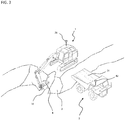
- FIGS. 3 and 4 are external views depicting an example of motion of the hydraulic excavator 1 during a loading work.
- the hydraulic excavator 1 of FIG. 3 is performing an "excavating motion" of excavating the object to be worked (the object to be excavated) 3 and loading the object to be worked 4 into the bucket 15, and the hydraulic excavator 1 of FIG. 4 is performing a "loading operation" of releasing the object to be worked 4 in the bucket 15 onto the cargo bed 36 of the dump truck 2.
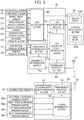
- FIG. 5 is a system configuration diagram of a load measuring system in the present embodiment, in which respective functions are depicted in block diagrams in the inside of the controller 40 and the controller 21.
- the controller 40 on the dump truck 2 side receives inputs of signals from the suspension pressure sensors 39a, 39b, 39c and 39d and the machine speed sensor 43, and is configured such that information (for example, loading determination and loading work determination which will be described later) computed based on these signals can be transmitted to the controller 21 on the excavator side through the wireless transceiver 42.
- the controller 40 functions as: a loading determination section 52 that determines whether or not the loading of the object to be worked onto the dump truck 2 (throwing of the object to be worked onto the cargo bed 36) by the hydraulic excavator 1 has been conducted based on the weight of the object to be worked calculated from detection values outputted from the suspension pressure sensors 39a, 39b, 39c and 39d; a loading work determination section 57 that determines whether or not the dump truck 2 is under the loading work of loading the object to be worked by the hydraulic excavator 1 based on the speed of the dump truck 2 calculated by a detection value outputted by the machine speed sensor 43; and a transmission/reception section 53 that controls transmission/reception of information (for example, results of determination by the loading determination section 52 and the loading work determination section 57) through the wireless transceiver 42.
- a loading determination section 52 that determines whether or not the loading of the object to be worked onto the dump truck 2 (throwing of the object to be worked onto the cargo bed 36) by the hydraulic excavator 1 has been
- the controller 21 on the hydraulic excavator 1 side is configured to be able to receive, as inputs, outputs of the angle sensors 24 to 28 and the pressure sensors 29 to 32, reception signals of the wireless transceiver 33, and information inputted from the input device 23B, to calculate information (for example, the loading amount onto the hauling machine 2) computed based on the inputs, display the information on the display device 23A, or to transmit the information to the controller 40 on the dump truck side through the wireless transceiver 33.
- the controller 21 functions as: a conveyance determination section 51 that determines whether or not the loading of the object to be worked onto the dump truck 2 by the hydraulic excavator 1 has been conducted based on a detection value at the bucket angle sensor 26 indicating the posture of the front work implement 12 and detection values at the arm bottom pressure sensor 31 and the arm rod pressure sensor 32 indicating a load on the arm cylinder 17; a load calculation section 50 that calculates the load (first load) of the object to be worked in the bucket 15 concerning the loading of the object to be worked onto the dump truck 2 by the hydraulic excavator 1 based on a thrust force of the boom cylinder 16 calculated from detection values at the boom bottom pressure sensor 29 and the boom rod pressure sensor 30; a transmission/reception section 54 that controls transmission and reception of information (for example, results of determination by the loading determination section 52 and the loading work determination section 57) through the wireless transceiver 33; an abnormality determination section 58 that determines presence or absence of an abnormality in a load measuring system based on results of determination by the conveyanc
- FIG. 6 is a flow chart depicting a method (sixth determination) of determining whether or not the dump truck 2 is under a loading work by the loading work determination section 57 in the controller 40 on the dump truck 2 side
- FIG. 7 is an example of graph depicting the relation between a detection value at the machine speed sensor 43 and the result of determination by the loading work determination section 57.
- the flow chart of FIG. 6 is executed every predetermined sampling period in the controller 40 on the dump truck 2.
- the loading work determination section 57 first determines whether or not a fixed time ⁇ tv has passed from the time of start of the flow chart, in step S100. When it is determined that the fixed time ⁇ tv has not passed, the control returns to before execution of step S100, and continues monitoring time passage in step S100. On the other hand, when it is determined that the fixed time ⁇ tv has passed, the control proceeds to step S101.
- step S101 it is determined whether or not the loading work determination is in non-loading work.
- the loading work determination includes "in loading work” that indicates that the dump truck 2 is under a loading work together with the hydraulic excavator 1, and "in non-loading work” that indicates that the dump truck 2 is not under a loading work (for example, it is in traveling).
- the loading work determination is set in steps S103 and S105 described later.
- a default value (a value at the time of start of the flow of FIG. 6 ) for the loading work determination is in non-loading work.
- the control goes to step S102.
- the control goes to step S104.
- step S102 it is determined whether or not the machine speed (traveling speed) of the dump truck 2 is equal to or less than a predetermined value, based on an output from the machine speed sensor 43.
- the predetermined value here is a value by which it can be determined whether or not the dump truck 2 is at stoppage, and can be set at, for example, 1 km/h.
- the loading work determination is set in step S103 to be in loading work, after which the control goes to step S106.
- the processing in step S103 is skipped, and the control goes to step S106. As depicted in FIG.
- the dump truck 2 in a case where the machine speed is lowered to or below the predetermined value during when the loading work determination is set to be "in non-loading work," the dump truck 2 is deemed as being at stoppage for a loading work, and the loading work determination is changed to "in loading work.”
- step S104 it is determined whether or not the machine speed of the dump truck 2 is equal to or more than a predetermined value, based on an output from the machine speed sensor 43.
- the predetermined value here is the same as the predetermined value in step S102, and is a value by which it can be determined whether or not the dump truck 2 is at stoppage.
- the loading work determination is set to be in non-loading work in step S105, after which the control goes to step S106.
- the processing in step S105 is skipped, and the control goes to step S106. As depicted in FIG.
- the loading work determination section 57 outputs the result of the loading work determination of the dump truck 2 (whether the dump truck 2 is in loading work or in non-loading work) to the transmission/reception section 53 in step S106, and the transmission/reception section 53 transmits it to the hydraulic excavator 1 through the wireless transceiver 42.
- the control returned to before step S100, and the loading work determination section 57 monitors whether a predetermined time has passed from the time of finish of step S106, in step S100.
- a flow chart may be configured such that the control goes to step S103 or step S105 and the loading work determination is changed only when a machine speed satisfying a condition has continued for a predetermined time in step S102 or step S104.
- FIG. 8 is a flow chart depicting a method (second determination) of determining whether or not the loading of the object to be worked onto the dump truck 2 by the hydraulic excavator 1, by the loading determination section 52 in the controller 40 on the dump truck 2 side.
- FIG. 9 is a graph depicting an example of time variation of a detection value at the suspension pressure sensor 39a of the dump truck 2 under a loading work.
- Each step in FIG. 8 is executed every predetermined sampling period in the controller 40 of the dump truck 2.
- the loading determination section 52 first determines, in step S110, whether or not a fixed time ⁇ tp has passed from the time of start of the flow chart; when it is determined that the fixed time ⁇ tp has not passed, the control goes to before execution of step S110, and monitoring of passed time is continued in step S110. On the other hand, when it is determined that the fixed time ⁇ tp has passed, the control proceeds to step S111.
- step S111 pressure values outputted from the four suspension pressure sensors 39a to 39d are acquired.
- step S112 differences ⁇ P between the pressure values obtained in step S111 by the suspension pressure sensors 39a to 39d and preceding-time pressure values are computed, and it is determined whether or not any one of the four differences is equal to or more than a predetermined value.
- the "preceding-time pressures" here means the pressure values acquired in step S111 before one control period (before ⁇ tp) and stored in step S115.
- the predetermined value here is a value by which it can be determined whether or not the object to be worked has been thrown onto the cargo bed 36 of the dump truck 2, and can be set to, for example, a pressure value increased by the weight of the object to be worked equal to one half of the bucket capacity.
- step S112 when any one of the four differences ⁇ Pa to ⁇ Pd is equal to or more than the predetermined value, it is determined that the object to be worked has been thrown onto the cargo bed 36, and the control proceeds to step S113. If not so, the control proceeds to step S115.
- step S113 the loading determination section 52 calculates the weight (loaded amount) M (second load) of the object to be worked that is thrown in.
- inside diameters of the suspensions 38a to 38d be Aa to Ad and let the gravitational acceleration be g, then the weight M (second load) of the object to be worked is represented by the following formula (1).
- M Aa ⁇ ⁇ Pa + Ab ⁇ ⁇ Pb + Ac ⁇ ⁇ Pc + Ad ⁇ ⁇ Pd / g
- the loading determination section 52 determines (loading determination) that the loading of the object to be worked onto the dump truck 2 by the hydraulic excavator 1 has been conducted, in step S114, while the transmission/reception section 53 transmits the determination result (loading determination) and the loaded amount M to the controller 21 on the hydraulic excavator 1 side through the wireless transceiver 42, and the control proceeds to step S115.
- step S115 the loading determination section 52 stores the suspension pressures acquired in step S111 this time as the preceding-time suspension pressures for calculation in step S112 next time, and the transmission/reception section 53 transmits the suspension pressures to the controller 21 on the hydraulic excavator 1 side through the wireless transceiver 42. Thereafter, the control returns to before step S110, and the loading determination section 52 stands by until the fixed time ⁇ tp passes again.
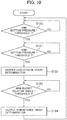
- FIG. 10 is a flow chart depicting a method (first determination) of determining whether or not the loading of the object to be worked onto the dump truck 2 by the hydraulic excavator 1 has been conducted, by the conveyance determination section 51 in the controller 21 on the hydraulic excavator 1 side.
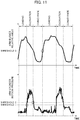
- FIG. 11 is an example of graph depicting the relation between a detection value at the arm bottom pressure sensor 31 (arm cylinder bottom pressure) and a detection value at the bucket angle sensor 26 (arm-bucket relative angle) and the result of determination by the conveyance determination section 51.
- the flow chart of FIG. 10 is executed every predetermined sampling period in the controller 21 of the hydraulic excavator 1.
- the conveyance determination section 51 monitors an output of the arm bottom pressure sensor 31, and determines whether or not the output has exceeded a preset threshold 1 from the state of being below the threshold 1, in step S120. Since the hydraulic excavator 1 performs excavation by pushing out the arm cylinder 17, the arm cylinder bottom pressure increases during an excavating motion, as depicted in the graph on the lower side in FIG. 11 . In the present embodiment, therefore, the excavating motion is deemed as being started at the timing when the arm bottom pressure exceeds the threshold 1. When it is determined in step S120 that the arm bottom pressure has exceeded the threshold 1 from the state of being below the threshold 1, the conveyance determination section 51 determines that the hydraulic excavator 1 has started an excavating motion, and the control proceeds to step S121. In contrast, when the arm bottom pressure does not exceed the threshold 1 from the state of being below the threshold 1 (when it remains equal to or less than the threshold 1), the control returns to before step S120, and monitoring of the output of the arm bottom pressure sensor 31 is continued.
- step S121 continued monitoring of the output of the arm bottom pressure sensor 31 is conducted, and it is determined whether or not the output has decreased below a preset threshold 2 from the state of being above the threshold 2. Since the arm cylinder bottom pressure decreases when an excavating motion is finished as depicted in the graph on the lower side in FIG. 11 , in the present embodiment the excavating motion is deemed as finished and the conveying motion is deemed as started, at the timing when the arm bottom pressure decreases below the threshold 2.
- the conveyance determination section 51 determines that the hydraulic excavator 1 has finished the excavating motion and that the conveying motion is started (fourth determination (No.
- step S122 the conveyance determination section 51 determines that the excavating motion is being continued, and the control returns to before step S121, to continue monitoring the output of the arm bottom pressure sensor 31.
- the relation between the threshold 1 and the threshold 2 is established in the example depicted in FIG. 11 , but this is merely an example.
- Arbitrary threshold values can be set in such a range that the start and finish of an excavating motion of the hydraulic excavator 1 can be determined.
- the relation in magnitude between the threshold 1 and the threshold 2 does not matter.
- step S122 the conveyance determination section 51 outputs to the exterior a determination that a conveying motion has been started, and the control proceeds to step S123.
- the destinations to which this determination is outputted include the load integration propriety determination section 55.
- step S123 the conveyance determination section 51 monitors an output of the bucket angle sensor 26, and determines whether or not an arm-bucket relative angle (the angle formed between the arm 14 and the bucket 15) has exceeded a preset threshold 3.
- the hydraulic excavator 1 having finished the conveying motion and starting the loading operation operates such as to widen the angle formed between the arm 14 and the bucket 15 in order to release the earth and sand (the object to be excavated) in the bucket 15. Specifically, as depicted in the graph on the upper side in FIG. 11 , the relative angle between the arm 14 and the bucket 15 increases at the time of transition from the conveying motion to the loading operation.
- the conveying motion is deemed as finished and the loading operation is deemed as started at the timing when the relative angle between the arm 14 and the bucket 15 exceeds the threshold 3.
- the conveyance determination section 51 determines that the hydraulic excavator 1 has finished the conveying motion and has started the loading operation (fourth determination (No. 2)), and the control proceeds to step S124.
- the conveyance determination section 51 determines that the conveying motion is being continued, and the control returns to before step S123, to continue monitoring the output of the bucket angle sensor 26.
- step S124 the conveyance determination section 51 outputs to the exterior a determination that the conveying motion has been finished (a determination that the loading operation has been started), and the control returns to step S120.
- the destinations to which this determination is outputted include the load integration propriety determination section 55 and the abnormality determination section 58.
- FIG. 12 is a flow chart depicting a method (fifth determination) of determining presence or absence of an abnormality in the load measuring system according to the present embodiment, by the abnormality determination section 58 in the controller 21 on the hydraulic excavator 1 side.
- the flow chart of FIG. 12 is executed every predetermined sampling period in the controller 21 of the hydraulic excavator 1.
- step S130 the abnormality determination section 58 determines whether or not the loading work determination (the result of the loading work determination transmitted in step S106 of FIG. 6 ) received from the dump truck 2 is set to the loading work.
- the control proceeds to step S133, whereas when the loading work determination is set to "non-loading work,” the control proceeds to step S131.
- the abnormality determination section 58 determines whether or not a predetermined time ⁇ tw has passed from the time of start of the flow chart, and checks if a state of no reception of the result of the loading work determination is being continued.
- the predetermined time ⁇ tw here is a time of equal to or more than the execution period of the flow chart of FIG. 6 by the loading work determination section 57, that is, a time of equal to or more than the fixed time ⁇ tv in step S100 of FIG. 6 .
- the value of ⁇ tw is preferably a value in the range from ⁇ tv to two times ⁇ tv.
- the controller 40 of the dump truck 2 transmits the result of the loading work determination at the fixed period ⁇ tv, as depicted in FIG.
- step S131 If reception of the result of the loading work determination is absent even when the fixed period ⁇ tv has passed, therefore, communication with the controller 40 of the dump truck 2 may not be being performed.
- step S131 the control returns to before step S130, and the presence or absence of reception of the loading work determination is again monitored in step S130.
- step S132 the control proceeds to step S132.
- step S132 it is determined whether or not it has been determined in the conveyance determination section 51 that the hydraulic excavator 1 has finished the conveying motion.
- the control returns to before step S130, and whether there is reception of the result of the loading work determination is again monitored in step S130.
- the control proceeds to step S137, where it is determined that an abnormality is present in the system and an abnormality determination is outputted.
- step S132 in a case where the result of loading work determination could not been received for the predetermined period ⁇ tw in step S131 and where it is determined in step S132 that the hydraulic excavator 1 has finished conveyance, it can be decided that the hydraulic excavator 1 is conducting loading onto the dump truck 2 but communication is not established between them. In other words, when determination at step S132 is YES, it can be decided that an abnormality in communication relation is present. Note that start of a loading operation may be determined in step S132 in place of finish of the conveying motion.
- step S133 whether or not there is an abnormality in the output values of the suspension pressure sensors 39a to 39d transmitted from the controller 40 of the dump truck 2 in step S115 of FIG. 8 is determined in step S133 (fifth determination). Specifically, from the output values of the suspension pressure sensors 39a to 39d indicative of the weight of the object to be worked loaded on the dump truck 2, an average value of the pressure values of the four suspensions is computed, then differences of the four pressure values from the average value are computed, and, if all the four differences are within a predetermined value, it is deemed that no abnormality is present in the suspension pressure sensors 39a to 39d, and the control proceeds to step S134.
- any one of the four differences is equal to or more than a predetermined value, it is determined that an abnormality is present in the system.
- the pressure value is not outputted normally, and the difference between the output value of the troubled sensor and that of the non-troubled sensor is enlarged. Therefore, in a case where determination at step S133 is NO, it can be decided that one or some of the pressure sensors 39a to 39d may be troubled.
- step S134 the abnormality determination section 58 determines whether or not a determination that the loading of the object to be worked onto the dump truck 2 by the hydraulic excavator 1 has been conducted (the loading determination transmitted in step S114 of FIG. 8 ) has been received from the controller 40 of the dump truck 2.
- the control proceeds to step S135, and, if not so, the control returns to before step S130, to again monitor whether or not the loading determination has been received.
- step S135 a load value (first load) of the object to be worked in the bucket 15 outputted from the load calculation section 50 in step S146 of FIG. 14 to be described later and a loaded amount M (second load) outputted from the loading determination section 52 in step S114 of FIG. 8 are compared with each other, and it is determined whether or not the difference (weight difference) between them is within a predetermined value.
- the weight difference is within the predetermined value, it is determined in step S136 that the system is normal.
- step S137 determines the predetermined value.
- decision at step S135 is NO, it can be decided that a trouble may have been generated in either of the load calculation section 50 of the hydraulic excavator 1 and the loading determination section 52 of the dump truck 2.
- the determination result of the system abnormality based on the flow chart of FIG. 12 is stored inside the controller 21 on the hydraulic excavator 1 side, and is referred to, as required, by the controller 21 itself or other devices or computers. Even in a case where abnormality determination is once made in step S137, if the control proceeds to step S136 due to a change-over of the dump truck 2 or the like, a determination result that the system is normal is stored.
- FIG. 13 is an illustration of a calculating method for an instantaneous load Ml of the object to be worked in the bucket 15 by the load calculation section 50 in the controller 21 on the hydraulic excavator 1 side.
- the load is computed by utilizing the balance between a torque acting around a rotational axis of the boom 13 which torque is generated by the boom cylinder 16, a torque generated by the front work implement 12 due to gravity and a swing centrifugal force, and a torque generated by the object to be worked due to gravity and a swing centrifugal force.
- a thrust force Fcyl of the boom cylinder 16 is computed by multiplying an output signal of the boom bottom pressure sensor 29 and an output signal of the boom rod pressure sensor 30 by a pressure receiving area of the boom cylinder 16, and then obtaining the difference between the products.
- a torque Tbm generated by the boom cylinder 16 is computed from the following formula (2), where Lbm is the length of a line segment interconnecting a boom rotational axis and a working point of the thrust force Fcyl of the boom cylinder 16, and ⁇ bmcyl is an angle formed between the thrust force Fcyl of the boom cylinder 16 and the line segment Lbm and the direction of the thrust force.
- Tbm Fcyl ⁇ Lbm ⁇ sin ⁇ bmcyl
- a torque Tgfr generated by the front work implement 12 due to gravity is computed by the following formula (3), where Mfr is the center-of-gravity weight of the front work implement 12, g is the gravitational acceleration, and Lfr is the length in the front-rear direction from the rotational axis of the boom to the center of gravity of the front work implement.
- Tgfr Mfr ⁇ g ⁇ Lfr
- a torque Tcfr generated by the front work implement 12 due to a swing centrifugal force is computed by the following formula (4), where ⁇ is the swing angular velocity, and ⁇ fr is the angle formed between a line segment interconnecting the boom rotational axis and the center of gravity of the front work implement and a horizontal plane.
- Tcfr Mfr ⁇ Lfr ⁇ ⁇ 2 ⁇ sin ⁇ fr
- Mfr, Lfr, and ⁇ fr are computed from the respective center-of-gravity positions and weights of the boom 13, the arm 14 and the bucket 15 that are preset and the angle signals outputted from the boom angle sensor 24, the arm angle sensor 25, the bucket angle sensor 26 and the inclination angle sensor 28.
- a torque Tgl generated by the object to be worked due to gravity is computed by the following formula (5), where Ml is the instantaneous load of the object to be worked, and Ll is the length in the front-rear direction from the rotational axis of the boom to the center of gravity of the bucket.
- Tgl Ml ⁇ g ⁇ Ll
- a torque Tcl generated by the object to be worked due to the swing centrifugal force is computed by the following formula (6), where ⁇ l is the angle formed between a line segment interconnecting the rotational axis of the boom and the center of gravity of the object to be worked and a horizontal plane.
- Tcl Ml ⁇ Ll ⁇ ⁇ 2 ⁇ sin ⁇ l
- the instantaneous load Ml is computed by the following formula (7) .
- Ml Tbm ⁇ Tgfr ⁇ Tcfr / Ll ⁇ g + ⁇ 2 ⁇ sin ⁇ l
- the calculations of the load by the formulas (2) to (8) cannot always output a fixed value during conveyance due to the sensor noises and the characteristics of the hydraulic circuit; therefore, the instantaneous load Ml computed in a predetermined period during when the hydraulic excavator 1 is in a conveying motion is averaged, and the load (first load) of the object to be worked is determined.
- FIG. 14 is a flow chart of processing steps performed by the load calculation section 50, the load integration propriety determination section 55 and the load integration section 56 in the controller 21 on the hydraulic excavator 1 side.
- the load calculation section 50 determines the load (first load) of the object to be worked in the bucket during conveyance
- the load integration propriety determination section 55 determines whether or not the load (first load) is to be integrated (third determination)
- the load integration section 56 integrates the load and thereby outputs the loaded weight.
- the flow chart of FIG. 14 is executed every predetermined sampling period in the controller 21 on the hydraulic excavator 1 side.
- step S140 the load integration section 56 determines whether or not the setting of loading work determination outputted at a fixed period ⁇ tv from the dump truck 2 in step S106 of FIG. 6 has been changed over.
- the control proceeds to step S142, whereas when it is determined that the loading work determination has been changed over, the control proceeds to step S141 to reset the loaded weight on the dump truck 2, and the control proceeds to step S142.
- the loaded weight is reset at with the timing when in loading work and in non-loading work are changed over, whereby it is possible to integrate the load of the object to be worked only in the period in which the dump truck 2 is under a loading work.
- step S142 the load calculation section 50 monitors whether or not a conveying motion start determination has been outputted from the conveyance determination section 51.
- the control proceeds to step S143, and if not so, the control returns to before step S140, to monitor the output of the loading work determination section 57 (setting of the loading work determination).
- step S143 the load calculation section 50 performs calculations concerning the formulas (2) to (8) to calculate the instantaneous load Ml of the object to be worked, the instantaneous load Ml is recorded in the controller 21 in step S144, and the control proceeds to step S145.
- step S145 the load calculation section 50 determines whether or not a predetermined time has passed from the time of output of the conveying motion start determination (the time when determination of YES is made in step S142). When it is determined here that the predetermined time has not passed, the control returns to before step S143, and step S143 and step S144 are again executed. By repeating step S143 and step S144 in the predetermined time, a plurality of instantaneous loads Ml calculated in the predetermined time can be recorded. On the other hand, when it is determined that the predetermined time has passed, the control proceeds to step S146.
- step S146 the load calculation section 50 calculates an average load of the plurality of instantaneous loads Ml recorded within the predetermined time, the average load is made to be a load value (first load) of the object to be worked, and the control proceeds to step S147.
- step S147 the load integration propriety determination section 55 monitors whether or not a conveying motion finish determination has been outputted from the conveyance determination section 51. When it is determined that the conveying motion finish determination has not been outputted, the control returns to before step S147, to continue monitoring the conveying motion finish determination. On the other hand, when it is determined that the conveying motion finish determination has been outputted, a loading operation by the hydraulic excavator 1 is deemed as started, and the control proceeds to step S148. Note that in step S147, a loading operation start determination may be monitored in place of the conveying motion finish determination.
- step S148 the load integration propriety determination section 55 determines whether or not the abnormality determination section 58 has made an abnormality determination. Specifically, determination is made by referring to the result of abnormality determination stored in the inside of the controller 21.
- the control proceeds to step S149, whereas when the abnormality determination has been made (that is, when the abnormality determination is stored), the control proceeds to step S151.
- step S149 the load integration propriety determination section 55 determines whether or not a determination that the loading of the object to be worked onto the dump truck 2 by the hydraulic excavator 1 has been conducted (a loading determination transmitted in step S114 of FIG. 8 ) has been received from the controller 40 of the dump truck 2.
- the load integration section 56 integrates the average load computed in step S145 onto the loaded weight (integrated weight) in step S154, and the control proceeds to step S155.
- the control proceeds to step S150.
- step S150 the load integration propriety determination section 55 determines whether or not a predetermined time ⁇ T has passed from the time of conveying motion finish determination in step S147.
- the predetermined time ⁇ T there can be set an arbitrary time within a range from (1) a time required for the hydraulic excavator 1 to perform a loading operation to (2) a time required for the hydraulic excavator 1 to perform a series of operations including excavation, conveyance, loading and reaching at the time of a loading work.
- the predetermined time ⁇ T may be inputted and determined by the operator through the input device 23B according to the tendency of the required time of each operator concerning the loading work.
- step S150 When it is determined in step S150 that the predetermined time ⁇ T has not passed, the control returns to before step S148, to again monitor the abnormality determination and the loading determination.
- step S150 when it is determined that the predetermined time ⁇ T has passed, it is deemed that the hydraulic excavator 1 has completed a conveying motion (has started a loading operation) but the loading of the object to be worked onto the cargo bed 36 of the dump truck 2 has not been performed, and the control proceeds to step S155 by skipping step S154 (that is, without integration of the average load in step S145).
- step S150 A specific example of a case where the control proceeds from step S150 to step S155 is a situation in which the hydraulic excavator 1 puts the bucket 15 into a dump operation, but, since the cargo bed 36 of the dump truck 2 is not located thereunder, the loading of the object to be worked onto the dump truck 2 is failed.
- the load integration propriety determination section 55 instructs outputting, to the display device 23A, of a warning display of notifying the operator that automatic load integration is impossible due to system abnormality, and an inquiry display of inquiring the operator if integration is needed, in step S151, whereby the warning display and the inquiry display are displayed on the display device 23A (for the inquiry display, refer to an inquiry display section 81 of FIG. 15 to be described later).
- the operator desires to perform integration, in response to the warning display and the inquiry display, an instruction of need for integration is inputted through the input device 23B.
- step S152 the load integration propriety determination section 55 determines whether or not the instruction of need for integration (this may herein be referred to as "integration instruction") has been inputted by the operator through the input device 23B.
- integration instruction the instruction of need for integration
- the load integration section 56 integrates (step S154) the average load computed in step S145 onto the previous loaded weight (integrated load), and the control proceeds to step S155.
- step S153 the control proceeds to step S153, to determine whether or not a predetermined time has passed from the warning output in step S151.
- step S153 When it is determined in step S153 that the predetermined time has not passed, the control returns to before step S152, to again monitor the presence or absence of an input of the integration instruction. On the other hand, when it is determined that the predetermined time has passed, the control proceeds to step S155 by skipping step S154.
- step S155 the load calculation section 50 resets the average load calculated in step S146, and the control returns to before step S140.
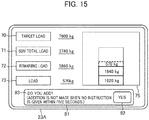
- FIG. 15 is an external view of a display screen (output screen) of the display device 23A.
- a displaying method for load measurement results in the load measuring system according to the present embodiment and a method of instructing execution of integration in a case where an abnormality is present in the system will be described.
- the display device 23A is configured by a touch panel.
- the display screen of the display device 23A includes: a target load display section 70 where to display a target loaded weight (target load value) on the dump truck 2; an in-bucket load display section 72 where to display the load value (average load value of the instantaneous load Ml) of the object to be worked in the bucket 15 that is calculated in step S146 of FIG.
- a sum total load display section 71 where to display the integrated value of load value of the object to be worked in the bucket 15 that is calculated in step S154 (integrated load on the dump truck 2); a remainder load display section 72 where to display the difference between the value (target loaded weight) displayed in the target load display section 70 and the value (integrated value of load value) displayed in the sum total load display section 71; an integration bar display section 75 where to display the history of the load value of the object to be worked that is integrated in numerical values and a pile-up vertical bar graph (integration bar); and an inquiry display section 81 where to display an inquiry display (a display of inquiring of the operator whether integration is needed) in step S151.
- the value in the in-bucket load display section 72 is updated to a newest value calculated in step S146 of FIG. 14 , and is updated to 0 when reset in step S155.
- the value in the sum total load display section 71 and the display in the integration bar display section 75 are updated to a newest value when step S154 is executed, and are updated to 0 when reset in step S141.
- An inquiry display 83 of inquiring of the operator whether or not loading is needed in step S151 when a system abnormality is detected is displayed in the inquiry display section 81.
- An integration instruction input section 82 as a button to be depressed in the case where the operator desires integration is displayed in the inquiry display section 81 together with the inquiry display 83.
- the load integration propriety determination section 55 determines that an integration instruction has been inputted in step S152.
- the integration instruction input section 82 is not depressed, the integration in step S154 is not executed. Note that in the example of FIG. 15 , a configuration is adopted in which a remaining time (5 seconds in FIG.
- step S151 from the timing of outputting of the warning display in step S151 until the predetermined time has passed in step S153 is displayed in the inquiry display section 81 together with the inquiry display 83, and, when the remaining time is reduced to zero (that is, when the predetermined time in step S153 has been passed), the display in the inquiry display section 81 disappears.
- the loading work determination section 57 in the controller 40 changes the loading work determination from in non-loading work to in loading work ( FIG. 6 : steps S102 and S103), and transmits this result to the controller 21 of the hydraulic excavator 1 ( FIG. 6 : step S106).
- the controller 21 of the hydraulic excavator 1 having received the loading work determination result recognizes the change-over of the loading work determination result and resets the loaded weight ( FIG. 14 : steps S140 and S141), and starts monitoring whether or not the hydraulic excavator 1 starts a conveying motion ( FIG. 14 : step S142).
- the bottom pressure of the arm cylinder 17 exceeds threshold 1 due to load attendant on excavation, thereafter, when the excavating motion is finished and the load is lightened, the bottom pressure of the arm cylinder 17 decreased below threshold 2.
- the conveyance determination section 51 of the controller 21 outputs a determination indicative of that the hydraulic excavator 1 has started the conveying motion ( FIG. 10 : step S122).
- the load integration section 56 in the controller 21 repeatedly calculates and records the instantaneous load Ml of the object to be worked in the bucket 15 in a predetermined time, and causes an average load value of the instantaneous loads Ml calculated in the predetermined time to be a load value of the object to be worked ( FIG. 14 : steps S143 to S146). In other words, the computation of the load value of the object to be worked is conducted during the conveying motion of the hydraulic excavator 1.
- the hydraulic excavator 1 having moved the bucket 15 to the upper side of the cargo bed of the dump truck 2 by the conveying motion starts a dumping operation of the bucket 15 for starting a loading operation.
- the arm-bucket relative angle exceeds threshold 3
- the conveyance determination section 51 in the controller 21 outputs a determination indicating that the hydraulic excavator 1 has finished the conveying motion ( FIG. 10 : step S124). That the conveying motion finish determination is outputted from the conveyance determination section 51 in this way indicates that the hydraulic excavator 1 has started the loading operation, and indicates the object to be worked is soon going to be thrown onto the cargo bed 36 of the dump truck 2 by the hydraulic excavator 1.
- the controller 21 of the hydraulic excavator 1 starts monitoring whether or not loading determination is inputted from the controller 40 of the dump truck 2, with the output of conveying motion finish determination from the conveyance determination section 51 as a trigger ( FIG. 14 : step S149).
- the dump truck 2 normally receives the loading of the object to be worked from the hydraulic excavator 1 by the loading operation of the hydraulic excavator 1, the pressures of the suspensions 38a to 38d of the dump truck 2 increase due to the load, and, as a result, the controller 40 transmits the loading determination to the controller 21 of the hydraulic excavator 1 ( FIG. 8 : step S114).
- the controller 21 Upon confirmation of the reception of the loading determination from the dump truck 2, the controller 21 computes the loaded weight on the dump truck 2 by integrating the average load value of the instantaneous loads Ml previously calculated.
- the loaded weight at the time of first-time loading is an average load value.
- the computation result of the loaded weight is displayed in the sum total load display section 71 of the display device 23A of the hydraulic excavator 1 ( FIG. 15 ).
- the same processing as above is repeated when the loading from the hydraulic excavator 1 onto the dump truck 2 is normally performed, and the load value of the object to be worked that is computed by the load calculation section 50 is integrated to the loaded weight.
- the loading determination is not transmitted from the controller 40 of the dump truck 2 even when the predetermined time ⁇ T is passed from the conveying motion finish determination from the conveyance determination section 51.
- the controller 21 of the hydraulic excavator 1 deems that the hydraulic excavator 1 has conducted the loading operation but the loading onto the dump truck 2 has been failed for some reason, cancels the integration of the load value of the object to be worked attendant on the this-time loading operation, resets the load value of the object to be worked calculated during the conveying motion, and waits for an output of the next conveying motion start determination.
- abnormality determination section 58 When the result of determination by the controller 21 (abnormality determination section 58) of the hydraulic excavator 1 is abnormality determination, there is a possibility of an abnormality of communication between the two controllers 21 and 40, an abnormality of the suspension pressure sensor 39 of the dump truck 2, or an abnormality of calculation of the load value. In this case, automatic integration of the load value of the object to be worked in the same manner as in the case of normality determination is impossible, and, therefore, a warning display and the inquiry display 83 are outputted to the display device 23A ( FIG. 14 : step S151). As a result, the operator of the hydraulic excavator 1 can be made to recognize that an abnormality has been generated in the system and automatic computation of an integrated value of the load value of the object to be worked is impossible.
- the integration instruction input section 82 is displayed on the display device 23A together with the inquiry display 83.
- the operator of the hydraulic excavator 1 inputs an integration instruction to the controller 21 through the integration instruction input section 82.
- the controller 21 computes the loaded weight on the dump truck 2 by integrating the average load value of the instantaneous load Ml previously calculated, in the same manner as in the case of normality determination. As a result, the loaded weight can be computed, even in the case where an abnormality in communication between the two controllers 21 and 40 or an abnormality in the suspension pressure sensor 39 of the dump truck 2 has occurred.
- the controller 40 (loading determination section 52) of the dump truck 2 and the controller 21 (conveyance determination section 51) of the hydraulic excavator 1 each determine whether or not the loading from the hydraulic excavator 1 onto the dump truck 2 has been conducted, the controller 21 (load integration propriety determination section 55) of the hydraulic excavator 1 determines the integration propriety of the load value of the object to be worked in the bucket, based on the results of determination by both of the controllers, and, based on the result of this determination, the controller 21 (load integration section 56) of the hydraulic excavator 1 integrates the load value.
- the controller 21 of the hydraulic excavator 1 deems that the hydraulic excavator 1 has conducted a loading operation but the loading onto the dump truck 2 has been failed for some reason, then cancels the integration of the load value of the object to be worked attendant on the loading operation, and waits for the next conveying motion of the hydraulic excavator 1 and the attendant load value calculation and loading operation. Therefore, even when the loading onto the dump truck 2 is failed, the load value integrating processing can be continued without inputting the failure into the controller 21 by the operator of the hydraulic excavator 1 or other person.
- the inquiry display 83 is displayed on the display device 23A, whereby integration of the load value is manually instructed only in the case of system abnormality, and, therefore, the operational burden on the operator concerning the integration of the load value can be mitigated at normal time.
- such a configuration makes it possible to continue integration of the load value even in the case where an abnormality has been generated.
- the present invention is not limited to the above-described embodiment, and includes various modifications made without departing from the scope of the gist thereof.
- the present invention is not limited to the configuration that includes all the components described in the above embodiment, and includes configurations in which part of the components is eliminated.
- part of the components according to an embodiment may be added to or replaced by components according to another embodiment.
- FIGS. 16 and 17 are illustrations of a system that performs a determining method for the loading work of the dump truck 2, different from that of the above-described embodiment.
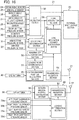
- FIG. 16 depicts a system configuration of the load measuring system
- FIG. 17 is an illustration of the determining method for the loading work of the dump truck 2 by the system of FIG. 16 .
- the dump truck 2 includes a GPS antenna 38, the controller 40 thereof is provided therein with a hauling machine position calculation section 66 that calculates an absolute position of the dump truck 2 based on an input signal from the GPS antenna 38, and the position of the hauling machine itself computed by the hauling machine position calculation section 66 is transmitted to the controller 21 of the hydraulic excavator 1.
- the hydraulic excavator 1 includes a GPS antenna 38, the controller 21 thereof is provided therein with a loading machine position calculation section 65 that calculates an absolute position of the hydraulic excavator 1 based on an input signal from the GPS antenna 38, and a loading work determination section 57 that determines a loading work status of the dump truck 2 based on the position information (relative distance) concerning the hydraulic excavator 1 and the dump truck 2 inputted from the loading machine position calculation section 65 and the hauling machine position calculation section 66.
- the loading work determination section 57 sets the loading work determination to in loading work.
- the loading work determination section 57 sets the loading work determination to in non-loading work.
- step S150 when determination in step S150 is YES, the control may proceed to step S151 in place of step S155.
- the processing steps subsequent to step S151 in this case is as depicted in FIG. 14 .
- step S150 it is considered that the loading onto the dump truck 2 has been failed.
- a warning display and an inquiry display are made on the display device 23A, thereby prompting the operator to input an integration instruction after again performing loading by the hydraulic excavator 1.
- Such a configuration ensures that the operator can be made to recognize that the integration is being interrupted due to failure in loading, and a state in which automatic integration is possible before failure in loading can be restored with the integration instruction as a trigger.
- step S151 of FIG. 14 upon abnormality determination the warning display and the inquiry display 83 are performed on the display device 23A independently of the cause of the abnormality determination, as described in the present embodiment; however, when abnormality is present in load computation by the controller 21 or the controller 40 (specifically, when determination in step S135 of FIG. 12 is NO), an error may exist in the load value of the object to be worked. Therefore, the system may be configured such as not to perform the inquiry display 83 but to perform only the abnormality display in this case, thereby preventing an erroneous load value from being integrated due to an operator's integration instruction.
- abnormality determination section 58 is provided in the controller 21 on the hydraulic excavator 1 side in the above-described embodiment, this may be omitted. In the case where the abnormality determination section 58 is omitted, it is sufficient to configure the control system such as to proceed to step S149 when determination in step S148 in the flow chart of FIG. 14 is YES, and to return to step S149 when determination in step S150 is NO.
- the configuration of the load measuring system of the present invention is not limited to the one depicted in FIG. 5 .
- the loading determination section 52 may not necessarily be mounted in the controller 40 of the dump truck 2, and the controller 40 may be configured such that signals from the suspension pressure sensors 39a to 39d are inputted to the transmission/reception section 53, and may be transmitted from the wireless transceiver 42 directly to the hydraulic excavator 1, whereby the processing corresponding to the calculation processing performed by the loading determination section 52 is executed by the controller 21 of the hydraulic excavator 1.
- the calculation of the instantaneous load Ml is not limited to the model depicted in FIG. 13 , but may be conducted using different formulas than those described above.
- the instantaneous load may be calculated using an equation of motion of the front work implement 12 including the boom 13, the arm 14 and the bucket 15.
- the computing method for the load value of the object to be worked is not limited to the technique depicted in FIG. 14 .
- the period for averaging the load may be determined using the magnitude of the swing angular velocity and the position of the bucket 15.
- the loading determination concerning the dump truck 2 is not limited to the contents depicted in FIGS. 8 and 9 .
- a configuration may be adopted in which an acceleration sensor is attached to the vessel 36 or the machine body, a variation in the acceleration in the vertical direction generated due to throwing of the object to be worked into the vessel 36 is detected by the acceleration sensor, and the loading determination is outputted.
- the contents of display on the display device 23A are not limited to those depicted in FIG. 15 .
- the proportion of the integrated load based on the dump truck capacity may be displayed in percent, and a part where to display a history of loaded amounts (loaded weights) in the past in an aligned manner may be provided on the display screen.
- Components of the controller 40 and the controller 21 as well as the functions of and processing steps executed by the components, etc. may be partly or entirely realized by hardware (for example, designing the logics for executing the functions in the form of integrated circuit).
- the components concerning the controllers 40 and 21 may be provided in the form of programs (software) to be read and executed by a calculation processing device (e.g., CPU) for implementing the functions concerning the components of the controllers 40 and 21.
- Information concerning the programs can be stored in, for example, semiconductor memory (flash memory, SSD, etc.), magnetic recording device (hard disk drive, etc.) and recording medium (magnetic disk, optical disk, etc.).
Landscapes
- Engineering & Computer Science (AREA)
- Mining & Mineral Resources (AREA)
- Civil Engineering (AREA)
- General Engineering & Computer Science (AREA)
- Structural Engineering (AREA)
- Physics & Mathematics (AREA)
- General Physics & Mathematics (AREA)
- Mechanical Engineering (AREA)
- Operation Control Of Excavators (AREA)
- Component Parts Of Construction Machinery (AREA)
Abstract
Description
- The present invention relates to a hydraulic excavator that calculates the loaded weight of an object to be worked that has been loaded onto a hauling machine.
- In general, a work machine represented by a hydraulic excavator may perform an operation of loading an excavated matter (this may herein be referred to as "object to be worked") onto a hauling machine such as a dump truck (loading work), in the case of, for example, excavation of a mineral and loading of the mineral onto the dump truck at a mine.
- At the time of such an operation, if the loading amount onto the hauling machine (the total weight of the object to be worked on the hauling machine) can be set to a suitable amount, a lowering in production amount due to insufficient loading or wastefulness of reloading due to overloading can be reduced, and production efficiency in the site can be enhanced.
- A general method for setting the loading amount onto the hauling machine to a suitable amount may include measuring the load of the excavated matter during when the hydraulic excavator (loading machine) is conveying the excavated matter, integrating the load measured during a loading work onto the hauling machine to calculate the loading amount onto the hauling machine, and presenting the loading amount to the operator of the hydraulic excavator. With the loading amount onto the hauling machine thus presented, the operator of the hydraulic excavator can regulate the excavation amount at the next time and thereafter, and, therefore, the loading amount onto the hauling machine can be set to a suitable amount. In addition, with the loading amount onto the hauling machine and the load of the excavated matter under conveyance presented, the operator of the hydraulic excavator can judge whether or not the loading of the excavated matter being conveyed results in overloading, and, therefore, overloading can be prevented.
- As a device for measuring the loading amount onto the hauling machine,
JP-3787046-B2 - Patent Document 1:
JP-3787046-B2 - In the work amount monitoring device for the hydraulic excavator disclosed in
JP-3787046-B2 - It is an object of the present invention to provide a hydraulic excavator capable of correctly detecting the throwing of an object to be worked onto a hauling machine and capable of accurately outputting a loading amount onto the hauling machine.
- The present application includes a plurality of means for solving the above-mentioned problem. As an example of the means, there is provided a hydraulic excavator including a hydraulic cylinder driven by a hydraulic fluid delivered from a hydraulic pump, a work implement driven by the hydraulic cylinder, and a controller that calculates a loaded weight of an object to be worked loaded onto a hauling machine by the work implement. The controller performs a first determination of determining whether or not the loading of the object to be worked onto the hauling machine by the hydraulic excavator has been conducted based on posture of the work implement, calculates a first load that is a load of the object to be worked loaded onto the hauling machine by the hydraulic excavator based on a thrust force of the hydraulic cylinder and a determination result of the first determination, performs a third determination of determining whether or not the first load is to be integrated based on a determination result of a second determination of determining whether or not the loading of the object to be worked onto the hauling machine by the hydraulic excavator has been conducted that is transmitted from a hauling machine side controller possessed by the hauling machine and on the determination result of the first determination, and calculates the loaded weight on the hauling machine by integrating the first load in a case where it is determined by the third determination that the first load is to be integrated.
- According to the present invention, that loading of the object to be worked has been completed is determined based on information from both the hydraulic excavator and the hauling machine. Therefore, the throwing of the object to be worked from the hydraulic excavator onto the hauling machine is detected correctly, and the loading amount onto the hauling machine can be accurately computed.
-
-
FIG. 1 is a side view of a hydraulic excavator according to an embodiment of the present invention. -
FIG. 2 is a side view of a dump truck according to the embodiment of the present invention. -
FIG. 3 is an external view depicting an example of operation of ahydraulic excavator 1 during a loading work. -
FIG. 4 is an external view depicting an example of operation of thehydraulic excavator 1 during the loading work. -
FIG. 5 is a system configuration diagram of a load measuring system according to the embodiment of the present invention. -
FIG. 6 is a flow chart depicting a method of determining whether or not adump truck 2 is under a loading work, by acontroller 40 on thedump truck 2 side. -
FIG. 7 is an example of graph depicting the relation between a detected value at amachine speed sensor 43 and result of determination by a loadingwork determination section 57. -
FIG. 8 is a flow chart depicting a method of determining whether or not the loading of an object to be worked onto thedump truck 2 by thehydraulic excavator 1 has been conducted, by thecontroller 40 on thedump truck 2 side. -
FIG. 9 is a graph depicting an example of time variation of a detected value at asuspension pressure sensor 39a of thedump truck 2 under a loading work. -
FIG. 10 is a flow chart depicting a method of determining whether or not the loading of the object to be worked onto thedump truck 2 by thehydraulic excavator 1 has been conducted, by acontroller 21 on thehydraulic excavator 1 side. -
FIG. 11 is an example of graph depicting the relation between a detected value at an armbottom pressure sensor 31 and a detected value at abucket angle sensor 26 and result of detection by aconveyance determination section 51. -
FIG. 12 is a flow chart depicting a method of determining presence or absence of an abnormality in the load measuring system of the present embodiment, by thecontroller 21 on thehydraulic excavator 1 side. -
FIG. 13 is an illustration of a calculating method for instantaneous load Ml of the object to be worked in abucket 15, by thecontroller 21 on thehydraulic excavator 1 side. -
FIG. 14 is a flow chart of processing steps executed by aload calculation section 50, a load integrationpropriety determination section 55 and aload integration section 56 in thecontroller 21 on thehydraulic excavator 1 side. -
FIG. 15 is an external view of a display screen of adisplay device 23A. -
FIG. 16 is a system configuration diagram of a load measuring system according another embodiment of the present invention. -
FIG. 17 is an illustration of a determining method for a loading work onto thedump truck 2 by the system ofFIG. 16 . - An embodiment of the present invention will be described below, using the drawings. A case where a hydraulic excavator is utilized as a loading machine constituting a load measuring system for a work machine and a dump truck is utilized as a hauling machine will be described below.
- In addition, for convenience herein, a "loading work (conveying work)" onto the dump truck (hauling machine) by the hydraulic excavator (loading machine) is defined as an operation including four motions, that is, A) an "excavating motion" of excavating an object to be worked (matter to be conveyed) and loading the object to be worked into a bucket (see
FIG. 3 ), B) a "conveying motion" of moving the bucket to an upper side of a cargo bed of the dump truck by combination of a swing of an upper swing structure and a motion of a front work implement, C) a "loading operation" (seeFIG. 4 ) of releasing (soil dropping) the object to be worked in the bucket onto the cargo bed of the dump truck, and D) a "reaching motion" of moving the bucket to a desired position over the object to be worked for starting the excavating motion. In many cases, the hydraulic excavator performs these four motions repeatedly in this order, thereby filling the cargo bed of the dump truck with the object to be worked. The conveying motion of B) is in many cases performed by swing boom raising. The loading operation of C) is in many cases performed by bucket dumping. The loading machine to which the present invention pertains is not limited to a hydraulic excavator having a bucket as an attachment, but includes a hydraulic excavator having a member capable of holding and releasing a matter to be conveyed, such as a grapple and a lifting magnet. In addition, the present invention is applicable also to a wheel loader or the like including a work arm that cannot be swung like the hydraulic excavator. -
FIG. 1 is a side view of a hydraulic excavator according to the present embodiment, andFIG. 2 is a side view of a dump truck according to the present embodiment. - A
hydraulic excavator 1 ofFIG. 1 includes: alower track structure 10; anupper swing structure 11 to be swingable provided at an upper part of thelower track structure 10; a front work implement 12 that is an articulated work arm mounted on a front side of theupper swing structure 11; aswing motor 19 that is a hydraulic motor for swinging theupper swing structure 11; anoperation room 20 which is provided on theupper swing structure 11 and into which an operator ride to operate theexcavator 1; acontrol lever 22 provided in theoperation room 20 for controlling motions of actuators mounted on thehydraulic excavator 1; and acontroller 21 that includes a storage device (for example, ROM or RAM), a calculation processing device (for example, CPU) and an input/output device and that controls operations of thehydraulic excavator 1. - The
front work implement 12 includes: aboom 13 rotatably provided on theupper swing structure 11; anarm 14 rotatably provided at a tip of theboom 13; a bucket (attachment) 15 rotatably provided at a tip of thearm 14; aboom cylinder 16 as a hydraulic cylinder that drives theboom 13; anarm cylinder 17 as a hydraulic cylinder that drives thearm 14; and abucket cylinder 18 as a hydraulic cylinder that drives thebucket 15. Theboom cylinder 16, thearm cylinder 17 and thebucket cylinder 18 are individually driven by a hydraulic fluid delivered from a hydraulic pump (not illustrated) mounted on theupper swing structure 11. - A
boom angle sensor 24, anarm angle sensor 25 and abucket angle sensor 26 are attached respectively to rotary shafts of theboom 13, thearm 14 and thebucket 15. Respective rotational angles of theboom 13, thearm 14 and thebucket 15 can be acquired from theseangle sensors angular velocity sensor 27 and aninclination angle sensor 28 are attached to theupper swing structure 11, and they are configured such that swing angular velocity of theupper swing structure 11 and inclination angle in the front-rear direction of theupper swing structure 11 can be acquired. Posture of thefront work implement 12 can be specified from detection values at theangle sensors - A boom
bottom pressure sensor 29 and a boomrod pressure sensor 30, and an armbottom pressure sensor 31 and an armrod pressure sensor 32 are attached respectively to theboom cylinder 16 and thearm cylinder 17, such that the pressure inside each hydraulic cylinder can be acquired. Thrust forces of thecylinders front work implement 12 can be specified from detection values at thepressure sensors - Note that the
boom angle sensor 24, thearm angle sensor 25, thebucket angle sensor 26, theinclination angle sensor 28 and the swingangular velocity sensor 27 may be replaced by other sensors insofar as the other sensors can detect physical quantities concerning the posture of the front work implement 12. For instance, theboom angle sensor 24, thearm angle sensor 25 and thebucket angle sensor 26 can be each replaced by an inclination angle sensor or an inertia measuring unit (IMU). In addition, the boombottom pressure sensor 29, the boomrod pressure sensor 30, the armbottom pressure sensor 31 and the armrod pressure sensor 32 can be replaced by other sensors insofar as the other sensors can detect physical quantities concerning the thrust forces generated by theboom cylinder 16 and thearm cylinder 17, that is, the driving forces given to the front work implement 12. Further, instead of detecting the thrust forces or driving forces, moving speeds of theboom cylinder 16 and thearm cylinder 17 may be detected by stroke sensors, or moving speeds of theboom 13 and thearm 14 may be detected by IMUs, thereby detecting the motions of the front work implement 12. - An external input/
output device 23 that displays measurement results of a load measuring system is provided inside theoperation room 20, and a wireless transceiver 33 for thecontroller 21 to communicate with an external controller (for example, a controller 40) is attached to an upper surface of theupper swing structure 11. - As the external input/
output device 23, there are provided adisplay device 23A (seeFIG. 3 ) that displays results of calculation in thecontroller 21 and the like, and aninput device 23B (seeFIG. 3 ) for an operator to input information to thecontroller 21. As thedisplay device 23A, there can be utilized, for example, a liquid crystal display. As theinput device 23B, there can be utilized, for example, a ten-key pad, a touch panel, a keyboard or the like. - The
dump truck 2 ofFIG. 2 includes amachine body 34, fourtires machine body 34, avessel 36 as a cargo bed into which a matter to be loaded is thrown by thehydraulic excavator 1, and anoperation room 37 into which the operator rides to operate thedump truck 2. - Four
suspensions machine body 34 are attached to the axles. Thesuspensions suspension pressure sensors suspension pressure sensors dump truck 2. - The
controller 40 that includes a storage device (for example, ROM or RAM), a calculation processing device (for example, CPU) and an input/output device and that controls thedump truck 2, and awireless transceiver 42 for thecontroller 40 to communicate with an external controller (for example, the controller 21) are attached to themachine body 34. Adisplay device 41 for displaying machine body information on thedump truck 2 is provided inside theoperation room 37. As thedisplay device 41, there can be utilized, for example, a liquid crystal display. In addition, themachine body 34 is provided with a machine speed sensor (third machine body status sensor) 43 that measures the traveling speed of thedump truck 2. - Note that the
suspension pressure sensors dump truck 2 by thehydraulic excavator 1. In addition, themachine speed sensor 43 can be replaced by other sensor insofar as the other sensor can detect a physical quantity concerning the traveling status of thedump truck 2. -
FIGS. 3 and4 are external views depicting an example of motion of thehydraulic excavator 1 during a loading work. Thehydraulic excavator 1 ofFIG. 3 is performing an "excavating motion" of excavating the object to be worked (the object to be excavated) 3 and loading the object to be worked 4 into thebucket 15, and thehydraulic excavator 1 ofFIG. 4 is performing a "loading operation" of releasing the object to be worked 4 in thebucket 15 onto thecargo bed 36 of thedump truck 2. -
FIG. 5 is a system configuration diagram of a load measuring system in the present embodiment, in which respective functions are depicted in block diagrams in the inside of thecontroller 40 and thecontroller 21. - The
controller 40 on thedump truck 2 side receives inputs of signals from thesuspension pressure sensors machine speed sensor 43, and is configured such that information (for example, loading determination and loading work determination which will be described later) computed based on these signals can be transmitted to thecontroller 21 on the excavator side through thewireless transceiver 42. - In addition, the
controller 40 functions as: aloading determination section 52 that determines whether or not the loading of the object to be worked onto the dump truck 2 (throwing of the object to be worked onto the cargo bed 36) by thehydraulic excavator 1 has been conducted based on the weight of the object to be worked calculated from detection values outputted from thesuspension pressure sensors work determination section 57 that determines whether or not thedump truck 2 is under the loading work of loading the object to be worked by thehydraulic excavator 1 based on the speed of thedump truck 2 calculated by a detection value outputted by themachine speed sensor 43; and a transmission/reception section 53 that controls transmission/reception of information (for example, results of determination by theloading determination section 52 and the loading work determination section 57) through thewireless transceiver 42. - The
controller 21 on thehydraulic excavator 1 side is configured to be able to receive, as inputs, outputs of theangle sensors 24 to 28 and thepressure sensors 29 to 32, reception signals of the wireless transceiver 33, and information inputted from theinput device 23B, to calculate information (for example, the loading amount onto the hauling machine 2) computed based on the inputs, display the information on thedisplay device 23A, or to transmit the information to thecontroller 40 on the dump truck side through the wireless transceiver 33. - In addition, the controller 21 functions as: a conveyance determination section 51 that determines whether or not the loading of the object to be worked onto the dump truck 2 by the hydraulic excavator 1 has been conducted based on a detection value at the bucket angle sensor 26 indicating the posture of the front work implement 12 and detection values at the arm bottom pressure sensor 31 and the arm rod pressure sensor 32 indicating a load on the arm cylinder 17; a load calculation section 50 that calculates the load (first load) of the object to be worked in the bucket 15 concerning the loading of the object to be worked onto the dump truck 2 by the hydraulic excavator 1 based on a thrust force of the boom cylinder 16 calculated from detection values at the boom bottom pressure sensor 29 and the boom rod pressure sensor 30; a transmission/reception section 54 that controls transmission and reception of information (for example, results of determination by the loading determination section 52 and the loading work determination section 57) through the wireless transceiver 33; an abnormality determination section 58 that determines presence or absence of an abnormality in a load measuring system based on results of determination by the conveyance determination section 51, the loading determination section 52 and the loading work determination section 57, detection values outputted by the suspension pressure sensors 39a, 39b, 39c and 39d and the like; a load integration propriety determination section 55 that determines whether or not the load calculated by the load calculation section 50 is to be integrated based on results of determination by the conveyance determination section 51 and the loading determination section 52; and a load integration section 56 that calculates the load loaded on the dump truck 2 by integrating the load when it is determined by the load integration propriety determination section 55 that the load (first load) calculated by the load calculation section 50 is to be integrated, and that outputs a display based on the calculation results to the display device 23A.
- Next, a method of calculating the load loaded on the
dump truck 2 by integrating the load in thebucket 15 based on the determination results of both the conveyance determination in thehydraulic excavator 1 and the loading determination in thedump truck 2 by the load measuring system according to the present embodiment will be described below, usingFIGS. 6 to 15 . - <Loading Work Determining Method by Loading
Work Determination Section 57> -
FIG. 6 is a flow chart depicting a method (sixth determination) of determining whether or not thedump truck 2 is under a loading work by the loadingwork determination section 57 in thecontroller 40 on thedump truck 2 side, andFIG. 7 is an example of graph depicting the relation between a detection value at themachine speed sensor 43 and the result of determination by the loadingwork determination section 57. - The flow chart of
FIG. 6 is executed every predetermined sampling period in thecontroller 40 on thedump truck 2. - The loading
work determination section 57 first determines whether or not a fixed time Δtv has passed from the time of start of the flow chart, in step S100. When it is determined that the fixed time Δtv has not passed, the control returns to before execution of step S100, and continues monitoring time passage in step S100. On the other hand, when it is determined that the fixed time Δtv has passed, the control proceeds to step S101. - In step S101, it is determined whether or not the loading work determination is in non-loading work. The loading work determination includes "in loading work" that indicates that the
dump truck 2 is under a loading work together with thehydraulic excavator 1, and "in non-loading work" that indicates that thedump truck 2 is not under a loading work (for example, it is in traveling). The loading work determination is set in steps S103 and S105 described later. A default value (a value at the time of start of the flow ofFIG. 6 ) for the loading work determination is in non-loading work. When the loading work determination in step S101 is in non-loading work (in the case of YES), the control goes to step S102. In contrast, when the loading work is in loading work (in the case of NO), the control goes to step S104. - In step S102, it is determined whether or not the machine speed (traveling speed) of the
dump truck 2 is equal to or less than a predetermined value, based on an output from themachine speed sensor 43. The predetermined value here is a value by which it can be determined whether or not thedump truck 2 is at stoppage, and can be set at, for example, 1 km/h. When the machine speed is equal to or less than the predetermined value, the loading work determination is set in step S103 to be in loading work, after which the control goes to step S106. On the other hand, when the machine speed exceeds the predetermined value, the processing in step S103 is skipped, and the control goes to step S106. As depicted inFIG. 7 , in a case where the machine speed is lowered to or below the predetermined value during when the loading work determination is set to be "in non-loading work," thedump truck 2 is deemed as being at stoppage for a loading work, and the loading work determination is changed to "in loading work." - In step S104, it is determined whether or not the machine speed of the
dump truck 2 is equal to or more than a predetermined value, based on an output from themachine speed sensor 43. The predetermined value here is the same as the predetermined value in step S102, and is a value by which it can be determined whether or not thedump truck 2 is at stoppage. When the machine speed is equal to or more than the predetermined value, the loading work determination is set to be in non-loading work in step S105, after which the control goes to step S106. On the other hand, when the machine speed is less than the predetermined value, the processing in step S105 is skipped, and the control goes to step S106. As depicted inFIG. 7 , in a case where the machine speed is raised to or above the predetermined value during when the loading work determination is set to be "loading work," it is deemed that the loading work is finished and thedump truck 2 has started traveling, and the loading work determination is changed to "in non-loading work." - Finally, the loading
work determination section 57 outputs the result of the loading work determination of the dump truck 2 (whether thedump truck 2 is in loading work or in non-loading work) to the transmission/reception section 53 in step S106, and the transmission/reception section 53 transmits it to thehydraulic excavator 1 through thewireless transceiver 42. When the processing in step S106 is finished, the control returned to before step S100, and the loadingwork determination section 57 monitors whether a predetermined time has passed from the time of finish of step S106, in step S100. - Note that a flow chart may be configured such that the control goes to step S103 or step S105 and the loading work determination is changed only when a machine speed satisfying a condition has continued for a predetermined time in step S102 or step S104.
-
FIG. 8 is a flow chart depicting a method (second determination) of determining whether or not the loading of the object to be worked onto thedump truck 2 by thehydraulic excavator 1, by theloading determination section 52 in thecontroller 40 on thedump truck 2 side.FIG. 9 is a graph depicting an example of time variation of a detection value at thesuspension pressure sensor 39a of thedump truck 2 under a loading work. - Each step in
FIG. 8 is executed every predetermined sampling period in thecontroller 40 of thedump truck 2. - The
loading determination section 52 first determines, in step S110, whether or not a fixed time Δtp has passed from the time of start of the flow chart; when it is determined that the fixed time Δtp has not passed, the control goes to before execution of step S110, and monitoring of passed time is continued in step S110. On the other hand, when it is determined that the fixed time Δtp has passed, the control proceeds to step S111. - In step S111, pressure values outputted from the four
suspension pressure sensors 39a to 39d are acquired. - In step S112, differences ΔP between the pressure values obtained in step S111 by the
suspension pressure sensors 39a to 39d and preceding-time pressure values are computed, and it is determined whether or not any one of the four differences is equal to or more than a predetermined value. The "preceding-time pressures" here means the pressure values acquired in step S111 before one control period (before Δtp) and stored in step S115. The predetermined value here is a value by which it can be determined whether or not the object to be worked has been thrown onto thecargo bed 36 of thedump truck 2, and can be set to, for example, a pressure value increased by the weight of the object to be worked equal to one half of the bucket capacity. When the object to be worked is thrown onto the cargo bed of thedump truck 2, the pressures of thesuspensions 38a to 38d are raised as indicated in section of t1 to t2 and section of t3 to t4 inFIG. 9 . Note that inFIG. 8 , only the variation in the pressure concerning thesuspension 38a is depicted, for simplification of explanation, and the suffixes in the subsequent description correspond to thesuspensions 38a to 38d. In step S112, when any one of the four differences ΔPa to ΔPd is equal to or more than the predetermined value, it is determined that the object to be worked has been thrown onto thecargo bed 36, and the control proceeds to step S113. If not so, the control proceeds to step S115. - In step S113, the
loading determination section 52 calculates the weight (loaded amount) M (second load) of the object to be worked that is thrown in. Let inside diameters of thesuspensions 38a to 38d be Aa to Ad and let the gravitational acceleration be g, then the weight M (second load) of the object to be worked is represented by the following formula (1).
- After the loaded amount M is calculated in step S113, the
loading determination section 52 determines (loading determination) that the loading of the object to be worked onto thedump truck 2 by thehydraulic excavator 1 has been conducted, in step S114, while the transmission/reception section 53 transmits the determination result (loading determination) and the loaded amount M to thecontroller 21 on thehydraulic excavator 1 side through thewireless transceiver 42, and the control proceeds to step S115. - In step S115, the
loading determination section 52 stores the suspension pressures acquired in step S111 this time as the preceding-time suspension pressures for calculation in step S112 next time, and the transmission/reception section 53 transmits the suspension pressures to thecontroller 21 on thehydraulic excavator 1 side through thewireless transceiver 42. Thereafter, the control returns to before step S110, and theloading determination section 52 stands by until the fixed time Δtp passes again. -
FIG. 10 is a flow chart depicting a method (first determination) of determining whether or not the loading of the object to be worked onto thedump truck 2 by thehydraulic excavator 1 has been conducted, by theconveyance determination section 51 in thecontroller 21 on thehydraulic excavator 1 side.FIG. 11 is an example of graph depicting the relation between a detection value at the arm bottom pressure sensor 31 (arm cylinder bottom pressure) and a detection value at the bucket angle sensor 26 (arm-bucket relative angle) and the result of determination by theconveyance determination section 51. - The flow chart of
FIG. 10 is executed every predetermined sampling period in thecontroller 21 of thehydraulic excavator 1. - The
conveyance determination section 51 monitors an output of the armbottom pressure sensor 31, and determines whether or not the output has exceeded apreset threshold 1 from the state of being below thethreshold 1, in step S120. Since thehydraulic excavator 1 performs excavation by pushing out thearm cylinder 17, the arm cylinder bottom pressure increases during an excavating motion, as depicted in the graph on the lower side inFIG. 11 . In the present embodiment, therefore, the excavating motion is deemed as being started at the timing when the arm bottom pressure exceeds thethreshold 1. When it is determined in step S120 that the arm bottom pressure has exceeded thethreshold 1 from the state of being below thethreshold 1, theconveyance determination section 51 determines that thehydraulic excavator 1 has started an excavating motion, and the control proceeds to step S121. In contrast, when the arm bottom pressure does not exceed thethreshold 1 from the state of being below the threshold 1 (when it remains equal to or less than the threshold 1), the control returns to before step S120, and monitoring of the output of the armbottom pressure sensor 31 is continued. - In step S121, continued monitoring of the output of the arm
bottom pressure sensor 31 is conducted, and it is determined whether or not the output has decreased below apreset threshold 2 from the state of being above thethreshold 2. Since the arm cylinder bottom pressure decreases when an excavating motion is finished as depicted in the graph on the lower side inFIG. 11 , in the present embodiment the excavating motion is deemed as finished and the conveying motion is deemed as started, at the timing when the arm bottom pressure decreases below thethreshold 2. When it is determined in step S121 that the arm bottom pressure has decreased below thethreshold 2 from the state of being above thethreshold 2, theconveyance determination section 51 determines that thehydraulic excavator 1 has finished the excavating motion and that the conveying motion is started (fourth determination (No. 1)), and the control proceeds to step S122. In contrast, when the arm bottom pressure does not decease below thethreshold 2 from the state of being above the threshold 2 (when it remains equal to or more than the threshold 2), theconveyance determination section 51 determines that the excavating motion is being continued, and the control returns to before step S121, to continue monitoring the output of the armbottom pressure sensor 31. - Note that as for the relation between the
threshold 1 and thethreshold 2, the relation ofthreshold 1 <threshold 2 is established in the example depicted inFIG. 11 , but this is merely an example. Arbitrary threshold values can be set in such a range that the start and finish of an excavating motion of thehydraulic excavator 1 can be determined. Besides, in this case, the relation in magnitude between thethreshold 1 and thethreshold 2 does not matter. - In step S122, the
conveyance determination section 51 outputs to the exterior a determination that a conveying motion has been started, and the control proceeds to step S123. The destinations to which this determination is outputted include the load integrationpropriety determination section 55. - In step S123, the
conveyance determination section 51 monitors an output of thebucket angle sensor 26, and determines whether or not an arm-bucket relative angle (the angle formed between thearm 14 and the bucket 15) has exceeded apreset threshold 3. Thehydraulic excavator 1 having finished the conveying motion and starting the loading operation operates such as to widen the angle formed between thearm 14 and thebucket 15 in order to release the earth and sand (the object to be excavated) in thebucket 15. Specifically, as depicted in the graph on the upper side inFIG. 11 , the relative angle between thearm 14 and thebucket 15 increases at the time of transition from the conveying motion to the loading operation. In the present embodiment, therefore, the conveying motion is deemed as finished and the loading operation is deemed as started at the timing when the relative angle between thearm 14 and thebucket 15 exceeds thethreshold 3. When it is determined in step S123 that the arm-bucket relative angle has exceeded thethreshold 3, theconveyance determination section 51 determines that thehydraulic excavator 1 has finished the conveying motion and has started the loading operation (fourth determination (No. 2)), and the control proceeds to step S124. On the other hand, when it is determined that the arm-bucket relative angle does not exceed the threshold 3 (when it remains equal to or less than the threshold 3), theconveyance determination section 51 determined that the conveying motion is being continued, and the control returns to before step S123, to continue monitoring the output of thebucket angle sensor 26. - In step S124, the
conveyance determination section 51 outputs to the exterior a determination that the conveying motion has been finished (a determination that the loading operation has been started), and the control returns to step S120. The destinations to which this determination is outputted include the load integrationpropriety determination section 55 and theabnormality determination section 58. -
FIG. 12 is a flow chart depicting a method (fifth determination) of determining presence or absence of an abnormality in the load measuring system according to the present embodiment, by theabnormality determination section 58 in thecontroller 21 on thehydraulic excavator 1 side. - The flow chart of
FIG. 12 is executed every predetermined sampling period in thecontroller 21 of thehydraulic excavator 1. - First, in step S130, the
abnormality determination section 58 determines whether or not the loading work determination (the result of the loading work determination transmitted in step S106 ofFIG. 6 ) received from thedump truck 2 is set to the loading work. When the loading work determination is set to "loading work," the control proceeds to step S133, whereas when the loading work determination is set to "non-loading work," the control proceeds to step S131. - In step S131, the
abnormality determination section 58 determines whether or not a predetermined time Δtw has passed from the time of start of the flow chart, and checks if a state of no reception of the result of the loading work determination is being continued. The predetermined time Δtw here is a time of equal to or more than the execution period of the flow chart ofFIG. 6 by the loadingwork determination section 57, that is, a time of equal to or more than the fixed time Δtv in step S100 ofFIG. 6 . Note that the value of Δtw is preferably a value in the range from Δtv to two times Δtv. Thecontroller 40 of thedump truck 2 transmits the result of the loading work determination at the fixed period Δtv, as depicted inFIG. 6 . If reception of the result of the loading work determination is absent even when the fixed period Δtv has passed, therefore, communication with thecontroller 40 of thedump truck 2 may not be being performed. When it is determined in step S131 that the predetermined time Δtw has not passed, the control returns to before step S130, and the presence or absence of reception of the loading work determination is again monitored in step S130. On the other hand, when it is determined that the predetermined time Δtw has passed, the control proceeds to step S132. - In step S132, it is determined whether or not it has been determined in the
conveyance determination section 51 that thehydraulic excavator 1 has finished the conveying motion. Here, when the determination of the finish of the conveying motion is absent, the control returns to before step S130, and whether there is reception of the result of the loading work determination is again monitored in step S130. On the other hand, when the determination of the finish of the conveying motion is present, the control proceeds to step S137, where it is determined that an abnormality is present in the system and an abnormality determination is outputted. In this way, in a case where the result of loading work determination could not been received for the predetermined period Δtw in step S131 and where it is determined in step S132 that thehydraulic excavator 1 has finished conveyance, it can be decided that thehydraulic excavator 1 is conducting loading onto thedump truck 2 but communication is not established between them. In other words, when determination at step S132 is YES, it can be decided that an abnormality in communication relation is present. Note that start of a loading operation may be determined in step S132 in place of finish of the conveying motion. - When loading work determination is set to "in loading work" in step S130, whether or not there is an abnormality in the output values of the
suspension pressure sensors 39a to 39d transmitted from thecontroller 40 of thedump truck 2 in step S115 ofFIG. 8 is determined in step S133 (fifth determination). Specifically, from the output values of thesuspension pressure sensors 39a to 39d indicative of the weight of the object to be worked loaded on thedump truck 2, an average value of the pressure values of the four suspensions is computed, then differences of the four pressure values from the average value are computed, and, if all the four differences are within a predetermined value, it is deemed that no abnormality is present in thesuspension pressure sensors 39a to 39d, and the control proceeds to step S134. On the other hand, if any one of the four differences is equal to or more than a predetermined value, it is determined that an abnormality is present in the system. When any one of thesuspension pressure sensors 39a to 39d is troubled, the pressure value is not outputted normally, and the difference between the output value of the troubled sensor and that of the non-troubled sensor is enlarged. Therefore, in a case where determination at step S133 is NO, it can be decided that one or some of thepressure sensors 39a to 39d may be troubled. - In step S134, the
abnormality determination section 58 determines whether or not a determination that the loading of the object to be worked onto thedump truck 2 by thehydraulic excavator 1 has been conducted (the loading determination transmitted in step S114 ofFIG. 8 ) has been received from thecontroller 40 of thedump truck 2. When it is determined that the loading determination has been received, the control proceeds to step S135, and, if not so, the control returns to before step S130, to again monitor whether or not the loading determination has been received. - In step S135, a load value (first load) of the object to be worked in the
bucket 15 outputted from theload calculation section 50 in step S146 ofFIG. 14 to be described later and a loaded amount M (second load) outputted from theloading determination section 52 in step S114 ofFIG. 8 are compared with each other, and it is determined whether or not the difference (weight difference) between them is within a predetermined value. When the weight difference is within the predetermined value, it is determined in step S136 that the system is normal. On the other hand, when the weight difference exceeds the predetermined value, it is determined in step S137 that an abnormality is present in the system. In this way, when decision at step S135 is NO, it can be decided that a trouble may have been generated in either of theload calculation section 50 of thehydraulic excavator 1 and theloading determination section 52 of thedump truck 2. - Note that the determination result of the system abnormality based on the flow chart of
FIG. 12 is stored inside thecontroller 21 on thehydraulic excavator 1 side, and is referred to, as required, by thecontroller 21 itself or other devices or computers. Even in a case where abnormality determination is once made in step S137, if the control proceeds to step S136 due to a change-over of thedump truck 2 or the like, a determination result that the system is normal is stored. -
FIG. 13 is an illustration of a calculating method for an instantaneous load Ml of the object to be worked in thebucket 15 by theload calculation section 50 in thecontroller 21 on thehydraulic excavator 1 side. In the present embodiment, the load is computed by utilizing the balance between a torque acting around a rotational axis of theboom 13 which torque is generated by theboom cylinder 16, a torque generated by the front work implement 12 due to gravity and a swing centrifugal force, and a torque generated by the object to be worked due to gravity and a swing centrifugal force. - A thrust force Fcyl of the
boom cylinder 16 is computed by multiplying an output signal of the boombottom pressure sensor 29 and an output signal of the boomrod pressure sensor 30 by a pressure receiving area of theboom cylinder 16, and then obtaining the difference between the products. A torque Tbm generated by theboom cylinder 16 is computed from the following formula (2), where Lbm is the length of a line segment interconnecting a boom rotational axis and a working point of the thrust force Fcyl of theboom cylinder 16, and θbmcyl is an angle formed between the thrust force Fcyl of theboom cylinder 16 and the line segment Lbm and the direction of the thrust force.
- A torque Tgfr generated by the front work implement 12 due to gravity is computed by the following formula (3), where Mfr is the center-of-gravity weight of the front work implement 12, g is the gravitational acceleration, and Lfr is the length in the front-rear direction from the rotational axis of the boom to the center of gravity of the front work implement.

- A torque Tcfr generated by the front work implement 12 due to a swing centrifugal force is computed by the following formula (4), where ω is the swing angular velocity, and θfr is the angle formed between a line segment interconnecting the boom rotational axis and the center of gravity of the front work implement and a horizontal plane.

- Note that Mfr, Lfr, and θfr are computed from the respective center-of-gravity positions and weights of the
boom 13, thearm 14 and thebucket 15 that are preset and the angle signals outputted from theboom angle sensor 24, thearm angle sensor 25, thebucket angle sensor 26 and theinclination angle sensor 28. - A torque Tgl generated by the object to be worked due to gravity is computed by the following formula (5), where Ml is the instantaneous load of the object to be worked, and Ll is the length in the front-rear direction from the rotational axis of the boom to the center of gravity of the bucket.

- A torque Tcl generated by the object to be worked due to the swing centrifugal force is computed by the following formula (6), where θl is the angle formed between a line segment interconnecting the rotational axis of the boom and the center of gravity of the object to be worked and a horizontal plane.

- When the balance from the formula (1) to the formula (5) is modified and the formulas are developed with respect to the instantaneous load Ml of the object to be worked, the instantaneous load Ml is computed by the following formula (7) .

- The calculations of the load by the formulas (2) to (8) cannot always output a fixed value during conveyance due to the sensor noises and the characteristics of the hydraulic circuit; therefore, the instantaneous load Ml computed in a predetermined period during when the
hydraulic excavator 1 is in a conveying motion is averaged, and the load (first load) of the object to be worked is determined. -
FIG. 14 is a flow chart of processing steps performed by theload calculation section 50, the load integrationpropriety determination section 55 and theload integration section 56 in thecontroller 21 on thehydraulic excavator 1 side. Here, usingFIG. 14 , description will be made of a method in which theload calculation section 50 determines the load (first load) of the object to be worked in the bucket during conveyance, the load integrationpropriety determination section 55 determines whether or not the load (first load) is to be integrated (third determination), and theload integration section 56 integrates the load and thereby outputs the loaded weight. - The flow chart of
FIG. 14 is executed every predetermined sampling period in thecontroller 21 on thehydraulic excavator 1 side. - First, in step S140, the
load integration section 56 determines whether or not the setting of loading work determination outputted at a fixed period Δtv from thedump truck 2 in step S106 ofFIG. 6 has been changed over. When it is determined that the loading work determination has not been changed over, the control proceeds to step S142, whereas when it is determined that the loading work determination has been changed over, the control proceeds to step S141 to reset the loaded weight on thedump truck 2, and the control proceeds to step S142. The loaded weight is reset at with the timing when in loading work and in non-loading work are changed over, whereby it is possible to integrate the load of the object to be worked only in the period in which thedump truck 2 is under a loading work. - In step S142, the
load calculation section 50 monitors whether or not a conveying motion start determination has been outputted from theconveyance determination section 51. When the conveying motion start determination has been outputted, the control proceeds to step S143, and if not so, the control returns to before step S140, to monitor the output of the loading work determination section 57 (setting of the loading work determination). - In step S143, the
load calculation section 50 performs calculations concerning the formulas (2) to (8) to calculate the instantaneous load Ml of the object to be worked, the instantaneous load Ml is recorded in thecontroller 21 in step S144, and the control proceeds to step S145. - In step S145, the
load calculation section 50 determines whether or not a predetermined time has passed from the time of output of the conveying motion start determination (the time when determination of YES is made in step S142). When it is determined here that the predetermined time has not passed, the control returns to before step S143, and step S143 and step S144 are again executed. By repeating step S143 and step S144 in the predetermined time, a plurality of instantaneous loads Ml calculated in the predetermined time can be recorded. On the other hand, when it is determined that the predetermined time has passed, the control proceeds to step S146. In step S146, theload calculation section 50 calculates an average load of the plurality of instantaneous loads Ml recorded within the predetermined time, the average load is made to be a load value (first load) of the object to be worked, and the control proceeds to step S147. - In step S147, the load integration
propriety determination section 55 monitors whether or not a conveying motion finish determination has been outputted from theconveyance determination section 51. When it is determined that the conveying motion finish determination has not been outputted, the control returns to before step S147, to continue monitoring the conveying motion finish determination. On the other hand, when it is determined that the conveying motion finish determination has been outputted, a loading operation by thehydraulic excavator 1 is deemed as started, and the control proceeds to step S148. Note that in step S147, a loading operation start determination may be monitored in place of the conveying motion finish determination. - In step S148, the load integration
propriety determination section 55 determines whether or not theabnormality determination section 58 has made an abnormality determination. Specifically, determination is made by referring to the result of abnormality determination stored in the inside of thecontroller 21. Here, when the abnormality determination has not been made (that is, when a normality determination is stored), the control proceeds to step S149, whereas when the abnormality determination has been made (that is, when the abnormality determination is stored), the control proceeds to step S151. - In step S149, the load integration
propriety determination section 55 determines whether or not a determination that the loading of the object to be worked onto thedump truck 2 by thehydraulic excavator 1 has been conducted (a loading determination transmitted in step S114 ofFIG. 8 ) has been received from thecontroller 40 of thedump truck 2. When it is determined that the loading determination has been received, theload integration section 56 integrates the average load computed in step S145 onto the loaded weight (integrated weight) in step S154, and the control proceeds to step S155. On the other hand, when reception of the loading determination is not found in step S149, the control proceeds to step S150. - In step S150, the load integration
propriety determination section 55 determines whether or not a predetermined time ΔT has passed from the time of conveying motion finish determination in step S147. As the predetermined time ΔT, there can be set an arbitrary time within a range from (1) a time required for thehydraulic excavator 1 to perform a loading operation to (2) a time required for thehydraulic excavator 1 to perform a series of operations including excavation, conveyance, loading and reaching at the time of a loading work. The predetermined time ΔT may be inputted and determined by the operator through theinput device 23B according to the tendency of the required time of each operator concerning the loading work. When it is determined in step S150 that the predetermined time ΔT has not passed, the control returns to before step S148, to again monitor the abnormality determination and the loading determination. On the other hand, when it is determined that the predetermined time ΔT has passed, it is deemed that thehydraulic excavator 1 has completed a conveying motion (has started a loading operation) but the loading of the object to be worked onto thecargo bed 36 of thedump truck 2 has not been performed, and the control proceeds to step S155 by skipping step S154 (that is, without integration of the average load in step S145). A specific example of a case where the control proceeds from step S150 to step S155 is a situation in which thehydraulic excavator 1 puts thebucket 15 into a dump operation, but, since thecargo bed 36 of thedump truck 2 is not located thereunder, the loading of the object to be worked onto thedump truck 2 is failed. - When it is determined in step S148 that there has been an abnormality, the load integration
propriety determination section 55 instructs outputting, to thedisplay device 23A, of a warning display of notifying the operator that automatic load integration is impossible due to system abnormality, and an inquiry display of inquiring the operator if integration is needed, in step S151, whereby the warning display and the inquiry display are displayed on thedisplay device 23A (for the inquiry display, refer to aninquiry display section 81 ofFIG. 15 to be described later). When the operator desires to perform integration, in response to the warning display and the inquiry display, an instruction of need for integration is inputted through theinput device 23B. - In subsequent step S152, the load integration
propriety determination section 55 determines whether or not the instruction of need for integration (this may herein be referred to as "integration instruction") has been inputted by the operator through theinput device 23B. Here, when it is determined that the integration instruction has been given from the operator, theload integration section 56 integrates (step S154) the average load computed in step S145 onto the previous loaded weight (integrated load), and the control proceeds to step S155. On the other hand, when the integration instruction is absent, the control proceeds to step S153, to determine whether or not a predetermined time has passed from the warning output in step S151. When it is determined in step S153 that the predetermined time has not passed, the control returns to before step S152, to again monitor the presence or absence of an input of the integration instruction. On the other hand, when it is determined that the predetermined time has passed, the control proceeds to step S155 by skipping step S154. - In step S155, the
load calculation section 50 resets the average load calculated in step S146, and the control returns to before step S140. -
FIG. 15 is an external view of a display screen (output screen) of thedisplay device 23A. UsingFIG. 15 , a displaying method for load measurement results in the load measuring system according to the present embodiment and a method of instructing execution of integration in a case where an abnormality is present in the system will be described. - The
display device 23A is configured by a touch panel. The display screen of thedisplay device 23A includes: a targetload display section 70 where to display a target loaded weight (target load value) on thedump truck 2; an in-bucketload display section 72 where to display the load value (average load value of the instantaneous load Ml) of the object to be worked in thebucket 15 that is calculated in step S146 ofFIG. 14 ; a sum totalload display section 71 where to display the integrated value of load value of the object to be worked in thebucket 15 that is calculated in step S154 (integrated load on the dump truck 2); a remainderload display section 72 where to display the difference between the value (target loaded weight) displayed in the targetload display section 70 and the value (integrated value of load value) displayed in the sum totalload display section 71; an integrationbar display section 75 where to display the history of the load value of the object to be worked that is integrated in numerical values and a pile-up vertical bar graph (integration bar); and aninquiry display section 81 where to display an inquiry display (a display of inquiring of the operator whether integration is needed) in step S151. - The value in the in-bucket
load display section 72 is updated to a newest value calculated in step S146 ofFIG. 14 , and is updated to 0 when reset in step S155. The value in the sum totalload display section 71 and the display in the integrationbar display section 75 are updated to a newest value when step S154 is executed, and are updated to 0 when reset in step S141. - An
inquiry display 83 of inquiring of the operator whether or not loading is needed in step S151 when a system abnormality is detected is displayed in theinquiry display section 81. An integrationinstruction input section 82 as a button to be depressed in the case where the operator desires integration is displayed in theinquiry display section 81 together with theinquiry display 83. When the integrationinstruction input section 82 is depressed, the load integrationpropriety determination section 55 determines that an integration instruction has been inputted in step S152. On the other hand, when the integrationinstruction input section 82 is not depressed, the integration in step S154 is not executed. Note that in the example ofFIG. 15 , a configuration is adopted in which a remaining time (5 seconds inFIG. 15 ) from the timing of outputting of the warning display in step S151 until the predetermined time has passed in step S153 is displayed in theinquiry display section 81 together with theinquiry display 83, and, when the remaining time is reduced to zero (that is, when the predetermined time in step S153 has been passed), the display in theinquiry display section 81 disappears. - An operation of the load measuring system configured as above will be described below. First, a case where normality determination (
FIG. 11 : step S136) has been made by theabnormality determination section 58 of thecontroller 21 of thehydraulic excavator 1 will be described. - In the embodiment configured as above, when the
dump truck 2 in an empty state stops for receiving the loading of the object to be worked by thehydraulic excavator 1, the loadingwork determination section 57 in thecontroller 40 changes the loading work determination from in non-loading work to in loading work (FIG. 6 : steps S102 and S103), and transmits this result to thecontroller 21 of the hydraulic excavator 1 (FIG. 6 : step S106). - The
controller 21 of thehydraulic excavator 1 having received the loading work determination result recognizes the change-over of the loading work determination result and resets the loaded weight (FIG. 14 : steps S140 and S141), and starts monitoring whether or not thehydraulic excavator 1 starts a conveying motion (FIG. 14 : step S142). When thehydraulic excavator 1 starts a crowding operation of thearm 14 for an excavating motion, the bottom pressure of thearm cylinder 17 exceedsthreshold 1 due to load attendant on excavation, thereafter, when the excavating motion is finished and the load is lightened, the bottom pressure of thearm cylinder 17 decreased belowthreshold 2. In this instance, theconveyance determination section 51 of thecontroller 21 outputs a determination indicative of that thehydraulic excavator 1 has started the conveying motion (FIG. 10 : step S122). - When a conveying motion start determination is outputted from the
conveyance determination section 51, theload integration section 56 in thecontroller 21 repeatedly calculates and records the instantaneous load Ml of the object to be worked in thebucket 15 in a predetermined time, and causes an average load value of the instantaneous loads Ml calculated in the predetermined time to be a load value of the object to be worked (FIG. 14 : steps S143 to S146). In other words, the computation of the load value of the object to be worked is conducted during the conveying motion of thehydraulic excavator 1. - The
hydraulic excavator 1 having moved thebucket 15 to the upper side of the cargo bed of thedump truck 2 by the conveying motion starts a dumping operation of thebucket 15 for starting a loading operation. In this instance, the arm-bucket relative angle exceedsthreshold 3, and theconveyance determination section 51 in thecontroller 21 outputs a determination indicating that thehydraulic excavator 1 has finished the conveying motion (FIG. 10 : step S124). That the conveying motion finish determination is outputted from theconveyance determination section 51 in this way indicates that thehydraulic excavator 1 has started the loading operation, and indicates the object to be worked is soon going to be thrown onto thecargo bed 36 of thedump truck 2 by thehydraulic excavator 1. - When the result of determination by the
abnormality determination section 58 is normality determination, thecontroller 21 of thehydraulic excavator 1 starts monitoring whether or not loading determination is inputted from thecontroller 40 of thedump truck 2, with the output of conveying motion finish determination from theconveyance determination section 51 as a trigger (FIG. 14 : step S149). When thedump truck 2 normally receives the loading of the object to be worked from thehydraulic excavator 1 by the loading operation of thehydraulic excavator 1, the pressures of thesuspensions 38a to 38d of thedump truck 2 increase due to the load, and, as a result, thecontroller 40 transmits the loading determination to thecontroller 21 of the hydraulic excavator 1 (FIG. 8 : step S114). - Upon confirmation of the reception of the loading determination from the
dump truck 2, thecontroller 21 computes the loaded weight on thedump truck 2 by integrating the average load value of the instantaneous loads Ml previously calculated. The loaded weight at the time of first-time loading is an average load value. The computation result of the loaded weight is displayed in the sum totalload display section 71 of thedisplay device 23A of the hydraulic excavator 1 (FIG. 15 ). For the second-time and latter loading operations, also, the same processing as above is repeated when the loading from thehydraulic excavator 1 onto thedump truck 2 is normally performed, and the load value of the object to be worked that is computed by theload calculation section 50 is integrated to the loaded weight. - ON the other hand, in a case where the
hydraulic excavator 1 has conducted the loading operation but the cargo bed of thedump truck 2 is not present under thebucket 15 and the loading of the object to be worked onto thedump truck 2 is failed, the loading determination is not transmitted from thecontroller 40 of thedump truck 2 even when the predetermined time ΔT is passed from the conveying motion finish determination from theconveyance determination section 51. In this case, thecontroller 21 of thehydraulic excavator 1 deems that thehydraulic excavator 1 has conducted the loading operation but the loading onto thedump truck 2 has been failed for some reason, cancels the integration of the load value of the object to be worked attendant on the this-time loading operation, resets the load value of the object to be worked calculated during the conveying motion, and waits for an output of the next conveying motion start determination. - A case where abnormality determination (
FIG. 11 : step S137) has been made in theabnormality determination section 58 of thecontroller 21 of thehydraulic excavator 1 will be described below. In this case, also, the flow of operations to the finish of the conveying motion of thehydraulic excavator 1 is the same as that in the case of normality determination, and, therefore, description of the same flow is omitted. - When the result of determination by the controller 21 (abnormality determination section 58) of the
hydraulic excavator 1 is abnormality determination, there is a possibility of an abnormality of communication between the twocontrollers dump truck 2, or an abnormality of calculation of the load value. In this case, automatic integration of the load value of the object to be worked in the same manner as in the case of normality determination is impossible, and, therefore, a warning display and theinquiry display 83 are outputted to thedisplay device 23A (FIG. 14 : step S151). As a result, the operator of thehydraulic excavator 1 can be made to recognize that an abnormality has been generated in the system and automatic computation of an integrated value of the load value of the object to be worked is impossible. - In this instance, the integration
instruction input section 82 is displayed on thedisplay device 23A together with theinquiry display 83. When integration is desired, the operator of thehydraulic excavator 1 inputs an integration instruction to thecontroller 21 through the integrationinstruction input section 82. When the integration instruction is inputted, thecontroller 21 computes the loaded weight on thedump truck 2 by integrating the average load value of the instantaneous load Ml previously calculated, in the same manner as in the case of normality determination. As a result, the loaded weight can be computed, even in the case where an abnormality in communication between the twocontrollers dump truck 2 has occurred. - As aforementioned, in the present embodiment, the controller 40 (loading determination section 52) of the
dump truck 2 and the controller 21 (conveyance determination section 51) of thehydraulic excavator 1 each determine whether or not the loading from thehydraulic excavator 1 onto thedump truck 2 has been conducted, the controller 21 (load integration propriety determination section 55) of thehydraulic excavator 1 determines the integration propriety of the load value of the object to be worked in the bucket, based on the results of determination by both of the controllers, and, based on the result of this determination, the controller 21 (load integration section 56) of thehydraulic excavator 1 integrates the load value. With the system configured in this way, the loading of the object to be worked from thehydraulic excavator 1 onto thedump truck 2 can be detected without error, and, therefore, the amount loaded onto the dump truck 2 (the loaded weight on the dump truck 2) can be computed accurately. - In addition, in a case where it is not determined by the controller 40 (loading determination section 52) of the
dump truck 2 even when the predetermined time ΔT has passed from the determination, that loading has been conducted, by the controller 21 (conveyance determination section 51) of thehydraulic excavator 1, thecontroller 21 of thehydraulic excavator 1 deems that thehydraulic excavator 1 has conducted a loading operation but the loading onto thedump truck 2 has been failed for some reason, then cancels the integration of the load value of the object to be worked attendant on the loading operation, and waits for the next conveying motion of thehydraulic excavator 1 and the attendant load value calculation and loading operation. Therefore, even when the loading onto thedump truck 2 is failed, the load value integrating processing can be continued without inputting the failure into thecontroller 21 by the operator of thehydraulic excavator 1 or other person. - Besides, in a case where an abnormality is generated in the system, the
inquiry display 83 is displayed on thedisplay device 23A, whereby integration of the load value is manually instructed only in the case of system abnormality, and, therefore, the operational burden on the operator concerning the integration of the load value can be mitigated at normal time. In addition, such a configuration makes it possible to continue integration of the load value even in the case where an abnormality has been generated. - Note that the present invention is not limited to the above-described embodiment, and includes various modifications made without departing from the scope of the gist thereof. For instance, the present invention is not limited to the configuration that includes all the components described in the above embodiment, and includes configurations in which part of the components is eliminated. Besides, part of the components according to an embodiment may be added to or replaced by components according to another embodiment.
- The determining method for the loading work of the
dump truck 2 is not limited to the method depicted inFIGS. 6 and7 .FIGS. 16 and17 are illustrations of a system that performs a determining method for the loading work of thedump truck 2, different from that of the above-described embodiment.FIG. 16 depicts a system configuration of the load measuring system, andFIG. 17 is an illustration of the determining method for the loading work of thedump truck 2 by the system ofFIG. 16 . Thedump truck 2 includes aGPS antenna 38, thecontroller 40 thereof is provided therein with a hauling machineposition calculation section 66 that calculates an absolute position of thedump truck 2 based on an input signal from theGPS antenna 38, and the position of the hauling machine itself computed by the hauling machineposition calculation section 66 is transmitted to thecontroller 21 of thehydraulic excavator 1. In addition, thehydraulic excavator 1 includes aGPS antenna 38, thecontroller 21 thereof is provided therein with a loading machineposition calculation section 65 that calculates an absolute position of thehydraulic excavator 1 based on an input signal from theGPS antenna 38, and a loadingwork determination section 57 that determines a loading work status of thedump truck 2 based on the position information (relative distance) concerning thehydraulic excavator 1 and thedump truck 2 inputted from the loading machineposition calculation section 65 and the hauling machineposition calculation section 66. When it is determined that thedump truck 2 is present at a position within a predetermined distance indicated by broken line from thehydraulic excavator 1 as illustrated in FIG. 18, the loadingwork determination section 57 sets the loading work determination to in loading work. When it is determined that thedump truck 2 is present at a position spaced more from thehydraulic excavator 1 than the predetermined distance, the loadingwork determination section 57 sets the loading work determination to in non-loading work. Where the system is configured in this way, also, the same or similar effect to that of the above-described embodiment can be produced. - With respect to the flow chart of
FIG. 14 , when determination in step S150 is YES, the control may proceed to step S151 in place of step S155. The processing steps subsequent to step S151 in this case is as depicted inFIG. 14 . When determination in step S150 is YES, it is considered that the loading onto thedump truck 2 has been failed. In view of this, a warning display and an inquiry display are made on thedisplay device 23A, thereby prompting the operator to input an integration instruction after again performing loading by thehydraulic excavator 1. Such a configuration ensures that the operator can be made to recognize that the integration is being interrupted due to failure in loading, and a state in which automatic integration is possible before failure in loading can be restored with the integration instruction as a trigger. - In regard of step S151 of
FIG. 14 , upon abnormality determination the warning display and theinquiry display 83 are performed on thedisplay device 23A independently of the cause of the abnormality determination, as described in the present embodiment; however, when abnormality is present in load computation by thecontroller 21 or the controller 40 (specifically, when determination in step S135 ofFIG. 12 is NO), an error may exist in the load value of the object to be worked. Therefore, the system may be configured such as not to perform theinquiry display 83 but to perform only the abnormality display in this case, thereby preventing an erroneous load value from being integrated due to an operator's integration instruction. - While the
abnormality determination section 58 is provided in thecontroller 21 on thehydraulic excavator 1 side in the above-described embodiment, this may be omitted. In the case where theabnormality determination section 58 is omitted, it is sufficient to configure the control system such as to proceed to step S149 when determination in step S148 in the flow chart ofFIG. 14 is YES, and to return to step S149 when determination in step S150 is NO. - In addition, the configuration of the load measuring system of the present invention is not limited to the one depicted in
FIG. 5 . For example, theloading determination section 52 may not necessarily be mounted in thecontroller 40 of thedump truck 2, and thecontroller 40 may be configured such that signals from thesuspension pressure sensors 39a to 39d are inputted to the transmission/reception section 53, and may be transmitted from thewireless transceiver 42 directly to thehydraulic excavator 1, whereby the processing corresponding to the calculation processing performed by theloading determination section 52 is executed by thecontroller 21 of thehydraulic excavator 1. - The calculation of the instantaneous load Ml is not limited to the model depicted in
FIG. 13 , but may be conducted using different formulas than those described above. For instance, the instantaneous load may be calculated using an equation of motion of the front work implement 12 including theboom 13, thearm 14 and thebucket 15. - The computing method for the load value of the object to be worked is not limited to the technique depicted in
FIG. 14 . For example, the period for averaging the load may be determined using the magnitude of the swing angular velocity and the position of thebucket 15. - The loading determination concerning the
dump truck 2 is not limited to the contents depicted inFIGS. 8 and9 . For instance, a configuration may be adopted in which an acceleration sensor is attached to thevessel 36 or the machine body, a variation in the acceleration in the vertical direction generated due to throwing of the object to be worked into thevessel 36 is detected by the acceleration sensor, and the loading determination is outputted. - The contents of display on the
display device 23A are not limited to those depicted inFIG. 15 . For example, the proportion of the integrated load based on the dump truck capacity may be displayed in percent, and a part where to display a history of loaded amounts (loaded weights) in the past in an aligned manner may be provided on the display screen. - Components of the
controller 40 and thecontroller 21 as well as the functions of and processing steps executed by the components, etc. may be partly or entirely realized by hardware (for example, designing the logics for executing the functions in the form of integrated circuit). In addition, the components concerning thecontrollers controllers -
- 1:
- Hydraulic excavator
- 2:
- Dump truck
- 12:
- Front work implement
- 13:
- Boom
- 14:
- Arm
- 15:
- Bucket
- 16:
- Boom cylinder
- 17:
- Arm cylinder
- 18:
- Bucket cylinder
- 21:
- Controller (loading machine side controller)
- 23:
- External input/output device
- 23A:
- Display device
- 23B:
- Input device
- 24:
- Boom angle sensor
- 25:
- Arm angle sensor
- 26:
- Bucket angle sensor
- 27:
- Swing angular velocity sensor
- 28:
- Inclination angle sensor
- 29:
- Boom bottom pressure sensor
- 30:
- Boom rod pressure sensor
- 31:
- Arm bottom pressure sensor
- 32:
- Arm rod pressure sensor
- 33:
- Wireless transceiver
- 36:
- Cargo bed
- 38:
- Suspension
- 39:
- Suspension pressure sensor
- 40:
- Controller (hauling machine side controller)
- 41:
- Display device
- 42:
- Wireless transceiver
- 43:
- Machine speed sensor
- 50:
- Load calculation section
- 51:
- Conveyance determination section
- 52:
- Loading determination section
- 53:
- Transmission/reception section
- 54:
- Transmission/reception section
- 55:
- Load integration propriety determination section
- 56:
- Load integration section
- 57:
- Loading work determination section
- 58:
- Abnormality determination section
- 70:
- Target load display section
- 71:
- Sum total load display section
- 72:
- Load display section
- 81:
- Inquiry display section
- 82:
- Integration instruction input section
- 83:
- Inquiry display
Claims (6)
- A hydraulic excavator comprising:a hydraulic cylinder driven by a hydraulic fluid delivered from a hydraulic pump;a work implement driven by the hydraulic cylinder; anda controller that calculates a loaded weight of an object to be worked loaded onto a hauling machine by the work implement,wherein the controllerperforms a first determination of determining whether or not the loading of the object to be worked onto the hauling machine by the hydraulic excavator has been conducted based on posture of the work implement,calculates a first load that is a load of the object to be worked loaded onto the hauling machine by the hydraulic excavator based on a thrust force of the hydraulic cylinder and a determination result of the first determination,performs a third determination of determining whether or not the first load is to be integrated based on a determination result of a second determination of determining whether or not the loading of the object to be worked onto the hauling machine by the hydraulic excavator has been conducted that is transmitted from a hauling machine side controller possessed by the hauling machine and on the determination result of the first determination, andcalculates the loaded weight on the hauling machine by integrating the first load in a case where it is determined by the third determination that the first load is to be integrated.
- The hydraulic excavator according to claim 1,
wherein the controller integrates the first load in a case where a determination result by the second determination that the loading of the object to be worked onto the hauling machine has been conducted is received from the hauling machine side controller within a predetermined time from the determination by the first determination that the loading of the object to be worked onto the hauling machine has been conducted. - The hydraulic excavator according to claim 1,
wherein the controller
performs a fourth determination of determining start and finish of a conveying motion of the hydraulic excavator for the hauling machine based on the posture of the work implement,
calculates the first load based on the thrust force of the hydraulic cylinder during a period from the start to the finish of the conveying motion determined by the fourth determination, and
integrates the first load in a case where it is determined by the fourth determination that the conveying motion has been finished and where a determination result by the second determination that the loading of the object to be worked onto the hauling machine by the hydraulic excavator has been conducted is received from the hauling machine side controller. - The hydraulic excavator according to claim 1, further comprising:an input device for inputting an instruction from an operator; anda display device for displaying predetermined information,wherein the controllerperforms a fifth determination of determining presence or absence of an abnormality in the hauling machine based on the weight of the object to be worked loaded onto the hauling machine that is transmitted from the hauling machine side controller, andin a case where it is determined by the fifth determination that an abnormality is present in the hauling machine, notifies generation of the abnormality through the display device, and integrates the first load in a case where it is inputted through the input device that the loading of the object to be worked onto the hauling machine has been conducted.
- The hydraulic excavator according to claim 1, further comprising:an input device for inputting an instruction from an operator; anda display device for displaying predetermined information,wherein the controllerdetermines that an abnormality is present in either of the hydraulic excavator and the hauling machine in a case where a difference between a second load that is a load of the object to be worked loaded onto the hauling machine by the hydraulic excavator that is calculated by the hauling machine side controller and the first load exceeds a predetermined value, andin a case where it is determined that an abnormality is present in either of the hydraulic excavator and the hauling machine, notifies generation of the abnormality through the display device, and integrates the first load in a case where it is inputted trough the input device that the loading of the object to be worked onto the hauling machine has been conducted.
- The hydraulic excavator according to claim 1,
wherein the controller performs a sixth determination of determining whether or not the hauling machine is under a loading work of the object to be worked by the hydraulic excavator based on a traveling speed of the hauling machine that is transmitted from the hauling machine, and resets an integrated value of the load of the object to be worked in a case where a result of sixth determination is changed over.
Applications Claiming Priority (2)
| Application Number | Priority Date | Filing Date | Title |
|---|---|---|---|
| JP2017181789A JP6745254B2 (en) | 2017-09-21 | 2017-09-21 | Hydraulic excavator |
| PCT/JP2018/035212 WO2019059383A1 (en) | 2017-09-21 | 2018-09-21 | Hydraulic shovel |
Publications (3)
| Publication Number | Publication Date |
|---|---|
| EP3686357A1 true EP3686357A1 (en) | 2020-07-29 |
| EP3686357A4 EP3686357A4 (en) | 2021-06-30 |
| EP3686357B1 EP3686357B1 (en) | 2025-04-23 |
Family
ID=65811383
Family Applications (1)
| Application Number | Title | Priority Date | Filing Date |
|---|---|---|---|
| EP18858189.6A Active EP3686357B1 (en) | 2017-09-21 | 2018-09-21 | Hydraulic shovel |
Country Status (6)
| Country | Link |
|---|---|
| US (1) | US11454005B2 (en) |
| EP (1) | EP3686357B1 (en) |
| JP (1) | JP6745254B2 (en) |
| KR (1) | KR102234963B1 (en) |
| CN (1) | CN110382789B (en) |
| WO (1) | WO2019059383A1 (en) |
Cited By (1)
| Publication number | Priority date | Publication date | Assignee | Title |
|---|---|---|---|---|
| EP4317618A4 (en) * | 2021-03-29 | 2024-08-28 | Sumitomo Construction Machinery Co., Ltd. | Display device for shovel, shovel, and shovel assistance device |
Families Citing this family (9)
| Publication number | Priority date | Publication date | Assignee | Title |
|---|---|---|---|---|
| US11125605B2 (en) * | 2017-03-03 | 2021-09-21 | Cnh Industrial America Llc | System and method for estimating implement load weights for a work vehicle |
| JP6868938B2 (en) * | 2017-08-24 | 2021-05-12 | 日立建機株式会社 | Construction machinery load measurement system |
| US11498785B2 (en) * | 2019-01-30 | 2022-11-15 | Caterpillar Inc. | System and method of automated clean out of carryback in surface haulage |
| JP7253949B2 (en) * | 2019-03-25 | 2023-04-07 | 株式会社小松製作所 | Work machines, systems and methods of controlling work machines |
| JP7300408B2 (en) * | 2020-02-21 | 2023-06-29 | 日立建機株式会社 | Working machines and control systems |
| CN116438356A (en) * | 2020-12-07 | 2023-07-14 | 住友重机械工业株式会社 | Construction machine and control device for construction machine |
| CN113654630A (en) * | 2021-07-30 | 2021-11-16 | 深圳市中金岭南有色金属股份有限公司凡口铅锌矿 | Mineral weight measuring method, device, equipment and storage medium |
| CN113982060A (en) * | 2021-11-12 | 2022-01-28 | 博雷顿科技有限公司 | Double-motor control system and method for electric loader |
| JP2023141281A (en) * | 2022-03-23 | 2023-10-05 | 日立建機株式会社 | working machine |
Family Cites Families (20)
| Publication number | Priority date | Publication date | Assignee | Title |
|---|---|---|---|---|
| AU2982584A (en) | 1983-06-17 | 1984-12-20 | Prgromet, L.S. | Excavator bucket load weigher |
| JPH0610378A (en) | 1992-06-26 | 1994-01-18 | Komatsu Ltd | Work load detection device for excavator |
| US5528498A (en) * | 1994-06-20 | 1996-06-18 | Caterpillar Inc. | Laser referenced swing sensor |
| JPH1037254A (en) * | 1996-07-29 | 1998-02-10 | Shin Caterpillar Mitsubishi Ltd | Loading weight measuring device in working machine |
| US6157889A (en) * | 1999-09-16 | 2000-12-05 | Modular Mining Systems, Inc. | Load distribution system for haulage trucks |
| JP3787046B2 (en) | 1999-09-17 | 2006-06-21 | 日立建機株式会社 | Work volume monitoring device for hydraulic excavators |
| CN1265065C (en) * | 2001-10-18 | 2006-07-19 | 日立建机株式会社 | Detection device, detection method and detection result display device for hydraulic excavator workload |
| JP2008240461A (en) | 2007-03-28 | 2008-10-09 | Komatsu Ltd | Overload prevention system and overload prevention method |
| US8156048B2 (en) | 2008-03-07 | 2012-04-10 | Caterpillar Inc. | Adaptive payload monitoring system |
| WO2011090077A1 (en) * | 2010-01-22 | 2011-07-28 | 日立建機株式会社 | Loading guide system |
| JP2012036645A (en) * | 2010-08-06 | 2012-02-23 | Ohbayashi Corp | Loading amount management system and loading amount management method |
| US8833861B2 (en) | 2010-12-03 | 2014-09-16 | Caterpillar Inc. | Loading analysis system and method |
| JPWO2012133410A1 (en) * | 2011-03-31 | 2014-07-28 | 日立建機株式会社 | Positioning support system for transporting machines |
| JP2012215495A (en) * | 2011-04-01 | 2012-11-08 | Hitachi Constr Mach Co Ltd | Load measuring device |
| JP5230851B1 (en) * | 2011-11-04 | 2013-07-10 | 株式会社小松製作所 | Loading system and transporter |
| JP2015040422A (en) * | 2013-08-22 | 2015-03-02 | 日立建機株式会社 | Display device of construction machine |
| CN107532410B (en) * | 2015-08-24 | 2020-10-13 | 株式会社小松制作所 | Wheel loader control system and control method thereof |
| US9714497B2 (en) * | 2015-10-21 | 2017-07-25 | Caterpillar Inc. | Control system and method for operating a machine |
| US10234368B2 (en) * | 2016-10-13 | 2019-03-19 | Deere & Company | System and method for load evaluation |
| US20180179732A1 (en) * | 2016-12-22 | 2018-06-28 | Caterpillar Inc. | Realtime payload mapping for loader/hauler system optimization |
-
2017
- 2017-09-21 JP JP2017181789A patent/JP6745254B2/en active Active
-
2018
- 2018-09-21 KR KR1020197025128A patent/KR102234963B1/en active Active
- 2018-09-21 WO PCT/JP2018/035212 patent/WO2019059383A1/en not_active Ceased
- 2018-09-21 US US16/493,010 patent/US11454005B2/en active Active
- 2018-09-21 EP EP18858189.6A patent/EP3686357B1/en active Active
- 2018-09-21 CN CN201880013791.8A patent/CN110382789B/en active Active
Cited By (1)
| Publication number | Priority date | Publication date | Assignee | Title |
|---|---|---|---|---|
| EP4317618A4 (en) * | 2021-03-29 | 2024-08-28 | Sumitomo Construction Machinery Co., Ltd. | Display device for shovel, shovel, and shovel assistance device |
Also Published As
| Publication number | Publication date |
|---|---|
| JP2019056246A (en) | 2019-04-11 |
| US20200115888A1 (en) | 2020-04-16 |
| JP6745254B2 (en) | 2020-08-26 |
| CN110382789B (en) | 2021-08-31 |
| EP3686357B1 (en) | 2025-04-23 |
| CN110382789A (en) | 2019-10-25 |
| EP3686357A4 (en) | 2021-06-30 |
| KR20190112075A (en) | 2019-10-02 |
| WO2019059383A1 (en) | 2019-03-28 |
| KR102234963B1 (en) | 2021-04-01 |
| US11454005B2 (en) | 2022-09-27 |
Similar Documents
| Publication | Publication Date | Title |
|---|---|---|
| EP3686357B1 (en) | Hydraulic shovel | |
| EP3763886B1 (en) | Work machinery | |
| KR102402515B1 (en) | working machine | |
| US11242669B2 (en) | Systems and methods for controlling machine ground pressure and tipping | |
| US8948977B2 (en) | Systems and methods for machine implement control | |
| EP3779068A1 (en) | Working machine | |
| US20250100462A1 (en) | Work Machine Capable of Calculating Loaded Amount for Hauling Machine | |
| JP2019060132A (en) | Work machine | |
| JP6986853B2 (en) | Work machine and control method of work machine | |
| EP4008842A1 (en) | Work machine | |
| JP2018145754A (en) | Load measuring device for work machines | |
| EP4012112B1 (en) | Work machine | |
| US20250129579A1 (en) | System, method, and computer program product for determining work implement wear, damage, or change |
Legal Events
| Date | Code | Title | Description |
|---|---|---|---|
| STAA | Information on the status of an ep patent application or granted ep patent |
Free format text: STATUS: THE INTERNATIONAL PUBLICATION HAS BEEN MADE |
|
| PUAI | Public reference made under article 153(3) epc to a published international application that has entered the european phase |
Free format text: ORIGINAL CODE: 0009012 |
|
| STAA | Information on the status of an ep patent application or granted ep patent |
Free format text: STATUS: REQUEST FOR EXAMINATION WAS MADE |
|
| 17P | Request for examination filed |
Effective date: 20200421 |
|
| AK | Designated contracting states |
Kind code of ref document: A1 Designated state(s): AL AT BE BG CH CY CZ DE DK EE ES FI FR GB GR HR HU IE IS IT LI LT LU LV MC MK MT NL NO PL PT RO RS SE SI SK SM TR |
|
| AX | Request for extension of the european patent |
Extension state: BA ME |
|
| DAV | Request for validation of the european patent (deleted) | ||
| DAX | Request for extension of the european patent (deleted) | ||
| A4 | Supplementary search report drawn up and despatched |
Effective date: 20210528 |
|
| RIC1 | Information provided on ipc code assigned before grant |
Ipc: E02F 9/26 20060101AFI20210521BHEP Ipc: E02F 3/43 20060101ALI20210521BHEP Ipc: G01G 19/10 20060101ALI20210521BHEP Ipc: G01G 19/16 20060101ALI20210521BHEP |
|
| GRAP | Despatch of communication of intention to grant a patent |
Free format text: ORIGINAL CODE: EPIDOSNIGR1 |
|
| STAA | Information on the status of an ep patent application or granted ep patent |
Free format text: STATUS: GRANT OF PATENT IS INTENDED |
|
| INTG | Intention to grant announced |
Effective date: 20241128 |
|
| GRAS | Grant fee paid |
Free format text: ORIGINAL CODE: EPIDOSNIGR3 |
|
| GRAA | (expected) grant |
Free format text: ORIGINAL CODE: 0009210 |
|
| STAA | Information on the status of an ep patent application or granted ep patent |
Free format text: STATUS: THE PATENT HAS BEEN GRANTED |
|
| AK | Designated contracting states |
Kind code of ref document: B1 Designated state(s): AL AT BE BG CH CY CZ DE DK EE ES FI FR GB GR HR HU IE IS IT LI LT LU LV MC MK MT NL NO PL PT RO RS SE SI SK SM TR |
|
| REG | Reference to a national code |
Ref country code: GB Ref legal event code: FG4D |
|
| REG | Reference to a national code |
Ref country code: CH Ref legal event code: EP |
|
| REG | Reference to a national code |
Ref country code: DE Ref legal event code: R096 Ref document number: 602018081383 Country of ref document: DE |
|
| REG | Reference to a national code |
Ref country code: IE Ref legal event code: FG4D |
|
| REG | Reference to a national code |
Ref country code: NL Ref legal event code: MP Effective date: 20250423 |
|
| PG25 | Lapsed in a contracting state [announced via postgrant information from national office to epo] |
Ref country code: NL Free format text: LAPSE BECAUSE OF FAILURE TO SUBMIT A TRANSLATION OF THE DESCRIPTION OR TO PAY THE FEE WITHIN THE PRESCRIBED TIME-LIMIT Effective date: 20250423 |
|
| REG | Reference to a national code |
Ref country code: AT Ref legal event code: MK05 Ref document number: 1787873 Country of ref document: AT Kind code of ref document: T Effective date: 20250423 |
|
| PG25 | Lapsed in a contracting state [announced via postgrant information from national office to epo] |
Ref country code: FI Free format text: LAPSE BECAUSE OF FAILURE TO SUBMIT A TRANSLATION OF THE DESCRIPTION OR TO PAY THE FEE WITHIN THE PRESCRIBED TIME-LIMIT Effective date: 20250423 Ref country code: PT Free format text: LAPSE BECAUSE OF FAILURE TO SUBMIT A TRANSLATION OF THE DESCRIPTION OR TO PAY THE FEE WITHIN THE PRESCRIBED TIME-LIMIT Effective date: 20250825 Ref country code: ES Free format text: LAPSE BECAUSE OF FAILURE TO SUBMIT A TRANSLATION OF THE DESCRIPTION OR TO PAY THE FEE WITHIN THE PRESCRIBED TIME-LIMIT Effective date: 20250423 |
|
| PGFP | Annual fee paid to national office [announced via postgrant information from national office to epo] |
Ref country code: DE Payment date: 20250930 Year of fee payment: 8 |
|
| REG | Reference to a national code |
Ref country code: LT Ref legal event code: MG9D |
|
| PG25 | Lapsed in a contracting state [announced via postgrant information from national office to epo] |
Ref country code: GR Free format text: LAPSE BECAUSE OF FAILURE TO SUBMIT A TRANSLATION OF THE DESCRIPTION OR TO PAY THE FEE WITHIN THE PRESCRIBED TIME-LIMIT Effective date: 20250724 Ref country code: NO Free format text: LAPSE BECAUSE OF FAILURE TO SUBMIT A TRANSLATION OF THE DESCRIPTION OR TO PAY THE FEE WITHIN THE PRESCRIBED TIME-LIMIT Effective date: 20250723 |
|
| PG25 | Lapsed in a contracting state [announced via postgrant information from national office to epo] |
Ref country code: PL Free format text: LAPSE BECAUSE OF FAILURE TO SUBMIT A TRANSLATION OF THE DESCRIPTION OR TO PAY THE FEE WITHIN THE PRESCRIBED TIME-LIMIT Effective date: 20250423 |
|
| PG25 | Lapsed in a contracting state [announced via postgrant information from national office to epo] |
Ref country code: BG Free format text: LAPSE BECAUSE OF FAILURE TO SUBMIT A TRANSLATION OF THE DESCRIPTION OR TO PAY THE FEE WITHIN THE PRESCRIBED TIME-LIMIT Effective date: 20250423 |
|
| PGFP | Annual fee paid to national office [announced via postgrant information from national office to epo] |
Ref country code: GB Payment date: 20250923 Year of fee payment: 8 |
|
| PG25 | Lapsed in a contracting state [announced via postgrant information from national office to epo] |
Ref country code: HR Free format text: LAPSE BECAUSE OF FAILURE TO SUBMIT A TRANSLATION OF THE DESCRIPTION OR TO PAY THE FEE WITHIN THE PRESCRIBED TIME-LIMIT Effective date: 20250423 |
|
| PG25 | Lapsed in a contracting state [announced via postgrant information from national office to epo] |
Ref country code: AT Free format text: LAPSE BECAUSE OF FAILURE TO SUBMIT A TRANSLATION OF THE DESCRIPTION OR TO PAY THE FEE WITHIN THE PRESCRIBED TIME-LIMIT Effective date: 20250423 |
|
| PG25 | Lapsed in a contracting state [announced via postgrant information from national office to epo] |
Ref country code: RS Free format text: LAPSE BECAUSE OF FAILURE TO SUBMIT A TRANSLATION OF THE DESCRIPTION OR TO PAY THE FEE WITHIN THE PRESCRIBED TIME-LIMIT Effective date: 20250723 |
|
| PG25 | Lapsed in a contracting state [announced via postgrant information from national office to epo] |
Ref country code: IS Free format text: LAPSE BECAUSE OF FAILURE TO SUBMIT A TRANSLATION OF THE DESCRIPTION OR TO PAY THE FEE WITHIN THE PRESCRIBED TIME-LIMIT Effective date: 20250823 |
|
| PG25 | Lapsed in a contracting state [announced via postgrant information from national office to epo] |
Ref country code: LV Free format text: LAPSE BECAUSE OF FAILURE TO SUBMIT A TRANSLATION OF THE DESCRIPTION OR TO PAY THE FEE WITHIN THE PRESCRIBED TIME-LIMIT Effective date: 20250423 |