EP3685402B1 - Korrelationsverfahren zwischen allergischen symptomen und allergenen - Google Patents
Korrelationsverfahren zwischen allergischen symptomen und allergenen Download PDFInfo
- Publication number
- EP3685402B1 EP3685402B1 EP18804719.5A EP18804719A EP3685402B1 EP 3685402 B1 EP3685402 B1 EP 3685402B1 EP 18804719 A EP18804719 A EP 18804719A EP 3685402 B1 EP3685402 B1 EP 3685402B1
- Authority
- EP
- European Patent Office
- Prior art keywords
- patient
- pollen
- allergens
- ige
- data
- Prior art date
- Legal status (The legal status is an assumption and is not a legal conclusion. Google has not performed a legal analysis and makes no representation as to the accuracy of the status listed.)
- Active
Links
Images







Classifications
-
- G—PHYSICS
- G16—INFORMATION AND COMMUNICATION TECHNOLOGY [ICT] SPECIALLY ADAPTED FOR SPECIFIC APPLICATION FIELDS
- G16H—HEALTHCARE INFORMATICS, i.e. INFORMATION AND COMMUNICATION TECHNOLOGY [ICT] SPECIALLY ADAPTED FOR THE HANDLING OR PROCESSING OF MEDICAL OR HEALTHCARE DATA
- G16H50/00—ICT specially adapted for medical diagnosis, medical simulation or medical data mining; ICT specially adapted for detecting, monitoring or modelling epidemics or pandemics
- G16H50/30—ICT specially adapted for medical diagnosis, medical simulation or medical data mining; ICT specially adapted for detecting, monitoring or modelling epidemics or pandemics for calculating health indices; for individual health risk assessment
-
- G—PHYSICS
- G16—INFORMATION AND COMMUNICATION TECHNOLOGY [ICT] SPECIALLY ADAPTED FOR SPECIFIC APPLICATION FIELDS
- G16H—HEALTHCARE INFORMATICS, i.e. INFORMATION AND COMMUNICATION TECHNOLOGY [ICT] SPECIALLY ADAPTED FOR THE HANDLING OR PROCESSING OF MEDICAL OR HEALTHCARE DATA
- G16H50/00—ICT specially adapted for medical diagnosis, medical simulation or medical data mining; ICT specially adapted for detecting, monitoring or modelling epidemics or pandemics
- G16H50/20—ICT specially adapted for medical diagnosis, medical simulation or medical data mining; ICT specially adapted for detecting, monitoring or modelling epidemics or pandemics for computer-aided diagnosis, e.g. based on medical expert systems
Definitions
- This invention refers to the area of allergic diseases, most notably the invention refers to new techniques of diagnostics and treatment of allergies, relying on the evaluation of symptoms in a patient, as these are related to hypersensitivity to a particular allergen.
- the WO 2009/099379 is a technique for obtaining clinical diagnoses based on the results of tests performed with a plurality of biomarkers (in practice the dosage of specific IgE for allergenic molecules) tested.
- the method is based on data-selection modules and includes the phases related to the acquisition of the results of a series of tests; access to a predefined structure that contains biomarkers associated with hosts (suspected allergic patient)-at least one host is associated with a plurality of biomarkers-; the identification of a group of hosts by mapping the biomarkers tested; the assignment of an evaluation to each host in the group based on the results of the biomarkers tests being evaluated, mapped with reference to the host. Hence this host rating is provided with a second resolution of the values.
- the indicative data of the host group and the assigned host evaluations are provided as input into a decision database installed on a computer in order to generate a support diagnostic for the clinical decisions.
- Host structures are envisaged at a differentiated hierarchical level, the number of hosts is expected to be less than the number of biomarkers available and at the same time the second level of resolution is lower than the first level of Resolution.
- Scaling of test results of host evaluations is based on specific data related to the patient's history. These data include demographic data, medical history, hereditary factors, responses to particular stresses.
- the patent WO 2009/099379 refers to the recent use of a set of tests with a plurality of biomarkers used for a single patient.
- the protocol of execution of the diagnosis involves different modalities, that is to say according to the symptoms, according to the patient's history or according to the diagnosis by the tests. It takes into account that in more recent years the availability of molecular biomarkers has increased exponentially and that more and more work is done with modules that combine the information on the patient's history with the information deriving from the tests, to reach a complex and complete diagnosis. However, when one has to work with hundreds of tests, at the same time, there could be a risk of misinterpretation on the part of the doctor. It was therefore obvious and immediate a solution-as in WO 2009/099379 -which tended to bring all these results on a computer application for its processing.
- the purpose of this invention is to provide an additional diagnostic approach to refine the diagnosis, and this will be possible by dosing in the blood of patients the antibodies responsible for the allergic reaction (specific IgE) directed to both extracts (the whole of the various molecules that constitute a given allergen) both to specific molecules present in the inhalant allergens, but not only, since the same methodology is also applicable to food allergies, drugs and the poison of Hymenoptera, but integrating these data with different SMS (Symptoms medication Score, i.e. curves of both symptoms and drugs recorded by patients).
- specific IgE antibodies responsible for the allergic reaction
- a further aim in fact, concerns the integration with automatic data import systems (clinical history, skin allergometric tests, Component Resolved Diagnosis, i.e. molecular IgE dosage, SMS curves, inhalant allergen count) or user-friendly manual input, all the above elements being combined together by one or more dedicated algorithms to lead to the result of the definition of the fundamental allergens for that patient because they are correlated by a cause-effect relationship to its symptomatology.
- automatic data import systems clinical history, skin allergometric tests, Component Resolved Diagnosis, i.e. molecular IgE dosage, SMS curves, inhalant allergen count
- Yet one purpose of this invention is to provide multivariate diagnostic approaches to refine the diagnosis, and this will be possible by dosing in the blood of patients the antibodies responsible for the allergic reaction (IgE specific) direct both to all allergenic extracts, in toto, and to specific molecules present in pollens and/or other allergens, also present in foods, drugs, etc.
- IgE specific antibodies responsible for the allergic reaction
- a further purpose concerns the integration with automatic data import systems (clinical history, skin allergy tests, CRD, symptom curves, pollen count, etc.) or user-friendly manual input, all of the above elements being combined together by a dedicated algorithm in order to reach the result of the definition of the basic allergens for that patient.
- automatic data import systems clinical history, skin allergy tests, CRD, symptom curves, pollen count, etc.
- the aim of this invention is to provide techniques and devices for multivariate approaches for the study of the relationship between symptoms and allergens, which employ acquisition and analysis protocols and means of research and processing of the recorded data, among the most widespread and recognized as standard in the field of allergic diseases, in order to make the embodiment of the invention immediate, reliable and easy to be employed.
- Figure 1a shows the image of the pyramid-shaped chart with multiple sections with central target, obtained in an example clinical case.
- a key point for the management of respiratory allergies, and in particular, allergic rhinitis (colds) is the exact identification of inhalant allergens to which the patient is sensitive and, among them, inhalant allergens (pollen, acarus, moulds, epidermal derivatives of animals) dispersed in the air are among the most important, both for the purpose of a possible prevention (avoiding exposure) and to choose the best allergen for the desensitizing vaccine or allergen specific immunotherapy (AIT).
- AIT allergen specific immunotherapy
- CRD Component Resolved Diagnosis
- the present invention refers to a method allowing to integrate into a procedural application, with automatic data import systems (such as skin allergy test results or laboratory test results of sepcific IgEs) or easy manual input from the user, all of the above elements combined together with one or more dedicated solutions in such a way as to obtain the definition of the basic allergen (s) for that patient.
- automatic data import systems such as skin allergy test results or laboratory test results of sepcific IgEs
- easy manual input from the user all of the above elements combined together with one or more dedicated solutions in such a way as to obtain the definition of the basic allergen (s) for that patient.
- the report will be produced automatically by the system so that an end result is provided that, with good statistical reliability, provides a useful and real time diagnosis for the patient, easily understandable even by the non-specialist doctor.
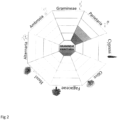
- Figure 2 is represented the result of the diagnostic process through a regular geometric figure that presents as a kind of target in which progressively, also with the intensity of the various colors from the periphery to the center, one gets to "center the target". That is to say that the allergen or allergens relevant to the specific patient will appear in the center, with the integrated assessments of all the data. In the present case there are significant gramineae, in grey, and parietal, in dark grey, reported in the central sector of the target. All other sectors, corresponding to the non-relevant allergens and therefore excluded and coloured in light grey.
- the allergic skin tests are very widespread for the diagnosis of allergic diseases, derived from inhalant allergens, such as inhalant allergens, derivatives of acarus or domestic animals, moulds, food, both of plant origin and food of animal origin, latex, insect venom, drugs (the diagnosis of these allergies also includes intradermal cutaneous tests).
- inhalant allergens such as inhalant allergens, derivatives of acarus or domestic animals, moulds, food, both of plant origin and food of animal origin, latex, insect venom, drugs
- the diagnosis of these allergies also includes intradermal cutaneous tests.
- the answer we usually get is that the patient is "sensitized” (such diction does not mean that the patient is allergic).
- the term "sensitized” indicates that a certain allergizing substance is recognized but it is not sure that the patient has the "clinical” symptomatology. That is to say that the patient may not have any manifestation if he comes into contact with the involved substance.
- the answer can therefore be very different depending on the extent of the skin response (wheal diameter) to the SPT, a response that can vary for example even from 0 to 20 mm. This is the reason that we choose a certain value (cut-off) to which a given predictive positive meaning can be conferred, knowing that the minimum value is 3 mm.
- cut-off a certain value to which a given predictive positive meaning can be conferred, knowing that the minimum value is 3 mm.
- laboratory analyses or data related to the patient's clinical response to exposure to the breathing allergen.
- the program records the patient data through an application, for the recording of the symptoms (Allergycard Web) and, downstream of the recording, to determine the weight to be assigned to each data acquired, a series of scores are available and a series of validated clinical scores at international level to achieve a truthful diagnosis referred to a time period. All this is set in correlation with the count of daily inhalant allergens, so that the data are integrated with each other.
- the skin responses (SPT) and laboratory data are inserted, together with specific IgE dosage for extracts and/or molecules (which can be manually inserted, or the laboratory sends them automatically and the results are recorded in the system). Then based on all the acquired data and based on the preset values that have been entered, we get the final response with the diagnosis.
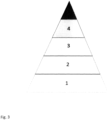
- Figure 3 illustrates the various diagnostic steps in a patient with suspected pollinosis (often highly polysensitive), arranged in order from the base to the apex of a pyramid divided into 5 coloured sectors with increasing intensity:
- the steps are characterised by a gradual reduction in the number of pollen extracts taken into account for AIT, represented in the fifth sector of the pyramid, namely the apical sector.
- Step 1 Clinical History and local Pollinic calendar
- the following inhalant allergens should be considered: Cypress, Parietal, Beech, Gramineae, Olive and Alternaria.
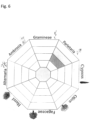
- Figure 4 is represented the pyramid of the model in which the outermost band was coloured, relative to all possible inhalant allergens, with the exception of Ambrosia, whose sector is in fact highlighted in grey, precisely because pollen is not present in the specific area.
- the patient was administered SPT for suspected allergens and the result is expressed in mm relative to the diameter of the skin response (wheal), taking into account that 3 mm is the minimum value considered positive.
- the user can choose the value of the cut-off in mm that he wishes to choose, in his opinion, what allows him to have the best ratio of sensitivity/specificity.
- the algorithm depending on the value chosen will give different results and the same happens for the next steps based on the values of the specific IgE and the intensity of the SMS. This is the so-called "tuning" of the system by the user.
- the result of cutaneous allergic tests in the case of patient No. 1 is reported below.
- Step 3 IgE results for allergen molecules.
- This step examines the laboratory's response (on blood sampling, but not only, since other biological fluids can be dosed, such as nasal secretes, tears, etc.) with the dosage of specific IgE for the genuine molecules of an inhalant both of those cross-reactive (panallergen) allowing to identify true sensitizations from false ones. Also in this case the result will be different depending on the chosen cut-off.
- the analysis of the molecular IgE shows a true sensitization only for the Gramineae (Phl p1 positive) and for the parietary (Par J 2 positive), it also highlights the presence of IgE for the panallergene Profiline (Phl p 12 and Bet v 2 positive) explaining the false Positivity of SPT.
- Figure 6 is represented the decision pyramid , in which, being positive the IgE only for gramineae and parietaria, the third sector of the relevant sections is coloured with even more intense tones, while the remaining sections are colored in light grey to indicate the exclusion of relative allergens.
- the methodology of pyramidal exclusion allows to restrict even more the number of potential allergens, approaching the center of the target.
- Step 4 Utilizing of the patient symptom recording data through the dedicated monitoring app, integrated with pollen curves.
- the monitoring application will be schematically described the functionality of the monitoring application, but, as a matter of fact, the entire system of the CDSS (Clinical Decision Support System) can be integrated into a single app.
- CDSS Code Division Multiple Access Security
- the patient's electronic clinical diary is carried out through the smartphone monitoring application.
- the application allows the recording of symptoms of allergic rhinoconjunctivitis and asthma, the intake of antiallergic or anti-asthmatic drugs and the adhesion to the sublingual immunotherapy (SLIT).
- the patient's access to the monitoring application is executed through the personal identification and a keyword provided by the attending physician and/or the laboratory where the molecular IgE is taken; the patients are explained how to download (from the Google Play stores, for Android systems, or from the Apple store, for IOS Systems) and install the app on his Smart-Phone, and they receive briefly the instructions on how it works. While registering, patients provide consent to the processing of data, in compliance with the current privacy policy and security of sensitive data.
- Patients are required to have daily access to the application during the assigned monitoring period, in order to accurately record the severity of the ocular, nasal and respiratory symptoms on a zero-to-three scale through the use of emoticons, answer questions about quality of life (QoL), record the intake of symptomatic drugs and express daily through a VAS (visual analogue scale) the state of wellbeing.
- QoL quality of life
- VAS visual analogue scale
- VAS Visual Analog Scale
- the monitoring application allows the exact classification of the allergic rhinitis of the patient according to the ARIA criteria, exceeding the limits of a medical history recorded retrospectively.
- the nearest aerobiological centre where the patient resides provides pollen count expressed in granules/m 3 of air, sending them automatically to the Management Server on a weekly basis.
- the daily concentrations of pollen granules are usually sampled with a VPPs ® 2000 (Volumetric Pollen and Particle Sampler, Lanzoni S.R.L., Bologna) instrument placed at about 15 m height referred to the road plan.
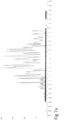
- Figure 7a shows the graph of the pollen count provided by the Tor Vergata Center of Aerobiology for the Gramineae for the period March-August 2016 in Rome, and they are expressed or according to the criteria of PP EAACI (Pfaar) or According to local criteria (Italy) more restrictive and more adapted to the Italian reality.
- the CDSS system automatically determines which period to analyse on the basis of the previously set (“tuning") criteria (whole season, pollen peak, days with higher pollen concentrations).
- Each patient compiles the electronic diary daily through the monitoring application, answering a set of questions about his symptomatology and the medications he/she has used. To each question is assigned a score that is used to process the following indices (or SMS, Symptom and Medication Score): a) RTSS (Rhinoconjuctivits Total Symptom Score), which affects only the symptoms; b) CSMS (Combined Symptom and Medication Score), which relates to both symptoms and medications.
- indices or SMS, Symptom and Medication Score
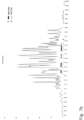
- Figure 8 shows the resulting graph of the data analysis of Case No. 1, in a period between 15/04 and 01/07, represented in the abscissa, while in the ordinate are represented on the left the RTSS values and on the right the CSMS values.
- the table below shows the data regarding VAS, sleep disturbance, daily activities and labor disturbance, for each day of the month and total, with dark blue coloration for the days of the month in which these data are relevant. All the parameters indicated in such a way are analyzed to allow the evaluation of the correlation between SMS and pollen data.
- the results in the CDSS will be developed automatically on the basis of the tuning of the cut-offs related to symptoms and pollens (intensity, duration, pollen peak, whole season, etc.) selected by the user.
- Figure 9 has the final representation of the decision pyramid, with coloration of the fourth sector of the faces related to the relevant allergens, in this case graminaceae and parietal and coloring of the central zone, within which are reported the names of the inhalants of interest.
- the instrument will give the doctor the possibility to modulate ("tuning") the minimum cut-offs of positivity of the allergological tests used (e.g., Skin Prick Test 3 - 5 mm; specific IgE dosage from Class 1 to Class 2, severity of symptoms, concentration of pollens, etc.), so that we can reach a more specific diagnosis for a given allergengenic source.
- the minimum cut-offs of positivity of the allergological tests used e.g., Skin Prick Test 3 - 5 mm; specific IgE dosage from Class 1 to Class 2, severity of symptoms, concentration of pollens, etc.
- the system which is the object of this patent application, at the end of the illustrated path will provide for a synthetic report useful to the patient and his doctor for the best therapeutic choices.
- SPTs are positive for: PAR, GRA, CIP, NOC, AG, and OLE.
- the clinical diary supports the diagnosis of allergic rhinitis to GRA, PAR.
- the user can choose different thresholds (cut-offs) for the various parameters in order to vary the sensitivity and specificity of the system of his choice.
- SA specific activity
- the values of the pollen curves can not only be visualized individually and compared graphically with the symptoms (expressed with different SMS) but they can be analyzed altogether by means of statistical approaches multivariate.
- the response of a symptom to the different pollens is not a approachable phenomenon using a deterministic approaches because this response is determined by physiological, biochemical and environmental components (just to make some examples) but with approaches that consider the extreme variability of the signal and therefore with approaches related to probability (probabilistic or stochastic approaches). These approaches take into account the variability of the signal (given by the aforementioned causes) and obtain results more important than the deterministic ones. This approach is one of the novelties of this invention.
- the multivariate approach also leads to the observation of several variables together (pollens) and displays/models in relation to the variable response (SMS).
- Usable approaches can be non-supervised (such as the Principal Component Analysis-PCA), where a dependent or supervised variable is not highlighted, where a model seeks the best solution to estimate an employee variable (categorical (classification) or continuous (regression)].
- non-supervised approaches we rely on a graphical synthesis where the proximity of the symptom with one or more pollens (corrected with SA or not) indicates the correspondence (analysis of the correspondences).
- the data can be further synthesized by establishing thresholds where the data itself is considered as present (1) or absent (0) generating a binary matrix (the choice of the threshold can be made on an empirical, statistical, or percentage basis).
- thresholds where the data itself is considered as present (1) or absent (0) generating a binary matrix (the choice of the threshold can be made on an empirical, statistical, or percentage basis).
- the supervised multivariate approaches generate, instead, the application models for the estimation of the symptom expressed in quantitative (regression) or categorical way compared to a threshold (classification). These approaches are very powerful and require strategies to avoid overfittng and establish real forward-looking efficacy (high number of observations and repetitions over several years).
- multivariate regression we can list some approaches: multivariate Linear regression, Principal Component regression, Partial Least Squares regression, Artificial Neural Networks.
- some approaches can be listed: Partial Least Squares Discriminant Analysis, Soft Independent Modelling of Class Analyogies, Support Vector Machine, Artificial Neural Networks.
- the system therefore relies largely on the acquisitions of data described aimed at the study of allergens, and in particular as regards:
- the difference with the 1st method of pyramidal exclusion, described above, consists in the elaboration of the aforementioned data with different algorithms aimed at the identification of the most relevant allergen/s for the patient, expressed both in concordance numerical term, both as images with the graphical representation of greater or lesser proximity between the selected SMS, and the graphic representation of the analyzed allergens (e.g. pollens, fungal spores, etc.), or other methodology of more intuitive representation.
- the present system is also integrated into an application where all the above mentioned data are conveyed and then the result of the relative analysis are presented to the patient and/or physician by algorithms resident on the control unit servers.
- the following approaches relate to the relationship between symptoms (identified by different indices) and variables linked, for example, to environmental variables (weather-climatic, organic and inorganic particulate present in the air) and/or variables depending on pollens or inhalant allergens. These variables can be corrected and modulated with the physiological state of the patient measured for example with the results of skin prick tests or specific IgE for extracts or allergen molecules or dosage of IgE and/or nasal IgG-specific or other biological fluids, or as a result of nasal and/or conjunctival provocation tests specific for a specific allergen.
- indices derived from the reciprocal relation between some of these parameters can be taken into account.
- SA Specific Activity
- the SA is given by the ratio of the concentration of the specific IgE measured in that patient to both the allergenic extracts and the allergenic molecules of that pollen (e.g. Phi p1; Phl p5; for Graminaceae), and the concentration of the total IgE of the patient. Obviously higher will be the SA for that allergen the greater will be the sensitization and responsiveness of the patient.
- the correction of the pollen concentration to which the patient is sensitized has a different weight depending on the SA.
- the relationship between symptoms and variables allows the practitioner (physician) to facilitate the prescription of vaccines, indicating, based on the outcome of the multivariate approaches, a better relationship between the symptoms and, for example, the inhalant allergens present in the area in a period of greater symptomatology.
- the approaches that can be used may involve sorting techniques (Principal Component Analysis-PCA, Canonical Correspondence Analysis-CCA, Principal Coordinates Analysis-PCooA, etc.) and clustering, both unsupervised, or more complex modelling approaches linked to supervised classification or regression techniques by linear approaches (Linear Discriminant Analysis-LDA, Quadratic Discriminant Analysis-QDA, Partial Least Squares analysis-PLS, etc.) or nonlinear ( Artificial Neural Networks-ANN, Support Vector Machines-SVM, etc.).
- the matrix of variables and symptoms can be transformed in different ways: standardization, smoothing, binarization by a certain threshold, etc.
- This X-value can be chosen by the operator with a dedicated tuning as intended for the method described above.
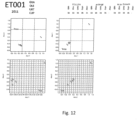
- a concrete example, shown below, shows the application of a univariate concordance approach and a multivariate approach (Analysis of the simple correspondence-CCA) applied to an array of concordance between symptoms and binarized pollens above a preset threshold.
- Multivariate analyses provide for an interpretation that takes into account not only the relationship between symptom and single pollinic species but considers the relation (multivariate) among all the pollinic species together. This analysis, although it may seem complex, actually is more "natural” since even the abundance of pollen species is not disconnected.
- Multivariate charts provide a multivariate profile which is nothing more than a two-dimensional space disposition (most commonly) or tri-dimensional disposition of the variable symptom (theoretically dependent) together with other variables (pollens in the specific case, but also environmental). This multivariate profile should be read as a geometric proximity variable symptom referred to other variables by considering first multivariate axis as the most important (due to the nature of the algorithm used).
- the two charts below show two examples of multivariate processing of anonymous patients (pt ET001 and pt ET059).
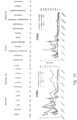
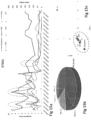
- diagrams 15 and 16 show pie charts, in which we observe the positivity of the patient considered allergens tested, by checking the values of the specific present IgE.
- Table 1 is an index showing the correlation between symptom and single pollen species.
- Tabella 1 Concordance index GRA Olea URT CUP ALT 33 33 33 35 21
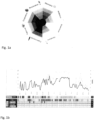
- the diagram in Fig. 15a with a line chart, three dashed circles on the chart (manually traced) show the peaks of symptoms with greater criticality and correspond to the pollen peaks of the taxa to which the patient is sensitized and more present in the considered period: graminaceae, urticaceae, olive.
- the molecular values and extracts for the patient ET059 show a polysensibilization for the four types of pollen considered (graminaceae, urticaceae, olive, cupressaceous) as well as for the alternaria spore; sensitization of the patient ET059 for olives and cupressaceae is lower than the other molecules considered (as shown in the 16b pie chart).
- line chart 16a the two dashed circles on the chart (manually arranged) show the peaks of symptoms with greater criticality and correspond to the pollen peaks of the taxa to which the patient is sensitized and more present in the period considered: graminaceae and urticaceae, in the first period, urticaceae and alternaria graminaceae, in the second period.
Landscapes
- Health & Medical Sciences (AREA)
- Engineering & Computer Science (AREA)
- Medical Informatics (AREA)
- Public Health (AREA)
- Biomedical Technology (AREA)
- Data Mining & Analysis (AREA)
- Databases & Information Systems (AREA)
- Pathology (AREA)
- Epidemiology (AREA)
- General Health & Medical Sciences (AREA)
- Primary Health Care (AREA)
- Investigating Or Analysing Biological Materials (AREA)
Claims (7)
- Multivariates Verfahren zur Bereitstellung einer klinischen Diagnoseunterstützung für allergische Erkrankungen, das die folgenden Schritte umfassta) die Beschaffung von Daten in Bezug auf:i. eine Allergieanamnese eines Patienten durch Aufzeichnung der Saisonalität der Symptome,ii. Ergebnisse von Hautallergietests,iii. Labortestergebnisse spezifischer IgEs für Allergenextrakte und/oder für allergene Moleküle,iv. einen lokalen Pollinenkalender,v. meteorologische Daten,vi. Daten zur Umweltverschmutzung;b) Zuweisung eines Symptom-Medikations-Scores (SMS), der aus den in den Schritten i., ii. und iii. erfassten Daten abgeleitet wird, in Form eines Rhinokonjunktivitis-Gesamtsymptom-Scores (RTSS), eines durchschnittlichen kombinierten Scores (ACS), eines mittelwertbereinigten Symptom-Scores (AdSS), eines Rescue-Medikations-Scores (RMS) oder eines täglichen kombinierten Symptom-Medikations-Scores (dCSMS),c) Erkennen des/der relevantesten Allergene(s) für den Patienten mittels eines computergestützten Entscheidungsverfahrens auf der Grundlage des zugewiesenen Symptom-Medikations-Scores (SMS), korreliert mit den in den Schritten iv., v. und vi. erfassten Daten, wobei das computergestützte Entscheidungsverfahren die Hauptkomponentenanalyse (PCA), die kanonische Korrespondenzanalyse (CCA), die Hauptkoordinatenanalyse (PCooA) und/oder das Clustering und/oder die lineare Diskriminanzanalyse (LDA), die quadratische Diskriminanzanalyse (QDA), die Partial-Least-Square-Analyse (PLS) und/oder künstliche neuronale Netze (ANN) und/oder Support Vector Machines (SVM) umfasst,d) wobei der Nachweis des relevantesten Allergens für den Patienten das Korrigieren der Daten für eine Pollen-/ Inhalationsmittelallergenkonzentration um die spezifische Aktivität (SA) des Pollen-/Inhalationsmittelallergens für den Patienten umfasst, wobei die spezifische Aktivität das Verhältnis der spezifischen IgE-Konzentration, die bei dem Patienten sowohl mit allergenen Extrakten als auch mit allergenen Molekülen ausgewählter Pollen-/Inhalationsmittelallergene nachgewiesen wurde, zu der gesamten IgE-Konzentration für diesen Patienten ist.
- Verfahren nach Anspruch 1, dadurch gekennzeichnet, dass eine korrigierte Pollen-/Inhalationsallergenzahl als Pollen-/Inhalationsallergenzahl ausgedrückt wird, die um die spezifische Aktivität (SA) korrigiert wird, die jeweils auf Moleküle (SA-IgE-M pc) oder Extrakte (SA-lgE-E pc) bezogen ist.
- Verfahren nach einem der vorhergehenden Ansprüche, dadurch gekennzeichnet, dass eine Variablen- und Symptommatrix erstellt wird, die optional durch Standardisierungs- und/oder Glättungs- und/oder Binarisierungstechniken transformiert wird.
- Verfahren nach einem der vorhergehenden Ansprüche, dadurch gekennzeichnet, dass Umweltdaten und/oder Pollen/Inhalationsdaten in Bezug auf den sensibilisierungsphysiologischen Zustand des Patienten korrigiert und moduliert werden, wobei der sensibilisierungsphysiologische Zustand des Patienten durch allergologische Tests gemessen wird, wobei die Korrektur und Modulation durch Multiplikation sowohl der spezifischen IgE-Aktivität mit der Pollen/Inhalationsallergenkonzentration IgE-pc (= IgE-SA * Pollenkonzentration) als auch der spezifischen Aktivität des Extrakts (Extract-SA) mit der Pollenkonzentration (= Extract-SA * Pollenkonzentration) durchgeführt wird.
- Verfahren nach einem der vorhergehenden Ansprüche, dadurch gekennzeichnet, dass auch Daten in Bezug auf Umweltvariablen, einschließlich wetter- und klimabezogener Variablen und in der Luft vorhandener organischer und anorganischer Partikel, erfasst und verarbeitet werden.
- Verfahren nach einem der vorhergehenden Ansprüche, dadurch gekennzeichnet, dass:i. verschiedene Symptom-Medikamenten-Scores (SMS), die entweder als Symptomentwicklung und/oder Medikamentenwirkung bei Patienten erfasst werden, mit den Kurven von Inhalationsallergenen, Pollen und Schimmelpilzen auf der Grundlage der klinischen Vorgeschichte und Sensibilisierungen der Patienten korreliert werden; undii. die Ergebnisse früherer Untersuchungen integriert werden und durch eine geometrische Figur eines dreidimensionalen idealen Körpers mit regelmäßiger Basis und in Form eines polyedrischen Winkels dargestellt werden, der aus einer Pyramide mit einer Basis mit n Seiten besteht, wobei n gleich der Anzahl der untersuchten Allergene ist, und Flächen mit verschiedenen Sektoren, wobei jeder Sektor einem der vier Diagnoseschritte (i- klinische Anamnese und Allergen-Inhalationskurven, ii- SPT-Ergebnisse, iii- komponentenaufgelöste Diagnose (CRD), iv- SMS) gewidmet ist, die in der Reihenfolge von der Pyramidenbasis zur Spitze angeordnet sind, wobei jedem Allergen eine Farbe zugewiesen wird, deren Intensität in zentripetaler Richtung entsprechend der erhöhten Empfindlichkeit der diagnostischen Tests am Ende des diagnostischen Prozesses zunimmt, wodurch durch ein CDSS-System ein synthetischer Bericht bereitgestellt wird, der sowohl für einen Patienten als auch für einen behandelnden Arzt im Hinblick auf die besten therapeutischen Entscheidungen nützlich ist, wobei ein solcher Bericht eine klinische Fallbeschreibung, die Ergebnisse der verschiedenen diagnostischen Phasen, ein abschließendes pyramidenförmiges Diagramm, in dem nur Flächen, die sich auf interessierende Allergene beziehen, farbig - nicht grau - sind und die Allergene in der Mitte des Diagramms angezeigt werden, und eine kurze beschreibende Zusammenfassung der in den verschiedenen Phasen erhaltenen Ergebnisse enthält.
- Verfahren nach einem der vorhergehenden Ansprüche, dadurch gekennzeichnet, dass sowohl die Sensitivität als auch die Spezifität einer endgültigen Antwort durch einen Benutzer mittels eines Abstimmungsverfahrens einstellbar sind, das es ermöglicht, die Grenzwerte für verschiedene Tests nach einem restriktiven Kriterium, "stark" genannt, oder einem weniger restriktiven Kriterium, "locker" genannt, zu variieren.
Applications Claiming Priority (3)
| Application Number | Priority Date | Filing Date | Title |
|---|---|---|---|
| IT102017000106602A IT201700106602A1 (it) | 2017-09-23 | 2017-09-23 | Approcci multivariati allo studio delle relazioni tra sintomi e allergeni |
| IT102017000106570A IT201700106570A1 (it) | 2017-09-23 | 2017-09-23 | Tecnica diagnostica per valutare se la sintomatologia allergica di un paziente è correlata alla sensibilità per un particolare allergene |
| PCT/IT2018/000119 WO2019058401A1 (en) | 2017-09-23 | 2018-09-19 | METHOD FOR CORRELATING ALLERGIC SYMPTOMS AND ALLERGENS |
Publications (3)
| Publication Number | Publication Date |
|---|---|
| EP3685402A1 EP3685402A1 (de) | 2020-07-29 |
| EP3685402C0 EP3685402C0 (de) | 2024-06-26 |
| EP3685402B1 true EP3685402B1 (de) | 2024-06-26 |
Family
ID=64362603
Family Applications (1)
| Application Number | Title | Priority Date | Filing Date |
|---|---|---|---|
| EP18804719.5A Active EP3685402B1 (de) | 2017-09-23 | 2018-09-19 | Korrelationsverfahren zwischen allergischen symptomen und allergenen |
Country Status (2)
| Country | Link |
|---|---|
| EP (1) | EP3685402B1 (de) |
| WO (1) | WO2019058401A1 (de) |
Families Citing this family (2)
| Publication number | Priority date | Publication date | Assignee | Title |
|---|---|---|---|---|
| CN110752039A (zh) * | 2019-10-30 | 2020-02-04 | 湖南财政经济学院 | 通过电子病历判断过敏原与预测过敏情况的定量评分系统 |
| KR102487664B1 (ko) * | 2020-12-16 | 2023-01-13 | 대한민국 | 꽃가루 달력과 환자 증상 일기를 이용한 사용자 맞춤형 꽃가루 알레르기 예측 방법 및 이를 실행하는 서버 |
Family Cites Families (3)
| Publication number | Priority date | Publication date | Assignee | Title |
|---|---|---|---|---|
| WO2009070122A1 (en) * | 2007-11-30 | 2009-06-04 | Phadia Ab | A novel method for assessing if symptoms in a patient are related to a hypersensitivity to a specific allergen |
| EP2388723A1 (de) * | 2010-05-18 | 2011-11-23 | University College Cork-National University of Ireland, Cork | Verfahren zur Beurteilung des allergischen Zustands einer Person |
| WO2014145897A2 (en) * | 2013-03-15 | 2014-09-18 | Phd Preventive Health Care And Diagnostics, Inc. | Immunotherapy system and method thereof |
-
2018
- 2018-09-19 EP EP18804719.5A patent/EP3685402B1/de active Active
- 2018-09-19 WO PCT/IT2018/000119 patent/WO2019058401A1/en not_active Ceased
Non-Patent Citations (5)
| Title |
|---|
| DANIEL CHUNG ET AL: "The significance of serum total immunoglobulin E for in vitro diagnosis of allergic rhinitis : The significance of serum total IgE", INTERNATIONAL FORUM OF ALLERGY & RHINOLOGY, vol. 4, no. 1, 12 November 2013 (2013-11-12), Oxford, pages 56 - 60, XP055486415, ISSN: 2042-6976, DOI: 10.1002/alr.21240 * |
| JAKOB FLORACK ET AL: "Comparison of six disease severity scores for allergic rhinitis against pollen counts a prospective analysis at population and individual level", PEDIATRIC ALLERGY AND IMMUNOLOGY, vol. 27, no. 4, 1 June 2016 (2016-06-01), GB, pages 382 - 390, XP055486752, ISSN: 0905-6157, DOI: 10.1111/pai.12562 * |
| JOANA VITTE ET AL: "Multivariate Analysis As a Support for Diagnostic Flowcharts in Allergic Bronchopulmonary Aspergillosis: A Proof-of-Concept Study", FRONTIERS IN IMMUNOLOGY, vol. 8, 22 August 2017 (2017-08-22), Lausanne, CH, XP055487046, ISSN: 1664-3224, DOI: 10.3389/fimmu.2017.01019 * |
| MAN-LI CHANG ET AL: "Analysis of total immunoglobulin E and specific immunoglobulin E of 3,721 patients with allergic disease", BIOMEDICAL REPORTS MAY 2014 SPANDIDOS PUBLICATIONS GBR, vol. 3, no. 4, 29 April 2015 (2015-04-29), Greece, pages 573 - 577, XP055486698, ISSN: 2049-9434, DOI: 10.3892/br.2015.455 * |
| SHINJI OTANI ET AL: "Associations Between Subjective Symptoms and Serum Immunoglobulin E Levels During Asian Dust Events", INTERNATIONAL JOURNAL OF ENVIRONMENTAL RESEARCH AND PUBLIC HEALTH, vol. 11, no. 8, 29 July 2014 (2014-07-29), pages 7636 - 7641, XP055487041, DOI: 10.3390/ijerph110807636 * |
Also Published As
| Publication number | Publication date |
|---|---|
| EP3685402C0 (de) | 2024-06-26 |
| WO2019058401A1 (en) | 2019-03-28 |
| EP3685402A1 (de) | 2020-07-29 |
Similar Documents
| Publication | Publication Date | Title |
|---|---|---|
| Nora et al. | Is caries associated with negative impact on oral health-related quality of life of pre-school children? A systematic review and meta-analysis | |
| US20260069161A1 (en) | Managing respiratory conditions based on sounds of the respiratory system | |
| Katz et al. | Modification of the children’s sleep habits questionnaire for children with autism spectrum disorder | |
| Kim et al. | Mathematical model and intervention strategies for mitigating tuberculosis in the Philippines | |
| US8297231B2 (en) | System and methods for health monitoring of anonymous animals in livestock groups | |
| Perazzo et al. | Oral health‐related quality of life and sense of coherence regarding the use of dental services by preschool children | |
| US20100198024A1 (en) | Vitality meter for health monitoring of anonymous animals in livestock groups | |
| Farley et al. | The prevalence of noma in northwest Nigeria | |
| CN102123660A (zh) | 用于神经测量分析的系统和方法 | |
| CN119517411A (zh) | 一种集成多种临床评价工具的皮肤病健康评测系统 | |
| CN116936104B (zh) | 一种基于人工智能的健康检测仪数据分析系统及方法 | |
| Peterson et al. | History of symptom triggers in patients presenting to the emergency department for asthma | |
| Brighetti et al. | Multivariate statistical forecasting modeling to predict Poaceae pollen critical concentrations by meteoclimatic data | |
| EP3685402B1 (de) | Korrelationsverfahren zwischen allergischen symptomen und allergenen | |
| Lloyd et al. | Endpoints and outcomes after immunotherapy for food allergy: what is meaningful for patients? | |
| Ng et al. | Preliminary criteria for the definition of allergic rhinitis: a systematic evaluation of clinical parameters in a disease cohort (II) | |
| Radcliffe et al. | Do skin prick and conjunctival provocation tests predict symptom severity in seasonal allergic rhinoconjunctivitis? | |
| Daley et al. | Assessing potential confounding and misclassification bias when studying the safety of the childhood immunization schedule | |
| Smith | Sensory processing as a predictor of feeding/eating behaviors in children with autism spectrum disorder | |
| EP2568402B1 (de) | Analysesystem zur Durchführung einer Analyse von gemessenen Blutzuckerwerten und Verfahren zur Verwendung des Analysesystems | |
| CN119049642B (zh) | 一种皮肤科康复护理的智能辅助系统及方法 | |
| McLean et al. | Emergency medical services outcomes research: evaluating the effectiveness of prehospital care | |
| Park et al. | Factor structure of Pre‐Loss Grief‐12 in caregivers of people living with dementia | |
| Lee et al. | Predictive characteristics to discriminate the longitudinal outcomes of childhood asthma: a retrospective program-based study | |
| EP4205139A1 (de) | Digitales analysesystem |
Legal Events
| Date | Code | Title | Description |
|---|---|---|---|
| STAA | Information on the status of an ep patent application or granted ep patent |
Free format text: STATUS: UNKNOWN |
|
| STAA | Information on the status of an ep patent application or granted ep patent |
Free format text: STATUS: THE INTERNATIONAL PUBLICATION HAS BEEN MADE |
|
| PUAI | Public reference made under article 153(3) epc to a published international application that has entered the european phase |
Free format text: ORIGINAL CODE: 0009012 |
|
| STAA | Information on the status of an ep patent application or granted ep patent |
Free format text: STATUS: REQUEST FOR EXAMINATION WAS MADE |
|
| 17P | Request for examination filed |
Effective date: 20200417 |
|
| AK | Designated contracting states |
Kind code of ref document: A1 Designated state(s): AL AT BE BG CH CY CZ DE DK EE ES FI FR GB GR HR HU IE IS IT LI LT LU LV MC MK MT NL NO PL PT RO RS SE SI SK SM TR |
|
| AX | Request for extension of the european patent |
Extension state: BA ME |
|
| DAV | Request for validation of the european patent (deleted) | ||
| DAX | Request for extension of the european patent (deleted) | ||
| STAA | Information on the status of an ep patent application or granted ep patent |
Free format text: STATUS: EXAMINATION IS IN PROGRESS |
|
| 17Q | First examination report despatched |
Effective date: 20220221 |
|
| GRAP | Despatch of communication of intention to grant a patent |
Free format text: ORIGINAL CODE: EPIDOSNIGR1 |
|
| STAA | Information on the status of an ep patent application or granted ep patent |
Free format text: STATUS: GRANT OF PATENT IS INTENDED |
|
| INTG | Intention to grant announced |
Effective date: 20240129 |
|
| GRAS | Grant fee paid |
Free format text: ORIGINAL CODE: EPIDOSNIGR3 |
|
| GRAA | (expected) grant |
Free format text: ORIGINAL CODE: 0009210 |
|
| STAA | Information on the status of an ep patent application or granted ep patent |
Free format text: STATUS: THE PATENT HAS BEEN GRANTED |
|
| AK | Designated contracting states |
Kind code of ref document: B1 Designated state(s): AL AT BE BG CH CY CZ DE DK EE ES FI FR GB GR HR HU IE IS IT LI LT LU LV MC MK MT NL NO PL PT RO RS SE SI SK SM TR |
|
| REG | Reference to a national code |
Ref country code: GB Ref legal event code: FG4D |
|
| REG | Reference to a national code |
Ref country code: CH Ref legal event code: EP |
|
| REG | Reference to a national code |
Ref country code: DE Ref legal event code: R096 Ref document number: 602018071061 Country of ref document: DE |
|
| U01 | Request for unitary effect filed |
Effective date: 20240716 |
|
| U07 | Unitary effect registered |
Designated state(s): AT BE BG DE DK EE FI FR IT LT LU LV MT NL PT SE SI Effective date: 20240729 |
|
| PG25 | Lapsed in a contracting state [announced via postgrant information from national office to epo] |
Ref country code: HR Free format text: LAPSE BECAUSE OF FAILURE TO SUBMIT A TRANSLATION OF THE DESCRIPTION OR TO PAY THE FEE WITHIN THE PRESCRIBED TIME-LIMIT Effective date: 20240626 |
|
| PG25 | Lapsed in a contracting state [announced via postgrant information from national office to epo] |
Ref country code: GR Free format text: LAPSE BECAUSE OF FAILURE TO SUBMIT A TRANSLATION OF THE DESCRIPTION OR TO PAY THE FEE WITHIN THE PRESCRIBED TIME-LIMIT Effective date: 20240927 |
|
| U20 | Renewal fee for the european patent with unitary effect paid |
Year of fee payment: 7 Effective date: 20240925 |
|
| PG25 | Lapsed in a contracting state [announced via postgrant information from national office to epo] |
Ref country code: NO Free format text: LAPSE BECAUSE OF FAILURE TO SUBMIT A TRANSLATION OF THE DESCRIPTION OR TO PAY THE FEE WITHIN THE PRESCRIBED TIME-LIMIT Effective date: 20240926 Ref country code: HR Free format text: LAPSE BECAUSE OF FAILURE TO SUBMIT A TRANSLATION OF THE DESCRIPTION OR TO PAY THE FEE WITHIN THE PRESCRIBED TIME-LIMIT Effective date: 20240626 Ref country code: GR Free format text: LAPSE BECAUSE OF FAILURE TO SUBMIT A TRANSLATION OF THE DESCRIPTION OR TO PAY THE FEE WITHIN THE PRESCRIBED TIME-LIMIT Effective date: 20240927 Ref country code: RS Free format text: LAPSE BECAUSE OF FAILURE TO SUBMIT A TRANSLATION OF THE DESCRIPTION OR TO PAY THE FEE WITHIN THE PRESCRIBED TIME-LIMIT Effective date: 20240926 |
|
| PG25 | Lapsed in a contracting state [announced via postgrant information from national office to epo] |
Ref country code: PL Free format text: LAPSE BECAUSE OF FAILURE TO SUBMIT A TRANSLATION OF THE DESCRIPTION OR TO PAY THE FEE WITHIN THE PRESCRIBED TIME-LIMIT Effective date: 20240626 |
|
| PG25 | Lapsed in a contracting state [announced via postgrant information from national office to epo] |
Ref country code: IS Free format text: LAPSE BECAUSE OF FAILURE TO SUBMIT A TRANSLATION OF THE DESCRIPTION OR TO PAY THE FEE WITHIN THE PRESCRIBED TIME-LIMIT Effective date: 20241026 |
|
| PG25 | Lapsed in a contracting state [announced via postgrant information from national office to epo] |
Ref country code: CZ Free format text: LAPSE BECAUSE OF FAILURE TO SUBMIT A TRANSLATION OF THE DESCRIPTION OR TO PAY THE FEE WITHIN THE PRESCRIBED TIME-LIMIT Effective date: 20240626 |
|
| PGFP | Annual fee paid to national office [announced via postgrant information from national office to epo] |
Ref country code: IE Payment date: 20241203 Year of fee payment: 7 |
|
| PG25 | Lapsed in a contracting state [announced via postgrant information from national office to epo] |
Ref country code: RO Free format text: LAPSE BECAUSE OF FAILURE TO SUBMIT A TRANSLATION OF THE DESCRIPTION OR TO PAY THE FEE WITHIN THE PRESCRIBED TIME-LIMIT Effective date: 20240626 Ref country code: SK Free format text: LAPSE BECAUSE OF FAILURE TO SUBMIT A TRANSLATION OF THE DESCRIPTION OR TO PAY THE FEE WITHIN THE PRESCRIBED TIME-LIMIT Effective date: 20240626 |
|
| PG25 | Lapsed in a contracting state [announced via postgrant information from national office to epo] |
Ref country code: SM Free format text: LAPSE BECAUSE OF FAILURE TO SUBMIT A TRANSLATION OF THE DESCRIPTION OR TO PAY THE FEE WITHIN THE PRESCRIBED TIME-LIMIT Effective date: 20240626 Ref country code: ES Free format text: LAPSE BECAUSE OF FAILURE TO SUBMIT A TRANSLATION OF THE DESCRIPTION OR TO PAY THE FEE WITHIN THE PRESCRIBED TIME-LIMIT Effective date: 20240626 |
|
| PG25 | Lapsed in a contracting state [announced via postgrant information from national office to epo] |
Ref country code: SM Free format text: LAPSE BECAUSE OF FAILURE TO SUBMIT A TRANSLATION OF THE DESCRIPTION OR TO PAY THE FEE WITHIN THE PRESCRIBED TIME-LIMIT Effective date: 20240626 Ref country code: SK Free format text: LAPSE BECAUSE OF FAILURE TO SUBMIT A TRANSLATION OF THE DESCRIPTION OR TO PAY THE FEE WITHIN THE PRESCRIBED TIME-LIMIT Effective date: 20240626 Ref country code: RO Free format text: LAPSE BECAUSE OF FAILURE TO SUBMIT A TRANSLATION OF THE DESCRIPTION OR TO PAY THE FEE WITHIN THE PRESCRIBED TIME-LIMIT Effective date: 20240626 Ref country code: PL Free format text: LAPSE BECAUSE OF FAILURE TO SUBMIT A TRANSLATION OF THE DESCRIPTION OR TO PAY THE FEE WITHIN THE PRESCRIBED TIME-LIMIT Effective date: 20240626 Ref country code: IS Free format text: LAPSE BECAUSE OF FAILURE TO SUBMIT A TRANSLATION OF THE DESCRIPTION OR TO PAY THE FEE WITHIN THE PRESCRIBED TIME-LIMIT Effective date: 20241026 Ref country code: ES Free format text: LAPSE BECAUSE OF FAILURE TO SUBMIT A TRANSLATION OF THE DESCRIPTION OR TO PAY THE FEE WITHIN THE PRESCRIBED TIME-LIMIT Effective date: 20240626 Ref country code: CZ Free format text: LAPSE BECAUSE OF FAILURE TO SUBMIT A TRANSLATION OF THE DESCRIPTION OR TO PAY THE FEE WITHIN THE PRESCRIBED TIME-LIMIT Effective date: 20240626 |
|
| PG25 | Lapsed in a contracting state [announced via postgrant information from national office to epo] |
Ref country code: MC Free format text: LAPSE BECAUSE OF FAILURE TO SUBMIT A TRANSLATION OF THE DESCRIPTION OR TO PAY THE FEE WITHIN THE PRESCRIBED TIME-LIMIT Effective date: 20240626 |
|
| REG | Reference to a national code |
Ref country code: CH Ref legal event code: PL |
|
| PLBE | No opposition filed within time limit |
Free format text: ORIGINAL CODE: 0009261 |
|
| STAA | Information on the status of an ep patent application or granted ep patent |
Free format text: STATUS: NO OPPOSITION FILED WITHIN TIME LIMIT |
|
| 26N | No opposition filed |
Effective date: 20250327 |
|
| PG25 | Lapsed in a contracting state [announced via postgrant information from national office to epo] |
Ref country code: CH Free format text: LAPSE BECAUSE OF NON-PAYMENT OF DUE FEES Effective date: 20240930 |
|
| U20 | Renewal fee for the european patent with unitary effect paid |
Year of fee payment: 8 Effective date: 20250923 |
|
| PGFP | Annual fee paid to national office [announced via postgrant information from national office to epo] |
Ref country code: GB Payment date: 20251105 Year of fee payment: 8 |
|
| PG25 | Lapsed in a contracting state [announced via postgrant information from national office to epo] |
Ref country code: CY Free format text: LAPSE BECAUSE OF FAILURE TO SUBMIT A TRANSLATION OF THE DESCRIPTION OR TO PAY THE FEE WITHIN THE PRESCRIBED TIME-LIMIT; INVALID AB INITIO Effective date: 20180919 |
|
| PG25 | Lapsed in a contracting state [announced via postgrant information from national office to epo] |
Ref country code: HU Free format text: LAPSE BECAUSE OF FAILURE TO SUBMIT A TRANSLATION OF THE DESCRIPTION OR TO PAY THE FEE WITHIN THE PRESCRIBED TIME-LIMIT; INVALID AB INITIO Effective date: 20180919 |