EP3683339B1 - One-step spun elastic composite filament and preparation method therefor - Google Patents
One-step spun elastic composite filament and preparation method therefor Download PDFInfo
- Publication number
- EP3683339B1 EP3683339B1 EP18889561.9A EP18889561A EP3683339B1 EP 3683339 B1 EP3683339 B1 EP 3683339B1 EP 18889561 A EP18889561 A EP 18889561A EP 3683339 B1 EP3683339 B1 EP 3683339B1
- Authority
- EP
- European Patent Office
- Prior art keywords
- pressure
- reaction
- modified polyester
- terephthalic acid
- esterification
- Prior art date
- Legal status (The legal status is an assumption and is not a legal conclusion. Google has not performed a legal analysis and makes no representation as to the accuracy of the status listed.)
- Active
Links
Classifications
-
- C—CHEMISTRY; METALLURGY
- C08—ORGANIC MACROMOLECULAR COMPOUNDS; THEIR PREPARATION OR CHEMICAL WORKING-UP; COMPOSITIONS BASED THEREON
- C08L—COMPOSITIONS OF MACROMOLECULAR COMPOUNDS
- C08L67/00—Compositions of polyesters obtained by reactions forming a carboxylic ester link in the main chain; Compositions of derivatives of such polymers
- C08L67/06—Unsaturated polyesters
-
- D—TEXTILES; PAPER
- D01—NATURAL OR MAN-MADE THREADS OR FIBRES; SPINNING
- D01F—CHEMICAL FEATURES IN THE MANUFACTURE OF ARTIFICIAL FILAMENTS, THREADS, FIBRES, BRISTLES OR RIBBONS; APPARATUS SPECIALLY ADAPTED FOR THE MANUFACTURE OF CARBON FILAMENTS
- D01F6/00—Monocomponent artificial filaments or the like of synthetic polymers; Manufacture thereof
- D01F6/88—Monocomponent artificial filaments or the like of synthetic polymers; Manufacture thereof from mixtures of polycondensation products as major constituent with other polymers or low-molecular-weight compounds
- D01F6/92—Monocomponent artificial filaments or the like of synthetic polymers; Manufacture thereof from mixtures of polycondensation products as major constituent with other polymers or low-molecular-weight compounds of polyesters
-
- D—TEXTILES; PAPER
- D01—NATURAL OR MAN-MADE THREADS OR FIBRES; SPINNING
- D01F—CHEMICAL FEATURES IN THE MANUFACTURE OF ARTIFICIAL FILAMENTS, THREADS, FIBRES, BRISTLES OR RIBBONS; APPARATUS SPECIALLY ADAPTED FOR THE MANUFACTURE OF CARBON FILAMENTS
- D01F6/00—Monocomponent artificial filaments or the like of synthetic polymers; Manufacture thereof
- D01F6/78—Monocomponent artificial filaments or the like of synthetic polymers; Manufacture thereof from copolycondensation products
- D01F6/84—Monocomponent artificial filaments or the like of synthetic polymers; Manufacture thereof from copolycondensation products from copolyesters
-
- C—CHEMISTRY; METALLURGY
- C08—ORGANIC MACROMOLECULAR COMPOUNDS; THEIR PREPARATION OR CHEMICAL WORKING-UP; COMPOSITIONS BASED THEREON
- C08G—MACROMOLECULAR COMPOUNDS OBTAINED OTHERWISE THAN BY REACTIONS ONLY INVOLVING UNSATURATED CARBON-TO-CARBON BONDS
- C08G63/00—Macromolecular compounds obtained by reactions forming a carboxylic ester link in the main chain of the macromolecule
- C08G63/02—Polyesters derived from hydroxycarboxylic acids or from polycarboxylic acids and polyhydroxy compounds
- C08G63/12—Polyesters derived from hydroxycarboxylic acids or from polycarboxylic acids and polyhydroxy compounds derived from polycarboxylic acids and polyhydroxy compounds
- C08G63/16—Dicarboxylic acids and dihydroxy compounds
- C08G63/18—Dicarboxylic acids and dihydroxy compounds the acids or hydroxy compounds containing carbocyclic rings
- C08G63/181—Acids containing aromatic rings
- C08G63/183—Terephthalic acids
-
- C—CHEMISTRY; METALLURGY
- C08—ORGANIC MACROMOLECULAR COMPOUNDS; THEIR PREPARATION OR CHEMICAL WORKING-UP; COMPOSITIONS BASED THEREON
- C08G—MACROMOLECULAR COMPOUNDS OBTAINED OTHERWISE THAN BY REACTIONS ONLY INVOLVING UNSATURATED CARBON-TO-CARBON BONDS
- C08G63/00—Macromolecular compounds obtained by reactions forming a carboxylic ester link in the main chain of the macromolecule
- C08G63/78—Preparation processes
-
- C—CHEMISTRY; METALLURGY
- C08—ORGANIC MACROMOLECULAR COMPOUNDS; THEIR PREPARATION OR CHEMICAL WORKING-UP; COMPOSITIONS BASED THEREON
- C08L—COMPOSITIONS OF MACROMOLECULAR COMPOUNDS
- C08L67/00—Compositions of polyesters obtained by reactions forming a carboxylic ester link in the main chain; Compositions of derivatives of such polymers
- C08L67/02—Polyesters derived from dicarboxylic acids and dihydroxy compounds
-
- C—CHEMISTRY; METALLURGY
- C08—ORGANIC MACROMOLECULAR COMPOUNDS; THEIR PREPARATION OR CHEMICAL WORKING-UP; COMPOSITIONS BASED THEREON
- C08L—COMPOSITIONS OF MACROMOLECULAR COMPOUNDS
- C08L2203/00—Applications
- C08L2203/12—Applications used for fibers
-
- C—CHEMISTRY; METALLURGY
- C08—ORGANIC MACROMOLECULAR COMPOUNDS; THEIR PREPARATION OR CHEMICAL WORKING-UP; COMPOSITIONS BASED THEREON
- C08L—COMPOSITIONS OF MACROMOLECULAR COMPOUNDS
- C08L2205/00—Polymer mixtures characterised by other features
- C08L2205/02—Polymer mixtures characterised by other features containing two or more polymers of the same C08L -group
- C08L2205/025—Polymer mixtures characterised by other features containing two or more polymers of the same C08L -group containing two or more polymers of the same hierarchy C08L, and differing only in parameters such as density, comonomer content, molecular weight, structure
Definitions
- the present invention belongs to the field of fiber manufacture, and more particularly, relates to a type of one-step spun composite DTY and a preparation method thereof.
- PET fiber polyethylene terephthalate
- PET fiber Because of its excellent properties such as high breaking strength, high elastic modulus, suitable resilience, excellent heat setting performance, strong resistance to heat, light, acid, alkali and corrosion, as well as the advantages of wrinkle resistance and stiffness of the involved fabrics, PET fiber has been widely used in the fields of clothing and home textile.
- Cyclic oligomers are those formed from the retraction and cyclization of intermediates during the condensation stage, among which more than 70% are found to be cyclic trimers.
- PET DTY and Nylon DTY are the two most common stretch yarn varieties.
- the former is of relatively low elasticity and suitable for making knitted outerwear with soft handling, considerable flexibility, dimensional stability, wrinkle resistance, wool feeling and air permeability, whereas the latter is of good extensibility and elasticity and suitable for making knitwear such as socks, underwear, sportswear and gloves.
- composite fibers are those desired to combine the both fibers to obtain the best performance.
- Document CN 106 283 253 A discloses a method which is similar to the present one but does not use two polymers of different viscosities.
- An object of the present invention is to provide a preparation method for a one-step spun composite DTY so as to overcome the problems such as poor heat setting effect, weak dyeability, dyeing unevenness and color stain existed in current PET fiber production.
- the provided PET DTY possesses a fairly low content of oligomer without performance loss.
- a branched diol is incorporated in PET so as to reduce the content of oligomer generated in side reaction and enhance the stability of PET producing.
- the present invention provides a technological scheme for one-step spun composite DTY in which the monofilament is composed of two modified polyester with different viscosities, wherein each modified polyester has a molecular chain structure including terephthalic acid segments, ethylene glycol segments and branched diol segments, and wherein said branched diol has a structural formula of in which R 1 and R 2 are separately selected from the linear alkylene with 1-3 carbon atoms, R 3 from the alkyl with 1-5 carbon atoms, and R 4 from the alky with 2-5 carbon atoms.
- the purpose of introducing branch or long carbon chain into diol is to reduce the electronegativity of the alkoxy group.
- said one-step spun composite DTY has an elastic shrinkage rate of no less than 35%.
- the intrinsic viscosity ratio of two modified polyesters is 0.55-0.70:1.00-1.20, and higher one is 1.00-1.20dL/g.
- the intrinsic viscosity ratio determines the elastic shrinkage of fiber, and the ratio range presented above has been optimized for the best elastic effect.
- the PET DTY has a fineness of 150-300dtex, a linear density CV of less than or equal to 1.00%, a breaking strength of greater than or equal to 2.2cN/dtex, a breaking elongation of 37.2 ⁇ 4.0%, a breaking strength CV of less than or equal to 5.0%, a breaking elongation CV of less than or equal to 10.0% and a boiling water shrinkage of 9.5 ⁇ 0.5%.
- esterification is carried out under the pressure of nitrogen after adding catalyst, extinction agent and stabilizer, wherein the pressure range from atmospheric pressure to 0.3MPa while reaction temperature is 250-260 ° C, and the end point of esterification is chosen as the moment when the elimination of water reach 90% of the theoretical value;
- the polycondensation is performed under negative pressure, which includes two successive stages, i.e., a) coarse vacuum stage, wherein the pressure is smoothly reduced from the normal value to less than 500Pa within 30 ⁇ 50min, and the reaction temperature is 260-270 ° C while reaction time is 30-50min, b) fine vacuum stage, wherein the pressure is furtherly reduced to less than 100Pa, and the reaction temperature is 275-285 ° C while reaction time is 50-90min;
- the obtained modified polyester of low viscosity will undergo an extra solid state polycondensation to produce the polyester of high viscosity.
- step (1) the molar ratio of terephthalic acid, ethylene glycol and the branched diol is 1:1.2-2.0:0.03-0.06, and an amount of the catalyst is 0.01-0.05% by weight of the terephthalic acid, an amount of the extinction agent is 0.20-0.25% by weight of the terephthalic acid and an amount of the stabilizer is 0.01-0.05% by weight of the terephthalic acid; wherein the catalyst is one of antimony trioxide, antimony glycol or antimony acetate, the extinction agent is titanium dioxide, and the stabilizer is one of triphenyl phosphate, trimethyl phosphate or trimethyl phosphite.
- a method for preparing the one-step spun composite DTY mentioned above is also provided, generally including the steps of melting, melt metering, composite extruding, cooling, oiling, drawing, heat setting and winding;
- the spinning technologies for the one-step spun composite DTY could be chosen as Spinning temperature 280-290°C, Cooling temperature 20-25°C, Interlacing pressure 0.20-0.30MPa, Speed of godet roller 1 2200-2600m/min, Temperature of godet roller1 75-85°C, Speed of godet roller 2 3600-3900m/min, Temperature of godet roller 2 135-165°C, Winding speed 3580-3840m/min, Initial spinning pack pressure 120bar, Spinning pack pressure rising ⁇ P ⁇ 0.6bar/day, Spinning pack life cycle ⁇ 60days.
- the mechanism of this invention could be described as follows:
- bond angle the angle between two chemical bonds formed between intramolecular atoms, called bond angle and usually expressed in degrees, is affected by the electronegativity of central atoms and coordination atoms.
- the electronegativity of the coordination atoms bonded with the central atom increases, i.e., the electron absorption ability of the coordination atoms increases, the electron pairs will move toward the coordination atom whereas far away from the central atom. Therefore, the chemical bonds will move closely with each other due to the reduction of repulsion force and the bond angle will decrease.
- the electronegativity of coordination atoms decreases, namely, their donor ability increases, the electron pairs will move close to the central atom, hence the increase of repulsion force will drive the chemical bonds away from each other and the bond angle will also increase.
- the electronegativity of C, H and O atom is 2.55, 2.20 and 3.44, respectively.
- the main steps for calculating the electronegativity of a complex atom group are as follows: a) calculating the electronegativity of simple group, b) treating the simple group as a quasi-atom and recalculating the electronegativity of the assembly of quasi-atoms, c) iterating the above calculations. It should be noted that in calculating the electronegativity of quasi-atoms, the unbounded valence electrons in the base atoms (e.g., the base atom of group -OH is O atom) should be regarded as the valence electrons of quasi-atoms.
- the branched diol with a formula of is incorporated in the polymerization, in which in which R 1 and R 2 are separately selected from the linear alkylene with 1-3 carbon atoms, R 3 from the alkyl with 1-5 carbon atoms, and R 4 from the alky with 2-5 carbon atoms.
- R 1 and R 2 are separately selected from the linear alkylene with 1-3 carbon atoms, R 3 from the alkyl with 1-5 carbon atoms, and R 4 from the alky with 2-5 carbon atoms.
- the alkoxyl part of that diol possess a weakened electronegativity because of the introduction of branch and long alkyl chain.
- a method for preparing the one-step spun composite DTY comprising the technological process of:
- the final obtained one-step spun composite DTY has an elastic shrinkage rate of 35%, a fineness of 150detx, a linear density CV of 0.96%, a breaking strength of 2.5cN/dtex, a breaking elongation of 33.2%, a breaking strength CV of 4.8%, a breaking elongation CV of 9.6%, a boiling water shrinkage of 9.0%.
- a method for preparing the one-step spun composite DTY comprising the technological process of:
- the final obtained one-step spun composite DTY has an elastic shrinkage rate of 38%, a fineness of 190detx, a linear density CV of 0.96%, a breaking strength of 2.4cN/dtex, a breaking elongation of 37.2%, a breaking strength CV of 4.3%, a breaking elongation CV of 9.9%, a boiling water shrinkage of 9.0%.
- a method for preparing the one-step spun composite DTY comprising the technological process of:
- the final obtained one-step spun composite DTY has an elastic shrinkage rate of 39%, a fineness of 210detx, a linear density CV of 0.99%, a breaking strength of 2.2cN/dtex, a breaking elongation of 41.2%, a breaking strength CV of 4.4%, a breaking elongation CV of 9.8%, a boiling water shrinkage of 9.5%.
- a method for preparing the one-step spun composite DTY comprising the technological process of:
- the final obtained one-step spun composite DTY has an elastic shrinkage rate of 36%, a fineness of 250detx, a linear density CV of 0.91%, a breaking strength of 2.8cN/dtex, a breaking elongation of 40.0%, a breaking strength CV of 4.1%, a breaking elongation CV of 9.7%, a boiling water shrinkage of 9.4%.
- a method for preparing the one-step spun composite DTY comprising the technological process of:
- the final obtained one-step spun composite DTY has an elastic shrinkage rate of 39%, a fineness of 280detx, a linear density CV of 0.93%, a breaking strength of 3.0cN/dtex, a breaking elongation of 38.2%, a breaking strength CV of 4.9%, a breaking elongation CV of 9.6%, a boiling water shrinkage of 9.9%.
- a method for preparing the one-step spun composite DTY comprising the technological process of:
- the final obtained one-step spun composite DTY has an elastic shrinkage rate of 41%, a fineness of 300detx, a linear density CV of 0.94%, a breaking strength of 2.5cN/dtex, a breaking elongation of 34.2%, a breaking strength CV of 4.7%, a breaking elongation CV of 9.7%, a boiling water shrinkage of 9.4%.
- a method for preparing the one-step spun composite DTY comprising the technological process of:
- the final obtained one-step spun composite DTY has an elastic shrinkage rate of 43%, a fineness of 290detx, a linear density CV of 0.99%, a breaking strength of 2.7cN/dtex, a breaking elongation of 37.2%, a breaking strength CV of 5.0%, a breaking elongation CV of 9.6%, a boiling water shrinkage of 10.0%.
- a method for preparing the one-step spun composite DTY comprising the technological process of:
- the final obtained one-step spun composite DTY has an elastic shrinkage rate of 35%, a fineness of 260detx, a linear density CV of 1.00%, a breaking strength of 2.7cN/dtex, a breaking elongation of 37.2%, a breaking strength CV of 5.0%, a breaking elongation CV of 10.0%, a boiling water shrinkage of 10.0%.
- a method for preparing the one-step spun composite DTY comprising the technological process of:
- the final obtained one-step spun composite DTY has an elastic shrinkage rate of 37%, a fineness of 240detx, a linear density CV of 0.98%, a breaking strength of 2.9cN/dtex, a breaking elongation of 33.2%, a breaking strength CV of 4.8%, a breaking elongation CV of 9.4%, a boiling water shrinkage of 9.5%.
- a method for preparing the one-step spun composite DTY comprising the technological process of:
- the final obtained one-step spun composite DTY has an elastic shrinkage rate of 36%, a fineness of 230detx, a linear density CV of 0.97%, a breaking strength of 2.2cN/dtex, a breaking elongation of 33.2%, a breaking strength CV of 4.8%, a breaking elongation CV of 9.0%, a boiling water shrinkage of 9.5%.
- a method for preparing the one-step spun composite DTY comprising the technological process of:
- the final obtained one-step spun composite DTY has an elastic shrinkage rate of 38%, a fineness of 150detx, a linear density CV of 1.00%, a breaking strength of 2.4cN/dtex, a breaking elongation of 33.2%, a breaking strength CV of 5.0%, a breaking elongation CV of 9.2%, a boiling water shrinkage of 10.0%.
- Table 1 The elastic shrinkage rate of 38%, a fineness of 150detx, a linear density CV of 1.00%, a breaking strength of 2.4cN/dtex, a breaking elongation of 33.2%, a breaking strength CV of 5.0%, a breaking elongation CV of 9.2%, a boiling water shrinkage of 10.0%. Table 1.
Landscapes
- Chemical & Material Sciences (AREA)
- Chemical Kinetics & Catalysis (AREA)
- Medicinal Chemistry (AREA)
- Organic Chemistry (AREA)
- Polymers & Plastics (AREA)
- Health & Medical Sciences (AREA)
- Engineering & Computer Science (AREA)
- Textile Engineering (AREA)
- General Chemical & Material Sciences (AREA)
- Artificial Filaments (AREA)
- Polyesters Or Polycarbonates (AREA)
- Compositions Of Macromolecular Compounds (AREA)
- Spinning Methods And Devices For Manufacturing Artificial Fibers (AREA)
Description
- The present invention belongs to the field of fiber manufacture, and more particularly, relates to a type of one-step spun composite DTY and a preparation method thereof.
- The production of polyethylene terephthalate (PET) fiber has grown rapidly and topped out in world's synthetic fibers since its inception. Because of its excellent properties such as high breaking strength, high elastic modulus, suitable resilience, excellent heat setting performance, strong resistance to heat, light, acid, alkali and corrosion, as well as the advantages of wrinkle resistance and stiffness of the involved fabrics, PET fiber has been widely used in the fields of clothing and home textile.
- However, during the polycondensation process, the generation of linear PET polymer will also be accompanied by the linear or cyclic oligomers if the oxidative degradation is initiated by high temperature. Cyclic oligomers are those formed from the retraction and cyclization of intermediates during the condensation stage, among which more than 70% are found to be cyclic trimers. Being easy to aggregate and crystallize, stable to heat and chemical, cyclic trimers will affect the processing of PET fiber through (1) blocking the spinning pack to reduce the service life of filtering components, (2) subsiding and being deposited on the heating roller during the fiber thermal setting to increase the friction and the heating unevenness, (3) being the aggregation center of dyes to cause color stains or color specks in the surface of fiber and furtherly degrade the feel and shade of PET fabrics, or subsiding in pipelines and valves and blocking the dyeing flow to reduce the repeatability and evenness of fiber dyeing, or (4) adhering to the fiber surface and causing difficulty in yarn winding so as to result in yarn broken and unevenness, finally degrading the quality of fiber products.
- PET DTY and Nylon DTY are the two most common stretch yarn varieties. The former is of relatively low elasticity and suitable for making knitted outerwear with soft handling, considerable flexibility, dimensional stability, wrinkle resistance, wool feeling and air permeability, whereas the latter is of good extensibility and elasticity and suitable for making knitwear such as socks, underwear, sportswear and gloves. Moreover, composite fibers are those desired to combine the both fibers to obtain the best performance.
- As a matter of fact, how to prepare the one-step spun composite DTY with high elasticity and dimensional stability so as to significantly improve the quality of industrial yarn, has become an urgent problem.
- Document
CN 106 283 253 A discloses a method which is similar to the present one but does not use two polymers of different viscosities. - An object of the present invention is to provide a preparation method for a one-step spun composite DTY so as to overcome the problems such as poor heat setting effect, weak dyeability, dyeing unevenness and color stain existed in current PET fiber production.
- The provided PET DTY possesses a fairly low content of oligomer without performance loss.
- In the present method for preparing one-step spun composite DTY, a branched diol is incorporated in PET so as to reduce the content of oligomer generated in side reaction and enhance the stability of PET producing.
- Accordingly, to achieve the above mentioned objects, the present invention provides a technological scheme for one-step spun composite DTY in which the monofilament is composed of two modified polyester with different viscosities, wherein each modified polyester has a molecular chain structure including terephthalic acid segments, ethylene glycol segments and branched diol segments, and wherein said branched diol has a structural formula of

- Herein said one-step spun composite DTY has an elastic shrinkage rate of no less than 35%.
- As a preferred technology program, for the one-step spun composite DTY mentioned above, wherein the intrinsic viscosity ratio of two modified polyesters is 0.55-0.70:1.00-1.20, and higher one is 1.00-1.20dL/g. The intrinsic viscosity ratio determines the elastic shrinkage of fiber, and the ratio range presented above has been optimized for the best elastic effect.
- For the one-step spun composite DTY mentioned above, wherein the PET DTY has a fineness of 150-300dtex, a linear density CV of less than or equal to 1.00%, a breaking strength of greater than or equal to 2.2cN/dtex, a breaking elongation of 37.2±4.0%, a breaking strength CV of less than or equal to 5.0%, a breaking elongation CV of less than or equal to 10.0% and a boiling water shrinkage of 9.5±0.5%.
- For the one-step spun composite DTY, wherein the two modified polyesters with different viscosities have a cyclic oligomer content of less than or equal to 0.6wt%, showing a remarkable subduction relative to 1.5-2.1wt% of cyclic oligomer in the polyester prepared by the prior technology;
- wherein said modified polyester of low viscosity has a number average molecular weight of 17000-22000 and a molecular weight distribution index of 1.8-2.2;
- wherein said modified polyester of high viscosity has a number average molecular weight of 25000-30000 and a molecular weight distribution index of 1.8-2.2;
- wherein said two modified polyesters have a branched diol segment content of 3-5mol% respect to terephthalic acid segments, which is beneficial to maintaining the excellent performance of the polyester itself;
- wherein said branched diol can be one of following compounds: 2-ethyl-2-methyl-1,3-propanediol, 2,2-diethyl-1,3-propanediol, 2-butyl-2-ethyl-1,3-propanediol, 3,3-diethyl-1,5-penpentadiol, 4,4-diethyl-1,7-heptanediol, 4,4-bis(1-methyl ethyl)-1,7-heptanediol, 3,3-dipropyl-1,5-pentanediol, 4,4-dipropyl-1,7-heptanediol, 4-methyl-4-(1,1-dimethyl ethyl)-1,7-heptanediol, 3-methyl-3-amyl-1,6-hexanediol or 3,3-dipropyl-1,5-pentanediol.
- For the one-step spun composite DTY mentioned above, wherein the modified polyester of low viscosity is prepared through the steps as follows:
- Firstly, terephthalic acid, ethylene glycol and the branched diol are mixed into a slurry, then the esterification is carried out under the pressure of nitrogen after adding catalyst, extinction agent and stabilizer, wherein the pressure range from atmospheric pressure to 0.3MPa while reaction temperature is 250-260 °C, and the end point of esterification is chosen as the moment when the elimination of water reach 90% of the theoretical value;
- After the esterification hereinabove, the polycondensation is performed under negative pressure, which includes two successive stages, i.e., a) coarse vacuum stage, wherein the pressure is smoothly reduced from the normal value to less than 500Pa within 30~50min, and the reaction temperature is 260-270°C while reaction time is 30-50min, b) fine vacuum stage, wherein the pressure is furtherly reduced to less than 100Pa, and the reaction temperature is 275-285°C while reaction time is 50-90min;
- The obtained modified polyester of low viscosity will undergo an extra solid state polycondensation to produce the polyester of high viscosity.
- For the one-step spun composite DTY mentioned above, in step (1) the molar ratio of terephthalic acid, ethylene glycol and the branched diol is 1:1.2-2.0:0.03-0.06, and an amount of the catalyst is 0.01-0.05% by weight of the terephthalic acid, an amount of the extinction agent is 0.20-0.25% by weight of the terephthalic acid and an amount of the stabilizer is 0.01-0.05% by weight of the terephthalic acid;
wherein the catalyst is one of antimony trioxide, antimony glycol or antimony acetate, the extinction agent is titanium dioxide, and the stabilizer is one of triphenyl phosphate, trimethyl phosphate or trimethyl phosphite. - Additionally, in the present invention a method for preparing the one-step spun composite DTY mentioned above is also provided, generally including the steps of melting, melt metering, composite extruding, cooling, oiling, drawing, heat setting and winding;
- As a preferred technology program, for the preparing method mentioned above, wherein the weight ratio of polyester of high viscosity and polyester of low viscosity is 0.7-1.0:0.7-1.0.
- For the preparing method mentioned above, the spinning technologies for the one-step spun composite DTY could be chosen as
Spinning temperature 280-290°C, Cooling temperature 20-25°C, Interlacing pressure 0.20-0.30MPa, Speed of godet roller 1 2200-2600m/min, Temperature of godet roller1 75-85°C, Speed of godet roller 2 3600-3900m/min, Temperature of godet roller 2 135-165°C, Winding speed 3580-3840m/min, Initial spinning pack pressure 120bar, Spinning pack pressure rising ΔP ≤0.6bar/day, Spinning pack life cycle ≥60days. - The mechanism of this invention could be described as follows:
In organic compounds, the angle between two chemical bonds formed between intramolecular atoms, called bond angle and usually expressed in degrees, is affected by the electronegativity of central atoms and coordination atoms. When the electronegativity of the coordination atoms bonded with the central atom increases, i.e., the electron absorption ability of the coordination atoms increases, the electron pairs will move toward the coordination atom whereas far away from the central atom. Therefore, the chemical bonds will move closely with each other due to the reduction of repulsion force and the bond angle will decrease. On the contrary, when the electronegativity of coordination atoms decreases, namely, their donor ability increases, the electron pairs will move close to the central atom, hence the increase of repulsion force will drive the chemical bonds away from each other and the bond angle will also increase. - According to Pauling's electronegativity scale, the electronegativity of C, H and O atom is 2.55, 2.20 and 3.44, respectively. Furthermore, on the basis of valence electron energy balance theory, the electronegativity of an atom group can be calculated through the formula of

in which χi is the electronegativity of neutral atom i before bonding, Nve,i is the number of valence electrons in atom i, and ni is the number of atom i in molecule. The main steps for calculating the electronegativity of a complex atom group are as follows: a) calculating the electronegativity of simple group, b) treating the simple group as a quasi-atom and recalculating the electronegativity of the assembly of quasi-atoms, c) iterating the above calculations. It should be noted that in calculating the electronegativity of quasi-atoms, the unbounded valence electrons in the base atoms (e.g., the base atom of group -OH is O atom) should be regarded as the valence electrons of quasi-atoms. - During the esterification of terephthalic acid with diol, atom C released from the broken C-O bond of carboxyl group in terephthalic acid will combine with the atom O of hydroxyl group in the diol to form a new C-O bond in the ester group. If the angle between the bond C-C (one C belongs to the ester group and the other C to the benzene ring) and the newly formed bond C-Q is marked as α, the change of the bond angle α will affect the cyclization reaction. Specifically, the cyclization will be easy if α is less than 109°, whereas the cyclizing probability will decrease when α becomes lager. In the present invention, the branched diol with a formula of

- Based on above mentioned method, the following embodiments are carried out for further demonstration in the present invention. It is to be understood that these embodiments are only intended to illustrate the invention and are not intended to limit the scope of the invention. In addition, it should be understood that after reading the contents described in the present invention, those technical personnel in this field can make various changes or modifications to the invention, and these equivalent forms also fall within the scope of the claims attached to the application.
- A method for preparing the one-step spun composite DTY, comprising the technological process of:
- (1) Preparation of modified polyester
- (a) Esterification
Firstly, a slurry of terephthalic acid, ethylene glycol and 2-ethyl-2-methyl-1,3-propanediol with a molar ratio 1:1.2:0.03 is concocted and properly mixed with antimony trioxide, titanium dioxide and triphenyl phosphate, then the esterification is carried out in the nitrogen atmosphere under the atmospheric pressure and the temperature of 250°C. The end point of esterification is chosen as the moment when the elimination of water reach 90% of the theoretical value. The additive contents (mass percentages relative to terephthalic acid) of antimony trioxide, titanium dioxide and triphenyl phosphate are 0.01%, 0.20% and 0.05%, respectively. Wherein the formula of branched diol is
- (b) Polycondensation
After the esterification hereinabove, the polycondensation is performed at negative pressure to obtain modified polyester eventually, which includes two successive stages, i.e., a) coarse vacuum stage, wherein the absolute pressure is smoothly reduced from the atmospheric pressure to 500Pa within 30min, and the reaction temperature is 260°C while reaction time is 40min, b) fine vacuum stage, wherein the pressure is furtherly reduced to 100Pa, and the reaction temperature is 275°C while reaction time is 70min. The obtained modified polyester possesses a molecular chain structure composed of terephthalic acid segments, ethylene glycol segments and 2-ethyl-2-methyl-1,3-propanediol segments (whose molar content is 3% respect to that of terephthalic acid segments), a cyclic oligomer content of 0.6Wt%, a number average molecular weight of 20000 and a molecular weight distribution index of 2.0.
- (a) Esterification
- (2) The one-step spun composite DTY is prepared from those two types of modified polyester with different viscosities mentioned above through the steps of melting, melt metering, composite extruding, cooling, oiling, drawing, heat setting and winding, and the spinning parameters in those technology steps are listed in Table 1. Wherein the intrinsic viscosity ratio of those two modified polyester is 0.55:1.05 and the value of higher one is 1.00dL/g, whereas the weight content ratio of two modified polyester is 0.7:0.8.
- The final obtained one-step spun composite DTY has an elastic shrinkage rate of 35%, a fineness of 150detx, a linear density CV of 0.96%, a breaking strength of 2.5cN/dtex, a breaking elongation of 33.2%, a breaking strength CV of 4.8%, a breaking elongation CV of 9.6%, a boiling water shrinkage of 9.0%.
- A method for preparing the one-step spun composite DTY, comprising the technological process of:
- (1) Preparation of modified polyester
- (a) Esterification
Firstly, a slurry of terephthalic acid, ethylene glycol and 2,2-diethyl-1,3-propanediol with a molar ratio 1:1.3:0.04 is concocted and properly mixed with antimony glycol, titanium dioxide and trimethyl phosphate, then the esterification is carried out in the nitrogen atmosphere under the atmospheric pressure and the temperature of 260°C. The end point of esterification is chosen as the moment when the elimination of water reach 91% of the theoretical value. The additive contents (mass percentages relative to terephthalic acid) of antimony glycol, titanium dioxide and trimethyl phosphate are 0.02%, 0.21% and 0.03%, respectively. Wherein the formula of branched diol is
- (b) Polycondensation
After the esterification hereinabove, the polycondensation is performed at negative pressure to obtain modified polyester eventually, which includes two successive stages, i.e., a) coarse vacuum stage, wherein the absolute pressure is smoothly reduced from the atmospheric pressure to 490Pa within 35min, and the reaction temperature is 261°C while reaction time is 30min, b) fine vacuum stage, wherein the pressure is furtherly reduced to 100Pa, and the reaction temperature is 277°C while reaction time is 85min. The obtained modified polyester possesses a molecular chain structure composed of terephthalic acid segments, ethylene glycol segments and 2,2-diethyl-1,3-propanediol segments (whose molar content is 5% respect to that of terephthalic acid segments), a cyclic oligomer content of 0.6Wt%, a number average molecular weight of 27000 and a molecular weight distribution index of 1.8.
- (a) Esterification
- (2) The one-step spun composite DTY is prepared from those two types of modified polyester with different viscosities mentioned above through the steps of melting, melt metering, composite extruding, cooling, oiling, drawing, heat setting and winding, and the spinning parameters in those technology steps are listed in Table 1. Wherein the intrinsic viscosity ratio of those two modified polyester is 0.60:1.00 and the value of higher one is 1.05dL/g, whereas the weight content ratio of two modified polyester is 0.8:0.7.
- The final obtained one-step spun composite DTY has an elastic shrinkage rate of 38%, a fineness of 190detx, a linear density CV of 0.96%, a breaking strength of 2.4cN/dtex, a breaking elongation of 37.2%, a breaking strength CV of 4.3%, a breaking elongation CV of 9.9%, a boiling water shrinkage of 9.0%.
- A method for preparing the one-step spun composite DTY, comprising the technological process of:
- (1) Preparation of modified polyester
- (a) Esterification
Firstly, a slurry of terephthalic acid, ethylene glycol and 2-butyl-2-ethyl-1,3-propanediol with a molar ratio 1:1.4:0.05 is concocted and properly mixed with antimony acetate, titanium dioxide and trimethyl phosphite, then the esterification is carried out in the nitrogen atmosphere under the pressure of 0.1MPa and the temperature of 252°C. The end point of esterification is chosen as the moment when the elimination of water reach 92% of the theoretical value. The additive contents (mass percentages relative to terephthalic acid) of antimony acetate, titanium dioxide and trimethyl phosphite are 0.03%, 0.23% and 0.01%, respectively. Wherein the formula of branched diol is
- (b) Polycondensation
After the esterification hereinabove, the polycondensation is performed at negative pressure to obtain modified polyester eventually, which includes two successive stages, i.e., a) coarse vacuum stage, wherein the absolute pressure is smoothly reduced from the normal value to 495Pa within 40min, and the reaction temperature is 263°C while reaction time is 45min, b) fine vacuum stage, wherein the pressure is furtherly reduced to 95Pa, and the reaction temperature is 278°C while reaction time is 60min. The obtained modified polyester possesses a molecular chain structure composed of terephthalic acid segments, ethylene glycol segments and 2-butyl-2-ethyl-1,3-propanediol segments (whose molar content is 4% respect to that of terephthalic acid segments), a cyclic oligomer content of 0.5Wt%, a number average molecular weight of 21000 and a molecular weight distribution index of 2.2.
- (a) Esterification
- (2) The one-step spun composite DTY is prepared from those two types of modified polyester with different viscosities mentioned above through the steps of melting, melt metering, composite extruding, cooling, oiling, drawing, heat setting and winding, and the spinning parameters in those technology steps are listed in Table 1. Wherein the intrinsic viscosity ratio of those two modified polyester is 0.65:1.10 and the value of higher one is 1.08dL/g, whereas the weight content ratio of two modified polyester is 0.7:0.7.
- The final obtained one-step spun composite DTY has an elastic shrinkage rate of 39%, a fineness of 210detx, a linear density CV of 0.99%, a breaking strength of 2.2cN/dtex, a breaking elongation of 41.2%, a breaking strength CV of 4.4%, a breaking elongation CV of 9.8%, a boiling water shrinkage of 9.5%.
- A method for preparing the one-step spun composite DTY, comprising the technological process of:
- (1) Preparation of modified polyester
- (a) Synthesis of 3,3-diethyl-1,5-pentanediol
At first 3,3-diethyl-propionaldehyde, acetaldehyde and triethylamine are reacted for 20min under 90 °C in nitrogen atmosphere, then the concentrated solution is added into the hydrogenation reactor equipped with Raney nickel catalyst, and the reaction is furtherly carried out under 2.914MPa of hydrogen pressure at 100 °C. When the reaction is completed, the reaction system is cooled to separate the catalyst out, then the solution is treated with ion exchange resin, followed by the water vacuum distillation, the separation and the purification of branched diol. The obtained diol has a formula of
- (b) Esterification
Firstly, a slurry of terephthalic acid, ethylene glycol and 3,3-diethyl-1,5-penpentadiol with a molar ratio 1:1.5:0.06 is concocted and properly mixed with antimony trioxide, titanium dioxide and triphenyl phosphate, then the esterification is carried out in the nitrogen atmosphere under the pressure of 0.3MPa and the temperature of 255°C. The end point of esterification is chosen as the moment when the elimination of water reach 95% of the theoretical value. The additive contents (mass percentages relative to terephthalic acid) of antimony trioxide, titanium dioxide and triphenyl phosphate are 0.04%, 0.25% and 0.01%, respectively. - (c) Polycondensation
After the esterification hereinabove, the polycondensation is performed at negative pressure to obtain modified polyester eventually, which includes two successive stages, i.e., a) coarse vacuum stage, wherein the absolute pressure is smoothly reduced from the normal value to 400Pa within 50min, and the reaction temperature is 265°C while reaction time is 33min, b) fine vacuum stage, wherein the pressure is furtherly reduced to 90Pa, and the reaction temperature is 280°C while reaction time is 50min. The obtained modified polyester possesses a molecular chain structure composed of terephthalic acid segments, ethylene glycol segments and 3,3-diethyl-1,5-penpentadiol segments (whose molar content is 3.5% respect to that of terephthalic acid segments), a cyclic oligomer content of 0.2wt%, a number average molecular weight of 23000 and a molecular weight distribution index of 1.9.
- (a) Synthesis of 3,3-diethyl-1,5-pentanediol
- (2) The one-step spun composite DTY is prepared from those two types of modified polyester with different viscosities mentioned above through the steps of melting, melt metering, composite extruding, cooling, oiling, drawing, heat setting and winding, and the spinning parameters in those technology steps are listed in Table 1. Wherein the intrinsic viscosity ratio of those two modified polyester is 0.65:1.05 and the value of higher one is 1.13dL/g, whereas the weight content ratio of two modified polyester is 0.9:0.7.
- The final obtained one-step spun composite DTY has an elastic shrinkage rate of 36%, a fineness of 250detx, a linear density CV of 0.91%, a breaking strength of 2.8cN/dtex, a breaking elongation of 40.0%, a breaking strength CV of 4.1%, a breaking elongation CV of 9.7%, a boiling water shrinkage of 9.4%.
- A method for preparing the one-step spun composite DTY, comprising the technological process of:
- (1) Preparation of modified polyester
- (a) Synthesis of 4,4-diethyl-1,7-heptanediol
At first 4,4-diethyl-butyraldehyde, propylaldehyde and triethylamine are reacted for 20min under 92 °C in nitrogen atmosphere, then the concentrated solution is added into the hydrogenation reactor equipped with Raney nickel catalyst, and the reaction is furtherly carried out under 2.914MPa of hydrogen pressure at 100°C. When the reaction is completed, the reaction system is cooled to separate the catalyst out, then the solution is treated with ion exchange resin, followed by the water vacuum distillation, the separation and the purification of branched diol. The obtained diol has a formula of
- (b) Esterification
Firstly, a slurry of terephthalic acid, ethylene glycol and 4,4-diethyl-1,7-heptanediol with a molar ratio 1:1.6:0.03 is concocted and properly mixed with antimony glycol, titanium dioxide and trimethyl phosphate, then the esterification is carried out in the nitrogen atmosphere under the atmospheric pressure and the temperature of 257°C. The end point of esterification is chosen as the moment when the elimination of water reach 92% of the theoretical value. The additive contents (mass percentages relative to terephthalic acid) of antimony glycol, titanium dioxide and trimethyl phosphate are 0.05%, 0.20% and 0.04%, respectively. - (c) Polycondensation
After the esterification hereinabove, the polycondensation is performed at negative pressure to obtain modified polyester eventually, which includes two successive stages, i.e., a) coarse vacuum stage, wherein the absolute pressure is smoothly reduced from the atmospheric pressure to 450Pa within 33min, and the reaction temperature is 270°C while reaction time is 30min, b) fine vacuum stage, wherein the pressure is furtherly reduced to 95Pa, and the reaction temperature is 275°C while reaction time is 60min. The obtained modified polyester possesses a molecular chain structure composed of terephthalic acid segments, ethylene glycol segments and 4,4-diethyl-1,7-heptanediol segments (whose molar content is 5% respect to that of terephthalic acid segments), a cyclic oligomer content of 0.5wt%, a number average molecular weight of 25000 and a molecular weight distribution index of 2.1.
- (a) Synthesis of 4,4-diethyl-1,7-heptanediol
- (2) The one-step spun composite DTY is prepared from those two types of modified polyester with different viscosities mentioned above through the steps of melting, melt metering, composite extruding, cooling, oiling, drawing, heat setting and winding, and the spinning parameters in those technology steps are listed in Table 1. Wherein the intrinsic viscosity ratio of those two modified polyester is 0.70:1.20 and the value of higher one is 1.18dL/g, whereas the weight content ratio of two modified polyester is 0.9:1.0.
- The final obtained one-step spun composite DTY has an elastic shrinkage rate of 39%, a fineness of 280detx, a linear density CV of 0.93%, a breaking strength of 3.0cN/dtex, a breaking elongation of 38.2%, a breaking strength CV of 4.9%, a breaking elongation CV of 9.6%, a boiling water shrinkage of 9.9%.
- A method for preparing the one-step spun composite DTY, comprising the technological process of:
- (1) Preparation of modified polyester
- (a) Synthesis of 4,4-bis(1-methyl ethyl)-1,7-heptanediol
At first 4,4-bis(1-methylethyl)-butyraldehyde, propylaldehyde and triethylamine are reacted for 20min under 95 °C in nitrogen atmosphere, then the concentrated solution is added into the hydrogenation reactor equipped with Raney nickel catalyst, and the reaction is furtherly carried out under 2.914MPa of hydrogen pressure at 100°C. When the reaction is completed, the reaction system is cooled to separate the catalyst out, then the solution is treated with ion exchange resin, followed by the water vacuum distillation, the separation and the purification of branched diol. The obtained diol has a formula of
- (b) Esterification
Firstly, a slurry of terephthalic acid, ethylene glycol and 4,4-bis(1-methyl ethyl)-1,7-heptanediol with a molar ratio 1:1.7:0.05 is concocted and properly mixed with antimony acetate, titanium dioxide and trimethyl phosphite, then the esterification is carried out in the nitrogen atmosphere under the pressure of 0.2MPa and the temperature of 253°C. The end point of esterification is chosen as the moment when the elimination of water reach 96% of the theoretical value. The additive contents (mass percentages relative to terephthalic acid) of antimony acetate, titanium dioxide and trimethyl phosphite are 0.01%, 0.20% and 0.05%, respectively. - (c) Polycondensation
After the esterification hereinabove, the polycondensation is performed at negative pressure to obtain modified polyester eventually, which includes two successive stages, i.e., a) coarse vacuum stage, wherein the absolute pressure is smoothly reduced from the atmospheric pressure to 480Pa within 38min, and the reaction temperature is 262°C while reaction time is 38min, b) fine vacuum stage, wherein the pressure is furtherly reduced to 98Pa, and the reaction temperature is 279°C while reaction time is 80min. The obtained modified polyester possesses a molecular chain structure composed of terephthalic acid segments, ethylene glycol segments and 4,4-bis(1-methyl ethyl)-1,7-heptanediol segments (whose molar content is 4% respect to that of terephthalic acid segments), a cyclic oligomer content of 0.55wt%, a number average molecular weight of 27000 and a molecular weight distribution index of 2.2.
- (a) Synthesis of 4,4-bis(1-methyl ethyl)-1,7-heptanediol
- (2) The one-step spun composite DTY is prepared from those two types of modified polyester with different viscosities mentioned above through the steps of melting, melt metering, composite extruding, cooling, oiling, drawing, heat setting and winding, and the spinning parameters in those technology steps are listed in Table 1. Wherein the intrinsic viscosity ratio of those two modified polyester is 0.75:1.20 and the value of higher one is 1.19dL/g, whereas the weight content ratio of two modified polyester is 1.0:0.7.
- The final obtained one-step spun composite DTY has an elastic shrinkage rate of 41%, a fineness of 300detx, a linear density CV of 0.94%, a breaking strength of 2.5cN/dtex, a breaking elongation of 34.2%, a breaking strength CV of 4.7%, a breaking elongation CV of 9.7%, a boiling water shrinkage of 9.4%.
- A method for preparing the one-step spun composite DTY, comprising the technological process of:
- (1) Preparation of modified polyester
- (a) Synthesis of 3,3-dipropyl-1,5-pentanediol
At first 3,3-dipropyl-propionaldehyde, acetaldehyde and triethylamine are reacted for 20min under 94 °C in nitrogen atmosphere, then the concentrated solution is added into the hydrogenation reactor equipped with Raney nickel catalyst, and the reaction is furtherly carried out under 2.914MPa of hydrogen pressure at 100°C. When the reaction is completed, the reaction system is cooled to separate the catalyst out, then the solution is treated with ion exchange resin, followed by the water vacuum distillation, the separation and the purification of branched diol. The obtained diol has a formula of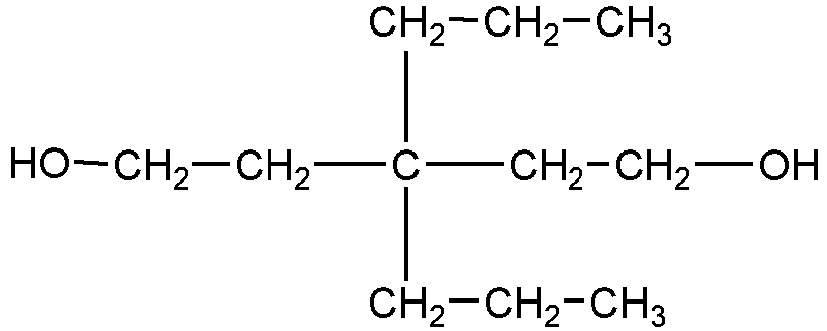
- (b) Esterification
Firstly, a slurry of terephthalic acid, ethylene glycol and 3,3-dipropyl-1,5-pentanediol with a molar ratio 1:1.8:0.03 is concocted and properly mixed with antimony trioxide, titanium dioxide and triphenyl phosphate, then the esterification is carried out in the nitrogen atmosphere under the pressure of 0.3MPa and the temperature of 250°C. The end point of esterification is chosen as the moment when the elimination of water reach 90% of the theoretical value. The additive contents (mass percentages relative to terephthalic acid) of antimony trioxide, titanium dioxide and triphenyl phosphate are 0.03%, 0.24% and 0.02%, respectively. - (c) Polycondensation
After the esterification hereinabove, the polycondensation is performed at negative pressure to obtain modified polyester eventually, which includes two successive stages, i.e., a) coarse vacuum stage, wherein the absolute pressure is smoothly reduced from the atmospheric pressure to 455Pa within 42min, and the reaction temperature is 264°C while reaction time is 45min, b) fine vacuum stage, wherein the pressure is furtherly reduced to 85Pa, and the reaction temperature is 285°C while reaction time is 75min. The obtained modified polyester possesses a molecular chain structure composed of terephthalic acid segments, ethylene glycol segments and 3,3-dipropyl-1,5-pentanediol segments (whose molar content is 4.5% respect to that of terephthalic acid segments), a cyclic oligomer content of 0.45wt%, a number average molecular weight of 26500 and a molecular weight distribution index of 2.2.
- (a) Synthesis of 3,3-dipropyl-1,5-pentanediol
- (2) The one-step spun composite DTY is prepared from those two types of modified polyester with different viscosities mentioned above through the steps of melting, melt metering, composite extruding, cooling, oiling, drawing, heat setting and winding, and the spinning parameters in those technology steps are listed in Table 1. Wherein the intrinsic viscosity ratio of those two modified polyester is 0.55:1.10 and the value of higher one is 1.OOdL/g, whereas the weight content ratio of two modified polyester is 1.0:0.9
- The final obtained one-step spun composite DTY has an elastic shrinkage rate of 43%, a fineness of 290detx, a linear density CV of 0.99%, a breaking strength of 2.7cN/dtex, a breaking elongation of 37.2%, a breaking strength CV of 5.0%, a breaking elongation CV of 9.6%, a boiling water shrinkage of 10.0%.
- A method for preparing the one-step spun composite DTY, comprising the technological process of:
- (1) Preparation of modified polyester
- (a) Synthesis of 4,4-dipropyl-1,7-heptanediol
At first 4,4-dipropyl-butyraldehyde, acetaldehyde and triethylamine are reacted for 20min under 92 °C in nitrogen atmosphere, then the concentrated solution is added into the hydrogenation reactor equipped with Raney nickel catalyst, and the reaction is furtherly carried out under 2.914MPa of hydrogen pressure at 100°C. When the reaction is completed, the reaction system is cooled to separate the catalyst out, then the solution is treated with ion exchange resin, followed by the water vacuum distillation, the separation and the purification of branched diol. The obtained diol has a formula of
- (b) Esterification
Firstly, a slurry of terephthalic acid, ethylene glycol and 4,4-dipropyl-1,7-heptanediol with a molar ratio 1:1.9:0.04 is concocted and properly mixed with antimony glycol, titanium dioxide and trimethyl phosphate, then the esterification is carried out in the nitrogen atmosphere under the pressure of 0.3MPa and the temperature of 260°C. The end point of esterification is chosen as the moment when the elimination of water reach 93% of the theoretical value. The additive contents (mass percentages relative to terephthalic acid) of antimony glycol, titanium dioxide and trimethyl phosphate are 0.04%, 0.21% and 0.03%, respectively. - (c) Polycondensation
After the esterification hereinabove, the polycondensation is performed at negative pressure to obtain modified polyester eventually, which includes two successive stages, i.e., a) coarse vacuum stage, wherein the absolute pressure is smoothly reduced from the atmospheric pressure to 475Pa within 45min, and the reaction temperature is 265°C while reaction time is 48min, b) fine vacuum stage, wherein the pressure is furtherly reduced to 88Pa, and the reaction temperature is 283°C while reaction time is 80min. The obtained modified polyester possesses a molecular chain structure composed of terephthalic acid segments, ethylene glycol segments and 4,4-dipropyl-1,7-heptanediol segments (whose molar content is 3% respect to that of terephthalic acid segments), a cyclic oligomer content of 0.6wt%, a number average molecular weight of 23000 and a molecular weight distribution index of 2.0.
- (a) Synthesis of 4,4-dipropyl-1,7-heptanediol
- (2) The one-step spun composite DTY is prepared from those two types of modified polyester with different viscosities mentioned above through the steps of melting, melt metering, composite extruding, cooling, oiling, drawing, heat setting and winding, and the spinning parameters in those technology steps are listed in Table 1. Wherein the intrinsic viscosity ratio of those two modified polyester is 0.65:1.15 and the value of higher one is 1.08dL/g, whereas the weight content ratio of two modified polyester is 0.8:0.7
- The final obtained one-step spun composite DTY has an elastic shrinkage rate of 35%, a fineness of 260detx, a linear density CV of 1.00%, a breaking strength of 2.7cN/dtex, a breaking elongation of 37.2%, a breaking strength CV of 5.0%, a breaking elongation CV of 10.0%, a boiling water shrinkage of 10.0%.
- A method for preparing the one-step spun composite DTY, comprising the technological process of:
- (1) Preparation of modified polyester
- (a) Synthesis of 4-methyl-4-(1,1-dimethyl ethyl) -1,7-heptanediol
At first 4-methyl-4-(1,1-dimethylethyl)-butyraldehyde, propylaldehyde and triethylamine are reacted for 20min under 92 °C in nitrogen atmosphere, then the concentrated solution is added into the hydrogenation reactor equipped with Raney nickel catalyst, and the reaction is furtherly carried out under 2.914MPa of hydrogen pressure at 100°C. When the reaction is completed, the reaction system is cooled to separate the catalyst out, then the solution is treated with ion exchange resin, followed by the water vacuum distillation, the separation and the purification of branched diol. The obtained diol has a formula of
- (b) Esterification
Firstly, a slurry of terephthalic acid, ethylene glycol and 4-methyl-4-(1,1-dimethyl ethyl)-1,7-heptanediol with a molar ratio 1:2.0:0.05 is concocted and properly mixed with antimony acetate, titanium dioxide and trimethyl phosphate, then the esterification is carried out in the nitrogen atmosphere under the atmospheric pressure and the temperature of 251°C. The end point of esterification is chosen as the moment when the elimination of water reach 96% of the theoretical value. The additive contents (mass percentages relative to terephthalic acid) of antimony acetate, titanium dioxide and trimethyl phosphate are 0.05%, 0.22% and 0.04%, respectively. - (c) Polycondensation
After the esterification hereinabove, the polycondensation is performed at negative pressure to obtain modified polyester eventually, which includes two successive stages, i.e., a) coarse vacuum stage, wherein the absolute pressure is smoothly reduced from the atmospheric pressure to 420Pa within 30min, and the reaction temperature is 267°C while reaction time is 50min, b) fine vacuum stage, wherein the pressure is furtherly reduced to 80Pa, and the reaction temperature is 280°C while reaction time is 90min. The obtained modified polyester possesses a molecular chain structure composed of terephthalic acid segments, ethylene glycol segments and 4-methyl-4-(1,1-dimethyl ethyl)-1,7-heptanediol segments (whose molar content is 4% respect to that of terephthalic acid segments), a cyclic oligomer content of 0.25wt%, a number average molecular weight of 24000 and a molecular weight distribution index of 2.2.
- (a) Synthesis of 4-methyl-4-(1,1-dimethyl ethyl) -1,7-heptanediol
- (2) The one-step spun composite DTY is prepared from those two types of modified polyester with different viscosities mentioned above through the steps of melting, melt metering, composite extruding, cooling, oiling, drawing, heat setting and winding, and the spinning parameters in those technology steps are listed in Table 1. Wherein the intrinsic viscosity ratio of those two modified polyester is 0.65:1.20 and the value of higher one is 1.01dL/g, whereas the weight content ratio of two modified polyester is 1.0:0.8.
- The final obtained one-step spun composite DTY has an elastic shrinkage rate of 37%, a fineness of 240detx, a linear density CV of 0.98%, a breaking strength of 2.9cN/dtex, a breaking elongation of 33.2%, a breaking strength CV of 4.8%, a breaking elongation CV of 9.4%, a boiling water shrinkage of 9.5%.
- A method for preparing the one-step spun composite DTY, comprising the technological process of:
- (1) Preparation of modified polyester
- (a) Synthesis of 3-methyl-3-amyl-1,6-hexanediol
At first 3-methyl-3-amyl-propionaldehyde, propylaldehyde and triethylamine are reacted for 20min under 90 °C in nitrogen atmosphere, then the concentrated solution is added into the hydrogenation reactor equipped with Raney nickel catalyst, and the reaction is furtherly carried out under 2.914MPa of hydrogen pressure at 100°C. When the reaction is completed, the reaction system is cooled to separate the catalyst out, then the solution is treated with ion exchange resin, followed by the water vacuum distillation, the separation and the purification of branched diol. The obtained diol has a formula of
- (b) Esterification
Firstly, a slurry of terephthalic acid, ethylene glycol and 3-methyl-3-amyl-1,6-hexanediol with a molar ratio 1:1.2:0.06 is concocted and properly mixed with antimony glycol, titanium dioxide and trimethyl phosphite, then the esterification is carried out in the nitrogen atmosphere under the pressure of 0.1MPa and the temperature of 255°C. The end point of esterification is chosen as the moment when the elimination of water reach 92% of the theoretical value. The additive contents (mass percentages relative to terephthalic acid) of antimony glycol, titanium dioxide and trimethyl phosphite are 0.01%, 0.20% and 0.01%, respectively. - (c) Polycondensation
After the esterification hereinabove, the polycondensation is performed at negative pressure to obtain modified polyester eventually, which includes two successive stages, i.e., a) coarse vacuum stage, wherein the absolute pressure is smoothly reduced from the atmospheric pressure to 490Pa within 50min, and the reaction temperature is 269°C while reaction time is 30min, b) fine vacuum stage, wherein the pressure is furtherly reduced to 100Pa, and the reaction temperature is 281°C while reaction time is 55min. The obtained modified polyester possesses a molecular chain structure composed of terephthalic acid segments, ethylene glycol segments and 3-methyl-3-amyl-1,6-hexanediol segments (whose molar content is 3.5% respect to that of terephthalic acid segments), a cyclic oligomer content of 0.1wt%, a number average molecular weight of 20000 and a molecular weight distribution index of 1.9.
- (a) Synthesis of 3-methyl-3-amyl-1,6-hexanediol
- (2) The one-step spun composite DTY is prepared from those two types of modified polyester with different viscosities mentioned above through the steps of melting, melt metering, composite extruding, cooling, oiling, drawing, heat setting and winding, and the spinning parameters in those technology steps are listed in Table 1. Wherein the intrinsic viscosity ratio of those two modified polyester is 0.70:1.00 and the value of higher one is 1.20dL/g, whereas the weight content ratio of two modified polyester is 0.9:1.0.
- The final obtained one-step spun composite DTY has an elastic shrinkage rate of 36%, a fineness of 230detx, a linear density CV of 0.97%, a breaking strength of 2.2cN/dtex, a breaking elongation of 33.2%, a breaking strength CV of 4.8%, a breaking elongation CV of 9.0%, a boiling water shrinkage of 9.5%.
- A method for preparing the one-step spun composite DTY, comprising the technological process of:
- (1) Preparation of modified polyester
- (a) Synthesis of 3,3-dipropyl-1,5-pentanediol
At first 3,3-dipentyl-propionaldehyde, acetaldehyde and triethylamine are reacted for 20min under 95 °C in nitrogen atmosphere, then the concentrated solution is added into the hydrogenation reactor equipped with Raney nickel catalyst, and the reaction is furtherly carried out under 2.914MPa of hydrogen pressure at 100°C. When the reaction is completed, the reaction system is cooled to separate the catalyst out, then the solution is treated with ion exchange resin, followed by the water vacuum distillation, the separation and the purification of branched diol. The obtained diol has a formula of
- (b) Esterification
Firstly, a slurry of terephthalic acid, ethylene glycol and 3,3-dipropyl-1,5-pentanediol with a molar ratio 1:2.0:0.03 is concocted and properly mixed with antimony acetate, titanium dioxide and trimethyl phosphite, then the esterification is carried out in the nitrogen atmosphere under the pressure of 0.2MPa and the temperature of 250°C. The end point of esterification is chosen as the moment when the elimination of water reach 97% of the theoretical value. The additive contents (mass percentages relative to terephthalic acid) of antimony acetate, titanium dioxide and trimethyl phosphite are 0.01%, 0.23% and 0.05%, respectively. - (c) Polycondensation
After the esterification hereinabove, the polycondensation is performed at negative pressure to obtain modified polyester eventually, which includes two successive stages, i.e., a) coarse vacuum stage, wherein the absolute pressure is smoothly reduced from the atmospheric pressure to 500Pa within 45min, and the reaction temperature is 260°C while reaction time is 40min, b) fine vacuum stage, wherein the pressure is furtherly reduced to 92Pa, and the reaction temperature is 277°C while reaction time is 80min. The obtained modified polyester possesses a molecular chain structure composed of terephthalic acid segments, ethylene glycol segments and 3,3-dipropyl-1,5-pentanediol segments (whose molar content is 5% respect to that of terephthalic acid segments), a cyclic oligomer content of 0.35wt%, a number average molecular weight of 25500 and a molecular weight distribution index of 1.8.
- (a) Synthesis of 3,3-dipropyl-1,5-pentanediol
- (2) The one-step spun composite DTY is prepared from those two types of modified polyester with different viscosities mentioned above through the steps of melting, melt metering, composite extruding, cooling, oiling, drawing, heat setting and winding, and the spinning parameters in those technology steps are listed in Table 1. Wherein the intrinsic viscosity ratio of those two modified polyester is 0.55:1.05 and the value of higher one is 1.20dL/g, whereas the weight content ratio of two modified polyester is 0.7:0.8.
- The final obtained one-step spun composite DTY has an elastic shrinkage rate of 38%, a fineness of 150detx, a linear density CV of 1.00%, a breaking strength of 2.4cN/dtex, a breaking elongation of 33.2%, a breaking strength CV of 5.0%, a breaking elongation CV of 9.2%, a boiling water shrinkage of 10.0%.
Table 1. Exa mpl e1 Exa mpl e2 Exa mpl e3 Exa mpl e4 Exam ple5 Exa mpl e6 Exa mpl e7 Exa mpl e8 Exa mpl e9 Exa mpl e10 Exa mpl e11 Spinni ng 285 283 281 280 290 285 288 290 281 283 286 Temp.( °C) Coolin g Temp. (°C) 20 21 25 25 21 20 20 21 24 23 22 Interla cing Pres. (MPa) 0.22 0.21 0.25 020 0.22 0.29 0.30 0.24 0.22 0.28 0.23 Roller1 Speed (m/min ) 220 0 230 0 250 0 235 0 2550 260 0 258 0 235 0 228 0 239 0 247 0 Roller1 Temp.( °C) 78 72 78 85 83 81 75 81 83 84 75 Roller2 Speed (m/min ) 365 0 378 0 379 0 365 0 3800 375 0 371 0 360 0 385 0 390 0 373 0 Roller2 Temp. (°C) 118 148 135 149 135 130 120 124 165 130 152 Windin g Speed (m/min ) 358 0 370 0 375 0 360 0 3700 384 0 376 0 368 0 372 0 360 0 379 0 Initial Spinni ng Pack Pres.(b ar) 120 120 120 120 120 120 120 120 120 120 120 Spinni ng Pack Pres. Rising ΔP (bar/da y) 0.58 0.56 0.6 0.55 0.52 0.6 0.54 0.55 0.52 0.54 0.59 Spinni ng Pack Life Cycle (Day) 66 62 63 60 60 65 67 62 61 60 68
Claims (3)
- A method for preparing a one-step spun composite DTY, characterized in that:two modified polyesters with different viscosities are melted, metered, compound extruded, cooled, oiled, drawn and a one-step spun composite DTY is prepared by stretching, heat setting and winding;the specific preparation steps of the two modified polyesters with different viscosities are as follows:(1) Esterification reaction;
terephthalic acid, ethylene glycol and a branched diol is formulated into a slurry, and after adding a catalyst, a matting agent and a stabilizer, the slurry mixture is uniformly mixed, and then pressurized for an esterification reaction under a pressurized nitrogen atmosphere; the pressure is from normal pressure to 0.3 MPa; the temperature is 250 ~ 260 ° C; and when the amount of water distilled in the esterification reaction reaches more than 90% of the theoretical value, it is the end point of the esterification reaction;(2) Polycondensation reaction;the polycondensation reaction is started in a low-vacuum stage in which, the pressure is steadily pumped from normal pressure to less than 500Pa absolute pressure within 30-50 minutes;the reaction temperature is 260-270 ° C and the reaction time is 30-50 minutes;the polycondensation reaction in the vacuum stage further reduces the reaction pressure to less than 100Pa absolute pressure, the reaction temperature is 275-285 °C, and the reaction time is 50-90min;the modified polyester with lower viscosity is prepared, and then undergoes an extra solid state polycondensation to produce the polyester of high viscosity;the branched glycols are 2-ethyl-2-methyl-1,3-propanediol, 2,2-diethyl-1,3-propanediol, 2 -Butyl-2-ethyl-1,3-propanediol, 3,3-diethyl-1,5-pentanediol, 4,4-diethyl-1,7-heptanediol, 4,4-bis (1,-methylethyl)-1,7-heptanediol, 3,3-dipropyl-1,5-pentanediol, 4,4-dipropyl-1,7-heptane Alcohol, 4-methyl-4- (1,1-dimethylethyl)-1,7-heptanediol, 3-methyl-3-pentyl-1,6-hexanediol or 3,3-dipropyl-1, 5-pentanediol;in said step (1) of the esterification reaction, the molar ratio of terephthalic acid, ethylene glycol and the branched glycol is 1: 1.2 to 2.0: 0.03 ~ 0.06, the dosage of the catalyst is 0.01 ~ 0.05% of the weight of terephthalic acid, the dosage of the matting agent is 0.20 ~ 0.25% of the weight of terephthalic acid, and the dosage of the stabilizer is 0.01 to 0.05% of the weight of phthalic acid;the catalyst is antimony trioxide, ethylene glycol antimony or antimony acetate, the matting agent is titanium dioxide, and the stabilizer is tripheynyl phosphate, trimethyl phosphate or trimethyl phosphite. - The method according to claim 1, characterized in that the component weight ratio of the modified polyester with higher viscosity to the modified polyester with lower viscosity is 0.7-1.0: 0.7-1.0.
- The method according to claim 1 or 2, wherein the spinning process parameters of the one-step spun composite DTY are as follows:spinning temperature: 280-290 ° C;cooling temperature: 20-25 ° C;network pressure : 0.20 ~ 0.30MPa;a first roller speed: 2200 ~ 2600m / min,a first roller temperature: 75 ~ 85 ° C;a second roller speed: 3600 ~ 3900m / min;a second roller temperature: 135 ~ 165 ° C;winding speed: 3580 ~ 3840m / min;initial spinning pack pressure: 120 Bar;spinning pack pressure rising ΔP ≤ 0.6bar/day; andspinning pack life cycle: ≥ 60days.
Applications Claiming Priority (2)
| Application Number | Priority Date | Filing Date | Title |
|---|---|---|---|
| CN201711340288.7A CN108048939B (en) | 2017-12-14 | 2017-12-14 | One step spins elastic force composite filament and preparation method thereof |
| PCT/CN2018/097501 WO2019114277A1 (en) | 2017-12-14 | 2018-07-27 | One-step spun elastic composite filament and preparation method therefor |
Publications (4)
| Publication Number | Publication Date |
|---|---|
| EP3683339A1 EP3683339A1 (en) | 2020-07-22 |
| EP3683339A4 EP3683339A4 (en) | 2021-06-02 |
| EP3683339C0 EP3683339C0 (en) | 2024-03-13 |
| EP3683339B1 true EP3683339B1 (en) | 2024-03-13 |
Family
ID=62132973
Family Applications (1)
| Application Number | Title | Priority Date | Filing Date |
|---|---|---|---|
| EP18889561.9A Active EP3683339B1 (en) | 2017-12-14 | 2018-07-27 | One-step spun elastic composite filament and preparation method therefor |
Country Status (5)
| Country | Link |
|---|---|
| US (1) | US11053387B2 (en) |
| EP (1) | EP3683339B1 (en) |
| JP (1) | JP6955634B2 (en) |
| CN (1) | CN108048939B (en) |
| WO (1) | WO2019114277A1 (en) |
Families Citing this family (6)
| Publication number | Priority date | Publication date | Assignee | Title |
|---|---|---|---|---|
| CN108048939B (en) * | 2017-12-14 | 2019-11-12 | 江苏恒力化纤股份有限公司 | One step spins elastic force composite filament and preparation method thereof |
| CN109369893B (en) * | 2018-10-23 | 2020-04-17 | 东华大学 | Polyester with low oligomer content and preparation method thereof |
| CN109610038B (en) * | 2018-12-27 | 2020-08-14 | 江苏恒力化纤股份有限公司 | One-step spinning elastic composite yarn and preparation method thereof |
| US12134842B2 (en) * | 2019-07-05 | 2024-11-05 | Kolon Industries, Inc. | Yarn for tire cord and tire cord |
| CN110468464B (en) * | 2019-08-28 | 2021-07-20 | 江苏索力得新材料集团有限公司 | High-strength flame-retardant polyester chip for industrial yarn and preparation method thereof |
| CN115074856B (en) * | 2022-07-15 | 2024-04-23 | 江苏恒科新材料有限公司 | Production method of FDY section of bending-resistant wide-wing I-beam |
Family Cites Families (15)
| Publication number | Priority date | Publication date | Assignee | Title |
|---|---|---|---|---|
| JPS6189338A (en) * | 1984-10-04 | 1986-05-07 | 帝人株式会社 | Production of composite bulky fiber |
| JPH02255710A (en) * | 1989-03-28 | 1990-10-16 | Unitika Ltd | Heat-resistant molded polymer product and production thereof |
| JPH04139212A (en) * | 1990-09-28 | 1992-05-13 | Chisso Corp | Modified polyester resin and heat bonding conjugate fiber using the same |
| KR100624145B1 (en) * | 2003-03-05 | 2006-09-18 | 주식회사 코오롱 | High color development island-in-the-sea composite fiber and suede-like fabric |
| CN104141178A (en) * | 2014-07-31 | 2014-11-12 | 江苏盛虹科技股份有限公司 | Elastic PET composite fiber and method for preparing elastic PET composite fiber |
| CN104480567B (en) * | 2014-12-31 | 2016-08-24 | 江苏恒力化纤股份有限公司 | A kind of Wool-Like abnormal contraction composite filament and preparation method thereof |
| CN105155034B (en) * | 2015-07-06 | 2018-02-02 | 中国纺织科学研究院 | It is thermally bonded elastomer and preparation method thereof |
| CN106283250B (en) * | 2016-08-31 | 2018-09-14 | 江苏恒力化纤股份有限公司 | A kind of high-strength ultralow miniature polyester industrial fiber of high uniformity and preparation method thereof |
| CN106350889B (en) * | 2016-08-31 | 2019-01-11 | 江苏恒力化纤股份有限公司 | A kind of high-strength middle shrinkage type polyester industrial fiber of high uniformity and preparation method thereof |
| CN106367835B (en) * | 2016-08-31 | 2018-12-04 | 江苏恒力化纤股份有限公司 | A kind of polyester fiber and preparation method thereof |
| CN106381558B (en) * | 2016-08-31 | 2018-09-14 | 江苏恒力化纤股份有限公司 | A kind of abnormal contraction composite filament and preparation method thereof |
| CN106245150B (en) * | 2016-08-31 | 2018-09-14 | 江苏恒力化纤股份有限公司 | A kind of high uniformity coloured polyester industrial yarn and preparation method thereof |
| CN106283253B (en) * | 2016-08-31 | 2018-10-30 | 江苏恒力化纤股份有限公司 | A kind of porous polyester fiber DTY and preparation method thereof |
| CN108048939B (en) * | 2017-12-14 | 2019-11-12 | 江苏恒力化纤股份有限公司 | One step spins elastic force composite filament and preparation method thereof |
| CN108130614B (en) * | 2017-12-14 | 2020-04-17 | 江苏恒力化纤股份有限公司 | Polyester HOY fiber and preparation method thereof |
-
2017
- 2017-12-14 CN CN201711340288.7A patent/CN108048939B/en active Active
-
2018
- 2018-07-27 EP EP18889561.9A patent/EP3683339B1/en active Active
- 2018-07-27 WO PCT/CN2018/097501 patent/WO2019114277A1/en not_active Ceased
- 2018-07-27 JP JP2020529695A patent/JP6955634B2/en active Active
- 2018-07-27 US US16/641,255 patent/US11053387B2/en active Active
Also Published As
| Publication number | Publication date |
|---|---|
| EP3683339A1 (en) | 2020-07-22 |
| EP3683339A4 (en) | 2021-06-02 |
| US11053387B2 (en) | 2021-07-06 |
| US20200190319A1 (en) | 2020-06-18 |
| WO2019114277A1 (en) | 2019-06-20 |
| JP2021504598A (en) | 2021-02-15 |
| CN108048939B (en) | 2019-11-12 |
| EP3683339C0 (en) | 2024-03-13 |
| CN108048939A (en) | 2018-05-18 |
| JP6955634B2 (en) | 2021-10-27 |
Similar Documents
| Publication | Publication Date | Title |
|---|---|---|
| EP3683339A1 (en) | One-step spun elastic composite filament and preparation method therefor | |
| CN108071009B (en) | Method for reducing hairiness of polyester yarn | |
| CN108130611B (en) | High-elongation low-shrinkage polyester industrial yarn and preparation method thereof | |
| CN108035011B (en) | Melt direct spinning colored polyester fiber and preparation method thereof | |
| CN107541803B (en) | Preparation method of normal-pressure cation dyeable polyester fiber | |
| US3869427A (en) | Treatment of linear polyester with organic monoepoxide | |
| CN108130610B (en) | Ultrahigh-strength polyester industrial yarn and preparation method thereof | |
| CN108130609B (en) | A kind of low-shrinkage polyester industrial yarn and preparation method thereof | |
| CN108035007B (en) | Superfine denier polyester drawn yarn and preparation method thereof | |
| CN102409429A (en) | A preparation method of high-comfort composite functional polyester fiber | |
| CN102408554B (en) | Preparation method for uvioresistant and cationic dyeable polyester chip | |
| CN107987260B (en) | Modified polyester and preparation method thereof | |
| CN106589330A (en) | Aromatic polyester-aliphatic polyester block copolyester and preparing method thereof | |
| CN115897267B (en) | A plant dyeing method for modified degradable polyester | |
| CN102690410B (en) | Modified polyester and production method of fiber thereof | |
| CN108385196B (en) | High-strength colored polyester industrial yarn and preparation method thereof | |
| CN105506774B (en) | A kind of low aberration polyester abnormal contraction composite filament and preparation method thereof | |
| KR101602385B1 (en) | Dimensionally stable polyethyleneterephthalate dipped cord, method of manufacturing the same and tire including the same | |
| US20180273680A1 (en) | Dyeable synthetic fiber | |
| US20070055043A1 (en) | Modified polyethylene, terephthalate for low temperature dyeability, controlled shrinkage characteristics and improved tensile properties | |
| US4442058A (en) | Esterification of carboxyl end groups employing addition of oxirane compounds | |
| EP3680369B1 (en) | Dual profile fiber and manufacturing method therefor | |
| CN109722741B (en) | Sheath-core flame-retardant filament and preparation method thereof | |
| CN108385187A (en) | High-strength aircraft safety band and preparation method thereof | |
| KR102642537B1 (en) | Antimony non elution tricot fabric filtration and Manufaturing method thereof |
Legal Events
| Date | Code | Title | Description |
|---|---|---|---|
| STAA | Information on the status of an ep patent application or granted ep patent |
Free format text: STATUS: THE INTERNATIONAL PUBLICATION HAS BEEN MADE |
|
| PUAI | Public reference made under article 153(3) epc to a published international application that has entered the european phase |
Free format text: ORIGINAL CODE: 0009012 |
|
| STAA | Information on the status of an ep patent application or granted ep patent |
Free format text: STATUS: REQUEST FOR EXAMINATION WAS MADE |
|
| 17P | Request for examination filed |
Effective date: 20200414 |
|
| AK | Designated contracting states |
Kind code of ref document: A1 Designated state(s): AL AT BE BG CH CY CZ DE DK EE ES FI FR GB GR HR HU IE IS IT LI LT LU LV MC MK MT NL NO PL PT RO RS SE SI SK SM TR |
|
| AX | Request for extension of the european patent |
Extension state: BA ME |
|
| DAV | Request for validation of the european patent (deleted) | ||
| DAX | Request for extension of the european patent (deleted) | ||
| A4 | Supplementary search report drawn up and despatched |
Effective date: 20210504 |
|
| RIC1 | Information provided on ipc code assigned before grant |
Ipc: D01F 6/84 20060101AFI20210428BHEP Ipc: D01F 6/92 20060101ALI20210428BHEP Ipc: C08G 63/83 20060101ALI20210428BHEP Ipc: C08G 63/78 20060101ALI20210428BHEP Ipc: C08L 67/02 20060101ALI20210428BHEP |
|
| STAA | Information on the status of an ep patent application or granted ep patent |
Free format text: STATUS: EXAMINATION IS IN PROGRESS |
|
| 17Q | First examination report despatched |
Effective date: 20220118 |
|
| GRAP | Despatch of communication of intention to grant a patent |
Free format text: ORIGINAL CODE: EPIDOSNIGR1 |
|
| STAA | Information on the status of an ep patent application or granted ep patent |
Free format text: STATUS: GRANT OF PATENT IS INTENDED |
|
| INTG | Intention to grant announced |
Effective date: 20231110 |
|
| GRAS | Grant fee paid |
Free format text: ORIGINAL CODE: EPIDOSNIGR3 |
|
| GRAA | (expected) grant |
Free format text: ORIGINAL CODE: 0009210 |
|
| STAA | Information on the status of an ep patent application or granted ep patent |
Free format text: STATUS: THE PATENT HAS BEEN GRANTED |
|
| AK | Designated contracting states |
Kind code of ref document: B1 Designated state(s): AL AT BE BG CH CY CZ DE DK EE ES FI FR GB GR HR HU IE IS IT LI LT LU LV MC MK MT NL NO PL PT RO RS SE SI SK SM TR |
|
| REG | Reference to a national code |
Ref country code: GB Ref legal event code: FG4D |
|
| REG | Reference to a national code |
Ref country code: CH Ref legal event code: EP |
|
| REG | Reference to a national code |
Ref country code: DE Ref legal event code: R096 Ref document number: 602018066711 Country of ref document: DE |
|
| REG | Reference to a national code |
Ref country code: IE Ref legal event code: FG4D |
|
| U01 | Request for unitary effect filed |
Effective date: 20240313 |
|
| U07 | Unitary effect registered |
Designated state(s): AT BE BG DE DK EE FI FR IT LT LU LV MT NL PT SE SI Effective date: 20240320 |
|
| PG25 | Lapsed in a contracting state [announced via postgrant information from national office to epo] |
Ref country code: GR Free format text: LAPSE BECAUSE OF FAILURE TO SUBMIT A TRANSLATION OF THE DESCRIPTION OR TO PAY THE FEE WITHIN THE PRESCRIBED TIME-LIMIT Effective date: 20240614 |
|
| PG25 | Lapsed in a contracting state [announced via postgrant information from national office to epo] |
Ref country code: RS Free format text: LAPSE BECAUSE OF FAILURE TO SUBMIT A TRANSLATION OF THE DESCRIPTION OR TO PAY THE FEE WITHIN THE PRESCRIBED TIME-LIMIT Effective date: 20240613 Ref country code: HR Free format text: LAPSE BECAUSE OF FAILURE TO SUBMIT A TRANSLATION OF THE DESCRIPTION OR TO PAY THE FEE WITHIN THE PRESCRIBED TIME-LIMIT Effective date: 20240313 |
|
| PG25 | Lapsed in a contracting state [announced via postgrant information from national office to epo] |
Ref country code: ES Free format text: LAPSE BECAUSE OF FAILURE TO SUBMIT A TRANSLATION OF THE DESCRIPTION OR TO PAY THE FEE WITHIN THE PRESCRIBED TIME-LIMIT Effective date: 20240313 |
|
| PG25 | Lapsed in a contracting state [announced via postgrant information from national office to epo] |
Ref country code: RS Free format text: LAPSE BECAUSE OF FAILURE TO SUBMIT A TRANSLATION OF THE DESCRIPTION OR TO PAY THE FEE WITHIN THE PRESCRIBED TIME-LIMIT Effective date: 20240613 Ref country code: NO Free format text: LAPSE BECAUSE OF FAILURE TO SUBMIT A TRANSLATION OF THE DESCRIPTION OR TO PAY THE FEE WITHIN THE PRESCRIBED TIME-LIMIT Effective date: 20240613 Ref country code: HR Free format text: LAPSE BECAUSE OF FAILURE TO SUBMIT A TRANSLATION OF THE DESCRIPTION OR TO PAY THE FEE WITHIN THE PRESCRIBED TIME-LIMIT Effective date: 20240313 Ref country code: GR Free format text: LAPSE BECAUSE OF FAILURE TO SUBMIT A TRANSLATION OF THE DESCRIPTION OR TO PAY THE FEE WITHIN THE PRESCRIBED TIME-LIMIT Effective date: 20240614 Ref country code: ES Free format text: LAPSE BECAUSE OF FAILURE TO SUBMIT A TRANSLATION OF THE DESCRIPTION OR TO PAY THE FEE WITHIN THE PRESCRIBED TIME-LIMIT Effective date: 20240313 |
|
| U20 | Renewal fee for the european patent with unitary effect paid |
Year of fee payment: 7 Effective date: 20240726 |
|
| PG25 | Lapsed in a contracting state [announced via postgrant information from national office to epo] |
Ref country code: IS Free format text: LAPSE BECAUSE OF FAILURE TO SUBMIT A TRANSLATION OF THE DESCRIPTION OR TO PAY THE FEE WITHIN THE PRESCRIBED TIME-LIMIT Effective date: 20240713 |
|
| PG25 | Lapsed in a contracting state [announced via postgrant information from national office to epo] |
Ref country code: SM Free format text: LAPSE BECAUSE OF FAILURE TO SUBMIT A TRANSLATION OF THE DESCRIPTION OR TO PAY THE FEE WITHIN THE PRESCRIBED TIME-LIMIT Effective date: 20240313 |
|
| PG25 | Lapsed in a contracting state [announced via postgrant information from national office to epo] |
Ref country code: CZ Free format text: LAPSE BECAUSE OF FAILURE TO SUBMIT A TRANSLATION OF THE DESCRIPTION OR TO PAY THE FEE WITHIN THE PRESCRIBED TIME-LIMIT Effective date: 20240313 |
|
| PG25 | Lapsed in a contracting state [announced via postgrant information from national office to epo] |
Ref country code: PL Free format text: LAPSE BECAUSE OF FAILURE TO SUBMIT A TRANSLATION OF THE DESCRIPTION OR TO PAY THE FEE WITHIN THE PRESCRIBED TIME-LIMIT Effective date: 20240313 |
|
| PG25 | Lapsed in a contracting state [announced via postgrant information from national office to epo] |
Ref country code: SK Free format text: LAPSE BECAUSE OF FAILURE TO SUBMIT A TRANSLATION OF THE DESCRIPTION OR TO PAY THE FEE WITHIN THE PRESCRIBED TIME-LIMIT Effective date: 20240313 |
|
| PG25 | Lapsed in a contracting state [announced via postgrant information from national office to epo] |
Ref country code: SM Free format text: LAPSE BECAUSE OF FAILURE TO SUBMIT A TRANSLATION OF THE DESCRIPTION OR TO PAY THE FEE WITHIN THE PRESCRIBED TIME-LIMIT Effective date: 20240313 Ref country code: SK Free format text: LAPSE BECAUSE OF FAILURE TO SUBMIT A TRANSLATION OF THE DESCRIPTION OR TO PAY THE FEE WITHIN THE PRESCRIBED TIME-LIMIT Effective date: 20240313 Ref country code: RO Free format text: LAPSE BECAUSE OF FAILURE TO SUBMIT A TRANSLATION OF THE DESCRIPTION OR TO PAY THE FEE WITHIN THE PRESCRIBED TIME-LIMIT Effective date: 20240313 Ref country code: PL Free format text: LAPSE BECAUSE OF FAILURE TO SUBMIT A TRANSLATION OF THE DESCRIPTION OR TO PAY THE FEE WITHIN THE PRESCRIBED TIME-LIMIT Effective date: 20240313 Ref country code: IS Free format text: LAPSE BECAUSE OF FAILURE TO SUBMIT A TRANSLATION OF THE DESCRIPTION OR TO PAY THE FEE WITHIN THE PRESCRIBED TIME-LIMIT Effective date: 20240713 Ref country code: CZ Free format text: LAPSE BECAUSE OF FAILURE TO SUBMIT A TRANSLATION OF THE DESCRIPTION OR TO PAY THE FEE WITHIN THE PRESCRIBED TIME-LIMIT Effective date: 20240313 |
|
| REG | Reference to a national code |
Ref country code: DE Ref legal event code: R097 Ref document number: 602018066711 Country of ref document: DE |
|
| PLBE | No opposition filed within time limit |
Free format text: ORIGINAL CODE: 0009261 |
|
| STAA | Information on the status of an ep patent application or granted ep patent |
Free format text: STATUS: NO OPPOSITION FILED WITHIN TIME LIMIT |
|
| PG25 | Lapsed in a contracting state [announced via postgrant information from national office to epo] |
Ref country code: MC Free format text: LAPSE BECAUSE OF FAILURE TO SUBMIT A TRANSLATION OF THE DESCRIPTION OR TO PAY THE FEE WITHIN THE PRESCRIBED TIME-LIMIT Effective date: 20240313 |
|
| 26N | No opposition filed |
Effective date: 20241216 |
|
| REG | Reference to a national code |
Ref country code: CH Ref legal event code: PL |
|
| GBPC | Gb: european patent ceased through non-payment of renewal fee |
Effective date: 20240727 |
|
| PG25 | Lapsed in a contracting state [announced via postgrant information from national office to epo] |
Ref country code: CH Free format text: LAPSE BECAUSE OF NON-PAYMENT OF DUE FEES Effective date: 20240731 |
|
| PG25 | Lapsed in a contracting state [announced via postgrant information from national office to epo] |
Ref country code: GB Free format text: LAPSE BECAUSE OF NON-PAYMENT OF DUE FEES Effective date: 20240727 |
|
| PG25 | Lapsed in a contracting state [announced via postgrant information from national office to epo] |
Ref country code: IE Free format text: LAPSE BECAUSE OF NON-PAYMENT OF DUE FEES Effective date: 20240727 |
|
| U20 | Renewal fee for the european patent with unitary effect paid |
Year of fee payment: 8 Effective date: 20250630 |
|
| PG25 | Lapsed in a contracting state [announced via postgrant information from national office to epo] |
Ref country code: CY Free format text: LAPSE BECAUSE OF FAILURE TO SUBMIT A TRANSLATION OF THE DESCRIPTION OR TO PAY THE FEE WITHIN THE PRESCRIBED TIME-LIMIT; INVALID AB INITIO Effective date: 20180727 |
|
| PG25 | Lapsed in a contracting state [announced via postgrant information from national office to epo] |
Ref country code: HU Free format text: LAPSE BECAUSE OF FAILURE TO SUBMIT A TRANSLATION OF THE DESCRIPTION OR TO PAY THE FEE WITHIN THE PRESCRIBED TIME-LIMIT; INVALID AB INITIO Effective date: 20180727 |