EP3683047A1 - Hard coating film having multilayer-structure, and polyimide film comprising same - Google Patents
Hard coating film having multilayer-structure, and polyimide film comprising same Download PDFInfo
- Publication number
- EP3683047A1 EP3683047A1 EP18850003.7A EP18850003A EP3683047A1 EP 3683047 A1 EP3683047 A1 EP 3683047A1 EP 18850003 A EP18850003 A EP 18850003A EP 3683047 A1 EP3683047 A1 EP 3683047A1
- Authority
- EP
- European Patent Office
- Prior art keywords
- hard coating
- coating film
- weight
- parts
- siloxane resin
- Prior art date
- Legal status (The legal status is an assumption and is not a legal conclusion. Google has not performed a legal analysis and makes no representation as to the accuracy of the status listed.)
- Pending
Links
- 239000011248 coating agent Substances 0.000 title claims abstract description 114
- 238000000576 coating method Methods 0.000 title claims abstract description 114
- 229920001721 polyimide Polymers 0.000 title claims description 31
- 239000011347 resin Substances 0.000 claims description 127
- 229920005989 resin Polymers 0.000 claims description 127
- KPUWHANPEXNPJT-UHFFFAOYSA-N disiloxane Chemical class [SiH3]O[SiH3] KPUWHANPEXNPJT-UHFFFAOYSA-N 0.000 claims description 115
- 239000000758 substrate Substances 0.000 claims description 26
- 238000007373 indentation Methods 0.000 claims description 11
- 150000002009 diols Chemical class 0.000 claims description 10
- -1 acryl Chemical group 0.000 claims description 9
- 239000004593 Epoxy Substances 0.000 claims description 7
- 150000001875 compounds Chemical class 0.000 claims description 6
- 125000000217 alkyl group Chemical group 0.000 claims description 5
- 125000002947 alkylene group Chemical group 0.000 claims description 5
- 125000006165 cyclic alkyl group Chemical group 0.000 claims description 5
- 125000004122 cyclic group Chemical group 0.000 claims description 5
- 230000000379 polymerizing effect Effects 0.000 claims description 5
- 238000002834 transmittance Methods 0.000 claims description 5
- 239000004642 Polyimide Substances 0.000 claims description 3
- 239000000203 mixture Substances 0.000 description 114
- 239000010410 layer Substances 0.000 description 102
- HEMHJVSKTPXQMS-UHFFFAOYSA-M Sodium hydroxide Chemical group [OH-].[Na+] HEMHJVSKTPXQMS-UHFFFAOYSA-M 0.000 description 96
- LYCAIKOWRPUZTN-UHFFFAOYSA-N Ethylene glycol Chemical compound OCCO LYCAIKOWRPUZTN-UHFFFAOYSA-N 0.000 description 57
- 239000011342 resin composition Substances 0.000 description 39
- XLYOFNOQVPJJNP-UHFFFAOYSA-N water Substances O XLYOFNOQVPJJNP-UHFFFAOYSA-N 0.000 description 39
- 239000003054 catalyst Substances 0.000 description 38
- 239000000047 product Substances 0.000 description 35
- BPSIOYPQMFLKFR-UHFFFAOYSA-N trimethoxy-[3-(oxiran-2-ylmethoxy)propyl]silane Chemical compound CO[Si](OC)(OC)CCCOCC1CO1 BPSIOYPQMFLKFR-UHFFFAOYSA-N 0.000 description 35
- ZWEHNKRNPOVVGH-UHFFFAOYSA-N 2-Butanone Chemical compound CCC(C)=O ZWEHNKRNPOVVGH-UHFFFAOYSA-N 0.000 description 34
- BOTDANWDWHJENH-UHFFFAOYSA-N Tetraethyl orthosilicate Chemical compound CCO[Si](OCC)(OCC)OCC BOTDANWDWHJENH-UHFFFAOYSA-N 0.000 description 34
- 239000004809 Teflon Substances 0.000 description 28
- 229920006362 Teflon® Polymers 0.000 description 28
- 239000007787 solid Substances 0.000 description 28
- 230000000052 comparative effect Effects 0.000 description 18
- 239000012153 distilled water Substances 0.000 description 16
- 239000011247 coating layer Substances 0.000 description 14
- 238000006243 chemical reaction Methods 0.000 description 13
- RAXXELZNTBOGNW-UHFFFAOYSA-N imidazole Natural products C1=CNC=N1 RAXXELZNTBOGNW-UHFFFAOYSA-N 0.000 description 12
- 238000006482 condensation reaction Methods 0.000 description 8
- 238000000034 method Methods 0.000 description 8
- 230000007062 hydrolysis Effects 0.000 description 7
- 238000006460 hydrolysis reaction Methods 0.000 description 7
- QNODIIQQMGDSEF-UHFFFAOYSA-N (1-hydroxycyclohexyl)-phenylmethanone Chemical compound C=1C=CC=CC=1C(=O)C1(O)CCCCC1 QNODIIQQMGDSEF-UHFFFAOYSA-N 0.000 description 6
- QTBSBXVTEAMEQO-UHFFFAOYSA-N Acetic acid Chemical compound CC(O)=O QTBSBXVTEAMEQO-UHFFFAOYSA-N 0.000 description 6
- UHOVQNZJYSORNB-UHFFFAOYSA-N Benzene Chemical compound C1=CC=CC=C1 UHOVQNZJYSORNB-UHFFFAOYSA-N 0.000 description 6
- YMWUJEATGCHHMB-UHFFFAOYSA-N Dichloromethane Chemical compound ClCCl YMWUJEATGCHHMB-UHFFFAOYSA-N 0.000 description 6
- KFZMGEQAYNKOFK-UHFFFAOYSA-N Isopropanol Chemical compound CC(C)O KFZMGEQAYNKOFK-UHFFFAOYSA-N 0.000 description 6
- OKKJLVBELUTLKV-UHFFFAOYSA-N Methanol Chemical compound OC OKKJLVBELUTLKV-UHFFFAOYSA-N 0.000 description 6
- KWYUFKZDYYNOTN-UHFFFAOYSA-M Potassium hydroxide Chemical compound [OH-].[K+] KWYUFKZDYYNOTN-UHFFFAOYSA-M 0.000 description 6
- YXFVVABEGXRONW-UHFFFAOYSA-N Toluene Chemical compound CC1=CC=CC=C1 YXFVVABEGXRONW-UHFFFAOYSA-N 0.000 description 6
- 230000000694 effects Effects 0.000 description 6
- 238000010438 heat treatment Methods 0.000 description 6
- 239000003999 initiator Substances 0.000 description 6
- 239000003960 organic solvent Substances 0.000 description 6
- 230000000704 physical effect Effects 0.000 description 6
- 229910010272 inorganic material Inorganic materials 0.000 description 5
- 239000011147 inorganic material Substances 0.000 description 5
- 239000000463 material Substances 0.000 description 5
- 229920006254 polymer film Polymers 0.000 description 5
- 238000006116 polymerization reaction Methods 0.000 description 5
- CSCPPACGZOOCGX-UHFFFAOYSA-N Acetone Chemical compound CC(C)=O CSCPPACGZOOCGX-UHFFFAOYSA-N 0.000 description 4
- QGZKDVFQNNGYKY-UHFFFAOYSA-N Ammonia Chemical compound N QGZKDVFQNNGYKY-UHFFFAOYSA-N 0.000 description 4
- HEDRZPFGACZZDS-UHFFFAOYSA-N Chloroform Chemical compound ClC(Cl)Cl HEDRZPFGACZZDS-UHFFFAOYSA-N 0.000 description 4
- RTZKZFJDLAIYFH-UHFFFAOYSA-N Diethyl ether Chemical compound CCOCC RTZKZFJDLAIYFH-UHFFFAOYSA-N 0.000 description 4
- LFQSCWFLJHTTHZ-UHFFFAOYSA-N Ethanol Chemical compound CCO LFQSCWFLJHTTHZ-UHFFFAOYSA-N 0.000 description 4
- VEXZGXHMUGYJMC-UHFFFAOYSA-N Hydrochloric acid Chemical compound Cl VEXZGXHMUGYJMC-UHFFFAOYSA-N 0.000 description 4
- LRHPLDYGYMQRHN-UHFFFAOYSA-N N-Butanol Chemical compound CCCCO LRHPLDYGYMQRHN-UHFFFAOYSA-N 0.000 description 4
- QAOWNCQODCNURD-UHFFFAOYSA-N Sulfuric acid Chemical compound OS(O)(=O)=O QAOWNCQODCNURD-UHFFFAOYSA-N 0.000 description 4
- 239000006227 byproduct Substances 0.000 description 4
- JHIVVAPYMSGYDF-UHFFFAOYSA-N cyclohexanone Chemical compound O=C1CCCCC1 JHIVVAPYMSGYDF-UHFFFAOYSA-N 0.000 description 4
- ZXEKIIBDNHEJCQ-UHFFFAOYSA-N isobutanol Chemical compound CC(C)CO ZXEKIIBDNHEJCQ-UHFFFAOYSA-N 0.000 description 4
- 238000006748 scratching Methods 0.000 description 4
- 230000002393 scratching effect Effects 0.000 description 4
- 238000012719 thermal polymerization Methods 0.000 description 4
- 238000005299 abrasion Methods 0.000 description 3
- 238000005336 cracking Methods 0.000 description 3
- 239000011521 glass Substances 0.000 description 3
- 230000003287 optical effect Effects 0.000 description 3
- 239000011368 organic material Substances 0.000 description 3
- NWUYHJFMYQTDRP-UHFFFAOYSA-N 1,2-bis(ethenyl)benzene;1-ethenyl-2-ethylbenzene;styrene Chemical compound C=CC1=CC=CC=C1.CCC1=CC=CC=C1C=C.C=CC1=CC=CC=C1C=C NWUYHJFMYQTDRP-UHFFFAOYSA-N 0.000 description 2
- RYHBNJHYFVUHQT-UHFFFAOYSA-N 1,4-Dioxane Chemical compound C1COCCO1 RYHBNJHYFVUHQT-UHFFFAOYSA-N 0.000 description 2
- XNWFRZJHXBZDAG-UHFFFAOYSA-N 2-METHOXYETHANOL Chemical compound COCCO XNWFRZJHXBZDAG-UHFFFAOYSA-N 0.000 description 2
- QQZOPKMRPOGIEB-UHFFFAOYSA-N 2-Oxohexane Chemical compound CCCCC(C)=O QQZOPKMRPOGIEB-UHFFFAOYSA-N 0.000 description 2
- POAOYUHQDCAZBD-UHFFFAOYSA-N 2-butoxyethanol Chemical compound CCCCOCCO POAOYUHQDCAZBD-UHFFFAOYSA-N 0.000 description 2
- KRHYYFGTRYWZRS-UHFFFAOYSA-N Fluorane Chemical compound F KRHYYFGTRYWZRS-UHFFFAOYSA-N 0.000 description 2
- GRYLNZFGIOXLOG-UHFFFAOYSA-N Nitric acid Chemical compound O[N+]([O-])=O GRYLNZFGIOXLOG-UHFFFAOYSA-N 0.000 description 2
- XSTXAVWGXDQKEL-UHFFFAOYSA-N Trichloroethylene Chemical group ClC=C(Cl)Cl XSTXAVWGXDQKEL-UHFFFAOYSA-N 0.000 description 2
- 239000003377 acid catalyst Substances 0.000 description 2
- 150000001298 alcohols Chemical class 0.000 description 2
- 150000001412 amines Chemical class 0.000 description 2
- 229910021529 ammonia Inorganic materials 0.000 description 2
- 239000003963 antioxidant agent Substances 0.000 description 2
- 230000003078 antioxidant effect Effects 0.000 description 2
- RQPZNWPYLFFXCP-UHFFFAOYSA-L barium dihydroxide Chemical compound [OH-].[OH-].[Ba+2] RQPZNWPYLFFXCP-UHFFFAOYSA-L 0.000 description 2
- 229910001863 barium hydroxide Inorganic materials 0.000 description 2
- 238000005452 bending Methods 0.000 description 2
- 238000005266 casting Methods 0.000 description 2
- 239000003795 chemical substances by application Substances 0.000 description 2
- 239000011162 core material Substances 0.000 description 2
- 238000010586 diagram Methods 0.000 description 2
- 150000002170 ethers Chemical class 0.000 description 2
- QFWPJPIVLCBXFJ-UHFFFAOYSA-N glymidine Chemical compound N1=CC(OCCOC)=CN=C1NS(=O)(=O)C1=CC=CC=C1 QFWPJPIVLCBXFJ-UHFFFAOYSA-N 0.000 description 2
- 150000008282 halocarbons Chemical class 0.000 description 2
- 229930195733 hydrocarbon Natural products 0.000 description 2
- 150000002430 hydrocarbons Chemical class 0.000 description 2
- 229910000040 hydrogen fluoride Inorganic materials 0.000 description 2
- 239000003456 ion exchange resin Substances 0.000 description 2
- 229920003303 ion-exchange polymer Polymers 0.000 description 2
- 229940035429 isobutyl alcohol Drugs 0.000 description 2
- 150000002576 ketones Chemical class 0.000 description 2
- 238000005259 measurement Methods 0.000 description 2
- 238000000465 moulding Methods 0.000 description 2
- VLKZOEOYAKHREP-UHFFFAOYSA-N n-Hexane Chemical compound CCCCCC VLKZOEOYAKHREP-UHFFFAOYSA-N 0.000 description 2
- 229910017604 nitric acid Inorganic materials 0.000 description 2
- 125000002524 organometallic group Chemical group 0.000 description 2
- 238000007254 oxidation reaction Methods 0.000 description 2
- 239000003505 polymerization initiator Substances 0.000 description 2
- 238000012545 processing Methods 0.000 description 2
- 238000011160 research Methods 0.000 description 2
- 150000003839 salts Chemical class 0.000 description 2
- 238000003756 stirring Methods 0.000 description 2
- UBOXGVDOUJQMTN-UHFFFAOYSA-N trichloroethylene Natural products ClCC(Cl)Cl UBOXGVDOUJQMTN-UHFFFAOYSA-N 0.000 description 2
- QXONIHMUSQFKJU-UHFFFAOYSA-N 2-(prop-1-enoxymethyl)oxirane Chemical group CC=COCC1CO1 QXONIHMUSQFKJU-UHFFFAOYSA-N 0.000 description 1
- BLRPTPMANUNPDV-UHFFFAOYSA-N Silane Chemical compound [SiH4] BLRPTPMANUNPDV-UHFFFAOYSA-N 0.000 description 1
- 229910000831 Steel Inorganic materials 0.000 description 1
- 239000003153 chemical reaction reagent Substances 0.000 description 1
- 238000009833 condensation Methods 0.000 description 1
- 230000005494 condensation Effects 0.000 description 1
- 238000007796 conventional method Methods 0.000 description 1
- 230000003247 decreasing effect Effects 0.000 description 1
- 238000011161 development Methods 0.000 description 1
- 229910003460 diamond Inorganic materials 0.000 description 1
- 239000010432 diamond Substances 0.000 description 1
- 238000005516 engineering process Methods 0.000 description 1
- 125000002887 hydroxy group Chemical group [H]O* 0.000 description 1
- 239000004615 ingredient Substances 0.000 description 1
- 238000000691 measurement method Methods 0.000 description 1
- 239000012528 membrane Substances 0.000 description 1
- 239000007769 metal material Substances 0.000 description 1
- 125000002496 methyl group Chemical group [H]C([H])([H])* 0.000 description 1
- 239000000178 monomer Substances 0.000 description 1
- 239000002365 multiple layer Substances 0.000 description 1
- 239000003973 paint Substances 0.000 description 1
- 238000000016 photochemical curing Methods 0.000 description 1
- 238000007747 plating Methods 0.000 description 1
- 230000009257 reactivity Effects 0.000 description 1
- 229910000077 silane Inorganic materials 0.000 description 1
- 239000002356 single layer Substances 0.000 description 1
- 239000010959 steel Substances 0.000 description 1
- 239000000126 substance Substances 0.000 description 1
- 210000002268 wool Anatomy 0.000 description 1
Images
Classifications
-
- B—PERFORMING OPERATIONS; TRANSPORTING
- B32—LAYERED PRODUCTS
- B32B—LAYERED PRODUCTS, i.e. PRODUCTS BUILT-UP OF STRATA OF FLAT OR NON-FLAT, e.g. CELLULAR OR HONEYCOMB, FORM
- B32B7/00—Layered products characterised by the relation between layers; Layered products characterised by the relative orientation of features between layers, or by the relative values of a measurable parameter between layers, i.e. products comprising layers having different physical, chemical or physicochemical properties; Layered products characterised by the interconnection of layers
- B32B7/02—Physical, chemical or physicochemical properties
- B32B7/022—Mechanical properties
-
- C—CHEMISTRY; METALLURGY
- C08—ORGANIC MACROMOLECULAR COMPOUNDS; THEIR PREPARATION OR CHEMICAL WORKING-UP; COMPOSITIONS BASED THEREON
- C08J—WORKING-UP; GENERAL PROCESSES OF COMPOUNDING; AFTER-TREATMENT NOT COVERED BY SUBCLASSES C08B, C08C, C08F, C08G or C08H
- C08J7/00—Chemical treatment or coating of shaped articles made of macromolecular substances
- C08J7/04—Coating
- C08J7/042—Coating with two or more layers, where at least one layer of a composition contains a polymer binder
-
- B—PERFORMING OPERATIONS; TRANSPORTING
- B32—LAYERED PRODUCTS
- B32B—LAYERED PRODUCTS, i.e. PRODUCTS BUILT-UP OF STRATA OF FLAT OR NON-FLAT, e.g. CELLULAR OR HONEYCOMB, FORM
- B32B27/00—Layered products comprising a layer of synthetic resin
- B32B27/06—Layered products comprising a layer of synthetic resin as the main or only constituent of a layer, which is next to another layer of the same or of a different material
- B32B27/08—Layered products comprising a layer of synthetic resin as the main or only constituent of a layer, which is next to another layer of the same or of a different material of synthetic resin
-
- B—PERFORMING OPERATIONS; TRANSPORTING
- B32—LAYERED PRODUCTS
- B32B—LAYERED PRODUCTS, i.e. PRODUCTS BUILT-UP OF STRATA OF FLAT OR NON-FLAT, e.g. CELLULAR OR HONEYCOMB, FORM
- B32B27/00—Layered products comprising a layer of synthetic resin
- B32B27/28—Layered products comprising a layer of synthetic resin comprising synthetic resins not wholly covered by any one of the sub-groups B32B27/30 - B32B27/42
-
- B—PERFORMING OPERATIONS; TRANSPORTING
- B32—LAYERED PRODUCTS
- B32B—LAYERED PRODUCTS, i.e. PRODUCTS BUILT-UP OF STRATA OF FLAT OR NON-FLAT, e.g. CELLULAR OR HONEYCOMB, FORM
- B32B27/00—Layered products comprising a layer of synthetic resin
- B32B27/28—Layered products comprising a layer of synthetic resin comprising synthetic resins not wholly covered by any one of the sub-groups B32B27/30 - B32B27/42
- B32B27/281—Layered products comprising a layer of synthetic resin comprising synthetic resins not wholly covered by any one of the sub-groups B32B27/30 - B32B27/42 comprising polyimides
-
- B—PERFORMING OPERATIONS; TRANSPORTING
- B32—LAYERED PRODUCTS
- B32B—LAYERED PRODUCTS, i.e. PRODUCTS BUILT-UP OF STRATA OF FLAT OR NON-FLAT, e.g. CELLULAR OR HONEYCOMB, FORM
- B32B27/00—Layered products comprising a layer of synthetic resin
- B32B27/28—Layered products comprising a layer of synthetic resin comprising synthetic resins not wholly covered by any one of the sub-groups B32B27/30 - B32B27/42
- B32B27/283—Layered products comprising a layer of synthetic resin comprising synthetic resins not wholly covered by any one of the sub-groups B32B27/30 - B32B27/42 comprising polysiloxanes
-
- B—PERFORMING OPERATIONS; TRANSPORTING
- B32—LAYERED PRODUCTS
- B32B—LAYERED PRODUCTS, i.e. PRODUCTS BUILT-UP OF STRATA OF FLAT OR NON-FLAT, e.g. CELLULAR OR HONEYCOMB, FORM
- B32B33/00—Layered products characterised by particular properties or particular surface features, e.g. particular surface coatings; Layered products designed for particular purposes not covered by another single class
-
- B—PERFORMING OPERATIONS; TRANSPORTING
- B32—LAYERED PRODUCTS
- B32B—LAYERED PRODUCTS, i.e. PRODUCTS BUILT-UP OF STRATA OF FLAT OR NON-FLAT, e.g. CELLULAR OR HONEYCOMB, FORM
- B32B7/00—Layered products characterised by the relation between layers; Layered products characterised by the relative orientation of features between layers, or by the relative values of a measurable parameter between layers, i.e. products comprising layers having different physical, chemical or physicochemical properties; Layered products characterised by the interconnection of layers
- B32B7/02—Physical, chemical or physicochemical properties
-
- B—PERFORMING OPERATIONS; TRANSPORTING
- B32—LAYERED PRODUCTS
- B32B—LAYERED PRODUCTS, i.e. PRODUCTS BUILT-UP OF STRATA OF FLAT OR NON-FLAT, e.g. CELLULAR OR HONEYCOMB, FORM
- B32B7/00—Layered products characterised by the relation between layers; Layered products characterised by the relative orientation of features between layers, or by the relative values of a measurable parameter between layers, i.e. products comprising layers having different physical, chemical or physicochemical properties; Layered products characterised by the interconnection of layers
- B32B7/02—Physical, chemical or physicochemical properties
- B32B7/023—Optical properties
-
- C—CHEMISTRY; METALLURGY
- C08—ORGANIC MACROMOLECULAR COMPOUNDS; THEIR PREPARATION OR CHEMICAL WORKING-UP; COMPOSITIONS BASED THEREON
- C08G—MACROMOLECULAR COMPOUNDS OBTAINED OTHERWISE THAN BY REACTIONS ONLY INVOLVING UNSATURATED CARBON-TO-CARBON BONDS
- C08G77/00—Macromolecular compounds obtained by reactions forming a linkage containing silicon with or without sulfur, nitrogen, oxygen or carbon in the main chain of the macromolecule
- C08G77/04—Polysiloxanes
-
- C—CHEMISTRY; METALLURGY
- C08—ORGANIC MACROMOLECULAR COMPOUNDS; THEIR PREPARATION OR CHEMICAL WORKING-UP; COMPOSITIONS BASED THEREON
- C08G—MACROMOLECULAR COMPOUNDS OBTAINED OTHERWISE THAN BY REACTIONS ONLY INVOLVING UNSATURATED CARBON-TO-CARBON BONDS
- C08G77/00—Macromolecular compounds obtained by reactions forming a linkage containing silicon with or without sulfur, nitrogen, oxygen or carbon in the main chain of the macromolecule
- C08G77/04—Polysiloxanes
- C08G77/14—Polysiloxanes containing silicon bound to oxygen-containing groups
-
- C—CHEMISTRY; METALLURGY
- C08—ORGANIC MACROMOLECULAR COMPOUNDS; THEIR PREPARATION OR CHEMICAL WORKING-UP; COMPOSITIONS BASED THEREON
- C08J—WORKING-UP; GENERAL PROCESSES OF COMPOUNDING; AFTER-TREATMENT NOT COVERED BY SUBCLASSES C08B, C08C, C08F, C08G or C08H
- C08J5/00—Manufacture of articles or shaped materials containing macromolecular substances
- C08J5/18—Manufacture of films or sheets
-
- C—CHEMISTRY; METALLURGY
- C08—ORGANIC MACROMOLECULAR COMPOUNDS; THEIR PREPARATION OR CHEMICAL WORKING-UP; COMPOSITIONS BASED THEREON
- C08J—WORKING-UP; GENERAL PROCESSES OF COMPOUNDING; AFTER-TREATMENT NOT COVERED BY SUBCLASSES C08B, C08C, C08F, C08G or C08H
- C08J7/00—Chemical treatment or coating of shaped articles made of macromolecular substances
- C08J7/04—Coating
- C08J7/046—Forming abrasion-resistant coatings; Forming surface-hardening coatings
-
- C—CHEMISTRY; METALLURGY
- C09—DYES; PAINTS; POLISHES; NATURAL RESINS; ADHESIVES; COMPOSITIONS NOT OTHERWISE PROVIDED FOR; APPLICATIONS OF MATERIALS NOT OTHERWISE PROVIDED FOR
- C09D—COATING COMPOSITIONS, e.g. PAINTS, VARNISHES OR LACQUERS; FILLING PASTES; CHEMICAL PAINT OR INK REMOVERS; INKS; CORRECTING FLUIDS; WOODSTAINS; PASTES OR SOLIDS FOR COLOURING OR PRINTING; USE OF MATERIALS THEREFOR
- C09D183/00—Coating compositions based on macromolecular compounds obtained by reactions forming in the main chain of the macromolecule a linkage containing silicon, with or without sulfur, nitrogen, oxygen, or carbon only; Coating compositions based on derivatives of such polymers
- C09D183/04—Polysiloxanes
-
- B—PERFORMING OPERATIONS; TRANSPORTING
- B32—LAYERED PRODUCTS
- B32B—LAYERED PRODUCTS, i.e. PRODUCTS BUILT-UP OF STRATA OF FLAT OR NON-FLAT, e.g. CELLULAR OR HONEYCOMB, FORM
- B32B2307/00—Properties of the layers or laminate
- B32B2307/40—Properties of the layers or laminate having particular optical properties
- B32B2307/412—Transparent
-
- B—PERFORMING OPERATIONS; TRANSPORTING
- B32—LAYERED PRODUCTS
- B32B—LAYERED PRODUCTS, i.e. PRODUCTS BUILT-UP OF STRATA OF FLAT OR NON-FLAT, e.g. CELLULAR OR HONEYCOMB, FORM
- B32B2307/00—Properties of the layers or laminate
- B32B2307/50—Properties of the layers or laminate having particular mechanical properties
- B32B2307/536—Hardness
-
- C—CHEMISTRY; METALLURGY
- C08—ORGANIC MACROMOLECULAR COMPOUNDS; THEIR PREPARATION OR CHEMICAL WORKING-UP; COMPOSITIONS BASED THEREON
- C08J—WORKING-UP; GENERAL PROCESSES OF COMPOUNDING; AFTER-TREATMENT NOT COVERED BY SUBCLASSES C08B, C08C, C08F, C08G or C08H
- C08J2379/00—Characterised by the use of macromolecular compounds obtained by reactions forming in the main chain of the macromolecule a linkage containing nitrogen with or without oxygen, or carbon only, not provided for in groups C08J2361/00 - C08J2377/00
- C08J2379/04—Polycondensates having nitrogen-containing heterocyclic rings in the main chain; Polyhydrazides; Polyamide acids or similar polyimide precursors
- C08J2379/08—Polyimides; Polyester-imides; Polyamide-imides; Polyamide acids or similar polyimide precursors
-
- C—CHEMISTRY; METALLURGY
- C08—ORGANIC MACROMOLECULAR COMPOUNDS; THEIR PREPARATION OR CHEMICAL WORKING-UP; COMPOSITIONS BASED THEREON
- C08J—WORKING-UP; GENERAL PROCESSES OF COMPOUNDING; AFTER-TREATMENT NOT COVERED BY SUBCLASSES C08B, C08C, C08F, C08G or C08H
- C08J2483/00—Characterised by the use of macromolecular compounds obtained by reactions forming in the main chain of the macromolecule a linkage containing silicon with or without sulfur, nitrogen, oxygen, or carbon only; Derivatives of such polymers
- C08J2483/04—Polysiloxanes
Definitions
- the present disclosure relates to a hard coating film having a multiple-layer structure and a polyimide film including the same.
- Transparent polymer films are widely used as core materials in the fields of optical and flexible displays, and in particular are replacing glass in the display industry due to the light weight and ease of processing.
- transparent polymer films have a disadvantage of poor abrasion resistance due to the low surface hardness compared to glass. Accordingly, research on hard coating for high hardness has been actively conducted, but when the high hardness is achieved, flexibility, which is the opposite physical property, is reduced, which is disadvantageous. For this purpose, coating techniques for satisfying the surface hardness and flexibility of polymer films arise as an important issue.
- the materials used for hard coating broadly include organic materials, inorganic materials and hybrid organic-inorganic materials.
- organic materials have advantages of flexibility and moldability due to the inherent characteristics of organic substances, but have the disadvantage of low surface hardness
- inorganic materials have the advantages of high surface hardness and transparency, but have the disadvantages of poor flexibility and moldability.
- Korean Patent Laid-open Publication No. 2014-0104175 and International Patent Laid-open Publication No. 2013-187699 also use organic or inorganic materials to increase surface hardness, but the physical properties of flexibility and formability were not satisfactory.
- the present disclosure has been made in view of the above problems, and it is one object of the present disclosure to provide a hard coating film that is introduced with a multilayer structure to satisfy the property of high hardness in an upper-layer structure and the property of high bending in a lower-layer structure to thereby secure all of hardness, scratch resistance and flexibility, and a polyimide film including the same.
- a hard coating film having a structure in which a highly bendable layer and a high-hardness layer are stacked on a substrate in that order, wherein the highly bendable layer has a Vickers hardness (Hv) of 40 or less, the high-hardness layer has a Vickers hardness (Hv) of 55 or more, and the hard coating film including the highly bendable layer and the high-hardness layer stacked on the substrate in that order has a Vickers hardness (Hv) of 20 to 65.
- Hv Vickers hardness
- Hv Vickers hardness
- the substrate may be a transparent polyimide substrate.
- the hard coating film may have a reverse R of 2.0 or less.
- the hard coating film may have a tensile fracture point of more than 6%.
- the hard coating film may have a bendability (EIT (indentation modulus)/HIT (indentation hardness) of 8 or more.
- the hard coating film may have a transmittance of 90% or more and a haze of 1.0% or less.
- the highly bendable layer may have a thickness of 1 to 200 ⁇ m, and the high-hardness layer may have a thickness of 30 ⁇ m or less.
- the highly bendable layer may include a siloxane resin obtained by polymerizing a compound including: at least one alkoxysilane selected from an alkoxysilane represented by the following Formula 1 and an alkoxysilane represented by the following Formula 2; and a diol represented by the following Formula 3: ⁇ Formula 1> R 1 n Si(OR 2 ) 4-n wherein R 1 is a C1-C3 linear, branched or cyclic alkylene group substituted with epoxy or acryl, R 2 is a C1-C8 linear, branched or cyclic alkyl group, and n is an integer of 1 to 3, ⁇ Formula 2> Si(OR 3 ) 4 wherein R 3 represents a C1 to C4 linear or branched alkyl group, ⁇ Formula 3> HO(CH 2 ) n OH wherein n is an integer of 1 to 10.
- the high-hardness layer may include a siloxane resin obtained by polymerizing a compound including at least one alkoxysilane selected from the alkoxysilane represented by Formula 1 and the alkoxysilane represented by Formula 2.
- a polyimide film including the hard coating film.
- the hard coating film having a multi-layered structure and the polyimide film including the same according to the present disclosure are capable of obtaining effects of excellent scratch resistance and flexibility, in spite of low Vickers hardness (Hv).
- the present disclosure is directed to a hard coating film having a structure in which a highly bendable layer and a high-hardness layer are stacked on a substrate in that order, wherein the highly bendable layer has a Vickers hardness (Hv) of 40 or less, and the high-hardness layer has a Vickers hardness (Hv) of 55 or more, and the hard coating film including the highly bendable layer and the high-hardness layer stacked on the substrate in that order has a Vickers hardness (Hv) of 20 to 65.
- Hv Vickers hardness
- Hv Vickers hardness
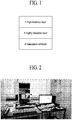
- FIG. 1 is a schematic diagram showing a hard coating film having a multilayer structure according to the present disclosure.
- the hard coating film according to the present disclosure has a multilayer structure in which a highly bendable layer (hereinafter, referred to as a "lower layer”) is laminated on a transparent substrate, and a high-hardness layer (hereinafter, referred to as an "upper layer”) is stacked on the highly bendable layer.
- a highly bendable layer hereinafter, referred to as a "lower layer”
- a high-hardness layer hereinafter, referred to as an "upper layer”
- the lower layer has a Vickers hardness (Hv) of 40 or less, preferably 15 to 35, and more preferably 20 to 30, it bends well when folded due to the excellent flexibility thereof, and has an effect of achieving flexibility to prevent the coating layer from breaking.
- Hv Vickers hardness
- the upper layer has a Vickers hardness (Hv) of 55 or more, preferably 60 or more, an effect of preventing scratches generated by external impacts can be obtained due to the high hardness of the upper layer.
- Hv Vickers hardness
- the hard coating film including both the lower layer and the upper layer has a Vickers hardness (Hv) of 20 to 65, preferably 20 to 55, and more preferably 20 to 50, a hard coating having bendability of 2.0 or less and resisting scratching can be obtained.
- Hv Vickers hardness
- the hard coating film described above includes a lower layer and an upper layer having a Vickers hardness within a specific range and thereby exhibits excellent scratch resistance and can obtain physical properties such as a reverse R of 2.0 or less, preferably 0.4 to 2.0, and a tensile fracture point of 6% or more, preferably 6 to 50%, bendability (EIT/HIT, wherein EIT is an indentation modulus, and HIT is an indentation hardness, of 8 or more, preferably 8 to 40, transmittance of 90% or more and a haze of 1.0% or less.
- EIT/HIT bendability
- EIT is an indentation modulus
- HIT is an indentation hardness
- EIT/HIT is a value obtained when measured with an indenter
- EIT represents an indentation modulus
- HIT represents an indentation hardness.
- the Vickers hardness of the lower layer, the upper layer and the multilayer hard coating film including the same are hardness measured using an indenter.
- the hard coating film needs excellent surface hardness in order to prevent damage upon external impact.
- surface hardness is increased, there is a problem in that flexibility is reduced.
- a hard coating film including a lower layer having a Vickers hardness (Hv) of 40 or less and an upper layer having a Vickers hardness (Hv) of 55 or more has a Vickers hardness (Hv) of 20 to 65 wherein the Vickers hardness is measured using an indenter, and thus ensures all of hardness, scratch resistance and flexibility.
- the present disclosure adopts a measurement method using an indenter as a method that is capable of solving the drawback of pencil hardness and indicating a quantified hardness. More specifically, Vickers hardness (Hv) can be obtained by measuring with an indenter, and the parameter for hardness can be digitized and quantified by introducing this parameter.
- Hv Vickers hardness
- FIG. 2 is an image showing an indenter.
- the indenter is a tester for measuring the physical properties of the surface and superficial layers of various materials (from diamond to rubber) in fields such as metal materials, hard coating, plating, paint and LCD, based on nano-scale indentation of membranes.
- the indenter is utilized in a variety of applications in industries requiring accuracy, precision and reliability.
- the most common conventional methods of measuring the hardness of hard coating films are pencil hardness methods because only inexpensive equipment is used, instead of expensive indenter equipment, and it is difficult to quantify the hardness with the pencil hardness method.
- the substrate in order for the indenter to be used for measuring the hardness of the hard coating film, the substrate should be completely adhered to a flat stage such as a glass substrate in a measuring method in order to completely prevent lifting, and there was an issue in that the load should be selected according to the thickness of the substrate and the modulus of the substrate.
- the present disclosure is capable of obtaining effects of easily solving the problem of adhesion of the substrate using a film jig (meaning a unit for mounting the film) and standardizing the parameter of the hard coating film using an indenter.
- the lower layer has a thickness of 1 to 200 pm, preferably 3 to 150 pm, and more preferably 4 to 100 pm, it can be bent more easily due to the small thickness thereof, and can absorb impacts applied to the upper layer, thus obtaining effects of preventing cracking and maintaining the flexibility of the film.
- the thickness of the upper layer is 30 ⁇ m or less, preferably 0.5 to 25 ⁇ m, and more preferably 1 to 20 pm, a flexible film capable of maintaining flexibility while preventing scratches due to impacts can be obtained.
- the upper layer is too thick, scratch resistance upon impact is improved, but a flexible film cannot be obtained due to the low flexibility thereof.
- the substrate is preferably a transparent substrate, and any substrate may be used without particular limitation as long as it is transparent.
- the substrate may be a film such as PI, EN, TAC, COP, COC or acryl.
- transparent polyimide is preferably used as a substrate because it provides excellent thermal properties, high modulus and high hardness of the film itself.
- the transparent substrate has a thickness of 10 to 250 ⁇ m, preferably 15 to 150 ⁇ m.
- the upper layer and the lower layer having the Vickers hardness described above may be formed by coating a resin composition generally used for hard coating.
- the resin of the high-hardness layer used in the present disclosure may be prepared through hydrolysis and condensation reaction between alkoxysilanes containing organics in the presence of hydroxyl groups.
- the high-hardness layer may include a siloxane resin obtained by polymerizing a compound including at least one alkoxysilane selected from an alkoxysilane represented by the following Formula 1 and an alkoxysilane represented by the following Formula 2.
- a siloxane resin obtained by polymerizing a compound including at least one alkoxysilane selected from an alkoxysilane represented by the following Formula 1 and an alkoxysilane represented by the following Formula 2.
- R 1 n Si(OR 2 ) 4-n wherein R 1 is a C1-C3 linear, branched or cyclic alkylene group substituted with epoxy or acryl, R 2 is a C1-C8 linear, branched or cyclic alkyl group, and n is an integer of 1 to 3.
- the alkoxysilane represented by Formula 1 and the alkoxysilane represented by Formula 2 are preferably reacted at a molar ratio of 1:0.05 to 1:1, preferably 1:0.05 to 1:0.25, in view of ensuring high surface hardness and improving flexibility.
- the hydrolysis and condensation reaction may be carried out at room temperature, but may be carried out while performing stirring at 100 rpm and at 50 to 120°C for 1 to 120 hours using a mechanical stirrer in order to facilitate the reaction, but the present disclosure is not limited thereto.
- the catalyst used to conduct the reaction for the present disclosure is sodium hydroxide.
- the catalyst used to conduct hydrolysis and condensation reaction may be an acid catalyst such as hydrochloric acid, acetic acid, hydrogen fluoride, nitric acid, sulfuric acid or iodic acid, a base catalyst such as ammonia, potassium hydroxide, sodium hydroxide, barium hydroxide or imidazole, and an ion exchange resin such as Amberite.
- the catalyst may be selected from the group consisting of combinations thereof.
- the amount of the catalyst may be about 0.0001 parts to about 10 parts by weight, but is not limited thereto.
- water or alcohol is produced as a byproduct.
- the reverse reaction can be suppressed and the forward reaction can be performed more quickly, so that control of the reaction rate is possible through this principle.
- the byproduct can be removed by heating under reduced pressure.
- an initiator may be further introduced to polymerize the siloxane resin, and is, for example, a photopolymerization initiator such as an onium salt or an organometallic salt and a thermal polymerization initiator such as amine and imidazole, but is not limited thereto.
- the amount of the initiator that is added is preferably about 0.01 to 10 parts by weight based on about 100 parts by weight of the siloxane resin.
- an organic solvent may be further introduced in order to control the viscosity of the siloxane resin and to thereby facilitate processability and to adjust the thickness of the coating film, but is not limited thereto.
- the amount of organic solvent that is added is not particularly limited.
- useful organic solvents may include, but are not limited to, at least one selected from the group consisting of: ketones such as acetone, methyl ethyl ketone, methyl butyl ketone and cyclohexanone; cellosolves such as methyl cellosolve and butyl cellosolve; ethers such as ethyl ether and dioxane; alcohols such as isobutyl alcohol, isopropyl alcohol, butanol and methanol; halogenated hydrocarbons such as dichloromethane, chloroform and trichloroethylene; and hydrocarbons such as normal hexane, benzene and toluene.
- ketones such as acetone, methyl ethyl ketone, methyl butyl ketone and cyclohexanone
- cellosolves such as methyl cellosolve and butyl cellosolve
- ethers such as ethyl ether and di
- the siloxane resin may include an antioxidant to inhibit the oxidation reaction caused by the polymerization reaction, but is not limited thereto.
- the resin composition may further include a leveling agent or a coating aid, but is not limited thereto.
- the polymerization may include light irradiation or heating, but is not limited thereto.
- a cured coating product having high hardness can be obtained using the siloxane resin composition by forming using a method such as coating, casting or molding, followed by photopolymerization or thermal polymerization.
- a uniform surface may be obtained by heat treatment before light irradiation, which may be performed at a temperature of about 40°C or more and about 300°C or less, but is not limited thereto.
- the light irradiation may be performed under a condition of 50 mJ/cm 2 or more and 20,000 mJ/cm 2 or less, but is not limited thereto.
- the resin of the highly bendable layer used in the present disclosure includes a siloxane resin obtained by condensation of a diol to an alkoxysilane containing an epoxy or an acryl, thereby improving hardness and abrasion resistance, flexibility and anti-curling property. Hardness and flexibility can be controlled by adjusting the amount of reagent that is added. As a result, a resin composition optimal for use can be obtained.
- the coating resin composition of the present disclosure has high surface hardness and scratch resistance due to the use of silane, and a film or sheet including the cured coating product having high hardness according to the present disclosure is prepared through photocuring reaction of the siloxane prepared by the condensation reaction between the diol and the alkoxysilane containing an epoxy or acryl, and H 2 O may be added in order to improve reactivity and hardness.
- the hydrolysis and condensation reaction may be carried out at room temperature, but may be carried out while performing stirring at 100 rpm and at 50 to 120°C for 1 to 120 hours using a mechanical stirrer in order to facilitate the reaction, but the present disclosure is not limited thereto.
- the catalyst used to conduct the reaction in the present disclosure is sodium hydroxide.
- the catalyst used to conduct the hydrolysis and condensation reaction may be an acid catalyst such as hydrochloric acid, acetic acid, hydrogen fluoride, nitric acid, sulfuric acid or iodic acid, a base catalyst such as ammonia, potassium hydroxide, sodium hydroxide, barium hydroxide or imidazole, and an ion exchange resin such as Amberite.
- the catalyst may be selected from the group consisting of combinations thereof.
- the amount of the catalyst may be about 0.0001 parts to about 10 parts by weight, but is not limited thereto.
- water or alcohol is produced as a byproduct.
- the reverse reaction can be suppressed and the forward reaction can be performed more quickly, so that control of the reaction rate is possible through this principle.
- the byproduct can be removed by heating under reduced pressure.
- the alkoxysilane for preparing the resin may include at least one selected from the alkoxysilane represented by Formula 1 and the alkoxysilane represented by Formula 2.
- the alkoxysilane for preparing the resin may further include at least one diol represented by the following Formula 3, but the present disclosure is not limited thereto.
- the alkoxysilane represented by Formula 1 and the alkoxysilane represented by Formula 2 are preferably reacted at a molar ratio of 1:0.05 to 1:1, preferably 1:0.05 to 1:0.25, in view of ensuring high surface hardness and improving flexibility.
- the diol represented by Formula 3 is present in a molar ratio (%) of 10 to 150 moles, preferably 10 to 100 moles, and more preferably 50 to 80 moles, with respect to a total of 100 moles of alkoxysilane.
- a molar ratio of the diol exceeds the predetermined range, the polymerization rate may be slowed due to the problem of the diol residue, and conversely, when the molar ratio is below the predetermined range, the addition of the diol may be meaningless due to the small increase in flexibility.
- an initiator may be further introduced to polymerize the siloxane resin, and is, for example, a photopolymerization initiator such as an onium salt or an organometallic salt and a thermal polymerization initiator such as amine and imidazole, but is not limited thereto.
- the amount of the initiator that is added is preferably about 0.01 to 10 parts by weight based on about 100 parts by weight of the siloxane resin, but is not limited thereto.
- an organic solvent may be further introduced in order to control the viscosity of the siloxane resin and to thereby facilitate processability and to adjust the thickness of the coating film, but is not limited thereto.
- the amount of organic solvent that is added is not particularly limited.
- useful organic solvents may include, but are not limited to, at least one selected from the group consisting of: ketones such as acetone, methyl ethyl ketone, methyl butyl ketone and cyclohexanone; cellosolves such as methyl cellosolve and butyl cellosolve; ethers such as ethyl ether and dioxane; alcohols such as isobutyl alcohol, isopropyl alcohol, butanol and methanol; halogenated hydrocarbons such as dichloromethane, chloroform and trichloroethylene; and hydrocarbons such as normal hexane, benzene and toluene.
- ketones such as acetone, methyl ethyl ketone, methyl butyl ketone and cyclohexanone
- cellosolves such as methyl cellosolve and butyl cellosolve
- ethers such as ethyl ether and di
- the siloxane resin may include an antioxidant to inhibit the oxidation reaction caused by the polymerization reaction, but is not limited thereto.
- the resin composition may further include a leveling agent or a coating aid, but is not limited thereto.
- the polymerization may include light irradiation or heating, but is not limited thereto.
- a cured coating product having high hardness can be obtained using the siloxane resin composition by forming using a method such as coating, casting or molding, followed by photopolymerization or thermal polymerization.
- a uniform surface may be obtained by heat treatment before light irradiation, which may be performed at a temperature of about 40°C or more and about 300°C or less, but is not limited thereto.
- the light irradiation may be performed under a condition of 50 mJ/cm 2 or more and 20,000 mJ/cm 2 or less, but is not limited thereto.
- the present disclosure is directed to a polyimide film including the hard coating film.
- KBM-403 is an alkoxysilane represented by Formula 1, which is R 1 n Si(OR 2 ) 4-n , wherein R 1 is a glycidoxypropylene group, R 2 is a methyl group and n is 1.
- a resin B of a lower layer was prepared as follows. KBM-403 (Shin-Etsu Chemical Co., Ltd.), TEOS (Sigma-Aldrich Corporation), ethylene glycol (Sigma-Aldrich Corporation) and distilled water were mixed at a molar ratio of 2.3 : 0.4 : 1.9 : 1.9, the resulting mixture was injected into a 1,000 mL flask, 0.1 equivalent of sodium hydroxide was added as a catalyst, and the mixture was stirred at 100 rpm using a mechanical stirrer at 90°C for 8 hours.
- the resulting mixture was diluted with 2-butanone to realize a solid content of 50 wt%, and was then filtered through a 0.45 ⁇ m Teflon filter to obtain a siloxane resin.
- 3 parts by weight of IRGACURE 250 (BASF Corporation), which is a photoinitiator, was added with respect to 100 parts by weight of the siloxane resin, and 60 parts by weight of EPOLIGHT 80MF (Kyoeisha Chemical Co., Ltd.) was added with respect to 100 parts by weight of the siloxane resin to finally obtain a resin composition for hard coating.
- composition was bar-coated to a thickness of 8 ⁇ m on a polyimide film (TH80, manufactured by Kolon Industries, Inc.) and then cured at a light dose of 2,000 mJ/cm 2 with an ultraviolet lamp having a wavelength of 315 nm to prepare a cured coating product.
- TH80 polyimide film
- an ultraviolet lamp having a wavelength of 315 nm
- a resin A of an upper layer was formed on the lower layer as follows.
- KBM-403 Shin-Etsu Chemical Co., Ltd.
- TEOS Sigma-Aldrich Corporation
- H 2 O was mixed at a molar ratio of 8 : 2 : 15, the resulting mixture was injected into a 1,000 mL flask, 0.1 equivalent of sodium hydroxide was added as a catalyst, and the mixture was stirred at 100 rpm with a mechanical stirrer at 60°C for 10 hours. Then, the resulting mixture was diluted with 2-butanone to realize a solid content of 50 wt%, and was then filtered through a 0.45 ⁇ m Teflon filter to obtain a siloxane resin. Next, 3 parts by weight of IRGACURE 250 (BASF Corporation), which is a photoinitiator, was added with respect to 100 parts by weight of the siloxane resin, to obtain a siloxane resin composition.
- IRGACURE 250 BASF Corporation
- composition was bar-coated to a thickness of 2 ⁇ m on the coating layer of the lower layer and then cured at a light dose of 2,000 mJ/cm 2 with an ultraviolet lamp having a wavelength of 315 nm to prepare a cured coating product.
- a resin B of a lower layer was prepared as follows. KBM-403 (Shin-Etsu Chemical Co., Ltd.), TEOS (Sigma-Aldrich Corporation), ethylene glycol (Sigma-Aldrich Corporation) and distilled water were mixed at a molar ratio of 2.3 : 0.4 : 1.9 : 1.9, the resulting mixture was injected into a 1,000 mL flask, 0.1 equivalent of sodium hydroxide was added as a catalyst, and the mixture was stirred at 100 rpm with a mechanical stirrer at 90°C for 8 hours.
- the resulting mixture was diluted with 2-butanone to realize a solid content of 50 wt%, and was then filtered through a 0.45 ⁇ m Teflon filter to obtain a siloxane resin.
- 3 parts by weight of IRGACURE 250 (BASF Corporation), which is a photoinitiator, was added with respect to 100 parts by weight of the siloxane resin, and 60 parts by weight of EPOLIGHT 80MF (Kyoeisha Chemical Co., Ltd.) was added with respect to 100 parts by weight of the siloxane resin to obtain a resin composition for hard coating.
- composition was bar-coated to a thickness of 15 ⁇ m on a polyimide film (TH80, manufactured by Kolon Industries, Inc.) and then cured at a light dose of 2,000 mJ/cm 2 with an ultraviolet lamp having a wavelength of 315 nm to prepare a cured coating product.
- a polyimide film TH80, manufactured by Kolon Industries, Inc.
- a resin A of an upper layer was formed on the lower layer as follows.
- KBM-403 Shin-Etsu Chemical Co., Ltd.
- TEOS Sigma-Aldrich Corporation
- H 2 O was mixed at a molar ratio of 8 : 2 : 15, the resulting mixture was injected into a 1,000 mL flask, 0.1 equivalent of sodium hydroxide was added as a catalyst, and the mixture was stirred at 100 rpm with a mechanical stirrer at 60°C for 10 hours. Then, the resulting mixture was diluted with 2-butanone to realize a solid content of 50 wt%, and was then filtered through a 0.45 ⁇ m Teflon filter to obtain a siloxane resin. Next, 3 parts by weight of IRGACURE 250 (BASF Corporation), which is a photoinitiator, was added with respect to 100 parts by weight of the siloxane resin, to obtain a siloxane resin composition.
- IRGACURE 250 BASF Corporation
- composition was bar-coated to a thickness of 2 ⁇ m on the coating layer of the lower layer and then cured at a light dose of 2,000 mJ/cm 2 with an ultraviolet lamp having a wavelength of 315 nm to prepare a cured coating product.
- a resin B of a lower layer was prepared as follows. KBM-403 (Shin-Etsu Chemical Co., Ltd.), TEOS (Sigma-Aldrich Corporation), ethylene glycol (Sigma-Aldrich Corporation) and distilled water were mixed at a molar ratio of 2.3 : 0.4 : 1.9 : 1.9, the resulting mixture was injected into a 1,000 mL flask, 0.1 equivalent of sodium hydroxide was added as a catalyst, and the mixture was stirred at 100 rpm with a mechanical stirrer at 90°C for 8 hours.
- the resulting mixture was diluted with 2-butanone to realize a solid content of 50 wt%, and was then filtered through a 0.45 ⁇ m Teflon filter to obtain a siloxane resin.
- IRGACURE 250 BASF Corporation
- composition was bar-coated to a thickness of 15 ⁇ m on a polyimide film (TH80, manufactured by Kolon Industries, Inc.) and then cured at a light dose of 2,000 mJ/cm 2 with an ultraviolet lamp having a wavelength of 315 nm to prepare a cured coating product.
- a polyimide film TH80, manufactured by Kolon Industries, Inc.
- a resin A of an upper layer was formed on the lower layer as follows.
- KBM-403 Shin-Etsu Chemical Co., Ltd.
- TEOS Sigma-Aldrich Corporation
- H 2 O was mixed at a molar ratio of 8 : 2 : 15, the resulting mixture was injected into a 1,000 mL flask, 0.1 equivalent of sodium hydroxide was added as a catalyst, and the mixture was stirred at 100 rpm with a mechanical stirrer at 60°C for 10 hours. Then, the resulting mixture was diluted with 2-butanone to realize a solid content of 50 wt%, and was then filtered through a 0.45 ⁇ m Teflon filter to obtain a siloxane resin. Next, 3 parts by weight of IRGACURE 250 (BASF Corporation), which is a photoinitiator, was added with respect to 100 parts by weight of the siloxane resin, to obtain a siloxane resin composition.
- IRGACURE 250 BASF Corporation
- composition was bar-coated to a thickness of 2 ⁇ m on the coating layer of the lower layer and then cured at a light dose of 2,000 mJ/cm 2 with an ultraviolet lamp having a wavelength of 315 nm to prepare a cured coating product.
- a resin B of a lower layer was prepared as follows. KBM-403 (Shin-Etsu Chemical Co., Ltd.), TEOS (Sigma-Aldrich Corporation), ethylene glycol (Sigma-Aldrich Corporation) and distilled water were mixed at a molar ratio of 2.3 : 0.4 : 1.9 : 1.9, the resulting mixture was injected into a 1,000 mL flask, 0.1 equivalent of sodium hydroxide was added as a catalyst, and the mixture was stirred at 100 rpm with a mechanical stirrer at 90°C for 8 hours.
- the resulting mixture was diluted with 2-butanone to realize a solid content of 50 wt%, and was then filtered through a 0.45 ⁇ m Teflon filter to obtain a siloxane resin.
- 3 parts by weight of IRGACURE 250 (BASF Corporation), which is a photoinitiator, was added with respect to 100 parts by weight of the siloxane resin, and 60 parts by weight of EPOLIGHT 80MF (Kyoeisha Chemical Co., Ltd.) was added with respect to 100 parts by weight of the siloxane resin to obtain a resin composition for hard coating.
- composition was bar-coated to a thickness of 8 ⁇ m on a polyimide film (TH80, manufactured by Kolon Industries, Inc.) and then cured at a light dose of 2,000 mJ/cm 2 with an ultraviolet lamp having a wavelength of 315 nm to prepare a cured coating product.
- TH80 polyimide film
- an ultraviolet lamp having a wavelength of 315 nm
- a resin A of an upper layer was formed on the lower layer as follows. KBM-403 (Shin-Etsu Chemical Co., Ltd.), TEOS (Sigma-Aldrich Corporation) and H 2 O were mixed at a molar ratio of 9 : 1 : 15, the resulting mixture was injected into a 1,000 mL flask, 0.1 equivalent of sodium hydroxide was added as a catalyst, and the mixture was stirred at 100 rpm with a mechanical stirrer at 60°C for 10 hours. Then, the resulting mixture was diluted with 2-butanone to realize a solid content of 50 wt%, and was then filtered through a 0.45 ⁇ m Teflon filter to obtain a siloxane resin. Next, 3 parts by weight of IRGACURE 250 (BASF Corporation), which is a photoinitiator, was added with respect to 100 parts by weight of the siloxane resin, to obtain a siloxane resin composition.
- KBM-403 Shin-Etsu Chemical Co.
- composition was bar-coated to a thickness of 2 ⁇ m on the coating layer of the lower layer and then cured at a light dose of 2,000 mJ/cm 2 with an ultraviolet lamp having a wavelength of 315 nm to prepare a cured coating product.
- a resin B of a lower layer was prepared as follows. KBM-403 (Shin-Etsu Chemical Co., Ltd.), TEOS (Sigma-Aldrich Corporation), ethylene glycol (Sigma-Aldrich Corporation) and distilled water were mixed at a molar ratio of 2.3 : 0.4 : 1.9 : 1.9, the resulting mixture was injected into a 1,000 mL flask, 0.1 equivalent of sodium hydroxide was added as a catalyst, and the mixture was stirred at 100 rpm with a mechanical stirrer at 90°C for 8 hours.
- the resulting mixture was diluted with 2-butanone to realize a solid content of 50 wt%, and was then filtered through a 0.45 ⁇ m Teflon filter to obtain a siloxane resin.
- IRGACURE 250 BASF Corporation
- composition was bar-coated to a thickness of 15 ⁇ m on a polyimide film (TH80, manufactured by Kolon Industries, Inc.) and then cured at a light dose of 2,000 mJ/cm 2 with an ultraviolet lamp having a wavelength of 315 nm to prepare a cured coating product.
- a polyimide film TH80, manufactured by Kolon Industries, Inc.
- a resin A of an upper layer was formed on the lower layer as follows. KBM-403 (Shin-Etsu Chemical Co., Ltd.), TEOS (Sigma-Aldrich Corporation) and H 2 O were mixed at a molar ratio of 9 : 1 : 15, the resulting mixture was injected into a 1,000 mL flask, 0.1 equivalent of sodium hydroxide was added as a catalyst, and the mixture was stirred at 100 rpm with a mechanical stirrer at 60°C for 10 hours. Then, the resulting mixture was diluted with 2-butanone to realize a solid content of 50 wt%, and was then filtered through a 0.45 ⁇ m Teflon filter to obtain a siloxane resin. Next, 3 parts by weight of IRGACURE 250 (BASF Corporation), which is a photoinitiator, was added with respect to 100 parts by weight of the siloxane resin, to obtain a siloxane resin composition.
- KBM-403 Shin-Etsu Chemical Co.
- composition was bar-coated to a thickness of 2 ⁇ m on the coating layer of the lower layer and then cured at a light dose of 2,000 mJ/cm 2 with an ultraviolet lamp having a wavelength of 315 nm to prepare a cured coating product.
- a resin B of a lower layer was prepared as follows. KBM-403 (Shin-Etsu Chemical Co., Ltd.), TEOS (Sigma-Aldrich Corporation), ethylene glycol (Sigma-Aldrich Corporation) and distilled water were mixed at a molar ratio of 2.3 : 0.4 : 1.9 : 1.9, the resulting mixture was injected into a 1,000 mL flask, 0.1 equivalent of sodium hydroxide was added as a catalyst, and the mixture was stirred at 100 rpm with a mechanical stirrer at 90°C for 8 hours.
- the resulting mixture was diluted with 2-butanone to realize a solid content of 50 wt%, and was then filtered through a 0.45 ⁇ m Teflon filter to obtain a siloxane resin.
- 3 parts by weight of IRGACURE 250 (BASF Corporation), which is a photoinitiator, was added with respect to 100 parts by weight of the siloxane resin, and 60 parts by weight of EPOLIGHT 80MF (Kyoeisha Chemical Co., Ltd.) was added with respect to 100 parts by weight of the siloxane resin to obtain a resin composition for hard coating.
- composition was bar-coated to a thickness of 8 ⁇ m on a polyimide film (TH80, manufactured by Kolon Industries, Inc.) and then cured at a light dose of 2,000 mJ/cm 2 with an ultraviolet lamp having a wavelength of 315 nm to prepare a cured coating product.
- TH80 polyimide film
- an ultraviolet lamp having a wavelength of 315 nm
- a resin A of an upper layer was formed on the lower layer as follows.
- KBM-403 Shin-Etsu Chemical Co., Ltd.
- TEOS Sigma-Aldrich Corporation
- H 2 O H 2 O
- the resulting mixture was injected into a 1,000 mL flask, 0.1 equivalent of sodium hydroxide was added as a catalyst, and the mixture was stirred at 100 rpm with a mechanical stirrer at 60°C for 10 hours.
- the resulting mixture was diluted with 2-butanone to realize a solid content of 50 wt%, and was then filtered through a 0.45 ⁇ m Teflon filter to obtain a siloxane resin.
- 3 parts by weight of IRGACURE 250 BASF Corporation
- was added with respect to 100 parts by weight of the siloxane resin to obtain a siloxane resin composition.
- composition was bar-coated to a thickness of 2 ⁇ m on the coating layer of the lower layer using a bar and then cured at a light dose of 2,000 mJ/cm 2 with an ultraviolet lamp having a wavelength of 315 nm to prepare a cured coating product.
- a cured coating product was prepared in the same manner as in Example 4 except that a polyimide film (TH50, manufactured by Kolon Industries, Inc.) was used as a substrate.
- a polyimide film TH50, manufactured by Kolon Industries, Inc.
- a cured coating product was prepared in the same manner as in Example 1 except that a polyimide film (TH30, manufactured by Kolon Industries, Inc.) was used as a substrate and the lower layer was formed to a thickness of 50 ⁇ m.
- a polyimide film TH30, manufactured by Kolon Industries, Inc.
- a cured coating product was prepared in the same manner as in Example 1 except that a polyimide film (TH30, manufactured by Kolon Industries, Inc.) was used as a substrate and the lower layer was formed to a thickness of 150 ⁇ m.
- a polyimide film TH30, manufactured by Kolon Industries, Inc.
- a cured coating product was prepared in the same manner as in Example 1 except that a polyimide film (TH30, manufactured by Kolon Industries, Inc.) was used as a substrate and the lower layer was formed to a thickness of 15 ⁇ m.
- a polyimide film TH30, manufactured by Kolon Industries, Inc.
- a resin B was prepared as follows. KBM-403 (Shin-Etsu Chemical Co., Ltd.), TEOS (Sigma-Aldrich Corporation), ethylene glycol (Sigma-Aldrich Corporation) and distilled water were mixed at a molar ratio of 2.3 : 0.4 : 1.9 : 1.9, the resulting mixture was injected into a 1,000 mL flask, 0.1 equivalent of sodium hydroxide was added as a catalyst, and the mixture was stirred at 100 rpm with a mechanical stirrer at 90°C for 8 hours.
- the resulting mixture was diluted with 2-butanone to realize a solid content of 50 wt%, and was then filtered through a 0.45 ⁇ m Teflon filter to obtain a siloxane resin.
- IRGACURE 250 BASF Corporation
- composition was bar-coated to a thickness of 10 ⁇ m on a polyimide film (TH80, manufactured by Kolon Industries, Inc.) and then cured at a light dose of 2,000 mJ/cm 2 with an ultraviolet lamp having a wavelength of 315 nm to prepare a cured coating product.
- a polyimide film TH80, manufactured by Kolon Industries, Inc.
- a resin B was prepared as follows. KBM-403 (Shin-Etsu Chemical Co., Ltd.), TEOS (Sigma-Aldrich Corporation), ethylene glycol (Sigma-Aldrich Corporation) and distilled water were mixed at a molar ratio of 2.3 : 0.4 : 1.9 : 1.9, the resulting mixture was injected into a 1,000 mL flask, 0.1 equivalent of sodium hydroxide was added as a catalyst, and the mixture was stirred at 100 rpm with a mechanical stirrer at 90°C for 8 hours.
- the resulting mixture was diluted with 2-butanone to realize a solid content of 50 wt%, and was then filtered through a 0.45 ⁇ m Teflon filter to obtain a siloxane resin.
- IRGACURE 250 BASF Corporation
- composition was bar-coated to a thickness of 10 ⁇ m on a polyimide film (TH80, manufactured by Kolon Industries, Inc.) and then cured at a light dose of 2,000 mJ/cm 2 with an ultraviolet lamp having a wavelength of 315 nm to prepare a cured coating product.
- a polyimide film TH80, manufactured by Kolon Industries, Inc.
- a resin A was prepared as follows. KBM-403 (Shin-Etsu Chemical Co., Ltd.), TEOS (Sigma-Aldrich Corporation) and H 2 O were mixed at a molar ratio of 8 : 2 : 15, the resulting mixture was injected into a 1,000 mL flask, 0.1 equivalent of sodium hydroxide was added as a catalyst, and the mixture was stirred at 100 rpm with a mechanical stirrer at 60°C for 10 hours. Then, the resulting mixture was diluted with 2-butanone to realize a solid content of 50 wt%, and was then filtered through a 0.45 ⁇ m Teflon filter to obtain a siloxane resin. Next, 3 parts by weight of IRGACURE 250 (BASF Corporation), which is a photoinitiator, was added with respect to 100 parts by weight of the siloxane resin, to obtain a siloxane resin composition.
- IRGACURE 250 BASF Corporation
- the composition was bar-coated to a thickness of 10 ⁇ m on a polyimide film (TH80, manufactured by Kolon Industries, Inc.) and was then cured at a light dose of 2,000 mJ/cm 2 with an ultraviolet lamp having a wavelength of 315 nm to prepare a cured coating product.
- a polyimide film TH80, manufactured by Kolon Industries, Inc.
- a resin A was prepared as follows. KBM-403 (Shin-Etsu Chemical Co., Ltd.), TEOS (Sigma-Aldrich Corporation) and H 2 O were mixed at a molar ratio of 9 : 1 : 15, the resulting mixture was injected into a 1,000 mL flask, 0.1 equivalent of sodium hydroxide was added as a catalyst, and the mixture was stirred at 100 rpm with a mechanical stirrer at 60°C for 10 hours. Then, the resulting mixture was diluted with 2-butanone to realize a solid content of 50 wt%, and was then filtered through a 0.45 ⁇ m Teflon filter to obtain a siloxane resin. Next, 3 parts by weight of IRGACURE 250 (BASF Corporation), which is a photoinitiator, was added with respect to 100 parts by weight of the siloxane resin, to obtain a siloxane resin composition.
- IRGACURE 250 BASF Corporation
- composition was bar-coated to a thickness of 10 ⁇ m on a polyimide film (TH80, manufactured by Kolon Industries, Inc.) and then cured at a light dose of 2,000 mJ/cm 2 with an ultraviolet lamp having a wavelength of 315 nm to prepare a cured coating product.
- a polyimide film TH80, manufactured by Kolon Industries, Inc.
- a resin A was prepared as follows. KBM-403 (Shin-Etsu Chemical Co., Ltd.), TEOS (Sigma-Aldrich Corporation) and H 2 O were mixed at a molar ratio of 9.5 : 0.5 : 15, the resulting mixture was injected into a 1,000 mL flask, 0.1 equivalent of sodium hydroxide was added as a catalyst, and the mixture was stirred at 100 rpm with a mechanical stirrer at 60°C for 10 hours. Then, the resulting mixture was diluted with 2-butanone to realize a solid content of 50 wt%, and was then filtered through a 0.45 ⁇ m Teflon filter to obtain a siloxane resin. Next, 3 parts by weight of IRGACURE 250 (BASF Corporation), which is a photoinitiator, was added with respect to 100 parts by weight of the siloxane resin, to obtain a siloxane resin composition.
- IRGACURE 250 BASF Corporation
- composition was bar-coated to a thickness of 10 ⁇ m on a polyimide film (TH80, manufactured by Kolon Industries, Inc.) and then cured at a light dose of 2,000 mJ/cm 2 with an ultraviolet lamp having a wavelength of 315 nm to prepare a cured coating product.
- a polyimide film TH80, manufactured by Kolon Industries, Inc.
- a resin A was prepared as follows. KBM-403 (Shin-Etsu Chemical Co., Ltd.), TEOS (Sigma-Aldrich Corporation), ethylene glycol (Sigma-Aldrich Corporation) and distilled water were mixed at a molar ratio of 2.3 : 0.4 : 1.9 : 1.9, the resulting mixture was injected into a 1,000 mL flask, 0.1 equivalent of sodium hydroxide was added as a catalyst, and the mixture was stirred at 100 rpm with a mechanical stirrer at 90°C for 8 hours.
- the resulting mixture was diluted with 2-butanone to realize a solid content of 50 wt%, and was then filtered through a 0.45 ⁇ m Teflon filter to obtain a siloxane resin.
- composition was bar-coated to a thickness of 10 ⁇ m on a polyimide film (TH80, manufactured by Kolon Industries, Inc.) and then cured at a light dose of 2,000 mJ/cm 2 with an ultraviolet lamp having a wavelength of 315 nm to prepare a cured coating product.
- a polyimide film TH80, manufactured by Kolon Industries, Inc.
- a resin A of a lower layer was prepared as follows. KBM-403 (Shin-Etsu Chemical Co., Ltd.), TEOS (Sigma-Aldrich Corporation), ethylene glycol (Sigma-Aldrich Corporation) and distilled water were mixed at a molar ratio of 2.3 : 0.4 : 1.9 : 1.9, the resulting mixture was injected into a 1,000 mL flask, 0.1 equivalent of sodium hydroxide was added as a catalyst, and the mixture was stirred at 100 rpm with a mechanical stirrer at 90°C for 8 hours.
- the resulting mixture was diluted with 2-butanone to realize a solid content of 50 wt%, and was then filtered through a 0.45 ⁇ m Teflon filter to obtain a siloxane resin.
- composition was bar-coated to a thickness of 8 ⁇ m on a polyimide film (TH80, manufactured by Kolon Industries, Inc.) and then cured at a light dose of 2,000 mJ/cm 2 with an ultraviolet lamp having a wavelength of 315 nm to prepare a cured coating product.
- TH80 polyimide film
- an ultraviolet lamp having a wavelength of 315 nm
- a resin A of an upper layer was formed on the lower layer as follows.
- KBM-403 Shin-Etsu Chemical Co., Ltd.
- TEOS Sigma-Aldrich Corporation
- H 2 O H 2 O
- the resulting mixture was injected into a 1,000 mL flask, 0.1 equivalent of sodium hydroxide was added as a catalyst, and the mixture was stirred at 100 rpm with a mechanical stirrer at 60°C for 10 hours.
- the resulting mixture was diluted with 2-butanone to realize a solid content of 50 wt%, and was then filtered through a 0.45 ⁇ m Teflon filter to obtain a siloxane resin.
- 3 parts by weight of IRGACURE 250 BASF Corporation
- was added with respect to 100 parts by weight of the siloxane resin to obtain a siloxane resin composition.
- composition was bar-coated to a thickness of 2 ⁇ m on the coating layer of the lower layer and then cured at a light dose of 2,000 mJ/cm 2 with an ultraviolet lamp having a wavelength of 315 nm to prepare a cured coating product.
- a resin A of a lower layer was prepared as follows. KBM-403 (Shin-Etsu Chemical Co., Ltd.), TEOS (Sigma-Aldrich Corporation) and H 2 O were mixed at a molar ratio of 9 : 1 : 15, the resulting mixture was injected into a 1,000 mL flask, 0.1 equivalent of sodium hydroxide was added as a catalyst, and the mixture was stirred at 100 rpm with a mechanical stirrer at 60°C for 10 hours. Then, the resulting mixture was diluted with 2-butanone to realize a solid content of 50 wt%, and was then filtered through a 0.45 ⁇ m Teflon filter to obtain a siloxane resin. Next, 3 parts by weight of IRGACURE 250 (BASF Corporation), which is a photoinitiator, was added with respect to 100 parts by weight of the siloxane resin, to obtain a siloxane resin composition.
- IRGACURE 250 BASF Corporation
- composition was bar-coated to a thickness of 8 ⁇ m on a polyimide film (TH80, manufactured by Kolon Industries, Inc.) and then cured at a light dose of 2,000 mJ/cm 2 with an ultraviolet lamp having a wavelength of 315 nm to prepare a cured coating product.
- a resin A of an upper layer was formed on the lower layer as follows.
- KBM-403 (Shin-Etsu Chemical Co., Ltd.), TEOS (Sigma-Aldrich Corporation) and H 2 O were mixed at a molar ratio of 8 : 2 : 15, the resulting mixture was injected into a 1,000 mL flask, 0.1 equivalent of sodium hydroxide was added as a catalyst, and the mixture was stirred at 100 rpm with a mechanical stirrer at 60°C for 10 hours. Then, the resulting mixture was diluted with 2-butanone to realize a solid content of 50 wt%, and was then filtered through a 0.45 ⁇ m Teflon filter to obtain a siloxane resin. Next, 3 parts by weight of IRGACURE 250 (BASF Corporation), which is a photoinitiator, was added with respect to 100 parts by weight of the siloxane resin, to obtain a siloxane resin composition.
- IRGACURE 250 BASF Corporation
- composition was bar-coated to a thickness of 2 ⁇ m on the coating layer of the lower layer and then cured at a light dose of 2,000 mJ/cm 2 with an ultraviolet lamp having a wavelength of 315 nm to prepare a cured coating product.
- a resin B of a lower layer was prepared as follows. KBM-403 (Shin-Etsu Chemical Co., Ltd.), TEOS (Sigma-Aldrich Corporation), ethylene glycol (Sigma-Aldrich Corporation) and distilled water were mixed at a molar ratio of 2.3 : 0.4 : 1.9 : 1.9, the resulting mixture was injected into a 1,000 mL flask, 0.1 equivalent of sodium hydroxide was added as a catalyst, and the mixture was stirred at 100 rpm with a mechanical stirrer at 90°C for 8 hours.
- the resulting mixture was diluted with 2-butanone to realize a solid content of 50 wt%, and was then filtered through a 0.45 ⁇ m Teflon filter to obtain a siloxane resin.
- 3 parts by weight of IRGACURE 250 (BASF Corporation), which is a photoinitiator, was added with respect to 100 parts by weight of the siloxane resin, and 60 parts by weight of EPOLIGHT 80MF (Kyoeisha Chemical Co., Ltd.) was added with respect to 100 parts by weight of the siloxane resin to obtain a resin composition for hard coating.
- composition was bar-coated to a thickness of 8 ⁇ m on a polyimide film (TH80, manufactured by Kolon Industries, Inc.) and then cured at a light dose of 2,000 mJ/cm 2 with an ultraviolet lamp having a wavelength of 315 nm to prepare a cured coating product.
- TH80 polyimide film
- an ultraviolet lamp having a wavelength of 315 nm
- a resin A of an upper layer was formed on the lower layer as follows. KBM-403 (Shin-Etsu Chemical Co., Ltd.), TEOS (Sigma-Aldrich Corporation), ethylene glycol (Sigma-Aldrich Corporation) and distilled water were mixed at a molar ratio of 2.3 : 0.4 : 1.9 : 1.9, the resulting mixture was injected into a 1,000 mL flask, 0.1 equivalent of sodium hydroxide was added as a catalyst, and the mixture was stirred at 100 rpm with a mechanical stirrer at 90°C for 8 hours.
- the resulting mixture was diluted with 2-butanone to realize a solid content of 50 wt%, and was then filtered through a 0.45 ⁇ m Teflon filter to obtain a siloxane resin.
- composition was bar-coated to a thickness of 2 ⁇ m on the coating layer of the lower layer and then cured at a light dose of 2,000 mJ/cm 2 with an ultraviolet lamp having a wavelength of 315 nm to prepare a cured coating product.
- a resin B of a lower layer was prepared as follows. KBM-403 (Shin-Etsu Chemical Co., Ltd.), TEOS (Sigma-Aldrich Corporation), ethylene glycol (Sigma-Aldrich Corporation) and distilled water were mixed at a molar ratio of 2.3 : 0.4 : 1.9 : 1.9, the resulting mixture was injected into a 1,000 mL flask, 0.1 equivalent of sodium hydroxide was added as a catalyst, and the mixture was stirred at 100 rpm with a mechanical stirrer at 90°C for 8 hours.
- the resulting mixture was diluted with 2-butanone to realize a solid content of 50 wt%, and was then filtered through a 0.45 ⁇ m Teflon filter to obtain a siloxane resin.
- 3 parts by weight of IRGACURE 250 (BASF Corporation), which is a photoinitiator, was added with respect to 100 parts by weight of the siloxane resin, and 60 parts by weight of EPOLIGHT 80MF (Kyoeisha Chemical Co., Ltd.) was added with respect to 100 parts by weight of the siloxane resin to obtain a resin composition for hard coating.
- composition was bar-coated to a thickness of 15 ⁇ m on a polyimide film (TH80, manufactured by Kolon Industries, Inc.) and then cured at a light dose of 2,000 mJ/cm 2 with an ultraviolet lamp having a wavelength of 315 nm to prepare a cured coating product.
- a polyimide film TH80, manufactured by Kolon Industries, Inc.
- a resin A of an upper layer was formed on the lower layer as follows. KBM-403 (Shin-Etsu Chemical Co., Ltd.), TEOS (Sigma-Aldrich Corporation), ethylene glycol (Sigma-Aldrich Corporation) and distilled water were mixed at a molar ratio of 2.3 : 0.4 : 1.9 : 1.9, the resulting mixture was injected into a 1,000 mL flask, 0.1 equivalent of sodium hydroxide was added as a catalyst, and the mixture was stirred at 100 rpm with a mechanical stirrer at 90°C for 8 hours.
- the resulting mixture was diluted with 2-butanone to realize a solid content of 50 wt%, and was then filtered through a 0.45 ⁇ m Teflon filter to obtain a siloxane resin.
- composition was bar-coated to a thickness of 2 ⁇ m on the coating layer of the lower layer and then cured at a light dose of 2,000 mJ/cm 2 with an ultraviolet lamp having a wavelength of 315 nm to prepare a cured coating product.
- a resin B of a lower layer was prepared as follows. KBM-403 (Shin-Etsu Chemical Co., Ltd.), TEOS (Sigma-Aldrich Corporation), ethylene glycol (Sigma-Aldrich Corporation) and distilled water were mixed at a molar ratio of 2.3 : 0.4 : 1.9 : 1.9, the resulting mixture was injected into a 1,000 mL flask, 0.1 equivalent of sodium hydroxide was added as a catalyst, and the mixture was stirred at 100 rpm with a mechanical stirrer at 90°C for 8 hours.
- the resulting mixture was diluted with 2-butanone to realize a solid content of 50 wt%, and was then filtered through a 0.45 ⁇ m Teflon filter to obtain a siloxane resin.
- IRGACURE 250 BASF Corporation
- composition was bar-coated to a thickness of 15 ⁇ m on a polyimide film (TH80, manufactured by Kolon Industries, Inc.) and then cured at a light dose of 2,000 mJ/cm 2 with an ultraviolet lamp having a wavelength of 315 nm to prepare a cured coating product.
- a polyimide film TH80, manufactured by Kolon Industries, Inc.
- a resin A of an upper layer was formed on the lower layer as follows. KBM-403 (Shin-Etsu Chemical Co., Ltd.), TEOS (Sigma-Aldrich Corporation), ethylene glycol (Sigma-Aldrich Corporation) and distilled water were mixed at a molar ratio of 2.3 : 0.4 : 1.9 : 1.9, the resulting mixture was injected into a 1,000 mL flask, 0.1 equivalent of sodium hydroxide was added as a catalyst, and the mixture was stirred at 100 rpm with a mechanical stirrer at 90°C for 8 hours.
- the resulting mixture was diluted with 2-butanone to realize a solid content of 50 wt%, and was then filtered through a 0.45 ⁇ m Teflon filter to obtain a siloxane resin.
- composition was bar-coated to a thickness of 2 ⁇ m on the coating layer of the lower layer and then cured at a light dose of 2,000 mJ/cm 2 with an ultraviolet lamp having a wavelength of 315 nm to prepare a cured coating product.
- Table 1 shows the ingredients of the compositions for the upper layer and the lower layer.
- Examples 1 to 6 have excellent scratch resistance despite the low Hv of about 20 to 30, and an inverse R value of 2.0 or less and C/S of 6% or more, which means that it was possible to obtain a flexible hard-coating film with excellent bendability.
- the C/S is not more than 6%, cracks may occur when flexibility, enabling folding and unfolding operations to be repeated in an outer direction of a coating direction, is required.
- Comparative Examples 1 and 2 had similar Hv values to Examples 1 to 6 and an inverse R of 2.0 or less, and exhibited good bendability, but scored "NG” with regard to scratch resistance. It can be seen that Comparative Examples 3 to 5 scored “OK” with regard to scratch resistance due to high Hv values, but had R of 2.0 or more and bendability of 6 or less.
- Comparative Example 7 when the hardness (Hv) of the lower layer is 40 or more, the inverse R is 2.0 or more, and bendability is poor. In Comparative Example 8, when the hardness of the hard coating is excessively high, scratch resistance is excellent, but flexibility is poor.
- a hard coating film having a multilayer structure has a low Hv, but has a reverse R of 2.0 or less, excellent bendability, better optical properties and superior scratch resistance.
- the present disclosure is applicable to a transparent polymer film that can be extensively utilized as a core material in the fields of optical, transparent and flexible displays.
Landscapes
- Chemical & Material Sciences (AREA)
- Engineering & Computer Science (AREA)
- Organic Chemistry (AREA)
- Chemical Kinetics & Catalysis (AREA)
- Health & Medical Sciences (AREA)
- Medicinal Chemistry (AREA)
- Polymers & Plastics (AREA)
- Mechanical Engineering (AREA)
- Materials Engineering (AREA)
- Manufacturing & Machinery (AREA)
- Life Sciences & Earth Sciences (AREA)
- Wood Science & Technology (AREA)
- Laminated Bodies (AREA)
- Silicon Polymers (AREA)
- Surface Treatment Of Optical Elements (AREA)
- Coating Of Shaped Articles Made Of Macromolecular Substances (AREA)
- Paints Or Removers (AREA)
Abstract
Description
- The present disclosure relates to a hard coating film having a multiple-layer structure and a polyimide film including the same.
- Transparent polymer films are widely used as core materials in the fields of optical and flexible displays, and in particular are replacing glass in the display industry due to the light weight and ease of processing. However, transparent polymer films have a disadvantage of poor abrasion resistance due to the low surface hardness compared to glass. Accordingly, research on hard coating for high hardness has been actively conducted, but when the high hardness is achieved, flexibility, which is the opposite physical property, is reduced, which is disadvantageous. For this purpose, coating techniques for satisfying the surface hardness and flexibility of polymer films arise as an important issue.
- The materials used for hard coating broadly include organic materials, inorganic materials and hybrid organic-inorganic materials. Thereamong, organic materials have advantages of flexibility and moldability due to the inherent characteristics of organic substances, but have the disadvantage of low surface hardness, whereas inorganic materials have the advantages of high surface hardness and transparency, but have the disadvantages of poor flexibility and moldability.
- For this reason, hybrid organic-inorganic materials having the advantages of both materials are receiving attention at present, and active research thereon is underway. However, it is not possible at present to realize the advantages of both types of materials.
- Korean Patent Laid-open Publication No.
2014-0104175 2013-187699 also use organic or inorganic materials to increase surface hardness, but the physical properties of flexibility and formability were not satisfactory. - As such, when the surface hardness is improved, curling and cracking may occur due to shrinkage of the coating layer, which causes the coating layer to peel off due to the deteriorated adhesivity. Meanwhile, when hardness is decreased to secure the desired flexibility, abrasion resistance is also deteriorated.
- Therefore, the development of a coating material having surface hardness, flexibility and ease of processing while resisting curling is expected to become an essential technology for wider application of polymer films.
- Therefore, the present disclosure has been made in view of the above problems, and it is one object of the present disclosure to provide a hard coating film that is introduced with a multilayer structure to satisfy the property of high hardness in an upper-layer structure and the property of high bending in a lower-layer structure to thereby secure all of hardness, scratch resistance and flexibility, and a polyimide film including the same.
- In accordance with one aspect of the present disclosure to solve the technical problems, provided is a hard coating film having a structure in which a highly bendable layer and a high-hardness layer are stacked on a substrate in that order, wherein the highly bendable layer has a Vickers hardness (Hv) of 40 or less, the high-hardness layer has a Vickers hardness (Hv) of 55 or more, and the hard coating film including the highly bendable layer and the high-hardness layer stacked on the substrate in that order has a Vickers hardness (Hv) of 20 to 65.
- The substrate may be a transparent polyimide substrate.
- The hard coating film may have a reverse R of 2.0 or less.
- The hard coating film may have a tensile fracture point of more than 6%.
- The hard coating film may have a bendability (EIT (indentation modulus)/HIT (indentation hardness) of 8 or more.
- The hard coating film may have a transmittance of 90% or more and a haze of 1.0% or less.
- The highly bendable layer may have a thickness of 1 to 200 µm, and the high-hardness layer may have a thickness of 30 µm or less.
- The highly bendable layer may include a siloxane resin obtained by polymerizing a compound including: at least one alkoxysilane selected from an alkoxysilane represented by the following Formula 1 and an alkoxysilane represented by the following Formula 2; and a diol represented by the following Formula 3:
<Formula 1> R1 nSi(OR2)4-n
wherein R1 is a C1-C3 linear, branched or cyclic alkylene group substituted with epoxy or acryl, R2 is a C1-C8 linear, branched or cyclic alkyl group, and n is an integer of 1 to 3,
<Formula 2> Si(OR3)4
wherein R3 represents a C1 to C4 linear or branched alkyl group,
<Formula 3> HO(CH2)nOH
wherein n is an integer of 1 to 10. - The high-hardness layer may include a siloxane resin obtained by polymerizing a compound including at least one alkoxysilane selected from the alkoxysilane represented by Formula 1 and the alkoxysilane represented by Formula 2.
- In accordance with a second aspect of the present disclosure, there is provided a polyimide film including the hard coating film.
- The hard coating film having a multi-layered structure and the polyimide film including the same according to the present disclosure are capable of obtaining effects of excellent scratch resistance and flexibility, in spite of low Vickers hardness (Hv).
-
-
FIG. 1 is a schematic diagram showing a hard coating film having a multilayer structure according to the present disclosure. -
FIG. 2 is an image showing an indenter. - In one aspect, the present disclosure is directed to a hard coating film having a structure in which a highly bendable layer and a high-hardness layer are stacked on a substrate in that order, wherein the highly bendable layer has a Vickers hardness (Hv) of 40 or less, and the high-hardness layer has a Vickers hardness (Hv) of 55 or more, and the hard coating film including the highly bendable layer and the high-hardness layer stacked on the substrate in that order has a Vickers hardness (Hv) of 20 to 65.
-
FIG. 1 is a schematic diagram showing a hard coating film having a multilayer structure according to the present disclosure. - This structure will be described in detail with reference to
FIG. 1 . The hard coating film according to the present disclosure has a multilayer structure in which a highly bendable layer (hereinafter, referred to as a "lower layer") is laminated on a transparent substrate, and a high-hardness layer (hereinafter, referred to as an "upper layer") is stacked on the highly bendable layer. - When the lower layer has a Vickers hardness (Hv) of 40 or less, preferably 15 to 35, and more preferably 20 to 30, it bends well when folded due to the excellent flexibility thereof, and has an effect of achieving flexibility to prevent the coating layer from breaking.
- When the upper layer has a Vickers hardness (Hv) of 55 or more, preferably 60 or more, an effect of preventing scratches generated by external impacts can be obtained due to the high hardness of the upper layer.
- In addition, when the hard coating film including both the lower layer and the upper layer has a Vickers hardness (Hv) of 20 to 65, preferably 20 to 55, and more preferably 20 to 50, a hard coating having bendability of 2.0 or less and resisting scratching can be obtained.
- The hard coating film described above includes a lower layer and an upper layer having a Vickers hardness within a specific range and thereby exhibits excellent scratch resistance and can obtain physical properties such as a reverse R of 2.0 or less, preferably 0.4 to 2.0, and a tensile fracture point of 6% or more, preferably 6 to 50%, bendability (EIT/HIT, wherein EIT is an indentation modulus, and HIT is an indentation hardness, of 8 or more, preferably 8 to 40, transmittance of 90% or more and a haze of 1.0% or less.
- In particular, the EIT/HIT is a value obtained when measured with an indenter, EIT represents an indentation modulus and HIT represents an indentation hardness. These values can serve as parameters for bendability and can be used as reference physical properties of the tensile fracture point, which is another index of bendability.
- In this case, the Vickers hardness of the lower layer, the upper layer and the multilayer hard coating film including the same are hardness measured using an indenter.
- In general, the hard coating film needs excellent surface hardness in order to prevent damage upon external impact. However, when surface hardness is increased, there is a problem in that flexibility is reduced.
- In the present disclosure, a hard coating film including a lower layer having a Vickers hardness (Hv) of 40 or less and an upper layer having a Vickers hardness (Hv) of 55 or more has a Vickers hardness (Hv) of 20 to 65 wherein the Vickers hardness is measured using an indenter, and thus ensures all of hardness, scratch resistance and flexibility.
- There are various criteria for indicating hardness, such as Brinell hardness, Rockwell hardness and Shore hardness. In conventional hard coating films, since the parameter indicating hardness is measured as pencil hardness, the criterion for determination between people who perform measurement differ when determining hardness, and the results depend on subjective observations by people. The present disclosure adopts a measurement method using an indenter as a method that is capable of solving the drawback of pencil hardness and indicating a quantified hardness. More specifically, Vickers hardness (Hv) can be obtained by measuring with an indenter, and the parameter for hardness can be digitized and quantified by introducing this parameter.
-
FIG. 2 is an image showing an indenter. As shown inFIG. 2 , the indenter is a tester for measuring the physical properties of the surface and superficial layers of various materials (from diamond to rubber) in fields such as metal materials, hard coating, plating, paint and LCD, based on nano-scale indentation of membranes. The indenter is utilized in a variety of applications in industries requiring accuracy, precision and reliability. However, the most common conventional methods of measuring the hardness of hard coating films are pencil hardness methods because only inexpensive equipment is used, instead of expensive indenter equipment, and it is difficult to quantify the hardness with the pencil hardness method. - In addition, in order for the indenter to be used for measuring the hardness of the hard coating film, the substrate should be completely adhered to a flat stage such as a glass substrate in a measuring method in order to completely prevent lifting, and there was an issue in that the load should be selected according to the thickness of the substrate and the modulus of the substrate. However, the present disclosure is capable of obtaining effects of easily solving the problem of adhesion of the substrate using a film jig (meaning a unit for mounting the film) and standardizing the parameter of the hard coating film using an indenter.
- When the lower layer has a thickness of 1 to 200 pm, preferably 3 to 150 pm, and more preferably 4 to 100 pm, it can be bent more easily due to the small thickness thereof, and can absorb impacts applied to the upper layer, thus obtaining effects of preventing cracking and maintaining the flexibility of the film.
- When the thickness of the upper layer is 30 µm or less, preferably 0.5 to 25 µm, and more preferably 1 to 20 pm, a flexible film capable of maintaining flexibility while preventing scratches due to impacts can be obtained. When the upper layer is too thick, scratch resistance upon impact is improved, but a flexible film cannot be obtained due to the low flexibility thereof.
- The substrate is preferably a transparent substrate, and any substrate may be used without particular limitation as long as it is transparent. The substrate may be a film such as PI, EN, TAC, COP, COC or acryl. Particularly, transparent polyimide is preferably used as a substrate because it provides excellent thermal properties, high modulus and high hardness of the film itself.
- The transparent substrate has a thickness of 10 to 250 µm, preferably 15 to 150 µm.
- The upper layer and the lower layer having the Vickers hardness described above may be formed by coating a resin composition generally used for hard coating.
- In the present disclosure, an example of a resin composition that can be used for the upper and lower layers as a resin composition for forming a hard coating will be described in detail below.
- The resin of the high-hardness layer used in the present disclosure may be prepared through hydrolysis and condensation reaction between alkoxysilanes containing organics in the presence of hydroxyl groups.
- Specifically, the high-hardness layer may include a siloxane resin obtained by polymerizing a compound including at least one alkoxysilane selected from an alkoxysilane represented by the following Formula 1 and an alkoxysilane represented by the following Formula 2.
<Formula 1> R1 nSi(OR2)4-n
wherein R1 is a C1-C3 linear, branched or cyclic alkylene group substituted with epoxy or acryl, R2 is a C1-C8 linear, branched or cyclic alkyl group, and n is an integer of 1 to 3.
<Formula 2> Si(OR3)4
wherein R3 represents a C1 to C4 linear or branched alkyl group. - When preparing the siloxane resin including the alkoxysilane represented by Formula 1 and the alkoxysilane represented by Formula 2, the alkoxysilane represented by Formula 1 and the alkoxysilane represented by Formula 2 are preferably reacted at a molar ratio of 1:0.05 to 1:1, preferably 1:0.05 to 1:0.25, in view of ensuring high surface hardness and improving flexibility.
- The hydrolysis and condensation reaction may be carried out at room temperature, but may be carried out while performing stirring at 100 rpm and at 50 to 120°C for 1 to 120 hours using a mechanical stirrer in order to facilitate the reaction, but the present disclosure is not limited thereto. The catalyst used to conduct the reaction for the present disclosure is sodium hydroxide. However, the catalyst used to conduct hydrolysis and condensation reaction may be an acid catalyst such as hydrochloric acid, acetic acid, hydrogen fluoride, nitric acid, sulfuric acid or iodic acid, a base catalyst such as ammonia, potassium hydroxide, sodium hydroxide, barium hydroxide or imidazole, and an ion exchange resin such as Amberite. Also, the catalyst may be selected from the group consisting of combinations thereof. The amount of the catalyst may be about 0.0001 parts to about 10 parts by weight, but is not limited thereto. When the hydrolysis and condensation reaction are conducted, water or alcohol is produced as a byproduct. When removing this water or alcohol, the reverse reaction can be suppressed and the forward reaction can be performed more quickly, so that control of the reaction rate is possible through this principle. After completion of the reaction, the byproduct can be removed by heating under reduced pressure.
- In one embodiment of the present disclosure, an initiator may be further introduced to polymerize the siloxane resin, and is, for example, a photopolymerization initiator such as an onium salt or an organometallic salt and a thermal polymerization initiator such as amine and imidazole, but is not limited thereto. In this case, the amount of the initiator that is added is preferably about 0.01 to 10 parts by weight based on about 100 parts by weight of the siloxane resin.
- In one embodiment of the present disclosure, an organic solvent may be further introduced in order to control the viscosity of the siloxane resin and to thereby facilitate processability and to adjust the thickness of the coating film, but is not limited thereto. The amount of organic solvent that is added is not particularly limited. Examples of useful organic solvents may include, but are not limited to, at least one selected from the group consisting of: ketones such as acetone, methyl ethyl ketone, methyl butyl ketone and cyclohexanone; cellosolves such as methyl cellosolve and butyl cellosolve; ethers such as ethyl ether and dioxane; alcohols such as isobutyl alcohol, isopropyl alcohol, butanol and methanol; halogenated hydrocarbons such as dichloromethane, chloroform and trichloroethylene; and hydrocarbons such as normal hexane, benzene and toluene.
- In one embodiment of the present disclosure, the siloxane resin may include an antioxidant to inhibit the oxidation reaction caused by the polymerization reaction, but is not limited thereto.
- In one embodiment of the present disclosure, the resin composition may further include a leveling agent or a coating aid, but is not limited thereto.
- In one embodiment of the present disclosure, the polymerization may include light irradiation or heating, but is not limited thereto.
- In one embodiment of the present disclosure, a cured coating product having high hardness can be obtained using the siloxane resin composition by forming using a method such as coating, casting or molding, followed by photopolymerization or thermal polymerization. In the case of photopolymerization, a uniform surface may be obtained by heat treatment before light irradiation, which may be performed at a temperature of about 40°C or more and about 300°C or less, but is not limited thereto. In addition, the light irradiation may be performed under a condition of 50 mJ/cm2 or more and 20,000 mJ/cm2 or less, but is not limited thereto.
- The resin of the highly bendable layer used in the present disclosure includes a siloxane resin obtained by condensation of a diol to an alkoxysilane containing an epoxy or an acryl, thereby improving hardness and abrasion resistance, flexibility and anti-curling property. Hardness and flexibility can be controlled by adjusting the amount of reagent that is added. As a result, a resin composition optimal for use can be obtained. Accordingly, the coating resin composition of the present disclosure has high surface hardness and scratch resistance due to the use of silane, and a film or sheet including the cured coating product having high hardness according to the present disclosure is prepared through photocuring reaction of the siloxane prepared by the condensation reaction between the diol and the alkoxysilane containing an epoxy or acryl, and H2O may be added in order to improve reactivity and hardness.
- The hydrolysis and condensation reaction may be carried out at room temperature, but may be carried out while performing stirring at 100 rpm and at 50 to 120°C for 1 to 120 hours using a mechanical stirrer in order to facilitate the reaction, but the present disclosure is not limited thereto. The catalyst used to conduct the reaction in the present disclosure is sodium hydroxide. However, the catalyst used to conduct the hydrolysis and condensation reaction may be an acid catalyst such as hydrochloric acid, acetic acid, hydrogen fluoride, nitric acid, sulfuric acid or iodic acid, a base catalyst such as ammonia, potassium hydroxide, sodium hydroxide, barium hydroxide or imidazole, and an ion exchange resin such as Amberite. Also, the catalyst may be selected from the group consisting of combinations thereof. The amount of the catalyst may be about 0.0001 parts to about 10 parts by weight, but is not limited thereto. When the hydrolysis and condensation reaction are conducted, water or alcohol is produced as a byproduct. When removing this water or alcohol, the reverse reaction can be suppressed and the forward reaction can be performed more quickly, so that control of the reaction rate is possible through this principle. After completion of the reaction, the byproduct can be removed by heating under reduced pressure. In one embodiment of the present disclosure, the alkoxysilane for preparing the resin may include at least one selected from the alkoxysilane represented by Formula 1 and the alkoxysilane represented by Formula 2. The alkoxysilane for preparing the resin may further include at least one diol represented by the following Formula 3, but the present disclosure is not limited thereto.
<Formula 1> R1 nSi(OR2)4-n
wherein R1 is a C1-C3 linear, branched or cyclic alkylene group substituted with epoxy or acryl, R2 is a C1-C8 linear, branched or cyclic alkyl group, and n is an integer of 1 to 3
<Formula 2> Si(OR3)4
wherein R3 represents a C1 to C4 linear or branched alkyl group
<Formula 3> HO(CH2)nOH
wherein n is an integer of 1 to 10. - When preparing a siloxane resin including the alkoxysilane represented by Formula 1 and the alkoxysilane represented by Formula 2, the alkoxysilane represented by Formula 1 and the alkoxysilane represented by Formula 2 are preferably reacted at a molar ratio of 1:0.05 to 1:1, preferably 1:0.05 to 1:0.25, in view of ensuring high surface hardness and improving flexibility.
- In addition, when preparing a siloxane resin including the alkoxysilane represented by Formula 1, the alkoxysilane represented by Formula 2 and the diol represented by Formula 3, the diol represented by Formula 3 is present in a molar ratio (%) of 10 to 150 moles, preferably 10 to 100 moles, and more preferably 50 to 80 moles, with respect to a total of 100 moles of alkoxysilane. When the molar ratio of the diol exceeds the predetermined range, the polymerization rate may be slowed due to the problem of the diol residue, and conversely, when the molar ratio is below the predetermined range, the addition of the diol may be meaningless due to the small increase in flexibility.
- In one embodiment of the present disclosure, an initiator may be further introduced to polymerize the siloxane resin, and is, for example, a photopolymerization initiator such as an onium salt or an organometallic salt and a thermal polymerization initiator such as amine and imidazole, but is not limited thereto. In this case, the amount of the initiator that is added is preferably about 0.01 to 10 parts by weight based on about 100 parts by weight of the siloxane resin, but is not limited thereto.
- In one embodiment of the present disclosure, an organic solvent may be further introduced in order to control the viscosity of the siloxane resin and to thereby facilitate processability and to adjust the thickness of the coating film, but is not limited thereto. The amount of organic solvent that is added is not particularly limited. Examples of useful organic solvents may include, but are not limited to, at least one selected from the group consisting of: ketones such as acetone, methyl ethyl ketone, methyl butyl ketone and cyclohexanone; cellosolves such as methyl cellosolve and butyl cellosolve; ethers such as ethyl ether and dioxane; alcohols such as isobutyl alcohol, isopropyl alcohol, butanol and methanol; halogenated hydrocarbons such as dichloromethane, chloroform and trichloroethylene; and hydrocarbons such as normal hexane, benzene and toluene.
- In one embodiment of the present disclosure, the siloxane resin may include an antioxidant to inhibit the oxidation reaction caused by the polymerization reaction, but is not limited thereto.
- In one embodiment of the present disclosure, the resin composition may further include a leveling agent or a coating aid, but is not limited thereto.
- In one embodiment of the present disclosure, the polymerization may include light irradiation or heating, but is not limited thereto.
- In one embodiment of the present disclosure, a cured coating product having high hardness can be obtained using the siloxane resin composition by forming using a method such as coating, casting or molding, followed by photopolymerization or thermal polymerization. In the case of photopolymerization, a uniform surface may be obtained by heat treatment before light irradiation, which may be performed at a temperature of about 40°C or more and about 300°C or less, but is not limited thereto. In addition, the light irradiation may be performed under a condition of 50 mJ/cm2 or more and 20,000 mJ/cm2 or less, but is not limited thereto.
- In addition, in another aspect, the present disclosure is directed to a polyimide film including the hard coating film.
- Hereinafter, the present disclosure will be described in more detail with reference to Examples. The examples are provided only for better understanding of the present disclosure, and should not be construed as limiting the scope of the present disclosure.
- Among the compounds used in Examples and Comparative Examples of the present disclosure, KBM-403 is an alkoxysilane represented by Formula 1, which is R1 nSi(OR2)4-n, wherein R1 is a glycidoxypropylene group, R2 is a methyl group and n is 1.
- A resin B of a lower layer was prepared as follows. KBM-403 (Shin-Etsu Chemical Co., Ltd.), TEOS (Sigma-Aldrich Corporation), ethylene glycol (Sigma-Aldrich Corporation) and distilled water were mixed at a molar ratio of 2.3 : 0.4 : 1.9 : 1.9, the resulting mixture was injected into a 1,000 mL flask, 0.1 equivalent of sodium hydroxide was added as a catalyst, and the mixture was stirred at 100 rpm using a mechanical stirrer at 90°C for 8 hours. Then, the resulting mixture was diluted with 2-butanone to realize a solid content of 50 wt%, and was then filtered through a 0.45 µm Teflon filter to obtain a siloxane resin. Next, 3 parts by weight of IRGACURE 250 (BASF Corporation), which is a photoinitiator, was added with respect to 100 parts by weight of the siloxane resin, and 60 parts by weight of EPOLIGHT 80MF (Kyoeisha Chemical Co., Ltd.) was added with respect to 100 parts by weight of the siloxane resin to finally obtain a resin composition for hard coating.
- The composition was bar-coated to a thickness of 8 µm on a polyimide film (TH80, manufactured by Kolon Industries, Inc.) and then cured at a light dose of 2,000 mJ/cm2 with an ultraviolet lamp having a wavelength of 315 nm to prepare a cured coating product.
- A resin A of an upper layer was formed on the lower layer as follows. KBM-403 (Shin-Etsu Chemical Co., Ltd.), TEOS (Sigma-Aldrich Corporation) and H2O were mixed at a molar ratio of 8 : 2 : 15, the resulting mixture was injected into a 1,000 mL flask, 0.1 equivalent of sodium hydroxide was added as a catalyst, and the mixture was stirred at 100 rpm with a mechanical stirrer at 60°C for 10 hours. Then, the resulting mixture was diluted with 2-butanone to realize a solid content of 50 wt%, and was then filtered through a 0.45 µm Teflon filter to obtain a siloxane resin. Next, 3 parts by weight of IRGACURE 250 (BASF Corporation), which is a photoinitiator, was added with respect to 100 parts by weight of the siloxane resin, to obtain a siloxane resin composition.
- The composition was bar-coated to a thickness of 2 µm on the coating layer of the lower layer and then cured at a light dose of 2,000 mJ/cm2 with an ultraviolet lamp having a wavelength of 315 nm to prepare a cured coating product.
- A resin B of a lower layer was prepared as follows. KBM-403 (Shin-Etsu Chemical Co., Ltd.), TEOS (Sigma-Aldrich Corporation), ethylene glycol (Sigma-Aldrich Corporation) and distilled water were mixed at a molar ratio of 2.3 : 0.4 : 1.9 : 1.9, the resulting mixture was injected into a 1,000 mL flask, 0.1 equivalent of sodium hydroxide was added as a catalyst, and the mixture was stirred at 100 rpm with a mechanical stirrer at 90°C for 8 hours. Then, the resulting mixture was diluted with 2-butanone to realize a solid content of 50 wt%, and was then filtered through a 0.45 µm Teflon filter to obtain a siloxane resin. Next, 3 parts by weight of IRGACURE 250 (BASF Corporation), which is a photoinitiator, was added with respect to 100 parts by weight of the siloxane resin, and 60 parts by weight of EPOLIGHT 80MF (Kyoeisha Chemical Co., Ltd.) was added with respect to 100 parts by weight of the siloxane resin to obtain a resin composition for hard coating.
- The composition was bar-coated to a thickness of 15 µm on a polyimide film (TH80, manufactured by Kolon Industries, Inc.) and then cured at a light dose of 2,000 mJ/cm2 with an ultraviolet lamp having a wavelength of 315 nm to prepare a cured coating product.
- A resin A of an upper layer was formed on the lower layer as follows. KBM-403 (Shin-Etsu Chemical Co., Ltd.), TEOS (Sigma-Aldrich Corporation) and H2O were mixed at a molar ratio of 8 : 2 : 15, the resulting mixture was injected into a 1,000 mL flask, 0.1 equivalent of sodium hydroxide was added as a catalyst, and the mixture was stirred at 100 rpm with a mechanical stirrer at 60°C for 10 hours. Then, the resulting mixture was diluted with 2-butanone to realize a solid content of 50 wt%, and was then filtered through a 0.45 µm Teflon filter to obtain a siloxane resin. Next, 3 parts by weight of IRGACURE 250 (BASF Corporation), which is a photoinitiator, was added with respect to 100 parts by weight of the siloxane resin, to obtain a siloxane resin composition.
- The composition was bar-coated to a thickness of 2 µm on the coating layer of the lower layer and then cured at a light dose of 2,000 mJ/cm2 with an ultraviolet lamp having a wavelength of 315 nm to prepare a cured coating product.
- A resin B of a lower layer was prepared as follows. KBM-403 (Shin-Etsu Chemical Co., Ltd.), TEOS (Sigma-Aldrich Corporation), ethylene glycol (Sigma-Aldrich Corporation) and distilled water were mixed at a molar ratio of 2.3 : 0.4 : 1.9 : 1.9, the resulting mixture was injected into a 1,000 mL flask, 0.1 equivalent of sodium hydroxide was added as a catalyst, and the mixture was stirred at 100 rpm with a mechanical stirrer at 90°C for 8 hours. Then, the resulting mixture was diluted with 2-butanone to realize a solid content of 50 wt%, and was then filtered through a 0.45 µm Teflon filter to obtain a siloxane resin. Next, 3 parts by weight of IRGACURE 250 (BASF Corporation), which is a photoinitiator, was added with respect to 100 parts by weight of the siloxane resin, 60 parts by weight of UFC012 (Kyoeisha Chemical Co., Ltd.) was added with respect to 100 parts by weight of the siloxane resin and 2 parts by weight of IRGACURE 184 (BASF Corporation) was added with respect to 100 parts by weight of the siloxane resin to obtain a resin composition for hard coating.
- The composition was bar-coated to a thickness of 15 µm on a polyimide film (TH80, manufactured by Kolon Industries, Inc.) and then cured at a light dose of 2,000 mJ/cm2 with an ultraviolet lamp having a wavelength of 315 nm to prepare a cured coating product.
- A resin A of an upper layer was formed on the lower layer as follows. KBM-403 (Shin-Etsu Chemical Co., Ltd.), TEOS (Sigma-Aldrich Corporation) and H2O were mixed at a molar ratio of 8 : 2 : 15, the resulting mixture was injected into a 1,000 mL flask, 0.1 equivalent of sodium hydroxide was added as a catalyst, and the mixture was stirred at 100 rpm with a mechanical stirrer at 60°C for 10 hours. Then, the resulting mixture was diluted with 2-butanone to realize a solid content of 50 wt%, and was then filtered through a 0.45 µm Teflon filter to obtain a siloxane resin. Next, 3 parts by weight of IRGACURE 250 (BASF Corporation), which is a photoinitiator, was added with respect to 100 parts by weight of the siloxane resin, to obtain a siloxane resin composition.
- The composition was bar-coated to a thickness of 2 µm on the coating layer of the lower layer and then cured at a light dose of 2,000 mJ/cm2 with an ultraviolet lamp having a wavelength of 315 nm to prepare a cured coating product.
- A resin B of a lower layer was prepared as follows. KBM-403 (Shin-Etsu Chemical Co., Ltd.), TEOS (Sigma-Aldrich Corporation), ethylene glycol (Sigma-Aldrich Corporation) and distilled water were mixed at a molar ratio of 2.3 : 0.4 : 1.9 : 1.9, the resulting mixture was injected into a 1,000 mL flask, 0.1 equivalent of sodium hydroxide was added as a catalyst, and the mixture was stirred at 100 rpm with a mechanical stirrer at 90°C for 8 hours. Then, the resulting mixture was diluted with 2-butanone to realize a solid content of 50 wt%, and was then filtered through a 0.45 µm Teflon filter to obtain a siloxane resin. Next, 3 parts by weight of IRGACURE 250 (BASF Corporation), which is a photoinitiator, was added with respect to 100 parts by weight of the siloxane resin, and 60 parts by weight of EPOLIGHT 80MF (Kyoeisha Chemical Co., Ltd.) was added with respect to 100 parts by weight of the siloxane resin to obtain a resin composition for hard coating.
- The composition was bar-coated to a thickness of 8 µm on a polyimide film (TH80, manufactured by Kolon Industries, Inc.) and then cured at a light dose of 2,000 mJ/cm2 with an ultraviolet lamp having a wavelength of 315 nm to prepare a cured coating product.
- A resin A of an upper layer was formed on the lower layer as follows. KBM-403 (Shin-Etsu Chemical Co., Ltd.), TEOS (Sigma-Aldrich Corporation) and H2O were mixed at a molar ratio of 9 : 1 : 15, the resulting mixture was injected into a 1,000 mL flask, 0.1 equivalent of sodium hydroxide was added as a catalyst, and the mixture was stirred at 100 rpm with a mechanical stirrer at 60°C for 10 hours. Then, the resulting mixture was diluted with 2-butanone to realize a solid content of 50 wt%, and was then filtered through a 0.45 µm Teflon filter to obtain a siloxane resin. Next, 3 parts by weight of IRGACURE 250 (BASF Corporation), which is a photoinitiator, was added with respect to 100 parts by weight of the siloxane resin, to obtain a siloxane resin composition.
- The composition was bar-coated to a thickness of 2 µm on the coating layer of the lower layer and then cured at a light dose of 2,000 mJ/cm2 with an ultraviolet lamp having a wavelength of 315 nm to prepare a cured coating product.
- A resin B of a lower layer was prepared as follows. KBM-403 (Shin-Etsu Chemical Co., Ltd.), TEOS (Sigma-Aldrich Corporation), ethylene glycol (Sigma-Aldrich Corporation) and distilled water were mixed at a molar ratio of 2.3 : 0.4 : 1.9 : 1.9, the resulting mixture was injected into a 1,000 mL flask, 0.1 equivalent of sodium hydroxide was added as a catalyst, and the mixture was stirred at 100 rpm with a mechanical stirrer at 90°C for 8 hours. Then, the resulting mixture was diluted with 2-butanone to realize a solid content of 50 wt%, and was then filtered through a 0.45 µm Teflon filter to obtain a siloxane resin. Next, 3 parts by weight of IRGACURE 250 (BASF Corporation), which is a photoinitiator, was added with respect to 100 parts by weight of the siloxane resin, 60 parts by weight of UFC012 (Kyoeisha Chemical Co., Ltd.) was added with respect to 100 parts by weight of the siloxane resin, and 2 parts by weight of IRGACURE 184 (BASF Corporation) was added with respect to 100 parts by weight of the siloxane resin to obtain a resin composition for hard coating.
- The composition was bar-coated to a thickness of 15 µm on a polyimide film (TH80, manufactured by Kolon Industries, Inc.) and then cured at a light dose of 2,000 mJ/cm2 with an ultraviolet lamp having a wavelength of 315 nm to prepare a cured coating product.
- A resin A of an upper layer was formed on the lower layer as follows. KBM-403 (Shin-Etsu Chemical Co., Ltd.), TEOS (Sigma-Aldrich Corporation) and H2O were mixed at a molar ratio of 9 : 1 : 15, the resulting mixture was injected into a 1,000 mL flask, 0.1 equivalent of sodium hydroxide was added as a catalyst, and the mixture was stirred at 100 rpm with a mechanical stirrer at 60°C for 10 hours. Then, the resulting mixture was diluted with 2-butanone to realize a solid content of 50 wt%, and was then filtered through a 0.45 µm Teflon filter to obtain a siloxane resin. Next, 3 parts by weight of IRGACURE 250 (BASF Corporation), which is a photoinitiator, was added with respect to 100 parts by weight of the siloxane resin, to obtain a siloxane resin composition.
- The composition was bar-coated to a thickness of 2 µm on the coating layer of the lower layer and then cured at a light dose of 2,000 mJ/cm2 with an ultraviolet lamp having a wavelength of 315 nm to prepare a cured coating product.
- A resin B of a lower layer was prepared as follows. KBM-403 (Shin-Etsu Chemical Co., Ltd.), TEOS (Sigma-Aldrich Corporation), ethylene glycol (Sigma-Aldrich Corporation) and distilled water were mixed at a molar ratio of 2.3 : 0.4 : 1.9 : 1.9, the resulting mixture was injected into a 1,000 mL flask, 0.1 equivalent of sodium hydroxide was added as a catalyst, and the mixture was stirred at 100 rpm with a mechanical stirrer at 90°C for 8 hours. Then, the resulting mixture was diluted with 2-butanone to realize a solid content of 50 wt%, and was then filtered through a 0.45 µm Teflon filter to obtain a siloxane resin. Next, 3 parts by weight of IRGACURE 250 (BASF Corporation), which is a photoinitiator, was added with respect to 100 parts by weight of the siloxane resin, and 60 parts by weight of EPOLIGHT 80MF (Kyoeisha Chemical Co., Ltd.) was added with respect to 100 parts by weight of the siloxane resin to obtain a resin composition for hard coating.
- The composition was bar-coated to a thickness of 8 µm on a polyimide film (TH80, manufactured by Kolon Industries, Inc.) and then cured at a light dose of 2,000 mJ/cm2 with an ultraviolet lamp having a wavelength of 315 nm to prepare a cured coating product.
- A resin A of an upper layer was formed on the lower layer as follows. KBM-403 (Shin-Etsu Chemical Co., Ltd.), TEOS (Sigma-Aldrich Corporation) and H2O were mixed at a molar ratio of 9.5 : 0.5 : 15, the resulting mixture was injected into a 1,000 mL flask, 0.1 equivalent of sodium hydroxide was added as a catalyst, and the mixture was stirred at 100 rpm with a mechanical stirrer at 60°C for 10 hours. Then, the resulting mixture was diluted with 2-butanone to realize a solid content of 50 wt%, and was then filtered through a 0.45 µm Teflon filter to obtain a siloxane resin. Next, 3 parts by weight of IRGACURE 250 (BASF Corporation), which is a photoinitiator, was added with respect to 100 parts by weight of the siloxane resin, to obtain a siloxane resin composition.
- The composition was bar-coated to a thickness of 2 µm on the coating layer of the lower layer using a bar and then cured at a light dose of 2,000 mJ/cm2 with an ultraviolet lamp having a wavelength of 315 nm to prepare a cured coating product.
- A cured coating product was prepared in the same manner as in Example 4 except that a polyimide film (TH50, manufactured by Kolon Industries, Inc.) was used as a substrate.
- A cured coating product was prepared in the same manner as in Example 1 except that a polyimide film (TH30, manufactured by Kolon Industries, Inc.) was used as a substrate and the lower layer was formed to a thickness of 50 µm.
- A cured coating product was prepared in the same manner as in Example 1 except that a polyimide film (TH30, manufactured by Kolon Industries, Inc.) was used as a substrate and the lower layer was formed to a thickness of 150 µm.
- A cured coating product was prepared in the same manner as in Example 1 except that a polyimide film (TH30, manufactured by Kolon Industries, Inc.) was used as a substrate and the lower layer was formed to a thickness of 15 µm.
- A resin B was prepared as follows. KBM-403 (Shin-Etsu Chemical Co., Ltd.), TEOS (Sigma-Aldrich Corporation), ethylene glycol (Sigma-Aldrich Corporation) and distilled water were mixed at a molar ratio of 2.3 : 0.4 : 1.9 : 1.9, the resulting mixture was injected into a 1,000 mL flask, 0.1 equivalent of sodium hydroxide was added as a catalyst, and the mixture was stirred at 100 rpm with a mechanical stirrer at 90°C for 8 hours. Then, the resulting mixture was diluted with 2-butanone to realize a solid content of 50 wt%, and was then filtered through a 0.45 µm Teflon filter to obtain a siloxane resin. Next, 3 parts by weight of IRGACURE 250 (BASF Corporation), which is a photoinitiator, was added with respect to 100 parts by weight of the siloxane resin, 60 parts by weight of UFC012 (Kyoeisha Chemical Co., Ltd.) was added with respect to 100 parts by weight of the siloxane resin, and 2 parts by weight of IRGACURE 184 (BASF Corporation) was added with respect to 100 parts by weight of the siloxane resin to obtain a resin composition for hard coating.
- The composition was bar-coated to a thickness of 10 µm on a polyimide film (TH80, manufactured by Kolon Industries, Inc.) and then cured at a light dose of 2,000 mJ/cm2 with an ultraviolet lamp having a wavelength of 315 nm to prepare a cured coating product.
- A resin B was prepared as follows. KBM-403 (Shin-Etsu Chemical Co., Ltd.), TEOS (Sigma-Aldrich Corporation), ethylene glycol (Sigma-Aldrich Corporation) and distilled water were mixed at a molar ratio of 2.3 : 0.4 : 1.9 : 1.9, the resulting mixture was injected into a 1,000 mL flask, 0.1 equivalent of sodium hydroxide was added as a catalyst, and the mixture was stirred at 100 rpm with a mechanical stirrer at 90°C for 8 hours. Then, the resulting mixture was diluted with 2-butanone to realize a solid content of 50 wt%, and was then filtered through a 0.45 µm Teflon filter to obtain a siloxane resin. Next, 3 parts by weight of IRGACURE 250 (BASF Corporation), which is a photoinitiator, was added with respect to 100 parts by weight of the siloxane resin, 60 parts by weight of UFC012 (Kyoeisha Chemical Co., Ltd.) was added with respect to 100 parts by weight of the siloxane resin, and 2 parts by weight of IRGACURE 184 (BASF Corporation) was added with respect to 100 parts by weight of the siloxane resin to obtain a resin composition for hard coating.
- The composition was bar-coated to a thickness of 10 µm on a polyimide film (TH80, manufactured by Kolon Industries, Inc.) and then cured at a light dose of 2,000 mJ/cm2 with an ultraviolet lamp having a wavelength of 315 nm to prepare a cured coating product.
- A resin A was prepared as follows. KBM-403 (Shin-Etsu Chemical Co., Ltd.), TEOS (Sigma-Aldrich Corporation) and H2O were mixed at a molar ratio of 8 : 2 : 15, the resulting mixture was injected into a 1,000 mL flask, 0.1 equivalent of sodium hydroxide was added as a catalyst, and the mixture was stirred at 100 rpm with a mechanical stirrer at 60°C for 10 hours. Then, the resulting mixture was diluted with 2-butanone to realize a solid content of 50 wt%, and was then filtered through a 0.45 µm Teflon filter to obtain a siloxane resin. Next, 3 parts by weight of IRGACURE 250 (BASF Corporation), which is a photoinitiator, was added with respect to 100 parts by weight of the siloxane resin, to obtain a siloxane resin composition.
- The composition was bar-coated to a thickness of 10 µm on a polyimide film (TH80, manufactured by Kolon Industries, Inc.) and was then cured at a light dose of 2,000 mJ/cm2 with an ultraviolet lamp having a wavelength of 315 nm to prepare a cured coating product.
- A resin A was prepared as follows. KBM-403 (Shin-Etsu Chemical Co., Ltd.), TEOS (Sigma-Aldrich Corporation) and H2O were mixed at a molar ratio of 9 : 1 : 15, the resulting mixture was injected into a 1,000 mL flask, 0.1 equivalent of sodium hydroxide was added as a catalyst, and the mixture was stirred at 100 rpm with a mechanical stirrer at 60°C for 10 hours. Then, the resulting mixture was diluted with 2-butanone to realize a solid content of 50 wt%, and was then filtered through a 0.45 µm Teflon filter to obtain a siloxane resin. Next, 3 parts by weight of IRGACURE 250 (BASF Corporation), which is a photoinitiator, was added with respect to 100 parts by weight of the siloxane resin, to obtain a siloxane resin composition.
- The composition was bar-coated to a thickness of 10 µm on a polyimide film (TH80, manufactured by Kolon Industries, Inc.) and then cured at a light dose of 2,000 mJ/cm2 with an ultraviolet lamp having a wavelength of 315 nm to prepare a cured coating product.
- A resin A was prepared as follows. KBM-403 (Shin-Etsu Chemical Co., Ltd.), TEOS (Sigma-Aldrich Corporation) and H2O were mixed at a molar ratio of 9.5 : 0.5 : 15, the resulting mixture was injected into a 1,000 mL flask, 0.1 equivalent of sodium hydroxide was added as a catalyst, and the mixture was stirred at 100 rpm with a mechanical stirrer at 60°C for 10 hours. Then, the resulting mixture was diluted with 2-butanone to realize a solid content of 50 wt%, and was then filtered through a 0.45 µm Teflon filter to obtain a siloxane resin. Next, 3 parts by weight of IRGACURE 250 (BASF Corporation), which is a photoinitiator, was added with respect to 100 parts by weight of the siloxane resin, to obtain a siloxane resin composition.
- The composition was bar-coated to a thickness of 10 µm on a polyimide film (TH80, manufactured by Kolon Industries, Inc.) and then cured at a light dose of 2,000 mJ/cm2 with an ultraviolet lamp having a wavelength of 315 nm to prepare a cured coating product.
- A resin A was prepared as follows. KBM-403 (Shin-Etsu Chemical Co., Ltd.), TEOS (Sigma-Aldrich Corporation), ethylene glycol (Sigma-Aldrich Corporation) and distilled water were mixed at a molar ratio of 2.3 : 0.4 : 1.9 : 1.9, the resulting mixture was injected into a 1,000 mL flask, 0.1 equivalent of sodium hydroxide was added as a catalyst, and the mixture was stirred at 100 rpm with a mechanical stirrer at 90°C for 8 hours. Then, the resulting mixture was diluted with 2-butanone to realize a solid content of 50 wt%, and was then filtered through a 0.45 µm Teflon filter to obtain a siloxane resin. Next, 3 parts by weight of IRGACURE 250 (BASF Corporation), which is a photoinitiator, was added with respect to 100 parts by weight of the siloxane resin, to obtain a siloxane resin composition.
- The composition was bar-coated to a thickness of 10 µm on a polyimide film (TH80, manufactured by Kolon Industries, Inc.) and then cured at a light dose of 2,000 mJ/cm2 with an ultraviolet lamp having a wavelength of 315 nm to prepare a cured coating product.
- A resin A of a lower layer was prepared as follows. KBM-403 (Shin-Etsu Chemical Co., Ltd.), TEOS (Sigma-Aldrich Corporation), ethylene glycol (Sigma-Aldrich Corporation) and distilled water were mixed at a molar ratio of 2.3 : 0.4 : 1.9 : 1.9, the resulting mixture was injected into a 1,000 mL flask, 0.1 equivalent of sodium hydroxide was added as a catalyst, and the mixture was stirred at 100 rpm with a mechanical stirrer at 90°C for 8 hours. Then, the resulting mixture was diluted with 2-butanone to realize a solid content of 50 wt%, and was then filtered through a 0.45 µm Teflon filter to obtain a siloxane resin. Next, 3 parts by weight of IRGACURE 250 (BASF Corporation), which is a photoinitiator, was added with respect to 100 parts by weight of the siloxane resin, to obtain a siloxane resin composition.
- The composition was bar-coated to a thickness of 8 µm on a polyimide film (TH80, manufactured by Kolon Industries, Inc.) and then cured at a light dose of 2,000 mJ/cm2 with an ultraviolet lamp having a wavelength of 315 nm to prepare a cured coating product.
- A resin A of an upper layer was formed on the lower layer as follows. KBM-403 (Shin-Etsu Chemical Co., Ltd.), TEOS (Sigma-Aldrich Corporation) and H2O were mixed at a molar ratio of 9.5 : 0.5 : 15, the resulting mixture was injected into a 1,000 mL flask, 0.1 equivalent of sodium hydroxide was added as a catalyst, and the mixture was stirred at 100 rpm with a mechanical stirrer at 60°C for 10 hours. Then, the resulting mixture was diluted with 2-butanone to realize a solid content of 50 wt%, and was then filtered through a 0.45 µm Teflon filter to obtain a siloxane resin. Next, 3 parts by weight of IRGACURE 250 (BASF Corporation), which is a photoinitiator, was added with respect to 100 parts by weight of the siloxane resin, to obtain a siloxane resin composition.
- The composition was bar-coated to a thickness of 2 µm on the coating layer of the lower layer and then cured at a light dose of 2,000 mJ/cm2 with an ultraviolet lamp having a wavelength of 315 nm to prepare a cured coating product.
- A resin A of a lower layer was prepared as follows. KBM-403 (Shin-Etsu Chemical Co., Ltd.), TEOS (Sigma-Aldrich Corporation) and H2O were mixed at a molar ratio of 9 : 1 : 15, the resulting mixture was injected into a 1,000 mL flask, 0.1 equivalent of sodium hydroxide was added as a catalyst, and the mixture was stirred at 100 rpm with a mechanical stirrer at 60°C for 10 hours. Then, the resulting mixture was diluted with 2-butanone to realize a solid content of 50 wt%, and was then filtered through a 0.45 µm Teflon filter to obtain a siloxane resin. Next, 3 parts by weight of IRGACURE 250 (BASF Corporation), which is a photoinitiator, was added with respect to 100 parts by weight of the siloxane resin, to obtain a siloxane resin composition.
- The composition was bar-coated to a thickness of 8 µm on a polyimide film (TH80, manufactured by Kolon Industries, Inc.) and then cured at a light dose of 2,000 mJ/cm2 with an ultraviolet lamp having a wavelength of 315 nm to prepare a cured coating product. A resin A of an upper layer was formed on the lower layer as follows. KBM-403 (Shin-Etsu Chemical Co., Ltd.), TEOS (Sigma-Aldrich Corporation) and H2O were mixed at a molar ratio of 8 : 2 : 15, the resulting mixture was injected into a 1,000 mL flask, 0.1 equivalent of sodium hydroxide was added as a catalyst, and the mixture was stirred at 100 rpm with a mechanical stirrer at 60°C for 10 hours. Then, the resulting mixture was diluted with 2-butanone to realize a solid content of 50 wt%, and was then filtered through a 0.45 µm Teflon filter to obtain a siloxane resin. Next, 3 parts by weight of IRGACURE 250 (BASF Corporation), which is a photoinitiator, was added with respect to 100 parts by weight of the siloxane resin, to obtain a siloxane resin composition.
- The composition was bar-coated to a thickness of 2 µm on the coating layer of the lower layer and then cured at a light dose of 2,000 mJ/cm2 with an ultraviolet lamp having a wavelength of 315 nm to prepare a cured coating product.
- A resin B of a lower layer was prepared as follows. KBM-403 (Shin-Etsu Chemical Co., Ltd.), TEOS (Sigma-Aldrich Corporation), ethylene glycol (Sigma-Aldrich Corporation) and distilled water were mixed at a molar ratio of 2.3 : 0.4 : 1.9 : 1.9, the resulting mixture was injected into a 1,000 mL flask, 0.1 equivalent of sodium hydroxide was added as a catalyst, and the mixture was stirred at 100 rpm with a mechanical stirrer at 90°C for 8 hours. Then, the resulting mixture was diluted with 2-butanone to realize a solid content of 50 wt%, and was then filtered through a 0.45 µm Teflon filter to obtain a siloxane resin. Next, 3 parts by weight of IRGACURE 250 (BASF Corporation), which is a photoinitiator, was added with respect to 100 parts by weight of the siloxane resin, and 60 parts by weight of EPOLIGHT 80MF (Kyoeisha Chemical Co., Ltd.) was added with respect to 100 parts by weight of the siloxane resin to obtain a resin composition for hard coating.
- The composition was bar-coated to a thickness of 8 µm on a polyimide film (TH80, manufactured by Kolon Industries, Inc.) and then cured at a light dose of 2,000 mJ/cm2 with an ultraviolet lamp having a wavelength of 315 nm to prepare a cured coating product.
- A resin A of an upper layer was formed on the lower layer as follows. KBM-403 (Shin-Etsu Chemical Co., Ltd.), TEOS (Sigma-Aldrich Corporation), ethylene glycol (Sigma-Aldrich Corporation) and distilled water were mixed at a molar ratio of 2.3 : 0.4 : 1.9 : 1.9, the resulting mixture was injected into a 1,000 mL flask, 0.1 equivalent of sodium hydroxide was added as a catalyst, and the mixture was stirred at 100 rpm with a mechanical stirrer at 90°C for 8 hours. Then, the resulting mixture was diluted with 2-butanone to realize a solid content of 50 wt%, and was then filtered through a 0.45 µm Teflon filter to obtain a siloxane resin. Next, 3 parts by weight of IRGACURE 250 (BASF Corporation), which is a photoinitiator, was added with respect to 100 parts by weight of the siloxane resin, to obtain a siloxane resin composition.
- The composition was bar-coated to a thickness of 2 µm on the coating layer of the lower layer and then cured at a light dose of 2,000 mJ/cm2 with an ultraviolet lamp having a wavelength of 315 nm to prepare a cured coating product.
- A resin B of a lower layer was prepared as follows. KBM-403 (Shin-Etsu Chemical Co., Ltd.), TEOS (Sigma-Aldrich Corporation), ethylene glycol (Sigma-Aldrich Corporation) and distilled water were mixed at a molar ratio of 2.3 : 0.4 : 1.9 : 1.9, the resulting mixture was injected into a 1,000 mL flask, 0.1 equivalent of sodium hydroxide was added as a catalyst, and the mixture was stirred at 100 rpm with a mechanical stirrer at 90°C for 8 hours. Then, the resulting mixture was diluted with 2-butanone to realize a solid content of 50 wt%, and was then filtered through a 0.45 µm Teflon filter to obtain a siloxane resin. Next, 3 parts by weight of IRGACURE 250 (BASF Corporation), which is a photoinitiator, was added with respect to 100 parts by weight of the siloxane resin, and 60 parts by weight of EPOLIGHT 80MF (Kyoeisha Chemical Co., Ltd.) was added with respect to 100 parts by weight of the siloxane resin to obtain a resin composition for hard coating.
- The composition was bar-coated to a thickness of 15 µm on a polyimide film (TH80, manufactured by Kolon Industries, Inc.) and then cured at a light dose of 2,000 mJ/cm2 with an ultraviolet lamp having a wavelength of 315 nm to prepare a cured coating product.
- A resin A of an upper layer was formed on the lower layer as follows. KBM-403 (Shin-Etsu Chemical Co., Ltd.), TEOS (Sigma-Aldrich Corporation), ethylene glycol (Sigma-Aldrich Corporation) and distilled water were mixed at a molar ratio of 2.3 : 0.4 : 1.9 : 1.9, the resulting mixture was injected into a 1,000 mL flask, 0.1 equivalent of sodium hydroxide was added as a catalyst, and the mixture was stirred at 100 rpm with a mechanical stirrer at 90°C for 8 hours. Then, the resulting mixture was diluted with 2-butanone to realize a solid content of 50 wt%, and was then filtered through a 0.45 µm Teflon filter to obtain a siloxane resin. Next, 3 parts by weight of IRGACURE 250 (BASF Corporation), which is a photoinitiator, was added with respect to 100 parts by weight of the siloxane resin, to obtain a siloxane resin composition.
- The composition was bar-coated to a thickness of 2 µm on the coating layer of the lower layer and then cured at a light dose of 2,000 mJ/cm2 with an ultraviolet lamp having a wavelength of 315 nm to prepare a cured coating product.
- A resin B of a lower layer was prepared as follows. KBM-403 (Shin-Etsu Chemical Co., Ltd.), TEOS (Sigma-Aldrich Corporation), ethylene glycol (Sigma-Aldrich Corporation) and distilled water were mixed at a molar ratio of 2.3 : 0.4 : 1.9 : 1.9, the resulting mixture was injected into a 1,000 mL flask, 0.1 equivalent of sodium hydroxide was added as a catalyst, and the mixture was stirred at 100 rpm with a mechanical stirrer at 90°C for 8 hours. Then, the resulting mixture was diluted with 2-butanone to realize a solid content of 50 wt%, and was then filtered through a 0.45 µm Teflon filter to obtain a siloxane resin. Next, 3 parts by weight of IRGACURE 250 (BASF Corporation), which is a photoinitiator, was added with respect to 100 parts by weight of the siloxane resin, 60 parts by weight of UFC012 (Kyoeisha Chemical Co., Ltd.) was added with respect to 100 parts by weight of the siloxane resin, and 2 parts by weight of IRGACURE 184 (BASF Corporation) was added with respect to 100 parts by weight of the siloxane resin to obtain a resin composition for hard coating.
- The composition was bar-coated to a thickness of 15 µm on a polyimide film (TH80, manufactured by Kolon Industries, Inc.) and then cured at a light dose of 2,000 mJ/cm2 with an ultraviolet lamp having a wavelength of 315 nm to prepare a cured coating product.
- A resin A of an upper layer was formed on the lower layer as follows. KBM-403 (Shin-Etsu Chemical Co., Ltd.), TEOS (Sigma-Aldrich Corporation), ethylene glycol (Sigma-Aldrich Corporation) and distilled water were mixed at a molar ratio of 2.3 : 0.4 : 1.9 : 1.9, the resulting mixture was injected into a 1,000 mL flask, 0.1 equivalent of sodium hydroxide was added as a catalyst, and the mixture was stirred at 100 rpm with a mechanical stirrer at 90°C for 8 hours. Then, the resulting mixture was diluted with 2-butanone to realize a solid content of 50 wt%, and was then filtered through a 0.45 µm Teflon filter to obtain a siloxane resin. Next, 3 parts by weight of IRGACURE 250 (BASF Corporation), which is a photoinitiator, was added with respect to 100 parts by weight of the siloxane resin, to obtain a siloxane resin composition.
- The composition was bar-coated to a thickness of 2 µm on the coating layer of the lower layer and then cured at a light dose of 2,000 mJ/cm2 with an ultraviolet lamp having a wavelength of 315 nm to prepare a cured coating product.
- The physical properties of the hard coating films produced in Examples and Comparative examples were evaluated in accordance with the following methods, and the results are shown in Tables 2 and 3 below.
- (1) Vickers hardness (Hv) measured by indenter: measured using FISCHERSCOPE HM-2000 manufactured by Helmut Fischer GMBH using a load of 12 mN for a load time of 12 seconds.
- (2) Tensile fracture point: measured by cutting the specimen to a size of 10 mm × 100 mm using a UTM (INSTRON, UTM-5967) and applying tension thereto under the conditions of the distance between support points of 50 mm, a speed of 10 mm/min and a load cell of 30 kN.
- (3) Scratch resistance: # 0000 steel wool was reciprocated 10 times at a load of 1 kg, whether or not scratching was observed with the naked eye and scratch property was determined based on the following criteria.
- -OK: no scratching occurred
- -NG: scratching occurred
- (4) Inverse R: The sample was loaded such that the coating surface was directed upwards using bending tester equipment (JIRBT-620, Junil Tech Co., Ltd.) and the radius (R) at which cracking occurred was measured while narrowing the radius.
- (5) Transmittance: measured in accordance with ASTM D1003 using HM-150 manufactured by MURAKAMI Co.
- (6) Haze: measured in accordance with ASTM D1003 using HM-150 manufactured by MURAKAMI Co.
- (7) Bendability (EIT/HIT) (EIT: indentation modulus, HIT: indentation hardness): measured using FISCHERSCOPE HM-2000 manufactured by Helmut Fischer GMBH using a load of 12 mN for a load time of 12 seconds.
- Also, the following Table 1 shows the ingredients of the compositions for the upper layer and the lower layer.
-
[Table 1] A1 Siloxane resin (100 parts by weight) KBM-403 (Shin-Etsu Chemical Co., Ltd.):TEOS (Sigma-Aldrich Corporation):H2O mixed at molar ratio of 8:2:15 Photoinitiator (3 parts by weight) IRGACURE 250 (BASF Corporation) A2 Siloxane resin (100 parts by weight) KBM-403 (Shin-Etsu Chemical Co., Ltd.):TEOS (Sigma-Aldrich Corporation):H2O mixed at molar ratio of 9:1:15 Photoinitiator (3 parts by weight) IRGACURE 250 (BASF Corporation) A3 Siloxane resin (100 parts by weight) KBM-403 (Shin-Etsu Chemical Co., Ltd.):TEOS (Sigma-Aldrich Corporation):H2O mixed at molar ratio of 9.5:0.5:15 Photoinitiator (3 parts by weight) IRGACURE 250 (BASF Corporation) A4 Siloxane resin (100 parts by weight) KBM-403(Shin-Etsu Chemical Co., Ltd.):TEOS (Sigma-Aldrich Corporation): Ethylene Glycol (Sigma-Aldrich Corporation):H2O mixed at molar ratio of 2.3:0.4:1.9:1.9 Photoinitiator (3 parts by weight) IRGACURE 250 (BASF Corporation) used in amount of 3 parts by weight B1 Siloxane resin (100 parts by weight) KBM-403 (Shin-Etsu Chemical Co., Ltd.):TEOS (Sigma-Aldrich Corporation): Ethylene Glycol (Sigma-Aldrich Corporation):H2O mixed at molar ratio of 2.3:0.4:1.9:1.9 Photoinitiator (3 parts by weight) IRGACURE 250 (BASF Corporation) Monomer (60 parts by weight) EPOLIGHT 80MF (Kyoeisha Chemical Co., Ltd.) B2 Siloxane resin (100 parts by weight) KBM-403 (Shin-Etsu Chemical Co., Ltd.):TEOS (Sigma-Aldrich Corporation): Ethylene Glycol (Sigma-Aldrich Corporation):H2O mixed at molar ratio of 2.3:0.4:1.9:1.9 Photoinitiator (3 parts by weight) IRGACURE 250 (BASF Corporation) Oligomer (60 parts by weight) UFC012 (Kyoeisha Chemical Co., Ltd.) Photoinitiator (2 parts by weight) IRGACURE 184 (BASF Corporation) [Table 2] Type Type of composition, thickness Vickers hardness (Hv) Lower layer Upper layer Lower layer Upper layer Hard coating film Ex. 1 B1, 8µm A1, 2µm 22.9 79.1 27.4 Ex. 2 B1, 15µm A1, 2µm 18.5 79.1 21.8 Ex. 3 B2, 8µm A1, 2µm 21.6 79.1 25.1 Ex. 4 B1, 8µm A2, 2µm 22.9 67.8 26.6 Ex. 5 B2, 8µm A2, 2µm 21.6 67.8 22.6 Ex. 6 B1, 8µm A3, 2µm 22.9 56.2 24.3 Ex. 7 B1, 8µm A2, 2µm 22.9 46.5 26.1 Ex. 8 B1, 50µm A1, 2µm 12.0 79.1 20.6 Ex. 9 B1, 150µm A1, 2µm 10.2 79.1 20.0 Ex. 10 B1, 8µm A1, 15µm 22.9 90.3 29.3 Comp. Ex. 1 B1, 10µm Absence Absence 24.3 Comp. Ex. 2 B2, 10µm Absence Absence 24.2 Comp. Ex. 3 A1, 10µm Absence Absence 84.5 Comp. Ex. 4 A2, 10µm Absence Absence 75.0 Comp. Ex. 5 A3, 10µm Absence Absence 65.2 Comp. Ex. 6 A4, 10µm Absence Absence 50.3 Comp. Ex. 7 A4, 8µm A3, 2µm 43.2 56.2 57.2 Comp. Ex. 8 A3, 8µm A1, 2µm 61.6 79.1 76.4 Comp. Ex. 9 B1, 8µm A4, 2µm 22.9 46.5 24.2 Comp. Ex. 10 B1, 15µm A4, 2µm 18.5 46.5 20.4 Comp. Ex. 11 B2, 8µm A4, 2µm 21.6 46.5 24.5 [Table 3] Hv Bendability (EIT/HIT) Tensile fracture point Inverse R Scratch resistance Transmittance Haze Ex. 1 27.4 10.8 6.3% R1.2 OK ≥90% ≤1.0% Ex. 2 21.8 11.4 7.0% R1.4 OK ≥90% ≤1.0% Ex. 3 25.1 12.5 8.4% R1.0 OK ≥90% ≤1.0% Ex. 4 26.6 10.2 6.7% R1.0 OK ≥90% ≤1.0% Ex. 5 22.6 13.6 9.3% R1.0 OK ≥90% ≤1.0% Ex. 6 24.3 12.7 8.7% R1.0 OK ≥90% ≤1.0% Ex. 7 26.1 10.8 6.4% R1.0 OK ≥90% ≤1.0% Ex. 8 20.6 12.4 7.2% ≤R2.0 OK ≥90% ≤1.0% Ex. 9 20.0 12.3 6.9% ≤R2.0 OK ≥90% ≤1.0% Ex. 10 29.3 10.3 6.0% ≤R2.0 OK ≥90% ≤1.0% Comp. Ex. 1 24.3 20.6 31% ≤R1.0 NG ≥90% ≤1.0% Comp. Ex. 2 24.2 21.3 34% ≤R1.0 NG ≥90% ≤1.0% Comp. Ex. 3 84.5 4.0 3.0% R3.0 OK ≥90% ≤1.0% Comp. Ex. 4 75.0 5.2 4.0% R2.4 OK ≥90% ≤1.0% Comp. Ex. 5 65.2 5.8 4.5% R2.2 OK ≥90% ≤1.0% Comp. Ex. 6 50.3 6.5 5.0% R1.8 NG ≥90% ≤1.0% Comp. Ex. 7 57.2 6.7 4.8% R2.0 OK ≥90% ≤1.0% Comp. Ex. 8 76.4 5.0 3.3% R2.9 OK ≥90% ≤1.0% Comp. Ex. 9 24.2 14.7 10.8% ≤R1.0 NG ≥90% <1.0% Comp. Ex. 10 20.4 15.2 11.6% R1.2 NG ≥90% <1.0% Comp. Ex. 11 24.5 18.1 17.1% ≤R1.0 NG ≥90% <1.0% *Note: In the above table, "≤" means not more than and "≥" means not less than. - As shown in Table 2 and Table 3, Examples 1 to 6 have excellent scratch resistance despite the low Hv of about 20 to 30, and an inverse R value of 2.0 or less and C/S of 6% or more, which means that it was possible to obtain a flexible hard-coating film with excellent bendability. When the C/S is not more than 6%, cracks may occur when flexibility, enabling folding and unfolding operations to be repeated in an outer direction of a coating direction, is required.
- Meanwhile, it can be seen that Comparative Examples 1 and 2 had similar Hv values to Examples 1 to 6 and an inverse R of 2.0 or less, and exhibited good bendability, but scored "NG" with regard to scratch resistance. It can be seen that Comparative Examples 3 to 5 scored "OK" with regard to scratch resistance due to high Hv values, but had R of 2.0 or more and bendability of 6 or less.
- In addition, in Comparative Example 7, when the hardness (Hv) of the lower layer is 40 or more, the inverse R is 2.0 or more, and bendability is poor. In Comparative Example 8, when the hardness of the hard coating is excessively high, scratch resistance is excellent, but flexibility is poor.
- In addition, in Comparative Examples 9 to 10, when the hardness (Hv) of the upper layer is 55 or less, bendability is excellent, but scratch resistance is poor. A multilayer coating film has a lower Hv, but better scratch resistance and flexibility than a single layer coating film. As described above, in the present disclosure, a hard coating film having a multilayer structure has a low Hv, but has a reverse R of 2.0 or less, excellent bendability, better optical properties and superior scratch resistance.
- The present disclosure is applicable to a transparent polymer film that can be extensively utilized as a core material in the fields of optical, transparent and flexible displays.
Claims (10)
- A hard coating film having a structure in which a highly bendable layer and a high-hardness layer are stacked on a substrate in that order,
wherein the highly bendable layer has a Vickers hardness (Hv) of 40 or less,
the high-hardness layer has a Vickers hardness (Hv) of 55 or more, and
the hard coating film including the highly bendable layer and the high-hardness layer stacked on the substrate in that order has a Vickers hardness (Hv) of 20 to 65. - The hard coating film according to claim 1, wherein the substrate is a transparent polyimide substrate.
- The hard coating film according to claim 1, wherein the hard coating film has a reverse R of 2.0 or less.
- The hard coating film according to claim 1, wherein the hard coating film has a tensile fracture point of 6% or more.
- The hard coating film according to claim 1, wherein the hard coating film has a bendability (EIT (indentation modulus)/HIT (indentation hardness) of 8 or more.
- The hard coating film according to claim 1, wherein the hard coating film has a transmittance of 90% or more and a haze of 1.0% or less.
- The hard coating film according to claim 1, wherein the highly bendable layer has a thickness of 1 to 200 µm, and the high-hardness layer has a thickness of 30 µm or less.
- The hard coating film according to claim 1, wherein the highly bendable layer comprises a siloxane resin obtained by polymerizing a compound comprising: at least one alkoxysilane selected from an alkoxysilane represented by the following Formula 1 and an alkoxysilane represented by the following Formula 2; and a diol represented by the following Formula 3:
<Formula 1> R1 nSi(OR2)4-n
wherein R1 is a C1-C3 linear, branched or cyclic alkylene group substituted with epoxy or acryl, R2 is a C1-C8 linear, branched or cyclic alkyl group, and n is an integer of 1 to 3,
<Formula 2> Si(OR3)4
wherein R3 represents a C1 to C4 linear or branched alkyl group,
<Formula 3> HO(CH2)nOH
wherein n is an integer of 1 to 10. - The hard coating film according to claim 1, wherein the high-hardness layer comprises a siloxane resin obtained by polymerizing a compound including at least one alkoxysilane selected from an alkoxysilane represented by the following Formula 1 and an alkoxysilane represented by the following Formula 2:
<Formula 1> R1 nSi(OR2)4-n
wherein R1 is a C1-C3 linear, branched or cyclic alkylene group substituted with epoxy or acryl, R2 is a C1-C8 linear, branched or cyclic alkyl group, and n is an integer of 1 to 3,
<Formula 2> Si(OR3)4
wherein R3 represents a C1 to C4 linear or branched alkyl group. - A polyimide film comprising the hard coating film according to any one of claims 1 to 9.
Applications Claiming Priority (3)
| Application Number | Priority Date | Filing Date | Title |
|---|---|---|---|
| KR20170112517 | 2017-09-04 | ||
| KR1020180104693A KR102271026B1 (en) | 2017-09-04 | 2018-09-03 | Hard Coating Film Having Multi-Layer and Polyimide film including the same |
| PCT/KR2018/010280 WO2019045548A1 (en) | 2017-09-04 | 2018-09-04 | Hard coating film having multilayer-structure, and polyimide film comprising same |
Publications (2)
| Publication Number | Publication Date |
|---|---|
| EP3683047A1 true EP3683047A1 (en) | 2020-07-22 |
| EP3683047A4 EP3683047A4 (en) | 2021-08-04 |
Family
ID=65761782
Family Applications (1)
| Application Number | Title | Priority Date | Filing Date |
|---|---|---|---|
| EP18850003.7A Pending EP3683047A4 (en) | 2017-09-04 | 2018-09-04 | Hard coating film having multilayer-structure, and polyimide film comprising same |
Country Status (7)
| Country | Link |
|---|---|
| US (1) | US11117355B2 (en) |
| EP (1) | EP3683047A4 (en) |
| JP (1) | JP6998464B2 (en) |
| KR (1) | KR102271026B1 (en) |
| CN (1) | CN111051052B (en) |
| TW (1) | TWI685550B (en) |
| WO (1) | WO2019045548A1 (en) |
Cited By (1)
| Publication number | Priority date | Publication date | Assignee | Title |
|---|---|---|---|---|
| EP3636719A4 (en) * | 2017-05-31 | 2021-03-10 | Kolon Industries, Inc. | COMPOSITION OF RESIN FOR COATING, AND COATING FILM INCLUDING A CURED PRODUCT BASED THEREFOR AS A COATING LAYER |
Families Citing this family (13)
| Publication number | Priority date | Publication date | Assignee | Title |
|---|---|---|---|---|
| EP4614199A3 (en) | 2017-10-27 | 2025-11-19 | Applied Materials Inc; | Flexible cover lens films |
| KR102691346B1 (en) | 2018-05-10 | 2024-08-05 | 어플라이드 머티어리얼스, 인코포레이티드 | Replaceable cover lens for flexible display |
| WO2020036693A1 (en) | 2018-08-14 | 2020-02-20 | Applied Materials, Inc. | Multi-layer wet-dry hardcoats for flexible cover lens |
| WO2020263628A1 (en) | 2019-06-26 | 2020-12-30 | Applied Materials, Inc. | Flexible multi-layered cover lens stacks for foldable displays |
| KR102147299B1 (en) | 2019-09-30 | 2020-08-24 | 에스케이이노베이션 주식회사 | Window cover film and flexible display panel including the same |
| KR102147297B1 (en) | 2019-09-30 | 2020-08-24 | 에스케이이노베이션 주식회사 | Window cover film and flexible display panel including the same |
| KR102147349B1 (en) | 2019-09-30 | 2020-08-25 | 에스케이이노베이션 주식회사 | Window cover film and flexible display panel including the same |
| CN114106379B (en) * | 2020-08-25 | 2024-07-23 | 新恒东薄膜材料(常州)有限公司 | Bending-resistant high-hardness high-wear-resistant polyester hardening film |
| KR102682364B1 (en) | 2021-07-30 | 2024-07-05 | 에스케이마이크로웍스솔루션즈 주식회사 | Laminated film with improved surface hardness and elasticity and display device comprising same |
| KR102677189B1 (en) | 2021-07-30 | 2024-06-21 | 에스케이마이크로웍스솔루션즈 주식회사 | Laminated film with improved surface hardness and recovery, and display device comprising same |
| KR102768458B1 (en) * | 2021-09-29 | 2025-02-13 | 코오롱인더스트리 주식회사 | Optical film having multi-layer and display apparatus comprising the same |
| KR102764037B1 (en) | 2022-02-25 | 2025-02-11 | 에스케이마이크로웍스솔루션즈 주식회사 | Composite film and display device comprising same |
| KR20240041628A (en) * | 2022-09-23 | 2024-04-01 | 동우 화인켐 주식회사 | Hard Coating Film and Image Display Device Having the Same |
Family Cites Families (19)
| Publication number | Priority date | Publication date | Assignee | Title |
|---|---|---|---|---|
| US5486565A (en) * | 1994-12-02 | 1996-01-23 | Dow Corning Corporation | Organosilicon compounds and low temperature curing organosiloxane compositions containing same |
| JP4135232B2 (en) | 1998-10-29 | 2008-08-20 | 凸版印刷株式会社 | Hard coat film or sheet |
| JP2006137932A (en) * | 2004-10-12 | 2006-06-01 | Toray Ind Inc | Coating composition and display device using the same |
| US7595372B2 (en) * | 2005-04-07 | 2009-09-29 | Momentive Performance Materials Inc. | Epoxy silane oligomer and coating composition containing same |
| US7893183B2 (en) * | 2005-04-07 | 2011-02-22 | Momentive Performance Materials Inc. | Epoxy silane oligomer and coating composition containing same |
| US7732552B2 (en) | 2006-01-27 | 2010-06-08 | Momentive Performance Materials Inc. | Low VOC epoxy silane oligomer and compositions containing same |
| JP5088297B2 (en) | 2008-10-31 | 2012-12-05 | 大日本印刷株式会社 | Hard coat film |
| JP5440089B2 (en) * | 2009-10-15 | 2014-03-12 | Jnc株式会社 | Thermosetting composition |
| JP2013109219A (en) * | 2011-11-22 | 2013-06-06 | Keiwa Inc | Optical sheet, transparent conductive laminate, and touch panel |
| US9617449B2 (en) | 2012-06-12 | 2017-04-11 | Korea Advanced Institute Of Science And Technology | Siloxane hard coating resin |
| KR101482687B1 (en) | 2013-02-20 | 2015-01-16 | 한국과학기술원 | Transparant flexible hard coating film, and producing process thereof |
| US9475947B2 (en) * | 2013-03-15 | 2016-10-25 | Google Technology Holdings LLC | Siloxane coating for a display lens assembly for mobile devices |
| JP2014186210A (en) | 2013-03-25 | 2014-10-02 | Toppan Printing Co Ltd | Hard coat film |
| KR101546729B1 (en) * | 2013-12-11 | 2015-08-24 | 한국과학기술원 | Hard coating film using composition including epoxy siloxane resin and producing method thereof |
| KR102280925B1 (en) * | 2014-07-25 | 2021-07-26 | 에스케이이노베이션 주식회사 | Composition for making hard coating layer |
| WO2017116103A1 (en) * | 2015-12-31 | 2017-07-06 | 코오롱인더스트리 주식회사 | Polyimide substrate and display substrate module comprising same |
| KR20170088062A (en) * | 2016-01-22 | 2017-08-01 | 동우 화인켐 주식회사 | Hard Coating Composition and Hard Coating Film Using the Same |
| CN118876552A (en) * | 2016-06-09 | 2024-11-01 | 3M创新有限公司 | Polyurethane acrylate protective display film |
| JP2019529963A (en) * | 2016-07-01 | 2019-10-17 | スリーエム イノベイティブ プロパティズ カンパニー | Low Tg polyurethane protective display film |
-
2018
- 2018-09-03 KR KR1020180104693A patent/KR102271026B1/en active Active
- 2018-09-04 WO PCT/KR2018/010280 patent/WO2019045548A1/en not_active Ceased
- 2018-09-04 CN CN201880057396.XA patent/CN111051052B/en active Active
- 2018-09-04 TW TW107130957A patent/TWI685550B/en active
- 2018-09-04 JP JP2020532536A patent/JP6998464B2/en active Active
- 2018-09-04 EP EP18850003.7A patent/EP3683047A4/en active Pending
- 2018-09-04 US US16/644,058 patent/US11117355B2/en active Active
Cited By (2)
| Publication number | Priority date | Publication date | Assignee | Title |
|---|---|---|---|---|
| EP3636719A4 (en) * | 2017-05-31 | 2021-03-10 | Kolon Industries, Inc. | COMPOSITION OF RESIN FOR COATING, AND COATING FILM INCLUDING A CURED PRODUCT BASED THEREFOR AS A COATING LAYER |
| US11236251B2 (en) | 2017-05-31 | 2022-02-01 | Kolon Industries, Inc. | Resin composition for coating, and coating film comprising cured product thereof as coating layer |
Also Published As
| Publication number | Publication date |
|---|---|
| JP2020531926A (en) | 2020-11-05 |
| CN111051052B (en) | 2022-02-08 |
| KR102271026B1 (en) | 2021-06-30 |
| KR20190026611A (en) | 2019-03-13 |
| JP6998464B2 (en) | 2022-01-18 |
| US11117355B2 (en) | 2021-09-14 |
| US20210060908A1 (en) | 2021-03-04 |
| EP3683047A4 (en) | 2021-08-04 |
| WO2019045548A1 (en) | 2019-03-07 |
| TW201920529A (en) | 2019-06-01 |
| TWI685550B (en) | 2020-02-21 |
| CN111051052A (en) | 2020-04-21 |
Similar Documents
| Publication | Publication Date | Title |
|---|---|---|
| US11117355B2 (en) | Hard coating film having multilayer-structure, and polyimide film comprising same | |
| US11613615B2 (en) | Polyimide-based composite film and display device comprising same | |
| EP3591017B1 (en) | Resin composition for hard coating, and hard-coating film comprising cured form of same as coating layer | |
| JP2021520309A (en) | Optical laminate | |
| EP3636719B1 (en) | Resin composition for coating, and coating film comprising cured product thereof as coating layer | |
| WO2022209922A1 (en) | Curable composition, hardcoat film, and product, image display device, and flexible display including hardcoat film | |
| JP2011116957A (en) | Transparent film | |
| CN115298275B (en) | Composition for forming a hard coat film, a hard coat film, a method for producing a hard coat film, and an article provided with a hard coat film | |
| EP4358677B1 (en) | Optical film having multilayered structure and display device comprising same | |
| US11571881B2 (en) | Hard coating film having multilayer-structure, and polyimide film comprising same | |
| KR102109345B1 (en) | Composition For Hard Coating and Hard Coating film Including Cured Product Of The Same As The Coating Layer | |
| JP7397367B1 (en) | compositions and articles | |
| KR20160082478A (en) | Polyimide Substrate And Display Substrate Module Including The Same | |
| KR101967146B1 (en) | Composition For Hard Coating and Hard Coating Film Including Cured Product Of The Same As The Coating Layer | |
| Choi et al. | Surface-segregated nanodomains for a fast room-temperature self-healing elastomer with exceptional scratch and chemical resistance and folding reliability | |
| KR102776228B1 (en) | Resin composition for coating and coating film | |
| WO2021060055A1 (en) | Composition for hard coat layer formation, hard coat film, method for producing hard coat film, and article including hard coat film | |
| JP2011068020A (en) | Transparent fiber reinforced resin sheet | |
| KR101967147B1 (en) | Composition For Hard Coating and Hard Coating film Including Cured Product Of The Same As The Coating Layer | |
| KR20180073049A (en) | Hard coating film | |
| KR20180001691A (en) | Composition For Hard Coating and Hard Coating Film Including Cured Product Of The Same As The Coating Layer | |
| KR20170003480A (en) | Composition For Hard Coating and Optical Sheet Including Cured Product Of The Same As The Coating Layer | |
| JP2011068019A (en) | Transparent fiber reinforced resin sheet |
Legal Events
| Date | Code | Title | Description |
|---|---|---|---|
| STAA | Information on the status of an ep patent application or granted ep patent |
Free format text: STATUS: THE INTERNATIONAL PUBLICATION HAS BEEN MADE |
|
| PUAI | Public reference made under article 153(3) epc to a published international application that has entered the european phase |
Free format text: ORIGINAL CODE: 0009012 |
|
| STAA | Information on the status of an ep patent application or granted ep patent |
Free format text: STATUS: REQUEST FOR EXAMINATION WAS MADE |
|
| 17P | Request for examination filed |
Effective date: 20200313 |
|
| AK | Designated contracting states |
Kind code of ref document: A1 Designated state(s): AL AT BE BG CH CY CZ DE DK EE ES FI FR GB GR HR HU IE IS IT LI LT LU LV MC MK MT NL NO PL PT RO RS SE SI SK SM TR |
|
| AX | Request for extension of the european patent |
Extension state: BA ME |
|
| DAV | Request for validation of the european patent (deleted) | ||
| DAX | Request for extension of the european patent (deleted) | ||
| A4 | Supplementary search report drawn up and despatched |
Effective date: 20210701 |
|
| RIC1 | Information provided on ipc code assigned before grant |
Ipc: B32B 7/02 20190101AFI20210625BHEP Ipc: B32B 27/28 20060101ALI20210625BHEP Ipc: B32B 27/08 20060101ALI20210625BHEP Ipc: C08J 5/18 20060101ALI20210625BHEP |
|
| STAA | Information on the status of an ep patent application or granted ep patent |
Free format text: STATUS: EXAMINATION IS IN PROGRESS |
|
| 17Q | First examination report despatched |
Effective date: 20240805 |