EP3682999A1 - Electrical connection assembly having two welded conductors and a layer of cyanoacrylate glue between the conductors, and method for this - Google Patents
Electrical connection assembly having two welded conductors and a layer of cyanoacrylate glue between the conductors, and method for this Download PDFInfo
- Publication number
- EP3682999A1 EP3682999A1 EP20152450.1A EP20152450A EP3682999A1 EP 3682999 A1 EP3682999 A1 EP 3682999A1 EP 20152450 A EP20152450 A EP 20152450A EP 3682999 A1 EP3682999 A1 EP 3682999A1
- Authority
- EP
- European Patent Office
- Prior art keywords
- conductors
- area
- connection assembly
- electrical connection
- layer
- Prior art date
- Legal status (The legal status is an assumption and is not a legal conclusion. Google has not performed a legal analysis and makes no representation as to the accuracy of the status listed.)
- Granted
Links
Images
Classifications
-
- H—ELECTRICITY
- H01—ELECTRIC ELEMENTS
- H01R—ELECTRICALLY-CONDUCTIVE CONNECTIONS; STRUCTURAL ASSOCIATIONS OF A PLURALITY OF MUTUALLY-INSULATED ELECTRICAL CONNECTING ELEMENTS; COUPLING DEVICES; CURRENT COLLECTORS
- H01R12/00—Structural associations of a plurality of mutually-insulated electrical connecting elements, specially adapted for printed circuits, e.g. printed circuit boards [PCB], flat or ribbon cables, or like generally planar structures, e.g. terminal strips, terminal blocks; Coupling devices specially adapted for printed circuits, flat or ribbon cables, or like generally planar structures; Terminals specially adapted for contact with, or insertion into, printed circuits, flat or ribbon cables, or like generally planar structures
- H01R12/50—Fixed connections
- H01R12/59—Fixed connections for flexible printed circuits, flat or ribbon cables or like structures
-
- H—ELECTRICITY
- H01—ELECTRIC ELEMENTS
- H01R—ELECTRICALLY-CONDUCTIVE CONNECTIONS; STRUCTURAL ASSOCIATIONS OF A PLURALITY OF MUTUALLY-INSULATED ELECTRICAL CONNECTING ELEMENTS; COUPLING DEVICES; CURRENT COLLECTORS
- H01R4/00—Electrically-conductive connections between two or more conductive members in direct contact, i.e. touching one another; Means for effecting or maintaining such contact; Electrically-conductive connections having two or more spaced connecting locations for conductors and using contact members penetrating insulation
- H01R4/02—Soldered or welded connections
- H01R4/029—Welded connections
-
- H—ELECTRICITY
- H01—ELECTRIC ELEMENTS
- H01B—CABLES; CONDUCTORS; INSULATORS; SELECTION OF MATERIALS FOR THEIR CONDUCTIVE, INSULATING OR DIELECTRIC PROPERTIES
- H01B13/00—Apparatus or processes specially adapted for manufacturing conductors or cables
- H01B13/0036—Details
-
- H—ELECTRICITY
- H01—ELECTRIC ELEMENTS
- H01M—PROCESSES OR MEANS, e.g. BATTERIES, FOR THE DIRECT CONVERSION OF CHEMICAL ENERGY INTO ELECTRICAL ENERGY
- H01M50/00—Constructional details or processes of manufacture of the non-active parts of electrochemical cells other than fuel cells, e.g. hybrid cells
- H01M50/50—Current conducting connections for cells or batteries
- H01M50/528—Fixed electrical connections, i.e. not intended for disconnection
-
- H—ELECTRICITY
- H01—ELECTRIC ELEMENTS
- H01M—PROCESSES OR MEANS, e.g. BATTERIES, FOR THE DIRECT CONVERSION OF CHEMICAL ENERGY INTO ELECTRICAL ENERGY
- H01M50/00—Constructional details or processes of manufacture of the non-active parts of electrochemical cells other than fuel cells, e.g. hybrid cells
- H01M50/50—Current conducting connections for cells or batteries
- H01M50/571—Methods or arrangements for affording protection against corrosion; Selection of materials therefor
-
- H—ELECTRICITY
- H01—ELECTRIC ELEMENTS
- H01R—ELECTRICALLY-CONDUCTIVE CONNECTIONS; STRUCTURAL ASSOCIATIONS OF A PLURALITY OF MUTUALLY-INSULATED ELECTRICAL CONNECTING ELEMENTS; COUPLING DEVICES; CURRENT COLLECTORS
- H01R11/00—Individual connecting elements providing two or more spaced connecting locations for conductive members which are, or may be, thereby interconnected, e.g. end pieces for wires or cables supported by the wire or cable and having means for facilitating electrical connection to some other wire, terminal, or conductive member, blocks of binding posts
- H01R11/11—End pieces or tapping pieces for wires, supported by the wire and for facilitating electrical connection to some other wire, terminal or conductive member
- H01R11/16—End pieces terminating in a soldering tip or socket
-
- H—ELECTRICITY
- H01—ELECTRIC ELEMENTS
- H01R—ELECTRICALLY-CONDUCTIVE CONNECTIONS; STRUCTURAL ASSOCIATIONS OF A PLURALITY OF MUTUALLY-INSULATED ELECTRICAL CONNECTING ELEMENTS; COUPLING DEVICES; CURRENT COLLECTORS
- H01R43/00—Apparatus or processes specially adapted for manufacturing, assembling, maintaining, or repairing of line connectors or current collectors or for joining electric conductors
- H01R43/02—Apparatus or processes specially adapted for manufacturing, assembling, maintaining, or repairing of line connectors or current collectors or for joining electric conductors for soldered or welded connections
- H01R43/0221—Laser welding
-
- H—ELECTRICITY
- H01—ELECTRIC ELEMENTS
- H01M—PROCESSES OR MEANS, e.g. BATTERIES, FOR THE DIRECT CONVERSION OF CHEMICAL ENERGY INTO ELECTRICAL ENERGY
- H01M2220/00—Batteries for particular applications
- H01M2220/20—Batteries in motive systems, e.g. vehicle, ship, plane
-
- H—ELECTRICITY
- H01—ELECTRIC ELEMENTS
- H01R—ELECTRICALLY-CONDUCTIVE CONNECTIONS; STRUCTURAL ASSOCIATIONS OF A PLURALITY OF MUTUALLY-INSULATED ELECTRICAL CONNECTING ELEMENTS; COUPLING DEVICES; CURRENT COLLECTORS
- H01R2201/00—Connectors or connections adapted for particular applications
- H01R2201/26—Connectors or connections adapted for particular applications for vehicles
-
- Y—GENERAL TAGGING OF NEW TECHNOLOGICAL DEVELOPMENTS; GENERAL TAGGING OF CROSS-SECTIONAL TECHNOLOGIES SPANNING OVER SEVERAL SECTIONS OF THE IPC; TECHNICAL SUBJECTS COVERED BY FORMER USPC CROSS-REFERENCE ART COLLECTIONS [XRACs] AND DIGESTS
- Y02—TECHNOLOGIES OR APPLICATIONS FOR MITIGATION OR ADAPTATION AGAINST CLIMATE CHANGE
- Y02E—REDUCTION OF GREENHOUSE GAS [GHG] EMISSIONS, RELATED TO ENERGY GENERATION, TRANSMISSION OR DISTRIBUTION
- Y02E60/00—Enabling technologies; Technologies with a potential or indirect contribution to GHG emissions mitigation
- Y02E60/10—Energy storage using batteries
Definitions
- the invention relates to an electrical connection assembly, wherein the connection assembly has at least two conductors which are welded onto one another. Furthermore, the invention relates to a method for welding at least two conductors. Finally, the invention relates to power electronics, in particular for an electrically powered vehicle, which have such an electrical connection assembly.
- the invention consequently sets itself the aim of providing such a connection of two conductors, which, in addition to protection from corrosion and relief from tension, also enables a simple method procedure and gives rise to low costs.
- this problem is solved for the electrical connection assembly specified at the outset in that at least one layer of cyanoacrylate glue is located in at least one area between the conductors.
- this problem is solved for the method specified at the outset by at least one conductor being coated with a cyanoacrylate glue in at least one section of the area to be welded, and by the at least two conductors being welded onto one another after the coating.
- the electrical connection assembly may be part of power electronics for an electrically powered vehicle, wherein one of the conductors can be connected to a battery and one of the conductors can be a ribbon cable.
- Cyanoacrylate glues are household adhesives which are freely available, simple to handle and inexpensive to purchase. According to the invention, they simultaneously serve as protection from corrosion and relief from tension.
- the thickness of the at least one layer corresponds at least partially to a maximum of double the surface roughness of the surface in the at least one area coated with cyanoacrylate glue.
- the thickness preferably corresponds to the at least one layer of the surface roughness, with it being appropriate to still regard deviations of ⁇ one third as being a correspondence.
- the at least one layer of cyanoacrylate glue only fills the surface roughnesses without covering the tips of the surface roughness. At the tips of the roughness, the thickness of the layer consequently may tend towards zero.
- Such a thin layer thickness leads to the two conductors being able to be welded onto one another despite the glue layer arranged therebetween.
- the surface roughness is preferably determined according to ISO 25178 and/or DIN 4760.
- the surface roughness may be the mean roughness, the quadratic roughness, the averaged roughness depth or the maximum roughness depth in the area.
- the area provided with cyanoacrylate glue at least partially has a different surface roughness than an area which is not coated with cyanoacrylate glue.
- the surface roughness of the area coated with cyanoacrylate glue may be greater or less than the surface roughness of the at least one part of the area which is not coated.
- the surface can be processed subsequently, in particular in the area coated with cyanoacrylate glue, for example roughened or polished or smoothed.
- At least one of the faces, which point towards one another, of the conductors is at least partially roughened or polished or smoothed in the at least one area.
- the roughened or polished area is preferably provided at least partially with the layer of cyanoacrylate glue.
- the roughening can be carried out by way of sandblasting, machining, grinding, laser structuring and/or embossing, for example.
- the cyanoacrylate glue may be arranged on not only one, but rather on both of the opposing faces of the conductors which are welded onto one another.
- At least one of the two conductors can be produced from a sheet metal material at least in the at least one area.
- the conductors can alternatively or cumulatively be configured in a disc or plate shape at least in that area.
- the electrical connection assembly preferably lie on one another over a large surface in the at least one area, so that low contact resistances are present and the transmission of large currents does not generate excessive heating.
- At least one of the conductors can be produced at least in the at least one area from an aluminium-containing material, including aluminium itself.
- a further advantageous configuration envisages a material which impedes or prevents the hardening of the cyanoacrylate glue being located at least in a subsection of the area. It is known that cyanoacrylate glue does not harden, or hardens more slowly, if it is not exposed to moisture or is located in an acidic environment.
- a material which impedes or prevents the hardening of the cyanoacrylate glue is therefore, for example, a moisture-absorbing material, moisture-repellent and/or an acidic substance.
- a hydrophilic or hydrophobic layer can be manufactured by a Pyrosil method, for example.
- the inhibition of hardening can be performed, for example, by the use of an acid with a solvent, such as formic acid and acetone.
- the material which prevents or impedes the hardening of the cyanoacrylate glue can be present in the form of a layer.
- the layer may be located between a layer of cyanoacrylate glue and the conductor and/or between two layers of cyanoacrylate glue.
- an acid in particular an organic acid, may be dispersed in the substance of an insulation of a conductor.
- the dispersed acid may prevent the hardening of the cyanoacrylate glue.
- a later hardening of the cyanoacrylate glue can be achieved by exposing the cyanoacrylate glue to an activator, for example an alkaline environment.
- the at least one subarea, or rather the material which impedes or prevents the hardening of the cyanoacrylate glue is located adjacent to at least one welding point at which the at least two conductors are welded onto one another.
- the welding point can be at least partially, preferably completely, surrounded by the area and/or subsection in which the material which impedes or prevents the hardening of the cyanoacrylate glue is located.
- the material which prevents or impedes the cyanoacrylate-hardening may be arranged, for example applied, at the later welding point prior to the welding. After the welding, the welding point is located there. Remnants of the material which impedes or prevents the hardening of the cyanoacrylate glue may however still be located in the vicinity, in particular the direct vicinity, of the welding point.
- the material which impedes or prevents the hardening of the cyanoacrylate glue can be applied prior to or after the application of the cyanoacrylate glue.
- the material may be located on, or applied onto, the same conductor as the cyanoacrylate glue or on the conductor lying opposite the layer of cyanoacrylate glue.
- the two conductors preferably touch one another, at least at points, outside the welding point. This is the case in particular when the layer of cyanoacrylate glue is so thin that the tips of the surface roughnesses of the two conductors can still come into electrical contact with one another.
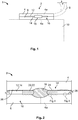
- Fig. 1 shows a portion of power electronics 1, depicted here only schematically, as used in an electrically powered vehicle, for example.
- the power electronics have an electrical connection assembly 2.
- the electrical connection assembly 2 comprises at least two conductors 4, 6 welded onto one another.
- the electrical connection assembly 2 may have further conductors 4a, 6a, which are merely indicated by dashed lines in Fig. 1 .
- One of the conductors, in this case the conductor 4, may be part of a ribbon cable 8.
- the other conductor, in this case the conductor 6, may be connected to a battery 10.
- At least one of the conductors 4, 6 may be made of an aluminium-containing material, in order to keep the electrical resistances low. At least one of the conductors 4, 6 may be produced from a sheet metal material and in particular may be configured in a disc or plate shape.
- the two conductors 4, 6 lie on one another as planarly as possible. At least one layer 12 consisting of or containing a cyanoacrylate glue 14 is located between them. The area 16 in which the cyanoacrylate glue 14 is located surrounds, at least partially, a welding point 18 at which the at least two conductors 4, 6 are materially connected to one another.
- Fig. 2 shows an electrical connection assembly 2 in a larger depiction.
- at least one layer 20 comprising or consisting of a material which impedes or prevents the hardening of the cyanoacrylate glue 14 may be present close to or adjacent to the welding point 18.
- the material 22 which impedes or prevents the hardening of the cyanoacrylate glue may be a moisture-absorbing material and/or an acidic substance, for example.
- the layer 20 consisting of or comprising the material 22 may be arranged between the layer 12 of the cyanoacrylate glue 14 and a conductor 4, 6 or between two opposing layers 12 of cyanoacrylate glue 14.
- a layer 20 of the material 22 which impedes or prevents the hardening of the cyanoacrylate glue 14 may be present on one of the conductors 4, 6 or on both opposing conductors 4, 6.
- the material 22 may be integrated into an electrical insulation of a conductor 4, 6, for example a ribbon cable, this material being released by said insulation upon welding.
- the layer 12 and/or the layer 20 was originally also present at least partially at the point at which the welding point 18 is located after the conductors 4, 6 are welded.
- the welding point 18 may have fully replaced the (former) layer 20, meaning that no remnant of this original layer 20 is present any longer. However, as schematically depicted in Fig. 2 , there may still be remnants of this layer 20 between the conductors 4, 6 outside the welding point 18.
- the surface 4 may be at least partially roughened, i.e. have a greater roughness R than the sections of the remaining, non-roughened surface.
- the roughening is indicated by reference number 24 in Fig. 2 .
- the roughening may be performed by embossing, grinding, machining or sandblasting.
- a predetermined surface roughness R is obtained which differs only slightly over a multiplicity of different conductors 4, 6.
- the surface roughness is preferably measured in this case according to ISO 25178 and/or DIN 4760.
- the surface roughness may be the mean roughness, the quadratic roughness, the averaged roughness depth or the maximum roughness depth in area 16 or a subarea thereof.
- the roughened area may have a greater surface roughness than the non-roughened area which surrounds it at least partially. If the basic material of the conductor 4 or 6 already has a very great surface roughness R, the surface 4 may also be provided with a lower surface roughness R in area 16, by means of polishing or smoothing, for example. A polished or smoothed area is then accordingly present instead of the roughening 24.
- Fig. 2 only one surface 28 of the one conductor 4 is provided with a roughening 24.
- the two opposing surfaces 26, 28 of the conductors 4, 6 it is also possible for the two opposing surfaces 26, 28 of the conductors 4, 6 to be roughened.
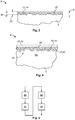
- Fig. 3 shows detail III from Fig. 2 .
- the conductor 6 is depicted merely for the purposes of exemplification. The description can similarly relate to the conductor 4.
- the surface 28 of the conductor 6 has a surface roughness R.
- the layer 12 of the cyanoacrylate glue 14, which has a layer thickness 30, is located on the surface 28.
- the layer thickness 30 corresponds to a maximum of double the surface roughness R and preferably to at least one times the surface roughness R within a tolerance of ⁇ 30%.
- the layer thickness 30 preferably corresponds at least approximately just to the surface roughness R, meaning that it just about covers or just releases the tips of the surface roughness R. At the tips of the surface roughness R, the layer thickness is therefore, in the preferred design, virtually zero.
- the layer 12 may also be applied without roughening 24 ( Fig. 2 ). However, due to a varying surface roughness, the layer thickness under some circumstances is subject to relatively large deviations and the characteristics of the connection assembly 2 are less reproducible.
- Fig. 4 shows detail IV from a subsection 34 ( Fig. 2 ), in which the layer 20 of the material 22 which impedes or prevents the hardening of the cyanoacrylate glue 14 is located.
- the subsection 34 is located preferably completely within the region 16.
- the layer 20 consisting of or comprising the material 22 may be located directly on the conductor 6. However, as indicated by the dashed line, it may also be located on the layer 14 or on the conductor 4.
- step 40 at least one of the conductors 4, 6 is roughened in order produce a predetermined surface roughness R.
- a step 42 at least one of the conductors 4, 6 is coated with cyanoacrylate glue 14.
- the layer thickness 30, as described above, is a maximum of double the surface roughness R. If the conductor 4, 6 on which the cyanoacrylate glue 14 has been applied has been roughened previously, then the cyanoacrylate glue 14 is applied onto the roughened area.
- a further optional step 44 of the method relates to the application of a layer 20 of the material 22 which impedes or prevents the hardening of the cyanoacrylate glue.
- the step 44 can be carried out before or after step 42.
- the material 22 which impedes or prevents the hardening of the cyanoacrylate glue can be applied directly onto a conductor 4, 6 or onto the layer 12.
- the material 22 may be applied onto a conductor 4, 6 which is not coated with cyanoacrylate glue 14, as long as the layer 12 is located on the opposing conductor 4, 6.
- the two conductors should be brought together directly after the coating, in order to inhibit or impede the hardening of the cyanoacrylate glue 14 in the subsection 34.
- the conductors 4, 6 are then welded onto one another at at least one welding point 18.
- the welding preferably takes place by way of, in particular, ultrashort laser pulses.
- the welding point in this case is located in an area in which the layer 12 is located, i.e. in the area 16.
- the welding point 18 is located where the layer 20 is also located, i.e. in the subsection 34 of the area 16.
- the conductors 4, 6 are electrically connected to one another by the welding point 18.
- the layer 12 of cyanoacrylate glue 14 represents an additional mechanically loadable connection which relieves the tension on the welding point 18. Due to the thin layer thickness 30, the glue may be applied prior to the welding 18.
- the layer 12 preferably hermetically encloses the welding point 18 and thus protects it from electrochemical corrosion. Outside the welding point 18, the two conductors 4, 6 can directly touch one another at tips of the surface roughness R, which further reduces the contact resistance between the conductors 4, 6.
Landscapes
- Engineering & Computer Science (AREA)
- Manufacturing & Machinery (AREA)
- Chemical & Material Sciences (AREA)
- Chemical Kinetics & Catalysis (AREA)
- Electrochemistry (AREA)
- General Chemical & Material Sciences (AREA)
- Physics & Mathematics (AREA)
- Optics & Photonics (AREA)
- Adhesives Or Adhesive Processes (AREA)
- Connections Effected By Soldering, Adhesion, Or Permanent Deformation (AREA)
Abstract
Description
- The invention relates to an electrical connection assembly, wherein the connection assembly has at least two conductors which are welded onto one another. Furthermore, the invention relates to a method for welding at least two conductors. Finally, the invention relates to power electronics, in particular for an electrically powered vehicle, which have such an electrical connection assembly.
- When welding ribbon cables to battery contacts in electric vehicles, it is important to protect the conductors which are welded onto one another against electrochemical corrosion. Moreover, it is advantageous if the welding point has relief from tension.
- The invention consequently sets itself the aim of providing such a connection of two conductors, which, in addition to protection from corrosion and relief from tension, also enables a simple method procedure and gives rise to low costs.
- According to the invention, this problem is solved for the electrical connection assembly specified at the outset in that at least one layer of cyanoacrylate glue is located in at least one area between the conductors.
- According to the invention, this problem is solved for the method specified at the outset by at least one conductor being coated with a cyanoacrylate glue in at least one section of the area to be welded, and by the at least two conductors being welded onto one another after the coating.
- The electrical connection assembly may be part of power electronics for an electrically powered vehicle, wherein one of the conductors can be connected to a battery and one of the conductors can be a ribbon cable.
- The solution according to the invention is simple to manufacture and inexpensive. Cyanoacrylate glues are household adhesives which are freely available, simple to handle and inexpensive to purchase. According to the invention, they simultaneously serve as protection from corrosion and relief from tension.
- Hereafter, features of the invention which further develop it will be described with their respectively associated technical effect. The individual features are advantageous per se and can be combined with one another as desired.
- It is therefore particularly advantageous if the thickness of the at least one layer corresponds at least partially to a maximum of double the surface roughness of the surface in the at least one area coated with cyanoacrylate glue. The thickness preferably corresponds to the at least one layer of the surface roughness, with it being appropriate to still regard deviations of ± one third as being a correspondence. Ideally, the at least one layer of cyanoacrylate glue only fills the surface roughnesses without covering the tips of the surface roughness. At the tips of the roughness, the thickness of the layer consequently may tend towards zero. Such a thin layer thickness leads to the two conductors being able to be welded onto one another despite the glue layer arranged therebetween.
- The surface roughness is preferably determined according to ISO 25178 and/or DIN 4760. The surface roughness may be the mean roughness, the quadratic roughness, the averaged roughness depth or the maximum roughness depth in the area.
- In a further advantageous configuration, the area provided with cyanoacrylate glue at least partially has a different surface roughness than an area which is not coated with cyanoacrylate glue. The surface roughness of the area coated with cyanoacrylate glue may be greater or less than the surface roughness of the at least one part of the area which is not coated. In order to obtain a different surface roughness, the surface can be processed subsequently, in particular in the area coated with cyanoacrylate glue, for example roughened or polished or smoothed.
- In order to achieve a predetermined surface roughness and thus reproducible results by virtue of consistent layer thicknesses which are situated within narrow tolerances, it is advantageous if at least one of the faces, which point towards one another, of the conductors is at least partially roughened or polished or smoothed in the at least one area. The roughened or polished area is preferably provided at least partially with the layer of cyanoacrylate glue.
- The roughening can be carried out by way of sandblasting, machining, grinding, laser structuring and/or embossing, for example. Of course, the cyanoacrylate glue may be arranged on not only one, but rather on both of the opposing faces of the conductors which are welded onto one another.
- In order to keep production costs low, at least one of the two conductors can be produced from a sheet metal material at least in the at least one area. The conductors can alternatively or cumulatively be configured in a disc or plate shape at least in that area.
- In the electrical connection assembly, they preferably lie on one another over a large surface in the at least one area, so that low contact resistances are present and the transmission of large currents does not generate excessive heating.
- According to a further advantageous configuration, at least one of the conductors, preferably both conductors, can be produced at least in the at least one area from an aluminium-containing material, including aluminium itself. By virtue of the low resistance values of aluminium, large currents can be conducted with small losses when such a material is selected.
- A further advantageous configuration envisages a material which impedes or prevents the hardening of the cyanoacrylate glue being located at least in a subsection of the area. It is known that cyanoacrylate glue does not harden, or hardens more slowly, if it is not exposed to moisture or is located in an acidic environment. A material which impedes or prevents the hardening of the cyanoacrylate glue is therefore, for example, a moisture-absorbing material, moisture-repellent and/or an acidic substance. A hydrophilic or hydrophobic layer can be manufactured by a Pyrosil method, for example. The inhibition of hardening can be performed, for example, by the use of an acid with a solvent, such as formic acid and acetone. The material which prevents or impedes the hardening of the cyanoacrylate glue can be present in the form of a layer. The layer may be located between a layer of cyanoacrylate glue and the conductor and/or between two layers of cyanoacrylate glue.
- Alternatively to this, according to a further advantageous configuration, an acid, in particular an organic acid, may be dispersed in the substance of an insulation of a conductor. The dispersed acid may prevent the hardening of the cyanoacrylate glue. In this case, a later hardening of the cyanoacrylate glue can be achieved by exposing the cyanoacrylate glue to an activator, for example an alkaline environment.
- In particular, the at least one subarea, or rather the material which impedes or prevents the hardening of the cyanoacrylate glue, is located adjacent to at least one welding point at which the at least two conductors are welded onto one another. In particular, the welding point can be at least partially, preferably completely, surrounded by the area and/or subsection in which the material which impedes or prevents the hardening of the cyanoacrylate glue is located.
- The material which prevents or impedes the cyanoacrylate-hardening may be arranged, for example applied, at the later welding point prior to the welding. After the welding, the welding point is located there. Remnants of the material which impedes or prevents the hardening of the cyanoacrylate glue may however still be located in the vicinity, in particular the direct vicinity, of the welding point.
- The material which impedes or prevents the hardening of the cyanoacrylate glue can be applied prior to or after the application of the cyanoacrylate glue. The material may be located on, or applied onto, the same conductor as the cyanoacrylate glue or on the conductor lying opposite the layer of cyanoacrylate glue.
- The two conductors preferably touch one another, at least at points, outside the welding point. This is the case in particular when the layer of cyanoacrylate glue is so thin that the tips of the surface roughnesses of the two conductors can still come into electrical contact with one another.
- Hereinafter, the invention is explained in greater detail using an exemplary embodiment with reference to the attached drawings. For the sake of simplicity, the same reference numbers are used in the drawings for elements which correspond to one another in terms of function and/or design.
- The combination of features depicted and described using the exemplary embodiment serves solely as an example. It can be changed according to the embodiments above. For example, it is possible to omit a feature whose technical effect is of no importance in a particular application. Conversely, it is possible to add a feature which is not present in the depicted combination of features of the exemplary embodiment if the technical effect linked to this feature is required for, or is advantageous to, a particular application.
- In the drawings:
-
Fig. 1 shows a schematic depiction of a portion of power electronics, in particular for an electrically powered vehicle with an electrical connection assembly; -
Fig. 2 shows a schematic depiction of an electrical connection assembly; -
Fig. 3 shows a schematic depiction of detail III fromFig. 2 ; -
Fig. 4 shows a schematic depiction of detail IV fromFig. 2 ; -
Fig. 5 shows a schematic depiction of the method sequence for the manufacture of an electrical connection assembly. -
Fig. 1 shows a portion ofpower electronics 1, depicted here only schematically, as used in an electrically powered vehicle, for example. The power electronics have anelectrical connection assembly 2. Theelectrical connection assembly 2 comprises at least twoconductors electrical connection assembly 2 may havefurther conductors Fig. 1 . One of the conductors, in this case theconductor 4, may be part of aribbon cable 8. The other conductor, in this case theconductor 6, may be connected to abattery 10. - At least one of the
conductors conductors - The two
conductors layer 12 consisting of or containing acyanoacrylate glue 14 is located between them. Thearea 16 in which thecyanoacrylate glue 14 is located surrounds, at least partially, awelding point 18 at which the at least twoconductors -
Fig. 2 shows anelectrical connection assembly 2 in a larger depiction. As can be seen, at least onelayer 20 comprising or consisting of a material which impedes or prevents the hardening of thecyanoacrylate glue 14 may be present close to or adjacent to thewelding point 18. The material 22 which impedes or prevents the hardening of the cyanoacrylate glue may be a moisture-absorbing material and/or an acidic substance, for example. Thelayer 20 consisting of or comprising the material 22 may be arranged between thelayer 12 of thecyanoacrylate glue 14 and aconductor layers 12 ofcyanoacrylate glue 14. Alayer 20 of the material 22 which impedes or prevents the hardening of thecyanoacrylate glue 14 may be present on one of theconductors conductors conductor - The
layer 12 and/or thelayer 20 was originally also present at least partially at the point at which thewelding point 18 is located after theconductors welding point 18 may have fully replaced the (former)layer 20, meaning that no remnant of thisoriginal layer 20 is present any longer. However, as schematically depicted inFig. 2 , there may still be remnants of thislayer 20 between theconductors welding point 18. - In the
area 16 of therespective conductor cyanoacrylate glue 14, thesurface 4 may be at least partially roughened, i.e. have a greater roughness R than the sections of the remaining, non-roughened surface. The roughening is indicated byreference number 24 inFig. 2 . The roughening may be performed by embossing, grinding, machining or sandblasting. As a result of theroughening 24, a predetermined surface roughness R is obtained which differs only slightly over a multiplicity ofdifferent conductors area 16 or a subarea thereof. The roughened area may have a greater surface roughness than the non-roughened area which surrounds it at least partially. If the basic material of theconductor surface 4 may also be provided with a lower surface roughness R inarea 16, by means of polishing or smoothing, for example. A polished or smoothed area is then accordingly present instead of theroughening 24. - In
Fig. 2 , only onesurface 28 of the oneconductor 4 is provided with aroughening 24. Of course, it is also possible for the two opposingsurfaces conductors -
Fig. 3 shows detail III fromFig. 2 . In this case, only theconductor 6 is depicted merely for the purposes of exemplification. The description can similarly relate to theconductor 4. - The
surface 28 of theconductor 6 has a surface roughness R. Thelayer 12 of thecyanoacrylate glue 14, which has alayer thickness 30, is located on thesurface 28. Thelayer thickness 30 corresponds to a maximum of double the surface roughness R and preferably to at least one times the surface roughness R within a tolerance of ± 30%. - The
layer thickness 30 preferably corresponds at least approximately just to the surface roughness R, meaning that it just about covers or just releases the tips of the surface roughness R. At the tips of the surface roughness R, the layer thickness is therefore, in the preferred design, virtually zero. Thelayer 12 may also be applied without roughening 24 (Fig. 2 ). However, due to a varying surface roughness, the layer thickness under some circumstances is subject to relatively large deviations and the characteristics of theconnection assembly 2 are less reproducible. -
Fig. 4 shows detail IV from a subsection 34 (Fig. 2 ), in which thelayer 20 of the material 22 which impedes or prevents the hardening of thecyanoacrylate glue 14 is located. Thesubsection 34 is located preferably completely within theregion 16. Thelayer 20 consisting of or comprising the material 22 may be located directly on theconductor 6. However, as indicated by the dashed line, it may also be located on thelayer 14 or on theconductor 4. - In order to manufacture the
electrical connection assembly 2 depicted inFigs. 1 to 4 , the method steps schematically depicted inFig. 5 are carried out. - In a first,
optional method step 40, at least one of theconductors - In a
step 42, at least one of theconductors cyanoacrylate glue 14. Here, thelayer thickness 30, as described above, is a maximum of double the surface roughness R. If theconductor cyanoacrylate glue 14 has been applied has been roughened previously, then thecyanoacrylate glue 14 is applied onto the roughened area. - A further
optional step 44 of the method relates to the application of alayer 20 of the material 22 which impedes or prevents the hardening of the cyanoacrylate glue. Thestep 44 can be carried out before or afterstep 42. The material 22 which impedes or prevents the hardening of the cyanoacrylate glue can be applied directly onto aconductor layer 12. In this case, the material 22 may be applied onto aconductor cyanoacrylate glue 14, as long as thelayer 12 is located on the opposingconductor cyanoacrylate glue 14 in thesubsection 34. - In a
step 46, theconductors welding point 18. The welding preferably takes place by way of, in particular, ultrashort laser pulses. The welding point in this case is located in an area in which thelayer 12 is located, i.e. in thearea 16. In addition, thewelding point 18 is located where thelayer 20 is also located, i.e. in thesubsection 34 of thearea 16. - In the final manufactured
electrical connection assembly 2, theconductors welding point 18. Thelayer 12 ofcyanoacrylate glue 14 represents an additional mechanically loadable connection which relieves the tension on thewelding point 18. Due to thethin layer thickness 30, the glue may be applied prior to thewelding 18. Thelayer 12 preferably hermetically encloses thewelding point 18 and thus protects it from electrochemical corrosion. Outside thewelding point 18, the twoconductors conductors -
- 1
- power electronics
- 2
- electrical connection assembly
- 4, 4a
- conductor
- 6, 6a
- conductor
- 8
- ribbon cable
- 10
- battery
- 12
- layer consisting of or comprising cyanoacrylate glue
- 14
- cyanoacrylate glue
- 16
- area with the
layer 12 - 18
- welding point
- 20
- layer consisting of or comprising a material which impedes or prevents the hardening of the cyanoacrylate glue
- 22
- material which impedes or prevents the hardening of the cyanoacrylate glue
- 24
- roughening
- 26
- surface of one conductor
- 28
- surface of the other conductor
- 30
- layer thickness of the layer consisting of or comprising cyanoacrylate glue
- 32
- doubled surface roughness R
- 34
- subsection having the
layer 20 - 32
- surface roughness
Claims (15)
- An electrical connection assembly (2) having at least two conductors (4, 6) which are welded onto one another, characterised in that at least one layer (12) consisting of or comprising cyanoacrylate glue (14) is located in at least one area (16) between the two conductors (4, 6).
- The electrical connection assembly (2) according to Claim 1, characterised in that the thickness (30) of the at least one layer (12) corresponds at least partially to a maximum of double, preferably between one times and double, the surface roughness (R) in the at least one area (16).
- The electrical connection assembly (2) according to Claim 1 or 2, characterised in that at least one of the surfaces (26, 28), which point towards one another, of the conductors (4, 6) is at least partially roughened in the at least one area (16).
- The electrical connection assembly (2) according to any one of Claims 1 to 3, characterised in that the two conductors (4, 6) are produced from a sheet metal material at least in the at least one area (16).
- The electrical connection assembly (2) according to any one of Claims 1 to 4, characterised in that at least one of the conductors (4, 6) is produced in the at least one area (16) from an aluminium-containing material.
- The electrical connection assembly (2) according to any one of Claims 1 to 5, characterised in that a material (22) which impedes or prevents the hardening of the cyanoacrylate glue (14) is located at least in a subsection (34) of the area (16).
- The electrical connection assembly (2) according to any one of Claims 1 to 6, characterised in that at least one welding point (18) is present at which the at least two conductors (4, 6) are welded onto one another, and in that the welding point (18) is at least partially surrounded by the area (16) and/or the subsection (34).
- The electrical connection assembly (2) according to any one of Claims 1 to 7, characterised in that the two conductors (4, 6) directly touch one another, at least at points, outside a welding point (18).
- The electrical connection assembly (2) according to any one of Claims 1 to 8, characterised in that one of the conductors (4) is part of a ribbon cable.
- Power electronics (1) in particular for an electrically powered vehicle, characterised by an electrical connection assembly (2) according to any one of Claims 1 to 9, wherein one of the conductors (6) is connected to a battery (10).
- A method for welding at least two conductors (4, 6), comprising the method steps:- coating at least one area (16) of at least one conductor (4, 6) with a cyanoacrylate glue (14);- welding the at least two conductors (4, 6) after the coating.
- The method according to Claim 11, comprising the further method step:- at least partially roughening the area (16) prior to the coating.
- The method according to Claim 11 or 12, comprising the further method step:- applying a material (22), which impedes or prevents the hardening of the cyanoacrylate adhesive (14), onto at least one subsection of the area (16).
- The method according to any one of Claims 11 to 13, comprising the further method step:- welding the at least two conductors (4, 6) by means of laser pulses.
- The method according to Claim 13 or 14, comprising the further method step:- welding the at least two conductors (4, 6) in a subsection (34) of the area (16), said subsection being one which is coated with the material (22).
Applications Claiming Priority (1)
| Application Number | Priority Date | Filing Date | Title |
|---|---|---|---|
| DE102019200659.0A DE102019200659A1 (en) | 2019-01-18 | 2019-01-18 | Electrical connection arrangement with two welded conductors and a layer of cyanoacrylate adhesive between the conductors and method therefor |
Publications (2)
| Publication Number | Publication Date |
|---|---|
| EP3682999A1 true EP3682999A1 (en) | 2020-07-22 |
| EP3682999B1 EP3682999B1 (en) | 2024-03-06 |
Family
ID=69177089
Family Applications (1)
| Application Number | Title | Priority Date | Filing Date |
|---|---|---|---|
| EP20152450.1A Active EP3682999B1 (en) | 2019-01-18 | 2020-01-17 | Electrical connection assembly having two welded conductors and a layer of cyanoacrylate glue between the conductors, and method for this |
Country Status (4)
| Country | Link |
|---|---|
| US (1) | US12394923B2 (en) |
| EP (1) | EP3682999B1 (en) |
| CN (1) | CN111463583B (en) |
| DE (1) | DE102019200659A1 (en) |
Families Citing this family (1)
| Publication number | Priority date | Publication date | Assignee | Title |
|---|---|---|---|---|
| JP7028854B2 (en) * | 2019-12-26 | 2022-03-02 | 株式会社オートネットワーク技術研究所 | Wire harness and power storage module |
Citations (4)
| Publication number | Priority date | Publication date | Assignee | Title |
|---|---|---|---|---|
| US20110073572A1 (en) * | 2008-09-30 | 2011-03-31 | Gm Global Technology Operations, Inc. | Method to reduce thermal degradation of adhesive in weldbonding |
| EP2679328A1 (en) * | 2012-06-29 | 2014-01-01 | Volkswagen Aktiengesellschaft | Joining of two parts by means of a combination of electrical resistance welding and friction welding |
| EP3031564A1 (en) * | 2014-12-10 | 2016-06-15 | Volkswagen Aktiengesellschaft | Method of thermal joining of components by means of a help element deformed by pressing ; device for achieving such method ; corresponding help element |
| DE102015100935A1 (en) * | 2015-01-22 | 2016-07-28 | Detlef Krov | Method for welding at least two metal components |
Family Cites Families (22)
| Publication number | Priority date | Publication date | Assignee | Title |
|---|---|---|---|---|
| US3519977A (en) * | 1968-01-11 | 1970-07-07 | Whitaker Cable Corp | High amperage quick disconnect electric coupling structure |
| DE3831394A1 (en) | 1988-09-15 | 1990-03-22 | Prithwis Basu | Method and device for making contact between an electrical lead wire and contact points on a printed circuit board |
| JPH0288684A (en) * | 1988-09-27 | 1990-03-28 | Nitto Denko Corp | Bonding and liquid adhesive used therefor |
| US5383788A (en) * | 1993-05-20 | 1995-01-24 | W. L. Gore & Associates, Inc. | Electrical interconnect assembly |
| EP0917687B1 (en) * | 1996-08-05 | 2001-04-18 | Gemplus | Improvement to a method for making smart cards |
| JP2003257513A (en) | 2002-02-27 | 2003-09-12 | Yazaki Corp | Connection method and connection structure of insulated wire |
| CN1797847A (en) * | 2004-12-28 | 2006-07-05 | 天迈企业股份有限公司 | Film antenna and manufacturing method thereof |
| TWI385231B (en) * | 2005-03-18 | 2013-02-11 | Three Bond Co Ltd | A cyanoacrylate-based adhesive composition |
| AT502005B1 (en) * | 2005-06-01 | 2007-03-15 | Outokumpu Copper Neumayer Gmbh | ELECTRICAL CONNECTING ELEMENT, PROCESS FOR ITS MANUFACTURE AND SOLAR CELL AND MODULE WITH CONNECTING ELEMENT |
| US7189103B1 (en) | 2005-12-07 | 2007-03-13 | Avocent Corporation | Wire comb overlying spark gap |
| EP2027760A2 (en) | 2006-05-22 | 2009-02-25 | Philips Intellectual Property & Standards GmbH | Interconnection arrangement and method for interconnecting a high-cuurent carrying cable with a metal thin-film |
| US7935035B2 (en) * | 2007-03-27 | 2011-05-03 | Tom Smith | Gyroscopic exerciser |
| JP5423325B2 (en) * | 2009-11-10 | 2014-02-19 | ソニー株式会社 | Light emitting device and manufacturing method thereof |
| EP2339894A1 (en) * | 2009-12-22 | 2011-06-29 | Saint-Gobain Glass France | Pane with electric connection element |
| CN102059460A (en) * | 2010-12-13 | 2011-05-18 | 大连理工大学 | Adhesive jointing and electric arc spot welding combined connection method for metals |
| US20130073235A1 (en) * | 2011-03-17 | 2013-03-21 | Isophi Bvba | Battery monitoring devices |
| JP2013109847A (en) | 2011-11-17 | 2013-06-06 | Yazaki Corp | Core wire water cut-off structure and core wire water cut-off method |
| CN103596372B (en) * | 2013-11-29 | 2016-08-31 | 丁保美 | Pcb board ultrasound wave grout method |
| CN104535231B (en) * | 2015-01-05 | 2017-02-22 | 攀钢集团攀枝花钢铁研究院有限公司 | Resistance strain gauge switching device for testing steel rail residual stress and testing method |
| DE102015210458A1 (en) * | 2015-06-08 | 2016-12-08 | Te Connectivity Germany Gmbh | Method for connecting a conductor having a base metal with a copper-containing terminal element by means of welding and a connection arrangement produced thereby |
| CN105149714B (en) * | 2015-09-21 | 2017-07-18 | 上海交通大学 | Metallic plate is without impression glue welding connection method |
| JP6822334B2 (en) * | 2017-07-04 | 2021-01-27 | 株式会社デンソー | Temperature sensor |
-
2019
- 2019-01-18 DE DE102019200659.0A patent/DE102019200659A1/en not_active Ceased
-
2020
- 2020-01-17 EP EP20152450.1A patent/EP3682999B1/en active Active
- 2020-01-19 CN CN202010058658.3A patent/CN111463583B/en active Active
- 2020-01-20 US US16/747,215 patent/US12394923B2/en active Active
Patent Citations (4)
| Publication number | Priority date | Publication date | Assignee | Title |
|---|---|---|---|---|
| US20110073572A1 (en) * | 2008-09-30 | 2011-03-31 | Gm Global Technology Operations, Inc. | Method to reduce thermal degradation of adhesive in weldbonding |
| EP2679328A1 (en) * | 2012-06-29 | 2014-01-01 | Volkswagen Aktiengesellschaft | Joining of two parts by means of a combination of electrical resistance welding and friction welding |
| EP3031564A1 (en) * | 2014-12-10 | 2016-06-15 | Volkswagen Aktiengesellschaft | Method of thermal joining of components by means of a help element deformed by pressing ; device for achieving such method ; corresponding help element |
| DE102015100935A1 (en) * | 2015-01-22 | 2016-07-28 | Detlef Krov | Method for welding at least two metal components |
Also Published As
| Publication number | Publication date |
|---|---|
| US12394923B2 (en) | 2025-08-19 |
| DE102019200659A1 (en) | 2020-07-23 |
| CN111463583A (en) | 2020-07-28 |
| CN111463583B (en) | 2026-01-23 |
| US20200235503A1 (en) | 2020-07-23 |
| EP3682999B1 (en) | 2024-03-06 |
Similar Documents
| Publication | Publication Date | Title |
|---|---|---|
| JP6965848B2 (en) | Coil parts | |
| JP2010108829A (en) | Connecting part and connecting method of conductor and terminal | |
| TWI431647B (en) | Coil coil and copper wire washing machine with electrical connection mechanism | |
| JP6639793B2 (en) | Wire with terminal and method of manufacturing the same | |
| JP2010108828A (en) | Connecting part and connecting method of conductor and terminal | |
| WO2011122622A1 (en) | Crimping terminal, connect structure body, and connector | |
| CN102948252A (en) | Contact device for conductors present on planar structures, especially glass plates | |
| JP2021120959A (en) | Electric wire with terminal | |
| US20190229437A1 (en) | Terminal-Equipped Electric Wire | |
| JP2019175790A (en) | Method om manufacturing wire with terminal | |
| EP3682999B1 (en) | Electrical connection assembly having two welded conductors and a layer of cyanoacrylate glue between the conductors, and method for this | |
| JP6642383B2 (en) | Press-fit terminals and electronic devices | |
| JP5875702B2 (en) | Manufacturing method of electronic device provided with laminate and electronic device | |
| JPH0773063B2 (en) | Crimped terminal conductor coupling structure and method of forming the same | |
| CN101199084A (en) | electrical connection element | |
| JP2016225171A (en) | Manufacturing method of electric wire with terminal and electric wire with terminal | |
| CN110071375B (en) | Method of manufacturing terminal-attached electric wire and terminal-attached electric wire | |
| JP7421844B2 (en) | Electric wire with terminal and its manufacturing method | |
| JP6989438B2 (en) | Wire with terminal and its manufacturing method | |
| JP2000299967A (en) | Rotating electric machine winding equipped with optical fiber sensor and method of attaching optical fiber sensor to rotating electric machine winding | |
| US9531093B2 (en) | Electrical connection arrangement | |
| JP2019197653A (en) | Manufacturing method of terminal-equipped electric wire | |
| JP7145696B2 (en) | Electric wire with terminal and manufacturing method thereof | |
| JP6887211B2 (en) | Terminals and wires with terminals | |
| JP2005294094A (en) | Planar heating element |
Legal Events
| Date | Code | Title | Description |
|---|---|---|---|
| PUAI | Public reference made under article 153(3) epc to a published international application that has entered the european phase |
Free format text: ORIGINAL CODE: 0009012 |
|
| STAA | Information on the status of an ep patent application or granted ep patent |
Free format text: STATUS: THE APPLICATION HAS BEEN PUBLISHED |
|
| AK | Designated contracting states |
Kind code of ref document: A1 Designated state(s): AL AT BE BG CH CY CZ DE DK EE ES FI FR GB GR HR HU IE IS IT LI LT LU LV MC MK MT NL NO PL PT RO RS SE SI SK SM TR |
|
| AX | Request for extension of the european patent |
Extension state: BA ME |
|
| STAA | Information on the status of an ep patent application or granted ep patent |
Free format text: STATUS: REQUEST FOR EXAMINATION WAS MADE |
|
| 17P | Request for examination filed |
Effective date: 20210122 |
|
| RBV | Designated contracting states (corrected) |
Designated state(s): AL AT BE BG CH CY CZ DE DK EE ES FI FR GB GR HR HU IE IS IT LI LT LU LV MC MK MT NL NO PL PT RO RS SE SI SK SM TR |
|
| STAA | Information on the status of an ep patent application or granted ep patent |
Free format text: STATUS: EXAMINATION IS IN PROGRESS |
|
| 17Q | First examination report despatched |
Effective date: 20211129 |
|
| GRAP | Despatch of communication of intention to grant a patent |
Free format text: ORIGINAL CODE: EPIDOSNIGR1 |
|
| STAA | Information on the status of an ep patent application or granted ep patent |
Free format text: STATUS: GRANT OF PATENT IS INTENDED |
|
| INTG | Intention to grant announced |
Effective date: 20231011 |
|
| GRAS | Grant fee paid |
Free format text: ORIGINAL CODE: EPIDOSNIGR3 |
|
| GRAA | (expected) grant |
Free format text: ORIGINAL CODE: 0009210 |
|
| STAA | Information on the status of an ep patent application or granted ep patent |
Free format text: STATUS: THE PATENT HAS BEEN GRANTED |
|
| AK | Designated contracting states |
Kind code of ref document: B1 Designated state(s): AL AT BE BG CH CY CZ DE DK EE ES FI FR GB GR HR HU IE IS IT LI LT LU LV MC MK MT NL NO PL PT RO RS SE SI SK SM TR |
|
| REG | Reference to a national code |
Ref country code: CH Ref legal event code: EP |
|
| REG | Reference to a national code |
Ref country code: DE Ref legal event code: R096 Ref document number: 602020026642 Country of ref document: DE |
|
| REG | Reference to a national code |
Ref country code: IE Ref legal event code: FG4D |
|
| REG | Reference to a national code |
Ref country code: LT Ref legal event code: MG9D |
|
| PG25 | Lapsed in a contracting state [announced via postgrant information from national office to epo] |
Ref country code: LT Free format text: LAPSE BECAUSE OF FAILURE TO SUBMIT A TRANSLATION OF THE DESCRIPTION OR TO PAY THE FEE WITHIN THE PRESCRIBED TIME-LIMIT Effective date: 20240306 |
|
| REG | Reference to a national code |
Ref country code: NL Ref legal event code: MP Effective date: 20240306 |
|
| PG25 | Lapsed in a contracting state [announced via postgrant information from national office to epo] |
Ref country code: GR Free format text: LAPSE BECAUSE OF FAILURE TO SUBMIT A TRANSLATION OF THE DESCRIPTION OR TO PAY THE FEE WITHIN THE PRESCRIBED TIME-LIMIT Effective date: 20240607 |
|
| PG25 | Lapsed in a contracting state [announced via postgrant information from national office to epo] |
Ref country code: RS Free format text: LAPSE BECAUSE OF FAILURE TO SUBMIT A TRANSLATION OF THE DESCRIPTION OR TO PAY THE FEE WITHIN THE PRESCRIBED TIME-LIMIT Effective date: 20240606 Ref country code: HR Free format text: LAPSE BECAUSE OF FAILURE TO SUBMIT A TRANSLATION OF THE DESCRIPTION OR TO PAY THE FEE WITHIN THE PRESCRIBED TIME-LIMIT Effective date: 20240306 |
|
| PG25 | Lapsed in a contracting state [announced via postgrant information from national office to epo] |
Ref country code: ES Free format text: LAPSE BECAUSE OF FAILURE TO SUBMIT A TRANSLATION OF THE DESCRIPTION OR TO PAY THE FEE WITHIN THE PRESCRIBED TIME-LIMIT Effective date: 20240306 |
|
| PG25 | Lapsed in a contracting state [announced via postgrant information from national office to epo] |
Ref country code: RS Free format text: LAPSE BECAUSE OF FAILURE TO SUBMIT A TRANSLATION OF THE DESCRIPTION OR TO PAY THE FEE WITHIN THE PRESCRIBED TIME-LIMIT Effective date: 20240606 Ref country code: NO Free format text: LAPSE BECAUSE OF FAILURE TO SUBMIT A TRANSLATION OF THE DESCRIPTION OR TO PAY THE FEE WITHIN THE PRESCRIBED TIME-LIMIT Effective date: 20240606 Ref country code: LT Free format text: LAPSE BECAUSE OF FAILURE TO SUBMIT A TRANSLATION OF THE DESCRIPTION OR TO PAY THE FEE WITHIN THE PRESCRIBED TIME-LIMIT Effective date: 20240306 Ref country code: HR Free format text: LAPSE BECAUSE OF FAILURE TO SUBMIT A TRANSLATION OF THE DESCRIPTION OR TO PAY THE FEE WITHIN THE PRESCRIBED TIME-LIMIT Effective date: 20240306 Ref country code: GR Free format text: LAPSE BECAUSE OF FAILURE TO SUBMIT A TRANSLATION OF THE DESCRIPTION OR TO PAY THE FEE WITHIN THE PRESCRIBED TIME-LIMIT Effective date: 20240607 Ref country code: FI Free format text: LAPSE BECAUSE OF FAILURE TO SUBMIT A TRANSLATION OF THE DESCRIPTION OR TO PAY THE FEE WITHIN THE PRESCRIBED TIME-LIMIT Effective date: 20240306 Ref country code: ES Free format text: LAPSE BECAUSE OF FAILURE TO SUBMIT A TRANSLATION OF THE DESCRIPTION OR TO PAY THE FEE WITHIN THE PRESCRIBED TIME-LIMIT Effective date: 20240306 Ref country code: BG Free format text: LAPSE BECAUSE OF FAILURE TO SUBMIT A TRANSLATION OF THE DESCRIPTION OR TO PAY THE FEE WITHIN THE PRESCRIBED TIME-LIMIT Effective date: 20240306 |
|
| REG | Reference to a national code |
Ref country code: AT Ref legal event code: MK05 Ref document number: 1663004 Country of ref document: AT Kind code of ref document: T Effective date: 20240306 |
|
| PG25 | Lapsed in a contracting state [announced via postgrant information from national office to epo] |
Ref country code: SE Free format text: LAPSE BECAUSE OF FAILURE TO SUBMIT A TRANSLATION OF THE DESCRIPTION OR TO PAY THE FEE WITHIN THE PRESCRIBED TIME-LIMIT Effective date: 20240306 Ref country code: LV Free format text: LAPSE BECAUSE OF FAILURE TO SUBMIT A TRANSLATION OF THE DESCRIPTION OR TO PAY THE FEE WITHIN THE PRESCRIBED TIME-LIMIT Effective date: 20240306 |
|
| PG25 | Lapsed in a contracting state [announced via postgrant information from national office to epo] |
Ref country code: NL Free format text: LAPSE BECAUSE OF FAILURE TO SUBMIT A TRANSLATION OF THE DESCRIPTION OR TO PAY THE FEE WITHIN THE PRESCRIBED TIME-LIMIT Effective date: 20240306 |
|
| PG25 | Lapsed in a contracting state [announced via postgrant information from national office to epo] |
Ref country code: NL Free format text: LAPSE BECAUSE OF FAILURE TO SUBMIT A TRANSLATION OF THE DESCRIPTION OR TO PAY THE FEE WITHIN THE PRESCRIBED TIME-LIMIT Effective date: 20240306 |
|
| PG25 | Lapsed in a contracting state [announced via postgrant information from national office to epo] |
Ref country code: IS Free format text: LAPSE BECAUSE OF FAILURE TO SUBMIT A TRANSLATION OF THE DESCRIPTION OR TO PAY THE FEE WITHIN THE PRESCRIBED TIME-LIMIT Effective date: 20240706 |
|
| PG25 | Lapsed in a contracting state [announced via postgrant information from national office to epo] |
Ref country code: PT Free format text: LAPSE BECAUSE OF FAILURE TO SUBMIT A TRANSLATION OF THE DESCRIPTION OR TO PAY THE FEE WITHIN THE PRESCRIBED TIME-LIMIT Effective date: 20240708 Ref country code: SM Free format text: LAPSE BECAUSE OF FAILURE TO SUBMIT A TRANSLATION OF THE DESCRIPTION OR TO PAY THE FEE WITHIN THE PRESCRIBED TIME-LIMIT Effective date: 20240306 |
|
| PG25 | Lapsed in a contracting state [announced via postgrant information from national office to epo] |
Ref country code: EE Free format text: LAPSE BECAUSE OF FAILURE TO SUBMIT A TRANSLATION OF THE DESCRIPTION OR TO PAY THE FEE WITHIN THE PRESCRIBED TIME-LIMIT Effective date: 20240306 Ref country code: CZ Free format text: LAPSE BECAUSE OF FAILURE TO SUBMIT A TRANSLATION OF THE DESCRIPTION OR TO PAY THE FEE WITHIN THE PRESCRIBED TIME-LIMIT Effective date: 20240306 |
|
| PG25 | Lapsed in a contracting state [announced via postgrant information from national office to epo] |
Ref country code: AT Free format text: LAPSE BECAUSE OF FAILURE TO SUBMIT A TRANSLATION OF THE DESCRIPTION OR TO PAY THE FEE WITHIN THE PRESCRIBED TIME-LIMIT Effective date: 20240306 |
|
| PG25 | Lapsed in a contracting state [announced via postgrant information from national office to epo] |
Ref country code: PL Free format text: LAPSE BECAUSE OF FAILURE TO SUBMIT A TRANSLATION OF THE DESCRIPTION OR TO PAY THE FEE WITHIN THE PRESCRIBED TIME-LIMIT Effective date: 20240306 |
|
| PG25 | Lapsed in a contracting state [announced via postgrant information from national office to epo] |
Ref country code: SK Free format text: LAPSE BECAUSE OF FAILURE TO SUBMIT A TRANSLATION OF THE DESCRIPTION OR TO PAY THE FEE WITHIN THE PRESCRIBED TIME-LIMIT Effective date: 20240306 |
|
| PG25 | Lapsed in a contracting state [announced via postgrant information from national office to epo] |
Ref country code: SM Free format text: LAPSE BECAUSE OF FAILURE TO SUBMIT A TRANSLATION OF THE DESCRIPTION OR TO PAY THE FEE WITHIN THE PRESCRIBED TIME-LIMIT Effective date: 20240306 Ref country code: SK Free format text: LAPSE BECAUSE OF FAILURE TO SUBMIT A TRANSLATION OF THE DESCRIPTION OR TO PAY THE FEE WITHIN THE PRESCRIBED TIME-LIMIT Effective date: 20240306 Ref country code: RO Free format text: LAPSE BECAUSE OF FAILURE TO SUBMIT A TRANSLATION OF THE DESCRIPTION OR TO PAY THE FEE WITHIN THE PRESCRIBED TIME-LIMIT Effective date: 20240306 Ref country code: PT Free format text: LAPSE BECAUSE OF FAILURE TO SUBMIT A TRANSLATION OF THE DESCRIPTION OR TO PAY THE FEE WITHIN THE PRESCRIBED TIME-LIMIT Effective date: 20240708 Ref country code: PL Free format text: LAPSE BECAUSE OF FAILURE TO SUBMIT A TRANSLATION OF THE DESCRIPTION OR TO PAY THE FEE WITHIN THE PRESCRIBED TIME-LIMIT Effective date: 20240306 Ref country code: IS Free format text: LAPSE BECAUSE OF FAILURE TO SUBMIT A TRANSLATION OF THE DESCRIPTION OR TO PAY THE FEE WITHIN THE PRESCRIBED TIME-LIMIT Effective date: 20240706 Ref country code: EE Free format text: LAPSE BECAUSE OF FAILURE TO SUBMIT A TRANSLATION OF THE DESCRIPTION OR TO PAY THE FEE WITHIN THE PRESCRIBED TIME-LIMIT Effective date: 20240306 Ref country code: CZ Free format text: LAPSE BECAUSE OF FAILURE TO SUBMIT A TRANSLATION OF THE DESCRIPTION OR TO PAY THE FEE WITHIN THE PRESCRIBED TIME-LIMIT Effective date: 20240306 Ref country code: AT Free format text: LAPSE BECAUSE OF FAILURE TO SUBMIT A TRANSLATION OF THE DESCRIPTION OR TO PAY THE FEE WITHIN THE PRESCRIBED TIME-LIMIT Effective date: 20240306 |
|
| REG | Reference to a national code |
Ref country code: DE Ref legal event code: R097 Ref document number: 602020026642 Country of ref document: DE |
|
| PLBE | No opposition filed within time limit |
Free format text: ORIGINAL CODE: 0009261 |
|
| STAA | Information on the status of an ep patent application or granted ep patent |
Free format text: STATUS: NO OPPOSITION FILED WITHIN TIME LIMIT |
|
| PG25 | Lapsed in a contracting state [announced via postgrant information from national office to epo] |
Ref country code: DK Free format text: LAPSE BECAUSE OF FAILURE TO SUBMIT A TRANSLATION OF THE DESCRIPTION OR TO PAY THE FEE WITHIN THE PRESCRIBED TIME-LIMIT Effective date: 20240306 |
|
| PG25 | Lapsed in a contracting state [announced via postgrant information from national office to epo] |
Ref country code: DK Free format text: LAPSE BECAUSE OF FAILURE TO SUBMIT A TRANSLATION OF THE DESCRIPTION OR TO PAY THE FEE WITHIN THE PRESCRIBED TIME-LIMIT Effective date: 20240306 |
|
| 26N | No opposition filed |
Effective date: 20241209 |
|
| PG25 | Lapsed in a contracting state [announced via postgrant information from national office to epo] |
Ref country code: SI Free format text: LAPSE BECAUSE OF FAILURE TO SUBMIT A TRANSLATION OF THE DESCRIPTION OR TO PAY THE FEE WITHIN THE PRESCRIBED TIME-LIMIT Effective date: 20240306 |
|
| REG | Reference to a national code |
Ref country code: CH Ref legal event code: PL |
|
| PG25 | Lapsed in a contracting state [announced via postgrant information from national office to epo] |
Ref country code: LU Free format text: LAPSE BECAUSE OF NON-PAYMENT OF DUE FEES Effective date: 20250117 Ref country code: MC Free format text: LAPSE BECAUSE OF FAILURE TO SUBMIT A TRANSLATION OF THE DESCRIPTION OR TO PAY THE FEE WITHIN THE PRESCRIBED TIME-LIMIT Effective date: 20240306 |
|
| GBPC | Gb: european patent ceased through non-payment of renewal fee |
Effective date: 20250117 |
|
| PG25 | Lapsed in a contracting state [announced via postgrant information from national office to epo] |
Ref country code: GB Free format text: LAPSE BECAUSE OF NON-PAYMENT OF DUE FEES Effective date: 20250117 Ref country code: BE Free format text: LAPSE BECAUSE OF NON-PAYMENT OF DUE FEES Effective date: 20250131 |
|
| PG25 | Lapsed in a contracting state [announced via postgrant information from national office to epo] |
Ref country code: CH Free format text: LAPSE BECAUSE OF NON-PAYMENT OF DUE FEES Effective date: 20250131 |
|
| REG | Reference to a national code |
Ref country code: BE Ref legal event code: MM Effective date: 20250131 |
|
| PGFP | Annual fee paid to national office [announced via postgrant information from national office to epo] |
Ref country code: FR Payment date: 20251208 Year of fee payment: 7 |
|
| PG25 | Lapsed in a contracting state [announced via postgrant information from national office to epo] |
Ref country code: IE Free format text: LAPSE BECAUSE OF NON-PAYMENT OF DUE FEES Effective date: 20250117 |
|
| PGFP | Annual fee paid to national office [announced via postgrant information from national office to epo] |
Ref country code: DE Payment date: 20251203 Year of fee payment: 7 |
|
| PGFP | Annual fee paid to national office [announced via postgrant information from national office to epo] |
Ref country code: IT Payment date: 20251219 Year of fee payment: 7 |