EP3682199B1 - System zur messung der bestandteile von sonnenstrahlung - Google Patents
System zur messung der bestandteile von sonnenstrahlung Download PDFInfo
- Publication number
- EP3682199B1 EP3682199B1 EP18806975.1A EP18806975A EP3682199B1 EP 3682199 B1 EP3682199 B1 EP 3682199B1 EP 18806975 A EP18806975 A EP 18806975A EP 3682199 B1 EP3682199 B1 EP 3682199B1
- Authority
- EP
- European Patent Office
- Prior art keywords
- image
- pza
- camera
- angle
- pixel
- Prior art date
- Legal status (The legal status is an assumption and is not a legal conclusion. Google has not performed a legal analysis and makes no representation as to the accuracy of the status listed.)
- Active
Links
Images

Classifications
-
- G—PHYSICS
- G01—MEASURING; TESTING
- G01J—MEASUREMENT OF INTENSITY, VELOCITY, SPECTRAL CONTENT, POLARISATION, PHASE OR PULSE CHARACTERISTICS OF INFRARED, VISIBLE OR ULTRAVIOLET LIGHT; COLORIMETRY; RADIATION PYROMETRY
- G01J1/00—Photometry, e.g. photographic exposure meter
- G01J1/42—Photometry, e.g. photographic exposure meter using electric radiation detectors
-
- G—PHYSICS
- G01—MEASURING; TESTING
- G01J—MEASUREMENT OF INTENSITY, VELOCITY, SPECTRAL CONTENT, POLARISATION, PHASE OR PULSE CHARACTERISTICS OF INFRARED, VISIBLE OR ULTRAVIOLET LIGHT; COLORIMETRY; RADIATION PYROMETRY
- G01J1/00—Photometry, e.g. photographic exposure meter
- G01J1/02—Details
- G01J1/04—Optical or mechanical part supplementary adjustable parts
- G01J1/0407—Optical elements not provided otherwise, e.g. manifolds, windows, holograms, gratings
- G01J1/0411—Optical elements not provided otherwise, e.g. manifolds, windows, holograms, gratings using focussing or collimating elements, i.e. lenses or mirrors; Aberration correction
-
- G—PHYSICS
- G06—COMPUTING OR CALCULATING; COUNTING
- G06F—ELECTRIC DIGITAL DATA PROCESSING
- G06F17/00—Digital computing or data processing equipment or methods, specially adapted for specific functions
- G06F17/10—Complex mathematical operations
- G06F17/11—Complex mathematical operations for solving equations, e.g. nonlinear equations, general mathematical optimization problems
-
- H—ELECTRICITY
- H04—ELECTRIC COMMUNICATION TECHNIQUE
- H04N—PICTORIAL COMMUNICATION, e.g. TELEVISION
- H04N23/00—Cameras or camera modules comprising electronic image sensors; Control thereof
- H04N23/50—Constructional details
- H04N23/51—Housings
-
- H—ELECTRICITY
- H04—ELECTRIC COMMUNICATION TECHNIQUE
- H04N—PICTORIAL COMMUNICATION, e.g. TELEVISION
- H04N23/00—Cameras or camera modules comprising electronic image sensors; Control thereof
- H04N23/95—Computational photography systems, e.g. light-field imaging systems
- H04N23/951—Computational photography systems, e.g. light-field imaging systems by using two or more images to influence resolution, frame rate or aspect ratio
-
- G—PHYSICS
- G01—MEASURING; TESTING
- G01J—MEASUREMENT OF INTENSITY, VELOCITY, SPECTRAL CONTENT, POLARISATION, PHASE OR PULSE CHARACTERISTICS OF INFRARED, VISIBLE OR ULTRAVIOLET LIGHT; COLORIMETRY; RADIATION PYROMETRY
- G01J1/00—Photometry, e.g. photographic exposure meter
- G01J1/42—Photometry, e.g. photographic exposure meter using electric radiation detectors
- G01J2001/4266—Photometry, e.g. photographic exposure meter using electric radiation detectors for measuring solar light
Definitions
- the present invention relates to the field of solar radiation and atmospheric properties.
- the invention relates more particularly to a system for measuring solar radiation.
- the GHI is expressed in Wm -2 .
- a pyranometer is typically used, which includes a horizontally mounted photodiode.
- the DNI can be determined.
- GHI cos(SZA) ⁇ DNI+DHI
- SZA is the angle between the Sun and the zenith.
- the sunshine duration of a geographic area is the duration during which this geographic area is illuminated by the Sun.
- the World Meteorological Organization defines sunshine duration as the duration during which direct solar radiation exceeds the threshold of 120 Wm -2 .
- Atmospheric disturbance relates to the attenuation of solar radiation as it passes through the Earth's atmosphere. This attenuation is mainly due to the phenomena of diffusion by aerosols and absorption by the various atmospheric components (ozone, water vapor, oxygen, etc.).
- Atmospheric haze provides a reliable indication of the quality of the solar resource or atmosphere for a given site.
- the solar profile i.e. the distribution of the luminance L in the circumsolar zone, i.e. the zone between the outside of the solar disk (about 0.26°) and the classic half-angle of aperture of the DNI measuring instruments.
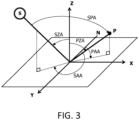
- the circumsolar zone is therefore defined by the condition 0.26° ⁇ SPA ⁇ ⁇ , where SPA is the angle between the pixel and the Sun and ⁇ is between 1° and 5°.
- the energy luminance denoted L and expressed in Wm -2 .sr -1 , is the flux radiated per unit of solid angle and surface.
- the present invention aims to remedy these drawbacks.
- the invention proposes a system for measuring the components of solar radiation more easily and at lower cost.
- the system according to the invention does not use a mask that obscures the Sun. This eliminates the operating and maintenance costs of a mask and the costs associated with a mechanical system that tracks the Sun's trajectory. Furthermore, since the Sun remains visible during the measurements, the algorithms for estimating the various components are more efficient.
- High dynamic range (HDR) imaging is achieved by acquiring multiple low dynamic range images taken with different exposure times and then combining these images into one HDR image, while maintaining the linearity of the camera sensor.
- the first region of interest ( ⁇ 1 ) is the set of image pixels verifying PZA ⁇ 90°
- the second region of interest ( ⁇ 2 ) is the set of image pixels verifying SPA ⁇ ⁇
- ⁇ is the angle defined as the limit between the circumsolar zone and the rest of the sky
- the third region of interest ( ⁇ 3 ) is the set of image pixels verifying ⁇ SPA > ⁇ ⁇ ⁇ PZA ⁇ 90° ⁇ .
- the measuring system comprises a waterproof and dustproof protective housing in which the camera is housed, and which comprises a transparent window located in front of the camera lens.
- the protective box is equipped with a temperature regulator capable of regulating the temperature inside the box.
- the system comprises at least one filter which is capable of attenuating or modulating the light entering the camera through the lens.
- the invention also relates to a method for measuring solar radiation.
- the method according to the invention further comprises the following step: (h)
- the solar profile is calculated by measuring the direct normal illuminance (DNI) along a line of pixels passing through the center of the Sun in the image, and then repeating this measurement for a plurality of angles, so as to obtain the radial distribution of luminance around the Sun.
- DNI direct normal illuminance
- the system according to the invention comprises a camera 10, provided with a hemispherical lens 20 (also called a “fisheye” lens), i.e. a wide-angle lens, with a field of vision greater than 180°.
- the camera 10 comprises a sensor 12 capable of capturing light to generate an image, for example a CMOS (“Complementary Metal Oxide Semiconductor”) sensor or a CCD sensor. (“Charge Coupled Device”).
- the sensor 12 has on its surface a certain number of pixels (125) on which the light falls to form an image.
- the camera 10 is located on a horizontal platform, and is located in a place where there is no shading (for example high up and away from buildings and vegetation).
- shading for example high up and away from buildings and vegetation.
- Camera 10 is oriented along a Z axis that points from the ground to the zenith.
- the measuring system comprises a waterproof and dustproof protective housing 40 in which the camera 10 is housed.
- the box 40 includes a transparent window 42, for example a transparent dome as shown in the figure 1 , which is located in front of the lens 20 of the camera 10 and which protects this lens 20.
- the transparent window 42 is located between the lens 20 and the Sun.
- the protective box 40 is equipped with a temperature regulator 50 capable of regulating the temperature inside the box 40.
- the system comprises one or more filters 60 which are capable of attenuating or modulating the light entering the camera 10.
- the filter(s) 60 are positioned between the Sun and the camera 10. Thus, the filter(s) 60 are located either between the camera 10 and the lens 20, or in the lens 20, or in front of the lens 20, or a combination of these positions.
- the inner face of the transparent window 42 is covered with a filter 60, as shown in the figure 1 in case window 42 is a dome.
- the transparent window 42 is tinted in order to attenuate parasitic reflections (which could, erroneously, be taken for clouds by the algorithms developed).
- the transparent window 42 is not tinted.
- the processor 30 includes an algorithm which removes these parasitic reflections.
- the system according to the invention comprises a processor 30 connected to the camera 10.
- a high dynamic range (HDR) image is defined as an image in which the image is faithfully reproduced (i.e. without underexposure or overexposure) all the luminance of the sky, from the luminance L min of the darkest area to the luminance L max of the brightest area (Sun).
- DR cam 20 log 10 L 2
- L 1 et DR sky 20 log 10 L max L min
- L 1 is the minimum luminance measurable by the camera sensor
- L 2 is the maximum luminance measurable by the camera sensor.
- the high dynamic range image is obtained by acquiring several LDR images and then combining these images into an HDR image, while preserving the linearity of the sensor, in a known manner.
- LDR low dynamic range
- the estimated value of each pixel of the generated HDR image is obtained from a weighted average of the pixel values of each LDR image (considering only the pixels falling within the linearity range of the sensor).
- the HDR image is obtained by using a 12 sensor with a dynamic range greater than the dynamic range of the DR sky .
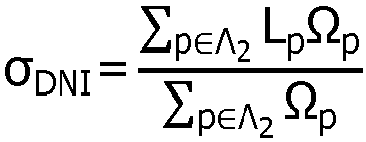
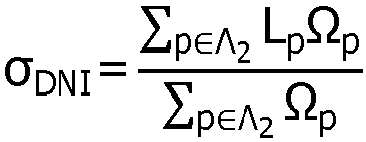
- the global horizontal illumination index ( ⁇ GHI ), the direct normal illumination index ( ⁇ DNI ) and the diffuse horizontal illumination index ( ⁇ DHI ) are then calculated, defined as the sum of the luminances measured by the pixels (125) of the image belonging to a first region of interest ( ⁇ 1 ), to a second region of interest ( ⁇ 2 ) and to a third region of interest ( ⁇ 3 ), respectively, these sums being weighted by the solid angle of the region considered.
- ⁇ p is the solid angle subtended by a pixel p (see figure 2 )
- L p is the luminance measured by this pixel
- PZA is the angle between this pixel and the zenith (see figure 3 ).
- the first region of interest ( ⁇ 1 ) is the set of pixels (125) of the image verifying PZA ⁇ 90°
- the second region of interest ( ⁇ 2 ) is the set of pixels (125) of the image verifying SPA ⁇ ⁇ , where ⁇ is the angle defined as the limit between the circumsolar zone (as defined above) and the rest of the sky
- the third region of interest ( ⁇ 3 ) is the set of pixels (125) of the image verifying ⁇ SPA > ⁇ ⁇ n ⁇ PZA ⁇ 90° ⁇ .
- the global horizontal illuminance index ( ⁇ GHI ), direct normal illuminance index ( ⁇ DNI ) and horizontal diffuse illuminance index ( ⁇ DHI ) are converted to global horizontal illuminance (GHI), direct normal illuminance (DNI) and horizontal diffuse illuminance (DHI), respectively, by conversion functions.
- artificial intelligence tools for example a neural network.
- artificial or a neuro-fuzzy system such a system combines the connectionist structure of a neural network and the writing of fuzzy rules; fuzzy logic is an extension of Boolean logic).
- a digital learning phase allows, from a base of examples (learning is supervised here), to determine the topology of the tool considered (its structure) and to identify its parameters.
- the method according to the invention further comprises the following step: (i) Calculation of sunshine duration from direct solar radiation.
- the method according to the invention then comprises the provision of a time counter which measures the time when the duration of sunshine is greater than the threshold specified above, and which stops when the duration of sunshine is less than this threshold.
- the duration of sunshine over a chosen period, for example a day, a month, or a year, is then known.
- the method according to the invention further comprises the following step: (j) Calculation of atmospheric disturbance from the determination of “clear sky” moments and the DNI.
- Atmospheric disturbance relates to the attenuation of solar radiation as it passes through the Earth's atmosphere. This attenuation is mainly due to the phenomena of diffusion by aerosols and absorption by the various atmospheric components (ozone, water vapor, oxygen, etc.).
- Atmospheric haze gives a good indication of the quality of the solar resource or atmosphere for a given site.
- the system according to the invention is capable of determining the evolution of the atmospheric disturbance on the site studied.
- the system uses an algorithm to detect times when the Sun is not obscured by a cloud. This is called a "clear sky” situation.
- An algorithm for detecting "clear sky” moments therefore acquires an image or several successive images taken with different exposure times, in a relatively short period of time (for example, a few milliseconds).
- the system then analyses the distribution of luminance in the circumsolar zone and, if necessary, performs a contour detection of the Sun, in a known manner.
- the system determines using this algorithm whether or not the moment corresponds to a so-called “clear sky” situation.
- temporal filtering based on several successive images, can be used to ensure that this situation is correctly detected.
- AT Atmospheric Disturbance
- the method according to the invention further comprises the following step: (h) Calculation of the solar profile from the analysis of the radial distribution of luminance.
- the DNI is measured along a line of pixels passing through the center of the Sun on the image.
- a radial distribution of the luminance L is obtained. This advantageously avoids the use of the SAM instrument (see above) whose cost is very high.
- the measurement of the solar profile according to the invention is more precise than a measurement with the SAM instrument because the measurement according to the invention takes into account the anisotropy of the luminance around the Sun (whereas the SAM instrument wrongly assumes a radial symmetry of the solar radiation).
Landscapes
- Engineering & Computer Science (AREA)
- Physics & Mathematics (AREA)
- General Physics & Mathematics (AREA)
- Theoretical Computer Science (AREA)
- Mathematical Physics (AREA)
- Spectroscopy & Molecular Physics (AREA)
- Multimedia (AREA)
- Signal Processing (AREA)
- Mathematical Optimization (AREA)
- Mathematical Analysis (AREA)
- Computational Mathematics (AREA)
- Pure & Applied Mathematics (AREA)
- Data Mining & Analysis (AREA)
- Computing Systems (AREA)
- Operations Research (AREA)
- Algebra (AREA)
- Databases & Information Systems (AREA)
- Software Systems (AREA)
- General Engineering & Computer Science (AREA)
- Photometry And Measurement Of Optical Pulse Characteristics (AREA)
Claims (6)
- System zum Messen der Sonnenstrahlung, das eine Kamera (10) umfasst, die mit einem halbkugelförmigen Objektiv (20) ausgestattet ist und einen Sensor (12), der dazu ausgelegt ist, Licht einzufangen, um ein Bild zu erzeugen, und einen Prozessor (30) enthält, der für Folgendes ausgelegt ist:- ausführen einer geometrischen Kalibrierung der Kamera (10), um die Übereinstimmung zwischen dem Koordinatensystem der Pixel (125) des Bilds und dem Koordinatensystem der Kamera (10) zu erhalten,- berechnen des Raumwinkels, der von jedem Pixel (125, p) des Bilds eingeschlossen wird, um den Wert der Leuchtdichte in den nachfolgenden Berechnungen zu gewichten,- ausführen einer zweiten Kalibrierung der Kamera (10), indem die theoretische Position der Sonne und ihre Position auf dem Bild verglichen werden, um die Übereinstimmung zwischen dem Koordinatensystem der Kamera (10) und den Himmelsrichtungen zu erhalten,- berechnen des Winkels zwischen jedem Pixel (125) und dem Zenit (PZA), des Winkels zwischen jedem Pixel (125) und dem Azimut (PAA), des Winkels zwischen der Sonne und dem Zenit (SZA) und des Winkels zwischen der Sonne und dem Azimut (SAA) und anschließend des Winkels zwischen jedem Pixel (125) und der Sonne (SPA) durch folgende Relation:
 - erhalten eines Bilds mit hoher Dynamik (HDR) des Himmels, wobei das Bild mit hoher Dynamik durch das Erfassen mehrerer Bilder mit niedriger Dynamik, die mit unterschiedlichen Belichtungszeiten aufgenommen wurden, und anschließend der Kombination dieser Bilder zu einem Bild mit hoher Dynamik unter Beibehaltung der Linearität des Sensors der Kamera erhalten wird,dadurch gekennzeichnet, dass der Prozessor (30) für Folgendes ausgelegt ist:- berechnen des Index der globalen horizontalen Bestrahlungsstärke (σGHI), des Index der direkten normalen Bestrahlungsstärke (σDNI) und des Index der diffusen horizontalen Bestrahlungsstärke (σDHI), definiert als die Summe der Leuchtdichten, die von den Pixeln (125) des Bilds gemessen werden, die zu einem ersten Bereich von Interesse (Λ1), zu einem zweiten Bereich von Interesse (Λ2) bzw. zu einem dritten Bereich von Interesse (Λ3) gehören, wobei Ωp, Lp und PZA der Raumwinkel, der von einem Pixel p eingeschlossen wird, die von diesem Pixel gemessene Leuchtdichte bzw. der Winkel zwischen diesem Pixel und dem Zenit sind, und wobei der erste Bereich von Interesse (Λ1) die Gesamtheit der Pixel (125) des Bilds ist, die PZA < 90° verifizieren, der zweite Bereich von Interesse (Λ2) die Gesamtheit der Pixel (125) des Bilds ist, die SPA < β verifizieren, wobei β der Winkel ist, der als Grenze zwischen der Zirkumsolarzone und dem Rest des Himmels definiert ist, und der dritte Bereich von Interesse (Λ3) die Gesamtheit der Pixel (125) des Bilds ist, die {SPA > β} ∩ {PZA < 90°} verifizieren:
 - konvertieren des Index der globalen horizontalen Bestrahlungsstärke (σGHI), des Index der direkten normalen Bestrahlungsstärke (σDNI) und des Index der diffusen horizontalen Bestrahlungsstärke (σDHI) in die globale horizontale Bestrahlungsstärke (GHI), die direkte normale Bestrahlungsstärke (DNI) bzw. die diffuse horizontale Bestrahlungsstärke (DHI).
 - System zum Messen der Sonnenstrahlung nach Anspruch 1, dadurch gekennzeichnet, dass es ein wasser- und staubdichtes Schutzgehäuse (40) umfasst, in dem die Kamera (10) untergebracht ist und das ein transparentes Fenster (42) umfasst, das sich vor dem Objektiv (20) der Kamera (10) befindet.
- System zum Messen der Sonnenstrahlung nach Anspruch 2, dadurch gekennzeichnet, dass das Gehäuse (40) mit einem Temperaturregler (50) ausgestattet ist, der dazu ausgelegt ist, die Temperatur im Inneren des Gehäuses (40) zu regeln.
- System zum Messen der Sonnenstrahlung nach einem der Ansprüche 1 bis 3, dadurch gekennzeichnet, dass es mindestens einen Filter (60) umfasst, der dazu ausgelegt ist, das durch das Objektiv (20) in die Kamera (10) eintretende Licht abzuschwächen oder zu modulieren.
- Verfahren zum Messen der Sonnenstrahlung, dadurch gekennzeichnet, dass es eine Kamera (10), die mit einem halbkugelförmigen Objektiv (20) ausgestattet ist und einen Sensor (12), der dazu ausgelegt ist, Licht einzufangen, um ein Bild zu erzeugen, und einen Prozessor (30) enthält, wobei die Kamera entlang einer Achse Z ausgerichtet ist, die vom Boden aus in Richtung des Zenits zeigt, und dass es die folgenden Schritte umfasst:(a) geometrisches Kalibrieren der Kamera (10), um die Übereinstimmung zwischen dem Koordinatensystem der Pixel (125) des Bilds, das von der Kamera (10) geliefert wird, und dem Koordinatensystem der Kamera (10) zu erhalten,(b) berechnen des Raumwinkels, der von jedem Pixel (125, p) des Bilds eingeschlossen wird, um den Wert der Leuchtdichte in den nachfolgenden Berechnungen zu gewichten,(c) kalibrieren der Kamera (10) zum zweiten Mal, indem die theoretische Position der Sonne und ihre Position auf dem Bild verglichen werden, um die Übereinstimmung zwischen dem Koordinatensystem der Kamera (10) und den Himmelsrichtungen zu erhalten,(d) berechnen des Winkels zwischen jedem Pixel (125, p) und dem Zenit (PZA), des Winkels zwischen jedem Pixel (125, p) und dem Azimut (PAA), des Winkels zwischen der Sonne und dem Zenit (SZA) und des Winkels zwischen der Sonne und dem Azimut (SAA) und anschließend des Winkels zwischen jedem Pixel (125, p) und der Sonne (SPA) aufgrund folgender Relation:
 (e) erhalten eines Bilds mit hoher Dynamik (HDR) des Himmels, wobei das Bild mit hoher Dynamik durch das Erfassen mehrerer Bilder mit niedriger Dynamik, die mit unterschiedlichen Belichtungszeiten aufgenommen wurden, und anschließend der Kombination dieser Bilder zu einem Bild mit hoher Dynamik unter Beibehaltung der Linearität des Sensors der Kamera erhalten wird,(f) berechnen des Index der globalen horizontalen Bestrahlungsstärke (σGHI), des Index der direkten normalen Bestrahlungsstärke (σDNI) und des Index der diffusen horizontalen Bestrahlungsstärke (σDHI), definiert als die Summe der Leuchtdichten, die von den Pixeln (125) des Bilds gemessen werden, die zu einem ersten Bereich von Interesse (Λ1), zu einem zweiten Bereich von Interesse (Λ2) bzw. zu einem dritten Bereich von Interesse (Λ3) gehören, wobei Ωp, Lp und PZA der Raumwinkel, der von einem Pixel p eingeschlossen wird, die von diesem Pixel gemessene Leuchtdichte bzw. der Winkel zwischen diesem Pixel und dem Zenit sind, und wobei der erste Bereich von Interesse (Λ1) die Gesamtheit der Pixel (125) des Bilds ist, die PZA < 90° verifizieren, der zweite Bereich von Interesse (Λ2) die Gesamtheit der Pixel (125) des Bilds ist, die SPA < β verifizieren, wobei β der Winkel ist, der als Grenze zwischen der Zirkumsolarzone und dem Rest des Himmels definiert ist, und der dritte Bereich von Interesse (Λ3) die Gesamtheit der Pixel (125) des Bilds ist, die {SPA > β} n {PZA < 90°} verifizieren: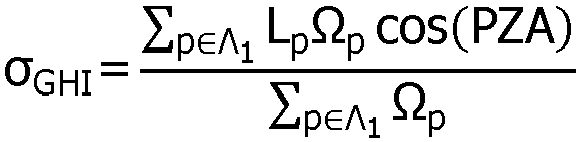
 (g) ausführen einer Konvertierung des Index der globalen horizontalen Bestrahlungsstärke (σGHI), des Index der direkten normalen Bestrahlungsstärke (σDNI) und des Index der diffusen horizontalen Bestrahlungsstärke (σDHI) in die globale horizontale Bestrahlungsstärke (GHI), die direkte normale Bestrahlungsstärke (DNI) bzw. die diffuse horizontale Bestrahlungsstärke (DHI).
 - Verfahren zum Messen der Sonnenstrahlung nach dem vorhergehenden Anspruch, dadurch gekennzeichnet, dass es ferner den folgenden Schritt umfasst:
(h) berechnen des Sonnenprofils, indem die direkte normale Bestrahlungsstärke (DNI) entlang einer Pixellinie gemessen wird, die durch die Mitte der Sonne im Bild verläuft, und anschließend Wiederholen dieser Messung für eine Mehrzahl von Winkeln, um eine radiale Verteilung der Leuchtdichte um die Sonne herum zu erhalten.
Applications Claiming Priority (2)
| Application Number | Priority Date | Filing Date | Title |
|---|---|---|---|
| FR1758549A FR3071057B1 (fr) | 2017-09-14 | 2017-09-14 | Systeme de mesure des composantes du rayonnement solaire |
| PCT/EP2018/074973 WO2019053232A1 (fr) | 2017-09-14 | 2018-09-14 | Systeme de mesure des composantes du rayonnement solaire |
Publications (3)
| Publication Number | Publication Date |
|---|---|
| EP3682199A1 EP3682199A1 (de) | 2020-07-22 |
| EP3682199C0 EP3682199C0 (de) | 2025-02-12 |
| EP3682199B1 true EP3682199B1 (de) | 2025-02-12 |
Family
ID=60138597
Family Applications (1)
| Application Number | Title | Priority Date | Filing Date |
|---|---|---|---|
| EP18806975.1A Active EP3682199B1 (de) | 2017-09-14 | 2018-09-14 | System zur messung der bestandteile von sonnenstrahlung |
Country Status (6)
| Country | Link |
|---|---|
| US (1) | US20210123800A1 (de) |
| EP (1) | EP3682199B1 (de) |
| FR (1) | FR3071057B1 (de) |
| SG (1) | SG11202002371VA (de) |
| WO (1) | WO2019053232A1 (de) |
| ZA (1) | ZA202001575B (de) |
Families Citing this family (7)
| Publication number | Priority date | Publication date | Assignee | Title |
|---|---|---|---|---|
| CN111198162B (zh) * | 2020-01-09 | 2022-10-18 | 胡德勇 | 一种城区表面反射率遥感反演方法 |
| DE102020111590A1 (de) * | 2020-04-28 | 2021-10-28 | Deutsches Zentrum für Luft- und Raumfahrt e.V. | Vorrichtung und Verfahren zur Bestimmung einer globalen Bestrahlungsstärke solarer Strahlung |
| CN113341238B (zh) * | 2021-06-08 | 2022-12-16 | 北方天穹信息技术(西安)有限公司 | 一种利用太阳辐射测量天线方向图的方法 |
| CN115098826B (zh) * | 2022-08-24 | 2022-11-04 | 成都众享天地网络科技有限公司 | 一种强光干扰的红外辐射亮度计算方法 |
| CN116295816A (zh) * | 2023-02-13 | 2023-06-23 | 上海晶电新能源有限公司 | 一种定日镜用太阳辐射量自动测量方法 |
| CN118225236B (zh) * | 2024-03-30 | 2024-11-05 | 北京奥博泰测控技术有限公司 | 天空亮度测量装置和方法、天空亮度和照度测量装置 |
| CN120522812B (zh) * | 2025-07-24 | 2025-10-17 | 山东电力建设第三工程有限公司 | 一种基于密集光流法和深度学习网络的dni预测方法 |
-
2017
- 2017-09-14 FR FR1758549A patent/FR3071057B1/fr active Active
-
2018
- 2018-09-14 WO PCT/EP2018/074973 patent/WO2019053232A1/fr not_active Ceased
- 2018-09-14 SG SG11202002371VA patent/SG11202002371VA/en unknown
- 2018-09-14 US US16/647,129 patent/US20210123800A1/en not_active Abandoned
- 2018-09-14 EP EP18806975.1A patent/EP3682199B1/de active Active
-
2020
- 2020-03-12 ZA ZA2020/01575A patent/ZA202001575B/en unknown
Also Published As
| Publication number | Publication date |
|---|---|
| SG11202002371VA (en) | 2020-04-29 |
| US20210123800A1 (en) | 2021-04-29 |
| ZA202001575B (en) | 2022-07-27 |
| FR3071057B1 (fr) | 2021-02-12 |
| EP3682199C0 (de) | 2025-02-12 |
| FR3071057A1 (fr) | 2019-03-15 |
| EP3682199A1 (de) | 2020-07-22 |
| WO2019053232A1 (fr) | 2019-03-21 |
Similar Documents
| Publication | Publication Date | Title |
|---|---|---|
| EP3682199B1 (de) | System zur messung der bestandteile von sonnenstrahlung | |
| Kurtz et al. | Measuring diffuse, direct, and global irradiance using a sky imager | |
| EP3198311B1 (de) | Detektionseinheit und verfahren zur identifizierung und überwachung von wolken in einem beobachteten bereich des himmels | |
| Pfister et al. | Cloud coverage based on all-sky imaging and its impact on surface solar irradiance | |
| Urquhart et al. | Development of a sky imaging system for short-term solar power forecasting | |
| CN103472501B (zh) | 云检测及全天空总云量检测方法和系统 | |
| Mei et al. | Noise modeling, evaluation and reduction for the atmospheric lidar technique employing an image sensor | |
| Prata et al. | Retrieval of sulfur dioxide from a ground-based thermal infrared imaging camera | |
| CN105872398A (zh) | 一种空间相机自适应曝光方法 | |
| JPWO2007069736A1 (ja) | 樹体生産能力を評価する方法、樹体生産能力を評価するための撮像装置及び樹体生産能力を評価するためのプログラム | |
| Urquhart et al. | Development of a sky imaging system for short-term solar power forecasting | |
| Cazorla et al. | Multi-exposure adaptive threshold technique for cloud detection with sky imagers | |
| Moore et al. | Spectral reflectance of whitecaps: instrumentation, calibration, and performance in coastal waters | |
| Dandini et al. | Halo ratio from ground-based all-sky imaging | |
| FR3047829A1 (fr) | Procede d'estimation de la position du disque solaire dans une image de ciel | |
| Dev et al. | Detecting rainfall onset using sky images | |
| Pickering | The MMT all-sky camera | |
| EP4254359B1 (de) | Verfahren zur positionsbestimmung einer person in einem raum, wärmebildgerät und heimdetektor | |
| Lederer et al. | Nasa’s orbital debris jao/es-mcat optical telescope facility on ascension island | |
| Saito et al. | Cloud discrimination from sky images using a clear-sky index | |
| Mohr et al. | Optical turbulence measurements and models for Mount John University Observatory | |
| WO2003044499A2 (fr) | Procede de detection optique de gaz a distance | |
| Ewald et al. | Design and characterization of specMACS, a multipurpose hyperspectral cloud and sky imager. | |
| Badura et al. | Spectral performance optimization of small telescopes for space object detection | |
| KR102542100B1 (ko) | 회전 프리즘을 적용한 반사도 측정 장치 |
Legal Events
| Date | Code | Title | Description |
|---|---|---|---|
| STAA | Information on the status of an ep patent application or granted ep patent |
Free format text: STATUS: UNKNOWN |
|
| STAA | Information on the status of an ep patent application or granted ep patent |
Free format text: STATUS: THE INTERNATIONAL PUBLICATION HAS BEEN MADE |
|
| PUAI | Public reference made under article 153(3) epc to a published international application that has entered the european phase |
Free format text: ORIGINAL CODE: 0009012 |
|
| STAA | Information on the status of an ep patent application or granted ep patent |
Free format text: STATUS: REQUEST FOR EXAMINATION WAS MADE |
|
| 17P | Request for examination filed |
Effective date: 20200312 |
|
| AK | Designated contracting states |
Kind code of ref document: A1 Designated state(s): AL AT BE BG CH CY CZ DE DK EE ES FI FR GB GR HR HU IE IS IT LI LT LU LV MC MK MT NL NO PL PT RO RS SE SI SK SM TR |
|
| AX | Request for extension of the european patent |
Extension state: BA ME |
|
| DAV | Request for validation of the european patent (deleted) | ||
| DAX | Request for extension of the european patent (deleted) | ||
| STAA | Information on the status of an ep patent application or granted ep patent |
Free format text: STATUS: EXAMINATION IS IN PROGRESS |
|
| 111L | Licence recorded |
Designated state(s): AL AT BE BG CH CY CZ DE DK EE ES FI FR GB GR HR HU IE IS IT LT LU LV MC MK MT NL NO PL PT RO RS SE SI SK SM TR Free format text: EXCLUSIVE LICENSE Name of requester: AXLR, SATT DU LANGUEDOC ROUSSILLON, FR Effective date: 20220922 |
|
| 17Q | First examination report despatched |
Effective date: 20220930 |
|
| RAP1 | Party data changed (applicant data changed or rights of an application transferred) |
Owner name: UNIVERSITE PERPIGNAN VIA DOMITIA Owner name: CENTRE NATIONAL DE LA RECHERCHE SCIENTIFIQUE |
|
| GRAP | Despatch of communication of intention to grant a patent |
Free format text: ORIGINAL CODE: EPIDOSNIGR1 |
|
| STAA | Information on the status of an ep patent application or granted ep patent |
Free format text: STATUS: GRANT OF PATENT IS INTENDED |
|
| RAP3 | Party data changed (applicant data changed or rights of an application transferred) |
Owner name: UNIVERSITE PERPIGNAN VIA DOMITIA Owner name: CENTRE NATIONAL DE LA RECHERCHE SCIENTIFIQUE |
|
| RAP3 | Party data changed (applicant data changed or rights of an application transferred) |
Owner name: UNIVERSITE DE PERPIGNAN VIA DOMITIA Owner name: CENTRE NATIONAL DE LA RECHERCHE SCIENTIFIQUE |
|
| INTG | Intention to grant announced |
Effective date: 20241114 |
|
| GRAS | Grant fee paid |
Free format text: ORIGINAL CODE: EPIDOSNIGR3 |
|
| GRAA | (expected) grant |
Free format text: ORIGINAL CODE: 0009210 |
|
| STAA | Information on the status of an ep patent application or granted ep patent |
Free format text: STATUS: THE PATENT HAS BEEN GRANTED |
|
| 111L | Licence recorded |
Designated state(s): AL AT BE BG CH CY CZ DE DK EE ES FI FR GB GR HR HU IE IS IT LT LU LV MC MK MT NL NO PL PT RO RS SE SI SK SM TR Free format text: EXCLUSIVE LICENSE Name of requester: AXLR, SATT DU LANGUEDOC ROUSSILLON, FR Effective date: 20220922 |
|
| AK | Designated contracting states |
Kind code of ref document: B1 Designated state(s): AL AT BE BG CH CY CZ DE DK EE ES FI FR GB GR HR HU IE IS IT LI LT LU LV MC MK MT NL NO PL PT RO RS SE SI SK SM TR |
|
| REG | Reference to a national code |
Ref country code: GB Ref legal event code: FG4D Free format text: NOT ENGLISH |
|
| REG | Reference to a national code |
Ref country code: CH Ref legal event code: EP |
|
| REG | Reference to a national code |
Ref country code: DE Ref legal event code: R096 Ref document number: 602018079113 Country of ref document: DE |
|
| REG | Reference to a national code |
Ref country code: IE Ref legal event code: FG4D Free format text: LANGUAGE OF EP DOCUMENT: FRENCH |
|
| U01 | Request for unitary effect filed |
Effective date: 20250217 |
|
| U07 | Unitary effect registered |
Designated state(s): AT BE BG DE DK EE FI FR IT LT LU LV MT NL PT RO SE SI Effective date: 20250224 |
|
| PG25 | Lapsed in a contracting state [announced via postgrant information from national office to epo] |
Ref country code: RS Free format text: LAPSE BECAUSE OF FAILURE TO SUBMIT A TRANSLATION OF THE DESCRIPTION OR TO PAY THE FEE WITHIN THE PRESCRIBED TIME-LIMIT Effective date: 20250512 |
|
| PG25 | Lapsed in a contracting state [announced via postgrant information from national office to epo] |
Ref country code: PL Free format text: LAPSE BECAUSE OF FAILURE TO SUBMIT A TRANSLATION OF THE DESCRIPTION OR TO PAY THE FEE WITHIN THE PRESCRIBED TIME-LIMIT Effective date: 20250212 |
|
| PG25 | Lapsed in a contracting state [announced via postgrant information from national office to epo] |
Ref country code: ES Free format text: LAPSE BECAUSE OF FAILURE TO SUBMIT A TRANSLATION OF THE DESCRIPTION OR TO PAY THE FEE WITHIN THE PRESCRIBED TIME-LIMIT Effective date: 20250212 |
|
| PG25 | Lapsed in a contracting state [announced via postgrant information from national office to epo] |
Ref country code: IS Free format text: LAPSE BECAUSE OF FAILURE TO SUBMIT A TRANSLATION OF THE DESCRIPTION OR TO PAY THE FEE WITHIN THE PRESCRIBED TIME-LIMIT Effective date: 20250612 Ref country code: NO Free format text: LAPSE BECAUSE OF FAILURE TO SUBMIT A TRANSLATION OF THE DESCRIPTION OR TO PAY THE FEE WITHIN THE PRESCRIBED TIME-LIMIT Effective date: 20250512 |
|
| PG25 | Lapsed in a contracting state [announced via postgrant information from national office to epo] |
Ref country code: HR Free format text: LAPSE BECAUSE OF FAILURE TO SUBMIT A TRANSLATION OF THE DESCRIPTION OR TO PAY THE FEE WITHIN THE PRESCRIBED TIME-LIMIT Effective date: 20250212 |
|
| PG25 | Lapsed in a contracting state [announced via postgrant information from national office to epo] |
Ref country code: GR Free format text: LAPSE BECAUSE OF FAILURE TO SUBMIT A TRANSLATION OF THE DESCRIPTION OR TO PAY THE FEE WITHIN THE PRESCRIBED TIME-LIMIT Effective date: 20250513 |
|
| PG25 | Lapsed in a contracting state [announced via postgrant information from national office to epo] |
Ref country code: SM Free format text: LAPSE BECAUSE OF FAILURE TO SUBMIT A TRANSLATION OF THE DESCRIPTION OR TO PAY THE FEE WITHIN THE PRESCRIBED TIME-LIMIT Effective date: 20250212 |
|
| PG25 | Lapsed in a contracting state [announced via postgrant information from national office to epo] |
Ref country code: CZ Free format text: LAPSE BECAUSE OF FAILURE TO SUBMIT A TRANSLATION OF THE DESCRIPTION OR TO PAY THE FEE WITHIN THE PRESCRIBED TIME-LIMIT Effective date: 20250212 |
|
| PG25 | Lapsed in a contracting state [announced via postgrant information from national office to epo] |
Ref country code: SK Free format text: LAPSE BECAUSE OF FAILURE TO SUBMIT A TRANSLATION OF THE DESCRIPTION OR TO PAY THE FEE WITHIN THE PRESCRIBED TIME-LIMIT Effective date: 20250212 |
|
| U20 | Renewal fee for the european patent with unitary effect paid |
Year of fee payment: 8 Effective date: 20250929 |
|
| U1N | Appointed representative for the unitary patent procedure changed after the registration of the unitary effect |
Representative=s name: SANTARELLI; FR |
|
| PLBE | No opposition filed within time limit |
Free format text: ORIGINAL CODE: 0009261 |
|
| STAA | Information on the status of an ep patent application or granted ep patent |
Free format text: STATUS: NO OPPOSITION FILED WITHIN TIME LIMIT |
|
| 26N | No opposition filed |
Effective date: 20251113 |