EP3681937B1 - Getränkeausgabeeinrichtung - Google Patents
Getränkeausgabeeinrichtung Download PDFInfo
- Publication number
- EP3681937B1 EP3681937B1 EP18755476.1A EP18755476A EP3681937B1 EP 3681937 B1 EP3681937 B1 EP 3681937B1 EP 18755476 A EP18755476 A EP 18755476A EP 3681937 B1 EP3681937 B1 EP 3681937B1
- Authority
- EP
- European Patent Office
- Prior art keywords
- nylon
- beverage dispensing
- dispensing equipment
- polyamide
- equipment according
- Prior art date
- Legal status (The legal status is an assumption and is not a legal conclusion. Google has not performed a legal analysis and makes no representation as to the accuracy of the status listed.)
- Not-in-force
Links
Images




Classifications
-
- C—CHEMISTRY; METALLURGY
- C08—ORGANIC MACROMOLECULAR COMPOUNDS; THEIR PREPARATION OR CHEMICAL WORKING-UP; COMPOSITIONS BASED THEREON
- C08G—MACROMOLECULAR COMPOUNDS OBTAINED OTHERWISE THAN BY REACTIONS ONLY INVOLVING UNSATURATED CARBON-TO-CARBON BONDS
- C08G85/00—General processes for preparing compounds provided for in this subclass
- C08G85/004—Modification of polymers by chemical after-treatment
-
- B—PERFORMING OPERATIONS; TRANSPORTING
- B67—OPENING, CLOSING OR CLEANING BOTTLES, JARS OR SIMILAR CONTAINERS; LIQUID HANDLING
- B67D—DISPENSING, DELIVERING OR TRANSFERRING LIQUIDS, NOT OTHERWISE PROVIDED FOR
- B67D1/00—Apparatus or devices for dispensing beverages on draught
-
- B—PERFORMING OPERATIONS; TRANSPORTING
- B67—OPENING, CLOSING OR CLEANING BOTTLES, JARS OR SIMILAR CONTAINERS; LIQUID HANDLING
- B67D—DISPENSING, DELIVERING OR TRANSFERRING LIQUIDS, NOT OTHERWISE PROVIDED FOR
- B67D1/00—Apparatus or devices for dispensing beverages on draught
- B67D1/08—Details
- B67D1/0801—Details of beverage containers, e.g. casks, kegs
- B67D1/0804—Shape or materials
-
- B—PERFORMING OPERATIONS; TRANSPORTING
- B67—OPENING, CLOSING OR CLEANING BOTTLES, JARS OR SIMILAR CONTAINERS; LIQUID HANDLING
- B67D—DISPENSING, DELIVERING OR TRANSFERRING LIQUIDS, NOT OTHERWISE PROVIDED FOR
- B67D3/00—Apparatus or devices for controlling flow of liquids under gravity from storage containers for dispensing purposes
- B67D3/0058—Details
- B67D3/0061—Details of liquid containers, e.g. filling, emptying, closing or opening means
- B67D3/0067—Details of liquid containers, e.g. filling, emptying, closing or opening means relating to shape or materials, e.g. bag-in-box packages [BIB], pouches
-
- C—CHEMISTRY; METALLURGY
- C08—ORGANIC MACROMOLECULAR COMPOUNDS; THEIR PREPARATION OR CHEMICAL WORKING-UP; COMPOSITIONS BASED THEREON
- C08G—MACROMOLECULAR COMPOUNDS OBTAINED OTHERWISE THAN BY REACTIONS ONLY INVOLVING UNSATURATED CARBON-TO-CARBON BONDS
- C08G69/00—Macromolecular compounds obtained by reactions forming a carboxylic amide link in the main chain of the macromolecule
- C08G69/48—Polymers modified by chemical after-treatment
-
- C—CHEMISTRY; METALLURGY
- C08—ORGANIC MACROMOLECULAR COMPOUNDS; THEIR PREPARATION OR CHEMICAL WORKING-UP; COMPOSITIONS BASED THEREON
- C08J—WORKING-UP; GENERAL PROCESSES OF COMPOUNDING; AFTER-TREATMENT NOT COVERED BY SUBCLASSES C08B, C08C, C08F, C08G or C08H
- C08J7/00—Chemical treatment or coating of shaped articles made of macromolecular substances
- C08J7/12—Chemical modification
-
- B—PERFORMING OPERATIONS; TRANSPORTING
- B67—OPENING, CLOSING OR CLEANING BOTTLES, JARS OR SIMILAR CONTAINERS; LIQUID HANDLING
- B67D—DISPENSING, DELIVERING OR TRANSFERRING LIQUIDS, NOT OTHERWISE PROVIDED FOR
- B67D1/00—Apparatus or devices for dispensing beverages on draught
- B67D1/07—Cleaning beverage-dispensing apparatus
- B67D2001/075—Sanitising or sterilising the apparatus
-
- B—PERFORMING OPERATIONS; TRANSPORTING
- B67—OPENING, CLOSING OR CLEANING BOTTLES, JARS OR SIMILAR CONTAINERS; LIQUID HANDLING
- B67D—DISPENSING, DELIVERING OR TRANSFERRING LIQUIDS, NOT OTHERWISE PROVIDED FOR
- B67D2210/00—Indexing scheme relating to aspects and details of apparatus or devices for dispensing beverages on draught or for controlling flow of liquids under gravity from storage containers for dispensing purposes
- B67D2210/00028—Constructional details
- B67D2210/00047—Piping
-
- C—CHEMISTRY; METALLURGY
- C08—ORGANIC MACROMOLECULAR COMPOUNDS; THEIR PREPARATION OR CHEMICAL WORKING-UP; COMPOSITIONS BASED THEREON
- C08J—WORKING-UP; GENERAL PROCESSES OF COMPOUNDING; AFTER-TREATMENT NOT COVERED BY SUBCLASSES C08B, C08C, C08F, C08G or C08H
- C08J2377/00—Characterised by the use of polyamides obtained by reactions forming a carboxylic amide link in the main chain; Derivatives of such polymers
- C08J2377/02—Polyamides derived from omega-amino carboxylic acids or from lactams thereof
Definitions
- the present invention relates to beverage dispensing equipment, in particular, beverage dispensing with improved biofouling resistance.
- Drinking liquids including beverages which are non-alcoholic such as soft drinks (for example carbonated drinks) and hard or alcohol-containing drinks are often conveyed from a reservoir through dispensing lines to a dispenser for example a dispensing tap. Such an arrangement is often present in premises with a bar.
- US5645697 describes a method for preventing contaminant build-up in a beer supply line by locating electromagnetic field generating means adjacent a section of a beer dispensing line, applying a frequency modulated square wave voltage signal to said electromagnetic field generating means to generate a varying frequency electromagnetic field in that section of the dispensing line.
- the authors present several explanations for the reduction in contaminants including that the applied electromagnetic field created in the pipe or duct carrying the beer interferes with electron transport within bacterial cells, leading to cell stasis or death; and/or that the electromagnetic field may block uptake of key nutrients thereby inhibiting bacterial cell growth.
- GB236106 is also concerned with the application of an electromagnetic field about beer dispensing equipment.
- the surfaces disclosed therein may be used in the manufacture of biofouling resistant material.
- JPH032115533 describes the immobilisation of D-glucosamine or an oligomer thereof to a polymer moulding via a cross-linking agent.
- Polymers are reacted with difunctional cross-linking agents, such as glutaraldehyde hydrate, to form a covalent linkage between the polymer and the cross-linking agent, and the resulting product is subsequently reacted with glucosamine, to form a polymer having glucosamine tethered thereto via a linker.
- the products are described as highly hydrophilic polymers and may be used for example to form woven fabrics such as underwear.
- EP3091025 provides one solution to address the issue of biofouling in beverage dispensing equipment.
- beverage dispensing equipment comprising a surface having a disaccharide immobilised thereon is described.
- the disaccharide is covalently bound to a linker moiety which in turn is bound to the surface.
- the linker moiety is disposed between the surface and the disaccharide, and the linker moiety comprises a carbon atom that forms a covalent bond with an atom on the surface.
- EP3091025 employs diazonium chemistry to covalently bond the linker - to which the disaccharide is covalently bound - to an atom on the surface of the beverage dispensing equipment.
- the present invention provides beverage dispensing equipment comprising an article having a polyamide surface, said polyamide surface comprising the following functionality: wherein:
- R 1 may be -OH.
- R 2 may be -CH 2 OH.
- R 3 may be -H.
- R 4 may be -OH.
- R 1 is -OH
- R 2 is -CH 2 OH
- R 3 is -H
- R 4 is -OH
- the functionalised polyamide surface resists biofouling.
- the polyamide surface may comprise functionality selected from the following group: and
- R 2 may be -CH 3 .
- R 1 is -OH
- R 2 is -CH 3
- R 3 is -H
- R 4 is -OH
- the polyamide surface may comprise functionality selected from the following group:
- R 1 is a monosaccharide sugar selected from glucose, galactose, mannose, rhamnose, fucose, glucosamine, fructose, ribose and xylose.
- the polyamide surface is a nylon surface.
- the nylon surface may be selected from nylon-6, nylon-7, nylon-8, nylon-9, nylon-10, nylon-11 and nylon-12.
- the nylon surface may be selected from nylon-4,6, nylon-6,6, or nylon-6,12.
- the polyamide surface may comprise the following functionality:
- m may be 10.
- the beverage dispensing equipment may comprise beverage dispensing lines, or beverage dispensing taps.
- the beverage dispensing equipment may comprise beer dispensing lines, soft drink dispensing lines, dairy-product dispensing lines.
- the oxidising agent may be sodium hypochlorite.
- Treating the surface with a basic solution comprising an oxidising agent may comprise exposing said surface to multiple aliquots of said basic solution comprising said oxidising agent.
- the basic solution comprising an oxidising agent may comprise a solution of sodium hydroxide and/or potassium hydroxide.
- the reducing sugar may be selected from the group consisting of: glucose, galactose, mannose, rhamnose, fucose, glucosamine, fructose, ribose, xylose, cellobiose, lactose and maltose.
- the absolute configuration of the reducing sugar may be D. In other embodiments, the absolute configuration of the reducing sugar may be L.
- the method of manufacture disclosed herein does not require the use of cross-linking agents such as dialdehydes.
- the surfaces of the invention are non-toxic and the beverage dispensing equipment of the present invention does not require cleaning at the frequency at which state of the art beverage dispensing equipment requires.
- the beverage dispensing equipment according to the present invention can easily replace state of the art beverage dispensing equipment and requires less maintenance than said beverage dispensing equipment.
- the present invention provides beverage dispensing equipment comprising an article having a polyamide surface, said polyamide surface comprising the following functionality: wherein:
- the beverage dispensing equipment comprising an article having a polyamide surface may comprise a polyamide surface may comprise the following functionality:
- R 1 may be -OH.
- R 3 may be H.
- R 4 may be -OH.
- R 1 is -OH
- R 3 is -H
- R 4 is -OH
- R 1 is a monosaccharide sugar selected from glucose, galactose, mannose, rhamnose, fucose, glucosamine, fructose, ribose and xylose.
- the polyamide surface is a nylon surface, for example, the nylon surface may be selected from nylon-6, nylon-8, nylon-10, nylon-11 and nylon-12.
- the polyamide surface may comprise the following functionality:
- m may be 10.
- polyamide surface may comprise the following functionality
- n 8 to 12, more preferably m is 10.
- the beverage dispensing equipment may be beverage dispensing lines or beverage dispensing taps.
- the beverage dispensing equipment may be beer dispensing equipment, such as beer dispensing lines or taps.
- the beverage dispensing equipment may be soft drink dispensing lines or taps, or dairy-product dispensing lines or taps.
- the beverage dispensing equipment comprising an article having a polyamide surface according to the invention comprises a biofouling resistant surface.
- the polyamide surface may be coated with polyhydroxylated components (derived from reducing sugars), which resist fouling by protein and cells.
- the polyhydroxylated component is formed when the activated surface reacts with the reducing terminus of a reducing sugar, i.e. when the activated polyamide surface reacts with a terminal aldehyde group in a reducing sugar.
- the polyhydroxylated component is connected directly to the polyamide surface via a covalent linkage from a carbon atom of the polyhydroxylated component to an amido nitrogen of the polyamide surface.
- the amido nitrogen is integrated in the polyamide polymer network which forms the polyamide surface.
- connection formed between the polyhydroxylated component and the polyamide surface is not for example, via a linker.
- direct covalent connection between a carbon atom in the polyhydroxylate component and an amido nitrogen integrated in the polyamide surface is significantly stronger than for example, connection between the polyamide surface and a saccharide moiety via an anomeric oxygen.
- the beverage dispensing equipment according to the present invention can easily replace conventional beverage dispensing equipment and requires less maintenance than conventional beverage dispensing equipment.
- the beverage dispensing equipment of the present invention owing to its biofouling resistant surface, does not need to be cleaned as often as conventional beverage dispensing equipment.
- the method may be easily carried out on conventional beverage dispensing equipment.
- beverage dispensing equipment such as a nylon beer line
- the method of the invention is robust, and can be conducted onsite, without the need for specialist equipment. This represents a marked advancement on previous technology, wherein parameters such as temperature and light exposure, must be rigorously controlled in order to functionalise surfaces with carbohydrates.
- a nylon beer line may be treated with a basic solution comprising an oxidising agent to activate the nylon surface i.e. to provide an activated polyamide surface.
- the basic solution comprising an oxidising agent i.e. the activating solution
- the line may be activated by exposing the line, for a period of 5 to 15 minutes, to an aliquot of activating solution. The process may be repeated using further aliquots of activating solution.
- the activating solution is then flushed, and the line comprising the activated polyamide surface is treated with a solution comprising a reducing sugar.
- Treating the activated polyamide surface may involve exposing the activated polyamide surface to a solution comprising a reducing sugar.
- the solution comprising a reducing sugar may be a basic solution comprising an oxidising agent and the reducing agent.
- the method of manufacture of the beverage dispensing equipment of the present invention does not require the use of cross-linking agents.
- This increases the atom economy of the present invention over state of the art technologies for functionalising polymeric surfaces.
- many state of the art cross-linking strategies for functionalising polymeric surfaces employ toxic cross-linking agents such as dialdehydes, which would render them unsuitable for forming beverage dispensing equipment. Therefore, the present methodology represents a marked advancement on the state of the art.
- [saccharide X]-functionalised [polyamide surface] means a polyamide surface functionalised with a polyhydroxylated component derived from saccharide X.
- "mannose-functionalised nylon” means nylon functionalised with a polyhydroxylated component derived from mannose
- lactose-functionalised nylon means nylon functionalised with a polyhydroxylated component derived from lactose
- maltotriose-functionalised nylon means nylon functionalised with a polyhydroxylated component derived from maltotriose
- mannobiose-functionalised nylon means nylon functionalised with a polyhydroxylated component derived from mannobiose.
- Terms in the above format may also be represented in the following manner: "lactose-functionalised nylon” may be represented by "nylon-lac”; “mannose-functionalised nylon” may be represented by "nylon-man”.
- beverage dispensing equipment includes equipment such as beverage dispensing lines, for example tubing or pipework, through which beverages may be conveyed.
- beer includes for example beer, stout, ale, lager and cider.
- beer includes alcoholic and non-alcoholic beers, i.e. "beer” may be alcoholic beer or non-alcoholic beer.
- air-product includes for example products comprising milk, cream, butter, or yogurt.
- Nylon 6,6 sheets and nylon 6 powder (mean particle size 15-20 ⁇ m) were purchased from Goodfellow; sodium hypochlorite, sodium hydroxide, potassium hydroxide, phosphate buffered saline buffer (0.010 M PBS, pH 7.4), sodium nitrite and fluoroboric acid were purchased from Sigma Aldrich.
- Lectin Concanavalin A (ConA), Bovine Serum Albumin (BSA) and peanut agglutinin from Arachis hypogaea (PNA) conjugates with Alexa Fluor 647 were purchased from BioSciences Ltd.
- Native saccharides Mannose, glucose, galactose, lactose, maltotriose and trehalose
- Methyl alpha/beta-D-Mannopyranoside Mannose-Me
- lactobionic acid were synthesised in accordance with standard procedures.
- F-Galactose was synthesised as described below.
- Nylon Modification (40 min protocol) Activation of nylon surfaces was carried out by treatment with a 0.5% aqueous solution of sodium hypochlorite in base (KOH 1% and NaOH 1%), referred to as BB from here onwards, for 30 min in total, while changing the BB solution every 10 min with a fresh aliquot. After activation, functionalization of the pre-activated nylon surface was carried out via incubation in freshly prepared 0.4 mg/mL solutions of the corresponding native saccharide in BB for 10 min.
- KOH 1% and NaOH 1% sodium hypochlorite in base
- Activation of nylon surfaces was carried out by treatment with a 0.5% aqueous solution of sodium hypochlorite in base (KOH 1% and NaOH 1%), referred to as BB from here onwards, for 15 min in total, while changing the BB solution every 5 min with a fresh aliquot.
- functionalisation of the pre-activated nylon surface was carried out via incubation in freshly prepared 0.4 mg/mL solutions of the corresponding native saccharide in BB for 5 min.
- X-ray photoelectron spectroscopy was performed on a VG Scientific ESCAlab Mk II system ( ⁇ 2 ⁇ 10 -8 mbar), using an Al K ⁇ source (1486.6 eV); pass energy was set at 200 eV for survey spectra and 20 eV for high resolution spectra. Spectra were collected with an emission current of 100 mA at 50% of normal operating conditions (200 mA) to minimize sample damage. Peaks were referenced to the C 1s core energy to correct for charging prior to analysis using CasaXPS software.
- NMR nuclear Magnetic Resonance Bruker spectrometer HD using the single ⁇ /2 pulse magic-angle-spinning technique, 400 MHz, 3.2 mm and H/X CP-MAS probe. Static contact angles were measured on a commercial system (FTA1000) in air, using 20 ⁇ L droplets.
- Nylon samples were incubated for 1 h in a 0.5 mg/mL solution of PBS buffer at pH 7.4 including 0.1 mM CaCl 2 and MgCl 2 for ConA and PNA conjugates.
- nylon samples were incubated for 1 h in a 0.2 mg/mL BSA solution in PBS buffer at pH 7.4. After incubation, surfaces were washed with PBS solution to remove unbound protein prior to imaging. Fluorescence images were acquired using an Olympus BX51 inverted microscope with a cellSens digital image processing software.
- Images were acquired with a cube filter set having a 635 nm EdgeBasic long-pass edge filter, a single-edge dichroic beamsplitter filter at 649 nm and a barrier filter at 620-640 nm. Analysis of emission intensities was carried out in triplicate using Image J software.
- Biofilm studies on glycosylated nylon surfaces A single colony from Saccharomyces cerevisiae BY4741 strain was inoculated in 10 mL of yeast extract peptone dextrose broth (YEPD), composed of 1% (w/v) Yeast Extract, 2% (w/v) Peptone and 2% (w/v) Glucose and incubated overnight at 37 °C.
- the culture (5 ⁇ L) was diluted into fresh media (10 mL) and cultured at 37 °C for 6 h; finally, 310 ⁇ L of media (1.615 . 10 7 CFU/mL) was inoculated on 50 mL of YEPD.
- the bare nylon surfaces (controls) and the functionalised nylon surfaces were placed into their corresponding fresh media containing the yeast and culture for 6 days at 20°C. The controls and samples were prepared in triplicate.
- the functionalisation method involves a two-step process.
- the first step consists in an activation pre-treatment of polyamide (e.g. nylon) surfaces via exposure to a solution of sodium hypochlorite and base (BB).
- the second step consists of immobilization of polyhydroxylated components derived from saccharides on the surface, by treating the activated polyaimde (e.g. nylon) surface with a solution comprising a reducing sugar.
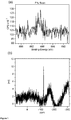
- Nylon pre-activated surfaces were functionalised via immersion in freshly prepared solutions of native saccharides. After modification, surfaces were rinsed and dried. The immobilization of the polyhydroxylated components derived from saccharides on the surface was first confirmed via XPS and NMR studies using fluorinated galactose (F-galactose), which was used in order to determine the presence of fluorine on the coated surface (see Figure 1 ).
- F-galactose fluorinated galactose
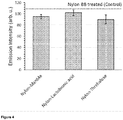
- Figure 3 shows emission intensity for galactose-functionalised nylon and lactose-functionalised nylon after treatment with PNA. Once the activated nylon reacts with galactose to produce the galactose-functionalised nylon, the sugar ring of galactose is opened and the resulting polyhydroxylated component which is covalently bound to the nylon surface has significantly reduced binding affinity for PNA. In contrast lactose-functionalised nylon comprises an entact galactose ring after covalently being bound to the nylon surface and therefore retains an ability to bind PNA.
- Figure 3 also demonstrates the ability of mannobiose-functionalised nylon to bind ConA, whereas mannose-functionalised nylon has markedly reduced binding affinity for ConA.
- Nylon dispensing lines (Nylon-11) that had previously been used in trade were connected to kegs containing beer (stout) using standard tapping and fitting elements. Lines were used in pairs with one of the lines cleaned using standard cleaning-in-place (CIP) procedures and the other cleaned and then functionalised with polyhydroxylated components derived from mannose to form a functionalised polyamide surface.
- CIP cleaning-in-place
- Each pair of control and test lines was sent through a cooling unit that cooled the beer so it was dispensed between 5° and 7° centigrade, this is representative of trade dispense temperatures.
- Each pair of control and test lines was then sent to a tap which could be used to dispense the beer under pressure from a standard gas tank.
- A, B, and C In the figures that summarise the results of tests each pair of taps is labelled A, B, and C.
- the internal volume of the lines used was approximately 800 mL, as measured experimentally, corresponding to total lengths of 10-12 m depending on the specific line. Identical amounts of beer were drawn from each tap over 56 calendar days, on all working days (41 working days).
- Dispensing line treatments All lines were cleaned with commercial CIP detergent solution, using pressure delivery of the solution from 15 L or 25 L wash bottles. Control lines were then rinsed with tap water by passing the equivalent of three total internal volumes and subsequently charged with beer.
- cleaned lines were charged completely with a solution containing: 0.5% sodium hypochlorite (3.5:100 dilution from concentrated commercial 14% NaClO), 1% wt. NaOH and 1% wt. KOH in water. The line was exposed to this solution for 10 min and the procedure repeated twice. Immediately afterwards, the lines were charged with a solution containing: 0.4 mg/mL of saccharide (D-mannose), 0.5% sodium hypochlorite, 1% wt. NaOH and 1% wt. KOH in water. The treated lines were exposed to this solution for 10 min, subsequently rinsed with water by passing the equivalent of three total internal volumes, and finally charged with beer ready for use.
- D-mannose saccharide
- sodium hypochlorite 1% wt. NaOH
- Contamination of coated relative to uncoated lines was quantitatively assessed using a combination of tests: (a) the aqueous solutions drawn from each line were analysed to determine relative turbidity and ATP content (see Figures 7 and 8 ); (b) the average amount of biofilm retained by the internal nylon walls of the dispensing lines was determined via crystal violet staining (see Figure 8 ); and (c) visualisation of biofilm was carried out via microscopy analysis of samples of the internal line walls (see Figure 9 ).
- Figure 6 shows turbidity measurements at 595 nm for water obtained from dispensing lines after 56 calendar day use. Aqueous solutions drawn from all lines were analysed to determine their relative turbidity for lines comprising mannose-functionalised nylon versus uncoated lines using a UV-Vis spectrometer, by monitoring the solution extinction at 595 nm vs. a water blank. Lines comprising saccharide-functionalised polyamide surfaces demonstrated significant antifouling properties.
- Figure 7 shows relative luminescence units measured from solutions of rinsing water drawn from beer dispensing lines after 56 calendar days.
- Figure 7a (on the left hand side) is for the first volume drawn from coated or uncoated lines and
- Figure 7b (on the right hand side) is for the second volume drawn for coated or uncoated lines.
- ATP adenosine triphosphate
- ATP adenosine triphosphate
- ATP adenosine triphosphate
- Figure 8 shows absorbance of crystal violet extracted from stained dispensing lines after a test of 56 calendar days. The higher the absorbance the higher the amount of crystal violet extracted from the internal walls of the dispensing lines, thus indicating higher biofilm accumulation. Uncoated lines therefore accumulate larger amounts of biofilm than coated lines. Samples of tubing, 2 cm in length, from the middle section of each line were cut and stained with a 0.01% crystal violet solution via immersion for 2 min, following standard staining protocols. Samples were then rinsed with copious amounts of water to remove unbound dye.
- the crystal violet dye retained by the biofilm at the internal tubing surface was dissolved in 40 mL of 95% ethanol via immersion (15 min) and the relative amount of dye released by coated and uncoated lines was determined by monitoring absorbance of the dye at 595 nm. The greater the amount of crystal violet released by the tubing into the ethanol, the greater the amount of biofilm retained by the tubing walls.
- Figure 9 shows Scanning Electron Microscopy (SEM) image of the internal surfaces of a dispensing line after 56 calendar day test.
- the uncoated lines ( Figure 9a ) show visible accumulation of biomass whereas the line functionalised with a polyhydroxylated component derived from mannose is clean from biofilm. These specific images correspond to the lines in Tap A in Figures 6-8 .
Landscapes
- Chemical & Material Sciences (AREA)
- General Chemical & Material Sciences (AREA)
- Health & Medical Sciences (AREA)
- Chemical Kinetics & Catalysis (AREA)
- Medicinal Chemistry (AREA)
- Polymers & Plastics (AREA)
- Organic Chemistry (AREA)
- Engineering & Computer Science (AREA)
- Mechanical Engineering (AREA)
- Polyamides (AREA)
- Apparatus For Disinfection Or Sterilisation (AREA)
Claims (15)
- Getränkeausgabeeinrichtung umfassend einen Gegenstand, der eine Polyamidoberfläche aufweist, wobei die Polyamidoberfläche die folgende Funktionalität aufweist:
 R1 gleich -OH, ein Monosaccharidzucker oder ein Disaccharidzucker ist;R2 gleich -H, -CH3 oder -CH2OH ist;R3 gleich -H oder -CH2OH ist;R4 gleich -OH oder -NH2 ist; undwobei:
wobei R5 und R6 jeweils unabhängig ausgewählt sind aus einer C4-C12-Alkylgruppe oder einer C6-C12-Arylgruppe, wobei R5 und R6 jeweils unabhängig gegebenenfalls substituiert sind mit einer oder mehreren C1-C6-Alkylgruppen, einem oder mehreren Halogenatomen, einer oder mehreren Oxogruppen und einer oder mehreren Amingruppen. - Getränkeausgabeeinrichtung nach Anspruch 1, wobei R1 gleich -OH ist, R2 gleich -CH2OH ist, R3 gleich -H ist und R4 gleich -OH ist.
- Getränkeausgabeeinrichtung nach Anspruch 1 oder 2, wobei die Polyamidoberfläche eine Funktionalität aufweist, ausgewählt aus der Gruppe umfassend:

- Getränkeausgabeeinrichtung nach Anspruch 1, wobei R1 gleich -OH ist, R2 gleich -CH3 ist, R3 gleich -H ist und R4 gleich -OH ist.
- Getränkeausgabeeinrichtung nach Anspruch 4, wobei die Polyamidoberfläche eine Funktionalität aufweist, ausgewählt aus der Gruppe umfassend:

- Getränkeausgabeeinrichtung nach Anspruch 1, wobei R1 ein Monosaccharidzucker ist, ausgewählt aus der Gruppe bestehend aus Glucose, Galactose, Mannose, Rhamnose, Fucose, Glucosamin, Fructose, Ribose und Xylose.
- Getränkeausgabeeinrichtung nach einem der vorhergehenden Ansprüche, wobei die Polyamidoberfläche eine Nylonoberfläche ist, zum Beispiel Nylon-4,6, Nylon-6,6, Nylon-6, Nylon-11, Nylon-12.
- Getränkeausgabeeinrichtung nach einem der Ansprüche 1 bis 7, wobei die Polyamidoberfläche die folgende Funktion umfasst:
 wobei n eine ganze Zahl ist,und m 2 bis 12 ist.
 - Getränkeausgabeeinrichtung nach Anspruch 8, wobei m gleich 10 ist (Nylon-11).
- Getränkeausgabeeinrichtung nach einem der vorhergehenden Ansprüche, umfassend Bierausgabeleitungen, Softdrinkausgabeleitungen oder Milchproduktausgabeleitungen.
- Ein Verfahren zur Herstellung einer Getränkeausgabeeinrichtung nach einem der vorangehenden Ansprüche, umfassend die folgenden Schritte:(i) Aktivieren einer Polyamidoberfläche durch Behandeln der Oberfläche mit einer basischen Lösung, die ein Oxidationsmittel umfasst; und(ii) Behandeln der aktivierten Polyamidoberfläche mit einer Lösung, die einen reduzierenden Zucker enthält.
- Ein Verfahren nach Anspruch 11, wobei das Oxidationsmittel Natriumhypochlorit ist.
- Ein Verfahren nach Anspruch 11 oder 12, wobei das Behandeln der Oberfläche mit einer basischen Lösung, die ein Oxidationsmittel umfasst, umfasst, die Oberfläche mehreren Aliquoten der basischen Lösung, die das Oxidationsmittel umfasst, auszusetzen.
- Ein Verfahren nach einem der Ansprüche 11 bis 13, wobei die basische Lösung, die ein Oxidationsmittel enthält, eine Lösung von Natriumhydroxid und/oder Kaliumhydroxid enthält.
- Ein Verfahren nach einem der Ansprüche 11 bis 14, wobei der reduzierende Zucker ausgewählt ist aus der Gruppe bestehend aus: Glucose, Galactose, Mannose, Rhamnose, Fucose, Glucosamin, Fructose, Ribose, Xylose, Cellobiose, Lactose und Maltose.
Applications Claiming Priority (2)
| Application Number | Priority Date | Filing Date | Title |
|---|---|---|---|
| GB1714419.7A GB2566294B (en) | 2017-09-07 | 2017-09-07 | Beverage dispensing equipment comprising a polyhydroxylated functionalised polyamide surface and methods for manufacturing same |
| PCT/EP2018/072266 WO2019048212A1 (en) | 2017-09-07 | 2018-08-16 | BEVERAGE DISTRIBUTION EQUIPMENT |
Publications (2)
| Publication Number | Publication Date |
|---|---|
| EP3681937A1 EP3681937A1 (de) | 2020-07-22 |
| EP3681937B1 true EP3681937B1 (de) | 2021-09-22 |
Family
ID=60117310
Family Applications (1)
| Application Number | Title | Priority Date | Filing Date |
|---|---|---|---|
| EP18755476.1A Not-in-force EP3681937B1 (de) | 2017-09-07 | 2018-08-16 | Getränkeausgabeeinrichtung |
Country Status (4)
| Country | Link |
|---|---|
| EP (1) | EP3681937B1 (de) |
| ES (1) | ES2895042T3 (de) |
| GB (1) | GB2566294B (de) |
| WO (1) | WO2019048212A1 (de) |
Families Citing this family (1)
| Publication number | Priority date | Publication date | Assignee | Title |
|---|---|---|---|---|
| US20250289703A1 (en) * | 2024-03-18 | 2025-09-18 | Taprite Micro Matic, Inc. | Bar gun |
Family Cites Families (4)
| Publication number | Priority date | Publication date | Assignee | Title |
|---|---|---|---|---|
| JPH03215533A (ja) * | 1989-11-22 | 1991-09-20 | Katakura Chitsukarin Kk | キトサンで変性処理した高分子成形体およびその製造方法 |
| WO2013050554A1 (en) * | 2011-10-05 | 2013-04-11 | The Provost, Fellows, Foundation Scholars, And The Other Members Of Board, Of The College Of The Holy And Undivided Trinity Of Queen Elizabeth, Near Dublin | Carbohydrate functionalised surfaces |
| CN104032564B (zh) * | 2014-06-16 | 2016-01-27 | 东华大学 | 一种用于锦纶基体的免敏化活化的化学镀银方法 |
| EP3091025A1 (de) * | 2015-05-08 | 2016-11-09 | The Provost, Fellows, Foundation Scholars, and The Other Members of Board, of The College of The Holy and Undivided Trinity of Queen Elizabeth | Getränkeausgabeeinrichtung |
-
2017
- 2017-09-07 GB GB1714419.7A patent/GB2566294B/en not_active Expired - Fee Related
-
2018
- 2018-08-16 ES ES18755476T patent/ES2895042T3/es active Active
- 2018-08-16 WO PCT/EP2018/072266 patent/WO2019048212A1/en not_active Ceased
- 2018-08-16 EP EP18755476.1A patent/EP3681937B1/de not_active Not-in-force
Also Published As
| Publication number | Publication date |
|---|---|
| EP3681937A1 (de) | 2020-07-22 |
| GB201714419D0 (en) | 2017-10-25 |
| GB2566294A (en) | 2019-03-13 |
| WO2019048212A1 (en) | 2019-03-14 |
| ES2895042T3 (es) | 2022-02-17 |
| GB2566294B (en) | 2021-01-27 |
Similar Documents
| Publication | Publication Date | Title |
|---|---|---|
| Sasahara et al. | Biofilm formation by Listeria monocytogenes utilizes a primary colonizing microorganism in flowing systems | |
| JP4846574B2 (ja) | 2相フローを用いてパイプライン、チューブ及び膜を清浄化する装置及び方法 | |
| CA2655921A1 (en) | Authentication of ingestible products using saccharides as markers | |
| US20180134903A1 (en) | Materials and Methods | |
| Williams et al. | Sialylated receptor setting influences Mycoplasma pneumoniae attachment and gliding motility | |
| EP3681937A1 (de) | Getränkeausgabeeinrichtung | |
| Aghajani et al. | Rhamnolipid as new bio‐agent for cleaning of ultrafiltration membrane fouled by whey | |
| US20140256924A1 (en) | Carbohydrate functionalised surfaces | |
| Vicaria et al. | Analysis of different protocols for the cleaning of corn starch adhering to stainless steel | |
| EP3091025A1 (de) | Getränkeausgabeeinrichtung | |
| US7687027B2 (en) | Cleaning compositions, methods and materials for reducing nucleic acid contamination | |
| Faille et al. | Increased resistance to detachment of adherent microspheres and Bacillus spores subjected to a drying step | |
| Han et al. | Anti-bacterial properties of lactoferrin immobilized wool fabric | |
| Bejarano et al. | Use of fluorescent lectin probes for analysis of footprints from Pseudomonas aeruginosa MDC on hydrophilic and hydrophobic glass substrata | |
| Fard | Production and purification of biosurfactants and study of their influence on surface properties of stainless steel and Teflon | |
| WO2016120534A1 (fr) | Détection sélective de bactéries lactiques et/ou acétiques ou de champignons | |
| Lindberg et al. | Bacteriophage receptor development and synthesis of O-specific side chains after addition of D-galactose to the uridine diphosphate-galactose-4-epimeraseless mutant Salmonella typhimurium LT2-M1 | |
| CZ183796A3 (en) | Process of cleaning apparatus for tapping beverages and a set for making the same | |
| Wang | Effects of microbial attachment and biofilm formation on microbiologically influenced corrosion | |
| US12618756B2 (en) | Device containing glass beads functionalized with polyethyleneimine, and use thereof for capturing microorganisms | |
| Ribeiro et al. | Microbiological control in a winery: a case study with stainless-steel tanks for wine storage | |
| RS58460B1 (sr) | Aditiv za pranje | |
| Schaule et al. | Autopsy of RO desalination membranes: Part 1 microbial characterization of foulants | |
| CA3052437A1 (en) | Decolorization of concentrated rhamnolipid composition | |
| WO1996007752A1 (en) | Natural polysaccharide adhesives of hyphomonas |
Legal Events
| Date | Code | Title | Description |
|---|---|---|---|
| STAA | Information on the status of an ep patent application or granted ep patent |
Free format text: STATUS: UNKNOWN |
|
| STAA | Information on the status of an ep patent application or granted ep patent |
Free format text: STATUS: THE INTERNATIONAL PUBLICATION HAS BEEN MADE |
|
| PUAI | Public reference made under article 153(3) epc to a published international application that has entered the european phase |
Free format text: ORIGINAL CODE: 0009012 |
|
| STAA | Information on the status of an ep patent application or granted ep patent |
Free format text: STATUS: REQUEST FOR EXAMINATION WAS MADE |
|
| 17P | Request for examination filed |
Effective date: 20200408 |
|
| AK | Designated contracting states |
Kind code of ref document: A1 Designated state(s): AL AT BE BG CH CY CZ DE DK EE ES FI FR GB GR HR HU IE IS IT LI LT LU LV MC MK MT NL NO PL PT RO RS SE SI SK SM TR |
|
| AX | Request for extension of the european patent |
Extension state: BA ME |
|
| DAV | Request for validation of the european patent (deleted) | ||
| DAX | Request for extension of the european patent (deleted) | ||
| GRAP | Despatch of communication of intention to grant a patent |
Free format text: ORIGINAL CODE: EPIDOSNIGR1 |
|
| STAA | Information on the status of an ep patent application or granted ep patent |
Free format text: STATUS: GRANT OF PATENT IS INTENDED |
|
| INTG | Intention to grant announced |
Effective date: 20210310 |
|
| GRAS | Grant fee paid |
Free format text: ORIGINAL CODE: EPIDOSNIGR3 |
|
| GRAA | (expected) grant |
Free format text: ORIGINAL CODE: 0009210 |
|
| STAA | Information on the status of an ep patent application or granted ep patent |
Free format text: STATUS: THE PATENT HAS BEEN GRANTED |
|
| AK | Designated contracting states |
Kind code of ref document: B1 Designated state(s): AL AT BE BG CH CY CZ DE DK EE ES FI FR GB GR HR HU IE IS IT LI LT LU LV MC MK MT NL NO PL PT RO RS SE SI SK SM TR |
|
| REG | Reference to a national code |
Ref country code: GB Ref legal event code: FG4D |
|
| REG | Reference to a national code |
Ref country code: IE Ref legal event code: FG4D |
|
| REG | Reference to a national code |
Ref country code: DE Ref legal event code: R096 Ref document number: 602018023965 Country of ref document: DE |
|
| REG | Reference to a national code |
Ref country code: CH Ref legal event code: EP Ref country code: AT Ref legal event code: REF Ref document number: 1432313 Country of ref document: AT Kind code of ref document: T Effective date: 20211015 |
|
| REG | Reference to a national code |
Ref country code: LT Ref legal event code: MG9D |
|
| REG | Reference to a national code |
Ref country code: NL Ref legal event code: MP Effective date: 20210922 |
|
| PG25 | Lapsed in a contracting state [announced via postgrant information from national office to epo] |
Ref country code: NO Free format text: LAPSE BECAUSE OF FAILURE TO SUBMIT A TRANSLATION OF THE DESCRIPTION OR TO PAY THE FEE WITHIN THE PRESCRIBED TIME-LIMIT Effective date: 20211222 Ref country code: LT Free format text: LAPSE BECAUSE OF FAILURE TO SUBMIT A TRANSLATION OF THE DESCRIPTION OR TO PAY THE FEE WITHIN THE PRESCRIBED TIME-LIMIT Effective date: 20210922 Ref country code: BG Free format text: LAPSE BECAUSE OF FAILURE TO SUBMIT A TRANSLATION OF THE DESCRIPTION OR TO PAY THE FEE WITHIN THE PRESCRIBED TIME-LIMIT Effective date: 20211222 Ref country code: RS Free format text: LAPSE BECAUSE OF FAILURE TO SUBMIT A TRANSLATION OF THE DESCRIPTION OR TO PAY THE FEE WITHIN THE PRESCRIBED TIME-LIMIT Effective date: 20210922 Ref country code: SE Free format text: LAPSE BECAUSE OF FAILURE TO SUBMIT A TRANSLATION OF THE DESCRIPTION OR TO PAY THE FEE WITHIN THE PRESCRIBED TIME-LIMIT Effective date: 20210922 Ref country code: HR Free format text: LAPSE BECAUSE OF FAILURE TO SUBMIT A TRANSLATION OF THE DESCRIPTION OR TO PAY THE FEE WITHIN THE PRESCRIBED TIME-LIMIT Effective date: 20210922 Ref country code: FI Free format text: LAPSE BECAUSE OF FAILURE TO SUBMIT A TRANSLATION OF THE DESCRIPTION OR TO PAY THE FEE WITHIN THE PRESCRIBED TIME-LIMIT Effective date: 20210922 |
|
| REG | Reference to a national code |
Ref country code: AT Ref legal event code: MK05 Ref document number: 1432313 Country of ref document: AT Kind code of ref document: T Effective date: 20210922 |
|
| REG | Reference to a national code |
Ref country code: ES Ref legal event code: FG2A Ref document number: 2895042 Country of ref document: ES Kind code of ref document: T3 Effective date: 20220217 |
|
| PG25 | Lapsed in a contracting state [announced via postgrant information from national office to epo] |
Ref country code: LV Free format text: LAPSE BECAUSE OF FAILURE TO SUBMIT A TRANSLATION OF THE DESCRIPTION OR TO PAY THE FEE WITHIN THE PRESCRIBED TIME-LIMIT Effective date: 20210922 Ref country code: GR Free format text: LAPSE BECAUSE OF FAILURE TO SUBMIT A TRANSLATION OF THE DESCRIPTION OR TO PAY THE FEE WITHIN THE PRESCRIBED TIME-LIMIT Effective date: 20211223 |
|
| PG25 | Lapsed in a contracting state [announced via postgrant information from national office to epo] |
Ref country code: AT Free format text: LAPSE BECAUSE OF FAILURE TO SUBMIT A TRANSLATION OF THE DESCRIPTION OR TO PAY THE FEE WITHIN THE PRESCRIBED TIME-LIMIT Effective date: 20210922 |
|
| PG25 | Lapsed in a contracting state [announced via postgrant information from national office to epo] |
Ref country code: IS Free format text: LAPSE BECAUSE OF FAILURE TO SUBMIT A TRANSLATION OF THE DESCRIPTION OR TO PAY THE FEE WITHIN THE PRESCRIBED TIME-LIMIT Effective date: 20220122 Ref country code: SK Free format text: LAPSE BECAUSE OF FAILURE TO SUBMIT A TRANSLATION OF THE DESCRIPTION OR TO PAY THE FEE WITHIN THE PRESCRIBED TIME-LIMIT Effective date: 20210922 Ref country code: RO Free format text: LAPSE BECAUSE OF FAILURE TO SUBMIT A TRANSLATION OF THE DESCRIPTION OR TO PAY THE FEE WITHIN THE PRESCRIBED TIME-LIMIT Effective date: 20210922 Ref country code: PT Free format text: LAPSE BECAUSE OF FAILURE TO SUBMIT A TRANSLATION OF THE DESCRIPTION OR TO PAY THE FEE WITHIN THE PRESCRIBED TIME-LIMIT Effective date: 20220124 Ref country code: PL Free format text: LAPSE BECAUSE OF FAILURE TO SUBMIT A TRANSLATION OF THE DESCRIPTION OR TO PAY THE FEE WITHIN THE PRESCRIBED TIME-LIMIT Effective date: 20210922 Ref country code: NL Free format text: LAPSE BECAUSE OF FAILURE TO SUBMIT A TRANSLATION OF THE DESCRIPTION OR TO PAY THE FEE WITHIN THE PRESCRIBED TIME-LIMIT Effective date: 20210922 Ref country code: EE Free format text: LAPSE BECAUSE OF FAILURE TO SUBMIT A TRANSLATION OF THE DESCRIPTION OR TO PAY THE FEE WITHIN THE PRESCRIBED TIME-LIMIT Effective date: 20210922 Ref country code: CZ Free format text: LAPSE BECAUSE OF FAILURE TO SUBMIT A TRANSLATION OF THE DESCRIPTION OR TO PAY THE FEE WITHIN THE PRESCRIBED TIME-LIMIT Effective date: 20210922 Ref country code: AL Free format text: LAPSE BECAUSE OF FAILURE TO SUBMIT A TRANSLATION OF THE DESCRIPTION OR TO PAY THE FEE WITHIN THE PRESCRIBED TIME-LIMIT Effective date: 20210922 |
|
| REG | Reference to a national code |
Ref country code: DE Ref legal event code: R097 Ref document number: 602018023965 Country of ref document: DE |
|
| PG25 | Lapsed in a contracting state [announced via postgrant information from national office to epo] |
Ref country code: DK Free format text: LAPSE BECAUSE OF FAILURE TO SUBMIT A TRANSLATION OF THE DESCRIPTION OR TO PAY THE FEE WITHIN THE PRESCRIBED TIME-LIMIT Effective date: 20210922 |
|
| PLBE | No opposition filed within time limit |
Free format text: ORIGINAL CODE: 0009261 |
|
| STAA | Information on the status of an ep patent application or granted ep patent |
Free format text: STATUS: NO OPPOSITION FILED WITHIN TIME LIMIT |
|
| 26N | No opposition filed |
Effective date: 20220623 |
|
| PG25 | Lapsed in a contracting state [announced via postgrant information from national office to epo] |
Ref country code: SI Free format text: LAPSE BECAUSE OF FAILURE TO SUBMIT A TRANSLATION OF THE DESCRIPTION OR TO PAY THE FEE WITHIN THE PRESCRIBED TIME-LIMIT Effective date: 20210922 |
|
| PG25 | Lapsed in a contracting state [announced via postgrant information from national office to epo] |
Ref country code: MC Free format text: LAPSE BECAUSE OF FAILURE TO SUBMIT A TRANSLATION OF THE DESCRIPTION OR TO PAY THE FEE WITHIN THE PRESCRIBED TIME-LIMIT Effective date: 20210922 |
|
| REG | Reference to a national code |
Ref country code: CH Ref legal event code: PL |
|
| PG25 | Lapsed in a contracting state [announced via postgrant information from national office to epo] |
Ref country code: LU Free format text: LAPSE BECAUSE OF NON-PAYMENT OF DUE FEES Effective date: 20220816 Ref country code: LI Free format text: LAPSE BECAUSE OF NON-PAYMENT OF DUE FEES Effective date: 20220831 Ref country code: CH Free format text: LAPSE BECAUSE OF NON-PAYMENT OF DUE FEES Effective date: 20220831 |
|
| REG | Reference to a national code |
Ref country code: BE Ref legal event code: MM Effective date: 20220831 |
|
| PG25 | Lapsed in a contracting state [announced via postgrant information from national office to epo] |
Ref country code: BE Free format text: LAPSE BECAUSE OF NON-PAYMENT OF DUE FEES Effective date: 20220831 |
|
| PGFP | Annual fee paid to national office [announced via postgrant information from national office to epo] |
Ref country code: GB Payment date: 20231025 Year of fee payment: 6 |
|
| PGFP | Annual fee paid to national office [announced via postgrant information from national office to epo] |
Ref country code: ES Payment date: 20231030 Year of fee payment: 6 |
|
| PGFP | Annual fee paid to national office [announced via postgrant information from national office to epo] |
Ref country code: IT Payment date: 20231026 Year of fee payment: 6 Ref country code: IE Payment date: 20231027 Year of fee payment: 6 Ref country code: FR Payment date: 20231027 Year of fee payment: 6 Ref country code: DE Payment date: 20231025 Year of fee payment: 6 |
|
| PG25 | Lapsed in a contracting state [announced via postgrant information from national office to epo] |
Ref country code: SM Free format text: LAPSE BECAUSE OF FAILURE TO SUBMIT A TRANSLATION OF THE DESCRIPTION OR TO PAY THE FEE WITHIN THE PRESCRIBED TIME-LIMIT Effective date: 20210922 Ref country code: CY Free format text: LAPSE BECAUSE OF FAILURE TO SUBMIT A TRANSLATION OF THE DESCRIPTION OR TO PAY THE FEE WITHIN THE PRESCRIBED TIME-LIMIT Effective date: 20210922 |
|
| PG25 | Lapsed in a contracting state [announced via postgrant information from national office to epo] |
Ref country code: MK Free format text: LAPSE BECAUSE OF FAILURE TO SUBMIT A TRANSLATION OF THE DESCRIPTION OR TO PAY THE FEE WITHIN THE PRESCRIBED TIME-LIMIT Effective date: 20210922 Ref country code: HU Free format text: LAPSE BECAUSE OF FAILURE TO SUBMIT A TRANSLATION OF THE DESCRIPTION OR TO PAY THE FEE WITHIN THE PRESCRIBED TIME-LIMIT; INVALID AB INITIO Effective date: 20180816 |
|
| PG25 | Lapsed in a contracting state [announced via postgrant information from national office to epo] |
Ref country code: TR Free format text: LAPSE BECAUSE OF FAILURE TO SUBMIT A TRANSLATION OF THE DESCRIPTION OR TO PAY THE FEE WITHIN THE PRESCRIBED TIME-LIMIT Effective date: 20210922 |
|
| PG25 | Lapsed in a contracting state [announced via postgrant information from national office to epo] |
Ref country code: MT Free format text: LAPSE BECAUSE OF FAILURE TO SUBMIT A TRANSLATION OF THE DESCRIPTION OR TO PAY THE FEE WITHIN THE PRESCRIBED TIME-LIMIT Effective date: 20210922 |
|
| REG | Reference to a national code |
Ref country code: DE Ref legal event code: R119 Ref document number: 602018023965 Country of ref document: DE |
|
| GBPC | Gb: european patent ceased through non-payment of renewal fee |
Effective date: 20240816 |
|
| PG25 | Lapsed in a contracting state [announced via postgrant information from national office to epo] |
Ref country code: DE Free format text: LAPSE BECAUSE OF NON-PAYMENT OF DUE FEES Effective date: 20250301 |
|
| PG25 | Lapsed in a contracting state [announced via postgrant information from national office to epo] |
Ref country code: GB Free format text: LAPSE BECAUSE OF NON-PAYMENT OF DUE FEES Effective date: 20240816 |
|
| PG25 | Lapsed in a contracting state [announced via postgrant information from national office to epo] |
Ref country code: IT Free format text: LAPSE BECAUSE OF NON-PAYMENT OF DUE FEES Effective date: 20240816 |
|
| PG25 | Lapsed in a contracting state [announced via postgrant information from national office to epo] |
Ref country code: FR Free format text: LAPSE BECAUSE OF NON-PAYMENT OF DUE FEES Effective date: 20240831 |
|
| PG25 | Lapsed in a contracting state [announced via postgrant information from national office to epo] |
Ref country code: IE Free format text: LAPSE BECAUSE OF NON-PAYMENT OF DUE FEES Effective date: 20240816 |
|
| REG | Reference to a national code |
Ref country code: ES Ref legal event code: FD2A Effective date: 20250926 |
|
| PG25 | Lapsed in a contracting state [announced via postgrant information from national office to epo] |
Ref country code: ES Free format text: LAPSE BECAUSE OF NON-PAYMENT OF DUE FEES Effective date: 20240817 |