EP3680830A1 - Work planning device - Google Patents
Work planning device Download PDFInfo
- Publication number
- EP3680830A1 EP3680830A1 EP19213204.1A EP19213204A EP3680830A1 EP 3680830 A1 EP3680830 A1 EP 3680830A1 EP 19213204 A EP19213204 A EP 19213204A EP 3680830 A1 EP3680830 A1 EP 3680830A1
- Authority
- EP
- European Patent Office
- Prior art keywords
- work
- condition
- order
- attachment
- work processes
- Prior art date
- Legal status (The legal status is an assumption and is not a legal conclusion. Google has not performed a legal analysis and makes no representation as to the accuracy of the status listed.)
- Withdrawn
Links
Images


Classifications
-
- G—PHYSICS
- G06—COMPUTING OR CALCULATING; COUNTING
- G06Q—INFORMATION AND COMMUNICATION TECHNOLOGY [ICT] SPECIALLY ADAPTED FOR ADMINISTRATIVE, COMMERCIAL, FINANCIAL, MANAGERIAL OR SUPERVISORY PURPOSES; SYSTEMS OR METHODS SPECIALLY ADAPTED FOR ADMINISTRATIVE, COMMERCIAL, FINANCIAL, MANAGERIAL OR SUPERVISORY PURPOSES, NOT OTHERWISE PROVIDED FOR
- G06Q10/00—Administration; Management
-
- G—PHYSICS
- G06—COMPUTING OR CALCULATING; COUNTING
- G06Q—INFORMATION AND COMMUNICATION TECHNOLOGY [ICT] SPECIALLY ADAPTED FOR ADMINISTRATIVE, COMMERCIAL, FINANCIAL, MANAGERIAL OR SUPERVISORY PURPOSES; SYSTEMS OR METHODS SPECIALLY ADAPTED FOR ADMINISTRATIVE, COMMERCIAL, FINANCIAL, MANAGERIAL OR SUPERVISORY PURPOSES, NOT OTHERWISE PROVIDED FOR
- G06Q10/00—Administration; Management
- G06Q10/06—Resources, workflows, human or project management; Enterprise or organisation planning; Enterprise or organisation modelling
- G06Q10/063—Operations research, analysis or management
- G06Q10/0631—Resource planning, allocation, distributing or scheduling for enterprises or organisations
- G06Q10/06316—Sequencing of tasks or work
-
- G—PHYSICS
- G05—CONTROLLING; REGULATING
- G05B—CONTROL OR REGULATING SYSTEMS IN GENERAL; FUNCTIONAL ELEMENTS OF SUCH SYSTEMS; MONITORING OR TESTING ARRANGEMENTS FOR SUCH SYSTEMS OR ELEMENTS
- G05B19/00—Program-control systems
- G05B19/02—Program-control systems electric
- G05B19/418—Total factory control, i.e. centrally controlling a plurality of machines, e.g. direct or distributed numerical control [DNC], flexible manufacturing systems [FMS], integrated manufacturing systems [IMS] or computer integrated manufacturing [CIM]
- G05B19/41865—Total factory control, i.e. centrally controlling a plurality of machines, e.g. direct or distributed numerical control [DNC], flexible manufacturing systems [FMS], integrated manufacturing systems [IMS] or computer integrated manufacturing [CIM] characterised by job scheduling, process planning, material flow
-
- G—PHYSICS
- G06—COMPUTING OR CALCULATING; COUNTING
- G06Q—INFORMATION AND COMMUNICATION TECHNOLOGY [ICT] SPECIALLY ADAPTED FOR ADMINISTRATIVE, COMMERCIAL, FINANCIAL, MANAGERIAL OR SUPERVISORY PURPOSES; SYSTEMS OR METHODS SPECIALLY ADAPTED FOR ADMINISTRATIVE, COMMERCIAL, FINANCIAL, MANAGERIAL OR SUPERVISORY PURPOSES, NOT OTHERWISE PROVIDED FOR
- G06Q10/00—Administration; Management
- G06Q10/06—Resources, workflows, human or project management; Enterprise or organisation planning; Enterprise or organisation modelling
- G06Q10/063—Operations research, analysis or management
- G06Q10/0633—Workflow analysis
-
- G—PHYSICS
- G06—COMPUTING OR CALCULATING; COUNTING
- G06Q—INFORMATION AND COMMUNICATION TECHNOLOGY [ICT] SPECIALLY ADAPTED FOR ADMINISTRATIVE, COMMERCIAL, FINANCIAL, MANAGERIAL OR SUPERVISORY PURPOSES; SYSTEMS OR METHODS SPECIALLY ADAPTED FOR ADMINISTRATIVE, COMMERCIAL, FINANCIAL, MANAGERIAL OR SUPERVISORY PURPOSES, NOT OTHERWISE PROVIDED FOR
- G06Q50/00—Information and communication technology [ICT] specially adapted for implementation of business processes of specific business sectors, e.g. utilities or tourism
- G06Q50/04—Manufacturing
-
- G—PHYSICS
- G05—CONTROLLING; REGULATING
- G05B—CONTROL OR REGULATING SYSTEMS IN GENERAL; FUNCTIONAL ELEMENTS OF SUCH SYSTEMS; MONITORING OR TESTING ARRANGEMENTS FOR SUCH SYSTEMS OR ELEMENTS
- G05B2219/00—Program-control systems
- G05B2219/30—Nc systems
- G05B2219/32—Operator till task planning
- G05B2219/32111—PPS production planning system
-
- Y—GENERAL TAGGING OF NEW TECHNOLOGICAL DEVELOPMENTS; GENERAL TAGGING OF CROSS-SECTIONAL TECHNOLOGIES SPANNING OVER SEVERAL SECTIONS OF THE IPC; TECHNICAL SUBJECTS COVERED BY FORMER USPC CROSS-REFERENCE ART COLLECTIONS [XRACs] AND DIGESTS
- Y02—TECHNOLOGIES OR APPLICATIONS FOR MITIGATION OR ADAPTATION AGAINST CLIMATE CHANGE
- Y02P—CLIMATE CHANGE MITIGATION TECHNOLOGIES IN THE PRODUCTION OR PROCESSING OF GOODS
- Y02P90/00—Enabling technologies with a potential contribution to greenhouse gas [GHG] emissions mitigation
- Y02P90/02—Total factory control, e.g. smart factories, flexible manufacturing systems [FMS] or integrated manufacturing systems [IMS]
Definitions
- the invention relates to a work planning device.
- Japanese Unexamined Patent Application Publication JP 2004-139 472 A discloses a system that automatically creates plural plans and derives an evaluation value from evaluation items, such as a delivery delay occurrence rate and a device operation rate.
- An aspect of the invention provides a work planning device including a process receiver, a condition receiver, and an order determination unit.
- the process receiver is configured to receive (i) input of a plurality of work processes at least including attachment and detachment of a workpiece, and (ii) input of an order condition that is a condition for a relative order of the work processes.
- the condition receiver is configured to receive input of an attachment condition for each of the work processes.
- the attachment condition includes a condition for an attachment situation of each workpiece.
- the order determination unit is configured to determine order of the work processes such that the order of the work processes satisfy the order condition and the attachment situation satisfies the attachment condition.
- JP 2004-139 472 A can only create a rough plan, for example, which lot is given priority and which line workpieces are to be input to.
- the technique described in JP 2004-139 472 A cannot create or modify a work plan by combining subdivided work processes, for example, which component among plural components is firstly to be attached. Therefore, an administrator manually created and modified the work plan.
- FIG. 1 is a functional block diagram illustrating an outline of a work planning device 10.
- the work planning device 10 is implemented by a computer such as a personal computer or a workstation. As illustrated in FIG. 1 , the work planning device 10 includes a storage 11, an operation member 12, a display 13 and a controller 20.
- the storage 11 is implemented by a RAM, a flash memory, or an HDD.
- the operation member 12 is implemented by, for example, a keyboard or a touch panel superimposed on the display 13.
- the operation member 12 receives an operation input from an administrator.
- the display 13 is implemented by a liquid crystal display or an electro luminescence (EL) display.
- the controller 20 manages and controls the whole work planning device 10 using a semiconductor integrated circuit including a central processing unit (CPU), a ROM storing a program, and the RAM serving as a work area.
- the controller 20 also serves as a process receiver 21, a condition receiver 22, and an order determination unit 23.
- the process receiver 21 receives information on plural work processes that the administrator inputs via the operation member 12.
- the plural work processes at least include attachment and detachment of a workpiece.
- FIG. 2 illustrates examples of workpieces.
- components A, B and C of an aircraft serve as the workpieces.
- the work processes include attachment and detachment of the components B and C to and from the component A, for example.
- the component C is disposed in a space surrounded by the components A and B. Therefore, when the component B is attached to the component A, it is impossible to attach the component C to the component A and to execute any work for a combination of the component A and the component C.
- the process receiver 21 receives input of an order condition that the administrator inputs via the operation member 12.
- the order condition will be described with reference to FIG. 3 .
- FIG. 3 illustrates an example of the order condition.
- the order condition is a condition of a relative order among the plural work processes.
- the relative order is set for the work processes as illustrated in FIG. 3 .
- the work processes illustrated in FIG. 3 are common to work for a combination of the component A and the component B and work for a combination of the component A and the component C. That is, there are seven work processes illustrated in FIG. 3 for each of the components B and C, and therefore, there are 14 work processes in total. In addition, there are another work process of setting (that is, fixing and attaching) the component A on (to) a jig (not illustrated). Therefore, this embodiment has 15 work processes in total.
- FIG. 4 illustrates an example of a work plan. As illustrated in FIG. 4 , a process number, a man-hour, a work region, an attachment situation, an attachment condition, and preparation are associated with each work process. It is noted that nothing is set in the preparation column. The preparation will be described later.
- the process number column stores positive numbers assigned to the respective processes in order of execution of the processes.
- the work process column stores information on an outline of each work process.
- the man-hour column stores, for example, a total man-hour (time) in each work process.
- the work region column stores a component(s) of interest in each work process.
- the attachment situation column stores information indicating a situation of attachment of each of the components A, B, and C to a target. For example, when a sign "+" is filled in the attachment situation of the component A, it indicates that the component A is attached to a target of the component A (here, the jig).
- the attachment condition column stores information on an attachment situation that is a prerequisite for execution of the work process. For example, when the sign "O" is filled in the attachment condition for the component A, the attachment condition includes a condition that the component A is attached to the target of the component A in advance.
- the attachment condition includes a condition that the component B is not attached to the target of the component B (which means the component B has not yet been attached or has been detached in advance after being attached).
- the signs "+” and "-" are information to be set for the work processes. That is, depending on the work process, information as to whether one of the components A, B, and C is attached to or detached from the target (hereinafter, referred to as "attachment/detachment information") is set.
- the process receiver 21 receives input of the attachment/detachment information that the administrator inputs via the operation member 12.
- the sign "O" is specified based on the attachment/detachment information set for a previous work process.
- the order determination unit 23 which will be described later, specifies the sign "O".
- the condition receiver 22 receives input of the attachment condition for each work process that the administrator inputs via the operation member 12.
- the order determination unit 23 changes the order of the work processes such that the changed order of the work processes satisfies the order condition illustrated in FIG. 3 . In this way, the order determination unit 23 creates plural temporary work plans.
- the order determination unit 23 specifies the sign "O" of the attachment situation, that is, whether the component A, B and C have already been attached to the targets, respectively, based on the attachment/detachment information (that is, the signs "+” and "-") of the previous work process.
- the order determination unit 23 determines, for each work process, whether the attachment situation satisfies the attachment condition. When there is a work process in which an attachment situation does not satisfy an attachment condition, the order determination unit 23 discards this temporary work plan. The order determination unit 23 also performs the same process on the remaining temporary work plans.
- the order determination unit 23 determines a temporary work plan in which order of work processes satisfies the order condition and an attachment situation satisfies the attachment condition, as a work plan.
- another work process(es) may be interposed between any two of the work processes of the process numbers 2 to 8, but it is not permitted to change the relative order of the work processes of the process numbers 2 to 8.
- another work process(es) may be interposed between any two of the work processes of the process numbers 9 to 15, but it is not permitted to change the relative order of the work processes of the process numbers 9 to 15.
- the process number 1 is always assigned to the work process of setting the component A on the jig.
- the order determination unit 23 may select any of the work plans or may cause the display 13 to display the plural work plans and select one of the work plans based on an input that the administrator makes via the operation member 12. In this way, the order determination unit 23 determines the order of the work processes such that the order of the work processes satisfies the order condition and the attachment situation satisfies the attachment condition.
- the above described processing of the order determination unit 23 is a mere example.
- the order determination unit 23 may perform processing according to other logic if the order determination unit 23 determines the order of the work processes such that the order of the work processes satisfies the order condition and the attachment situation satisfies the attachment condition.
- the order determination unit 23 can determine appropriate order of the work processes by performing the above processing on unexecuted work processes.
- the work planning device 10 receives the order condition and the attachment condition set for each work process and creates a work plan satisfying these conditions. Therefore, it is not necessary for the administrator to manually create and modify the work plan, and the burden related to the work planning can be reduced.
- the work planning device 10 can significantly reduce the burden related to the work planning. It is needless to say that the target of the work planning to be performed by the work planning device 10 is not limited to the manufacturing of the aircraft.
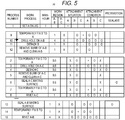
- FIG. 5 is a diagram illustrating an example of the work plan.
- a type "sealant" is set in the work processes of the process numbers 6 and 13 as the preparation.
- the "preparation” is information indicating preparation for execution of a work process.
- the work processes of the process numbers 6 and 13 both include preparation of providing the sealant in a workplace.
- the number of types set in the preparation is not limited to one. Plural types may be set in the preparation. In this way, the type(s) of the preparation can be set in the work processes.
- the condition receiver 22 also receives input of a type of the preparation that the administrator inputs via the operation member 12.
- the order determination unit 23 determines the order of the work processes such that the number of work processes provided between plural work processes for which the same type of preparation is set is smaller than that when no preparation is set. It is assumed that as a result, the work plan illustrated in FIG. 5 is created.
- the work processes of the process numbers 9 to 12 are moved to positions between the process number 1 and the process number 2.
- the work processes are performed in order of the process numbers 1, 9 to 12, 2 to 8, and 13 to 15.
- the process numbers are not reassigned in FIG. 5 . It is noted that the process numbers are reassigned in order from the top in FIG. 5 .
- FIG. 5 as compared with FIG. 4 in which no preparation is set, the number of work processes between a work process of sealing an A-C mating surface and a work process of sealing an A-B mating surface is small.
- the administrator leaves the sealant in the workplace. Thereafter, a preparation work of the sealant is unnecessary in the work process of sealing the A-B mating surface after the work processes of the process numbers 7 and 8. In this way, preparing and putting away of the sealant are reduced to one time. In this way, the number of the man-hours can be reduced using information on the preparation.
- a program that causes the computer to function as the work planning device 10 and a storage medium, such as a computer readable flexible disc, a magneto-optical disc, a ROM, a CD, a DVD, and a BD, that is recorded with the program and can be read by the computer are also provided.
- a storage medium such as a computer readable flexible disc, a magneto-optical disc, a ROM, a CD, a DVD, and a BD, that is recorded with the program and can be read by the computer are also provided.
- the "program” refers to a data processing unit described in any language or with a description method.
- the burden related to the work planning can be reduced.
Landscapes
- Business, Economics & Management (AREA)
- Engineering & Computer Science (AREA)
- Human Resources & Organizations (AREA)
- Strategic Management (AREA)
- Economics (AREA)
- Entrepreneurship & Innovation (AREA)
- General Physics & Mathematics (AREA)
- Physics & Mathematics (AREA)
- Quality & Reliability (AREA)
- General Business, Economics & Management (AREA)
- Theoretical Computer Science (AREA)
- Tourism & Hospitality (AREA)
- Marketing (AREA)
- Operations Research (AREA)
- Development Economics (AREA)
- Educational Administration (AREA)
- Game Theory and Decision Science (AREA)
- Manufacturing & Machinery (AREA)
- Automation & Control Theory (AREA)
- General Engineering & Computer Science (AREA)
- General Health & Medical Sciences (AREA)
- Health & Medical Sciences (AREA)
- Primary Health Care (AREA)
- Management, Administration, Business Operations System, And Electronic Commerce (AREA)
- General Factory Administration (AREA)
- Human Computer Interaction (AREA)
Abstract
Description
- The present application claims priority from Japanese Patent Application No.
2019-002 134 filed on January 9, 2019 - The invention relates to a work planning device.
- With regard to creating of a work plan in a manufacturing factory, techniques for automation have been developed. For example, Japanese Unexamined Patent Application Publication
JP 2004-139 472 A - An aspect of the invention provides a work planning device including a process receiver, a condition receiver, and an order determination unit. The process receiver is configured to receive (i) input of a plurality of work processes at least including attachment and detachment of a workpiece, and (ii) input of an order condition that is a condition for a relative order of the work processes. The condition receiver is configured to receive input of an attachment condition for each of the work processes.
- The attachment condition includes a condition for an attachment situation of each workpiece. The order determination unit is configured to determine order of the work processes such that the order of the work processes satisfy the order condition and the attachment situation satisfies the attachment condition.
- The accompanying drawings are included to provide a further understanding of the invention and are incorporated in and constitute a part of this specification. The drawings illustrate example embodiments and, together with the specification, serve to explain the principles of the invention.
- FIG. 1
- is a functional block diagram illustrating an outline of a work planning ^ device.
- FIG. 2
- illustrates examples of workpieces.
- FIG. 3
- illustrates an example of an order condition.
- FIG. 4
- illustrates an example of a work plan.
- FIG. 5
- illustrates another example of the work plan.
- In the following, some embodiments of the invention are described in detail with reference to the accompanying drawings. Note that the following description is directed to illustrative examples of the invention and not to be construed as limiting to the invention. Factors including, without limitation, numerical values, shapes, materials, components, positions of the components, and how the components are coupled to each other are illustrative only and not to be construed as limiting to the invention.
- Further, elements in the following example embodiments which are not recited in a most-generic independent claim of the invention are optional and may be provided on an as-needed basis. The drawings are schematic and are not intended to be drawn to scale. Throughout the present specification and the drawings, elements having substantially the same function and configuration are denoted with the same numerals to avoid any redundant description.
- The technique described in
JP 2004-139 472 A JP 2004-139 472 A - It is desirable to provide a work planning device capable of reducing a burden related to work planning.
-
FIG. 1 is a functional block diagram illustrating an outline of awork planning device 10. Thework planning device 10 is implemented by a computer such as a personal computer or a workstation. As illustrated inFIG. 1 , thework planning device 10 includes astorage 11, anoperation member 12, adisplay 13 and acontroller 20. - The
storage 11 is implemented by a RAM, a flash memory, or an HDD. Theoperation member 12 is implemented by, for example, a keyboard or a touch panel superimposed on thedisplay 13. Theoperation member 12 receives an operation input from an administrator. Thedisplay 13 is implemented by a liquid crystal display or an electro luminescence (EL) display. - The
controller 20 manages and controls the wholework planning device 10 using a semiconductor integrated circuit including a central processing unit (CPU), a ROM storing a program, and the RAM serving as a work area. In addition, thecontroller 20 also serves as a process receiver 21, acondition receiver 22, and anorder determination unit 23. - The process receiver 21 receives information on plural work processes that the administrator inputs via the
operation member 12. The plural work processes at least include attachment and detachment of a workpiece. -
FIG. 2 illustrates examples of workpieces. InFIG. 2 , for example, components A, B and C of an aircraft serve as the workpieces. The work processes include attachment and detachment of the components B and C to and from the component A, for example. As can be seen fromFIG. 2 , the component C is disposed in a space surrounded by the components A and B. Therefore, when the component B is attached to the component A, it is impossible to attach the component C to the component A and to execute any work for a combination of the component A and the component C. - Further, the process receiver 21 receives input of an order condition that the administrator inputs via the
operation member 12. The order condition will be described with reference toFIG. 3 . -
FIG. 3 illustrates an example of the order condition. The order condition is a condition of a relative order among the plural work processes. Here, the relative order is set for the work processes as illustrated inFIG. 3 . - The work processes illustrated in
FIG. 3 are common to work for a combination of the component A and the component B and work for a combination of the component A and the component C. That is, there are seven work processes illustrated inFIG. 3 for each of the components B and C, and therefore, there are 14 work processes in total. In addition, there are another work process of setting (that is, fixing and attaching) the component A on (to) a jig (not illustrated). Therefore, this embodiment has 15 work processes in total. -
FIG. 4 illustrates an example of a work plan. As illustrated inFIG. 4 , a process number, a man-hour, a work region, an attachment situation, an attachment condition, and preparation are associated with each work process. It is noted that nothing is set in the preparation column. The preparation will be described later. - The process number column stores positive numbers assigned to the respective processes in order of execution of the processes. The work process column stores information on an outline of each work process. The man-hour column stores, for example, a total man-hour (time) in each work process. The work region column stores a component(s) of interest in each work process.
- The attachment situation column stores information indicating a situation of attachment of each of the components A, B, and C to a target. For example, when a sign "+" is filled in the attachment situation of the component A, it indicates that the component A is attached to a target of the component A (here, the jig).
- When a sign "-" is filled in the attachment situation of the component B, it indicates that the component B is detached from a target of the component B (here, the component A).
- When a sign "O" is filled in the attachment situation of the component C, it indicates that the component C has already been attached to a target of the component C (here, the component A).
- The attachment condition column stores information on an attachment situation that is a prerequisite for execution of the work process. For example, when the sign "O" is filled in the attachment condition for the component A, the attachment condition includes a condition that the component A is attached to the target of the component A in advance.
- When a sign "×" is filled in the attachment condition for the component B, the attachment condition includes a condition that the component B is not attached to the target of the component B (which means the component B has not yet been attached or has been detached in advance after being attached).
- Among the above attachment situations, the signs "+" and "-" are information to be set for the work processes. That is, depending on the work process, information as to whether one of the components A, B, and C is attached to or detached from the target (hereinafter, referred to as "attachment/detachment information") is set. The process receiver 21 receives input of the attachment/detachment information that the administrator inputs via the
operation member 12. - Meanwhile, among the above attachment situations, the sign "O" is specified based on the attachment/detachment information set for a previous work process. The
order determination unit 23, which will be described later, specifies the sign "O". - The
condition receiver 22 receives input of the attachment condition for each work process that the administrator inputs via theoperation member 12. - For example, it is assumed that the work plan illustrated in
FIG. 4 is not created. It is further assumed that at this time, the process receiver 21 and thecondition receiver 22 receive input of the information described above. Theorder determination unit 23 changes the order of the work processes such that the changed order of the work processes satisfies the order condition illustrated inFIG. 3 . In this way, theorder determination unit 23 creates plural temporary work plans. - For each work process of one temporary work plan, the
order determination unit 23 specifies the sign "O" of the attachment situation, that is, whether the component A, B and C have already been attached to the targets, respectively, based on the attachment/detachment information (that is, the signs "+" and "-") of the previous work process. - Further, the
order determination unit 23 determines, for each work process, whether the attachment situation satisfies the attachment condition. When there is a work process in which an attachment situation does not satisfy an attachment condition, theorder determination unit 23 discards this temporary work plan. Theorder determination unit 23 also performs the same process on the remaining temporary work plans. - Among the temporary work plans, the
order determination unit 23 determines a temporary work plan in which order of work processes satisfies the order condition and an attachment situation satisfies the attachment condition, as a work plan. - For example, because of the order condition, another work process(es) may be interposed between any two of the work processes of the
process numbers 2 to 8, but it is not permitted to change the relative order of the work processes of theprocess numbers 2 to 8. Similarly, another work process(es) may be interposed between any two of the work processes of theprocess numbers 9 to 15, but it is not permitted to change the relative order of the work processes of theprocess numbers 9 to 15. Further, since the work processes of theprocess numbers 2 to 4, 7 to 11, and 13 to 15 have the sign "O" in the attachment condition for the component A, theprocess number 1 is always assigned to the work process of setting the component A on the jig. - When there are plural work plans in which the order of the work processes of each work plan satisfies the order condition and the attachment situation of each work plan satisfies the attachment condition, the
order determination unit 23 may select any of the work plans or may cause thedisplay 13 to display the plural work plans and select one of the work plans based on an input that the administrator makes via theoperation member 12. In this way, theorder determination unit 23 determines the order of the work processes such that the order of the work processes satisfies the order condition and the attachment situation satisfies the attachment condition. - The above described processing of the
order determination unit 23 is a mere example. Theorder determination unit 23 may perform processing according to other logic if theorder determination unit 23 determines the order of the work processes such that the order of the work processes satisfies the order condition and the attachment situation satisfies the attachment condition. - In addition, when there is a disturbance factor such as a delay in the work plan, the work plan is to be modified. Even in this case, the
order determination unit 23 can determine appropriate order of the work processes by performing the above processing on unexecuted work processes. - As described above, the
work planning device 10 receives the order condition and the attachment condition set for each work process and creates a work plan satisfying these conditions. Therefore, it is not necessary for the administrator to manually create and modify the work plan, and the burden related to the work planning can be reduced. - For example, unlike a line work, manufacturing of an aircraft involves a lot of work processes to be performed on the same components A, B and C, and the number of permutations of the work processes is large. Therefore, the burden related to the work planning is large. The
work planning device 10 can significantly reduce the burden related to the work planning. It is needless to say that the target of the work planning to be performed by thework planning device 10 is not limited to the manufacturing of the aircraft. -
FIG. 5 is a diagram illustrating an example of the work plan. In the work plan illustrated inFIG. 5 , a type "sealant" is set in the work processes of theprocess numbers - The "preparation" is information indicating preparation for execution of a work process. The work processes of the
process numbers - The
condition receiver 22 also receives input of a type of the preparation that the administrator inputs via theoperation member 12. Theorder determination unit 23 determines the order of the work processes such that the number of work processes provided between plural work processes for which the same type of preparation is set is smaller than that when no preparation is set. It is assumed that as a result, the work plan illustrated inFIG. 5 is created. - In
FIG. 5 , the work processes of theprocess numbers 9 to 12 are moved to positions between theprocess number 1 and theprocess number 2. The work processes are performed in order of theprocess numbers FIG. 5 . It is noted that the process numbers are reassigned in order from the top inFIG. 5 . InFIG. 5 , as compared withFIG. 4 in which no preparation is set, the number of work processes between a work process of sealing an A-C mating surface and a work process of sealing an A-B mating surface is small. - After the work process of sealing the A-C mating surface, the administrator leaves the sealant in the workplace. Thereafter, a preparation work of the sealant is unnecessary in the work process of sealing the A-B mating surface after the work processes of the
process numbers - The embodiments of the invention have been described above with reference to the accompanying drawings. It is needless to say that the invention is not limited to such embodiments. It is apparent that those skilled in the art would conceive various changes and modifications within the scope of the appended claims, and it is to be understood that such changes and modification also fall within the technical scope of the invention.
- In addition, a program that causes the computer to function as the
work planning device 10, and a storage medium, such as a computer readable flexible disc, a magneto-optical disc, a ROM, a CD, a DVD, and a BD, that is recorded with the program and can be read by the computer are also provided. Here, the "program" refers to a data processing unit described in any language or with a description method. - According to the invention, the burden related to the work planning can be reduced.
-
- 10
- work planning device
- 11
- storage
- 12
- operation member
- 13
- display
- 20
- controller
- 21
- process receiver
- 22
- condition receiver
- 23
- order determination unit
- A
- component
- B
- component
- C
- component
Claims (2)
- A work planning device (10) comprising:- a process receiver (21) configured to receive(i) input of a plurality of work processes at least including attachment and detachment of a workpiece, and(ii) input of an order condition that is a condition for a relative order of the work processes;- a condition receiver (22) configured to receive input of an attachment condition for each of the work processes, the attachment condition including a condition for an attachment situation of each workpiece; and- an order determination unit (23) configured to determine order of the work processes such that the order of the work processes satisfy the order condition and the attachment situation satisfies the attachment condition.
- The work planning device (10) according to claim 1,
wherein a type of preparation for each work process can be set in each work process, and
wherein the order determination unit (23) is configured to determine the order of the work processes such that the number of work processes provided between work processes for which a preparation of a same type is set is smaller than that when no preparation is set.
Applications Claiming Priority (1)
| Application Number | Priority Date | Filing Date | Title |
|---|---|---|---|
| JP2019002134A JP7316048B2 (en) | 2019-01-09 | 2019-01-09 | work planning device |
Publications (1)
| Publication Number | Publication Date |
|---|---|
| EP3680830A1 true EP3680830A1 (en) | 2020-07-15 |
Family
ID=68766649
Family Applications (1)
| Application Number | Title | Priority Date | Filing Date |
|---|---|---|---|
| EP19213204.1A Withdrawn EP3680830A1 (en) | 2019-01-09 | 2019-12-03 | Work planning device |
Country Status (4)
| Country | Link |
|---|---|
| US (1) | US20200219032A1 (en) |
| EP (1) | EP3680830A1 (en) |
| JP (1) | JP7316048B2 (en) |
| CN (1) | CN111428956A (en) |
Citations (4)
| Publication number | Priority date | Publication date | Assignee | Title |
|---|---|---|---|---|
| JP2004139472A (en) | 2002-10-18 | 2004-05-13 | Hitachi East Japan Solutions Ltd | Work schedule planning system, work schedule planning method, program, and medium |
| JP2007164519A (en) * | 2005-12-14 | 2007-06-28 | Toshiba Corp | Work plan creation device and work plan creation processing program |
| JP2018097405A (en) * | 2016-12-08 | 2018-06-21 | 三菱重工業株式会社 | Work plan creation system, work plan creation method and work plan creation program |
| WO2018194094A1 (en) * | 2017-04-19 | 2018-10-25 | 株式会社安川電機 | Programming assistance apparatus, robot system, programming assistance method and program-generating method |
Family Cites Families (4)
| Publication number | Priority date | Publication date | Assignee | Title |
|---|---|---|---|---|
| JPH08174389A (en) * | 1994-12-27 | 1996-07-09 | Omron Corp | Work plan creation method and device |
| JPH08235236A (en) * | 1995-02-28 | 1996-09-13 | Hitachi Ltd | Assembly sequence creation device and assembly sequence creation method |
| JPH09225784A (en) * | 1996-02-14 | 1997-09-02 | Mazda Motor Corp | Process chart creation device and work organization device |
| JP5011754B2 (en) * | 2006-03-01 | 2012-08-29 | 日産自動車株式会社 | Automatic setting method and automatic setting device for mold manufacturing process |
-
2019
- 2019-01-09 JP JP2019002134A patent/JP7316048B2/en active Active
- 2019-11-11 CN CN201911093596.3A patent/CN111428956A/en not_active Withdrawn
- 2019-12-03 EP EP19213204.1A patent/EP3680830A1/en not_active Withdrawn
-
2020
- 2020-01-07 US US16/736,127 patent/US20200219032A1/en not_active Abandoned
Patent Citations (4)
| Publication number | Priority date | Publication date | Assignee | Title |
|---|---|---|---|---|
| JP2004139472A (en) | 2002-10-18 | 2004-05-13 | Hitachi East Japan Solutions Ltd | Work schedule planning system, work schedule planning method, program, and medium |
| JP2007164519A (en) * | 2005-12-14 | 2007-06-28 | Toshiba Corp | Work plan creation device and work plan creation processing program |
| JP2018097405A (en) * | 2016-12-08 | 2018-06-21 | 三菱重工業株式会社 | Work plan creation system, work plan creation method and work plan creation program |
| WO2018194094A1 (en) * | 2017-04-19 | 2018-10-25 | 株式会社安川電機 | Programming assistance apparatus, robot system, programming assistance method and program-generating method |
Non-Patent Citations (2)
| Title |
|---|
| SINREICH DAVID ET AL: "Determining production sequences for single-stage multifunctional machining systems based on the tradeoff between fixture cost, re-fixturing and tool replenishment", IIE TRANSACTIONS, vol. 38, no. 10, 1 October 2006 (2006-10-01), US, pages 813 - 828, XP093230021, ISSN: 0740-817X, DOI: 10.1080/07408170500516707 * |
| TSENG YUAN-JYE ET AL: "Integrated assembly and disassembly sequence planning using a GA approach", INTERNATIONAL JOURNAL OF PRODUCTION RESEARCH., vol. 48, no. 20, 15 October 2010 (2010-10-15), GB, pages 5991 - 6013, XP055853981, ISSN: 0020-7543, [retrieved on 20241202], DOI: 10.1080/00207540903229173 * |
Also Published As
| Publication number | Publication date |
|---|---|
| JP2020112949A (en) | 2020-07-27 |
| JP7316048B2 (en) | 2023-07-27 |
| US20200219032A1 (en) | 2020-07-09 |
| CN111428956A (en) | 2020-07-17 |
Similar Documents
| Publication | Publication Date | Title |
|---|---|---|
| US7945466B2 (en) | Scheduling system | |
| EP3257664B1 (en) | System for analysis of a repair for a structure | |
| CN106796425B (en) | Machine tool control device | |
| US20190129393A1 (en) | Method and apparatus for shaping a production process for producing a product made up of multiple subproducts | |
| US20150352724A1 (en) | Robot control device provided with function of reflecting points of difference of setting data compared with | |
| AU2026201414A1 (en) | Determining a runway exit for landing an aircraft | |
| US10838380B2 (en) | Amplifier selection device, amplifier selection method, and computer readable medium having function of clarifying erroneous selection part | |
| Dong et al. | Dynamic control of a closed two-stage queueing network for outfitting process in shipbuilding | |
| US7477958B2 (en) | Method of release and product flow management for a manufacturing facility | |
| US20200219032A1 (en) | Work planning device | |
| US20160320765A1 (en) | Machining method and apparatus | |
| US20150261209A1 (en) | Job plan display system | |
| CN109313430B (en) | Machining time calculation device and machining time calculation method | |
| US20090069919A1 (en) | Intelligent mass production planning and routing system | |
| JP2009282897A (en) | Operation assignment method and operation assignment apparatus | |
| Kolich et al. | Value stream mapping micropanel assembly with clustering to improve flow in a shipyard | |
| US20160306344A1 (en) | Numerical controller for classifying and displaying machining program recorded as history | |
| CN106843159A (en) | The data configuration of numerical control system, the Work machine for possessing numerical control system and procedure | |
| WO2024054214A1 (en) | Workflow management method, system and computer program product with real time log, debug and resume features | |
| JP5622483B2 (en) | Processing scheduling system | |
| US11340782B2 (en) | Control device and control method | |
| CN113704892B (en) | Process model generation method, system and terminal added with compensation quantity and groove | |
| US12491631B2 (en) | Robot automation system | |
| JP2006215713A (en) | Prior work instruction and abolition method of workflow system | |
| US20230289222A1 (en) | Control system, control method, and non-transitory storage medium |
Legal Events
| Date | Code | Title | Description |
|---|---|---|---|
| PUAI | Public reference made under article 153(3) epc to a published international application that has entered the european phase |
Free format text: ORIGINAL CODE: 0009012 |
|
| STAA | Information on the status of an ep patent application or granted ep patent |
Free format text: STATUS: THE APPLICATION HAS BEEN PUBLISHED |
|
| AK | Designated contracting states |
Kind code of ref document: A1 Designated state(s): AL AT BE BG CH CY CZ DE DK EE ES FI FR GB GR HR HU IE IS IT LI LT LU LV MC MK MT NL NO PL PT RO RS SE SI SK SM TR |
|
| AX | Request for extension of the european patent |
Extension state: BA ME |
|
| STAA | Information on the status of an ep patent application or granted ep patent |
Free format text: STATUS: REQUEST FOR EXAMINATION WAS MADE |
|
| 17P | Request for examination filed |
Effective date: 20210107 |
|
| RBV | Designated contracting states (corrected) |
Designated state(s): AL AT BE BG CH CY CZ DE DK EE ES FI FR GB GR HR HU IE IS IT LI LT LU LV MC MK MT NL NO PL PT RO RS SE SI SK SM TR |
|
| STAA | Information on the status of an ep patent application or granted ep patent |
Free format text: STATUS: EXAMINATION IS IN PROGRESS |
|
| 17Q | First examination report despatched |
Effective date: 20211110 |
|
| STAA | Information on the status of an ep patent application or granted ep patent |
Free format text: STATUS: THE APPLICATION IS DEEMED TO BE WITHDRAWN |
|
| 18D | Application deemed to be withdrawn |
Effective date: 20250611 |