EP3677086B1 - Vorrichtung und verfahren zur behandlung der konfiguration einer bandbreite für direktzugriffs-kanalverfahren in einem drahtlosen kommunikationssystem - Google Patents
Vorrichtung und verfahren zur behandlung der konfiguration einer bandbreite für direktzugriffs-kanalverfahren in einem drahtlosen kommunikationssystem Download PDFInfo
- Publication number
- EP3677086B1 EP3677086B1 EP18861325.1A EP18861325A EP3677086B1 EP 3677086 B1 EP3677086 B1 EP 3677086B1 EP 18861325 A EP18861325 A EP 18861325A EP 3677086 B1 EP3677086 B1 EP 3677086B1
- Authority
- EP
- European Patent Office
- Prior art keywords
- bwp
- rar
- uplink
- rach
- random access
- Prior art date
- Legal status (The legal status is an assumption and is not a legal conclusion. Google has not performed a legal analysis and makes no representation as to the accuracy of the status listed.)
- Active
Links
Images






Classifications
-
- H—ELECTRICITY
- H04—ELECTRIC COMMUNICATION TECHNIQUE
- H04W—WIRELESS COMMUNICATION NETWORKS
- H04W74/00—Wireless channel access
- H04W74/08—Non-scheduled access, e.g. ALOHA
- H04W74/0833—Random access procedures, e.g. with 4-step access
-
- H—ELECTRICITY
- H04—ELECTRIC COMMUNICATION TECHNIQUE
- H04W—WIRELESS COMMUNICATION NETWORKS
- H04W74/00—Wireless channel access
- H04W74/08—Non-scheduled access, e.g. ALOHA
- H04W74/0866—Non-scheduled access, e.g. ALOHA using a dedicated channel for access
-
- H—ELECTRICITY
- H04—ELECTRIC COMMUNICATION TECHNIQUE
- H04B—TRANSMISSION
- H04B7/00—Radio transmission systems, i.e. using radiation field
- H04B7/02—Diversity systems; Multi-antenna system, i.e. transmission or reception using multiple antennas
- H04B7/04—Diversity systems; Multi-antenna system, i.e. transmission or reception using multiple antennas using two or more spaced independent antennas
- H04B7/06—Diversity systems; Multi-antenna system, i.e. transmission or reception using multiple antennas using two or more spaced independent antennas at the transmitting station
- H04B7/0613—Diversity systems; Multi-antenna system, i.e. transmission or reception using multiple antennas using two or more spaced independent antennas at the transmitting station using simultaneous transmission
- H04B7/0615—Diversity systems; Multi-antenna system, i.e. transmission or reception using multiple antennas using two or more spaced independent antennas at the transmitting station using simultaneous transmission of weighted versions of same signal
- H04B7/0617—Diversity systems; Multi-antenna system, i.e. transmission or reception using multiple antennas using two or more spaced independent antennas at the transmitting station using simultaneous transmission of weighted versions of same signal for beam forming
-
- H—ELECTRICITY
- H04—ELECTRIC COMMUNICATION TECHNIQUE
- H04L—TRANSMISSION OF DIGITAL INFORMATION, e.g. TELEGRAPHIC COMMUNICATION
- H04L27/00—Modulated-carrier systems
- H04L27/26—Systems using multi-frequency codes
- H04L27/2601—Multicarrier modulation systems
- H04L27/2602—Signal structure
- H04L27/26025—Numerology, i.e. varying one or more of symbol duration, subcarrier spacing, Fourier transform size, sampling rate or down-clocking
-
- H—ELECTRICITY
- H04—ELECTRIC COMMUNICATION TECHNIQUE
- H04L—TRANSMISSION OF DIGITAL INFORMATION, e.g. TELEGRAPHIC COMMUNICATION
- H04L5/00—Arrangements affording multiple use of the transmission path
- H04L5/0001—Arrangements for dividing the transmission path
- H04L5/0003—Two-dimensional division
- H04L5/0005—Time-frequency
- H04L5/0007—Time-frequency the frequencies being orthogonal, e.g. OFDM(A) or DMT
-
- H—ELECTRICITY
- H04—ELECTRIC COMMUNICATION TECHNIQUE
- H04L—TRANSMISSION OF DIGITAL INFORMATION, e.g. TELEGRAPHIC COMMUNICATION
- H04L5/00—Arrangements affording multiple use of the transmission path
- H04L5/0001—Arrangements for dividing the transmission path
- H04L5/0003—Two-dimensional division
- H04L5/0005—Time-frequency
- H04L5/0007—Time-frequency the frequencies being orthogonal, e.g. OFDM(A) or DMT
- H04L5/001—Time-frequency the frequencies being orthogonal, e.g. OFDM(A) or DMT the frequencies being arranged in component carriers
-
- H—ELECTRICITY
- H04—ELECTRIC COMMUNICATION TECHNIQUE
- H04L—TRANSMISSION OF DIGITAL INFORMATION, e.g. TELEGRAPHIC COMMUNICATION
- H04L5/00—Arrangements affording multiple use of the transmission path
- H04L5/003—Arrangements for allocating sub-channels of the transmission path
- H04L5/0048—Allocation of pilot signals, i.e. of signals known to the receiver
-
- H—ELECTRICITY
- H04—ELECTRIC COMMUNICATION TECHNIQUE
- H04L—TRANSMISSION OF DIGITAL INFORMATION, e.g. TELEGRAPHIC COMMUNICATION
- H04L5/00—Arrangements affording multiple use of the transmission path
- H04L5/003—Arrangements for allocating sub-channels of the transmission path
- H04L5/0053—Allocation of signalling, i.e. of overhead other than pilot signals
-
- H—ELECTRICITY
- H04—ELECTRIC COMMUNICATION TECHNIQUE
- H04W—WIRELESS COMMUNICATION NETWORKS
- H04W72/00—Local resource management
- H04W72/04—Wireless resource allocation
- H04W72/044—Wireless resource allocation based on the type of the allocated resource
- H04W72/0453—Resources in frequency domain, e.g. a carrier in FDMA
-
- H—ELECTRICITY
- H04—ELECTRIC COMMUNICATION TECHNIQUE
- H04W—WIRELESS COMMUNICATION NETWORKS
- H04W72/00—Local resource management
- H04W72/20—Control channels or signalling for resource management
- H04W72/23—Control channels or signalling for resource management in the downlink direction of a wireless link, i.e. towards a terminal
-
- H—ELECTRICITY
- H04—ELECTRIC COMMUNICATION TECHNIQUE
- H04W—WIRELESS COMMUNICATION NETWORKS
- H04W74/00—Wireless channel access
- H04W74/002—Transmission of channel access control information
- H04W74/006—Transmission of channel access control information in the downlink, i.e. towards the terminal
-
- H—ELECTRICITY
- H04—ELECTRIC COMMUNICATION TECHNIQUE
- H04L—TRANSMISSION OF DIGITAL INFORMATION, e.g. TELEGRAPHIC COMMUNICATION
- H04L27/00—Modulated-carrier systems
- H04L27/26—Systems using multi-frequency codes
- H04L27/2601—Multicarrier modulation systems
- H04L27/2602—Signal structure
-
- H—ELECTRICITY
- H04—ELECTRIC COMMUNICATION TECHNIQUE
- H04W—WIRELESS COMMUNICATION NETWORKS
- H04W74/00—Wireless channel access
- H04W74/08—Non-scheduled access, e.g. ALOHA
- H04W74/0833—Random access procedures, e.g. with 4-step access
- H04W74/0838—Random access procedures, e.g. with 4-step access using contention-free random access [CFRA]
Definitions
- Embodiments disclosed herein relate to a wireless communication network, and more specifically related to a method for handling bandwidth part (BWP) configurations for a random access channel (RACH) procedure in a wireless network.
- BWP bandwidth part
- RACH random access channel
- the 5G or pre-5G communication system is also called a ⁇ Beyond 4G Network' or a 'Post Long Term Evolution (LTE) System'.
- the 5G communication system is considered to be implemented in higher frequency (mmWave) bands, e.g., 60GHz bands, so as to accomplish higher data rates.
- mmWave e.g., 60GHz bands
- MIMO massive multiple-input multiple-output
- FD-MIMO Full Dimensional MIMO
- array antenna an analog beam forming, large scale antenna techniques are discussed in 5G communication systems.
- RANs Cloud Radio Access Networks
- D2D device-to-device
- wireless backhaul moving network
- cooperative communication Coordinated Multi-Points (CoMP), reception-end interference cancellation and the like.
- CoMP Coordinated Multi-Points
- FSK Hybrid frequency shift keying
- FQAM quadrature amplitude modulation
- SWSC sliding window superposition coding
- ACM advanced coding modulation
- FBMC filter bank multi carrier
- NOMA non-orthogonal multiple access
- SCMA sparse code multiple access
- R1-1715846 submitted for 3GPP TSG RAN WG1 Meeting NR#3 discloses a list of parts of contents on PRACH configurations, including LTL BWP information and subcarrier spacing (SCS) information.
- LTL BWP information discloses a list of parts of contents on PRACH configurations, including LTL BWP information and subcarrier spacing (SCS) information.
- SCS subcarrier spacing
- EP 3445123 A1 is related to a method of a UE receiving information from a network node to associate a RACH configuration with a BWP among the multiple BWPs.
- R1-1714963 submitted for 3GPP TSG RAN WG1 #90 provides a contention-based NR 4-step random access procedure and a contention-free 3-step random access procedure.
- R1-1715790 submitted for 3GPP TSG RAN WG1 Meeting NR#3 provides details on a NR 4-step random access procedure.
- the principal object of the examples herein is to disclose a method for handling bandwidth part (BWP) configurations for a random access channel (RACH) procedure in a wireless communication system.
- BWP bandwidth part
- RACH random access channel
- various functions described below can be implemented or supported by one or more computer programs, each of which is formed from computer readable program code and embodied in a computer readable medium.
- application and “program” refer to one or more computer programs, software components, sets of instructions, procedures, functions, objects, classes, instances, related data, or a portion thereof adapted for implementation in a suitable computer readable program code.
- computer readable program code includes any type of computer code, including source code, object code, and executable code.
- computer readable medium includes any type of medium capable of being accessed by a computer, such as read only memory (ROM), random access memory (RAM), a hard disk drive, a compact disc (CD), a digital video disc (DVD), or any other type of memory.
- ROM read only memory
- RAM random access memory
- CD compact disc
- DVD digital video disc
- a "non-transitory” computer readable medium excludes wired, wireless, optical, or other communication links that transport transitory electrical or other signals.
- a non-transitory computer readable medium includes media where data can be permanently stored and media where data can be stored and later overwritten, such as a rewritable optical disc or an erasable memory device.
- circuits may, for example, be embodied in one or more semiconductor chips, or on substrate supports such as printed circuit boards and the like.
- circuits constituting a block may be implemented by dedicated hardware, or by a processor (e.g., one or more programmed microprocessors and associated circuitry), or by a combination of dedicated hardware to perform some functions of the block and a processor to perform other functions of the block.
- a processor e.g., one or more programmed microprocessors and associated circuitry
- Each block of the embodiments may be physically separated into two or more interacting and discrete blocks without departing from the scope of the present disclosure.
- the blocks of the embodiments may be physically combined into more complex blocks without departing from the scope of the present disclosure
- the embodiments herein achieve a method of handling bandwidth part (BWP) configurations for a random access channel (RACH) procedure in a wireless network.
- the method includes configuring, by a base station (BS), a BWP configuration comprising RACH resource for each BWP in a set of BWPs for the RACH procedure. Further, the method includes indicating, by the BS, the RACH resource for each of the BWPs in the set of BWPs to a UE in the wireless network.
- BS base station
- RACH random access channel
- the second generation wireless communication system has been developed to provide voice services while ensuring the mobility of users.
- Third generation wireless communication system supports not only the voice service, but also data service.
- the fourth wireless communication system has been developed to provide high-speed data service.
- the fourth generation wireless communication system suffers from lack of resources to meet the growing demand for high speed data services.
- the fifth generation (5G) wireless systems are being developed to meet the growing demand for high speed data services, support ultra-reliability and low latency applications.
- the 5G wireless systems is implemented not only in lower frequency bands, but also in higher frequency (mmWave) bands, e.g., 10 GHz to 100 GHz bands, so as to accomplish higher data rates.
- mmWave e.g. 10 GHz to 100 GHz bands
- the beamforming, massive multiple-input multiple-output (MIMO), full dimensional MIMO (FD-MIMO), array antenna, an analog beam forming, large scale antenna techniques are being considered in the design of the 5G wireless systems.
- MIMO massive multiple-input multiple-output
- FD-MIMO full dimensional MIMO
- array antenna an analog beam forming, large scale antenna techniques are being considered in the design of the 5G wireless systems.
- the 5G wireless systems are expected to address different use cases having quite different requirements in terms of data rate, latency, reliability, mobility and so on.
- the design of the air-interface of the 5G wireless systems would be flexible enough to serve user equipments (UEs) having quite different capabilities depending on the use case and market segment the UE cater service to the end customers.
- the 5G wireless systems are expected to address uses cases such as enhanced mobile broadband (eMBB), massive machine type communication (m-MTC), ultra-reliable low latency communication (URLL) and so on.
- eMBB enhanced mobile broadband
- m-MTC massive machine type communication
- URLL ultra-reliable low latency communication
- the eMBB requirements like tens of Gbps data rate, low latency, high mobility so on and so forth address the market segment representing conventional wireless broadband subscribers needing internet connectivity everywhere, all the time and on the go.
- the m-MTC requirements like very high connection density, infrequent data transmission, very long battery life, low mobility address so on and so forth address the market segment representing Internet of Things (IoT)/Internet of Everything (IoE) envisioning connectivity of billions of devices.
- the URLL requirements like very low latency, very high reliability and variable mobility so on and so forth address the market segment representing the Industrial automation application, vehicle-to-vehicle/vehicle-to-infrastructure communication foreseen as one of the enabler for autonomous cars.
- the UE In Long Term Evolution (LTE) wireless systems, the UE first performs an initial access procedure by scanning for a primary synchronization signal (PSS), and a Secondary synchronization signal (SSS) and then becoming synchronized in a downlink signal. Upon synchronization, the random access procedures are performed in order to acquire an uplink synchronization in order to send uplink transmissions appropriately. Owing to the beamforming technologies used in the above-6GHz spectrum, the above mentioned procedures will not function adequately in the 5G wireless systems.
- PSS primary synchronization signal
- SSS Secondary synchronization signal
- the proposed method can be used to handle the BWP configurations for the RACH procedure in the wireless network in an effective manner.
- the proposed method can be used to handle the BWP configurations for the RACH procedure in the wireless network in an effective manner during the handover procedure. Further, the method can be used to handle the BWP configurations for the RACH procedure in the wireless network for carrier aggregation and dual connectivity scenarios in an effective manner.
- FIGS. 6a to 18 there are shown preferred embodiments.
- FIG. 1 illustrates a wireless communication system.
- a BS 110, a terminal 120, and a terminal 130 are illustrated as the part of nodes using a wireless channel in a wireless communication system.
- FIG. 1 illustrates only one BS, but another BS, which is the same as or similar to the BS 110, may be further included.
- the BS 110 is network infrastructure that provides wireless access to the terminals 120 and 130.
- the BS 110 has coverage defined as a predetermined geographical region based on the distance at which a signal can be transmitted.
- the BS 110 may be referred to as "access point (AP),” “eNodeB (eNB),” “5G node,” “gNB,” “wireless point,” “transmission/reception Point (TRP)” as well as “base station.”
- Each of the terminals 120 and 130 is a device used by a user, and performs communication with the BS 110 through a wireless channel. Depending on the case, at least one of the terminals 120 and 130 may operate without user involvement. That is, at least one of the terminals 120 and 130 is a device that performs machine-type communication (MTC) and may not be carried by the user.
- MTC machine-type communication
- Each of the terminals 120 and 130 may be referred to as "UE,” “mobile station,” “subscriber station,” “remote terminal,” “wireless terminal,” or “user device” as well as “terminal.”
- the BS 110, the terminal 120, and the terminal 130 may transmit and receive wireless signals in millimeter wave (mmWave) bands (for example, 28 GHz, 30 GHz, 38 GHz, and 60 GHz).
- mmWave millimeter wave
- the BS 110, the terminal 120, and the terminal 130 may perform beamforming.
- the beamforming may include transmission beamforming and reception beamforming. That is, the BS 110, the terminal 120, and the terminal 130 may assign directivity to a transmission signal and a reception signal.
- the BS 110 and the terminals 120 and 130 may select serving beams 112, 113, 121, and 131 through a beam search procedure or a beam management procedure. After that, communications may be performed using resources having a quasi co-located relationship with resources carrying the serving beams 112, 113, 121, and 131.
- a first antenna port and a second antenna ports are considered to be quasi co-located if the large-scale properties of the channel over which a symbol on the first antenna port is conveyed can be inferred from the channel over which a symbol on the second antenna port is conveyed.
- the large-scale properties may include one or more of delay spread, doppler spread, doppler shift, average gain, average delay, and spatial Rx parameters.
- FIG. 2 illustrates the BS in the wireless communication system.
- a structure exemplified at FIG. 2 may be understood as a structure of the BS 110.
- the term "-module”, “-unit” or “-er” used hereinafter may refer to the unit for processing at least one function or operation and software.
- the BS may include a wireless communication interface 210, a backhaul communication interface 220, a storage unit 230, and a controller 240.
- the wireless communication interface 210 performs functions for transmitting and receiving signals through a wireless channel.
- the wireless communication interface 210 may perform a function of conversion between a baseband signal and bitstreams according to a physical layer standard of the system.
- the wireless communication interface 210 in data transmission, the wireless communication interface 210 generates complex symbols by encoding and modulating transmission bitstreams. Further, in data reception, the wireless communication interface 210 reconstructs reception bitstreams by demodulating and decoding the baseband signal.
- the wireless communication interface 210 up-converts the baseband signal into a radio frequency (RF) band signal, transmits the converted signal through an antenna, and then down-converts the RF band signal received through the antenna into the baseband signal.
- the wireless communication interface 210 may include a transmission filter, a reception filter, an amplifier, a mixer, an oscillator, a digital-to-analog convertor (DAC), an analog-to-digital convertor (ADC), and the like.
- the wireless communication interface 210 may include a plurality of transmission/reception paths.
- the wireless communication interface 210 may include at least one antenna array consisting of a plurality of antenna elements.
- the wireless communication interface 210 may include a digital unit and an analog unit, and the analog unit may include a plurality of sub-units according to operation power, operation frequency, and the like.
- the digital unit may be implemented as at least one processor (e.g., a digital signal processor (DSP)).
- DSP digital signal processor
- the wireless communication interface 210 transmits and receives the signal as described above. Accordingly, the wireless communication interface 210 may be referred to as a "wireless communication unit", a “wireless communication module”, a “transmitter” a “receiver,” or a “transceiver.” Further, in the following description, transmission and reception performed through the wireless channel may be used to have a meaning including the processing performed by the wireless communication interface 210 as described above.
- the backhaul communication interface 220 provides an interface for performing communication with other nodes within the network. That is, the backhaul communication interface 220 converts bitstreams transmitted to another node, for example, another access node, another BS, a higher node, or a core network, from the BS into a physical signal and converts the physical signal received from the other node into the bitstreams.
- the backhaul communication interface 220 may be referred to as a "backhaul communication unit" or a "backhaul communication module".
- the storage unit 230 stores a basic program, an application, and data such as setting information for the operation of the BS.
- the storage unit 230 may include a volatile memory, a non-volatile memory, or a combination of volatile memory and non-volatile memory. Further, the storage unit 230 provides stored data in response to a request from the controller 240.
- the controller 240 controls the general operation of the BS. For example, the controller 240 transmits and receives a signal through the wireless communication interface 210 or the backhaul communication interface 220. Further, the controller 240 records data in the storage unit 230 and reads the recorded data. The controller 240 may performs functions of a protocol stack that is required from a communication standard. According to another implementation, the protocol stack may be included in the wireless communication interface 210. To this end, the controller 240 may include at least one processor. According to various embodiments, the controller 240 may control the base station to perform operations according to the exemplary embodiments of the present disclosure.
- FIG. 3 illustrates the terminal in the wireless communication system.
- a structure exemplified at FIG. 3 may be understood as a structure of the terminal 120 or the terminal 130.
- the term "-module”, “-unit” or “-er” used hereinafter may refer to the unit for processing at least one function or operation, and may be implemented in hardware, software, or a combination of hardware and software.
- the terminal includes a communication interface 310, a storage unit 320, and a controller 330.
- the communication interface 310 performs functions for transmitting/receiving a signal through a wireless channel. For example, the communication interface 310 performs a function of conversion between a baseband signal and bitstreams according to the physical layer standard of the system. For example, in data transmission, the communication interface 310 generates complex symbols by encoding and modulating transmission bitstreams. Also, in data reception, the communication interface 310 reconstructs reception bitstreams by demodulating and decoding the baseband signal. In addition, the communication interface 310 up-converts the baseband signal into an RF band signal, transmits the converted signal through an antenna, and then down-converts the RF band signal received through the antenna into the baseband signal. For example, the communication interface 310 may include a transmission filter, a reception filter, an amplifier, a mixer, an oscillator, a DAC, and an ADC.
- the communication interface 310 may include a plurality of transmission/ reception paths.
- the communication interface 310 may include at least one antenna array consisting of a plurality of antenna elements.
- the wireless communication interface 210 may include a digital circuit and an analog circuit (for example, a radio frequency integrated circuit (RFIC)).
- the digital circuit and the analog circuit may be implemented as one package.
- the digital circuit may be implemented as at least one processor (e.g., a DSP).
- the communication interface 310 may include a plurality of RF chains.
- the communication interface 310 may perform beamforming.
- the communication interface 310 transmits and receives the signal as described above. Accordingly, the communication interface 310 may be referred to as a "communication unit”, a “communication module”, a “transmitter,” a “receiver,” or a “transceiver.” Further, in the following description, transmission and reception performed through the wireless channel is used to have a meaning including the processing performed by the communication interface 310 as described above.
- the storage unit 320 stores a basic program, an application, and data such as setting information for the operation of the terminal.
- the storage unit 320 may include a volatile memory, a non-volatile memory, or a combination of volatile memory and non-volatile memory. Further, the storage unit 320 provides stored data in response to a request from the controller 330.
- the controller 330 controls the general operation of the terminal. For example, the controller 330 transmits and receives a signal through the communication interface 310. Further, the controller 330 records data in the storage unit 320 and reads the recorded data. The controller 330 may performs functions of a protocol stack that is required from a communication standard. According to another implementation, the protocol stack may be included in the communication interface 310. To this end, the controller 330 may include at least one processor or microprocessor, or may play the part of the processor. Further, the part of the communication interface 310 or the controller 330 may be referred to as a communication processor (CP). According to various embodiments, the controller 330 may control the terminal to perform operations according to the exemplary embodiments of the present disclosure.
- CP communication processor
- FIG. 4 illustrates the communication interface in the wireless communication system according to various embodiments of the present disclosure.
- FIG. 4 shows an example for the detailed configuration of the communication interface 210 of FIG. 2 or the communication interface 310 of FIG. 3 . More specifically, FIG. 4 shows elements for performing beamforming as part of the communication interface 210 of FIG. 2 or the communication interface 310 of FIG. 3 .
- the communication interface 210 or 310 includes an encoding and circuitry 402, a digital circuitry 404, a plurality of transmission paths 406-1 to 406-N, and an analog circuitry 408.
- the encoding and circuitry 402 performs channel encoding.
- a low-density parity check (LDPC) code For the channel encoding, at least one of a low-density parity check (LDPC) code, a convolution code, and a polar code may be used.
- the encoding and circuitry 402 generates modulation symbols by performing constellation mapping.
- LDPC low-density parity check
- the digital circuitry 404 performs beamforming for a digital signal (for example, modulation symbols). To this end, the digital circuitry 404 multiples the modulation symbols by beamforming weighted values.
- the beamforming weighted values may be used for changing the size and phrase of the signal, and may be referred to as a "precoding matrix" or a "precoder.”
- the digital circuitry 404 outputs the digitally beamformed modulation symbols to the plurality of transmission paths 406-1 to 406-N.
- the modulation symbols may be multiplexed, or the same modulation symbols may be provided to the plurality of transmission paths 406-1 to 406-N.
- MIMO multiple input multiple output
- the plurality of transmission paths 406-1 to 406-N convert the digitally beamformed digital signals into analog signals.
- each of the plurality of transmission paths 406-1 to 406-N may include an inverse fast Fourier transform (IFFT) calculation unit, a cyclic prefix (CP) insertion unit, a DAC, and an up-conversion unit.
- the CP insertion unit is for an orthogonal frequency division multiplexing (OFDM) scheme, and may be omitted when another physical layer scheme (for example, a filter bank multi-carrier (FBMC)) is applied. That is, the plurality of transmission paths 406-1 to 406-N provide independent signal processing processes for a plurality of streams generated through the digital beamforming. However, depending on the implementation, some of the elements of the plurality of transmission paths 406-1 to 406-N may be used in common.
- OFDM orthogonal frequency division multiplexing
- the analog circuitry 408 performs beamforming for analog signals. To this end, the digital circuitry 404 multiples the analog signals by beamforming weighted values. The beamformed weighted values are used for changing the size and phrase of the signal. More specifically, according to a connection structure between the plurality of transmission paths 406-1 to 406-N and antennas, the analog circuitry 408 may be configured in various ways. For example, each of the plurality of transmission paths 406-1 to 406-N may be connected to one antenna array. In another example, the plurality of transmission paths 406-1 to 406-N may be connected to one antenna array. In still another example, the plurality of transmission paths 406-1 to 406-N may be adaptively connected to one antenna array, or may be connected to two or more antenna arrays.
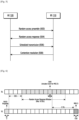
- FIG. 5 depicts a contention-based random access (CBRA) procedure between a UE 120 and a BS 110 in a wireless network.
- the UE 120 transmits the random access preamble to the BS 110.
- RA preamble or Msg1 transmission:
- the UE 120 selects one of the available 64-N cf contention based random access (RA) preambles, where N cf is the number of RA preambles reserved for contention free access.
- the contention based RA preambles can be optionally partitioned into two groups. If two groups are configured, the UE 120 selects the group based on size of message 3 it can transmit.
- the initial RA preamble transmission power can be set based on open loop estimation after compensating for path loss.
- the BS 110 transmits a random access response (RAR) to the UE 120.
- RAR random access response
- Msg2 The BS 110 transmits the RAR on a physical downlink shared channel (PDSCH) addressed to random access - random network temporary identifier (RA-RNTI).
- PDSCH physical downlink shared channel
- RA-RNTI random access - random network temporary identifier
- the RA-RNTI identifies a time-frequency slot in which RA preamble is detected by the BS 110.
- the RAR conveys the RA preamble identifier, timing alignment information, temporary C-RNTI and uplink (UL) grant for message 3.
- the RAR may also include back off indicator to instruct the UE 120 to back off for period of time before retrying the RA attempt.
- the RAR is transmitted in the RAR window. As shown in FIG. 6 , the RAR window starts at subframe 'x+3' for RA preamble transmitted in subframe 'x'.
- the UE 120 transmits a scheduled UL transmission on a UL SCH to the BS 110.
- the scheduled UL Transmission on the UL SCH i.e., Msg3: It is used to transmit message such as radio resource control (RRC) connection request, RRC connection re-establishment request, RRC handover confirm, scheduling request, etc. It also includes the UE identity (i.e., C-RNTI or S-TMSI or a random number).
- RRC radio resource control
- RRC connection re-establishment request RRC handover confirm, scheduling request, etc.
- It also includes the UE identity (i.e., C-RNTI or S-TMSI or a random number).
- HARQ hybrid automatic repeat request
- the BS 110 transmits a contention resolution message to the UE 120.
- the contention resolution message i.e., Msg 4:
- the contention resolution message utilizes the HARQ and is addressed to the C-RNTI (if included in the message 3) or temporary C-RNTI (UE identity included in the message 3 is included this case).
- a HARQ feedback is only sent by the UE 120, which detects its own UE ID or C-RNTI.
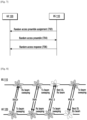
- FIG. 7 is a sequence diagram illustrating a contention-free RA (CFRA) procedure between the UE 120 and the BS 110 in the wireless network.
- CFRA contention-free RA
- the BS 110 transmits a random access preamble assignment to the UE 120.
- the UE 120 transmits the random access preamble to the BS 110.
- the BS 110 transmits the random access response to the UE 120.
- the contention free RA procedure can be used for scenarios such as handover where low latency is required, timing advance establishment for secondary cell (SCell), and so on.
- the BS 110 assigns non-contention RA preamble to the UE 120 in dedicated signaling.
- the UE 120 transmits the assigned non-contention RA preamble.
- the BS 110 transmits the RAR on PDSCH addressed to the RA-RNTI.
- the RAR conveys RA preamble identifier and Timing alignment information. Further, the RAR may also include UL grant.
- the RAR is transmitted in the RAR window similar to contention based RA procedure.
- the contention free RA procedure terminates after receiving the RAR.
- FIG. 8 depicts an example RACH procedure for 5G beamforming systems in the wireless network. This is performed after DL synchronization phase.
- the UE 120 performs the RACH procedure with a transmission reception point (TRP) inside a cell area that is under control of one BS 110 (e.g., gNB, 5G systems base station) or with a gNB itself. Since the best beams are unknown during initial access, beam sweeping based mechanisms are necessary during the initial access RACH procedures.
- a NR refers to "new radio" which is the term used by the 3GPP for discussing activities about the 5G system.
- the UE 120 and the BS 110 need not support the same BW and variable BW capable UE may be supported in such deployments.
- the existing methods disclose efficient mechanisms to support various operations such as search space configurations, efficient resource allocation mechanisms among others.
- such large bandwidth may not be needed at all times. So opportunistically it may be turned on and off.
- the UE 120 For the case of 5G communications, it is proposed that the UE 120 must support bandwidth on the order of 1GHz in a single carrier manner. In other words, without using carrier aggregation, a 5G user of the UE 120 must support bandwidths of this order.
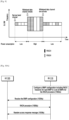
- FIG. 9 depicts example illustration where various bandwidths involved in operations of the UE 120 are explained.
- a generic term known as BWP is defined which indicates a set of contiguous physical resource blocks (PRBs) in a frequency domain, which are configured for the the UE 120. The resource allocation will be done within the BWP.
- BWP may be configured to the UE 120 but only one will be activated at a given time instant.
- each BWP is configured in a UE-specific manner.
- the sizes of the BWP supported by each UE must also be accounted for as it impacts the pre-coding design, the channel and interference estimation as a result of the same etc.
- Multiple BWPs may be configured and activated to the UE 120 and this entails new operations regarding monitoring timeline, BW sizes supported etc.
- FIG. 10A and FIG. 10B depict sequence diagrams for a RACH resource configuration for the BWP in the wireless network, according to an exemplary embodiment as disclosed herein.
- the wireless network includes the UE 120 and the BS 110 communicated with the each other.
- the UE 120 can be, for example but not limited to, a cellular phone, a tablet, a smart phone, a laptop, a personal digital assistant (PDA), a global positioning system, a multimedia device, a video device, a game console, or the like.
- PDA personal digital assistant
- the UE 120 may also be referred to by those skilled in the art as a mobile station, a subscriber station, a mobile unit, a subscriber unit, a wireless unit, a remote unit, a mobile device, a wireless device, a wireless communications device, a mobile subscriber station, an access terminal, a mobile terminal, a wireless terminal, a remote terminal, a handset, a user agent, a mobile client, or the like.
- the UE 120 is compliant with multiple, different communication protocols that can operate as a multi-mode device by communicating within the 5G system.
- the BS 110 may also be referred to as a base transceiver station, a radio base station, a radio transceiver, a transceiver function, a basic service set (BSS), an extended service set (ESS), an eNB, a gNB or the like.
- BSS basic service set
- ESS extended service set
- eNB evolved node B
- gNB gNode B
- the BS 110 configures the BWP configuration comprising the RACH resources for each BWP in the set of BWPs for the RACH procedure. Further, the BS 110 indicates the RACH resource for each of the BWPs in the set of BWPs to the UE 120. Based on the indication, at step 1004a, the UE 120 receives the BWP configuration comprising the RACH resources for each BWP in the set of BWPs for the RACH procedure from the BS 110.
- the UE 120 performs the RACH procedure on the selected BWP from the set of BWPs using the RACH resources for the selected BWP indicated in the BWP configuration. Further, at step 1008a, the UE 120 receives the RAR message on the selected BWP from the BS 110.
- the BS 110 activates the selected BWP from the set of BWPs when the UE 120 attempts to establish the RRC connection with the BS 110 for the RACH procedure.
- the BS 110 configures the RACH resources for the activated BWP for the RACH procedure. Further, the BS 110 indicates the RACH resource for the activated BWP in the UE 120.
- the UE 120 receives the BWP configuration comprising RACH resources for the active BWP from the BS 110. Further, at step 1006b, the UE 120 performs the RACH procedure on the active BWP using the RACH resources for the active BWP. Further, at step 1008b, the UE 120 receives the RAR message on the active BWP from the BS 110.
- one or more DL BWPs and one or more UL BWPs can be configured by dedicated RRC for the UE 120.
- RRC Radio Resource Control
- the PCell this can be done as part of the RRC connection establishment procedure.
- the SCell this can be done via the RRC configuration, which also indicates the SCell parameters.
- the UE 120 receives a SCell activation command, there should be a default DL and/or UL BWP which must be activated since there must be at least one DL and/or UL BWP which must be monitored by the UE 120 depending on the properties of the SCell (e.g., DL only or UL only or combination of DL and UL).
- This BWP which must be activated upon receiving the SCell activation command, is informed to the UE 120 via the same RRC configuration, which configured the BWP on this serving cell.
- the RRC signaling for the SCell configuration/reconfiguration is used for indicating the default DL BWP on the SCell, which can be used for fallback purposes.
- this default DL BWP can be same or different from the initially activated DL/UL BWP, which is indicated to the UE 120 as part of the SCell configuration.
- a default UL BWP can be configured to the UE 120 for the case of transmitting PUCCH for scheduling request (SR) (as an example), in case the PUCCH resources are not configured in every BWP for the sake of SR.
- SR scheduling request
- different types of BWP may be configured to the UE 120 and it will be monitoring one of them actively in PCell and/or SCell.
- the UE 120 needs to perform random access procedure in the SCell when the UE 120 receives a PDCCH order.
- the PRACH procedure in the PCell is such that the UE 120 performs the RACH in a certain UL BWP depending on the availability of the PRACH resources which is also discussed in the disclosure and receives the Msg2 response either in following at least one of:
- the numerology (e.g., SCS) of Msg2 follows the numerology of the BWP configured for the UE 120, which can be one of the above options, where the UE 120 will monitor Msg2 which will be indicated to the UE 120 by the BS 110.
- This configuration can be either pre-defined or configured via the RMSI or via UE specific higher layer signaling. Accordingly, the UE 120 will monitor for the Msg2.
- the UE 120 performs the contention free RACH procedure performed in the connected mode.
- the UE 120 is configured with one BWP
- the UE 120 sends the Msg1 on the UL initial active BWP (or UL default BWP as indicated to the UE 120 and depending on where the contention free random access (CFRA) resources are is received for performing contention free RACH - indicated to the UE 120 via the RMSI/ UE specific higher layer signaling) then the UE 120 comes back to its current DL active BWP for Msg2 monitoring (both frequency-division duplexing (FDD) and time-division duplexing (TDD) cases), then numerology for Msg2 follows numerology of this BWP.
- FDD frequency-division duplexing
- TDD time-division duplexing
- the Msg2 is then sent on a common search space (CSS) if it is configured in that BWP or it will be sent via a UE-specific search space (USS), which is configured in every BWP.
- CSS common search space
- USS UE-specific search space
- the PDCCH order is received in active BWP (or one of the multiple active BWPs) on the PCell.
- the numerology for the PDCCH order is same as that of active BWP on the PCell.
- Msg2 can have one of the following options:
- PRACH physical random access channel
- the configuration is either given in the RMSI or the handover command.
- the BWP/UL location for CFRA resources is also given in the handover command/RMSI. Accordingly, the SCS is used by the UE 120.
- the UE 120 identity is not known; only the initial active BWP is used by the BS 110 for sending Msg2 and other responses.
- the numerology for various steps follows the configuration of the Msg2.
- the UE 120 may be requested to perform RACH on a specific BWP.
- the BS 110 can configure the RACH resources on each BWP.
- the RACH resources on per BWP basis can be indicated to the UE 120 via
- the UE 120 performs the RACH on the specific BWP and receives Msg2 and other responses on the corresponding BWP. Since, the UE 120 need not perform RACH on all BWP at initial access besides the initial active BWP, the configuration via above options (b) and (c) are more reasonable. Else the TA value on different BWP can follow the below mechanisms:
- the absolute delay (e.g., propagation delay and the delay from the channel) between the UE 120 and BS 110 is independent of the SCS used for UL transmission.
- a receiver can estimate the TA value in finer granularity when higher SCS is used i.e., the step size of TA can change based on the SCS used in the Msg1 for initial access and the SCS used by UL transmission during connected mode (using which the gNB constantly evaluates TA).
- the TA value that can be applied by the UE 120 is limited by the SCS used for Msg3 in the initial access and by the subsequent UL transmissions in the connected mode (i.e., after estimation of TA).
- the TA value step size to be indicated should be dependent on the SCS of Msg3 during initial access and subsequent UL transmissions for connected mode.
- the TA indication can be either indicated in terms of the lowest or the highest sub-carrier spacing among all these multiple active BWPs.
- the above description is generic for CBRA and CFRA RACH procedures.
- the TA value can be indicated to UE in terms of:
- FIG. 11 is an overview of a system 1100 for handling BWP configurations for the RACH procedure in the wireless network, according to an exemplary embodiment as disclosed herein.
- the system 1100 includes the UE 120 and the BS 110 communicated with the each other.
- the BS 110 includes a communicator 1112, a BWP controller 1114, a processor 1116, and a memory 1118.
- the BWP controller 1114 configures the BWP configuration comprising RACH resources for each BWP in the set of BWPs for the RACH procedure. After configuring the BWP configuration comprising the RACH resources for each BWP in the set of BWPs for the RACH procedure, the BWP controller 1114 indicates the RACH resource for each of the BWPs in the set of BWPs to the UE 120.
- the RACH resource for each of the BWPs is indicated to the UE 120 using the BWP configuration procedure via the RRC indication.
- the RMSI i.e. SIB 1
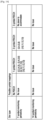
- RACH configuration for the initial BWP is depicted below:
- the ServingCellConfig IE is used to configure (add or modify) the UE 120 with the serving cell, which may be the SpCell or the SCell of an MCG or SCG.
- the ServingCellConfig information element is explained below:
- the BWP information element is explained below:
- each of the BWPs in the set of BWPs is associated with one of same numerology and different numerology.
- the UE 120 can be configured control the resource sets for every type of common search space and for UE-specific search space. Further, the UE 120 is not expected to be configured without the common search space on the PCell, or on the PSCell, in the active DL BWP so that the UE 120 can avoid the retuning.
- the BWP controller 1114 is configured to indicate the TA value to the UE 120 upon completion of the RACH procedure.
- the TA value is indicated to the UE with reference to the granularity of the numerology used by one of a) Random access Preamble numerology of a preamble format used by the UE 120 and configured in the BWP configuration, b) the Scheduled Transmission numerology configured for the UE 120 in the RMSI, c) the ongoing UL data transmission numerology in a primary cell in case of a contention free RACH in the primary cell, d) an ongoing UL data transmission numerology in a secondary cell in accordance with the claimed embodiment, e) the numerology configured for the SUL carrier, and f) the numerology commonly chosen among multiple bandwidth parts in the case of multiple simultaneously active bandwidth parts.
- a granularity of the TA value depends on the numerology of a first UL transmission after receiving a random access response (RAR).
- N TA is defined in [4, TS 38.211] and is relative to the subcarrier spacing of the first uplink transmission from the UE after the reception of the random access response.
- the BWP controller 1114 activates the selected BWP from the set of BWPs when the UE 120 attempts to establish the RRC connection with the BS 110 for the RACH procedure. Further, the BWP controller 1114 configures the RACH resources for the activated BWP for the RACH procedure. After configuring the RACH resources for the activated BWP for the RACH procedure, the BWP controller 1114 indicates the RACH resource for the activated BWP in the UE 120.
- the BWP controller 1114 includes a BWP configuration controller, a RACH resource indicator, a TA value indicator, a BWP activator to handle the BWP configurations for the RACH procedure in the wireless network.
- the processor 1116 is configured to execute instructions stored in the memory 1118 and to perform various processes.
- the communicator 1112 is configured for communicating internally between internal hardware components and with external devices via one or more networks.
- the communicator 1112 is configured for communicating with the BWP controller 210 to handle the BWP configurations for the RACH procedure in the wireless network.
- the memory 1118 also stores instructions to be executed by the processor 1116.
- the memory 1118 may include non-volatile storage elements. Examples of such non-volatile storage elements may include magnetic hard discs, optical discs, floppy discs, flash memories, or forms of electrically programmable memories (EPROM) or electrically erasable and programmable (EEPROM) memories.
- the memory 1118 may, in some examples, be considered a non-transitory storage medium.
- the term “non-transitory” may indicate that the storage medium is not embodied in a carrier wave or a propagated signal. However, the term “non-transitory” should not be interpreted that the memory 1118 is non-movable.
- the memory 1118 can be configured to store larger amounts of information than the memory.
- a non-transitory storage medium may store data that can, over time, change (e.g., in Random Access Memory (RAM) or cache).
- RAM Random Access Memory
- the UE 120 includes a communicator 1122, a BWP controller 1124, a processor 1126, and a memory 1128.
- the BWP controller 1124 receives the BWP configuration comprising RACH resources for each BWP in the set of BWPs for the RACH procedure from the BS 110. Further, the BWP controller 1124 performs the RACH procedure on the selected BWP from the set of BWPs using the RACH resources for the selected BWP indicated in the BWP configuration. After performing the RACH procedure on the selected BWP from the set of BWPs, the BWP controller 1124 receives the Random access response message on the selected BWP from the BS.
- the RACH resource for each of the BWPs is received by the UE 120 using the BWP configuration procedure via the RRC indication.
- the BWP controller 110 receives the Random access response message on the selected BWP from the BS 110 in at least one of a) a current active BWP on the primary cell, b) an initial active BWP on the primary cell, c) a default BWP configured to the UE 120 on the primary cell, and one of multiple active BWPs when the UE 120 supports multiple active BWPs, where each index of the supported multiple active BWPs is provided to the UE 120 by the BS 110, and the index of BWP is related to the RACH resource and/or preamble chosen by the UE 120.
- the BWP controller 1124 establishes the RRC connection on the active BWP. Further, the BWP controller 1124 receives the BWP configuration comprising RACH resources for the active BWP from the BS 110. Further, the BWP controller 1124 performs the RACH procedure on the active BWP using the RACH resources for the active BWP. Further, the BWP controller 1124 receives the random access response message on the active BWP from the BS 110.
- the UE 120 performs the RACH procedure on the active bandwidth part when the RACH resources are available. In another claimed embodiment, the UE 120 switches to a default bandwidth part or the initial active BWP from the set of BWPs, when the RACH resources are not available in the active bandwidth part.
- the processor 1126 is configured to execute instructions stored in the memory 1128 and to perform various processes.
- the communicator 1122 is configured for communicating internally between internal hardware components and with external devices via one or more networks.
- the communicator 1122 is configured for communicating with the BWP controller 1124 to handle the BWP configurations for the RACH procedure in the wireless network.
- the memory 1128 also stores instructions to be executed by the processor 1126.
- the memory 1128 may include non-volatile storage elements. Examples of such non-volatile storage elements may include magnetic hard discs, optical discs, floppy discs, flash memories, or forms of electrically programmable memories (EPROM) or electrically erasable and programmable (EEPROM) memories.
- the memory 1128 may, in some examples, be considered a non-transitory storage medium.
- the term “non-transitory” may indicate that the storage medium is not embodied in a carrier wave or a propagated signal. However, the term “non-transitory” should not be interpreted that the memory 1128 is non-movable.
- the memory 1128 can be configured to store larger amounts of information than the memory.
- a non-transitory storage medium may store data that can, over time, change (e.g., in random access memory (RAM) or cache).
- FIG. 11 shows various hardware components of the system 1100 but it is to be understood that other embodiments are not limited thereon.
- the system 1100 may include less or more number of components.
- the labels or names of the components are used only for illustrative purpose and does not limit the scope of the disclosure.
- One or more components can be combined together to perform same or substantially similar function to handle the BWP configurations for the RACH procedure in the wireless network.
- FIGS. 12A and 12B depict example TA indication mechanisms between the UE 120 and BS 110 in the wireless network, according to the claimed embodiment as disclosed herein.
- the UE 120 transmits the random access preamble to the BS 110.
- the BS 110 sends the RAR to the UE 120.
- the RAR includes the TA indication in terms of SCS of scheduled Msg3 transmission.
- the UE 120 transmits the scheduled UL transmission on the UL SCH to the BS 110.
- the BS 110 sends a contention resolution message to the UE 120.
- the BS 110 sends the random access preamble assignment to the UE 120.
- the UE 120 sends the random access preamble to the BS 110.
- the BS 110 sends the random access response to the UE 120.
- the random access response includes TA indication in terms of SCS of scheduled UL transmission.
- Exemplary embodiments herein disclose the numerology for the RACH procedure performed on the SCell.
- the PDCCH order is received in the active BWP of the scheduling cell of TAG to which the SCell belongs.
- the numerology for the PDCCH order is same as that of active BWP of scheduling cell of TAG to which the SCell belongs. Therefore, PDCCH for the RAR and PDSCH for the RAR are received on PCell in this case. Therefore, the following options can be considered for the numerology configurations:
- This scheduling cell can be PCell/ PSCell.
- the above options for SCell RAR can be following PCell or PSCell numerology of the BWP configured and follows the options above.
- the coreset for RAR in initial access can be configured by the RMSI. This configuration to avoid too much overhead can have same properties as the RMSI CORESET. Except the periodicity of this RAR coreset could be smaller than RMSI/ different from RMSI to meet control plane latency. Hence to indicate RAR coreset, only the CORESET monitoring periodicity can be indicated to the UE 120 via the RMSI. This periodicity can be 2/4/7/14 symbols and hence 2 bits can be sufficient to indicate the RAR CORESET configurations to the UE 120. Rest other properties of search space design, interleaver design, REG bundle etc. need not change between RMSI CORESET and RAR CORESET.
- Orthogonal frequency-division multiplexing (OFDM) symbol numbers in slot are configured in MIB and commonly applicable to SIBx/paging/RAR CORESET but the slot-timing (slot periodicity & offset) is separately configured for different x and paging and for RAR.
- OFDM Orthogonal frequency-division multiplexing
- This approach is indeed similar to SIBx timing configuration in the LTE.
- the common search space (or common search space CORESET) is placed in every subframe, but the SIBx slot timing is indicated in SIB2 for all x>2. So that, the RMSI carries only the periodicity and the slot offset for RAR CORESET configurations.
- the CORESET is typically characterized by slot timing, the OFDM symbol numbers in each slot, and frequency resources.
- the OFDM symbol numbers and frequency resources be commonly applicable to RAR and RMSI, and the slot timing can be individually determined/indicated for the RAR and the RMSI.
- the PBCH indicates the following information for the CORESET: #1) frequency resources; #2) OFDM symbol numbers in each slot; and #3) RMSI slot timing e.g., in terms of slot offset and periodicity.
- the RMSI indicates only (3) for RAR configuration i.e., RAR CORESET slot timing.
- Information #1 and #2 can be reused for type0 CSS, i.e., at least for RAR and RMSI transmissions; while information #3 is only for RMSI transmissions and RAR transmission specific.
- RAR CORESET frequency location is same as RMSI CORESET.
- the RAR is monitored in time using following information.
- the following could be configuration for CORESET, which can be shared between the RMSI and the RAR.
- Timing information can be as follows:
- the RMSI will indicate to the UE 120: slot location of CORESET, OFDM symbol locations of a CORESET specific for RAR, CORESET periodicity.
- the number of bits for the same can be limited to 2 or 3.
- RAR the below mentioned can be followed:
- f(n ss , i ss , ⁇ ss ) may be used.
- OFDM symbol indices can be determined as a function of at least one of numerology, number of CORESETs per slot, i ss , and ⁇ ss .
- FIG. 13 depicts the CORESET mapping for the RAR to support slot-based scheduling.
- the fully shaded box indicates the SSB and the shaded boxes indicate the CORESET locations for each SSB (for ease, the time duration is taken as 2 symbols).
- the RAN1 specification must account for the worst case designs. Hence, to avoid such cases, the RAN1 should consider RAR scheduling on a non-slot basis as well. Such an agreement will also match the RMSI scheduling agreement made in the last RAN1 meeting.
- the RAR CORESET design can follow properties of the RMSI except for different time durations and periodicity. Slot locations, number of CORESETs per slot and OFDM symbol indices are indicated via RMSI to configure RAR CORESET. Rest of the configuration follows from the RMSI CORESET configuration.
- the Msg4 CORESET (same as RAR/ configured by RAR) can follow same properties as above.
- the CORESET monitoring periodicity for Msg4 can be greater than that of Msg2, at least equal to or greater than Msg2. Only this value can be indicated via Msg2 to reduce Msg2 payload size.
- the search space being used for Msg4 indication can be common search space or UE specific search space. In case it is USS, it is indexed by T-CRNTI.
- Msg4 CORESET can be indicated via RAR as slot location of CORESET, the OFDM symbol locations of a CORESET specific for RAR, CORESET periodicity if deemed necessary beyond RAR CORESET.
- RACH Slots and RACH Symbols The mapping of multiple PRACH preamble formats depending on the number of PDCCH symbols is explained below:
- the UE 120 uses this information to know the slot structure. Then the BS 110 indicates the RACH preamble format in the RACH configuration, which is valid for all UEs within the cell. Then a fixed mapping can be defined for each RACH preamble format depending on the slot formats indicated in the SIB.
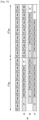
- FIG. 16 depicts an example slot format indicated to the UE 120.
- the UE 120 can send RACH preambles on any of the UL symbols. Then, based on the restrictions indicated above, this slot format supports, 1-, 2- and 4-symbol PRACH preamble formats. Other formats cannot be sent when the UE 120 knows that this slot format is being used by the cell.
- FIG. 16 depicts an example the slot format with potential RACH locations (RACH slots) given to the UE 120.
- RACH slots potential RACH locations
- FIG. 17 it indicates that the slots that can support RACH occur with a periodicity of 3 slots.
- This periodicity can be indicated in absolute time duration (in milli-seconds) as in the LTE or in number of slots. Therefore, once the SFI is indicated via SIB, and the preamble format is indicated via the RACH configuration, the UE 120 needs to be indicated the periodicity/location of the RACH in the UL portion of these slots.
- the slot format is indicated for every numerology. Then based on Msg1 SCS, the UE 120 will send at the appropriate time instant.
- the slot format could be indicated in terms of a) SS block numerology, Msg1 numerology configured in RMSI, or some reference numerology fixed in specification.
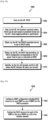
- FIG. 18 is a flow chart 1800 illustrating a method for mapping of multiple PRACH preamble formats.
- the operations are performed by the UE 120.
- the method includes sending the RACH.
- the method includes finding the locations (symbols) where the RACH can be sent based on preamble format and the SFI-fixed mapping defined in 3GPP specification.
- the method includes obtaining the PRACH preamble format to use in the RACH config.
- the method includes obtaining the RACH slot periodicity via the RACH configuration corresponding to the SFI given: fixed in spec or indicated via the RMSI.
- the method includes identifying the slot formats via SFI in SIB, where the BS 110 indicates the UE 120 about the slot formats.
- FIG. 19 is a flow diagram 1900 illustrating a method for indicating the RACH resource for each of the BWPs in the set of BWPs to the UE 120.
- the operations are performed by the BWP controller 1114.
- the operations 1902 and 1904 are performed by the BWP controller 1114 or the base station 110
- the method includes configuring the BWP configuration having RACH resources for each BWP in the set of BWPs for the RACH procedure.
- the method includes indicating the RACH resource for each of the BWPs in the set of BWPs to the UE 120 in the wireless network.
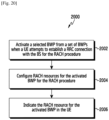
- FIG. 20 is a flow diagram 2000 illustrating a method for indicating the RACH resource for the activated BWP in the UE 120.
- the operations 2002, 2004 and 2006 are performed by the BWP controller 1114 or the base station 110.
- the method includes activating the selected BWP from the set of BWPs when the UE 120 attempts to establish the RRC connection with the BS 110 for the RACH procedure.
- the method includes configuring the RACH resources for the activated BWP for the RACH procedure.
- the method includes indicating the RACH resource for the activated BWP in the UE 120.
- FIG. 21 is flow diagram 2100 illustrating a method for receiving the random access response message on the selected BWP from the BS 110, according to an embodiment as disclosed herein.
- the operations 2102, 2104 and 2106 are performed by the BWP controller 1124 or the UE 120.
- the method includes receiving the BWP configuration comprising RACH resources for each BWP in the set of BWPs for the RACH procedure from the BS 110 in the wireless network.
- the method includes performing the RACH procedure on the selected BWP from the set of BWPs using the RACH resources for the selected BWP indicated in the BWP configuration.
- the method includes receiving the random access response message on the selected BWP from the BS 110.
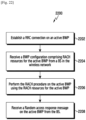
- FIG. 22 is flow diagram 2200 illustrating a method for receiving the random access response message on the active BWP from the BS 110, according to an embodiment as disclosed herein.
- the operations 2202, 2204, 2206 and 2208 are performed by the BWP controller 1124 or the UE 120.
- the method includes establishing the RRC connection on the active BWP.
- the method includes receiving the BWP configuration comprising RACH resources for the active BWP from the BS 110 in the wireless network.
- the method includes performing the RACH procedure on the active BWP using the RACH resources for the active BWP.
- the method includes receiving the random access response message on the active BWP from the BS 110.
- the embodiments disclosed herein can be implemented through at least one software program running on at least one hardware device and performing network management functions to control the elements.
- the elements can be at least one of a hardware device, or a combination of hardware device and software module.
Landscapes
- Engineering & Computer Science (AREA)
- Signal Processing (AREA)
- Computer Networks & Wireless Communication (AREA)
- Physics & Mathematics (AREA)
- Mathematical Physics (AREA)
- Mobile Radio Communication Systems (AREA)
Claims (8)
- Verfahren, durchgeführt durch ein Benutzergerät, UE, (120) in einem drahtlosen Kommunikationssystem, wobei das Verfahren Folgendes umfasst:Empfangen (1004a) einer Funkressourcensteuerungs-, RRC-Nachricht für eine bedienende Zelle, beinhaltend eine Direktzugriffskanal-, RACH-Ressourcenkonfiguration für einen oder mehrere Uplink-Bandbreitenteile, BWPs, für die bedienende Zelle, wobei die RRC-Nachricht für die bedienende Zelle Informationen beinhaltet, die einen Standard-Uplink-BWP für eine sekundäre Zelle, SCell, angeben;Empfangen eines SCell-Aktivierungsbefehls;Aktivieren des Standard-Uplink-BWP basierend auf dem SCell-Aktivierungsbefehl;Übertragen (1006a) einer Direktzugriffspräambel auf dem aktivierten Standard-Uplink-BWP zwischen dem einen oder den mehreren Uplink-BWPs,Empfangen (1008a) einer Direktzugriffsantwort, RAR, beinhaltend eine Angabe eines Zeitvorlauf-, TA-Wertes, wobei der TA-Wert relativ zu einem Unterträgerabstand, SCS, einer Uplink-Übertragung angegeben ist, die von dem UE nach dem Empfang der RAR durchzuführen ist; undDurchführen der Uplink-Übertragung nach dem Empfang der RAR gemäß dem TA-Wert, basierend auf einer Zeitausrichtung, die dem TA-Wert entspricht,wobei die Zeitausrichtung basierend auf dem TA-Wert und einer Schrittgröße identifiziert wird, die einer Granularität zugeordnet ist,wobei die Schrittgröße umgekehrt proportional zu dem identifizierten SCS der Uplink-Übertragung nach dem Empfang der RAR ist, undwobei die Direktzugriffspräambel basierend auf einer RACH-Ressourcenkonfiguration übertragen wird, die dem aktivierten Standard-Uplink-BWP zugeordnet ist.
- Verfahren nach Anspruch 1,wobei die Uplink-Übertragung eine Übertragung einer Uplink-Nachricht umfasst, die durch eine Uplink-Gewährung der RAR geplant ist, undwobei der SCS der Uplink-Übertragung in übrigen Mindestsysteminformationen, RMSI, konfiguriert ist.
- Verfahren nach Anspruch 1,
wobei ein aktiver Uplink-BWP auf den Standard-Uplink-BWP umgeschaltet wird, falls eine RACH-Ressource nicht für den aktiven Uplink-BWP konfiguriert ist. - Verfahren, durchgeführt durch eine Basisstation (110) in einem drahtlosen Kommunikationssystem, wobei das Verfahren Folgendes umfasst:Übertragen (1004a) einer Funkressourcensteuerungs-, RRC-Nachricht für eine bedienende Zelle, beinhaltend eine Direktzugriffskanal-, RACH-Ressourcenkonfiguration für einen oder mehrere Uplink-Bandbreitenteile, BWPs, für die bedienende Zelle, wobei die RRC-Nachricht für die bedienende Zelle Informationen beinhaltet, die einen Standard-Uplink-BWP für eine sekundäre Zelle, SCell, angeben;Übertragen eines SCell-Aktivierungsbefehls zum Aktivieren des Standard-Uplink-BWP basierend auf dem SCell-Aktivierungsbefehl;Empfangen (1006a), von einem Benutzergerät, UE, einer Direktzugriffspräambel auf dem aktivierten Standard-Uplink-BWP zwischen dem einen oder den mehreren Uplink-BWPs;Übertragen (1008a), an das UE, einer Direktzugriffsantwort, RAR, beinhaltend eine Angabe eines Zeitvorlauf-, TA-Wertes, wobei der TA-Wert relativ zu einem Unterträgerabstand, SCS, einer Uplink-Übertragung angegeben ist, die von dem UE nach einem Empfang der RAR durchzuführen ist; undEmpfangen der Uplink-Übertragung von dem UE gemäß dem TA-Wert, basierend auf einer Zeitausrichtung, die dem TA-Wert entspricht,wobei die Zeitausrichtung basierend auf dem TA-Wert und einer Schrittgröße identifiziert wird, die einer Granularität zugeordnet ist,wobei die Schrittgröße umgekehrt proportional zu dem identifizierten SCS der Uplink-Übertragung nach dem Empfang der RAR ist, undwobei die Direktzugriffspräambel basierend auf einer RACH-Ressourcenkonfiguration empfangen wird, die dem aktivierten Standard-Uplink-BWP zugeordnet ist.
- Verfahren nach Anspruch 4,wobei die Uplink-Übertragung eine Übertragung einer Uplink-Nachricht umfasst, die durch eine Uplink-Gewährung der RAR geplant ist, undwobei der SCS der Uplink-Übertragung in übrigen Mindestsysteminformationen, RMSI, konfiguriert ist.
- Verfahren nach Anspruch 4, wobei ein aktiver Uplink-BWP auf den Standard-Uplink-BWP umgeschaltet wird, falls eine RACH-Ressource nicht für den aktiven Uplink-BWP konfiguriert ist.
- Benutzergerät, UE, (120) in einem drahtlosen Kommunikationssystem, wobei das UE Folgendes umfasst:zumindest einen Sendeempfänger (310);zumindest einen Prozessor (330), der an den zumindest einen Sendeempfänger wirkgekoppelt ist;wobei der zumindest eine Prozessor konfiguriert ist, um eines der in Anspruch 1-3 beanspruchten Verfahren zu implementieren.
- Basisstation, BS, (110) in einem drahtlosen Kommunikationssystem, wobei die BS Folgendes umfasst:zumindest einen Sendeempfänger (210);zumindest einen Prozessor (240), der an den zumindest einen Sendeempfänger wirkgekoppelt ist;wobei der zumindest eine Prozessor konfiguriert ist, um eines der in Anspruch 4-6 beanspruchten Verfahren zu implementieren.
Applications Claiming Priority (2)
| Application Number | Priority Date | Filing Date | Title |
|---|---|---|---|
| IN201741034778 | 2017-09-29 | ||
| PCT/KR2018/011502 WO2019066533A1 (en) | 2017-09-29 | 2018-09-28 | APPARATUS AND METHOD FOR MANAGING CONFIGURATION OF BANDWIDTH PARTIES FOR RANDOM ACCESS CHANNEL PROCEDURE IN WIRELESS COMMUNICATION SYSTEM |
Publications (4)
| Publication Number | Publication Date |
|---|---|
| EP3677086A1 EP3677086A1 (de) | 2020-07-08 |
| EP3677086A4 EP3677086A4 (de) | 2020-09-09 |
| EP3677086B1 true EP3677086B1 (de) | 2023-11-15 |
| EP3677086C0 EP3677086C0 (de) | 2023-11-15 |
Family
ID=65895521
Family Applications (1)
| Application Number | Title | Priority Date | Filing Date |
|---|---|---|---|
| EP18861325.1A Active EP3677086B1 (de) | 2017-09-29 | 2018-09-28 | Vorrichtung und verfahren zur behandlung der konfiguration einer bandbreite für direktzugriffs-kanalverfahren in einem drahtlosen kommunikationssystem |
Country Status (6)
| Country | Link |
|---|---|
| US (2) | US11483867B2 (de) |
| EP (1) | EP3677086B1 (de) |
| KR (1) | KR102706917B1 (de) |
| CN (1) | CN111165061B (de) |
| AU (1) | AU2018341637B2 (de) |
| WO (1) | WO2019066533A1 (de) |
Families Citing this family (58)
| Publication number | Priority date | Publication date | Assignee | Title |
|---|---|---|---|---|
| PL3459315T3 (pl) * | 2016-09-30 | 2020-03-31 | Telefonaktiebolaget Lm Ericsson (Publ) | Sposób losowego dostępu dla pracy z wielokrotną numerologią |
| CN116709494A (zh) * | 2017-08-10 | 2023-09-05 | 三星电子株式会社 | 用于确定上行链路发送定时的方法和装置 |
| CN118201100A (zh) | 2017-09-28 | 2024-06-14 | 三星电子株式会社 | 用于在多个带宽部分上执行数据发射和测量的方法和网络节点 |
| CN113242607B (zh) * | 2017-10-20 | 2022-08-02 | 维沃移动通信有限公司 | 随机接入的方法、设备及终端 |
| KR102033127B1 (ko) * | 2017-10-26 | 2019-10-16 | 엘지전자 주식회사 | 무선 통신 시스템에서 그룹 공통 dci에 따라 동작하는 방법 및 장치 |
| US11540256B2 (en) * | 2017-11-03 | 2022-12-27 | Qualcomm Incorporated | Timing advance granularity for uplink with different numerologies |
| EP4301072B1 (de) | 2017-11-15 | 2025-10-29 | Nokia Technologies Oy | Direktzugriff mit bandbreitenteilschalter |
| JP7024867B2 (ja) * | 2017-11-17 | 2022-02-24 | 富士通株式会社 | ランダムアクセス方法、装置及び通信システム |
| US10506588B2 (en) | 2017-11-17 | 2019-12-10 | Lg Electronics Inc. | Method and apparatus for transmitting and receiving system information |
| US10880867B2 (en) * | 2017-11-17 | 2020-12-29 | Qualcomm Incorporated | Selecting a new radio uplink resource to transmit a random access procedure communication |
| US10609735B2 (en) * | 2017-11-17 | 2020-03-31 | Lg Electronics Inc. | Method of transmitting and receiving physical random access channel and device therefor |
| CN111226486B (zh) * | 2017-11-18 | 2024-08-09 | 联想(新加坡)私人有限公司 | 随机接入配置 |
| MX2020004751A (es) * | 2017-11-24 | 2020-08-20 | Fg innovation co ltd | Metodos y dispositivos relacionados para manejar un procedimiento de acceso aleatorio en la operacion de conmutacion de partes de ancho de banda. |
| US11147101B2 (en) * | 2018-01-11 | 2021-10-12 | Sharp Kabushiki Kaisha | User equipments, base stations and methods |
| JP7036830B2 (ja) * | 2018-01-12 | 2022-03-15 | エルジー エレクトロニクス インコーポレイティド | 物理任意接続チャネルを送受信する方法及びそのための装置 |
| WO2019154551A1 (en) * | 2018-02-10 | 2019-08-15 | Telefonaktiebolaget Lm Ericsson (Publ) | Methods, user equipment and base station for processing scheduling request |
| US11683812B2 (en) * | 2018-02-16 | 2023-06-20 | Telefonaktiebolaget Lm Ericsson (Publ) | Resource mapping based on bandwidth part |
| US10785804B2 (en) * | 2018-02-17 | 2020-09-22 | Ofinno, Llc | Bandwidth part configuration information |
| US11197324B2 (en) * | 2018-02-23 | 2021-12-07 | Qualcomm Incorporated | NR RACH MSG3 and MSG4 resource configuration for CV2X |
| US11019590B2 (en) * | 2018-02-27 | 2021-05-25 | Qualcomm Incorporated | Timing adjustments with mixed numerologies |
| US11324066B2 (en) * | 2018-04-23 | 2022-05-03 | Qualcomm Incorporated | Dynamic downlink monitoring techniques for communication systems |
| US10813069B2 (en) * | 2018-06-29 | 2020-10-20 | Qualcomm Incorporated | Techniques and apparatuses for using different timing advance values for different numerologies |
| CN115996486B (zh) | 2018-10-04 | 2026-03-17 | 谷歌有限责任公司 | 用于处理无线电资源控制小区组配置的方法 |
| US11445549B2 (en) * | 2018-10-10 | 2022-09-13 | Qualcomm Incorporated | Two-step random access channel (RACH) procedure to four-step RACH procedure fallback |
| CN118139206A (zh) * | 2018-10-26 | 2024-06-04 | 日本电气株式会社 | 用户设备、通信设备及其进行的方法 |
| US11140722B2 (en) | 2018-11-01 | 2021-10-05 | Ofinno, Llc | Pathloss measurement in multiple cells |
| US11979912B2 (en) * | 2019-02-07 | 2024-05-07 | Qualcomm Incorporated | Signaling of transmission parameters |
| FI3930393T3 (fi) * | 2019-02-22 | 2026-01-22 | Ntt Docomo Inc | Käyttäjälaite ja tukitukiasemalaite |
| WO2020184954A1 (ko) | 2019-03-14 | 2020-09-17 | 한국전자통신연구원 | 통신 시스템에서 단말의 접속 제어 방법 |
| KR20200110201A (ko) | 2019-03-14 | 2020-09-23 | 한국전자통신연구원 | 통신 시스템에서 단말의 접속 제어 방법 |
| WO2020220320A1 (zh) * | 2019-04-30 | 2020-11-05 | Oppo广东移动通信有限公司 | 随机接入类型的选择方法、装置、终端及存储介质 |
| KR102711430B1 (ko) * | 2019-05-02 | 2024-09-27 | 삼성전자 주식회사 | 차세대 이동 통신 시스템에서 제조사 기반의 단말능력 식별자를 이용해 단말 능력을 보고하는 방법 및 장치 |
| US11539494B2 (en) | 2019-05-13 | 2022-12-27 | Qualcomm Incorporated | Reference coordinates for two-step RACH resource configuration |
| KR20210020397A (ko) * | 2019-08-14 | 2021-02-24 | 삼성전자주식회사 | 무선 통신 시스템에서 네트워크에 액세스하기 위한 장치 및 방법 |
| CN112449418B (zh) * | 2019-08-30 | 2022-04-29 | 华为技术有限公司 | 通信方法及装置 |
| US11051220B1 (en) | 2019-10-10 | 2021-06-29 | T-Mobile Innovations Llc | Performing MU-MIMO in wireless networks utilizing different bandwidth parts |
| CN112702796B (zh) * | 2019-10-23 | 2022-08-12 | 中国移动通信有限公司研究院 | 随机接入方法、配置方法、装置、相关设备及存储介质 |
| EP3823413A1 (de) * | 2019-11-15 | 2021-05-19 | Panasonic Intellectual Property Corporation of America | Benutzergerät, planungsknoten, verfahren für benutzergerät und verfahren für planungsknoten zur bestimmung eines ziel-bwp |
| CA3103260A1 (en) | 2019-12-17 | 2021-06-17 | Comcast Cable Communications, Llc | Wireless resource switching |
| US11627608B2 (en) * | 2019-12-31 | 2023-04-11 | Qualcomm Incorporated | Indicating system timing information in high band communications |
| JP7407957B2 (ja) | 2020-01-22 | 2024-01-04 | 華為技術有限公司 | 初期帯域幅部bwp及び記憶媒体を決定するための方法及び装置 |
| US12381668B2 (en) | 2020-02-13 | 2025-08-05 | Telefonaktiebolaget Lm Ericsson (Publ) | Random access resource configuration in different bandwidth parts for two-step random access |
| CN115428550B (zh) * | 2020-02-13 | 2025-07-15 | 日本电气株式会社 | Ran节点、无线电终端及其方法 |
| US11432195B1 (en) * | 2020-03-27 | 2022-08-30 | T-Mobile Innovations Llc | Load balancing based on pairing efficiency and channel bandwidth |
| WO2021193995A1 (ko) * | 2020-03-27 | 2021-09-30 | 엘지전자 주식회사 | 사이드링크를 지원하는 무선통신시스템에서 신호를 수신하는 방법 및 이를 위한 장치 |
| EP4133875A4 (de) * | 2020-04-10 | 2023-12-06 | Qualcomm Incorporated | Kommunikationskonfiguration basierend auf zufallszugriffsbandbreite |
| CN116017726B (zh) * | 2020-06-02 | 2024-09-24 | Oppo广东移动通信有限公司 | 无线通信的方法、终端设备和网络设备 |
| CN113891461B (zh) * | 2020-07-01 | 2025-04-25 | 大唐移动通信设备有限公司 | 一种随机接入资源配置和随机接入方法及设备 |
| CN113891464B (zh) * | 2020-07-03 | 2025-10-31 | 捷开通讯(深圳)有限公司 | 部分带宽切换方法、通信网络系统,基站和用户设备 |
| US11751277B2 (en) * | 2020-07-15 | 2023-09-05 | Asustek Computer Inc. | Method and apparatus for selecting Bandwidth part (BWP) for subsequent transmission in pre-configured resources based Small Data Transmission (SDT) in a wireless communication system |
| CN115918234B (zh) * | 2020-08-03 | 2025-10-24 | 中兴通讯股份有限公司 | 无线小区激活和去激活 |
| CN116210269B (zh) * | 2020-09-11 | 2025-07-29 | 联想(北京)有限公司 | 用于随机存取的方法及设备 |
| US20230073130A1 (en) | 2021-09-01 | 2023-03-09 | Apple Inc. | Systems, methods, and apparatuses for cross division duplex operation in wireless communication |
| US20250234384A1 (en) * | 2021-10-22 | 2025-07-17 | Nokia Technologies Oy | Bandwidth part (bwp) switching for configured grant small data transmission |
| EP4449802A4 (de) * | 2021-12-15 | 2025-10-01 | Nokia Technologies Oy | Bandbreitenteilauswahl für direktzugriffsverfahren |
| EP4562940A4 (de) * | 2022-07-29 | 2026-04-08 | Qualcomm Inc | Zeitvorlaufsaktualisierung für relaxierte deaktivierte zellen |
| CN118473615A (zh) * | 2023-02-09 | 2024-08-09 | 大唐移动通信设备有限公司 | 信息处理方法、装置、终端及网络设备 |
| WO2026024925A1 (en) * | 2024-07-25 | 2026-01-29 | Ofinno, Llc | Bandwidth part switching in network energy saving |
Family Cites Families (12)
| Publication number | Priority date | Publication date | Assignee | Title |
|---|---|---|---|---|
| EP2166694A3 (de) * | 2008-09-18 | 2012-01-04 | Samsung Electronics Co., Ltd. | Übertragung von Trainingssignalen in TDD-Kommunikationssystemen |
| CN102123475B (zh) * | 2010-01-12 | 2015-08-19 | 华为技术有限公司 | 一种定时提前分组的确定方法及装置 |
| JP6122855B2 (ja) * | 2011-09-30 | 2017-04-26 | インターデイジタル パテント ホールディングス インコーポレイテッド | 縮小されたチャネル帯域幅を使用するデバイス通信 |
| CN105379357B (zh) * | 2013-03-15 | 2020-03-03 | 高通股份有限公司 | 在lte中采用波束成形来改善随机接入规程的系统和方法 |
| US11064329B2 (en) * | 2013-04-17 | 2021-07-13 | Qualcomm Incorporated | Control-less operation for coverage limited machine-type-communications |
| CN107852683B (zh) | 2015-08-12 | 2021-04-02 | 上海诺基亚贝尔股份有限公司 | 用于发送和接收波束对准的方法和装置 |
| WO2017039042A1 (ko) * | 2015-09-04 | 2017-03-09 | 엘지전자(주) | 무선 통신 시스템에서 단말의 데이터 송수신 방법 및 장치 |
| WO2018008918A1 (ko) * | 2016-07-02 | 2018-01-11 | 엘지전자 주식회사 | 하향링크 신호 수신 방법 및 사용자기기와, 하향링크 신호 전송 방법 및 기지국 |
| US10159097B2 (en) * | 2016-09-30 | 2018-12-18 | Qualcomm Incorporated | Signaling and determination of slot and mini-slot structure |
| EP3668213A4 (de) * | 2017-08-10 | 2021-01-20 | Ntt Docomo, Inc. | Benutzerendgerät und drahtloskommunikationsverfahren |
| US10999870B2 (en) * | 2017-08-18 | 2021-05-04 | Asustek Computer Inc. | Method and apparatus for random access configuration in a wireless communication system |
| EP4597907A3 (de) * | 2017-09-11 | 2025-11-05 | Nokia Technologies Oy | Uplink-timing-anpassung mit mehreren numerologien |
-
2018
- 2018-09-28 WO PCT/KR2018/011502 patent/WO2019066533A1/en not_active Ceased
- 2018-09-28 AU AU2018341637A patent/AU2018341637B2/en active Active
- 2018-09-28 EP EP18861325.1A patent/EP3677086B1/de active Active
- 2018-09-28 KR KR1020207012678A patent/KR102706917B1/ko active Active
- 2018-09-28 CN CN201880063842.8A patent/CN111165061B/zh active Active
- 2018-10-01 US US16/148,841 patent/US11483867B2/en active Active
-
2022
- 2022-09-29 US US17/936,732 patent/US20230024023A1/en not_active Abandoned
Non-Patent Citations (3)
| Title |
|---|
| CATT [ ]: "Way Forward for the Numerology in NR RA Procedures", vol. RAN WG1, no. Prague, Czech Republic; 20170821 - 20170825, 26 August 2017 (2017-08-26), XP051328477, Retrieved from the Internet <URL:http://www.3gpp.org/ftp/tsg_ran/WG1_RL1/TSGR1_90/Docs/> [retrieved on 20170826] * |
| CATT: "Further details on NR 4-step RA Procedure", vol. RAN WG1, no. Nagoya, Japan; 20170918 - 20170921, 17 September 2017 (2017-09-17), XP051339250, Retrieved from the Internet <URL:http://www.3gpp.org/ftp/Meetings_3GPP_SYNC/RAN1/Docs/> [retrieved on 20170917] * |
| MEDIATEK INC: "Summary of Offline Discussion on Bandwidth Part Operation", vol. RAN WG1, no. Nagoya, Japan; 20170918 - 20170921, 20 September 2017 (2017-09-20), XP051353894, Retrieved from the Internet <URL:http://www.3gpp.org/ftp/tsg_ran/WG1_RL1/TSGR1_AH/NR_AH_1709/Docs/> [retrieved on 20170920] * |
Also Published As
| Publication number | Publication date |
|---|---|
| US20230024023A1 (en) | 2023-01-26 |
| WO2019066533A1 (en) | 2019-04-04 |
| US11483867B2 (en) | 2022-10-25 |
| CN111165061A (zh) | 2020-05-15 |
| AU2018341637B2 (en) | 2022-11-03 |
| CN111165061B (zh) | 2023-11-24 |
| EP3677086A4 (de) | 2020-09-09 |
| EP3677086A1 (de) | 2020-07-08 |
| AU2018341637A1 (en) | 2020-05-14 |
| US20190104554A1 (en) | 2019-04-04 |
| KR102706917B1 (ko) | 2024-09-19 |
| EP3677086C0 (de) | 2023-11-15 |
| KR20200051052A (ko) | 2020-05-12 |
Similar Documents
| Publication | Publication Date | Title |
|---|---|---|
| EP3677086B1 (de) | Vorrichtung und verfahren zur behandlung der konfiguration einer bandbreite für direktzugriffs-kanalverfahren in einem drahtlosen kommunikationssystem | |
| US11832093B2 (en) | Method and apparatus for handling a beam failure recovery in wireless communication system | |
| JP7389863B2 (ja) | 無線通信システムにおいて、周波数ホッピングを介してアップリンク伝送を実行するための方法及びそのための装置 | |
| Parkvall et al. | NR: The new 5G radio access technology | |
| CN111937475B (zh) | 用于无线通信系统中的波束故障恢复的装置和方法 | |
| US11051326B2 (en) | Method and apparatus for requesting uplink scheduling in wireless communication system | |
| US10499424B2 (en) | Scheduling request arrangement for new radio | |
| CN113273248B (zh) | 用于处理2步和4步随机接入之间的切换的方法和装置 | |
| JP2024045192A (ja) | マルチtrp pdsch送信方式の動的インジケーション | |
| CN116018865A (zh) | 无线通信系统中用于分配频率资源的方法和装置 | |
| EP4373186A2 (de) | Verfahren und vorrichtung für drahtlose signalübertragung oder -empfang auf basis einer frequenzressourcenkonfiguration in einem drahtloskommunikationssystem | |
| US20110249639A1 (en) | Method of Handling Sounding Reference Signal and Physical Uplink Control Channel and Related Communication Device | |
| CN110999497B (zh) | 执行终端与基站之间的rach过程的方法及使用其的基站与终端 | |
| CN110268648B (zh) | 无线蜂窝通信系统中执行随机接入的方法和设备 | |
| US20220174552A1 (en) | Method for transmitting and receiving downlink information in wireless communication system supporting internet of things, and apparatus therefor | |
| WO2013159304A1 (en) | Switching between downlink and uplink | |
| CN111373830B (zh) | 用于在无线通信系统中发送随机接入信道的方法和装置 | |
| KR102613535B1 (ko) | 네트워크 슬라이싱에 기반하여 랜덤 액세스를 수행하는 장치 및 방법 | |
| WO2024011632A1 (zh) | 资源配置方法、装置、设备及存储介质 | |
| US20250150246A1 (en) | Apparatus and method for transmitting/receiving signal on basis of cross division duplex (xdd) in wireless communication system | |
| EP4270844A1 (de) | Verfahren und vorrichtung zur uplink-übertragung in einem drahtloskommunikationssystem | |
| US12089263B2 (en) | Apparatus and method for transmitting radio access network slicing-related information | |
| EP4694519A1 (de) | Erstzugangsverfahren und -vorrichtung für ein endgerät mit reduzierter fähigkeit in einem drahtloskommunikationssystem | |
| CN120693848A (zh) | 用于在无线通信系统中发送和接收上行链路的方法和装置 |
Legal Events
| Date | Code | Title | Description |
|---|---|---|---|
| STAA | Information on the status of an ep patent application or granted ep patent |
Free format text: STATUS: THE INTERNATIONAL PUBLICATION HAS BEEN MADE |
|
| PUAI | Public reference made under article 153(3) epc to a published international application that has entered the european phase |
Free format text: ORIGINAL CODE: 0009012 |
|
| STAA | Information on the status of an ep patent application or granted ep patent |
Free format text: STATUS: REQUEST FOR EXAMINATION WAS MADE |
|
| 17P | Request for examination filed |
Effective date: 20200331 |
|
| AK | Designated contracting states |
Kind code of ref document: A1 Designated state(s): AL AT BE BG CH CY CZ DE DK EE ES FI FR GB GR HR HU IE IS IT LI LT LU LV MC MK MT NL NO PL PT RO RS SE SI SK SM TR |
|
| AX | Request for extension of the european patent |
Extension state: BA ME |
|
| A4 | Supplementary search report drawn up and despatched |
Effective date: 20200807 |
|
| RIC1 | Information provided on ipc code assigned before grant |
Ipc: H04B 7/06 20060101ALN20200803BHEP Ipc: H04W 72/04 20090101ALI20200803BHEP Ipc: H04W 74/08 20090101AFI20200803BHEP |
|
| DAV | Request for validation of the european patent (deleted) | ||
| DAX | Request for extension of the european patent (deleted) | ||
| STAA | Information on the status of an ep patent application or granted ep patent |
Free format text: STATUS: EXAMINATION IS IN PROGRESS |
|
| 17Q | First examination report despatched |
Effective date: 20210430 |
|
| GRAP | Despatch of communication of intention to grant a patent |
Free format text: ORIGINAL CODE: EPIDOSNIGR1 |
|
| STAA | Information on the status of an ep patent application or granted ep patent |
Free format text: STATUS: GRANT OF PATENT IS INTENDED |
|
| RIC1 | Information provided on ipc code assigned before grant |
Ipc: H04W 74/00 20090101ALN20230524BHEP Ipc: H04L 27/26 20060101ALN20230524BHEP Ipc: H04B 7/06 20060101ALN20230524BHEP Ipc: H04L 5/00 20060101ALI20230524BHEP Ipc: H04W 74/08 20090101AFI20230524BHEP |
|
| INTG | Intention to grant announced |
Effective date: 20230607 |
|
| GRAS | Grant fee paid |
Free format text: ORIGINAL CODE: EPIDOSNIGR3 |
|
| GRAA | (expected) grant |
Free format text: ORIGINAL CODE: 0009210 |
|
| STAA | Information on the status of an ep patent application or granted ep patent |
Free format text: STATUS: THE PATENT HAS BEEN GRANTED |
|
| AK | Designated contracting states |
Kind code of ref document: B1 Designated state(s): AL AT BE BG CH CY CZ DE DK EE ES FI FR GB GR HR HU IE IS IT LI LT LU LV MC MK MT NL NO PL PT RO RS SE SI SK SM TR |
|
| REG | Reference to a national code |
Ref country code: CH Ref legal event code: EP Ref country code: GB Ref legal event code: FG4D |
|
| REG | Reference to a national code |
Ref country code: DE Ref legal event code: R096 Ref document number: 602018061261 Country of ref document: DE |
|
| REG | Reference to a national code |
Ref country code: IE Ref legal event code: FG4D |
|
| U01 | Request for unitary effect filed |
Effective date: 20231116 |
|
| U07 | Unitary effect registered |
Designated state(s): AT BE BG DE DK EE FI FR IT LT LU LV MT NL PT SE SI Effective date: 20231122 |
|
| PG25 | Lapsed in a contracting state [announced via postgrant information from national office to epo] |
Ref country code: GR Free format text: LAPSE BECAUSE OF FAILURE TO SUBMIT A TRANSLATION OF THE DESCRIPTION OR TO PAY THE FEE WITHIN THE PRESCRIBED TIME-LIMIT Effective date: 20240216 |
|
| PG25 | Lapsed in a contracting state [announced via postgrant information from national office to epo] |
Ref country code: IS Free format text: LAPSE BECAUSE OF FAILURE TO SUBMIT A TRANSLATION OF THE DESCRIPTION OR TO PAY THE FEE WITHIN THE PRESCRIBED TIME-LIMIT Effective date: 20240315 |
|
| PG25 | Lapsed in a contracting state [announced via postgrant information from national office to epo] |
Ref country code: ES Free format text: LAPSE BECAUSE OF FAILURE TO SUBMIT A TRANSLATION OF THE DESCRIPTION OR TO PAY THE FEE WITHIN THE PRESCRIBED TIME-LIMIT Effective date: 20231115 |
|
| PG25 | Lapsed in a contracting state [announced via postgrant information from national office to epo] |
Ref country code: IS Free format text: LAPSE BECAUSE OF FAILURE TO SUBMIT A TRANSLATION OF THE DESCRIPTION OR TO PAY THE FEE WITHIN THE PRESCRIBED TIME-LIMIT Effective date: 20240315 Ref country code: GR Free format text: LAPSE BECAUSE OF FAILURE TO SUBMIT A TRANSLATION OF THE DESCRIPTION OR TO PAY THE FEE WITHIN THE PRESCRIBED TIME-LIMIT Effective date: 20240216 Ref country code: ES Free format text: LAPSE BECAUSE OF FAILURE TO SUBMIT A TRANSLATION OF THE DESCRIPTION OR TO PAY THE FEE WITHIN THE PRESCRIBED TIME-LIMIT Effective date: 20231115 |
|
| PG25 | Lapsed in a contracting state [announced via postgrant information from national office to epo] |
Ref country code: RS Free format text: LAPSE BECAUSE OF FAILURE TO SUBMIT A TRANSLATION OF THE DESCRIPTION OR TO PAY THE FEE WITHIN THE PRESCRIBED TIME-LIMIT Effective date: 20231115 Ref country code: PL Free format text: LAPSE BECAUSE OF FAILURE TO SUBMIT A TRANSLATION OF THE DESCRIPTION OR TO PAY THE FEE WITHIN THE PRESCRIBED TIME-LIMIT Effective date: 20231115 Ref country code: NO Free format text: LAPSE BECAUSE OF FAILURE TO SUBMIT A TRANSLATION OF THE DESCRIPTION OR TO PAY THE FEE WITHIN THE PRESCRIBED TIME-LIMIT Effective date: 20240215 Ref country code: HR Free format text: LAPSE BECAUSE OF FAILURE TO SUBMIT A TRANSLATION OF THE DESCRIPTION OR TO PAY THE FEE WITHIN THE PRESCRIBED TIME-LIMIT Effective date: 20231115 |
|
| PG25 | Lapsed in a contracting state [announced via postgrant information from national office to epo] |
Ref country code: CZ Free format text: LAPSE BECAUSE OF FAILURE TO SUBMIT A TRANSLATION OF THE DESCRIPTION OR TO PAY THE FEE WITHIN THE PRESCRIBED TIME-LIMIT Effective date: 20231115 |
|
| PG25 | Lapsed in a contracting state [announced via postgrant information from national office to epo] |
Ref country code: SK Free format text: LAPSE BECAUSE OF FAILURE TO SUBMIT A TRANSLATION OF THE DESCRIPTION OR TO PAY THE FEE WITHIN THE PRESCRIBED TIME-LIMIT Effective date: 20231115 |
|
| PG25 | Lapsed in a contracting state [announced via postgrant information from national office to epo] |
Ref country code: SM Free format text: LAPSE BECAUSE OF FAILURE TO SUBMIT A TRANSLATION OF THE DESCRIPTION OR TO PAY THE FEE WITHIN THE PRESCRIBED TIME-LIMIT Effective date: 20231115 Ref country code: SK Free format text: LAPSE BECAUSE OF FAILURE TO SUBMIT A TRANSLATION OF THE DESCRIPTION OR TO PAY THE FEE WITHIN THE PRESCRIBED TIME-LIMIT Effective date: 20231115 Ref country code: RO Free format text: LAPSE BECAUSE OF FAILURE TO SUBMIT A TRANSLATION OF THE DESCRIPTION OR TO PAY THE FEE WITHIN THE PRESCRIBED TIME-LIMIT Effective date: 20231115 Ref country code: CZ Free format text: LAPSE BECAUSE OF FAILURE TO SUBMIT A TRANSLATION OF THE DESCRIPTION OR TO PAY THE FEE WITHIN THE PRESCRIBED TIME-LIMIT Effective date: 20231115 |
|
| REG | Reference to a national code |
Ref country code: DE Ref legal event code: R097 Ref document number: 602018061261 Country of ref document: DE |
|
| PLBE | No opposition filed within time limit |
Free format text: ORIGINAL CODE: 0009261 |
|
| STAA | Information on the status of an ep patent application or granted ep patent |
Free format text: STATUS: NO OPPOSITION FILED WITHIN TIME LIMIT |
|
| 26N | No opposition filed |
Effective date: 20240819 |
|
| U20 | Renewal fee for the european patent with unitary effect paid |
Year of fee payment: 7 Effective date: 20240923 |
|
| PG25 | Lapsed in a contracting state [announced via postgrant information from national office to epo] |
Ref country code: MC Free format text: LAPSE BECAUSE OF FAILURE TO SUBMIT A TRANSLATION OF THE DESCRIPTION OR TO PAY THE FEE WITHIN THE PRESCRIBED TIME-LIMIT Effective date: 20231115 |
|
| REG | Reference to a national code |
Ref country code: CH Ref legal event code: PL |
|
| GBPC | Gb: european patent ceased through non-payment of renewal fee |
Effective date: 20240928 |
|
| PG25 | Lapsed in a contracting state [announced via postgrant information from national office to epo] |
Ref country code: GB Free format text: LAPSE BECAUSE OF NON-PAYMENT OF DUE FEES Effective date: 20240928 |
|
| PG25 | Lapsed in a contracting state [announced via postgrant information from national office to epo] |
Ref country code: CH Free format text: LAPSE BECAUSE OF NON-PAYMENT OF DUE FEES Effective date: 20240930 |
|
| PG25 | Lapsed in a contracting state [announced via postgrant information from national office to epo] |
Ref country code: IE Free format text: LAPSE BECAUSE OF NON-PAYMENT OF DUE FEES Effective date: 20240928 |
|
| U20 | Renewal fee for the european patent with unitary effect paid |
Year of fee payment: 8 Effective date: 20250924 |
|
| PG25 | Lapsed in a contracting state [announced via postgrant information from national office to epo] |
Ref country code: CY Free format text: LAPSE BECAUSE OF FAILURE TO SUBMIT A TRANSLATION OF THE DESCRIPTION OR TO PAY THE FEE WITHIN THE PRESCRIBED TIME-LIMIT; INVALID AB INITIO Effective date: 20180928 |
|
| PG25 | Lapsed in a contracting state [announced via postgrant information from national office to epo] |
Ref country code: HU Free format text: LAPSE BECAUSE OF FAILURE TO SUBMIT A TRANSLATION OF THE DESCRIPTION OR TO PAY THE FEE WITHIN THE PRESCRIBED TIME-LIMIT; INVALID AB INITIO Effective date: 20180928 |