EP3672018A1 - Autonome steuerung des elektrischen energieverbrauchs durch eine vorrichtung - Google Patents
Autonome steuerung des elektrischen energieverbrauchs durch eine vorrichtung Download PDFInfo
- Publication number
- EP3672018A1 EP3672018A1 EP19202923.9A EP19202923A EP3672018A1 EP 3672018 A1 EP3672018 A1 EP 3672018A1 EP 19202923 A EP19202923 A EP 19202923A EP 3672018 A1 EP3672018 A1 EP 3672018A1
- Authority
- EP
- European Patent Office
- Prior art keywords
- electric power
- battery
- array
- charge
- state
- Prior art date
- Legal status (The legal status is an assumption and is not a legal conclusion. Google has not performed a legal analysis and makes no representation as to the accuracy of the status listed.)
- Granted
Links
Images



Classifications
-
- B—PERFORMING OPERATIONS; TRANSPORTING
- B64—AIRCRAFT; AVIATION; COSMONAUTICS
- B64G—COSMONAUTICS; VEHICLES OR EQUIPMENT THEREFOR
- B64G1/00—Cosmonautic vehicles
- B64G1/22—Parts of, or equipment specially adapted for fitting in or to, cosmonautic vehicles
- B64G1/42—Arrangements or adaptations of power supply systems
- B64G1/44—Arrangements or adaptations of power supply systems using radiation, e.g. deployable solar arrays
-
- B—PERFORMING OPERATIONS; TRANSPORTING
- B64—AIRCRAFT; AVIATION; COSMONAUTICS
- B64G—COSMONAUTICS; VEHICLES OR EQUIPMENT THEREFOR
- B64G1/00—Cosmonautic vehicles
- B64G1/22—Parts of, or equipment specially adapted for fitting in or to, cosmonautic vehicles
- B64G1/42—Arrangements or adaptations of power supply systems
- B64G1/425—Power storage
-
- B—PERFORMING OPERATIONS; TRANSPORTING
- B64—AIRCRAFT; AVIATION; COSMONAUTICS
- B64G—COSMONAUTICS; VEHICLES OR EQUIPMENT THEREFOR
- B64G1/00—Cosmonautic vehicles
- B64G1/22—Parts of, or equipment specially adapted for fitting in or to, cosmonautic vehicles
- B64G1/42—Arrangements or adaptations of power supply systems
- B64G1/428—Power distribution and management
-
- H—ELECTRICITY
- H02—GENERATION; CONVERSION OR DISTRIBUTION OF ELECTRIC POWER
- H02J—ELECTRIC POWER NETWORKS; CIRCUIT ARRANGEMENTS OR SYSTEMS FOR SUPPLYING OR DISTRIBUTING ELECTRIC POWER; SYSTEMS FOR STORING ELECTRIC ENERGY
- H02J7/00—Circuit arrangements for charging or discharging batteries or for supplying loads from batteries
- H02J7/34—Parallel operation in networks using both storage and other DC sources, e.g. providing buffering
- H02J7/35—Parallel operation in networks using both storage and other DC sources, e.g. providing buffering with light sensitive cells
-
- H—ELECTRICITY
- H02—GENERATION; CONVERSION OR DISTRIBUTION OF ELECTRIC POWER
- H02J—ELECTRIC POWER NETWORKS; CIRCUIT ARRANGEMENTS OR SYSTEMS FOR SUPPLYING OR DISTRIBUTING ELECTRIC POWER; SYSTEMS FOR STORING ELECTRIC ENERGY
- H02J7/00—Circuit arrangements for charging or discharging batteries or for supplying loads from batteries
- H02J7/80—Circuit arrangements for charging or discharging batteries or for supplying loads from batteries including monitoring or indicating arrangements
- H02J7/82—Control of state of charge [SOC]
-
- H—ELECTRICITY
- H02—GENERATION; CONVERSION OR DISTRIBUTION OF ELECTRIC POWER
- H02J—ELECTRIC POWER NETWORKS; CIRCUIT ARRANGEMENTS OR SYSTEMS FOR SUPPLYING OR DISTRIBUTING ELECTRIC POWER; SYSTEMS FOR STORING ELECTRIC ENERGY
- H02J7/00—Circuit arrangements for charging or discharging batteries or for supplying loads from batteries
- H02J7/90—Regulation of charging or discharging current or voltage
- H02J7/933—Regulation of charging or discharging current or voltage the cycle being controlled or terminated in response to electric parameters
-
- B—PERFORMING OPERATIONS; TRANSPORTING
- B64—AIRCRAFT; AVIATION; COSMONAUTICS
- B64G—COSMONAUTICS; VEHICLES OR EQUIPMENT THEREFOR
- B64G1/00—Cosmonautic vehicles
- B64G1/22—Parts of, or equipment specially adapted for fitting in or to, cosmonautic vehicles
- B64G1/40—Arrangements or adaptations of propulsion systems
- B64G1/411—Electric propulsion
- B64G1/413—Ion or plasma engines
-
- H—ELECTRICITY
- H02—GENERATION; CONVERSION OR DISTRIBUTION OF ELECTRIC POWER
- H02J—ELECTRIC POWER NETWORKS; CIRCUIT ARRANGEMENTS OR SYSTEMS FOR SUPPLYING OR DISTRIBUTING ELECTRIC POWER; SYSTEMS FOR STORING ELECTRIC ENERGY
- H02J2105/00—Networks for supplying or distributing electric power characterised by their spatial reach or by the load
- H02J2105/30—Networks for supplying or distributing electric power characterised by their spatial reach or by the load the load networks being external to vehicles, i.e. exchanging power with vehicles
-
- H—ELECTRICITY
- H02—GENERATION; CONVERSION OR DISTRIBUTION OF ELECTRIC POWER
- H02J—ELECTRIC POWER NETWORKS; CIRCUIT ARRANGEMENTS OR SYSTEMS FOR SUPPLYING OR DISTRIBUTING ELECTRIC POWER; SYSTEMS FOR STORING ELECTRIC ENERGY
- H02J7/00—Circuit arrangements for charging or discharging batteries or for supplying loads from batteries
- H02J7/80—Circuit arrangements for charging or discharging batteries or for supplying loads from batteries including monitoring or indicating arrangements
- H02J7/84—Control of state of health [SOH]
Definitions
- the present disclosure relates to spacecraft and more particularly to autonomously controlling electric power consumption by an apparatus, such as a spacecraft.
- An apparatus or spacecraft needs to provide reliable communications during times when the apparatus or spacecraft is expected to be available for communications. Complete shedding of an integrated payload array or shutdown of communications components of the apparatus or spacecraft may occur under certain circumstances. We cite as examples, a ground station exceeding an allowable bandwidth, the spacecraft or satellite performing a station-keeping maneuver at the wrong time, such as during an eclipse, a solar array degrading faster than expected, or other operations by the apparatus or spacecraft that draw more than a typical amount or expected amount of electric power and cause complete shutdown of communications by the apparatus or spacecraft. Accordingly, there is a need to autonomously control electric power usage by an apparatus, spacecraft or satellite to avoid complete shedding of the payload.
- a method for autonomous control of electric power consumption by an apparatus includes monitoring electric power measurement data of electric power being generated by a solar array of the apparatus.
- the solar array is configured to at least charge a battery and provide electrical power to components of the apparatus.
- the method also includes monitoring a state of charge of the battery.
- the method additionally includes autonomously controlling electric power consumption of an integrated payload array in response to at least the state of charge of the battery.
- the state of charge of the battery is maintained proximate a preset threshold.
- a method for autonomous control of electric power consumption by an apparatus includes monitoring electric power measurement data of electric power generated by a solar array of the apparatus.
- the solar array is configured to at least charge a battery and provide electrical power to components of the apparatus.
- the method also includes monitoring a state of charge of the battery.
- the method additionally includes monitoring temperature measurement data from an integrated payload array.
- the method further includes autonomously controlling electric power consumption of the integrated payload array in response to at least one of the state of charge of the battery and the temperature measurement data.
- the state of charge of the battery is maintained proximate a preset threshold and the temperature of the integrated payload array is maintained below a preset temperature operating limit.
- an apparatus for autonomous control of electric power consumption includes an apparatus body and a battery.
- the battery is configured to supply electric power to components of the apparatus.
- the apparatus also includes a solar array attached to the apparatus body.
- the solar array is configured to at least charge the battery and provide electrical power to the components of the apparatus.
- the apparatus also includes an integrated payload array configured to transmit and receive signals.
- the apparatus further includes a controller.
- the controller includes a processor.
- the controller is configured to monitor electric power measurement data of electric power generated by the solar array.
- the controller is also configured to monitor a state of charge of the battery and to autonomously control electric power consumption of the integrated payload array in response to at least the state of charge of the battery.
- the state of charge of the battery is maintained proximate a preset threshold.
- a controller for autonomous control of electric power consumption by an apparatus includes a processor.
- the controller is configured to monitor electric power measurement data of electric power being generated by a solar array of the apparatus.
- the controller is also configured to monitor a state of charge of a battery and to autonomously control electric power consumption of an integrated payload array in response to at least the state of charge of the battery.
- the state of charge of the battery is maintained proximate a preset threshold.
- the controller is further configured to autonomously control electric power consumption of selected components of the integrated payload array in response to the solar array receiving insufficient light to generate electric power.
- the controller is further configured to autonomously control electric power consumption of selected components of the integrated payload array in response to a parameter related to the integrated payload array.
- the parameter related to the integrated payload array includes temperature of the integrated payload array.
- the temperature is sensed by a temperature sensor associated with the integrated payload array.
- the controller is configured to monitor temperature measurement data from the integrated payload array and to autonomously control electric power consumption of selected components of the integrated payload array in response to the temperature measurement data exceeding a preset temperature operating limit.
- autonomously controlling electric power consumption of the integrated payload array includes autonomously controlling electric power consumption of selected components of the integrated payload array.
- autonomously controlling electric power consumption of the integrated payload array is also in response to the solar array receiving insufficient light to generate electric power.
- the method and apparatus further include monitoring temperature measurement data of temperature of the integrated payload array.
- the method and apparatus also include autonomously controlling electric power consumption of selected components of the integrated payload array in response to the temperature measurement data exceeding a preset temperature operating limit.
- the method and apparatus further include receiving a task command including a bandwidth.
- the method and apparatus additionally include controlling payload communications traffic of the integrated payload array in response to at least one of the electric power measurement data of the solar array, the state of charge of the battery, temperature measurement data from the integrated payload array and the bandwidth of the task command.
- the method and apparatus further include receiving a task command including a payload mission task and accepting the task command in response to the state of charge of the battery being proximate the preset threshold.
- the method and apparatus further include receiving a task command including a payload mission task and rejecting the task command in response to the state of charge of the battery being below the preset threshold and a priority of the payload mission task being below a chosen priority value.
- the method and apparatus additionally include transmitting an alarm to mission operations in response to rejecting the task command.
- the method and apparatus further include disabling one or more payload mission tasks performed by the integrated payload array until the state of charge of the battery is achieved that prevents shutting down all payload operations.
- disabling the one or more payload mission tasks performed by the integrated payload array includes disabling a lowest priority payload mission task and progressing to disable higher priority payload mission tasks until the state of charge of the battery is achieved that prevents shutting down all payload operations.
- the method and apparatus further include preventing a station-keeping maneuver, that includes using thrusters, when the state of charge of the battery is below the preset threshold.
- the method and apparatus further include preventing operation of redundant equipment when the state of charge of the battery is below the preset threshold.
- the method and apparatus further include autonomously controlling operation of selected components of the integrated payload array in response to at least one of premature degradation of the solar array, the state of charge of the battery being below the preset threshold, temperature measurement data of the integrated payload array exceeding a preset temperature operating limit, and a task command bandwidth exceeding an allowable limit.
- the method and apparatus further include monitoring a state of health of the battery and monitoring a state of health of the solar array.
- the method and apparatus additionally include controlling electric power consumption of the integrated payload array in response to the state of health of the battery and controlling the electric power consumption of the integrated payload array in response to the state of health of the solar array.
- the method and apparatus include autonomously controlling electric power consumption of the integrated payload array and thrusters in response to the solar array receiving insufficient light to generate electric power.
- apparatus satellite, spacecraft, and vehicle may be used interchangeably in the present disclosure and the present disclosure is not intended to limited by which term or terms are used.
- FIG. 1 is a schematic diagram of an example of a satellite communications system 100 in accordance with an embodiment of the present disclosure.
- the satellite communications system 100 includes an apparatus 102.
- the apparatus 102 is a spacecraft.
- the satellite communications system 100 also include one or more a telemetry and control (T&C) ground stations 104.
- T&C telemetry and control
- Examples of features or functions the T&C ground station 104 is configured to perform include but are not necessarily limited to allocate payload communication resources, upload communication task descriptions 106, update task parameters to maintain link performance, upload beam target changes and upload transmit gain changes 108.
- management and communication task descriptions 246 are stored in a mission plan 244 in a memory 242 of the apparatus 102.
- the apparatus 102 autonomously executes tasks, for example, configures allocated beam channels at scheduled times on a recurring basis, dynamically steers beams based on beam targets and apparatus motion, applies real-time task parameter changes received from the T&C ground station 104 and performs other tasks associated with communications.
- the satellite communications system 100 also includes one or more gateway (GW) ground stations 110.
- the GW ground stations 110 are configured to transmit uplink signals 112 that are received by the apparatus 102.
- the apparatus 102 is also configured to transmit downlink signals 114 to one or more fixed ground terminals 116 and mobile terminals 118.
- FIG. 2 is a block schematic diagram of an example of the apparatus 102 in FIG.1 .
- the apparatus 102 includes a controller 202.
- the controller 202 is a power management controller.
- Controller 202 is configured to autonomously control electric power consumption by the apparatus 102 in accordance with an embodiment of the present disclosure.
- the apparatus 102 is a spacecraft.
- the apparatus 102 includes an apparatus body 204 and one or more solar arrays 206 attached to the apparatus body 204.
- the solar arrays 206 are configured to at least charge the battery 220 and provide electric power 210 to the components 211 of the apparatus 102.
- the apparatus 102 includes a north solar array 206a and a south solar array 206b.
- the north solar array 206a and the south solar array 206b are mounted on opposite sides of the apparatus body 204.
- the north solar array 206a and the south solar array 206b are coupled to an integrated power controller (IPC) 208 to supply electric power 210 to the IPC 208.
- the IPC 208 receives electric power 210 from the solar arrays 206 and controls distribution of the electric power 210 to other components 211 of the apparatus 102.
- Electric power 210 from each of the solar arrays 206 is measured or sensed by sensing devices 212 and electric power measurement data 214 is provided to the controller 202.
- the controller 202 monitors the electric power measurement data 214 of the electric power 210 generated by each solar array 206a and 206b.
- two thrusters 216 such as Hall-effect thrusters (HET) or Xenon propellant thrusters, are mounted to the apparatus body 204.
- the amount of thrust generated by each of the thrusters 216 is proportional to an amount of electric power 210 supplied to each thruster 216 when fired.
- the amount of electric power 210 supplied to each thruster 216 is controlled by the IPC 208.
- the thrusters 216 are fired to perform a maneuver by the apparatus 102, such as station-keeping, electric orbit raising to transition from separation from a launch vehicle to a target orbit, or other maneuvers.
- the apparatus 102 also includes control electronics, such as spacecraft control electronics (SCE) 218 in the example of FIG. 2 .
- control electronics such as spacecraft control electronics (SCE) 218 in the example of FIG. 2 .
- the controller 202 is a component of the SCE 218. In other examples, the controller 202 is a separate component from the SCE 218.
- the SCE 218 is connected to the IPC 208 to control operation of the IPC 208 and distribution of electric power 210 to the components 211 of the apparatus 102.
- a battery 220 is mounted in the apparatus body 204 and configured to supply electric power 210 to components 211 of the apparatus 102.
- the battery 220 is a battery pack.
- the battery 220 is charged by electric power 210 from the solar arrays 206 through the IPC 208.
- the IPC 208 controls charging of the battery 220 by the solar arrays 206.
- a state of charge (SOC) 222 of the battery 220 is monitored by the SCE 218.
- the SCE 218 is configured to control the SOC 222 through the controller 202.
- Voltages 224 associated with the battery 220 are measured to determine the SOC 222 of the battery 220 at any particular time.
- the SCE 218 transmits control signals 225 to the IPC 208 to control charging the battery 220 in response to at least the SOC 222 of the battery 220 to maintain the SOC 222 of the battery 220 proximate a preset threshold 602 ( FIG. 6A ) or within predetermined limits. Maintaining the SOC 222 of the battery 220 proximate the preset threshold 602 or within predetermined limits is also referred to as maintaining a balanced battery SOC 228 herein.
- the preset threshold 602 in FIG. 6A is about 80% of a full charge of the battery 220 or the battery being charged 100%.
- a high fault limit 612 FIG.
- a fault limit is a threshold value that initiates a fault response if a measured parameter exceeds the predefined threshold value.
- the high fault limit 612 of the SOC 222 of the battery 220 is set to about 25% of a 100% charge on the battery 220 and the low fault limit 614 is set to about 20% of the 100% charge on the battery 220.
- Different fault protections may be implemented depending upon the SOC 222 of the battery 220 falling below each fault limit 612 and 614. For example, additional components of the integrated payload array 226 are shut down in response to the SOC 222 falling below each lower fault limit 612 and 614.
- the apparatus 102 also includes an integrated payload array (IPA) 226.
- IPA integrated payload array
- An example of an integrated payload array 226 will be described in more detail with reference to FIG. 7 .
- the integrated payload array 226 is configured to transmit and receive communications signals 230.
- the integrated payload array 226 is configurable to perform any of the communications 106, 108, 112 and 114 described with reference to FIG. 1 .
- the controller 202 includes a processor 232.
- the controller 202 is configured to monitor the electric power measurement data 214 generated by the solar arrays 206 of the apparatus 102, to monitor the SOC 222 of the battery 220 and to autonomously control electric power consumption of the integrated payload array 226 in response to at least the SOC 222 of the battery 220 to maintain a balanced battery SOC 228 proximate a preset threshold 602 ( FIG. 6A ).
- the controller 202 is further configured to autonomously control electric power consumption of selected components 238 of the integrated payload array 226 in response to the solar arrays 206 receiving insufficient light to generate electric power 210, such in the case of an eclipse.
- An eclipse occurs when the apparatus 102 orbits around the earth and is in a position where the earth blocks some or all sun light from reaching the solar arrays 206.
- one or more payload temperature sensors 234 are associated with the integrated payload array 226 to measure the temperature of the integrated payload array 226 and transmit temperature measurement data 236 of the integrated payload array 226 to the controller 202 of the SCE 218.
- the controller 202 is further configured to monitor the temperature measurement data 236 from the integrated payload array 226 and to autonomously control electric power consumption of selected components 238 of the integrated payload array 226 in response to the temperature measurement data 236 exceeding a preset temperature operating limit 240. Examples of the selected components 238 of the integrated payload array 226 that are autonomously controlled are described with reference to FIG. 7 .
- the electric power consumption by the integrated payload array 226 is autonomously controlled by disabling operation of some selected component 238 and adjusting performance of other selected components 238 to control electric power consumption.
- the apparatus 102 also includes a memory 242.
- the memory 242 is a component of the SCE 218. In other examples, the memory 242 may be a separate component from the SCE 218.
- a mission plan 244 for the apparatus 102 is stored on the memory 242.
- the mission plan 244 includes management and communication task descriptions 246 which are performed by the integrated payload array 226.
- the management and communications task descriptions 246 include task parameters 248 that are used in performing the communications tasks by the integrated payload array 226.
- a task command message 250 including a task command 252 is received by the integrated payload array 226 and transmitted to the SCE 218 from mission operations 253.
- mission operations 253 is a ground station, such as ground station 104 in FIG. 1 .
- the task command 252 includes a bandwidth 254.
- Payload communications traffic 256 flowing through the integrated payload array 226 is controlled by the controller 202 of the SCE 218.
- the payload communications traffic 256 is controlled in response to at least one of the electric power measurement data 214 from the solar arrays 206, the SOC 222 of the battery 220, the temperature measurement data 236 from the integrated payload array 226 and the occupied bandwidth 254 as directed in the task command 252.
- a task command 252 including payload mission task 258 is received by the integrated payload array 226 and transmitted to the SCE 218.
- the task command 252 is accepted by the SCE 218 in response to the state of charge 222 of the battery 220 being proximate the preset threshold 602 ( FIG. 6A ) and a priority 260 of the payload mission task 258 being equal to or exceeding a chosen priority value 259.
- the task command 252 is rejected by the SCE 218 in response to the state of charge 222 of the battery 220 being below the preset threshold 602 and the priority 260 of the payload mission task 258 being below the chosen priority value 259.
- an alarm 262 is transmitted to mission operations 253 by the SCE 218 through the integrated payload array 226 in response to rejecting the task command 252 or a mission plan 244 of the apparatus 102 not satisfying the balanced battery SOC 228 or the preset temperature operating limit 240 of the integrated payload array 226.
- FIG. 3 is a graph of electric power consumption 300 illustrating an example of electric power consumption 300 by a payload, such as the integrated payload array 226, of an apparatus 102 as the apparatus 102 orbits the earth in accordance with an embodiment of the present disclosure.
- the horizontal axis is the longitudinal location of the apparatus 102 with respect to the earth in degrees.
- the vertical axis is electric power in watts.
- the electric power consumption 300 of the integrated payload array 226 ( FIG. 2 ) is a function of longitude and varies according to the amount of payload communications traffic 256 caused or needed in a specific location as the apparatus 102 orbits the earth.
- the electric power consumption 300 and bandwidth 254 will increase when the apparatus 102 is over portions of the earth where communications demand is higher, such as heavily populated areas, and will decrease over portions of the earth with lower communications demand, such as less populated areas.
- Payload electric power consumption 300 is proportional to the amount of radio frequency (RF) output power which must provide a threshold RF power density per unit of bandwidth (Hertz (Hz)) at a ground receiver antenna 120 ( FIG. 1 ).
- RF radio frequency
- Hz RF power density per unit of bandwidth
- payload electric power is also proportional to the number of beams, as the total processed bandwidth is proportional to the number of processed beams.
- a balanced battery SOC 228 is achieved by reducing electric power consumption 300 of the integrated payload array 226 during periods of lower demand.
- FIG. 4 is a flow chart of an example of a method 400 for autonomously controlling electric power consumption in accordance with an embodiment of the present disclosure.
- the method 400 is embodied in and performed by the controller 202 of the apparatus 102.
- electric power measurement data 214 of electric power 210 being generated by a solar array 206 of the apparatus 102 is monitored.
- the solar array 206 is configured to at least charge a battery 220 and provide electrical power 210 to components 211 of the apparatus 102.
- a state of charge 222 of the battery 220 is monitored and in block 406, temperature measurement data 236 of an integrated payload array 226 is monitored.
- electric power consumption of the integrated payload array 226 is autonomously controlled in response to at least one of the state of charge 222 of the battery 220 and temperature measurement data 236. At least one of the state of charge 222 of the battery 220 is maintained proximate a preset threshold 602 ( FIG. 6A ) and a temperature of the integrated payload array 226 is maintained within preset temperature operating limit 240.
- the electric power consumption is autonomously controlled in that the apparatus 102 controls the electric power consumption without any external input or minimal external input from a ground station 104 or other sources.
- autonomously controlling electric power consumption of the integrated payload array 226 includes autonomously controlling electric power consumption of selected components 238 of the integrated payload array 226. Electric power consumption of the integrated payload array 226 is also autonomously controlled in response to the solar array 206 receiving insufficient light to generate electric power 210, such is the case of an eclipse.
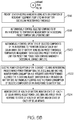
- FIGS. 5A and 5B are a flow chart of an example of a method 500 for autonomously controlling electric power consumption in accordance with another embodiment of the present disclosure.
- the method 500 is embodied in and performed by the controller 202 of the apparatus 102.
- electric power measurement data 214 of electric power 210 being generated by a solar array 206 of the apparatus 102 is monitored.
- the solar array 206 is configured to at least charge a battery 220 and provide electrical power 210 to components 211 of the apparatus 102.
- a state of charge 222 of the battery 220 is monitored.
- temperature measurement data 236 of the integrated payload array 226 is monitored.
- a task command 252 is received from mission operations 253.
- the task command 252 includes a bandwidth 254.
- the task command 252 includes a payload mission task 258.
- the payload mission task 258 includes a communications operation (COMM OP) 264 that is to be performed by the integrated payload array 226. Examples of information that the task command 252 contains include resource groups, radio frequency (RF) drive, element mode and filter mode, routing and task priorities.
- RF radio frequency
- payload communications traffic 256 of the integrated payload array 226 is controlled in response to the electric power measurement data 214 of the solar array 206, state of charge 222 of the battery 220, temperature measurement data 236 from the integrated payload array 226 and the configured bandwidth 254 of the task command 252.
- the task command 252 is accepted in response to the state of charge 222 of the battery 220 being proximate the preset threshold 602 ( FIG. 6A ) and a priority 260 of the payload mission task 258 being equal to or exceeding a chosen priority value 259.
- the task command 252 is rejected in response to the state of charge 222 of the battery 220 being below the preset threshold 602 and the priority 260 of the payload mission task 258 being below the chosen priority value 259.
- An alarm 262 is transmitted to mission operations 253 in response to the task command 252 being rejected or a mission plan 244 of the apparatus 102 not satisfying the balanced battery SOC 228 or the preset temperature operating limit 240 of the integrated payload array 226.
- the mission plan 244 includes a plurality of task commands 252 that cause electric power consumption 300 and elevated temperatures of the integrated payload array 226.
- one or more payload mission tasks 258 performed by the integrated payload array 226 are disabled to prevent complete payload shed or shutting down all payload operations.
- payload mission tasks 258 are disabled starting with a lowest priority 260 payload mission task 258 and progressing to disable higher priority 260 payload mission tasks 258 until the balanced battery SOC 228 is achieved that prevents complete payload shed or shutting down all payload operations.
- the SOC 222 of the battery 220 returns to proximate the preset threshold 602 or above the preset threshold 602 in FIG. 6A .
- a station-keeping maneuver that includes using thrusters such as thrusters 216, is prevented when the balanced battery SOC 228 is below a preset threshold 602 ( FIG. 6A ).
- operation of redundant equipment of the apparatus 102 is also prevented when the balanced battery SOC 228 is below the preset threshold 602.
- selected components 238 of the integrated payload array 226 are autonomously controlled by the controller 202 to reduce electric power consumption by the integrated payload array 226 in response to the temperature measurement data 236 exceeding the preset temperature operating limit 240. Examples of selected components 238 of the integrated payload array 226 that are either autonomously disabled or controlled to reduce the electric power consumption will be described with reference to FIG. 7 .
- operations of selected components 238 of the integrated payload array 226 are autonomously controlled in response to at least one of premature degradation of the solar array 206, the state of charge 222 of the battery 220 being below the preset threshold 602 ( FIG. 6A ), temperature measurement data 236 of the integrated payload array exceeding a preset temperature operating limit 240, and a task command bandwidth 254 exceeding an allowable limit 266.
- electric power consumption of the integrated payload array 226 is divided into a number of power consumption bins that each represent a predetermined power consumption level, for example, a Max power consumption bin, a Mid power consumption bin and a Min power consumption bin.
- the power consumption of the integrated payload array 226 is then monitored and integrated over a predetermined time period, for example, a 24 hour period. An amount of time the integrated payload array 226 spends at each power consumption bin over the 24 hour period is compared to the maximum allowable time in each power consumption bin. The amount of time in each power consumption bin is controlled in response to the state of charge 222 of the battery 220.
- the selected components 238 in the integrated payload array 226 are controlled to prevent the integrated payload array 226 from entering that power consumption bin for the remainder of the 24 hour period.
- a state of health of the battery 220 and a state of health of the solar arrays 206 are monitored. Electric power consumption by the integrated payload array 226 is controlled in response to at least one of the state of health of the battery 220 and the state of health of the solar arrays 206.
- monitoring the state of health of the battery 220 is determined by monitoring the state of charge 222 of the battery 220 and an amount of charge the battery 220 is able to hold. The amount of charge the battery 220 is able to hold will gradually decrease over time because the battery's ability to hold a charge is reduced with age and over multiple charging cycles.
- Monitoring the state of health of the solar arrays 206 is determined by monitoring the amount of electric power 210 generated by the solar arrays 206 which will decrease over time as the solar arrays 206 degrade and become less efficient.
- FIG. 6A is a graph 600 of an example of monitoring a state of charge (SOC) 222 of a battery 220 of an apparatus 102 in accordance with an embodiment of the present disclosure.
- the horizontal axis of FIG. 6A is time in days.
- the vertical axis of FIG. 6A is SOC 222 of the battery 220 in percentage of charge of the battery 220.
- FIG. 6B is a graph 604 of an example of monitoring electric power consumption 605 by the apparatus 102 in accordance with an embodiment of the present disclosure.
- the horizontal axis of FIG. 6B is time in days.
- the vertical axis of FIG. 6B is electric power consumption 605 in kilowatts (KW).
- FIG. 6C is a graph 606 of an example of monitoring electric power consumption 605 by a payload (PL) such as the integrated payload array 226 of the apparatus 102 in accordance with an embodiment of the present disclosure.
- the horizontal axis in FIG. 6C is time in days.
- the vertical axis in FIG. 6C is electric power consumption 605 by a payload, such as the integrated payload array 226, in watts (W).
- W watts
- the state of charge 222 of the battery 220 decreased during each eclipse 608a-608e and recharges when the solar arrays 206 of the apparatus 102 are receiving sunlight between eclipses except when there is electric power consumption by other components of the apparatus 102, such as the thrusters 216.
- the state of charge 222 of the battery 220 is further decreased after a thruster maneuver 610 in FIG. 6B after the eclipse 608b at time 0.2 days.
- the integrated payload array 226 power consumption is autonomously controlled by decreasing the electric power consumption by the integrated payload array 226.
- a reduction of power consumption by 10% compared to a payload nominal value 616 in FIG. 6B is used to prevent payload shedding or complete shutdown of the integrated payload array 226 .
- the electric power consumption 605 by the integrated payload array 226 is further decreased by 20% of the nominal value 616 during the eclipse 608d at time 0.6 days.
- the electric power consumption 605 of the integrated payload array 226 returns to the nominal value 616 when the state of charge 222 of the battery 220 exceeds the preset threshold 602 just before eclipse 608e in FIG. 6A .
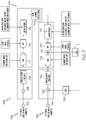
- FIG. 7 is a block schematic diagram of an example of the integrated payload array 226 in FIG. 2 including selected components 238 that are selectively controlled for autonomously controlling electric power consumption 605 in accordance with an embodiment of the present disclosure.
- electric power consumption 605 by the integrated payload array 226 is autonomously controlled by autonomously controlling electric power consumption 605 by selected components 238 of the integrated payload array 226.
- the integrated payload array 226 includes a receive (Rx) antenna array 702.
- the Rx antenna array 702 includes multiple antenna elements 704. Only a single antenna element 704 is shown in FIG. 7 for clarity.
- the receive antenna array 702 is operatively coupled to an analog front end 706 by a low noise amplifier (LNA) 708.
- LNA low noise amplifier
- the analog front end 706 is operatively connected to an analog-to-digital converter (ADC) 710.
- ADC analog-to-digital converter
- the ADC 710 operates according to one of three element modes: ON, Standby or OFF. Each of these element modes will consume a different amount of electric power. For example, the ON mode will consume the most electric power, the OFF mode will not consume any electric power and the standby mode will consume a much smaller amount of electric power compared to the ON mode. Electric power consumption by the ADC 710 is autonomously controllable by selecting one of three element modes.
- the ADC 710 is operatively connected to a transmit band pass filter (BPF) 712.
- BPF transmit band pass filter
- the transmit BPF 712 is selectively set in one of a plurality of channel modes, for example, a channel mode 1 or a channel mode 2, to autonomously control power consumption by the integrated payload array 226.
- the transmit BPF 712 is operatively connected to a receive (Rx) beam forming element 714.
- the electric power consumption by the Rx beam forming element 714 is autonomously controllable by alternatively selecting element modes ON or Standby.
- the electric power consumption by the Rx beam forming element 714 is also autonomously controllable by controlling the beam channel gain of the Rx beam forming element 714 and turning a resource group of the Rx beam forming element 714 on or off.
- the Rx beam forming element 714 is operatively connected to a beam channel processing element 716.
- the beam channel processing element 716 is operatively connected to a transmit (Tx) beam weight element 718.
- Electric power consumption by the Tx beam weight element 718 is controllable by adjusting the beam channel gain, turning on or off a resource group of the Tx beam weight element 718 and selecting an element mode ON or Standby.
- the Tx beam weight element 718 is operatively connected to a receive band pass filter (BPF) 720.
- Electric power consumption by the receive BPF 720 is controlled by selecting one of a plurality of channel modes, for example, a channel mode 1 or a channel mode 2 which respectively consume different amounts of electric power.
- the receive BPF 720 is operatively connected to an adjustable gain element 722.
- the adjustable gain element 722 is any controllable variable gain device, such as a potentiometer, etc. Electric power consumption by the adjustable gain element 722 is autonomously controlled by adjusting the gain of the element 722.
- the adjustable gain element 722 is operatively connected to a digital-to-analog converter (DAC) 724. Electric power consumption by the DAC 724 is controlled by selecting one of element modes ON, Standby or Off.
- DAC digital-to-analog converter
- the DAC 724 is operatively connected to an analog back end (ABE) 726 and the ABE 726 is operatively connected to a high power amplifier (HPA) 728. Electric power consumption by the HPA 728 is controlled by adjusting the output back off (OBO) 730 of the HPA 278.
- the HPA 728 is operatively connected to a transmit (Tx) array 732.
- the Tx array 732 includes a multiplicity of antenna elements 734. Only a single antenna element 734 is shown in FIG. 7 for clarity.
- each block in the flowchart or block diagrams may represent a module, segment, or portion of instructions, which comprises one or more executable instructions for implementing the specified logical function(s).
- the functions noted in the block may occur out of the order noted in the figures.
- two blocks shown in succession may, in fact, be executed substantially concurrently, or the blocks may sometimes be executed in the reverse order, depending upon the functionality involved.
Landscapes
- Engineering & Computer Science (AREA)
- Remote Sensing (AREA)
- Aviation & Aerospace Engineering (AREA)
- Power Engineering (AREA)
- Life Sciences & Earth Sciences (AREA)
- Sustainable Development (AREA)
- Charge And Discharge Circuits For Batteries Or The Like (AREA)
- Chemical & Material Sciences (AREA)
- Combustion & Propulsion (AREA)
- Radar, Positioning & Navigation (AREA)
Applications Claiming Priority (1)
| Application Number | Priority Date | Filing Date | Title |
|---|---|---|---|
| US16/228,000 US20200198811A1 (en) | 2018-12-20 | 2018-12-20 | Autonomous control of electric power consumption by an apparatus |
Publications (2)
| Publication Number | Publication Date |
|---|---|
| EP3672018A1 true EP3672018A1 (de) | 2020-06-24 |
| EP3672018B1 EP3672018B1 (de) | 2024-05-22 |
Family
ID=68342466
Family Applications (1)
| Application Number | Title | Priority Date | Filing Date |
|---|---|---|---|
| EP19202923.9A Active EP3672018B1 (de) | 2018-12-20 | 2019-10-14 | Autonome steuerung des elektrischen energieverbrauchs durch eine vorrichtung |
Country Status (2)
| Country | Link |
|---|---|
| US (1) | US20200198811A1 (de) |
| EP (1) | EP3672018B1 (de) |
Cited By (3)
| Publication number | Priority date | Publication date | Assignee | Title |
|---|---|---|---|---|
| US11396388B2 (en) | 2018-12-20 | 2022-07-26 | The Boeing Company | Optimized power balanced variable thrust transfer orbits to minimize an electric orbit raising duration |
| US11401053B2 (en) * | 2018-12-20 | 2022-08-02 | The Boeing Company | Autonomous control of electric power supplied to a thruster during electric orbit raising |
| US11753188B2 (en) | 2018-12-20 | 2023-09-12 | The Boeing Company | Optimized power balanced low thrust transfer orbits utilizing split thruster execution |
Families Citing this family (7)
| Publication number | Priority date | Publication date | Assignee | Title |
|---|---|---|---|---|
| US11254451B2 (en) * | 2019-05-14 | 2022-02-22 | Space Exploration Technologies Corp. | Pre-deployment battery power conservation for spacecraft |
| CN112018869B (zh) * | 2020-08-07 | 2021-12-28 | 航天行云科技有限公司 | 一种星箭分离自主上电电路 |
| US11381303B2 (en) * | 2020-11-11 | 2022-07-05 | Huawei Technologies Co., Ltd. | Task delegation in a satellite network |
| US12537593B2 (en) * | 2022-04-03 | 2026-01-27 | Henry D Voss | ThinSat constellations that are a group of satellites for carrying payloads for experimentation and data collection which are launched into and orbit through low earth orbit (LEO) and very low earth orbit (VLEO) conditions |
| US20240242172A1 (en) * | 2023-01-13 | 2024-07-18 | Accenture Global Solutions Limited | Robotic resource allocation |
| CN120353240B (zh) * | 2025-06-25 | 2025-09-19 | 厦门渊亭信息科技有限公司 | 无人机集群控制系统 |
| CN121124075B (zh) * | 2025-11-10 | 2026-03-31 | 上海海能信息科技股份有限公司 | 一种基于多维自感知的主动功耗调度方法及系统 |
Citations (1)
| Publication number | Priority date | Publication date | Assignee | Title |
|---|---|---|---|---|
| US20160251092A1 (en) * | 2015-02-26 | 2016-09-01 | Spire Global, Inc. | System and method for power distribution in a autonomous modular system |
Family Cites Families (11)
| Publication number | Priority date | Publication date | Assignee | Title |
|---|---|---|---|---|
| US6021979A (en) * | 1993-07-19 | 2000-02-08 | Hughes Electronics Corporation | Sun-referenced safe-hold control for momentum biased satellites |
| US6914411B2 (en) * | 2003-05-19 | 2005-07-05 | Ihs Imonitoring Inc. | Power supply and method for controlling it |
| US20080306700A1 (en) * | 2007-06-07 | 2008-12-11 | Ekla-Tek L.L.C | Photvoltaic solar array health monitor |
| US9346564B1 (en) * | 2013-02-05 | 2016-05-24 | The Boeing Company | System and method for manually safing and deorbiting a geostationary spacecraft in an absence of a spacecraft processor |
| TWI644194B (zh) * | 2013-08-06 | 2018-12-11 | 睿能創意公司 | 電能儲存裝置熱分布調節控制器、方法及其電動車系統 |
| US9742486B2 (en) * | 2014-11-05 | 2017-08-22 | Viasat, Inc. | High temperature operation of an airborne satellite terminal |
| BR112018004887A2 (en) * | 2015-09-13 | 2018-10-09 | Alpha Technologies Inc. | power control systems and methods. |
| US20170072812A1 (en) * | 2015-09-16 | 2017-03-16 | Qualcomm Incorporated | Battery Management Systems for Autonomous Vehicles |
| US10600295B2 (en) * | 2017-05-05 | 2020-03-24 | Tg-17, Inc. | System and method for threat monitoring, detection, and response |
| WO2019034908A1 (en) * | 2017-08-15 | 2019-02-21 | Saronikos Trading And Services, Unipessoal Lda | ASSEMBLY AND METHOD FOR SUPPLYING AN ELECTRIC AIRCRAFT AND / OR ELECTRIC AIRCRAFT EQUIPPED WITH SAID ASSEMBLY |
| US10800278B2 (en) * | 2018-06-07 | 2020-10-13 | Ford Global Technologies, Llc | Vehicle low-voltage energy system control |
-
2018
- 2018-12-20 US US16/228,000 patent/US20200198811A1/en active Pending
-
2019
- 2019-10-14 EP EP19202923.9A patent/EP3672018B1/de active Active
Patent Citations (1)
| Publication number | Priority date | Publication date | Assignee | Title |
|---|---|---|---|---|
| US20160251092A1 (en) * | 2015-02-26 | 2016-09-01 | Spire Global, Inc. | System and method for power distribution in a autonomous modular system |
Non-Patent Citations (1)
| Title |
|---|
| CHETTY P R K ET AL: "TOPEX ELECTRICAL POWER SYSTEM", AEROSPACE POWER SYSTEMS. BOSTON, AUG. 4 - 9, 1991; [PROCEEDINGS OF THE INTERSOCIETY ENERGY CONVERSION ENGINEERING CONFERENCE], NEW YORK, IEEE, US, vol. 1, 4 August 1991 (1991-08-04), pages 36 - 44, XP000280425, ISBN: 978-0-89448-163-5 * |
Cited By (3)
| Publication number | Priority date | Publication date | Assignee | Title |
|---|---|---|---|---|
| US11396388B2 (en) | 2018-12-20 | 2022-07-26 | The Boeing Company | Optimized power balanced variable thrust transfer orbits to minimize an electric orbit raising duration |
| US11401053B2 (en) * | 2018-12-20 | 2022-08-02 | The Boeing Company | Autonomous control of electric power supplied to a thruster during electric orbit raising |
| US11753188B2 (en) | 2018-12-20 | 2023-09-12 | The Boeing Company | Optimized power balanced low thrust transfer orbits utilizing split thruster execution |
Also Published As
| Publication number | Publication date |
|---|---|
| US20200198811A1 (en) | 2020-06-25 |
| EP3672018B1 (de) | 2024-05-22 |
Similar Documents
| Publication | Publication Date | Title |
|---|---|---|
| EP3672018B1 (de) | Autonome steuerung des elektrischen energieverbrauchs durch eine vorrichtung | |
| US7980514B2 (en) | Solar array momentum control | |
| US5394075A (en) | Spacecraft bus regulation using solar panel position | |
| US8152108B2 (en) | Solar array peak power extraction | |
| EP2621813B1 (de) | Satellitensystem und -verfahren für zirkumpolare breitengrade | |
| US20240158107A1 (en) | Multiport converters, multiple-input multiple-output converters, and power-down modes for satellite electric power systems | |
| US5285208A (en) | Power management system for a worldwide multiple satellite communications system | |
| EP3670359B1 (de) | Optimierte leistungsausgeglichene variable schubübertragungsorbits zur minimierung einer dauer des aufsteigens in den orbit | |
| CN114296371B (zh) | 一种支持在轨重构的多模式测控终端 | |
| US11401053B2 (en) | Autonomous control of electric power supplied to a thruster during electric orbit raising | |
| EA036787B1 (ru) | Спутниковая система и способ глобального покрытия | |
| Goh et al. | LEO satellite formation for SSP: energy and doppler analysis | |
| JP6541880B2 (ja) | 人工衛星および推力バランス調整方法 | |
| Scala et al. | The HERMES mission: A CubeSat constellation for multi-messenger astrophysics | |
| US12024316B1 (en) | System and method improving satellite capability through power sharing | |
| RU2430860C1 (ru) | Способ эксплуатации литий-ионной аккумуляторной батареи в составе космического аппарата негерметичного исполнения с радиационным охлаждением и космический аппарат для его реализации | |
| EP0416462A2 (de) | Leistungssteuersystem für ein weltweites, mit mehreren Satelliten ausgerüstetes Fernmeldesystem | |
| Watanabe et al. | Engineering Model Development of HIBARI: MicroSatellite for Technology Demonstration of Variable-Shape Attitude Control | |
| Vandenbussche | SOHO's recovery-An unprecedented success story | |
| Han | The Korea domestic communications and broadcasting satellite system | |
| Wu et al. | Tsinghua-1 Micro-satellite power system architecture and design | |
| US20250202573A1 (en) | System for satellite data traffic shaping | |
| Ruf et al. | LOLASAT–Nano-Satellite In-Orbit Demonstration For Very Low Latency Communication | |
| Neri et al. | The Brazilian scientific microsatellite SACI-1 | |
| Suryanti et al. | Preliminary Design Electronic Power System (EPS) Low Earth Orbit (LEO) Communication Microsatellite |
Legal Events
| Date | Code | Title | Description |
|---|---|---|---|
| PUAI | Public reference made under article 153(3) epc to a published international application that has entered the european phase |
Free format text: ORIGINAL CODE: 0009012 |
|
| STAA | Information on the status of an ep patent application or granted ep patent |
Free format text: STATUS: THE APPLICATION HAS BEEN PUBLISHED |
|
| AK | Designated contracting states |
Kind code of ref document: A1 Designated state(s): AL AT BE BG CH CY CZ DE DK EE ES FI FR GB GR HR HU IE IS IT LI LT LU LV MC MK MT NL NO PL PT RO RS SE SI SK SM TR |
|
| AX | Request for extension of the european patent |
Extension state: BA ME |
|
| STAA | Information on the status of an ep patent application or granted ep patent |
Free format text: STATUS: REQUEST FOR EXAMINATION WAS MADE |
|
| 17P | Request for examination filed |
Effective date: 20201209 |
|
| RBV | Designated contracting states (corrected) |
Designated state(s): AL AT BE BG CH CY CZ DE DK EE ES FI FR GB GR HR HU IE IS IT LI LT LU LV MC MK MT NL NO PL PT RO RS SE SI SK SM TR |
|
| RIN1 | Information on inventor provided before grant (corrected) |
Inventor name: HAHN, CARL J. III Inventor name: MANSOUR, SADEK W. |
|
| STAA | Information on the status of an ep patent application or granted ep patent |
Free format text: STATUS: EXAMINATION IS IN PROGRESS |
|
| 17Q | First examination report despatched |
Effective date: 20220429 |
|
| RAP3 | Party data changed (applicant data changed or rights of an application transferred) |
Owner name: THE BOEING COMPANY |
|
| REG | Reference to a national code |
Ref country code: DE Ipc: B64G0001420000 Ref legal event code: R079 Ref document number: 602019052522 Country of ref document: DE Free format text: PREVIOUS MAIN CLASS: H02J0007000000 |
|
| RIC1 | Information provided on ipc code assigned before grant |
Ipc: B64G 1/40 20060101ALN20230915BHEP Ipc: B64G 1/44 20060101ALI20230915BHEP Ipc: H02J 7/35 20060101ALI20230915BHEP Ipc: H02J 7/00 20060101ALI20230915BHEP Ipc: B64G 1/42 20060101AFI20230915BHEP |
|
| GRAP | Despatch of communication of intention to grant a patent |
Free format text: ORIGINAL CODE: EPIDOSNIGR1 |
|
| STAA | Information on the status of an ep patent application or granted ep patent |
Free format text: STATUS: GRANT OF PATENT IS INTENDED |
|
| RIC1 | Information provided on ipc code assigned before grant |
Ipc: B64G 1/40 20060101ALN20231012BHEP Ipc: B64G 1/44 20060101ALI20231012BHEP Ipc: H02J 7/35 20060101ALI20231012BHEP Ipc: H02J 7/00 20060101ALI20231012BHEP Ipc: B64G 1/42 20060101AFI20231012BHEP |
|
| GRAJ | Information related to disapproval of communication of intention to grant by the applicant or resumption of examination proceedings by the epo deleted |
Free format text: ORIGINAL CODE: EPIDOSDIGR1 |
|
| STAA | Information on the status of an ep patent application or granted ep patent |
Free format text: STATUS: EXAMINATION IS IN PROGRESS |
|
| INTG | Intention to grant announced |
Effective date: 20231109 |
|
| INTC | Intention to grant announced (deleted) | ||
| RIC1 | Information provided on ipc code assigned before grant |
Ipc: B64G 1/40 20060101ALN20231205BHEP Ipc: B64G 1/44 20060101ALI20231205BHEP Ipc: H02J 7/35 20060101ALI20231205BHEP Ipc: H02J 7/00 20060101ALI20231205BHEP Ipc: B64G 1/42 20060101AFI20231205BHEP |
|
| GRAP | Despatch of communication of intention to grant a patent |
Free format text: ORIGINAL CODE: EPIDOSNIGR1 |
|
| STAA | Information on the status of an ep patent application or granted ep patent |
Free format text: STATUS: GRANT OF PATENT IS INTENDED |
|
| INTG | Intention to grant announced |
Effective date: 20240116 |
|
| GRAS | Grant fee paid |
Free format text: ORIGINAL CODE: EPIDOSNIGR3 |
|
| GRAA | (expected) grant |
Free format text: ORIGINAL CODE: 0009210 |
|
| STAA | Information on the status of an ep patent application or granted ep patent |
Free format text: STATUS: THE PATENT HAS BEEN GRANTED |
|
| AK | Designated contracting states |
Kind code of ref document: B1 Designated state(s): AL AT BE BG CH CY CZ DE DK EE ES FI FR GB GR HR HU IE IS IT LI LT LU LV MC MK MT NL NO PL PT RO RS SE SI SK SM TR |
|
| P01 | Opt-out of the competence of the unified patent court (upc) registered |
Effective date: 20240416 |
|
| REG | Reference to a national code |
Ref country code: GB Ref legal event code: FG4D |
|
| REG | Reference to a national code |
Ref country code: CH Ref legal event code: EP |
|
| REG | Reference to a national code |
Ref country code: DE Ref legal event code: R096 Ref document number: 602019052522 Country of ref document: DE |
|
| REG | Reference to a national code |
Ref country code: IE Ref legal event code: FG4D |
|
| REG | Reference to a national code |
Ref country code: LT Ref legal event code: MG9D |
|
| REG | Reference to a national code |
Ref country code: NL Ref legal event code: MP Effective date: 20240522 |
|
| PG25 | Lapsed in a contracting state [announced via postgrant information from national office to epo] |
Ref country code: IS Free format text: LAPSE BECAUSE OF FAILURE TO SUBMIT A TRANSLATION OF THE DESCRIPTION OR TO PAY THE FEE WITHIN THE PRESCRIBED TIME-LIMIT Effective date: 20240922 |
|
| PG25 | Lapsed in a contracting state [announced via postgrant information from national office to epo] |
Ref country code: BG Free format text: LAPSE BECAUSE OF FAILURE TO SUBMIT A TRANSLATION OF THE DESCRIPTION OR TO PAY THE FEE WITHIN THE PRESCRIBED TIME-LIMIT Effective date: 20240522 |
|
| PG25 | Lapsed in a contracting state [announced via postgrant information from national office to epo] |
Ref country code: HR Free format text: LAPSE BECAUSE OF FAILURE TO SUBMIT A TRANSLATION OF THE DESCRIPTION OR TO PAY THE FEE WITHIN THE PRESCRIBED TIME-LIMIT Effective date: 20240522 Ref country code: FI Free format text: LAPSE BECAUSE OF FAILURE TO SUBMIT A TRANSLATION OF THE DESCRIPTION OR TO PAY THE FEE WITHIN THE PRESCRIBED TIME-LIMIT Effective date: 20240522 |
|
| PG25 | Lapsed in a contracting state [announced via postgrant information from national office to epo] |
Ref country code: GR Free format text: LAPSE BECAUSE OF FAILURE TO SUBMIT A TRANSLATION OF THE DESCRIPTION OR TO PAY THE FEE WITHIN THE PRESCRIBED TIME-LIMIT Effective date: 20240823 |
|
| PG25 | Lapsed in a contracting state [announced via postgrant information from national office to epo] |
Ref country code: PT Free format text: LAPSE BECAUSE OF FAILURE TO SUBMIT A TRANSLATION OF THE DESCRIPTION OR TO PAY THE FEE WITHIN THE PRESCRIBED TIME-LIMIT Effective date: 20240923 |
|
| REG | Reference to a national code |
Ref country code: AT Ref legal event code: MK05 Ref document number: 1688592 Country of ref document: AT Kind code of ref document: T Effective date: 20240522 |
|
| PG25 | Lapsed in a contracting state [announced via postgrant information from national office to epo] |
Ref country code: NL Free format text: LAPSE BECAUSE OF FAILURE TO SUBMIT A TRANSLATION OF THE DESCRIPTION OR TO PAY THE FEE WITHIN THE PRESCRIBED TIME-LIMIT Effective date: 20240522 |
|
| PG25 | Lapsed in a contracting state [announced via postgrant information from national office to epo] |
Ref country code: ES Free format text: LAPSE BECAUSE OF FAILURE TO SUBMIT A TRANSLATION OF THE DESCRIPTION OR TO PAY THE FEE WITHIN THE PRESCRIBED TIME-LIMIT Effective date: 20240522 |
|
| PG25 | Lapsed in a contracting state [announced via postgrant information from national office to epo] |
Ref country code: AT Free format text: LAPSE BECAUSE OF FAILURE TO SUBMIT A TRANSLATION OF THE DESCRIPTION OR TO PAY THE FEE WITHIN THE PRESCRIBED TIME-LIMIT Effective date: 20240522 |
|
| PG25 | Lapsed in a contracting state [announced via postgrant information from national office to epo] |
Ref country code: PL Free format text: LAPSE BECAUSE OF FAILURE TO SUBMIT A TRANSLATION OF THE DESCRIPTION OR TO PAY THE FEE WITHIN THE PRESCRIBED TIME-LIMIT Effective date: 20240522 |
|
| PG25 | Lapsed in a contracting state [announced via postgrant information from national office to epo] |
Ref country code: LV Free format text: LAPSE BECAUSE OF FAILURE TO SUBMIT A TRANSLATION OF THE DESCRIPTION OR TO PAY THE FEE WITHIN THE PRESCRIBED TIME-LIMIT Effective date: 20240522 |
|
| PG25 | Lapsed in a contracting state [announced via postgrant information from national office to epo] |
Ref country code: PT Free format text: LAPSE BECAUSE OF FAILURE TO SUBMIT A TRANSLATION OF THE DESCRIPTION OR TO PAY THE FEE WITHIN THE PRESCRIBED TIME-LIMIT Effective date: 20240923 Ref country code: PL Free format text: LAPSE BECAUSE OF FAILURE TO SUBMIT A TRANSLATION OF THE DESCRIPTION OR TO PAY THE FEE WITHIN THE PRESCRIBED TIME-LIMIT Effective date: 20240522 Ref country code: NO Free format text: LAPSE BECAUSE OF FAILURE TO SUBMIT A TRANSLATION OF THE DESCRIPTION OR TO PAY THE FEE WITHIN THE PRESCRIBED TIME-LIMIT Effective date: 20240822 Ref country code: NL Free format text: LAPSE BECAUSE OF FAILURE TO SUBMIT A TRANSLATION OF THE DESCRIPTION OR TO PAY THE FEE WITHIN THE PRESCRIBED TIME-LIMIT Effective date: 20240522 Ref country code: LV Free format text: LAPSE BECAUSE OF FAILURE TO SUBMIT A TRANSLATION OF THE DESCRIPTION OR TO PAY THE FEE WITHIN THE PRESCRIBED TIME-LIMIT Effective date: 20240522 Ref country code: IS Free format text: LAPSE BECAUSE OF FAILURE TO SUBMIT A TRANSLATION OF THE DESCRIPTION OR TO PAY THE FEE WITHIN THE PRESCRIBED TIME-LIMIT Effective date: 20240922 Ref country code: HR Free format text: LAPSE BECAUSE OF FAILURE TO SUBMIT A TRANSLATION OF THE DESCRIPTION OR TO PAY THE FEE WITHIN THE PRESCRIBED TIME-LIMIT Effective date: 20240522 Ref country code: GR Free format text: LAPSE BECAUSE OF FAILURE TO SUBMIT A TRANSLATION OF THE DESCRIPTION OR TO PAY THE FEE WITHIN THE PRESCRIBED TIME-LIMIT Effective date: 20240823 Ref country code: FI Free format text: LAPSE BECAUSE OF FAILURE TO SUBMIT A TRANSLATION OF THE DESCRIPTION OR TO PAY THE FEE WITHIN THE PRESCRIBED TIME-LIMIT Effective date: 20240522 Ref country code: ES Free format text: LAPSE BECAUSE OF FAILURE TO SUBMIT A TRANSLATION OF THE DESCRIPTION OR TO PAY THE FEE WITHIN THE PRESCRIBED TIME-LIMIT Effective date: 20240522 Ref country code: BG Free format text: LAPSE BECAUSE OF FAILURE TO SUBMIT A TRANSLATION OF THE DESCRIPTION OR TO PAY THE FEE WITHIN THE PRESCRIBED TIME-LIMIT Effective date: 20240522 Ref country code: AT Free format text: LAPSE BECAUSE OF FAILURE TO SUBMIT A TRANSLATION OF THE DESCRIPTION OR TO PAY THE FEE WITHIN THE PRESCRIBED TIME-LIMIT Effective date: 20240522 Ref country code: RS Free format text: LAPSE BECAUSE OF FAILURE TO SUBMIT A TRANSLATION OF THE DESCRIPTION OR TO PAY THE FEE WITHIN THE PRESCRIBED TIME-LIMIT Effective date: 20240822 |
|
| PG25 | Lapsed in a contracting state [announced via postgrant information from national office to epo] |
Ref country code: DK Free format text: LAPSE BECAUSE OF FAILURE TO SUBMIT A TRANSLATION OF THE DESCRIPTION OR TO PAY THE FEE WITHIN THE PRESCRIBED TIME-LIMIT Effective date: 20240522 |
|
| PG25 | Lapsed in a contracting state [announced via postgrant information from national office to epo] |
Ref country code: EE Free format text: LAPSE BECAUSE OF FAILURE TO SUBMIT A TRANSLATION OF THE DESCRIPTION OR TO PAY THE FEE WITHIN THE PRESCRIBED TIME-LIMIT Effective date: 20240522 |
|
| PG25 | Lapsed in a contracting state [announced via postgrant information from national office to epo] |
Ref country code: CZ Free format text: LAPSE BECAUSE OF FAILURE TO SUBMIT A TRANSLATION OF THE DESCRIPTION OR TO PAY THE FEE WITHIN THE PRESCRIBED TIME-LIMIT Effective date: 20240522 |
|
| PG25 | Lapsed in a contracting state [announced via postgrant information from national office to epo] |
Ref country code: SK Free format text: LAPSE BECAUSE OF FAILURE TO SUBMIT A TRANSLATION OF THE DESCRIPTION OR TO PAY THE FEE WITHIN THE PRESCRIBED TIME-LIMIT Effective date: 20240522 Ref country code: RO Free format text: LAPSE BECAUSE OF FAILURE TO SUBMIT A TRANSLATION OF THE DESCRIPTION OR TO PAY THE FEE WITHIN THE PRESCRIBED TIME-LIMIT Effective date: 20240522 |
|
| PG25 | Lapsed in a contracting state [announced via postgrant information from national office to epo] |
Ref country code: SM Free format text: LAPSE BECAUSE OF FAILURE TO SUBMIT A TRANSLATION OF THE DESCRIPTION OR TO PAY THE FEE WITHIN THE PRESCRIBED TIME-LIMIT Effective date: 20240522 |
|
| PG25 | Lapsed in a contracting state [announced via postgrant information from national office to epo] |
Ref country code: SM Free format text: LAPSE BECAUSE OF FAILURE TO SUBMIT A TRANSLATION OF THE DESCRIPTION OR TO PAY THE FEE WITHIN THE PRESCRIBED TIME-LIMIT Effective date: 20240522 Ref country code: SK Free format text: LAPSE BECAUSE OF FAILURE TO SUBMIT A TRANSLATION OF THE DESCRIPTION OR TO PAY THE FEE WITHIN THE PRESCRIBED TIME-LIMIT Effective date: 20240522 Ref country code: RO Free format text: LAPSE BECAUSE OF FAILURE TO SUBMIT A TRANSLATION OF THE DESCRIPTION OR TO PAY THE FEE WITHIN THE PRESCRIBED TIME-LIMIT Effective date: 20240522 Ref country code: EE Free format text: LAPSE BECAUSE OF FAILURE TO SUBMIT A TRANSLATION OF THE DESCRIPTION OR TO PAY THE FEE WITHIN THE PRESCRIBED TIME-LIMIT Effective date: 20240522 Ref country code: DK Free format text: LAPSE BECAUSE OF FAILURE TO SUBMIT A TRANSLATION OF THE DESCRIPTION OR TO PAY THE FEE WITHIN THE PRESCRIBED TIME-LIMIT Effective date: 20240522 Ref country code: CZ Free format text: LAPSE BECAUSE OF FAILURE TO SUBMIT A TRANSLATION OF THE DESCRIPTION OR TO PAY THE FEE WITHIN THE PRESCRIBED TIME-LIMIT Effective date: 20240522 |
|
| PG25 | Lapsed in a contracting state [announced via postgrant information from national office to epo] |
Ref country code: IT Free format text: LAPSE BECAUSE OF FAILURE TO SUBMIT A TRANSLATION OF THE DESCRIPTION OR TO PAY THE FEE WITHIN THE PRESCRIBED TIME-LIMIT Effective date: 20240522 |
|
| REG | Reference to a national code |
Ref country code: DE Ref legal event code: R097 Ref document number: 602019052522 Country of ref document: DE |
|
| PLBE | No opposition filed within time limit |
Free format text: ORIGINAL CODE: 0009261 |
|
| STAA | Information on the status of an ep patent application or granted ep patent |
Free format text: STATUS: NO OPPOSITION FILED WITHIN TIME LIMIT |
|
| PG25 | Lapsed in a contracting state [announced via postgrant information from national office to epo] |
Ref country code: SI Free format text: LAPSE BECAUSE OF FAILURE TO SUBMIT A TRANSLATION OF THE DESCRIPTION OR TO PAY THE FEE WITHIN THE PRESCRIBED TIME-LIMIT Effective date: 20240522 |
|
| 26N | No opposition filed |
Effective date: 20250225 |
|
| REG | Reference to a national code |
Ref country code: CH Ref legal event code: PL |
|
| PG25 | Lapsed in a contracting state [announced via postgrant information from national office to epo] |
Ref country code: MC Free format text: LAPSE BECAUSE OF FAILURE TO SUBMIT A TRANSLATION OF THE DESCRIPTION OR TO PAY THE FEE WITHIN THE PRESCRIBED TIME-LIMIT Effective date: 20240522 |
|
| PG25 | Lapsed in a contracting state [announced via postgrant information from national office to epo] |
Ref country code: BE Free format text: LAPSE BECAUSE OF NON-PAYMENT OF DUE FEES Effective date: 20241031 Ref country code: LU Free format text: LAPSE BECAUSE OF NON-PAYMENT OF DUE FEES Effective date: 20241014 |
|
| PG25 | Lapsed in a contracting state [announced via postgrant information from national office to epo] |
Ref country code: CH Free format text: LAPSE BECAUSE OF NON-PAYMENT OF DUE FEES Effective date: 20241031 |
|
| REG | Reference to a national code |
Ref country code: BE Ref legal event code: MM Effective date: 20241031 |
|
| PG25 | Lapsed in a contracting state [announced via postgrant information from national office to epo] |
Ref country code: SE Free format text: LAPSE BECAUSE OF FAILURE TO SUBMIT A TRANSLATION OF THE DESCRIPTION OR TO PAY THE FEE WITHIN THE PRESCRIBED TIME-LIMIT Effective date: 20240522 |
|
| PG25 | Lapsed in a contracting state [announced via postgrant information from national office to epo] |
Ref country code: IE Free format text: LAPSE BECAUSE OF NON-PAYMENT OF DUE FEES Effective date: 20241014 |
|
| PGFP | Annual fee paid to national office [announced via postgrant information from national office to epo] |
Ref country code: DE Payment date: 20251029 Year of fee payment: 7 |
|
| PGFP | Annual fee paid to national office [announced via postgrant information from national office to epo] |
Ref country code: GB Payment date: 20251027 Year of fee payment: 7 |
|
| PGFP | Annual fee paid to national office [announced via postgrant information from national office to epo] |
Ref country code: FR Payment date: 20251027 Year of fee payment: 7 |
|
| PG25 | Lapsed in a contracting state [announced via postgrant information from national office to epo] |
Ref country code: CY Free format text: LAPSE BECAUSE OF FAILURE TO SUBMIT A TRANSLATION OF THE DESCRIPTION OR TO PAY THE FEE WITHIN THE PRESCRIBED TIME-LIMIT; INVALID AB INITIO Effective date: 20191014 |
|
| PG25 | Lapsed in a contracting state [announced via postgrant information from national office to epo] |
Ref country code: HU Free format text: LAPSE BECAUSE OF FAILURE TO SUBMIT A TRANSLATION OF THE DESCRIPTION OR TO PAY THE FEE WITHIN THE PRESCRIBED TIME-LIMIT; INVALID AB INITIO Effective date: 20191014 |