EP3671491A1 - Computerimplementiertes verfahren zum schätzen der massenverteilung eines physikalischen produkts - Google Patents
Computerimplementiertes verfahren zum schätzen der massenverteilung eines physikalischen produkts Download PDFInfo
- Publication number
- EP3671491A1 EP3671491A1 EP18306796.6A EP18306796A EP3671491A1 EP 3671491 A1 EP3671491 A1 EP 3671491A1 EP 18306796 A EP18306796 A EP 18306796A EP 3671491 A1 EP3671491 A1 EP 3671491A1
- Authority
- EP
- European Patent Office
- Prior art keywords
- product
- computer
- data
- slice
- mass
- Prior art date
- Legal status (The legal status is an assumption and is not a legal conclusion. Google has not performed a legal analysis and makes no representation as to the accuracy of the status listed.)
- Pending
Links
Images


Classifications
-
- G—PHYSICS
- G06—COMPUTING OR CALCULATING; COUNTING
- G06F—ELECTRIC DIGITAL DATA PROCESSING
- G06F30/00—Computer-aided design [CAD]
-
- G—PHYSICS
- G06—COMPUTING OR CALCULATING; COUNTING
- G06F—ELECTRIC DIGITAL DATA PROCESSING
- G06F16/00—Information retrieval; Database structures therefor; File system structures therefor
- G06F16/20—Information retrieval; Database structures therefor; File system structures therefor of structured data, e.g. relational data
- G06F16/22—Indexing; Data structures therefor; Storage structures
- G06F16/2228—Indexing structures
-
- G—PHYSICS
- G06—COMPUTING OR CALCULATING; COUNTING
- G06F—ELECTRIC DIGITAL DATA PROCESSING
- G06F30/00—Computer-aided design [CAD]
- G06F30/20—Design optimisation, verification or simulation
-
- G—PHYSICS
- G06—COMPUTING OR CALCULATING; COUNTING
- G06F—ELECTRIC DIGITAL DATA PROCESSING
- G06F2111/00—Details relating to CAD techniques
- G06F2111/04—Constraint-based CAD
-
- G—PHYSICS
- G06—COMPUTING OR CALCULATING; COUNTING
- G06F—ELECTRIC DIGITAL DATA PROCESSING
- G06F30/00—Computer-aided design [CAD]
- G06F30/10—Geometric CAD
- G06F30/15—Vehicle, aircraft or watercraft design
Definitions
- the invention pertains to the field of Computer Aided Engineering (CAE) and, more precisely, of Computer Aided Design (CAD). It relates to a computer-implemented method of estimating the mass distribution of a physical product constituted by a plurality of product parts, such as a ship or boat, an aircraft, a terrestrial vehicle, a building, a machine tool or the like.
- CAE Computer Aided Engineering
- CAD Computer Aided Design
- the mass distribution may be required to peak near the axles and be minimal between them.
- Aircraft makers are interested in the distribution of mass - and therefore inertia - along the wings.
- a very rough approximation of the mass distribution of a ship may be obtained by a simple geometrical modelling of the ship - e.g. a rectangle flanked by two trapezoids.
- the invention aims at overcoming these drawbacks of the prior art. More precisely, it aims at providing a computer-implemented method of estimating a mass distribution of a physical product constituted by a large number of parts which is more accurate than the prior art, while keeping its computational complexity at an acceptable level ("scalability"). Subsidiarily, the invention also aims at dealing with incomplete information on some or all the product parts (for instance, the geometry of parts supplied by third parties may be insufficiently defined), at quantifying a tolerance of the estimated mass and mass distribution and/or at facilitating cooperative design.
- a data structure comprising, for each product part of a detailed digital mock-up of the product, data representing the position and orientation of the part within the product, the mass of the part and, for at least some product parts, the part geometry in voxel format, and preferably in n-tree (usually, octree) voxel format.
- index a data structure
- voxel format for modelling the part geometry is important as it allows a simple and fast computation of an overlap rate of each product part with every one of a plurality of slices into which the product is notionally cut. This, in turn, allows allocating to each slice the correct share of each part's mass.
- An object of the present invention is therefore a computer-implemented method of estimating a mass distribution of a physical product comprising a plurality of product parts, the method comprising the steps of:
- the method may further comprise a step of:
- Another object of the invention is a computer program product, stored on a non-transitory computer-readable data-storage medium, comprising computer-executable instructions to cause a computer system to carry out such a method.
- Another object of the invention is a non-transitory computer-readable data-storage medium containing computer-executable instructions to cause a computer system to carry out such a method.
- Another object of the invention is a Computer Aided Design system comprising a processor coupled to a non-transitory memory and a graphical user interface, the non-transitory memory storing computer-executable instructions to cause the Computer Aided Design system to carry out such a method.
- mass and “weight” will be considered synonyms. Indeed, “weight distribution” is the expression commonly used in industry but, from a physical point of view, “mass distribution” would be more exact.
- the invention relies on two software infrastructures that cohabit, and which will be called “build” and the "run”.
- both infrastructures are stored on and executed by dedicated hardware, different from the computers used by a team of designers for designing the physical products whose mass distribution is to be estimated. This ensures that the mass distribution estimation does not slow down the design process.
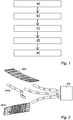
- the first step of the inventive method - block "a)" of the flow-chart of figure 1 - is carried out by the "build" infrastructure. It consists in creating a data structure, or "cache” that indexes product part data which may come from different sources (files stored on different computers of a network, possibly in different formats). This step is illustrated schematically on figure 2 , where data pertaining to product parts PP1, PP2 and PP3 are gathered and indexed in data structure DS.
- the indexed data represent, for each product part, its position and orientation within the product (i.e. in a reference frame affixed to the product), as well as its mass (or, equivalently, weight).
- the data also represent a tolerance or incertitude of the mass value of at least some parts.
- data representing the shape ("geometry") of the part are also provided.
- part geometry data are provided in a tessellated format, i.e. a solid part is represented by a three-dimensional surface formed by polygons, often triangles.
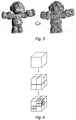
- Figure 3 represents the transformation of a tessellated geometry (left) into a voxel-based one (right).
- a cube is defined, which encompasses the product part geometry to be represented (upper part of the figure).
- This cube is then split into eight octants (smaller cubes), arranged in a 2x2x2 three-dimensional array (middle part of the figure); more generally, in an arbitrary n-tree representation, the volume is split into 2 n smaller volumes.
- the cubes which contain part of the geometry are split again (lower part of the figure), those which do not contain part of the geometry are not split.
- the process is carried out recursively, over a predetermined number of recursion (e.g. 7).
- the cubes form an approximated representation of the product part, having a significantly smaller memory occupation than one based on uniform voxels.
- the representation is conveniently stored in a tree-based data structure.
- the use of the efficient n-tree representation is important to ensure the "scalability" of the inventive method (i.e. its aptitude to deal with a large number of parts) and to keep the computational burden acceptable.
- the data structure contains data identifying a subset of the product to which said product part belongs and data representing the geometry of said subset of the product in (n-tree) voxel format.
- the geometry of a turbine blade in an airplane engine may be unknown, but it is known that the blade belongs to a turbine, having a known geometry (which is also represented in voxel format).
- the mass of these parts is considered to be uniformly spread within the corresponding subset of the product.
- the product parts whose geometry is unknown are considered as point mass - i.e. the mass is considered to be concentrated in a single point, identified by the positional data.
- Figure 5 is a symbolic representation of the data structure DS representing a physical product PR (e.g. an aircraft) comprising three parts PP1, PP2, PP3. Each part is associated to a record of the data structure, comprising an identifier (PP1_Id, PP2_Id, PP3_Id), position/orientation data (PP1_PO, PP2_PO, PP3_PO), a mass/weight value (PP1_m, PP2_m, PP3_m) and a voxel-based geometry (PP1_g, PP2_g, PP3_g).
- the record may also comprise a tolerance value (not represented on the figure).
- the data structure is created incrementally during a design process, by updating it at periodic intervals.
- a mass distribution computation of the partially or wholly designed product may be carried out by launching the "run" infrastructure. Due to the incremental building of the data structure DS, a first mass distribution computation can be performed at the very beginning of a design project, at a moment where the definition of the project is still not mature. This enables the program manager to take the right decision from the very beginning, thus not affecting much the cost of the program. Moreover, additional computations may be performed regularly during the advancement of the project, to ensure that design constraints are respected and to detect "wrong tracks" as early as possible.
- a user may launch the "run” infrastructure by performing a predetermined action on a user interface ("front-end"), e.g. by clicking on an icon.
- front-end e.g. by clicking on an icon.
- the overall statistical tolerance of the mass distribution is also computed during step d), based on the tolerance values stored, for each part, in the data structure and on the tolerance of the voxel representation in comparison to a tessellated representation.
- the overall tolerance on the mass value of a slice is the square root of the sum of the square of the tolerances on the mass values of each element.
- the tolerance value of an element depends on the one hand on its "intrinsic" tolerance, stored in the data structure, and on the other and on the number of "edge” voxels (to account for the "quantization error" on the volume introduced by the voxelization of the geometry).
- a smoothing and interpolation step e) may then lead to the final estimation of the linear mass distribution ⁇ (x). This is represented on figure 8 .
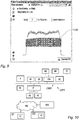
- Figure 9 is a screenshot showing a graphical representation of the linear mass distribution of a physical product according to an axis.
- the gray zone surrounding curve ⁇ corresponds to the computed tolerance.
- the inventive method can be performed by a suitably-programmed general-purpose computer or computer system, possibly including a computer network, storing a suitable program in non-volatile form on a computer-readable medium such as a hard disk, a solid state disk or a CD-ROM and executing said program using its microprocessor(s) and memory.
- a suitably-programmed general-purpose computer or computer system possibly including a computer network, storing a suitable program in non-volatile form on a computer-readable medium such as a hard disk, a solid state disk or a CD-ROM and executing said program using its microprocessor(s) and memory.
- the computer CPT includes a Central Processing Unit (CPU) P which performs the method step described above while running an executable program, i.e. a set of computer-readable instructions, stored in a memory device such as RAM M1 or ROM M2 or hard disk drive (HDD) M3, DVD/CD drive M4, or stored remotely.
- an executable program i.e. a set of computer-readable instructions
- a memory device such as RAM M1 or ROM M2 or hard disk drive (HDD) M3, DVD/CD drive M4
- the data structure DS created in step a) of the inventive method may also be stored on one or more of memory devices M1 to M4, or remotely.
- the claimed invention is not limited by the form of the computer-readable media on which the computer-readable instructions and/or the data structure of the inventive process are stored.
- the instructions and files can be stored on CDs, DVDs, in FLASH memory, RAM, ROM, PROM, EPROM, EEPROM, hard disk or any other information processing device with which the computer communicates, such as a server or computer.
- the program and the files can be stored on a same memory device or on different memory devices.
- a computer program suitable for carrying out the inventive method can be provided as a utility application, background daemon, or component of an operating system, or combination thereof, executing in conjunction with CPU P and an operating system such as Microsoft VISTA, Microsoft Windows 10, UNIX, Solaris, LINUX, Apple MAC-OS and other systems known to those skilled in the art.
- an operating system such as Microsoft VISTA, Microsoft Windows 10, UNIX, Solaris, LINUX, Apple MAC-OS and other systems known to those skilled in the art.
- CPU P can be a Xenon processor from Intel of America or an Opteron processor from AMD of America, or can be other processor types, such as a Freescale ColdFire, IMX, or ARM processor from Freescale Corporation of America.
- the CPU can be a processor such as a Core2 Duo from Intel Corporation of America, or can be implemented on an FPGA, ASIC, PLD or using discrete logic circuits, as one of ordinary skill in the art would recognize.
- the CPU can be implemented as multiple processors cooperatively working to perform the computer-readable instructions of the inventive processes described above.
- the computer CPT in figure 10 also includes a network interface NI, such as an Intel Ethernet PRO network interface card from Intel Corporation of America, for interfacing with a network, such as a local area network (LAN), wide area network (WAN), the Internet and the like.
- the computer further includes a display controller DC, such as a NVIDIA GeForce GTX graphics adaptor from NVIDIA Corporation of America for interfacing with display DY, such as a Hewlett Packard HPL2445w LCD monitor.
- a general purpose I/O interface IF interfaces with a keyboard KB and pointing device PD, such as a roller ball, mouse, touchpad and the like.
- the display, the keyboard and the pointing device, together with the display controller and the I/O interfaces form a graphical user interface, used by the user to provide input commands and by the computer for displaying the mass distribution, as illustrated on figure 9 .
- Disk controller DKC connects HDD M3 and DVD/CD M4 with communication bus CBS, which can be an ISA, EISA, VESA, PCI, or similar, for interconnecting all of the components of the computer.
- CBS can be an ISA, EISA, VESA, PCI, or similar, for interconnecting all of the components of the computer.
- Network interface NI connects computer CPT to a system administrator ADS and to one or more other computers CP1, CP2, ... through a network NW.
- Computer systems CP1, CP2 store files of different formats - F1, F2 - containing data describing product parts. These data are gathered by computer CPT in order to create the data structure used for computing the mass distribution, as discussed above. This way, users of computers CP1, CP2 may continue working - e.g. perfecting the product design - while the mass distribution computation is performed by computer CPT.
- computer CPT is replaced by a server and an end user computer.
- the overall architecture of the server may be the same as discussed above with reference to computer CPT, except that display controller, display, keyboard and/or pointing device may be missing in the server.
- the end user computer runs the front-end section of the "run” infrastructure, including the user interface; the server runs the "build” infrastructure and the back-end section of the "run” infrastructure.
- An action of the user on the user interface launches a query - e.g. a REST query - to a webservice provided by the server (e.g. an Apache server) which executes the mass distribution estimation algorithm.
- the overall architecture of the end user computer may also be the same as discussed above with reference to computer CPT, except that the memory devices of the end user computer do not store the executable program EXP and/or the data structure. However, the end user computer does store a client program designed for cooperating with the executable program of the server. In this embodiment, the mass distribution computation is performed by server SC, while end user computer EUC allows the user to interact with the server.
- Network NW can be a public network, such as the Internet, or a private network such as an LAN or WAN network, or any combination thereof and can also include PSTN or ISDN sub-networks.
- the network NW can also be wired, such as an Ethernet network, or can be wireless such as a cellular network including EDGE, 3G and 4G wireless cellular systems.
- the wireless network can also be Wi-Fi, Bluetooth, or any other wireless form of communication that is known.
- the network NW is merely exemplary and in no way limits the scope of the present advancements.
Landscapes
- Engineering & Computer Science (AREA)
- Physics & Mathematics (AREA)
- Theoretical Computer Science (AREA)
- General Physics & Mathematics (AREA)
- Geometry (AREA)
- General Engineering & Computer Science (AREA)
- Computer Hardware Design (AREA)
- Evolutionary Computation (AREA)
- Software Systems (AREA)
- Databases & Information Systems (AREA)
- Data Mining & Analysis (AREA)
- Automation & Control Theory (AREA)
- Aviation & Aerospace Engineering (AREA)
- Computational Mathematics (AREA)
- Mathematical Analysis (AREA)
- Mathematical Optimization (AREA)
- Pure & Applied Mathematics (AREA)
- Management, Administration, Business Operations System, And Electronic Commerce (AREA)
- Architecture (AREA)
Priority Applications (4)
| Application Number | Priority Date | Filing Date | Title |
|---|---|---|---|
| EP18306796.6A EP3671491A1 (de) | 2018-12-21 | 2018-12-21 | Computerimplementiertes verfahren zum schätzen der massenverteilung eines physikalischen produkts |
| US16/689,999 US20200201947A1 (en) | 2018-12-21 | 2019-11-20 | Computer-Implemented Method Of Estimating A Mass Distribution Of A Physical Product |
| JP2019229608A JP7427440B2 (ja) | 2018-12-21 | 2019-12-19 | 物理製品の質量分布を推定するコンピューターに実装される方法 |
| CN201911322848.5A CN111353210A (zh) | 2018-12-21 | 2019-12-20 | 估计物理产品质量分布的计算机实现方法 |
Applications Claiming Priority (1)
| Application Number | Priority Date | Filing Date | Title |
|---|---|---|---|
| EP18306796.6A EP3671491A1 (de) | 2018-12-21 | 2018-12-21 | Computerimplementiertes verfahren zum schätzen der massenverteilung eines physikalischen produkts |
Publications (1)
| Publication Number | Publication Date |
|---|---|
| EP3671491A1 true EP3671491A1 (de) | 2020-06-24 |
Family
ID=65236822
Family Applications (1)
| Application Number | Title | Priority Date | Filing Date |
|---|---|---|---|
| EP18306796.6A Pending EP3671491A1 (de) | 2018-12-21 | 2018-12-21 | Computerimplementiertes verfahren zum schätzen der massenverteilung eines physikalischen produkts |
Country Status (4)
| Country | Link |
|---|---|
| US (1) | US20200201947A1 (de) |
| EP (1) | EP3671491A1 (de) |
| JP (1) | JP7427440B2 (de) |
| CN (1) | CN111353210A (de) |
Citations (2)
| Publication number | Priority date | Publication date | Assignee | Title |
|---|---|---|---|---|
| US20040195439A1 (en) * | 2002-07-12 | 2004-10-07 | Masaki Hamamoto | Rising and moving apparatus and manufacturing method thereof |
| US20070282571A1 (en) * | 2006-05-30 | 2007-12-06 | The Boeing Company | Finite element modeling method utilizing mass distribution |
Family Cites Families (3)
| Publication number | Priority date | Publication date | Assignee | Title |
|---|---|---|---|---|
| CN107918698B (zh) * | 2017-10-27 | 2024-11-05 | 中航通飞华南飞机工业有限公司 | 一种水陆两栖飞机机身蒙皮质量分布计算方法 |
| CN108959695B (zh) * | 2018-05-18 | 2022-11-11 | 中国舰船研究设计中心 | 基于三维模型的船舶管路系统重量分布统计方法 |
| CN108763691A (zh) * | 2018-05-18 | 2018-11-06 | 中国舰船研究设计中心 | 基于三维模型的船体结构重量统计方法 |
-
2018
- 2018-12-21 EP EP18306796.6A patent/EP3671491A1/de active Pending
-
2019
- 2019-11-20 US US16/689,999 patent/US20200201947A1/en active Pending
- 2019-12-19 JP JP2019229608A patent/JP7427440B2/ja active Active
- 2019-12-20 CN CN201911322848.5A patent/CN111353210A/zh active Pending
Patent Citations (2)
| Publication number | Priority date | Publication date | Assignee | Title |
|---|---|---|---|---|
| US20040195439A1 (en) * | 2002-07-12 | 2004-10-07 | Masaki Hamamoto | Rising and moving apparatus and manufacturing method thereof |
| US20070282571A1 (en) * | 2006-05-30 | 2007-12-06 | The Boeing Company | Finite element modeling method utilizing mass distribution |
Non-Patent Citations (2)
| Title |
|---|
| DAVID LAURENCE HANSCH ET AL: "Methods of Determining the Longitudinal Weight Distribution of a Ship Hampton Roads Section of the Society of Naval Architects and Marine Engineers Hampton Roads Chapter of the Society of Allied Weight Engineers", 24 January 2008 (2008-01-24), pages 1 - 24, XP055598052, Retrieved from the Internet <URL:https://www.sawe.org/files/Methods%20of%20Longitudinal%20Weight%20Distribution.pdf> [retrieved on 20190619] * |
| DAVID LAURENCE HANSCH: "67th Annual conference of the International Society of Allied Weight Engineers", 2008, SOCIETY OF ALLIED WEIGHT ENGINEERS INC., article "Methods of determining the longitudinal weight distribution of a ship" |
Also Published As
| Publication number | Publication date |
|---|---|
| CN111353210A (zh) | 2020-06-30 |
| JP2020102217A (ja) | 2020-07-02 |
| US20200201947A1 (en) | 2020-06-25 |
| JP7427440B2 (ja) | 2024-02-05 |
Similar Documents
| Publication | Publication Date | Title |
|---|---|---|
| US10529126B2 (en) | Generating slice data from a voxel representation | |
| CN107767457B (zh) | 一种基于点云快速重建的stl数模生成方法 | |
| CN104699606B (zh) | 一种基于隐马尔科夫模型的软件系统状态预测方法 | |
| CN111539149B (zh) | 舰船模型建立及模态分析方法 | |
| EP3486812B1 (de) | Automatische montagepassungserstellung für häufig verwendete komponenten | |
| US10926475B2 (en) | Method, system and program product for optimizing mechanical design for additive manufacturing | |
| US20180052433A1 (en) | Systems and methods for generating slice files from native cad geometries | |
| CN115564925B (zh) | 基于B-rep模型和笛卡尔网格切片的网格生成方法 | |
| Brujic et al. | CAD based shape optimization for gas turbine component design | |
| Canann et al. | Automatic 3D surface meshing to address today's industrial needs | |
| CN117975031B (zh) | 特征线提取方法、装置、电子设备及计算机可读存储介质 | |
| WO2018053637A1 (en) | Geometric modelling for facilitating simulation for manufacturing operations | |
| CN118673790A (zh) | 航空发动机气动载荷谱建模及仿真方法 | |
| EP3671491A1 (de) | Computerimplementiertes verfahren zum schätzen der massenverteilung eines physikalischen produkts | |
| EP4275177B1 (de) | Systeme und verfahren zur simulation von strömungsinduzierten multiskalenphänomenen | |
| CN115841343A (zh) | 一种销售额度的确定方法及装置 | |
| Betts | Calculating target inventory levels for constrained production: A fast simulation-based approximation | |
| Strönisch et al. | Prediction of Steady and Unsteady Flow Quantities Using Multiscale Graph Neural Networks | |
| CN115828398B (zh) | 碎线数据处理方法、装置、设备及存储介质 | |
| CN117763931A (zh) | 一种复杂几何模型粒子离散方法、系统及电子设备 | |
| Pons | Aeroelastic flutter as a multiparameter eigenvalue problem | |
| CN110377959B (zh) | 确定飞机加筋平板对应的有限元及稳定性校核方法和装置 | |
| US10831937B2 (en) | Formation of a simplified model | |
| EP3822920B1 (de) | Verfahren zur lokalisierung eines digital modellierten objekts mit bezug auf einen digital modellierten raum und zur durchführung volumetrischer abfragen | |
| Tognaccini et al. | Multi-fidelity Surrogate Assisted Design Optimisation of an Airfoil under Uncertainty Using Far-Field Drag Approximation |
Legal Events
| Date | Code | Title | Description |
|---|---|---|---|
| PUAI | Public reference made under article 153(3) epc to a published international application that has entered the european phase |
Free format text: ORIGINAL CODE: 0009012 |
|
| STAA | Information on the status of an ep patent application or granted ep patent |
Free format text: STATUS: THE APPLICATION HAS BEEN PUBLISHED |
|
| AK | Designated contracting states |
Kind code of ref document: A1 Designated state(s): AL AT BE BG CH CY CZ DE DK EE ES FI FR GB GR HR HU IE IS IT LI LT LU LV MC MK MT NL NO PL PT RO RS SE SI SK SM TR |
|
| AX | Request for extension of the european patent |
Extension state: BA ME |
|
| STAA | Information on the status of an ep patent application or granted ep patent |
Free format text: STATUS: REQUEST FOR EXAMINATION WAS MADE |
|
| 17P | Request for examination filed |
Effective date: 20201201 |
|
| RBV | Designated contracting states (corrected) |
Designated state(s): AL AT BE BG CH CY CZ DE DK EE ES FI FR GB GR HR HU IE IS IT LI LT LU LV MC MK MT NL NO PL PT RO RS SE SI SK SM TR |
|
| STAA | Information on the status of an ep patent application or granted ep patent |
Free format text: STATUS: EXAMINATION IS IN PROGRESS |
|
| 17Q | First examination report despatched |
Effective date: 20220114 |