EP3668878B1 - Verbindungen zur hemmung des mcl-1-proteins - Google Patents
Verbindungen zur hemmung des mcl-1-proteins Download PDFInfo
- Publication number
- EP3668878B1 EP3668878B1 EP18769537.4A EP18769537A EP3668878B1 EP 3668878 B1 EP3668878 B1 EP 3668878B1 EP 18769537 A EP18769537 A EP 18769537A EP 3668878 B1 EP3668878 B1 EP 3668878B1
- Authority
- EP
- European Patent Office
- Prior art keywords
- alkyl
- oxa
- compound
- chloro
- dimethyl
- Prior art date
- Legal status (The legal status is an assumption and is not a legal conclusion. Google has not performed a legal analysis and makes no representation as to the accuracy of the status listed.)
- Active
Links
Classifications
-
- C—CHEMISTRY; METALLURGY
- C07—ORGANIC CHEMISTRY
- C07D—HETEROCYCLIC COMPOUNDS
- C07D498/00—Heterocyclic compounds containing in the condensed system at least one hetero ring having nitrogen and oxygen atoms as the only ring hetero atoms
- C07D498/02—Heterocyclic compounds containing in the condensed system at least one hetero ring having nitrogen and oxygen atoms as the only ring hetero atoms in which the condensed system contains two hetero rings
- C07D498/08—Bridged systems
-
- A—HUMAN NECESSITIES
- A61—MEDICAL OR VETERINARY SCIENCE; HYGIENE
- A61K—PREPARATIONS FOR MEDICAL, DENTAL OR TOILETRY PURPOSES
- A61K31/00—Medicinal preparations containing organic active ingredients
- A61K31/33—Heterocyclic compounds
- A61K31/395—Heterocyclic compounds having nitrogen as a ring hetero atom, e.g. guanethidine or rifamycins
- A61K31/55—Heterocyclic compounds having nitrogen as a ring hetero atom, e.g. guanethidine or rifamycins having seven-membered rings, e.g. azelastine, pentylenetetrazole
- A61K31/553—Heterocyclic compounds having nitrogen as a ring hetero atom, e.g. guanethidine or rifamycins having seven-membered rings, e.g. azelastine, pentylenetetrazole having at least one nitrogen and one oxygen as ring hetero atoms, e.g. loxapine, staurosporine
-
- A—HUMAN NECESSITIES
- A61—MEDICAL OR VETERINARY SCIENCE; HYGIENE
- A61K—PREPARATIONS FOR MEDICAL, DENTAL OR TOILETRY PURPOSES
- A61K31/00—Medicinal preparations containing organic active ingredients
- A61K31/33—Heterocyclic compounds
- A61K31/395—Heterocyclic compounds having nitrogen as a ring hetero atom, e.g. guanethidine or rifamycins
- A61K31/495—Heterocyclic compounds having nitrogen as a ring hetero atom, e.g. guanethidine or rifamycins having six-membered rings with two or more nitrogen atoms as the only ring heteroatoms, e.g. piperazine or tetrazines
- A61K31/496—Non-condensed piperazines containing further heterocyclic rings, e.g. rifampin, thiothixene or sparfloxacin
-
- A—HUMAN NECESSITIES
- A61—MEDICAL OR VETERINARY SCIENCE; HYGIENE
- A61K—PREPARATIONS FOR MEDICAL, DENTAL OR TOILETRY PURPOSES
- A61K31/00—Medicinal preparations containing organic active ingredients
- A61K31/70—Carbohydrates; Sugars; Derivatives thereof
- A61K31/7042—Compounds having saccharide radicals and heterocyclic rings
- A61K31/7052—Compounds having saccharide radicals and heterocyclic rings having nitrogen as a ring hetero atom, e.g. nucleosides, nucleotides
- A61K31/706—Compounds having saccharide radicals and heterocyclic rings having nitrogen as a ring hetero atom, e.g. nucleosides, nucleotides containing six-membered rings with nitrogen as a ring hetero atom
- A61K31/7064—Compounds having saccharide radicals and heterocyclic rings having nitrogen as a ring hetero atom, e.g. nucleosides, nucleotides containing six-membered rings with nitrogen as a ring hetero atom containing condensed or non-condensed pyrimidines
- A61K31/7068—Compounds having saccharide radicals and heterocyclic rings having nitrogen as a ring hetero atom, e.g. nucleosides, nucleotides containing six-membered rings with nitrogen as a ring hetero atom containing condensed or non-condensed pyrimidines having oxo groups directly attached to the pyrimidine ring, e.g. cytidine, cytidylic acid
-
- A—HUMAN NECESSITIES
- A61—MEDICAL OR VETERINARY SCIENCE; HYGIENE
- A61K—PREPARATIONS FOR MEDICAL, DENTAL OR TOILETRY PURPOSES
- A61K38/00—Medicinal preparations containing peptides
- A61K38/04—Peptides having up to 20 amino acids in a fully defined sequence; Derivatives thereof
- A61K38/07—Tetrapeptides
-
- C—CHEMISTRY; METALLURGY
- C07—ORGANIC CHEMISTRY
- C07D—HETEROCYCLIC COMPOUNDS
- C07D513/00—Heterocyclic compounds containing in the condensed system at least one hetero ring having nitrogen and sulfur atoms as the only ring hetero atoms, not provided for in groups C07D463/00, C07D477/00 or C07D499/00 - C07D507/00
- C07D513/02—Heterocyclic compounds containing in the condensed system at least one hetero ring having nitrogen and sulfur atoms as the only ring hetero atoms, not provided for in groups C07D463/00, C07D477/00 or C07D499/00 - C07D507/00 in which the condensed system contains two hetero rings
- C07D513/10—Spiro-condensed systems
Definitions
- the present invention relates to compounds that inhibit myeloid cell leukemia 1 protein (Mcl-1, also abbreviated as MCl-1, MCL-1 or MCL1); compounds for use in methods of treating diseases or conditions, such as cancer; and pharmaceutical compositions containing the compounds.
- Mcl-1 myeloid cell leukemia 1 protein
- MCL-1 myeloid cell leukemia 1 protein
- Mcl-1 One common characteristic of human cancer is overexpression of Mcl-1. Mcl-1overexpression prevents cancer cells from undergoing programmed cell death (apoptosis), allowing the cells to survive despite widespread genetic damage.
- Mcl-1 is a member of the Bcl-2 family of proteins.
- the Bcl-2 family includes pro-apoptotic members (such as BAX and BAK) which, upon activation, form a homo-oligomer in the outer mitochondrial membrane that leads to pore formation and the escape of mitochondrial contents, a step in triggering apoptosis.
- Antiapoptotic members of the Bcl-2 family (such as Bcl-2, Bcl-XL, and Mcl-1) block the activity of BAX and BAK.
- Other proteins (such as BID, BIM, BIK, and BAD) exhibit additional regulatory functions.
- Mcl-1 inhibitors can be useful for the treatment of cancers.
- MCl-1 is overexpressed in numerous cancers. See Beroukhim et al. (2010) Nature 463, 899-90 . Cancer cells containing amplifications surrounding the Mcl-1 and Bcl-2-l-1 anti-apoptotic genes depend on the expression of these genes for survival. Beroukhim et al.
- Mcl-1 is a relevant target for the re-iniation of apoptosis in numerous cancer cells. See G. Lessene, P. Czabotar and P. Colman, Nat. Rev. Drug. Discov., 2008, 7, 989-1000 ; C. Akgul Cell. Mol. Life Sci. Vol. 66, 2009 ; and Arthur M. Mandelin II, Richard M. Pope, Expert Opin. Ther. Targets (2007) 11(3):363-373 .
- WO 2016/033486 A1 describes myeloid cell leukemia 1 protein (Mcl-1) inhibitors, methods of their preparation, related pharmaceutical compositions and methods of using the same.
- Mcl-1 inhibitors New compositions and methods for preparing and formulating Mcl-1 inhibitors would be useful.
- Another embodiment of the present invention is directed to a method of inhibiting myeloid cell leukemia 1 protein (Mcl-1) of a cell comprising contacting the cell with the compound of Formula I in an effective amount to inhibit the Mcl-1, in conjunction with any of the above or below embodiments.
- the contacting is in vitro.
- the contacting is in vivo.
- the contacting comprises administering the compound to a subject.
- the administering is oral, parenteral, via injection, via inhalation, transdermal, or transmucosal.
- the subject suffers from cancer.
- One embodiment of the present invention is directed to a method of the treatment of cancer, comprising administering to a patient in need thereof a therapeutically effective amount of the compound of Formula I or a pharmaceutical composition comprising the compound of Formula I, or pharmaceutically acceptable salt thereof, and a pharmaceutically acceptable excipient, in conjunction with any of the above or below embodiments.
- the cancer is a hematologic malignancy.
- the cancer is selected from the group consisting of breast cancer, colorectal cancer, skin cancer, melanoma, ovarian cancer, kidney cancer, lung cancer, non-small cell lung cancer, lymphoma, non-Hodgkin's lymphoma, myeloma, multiple myeloma, leukemia, and acute myelogenous leukemia. In one embodiment, the cancer is multiple myeloma.
- the symbol "-" represents a covalent bond and can also be used in a radical group to indicate the point of attachment to another group. In chemical structures, the symbol - is commonly used to represent a methyl group in a molecule.
- chemical structures which contain one or more stereocenters depicted with dashed and bold bonds are meant to indicate absolute stereochemistry of the stereocenter(s) present in the chemical structure.
- bonds symbolized by a simple line do not indicate a stereo-preference.
- chemical structures that include one or more stereocenters which are illustrated herein without indicating absolute or relative stereochemistry encompass all possible stereoisomeric forms of the compound (e.g., diastereomers, enantiomers) and mixtures thereof. Structures with a single bold or dashed line, and at least one additional simple line, encompass a single enantiomeric series of all possible diastereomers.
- alkyl means a straight or branched chain hydrocarbon.
- Representative examples of alkyl groups include methyl, ethyl, propyl, isopropyl, butyl, isobutyl, tert-butyl, sec-butyl, pentyl and hexyl.
- Typical alkyl groups are alkyl groups having from 1 to 8 carbon atoms, which groups are commonly represented as C 1-8 alkyl.
- cycloalkyl means a cyclic, nonaromatic hydrocarbon.
- Representative examples of cycloalkyl groups include cyclopropyl, cyclobutyl, cyclopentyl, cyclohexyl and cycloheptyl.
- a cycloalkyl group can contain one or more double bonds.
- Representative examples of cycloalkyl groups that contain double bonds include cyclopentenyl, cyclohexenyl, cyclohexadienyl and cyclobutadienyl.
- Common cycloalkyl groups are C 3-8 cycloalkyl groups.
- excipient means any pharmaceutically acceptable additive, carrier, diluent, adjuvant or other ingredient, other than the active pharmaceutical ingredient (API), which is typically included for formulation and/or administration to a patient.
- API active pharmaceutical ingredient
- halogen or halo means F, Cl, Br or I.
- patient means subjects including animals, such as dogs, cats, cows, horses, sheep and humans. Particular patients are mammals. The term patient includes males and females.
- patient in need means a patient having, or at risk of having, one or more diseases or conditions where the Mcl-1 protein is involved, such as cancers. Identifying a patient in need can be in the judgment of a subject or a health care professional and can be subjective (e.g., opinion) or objective (e.g., measurable by a test or diagnostic method).
- parenteral administration and “administered parenterally” as used herein means modes of administration other than enteral and topical administration, usually by injection, and includes, without limitation, intravenous, intramuscular, intraarterial, intrathecal, intracapsular, intraorbital, intracardiac, intradermal, intraperitoneal, transtracheal, subcutaneous, subcuticular, intraarticular, subcapsular, subarachnoid, intraspinal and intrastemal injection, and infusion.
- compositions suitable for parenteral injection may comprise physiologically acceptable sterile aqueous or nonaqueous solutions, dispersions, suspensions, or emulsions, and sterile powders for reconstitution into sterile injectable solutions or dispersions.
- suitable aqueous and nonaqueous carriers, diluents, solvents, or vehicles include water, ethanol, polyols (propylene glycol, polyethylene glycol, glycerol, and the like), suitable mixtures thereof, vegetable oils (such as olive oil) and injectable organic esters such as ethyl oleate.
- Proper fluidity can be maintained, for example, by the use of a coating such as lecithin, by the maintenance of the required particle size in the case of dispersions, and by the use of surfactants.
- pharmaceutically acceptable is employed herein to refer to those ligands, materials, compositions, and/or dosage forms which are, within the scope of sound medical judgment, suitable for administration to a patient, commensurate with a reasonable benefit/risk ratio.
- pharmaceutically acceptable carrier means a pharmaceutically acceptable material, composition, or vehicle, such as a liquid or solid filler, diluent, excipient, solvent or encapsulating material.
- pharmaceutically acceptable carrier includes buffer, sterile water for injection, solvents, dispersion media, coatings, antibacterial and antifungal agents, isotonic and absorption delaying agents, and the like, compatible with pharmaceutical administration.
- Each carrier must be “acceptable” in the sense of being compatible with the other ingredients of the formulation and not injurious to the patient.
- materials which can serve as pharmaceutically acceptable carriers include: (1) sugars, such as lactose, glucose, and sucrose; (2) starches, such as corn starch, potato starch, and substituted or unsubstituted ⁇ -cyclodextrin; (3) cellulose, and its derivatives, such as sodium carboxymethyl cellulose, ethyl cellulose, and cellulose acetate; (4) powdered tragacanth; (5) malt; (6) gelatin; (7) talc; (8) excipients, such as cocoa butter and suppository waxes; (9) oils, such as peanut oil, cottonseed oil, safflower oil, sesame oil, olive oil, corn oil, and soybean oil; (10) glycols, such as propylene glycol; (11) polyols, such as glycerin, sorbitol, mannitol, and polyethylene glycol; (12) esters, such as ethyl oleate and ethyl laurate;
- pharmaceutically acceptable salt refers to the relatively non-toxic, inorganic and organic acid addition salts of a compound provided herein. These salts can be prepared in situ during the final isolation and purification of a compound provided herein, or by separately reacting the compound in its free base form with a suitable organic or inorganic acid, and isolating the salt thus formed.
- Representative salts include the hydrobromide, hydrochloride, sulfate, bisulfate, phosphate, nitrate, acetate, valerate, oleate, palmitate, stearate, laurate, benzoate, lactate, phosphate, tosylate, citrate, maleate, fumarate, succinate, tartrate, naphthylate, mesylate, glucoheptonate, lactobionate, laurylsulphonate salts, and amino acid salts, and the like.
- sulfate bisulfate
- phosphate nitrate
- acetate valerate
- oleate palmitate
- stearate laurate
- benzoate lactate
- phosphate tosylate
- citrate maleate
- fumarate succinate
- tartrate naphthylate
- mesylate glucoheptonate
- lactobionate lactobionate
- laurylsulphonate salts
- systemic administration means the administration of a ligand, drug, or other material via route other than directly into the central nervous system, such that it enters the patient's system and thus, is subject to metabolism and other like processes, for example, subcutaneous administration.
- terapéuticaally effective amount means an amount of a compound that ameliorates, attenuates or eliminates one or more symptom of a particular disease or condition, or prevents or delays the onset of one of more symptom of a particular disease or condition.
- treating include preventative (e.g., prophylactic) and palliative treatment.
- compositions which include one or more of the compounds provided herein. Also included are the pharmaceutical compositions themselves.
- a compound provided herein may contain one or more acidic functional groups and, thus, is capable of forming pharmaceutically acceptable salts with pharmaceutically acceptable bases.
- pharmaceutically acceptable salts refers to the relatively non-toxic inorganic and organic base addition salts of a compound provided herein. These salts can likewise be prepared in situ during the final isolation and purification of the compound, or by separately reacting the purified compound in its free acid form with a suitable base, such as the hydroxide, carbonate, or bicarbonate of a pharmaceutically acceptable metal cation, with ammonia, or with a pharmaceutically acceptable organic primary, secondary, or tertiary amine.
- Representative alkali or alkaline earth salts include the lithium, sodium, potassium, calcium, magnesium, and aluminum salts, and the like.
- Representative organic amines useful for the formation of base addition salts include ethylamine, diethylamine, ethylenediamine, ethanolamine, diethanolamine, piperazine, and the like (see, for example, Berge et al., supra).
- wetting agents such as sodium lauryl sulfate and magnesium stearate, as well as coloring agents, release agents, coating agents, sweetening, flavoring, and perfuming agents, preservatives and antioxida
- antioxidants examples include: (1) water soluble antioxidants, such as ascorbic acid, cysteine hydrochloride, sodium bisulfate, sodium metabisulfite, sodium sulfite, and the like; (2) oil-soluble antioxidants, such as ascorbyl palmitate, butylated hydroxyanisole (BHA), butylated hydroxytoluene (BHT), lecithin, propyl gallate, alpha-tocopherol, and the like; and (3) metal chelating agents, such as citric acid, ethylenediamine tetraacetic acid (EDTA), sorbitol, tartaric acid, phosphoric acid, and the like.
- water soluble antioxidants such as ascorbic acid, cysteine hydrochloride, sodium bisulfate, sodium metabisulfite, sodium sulfite, and the like
- oil-soluble antioxidants such as ascorbyl palmitate, butylated hydroxyanisole (BHA), butylated hydroxytoluene (BHT
- a pharmaceutical composition may also contain adjuvants such as preservatives, wetting agents, emulsifying agents, and dispersing agents. Prevention of the action of microorganisms may be ensured by the inclusion of various antibacterial and antifungal agents, for example, paraben, chlorobutanol, phenol sorbic acid, and the like. It may also be desirable to include tonicity-adjusting agents, such as sugars and the like into the compositions. In addition, prolonged absorption of the injectable pharmaceutical form may be brought about by the inclusion of agents which delay absorption such as aluminum monostearate and gelatin.
- delayed absorption of a parenterally administered compound can be accomplished by dissolving or suspending the compound in an oil vehicle.
- the compounds of the present invention are administered to a patient in a therapeutically effective amount.
- the compounds can be administered alone or as part of a pharmaceutically acceptable composition or formulation.
- the compounds or compositions can be administered all at once, as for example, by a bolus injection, multiple times, such as by a series of tablets, or delivered substantially uniformly over a period of time, as for example, using transdermal delivery.
- the dose of the compound or composition can be varied over time. All combinations, delivery methods and administration sequences are contemplated.
- the compounds of the present invention and in some embodiments, other additional pharmaceutically active compounds can be administered to a patient either orally, rectally, parenterally, (for example, intravenously, intramuscularly, or subcutaneously) intracisternally, intravaginally, intraperitoneally, intravesically, locally (for example, powders, ointments or drops), or as a buccal or nasal spray. All methods that are used by those skilled in the art to administer a pharmaceutically active agent are contemplated.
- compositions prepared as described herein can be administered in various forms, depending on the disorder to be treated and the age, condition, and body weight of the patient, as is well known in the art.
- the compositions may be formulated as tablets, capsules, granules, powders, or syrups; or for parenteral administration, they may be formulated as injections (intravenous, intramuscular, or subcutaneous), drop infusion preparations, or suppositories.
- injections intravenous, intramuscular, or subcutaneous
- drop infusion preparations or suppositories.
- ophthalmic mucous membrane route they may be formulated as eye drops or eye ointments.
- formulations can be prepared by conventional means in conjunction with the methods described herein, and, if desired, the active ingredient may be mixed with any conventional additive or excipient, such as a binder, a disintegrating agent, a lubricant, a corrigent, a solubilizing agent, a suspension aid, an emulsifying agent, or a coating agent.
- Formulations suitable for oral administration may be in the form of capsules (e.g., gelatin capsules), cachets, pills, tablets, lozenges (using a flavored basis, usually sucrose and acacia or tragacanth), powders, troches, granules, or as a solution or a suspension in an aqueous or non-aqueous liquid, or as an oil-in-water or water-in-oil liquid emulsion, or as an elixir or syrup, or as pastilles (using an inert matrix, such as gelatin and glycerin, or sucrose and acacia) and/or as mouthwashes, and the like, each containing a predetermined amount of a compound provided herein as an active ingredient.
- a composition may also be administered as a bolus, electuary, or paste.
- Oral compositions generally include an inert diluent or an edible carrier.
- compositions can be included as part of an oral composition.
- the active ingredient can be mixed with one or more pharmaceutically acceptable carriers, such as sodium citrate or dicalcium phosphate, and/or any of the following: (1) fillers or extenders, such as starches, cyclodextrins, lactose, sucrose, saccharin, glucose, mannitol, and/or silicic acid; (2) binders, such as, for example, carboxymethylcellulose, microcrystalline cellulose, gum tragacanth, alginates, gelatin, polyvinyl pyrrolidone, sucrose, and/or acacia; (3) humectants, such as glycerol; (4) disintegrating agents, such as agar-agar, calcium carbonate, potato, corn, or tapioca starch, alginic acid, Primogel
- compositions may also comprise buffering agents.
- Solid compositions of a similar type may also be employed as fillers in soft and hard-filled gelatin capsules using such excipients as lactose or milk sugars, as well as high molecular weight polyethylene glycols, and the like.
- a tablet may be made by compression or molding, optionally with one or more accessory ingredients.
- Compressed tablets may be prepared using binder (for example, gelatin or hydroxypropylmethyl cellulose), lubricant, inert diluent, preservative, disintegrant (for example, sodium starch glycolate or cross-linked sodium carboxymethyl cellulose), surface-active or dispersing agent.
- Molded tablets may be made by molding in a suitable machine a mixture of a powdered compound moistened with an inert liquid diluent.
- Tablets, and other solid dosage forms may optionally be scored or prepared with coatings and shells, such as enteric coatings and other coatings well known in the pharmaceutical-formulating art. They may also be formulated so as to provide slow or controlled release of the active ingredient therein using, for example, hydroxypropylmethyl cellulose in varying proportions to provide the desired release profile, other polymer matrices, liposomes, microspheres, and/or nanoparticles.
- compositions may be sterilized by, for example, filtration through a bacteria-retaining filter, or by incorporating sterilizing agents in the form of sterile solid compositions which can be dissolved in sterile water, or some other sterile injectable medium immediately before use.
- These compositions may also optionally contain opacifying agents and may be of a composition that they release the active ingredient(s) only, or preferentially, in a certain portion of the gastrointestinal tract, optionally, in a delayed manner.
- embedding compositions which can be used include polymeric substances and waxes.
- the active ingredient can also be in micro-encapsulated form, if appropriate, with one or more of the above-described excipients.
- Liquid dosage forms for oral administration include pharmaceutically acceptable emulsions, microemulsions, solutions, suspensions, syrups, and elixirs.
- the liquid dosage forms may contain inert diluents commonly used in the art, such as, for example, water or other solvents, solubilizing agents, and emulsifiers such as ethyl alcohol, isopropyl alcohol, ethyl carbonate, ethyl acetate, benzyl alcohol, benzyl benzoate, propylene glycol, 1,3-butylene glycol, oils (in particular, cottonseed, groundnut, corn, germ, olive, castor, and sesame oils), glycerol, tetrahydrofuryl alcohol, polyethylene glycols, and fatty acid esters of sorbitan, and mixtures thereof.
- inert diluents commonly used in the art, such as, for example, water or other solvents, solubilizing agents, and e
- the oral compositions can also include adjuvants such as wetting agents, emulsifying and suspending agents, sweetening, flavoring, coloring, perfuming, and preservative agents.
- adjuvants such as wetting agents, emulsifying and suspending agents, sweetening, flavoring, coloring, perfuming, and preservative agents.
- Suspensions in addition to the active compound(s) may contain suspending agents as, for example, ethoxylated isostearyl alcohols, polyoxyethylene sorbitol and sorbitan esters, microcrystalline cellulose, aluminum metahydroxide, bentonite, agar-agar and tragacanth, and mixtures thereof.
- suspending agents as, for example, ethoxylated isostearyl alcohols, polyoxyethylene sorbitol and sorbitan esters, microcrystalline cellulose, aluminum metahydroxide, bentonite, agar-agar and tragacanth, and mixtures thereof.
- compositions suitable for parenteral administration can include one or more compounds provided herein in combination with one or more pharmaceutically acceptable sterile aqueous or nonaqueous solutions, dispersions, suspensions or emulsions, or sterile powders which may be reconstituted into sterile injectable solutions or dispersions just prior to use, which may contain antioxidants, buffers, bacteriostats, solutes which render the formulation isotonic with the blood of the intended recipient or suspending or thickening agents.
- the IV formulation consists of a composition containing hydroxypropyl beta cyclodextrin within a pH range between 8 - 10 as a buffered or unbuffered solution.
- the IV formulation can be formulated as a sterile solution ready for injection, a sterile solution ready for dilution into an IV admixture or a sterile solid for reconstituion.
- the API in the IV formulation may exist as a free acid/base or an in situ salt.
- aqueous and nonaqueous carriers examples include water for injection (e.g., sterile water for injection), bacteriostatic water, ethanol, polyols (such as glycerol, propylene glycol, polyethylene glycol such as liquid polyethylene glycol, and the like), sterile buffer (such as citrate buffer), and suitable mixtures thereof, vegetable oils, such as olive oil, injectable organic esters, such as ethyl oleate, and Cremophor EL TM (BASF, Parsippany, NJ).
- the composition must be sterile and should be fluid to the extent that easy syringability exists. Proper fluidity can be maintained, for example, by the use of coating materials, such as lecithin, by the maintenance of the required particle size in the case of dispersions, and by the use of surfactants.
- the composition should be stable under the conditions of manufacture and storage and must be preserved against the contaminating action of microorganisms such as bacteria and fungi.
- microorganisms such as bacteria and fungi.
- Prevention of the action of microorganisms can be achieved by various antibacterial and antifungal agents, for example, parabens, chlorobutanol, phenol, ascorbic acid, thimerosal, and the like.
- isotonic agents for example, sugars, polyalcohols such as mannitol, sorbitol, and sodium chloride in the composition.
- Prolonged absorption of the injectable compositions can be brought about by including in the composition an agent that delays absorption, for example, aluminum monostearate and gelatin.
- Sterile injectable solutions can be prepared by incorporating the active compound in the required amount in an appropriate solvent with one or a combination of ingredients enumerated above, as required, followed by filtered sterilization.
- dispersions are prepared by incorporating the active compound into a sterile vehicle, which contains a basic dispersion medium and the required other ingredients from those enumerated above.
- the methods of preparation are freeze-drying (lyophilization), which yields a powder of the active ingredient plus any additional desired ingredient from a previously sterile-filtered solution thereof.
- Injectable depot forms can be made by forming microencapsule or nanoencapsule matrices of a compound provided herein in biodegradable polymers such as polylactide-polyglycolide. Depending on the ratio of drug to polymer, and the nature of the particular polymer employed, the rate of drug release can be controlled. Examples of other biodegradable polymers include poly(orthoesters) and poly(anhydrides). Depot injectable formulations are also prepared by entrapping the drug in liposomes, microemulsions or nanoemulsions, which are compatible with body tissue.
- biodegradable polymers such as polylactide-polyglycolide.
- Depot injectable formulations are also prepared by entrapping the drug in liposomes, microemulsions or nanoemulsions, which are compatible with body tissue.
- the compounds can be delivered in the form of an aerosol spray from a pressured container or dispenser that contains a suitable propellant (e.g., a gas such as carbon dioxide) or a nebulizer.
- a suitable propellant e.g., a gas such as carbon dioxide
- intranasal delivery can be accomplished, as described in, inter alia, Hamajima et al., Clin. Immunol. Immunopathol., 88(2), 205-10 (1998 ).
- liposomes e.g., as described in U.S. Patent No. 6,472,375
- microencapsulation and nanoencapsulation can also be used.
- Biodegradable targetable microparticle delivery systems or biodegradable targetable nanoparticle delivery systems can also be used (e.g., as described in U.S. Patent No. 6,471,996 ).
- Systemic administration of a therapeutic compound as described herein can also be by transmucosal or transdermal means.
- Dosage forms for the topical or transdermal administration of a compound provided herein include powders, sprays, ointments, pastes, creams, lotions, gels, solutions, patches, and inhalants.
- the active component may be mixed under sterile conditions with a pharmaceutically acceptable carrier, and with any preservatives, buffers, or propellants which may be required.
- penetrants appropriate to the barrier to be permeated are used in the formulation.
- Such penetrants are generally known in the art, and include, for example, for transmucosal administration, detergents, bile salts, and fusidic acid derivatives.
- Transmucosal administration can be accomplished through the use of nasal sprays or suppositories.
- the active compounds are formulated into ointments, salves, gels, or creams as generally known in the art.
- the ointments, pastes, creams, and gels may contain, in addition to one or more compounds provided herein, excipients, such as animal and vegetable fats, oils, waxes, paraffins, starch, tragacanth, cellulose derivatives, polyethylene glycols, silicones, bentonites, silicic acid, talc, and zinc oxide, or mixtures thereof.
- excipients such as animal and vegetable fats, oils, waxes, paraffins, starch, tragacanth, cellulose derivatives, polyethylene glycols, silicones, bentonites, silicic acid, talc, and zinc oxide, or mixtures thereof.
- Powders and sprays can contain, in addition to a compound provided herein, excipients such as lactose, talc, silicic acid, aluminum hydroxide, calcium silicates, and polyamide powder, or mixtures of these substances.
- Sprays can additionally contain customary propellants, such as chlorofluorohydrocarbons and volatile unsubstituted hydrocarbons, such as butane and propane.
- a compound provided herein can be administered by aerosol. This is accomplished by preparing an aqueous aerosol, liposomal preparation, or solid particles containing a compound or composition provided herein.
- a nonaqueous (e.g., fluorocarbon propellant) suspension could be used.
- sonic nebulizers are used because they minimize exposing the agent to shear, which can result in degradation of the compound.
- an aqueous aerosol can be made by formulating an aqueous solution or suspension of the agent together with conventional pharmaceutically acceptable carriers and stabilizers.
- the carriers and stabilizers vary with the requirements of the particular composition, but typically include nonionic surfactants (TWEEN ® (polysorbates), PLURONIC ® (poloxamers), sorbitan esters, lecithin, CREMOPHOR ® (polyethoxylates)), pharmaceutically acceptable co-solvents such as polyethylene glycol, innocuous proteins like serum albumin, sorbitan esters, oleic acid, lecithin, amino acids such as glycine, buffers, salts, sugars, or sugar alcohols. Aerosols generally are prepared from isotonic solutions.
- Transdermal patches have the added advantage of providing controlled delivery of a compound provided herein to the body.
- dosage forms can be made by dissolving or dispersing the agent in the proper medium.
- Absorption enhancers can also be used to increase the flux of the compound across the skin. The rate of such flux can be controlled by either providing a rate controlling membrane or dispersing the compound in a polymer matrix or gel.
- compositions can also be prepared in the form of suppositories or retention enemas for rectal and/or vaginal delivery.
- Formulations presented as a suppository can be prepared by mixing one or more compounds provided herein with one or more suitable nonirritating excipients or carriers comprising, for example, cocoa butter, glycerides, polyethylene glycol, a suppository wax or a salicylate, which is solid at room temperature, but liquid at body temperature and, therefore, will melt in the rectum or vaginal cavity and release the active agent.
- suitable nonirritating excipients or carriers comprising, for example, cocoa butter, glycerides, polyethylene glycol, a suppository wax or a salicylate, which is solid at room temperature, but liquid at body temperature and, therefore, will melt in the rectum or vaginal cavity and release the active agent.
- Formulations which are suitable for vaginal administration also include pessaries, tampons, creams, gels,
- the therapeutic compounds are prepared with carriers that will protect the therapeutic compounds against rapid elimination from the body, such as a controlled release formulation, including implants and microencapsulated delivery systems.
- a controlled release formulation including implants and microencapsulated delivery systems.
- Biodegradable, biocompatible polymers can be used, such as ethylene vinyl acetate, polyanhydrides, polyglycolic acid, collagen, polyorthoesters, and polylactic acid.
- Such formulations can be prepared using standard techniques, or obtained commercially (e.g., from Alza Corporation and Nova Pharmaceuticals, Inc).
- Liposomal suspensions including liposomes targeted to selected cells with monoclonal antibodies to cellular antigens
- These can be prepared according to methods known to those skilled in the art, for example, as described in U.S. Patent No. 4,522,811 .
- the compounds of the present invention are used in the treatment of diseases, disorders or symptoms mediated by Mcl-1 inhibition.
- diseases, disorders or symptoms mediated by Mcl-1 inhibition include, but are not limited to, cancers.
- cancers include breast cancer, colorectal cancer, skin cancer, melanoma, ovarian cancer, kidney cancer, lung cancer, non-small cell lung cancer, lymphoma, non-Hodgkin's lymphoma, myeloma, multiple myeloma, leukemia, and acute myelogenous leukemia.
- the cancers can include carcinomas (originating in the outer layer of cells of the skin and internal membranes, e.g., breasts, kidneys, lungs, skin); sarcomas (arising from connective tissue such as bone, muscle, cartilage, and blood vessels), and hematologic malignancies (e.g., lymphomas and leukemias, which arise in the blood or blood-forming organs such as the spleen, lymph nodes, and bone marrow).
- Cancer cells can include, for example, tumor cells, neoplastic cells, malignant cells, metastatic cells, and hyperplastic cells.
- the disease, disorder or symptom is a hyperproliferative disorder, e.g., a lymphoma, leukemia, carcinoma (e.g., renal, breast, lung, skin), multiple myeloma, or a sarcoma.
- the leukemia is acute myeloid leukemia.
- the hyperproliferative disorder is a relapsed or refractory cancer.
- Actual dosage levels of the active ingredients in the pharmaceutical compositions provided herein may be varied so as to obtain an amount of the active ingredient which is effective to achieve the desired therapeutic response for a particular patient, composition, and mode of administration, without being toxic to the patient.
- compositions provided herein can be provided in an aqueous solution containing about 0.1-10% w/v of a compound disclosed herein, among other substances, for parenteral administration.
- Typical dose ranges can include from about 0.01 to about 50 mg/kg of body weight per day, given in 1-4 divided doses. Each divided dose may contain the same or different compounds.
- the dosage will be a therapeutically effective amount depending on several factors including the overall health of a patient, and the formulation and route of administration of the selected compound(s).
- Dosage forms or compositions containing a compound as described herein in the range of 0.005% to 100% with the balance made up from non-toxic carrier may be prepared. Methods for preparation of these compositions are known to those skilled in the art.
- the contemplated compositions may contain about 0.001%-100% active ingredient, in one embodiment from about 0.1 to about 95%, in another embodiment from about 75 to about 85%.
- a daily dosage of from about 0.01 to about 3,000 mg of the compound is recommended for an adult human patient, and this may be administered in a single dose or in divided doses.
- the amount of active ingredient which can be combined with a carrier material to produce a single dosage form will generally be that amount of the compound which produces a therapeutic effect.
- the pharmaceutical composition may be administered at once, or may be divided into a number of smaller doses to be administered at intervals of time. It is understood that the precise dosage and duration of treatment is a function of the disease being treated and may be determined empirically using known testing protocols or by extrapolation from in vivo or in vitro test data. It is to be noted that concentrations and dosage values may also vary with the severity of the condition to be alleviated. It is to be further understood that for any particular patient, specific dosage regimens should be adjusted over time according to the individual need and the professional judgment of the person administering or supervising the administration of the compositions, and that the concentration ranges set forth herein are exemplary only and are not intended to limit the scope or practice of the claimed compositions.
- the precise time of administration and/or amount of the composition that will yield the most effective results in terms of efficacy of treatment in a given patient will depend upon the activity, pharmacokinetics, and bioavailability of a particular compound, physiological condition of the patient (including age, sex, disease type and stage, general physical condition, responsiveness to a given dosage, and type of medication), route of administration, etc.
- physiological condition of the patient including age, sex, disease type and stage, general physical condition, responsiveness to a given dosage, and type of medication
- route of administration etc.
- the above guidelines can be used as the basis for fine-tuning the treatment, e.g., determining the optimum time and/or amount of administration, which will require no more than routine experimentation consisting of monitoring the patient and adjusting the dosage and/or timing
- the compounds of the present invention can be administered alone, in combination with other compounds of the present invention, or with other pharmaceutically active compounds or agents.
- the other pharmaceutically active compounds/agents can be intended to treat the same disease or condition as the compounds of the present invention or a different disease or condition. If the patient is to receive or is receiving multiple pharmaceutically active compounds or agents, the compounds can be administered simultaneously, or sequentially.
- the compounds of the present invention may be used in combination with one or more additional pharmaceutically active compounds/agents.
- One or more additional pharmaceutically active compounds or agents may be administered separately, as part of a multiple dose regimen, from the compound of Formula I (e.g., sequentially, e.g., on different overlapping schedules with the administration of one or more compounds of Formula I (including any subgenera or specific compounds thereof).
- the one or more additional compounds/agents may be part of a single dosage form, mixed together with the compound of Formula I in a single composition.
- the one or more additional compounds/agents can be given as a separate dose that is administered at about the same time that one or more compounds of Formula I are administered (e.g., simultaneously with the administration of one or more compounds of Formula I (including any subgenera or specific compounds thereof).
- Both the compound of Formula I and the one or more additional compounds/agents can be present at dosage levels of between about 1 to 100%, and more preferably between about 5 to 95% of the dosage normally administered in a monotherapy regimen.
- the additional pharmaceutically active compound/agent is a compound or agent that can be used to treat a cancer.
- the additional pharmaceutically active compound/agent can be selected from antineoplastic agents, anti-angiogenic agents, chemotherapeutic agents, and peptidal cancer therapy agents.
- the antineoplastic agents are selected from antibiotic-type agents, alkylating agents, antimetabolite agents, hormonal agents, immunological agents, interferon-type agents, kinase inhibitors, proteasome inhibitors, and combinations thereof.
- the additional pharmaceutically active compound/agent may be a traditional small organic chemical molecule or can be a macromolecule such as a protein, antibody, peptibody, DNA, RNA or a fragment of such macromolecules.
- Examples of additional pharmaceutically active compounds/agents that can be used in the treatment of cancers and that can be used in combination with one or more compounds of the present invention include: acemannan; aclarubicin; aldesleukin; alitretinoin; amifostine; amrubicin; amsacrine; anagrelide; arglabin; arsenic trioxide; BAM 002 (Novelos); bicalutamide; broxuridine; celmoleukin; cetrorelix; cladribine; clotrimazole; cytarabine; DA 3030 (Dong-A); daclizumab; denileukin diftitox; deslorelin; dilazep; docosanol; doxercalciferol; doxifluridine; bromocriptine; cytarabine; HIT diclofenac; interferon alfa; tretinoin; edelfos
- Additional pharmaceutically active compounds/agents that can be used in the treatment of cancers and that can be used in combination with one or more compound of the present invention include: epoetin alfa; darbepoetin alfa; panitumumab; pegfilgrastim; palifermin; filgrastim; denosumab; ancestim; AMG 102; AMG 386; AMG 479; AMG 655; AMG 745; AMG 951; and AMG 706, or a pharmaceutically acceptable salt thereof.
- a composition provided herein is conjointly administered with a chemotherapeutic agent.
- chemotherapeutic agents may include, natural products such as vinca alkaloids (e.g., vinblastine, vincristine, and vinorelbine), paclitaxel, epidipodophyllotoxins (e.g., etoposide and teniposide), antibiotics (e.g., dactinomycin (actinomycin D), daunorubicin, doxorubicin, and idarubicin), anthracyclines, mitoxantrone, bleomycins, plicamycin (mithramycin), mitomycin, enzymes (e.g., L-asparaginase which systemically metabolizes L-asparagine and deprives cells which do not have the capacity to synthesize their own asparagine), antiplatelet agents, antiproliferative/antimitotic alkylating agents such as nitrogen mustards
- chemotherapeutic agents may include mechlorethamine, camptothecin, ifosfamide, tamoxifen, raloxifene, gemcitabine, navelbine, sorafenib, or any analog or derivative variant of the foregoing.
- the compounds of the present invention may also be used in combination with radiation therapy, hormone therapy, surgery and immunotherapy, which therapies are well known to those skilled in the art.
- a pharmaceutical composition provided herein is conjointly administered with a steroid.
- Suitable steroids may include, but are not limited to, 21-acetoxypregnenolone, alclometasone, algestone, amcinonide, beclomethasone, betamethasone, budesonide, chloroprednisone, clobetasol, clocortolone, cloprednol, corticosterone, cortisone, cortivazol, deflazacort, desonide, desoximetasone, dexamethasone, diflorasone, diflucortolone, difuprednate, enoxolone, fluazacort, flucloronide, flumethasone, flunisolide, fluocinolone acetonide, fluocinonide, fluocortin butyl, fluocortolone, fluorometholone, fluperolone acetate, flupredni
- the compounds of the present invention can be administered as pharmaceutically acceptable salts, esters, or amides.
- salts refers to inorganic and organic salts of compounds of the present invention.
- the salts can be prepared in situ during the final isolation and purification of a compound, or by separately reacting a purified compound in its free base or acid form with a suitable organic or inorganic base or acid and isolating the salt thus formed.
- Representative salts include the hydrobromide, hydrochloride, sulfate, bisulfate, nitrate, acetate, oxalate, palmitiate, stearate, laurate, borate, benzoate, lactate, phosphate, tosylate, citrate, maleate, fumarate, succinate, tartrate, naphthylate, mesylate, glucoheptonate, lactobionate, and laurylsulphonate salts, and the like.
- the salts may include cations based on the alkali and alkaline earth metals, such as sodium, lithium, potassium, calcium, magnesium, and the like, as well as non-toxic ammonium, quaternary ammonium, and amine cations including, but not limited to, ammonium, tetramethylammonium, tetraethylammonium, methylamine, dimethylamine, trimethylamine, 53rimethylamine, ethylamine, and the like. See, for example, S. M. Berge, et al., "Pharmaceutical Salts," J Pharm Sci, 66: 1-19 (1977 ).
- the compounds of the present invention may contain asymmetric or chiral centers, and therefore, exist in different stereoisomeric forms. It is contemplated that all stereoisomeric forms of the compounds as well as mixtures thereof, including racemic mixtures, form part of the present invention. In addition, the present invention contemplates all geometric and positional isomers. For example, if the compound contains a double bond, both the cis and trans forms (designated as Z and E, respectively), as well as mixtures, are contemplated.
- the compounds of the present invention may exist in unsolvated as well as solvated forms with pharmaceutically acceptable solvents such as water (hydrate), ethanol, and the like.
- pharmaceutically acceptable solvents such as water (hydrate), ethanol, and the like.
- the present invention contemplates and encompasses both the solvated and unsolvated forms.
- the present invention encompass compounds that are synthesized in vitro using laboratory techniques, such as those well known to synthetic chemists; or synthesized using in vivo techniques, such as through metabolism, fermentation, digestion, and the like. It is also contemplated that the compounds of the present invention may be synthesized using a combination of in vitro and in vivo techniques.
- the compounds of the present invention may exist in various solid states including crystalline states and as an amorphous state.
- crystalline states also called polymorphs, and the amorphous states of the present compounds are contemplated as part of this invention.
- starting materials and reagents used in preparing these compounds are either available from commercial suppliers such as Aldrich Chemical Co., (Milwaukee, Wis.) or are prepared by methods known to those skilled in the art following procedures set forth in references such as Fieser and Fieser's Reagents for Organic Synthesis, Volumes 1-17 (John Wiley and Sons, 1991 ); Rodd's Chemistry of Carbon Compounds, Volumes 1-5 and Supplementals (Elsevier Science Publishers, 1989 ); Organic Reactions, Volumes 1-40 (John Wiley and Sons, 1991 ), March's Advanced Organic Chemistry (John Wiley and Sons, 4th Editi on) and Larock's Comprehensive Organic Transformations (VCH Publishers Inc., 1989 ).
- the starting materials for the following synthetic methods can be found in the General Methods and General Synthesis for Intermediates.
- the synthesis of some of the starting materials and the intermediates are disclosed in U.S. Patent No. 9,562,061 and PCT/US17/19336 , respectively. These schemes are merely illustrative of some methods by which the compounds of this invention can be synthesized, and various modifications to these schemes can be made and will be suggested to one skilled in the art having referred to this disclosure.
- the starting materials and the intermediates, and the final products of the reaction may be isolated and purified if desired using conventional techniques, including but not limited to filtration, distillation, crystallization, chromatography and the like. Such materials may be characterized using conventional means, including physical constants and spectral data.
- the reactions described herein take place at atmospheric pressure over a temperature range from about -78 °C to about 150 °C, more preferably from about 0 °C to about 125 °C and most preferably at about room (or ambient) temperature, e.g., about 22 °C.
- IUPAC names were generated using either ACD/Name v2015 or ChemBioDraw Ultra 12.
- Step 1 1S,3'R,6'R,7'Z,11'S,12'R)-6-CHLORO-7'-(METHOXYMETHYLIDENE)-11',12'-DIMETHYL-3,4-DIHYDRO-2H,15'H-SPIRO[NAPHTHALENE-1,22'-[20]OXA[13]THIA[1,14]DIAZATETRACYCLO[14.7.2.0 ⁇ 3,6 ⁇ .0 ⁇ 19,24 ⁇ ]PENTAC OSA[16,18,24]TRIEN]-15'-ONE 13',13'-DIOXIDE AND (15,3'R,6'R,7'E,11'5,12'R)-6-CHLORO-7'-(METHOXYMETHYLIDENE)-11',12'-DIMETHYL-3,4-DIHYDRO-2H,15'H-SPIRO[NAPHTHALENE-1,22'-[20]OXA[13]THIA[1,14]DIAZ
- the geoisomeric ratio was determined to be 2 (the first eluting isomer on reverse-phase HPLC) to 3. This mixture was directly used in the next step without separation. MS (ESI, +ve) m / z 627.2 [M + H] + .
- Step 2 (1S,3'R,6'R,7'S,11'S,12'R)-6-CHLORO-11',12'-DIMETHYL-15'-OXO-3,4-DIHYDRO-2H-SPIRO[NAPHTHALENE-1,22'-[20]OXA[13]THIA[1,14]DIAZATETRACYCLO[14.7.2.0 ⁇ 3,6 ⁇ .0 ⁇ 19,24 ⁇ ]PENTAC OSA[16,18,24]TRIENE]-7'-CARBALDEHYDE 13',13'-DIOXIDE AND (1S,3'R,6'R,7'R,11'S,12'R)-6-CHLORO-11',12'-DIMETHYL-15'-OXO-3,4-DIHYDRO-2H-SPIRO[NAPHTHALENE-1,22'-[20]OXA[13]THIA[1,14]DIAZATETRACYCLO[14.7.2.0 ⁇ 3,6 ⁇ .0 ⁇
- the epimeric ratio was determined to be about 65 to 35 favoring the (s)-epimer.
- the filtrate was diluted with water and extracted with EtOAc (2 X). The combined organics were dried over anhydrous sodium sulfate and concentrated in vacuo to give, in the second batch, 66 mg of a nearly 1-to-1 epimeric mixture of the same two compounds.
- MS (ESI, +ve) m / z 613.2 [M + H] + .
- Step 3 (1S,3'R,6'R,7'S,11'S,12'R)-6-CHLORO-7'-(TRANS-5-(DIMETHYLAMINO)-1,3-DIOXAN-2-YL)-11',12'-DIMETHYL-3,4-DIHIYDRO-2H,15'H-SPIRO[NAPHTHALENE-1,22'-[20]OXA[13]THIA[1,14]DIAZATETRACYCLO[14.7.2.0 ⁇ 3,6 ⁇ .0 ⁇ 19,24 ⁇ ]PENTAC OSA[16,18,24]TRIEN]-15'-ONE 13',13'-DIOXIDE (EXAMPLE 1) AND (1S,3'R,6'R,7'R,11'S,12'R)-6-CHLORO-7'-(CIS-5-(DIMETHYLAMlNO)-1,3-DIOXAN-2-YL)-11',12'-DIMETHYL-3,4-DIHY
- Step 1 (1S,3'R,6'R,7'S,8'E,11'S,12'R)-6-CHLORO-11',12'-DIMETHYL-15'-OXO-3,4-DIHYDRO-2H-SPIRO[NAPHTHALENE-1,22'-[20]OXA[13]THIA[1,14]DIAZATETRACYCLO[14.7.2.0 ⁇ 3,6 ⁇ .0 ⁇ 19,24 ⁇ ]PENTAC OSA[8,16,18,24]TETRAENE]-7'-CARBALDEHYDE 13',13'-DIOXIDE AND (1S,3'R,6'R,7'R,8'E,11'S,12'R)-6-CHLORO-11',12'-DIMETHYL-15'-OXO-3,4-DIHIYDRO-2H-SPIRO[NAPHTHALENE-1,22'-[20]OXA[13]THIA[1,14]DIAZATETRACYCLO[
- Step 2 (1S,3R,6'R,7'S,8'E,11'S,12'R)-6-CHLORO-7'-(CIS-5-(DIMETHYLAMINO)-1,3-DIOXAN-2-YL)-11',12'-DIMETHYL-3,4-DIHYDRO-2H,15''H-SPIRO[NAPHTHALENE-1,22'-[20]OXA[13]THIA[1,14]DIAZATETRACYCLO[14.7.2.0 ⁇ 3,6 ⁇ .0 ⁇ 19,24 ⁇ ]PENTAC OSA[8,16,18,24]TETRAEN]-15'-ONE 13',13'-DIOXIDE OR (1S,3'R,6'R,7'R,8'E,11'S,12'R)-6-CHLORO-7'-(CIS-5-(DIMETHYLAMINO)-1,3-DIOXAN-2-YL)-11',12'-DIMETHYL-3,4-DI
- Step 1 (1S,3'R,6'R,7'S,11'S,12'R)-6-CHLORO-11',12'-DIMETHYL-7'-(CIS-5-(METHYLAMINO)-1,3-DIOXAN-2-YL)-3,4-DIHYDRO-2H,15'H-SPIRO[NAPHTHALENE-1,22'-[20]OXA[13]THIA[1,14] DIAZATETRACYCLO[14.7.2.0 ⁇ 3,6 ⁇ .0 ⁇ 19,24 ⁇ ]PENTACOSA[16,18,24]TRIEN]-15'-ONE 13',13'-DIOXIDE OR (1S,3'R,6'R,7'R,11'S,12'R)-6-CHLORO-11',12'-DIMETHYL-7'-(CIS-5-(METHYLAMINO)-1,3-DIOXAN-2-YL)-3,4-DIHYDRO-2H,15'H-SPIRO[NA
- Example 41 was the first eluting epimer off of preparative reverse-phase HPLC (Gemini TM Prep C18 5 ⁇ m column; Phenomenex, Torrance, CA; gradient elution of 5 to 95% MeCN in water, where both solvents contain 0.1% TFA, 35 min method).
- Example 42 To a 25-mL round-bottomed flask was added Example 42 (65 mg, 0.093 mmol) and acetaldehyde (0.026 mL, 0.464 mmol) in DCM (0.5 mL). The reaction mixture was stirred at rt for 1 h before sodium triacetoxyborohydride (98 mg, 0.464 mmol) was added. The reaction was stirred overnight. The reaction mixture was diluted with a saturated aqueous solution of NH 4 Cl (5 mL) and extracted with EtOAc (2 x 10 mL). The combined organics were washed with a saturated aqueous solution of NaCl (10 mL), dried over MgSO 4 , filtered, and concentrated in vacuo.
- Step 1 (1S,3'R,6'R, 7'S,11'S,12'R)-6-CHLORO-7'-(CIS-5-(3-(CHLOROMETHYL)-3-(HYDROXYMETHYL)-1-AZETIDINYL)-1,3-DIOXAN-2-YL)-11',12'-DIMETHYL-3,4-DIHYDRO-2H,15'H-SPIRO[NAPHTHALENE-1,22'-[20]OXA[13]THIA[1,14] DIAZATETRACYCLO[14.7.2.0 ⁇ 3,6 ⁇ .0 ⁇ 19,24 ⁇ ]PENTACOSA[16,18,24]TRIEN]-15'-ONE 13',13'-DIOXIDE AND (1S,3'R,6'R, 7'R,11'S,12'R)-6-CHLORO-7'-(CIS-5-(3-(CHLOROMETHYL)-3-(HYDROXYMETHYL)-1-AZET
- Step 2 (1S,3'R,6'R,7'S,11'S,12'R)-6-CHLORO-11',12'-DIMETHYL-7'-(CIS-5-(2-OXA-6-AZASPIRO[3.3]HEPT-6-YL)-1,3-DIOXAN-2-YL)-3,4-DIHYDRO-2H,15'H-SPIRO[NAPHTHALENE-1,22'-[20]OXA[13]THIA[1,14] DIAZATETRACYCLO[14.7.2.0 ⁇ 3,6 ⁇ .0 ⁇ 19,24 ⁇ ]PENTACOSA[16,18,24]TRIEN]-15'-ONE 13',13'-DIOXIDE OR (1S,3'R,6'R,7'R,11'S,12'R)-6-CHLORO-11',12'-DIMETHYL-7'-(CIS-S-(2-OXA-6-AZASPIRO[3.3]HEPT-6-YL)-1,3-D
- Step 1 2-(TRANS-2-((1S,3'R,6'R,7'S,11'S,12'R)-6-CHLORO-11',12'-DIMETHYL-13',13'-DIOXIDO-15'-OXO-3,4-DIHYDRO-2H-SPIRO[NAPHTHALENE-1,22'-[20]OXA[13]THIA[1,14] DIAZATETRACYCLO[14.7.2.0 ⁇ 3,6 ⁇ .0 ⁇ 19,24 ⁇ ]PENTACOSA[16,18,24]TRIEN]-7'-YL)-1,3-DIOXAN-5-YL)-1H-ISOINDOLE-1,3(2H)-DIONE OR 2-(TRANS-2-((1S,3'R,6'R,7'R,11'S,12'R)-6-CHLORO-11',12'-DIMETHYL-13',13'-DIOXIDO-15'-OXO-3,4-D
- the title compounds were prepared in an analogous manner to that described in Example 1 using 2-(1,3-dihydroxy-2-propanyl)-1H-isoindole-1,3(2H)-dione.
- the crude product was absorbed onto a plug of silica gel and purified by chromatography through a Redi-Sep pre-packed silica gel column, eluting with a gradient of 0% to 100% EtOAc in hexane, to provide a mixture of two epimeric products in 93 % yield as a white solid.
- Step 2 (1S,3'R,6'R,7'S,11'S,12'R)-7'-(TRANS-5-AMINO-1,3-DIOXAN-2-YL)-6 CHLORO-11',12-DIMETHYL-3 4-DIHYDRO-2H,15'H-SPIRO[NAPHTHALENE-1,22'-[20]OXA[13]THIA[1,14] DIAZATETRACYCLO[14.7.2.0 ⁇ 3,6 ⁇ .0 ⁇ 19,24 ⁇ ]PENTACOSA[16,18,24]TRIEN]-15'-ONE 13',13'-DIOXIDE OR (1S,3'R,6'R,7'R,11'S,12'R)-7'-(TRANS-5-AMINO-1,3-DIOXAN-2-YL)-6-CHLORO-11',12'-DIMETHYL-3,4-DIHYDRO-2H,15'H-SPIRO[NAPHTHALENE-1,22'-[
- Step 1 2-(2,2-DIMETHYL-1,3-DIOXAN-5-YL)-1H-ISOINDOLE-1,3(2H)-DIONE
- Step 1 6-(2,2-DIMETHYL-1,3-DIOXAN-5-YL)-2-OXA-6-AZASPIRO[3.3]HEPTANE
- Step 2 2-(3-(CHLOROMETHYL)-3-(HYDROXYMETHYL)-1-AZETIDINYL)-1,3-PROPANEDIOL
- reaction mixture was diluted with EtOAc (75 mL), added to a separatory funnel, and washed with saturated, aqueous ammonium chloride (75 mL) and brine (75 mL); the organic layer was separated, dried over anhydrous Na 2 SO 4 , and concentrated in vacuo to give 5-methoxy-2,2-dimethyl-1,3-dioxane as a liquid. This was used directly in the next step.
- Step 1 (S)-1-(2,2-DIMETHYL-1,3-DIOXOLAN-4-YL)-N,N-DIMETHYLMETHANAMINE
- Step 1 1-(2,2-DIMETHYL-1,3-DIOXAN-5-YL)-2,2-DIMETHYLAZETIDINE
- Mcl-1:Bim affinity assay (Mcl-1 HTRF)
- the inhibition of the Mcl-1/Bim interaction was measured using a time-resolved fluorescence resonance energy transfer (TR-FRET) assay.
- TR-FRET time-resolved fluorescence resonance energy transfer
- the recombinant human Mcl-1 C-terminally 6xHis tagged Mcl-1 containing residues 171-327 was generated at Amgen Inc (Thousand Oaks, CA).
- a biotinylated peptide derived from human Bim was purchased from CPC Scientific (San Jose, CA).
- the TR-FRET assay was conducted in a 384-well white OptiPlate TM (PerkinElmer, Waltham, MA) in a total volume of 40 ⁇ L.
- the reaction mixture contained 0.1 nM Mcl-1(171-327), 0.05 nM biotin-Bim(51-76), 0.05 nM LANCE ® Eu-W1024 Anti-6xHis (PerkinElmer), 0.072 nM Streptavidin-Xlent (Cisbio, Bedford, MA), and serially diluted test compounds in the binding buffer of 20 mM Hepes, pH 7.5, 150 mM NaCl, 0.016 mM Brij ® 35, and 1 mM dithiothreitol.
- Test compounds were preincubated with Mcl-1(171-327) and biotin-Bim (51-76) for 60 min before addition of the detection mixture (LANCE ® Eu-W1024 Anti-6xHis and Streptavidin-Xlent). The reaction plates were further incubated overnight and then were read on an Envision ® multimode reader (PerkinElmer). Fluorescence signals were measured at 620 nm (40-nm bandwidth) and 665 nm (7.5-nm bandwidth) with a 60 ⁇ s delay after excitation at 320 nm (75-nm bandwidth). The signal ratio at 665/620 nm corresponded to the Mcl-1/Bim interaction and was used in all data analyses.
- test compounds were determined from duplicate data by analyzing competition curves using a four-parameter sigmoidal model in GraphPad Prism (GraphPad Software, San Diego, CA) or in Genedata Screener ® (Genedata, Basel, Switzerland).
- the human multiple myeloma cell line, OPM-2 was cultured in complete growth medium containing RPMI 1640 and 10% fetal bovine serum (FBS). Cells were seeded into 384-well plates at 3000 cells/well density in complete growth medium containing 10% FBS, and incubated for 16 h with serially diluted test compounds in a 37°C incubator with 5% CO 2 . Cell viability was tested using CellTiter-Glo ® assay (Promega, Madison, WI) according to the manufacturer recommendations. Luminescence was determined using an EnVision ® Multilabel plate reader 25 min after the addition of detection reagent. IC 50 values were then calculated with Xlfit using a logistical 4-parameter fit model in GraphPad Prism (GraphPad Software, San Diego, CA) or in Genedata Screener ® (Genedata, Basel, Switzerland).
Landscapes
- Health & Medical Sciences (AREA)
- Chemical & Material Sciences (AREA)
- Life Sciences & Earth Sciences (AREA)
- Organic Chemistry (AREA)
- Medicinal Chemistry (AREA)
- Public Health (AREA)
- Veterinary Medicine (AREA)
- General Health & Medical Sciences (AREA)
- Animal Behavior & Ethology (AREA)
- Pharmacology & Pharmacy (AREA)
- Epidemiology (AREA)
- Proteomics, Peptides & Aminoacids (AREA)
- Gastroenterology & Hepatology (AREA)
- Immunology (AREA)
- Engineering & Computer Science (AREA)
- Bioinformatics & Cheminformatics (AREA)
- Molecular Biology (AREA)
- Pharmaceuticals Containing Other Organic And Inorganic Compounds (AREA)
Claims (37)
- Eine Verbindung der Formel I:
 ein Stereoisomer davon, ein pharmazeutisch verträgliches Salz davon oder ein pharmazeutisch verträgliches Salz des Stereoisomers davon,wobei:Z ist C oder N;b, dargestellt durch das Symbol
------ , eine chemische Einfach- oder Doppelbindung ist, die cis- oder trans-ständig sein kann;R1 unabhängig ausgewählt ist aus H, Halogen, C1-6-Alkylhalogen, C1-6-Alkyl, C2-6-Alkenyl, -(CH2CH2O)nRa, -SO2Ra, -C(=O)Ra , -C(=O)ORa oder -C(=O)NRaRb;R2 ausgewählt ist aus H, Halogen, C1-6-Halogenalkyl, -C1-6-Alkyl, -O-C1-6-Alkyl, -C2-6-Alkenyl, -C2-6-Alkinyl, -C1-6-Alkyl-O-C1-6-Alkyl, -(CH2CH2O)nRa, -SO2Ra, -C(=O)Ra, -C(=O)ORa, -OC(=O)Ra, -C(=O)NRaRb, eine 6- bis 12-gliedrige Aryl- oder Heteroarylgruppe, eine 5- bis 12-gliedrige Spirocycloalkyl- oder Spiroheterocycloalkylgruppe oder eine 3- bis 12-gliedrige Cycloalkenylgruppe, eine 3- bis 12-gliedrige monocyclische oder bicyclische Cycloalkyl- oder eine 3- bis 12-gliedrige monocyclische oder bicyclische Heterocycloalkylgruppe, wobei die Heteroaryl-, Spiroheterocycloalkyl- oder Heterocycloalkylgruppe 1, 2, 3 oder 4 Heteroatome aufweist, die unabhängig voneinander aus O, N oder S ausgewählt sind, wobei die Cycloalkyl-, Spirocycloalkyl-, Spiroheterocycloalkyl- und Heterocycloalkylgruppen eine C=O-Gruppe enthalten können und wobei die Spiroheterocycloalkyl- und Heterocycloalkylgruppen ferner eine S=O- oder SO2-Gruppe enthalten können;R3 ausgewählt ist aus H, -C1-6-Alkylhalo, -C1-6-Alkyl, -C2-6-Alkenyl, -(CH2CH2O)nRa,-C(=O)Ra , -C(=O)ORa oder -C(=O)NRaRb;jedes von R2B, R2C, R4, R5, R6, R7 und R8 unabhängig ausgewählt ist aus H, Halogen, -C1-6-Halogenalkyl, -C1-6-Alkyl, -O-C1-6-Alkyl, -C2-6-Alkenyl, -C1-6-Alkyl-O-C1-6-Alkyl, -(CH2CH2O)nRa, -SO2Ra, -C(=O)Ra, -C(=O)ORa, -OC(=O)Ra, -C(=O)NRaRb, ein 6- bis 12-gliedriges Aryl oder Heteroaryl, ein 5- bis 12-gliedriges Spirocycloalkyl oder Spiroheterocycloalkyl, eine 3- bis 12-gliedrige Cycloalkenyl-, eine 3- bis 12-gliedrige monocyclische oder bicyclische Cycloalkyl- oder eine 3- bis 12-gliedrige monocyclische oder bicyclische Heterocycloalkylgruppe, wobei die Heteroaryl-, Spiroheterocycloalkyl- und Heterocycloalkylgruppen 1, 2, 3 oder 4 Heteroatome aufweisen, die unabhängig voneinander aus O, N oder S ausgewählt sind, wobei die Cycloalkyl-, Spirocycloalkyl-, Spiroheterocycloalkyl- und Heterocycloalkylgruppen eine C=O-Gruppe enthalten können, und wobei die Spiroheterocycloalkyl- und Heterocycloalkylgruppen ferner eine S=O- oder SO2-Gruppe enthalten können;alternativ können R3 und R4 zusammen mit den Atomen, an die sie gebunden sind, einen 5- bis 12-gliedrigen Ring bilden, optional mit einem Heteroatom, ausgewählt aus einem N-, O- oder S-Atom, zusätzlich zu den S- und N-Atomen, die in dem Ring vorhanden sind, wobei der Ring optional mindestens eine Doppelbindung enthalten kann; und der Ring kann mit 0, 1, 2 oder 3 R3A-Substituenten substituiert sein;wobei R3A ausgewählt ist aus H, Halogen, -OH, C1-6-Halogenalkyl, C1-6-Alkyl, O-C1-6-Alkyl, C2-6-Alkenyl, -C1-6-Alkyl-O-C1-6-Alkyl, -(CH2CH2O)nRa, -SO2Ra, -C(=O)Ra, -C(=O)ORa, -OC(=O)Ra oder -C(=O)NRaRb;jedes von R4A, R5A, R6A, R7A und R8A ist unabhängig ausgewählt aus H, -OH, Halogen oder -C1-6-Alkyl;R7A und R8A fehlen, wenn b eine chemische Doppelbindung ist;alternativ können R7 und R8 zusammen mit den Atomen, an die sie gebunden sind, einen 3- bis 12-gliedrigen Ring bilden, wobei der Ring gegebenenfalls mindestens eine Doppelbindung enthalten kann;R9 ist unabhängig ausgewählt aus H, OH, -(=O), -C1-6Haloalkyl, -C1-6Alkyl, -C1-6-Alkenylen, -(CH2CH2O)nRa, -C(=O)Ra , -C(=O)ORa, -C(=O)NRaRb, -C1-6-Alkyl-O-C1-6-alkyl, Cyano, einem 6- bis 12-gliedrigen Aryl oder Heteroaryl, eine 5- bis 12-gliedrige Spirocycloalkyl- oder Spiroheterocycloalkyl-, eine 3- bis 12-gliedrige Cycloalkenyl-, eine 3- bis 12-gliedrige monocyclische oder bicyclische Cycloalkyl- oder eine 3- bis 12-gliedrige monocyclische oder bicyclische Heterocycloalkylgruppe, wobei die Heteroaryl-, Spiroheterocycloalkyl- oder Heterocycloalkylgruppen 1, 2, 3 oder 4 Heteroatome aufweisen, die unabhängig voneinander aus O, N oder S ausgewählt sind, und die Cycloalkyl-, Spirocycloalkyl-, Spiroheterocycloalkyl- und Heterocycloalkylgruppe eine C=O-Gruppe enthalten können, und wobei ferner die Spiroheterocycloalkyl- und Heterocycloalkylgruppen eine S=O oder SO2 enthalten können;R9A unabhängig ausgewählt ist aus R9B, R9C, R9D und R9E unabhängig voneinander ausgewählt sind aus H, -OH, Halogen, Cyano, -C1-6-Halogenalkyl, -C1-6-Alkyl, -C1-6-Alkyl-OH, -C2-C6-Alkenyl, -C2-C6-Alkinyl,-(CH2CH2O)nRa, -CSRa, -CS(=O)Ra, -SRa, -SORa, -OSO2Ra, -SO2Ra, -(CH2CH2O)nCH3, -(=O),-C(=O), -C(=O)Ra, -C(=O)ORa, -C(=O)NRaRb, -(CH2)n-NRaRb, -NRaRb, -C1-6-Alkyl-O-C1-6-alkyl,-OC1-6-Alkyl, -O-C1-6-Alkyl-O-C1-6-alkyl, Phenyl, ein 6- bis 12-gliedriges monocyclisches oder bicyclisches Aryl, ein 6- bis 12-gliedriges monocyclisches oder bicyclisches Heteroaryl, eine 5-bis 12-gliedrige Spirocycloalkyl- oder Spiroheterocycloalkyl-, eine 3- bis 12-gliedrige Cycloalkenyl-, eine 3- bis 12-gliedrige monocyclische oder bicyclische Cycloalkyl- oder eine 3-bis 12-gliedrige monocyclische oder bicyclische Heterocycloalkylgruppe, wobei die Heteroaryl-, Spiroheterocycloalkyl- und Heterocycloalkylgruppen 1, 2, 3 oder 4 Heteroatome aufweisen, die unabhängig voneinander aus O, N oder S ausgewählt sind, wobei die Cycloalkyl-, Spirocycloalkyl-, Spiroheterocycloalkyl- und Heterocycloalkylgruppen eine Doppelbindung und eine oder zwei C=O-Gruppen enthalten können, und wobei ferner die Spiroheterocycloalkyl- und Heterocycloalkylgruppen eine S=O oder SO2 enthalten können; und wobei weiterhin zwei benachbarte Kohlenstoffatome oder ein benachbartes Kohlenstoffatom und ein benachbartes N-Atom in einer R9B-Heterocycloalkylgruppe miteinander verbunden sein können, um einen 6-gliedrigen aromatischen Ring zu bilden, der unsubstituiert oder mit 1, 2 oder 3 R13-Gruppen substituiert ist;wobei R9D und R9E zusammen mit den Atomen, an die sie gebunden sind, einen 3- bis 12-gliedrigen monocyclischen oder bicyclischen Ring bilden können, der optional 1, 2, 3 oder 4 Heteroatome enthält, die unabhängig voneinander aus N, O oder S ausgewählt sind, wobei der Ring eine Doppelbindung enthalten kann, wobei der Ring optional eine C=O-Gruppe enthalten kann und wobei der Ring ferner optional durch 1, 2 oder 3 R9F-Substituenten substituiert sein kann;R9F unabhängig ausgewählt ist aus -OH, Halogen, Cyano, -C1-6-Halogenalkyl, -C1-6-Alkyl, -C1-6-Alkyl-OH, -C2-C6-Alkenyl, -C2-C6-Alkinyl, -(CH2CH2O)nRa, -CSRa, -CS(=O)Ra, -SRa, -SORa, -OSO2Ra, -SO2Ra, -(CH2CH2O)nCH3, -(=O), -C(=O), -C(=O)Ra, -C(=O)ORa, -C(=O)NRaRb,-(CH2)n-NRaRb und -NRaRb;wobei die Aryl-, Heteroaryl-, Cycloalkyl-, Heterocycloalkyl-, Spirocycloalkyl- und Spiroheterocycloalkylgruppen eines der Substituenten R9B, R9C, R9D und R9E unsubstituiert oder mit 1, 2, 3 oder 4 R10-Substituenten substituiert sein können, die unabhängig voneinander aus OH, Halogen, -NRcRd, -C1-6-Alkyl, -C2-C6-Alkenyl, -C2-C6-Alkinyl, -OC1-6-Alkyl, -C1-6-Alkyl-OH, -C1-6-Alkyl-O-C1-6-Alkyl, C1-6-Halogenalkyl, -O-Halogen-C1-6-Alkyl, -SO2Rc, -CN, -C(=O)NRcRd,-C(=O)Rc, -OC(=O)Rc und -C(=O)ORc;wobei das C1-6-Alkyl, C2-6-Alkenyl, C2-6-Alkinyl und das -OC1-6-Alkyl eines der R1, R2, R3, R4, R5, R6, R7, R8, R9, R10, R4A, R5A, R6A, R7A, R8A, R9A, R9B, R9C, R9D und R9F unsubstituiert oder substituiert ist durch 1, 2 oder 3 R11-Substituenten, unabhängig ausgewählt aus OH, -OC1-6Alkyl, -C1-6Alkyl-O-C1-6Alkyl, Halogen, -O-HalogenC1-6Alkyl, -CN, -NRaRb, -(NRaRbRc)n, -OSO2Ra,-SO2Ra, -(CH2CH2O)nCH3, -(=O), -C(=O), -C(=O)Ra, -OC(=O)Ra, -C(=O)ORa, -C(=O)NRaRb, -O-SiRaRbRc und -SiRaRbRc;wobei die Aryl-, Heteroaryl-, Cycloalkyl-, Heterocycloalkyl-, Spirocycloalkyl- und Spiroheterocycloalkylgruppe eines der Substituenten R2, R4, R5, R6, R7, R8 und R9 unsubstituiert oder mit 1, 2, 3 oder 4 R12-Substituenten substituiert sein kann, die unabhängig voneinander aus OH, Halogen, -NRcRd, -C1-6-Alkyl, -OC1-6-Alkyl, -C1-6-Alkyl-OH, -C1-6-Alkyl-O-C1-6-Alkyl, C1-6-Halogenalkyl, -O-Halogen-C1-6-Alkyl, -SO2Rc, -CN, -C(=O)NRcRd, -C(=O)Rc, -OC(=O)Rc und-C(=O)ORc;wobei jedes Ra, Rb, Rc und Rd, unabhängig ausgewählt ist aus H, OH, -C1-6-Alkyl, -C2-6-Alkenyl, -C2-6-Alkinyl, -C1-6-Alkyl-NR13R13, -NR13R13, -SO2R13, -(CH2CH2O)nCH3, -(=O), -C(=O)R13, -OC(=O)R13, -C(=O)OR13, und -C(=O)NR13R13, -C1-6-Halogenalkyl, -O-Halogen-C1-6-alkyl, -C1-6-Alkyl-O-C1-6-alkyl, Benzyl, Phenyl, -C1-6-Alkyl-C(=O)OH, -C1-6-Alkyl-C(=O)-O-C1-6-Alkyl, -C1-6-Alkyl-Cycloalkyl, C3-6-Cycloalkyl und -C1-6-Alkyl-Heterocycloalkyl;R13 unabhängig ausgewählt ist aus H, OH, -C1-6-Alkyl, Halogen, -C1-6-Alkyl-O-C1-6-Alkyl,-OC1-6-Alkyl, -O-Halogen-C1-6-Alkyl, -CN, -N(-C1-6-Alkyl)(-C1-6-Alkyl), -N(-C1-6Alkyl)(-C1-6Alkyl-O-C1-6Alkyl), (CH2CH2O)nCH3, -(=O), -C(=O), -C(=O)-C1-6Alkyl, -OC(=O) und -C(=O)O-C1-6Alkyl, undwobei n jeweils unabhängig eine ganze Zahl von 1, 2, 3 oder 4 ist,wobei die Verbindung nicht eine Verbindungen ist, ausgewählt aus der Gruppe bestehend aus:

- Die Verbindung nach Anspruch 1, wobei die Verbindung die Formel IA:
 ein Stereoisomer davon, ein pharmazeutisch verträgliches Salz davon oder ein pharmazeutisch verträgliches Salz des Stereoisomers davon,wobei:Z ist C oder N;b, dargestellt durch das Symbol
------ , eine chemische Einfach- oder Doppelbindung ist, die cis- oder trans-ständig sein kann;R1 aus H, Halogen oder C1-6-Alkyl ausgewählt ist;R2 aus H, Halogen oder C1-6-Alkyl ausgewählt ist;R3 aus H oder -C1-6-Alkyl ausgewählt ist;jedes von R4, R5, R6, R7 und R8 unabhängig ausgewählt ist aus H, -C1-6-Alkyl, -O-C1-6-Alkyl oder -C1-6-Alkyl-O-C1-6-Alkyl;jedes von R4A, R5A, R6A, R7A und R8A unabhängig ausgewählt ist aus H oder -C1-6-Alkyl;R7A und R8A fehlen, wenn b eine chemische Doppelbindung ist;R9 unabhängig aus H oder -C1-6-Alkyl ausgewählt ist;R9A unabhängig ausgewählt ist aus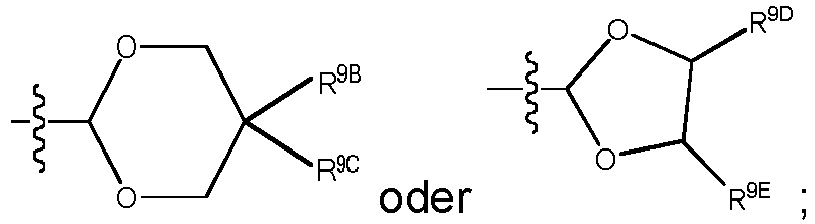 R9B, R9C, R9D und R9E unabhängig ausgewählt sind aus H, -OH, -C1-6-Alkyl, -C1-6-Alkyl-OH, -(CH2)n-NRaRb, -NRaRb, -C1-6-Alkyl-O-C1-6-Alkyl, -OC1-6-Alkyl, -O-C1-6-Alkyl-O-C1-6-Alkyl, einer 5-bis 12-gliedrigen Spirocycloalkyl- oder Spiroheterocycloalkyl- oder eine 3- bis 12-gliedrige monocyclische oder bicyclische Heterocycloalkylgruppe, wobei die Spiroheterocycloalkyl- und Heterocycloalkylgruppen 1, 2, 3 oder 4 Heteroatome aufweisen, die unabhängig voneinander aus O, N oder S ausgewählt sind, wobei die Spirocycloalkyl-, Spiroheterocycloalkyl- und Heterocycloalkylgruppen eine oder zwei C=O-Gruppen enthalten können, und wobei ferner zwei benachbarte Kohlenstoffatome oder ein benachbartes Kohlenstoffatom und ein benachbartes Stickstoffatom in einer R9B-Heterocycloalkylgruppe miteinander verbunden sein können, um einen 6-gliedrigen aromatischen Ring zu bilden, der unsubstituiert ist oder mit 1, 2 oder 3 R13-Gruppen substituiert ist;wobei R9D und R9E zusammen mit den Atomen, an die sie gebunden sind, einen 3- bis 12-gliedrigen monocyclischen oder bicyclischen Ring bilden können, der gegebenenfalls 1, 2, 3 oder 4 Heteroatome enthält, die unabhängig voneinander aus N, O oder S ausgewählt sind, wobei der Ring eine Doppelbindung enthalten kann, wobei der Ring optional eine C=O-Gruppe enthalten kann, und wobei der Ring ferner optional durch 1, 2 oder 3 R9F-Substituenten substituiert sein kann;R9F ist unabhängig ausgewählt aus -C1-6-Alkyl - oder C(=O)Ra;wobei die Heterocycloalkyl-, Spirocycloalkyl- und Spiroheterocycloalkylgruppen von beliebigen der R9B-, R9C, R9D und R9E unsubstituiert oder mit 1, 2, 3 oder 4 R10-Substituenten substituiert sein können, die unabhängig voneinander aus OH, Halogen, -NRcRd, -C1-6-Alkyl oder -OC1-6-Alkyl ausgewählt sind;wobei jedes Ra, Rb, Rc und Rd unabhängig H, -C1-6-Alkyl, -C(=O)NR13R13, -C1-6-Alkyl-O-C1-6-alkyl, -C3-6-Cycloalkyl und -C1-6-Alkyl-heterocycloalkyl ist;R13 unabhängig aus H oder -C1-6-Alkyl ausgewählt ist, undwobei n jeweils unabhängig eine ganze Zahl von 1 ist.
 - Die Verbindung nach Anspruch 1, wobei die Verbindung die Formel II oder die Formel IIa aufweist:


- Die Verbindung nach einem der Ansprüche 1-3, wobei R1 ein Halogen ist.
- Die Verbindung nach einem der Ansprüche 1-4, wobei R3 H ist.
- Die Verbindung nach einem der Ansprüche 1-5, wobei R4 unabhängig ausgewählt ist aus H, - C1-6-Alkyl, -C1-6-Alkyl-O-C1-6-Alkyl, -C1-6-Alkyl-OH, -C1-6-Alkyl-OSO2CH3, -C1-6-Alkyl-phenyl oder - C1-6-Alkyl-(5-6-gliedriges Heterocycloalkyl mit einem oder zwei Heteroatomen, unabhängig ausgewählt aus N oder O).
- Die Verbindung nach einem der Ansprüche 1-6, wobei R4 unabhängig ausgewählt ist aus H, -CH3, -CH2CH3, -CH2-O-CH3 oder -CH2CH2-O-CH3.
- Die Verbindung nach Anspruch 7, wobei R4 ist -CH3, -CH2-O-CH3 oder -CH2CH2-O-CH3.
- Die Verbindung nach einem der Ansprüche 1-8, wobei R5 aus H oder -C1-6-Alkyl ausgewählt ist.
- Die Verbindung nach einem der Ansprüche 1-9, wobei R6 aus H oder -C1-6-Alkyl ausgewählt ist.
- Die Verbindung nach einem der Ansprüche 1-10, wobei R9 unabhängig aus H oder -C1-6-Alkyl ausgewählt ist.
- Die Verbindung nach einem der Ansprüche 1-11, wobei R9A

- Die Verbindung nach einem der Ansprüche 1-12, wobei R9B ist H, -OH, -C1-6-Alkyl, -OCH3, -NRaRb, -CH2OH,


- Die Verbindung nach einem der Ansprüche 1-13, wobei R9C ist H, -C1-6-Alkyl, oder -C1-6-Alkyl-OH.
- Die Verbindung nach einem der Ansprüche 1-14, wobei R9A ist

- Die Verbindung nach einem der Ansprüche 1-11, wobei R9A

- Die Verbindung nach einem der Ansprüche 1-11 und 16, wobei R9Aist

- Die Verbindung nach Anspruch 1, wobei die Verbindung die Formel III oder die Formel IIIa hat:


- Die Verbindung nach einem der Ansprüche 1 oder 18, wobei R1 ein Halogen ist.
- Die Verbindung nach einem der Ansprüche 1 oder 18-19, wobei R4 -C1-6-Alkyl ist.
- Die Verbindung nach einem der Ansprüche 1 oder 18-20, wobei R5 -C1-6-Alkyl ist.
- Die Verbindung nach einem der Ansprüche 1, 18-21, wobei R6 H ist.
- Die Verbindung nach einem der Ansprüche 1, 18-22, wobei R9 H ist.
- Die Verbindung nach einem der Ansprüche 1, 18-23, wobei R9A

- Die Verbindung nach Anspruch 1, wobei die Verbindung die Formel IV oder die Formel IVa hat:


- Die Verbindung nach einem der Ansprüche 1 oder 25, wobei R1 ein Halogen ist.
- Die Verbindung nach einem der Ansprüche 1 oder 25-26, wobei R4 -C1-6-Alkyl ist.
- Die Verbindung nach einem der Ansprüche 1 oder 25-27, wobei R5 -C1-6-Alkyl ist.
- Die Verbindung nach einem der Ansprüche 1 oder 25-28, wobei R6 H ist.
- Die Verbindung nach einem der Ansprüche 1, 25-29, wobei R9 H ist.
- Die Verbindung nach einem der Ansprüche 1, 25-30, wobei R9A

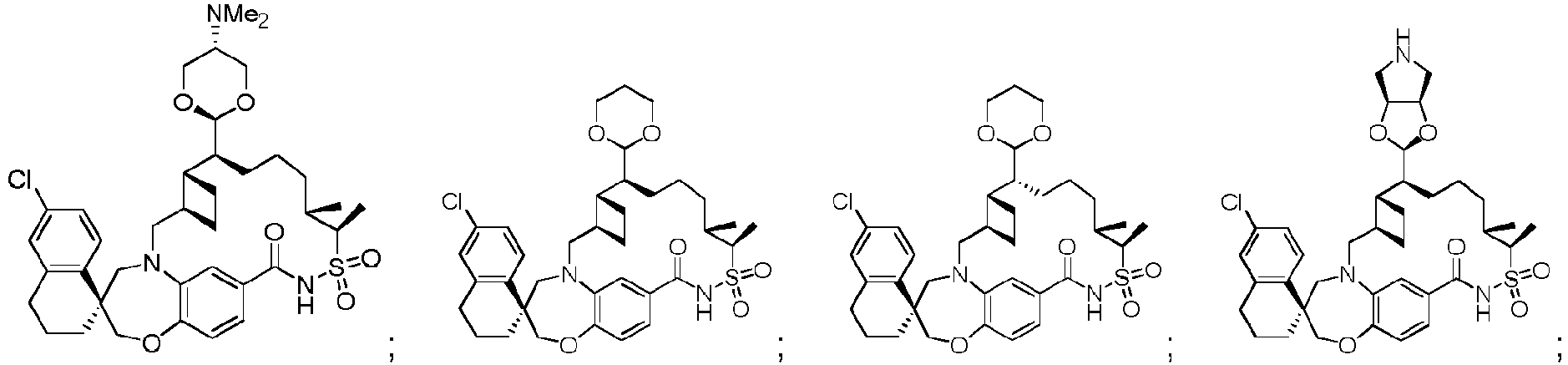
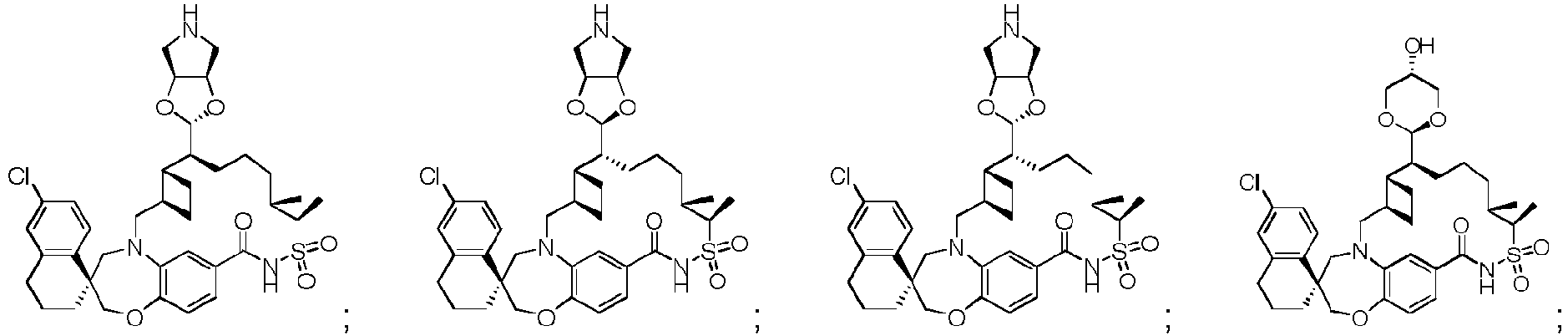
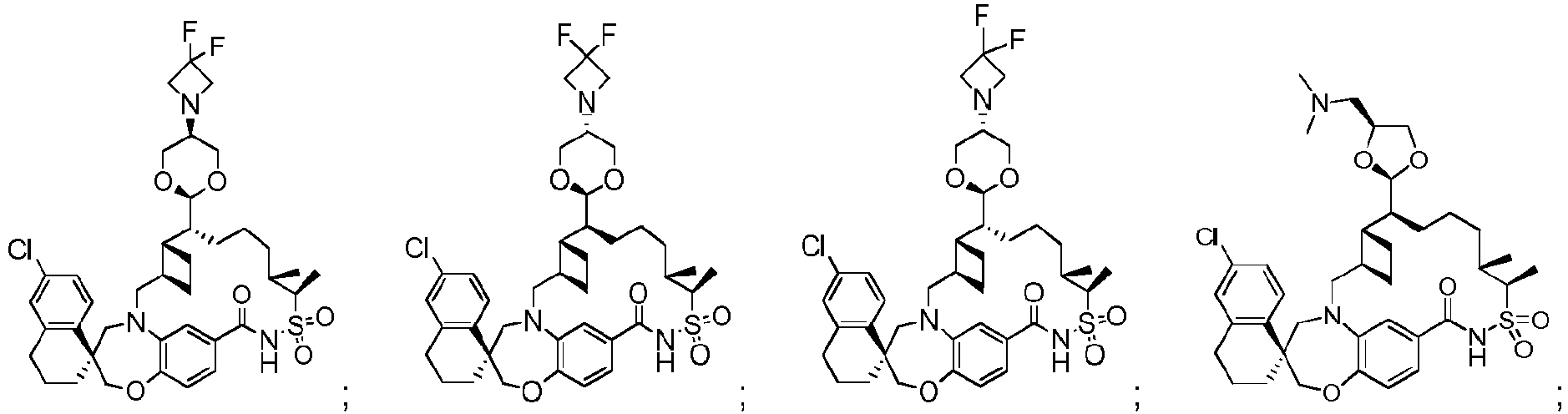
- Die Verbindung nach Anspruch 1, wobei die Verbindung eine Struktur aufweist, die ausgewählt ist aus:





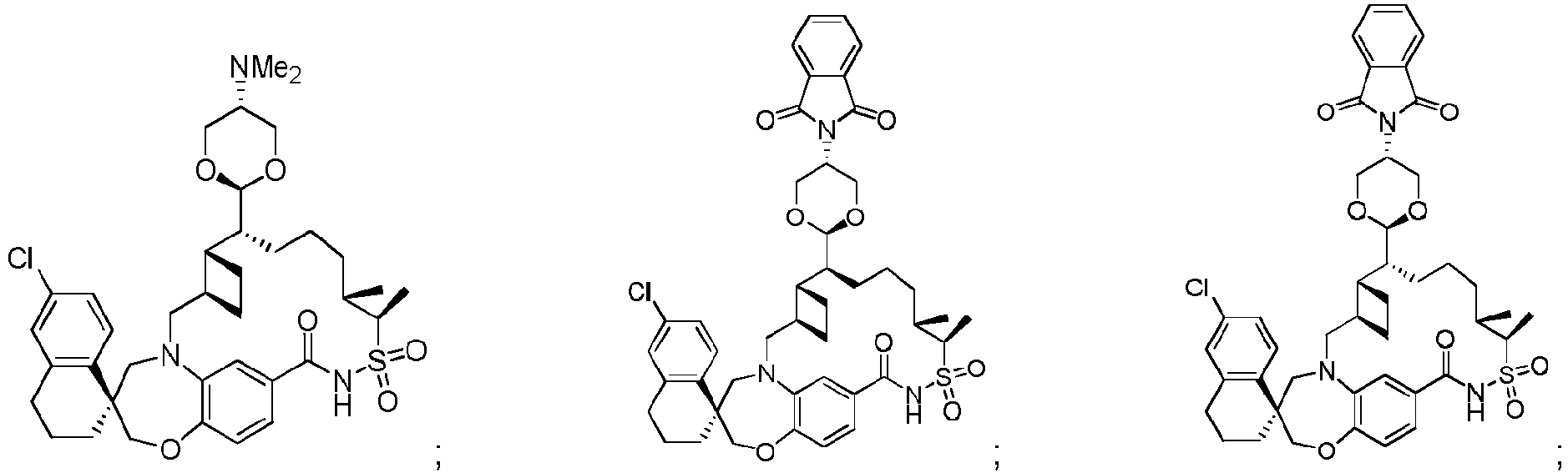

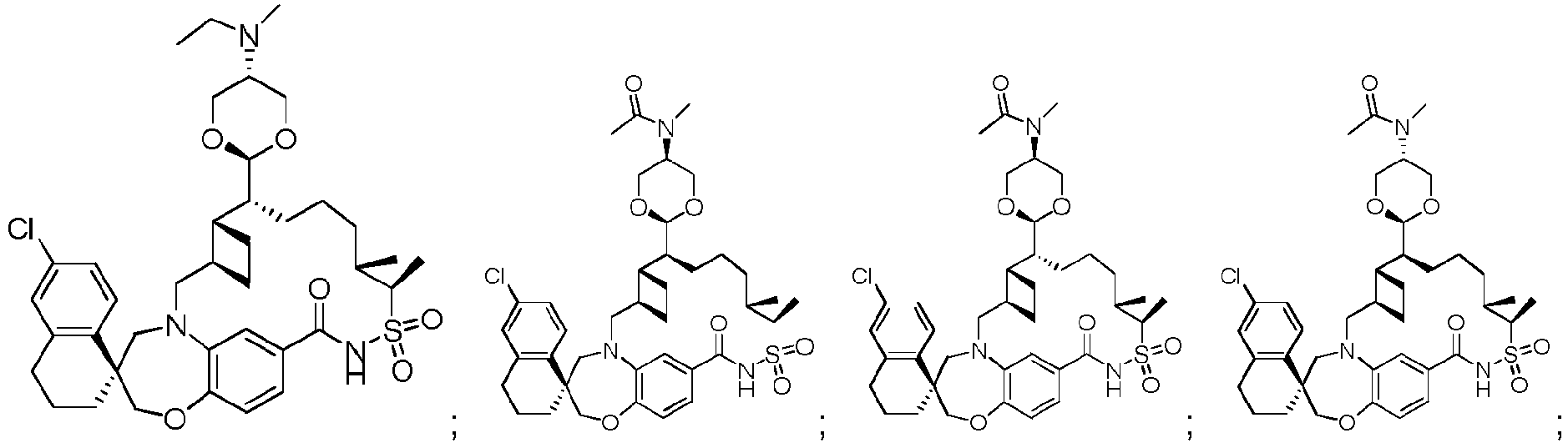


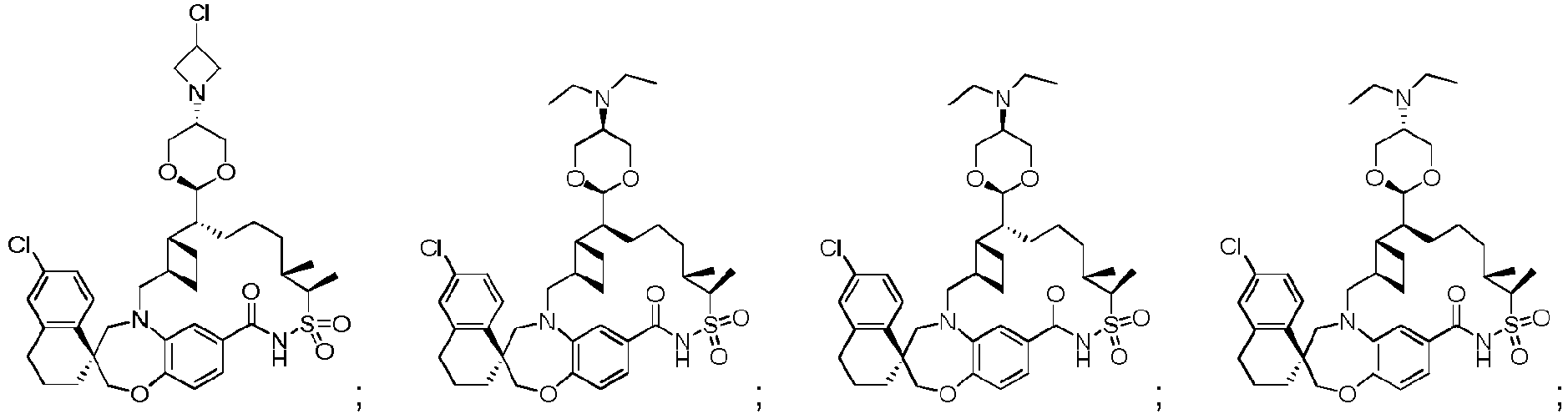

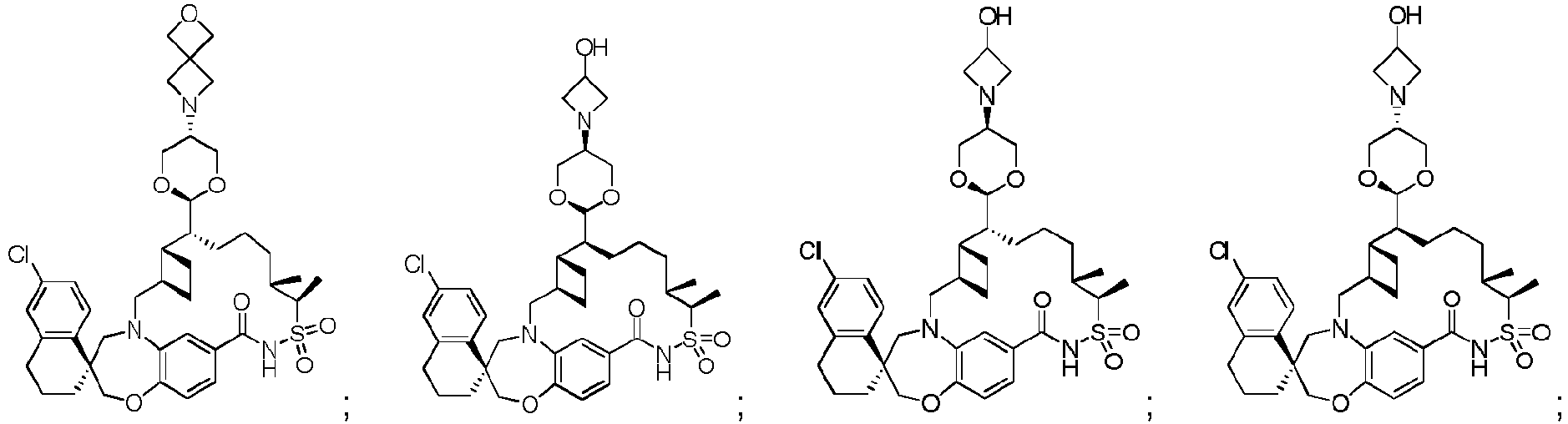


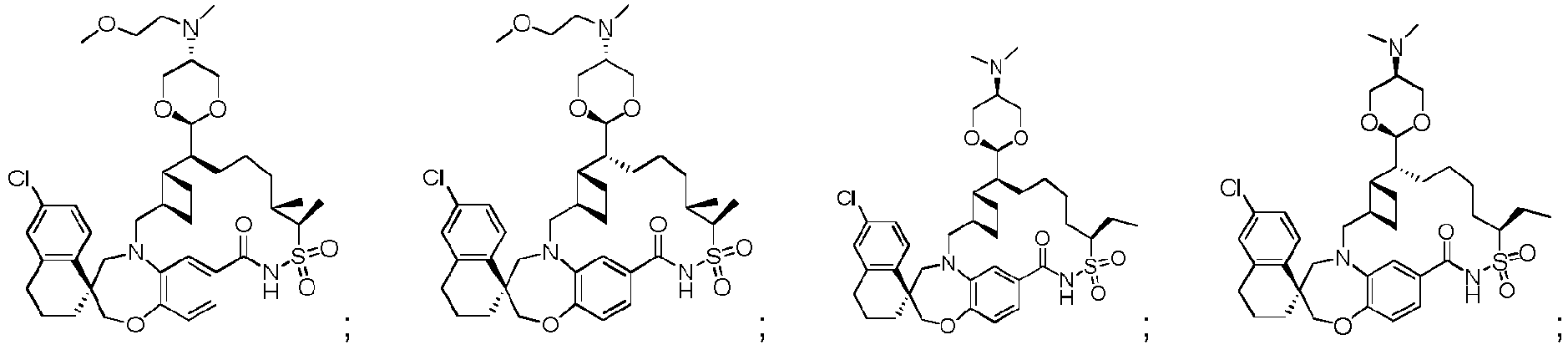


- Die Verbindung nach Anspruch 1, wobei die Verbindung eine Struktur hat, die ausgewählt ist aus:


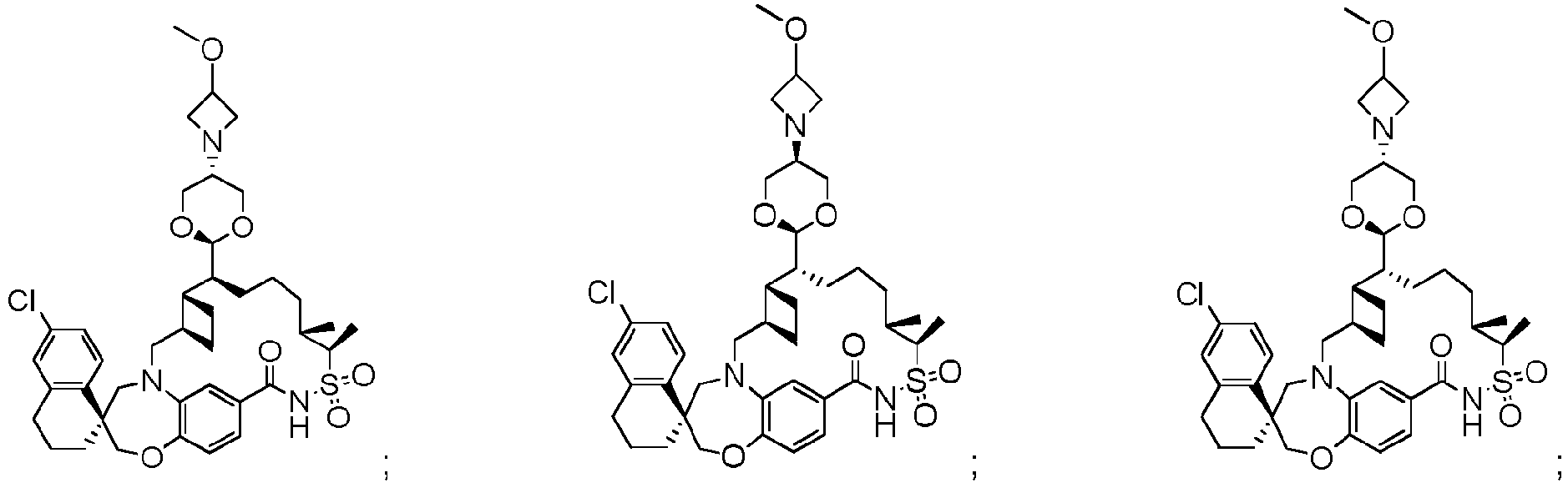


- Pharmazeutische Zusammensetzung, umfassend die Verbindung nach einem der Ansprüche 1-33 oder das pharmazeutisch verträgliche Salz davon und einen pharmazeutisch verträglichen Träger oder Verdünnungsmittel.
- Verbindung gemäß einem der Ansprüche 1-33 zur Verwendung als Medikament.
- Verbindung gemäß einem der Ansprüche 1-33 zur Verwendung bei der Behandlung von Krebs.
- Die Verbindung zur Verwendung gemäß Anspruch 36, wobei es sich bei dem Krebs um multiples Myelom, akute myeloische Leukämie oder Non-Hodgkin-Lymphom handelt.
Applications Claiming Priority (2)
| Application Number | Priority Date | Filing Date | Title |
|---|---|---|---|
| US201762547589P | 2017-08-18 | 2017-08-18 | |
| PCT/US2018/046859 WO2019036575A1 (en) | 2017-08-18 | 2018-08-17 | MCL-1 PROTEIN INHIBITING COMPOUNDS |
Publications (2)
| Publication Number | Publication Date |
|---|---|
| EP3668878A1 EP3668878A1 (de) | 2020-06-24 |
| EP3668878B1 true EP3668878B1 (de) | 2025-05-21 |
Family
ID=63579748
Family Applications (1)
| Application Number | Title | Priority Date | Filing Date |
|---|---|---|---|
| EP18769537.4A Active EP3668878B1 (de) | 2017-08-18 | 2018-08-17 | Verbindungen zur hemmung des mcl-1-proteins |
Country Status (5)
| Country | Link |
|---|---|
| US (1) | US11364248B2 (de) |
| EP (1) | EP3668878B1 (de) |
| ES (1) | ES3036998T3 (de) |
| MA (1) | MA49908A (de) |
| WO (1) | WO2019036575A1 (de) |
Families Citing this family (15)
| Publication number | Priority date | Publication date | Assignee | Title |
|---|---|---|---|---|
| JP6453507B2 (ja) | 2017-03-30 | 2019-01-16 | アムジエン・インコーポレーテツド | Mcl−1タンパク質を阻害する化合物 |
| US11279712B2 (en) | 2017-08-29 | 2022-03-22 | Amgen Inc. | Macrocyclic compounds that inhibit MCL-1 protein |
| US11274105B2 (en) | 2018-03-05 | 2022-03-15 | Amgen Inc. | Alpha-hydroxy phenylacetic acid pharmacophore or bioisostere Mcl-1 protein antagonists |
| EP3793565B1 (de) | 2018-05-14 | 2022-01-05 | Gilead Sciences, Inc. | Mcl-1 hemmer |
| EP3781574B1 (de) | 2019-01-18 | 2023-05-10 | Ascentage Pharma (Suzhou) Co., Ltd. | Makrocyclische spiroether als mcl-1-inhibitoren |
| CA3144558A1 (en) | 2019-07-09 | 2021-01-14 | Janssen Pharmaceutica Nv | Macrocyclic spirocycle derivatives as mcl-1 inhibitors |
| TWI778443B (zh) | 2019-11-12 | 2022-09-21 | 美商基利科學股份有限公司 | Mcl1抑制劑 |
| AU2020391106B2 (en) | 2019-11-26 | 2024-03-21 | Gilead Sciences, Inc. | Processes and intermediates for preparing MCL1 inhibitors |
| CA3180387A1 (en) | 2020-06-10 | 2021-12-16 | Soufyan JERHAOUI | Macrocyclic 2-amino-3-fluoro-but-3-enamides as inhibitors of mcl-1 |
| JP7659630B2 (ja) | 2020-11-19 | 2025-04-09 | ギリアード サイエンシーズ, インコーポレイテッド | 大環状mcl1阻害剤を調製するための方法及び中間体 |
| MX2023007297A (es) | 2020-12-17 | 2023-07-04 | Janssen Pharmaceutica Nv | 3-fluoro-but-3-enamidas ramificadas macrociclicas como inhibidores de mcl-1. |
| CN117295749A (zh) | 2021-04-26 | 2023-12-26 | 詹森药业有限公司 | 作为mcl-1抑制剂的大环2-烯丙基四氢呋喃 |
| TWI861509B (zh) | 2021-06-11 | 2024-11-11 | 美商基利科學股份有限公司 | Mcl-1抑制劑與抗體藥物接合物之組合 |
| JP2024520801A (ja) | 2021-06-11 | 2024-05-24 | ギリアード サイエンシーズ, インコーポレイテッド | Mcl-1阻害剤と抗がん剤との組み合わせ |
| JP2024544570A (ja) | 2021-11-16 | 2024-12-03 | ヤンセン ファーマシューティカ エヌ.ベー. | Mcl-1阻害剤としての大環状2-アミノ-ブト-3-エナミド |
Family Cites Families (13)
| Publication number | Priority date | Publication date | Assignee | Title |
|---|---|---|---|---|
| US4522811A (en) | 1982-07-08 | 1985-06-11 | Syntex (U.S.A.) Inc. | Serial injection of muramyldipeptides and liposomes enhances the anti-infective activity of muramyldipeptides |
| US5858784A (en) | 1991-12-17 | 1999-01-12 | The Regents Of The University Of California | Expression of cloned genes in the lung by aerosol- and liposome-based delivery |
| US6042820A (en) | 1996-12-20 | 2000-03-28 | Connaught Laboratories Limited | Biodegradable copolymer containing α-hydroxy acid and α-amino acid units |
| US6472375B1 (en) | 1998-04-16 | 2002-10-29 | John Wayne Cancer Institute | DNA vaccine and methods for its use |
| CA2682356C (en) | 2007-04-16 | 2016-06-14 | Abbott Laboratories | 7-substituted indole mcl-1 inhibitors |
| EP3138838A1 (de) | 2010-01-29 | 2017-03-08 | Dana-Farber Cancer Institute, Inc. | Kleine moleküle zur modulierung von mcl-1 und verfahren zur modulierung von zelltod, zellteilung und zelldifferenzierung sowie verfahren zur krankheitsbehandlung damit |
| WO2013052943A2 (en) | 2011-10-06 | 2013-04-11 | The Regents Of The University Of Michgian | Small molecule inhibitors of mcl-1 and uses thereof |
| US9914723B2 (en) | 2012-03-29 | 2018-03-13 | The Regents Of The University Of Michigan | Small molecule inhibitors of Mcl-1 and uses thereof |
| JO3474B1 (ar) | 2014-08-29 | 2020-07-05 | Amgen Inc | مشتقات تيتراهيدرونافثالين التي تثبط بروتين mcl-1 |
| US11306107B2 (en) * | 2016-02-25 | 2022-04-19 | Amgen Inc. | Compounds that inhibit MCL-1 protein |
| JP6453507B2 (ja) | 2017-03-30 | 2019-01-16 | アムジエン・インコーポレーテツド | Mcl−1タンパク質を阻害する化合物 |
| US11279712B2 (en) | 2017-08-29 | 2022-03-22 | Amgen Inc. | Macrocyclic compounds that inhibit MCL-1 protein |
| US11274105B2 (en) | 2018-03-05 | 2022-03-15 | Amgen Inc. | Alpha-hydroxy phenylacetic acid pharmacophore or bioisostere Mcl-1 protein antagonists |
-
2018
- 2018-08-17 EP EP18769537.4A patent/EP3668878B1/de active Active
- 2018-08-17 US US16/638,503 patent/US11364248B2/en active Active
- 2018-08-17 WO PCT/US2018/046859 patent/WO2019036575A1/en not_active Ceased
- 2018-08-17 MA MA049908A patent/MA49908A/fr unknown
- 2018-08-17 ES ES18769537T patent/ES3036998T3/es active Active
Also Published As
| Publication number | Publication date |
|---|---|
| ES3036998T3 (en) | 2025-09-26 |
| MA49908A (fr) | 2021-04-28 |
| WO2019036575A1 (en) | 2019-02-21 |
| US11364248B2 (en) | 2022-06-21 |
| US20200360399A1 (en) | 2020-11-19 |
| EP3668878A1 (de) | 2020-06-24 |
Similar Documents
| Publication | Publication Date | Title |
|---|---|---|
| EP3668878B1 (de) | Verbindungen zur hemmung des mcl-1-proteins | |
| US12024529B2 (en) | Compounds that inhibit MCL-1 protein | |
| EP3601297B9 (de) | Verbindungen zur hemmung des mcl-1-proteins | |
| US11279712B2 (en) | Macrocyclic compounds that inhibit MCL-1 protein | |
| US11274105B2 (en) | Alpha-hydroxy phenylacetic acid pharmacophore or bioisostere Mcl-1 protein antagonists | |
| HK40020443A (en) | Compounds that inhibit mcl-1 protein | |
| HK40020443B (en) | Compounds that inhibit mcl-1 protein | |
| NZ729768B2 (en) | Tetrahydronaphthalene derivatives that inhibit mcl-1 protein |
Legal Events
| Date | Code | Title | Description |
|---|---|---|---|
| STAA | Information on the status of an ep patent application or granted ep patent |
Free format text: STATUS: UNKNOWN |
|
| STAA | Information on the status of an ep patent application or granted ep patent |
Free format text: STATUS: THE INTERNATIONAL PUBLICATION HAS BEEN MADE |
|
| PUAI | Public reference made under article 153(3) epc to a published international application that has entered the european phase |
Free format text: ORIGINAL CODE: 0009012 |
|
| STAA | Information on the status of an ep patent application or granted ep patent |
Free format text: STATUS: REQUEST FOR EXAMINATION WAS MADE |
|
| 17P | Request for examination filed |
Effective date: 20200317 |
|
| AK | Designated contracting states |
Kind code of ref document: A1 Designated state(s): AL AT BE BG CH CY CZ DE DK EE ES FI FR GB GR HR HU IE IS IT LI LT LU LV MC MK MT NL NO PL PT RO RS SE SI SK SM TR |
|
| AX | Request for extension of the european patent |
Extension state: BA ME |
|
| RAV | Requested validation state of the european patent: fee paid |
Extension state: TN Effective date: 20200317 Extension state: MA Effective date: 20200317 Extension state: MD Effective date: 20200317 |
|
| STAA | Information on the status of an ep patent application or granted ep patent |
Free format text: STATUS: EXAMINATION IS IN PROGRESS |
|
| 17Q | First examination report despatched |
Effective date: 20210324 |
|
| GRAP | Despatch of communication of intention to grant a patent |
Free format text: ORIGINAL CODE: EPIDOSNIGR1 |
|
| STAA | Information on the status of an ep patent application or granted ep patent |
Free format text: STATUS: GRANT OF PATENT IS INTENDED |
|
| INTG | Intention to grant announced |
Effective date: 20241213 |
|
| GRAS | Grant fee paid |
Free format text: ORIGINAL CODE: EPIDOSNIGR3 |
|
| GRAA | (expected) grant |
Free format text: ORIGINAL CODE: 0009210 |
|
| STAA | Information on the status of an ep patent application or granted ep patent |
Free format text: STATUS: THE PATENT HAS BEEN GRANTED |
|
| P01 | Opt-out of the competence of the unified patent court (upc) registered |
Free format text: CASE NUMBER: APP_14683/2025 Effective date: 20250326 |
|
| AK | Designated contracting states |
Kind code of ref document: B1 Designated state(s): AL AT BE BG CH CY CZ DE DK EE ES FI FR GB GR HR HU IE IS IT LI LT LU LV MC MK MT NL NO PL PT RO RS SE SI SK SM TR |
|
| REG | Reference to a national code |
Ref country code: GB Ref legal event code: FG4D |
|
| REG | Reference to a national code |
Ref country code: CH Ref legal event code: EP |
|
| REG | Reference to a national code |
Ref country code: DE Ref legal event code: R096 Ref document number: 602018082110 Country of ref document: DE |
|
| REG | Reference to a national code |
Ref country code: IE Ref legal event code: FG4D |
|
| REG | Reference to a national code |
Ref country code: NL Ref legal event code: MP Effective date: 20250521 |
|
| REG | Reference to a national code |
Ref country code: ES Ref legal event code: FG2A Ref document number: 3036998 Country of ref document: ES Kind code of ref document: T3 Effective date: 20250926 |
|
| PG25 | Lapsed in a contracting state [announced via postgrant information from national office to epo] |
Ref country code: PT Free format text: LAPSE BECAUSE OF FAILURE TO SUBMIT A TRANSLATION OF THE DESCRIPTION OR TO PAY THE FEE WITHIN THE PRESCRIBED TIME-LIMIT Effective date: 20250922 Ref country code: FI Free format text: LAPSE BECAUSE OF FAILURE TO SUBMIT A TRANSLATION OF THE DESCRIPTION OR TO PAY THE FEE WITHIN THE PRESCRIBED TIME-LIMIT Effective date: 20250521 |
|
| PGFP | Annual fee paid to national office [announced via postgrant information from national office to epo] |
Ref country code: ES Payment date: 20250902 Year of fee payment: 8 |
|
| PGFP | Annual fee paid to national office [announced via postgrant information from national office to epo] |
Ref country code: DE Payment date: 20250827 Year of fee payment: 8 |
|
| REG | Reference to a national code |
Ref country code: LT Ref legal event code: MG9D |
|
| PG25 | Lapsed in a contracting state [announced via postgrant information from national office to epo] |
Ref country code: NO Free format text: LAPSE BECAUSE OF FAILURE TO SUBMIT A TRANSLATION OF THE DESCRIPTION OR TO PAY THE FEE WITHIN THE PRESCRIBED TIME-LIMIT Effective date: 20250821 Ref country code: GR Free format text: LAPSE BECAUSE OF FAILURE TO SUBMIT A TRANSLATION OF THE DESCRIPTION OR TO PAY THE FEE WITHIN THE PRESCRIBED TIME-LIMIT Effective date: 20250822 |
|
| PG25 | Lapsed in a contracting state [announced via postgrant information from national office to epo] |
Ref country code: NL Free format text: LAPSE BECAUSE OF FAILURE TO SUBMIT A TRANSLATION OF THE DESCRIPTION OR TO PAY THE FEE WITHIN THE PRESCRIBED TIME-LIMIT Effective date: 20250521 Ref country code: PL Free format text: LAPSE BECAUSE OF FAILURE TO SUBMIT A TRANSLATION OF THE DESCRIPTION OR TO PAY THE FEE WITHIN THE PRESCRIBED TIME-LIMIT Effective date: 20250521 |
|
| PGFP | Annual fee paid to national office [announced via postgrant information from national office to epo] |
Ref country code: IT Payment date: 20250827 Year of fee payment: 8 |
|
| PG25 | Lapsed in a contracting state [announced via postgrant information from national office to epo] |
Ref country code: BG Free format text: LAPSE BECAUSE OF FAILURE TO SUBMIT A TRANSLATION OF THE DESCRIPTION OR TO PAY THE FEE WITHIN THE PRESCRIBED TIME-LIMIT Effective date: 20250521 |
|
| PGFP | Annual fee paid to national office [announced via postgrant information from national office to epo] |
Ref country code: GB Payment date: 20250826 Year of fee payment: 8 |
|
| PG25 | Lapsed in a contracting state [announced via postgrant information from national office to epo] |
Ref country code: HR Free format text: LAPSE BECAUSE OF FAILURE TO SUBMIT A TRANSLATION OF THE DESCRIPTION OR TO PAY THE FEE WITHIN THE PRESCRIBED TIME-LIMIT Effective date: 20250521 |
|
| PGFP | Annual fee paid to national office [announced via postgrant information from national office to epo] |
Ref country code: FR Payment date: 20250826 Year of fee payment: 8 |
|
| PGFP | Annual fee paid to national office [announced via postgrant information from national office to epo] |
Ref country code: CH Payment date: 20250901 Year of fee payment: 8 |
|
| PG25 | Lapsed in a contracting state [announced via postgrant information from national office to epo] |
Ref country code: RS Free format text: LAPSE BECAUSE OF FAILURE TO SUBMIT A TRANSLATION OF THE DESCRIPTION OR TO PAY THE FEE WITHIN THE PRESCRIBED TIME-LIMIT Effective date: 20250821 |
|
| PG25 | Lapsed in a contracting state [announced via postgrant information from national office to epo] |
Ref country code: IS Free format text: LAPSE BECAUSE OF FAILURE TO SUBMIT A TRANSLATION OF THE DESCRIPTION OR TO PAY THE FEE WITHIN THE PRESCRIBED TIME-LIMIT Effective date: 20250921 |
|
| PG25 | Lapsed in a contracting state [announced via postgrant information from national office to epo] |
Ref country code: LV Free format text: LAPSE BECAUSE OF FAILURE TO SUBMIT A TRANSLATION OF THE DESCRIPTION OR TO PAY THE FEE WITHIN THE PRESCRIBED TIME-LIMIT Effective date: 20250521 |
|
| REG | Reference to a national code |
Ref country code: AT Ref legal event code: MK05 Ref document number: 1796695 Country of ref document: AT Kind code of ref document: T Effective date: 20250521 |
|
| PG25 | Lapsed in a contracting state [announced via postgrant information from national office to epo] |
Ref country code: DK Free format text: LAPSE BECAUSE OF FAILURE TO SUBMIT A TRANSLATION OF THE DESCRIPTION OR TO PAY THE FEE WITHIN THE PRESCRIBED TIME-LIMIT Effective date: 20250521 Ref country code: AT Free format text: LAPSE BECAUSE OF FAILURE TO SUBMIT A TRANSLATION OF THE DESCRIPTION OR TO PAY THE FEE WITHIN THE PRESCRIBED TIME-LIMIT Effective date: 20250521 Ref country code: SM Free format text: LAPSE BECAUSE OF FAILURE TO SUBMIT A TRANSLATION OF THE DESCRIPTION OR TO PAY THE FEE WITHIN THE PRESCRIBED TIME-LIMIT Effective date: 20250521 |
|
| VS25 | Lapsed in a validation state [announced via postgrant information from nat. office to epo] |
Ref country code: MD Free format text: LAPSE BECAUSE OF FAILURE TO SUBMIT A TRANSLATION OF THE DESCRIPTION OR TO PAY THE FEE WITHIN THE PRESCRIBED TIME-LIMIT Effective date: 20250521 |
|
| PG25 | Lapsed in a contracting state [announced via postgrant information from national office to epo] |
Ref country code: CZ Free format text: LAPSE BECAUSE OF FAILURE TO SUBMIT A TRANSLATION OF THE DESCRIPTION OR TO PAY THE FEE WITHIN THE PRESCRIBED TIME-LIMIT Effective date: 20250521 |
|
| PG25 | Lapsed in a contracting state [announced via postgrant information from national office to epo] |
Ref country code: EE Free format text: LAPSE BECAUSE OF FAILURE TO SUBMIT A TRANSLATION OF THE DESCRIPTION OR TO PAY THE FEE WITHIN THE PRESCRIBED TIME-LIMIT Effective date: 20250521 |
|
| PG25 | Lapsed in a contracting state [announced via postgrant information from national office to epo] |
Ref country code: RO Free format text: LAPSE BECAUSE OF FAILURE TO SUBMIT A TRANSLATION OF THE DESCRIPTION OR TO PAY THE FEE WITHIN THE PRESCRIBED TIME-LIMIT Effective date: 20250521 Ref country code: SK Free format text: LAPSE BECAUSE OF FAILURE TO SUBMIT A TRANSLATION OF THE DESCRIPTION OR TO PAY THE FEE WITHIN THE PRESCRIBED TIME-LIMIT Effective date: 20250521 |