EP3662036B1 - Wasserlösliche pyraninpolymere und verfahren zur herstellung - Google Patents
Wasserlösliche pyraninpolymere und verfahren zur herstellung Download PDFInfo
- Publication number
- EP3662036B1 EP3662036B1 EP18745619.9A EP18745619A EP3662036B1 EP 3662036 B1 EP3662036 B1 EP 3662036B1 EP 18745619 A EP18745619 A EP 18745619A EP 3662036 B1 EP3662036 B1 EP 3662036B1
- Authority
- EP
- European Patent Office
- Prior art keywords
- pyranine
- acid
- alkyl
- salts
- functionalizing agent
- Prior art date
- Legal status (The legal status is an assumption and is not a legal conclusion. Google has not performed a legal analysis and makes no representation as to the accuracy of the status listed.)
- Active
Links
Classifications
-
- C—CHEMISTRY; METALLURGY
- C08—ORGANIC MACROMOLECULAR COMPOUNDS; THEIR PREPARATION OR CHEMICAL WORKING-UP; COMPOSITIONS BASED THEREON
- C08F—MACROMOLECULAR COMPOUNDS OBTAINED BY REACTIONS ONLY INVOLVING CARBON-TO-CARBON UNSATURATED BONDS
- C08F16/00—Homopolymers and copolymers of compounds having one or more unsaturated aliphatic radicals, each having only one carbon-to-carbon double bond, and at least one being terminated by an alcohol, ether, aldehydo, ketonic, acetal or ketal radical
- C08F16/12—Homopolymers and copolymers of compounds having one or more unsaturated aliphatic radicals, each having only one carbon-to-carbon double bond, and at least one being terminated by an alcohol, ether, aldehydo, ketonic, acetal or ketal radical by an ether radical
- C08F16/14—Monomers containing only one unsaturated aliphatic radical
- C08F16/30—Monomers containing sulfur
-
- C—CHEMISTRY; METALLURGY
- C02—TREATMENT OF WATER, WASTE WATER, SEWAGE, OR SLUDGE
- C02F—TREATMENT OF WATER, WASTE WATER, SEWAGE, OR SLUDGE
- C02F5/00—Softening water; Preventing scale; Adding scale preventatives or scale removers to water, e.g. adding sequestering agents
- C02F5/08—Treatment of water with complexing chemicals or other solubilising agents for softening, scale prevention or scale removal, e.g. adding sequestering agents
- C02F5/10—Treatment of water with complexing chemicals or other solubilising agents for softening, scale prevention or scale removal, e.g. adding sequestering agents using organic substances
-
- C—CHEMISTRY; METALLURGY
- C02—TREATMENT OF WATER, WASTE WATER, SEWAGE, OR SLUDGE
- C02F—TREATMENT OF WATER, WASTE WATER, SEWAGE, OR SLUDGE
- C02F5/00—Softening water; Preventing scale; Adding scale preventatives or scale removers to water, e.g. adding sequestering agents
- C02F5/08—Treatment of water with complexing chemicals or other solubilising agents for softening, scale prevention or scale removal, e.g. adding sequestering agents
- C02F5/10—Treatment of water with complexing chemicals or other solubilising agents for softening, scale prevention or scale removal, e.g. adding sequestering agents using organic substances
- C02F5/105—Treatment of water with complexing chemicals or other solubilising agents for softening, scale prevention or scale removal, e.g. adding sequestering agents using organic substances combined with inorganic substances
-
- C—CHEMISTRY; METALLURGY
- C02—TREATMENT OF WATER, WASTE WATER, SEWAGE, OR SLUDGE
- C02F—TREATMENT OF WATER, WASTE WATER, SEWAGE, OR SLUDGE
- C02F5/00—Softening water; Preventing scale; Adding scale preventatives or scale removers to water, e.g. adding sequestering agents
- C02F5/08—Treatment of water with complexing chemicals or other solubilising agents for softening, scale prevention or scale removal, e.g. adding sequestering agents
- C02F5/10—Treatment of water with complexing chemicals or other solubilising agents for softening, scale prevention or scale removal, e.g. adding sequestering agents using organic substances
- C02F5/12—Treatment of water with complexing chemicals or other solubilising agents for softening, scale prevention or scale removal, e.g. adding sequestering agents using organic substances containing nitrogen
- C02F5/125—Treatment of water with complexing chemicals or other solubilising agents for softening, scale prevention or scale removal, e.g. adding sequestering agents using organic substances containing nitrogen combined with inorganic substances
-
- C—CHEMISTRY; METALLURGY
- C07—ORGANIC CHEMISTRY
- C07C—ACYCLIC OR CARBOCYCLIC COMPOUNDS
- C07C309/00—Sulfonic acids; Halides, esters, or anhydrides thereof
- C07C309/01—Sulfonic acids
- C07C309/28—Sulfonic acids having sulfo groups bound to carbon atoms of six-membered aromatic rings of a carbon skeleton
- C07C309/41—Sulfonic acids having sulfo groups bound to carbon atoms of six-membered aromatic rings of a carbon skeleton containing singly-bound oxygen atoms bound to the carbon skeleton
- C07C309/43—Sulfonic acids having sulfo groups bound to carbon atoms of six-membered aromatic rings of a carbon skeleton containing singly-bound oxygen atoms bound to the carbon skeleton having at least one of the sulfo groups bound to a carbon atom of a six-membered aromatic ring being part of a condensed ring system
-
- C—CHEMISTRY; METALLURGY
- C09—DYES; PAINTS; POLISHES; NATURAL RESINS; ADHESIVES; COMPOSITIONS NOT OTHERWISE PROVIDED FOR; APPLICATIONS OF MATERIALS NOT OTHERWISE PROVIDED FOR
- C09K—MATERIALS FOR MISCELLANEOUS APPLICATIONS, NOT PROVIDED FOR ELSEWHERE
- C09K11/00—Luminescent materials, e.g. electroluminescent or chemiluminescent
- C09K11/06—Luminescent materials, e.g. electroluminescent or chemiluminescent containing organic luminescent materials
-
- C—CHEMISTRY; METALLURGY
- C02—TREATMENT OF WATER, WASTE WATER, SEWAGE, OR SLUDGE
- C02F—TREATMENT OF WATER, WASTE WATER, SEWAGE, OR SLUDGE
- C02F2103/00—Nature of the water, waste water, sewage or sludge to be treated
- C02F2103/02—Non-contaminated water, e.g. for industrial water supply
- C02F2103/023—Water in cooling circuits
-
- C—CHEMISTRY; METALLURGY
- C02—TREATMENT OF WATER, WASTE WATER, SEWAGE, OR SLUDGE
- C02F—TREATMENT OF WATER, WASTE WATER, SEWAGE, OR SLUDGE
- C02F2303/00—Specific treatment goals
- C02F2303/08—Corrosion inhibition
-
- C—CHEMISTRY; METALLURGY
- C02—TREATMENT OF WATER, WASTE WATER, SEWAGE, OR SLUDGE
- C02F—TREATMENT OF WATER, WASTE WATER, SEWAGE, OR SLUDGE
- C02F2303/00—Specific treatment goals
- C02F2303/22—Eliminating or preventing deposits, scale removal, scale prevention
-
- C—CHEMISTRY; METALLURGY
- C07—ORGANIC CHEMISTRY
- C07C—ACYCLIC OR CARBOCYCLIC COMPOUNDS
- C07C2603/00—Systems containing at least three condensed rings
- C07C2603/02—Ortho- or ortho- and peri-condensed systems
- C07C2603/40—Ortho- or ortho- and peri-condensed systems containing four condensed rings
- C07C2603/42—Ortho- or ortho- and peri-condensed systems containing four condensed rings containing only six-membered rings
- C07C2603/50—Pyrenes; Hydrogenated pyrenes
-
- C—CHEMISTRY; METALLURGY
- C09—DYES; PAINTS; POLISHES; NATURAL RESINS; ADHESIVES; COMPOSITIONS NOT OTHERWISE PROVIDED FOR; APPLICATIONS OF MATERIALS NOT OTHERWISE PROVIDED FOR
- C09K—MATERIALS FOR MISCELLANEOUS APPLICATIONS, NOT PROVIDED FOR ELSEWHERE
- C09K2211/00—Chemical nature of organic luminescent or tenebrescent compounds
- C09K2211/14—Macromolecular compounds
- C09K2211/1408—Carbocyclic compounds
- C09K2211/1416—Condensed systems
Definitions
- This application relates generally to methods of synthesizing pyranine monomers, compositions of pyranine monomers synthesized by the method, and compositions of water soluble polymers made with the pyranine monomer compositions, which compositions of water soluble polymers incorporating pyranine monomers are useful in the treatment of industrial water systems, as well as for scale control in oil field applications.
- water soluble treatment polymers are effective for preventing formation of scale and suppressing the occurrence of corrosion in industrial water systems. These water soluble treatment polymers are known to persons of ordinary skill in the art of industrial water systems and are widely used in scale and corrosion inhibition products. Such water soluble treatment polymers generally exhibit activity against scale and corrosion when added to water in an amount in the range of from about 1 to about 100 milligrams of solid component active per liter of water.
- the efficacy of water soluble treatment polymers in inhibiting scale and suppressing corrosion depends in part on the concentration of the water soluble treatment polymer in the water system.
- Water soluble treatment polymers added to a cooling water system can be consumed by many causes, leading to changes in concentration of the water soluble polymer. Therefore, it is important for the optimum operation of an industrial water system to be able to determine the concentration of water soluble treatment polymers in the water.
- the concentration of water soluble treatment polymers used as components of scale and corrosion inhibitors in industrial water systems can be monitored if the polymer is tagged with a fluorescent monomer.
- the amount of fluorescent monomer incorporated into the water soluble polymer must be enough so that the fluorescence of the water soluble polymer can be adequately measured, however, it must not be so much as to adversely impact the performance of the water soluble polymer as a treatment agent.
- the concentration of the tagged water soluble treatment polymer can be determined using a fluorimeter, it is also possible to measure consumption of the water soluble treatment polymer directly. It is important to be able to measure consumption directly because consumption of a water soluble treatment polymer usually indicates that a non-desired event, such as scaling, is occurring.
- the scaling activity in the cooling system can be monitored.
- Such systems are disclosed, for example, in U.S. 5,171,450 , U.S. 5,986,030 , and U.S. 6,280,635 .
- such measurements can be conducted in line, in situ, in real time.
- the fluorescent compound In preparing a fluorescent compound to tag a polymer, the fluorescent compound must first be functionalized with a polymerizable moiety, typically a moiety with a carbon-carbon double bond, to form a fluorescent monomer. If a reaction to functionalize a fluorescent compound does not go substantially to completion, then unfunctionalized fluorescent compound can remain in the monomer reaction product. Because the unfunctionalized fluorescent compound and the functionalized fluorescent monomer are chemically very similar, it can be difficult to separate any unfunctionalized fluorescent compound starting material remaining from the monomer reaction product.
- a polymerizable moiety typically a moiety with a carbon-carbon double bond
- this monomer reaction product containing both the desired monomer and the undesirable unfunctionalized fluorescent compound is then added to a polymerization reaction mixture in the polymerization of a water soluble fluorescent tagged polymer, then the unfunctionalized fluorescent compound can also be present in the polymerization reaction product composition.
- the unfunctionalized fluorescent compound will likewise be difficult to separate from the polymerization reaction product composition.
- any unfunctionalized free fluorescent compound that is present in the polymer composition will add to the fluorescence signal detected, leading to an inaccurate determination of the amount of fluorescent-tagged water soluble polymer present in the water system.
- Water in industrial systems is typically recycled, three to five times or even more. With each cycle of use, an additional dose of the fluorescent polymer composition is added, thus multiplying the amount of unfunctionalized fluorescent compound present in the system, After only a few cycles this can significantly adversely affect the accuracy of subsequent measurements of the amount of fluorescent polymer present.
- US 6,312,644 teaches that the fluorescent compound pyranine can be functionalized with either an allyl group or a vinylbenzyl group by reacting the pyranine with either allyl chloride or vinylbenzyl chloride, respectively, added as a single addition to the pyranine in a polar organic solvent such as dimethyl sulfoxide (DMSO).
- a polar organic solvent such as dimethyl sulfoxide (DMSO).
- DMSO dimethyl sulfoxide
- WO 2013/139673 also discloses the synthesis of fluorescent monomers based on pyranine under an inert atmosphere in DMSO, which monomers are used in the synthesis of water-insoluble superabsorbent polymers with desired optical properties.
- the monomers are prepared by providing pyranine in DMSO, adding an amount of aqueous NaOH, and then adding a functionalizing compound all in one portion .
- IP.com document IPCOM000250326D with an electronic publication date of June 28, 2017 states that it discloses the synthesis of sulfonated aryl alkyl ether monomers in cost effective solvents.
- the publication discloses at pages 3-5 the synthesis of methallyl derivatives of hydroxypyrenetrisulfonic acid sodium salt.
- This application relates to improved methods of making pyranine monomers, improved pyranine monomer compositions, and improved compositions of pyranine tagged fluorescent polymers and the use thereof.
- a method for making a pyranine monomer composition comprises the step of reacting pyranine with a functionalizing agent that functionalizes the pyranine molecule with a polymerizable functional group to provide a composition of functionalized pyranine monomers, the functionalization reaction taking place in an aqueous reaction medium with an excess of the functionalizing agent, and under reaction conditions such that the reaction goes substantially to completion, whereby the functionalization reaction product is a monomer composition containing less than 5 mol% of unfunctionalized pyranine compound based on the total moles of functionalized pyranine monomer and unfunctionalized fluorescent compound.
- a method for making a functionalized pyranine monomer composition comprises the steps of
- a method for making a functionalized pyranine monomer composition comprises the steps of
- the base is added to the solvent system prior to the addition of the functionalizing agent, or the step of adding the base is accomplished by the simultaneous dosing of the base and the functionalizing agent to the aqueous solvent system, with the dosing of both the functionalizing agent and the base being maintained during the reaction of the pyranine with the functionalizing agent until the amount of functionalizing agent dosed to the system exceeds the starting amount of pyranine on a molar basis.
- the aqueous reaction medium optionally comprises one or more water-soluble organic co-solvents.
- the one or more water-soluble organic co-solvents are selected from the group consisting of C 1 -C 6 alcohols.
- the co-solvent is selected from methanol, ethanol, n-propanol, and isopropanol.
- the co-solvent is selected from methanol and n-propanol.
- the co-solvent is n-propanol.
- the method of the disclosure is carried out over a time period of from about five minutes to about 24 hours; in one embodiment from about 30 minutes to about 18 hours, in one embodiment from about 1 hour to about ten hours.
- Reaction of a functionalizing agent of formula (I) with pyranine in accordance with the disclosed method yields a monomer composition comprising pyranine monomer of formula (IIa): wherein M is selected from the group consisting of hydrogen, sodium, potassium, cesium, rubidium, lithium, ammonium, tetraalkylammonium and
- the monomer composition comprises a pyranine monomer functionalized with a methallyl group.
- Yet another aspect of the disclosure is a polymer composition
- a polymer composition comprising a fluorescent tagged water soluble polymer polymerized with the reaction product of the pyranine functionalization reaction disclosed herein, said polymer composition containing less than 5 mol% of unfunctionalized fluorescent compound, based on the total moles of unfunctionalized fluorescent compound, unpolymerized fluorescent monomer, and polymerized fluorescent monomer.
- a monomer composition of functionalized pyranine monomer being "substantially free" of unfunctionalized pyranine compound means that the monomer composition comprises less than 5 mol% of unfunctionalized pyranine compound, or less than 4 mol%, or less than 3 mol%, or less than 2 mol%, or less than 1 mol%, or less than 0.5 mol%, based on the total moles of the unfunctionalized pyranine compound and functionalized pyranine monomer in the monomer composition.
- a polymer composition of a water soluble fluorescent tagged polymer being "substantially free” of unpolymerized pyranine means that the composition comprises less than 5 mol%, or less than 4 mol%, or less than 3 mol%, or less than 2 mol%, or less than 1 mol%, or less than 0.5 mol%, of total unpolymerized pyranine, based on the moles of total pyranine in the composition.
- the “total unpolymerized pyranine” in the polymer composition is the sum of the unfunctionalized pyranine compound and unpolymerized pyranine monomer that is not polymerized into the polymer.
- the “total pyranine” in the polymer composition is the sum of the total unpolymerized pyranine and the pyranine monomer that is polymerized into the polymer.
- water-soluble polymer means that the polymer has a solubility in water of at least 1 g/L, or preferably at least 10 g/L, or more preferably at least 100 g/L, when measured in an aqueous composition having a pH of 7 at a temperature of 25°C.
- water-soluble organic co-solvent means that the co-solvent has a solubility in water of at least 20 g/L, or preferably at least 50 g/L, or more preferably at least 70 g/L, when measured in an aqueous composition having a pH of 7 at a temperature of 25°C.
- the term "dosing" of a reactant into a reaction mixture means that the reactant is added over a period of time during the course of the reaction, as opposed to a single addition of an entire reactant portion.
- the present application is based upon the discovery that pyranine can be reacted with a functionalizing agent to provide a pyranine monomer having a polymerizable functional group, the reaction taking place in an aqueous system with an excess of the functionalizing agent, under conditions such that the reaction goes substantially to completion, thereby providing a monomer composition of functionalized polymerizable pyranine monomers, the composition containing less than 5 mol% of unfunctionalized pyranine compound based on the total moles of functionalized pyranine monomer and unfunctionalized fluorescent compound.
- These compositions of functionalized pyranine monomers are useful in the preparation of water soluble fluorescent tagged polymers that can be used as treatment polymers in industrial water systems, and as scale-control polymers in oilfield applications.
- a method for making a functionalized pyranine monomer composition comprises the steps of
- a method for making a functionalized pyranine monomer composition comprises the steps of
- the base is added to the solvent system prior to the addition of the functionalizing agent, or the step of adding the base is accomplished by the simultaneous dosing of the base and the functionalizing agent to the aqueously solvent system, with the dosing of both the functionalizing agent and the base being maintained during the reaction of the pyranine with the functionalizing agent until the amount of functionalizing agent dosed to the system exceeds the starting amount of pyranine on a molar basis.
- the dosing of base to the reaction mixture continues after the addition of the functionalizing agent is complete and during the continued reaction of the pyranine with the functionalizing agent.
- the method of the disclosure is carried out over a time period of from about five minutes to about 24 hours; in one embodiment from about 30 minutes to about 18 hours, in one embodiment from about 1 hour to about ten hours.
- the functionalizing agent and the base each be dosed slowly into the reaction mixture.
- the functionalizing agent can be added at a rate of no more than 50% of the total dosage amount per hour, or no more than 40% of the total dosage amount per hour, or no more than 30% of the total dosage amount per hour, or no more than 25% of the total dosage amount per hour, or no more than 20% of the total dosage amount per hour, or no more than 15% of the total dosage amount per hour, or no more than 10% of the total dosage amount per hour.
- the base is dosed to the reaction mixture at a rate no faster than the rate of the dosage of the functionalizing agent, based on the total dosage amount of base.
- the reaction mixture is heated during the step of dosing of the reactants.
- the heating may be continued during the step of maintaining the reaction until at least 95 mol% of the starting amount of pyranine has been functionalized with the functionalizing agent.
- the reaction may be terminated by discontinuing the heating of the reaction mixture.
- a co-solvent is used as discussed below, the reaction may be terminated by distilling the co-solvent.
- the reaction temperature can be at least 50°C, or at least 60°C, or at least 70°C, or at least 80°C. In one embodiment the reaction temperature is in the range of 70-75°C.
- the aqueous reaction medium optionally comprises one or more water-soluble organic co-solvents.
- the one or more water-soluble organic co-solvents are selected from the group consisting of C 1 -C 6 alcohols.
- the organic co-solvent is selected from the group consisting of methanol, ethanol, n-propanol and isopropanol.
- the organic co-solvent is selected from one or more of methanol, n-propanol, and isopropanol.
- the organic co-solvent is selected from one or more of methanol and n-propanol.
- the water-soluble organic co-solvent is n-propanol.
- the alcohol co-solvent has unlimited solubility in water.
- the ratio of water to total organic co-solvent on a volume:volume basis is in the range of 20:1 - 1:20, or in the range of 10:1 - 1:10, or in the range of 5:1 - 1:5, or in the range of 4:1 - 1:4, or in the range of 3:1 - 1:3.
- the polymerizable functional group comprises a carbon-carbon double bond
- the functionalizing agent can be a compound containing such a carbon-carbon double bond, which compound reacts with the hydroxyl group on the pyranine to functionalize the pyranine compound with the carbon-carbon double bond, thereby creating a polymerizable pyranine monomer.
- R 1 is selected from -C 1 -C 10 alkyl- and -aryl-C 1 -C 10 alkyl-, or -C 1 -C 6 alkyl- and -aryl-C 1 -C 6 alkyl-, or -C 1 -C 3 alkyl- and -aryl-C 1 -C 3 alkyl-.
- R 1 is methylene.
- R 1 is benzyl.
- R is H or C 1 C 10 alkyl-. In one embodiment R is H or C 1 -C 6 alkyl-. In one embodiment R is H. In one embodiment R is C 1 - 3 alkyl-. In one embodiment R is methyl. In one embodiment R is H.
- X is a halide ion.
- X is chloride.
- Other suitable leaving groups include - SO 2 C 6 H 4 CH 3 and -SO 2 CH 3 .
- a monomer composition comprises a pyranine monomer of formula (IIa):
- the alkyl groups on the ammonium ion are independently selected from linear or branched C 1 -C 4 alkyl. In one embodiment, M is tetramethylammonium.
- the monomer composition comprises less than 4 mol%, or less than 3 mol%, or less than 2 mol%, or less than 1 mol%, or less than 0.5 mol% of unfunctionalized pyranine compound, based on the total moles of the unfunctionalized pyranine and pyranine monomer in the monomer composition.
- M is selected from the group consisting of hydrogen, sodium and potassium. More preferably, M is selected from the group consisting of sodium and potassium.
- the polymerizable functional group is methallyl
- the methallyl-functionalized pyranine monomers include those selected from the group consisting of compounds of the formula (III): wherein M is selected from the group consisting of hydrogen, sodium, potassium, cesium, rubidium, lithium, ammonium, and tetralkylammonium, and n is 1.
- the pyranine molecule is functionalized through the pendant hydroxyl group to form an alkoxylated molecule.
- some of the pyranine molecules can be functionalized directly on the pyrene ring structure to form an alkylated molecule, illustrated in formula (IIb): where M is selected from any of hydrogen, sodium, potassium, cesium, rubidium, lithium, ammonium, and tetralkylammonium.
- M is selected from any of hydrogen, sodium, potassium, cesium, rubidium, lithium, ammonium, and tetralkylammonium.
- Both the alkoxylated reaction product of formula (IIa) and the alkylated reaction product of formula (IIb) will be polymerizable monomers that can be included in a mixture of monomers to be polymerized in a subsequent polymerization reaction to form water soluble fluorescent tagged polymers.
- fluorescent pyranine monomers made by the method of the disclosure herein include without limitation those selected from the group consisting of 8-(methallyloxy)-1,3,6-pyrene trisulfonic acid, methallyl-8-(hydroxy)-1,3,6-pyrene trisulfonic acid, 8-(allyloxy)-1,3,6-pyrene trisulfonic acid, vinyl benzyl-8-(hydroxy)-1,3,6-pyrene trisulfonic acid, allyl-8-(hydroxy)-1,3,6-pyrene trisulfonic acid, 2-(methallyl)-1,3,6-pyrene trisulfonic acid, 4-(methallyl)-1,3,6-pyrene trisulfonic acid, 5-(methallyl)-1,3,6-pyrene trisulfonic acid, 7-(methallyl)-1,3,6-pyrene trisulfonic acid; 9-(methallyl)-1,3,6-pyrene trisulf
- the base is a strong base such as sodium hydroxide, and is used in a stoichiometric amount to deprotonate the hydroxyl group on the pyranine molecule.
- an excess of functionalizing agent is used to ensure substantially complete conversion of the pyranine to the desired functionalized polymerizable monomer.
- the functionalizing agent is present in at least 10% molar excess, in one embodiment at least 50% molar excess, in one embodiment at least 100% molar excess, relative to the starting amount of pyranine.
- reaction can be accomplished in an aqueous reaction medium, as discussed above.
- the reaction mixture can be heated to further ensure substantially complete functionalization of the pyranine compound.
- Higher reaction temperatures can be used to shorten the reaction time and drive the reaction further to completion.
- the reaction is carried out at a temperature in the range of about 20° C. to about 80° C. for a period of time in the range of about 3 to about 10 hours.
- the functionalization reaction can be illustrated as
- reaction product is illustrated above as including only the alkoxylated monomer of formula (IIa), it will be understood that the reaction product also may include a portion of the alkylated monomer of formula (IIb).
- this reaction product including functionalized pyranine monomers, water, co-solvent, and byproducts can be used directly in the polymerization process without a separate isolation step. It is a feature of the disclosed method that any unreacted functionalizing agent or any alcohol byproduct, both of which contain double bonds, can be polymerized into the water treatment polymer with no adverse effects on the properties or effectiveness thereof. In some instances the presence of the unreacted functionalizing agent and alcohol byproduct as co-monomers in the water treatment polymer can also improve the properties or effectiveness of the water treatment polymer.
- the co-solvent be selected from either methanol or n-propanol, as these co-solvents will not act as a chain transfer agent in the subsequent polymerization reaction and therefore will not affect the molecular weight of the polymer product.
- isopropanol can be used as a co-solvent in the functionalization reaction of the pyranine monomer.
- water and optional co-solvent can be removed such as by evaporation or distillation, and the desired functionalized monomer reaction product is collected as a solid.
- the functionalization reaction is driven substantially to completion, to minimize the amount of unfunctionalized pyranine present in the monomer reaction product composition and ultimately in the water treatment polymer composition.
- fluorescent-tagged water soluble polymers containing these fluorescent monomers can be prepared by inclusion of the fluorescent monomer reaction product into a water soluble polymer.
- the amount of fluorescent monomer that is used should be an amount sufficient to allow the water soluble polymer to be detected in the aqueous environment that it is used.
- the minimum amount of fluorescent moiety that can be used is that amount which gives a signal-to-noise ratio (S/N) of 3 at the desired polymer dosage.
- the signal-to-noise ratio is that value where the magnitude of the transduced signal (including electronic and optical signals) due to the presence of a target analyte in a measurement device is greater than or equal to a level three (3) times the magnitude of a transduced signal where the analyte (species) of interest is not present in the measurement device.
- the amount of fluorescent monomer in the tagged polymers is in the range of from about 0.01 wt% to about 10.0 wt.%, preferably from about 0.05 wt.% to about 2 wt.%, and most preferably from about 0.1 wt.% to about 1.0 wt.%. (When mol percentages are given in this patent application it is understood that these are calculated mol percentages, not measured.) The amount of the fluorescent monomer will be sufficient to allow the fluorescence to be detected without hindering the scale-inhibition or other desired function of the polymer.
- the water soluble polymer further comprises one, two, three or more additional monomers.
- the other monomers of the water soluble polymer can be selected from one or more of the group consisting of acrylic acid and salts, methacrylic acid and salts, maleic acid and salts, maleic anhydride, acrylamide, crotonic acid and salts; in one aspect the water soluble polymer can additionally include one or more monomers selected from the group consisting of methacrylic acid and salts, maleic acid and salts, maleic anhydride, crotonic acid and salts, itaconic acid and salts, acrylamide, methacrylamide, 2-acrylamido-2-methylpropanesulfonic acid and salts, sodium (meth)allyl sulfonate, allyloxybenzene sulfonic acid and its salts, polyethylene glycol monomethacrylate, vinyl phosphonic acid and salts, styrene sulfonic acid and salts, vinyl sulfonic acid and salts, 3-allyloxy-2-hydroxypropane sulf
- the water soluble polymer comprises the fluorescent monomer; maleate monomer; a monomer selected from the group consisting of acrylic acid, methacrylic acid and 2-ethylacrylicacid, and combinations thereof; and a nitrogen-containing, nonionic comonomer selected from the group consisting of acrylamide, methacrylamide, ethylacrylamide, propylacrylamide, isopropylacrylamide, N,N-dimethylacrylamide, N,N-diethylacrylamide, N,N-dipropylacrylamide, N-methylolacrylamide and t-butylacrylamide.
- the water soluble polymer is a maleate copolymer comprising about 50 mole percent of maleate monomer, about 40 to about 50 mole percent of a monomer selected from acrylic acid, methacrylic acid and 2-ethylacrylicacid, and combinations thereof, about 1 to about 10 mole percent of the nitrogen-containing, nonionic comonomer; and about 0.05 to about 1 mole percent of the fluorescent monomer.
- the water soluble polymer is a polymer disclosed in US 5,925,610 and references cited therein, with the addition of a fluorescent monomer as described herein.
- the water soluble polymer comprises the fluorescent monomer, an allyloxybenzenesulfonic acid monomer, a methallyl sulfonic acid monomer, a copolymerizable olefinically unsaturated carboxylic acid monomer and a copolymerizable nonionic monomer.
- the water soluble polymer comprises at least about 2.5 mol% of allyloxybenzenesulfonic acid monomer, at least about 0.5 mol% of a methallyl sulfonic acid monomer, about 10-20 mol% of a copolymerizable olefinically unsaturated carboxylic acid monomer, about 60-97 mol% of a copolymerizable nonionic monomer, and about 0.05 to about 1 mole percent of the fluorescent monomer.
- the water soluble polymer is a polymer disclosed in US 5,698,512 and references cited therein, with the addition of a fluorescent monomer as described herein.
- the water-soluble polymer comprises the fluorescent monomer as disclosed herein, a dicarboxylic acid monomer, a monocarboxylic acid monomer, a non-ionic monomer, and sulfonated or sulfated monomer or combinations thereof.
- the dicarboxylic acid monomer is selected from itaconic acid, maleic acid, maleic anhydride, citraconic acid, mesaconic acid, glutaconic acid, aconitic acid, fumaric acid, tricarboxy ethylene, and mixtures thereof, preferably maleic acid or maleic anhydride;
- the monocarboxyylic acid monomer is selected from acrylic acid, methacrylic acid, 2-ethylacrylicacid, alpha-chloro-acrylic acid, alpha-cyano acrylic acid, alpha-chloro-acrylic acid, alpha-cyano acrylic acid, beta methyl-acrylic acid (crotonic acid), alpha-phenyl acrylic acid, beta-acryloxy propionic acid, sorbic acid, alpha-chloro sorbic acid, angelic acid, cinnamic acid, p-chloro cinnamic acid, beta-styryl acrylic acid (1-carboxy-4-phenyl butadiene-1,3), and
- the water soluble polymer can further include a naturally derived hydroxy-containing chain transfer agent selected from a monosaccharide, disaccharide, oligosaccharide or polysaccharide, and derivatives of any of the foregoing.
- a naturally derived hydroxy-containing chain transfer agent selected from a monosaccharide, disaccharide, oligosaccharide or polysaccharide, and derivatives of any of the foregoing.
- hydroxy-containing chain transfer agents are described in US 7,666,963 and US 9,109,068 .
- Other suitable chain transfer agents can include without limitation mercaptans, ferric and cupric salts, bisulfites, and lower secondary alcohols, preferably isopropanol.
- the weight average molecular weight of these polymers, apart from any optional naturally derived hydroxy-containing chain transfer agent, is from about 500 atomic mass units (hereinafter "a.m.u.") to about 20,0,000 a.m.u.
- a.m.u. 500 atomic mass units
- the molecular weight is from about 1000 a.m.u. to about 100,000 a.m.u.
- the molecular weight is from about 1000 a.m.u. to about 40,000 a.m.u.
- Labeling of the water soluble polymer through the use of the fluorescent monomers disclosed herein is achieved by synthesizing the water soluble polymer in the presence of the fluorescent monomer.
- the polymerization is generally carried out in an aqueous medium through the copolymerization of fluorescent monomers with one or more water soluble ethylenically unsaturated monomers.
- the polymers may be prepared by any number of conventional means well known to those skilled in the art including, for instance, such techniques as bulk, emulsion, suspension, precipitation, or preferably solution polymerization,
- the polymer compositions are preferably prepared in an aqueous medium in the presence of any initiator or initiator system capable of liberating free radicals under the reaction conditions employed.
- the free radical initiators are present in an amount ranging from about 0.01 % to about 3% by weight based on total monomer weight.
- the initiating system is soluble in water to at least 0.1 weight percent at 25°C.
- Suitable initiators include peroxides, azo initiators as well as redox systems, such as tert-butyl hydroperoxide and erythorbic acid, and metal ion based initiating systems.
- Initiators may also include both inorganic and organic peroxides, such as hydrogen peroxide, benzoyl peroxide, acetyl peroxide, and lauryl peroxide; organic hydroperoxides, such as cumene hydroperoxide and t-butyl hydroperoxide.
- the inorganic peroxides such as sodium persulfate, potassium persulfate and ammonium persulfate, are preferred.
- the initiators comprise metal ion based initiating systems including Fe and hydrogen peroxide, as well as Fe in combination with other peroxides.
- Organic peracids such as peracetic acid can be used.
- Peroxides and peracids can optionally be activated with reducing agents, such as sodium bisulfite, sodium formaldehyde, or ascorbic acid, transition metals, and hydrazine.
- reducing agents such as sodium bisulfite, sodium formaldehyde, or ascorbic acid, transition metals, and hydrazine.
- a preferred system is the redox system of sodium persulfate and sodium bisulfite.
- Azo initiators especially water soluble azo initiators, may also be used.
- Water soluble azo initiators include 2,2'-Azobis[2-(2-imidazolin-2-yl)propane]dihydrochloride, 2,2'-Azobis[2-(2-imidazolin-2-yl)propane]disulfate dihydrate, 2.2'-Azobis(2-mathylpropionamidine)dihydrochloride, 2,2'-Azobis[N-(2-carboxyethyl)-2-methylpropionamidine]hydrate, 2,2'-Azobis ⁇ 2-[1-(2-hydroxyethyl)-2-imidazolin-2-yl]propane ⁇ dihydrochloride, 2,2'-Azobis[2-(2-imidazolin-2-yl)propane], 2,2'-Azobis(1-imino-1-pyrrolidino-2-ethylpropane)dihydrochloride, 2,2'-Azobis ⁇ 2-methyl-N-
- the polymer compositions may be added to the aqueous systems or may be formulated into various water treatment compositions which may then be added to the aqueous systems.
- the polymers may be used at levels as low as 0.5 ppm (parts per million).
- the upper limit on the level of polymer used will be dependent upon the particular aqueous system to be treated. For example, when used to disperse particulate matter the polymer may be used at levels ranging from 0.5 ppm to 2,000 ppm.
- the polymer When used to inhibit the formation or deposition of mineral scale the polymer may be used at levels ranging preferably from 3 ppm to 20 ppm, more preferably from 5 ppm to 10 ppm.
- the water soluble polymers can be incorporated into a water treatment composition comprising about 10 - 25 wt% of the water soluble polymer and optionally other water treatment chemicals.
- Such other chemicals include corrosion inhibitors such as orthophosphates, zinc compounds and azoles such as tolyltriazole and benzotriazole.
- the level of the fluorescent polymer utilized in the water treatment compositions will be determined by the treatment level desired for the particular aqueous system to be treated.
- Conventional water treatment compositions are known to those skilled in the art and exemplary water treatment compositions are set forth below, in which HEDP is hydroxyethylidene diphosphonic acid and TKPP is tetrapotassium pyrophosphate.
- Formulation 1 Formulation 2 11.3% Polymer (40% active) 11.3% Polymer (40% active) 47.7% Water 59.6% Water 4.2% HEDP 4.2% HEDP 10.3% NaOH 18.4% TKPP 24.5% Sodium Molybdate 7.2% NaOH 2.0% Tolyttriazole 2.0% Tolyltriazole pH 13.0 pH 12.6 Formulation 3 Formulation 4 22.6% Polymer (40% active) 11.3% Polymer (40% active) 51.1% Water 59.0% Water 8.3% HEDP 4.2% HEDP 14.0% NaOH 19.3% NaOH 4.0% Tolyltriazole 2.0% Tolyltriazole 4.2% ZnCl2 pH 12.5 pH 13.2 Formulation 5 25.0% Polymer (40% active) 65.0% Water (soft or DI) 6.0% 2-Phosphonobutane-1,2,4-Tricarboxylic Acid (50% active) 1.0% Muriatic Acid 3.0% Benzotriazole pH 13.0
- the fluorescent water soluble polymers can be used as scale inhibitors in any industrial water system where a scale inhibitor is needed.
- This disclosure further relates to a method of inhibiting scale in an industrial water system, the method comprising the steps of
- the non-fluorescent monomers are selected from one or more of the group consisting of acrylic acid and salts, methacrylic acid and salts, maleic acid and salts, maleic anhydride, acrylamide, crotonic acid and salts; itaconic acid and salts, methacrylamide, 2-acrylamido-2-methylpropanesulfonic acid and salts, sodium (meth)allyl sulfonate, allyloxybenzene sulfonic acid and its salts, polyethylene glycol monomethacrylate, vinyl phosphonic acid and salts, styrene sulfonic acid and salts, vinyl sulfonic acid and salts, 3-allyloxy-2-hydroxypropane sulfonic acid and salts, N-alkyl (meth)acrylamide, t-butyl (meth)acrylate, N-alkyl (meth)acrylate, N-alkanol-N-alkyl(meth)acrylate, vinyl acetate, 2-
- Industrial water systems include cooling tower water systems (including open recirculating, closed and once-through systems); petroleum wells, downhole formations, geothermal wells and other oil field applications; boilers and boiler water systems; mineral process waters including mineral washing, flotation and benefaction; paper mill digesters, washers, bleach plants and white water systems; black liquor evaporators in the pulp industry; gas scrubbers and air washers; continuous casting processes in the metallurgical industry; air conditioning and refrigeration systems; industrial and petroleum process water; indirect contact cooling and heating water, such as pasteurization water; water reclamation and purification systems; membrane filtration water systems; food processing streams (meat, vegetable, sugar beets, sugar cane, grain, poultry, fruit and soybean); and waste treatment systems as well as in clarifiers, liquid-solid applications, municipal sewage treatment and industrial or municipal water systems,
- the fluorescent water soluble polymers can be used as scale inhibitors in oilfield applications.
- Scale formation is a major problem in oilfield applications.
- Subterranean oil recovery operations can involve the injection of an aqueous solution into the oil formation to help move the oil through the formation and to maintain the pressure in the reservoir as fluids are being removed.
- the injected water either surface water (lake or river) or seawater (for operations offshore) can contain soluble salts such as sulfates and carbonates. These salts tend to be incompatible with ions already present in the oil-containing reservoir (formation water).
- the formation water can contain high concentrations of certain ions that are encountered at much lower levels in normal surface water, such as strontium, barium, zinc and calcium, Partially soluble inorganic salts, such as barium sulfate and calcium carbonate, often precipitate from the production water as conditions affecting solubility, such as temperature and pressure, change within the producing well bores and topsides. This is especially prevalent when incompatible waters are encountered such as formation water, seawater, or produced water.
- Barium sulfate and strontium sulfate form very hard, very insoluble scales that are difficult to prevent.
- Barium sulfate or other inorganic supersaturated salts can precipitate onto the formation forming scale, thereby clogging the formation and restricting the recovery of oil from the reservoir.
- the insoluble salts can also precipitate onto production tubing surfaces and associated extraction equipment, limiting productivity, production efficiency and compromising safety.
- Certain oil-containing formation waters are known to contain high barium concentrations of 400 ppm, and higher. Since barium sulfate forms a particularly insoluble salt, the solubility of which declines rapidly with temperature, it is difficult to inhibit scale formation and to prevent plugging of the oil formation and topside processes and safety equipment.
- these fluorescent water soluble polymers function as scale inhibitors. As these water soluble polymers are consumed performing that function, their fluorescent signal will decrease and thus the decrease in the fluorescent signal can be used to indicate that undesired scaling is taking place.
- the tagged polymer compositions comprise less than 5 mol% of total unpolymerized pyranine, which includes both unfunctionalized pyranine and pyranine monomer; if present, the unpolymerized pyranine would emit its own fluorescent signal, so that the decrease in signal from the consumption of the tagged polymer would be difficult or impossible to detect.
- the water soluble polymer tagged with the fluorescent monomer may be used in the industrial water systems singly or in combination with other polymers, which are not tagged.
- the fluorescent signal of the water soluble polymers can be used to determine how much polymer is present in the industrial water system, as is known in the art.
- An advantage of the fluorescent monomers disclosed herein is that in their use in the formation of a tagged polymer, the fluorescent monomer is not significantly affected by other structures in the polymer or by other ingredients in the system.
- a further advantage of the disclosed water soluble polymers is that the spectral properties, i.e. both excitation and emission of the polymers are in the visible wavelength region, thus allowing the use of solid state instrumentation and potentially minimizing interferences that generally occur in the UV wavelength region.
- the pyranine used in the following examples was Keystone TM Liquid Pyranine sold as an aqueous solution of 19-23% pyranine by Keystone Aniline Corporation, Chicago, IL. For purposes of calculating completion of reaction it was assumed that the pyranine solutions used contained 23% pyranine.
- Methallyl chloride was obtained from Alfa Aesar, Tewksbury, Massachusetts.
- Liquid chromatography measurements were conducted using a liquid chromatography/ultra-violet/mass spectroscopy procedure as follows: 10 ul of sample was weighed into an auto-sampling vial and diluted with 1.0 ml of water. The diluted sample was analyzed by LC/UV 400nm/MS with indicated conditions.
- the mass spectroscopy trace was used to qualitatively confirm the peak, but quantitation was from the ultraviolet trace only. There was no interference in the area of pyranine.
- Example 1 Methallyl oxy pyranine synthesized in water and methanol.
- Table 1 summarizes the material balance of the initial reaction mixture.
- Table 1 Material balance Material Wt (g) Wt% EW (g/eq) moles Pyranine solution (assume 23%) 548.7 78.01 2280.00 0.241 NaOH, 50% 25.6 3.64 80 0.320 Methallyl chloride 29.0 4.12 90.55 0.320 Methanol 100.1 14.23 - - Total 703.4 100.0
- Table 2 sets forth the composition of the reaction product after distillation, as determined by NMR. Table 2: Percentage Composition of Example 1 Reaction Product Component Reaction Product Mole % Weight % methallyl oxy pyranine 82.3 87.1 methallyl pyranine 9.8 10.3 Unreacted Pyranine 1.4 1.5 Methallyl Alcohol 3.3 0.4 Dimethallyl Ether 3.2 0.7
- the unfunctionalized pyranine content was 1.4 mol% of the total moles of unfunctionalized pyranine, methallyl oxy pyranine and methallyl pyranine.
- Example 2 Methallyl oxy pyranine synthesized in water and 1-propanol.
- Table 3 summarizes the material balance of the initial reaction mixture. Table 3 - Material balance Material Wt (g) Wt% EW (g/eq) moles Pyranine solution (calculated as 23%)* 548.7 78.01 2280.00 0.241 NaOH, 50% 25.6 3.64 80 0.320 Methallyl chloride 29.0 4.12 90.55 0.320 1-propanol 100.1 14.23 - - Total 703.4 100.0 *Pyranine solution as supplied is 19-23% pyranine
- Table 4 sets forth the composition of the reaction product as determined by NMR. Table 4: Composition of Example 2 Reaction product Component Reaction Product Mole % Weight % methallyloxy pyranine 52.2 81.5 methallyl pyranine 6.1 9.5 Methallyl Alcohol 34.8 6.8 Dimethallyl Ether 2.8 0.9 2-methyl-3-propoxyprop-1-ene 4.2 1.3
- the unfunctionalized pyranine content was 0.11 wt% of the final solution as determined by LC.
- the unfunctionalized pyranine content was 0.55 wt% (0.61 mol%) of the total of pyranine, methallyl oxy pyranine and methallyl pyranine.
- Example 3 Methallyl oxy pyranine synthesized in water and 2-propanol.
- Example 2 was repeated, but 2-propanol was used instead of 1-propanol.
- the unfunctionalized pyranine content was 0.50 wt% (0.55 mol%) of the total of unfunctionalized pyranine, methallyl oxy pyranine and methallyl pyranine, as determined by NMR.
- Example 5 Synthesis of polymer containing methallyl oxy pyranine monomer.
- an initiator solution containing 15.3 g of sodium persulfate, 50.9 g of 35% hydrogen peroxide dissolved in 25 g of water was added over the same period of 4 hours.
- the reaction mixture was held for one hour at 85°C.
- the reaction mixture was then cooled down to room temperature and 50.4 g of 50% sodium hydroxide was added.
- the polymer solution contained approximately 40% polymer solids and a pH of 4.5.
- Example 6 Methallyl oxy pyranine synthesized in water and 1-propanol, with all base added at start of reaction
- Table 6 summarizes the material balance and Table 7 the analysis of the sample compared to the sample made by co-dosing the sodium hydroxide and methallyl chloride to the pyranine solution.
- the co-dosing method gives higher amounts of pyranine reaction product along with reducing the amount of unreacted pyranine to below the detection limit of NMR of ⁇ 1mol%.
- a higher rate of methallyl alcohol formation is likely the cause of the lower conversion for the process in which the NaOH is added upfront. This hypothesis is supported by the higher amount of methallyl alcohol seen in the NMR analysis.
- the method of Example 2 achieved higher conversion of pyranine to polymerizable monomers than the method of Example 6.
- a mixed monomer solution which consisted of 125.5 g of acrylic acid, 11.9 g of methyl methacrylate, 74.3 g of AMPS 2403 (50% solution of sodium AMPS from Lubrizol) 8.13 g of the monomer solution from Example 2 was fed to the reactor via measured slow-addition with stirring over a period of 4 hours.
- An initiator solution of 50.9 g of 35% hydrogen peroxide, 15.2 grams sodium persulfate dissolved in 25 grams water was concurrently added, starting at the same time as the monomer solution, for a period of 4 hours.
- the reaction product was then held at 85°C for 30 minutes.
- 0.36 g of erythorbic acid dissolved in 3 g of water was added.
- a mixed monomer solution which consisted of 125.5 g of acrylic acid, 11.9 g of methyl methacrylate, 74.3 g of AMPS 2403 (50% solution of sodium AMPS from Lubrizol) 22.35 g of the monomer solution from Example 2 was fed to the reactor via measured slow-addition with stirring over a period of 4 hours.
- An initiator solution of 50.9 g of 35% hydrogen peroxide, 15.2 grams sodium persulfate dissolved in 25 grams water was concurrently added, starting at the same time as the monomer solution, for a period of 4 hours.
- the reaction product was then held at 85°C for 30 minutes.
- 0.36 g of erythorbic acid dissolved in 3 g of water was added.
- above average threshold inhibitors can reach anywhere from four to five cycles of concentration with this water before significant calcium carbonate precipitation begins. Average threshold inhibitors may only be able to reach three to four cycles of concentration before precipitating, while below average inhibitors may only reach two to three cycles of concentration before precipitation occurs.
- Polymer performance is generally expressed as percent calcium inhibition. This number is calculated by taking the actual soluble calcium concentration at any given cycle, dividing it by the intended soluble calcium concentration for that same given cycle, and then multiplying the result by 100. Resulting percentage amounts that are below 90% calcium inhibition are considered to be indicators of a significant precipitation of calcium carbonate.
- an inhibitor can react once the threshold limit is reached. Some lose practically all of their calcium carbonate threshold inhibition properties, falling from 90-100% to below 25% threshold inhibition. Others are able to "hold on" better to their inhibition properties, maintaining anywhere from 50% to 80% threshold inhibition.
- the incubator shaker was turned on and set for a temperature of 50°C to preheat.
- 34 screw cap flasks were set out in groups of three to allow for triplicate testing of each treatment, allowing for testing of eleven different treatments. The one remaining flask was used as an untreated blank.
- the Brinkmann dispensette was calibrated to deliver 96.6 mL, using DI water, by placing a specimen cup or beaker on an electronic balance and dispensing the water into the container for weighing. The dispensette was adjusted accordingly, until a weight of 96.5-96.7 g DI water was delivered. This weight was recorded, the procedure was repeated for a total of three measurements, and the average determined. Once calibrated, 96.6 mL DI water was dispensed into each flask.
- alkalinity solution Using a 2.5 mL electric pipette, 1.60 mL of alkalinity solution was added to each flask to simulate four cycles of make-up water. The addition of alkalinity was done while swirling the flask, so as not to generate premature scale formation from high alkalinity concentration pooling at the addition site.
- a “total” solution was prepared in the exact same manner as the above treated solutions were prepared, except that DI water was used in place of both the treatment solution and alkalinity solution. This solution was capped and left overnight outside the shaker.
- the percent inhibition was calculated for each treatment.
- the lithium was used as a tracer of evaporation in each flask (typically about ten percent of the original volume).
- the lithium concentration found in the "total” solution was assumed to be the starting concentration in all 34 flasks.
- the concentrations of lithium in the 34 shaker samples were each divided by the lithium concentration found in the "total” sample. These results provided the multiplying factor for increases in concentration, due to evaporation.
- the calcium and magnesium concentrations found in the "total” solution were also assumed to be the starting concentrations in all 34 flasks.
- the final intended calcium and magnesium concentration for each shaker sample was determined.
- the percent inhibition for each treated sample was calculated. The triplicate treatments were averaged to provide more accurate results.
- Example 7 and 8 were tested according to the procedure outlined above. Table 8 - percent calcium carbonate inhibition Polymer % inhibition at 2 ppm % inhibition at 3ppm % inhibition at 4ppm % inhibition at 5ppm Example 7 61 87 92 Example 8 87 99 100 Polymer of Example 7 without fluorescent tag 56 75 94 100
Landscapes
- Chemical & Material Sciences (AREA)
- Organic Chemistry (AREA)
- Engineering & Computer Science (AREA)
- Chemical Kinetics & Catalysis (AREA)
- Water Supply & Treatment (AREA)
- General Chemical & Material Sciences (AREA)
- Life Sciences & Earth Sciences (AREA)
- Hydrology & Water Resources (AREA)
- Environmental & Geological Engineering (AREA)
- Materials Engineering (AREA)
- Inorganic Chemistry (AREA)
- Health & Medical Sciences (AREA)
- Medicinal Chemistry (AREA)
- Polymers & Plastics (AREA)
- Addition Polymer Or Copolymer, Post-Treatments, Or Chemical Modifications (AREA)
- Organic Low-Molecular-Weight Compounds And Preparation Thereof (AREA)
Claims (15)
- Ein Verfahren zur Herstellung einer Zusammensetzung, die ein funktionalisiertes Pyraninmonomer umfasst, wobei das Verfahren die folgenden Schritte umfasst- Bereitstellung einer Ausgangsmenge an Pyranin in einem wässrigen Lösungsmittelsystem,- Zugabe einer Basenmenge zum wässrigen Lösungsmittelsystem,- Dosieren einer Menge eines polymerisierbaren Funktionalisierungsmittels zu dem wässrigen Lösungsmittelsystem, um eine Reaktionsmischung zu bilden, wodurch die Reaktion des Pyranins mit dem Funktionalisierungsmittel eingeleitet wird, um das Pyraninmolekül mit einer polymerisierbaren funktionellen Gruppe zu funktionalisieren, wobei die Menge des polymerisierbaren Funktionalisierungsmittels geringer ist als die Ausgangsmenge an Pyranin auf einer molaren Basis, und- Aufrechterhaltung der Dosierung des Funktionalisierungsmittels zu der Reaktionsmischung während der Reaktion des Pyranins mit dem Funktionalisierungsmittel, bis die Menge des Funktionalisierungsmittels, die dem System zugeführt wird, die Ausgangsmenge an Pyranin auf molarer Basis übersteigt,wobei(i) die Base dem Lösungsmittelsystem vor der Zugabe des Funktionalisierungsmittels zugesetzt wird, oder(ii) die Base und das Funktionalisierungsmittel gleichzeitig in das wässrige Lösungsmittelsystem dosiert werden, wobei die Dosierung sowohl des Funktionalisierungsmittels als auch der Base während der Reaktion des Pyranins mit dem Funktionalisierungsmittel aufrechterhalten wird, bis die Menge des Funktionalisierungsmittels, die in das System dosiert wird, die Ausgangsmenge an Pyranin auf einer molaren Basis übersteigt,und
wobei die Zusammensetzung weniger als 5 Mol-% unfunktionalisiertes Pyranin, bezogen auf die Gesamtmenge an unfunktionalisiertem Pyranin und funktionalisiertem Pyranin, umfasst. - Das Verfahren nach Anspruch 1- umfassend die Fortsetzung der Reaktion von Pyranin mit dem Funktionalisierungsmittel, bis mindestens 95 Mol-% der Ausgangsmenge an Pyranin mit dem Funktionalisierungsmittel funktionalisiert worden sind, und/oder- wenn gemäß (ii) vorgegangen wird, wobei die Dosierung der Base zu der Reaktionsmischung fortgesetzt wird, nachdem die Zugabe des Funktionalisierungsmittels abgeschlossen ist und während der fortgesetzten Reaktion des Pyranins mit dem Funktionalisierungsmittel und/oder der Base zu der Reaktionsmischung mit einer Rate dosiert wird, die nicht schneller ist als die Rate der Dosierung des Funktionalisierungsmittels, bezogen auf die Gesamtdosierungsmenge der Base.
- Das Verfahren nach Anspruch 1 oder 2, wobei das wässrige Reaktionsmedium weiterhin ein wasserlösliches organisches Co-Lösungsmittel umfasst, wobei- bevorzugt das Verhältnis von Wasser zum gesamten organischen Co-Lösungsmittel auf Volumenbasis im Bereich von 20:1 - 1:20 liegt, und/oder- bevorzugt das wasserlösliche organische Co-Lösungsmittel ausgewählt wird aus der Gruppe der C1-C6-Alkohole.
- Das Verfahren nach einem der vorhergehenden Ansprüche 1 bis 3, wobei das Funktionalisierungsmittel eine Verbindung der Formel (I) ist
R-C(=CH2)-R1-X (I),
wobeiR1 ausgewählt wird aus -C1-C10Alkyl-, -Aryl-C1-C10Alkyl-, -C(O)-, -CH2NH-C(O)-, -C(CH3)2-NH-C(O)-, von denen jedes substituiert oder unsubstituiert sein kann;R ist H oder unsubstituiertes oder substituiertes -C1-C10-Alkyl; undX ist eine Abgangsgruppe. - Das Verfahren nach einem der vorhergehenden Ansprüche 1-4, wobei die Zusammensetzung eine Verbindung der Formel (IIa) umfasst
 - M ausgewählt wird aus der Gruppe bestehend aus Wasserstoff, Natrium, Kalium, Cäsium, Rubidium, Lithium, Ammonium und Tetraalkylammonium; oder- die Verbindung der Formel (IIa) bevorzugt Allyloxypyranin oder, noch bevorzugter, Methallyloxypyranin ist.
 - Das Verfahren nach einem der vorhergehenden Ansprüche 1-5, wobei die Zusammensetzung weiterhin eine Verbindung der Formel (IIb) umfasst
 - M ausgewählt wird aus der Gruppe bestehend aus Wasserstoff, Natrium, Kalium, Cäsium, Rubidium, Lithium, Ammonium und Tetraalkylammonium; oder- wobei die Verbindung der Formel (IIb) bevorzugt Vinylbenzylpyranin ist.
 - Das Verfahren nach einem der vorhergehenden Ansprüche 4-6, wobei R eine Methylgruppe ist, R1 C1-C10-Alkyl ist und die Monomerzusammensetzung eine Verbindung umfasst, die aus der Gruppe ausgewählt wird, die aus Verbindungen der Formel (III) besteht:

- Das Verfahren nach einem der vorhergehenden Ansprüche 1-7, wobei die Monomerzusammensetzung weiterhin einen Alkohol der Formel R-C(=CH2)-R1-OH umfasst.
- Das Verfahren nach einem der vorhergehenden Ansprüche 1-8, wobei die Monomerzusammensetzung ein oder mehrere Monomere umfasst, die aus der Gruppe ausgewählt sind, die aus 8-(Methallyloxy)-1,3,6-pyrentrisulfonsäure, Methallyl-8-(hydroxy)-1,3,6-pyrentrisulfonsäure, 8-(Allyloxy)-1,3,6-pyrentrisulfonsäure, Vinylbenzyl-8-(hydroxy)-1,3,6-pyrentrisulfonsäure, Allyl-8-(hydroxy)-1,3,6-pyrentrisulfonsäure, 2-(Methallyl)-1,3,6-pyrentrisulfonsäure, 4-(Methallyl)-1,3,6-pyrentrisulfonsäure, 5-(Methallyl)-1,3,6-pyrentrisulfonsäure, 7-(Methallyl)-1,3,6-pyrentrisulfonsäure; 9-(Methallyl)-1,3,6-pyrentrisulfonsäure; 10-(Methallyl)-1,3,6-pyrentrisulfonsäure; 2-(Allyl)-1,3,6-pyrentrisulfonsäure, 4-(Allyl)-1,3,6-pyrentrisulfonsäure, 5-(Allyl)-1,3,6-pyrentrisulfonsäure, 7-(Allyl)-1,3,6-pyrentrisulfonsäure; 9-(Allyl)-1,3,6-pyrentrisulfonsäure; 10-(Allyl)-1,3,6-pyrentrisulfonsäure, 2-Vinylbenzyl-1,3,6-pyrentrisulfonsäure, 4-Vinylbenzyl-1,3,6-pyrentrisulfonsäure, 5-Vinylbenzyl-1,3,6-pyrentrisulfonsäure, 7-Vinylbenzyl-1,3,6-pyrentrisulfonsäure, 9-Vinylbenzyl-1,3,6-pyrentrisulfonsäure, 10-Benzyl-1,3,6-pyrentrisulfonsäure; 8-(3-Vinylbenzyloxy)-1,3,6-pyrentrisulfonsäure; 8-(4-Vinylbenzyloxy)-1,3,6-pyrentrisulfonsäure; und den Natrium-, Kalium-, Cäsium-, Rubidium-, Lithium-, Ammonium- und Tetralkylammoniumsalzen der vorgenannten Verbindungen besteht.
- Eine Polymerzusammensetzung, umfassend ein wasserlösliches Polymer, das aus einer Mischung von Monomeren, die ein Monomer der Formel (IIa)
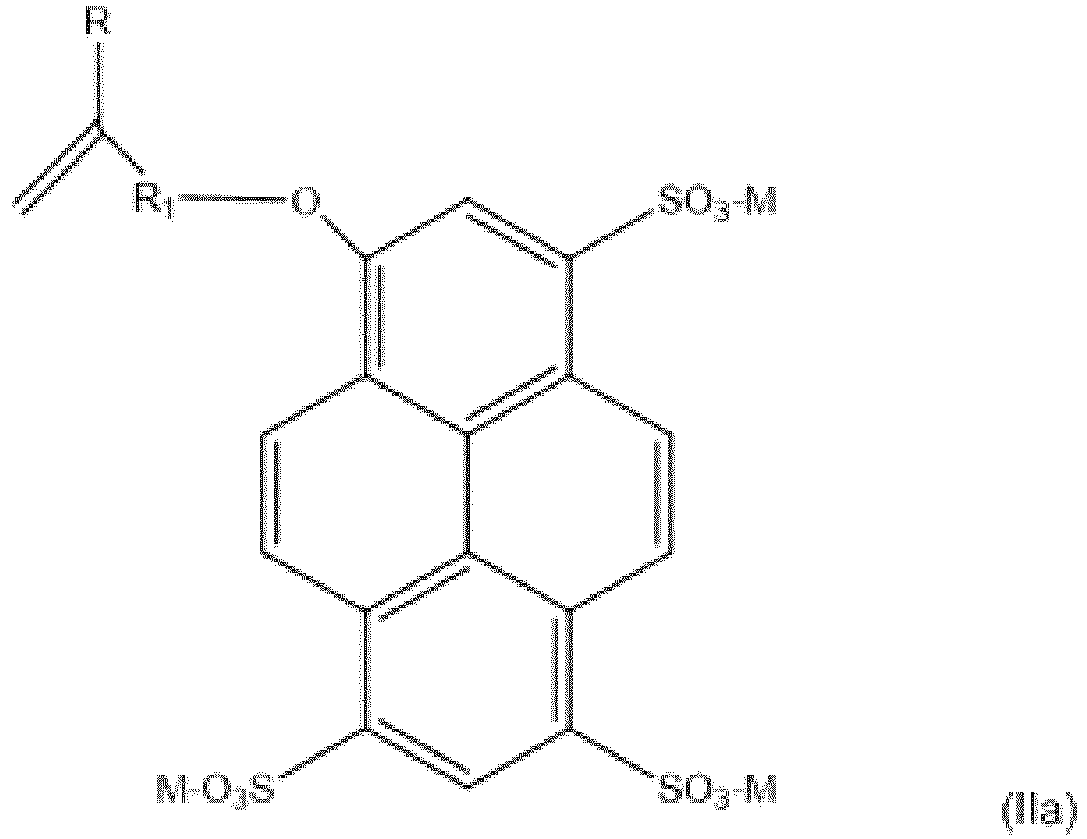
 wobei M ausgewählt wird aus der Gruppe bestehend aus Wasserstoff, Natrium, Kalium, Cäsium, Rubidium, Lithium, Ammonium und Tetralkylammonium, undR1 ausgewählt wird aus gegebenenfalls substituiertem -C1-C10-Alkyl-, -Aryl-C2-C10-Alkyl-, -C(O)-, -CH2NH-C(O)- und -C(CH3)2-NH-C(O)-, undR H oder gegebenenfalls substituiertes C1-C10-Alkyl ist;wobei die Summe der Molprozente der unfunktionalisierten Pyraninverbindung und der Molprozente des unpolymerisierten Pyraninmonomers weniger als 5 Molprozent des gesamten Pyranins in der Polymerzusammensetzung beträgt.
 - Die Polymerzusammensetzung nach Anspruch 10, wobei- das wasserlösliche Polymer außerdem ein oder mehrere Monomere umfasst, die aus der Gruppe ausgewählt werden, die aus Acrylsäure und Salzen, Methacrylsäure und Salzen, Maleinsäure und Salzen, Maleinsäureanhydrid, Acrylamid, Crotonsäure und Salzen, Itaconsäure und Salze, Methacrylamid, 2-Acrylamido-2-methylpropansulfonsäure und Salze, Natrium(meth)allylsulfonat, Allyloxybenzolsulfonsäure und ihre Salze, Polyethylenglykolmonomethacrylat, Vinylphosphonsäure und Salze, Styrolsulfonsäure und Salze, Vinylsulfonsäure und Salze, 3-Allyloxy-2-hydroxypropansulfonsäure und Salze, N-Alkyl(meth)acrylamid, t-Butyl(meth)acrylat, N-Alkyl(meth)acrylat, N-Alkanol-N-alkyl(meth)acrylat, Vinylacetat, 2-Hydroxy-N-alkyl(meth)acrylat, Alkylvinylether, Alkoxyethylacrylat, N-Alkanol(meth)acrylamid, N,N-Dialkyl(meth)acrylamid und 1-Vinyl-2-pyrrolidinon; Sulfomethylacrylamid und Sulfoethylacrylamid besteht; oder- die Verbindung der Formel (IIa) bevorzugt Allyloxypyranin oder, noch bevorzugter, Methallyloxypyranin ist.
- Die Polymerzusammensetzung nach Anspruch 10 oder Anspruch 11, die weiterhin einen Alkohol der Formel R-C(=CH2)-R1-OH umfasst.
- Eine Zusammensetzung, die ein funktionalisiertes Pyranin der Formel (IIa)


wobeiR1 ausgewählt wird aus gegebenenfalls substituiertem C1-C10-Alkyl, Aryl-C2-C10-Alkyl, -C(O)-, -CH2NH-C(O)-, -C(CH3)2-NH-C(O)-,R gegebenenfalls substituiertes C1-C10-Alkyl ist undM ausgewählt wird aus der Gruppe bestehend aus Wasserstoff, Natrium, Kalium, Cäsium, Rubidium, Lithium, Ammonium und Tetraalkylammonium,wobei die Zusammensetzung weniger als 5 Mol-% unfunktionalisiertes Pyranin, bezogen auf die Gesamtmenge an unfunktionalisiertem Pyranin und funktionalisiertem Pyranin, umfasst. - Die Zusammensetzung nach Anspruch 13, wobei- R Methyl ist und R1 Methylen ist; oder- wobei die Verbindung der Formel (IIa) bevorzugt Methallyloxypyranin ist.
- Ein Verfahren zur Verhinderung von Kesselstein in einem industriellen Wassersystem, das die folgenden Schritte umfassta) Bereitstellung eines industriellen Wassersystems, das für unerwünschte Ablagerungen anfällig ist; undb) Zugabe von etwa 1 ppm bis etwa 30 ppm eines Kesselsteininhibitors zu dem Wasser des industriellen Wassersystems,wobei der Kesselsteininhibitor eine fluoreszierende Polymerzusammensetzung umfasst, die fluoreszierende Pyraninmonomere und nicht fluoreszierende Monomere umfasst,wobei die fluoreszierende Polymerzusammensetzung weniger als 5 Mol-% unpolymerisiertes Gesamtpyranin, bezogen auf die Gesamtpyraninmole in der Zusammensetzung, umfasst,wobei die fluoreszierenden Pyraninmonomere ausgewählt werden aus Monomeren der Formel (IIa)

 wobeiR1 ausgewählt wird aus gegebenenfalls substituiertem C1-C10-Alkyl, Aryl-C2-C10-Alkyl, -C(O)-, - CH2NH-C(O)-, -C(CH3)2-NH-C(O)-,R gegebenenfalls substituiertes C1-C10-Alkyl ist undM ausgewählt wird aus der Gruppe bestehend aus Wasserstoff, Natrium, Kalium, Cäsium, Rubidium, Lithium, Ammonium und Tetraalkylammonium,und wobei die nicht-fluoreszierenden Monomere ausgewählt werden aus einem oder mehreren der Gruppe bestehend aus Acrylsäure und Salzen, Methacrylsäure und Salzen, Maleinsäure und Salzen, Maleinsäureanhydrid, Acrylamid, Crotonsäure und Salzen; Itaconsäure und Salze, Methacrylamid, 2-Acrylamido-2-methylpropansulfonsäure und Salze, Natrium(meth)allylsulfonat, Allyloxybenzolsulfonsäure und ihre Salze, Polyethylenglykolmonomethacrylat, Vinylphosphonsäure und Salze, Styrolsulfonsäure und Salze, Vinylsulfonsäure und Salze, 3-Allyloxy-2-hydroxypropansulfonsäure und Salze, N-Alkyl(meth)acrylamid, t-Butyl(meth)acrylat, N-Alkyl(meth)acrylat, N-Alkanol-N-alkyl(meth)acrylat, Vinylacetat, 2-Hydroxy-N-alkyl(meth)acrylat, Alkylvinylether, Alkoxyethylacrylat, N-Alkanol(meth)acrylamid, N,N-Dialkyl(meth)acrylamid und 1-Vinyl-2-pyrrolidinon; Sulfomethylacrylamid und Sulfoethylacrylamid;und wobei die Verbindung der Formel (IIa) bevorzugt Methallyloxypyranin ist.
Applications Claiming Priority (3)
| Application Number | Priority Date | Filing Date | Title |
|---|---|---|---|
| US201762539901P | 2017-08-01 | 2017-08-01 | |
| EP17196930 | 2017-10-17 | ||
| PCT/EP2018/070398 WO2019025305A1 (en) | 2017-08-01 | 2018-07-27 | WATER-SOLUBLE POLYMER POLYMERS AND METHOD OF MANUFACTURE |
Publications (2)
| Publication Number | Publication Date |
|---|---|
| EP3662036A1 EP3662036A1 (de) | 2020-06-10 |
| EP3662036B1 true EP3662036B1 (de) | 2025-03-26 |
Family
ID=63013050
Family Applications (1)
| Application Number | Title | Priority Date | Filing Date |
|---|---|---|---|
| EP18745619.9A Active EP3662036B1 (de) | 2017-08-01 | 2018-07-27 | Wasserlösliche pyraninpolymere und verfahren zur herstellung |
Country Status (7)
| Country | Link |
|---|---|
| US (1) | US11859026B2 (de) |
| EP (1) | EP3662036B1 (de) |
| JP (1) | JP2020528959A (de) |
| CN (1) | CN111094507A (de) |
| AU (1) | AU2018310998B2 (de) |
| CA (1) | CA3071554A1 (de) |
| TW (1) | TW201920087A (de) |
Families Citing this family (3)
| Publication number | Priority date | Publication date | Assignee | Title |
|---|---|---|---|---|
| US10858566B2 (en) * | 2020-04-14 | 2020-12-08 | S.P.C.M. Sa | Drilling fluid with improved fluid loss and viscosifying properties |
| JP6989039B1 (ja) * | 2021-01-18 | 2022-01-05 | 栗田工業株式会社 | 水処理剤 |
| WO2023245197A2 (en) * | 2022-06-16 | 2023-12-21 | Nouryon Chemicals International B.V. | Tagged polymers as phosphonate replacements in water treatment applications |
Family Cites Families (16)
| Publication number | Priority date | Publication date | Assignee | Title |
|---|---|---|---|---|
| US5171450A (en) | 1991-03-20 | 1992-12-15 | Nalco Chemical Company | Monitoring and dosage control of tagged polymers in cooling water systems |
| EP0878446A1 (de) | 1993-01-26 | 1998-11-18 | National Starch And Chemical Investment Holding Corporation | Verfahren zur Sequestrierung von Ionen in harten Wasser |
| US5514710A (en) * | 1994-01-11 | 1996-05-07 | Molecular Probes, Inc. | Photocleavable derivatives of hydroxyprenesulfonic acids |
| US5547612A (en) | 1995-02-17 | 1996-08-20 | National Starch And Chemical Investment Holding Corporation | Compositions of water soluble polymers containing allyloxybenzenesulfonic acid monomer and methallyl sulfonic acid monomer and methods for use in aqueous systems |
| JP3983833B2 (ja) | 1995-08-11 | 2007-09-26 | 株式会社日本触媒 | 水処理剤 |
| US5986030A (en) | 1997-04-15 | 1999-11-16 | Nalco Chemical Company | Fluorescent water soluble polymers |
| US6312644B1 (en) * | 1999-12-16 | 2001-11-06 | Nalco Chemical Company | Fluorescent monomers and polymers containing same for use in industrial water systems |
| US6280635B1 (en) | 2000-05-01 | 2001-08-28 | Nalco Chemical Company | Autocycle control of cooling water systems |
| US7087189B2 (en) | 2002-03-18 | 2006-08-08 | National Starch Chemical Investment Holding Co | Multifunctional calcium carbonate and calcium phosphate scale inhibitor |
| US7666963B2 (en) | 2005-07-21 | 2010-02-23 | Akzo Nobel N.V. | Hybrid copolymers |
| US9321873B2 (en) | 2005-07-21 | 2016-04-26 | Akzo Nobel N.V. | Hybrid copolymer compositions for personal care applications |
| CN101125714B (zh) * | 2007-07-06 | 2012-05-23 | 东南大学 | 一种荧光聚醚阻垢剂及制备方法 |
| CN101289257A (zh) * | 2008-05-29 | 2008-10-22 | 东南大学 | 荧光标记聚醚羧酸类阻垢剂及制备方法 |
| CN101475266A (zh) * | 2009-01-09 | 2009-07-08 | 东南大学 | 一种荧光示踪阻垢剂及其制备方法 |
| US8871880B2 (en) | 2012-03-22 | 2014-10-28 | Evonik Corporation | Superabsorbent copolymer |
| US9751789B2 (en) | 2012-12-28 | 2017-09-05 | Ecolab Usa Inc. | Fluorescent monomers and tagged treatment polymers containing same for use in industrial water systems |
-
2018
- 2018-07-27 JP JP2020505435A patent/JP2020528959A/ja active Pending
- 2018-07-27 CA CA3071554A patent/CA3071554A1/en active Pending
- 2018-07-27 US US16/635,828 patent/US11859026B2/en active Active
- 2018-07-27 AU AU2018310998A patent/AU2018310998B2/en not_active Ceased
- 2018-07-27 EP EP18745619.9A patent/EP3662036B1/de active Active
- 2018-07-27 CN CN201880057510.9A patent/CN111094507A/zh active Pending
- 2018-08-01 TW TW107126631A patent/TW201920087A/zh unknown
Also Published As
| Publication number | Publication date |
|---|---|
| AU2018310998B2 (en) | 2024-01-25 |
| JP2020528959A (ja) | 2020-10-01 |
| CA3071554A1 (en) | 2019-02-07 |
| CN111094507A (zh) | 2020-05-01 |
| AU2018310998A1 (en) | 2020-02-20 |
| TW201920087A (zh) | 2019-06-01 |
| EP3662036A1 (de) | 2020-06-10 |
| US20200223959A1 (en) | 2020-07-16 |
| US11859026B2 (en) | 2024-01-02 |
Similar Documents
| Publication | Publication Date | Title |
|---|---|---|
| US6312644B1 (en) | Fluorescent monomers and polymers containing same for use in industrial water systems | |
| WO2019025305A1 (en) | WATER-SOLUBLE POLYMER POLYMERS AND METHOD OF MANUFACTURE | |
| US11859026B2 (en) | Water soluble pyranine polymers and method of making | |
| US11542187B2 (en) | Composition and method for controlling scale in industrial water systems | |
| US6995120B2 (en) | Scale control composition for high scaling environments | |
| EP2665794B1 (de) | Familien von ablagerungsinhibitoren mit verschiedenen absorptionsprofilen und ihre anwendung in ölfeldern | |
| EP2387591B1 (de) | Copolymer zur inhibierung von anorganischen ablagerungen | |
| EP3977102A1 (de) | Fluoreszente naphthalimidpolymere und lösungen davon zur kesselsteinbekämpfung in wässrigen systemen | |
| EP2429957B1 (de) | Markierte kesselsteinhemmer | |
| WO2019027608A1 (en) | FLUORESCENT POLYMERS FOR MONITORING CONCENTRATIONS OF ANTITARTER AGENTS IN INDUSTRIAL WATER SYSTEMS | |
| CN101432324B (zh) | 用作污垢抑制剂的共聚物 | |
| WO2019027610A1 (en) | METHOD FOR MONITORING FLUORESCENT POLYMER ANTITARES AGENTS IN INDUSTRIAL WATER DISTRIBUTION SYSTEMS | |
| US11421152B2 (en) | Tagged treatment polymers for monitoring antiscalant concentrations in industrial water systems | |
| RU2598645C2 (ru) | Способ получения сополимеров малеиновой кислоты с изопренолом | |
| US20240343849A1 (en) | Tagged polymer and method | |
| EP0681995A2 (de) | Verfahren zur Verhinderung von Kesselstein | |
| WO2019027609A1 (en) | MONITORING AND CONTROL OF DETERMINATION OF PROCESSED POLYMERS IN INDUSTRIAL WATER DISTRIBUTION SYSTEMS | |
| JP2001081110A (ja) | 水溶性蛍光ポリマーおよび製造方法 | |
| AU2020380210A1 (en) | Fluorescent-tagged water treatment polymers | |
| NO20092851L (no) | Prosess og polymer for forhindring av BA/SR kjelstein med inkorporert detekterbar fosforfunksjonalitet |
Legal Events
| Date | Code | Title | Description |
|---|---|---|---|
| STAA | Information on the status of an ep patent application or granted ep patent |
Free format text: STATUS: UNKNOWN |
|
| STAA | Information on the status of an ep patent application or granted ep patent |
Free format text: STATUS: THE INTERNATIONAL PUBLICATION HAS BEEN MADE |
|
| PUAI | Public reference made under article 153(3) epc to a published international application that has entered the european phase |
Free format text: ORIGINAL CODE: 0009012 |
|
| STAA | Information on the status of an ep patent application or granted ep patent |
Free format text: STATUS: REQUEST FOR EXAMINATION WAS MADE |
|
| 17P | Request for examination filed |
Effective date: 20200302 |
|
| AK | Designated contracting states |
Kind code of ref document: A1 Designated state(s): AL AT BE BG CH CY CZ DE DK EE ES FI FR GB GR HR HU IE IS IT LI LT LU LV MC MK MT NL NO PL PT RO RS SE SI SK SM TR |
|
| AX | Request for extension of the european patent |
Extension state: BA ME |
|
| DAV | Request for validation of the european patent (deleted) | ||
| DAX | Request for extension of the european patent (deleted) | ||
| STAA | Information on the status of an ep patent application or granted ep patent |
Free format text: STATUS: EXAMINATION IS IN PROGRESS |
|
| 17Q | First examination report despatched |
Effective date: 20220118 |
|
| P01 | Opt-out of the competence of the unified patent court (upc) registered |
Effective date: 20230511 |
|
| GRAP | Despatch of communication of intention to grant a patent |
Free format text: ORIGINAL CODE: EPIDOSNIGR1 |
|
| STAA | Information on the status of an ep patent application or granted ep patent |
Free format text: STATUS: GRANT OF PATENT IS INTENDED |
|
| RIC1 | Information provided on ipc code assigned before grant |
Ipc: C02F 103/02 20060101ALI20241025BHEP Ipc: C02F 5/12 20060101ALI20241025BHEP Ipc: C02F 5/10 20060101ALI20241025BHEP Ipc: C02F 5/00 20060101ALI20241025BHEP Ipc: C02F 1/50 20060101ALI20241025BHEP Ipc: C09K 11/06 20060101AFI20241025BHEP |
|
| INTG | Intention to grant announced |
Effective date: 20241114 |
|
| GRAS | Grant fee paid |
Free format text: ORIGINAL CODE: EPIDOSNIGR3 |
|
| GRAA | (expected) grant |
Free format text: ORIGINAL CODE: 0009210 |
|
| STAA | Information on the status of an ep patent application or granted ep patent |
Free format text: STATUS: THE PATENT HAS BEEN GRANTED |
|
| AK | Designated contracting states |
Kind code of ref document: B1 Designated state(s): AL AT BE BG CH CY CZ DE DK EE ES FI FR GB GR HR HU IE IS IT LI LT LU LV MC MK MT NL NO PL PT RO RS SE SI SK SM TR |
|
| REG | Reference to a national code |
Ref country code: GB Ref legal event code: FG4D |
|
| REG | Reference to a national code |
Ref country code: CH Ref legal event code: EP |
|
| REG | Reference to a national code |
Ref country code: DE Ref legal event code: R096 Ref document number: 602018080458 Country of ref document: DE |
|
| REG | Reference to a national code |
Ref country code: IE Ref legal event code: FG4D |
|
| PG25 | Lapsed in a contracting state [announced via postgrant information from national office to epo] |
Ref country code: RS Free format text: LAPSE BECAUSE OF FAILURE TO SUBMIT A TRANSLATION OF THE DESCRIPTION OR TO PAY THE FEE WITHIN THE PRESCRIBED TIME-LIMIT Effective date: 20250626 |
|
| PG25 | Lapsed in a contracting state [announced via postgrant information from national office to epo] |
Ref country code: FI Free format text: LAPSE BECAUSE OF FAILURE TO SUBMIT A TRANSLATION OF THE DESCRIPTION OR TO PAY THE FEE WITHIN THE PRESCRIBED TIME-LIMIT Effective date: 20250326 |
|
| REG | Reference to a national code |
Ref country code: LT Ref legal event code: MG9D |
|
| PG25 | Lapsed in a contracting state [announced via postgrant information from national office to epo] |
Ref country code: NO Free format text: LAPSE BECAUSE OF FAILURE TO SUBMIT A TRANSLATION OF THE DESCRIPTION OR TO PAY THE FEE WITHIN THE PRESCRIBED TIME-LIMIT Effective date: 20250626 |
|
| PG25 | Lapsed in a contracting state [announced via postgrant information from national office to epo] |
Ref country code: HR Free format text: LAPSE BECAUSE OF FAILURE TO SUBMIT A TRANSLATION OF THE DESCRIPTION OR TO PAY THE FEE WITHIN THE PRESCRIBED TIME-LIMIT Effective date: 20250326 |
|
| PG25 | Lapsed in a contracting state [announced via postgrant information from national office to epo] |
Ref country code: LV Free format text: LAPSE BECAUSE OF FAILURE TO SUBMIT A TRANSLATION OF THE DESCRIPTION OR TO PAY THE FEE WITHIN THE PRESCRIBED TIME-LIMIT Effective date: 20250326 |
|
| PG25 | Lapsed in a contracting state [announced via postgrant information from national office to epo] |
Ref country code: GR Free format text: LAPSE BECAUSE OF FAILURE TO SUBMIT A TRANSLATION OF THE DESCRIPTION OR TO PAY THE FEE WITHIN THE PRESCRIBED TIME-LIMIT Effective date: 20250627 Ref country code: BG Free format text: LAPSE BECAUSE OF FAILURE TO SUBMIT A TRANSLATION OF THE DESCRIPTION OR TO PAY THE FEE WITHIN THE PRESCRIBED TIME-LIMIT Effective date: 20250326 |
|
| REG | Reference to a national code |
Ref country code: NL Ref legal event code: MP Effective date: 20250326 |
|
| PG25 | Lapsed in a contracting state [announced via postgrant information from national office to epo] |
Ref country code: NL Free format text: LAPSE BECAUSE OF FAILURE TO SUBMIT A TRANSLATION OF THE DESCRIPTION OR TO PAY THE FEE WITHIN THE PRESCRIBED TIME-LIMIT Effective date: 20250326 |
|
| PG25 | Lapsed in a contracting state [announced via postgrant information from national office to epo] |
Ref country code: SE Free format text: LAPSE BECAUSE OF FAILURE TO SUBMIT A TRANSLATION OF THE DESCRIPTION OR TO PAY THE FEE WITHIN THE PRESCRIBED TIME-LIMIT Effective date: 20250326 |
|
| REG | Reference to a national code |
Ref country code: AT Ref legal event code: MK05 Ref document number: 1778992 Country of ref document: AT Kind code of ref document: T Effective date: 20250326 |
|
| PG25 | Lapsed in a contracting state [announced via postgrant information from national office to epo] |
Ref country code: SM Free format text: LAPSE BECAUSE OF FAILURE TO SUBMIT A TRANSLATION OF THE DESCRIPTION OR TO PAY THE FEE WITHIN THE PRESCRIBED TIME-LIMIT Effective date: 20250326 |
|
| PG25 | Lapsed in a contracting state [announced via postgrant information from national office to epo] |
Ref country code: PT Free format text: LAPSE BECAUSE OF FAILURE TO SUBMIT A TRANSLATION OF THE DESCRIPTION OR TO PAY THE FEE WITHIN THE PRESCRIBED TIME-LIMIT Effective date: 20250728 Ref country code: ES Free format text: LAPSE BECAUSE OF FAILURE TO SUBMIT A TRANSLATION OF THE DESCRIPTION OR TO PAY THE FEE WITHIN THE PRESCRIBED TIME-LIMIT Effective date: 20250326 |
|
| PGFP | Annual fee paid to national office [announced via postgrant information from national office to epo] |
Ref country code: DE Payment date: 20250729 Year of fee payment: 8 |
|
| PG25 | Lapsed in a contracting state [announced via postgrant information from national office to epo] |
Ref country code: IT Free format text: LAPSE BECAUSE OF FAILURE TO SUBMIT A TRANSLATION OF THE DESCRIPTION OR TO PAY THE FEE WITHIN THE PRESCRIBED TIME-LIMIT Effective date: 20250326 Ref country code: PL Free format text: LAPSE BECAUSE OF FAILURE TO SUBMIT A TRANSLATION OF THE DESCRIPTION OR TO PAY THE FEE WITHIN THE PRESCRIBED TIME-LIMIT Effective date: 20250326 |
|
| PGFP | Annual fee paid to national office [announced via postgrant information from national office to epo] |
Ref country code: GB Payment date: 20250728 Year of fee payment: 8 |
|
| PG25 | Lapsed in a contracting state [announced via postgrant information from national office to epo] |
Ref country code: AT Free format text: LAPSE BECAUSE OF FAILURE TO SUBMIT A TRANSLATION OF THE DESCRIPTION OR TO PAY THE FEE WITHIN THE PRESCRIBED TIME-LIMIT Effective date: 20250326 |
|
| PGFP | Annual fee paid to national office [announced via postgrant information from national office to epo] |
Ref country code: FR Payment date: 20250728 Year of fee payment: 8 |
|
| PG25 | Lapsed in a contracting state [announced via postgrant information from national office to epo] |
Ref country code: EE Free format text: LAPSE BECAUSE OF FAILURE TO SUBMIT A TRANSLATION OF THE DESCRIPTION OR TO PAY THE FEE WITHIN THE PRESCRIBED TIME-LIMIT Effective date: 20250326 |
|
| PG25 | Lapsed in a contracting state [announced via postgrant information from national office to epo] |
Ref country code: RO Free format text: LAPSE BECAUSE OF FAILURE TO SUBMIT A TRANSLATION OF THE DESCRIPTION OR TO PAY THE FEE WITHIN THE PRESCRIBED TIME-LIMIT Effective date: 20250326 |
|
| PG25 | Lapsed in a contracting state [announced via postgrant information from national office to epo] |
Ref country code: SK Free format text: LAPSE BECAUSE OF FAILURE TO SUBMIT A TRANSLATION OF THE DESCRIPTION OR TO PAY THE FEE WITHIN THE PRESCRIBED TIME-LIMIT Effective date: 20250326 |
|
| PG25 | Lapsed in a contracting state [announced via postgrant information from national office to epo] |
Ref country code: IS Free format text: LAPSE BECAUSE OF FAILURE TO SUBMIT A TRANSLATION OF THE DESCRIPTION OR TO PAY THE FEE WITHIN THE PRESCRIBED TIME-LIMIT Effective date: 20250726 |
|
| REG | Reference to a national code |
Ref country code: DE Ref legal event code: R097 Ref document number: 602018080458 Country of ref document: DE |
|
| PG25 | Lapsed in a contracting state [announced via postgrant information from national office to epo] |
Ref country code: DK Free format text: LAPSE BECAUSE OF FAILURE TO SUBMIT A TRANSLATION OF THE DESCRIPTION OR TO PAY THE FEE WITHIN THE PRESCRIBED TIME-LIMIT Effective date: 20250326 |
|
| PG25 | Lapsed in a contracting state [announced via postgrant information from national office to epo] |
Ref country code: CZ Free format text: LAPSE BECAUSE OF FAILURE TO SUBMIT A TRANSLATION OF THE DESCRIPTION OR TO PAY THE FEE WITHIN THE PRESCRIBED TIME-LIMIT Effective date: 20250326 |
|
| PLBE | No opposition filed within time limit |
Free format text: ORIGINAL CODE: 0009261 |
|
| STAA | Information on the status of an ep patent application or granted ep patent |
Free format text: STATUS: NO OPPOSITION FILED WITHIN TIME LIMIT |
|
| REG | Reference to a national code |
Ref country code: CH Ref legal event code: L10 Free format text: ST27 STATUS EVENT CODE: U-0-0-L10-L00 (AS PROVIDED BY THE NATIONAL OFFICE) Effective date: 20260211 |
|
| REG | Reference to a national code |
Ref country code: CH Ref legal event code: H13 Free format text: ST27 STATUS EVENT CODE: U-0-0-H10-H13 (AS PROVIDED BY THE NATIONAL OFFICE) Effective date: 20260224 |
|
| 26N | No opposition filed |
Effective date: 20260105 |
|
| PG25 | Lapsed in a contracting state [announced via postgrant information from national office to epo] |
Ref country code: LU Free format text: LAPSE BECAUSE OF NON-PAYMENT OF DUE FEES Effective date: 20250727 |
|
| REG | Reference to a national code |
Ref country code: BE Ref legal event code: MM Effective date: 20250731 |
|
| PG25 | Lapsed in a contracting state [announced via postgrant information from national office to epo] |
Ref country code: BE Free format text: LAPSE BECAUSE OF NON-PAYMENT OF DUE FEES Effective date: 20250731 |
|
| PG25 | Lapsed in a contracting state [announced via postgrant information from national office to epo] |
Ref country code: CH Free format text: LAPSE BECAUSE OF NON-PAYMENT OF DUE FEES Effective date: 20250731 |