EP3659714A1 - Dispositif d'enduction - Google Patents
Dispositif d'enduction Download PDFInfo
- Publication number
- EP3659714A1 EP3659714A1 EP19211648.1A EP19211648A EP3659714A1 EP 3659714 A1 EP3659714 A1 EP 3659714A1 EP 19211648 A EP19211648 A EP 19211648A EP 3659714 A1 EP3659714 A1 EP 3659714A1
- Authority
- EP
- European Patent Office
- Prior art keywords
- coating device
- coating
- pile
- velvet
- monofilaments
- Prior art date
- Legal status (The legal status is an assumption and is not a legal conclusion. Google has not performed a legal analysis and makes no representation as to the accuracy of the status listed.)
- Withdrawn
Links
- 238000000576 coating method Methods 0.000 title claims abstract description 52
- 239000011248 coating agent Substances 0.000 title claims abstract description 50
- 239000004753 textile Substances 0.000 claims abstract description 9
- 239000000463 material Substances 0.000 claims abstract description 8
- 239000004952 Polyamide Substances 0.000 claims description 4
- 229920002647 polyamide Polymers 0.000 claims description 4
- 210000004209 hair Anatomy 0.000 description 7
- 230000000694 effects Effects 0.000 description 4
- 239000011505 plaster Substances 0.000 description 3
- 230000008021 deposition Effects 0.000 description 2
- 239000006260 foam Substances 0.000 description 2
- 239000000203 mixture Substances 0.000 description 2
- 239000003973 paint Substances 0.000 description 2
- 238000009877 rendering Methods 0.000 description 2
- 208000023178 Musculoskeletal disease Diseases 0.000 description 1
- 239000000853 adhesive Substances 0.000 description 1
- 230000001070 adhesive effect Effects 0.000 description 1
- 230000001413 cellular effect Effects 0.000 description 1
- 238000001035 drying Methods 0.000 description 1
- 230000003670 easy-to-clean Effects 0.000 description 1
- 239000013013 elastic material Substances 0.000 description 1
- 238000009499 grossing Methods 0.000 description 1
- 238000000034 method Methods 0.000 description 1
- 235000011837 pasties Nutrition 0.000 description 1
- 239000004033 plastic Substances 0.000 description 1
- 230000003252 repetitive effect Effects 0.000 description 1
- 238000007761 roller coating Methods 0.000 description 1
- 238000005096 rolling process Methods 0.000 description 1
- 238000004448 titration Methods 0.000 description 1
- 238000009941 weaving Methods 0.000 description 1
- 210000002268 wool Anatomy 0.000 description 1
Images
Classifications
-
- B—PERFORMING OPERATIONS; TRANSPORTING
- B05—SPRAYING OR ATOMISING IN GENERAL; APPLYING FLUENT MATERIALS TO SURFACES, IN GENERAL
- B05C—APPARATUS FOR APPLYING FLUENT MATERIALS TO SURFACES, IN GENERAL
- B05C17/00—Hand tools or apparatus using hand held tools, for applying liquids or other fluent materials to, for spreading applied liquids or other fluent materials on, or for partially removing applied liquids or other fluent materials from, surfaces
- B05C17/02—Rollers ; Hand tools comprising coating rollers or coating endless belts
- B05C17/0207—Rollers ; Hand tools comprising coating rollers or coating endless belts characterised by the cover, e.g. cover material or structure, special surface for producing patterns
-
- B—PERFORMING OPERATIONS; TRANSPORTING
- B05—SPRAYING OR ATOMISING IN GENERAL; APPLYING FLUENT MATERIALS TO SURFACES, IN GENERAL
- B05C—APPARATUS FOR APPLYING FLUENT MATERIALS TO SURFACES, IN GENERAL
- B05C17/00—Hand tools or apparatus using hand held tools, for applying liquids or other fluent materials to, for spreading applied liquids or other fluent materials on, or for partially removing applied liquids or other fluent materials from, surfaces
- B05C17/02—Rollers ; Hand tools comprising coating rollers or coating endless belts
- B05C17/0215—Rollers ; Hand tools comprising coating rollers or coating endless belts the coating roller itself, i.e. not only its cover being deformable, e.g. to allow proper coating of non-plane surfaces
Definitions
- the present invention relates to a coating device for applying coatings to an interior or exterior surface.
- the present invention provides a coating device intended for applying a coating to a surface, the coating device comprising a cylindrical drum coated with a lining made of a textile material of the velvet type, the threads forming the pile pile being monofilaments.
- the lining of the present invention makes it possible to restore the coated evenly and effectively. This quality of application is also better than that obtained with honeycomb rollers. Despite appearances, this type of cell roller does not load well and projects the coating during removal. Careful protection of the site is then necessary because the application is very messy, which is now avoided by the device of the present invention.
- coating means any type of coating which can be deposited with a roller.
- the coating device of the present invention is configured for the application of paste coating which can be otherwise called pasty coating.
- This coating device is in particular configured for the application of plaster on surfaces of the plasterboard type, concrete or concrete block walls.
- the coating device comprises a drum and a textile lining and that it is devoid of cellular foam or other elastic material disposed between the drum and the lining.
- the coating device comprises monofilaments woven on a weft which forms the velvet.
- the coating device is devoid of any adhesive or other fixing element having for goal the adhesion of monofilmanents on a weft or other element allowing the fixing of monofilaments other than by weaving.
- the threads forming the pile of the velvet consist solely of monofilaments.
- the pile of the pile type textile of the present invention comprises monofilaments having a titer greater than 150 decitex and more preferably a titer greater than 200 decitex.
- these hairs have a large linear mass, they are thicker than the vast majority of hairs commonly used.
- This type of hair thus has greater resistance to setting when rendering the coating than multi-filament hairs which are often thinner, which facilitates application.
- the multi-filament hairs have a lower titer.
- the small thickness of each of the filaments of this type of hair is compensated by the fact that several filaments are joined, generally by a braid.
- the bristles thus obtained are very flexible, they easily deform so that it is more difficult to load them and it is more difficult to apply the coating because the bristles lie down on contact with a surface. .
- the length of the pile of the velvet is between 8 and 27 mm so as to be able to load a lot of material at one time.
- the monofilaments of the lining of the coating device are made of polyamide.
- polyamide monofilaments have a titer greater than 150 decitex. This composition gives the bristles resistance to flattening, while also imparting the elasticity necessary for optimal deposition of the coating.
- the textile material of the pile type of the lining according to the present invention comprises a woven weft having two sides and the pile of the velvet extend radially from one of the faces of the weft which is opposite to that disposed on the side. of the cylindrical drum.
- the bristles extend towards the outside of the cylindrical drum and can receive the coating.
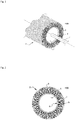
- the coating device 100 is generally presented as a paint roller with long hairs.
- the coating device 100 comprises a cylindrical drum 1, in particular formed of plastic material and is coated with a lining 2 made of a textile material of the velvet type.
- the weft 3 of this textile comprises two faces 4,5.
- the bristles 6 consist of thick monofilaments, the title or linear mass of which is approximately 200 decitex; 1 decitex being the international standardized thread titration unit equivalent to 1 g / 10,000 m or 10 -7 kg / m.
- the bristles 6 are curved and their thickness gives them resistance to flattening.
- the application of the coating is carried out by regular deposition.
- the monofilaments include a titer varying between 150 and 250 decitex, or even more depending on the desired effects, such as texturing, 3D effect, projected effect ... etc.
- the pile 6 of the velvet is long, they measure approximately 25 mm in the illustrated embodiment, which makes it possible to load an optimal amount of coating while guaranteeing a uniform application due to the stiffness of the pile 6.
- the monofilaments of the bristles 6 have a variable length between 8 and 27 mm, the length of the bristle 6 being chosen according to the fluidity of the coating to be applied.
- the monofilaments are made of polyamide. They have a titer greater than 150 decitex. This composition provides the optimal flexibility and elasticity necessary for loading and removing the coating.
- such a lining 2 is easy to clean, which promotes the reusability of the coating device 100 in an eco-responsible approach.
- the cylindrical drum 1 of the coating device 100 extends along a longitudinal axis. It is mounted mobile in rotation around this longitudinal axis, on a portion of a handle 7 intended for the gripping of the device by a user. It is understood in the present application of the cylindrical drum 1 is removably mounted on the handle portion 7.
- the coating device 100 can be used both indoors and outdoors, for large areas but also the joints of panel plates with an appropriate drum size.
- the device allows decorative effects of the projected type, by rolling in the cool, on a previously smoothed coating, in particular by applying the roller without load, before drying or before setting, on the previously smoothed coating.
Landscapes
- Engineering & Computer Science (AREA)
- Mechanical Engineering (AREA)
- Coating Apparatus (AREA)
Abstract
Description
- La présente invention concerne un dispositif d'enduction destiné à l'application d'enduits sur une surface intérieure ou extérieure.
- Au cours de la dernière décennie, les techniques du bâtiment ont évolué et les opérations d'enduction se font en partie maintenant à l'aide d'un enduit préparé, souvent conditionné en seau. Ces enduits présentent une certaine liquidité qui permet de les appliquer par exemple au rouleau. Les rouleaux traditionnels sont notamment des rouleaux à peindre, des rouleaux mousse, des rouleaux type « nids d'abeilles », « trous brulés » ou rouleaux laine. Parmi les rouleaux tissés actuellement disponibles sur le marché, peu d'entre eux permet une charge conséquente en enduit et souvent l'enduit est restitué de façon irrégulière. De plus, l'application provoque souvent des projections peu agréables pour l'utilisateur.
- Un des buts de la présente invention est de pallier au moins l'un de ces inconvénients. A cet effet, la présente invention propose un dispositif d'enduction destiné à appliquer un enduit sur une surface, le dispositif d'enduction comprenant un tambour cylindrique revêtu d'une garniture constituée d'une matière textile de type velours, les fils formant les poils du velours étant des mono-filaments. Ainsi, grâce à la très bonne tenue des poils en mono-filament, et à leur faible surface de contact (capillarité) par rapport à une garniture tissée avec des multi-filaments couramment utilisée, la garniture de la présente invention permet de restituer l'enduit de façon régulière et efficace. Cette qualité d'application est également meilleure à celle obtenue avec des rouleaux à alvéoles. En dépit des apparences, ce type de rouleau à alvéoles se charge mal et projete l'enduit lors de la dépose. Une protection soignée du chantier est alors nécessaire car l'application est très salissante, ce qui est désormais évitée par le dipositif de la présente invention.
- Il est entendu dans la présente demande que l'expression 'enduit' signifie tout type d'enduit déposable au rouleau.
- De préférence le dispositif d'enduction de la présente invention est configuré pour l'application d'enduit en pâte pouvant être autrement dénommé enduit pâteux.
- Ce dipositif d'enduction est notamment configuré pour l'application d'enduit sur des surfaces de type plaques de platre, des murs en béton ou en parpaing.
- Il est entendu dans le présent document que le dipositif d'enduction comprend un tambour et une garniture textile et qu'il est dépourvu de mousse alvéolaire ou autre matériau élastique disposé entre le tambour et la garniture.
- Il est également entendu dans le présent document que le dispositif d'enduction comprend des monofilaments tissés sur une trame qui forme le velours. le dispositif d'enduction est dépourvu de tout adhésif ou autre élement de fixation ayant pour but l'adhésion de monofilmanents sur une trame ou autre élement permettant la fixation de monofilaments autrement que par tissage.
- De plus, les fils formant les poils du velours sont uniquement constitués de monofilaments.
- De préférence, les poils du textile de type velours de la présente invention comprennent des mono-filaments présentant un titre supérieur à 150 décitex et de préférence encore un titre supérieur à 200 décitex. Ainsi, ces poils présentent une masse linéaire importante, ils sont plus épais que la grande majorité des poils couramment utilisés. Ce type de poil présente ainsi une plus grande résistance à se coucher lors de la restitution de l'enduit que des poils multi-filaments souvent plus minces, ce qui facilite l'application. En effet les poils multi-filaments présentent un titre plus faible. La faible épaisseur de chacun des filaments de ce type de poil est compensée par le fait que plusieurs filaments sont réunis, généralement par une tresse. Toutefois les poils ainsi obtenus sont très souples, ils se déforment facilement de sorte qu'il est plus difficile de les charger et qu'il est plus difficile d'appliquer l'enduit du fait que les poils se couchent au contact d'une surface.
- Avantageusement, la longueur des poils du velours est comprise entre 8 et 27 mm de sorte à pouvoir charger beaucoup de matière en une seule fois.
- Selon une disposition, les mono-filaments de la garniture du dispositif d'enduction sont en polyamide. En particulier, les monofilaments de polyamide présentent un titre supérieur à 150 décitex. Cette composition confère aux poils une résistance à l'aplatissement, tout en conférant l'élasticité nécessaire pour une dépose optimale de l'enduit.
- Avantageusement, la matière textile de type velours de la garniture selon la présente invention comprend une trame tissée présentant deux faces et les poils du velours s'étendent radialement à partir de l'une des faces de la trame qui est opposée à celle disposée du coté du tambour cylindrique. Ainsi, les poils s'étendent vers l'extérieur du tambour cylindrique et peuvent recevoir l'enduit.
- D'autres aspects, buts et avantages de la présente invention apparaîtront mieux à la lecture de la description suivante d'un mode de réalisation de celle-ci, donnée à titre d'exemple non limitatif et faite en référence aux dessins annexés. Les figures ne respectent pas nécessairement l'échelle de tous les éléments représentés de sorte à améliorer leur lisibilité. Dans la suite de la description, par souci de simplification, des éléments identiques, similaires ou équivalents des différentes formes de réalisation portent les mêmes références numériques, sur lesquelles :
- La
figure 1 représente une vue en perspective d'un dispositif d'enduction selon un mode de réalisation de l'invention. - La
figure 2 représente une vue en coupe du dispositif d'enduction selon le mode de réalisation de l'invention illustré à lafigure 1 . - Comme illustré à la
figure 1 , à première vue, le dispositif d'enduction 100 se présente globalement comme un rouleau de peinture à poils longs. Le dispositif d'enduction 100 comprend un tambour cylindrique 1, notamment formé en matière plastique et est revêtu d'une garniture 2 constituée d'une matière textile de type velours. La trame 3 de ce textile comprend deux faces 4,5. Une face interne 4 recouvrant la surface externe du tambour 1, hormis les faces latérales de ce dernier, et une face externe 5 disposée du côté opposé au tambour 1, à partir de laquelle les poils 6 du velours s'étendent (illustré à lafigure 2 ). En observant plus attentivement la garniture 2 ou à l'aide d'un grossissement, on peut observer que les poils 6 sont constitués de mono-filaments épais, dont le titre ou la masse linéaire est d'environ 200 décitex; 1 décitex étant l'unité normalisée internationale de titrage des fils équivalent à 1 g / 10 000 m ou 10-7 kg/m. Comme il est visible sur les figures, les poils 6 sont courbes et leur épaisseur leur confère une résistance à l'aplatissement. Ainsi, l'application de l'enduit est réalisée par un dépôt régulier. Selon une variante non illustrée les mono-filaments comprennent un titre variant entre 150 et 250 décitex, voire davantage selon les effets recherchés, tels que la texturation, effet 3D, effet projeté... etc. - Les poils 6 du velours sont longs, ils mesurent environ 25 mm dans le mode de réalisation illustré, ce qui permet de charger une quantité optimale d'enduit tout en garantissant une application homogène du fait de la raideur du poil 6. Selon une autre disposition non illustrée, les mono-filaments des poils 6 présentent une longueur variable entre 8 et 27 mm, la longueur du poil 6 étant choisie selon la fluidité de l'enduit à appliquer. Les mono-filaments sont constitués de polyamide. Ils présentent un titre supérieur à 150 décitex. Cette composition confère la souplesse et l'élasticité optimale nécessaire à la charge et à la dépose de l'enduit. De plus, une telle garniture 2 est facile à nettoyer ce qui favorise la réutilisaiton du dispositif d'enduction 100 dans une démarche eco-responsable.
- Comme illustré sur la
figure 1 , le tambour cylindrique 1 du dispositif d'enduction 100 s'étend selon un axe longitudinal. Il est monté mobile en rotation autour de cet axe longitudinal, sur une portion d'un manche 7 destiné à la préhension du dispositif par un utilisateur. Il est entendu dans la présente demande du tambour cylindrique 1 est monté de façon amovible sur la portion de manche 7. - Ainsi, la présente invention propose un dispositif d'enduction 100 qui améliore l'efficacité des systèmes d'enductions disponibles dans le commerce à ce jour, tels des rouleaux, et le confort lors de l'enduction au rouleau :
- En limitant de nombre de recharge du rouleau pour une même surface enduite, limitant ainsi gestes répétitifs et risques de troubles musculo squelettiques.
- En limitant les projections au sol et sur l'applicateur
- En réalisant une restitution régulière de l'enduit sur le support, facilitant le lissage.
- De plus, le dispositif d'enduction 100 peut être utilisé autant en intérieur qu'en extérieur, pour des grandes surfaces mais aussi les joints de plaques de panneaux avec une dimension de tambour appropriée. Enfin, le dispositif permet des effets décoratifs de type projeté, en roulant dans le frais, sur un enduit préalablement lissé, en particulier en appliquant le rouleau sans charge, avant séchage ou avant prise, sur l'enduit préalablement lissé.
- Il va de soi que l'invention n'est pas limitée aux variantes de réalisation décrites ci-dessus à titre d'exemple mais qu'elle comprend tous les équivalents techniques et les variantes des moyens décrits ainsi que leurs combinaisons.
Claims (6)
- Dispositif d'enduction (100) destiné à appliquer un enduit sur une surface, le dispositif d'enduction (100) comprenant un tambour cylindrique (1) revêtu d'une garniture (2) constituée d'une matière textile du type velours, les fils formant les poils (6) du velours étant des mono-filaments.
- Dispositif d'enduction (100) selon la revendication 1, dans lequel les mono-filaments présentent un titre supérieur à 150 décitex et de préférence un titre supérieur à 200 décitex.
- Dispositif d'enduction (100) selon l'une des revendications 1 ou 2, dans lequel la longueur des poils (6) du velours est comprise entre 8 et 27 mm.
- Dispositif d'enduction (100) selon l'une des revendications 1 à 3, dans lequel les mono-filaments sont constitués de polyamide.
- Dispositif d'enduction (100) selon l'une des revendications 1 à 4, dans lequel le tambour cylindrique (1) est monté mobile en rotation autour de son axe longitudinal et relié à un manche (7).
- Dispositif d'enduction (100) selon l'une des revendications 1 à 5, dans lequel la matière textile de type velours présente une trame (3) présentant une face interne (4) et une face externe (5) et dans lequel les poils (6) du velours s'étendent radialement à partir de la face externe (5) de la trame (3) qui est opposée à la face interne (4) du côté du tambour cylindrique (1) de sorte à pouvoir recevoir l'enduit.
Applications Claiming Priority (1)
| Application Number | Priority Date | Filing Date | Title |
|---|---|---|---|
| FR1872099A FR3089137B1 (fr) | 2018-11-29 | 2018-11-29 | Dispositif d’enduction |
Publications (1)
| Publication Number | Publication Date |
|---|---|
| EP3659714A1 true EP3659714A1 (fr) | 2020-06-03 |
Family
ID=67107498
Family Applications (1)
| Application Number | Title | Priority Date | Filing Date |
|---|---|---|---|
| EP19211648.1A Withdrawn EP3659714A1 (fr) | 2018-11-29 | 2019-11-26 | Dispositif d'enduction |
Country Status (2)
| Country | Link |
|---|---|
| EP (1) | EP3659714A1 (fr) |
| FR (1) | FR3089137B1 (fr) |
Cited By (1)
| Publication number | Priority date | Publication date | Assignee | Title |
|---|---|---|---|---|
| US20230265613A1 (en) * | 2020-08-13 | 2023-08-24 | Cellulotech Inc | Process for acylation of a hydroxylated solid material |
Citations (4)
| Publication number | Priority date | Publication date | Assignee | Title |
|---|---|---|---|---|
| GB1505670A (en) * | 1974-07-13 | 1978-03-30 | Boettcher F | Production of flocked rollers |
| US4404703A (en) | 1982-04-30 | 1983-09-20 | Collins & Aikman Corporation | Paint roller |
| EP1293263A1 (fr) * | 2001-09-14 | 2003-03-19 | Imperial Chemical Industries PLC | Procédé pour peindre des surfaces rugueuses au rouleau |
| US20090271938A1 (en) * | 2008-04-30 | 2009-11-05 | Kuraray Co., Ltd. | Cleaning fabric and window screen cleaner |
-
2018
- 2018-11-29 FR FR1872099A patent/FR3089137B1/fr active Active
-
2019
- 2019-11-26 EP EP19211648.1A patent/EP3659714A1/fr not_active Withdrawn
Patent Citations (4)
| Publication number | Priority date | Publication date | Assignee | Title |
|---|---|---|---|---|
| GB1505670A (en) * | 1974-07-13 | 1978-03-30 | Boettcher F | Production of flocked rollers |
| US4404703A (en) | 1982-04-30 | 1983-09-20 | Collins & Aikman Corporation | Paint roller |
| EP1293263A1 (fr) * | 2001-09-14 | 2003-03-19 | Imperial Chemical Industries PLC | Procédé pour peindre des surfaces rugueuses au rouleau |
| US20090271938A1 (en) * | 2008-04-30 | 2009-11-05 | Kuraray Co., Ltd. | Cleaning fabric and window screen cleaner |
Non-Patent Citations (3)
| Title |
|---|
| KRENOBAT DISTRIBUTION: "Rouleau à enduire Roll'Enduit | L'Outil Parfait", YOUTUBE, 12 February 2019 (2019-02-12), XP093002562, Retrieved from the Internet <URL:https://www.youtube.com/watch?v=dJxWKy5pjws> [retrieved on 20221128] |
| L'OUTIL PARFAIT: "Manchon 80 mm ROLL'ENDUIT L'OUTIL PARFAIT", KRENOBAT, pages 1 - 5, XP009540965, Retrieved from the Internet <URL:https://web.archive.org/web/20220817082722/https://krenobat.fr/Manchon-80-mm-ROLL-ENDUIT-L-OUTIL-PARFAIT-3289559870808--0083466.html> |
| MARQUARDT: "L'Outil Parfait", INFOGREFFE. ENTREPRENDRE EN CONFIANCE, pages 1 - 2, XP009540966, Retrieved from the Internet <URL:https://web.archive.org/web/20220817125546/https://www.infogreffe.fr/entreprise-societe/746980127-marquardt-630369B700120000.html?typeProduitOnglet=EXTRAIT&afficherretour=true&tab=entrep> |
Cited By (1)
| Publication number | Priority date | Publication date | Assignee | Title |
|---|---|---|---|---|
| US20230265613A1 (en) * | 2020-08-13 | 2023-08-24 | Cellulotech Inc | Process for acylation of a hydroxylated solid material |
Also Published As
| Publication number | Publication date |
|---|---|
| FR3089137B1 (fr) | 2021-02-19 |
| FR3089137A1 (fr) | 2020-06-05 |
Similar Documents
| Publication | Publication Date | Title |
|---|---|---|
| EP1070465B1 (fr) | Dispositif de conditionnement et d'application d'un produit sur les cils ou les sourcils | |
| EP1070466B1 (fr) | Dispositif de conditionnement et d'application d'un produit sur les cils ou les sourcils | |
| EP1623650B1 (fr) | Dispositif de conditionnement et d'application d'un produit cosmétique ou de soin | |
| CA2348801C (fr) | Dispositif pour l'application d'un produit, cosmetique ou de soin, sur les fibres keratiniques, notamment les cils ou les sourcils | |
| EP1169941B1 (fr) | Dispositif pour l'application d'un produit sur les cils ou les sourcils | |
| CA2343020C (fr) | Peigne pour l'application d'un produit sur des fibres keratiniques, ensemble d'application ainsi equipe et utilisation de cet ensemble | |
| FR2961384B1 (fr) | Applicateur d'un produit cosmetique, de maquillage ou de soin, sur les cils ou les sourcils | |
| FR2951359A1 (fr) | Dispositif pour appliquer un produit sur les cils ou les sourcils. | |
| FR2796530A1 (fr) | Dispositif pour le peignage des cils ou des sourcils et dispositif de conditionnement et d'application ainsi equipe | |
| EP4098148A1 (fr) | Dispositif applicateur d'un produit de type fluide ou pateux sur des fibres keratiniques | |
| EP1070467A2 (fr) | Dispositif de conditionnement et d'application d'un produit sur les cils ou les sourcils | |
| FR2922420A1 (fr) | Applicateur pour l'application d'un produit sur les cils ou les sourcils | |
| FR3035779A1 (fr) | Applicateur pour l'application d'un produit cosmetique | |
| EP3003091B1 (fr) | Applicateur pour appliquer un produit sur les cils et/ou les sourcils | |
| EP2265146A2 (fr) | Dispositif applicateur d'un produit cosmetique fluide ou pateux, typiquement du mascara | |
| FR2961669A1 (fr) | Dispositif pour l'application d'un produit sur les fibres keratiniques. | |
| FR3034969A1 (fr) | Dispositif applicateur d'un produit de type fluide ou pateux sur des fibres keratiniques | |
| FR2836030A1 (fr) | Dispositif pour l'application d'un produit sur les fibres keratiniques | |
| FR2855379A1 (fr) | Dispositif de conditionnement et d'application | |
| EP3310208A1 (fr) | Applicateur cosmétique | |
| EP3110289A1 (fr) | Applicateur pour produit cosmétique et ensemble applicateur associé | |
| FR3089137A1 (fr) | Dispositif d’enduction | |
| FR2916950A1 (fr) | Applicateur pour appliquer un produit sur les cils ou les sourcils. | |
| EP3209160B1 (fr) | Article de cosmetique comprenant un reservoir presentant un col | |
| FR2996738A1 (fr) | Dispositif d’application de produit cosmetique |
Legal Events
| Date | Code | Title | Description |
|---|---|---|---|
| PUAI | Public reference made under article 153(3) epc to a published international application that has entered the european phase |
Free format text: ORIGINAL CODE: 0009012 |
|
| STAA | Information on the status of an ep patent application or granted ep patent |
Free format text: STATUS: THE APPLICATION HAS BEEN PUBLISHED |
|
| AK | Designated contracting states |
Kind code of ref document: A1 Designated state(s): AL AT BE BG CH CY CZ DE DK EE ES FI FR GB GR HR HU IE IS IT LI LT LU LV MC MK MT NL NO PL PT RO RS SE SI SK SM TR |
|
| AX | Request for extension of the european patent |
Extension state: BA ME |
|
| STAA | Information on the status of an ep patent application or granted ep patent |
Free format text: STATUS: REQUEST FOR EXAMINATION WAS MADE |
|
| 17P | Request for examination filed |
Effective date: 20201125 |
|
| RBV | Designated contracting states (corrected) |
Designated state(s): AL AT BE BG CH CY CZ DE DK EE ES FI FR GB GR HR HU IE IS IT LI LT LU LV MC MK MT NL NO PL PT RO RS SE SI SK SM TR |
|
| STAA | Information on the status of an ep patent application or granted ep patent |
Free format text: STATUS: EXAMINATION IS IN PROGRESS |
|
| 17Q | First examination report despatched |
Effective date: 20210127 |
|
| TPAC | Observations filed by third parties |
Free format text: ORIGINAL CODE: EPIDOSNTIPA |
|
| STAA | Information on the status of an ep patent application or granted ep patent |
Free format text: STATUS: THE APPLICATION IS DEEMED TO BE WITHDRAWN |
|
| 18D | Application deemed to be withdrawn |
Effective date: 20230412 |