EP3656713A1 - Film roll and film bundle - Google Patents
Film roll and film bundle Download PDFInfo
- Publication number
- EP3656713A1 EP3656713A1 EP18834339.6A EP18834339A EP3656713A1 EP 3656713 A1 EP3656713 A1 EP 3656713A1 EP 18834339 A EP18834339 A EP 18834339A EP 3656713 A1 EP3656713 A1 EP 3656713A1
- Authority
- EP
- European Patent Office
- Prior art keywords
- film
- polymer film
- reactive compound
- compound layer
- polymer
- Prior art date
- Legal status (The legal status is an assumption and is not a legal conclusion. Google has not performed a legal analysis and makes no representation as to the accuracy of the status listed.)
- Granted
Links
Images

Classifications
-
- B—PERFORMING OPERATIONS; TRANSPORTING
- B65—CONVEYING; PACKING; STORING; HANDLING THIN OR FILAMENTARY MATERIAL
- B65H—HANDLING THIN OR FILAMENTARY MATERIAL, e.g. SHEETS, WEBS, CABLES
- B65H39/00—Associating, collating, or gathering articles or webs
- B65H39/16—Associating two or more webs
-
- B—PERFORMING OPERATIONS; TRANSPORTING
- B32—LAYERED PRODUCTS
- B32B—LAYERED PRODUCTS, i.e. PRODUCTS BUILT-UP OF STRATA OF FLAT OR NON-FLAT, e.g. CELLULAR OR HONEYCOMB, FORM
- B32B27/00—Layered products comprising a layer of synthetic resin
- B32B27/06—Layered products comprising a layer of synthetic resin as the main or only constituent of a layer, which is next to another layer of the same or of a different material
- B32B27/08—Layered products comprising a layer of synthetic resin as the main or only constituent of a layer, which is next to another layer of the same or of a different material of synthetic resin
-
- B—PERFORMING OPERATIONS; TRANSPORTING
- B32—LAYERED PRODUCTS
- B32B—LAYERED PRODUCTS, i.e. PRODUCTS BUILT-UP OF STRATA OF FLAT OR NON-FLAT, e.g. CELLULAR OR HONEYCOMB, FORM
- B32B27/00—Layered products comprising a layer of synthetic resin
- B32B27/30—Layered products comprising a layer of synthetic resin comprising vinyl (co)polymers; comprising acrylic (co)polymers
-
- B—PERFORMING OPERATIONS; TRANSPORTING
- B32—LAYERED PRODUCTS
- B32B—LAYERED PRODUCTS, i.e. PRODUCTS BUILT-UP OF STRATA OF FLAT OR NON-FLAT, e.g. CELLULAR OR HONEYCOMB, FORM
- B32B27/00—Layered products comprising a layer of synthetic resin
- B32B27/30—Layered products comprising a layer of synthetic resin comprising vinyl (co)polymers; comprising acrylic (co)polymers
- B32B27/304—Layered products comprising a layer of synthetic resin comprising vinyl (co)polymers; comprising acrylic (co)polymers comprising vinyl halide (co)polymers, e.g. PVC, PVDC, PVF, PVDF
-
- B—PERFORMING OPERATIONS; TRANSPORTING
- B32—LAYERED PRODUCTS
- B32B—LAYERED PRODUCTS, i.e. PRODUCTS BUILT-UP OF STRATA OF FLAT OR NON-FLAT, e.g. CELLULAR OR HONEYCOMB, FORM
- B32B27/00—Layered products comprising a layer of synthetic resin
- B32B27/32—Layered products comprising a layer of synthetic resin comprising polyolefins
-
- B—PERFORMING OPERATIONS; TRANSPORTING
- B32—LAYERED PRODUCTS
- B32B—LAYERED PRODUCTS, i.e. PRODUCTS BUILT-UP OF STRATA OF FLAT OR NON-FLAT, e.g. CELLULAR OR HONEYCOMB, FORM
- B32B27/00—Layered products comprising a layer of synthetic resin
- B32B27/36—Layered products comprising a layer of synthetic resin comprising polyesters
-
- B—PERFORMING OPERATIONS; TRANSPORTING
- B65—CONVEYING; PACKING; STORING; HANDLING THIN OR FILAMENTARY MATERIAL
- B65H—HANDLING THIN OR FILAMENTARY MATERIAL, e.g. SHEETS, WEBS, CABLES
- B65H18/00—Winding webs
- B65H18/28—Wound package of webs
-
- B—PERFORMING OPERATIONS; TRANSPORTING
- B65—CONVEYING; PACKING; STORING; HANDLING THIN OR FILAMENTARY MATERIAL
- B65H—HANDLING THIN OR FILAMENTARY MATERIAL, e.g. SHEETS, WEBS, CABLES
- B65H19/00—Changing the web roll
- B65H19/10—Changing the web roll in unwinding mechanisms or in connection with unwinding operations
- B65H19/18—Attaching, e.g. pasting, the replacement web to the expiring web
- B65H19/1805—Flying splicing, i.e. the expiring web moving during splicing contact
- B65H19/181—Flying splicing, i.e. the expiring web moving during splicing contact taking place on the replacement roll
- B65H19/1821—Flying splicing, i.e. the expiring web moving during splicing contact taking place on the replacement roll the replacement web being accelerated or running prior to splicing contact
-
- C—CHEMISTRY; METALLURGY
- C08—ORGANIC MACROMOLECULAR COMPOUNDS; THEIR PREPARATION OR CHEMICAL WORKING-UP; COMPOSITIONS BASED THEREON
- C08J—WORKING-UP; GENERAL PROCESSES OF COMPOUNDING; AFTER-TREATMENT NOT COVERED BY SUBCLASSES C08B, C08C, C08F, C08G or C08H
- C08J7/00—Chemical treatment or coating of shaped articles made of macromolecular substances
- C08J7/04—Coating
-
- C—CHEMISTRY; METALLURGY
- C09—DYES; PAINTS; POLISHES; NATURAL RESINS; ADHESIVES; COMPOSITIONS NOT OTHERWISE PROVIDED FOR; APPLICATIONS OF MATERIALS NOT OTHERWISE PROVIDED FOR
- C09J—ADHESIVES; NON-MECHANICAL ASPECTS OF ADHESIVE PROCESSES IN GENERAL; ADHESIVE PROCESSES NOT PROVIDED FOR ELSEWHERE; USE OF MATERIALS AS ADHESIVES
- C09J7/00—Adhesives in the form of films or foils
- C09J7/40—Adhesives in the form of films or foils characterised by release liners
- C09J7/403—Adhesives in the form of films or foils characterised by release liners characterised by the structure of the release feature
-
- B—PERFORMING OPERATIONS; TRANSPORTING
- B32—LAYERED PRODUCTS
- B32B—LAYERED PRODUCTS, i.e. PRODUCTS BUILT-UP OF STRATA OF FLAT OR NON-FLAT, e.g. CELLULAR OR HONEYCOMB, FORM
- B32B2255/00—Coating on the layer surface
- B32B2255/10—Coating on the layer surface on synthetic resin layer or on natural or synthetic rubber layer
-
- B—PERFORMING OPERATIONS; TRANSPORTING
- B32—LAYERED PRODUCTS
- B32B—LAYERED PRODUCTS, i.e. PRODUCTS BUILT-UP OF STRATA OF FLAT OR NON-FLAT, e.g. CELLULAR OR HONEYCOMB, FORM
- B32B2255/00—Coating on the layer surface
- B32B2255/26—Polymeric coating
-
- B—PERFORMING OPERATIONS; TRANSPORTING
- B32—LAYERED PRODUCTS
- B32B—LAYERED PRODUCTS, i.e. PRODUCTS BUILT-UP OF STRATA OF FLAT OR NON-FLAT, e.g. CELLULAR OR HONEYCOMB, FORM
- B32B2264/00—Composition or properties of particles which form a particulate layer or are present as additives
-
- B—PERFORMING OPERATIONS; TRANSPORTING
- B32—LAYERED PRODUCTS
- B32B—LAYERED PRODUCTS, i.e. PRODUCTS BUILT-UP OF STRATA OF FLAT OR NON-FLAT, e.g. CELLULAR OR HONEYCOMB, FORM
- B32B2264/00—Composition or properties of particles which form a particulate layer or are present as additives
- B32B2264/10—Inorganic particles
-
- B—PERFORMING OPERATIONS; TRANSPORTING
- B32—LAYERED PRODUCTS
- B32B—LAYERED PRODUCTS, i.e. PRODUCTS BUILT-UP OF STRATA OF FLAT OR NON-FLAT, e.g. CELLULAR OR HONEYCOMB, FORM
- B32B2307/00—Properties of the layers or laminate
- B32B2307/50—Properties of the layers or laminate having particular mechanical properties
- B32B2307/538—Roughness
-
- B—PERFORMING OPERATIONS; TRANSPORTING
- B32—LAYERED PRODUCTS
- B32B—LAYERED PRODUCTS, i.e. PRODUCTS BUILT-UP OF STRATA OF FLAT OR NON-FLAT, e.g. CELLULAR OR HONEYCOMB, FORM
- B32B2307/00—Properties of the layers or laminate
- B32B2307/50—Properties of the layers or laminate having particular mechanical properties
- B32B2307/544—Torsion strength; Torsion stiffness
-
- B—PERFORMING OPERATIONS; TRANSPORTING
- B32—LAYERED PRODUCTS
- B32B—LAYERED PRODUCTS, i.e. PRODUCTS BUILT-UP OF STRATA OF FLAT OR NON-FLAT, e.g. CELLULAR OR HONEYCOMB, FORM
- B32B2307/00—Properties of the layers or laminate
- B32B2307/50—Properties of the layers or laminate having particular mechanical properties
- B32B2307/546—Flexural strength; Flexion stiffness
-
- B—PERFORMING OPERATIONS; TRANSPORTING
- B32—LAYERED PRODUCTS
- B32B—LAYERED PRODUCTS, i.e. PRODUCTS BUILT-UP OF STRATA OF FLAT OR NON-FLAT, e.g. CELLULAR OR HONEYCOMB, FORM
- B32B2307/00—Properties of the layers or laminate
- B32B2307/70—Other properties
- B32B2307/732—Dimensional properties
-
- B—PERFORMING OPERATIONS; TRANSPORTING
- B32—LAYERED PRODUCTS
- B32B—LAYERED PRODUCTS, i.e. PRODUCTS BUILT-UP OF STRATA OF FLAT OR NON-FLAT, e.g. CELLULAR OR HONEYCOMB, FORM
- B32B7/00—Layered products characterised by the relation between layers; Layered products characterised by the relative orientation of features between layers, or by the relative values of a measurable parameter between layers, i.e. products comprising layers having different physical, chemical or physicochemical properties; Layered products characterised by the interconnection of layers
- B32B7/04—Interconnection of layers
- B32B7/06—Interconnection of layers permitting easy separation
-
- B—PERFORMING OPERATIONS; TRANSPORTING
- B65—CONVEYING; PACKING; STORING; HANDLING THIN OR FILAMENTARY MATERIAL
- B65H—HANDLING THIN OR FILAMENTARY MATERIAL, e.g. SHEETS, WEBS, CABLES
- B65H2701/00—Handled material; Storage means
- B65H2701/10—Handled articles or webs
- B65H2701/17—Nature of material
- B65H2701/172—Composite material
-
- B—PERFORMING OPERATIONS; TRANSPORTING
- B65—CONVEYING; PACKING; STORING; HANDLING THIN OR FILAMENTARY MATERIAL
- B65H—HANDLING THIN OR FILAMENTARY MATERIAL, e.g. SHEETS, WEBS, CABLES
- B65H2701/00—Handled material; Storage means
- B65H2701/10—Handled articles or webs
- B65H2701/18—Form of handled article or web
- B65H2701/184—Wound packages
- B65H2701/1848—Dimensional aspect
- B65H2701/18482—Proportion
- B65H2701/18483—Diameter much larger than width, e.g. audio/video tape bobbin
-
- C—CHEMISTRY; METALLURGY
- C09—DYES; PAINTS; POLISHES; NATURAL RESINS; ADHESIVES; COMPOSITIONS NOT OTHERWISE PROVIDED FOR; APPLICATIONS OF MATERIALS NOT OTHERWISE PROVIDED FOR
- C09J—ADHESIVES; NON-MECHANICAL ASPECTS OF ADHESIVE PROCESSES IN GENERAL; ADHESIVE PROCESSES NOT PROVIDED FOR ELSEWHERE; USE OF MATERIALS AS ADHESIVES
- C09J2423/00—Presence of polyolefin
- C09J2423/005—Presence of polyolefin in the release coating
-
- C—CHEMISTRY; METALLURGY
- C09—DYES; PAINTS; POLISHES; NATURAL RESINS; ADHESIVES; COMPOSITIONS NOT OTHERWISE PROVIDED FOR; APPLICATIONS OF MATERIALS NOT OTHERWISE PROVIDED FOR
- C09J—ADHESIVES; NON-MECHANICAL ASPECTS OF ADHESIVE PROCESSES IN GENERAL; ADHESIVE PROCESSES NOT PROVIDED FOR ELSEWHERE; USE OF MATERIALS AS ADHESIVES
- C09J2463/00—Presence of epoxy resin
-
- C—CHEMISTRY; METALLURGY
- C09—DYES; PAINTS; POLISHES; NATURAL RESINS; ADHESIVES; COMPOSITIONS NOT OTHERWISE PROVIDED FOR; APPLICATIONS OF MATERIALS NOT OTHERWISE PROVIDED FOR
- C09J—ADHESIVES; NON-MECHANICAL ASPECTS OF ADHESIVE PROCESSES IN GENERAL; ADHESIVE PROCESSES NOT PROVIDED FOR ELSEWHERE; USE OF MATERIALS AS ADHESIVES
- C09J2467/00—Presence of polyester
- C09J2467/005—Presence of polyester in the release coating
-
- C—CHEMISTRY; METALLURGY
- C09—DYES; PAINTS; POLISHES; NATURAL RESINS; ADHESIVES; COMPOSITIONS NOT OTHERWISE PROVIDED FOR; APPLICATIONS OF MATERIALS NOT OTHERWISE PROVIDED FOR
- C09J—ADHESIVES; NON-MECHANICAL ASPECTS OF ADHESIVE PROCESSES IN GENERAL; ADHESIVE PROCESSES NOT PROVIDED FOR ELSEWHERE; USE OF MATERIALS AS ADHESIVES
- C09J2467/00—Presence of polyester
- C09J2467/006—Presence of polyester in the substrate
-
- C—CHEMISTRY; METALLURGY
- C09—DYES; PAINTS; POLISHES; NATURAL RESINS; ADHESIVES; COMPOSITIONS NOT OTHERWISE PROVIDED FOR; APPLICATIONS OF MATERIALS NOT OTHERWISE PROVIDED FOR
- C09J—ADHESIVES; NON-MECHANICAL ASPECTS OF ADHESIVE PROCESSES IN GENERAL; ADHESIVE PROCESSES NOT PROVIDED FOR ELSEWHERE; USE OF MATERIALS AS ADHESIVES
- C09J2479/00—Presence of polyamine or polyimide
- C09J2479/08—Presence of polyamine or polyimide polyimide
- C09J2479/086—Presence of polyamine or polyimide polyimide in the substrate
-
- C—CHEMISTRY; METALLURGY
- C09—DYES; PAINTS; POLISHES; NATURAL RESINS; ADHESIVES; COMPOSITIONS NOT OTHERWISE PROVIDED FOR; APPLICATIONS OF MATERIALS NOT OTHERWISE PROVIDED FOR
- C09J—ADHESIVES; NON-MECHANICAL ASPECTS OF ADHESIVE PROCESSES IN GENERAL; ADHESIVE PROCESSES NOT PROVIDED FOR ELSEWHERE; USE OF MATERIALS AS ADHESIVES
- C09J2483/00—Presence of polysiloxane
Definitions
- the present invention relates to a roll in which a first film having a reactive compound layer on a surface and a second film for protecting the face of the reactive compound layer are co-wound and/or a film bundle in which the first film and the second film are alternately stacked.
- Silane coupling agents are widely used at the interface of an inorganic material such as glass and a polymer resin to improve the wettability and adhesiveness of both faces. Since a silane coupling agent is highly reactive, when the film coated with the silane coupling agent is stored as a roll, the reaction proceeds and it is often impossible to unwind the roll.
- Patent Document 1 discloses a technique for applying a silane coupling agent in a gas phase state to a substrate. It is said that an extremely thin silane coupling agent layer can be realized with low defects with this technique. Even in a film having a low-defect silane coupling agent coating layer obtained by such a technique, when the film is wound into a roll, or the sheets of the film are stacked, it is difficult to maintain the satisfactory face of the silane coupling agent due to adhesion of foreign matters on the silane coupling agent layer or migration of the silane coupling agent layer to the surface of the counterpart, when the faces coated with the silane coupling agent are brought into contact with each other or when the face coated with the silane coupling agent and a protective film face are brought into contact with each other.
- This problem is not limited in the case where a silane coupling agent is used, but is a problem generally relating to films coated with a reactive compound layer, in particular, a reactive compound that is liquid at room temperature.
- Patent Document 1 JP-A-2015-178237
- the inventors of the present invention found that by storing the film in the state that the face coated with the reactive compound of the film is in contact with a film having a surface roughness (Ra) of a certain value or more, contact between the face that is coated with the reactive compound and the face that is not coated with the reactive compound can be suppressed, and unwinding can be easily performed, and found that the present technique is widely applicable to general liquid-coated films, and accomplished the present invention.
- Ra surface roughness
- the present invention has the following configurations.
- the film having a surface roughness of a certain value or more can prevent contact between the face coated with the reactive compound and the other surface, it is possible to prevent the difficulty in unwinding due to close adhesion of films, and prevent migration and transferring of a part or the whole of the reactive compound layer to the facing film face.
- the film roll by storing a continuous film coated with a reactive compound as such a film roll, the film roll can be easily can be easily unwound without transferring or reaction of the reactive compound.
- Fig. 1 is a schematic view showing a cross section of a film unwound from the film roll or a film bundle of the present invention.
- a first polymer film 11 coated with a reactive compound 14 is co-wound or stacked with a second polymer film 12.
- the face being in contact with the first polymer film of the second polymer film 12 has a predetermined surface roughness (Ra) by a technique such as addition of a lubricant, and surface contact with the reactive compound layer of the first polymer film can be avoided due to the protrusions in microscopic views. Therefore, it is possible to prevent such trouble that the reactive compound layer of the first polymer film and the second polymer film are adhered to each other, making it difficult to delaminate the films (unwinding is difficult), or the reactive compound layer is impaired due to transferring to the face of the counterpart.
- polymer film examples include films of polyester such as PET, PEN or PBT, polyamide film, polyimide film, polyimide benzothiazole film, polyimide benzoxazole film, polyimide benzimidazole film, polybenzoxazole film, polyethersulfone film, polyamideimide film, polyethylene film, polypropylene film, polyvinyl chloride film, and polyvinylidene chloride film.
- a sheet-like continuous polymer film having an area of 0.1 square meters or more can be used.
- a continuous polymer film in the form of a continuous film having a width of 240 mm or more and a length of 10 m or more can be used.
- the use of a large-area substrate is advantageous in terms of productivity.
- the area is large, defects are likely to occur stochastically and the yield of the product is difficult to increase.
- a large-area substrate can be used effectively. These can be used for both the first polymer film and the second polymer film.
- the flexible glass is a thin glass having a thickness of 5 pm or more and 200 pm or less. It is a glass that is flexible like a polymer film and can be wound into a roll.
- the flexible glass may be a flexible glass in which a polymer film is bonded on either face for ensuring the handleability and the safety such as prevention of scattering in case of breakage.
- Examples of the reactive compound that forms the reactive compound layer in the present invention include a compound having an unsaturated double bond, a compound having an epoxy group, a compound having an amino group, a compound having a carboxyl group, a compound having a hydroxyl group, an isocyanate compound, and a compound having a silanol group.
- the present invention is suitably applicable to a reactive compound that is liquid preferably at 25°C.
- a silane coupling agent can be used as the reactive compound suitably used in the present invention.
- the silane coupling agent can be used alone or in combination of two or more. Further, the silane coupling agent can be used as a solution in alcohol, water or various solvents.
- silane coupling agent examples include N-2-(aminoethyl)-3-aminopropylmethyldimethoxysilane, N-2-(aminoethyl)-3-aminopropyltrimethoxysilane, N-2-(aminoethyl)-3-aminopropyltriethoxysilane, 3-aminopropyltrimethoxysilane, 3-aminopropyltriethoxysilane, 3-triethoxysilyl-N-(1,3-dimethylbutylidene)propylamine, 2-(3,4-epoxycyclohexyl)ethyltrimethoxysilane, 3-glycidoxypropyltrimethoxysilane, 3-glycidoxypropylmethyldiethoxysilane, 3-glycidoxypropyltriethoxysilane, vinyltrichlorosilane, vinyltrimethoxysilane, vinyl
- alkoxysilanes such as tetramethoxysilane or tetraethoxysilane may be appropriately added to the silane coupling agent.
- the silane coupling agent may be used after the reaction is advanced to some extent by additionally performing a mixing and heating operations regardless of whether other alkoxysilanes such as tetramethoxysilane or tetraethoxysilane is appropriately added to the silane coupling agent.
- the silane coupling agent suitably used in the present invention is preferably a silane coupling agent having a chemical structure having one silicon atom in one molecule of the coupling agent.
- silane coupling agents include N-2-(aminoethyl) -3-aminopropylmethyldimethoxysilane, N-2-(aminoethyl)-3-aminopropyltrimethoxysilane, N-2-(aminoethyl)-3-aminopropyltriethoxysilane, 3-aminopropyltrimethoxysilane, 3-aminopropyltriethoxysilane, 3-triethoxysilyl-N-(1,3-dimethyl-butylidene)propylamine, 2-(3,4-epoxycyclohexyl) ethyltrimethoxysilane, 3-glycidoxypropyltrimethoxysilane, 3-glycidoxypropylmethyldiethoxysilane, 3-glycidoxypropyltriethoxysilane, aminophenyltrimethoxysilane, aminophenethyltrimethoxysilane,
- a phosphorus coupling agent, a titanate coupling agent, or the like may be used in combination.
- the solvent when the silane coupling agent is used in combination with a solvent, is preferably at least one or more liquid selected from water, monohydric alcohols having 8 or less carbon atoms, and dihydric alcohols having 4 or less carbon atoms. More preferably, the solvent is preferably one or more solvents selected from methanol, ethanol, normal propanol, isopropanol, butanol, ethylene glycol, propylene glycol, and water. In the present invention, a mixed solvent composed of two or more solvents can be used.
- a mixed solvent of water and alcohol a mixed solvent of water and ethylene glycol or propylene glycol, further a mixed solvent of water, an alcohol having 3 or less carbon atoms, and a diol having 3 or less carbon atoms.
- a continuous first polymer film is passed through a reactive compound coating apparatus, and after being led out from the apparatus, the solvent and the like are removed by a drying step or the like, and the resultant first polymer film may be co-wound with a second polymer film having a predetermined surface to give a film roll.
- the first and second polymer films in a stacked state may be cut to give a film bundle.
- the films may be wound into a roll, unwound in a separate step, and cut into a film bundle.
- the drying is performed so that the water content of the first polymer film and the second polymer film is preferably 0.3% by mass or less, more preferably 0.15% by mass or less, still more preferably 0.08% by mass or less. If moisture remains in the polymer films more than necessary, blister defects are likely to occur. Control of the water content is particularly important when an aramid film, polyimide film, or polyamideimide film is used as the first polymer film.
- the first polymer film it is preferred to introduce the first polymer film into the liquid coating mechanism of the present invention after dry cleaning the first polymer film with an atmospheric pressure plasma processing apparatus.
- the reactive compound after dry-cleaning the first polymer film with a UV ozone irradiation apparatus.
- the UV ozone treatment apparatus is a treatment apparatus that irradiates the substrate with ultraviolet rays having a wavelength of 300 nm or less in the atmosphere and simultaneously exposes the substrate to ozone generated in the vicinity of the UV light source.
- the storage environment of the film roll or film bundle of the present invention is preferably 15°C or lower, more preferably 5°C or lower, still more preferably -5°C or lower, further preferably -15°C or lower.
- the surface roughness (Ra) of the film in contact with the film surface coated with the reactive compound was evaluated using a scanning laser microscope (VK-8500). The film was fixed on the observation stage, and the surface roughness in a 20 pm square area was calculated. Absolute values of deviations from the average line to the measurement curve in the portion of the reference length (20 pm) in the direction of the average line from the measured roughness curve were summed, and the average value was defined as Ra.
- the strain-stress curve was measured at an atmospheric temperature of 23°C and a relative humidity of 60% under the conditions of a sample length of 100 mm (length between chucks) and an elongation rate of 50 mm/min.
- the modulus of elasticity was calculated from the tangent that gives the maximum gradient near the origin of the curve. For the modulus of elasticity, the mean value of 10 measurements was used.
- Predetermined faces of a polyimide film with the silane coupling agent (first polymer film) and a second polymer film cut into 15 cm x 15 cm were overlapped with each other, and the films were stored at a temperature of - 15°C under a load of 8 kg/square meters. At this time, the films were arranged so that the polyimide film was placed on the lower side, and the polyimide film was fixed on a metal plate with a double-sided tape of 20 cm ⁇ 20 cm. After storing the films at low temperature for 5 days, the two stacked films were cut together to have 10 square cuts reaching the polyimide film by using a cutter guide with a gap spacing of 2 mm.
- the metal plate to which the polyimide film was fixed was turned over, and the number of squares of the co-winding film peeled off from the polyimide film was visually counted to determine the adhesiveness.
- the square in which the film was partially peeled off was counted as a non-peeled square, and was ranked according to the following criteria.
- a silane coupling agent was applied to a polyimide film under the following conditions using an apparatus for generating a silane coupling agent vapor as schematically shown in Fig. 2 (batch type vapor phase method).
- the polyimide film was held on a stainless frame having an opening of 370 mm ⁇ 470 mm, and held vertically in a chamber into which the silane coupling agent vapor was introduced.
- a container containing 100 g of a silane coupling agent ("KBM-903": 3-aminopropyltrimethoxysilane, available from Shin-Etsu Chemical Co., Ltd.) was regulated to a temperature of 40°C, and then fed with nitrogen gas at 25 L/min in a bubbling manner, and the generated nitrogen gas containing the silane coupling agent vapor was introduced into the chamber through piping, and both sides of the polyimide film used as the first polymer film were exposed to the gas for 3 minutes.
- KBM-903 3-aminopropyltrimethoxysilane, available from Shin-Etsu Chemical Co., Ltd.
- 3-aminopropyltrimethoxysilane has a melting point of - 60°C or lower and a boiling point of 91 to 92°C, and is liquid at least at 25°C to 40°C under normal pressure.
- the obtained polyimide film with the silane coupling agent was cut into a size of 15 cm x 15 cm, and overlaid as a second polymer film on the smooth surface of a polyethylene terephthalate film ("A4100" available from Toyobo Co., Ltd.), and the adhesiveness was evaluated.
- A4100 polyethylene terephthalate film
- a continuous polyimide film with a width of 100 mm was set to pass through a chamber of 750 mm x 20 mm x 10 mm having a slit of 20 mm x 160 mm at a speed of 240 mm/min.
- a container containing 50 g of a silane coupling agent ("KBM-903": 3-aminopropyltrimethoxysilane, available from Shin-Etsu Chemical Co., Ltd.) was regulated to a temperature of 40°C, and fed with nitrogen gas at 4.6 L/min in a bubbling manner, and the generated nitrogen gas containing the silane coupling agent vapor was introduced into the chamber through piping, and both sides of the polyimide film were exposed to the gas to give a polyimide film coated with the silane coupling agent.
- KBM-903 3-aminopropyltrimethoxysilane, available from Shin-Etsu Chemical Co., Ltd.
- the polyimide film coated with the silane coupling agent was co-wound with a polyethylene terephthalate film E5100 (available from Toyobo Co., Ltd.) having a thickness of 50 pm to give a film roll. From the obtained film roll, a stack of the first polymer film and the second polymer film in a size of 15 cm ⁇ 15 cm was cut out, and the adhesiveness was evaluated.
- a polyethylene terephthalate film E5100 available from Toyobo Co., Ltd.
- a silane coupling agent was applied to a polyimide film serving as a first polymer film under the following conditions.
- a 0.5 wt% silane coupling agent solution in isopropanol was applied by spraying to the polyimide film having a width of 280 mm and moving at 10 m/min, and the film was pre-dried at 25°C and then dried at 60°C, to give a polyimide film coated with the silane coupling agent.
- a polyethylene terephthalate film (“E5100" available from Toyobo Co., Ltd.) was overlaid and co-wound to obtain a film roll. From the obtained film roll, a stack of the first polymer film and the second polymer film in a size of 15 cm ⁇ 15 cm was cut out, and the adhesiveness was evaluated.
- an epoxy resin was applied to a polyethylene terephthalate film (E5100 available from Toyobo Co., Ltd.) serving as a first polymer film under the following conditions.
- a polyethylene terephthalate film (E5100 available from Toyobo Co., Ltd.) serving as a first polymer film under the following conditions.
- Epoxy resin JER1001B80 (MEK solution) available from Mitsubishi Chemical Corporation was applied to a polyethylene terephthalate film having a width of 520 mm and moving at 3 m/min with a comma coater, and the film was pre-dried at 25°C and then dried at 60°C, to give a polyethylene terephthalate film coated with the epoxy resin.
- a polypropylene film (“P1128A" available from Toyobo Co., Ltd.) was overlaid and co-wound to obtain a film roll. From the obtained film roll, a stack of the first polymer film and the second polymer film in a size of 15 cm ⁇ 15 cm was cut out, and the adhesiveness was evaluated.
- Epoxy resin JER1001 is a bisphenol type epoxy resin, and has a softening temperature in the ring and ball method of 64°C.
- JER1001B80 is a solution of JER1001 in methyl ethyl ketone (MEK) prepared to have a solid content concentration of about 80%.
- a film roll was obtained in the same manner as in Example 6 except that the epoxy resin was changed to pentaerythritol tetraacrylate (PE4A) (available from Kyoeisha Chemical), which is a multifunctional acrylate. Then evaluation was carried out in the same manner.
- PE4A pentaerythritol tetraacrylate
- Table 1 shows the results obtained in the above comparative examples and examples.
- Pentaerythritol tetraacrylate has a melting point of 18°C and is liquid at 25°C under normal pressure.
- Example 1 Comparative Example 1 Comparative Example 2
- Example 2 Example 3
- Example 4 Example 5
- Example 6 Example 7
- First polymer film Polyimide 25 ⁇ mt Polyimide 10 ⁇ mt Polyimide 25 ⁇ mt Polyimide 25 ⁇ mt Polyimide 38 ⁇ mt Polyimide 38 ⁇ mt Polyimide 38 ⁇ mt PET 50 ⁇ mt PET 50 ⁇ mt Reactive compound KBM-903 KBM-903 KBM-903 KBM-903 KBM-903 KBM-903 KBM-903 KBM-903 KBM-903 KBM-903 KBM-903 KBM-903 KBM-903 1001B80 PE4A Coating method of reactive compound Batch type gas phase Batch type gas phase Batch type gas phase Batch type gas phase Batch type gas phase Batch type gas phase Batch type gas phase Batch type gas phase
- the film roll and film bundle of the present invention can stably maintain a reactive compound layer despite having a layer made of a reactive compound on the surface.
- various reactive compounds such as an epoxy resin which is a thermosetting compound, a (meth)acrylate which is a photocurable compound, and a silane coupling agent for a long time in a state of a thin film layer, and thus the present invention can be used effectively in various industrial fields.
Landscapes
- Chemical & Material Sciences (AREA)
- Organic Chemistry (AREA)
- Health & Medical Sciences (AREA)
- Chemical Kinetics & Catalysis (AREA)
- Medicinal Chemistry (AREA)
- Polymers & Plastics (AREA)
- Laminated Bodies (AREA)
- Coating Of Shaped Articles Made Of Macromolecular Substances (AREA)
- Storage Of Web-Like Or Filamentary Materials (AREA)
- Manufacture Of Macromolecular Shaped Articles (AREA)
Abstract
Description
- The present invention relates to a roll in which a first film having a reactive compound layer on a surface and a second film for protecting the face of the reactive compound layer are co-wound and/or a film bundle in which the first film and the second film are alternately stacked.
- Silane coupling agents are widely used at the interface of an inorganic material such as glass and a polymer resin to improve the wettability and adhesiveness of both faces. Since a silane coupling agent is highly reactive, when the film coated with the silane coupling agent is stored as a roll, the reaction proceeds and it is often impossible to unwind the roll.
- Patent Document 1 discloses a technique for applying a silane coupling agent in a gas phase state to a substrate. It is said that an extremely thin silane coupling agent layer can be realized with low defects with this technique. Even in a film having a low-defect silane coupling agent coating layer obtained by such a technique, when the film is wound into a roll, or the sheets of the film are stacked, it is difficult to maintain the satisfactory face of the silane coupling agent due to adhesion of foreign matters on the silane coupling agent layer or migration of the silane coupling agent layer to the surface of the counterpart, when the faces coated with the silane coupling agent are brought into contact with each other or when the face coated with the silane coupling agent and a protective film face are brought into contact with each other.
- This problem is not limited in the case where a silane coupling agent is used, but is a problem generally relating to films coated with a reactive compound layer, in particular, a reactive compound that is liquid at room temperature.
- Patent Document 1:
JP-A-2015-178237 - As a result of diligent studies to solve the above problems, the inventors of the present invention found that by storing the film in the state that the face coated with the reactive compound of the film is in contact with a film having a surface roughness (Ra) of a certain value or more, contact between the face that is coated with the reactive compound and the face that is not coated with the reactive compound can be suppressed, and unwinding can be easily performed, and found that the present technique is widely applicable to general liquid-coated films, and accomplished the present invention.
- That is, the present invention has the following configurations.
- [1] A film roll comprises
- a first polymer film having a reactive compound layer on at least one surface; and
- a second polymer film having a rough surface with a surface roughness Ra of 0.1 pm or more and 5 pm or less on at least one side, the second polymer film having a modulus of elasticity of 300 MPa or more and 10 GPa or less,
- the first polymer film and the second polymer film being co-wound in a state that the surface having the reactive compound layer of the first polymer film and the rough surface of the second film face each other.
- [2] The film roll according to [1], wherein the second polymer film contains, as a lubricant, inorganic particles having a volume average particle diameter of 0.1 pm or more and 10 pm or less in an amount ranging from 0.3% by mass or more to 5% by mass.
- [3] The film roll according to [1] or [2], wherein a peeling strength between the first polymer film and the second polymer film is 0.5 N/cm or less after the surface having the reactive compound layer of the first polymer film and the rough surface of the second film are stacked to face each other, and held at -15°C for 24 hours under a load of 8 kg/square meters.
- [4] The film roll according to any one of [1] to [3], wherein a reactive compound forming the reactive compound layer is a silane coupling agent.
- [5] The film roll according to any one of [1] to [4], wherein the reactive compound layer has a thickness of 5 nm or more and 800 nm or less.
- [6] A film bundle comprises
- a first polymer film having a reactive compound layer on at least one surface; and
- a second polymer film having a rough surface with a surface roughness Ra of 0.1 pm or more and 5 pm or less on at least one side, the second polymer film having a modulus of elasticity of 300 MPa or more and 10 GPa or less,
- the first polymer film and the second polymer film being alternately stacked in a state that the surface having the reactive compound layer of the first polymer film and the rough surface of the second film face each other.
The present invention preferably further has the following configuration. - [7] A method for storing a film roll having a reactive compound layer comprises storing the film roll according to any one of [1] to [5] at -5°C or lower.
- [8] A method for storing a film bundle having a reactive compound layer comprises storing the film bundle according to [6] at -5°C or lower.
- [9] The film roll according to any one of [1] to [5] or the film bundle according to [6], wherein a reactive compound forming the reactive compound layer has a softening point of 70°C or lower measured by a ring and ball method.
- [10] The film roll according to any one of [1] to [5] or the film bundle according to [6], wherein a reactive compound forming the reactive compound layer a liquid at least at 25°C under normal pressure.
- In the film roll of the present invention, since the film having a surface roughness of a certain value or more can prevent contact between the face coated with the reactive compound and the other surface, it is possible to prevent the difficulty in unwinding due to close adhesion of films, and prevent migration and transferring of a part or the whole of the reactive compound layer to the facing film face.
- Therefore, even in a film coated with a highly reactive compound such as a silane coupling agent, it is possible to wind the film as a roll, and it is possible to hold as a film bundle in which sheet-like films are stacked, and hence it is possible to maintain a high-quality reactive compound face.
- In the present invention, by storing a continuous film coated with a reactive compound as such a film roll, the film roll can be easily can be easily unwound without transferring or reaction of the reactive compound.
-
-
Fig. 1 is a schematic view showing a cross section of a film unwound from a film roll or a film bundle of the present invention. -
Fig. 2 is a schematic view showing an example of a reactive compound coating apparatus of the present invention. -
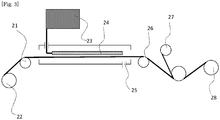
Fig. 3 is a schematic view showing an example of a mechanism for co-winding the first polymer film of the present invention having passed through the reactive compound coating apparatus, with the second polymer film. - Hereinafter, the film roll or film bundle of the present invention will be described with reference to the drawings.
Fig. 1 is a schematic view showing a cross section of a film unwound from the film roll or a film bundle of the present invention. - A
first polymer film 11 coated with areactive compound 14 is co-wound or stacked with asecond polymer film 12. The face being in contact with the first polymer film of thesecond polymer film 12 has a predetermined surface roughness (Ra) by a technique such as addition of a lubricant, and surface contact with the reactive compound layer of the first polymer film can be avoided due to the protrusions in microscopic views. Therefore, it is possible to prevent such trouble that the reactive compound layer of the first polymer film and the second polymer film are adhered to each other, making it difficult to delaminate the films (unwinding is difficult), or the reactive compound layer is impaired due to transferring to the face of the counterpart. - Examples of the polymer film that can be used in the present invention include films of polyester such as PET, PEN or PBT, polyamide film, polyimide film, polyimide benzothiazole film, polyimide benzoxazole film, polyimide benzimidazole film, polybenzoxazole film, polyethersulfone film, polyamideimide film, polyethylene film, polypropylene film, polyvinyl chloride film, and polyvinylidene chloride film.
- In the present invention, a sheet-like continuous polymer film having an area of 0.1 square meters or more can be used. In the present invention, a continuous polymer film in the form of a continuous film having a width of 240 mm or more and a length of 10 m or more can be used. The use of a large-area substrate is advantageous in terms of productivity. On the other hand, if the area is large, defects are likely to occur stochastically and the yield of the product is difficult to increase. However, in the treatment method of the present invention, since the frequency of occurrence of defects is very low, a large-area substrate can be used effectively. These can be used for both the first polymer film and the second polymer film.
- In the present invention, as a very special case of a polymer film, it can be applied to a long flexible glass. Here, the flexible glass is a thin glass having a thickness of 5 pm or more and 200 pm or less. It is a glass that is flexible like a polymer film and can be wound into a roll. The flexible glass may be a flexible glass in which a polymer film is bonded on either face for ensuring the handleability and the safety such as prevention of scattering in case of breakage.
- Examples of the reactive compound that forms the reactive compound layer in the present invention include a compound having an unsaturated double bond, a compound having an epoxy group, a compound having an amino group, a compound having a carboxyl group, a compound having a hydroxyl group, an isocyanate compound, and a compound having a silanol group. The present invention is suitably applicable to a reactive compound that is liquid preferably at 25°C.
- As the reactive compound suitably used in the present invention, a silane coupling agent can be used. The silane coupling agent can be used alone or in combination of two or more. Further, the silane coupling agent can be used as a solution in alcohol, water or various solvents.
- Examples of the silane coupling agent that can be used in the present invention include N-2-(aminoethyl)-3-aminopropylmethyldimethoxysilane, N-2-(aminoethyl)-3-aminopropyltrimethoxysilane, N-2-(aminoethyl)-3-aminopropyltriethoxysilane, 3-aminopropyltrimethoxysilane, 3-aminopropyltriethoxysilane, 3-triethoxysilyl-N-(1,3-dimethylbutylidene)propylamine, 2-(3,4-epoxycyclohexyl)ethyltrimethoxysilane, 3-glycidoxypropyltrimethoxysilane, 3-glycidoxypropylmethyldiethoxysilane, 3-glycidoxypropyltriethoxysilane, vinyltrichlorosilane, vinyltrimethoxysilane, vinyltriethoxysilane, 2-(3,4-epoxycyclohexyl)ethyltrimethoxysilane, 3-glycidoxypropyltrimethoxysilane, 3-glycidoxypropylmethyldiethoxysilane, 3-glycidoxypropyltriethoxysilane, p-styryltrimethoxysilane, 3-methacryloxypropylmethyldimethoxysilane, 3-methacryloxypropyltrimethoxysilane, 3-methacryloxypropylmethyldiethoxysilane, 3-methacryloxypropyltriethoxysilane, 3-acryloxypropyltrimethoxysilane, N-phenyl-3-aminopropyltrimethoxysilane, N-(vinylbenzyl)-2-aminoethyl-3-aminopropyltrimethoxysilane hydrochloride, 3-ureidopropyltriethoxysilane, 3-chloropropyltrimethoxysilane, 3-mercaptopropylmethyldimethoxysilane, 3-mercaptopropyltrimethoxysilane, bis(triethoxysilylpropyl)tetrasulfide, 3-isocyanatepropyltriethoxysilane, tris-(3-trimethoxysilylpropyl) isocyanurate, chloromethylphenethyltrimethoxysilane, chloromethyltrimethoxysilane, aminophenyltrimethoxysilane, aminophenethyltrimethoxysilane, aminophenylaminomethylphenethyltrimethoxysilane, and hexamethyldisilazane.
- Examples of the silane coupling agent that can be used in the present invention further include, in addition to the above, n-propyltrimethoxysilane, butyltrichlorosilane, 2 -cyanoethyltriethoxysilane, cyclohexyltrichlorosilane, decyltrichlorosilane, diacetoxydimethylsilane, diethoxydimethylsilane, dimethoxydimethylsilane, dimethoxydiphenylsilane, dimethoxymethylphenylsilane, dodecyltrichlorosilane, dodecyltrimethoxysilane, ethyltrichlorosilane, hexyltrimethoxysilane, octadecyltriethoxysilane, octadecyltrimethoxysilane, n-octyltrichlorosilane, n-octyltriethoxysilane, n-octyltrimethoxysilane, triethoxyethylsilane, triethoxymethylsilane, trimethoxymethylsilane, trimethoxyphenylsilane, pentyltriethoxysilane, pentyltrichlorosilane, triacetoxymethylsilane, trichlorohexylsilane, trichloromethylsilane, trichlorooctadecylsilane, trichloropropylsilane, trichlorotetradecylsilane, trimethoxypropylsilane, allyltrichlorosilane, allyltriethoxysilane, allyltrimethoxysilane, diethoxymethylvinylsilane, dimethoxymethylvinylsilane, trichlorovinylsilane, triethoxyvinylsilane, vinyltris(2 -methoxyethoxy)silane, trichloro-2-cyanoethylsilane, diethoxy(3-glycidyloxypropyl)methylsilane, 3-glycidyloxypropyl(dimethoxy)methylsilane, and 3-glycidyloxypropyltrimethoxysilane.
- Further, other alkoxysilanes such as tetramethoxysilane or tetraethoxysilane may be appropriately added to the silane coupling agent. The silane coupling agent may be used after the reaction is advanced to some extent by additionally performing a mixing and heating operations regardless of whether other alkoxysilanes such as tetramethoxysilane or tetraethoxysilane is appropriately added to the silane coupling agent.
- Among such silane coupling agents, the silane coupling agent suitably used in the present invention is preferably a silane coupling agent having a chemical structure having one silicon atom in one molecule of the coupling agent.
- In the present invention, particularly preferred silane coupling agents include N-2-(aminoethyl) -3-aminopropylmethyldimethoxysilane, N-2-(aminoethyl)-3-aminopropyltrimethoxysilane, N-2-(aminoethyl)-3-aminopropyltriethoxysilane, 3-aminopropyltrimethoxysilane, 3-aminopropyltriethoxysilane, 3-triethoxysilyl-N-(1,3-dimethyl-butylidene)propylamine, 2-(3,4-epoxycyclohexyl) ethyltrimethoxysilane, 3-glycidoxypropyltrimethoxysilane, 3-glycidoxypropylmethyldiethoxysilane, 3-glycidoxypropyltriethoxysilane, aminophenyltrimethoxysilane, aminophenethyltrimethoxysilane, and aminophenylaminomethylphenethyltrimethoxysilane. When the process requires particularly high heat resistance, it is desirable to use the one in which Si and the amino group are connected with an aromatic group.
- In the present invention, if necessary, a phosphorus coupling agent, a titanate coupling agent, or the like may be used in combination.
- In the present invention, when the silane coupling agent is used in combination with a solvent, the solvent is preferably at least one or more liquid selected from water, monohydric alcohols having 8 or less carbon atoms, and dihydric alcohols having 4 or less carbon atoms. More preferably, the solvent is preferably one or more solvents selected from methanol, ethanol, normal propanol, isopropanol, butanol, ethylene glycol, propylene glycol, and water. In the present invention, a mixed solvent composed of two or more solvents can be used. In the present invention, it is preferred to use a mixed solvent of water and alcohol, a mixed solvent of water and ethylene glycol or propylene glycol, further a mixed solvent of water, an alcohol having 3 or less carbon atoms, and a diol having 3 or less carbon atoms.
- In the present invention, a continuous first polymer film is passed through a reactive compound coating apparatus, and after being led out from the apparatus, the solvent and the like are removed by a drying step or the like, and the resultant first polymer film may be co-wound with a second polymer film having a predetermined surface to give a film roll. Before making a film roll, the first and second polymer films in a stacked state may be cut to give a film bundle. Alternatively, the films may be wound into a roll, unwound in a separate step, and cut into a film bundle.
- In the present invention, it is preferred that the drying is performed so that the water content of the first polymer film and the second polymer film is preferably 0.3% by mass or less, more preferably 0.15% by mass or less, still more preferably 0.08% by mass or less. If moisture remains in the polymer films more than necessary, blister defects are likely to occur. Control of the water content is particularly important when an aramid film, polyimide film, or polyamideimide film is used as the first polymer film.
- In the present invention, it is preferred to introduce the first polymer film into the liquid coating mechanism of the present invention after dry cleaning the first polymer film with an atmospheric pressure plasma processing apparatus. In the present invention, it is preferred to apply the reactive compound after dry-cleaning the first polymer film with a UV ozone irradiation apparatus. Here, the UV ozone treatment apparatus is a treatment apparatus that irradiates the substrate with ultraviolet rays having a wavelength of 300 nm or less in the atmosphere and simultaneously exposes the substrate to ozone generated in the vicinity of the UV light source.
- The storage environment of the film roll or film bundle of the present invention is preferably 15°C or lower, more preferably 5°C or lower, still more preferably -5°C or lower, further preferably -15°C or lower.
- Hereinafter, the present invention will be described more specifically with reference to examples. However, the present invention is not limited by the following examples. The methods for evaluating physical properties in the following examples are as follows.
- The surface roughness (Ra) of the film in contact with the film surface coated with the reactive compound was evaluated using a scanning laser microscope (VK-8500). The film was fixed on the observation stage, and the surface roughness in a 20 pm square area was calculated. Absolute values of deviations from the average line to the measurement curve in the portion of the reference length (20 pm) in the direction of the average line from the measured roughness curve were summed, and the average value was defined as Ra.
- <Modulus of elasticity>
- Using a universal testing machine (available from Shimadzu Corporation, "Precision Universal Testing Machine AG-IS"), the strain-stress curve was measured at an atmospheric temperature of 23°C and a relative humidity of 60% under the conditions of a sample length of 100 mm (length between chucks) and an elongation rate of 50 mm/min. The modulus of elasticity was calculated from the tangent that gives the maximum gradient near the origin of the curve. For the modulus of elasticity, the mean value of 10 measurements was used.
- Predetermined faces of a polyimide film with the silane coupling agent (first polymer film) and a second polymer film cut into 15 cm x 15 cm were overlapped with each other, and the films were stored at a temperature of - 15°C under a load of 8 kg/square meters. At this time, the films were arranged so that the polyimide film was placed on the lower side, and the polyimide film was fixed on a metal plate with a double-sided tape of 20 cm × 20 cm. After storing the films at low temperature for 5 days, the two stacked films were cut together to have 10 square cuts reaching the polyimide film by using a cutter guide with a gap spacing of 2 mm. The metal plate to which the polyimide film was fixed was turned over, and the number of squares of the co-winding film peeled off from the polyimide film was visually counted to determine the adhesiveness. The square in which the film was partially peeled off was counted as a non-peeled square, and was ranked according to the following criteria.
- ○: 90 to 100 peeled squares
- ■: 0 to 89 peeled squares
- A silane coupling agent was applied to a polyimide film under the following conditions using an apparatus for generating a silane coupling agent vapor as schematically shown in
Fig. 2 (batch type vapor phase method). - The polyimide film was held on a stainless frame having an opening of 370 mm × 470 mm, and held vertically in a chamber into which the silane coupling agent vapor was introduced.
- A container containing 100 g of a silane coupling agent ("KBM-903": 3-aminopropyltrimethoxysilane, available from Shin-Etsu Chemical Co., Ltd.) was regulated to a temperature of 40°C, and then fed with nitrogen gas at 25 L/min in a bubbling manner, and the generated nitrogen gas containing the silane coupling agent vapor was introduced into the chamber through piping, and both sides of the polyimide film used as the first polymer film were exposed to the gas for 3 minutes.
- Note that 3-aminopropyltrimethoxysilane has a melting point of - 60°C or lower and a boiling point of 91 to 92°C, and is liquid at least at 25°C to 40°C under normal pressure.
- The obtained polyimide film with the silane coupling agent was cut into a size of 15 cm x 15 cm, and overlaid as a second polymer film on the smooth surface of a polyethylene terephthalate film ("A4100" available from Toyobo Co., Ltd.), and the adhesiveness was evaluated.
- <Comparative Example 2>
- The evaluation was carried out in the same manner as in Comparative Example 1 except that the polyethylene terephthalate film was changed to Polywrap (polyethylene film available from Ube Film Co., Ltd.).
- The evaluation was carried out in the same manner as in Comparative Example 1 except that the polyethylene terephthalate film was changed to a polytetrafluoroethylene sheet (available from Nitto Denko Corporation).
- The evaluation was carried out in the same manner as in Comparative Example 1 except that the polyethylene terephthalate film was changed to a polypropylene film ("P1128A" available from Toyobo Co., Ltd.).
- The evaluation was carried out in the same manner as in Comparative Example 1 except that the polyethylene terephthalate film was changed to a polyethylene terephthalate film ("E5100" available from Toyobo Co., Ltd.).
- Using the apparatus for applying a silane coupling agent vapor as schematically shown in
Fig. 3 , a continuous polyimide film with a width of 100 mm was set to pass through a chamber of 750 mm x 20 mm x 10 mm having a slit of 20 mm x 160 mm at a speed of 240 mm/min. - A container containing 50 g of a silane coupling agent ("KBM-903": 3-aminopropyltrimethoxysilane, available from Shin-Etsu Chemical Co., Ltd.) was regulated to a temperature of 40°C, and fed with nitrogen gas at 4.6 L/min in a bubbling manner, and the generated nitrogen gas containing the silane coupling agent vapor was introduced into the chamber through piping, and both sides of the polyimide film were exposed to the gas to give a polyimide film coated with the silane coupling agent. Then the polyimide film coated with the silane coupling agent was co-wound with a polyethylene terephthalate film E5100 (available from Toyobo Co., Ltd.) having a thickness of 50 pm to give a film roll. From the obtained film roll, a stack of the first polymer film and the second polymer film in a size of 15 cm × 15 cm was cut out, and the adhesiveness was evaluated.
- After storing the obtained film roll at -15°C for 5 days, a stack of the first polymer film and the second polymer film in a size of 15 cm × 15 cm was cut out, and the adhesiveness was evaluated in the same manner.
- Using a spray coater, a silane coupling agent was applied to a polyimide film serving as a first polymer film under the following conditions.
- A 0.5 wt% silane coupling agent solution in isopropanol was applied by spraying to the polyimide film having a width of 280 mm and moving at 10 m/min, and the film was pre-dried at 25°C and then dried at 60°C, to give a polyimide film coated with the silane coupling agent. Next, as a second polymer film, a polyethylene terephthalate film ("E5100" available from Toyobo Co., Ltd.) was overlaid and co-wound to obtain a film roll. From the obtained film roll, a stack of the first polymer film and the second polymer film in a size of 15 cm × 15 cm was cut out, and the adhesiveness was evaluated.
- After storing the obtained film roll at -15°C for 5 days, a stack of the first polymer film and the second polymer film in a size of 15 cm × 15 cm was cut out, and the adhesiveness was evaluated in the same manner.
- Using a comma coater, an epoxy resin was applied to a polyethylene terephthalate film (E5100 available from Toyobo Co., Ltd.) serving as a first polymer film under the following conditions.
- Epoxy resin JER1001B80 (MEK solution) available from Mitsubishi Chemical Corporation was applied to a polyethylene terephthalate film having a width of 520 mm and moving at 3 m/min with a comma coater, and the film was pre-dried at 25°C and then dried at 60°C, to give a polyethylene terephthalate film coated with the epoxy resin. Next, as a second polymer film, a polypropylene film ("P1128A" available from Toyobo Co., Ltd.) was overlaid and co-wound to obtain a film roll. From the obtained film roll, a stack of the first polymer film and the second polymer film in a size of 15 cm × 15 cm was cut out, and the adhesiveness was evaluated.
- Epoxy resin JER1001 is a bisphenol type epoxy resin, and has a softening temperature in the ring and ball method of 64°C. JER1001B80 is a solution of JER1001 in methyl ethyl ketone (MEK) prepared to have a solid content concentration of about 80%.
- After storing the obtained film roll at -15°C for 5 days, a stack of the first polymer film and the second polymer film in a size of 15 cm × 15 cm was cut out, and the adhesiveness was evaluated in the same manner.
- A film roll was obtained in the same manner as in Example 6 except that the epoxy resin was changed to pentaerythritol tetraacrylate (PE4A) (available from Kyoeisha Chemical), which is a multifunctional acrylate. Then evaluation was carried out in the same manner.
- Table 1 shows the results obtained in the above comparative examples and examples.
- Pentaerythritol tetraacrylate has a melting point of 18°C and is liquid at 25°C under normal pressure.
[Table 1] Comparative Example 1 Comparative Example 2 Example 1 Example 2 Example 3 Example 4 Example 5 Example 6 Example 7 First polymer film Polyimide 25 µ mt Polyimide 10 µ mt Polyimide 25 µ mt Polyimide 25 µ mt Polyimide 38 µ mt Polyimide 38 µ mt Polyimide 38 µ mt PET 50 µ mt PET 50 µ mt Reactive compound KBM-903 KBM-903 KBM-903 KBM-903 KBM-903 KBM-903 KBM-903 1001B80 PE4A Coating method of reactive compound Batch type gas phase Batch type gas phase Batch type gas phase Batch type gas phase Batch type gas phase RtoR gas phase coating RtoR spray coating RtoR comma coating RtoR comma coating Second polymer film Type A4100 (smooth surface) PE(Wrap) PTFE PP E5100 E5100 E5100 PP PP Surface roughness Ra [µ m] 0.005 0.05 0.38 0.18 0.16 0.16 0.16 0.18 0.18 Elasticity [MPa] 4000 250 400 630 3920 3920 3920 630 630 Adhesion (sheet-like storage) × × ○ ○ ○ ○ ○ ○ ○ Adhesion (roll-like storage) - - - - - ○ ○ ○ ○ - As described above, the film roll and film bundle of the present invention can stably maintain a reactive compound layer despite having a layer made of a reactive compound on the surface. In the present invention, as exemplified in the examples, it is possible to maintain various reactive compounds such as an epoxy resin which is a thermosetting compound, a (meth)acrylate which is a photocurable compound, and a silane coupling agent for a long time in a state of a thin film layer, and thus the present invention can be used effectively in various industrial fields.
-
- 11
- First polymer film
- 12
- Second polymer film
- 13
- Lubricant
- 14
- Reactive compound
- 21
- Height adjustment roll
- 22
- First polymer film unwinding part
- 23
- Reactive compound supply part
- 24
- Reactive compound discharge part
- 25
- Air outlet for reactive compound and solvent vapor
- 26
- Height adjustment roll
- 27
- Second polymer film supply roll
- 28
- Film winding part
Claims (6)
- A film roll, comprising:a first polymer film having a reactive compound layer on at least one surface; anda second polymer film having a rough surface with a surface roughness Ra of 0.1 pm or more and 5 pm or less on at least one side, the second polymer film having a modulus of elasticity of 300 MPa or more and 10 GPa or less,the first polymer film and the second polymer film being co-wound in a state that the surface having the reactive compound layer of the first polymer film and the rough surface of the second film face each other.
- The film roll according to claim 1, wherein the second polymer film contains, as a lubricant, inorganic particles having a volume average particle diameter of 0.1 pm or more and 10 pm or less in an amount ranging from 0.3% by mass or more to 5% by mass.
- The film roll according to claim 1 or 2, wherein a peeling strength between the first polymer film and the second polymer film is 0.5 N/cm or less after the surface having the reactive compound layer of the first polymer film and the rough surface of the second film are stacked to face each other, and held at -15°C for 24 hours under a load of 8 kg/square meters.
- The film roll according to any one of claims 1 to 3, wherein a reactive compound forming the reactive compound layer is a silane coupling agent.
- The film roll according to any one of claims 1 to 4, wherein the reactive compound layer has a thickness of 5 nm or more and 800 nm or less.
- A film bundle, comprising:a first polymer film having a reactive compound layer on at least one surface; anda second polymer film having a rough surface with a surface roughness Ra of 0.1 pm or more and 5 pm or less on at least one side, the second polymer film having a modulus of elasticity of 300 MPa or more and 10 GPa or less,the first polymer film and the second polymer film being alternately stacked in a state that the surface having the reactive compound layer of the first polymer film and the rough surface of the second film face each other.
Priority Applications (1)
| Application Number | Priority Date | Filing Date | Title |
|---|---|---|---|
| EP21202950.8A EP3970968A1 (en) | 2017-07-20 | 2018-07-13 | Film roll and film bundle |
Applications Claiming Priority (2)
| Application Number | Priority Date | Filing Date | Title |
|---|---|---|---|
| JP2017140914 | 2017-07-20 | ||
| PCT/JP2018/026478 WO2019017287A1 (en) | 2017-07-20 | 2018-07-13 | Film roll and film bundle |
Related Child Applications (2)
| Application Number | Title | Priority Date | Filing Date |
|---|---|---|---|
| EP21202950.8A Division-Into EP3970968A1 (en) | 2017-07-20 | 2018-07-13 | Film roll and film bundle |
| EP21202950.8A Division EP3970968A1 (en) | 2017-07-20 | 2018-07-13 | Film roll and film bundle |
Publications (3)
| Publication Number | Publication Date |
|---|---|
| EP3656713A1 true EP3656713A1 (en) | 2020-05-27 |
| EP3656713A4 EP3656713A4 (en) | 2021-04-28 |
| EP3656713B1 EP3656713B1 (en) | 2023-05-03 |
Family
ID=65015998
Family Applications (2)
| Application Number | Title | Priority Date | Filing Date |
|---|---|---|---|
| EP21202950.8A Pending EP3970968A1 (en) | 2017-07-20 | 2018-07-13 | Film roll and film bundle |
| EP18834339.6A Active EP3656713B1 (en) | 2017-07-20 | 2018-07-13 | Film roll and film bundle |
Family Applications Before (1)
| Application Number | Title | Priority Date | Filing Date |
|---|---|---|---|
| EP21202950.8A Pending EP3970968A1 (en) | 2017-07-20 | 2018-07-13 | Film roll and film bundle |
Country Status (6)
| Country | Link |
|---|---|
| US (1) | US11655118B2 (en) |
| EP (2) | EP3970968A1 (en) |
| JP (1) | JP7120236B2 (en) |
| KR (1) | KR102387757B1 (en) |
| CN (1) | CN110914181A (en) |
| WO (1) | WO2019017287A1 (en) |
Family Cites Families (10)
| Publication number | Priority date | Publication date | Assignee | Title |
|---|---|---|---|---|
| DE69910933T2 (en) * | 1998-10-14 | 2004-05-13 | Fuji Photo Film Co., Ltd., Minami-Ashigara | System for treating a web |
| JP2006104344A (en) * | 2004-10-06 | 2006-04-20 | Oji Paper Co Ltd | Cover tape for carrier tape |
| JP2008018628A (en) | 2006-07-13 | 2008-01-31 | Toray Ind Inc | Laminated film and film roll |
| ES2528213T3 (en) | 2007-07-24 | 2015-02-05 | Mitsubishi Gas Chemical Company, Inc. | Polyurethane Resin Composition |
| JP5517326B2 (en) * | 2008-06-27 | 2014-06-11 | 株式会社Adeka | One-component cyanate-epoxy composite resin composition |
| JP5809177B2 (en) * | 2013-02-13 | 2015-11-10 | Ckd株式会社 | Winding device |
| JP2015178237A (en) * | 2014-03-19 | 2015-10-08 | 東洋紡株式会社 | Laminated inorganic substrate, laminate, method of producing laminate and method of producing flexible electronic device |
| JP2016004120A (en) | 2014-06-16 | 2016-01-12 | 帝人株式会社 | Release film |
| TWI735411B (en) | 2014-06-18 | 2021-08-11 | 日商味之素股份有限公司 | Adhesive sheet with protective film |
| JP6351532B2 (en) * | 2015-03-26 | 2018-07-04 | 富士フイルム株式会社 | Functional film and method for producing functional film |
-
2018
- 2018-07-13 CN CN201880047955.9A patent/CN110914181A/en active Pending
- 2018-07-13 EP EP21202950.8A patent/EP3970968A1/en active Pending
- 2018-07-13 KR KR1020207003464A patent/KR102387757B1/en active Active
- 2018-07-13 EP EP18834339.6A patent/EP3656713B1/en active Active
- 2018-07-13 WO PCT/JP2018/026478 patent/WO2019017287A1/en not_active Ceased
- 2018-07-13 US US16/631,957 patent/US11655118B2/en active Active
- 2018-07-13 JP JP2019531008A patent/JP7120236B2/en active Active
Also Published As
| Publication number | Publication date |
|---|---|
| JP7120236B2 (en) | 2022-08-17 |
| EP3656713B1 (en) | 2023-05-03 |
| CN110914181A (en) | 2020-03-24 |
| JPWO2019017287A1 (en) | 2020-05-28 |
| KR102387757B1 (en) | 2022-04-19 |
| WO2019017287A1 (en) | 2019-01-24 |
| KR20200033871A (en) | 2020-03-30 |
| EP3970968A1 (en) | 2022-03-23 |
| EP3970968A9 (en) | 2023-01-25 |
| US20200180888A1 (en) | 2020-06-11 |
| US11655118B2 (en) | 2023-05-23 |
| EP3656713A4 (en) | 2021-04-28 |
Similar Documents
| Publication | Publication Date | Title |
|---|---|---|
| EP2832537B1 (en) | Gas-barrier film and process for producing same, and gas-barrier laminate | |
| KR102106145B1 (en) | Adhesive sheet | |
| EP2335918A1 (en) | Joint structure producing method and joint structure | |
| US20090155601A1 (en) | Ultraviolet protective material | |
| JP2013028018A (en) | Gas barrier film and device | |
| JP7205687B2 (en) | LAMINATED PRODUCT, LAMINATED PRODUCTION METHOD, AND HEAT-RESISTANT POLYMER FILM WITH METAL-CONTAINING LAYER | |
| US10202689B2 (en) | Laminate and gas barrier film | |
| WO2017169977A1 (en) | Barrier film and method for manufacturing same, wavelength conversion sheet and method for manufacturing same, and optical laminate and method for manufacturing same | |
| JP6802529B2 (en) | Laminated body and its manufacturing method | |
| JP2016155241A (en) | Gas barrier film laminate and electronic component using the same | |
| EP3656713B1 (en) | Film roll and film bundle | |
| JP6497063B2 (en) | Multi-layer film, method for producing the same, and polarizing plate | |
| JP6524702B2 (en) | Process for producing gas barrier film and gas barrier film | |
| KR20190045831A (en) | Transparent conductive film and transparent conductive film laminate | |
| JP2024050925A (en) | Protective film, film laminate using same, and method for producing same | |
| EP3243655B1 (en) | Light-transmitting laminate for optical applications | |
| JP2017181900A (en) | Optical laminated body and method for producing the same, wavelength conversion sheet and method for producing the same | |
| JP6780272B2 (en) | Polymer composite film | |
| WO2010024143A1 (en) | Heat-insulating article, process for producing heat-insulating article, and building member | |
| EP4427928A1 (en) | Multilayer film, multilayer body and packaging material | |
| WO2009148045A1 (en) | Heat shielding resin base and construction member using the same | |
| WO2009131136A1 (en) | Heat insulation resin base and architectural member using the same | |
| JP7211374B2 (en) | Film laminate manufacturing method and film laminate manufacturing apparatus | |
| EP4279270A1 (en) | Multilayer film | |
| JP2020163859A (en) | Film laminate and its manufacturing method |
Legal Events
| Date | Code | Title | Description |
|---|---|---|---|
| STAA | Information on the status of an ep patent application or granted ep patent |
Free format text: STATUS: THE INTERNATIONAL PUBLICATION HAS BEEN MADE |
|
| PUAI | Public reference made under article 153(3) epc to a published international application that has entered the european phase |
Free format text: ORIGINAL CODE: 0009012 |
|
| STAA | Information on the status of an ep patent application or granted ep patent |
Free format text: STATUS: REQUEST FOR EXAMINATION WAS MADE |
|
| 17P | Request for examination filed |
Effective date: 20200220 |
|
| AK | Designated contracting states |
Kind code of ref document: A1 Designated state(s): AL AT BE BG CH CY CZ DE DK EE ES FI FR GB GR HR HU IE IS IT LI LT LU LV MC MK MT NL NO PL PT RO RS SE SI SK SM TR |
|
| AX | Request for extension of the european patent |
Extension state: BA ME |
|
| DAV | Request for validation of the european patent (deleted) | ||
| DAX | Request for extension of the european patent (deleted) | ||
| A4 | Supplementary search report drawn up and despatched |
Effective date: 20210326 |
|
| RIC1 | Information provided on ipc code assigned before grant |
Ipc: B65H 75/00 20060101AFI20210322BHEP Ipc: B65H 18/28 20060101ALI20210322BHEP Ipc: B65H 39/16 20060101ALI20210322BHEP Ipc: B65H 19/18 20060101ALI20210322BHEP Ipc: B65H 23/02 20060101ALI20210322BHEP |
|
| RAP3 | Party data changed (applicant data changed or rights of an application transferred) |
Owner name: TOYOBO CO., LTD. |
|
| RIC1 | Information provided on ipc code assigned before grant |
Ipc: B32B 27/36 20060101ALI20220915BHEP Ipc: B32B 27/32 20060101ALI20220915BHEP Ipc: B32B 27/30 20060101ALI20220915BHEP Ipc: B32B 27/08 20060101ALI20220915BHEP Ipc: B65H 23/02 20060101ALI20220915BHEP Ipc: B65H 19/18 20060101ALI20220915BHEP Ipc: B65H 39/16 20060101ALI20220915BHEP Ipc: B65H 18/28 20060101ALI20220915BHEP Ipc: B65H 75/00 20060101AFI20220915BHEP |
|
| INTG | Intention to grant announced |
Effective date: 20221118 |
|
| RIN1 | Information on inventor provided before grant (corrected) |
Inventor name: ICHIMURA, SHUNSUKE Inventor name: WATANABE, NAOKI Inventor name: TSUCHIYA, TOSHIYUKI Inventor name: OKUYAMA, TETSUO Inventor name: YAMASHITA, MASAHIRO Inventor name: TOKUDA, KAYA |
|
| GRAS | Grant fee paid |
Free format text: ORIGINAL CODE: EPIDOSNIGR3 |
|
| STAA | Information on the status of an ep patent application or granted ep patent |
Free format text: STATUS: GRANT OF PATENT IS INTENDED |
|
| GRAA | (expected) grant |
Free format text: ORIGINAL CODE: 0009210 |
|
| STAA | Information on the status of an ep patent application or granted ep patent |
Free format text: STATUS: THE PATENT HAS BEEN GRANTED |
|
| AK | Designated contracting states |
Kind code of ref document: B1 Designated state(s): AL AT BE BG CH CY CZ DE DK EE ES FI FR GB GR HR HU IE IS IT LI LT LU LV MC MK MT NL NO PL PT RO RS SE SI SK SM TR |
|
| REG | Reference to a national code |
Ref country code: GB Ref legal event code: FG4D |
|
| REG | Reference to a national code |
Ref country code: DE Ref legal event code: R096 Ref document number: 602018049352 Country of ref document: DE |
|
| REG | Reference to a national code |
Ref country code: AT Ref legal event code: REF Ref document number: 1564449 Country of ref document: AT Kind code of ref document: T Effective date: 20230515 Ref country code: CH Ref legal event code: EP |
|
| REG | Reference to a national code |
Ref country code: IE Ref legal event code: FG4D |
|
| P01 | Opt-out of the competence of the unified patent court (upc) registered |
Effective date: 20230512 |
|
| REG | Reference to a national code |
Ref country code: LT Ref legal event code: MG9D |
|
| REG | Reference to a national code |
Ref country code: NL Ref legal event code: MP Effective date: 20230503 |
|
| REG | Reference to a national code |
Ref country code: AT Ref legal event code: MK05 Ref document number: 1564449 Country of ref document: AT Kind code of ref document: T Effective date: 20230503 |
|
| PG25 | Lapsed in a contracting state [announced via postgrant information from national office to epo] |
Ref country code: SE Free format text: LAPSE BECAUSE OF FAILURE TO SUBMIT A TRANSLATION OF THE DESCRIPTION OR TO PAY THE FEE WITHIN THE PRESCRIBED TIME-LIMIT Effective date: 20230503 Ref country code: PT Free format text: LAPSE BECAUSE OF FAILURE TO SUBMIT A TRANSLATION OF THE DESCRIPTION OR TO PAY THE FEE WITHIN THE PRESCRIBED TIME-LIMIT Effective date: 20230904 Ref country code: NO Free format text: LAPSE BECAUSE OF FAILURE TO SUBMIT A TRANSLATION OF THE DESCRIPTION OR TO PAY THE FEE WITHIN THE PRESCRIBED TIME-LIMIT Effective date: 20230803 Ref country code: NL Free format text: LAPSE BECAUSE OF FAILURE TO SUBMIT A TRANSLATION OF THE DESCRIPTION OR TO PAY THE FEE WITHIN THE PRESCRIBED TIME-LIMIT Effective date: 20230503 Ref country code: ES Free format text: LAPSE BECAUSE OF FAILURE TO SUBMIT A TRANSLATION OF THE DESCRIPTION OR TO PAY THE FEE WITHIN THE PRESCRIBED TIME-LIMIT Effective date: 20230503 Ref country code: AT Free format text: LAPSE BECAUSE OF FAILURE TO SUBMIT A TRANSLATION OF THE DESCRIPTION OR TO PAY THE FEE WITHIN THE PRESCRIBED TIME-LIMIT Effective date: 20230503 |
|
| PG25 | Lapsed in a contracting state [announced via postgrant information from national office to epo] |
Ref country code: RS Free format text: LAPSE BECAUSE OF FAILURE TO SUBMIT A TRANSLATION OF THE DESCRIPTION OR TO PAY THE FEE WITHIN THE PRESCRIBED TIME-LIMIT Effective date: 20230503 Ref country code: PL Free format text: LAPSE BECAUSE OF FAILURE TO SUBMIT A TRANSLATION OF THE DESCRIPTION OR TO PAY THE FEE WITHIN THE PRESCRIBED TIME-LIMIT Effective date: 20230503 Ref country code: LV Free format text: LAPSE BECAUSE OF FAILURE TO SUBMIT A TRANSLATION OF THE DESCRIPTION OR TO PAY THE FEE WITHIN THE PRESCRIBED TIME-LIMIT Effective date: 20230503 Ref country code: LT Free format text: LAPSE BECAUSE OF FAILURE TO SUBMIT A TRANSLATION OF THE DESCRIPTION OR TO PAY THE FEE WITHIN THE PRESCRIBED TIME-LIMIT Effective date: 20230503 Ref country code: IS Free format text: LAPSE BECAUSE OF FAILURE TO SUBMIT A TRANSLATION OF THE DESCRIPTION OR TO PAY THE FEE WITHIN THE PRESCRIBED TIME-LIMIT Effective date: 20230903 Ref country code: HR Free format text: LAPSE BECAUSE OF FAILURE TO SUBMIT A TRANSLATION OF THE DESCRIPTION OR TO PAY THE FEE WITHIN THE PRESCRIBED TIME-LIMIT Effective date: 20230503 Ref country code: GR Free format text: LAPSE BECAUSE OF FAILURE TO SUBMIT A TRANSLATION OF THE DESCRIPTION OR TO PAY THE FEE WITHIN THE PRESCRIBED TIME-LIMIT Effective date: 20230804 |
|
| PG25 | Lapsed in a contracting state [announced via postgrant information from national office to epo] |
Ref country code: FI Free format text: LAPSE BECAUSE OF FAILURE TO SUBMIT A TRANSLATION OF THE DESCRIPTION OR TO PAY THE FEE WITHIN THE PRESCRIBED TIME-LIMIT Effective date: 20230503 |
|
| PG25 | Lapsed in a contracting state [announced via postgrant information from national office to epo] |
Ref country code: SK Free format text: LAPSE BECAUSE OF FAILURE TO SUBMIT A TRANSLATION OF THE DESCRIPTION OR TO PAY THE FEE WITHIN THE PRESCRIBED TIME-LIMIT Effective date: 20230503 |
|
| PG25 | Lapsed in a contracting state [announced via postgrant information from national office to epo] |
Ref country code: SM Free format text: LAPSE BECAUSE OF FAILURE TO SUBMIT A TRANSLATION OF THE DESCRIPTION OR TO PAY THE FEE WITHIN THE PRESCRIBED TIME-LIMIT Effective date: 20230503 Ref country code: SK Free format text: LAPSE BECAUSE OF FAILURE TO SUBMIT A TRANSLATION OF THE DESCRIPTION OR TO PAY THE FEE WITHIN THE PRESCRIBED TIME-LIMIT Effective date: 20230503 Ref country code: RO Free format text: LAPSE BECAUSE OF FAILURE TO SUBMIT A TRANSLATION OF THE DESCRIPTION OR TO PAY THE FEE WITHIN THE PRESCRIBED TIME-LIMIT Effective date: 20230503 Ref country code: EE Free format text: LAPSE BECAUSE OF FAILURE TO SUBMIT A TRANSLATION OF THE DESCRIPTION OR TO PAY THE FEE WITHIN THE PRESCRIBED TIME-LIMIT Effective date: 20230503 Ref country code: DK Free format text: LAPSE BECAUSE OF FAILURE TO SUBMIT A TRANSLATION OF THE DESCRIPTION OR TO PAY THE FEE WITHIN THE PRESCRIBED TIME-LIMIT Effective date: 20230503 Ref country code: CZ Free format text: LAPSE BECAUSE OF FAILURE TO SUBMIT A TRANSLATION OF THE DESCRIPTION OR TO PAY THE FEE WITHIN THE PRESCRIBED TIME-LIMIT Effective date: 20230503 |
|
| REG | Reference to a national code |
Ref country code: DE Ref legal event code: R097 Ref document number: 602018049352 Country of ref document: DE |
|
| PG25 | Lapsed in a contracting state [announced via postgrant information from national office to epo] |
Ref country code: MC Free format text: LAPSE BECAUSE OF FAILURE TO SUBMIT A TRANSLATION OF THE DESCRIPTION OR TO PAY THE FEE WITHIN THE PRESCRIBED TIME-LIMIT Effective date: 20230503 |
|
| PG25 | Lapsed in a contracting state [announced via postgrant information from national office to epo] |
Ref country code: MC Free format text: LAPSE BECAUSE OF FAILURE TO SUBMIT A TRANSLATION OF THE DESCRIPTION OR TO PAY THE FEE WITHIN THE PRESCRIBED TIME-LIMIT Effective date: 20230503 |
|
| REG | Reference to a national code |
Ref country code: CH Ref legal event code: PL |
|
| PLBE | No opposition filed within time limit |
Free format text: ORIGINAL CODE: 0009261 |
|
| STAA | Information on the status of an ep patent application or granted ep patent |
Free format text: STATUS: NO OPPOSITION FILED WITHIN TIME LIMIT |
|
| PG25 | Lapsed in a contracting state [announced via postgrant information from national office to epo] |
Ref country code: LU Free format text: LAPSE BECAUSE OF NON-PAYMENT OF DUE FEES Effective date: 20230713 |
|
| PG25 | Lapsed in a contracting state [announced via postgrant information from national office to epo] |
Ref country code: LU Free format text: LAPSE BECAUSE OF NON-PAYMENT OF DUE FEES Effective date: 20230713 |
|
| 26N | No opposition filed |
Effective date: 20240206 |
|
| REG | Reference to a national code |
Ref country code: IE Ref legal event code: MM4A |
|
| PG25 | Lapsed in a contracting state [announced via postgrant information from national office to epo] |
Ref country code: CH Free format text: LAPSE BECAUSE OF NON-PAYMENT OF DUE FEES Effective date: 20230731 |
|
| PG25 | Lapsed in a contracting state [announced via postgrant information from national office to epo] |
Ref country code: SI Free format text: LAPSE BECAUSE OF FAILURE TO SUBMIT A TRANSLATION OF THE DESCRIPTION OR TO PAY THE FEE WITHIN THE PRESCRIBED TIME-LIMIT Effective date: 20230503 |
|
| PG25 | Lapsed in a contracting state [announced via postgrant information from national office to epo] |
Ref country code: SI Free format text: LAPSE BECAUSE OF FAILURE TO SUBMIT A TRANSLATION OF THE DESCRIPTION OR TO PAY THE FEE WITHIN THE PRESCRIBED TIME-LIMIT Effective date: 20230503 Ref country code: IT Free format text: LAPSE BECAUSE OF FAILURE TO SUBMIT A TRANSLATION OF THE DESCRIPTION OR TO PAY THE FEE WITHIN THE PRESCRIBED TIME-LIMIT Effective date: 20230503 |
|
| PG25 | Lapsed in a contracting state [announced via postgrant information from national office to epo] |
Ref country code: IE Free format text: LAPSE BECAUSE OF NON-PAYMENT OF DUE FEES Effective date: 20230713 |
|
| PG25 | Lapsed in a contracting state [announced via postgrant information from national office to epo] |
Ref country code: IE Free format text: LAPSE BECAUSE OF NON-PAYMENT OF DUE FEES Effective date: 20230713 |
|
| PG25 | Lapsed in a contracting state [announced via postgrant information from national office to epo] |
Ref country code: BG Free format text: LAPSE BECAUSE OF FAILURE TO SUBMIT A TRANSLATION OF THE DESCRIPTION OR TO PAY THE FEE WITHIN THE PRESCRIBED TIME-LIMIT Effective date: 20230503 |
|
| PG25 | Lapsed in a contracting state [announced via postgrant information from national office to epo] |
Ref country code: BG Free format text: LAPSE BECAUSE OF FAILURE TO SUBMIT A TRANSLATION OF THE DESCRIPTION OR TO PAY THE FEE WITHIN THE PRESCRIBED TIME-LIMIT Effective date: 20230503 |
|
| PG25 | Lapsed in a contracting state [announced via postgrant information from national office to epo] |
Ref country code: CY Free format text: LAPSE BECAUSE OF FAILURE TO SUBMIT A TRANSLATION OF THE DESCRIPTION OR TO PAY THE FEE WITHIN THE PRESCRIBED TIME-LIMIT; INVALID AB INITIO Effective date: 20180713 |
|
| PG25 | Lapsed in a contracting state [announced via postgrant information from national office to epo] |
Ref country code: HU Free format text: LAPSE BECAUSE OF FAILURE TO SUBMIT A TRANSLATION OF THE DESCRIPTION OR TO PAY THE FEE WITHIN THE PRESCRIBED TIME-LIMIT; INVALID AB INITIO Effective date: 20180713 |
|
| PGFP | Annual fee paid to national office [announced via postgrant information from national office to epo] |
Ref country code: DE Payment date: 20250731 Year of fee payment: 8 |
|
| PGFP | Annual fee paid to national office [announced via postgrant information from national office to epo] |
Ref country code: BE Payment date: 20250724 Year of fee payment: 8 Ref country code: GB Payment date: 20250730 Year of fee payment: 8 |
|
| PGFP | Annual fee paid to national office [announced via postgrant information from national office to epo] |
Ref country code: FR Payment date: 20250723 Year of fee payment: 8 |
|
| PG25 | Lapsed in a contracting state [announced via postgrant information from national office to epo] |
Ref country code: TR Free format text: LAPSE BECAUSE OF FAILURE TO SUBMIT A TRANSLATION OF THE DESCRIPTION OR TO PAY THE FEE WITHIN THE PRESCRIBED TIME-LIMIT Effective date: 20230503 |