EP3655796B1 - Kalibriereinrichtung und verfahren zum kalibrieren von kraftfahrzeug-umfeldsensoren - Google Patents
Kalibriereinrichtung und verfahren zum kalibrieren von kraftfahrzeug-umfeldsensoren Download PDFInfo
- Publication number
- EP3655796B1 EP3655796B1 EP18729422.8A EP18729422A EP3655796B1 EP 3655796 B1 EP3655796 B1 EP 3655796B1 EP 18729422 A EP18729422 A EP 18729422A EP 3655796 B1 EP3655796 B1 EP 3655796B1
- Authority
- EP
- European Patent Office
- Prior art keywords
- calibration device
- camera
- motor vehicle
- measurement
- vehicle
- Prior art date
- Legal status (The legal status is an assumption and is not a legal conclusion. Google has not performed a legal analysis and makes no representation as to the accuracy of the status listed.)
- Active
Links
Images

Classifications
-
- G—PHYSICS
- G06—COMPUTING OR CALCULATING; COUNTING
- G06T—IMAGE DATA PROCESSING OR GENERATION, IN GENERAL
- G06T7/00—Image analysis
- G06T7/80—Analysis of captured images to determine intrinsic or extrinsic camera parameters, i.e. camera calibration
-
- G—PHYSICS
- G01—MEASURING; TESTING
- G01S—RADIO DIRECTION-FINDING; RADIO NAVIGATION; DETERMINING DISTANCE OR VELOCITY BY USE OF RADIO WAVES; LOCATING OR PRESENCE-DETECTING BY USE OF THE REFLECTION OR RERADIATION OF RADIO WAVES; ANALOGOUS ARRANGEMENTS USING OTHER WAVES
- G01S13/00—Systems using the reflection or reradiation of radio waves, e.g. radar systems; Analogous systems using reflection or reradiation of waves whose nature or wavelength is irrelevant or unspecified
- G01S13/86—Combinations of radar systems with non-radar systems, e.g. sonar, direction finder
- G01S13/867—Combination of radar systems with cameras
-
- G—PHYSICS
- G01—MEASURING; TESTING
- G01S—RADIO DIRECTION-FINDING; RADIO NAVIGATION; DETERMINING DISTANCE OR VELOCITY BY USE OF RADIO WAVES; LOCATING OR PRESENCE-DETECTING BY USE OF THE REFLECTION OR RERADIATION OF RADIO WAVES; ANALOGOUS ARRANGEMENTS USING OTHER WAVES
- G01S13/00—Systems using the reflection or reradiation of radio waves, e.g. radar systems; Analogous systems using reflection or reradiation of waves whose nature or wavelength is irrelevant or unspecified
- G01S13/88—Radar or analogous systems specially adapted for specific applications
- G01S13/93—Radar or analogous systems specially adapted for specific applications for anti-collision purposes
- G01S13/931—Radar or analogous systems specially adapted for specific applications for anti-collision purposes of land vehicles
-
- G—PHYSICS
- G01—MEASURING; TESTING
- G01S—RADIO DIRECTION-FINDING; RADIO NAVIGATION; DETERMINING DISTANCE OR VELOCITY BY USE OF RADIO WAVES; LOCATING OR PRESENCE-DETECTING BY USE OF THE REFLECTION OR RERADIATION OF RADIO WAVES; ANALOGOUS ARRANGEMENTS USING OTHER WAVES
- G01S7/00—Details of systems according to groups G01S13/00, G01S15/00, G01S17/00
- G01S7/02—Details of systems according to groups G01S13/00, G01S15/00, G01S17/00 of systems according to group G01S13/00
- G01S7/40—Means for monitoring or calibrating
- G01S7/4004—Means for monitoring or calibrating of parts of a radar system
- G01S7/4026—Antenna boresight
Definitions
- the invention relates to a calibration device and a method for calibrating motor vehicle environment sensors
- Modern motor vehicles are often equipped with driver assistance systems, for example with an automatic distance warning and / or holder, a lane departure warning, a lane change warning, a lane departure warning, and / or a parking aid.
- driver assistance systems for example with an automatic distance warning and / or holder, a lane departure warning, a lane change warning, a lane departure warning, and / or a parking aid.
- the sensors of the driver assistance systems for example cameras and / or radar sensors, provide a precise image of the surroundings of the vehicle that corresponds well to reality and is correctly aligned with the vehicle.
- the sensors of the driver assistance systems have to be calibrated, in particular relative to the movement path of the vehicle.
- a test stand for calibrating vehicle surroundings sensors is known, the measurement features being attached to the body.
- a method is known for determining the position and the orientation of a camera of a driver assistance system of a vehicle.
- a calibration device for calibrating motor vehicle environment sensors having the features according to claim 1 comprises.
- Embodiments of the invention also include a measuring station for calibrating motor vehicle environment sensors with a calibration device which is arranged on the measuring station and is designed according to an embodiment of the invention.
- a method for calibrating motor vehicle environment sensors comprises the features according to claim 5.
- the method according to the invention for calibrating motor vehicle environment sensors comprises placing a calibration device according to the invention on a measuring station, which is designed according to an exemplary embodiment of the invention; to place a motor vehicle with at least one motor vehicle environment sensor on the measuring station; to attach a plurality of measurement points as measurement features on the vehicle in such a way that they can be optically detected by the at least one camera of the calibration device, a measurement feature being located on the measurement board which is adapted to the wheel; take at least one image of the measurement features present on the vehicle with the at least one camera of the calibration device; and to determine the position of the calibration device in relation to the motor vehicle by evaluating the images recorded by the at least one camera.
- the position of the calibration device in space can be determined with the aid of the images recorded by the at least one camera.
- the position and the orientation of the target with respect to the camera are fixed and known, the position and the orientation of the target in space can be determined if the position and the orientation of the camera are known.
- the space requirement compared to configurations in which the camera is separate from the Calibration device is arranged at the measuring station and both the target and the motor vehicle detected, can be significantly reduced.
- the calibration can therefore also be carried out on small measuring stations and in small workshops.
- the method additionally comprises moving the vehicle relative to the calibration device; with the at least one camera of the calibration device to record at least two images of the at least one measuring point attached to the vehicle at different times of the vehicle movement; and to determine the path of movement of the vehicle with respect to the calibration device by evaluating the images recorded by the at least one camera of the at least one measuring point attached to the vehicle.
- the at least one target comprises a reflector plane which is designed to reflect electromagnetic radiation, in particular radar radiation.
- a target can be used to calibrate sensors that detect electromagnetic radiation, in particular radar sensors.
- the at least one target comprises a pattern plate on which an optically detectable pattern, in particular a control point pattern, is formed.
- a target can be used to calibrate optical sensors such as cameras.
- the at least one camera is designed and oriented to record images of measurement features that are formed on the measuring station, in particular on the floor of the measuring station.
- the measurement features can be artificial features, such as, for example, retroreflective measurement points in the form of flat circular marks or spheres, the are particularly easy to detect by the camera and, due to their defined geometry, offer advantages in terms of measurement accuracy.
- the measurement features can in particular be arranged in the form of a control point system.
- the at least one camera is designed and oriented to record images of measurement features that are designed on a vehicle arranged in front of the calibration device.
- the measurement features can be features or patterns of the vehicle, in particular the body, such as screws, bores, contrast points, etc., or measurement points specifically attached to the vehicle.
- At least one measurement feature is attached to at least one of the wheels of the vehicle. This makes it possible to determine additional geometric information, such as the position or the alignment of the wheel, in addition to the trajectory.
- the measurement features are in the form of measurement points on a measurement board that is adapted to the wheel.
- the measuring points are designed as spheres so that they are recorded by the camera independently of the wheel rotation angle. This enables the vehicle to travel longer.
- the alignment of the vehicle's travel axis with respect to the calibration device can be determined so that a motor vehicle environment sensor can be aligned with respect to the vehicle's travel axis.
- the position and the alignment of the calibration device in relation to the motor vehicle can also be determined.
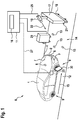
- Figure 1 shows in a schematic perspective illustration a vehicle 1 with a motor vehicle environment sensor 2 to be calibrated, for example a distance sensor 2, and two headlights 3 and 4 in a front area 5 of the vehicle 1.
- a measurement feature 6 is or is formed on an engine hood 7 of the vehicle 1 appropriate.
- the at least one measurement feature 6 is attached to at least one of the wheels 9 of the vehicle 1 in order to be able to determine (in addition to the movement path) further geometric information such as the position or the orientation of the wheel 9.
- Measurement features 6 in the form of measurement points 6 can be adapted directly to a wheel 9 or can be located on a measurement board 30 which is adapted to the wheel 9.
- the wheel 9 rotates during the movement of the vehicle 1, it is advantageous to design the measuring points 6 as spheres, since they are recorded by the camera independently of the angle of rotation of the wheel 9 and thus travel distances of any length can be carried out.
- the vehicle 1 stands on a measuring station 8.
- a control point system 14 is formed from at least three measuring features, in particular measuring points 13, which are not arranged on a common line.
- a movable calibration device 21 which is designed to calibrate the motor vehicle environment sensor 2, is arranged in front of the vehicle 1.
- the calibration device 21 has a chassis 18 and a target 17 arranged on the chassis 18.
- the target 17 is designed to interact with the motor vehicle environment sensor 2 to be calibrated.
- the target 17 is designed with a reflector plane which reflects electromagnetic radiation, in particular radar radiation.
- the target 17 can alternatively or additionally be designed with an optical control point pattern.
- the calibration device 21 also includes a camera 10 which is aligned with the vehicle 1.
- the camera 10 is fixed with respect to the target 17 so that the position and the alignment of the camera 10 with respect to the target 17 do not change.
- the fixed position and alignment of the camera 10 with respect to the target 17 are known to an evaluation device 11 which is connected to the camera 10 via a wired or wireless connection line 25.
- the viewing axis 22 of the camera 10 is aligned in such a way that the camera 10 is able to optically capture both the measurement features 13 of the control point system 14 formed on the road plane 12 of the measuring station 8 and the at least one measurement feature 6 formed on the vehicle 1 .
- the evaluation device 11 Since the evaluation device 11 knows the position and the orientation of the camera 10 in relation to the target 17, the evaluation device 11 is able to determine the position and the orientation of the calibration device from an image of the measurement features 13 of the control point system 14 recorded by the camera 10 21 and in particular of the target 17 on the measuring station 8 to be determined.
- the evaluation device 11 controls a display unit 16 in order to display method steps that are necessary to align the calibration device 21 and in particular the target 17 in a desired / required position on the measuring station 8.
- the camera 10 While the vehicle 1 is approaching the measuring station 8 in the direction of the calibration device 21, the camera 10 records a trajectory of the measuring feature 6 on the vehicle 1.
- the evaluation device 11 determines a travel axis 15 of the vehicle 1 from the movement path recorded in this way.
- the target 17 can then be aligned in particular orthogonally to the travel axis 15 of the vehicle 1.
- the motor vehicle environment sensor 2 detects a signal (e.g. radar radiation or light) reflected by the target 17 and outputs adjustment instructions for adjusting the motor vehicle environment sensor 2 via an environment sensor evaluation device 23 arranged in the motor vehicle 1.
- a signal e.g. radar radiation or light
- the environment sensor evaluation device 23 of the motor vehicle 1 communicates with the evaluation device 11 via a wireless or wired data connection 27, so that adjustment information for a service technician can be displayed on the display unit 16.
- an assembly robot 29 can be provided which acts on the adjusting screws of the distance sensor 2 in order to align the distance sensor 2 in the desired position and orientation.
- the measurement features 13 of the control point system 14 must not be covered either by the vehicle 1 or by the calibration device 21.
- the freedom of movement of the calibration device 21 and of the vehicle 1 are limited by this condition.
- Figure 2 shows a second exemplary embodiment in which no measurement features 13 are or have to be formed on the roadway plane 12 of the measuring station 8.
- a control point system 26 with at least three measurement features 6 is formed on the vehicle 1 in the second exemplary embodiment.
- the camera 10 detects the control point system 26 formed on the vehicle 1 and enables the evaluation device 11 to determine the position and orientation of the calibration device 21 in To be determined with respect to the vehicle 1.
- the position and the alignment of the calibration device 21 with respect to the vehicle 1 can be adjusted manually or with the aid of motors (not shown in the figures) formed on the calibration device 21.
- the camera 10 While the vehicle 1 is approaching the measuring station 8 in the direction of the calibration device 21, the camera 10 records a trajectory of at least one of the measurement features 6 and the evaluation device 11 determines the travel axis 15 of the vehicle 1 from this.
- the motor vehicle environment sensor 2 detects the signal (e.g. radar radiation or light) reflected by the target 17 and outputs adjustment information via an evaluation device 23 arranged in the motor vehicle 1 and / or controls the assembly robot 29 so that it acts on the adjustment screws of the distance sensor 2 to align the distance sensor 2 in the desired position and orientation.
- the signal e.g. radar radiation or light
Landscapes
- Engineering & Computer Science (AREA)
- Radar, Positioning & Navigation (AREA)
- Remote Sensing (AREA)
- Physics & Mathematics (AREA)
- General Physics & Mathematics (AREA)
- Computer Networks & Wireless Communication (AREA)
- Electromagnetism (AREA)
- Computer Vision & Pattern Recognition (AREA)
- Theoretical Computer Science (AREA)
- Traffic Control Systems (AREA)
- Radar Systems Or Details Thereof (AREA)
- Length Measuring Devices By Optical Means (AREA)
Description
- Die Erfindung betrifft eine Kalibriereinrichtung und ein Verfahren zum Kalibrieren von Kraftfahrzeug-Umfeldsensoren
- Moderne Kraftfahrzeuge sind häufig mit Fahrerassistenzsystemen ausgestattet, beispielsweise mit einem automatischen Abstandswarner und/oder -halter, einem Spurhalteassistenten, einer Spurwechselwarnung ("lane change warning"), einer Spurverlassenswarnung ("lane departure warning"), und/oder einer Einparkhilfe.
- Um eine zuverlässige Funktion der Fahrerassistenzsysteme zu gewährleisten, ist es erforderlich, dass die Sensoren der Fahrerassistenzsysteme, beispielsweise Kameras und/oder Radarsensoren, ein präzises, gut mit der Realität übereinstimmendes und korrekt auf das Fahrzeug ausgerichtetes Bild der Umgebung des Fahrzeugs liefern. Hierfür müssen die Sensoren der Fahrerassistenzsysteme kalibriert werden, insbesondere relativ zur Bewegungsbahn des Fahrzeugs. Diese Kalibrierungsvorgänge und die hierfür notwendigen vorbereitenden Schritte, wie z.B. die Bestimmung der Positionierung und der Ausrichtung der Fahrerassistenzsystem-Sensoren zu dem Fahrzeug, sind in der Praxis häufig sehr aufwändig.
- Aus dem Dokument
EP 1953518 A2 ist ein Prüfstand zum Kalibrieren von Fahrzeugumfeldsensoren bekannt, wobei die Messmerkmale auf der Karosserie angebracht werden. Aus dem DokumentEP 2233365 A2 ist ein Verfahren bekannt, um die Position und die Ausrichtung einer Kamera eines Fahrerassistenzsystems eines Fahrzeuges zu bestimmen. - Es ist daher eine Aufgabe der vorliegenden Erfindung, die Kalibrierung von Fahrerassistenzsystemen, insbesondere von Fahrerassistenzsystem-Sensoren, zu vereinfachen.
- Gemäß einem Ausführungsbeispiel der Erfindung umfasst eine Kalibriereinrichtung zum Kalibrieren von Kraftfahrzeug-Umfeldsensoren mit den Merkmalen gemäß Anspruch 1.
- Ausführungsbeispiele der Erfindung umfassen auch einen Messplatz zum Kalibrieren von Kraftfahrzeug-Umfeldsensoren mit einer auf dem Messplatz angeordneten Kalibriereinrichtung, die gemäß einem Ausführungsbeispiel der Erfindung ausgebildet ist.
- Gemäß einem Ausführungsbeispiel der Erfindung umfasst ein Verfahren zum Kalibrieren von Kraftfahrzeug-Umfeldsensoren die Merkmale gemäß Anspruch 5.
- Das erfindungsgemäße Verfahren zum Kalibrieren von Kraftfahrzeug-Umfeldsensoren,umfasst, eine erfindungsgemäße Kalibriereinrichtung auf einem Messplatz zu platzieren, welche gemäß einem Ausführungsbeispiel der Erfindung ausgebildet ist; ein Kraftfahrzeug mit wenigstens einem Kraftfahrzeug-Umfeldsensor auf dem Messplatz zu platzieren; mehrere Messpunkte als Messmerkmale derart auf dem Fahrzeug anzubringen, dass sie von der wenigstens einen Kamera der Kalibriereinrichtung optisch erfassbar sind, wobei sich ein Messmerkmal auf der Messtafel befindet, die am Rad adaptiert wird; mit der wenigstens einen Kamera der Kalibriereinrichtung wenigstens ein Bild der an dem Fahrzeug vorhandenen Messmerkmale aufzunehmen; und durch Auswerten der von der wenigstens einen Kamera aufgenommenen Bilder die Position der Kalibriereinrichtung in Bezug auf das Kraftfahrzeug zu bestimmen.
- Mit Hilfe der von der wenigstens einen Kamera aufgenommenen Bilder kann die Position der Kalibriereinrichtung im Raum bestimmt werden.
- Da die Position und die Ausrichtung des Targets gegenüber der Kamera fest und bekannt sind, können die Position und die Ausrichtung des Targets im Raum bestimmt werden, wenn die Position und die Ausrichtung der Kamera bekannt sind.
- Dadurch, dass die Kamera Bestandteil der Kalibriereinrichtung ist, kann der Platzbedarf gegenüber Konfigurationen, in denen die Kamera separat von der Kalibriereinrichtung am Messplatz angeordnet ist und sowohl das Target als auch das Kraftfahrzeug erfasst, deutlich reduziert werden. Mit einer erfindungsgemäßen Kalibriereinrichtung kann die Kalibrierung daher auch auf kleinen Messplätzen und in kleinen Werkstätten durchgeführt werden.
- In einer Ausführungsform umfasst das Verfahren zusätzlich, das Fahrzeug relativ zur der Kalibriereinrichtung zu bewegen; mit der wenigstens einen Kamera der Kalibriereinrichtung zu verschiedenen Zeitpunkten der Fahrzeugbewegung wenigstens zwei Bilder des auf dem Fahrzeug angebrachten wenigstens einen Messpunktes aufzunehmen; und durch Auswerten der von der wenigstens einen Kamera aufgenommenen Bilder des wenigstens einen an dem Fahrzeug angebrachten Messpunktes die Bewegungsbahn des Fahrzeugs gegenüber der Kalibriereinrichtung zu bestimmen.
- Durch Vergleichen der auf diese Weise gewonnen Daten mit den von dem Kraftfahrzeug-Umfeldsensor gelieferten Daten können Abweichungen der Position und der Ausrichtung des Kraftfahrzeug-Umfeldsensors von vorgegebenen Solldaten bestimmt werden, und der Kraftfahrzeug-Umfeldsensor kann justiert und kalibriert werden.
- In einer Ausführungsform umfasst das wenigstens eine Target eine Reflektorebene, die zur Reflexion elektromagnetischer Strahlung, insbesondere von Radarstrahlung, ausgebildet ist. Ein solches Target kann zum Kalibrieren von Sensoren, die elektromagnetische Strahlung detektieren, insbesondere von Radarsensoren, eingesetzt werden.
- In einer Ausführungsform umfasst das wenigstens eine Target eine Musterplatte, auf der ein optisch erfassbares Muster, insbesondere ein Passpunktmuster, ausgebildet ist. Ein solches Target kann zum Kalibrieren optischer Sensoren, wie z.B. Kameras, eingesetzt werden.
- In einer Ausführungsform ist die wenigstens eine Kamera ausgebildet und ausgerichtet, Bilder von Messmerkmalen aufzunehmen, die auf dem Messplatz, insbesondere auf dem Boden des Messplatzes, ausgebildet sind.
- Die Messmerkmale können künstliche Merkmale sein, wie zum Beispiel retroreflektierende Messpunkte in Form ebener Kreismarken oder Kugeln, die von der Kamera besonders gut detektierbar sind und aufgrund ihrer definierten Geometrie Vorteile bezüglich der Messgenauigkeit bieten.
- Auf diese Weise können die Position und die Ausrichtung der Kalibriereinrichtung in Bezug auf den Messplatz bestimmt werden. Die Messmerkmale können insbesondere in Form eines Passpunktsystems angeordnet sein.
- Die wenigstens eine Kamera ist ausgebildet und ausgerichtet, Bilder von Messmerkmalen aufzunehmen, die auf einem vor der Kalibriereinrichtung angeordneten Fahrzeug ausgebildet sind. Die Messmerkmale können Merkmale oder Muster des Fahrzeugs, insbesondere der Karosserie, wie z.B. Schrauben, Bohrungen, Kontraststellen, usw. oder gezielt an dem Fahrzeug angebrachte Messpunkte sein.
- Erfindungsgemäß ist wenigstens ein Messmerkmal an wenigstens einem der Räder des Fahrzeugs angebracht. Dies ermöglicht es, zusätzlich zur Bewegungsbahn weitere geometrische Informationen, wie z.B. die Position oder die Ausrichtung des Rades, zu bestimmen.
- Die Messmerkmale befinden sich in Form von Messpunkten auf einer Messtafel, die am Rad adaptiert wird.
- Erfindungsgemäß sind die Messpunkte als Kugeln ausgelegt, so dass sie unabhängig vom Raddrehwinkel von der Kamera erfasst werden. Damit sind längere Fahrwege des Fahrzeugs möglich.
- Durch Auswerten der Bewegungsbahn eines an einem sich bewegenden Fahrzeug vorhandenen Messmerkmals kann die Ausrichtung der Fahrachse des Fahrzeugs gegenüber der Kalibriereinrichtung bestimmt werden, so dass ein Kraftfahrzeug-Umfeldsensor in Bezug auf die Fahrachse des Fahrzeugs ausgerichtet werden kann.
- Sind auf dem Fahrzeug mehrere Messmerkmale vorhanden, die in Form eines Passpunktsystems angeordnet sind, können auch die Position und die Ausrichtung der Kalibriereinrichtung in Bezug auf das Kraftfahrzeug bestimmt werden.
- Ein Ausführungsbeispiel der Erfindung wird im Folgenden unter Bezugnahme auf die beigefügten Figuren beschrieben.
-
-
Figur 1 zeigt einen Messplatz zum Kalibrieren von Kraftfahrzeug-Umfeldsensoren mit einer auf dem Messplatz angeordneten Kalibriereinrichtung gemäß einem ersten Ausführungsbeispiel der Erfindung. -
Figur 2 zeigt einen Messplatz zum Kalibrieren von Kraftfahrzeug-Umfeldsensoren mit einer auf dem Messplatz angeordneten Kalibriereinrichtung gemäß einem zweiten Ausführungsbeispiel der Erfindung. -
Figur 1 zeigt in einer schematischen perspektivischen Darstellung ein Fahrzeug 1 mit einem zu kalibrierenden Kraftfahrzeug-Umfeldsensor 2, beispielsweise einem Abstandssensor 2, und zwei Scheinwerfern 3 und 4 in einem Frontbereich 5 des Fahrzeugs 1. Auf einer Motorhaube 7 des Fahrzeugs 1 ist ein Messmerkmal 6 ausgebildet oder angebracht. - Das wenigstens eine Messmerkmal 6 ist an wenigstens einem der Räder 9 des Fahrzeugs 1 angebracht sein, um (zusätzlich zur Bewegungsbahn) weitere geometrische Informationen wie die Position oder die Ausrichtung des Rades 9 bestimmen zu können.
- Messmerkmale 6 in Form von Messpunkten 6 können direkt an einem Rad 9 adaptiert werden oder sich auf einer Messtafel 30 befinden, die am Rad 9 adaptiert wird.
- Da sich das Rad 9 während der Bewegung des Fahrzeugs 1 dreht, ist es vorteilhaft, die Messpunkte 6 als Kugeln auszulegen, da sie unabhängig vom Drehwinkel des Rades 9 von der Kamera erfasst werden und damit beliebig lange Fahrwege ausgeführt werden können.
- Möglich wäre auch eine pendelnd zur Schwerkraft am Rad 9 aufgehängte Messtafel 30 mit ebenen Messpunkten 6 zu verwenden, so dass die ebenen Messpunkte 6 unabhängig vom Drehwinkel des Rades 9 immer der Sichtachse 22 der Kamera 10 zugewandt sind. Damit sind ebenfalls längere Fahrwege möglich.
- Das Fahrzeug 1 steht auf einem Messplatz 8. Auf einer Fahrbahnebene (Boden) 12 des Messplatzes 8 ist ein Passpunktsystem 14 aus wenigstens drei Messmerkmalen, insbesondere Messpunkten, 13, die nicht auf einer gemeinsamen Linie angeordnet sind, ausgebildet.
- Vor dem Fahrzeug 1 ist eine bewegliche Kalibriereinrichtung 21 angeordnet, die zum Kalibrieren des Kraftfahrzeug-Umfeldsensors 2 ausgebildet ist.
- Die Kalibriereinrichtung 21 hat ein Fahrgestell 18 und ein auf dem Fahrgestell 18 angeordnetes Target 17. Das Target 17 ist zur Wechselwirkung mit dem zu kalibrierenden Kraftfahrzeug-Umfeldsensor 2 ausgebildet.
- Beispielsweise ist das Target 17 im Falle eines Radarsensors 2 mit einer Reflektorebene ausgebildet, die elektromagnetische Strahlung, insbesondere Radarstrahlung, reflektiert.
- Zum Kalibrieren eines optischen Sensors 2 kann das Target 17 alternativ oder zusätzlich mit einem optischen Passpunktmuster ausgebildet sein.
- Die Kalibriereinrichtung 21 umfasst darüber hinaus eine Kamera 10, die auf das Fahrzeug 1 ausgerichtet ist. Die Kamera 10 ist gegenüber dem Target 17 fixiert, so dass sich die Position und die Ausrichtung der Kamera 10 in Bezug auf das Target 17 nicht verändern.
- Die feste Position und Ausrichtung der Kamera 10 in Bezug auf das Target 17 sind einer Auswerteeinrichtung 11, die über eine drahtgebundene oder drahtlose Verbindungsleitung 25 mit der Kamera 10 verbunden ist, bekannt.
- Die Sichtachse 22 der Kamera 10 ist insbesondere so ausgerichtet, dass die Kamera 10 in der Lage ist, sowohl die auf der Fahrbahnebene 12 des Messplatzes 8 ausgebildeten Messmerkmale 13 des Passpunktsystems 14 als auch das wenigstens eine auf dem Fahrzeug 1 ausgebildete Messmerkmal 6 optisch zu erfassen.
- Da der Auswerteeinrichtung 11 die Position und die Ausrichtung der Kamera 10 in Bezug auf das Target 17 bekannt sind, ist die Auswerteeinrichtung 11 in der Lage, aus einem von der Kamera 10 aufgenommenen Bild der Messmerkmale 13 des Passpunktsystems 14 die Position und die Ausrichtung der Kalibriereinrichtung 21 und insbesondere des Targets 17 auf dem Messplatz 8 zu bestimmen.
- Die Auswerteeinrichtung 11 steuert eine Anzeigeeinheit 16 an, um Verfahrensschritte anzuzeigen, die notwendig sind, um die Kalibriereinrichtung 21 und insbesondere das Target 17 in einer gewünschten/benötigten Position auf dem Messplatz 8 auszurichten.
- Während einer Anfahrt des Fahrzeugs 1 auf den Messplatz 8 in Richtung der Kalibriereinrichtung 21 wird von der Kamera 10 eine Bewegungsbahn des Messmerkmals 6 auf dem Fahrzeug 1 aufgezeichnet. Aus der so aufgezeichneten Bewegungsbahn bestimmt die Auswerteeinrichtung 11 eine Fahrachse 15 des Fahrzeugs 1.
- Das Target 17 kann dann insbesondere orthogonal zur Fahrachse 15 des Fahrzeugs 1 ausgerichtet werden.
- In einem Kalibriermodus erkennt der Kraftfahrzeug-Umfeldsensor 2 ein von dem Target 17 reflektiertes Signal (z.B. Radarstrahlung oder Licht) und gibt über eine in dem Kraftfahrzeug 1 angeordnete Umfeldsensor-Auswerteeinrichtung 23 Justagehinweise zum Justieren des Kraftfahrzeug-Umfeldsensors 2 aus.
- Insbesondere kommuniziert die Umfeldsensor-Auswerteeinrichtung 23 des Kraftfahrzeugs 1 dabei über eine drahtlose oder drahtgebundene Datenverbindung 27 mit der Auswerteeinrichtung 11, so dass auf der Anzeigeeinheit 16 Justageinformationen für einen Servicetechniker darstellbar sind. Alternativ oder zusätzlich kann ein Montageroboter 29 vorgesehen sein, der auf die Justierschrauben des Abstandssensors 2 einwirkt, um den Abstandssensor 2 in der gewünschten Position und Orientierung auszurichten.
- Da eine Verschiebung und/oder Drehung der Kalibriereinrichtung 21 zur Justage des Kraftfahrzeug-Umfeldsensors 2 erforderlich ist und die Kamera 10 an der Kalibriereinrichtung 21 selbst befestigt ist, werden zwangsläufig auch die Position und die Ausrichtung der Kamera 10 verändert.
- Um die Bestimmung und kontinuierliche Überwachung der Position und der Ausrichtung der Kalibriereinrichtung 21 auf dem Messplatz 8 zu ermöglichen, dürfen die Messmerkmale 13 des Passpunktsystems 14 weder von dem Fahrzeug 1 noch von der Kalibriereinrichtung 21 verdeckt werden. Die Bewegungsspielräume der Kalibriereinrichtung 21 und des Fahrzeugs 1 sind durch diese Bedingung beschränkt.
-
Figur 2 zeigt ein zweites Ausführungsbeispiel, bei dem keine Messmerkmale 13 auf der Fahrbahnebene 12 des Messplatzes 8 ausgebildet sind bzw. ausgebildet sein müssen. - Statt auf der Fahrbahnebene 12 angebrachten Messmerkmalen 13 ist im zweiten Ausführungsbeispiel ein Passpunktsystem 26 mit wenigstens drei Messmerkmalen 6 auf dem Fahrzeug 1 ausgebildet.
- Sobald sich ein mit einem solchen Passpunktsystem 26 ausgestattetes Fahrzeug 1 auf dem Messplatz 8 im Blickfeld der Kamera 10 befindet, erfasst die Kamera 10 das auf dem Fahrzeug 1 ausgebildete Passpunktsystem 26 und ermöglicht es der Auswerteeinrichtung 11, die Position und die Ausrichtung der Kalibriereinrichtung 21 in Bezug auf das Fahrzeug 1 zu bestimmen.
- Bei Bedarf können die Position und die Ausrichtung der Kalibriereinrichtung 21 gegenüber dem Fahrzeug 1 manuell oder mit Hilfe von an der Kalibriereinrichtung 21 ausgebildeten (in den Figuren nicht gezeigten) Motoren angepasst werden.
- Während einer Anfahrt des Fahrzeugs 1 auf den Messplatz 8 in Richtung der Kalibriereinrichtung 21 wird von der Kamera 10 eine Bewegungsbahn wenigstens eines der Messmerkmale 6 aufgezeichnet und daraus von der Auswerteeinrichtung 11 die Fahrachse 15 des Fahrzeugs 1 bestimmt.
- Der Kraftfahrzeug-Umfeldsensor 2 erkennt das von dem Target 17 reflektierte Signal (z.B. Radarstrahlung oder Licht) und gibt über eine in dem Kraftfahrzeug 1 angeordnete Auswerteeinrichtung 23 Justagehinweise aus und/oder steuert den Montageroboter 29 an, damit dieser auf die Justierschrauben des Abstandssensors 2 einwirkt, um den Abstandssensor 2 in der gewünschten Position und Orientierung auszurichten.
Claims (6)
- Kalibriereinrichtung (21) zum Kalibrieren von Kraftfahrzeug-Umfeldsensoren (2), wobei die Kalibriereinrichtung (21) aufweist:wenigstens ein Target (17), das zur Wechselwirkung mit wenigstens einem zu kalibrierenden Kraftfahrzeug-Umfeldsensor (2) ausgebildet ist; undwenigstens eine Kamera (10), die zum optischen Erfassen eines Umfelds der Kalibriereinrichtung (21) ausgebildet ist;wenigstens ein Messmerkmal (6), welches an wenigstens einem der Räder eines vor der Kalibriereinrichtung angeordneten Fahrzeugs (1) anbringbar ist, wobei sich das Messmerkmal (6) auf einer Messtafel befindet, die am Rad adaptierbar ist;wobei die Kamera (10) ausgebildet und ausgerichtet ist, Bilder des wenigstens einen Messmerkmals (6) aufzunehmen, wobei die Position und die Ausrichtung der wenigstens einen Kamera (10) in Bezug auf das wenigstens eine Target (17) bekannt sind,wobei das wenigstens eine Messmerkmal (6) als Kugel ausgelegt ist, so dass es unabhängig vom Raddrehwinkel von der Kamera erfasst wird.
- Kalibriereinrichtung (21) nach Anspruch 1, wobei das wenigstens eine Target (17) eine Reflektorebene umfasst, die zur Reflexion elektromagnetischer Strahlung, insbesondere von Radarstrahlung, ausgebildet ist.
- Kalibriereinrichtung (21) nach Anspruch 1 oder 2, wobei das wenigstens eine Target (17) eine Musterplatte umfasst, auf der ein optisch erfassbares Muster, insbesondere ein Passpunktmuster, ausgebildet ist.
- Kalibriereinrichtung (21) nach einem der vorangehenden Ansprüche, wobei die wenigstens eine Kamera (10) ausgebildet und ausgerichtet ist, Bilder von Messmerkmalen (13) aufzunehmen, die an einem Messplatz (8), insbesondere auf einem Boden (12) eines Messplatzes (8), ausgebildet sind.
- Verfahren zum Kalibrieren von Kraftfahrzeug-Umfeldsensoren (2), wobei das Verfahren umfasst:ein Kraftfahrzeug (1) mit wenigstens einem Kraftfahrzeug-Umfeldsensor (2) auf einem Messplatz (8) zu platzieren;eine Kalibriereinrichtung (21) nach einem der Ansprüche 1 bis 4 auf dem Messplatz (8) zu platzieren;mehrere Messmerkmale (6) auf dem Fahrzeug (1) derart anzubringen, dass sie von der wenigstens einen Kamera (10) der Kalibriereinrichtung (21) optisch erfassbar sind, wobei sich ein Messmerkmal (6) auf einer Messtafel befindt, die am Rad adaptiert wird;mit der wenigstens einen Kamera (10) der Kalibriereinrichtung (21) wenigstens ein Bild der auf dem Fahrzeug (1) angebrachten Messmerkmale (6) aufzunehmen;durch Auswerten der von der wenigstens einen Kamera (10) aufgenommenen Bilder die Position der Kalibriereinrichtung (21) in Bezug auf das Kraftfahrzeug (1) zu bestimmen.
- Verfahren zum Kalibrieren von Kraftfahrzeug-Umfeldsensoren (2) nach Anspruch 5, wobei das Verfahren zusätzlich umfasst:das Fahrzeug (1) gegenüber der Kalibriereinrichtung (21) zu bewegen;mit der wenigstens einen Kamera (10) der Kalibriereinrichtung (21) zu verschiedenen Zeitpunkten der Bewegung wenigstens zwei Bilder des auf dem Fahrzeug (1) angebrachten wenigstens einen Messmerkmals (6) aufzunehmen; unddurch Auswerten der von der wenigstens einen Kamera (10) aufgenommenen Bilder des wenigstens einen auf dem Fahrzeug (1) angebrachten Messmerkmals (6) eine Bewegungsbahn des Fahrzeugs (1) gegenüber der Kalibriereinrichtung (21) zu bestimmen;vergleichen der auf diese Weise gewonnen Daten mit den von dem Kraftfahrzeug-Umfeldsensor gelieferten Daten, bestimmen von Abweichungen der Position und der Ausrichtung des Kraftfahrzeug-Umfeldsensors von vorgegebenen Solldaten, justieren und kalibrieren des Kraftfahrzeug-Umfeldsensors.
Applications Claiming Priority (2)
| Application Number | Priority Date | Filing Date | Title |
|---|---|---|---|
| DE102017212289.7A DE102017212289A1 (de) | 2017-07-18 | 2017-07-18 | Kalibriereinrichtung und Verfahren zum Kalibrieren von Kraftfahrzeug-Umfeldsensoren |
| PCT/EP2018/064880 WO2019015847A1 (de) | 2017-07-18 | 2018-06-06 | Kalibriereinrichtung und verfahren zum kalibrieren von kraftfahrzeug-umfeldsensoren |
Publications (2)
| Publication Number | Publication Date |
|---|---|
| EP3655796A1 EP3655796A1 (de) | 2020-05-27 |
| EP3655796B1 true EP3655796B1 (de) | 2021-10-27 |
Family
ID=62530248
Family Applications (1)
| Application Number | Title | Priority Date | Filing Date |
|---|---|---|---|
| EP18729422.8A Active EP3655796B1 (de) | 2017-07-18 | 2018-06-06 | Kalibriereinrichtung und verfahren zum kalibrieren von kraftfahrzeug-umfeldsensoren |
Country Status (4)
| Country | Link |
|---|---|
| EP (1) | EP3655796B1 (de) |
| CN (1) | CN111095017B (de) |
| DE (1) | DE102017212289A1 (de) |
| WO (1) | WO2019015847A1 (de) |
Cited By (2)
| Publication number | Priority date | Publication date | Assignee | Title |
|---|---|---|---|---|
| WO2020056303A1 (en) | 2018-09-13 | 2020-03-19 | Snap-On Incorporated | Automotive aligner with improved accuracy and no-stop positioning using a drive direction calculation |
| US11993282B2 (en) | 2020-06-15 | 2024-05-28 | Snap-On Incorporated | Apparatus and method for calibrating and aligning automotive sensors |
Families Citing this family (11)
| Publication number | Priority date | Publication date | Assignee | Title |
|---|---|---|---|---|
| HUE061524T2 (hu) | 2018-06-21 | 2023-07-28 | Mahle Aftermarket Italy S R L | Rendszer és eljárás jármû fedélzetére szerelt optikai érzékelõ kalibrálására |
| US12573091B2 (en) | 2018-06-21 | 2026-03-10 | Mahle Aftermarket Italy S.P.A. | System and method of calibrating an optical sensor mounted on board of a vehicle using a graduated mounting bar |
| CN110310339B (zh) * | 2019-07-04 | 2021-05-04 | 厦门金龙联合汽车工业有限公司 | 一种标定装置及一种雷达与摄像头联合标定方法及系统 |
| CN112304628B (zh) * | 2019-07-23 | 2023-09-05 | 深圳市道通科技股份有限公司 | 一种标定设备、标定系统以及标定方法 |
| CN112255627B (zh) * | 2020-09-25 | 2024-06-04 | 深圳市道通科技股份有限公司 | Adas标定设备的定位方法、系统、装置及可读存储介质 |
| DE102021203348A1 (de) | 2021-04-01 | 2022-10-06 | Robert Bosch Gesellschaft mit beschränkter Haftung | Verfahren und Vorrichtung zur Kalibrierung mindestens eines Sensors |
| CN113219428A (zh) * | 2021-06-04 | 2021-08-06 | 东软睿驰汽车技术(沈阳)有限公司 | 相机与雷达的融合标定方法和装置 |
| US20230154034A1 (en) * | 2021-11-16 | 2023-05-18 | Texa S.P.A. | Vehicle measuring apparatus and operating method thereof |
| DE102023202933A1 (de) * | 2023-03-30 | 2024-10-02 | Robert Bosch Gesellschaft mit beschränkter Haftung | Optisches Messsystem und Kalibriervorrichtung zum Kalibrieren eines Fahrerassistenzsystems |
| DE102023211230A1 (de) * | 2023-11-13 | 2025-05-15 | Robert Bosch Gesellschaft mit beschränkter Haftung | Verfahren, Vorrichtung und Sensor-Messtafel zum Bestimmen der räumlichen Ausrichtung eines Umgebungssensors in oder an einem Fahrzeug |
| DE102024200364A1 (de) * | 2024-01-16 | 2025-07-17 | Robert Bosch Gesellschaft mit beschränkter Haftung | Vorrichtung, System und Verfahren zum Bestimmen der Position eines Kalibriertools vor einem Kraftfahrzeug |
Family Cites Families (12)
| Publication number | Priority date | Publication date | Assignee | Title |
|---|---|---|---|---|
| GB2013340A (en) * | 1978-01-26 | 1979-08-08 | B & A Eng Co | Indicating tilt |
| DE19941034A1 (de) * | 1999-08-28 | 2001-03-22 | Bosch Gmbh Robert | Einstellvorrichtung mit einem Einstellgerät für einen Scheinwerfer oder für einen Abstandssensor eines Fahrzeuges |
| EP1623185B1 (de) * | 2003-05-09 | 2010-08-11 | Snap-on Incorporated | Kameratechnik für die sensoreinstellung für die adaptive fahrtregelung (acc) |
| DE102005063051A1 (de) * | 2005-12-29 | 2007-07-05 | Robert Bosch Gmbh | Verfahren zur optischen Fahrwerksvermessung |
| US20080119978A1 (en) * | 2006-11-20 | 2008-05-22 | Hunter Engineering Company | Method and Apparatus For Wheel Assembly Force Moment Arm Measurement |
| DE102007005085A1 (de) * | 2007-02-01 | 2008-08-07 | Robert Bosch Gmbh | Verfahren und Vorrichtung zum Ausrichten eines Fahrzeug-Umfeldsensors oder Scheinwerfers |
| DE102007005086A1 (de) * | 2007-02-01 | 2008-08-07 | Robert Bosch Gmbh | Verfahren und Vorrichtung zum Ausrichten eines Fahrzeug-Umfeldsensors oder Scheinwerfers |
| CN101308386B (zh) * | 2008-07-10 | 2012-03-07 | 同济大学 | 汽车底盘集成控制器硬件在环仿真试验台 |
| DE102009001742A1 (de) * | 2009-03-23 | 2010-09-30 | Robert Bosch Gmbh | Verfahren sowie Vorrichtung zum Bestimmen der Position und Ausrichtung einer Fahrerassistenzsystem-Kamera eines Fahrzeugs zu dem Fahrzeug |
| DE102010062696A1 (de) * | 2010-12-09 | 2012-06-14 | Robert Bosch Gmbh | Verfahren und Vorrichtung zum Kalibrieren und Justieren eines Fahrzeug-Umfeldsensors. |
| IT1404235B1 (it) * | 2010-12-30 | 2013-11-15 | Space S R L Con Unico Socio | Dispositivo di rilevamento, e relativo sistema di determinazione dell'orientamento delle ruote di un veicolo |
| DE102015112368A1 (de) * | 2015-07-29 | 2017-02-02 | Hella Gutmann Solutions GmbH | Verfahren und Vorrichtung zur Kalibrierung von Assistenzsystemen von Fahrzeugen |
-
2017
- 2017-07-18 DE DE102017212289.7A patent/DE102017212289A1/de not_active Withdrawn
-
2018
- 2018-06-06 WO PCT/EP2018/064880 patent/WO2019015847A1/de not_active Ceased
- 2018-06-06 EP EP18729422.8A patent/EP3655796B1/de active Active
- 2018-06-06 CN CN201880060237.5A patent/CN111095017B/zh active Active
Cited By (5)
| Publication number | Priority date | Publication date | Assignee | Title |
|---|---|---|---|---|
| WO2020056303A1 (en) | 2018-09-13 | 2020-03-19 | Snap-On Incorporated | Automotive aligner with improved accuracy and no-stop positioning using a drive direction calculation |
| EP3850306A4 (de) * | 2018-09-13 | 2022-09-21 | Snap-On Incorporated | Kraftfahrzeugausrichter mit verbesserter genauigkeit und no-stopp-positionierung unter verwendung einer antriebsrichtungsberechnung |
| US11698250B2 (en) | 2018-09-13 | 2023-07-11 | Snap-On Incorporated | Wheel aligner with improved accuracy and no-stop positioning, using a drive direction calculation |
| US12467747B2 (en) | 2018-09-13 | 2025-11-11 | Snap-On Incorporated | Wheel aligner with improved accuracy and no-stop positioning using a drive direction calculation |
| US11993282B2 (en) | 2020-06-15 | 2024-05-28 | Snap-On Incorporated | Apparatus and method for calibrating and aligning automotive sensors |
Also Published As
| Publication number | Publication date |
|---|---|
| WO2019015847A1 (de) | 2019-01-24 |
| CN111095017B (zh) | 2024-04-05 |
| CN111095017A (zh) | 2020-05-01 |
| DE102017212289A1 (de) | 2019-01-24 |
| EP3655796A1 (de) | 2020-05-27 |
Similar Documents
| Publication | Publication Date | Title |
|---|---|---|
| EP3655796B1 (de) | Kalibriereinrichtung und verfahren zum kalibrieren von kraftfahrzeug-umfeldsensoren | |
| EP1376051B1 (de) | Kalibrierung eines Bildsensorsystems an einem Kraftfahrzeug mit Kalibrierobjekt und Lagebezugssensor | |
| EP1520184B1 (de) | Verfahren und vorrichtung zur kalibrierung von sensoren im kraftfahrzeug | |
| DE102010062696A1 (de) | Verfahren und Vorrichtung zum Kalibrieren und Justieren eines Fahrzeug-Umfeldsensors. | |
| EP1953520B1 (de) | Verfahren und Vorrichtung zum Ausrichten eines Fahrzeug-Umfeldsensors oder Scheinwerfers | |
| EP2233365A2 (de) | Verfahren sowie Vorrichtung zum Bestimmen der Position und Ausrichtung einer Fahrerassistenzsystem-Kamera eines Fahrzeugs zu dem Fahrzeug | |
| DE102010049093A1 (de) | Verfahren zum Betreiben zumindest eines Sensors eines Fahrzeugs und Fahrzeug mit zumindest einem Sensor | |
| WO2013004327A1 (de) | Lageverstellbare fahrzeugkomponente und verfahren zum ausrichten derselben | |
| DE102016219455A1 (de) | Kraftfahrzeug, Verfahren und aktive Infrastruktur zur Überprüfung einer Umfelderfassung eines Kraftfahrzeugs | |
| WO2019110245A1 (de) | System und verfahren zum ausrichten einer kalibriervorrichtung zum kalibrieren von fahrzeugumfeldsensoren | |
| DE102018216104A1 (de) | Verfahren zum Kalibrieren eines Umfeldsensors eines Fahrzeugs mit Berücksichtigung eines dreidimensionalen Modells des Fahrzeugs, Kalibrierprüfstand sowie Fahrzeug | |
| DE102018208846B4 (de) | Verfahren zur Kalibrierung einer Sensorbaugruppe | |
| DE102015008553A1 (de) | Vorrichtung und Verfahren zur adaptiven Ausrichtung des Kamerasichtfelds einer Fahrzeugkamera | |
| EP1953518A2 (de) | Verfahren und Vorrichtung zum Ausrichten eines Fahrzeug-Umfeldsensors oder Scheinwerfers | |
| DE102006006023A1 (de) | Vorrichtung für die Prüfung und Einstellung von Fahrerassistenzsystemen von Kraftfahrzeugen am Bandende | |
| EP1927865A1 (de) | Verfahren und Vorrichtung zum Ausrichten eines Abstandssensors | |
| DE102016208398B4 (de) | Verfahren zur Kalibrierung einer Fahrzeugkamera | |
| EP3757509B1 (de) | System zur automatisierten vermessung von kraftfahrzeugen | |
| EP1550983A1 (de) | Vorrichtung zur Kalibrierung eines Bildsensorsystems | |
| DE102017220458A1 (de) | Kalibriereinrichtung und Verfahren zum Kalibrieren eines Referenztargets | |
| DE102005016718B4 (de) | Verfahren zur Justage von Objektsensoren eines Kraftfahrzeugs | |
| DE102022203992A1 (de) | Verfahren zum Kalibrierung eines Verkehrsleitsystem und Verkehrsleitsystem | |
| EP1953519A2 (de) | Verfahren und Vorrichtung zum Ausrichten eines Fahrzeug-Umfeldsensors | |
| WO2022078835A1 (de) | Messanordnung und messverfahren | |
| DE102024200364A1 (de) | Vorrichtung, System und Verfahren zum Bestimmen der Position eines Kalibriertools vor einem Kraftfahrzeug |
Legal Events
| Date | Code | Title | Description |
|---|---|---|---|
| STAA | Information on the status of an ep patent application or granted ep patent |
Free format text: STATUS: UNKNOWN |
|
| STAA | Information on the status of an ep patent application or granted ep patent |
Free format text: STATUS: THE INTERNATIONAL PUBLICATION HAS BEEN MADE |
|
| PUAI | Public reference made under article 153(3) epc to a published international application that has entered the european phase |
Free format text: ORIGINAL CODE: 0009012 |
|
| STAA | Information on the status of an ep patent application or granted ep patent |
Free format text: STATUS: REQUEST FOR EXAMINATION WAS MADE |
|
| 17P | Request for examination filed |
Effective date: 20200218 |
|
| AK | Designated contracting states |
Kind code of ref document: A1 Designated state(s): AL AT BE BG CH CY CZ DE DK EE ES FI FR GB GR HR HU IE IS IT LI LT LU LV MC MK MT NL NO PL PT RO RS SE SI SK SM TR |
|
| AX | Request for extension of the european patent |
Extension state: BA ME |
|
| DAV | Request for validation of the european patent (deleted) | ||
| DAX | Request for extension of the european patent (deleted) | ||
| GRAP | Despatch of communication of intention to grant a patent |
Free format text: ORIGINAL CODE: EPIDOSNIGR1 |
|
| STAA | Information on the status of an ep patent application or granted ep patent |
Free format text: STATUS: GRANT OF PATENT IS INTENDED |
|
| INTG | Intention to grant announced |
Effective date: 20210315 |
|
| GRAJ | Information related to disapproval of communication of intention to grant by the applicant or resumption of examination proceedings by the epo deleted |
Free format text: ORIGINAL CODE: EPIDOSDIGR1 |
|
| STAA | Information on the status of an ep patent application or granted ep patent |
Free format text: STATUS: REQUEST FOR EXAMINATION WAS MADE |
|
| GRAP | Despatch of communication of intention to grant a patent |
Free format text: ORIGINAL CODE: EPIDOSNIGR1 |
|
| STAA | Information on the status of an ep patent application or granted ep patent |
Free format text: STATUS: GRANT OF PATENT IS INTENDED |
|
| INTC | Intention to grant announced (deleted) | ||
| INTG | Intention to grant announced |
Effective date: 20210518 |
|
| GRAS | Grant fee paid |
Free format text: ORIGINAL CODE: EPIDOSNIGR3 |
|
| GRAA | (expected) grant |
Free format text: ORIGINAL CODE: 0009210 |
|
| STAA | Information on the status of an ep patent application or granted ep patent |
Free format text: STATUS: THE PATENT HAS BEEN GRANTED |
|
| AK | Designated contracting states |
Kind code of ref document: B1 Designated state(s): AL AT BE BG CH CY CZ DE DK EE ES FI FR GB GR HR HU IE IS IT LI LT LU LV MC MK MT NL NO PL PT RO RS SE SI SK SM TR |
|
| REG | Reference to a national code |
Ref country code: GB Ref legal event code: FG4D Free format text: NOT ENGLISH |
|
| REG | Reference to a national code |
Ref country code: CH Ref legal event code: EP |
|
| REG | Reference to a national code |
Ref country code: AT Ref legal event code: REF Ref document number: 1442266 Country of ref document: AT Kind code of ref document: T Effective date: 20211115 |
|
| REG | Reference to a national code |
Ref country code: DE Ref legal event code: R096 Ref document number: 502018007594 Country of ref document: DE |
|
| REG | Reference to a national code |
Ref country code: IE Ref legal event code: FG4D Free format text: LANGUAGE OF EP DOCUMENT: GERMAN |
|
| REG | Reference to a national code |
Ref country code: LT Ref legal event code: MG9D |
|
| REG | Reference to a national code |
Ref country code: NL Ref legal event code: MP Effective date: 20211027 |
|
| PG25 | Lapsed in a contracting state [announced via postgrant information from national office to epo] |
Ref country code: RS Free format text: LAPSE BECAUSE OF FAILURE TO SUBMIT A TRANSLATION OF THE DESCRIPTION OR TO PAY THE FEE WITHIN THE PRESCRIBED TIME-LIMIT Effective date: 20211027 Ref country code: LT Free format text: LAPSE BECAUSE OF FAILURE TO SUBMIT A TRANSLATION OF THE DESCRIPTION OR TO PAY THE FEE WITHIN THE PRESCRIBED TIME-LIMIT Effective date: 20211027 Ref country code: FI Free format text: LAPSE BECAUSE OF FAILURE TO SUBMIT A TRANSLATION OF THE DESCRIPTION OR TO PAY THE FEE WITHIN THE PRESCRIBED TIME-LIMIT Effective date: 20211027 Ref country code: BG Free format text: LAPSE BECAUSE OF FAILURE TO SUBMIT A TRANSLATION OF THE DESCRIPTION OR TO PAY THE FEE WITHIN THE PRESCRIBED TIME-LIMIT Effective date: 20220127 |
|
| PG25 | Lapsed in a contracting state [announced via postgrant information from national office to epo] |
Ref country code: IS Free format text: LAPSE BECAUSE OF FAILURE TO SUBMIT A TRANSLATION OF THE DESCRIPTION OR TO PAY THE FEE WITHIN THE PRESCRIBED TIME-LIMIT Effective date: 20220227 Ref country code: SE Free format text: LAPSE BECAUSE OF FAILURE TO SUBMIT A TRANSLATION OF THE DESCRIPTION OR TO PAY THE FEE WITHIN THE PRESCRIBED TIME-LIMIT Effective date: 20211027 Ref country code: PT Free format text: LAPSE BECAUSE OF FAILURE TO SUBMIT A TRANSLATION OF THE DESCRIPTION OR TO PAY THE FEE WITHIN THE PRESCRIBED TIME-LIMIT Effective date: 20220228 Ref country code: PL Free format text: LAPSE BECAUSE OF FAILURE TO SUBMIT A TRANSLATION OF THE DESCRIPTION OR TO PAY THE FEE WITHIN THE PRESCRIBED TIME-LIMIT Effective date: 20211027 Ref country code: NO Free format text: LAPSE BECAUSE OF FAILURE TO SUBMIT A TRANSLATION OF THE DESCRIPTION OR TO PAY THE FEE WITHIN THE PRESCRIBED TIME-LIMIT Effective date: 20220127 Ref country code: NL Free format text: LAPSE BECAUSE OF FAILURE TO SUBMIT A TRANSLATION OF THE DESCRIPTION OR TO PAY THE FEE WITHIN THE PRESCRIBED TIME-LIMIT Effective date: 20211027 Ref country code: LV Free format text: LAPSE BECAUSE OF FAILURE TO SUBMIT A TRANSLATION OF THE DESCRIPTION OR TO PAY THE FEE WITHIN THE PRESCRIBED TIME-LIMIT Effective date: 20211027 Ref country code: HR Free format text: LAPSE BECAUSE OF FAILURE TO SUBMIT A TRANSLATION OF THE DESCRIPTION OR TO PAY THE FEE WITHIN THE PRESCRIBED TIME-LIMIT Effective date: 20211027 Ref country code: GR Free format text: LAPSE BECAUSE OF FAILURE TO SUBMIT A TRANSLATION OF THE DESCRIPTION OR TO PAY THE FEE WITHIN THE PRESCRIBED TIME-LIMIT Effective date: 20220128 Ref country code: ES Free format text: LAPSE BECAUSE OF FAILURE TO SUBMIT A TRANSLATION OF THE DESCRIPTION OR TO PAY THE FEE WITHIN THE PRESCRIBED TIME-LIMIT Effective date: 20211027 |
|
| REG | Reference to a national code |
Ref country code: DE Ref legal event code: R097 Ref document number: 502018007594 Country of ref document: DE |
|
| PG25 | Lapsed in a contracting state [announced via postgrant information from national office to epo] |
Ref country code: SM Free format text: LAPSE BECAUSE OF FAILURE TO SUBMIT A TRANSLATION OF THE DESCRIPTION OR TO PAY THE FEE WITHIN THE PRESCRIBED TIME-LIMIT Effective date: 20211027 Ref country code: SK Free format text: LAPSE BECAUSE OF FAILURE TO SUBMIT A TRANSLATION OF THE DESCRIPTION OR TO PAY THE FEE WITHIN THE PRESCRIBED TIME-LIMIT Effective date: 20211027 Ref country code: RO Free format text: LAPSE BECAUSE OF FAILURE TO SUBMIT A TRANSLATION OF THE DESCRIPTION OR TO PAY THE FEE WITHIN THE PRESCRIBED TIME-LIMIT Effective date: 20211027 Ref country code: EE Free format text: LAPSE BECAUSE OF FAILURE TO SUBMIT A TRANSLATION OF THE DESCRIPTION OR TO PAY THE FEE WITHIN THE PRESCRIBED TIME-LIMIT Effective date: 20211027 Ref country code: DK Free format text: LAPSE BECAUSE OF FAILURE TO SUBMIT A TRANSLATION OF THE DESCRIPTION OR TO PAY THE FEE WITHIN THE PRESCRIBED TIME-LIMIT Effective date: 20211027 Ref country code: CZ Free format text: LAPSE BECAUSE OF FAILURE TO SUBMIT A TRANSLATION OF THE DESCRIPTION OR TO PAY THE FEE WITHIN THE PRESCRIBED TIME-LIMIT Effective date: 20211027 |
|
| PLBE | No opposition filed within time limit |
Free format text: ORIGINAL CODE: 0009261 |
|
| STAA | Information on the status of an ep patent application or granted ep patent |
Free format text: STATUS: NO OPPOSITION FILED WITHIN TIME LIMIT |
|
| 26N | No opposition filed |
Effective date: 20220728 |
|
| PG25 | Lapsed in a contracting state [announced via postgrant information from national office to epo] |
Ref country code: AL Free format text: LAPSE BECAUSE OF FAILURE TO SUBMIT A TRANSLATION OF THE DESCRIPTION OR TO PAY THE FEE WITHIN THE PRESCRIBED TIME-LIMIT Effective date: 20211027 |
|
| PG25 | Lapsed in a contracting state [announced via postgrant information from national office to epo] |
Ref country code: SI Free format text: LAPSE BECAUSE OF FAILURE TO SUBMIT A TRANSLATION OF THE DESCRIPTION OR TO PAY THE FEE WITHIN THE PRESCRIBED TIME-LIMIT Effective date: 20211027 |
|
| PG25 | Lapsed in a contracting state [announced via postgrant information from national office to epo] |
Ref country code: MC Free format text: LAPSE BECAUSE OF FAILURE TO SUBMIT A TRANSLATION OF THE DESCRIPTION OR TO PAY THE FEE WITHIN THE PRESCRIBED TIME-LIMIT Effective date: 20211027 |
|
| REG | Reference to a national code |
Ref country code: CH Ref legal event code: PL |
|
| REG | Reference to a national code |
Ref country code: BE Ref legal event code: MM Effective date: 20220630 |
|
| PG25 | Lapsed in a contracting state [announced via postgrant information from national office to epo] |
Ref country code: LU Free format text: LAPSE BECAUSE OF NON-PAYMENT OF DUE FEES Effective date: 20220606 Ref country code: LI Free format text: LAPSE BECAUSE OF NON-PAYMENT OF DUE FEES Effective date: 20220630 Ref country code: IE Free format text: LAPSE BECAUSE OF NON-PAYMENT OF DUE FEES Effective date: 20220606 Ref country code: CH Free format text: LAPSE BECAUSE OF NON-PAYMENT OF DUE FEES Effective date: 20220630 |
|
| PG25 | Lapsed in a contracting state [announced via postgrant information from national office to epo] |
Ref country code: IT Free format text: LAPSE BECAUSE OF FAILURE TO SUBMIT A TRANSLATION OF THE DESCRIPTION OR TO PAY THE FEE WITHIN THE PRESCRIBED TIME-LIMIT Effective date: 20211027 Ref country code: BE Free format text: LAPSE BECAUSE OF NON-PAYMENT OF DUE FEES Effective date: 20220630 |
|
| PG25 | Lapsed in a contracting state [announced via postgrant information from national office to epo] |
Ref country code: MK Free format text: LAPSE BECAUSE OF FAILURE TO SUBMIT A TRANSLATION OF THE DESCRIPTION OR TO PAY THE FEE WITHIN THE PRESCRIBED TIME-LIMIT Effective date: 20211027 Ref country code: CY Free format text: LAPSE BECAUSE OF FAILURE TO SUBMIT A TRANSLATION OF THE DESCRIPTION OR TO PAY THE FEE WITHIN THE PRESCRIBED TIME-LIMIT Effective date: 20211027 |
|
| PG25 | Lapsed in a contracting state [announced via postgrant information from national office to epo] |
Ref country code: HU Free format text: LAPSE BECAUSE OF FAILURE TO SUBMIT A TRANSLATION OF THE DESCRIPTION OR TO PAY THE FEE WITHIN THE PRESCRIBED TIME-LIMIT; INVALID AB INITIO Effective date: 20180606 |
|
| PG25 | Lapsed in a contracting state [announced via postgrant information from national office to epo] |
Ref country code: TR Free format text: LAPSE BECAUSE OF FAILURE TO SUBMIT A TRANSLATION OF THE DESCRIPTION OR TO PAY THE FEE WITHIN THE PRESCRIBED TIME-LIMIT Effective date: 20211027 |
|
| REG | Reference to a national code |
Ref country code: AT Ref legal event code: MM01 Ref document number: 1442266 Country of ref document: AT Kind code of ref document: T Effective date: 20230606 |
|
| PG25 | Lapsed in a contracting state [announced via postgrant information from national office to epo] |
Ref country code: MT Free format text: LAPSE BECAUSE OF FAILURE TO SUBMIT A TRANSLATION OF THE DESCRIPTION OR TO PAY THE FEE WITHIN THE PRESCRIBED TIME-LIMIT Effective date: 20211027 |
|
| PG25 | Lapsed in a contracting state [announced via postgrant information from national office to epo] |
Ref country code: AT Free format text: LAPSE BECAUSE OF NON-PAYMENT OF DUE FEES Effective date: 20230606 |
|
| PG25 | Lapsed in a contracting state [announced via postgrant information from national office to epo] |
Ref country code: AT Free format text: LAPSE BECAUSE OF NON-PAYMENT OF DUE FEES Effective date: 20230606 |
|
| PGFP | Annual fee paid to national office [announced via postgrant information from national office to epo] |
Ref country code: GB Payment date: 20250620 Year of fee payment: 8 |
|
| PGFP | Annual fee paid to national office [announced via postgrant information from national office to epo] |
Ref country code: FR Payment date: 20250626 Year of fee payment: 8 |
|
| PGFP | Annual fee paid to national office [announced via postgrant information from national office to epo] |
Ref country code: DE Payment date: 20250814 Year of fee payment: 8 |
|
| PGFP | Annual fee paid to national office [announced via postgrant information from national office to epo] |
Ref country code: AT Payment date: 20260410 Year of fee payment: 5 |