EP3650775A1 - Air conditioning control device, environment setting terminal, air conditioning control method, and program - Google Patents
Air conditioning control device, environment setting terminal, air conditioning control method, and program Download PDFInfo
- Publication number
- EP3650775A1 EP3650775A1 EP18827702.4A EP18827702A EP3650775A1 EP 3650775 A1 EP3650775 A1 EP 3650775A1 EP 18827702 A EP18827702 A EP 18827702A EP 3650775 A1 EP3650775 A1 EP 3650775A1
- Authority
- EP
- European Patent Office
- Prior art keywords
- environment setting
- air conditioning
- terminal
- radio wave
- user
- Prior art date
- Legal status (The legal status is an assumption and is not a legal conclusion. Google has not performed a legal analysis and makes no representation as to the accuracy of the status listed.)
- Withdrawn
Links
Images




Classifications
-
- F—MECHANICAL ENGINEERING; LIGHTING; HEATING; WEAPONS; BLASTING
- F24—HEATING; RANGES; VENTILATING
- F24F—AIR-CONDITIONING; AIR-HUMIDIFICATION; VENTILATION; USE OF AIR CURRENTS FOR SCREENING
- F24F11/00—Control or safety arrangements
- F24F11/50—Control or safety arrangements characterised by user interfaces or communication
- F24F11/56—Remote control
-
- F—MECHANICAL ENGINEERING; LIGHTING; HEATING; WEAPONS; BLASTING
- F24—HEATING; RANGES; VENTILATING
- F24F—AIR-CONDITIONING; AIR-HUMIDIFICATION; VENTILATION; USE OF AIR CURRENTS FOR SCREENING
- F24F11/00—Control or safety arrangements
- F24F11/62—Control or safety arrangements characterised by the type of control or by internal processing, e.g. using fuzzy logic, adaptive control or estimation of values
- F24F11/63—Electronic processing
-
- F—MECHANICAL ENGINEERING; LIGHTING; HEATING; WEAPONS; BLASTING
- F24—HEATING; RANGES; VENTILATING
- F24F—AIR-CONDITIONING; AIR-HUMIDIFICATION; VENTILATION; USE OF AIR CURRENTS FOR SCREENING
- F24F2120/00—Control inputs relating to users or occupants
- F24F2120/10—Occupancy
- F24F2120/12—Position of occupants
Definitions
- the present invention relates to an air conditioning control device, an environment setting terminal, an air conditioning control method, and a program.
- air conditioning control devices which identify positions of individuals based on time difference of arrival (TDOA) measurement or radio wave strengths of environment setting terminals (remote controllers or the like) carried by the users and perform control such that respective air conditioning requests can be satisfied as far as possible are known (for example, see Patent Literature 1).
- TDOA time difference of arrival
- remote controllers or the like radio wave strengths of environment setting terminals
- Patent Literature 1 Japanese Patent No. 4867836
- an estimation result of a position based on the radio wave arriving from the environment setting terminal is assumed to vary considerably depending on a radio wave situation based on walls, ceilings, installed objects, or the like in a space.
- the present invention is devised in view of the foregoing problems and an objective of the present invention is to provide an air conditioning control device, an environment setting terminal, an air conditioning control method, and a program capable of correcting a position estimated based on a radio wave arriving from an environment setting terminal.
- an air conditioning control device is configured to control an air conditioning indoor machine based on a request environment setting requested by a user carrying an environment setting terminal and a terminal position of the environment setting terminal.
- the air conditioning control device includes: a radio wave detection processing unit configured to detect a radio wave arriving from the environment setting terminal through a plurality of wireless communicators disposed at different positions; a position estimation unit configured to estimate the terminal position of the environment setting terminal based on a result obtained by detecting the radio wave arriving from the environment setting terminal from each of the plurality of wireless communicators; a request environment acquisition unit configured to acquire the request environment setting; and an indoor machine control unit configured to control the air conditioning indoor machine based on an estimated terminal position which is the terminal position estimated by the position estimation unit and the request environment setting acquired by the request environment acquisition unit.
- the position estimation unit is configured to correct the estimated terminal position based on a designated position which is information received from the environment setting terminal and indicates a position designated by the user.
- the position estimation unit may be configured to learn a tendency of an error between the estimated terminal position and the designated position and correct the estimated terminal position based on the tendency of the error obtained through the learning.
- the air conditioning control device may further include an estimated terminal position notification unit configured to transmit information indicating the estimated terminal position to the environment setting terminal.
- an environment setting terminal is carried by a user and configured to transmit a request environment setting requested by the user to an air conditioning control device.
- the environment setting terminal includes: a reception processing unit configured to receive the request environment setting from the user; and a radio wave transmission processing unit configured to cause a transmitter capable of transmitting a radio wave to transmit a radio wave on which the request environment setting is superimposed.
- the reception processing unit is further configured to receive a designation of a position of the user from the user.
- the radio wave transmission processing unit is further configured to cause the transmitter to transmit a radio wave on which a designated position which is a position designated by the user is superimposed.
- the environment setting terminal may further include a display processing unit configured to cause a receiver capable of receiving a radio wave to receive information indicating an estimated terminal position which is a position estimated by the air conditioning control device and cause a display unit to display the estimated terminal position.
- a display processing unit configured to cause a receiver capable of receiving a radio wave to receive information indicating an estimated terminal position which is a position estimated by the air conditioning control device and cause a display unit to display the estimated terminal position.
- an air conditioning control method of controlling an air conditioning indoor machine based on a request environment setting requested by a user carrying an environment setting terminal and a terminal position of the environment setting terminal includes: a radio wave detection processing step of detecting a radio wave arriving from the environment setting terminal through a plurality of wireless communicators disposed at different positions; a position estimation step of estimating the terminal position of the environment setting terminal based on a result obtained by detecting the radio wave arriving from the environment setting terminal from each of the plurality of wireless communicators; a request environment acquisition step of acquiring the request environment setting; and an indoor machine control step of controlling the air conditioning indoor machine based on an estimated terminal position which is the terminal position estimated in the position estimation step and the request environment setting acquired in the request environment acquisition step.
- the estimated terminal position is corrected based on a designated position which is information received from the environment setting terminal and indicates a position designated by the user.
- a program causes a computer to control an air conditioning indoor machine based on a request environment setting requested by a user carrying an environment setting terminal and a terminal position of the environment setting terminal.
- the program causes the computer to perform: a radio wave detection processing step of detecting a radio wave arriving from the environment setting terminal through a plurality of wireless communicators disposed at different positions; a position estimation step of estimating the terminal position of the environment setting terminal based on a result obtained by detecting the radio wave arriving from the environment setting terminal from each of the plurality of wireless communicators; a request environment acquisition step of acquiring the request environment setting; and an indoor machine control step of controlling the air conditioning indoor machine based on an estimated terminal position which is the terminal position estimated in the position estimation step and the request environment setting acquired in the request environment acquisition step.
- the estimated terminal position is corrected based on a designated position which is information received from the environment setting terminal and indicates a position designated by the user.
- the air conditioning control device, the environment setting terminal, the air conditioning control method, and the program described above are capable of correcting a position estimated based on a radio wave arriving from an environment setting terminal.
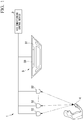
- Fig. 1 is a diagram illustrating an overall configuration of an air conditioning system according to a first embodiment.
- An air conditioning system 1 sets a space which is relatively large and in which there are a plurality of users, such as a library, a large-scale store, a warehouse, or a factory, as an air conditioning management target.
- a plurality of users such as a library, a large-scale store, a warehouse, or a factory
- the air conditioning system 1 is not limited to the foregoing use aspect.
- the air conditioning system 1 includes an air conditioning control device 2, an air conditioning indoor machine 3, wireless communicators 32, and a smartphone 4 carried by each of a plurality of users who are in the same space.
- the air conditioning control device 2 receives requests ("request environment setting" to be described below) for an environment (temperature, humidity, air volume, and the like) from the plurality of users and controls the air conditioning indoor machine 3 such that the requests are satisfied as far as possible.
- the air conditioning indoor machine 3 is installed on a ceiling or the like of a space in which there are users and performs various operations of adjusting an environment in the space in accordance with a control instruction by the air conditioning control device 2.
- the air conditioning indoor machine 3 includes a fan 30 capable of adjusting air volume and a louver 31 capable of adjusting an air direction.
- the air conditioning system 1 of the first embodiment includes only one air conditioning indoor machine 3 (see Fig. 1 ), but the present invention is not limited to this aspect in another embodiment. That is, in the air conditioning system 1 according to another embodiment, the plurality of air conditioning indoor machines 3 may be installed in the same space and one air conditioning control device 2 may individually control operations of the plurality of air conditioning indoor machines 3 according to an aspect.
- the plurality of wireless communicators 32 are installed on the ceiling or wall of the same space and receive radio waves from the smartphones 4 carried by the users. According to an aspect, the plurality of wireless communicators 32 may be installed on the surface of the casing of the air conditioning indoor machine 3 in addition to the ceiling or wall of the space.
- the smartphone 4 is a portable terminal device carried by each of the plurality of users.
- the smartphone 4 according to the embodiment operates in accordance with a dedicated program (application) to function as an environment setting terminal (a remote controller of the air conditioning machine) that transmits a request (request environment setting) of the user to the air conditioning control device 2.
- the smartphone 4 performs wireless communication with the air conditioning control device 2 through short-range wireless communication with the wireless communicators 32 installed in the space.
- the "environment setting terminal” is not limited to the smartphone carried by each user.
- the "environment setting terminal” may be a tablet terminal device, a wristwatch terminal device, or the like carried by the user or may be a dedicated remote controller.
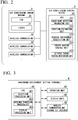
- Fig. 2 is a diagram illustrating functional configurations of the air conditioning control device and an air conditioning indoor machine according to the first embodiment.
- the air conditioning control device 2 includes a CPU 20.
- the CPU 20 is a processor (microcomputer) that controls the entire air conditioning control device 2 and operates in accordance with a program prepared in advance.
- the CPU 20 operates in accordance with a program and functions as a radio wave detection processing unit 201, a position estimation unit 202, a request environment acquisition unit 203, an indoor machine control unit 204, and an estimated terminal position notification unit 205.
- the radio wave detection processing unit 201 individually detects a radio wave arriving from each smartphone 4 through the plurality of wireless communicators 32 installed in the space.
- the radio wave detection processing unit 201 performs an answerback (response) through the wireless communicators 32 when information superimposed in the radio wave arriving from the smartphone 4 is correctly read.
- the position estimation unit 202 estimates a position (terminal position) of the smartphone 4 based on a result obtained by detecting the radio wave transmitted by the smartphone 4 by each of the plurality of wireless communicators 32 (specifically, the strength of a radio wave arriving to each radio communicator 32, a difference in a time of arrival to each wireless communicator 32, or the like).
- the request environment acquisition unit 203 acquires the request environment setting.
- the "request environment setting" is information indicating set values (set values of temperature, humidity, air volume, and the like desired by the user) of an environment requested to the air conditioning control device 2 by each user using the smartphone 4.
- the request environment acquisition unit 203 reads the information superimposed in the radio wave arriving from the smartphone 4 and acquires the request environment setting via the wireless communicators 32.
- the indoor machine control unit 204 controls the air conditioning indoor machine 3 (the fan 30 and the louver 31) based on the request environment setting received from each of the plurality of users and the position (the terminal position) of each of the plurality of users.
- Fig. 3 is a diagram illustrating a functional configuration of a smartphone according to the first embodiment.
- the smartphone 4 includes a CPU 40, an operation unit 41, a display unit 42, and a wireless communication unit 43.
- the operation unit 41 is, for example, a touch panel and receives an input operation by the user carrying the smartphone.
- the display unit 42 is, for example, a liquid crystal display, an organic EL display, or the like and supplies various kinds of information (a current set temperature, an input form of the set values, and the like) regarding an operation of the air conditioning control device 2 to the user through an image.
- the wireless communication unit 43 is a dedicated IC chip mounted to perform short-range wireless communication.
- the wireless communication unit 43 functions as a transmitter capable of superimposing information desired to be transmitted in a radio wave and transmitting the radio wave and a receiver capable of reading information superimposed in a radio wave transmitted from the outside (the wireless communicator 32).
- the CPU 40 is a processor that controls the entire smartphone 4 and operates in accordance with a program (an air conditioning control application) prepared in advance. Specifically, the CPU 40 functions as a reception processing unit 401, a radio wave transmission processing unit 402, and a display processing unit 403.
- the reception processing unit 401 receives inputs of the request environment setting (set values of set temperature, set humidity, air volume, and the like) and a designated position (to be described below) from the user through the operation unit 41.
- the radio wave transmission processing unit 402 causes the wireless communication unit 43 (transmitter) to transmit the radio wave on which the request environment setting received from the user is superimposed.
- the radio wave transmission processing unit 402 When the radio wave transmission processing unit 402 has not received an answerback from the air conditioning control device 2 through the wireless communication unit 43 (receiver) after transmission of a radio wave on which a first request environment setting is superimposed, the radio wave transmission processing unit 402 causes the wireless communication unit 43 to retransmit the radio wave on which a request environment setting equal to the first request environment setting is superimposed after waiting for a predetermined time.
- Fig. 4 is a diagram illustrating a processing flow of the smartphone according to the first embodiment.
- Fig. 5 is a diagram illustrating a data structure of first transmission information transmitted by the smartphone according to the first embodiment.
- the processing flow of the smartphone 4 according to the first embodiment is repeatedly performed, for example, from a time point at which the user entering the space activates a dedicated application.
- the reception processing unit 401 of the smartphone 4 (the CPU 40) waits for an input of the request environment setting from the user (NO in step S01).
- the reception processing unit 401 acquires the input request environment setting.
- the request environment setting includes a set temperature, a set humidity, a set air volume, and the like input by the user carrying the smartphone 4.
- the radio wave transmission processing unit 402 of the smartphone 4 assigns a user ID to the request environment setting acquired in step S01, superimposes the request environment setting to which the user ID is attached (hereinafter referred to as "first transmission information") in a radio wave, and transmits the radio wave from the wireless communication unit 43 (step S02).
- the "first transmission information” has, for example, a data structure illustrated in Fig. 5 .
- the set temperature (“00°C”), the set humidity (“00%”), the set air volume (“small”), and the like input by the user are associated with the user ID ("UID0001").
- the user ID may be determined at random at the time of activation of the dedicated application or may be individual identification information uniquely assigned to the body of the smartphone 4 in advance.
- the first transmission information is encoded by the wireless communication unit 43 in accordance with amplitude modulation, frequency modulation, phase modulation, or the like to be superimposed in the radio wave and transmitted.
- the radio wave transmission processing unit 402 determines whether an answerback is received from the air conditioning control device 2 within a predefined time (step S03). An answerback process in the air conditioning control device 2 will be described later.
- step S05 When the answerback is received from the air conditioning control device 2 within the predefined time (YES in step S03), it is determined that the first transmission information has been recognized properly by the air conditioning control device 2 and the smartphone 4 moves the process to a subsequent process (after step S05).
- step S04 when the answerback is not received from the air conditioning control device 2 within the predefined time (NO in step S03), it is determined that the first transmission information transmitted in step S02 has not been correctly recognized by the air conditioning control device 2. Accordingly, after the radio wave transmission processing unit 402 waits for a predetermined time (step S04), the radio wave transmission processing unit 402 superimposes the first transmission information including the request environment setting received in step S01 in the radio wave and transmits the radio wave again (step S02). The radio wave transmission processing unit 402 repeatedly performs the processes of steps S02 to S04 until the answerback is received from the air conditioning control device 2.
- the waiting time in step S04 may be determined at random at each time, for example, on the order of several seconds to tens of seconds.
- Fig. 6 is a diagram illustrating a processing flow of the air conditioning control device according to the first embodiment.
- Fig. 7 is a diagram illustrating a data structure of information on individual users acquired by an indoor machine control device according to the first embodiment.
- Fig. 8 is a diagram illustrating a data structure of an answerback transmitted by the indoor machine control device according to the first embodiment.
- Fig. 9 is a diagram illustrating a function of the indoor machine control unit according to the first embodiment.
- the processing flow illustrated in Fig. 6 is repeatedly routinely performed from the time of activation of the air conditioning control device 2, the air conditioning indoor machine 3, or the like.
- the radio wave detection processing unit 201 of the air conditioning control device 2 waits to receive the radio wave (see step S02 of Fig. 4 ) transmitted from the smartphone 4 (NO in step S11). Specifically, when the plurality of wireless communicators 32 (see Figs. 1 and 2 ) provided at respective locations in the space receive the radio waves from the smartphone 4, the radio wave detection processing unit 201 monitors reception detection signals to be output to the air conditioning control device 2 by the wireless communicators 32. When the reception detection signals are received, the radio wave detection processing unit 201 determines that the radio waves have been received from the smartphone 4.
- the position estimation unit 202 of the air conditioning control device 2 performs a position estimation for the smartphone 4 which has transmitted the radio wave based on a phase difference in the radio wave, the reception strength of the radio wave, or the like received from each of the plurality of wireless communicators 32 (see Figs. 1 and 2 ) (step S12).
- the radio communicator 32 provided at each location in the space detects a phase of the received radio wave and a reception strength in accordance with the reception of the radio wave, includes the information in the reception detection signal, and notifies the air conditioning control device 2 (the position estimation unit 202) of the reception detection signal.
- the position estimation unit 202 estimates the position (the terminal position) of the smartphone 4 which has transmitted the radio wave based on the information regarding the phase difference or the reception strength.
- the position estimation unit 202 records and retains an estimation result of the terminal position (hereinafter referred to as an "estimated terminal position") obtained through the process of step S12.
- the radio wave detection processing unit 201 reads the transmission information encoded in the radio wave arriving from the smartphone 4 through the wireless communicator 32 (step S13) and determines whether the "request environment setting" is included or a "designated position" (to be described below) is included in the read information (step S14).
- the radio wave detection processing unit 201 reads the "request environment setting" in step S13 (request environment setting in step S14).
- the request environment acquisition unit 203 of the air conditioning control device 2 newly adds the "estimated terminal position" obtained in step S12 to the information on individual users in association with the read "user ID” and "request environment setting” (step S15).
- an estimated terminal position (X1, Y1"), a set temperature (“00°C”), a set humidity (“00%”), a set air volume (“small”), and the like are associated for each different user ID (“UID0001,"”UID0002,” and “UID0003”).
- the estimated terminal position notification unit 205 of the air conditioning control device 2 performs answerback with a radio wave through one of the wireless communicators 32 (step S16).
- the smartphone 4 can ascertain that the air conditioning control device 2 correctly recognizes the estimated terminal position, the user ID, and the request environment setting by receiving the answerback (see step S03 of Fig. 4 ).
- the estimated terminal position notification unit 205 transmits the answerback including, for example, the user ID and the terminal position estimated in step S12 by the position estimation unit 202 (an estimated terminal position), as illustrated in Fig. 8 .
- the position estimation unit 202 an estimated terminal position
- the details of the process of the smartphone 4 receiving the answerback including the estimated terminal position will be described later.
- step S17 the indoor machine control unit 204 of the air conditioning control device 2 controls the air conditioning indoor machine 3 based on the information on individual users including the terminal position of a new user (an estimated terminal position) and the request environment setting and optimizes the air conditioning (step S17).
- the process of step S17 will be described in detail with reference to Fig. 9 .
- the indoor machine control unit 204 identifies control parameters (a1, a2, a3, a4, ..) for minimizing the objective function J (step S171).
- the control parameters are direct instruction values for causing the air conditioning indoor machine 3 to enter a desired state and are, for example, the rotation speed of the fan 30, an inclination angle of the louver 31, and the like.
- the objective function J is defined as Expression (1), for example.
- the vector x(i) includes M elements (x(i) 1 , x(i) 2 , .., x(i) M ).
- the elements (x(i) 1 , x(i) 2 , .., x(i) M ) indicate values (scalar quantities) of the actual temperature, humidity, air volume, and the like at a position at which the user i is located.
- the vector x(i) is uniquely determined by a function F that has the control parameters (a1, a2, a2, a4, ..) of the air conditioning indoor machine 3 as input variables.
- a vector x*(i) is a vector quantity indicating temperature, humidity, air volume, and the like desired by the user i.
- the vector x*(i) includes M elements (x*(i) 1 , x*(i) 2 , .., x*(i) M ) and the elements (x*(i) 1 , x*(i) 2 , .., x*(i) M ) indicate the temperature, the humidity, and the air volume, and the like desired by the user i.
- the elements (x*(i) 1 , x*(i) 2 , .., x*(i) M ) are the set temperature, the set humidity, the set air volume, and the like indicated by the information on individual users (see Fig. 7 ).
- the objective function J is derived by further adding total sums of the error rates obtained for each user i with regard to all the users.
- M indicates the number of elements included in the vector x(i) and the vector x*(i) and is a total number of physical quantities such as temperature, humidity, and air volume which are targets set by the user.
- N is the number of users who are in the space in which the air conditioning indoor machine 3 is installed and is more specifically the number of smartphones 4 (the number of kinds of user IDs) detected through ultrasonic waves.
- Wd (i, k) is a weighting coefficient separately defined by element and is considered to always be “1" (an equal value) in a general operation.
- each user may set “Wd (i, k)” for each element (temperature, humidity, air volume, and the like) and reflect a preference indicating which physical quantity is weighted.
- the weighting coefficient "Wd (i, k)," it is possible to respond to, for example, even a specific request indicating that "a user desires to realize a request for "air volume” when the user has just returned from outdoor in hot weather” or "a user desires to set "humidity” preferably to a preferred value in the rainy season” despite the same person.
- Weighting coefficient is a weighting coefficient separately defined on individual users and is considered to always be “1" (an equal value) in a general operation. However, for example, when an operation of weighting a request from an elderly user or a user who is an executive is realized, the weighting coefficient for each user i may be changed.
- a method of identifying a minimum value of the objective function J may be based on a well-known search algorithm.
- the function F may be based on, for example, a physical simulation of a temperature distribution, a humidity distribution, and an air volume distribution in a space based on an air flow or emission.
- the indoor machine control unit 204 transmits the identified control parameters as instruction values to the air conditioning indoor machine 3 and controls the air conditioning indoor machine 3 (step S172).
- step S18 and S19 A processing flow (steps S18 and S19) performed when the "designated position" is read in step S13 (the designated position in step S14) will be described later.
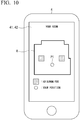
- Figs. 10 and 11 are first and second diagrams illustrating a position designation function of the smartphone according to the first embodiment.
- Fig. 12 is a diagram illustrating a data structure of second transmission information transmitted by the smartphone according to the first embodiment.
- the display processing unit 403 of the smartphone 4 causes the display unit 42 to display an image indicating a map of a room in which there is the user and an estimated position of the user (a position identified with the estimated terminal position) based on the estimated terminal position (see Fig. 8 ) included in the answerback (step S05).
- the display processing unit 403 displays a map image R of a room and a marker image PI shown at an estimated terminal position on the display unit 42 of the smartphone 4.
- the user can determine whether the air conditioning control device 2 correctly estimates the position of the user by confirming an image as illustrated in Fig. 10 .
- information regarding the map image R may be transmitted in sequence from the air conditioning control device 2 to the smartphone 4.
- the air conditioning control device 2 records and retains a map for each space (room) which is an air conditioning management target in advance.
- the air conditioning control device 2 may include the map image R corresponding to the space in which there is the user in an answerback in addition to the estimated terminal position based on a detection result of the radio wave and transmit the answerback.
- the reception processing unit 401 of the smartphone 4 determines whether a designation of a position at which there is the user is received in accordance with an input of the user (step S06).
- a radio wave strength is known to be spatially distorted due to reflection, interference, or the like of a radio wave on a wall, a ceiling, an installed object, or the like in a space.
- an estimation result of a position based on the radio wave arriving from the smartphone 4 considerably deviates from an actual position of the user. Accordingly, when the position (the position indicated by the marker image PI of Fig. 10 ) estimated by the air conditioning control device 2 considerably deviates from the actual position, the user operates the smartphone 4 and directly designates a genuine position of the user to correct the position (the estimated terminal position).
- the reception processing unit 401 receives a touch operation by the user on the operation unit 41 (a touch panel) and receives a designation of a current position of the user (YES in step S06).
- the user designate the position of the user by touching a predetermined position on the map image R displayed on the display unit 42 with his or her finger.
- the display processing unit 403 may display a position of the user designated (touched) directly through the operation unit 41 (hereinafter referred to as a "designated position") using a new marker image P2 (see Fig. 11 ).
- the radio wave transmission processing unit 402 assigns the user ID to the designated position acquired in step S06, superimposes a designated position to which the user ID is attached (hereinafter referred to as "second transmission information") in a radio wave, and transmits the radio wave from the wireless communication unit 43 (step S07).
- the "second transmission information” has, for example, a data structure illustrated in Fig. 12 . Specifically, in the second transmission information, a designated position (“Xa1, Ya1") input by the user is associated with the user ID ("UID0001").
- the radio wave detection processing unit 201 reads the "designated position" in step S13 of Fig. 6 (step S14: designated position).
- the position estimation unit 202 of the air conditioning control device 2 performs a correction process of substituting the "estimated terminal position" ("X1, Y1") of the user indicated in the "user ID” of the second transmission information in the information on individual users (see Fig. 7 ) with the position ("Xa1, Ya1") indicated in the "designated position" of the second transmission information (step S18).
- the radio wave detection processing unit 201 of the air conditioning control device 2 transmits an answerback indicating that the correction process for the terminal position in step S18 is properly completed (step S19).
- the smartphone 4 can recognize that the position of the user estimated by the air conditioning control device 2 (the estimated terminal position) is updated (corrected) to the position designated by the user (the designated position).
- the indoor machine control unit 204 of the air conditioning control device 2 controls the air conditioning indoor machine 3 based on the information on individual users newly updated in step S18 (information in which the estimated terminal position is updated to the designated position) (step S17).
- the CPU 20 (the position estimation unit 202) of the air conditioning control device 2 according to the first embodiment corrects the "estimated terminal position" based on the "designated position” which is information received from the smartphone 4 (an environment setting terminal) and indicates the position designated by the direct input of the user.
- the estimated terminal position can be simply corrected through a direct position designation by the user.
- the air conditioning control device 2 can correct the estimated position based on the radio wave arriving from the environment setting terminal.
- the CPU 20 (the estimated terminal position notification unit 205) of the air conditioning control device 2 transmits information indicating the smartphone 4 to the smartphone 4.
- the user can check the position automatically identified by the air conditioning control device 2 and determine whether the position is correct.
- the smartphone 4 (the environment setting terminal) according to the first embodiment receives a designation of a position of a user from the user and causes the wireless communication unit 43 (a transmitter) to transmit the radio wave in which the position designated by the user (the designated position) is superimposed.
- the user can correct the position of the user estimated by the air conditioning control device 2 (the estimated terminal position) by performing a direct designation operation on the smartphone 4.
- the smartphone 4 receives information indicating the position estimated by the air conditioning control device 2 through the wireless communication unit 43 (a receiver) capable of receiving the radio wave and causes the display unit 42 to display the estimated terminal position.
- the wireless communication unit 43 a receiver
- the user can visually recognize and determine whether the position estimated by the air conditioning control device 2 is correct.
- Fig. 13 is a diagram illustrating a data structure of training information collected by the air conditioning control device according to the second embodiment.
- the CPU 20 (the position estimation unit 202) of the air conditioning control device 2 according to the second embodiment learns a tendency of an error between the estimated terminal position and the designated position and corrects the estimated terminal position based on the tendency of the error obtained through the learning.
- the position estimation unit 202 cumulates training information illustrated in Fig. 13 .
- the training information is an information table in which the estimated position in accordance with the detection result of the radio wave from the smartphone 4 (the estimated terminal position), the position (the designated position) corrected (designated) from the estimated terminal position by the user, and an "error" ( ⁇ X, ⁇ Y) which is a difference between the estimated terminal position and the designated position are associated.
- ⁇ X, ⁇ Y an "error" which is a difference between the estimated terminal position and the designated position
- Fig. 14 is a diagram illustrating a data structure of learning information collected by the air conditioning control device according to the second embodiment.
- the position estimation unit 202 identifies a distribution of an estimated terminal position of which an error is large in accordance with the cumulated training information (see Fig. 13 ).
- the position estimation unit 202 calculates a tendency of an error in the distribution of the estimated terminal position of which the error is large (for example, an average value of the "error" ( ⁇ X, ⁇ Y) or the like) and records the calculation result in association with the distribution of the estimated terminal position. Through this process, the position estimation unit 202 generates learning information.
- a "target range" (X ⁇ 1 to X ⁇ 1, Y ⁇ 1 to Y ⁇ 1) indicating a range of the estimated terminal position which is an automatic correction target is associated with a "correction amount” ( ⁇ Xe1, ⁇ Ye1) indicating a tendency of an error corresponding to the range.
- the position estimation unit 202 identifies the estimated terminal position based on the detection result of the radio wave by the wireless communicator 32 and subsequently determines whether the estimated terminal position is within the "target range" of the learning information in the process of step S12 of Fig. 6 .
- the estimated terminal position is included in the "target range,” a result obtained by adding a "correction amount” corresponding to the "target range” is acquired as a new estimated terminal position.
- the air conditioning control device 2 can automatically correct the estimated terminal position based on the cumulated error between the estimated terminal position and the designated position. Accordingly, it is possible to perform high precise position estimation irrespective of distortion or the like of the radio wave in the space.
- the air conditioning system 1 according to the first and second embodiments has been described in detail above. However, a specific aspect of the air conditioning system 1 is not limited to the above-described aspects and various design changes or the like can be made within the scope of the present invention without departing from the gist of the present invention.
- the smartphone 4 may periodically transmit the radio wave on which the user ID is superimposed.
- the terminal position is constantly updated as a latest position of the user. Therefore, it is possible to provide an environment requested by the user more appropriately.
- the smartphone 4 may detect that the position of the user is changed (the user has moved) through an embedded acceleration sensor or the like and transmit a radio wave on which various kinds of information are superimposed using the detection as a trigger.
- the smartphone 4 When the user designates a genuine position on a screen of the smartphone 4, it can be considered that it is difficult for the user to perform an operation with his or her finger due to the small screen (the display unit 42) and to tap a position which the user desires to designate. Accordingly, the smartphone 4 according to another embodiment may further have the following function.
- the smartphone 4 may divide the map image R into grids and set a position to be drawn into a close grid point.
- This grid may be displayed or may not be displayed on the display unit 42.
- a desired interval between the grids (for example, an interval of 0.5 m) may be designated by the user.
- the smartphone 4 may have a function capable of displaying coordinates on the map image R (at either absolute coordinates or relative coordinates, a grid sliced as in a map may be indicated using a matrix number (for example, C-3)) and designating a position at which the smartphone 4 is located using coordinate values.
- a function capable of displaying coordinates on the map image R (at either absolute coordinates or relative coordinates, a grid sliced as in a map may be indicated using a matrix number (for example, C-3)) and designating a position at which the smartphone 4 is located using coordinate values.
- the above-described error (P A -P D ) can be stored (learned), for example, by causing the smartphone 4 to provide the following separate mode and receive an operation from the user:
- the elements used for control are "temperature,” “humidity,” “air volume,” and the like, as described above, but other embodiments are not limited to this aspect.
- any aspect may be realized using the elements in addition to the above-described elements of the air conditioning, such as “illumination,” “aroma,” “temperature of hot water,” and “cleaning strength of toilet seat”, as long as the elements are amounts related to comfort of people.
- the air conditioning control device 2 according to the other embodiments may set an illumination device, an aroma instrument, a water heater, and a toilet seat device as control targets as well as the air conditioning indoor machine 3 according to an aspect.
- the course of the above-described various processes of the air conditioning control device 2 and the smartphone 4 are stored in a computer-readable recording medium in a program format.
- a computer performs the foregoing various processes by reading and executing the program.
- the computer-readable recording medium is a magnetic disk, a magneto-optical disc, a CD-ROM, a DVD-ROM, a semiconductor memory, or the like.
- the computer program may be delivered to a computer via a communication line and the computer to which the program is delivered may execute the program.
- the program may realize some of the above-described functions. Further, the program may be a so-called differential file (differential program), which can realize the above-described functions in combination with a program previously recorded in the computer system. Further, the air conditioning control device 2 and the smartphone 4 may be configured by one computer or may be configured by a plurality of computers connected to be communicable in another embodiment.
- the air conditioning control device, the environment setting terminal, the air conditioning control method, and the program described above are capable of correcting a position estimated based on a radio wave arriving from an environment setting terminal.
Landscapes
- Engineering & Computer Science (AREA)
- Signal Processing (AREA)
- Chemical & Material Sciences (AREA)
- Combustion & Propulsion (AREA)
- Mechanical Engineering (AREA)
- General Engineering & Computer Science (AREA)
- Physics & Mathematics (AREA)
- Fuzzy Systems (AREA)
- Mathematical Physics (AREA)
- Human Computer Interaction (AREA)
- Air Conditioning Control Device (AREA)
- Selective Calling Equipment (AREA)
Abstract
Description
- The present invention relates to an air conditioning control device, an environment setting terminal, an air conditioning control method, and a program.
- Priority is claimed on Japanese Patent Application No.
2017-133608, filed July 7, 2017 - In a space in which there are a plurality of users, air conditioning control devices which identify positions of individuals based on time difference of arrival (TDOA) measurement or radio wave strengths of environment setting terminals (remote controllers or the like) carried by the users and perform control such that respective air conditioning requests can be satisfied as far as possible are known (for example, see Patent Literature 1).
- [Patent Literature 1]
Japanese Patent No.4867836 - When communication between an air conditioning control device and an environment setting terminal is performed by exchanging a radio wave, an estimation result of a position based on the radio wave arriving from the environment setting terminal is assumed to vary considerably depending on a radio wave situation based on walls, ceilings, installed objects, or the like in a space.
- The present invention is devised in view of the foregoing problems and an objective of the present invention is to provide an air conditioning control device, an environment setting terminal, an air conditioning control method, and a program capable of correcting a position estimated based on a radio wave arriving from an environment setting terminal.
- According to a first aspect of the present invention, an air conditioning control device is configured to control an air conditioning indoor machine based on a request environment setting requested by a user carrying an environment setting terminal and a terminal position of the environment setting terminal. The air conditioning control device includes: a radio wave detection processing unit configured to detect a radio wave arriving from the environment setting terminal through a plurality of wireless communicators disposed at different positions; a position estimation unit configured to estimate the terminal position of the environment setting terminal based on a result obtained by detecting the radio wave arriving from the environment setting terminal from each of the plurality of wireless communicators; a request environment acquisition unit configured to acquire the request environment setting; and an indoor machine control unit configured to control the air conditioning indoor machine based on an estimated terminal position which is the terminal position estimated by the position estimation unit and the request environment setting acquired by the request environment acquisition unit. The position estimation unit is configured to correct the estimated terminal position based on a designated position which is information received from the environment setting terminal and indicates a position designated by the user.
- According to a second aspect of the present invention, the position estimation unit may be configured to learn a tendency of an error between the estimated terminal position and the designated position and correct the estimated terminal position based on the tendency of the error obtained through the learning.
- According to a third aspect of the present invention, the air conditioning control device may further include an estimated terminal position notification unit configured to transmit information indicating the estimated terminal position to the environment setting terminal.
- According to a fourth aspect of the present invention, an environment setting terminal is carried by a user and configured to transmit a request environment setting requested by the user to an air conditioning control device. The environment setting terminal includes: a reception processing unit configured to receive the request environment setting from the user; and a radio wave transmission processing unit configured to cause a transmitter capable of transmitting a radio wave to transmit a radio wave on which the request environment setting is superimposed. The reception processing unit is further configured to receive a designation of a position of the user from the user. The radio wave transmission processing unit is further configured to cause the transmitter to transmit a radio wave on which a designated position which is a position designated by the user is superimposed.
- According to a fifth aspect of the present invention, the environment setting terminal may further include a display processing unit configured to cause a receiver capable of receiving a radio wave to receive information indicating an estimated terminal position which is a position estimated by the air conditioning control device and cause a display unit to display the estimated terminal position.
- According to a sixth aspect of the present invention, there is provided an air conditioning control method of controlling an air conditioning indoor machine based on a request environment setting requested by a user carrying an environment setting terminal and a terminal position of the environment setting terminal. The air conditioning control method includes: a radio wave detection processing step of detecting a radio wave arriving from the environment setting terminal through a plurality of wireless communicators disposed at different positions; a position estimation step of estimating the terminal position of the environment setting terminal based on a result obtained by detecting the radio wave arriving from the environment setting terminal from each of the plurality of wireless communicators; a request environment acquisition step of acquiring the request environment setting; and an indoor machine control step of controlling the air conditioning indoor machine based on an estimated terminal position which is the terminal position estimated in the position estimation step and the request environment setting acquired in the request environment acquisition step. In the position estimation step, the estimated terminal position is corrected based on a designated position which is information received from the environment setting terminal and indicates a position designated by the user.
- According to a seventh aspect of the present invention, a program causes a computer to control an air conditioning indoor machine based on a request environment setting requested by a user carrying an environment setting terminal and a terminal position of the environment setting terminal. The program causes the computer to perform: a radio wave detection processing step of detecting a radio wave arriving from the environment setting terminal through a plurality of wireless communicators disposed at different positions; a position estimation step of estimating the terminal position of the environment setting terminal based on a result obtained by detecting the radio wave arriving from the environment setting terminal from each of the plurality of wireless communicators; a request environment acquisition step of acquiring the request environment setting; and an indoor machine control step of controlling the air conditioning indoor machine based on an estimated terminal position which is the terminal position estimated in the position estimation step and the request environment setting acquired in the request environment acquisition step. In the position estimation step, the estimated terminal position is corrected based on a designated position which is information received from the environment setting terminal and indicates a position designated by the user.
- The air conditioning control device, the environment setting terminal, the air conditioning control method, and the program described above are capable of correcting a position estimated based on a radio wave arriving from an environment setting terminal.
-
-
Fig. 1 is a diagram illustrating an overall configuration of an air conditioning system according to a first embodiment. -
Fig. 2 is a diagram illustrating functional configurations of the air conditioning control device and an air conditioning indoor machine according to the first embodiment. -
Fig. 3 is a diagram illustrating a functional configuration of a smartphone according to the first embodiment. -
Fig. 4 is a diagram illustrating a processing flow of the smartphone according to the first embodiment. -
Fig. 5 is a diagram illustrating a data structure of first transmission information transmitted by the smartphone according to the first embodiment. -
Fig. 6 is a diagram illustrating a processing flow of the air conditioning control device according to the first embodiment. -
Fig. 7 is a diagram illustrating a data structure of information on individual users acquired by an indoor machine control device according to the first embodiment. -
Fig. 8 is a diagram illustrating a data structure of an answerback transmitted by the indoor machine control device according to the first embodiment. -
Fig. 9 is a diagram illustrating a function of the indoor machine control unit according to the first embodiment. -
Fig. 10 is a first diagram illustrating a position designation function of the smartphone according to the first embodiment. -
Fig. 11 is a second diagram illustrating the position designation function of the smartphone according to the first embodiment. -
Fig. 12 is a diagram illustrating a data structure of second transmission information transmitted by the smartphone according to the first embodiment. -
Fig. 13 is a diagram illustrating a data structure of training information collected by the air conditioning control device according to a second embodiment. -
Fig. 14 is a diagram illustrating a data structure of learning information collected by the air conditioning control device according to the second embodiment. - Hereinafter, an air conditioning system according to a first embodiment will be described with reference to
Figs. 1 to 12 . -
Fig. 1 is a diagram illustrating an overall configuration of an air conditioning system according to a first embodiment. - An
air conditioning system 1 according to the first embodiment sets a space which is relatively large and in which there are a plurality of users, such as a library, a large-scale store, a warehouse, or a factory, as an air conditioning management target. However, in another embodiment, theair conditioning system 1 is not limited to the foregoing use aspect. - The
air conditioning system 1 includes an airconditioning control device 2, an air conditioningindoor machine 3,wireless communicators 32, and asmartphone 4 carried by each of a plurality of users who are in the same space. - The air
conditioning control device 2 receives requests ("request environment setting" to be described below) for an environment (temperature, humidity, air volume, and the like) from the plurality of users and controls the air conditioningindoor machine 3 such that the requests are satisfied as far as possible. - The air conditioning
indoor machine 3 is installed on a ceiling or the like of a space in which there are users and performs various operations of adjusting an environment in the space in accordance with a control instruction by the airconditioning control device 2. - As illustrated in
Fig. 1 , the air conditioningindoor machine 3 includes afan 30 capable of adjusting air volume and alouver 31 capable of adjusting an air direction. - According to an aspect, the
air conditioning system 1 of the first embodiment includes only one air conditioning indoor machine 3 (seeFig. 1 ), but the present invention is not limited to this aspect in another embodiment. That is, in theair conditioning system 1 according to another embodiment, the plurality of air conditioningindoor machines 3 may be installed in the same space and one airconditioning control device 2 may individually control operations of the plurality of air conditioningindoor machines 3 according to an aspect. - The plurality of
wireless communicators 32 are installed on the ceiling or wall of the same space and receive radio waves from thesmartphones 4 carried by the users. According to an aspect, the plurality ofwireless communicators 32 may be installed on the surface of the casing of the air conditioningindoor machine 3 in addition to the ceiling or wall of the space. - The
smartphone 4 is a portable terminal device carried by each of the plurality of users. Thesmartphone 4 according to the embodiment operates in accordance with a dedicated program (application) to function as an environment setting terminal (a remote controller of the air conditioning machine) that transmits a request (request environment setting) of the user to the airconditioning control device 2. Thesmartphone 4 performs wireless communication with the airconditioning control device 2 through short-range wireless communication with thewireless communicators 32 installed in the space. - In another embodiment, the "environment setting terminal" is not limited to the smartphone carried by each user. In another embodiment, the "environment setting terminal" may be a tablet terminal device, a wristwatch terminal device, or the like carried by the user or may be a dedicated remote controller.
-
Fig. 2 is a diagram illustrating functional configurations of the air conditioning control device and an air conditioning indoor machine according to the first embodiment. - As illustrated in
Fig. 2 , the airconditioning control device 2 includes aCPU 20. TheCPU 20 is a processor (microcomputer) that controls the entire airconditioning control device 2 and operates in accordance with a program prepared in advance. - The
CPU 20 operates in accordance with a program and functions as a radio wavedetection processing unit 201, aposition estimation unit 202, a requestenvironment acquisition unit 203, an indoormachine control unit 204, and an estimated terminalposition notification unit 205. - The radio wave
detection processing unit 201 individually detects a radio wave arriving from eachsmartphone 4 through the plurality ofwireless communicators 32 installed in the space. The radio wavedetection processing unit 201 performs an answerback (response) through thewireless communicators 32 when information superimposed in the radio wave arriving from thesmartphone 4 is correctly read. - The
position estimation unit 202 estimates a position (terminal position) of thesmartphone 4 based on a result obtained by detecting the radio wave transmitted by thesmartphone 4 by each of the plurality of wireless communicators 32 (specifically, the strength of a radio wave arriving to eachradio communicator 32, a difference in a time of arrival to eachwireless communicator 32, or the like). - The request
environment acquisition unit 203 acquires the request environment setting. Here, the "request environment setting" is information indicating set values (set values of temperature, humidity, air volume, and the like desired by the user) of an environment requested to the airconditioning control device 2 by each user using thesmartphone 4. The requestenvironment acquisition unit 203 reads the information superimposed in the radio wave arriving from thesmartphone 4 and acquires the request environment setting via thewireless communicators 32. - The indoor
machine control unit 204 controls the air conditioning indoor machine 3 (thefan 30 and the louver 31) based on the request environment setting received from each of the plurality of users and the position (the terminal position) of each of the plurality of users. -
Fig. 3 is a diagram illustrating a functional configuration of a smartphone according to the first embodiment. - As illustrated in
Fig. 3 , thesmartphone 4 includes aCPU 40, anoperation unit 41, adisplay unit 42, and awireless communication unit 43. - The
operation unit 41 is, for example, a touch panel and receives an input operation by the user carrying the smartphone. - The
display unit 42 is, for example, a liquid crystal display, an organic EL display, or the like and supplies various kinds of information (a current set temperature, an input form of the set values, and the like) regarding an operation of the airconditioning control device 2 to the user through an image. - The
wireless communication unit 43 is a dedicated IC chip mounted to perform short-range wireless communication. Thewireless communication unit 43 functions as a transmitter capable of superimposing information desired to be transmitted in a radio wave and transmitting the radio wave and a receiver capable of reading information superimposed in a radio wave transmitted from the outside (the wireless communicator 32). - The
CPU 40 is a processor that controls theentire smartphone 4 and operates in accordance with a program (an air conditioning control application) prepared in advance. Specifically, theCPU 40 functions as areception processing unit 401, a radio wavetransmission processing unit 402, and adisplay processing unit 403. - The
reception processing unit 401 receives inputs of the request environment setting (set values of set temperature, set humidity, air volume, and the like) and a designated position (to be described below) from the user through theoperation unit 41. - The radio wave
transmission processing unit 402 causes the wireless communication unit 43 (transmitter) to transmit the radio wave on which the request environment setting received from the user is superimposed. - When the radio wave
transmission processing unit 402 has not received an answerback from the airconditioning control device 2 through the wireless communication unit 43 (receiver) after transmission of a radio wave on which a first request environment setting is superimposed, the radio wavetransmission processing unit 402 causes thewireless communication unit 43 to retransmit the radio wave on which a request environment setting equal to the first request environment setting is superimposed after waiting for a predetermined time. -
Fig. 4 is a diagram illustrating a processing flow of the smartphone according to the first embodiment. -
Fig. 5 is a diagram illustrating a data structure of first transmission information transmitted by the smartphone according to the first embodiment. - The processing flow of the
smartphone 4 according to the first embodiment is repeatedly performed, for example, from a time point at which the user entering the space activates a dedicated application. - The
reception processing unit 401 of the smartphone 4 (the CPU 40) waits for an input of the request environment setting from the user (NO in step S01). When an input of the request environment setting is received from the user through an operation of the operation unit 41 (touch panel) (YES in step S01), thereception processing unit 401 acquires the input request environment setting. The request environment setting includes a set temperature, a set humidity, a set air volume, and the like input by the user carrying thesmartphone 4. - Subsequently, the radio wave
transmission processing unit 402 of thesmartphone 4 assigns a user ID to the request environment setting acquired in step S01, superimposes the request environment setting to which the user ID is attached (hereinafter referred to as "first transmission information") in a radio wave, and transmits the radio wave from the wireless communication unit 43 (step S02). - Here, the "first transmission information" has, for example, a data structure illustrated in
Fig. 5 . Specifically, in the first transmission information, the set temperature ("00°C"), the set humidity ("00%"), the set air volume ("small"), and the like input by the user are associated with the user ID ("UID0001"). For example, the user ID may be determined at random at the time of activation of the dedicated application or may be individual identification information uniquely assigned to the body of thesmartphone 4 in advance. - The first transmission information is encoded by the
wireless communication unit 43 in accordance with amplitude modulation, frequency modulation, phase modulation, or the like to be superimposed in the radio wave and transmitted. - When the transmission of the radio wave (the radio wave on which the first transmission information is superimposed) is completed in step S02, the radio wave
transmission processing unit 402 determines whether an answerback is received from the airconditioning control device 2 within a predefined time (step S03). An answerback process in the airconditioning control device 2 will be described later. - When the answerback is received from the air
conditioning control device 2 within the predefined time (YES in step S03), it is determined that the first transmission information has been recognized properly by the airconditioning control device 2 and thesmartphone 4 moves the process to a subsequent process (after step S05). - Conversely, when the answerback is not received from the air
conditioning control device 2 within the predefined time (NO in step S03), it is determined that the first transmission information transmitted in step S02 has not been correctly recognized by the airconditioning control device 2. Accordingly, after the radio wavetransmission processing unit 402 waits for a predetermined time (step S04), the radio wavetransmission processing unit 402 superimposes the first transmission information including the request environment setting received in step S01 in the radio wave and transmits the radio wave again (step S02). The radio wavetransmission processing unit 402 repeatedly performs the processes of steps S02 to S04 until the answerback is received from the airconditioning control device 2. - In the embodiment, the waiting time in step S04 may be determined at random at each time, for example, on the order of several seconds to tens of seconds.
- Next, a process related to steps S05 to S08 of
Fig. 4 will be described below. -
Fig. 6 is a diagram illustrating a processing flow of the air conditioning control device according to the first embodiment. -
Fig. 7 is a diagram illustrating a data structure of information on individual users acquired by an indoor machine control device according to the first embodiment. -
Fig. 8 is a diagram illustrating a data structure of an answerback transmitted by the indoor machine control device according to the first embodiment. -
Fig. 9 is a diagram illustrating a function of the indoor machine control unit according to the first embodiment. - Hereinafter, a processing flow of the air
conditioning control device 2 will be described with reference toFigs. 6 to 9 . - The processing flow illustrated in
Fig. 6 is repeatedly routinely performed from the time of activation of the airconditioning control device 2, the air conditioningindoor machine 3, or the like. - The radio wave
detection processing unit 201 of the air conditioning control device 2 (the CPU 20) waits to receive the radio wave (see step S02 ofFig. 4 ) transmitted from the smartphone 4 (NO in step S11). Specifically, when the plurality of wireless communicators 32 (seeFigs. 1 and2 ) provided at respective locations in the space receive the radio waves from thesmartphone 4, the radio wavedetection processing unit 201 monitors reception detection signals to be output to the airconditioning control device 2 by thewireless communicators 32. When the reception detection signals are received, the radio wavedetection processing unit 201 determines that the radio waves have been received from thesmartphone 4. - When the radio wave has been received from the smartphone 4 (YES in step S11), the
position estimation unit 202 of the airconditioning control device 2 performs a position estimation for thesmartphone 4 which has transmitted the radio wave based on a phase difference in the radio wave, the reception strength of the radio wave, or the like received from each of the plurality of wireless communicators 32 (seeFigs. 1 and2 ) (step S12). Specifically, theradio communicator 32 provided at each location in the space detects a phase of the received radio wave and a reception strength in accordance with the reception of the radio wave, includes the information in the reception detection signal, and notifies the air conditioning control device 2 (the position estimation unit 202) of the reception detection signal. When the reception detection signal including information regarding the phase or the strength of the received radio wave is received from eachwireless communicator 32, theposition estimation unit 202 estimates the position (the terminal position) of thesmartphone 4 which has transmitted the radio wave based on the information regarding the phase difference or the reception strength. - Since a scheme of estimating a position of a transmission source of a radio wave based on a detection result (the phase difference or the reception strength of the radio wave) of the radio wave in a plurality of sensors is a known technology, detailed description thereof will be omitted.
- The
position estimation unit 202 records and retains an estimation result of the terminal position (hereinafter referred to as an "estimated terminal position") obtained through the process of step S12. - Subsequently, the radio wave
detection processing unit 201 reads the transmission information encoded in the radio wave arriving from thesmartphone 4 through the wireless communicator 32 (step S13) and determines whether the "request environment setting" is included or a "designated position" (to be described below) is included in the read information (step S14). - Here, when the radio wave including the first transmission information ("user ID" + "environment supply setting") is transmitted from the
smartphone 4 of the user (step S02 ofFig. 4 ), the radio wavedetection processing unit 201 reads the "request environment setting" in step S13 (request environment setting in step S14). In this case, the requestenvironment acquisition unit 203 of the airconditioning control device 2 newly adds the "estimated terminal position" obtained in step S12 to the information on individual users in association with the read "user ID" and "request environment setting" (step S15). - As illustrated in
Fig. 7 , in the information on individual, an estimated terminal position ("X1, Y1"), a set temperature ("00°C"), a set humidity ("00%"), a set air volume ("small"), and the like are associated for each different user ID ("UID0001,""UID0002," and "UID0003"). - When the various kinds of information (the user ID, the estimated terminal position, and the request environment setting) obtained through steps S11 to S15 are properly added to the information on individual users, the estimated terminal
position notification unit 205 of the airconditioning control device 2 performs answerback with a radio wave through one of the wireless communicators 32 (step S16). Thesmartphone 4 can ascertain that the airconditioning control device 2 correctly recognizes the estimated terminal position, the user ID, and the request environment setting by receiving the answerback (see step S03 ofFig. 4 ). - Here, the estimated terminal
position notification unit 205 transmits the answerback including, for example, the user ID and the terminal position estimated in step S12 by the position estimation unit 202 (an estimated terminal position), as illustrated inFig. 8 . The details of the process of thesmartphone 4 receiving the answerback including the estimated terminal position will be described later. - Subsequently, the indoor
machine control unit 204 of the airconditioning control device 2 controls the air conditioningindoor machine 3 based on the information on individual users including the terminal position of a new user (an estimated terminal position) and the request environment setting and optimizes the air conditioning (step S17). The process of step S17 will be described in detail with reference toFig. 9 . - As illustrated in
Fig. 9 , the indoormachine control unit 204 identifies control parameters (a1, a2, a3, a4, ..) for minimizing the objective function J (step S171). Here, the control parameters are direct instruction values for causing the air conditioningindoor machine 3 to enter a desired state and are, for example, the rotation speed of thefan 30, an inclination angle of thelouver 31, and the like. - The objective function J is defined as Expression (1), for example.
[Math. 1]
- A vector x(i) shown in Expression (1) is a vector quantity indicating an actual temperature, humidity, air volume, and the like at a position at which a user i (where i = 1, 2, .., N) is located. The vector x(i) includes M elements (x(i)1, x(i)2, .., x(i)M). The elements (x(i)1, x(i)2, .., x(i)M) indicate values (scalar quantities) of the actual temperature, humidity, air volume, and the like at a position at which the user i is located. As shown in Expression (1), the vector x(i) is uniquely determined by a function F that has the control parameters (a1, a2, a2, a4, ..) of the air conditioning
indoor machine 3 as input variables. - A vector x*(i) is a vector quantity indicating temperature, humidity, air volume, and the like desired by the user i. The vector x*(i) includes M elements (x*(i)1, x*(i)2, .., x*(i)M) and the elements (x*(i)1, x*(i)2, .., x*(i)M) indicate the temperature, the humidity, and the air volume, and the like desired by the user i. More specifically, the elements (x*(i)1, x*(i)2, .., x*(i)M) are the set temperature, the set humidity, the set air volume, and the like indicated by the information on individual users (see
Fig. 7 ). - As shown in Expression (1), the objective function J first obtains an error ratio ((x(i)k-x*(i)k)/x*(i)k) for each k-th element (where k = 1, .., M) of the vector x(i) and adds up all the elements. The objective function J is derived by further adding total sums of the error rates obtained for each user i with regard to all the users.
- "M" indicates the number of elements included in the vector x(i) and the vector x*(i) and is a total number of physical quantities such as temperature, humidity, and air volume which are targets set by the user.
- "N" is the number of users who are in the space in which the air conditioning
indoor machine 3 is installed and is more specifically the number of smartphones 4 (the number of kinds of user IDs) detected through ultrasonic waves. - "Wd (i, k)" is a weighting coefficient separately defined by element and is considered to always be "1" (an equal value) in a general operation. However, for example, each user may set "Wd (i, k)" for each element (temperature, humidity, air volume, and the like) and reflect a preference indicating which physical quantity is weighted. For example, in accordance with the weighting coefficient "Wd (i, k)," it is possible to respond to, for example, even a specific request indicating that "a user desires to realize a request for "air volume" when the user has just returned from outdoor in hot weather" or "a user desires to set "humidity" preferably to a preferred value in the rainy season" despite the same person.
- "Wp(i)" is a weighting coefficient separately defined on individual users and is considered to always be "1" (an equal value) in a general operation. However, for example, when an operation of weighting a request from an elderly user or a user who is an executive is realized, the weighting coefficient for each user i may be changed.
- A method of identifying a minimum value of the objective function J may be based on a well-known search algorithm. The function F may be based on, for example, a physical simulation of a temperature distribution, a humidity distribution, and an air volume distribution in a space based on an air flow or emission.
- When control parameters for minimizing the objective function J are identified, the indoor
machine control unit 204 transmits the identified control parameters as instruction values to the air conditioningindoor machine 3 and controls the air conditioning indoor machine 3 (step S172). - A processing flow (steps S18 and S19) performed when the "designated position" is read in step S13 (the designated position in step S14) will be described later.
-
Figs. 10 and11 are first and second diagrams illustrating a position designation function of the smartphone according to the first embodiment. -
Fig. 12 is a diagram illustrating a data structure of second transmission information transmitted by the smartphone according to the first embodiment. - Next, a process of the
smartphone 4 related to steps S05 to S07 will be described in detail further with reference toFigs. 10 to 12 in addition toFig. 4 . - When the answerback (see
Fig. 8 ) is received from the airconditioning control device 2 in step S03 ofFig. 4 , thedisplay processing unit 403 of thesmartphone 4 causes thedisplay unit 42 to display an image indicating a map of a room in which there is the user and an estimated position of the user (a position identified with the estimated terminal position) based on the estimated terminal position (seeFig. 8 ) included in the answerback (step S05). - Specifically, as illustrated in
Fig. 10 , thedisplay processing unit 403 displays a map image R of a room and a marker image PI shown at an estimated terminal position on thedisplay unit 42 of thesmartphone 4. - The user can determine whether the air
conditioning control device 2 correctly estimates the position of the user by confirming an image as illustrated inFig. 10 . - According to an aspect, information regarding the map image R may be transmitted in sequence from the air
conditioning control device 2 to thesmartphone 4. Specifically, the airconditioning control device 2 records and retains a map for each space (room) which is an air conditioning management target in advance. When a radio wave is received from thesmartphone 4, the airconditioning control device 2 may include the map image R corresponding to the space in which there is the user in an answerback in addition to the estimated terminal position based on a detection result of the radio wave and transmit the answerback. - Subsequently, the
reception processing unit 401 of thesmartphone 4 determines whether a designation of a position at which there is the user is received in accordance with an input of the user (step S06). - Here, a radio wave strength is known to be spatially distorted due to reflection, interference, or the like of a radio wave on a wall, a ceiling, an installed object, or the like in a space. When there is an influence of the distortion of the radio wave strength, it is assumed that an estimation result of a position based on the radio wave arriving from the
smartphone 4 considerably deviates from an actual position of the user. Accordingly, when the position (the position indicated by the marker image PI ofFig. 10 ) estimated by the airconditioning control device 2 considerably deviates from the actual position, the user operates thesmartphone 4 and directly designates a genuine position of the user to correct the position (the estimated terminal position). - Specifically, as illustrated in
Fig. 11 , thereception processing unit 401 receives a touch operation by the user on the operation unit 41 (a touch panel) and receives a designation of a current position of the user (YES in step S06). In this case, the user designate the position of the user by touching a predetermined position on the map image R displayed on thedisplay unit 42 with his or her finger. Thedisplay processing unit 403 may display a position of the user designated (touched) directly through the operation unit 41 (hereinafter referred to as a "designated position") using a new marker image P2 (seeFig. 11 ). - When the designation of the position is received from the user through the
operation unit 41, the radio wavetransmission processing unit 402 assigns the user ID to the designated position acquired in step S06, superimposes a designated position to which the user ID is attached (hereinafter referred to as "second transmission information") in a radio wave, and transmits the radio wave from the wireless communication unit 43 (step S07). - Here, the "second transmission information" has, for example, a data structure illustrated in
Fig. 12 . Specifically, in the second transmission information, a designated position ("Xa1, Ya1") input by the user is associated with the user ID ("UID0001"). - Next, a process related to steps S18 and S19 of the air
conditioning control device 2 will be described again in detail with reference toFig. 6 . - When a radio wave including the second transmission information ("user ID" + "designated position") is transmitted from the
smartphone 4 of the user (step S07 ofFig. 4 ), the radio wavedetection processing unit 201 reads the "designated position" in step S13 ofFig. 6 (step S14: designated position). In this case, theposition estimation unit 202 of the airconditioning control device 2 performs a correction process of substituting the "estimated terminal position" ("X1, Y1") of the user indicated in the "user ID" of the second transmission information in the information on individual users (seeFig. 7 ) with the position ("Xa1, Ya1") indicated in the "designated position" of the second transmission information (step S18). - When the "estimated terminal position" is properly substituted with the "designated position," the radio wave
detection processing unit 201 of the airconditioning control device 2 transmits an answerback indicating that the correction process for the terminal position in step S18 is properly completed (step S19). Through the answerback, thesmartphone 4 can recognize that the position of the user estimated by the air conditioning control device 2 (the estimated terminal position) is updated (corrected) to the position designated by the user (the designated position). - The indoor
machine control unit 204 of the airconditioning control device 2 controls the air conditioningindoor machine 3 based on the information on individual users newly updated in step S18 (information in which the estimated terminal position is updated to the designated position) (step S17). - As described above, the CPU 20 (the position estimation unit 202) of the air
conditioning control device 2 according to the first embodiment corrects the "estimated terminal position" based on the "designated position" which is information received from the smartphone 4 (an environment setting terminal) and indicates the position designated by the direct input of the user. - In this way, even in an environment in which precision of the estimated terminal position based on the detection result of the radio waves by the plurality of
wireless communicators 32 degrades due to an influence of a wall, a ceiling, an installed object, or the like on the radio waves, the estimated terminal position can be simply corrected through a direct position designation by the user. - As described above, the air
conditioning control device 2 according to the first embodiment can correct the estimated position based on the radio wave arriving from the environment setting terminal. - The CPU 20 (the estimated terminal position notification unit 205) of the air
conditioning control device 2 transmits information indicating thesmartphone 4 to thesmartphone 4. - In this way, the user can check the position automatically identified by the air
conditioning control device 2 and determine whether the position is correct. - The smartphone 4 (the environment setting terminal) according to the first embodiment receives a designation of a position of a user from the user and causes the wireless communication unit 43 (a transmitter) to transmit the radio wave in which the position designated by the user (the designated position) is superimposed.
- In this way, the user can correct the position of the user estimated by the air conditioning control device 2 (the estimated terminal position) by performing a direct designation operation on the
smartphone 4. - The
smartphone 4 according to the first embodiment receives information indicating the position estimated by the airconditioning control device 2 through the wireless communication unit 43 (a receiver) capable of receiving the radio wave and causes thedisplay unit 42 to display the estimated terminal position. - In this way, the user can visually recognize and determine whether the position estimated by the air
conditioning control device 2 is correct. - Next, an air conditioning system according to a second embodiment will be described with reference to
Figs. 13 and 14 . -
Fig. 13 is a diagram illustrating a data structure of training information collected by the air conditioning control device according to the second embodiment. - Since an overall configuration and a functional configuration according to the second embodiment is similar to those of the first embodiment (see
Figs. 1 to 3 ), the illustrations of the overall configuration and the functional configuration are omitted. - The CPU 20 (the position estimation unit 202) of the air
conditioning control device 2 according to the second embodiment learns a tendency of an error between the estimated terminal position and the designated position and corrects the estimated terminal position based on the tendency of the error obtained through the learning. - Specifically, the
position estimation unit 202 cumulates training information illustrated inFig. 13 . The training information is an information table in which the estimated position in accordance with the detection result of the radio wave from the smartphone 4 (the estimated terminal position), the position (the designated position) corrected (designated) from the estimated terminal position by the user, and an "error" (ΔX, ΔY) which is a difference between the estimated terminal position and the designated position are associated. When a designated position is not input from the user ("not designated"), the error is considered to be zero, as illustrated inFig. 13 . -
Fig. 14 is a diagram illustrating a data structure of learning information collected by the air conditioning control device according to the second embodiment. - The
position estimation unit 202 according to the second embodiment identifies a distribution of an estimated terminal position of which an error is large in accordance with the cumulated training information (seeFig. 13 ). Theposition estimation unit 202 calculates a tendency of an error in the distribution of the estimated terminal position of which the error is large (for example, an average value of the "error" (ΔX, ΔY) or the like) and records the calculation result in association with the distribution of the estimated terminal position. Through this process, theposition estimation unit 202 generates learning information. - In the learning information, as illustrated in
Fig. 14 , a "target range" (Xα1 to Xβ1, Yα1 to Yβ1) indicating a range of the estimated terminal position which is an automatic correction target is associated with a "correction amount" (ΔXe1, ΔYe1) indicating a tendency of an error corresponding to the range. - The
position estimation unit 202 identifies the estimated terminal position based on the detection result of the radio wave by thewireless communicator 32 and subsequently determines whether the estimated terminal position is within the "target range" of the learning information in the process of step S12 ofFig. 6 . When the estimated terminal position is included in the "target range," a result obtained by adding a "correction amount" corresponding to the "target range" is acquired as a new estimated terminal position. - In this way, the air
conditioning control device 2 can automatically correct the estimated terminal position based on the cumulated error between the estimated terminal position and the designated position. Accordingly, it is possible to perform high precise position estimation irrespective of distortion or the like of the radio wave in the space. - The
air conditioning system 1 according to the first and second embodiments has been described in detail above. However, a specific aspect of theair conditioning system 1 is not limited to the above-described aspects and various design changes or the like can be made within the scope of the present invention without departing from the gist of the present invention. - For example, in the processing flow of the
smartphone 4 illustrated inFig. 4 , the waiting until the request environment setting is received from the user has been described, but the present invention is not limited to the aspect. For example, although the request environment setting is not received from the user, thesmartphone 4 may periodically transmit the radio wave on which the user ID is superimposed. - In this way, even when the position of a user is changed, the terminal position is constantly updated as a latest position of the user. Therefore, it is possible to provide an environment requested by the user more appropriately.
- In this case, according to an aspect, the
smartphone 4 may detect that the position of the user is changed (the user has moved) through an embedded acceleration sensor or the like and transmit a radio wave on which various kinds of information are superimposed using the detection as a trigger. - When the user designates a genuine position on a screen of the
smartphone 4, it can be considered that it is difficult for the user to perform an operation with his or her finger due to the small screen (the display unit 42) and to tap a position which the user desires to designate. Accordingly, thesmartphone 4 according to another embodiment may further have the following function. - The
smartphone 4 according to still another embodiment may divide the map image R into grids and set a position to be drawn into a close grid point. This grid may be displayed or may not be displayed on thedisplay unit 42. A desired interval between the grids (for example, an interval of 0.5 m) may be designated by the user. - The
smartphone 4 according to still another embodiment may have a function capable of displaying coordinates on the map image R (at either absolute coordinates or relative coordinates, a grid sliced as in a map may be indicated using a matrix number (for example, C-3)) and designating a position at which thesmartphone 4 is located using coordinate values. - When a user designates the position of the user by performing a tapping operation, it is considered that there is an error between a tapped position ("PA") recognized by the
smartphone 4 in the tapping operation by the user and a position ("PD") which the user desires to genuinely touch. This error (PA-PD) is considered to originate from characteristics of a finger of each user. Accordingly, thesmartphone 4 according to still another embodiment stores a tendency of the error (PA-PD) and thesmartphone 4 applies "a tapped position correction." - In this way, since a tapped position intended by the user can be sensed accurately, it is possible to reduce an operation load and stress of the user.
- The above-described error (PA-PD) can be stored (learned), for example, by causing the
smartphone 4 to provide the following separate mode and receive an operation from the user: - (1) to display one point or a plurality of points on a screen; and
- (2) to receive touches of the points in sequence and store deviation amounts between points of touched positions and genuine positions.
- In the air
conditioning control device 2 according to the first and second embodiments, the elements used for control are "temperature," "humidity," "air volume," and the like, as described above, but other embodiments are not limited to this aspect. In the airconditioning control device 2 according to the other embodiments, any aspect may be realized using the elements in addition to the above-described elements of the air conditioning, such as "illumination," "aroma," "temperature of hot water," and "cleaning strength of toilet seat", as long as the elements are amounts related to comfort of people. In the cases of the above-described examples, the airconditioning control device 2 according to the other embodiments may set an illumination device, an aroma instrument, a water heater, and a toilet seat device as control targets as well as the air conditioningindoor machine 3 according to an aspect. - In the above-described embodiments, the course of the above-described various processes of the air
conditioning control device 2 and thesmartphone 4 are stored in a computer-readable recording medium in a program format. A computer performs the foregoing various processes by reading and executing the program. The computer-readable recording medium is a magnetic disk, a magneto-optical disc, a CD-ROM, a DVD-ROM, a semiconductor memory, or the like. The computer program may be delivered to a computer via a communication line and the computer to which the program is delivered may execute the program. - The program may realize some of the above-described functions. Further, the program may be a so-called differential file (differential program), which can realize the above-described functions in combination with a program previously recorded in the computer system. Further, the air
conditioning control device 2 and thesmartphone 4 may be configured by one computer or may be configured by a plurality of computers connected to be communicable in another embodiment. - Several embodiments of the present invention have been described above, but the embodiments are proposed as examples and not intended to limit the scope of the present invention. The embodiments can be realized in other various forms and various omissions, substitutions, and changes may be made within the scope of the present invention without departing from the gist of the present invention. The embodiments and the modifications are included in the equivalent scope of the present invention described in the claims as long as the embodiments and the modifications are included in the scope or the gist of the present invention.
- The air conditioning control device, the environment setting terminal, the air conditioning control method, and the program described above are capable of correcting a position estimated based on a radio wave arriving from an environment setting terminal.
-
- 1 Air conditioning system
- 2 Air conditioning control device
- 20 CPU
- 201 Radio wave detection processing unit
- 202 Position estimation unit
- 203 Request environment acquisition unit
- 204 Indoor machine control unit
- 205 Estimated terminal position notification unit
- 3 Air conditioning indoor machine
- 30 Fan
- 31 Louver
- 32 Wireless communicator
- 4 Smartphone (environment setting terminal)
- 40 CPU
- 401 Reception processing unit
- 402 Radio wave transmission processing unit
- 403 Display processing unit
- 41 Operation unit
- 42 Display unit
- 43 Wireless communication unit (transmitter, receiver)
Claims (7)
- An air conditioning control device configured to control an air conditioning indoor machine based on a request environment setting requested by a user carrying an environment setting terminal and a terminal position of the environment setting terminal, the air conditioning control device comprising:a radio wave detection processing unit configured to detect a radio wave arriving from the environment setting terminal through a plurality of wireless communicators disposed at different positions;a position estimation unit configured to estimate the terminal position of the environment setting terminal based on a result obtained by detecting the radio wave arriving from the environment setting terminal from each of the plurality of wireless communicators;a request environment acquisition unit configured to acquire the request environment setting; andan indoor machine control unit configured to control the air conditioning indoor machine based on an estimated terminal position which is the terminal position estimated by the position estimation unit and the request environment setting acquired by the request environment acquisition unit,wherein the position estimation unit is configured to correct the estimated terminal position based on a designated position which is information received from the environment setting terminal and indicates a position designated by the user.
- The air conditioning control device according to claim 1, wherein the position estimation unit is configured to learn a tendency of an error between the estimated terminal position and the designated position and correct the estimated terminal position based on the tendency of the error obtained through the learning.
- The air conditioning control device according to claim 1 or 2, further comprising:
an estimated terminal position notification unit configured to transmit information indicating the estimated terminal position to the environment setting terminal. - An environment setting terminal that is carried by a user and configured to transmit a request environment setting requested by the user to an air conditioning control device, the environment setting terminal comprising:a reception processing unit configured to receive the request environment setting from the user; anda radio wave transmission processing unit configured to cause a transmitter capable of transmitting a radio wave to transmit a radio wave on which the request environment setting is superimposed,wherein the reception processing unit is further configured to receive a designation of a position of the user from the user, andwherein the radio wave transmission processing unit is further configured to cause the transmitter to transmit a radio wave on which a designated position which is a position designated by the user is superimposed.
- The environment setting terminal according to claim 4, further comprising:
a display processing unit configured to cause a receiver capable of receiving a radio wave to receive information indicating an estimated terminal position which is a position estimated by the air conditioning control device and cause a display unit to display the estimated terminal position. - An air conditioning control method of controlling an air conditioning indoor machine based on a request environment setting requested by a user carrying an environment setting terminal and a terminal position of the environment setting terminal, the air conditioning control method comprising:a radio wave detection processing step of detecting a radio wave arriving from the environment setting terminal through a plurality of wireless communicators disposed at different positions;a position estimation step of estimating the terminal position of the environment setting terminal based on a result obtained by detecting the radio wave arriving from the environment setting terminal from each of the plurality of wireless communicators;a request environment acquisition step of acquiring the request environment setting; andan indoor machine control step of controlling the air conditioning indoor machine based on an estimated terminal position which is the terminal position estimated in the position estimation step and the request environment setting acquired in the request environment acquisition step,wherein, in the position estimation step, the estimated terminal position is corrected based on a designated position which is information received from the environment setting terminal and indicates a position designated by the user.
- A program causing a computer to control an air conditioning indoor machine based on a request environment setting requested by a user carrying an environment setting terminal and a terminal position of the environment setting terminal, the program causing the computer to perform:a radio wave detection processing step of detecting a radio wave arriving from the environment setting terminal through a plurality of wireless communicators disposed at different positions;a position estimation step of estimating the terminal position of the environment setting terminal based on a result obtained by detecting the radio wave arriving from the environment setting terminal from each of the plurality of wireless communicators;a request environment acquisition step of acquiring the request environment setting; andan indoor machine control step of controlling the air conditioning indoor machine based on an estimated terminal position which is the terminal position estimated in the position estimation step and the request environment setting acquired in the request environment acquisition step,wherein, in the position estimation step, the estimated terminal position is corrected based on a designated position which is information received from the environment setting terminal and indicates a position designated by the user.
Applications Claiming Priority (2)
| Application Number | Priority Date | Filing Date | Title |
|---|---|---|---|
| JP2017133608A JP2019015458A (en) | 2017-07-07 | 2017-07-07 | Air conditioning control device, environment setting terminal, air conditioning control method and program |
| PCT/JP2018/022903 WO2019009045A1 (en) | 2017-07-07 | 2018-06-15 | Air conditioning control device, environment setting terminal, air conditioning control method, and program |
Publications (2)
| Publication Number | Publication Date |
|---|---|
| EP3650775A1 true EP3650775A1 (en) | 2020-05-13 |
| EP3650775A4 EP3650775A4 (en) | 2020-07-22 |
Family
ID=64949878
Family Applications (1)
| Application Number | Title | Priority Date | Filing Date |
|---|---|---|---|
| EP18827702.4A Withdrawn EP3650775A4 (en) | 2017-07-07 | 2018-06-15 | Air conditioning control device, environment setting terminal, air conditioning control method, and program |
Country Status (4)
| Country | Link |
|---|---|
| EP (1) | EP3650775A4 (en) |
| JP (1) | JP2019015458A (en) |
| CN (1) | CN111094863A (en) |
| WO (1) | WO2019009045A1 (en) |
Cited By (3)
| Publication number | Priority date | Publication date | Assignee | Title |
|---|---|---|---|---|
| CN115667812A (en) * | 2020-06-02 | 2023-01-31 | 三菱电机株式会社 | Environmental Control System |
| SE2250669A1 (en) * | 2022-06-02 | 2023-05-12 | Ecoclime Group AB | HVAC control using mobile devices |
| EP4440093A4 (en) * | 2021-12-22 | 2024-12-25 | Mitsubishi Electric Corporation | Communication terminal, equipment control system, control circuit, and storage medium |
Families Citing this family (10)
| Publication number | Priority date | Publication date | Assignee | Title |
|---|---|---|---|---|
| CN111457567A (en) * | 2019-01-21 | 2020-07-28 | 广东美的制冷设备有限公司 | Operation control method, home appliance, system, and computer-readable storage medium |
| CN112413835B (en) * | 2019-08-20 | 2022-04-12 | 广东美的制冷设备有限公司 | Air conditioning system and its air conditioning control method, control device and readable storage medium |
| WO2021079509A1 (en) * | 2019-10-25 | 2021-04-29 | 三菱電機株式会社 | Facility equipment control system, information terminal, location identification method, and program |
| WO2021229690A1 (en) * | 2020-05-12 | 2021-11-18 | 三菱電機株式会社 | Air-conditioning system |
| EP4171055A4 (en) * | 2020-06-17 | 2023-07-05 | Mitsubishi Electric Corporation | DEVICE CONTROL SYSTEM, USER TERMINAL, DEVICE CONTROL METHOD AND PROGRAM |
| CN114251790B (en) * | 2020-09-21 | 2022-11-22 | 广州华凌制冷设备有限公司 | Air conditioner, method of controlling the same, and computer-readable storage medium |
| JPWO2022130513A1 (en) * | 2020-12-15 | 2022-06-23 | ||
| JP7641828B2 (en) * | 2021-06-15 | 2025-03-07 | 三菱電機株式会社 | Air conditioner, air conditioning system, and sensor terminal position display method |
| JP7546798B2 (en) * | 2022-02-14 | 2024-09-06 | 三菱電機株式会社 | Air conditioners |
| WO2024100790A1 (en) * | 2022-11-09 | 2024-05-16 | 三菱電機株式会社 | Air-conditioning system and air-conditioning method |
Family Cites Families (18)
| Publication number | Priority date | Publication date | Assignee | Title |
|---|---|---|---|---|
| JP2001349742A (en) * | 2000-06-07 | 2001-12-21 | Sharp Corp | Pedestrian guidance system and method and storage medium used therefor |
| US20090066473A1 (en) * | 2005-03-11 | 2009-03-12 | Koninklijke Philips Electronics, N.V. | Commissioning wireless network devices according to an installation plan |
| JP4737037B2 (en) * | 2006-10-31 | 2011-07-27 | ダイキン工業株式会社 | Air conditioning control device, air conditioning control method, and air conditioning control program |
| JP4867836B2 (en) | 2007-06-15 | 2012-02-01 | ダイキン工業株式会社 | Air conditioning system and system for identifying the location of electromagnetic wave oscillation etc. |
| JP5879221B2 (en) * | 2012-07-12 | 2016-03-08 | 日立アプライアンス株式会社 | Air conditioner |
| US20140209696A1 (en) * | 2013-01-29 | 2014-07-31 | Eduard Mazanec | Indoor climate control system |
| CN103968496B (en) * | 2013-01-30 | 2017-03-22 | 珠海格力电器股份有限公司 | Control method of air conditioner and air conditioner |
| US9173067B2 (en) * | 2013-12-02 | 2015-10-27 | At&T Intellectual Property I, L.P. | Method and apparatus for performing a passive indoor localization of a mobile endpoint device |
| US9989944B2 (en) * | 2014-05-21 | 2018-06-05 | Portable Comfort Corporation LLC | Temperature control voting system |
| JP2016032184A (en) * | 2014-07-28 | 2016-03-07 | 株式会社Nttファシリティーズ | Control system, control method and program |
| US11105885B2 (en) * | 2014-08-06 | 2021-08-31 | Yogendra C Shah | System and methods for identifying the location of a device based on calibration information |
| WO2016029165A2 (en) * | 2014-08-22 | 2016-02-25 | Lutron Electronics Co., Inc. | Load control system responsive to location of an occupant and mobile devices |
| CN107110537B (en) * | 2014-12-22 | 2021-02-02 | 特灵国际有限公司 | Occupancy sensing and building control using mobile devices |
| WO2017098589A1 (en) * | 2015-12-08 | 2017-06-15 | 三菱電機株式会社 | Air-conditioning system |
| JP6160719B1 (en) | 2016-01-28 | 2017-07-12 | 株式会社アカギ | Pipe suspension support |
| CN106091263A (en) * | 2016-06-17 | 2016-11-09 | 珠海格力电器股份有限公司 | Air conditioner and air conditioner control method |
| CN106152426B (en) * | 2016-09-06 | 2019-03-22 | 珠海格力电器股份有限公司 | Air conditioner control method and device |
| CN106369753B (en) * | 2016-09-12 | 2019-05-14 | 珠海格力电器股份有限公司 | Air conditioner and control method and device thereof |
-
2017
- 2017-07-07 JP JP2017133608A patent/JP2019015458A/en active Pending
-
2018
- 2018-06-15 WO PCT/JP2018/022903 patent/WO2019009045A1/en not_active Ceased
- 2018-06-15 CN CN201880057742.4A patent/CN111094863A/en active Pending
- 2018-06-15 EP EP18827702.4A patent/EP3650775A4/en not_active Withdrawn
Cited By (4)
| Publication number | Priority date | Publication date | Assignee | Title |
|---|---|---|---|---|
| CN115667812A (en) * | 2020-06-02 | 2023-01-31 | 三菱电机株式会社 | Environmental Control System |
| EP4160105A4 (en) * | 2020-06-02 | 2023-07-05 | Mitsubishi Electric Corporation | Environment control system |
| EP4440093A4 (en) * | 2021-12-22 | 2024-12-25 | Mitsubishi Electric Corporation | Communication terminal, equipment control system, control circuit, and storage medium |
| SE2250669A1 (en) * | 2022-06-02 | 2023-05-12 | Ecoclime Group AB | HVAC control using mobile devices |
Also Published As
| Publication number | Publication date |
|---|---|
| CN111094863A (en) | 2020-05-01 |
| EP3650775A4 (en) | 2020-07-22 |
| JP2019015458A (en) | 2019-01-31 |
| WO2019009045A1 (en) | 2019-01-10 |
Similar Documents
| Publication | Publication Date | Title |
|---|---|---|
| WO2019009045A1 (en) | Air conditioning control device, environment setting terminal, air conditioning control method, and program | |
| US10812942B2 (en) | Mobile tag sensing and location estimation | |
| KR102328673B1 (en) | Method And System for Controlling SmartHome based on Location | |
| TWI500003B (en) | Positioning and mapping based on virtual landmarks | |
| KR102280610B1 (en) | Method and apparatus for location estimation of electronic device | |
| CN106461786B (en) | Indoor global positioning system | |
| JP5766217B2 (en) | LOCATION DEVICE, LOCATION METHOD, LOCATION SYSTEM, PROGRAM, AIR CONDITIONING SYSTEM, AND LIGHTING SYSTEM | |
| US20220196788A1 (en) | Determining a location of an electronic device | |
| US9632169B2 (en) | Using inertial navigation for calibration of indoor positioning system | |
| CN107179522A (en) | System, method and apparatus for indoor positioning | |
| EP3328100A1 (en) | Instruction transmission method and apparatus based on indication direction, smart device, and storage medium | |
| JP2017138262A (en) | Position estimation system | |
| EP3650774A1 (en) | Air conditioning control device, environmental setting terminal, air conditioning control method, and program | |
| US9451409B2 (en) | Information processing device, information providing method, and program | |
| US9881378B2 (en) | Position determining techniques using image analysis of marks with encoded or associated position data | |
| Hua et al. | Arciot: Enabling intuitive device control in the Internet of things through Augmented Reality | |
| JP5105826B2 (en) | Location management system | |
| CN105741260A (en) | Action positioning device and positioning method thereof | |
| CN108036795B (en) | Path acquisition method, device and mobile terminal | |
| JP6798711B2 (en) | Positioning support device, positioning system, positioning support method, and program | |
| US11002820B2 (en) | System for object tracking in physical space with aligned reference frames | |
| WO2019026541A1 (en) | Sensor management device, position estimation system, position estimation method and position estimation program | |
| JP6809288B2 (en) | Information processing system |
Legal Events
| Date | Code | Title | Description |
|---|---|---|---|
| PUAI | Public reference made under article 153(3) epc to a published international application that has entered the european phase |
Free format text: ORIGINAL CODE: 0009012 |
|
| 17P | Request for examination filed |
Effective date: 20200205 |
|
| AK | Designated contracting states |
Kind code of ref document: A1 Designated state(s): AL AT BE BG CH CY CZ DE DK EE ES FI FR GB GR HR HU IE IS IT LI LT LU LV MC MK MT NL NO PL PT RO RS SE SI SK SM TR |
|
| AX | Request for extension of the european patent |
Extension state: BA ME |
|
| STAA | Information on the status of an ep patent application or granted ep patent |
Free format text: STATUS: THE APPLICATION HAS BEEN WITHDRAWN |
|
| A4 | Supplementary search report drawn up and despatched |
Effective date: 20200619 |
|
| RIC1 | Information provided on ipc code assigned before grant |
Ipc: F24F 11/56 20180101ALI20200616BHEP Ipc: F24F 11/63 20180101AFI20200616BHEP Ipc: F24F 120/12 20180101ALN20200616BHEP |
|
| 18W | Application withdrawn |
Effective date: 20200709 |