EP3647341A1 - (meth)acryloyl group-containing organosiloxane - Google Patents
(meth)acryloyl group-containing organosiloxane Download PDFInfo
- Publication number
- EP3647341A1 EP3647341A1 EP19205274.4A EP19205274A EP3647341A1 EP 3647341 A1 EP3647341 A1 EP 3647341A1 EP 19205274 A EP19205274 A EP 19205274A EP 3647341 A1 EP3647341 A1 EP 3647341A1
- Authority
- EP
- European Patent Office
- Prior art keywords
- group
- carbon atoms
- meth
- hydrocarbon group
- independently
- Prior art date
- Legal status (The legal status is an assumption and is not a legal conclusion. Google has not performed a legal analysis and makes no representation as to the accuracy of the status listed.)
- Granted
Links
- 0 CCN(C(C)C(*)*O)OC(C(C)*)=O Chemical compound CCN(C(C)C(*)*O)OC(C(C)*)=O 0.000 description 1
Images

Classifications
-
- C—CHEMISTRY; METALLURGY
- C08—ORGANIC MACROMOLECULAR COMPOUNDS; THEIR PREPARATION OR CHEMICAL WORKING-UP; COMPOSITIONS BASED THEREON
- C08G—MACROMOLECULAR COMPOUNDS OBTAINED OTHERWISE THAN BY REACTIONS ONLY INVOLVING UNSATURATED CARBON-TO-CARBON BONDS
- C08G77/00—Macromolecular compounds obtained by reactions forming a linkage containing silicon with or without sulfur, nitrogen, oxygen or carbon in the main chain of the macromolecule
- C08G77/04—Polysiloxanes
- C08G77/20—Polysiloxanes containing silicon bound to unsaturated aliphatic groups
-
- C—CHEMISTRY; METALLURGY
- C08—ORGANIC MACROMOLECULAR COMPOUNDS; THEIR PREPARATION OR CHEMICAL WORKING-UP; COMPOSITIONS BASED THEREON
- C08G—MACROMOLECULAR COMPOUNDS OBTAINED OTHERWISE THAN BY REACTIONS ONLY INVOLVING UNSATURATED CARBON-TO-CARBON BONDS
- C08G77/00—Macromolecular compounds obtained by reactions forming a linkage containing silicon with or without sulfur, nitrogen, oxygen or carbon in the main chain of the macromolecule
- C08G77/04—Polysiloxanes
- C08G77/14—Polysiloxanes containing silicon bound to oxygen-containing groups
- C08G77/18—Polysiloxanes containing silicon bound to oxygen-containing groups to alkoxy or aryloxy groups
-
- C—CHEMISTRY; METALLURGY
- C08—ORGANIC MACROMOLECULAR COMPOUNDS; THEIR PREPARATION OR CHEMICAL WORKING-UP; COMPOSITIONS BASED THEREON
- C08G—MACROMOLECULAR COMPOUNDS OBTAINED OTHERWISE THAN BY REACTIONS ONLY INVOLVING UNSATURATED CARBON-TO-CARBON BONDS
- C08G77/00—Macromolecular compounds obtained by reactions forming a linkage containing silicon with or without sulfur, nitrogen, oxygen or carbon in the main chain of the macromolecule
- C08G77/04—Polysiloxanes
- C08G77/045—Polysiloxanes containing less than 25 silicon atoms
-
- C—CHEMISTRY; METALLURGY
- C08—ORGANIC MACROMOLECULAR COMPOUNDS; THEIR PREPARATION OR CHEMICAL WORKING-UP; COMPOSITIONS BASED THEREON
- C08G—MACROMOLECULAR COMPOUNDS OBTAINED OTHERWISE THAN BY REACTIONS ONLY INVOLVING UNSATURATED CARBON-TO-CARBON BONDS
- C08G77/00—Macromolecular compounds obtained by reactions forming a linkage containing silicon with or without sulfur, nitrogen, oxygen or carbon in the main chain of the macromolecule
- C08G77/04—Polysiloxanes
- C08G77/06—Preparatory processes
- C08G77/08—Preparatory processes characterised by the catalysts used
-
- C—CHEMISTRY; METALLURGY
- C08—ORGANIC MACROMOLECULAR COMPOUNDS; THEIR PREPARATION OR CHEMICAL WORKING-UP; COMPOSITIONS BASED THEREON
- C08G—MACROMOLECULAR COMPOUNDS OBTAINED OTHERWISE THAN BY REACTIONS ONLY INVOLVING UNSATURATED CARBON-TO-CARBON BONDS
- C08G77/00—Macromolecular compounds obtained by reactions forming a linkage containing silicon with or without sulfur, nitrogen, oxygen or carbon in the main chain of the macromolecule
- C08G77/04—Polysiloxanes
- C08G77/22—Polysiloxanes containing silicon bound to organic groups containing atoms other than carbon, hydrogen and oxygen
- C08G77/24—Polysiloxanes containing silicon bound to organic groups containing atoms other than carbon, hydrogen and oxygen halogen-containing groups
-
- C—CHEMISTRY; METALLURGY
- C08—ORGANIC MACROMOLECULAR COMPOUNDS; THEIR PREPARATION OR CHEMICAL WORKING-UP; COMPOSITIONS BASED THEREON
- C08G—MACROMOLECULAR COMPOUNDS OBTAINED OTHERWISE THAN BY REACTIONS ONLY INVOLVING UNSATURATED CARBON-TO-CARBON BONDS
- C08G77/00—Macromolecular compounds obtained by reactions forming a linkage containing silicon with or without sulfur, nitrogen, oxygen or carbon in the main chain of the macromolecule
- C08G77/04—Polysiloxanes
- C08G77/38—Polysiloxanes modified by chemical after-treatment
-
- C—CHEMISTRY; METALLURGY
- C08—ORGANIC MACROMOLECULAR COMPOUNDS; THEIR PREPARATION OR CHEMICAL WORKING-UP; COMPOSITIONS BASED THEREON
- C08K—Use of inorganic or non-macromolecular organic substances as compounding ingredients
- C08K5/00—Use of organic ingredients
- C08K5/04—Oxygen-containing compounds
- C08K5/05—Alcohols; Metal alcoholates
-
- C—CHEMISTRY; METALLURGY
- C08—ORGANIC MACROMOLECULAR COMPOUNDS; THEIR PREPARATION OR CHEMICAL WORKING-UP; COMPOSITIONS BASED THEREON
- C08K—Use of inorganic or non-macromolecular organic substances as compounding ingredients
- C08K5/00—Use of organic ingredients
- C08K5/04—Oxygen-containing compounds
- C08K5/10—Esters; Ether-esters
-
- C—CHEMISTRY; METALLURGY
- C08—ORGANIC MACROMOLECULAR COMPOUNDS; THEIR PREPARATION OR CHEMICAL WORKING-UP; COMPOSITIONS BASED THEREON
- C08K—Use of inorganic or non-macromolecular organic substances as compounding ingredients
- C08K5/00—Use of organic ingredients
- C08K5/04—Oxygen-containing compounds
- C08K5/10—Esters; Ether-esters
- C08K5/101—Esters; Ether-esters of monocarboxylic acids
- C08K5/103—Esters; Ether-esters of monocarboxylic acids with polyalcohols
-
- G—PHYSICS
- G03—PHOTOGRAPHY; CINEMATOGRAPHY; ANALOGOUS TECHNIQUES USING WAVES OTHER THAN OPTICAL WAVES; ELECTROGRAPHY; HOLOGRAPHY
- G03F—PHOTOMECHANICAL PRODUCTION OF TEXTURED OR PATTERNED SURFACES, e.g. FOR PRINTING, FOR PROCESSING OF SEMICONDUCTOR DEVICES; MATERIALS THEREFOR; ORIGINALS THEREFOR; APPARATUS SPECIALLY ADAPTED THEREFOR
- G03F7/00—Photomechanical, e.g. photolithographic, production of textured or patterned surfaces, e.g. printing surfaces; Materials therefor, e.g. comprising photoresists; Apparatus specially adapted therefor
- G03F7/004—Photosensitive materials
- G03F7/027—Non-macromolecular photopolymerisable compounds having carbon-to-carbon double bonds, e.g. ethylenic compounds
-
- G—PHYSICS
- G03—PHOTOGRAPHY; CINEMATOGRAPHY; ANALOGOUS TECHNIQUES USING WAVES OTHER THAN OPTICAL WAVES; ELECTROGRAPHY; HOLOGRAPHY
- G03F—PHOTOMECHANICAL PRODUCTION OF TEXTURED OR PATTERNED SURFACES, e.g. FOR PRINTING, FOR PROCESSING OF SEMICONDUCTOR DEVICES; MATERIALS THEREFOR; ORIGINALS THEREFOR; APPARATUS SPECIALLY ADAPTED THEREFOR
- G03F7/00—Photomechanical, e.g. photolithographic, production of textured or patterned surfaces, e.g. printing surfaces; Materials therefor, e.g. comprising photoresists; Apparatus specially adapted therefor
- G03F7/004—Photosensitive materials
- G03F7/075—Silicon-containing compounds
- G03F7/0755—Non-macromolecular compounds containing Si-O, Si-C or Si-N bonds
Definitions
- the present invention relates to an organosiloxane having at least two (meth)acryloyl groups and a method for preparing the same.
- Patent Literature 1 describes a silicone resin composition for encapsulating optical semiconductors, which composition is excellent in curing and has an excellent adhesion property, and also describes a (meth)acryloyl group-containing organopolysiloxane which has at least two (meth)acryloyl groups and at least one alkoxysilyl group and has a weight average molecular weight of from 10,000 to 150,000.
- Patent Literature 2 describes a (meth)acryloyl group-containing organohydrogensiloxane which has both a hydrosilyl group and a (meth)acryloyl group in a molecule, so as to simultaneously cause heat curing and UV curing and, therefore, to be useful as a crosslinking agent.
- Patent Literature 3 describes a UV-curable silicone composition comprising a specific UV-curable organopolysiloxane component, a monofunctional ethylene group-containing compound having no siloxane structure and/or a polyfunctional, ethylene group-containing compound having no siloxane structure.
- One of the purposes of the present invention is to provide a (meth)acryloyl group-containing organosiloxane which provides a strong cured product showing excellent adhesion to a substrate.
- the present inventors have conducted research on an organosiloxane having at least two, preferably at least four, (meth)acryloyl groups in a molecule, and have invented a (meth)acryloyl group-containing organosiloxane represented by the following formula.
- the present invention provides a (meth)acryloyl group-containing organosiloxane represented by the following formula (1): wherein R 1 is, independently of each other, an aliphatic hydrocarbon group having 1 to 10 carbon atoms or an aromatic hydrocarbon group having 6 to 12 carbon atoms, R 2 is, independently of each other, a hydrogen atom, an alkoxy group having 1 to 6 carbon atoms, an aryloxy or aralkyloxy group having 6 to 12 carbon atoms, an aliphatic hydrocarbon group having 1 to 6 carbon atoms, or an aromatic hydrocarbon group having 6 to 12 carbon atoms, R 3 is, independently of each other, a hydrogen atom or a methyl group, Q is a single bond or an alkylene group having 1 to 6 carbon atoms, W is a divalent hydrocarbon group which has 1 to 6 carbon atoms and may have an ether bond, a is an integer of from 1 to 3, and n is an integer of from 1 to 6; and a method for preparing
- the (meth)acryloyl group-containing organosiloxane of the present invention has at least two (meth)acryloyl groups in a molecule and, therefore, provides a very strong cured product. Further, a moiety having a (meth)acryloyl-containing group and a moiety of organosiloxane are connected with each other via a -C-O-Si- structure and, thereby, a cured product has excellent adhesion to a substrate.
- Figure 1 is a 1 H-NMR spectrum of the compound prepared in Example 1.
- the (meth)acryloyl-modified organosiloxane of the present invention is represented by the following formula (1) : wherein R 1 is, independently of each other, an aliphatic hydrocarbon group having 1 to 10 carbon atoms or an aromatic hydrocarbon group having 6 to 12 carbon atoms, R 2 is, independently of each other, a hydrogen atom, an alkoxy group having 1 to 6 carbon atoms, an aryloxy or aralkyloxy group having 6 to 12 carbon atoms, an aliphatic hydrocarbon group having 1 to 6 carbon atoms, or an aromatic hydrocarbon group having 6 to 12 carbon atoms, R 3 is, independently of each other, a hydrogen atom or a methyl group, Q is a single bond or an alkylene group having 1 to 6 carbon atoms, W is a divalent hydrocarbon group which has 1 to 6 carbon atoms and may have an ether bond, a is an integer of from 1 to 3, and n is an integer of from 1 to 6.
- R 1 is, independently of each other, an aliphatic hydrocarbon group having 1 to 10 carbon atoms or an aromatic hydrocarbon group having 6 to 12 carbon atoms, preferably an aliphatic hydrocarbon group having 1 to 6 carbon atoms or an aromatic hydrocarbon group having 6 to 10 carbon atoms, more preferably an aliphatic hydrocarbon group having 1 to 3 carbon atoms or an aromatic hydrocarbon group having 6 to 8 carbon atoms.
- the aliphatic hydrocarbon group include alkyl groups such as a methyl, ethyl, propyl or butyl group and cycloalkyl groups such as a cyclopentyl or cyclohexyl group.
- a methyl group and a cyclohexyl group are preferred, and a methyl group is particularly preferred.
- the aromatic hydrocarbon group include aryl groups such as a phenyl, tolyl, naphthyl or biphenyl group and aralkyl groups such as a benzyl, phenylethyl or phenylpropyl group. Among these, a phenyl group is preferred.
- R 2 is, independently of each other, a hydrogen atom, an alkoxy group having 1 to 6 carbon atoms, an aryloxy or aralkyloxy group having 6 to 12 carbon atoms, an aliphatic hydrocarbon group having 1 to 6 carbon atoms, or an aromatic hydrocarbon group having 6 to 12 carbon atoms.
- the aliphatic hydrocarbon group and the aromatic hydrocarbon group include those given as examples for R 1 .
- the alkoxy group include alkyloxy groups such as a methoxy, ethoxy, propoxy or butoxy group and cycloalkyloxy groups such as a cyclopentyloxy or cyclohexyloxy group.
- a methoxy group and an ethoxy group are preferred, and a methoxy group is particularly preferred.
- the aryloxy group include a phenoxy, tolyloxy, naphthoxy or biphenyloxy group.
- the aralkyloxy group include a benzyloxy, phenylethoxy or phenylpropoxy group. Among these, a phenoxy group is preferred.
- R 2 is preferably a hydrogen atom, an alkoxy group having 1 to 3 carbon atoms, an aryloxy group having 6 to 10 carbon atoms, an alkyl group having 1 to 3 carbon atoms, or an aryl group having 6 to 10 carbon atoms, more preferably a hydrogen atom, an alkoxy group having 1 or 2 carbon atoms, an aryloxy group having 6 to 8 carbon atoms, an alkyl group having 1 or 2 carbon atoms, or an aryl group having 6 to 8 carbon atoms.
- Q is a single bond or an alkylene group having 1 to 6, preferably 1 to 4 carbon atoms and preferably a single bond or methylene.
- n is an integer of from 1 to 6, preferably an integer from 1 to 4, more preferably 1 or 2; and a is an integer of from 1 to 3, preferably 2 or 3.
- W is a divalent hydrocarbon group which has 1 to 6, preferably 1 to 3 carbon atoms and may have an ether bond. Examples of W include alkylene groups such as a methylene group and an ethylene group and oxyalkylene groups such as an oxyethylene group.
- Preferred is an alkylene group having 1 to 6, more preferably 1 to 3 carbon atoms, and particularly a methylene group.
- Examples of the (meth)acryloyl group-containing organosiloxane represented by the formula (1) include compounds represented by the following formulae:
- A (meth)acryloyl group-containing alcohol
- B chlorosilyl group-containing organosiloxane
- C basic catalyst
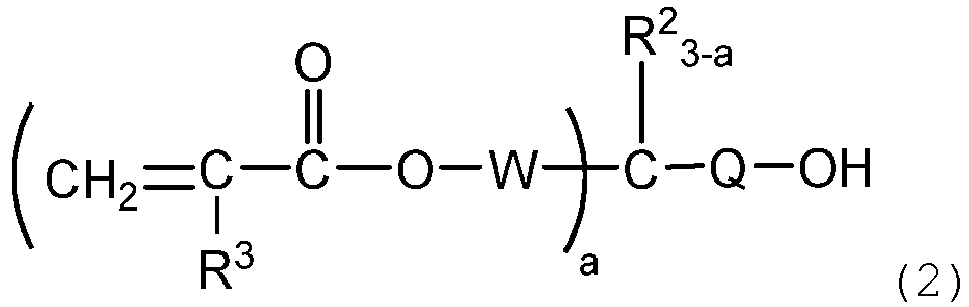
- Examples of the (meth)acryloyl group-containing alcohol represented by the formula (2) include compounds represented by the following formulae.
- chlorosilyl group-containing organosiloxane represented by the formula (3) examples include compounds represented by the following formulae.
- the basic catalyst accelerates the dehydrochlorination and is not particularly limited, as long as it forms a covalent bond with the hydrogen atom of the hydroxyl group of the (meth)acryloyl group-containing alcohol.
- the basic catalyst include amine catalysts, phosphorus catalysts, sulfur catalysts, hydroxide catalysts, and oxide catalysts. Amine catalysts and phosphine catalysts are preferred, and an amine catalyst is more preferred. Reaction conditions of the dehydrochlorination are not particularly limited and may be conducted according to a conventional manner.
- phosphine catalysts examples include aliphatic secondary phosphines such as dibutylphosphine and dicyclohexylphosphine, aliphatic tertiary phosphines such as trimethylphosphine, tributylphosphine, and trihexylphosphine, aliphatic diphosphines such as 1,2-(dimethyphosphino)ethane and 1,2-(dibutylphosphino)ethane, aromatic secondary phosphines such as diphenylphosphine, and aromatic tertiary phosphines such as triphenylphosphine and dimethylphenylphosphine.
- aromatic secondary phosphines such as diphenylphosphine
- aromatic tertiary phosphines such as triphenylphosphine and dimethylphenylphosphine.
- amine catalysts examples include aliphatic primary amines such as butylamine, hexylamine, and octylamine, aliphatic secondary amines such as diethylamine and dibutylamine, aliphatic tertiary amines such as triethylamine, triethanolamine, and N,N-diisopropylethylamine, aliphatic primary diamines such as ethylenediamine, tetramethylethylenediamine, and hexamethylenediamine, aromatic primary amines such as aniline and toluidine, and heterocyclic amines such as pyridine, piperidine, picoline, pyrrole, imidazole, oxazole, thiazole, diazabicycloundecene, and diazabicyclononene.
- aliphatic tertiary amines and heterocyclic amines are preferred, and triethylamine and pyridine
- the dehydrochlorination may be conducted according to a conventional manner.
- an amount of the (meth)acryloyl group-containing alcohol represented by the formula (2) may be 1 mol to 3 mol, per mol of the chlorosilyl group-containing organosiloxane represented by the formula (3).
- An amount of the catalyst may be a catalytically effective amount (catalytic amount) for making the dehydrochlorination proceed.
- the amount is 1 mol to 3 mol, per mol of the (meth)acryloyl group-containing alcohol.
- the reaction may be conducted, for example, at a temperature in the range of from 30 to 60 degrees C for 2 to 5 hours.
- the organosiloxane of the present invention has at least two (meth)acryloyl groups, so that it provides a very strong cured product.
- a moiety having a (meth)acryloyl-containing group and an organosiloxane moiety are connected with each other via a -C-O-Si- structure in the present organosiloxane. Accordingly, its cured product is resinous and excellent in adhesion to a substrate.
- the present organosiloxane is useful, for instance, the present organosiloxane is mixed with a polymerization initiator to give a heat-curable resin composition or a light-curable resin composition which cures by exposure to UV rays or electron rays.
Landscapes
- Chemical & Material Sciences (AREA)
- Health & Medical Sciences (AREA)
- Chemical Kinetics & Catalysis (AREA)
- Medicinal Chemistry (AREA)
- Polymers & Plastics (AREA)
- Organic Chemistry (AREA)
- Physics & Mathematics (AREA)
- Spectroscopy & Molecular Physics (AREA)
- General Physics & Mathematics (AREA)
- General Chemical & Material Sciences (AREA)
- Silicon Polymers (AREA)
Abstract

Description
- This application claims the benefits of Japanese Patent Application No.
2018-202925 filed on October 29, 2018 - The present invention relates to an organosiloxane having at least two (meth)acryloyl groups and a method for preparing the same.
- Various (meth)acryloyl group-containing organosiloxanes are known as an additive for UV-curable materials or a crosslinking agent for addition-curable or UV-curable silicone rubbers. For example,
JP application Laid-Open No. 2010-248446 -
JP application Laid-Open No. 2015-101562 WO2018/003381 , Patent Literature 3, describes a UV-curable silicone composition comprising a specific UV-curable organopolysiloxane component, a monofunctional ethylene group-containing compound having no siloxane structure and/or a polyfunctional, ethylene group-containing compound having no siloxane structure. -
- Patent Literature 1:
JP application Laid-Open No. 2010-248446 - Patent Literature 2:
JP application Laid-Open No. 2015-101562 - Patent Literature 3:
WO2018/003381 - One of the purposes of the present invention is to provide a (meth)acryloyl group-containing organosiloxane which provides a strong cured product showing excellent adhesion to a substrate.
- The present inventors have conducted research on an organosiloxane having at least two, preferably at least four, (meth)acryloyl groups in a molecule, and have invented a (meth)acryloyl group-containing organosiloxane represented by the following formula.
- Thus, the present invention provides a (meth)acryloyl group-containing organosiloxane represented by the following formula (1):

- The (meth)acryloyl group-containing organosiloxane of the present invention has at least two (meth)acryloyl groups in a molecule and, therefore, provides a very strong cured product. Further, a moiety having a (meth)acryloyl-containing group and a moiety of organosiloxane are connected with each other via a -C-O-Si- structure and, thereby, a cured product has excellent adhesion to a substrate.
-
Figure 1 is a 1H-NMR spectrum of the compound prepared in Example 1. - The present invention will be described in more detail.
- The (meth)acryloyl-modified organosiloxane of the present invention is represented by the following formula (1) :

- R1 is, independently of each other, an aliphatic hydrocarbon group having 1 to 10 carbon atoms or an aromatic hydrocarbon group having 6 to 12 carbon atoms, preferably an aliphatic hydrocarbon group having 1 to 6 carbon atoms or an aromatic hydrocarbon group having 6 to 10 carbon atoms, more preferably an aliphatic hydrocarbon group having 1 to 3 carbon atoms or an aromatic hydrocarbon group having 6 to 8 carbon atoms. Examples of the aliphatic hydrocarbon group include alkyl groups such as a methyl, ethyl, propyl or butyl group and cycloalkyl groups such as a cyclopentyl or cyclohexyl group. Among these, a methyl group and a cyclohexyl group are preferred, and a methyl group is particularly preferred. Examples of the aromatic hydrocarbon group include aryl groups such as a phenyl, tolyl, naphthyl or biphenyl group and aralkyl groups such as a benzyl, phenylethyl or phenylpropyl group. Among these, a phenyl group is preferred.
- R2 is, independently of each other, a hydrogen atom, an alkoxy group having 1 to 6 carbon atoms, an aryloxy or aralkyloxy group having 6 to 12 carbon atoms, an aliphatic hydrocarbon group having 1 to 6 carbon atoms, or an aromatic hydrocarbon group having 6 to 12 carbon atoms. Examples of the aliphatic hydrocarbon group and the aromatic hydrocarbon group include those given as examples for R1. Examples of the alkoxy group include alkyloxy groups such as a methoxy, ethoxy, propoxy or butoxy group and cycloalkyloxy groups such as a cyclopentyloxy or cyclohexyloxy group. Among these, a methoxy group and an ethoxy group are preferred, and a methoxy group is particularly preferred. Examples of the aryloxy group include a phenoxy, tolyloxy, naphthoxy or biphenyloxy group. Examples of the aralkyloxy group include a benzyloxy, phenylethoxy or phenylpropoxy group. Among these, a phenoxy group is preferred. R2 is preferably a hydrogen atom, an alkoxy group having 1 to 3 carbon atoms, an aryloxy group having 6 to 10 carbon atoms, an alkyl group having 1 to 3 carbon atoms, or an aryl group having 6 to 10 carbon atoms, more preferably a hydrogen atom, an alkoxy group having 1 or 2 carbon atoms, an aryloxy group having 6 to 8 carbon atoms, an alkyl group having 1 or 2 carbon atoms, or an aryl group having 6 to 8 carbon atoms.
- Q is a single bond or an alkylene group having 1 to 6, preferably 1 to 4 carbon atoms and preferably a single bond or methylene. n is an integer of from 1 to 6, preferably an integer from 1 to 4, more preferably 1 or 2; and a is an integer of from 1 to 3, preferably 2 or 3. W is a divalent hydrocarbon group which has 1 to 6, preferably 1 to 3 carbon atoms and may have an ether bond. Examples of W include alkylene groups such as a methylene group and an ethylene group and oxyalkylene groups such as an oxyethylene group. Preferred is an alkylene group having 1 to 6, more preferably 1 to 3 carbon atoms, and particularly a methylene group.
- Examples of the (meth)acryloyl group-containing organosiloxane represented by the formula (1) include compounds represented by the following formulae:


- A method for preparing the (meth)acryloyl group-containing organosiloxane of the present invention will be described in detail below.
- The (meth) acryloyl group-containing organosiloxane of the present invention is obtained, for example, by subjecting a (meth)acryloyl group-containing alcohol (A) represented by the following formula (2):


to dehydrochlorination in the presence of a basic catalyst (C) . - Examples of the (meth)acryloyl group-containing alcohol represented by the formula (2) include compounds represented by the following formulae.


- Examples of the chlorosilyl group-containing organosiloxane represented by the formula (3) include compounds represented by the following formulae.


- The basic catalyst accelerates the dehydrochlorination and is not particularly limited, as long as it forms a covalent bond with the hydrogen atom of the hydroxyl group of the (meth)acryloyl group-containing alcohol. Examples of the basic catalyst include amine catalysts, phosphorus catalysts, sulfur catalysts, hydroxide catalysts, and oxide catalysts. Amine catalysts and phosphine catalysts are preferred, and an amine catalyst is more preferred. Reaction conditions of the dehydrochlorination are not particularly limited and may be conducted according to a conventional manner.
- Examples of the phosphine catalysts include aliphatic secondary phosphines such as dibutylphosphine and dicyclohexylphosphine, aliphatic tertiary phosphines such as trimethylphosphine, tributylphosphine, and trihexylphosphine, aliphatic diphosphines such as 1,2-(dimethyphosphino)ethane and 1,2-(dibutylphosphino)ethane, aromatic secondary phosphines such as diphenylphosphine, and aromatic tertiary phosphines such as triphenylphosphine and dimethylphenylphosphine. Among these, aliphatic tertiary phosphines and aromatic tertiary phosphines are preferred, and tributylphosphine and triphenylphosphine are particularly preferred.
- Examples of the amine catalysts include aliphatic primary amines such as butylamine, hexylamine, and octylamine, aliphatic secondary amines such as diethylamine and dibutylamine, aliphatic tertiary amines such as triethylamine, triethanolamine, and N,N-diisopropylethylamine, aliphatic primary diamines such as ethylenediamine, tetramethylethylenediamine, and hexamethylenediamine, aromatic primary amines such as aniline and toluidine, and heterocyclic amines such as pyridine, piperidine, picoline, pyrrole, imidazole, oxazole, thiazole, diazabicycloundecene, and diazabicyclononene. Among these, aliphatic tertiary amines and heterocyclic amines are preferred, and triethylamine and pyridine are particularly preferred.
- The dehydrochlorination may be conducted according to a conventional manner. For example, an amount of the (meth)acryloyl group-containing alcohol represented by the formula (2) may be 1 mol to 3 mol, per mol of the chlorosilyl group-containing organosiloxane represented by the formula (3). An amount of the catalyst may be a catalytically effective amount (catalytic amount) for making the dehydrochlorination proceed. For example, the amount is 1 mol to 3 mol, per mol of the (meth)acryloyl group-containing alcohol. Concerning reaction conditions, the reaction may be conducted, for example, at a temperature in the range of from 30 to 60 degrees C for 2 to 5 hours.
- The present invention will be explained below in further detail with reference to a series of the Examples, and the present invention is in no way limited by these Examples.
- In the Examples, 1H-NMR measurement was undertaken by an equipment produced by BRUKER, using deuterochloroform as a solvent and chloroform as an internal standard.
- Dichlorodiphenylsilane (506 g) and toluene (506 g) were placed in a 5-L brown flask. After stirring for 10 minutes, 2-hydroxy-3-acryloxypropyl methacrylate (854 g, "NK Ester 701A", ex Shin-Nakamura Chemical) was added, followed by stirring for 10 minutes. Triethylamine (547 g) was added dropwise to the mixture, followed by stirring at 60 degrees C for 3 hours. The reaction mixture was subjected to filtration and to distillation at a reduced pressure to obtain a colorless transparent liquid product (yield, 750 g). According to the chemical shifts and the integration ratios by 1H-NMR analysis, the product obtained was found to be the compound (A-1) represented by the following formula. The 1H-NMR spectrum is shown as
FIG. 1 .
- The chemical shifts and the integration ratios of 1H-NMR are as follows.
δ 2.0 (CH2=C(CH 3 )C(O)OCH2CH(O)CH2OC(O)CH=CH2)6H
δ 3.9 (CH2=C(CH3)C(O)OCH2CH(O)CH2OC(O)CH=CH2)2H
δ 4.1-4.5 (CH2=C(CH3)C(O)OCH 2 CH(O)CH 2 OC(O)CH=CH2)8H
δ 5.6 (CH2=C(CH3)C(O)OCH2CH(O)CH2OC(O)CH=CH2)2H
55.8-6.5 (CH 2 =C(CH3)C(O)OCH2CH(O)CH2OC(O)CH=CH 2)8H
δ 7.4-7.8 (C6 H 5 SiOC6 H 5 )10H - Dichlorodiphenylsilane (506 g) and toluene (506 g) were placed in a 5-L brown flask. After stirring for 10 minutes, 2-hydroxy-3-phenoxypropyl acrylate (977 g, "KAYARAD R-128H", ex Nippon Kayaku) was added, followed by stirring for 10 minutes. Triethylamine (607 g) was added dropwise to the mixture, followed by stirring at 60 degrees C for 3 hours. The reaction mixture was subjected to filtration and to distillation at a reduced pressure to obtain a colorless transparent liquid product (yield, 813 g). According to the chemical shifts and the integration ratios by 1H-NMR analysis, the product obtained was found to be the compound (A-2) represented by the following formula.
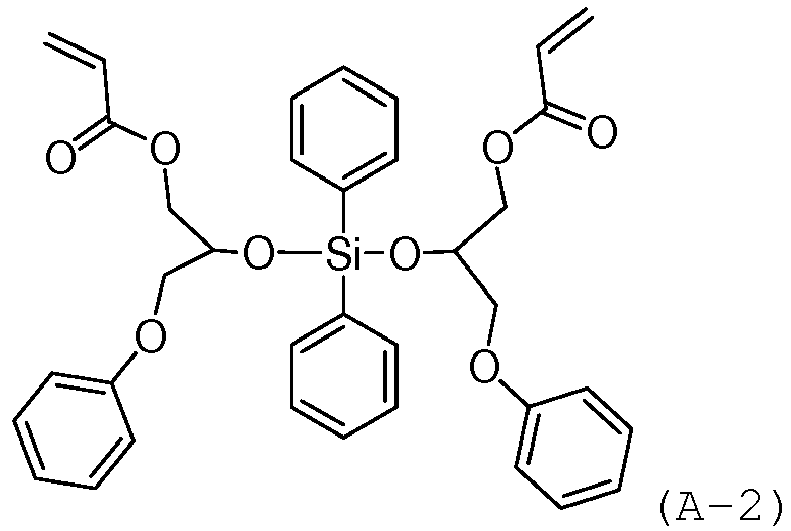
- The chemical shifts and the integration ratios of 1H-NMR are as follows.
δ 3.8-4.6 (C6H5OCH 2 CH(O)CH 2 OC(O)CH=CH2)10H
55.8-6.5 (-OC(O)CH=CH 2 )6H
δ 6.7-7.8 (C6 H 5 OCH2, C6 H 5 SiOC6 H 5 )20H - Dichlorodimethylsilane (258 g) and toluene (258 g) were placed in a 5-L brown flask. After stirring for 10 minutes, 2-hydroxy-3-acryloxypropyl methacrylate (854 g) was added, followed by stirring for 10 minutes. Triethylamine (547 g) was added dropwise to the mixture, followed by stirring at 60 degrees C for 3 hours. The reaction mixture was subjected to filtration and to distillation at a reduced pressure to obtain a colorless transparent liquid product (yield, 630 g). According to the chemical shifts and the integration ratios by 1H-NMR analysis, the product obtained was found to be the compound (A-3) represented by the following formula.

- The chemical shifts and the integration ratios of 1H-NMR are as follows.
δ 0.0-0.5 (CH 3 SiOCH 3 )6H
δ 1.9 (CH2=C(CH 3 )C(O)OCH2CH(O)CH 2 OC(O)CH=CH2)6H
δ 3.7-3.9 (CH2=C(CH3)C(O)OCH2CH(O)CH2OC(O)CH=CH2)2H δ4.1-4.5 (CH2=C(CH3)C(O)OCH 2 CH(O)CH 2 OC(O)CH=CH2)8H
δ 5.6 (CH2=C(CH3)C(O)OCH2CH(O)CH2OC(O)CH=CH2)2H
55.8-6.5 (CH 2 =C(CH3)C(O)OCH2CH(O)CH2OC(O)CH=CH 2)8H - 1, 1, 3, 3-Tetramethyl-1,3-dichlorodisiloxane (406 g) and toluene (406 g) were placed in a 5-L brown flask. After stirring for 10 minutes, 2-hydroxy-2-methyl-3-acryloxypropyl acrylate (854 g) was added, followed by stirring for 10 minutes. Triethylamine (548 g) was added dropwise to the mixture, followed by stirring at 60 degrees C for 3 hours. The reaction mixture was subjected to filtration and to distillation at a reduced pressure to obtain a colorless transparent liquid product (yield, 720 g). According to the chemical shifts and the integration ratios by 1H-NMR analysis, the product obtained was found to be the compound (A-4) represented by the following formula.

- The chemical shifts and the integration ratios of 1H-NMR are as follows.
δ 0.0-0.5 (CH 3 SiOCH 3 )12H
δ 1.8-2.3 (CH2=CHC(O)OCH2C(CH 3 )(O)CH2OC(O)CH=CH2)6H
δ 4.0-4.6 (CH2=CHC(O)OCH2C(CH3)(O)CH2OC(O)CH=CH2)8H
δ 5.6 (CH2=CHC(O)OCH2C(CH3)(O)CH2OC(O)CH=CH2)4H
55.8-6.6 (CH 2 =CHC(O)OCH2C(CH3)(O)CH2OC(O)CH=CH 2 ) 8H - 1, 1, 3, 3, 5, 5, 7, 7-Octamethyl-1, 7-dichlorotetrasiloxane (703 g) and toluene (703 g) were placed in a 5-L brown flask. After stirring for 10 minutes, pentaerythritol triacrylate (1,311 g, "NK Ester A-TMM-3LM-N", ex Shin-Nakamura Chemical) was added, followed by stirring for 10 minutes. Triethylamine (607 g) was added dropwise to the mixture, followed by stirring at 60 degrees C for 3 hours. The reaction mixture was subjected to filtration and to distillation at a reduced pressure to obtain a colorless transparent liquid product (yield, 1,550 g). According to the chemical shifts and the integration ratios by 1H-NMR analysis, the product obtained was found to be the compound (A-5) represented by the following formula.

- The chemical shifts and the integration ratios of 1H-NMR are as follows.
δ 0.0-0.5 (CH 3 SiOCH 3 )24H
δ 3.7-4.0 (C-CH 2 OC(O)CH=CH2)12H
δ 4.3-4.5 (SiO-CH 2 C(CH2OC(O)CH=CH2)3)4H
55.8-6.5 (C-CH2OC(O)CH=CH 2 )18H - The organosiloxane of the present invention has at least two (meth)acryloyl groups, so that it provides a very strong cured product. A moiety having a (meth)acryloyl-containing group and an organosiloxane moiety are connected with each other via a -C-O-Si- structure in the present organosiloxane. Accordingly, its cured product is resinous and excellent in adhesion to a substrate. The present organosiloxane is useful, for instance, the present organosiloxane is mixed with a polymerization initiator to give a heat-curable resin composition or a light-curable resin composition which cures by exposure to UV rays or electron rays.
Claims (7)
- A (meth)acryloyl group-containing organosiloxane represented by the following formula (1):

- The (meth)acryloyl group-containing organosiloxane according to claim 1, wherein R2 is a hydrogen atom, an alkoxy group having 1 to 3 carbon atoms, an aryloxy group having 6 to 10 carbon atoms, an alkyl group having 1 to 3 carbon atoms, or an aryl group having 6 to 10 carbon atoms.
- The (meth)acryloyl group-containing organosiloxane according to claim 1 or claim 2, wherein Q is a single bond or an alkylene group having 1 to 3 carbon atoms.
- The (meth)acryloyl group-containing organosiloxane according to any one of claims 1 to 3, wherein a is 2 or 3.
- A method for preparing a (meth)acryloyl group-containing organosiloxane represented by the following formula (1):


in the presence of (C) a basic catalyst. - The method according to claim 5, wherein component (C) is an amine catalyst.
- The method according to claim 5 or claim 6, wherein a is 2 or 3.
Applications Claiming Priority (1)
| Application Number | Priority Date | Filing Date | Title |
|---|---|---|---|
| JP2018202925A JP7074641B2 (en) | 2018-10-29 | 2018-10-29 | (Meta) Acryloyl group-containing organosiloxane |
Publications (2)
| Publication Number | Publication Date |
|---|---|
| EP3647341A1 true EP3647341A1 (en) | 2020-05-06 |
| EP3647341B1 EP3647341B1 (en) | 2024-08-07 |
Family
ID=68344677
Family Applications (1)
| Application Number | Title | Priority Date | Filing Date |
|---|---|---|---|
| EP19205274.4A Active EP3647341B1 (en) | 2018-10-29 | 2019-10-25 | (meth)acryloyl group-containing organosiloxane |
Country Status (3)
| Country | Link |
|---|---|
| US (1) | US20200131316A1 (en) |
| EP (1) | EP3647341B1 (en) |
| JP (1) | JP7074641B2 (en) |
Cited By (1)
| Publication number | Priority date | Publication date | Assignee | Title |
|---|---|---|---|---|
| CN109851789A (en) * | 2018-08-30 | 2019-06-07 | 深圳市冠恒新材料科技有限公司 | A kind of add-on type fluorine silicon liquid glue and preparation method thereof |
Families Citing this family (2)
| Publication number | Priority date | Publication date | Assignee | Title |
|---|---|---|---|---|
| JP7145122B2 (en) * | 2019-06-06 | 2022-09-30 | 信越化学工業株式会社 | Siloxane and its manufacturing method |
| JP7288234B2 (en) * | 2020-12-17 | 2023-06-07 | Dic株式会社 | Compounds, leveling agents, coating compositions, resist compositions and articles |
Citations (5)
| Publication number | Priority date | Publication date | Assignee | Title |
|---|---|---|---|---|
| US6069186A (en) * | 1998-01-08 | 2000-05-30 | Shin-Etsu Chemical Co., Ltd. | Radiation-curable silicone rubber composition |
| JP2010248446A (en) | 2009-04-20 | 2010-11-04 | Yokohama Rubber Co Ltd:The | Optical semiconductor sealing silicone resin composition |
| EP2720085A1 (en) * | 2012-10-11 | 2014-04-16 | Cheil Industries Inc. | Photocurable composition and encapsulated apparatus including barrier layer formed of the same |
| JP2015101562A (en) | 2013-11-25 | 2015-06-04 | 信越化学工業株式会社 | (Meth) acrylic group-containing organohydrogensiloxane |
| WO2018003381A1 (en) | 2016-06-30 | 2018-01-04 | 信越化学工業株式会社 | Ultraviolet curable silicone composition and cured product of same |
Family Cites Families (10)
| Publication number | Priority date | Publication date | Assignee | Title |
|---|---|---|---|---|
| GB8414705D0 (en) * | 1984-06-08 | 1984-07-11 | Wiggins Teape Group Ltd | Coating substrates |
| JPH10204137A (en) * | 1997-01-24 | 1998-08-04 | Nippon Paint Co Ltd | Highly translucent curable composition, laminate using the same, and touch panel |
| JP3615070B2 (en) * | 1998-01-08 | 2005-01-26 | 信越化学工業株式会社 | Radiation curable silicone rubber composition |
| JP3788911B2 (en) * | 2001-02-07 | 2006-06-21 | 信越化学工業株式会社 | Organopolysiloxane composition |
| DE10359764A1 (en) * | 2003-12-19 | 2005-07-14 | Goldschmidt Ag | Polysiloxanes with (meth) acrylic ester groups bonded via SiOC groups, processes for their preparation and their use as radiation-curable, abhesive coatings |
| EP2444450A1 (en) * | 2010-10-19 | 2012-04-25 | Hinterwaldner Consulting & Partner (Gbr) | Compounds for producing anti-adhesive coatings |
| CN102584883B (en) * | 2011-10-20 | 2014-06-04 | 湖北固润科技股份有限公司 | Multi-silicon methacrylate and acrylate monomer and synthetic method |
| CN103588806A (en) * | 2013-11-14 | 2014-02-19 | 青岛驰科工业技术有限公司 | Preparation method of flame-retardant organosilicone acrylate |
| CN107075017B (en) * | 2014-11-07 | 2019-11-05 | Dic株式会社 | Curable composition, resist material and resist film |
| CN104914675B (en) * | 2015-04-08 | 2019-04-23 | 乐道战略材料有限公司 | It is a kind of for the siloxanes containing light sensitivity of three-dimensional fast shaping and the photosensitive resin composition of hyperbranched poly ethoxylated polyhydric alcohol |
-
2018
- 2018-10-29 JP JP2018202925A patent/JP7074641B2/en active Active
-
2019
- 2019-10-25 EP EP19205274.4A patent/EP3647341B1/en active Active
- 2019-10-28 US US16/665,221 patent/US20200131316A1/en not_active Abandoned
Patent Citations (5)
| Publication number | Priority date | Publication date | Assignee | Title |
|---|---|---|---|---|
| US6069186A (en) * | 1998-01-08 | 2000-05-30 | Shin-Etsu Chemical Co., Ltd. | Radiation-curable silicone rubber composition |
| JP2010248446A (en) | 2009-04-20 | 2010-11-04 | Yokohama Rubber Co Ltd:The | Optical semiconductor sealing silicone resin composition |
| EP2720085A1 (en) * | 2012-10-11 | 2014-04-16 | Cheil Industries Inc. | Photocurable composition and encapsulated apparatus including barrier layer formed of the same |
| JP2015101562A (en) | 2013-11-25 | 2015-06-04 | 信越化学工業株式会社 | (Meth) acrylic group-containing organohydrogensiloxane |
| WO2018003381A1 (en) | 2016-06-30 | 2018-01-04 | 信越化学工業株式会社 | Ultraviolet curable silicone composition and cured product of same |
Non-Patent Citations (2)
| Title |
|---|
| E R CHUNG ET AL: "Photopolymerization and curing shrinkage of silicon-containing multifunctional methacrylates", 31 December 2002 (2002-12-31), XP055668262, Retrieved from the Internet <URL:https://link.springer.com/content/pdf/10.1023/A:1016554415768.pdf> [retrieved on 20200213] * |
| EFROSYNI THEMISTOU ET AL: "Synthesis and Characterization of Star Polymers and Cross-Linked Star Polymer Model Networks Containing a Novel, Silicon-Based, Hydrolyzable Cross-Linker", MACROMOLECULES, AMERICAN CHEMICAL SOCIETY, WASHINGTON, DC, UNITED STATES, vol. 37, no. 18, 1 January 2004 (2004-01-01), pages 6734 - 6743, XP002533454, ISSN: 0024-9297, [retrieved on 20040806], DOI: 10.1021/MA049618+ * |
Cited By (1)
| Publication number | Priority date | Publication date | Assignee | Title |
|---|---|---|---|---|
| CN109851789A (en) * | 2018-08-30 | 2019-06-07 | 深圳市冠恒新材料科技有限公司 | A kind of add-on type fluorine silicon liquid glue and preparation method thereof |
Also Published As
| Publication number | Publication date |
|---|---|
| US20200131316A1 (en) | 2020-04-30 |
| JP2020070239A (en) | 2020-05-07 |
| JP7074641B2 (en) | 2022-05-24 |
| EP3647341B1 (en) | 2024-08-07 |
Similar Documents
| Publication | Publication Date | Title |
|---|---|---|
| AU678279B2 (en) | Organopolysiloxanes modified with acrylate groups | |
| KR101842424B1 (en) | Silicate resins and methods of preparing same | |
| KR101868158B1 (en) | Succinic anhydride group containing cyclic organosiloxane, preparation thereof, organosiloxane composition and thermosetting resin composition | |
| US20050136269A1 (en) | Polysiloxanes containing (meth)acrylic ester groups attached via SiOC groups, processes for preparing them and their use as a radiation-curable abhesive coating | |
| EP3647341B1 (en) | (meth)acryloyl group-containing organosiloxane | |
| RU2005130177A (en) | POLYMERIZABLE COMPOSITIONS CONTAINING SILOXANE POLYMERIZING COMPONENTS INITIATED BY ORGAN-ORANINE COMPLEX | |
| US9175139B2 (en) | Alkoxy group-containing silicones with reactive functional groups of defined reactivity | |
| JP2018512468A (en) | Curable siloxane composition | |
| CN109705397B (en) | Novel bis (alkoxysilyl-vinylene) -group-containing silicon compounds and process for producing the same | |
| JP2000026609A (en) | Method for producing alkoxy-terminated polydiorganosiloxane | |
| US8841473B2 (en) | Synthesis of fluorosilicones and their derivatives | |
| JP6105616B2 (en) | Hydrolyzable silane | |
| JP5890288B2 (en) | Method for producing novel organosilicon compound | |
| JP4012680B2 (en) | Organosilicon compound | |
| JPS6325024B2 (en) | ||
| JPH11158379A (en) | Adhesion promoter and curable silicone composition | |
| CN114989764B (en) | Silane modified polyether sealant for interior decoration and its preparation method and application | |
| JP2839150B2 (en) | Composite polysiloxane resin, process for producing the same, and coating / cast encapsulating composition containing the same | |
| WO2016170851A1 (en) | Hydrolyzable-silyl-group-containing cyclic organohydrogen siloxane | |
| CN110511373B (en) | Fluorine-containing organosilicon compound, method for producing same, room-temperature-curable fluorine-containing rubber composition, cured product thereof, and article | |
| HK1005315B (en) | Mtq/polysiloxane hybrid resins, method of making the same, and coating/potting compositions containing the same | |
| EP3861002B1 (en) | Organosilicon compound, method for producing thereof, and use thereof | |
| JP2015110527A (en) | Organosilicon compound having oxetane ring and production method thereof | |
| US5117029A (en) | Process for preparing alkoxy-functional organopolysiloxanes and the resultant alkoxy-functional organopolysiloxanes | |
| JP7723760B2 (en) | Method for producing (meth)acryloyl group-containing organopolysiloxane |
Legal Events
| Date | Code | Title | Description |
|---|---|---|---|
| PUAI | Public reference made under article 153(3) epc to a published international application that has entered the european phase |
Free format text: ORIGINAL CODE: 0009012 |
|
| STAA | Information on the status of an ep patent application or granted ep patent |
Free format text: STATUS: THE APPLICATION HAS BEEN PUBLISHED |
|
| AK | Designated contracting states |
Kind code of ref document: A1 Designated state(s): AL AT BE BG CH CY CZ DE DK EE ES FI FR GB GR HR HU IE IS IT LI LT LU LV MC MK MT NL NO PL PT RO RS SE SI SK SM TR |
|
| AX | Request for extension of the european patent |
Extension state: BA ME |
|
| STAA | Information on the status of an ep patent application or granted ep patent |
Free format text: STATUS: REQUEST FOR EXAMINATION WAS MADE |
|
| 17P | Request for examination filed |
Effective date: 20201020 |
|
| RBV | Designated contracting states (corrected) |
Designated state(s): AL AT BE BG CH CY CZ DE DK EE ES FI FR GB GR HR HU IE IS IT LI LT LU LV MC MK MT NL NO PL PT RO RS SE SI SK SM TR |
|
| GRAP | Despatch of communication of intention to grant a patent |
Free format text: ORIGINAL CODE: EPIDOSNIGR1 |
|
| STAA | Information on the status of an ep patent application or granted ep patent |
Free format text: STATUS: GRANT OF PATENT IS INTENDED |
|
| INTG | Intention to grant announced |
Effective date: 20240312 |
|
| GRAS | Grant fee paid |
Free format text: ORIGINAL CODE: EPIDOSNIGR3 |
|
| GRAA | (expected) grant |
Free format text: ORIGINAL CODE: 0009210 |
|
| STAA | Information on the status of an ep patent application or granted ep patent |
Free format text: STATUS: THE PATENT HAS BEEN GRANTED |
|
| AK | Designated contracting states |
Kind code of ref document: B1 Designated state(s): AL AT BE BG CH CY CZ DE DK EE ES FI FR GB GR HR HU IE IS IT LI LT LU LV MC MK MT NL NO PL PT RO RS SE SI SK SM TR |
|
| REG | Reference to a national code |
Ref country code: GB Ref legal event code: FG4D |
|
| REG | Reference to a national code |
Ref country code: CH Ref legal event code: EP |
|
| REG | Reference to a national code |
Ref country code: IE Ref legal event code: FG4D |
|
| REG | Reference to a national code |
Ref country code: DE Ref legal event code: R096 Ref document number: 602019056480 Country of ref document: DE |
|
| REG | Reference to a national code |
Ref country code: NL Ref legal event code: FP |
|
| REG | Reference to a national code |
Ref country code: LT Ref legal event code: MG9D |
|
| PG25 | Lapsed in a contracting state [announced via postgrant information from national office to epo] |
Ref country code: NO Free format text: LAPSE BECAUSE OF FAILURE TO SUBMIT A TRANSLATION OF THE DESCRIPTION OR TO PAY THE FEE WITHIN THE PRESCRIBED TIME-LIMIT Effective date: 20241107 |
|
| REG | Reference to a national code |
Ref country code: AT Ref legal event code: MK05 Ref document number: 1710887 Country of ref document: AT Kind code of ref document: T Effective date: 20240807 |
|
| PG25 | Lapsed in a contracting state [announced via postgrant information from national office to epo] |
Ref country code: PT Free format text: LAPSE BECAUSE OF FAILURE TO SUBMIT A TRANSLATION OF THE DESCRIPTION OR TO PAY THE FEE WITHIN THE PRESCRIBED TIME-LIMIT Effective date: 20241209 Ref country code: FI Free format text: LAPSE BECAUSE OF FAILURE TO SUBMIT A TRANSLATION OF THE DESCRIPTION OR TO PAY THE FEE WITHIN THE PRESCRIBED TIME-LIMIT Effective date: 20240807 Ref country code: PL Free format text: LAPSE BECAUSE OF FAILURE TO SUBMIT A TRANSLATION OF THE DESCRIPTION OR TO PAY THE FEE WITHIN THE PRESCRIBED TIME-LIMIT Effective date: 20240807 Ref country code: GR Free format text: LAPSE BECAUSE OF FAILURE TO SUBMIT A TRANSLATION OF THE DESCRIPTION OR TO PAY THE FEE WITHIN THE PRESCRIBED TIME-LIMIT Effective date: 20241108 |
|
| PG25 | Lapsed in a contracting state [announced via postgrant information from national office to epo] |
Ref country code: BG Free format text: LAPSE BECAUSE OF FAILURE TO SUBMIT A TRANSLATION OF THE DESCRIPTION OR TO PAY THE FEE WITHIN THE PRESCRIBED TIME-LIMIT Effective date: 20240807 |
|
| PG25 | Lapsed in a contracting state [announced via postgrant information from national office to epo] |
Ref country code: LV Free format text: LAPSE BECAUSE OF FAILURE TO SUBMIT A TRANSLATION OF THE DESCRIPTION OR TO PAY THE FEE WITHIN THE PRESCRIBED TIME-LIMIT Effective date: 20240807 |
|
| PG25 | Lapsed in a contracting state [announced via postgrant information from national office to epo] |
Ref country code: AT Free format text: LAPSE BECAUSE OF FAILURE TO SUBMIT A TRANSLATION OF THE DESCRIPTION OR TO PAY THE FEE WITHIN THE PRESCRIBED TIME-LIMIT Effective date: 20240807 Ref country code: IS Free format text: LAPSE BECAUSE OF FAILURE TO SUBMIT A TRANSLATION OF THE DESCRIPTION OR TO PAY THE FEE WITHIN THE PRESCRIBED TIME-LIMIT Effective date: 20241207 |
|
| PG25 | Lapsed in a contracting state [announced via postgrant information from national office to epo] |
Ref country code: HR Free format text: LAPSE BECAUSE OF FAILURE TO SUBMIT A TRANSLATION OF THE DESCRIPTION OR TO PAY THE FEE WITHIN THE PRESCRIBED TIME-LIMIT Effective date: 20240807 |
|
| PG25 | Lapsed in a contracting state [announced via postgrant information from national office to epo] |
Ref country code: ES Free format text: LAPSE BECAUSE OF FAILURE TO SUBMIT A TRANSLATION OF THE DESCRIPTION OR TO PAY THE FEE WITHIN THE PRESCRIBED TIME-LIMIT Effective date: 20240807 Ref country code: RS Free format text: LAPSE BECAUSE OF FAILURE TO SUBMIT A TRANSLATION OF THE DESCRIPTION OR TO PAY THE FEE WITHIN THE PRESCRIBED TIME-LIMIT Effective date: 20241107 |
|
| PG25 | Lapsed in a contracting state [announced via postgrant information from national office to epo] |
Ref country code: RS Free format text: LAPSE BECAUSE OF FAILURE TO SUBMIT A TRANSLATION OF THE DESCRIPTION OR TO PAY THE FEE WITHIN THE PRESCRIBED TIME-LIMIT Effective date: 20241107 Ref country code: PT Free format text: LAPSE BECAUSE OF FAILURE TO SUBMIT A TRANSLATION OF THE DESCRIPTION OR TO PAY THE FEE WITHIN THE PRESCRIBED TIME-LIMIT Effective date: 20241209 Ref country code: PL Free format text: LAPSE BECAUSE OF FAILURE TO SUBMIT A TRANSLATION OF THE DESCRIPTION OR TO PAY THE FEE WITHIN THE PRESCRIBED TIME-LIMIT Effective date: 20240807 Ref country code: NO Free format text: LAPSE BECAUSE OF FAILURE TO SUBMIT A TRANSLATION OF THE DESCRIPTION OR TO PAY THE FEE WITHIN THE PRESCRIBED TIME-LIMIT Effective date: 20241107 Ref country code: LV Free format text: LAPSE BECAUSE OF FAILURE TO SUBMIT A TRANSLATION OF THE DESCRIPTION OR TO PAY THE FEE WITHIN THE PRESCRIBED TIME-LIMIT Effective date: 20240807 Ref country code: IS Free format text: LAPSE BECAUSE OF FAILURE TO SUBMIT A TRANSLATION OF THE DESCRIPTION OR TO PAY THE FEE WITHIN THE PRESCRIBED TIME-LIMIT Effective date: 20241207 Ref country code: HR Free format text: LAPSE BECAUSE OF FAILURE TO SUBMIT A TRANSLATION OF THE DESCRIPTION OR TO PAY THE FEE WITHIN THE PRESCRIBED TIME-LIMIT Effective date: 20240807 Ref country code: GR Free format text: LAPSE BECAUSE OF FAILURE TO SUBMIT A TRANSLATION OF THE DESCRIPTION OR TO PAY THE FEE WITHIN THE PRESCRIBED TIME-LIMIT Effective date: 20241108 Ref country code: FI Free format text: LAPSE BECAUSE OF FAILURE TO SUBMIT A TRANSLATION OF THE DESCRIPTION OR TO PAY THE FEE WITHIN THE PRESCRIBED TIME-LIMIT Effective date: 20240807 Ref country code: ES Free format text: LAPSE BECAUSE OF FAILURE TO SUBMIT A TRANSLATION OF THE DESCRIPTION OR TO PAY THE FEE WITHIN THE PRESCRIBED TIME-LIMIT Effective date: 20240807 Ref country code: BG Free format text: LAPSE BECAUSE OF FAILURE TO SUBMIT A TRANSLATION OF THE DESCRIPTION OR TO PAY THE FEE WITHIN THE PRESCRIBED TIME-LIMIT Effective date: 20240807 Ref country code: AT Free format text: LAPSE BECAUSE OF FAILURE TO SUBMIT A TRANSLATION OF THE DESCRIPTION OR TO PAY THE FEE WITHIN THE PRESCRIBED TIME-LIMIT Effective date: 20240807 |
|
| PG25 | Lapsed in a contracting state [announced via postgrant information from national office to epo] |
Ref country code: SM Free format text: LAPSE BECAUSE OF FAILURE TO SUBMIT A TRANSLATION OF THE DESCRIPTION OR TO PAY THE FEE WITHIN THE PRESCRIBED TIME-LIMIT Effective date: 20240807 Ref country code: DK Free format text: LAPSE BECAUSE OF FAILURE TO SUBMIT A TRANSLATION OF THE DESCRIPTION OR TO PAY THE FEE WITHIN THE PRESCRIBED TIME-LIMIT Effective date: 20240807 Ref country code: RO Free format text: LAPSE BECAUSE OF FAILURE TO SUBMIT A TRANSLATION OF THE DESCRIPTION OR TO PAY THE FEE WITHIN THE PRESCRIBED TIME-LIMIT Effective date: 20240807 |
|
| PG25 | Lapsed in a contracting state [announced via postgrant information from national office to epo] |
Ref country code: EE Free format text: LAPSE BECAUSE OF FAILURE TO SUBMIT A TRANSLATION OF THE DESCRIPTION OR TO PAY THE FEE WITHIN THE PRESCRIBED TIME-LIMIT Effective date: 20240807 |
|
| PG25 | Lapsed in a contracting state [announced via postgrant information from national office to epo] |
Ref country code: CZ Free format text: LAPSE BECAUSE OF FAILURE TO SUBMIT A TRANSLATION OF THE DESCRIPTION OR TO PAY THE FEE WITHIN THE PRESCRIBED TIME-LIMIT Effective date: 20240807 |
|
| PG25 | Lapsed in a contracting state [announced via postgrant information from national office to epo] |
Ref country code: SK Free format text: LAPSE BECAUSE OF FAILURE TO SUBMIT A TRANSLATION OF THE DESCRIPTION OR TO PAY THE FEE WITHIN THE PRESCRIBED TIME-LIMIT Effective date: 20240807 |
|
| REG | Reference to a national code |
Ref country code: DE Ref legal event code: R097 Ref document number: 602019056480 Country of ref document: DE |
|
| REG | Reference to a national code |
Ref country code: CH Ref legal event code: PL |
|
| PLBE | No opposition filed within time limit |
Free format text: ORIGINAL CODE: 0009261 |
|
| STAA | Information on the status of an ep patent application or granted ep patent |
Free format text: STATUS: NO OPPOSITION FILED WITHIN TIME LIMIT |
|
| PG25 | Lapsed in a contracting state [announced via postgrant information from national office to epo] |
Ref country code: MC Free format text: LAPSE BECAUSE OF FAILURE TO SUBMIT A TRANSLATION OF THE DESCRIPTION OR TO PAY THE FEE WITHIN THE PRESCRIBED TIME-LIMIT Effective date: 20240807 |
|
| PG25 | Lapsed in a contracting state [announced via postgrant information from national office to epo] |
Ref country code: BE Free format text: LAPSE BECAUSE OF NON-PAYMENT OF DUE FEES Effective date: 20241031 Ref country code: LU Free format text: LAPSE BECAUSE OF NON-PAYMENT OF DUE FEES Effective date: 20241025 |
|
| 26N | No opposition filed |
Effective date: 20250508 |
|
| PG25 | Lapsed in a contracting state [announced via postgrant information from national office to epo] |
Ref country code: FR Free format text: LAPSE BECAUSE OF NON-PAYMENT OF DUE FEES Effective date: 20241031 |
|
| GBPC | Gb: european patent ceased through non-payment of renewal fee |
Effective date: 20241107 |
|
| PG25 | Lapsed in a contracting state [announced via postgrant information from national office to epo] |
Ref country code: CH Free format text: LAPSE BECAUSE OF NON-PAYMENT OF DUE FEES Effective date: 20241031 |
|
| REG | Reference to a national code |
Ref country code: BE Ref legal event code: MM Effective date: 20241031 |
|
| PG25 | Lapsed in a contracting state [announced via postgrant information from national office to epo] |
Ref country code: SE Free format text: LAPSE BECAUSE OF FAILURE TO SUBMIT A TRANSLATION OF THE DESCRIPTION OR TO PAY THE FEE WITHIN THE PRESCRIBED TIME-LIMIT Effective date: 20240807 |
|
| PG25 | Lapsed in a contracting state [announced via postgrant information from national office to epo] |
Ref country code: GB Free format text: LAPSE BECAUSE OF NON-PAYMENT OF DUE FEES Effective date: 20241107 |
|
| PG25 | Lapsed in a contracting state [announced via postgrant information from national office to epo] |
Ref country code: IE Free format text: LAPSE BECAUSE OF NON-PAYMENT OF DUE FEES Effective date: 20241025 |
|
| PGFP | Annual fee paid to national office [announced via postgrant information from national office to epo] |
Ref country code: NL Payment date: 20251021 Year of fee payment: 7 |
|
| PGFP | Annual fee paid to national office [announced via postgrant information from national office to epo] |
Ref country code: DE Payment date: 20251021 Year of fee payment: 7 |
|
| PG25 | Lapsed in a contracting state [announced via postgrant information from national office to epo] |
Ref country code: IT Free format text: LAPSE BECAUSE OF FAILURE TO SUBMIT A TRANSLATION OF THE DESCRIPTION OR TO PAY THE FEE WITHIN THE PRESCRIBED TIME-LIMIT Effective date: 20240807 Ref country code: CY Free format text: LAPSE BECAUSE OF FAILURE TO SUBMIT A TRANSLATION OF THE DESCRIPTION OR TO PAY THE FEE WITHIN THE PRESCRIBED TIME-LIMIT; INVALID AB INITIO Effective date: 20191025 |
|
| PG25 | Lapsed in a contracting state [announced via postgrant information from national office to epo] |
Ref country code: HU Free format text: LAPSE BECAUSE OF FAILURE TO SUBMIT A TRANSLATION OF THE DESCRIPTION OR TO PAY THE FEE WITHIN THE PRESCRIBED TIME-LIMIT; INVALID AB INITIO Effective date: 20191025 |