EP3644404B1 - Ceramic and polymer composite coated lithium ion separator and preparation method therefor - Google Patents
Ceramic and polymer composite coated lithium ion separator and preparation method therefor Download PDFInfo
- Publication number
- EP3644404B1 EP3644404B1 EP17895498.8A EP17895498A EP3644404B1 EP 3644404 B1 EP3644404 B1 EP 3644404B1 EP 17895498 A EP17895498 A EP 17895498A EP 3644404 B1 EP3644404 B1 EP 3644404B1
- Authority
- EP
- European Patent Office
- Prior art keywords
- parts
- ceramic
- weight
- polymer
- coating
- Prior art date
- Legal status (The legal status is an assumption and is not a legal conclusion. Google has not performed a legal analysis and makes no representation as to the accuracy of the status listed.)
- Active
Links
Images


Classifications
-
- H—ELECTRICITY
- H01—ELECTRIC ELEMENTS
- H01M—PROCESSES OR MEANS, e.g. BATTERIES, FOR THE DIRECT CONVERSION OF CHEMICAL ENERGY INTO ELECTRICAL ENERGY
- H01M10/00—Secondary cells; Manufacture thereof
- H01M10/42—Methods or arrangements for servicing or maintenance of secondary cells or secondary half-cells
- H01M10/4235—Safety or regulating additives or arrangements in electrodes, separators or electrolyte
-
- H—ELECTRICITY
- H01—ELECTRIC ELEMENTS
- H01M—PROCESSES OR MEANS, e.g. BATTERIES, FOR THE DIRECT CONVERSION OF CHEMICAL ENERGY INTO ELECTRICAL ENERGY
- H01M50/00—Constructional details or processes of manufacture of the non-active parts of electrochemical cells other than fuel cells, e.g. hybrid cells
- H01M50/40—Separators; Membranes; Diaphragms; Spacing elements inside cells
- H01M50/403—Manufacturing processes of separators, membranes or diaphragms
-
- H—ELECTRICITY
- H01—ELECTRIC ELEMENTS
- H01M—PROCESSES OR MEANS, e.g. BATTERIES, FOR THE DIRECT CONVERSION OF CHEMICAL ENERGY INTO ELECTRICAL ENERGY
- H01M50/00—Constructional details or processes of manufacture of the non-active parts of electrochemical cells other than fuel cells, e.g. hybrid cells
- H01M50/40—Separators; Membranes; Diaphragms; Spacing elements inside cells
- H01M50/409—Separators, membranes or diaphragms characterised by the material
- H01M50/411—Organic material
- H01M50/414—Synthetic resins, e.g. thermoplastics or thermosetting resins
- H01M50/417—Polyolefins
-
- H—ELECTRICITY
- H01—ELECTRIC ELEMENTS
- H01M—PROCESSES OR MEANS, e.g. BATTERIES, FOR THE DIRECT CONVERSION OF CHEMICAL ENERGY INTO ELECTRICAL ENERGY
- H01M50/00—Constructional details or processes of manufacture of the non-active parts of electrochemical cells other than fuel cells, e.g. hybrid cells
- H01M50/40—Separators; Membranes; Diaphragms; Spacing elements inside cells
- H01M50/409—Separators, membranes or diaphragms characterised by the material
- H01M50/431—Inorganic material
- H01M50/434—Ceramics
-
- H—ELECTRICITY
- H01—ELECTRIC ELEMENTS
- H01M—PROCESSES OR MEANS, e.g. BATTERIES, FOR THE DIRECT CONVERSION OF CHEMICAL ENERGY INTO ELECTRICAL ENERGY
- H01M50/00—Constructional details or processes of manufacture of the non-active parts of electrochemical cells other than fuel cells, e.g. hybrid cells
- H01M50/40—Separators; Membranes; Diaphragms; Spacing elements inside cells
- H01M50/409—Separators, membranes or diaphragms characterised by the material
- H01M50/449—Separators, membranes or diaphragms characterised by the material having a layered structure
- H01M50/451—Separators, membranes or diaphragms characterised by the material having a layered structure comprising layers of only organic material and layers containing inorganic material
-
- H—ELECTRICITY
- H01—ELECTRIC ELEMENTS
- H01M—PROCESSES OR MEANS, e.g. BATTERIES, FOR THE DIRECT CONVERSION OF CHEMICAL ENERGY INTO ELECTRICAL ENERGY
- H01M50/00—Constructional details or processes of manufacture of the non-active parts of electrochemical cells other than fuel cells, e.g. hybrid cells
- H01M50/40—Separators; Membranes; Diaphragms; Spacing elements inside cells
- H01M50/409—Separators, membranes or diaphragms characterised by the material
- H01M50/449—Separators, membranes or diaphragms characterised by the material having a layered structure
- H01M50/457—Separators, membranes or diaphragms characterised by the material having a layered structure comprising three or more layers
-
- H—ELECTRICITY
- H01—ELECTRIC ELEMENTS
- H01M—PROCESSES OR MEANS, e.g. BATTERIES, FOR THE DIRECT CONVERSION OF CHEMICAL ENERGY INTO ELECTRICAL ENERGY
- H01M50/00—Constructional details or processes of manufacture of the non-active parts of electrochemical cells other than fuel cells, e.g. hybrid cells
- H01M50/40—Separators; Membranes; Diaphragms; Spacing elements inside cells
- H01M50/489—Separators, membranes, diaphragms or spacing elements inside the cells, characterised by their physical properties, e.g. swelling degree, hydrophilicity or shut down properties
-
- H—ELECTRICITY
- H01—ELECTRIC ELEMENTS
- H01M—PROCESSES OR MEANS, e.g. BATTERIES, FOR THE DIRECT CONVERSION OF CHEMICAL ENERGY INTO ELECTRICAL ENERGY
- H01M50/00—Constructional details or processes of manufacture of the non-active parts of electrochemical cells other than fuel cells, e.g. hybrid cells
- H01M50/40—Separators; Membranes; Diaphragms; Spacing elements inside cells
- H01M50/489—Separators, membranes, diaphragms or spacing elements inside the cells, characterised by their physical properties, e.g. swelling degree, hydrophilicity or shut down properties
- H01M50/491—Porosity
-
- H—ELECTRICITY
- H01—ELECTRIC ELEMENTS
- H01M—PROCESSES OR MEANS, e.g. BATTERIES, FOR THE DIRECT CONVERSION OF CHEMICAL ENERGY INTO ELECTRICAL ENERGY
- H01M10/00—Secondary cells; Manufacture thereof
- H01M10/05—Accumulators with non-aqueous electrolyte
- H01M10/052—Li-accumulators
- H01M10/0525—Rocking-chair batteries, i.e. batteries with lithium insertion or intercalation in both electrodes; Lithium-ion batteries
-
- Y—GENERAL TAGGING OF NEW TECHNOLOGICAL DEVELOPMENTS; GENERAL TAGGING OF CROSS-SECTIONAL TECHNOLOGIES SPANNING OVER SEVERAL SECTIONS OF THE IPC; TECHNICAL SUBJECTS COVERED BY FORMER USPC CROSS-REFERENCE ART COLLECTIONS [XRACs] AND DIGESTS
- Y02—TECHNOLOGIES OR APPLICATIONS FOR MITIGATION OR ADAPTATION AGAINST CLIMATE CHANGE
- Y02E—REDUCTION OF GREENHOUSE GAS [GHG] EMISSIONS, RELATED TO ENERGY GENERATION, TRANSMISSION OR DISTRIBUTION
- Y02E60/00—Enabling technologies; Technologies with a potential or indirect contribution to GHG emissions mitigation
- Y02E60/10—Energy storage using batteries
Definitions
- the present disclosure relates to a lithium ion battery separator, and particularly to a ceramic-and-polymer-compositely-coated lithium ion separator having good heat shrinkage performance and strong bonding force with a pole piece and allowing for mass production, and a preparation method therefor.
- a separator is generally made of polyolefin-based porous membrane.
- a battery separator mainly serves the function of separating the positive electrode from the negative electrode to avoid the short circuit of the battery, ensuring the passage of Li + , and ensuring a smooth circuit inside the battery.
- the existing polyolefin-based porous membranes generally have a melting point of lower than 200°C, when the battery experiences thermal runaway due to collision, over-charging, etc., the separator will shrink or melt, which will cause direct contact between the positive electrode and the negative electrode, leading to a short circuit of the battery, thereby causing accidents such as battery fire.
- the general practice is to coat the separator with a ceramic layer to reduce the degree of heat shrinkage of the separator and improve the mechanical strength of the separator, thereby reducing the probability of short circuit in the battery caused by shrinkage or melting of the separator due to thermal runaway, piercing of the separator by lithium dendrites, etc. in the battery.
- a ceramic layer cannot meet the higher requirements raised by today's battery industry upon separators, i.e., 1) high bonding strength between the separator and the positive and negative pole pieces, and good interfacial compatibility; and 2) excellent electrochemical performance of the coating, and high ion conductivity.
- US patent application No. 2014272526 discloses a porous separator for a lithium ion battery comprising a polyolefin porous membrane, a ceramic layer coated on the porous membrane and a polymer coating coated on the ceramic layer.
- WO 2016/062126 discloses a lithium battery diaphragm comprising a polyolefin membrane, a ceramic layer coated on the membrane and a PVDF layer coated on the ceramic layer.
- US patent application No. 2014/141312 discloses a separator comprising a polyethylene substrate, a nylon layer formed thereon, a ceramic layer formed on the nylon layer and a polymer coating layer formed on the ceramic layer.
- CN application No. 102569701 discloses a lithium ion battery separator comprising a polyolefin porous base material, a ceramic material layer formed on the surface part of the porous membrane and a polymer adhesive layer formed on the ceramic layer.
- CN application No. 106654119 discloses a separator comprising PE, PP, PP/PE porous film, a ceramic particle coating coated on ones side or both side of the porous film and a polymer coating layer coated on the ceramic layer.
- One of the objects of the present disclosure is to provide a ceramic-and-polymer-compositely-coated lithium ion separator, which has the advantages of high bonding strength with a battery pole piece and high heat shrinkage performance, and can effectively avoid short circuit caused by dislocation with respect to the battery pole piece.
- the other object of the present disclosure is to provide a method for manufacturing the ceramic-and-polymer-compositely-coated lithium ion separator, which is advantageous for continuous and large-scale production.
- a ceramic-and-polymer-compositely-coated lithium ion separator comprising a polyolefin porous membrane, a ceramic coating coated onto one or both sides of a membrane surface, and a polymer coating coated onto the ceramic surface or the membrane surface, characterized in that the ceramic coating is made by following raw materials in parts by weight: 15 - 45 parts of a ceramic material, 0.5 - 8 parts of an aqueous dispersant, 1 - 10 parts of an aqueous binder, 1 - 5 parts of an aqueous binder emulsion, and 0.1 - 5 parts of an aqueous wetting agent.
- the polyolefin porous membrane is one selected from the group consisting of a dry method PP membrane, a wet method PE membrane and a PE and PP composite three-layered membrane; preferably, the polyolefin porous membrane has a thickness of 2-50 ⁇ m; and more preferably, the polyolefin porous membrane has a porosity of 20%-70%.
- the ceramic coating has a thickness of 1-10 ⁇ m; and preferably, the polymer coating has a thickness of 0.5-8 ⁇ m.
- the total coating thickness of the ceramic coating and the polymer coating is 1.5-18 ⁇ m; preferably, the total coating surface density of the ceramic coating and the polymer coating is 3-15 g/m 2 ; more preferably, the total thickness of the compositely coated lithium ion separator is 3.5-68 ⁇ m; and further preferably, the total surface density of the compositely coated lithium ion separator is 3-50 g/m 2 .
- the ceramic material is at least one selected from the group consisting of aluminum oxide, silicon dioxide, magnesium hydroxide, rutile titanium dioxide, magnesium oxide, boehmite, zirconium dioxide, barium titanate and zinc oxide; preferably, the D50 of particles of the ceramic material is 20-2000 nm; and more preferably, the specific surface area of the ceramic material is 0.8-200 m 2 /g.
- the aqueous binder is at least one selected from the group consisting of polyvinylidene fluoride, polyvinyl alcohol, styrene-butadiene rubber, sodium carboxymethyl cellulose, styrene-acrylic latex, pure styrene latex, sodium alginate and polyacrylic acid; preferably, the aqueous dispersant is at least one selected from the group consisting of sodium polyacrylate, polyethylene glycol, sodium dodecyl sulfate, carboxylate fluorine dispersants, sodium dibutylnaphthalenesulfonate, sulfonate fluorine dispersants, potassium polyacrylate, polyacrylamide, polyethylene glycol fatty acid ester and sodium carboxymethyl cellulose; and more preferably, the aqueous wetting agent is at least one selected from the group consisting of sodium polyacrylate, polyvinyl alcohol, sodium alkyl polyoxyethylene ether carboxylate, alkylphenol polyoxyethylene ether
- the aqueous binder emulsion is composed of the following raw materials in parts by weight: 1-10 parts of sodium carboxymethyl cellulose, 0-5 parts of a high dielectric constant ceramic material, 5-20 parts of a monomer for synthesis of acrylic resin, 0.1-0.5 parts of ammonium persulfate, and 0.2-2 parts of a surfactant.
- the surfactant is at least one selected from the group consisting of carboxylate, sodium benzenesulfonate, sodium dodecylbenzene sulfonate, sodium fatty alcohol polyoxyethylene ether sulfate, Triton X-100, quaternary ammonium salts, lauryl glucoside, sodium dodecyl sulfate and betaine salts; and more preferably, the monomer for synthesis of acrylic resin is at least one selected from the group consisting of methyl acrylate, ethyl acrylate, butyl acrylate, methyl methacrylate, butyl methacrylate, 2-ethylhe
- the polymer coating is made of the following raw materials in parts by weight: 0-5 parts of a high dielectric constant ceramic material, 0-2 parts of a binder, 3-20 parts of a polymer, 2-20 parts of a pore-forming agent, 0-5 parts of a dispersant and 48-92 parts of a solvent.
- the polymer is at least one selected from the group consisting of a PVDF homopolymer, a copolymer of PVDF and hexafluoropropylene, polyacrylonitrile, polyoxyethylene and polymethacrylate; preferably, the polymer has a molecular weight of 50000-1200000; more preferably, the pore-forming agent is at least one selected from the group consisting of polyethylene glycol, polyvinylpyrrolidone, pure water, acetone, methyl acetate, methanol, isopropanol, ethanol, methanoic acid, acetic acid, propionic acid, n-butyl alcohol, n-octyl alcohol, lauryl alcohol, lithium chloride and lithium perchlorate; further preferably, the solvent is at least one selected from the group consisting of dimethyl acetamide, dichloroethane, dimethylformamide, trichloroethane, sulfolane, dimethyl sulfoxide,
- An embodiment of the present disclosure further provides a method for preparing a ceramic-and-polymer-compositely-coated lithium ion separator, comprising the steps of:
- a method for preparing the aqueous binder emulsion comprises the steps of:
- step (2) the stirring to disperse is stirring at 2000-3500 R/min for 30-60 min; and preferably, in step (4), the dropwise addition of solution B to solution A is finished within 10-60 min.
- a method for preparing the polymer slurry III is as follows: mixing, while stirring, 2-20 parts by weight of a pore-forming agent, 0-2 parts by weight of a binder, 0-5 parts by weight of a dispersant and 48-92 parts by weight of a solvent to obtain mixed solution II; mixing 3-20 parts by weight of a polymer with 0-5 parts by weight of a high dielectric constant ceramic material and then adding the same to the mixed solution II, and thereafter sequentially subjecting the resultant solution to pre-dispersion by a ball mill and dispersion by a high-speed disperser.
- the mixing while stirring is stirring at a rotational speed of 500-5000 R/min for 0.2-1.2 h.
- the pre-dispersion by a ball mill is stirring for 0.1-1.5 h in a ball mill having a rotational speed of 200-2500 R/min; and preferably, the dispersion by a high-speed disperser is high-speed stirring at a rotational speed of 500-9000 R/min for 0.3-2 h.
- the coating is carried out by a coater at a coating speed of 25-85 m/min; preferably, the coating is one selected from the group consisting of dip coating, slide coating, curtain coating, microgravure coating and spray coating; more preferably, the drying is drying at a temperature of 35-78 °C; further preferably, the solidification refers to passing through a solidification tank containing 60-100 wt% of pure water and 0-40 wt% of an alcohol, wherein the alcohol is at least one selected from the group consisting of ethanol, methanol, isopropanol and ethylene glycol; and still further preferably, the water washing refers to passing through a washing tank containing pure water.
- the ceramic-and-polymer-compositely-coated lithium ion separator provided by the present disclosure is prepared by coating a ceramic coating and then a polymer coating onto the surface of a membrane, which has the advantages of high heat resistance performance and high bonding strength with the positive and negative pole pieces, and can also improve the wettability of an electrolyte, prevent an internal short circuit due to layer dislocation between the composite separator and the electrodes and improve hardness and safety performance of the battery.
- a high dielectric constant ceramic material is innovatively added to the polymer coating, which greatly improves the Li + ion conductivity of the polymer coating, thereby improving the charging and discharging performance of the battery using the composite separator.
- the method for preparing a ceramic-and-polymer-compositely-coated lithium ion separator provided by the present disclosure is favorable for continuous and large-scale production.
- the PP membrane is the abbreviation of polypropylene membrane
- the PE membrane is the abbreviation of polyethylene membrane
- pure water is deionized water
- Triton is the product name of polyoxyethylene-8-octyl phenyl ether
- PVDF is the abbreviation of polyvinylidene fluoride.
- the present embodiment provides a ceramic-and-polymer-compositely-coated lithium ion separator, and the preparation method thereof is as follow:
- the ceramic coating and the polymer coating of the prepared ceramic-and-polymer-compositely-coated lithium ion separator have a total coating thickness of 6.4 ⁇ m and a surface density of 7.8 g/m 2 ; and the entire compositely coated lithium ion separator has a thickness of 18.4 ⁇ m and a surface density of 14.2 g/m 2 .
- the present embodiment provides a ceramic-and-polymer-compositely-coated lithium ion separator, and the preparation method thereof is as follow:
- the ceramic coating and the polymer coating of the ceramic-and-polymer-compositely-coated lithium ion separator prepared in embodiment 2 have a total coating thickness of 5.1 ⁇ m and a surface density of 6.9 g/m 2 ; and the entire compositely coated lithium ion separator has a thickness of 21.1 ⁇ m and a surface density of 17.4 g/m 2 .
- the present embodiment provides a ceramic-and-polymer-compositely-coated lithium ion separator, and the preparation method thereof is as follow:
- the ceramic coating and the polymer coating of the ceramic-and-polymer-compositely-coated lithium ion separator prepared in embodiment 3 have a total coating thickness of 4.7 ⁇ m and a surface density of 5.5 g/m 2 ; and the entire compositely coated lithium ion separator has a thickness of 24.7 ⁇ m and a surface density of 17.2 g/m 2 .
- the present embodiment provides a ceramic-and-polymer-compositely-coated lithium ion separator, and the preparation method thereof is as follow:
- the ceramic coating and the polymer coating of the ceramic-and-polymer-compositely-coated lithium ion separator prepared in embodiment 4 have a total coating thickness of 5.3 ⁇ m and a surface density of 6.3 g/m 2 ; and the entire compositely coated lithium ion separator has a thickness of 21.3 ⁇ m and a surface density of 16.8 g/m 2 .
- Embodiment 5 differs from Embodiment 2 in step (5) in which when the aqueous ceramic slurry I is coated onto one side of a 2 ⁇ m wet method PP membrane by a large coater, the coating method is dip coating and the coating speed is 35 m/min, and the resultant product is dried in an oven at a temperature of 45 °C and then rolled up to obtain a ceramic coated membrane
- the ceramic coating and the polymer coating of the ceramic-and-polymer-compositely-coated lithium ion separator prepared in embodiment 5 have a total coating thickness of 1.5 ⁇ m and a surface density of 3 g/m 2 ; and the entire compositely coated lithium ion separator has a thickness of 3.5 ⁇ m and a surface density of 3 g/m 2 .
- Embodiment 6 differs from Embodiment 5 in step (5) in which when the aqueous ceramic slurry I is coated onto both sides of a 50 ⁇ m PE and PP composite three-layered membrane by a large coater, the coating method is dip coating and the coating speed is 75 m/min, and the resultant product is dried in an oven at a temperature of 65 °C and then rolled up to obtain a ceramic coated membrane
- the ceramic coating and the polymer coating of the ceramic-and-polymer-compositely-coated lithium ion separator prepared in embodiment 6 have a total coating thickness of 18 ⁇ m and a surface density of 15 g/m 2 ; and the entire compositely coated lithium ion separator has a thickness of 68 ⁇ m and a surface density of 50 g/m 2 .
- Embodiment 7 differs from embodiment 1 in that: in embodiment 7, the method for preparing an aqueous binder emulsion is, in parts by weight:
- the method for preparing the aqueous ceramic slurry I is, in parts by weight: adding 20 parts of magnesium oxide and 20 parts of boehmite, serving as the ceramic powder (with D50 of 1.1 ⁇ m and a specific surface area of 3.3 m 2 /g), 5 parts of the aqueous binder emulsion, 6 parts of the aqueous binder styrene-acrylic latex, 5 parts of the aqueous dispersant sodium dibutylnaphthalenesulfonate, 0.4 parts of the wetting agent sodium alkyl polyoxyethylene ether carboxylate and 45 parts of pure water into a dispersion tank, ball-milling the same for 30 min in a ball mill at a rotational speed of 1200 R/min for pre-dispersion, after the pre-dispersion is finished, pumping the same into a high-speed disperser for stirring for 900 min at a rotational speed of 4700 R/min, then pouring the resultant slurry into
- Embodiment 8 differs from embodiment 2 in that: in embodiment 8, the method for preparing an aqueous binder emulsion is, in parts by weight:
- the method for preparing the aqueous ceramic slurry I is, in parts by weight: adding 20 parts of magnesium oxide and 20 parts of boehmite, serving as the ceramic powder (with D50 of 1.1 ⁇ m and a specific surface area of 3.3 m 2 /g), 5 parts of the aqueous binder emulsion, 6 parts of the aqueous binder styrene-acrylic latex, 5 parts of the aqueous dispersant sodium dibutylnaphthalenesulfonate, 0.4 parts of the wetting agent sodium alkyl polyoxyethylene ether carboxylate and 45 parts of pure water into a dispersion tank, ball-milling the same for 30 min in a ball mill at a rotational speed of 1500 R/min for pre-dispersion, after the pre-dispersion is finished, pumping the same into a high-speed disperser for stirring for 70 min at a rotational speed of 6000 R/min, then pouring the resultant slurry into a
- Embodiment 9 differs from embodiment 3 in that: in embodiment 9, the method for preparing an aqueous binder emulsion is, in parts by weight:
- the method for preparing the aqueous ceramic slurry I is, in parts by weight: adding 15 parts of zirconium dioxide, 15 parts of barium titanate and 15 parts of zinc oxide, serving as the ceramic powder (with D50 of 0.8 ⁇ m and a specific surface area of 7.8 m 2 /g), 5 parts of the aqueous binder emulsion, 3 parts of the aqueous binder sodium alginate, 3 parts of the aqueous binder polyacrylic acid, 2 parts of the aqueous dispersant sodium dibutylnaphthalenesulfonate, 2 parts of the aqueous dispersant polyacrylamide, 0.4 parts of the wetting agent alkyl polyoxyethylene amide and 50 parts of pure water into a dispersion tank, ball-milling the same for 60 min in a ball mill at a rotational speed of 1800 R/min for pre-dispersion, after the pre-dispersion is finished, pumping the same into a high-speed disperser for stirring for
- Embodiment 10 differs from embodiment 3 in that: in embodiment 10, the method for preparing polymer slurry III is:
- Embodiment 11 differs from embodiment 4 in that: in embodiment 11, the method for preparing polymer slurry III is:
- An existing PE membrane was used as the base membrane, having a thickness of 22 ⁇ m.
- An existing PP membrane was used as the base membrane, having a thickness of 16 ⁇ m.
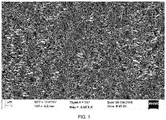
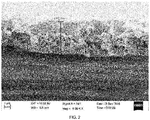
- Electron microscope scanning was conducted on the surface of the ceramic-and-polymer-compositely-coated lithium ion separator prepared in embodiment 1 of the present disclosure, on the cross section of the surface on one side thereof with PE, ceramic and polymer and on the cross section of the surface on one side thereof with PE and polymer, as shown in FIG. 1 , FIG. 2 and FIG. 3 , respectively.
- the ceramic coating and the polymer coating have even coating thickness, and the uniformity of thickness distribution is high; moreover, the distribution of pores in the composite separator is also very even.
- Test was conducted on the properties of the ceramic-and-polymer-compositely-coated lithium ion separators synthesized in embodiment 1, embodiment 2, embodiment 3 and embodiment 4, the base membrane provided in comparative embodiment 1 and the base membrane provided in comparative embodiment 2 (test conditions: temperature: 90 °C, pressure: 5 Mpa, duration: 1 min, the pole pieces being lithium cobalt oxide pole pieces).
- the data are shown in the table of FIG. 4 .
- the heat shrinkage value is significantly reduced, the 130°C/1H heat shrinkage value is reduced from 3.86% of the 16 ⁇ m PP base membrane of comparative embodiment 2 to 1.14% of the ceramic-and-polymer-compositely-coated separator of embodiment 2; and the interfacial bonding force between the ceramic-and-polymer-compositely-coated separator provided in each of embodiments 1-4 and the lithium cobalt oxide pole pieces under the conditions of 90 °C, 5 Mpa and 1 min dry pressing reaches 39N/m or above, which can meet the requirements of power batteries and digital consumer batteries for the interfacial bonding force between the composite separator and the pole pieces.
- the ceramic-and-polymer-compositely-coated lithium ion separator provided by the present disclosure has the advantages of high heat resistance and high bonding strength with the positive and negative pole pieces, and can also improve the wettability of an electrolyte, prevent an internal short circuit due to layer dislocation between the composite separator and the electrodes and improve hardness and safety performance of the battery.
- a high dielectric constant ceramic material is innovatively added to the polymer coating, which greatly improves the Li + ion conductivity of the polymer coating, thereby improving the charging and discharging performance of the battery using the composite separator.
- the method for preparing a ceramic-and-polymer-compositely-coated lithium ion separator provided by the present disclosure is favorable for continuous and large-scale production.
Landscapes
- Chemical & Material Sciences (AREA)
- Chemical Kinetics & Catalysis (AREA)
- Electrochemistry (AREA)
- General Chemical & Material Sciences (AREA)
- Engineering & Computer Science (AREA)
- Manufacturing & Machinery (AREA)
- Inorganic Chemistry (AREA)
- Ceramic Engineering (AREA)
- Cell Separators (AREA)
- Laminated Bodies (AREA)
Description
- The present disclosure claims the priority of the
Chinese patent application No. 201710470496.2, filed with the Chinese Patent Office on June 20, 2017 - The present disclosure relates to a lithium ion battery separator, and particularly to a ceramic-and-polymer-compositely-coated lithium ion separator having good heat shrinkage performance and strong bonding force with a pole piece and allowing for mass production, and a preparation method therefor.
- With the rapid development of electric automobiles in recent years, the market scale of the power batteries required by the electric automobiles increases sharply, and the safety of the power batteries also becomes a focus of public concern. According to incomplete statistics, in the first half of 2016 alone, there were totally 11 fire accidents in electric automobiles, of which one was caused by a short circuit in the battery. It has become the industry consensus to eliminate the potential risks of the power batteries and improve the safety of the power batteries.
- As one of the four major materials of a lithium battery, a separator is generally made of polyolefin-based porous membrane. During the charging and discharging process of a lithium battery, a battery separator mainly serves the function of separating the positive electrode from the negative electrode to avoid the short circuit of the battery, ensuring the passage of Li+, and ensuring a smooth circuit inside the battery. Since the existing polyolefin-based porous membranes generally have a melting point of lower than 200°C, when the battery experiences thermal runaway due to collision, over-charging, etc., the separator will shrink or melt, which will cause direct contact between the positive electrode and the negative electrode, leading to a short circuit of the battery, thereby causing accidents such as battery fire.
- In order to avoid short circuit of the battery caused by shrinkage or melting of the separator, the general practice is to coat the separator with a ceramic layer to reduce the degree of heat shrinkage of the separator and improve the mechanical strength of the separator, thereby reducing the probability of short circuit in the battery caused by shrinkage or melting of the separator due to thermal runaway, piercing of the separator by lithium dendrites, etc. in the battery. However, merely coating the separator with a ceramic layer cannot meet the higher requirements raised by today's battery industry upon separators, i.e., 1) high bonding strength between the separator and the positive and negative pole pieces, and good interfacial compatibility; and 2) excellent electrochemical performance of the coating, and high ion conductivity.
-
US patent application No. 2014272526 discloses a porous separator for a lithium ion battery comprising a polyolefin porous membrane, a ceramic layer coated on the porous membrane and a polymer coating coated on the ceramic layer. -
WO 2016/062126 -
US patent application No. 2014/141312 discloses a separator comprising a polyethylene substrate, a nylon layer formed thereon, a ceramic layer formed on the nylon layer and a polymer coating layer formed on the ceramic layer. -
CN application No. 102569701 discloses a lithium ion battery separator comprising a polyolefin porous base material, a ceramic material layer formed on the surface part of the porous membrane and a polymer adhesive layer formed on the ceramic layer. -
CN application No. 106654119 discloses a separator comprising PE, PP, PP/PE porous film, a ceramic particle coating coated on ones side or both side of the porous film and a polymer coating layer coated on the ceramic layer. - Therefore, there is a need for a high-safety separator for a battery that has high bonding strength and can reduce the probability of short circuit in the battery.
- One of the objects of the present disclosure is to provide a ceramic-and-polymer-compositely-coated lithium ion separator, which has the advantages of high bonding strength with a battery pole piece and high heat shrinkage performance, and can effectively avoid short circuit caused by dislocation with respect to the battery pole piece.
- The other object of the present disclosure is to provide a method for manufacturing the ceramic-and-polymer-compositely-coated lithium ion separator, which is advantageous for continuous and large-scale production.
- In order to achieve at least one of the above objects, the technical solution adopted in the present disclosure is as follows:
a ceramic-and-polymer-compositely-coated lithium ion separator, comprising a polyolefin porous membrane, a ceramic coating coated onto one or both sides of a membrane surface, and a polymer coating coated onto the ceramic surface or the membrane surface, characterized in that the ceramic coating is made by following raw materials in parts by weight: 15 - 45 parts of a ceramic material, 0.5 - 8 parts of an aqueous dispersant, 1 - 10 parts of an aqueous binder, 1 - 5 parts of an aqueous binder emulsion, and 0.1 - 5 parts of an aqueous wetting agent. - Optionally, the polyolefin porous membrane is one selected from the group consisting of a dry method PP membrane, a wet method PE membrane and a PE and PP composite three-layered membrane; preferably, the polyolefin porous membrane has a thickness of 2-50 µm; and more preferably, the polyolefin porous membrane has a porosity of 20%-70%.
- Optionally, the ceramic coating has a thickness of 1-10 µm; and preferably, the polymer coating has a thickness of 0.5-8 µm.
- Optionally, the total coating thickness of the ceramic coating and the polymer coating is 1.5-18 µm; preferably, the total coating surface density of the ceramic coating and the polymer coating is 3-15 g/m2; more preferably, the total thickness of the compositely coated lithium ion separator is 3.5-68 µm; and further preferably, the total surface density of the compositely coated lithium ion separator is 3-50 g/m2.
- Optionally, the ceramic material is at least one selected from the group consisting of aluminum oxide, silicon dioxide, magnesium hydroxide, rutile titanium dioxide, magnesium oxide, boehmite, zirconium dioxide, barium titanate and zinc oxide; preferably, the D50 of particles of the ceramic material is 20-2000 nm; and more preferably, the specific surface area of the ceramic material is 0.8-200 m2/g.
- Optionally, the aqueous binder is at least one selected from the group consisting of polyvinylidene fluoride, polyvinyl alcohol, styrene-butadiene rubber, sodium carboxymethyl cellulose, styrene-acrylic latex, pure styrene latex, sodium alginate and polyacrylic acid; preferably, the aqueous dispersant is at least one selected from the group consisting of sodium polyacrylate, polyethylene glycol, sodium dodecyl sulfate, carboxylate fluorine dispersants, sodium dibutylnaphthalenesulfonate, sulfonate fluorine dispersants, potassium polyacrylate, polyacrylamide, polyethylene glycol fatty acid ester and sodium carboxymethyl cellulose; and more preferably, the aqueous wetting agent is at least one selected from the group consisting of sodium polyacrylate, polyvinyl alcohol, sodium alkyl polyoxyethylene ether carboxylate, alkylphenol polyoxyethylene ether, sodium alkyl benzenesulfonate, alkylphenol polyoxyethylene ether, polyoxyethylene alkyl amine and polyoxyethylene amide
- Optionally, the aqueous binder emulsion is composed of the following raw materials in parts by weight: 1-10 parts of sodium carboxymethyl cellulose, 0-5 parts of a high dielectric constant ceramic material, 5-20 parts of a monomer for synthesis of acrylic resin, 0.1-0.5 parts of ammonium persulfate, and 0.2-2 parts of a surfactant.
- Optionally, the high dielectric constant ceramic material is at least one selected from the group consisting of rutile titanium dioxide, barium titanate, BaTiO3-Nb2O5-MOx (wherein M=Co, Ni, Mn, Zn), potassium niobate and sodium niobate; preferably, the surfactant is at least one selected from the group consisting of carboxylate, sodium benzenesulfonate, sodium dodecylbenzene sulfonate, sodium fatty alcohol polyoxyethylene ether sulfate, Triton X-100, quaternary ammonium salts, lauryl glucoside, sodium dodecyl sulfate and betaine salts; and more preferably, the monomer for synthesis of acrylic resin is at least one selected from the group consisting of methyl acrylate, ethyl acrylate, butyl acrylate, methyl methacrylate, butyl methacrylate, 2-ethylhexyl acrylate, ethyl methacrylate, acrylic acid, hydroxyethyl methacrylate, hydroxyethyl acrylate, N-hydroxymethyl acrylamide, hydroxypropyl acrylate, glycidyl acrylate, methacrylic acid, hydroxypropyl methacrylate and glycidyl methacrylate.
- Optionally, the polymer coating is made of the following raw materials in parts by weight: 0-5 parts of a high dielectric constant ceramic material, 0-2 parts of a binder, 3-20 parts of a polymer, 2-20 parts of a pore-forming agent, 0-5 parts of a dispersant and 48-92 parts of a solvent.
- Optionally, the polymer is at least one selected from the group consisting of a PVDF homopolymer, a copolymer of PVDF and hexafluoropropylene, polyacrylonitrile, polyoxyethylene and polymethacrylate; preferably, the polymer has a molecular weight of 50000-1200000; more preferably, the pore-forming agent is at least one selected from the group consisting of polyethylene glycol, polyvinylpyrrolidone, pure water, acetone, methyl acetate, methanol, isopropanol, ethanol, methanoic acid, acetic acid, propionic acid, n-butyl alcohol, n-octyl alcohol, lauryl alcohol, lithium chloride and lithium perchlorate; further preferably, the solvent is at least one selected from the group consisting of dimethyl acetamide, dichloroethane, dimethylformamide, trichloroethane, sulfolane, dimethyl sulfoxide, N-methylpyrrolidone, chloroform, dichloromethane and acetone; still further preferably, the binder is at least one selected from the group consisting of polyvinylidene fluoride, polyvinyl alcohol, styrene-butadiene rubber, sodium carboxymethyl cellulose, styrene-acrylic latex, pure styrene latex, sodium alginate and polyacrylic acid; and still further preferably, the dispersant is at least one selected from the group consisting of sodium polyacrylate, polyethylene glycol, sodium dodecyl sulfate, carboxylate fluorine dispersants, sodium dibutylnaphthalenesulfonate, sulfonate fluorine dispersants, potassium polyacrylate, polyacrylamide, polyethylene glycol fatty acid ester and sodium carboxymethyl cellulose.
- An embodiment of the present disclosure further provides a method for preparing a ceramic-and-polymer-compositely-coated lithium ion separator, comprising the steps of:
- (1) coating an aqueous ceramic slurry I onto one or both sides of a dry method PP membrane, a wet method PE membrane or a PE and PP composite three-layered membrane, and drying the same to obtain a ceramic coated membrane; and
- (2) coating a polymer slurry III onto both sides of the ceramic coated membrane, subjecting the same to solidification, water washing and polymer pore-forming, and then drying the same, wherein the method for preparing the aqueous ceramic slurry I comprises: mixing 15-45 parts by weight of a ceramic material, 0.5-8 parts by weight of an aqueous dispersant, 1-10 parts by weight of an aqueous binder, 1-5 parts by weight of an aqueous binder emulsion, 0.1-5 parts by weight of an aqueous wetting agent and pure water, subjecting the mixture to pre-dispersion by a ball mill and dispersion by a high-speed disperser, and then filtering the same with a 200-500 mesh sieves.
- Optionally, a method for preparing the aqueous binder emulsion comprises the steps of:
- (1) adding 1-10 parts by weight of sodium carboxymethyl cellulose to deionized water having a weight that is 5-20 times the weight of sodium carboxymethyl cellulose, and stirring the same evenly to obtain a sodium carboxymethyl cellulose aqueous solution;
- (2) adding 0-5 parts by weight of a high dielectric constant ceramic material, 0.1-1 parts by weight of a surfactant and 8-30% of the total weight of the sodium carboxymethyl cellulose aqueous solution, which serve as a first input material, into to deionized water having a weight that is 5-20 times the weight of the first input material, and stirring to disperse the same to obtain solution A;
- (3) adding 5-20 parts by weight of a monomer for synthesis of acrylic resin and 0.1-1 parts by weight of a surfactant, which serve as a second input material, into deionized water having a weight that is 5-20 times the weight of the second input material, and stirring to disperse the same evenly to obtain solution B; and
- (4) heating solution A to 60-80 °C, adding thereto 0.1-0.5 parts by weight of ammonium persulfate, introducing thereto a protective gas, dropwise adding solution B to solution A while stirring, stirring for 10-60 min with the temperature maintained, discharging the resultant product, cooling the same to normal temperature, and mixing, while stirring evenly, the same with 70-92% of the total weight of the sodium carboxymethyl cellulose aqueous solution.
- Optionally, in step (2), the stirring to disperse is stirring at 2000-3500 R/min for 30-60 min; and preferably, in step (4), the dropwise addition of solution B to solution A is finished within 10-60 min.
- Optionally, a method for preparing the polymer slurry III is as follows: mixing, while stirring, 2-20 parts by weight of a pore-forming agent, 0-2 parts by weight of a binder, 0-5 parts by weight of a dispersant and 48-92 parts by weight of a solvent to obtain mixed solution II; mixing 3-20 parts by weight of a polymer with 0-5 parts by weight of a high dielectric constant ceramic material and then adding the same to the mixed solution II, and thereafter sequentially subjecting the resultant solution to pre-dispersion by a ball mill and dispersion by a high-speed disperser.
- Optionally, the mixing while stirring is stirring at a rotational speed of 500-5000 R/min for 0.2-1.2 h.
- Optionally, the pre-dispersion by a ball mill is stirring for 0.1-1.5 h in a ball mill having a rotational speed of 200-2500 R/min; and preferably, the dispersion by a high-speed disperser is high-speed stirring at a rotational speed of 500-9000 R/min for 0.3-2 h.
- Optionally, the coating is carried out by a coater at a coating speed of 25-85 m/min; preferably, the coating is one selected from the group consisting of dip coating, slide coating, curtain coating, microgravure coating and spray coating; more preferably, the drying is drying at a temperature of 35-78 °C; further preferably, the solidification refers to passing through a solidification tank containing 60-100 wt% of pure water and 0-40 wt% of an alcohol, wherein the alcohol is at least one selected from the group consisting of ethanol, methanol, isopropanol and ethylene glycol; and still further preferably, the water washing refers to passing through a washing tank containing pure water.
- Compared with the prior art, the present disclosure has the following advantageous effects:
The ceramic-and-polymer-compositely-coated lithium ion separator provided by the present disclosure is prepared by coating a ceramic coating and then a polymer coating onto the surface of a membrane, which has the advantages of high heat resistance performance and high bonding strength with the positive and negative pole pieces, and can also improve the wettability of an electrolyte, prevent an internal short circuit due to layer dislocation between the composite separator and the electrodes and improve hardness and safety performance of the battery. In addition, in the present disclosure, a high dielectric constant ceramic material is innovatively added to the polymer coating, which greatly improves the Li+ ion conductivity of the polymer coating, thereby improving the charging and discharging performance of the battery using the composite separator. The method for preparing a ceramic-and-polymer-compositely-coated lithium ion separator provided by the present disclosure is favorable for continuous and large-scale production. -
-
FIG. 1 is a scanning electron microscope image of a surface of a ceramic-and-polymer-compositely-coated lithium ion separator synthesized according toembodiment 1; -
FIG. 2 is a scanning electron microscope image of a cross section (at the PE, ceramic and polymer side) of the ceramic-and-polymer-compositely-coated lithium ion separator synthesized according toembodiment 1; -
FIG. 3 is a scanning electron microscope image of a cross section (at the PE and polymer side) of the ceramic-and-polymer-compositely-coated lithium ion separator synthesized according toembodiment 1; -
FIG. 4 shows heat shrinkage data, and data of interfacial bonding strength between the coating and pole pieces and the compositely coated separator (under the test conditions: temperature: 90 °C, pressure: 5 Mpa, duration: 1 min, the pole pieces being lithium cobalt oxide pole pieces) of ceramic-and-polymer-compositely-coated lithium ion separators synthesized according toembodiments -
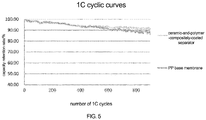
FIG. 5 shows cyclic curves of pouch-type batteries, made using the ceramic-and-polymer-compositely-coated lithium ion separator synthesized according toembodiment 1 and using a PP base membrane respectively under the same conditions and with the same process, under 1C charging and discharging condition. - The present disclosure is further described below in connection with specific embodiments and the accompanying drawings, but the scope of protection of the present disclosure is not merely limited to the contents described in the embodiments.
- In the raw materials used in the present disclosure, the PP membrane is the abbreviation of polypropylene membrane, the PE membrane is the abbreviation of polyethylene membrane, pure water is deionized water, Triton is the product name of polyoxyethylene-8-octyl phenyl ether, and PVDF is the abbreviation of polyvinylidene fluoride.
- The present embodiment provides a ceramic-and-polymer-compositely-coated lithium ion separator, and the preparation method thereof is as follow:
- (1) preparation of an aqueous binder emulsion:
- 1) adding 5 parts of sodium carboxymethyl cellulose to deionized water having a weight that is 8 times the weight of sodium carboxymethyl cellulose, and stirring the same evenly to obtain a sodium carboxymethyl cellulose aqueous solution;
- 2) adding 1.5 parts of barium titanate powder, 0.5 parts of sodium dodecylbenzene sulfonate, and 22% of the total weight of the sodium carboxymethyl cellulose aqueous solution, which serve as a first input material, into deionized water having a weight that is 6 times the weight of the first input material, and stirring to disperse the same at a high speed of 2500 R/min for 60 min to obtain solution A;
- 3) adding 8 parts of butyl acrylate, 8 parts of methyl methacrylate, 0.2 parts of Triton X-100, and 0.2 parts of sodium dodecylbenzene sulfonate, which serve as a second input material, into deionized water having a weight that is 16 times the weight of the second input material, and stirring to evenly disperse the same to obtain solution B; and
- 4) heating solution A in a reactor to 80 °C, adding thereto 0.25 parts of ammonium persulfate, introducing thereto a protective gas, dropwise adding solution B to solution A while stirring in such a manner that dropwise addition of solution B to solution A is finished within 30 min, stirring for 50 min with the temperature maintained, discharging the resultant product, cooling the same to normal temperature, and mixing, while stirring evenly, the same with 78% of the total weight of the sodium carboxymethyl cellulose aqueous solution, obtaining the aqueous binder emulsion.
- (2) adding 27 parts of aluminum oxide (with D50 of 0.91 µm and a specific surface area of 4.87 m2/g), 4.5 parts of the aqueous binder emulsion, 2.8 parts of polyvinyl alcohol, 3.7 parts of styrene-butadiene rubber, 0.85 parts of the aqueous wetting agent sodium alkyl polyoxyethylene ether carboxylate and 59.15 parts of pure water into a dispersion tank, ball-milling the same for 40 min in a ball mill at a rotational speed of 800 R/min for pre-dispersion, after the pre-dispersion is finished, pumping the same into a high-speed disperser for stirring for 100 min at a rotational speed of 6000 R/min, then pouring the resultant slurry into a plastic bucket, and filtering the same with a 400 mesh sieve, to obtain aqueous ceramic slurry I;
- (3) placing 6 parts of pure water, 10 parts of isopropyl alcohol, 1.8 parts of a carboxylate fluorine dispersant, and 68 parts of NMP in an agitation tank, and stirring the same at 2500 R/min for 0.5 h to obtain mixed solution II;
- (4) placing 14 parts of a copolymer P (VDF-HFP) powder of PVDF and hexafluoropropylene (HFP), 0.2 parts of rutile titanium dioxide powder (with D50 of 25 µm) in a dispersion tank, adding the mixed solution II thereto, ball-milling the same for 30 min in the ball mill at a rotational speed of 800 R/min for pre-dispersion, and after the pre-dispersion is finished, pumping the same into a high-speed disperser for stirring for 40 min at a rotational speed of 3500 R/min, to obtain polymer slurry III;
- (5) coating the aqueous ceramic slurry III onto one side of a 12 µm wet method PE membrane by a large coater, using the coating method of microgravure coating at a coating speed of 60 m/min, drying the same in an oven at a temperature of 55 °C, and rolling up to obtain a ceramic coated membrane; and
- (6) coating the polymer slurry III onto both sides of the ceramic coated membrane simultaneously by the large coater, using the coating method of microgravure coating at a coating speed of 35 m/min, subjecting the resultant product to solidification in a solidification tank containing 85 parts of pure water and 15 parts of ethanol, to water washing in a washing tank containing pure water, and to polymer pore-forming, thereafter drying the same in the oven at a temperature of 60 °C, and rolling up to obtain a ceramic-and-polymer-compositely-coated lithium ion separator.
- The ceramic coating and the polymer coating of the prepared ceramic-and-polymer-compositely-coated lithium ion separator have a total coating thickness of 6.4 µm and a surface density of 7.8 g/m2; and the entire compositely coated lithium ion separator has a thickness of 18.4 µm and a surface density of 14.2 g/m2.
- The present embodiment provides a ceramic-and-polymer-compositely-coated lithium ion separator, and the preparation method thereof is as follow:
- (1) preparation of an aqueous binder emulsion:
- 1) adding 8 parts of sodium carboxymethyl cellulose to deionized water having a weight that is 10 times the weight of sodium carboxymethyl cellulose, and stirring the same evenly to obtain a sodium carboxymethyl cellulose aqueous solution;
- 2) adding 2.5 parts of rutile titanium dioxide, 0.35 parts of sodium dodecyl sulfate, and 15% of the total weight of the sodium carboxymethyl cellulose aqueous solution, which serve as a first input material, into deionized water having a weight that is 5 times the weight of the first input material, and stirring to disperse the same at a high speed of 2500 R/min for 55 min to obtain solution A;
- 3) adding 6 parts of butyl acrylate, 7 parts of ethyl acrylate, 4.5 parts of acrylic acid, and 0.25 parts of sodium dodecyl sulfate, which serve as a second input material, into deionized water having a weight that is 14 times the weight of the second input material, and stirring to evenly disperse the same to obtain solution B; and
- 4) heating solution A in a reactor to 75 °C, adding thereto 0.35 parts of ammonium persulfate, introducing thereto a protective gas, dropwise adding solution B to solution A while stirring in such a manner that dropwise addition of solution B to solution A is finished within 30 min, stirring for 55 min with the temperature maintained, discharging the resultant product, cooling the same to normal temperature, and mixing, while stirring evenly, the same with 85% of the total weight of the sodium carboxymethyl cellulose aqueous solution, obtaining the aqueous binder emulsion.
- (2) adding 36 parts of boehmite (with D50 of 1.06 µm and a specific surface area of 3.47 m2/g), 6.2 parts of the aqueous binder emulsion, 3.1 parts of sodium carboxymethyl cellulose, 3.1 parts of styrene-butadiene rubber, 3.5 parts of the aqueous dispersant sulfonate fluorine dispersants, 0.5 parts of the aqueous wetting agent polyoxyethylene amide and 47.6 parts of pure water into a dispersion tank, ball-milling the same for 30 min in a ball mill at a rotational speed of 500 R/min for pre-dispersion, after the pre-dispersion is finished, pumping the same into a high-speed disperser for stirring for 90 min at a rotational speed of 6500 R/min, then pouring the resultant slurry into a plastic bucket, and filtering the same with a 300 mesh sieve, to obtain aqueous ceramic slurry I;
- (3) placing 8 parts of ethanol, 7 parts of isopropyl alcohol, 2.5 parts of sodium polyacrylate, and 64 parts of dimethyl acetamide in an agitation tank, and stirring the same at 2500 R/min for 0.5 h to obtain mixed solution II;
- (4) placing 18 parts of a copolymer P (VDF-HFP) powder of PVDF and hexafluoropropylene (HFP), and 0.5 parts of barium titanate (with D50 of 130 nm) in a dispersion tank, adding the mixed solution II thereto, ball-milling the same for 60 min in the ball mill at a rotational speed of 600 R/min for pre-dispersion, and after the pre-dispersion is finished, pumping the same into a high-speed disperser for stirring for 60 min at a rotational speed of 50000 R/min, to obtain polymer slurry III;
- (5) coating the aqueous ceramic slurry I onto one side of a 16 µm wet method PP membrane by a large coater, using the coating method of microgravure coating at a coating speed of 40 m/min, drying the same in an oven at a temperature of 50 °C, and rolling up to obtain a ceramic coated membrane; and
- (6) coating the polymer slurry III onto both sides of the ceramic coated membrane simultaneously by the large coater, using the coating method of curtain coating at a coating speed of 40 m/min, subjecting the resultant product to solidification in a solidification tank containing 90 parts of pure water, 5 parts of ethanol and 5 parts of methanol, to water washing in a washing tank containing pure water, and to polymer pore-forming, thereafter drying the same in the oven at a temperature of 55 °C, and rolling up to obtain a ceramic-and-polymer-compositely-coated lithium ion separator.
- The ceramic coating and the polymer coating of the ceramic-and-polymer-compositely-coated lithium ion separator prepared in
embodiment 2 have a total coating thickness of 5.1 µm and a surface density of 6.9 g/m2; and the entire compositely coated lithium ion separator has a thickness of 21.1 µm and a surface density of 17.4 g/m2. - The present embodiment provides a ceramic-and-polymer-compositely-coated lithium ion separator, and the preparation method thereof is as follow:
- (1) preparation of an aqueous binder emulsion:
- 1) adding 10 parts of sodium carboxymethyl cellulose to deionized water having a weight that is 18 times the weight of sodium carboxymethyl cellulose, and stirring the same evenly to obtain a sodium carboxymethyl cellulose aqueous solution;
- 2) adding 3.8 parts of rutile titanium dioxide, 0.15 parts of Triton X-100, and 18% of the total weight of the sodium carboxymethyl cellulose aqueous solution, which serve as a first input material, into deionized water having a weight that is 13 times the weight of the first input material, and stirring to disperse the same at a high speed of 3300 R/min for 35 min to obtain solution A;
- 3) adding 5 parts of butyl acrylate, 5 parts of ethyl acrylate, 8 parts of methyl methacrylate, 0.2 parts of Tritox X-100, and 0.3 parts of sodium dodecylbenzene sulfonate, which serve as a second input material, into deionized water having a weight that is 10 times the weight of the second input material, and stirring to evenly disperse the same to obtain solution B; and
- 4) heating solution A in a reactor to 60 °C, adding thereto 0.35 parts of ammonium persulfate, introducing thereto a protective gas, dropwise adding solution B to solution A while stirring in such a manner that dropwise addition of solution B to solution A is finished within 37 min, stirring for 40 min with the temperature maintained, discharging the resultant product, cooling the same to normal temperature, and mixing, while stirring evenly, the same with 82% of the total weight of the sodium carboxymethyl cellulose aqueous solution, obtaining the aqueous binder emulsion.
- (2) adding 30 parts of magnesium hydroxide (with D50 of 0.87 µm and a specific surface area of 7.1 m2/g), 6.8 parts of the aqueous binder emulsion, 5 parts of styrene-acrylic latex, 1.8 parts of polyvinyl alcohol, 4.8 parts of the aqueous dispersant polyethylene glycol, 0.6 parts of the aqueous wetting agent polyoxyethylene alkyl amine and 51 parts of pure water into a dispersion tank, ball-milling the same for 45 min in a ball mill at a rotational speed of 750 R/min for pre-dispersion, after the pre-dispersion is finished, pumping the same into a high-speed disperser for stirring for 100 min at a rotational speed of 4500 R/min, then pouring the resultant slurry into a plastic bucket, and filtering the same with a 400 mesh sieve, to obtain aqueous ceramic slurry I;
- (3) placing 12 parts of ethanol and 75 parts of dimethylformamide in an agitation tank, and stirring the same at 1500 R/min for 0.3 h to obtain mixed solution II;
- (4) placing 13 parts of a copolymer P (VFD-HFP) powder of PVDF and hexafluoropropylene (HFP) in a dispersion tank, adding the mixed solution II thereto, ball-milling the same for 30 min in the ball mill at a rotational speed of 800 R/min, and after the pre-dispersion is finished, pumping the same into a high-speed disperser for stirring for 70 min at a rotational speed of 3500 R/min, to obtain polymer slurry III;
- (5) coating the aqueous ceramic slurry I onto both sides of a 20 µm PE and PP composite three-layered membrane by a large coater, using the coating method of dip coating at a coating speed of 45 m/min, drying the same in an oven at a temperature of 55 °C, and rolling up to obtain a ceramic coated membrane; and
- (6) coating the polymer slurry III onto both sides of the ceramic coated membrane simultaneously by the large coater, using the coating method of microgravure coating at a coating speed of 55 m/min, subjecting the resultant product to solidification in a solidification tank containing 90 parts of pure water and 10 parts of ethanol, to water washing in a washing tank containing pure water, and to polymer pore-forming, thereafter drying the same in the oven at a temperature of 60 °C, and rolling up to obtain a ceramic-and-polymer-compositely-coated lithium ion separator.
- The ceramic coating and the polymer coating of the ceramic-and-polymer-compositely-coated lithium ion separator prepared in
embodiment 3 have a total coating thickness of 4.7 µm and a surface density of 5.5 g/m2; and the entire compositely coated lithium ion separator has a thickness of 24.7 µm and a surface density of 17.2 g/m2. - The present embodiment provides a ceramic-and-polymer-compositely-coated lithium ion separator, and the preparation method thereof is as follow:
- (1) preparation of an aqueous binder emulsion:
- 1) adding 4.8 parts of sodium carboxymethyl cellulose to deionized water having a weight that is 14.5 times the weight of sodium carboxymethyl cellulose, and stirring the same evenly to obtain a sodium carboxymethyl cellulose aqueous solution;
- 2) adding 1.5 parts of barium titanate powder, 2.5 parts of rutile titanium dioxide, 0.31 parts of sodium dodecyl sulfate, and 25% of the total weight of the sodium carboxymethyl cellulose aqueous solution, which serve as a first input material, into deionized water having a weight that is 15.5 times the weight of the first input material, and stirring to disperse the same at a high speed of 2800 R/min for 48 min to obtain solution A;
- 3) adding 6 parts of butyl acrylate, 6 parts of methyl methacrylate, 3 parts of N-hydroxymethyl acrylamide, 0.26 parts of sodium dodecyl sulfate, and 0.15 parts of sodium dodecylbenzene sulfonate, which serve as a second input material, into deionized water having a weight that is 13 times the weight of the second input material, and stirring to evenly disperse the same to obtain solution B; and
- 4) heating solution A in a reactor to 80 °C, adding thereto 0.33 parts of ammonium persulfate, introducing thereto a protective gas, dropwise adding solution B to solution A while stirring in such a manner that dropwise addition of solution B to solution A is finished within 55 min, stirring for 38 min with the temperature maintained, discharging the resultant product, cooling the same to normal temperature, and mixing, while stirring evenly, the same with 75% of the total weight of the sodium carboxymethyl cellulose aqueous solution, obtaining the aqueous binder emulsion.
- (2) adding 40 parts of aluminum oxide (with D50 of 1.1 µm and a specific surface area of 3.3 m2/g), 6.5 parts of the aqueous binder emulsion, 6.5 parts of the aqueous binder poly(ethyl acrylate), 6.5 parts of the aqueous dispersant sodium dibutylnaphthalenesulfonate, 0.46 parts of the aqueous wetting agent polyoxyethylene amide and 40.04 parts of pure water into a dispersion tank, ball-milling the same for 30 min in a ball mill at a rotational speed of 1200 R/min for pre-dispersion, after the pre-dispersion is finished, pumping the same into a high-speed disperser for stirring for 900 min at a rotational speed of 4700 R/min, then pouring the resultant slurry into a plastic bucket, and filtering the same with a 300 mesh sieve, to obtain aqueous ceramic slurry I;
- (3) placing 5 parts of ethanol, 5 parts of pure water, 0.8 parts of potassium polyacrylate, and 79 parts of dimethyl sulfoxide in an agitation tank, and stirring the same at 1000 R/min for 0.5 h to obtain mixed solution II;
- (4) placing 9 parts of a copolymer P (VDF-HFP) powder of PVDF and hexafluoropropylene (HFP), and 1.2 parts of sodium niobate in a dispersion tank, adding the mixed solution II thereto, ball-milling the same for 45 min in the ball mill at a rotational speed of 750 R/min for pre-dispersion, and after the pre-dispersion is finished, pumping the same into a high-speed disperser for stirring for 40 min at a rotational speed of 6500 R/min, to obtain polymer slurry III;
- (5) coating the aqueous ceramic slurry I onto one side of a 16 µm PE and PP composite three-layered membrane by a large coater, using the coating method of dip coating at a coating speed of 52 m/min, drying the same in an oven at a temperature of 65 °C, and rolling up to obtain a ceramic coated membrane; and
- (6) coating the polymer slurry III onto both sides of the ceramic coated membrane simultaneously by the large coater, using the coating method of spray coating at a coating speed of 42 m/min, subjecting the resultant product to solidification in a solidification tank containing 100 parts of pure water, to water washing in a washing tank containing pure water, and to polymer pore-forming, thereafter drying the same in the oven at a temperature of 55 °C, and rolling up to obtain a ceramic-and-polymer-compositely-coated lithium ion separator.
- The ceramic coating and the polymer coating of the ceramic-and-polymer-compositely-coated lithium ion separator prepared in
embodiment 4 have a total coating thickness of 5.3 µm and a surface density of 6.3 g/m2; and the entire compositely coated lithium ion separator has a thickness of 21.3 µm and a surface density of 16.8 g/m2. - Embodiment 5 differs from
Embodiment 2 in step (5) in which when the aqueous ceramic slurry I is coated onto one side of a 2 µm wet method PP membrane by a large coater, the coating method is dip coating and the coating speed is 35 m/min, and the resultant product is dried in an oven at a temperature of 45 °C and then rolled up to obtain a ceramic coated membrane - The ceramic coating and the polymer coating of the ceramic-and-polymer-compositely-coated lithium ion separator prepared in embodiment 5 have a total coating thickness of 1.5 µm and a surface density of 3 g/m2; and the entire compositely coated lithium ion separator has a thickness of 3.5 µm and a surface density of 3 g/m2.
- Embodiment 6 differs from Embodiment 5 in step (5) in which when the aqueous ceramic slurry I is coated onto both sides of a 50 µm PE and PP composite three-layered membrane by a large coater, the coating method is dip coating and the coating speed is 75 m/min, and the resultant product is dried in an oven at a temperature of 65 °C and then rolled up to obtain a ceramic coated membrane
- The ceramic coating and the polymer coating of the ceramic-and-polymer-compositely-coated lithium ion separator prepared in embodiment 6 have a total coating thickness of 18 µm and a surface density of 15 g/m2; and the entire compositely coated lithium ion separator has a thickness of 68 µm and a surface density of 50 g/m2.
- Embodiment 7 differs from
embodiment 1 in that: in embodiment 7, the method for preparing an aqueous binder emulsion is, in parts by weight: - 1) adding 7 parts of sodium carboxymethyl cellulose to deionized water having a weight that is 5 times the weight of sodium carboxymethyl cellulose, and stirring the same evenly to obtain a sodium carboxymethyl cellulose aqueous solution;
- 2) adding 1 part of potassium niobate powder, 1 part of sodium niobate powder, 0.8 parts of sodium dodecylbenzene sulfonate, and 10% of the total weight of the sodium carboxymethyl cellulose aqueous solution, which serve as a first input material, into deionized water having a weight that is 6 times the weight of the first input material, and stirring to disperse the same at a high speed of 2500 R/min for 60 min to obtain solution A;
- 3) adding 6 parts of N-hydroxymethyl acrylamide, 9 parts of glycidyl methacrylate, 0.4 parts of lauryl glucoside, and 0.4 parts of sodium fatty alcohol polyoxyethylene ether sulfate, which serve as a second input material, into deionized water having a weight that is 12 times the weight of the second input material, and stirring to evenly disperse the same to obtain solution B; and
- 4) heating solution A in a reactor to 80 °C, adding thereto 0.3 parts of ammonium persulfate, introducing thereto a protective gas, dropwise adding solution B to solution A while stirring in such a manner that dropwise addition of solution B to solution A is finished within 30 min, stirring for 50 min with the temperature maintained, discharging the resultant product, cooling the same to normal temperature, and mixing, while stirring evenly, the same with 90% of the total weight of the sodium carboxymethyl cellulose aqueous solution, obtaining the aqueous binder emulsion, and
- In embodiment 7, the method for preparing the aqueous ceramic slurry I is, in parts by weight: adding 20 parts of magnesium oxide and 20 parts of boehmite, serving as the ceramic powder (with D50 of 1.1 µm and a specific surface area of 3.3 m2/g), 5 parts of the aqueous binder emulsion, 6 parts of the aqueous binder styrene-acrylic latex, 5 parts of the aqueous dispersant sodium dibutylnaphthalenesulfonate, 0.4 parts of the wetting agent sodium alkyl polyoxyethylene ether carboxylate and 45 parts of pure water into a dispersion tank, ball-milling the same for 30 min in a ball mill at a rotational speed of 1200 R/min for pre-dispersion, after the pre-dispersion is finished, pumping the same into a high-speed disperser for stirring for 900 min at a rotational speed of 4700 R/min, then pouring the resultant slurry into a plastic bucket, and filtering the same with a 300 mesh sieve, thereby obtaining the aqueous ceramic slurry I.
- Embodiment 8 differs from
embodiment 2 in that: in embodiment 8, the method for preparing an aqueous binder emulsion is, in parts by weight: - 1) adding 6 parts of sodium carboxymethyl cellulose to deionized water having a weight that is 12 times the weight of sodium carboxymethyl cellulose, and stirring the same evenly to obtain a sodium carboxymethyl cellulose aqueous solution;
- 2) adding 1 part of BaTiO3-Nb2O5-ZnO powder, 1 part of barium titanate powder, 0.8 parts of sodium dodecylbenzene sulfonate, and 10% of the total weight of the sodium carboxymethyl cellulose aqueous solution, which serve as a first input material, into deionized water having a weight that is 12 times the weight of the first input material, and stirring to disperse the same at a high speed of 2800 R/min for 50 min to obtain solution A;
- 3) adding 6 parts of N-hydroxymethyl acrylamide, 9 parts of glycidyl methacrylate, 0.4 parts of lauryl glucoside, and 0.4 parts of sodium fatty alcohol polyoxyethylene ether sulfate, which serve as a second input material, into deionized water having a weight that is 15 times the weight of the second input material, and stirring to evenly disperse the same to obtain solution B; and
- 4) heating solution A in a reactor to 70 °C, adding thereto 0.3 parts of ammonium persulfate, introducing thereto a protective gas, dropwise adding solution B to solution A while stirring in such a manner that dropwise addition of solution B to solution A is finished within 40 min, stirring for 40 min with the temperature maintained, discharging the resultant product, cooling the same to normal temperature, and mixing, while stirring evenly, the same with 90% of the total weight of the sodium carboxymethyl cellulose aqueous solution, obtaining the aqueous binder emulsion, and
- In embodiment 8, the method for preparing the aqueous ceramic slurry I is, in parts by weight: adding 20 parts of magnesium oxide and 20 parts of boehmite, serving as the ceramic powder (with D50 of 1.1 µm and a specific surface area of 3.3 m2/g), 5 parts of the aqueous binder emulsion, 6 parts of the aqueous binder styrene-acrylic latex, 5 parts of the aqueous dispersant sodium dibutylnaphthalenesulfonate, 0.4 parts of the wetting agent sodium alkyl polyoxyethylene ether carboxylate and 45 parts of pure water into a dispersion tank, ball-milling the same for 30 min in a ball mill at a rotational speed of 1500 R/min for pre-dispersion, after the pre-dispersion is finished, pumping the same into a high-speed disperser for stirring for 70 min at a rotational speed of 6000 R/min, then pouring the resultant slurry into a plastic bucket, and filtering the same with a 300 mesh sieve, thereby obtaining the aqueous ceramic slurry I.
- Embodiment 9 differs from
embodiment 3 in that: in embodiment 9, the method for preparing an aqueous binder emulsion is, in parts by weight: - 1) adding 10 parts of sodium carboxymethyl cellulose to deionized water having a weight that is 20 times the weight of sodium carboxymethyl cellulose, and stirring the same evenly to obtain a sodium carboxymethyl cellulose aqueous solution;
- 2) adding 1 part of barium titanate powder, 1 part of sodium niobate powder, 1 part of rutile titanium dioxide powder, 0.6 parts of sodium benzenesulfonate, and 20% of the total weight of the sodium carboxymethyl cellulose aqueous solution, which serve as a first input material, into deionized water having a weight that is 6 times the weight of the first input material, and stirring to disperse the same at a high speed of 3200 R/min for 40 min to obtain solution A;
- 3) adding 5 parts of 2-ethylhexyl acrylate, 5 parts of hydroxyethyl methacrylate, 5 parts of hydroxypropyl methacrylate, 5 parts of butyl acrylate, 0.3 parts of sodium dodecyl sulfate, and 0.5 parts of betaine hydrochloride, which serve as a second input material, into deionized water having a weight that is 10 times the weight of the second input material, and stirring to evenly disperse the same to obtain solution B; and
- 4) heating solution A, placed in a reactor, to 75 °C, adding thereto 0.3 parts of ammonium persulfate, introducing thereto a protective gas, dropwise adding solution B to solution A while stirring in such a manner that dropwise addition of solution B to solution A is finished within 35 min, stirring for 40 min with the temperature maintained, discharging the resultant product, cooling the same to normal temperature, and mixing, while stirring evenly, the same with 80% of the total weight of the sodium carboxymethyl cellulose aqueous solution, obtaining the aqueous binder emulsion.
- In embodiment 9, the method for preparing the aqueous ceramic slurry I is, in parts by weight: adding 15 parts of zirconium dioxide, 15 parts of barium titanate and 15 parts of zinc oxide, serving as the ceramic powder (with D50 of 0.8 µm and a specific surface area of 7.8 m2/g), 5 parts of the aqueous binder emulsion, 3 parts of the aqueous binder sodium alginate, 3 parts of the aqueous binder polyacrylic acid, 2 parts of the aqueous dispersant sodium dibutylnaphthalenesulfonate, 2 parts of the aqueous dispersant polyacrylamide, 0.4 parts of the wetting agent alkyl polyoxyethylene amide and 50 parts of pure water into a dispersion tank, ball-milling the same for 60 min in a ball mill at a rotational speed of 1800 R/min for pre-dispersion, after the pre-dispersion is finished, pumping the same into a high-speed disperser for stirring for 90 min at a rotational speed of 4200 R/min, then pouring the resultant slurry into a plastic bucket, and filtering the same with a 300 mesh sieve, thereby obtaining the aqueous ceramic slurry I.
- Embodiment 10 differs from
embodiment 3 in that: in embodiment 10, the method for preparing polymer slurry III is: - (3) placing 8 parts of methyl acetate, 8 parts of pure water, 0.8 parts of sodium dibutylnaphthalenesulfonate, 35 parts of N-methylpyrrolidone and 30 parts of sulfolane in an agitation tank, and stirring the same at 1800 R/min for 1.5 h to obtain mixed solution II; and
- (4) placing 5 parts of polyacrylonitrile, 5 parts of polyoxyethylene and 2 parts of rutile titanium dioxide in a dispersion tank, adding the mixed solution II thereto, ball-milling the same for 45 min in the ball mill at a rotational speed of 750 R/min for pre-dispersion, and after the pre-dispersion is finished, pumping the same into a high-speed disperser for stirring for 40 min at a rotational speed of 6500 R/min, thereby obtaining polymer slurry III.
- Embodiment 11 differs from
embodiment 4 in that: in embodiment 11, the method for preparing polymer slurry III is: - (3) placing 5 parts of lithium chloride, 5 parts of polyethylene glycol, 15 parts of pure water, 1.5 parts of polyethylene glycol fatty acid ester, 40 parts of dimethyl acetamide and 40 parts of dichloroethane in an agitation tank, and stirring the same at 1500 R/min for 1.2 h to obtain mixed solution II; and
- (4) placing 6 parts of polyacrylonitrile, 10 parts of polyoxyethylene and 3 parts of barium titanate in a dispersion tank, adding the mixed solution II thereto, ball-milling the same for 35 min in the ball mill at a rotational speed of 1250 R/min for pre-dispersion, and after the pre-dispersion is finished, pumping the same into a high-speed disperser for stirring for 50 min at a rotational speed of 4000 R/min, thereby obtaining polymer slurry III.
- An existing PE membrane was used as the base membrane, having a thickness of 22 µm.
- An existing PP membrane was used as the base membrane, having a thickness of 16 µm.
- Electron microscope scanning was conducted on the surface of the ceramic-and-polymer-compositely-coated lithium ion separator prepared in
embodiment 1 of the present disclosure, on the cross section of the surface on one side thereof with PE, ceramic and polymer and on the cross section of the surface on one side thereof with PE and polymer, as shown inFIG. 1 ,FIG. 2 andFIG. 3 , respectively. As can be seen, for the composite separator prepared inembodiment 1, the ceramic coating and the polymer coating have even coating thickness, and the uniformity of thickness distribution is high; moreover, the distribution of pores in the composite separator is also very even. - Test was conducted on the properties of the ceramic-and-polymer-compositely-coated lithium ion separators synthesized in
embodiment 1,embodiment 2,embodiment 3 andembodiment 4, the base membrane provided incomparative embodiment 1 and the base membrane provided in comparative embodiment 2 (test conditions: temperature: 90 °C, pressure: 5 Mpa, duration: 1 min, the pole pieces being lithium cobalt oxide pole pieces). The data are shown in the table ofFIG. 4 . Compared with the uncoated base membranes provided incomparative embodiment 1 andcomparative embodiment 2, for the ceramic-and-polymer-compositely-coated lithium ion separators made inembodiment 1,embodiment 2,embodiment 3 andembodiment 4 of the present disclosure, the heat shrinkage value is significantly reduced, the 130°C/1H heat shrinkage value is reduced from 3.86% of the 16 µm PP base membrane ofcomparative embodiment 2 to 1.14% of the ceramic-and-polymer-compositely-coated separator ofembodiment 2; and the interfacial bonding force between the ceramic-and-polymer-compositely-coated separator provided in each of embodiments 1-4 and the lithium cobalt oxide pole pieces under the conditions of 90 °C, 5 Mpa and 1 min dry pressing reaches 39N/m or above, which can meet the requirements of power batteries and digital consumer batteries for the interfacial bonding force between the composite separator and the pole pieces. - In addition, test was conducted on the cyclic curves of pouch-type batteries, made using the ceramic-and-polymer-compositely-coated lithium ion separator prepared according to the embodiments and using the PP base membrane provided in
comparative embodiment 2, respectively, under the same conditions and with the same process, under 1C charging and discharging conditions. The results are shown inFIG. 5 , in which the battery prepared with the ceramic-and-polymer-compositely-coated separator provided inembodiment 1 has superior electrochemical performance, as the battery capacity is still maintained at 90% or above after 900 cycles of 1C charging and discharging, while the battery capacity retention rate of the battery prepared with the PP base membrane is 87.9% after 900 cycles of charging and discharging. Thus, the ceramic-and-polymer-compositely-coated separator provided in the present disclosure has superior electrochemical performance. - The above is detailed description of the present disclosure, which helps to understand the present disclosure. However, the implementation mode of the present disclosure is not limited to the above embodiments.
- The ceramic-and-polymer-compositely-coated lithium ion separator provided by the present disclosure has the advantages of high heat resistance and high bonding strength with the positive and negative pole pieces, and can also improve the wettability of an electrolyte, prevent an internal short circuit due to layer dislocation between the composite separator and the electrodes and improve hardness and safety performance of the battery. In addition, in the present disclosure, a high dielectric constant ceramic material is innovatively added to the polymer coating, which greatly improves the Li+ ion conductivity of the polymer coating, thereby improving the charging and discharging performance of the battery using the composite separator. The method for preparing a ceramic-and-polymer-compositely-coated lithium ion separator provided by the present disclosure is favorable for continuous and large-scale production.
Claims (15)
- A ceramic-and-polymer-compositely-coated lithium ion separator, comprising a polyolefin porous membrane, a ceramic coating coated onto one or both sides of the membrane surface, and a polymer coating coated onto the ceramic surface or the membrane surface,
characterized in that the ceramic coating is made by following raw materials in parts by weight: 15-45 parts of a ceramic material, 0.5-8 parts of an aqueous dispersant, 1-10 parts of an aqueous binder, 1-5 parts of an aqueous binder emulsion, and 0.1-5 parts of an aqueous wetting agent. - The ceramic-and-polymer-compositely-coated lithium ion separator according to claim 1, characterized in that the polyolefin porous membrane is one selected from the group consisting of a dry method polypropylene (PP) membrane, a wet method polyethylene (PE) membrane and a PE and PP composite three-layered membrane; and preferably, the polyolefin porous membrane has a thickness of 2-50 µm; and more preferably, the polyolefin porous membrane has a porosity of 20%-70%.
- The ceramic-and-polymer-compositely-coated lithium ion separator according to claim 1 or 2, characterized in that the ceramic coating has a thickness of 1-10 µm, and preferably, the polymer coating has a thickness of 0.5-8 µm.
- The ceramic-and-polymer-compositely-coated lithium ion separator according to any one of claims 1-3, characterized in that the ceramic coating and the polymer coating form a total coating thickness of 1.5-18 µm; preferably, the ceramic coating and the polymer coating form a total coating which has a surface density of 3-15 g/m2; more preferably, a total thickness of the compositely coated lithium ion separator is 3.5-68 µm; and further preferably, a total surface density of the compositely coated lithium ion separator is 3-50 g/m2.
- The ceramic-and-polymer-compositely-coated lithium ion separator according to any one of claims 1-4, characterized in that the ceramic material is at least one selected from the group consisting of aluminum oxide, silicon dioxide, magnesium hydroxide, rutile titanium dioxide, magnesium oxide, boehmite, zirconium dioxide, barium titanate and zinc oxide; preferably the D50 of particles of the ceramic material is 20-2000 nm; and further preferably, a specific surface area of the ceramic material is 0.8-200 m2/g.
- The ceramic-and-polymer-compositely-coated lithium ion separator according to claim 5, characterized in that the aqueous binder is at least one selected from the group consisting of polyvinylidene fluoride, polyvinyl alcohol, styrene-butadiene rubber, sodium carboxymethyl cellulose, styrene-acrylic latex, pure styrene latex, sodium alginate and polyacrylic acid; preferably, the aqueous dispersant is at least one selected from the group consisting of sodium polyacrylate, polyethylene glycol, sodium dodecyl sulfate, carboxylate fluorine dispersants, sodium dibutylnaphthalenesulfonate, sulfonate fluorine dispersants, potassium polyacrylate, polyacrylamide, polyethylene glycol fatty acid ester and sodium carboxymethyl cellulose; and more preferably, the aqueous wetting agent is at least one selected from the group consisting of sodium polyacrylate, polyvinyl alcohol, sodium alkyl polyoxyethylene ether carboxylate, alkylphenol polyoxyethylene ether, sodium alkyl benzene sulfonate, alkyl phenol polyoxyethylene ether, polyoxyethylene alkyl amine and polyoxyethylene amide.
- The ceramic-and-polymer-compositely-coated lithium ion separator according to claim 5 or 6, characterized in that the aqueous binder emulsion is composed of following raw materials in parts by weight: 1-10 parts of sodium carboxymethyl cellulose, 0-5 parts of a high dielectric constant ceramic material, 5-20 parts of a monomer for synthesis of acrylic resin, 0.1-0.5 parts of ammonium persulfate, and 0.2-2 parts of a surfactant.
- The ceramic-and-polymer-compositely-coated lithium ion separator according to claim 7, characterized in that the high dielectric constant ceramic material is at least one selected from the group consisting of rutile titanium dioxide, barium titanate, BaTiO3-Nb2O5-MOx ,wherein M=Co, Ni, Mn, Zn, potassium niobate and sodium niobate; preferably, the surfactant is at least one selected from the group consisting of carboxylate, sodium benzenesulfonate, sodium dodecylbenzene sulfonate, sodium fatty alcohol polyoxyethylene ether sulfate, Triton X-100, quaternary ammonium salts, lauryl glucoside, sodium dodecyl sulfate and betaine salts; and more preferably, the monomer for synthesis of acrylic resin is at least one selected from the group consisting of methyl acrylate, ethyl acrylate, butyl acrylate, methyl methacrylate, butyl methacrylate, 2-ethylhexyl acrylate, ethyl methacrylate, acrylic acid, hydroxyethyl methacrylate, hydroxyethyl acrylate, N-hydroxymethyl acrylamide, hydroxypropyl acrylate, glycidyl acrylate, methacrylic acid, hydroxypropyl methacrylate and glycidyl methacrylate.
- The ceramic-and-polymer-compositely-coated lithium ion separator according to any one of claims 1-8, characterized in that the polymer coating is made of following raw materials in parts by weight: 0-5 parts of a high dielectric constant ceramic material, 0-2 parts of a binder, 3-20 parts of a polymer, 2-20 parts of a pore-forming agent, 0-5 parts of a dispersant and 48-92 parts of a solvent.
- The ceramic-and-polymer-compositely-coated lithium ion separator according to claim 9, characterized in that the polymer is at least one selected from the group consisting of a polyvinylidene fluoride (PDVF) homopolymer, a copolymer of PVDF and hexafluoropropylene, polyacrylonitrile, polyoxyethylene and polymethacrylate; preferably, the polymer has a molecular weight of 50000-1200000; more preferably, the pore-forming agent is at least one selected from the group consisting of polyethylene glycol, polyvinylpyrrolidone, pure water, acetone, methyl acetate, methanol, isopropanol, ethanol, methanoic acid, acetic acid, propionic acid, n-butyl alcohol, n-octyl alcohol, lauryl alcohol, lithium chloride and lithium perchlorate; further preferably, the solvent is at least one selected from the group consisting of dimethyl acetamide, dichloroethane, dimethylformamide, trichloroethane, sulfolane, dimethyl sulfoxide, N-methylpyrrolidone, chloroform, dichloromethane and acetone; still further preferably, the binder is at least one selected from the group consisting of polyvinylidene fluoride, polyvinyl alcohol, styrene-butadiene rubber, sodium carboxymethyl cellulose, styrene-acrylic latex, pure styrene latex, sodium alginate and polyacrylic acid; and still further preferably, the dispersant is at least one selected from the group consisting of sodium polyacrylate, polyethylene glycol, sodium dodecyl sulfate, carboxylate fluorine dispersants, sodium dibutylnaphthalenesulfonate, sulfonate fluorine dispersants, potassium polyacrylate, polyacrylamide, polyethylene glycol fatty acid ester and sodium carboxymethyl cellulose.
- A method for preparing a ceramic-and-polymer-compositely-coated lithium ion separator, characterized by comprising steps of:(1) coating an aqueous ceramic slurry I onto one or both sides of a dry-method PP membrane, a wet-method PE membrane or a PE and PP composite three-layered membrane, and drying to obtain a ceramic coated membrane; and(2) coating a polymer slurry III onto both sides of the ceramic coated membrane, subjecting to solidification, water washing and polymer pore-forming, and then drying;wherein the
method for preparing the aqueous ceramic slurry I comprises: mixing 15-45 parts by weight of a ceramic material, 0.5-8 parts by weight of an aqueous dispersant, 1-10 parts by weight of an aqueous binder, 1-5 parts by weight of an aqueous binder emulsion, 0.1-5 parts by weight of an aqueous wetting agent and pure water, subjecting to pre-dispersion by a ball mill and dispersion by a high-speed disperser, and then filtering with a 200-500 mesh sieve. - The method for preparing a ceramic-and-polymer-compositely-coated lithium ion separator according to claim 11, characterized in that a method for preparing the aqueous binder emulsion comprises steps of:(1) adding 1-10 parts by weight of sodium carboxymethyl cellulose to deionized water having a weight 5-20 times the weight of sodium carboxymethyl cellulose, and stirring evenly to obtain a sodium carboxymethyl cellulose aqueous solution;(2) adding 0-5 parts by weight of a high dielectric constant ceramic material, 0.1-1 parts by weight of a surfactant and 8-30% of total weight of the sodium carboxymethyl cellulose aqueous solution, which serve as a first input material, into to deionized water having a weight 5-20 times the weight of the first input material, and stirring to disperse to obtain solution A;(3) adding 5-20 parts by weight of a monomer for synthesis of acrylic resin and 0.1-1 parts by weight of a surfactant, which serve as a second input material, into deionized water having a weight 5-20 times the weight of the second input material, and stirring to disperse evenly to obtain solution B; and(4) heating the solution A to 60-80 °C, adding thereto 0.1-0.5 parts by weight of ammonium persulfate, introducing thereto a protective gas, dropwise adding the solution B to the solution A while stirring, stirring for 10-60 min with the temperature maintained, discharging, cooling to a normal temperature, and mixing, while stirring evenly, with 70-92% of total weight of the sodium carboxymethyl cellulose aqueous solution;preferably in step (2), the stirring to disperse is at 2000-3500 R/min for 30-60 min; and preferably, in step (4), the dropwise addition of the solution B to the solution A is finished within 10-60 min.
- The method for preparing a ceramic-and-polymer-compositely-coated lithium ion separator according to claim 11 or 12, characterized in that a method for preparing the polymer slurry III comprises: mixing, while stirring, 2-20 parts by weight of a pore-forming agent, 0-2 parts by weight of a binder, 0-5 parts by weight of a dispersant and 48-92 parts by weight of a solvent to obtain mixed solution II; mixing 3-20 parts by weight of a polymer with 0-5 parts by weight of a high dielectric constant ceramic material and then adding to the mixed solution II, and thereafter sequentially subjecting to pre-dispersion by a ball mill and dispersion by a high-speed dispersion machine;
preferably the mixing while stirring is performed at a rotational speed of 500-5000 R/min for 0.2-1.2 h. - The method for preparing a ceramic-and-polymer-compositely-coated lithium ion separator according to any one of claims 11-13, characterized in that the pre-dispersion by a ball mill performed by stirring for 0.1-1.5 h in a ball mill having a rotational speed of 200-2500 R/min; and preferably, the dispersion by a high-speed disperser is a high-speed stirring at a rotational speed of 500-9000 R/min for 0.3-2 h.
- The method for preparing a ceramic-and-polymer-compositely-coated lithium ion separator according to any one of claims 11-14, characterized in that the coating is carried out by a coater at a coating speed of 25-85 m/min; preferably, the coating is one selected from the group consisting of dip coating, slide coating, curtain coating, microgravure coating and spray coating; more preferably, the drying is at a temperature of 35-78 °C; further preferably, the solidification refers to passing through a solidification tank containing 60-100 wt% of pure water and 0-40 wt% of an alcohol, wherein the alcohol is at least one selected from the group consisting of ethanol, methanol, isopropanol and ethylene glycol; and still further preferably, the water washing refers to passing through a washing tank containing pure water.
Priority Applications (1)
| Application Number | Priority Date | Filing Date | Title |
|---|---|---|---|
| PL17895498T PL3644404T3 (en) | 2017-06-20 | 2017-12-29 | Ceramic and polymer composite coated lithium ion separator and preparation method therefor |
Applications Claiming Priority (2)
| Application Number | Priority Date | Filing Date | Title |
|---|---|---|---|
| CN201710470496.2A CN107275550B (en) | 2017-06-20 | 2017-06-20 | Ceramic and polymer composite coating lithium ion diaphragm and preparation method thereof |
| PCT/CN2017/120056 WO2018233269A1 (en) | 2017-06-20 | 2017-12-29 | Ceramic and polymer composite coated lithium ion separator and preparation method thereof |
Publications (3)
| Publication Number | Publication Date |
|---|---|
| EP3644404A1 EP3644404A1 (en) | 2020-04-29 |
| EP3644404A4 EP3644404A4 (en) | 2020-06-10 |
| EP3644404B1 true EP3644404B1 (en) | 2021-10-13 |
Family
ID=60068183
Family Applications (1)
| Application Number | Title | Priority Date | Filing Date |
|---|---|---|---|
| EP17895498.8A Active EP3644404B1 (en) | 2017-06-20 | 2017-12-29 | Ceramic and polymer composite coated lithium ion separator and preparation method therefor |
Country Status (7)
| Country | Link |
|---|---|
| US (1) | US11811092B2 (en) |
| EP (1) | EP3644404B1 (en) |
| JP (1) | JP6700406B2 (en) |
| CN (1) | CN107275550B (en) |
| HU (1) | HUE056191T2 (en) |
| PL (1) | PL3644404T3 (en) |
| WO (1) | WO2018233269A1 (en) |
Families Citing this family (111)
| Publication number | Priority date | Publication date | Assignee | Title |
|---|---|---|---|---|
| CN107275550B (en) | 2017-06-20 | 2020-07-07 | 深圳市星源材质科技股份有限公司 | Ceramic and polymer composite coating lithium ion diaphragm and preparation method thereof |
| CN108035142B (en) * | 2017-11-29 | 2020-10-30 | 上海恩捷新材料科技有限公司 | Novel coated non-woven fabric and preparation method thereof |
| CN108183188A (en) * | 2017-11-29 | 2018-06-19 | 合肥国轩高科动力能源有限公司 | A kind of lithium-ion battery composite diaphragm and preparation method thereof |
| CN108305976B (en) * | 2018-02-01 | 2021-04-20 | 中航锂电技术研究院有限公司 | Lithium ion power battery and diaphragm thereof |
| CN108467503B (en) * | 2018-03-02 | 2021-08-10 | 瑞固新能(上海)材料科技有限公司 | Preparation method of heat-resistant lithium battery diaphragm |
| CN108511664B (en) * | 2018-03-30 | 2021-05-18 | 吉林师范大学 | A lithium-sulfur battery separator and preparation method thereof |
| US11870037B2 (en) | 2018-04-10 | 2024-01-09 | Apple Inc. | Porous ceramic separator materials and formation processes |
| CN108470874A (en) * | 2018-04-11 | 2018-08-31 | 北京国能电池科技股份有限公司 | Improve method, the preparation process of lithium ion battery and the lithium ion battery of battery core extrusion performance |
| CN108711603A (en) * | 2018-04-27 | 2018-10-26 | 青岛蓝科途膜材料有限公司 | Coloured ceramic coated film of a kind of aramid fiber polymeric compound coating and preparation method thereof |
| CN108807789A (en) * | 2018-05-28 | 2018-11-13 | 上海恩捷新材料科技股份有限公司 | Diaphragm and preparation method thereof for lithium ion battery |
| KR102543254B1 (en) * | 2018-06-26 | 2023-06-13 | 셴젠 시니어 테크놀로지 매테리얼 씨오., 엘티디. | Composite lithium battery separator and its manufacturing method |
| CN108987649B (en) * | 2018-07-16 | 2021-10-22 | 怀化学院 | Ceramic slurry for battery and its preparation method, application, battery separator and battery |
| CN108987650B (en) * | 2018-07-20 | 2021-06-15 | 河北金力新能源科技股份有限公司 | Separator for battery and preparation method thereof and battery |
| CN109167001B (en) * | 2018-08-09 | 2020-06-12 | 上海恩捷新材料科技股份有限公司 | Lithium ion battery diaphragm and preparation method thereof |
| CN108807802A (en) * | 2018-08-20 | 2018-11-13 | 湖南烁普新材料有限公司 | Highly-breathable polymer-coated diaphragm and its preparation method and application |
| CN109461866A (en) * | 2018-08-30 | 2019-03-12 | 上海顶皓新材料科技有限公司 | A kind of low moisture lithium ion battery ceramic coating membrane and preparation method thereof |
| CN109216635A (en) * | 2018-08-30 | 2019-01-15 | 溧阳天目先导电池材料科技有限公司 | Activate film and its preparation method and application |
| CN109103397A (en) * | 2018-09-28 | 2018-12-28 | 河南福森新能源科技有限公司 | A kind of preparation method of lithium ion battery ceramic coating membrane |
| KR102388261B1 (en) * | 2018-10-12 | 2022-04-18 | 주식회사 엘지에너지솔루션 | Porous separating film and lithium sencondary battery containing the same |
| CN109461867A (en) * | 2018-10-18 | 2019-03-12 | 苏州捷力新能源材料有限公司 | A kind of multilayer water system PVDF lithium ion battery separator and preparation method |
| CN109494390A (en) * | 2018-10-30 | 2019-03-19 | 溧阳天目先导电池材料科技有限公司 | A kind of modified solid electrolyte membrane and preparation method thereof and lithium battery |
| CN111200112B (en) * | 2018-11-16 | 2021-06-08 | 宁德时代新能源科技股份有限公司 | Positive pole piece and electrochemical device |
| CN109301136A (en) * | 2018-11-28 | 2019-02-01 | 河北金力新能源科技股份有限公司 | A kind of heat-resisting lithium battery diaphragm and preparation method thereof |
| CN109411682B (en) * | 2018-12-11 | 2022-01-28 | 广东永邦新能源股份有限公司 | High-thermal-stability lithium battery diaphragm and preparation method thereof |
| CN109802073A (en) * | 2018-12-21 | 2019-05-24 | 上海顶皓新材料科技有限公司 | A kind of novel lithium ion battery ceramic diaphragm and preparation method thereof |
| WO2020130723A1 (en) * | 2018-12-21 | 2020-06-25 | 주식회사 엘지화학 | Separator for electrochemical device and electrochemical device containing same |
| CN109860486A (en) * | 2018-12-30 | 2019-06-07 | 湖北金泉新材料有限责任公司 | A kind of battery separator and preparation method thereof |
| CN111435761B (en) * | 2019-01-11 | 2021-08-10 | 荣盛盟固利新能源科技有限公司 | All-solid-state lithium ion battery and hot-pressing preparation method of multilayer electrolyte membrane thereof |
| CN109888290B (en) * | 2019-03-19 | 2021-01-22 | 郑州中科新兴产业技术研究院 | High-rate lithium ion battery, aging and formation method |
| CN110190235A (en) * | 2019-06-14 | 2019-08-30 | 湖南高瑞电源材料有限公司 | A special adhesive for aqueous solution type lithium battery ceramic diaphragm and its preparation method and application |
| CN110635089B (en) * | 2019-09-27 | 2022-04-19 | 宁德卓高新材料科技有限公司 | Preparation method of high-permeability vinylidene fluoride polymer mixed coating diaphragm |
| CN110635090B (en) * | 2019-09-27 | 2022-04-29 | 宁德卓高新材料科技有限公司 | Preparation method of high-heat-resistance vinylidene fluoride polymer mixed coating diaphragm |
| CN110600657B (en) * | 2019-09-27 | 2022-04-19 | 宁德卓高新材料科技有限公司 | Preparation method of filamentous vinylidene fluoride polymer composite coating diaphragm |
| CN110660949A (en) * | 2019-10-08 | 2020-01-07 | 宁波中科达新材料有限公司 | Preparation method of inorganic and organic composite coating diaphragm |
| CN111029514B (en) * | 2019-11-14 | 2021-09-28 | 珠海冠宇电池股份有限公司 | Diaphragm and high-voltage battery comprising same |
| CN110828757A (en) * | 2019-11-20 | 2020-02-21 | 江苏塔菲尔新能源科技股份有限公司 | Lithium ion battery diaphragm and preparation method and application thereof |
| CN112952295B (en) * | 2019-11-26 | 2023-03-10 | 北京卫蓝新能源科技有限公司 | Polyolefin-cellulose composite diaphragm and preparation method thereof |
| CN110828779B (en) * | 2019-12-11 | 2022-08-23 | 东莞维科电池有限公司 | Lithium ion battery negative plate, preparation method thereof and lithium ion battery |
| CN111129397A (en) * | 2019-12-18 | 2020-05-08 | 中国科学院广州能源研究所 | Lithium ion battery diaphragm water-based coating and preparation method thereof |
| CN113224465A (en) * | 2020-01-17 | 2021-08-06 | 厦门大学 | Ceramic diaphragm with multilayer composite structure and battery thereof |
| CN113437438A (en) * | 2020-03-06 | 2021-09-24 | 厦门大学 | Epoxy resin modified ceramic diaphragm and preparation method and application thereof |
| CN115836437A (en) * | 2020-03-18 | 2023-03-21 | 宁德新能源科技有限公司 | An electrochemical device and an electronic device comprising the electrochemical device |
| KR102572651B1 (en) | 2020-03-24 | 2023-08-31 | 삼성에스디아이 주식회사 | Composite Separator, Lithium Battery comprising Composite Separator, and Preparation Method thereof |
| CN113451708A (en) * | 2020-03-26 | 2021-09-28 | 广州汽车集团股份有限公司 | Functional coating diaphragm and preparation method thereof, lithium ion battery cell, lithium ion battery pack and application thereof |
| CN113540686A (en) * | 2020-04-20 | 2021-10-22 | 河北金力新能源科技股份有限公司 | Functional diaphragm for lithium-sulfur battery and preparation method thereof |
| MX2022013561A (en) | 2020-04-30 | 2023-02-01 | Piersica Inc | Solid-state polymer separator for lithium-ion batteries. |
| CN111554858B (en) * | 2020-05-15 | 2022-04-01 | 瑞固新能(上海)材料科技有限公司 | High-peel-strength ceramic slurry and ceramic coating diaphragm |
| CN113794035A (en) * | 2020-05-26 | 2021-12-14 | 深圳格林德能源集团有限公司 | Lithium ion battery diaphragm and lithium ion battery thereof |
| CN111384346A (en) * | 2020-05-28 | 2020-07-07 | 北京小米移动软件有限公司 | Separator and method of making the same, cell and battery |
| CN111668427A (en) * | 2020-06-30 | 2020-09-15 | 沧州明珠锂电隔膜有限公司 | Composite battery diaphragm with excellent temperature resistance and adhesion and preparation method thereof |
| CN111769237A (en) * | 2020-07-21 | 2020-10-13 | 河北金力新能源科技股份有限公司 | Functional diaphragm for lithium battery and preparation method thereof |
| CN111900315B (en) * | 2020-08-04 | 2021-10-22 | 中国科学院物理研究所 | Ceramic diaphragm with double-sided coating material coating, preparation method and application thereof |
| CN111900316B (en) * | 2020-08-11 | 2023-05-09 | 珠海冠宇电池股份有限公司 | A kind of diaphragm and lithium ion battery |
| KR102834538B1 (en) * | 2020-08-14 | 2025-07-15 | 주식회사 엘지에너지솔루션 | Separator and electrochemical device containing the same |
| CN114106717A (en) * | 2020-09-01 | 2022-03-01 | 沈敏怡 | Water-based adhesive precoating film capable of being cold mounted |
| CN112151727B (en) * | 2020-10-14 | 2023-04-07 | 湖北亿纬动力有限公司 | Lithium-containing diaphragm, preparation method thereof and lithium ion battery |
| CN112406239A (en) * | 2020-10-16 | 2021-02-26 | 西南计算机有限责任公司 | A kind of military power equipment insulator and preparation method thereof |
| CN112242589A (en) * | 2020-10-19 | 2021-01-19 | 深圳市鼎泰祥新能源科技有限公司 | Polymer and ceramic composite coating diaphragm, preparation method thereof and lithium ion battery |
| WO2022090862A1 (en) * | 2020-10-26 | 2022-05-05 | 株式会社半導体エネルギー研究所 | Separator, secondary cell, and method for producing separator |
| CN112490581B (en) * | 2020-10-28 | 2022-12-27 | 河北金力新能源科技股份有限公司 | Meta-aramid fiber and oil PDVF composite coating diaphragm and preparation method thereof |
| CN112366425B (en) * | 2020-11-20 | 2022-06-17 | 江苏厚生新能源科技有限公司 | Leakage-proof blue-coated ceramic coating film and preparation method thereof |
| CN112652861A (en) * | 2020-12-21 | 2021-04-13 | 惠州锂威电子科技有限公司 | Lithium ion battery isolating membrane |
| CN112736364B (en) * | 2020-12-28 | 2022-08-12 | 惠州亿纬创能电池有限公司 | Composite diaphragm and preparation method and application thereof |
| CN112768835B (en) * | 2021-01-07 | 2022-07-15 | 广州明美新能源股份有限公司 | Cr (chromium)3AlC2Preparation method of/PVDF-PVA lithium ion battery diaphragm |
| CN112909426B (en) * | 2021-01-21 | 2022-11-01 | 河北金力新能源科技股份有限公司 | Lithium battery modified coating diaphragm and preparation method thereof |
| EP4113685B1 (en) * | 2021-04-26 | 2025-11-26 | Contemporary Amperex Technology (Hong Kong) Limited | Battery group, battery pack, electric apparatus, and manufacturing method and manufacturing device for battery group |
| CN113178663A (en) * | 2021-04-28 | 2021-07-27 | 惠州亿纬锂能股份有限公司 | Composite diaphragm and preparation method and application thereof |
| CN115477876A (en) * | 2021-06-16 | 2022-12-16 | 深圳市星源材质科技股份有限公司 | Coating slurry, coating diaphragm and preparation method of coating diaphragm |
| CN113437435B (en) * | 2021-06-23 | 2023-05-26 | 江苏星源新材料科技有限公司 | Coating slurry, coating diaphragm and preparation method thereof |
| CN113555540A (en) * | 2021-07-21 | 2021-10-26 | 凤凰新能源(惠州)有限公司 | Fast-charging polymer lithium ion battery |
| CN113690545A (en) * | 2021-08-02 | 2021-11-23 | 惠州锂威电子科技有限公司 | Ceramic diaphragm, preparation method thereof and secondary battery |
| CN113394515B (en) * | 2021-08-17 | 2021-11-02 | 江苏卓高新材料科技有限公司 | Composite diaphragm for lithium battery, preparation method and detection method thereof |
| CN113972441A (en) * | 2021-09-26 | 2022-01-25 | 中材锂膜有限公司 | A lithium ion battery separator with high heat resistance and high adhesion and preparation method thereof |
| CN114156591B (en) * | 2021-10-21 | 2024-06-25 | 东风汽车集团股份有限公司 | A water-based coated electrode-supported inorganic diaphragm and a preparation method thereof |
| CN116120864A (en) * | 2021-11-12 | 2023-05-16 | 上海道赢实业有限公司 | Battery cell positive electrode ceramic edge-locking adhesive, preparation method and laminated battery |
| CN114141455B (en) * | 2021-11-23 | 2024-11-29 | 江西正强电瓷电器有限公司 | Preparation method of high-strength column porcelain insulator |
| CN114447520B (en) * | 2021-12-22 | 2024-03-19 | 河北金力新能源科技股份有限公司 | Functionally graded coating lithium battery separator and preparation method thereof |
| CN114464950B (en) * | 2021-12-23 | 2024-02-27 | 惠州锂威新能源科技有限公司 | High ion conductivity separator, preparation method of separator and battery |
| CN114243222B (en) | 2021-12-23 | 2022-09-20 | 中材锂膜有限公司 | Diaphragm with high cross-sectional structure consistency and preparation method thereof |
| CN114335903A (en) * | 2021-12-24 | 2022-04-12 | 惠州亿纬锂能股份有限公司 | A kind of heat-resistant diaphragm and its preparation method and application |
| CN114006127B (en) * | 2021-12-30 | 2022-03-18 | 湖南中锂新材料科技有限公司 | Lithium battery diaphragm containing porous PVDF resin coating and preparation method thereof |
| CN114243214A (en) * | 2021-12-30 | 2022-03-25 | 东莞凯德新能源有限公司 | Inorganic ceramic coating diaphragm and preparation method and application thereof |
| CN114292121A (en) * | 2022-01-13 | 2022-04-08 | 顾燕清 | Ceramic composite board for interior decoration and preparation method thereof |
| US11728548B1 (en) | 2022-02-07 | 2023-08-15 | Natron Energy, Inc. | Separator for electrochemical cell |
| CN114464957B (en) * | 2022-02-11 | 2025-03-25 | 宁德卓高新材料科技有限公司 | Nanoscale lithium battery separator coating suitable for electrohydrodynamic EHD printing technology |
| CN114824665A (en) * | 2022-04-06 | 2022-07-29 | 东风汽车集团股份有限公司 | Solid electrolyte diaphragm and preparation method and application thereof |
| KR20230148039A (en) * | 2022-04-15 | 2023-10-24 | 삼성에스디아이 주식회사 | Separator for rechargeable lithium battery and rechargebale lithium battery including same |
| CN114696040B (en) * | 2022-06-01 | 2022-08-30 | 沧州明珠隔膜科技有限公司 | Lithium ion battery diaphragm and preparation method and application thereof |
| CN114976491B (en) * | 2022-06-16 | 2023-09-01 | 江苏厚生新能源科技有限公司 | High heat-resistant battery diaphragm based on titanium dioxide coaxial tube and preparation method thereof |
| CN114865221B (en) * | 2022-06-16 | 2024-03-19 | 河北金力新能源科技股份有限公司 | Puncture-resistant inorganic composite coated separator and preparation method thereof |
| CN116897461B (en) * | 2022-06-24 | 2024-09-06 | 宁德时代新能源科技股份有限公司 | Separator, method for producing the same, and secondary battery and electric device using the same |
| CN115000622B (en) * | 2022-07-21 | 2024-04-26 | 浙江人行道化工有限公司 | PVDF coated diaphragm and preparation method thereof |
| CN115084781B (en) * | 2022-07-22 | 2024-06-14 | 欣旺达电子股份有限公司 | Ceramic coating diaphragm, secondary battery and electric equipment |
| CN115312962A (en) * | 2022-08-18 | 2022-11-08 | 惠州锂威电子科技有限公司 | A kind of cross-linked composite diaphragm and preparation method thereof |
| CN115301087B (en) * | 2022-08-20 | 2023-03-17 | 西藏旭升矿业开发有限公司 | Electrodialysis ion exchange membrane for electrode liquid recovery and preparation method thereof |
| CN115873290A (en) * | 2022-10-31 | 2023-03-31 | 湖北兴瑞硅材料有限公司 | Preparation method of silicon aerogel heat insulation film |
| WO2024107405A1 (en) | 2022-11-14 | 2024-05-23 | Piersica, Inc. | Polymer composition and methods for making same |
| CN115714239A (en) * | 2022-12-07 | 2023-02-24 | 广东卓高新材料科技有限公司 | Composite diaphragm with thermal shutdown effect for lithium ion battery and preparation method thereof |
| CN115764158A (en) * | 2022-12-08 | 2023-03-07 | 江苏北星新材料科技有限公司 | Three-layer sandwich structure lithium ion battery diaphragm and preparation method thereof |
| CN115966775B (en) * | 2022-12-14 | 2023-08-29 | 东莞市晟驰动力技术有限公司 | Rechargeable lithium battery with ultralow self-discharge rate and preparation method thereof |
| CN116093542A (en) * | 2023-03-07 | 2023-05-09 | 中材锂膜有限公司 | Separator for nonaqueous electrolyte lithium secondary battery, method for producing same, and electrochemical device |
| CN116487825A (en) * | 2023-06-01 | 2023-07-25 | 湖州南木纳米科技有限公司 | A diaphragm for improving polarization discharge of lithium battery and preparation method thereof |
| CN117080530B (en) * | 2023-08-31 | 2024-10-01 | 深圳欣界能源科技有限公司 | A lithium metal battery and its preparation method and battery pack |
| US20250118812A1 (en) * | 2023-10-05 | 2025-04-10 | Ford Global Technologies, Llc | Endothermic phase-change material coated separators for batteries |
| CN117210167B (en) * | 2023-11-08 | 2024-01-09 | 广东鑫瑞新材料有限公司 | Nanofiber ceramic high-heat-insulation sun-shading adhesive film and preparation method and application thereof |
| CN117352959A (en) * | 2023-12-01 | 2024-01-05 | 宁德时代新能源科技股份有限公司 | Isolation films, batteries and electrical equipment |
| WO2025128448A1 (en) * | 2023-12-12 | 2025-06-19 | Factorial Inc. | Polymeric separator modified by polyacid modifying agent and solid-state batteries comprising same |
| CN118156728B (en) * | 2024-05-09 | 2024-07-23 | 江汉大学 | Composite diaphragm with aperture gradient effect and preparation method and application thereof |
| CN120261914A (en) * | 2024-01-03 | 2025-07-04 | 宁德时代新能源科技股份有限公司 | Isolation film and preparation method thereof, battery and electrical device |
| CN119401064A (en) * | 2024-10-23 | 2025-02-07 | 上海恩捷新材料科技有限公司 | A battery separator and a method for manufacturing the same |
| CN119381700B (en) * | 2024-11-01 | 2025-12-19 | 浙江锂威能源科技有限公司 | Diaphragm and secondary battery |
Family Cites Families (28)
| Publication number | Priority date | Publication date | Assignee | Title |
|---|---|---|---|---|
| US6881438B2 (en) | 2000-03-07 | 2005-04-19 | Teijin Limited | Process for production of composite porous film |
| JP4981220B2 (en) * | 2001-06-21 | 2012-07-18 | 帝人株式会社 | Non-aqueous secondary battery separator and non-aqueous secondary battery |
| JP5226744B2 (en) | 2001-09-28 | 2013-07-03 | 帝人株式会社 | Manufacturing method of composite porous membrane |
| BRPI0620590B1 (en) * | 2005-12-06 | 2019-07-09 | Lg Chem, Ltd. | ORGANIC / INORGANIC COMPOSITE SEPARATOR, METHOD FOR MANUFACTURING AN ORGANIC / INORGANIC COMPOSITE SEPARATOR AND ELECTROCHEMICAL DEVICE |
| JP2007324073A (en) | 2006-06-05 | 2007-12-13 | Matsushita Electric Ind Co Ltd | LITHIUM SECONDARY BATTERY, ITS SEPARATOR, AND ITS MANUFACTURING METHOD |
| KR20090103010A (en) * | 2008-03-27 | 2009-10-01 | 삼성에스디아이 주식회사 | Electrode Assembly and Lithium Ion Secondary battery having the Same |
| JP5172047B2 (en) * | 2010-12-17 | 2013-03-27 | 帝人株式会社 | Nonaqueous electrolyte battery separator and nonaqueous electrolyte battery |
| CN102569701A (en) * | 2012-01-04 | 2012-07-11 | 宁德新能源科技有限公司 | Lithium ion battery and membrane thereof |
| KR20150056503A (en) * | 2012-09-11 | 2015-05-26 | 제이에스알 가부시끼가이샤 | Composition for producing protective film, protective film, and electricity storage device |
| US9306202B2 (en) * | 2012-11-20 | 2016-04-05 | Samsung Sdi Co., Ltd. | Separator for a secondary battery and secondary battery including the same |
| US20140272526A1 (en) * | 2013-03-14 | 2014-09-18 | GM Global Technology Operations LLC | Porous separator for a lithium ion battery and a method of making the same |
| CN105051940B (en) * | 2013-03-19 | 2018-05-04 | 帝人株式会社 | Diaphragm for non-water system secondary battery and non-aqueous secondary battery |
| CN103618059B (en) * | 2013-12-10 | 2017-01-04 | 深圳市星源材质科技股份有限公司 | A kind of macromolecule inorganic coating lithium ion battery separator and preparation method thereof |
| JP6343468B2 (en) * | 2014-03-19 | 2018-06-13 | マクセルホールディングス株式会社 | Electrochemical element separator and electrochemical element |
| CN103915595A (en) * | 2014-04-23 | 2014-07-09 | 深圳市星源材质科技股份有限公司 | Aqueous polymer diaphragm and preparation method thereof |
| CN104241569B (en) * | 2014-08-28 | 2016-06-01 | 江苏华东锂电技术研究院有限公司 | The preparation method of composite diaphragm |
| CN104157819A (en) * | 2014-09-02 | 2014-11-19 | 深圳市星源材质科技股份有限公司 | Ceramic-gel polymer multilayer composite lithium battery diaphragm and preparation method thereof |
| CN104157818A (en) * | 2014-09-02 | 2014-11-19 | 深圳市星源材质科技股份有限公司 | Lithium battery diaphragm compounded from aqueous polymer and inorganic nanoparticles and preparation method thereof |
| CN104269506A (en) * | 2014-10-24 | 2015-01-07 | 深圳市星源材质科技股份有限公司 | Method and device for preparing composite diaphragm of lithium battery in multilayer co-extrusion coating way |
| KR20160059013A (en) * | 2014-11-17 | 2016-05-26 | 전자부품연구원 | The method of dielectrics material coated seperator and the seperator containing the lithium-sulfur secondary battery |
| CN104446515B (en) * | 2014-11-20 | 2016-06-22 | 深圳市星源材质科技股份有限公司 | The high solid content water ceramic size of lithium ion battery separator and processing method thereof |
| CN104393215B (en) | 2014-12-01 | 2017-01-04 | 天津工业大学 | Multi-layer porous battery diaphragm of component ratio continually varying in gradient and preparation method thereof |
| US10468652B2 (en) | 2015-04-22 | 2019-11-05 | Lg Chem, Ltd. | Separator for lithium secondary battery and manufacturing method therefor |
| CN109790412A (en) * | 2016-07-22 | 2019-05-21 | 赛尔格有限责任公司 | Improved coatings, coated separators, batteries, and related methods |
| CN107799703A (en) * | 2016-08-29 | 2018-03-13 | 比亚迪股份有限公司 | A kind of composite membrane of polymer and preparation method thereof and the lithium ion battery for including it |
| CN106654119A (en) * | 2016-11-14 | 2017-05-10 | 宁波中车新能源科技有限公司 | Mixed coating diaphragm and preparation method and application thereof |
| CN106784533B (en) | 2017-01-20 | 2019-09-13 | 东莞市卓高电子科技有限公司 | A kind of production technology of the copolymer coated diaphragm containing PMMA |
| CN107275550B (en) | 2017-06-20 | 2020-07-07 | 深圳市星源材质科技股份有限公司 | Ceramic and polymer composite coating lithium ion diaphragm and preparation method thereof |
-
2017
- 2017-06-20 CN CN201710470496.2A patent/CN107275550B/en active Active
- 2017-12-29 EP EP17895498.8A patent/EP3644404B1/en active Active
- 2017-12-29 HU HUE17895498A patent/HUE056191T2/en unknown
- 2017-12-29 JP JP2018542702A patent/JP6700406B2/en active Active
- 2017-12-29 US US16/078,188 patent/US11811092B2/en active Active
- 2017-12-29 PL PL17895498T patent/PL3644404T3/en unknown
- 2017-12-29 WO PCT/CN2017/120056 patent/WO2018233269A1/en not_active Ceased
Also Published As
| Publication number | Publication date |
|---|---|
| JP6700406B2 (en) | 2020-05-27 |
| JP2019523518A (en) | 2019-08-22 |
| WO2018233269A1 (en) | 2018-12-27 |
| US20190245182A1 (en) | 2019-08-08 |
| CN107275550B (en) | 2020-07-07 |
| EP3644404A4 (en) | 2020-06-10 |
| HUE056191T2 (en) | 2022-01-28 |
| US11811092B2 (en) | 2023-11-07 |
| PL3644404T3 (en) | 2022-01-10 |
| EP3644404A1 (en) | 2020-04-29 |
| CN107275550A (en) | 2017-10-20 |
Similar Documents
| Publication | Publication Date | Title |
|---|---|---|
| EP3644404B1 (en) | Ceramic and polymer composite coated lithium ion separator and preparation method therefor | |
| JP7167245B2 (en) | Lithium-ion battery separator | |
| US10811659B2 (en) | Separator for electricity storage device, laminate and porous film | |
| KR102543254B1 (en) | Composite lithium battery separator and its manufacturing method | |
| CN103441230B (en) | Organic/inorganic composite porous isolating membrane and preparation method thereof and electrochemical appliance | |
| CN113451708A (en) | Functional coating diaphragm and preparation method thereof, lithium ion battery cell, lithium ion battery pack and application thereof | |
| WO2023179333A1 (en) | Separator and preparation method therefor, battery, and electric apparatus | |
| KR20170129125A (en) | Compositions for non-aqueous secondary battery functional layer, functional layer for non-aqueous secondary battery, and non-aqueous secondary battery | |
| JP2017050149A (en) | Secondary battery separator | |
| JP2016107642A (en) | Multilayer porous membrane and separator for electricity storage device | |
| CN119153894B (en) | Bonding composition for battery separator, slurry, separator and lithium ion battery | |
| CN109088030B (en) | Closed porous ceramic composite material, preparation method and application thereof | |
| JP2019008882A (en) | Slurries for pattern coating | |
| JP2022533263A (en) | Improved coated battery separator and battery | |
| JP2018200788A (en) | Separator for lithium ion secondary battery | |
| CN115954618A (en) | A kind of composite ionic conductor rubber-coated diaphragm and its preparation method and sodium battery | |
| CN119331548B (en) | Diaphragm binder composition, diaphragm binder powder, diaphragm and battery | |
| WO2022239548A1 (en) | Porous film, separator for secondary batteries, and secondary battery | |
| JP7853420B2 (en) | Separator for energy storage devices | |
| WO2022239547A1 (en) | Porous film, separator for secondary battery, and secondary battery | |
| WO2023053821A1 (en) | Porous film, separator for secondary battery, and secondary battery |
Legal Events
| Date | Code | Title | Description |
|---|---|---|---|
| STAA | Information on the status of an ep patent application or granted ep patent |
Free format text: STATUS: UNKNOWN |
|
| STAA | Information on the status of an ep patent application or granted ep patent |
Free format text: STATUS: THE INTERNATIONAL PUBLICATION HAS BEEN MADE |
|
| PUAI | Public reference made under article 153(3) epc to a published international application that has entered the european phase |
Free format text: ORIGINAL CODE: 0009012 |
|
| STAA | Information on the status of an ep patent application or granted ep patent |
Free format text: STATUS: REQUEST FOR EXAMINATION WAS MADE |
|
| 17P | Request for examination filed |
Effective date: 20180813 |
|
| AK | Designated contracting states |
Kind code of ref document: A1 Designated state(s): AL AT BE BG CH CY CZ DE DK EE ES FI FR GB GR HR HU IE IS IT LI LT LU LV MC MK MT NL NO PL PT RO RS SE SI SK SM TR |
|
| AX | Request for extension of the european patent |
Extension state: BA ME |
|
| A4 | Supplementary search report drawn up and despatched |
Effective date: 20200512 |
|
| RIC1 | Information provided on ipc code assigned before grant |
Ipc: H01M 2/16 20060101AFI20200506BHEP Ipc: H01M 2/14 20060101ALI20200506BHEP Ipc: H01M 10/0525 20100101ALI20200506BHEP |
|
| STAA | Information on the status of an ep patent application or granted ep patent |
Free format text: STATUS: EXAMINATION IS IN PROGRESS |
|
| TPAC | Observations filed by third parties |
Free format text: ORIGINAL CODE: EPIDOSNTIPA |
|
| 17Q | First examination report despatched |
Effective date: 20200709 |
|
| DAV | Request for validation of the european patent (deleted) | ||
| DAX | Request for extension of the european patent (deleted) | ||
| REG | Reference to a national code |
Ref country code: DE Ref legal event code: R079 Ref document number: 602017047751 Country of ref document: DE Free format text: PREVIOUS MAIN CLASS: H01M0002160000 Ipc: H01M0050403000 |
|
| RIC1 | Information provided on ipc code assigned before grant |
Ipc: H01M 10/0525 20100101ALI20210429BHEP Ipc: H01M 50/449 20210101ALI20210429BHEP Ipc: H01M 50/431 20210101ALI20210429BHEP Ipc: H01M 50/411 20210101ALI20210429BHEP Ipc: H01M 50/403 20210101AFI20210429BHEP |
|
| GRAP | Despatch of communication of intention to grant a patent |
Free format text: ORIGINAL CODE: EPIDOSNIGR1 |
|
| STAA | Information on the status of an ep patent application or granted ep patent |
Free format text: STATUS: GRANT OF PATENT IS INTENDED |
|
| INTG | Intention to grant announced |
Effective date: 20210628 |
|
| GRAS | Grant fee paid |
Free format text: ORIGINAL CODE: EPIDOSNIGR3 |
|
| GRAA | (expected) grant |
Free format text: ORIGINAL CODE: 0009210 |
|
| STAA | Information on the status of an ep patent application or granted ep patent |
Free format text: STATUS: THE PATENT HAS BEEN GRANTED |
|
| AK | Designated contracting states |
Kind code of ref document: B1 Designated state(s): AL AT BE BG CH CY CZ DE DK EE ES FI FR GB GR HR HU IE IS IT LI LT LU LV MC MK MT NL NO PL PT RO RS SE SI SK SM TR |
|
| REG | Reference to a national code |
Ref country code: GB Ref legal event code: FG4D |
|
| REG | Reference to a national code |
Ref country code: CH Ref legal event code: EP |
|
| REG | Reference to a national code |
Ref country code: DE Ref legal event code: R096 Ref document number: 602017047751 Country of ref document: DE |
|
| REG | Reference to a national code |
Ref country code: IE Ref legal event code: FG4D |
|
| REG | Reference to a national code |
Ref country code: AT Ref legal event code: REF Ref document number: 1438840 Country of ref document: AT Kind code of ref document: T Effective date: 20211115 |
|
| REG | Reference to a national code |
Ref country code: SE Ref legal event code: TRGR |
|
| REG | Reference to a national code |
Ref country code: NO Ref legal event code: T2 Effective date: 20211013 |
|
| REG | Reference to a national code |
Ref country code: HU Ref legal event code: AG4A Ref document number: E056191 Country of ref document: HU |
|
| REG | Reference to a national code |
Ref country code: LT Ref legal event code: MG9D |
|
| REG | Reference to a national code |
Ref country code: NL Ref legal event code: MP Effective date: 20211013 |
|
| REG | Reference to a national code |
Ref country code: AT Ref legal event code: MK05 Ref document number: 1438840 Country of ref document: AT Kind code of ref document: T Effective date: 20211013 |
|
| PG25 | Lapsed in a contracting state [announced via postgrant information from national office to epo] |
Ref country code: RS Free format text: LAPSE BECAUSE OF FAILURE TO SUBMIT A TRANSLATION OF THE DESCRIPTION OR TO PAY THE FEE WITHIN THE PRESCRIBED TIME-LIMIT Effective date: 20211013 Ref country code: LT Free format text: LAPSE BECAUSE OF FAILURE TO SUBMIT A TRANSLATION OF THE DESCRIPTION OR TO PAY THE FEE WITHIN THE PRESCRIBED TIME-LIMIT Effective date: 20211013 Ref country code: FI Free format text: LAPSE BECAUSE OF FAILURE TO SUBMIT A TRANSLATION OF THE DESCRIPTION OR TO PAY THE FEE WITHIN THE PRESCRIBED TIME-LIMIT Effective date: 20211013 Ref country code: BG Free format text: LAPSE BECAUSE OF FAILURE TO SUBMIT A TRANSLATION OF THE DESCRIPTION OR TO PAY THE FEE WITHIN THE PRESCRIBED TIME-LIMIT Effective date: 20220113 Ref country code: AT Free format text: LAPSE BECAUSE OF FAILURE TO SUBMIT A TRANSLATION OF THE DESCRIPTION OR TO PAY THE FEE WITHIN THE PRESCRIBED TIME-LIMIT Effective date: 20211013 |
|
| PG25 | Lapsed in a contracting state [announced via postgrant information from national office to epo] |
Ref country code: IS Free format text: LAPSE BECAUSE OF FAILURE TO SUBMIT A TRANSLATION OF THE DESCRIPTION OR TO PAY THE FEE WITHIN THE PRESCRIBED TIME-LIMIT Effective date: 20220213 Ref country code: PT Free format text: LAPSE BECAUSE OF FAILURE TO SUBMIT A TRANSLATION OF THE DESCRIPTION OR TO PAY THE FEE WITHIN THE PRESCRIBED TIME-LIMIT Effective date: 20220214 Ref country code: NL Free format text: LAPSE BECAUSE OF FAILURE TO SUBMIT A TRANSLATION OF THE DESCRIPTION OR TO PAY THE FEE WITHIN THE PRESCRIBED TIME-LIMIT Effective date: 20211013 Ref country code: LV Free format text: LAPSE BECAUSE OF FAILURE TO SUBMIT A TRANSLATION OF THE DESCRIPTION OR TO PAY THE FEE WITHIN THE PRESCRIBED TIME-LIMIT Effective date: 20211013 Ref country code: HR Free format text: LAPSE BECAUSE OF FAILURE TO SUBMIT A TRANSLATION OF THE DESCRIPTION OR TO PAY THE FEE WITHIN THE PRESCRIBED TIME-LIMIT Effective date: 20211013 Ref country code: GR Free format text: LAPSE BECAUSE OF FAILURE TO SUBMIT A TRANSLATION OF THE DESCRIPTION OR TO PAY THE FEE WITHIN THE PRESCRIBED TIME-LIMIT Effective date: 20220114 Ref country code: ES Free format text: LAPSE BECAUSE OF FAILURE TO SUBMIT A TRANSLATION OF THE DESCRIPTION OR TO PAY THE FEE WITHIN THE PRESCRIBED TIME-LIMIT Effective date: 20211013 |
|
| REG | Reference to a national code |
Ref country code: DE Ref legal event code: R097 Ref document number: 602017047751 Country of ref document: DE |
|
| PG25 | Lapsed in a contracting state [announced via postgrant information from national office to epo] |
Ref country code: SM Free format text: LAPSE BECAUSE OF FAILURE TO SUBMIT A TRANSLATION OF THE DESCRIPTION OR TO PAY THE FEE WITHIN THE PRESCRIBED TIME-LIMIT Effective date: 20211013 Ref country code: SK Free format text: LAPSE BECAUSE OF FAILURE TO SUBMIT A TRANSLATION OF THE DESCRIPTION OR TO PAY THE FEE WITHIN THE PRESCRIBED TIME-LIMIT Effective date: 20211013 Ref country code: RO Free format text: LAPSE BECAUSE OF FAILURE TO SUBMIT A TRANSLATION OF THE DESCRIPTION OR TO PAY THE FEE WITHIN THE PRESCRIBED TIME-LIMIT Effective date: 20211013 Ref country code: MC Free format text: LAPSE BECAUSE OF FAILURE TO SUBMIT A TRANSLATION OF THE DESCRIPTION OR TO PAY THE FEE WITHIN THE PRESCRIBED TIME-LIMIT Effective date: 20211013 Ref country code: EE Free format text: LAPSE BECAUSE OF FAILURE TO SUBMIT A TRANSLATION OF THE DESCRIPTION OR TO PAY THE FEE WITHIN THE PRESCRIBED TIME-LIMIT Effective date: 20211013 Ref country code: DK Free format text: LAPSE BECAUSE OF FAILURE TO SUBMIT A TRANSLATION OF THE DESCRIPTION OR TO PAY THE FEE WITHIN THE PRESCRIBED TIME-LIMIT Effective date: 20211013 Ref country code: CZ Free format text: LAPSE BECAUSE OF FAILURE TO SUBMIT A TRANSLATION OF THE DESCRIPTION OR TO PAY THE FEE WITHIN THE PRESCRIBED TIME-LIMIT Effective date: 20211013 |
|
| REG | Reference to a national code |
Ref country code: CH Ref legal event code: PL |
|
| PLBE | No opposition filed within time limit |
Free format text: ORIGINAL CODE: 0009261 |
|
| STAA | Information on the status of an ep patent application or granted ep patent |
Free format text: STATUS: NO OPPOSITION FILED WITHIN TIME LIMIT |
|
| 26N | No opposition filed |
Effective date: 20220714 |
|
| REG | Reference to a national code |
Ref country code: BE Ref legal event code: MM Effective date: 20211231 |
|
| PG25 | Lapsed in a contracting state [announced via postgrant information from national office to epo] |
Ref country code: LU Free format text: LAPSE BECAUSE OF NON-PAYMENT OF DUE FEES Effective date: 20211229 Ref country code: IE Free format text: LAPSE BECAUSE OF NON-PAYMENT OF DUE FEES Effective date: 20211229 Ref country code: AL Free format text: LAPSE BECAUSE OF FAILURE TO SUBMIT A TRANSLATION OF THE DESCRIPTION OR TO PAY THE FEE WITHIN THE PRESCRIBED TIME-LIMIT Effective date: 20211013 |
|
| PG25 | Lapsed in a contracting state [announced via postgrant information from national office to epo] |
Ref country code: SI Free format text: LAPSE BECAUSE OF FAILURE TO SUBMIT A TRANSLATION OF THE DESCRIPTION OR TO PAY THE FEE WITHIN THE PRESCRIBED TIME-LIMIT Effective date: 20211013 Ref country code: BE Free format text: LAPSE BECAUSE OF NON-PAYMENT OF DUE FEES Effective date: 20211231 |
|
| PG25 | Lapsed in a contracting state [announced via postgrant information from national office to epo] |
Ref country code: LI Free format text: LAPSE BECAUSE OF NON-PAYMENT OF DUE FEES Effective date: 20211231 Ref country code: CH Free format text: LAPSE BECAUSE OF NON-PAYMENT OF DUE FEES Effective date: 20211231 |
|
| P01 | Opt-out of the competence of the unified patent court (upc) registered |
Effective date: 20230515 |
|
| PG25 | Lapsed in a contracting state [announced via postgrant information from national office to epo] |
Ref country code: CY Free format text: LAPSE BECAUSE OF FAILURE TO SUBMIT A TRANSLATION OF THE DESCRIPTION OR TO PAY THE FEE WITHIN THE PRESCRIBED TIME-LIMIT Effective date: 20211013 |
|
| PG25 | Lapsed in a contracting state [announced via postgrant information from national office to epo] |
Ref country code: MK Free format text: LAPSE BECAUSE OF FAILURE TO SUBMIT A TRANSLATION OF THE DESCRIPTION OR TO PAY THE FEE WITHIN THE PRESCRIBED TIME-LIMIT Effective date: 20211013 |
|
| PG25 | Lapsed in a contracting state [announced via postgrant information from national office to epo] |
Ref country code: TR Free format text: LAPSE BECAUSE OF FAILURE TO SUBMIT A TRANSLATION OF THE DESCRIPTION OR TO PAY THE FEE WITHIN THE PRESCRIBED TIME-LIMIT Effective date: 20211013 |
|
| PG25 | Lapsed in a contracting state [announced via postgrant information from national office to epo] |
Ref country code: MT Free format text: LAPSE BECAUSE OF FAILURE TO SUBMIT A TRANSLATION OF THE DESCRIPTION OR TO PAY THE FEE WITHIN THE PRESCRIBED TIME-LIMIT Effective date: 20211013 |
|
| PGFP | Annual fee paid to national office [announced via postgrant information from national office to epo] |
Ref country code: NO Payment date: 20250905 Year of fee payment: 9 |
|
| PGFP | Annual fee paid to national office [announced via postgrant information from national office to epo] |
Ref country code: FR Payment date: 20250904 Year of fee payment: 9 |
|
| PGFP | Annual fee paid to national office [announced via postgrant information from national office to epo] |
Ref country code: SE Payment date: 20250904 Year of fee payment: 9 |
|
| PGFP | Annual fee paid to national office [announced via postgrant information from national office to epo] |
Ref country code: DE Payment date: 20250919 Year of fee payment: 9 |
|
| PGFP | Annual fee paid to national office [announced via postgrant information from national office to epo] |
Ref country code: GB Payment date: 20251010 Year of fee payment: 9 |
|
| PGFP | Annual fee paid to national office [announced via postgrant information from national office to epo] |
Ref country code: IT Payment date: 20250919 Year of fee payment: 9 |
|
| PGFP | Annual fee paid to national office [announced via postgrant information from national office to epo] |
Ref country code: HU Payment date: 20251029 Year of fee payment: 9 |
|
| PGFP | Annual fee paid to national office [announced via postgrant information from national office to epo] |
Ref country code: PL Payment date: 20251124 Year of fee payment: 9 |