EP3638587B1 - Wingletejektorkonfigurationen - Google Patents
Wingletejektorkonfigurationen Download PDFInfo
- Publication number
- EP3638587B1 EP3638587B1 EP18817815.6A EP18817815A EP3638587B1 EP 3638587 B1 EP3638587 B1 EP 3638587B1 EP 18817815 A EP18817815 A EP 18817815A EP 3638587 B1 EP3638587 B1 EP 3638587B1
- Authority
- EP
- European Patent Office
- Prior art keywords
- ejector
- coupled
- diffusing structure
- vehicle
- airfoil
- Prior art date
- Legal status (The legal status is an assumption and is not a legal conclusion. Google has not performed a legal analysis and makes no representation as to the accuracy of the status listed.)
- Active
Links
Images


Classifications
-
- B—PERFORMING OPERATIONS; TRANSPORTING
- B64—AIRCRAFT; AVIATION; COSMONAUTICS
- B64C—AEROPLANES; HELICOPTERS
- B64C9/00—Adjustable control surfaces or members, e.g. rudders
- B64C9/38—Jet flaps
-
- B—PERFORMING OPERATIONS; TRANSPORTING
- B64—AIRCRAFT; AVIATION; COSMONAUTICS
- B64D—EQUIPMENT FOR FITTING IN OR TO AIRCRAFT; FLIGHT SUITS; PARACHUTES; ARRANGEMENT OR MOUNTING OF POWER PLANTS OR PROPULSION TRANSMISSIONS IN AIRCRAFT
- B64D33/00—Arrangement in aircraft of power plant parts or auxiliaries not otherwise provided for
- B64D33/04—Arrangement in aircraft of power plant parts or auxiliaries not otherwise provided for of exhaust outlets or jet pipes
-
- B—PERFORMING OPERATIONS; TRANSPORTING
- B64—AIRCRAFT; AVIATION; COSMONAUTICS
- B64C—AEROPLANES; HELICOPTERS
- B64C15/00—Attitude, flight direction, or altitude control by jet reaction
- B64C15/02—Attitude, flight direction, or altitude control by jet reaction the jets being propulsion jets
-
- B—PERFORMING OPERATIONS; TRANSPORTING
- B64—AIRCRAFT; AVIATION; COSMONAUTICS
- B64C—AEROPLANES; HELICOPTERS
- B64C29/00—Aircraft capable of landing or taking-off vertically, e.g. vertical take-off and landing [VTOL] aircraft
- B64C29/0008—Aircraft capable of landing or taking-off vertically, e.g. vertical take-off and landing [VTOL] aircraft having its flight directional axis horizontal when grounded
- B64C29/0041—Aircraft capable of landing or taking-off vertically, e.g. vertical take-off and landing [VTOL] aircraft having its flight directional axis horizontal when grounded the lift during taking-off being created by jet motors
-
- B—PERFORMING OPERATIONS; TRANSPORTING
- B64—AIRCRAFT; AVIATION; COSMONAUTICS
- B64C—AEROPLANES; HELICOPTERS
- B64C3/00—Wings
- B64C3/10—Shape of wings
- B64C3/14—Aerofoil profile
- B64C3/141—Circulation Control Airfoils
-
- F—MECHANICAL ENGINEERING; LIGHTING; HEATING; WEAPONS; BLASTING
- F02—COMBUSTION ENGINES; HOT-GAS OR COMBUSTION-PRODUCT ENGINE PLANTS
- F02K—JET-PROPULSION PLANTS
- F02K1/00—Plants characterised by the form or arrangement of the jet pipe or nozzle; Jet pipes or nozzles peculiar thereto
- F02K1/36—Plants characterised by the form or arrangement of the jet pipe or nozzle; Jet pipes or nozzles peculiar thereto having an ejector
-
- F—MECHANICAL ENGINEERING; LIGHTING; HEATING; WEAPONS; BLASTING
- F02—COMBUSTION ENGINES; HOT-GAS OR COMBUSTION-PRODUCT ENGINE PLANTS
- F02K—JET-PROPULSION PLANTS
- F02K7/00—Plants in which the working fluid is used in a jet only, i.e. the plants not having a turbine or other engine driving a compressor or a ducted fan; Control thereof
- F02K7/08—Plants in which the working fluid is used in a jet only, i.e. the plants not having a turbine or other engine driving a compressor or a ducted fan; Control thereof the jet being continuous
-
- F—MECHANICAL ENGINEERING; LIGHTING; HEATING; WEAPONS; BLASTING
- F05—INDEXING SCHEMES RELATING TO ENGINES OR PUMPS IN VARIOUS SUBCLASSES OF CLASSES F01-F04
- F05D—INDEXING SCHEME FOR ASPECTS RELATING TO NON-POSITIVE-DISPLACEMENT MACHINES OR ENGINES, GAS-TURBINES OR JET-PROPULSION PLANTS
- F05D2270/00—Control
- F05D2270/01—Purpose of the control system
- F05D2270/17—Purpose of the control system to control boundary layer
- F05D2270/173—Purpose of the control system to control boundary layer by the Coanda effect
Definitions
- VTOL Vertical Take-Off and Landing
- STOL Short Take-Off and Landing
- an example of a current aircraft that has VTOL capability is the F-35 Lightning.
- Conventional methods of vectoring the vertical lift airflow includes the use of nozzles that can be swiveled in a single direction along with the use of two sets of flat flapper vanes arranged 90 degrees to each other and located at the external nozzle.
- the propulsion system of the F-35 Lightning similarly, provides vertical lifting force using a combination of vectored thrust from the turbine engine and a vertically oriented lift fan.
- the lift fan is located behind the cockpit in a bay with upper and lower clamshell doors.
- the engine exhausts through a three-bearing swivel nozzle that can deflect the thrust from horizontal to just forward of vertical.
- Roll control ducts extend out in each wing and are supplied with their thrust with air from the engine fan. Pitch control is affected via lift fan/engine thrust split. Yaw control is through yaw motion of the engine swivel nozzle. Roll control is provided by differentially opening and closing the apertures at the ends of the two roll control ducts.
- the lift fan has a telescoping "D"-shaped nozzle to provide thrust deflection in the forward and aft directions.
- the D-nozzle has fixed vanes at the exit aperture.
- the design of an aircraft or drone more generally consists of its propulsive elements and the airframe into which those elements are integrated.
- the propulsive device in aircrafts can be a turbojet, turbofan, turboprop or turboshaft, piston engine, or an electric motor equipped with a propeller.
- the propulsive system (propulsor) in small unmanned aerial vehicles (UAVs) is conventionally a piston engine or an electric motor which provides power via a shaft to one or several propellers.
- the propulsor for a larger aircraft, whether manned or unmanned, is traditionally a jet engine or a turboprop.
- the propulsor is generally attached to the fuselage or the body or the wings of the aircraft via pylons or struts capable of transmitting the force to the aircraft and sustaining the loads.
- the emerging mixed jet (jet efflux) of air and gases is what propels the aircraft in the opposite direction to the flow of the jet efflux.
- the air stream efflux of a large propeller is not used for lift purposes in level flight and a significant amount of kinetic energy is hence not utilized to the benefit of the aircraft, unless it is swiveled as in some of the applications existing today (namely the Bell Boeing V-22 Osprey). Rather, the lift on most existing aircrafts is created by the wings and tail. Moreover, even in those particular VTOL applications (e.g., take-off through the transition to level flight) found in the Osprey, the lift caused by the propeller itself is minimal during level flight, and most of the lift force is nonetheless from the wings.
- VTOL applications e.g., take-off through the transition to level flight
- Airfoils are characterized by a chord line extended mainly in the axial direction, from a leading edge to a trailing edge of the airfoil. Based on the angle of attack formed between the incident airflow and the chord line, and according to the principles of airfoil lift generation, lower pressure air is flowing over the suction (upper) side and conversely, by Bernoulli law, moving at higher speeds than the lower side (pressure side).
- a similar vehicle using jet fuel or any other hydrocarbon fuel typically used in transportation will carry more usable fuel by at least one order of magnitude. This can be explained by the much higher energy density of the hydrocarbon fuel compared to battery systems (by at least one order of magnitude), as well as the lower weight to total vehicle weight ratio of a hydrocarbon fuel based system.
- DE2748724 discloses a nozzle comprising an internal surface, a curved surface merging into the internal surface, a narrowed throat in the internal surface located towards the leading edge of the nozzle, a jacket surrounding the internal surface, an annular internal slot located in the internal surface between the curved surface and the narrowed throat and communicating with the jacket.
- the fluid under pressure is supplied through the slot the arrangement of the slot being such that the fluid is ejected at an acute angle of under 45° to the direction of the exit flow tangentially to the curved surface.
- US3591087 discloses that the Jetstream flowing through a tubular thrust ejector may be prevented from detaching from the inner surface thereof by admitting a portion of the boundary layer of the Jetstream into holes which terminate within an area encircling the aft portion of said inner surface and which communicate with the forward portion of the ejector throat.
- US4413782 discloses that, to achieve rapid mixing between a jet flow and its surrounding medium a vane is mounted in the jet downstream of the jet nozzle exit.
- the vane is oscillated in either pitch or plunge by an appropriate excitation mechanism at a constant frequency.
- the amplitude of oscillation is typically only a few degrees.
- the oscillation frequency may be varied to control the entrainment rate.
- One embodiment of the present invention includes a propulsor that utilizes fluidics for the entrainment and acceleration of ambient air and delivers a high-speed jet efflux of a mixture of the high-pressure gas (supplied to the propulsor from a gas generator) and entrained ambient air.
- this objective is achieved by discharging the gas adjacent to a convex surface.
- the convex surface is a so-called Coanda surface benefitting from the Coanda effect described in U.S. Pat. No. 2,052,869 issued to Henri Coanda on Sep. 1, 1936 .
- the Coanda effect is the tendency of a jet-emitted gas or liquid to travel close to a wall contour even if the direction of curvature of the wall is away from the axis of the jet.
- the convex Coanda surfaces discussed herein with respect to one or more embodiments do not have to consist of any particular material.
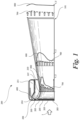
- FIG. 1 illustrates a cross-section of the upper half of an ejector 200 that may be attached to a vehicle (not shown), such as, for non-limiting examples, a UAV or a manned aerial vehicle, such as an airplane.
- a duct such as plenum 211, is supplied with hotter-than-ambient air (i.e. , a pressurized motive gas stream) from, for example, a combustion-based engine that may be employed by the vehicle.
- This pressurized motive gas stream denoted by arrow 600, is introduced via at least one conduit, such as primary nozzles 203, to the interior of the ejector 200.
- the primary nozzles 203 are configured to accelerate the motive fluid stream 600 to a variable predetermined desired velocity directly over a convex Coanda surface 204 as a wall jet. Additionally, primary nozzles 203 provide adjustable volumes of fluid stream 600. This wall jet, in turn, serves to entrain through an intake structure 206 secondary fluid, such as ambient air denoted by arrow 1, that may be at rest or approaching the ejector 200 at non-zero speed from the direction indicated by arrow 1. In various embodiments, the nozzles 203 may be arranged in an array and in a curved orientation, a spiraled orientation, and/or a zigzagged orientation.
- the mix of the stream 600 and the air 1 may be moving purely axially at a throat section 225 of the ejector 200.
- a diffusing structure such as diffuser 210
- the mixing and smoothing out process continues so the profiles of temperature (800) and velocity (700) in the axial direction of ejector 200 no longer have the high and low values present at the throat section 225, but become more uniform at the terminal end 100 of diffuser 210.
- the temperature and velocity profiles are almost uniform.
- the temperature of the mixture is low enough to be directed towards an airfoil such as a wing or control surface.
- V-shaped, vortex generating secondary nozzles 205 are staggered when compared to a normal rectangular primary nozzle 203 and injecting at least 25% of the total fluid stream 600 before the balance of the fluid stream massflow is injected at a moment later by nozzles 203.
- This injection by nozzles 205 prior to that of nozzles 203 results in a higher entrainment rate enough to significantly increase the performance of the ejector 200.
- Secondary nozzles 205 introduce a more-favorable entrainment of the secondary flow via shear layers and are staggered both axially and circumferentially in relation to the primary nozzles 203.
- Primary nozzles 203 include an airfoil, such as a delta-wing structure 226, that is provided with a supporting leg 227 connected to the middle point of the primary nozzle 203 structure at its innermost side, with a delta-wing structure apex pointing against the fluid stream 600 flow to maximize entrainment. This in turn generates two vortices opposed in direction towards the center of the delta wing 226 and strongly entraining from both sides of primary nozzle 203 the already entrained mixture of primary and secondary fluid flows resulting from nozzles 205.
- Supporting leg 227 may, in an embodiment, serve as an actuating element capable of causing structure 226 to vibrate.
- an embodiment improves the surface for flow separation delay via elements such as dimples 221 placed on the Coanda surface 204.
- the dimples 221 prevent separation of the flow and enhance the performance of the ejector 200 significantly.
- surfaces of the diffuser 210 may also include dimples 222 and/or other elements that delay or prevent separation of the boundary layer.
- thermophoresis in which a cold fluid is made available to cool off surface 204 where the separation propensity at high speeds is greater. By cooling off several regions of the surface 204, the hot motive fluid is diverted towards the cold portion of surface 204 through the force of thermophoresis.
- bleed air from the compressor discharge of a jet engine acting as a gas generator is routed towards an internal channel system (not shown) of ejector 200 that allows the cooling of hot spots where separation occurs.
- a typical difference in temperature goes from 100 F uncooled to 500F (hot stream temperature of a nozzle 203 is 1200 and wall temperature is brought down to 700F).
- Another approach may employ electrophoresis in which elements (not shown) embedded into surface 204 generate a local field that enhances fluid attachment and delays or eliminates separation.
- the current source for such elements can be provided by a battery or a generator coupled with the main gas generator of the vehicle.
- Another approach may employ plasma in a manner similar to electrophoresis as in the use of electric fields, albeit in this case acting at high altitudes where plasma generation is less energy-intensive. Specially placed elements (not shown) may enhance attachment and eliminate separation.
- Yet another approach may mechanically reduce or enlarge the height of the nozzles 203.
- By reducing the wall height it is possible to increase local velocity. Such may be achieved by curving the inlet portion of the individual channels where the hot flow is guided from the plenum to the nozzles 203 and manipulating the flow in that manner.
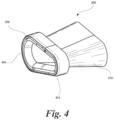
- intake structure 206 may be circular in configuration. However, in varying embodiments, and as best shown in FIGS. 3-4 , intake structure 206 can be non-circular and, indeed, asymmetrical (i.e., not identical on both sides of at least one, or alternatively any-given, plane bisecting the intake structure).
- the intake structure 206 can include first and second opposing edges 301, 302, wherein the second opposing edge includes a curved portion projecting toward the first opposing edge.
- the intake structure 206 can include first and second lateral opposing edges 401, 402, wherein the first lateral opposing edge has a greater radius of curvature than the second lateral opposing edge.
Landscapes
- Engineering & Computer Science (AREA)
- Aviation & Aerospace Engineering (AREA)
- Chemical & Material Sciences (AREA)
- Combustion & Propulsion (AREA)
- Mechanical Engineering (AREA)
- General Engineering & Computer Science (AREA)
- Jet Pumps And Other Pumps (AREA)
Claims (8)
- Ejektorsystem (200) zum Antreiben eines Fahrzeugs, das System umfassend:eine Diffusionsstruktur (210);einen Kanal (211), der mit der Diffusionsstruktur (210) gekoppelt ist, der Kanal (211) umfassend eine Wand, die darin ausgebildete Öffnungen (203) aufweist, wobei die Öffnungen (203) konfiguriert sind, um ein Primärfluid, das durch das Fahrzeug erzeugt wird, in die Diffusionsstruktur (210) einzuführen; unddadurch gekennzeichnet, dass jede Öffnung (203) ein Tragflächenprofil (226) aufweist, das innerhalb der Strömung des Primärfluids durch die Öffnung (203) positioniert ist.
- System nach Anspruch 1, ferner umfassend eine Einlassstruktur (206), die mit der Diffusionsstruktur (210) gekoppelt ist und konfiguriert ist, um ein Sekundärfluid, das für das Fahrzeug zugänglich ist, in die Diffusionsstruktur (210) einzuführen, wobei die Diffusionsstruktur (210) eine Auslassstruktur umfasst, aus der Antriebsfluid mit einer zuvor bestimmten, einstellbaren Geschwindigkeit strömt, und das Antriebsfluid das Primär- und das Sekundärfluid umfasst.
- System nach Anspruch 1, wobei der Ejektor (200) ferner eine konvexe Oberfläche (204) umfasst, die Diffusionsstruktur (210) mit der konvexen Oberfläche (204) gekoppelt ist und der Kanal (211) mit der konvexen Oberfläche (204) gekoppelt und konfiguriert ist, um das Primärfluid durch die Öffnungen in die konvexe Oberfläche (204) einzuführen.
- System nach Anspruch 1, wobei das Tragflächenprofil (226) dreieckig ist.
- System nach Anspruch 3, wobei die konvexe Oberfläche (204) eine Vielzahl von Vertiefungen einschließt.
- System nach Anspruch 1, ferner umfassend ein Betätigungselement, das mit dem Tragflächenprofil (226) gekoppelt ist und konfiguriert ist, um eine Schwingung des Tragflächenprofils (226) auszulösen.
- System nach Anspruch 2, wobei die Einlassstruktur (206) asymmetrisch ist.
- Fahrzeug, umfassend:einen Hauptkörper;einen Gasgenerator, der mit dem Hauptkörper gekoppelt ist und einen Gasstrom erzeugt; undein Ejektorsystem (200) nach einem der Ansprüche 1 bis 7, wobei:die Diffusionsstruktur (210) des Ejektorsystems (200) mit dem Hauptkörper gekoppelt ist;der Kanal (211) des Ejektorsystems (200) mit dem Gasgenerator gekoppelt ist.
Priority Applications (1)
| Application Number | Priority Date | Filing Date | Title |
|---|---|---|---|
| EP25151184.6A EP4563806A3 (de) | 2017-06-16 | 2018-06-15 | Wingletejektorkonfigurationen |
Applications Claiming Priority (2)
| Application Number | Priority Date | Filing Date | Title |
|---|---|---|---|
| US15/625,907 US20170283080A1 (en) | 2015-09-02 | 2017-06-16 | Winglet ejector configurations |
| PCT/US2018/037902 WO2018232340A1 (en) | 2017-06-16 | 2018-06-15 | Winglet ejector configurations |
Related Child Applications (1)
| Application Number | Title | Priority Date | Filing Date |
|---|---|---|---|
| EP25151184.6A Division EP4563806A3 (de) | 2017-06-16 | 2018-06-15 | Wingletejektorkonfigurationen |
Publications (3)
| Publication Number | Publication Date |
|---|---|
| EP3638587A1 EP3638587A1 (de) | 2020-04-22 |
| EP3638587A4 EP3638587A4 (de) | 2021-03-24 |
| EP3638587B1 true EP3638587B1 (de) | 2025-01-15 |
Family
ID=64660749
Family Applications (2)
| Application Number | Title | Priority Date | Filing Date |
|---|---|---|---|
| EP18817815.6A Active EP3638587B1 (de) | 2017-06-16 | 2018-06-15 | Wingletejektorkonfigurationen |
| EP25151184.6A Pending EP4563806A3 (de) | 2017-06-16 | 2018-06-15 | Wingletejektorkonfigurationen |
Family Applications After (1)
| Application Number | Title | Priority Date | Filing Date |
|---|---|---|---|
| EP25151184.6A Pending EP4563806A3 (de) | 2017-06-16 | 2018-06-15 | Wingletejektorkonfigurationen |
Country Status (10)
| Country | Link |
|---|---|
| EP (2) | EP3638587B1 (de) |
| JP (1) | JP7217272B2 (de) |
| KR (1) | KR20200056978A (de) |
| CN (2) | CN111655580B (de) |
| BR (1) | BR112019026384B8 (de) |
| CA (1) | CA3067346A1 (de) |
| ES (1) | ES3022937T3 (de) |
| IL (2) | IL315640A (de) |
| MY (1) | MY204828A (de) |
| WO (1) | WO2018232340A1 (de) |
Families Citing this family (1)
| Publication number | Priority date | Publication date | Assignee | Title |
|---|---|---|---|---|
| CN111577657B (zh) * | 2020-04-29 | 2021-10-29 | 南京工业大学 | 带有无源自激励扫掠射流流动控制装置的压气机叶片 |
Family Cites Families (20)
| Publication number | Priority date | Publication date | Assignee | Title |
|---|---|---|---|---|
| US2052869A (en) | 1934-10-08 | 1936-09-01 | Coanda Henri | Device for deflecting a stream of elastic fluid projected into an elastic fluid |
| GB844748A (en) * | 1956-01-11 | 1960-08-17 | English Electric Co Ltd | Improvements in and relating to aircraft wings incorporating a power installation for propulsion |
| US3525474A (en) * | 1968-12-09 | 1970-08-25 | Us Air Force | Jet pump or thrust augmentor |
| US3591087A (en) | 1969-05-08 | 1971-07-06 | Rohr Corp | Apparatus for augmenting the thrust of an aircraft jet engine |
| US3819134A (en) * | 1972-11-30 | 1974-06-25 | Rockwell International Corp | Aircraft system lift ejector |
| JPS5349612A (en) * | 1976-10-14 | 1978-05-06 | Petorobuichi Subuisuc Georugii | Ejector engine thrust increase device |
| DK140426B (da) * | 1976-11-01 | 1979-08-27 | Arborg O J M | Fremdriftsdyse til transportmidler i luft eller vand. |
| CA1100463A (en) * | 1978-11-22 | 1981-05-05 | Frederick L. Gilbertson | Nozzle structure with notches |
| US4413782A (en) * | 1980-12-18 | 1983-11-08 | The United States Of America As Represented By The Secretary Of The Navy | Jet excitation by an oscillating vane |
| US4448354A (en) * | 1982-07-23 | 1984-05-15 | The United States Of America As Represented By The Secretary Of The Air Force | Axisymmetric thrust augmenting ejector with discrete primary air slot nozzles |
| US4815942A (en) * | 1982-10-25 | 1989-03-28 | Elayne P. Alperin | Axially-symmetric, jet-diffuser ejector |
| US4666104A (en) | 1985-07-22 | 1987-05-19 | Kelber Charles C | Combination lift thrust device |
| JP3525527B2 (ja) * | 1994-12-21 | 2004-05-10 | 石川島播磨重工業株式会社 | 航空機エンジンのローブミキサ |
| US20060059891A1 (en) * | 2004-09-23 | 2006-03-23 | Honeywell International, Inc. | Quiet chevron/tab exhaust eductor system |
| US7686257B2 (en) | 2005-05-23 | 2010-03-30 | Lockheed Martin Corporation | Dual bimorph synthetic pulsator |
| US7937945B2 (en) * | 2006-10-27 | 2011-05-10 | Kinde Sr Ronald August | Combining a series of more efficient engines into a unit, or modular units |
| US20160152324A1 (en) | 2013-04-01 | 2016-06-02 | California Institute Of Technology | Fluidic fence for performance enhancement |
| US9587585B1 (en) * | 2013-04-30 | 2017-03-07 | The United States Of America As Represented By The Secretary Of The Air Force | Augmented propulsion system with boundary layer suction and wake blowing |
| CA2996285C (en) | 2015-09-02 | 2023-10-31 | Jetoptera, Inc. | Ejector and airfoil configurations |
| US20170283080A1 (en) * | 2015-09-02 | 2017-10-05 | Jetoptera, Inc. | Winglet ejector configurations |
-
2018
- 2018-06-15 CA CA3067346A patent/CA3067346A1/en active Pending
- 2018-06-15 CN CN201880047603.3A patent/CN111655580B/zh active Active
- 2018-06-15 MY MYPI2019007491A patent/MY204828A/en unknown
- 2018-06-15 KR KR1020207001412A patent/KR20200056978A/ko not_active Ceased
- 2018-06-15 ES ES18817815T patent/ES3022937T3/es active Active
- 2018-06-15 BR BR112019026384A patent/BR112019026384B8/pt active IP Right Grant
- 2018-06-15 EP EP18817815.6A patent/EP3638587B1/de active Active
- 2018-06-15 WO PCT/US2018/037902 patent/WO2018232340A1/en not_active Ceased
- 2018-06-15 IL IL315640A patent/IL315640A/en unknown
- 2018-06-15 CN CN202410029899.3A patent/CN118205703A/zh active Pending
- 2018-06-15 EP EP25151184.6A patent/EP4563806A3/de active Pending
- 2018-06-15 IL IL271437A patent/IL271437B2/en unknown
- 2018-06-15 JP JP2020519014A patent/JP7217272B2/ja active Active
Also Published As
| Publication number | Publication date |
|---|---|
| BR112019026384B8 (pt) | 2024-02-06 |
| EP3638587A1 (de) | 2020-04-22 |
| ES3022937T3 (en) | 2025-05-29 |
| JP7217272B2 (ja) | 2023-02-02 |
| WO2018232340A1 (en) | 2018-12-20 |
| EP4563806A3 (de) | 2025-07-30 |
| EP3638587A4 (de) | 2021-03-24 |
| BR112019026384A2 (pt) | 2020-07-21 |
| JP2020524116A (ja) | 2020-08-13 |
| KR20200056978A (ko) | 2020-05-25 |
| IL315640A (en) | 2024-11-01 |
| CN111655580B (zh) | 2024-01-16 |
| CN111655580A (zh) | 2020-09-11 |
| MY204828A (en) | 2024-09-18 |
| BR112019026384B1 (pt) | 2023-12-12 |
| IL271437A (en) | 2020-01-30 |
| CN118205703A (zh) | 2024-06-18 |
| IL271437B2 (en) | 2025-02-01 |
| IL271437B1 (en) | 2024-10-01 |
| EP4563806A2 (de) | 2025-06-04 |
| CA3067346A1 (en) | 2018-12-20 |
Similar Documents
| Publication | Publication Date | Title |
|---|---|---|
| US12565327B2 (en) | Ejector and airfoil configurations | |
| US11053012B2 (en) | Winglet ejector configurations | |
| EP3638587B1 (de) | Wingletejektorkonfigurationen | |
| HK1256577B (en) | Fluidic propulsive system |
Legal Events
| Date | Code | Title | Description |
|---|---|---|---|
| STAA | Information on the status of an ep patent application or granted ep patent |
Free format text: STATUS: THE INTERNATIONAL PUBLICATION HAS BEEN MADE |
|
| PUAI | Public reference made under article 153(3) epc to a published international application that has entered the european phase |
Free format text: ORIGINAL CODE: 0009012 |
|
| STAA | Information on the status of an ep patent application or granted ep patent |
Free format text: STATUS: REQUEST FOR EXAMINATION WAS MADE |
|
| 17P | Request for examination filed |
Effective date: 20200114 |
|
| AK | Designated contracting states |
Kind code of ref document: A1 Designated state(s): AL AT BE BG CH CY CZ DE DK EE ES FI FR GB GR HR HU IE IS IT LI LT LU LV MC MK MT NL NO PL PT RO RS SE SI SK SM TR |
|
| AX | Request for extension of the european patent |
Extension state: BA ME |
|
| DAV | Request for validation of the european patent (deleted) | ||
| DAX | Request for extension of the european patent (deleted) | ||
| A4 | Supplementary search report drawn up and despatched |
Effective date: 20210219 |
|
| RIC1 | Information provided on ipc code assigned before grant |
Ipc: F02K 1/36 20060101ALI20210215BHEP Ipc: B64D 33/04 20060101AFI20210215BHEP |
|
| STAA | Information on the status of an ep patent application or granted ep patent |
Free format text: STATUS: EXAMINATION IS IN PROGRESS |
|
| 17Q | First examination report despatched |
Effective date: 20230721 |
|
| GRAP | Despatch of communication of intention to grant a patent |
Free format text: ORIGINAL CODE: EPIDOSNIGR1 |
|
| STAA | Information on the status of an ep patent application or granted ep patent |
Free format text: STATUS: GRANT OF PATENT IS INTENDED |
|
| INTG | Intention to grant announced |
Effective date: 20240816 |
|
| GRAS | Grant fee paid |
Free format text: ORIGINAL CODE: EPIDOSNIGR3 |
|
| GRAA | (expected) grant |
Free format text: ORIGINAL CODE: 0009210 |
|
| STAA | Information on the status of an ep patent application or granted ep patent |
Free format text: STATUS: THE PATENT HAS BEEN GRANTED |
|
| AK | Designated contracting states |
Kind code of ref document: B1 Designated state(s): AL AT BE BG CH CY CZ DE DK EE ES FI FR GB GR HR HU IE IS IT LI LT LU LV MC MK MT NL NO PL PT RO RS SE SI SK SM TR |
|
| REG | Reference to a national code |
Ref country code: CH Ref legal event code: EP Ref country code: GB Ref legal event code: FG4D |
|
| REG | Reference to a national code |
Ref country code: DE Ref legal event code: R096 Ref document number: 602018078551 Country of ref document: DE |
|
| REG | Reference to a national code |
Ref country code: IE Ref legal event code: FG4D |
|
| P01 | Opt-out of the competence of the unified patent court (upc) registered |
Free format text: CASE NUMBER: APP_13122/2025 Effective date: 20250317 |
|
| REG | Reference to a national code |
Ref country code: NL Ref legal event code: MP Effective date: 20250115 |
|
| REG | Reference to a national code |
Ref country code: ES Ref legal event code: FG2A Ref document number: 3022937 Country of ref document: ES Kind code of ref document: T3 Effective date: 20250529 |
|
| PG25 | Lapsed in a contracting state [announced via postgrant information from national office to epo] |
Ref country code: NL Free format text: LAPSE BECAUSE OF FAILURE TO SUBMIT A TRANSLATION OF THE DESCRIPTION OR TO PAY THE FEE WITHIN THE PRESCRIBED TIME-LIMIT Effective date: 20250115 |
|
| PG25 | Lapsed in a contracting state [announced via postgrant information from national office to epo] |
Ref country code: RS Free format text: LAPSE BECAUSE OF FAILURE TO SUBMIT A TRANSLATION OF THE DESCRIPTION OR TO PAY THE FEE WITHIN THE PRESCRIBED TIME-LIMIT Effective date: 20250415 |
|
| PG25 | Lapsed in a contracting state [announced via postgrant information from national office to epo] |
Ref country code: FI Free format text: LAPSE BECAUSE OF FAILURE TO SUBMIT A TRANSLATION OF THE DESCRIPTION OR TO PAY THE FEE WITHIN THE PRESCRIBED TIME-LIMIT Effective date: 20250115 |
|
| PG25 | Lapsed in a contracting state [announced via postgrant information from national office to epo] |
Ref country code: PL Free format text: LAPSE BECAUSE OF FAILURE TO SUBMIT A TRANSLATION OF THE DESCRIPTION OR TO PAY THE FEE WITHIN THE PRESCRIBED TIME-LIMIT Effective date: 20250115 |
|
| PGFP | Annual fee paid to national office [announced via postgrant information from national office to epo] |
Ref country code: DE Payment date: 20250626 Year of fee payment: 8 |
|
| REG | Reference to a national code |
Ref country code: LT Ref legal event code: MG9D |
|
| PG25 | Lapsed in a contracting state [announced via postgrant information from national office to epo] |
Ref country code: NO Free format text: LAPSE BECAUSE OF FAILURE TO SUBMIT A TRANSLATION OF THE DESCRIPTION OR TO PAY THE FEE WITHIN THE PRESCRIBED TIME-LIMIT Effective date: 20250415 Ref country code: IS Free format text: LAPSE BECAUSE OF FAILURE TO SUBMIT A TRANSLATION OF THE DESCRIPTION OR TO PAY THE FEE WITHIN THE PRESCRIBED TIME-LIMIT Effective date: 20250515 |
|
| REG | Reference to a national code |
Ref country code: AT Ref legal event code: MK05 Ref document number: 1759727 Country of ref document: AT Kind code of ref document: T Effective date: 20250115 |
|
| PG25 | Lapsed in a contracting state [announced via postgrant information from national office to epo] |
Ref country code: HR Free format text: LAPSE BECAUSE OF FAILURE TO SUBMIT A TRANSLATION OF THE DESCRIPTION OR TO PAY THE FEE WITHIN THE PRESCRIBED TIME-LIMIT Effective date: 20250115 |
|
| PG25 | Lapsed in a contracting state [announced via postgrant information from national office to epo] |
Ref country code: LV Free format text: LAPSE BECAUSE OF FAILURE TO SUBMIT A TRANSLATION OF THE DESCRIPTION OR TO PAY THE FEE WITHIN THE PRESCRIBED TIME-LIMIT Effective date: 20250115 Ref country code: PT Free format text: LAPSE BECAUSE OF FAILURE TO SUBMIT A TRANSLATION OF THE DESCRIPTION OR TO PAY THE FEE WITHIN THE PRESCRIBED TIME-LIMIT Effective date: 20250515 |
|
| PGFP | Annual fee paid to national office [announced via postgrant information from national office to epo] |
Ref country code: FR Payment date: 20250624 Year of fee payment: 8 |
|
| PG25 | Lapsed in a contracting state [announced via postgrant information from national office to epo] |
Ref country code: GR Free format text: LAPSE BECAUSE OF FAILURE TO SUBMIT A TRANSLATION OF THE DESCRIPTION OR TO PAY THE FEE WITHIN THE PRESCRIBED TIME-LIMIT Effective date: 20250416 Ref country code: BG Free format text: LAPSE BECAUSE OF FAILURE TO SUBMIT A TRANSLATION OF THE DESCRIPTION OR TO PAY THE FEE WITHIN THE PRESCRIBED TIME-LIMIT Effective date: 20250115 |
|
| PG25 | Lapsed in a contracting state [announced via postgrant information from national office to epo] |
Ref country code: AT Free format text: LAPSE BECAUSE OF FAILURE TO SUBMIT A TRANSLATION OF THE DESCRIPTION OR TO PAY THE FEE WITHIN THE PRESCRIBED TIME-LIMIT Effective date: 20250115 |
|
| PG25 | Lapsed in a contracting state [announced via postgrant information from national office to epo] |
Ref country code: SE Free format text: LAPSE BECAUSE OF FAILURE TO SUBMIT A TRANSLATION OF THE DESCRIPTION OR TO PAY THE FEE WITHIN THE PRESCRIBED TIME-LIMIT Effective date: 20250115 |
|
| PG25 | Lapsed in a contracting state [announced via postgrant information from national office to epo] |
Ref country code: SM Free format text: LAPSE BECAUSE OF FAILURE TO SUBMIT A TRANSLATION OF THE DESCRIPTION OR TO PAY THE FEE WITHIN THE PRESCRIBED TIME-LIMIT Effective date: 20250115 |
|
| PGFP | Annual fee paid to national office [announced via postgrant information from national office to epo] |
Ref country code: ES Payment date: 20250710 Year of fee payment: 8 |
|
| PG25 | Lapsed in a contracting state [announced via postgrant information from national office to epo] |
Ref country code: DK Free format text: LAPSE BECAUSE OF FAILURE TO SUBMIT A TRANSLATION OF THE DESCRIPTION OR TO PAY THE FEE WITHIN THE PRESCRIBED TIME-LIMIT Effective date: 20250115 |
|
| PGFP | Annual fee paid to national office [announced via postgrant information from national office to epo] |
Ref country code: IT Payment date: 20250623 Year of fee payment: 8 |
|
| PGFP | Annual fee paid to national office [announced via postgrant information from national office to epo] |
Ref country code: GB Payment date: 20250729 Year of fee payment: 8 |
|
| REG | Reference to a national code |
Ref country code: DE Ref legal event code: R097 Ref document number: 602018078551 Country of ref document: DE |
|
| PG25 | Lapsed in a contracting state [announced via postgrant information from national office to epo] |
Ref country code: EE Free format text: LAPSE BECAUSE OF FAILURE TO SUBMIT A TRANSLATION OF THE DESCRIPTION OR TO PAY THE FEE WITHIN THE PRESCRIBED TIME-LIMIT Effective date: 20250115 Ref country code: CZ Free format text: LAPSE BECAUSE OF FAILURE TO SUBMIT A TRANSLATION OF THE DESCRIPTION OR TO PAY THE FEE WITHIN THE PRESCRIBED TIME-LIMIT Effective date: 20250115 |
|
| PG25 | Lapsed in a contracting state [announced via postgrant information from national office to epo] |
Ref country code: RO Free format text: LAPSE BECAUSE OF FAILURE TO SUBMIT A TRANSLATION OF THE DESCRIPTION OR TO PAY THE FEE WITHIN THE PRESCRIBED TIME-LIMIT Effective date: 20250115 |
|
| PG25 | Lapsed in a contracting state [announced via postgrant information from national office to epo] |
Ref country code: SK Free format text: LAPSE BECAUSE OF FAILURE TO SUBMIT A TRANSLATION OF THE DESCRIPTION OR TO PAY THE FEE WITHIN THE PRESCRIBED TIME-LIMIT Effective date: 20250115 |
|
| PLBE | No opposition filed within time limit |
Free format text: ORIGINAL CODE: 0009261 |
|
| STAA | Information on the status of an ep patent application or granted ep patent |
Free format text: STATUS: NO OPPOSITION FILED WITHIN TIME LIMIT |
|
| REG | Reference to a national code |
Ref country code: CH Ref legal event code: L10 Free format text: ST27 STATUS EVENT CODE: U-0-0-L10-L00 (AS PROVIDED BY THE NATIONAL OFFICE) Effective date: 20251126 |
|
| 26N | No opposition filed |
Effective date: 20251016 |
|
| REG | Reference to a national code |
Ref country code: CH Ref legal event code: H13 Free format text: ST27 STATUS EVENT CODE: U-0-0-H10-H13 (AS PROVIDED BY THE NATIONAL OFFICE) Effective date: 20260127 |
|
| PG25 | Lapsed in a contracting state [announced via postgrant information from national office to epo] |
Ref country code: MC Free format text: LAPSE BECAUSE OF FAILURE TO SUBMIT A TRANSLATION OF THE DESCRIPTION OR TO PAY THE FEE WITHIN THE PRESCRIBED TIME-LIMIT Effective date: 20250115 |
|
| PG25 | Lapsed in a contracting state [announced via postgrant information from national office to epo] |
Ref country code: LU Free format text: LAPSE BECAUSE OF NON-PAYMENT OF DUE FEES Effective date: 20250615 |
|
| REG | Reference to a national code |
Ref country code: BE Ref legal event code: MM Effective date: 20250630 |