EP3637686B1 - Verfahren zur erfassung einer standardkonfigurationsvorlage einer netzwerkvorrichtung und rechenvorrichtung - Google Patents
Verfahren zur erfassung einer standardkonfigurationsvorlage einer netzwerkvorrichtung und rechenvorrichtung Download PDFInfo
- Publication number
- EP3637686B1 EP3637686B1 EP18806298.8A EP18806298A EP3637686B1 EP 3637686 B1 EP3637686 B1 EP 3637686B1 EP 18806298 A EP18806298 A EP 18806298A EP 3637686 B1 EP3637686 B1 EP 3637686B1
- Authority
- EP
- European Patent Office
- Prior art keywords
- command
- command template
- template
- correlation
- network device
- Prior art date
- Legal status (The legal status is an assumption and is not a legal conclusion. Google has not performed a legal analysis and makes no representation as to the accuracy of the status listed.)
- Active
Links
Images




Classifications
-
- H—ELECTRICITY
- H04—ELECTRIC COMMUNICATION TECHNIQUE
- H04L—TRANSMISSION OF DIGITAL INFORMATION, e.g. TELEGRAPHIC COMMUNICATION
- H04L41/00—Arrangements for maintenance, administration or management of data switching networks, e.g. of packet switching networks
- H04L41/08—Configuration management of networks or network elements
- H04L41/0803—Configuration setting
- H04L41/084—Configuration by using pre-existing information, e.g. using templates or copying from other elements
- H04L41/0843—Configuration by using pre-existing information, e.g. using templates or copying from other elements based on generic templates
-
- G—PHYSICS
- G06—COMPUTING OR CALCULATING; COUNTING
- G06F—ELECTRIC DIGITAL DATA PROCESSING
- G06F18/00—Pattern recognition
- G06F18/20—Analysing
- G06F18/23—Clustering techniques
-
- H—ELECTRICITY
- H04—ELECTRIC COMMUNICATION TECHNIQUE
- H04L—TRANSMISSION OF DIGITAL INFORMATION, e.g. TELEGRAPHIC COMMUNICATION
- H04L41/00—Arrangements for maintenance, administration or management of data switching networks, e.g. of packet switching networks
- H04L41/08—Configuration management of networks or network elements
- H04L41/085—Retrieval of network configuration; Tracking network configuration history
- H04L41/0853—Retrieval of network configuration; Tracking network configuration history by actively collecting configuration information or by backing up configuration information
-
- H—ELECTRICITY
- H04—ELECTRIC COMMUNICATION TECHNIQUE
- H04L—TRANSMISSION OF DIGITAL INFORMATION, e.g. TELEGRAPHIC COMMUNICATION
- H04L41/00—Arrangements for maintenance, administration or management of data switching networks, e.g. of packet switching networks
- H04L41/08—Configuration management of networks or network elements
- H04L41/0866—Checking the configuration
-
- H—ELECTRICITY
- H04—ELECTRIC COMMUNICATION TECHNIQUE
- H04L—TRANSMISSION OF DIGITAL INFORMATION, e.g. TELEGRAPHIC COMMUNICATION
- H04L41/00—Arrangements for maintenance, administration or management of data switching networks, e.g. of packet switching networks
- H04L41/08—Configuration management of networks or network elements
- H04L41/0893—Assignment of logical groups to network elements
-
- H—ELECTRICITY
- H04—ELECTRIC COMMUNICATION TECHNIQUE
- H04L—TRANSMISSION OF DIGITAL INFORMATION, e.g. TELEGRAPHIC COMMUNICATION
- H04L41/00—Arrangements for maintenance, administration or management of data switching networks, e.g. of packet switching networks
- H04L41/08—Configuration management of networks or network elements
- H04L41/0895—Configuration of virtualised networks or elements, e.g. virtualised network function or OpenFlow elements
-
- H—ELECTRICITY
- H04—ELECTRIC COMMUNICATION TECHNIQUE
- H04L—TRANSMISSION OF DIGITAL INFORMATION, e.g. TELEGRAPHIC COMMUNICATION
- H04L41/00—Arrangements for maintenance, administration or management of data switching networks, e.g. of packet switching networks
- H04L41/02—Standardisation; Integration
Definitions
- This application relates to the communications field, and in particular, to a method for obtaining a standard configuration template of a network device, and a computing device.
- a current configuration on a network device is matched with a standard configuration.
- information that the current configuration on the network device is inconsistent with the standard configuration is used as an alarm for a prompt, and then processed by an expert.
- US 2014/0095677A1 presents a configuration command template creation assistant which uses cross-model analysis to identify common syntax and semantics.
- US 2011/0317553 A1 refers to an apparatus and method for dynamic downlink permutation assignment for use in wireless communication systems.
- a method for obtaining a standard configuration template of a network device includes: obtaining, by a computing device, configuration commands of a plurality of network devices, and generating a command template set according to the configuration commands of the plurality of network devices, where the command template set includes a plurality of command templates; generating, by the computing device, a correlation matrix based on the command template set, where the correlation matrix includes a plurality of correlation values, and each correlation value indicates a correlation between one command template in the command template set and one of the plurality of network devices; clustering, by the computing device, the plurality of network devices based on the correlation matrix to obtain at least two categories of network devices, and dividing the correlation matrix into a plurality of submatrixes based on a clustering result, where each submatrix corresponds to one of the at least two categories of network devices, and a correlation value in each submatrix indicates a correlation between a command template in the command template set and a network device of the
- a standard configuration template is generated for each category, thereby avoiding storing, for each device, a standard configuration used for a configuration check, and reducing storage resource consumption.
- the computing device obtains a configuration command of a to-be-detected network device, generates a command template of the to-be-detected network device according to the configuration command of the to-be-detected network device, matches the command template of the to-be-detected network device with a standard configuration template of a category to which the to-be-detected network device belongs, and outputs an error prompt based on a matching result.
- the computing device determines, according to the configuration command of the to-be-detected network device and a standard configuration template of each category, the category to which the to-be-detected network device belongs.
- the to-be-detected network device is one of the plurality of network devices, and the computing device determines, based on the clustering result, the category to which the to-be-detected network device belongs.
- the computing device deletes parameters in the configuration commands to obtain the plurality of command templates.
- the parameters in the configuration commands are deleted, so that a subsequently generated standard configuration template includes no parameter. Therefore, matching is easier in a configuration check performed based on the standard configuration template, and applicability is better.
- a weight of a command template is set, so that accuracy and applicability of the clustering result can be improved.
- a computing device includes an obtaining unit and a processing unit.
- the obtaining unit is configured to obtain configuration commands of a plurality of network devices.
- the processing unit is configured to: generate a command template set according to the configuration commands of the plurality of network devices, and generate a correlation matrix based on the command template set.
- the command template set includes a plurality of command templates
- the correlation matrix includes a plurality of correlation values
- each correlation value indicates a correlation between one command template in the command template set and one of the plurality of network devices.
- the processing unit is further configured to: cluster the plurality of network devices based on the correlation matrix to obtain at least two categories of network devices, and divide the correlation matrix into a plurality of submatrixes based on a clustering result.
- Each submatrix corresponds to one of the at least two categories of network devices, and a correlation value in each submatrix indicates a correlation between a command template in the command template set and a network device of the corresponding category.
- the processing unit is further configured to: perform singular value decomposition on each submatrix to obtain a non-zero singular value, and use, as a standard configuration template of the corresponding category, a command template that is in the command template set and that makes a contribution greater than a threshold to the non-zero singular value.
- the obtaining unit is further configured to obtain a configuration command of a to-be-detected network device; and the processing unit is further configured to: generate a command template of the to-be-detected network device according to the configuration command of the to-be-detected network device, match the command template of the to-be-detected network device with a standard configuration template of a category to which the to-be-detected network device belongs, and output an error prompt based on a matching result.
- the processing unit determines, according to the configuration command of the to-be-detected network device and a standard configuration template of each category, the category to which the to-be-detected network device belongs.
- the to-be-detected network device is one of the plurality of network devices, and the processing unit determines, based on the clustering result, the category to which the to-be-detected network device belongs.
- the processing unit deletes parameters in the configuration commands to obtain the plurality of command templates.
- the parameters in the configuration commands are deleted, so that a subsequently generated standard configuration template includes no parameter. Therefore, matching is easier in a configuration check performed based on the standard configuration template, and applicability is better.
- the correlation matrix is an n ⁇ m matrix, n is a quantity of the plurality of network devices, and m is a quantity of the command templates in the command template set; and a calculation formula of the correlation value is the calculation formula of the correlation value in the first aspect.
- a calculation formula of the singular value decomposition and a calculation formula of the contribution are respectively the calculation formula of the singular value decomposition and the calculation formula of the contribution in the first aspect.
- a computing device includes a network interface and a processor.
- the network interface is configured to obtain configuration commands of a plurality of network devices.
- the processor is configured to: generate a command template set according to the configuration commands of the plurality of network devices, and generate a correlation matrix based on the command template set.
- the command template set includes a plurality of command templates
- the correlation matrix includes a plurality of correlation values
- each correlation value indicates a correlation between one command template in the command template set and one of the plurality of network devices.
- the processor is further configured to: cluster the plurality of network devices based on the correlation matrix to obtain at least two categories of network devices, and divide the correlation matrix into a plurality of submatrixes based on a clustering result.
- Each submatrix corresponds to one of the at least two categories of network devices, and a correlation value in each submatrix indicates a correlation between a command template in the command template set and a network device of the corresponding category.
- the processor is further configured to: perform singular value decomposition on each submatrix to obtain a non-zero singular value, and use, as a standard configuration template of the corresponding category, a command template that is in the command template set and that makes a contribution greater than a threshold to the non-zero singular value.
- the network interface is further configured to obtain a configuration command of a to-be-detected network device; and the processor is further configured to: generate a command template of the to-be-detected network device according to the configuration command of the to-be-detected network device, match the command template of the to-be-detected network device with a standard configuration template of a category to which the to-be-detected network device belongs, and output an error prompt based on a matching result.
- the processor determines, according to the configuration command of the to-be-detected network device and a standard configuration template of each category, the category to which the to-be-detected network device belongs.
- the to-be-detected network device is one of the plurality of network devices, and the processor determines, based on the clustering result, the category to which the to-be-detected network device belongs.
- the processor deletes parameters in the configuration commands to obtain the plurality of command templates.
- the parameters in the configuration commands are deleted, so that a subsequently generated standard configuration template includes no parameter. Therefore, matching is easier in a configuration check performed based on the standard configuration template, and applicability is better.
- the correlation matrix is an n ⁇ m matrix, n is a quantity of the plurality of network devices, and m is a quantity of the command templates in the command template set; and a calculation formula of the correlation value is the calculation formula of the correlation value in the first aspect.
- a calculation formula of the singular value decomposition and a calculation formula of the contribution are respectively the calculation formula of the singular value decomposition and the calculation formula of the contribution in the first aspect.
- a computer readable storage medium stores an instruction.
- the instruction When the instruction is run on a computer, the computer performs the method in the first aspect as the computing device.
- a computer program product including an instruction is provided.
- the instruction When the instruction is run on a computer, the computer performs the method in the first aspect as the computing device.
- FIG. 1 is a schematic diagram of an application scenario according to an embodiment of this application.
- a network shown in FIG 1 includes a plurality of network devices (for example, network devices 103, 104, and 105) and a computing device 101.
- the network devices 103, 104, and 105 may each be a switch or a router.
- the computing device 101 may be connected to the network devices in the network, and obtain configuration information of the network devices.
- the computing device 101 may be, for example, a computer or a mobile terminal.
- the network may further include a database device 102.
- the computing device 101 may store data into the database device 102.
- the database device 102 and the computing device 101 may be a same device, or may be separate devices.
- FIG. 2 is a schematic flowchart of a method for obtaining a standard configuration template of a network device according to an embodiment of this application. The method may be applied to the network shown in FIG 1 , and the method specifically includes the following steps.
- the computing device 101 obtains configuration commands of a plurality of network devices, and generates a command template set according to the configuration commands of the plurality of network devices.
- the plurality of network devices may be, for example, the network device 103, the network device 104, and the network device 105 in FIG 1 .
- the computing device 101 may obtain the configuration commands on the network devices in various manners. For example, the computing device 101 obtains configuration files on the network devices by using the File Transfer Protocol (English: File Transfer Protocol, FTP), and then obtains the configuration commands from the configuration files. For another example, the computing device 101 logs in to the network devices, and directly obtains the configuration commands on the network devices through command exchange. Each configuration command on a network device may be used to configure one function of the network device. Each configuration command may include one or more configuration command lines. FIG 3 shows examples of three configuration commands. The three configuration commands are separated by symbols "#". The three configuration commands each include two configuration command lines.
- a first configuration command is used to establish a virtual private network (English: virtual private network, VPN) instance named "_LOCAL_OAM_VPN_”, and set the VPN instance, to support an Internet Protocol version 4 (English: Internet Protocol version 4, IPv4) address family.
- a second configuration command is used to establish a VPN instance that is named "_dcn_vpn_” and that is dedicated to a data communication network (English: data communication network, DCN), and set the VPN instance, to support an IPv4 address family.
- a third configuration command has a function similar to that of the first configuration command, and is used to establish a VPN instance named "_LOCAL_OAM_VPN2_", and set the VPN instance, to support an IPv4 address family.
- a configuration command includes a command and a parameter.
- "ip vpn-instance ipv4-family" in the first configuration command is a command
- “_LOCAL_OAM_VPN_” is a parameter
- "ip dcn vpn-instance ipv4-family” in the second configuration command is a command
- “_dcn_vpn_” is a parameter
- "ip vpn-instance ipv4-family” in the third configuration command is a command
- “_LOCAL_OAM_VPN2_” is a parameter.
- the computing device 101 may identify the command in the configuration command based on a command dictionary.
- the command dictionary may be manually set.
- a command template includes a command in a configuration command.
- a same command template is obtained after parameters in configuration commands having a same function on network devices are deleted.
- the first configuration command and the third configuration command shown in FIG 3 each are used to establish a VPN instance supporting an IPv4 address family, and a difference lies only in that names (namely, parameters) of established VPN instances are different.
- FIG 4 shows three command templates obtained after parameters in the three configuration commands in FIG 3 are deleted. As shown in FIG 4 , after the parameters are deleted, a first command template and a third command template are the same.
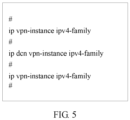
- FIG 5 shows a command template in another format.
- all content of each configuration command that is obtained after a parameter is deleted is arranged in one row to form a command template.
- the computing device 101 deletes parameters in the configuration commands obtained from the plurality of network devices, to obtain a plurality of command templates, and obtains different command templates from the plurality of command templates to generate the command template set.
- the computing device 101 selects one of the plurality of command templates and adds the command template to the command template set.
- the first command template and the third command template in the three command templates shown in FIG 4 are the same, and the command template set generated by the computing device 101 may include the first command template and a second command template. Therefore, the generated command template set includes a plurality of command templates.
- the computing device 101 generates a correlation matrix based on the command template set.
- the computing device 101 calculates a plurality of correlation values based on the command template set, and generates the correlation matrix by using the plurality of correlation values. Each correlation value indicates a correlation between one command template in the command template set and one of the plurality of network devices.
- the correlation matrix is subsequently used for clustering. It is assumed that the computing device 101 obtains configuration commands from n network devices, and a command template set generated according to the configuration commands includes m command templates.
- the correlation matrix is an n ⁇ m matrix. Each of the n devices corresponds to one row of the matrix, and each of the m different command templates corresponds to one column of the matrix.
- w ij represents a correlation value in an i th row and a j th column in the correlation matrix
- tf ij represents a quantity of j th command templates in the command template set that are included in an i th network device
- df j represents a quantity of network devices that are in the n network devices and that include the j th command template.
- ⁇ j represents a weight of the j th command template.
- Types of command templates may include a typical command template, a general command template, and an interfering command template.
- a command included in each command template whose type is the typical command template, a command included in each command template whose type is the general command template, and a command included in each command template whose type is the interfering command template may be set.
- a weight of each type of command template may be set.
- a weight of the typical command template is greater than a weight of the general command template, and the weight of the general command template is greater than a weight of the interfering command template (for example, the weight of the typical command template is 1, the weight of the general command template is 0.1, and the weight of the interfering command template is 0).
- the typical command template is a command template that appears only on some common categories of devices, and a category of a device can be relatively easily identified based on the typical command template.
- the general command template is a command template that appears a relatively large quantity of times on various categories of devices, and it is relatively difficult to identify a category of a device based on the general command template.
- the interfering command template is a rare command template that occasionally appears. A value of df j corresponding to the rare command template is apparently less than values of df j corresponding to the typical command template and the general command template.
- a weight of the rare command template is the same as the weight of the general command template, it indicates that a correlation value (namely, an interfering correlation value) of a correlation between the rare command template and a network device on which the rare command template appears is excessively large. Consequently, when clustering is performed by using a correlation matrix including the interfering correlation value, the network device including the rare command template is separately categorized into a category, rather than categorized into a common category to which the network device belongs (in other words, the rare command template that occasionally appears interferes with categorization of the network device). Therefore, the weight of the rare command template is set to be less than the weight of the general command template.
- the weights of the command templates are set (to improve impact of the typical command template and lower impact of the general command template and the interfering command template), so that accuracy and applicability of a clustering result can be improved, and accuracy of network device categorization based on the clustering result can be improved.
- command templates whose types are the typical command template and the interfering command template may be set.
- a command template whose type is neither the typical command template nor the interfering command template is considered as the general command template.
- the computing device 101 clusters the plurality of network devices based on the correlation matrix to obtain at least two categories of network devices, and divides the correlation matrix into a plurality of submatrixes based on a clustering result.
- the clustering may be performed by using an affinity propagation (English: affinity propagation, AP) clustering algorithm, and by using the correlation matrix as input.
- the AP clustering algorithm is an unsupervised clustering algorithm, and a quantity of categories is determined based on a specified categorization threshold.
- the categorization threshold has a value range from 0 to 1. A smaller categorization threshold indicates fewer categories, and a larger categorization threshold indicates more categories.
- the plurality of network devices are categorized into a plurality of categories (the at least two categories) through clustering.
- a command template on a network device reflects a function of the network device, and devices having same or similar functions are categorized into a same category in the clustering.
- a cell site gateway (English: cell site gateway, CSG) device, an aggregation site gateway (English: aggregation site gateway, ASG) device, and a radio network controller site gateway (English: radio network controller site gateway, RSG) device are included in an Internet Protocol radio access network (English: Internet Protocol radio access network, IPRAN).
- IPRAN Internet Protocol radio access network
- the CSG device, the ASG device, and the RSG device may be categorized into three categories.
- a customer edge (English: customer edge, CE) device, a provider edge (English: provider edge, PE) device, and a provider (English: Provider, P) device are included in a Multiprotocol Label Switching (English: Multiprotocol Label Switching, MPLS) network.
- the PE device, the CE device, and the P device may be categorized three categories.
- the correlation matrix is divided into the plurality of submatrixes based on the clustering result.
- Each submatrix corresponds to one of the at least two categories of network devices, and a correlation value in each submatrix indicates a correlation between a command template in the command template set and a network device of the corresponding category.
- FIG. 6A and FIG. 6B show an example of dividing a 7 ⁇ m correlation matrix 601 into two submatrixes: a 4 ⁇ m submatrix and a 3 ⁇ m submatrix.
- clustering is performed based on the 7 ⁇ m correlation matrix 601 of seven network devices (a network device 1 to a network device 7 are respectively first to seventh network devices), and the seven network devices totally include m different command templates (in other words, a command template set includes the m different command templates, and a command template 1 to a command template m are respectively first to m th different command templates).
- Each correlation value in the correlation matrix 601 indicates a correlation between one command template in the command template set and one of the seven network devices (for example, w 12 indicates a correlation between the command template 2 and the network device 1, and w 61 indicates a correlation between the command template 1 and the network device 6).
- the seven network devices are categorized into two categories of devices through the clustering.
- a first category of devices includes the network device 1, the network device 2, the network device 4, and the network device 5, and a second category of devices includes the network device 3, the network device 6, and the network device 7.
- Row vectors in the correlation matrix 601 that correspond to the first category of devices form a first submatrix 602, and a correlation value in the first submatrix 602 indicates a correlation between a command template in the command template set (including the command template 1 to the command template m) and a device of the first category (for example, w 12 indicates a correlation between the command template 2 and the network device 1, and w 2m indicates a correlation between the command template m and the network device 2).
- Row vectors in the correlation matrix 601 that correspond to the second category of devices form a second submatrix 603, and a correlation value in the second submatrix 603 indicates a correlation between a command template in the command template set (the command template 1 to the command template m) and a device of the second category (for example, w 61 indicates a correlation between the command template 1 and the network device 6, and w 72 indicates a correlation between the command template 2 and the network device 7).
- the computing device 101 performs singular value decomposition (English: Singular Value Decomposition, SVD) on each submatrix to obtain a non-zero singular value, and obtains, as a standard configuration template of a category corresponding to each submatrix, a command template that is in the command template set and that makes a contribution greater than a threshold to the non-zero singular value.
- singular value decomposition English: Singular Value Decomposition, SVD
- M represents a submatrix (for example, the submatrix 602 or the submatrix 603 in FIG 6B ) on which the singular value decomposition is performed.
- U represents an s ⁇ s unitary matrix, and s is a quantity of network devices of a category corresponding to the submatrix M (for example, a quantity of network devices of the first category corresponding to the submatrix 602 in FIG 6B is 4, and a quantity of network devices of the second category corresponding to the submatrix 603 in FIG. 6B is 3).
- ⁇ represents a positive semi-definite s ⁇ m rectangular diagonal matrix (English: rectangular diagonal matrix, where the rectangular diagonal matrix indicates that all elements outside a diagonal in the matrix are zero, and an element on the diagonal in the matrix is an element whose row number and column number are the same in the matrix), ⁇ includes k non-zero singular values that are arranged in descending order along a diagonal starting from a first row, a value of k is equal to a rank of the submatrix M, and all the non-zero singular values in ⁇ are greater than 0.
- V ⁇ represents an m ⁇ m unitary matrix
- V* is a conjugate transpose matrix of V
- U is a 4 ⁇ 4 unitary matrix
- ⁇ is a positive semi-definite 4 ⁇ 5 rectangular diagonal matrix
- V* is a 5 ⁇ 5 unitary matrix.
- the k non-zero singular values may be obtained through the singular value decomposition, and k is the rank of the submatrix M.
- Each non-zero singular value obtained through the singular value decomposition may be decomposed into m contribution values, and a sum of the m contribution values is equal to the non-zero singular value.
- Each of m contribution values obtained by decomposing one non-zero singular value corresponds to one command template. Therefore, the contribution value reflects a contribution that is made by the command template to the non-zero singular value.
- ⁇ p represents a p th non-zero singular value of the non-zero singular values in the matrix ⁇ that is counted to in descending order.
- U p M j V jp represents a sum of the m contribution values, a first contribution value is U p M 1 V 1p , a second contribution value is U p M 2 V 2p , and a j th contribution value is U p M j V jp .
- U p represents a p th row vector in the matrix U.
- M j represents a j th column vector in the submatrix M (each column vector in the submatrix M corresponds to one command template).
- V jp represents an element in a j th row and a p th column in the matrix V
- Each contribution value above corresponds to one command template
- the j th contribution value U p M j V jp corresponds to the j th command template.
- ⁇ 1 is equal to a sum of m contribution values U 1 M 1 V 11 , U 1 M 2 V 21 , ..., and U 1 M m V m1
- U 1 M 1 V 11 corresponds to a first command template
- U 1 M 2 V 21 corresponds to a second command template
- U 1 M m V m1 corresponds to an m th command template.
- U p represents the p th row vector in the matrix U.
- M j represents the j th column vector in the submatrix M.
- V jp represents the element in the j th row and the p th column in the matrix V k represents the quantity of the non-zero singular values in ⁇ .
- ⁇ p represents the p th singular value in the matrix ⁇ .
- a contribution may reflect a typical degree of a command template. A command template with a higher contribution is more suitable to be used as a reference standard for a network device configuration check.
- ⁇ j has a value range of 0 to 1.
- a same threshold (a value range of the threshold is 0 to 1) may be set for categories corresponding to all the submatrixes, to simply complete threshold setting.
- the computing device 101 compares the contribution with the threshold, and uses, as a standard configuration template of the category corresponding to the submatrix M, a command template that is in the command template set and that makes a contribution greater than the threshold. For example, based on the submatrix 602 in FIG 6B , a command template that makes a contribution greater than the threshold is used as a standard configuration template of the first category of devices; based on the submatrix 603 in FIG 6B , a command template that makes a contribution greater than the threshold is used as a standard configuration template of the second category of devices.
- a value of the threshold is related to a quantity of different command templates on the plurality of network devices (in other words, a quantity of command templates in the command template set).
- a larger quantity of different command templates indicates a smaller threshold.
- the threshold may be manually determined.
- the command template 1 and the command template m are used as standard configuration templates of the first category of devices. It is assumed that contributions of the command template 2 and the command template m are greater than the threshold.
- the command template 2 and the command template m are used as standard configuration templates of the second category of devices.
- a standard configuration template may be used as a reference standard for a network device configuration check.
- a difference between the parameters in the configuration commands is shielded by deleting the parameters, so that the clustering can be performed more efficiently, and because the subsequently generated standard configuration template includes no parameter, matching is easier in a configuration check performed based on the standard configuration template, and applicability is better.
- a standard configuration template is generated for each category, thereby avoiding storing, for each device, a standard configuration used for a configuration check, and reducing storage resource consumption.
- the configuration check based on the standard configuration template can be used to replace a configuration check based on a baseline (English: baseline) configuration.
- a baseline is a description of a product attribute that is recognized at a specific time point.
- the baseline configuration may be a set of correct configurations that is designed when a network is established and that each device in the network needs to follow.
- the configuration check based on the baseline configuration if it is found that a configuration command of a device is inconsistent with the baseline configuration, it is considered that the device has a configuration risk, and an error prompt is output.
- a difference between parameters in configuration commands is shielded, thereby avoiding an unnecessary error prompt occurring only because a configuration command has a different parameter.
- an IP address is reassigned in network device upgrade or network expansion, and a configuration command on a network device for IP address configuration is inconsistent with the baseline configuration.
- the "inconsistent" is caused only by an IP address (namely, a parameter in the configuration command for IP address configuration) change, and is not a configuration error.
- shielding the parameter "IP address” helps avoid an unnecessary error prompt in a configuration check.
- the configuration check based on the standard configuration template the standard configuration template is used for matching, so that storage resource consumption can be reduced while a configuration check can be implemented.
- the computing device 101 may store the standard configuration template into a local or remote database.
- the standard configuration template is stored into a local database of the computing device 101.
- the computing device 101 and the database device 102 are two separate devices, the standard configuration template is stored into a remote database (namely, a database on the database device 102).
- the computing device 101 matches a command template of a to-be-detected network device with a standard configuration template of a category to which the to-be-detected network device belongs, and outputs an error prompt based on a matching result.
- the computing device 101 obtains a configuration command of the to-be-detected network device, and generates the command template of the to-be-detected network device according to the configuration command of the to-be-detected network device to perform a configuration check.
- the to-be-detected device is, for example, a network device newly added to a network (for example, a switch or a router newly added to the network) or an existing network device in the network (for example, the network device 103, the network device 104, or the network device 105 shown in FIG 1 ).
- a configuration check on the existing network device in the network an erroneous configuration change on the existing network device in a network running process can be found.
- the computing device 101 may obtain the standard configuration template from the local database or the remote database (for example, the database on the database device 102).
- the computing device 101 may match the command template of the to-be-detected network device with the standard configuration template of each category, to determine the category to which the to-be-detected network device belongs and the result of matching between the command template of the to-be-detected network device and the standard configuration template of a network device of the category to which the to-be-detected network device belongs. For example, a quantity of command templates that are in all command templates of the to-be-detected network device and that have same content as the standard configuration template of each category is determined as a score of each category. A category having a highest score is the category to which the to-be-detected network device belongs.
- command templates of the to-be-detected network device include A, B, and C
- standard configuration templates of a category 1 include A, B, and D
- standard configuration templates of a category 2 include A, B, C, and D.
- a and B can match standard configuration templates A and B of the category 1 (in other words, a score of the category 1 is 2).
- A, B, and C can match standard configuration templates A, B, and C of the category 2 (in other words, a score of the category 2 is 3 and greater than the score of the category 1). Therefore, the category of the to-be-detected network device is the category 2.
- the computing device 101 may alternatively determine, based on the clustering result in S203, the category to which the to-be-detected network device belongs.
- the computing device 101 may store, into the local or remote database, the category to which the existing network device belongs.
- the computing device 101 may match the command template of the to-be-detected network device with the standard configuration template of the category to which the to-be-detected network device belongs, to obtain the matching result.
- the result of matching between the command template of the to-be-detected network device and the standard configuration template of the category to which the to-be-detected network device belongs includes, for example, a first result: all standard configuration templates of the category to which the to-be-detected network device belongs do not include a standard configuration template that exists in the command template of the to-be-detected network device.
- the result of matching between the command template of the to-be-detected network device and the standard configuration template of the category to which the to-be-detected network device belongs includes, for example, a second result: all command templates of the to-be-detected network device do not include a command template that exists in the standard configuration template of the category to which the to-be-detected network device belongs.
- the computing device 101 outputs the error prompt based on the matching result.
- content of the error prompt may include that a standard configuration is missing.
- content of the error prompt may include that an erroneous configuration is suspected to occur.
- the computing device 101 may output the error prompt to a screen, a log, or another device to change the erroneous configuration.
- the computing device 101 may be one device, or may be two separate devices. When the computing device 101 is two separate devices, one of the two separate devices may be configured to perform S201 to S204, and the other may be configured to perform S205.
- FIG 7 is a structural diagram of a computing device 700 according to an embodiment of this application.
- the computing device 700 may be the computing device 101 in the method shown in FIG 2 .
- the computing device 700 includes an obtaining unit 701 and a processing unit 702.
- the obtaining unit 701 is configured to obtain configuration commands of a plurality of network devices (for example, the network device 103, the network device 104, and the network device 105 in FIG 1 ) (for details, refer to the description in S201).
- a plurality of network devices for example, the network device 103, the network device 104, and the network device 105 in FIG 1 .
- the processing unit 702 is configured to: generate a command template set according to the configuration commands of the plurality of network devices, and generate a correlation matrix based on the command template set (for details, refer to the description in S202).
- the command template set includes a plurality of command templates.
- the correlation matrix includes a plurality of correlation values, and each correlation value indicates a correlation between one command template in the command template set and one of the plurality of network devices.
- the processing unit 702 is further configured to: cluster the plurality of network devices based on the correlation matrix to obtain at least two categories of network devices, and divide the correlation matrix into a plurality of submatrixes based on a clustering result (for details, refer to the description in S203).
- Each submatrix corresponds to one of the at least two categories of network devices.
- a correlation value in each submatrix indicates a correlation between a command template in the command template set and a network device of the corresponding category.
- the processing unit 702 is further configured to: perform singular value decomposition on each submatrix to obtain a non-zero singular value, and use, as a standard configuration template of the corresponding category, a command template that is in the command template set and that makes a contribution greater than a threshold to the non-zero singular value (for details, refer to the description in S204).
- the processing unit 702 may store the standard configuration template into a local or remote database (for details, refer to the description in S204).
- the obtaining unit 701 may be further configured to obtain a configuration command of a to-be-detected network device (for details, refer to the description in S205).
- the processing unit 702 may be further configured to: generate a command template of the to-be-detected network device according to the configuration command of the to-be-detected network device, match the command template of the to-be-detected network device with a standard configuration template of a category to which the to-be-detected network device belongs, and output an error prompt based on a matching result (for details, refer to the description in S205).
- the processing unit 702 may delete parameters in the configuration commands to obtain the plurality of command templates (for details, refer to the description in S201).
- the obtaining unit 701 may be one unit, or may be two separate units. When the obtaining unit 701 is two separate units, one of the two separate units may be configured to obtain the configuration commands of the plurality of network devices, and the other may be configured to obtain the configuration command of the to-be-detected network device.
- the processing unit 702 may be one unit, or may be two separate units.
- one of the two separate units may be configured to: generate the command template set according to the configuration commands of the plurality of network devices, generate the correlation matrix based on the command template set, cluster the plurality of network devices based on the correlation matrix to obtain the at least two categories of network devices, divide the correlation matrix into the plurality of submatrixes based on the clustering result, perform singular value decomposition on each submatrix to obtain the non-zero singular value, and use, as the standard configuration template of the corresponding category, the command template that is in the command template set and that makes the contribution greater than the threshold to the non-zero singular value, and may store, after obtaining the standard configuration template of each category, the standard configuration template into the local or remote database.
- the other of the two separate units may be configured to: generate the command template of the to-be-detected network device according to the configuration command of the to-be-detected network device, match the command template of the to-be-detected network device with the standard configuration template of the category to which the to-be-detected network device belongs, and output the error prompt based on the matching result.
- the other of the two separate units may determine, according to the configuration command of the to-be-detected network device and the standard configuration template of each category, the category to which the to-be-detected network device belongs.
- the other of the two separate units may determine, based on the clustering result, the category to which the to-be-detected network device belongs.
- FIG 8 is a structural diagram of a computing device 800 according to an embodiment of this application.
- the computing device 800 may be the computing device 101 in the method shown in FIG 2 .
- the computing device 800 includes a network interface 801 and a processor 802.
- the network interface 801 is configured to obtain configuration commands of a plurality of network devices (for example, the network device 103, the network device 104, and the network device 105 in FIG 1 ) (the computing device 800 may be connected to the network devices through the network interface to obtain the configuration commands, and for details, refer to the description in S201).
- a plurality of network devices for example, the network device 103, the network device 104, and the network device 105 in FIG 1 .
- the processor 802 is configured to: generate a command template set according to the configuration commands of the plurality of network devices, and generate a correlation matrix based on the command template set (for details, refer to the description in S202).
- the command template set includes a plurality of command templates.
- the correlation matrix includes a plurality of correlation values, and each correlation value indicates a correlation between one command template in the command template set and one of the plurality of network devices.
- the processor 802 is further configured to: cluster the plurality of network devices based on the correlation matrix to obtain at least two categories of network devices, and divide the correlation matrix into a plurality of submatrixes based on a clustering result (for details, refer to the description in S203). Each submatrix corresponds to one of the at least two categories of network devices. A correlation value in each submatrix indicates a correlation between a command template in the command template set and a network device of the corresponding category.
- the processor 802 is further configured to: perform singular value decomposition on each submatrix to obtain a non-zero singular value, and use, as a standard configuration template of the corresponding category, a command template that is in the command template set and that makes a contribution greater than a threshold to the non-zero singular value (for details, refer to the description in S204).
- the network interface 801 may be a wired communications interface, a wireless communications interface, or a combination thereof.
- the wired communications interface may be, for example, an Ethernet interface, an asynchronous transfer mode (English: asynchronous transfer mode, ATM) interface, or a packet over SDH/SONET (English: packet over SDH/SONET, POS) interface.
- the wireless communications interface may be, for example, a wireless local area network (wireless local area network, WLAN) interface, a cellular network communications interface, or a combination thereof.
- the processor 802 includes but is not limited to one or more of a central processing unit (English: Central Processing Unit, CPU), a network processor (English: Network Processor, NP), an application-specific integrated circuit (English: Application-Specific Integrated Circuit, ASIC), or a programmable logic device (English: Programmable Logic Device, PLD).
- the PLD may be a complex programmable logic device (English: Complex Programmable Logic Device, CPLD), a field-programmable gate array (English: Field-Programmable Gate Array, FPGA), generic array logic (English: Generic Array Logic, GAL), or any combination thereof.
- the network interface 801 may communicate with the processor 802 by using a bus, or the network interface 801 may be directly connected to the processor 802.
- the network interface 801 may be further configured to obtain a configuration command of a to-be-detected network device (for details, refer to the description in S205).
- the processor 802 may be further configured to: generate a command template of the to-be-detected network device according to the configuration command of the to-be-detected network device, match the command template of the to-be-detected network device with a standard configuration template of a category to which the to-be-detected network device belongs, and output an error prompt based on a matching result (for details, refer to the description in S205).
- the processor 802 may delete parameters in the configuration commands to obtain the plurality of command templates (for details, refer to the description in S201).
- the network interface 801 may be one component, or may be two separate components. When the network interface 801 is two separate components, one of the two separate components may be configured to obtain the configuration commands of the plurality of network devices, and the other may be configured to obtain the configuration command of the to-be-detected network device.
- the processor 802 may be one component, or may be two separate components.
- one of the two separate components may be configured to: generate the command template set according to the configuration commands of the plurality of network devices, generate the correlation matrix based on the command template set, cluster the plurality of network devices based on the correlation matrix to obtain the at least two categories of network devices, divide the correlation matrix into the plurality of submatrixes based on the clustering result, perform singular value decomposition on each submatrix to obtain the non-zero singular value, and use, as the standard configuration template of the corresponding category, the command template that is in the command template set and that makes the contribution greater than the threshold to the non-zero singular value, and may store, after obtaining the standard configuration template of each category, the standard configuration template into the local or remote database.
- the other of the two separate components may be configured to: generate the command template of the to-be-detected network device according to the configuration command of the to-be-detected network device, match the command template of the to-be-detected network device with the standard configuration template of the category to which the to-be-detected network device belongs, and output the error prompt based on the matching result.
- the other of the two separate components may determine, according to the configuration command of the to-be-detected network device and the standard configuration template of each category, the category to which the to-be-detected network device belongs.
- the other of the two separate components may determine, based on the clustering result, the category to which the to-be-detected network device belongs.
- All or some of the foregoing embodiments may be implemented by using software, hardware, firmware, or any combination thereof.
- the embodiments When implemented by using software, the embodiments may be implemented completely or partially in a form of a computer program product.
- the computer program product includes one or more computer instructions.
- the computer may be a general-purpose computer, a dedicated computer, a computer network, or other programmable apparatuses.
- the computer instruction may be stored in a computer-readable storage medium or may be transmitted from a computer-readable storage medium to another computer-readable storage medium.
- the computer instruction may be transmitted from a website, computer, server, or data center to another website, computer, server, or data center in a wired (for example, a coaxial cable, an optical fiber, or a digital subscriber line (DSL)) or wireless (for example, infrared, radio, or microwave) manner.
- the computer-readable storage medium may be any usable medium accessible by a computer, or a data storage device, such as a server or a data center, integrating one or more usable media.
- the usable medium may be a magnetic medium (for example, a floppy disk, a hard disk, or a magnetic tape), an optical medium (for example, a DVD), a semiconductor medium (for example, a solid state disk (SSD)), or the like.
Landscapes
- Engineering & Computer Science (AREA)
- Computer Networks & Wireless Communication (AREA)
- Signal Processing (AREA)
- Data Mining & Analysis (AREA)
- Theoretical Computer Science (AREA)
- Computer Vision & Pattern Recognition (AREA)
- Bioinformatics & Cheminformatics (AREA)
- Bioinformatics & Computational Biology (AREA)
- Artificial Intelligence (AREA)
- Evolutionary Biology (AREA)
- Evolutionary Computation (AREA)
- Physics & Mathematics (AREA)
- General Engineering & Computer Science (AREA)
- General Physics & Mathematics (AREA)
- Life Sciences & Earth Sciences (AREA)
- Data Exchanges In Wide-Area Networks (AREA)
Claims (8)
- Verfahren zum Erlangen einer Standart-Konfigurationsvorlage einer Netzwerkvorrichtung, wobei das Verfahren umfasst:Erlangen (S201), durch eine Berechnungsvorrichtung, von Konfigurationsbefehlen einer Vielzahl von Netzwerkvorrichtungen und Erzeugen einer Befehlsvorlagenmenge gemäß den Konfigurationsbefehlen der Vielzahl von Netzwerkvorrichtungen, wobei die Befehlsvorlagenmenge eine Vielzahl von Befehlsvorlagen umfasst;Erzeugen (S202), durch die Berechnungsvorrichtung, einer Korrelationsmatrix basierend auf der Befehlsvorlagenmenge, wobei die Korrelationsmatrix eine Vielzahl von Korrelationswerten umfasst und jeder Korrelationswert eine Korrelation zwischen einer Befehlsvorlage in der Befehlsvorlagenmenge und einer der Vielzahl von Netzwerkvorrichtungen angibt;Clusterbildung (S203), durch die Berechnungsvorrichtung, der Vielzahl von Netzwerkvorrichtungen basierend auf der Korrelationsmatrix, um mindestens zwei Kategorien von Netzwerkvorrichtungen zu erhalten, und Aufteilen der Korrelationsmatrix in eine Vielzahl von Teilmatrizen basierend auf einem Clusterbildungsergebnis, wobei jede Teilmatrix mit einer der mindestens zwei Kategorien von Netzwerkvorrichtungen korrespondiert und ein Korrelationswert in jeder Teilmatrix eine Korrelation zwischen einer Befehlsvorlage in der Befehlsvorlagenmenge und einer Netzwerkvorrichtung der korrespondierenden Kategorie angibt; undDurchführen (S204), durch die Berechnungsvorrichtung, von Singulärwertzerlegung an jeder Teilmatrix, um einen Singulärwert ungleich null zu erhalten, und Verwenden, als eine Standart-Konfigurationsvorlage der korrespondierenden Kategorie, einer Befehlsvorlage, die in der Befehlsvorlagenmenge ist und die einen Beitrag zu dem Singulärwert ungleich null leistet, der größer als ein Schwellenwert ist.
- Verfahren nach Anspruch 1, wobei das Verfahren ferner umfasst:
Erlangen, durch die Berechnungsvorrichtung, eines Konfigurationsbefehls einer Netzwerkvorrichtung, die detektiert werden soll, Erzeugen einer Befehlsvorlage der Netzwerkvorrichtung, die detektiert werden soll, gemäß dem Konfigurationsbefehl der Netzwerkvorrichtung, die detektiert werden soll, Abgleichen (S205) der Befehlsvorlage der Netzwerkvorrichtung, die detektiert werden soll, mit einer Standart-Konfigurationsvorlage einer Kategorie, zu der die Netzwerkvorrichtung, die detektiert werden soll, gehört, und Ausgeben eines Fehlerhinweises basierend auf einem Abgleichungsergebnis. - Verfahren nach Anspruch 1 oder 2, wobeidie Korrelationsmatrix eine n×m-Matrix ist, n eine Quantität der Vielzahl von Netzwerkvorrichtungen ist und m eine Quantität der Befehlsvorlagen in der Befehlsvorlagenmenge ist; und eine Berechnungsformel des Korrelationswerts wie folgt ist:
 wij einen Korrelationswert in einer i-ten Reihe und einer j-ten Spalte in der Korrelationsmatrix repräsentiert, tfij eine Quantität von j-ten Befehlsvorlagen in der Befehlsvorlagenmenge repräsentiert, die in einer i-ten Netzwerkvorrichtung enthalten sind, dfj eine Quantität von Netzwerkvorrichtungen repräsentiert, die in der Vielzahl von Netzwerkvorrichtungen sind und die die j-te Befehlsvorlage umfassen, und δj ein Gewicht der j-ten Befehlsvorlage repräsentiert.
 - Verfahren nach einem der Ansprüche 1 bis 3, wobeieine Berechnungsformel der Singulärwertzerlegung M = UΣV ∗ ist, wobei M eine Teilmatrix repräsentiert, an der die Singulärwertzerlegung durchgeführt wird, U eine s×s-Einheitsmatrix repräsentiert, s eine Quantität von Netzwerkvorrichtungen einer Kategorie korrespondierend mit der Teilmatrix M ist, Σ eine positive halbdefinite rechtwinkelige s×m-Diagonalmatrix repräsentiert, Singulärwerte ungleich null in Σ in absteigender Reihenfolge entlang einer Diagonalen beginnend von einer ersten Reihe angeordnet sind, V* eine m×m-Einheitsmatrix repräsentiert und V* eine konjugierte Transpositionsmatrix von V ist; und eine Berechnungsformel des Beitrags ρj =
 ρj einen Beitrag der j-ten Befehlsvorlage in der Befehlsvorlagenmenge repräsentiert, Up einen p-ten Reihenvektor in U repräsentiert, Mj einen j-ten Spaltenvektor in M repräsentiert, Vjp ein Element in einer j-ten Reihe und einer p-ten Spalte in V repräsentiert, k eine Quantität der Singulärwerte ungleich null in Σ ist und λp einen p-ten Singulärwert ungleich null der Singulärwerte ungleich null in Σ repräsentiert, bis zu dem in absteigender Reihenfolge gezählt wird.
 - Berechnungsvorrichtung, wobei die Berechnungsvorrichtung umfasst:eine Erlangungseinheit (701), konfiguriert zum Erlangen von Konfigurationsbefehlen einer Vielzahl von Netzwerkvorrichtungen; undeine Verarbeitungseinheit (702), konfiguriert zum: Erzeugen einer Befehlsvorlagenmenge gemäß den Konfigurationsbefehlen der Vielzahl von Netzwerkvorrichtungen und Erzeugen einer Korrelationsmatrix basierend auf der Befehlsvorlagenmenge, wobei die Befehlsvorlagenmenge eine Vielzahl von Befehlsvorlagen umfasst, die Korrelationsmatrix eine Vielzahl von Korrelationswerten umfasst und jeder Korrelationswert eine Korrelation zwischen einer Befehlsvorlage in der Befehlsvorlagenmenge und einer der Vielzahl von Netzwerkvorrichtungen angibt, wobeidie Verarbeitungseinheit (702) ferner konfiguriert ist zum: Clusterbilden der Vielzahl von Netzwerkvorrichtungen basierend auf der Korrelationsmatrix, um mindestens zwei Kategorien von Netzwerkvorrichtungen zu erhalten, und Aufteilen der Korrelationsmatrix in eine Vielzahl von Teilmatrizen basierend auf einem Clusterbildungsergebnis, wobei jede Teilmatrix mit einer der mindestens zwei Kategorien von Netzwerkvorrichtungen korrespondiert und ein Korrelationswert in jeder Teilmatrix eine Korrelation zwischen einer Befehlsvorlage in der Befehlsvorlagenmenge und einer Netzwerkvorrichtung der korrespondierenden Kategorie angibt; unddie Verarbeitungseinheit (702) ferner konfiguriert ist zum: Durchführen von Singulärwertzerlegung an jeder Teilmatrix, um einen Singulärwert ungleich null zu erhalten, und Verwenden, als eine Standart-Konfigurationsvorlage der korrespondierenden Kategorie, einer Befehlsvorlage, die in der Befehlsvorlagenmenge ist und die einen Beitrag zu dem Singulärwert ungleich null leistet, der größer als ein Schwellenwert ist.
- Berechnungsvorrichtung nach Anspruch 5, wobei
die Erlangungseinheit (701) ferner konfiguriert ist zum Erlangen eines Konfigurationsbefehls einer Netzwerkvorrichtung, die detektiert werden soll; und die Verarbeitungseinheit (702) ferner konfiguriert ist zum: Erzeugen einer Befehlsvorlage der Netzwerkvorrichtung, die detektiert werden soll gemäß dem Konfigurationsbefehl der Netzwerkvorrichtung, die detektiert werden soll, Abgleichen der Befehlsvorlage der Netzwerkvorrichtung, die detektiert werden soll, mit einer Standart-Konfigurationsvorlage einer Kategorie, zu der die Netzwerkvorrichtung, die detektiert werden soll, gehört, und Ausgeben eines Fehlerhinweises basierend auf einem Abgleichungsergebnis. - Berechnungsvorrichtung nach Anspruch 5 oder 6, wobeidie Korrelationsmatrix eine n×m-Matrix ist, n eine Quantität der Vielzahl von Netzwerkvorrichtungen ist und m eine Quantität der Befehlsvorlagen in der Befehlsvorlagenmenge ist; und eine Berechnungsformel des Korrelationswerts wie folgt ist:
 wij einen Korrelationswert in einer i-ten Reihe und einer j-ten Spalte in der Korrelationsmatrix repräsentiert, tfij eine Quantität von j-ten Befehlsvorlagen in der Befehlsvorlagenmenge repräsentiert, die in einer i-ten Netzwerkvorrichtung enthalten sind, dfj eine Quantität von Netzwerkvorrichtungen repräsentiert, die in der Vielzahl von Netzwerkvorrichtungen sind und die die j-te Befehlsvorlage umfassen, und δj ein Gewicht der j-ten Befehlsvorlage repräsentiert.
 - Berechnungsvorrichtung nach einem der Ansprüche 5 bis 7, wobeieine Berechnungsformel der Singulärwertzerlegung M = UΣV ∗ ist, wobei M eine Teilmatrix repräsentiert, an der die Singulärwertzerlegung durchgeführt wird, U eine s×s-Einheitsmatrix repräsentiert, s eine Quantität von Netzwerkvorrichtungen einer Kategorie korrespondierend mit der Teilmatrix M ist, Σ eine positive halbdefinite rechtwinkelige s×m-Diagonalmatrix repräsentiert, Singulärwerte ungleich null in Σ in absteigender Reihenfolge entlang einer Diagonalen beginnend von einer ersten Reihe angeordnet sind, V* eine m×m-Einheitsmatrix repräsentiert und V* eine konjugierte Transpositionsmatrix von V ist; und eine Berechnungsformel des Beitrags ρj =
 ρj einen Beitrag der j-ten Befehlsvorlage in der Befehlsvorlagenmenge repräsentiert, Up einen p-ten Reihenvektor in U repräsentiert, Mj einen j-ten Spaltenvektor in M repräsentiert, Vjp ein Element in einer j-ten Reihe und einer p-ten Spalte in V repräsentiert, k eine Quantität der Singulärwerte ungleich null in Σ ist und λp einen p-ten Singulärwert ungleich null der Singulärwerte ungleich null in Σ repräsentiert, bis zu dem in absteigender Reihenfolge gezählt wird.
Applications Claiming Priority (2)
| Application Number | Priority Date | Filing Date | Title |
|---|---|---|---|
| CN201710386893.1A CN108933691B (zh) | 2017-05-26 | 2017-05-26 | 一种获取网络设备标准配置模板的方法和计算设备 |
| PCT/CN2018/084896 WO2018214702A1 (zh) | 2017-05-26 | 2018-04-27 | 一种获取网络设备标准配置模板的方法和计算设备 |
Publications (3)
| Publication Number | Publication Date |
|---|---|
| EP3637686A1 EP3637686A1 (de) | 2020-04-15 |
| EP3637686A4 EP3637686A4 (de) | 2020-05-13 |
| EP3637686B1 true EP3637686B1 (de) | 2023-04-26 |
Family
ID=64395244
Family Applications (1)
| Application Number | Title | Priority Date | Filing Date |
|---|---|---|---|
| EP18806298.8A Active EP3637686B1 (de) | 2017-05-26 | 2018-04-27 | Verfahren zur erfassung einer standardkonfigurationsvorlage einer netzwerkvorrichtung und rechenvorrichtung |
Country Status (4)
| Country | Link |
|---|---|
| US (1) | US10917300B2 (de) |
| EP (1) | EP3637686B1 (de) |
| CN (1) | CN108933691B (de) |
| WO (1) | WO2018214702A1 (de) |
Families Citing this family (3)
| Publication number | Priority date | Publication date | Assignee | Title |
|---|---|---|---|---|
| CN110300017B (zh) * | 2019-05-22 | 2022-07-01 | 北京百度网讯科技有限公司 | 标准配置生成装置及方法和网络设备配置纠错装置及方法 |
| US11463312B2 (en) * | 2021-01-21 | 2022-10-04 | Cisco Technology, Inc. | Secure onboarding of network devices |
| CN115051918B (zh) * | 2021-03-09 | 2024-03-12 | 大唐移动通信设备有限公司 | 网络设备的控制方法、服务器、装置及存储介质 |
Family Cites Families (15)
| Publication number | Priority date | Publication date | Assignee | Title |
|---|---|---|---|---|
| US7054924B1 (en) * | 2000-09-29 | 2006-05-30 | Cisco Technology, Inc. | Method and apparatus for provisioning network devices using instructions in extensible markup language |
| US7249170B2 (en) * | 2000-12-06 | 2007-07-24 | Intelliden | System and method for configuration, management and monitoring of network resources |
| US6978301B2 (en) * | 2000-12-06 | 2005-12-20 | Intelliden | System and method for configuring a network device |
| US20040017585A1 (en) * | 2002-07-29 | 2004-01-29 | Toshiba Tec Kabushiki Kaisha | Output supporting server, output supporting method, and output supporting system |
| US8782182B2 (en) * | 2007-05-24 | 2014-07-15 | Foundry Networks, Llc | Generating device-specific configurations |
| US8255405B2 (en) * | 2009-01-30 | 2012-08-28 | Hewlett-Packard Development Company, L.P. | Term extraction from service description documents |
| US8331302B2 (en) * | 2010-06-23 | 2012-12-11 | Clearwire Ip Holdings Llc | Apparatus and method of dynamic downlink permutation assignment for use in a wireless communication system |
| JP5707239B2 (ja) * | 2011-06-02 | 2015-04-22 | 株式会社日立製作所 | マルチテナント型情報処理システム、管理サーバ及び構成管理方法 |
| US9417892B2 (en) * | 2012-09-28 | 2016-08-16 | International Business Machines Corporation | Configuration command template creation assistant using cross-model analysis to identify common syntax and semantics |
| US9960983B2 (en) * | 2013-05-27 | 2018-05-01 | Hitachi, Ltd. | Monitoring item selection method and device, and storage medium |
| US10700931B2 (en) * | 2014-08-17 | 2020-06-30 | Microsoft Technology Licensing, Llc | Network device configuration framework |
| JP2016192175A (ja) * | 2015-03-31 | 2016-11-10 | 富士通株式会社 | コマンド生成プログラム、コマンド生成方法および情報処理装置 |
| CN105512267A (zh) * | 2015-12-03 | 2016-04-20 | 北京锐安科技有限公司 | 一种配置文件的调整方法和装置 |
| CN105847065B (zh) * | 2016-05-24 | 2019-05-10 | 华为技术有限公司 | 一种网元设备误配置检测方法及检测设备 |
| CN106708969B (zh) * | 2016-12-02 | 2020-01-10 | 山西大学 | 文献资源主题聚类共现潜在语义向量空间模型语义核方法 |
-
2017
- 2017-05-26 CN CN201710386893.1A patent/CN108933691B/zh active Active
-
2018
- 2018-04-27 WO PCT/CN2018/084896 patent/WO2018214702A1/zh not_active Ceased
- 2018-04-27 EP EP18806298.8A patent/EP3637686B1/de active Active
-
2019
- 2019-11-25 US US16/694,160 patent/US10917300B2/en active Active
Also Published As
| Publication number | Publication date |
|---|---|
| WO2018214702A1 (zh) | 2018-11-29 |
| EP3637686A4 (de) | 2020-05-13 |
| CN108933691A (zh) | 2018-12-04 |
| US20200092169A1 (en) | 2020-03-19 |
| CN108933691B (zh) | 2021-09-07 |
| EP3637686A1 (de) | 2020-04-15 |
| US10917300B2 (en) | 2021-02-09 |
Similar Documents
| Publication | Publication Date | Title |
|---|---|---|
| US20230146912A1 (en) | Method, Apparatus, and Computing Device for Constructing Prediction Model, and Storage Medium | |
| WO2018072711A1 (en) | Distributed FP-Growth With Node Table For Large-Scale Association Rule Mining | |
| CN107102941B (zh) | 一种测试用例的生成方法及装置 | |
| US8751417B2 (en) | Trouble pattern creating program and trouble pattern creating apparatus | |
| US20220368706A1 (en) | Attack Behavior Detection Method and Apparatus, and Attack Detection Device | |
| US9537871B2 (en) | Systems and methods for categorizing network traffic content | |
| US20190121926A1 (en) | Graph centrality calculation method and apparatus, and storage medium | |
| EP3528435A1 (de) | Automatisierte konfiguration und datensammlung bei der modellierung von netzwerkvorrichtungen | |
| US20190179615A1 (en) | Community discovery method, device, server and computer storage medium | |
| CN111355697B (zh) | 僵尸网络域名家族的检测方法、装置、设备及存储介质 | |
| US20170111225A1 (en) | Design validation using natural language processing | |
| US10917300B2 (en) | Method for obtaining standard configuration template of network device, and computing device | |
| USRE47933E1 (en) | Reliability estimator for ad hoc applications | |
| US11863439B2 (en) | Method, apparatus and storage medium for application identification | |
| EP2753044A1 (de) | Verfahren und vorrichtung für ressourcenanpassung in der vpc-migration | |
| CN113128213B (zh) | 日志模板提取方法及装置 | |
| CN112291272B (zh) | 网络威胁检测方法、装置、设备及计算机可读存储介质 | |
| US10505963B1 (en) | Anomaly score generation based on adaptive clustering of user location | |
| CN111800290A (zh) | 一种确定根因的方法,系统以及设备 | |
| CN111045848A (zh) | 日志分析方法、终端设备及计算机可读存储介质 | |
| US10057291B1 (en) | Comparing networking access control lists | |
| CN114565105A (zh) | 处理数据的方法和深度学习模型的训练方法、装置 | |
| CN115225543B (zh) | 一种流量预测方法、装置、电子设备和存储介质 | |
| CN107622048B (zh) | 一种文本模式识别方法及系统 | |
| CN120416178A (zh) | 应用特定网络遥测和诊断 |
Legal Events
| Date | Code | Title | Description |
|---|---|---|---|
| STAA | Information on the status of an ep patent application or granted ep patent |
Free format text: STATUS: THE INTERNATIONAL PUBLICATION HAS BEEN MADE |
|
| PUAI | Public reference made under article 153(3) epc to a published international application that has entered the european phase |
Free format text: ORIGINAL CODE: 0009012 |
|
| STAA | Information on the status of an ep patent application or granted ep patent |
Free format text: STATUS: REQUEST FOR EXAMINATION WAS MADE |
|
| 17P | Request for examination filed |
Effective date: 20191209 |
|
| AK | Designated contracting states |
Kind code of ref document: A1 Designated state(s): AL AT BE BG CH CY CZ DE DK EE ES FI FR GB GR HR HU IE IS IT LI LT LU LV MC MK MT NL NO PL PT RO RS SE SI SK SM TR |
|
| AX | Request for extension of the european patent |
Extension state: BA ME |
|
| A4 | Supplementary search report drawn up and despatched |
Effective date: 20200415 |
|
| RIC1 | Information provided on ipc code assigned before grant |
Ipc: H04L 12/24 20060101AFI20200407BHEP |
|
| DAV | Request for validation of the european patent (deleted) | ||
| DAX | Request for extension of the european patent (deleted) | ||
| STAA | Information on the status of an ep patent application or granted ep patent |
Free format text: STATUS: EXAMINATION IS IN PROGRESS |
|
| 17Q | First examination report despatched |
Effective date: 20210514 |
|
| REG | Reference to a national code |
Ref country code: DE Ref legal event code: R079 Ref document number: 602018048944 Country of ref document: DE Free format text: PREVIOUS MAIN CLASS: H04L0012240000 Ipc: H04L0041084000 |
|
| GRAP | Despatch of communication of intention to grant a patent |
Free format text: ORIGINAL CODE: EPIDOSNIGR1 |
|
| STAA | Information on the status of an ep patent application or granted ep patent |
Free format text: STATUS: GRANT OF PATENT IS INTENDED |
|
| RIC1 | Information provided on ipc code assigned before grant |
Ipc: H04L 41/084 20220101AFI20221202BHEP |
|
| INTG | Intention to grant announced |
Effective date: 20221221 |
|
| GRAS | Grant fee paid |
Free format text: ORIGINAL CODE: EPIDOSNIGR3 |
|
| GRAA | (expected) grant |
Free format text: ORIGINAL CODE: 0009210 |
|
| STAA | Information on the status of an ep patent application or granted ep patent |
Free format text: STATUS: THE PATENT HAS BEEN GRANTED |
|
| AK | Designated contracting states |
Kind code of ref document: B1 Designated state(s): AL AT BE BG CH CY CZ DE DK EE ES FI FR GB GR HR HU IE IS IT LI LT LU LV MC MK MT NL NO PL PT RO RS SE SI SK SM TR |
|
| REG | Reference to a national code |
Ref country code: GB Ref legal event code: FG4D |
|
| REG | Reference to a national code |
Ref country code: CH Ref legal event code: EP |
|
| REG | Reference to a national code |
Ref country code: DE Ref legal event code: R096 Ref document number: 602018048944 Country of ref document: DE |
|
| REG | Reference to a national code |
Ref country code: AT Ref legal event code: REF Ref document number: 1563653 Country of ref document: AT Kind code of ref document: T Effective date: 20230515 |
|
| REG | Reference to a national code |
Ref country code: IE Ref legal event code: FG4D |
|
| REG | Reference to a national code |
Ref country code: LT Ref legal event code: MG9D |
|
| REG | Reference to a national code |
Ref country code: NL Ref legal event code: MP Effective date: 20230426 |
|
| REG | Reference to a national code |
Ref country code: AT Ref legal event code: MK05 Ref document number: 1563653 Country of ref document: AT Kind code of ref document: T Effective date: 20230426 |
|
| PG25 | Lapsed in a contracting state [announced via postgrant information from national office to epo] |
Ref country code: NL Free format text: LAPSE BECAUSE OF FAILURE TO SUBMIT A TRANSLATION OF THE DESCRIPTION OR TO PAY THE FEE WITHIN THE PRESCRIBED TIME-LIMIT Effective date: 20230426 |
|
| PG25 | Lapsed in a contracting state [announced via postgrant information from national office to epo] |
Ref country code: SE Free format text: LAPSE BECAUSE OF FAILURE TO SUBMIT A TRANSLATION OF THE DESCRIPTION OR TO PAY THE FEE WITHIN THE PRESCRIBED TIME-LIMIT Effective date: 20230426 Ref country code: PT Free format text: LAPSE BECAUSE OF FAILURE TO SUBMIT A TRANSLATION OF THE DESCRIPTION OR TO PAY THE FEE WITHIN THE PRESCRIBED TIME-LIMIT Effective date: 20230828 Ref country code: NO Free format text: LAPSE BECAUSE OF FAILURE TO SUBMIT A TRANSLATION OF THE DESCRIPTION OR TO PAY THE FEE WITHIN THE PRESCRIBED TIME-LIMIT Effective date: 20230726 Ref country code: ES Free format text: LAPSE BECAUSE OF FAILURE TO SUBMIT A TRANSLATION OF THE DESCRIPTION OR TO PAY THE FEE WITHIN THE PRESCRIBED TIME-LIMIT Effective date: 20230426 Ref country code: AT Free format text: LAPSE BECAUSE OF FAILURE TO SUBMIT A TRANSLATION OF THE DESCRIPTION OR TO PAY THE FEE WITHIN THE PRESCRIBED TIME-LIMIT Effective date: 20230426 |
|
| PG25 | Lapsed in a contracting state [announced via postgrant information from national office to epo] |
Ref country code: RS Free format text: LAPSE BECAUSE OF FAILURE TO SUBMIT A TRANSLATION OF THE DESCRIPTION OR TO PAY THE FEE WITHIN THE PRESCRIBED TIME-LIMIT Effective date: 20230426 Ref country code: PL Free format text: LAPSE BECAUSE OF FAILURE TO SUBMIT A TRANSLATION OF THE DESCRIPTION OR TO PAY THE FEE WITHIN THE PRESCRIBED TIME-LIMIT Effective date: 20230426 Ref country code: LV Free format text: LAPSE BECAUSE OF FAILURE TO SUBMIT A TRANSLATION OF THE DESCRIPTION OR TO PAY THE FEE WITHIN THE PRESCRIBED TIME-LIMIT Effective date: 20230426 Ref country code: LT Free format text: LAPSE BECAUSE OF FAILURE TO SUBMIT A TRANSLATION OF THE DESCRIPTION OR TO PAY THE FEE WITHIN THE PRESCRIBED TIME-LIMIT Effective date: 20230426 Ref country code: IS Free format text: LAPSE BECAUSE OF FAILURE TO SUBMIT A TRANSLATION OF THE DESCRIPTION OR TO PAY THE FEE WITHIN THE PRESCRIBED TIME-LIMIT Effective date: 20230826 Ref country code: HR Free format text: LAPSE BECAUSE OF FAILURE TO SUBMIT A TRANSLATION OF THE DESCRIPTION OR TO PAY THE FEE WITHIN THE PRESCRIBED TIME-LIMIT Effective date: 20230426 Ref country code: GR Free format text: LAPSE BECAUSE OF FAILURE TO SUBMIT A TRANSLATION OF THE DESCRIPTION OR TO PAY THE FEE WITHIN THE PRESCRIBED TIME-LIMIT Effective date: 20230727 |
|
| REG | Reference to a national code |
Ref country code: CH Ref legal event code: PL |
|
| PG25 | Lapsed in a contracting state [announced via postgrant information from national office to epo] |
Ref country code: LU Free format text: LAPSE BECAUSE OF NON-PAYMENT OF DUE FEES Effective date: 20230427 Ref country code: FI Free format text: LAPSE BECAUSE OF FAILURE TO SUBMIT A TRANSLATION OF THE DESCRIPTION OR TO PAY THE FEE WITHIN THE PRESCRIBED TIME-LIMIT Effective date: 20230426 |
|
| REG | Reference to a national code |
Ref country code: BE Ref legal event code: MM Effective date: 20230430 |
|
| PG25 | Lapsed in a contracting state [announced via postgrant information from national office to epo] |
Ref country code: SK Free format text: LAPSE BECAUSE OF FAILURE TO SUBMIT A TRANSLATION OF THE DESCRIPTION OR TO PAY THE FEE WITHIN THE PRESCRIBED TIME-LIMIT Effective date: 20230426 |
|
| PG25 | Lapsed in a contracting state [announced via postgrant information from national office to epo] |
Ref country code: MC Free format text: LAPSE BECAUSE OF FAILURE TO SUBMIT A TRANSLATION OF THE DESCRIPTION OR TO PAY THE FEE WITHIN THE PRESCRIBED TIME-LIMIT Effective date: 20230426 |
|
| REG | Reference to a national code |
Ref country code: DE Ref legal event code: R097 Ref document number: 602018048944 Country of ref document: DE |
|
| PG25 | Lapsed in a contracting state [announced via postgrant information from national office to epo] |
Ref country code: SM Free format text: LAPSE BECAUSE OF FAILURE TO SUBMIT A TRANSLATION OF THE DESCRIPTION OR TO PAY THE FEE WITHIN THE PRESCRIBED TIME-LIMIT Effective date: 20230426 Ref country code: SK Free format text: LAPSE BECAUSE OF FAILURE TO SUBMIT A TRANSLATION OF THE DESCRIPTION OR TO PAY THE FEE WITHIN THE PRESCRIBED TIME-LIMIT Effective date: 20230426 Ref country code: RO Free format text: LAPSE BECAUSE OF FAILURE TO SUBMIT A TRANSLATION OF THE DESCRIPTION OR TO PAY THE FEE WITHIN THE PRESCRIBED TIME-LIMIT Effective date: 20230426 Ref country code: MC Free format text: LAPSE BECAUSE OF FAILURE TO SUBMIT A TRANSLATION OF THE DESCRIPTION OR TO PAY THE FEE WITHIN THE PRESCRIBED TIME-LIMIT Effective date: 20230426 Ref country code: LI Free format text: LAPSE BECAUSE OF NON-PAYMENT OF DUE FEES Effective date: 20230430 Ref country code: EE Free format text: LAPSE BECAUSE OF FAILURE TO SUBMIT A TRANSLATION OF THE DESCRIPTION OR TO PAY THE FEE WITHIN THE PRESCRIBED TIME-LIMIT Effective date: 20230426 Ref country code: DK Free format text: LAPSE BECAUSE OF FAILURE TO SUBMIT A TRANSLATION OF THE DESCRIPTION OR TO PAY THE FEE WITHIN THE PRESCRIBED TIME-LIMIT Effective date: 20230426 Ref country code: CZ Free format text: LAPSE BECAUSE OF FAILURE TO SUBMIT A TRANSLATION OF THE DESCRIPTION OR TO PAY THE FEE WITHIN THE PRESCRIBED TIME-LIMIT Effective date: 20230426 Ref country code: CH Free format text: LAPSE BECAUSE OF NON-PAYMENT OF DUE FEES Effective date: 20230430 |
|
| REG | Reference to a national code |
Ref country code: IE Ref legal event code: MM4A |
|
| PG25 | Lapsed in a contracting state [announced via postgrant information from national office to epo] |
Ref country code: BE Free format text: LAPSE BECAUSE OF NON-PAYMENT OF DUE FEES Effective date: 20230430 |
|
| PLBE | No opposition filed within time limit |
Free format text: ORIGINAL CODE: 0009261 |
|
| STAA | Information on the status of an ep patent application or granted ep patent |
Free format text: STATUS: NO OPPOSITION FILED WITHIN TIME LIMIT |
|
| GBPC | Gb: european patent ceased through non-payment of renewal fee |
Effective date: 20230726 |
|
| 26N | No opposition filed |
Effective date: 20240129 |
|
| PG25 | Lapsed in a contracting state [announced via postgrant information from national office to epo] |
Ref country code: IE Free format text: LAPSE BECAUSE OF NON-PAYMENT OF DUE FEES Effective date: 20230427 |
|
| PG25 | Lapsed in a contracting state [announced via postgrant information from national office to epo] |
Ref country code: IE Free format text: LAPSE BECAUSE OF NON-PAYMENT OF DUE FEES Effective date: 20230427 Ref country code: GB Free format text: LAPSE BECAUSE OF NON-PAYMENT OF DUE FEES Effective date: 20230726 |
|
| PG25 | Lapsed in a contracting state [announced via postgrant information from national office to epo] |
Ref country code: SI Free format text: LAPSE BECAUSE OF FAILURE TO SUBMIT A TRANSLATION OF THE DESCRIPTION OR TO PAY THE FEE WITHIN THE PRESCRIBED TIME-LIMIT Effective date: 20230426 |
|
| PG25 | Lapsed in a contracting state [announced via postgrant information from national office to epo] |
Ref country code: SI Free format text: LAPSE BECAUSE OF FAILURE TO SUBMIT A TRANSLATION OF THE DESCRIPTION OR TO PAY THE FEE WITHIN THE PRESCRIBED TIME-LIMIT Effective date: 20230426 Ref country code: IT Free format text: LAPSE BECAUSE OF FAILURE TO SUBMIT A TRANSLATION OF THE DESCRIPTION OR TO PAY THE FEE WITHIN THE PRESCRIBED TIME-LIMIT Effective date: 20230426 Ref country code: FR Free format text: LAPSE BECAUSE OF NON-PAYMENT OF DUE FEES Effective date: 20230626 |
|
| PG25 | Lapsed in a contracting state [announced via postgrant information from national office to epo] |
Ref country code: BG Free format text: LAPSE BECAUSE OF FAILURE TO SUBMIT A TRANSLATION OF THE DESCRIPTION OR TO PAY THE FEE WITHIN THE PRESCRIBED TIME-LIMIT Effective date: 20230426 |
|
| PG25 | Lapsed in a contracting state [announced via postgrant information from national office to epo] |
Ref country code: BG Free format text: LAPSE BECAUSE OF FAILURE TO SUBMIT A TRANSLATION OF THE DESCRIPTION OR TO PAY THE FEE WITHIN THE PRESCRIBED TIME-LIMIT Effective date: 20230426 |
|
| PGFP | Annual fee paid to national office [announced via postgrant information from national office to epo] |
Ref country code: DE Payment date: 20250305 Year of fee payment: 8 |
|
| PG25 | Lapsed in a contracting state [announced via postgrant information from national office to epo] |
Ref country code: CY Free format text: LAPSE BECAUSE OF FAILURE TO SUBMIT A TRANSLATION OF THE DESCRIPTION OR TO PAY THE FEE WITHIN THE PRESCRIBED TIME-LIMIT; INVALID AB INITIO Effective date: 20180427 |
|
| PG25 | Lapsed in a contracting state [announced via postgrant information from national office to epo] |
Ref country code: HU Free format text: LAPSE BECAUSE OF FAILURE TO SUBMIT A TRANSLATION OF THE DESCRIPTION OR TO PAY THE FEE WITHIN THE PRESCRIBED TIME-LIMIT; INVALID AB INITIO Effective date: 20180427 |
|
| PG25 | Lapsed in a contracting state [announced via postgrant information from national office to epo] |
Ref country code: TR Free format text: LAPSE BECAUSE OF FAILURE TO SUBMIT A TRANSLATION OF THE DESCRIPTION OR TO PAY THE FEE WITHIN THE PRESCRIBED TIME-LIMIT Effective date: 20230426 |