EP3636711B1 - Fluoroelastomer composition and molded article thereof - Google Patents
Fluoroelastomer composition and molded article thereof Download PDFInfo
- Publication number
- EP3636711B1 EP3636711B1 EP18813060.3A EP18813060A EP3636711B1 EP 3636711 B1 EP3636711 B1 EP 3636711B1 EP 18813060 A EP18813060 A EP 18813060A EP 3636711 B1 EP3636711 B1 EP 3636711B1
- Authority
- EP
- European Patent Office
- Prior art keywords
- fluoroelastomer
- graphene
- linking agent
- composition
- cross
- Prior art date
- Legal status (The legal status is an assumption and is not a legal conclusion. Google has not performed a legal analysis and makes no representation as to the accuracy of the status listed.)
- Active
Links
Classifications
-
- C—CHEMISTRY; METALLURGY
- C08—ORGANIC MACROMOLECULAR COMPOUNDS; THEIR PREPARATION OR CHEMICAL WORKING-UP; COMPOSITIONS BASED THEREON
- C08L—COMPOSITIONS OF MACROMOLECULAR COMPOUNDS
- C08L27/00—Compositions of homopolymers or copolymers of compounds having one or more unsaturated aliphatic radicals, each having only one carbon-to-carbon double bond, and at least one being terminated by a halogen; Compositions of derivatives of such polymers
- C08L27/02—Compositions of homopolymers or copolymers of compounds having one or more unsaturated aliphatic radicals, each having only one carbon-to-carbon double bond, and at least one being terminated by a halogen; Compositions of derivatives of such polymers not modified by chemical after-treatment
- C08L27/12—Compositions of homopolymers or copolymers of compounds having one or more unsaturated aliphatic radicals, each having only one carbon-to-carbon double bond, and at least one being terminated by a halogen; Compositions of derivatives of such polymers not modified by chemical after-treatment containing fluorine atoms
-
- B—PERFORMING OPERATIONS; TRANSPORTING
- B29—WORKING OF PLASTICS; WORKING OF SUBSTANCES IN A PLASTIC STATE IN GENERAL
- B29C—SHAPING OR JOINING OF PLASTICS; SHAPING OF MATERIAL IN A PLASTIC STATE, NOT OTHERWISE PROVIDED FOR; AFTER-TREATMENT OF THE SHAPED PRODUCTS, e.g. REPAIRING
- B29C43/00—Compression moulding, i.e. applying external pressure to flow the moulding material; Apparatus therefor
- B29C43/003—Compression moulding, i.e. applying external pressure to flow the moulding material; Apparatus therefor characterised by the choice of material
-
- B—PERFORMING OPERATIONS; TRANSPORTING
- B29—WORKING OF PLASTICS; WORKING OF SUBSTANCES IN A PLASTIC STATE IN GENERAL
- B29C—SHAPING OR JOINING OF PLASTICS; SHAPING OF MATERIAL IN A PLASTIC STATE, NOT OTHERWISE PROVIDED FOR; AFTER-TREATMENT OF THE SHAPED PRODUCTS, e.g. REPAIRING
- B29C45/00—Injection moulding, i.e. forcing the required volume of moulding material through a nozzle into a closed mould; Apparatus therefor
- B29C45/0001—Injection moulding, i.e. forcing the required volume of moulding material through a nozzle into a closed mould; Apparatus therefor characterised by the choice of material
-
- B—PERFORMING OPERATIONS; TRANSPORTING
- B29—WORKING OF PLASTICS; WORKING OF SUBSTANCES IN A PLASTIC STATE IN GENERAL
- B29C—SHAPING OR JOINING OF PLASTICS; SHAPING OF MATERIAL IN A PLASTIC STATE, NOT OTHERWISE PROVIDED FOR; AFTER-TREATMENT OF THE SHAPED PRODUCTS, e.g. REPAIRING
- B29C48/00—Extrusion moulding, i.e. expressing the moulding material through a die or nozzle which imparts the desired form; Apparatus therefor
- B29C48/022—Extrusion moulding, i.e. expressing the moulding material through a die or nozzle which imparts the desired form; Apparatus therefor characterised by the choice of material
-
- C—CHEMISTRY; METALLURGY
- C08—ORGANIC MACROMOLECULAR COMPOUNDS; THEIR PREPARATION OR CHEMICAL WORKING-UP; COMPOSITIONS BASED THEREON
- C08K—Use of inorganic or non-macromolecular organic substances as compounding ingredients
- C08K3/00—Use of inorganic substances as compounding ingredients
- C08K3/02—Elements
- C08K3/04—Carbon
- C08K3/042—Graphene or derivatives, e.g. graphene oxides
-
- C—CHEMISTRY; METALLURGY
- C08—ORGANIC MACROMOLECULAR COMPOUNDS; THEIR PREPARATION OR CHEMICAL WORKING-UP; COMPOSITIONS BASED THEREON
- C08K—Use of inorganic or non-macromolecular organic substances as compounding ingredients
- C08K5/00—Use of organic ingredients
- C08K5/0008—Organic ingredients according to more than one of the "one dot" groups of C08K5/01 - C08K5/59
- C08K5/0025—Crosslinking or vulcanising agents; including accelerators
-
- C—CHEMISTRY; METALLURGY
- C08—ORGANIC MACROMOLECULAR COMPOUNDS; THEIR PREPARATION OR CHEMICAL WORKING-UP; COMPOSITIONS BASED THEREON
- C08K—Use of inorganic or non-macromolecular organic substances as compounding ingredients
- C08K5/00—Use of organic ingredients
- C08K5/16—Nitrogen-containing compounds
- C08K5/34—Heterocyclic compounds having nitrogen in the ring
- C08K5/35—Heterocyclic compounds having nitrogen in the ring having also oxygen in the ring
- C08K5/353—Five-membered rings
-
- C—CHEMISTRY; METALLURGY
- C08—ORGANIC MACROMOLECULAR COMPOUNDS; THEIR PREPARATION OR CHEMICAL WORKING-UP; COMPOSITIONS BASED THEREON
- C08K—Use of inorganic or non-macromolecular organic substances as compounding ingredients
- C08K5/00—Use of organic ingredients
- C08K5/36—Sulfur-, selenium-, or tellurium-containing compounds
- C08K5/45—Heterocyclic compounds having sulfur in the ring
- C08K5/46—Heterocyclic compounds having sulfur in the ring with oxygen or nitrogen in the ring
-
- C—CHEMISTRY; METALLURGY
- C08—ORGANIC MACROMOLECULAR COMPOUNDS; THEIR PREPARATION OR CHEMICAL WORKING-UP; COMPOSITIONS BASED THEREON
- C08K—Use of inorganic or non-macromolecular organic substances as compounding ingredients
- C08K7/00—Use of ingredients characterised by shape
-
- C—CHEMISTRY; METALLURGY
- C08—ORGANIC MACROMOLECULAR COMPOUNDS; THEIR PREPARATION OR CHEMICAL WORKING-UP; COMPOSITIONS BASED THEREON
- C08L—COMPOSITIONS OF MACROMOLECULAR COMPOUNDS
- C08L27/00—Compositions of homopolymers or copolymers of compounds having one or more unsaturated aliphatic radicals, each having only one carbon-to-carbon double bond, and at least one being terminated by a halogen; Compositions of derivatives of such polymers
- C08L27/22—Compositions of homopolymers or copolymers of compounds having one or more unsaturated aliphatic radicals, each having only one carbon-to-carbon double bond, and at least one being terminated by a halogen; Compositions of derivatives of such polymers modified by chemical after-treatment
-
- C—CHEMISTRY; METALLURGY
- C08—ORGANIC MACROMOLECULAR COMPOUNDS; THEIR PREPARATION OR CHEMICAL WORKING-UP; COMPOSITIONS BASED THEREON
- C08K—Use of inorganic or non-macromolecular organic substances as compounding ingredients
- C08K2201/00—Specific properties of additives
- C08K2201/016—Additives defined by their aspect ratio
-
- C—CHEMISTRY; METALLURGY
- C08—ORGANIC MACROMOLECULAR COMPOUNDS; THEIR PREPARATION OR CHEMICAL WORKING-UP; COMPOSITIONS BASED THEREON
- C08K—Use of inorganic or non-macromolecular organic substances as compounding ingredients
- C08K5/00—Use of organic ingredients
- C08K5/16—Nitrogen-containing compounds
- C08K5/34—Heterocyclic compounds having nitrogen in the ring
- C08K5/3442—Heterocyclic compounds having nitrogen in the ring having two nitrogen atoms in the ring
- C08K5/3445—Five-membered rings
-
- C—CHEMISTRY; METALLURGY
- C08—ORGANIC MACROMOLECULAR COMPOUNDS; THEIR PREPARATION OR CHEMICAL WORKING-UP; COMPOSITIONS BASED THEREON
- C08K—Use of inorganic or non-macromolecular organic substances as compounding ingredients
- C08K5/00—Use of organic ingredients
- C08K5/36—Sulfur-, selenium-, or tellurium-containing compounds
- C08K5/45—Heterocyclic compounds having sulfur in the ring
- C08K5/46—Heterocyclic compounds having sulfur in the ring with oxygen or nitrogen in the ring
- C08K5/47—Thiazoles
-
- C—CHEMISTRY; METALLURGY
- C08—ORGANIC MACROMOLECULAR COMPOUNDS; THEIR PREPARATION OR CHEMICAL WORKING-UP; COMPOSITIONS BASED THEREON
- C08L—COMPOSITIONS OF MACROMOLECULAR COMPOUNDS
- C08L2201/00—Properties
- C08L2201/08—Stabilised against heat, light or radiation or oxydation
-
- C—CHEMISTRY; METALLURGY
- C08—ORGANIC MACROMOLECULAR COMPOUNDS; THEIR PREPARATION OR CHEMICAL WORKING-UP; COMPOSITIONS BASED THEREON
- C08L—COMPOSITIONS OF MACROMOLECULAR COMPOUNDS
- C08L2207/00—Properties characterising the ingredient of the composition
- C08L2207/04—Thermoplastic elastomer
Definitions
- the invention relates to fluoroelastomer compositions and molded articles thereof.
- Fluoroelastomers are known as elastomers having excellent characteristics such as heat resistance, oil resistance, and chemical resistance. Adding a filler such as carbon black to fluoroelastomers can improve the above characteristics of fluoroelastomers.
- JP-A-2013-23575 discloses that a carbon fiber composite material in which carbon nanofibers are dispersed in a perfluoroelastomer can have excellent heat resistance and chemical resistance.
- FKM fluoroelastomer
- a fluoroelastomer composition is still awaited which can provide a fluoroelastomer molded article having a similar tensile modulus as and higher tensile strength and better abrasion resistance than the carbon fiber composite material disclosed in JP-A-2013-23575 .
- the invention aims to provide a fluoroelastomer composition that can be crosslinked at an industrially sufficient rate without the use of a graphene having specific surface properties and can provide a fluoroelastomer molded article having higher tensile strength and better abrasion resistance than conventional fluoroelastomer molded articles even though having a similar tensile modulus to conventional fluoroelastomer molded articles.
- the inventors examined a solution to the above issue to find that use of a fluoroelastomer that contains a crosslinkable group-containing monomer (CGCM) unit as a fluoroelastomer and blending a graphene having a specific shape with the fluoroelastomer enable crosslinking of the fluoroelastomer at an industrially sufficient rate without the use of a graphene having specific surface properties, and allow the resulting fluoroelastomer molded article to have a similar tensile modulus to conventional fluoroelastomer molded articles and to have higher tensile strength and better abrasion resistance than conventional fluoroelastomer molded articles. As a result, the inventors completed the invention.
- CGCM crosslinkable group-containing monomer
- composition comprising:
- the invention also relates to a fluoroelastomer molded article formed from the aforementioned fluoroelastomer composition.
- the fluoroelastomer composition of the invention (also referred to as “the present composition” hereinafter) can be crosslinked at an industrially sufficient rate without the use of a graphene having specific surface properties and can provide a fluoroelastomer molded article having excellent abrasion resistance.
- the present composition can provide a fluoroelastomer molded article having high tensile strength even though having a similar tensile modulus to conventional fluoroelastomer molded articles.
- the fluoroelastomer molded article of the invention (also referred to as “the present article” hereinafter) can be efficiently produced and can have high tensile strength and excellent abrasion resistance.
- the present composition contains a fluoroelastomer and a graphene.
- the fluoroelastomer as used herein means an amorphous fluoropolymer.
- amorphous as used herein means that the fluoropolymer has a melting peak ( ⁇ H) of ⁇ 4.5 J/g in differential scanning calorimetry (DSC) (temperature-increasing rate: 10°C/min) or differential thermal analysis (DTA) (temperature-increasing rate: 10°C/min).
- DSC differential scanning calorimetry
- DTA differential thermal analysis
- the fluoroelastomer after being crosslinked exhibits elastomeric characteristics.
- the elastomeric characteristics as used herein mean the characteristics such that the polymer can be stretched and can return to the original length after the force needed to stretch the polymer is no longer applied.
- the fluoroelastomer contains a CGCM unit.
- the CGCM as used herein means an ethylenically unsaturated compound containing at least one crosslinkable group in the molecule.
- the crosslinkable group can form a three-dimensional network structure.
- the crosslinkable groups may react with each other to form a crosslinked structure, or a crosslinkable group and a functional group contained in a cross-linking agent that may be used as needed may react with each other to form a crosslinked structure.
- the crosslinkable group is at least one of cyano (-CN), carboxy (-COOH), alkoxycarbonyl and acid halide, more preferably at least one of cyano and carboxy, and particularly preferably cyano.
- the alkoxycarbonyl group is preferably represented by -COOR (wherein R is a monovalent organic group).
- the acid halide group is preferably represented by -COX (wherein X is halogen).
- the CGCM unit is preferably present in an amount of 0.01-30 mol%, more preferably 0.1-20 mol%, still more preferably 0.1-10 mol%, particularly preferably 0.1-5 mol%, most preferably 0.1-3 mol% in the fluoroelastomer.
- the amounts of the monomers constituting the fluoroelastomer can be calculated by any appropriate combination of NMR, FT-IR, elemental analysis, and X-ray fluorescence analysis in accordance with the types of the monomers.
- the CGCM is preferably at least one of formula (3) or (4) :
- CF 2 CFO(CF 2 CF(CF 3 )O) m (CF 2 ) n -X 3 (3)
- CH 2 CFCF 2 O(CF(CF 3 )CF 2 O) m (CF(CF 3 )) n -X 4 (4)
- m is an integer of 0-5;
- n is an integer of 1-3;
- X 3 is cyano, carboxy or alkoxycarbonyl; and
- X 4 is cyano, carboxy or alkoxycarbonyl.
- X 3 is preferably cyano, or alkoxycarbonyl.
- X 4 is preferably cyano or alkoxycarbonyl.
- the CGCM is also preferably a cyano group-containing (-CN group-containing) monomer.
- a fluoroelastomer containing a cyano group-containing monomer unit can be crosslinked as a result of cyclotrimerization of the cyano group into a triazine ring.
- the crosslinking reaction thereof proceeds at a sufficient rate without the use of a graphene having specific surface properties and the fluoroelastomer can provide a fluoroelastomer molded article having much higher tensile strength and much better abrasion resistance, as well as excellent compression set and heat resistance.
- These monomers may be used alone or in any combination.
- CF 2 CFOCF 2 CF(CF 3 )OCF 2 CF 2 CN.
- the monomers of any of the formulas (11)-(27) each have a cyano group. This cyano group is cyclotrimerized, so that triazine crosslinking proceeds.
- the fluoroelastomer may be either a partially fluorinated elastomer or a perfluoroelastomer, and is preferably the above perfluoroelastomer.
- the partially fluorinated elastomer as used herein means a fluoropolymer that contains a fluoromonomer unit and also contains a perfluoromonomer unit in an amount of ⁇ 90 mol% of all polymerized units, that has a glass transition temperature of ⁇ 20°C and a melting peak ( ⁇ H) of ⁇ 4.5 J/g.
- the perfluoroelastomer as used herein means a fluoropolymer that contains a perfluoromonomer unit in an amount of ⁇ 90 mol% of all polymerized units, has a glass transition temperature of ⁇ 20°C, a melting peak ( ⁇ H) of ⁇ 4.5 J/g and a fluorine atom concentration of ⁇ 71 mass% in the fluoropolymer.
- the fluorine atom concentration in the fluoropolymer as used herein means the concentration (mass%) of the fluorine atoms contained in the fluoropolymer and is determined by calculation based on the types and amounts of the monomers constituting the fluoropolymer.
- the perfluoromonomer as used herein means a monomer containing no carbon-hydrogen bond in the molecule.
- the perfluoromonomer may be a monomer containing C and F atoms in which some F atoms binding to any C atom are optionally replaced by Cl atoms, and may be a monomer containing C atoms, as well as a N atom, an 0 atom, and a S atom.
- the perfluoromonomer is preferably a monomer in which all H are replaced by F.
- the perfluoromonomer does not encompass the CGCM.
- Examples of the partially fluorinated elastomer include a vinylidene fluoride (VdF)/CGCM-based fluoroelastomer, a tetrafluoroethylene (TFE)/propylene (Pr)/CGCM-based fluoroelastomer, a TFE/Pr/VdF/CGCM-based fluoroelastomer, an ethylene/hexafluoropropylene (HFP)/CGCM-based fluoroelastomer, an ethylene/HFP/VdF/CGCM-based fluoroelastomer, and an ethylene/HFP/TFE/CGCM-based fluoroelastomer.
- Preferred is at least one selected from the group consisting of a vinylidene fluoride/CGCM-based fluoroelastomer and a tetrafluoroethylene/propylene/CGCM-based fluoroelastomer.
- the VdF/CGCM-based fluoroelastomer is preferably a copolymer containing 45-85 mol% of VdF, 50-14.9 mol% of at least one different monomer copolymerizable with VdF, and 0.1-5 mol% of a CGCM. It is preferably a copolymer containing 50-80 mol% of VdF, 52-19.9 mol% of at least one different monomer copolymerizable with VdF, and 0.1-3 mol% of a CGCM.
- the amounts of the monomers constituting the fluoroelastomer can be calculated by any appropriate combination of NMR, FT-IR, elemental analysis, and X-ray fluorescence analysis in accordance with the types of the monomers.
- VdF/CGCM-based fluoroelastomer examples include VdF/HFP/CGCM-based rubber, VdF/HFP/TFE/CGCM-based rubber, VdF/CTFE/CGCM-based rubber, VdF/CTFE/TFE/CGCM-based rubber, VdF/fluoromonomer of formula (36)/CGCM-based rubber, VdF/fluoromonomer of formula (36)/TFE/CGCM-based rubber, VdF/perfluoro(methyl vinyl ether) (PMVE)/CGCM-based rubber, VdF/PMVE/TFE/CGCM-based rubber, and VdF/PMVE/TFE/HFP/CGCM-based rubber.
- VdF/HFP/CGCM-based rubber examples include VdF/HFP/CGCM-based rubber, VdF/HFP/TFE/CGCM-based rubber, VdF/CTFE/CGCM-based rubber, VdF/CTFE/TFE/CGCM-based rubber
- the TFE/Pr/CGCM-based fluoroelastomer is preferably a copolymer containing 45-70 mol% of TFE, 50-29.9 mol% of propylene, and 0.1-5 mol% of a crosslinkable group-containing fluoromonomer.
- the fluoroelastomer may be a perfluoroelastomer.
- the perfluoroelastomer is preferably a TFE/CGCM copolymer, more preferably a TFE/fluoromonomer of formula (38), (39), or (40)/CGCM copolymer, still more preferably a TFE/C 4-12 -fluoromonomer of formula (38), (39) or (40)/CGCM copolymer.
- the TFE/PMVE/CGCM copolymer preferably has a TFE/PMVE/CGCM ratio of (45-89.9)/(10-54.9)/(0.01-4) (mol%), more preferably (55-77.9)/(20-49.9)/(0.1-3.5), still more preferably (55-69.8)/(30-44.8)/(0.2-3).
- the TFE/C4-C12 fluoromonomer of formula (38), (39) or (40)/CGCM copolymer preferably has a TFE/C 4-12 -fluoromonomer of formula (38), (39) or (40)/CGCM ratio of (50-89.9)/(10-49.9)/(0.01-4) (mol%), more preferably (60-87.9)/(12-39.9)/(0.1-3.5), still more preferably (65-84.8)/(15-34.8)/(0.2-3).
- a copolymer having a ratio outside the above range tends to lose the properties as an elastomer and to have properties similar to those of resin.
- the perfluoroelastomer is preferably at least one of a TFE/fluoromonomer of formula (40)/crosslinkable group-containing fluoromonomer copolymer and a TFE/fluoromonomer of formula (38)/CGCM copolymer.
- perfluoroelastomer examples include perfluoroelastomers disclosed in WO 97/24381 , JP-B-1986-57324 , JP-B-1992-81608 and JP-B-1993-13961 .
- the perfluoroelastomer preferably contains a cyano group-containing monomer unit, and more preferably is a TFE/perfluoro(alkyl vinyl ether)(PAVE)/cyano group-containing monomer copolymer.
- the TFE/PAVE ratio is preferably (50-90)/(10-50) mol%, more preferably (50-80)/(20-50) mol%, still more preferably (55-75)/(25-45) mol%.
- the cyano group-containing monomer is preferably in an amount of 0.1-5 mol%, more preferably 0.3-3 mol%, relative to the sum of the amounts of TFE and PAVE.
- PAVE perfluoro(methyl vinyl ether) and perfluoro(propyl vinyl ether). These may be used alone or in any combination.
- the fluoroelastomer preferably has a glass transition temperature of -70°C or higher, more preferably -60°C or higher, still more preferably -50°C or higher.
- the glass transition temperature is preferably 5°C or lower, more preferably 0°C or lower, still more preferably -3°C or lower.
- the glass transition temperature can be determined as follows. Specifically, using a differential scanning calorimeter (DSC822e, available from Mettler-Toledo International Inc.), 10 mg of a sample is heated at 10°C/min to give a DSC curve, and the temperature is read at the intermediate point of two intersections between each of the extension lines of the base lines before and after the secondary transition of the DSC curve and the tangent line at the inflection point of the DSC curve.
- DSC822e differential scanning calorimeter
- the fluoroelastomer preferably has a Mooney viscosity ML(1+20) of ⁇ 30, more preferably ⁇ 40, still more preferably ⁇ 50, at 170°C. To give good processibility, this Mooney viscosity is preferably ⁇ 150, more preferably ⁇ 120, still more preferably ⁇ 110.
- the fluoroelastomer preferably has a Mooney viscosity ML(1+20) of ⁇ 30, more preferably ⁇ 40, still more preferably ⁇ 50, at 140°C. To give good processibility, this Mooney viscosity is preferably ⁇ 180, more preferably ⁇ 150, still more preferably ⁇ 110.
- the fluoroelastomer preferably has a Mooney viscosity ML(1+10) of ⁇ 10, more preferably ⁇ 20, still more preferably ⁇ 30, at 100°C. To give good processibility, this Mooney viscosity is preferably ⁇ 120, more preferably ⁇ 100, still more preferably ⁇ 80.
- the Mooney viscosity can be determined using a Mooney viscometer MV2000E available from Alpha Technologies Inc. at 170°C, 140°C, or 100°C in conformity with JIS K 6300.
- the present composition contains an elongated sheet-shaped graphene.
- the graphene has an elongated sheet-like shape.
- the graphene exhibits a ratio (L/W) of the maximum length (L) and the width (W) of 2 to 10 5 and a ratio (L/T) of the maximum length (L) and the thickness (T) of 1 ⁇ 10 1 to 1 ⁇ 10 7 .
- a carbon nanotube has a cylindrical shape and is therefore different from the elongated sheet-shaped graphene.
- the present composition contains an elongated sheet-shaped graphene exhibiting a specific ratio (L/W) and a specific ratio (L/T), and thus can provide a molded article having much higher tensile strength and better abrasion resistance than molded articles obtained from a conventional composition containing a cylindrical carbon nanotube.
- the graphene may be a graphene nanoribbon.
- the graphene may be either a monolayer sheet having a thickness corresponding to a single carbon atom or a multilayer sheet that is a stack of the single layers, and is preferably a monolayer sheet.
- the graphene may be graphene oxide.
- the ratio (L/W) is preferably ⁇ 3, more preferably ⁇ 4, still more preferably ⁇ 5, while preferably ⁇ 10 4 , more preferably ⁇ 10 3 .
- the ratio (L/T) is preferably ⁇ 2 ⁇ 10 1 , more preferably ⁇ 1 ⁇ 10 2 , while preferably ⁇ 2 ⁇ 10 6 , more preferably ⁇ 1 ⁇ 10 6 , still more preferably ⁇ 1 ⁇ 10 5 .
- the maximum length (L) of the graphene is preferably 1-2,000 ⁇ m, more preferably 2-2,000 ⁇ m.
- the maximum length (L) may be longer than 500 nm.
- the width (W) of the graphene is preferably 20-500 nm, more preferably 20-300 nm.
- the thickness (T) of the graphene is preferably 1-50 nm, more preferably 1-20 nm.
- the maximum length (L), width (W), and thickness (T) of the graphene can be determined by observing the graphene using a scanning electron microscope (SEM), a transmission electron microscope (TEM), an atomic force microscope (AFM), or the like. Each value may be an average value.
- SEM scanning electron microscope
- TEM transmission electron microscope
- AFM atomic force microscope
- the graphene preferably has a specific surface area of 200-2,500 m 2 /g, more preferably 400-2,500 m 2 /g.
- the specific surface area of the graphene can be determined by nitrogen gas adsorption.
- the nitrogen gas adsorption is specifically described in D.V. Kosynkin et al., Nature, 458.7240(2009):872-876 .
- the graphene may be produced by a method known as a method for producing the graphene nanoribbon.
- Examples of the method for producing a graphene nanoribbon include mechanical peeling, chemical peeling, SiC epitaxial growth, and chemical vapor deposition.
- the graphene may be obtained by cleaving a carbon nanotube in the longitudinal direction using an oxidizing agent.
- the fluoroelastomer composition of the invention preferably contains the graphene in an amount of 0.1-20 mass% relative to the sum of the amounts of the fluoroelastomer and the graphene.
- the amount of the graphene is more preferably ⁇ 0.2 mass%, still more preferably ⁇ 0.5 mass%, further more preferably ⁇ 1 mass%, particularly preferably ⁇ 2 mass%, most preferably ⁇ 3 mass%.
- the amount is more preferably ⁇ 15 mass%, still more preferably ⁇ 10 mass%.
- the present composition preferably contains a cross-linking agent that can be crosslinked with the crosslinkable group contained in the fluoroelastomer or a catalyst that causes a reaction of the crosslinkable groups to bond to each other and to thereby generate a crosslinked structure. Still, the cross-linking agent and the catalyst are not essential components in the present composition. Even without these components, the present composition can provide a fluoroelastomer molded article having much higher tensile strength and much better abrasion resistance.
- the catalyst is preferably a catalyst that causes a reaction of three cyano groups to generate a triazine ring.
- the present composition further contains a catalyst that generates a triazine ring and the crosslinkable group is cyano.
- the catalyst that generates a triazine ring is preferably an organic or inorganic tin compound; an organic or inorganic ammonium salt disclosed in JP-A-1997-111081 ; ammonia; a support with ammonia adsorbed thereon; or a compound that is pyrolyzed to generate ammonia disclosed in JP-T-2007-502890 .
- Examples of the compound that is pyrolyzed to generate ammonia include urea and thiourea.
- Examples of the organic tin compound include tetraphenyl tin and triphenyl tin.
- the amount thereof is preferably 0.05-10 parts by mass (pbm), more preferably 1-5 pbm, relative to 100 pbm of the fluoroelastomer. Less than 0.05 pbm of the organic tin compound tends to cause insufficient crosslinking of the fluoroelastomer, while more than 10 pbm thereof tends to cause poor physical properties of the molded article.
- the catalyst that generates a triazine ring is preferably at least one of a compound that generates ammonia at 40-330°C (other than particulate inorganic nitrides; hereinafter, also referred to as an ammonia-generating compound) and a particulate inorganic nitride.
- Ammonia and the particulate inorganic nitride may be used in combination, or the ammonia-generating compound and the particulate inorganic nitride may be used in combination.
- the ammonia generated at a crosslinking reaction temperature (40-330°C) has a catalytic effect of causing crosslinking of the fluoroelastomer.
- a cross-linking agent that is to be incorporated as a structural unit into the molded article after the crosslinking.
- Some of such compounds may react with a slight amount of water to generate ammonia.
- the reason of setting the temperature at which ammonia is generated to 40-330°C is that the fluoroelastomer composition containing a compound that generates ammonia at a temperature ⁇ 40°C may have poor storage stability, while the fluoroelastomer composition containing a compound that generates ammonia at a temperature > 330°C may cause generation of ammonia from the molded article when the molded article is used at high temperature.
- the ammonia-generating compound is preferably at least one of urea, a urea derivative, and an ammonium salt, more preferably at least one of urea and an ammonium salt.
- the ammonium salt may be either an organic ammonium salt or an inorganic ammonium salt.
- urea derivatives such as biurea, thiourea, urea hydrochloride, and biuret.
- organic ammonium salt examples include compounds disclosed in JP-A-1997-111081 , WO 00/09603 and WO 98/23675 , including ammonium polyfluorocarboxylates, e.g., ammonium perfluorohexanoate and ammonium perfluorooctanoate; ammonium polyfluorosulfonates, e.g., ammonium perfluorohexanesulfonate and ammonium perfluorooctanesulfonate; polyfluoroalkyl group-containing ammonium phosphates or phosphonates, e.g., ammonium perfluorohexanephosphate and ammonium perfluorooctanephosphate; and fluorine-free ammonium carboxylates or sulfonates, e.g., ammonium benzoate, ammonium adipate, and ammonium phthalate.
- fluorine-containing ammonium carboxylates preferred are fluorine-containing ammonium carboxylates, sulfonates, or phosphates.
- fluorine-free ammonium carboxylates, sulfonates, or phosphates preferred are fluorine-free ammonium carboxylates, sulfonates, or phosphates.
- Examples of the inorganic ammonium salt include compounds disclosed in JP-A-1997-111081 , such as ammonium sulfate, ammonium carbonate, ammonium nitrate, and ammonium phosphate. In consideration of the crosslinkability, preferred is ammonium phosphate.
- acetaldehyde ammonia hexamethylene tetramine
- formamidine formamidine hydrochloride
- formamidine acetate t-butyl carbamate
- benzyl carbamate HCF 2 CF 2 CH(CH 3 )OCONH 2
- phthalamide examples include acetaldehyde ammonia, hexamethylene tetramine, formamidine, formamidine hydrochloride, formamidine acetate, t-butyl carbamate, benzyl carbamate, HCF 2 CF 2 CH(CH 3 )OCONH 2 , and phthalamide.
- ammonia-generating compounds may be used alone or in combination of two or more.
- the amount of the ammonia-generating compound may be selected as appropriate in accordance with the amount of ammonia to be generated, and is usually 0.05-10 pbm, preferably 0.1-5 pbm, more preferably 0.2-3 pbm, relative to 100 pbm of the fluoroelastomer. Too small an amount of the ammonia-generating compound tends to cause a low crosslinking density, resulting in a failure in achieving practically sufficient heat resistance and chemical resistance. Too large an amount thereof tends to unfortunately cause scorch, resulting in poor storage stability.
- particulate inorganic nitride examples include, but are not limited to, silicon nitride (Si 3 N 4 ) particles, lithium nitride particles, titanium nitride particles, aluminum nitride particles, boron nitride particles, vanadium nitride particles, and zirconium nitride particles. In order to give nanometer-scale fine particles, preferred are silicon nitride particles. These particulate nitrides may be used in combination of two or more.
- the particulate inorganic nitride may have any particle size, which is preferably ⁇ 1,000 nm, more preferably ⁇ 300 nm, still more preferably 100 nm or smaller. The lower limit thereof is not limited.
- the amount of the particulate inorganic nitride is usually 0.1-20 pbm, preferably 0.2-5 pbm, more preferably 0.2-1 pbm, relative to 100 pbm of the fluoroelastomer. Less than 0.1 pbm of the particulate inorganic nitride tends to cause a low crosslink density, resulting in a failure in achieving practically sufficient heat resistance and chemical resistance. More than 20 pbm thereof tends to unfortunately cause scorch, resulting in poor storage stability.
- the cross-linking agent is not an essential component, but the present composition may further contain the cross-linking agent.
- the cross-linking agent include a cross-linking agent to be used in peroxide crosslinking, polyol crosslinking, polyamine crosslinking, oxazole crosslinking, imidazole crosslinking, or thiazole crosslinking.
- the cross-linking agent is preferably at least one of an oxazole cross-linking agent, an imidazole cross-linking agent, and a thiazole cross-linking agent. These cross-linking agents are particularly suitable for the case where the fluoroelastomer contains a cyano group as a crosslinkable group.
- the cross-linking agent to be used in peroxide crosslinking is an organic peroxide that can easily generate a peroxy radical in the presence of heat or a redox system.
- organic peroxide that can easily generate a peroxy radical in the presence of heat or a redox system.
- examples thereof include 1,1-bis(t-butylperoxy)-3,5,5-trimethylcyclohexane, 2,5-dimethylhexane-2,5-dihydroperoxide, di-t-butyl peroxide, t-butylcumyl peroxide, dicumyl peroxide, ⁇ , ⁇ -bis(t-butylperoxy)-p-diisopropylbenzene, 2,5-dimethyl-2,5-di(t-butylperoxy)hexane, 2,5-dimethyl-2,5-di(t-butylperoxy)-hexyne-3, benzoyl peroxide, t-but
- the crosslinking aid to be used in this case is a compound having reactivity with a peroxy radical and a polymer radical.
- triallyl cyanurate triallyl isocyanurate (TAIC), triacrylformal, triallyl trimellitate, N,N'-n-phenylene bismaleimide, dipropargyl terephthalate, diallyl phthalate, tetraallyl terephthalate amide, triallyl phosphate, bismaleimide, fluorinated triallyl isocyanurate (1,3,5-tris(2,3,3-trifluoro-2-propenyl)-1,3,5-triazine-2,4,6-trione), tris(diallylamine)-S-triazine, triallyl phosphite, N,N-diallyl acrylamide, and 1,6-divinyl dodecafluorohexane.
- cross-linking agent to be used in polyol crosslinking examples include polyhydric alcohol compounds such as bisphenol A and bisphenol AF.
- the cross-linking agent to be used in polyamine crosslinking include polyvalent amine compounds such as hexamethylene diamine carbamate, N,N'-dicinnamylidene-1,6-hexanediamine, and 4,4'-bis(aminocyclohexyl)methane carbamate.
- cross-linking agent to be used in oxazole crosslinking, imidazole crosslinking, or thiazole crosslinking may be, for example:
- the bisaminophenol cross-linking agent, the bisaminothiophenol cross-linking agent, and the bisdiaminophenyl cross-linking agent can be used for crosslinking where a cyano group serves as a crosslinking site, and they can also react with a carboxy group and an alkoxycarbonyl group to form an oxazole ring, a thiazole ring, or an imidazole ring, providing a crosslinked product.
- cross-linking agents are bisdiaminophenyl cross-linking agent containing at least two bisamino-crosslinkable functional groups of formula (56) : wherein R 55 is F or a monovalent organic group.
- R 55 is F or a monovalent organic group.
- the functional group reactive with this crosslinkable functional group include cyano, carboxy and alkoxycarbonyl. The reaction thereof leads to formation of an imidazole ring.
- a still more preferred cross-linking agent is a compound of formula (57): wherein R 56 is a monovalent organic group other than H or F; R 57 is a single bond, -SO 2 -, -O-, -CO-, optionally substituted alkylene, or a group of formula (58):
- R 56 is particularly preferably a substituent that forms an N-R 56 bond having higher oxidation resistance than an N-H bond.
- the "substituent that forms an N-R 56 bond having higher oxidation resistance than an N-H bond” means a substituent that forms an N-R 56 bond present in a compound that is less likely to be oxidized than a compound having an N-H bond when an imidazole ring is formed.
- R 56 examples include, but are not limited to, an aliphatic hydrocarbon group optionally substituted and a phenyl or benzyl group optionally substituted.
- At least one R 56 is C 1-10 -alkyl, especially C 1-6 -alkyl such as -CH 3 , -C 2 H 5 , or -C 3 H 7 ; C 1-10 -fluoroalkyl, especially C 1-6 -fluoroalkyl such as -CF 3 , -C 2 F 5 , -CH 2 F, -CH 2 CF 3 , or -CH 2 C 2 F 5 ; phenyl; benzyl; phenyl or benzyl in which 1-5 H are replaced by F, such as -C 6 F 5 or - CH 2 C 6 F 5 ; or phenyl or benzyl in which 1-5 H are replaced by -CF 3 , such as -C 6 H 5-n (CF 3 ) n or -CH 2 C 6 H 5-n (CF 3 ) n (wherein n is an integer of 1-5).
- preferred specific examples of the optionally substituted alkylene group for R 57 include, but are not limited to, unsubstituted C 1-6 -alkylene and C 1-10 -perfluoroalkylene.
- the perfluoroalkylene group may be a group of the formula -C(CF 3 ) 2 - (59).
- R 57 to be used may be known ones disclosed as examples of bisdiaminophenyl compounds in documents such as JP-B-1990-59177 and JP-A-1996-120146 .
- R 57 may bind to any position of each of left and right benzene rings. To enable easy synthesis and an easy crosslinking reaction, R 57 preferably bind to the para-position relative to the NH 2 or NHR 56 group.
- a particularly preferred cross-linking agent is a compound of formula (60): wherein R 58 each independently is C 1-10 -alkyl, C 1-10 -fluoroalkyl, phenyl, benzyl, or phenyl or benzyl in which 1-5 H are replaced by F or -CF 3 .
- Examples of the compound of formula (60) include 2,2-bis-[3-amino-4-(N-methylamino)phenyl]hexafluoropropane, 2,2-bis-[3-amino-4-(N-ethylamino)phenyl]hexafluoropropane, 2,2-bis-[3-amino-4-(N-propylamino)phenyl]hexafluoropropane, 2,2-bis-[3-amino-4-(N-phenylamino)phenyl]hexafluoropropane, 2,2-bis-[3-amino-4-(N-perfluorophenylamino)phenyl]hexafluoropropane, 2,2-bis-[3-amino-4-(N-benzylamino)phenyl]hexafluoropropane, 2,2-bis(3-amino-4-hydroxyphenyl)hexafluoropropane (generic name
- the amount of the cross-linking agent is preferably 0.05-10 pbm, more preferably 0.5-5 pbm, relative to 100 pbm of the fluoroelastomer. Less than 0.05 pbm of the cross-linking agent tends to cause insufficient crosslinking of the fluoroelastomer, while more than 10 pbm thereof tends to cause poor physical properties of the molded article.
- the present composition can also be crosslinked by high energy rays without addition of a cross-linking agent, for example.
- the crosslinking source include X-rays, ⁇ -rays, ⁇ -rays, ⁇ -rays, electron beams, proton beams, deuteron beams, and ultraviolet rays.
- the radiation dose in this case is 0.1-50 Mrad.
- the irradiation temperature is -20°C to 100°C.
- the irradiation atmosphere is in the presence of the air, nitrogen, argon, or helium, or in a vacuum.
- the present composition may contain a common filler.
- the filler examples include imide fillers having an imide structure, such as polyimide, polyamide-imide, and polyetherimide; engineering plastic-based organic fillers such as polyarylate, polysulfone, polyethersulfone, polyphenylene sulfide, polyether ether ketone, polyether ketone, and polyoxy benzoate; and inorganic fillers such as metal oxide fillers, e.g., aluminum oxide, silicon oxide, and yttrium oxide, metal carbide, e.g., silicon carbide and aluminum carbide, metal nitride fillers, e.g., silicon nitride and aluminum nitride, aluminum fluoride, carbon fluoride, and carbon black.
- imide fillers having an imide structure such as polyimide, polyamide-imide, and polyetherimide
- engineering plastic-based organic fillers such as polyarylate, polysulfone, polyethersulfone, polyphenylene sulfide, polyether ether
- the inorganic fillers and organic fillers may be used alone or in combination of two or more.
- the amount of the filler is preferably 0.5-100 pbm, more preferably 5-50 pbm, relative to 100 pbm of the fluoroelastomer.
- the present composition may optionally contain any of common additives to be blended with the fluoroelastomer, such as a processing aid, a plasticizer, and a colorant, and may contain one or more of common cross-linking agents and crosslinking aids other than those mentioned above.
- the present composition can be produced by kneading the fluoroelastomer and the graphene.
- the kneading can be performed using a common polymer processing machine, such as an open roll, a Banbury mixer, a kneader, or a closed-type mixer.
- the present composition can suitably be used as a molding material to be molded into a molded article.
- the present composition may be molded into a molded article by a common method.
- the method may be a known method such as heat compression in a mold, injection into a heated mold, or extrusion through an extruder.
- the present composition may be formed into a pre-molded article and the pre-molded article may be crosslinked into a molded article by a common method.
- the method may be heat compression in a mold, injection into a heated mold, or a method including extrusion through an extruder, followed by primary crosslinking, and followed by secondary crosslinking.
- a molded article can be obtained by heat-crosslinking the extrudate by steam, for example.
- the primary crosslinking is preferably performed at 150-200°C for 5-120 minutes, more preferably at 170-190°C for 5-60 minutes.
- the crosslinking technique may be a known crosslinking technique such as press crosslinking.
- the secondary crosslinking is preferably performed at 250-320°C for 2-24 hours, more preferably at 280-310°C for 5-20 hours.
- the crosslinking technique may be a known crosslinking technique such as oven crosslinking.
- the invention also relates to a fluoroelastomer molded article formed from the fluoroelastomer composition.
- the present article can suitably be used as a sealant for semiconductor manufacturing devices requiring particularly high cleanliness, especially semiconductor manufacturing devices involving high density plasma irradiation.
- the sealant include O-rings, square rings, gaskets, packings, oil seals, bearing seals, and lip seals.
- the present article can also be used for a variety of polymer products used in semiconductor manufacturing devices, such as diaphragms, tubes, hoses, a variety of rubber rolls, and belts, and can also be used for coating materials and lining materials.
- the semiconductor manufacturing devices in the invention are not limited to devices for manufacturing semiconductors, but generally widely include manufacturing devices used in the semiconductor field requiring high cleanliness, such as devices for manufacturing liquid crystal panels or plasma panels. Examples thereof include the following.
- the present article exhibits excellent performance as a sealant of a CVD system, a plasma etching system, a reactive ion etching system, an ashing system, or an excimer laser exposure system, for example.
- a multiwall carbon nanotube (MWCNT, VGCF-H, available from Showa Denko K.K.) was mixed with 60 ml of concentrated sulfuric acid and stirred for one hour. Then, 7.5 g of potassium permanganate was added thereto and the mixture was stirred for one hour. The resulting dispersion was heated up to 55°C and stirred for one hour, then heated up to 70°C and stirred for 30 minutes. The dispersion was then cooled down to room temperature. To this dispersion was added 400 ml of ice water containing 30 ml of hydrogen peroxide water to prevent deposition of insoluble manganese dioxide.
- MWCNT multiwall carbon nanotube
- the mixture was subjected to suction filtration using a polytetrafluoroethylene filter having a pore size of 0.45 ⁇ m.
- the resulting solid was dispersed in 150 ml of water and the dispersion was sonicated for 30 minutes.
- This dispersion was mixed with 100 ml of 0.5 mol/l hydrochloric acid to agglomerate the solid, and then subjected to suction filtration using a polytetrafluoroethylene filter having a pore size of 0.45 ⁇ m.
- the resulting solid was dispersed in 200 ml of ethanol and the dispersion was sonicated for 30 minutes.
- This dispersion was mixed with 200 ml of hexane, and then the mixture was subjected to suction filtration using a polytetrafluoroethylene filter having a pore size of 0.45 ⁇ m.
- the resulting solid was heated up to 60°C and dried for 24 hours in a vacuum oven, whereby a graphene oxide (GO) was obtained.
- GO graphene oxide
- the dispersion was sonicated at 45 kHz for two hours, whereby the agglomerated mass was deagglomerated.
- the filler dispersion was mixed with the swelled crude rubber at a ratio shown in Table 1 for Examples 1-3 or in Table 2 for Comparative Examples 1-4, and the mixture was kneaded using a mixer for 20 minutes. Then, the mixture was stirred in a planetary centrifugal mixer in the open state for two minutes to remove the solvent in the mixture, and then heated up to 80°C in a hot air furnace and left to stand for three hours.
- the resulting filler-dispersed non-crosslinked elastomer was pressed using a hot press at 140°C and at 10 MPa for 20 minutes, whereby a 500- ⁇ m-thick sheet was obtained.
- the resulting sheet was put into a desiccator together with 1 g of silicon nitride and 10 ml of ammonia water. The system was heated up to 140°C and maintained for 72 hours for crosslinking.
- the filler-dispersed elastomer sheets of Examples 1-3 and Comparative Examples 1-4 were each formed into a JIS No. 7 dumbbell-shaped test piece using a punching blade. These test pieces were subjected to a tensile test using a tensile tester at a tensile rate of 50 mm/min. Based on the resulting stress-strain curve, the tensile modulus (MPa), the tensile strength (MPa), and the elongation at break were determined.
- MPa tensile modulus
- MPa tensile strength
- elongation at break were determined.
- the filler-dispersed elastomer sheets of Examples 1-3 and Comparative Examples 1-4 were each cut into a test piece having a length of 80 mm and a width of 5 mm. These test pieces were subjected to a friction abrasion test.
- the friction abrasion test was performed in conformity with the method disclosed in T. Irisawa et al., Sen'i Gakkaishi, 67(5), 109-118 (2011 ) such that a 100-mm-diameter rotary drum whose side face is coated with #320 abrasive paper was rotated at 500 rpm and the sample was brought into contact with this side face.
- the friction coefficient ( ⁇ ) and the wear rate (Ws (Pa -1 )) were determined. The lower the wear rate is, the higher the abrasion resistance is.
- the filler-dispersed elastomer sheets of Examples 1-3 and Comparative Examples 1-4 were each cut into a 20-mm square sample. Each sample was immersed in a 50 ml of solvent (Fluorinert FC-770, available from 3M Co.) and left to stand for seven days. The sample shape was then observed, whereby the solubility of the sample in the solvent was examined.
- solvent Fluorinert FC-770, available from 3M Co.
- Tables 3 and 4 show that the tensile strength (TS) and the elongation at break (Eb) were respectively 13.9 MPa and 2.46 in Comparative Example 2, while they were respectively 17.4 MPa and 2.73 in Example 1.
- the tensile modulus (E) was 3.64 MPa in Comparative Example 2, while it was 3.61 MPa in Example 1 and was hardly different from that in Comparative Example 2.
- Tables 3 and 4 show that the friction coefficient ( ⁇ ) was 0.44-0.64 in Comparative Examples 1-4, while it was 0.39-0.48 in Examples 1-3.
- the wear rate (Ws) was 4.80-7.63 ⁇ 10 -11 Pa -1 in Comparative Examples 1-4, while it was 1.48-2.31 ⁇ 10 -11 Pa -1 in Examples 1-3.
Landscapes
- Chemical & Material Sciences (AREA)
- Health & Medical Sciences (AREA)
- Chemical Kinetics & Catalysis (AREA)
- Medicinal Chemistry (AREA)
- Polymers & Plastics (AREA)
- Organic Chemistry (AREA)
- Engineering & Computer Science (AREA)
- Mechanical Engineering (AREA)
- Manufacturing & Machinery (AREA)
- General Chemical & Material Sciences (AREA)
- Compositions Of Macromolecular Compounds (AREA)
Description
- The invention relates to fluoroelastomer compositions and molded articles thereof.
- Fluoroelastomers are known as elastomers having excellent characteristics such as heat resistance, oil resistance, and chemical resistance. Adding a filler such as carbon black to fluoroelastomers can improve the above characteristics of fluoroelastomers.
- For example,
JP-A-2013-23575 - M. Khajehpour et al., Polymer, 55(24), 6293-6302 (2014) discloses that multiple species of graphene nanoribbon are blended into a fluoroelastomer (FKM) (a copolymer of vinylidene fluoride, hexafluoropropylene, and tetrafluoroethylene).
- A fluoroelastomer composition is still awaited which can provide a fluoroelastomer molded article having a similar tensile modulus as and higher tensile strength and better abrasion resistance than the carbon fiber composite material disclosed in
JP-A-2013-23575 - M. Khajehpour et al., Polymer, 55(24), 6293-6302 (2014) discloses that a reduced nitrogen-doped graphene nanoribbon exhibited a crosslinking behavior similar to that of pure FKM, but an oxidized graphene nanoribbon exhibited a relatively low crosslinking rate. Still, the type of graphene nanoribbon is preferably not limited because, in such a case, a variety of characteristics can be given to a fluoroelastomer molded article.
WO 2015/126955 discloses graphene enhanced elastomeric stator assembly and method of making the same. The elastomer composition can be based on FKM. - In view of the above state of the art, the invention aims to provide a fluoroelastomer composition that can be crosslinked at an industrially sufficient rate without the use of a graphene having specific surface properties and can provide a fluoroelastomer molded article having higher tensile strength and better abrasion resistance than conventional fluoroelastomer molded articles even though having a similar tensile modulus to conventional fluoroelastomer molded articles.
- The inventors examined a solution to the above issue to find that use of a fluoroelastomer that contains a crosslinkable group-containing monomer (CGCM) unit as a fluoroelastomer and blending a graphene having a specific shape with the fluoroelastomer enable crosslinking of the fluoroelastomer at an industrially sufficient rate without the use of a graphene having specific surface properties, and allow the resulting fluoroelastomer molded article to have a similar tensile modulus to conventional fluoroelastomer molded articles and to have higher tensile strength and better abrasion resistance than conventional fluoroelastomer molded articles. As a result, the inventors completed the invention.
- Specifically, the invention relates to a composition comprising:
- (i) a fluoroelastomer containing a unit of a monomer containing a at least one crosslinkable group selected from cyano, carboxy, alkoxycarbonyl and acid halide; and
- (ii) an elongated sheet-shaped graphene exhibiting
- a ratio (L/W) of a maximum length (L) and a width (W) of 2 to 105, and
- a ratio (L/T) of the maximum length (L) and a thickness (T) of 1 × 101 to 1 × 10⁷,
- The invention also relates to a fluoroelastomer molded article formed from the aforementioned fluoroelastomer composition.
- Preferred embodiments of the invention are as defined in the appended dependent claims and/or in the following detailed description.
- The fluoroelastomer composition of the invention (also referred to as "the present composition" hereinafter) can be crosslinked at an industrially sufficient rate without the use of a graphene having specific surface properties and can provide a fluoroelastomer molded article having excellent abrasion resistance. The present composition can provide a fluoroelastomer molded article having high tensile strength even though having a similar tensile modulus to conventional fluoroelastomer molded articles.
- The fluoroelastomer molded article of the invention (also referred to as "the present article" hereinafter) can be efficiently produced and can have high tensile strength and excellent abrasion resistance.
- The invention will be specifically described hereinbelow.
- The present composition contains a fluoroelastomer and a graphene.
- The fluoroelastomer as used herein means an amorphous fluoropolymer. The term "amorphous" as used herein means that the fluoropolymer has a melting peak (ΔH) of ≥ 4.5 J/g in differential scanning calorimetry (DSC) (temperature-increasing rate: 10°C/min) or differential thermal analysis (DTA) (temperature-increasing rate: 10°C/min). The fluoroelastomer after being crosslinked exhibits elastomeric characteristics. The elastomeric characteristics as used herein mean the characteristics such that the polymer can be stretched and can return to the original length after the force needed to stretch the polymer is no longer applied.
- The fluoroelastomer contains a CGCM unit. The CGCM as used herein means an ethylenically unsaturated compound containing at least one crosslinkable group in the molecule. The crosslinkable group can form a three-dimensional network structure. The crosslinkable groups may react with each other to form a crosslinked structure, or a crosslinkable group and a functional group contained in a cross-linking agent that may be used as needed may react with each other to form a crosslinked structure.
- To enable a crosslinking reaction at a sufficient rate without the use of a graphene having specific surface properties and to provide a fluoroelastomer molded article having much higher tensile strength and much better abrasion resistance, the crosslinkable group is at least one of cyano (-CN), carboxy (-COOH), alkoxycarbonyl and acid halide, more preferably at least one of cyano and carboxy, and particularly preferably cyano.
- The alkoxycarbonyl group is preferably represented by -COOR (wherein R is a monovalent organic group). The acid halide group is preferably represented by -COX (wherein X is halogen).
- To allow the crosslinking reaction to proceed at a sufficient rate without the use of a graphene having specific surface properties to lead to a fluoroelastomer molded article having much higher tensile strength and much better abrasion resistance, the CGCM unit is preferably present in an amount of 0.01-30 mol%, more preferably 0.1-20 mol%, still more preferably 0.1-10 mol%, particularly preferably 0.1-5 mol%, most preferably 0.1-3 mol% in the fluoroelastomer.
- In the description, the amounts of the monomers constituting the fluoroelastomer can be calculated by any appropriate combination of NMR, FT-IR, elemental analysis, and X-ray fluorescence analysis in accordance with the types of the monomers.
- The CGCM is preferably at least one of formula (3) or (4) :
CF2=CFO(CF2CF(CF3)O)m(CF2)n-X3 (3)
CH2=CFCF2O(CF(CF3)CF2O)m(CF(CF3))n-X4 (4)
wherein m is an integer of 0-5; n is an integer of 1-3; X3 is cyano, carboxy or alkoxycarbonyl; and X4 is cyano, carboxy or alkoxycarbonyl. - X3 is preferably cyano, or alkoxycarbonyl. X4 is preferably cyano or alkoxycarbonyl.
- The CGCM is preferably at least one selected from CF2=CFOCF2CF(CF3)OCF2CF2CN, CF2=CFOCF2CF(CF3)OCF2CF2COOH, CH2=CFCF2OCF(CF3)CF2OCF(CF3)CN, CH2=CFCF2OCF(CF3)CF2OCF(CF3)COOH, and CF2=CFO(CF2)5CN, more preferably CF2=CFOCF2CF(CF3)OCF2CF2CN.
- The CGCM is also preferably a cyano group-containing (-CN group-containing) monomer. A fluoroelastomer containing a cyano group-containing monomer unit can be crosslinked as a result of cyclotrimerization of the cyano group into a triazine ring. Thus, the crosslinking reaction thereof proceeds at a sufficient rate without the use of a graphene having specific surface properties and the fluoroelastomer can provide a fluoroelastomer molded article having much higher tensile strength and much better abrasion resistance, as well as excellent compression set and heat resistance.
- Examples of the cyano group-containing monomer include monomers of any of the formulas (11)-(27):
CY11 2=CY11 (CF2)n-CN (11)
(wherein Y11 is H or F; and n is an integer of 1-8);
CF2=CFCF2Rf 12-CN (12)
(wherein Rf 12 is -(OCF2)n- or - (OCF(CF3))n-; and n is an integer of 0-5);
CF2=CFCF2(OCF(CF3)CF2)m(OCH2CF2CF2)nOCH2CF2-CN (13)
(wherein m is an integer of 0-5; and n is an integer of 0-5) ;
CF2=CFCF2(OCH2CF2CF2)m(OCF(CF3)CF2)nOCF(CF3)-CN (14)
(wherein m is an integer of 0-5; and n is an integer of 0-5) ;
CF2=CF(OCF2CF(CF3))mO(CF2)n-CN (15)
(wherein m is an integer of 0-5; and n is an integer of 1-8) ;
CF2=CF(OCF2CF(CF3))m-CN (16)
(wherein m is an integer of 1-5);
CF2=CFOCF2(CF(CF3)OCF2)nCF(-CN)CF3 (17)
(wherein n is an integer of 1-4);
CF2=CFO(CF2)nOCF(CF3)-CN (18)
(wherein n is an integer of 2-5)
CF2=CFO(CF2)n-(C6H4)-CN (19)
(wherein n is an integer of 1-6);
CF2=CF(OCF2CF(CF3))nOCF2CF(CF3)-CN (20)
(wherein n is an integer of 1 or 2);
CH2=CFCF2O(CF(CF3)CF2O)nCF(CF3)-CN (21)
(wherein n is an integer of 0-5);
CF2=CFO(CF2CF(CF3)O)m(CF2)n-CN (22)
(wherein m is an integer of 0-5; and n is an integer of 1-3) ;
CH2=CFCF2OCF(CF3)OCF(CF3)-CN (23)
CH2=CFCF2OCH2CF2-CN (24)
CF2=CFO(CF2CF(CF3)O)mCF2CF(CF3)-CN (25)
(wherein m is an integer of 0 or greater);
CF2=CFOCF(CF3)CF2O(CF2)n-CN (26)
(wherein n is an integer of 1 or greater); and
CF2=CFOCF2OCF2CF(CF3)OCF2-CN (27).
- These monomers may be used alone or in any combination.
- Preferred among these is a monomer of formula (15) or (22), more preferred is CF2=CFOCF2CF(CF3)OCF2CF2CN.
- The monomers of any of the formulas (11)-(27) each have a cyano group. This cyano group is cyclotrimerized, so that triazine crosslinking proceeds.
- The fluoroelastomer may be either a partially fluorinated elastomer or a perfluoroelastomer, and is preferably the above perfluoroelastomer.
- The partially fluorinated elastomer as used herein means a fluoropolymer that contains a fluoromonomer unit and also contains a perfluoromonomer unit in an amount of < 90 mol% of all polymerized units, that has a glass transition temperature of ≤ 20°C and a melting peak (ΔH) of ≤ 4.5 J/g.
- The perfluoroelastomer as used herein means a fluoropolymer that contains a perfluoromonomer unit in an amount of ≥ 90 mol% of all polymerized units, has a glass transition temperature of ≤ 20°C, a melting peak (ΔH) of ≤ 4.5 J/g and a fluorine atom concentration of ≥ 71 mass% in the fluoropolymer. The fluorine atom concentration in the fluoropolymer as used herein means the concentration (mass%) of the fluorine atoms contained in the fluoropolymer and is determined by calculation based on the types and amounts of the monomers constituting the fluoropolymer.
- The perfluoromonomer as used herein means a monomer containing no carbon-hydrogen bond in the molecule. The perfluoromonomer may be a monomer containing C and F atoms in which some F atoms binding to any C atom are optionally replaced by Cl atoms, and may be a monomer containing C atoms, as well as a N atom, an 0 atom, and a S atom. The perfluoromonomer is preferably a monomer in which all H are replaced by F. The perfluoromonomer does not encompass the CGCM.
- Examples of the partially fluorinated elastomer include a vinylidene fluoride (VdF)/CGCM-based fluoroelastomer, a tetrafluoroethylene (TFE)/propylene (Pr)/CGCM-based fluoroelastomer, a TFE/Pr/VdF/CGCM-based fluoroelastomer, an ethylene/hexafluoropropylene (HFP)/CGCM-based fluoroelastomer, an ethylene/HFP/VdF/CGCM-based fluoroelastomer, and an ethylene/HFP/TFE/CGCM-based fluoroelastomer. Preferred is at least one selected from the group consisting of a vinylidene fluoride/CGCM-based fluoroelastomer and a tetrafluoroethylene/propylene/CGCM-based fluoroelastomer.
- The VdF/CGCM-based fluoroelastomer is preferably a copolymer containing 45-85 mol% of VdF, 50-14.9 mol% of at least one different monomer copolymerizable with VdF, and 0.1-5 mol% of a CGCM. It is preferably a copolymer containing 50-80 mol% of VdF, 52-19.9 mol% of at least one different monomer copolymerizable with VdF, and 0.1-3 mol% of a CGCM.
- In the description, the amounts of the monomers constituting the fluoroelastomer can be calculated by any appropriate combination of NMR, FT-IR, elemental analysis, and X-ray fluorescence analysis in accordance with the types of the monomers.
- Examples of the at least one different monomer copolymerizable with VdF include monomers such as TFE, HFP, fluoroalkyl vinyl ether, chlorotrifluoroethylene (CTFE), trifluoroethylene, trifluoropropylene, pentafluoropropylene, trifluorobutene, tetrafluoroisobutene, hexafluoroisobutene, vinyl fluoride, a fluoromonomer of the formula CH2=CFRf36 (36) wherein Rf36 is linear or branched C1-12-fluoroalkyl, a fluoromonomer of the formula CH2=CH-(CF2)n-X37 (37) wherein X37 is H or F; and n is an integer of 3-10), and a CGCM; and non-fluorinated monomers such as ethylene, propylene, and alkyl vinyl ether. These may be used alone or in any combination. Preferred among these is at least one of TFE, HFP, fluoroalkyl vinyl ether, and CTFE.
- The fluoroalkyl vinyl ether is preferably at least one selected from of fluoromonomers of the formula CF2=CF-ORf38 (38) wherein Rf38 is C1-8-perfluoroalkyl;of the formula CF2=CFOCF2ORf39 (39) wherein Rf39 is linear or branched C1-6-perfluoroalkyl, cyclic C5-6-perfluoroalkyl or linear or branched C2-6-perfluorooxyalkyl containing 1-3 oxygen atoms); and the formula CF2=CFO(CF2CF(Y40)O)m(CF2)nF (40) wherein Y40 is F or -CF3; m is an integer of 1-4; and n is an integer of 1-4).
- More preferred is a fluoromonomer of formula (38).
- Specific examples of the VdF/CGCM-based fluoroelastomer include VdF/HFP/CGCM-based rubber, VdF/HFP/TFE/CGCM-based rubber, VdF/CTFE/CGCM-based rubber, VdF/CTFE/TFE/CGCM-based rubber, VdF/fluoromonomer of formula (36)/CGCM-based rubber, VdF/fluoromonomer of formula (36)/TFE/CGCM-based rubber, VdF/perfluoro(methyl vinyl ether) (PMVE)/CGCM-based rubber, VdF/PMVE/TFE/CGCM-based rubber, and VdF/PMVE/TFE/HFP/CGCM-based rubber. The VdF/fluoromonomer of formula (36)/CGCM-based rubber is preferably VdF/CH2=CFCF3/CGCM-based rubber and the VdF/fluoromonomer of formula (36)/TFE/CGCM-based rubber is preferably VdF/TFE/CH2=CFCF3/CGCM-based rubber.
- The VdF/CH2=CFCF3/CGCM-based rubber is preferably a copolymer containing 40-99.5 mol% of VdF, 0.4-55 mol% of CH2=CFCF3, and 0.1-5 mol% of a CGCM, more preferably a copolymer containing 50-85 mol% of VdF, 14.9-47 mol% of CH2=CFCF3, and 0.1-3 mol% of a CGCM.
- The TFE/Pr/CGCM-based fluoroelastomer is preferably a copolymer containing 45-70 mol% of TFE, 50-29.9 mol% of propylene, and 0.1-5 mol% of a crosslinkable group-containing fluoromonomer.
- The fluoroelastomer may be a perfluoroelastomer. The perfluoroelastomer is preferably a TFE/CGCM copolymer, more preferably a TFE/fluoromonomer of formula (38), (39), or (40)/CGCM copolymer, still more preferably a TFE/C4-12-fluoromonomer of formula (38), (39) or (40)/CGCM copolymer.
- The TFE/PMVE/CGCM copolymer preferably has a TFE/PMVE/CGCM ratio of (45-89.9)/(10-54.9)/(0.01-4) (mol%), more preferably (55-77.9)/(20-49.9)/(0.1-3.5), still more preferably (55-69.8)/(30-44.8)/(0.2-3).
- The TFE/C4-C12 fluoromonomer of formula (38), (39) or (40)/CGCM copolymer preferably has a TFE/C4-12-fluoromonomer of formula (38), (39) or (40)/CGCM ratio of (50-89.9)/(10-49.9)/(0.01-4) (mol%), more preferably (60-87.9)/(12-39.9)/(0.1-3.5), still more preferably (65-84.8)/(15-34.8)/(0.2-3).
- A copolymer having a ratio outside the above range tends to lose the properties as an elastomer and to have properties similar to those of resin.
- The perfluoroelastomer is preferably at least one of a TFE/fluoromonomer of formula (40)/crosslinkable group-containing fluoromonomer copolymer and a TFE/fluoromonomer of formula (38)/CGCM copolymer.
- Examples of the perfluoroelastomer also include perfluoroelastomers disclosed in
WO 97/24381 JP-B-1986-57324 JP-B-1992-81608 JP-B-1993-13961 - In particular, the perfluoroelastomer preferably contains a cyano group-containing monomer unit, and more preferably is a TFE/perfluoro(alkyl vinyl ether)(PAVE)/cyano group-containing monomer copolymer. The TFE/PAVE ratio is preferably (50-90)/(10-50) mol%, more preferably (50-80)/(20-50) mol%, still more preferably (55-75)/(25-45) mol%. In order to give good crosslinkability and heat resistance, the cyano group-containing monomer is preferably in an amount of 0.1-5 mol%, more preferably 0.3-3 mol%, relative to the sum of the amounts of TFE and PAVE.
- Examples of the PAVE in this case include perfluoro(methyl vinyl ether) and perfluoro(propyl vinyl ether). These may be used alone or in any combination.
- To give excellent compression set performance at high temperature, the fluoroelastomer preferably has a glass transition temperature of -70°C or higher, more preferably -60°C or higher, still more preferably -50°C or higher. To give good cold resistance, the glass transition temperature is preferably 5°C or lower, more preferably 0°C or lower, still more preferably -3°C or lower.
- The glass transition temperature can be determined as follows. Specifically, using a differential scanning calorimeter (DSC822e, available from Mettler-Toledo International Inc.), 10 mg of a sample is heated at 10°C/min to give a DSC curve, and the temperature is read at the intermediate point of two intersections between each of the extension lines of the base lines before and after the secondary transition of the DSC curve and the tangent line at the inflection point of the DSC curve.
- To give good heat resistance, the fluoroelastomer preferably has a Mooney viscosity ML(1+20) of ≥ 30, more preferably ≥ 40, still more preferably ≥ 50, at 170°C. To give good processibility, this Mooney viscosity is preferably ≤ 150, more preferably ≤ 120, still more preferably ≤ 110.
- To give good heat resistance, the fluoroelastomer preferably has a Mooney viscosity ML(1+20) of ≥ 30, more preferably ≥ 40, still more preferably ≥ 50, at 140°C. To give good processibility, this Mooney viscosity is preferably ≤ 180, more preferably ≤ 150, still more preferably ≤ 110.
- To give good heat resistance, the fluoroelastomer preferably has a Mooney viscosity ML(1+10) of ≥ 10, more preferably ≥ 20, still more preferably ≥ 30, at 100°C. To give good processibility, this Mooney viscosity is preferably ≤ 120, more preferably ≤ 100, still more preferably ≤ 80.
- The Mooney viscosity can be determined using a Mooney viscometer MV2000E available from Alpha Technologies Inc. at 170°C, 140°C, or 100°C in conformity with JIS K 6300.
- The present composition contains an elongated sheet-shaped graphene.
- The graphene has an elongated sheet-like shape. The graphene exhibits a ratio (L/W) of the maximum length (L) and the width (W) of 2 to 105 and a ratio (L/T) of the maximum length (L) and the thickness (T) of 1 × 101 to 1 × 10⁷. In contrast, a carbon nanotube has a cylindrical shape and is therefore different from the elongated sheet-shaped graphene.
- The present composition contains an elongated sheet-shaped graphene exhibiting a specific ratio (L/W) and a specific ratio (L/T), and thus can provide a molded article having much higher tensile strength and better abrasion resistance than molded articles obtained from a conventional composition containing a cylindrical carbon nanotube.
- The graphene may be a graphene nanoribbon. The graphene may be either a monolayer sheet having a thickness corresponding to a single carbon atom or a multilayer sheet that is a stack of the single layers, and is preferably a monolayer sheet. The graphene may be graphene oxide.
- The ratio (L/W) is preferably ≥ 3, more preferably ≥ 4, still more preferably ≥ 5, while preferably ≤ 104, more preferably ≤ 103.
- The ratio (L/T) is preferably ≥ 2 × 101, more preferably ≥ 1 × 10², while preferably ≤ 2 × 10⁶, more preferably ≤ 1 × 10⁶, still more preferably ≤ 1 × 10⁵.
- The maximum length (L) of the graphene is preferably 1-2,000 µm, more preferably 2-2,000 µm. The maximum length (L) may be longer than 500 nm.
- The width (W) of the graphene is preferably 20-500 nm, more preferably 20-300 nm.
- The thickness (T) of the graphene is preferably 1-50 nm, more preferably 1-20 nm.
- The maximum length (L), width (W), and thickness (T) of the graphene can be determined by observing the graphene using a scanning electron microscope (SEM), a transmission electron microscope (TEM), an atomic force microscope (AFM), or the like. Each value may be an average value.
- The graphene preferably has a specific surface area of 200-2,500 m2/g, more preferably 400-2,500 m2/g.
- The specific surface area of the graphene can be determined by nitrogen gas adsorption. The nitrogen gas adsorption is specifically described in D.V. Kosynkin et al., Nature, 458.7240(2009):872-876.
- The graphene may be produced by a method known as a method for producing the graphene nanoribbon. Examples of the method for producing a graphene nanoribbon include mechanical peeling, chemical peeling, SiC epitaxial growth, and chemical vapor deposition. For example, the graphene may be obtained by cleaving a carbon nanotube in the longitudinal direction using an oxidizing agent.
- To achieve a crosslinking reaction at a sufficient rate and to provide a fluoroelastomer molded article having much higher tensile strength and much better abrasion resistance, the fluoroelastomer composition of the invention preferably contains the graphene in an amount of 0.1-20 mass% relative to the sum of the amounts of the fluoroelastomer and the graphene. To lead to a fluoroelastomer molded article having still much better abrasion resistance, the amount of the graphene is more preferably ≥ 0.2 mass%, still more preferably ≥ 0.5 mass%, further more preferably ≥ 1 mass%, particularly preferably ≥ 2 mass%, most preferably ≥ 3 mass%. To lead to an elastomer molded article having flexibility, the amount is more preferably ≤ 15 mass%, still more preferably ≤ 10 mass%.
- The present composition preferably contains a cross-linking agent that can be crosslinked with the crosslinkable group contained in the fluoroelastomer or a catalyst that causes a reaction of the crosslinkable groups to bond to each other and to thereby generate a crosslinked structure. Still, the cross-linking agent and the catalyst are not essential components in the present composition. Even without these components, the present composition can provide a fluoroelastomer molded article having much higher tensile strength and much better abrasion resistance.
- In the case where the crosslinkable group is cyano, the catalyst is preferably a catalyst that causes a reaction of three cyano groups to generate a triazine ring. In other words, in a preferred embodiment, the present composition further contains a catalyst that generates a triazine ring and the crosslinkable group is cyano.
- The catalyst that generates a triazine ring is preferably an organic or inorganic tin compound; an organic or inorganic ammonium salt disclosed in
JP-A-1997-111081 JP-T-2007-502890 - Examples of the organic tin compound include tetraphenyl tin and triphenyl tin. The amount thereof is preferably 0.05-10 parts by mass (pbm), more preferably 1-5 pbm, relative to 100 pbm of the fluoroelastomer. Less than 0.05 pbm of the organic tin compound tends to cause insufficient crosslinking of the fluoroelastomer, while more than 10 pbm thereof tends to cause poor physical properties of the molded article.
- The catalyst that generates a triazine ring is preferably at least one of a compound that generates ammonia at 40-330°C (other than particulate inorganic nitrides; hereinafter, also referred to as an ammonia-generating compound) and a particulate inorganic nitride. Ammonia and the particulate inorganic nitride may be used in combination, or the ammonia-generating compound and the particulate inorganic nitride may be used in combination.
- For the compound that generates ammonia at 40-330°C, the ammonia generated at a crosslinking reaction temperature (40-330°C) has a catalytic effect of causing crosslinking of the fluoroelastomer. Thus, such a compound is different from a cross-linking agent that is to be incorporated as a structural unit into the molded article after the crosslinking. Some of such compounds may react with a slight amount of water to generate ammonia. The reason of setting the temperature at which ammonia is generated to 40-330°C is that the fluoroelastomer composition containing a compound that generates ammonia at a temperature < 40°C may have poor storage stability, while the fluoroelastomer composition containing a compound that generates ammonia at a temperature > 330°C may cause generation of ammonia from the molded article when the molded article is used at high temperature.
- The ammonia-generating compound is preferably at least one of urea, a urea derivative, and an ammonium salt, more preferably at least one of urea and an ammonium salt. The ammonium salt may be either an organic ammonium salt or an inorganic ammonium salt.
- Examples of the urea derivative include urea derivatives such as biurea, thiourea, urea hydrochloride, and biuret.
- Examples of the organic ammonium salt include compounds disclosed in
JP-A-1997-111081 WO 00/09603 WO 98/23675 - Examples of the inorganic ammonium salt include compounds disclosed in
JP-A-1997-111081 - Other examples include acetaldehyde ammonia, hexamethylene tetramine, formamidine, formamidine hydrochloride, formamidine acetate, t-butyl carbamate, benzyl carbamate, HCF2CF2CH(CH3)OCONH2, and phthalamide.
- The ammonia-generating compounds may be used alone or in combination of two or more.
- The amount of the ammonia-generating compound may be selected as appropriate in accordance with the amount of ammonia to be generated, and is usually 0.05-10 pbm, preferably 0.1-5 pbm, more preferably 0.2-3 pbm, relative to 100 pbm of the fluoroelastomer. Too small an amount of the ammonia-generating compound tends to cause a low crosslinking density, resulting in a failure in achieving practically sufficient heat resistance and chemical resistance. Too large an amount thereof tends to unfortunately cause scorch, resulting in poor storage stability.
- Examples of the particulate inorganic nitride include, but are not limited to, silicon nitride (Si3N4) particles, lithium nitride particles, titanium nitride particles, aluminum nitride particles, boron nitride particles, vanadium nitride particles, and zirconium nitride particles. In order to give nanometer-scale fine particles, preferred are silicon nitride particles. These particulate nitrides may be used in combination of two or more.
- The particulate inorganic nitride may have any particle size, which is preferably ≤ 1,000 nm, more preferably ≤ 300 nm, still more preferably 100 nm or smaller. The lower limit thereof is not limited.
- The amount of the particulate inorganic nitride is usually 0.1-20 pbm, preferably 0.2-5 pbm, more preferably 0.2-1 pbm, relative to 100 pbm of the fluoroelastomer. Less than 0.1 pbm of the particulate inorganic nitride tends to cause a low crosslink density, resulting in a failure in achieving practically sufficient heat resistance and chemical resistance. More than 20 pbm thereof tends to unfortunately cause scorch, resulting in poor storage stability.
- The cross-linking agent is not an essential component, but the present composition may further contain the cross-linking agent. Examples of the cross-linking agent include a cross-linking agent to be used in peroxide crosslinking, polyol crosslinking, polyamine crosslinking, oxazole crosslinking, imidazole crosslinking, or thiazole crosslinking. The cross-linking agent is preferably at least one of an oxazole cross-linking agent, an imidazole cross-linking agent, and a thiazole cross-linking agent. These cross-linking agents are particularly suitable for the case where the fluoroelastomer contains a cyano group as a crosslinkable group.
- The cross-linking agent to be used in peroxide crosslinking is an organic peroxide that can easily generate a peroxy radical in the presence of heat or a redox system. Examples thereof include 1,1-bis(t-butylperoxy)-3,5,5-trimethylcyclohexane, 2,5-dimethylhexane-2,5-dihydroperoxide, di-t-butyl peroxide, t-butylcumyl peroxide, dicumyl peroxide, α,α-bis(t-butylperoxy)-p-diisopropylbenzene, 2,5-dimethyl-2,5-di(t-butylperoxy)hexane, 2,5-dimethyl-2,5-di(t-butylperoxy)-hexyne-3, benzoyl peroxide, t-butyl peroxybenzene, 2,5-dimethyl-2,5-di(benzoylperoxy)hexane, t-butyl peroxymaleic acid, and t-butyl peroxyisopropyl carbonate. The type and amount of the organic peroxide are selected usually in consideration of factors such as the amount of active -O-O- and the decomposition temperature.
- The crosslinking aid to be used in this case is a compound having reactivity with a peroxy radical and a polymer radical. Examples thereof include a multifunctional compounds containing a functional group such as CH2=CH-, CH2=CHCH2-, or CF2=CF-. Specific examples thereof include triallyl cyanurate, triallyl isocyanurate (TAIC), triacrylformal, triallyl trimellitate, N,N'-n-phenylene bismaleimide, dipropargyl terephthalate, diallyl phthalate, tetraallyl terephthalate amide, triallyl phosphate, bismaleimide, fluorinated triallyl isocyanurate (1,3,5-tris(2,3,3-trifluoro-2-propenyl)-1,3,5-triazine-2,4,6-trione), tris(diallylamine)-S-triazine, triallyl phosphite, N,N-diallyl acrylamide, and 1,6-divinyl dodecafluorohexane.
- Examples of the cross-linking agent to be used in polyol crosslinking include polyhydric alcohol compounds such as bisphenol A and bisphenol AF.
- The cross-linking agent to be used in polyamine crosslinking include polyvalent amine compounds such as hexamethylene diamine carbamate, N,N'-dicinnamylidene-1,6-hexanediamine, and 4,4'-bis(aminocyclohexyl)methane carbamate.
- The cross-linking agent to be used in oxazole crosslinking, imidazole crosslinking, or thiazole crosslinking may be, for example:
- a bisdiaminophenyl cross-linking agent, bisaminophenol cross-linking agent, or bisaminothiophenol cross-linking agent of formula (51):

- a bisamidrazone cross-linking agent or bisamidoxime cross-linking agent of formula (52):

- a bisamidrazone cross-linking agent or a bisamidoxime cross-linking agent of formula (54) or (55):

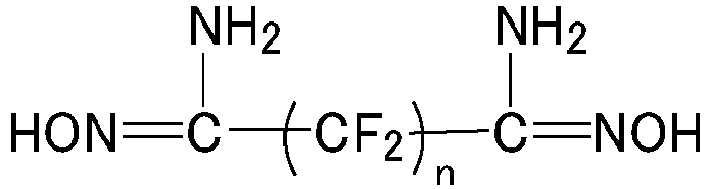
- The bisaminophenol cross-linking agent, the bisaminothiophenol cross-linking agent, and the bisdiaminophenyl cross-linking agent can be used for crosslinking where a cyano group serves as a crosslinking site, and they can also react with a carboxy group and an alkoxycarbonyl group to form an oxazole ring, a thiazole ring, or an imidazole ring, providing a crosslinked product.
- To achieve particularly good heat resistance, good crosslinking reactivity, and relatively easy synthesis, more preferred among the cross-linking agents are bisdiaminophenyl cross-linking agent containing at least two bisamino-crosslinkable functional groups of formula (56) :

- A still more preferred cross-linking agent is a compound of formula (57):


- R56 is particularly preferably a substituent that forms an N-R56 bond having higher oxidation resistance than an N-H bond. The "substituent that forms an N-R56 bond having higher oxidation resistance than an N-H bond" means a substituent that forms an N-R56 bond present in a compound that is less likely to be oxidized than a compound having an N-H bond when an imidazole ring is formed.
- Examples of such R56 include, but are not limited to, an aliphatic hydrocarbon group optionally substituted and a phenyl or benzyl group optionally substituted.
- Specifically, for example, at least one R56 is C1-10-alkyl, especially C1-6-alkyl such as -CH3, -C2H5, or -C3H7; C1-10-fluoroalkyl, especially C1-6-fluoroalkyl such as -CF3, -C2F5, -CH2F, -CH2CF3, or -CH2C2F5; phenyl; benzyl; phenyl or benzyl in which 1-5 H are replaced by F, such as -C6F5 or - CH2C6F5; or phenyl or benzyl in which 1-5 H are replaced by -CF3, such as -C6H5-n (CF3)n or -CH2C6H5-n (CF3)n (wherein n is an integer of 1-5).
- To achieve particularly good heat resistance, good crosslinking reactivity, and relatively easy synthesis, preferred among these are phenyl and -CH3.
- In the compound of formula (57), preferred specific examples of the optionally substituted alkylene group for R57 include, but are not limited to, unsubstituted C1-6-alkylene and C1-10-perfluoroalkylene. The perfluoroalkylene group may be a group of the formula -C(CF3)2- (59).
- R57 to be used may be known ones disclosed as examples of bisdiaminophenyl compounds in documents such as
JP-B-1990-59177 JP-A-1996-120146 - R57 may bind to any position of each of left and right benzene rings. To enable easy synthesis and an easy crosslinking reaction, R57 preferably bind to the para-position relative to the NH2 or NHR56 group.
- A particularly preferred cross-linking agent is a compound of formula (60):

- Examples of the compound of formula (60) include 2,2-bis-[3-amino-4-(N-methylamino)phenyl]hexafluoropropane, 2,2-bis-[3-amino-4-(N-ethylamino)phenyl]hexafluoropropane, 2,2-bis-[3-amino-4-(N-propylamino)phenyl]hexafluoropropane, 2,2-bis-[3-amino-4-(N-phenylamino)phenyl]hexafluoropropane, 2,2-bis-[3-amino-4-(N-perfluorophenylamino)phenyl]hexafluoropropane, 2,2-bis-[3-amino-4-(N-benzylamino)phenyl]hexafluoropropane, 2,2-bis(3-amino-4-hydroxyphenyl)hexafluoropropane (generic name: bis(aminophenol) AF), 2,2-bis(3-amino-4-mercaptophenyl)hexafluoropropane, tetraaminobenzene, bis-3,4-diaminophenylmethane, bis-3,4-diaminophenyl ether, and 2,2-bis(3,4-diaminophenyl)hexafluoropropane.
- The amount of the cross-linking agent is preferably 0.05-10 pbm, more preferably 0.5-5 pbm, relative to 100 pbm of the fluoroelastomer. Less than 0.05 pbm of the cross-linking agent tends to cause insufficient crosslinking of the fluoroelastomer, while more than 10 pbm thereof tends to cause poor physical properties of the molded article.
- The present composition can also be crosslinked by high energy rays without addition of a cross-linking agent, for example. Examples of the crosslinking source include X-rays, α-rays, β-rays, γ-rays, electron beams, proton beams, deuteron beams, and ultraviolet rays. The radiation dose in this case is 0.1-50 Mrad. The irradiation temperature is -20°C to 100°C. The irradiation atmosphere is in the presence of the air, nitrogen, argon, or helium, or in a vacuum.
- The present composition may contain a common filler.
- Examples of the filler include imide fillers having an imide structure, such as polyimide, polyamide-imide, and polyetherimide; engineering plastic-based organic fillers such as polyarylate, polysulfone, polyethersulfone, polyphenylene sulfide, polyether ether ketone, polyether ketone, and polyoxy benzoate; and inorganic fillers such as metal oxide fillers, e.g., aluminum oxide, silicon oxide, and yttrium oxide, metal carbide, e.g., silicon carbide and aluminum carbide, metal nitride fillers, e.g., silicon nitride and aluminum nitride, aluminum fluoride, carbon fluoride, and carbon black.
- To give an effect of blocking a variety of plasma, preferred among these are aluminum oxide, yttrium oxide, silicon oxide, polyimide, and carbon fluoride.
- The inorganic fillers and organic fillers may be used alone or in combination of two or more.
- The amount of the filler is preferably 0.5-100 pbm, more preferably 5-50 pbm, relative to 100 pbm of the fluoroelastomer.
- In the fields not requiring high purity and stain resistance, the present composition may optionally contain any of common additives to be blended with the fluoroelastomer, such as a processing aid, a plasticizer, and a colorant, and may contain one or more of common cross-linking agents and crosslinking aids other than those mentioned above.
- The present composition can be produced by kneading the fluoroelastomer and the graphene. The kneading can be performed using a common polymer processing machine, such as an open roll, a Banbury mixer, a kneader, or a closed-type mixer.
- The present composition can suitably be used as a molding material to be molded into a molded article.
- The present composition may be molded into a molded article by a common method. The method may be a known method such as heat compression in a mold, injection into a heated mold, or extrusion through an extruder.
- The present composition may be formed into a pre-molded article and the pre-molded article may be crosslinked into a molded article by a common method. The method may be heat compression in a mold, injection into a heated mold, or a method including extrusion through an extruder, followed by primary crosslinking, and followed by secondary crosslinking. In the case of extruded products such as hoses and electric wires, a molded article can be obtained by heat-crosslinking the extrudate by steam, for example.
- The primary crosslinking is preferably performed at 150-200°C for 5-120 minutes, more preferably at 170-190°C for 5-60 minutes. The crosslinking technique may be a known crosslinking technique such as press crosslinking.
- The secondary crosslinking is preferably performed at 250-320°C for 2-24 hours, more preferably at 280-310°C for 5-20 hours. The crosslinking technique may be a known crosslinking technique such as oven crosslinking.
- The invention also relates to a fluoroelastomer molded article formed from the fluoroelastomer composition.
- The present article can suitably be used as a sealant for semiconductor manufacturing devices requiring particularly high cleanliness, especially semiconductor manufacturing devices involving high density plasma irradiation. Examples of the sealant include O-rings, square rings, gaskets, packings, oil seals, bearing seals, and lip seals.
- The present article can also be used for a variety of polymer products used in semiconductor manufacturing devices, such as diaphragms, tubes, hoses, a variety of rubber rolls, and belts, and can also be used for coating materials and lining materials.
- The semiconductor manufacturing devices in the invention are not limited to devices for manufacturing semiconductors, but generally widely include manufacturing devices used in the semiconductor field requiring high cleanliness, such as devices for manufacturing liquid crystal panels or plasma panels. Examples thereof include the following.
-
- Dry etching systems
- Plasma etching systems
- Reactive ion etching systems
- Reactive ion beam etching systems
- Sputter etching systems
- Ion beam etching systems
- Wet etching systems
- Ashing systems
-
- Dry etching and cleaning systems
- UV/O3 cleaning systems
- Ion beam cleaning systems
- Laser beam cleaning systems
- Plasma cleaning systems
- Gas etching and cleaning systems
- Extraction and cleaning systems
- Soxhlet extraction and cleaning systems
- High-temperature and high-pressure extraction and cleaning systems
- Microwave extraction and cleaning systems
- Supercritical extraction and cleaning systems
-
- Steppers
- Coaters/developers
- CMP systems
-
- CVD systems
- Sputtering systems
-
- Oxidation and diffusion systems
- Ion implantation systems
- The present article exhibits excellent performance as a sealant of a CVD system, a plasma etching system, a reactive ion etching system, an ashing system, or an excimer laser exposure system, for example.
- The invention is described hereinbelow with reference to, but not limited to, examples.
- First, 1.5 g of a multiwall carbon nanotube (MWCNT, VGCF-H, available from Showa Denko K.K.) was mixed with 60 ml of concentrated sulfuric acid and stirred for one hour. Then, 7.5 g of potassium permanganate was added thereto and the mixture was stirred for one hour. The resulting dispersion was heated up to 55°C and stirred for one hour, then heated up to 70°C and stirred for 30 minutes. The dispersion was then cooled down to room temperature. To this dispersion was added 400 ml of ice water containing 30 ml of hydrogen peroxide water to prevent deposition of insoluble manganese dioxide. The mixture was subjected to suction filtration using a polytetrafluoroethylene filter having a pore size of 0.45 µm. The resulting solid was dispersed in 150 ml of water and the dispersion was sonicated for 30 minutes. This dispersion was mixed with 100 ml of 0.5 mol/l hydrochloric acid to agglomerate the solid, and then subjected to suction filtration using a polytetrafluoroethylene filter having a pore size of 0.45 µm. The resulting solid was dispersed in 200 ml of ethanol and the dispersion was sonicated for 30 minutes. This dispersion was mixed with 200 ml of hexane, and then the mixture was subjected to suction filtration using a polytetrafluoroethylene filter having a pore size of 0.45 µm. The resulting solid was heated up to 60°C and dried for 24 hours in a vacuum oven, whereby a graphene oxide (GO) was obtained.
- The graphene oxide had the following dimensions and parameters.


- Next, 10 g of crude rubber of a tetrafluoroethylene-perfluoro(propyl vinyl ether) elastomer containing a cyano group-containing monomer unit was mixed with 100 g of a solvent (Fluorinert FC-770, available from 3M Co.) and stirred for 24 hours. Thereby, the crude rubber was swelled. Then, 0.1 g of the same multiwall carbon nanotube as the material of the graphene oxide or 0.1 g of the graphene oxide was dispersed in 10 ml of a solvent (Fluorinert FC-770, available from 3M Co.). The dispersion was sonicated at 45 kHz for two hours, whereby the agglomerated mass was deagglomerated. The filler dispersion was mixed with the swelled crude rubber at a ratio shown in Table 1 for Examples 1-3 or in Table 2 for Comparative Examples 1-4, and the mixture was kneaded using a mixer for 20 minutes. Then, the mixture was stirred in a planetary centrifugal mixer in the open state for two minutes to remove the solvent in the mixture, and then heated up to 80°C in a hot air furnace and left to stand for three hours. The resulting filler-dispersed non-crosslinked elastomer was pressed using a hot press at 140°C and at 10 MPa for 20 minutes, whereby a 500-µm-thick sheet was obtained. The resulting sheet was put into a desiccator together with 1 g of silicon nitride and 10 ml of ammonia water. The system was heated up to 140°C and maintained for 72 hours for crosslinking.
[Table 1] Component Unit Example 1 Example 2 Example 3 Composition FFKM wt% 99 95 90 MWCNT wt% 0 0 0 GO wt% 1 5 10 [Table 2] Component Unit Comparative Example 1 Comparative Example 2 Comparative Example 3 Comparative Example 4 Composition FFKM wt% 100 99 95 90 MWCNT wt% 0 1 5 10 GO wt% 0 0 0 0 - The filler-dispersed elastomer sheets of Examples 1-3 and Comparative Examples 1-4 were each formed into a JIS No. 7 dumbbell-shaped test piece using a punching blade. These test pieces were subjected to a tensile test using a tensile tester at a tensile rate of 50 mm/min. Based on the resulting stress-strain curve, the tensile modulus (MPa), the tensile strength (MPa), and the elongation at break were determined.
- The filler-dispersed elastomer sheets of Examples 1-3 and Comparative Examples 1-4 were each cut into a test piece having a length of 80 mm and a width of 5 mm. These test pieces were subjected to a friction abrasion test. The friction abrasion test was performed in conformity with the method disclosed in T. Irisawa et al., Sen'i Gakkaishi, 67(5), 109-118 (2011) such that a 100-mm-diameter rotary drum whose side face is coated with #320 abrasive paper was rotated at 500 rpm and the sample was brought into contact with this side face. The friction coefficient (µ) and the wear rate (Ws (Pa-1)) were determined. The lower the wear rate is, the higher the abrasion resistance is.
- The filler-dispersed elastomer sheets of Examples 1-3 and Comparative Examples 1-4 were each cut into a 20-mm square sample. Each sample was immersed in a 50 ml of solvent (Fluorinert FC-770, available from 3M Co.) and left to stand for seven days. The sample shape was then observed, whereby the solubility of the sample in the solvent was examined.
- In Tables 3 and 4, the measurement results of the tensile modulus, the tensile strength, the elongation at break, the friction coefficient, and the wear rate were respectively expressed by "E (MPa)", "TS (MPa)", "Eb", "µ", and "Ws (Pa-1)".
[Table 3] Unit Example 1 Example 2 Example 3 E MPa 3.61 - - TS MPa 17.4 - - Eb 2.73 - - µ 0.48 0.41 0.39 Ws 10-11 Pa-1 2.31 1.48 1. 84 [Table 4] Unit Comparative Example 1 Comparative Example 2 Comparative Example 3 Comparative Example 4 E MPa 1.10 3.64 - - TS MPa 3.26 13.9 - - Eb 2.14 2.46 - - µ 0.64 0.47 0.48 0.44 Ws 10-11 Pa-1 7.63 6.66 5.63 4.80 - Tables 3 and 4 show that the tensile strength (TS) and the elongation at break (Eb) were respectively 13.9 MPa and 2.46 in Comparative Example 2, while they were respectively 17.4 MPa and 2.73 in Example 1. The tensile modulus (E) was 3.64 MPa in Comparative Example 2, while it was 3.61 MPa in Example 1 and was hardly different from that in Comparative Example 2. These results demonstrate that dispersing the graphene oxide increased the tensile strength by 25% without impairing the easiness of shape change unique to elastomers (without increasing the tensile modulus) in comparison with the case of dispersing the multiwall carbon nanotube.
- Tables 3 and 4 show that the friction coefficient (µ) was 0.44-0.64 in Comparative Examples 1-4, while it was 0.39-0.48 in Examples 1-3. The wear rate (Ws) was 4.80-7.63 × 10⁻¹¹ Pa-1 in Comparative Examples 1-4, while it was 1.48-2.31 × 10⁻¹¹ Pa-1 in Examples 1-3. These results demonstrate that dispersing the graphene oxide instead of the multiwall carbon nanotube improved the abrasion resistance.
- In the test of examining the solubility of the sample in a solvent, the non-crosslinked sample started to be dissolved after about 20 minutes from the start of immersing the sample in the solvent and was completely dissolved after one hour therefrom. In contrast, no change of the sample and no dissolution of the filler in the solvent were observed in Examples 1-3. These results demonstrate that dispersion of the graphene oxide does not reduce the crosslinking reaction.
Claims (7)
- A composition comprising:(i) a fluoroelastomer containing a unit of a monomer containing a at least one crosslinkable group selected from cyano, carboxy, alkoxycarbonyl and acid halide; and(ii) an elongated sheet-shaped graphene exhibiting- a ratio (L/W) of a maximum length (L) and a width (W) of 2 to 105, and- a ratio (L/T) of the maximum length (L) and a thickness (T) of 1 × 101 to 1 × 10⁷,wherein L, W and T are determined by observing the graphene using a scanning electron microscope (SEM), a transmission electron microscope (TEM) or an atomic force microscope (AFM).
- The composition of claim 1, wherein the fluoroelastomer is a perfluoroelastomer.
- The composition of claim 1 or 2, wherein the content of the graphene is 0.1-20 mass-%, based on the sum of the fluoroelastomer and the graphene.
- The composition of any of claims 1-3, further comprising a catalyst that generates a triazine ring, wherein the crosslinkable group is a cyano group.
- The composition of any of claims 1-3, further comprising a cross-linking agent.
- The composition of claim 5, wherein the cross-linking agent is at least one of an oxazole cross-linking agent, an imidazole cross-linking agent and a thiazole cross-linking agent.
- A fluoroelastomer molded article formed from the composition of any of claims 1-6.
Applications Claiming Priority (2)
| Application Number | Priority Date | Filing Date | Title |
|---|---|---|---|
| JP2017111997 | 2017-06-06 | ||
| PCT/JP2018/021361 WO2018225682A1 (en) | 2017-06-06 | 2018-06-04 | Fluoroelastomer composition and molded article thereof |
Publications (3)
| Publication Number | Publication Date |
|---|---|
| EP3636711A1 EP3636711A1 (en) | 2020-04-15 |
| EP3636711A4 EP3636711A4 (en) | 2021-03-24 |
| EP3636711B1 true EP3636711B1 (en) | 2022-08-31 |
Family
ID=64566626
Family Applications (1)
| Application Number | Title | Priority Date | Filing Date |
|---|---|---|---|
| EP18813060.3A Active EP3636711B1 (en) | 2017-06-06 | 2018-06-04 | Fluoroelastomer composition and molded article thereof |
Country Status (6)
| Country | Link |
|---|---|
| US (1) | US11492480B2 (en) |
| EP (1) | EP3636711B1 (en) |
| JP (2) | JP6861423B2 (en) |
| KR (1) | KR102327854B1 (en) |
| CN (1) | CN110709465B (en) |
| WO (1) | WO2018225682A1 (en) |
Families Citing this family (4)
| Publication number | Priority date | Publication date | Assignee | Title |
|---|---|---|---|---|
| US11492480B2 (en) * | 2017-06-06 | 2022-11-08 | Tokyo Institute Of Technology | Fluoroelastomer composition and molded article thereof |
| KR20200059236A (en) * | 2017-10-12 | 2020-05-28 | 에이지씨 가부시키가이샤 | Fluorine-containing elastic copolymer composition, paint, and painted article |
| CN118006062B (en) * | 2024-02-29 | 2024-12-17 | 惠州市协同橡塑材料有限公司 | High-temperature-resistant perfluoroether rubber composition and preparation method thereof |
| JP7577287B1 (en) | 2024-03-28 | 2024-11-05 | 株式会社バルカー | Method for producing recycled perfluoro (co)polymer and method for producing recycled material |
Family Cites Families (26)
| Publication number | Priority date | Publication date | Assignee | Title |
|---|---|---|---|---|
| JPS5871906A (en) | 1981-10-22 | 1983-04-28 | Daikin Ind Ltd | Manufacture of fluorine-containing elastic copolymer |
| US4525539A (en) | 1982-12-02 | 1985-06-25 | E. I. Du Pont De Nemours And Company | Vulcanizable nitrile-containing perfluoroelastomer |
| US4513128A (en) | 1983-06-23 | 1985-04-23 | E. I. Du Pont De Nemours And Company | Fluorinated vinyl ether copolymers having low glass transition temperatures |
| JPS61223007A (en) | 1985-03-28 | 1986-10-03 | Daikin Ind Ltd | Emulsion polymerization of fluoroelastomer |
| JP3398492B2 (en) | 1994-10-21 | 2003-04-21 | 日本メクトロン株式会社 | Fluorine-containing elastomer composition |
| JP3223776B2 (en) | 1995-03-31 | 2001-10-29 | 日本メクトロン株式会社 | Fluorine-containing elastomer composition |
| US6140437A (en) | 1995-12-28 | 2000-10-31 | Daikin Industries Ltd. | Fluorine-containing elastic copolymers, curable composition containing the same and sealant made therefrom |
| US5677389A (en) | 1996-11-25 | 1997-10-14 | E. I. Du Pont De Nemours | Perfluoroelastomer composition having enhanced curing performance |
| US6281296B1 (en) | 1998-08-10 | 2001-08-28 | Dupont Dow Elastomers L.L.C. | Curable perfluoroelastomer composition |
| US6794457B2 (en) | 2001-04-30 | 2004-09-21 | 3M Innovative Properties Company | Fluoropolymer curing system containing a nitrogen cure site monomer |
| EP1598396B1 (en) * | 2003-02-19 | 2010-05-12 | DuPont-Mitsui Fluorochemicals Company, Ltd. | Fluororesin composite compositions |
| US6992143B2 (en) | 2003-08-15 | 2006-01-31 | Dupont Dow Elastomers Llc | Curable perfluoroelastomer composition |
| JP2005239835A (en) | 2004-02-25 | 2005-09-08 | Nippon Valqua Ind Ltd | Crosslinkable fluororubber composition |
| JP2006316112A (en) * | 2005-05-10 | 2006-11-24 | Daikin Ind Ltd | Fluorine-containing elastomer composition and molded article comprising the same |
| JP2008266368A (en) | 2007-04-16 | 2008-11-06 | Daikin Ind Ltd | Fluorine-containing elastomer composition and sealing material comprising the same |
| JP2010209275A (en) * | 2009-03-12 | 2010-09-24 | Daikin Ind Ltd | Polymer composition and molded article |
| JP2011116004A (en) * | 2009-12-02 | 2011-06-16 | Daikin Industries Ltd | Method of manufacturing fluoropolymer laminate, fluoropolymer laminate obtained by the method and non-fluororubber composition |
| US9327985B2 (en) | 2009-12-18 | 2016-05-03 | National University Corporation Hokkaido University | Graphene oxide sheet, article containing graphene-containing substance produced by reducing the graphene oxide sheet, and process for production of the graphene oxide sheet |
| JP5816474B2 (en) | 2011-07-21 | 2015-11-18 | 日信工業株式会社 | Seal member and manufacturing method thereof |
| CN102604175B (en) * | 2012-02-23 | 2014-04-16 | 北京化工大学 | Method for preparing graphene oxide/white carbon black/rubber nanocomposite |
| JP6473588B2 (en) * | 2013-09-12 | 2019-02-20 | 日信工業株式会社 | Carbon fiber composite material and method for producing carbon fiber composite material |
| JP6225726B2 (en) * | 2014-01-29 | 2017-11-08 | ダイキン工業株式会社 | Conductive fluorine-containing polymer composition |
| BR112016019261B1 (en) * | 2014-02-18 | 2022-06-14 | Reme Technologies, Llc | PROGRESSIVE CAVITY ENERGY SECTION |
| WO2016154057A1 (en) * | 2015-03-23 | 2016-09-29 | Garmor Inc. | Engineered composite structure using graphene oxide |
| JP2017206604A (en) * | 2016-05-17 | 2017-11-24 | Jxtgエネルギー株式会社 | Thermoplastic elastomer composition and method for producing the same |
| US11492480B2 (en) | 2017-06-06 | 2022-11-08 | Tokyo Institute Of Technology | Fluoroelastomer composition and molded article thereof |
-
2018
- 2018-06-04 US US16/619,698 patent/US11492480B2/en active Active
- 2018-06-04 JP JP2019523524A patent/JP6861423B2/en active Active
- 2018-06-04 CN CN201880037051.8A patent/CN110709465B/en active Active
- 2018-06-04 KR KR1020197032971A patent/KR102327854B1/en active Active
- 2018-06-04 EP EP18813060.3A patent/EP3636711B1/en active Active
- 2018-06-04 WO PCT/JP2018/021361 patent/WO2018225682A1/en not_active Ceased
-
2020
- 2020-09-18 JP JP2020157063A patent/JP7486125B2/en active Active
Also Published As
| Publication number | Publication date |
|---|---|
| US11492480B2 (en) | 2022-11-08 |
| KR102327854B1 (en) | 2021-11-17 |
| WO2018225682A1 (en) | 2018-12-13 |
| JPWO2018225682A1 (en) | 2020-01-16 |
| JP2020200482A (en) | 2020-12-17 |
| JP6861423B2 (en) | 2021-04-21 |
| EP3636711A4 (en) | 2021-03-24 |
| EP3636711A1 (en) | 2020-04-15 |
| JP7486125B2 (en) | 2024-05-17 |
| KR20190130173A (en) | 2019-11-21 |
| US20200181386A1 (en) | 2020-06-11 |
| CN110709465B (en) | 2023-02-17 |
| CN110709465A (en) | 2020-01-17 |
Similar Documents
| Publication | Publication Date | Title |
|---|---|---|
| JP5487584B2 (en) | Crosslinkable elastomer composition and molded article comprising the composition | |
| JP5553320B2 (en) | Crosslinkable fluorine-containing elastomer composition and molded article produced from the composition | |
| JP7713826B2 (en) | Crosslinkable elastomer composition and fluororubber molded product | |
| TWI830916B (en) | Fluoroelastomer compositions and polymer products | |
| JP7486125B2 (en) | Fluoroelastomer composition and molded article thereof | |
| EP3309214B1 (en) | Composition comprising fluoropolymer and molded article | |
| EP3486283B1 (en) | Composition and molded article | |
| EP3260490B1 (en) | Composition and molded article | |
| WO2023195485A1 (en) | Composition and crosslinked product | |
| JP4086070B2 (en) | Crosslinkable elastomer composition and molded article comprising the crosslinkable elastomer composition | |
| TWI830956B (en) | Compositions and cross-linked products containing fluoropolymers | |
| JP6789521B2 (en) | Dendrimer, composition and molded product | |
| WO2026071239A1 (en) | Composition containing fluorine-containing polymer, and molded article |
Legal Events
| Date | Code | Title | Description |
|---|---|---|---|
| STAA | Information on the status of an ep patent application or granted ep patent |
Free format text: STATUS: THE INTERNATIONAL PUBLICATION HAS BEEN MADE |
|
| PUAI | Public reference made under article 153(3) epc to a published international application that has entered the european phase |
Free format text: ORIGINAL CODE: 0009012 |
|
| STAA | Information on the status of an ep patent application or granted ep patent |
Free format text: STATUS: REQUEST FOR EXAMINATION WAS MADE |
|
| 17P | Request for examination filed |
Effective date: 20191204 |
|
| AK | Designated contracting states |
Kind code of ref document: A1 Designated state(s): AL AT BE BG CH CY CZ DE DK EE ES FI FR GB GR HR HU IE IS IT LI LT LU LV MC MK MT NL NO PL PT RO RS SE SI SK SM TR |
|
| AX | Request for extension of the european patent |
Extension state: BA ME |
|
| DAV | Request for validation of the european patent (deleted) | ||
| DAX | Request for extension of the european patent (deleted) | ||
| A4 | Supplementary search report drawn up and despatched |
Effective date: 20210222 |
|
| RIC1 | Information provided on ipc code assigned before grant |
Ipc: C08L 27/12 20060101AFI20210216BHEP Ipc: C08K 3/04 20060101ALI20210216BHEP |
|
| STAA | Information on the status of an ep patent application or granted ep patent |
Free format text: STATUS: EXAMINATION IS IN PROGRESS |
|
| 17Q | First examination report despatched |
Effective date: 20210727 |
|
| REG | Reference to a national code |
Ref country code: DE Ref legal event code: R079 Ref document number: 602018040091 Country of ref document: DE Free format text: PREVIOUS MAIN CLASS: C08L0027120000 Ipc: C08K0005000000 |
|
| GRAP | Despatch of communication of intention to grant a patent |
Free format text: ORIGINAL CODE: EPIDOSNIGR1 |
|
| STAA | Information on the status of an ep patent application or granted ep patent |
Free format text: STATUS: GRANT OF PATENT IS INTENDED |
|
| RIC1 | Information provided on ipc code assigned before grant |
Ipc: C08K 5/353 20060101ALN20220510BHEP Ipc: C08K 5/47 20060101ALN20220510BHEP Ipc: C08K 5/3445 20060101ALN20220510BHEP Ipc: C08L 27/12 20060101ALI20220510BHEP Ipc: C08K 3/04 20060101ALI20220510BHEP Ipc: C08L 27/18 20060101ALI20220510BHEP Ipc: C08K 5/00 20060101AFI20220510BHEP |
|
| INTG | Intention to grant announced |
Effective date: 20220601 |
|
| GRAS | Grant fee paid |
Free format text: ORIGINAL CODE: EPIDOSNIGR3 |
|
| GRAA | (expected) grant |
Free format text: ORIGINAL CODE: 0009210 |
|
| STAA | Information on the status of an ep patent application or granted ep patent |
Free format text: STATUS: THE PATENT HAS BEEN GRANTED |
|
| AK | Designated contracting states |
Kind code of ref document: B1 Designated state(s): AL AT BE BG CH CY CZ DE DK EE ES FI FR GB GR HR HU IE IS IT LI LT LU LV MC MK MT NL NO PL PT RO RS SE SI SK SM TR |
|
| REG | Reference to a national code |
Ref country code: CH Ref legal event code: EP Ref country code: GB Ref legal event code: FG4D |
|
| REG | Reference to a national code |
Ref country code: AT Ref legal event code: REF Ref document number: 1515277 Country of ref document: AT Kind code of ref document: T Effective date: 20220915 |
|
| REG | Reference to a national code |
Ref country code: DE Ref legal event code: R096 Ref document number: 602018040091 Country of ref document: DE |
|
| REG | Reference to a national code |
Ref country code: IE Ref legal event code: FG4D |
|
| REG | Reference to a national code |
Ref country code: LT Ref legal event code: MG9D |
|
| REG | Reference to a national code |
Ref country code: NL Ref legal event code: MP Effective date: 20220831 |
|
| PG25 | Lapsed in a contracting state [announced via postgrant information from national office to epo] |
Ref country code: SE Free format text: LAPSE BECAUSE OF FAILURE TO SUBMIT A TRANSLATION OF THE DESCRIPTION OR TO PAY THE FEE WITHIN THE PRESCRIBED TIME-LIMIT Effective date: 20220831 Ref country code: RS Free format text: LAPSE BECAUSE OF FAILURE TO SUBMIT A TRANSLATION OF THE DESCRIPTION OR TO PAY THE FEE WITHIN THE PRESCRIBED TIME-LIMIT Effective date: 20220831 Ref country code: NO Free format text: LAPSE BECAUSE OF FAILURE TO SUBMIT A TRANSLATION OF THE DESCRIPTION OR TO PAY THE FEE WITHIN THE PRESCRIBED TIME-LIMIT Effective date: 20221130 Ref country code: LV Free format text: LAPSE BECAUSE OF FAILURE TO SUBMIT A TRANSLATION OF THE DESCRIPTION OR TO PAY THE FEE WITHIN THE PRESCRIBED TIME-LIMIT Effective date: 20220831 Ref country code: LT Free format text: LAPSE BECAUSE OF FAILURE TO SUBMIT A TRANSLATION OF THE DESCRIPTION OR TO PAY THE FEE WITHIN THE PRESCRIBED TIME-LIMIT Effective date: 20220831 Ref country code: FI Free format text: LAPSE BECAUSE OF FAILURE TO SUBMIT A TRANSLATION OF THE DESCRIPTION OR TO PAY THE FEE WITHIN THE PRESCRIBED TIME-LIMIT Effective date: 20220831 |
|
| REG | Reference to a national code |
Ref country code: AT Ref legal event code: MK05 Ref document number: 1515277 Country of ref document: AT Kind code of ref document: T Effective date: 20220831 |
|
| PG25 | Lapsed in a contracting state [announced via postgrant information from national office to epo] |
Ref country code: PL Free format text: LAPSE BECAUSE OF FAILURE TO SUBMIT A TRANSLATION OF THE DESCRIPTION OR TO PAY THE FEE WITHIN THE PRESCRIBED TIME-LIMIT Effective date: 20220831 Ref country code: IS Free format text: LAPSE BECAUSE OF FAILURE TO SUBMIT A TRANSLATION OF THE DESCRIPTION OR TO PAY THE FEE WITHIN THE PRESCRIBED TIME-LIMIT Effective date: 20221231 Ref country code: HR Free format text: LAPSE BECAUSE OF FAILURE TO SUBMIT A TRANSLATION OF THE DESCRIPTION OR TO PAY THE FEE WITHIN THE PRESCRIBED TIME-LIMIT Effective date: 20220831 Ref country code: GR Free format text: LAPSE BECAUSE OF FAILURE TO SUBMIT A TRANSLATION OF THE DESCRIPTION OR TO PAY THE FEE WITHIN THE PRESCRIBED TIME-LIMIT Effective date: 20221201 |
|
| PG25 | Lapsed in a contracting state [announced via postgrant information from national office to epo] |
Ref country code: SM Free format text: LAPSE BECAUSE OF FAILURE TO SUBMIT A TRANSLATION OF THE DESCRIPTION OR TO PAY THE FEE WITHIN THE PRESCRIBED TIME-LIMIT Effective date: 20220831 Ref country code: RO Free format text: LAPSE BECAUSE OF FAILURE TO SUBMIT A TRANSLATION OF THE DESCRIPTION OR TO PAY THE FEE WITHIN THE PRESCRIBED TIME-LIMIT Effective date: 20220831 Ref country code: PT Free format text: LAPSE BECAUSE OF FAILURE TO SUBMIT A TRANSLATION OF THE DESCRIPTION OR TO PAY THE FEE WITHIN THE PRESCRIBED TIME-LIMIT Effective date: 20230102 Ref country code: ES Free format text: LAPSE BECAUSE OF FAILURE TO SUBMIT A TRANSLATION OF THE DESCRIPTION OR TO PAY THE FEE WITHIN THE PRESCRIBED TIME-LIMIT Effective date: 20220831 Ref country code: DK Free format text: LAPSE BECAUSE OF FAILURE TO SUBMIT A TRANSLATION OF THE DESCRIPTION OR TO PAY THE FEE WITHIN THE PRESCRIBED TIME-LIMIT Effective date: 20220831 Ref country code: CZ Free format text: LAPSE BECAUSE OF FAILURE TO SUBMIT A TRANSLATION OF THE DESCRIPTION OR TO PAY THE FEE WITHIN THE PRESCRIBED TIME-LIMIT Effective date: 20220831 Ref country code: AT Free format text: LAPSE BECAUSE OF FAILURE TO SUBMIT A TRANSLATION OF THE DESCRIPTION OR TO PAY THE FEE WITHIN THE PRESCRIBED TIME-LIMIT Effective date: 20220831 |
|
| PG25 | Lapsed in a contracting state [announced via postgrant information from national office to epo] |
Ref country code: SK Free format text: LAPSE BECAUSE OF FAILURE TO SUBMIT A TRANSLATION OF THE DESCRIPTION OR TO PAY THE FEE WITHIN THE PRESCRIBED TIME-LIMIT Effective date: 20220831 Ref country code: EE Free format text: LAPSE BECAUSE OF FAILURE TO SUBMIT A TRANSLATION OF THE DESCRIPTION OR TO PAY THE FEE WITHIN THE PRESCRIBED TIME-LIMIT Effective date: 20220831 |
|
| REG | Reference to a national code |
Ref country code: DE Ref legal event code: R097 Ref document number: 602018040091 Country of ref document: DE |
|
| PG25 | Lapsed in a contracting state [announced via postgrant information from national office to epo] |
Ref country code: NL Free format text: LAPSE BECAUSE OF FAILURE TO SUBMIT A TRANSLATION OF THE DESCRIPTION OR TO PAY THE FEE WITHIN THE PRESCRIBED TIME-LIMIT Effective date: 20220831 Ref country code: AL Free format text: LAPSE BECAUSE OF FAILURE TO SUBMIT A TRANSLATION OF THE DESCRIPTION OR TO PAY THE FEE WITHIN THE PRESCRIBED TIME-LIMIT Effective date: 20220831 |
|
| P01 | Opt-out of the competence of the unified patent court (upc) registered |
Effective date: 20230525 |
|
| PLBE | No opposition filed within time limit |
Free format text: ORIGINAL CODE: 0009261 |
|
| STAA | Information on the status of an ep patent application or granted ep patent |
Free format text: STATUS: NO OPPOSITION FILED WITHIN TIME LIMIT |
|
| 26N | No opposition filed |
Effective date: 20230601 |
|
| PG25 | Lapsed in a contracting state [announced via postgrant information from national office to epo] |
Ref country code: SI Free format text: LAPSE BECAUSE OF FAILURE TO SUBMIT A TRANSLATION OF THE DESCRIPTION OR TO PAY THE FEE WITHIN THE PRESCRIBED TIME-LIMIT Effective date: 20220831 |
|
| PG25 | Lapsed in a contracting state [announced via postgrant information from national office to epo] |
Ref country code: MC Free format text: LAPSE BECAUSE OF FAILURE TO SUBMIT A TRANSLATION OF THE DESCRIPTION OR TO PAY THE FEE WITHIN THE PRESCRIBED TIME-LIMIT Effective date: 20220831 |
|
| PG25 | Lapsed in a contracting state [announced via postgrant information from national office to epo] |
Ref country code: MC Free format text: LAPSE BECAUSE OF FAILURE TO SUBMIT A TRANSLATION OF THE DESCRIPTION OR TO PAY THE FEE WITHIN THE PRESCRIBED TIME-LIMIT Effective date: 20220831 |
|
| REG | Reference to a national code |
Ref country code: CH Ref legal event code: PL |
|
| REG | Reference to a national code |
Ref country code: BE Ref legal event code: MM Effective date: 20230630 |
|
| PG25 | Lapsed in a contracting state [announced via postgrant information from national office to epo] |
Ref country code: LU Free format text: LAPSE BECAUSE OF NON-PAYMENT OF DUE FEES Effective date: 20230604 |
|
| REG | Reference to a national code |
Ref country code: IE Ref legal event code: MM4A |
|
| PG25 | Lapsed in a contracting state [announced via postgrant information from national office to epo] |
Ref country code: LU Free format text: LAPSE BECAUSE OF NON-PAYMENT OF DUE FEES Effective date: 20230604 |
|
| PG25 | Lapsed in a contracting state [announced via postgrant information from national office to epo] |
Ref country code: IE Free format text: LAPSE BECAUSE OF NON-PAYMENT OF DUE FEES Effective date: 20230604 |
|
| PG25 | Lapsed in a contracting state [announced via postgrant information from national office to epo] |
Ref country code: IE Free format text: LAPSE BECAUSE OF NON-PAYMENT OF DUE FEES Effective date: 20230604 Ref country code: CH Free format text: LAPSE BECAUSE OF NON-PAYMENT OF DUE FEES Effective date: 20230630 |
|
| PG25 | Lapsed in a contracting state [announced via postgrant information from national office to epo] |
Ref country code: BE Free format text: LAPSE BECAUSE OF NON-PAYMENT OF DUE FEES Effective date: 20230630 |
|
| PG25 | Lapsed in a contracting state [announced via postgrant information from national office to epo] |
Ref country code: BG Free format text: LAPSE BECAUSE OF FAILURE TO SUBMIT A TRANSLATION OF THE DESCRIPTION OR TO PAY THE FEE WITHIN THE PRESCRIBED TIME-LIMIT Effective date: 20220831 |
|
| PG25 | Lapsed in a contracting state [announced via postgrant information from national office to epo] |
Ref country code: BG Free format text: LAPSE BECAUSE OF FAILURE TO SUBMIT A TRANSLATION OF THE DESCRIPTION OR TO PAY THE FEE WITHIN THE PRESCRIBED TIME-LIMIT Effective date: 20220831 |
|
| PGFP | Annual fee paid to national office [announced via postgrant information from national office to epo] |
Ref country code: DE Payment date: 20250618 Year of fee payment: 8 |
|
| PGFP | Annual fee paid to national office [announced via postgrant information from national office to epo] |
Ref country code: GB Payment date: 20250618 Year of fee payment: 8 |
|
| PGFP | Annual fee paid to national office [announced via postgrant information from national office to epo] |
Ref country code: FR Payment date: 20250626 Year of fee payment: 8 |
|
| PG25 | Lapsed in a contracting state [announced via postgrant information from national office to epo] |
Ref country code: CY Free format text: LAPSE BECAUSE OF FAILURE TO SUBMIT A TRANSLATION OF THE DESCRIPTION OR TO PAY THE FEE WITHIN THE PRESCRIBED TIME-LIMIT; INVALID AB INITIO Effective date: 20180604 |
|
| PG25 | Lapsed in a contracting state [announced via postgrant information from national office to epo] |
Ref country code: HU Free format text: LAPSE BECAUSE OF FAILURE TO SUBMIT A TRANSLATION OF THE DESCRIPTION OR TO PAY THE FEE WITHIN THE PRESCRIBED TIME-LIMIT; INVALID AB INITIO Effective date: 20180604 |
|
| PGFP | Annual fee paid to national office [announced via postgrant information from national office to epo] |
Ref country code: IT Payment date: 20250624 Year of fee payment: 8 |
|
| PG25 | Lapsed in a contracting state [announced via postgrant information from national office to epo] |
Ref country code: TR Free format text: LAPSE BECAUSE OF FAILURE TO SUBMIT A TRANSLATION OF THE DESCRIPTION OR TO PAY THE FEE WITHIN THE PRESCRIBED TIME-LIMIT Effective date: 20220831 |