EP3636191B1 - Verbesserung der effizienz von wiederholter ablation mittels fusionierung aktueller und vorhergehender karten - Google Patents
Verbesserung der effizienz von wiederholter ablation mittels fusionierung aktueller und vorhergehender karten Download PDFInfo
- Publication number
- EP3636191B1 EP3636191B1 EP19213200.9A EP19213200A EP3636191B1 EP 3636191 B1 EP3636191 B1 EP 3636191B1 EP 19213200 A EP19213200 A EP 19213200A EP 3636191 B1 EP3636191 B1 EP 3636191B1
- Authority
- EP
- European Patent Office
- Prior art keywords
- map
- ablation
- initial
- processor
- chamber
- Prior art date
- Legal status (The legal status is an assumption and is not a legal conclusion. Google has not performed a legal analysis and makes no representation as to the accuracy of the status listed.)
- Active
Links
Images




Classifications
-
- A—HUMAN NECESSITIES
- A61—MEDICAL OR VETERINARY SCIENCE; HYGIENE
- A61B—DIAGNOSIS; SURGERY; IDENTIFICATION
- A61B18/00—Surgical instruments, devices or methods for transferring non-mechanical forms of energy to or from the body
- A61B18/04—Surgical instruments, devices or methods for transferring non-mechanical forms of energy to or from the body by heating
- A61B18/12—Surgical instruments, devices or methods for transferring non-mechanical forms of energy to or from the body by heating by passing a current through the tissue to be heated, e.g. high-frequency current
- A61B18/14—Probes or electrodes therefor
- A61B18/1492—Probes or electrodes therefor having a flexible, catheter-like structure, e.g. for heart ablation
-
- A—HUMAN NECESSITIES
- A61—MEDICAL OR VETERINARY SCIENCE; HYGIENE
- A61B—DIAGNOSIS; SURGERY; IDENTIFICATION
- A61B5/00—Measuring for diagnostic purposes; Identification of persons
- A61B5/48—Other medical applications
- A61B5/4848—Monitoring or testing the effects of treatment, e.g. of medication
-
- A—HUMAN NECESSITIES
- A61—MEDICAL OR VETERINARY SCIENCE; HYGIENE
- A61B—DIAGNOSIS; SURGERY; IDENTIFICATION
- A61B34/00—Computer-aided surgery; Manipulators or robots specially adapted for use in surgery
- A61B34/20—Surgical navigation systems; Devices for tracking or guiding surgical instruments, e.g. for frameless stereotaxis
-
- A—HUMAN NECESSITIES
- A61—MEDICAL OR VETERINARY SCIENCE; HYGIENE
- A61B—DIAGNOSIS; SURGERY; IDENTIFICATION
- A61B18/00—Surgical instruments, devices or methods for transferring non-mechanical forms of energy to or from the body
- A61B2018/00315—Surgical instruments, devices or methods for transferring non-mechanical forms of energy to or from the body for treatment of particular body parts
- A61B2018/00345—Vascular system
- A61B2018/00351—Heart
- A61B2018/00357—Endocardium
-
- A—HUMAN NECESSITIES
- A61—MEDICAL OR VETERINARY SCIENCE; HYGIENE
- A61B—DIAGNOSIS; SURGERY; IDENTIFICATION
- A61B18/00—Surgical instruments, devices or methods for transferring non-mechanical forms of energy to or from the body
- A61B2018/00571—Surgical instruments, devices or methods for transferring non-mechanical forms of energy to or from the body for achieving a particular surgical effect
- A61B2018/00577—Ablation
-
- A—HUMAN NECESSITIES
- A61—MEDICAL OR VETERINARY SCIENCE; HYGIENE
- A61B—DIAGNOSIS; SURGERY; IDENTIFICATION
- A61B18/00—Surgical instruments, devices or methods for transferring non-mechanical forms of energy to or from the body
- A61B2018/00636—Sensing and controlling the application of energy
- A61B2018/00773—Sensed parameters
- A61B2018/00839—Bioelectrical parameters, e.g. ECG, EEG
-
- A—HUMAN NECESSITIES
- A61—MEDICAL OR VETERINARY SCIENCE; HYGIENE
- A61B—DIAGNOSIS; SURGERY; IDENTIFICATION
- A61B18/00—Surgical instruments, devices or methods for transferring non-mechanical forms of energy to or from the body
- A61B2018/00636—Sensing and controlling the application of energy
- A61B2018/00773—Sensed parameters
- A61B2018/00875—Resistance or impedance
-
- A—HUMAN NECESSITIES
- A61—MEDICAL OR VETERINARY SCIENCE; HYGIENE
- A61B—DIAGNOSIS; SURGERY; IDENTIFICATION
- A61B18/00—Surgical instruments, devices or methods for transferring non-mechanical forms of energy to or from the body
- A61B2018/00988—Means for storing information, e.g. calibration constants, or for preventing excessive use, e.g. usage, service life counter
-
- A—HUMAN NECESSITIES
- A61—MEDICAL OR VETERINARY SCIENCE; HYGIENE
- A61B—DIAGNOSIS; SURGERY; IDENTIFICATION
- A61B34/00—Computer-aided surgery; Manipulators or robots specially adapted for use in surgery
- A61B34/10—Computer-aided planning, simulation or modelling of surgical operations
- A61B2034/107—Visualisation of planned trajectories or target regions
-
- A—HUMAN NECESSITIES
- A61—MEDICAL OR VETERINARY SCIENCE; HYGIENE
- A61B—DIAGNOSIS; SURGERY; IDENTIFICATION
- A61B34/00—Computer-aided surgery; Manipulators or robots specially adapted for use in surgery
- A61B34/20—Surgical navigation systems; Devices for tracking or guiding surgical instruments, e.g. for frameless stereotaxis
- A61B2034/2046—Tracking techniques
- A61B2034/2051—Electromagnetic tracking systems
-
- A—HUMAN NECESSITIES
- A61—MEDICAL OR VETERINARY SCIENCE; HYGIENE
- A61B—DIAGNOSIS; SURGERY; IDENTIFICATION
- A61B34/00—Computer-aided surgery; Manipulators or robots specially adapted for use in surgery
- A61B34/20—Surgical navigation systems; Devices for tracking or guiding surgical instruments, e.g. for frameless stereotaxis
- A61B2034/2046—Tracking techniques
- A61B2034/2063—Acoustic tracking systems, e.g. using ultrasound
-
- A—HUMAN NECESSITIES
- A61—MEDICAL OR VETERINARY SCIENCE; HYGIENE
- A61B—DIAGNOSIS; SURGERY; IDENTIFICATION
- A61B34/00—Computer-aided surgery; Manipulators or robots specially adapted for use in surgery
- A61B34/20—Surgical navigation systems; Devices for tracking or guiding surgical instruments, e.g. for frameless stereotaxis
- A61B2034/2046—Tracking techniques
- A61B2034/2065—Tracking using image or pattern recognition
-
- A—HUMAN NECESSITIES
- A61—MEDICAL OR VETERINARY SCIENCE; HYGIENE
- A61B—DIAGNOSIS; SURGERY; IDENTIFICATION
- A61B90/00—Instruments, implements or accessories specially adapted for surgery or diagnosis and not covered by any of the groups A61B1/00 - A61B50/00, e.g. for luxation treatment or for protecting wound edges
- A61B90/06—Measuring instruments not otherwise provided for
- A61B2090/064—Measuring instruments not otherwise provided for for measuring force, pressure or mechanical tension
- A61B2090/065—Measuring instruments not otherwise provided for for measuring force, pressure or mechanical tension for measuring contact or contact pressure
-
- A—HUMAN NECESSITIES
- A61—MEDICAL OR VETERINARY SCIENCE; HYGIENE
- A61B—DIAGNOSIS; SURGERY; IDENTIFICATION
- A61B5/00—Measuring for diagnostic purposes; Identification of persons
- A61B5/06—Devices, other than using radiation, for detecting or locating foreign bodies ; Determining position of diagnostic devices within or on the body of the patient
- A61B5/061—Determining position of a probe within the body employing means separate from the probe, e.g. sensing internal probe position employing impedance electrodes on the surface of the body
- A61B5/062—Determining position of a probe within the body employing means separate from the probe, e.g. sensing internal probe position employing impedance electrodes on the surface of the body using magnetic field
Definitions
- the present invention relates generally to systems for invasive medical treatment, and specifically to tracking and evaluating such treatment.
- Minimally-invasive intracardiac ablation is the treatment of choice for various types of arrhythmias.
- the physician typically inserts a catheter through the vascular system into the heart, brings the distal end of the catheter into contact with myocardial tissue in areas of abnormal electrical activity, and then energizes one or more electrodes at or near the distal end in order to create tissue necrosis.
- CARTO intracardiac ablation therapy
- Biosense Webster Inc. Irvine, California
- CARTO tracks the position and operating parameters of the distal end of the catheter and displays this information electronically on a three-dimensional (3D) anatomical map of the heart.
- CARTO enables the system operator to electronically tag locations that have been ablated on the map and thus to keep track of the progress of the procedure.
- U.S. Patent 8,900,225 describes a method for performing a medical procedure in which a probe is brought into contact with an organ in a body of a patient. A map of the organ is displayed, and the location of the probe relative to the map is tracked. A therapy is applied via the probe at multiple tissue sites in the organ with which the probe is brought into contact. Stability of the contact between the probe and the tissue sites is assessed while applying the therapy. The map is automatically marked, responsively to the assessed stability, to indicate the tissue sites at which the therapy was applied.
- Atrial fibrillation often stems from arrhythmogenic electrical activity originating in areas in and around the pulmonary veins.
- This condition can be treated by a pulmonary vein isolation (PVI) procedure, in which a catheter is inserted into the left atrium and ablates myocardial tissue around the ostia of the pulmonary veins, typically by applying radio frequency (RF) energy to create lesions in the tissue.
- RF radio frequency
- the operating physician uses the catheter to create multiple overlapping ablation lesions, which form wide circumferential ablation (WCA) lines in the tissue around the pulmonary veins and thus interrupt any conductive pathways between the pulmonary veins and the atrium.
- WCA wide circumferential ablation
- This treatment can be carried out, for example, using the above-mentioned CARTO system, which is capable of both mapping the shape of and electrical activity in the heart and applying the RF energy to ablate the tissue.
- PVI by RF ablation RAA
- RAA RF ablation
- Embodiments of the present invention that are described hereinbelow provide systems for performing ablation procedures, and particularly for improving the ease and efficacy of redo ablation.
- One of the challenges in a redo ablation procedure is to find the precise locations of the WCA lines made in the previous procedure, so that new RFA lesions can be placed exactly where necessary in order to achieve re-isolation of the pulmonary veins.
- some existing mapping tools permit the user to superimpose and register different images of the heart, they do not enable the physician to view and make use of the mapping and ablation data, including the WCA lines, from a previous procedure on the current map.
- the inability to incorporate the previously-acquired map and ablation data in the current map results in unnecessary repetitions of RFA and prolongs procedure time.
- VT ventricular tachycardia
- Embodiments of the present invention that are described herein provide novel techniques, implemented in software, for registering and superimposing a previously-acquired map and RFA data onto the current map that is in use by the physician in a redo ablation procedure.
- the registration and superimposition rely on accurate alignment of the previous and current maps, so that the inner surfaces of the heart chamber in the previous and current maps are precisely registered with one another, even when a long period (possibly on the order of a year or more) has elapsed between the previous and current procedures.
- the alignment is typically based, inter alia, on matching anatomical landmarks, such as the carinae between superior and inferior pulmonary veins, which the inventors have found to facilitate accurate and reliable registration of the left atrium, or other fixed anatomical landmarks in other arrhythmias and chambers of the heart.
- anatomical landmarks such as the coronary sinus, bundle of His, or superior and inferior venae cavae can be use individually or in combination for map registration and alignment.
- the embodiments that are illustrated in the figures relate specifically to RFA treatment of atrial fibrillation in the left atrium, the principles of the present invention may similarly be applied in treatment of other conditions in the atria or ventricles, such as ventricular tachycardia.
- Fig. 1 is a schematic, pictorial illustration of a cardiac mapping and ablation system 20, which operates in accordance with an embodiment of the invention.
- System 20 may be based, for example, on the above-mentioned CARTO system, with suitable additions to the system software.
- System 20 comprises a probe, such as a catheter 24, and a control console 34.
- catheter 24 is used in ablating sites of arrhythmias in one or more chambers of a heart 26 of a patient 30.
- An operator 22 such as a cardiologist inserts catheter 24 through the vascular system of patient 30 so that the distal end of the catheter enters a chamber of heart 26. Operator 22 advances the catheter so that an electrode 28 at the distal tip of the catheter engages endocardial tissue at desired ablation sites.
- Catheter 24 is typically connected by a suitable connector at its proximal end to console 34, and specifically to a radio frequency (RF) generator 36, which generates RF energy for transmission via catheter 24 to electrode 28.
- RF radio frequency
- system 20 uses magnetic position sensing to determine position coordinates of the distal end of catheter 24 inside heart 26.
- a driver circuit 38 in console 34 drives field generators 32 to generate magnetic fields within the body of patient 30.
- field generators 32 comprise coils, which are placed below the patient's torso at fixed, known positions. These coils generate magnetic fields in a predefined working volume that contains heart 26.
- a magnetic field sensor (not shown) within the distal end of catheter 24 generates electrical signals in response to these magnetic fields.
- a signal processor 40 processes these signals in order to determine the position coordinates of the distal end of catheter 24, typically including both location and orientation coordinates, and tracking these coordinates in order to create a map of the interior surface of the heart.
- system 20 may use other methods of position sensing that are known in the art, such as ultrasonic or electrical impedance-based methods.
- catheter 24 may comprise a force sensor (not shown) in its distal end, for measuring the contact force between the catheter tip and the wall of heart 26.
- a force sensor (not shown) in its distal end, for measuring the contact force between the catheter tip and the wall of heart 26.
- the SmartTouch TM catheter developed by Biosense Webster Inc. for the CARTO system offers this sort of capability. A catheter of this sort is described, for example, in U.S. Patent Application Publication 2011/0130648 .
- the force measurement is useful in ensuring that electrode 28 is in sufficiently firm contact with the heart wall to effectively transfer RF energy and ablate the heart tissue.
- the force measurements can also be used by processor 40 in tagging ablation sites, as described below.
- Processor 40 in console 34 typically comprises a general-purpose computer processor, with suitable front end and interface circuits for receiving signals from catheter 24 and for controlling and receiving inputs from the other components of console 34.
- Processor 40 may be programmed in software to carry out the functions that are described herein.
- the software may be downloaded to processor 40 in electronic form, over a network, for example, or it may be provided, alternatively or additionally, on tangible, non-transitory media, such as optical, magnetic or electronic memory media. Further alternatively or additionally, some or all of the functions of processor 40 may be carried out by dedicated or programmable digital hardware components.
- processor 40 drives a display 42 to present operator 22 with a three-dimensional (3D) map 44 of heart 26.
- the map may indicate cardiac electrophysiological activity measured by catheter 24, as well as providing visual feedback regarding the position of the catheter in the patient's body and status information and guidance regarding the procedure that is in progress.
- Other parameters that may be measured by catheter 24 and by other elements of system 20 and may be shown on display 42 can include, for example, contact force between the catheter and heart tissue, electrical impedance of the heart tissue, local temperature, and RF power delivered through the catheter.
- Processor 40 assesses the parameters that it receives from system 20 as indicators of the adequacy of ablation at each treated site in heart 26.
- the processor automatically places a mark 46, also referred to as a "tag," on map 44 to indicate the site.
- the processor may vary the appearance of marks 46 (such as their color) in response to the parameters at each site.
- the criteria for automatic marking of the ablation sites may be preconfigured, or they may, alternatively or additionally, be set by operator 22, typically using user interface controls 50 and on-screen menus. Additionally or alternatively, operator 22 can use controls 50 to instruct processor to place marks 46 at ablation sites.
- system 20 may alternatively or additionally comprise an automated mechanism (not shown) for maneuvering and operating the catheter within the body of patient 30.
- processor 40 generates a control input for controlling the motion of catheter 24 based on the signals provided by the magnetic field sensor in the catheter and other system parameters, such as those mentioned above.
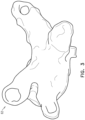
- Figs. 2 and 3 are schematic representations of maps 60 and 62, respectively, of the left atrium of a patient during an initial PVI treatment to treat AF, and a subsequent redo ablation treatment, in order to resolve a recurrence of the AF.
- These figures are reproductions of actual maps, taken from procedures performed about one year apart. The procedures were performed using a CARTO system, and maps 60 and 62 were acquired automatically by the system as the operating physician manipulated a mapping and ablation catheter within the heart.
- the markings shown on map 60 were likewise created by the CARTO system and include Visitag TM marks 46 (which appear in the figures as small balls superimposed on the heart surface), which indicate RFA locations and may also hold data regarding ablation parameters at each location.
- Map 60 shows the left atrium at the conclusion of the initial ablation treatment, while map 62 shows the same atrium just before beginning the redo ablation procedure (a year later).
- Visitag marks 46 on map 60 show the locations of circumferential WCA lines that were ablated by the physician in the initial treatment, around the ostia of the pulmonary veins. No such marks appear initially on map 62, thus making it difficult for operator 22 to identify during the redo procedure which locations were already ablated in the previous procedure.
- Fig. 4 is a flow chart that schematically illustrates a method, which is not part of the invention, for performing a redo ablation procedure, while automatically transferring the locations of RFA lesions from a previous map (such as map 60) to the current map (such as map 62).
- the method is described, for the sake of concreteness and clarity, with reference to the elements of system 20 ( Fig. 1 ) and to a sequence of example maps of the left atrium, shown in Figs. 2 , 3 and 5-7 .
- the method can be carried out using other sorts of ablation systems and can be applied to other chambers of the heart, as well.
- console 34 acquired and saved an initial map of the heart chamber, with locations of RFA lesions marked in the initial map, as shown in Fig. 2 , for example.
- console 34 acquires a current map of the chamber, such as map 62, illustrated in Fig. 3 , at a map acquisition step 72.
- Console 34 registers the initial map with the current map, at a map registration step 74. This registration can be performed by identifying one or more anatomical landmarks in both the initial map and the current map, and aligning the landmarks identified in the initial map with the positions of the same landmarks identified in the current map.
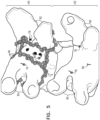
- Fig. 5 is a schematic representation of maps 60 and 62 (from Figs. 2 and 3 ), illustrating landmarks 76, 78, 80 that are used in registering the maps, in accordance with an embodiment of the invention.
- Maps 60 and 62 are shown side by side in Fig. 5 as an aid to visualization.
- the carinae between superior and inferior pulmonary veins 82 on the left and right sides of the left atrium serve as landmarks 76 and 78.
- Landmark 80 is chosen in the present example to be the apex of an isosceles triangle, with its base drawn between landmarks 76 and 78.
- Console 34 aligns landmarks 76, 78 and 80 in maps 60 and 62 and thus registers the initial map with the map surface in the current map.
- console 34 marks and displays on the current map (i.e., on map 62 in the present example) the locations of the RFA lesions from the initial map, at a marking step 84.
- the Visitag and/or other RFA marks corresponding to the WCA lines from the initial map are displayed at the precise corresponding locations on the current map.
- Operator 22 manipulates catheter 24 and actuates system 20 to ablate further tissue in the left atrium, at an ablation step 90.
- the operator (or system 20, operating automatically) can use the markings on the current map to choose ablation sites in proximity to the previous RFA lesions, and specifically to close any gaps that have opened in the WCA lines that were ablated previously.
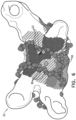
- FIGs. 6 and 7 are schematic representations of map 62, seen from two different angles, illustrating the operations carried out in steps 84 and 90, in accordance with an embodiment of the invention.
- Map 62 now includes both marks 86, representing ablation lesions made previously in the initial ablation procedure, and new marks 92 at the sites ablated in the current procedure. Marks 86 are transferred to map 62 from map 60 on the basis of the registration performed at step 74, while marks 92 are added to map 62 by console 34 as the corresponding sites are ablated in step 90.
- Figs. 6 and 7 also show an electrical activity map 88, which is superimposed on the surface of map 62.
- System 20 acquires this electrical activity map by sensing electrical activity in the left atrium, using catheter 24 or another sensing catheter (not shown).
- Electrical activity map 88 gives an indication of the electrical activity in the atrial wall, which is useful, together with marks 86 showing past RFA locations, in visualizing the locations of gaps in the WCA lines, where arrhythmogenic electrical activity "leaks through.” The operator thus can create new RFA lesions at locations that are chosen in order to close the gaps and can observe the effect of these new lesions (indicated by the corresponding marks 92) on the electrical activity shown in map 88.
- the inventors performed a clinical study to examine the efficacy of utilizing the present techniques in reducing procedure and RFA time in redo PVI.
- Software running on the CARTO system was used in incorporation of a previously-acquired map and RFA lesion marks for use in the current active map.
- Group (GR) 1 included 23 Pts who had prior maps that could be merged into the current map.
- GR 2 included the 27 Pts without available prior maps. Both groups underwent CARTO 3D mapping of the left atrium and pulmonary veins to create an anatomical structural shell. In GR 1, the prior map was merged into the current, active map. Electrical activity maps (specifically, activation maps) were created to localize conduction gaps (CGs), and focal RFA was delivered only to target the CGs on the WCA lines in order to achieve pulmonary vein isolation (PVI). In GR 2, standard methods for CG localization and guiding RFA to achieve PVI were used.
- RFA time RFA time
- RFA-D duration to complete RFA
- TP-D total procedure duration
- Group 1 had a statistically significant reduction of the measured procedure parameters (minutes), as shown in Table I below.
- Table I TABLE I - STUDY RESULTS PVP with CG RFA-T/PVP RFA-D/PVP TP-D/PVP for PVI GR 1 19 3.5 ⁇ 2.1 4.8 ⁇ 4.2 7.7 ⁇ 7.5 GR 2 32 19.3 ⁇ 10.2 38.4 ⁇ 39.3 40.7 ⁇ 39.8 Reduction 82% 88% 81% P value 0.002 ⁇ 0.001 ⁇ 0.001
Landscapes
- Health & Medical Sciences (AREA)
- Life Sciences & Earth Sciences (AREA)
- Engineering & Computer Science (AREA)
- Surgery (AREA)
- Animal Behavior & Ethology (AREA)
- Veterinary Medicine (AREA)
- Biomedical Technology (AREA)
- Heart & Thoracic Surgery (AREA)
- Medical Informatics (AREA)
- Molecular Biology (AREA)
- Public Health (AREA)
- General Health & Medical Sciences (AREA)
- Nuclear Medicine, Radiotherapy & Molecular Imaging (AREA)
- Physics & Mathematics (AREA)
- Robotics (AREA)
- Cardiology (AREA)
- Plasma & Fusion (AREA)
- Otolaryngology (AREA)
- Biophysics (AREA)
- Pathology (AREA)
- Human Computer Interaction (AREA)
- Surgical Instruments (AREA)
Claims (4)
- System für eine Herzbehandlung, umfassend:einen Katheter, der zum Einführen in eine Kammer eines Herzes eines Patienten konfiguriert ist; undeinen Prozessor, der konfiguriert ist, um eine anfängliche Karte einer Kammer eines Herzes eines Patienten, die bei einem anfänglichen Ablationsverfahren erfasst wird, zu empfangen, wobei Stellen von Ablationsläsionen auf der anfänglichen Karte markiert sind, dadurch gekennzeichnet, dass der Prozessor gekoppelt ist, um unter Verwendung des Katheters in Vorbereitung auf ein erneutes Ablationsverfahren im Anschluss an das anfängliche Ablationsverfahren eine aktuelle Karte der Kammer zu erfassen, und um die anfängliche Karte mit der aktuellen Karte zu registrieren und um die Stellen der Ablationsläsionen von der registrierten anfänglichen Karte auf der aktuellen Karte zu markieren und anzuzeigen;wobei der Prozessor konfiguriert ist, um die anfängliche Karte durch Identifizieren mindestens eines anatomischen Orientierungspunkts sowohl in der anfänglichen Karte als auch in der aktuellen Karte und Ausrichten des mindestens einen Orientierungspunkts, der in der anfänglichen Karte identifiziert wird, an einer Position des mindestens einen Orientierungspunkts, der in der aktuellen Karte identifiziert wird, zu registrieren;wobei die Kammer ein linker Vorhof des Herzes ist und der mindestens eine Orientierungspunkt eine Carina zwischen der oberen und der unteren Lungenvene umfasst, die mit dem linken Vorhof verbunden sind;wobei der Prozessor konfiguriert ist, um auf die aktuelle Karte Linien einer breiten umlaufenden Ablation (WCA) zu überlagern, die in dem ersten Ablationsverfahren erzeugt werden, und wobei das erneute Ablationsverfahren ein Abtragen von weiterem Gewebe in der Kammer an Orten umfasst, die ausgewählt sind, um mindestens eine Leitungslücke in der WCA zu schließen;wobei der Katheter konfiguriert ist, um elektrische Aktivität in der Kammer des Herzes abzutasten, und der Prozessor konfiguriert ist, um eine Angabe der abgetasteten elektrischen Aktivität auf der aktuellen Karte anzuzeigen, die eine Leitungslücke zwischen den Ablationsläsionen zeigt; undwobei das erneute Ablationsverfahren das Abtragen weiteren Gewebes in der Kammer umfasst, und wobei der Prozessor konfiguriert ist, um die Stellen weiterer Ablationsläsionen, die durch das Abtragen des weiteren Gewebes erstellt werden, zusammen mit den Ablationsläsionen aus der registrierten anfänglichen Karte auf der aktuellen Karte zu markieren und anzuzeigen.
- System nach Anspruch 1, wobei die Ablationsläsionen durch Anwendung von Hochfrequenzenergie (RF) durch den Katheter auf Myokardgewebe in der Kammer des Herzes erzeugt werden.
- System nach Anspruch 1, wobei der Prozessor konfiguriert ist, um die aktuelle Karte durch Verfolgen von Koordinaten des Katheters zu erfassen, während der Katheter innerhalb des Herzes bewegt wird.
- Computersoftwareprodukt, umfassend ein computerlesbares Medium, auf dem Programmieranweisungen gespeichert sind, wobei die Anweisungen, wenn sie durch einen Prozessor gelesen werden, den Prozessor veranlassen, eine anfängliche Karte einer Kammer eines Herzes eines Patienten zu empfangen, die bei einem ersten Ablationsverfahren erfasst wird, wobei Stellen von Ablationsläsionen auf der anfänglichen Karte markiert sind, und dadurch gekennzeichnet, dass die Anweisungen den Prozessor veranlassen, eine aktuelle Karte der Kammer unter Verwendung eines Katheters zu erfassen, der zum Einführen in die Kammer des Herzes des Patienten konfiguriert ist, in Vorbereitung auf ein erneutes Ablationsverfahren im Anschluss an das anfängliche Ablationsverfahren, und um die anfängliche Karte mit der aktuellen Karte zu registrieren und auf der aktuellen Karte die Stellen der Ablationsläsionen von der registrierten anfänglichen Karte zu markieren und anzuzeigen:wobei die Anweisungen ferner den Prozessor veranlassen, die anfängliche Karte durch Identifizieren mindestens eines anatomischen Orientierungspunkts sowohl in der anfänglichen Karte als auch in der aktuellen Karte und Ausrichten des mindestens einen Orientierungspunkts, der in der anfänglichen Karte identifiziert wird, an einer Position des mindestens einen Orientierungspunkts, der in der aktuellen Karte identifiziert wird, zu registrieren;wobei die Kammer ein linker Vorhof des Herzes ist und der mindestens eine Orientierungspunkt eine Carina zwischen der oberen und der unteren Lungenvene umfasst, die mit dem linken Vorhof verbunden sind;wobei die Anweisungen ferner den Prozessor veranlassen, auf die aktuelle Karte Linien einer breiten umlaufenden Ablation (WCA) zu überlagern, die in dem ersten Ablationsverfahren erzeugt werden, und wobei das erneute Ablationsverfahren ein Abtragen von weiterem Gewebe in der Kammer an Orten umfasst, die ausgewählt sind, um mindestens eine Leitungslücke in der WCA zu schließen;wobei der Katheter konfiguriert ist, um elektrische Aktivität in der Kammer des Herzes abzutasten, und die Anweisungen den Prozessor ferner veranlassen, eine Anzeige der abgetasteten elektrischen Aktivität auf der aktuellen Karte anzuzeigen, die eine Leitungslücke zwischen den Ablationsläsionen zeigt; undwobei das erneute Ablationsverfahren das Abtragen weiteren Gewebes in der Kammer umfasst, und wobei die Anweisungen den Prozessor ferner veranlassen, die Positionen weiterer Ablationsläsionen, die durch Abtragen des weiteren Gewebes erstellt werden, zusammen mit den Ablationsläsionen von der registrierten anfänglichen Karte auf der aktuellen Karte zu markieren und anzuzeigen.
Applications Claiming Priority (3)
| Application Number | Priority Date | Filing Date | Title |
|---|---|---|---|
| US201762447936P | 2017-01-19 | 2017-01-19 | |
| US15/811,856 US11083517B2 (en) | 2017-01-19 | 2017-11-14 | Enhancing efficiency of repeat ablation by merging current and previous maps |
| EP18152349.9A EP3351197B1 (de) | 2017-01-19 | 2018-01-18 | Verbesserung der effizienz von wiederholter ablation mittels fusionierung aktueller und vorhergehender karten |
Related Parent Applications (1)
| Application Number | Title | Priority Date | Filing Date |
|---|---|---|---|
| EP18152349.9A Division EP3351197B1 (de) | 2017-01-19 | 2018-01-18 | Verbesserung der effizienz von wiederholter ablation mittels fusionierung aktueller und vorhergehender karten |
Publications (3)
| Publication Number | Publication Date |
|---|---|
| EP3636191A1 EP3636191A1 (de) | 2020-04-15 |
| EP3636191B1 true EP3636191B1 (de) | 2024-08-07 |
| EP3636191C0 EP3636191C0 (de) | 2024-08-07 |
Family
ID=61007530
Family Applications (2)
| Application Number | Title | Priority Date | Filing Date |
|---|---|---|---|
| EP19213200.9A Active EP3636191B1 (de) | 2017-01-19 | 2018-01-18 | Verbesserung der effizienz von wiederholter ablation mittels fusionierung aktueller und vorhergehender karten |
| EP18152349.9A Active EP3351197B1 (de) | 2017-01-19 | 2018-01-18 | Verbesserung der effizienz von wiederholter ablation mittels fusionierung aktueller und vorhergehender karten |
Family Applications After (1)
| Application Number | Title | Priority Date | Filing Date |
|---|---|---|---|
| EP18152349.9A Active EP3351197B1 (de) | 2017-01-19 | 2018-01-18 | Verbesserung der effizienz von wiederholter ablation mittels fusionierung aktueller und vorhergehender karten |
Country Status (7)
| Country | Link |
|---|---|
| US (1) | US11083517B2 (de) |
| EP (2) | EP3636191B1 (de) |
| JP (1) | JP7013253B2 (de) |
| CN (1) | CN108324245B (de) |
| CA (1) | CA2992245A1 (de) |
| ES (1) | ES2772846T3 (de) |
| IL (1) | IL256890B (de) |
Families Citing this family (15)
| Publication number | Priority date | Publication date | Assignee | Title |
|---|---|---|---|---|
| US9119633B2 (en) | 2006-06-28 | 2015-09-01 | Kardium Inc. | Apparatus and method for intra-cardiac mapping and ablation |
| US11389232B2 (en) | 2006-06-28 | 2022-07-19 | Kardium Inc. | Apparatus and method for intra-cardiac mapping and ablation |
| US8906011B2 (en) | 2007-11-16 | 2014-12-09 | Kardium Inc. | Medical device for use in bodily lumens, for example an atrium |
| US10827977B2 (en) | 2012-05-21 | 2020-11-10 | Kardium Inc. | Systems and methods for activating transducers |
| US9198592B2 (en) | 2012-05-21 | 2015-12-01 | Kardium Inc. | Systems and methods for activating transducers |
| US9693832B2 (en) | 2012-05-21 | 2017-07-04 | Kardium Inc. | Systems and methods for selecting, activating, or selecting and activating transducers |
| US10722184B2 (en) | 2014-11-17 | 2020-07-28 | Kardium Inc. | Systems and methods for selecting, activating, or selecting and activating transducers |
| US10368936B2 (en) | 2014-11-17 | 2019-08-06 | Kardium Inc. | Systems and methods for selecting, activating, or selecting and activating transducers |
| US11854217B2 (en) | 2019-05-03 | 2023-12-26 | Koninklijke Philips N.V. | Co-registration of cardiac images |
| US11564738B2 (en) * | 2019-05-06 | 2023-01-31 | Biosense Webster (Israel) Ltd. | Using pulmonary vein isolation for patients with atrial fibrillation |
| US11998265B2 (en) * | 2019-12-23 | 2024-06-04 | Biosense Webster (Israel) Ltd. | Respiration control during cardiac ablation |
| CN112704514B (zh) * | 2020-12-24 | 2021-11-02 | 重庆海扶医疗科技股份有限公司 | 病灶定位方法及病灶定位系统 |
| US11911167B2 (en) * | 2021-01-19 | 2024-02-27 | Biosense Webster (Israel) Ltd. | Automatic mesh reshaping of an anatomical map to expose internal points of interest |
| US20250134574A1 (en) * | 2023-10-25 | 2025-05-01 | Biosense Webster (Israel) Ltd. | Graphically encoded ablation tags according to regions of anatomy |
| EP4670661A1 (de) * | 2024-06-29 | 2025-12-31 | Substrate HD | Computerimplementiertes herzchirurgieunterstützungsverfahren |
Family Cites Families (34)
| Publication number | Priority date | Publication date | Assignee | Title |
|---|---|---|---|---|
| US20030093067A1 (en) | 2001-11-09 | 2003-05-15 | Scimed Life Systems, Inc. | Systems and methods for guiding catheters using registered images |
| US20060241445A1 (en) * | 2005-04-26 | 2006-10-26 | Altmann Andres C | Three-dimensional cardial imaging using ultrasound contour reconstruction |
| US7517318B2 (en) | 2005-04-26 | 2009-04-14 | Biosense Webster, Inc. | Registration of electro-anatomical map with pre-acquired image using ultrasound |
| US7681579B2 (en) * | 2005-08-02 | 2010-03-23 | Biosense Webster, Inc. | Guided procedures for treating atrial fibrillation |
| US7877128B2 (en) * | 2005-08-02 | 2011-01-25 | Biosense Webster, Inc. | Simulation of invasive procedures |
| US20080172049A1 (en) * | 2005-08-25 | 2008-07-17 | Koninklijke Philips Electronics, N.V. | System and Method For Electrophysiology Regaining Support to Continue Line and Ring Ablations |
| US20070049817A1 (en) | 2005-08-30 | 2007-03-01 | Assaf Preiss | Segmentation and registration of multimodal images using physiological data |
| US20070100223A1 (en) * | 2005-10-14 | 2007-05-03 | Rui Liao | Method and system for cardiac imaging and catheter guidance for radio frequency (RF) ablation |
| US7918793B2 (en) | 2005-10-28 | 2011-04-05 | Biosense Webster, Inc. | Synchronization of ultrasound imaging data with electrical mapping |
| US20070167784A1 (en) | 2005-12-13 | 2007-07-19 | Raj Shekhar | Real-time Elastic Registration to Determine Temporal Evolution of Internal Tissues for Image-Guided Interventions |
| US7855723B2 (en) | 2006-03-21 | 2010-12-21 | Biosense Webster, Inc. | Image registration using locally-weighted fitting |
| US9119633B2 (en) * | 2006-06-28 | 2015-09-01 | Kardium Inc. | Apparatus and method for intra-cardiac mapping and ablation |
| DE102007009764A1 (de) | 2007-02-27 | 2008-08-28 | Siemens Ag | Verfahren und Vorrichtung zur visuellen Unterstützung einer Katheteranwendung |
| US8320711B2 (en) | 2007-12-05 | 2012-11-27 | Biosense Webster, Inc. | Anatomical modeling from a 3-D image and a surface mapping |
| EP2256971B1 (de) | 2008-01-22 | 2017-07-05 | Mitsubishi Electric Corporation | Optisches übertragungssystem und repeater |
| US8270694B2 (en) | 2008-04-23 | 2012-09-18 | Aditya Koolwal | Systems, methods and devices for correlating reference locations using image data |
| RU2435518C2 (ru) | 2008-11-27 | 2011-12-10 | Амиран Шотаевич РЕВИШВИЛИ | Способ неинвазивного электрофизиологического исследования сердца |
| EP2440130A4 (de) | 2009-06-08 | 2015-06-03 | Mri Interventions Inc | Mrt-gesteuerte chirurgische systeme mit näherungsalarmen |
| WO2010148088A2 (en) * | 2009-06-16 | 2010-12-23 | Surgivision, Inc. | Mri-guided devices and mri-guided interventional systems that can track and generate dynamic visualizations of the devices in near real time |
| US10688278B2 (en) | 2009-11-30 | 2020-06-23 | Biosense Webster (Israel), Ltd. | Catheter with pressure measuring tip |
| US20110160569A1 (en) | 2009-12-31 | 2011-06-30 | Amit Cohen | system and method for real-time surface and volume mapping of anatomical structures |
| EP2563229B1 (de) | 2010-04-28 | 2019-07-24 | Koninklijke Philips N.V. | Vorrichtung zur bestimmung einer eigenschaft eines objekts |
| US10918307B2 (en) | 2011-09-13 | 2021-02-16 | St. Jude Medical, Atrial Fibrillation Division, Inc. | Catheter navigation using impedance and magnetic field measurements |
| US9002436B2 (en) * | 2011-09-19 | 2015-04-07 | Siemens Aktiengesellschaft | Method and system for ablation catheter and circumferential mapping catheter tracking in fluoroscopic images |
| US8644917B2 (en) | 2011-09-20 | 2014-02-04 | Albert Einstein Healthcare Network | Cardio mapping system and method for cardio mapping |
| US9277956B2 (en) | 2011-11-09 | 2016-03-08 | Siemens Medical Solutions Usa, Inc. | System for automatic medical ablation control |
| JP6080872B2 (ja) | 2012-02-29 | 2017-02-15 | プロセプト バイオロボティクス コーポレイション | 自動化された画像誘導組織切除および治療 |
| US20130282005A1 (en) * | 2012-04-24 | 2013-10-24 | Siemens Corporation | Catheter navigation system |
| US8900225B2 (en) * | 2012-05-07 | 2014-12-02 | Biosense Webster (Israel) Ltd. | Automatic ablation tracking |
| CN105142500A (zh) | 2013-01-17 | 2015-12-09 | 科迪影技术股份有限公司 | 合成奇点绘图 |
| US9757182B2 (en) * | 2014-06-02 | 2017-09-12 | Biosense Webster (Israel) Ltd. | Identification and visualization of gaps between cardiac ablation sites |
| WO2016014949A1 (en) | 2014-07-24 | 2016-01-28 | Blake Robert C | System and method for cardiac ablation |
| US9955889B2 (en) | 2014-11-03 | 2018-05-01 | Biosense Webster (Israel) Ltd. | Registration maps using intra-cardiac signals |
| US20160331262A1 (en) * | 2015-05-13 | 2016-11-17 | Ep Solutions Sa | Combined Electrophysiological Mapping and Cardiac Ablation Methods, Systems, Components and Devices |
-
2017
- 2017-11-14 US US15/811,856 patent/US11083517B2/en active Active
-
2018
- 2018-01-14 IL IL256890A patent/IL256890B/en unknown
- 2018-01-17 CA CA2992245A patent/CA2992245A1/en not_active Abandoned
- 2018-01-18 EP EP19213200.9A patent/EP3636191B1/de active Active
- 2018-01-18 ES ES18152349T patent/ES2772846T3/es active Active
- 2018-01-18 EP EP18152349.9A patent/EP3351197B1/de active Active
- 2018-01-18 JP JP2018006200A patent/JP7013253B2/ja active Active
- 2018-01-19 CN CN201810053357.4A patent/CN108324245B/zh active Active
Also Published As
| Publication number | Publication date |
|---|---|
| IL256890B (en) | 2021-08-31 |
| EP3636191A1 (de) | 2020-04-15 |
| CN108324245A (zh) | 2018-07-27 |
| US11083517B2 (en) | 2021-08-10 |
| US20180199990A1 (en) | 2018-07-19 |
| EP3636191C0 (de) | 2024-08-07 |
| CA2992245A1 (en) | 2018-07-19 |
| EP3351197B1 (de) | 2019-12-04 |
| JP7013253B2 (ja) | 2022-01-31 |
| CN108324245B (zh) | 2023-10-20 |
| ES2772846T3 (es) | 2020-07-08 |
| EP3351197A1 (de) | 2018-07-25 |
| JP2018114285A (ja) | 2018-07-26 |
| IL256890A (en) | 2018-02-28 |
Similar Documents
| Publication | Publication Date | Title |
|---|---|---|
| EP3636191B1 (de) | Verbesserung der effizienz von wiederholter ablation mittels fusionierung aktueller und vorhergehender karten | |
| EP2591722B1 (de) | Integrative Vorhofflimmernablation | |
| US9883918B2 (en) | Method for mapping ventricular/atrial premature beats during sinus rhythm | |
| JP6812220B2 (ja) | アブレーションライン接近性指標 | |
| EP2689722B1 (de) | Eine Vorrichtung zum Abbilden der elektrischen Herzaktivität | |
| JP2019051309A (ja) | 最早期のlatの自動表示 | |
| EP4389027A1 (de) | Empfehlung einer transseptalen nadelkrümmung auf der basis der anatomie | |
| CN120112235A (zh) | 用于消融规程的对准辅助 | |
| Dixit et al. | Role of contact and noncontact mapping in the curative ablation of tachyarrhythmias | |
| Markides et al. | New mapping technologies: an overview with a clinical perspective | |
| AU2018200387A1 (en) | Enhancing efficiency of repeat ablation by merging current and previous maps | |
| US20230404677A1 (en) | Applying ablation signals to both sides of tissue | |
| JP2022187485A (ja) | 自動解剖学的特徴識別及びマップセグメント化 | |
| CN120053070A (zh) | 利用经胸廓超声引导进入心外膜袋 | |
| Swygman et al. | EP Mapping System Technologies |
Legal Events
| Date | Code | Title | Description |
|---|---|---|---|
| PUAI | Public reference made under article 153(3) epc to a published international application that has entered the european phase |
Free format text: ORIGINAL CODE: 0009012 |
|
| STAA | Information on the status of an ep patent application or granted ep patent |
Free format text: STATUS: THE APPLICATION HAS BEEN PUBLISHED |
|
| AC | Divisional application: reference to earlier application |
Ref document number: 3351197 Country of ref document: EP Kind code of ref document: P |
|
| AK | Designated contracting states |
Kind code of ref document: A1 Designated state(s): AL AT BE BG CH CY CZ DE DK EE ES FI FR GB GR HR HU IE IS IT LI LT LU LV MC MK MT NL NO PL PT RO RS SE SI SK SM TR |
|
| STAA | Information on the status of an ep patent application or granted ep patent |
Free format text: STATUS: REQUEST FOR EXAMINATION WAS MADE |
|
| 17P | Request for examination filed |
Effective date: 20201015 |
|
| RBV | Designated contracting states (corrected) |
Designated state(s): AL AT BE BG CH CY CZ DE DK EE ES FI FR GB GR HR HU IE IS IT LI LT LU LV MC MK MT NL NO PL PT RO RS SE SI SK SM TR |
|
| RIC1 | Information provided on ipc code assigned before grant |
Ipc: A61B 90/00 20160101ALN20230331BHEP Ipc: A61B 34/20 20160101ALN20230331BHEP Ipc: A61B 34/10 20160101ALN20230331BHEP Ipc: A61B 18/14 20060101AFI20230331BHEP |
|
| GRAP | Despatch of communication of intention to grant a patent |
Free format text: ORIGINAL CODE: EPIDOSNIGR1 |
|
| STAA | Information on the status of an ep patent application or granted ep patent |
Free format text: STATUS: GRANT OF PATENT IS INTENDED |
|
| RIC1 | Information provided on ipc code assigned before grant |
Ipc: A61B 90/00 20160101ALN20230417BHEP Ipc: A61B 34/20 20160101ALN20230417BHEP Ipc: A61B 34/10 20160101ALN20230417BHEP Ipc: A61B 18/14 20060101AFI20230417BHEP |
|
| INTG | Intention to grant announced |
Effective date: 20230515 |
|
| GRAJ | Information related to disapproval of communication of intention to grant by the applicant or resumption of examination proceedings by the epo deleted |
Free format text: ORIGINAL CODE: EPIDOSDIGR1 |
|
| STAA | Information on the status of an ep patent application or granted ep patent |
Free format text: STATUS: REQUEST FOR EXAMINATION WAS MADE |
|
| INTC | Intention to grant announced (deleted) | ||
| GRAP | Despatch of communication of intention to grant a patent |
Free format text: ORIGINAL CODE: EPIDOSNIGR1 |
|
| STAA | Information on the status of an ep patent application or granted ep patent |
Free format text: STATUS: GRANT OF PATENT IS INTENDED |
|
| INTG | Intention to grant announced |
Effective date: 20230921 |
|
| RIC1 | Information provided on ipc code assigned before grant |
Ipc: A61B 90/00 20160101ALN20230907BHEP Ipc: A61B 34/20 20160101ALN20230907BHEP Ipc: A61B 34/10 20160101ALN20230907BHEP Ipc: A61B 18/14 20060101AFI20230907BHEP |
|
| GRAJ | Information related to disapproval of communication of intention to grant by the applicant or resumption of examination proceedings by the epo deleted |
Free format text: ORIGINAL CODE: EPIDOSDIGR1 |
|
| STAA | Information on the status of an ep patent application or granted ep patent |
Free format text: STATUS: REQUEST FOR EXAMINATION WAS MADE |
|
| INTC | Intention to grant announced (deleted) | ||
| GRAP | Despatch of communication of intention to grant a patent |
Free format text: ORIGINAL CODE: EPIDOSNIGR1 |
|
| STAA | Information on the status of an ep patent application or granted ep patent |
Free format text: STATUS: GRANT OF PATENT IS INTENDED |
|
| RIC1 | Information provided on ipc code assigned before grant |
Ipc: A61B 90/00 20160101ALN20240223BHEP Ipc: A61B 34/20 20160101ALN20240223BHEP Ipc: A61B 34/10 20160101ALN20240223BHEP Ipc: A61B 18/14 20060101AFI20240223BHEP |
|
| INTG | Intention to grant announced |
Effective date: 20240313 |
|
| GRAS | Grant fee paid |
Free format text: ORIGINAL CODE: EPIDOSNIGR3 |
|
| GRAA | (expected) grant |
Free format text: ORIGINAL CODE: 0009210 |
|
| STAA | Information on the status of an ep patent application or granted ep patent |
Free format text: STATUS: THE PATENT HAS BEEN GRANTED |
|
| AC | Divisional application: reference to earlier application |
Ref document number: 3351197 Country of ref document: EP Kind code of ref document: P |
|
| AK | Designated contracting states |
Kind code of ref document: B1 Designated state(s): AL AT BE BG CH CY CZ DE DK EE ES FI FR GB GR HR HU IE IS IT LI LT LU LV MC MK MT NL NO PL PT RO RS SE SI SK SM TR |
|
| REG | Reference to a national code |
Ref country code: GB Ref legal event code: FG4D |
|
| REG | Reference to a national code |
Ref country code: CH Ref legal event code: EP |
|
| REG | Reference to a national code |
Ref country code: IE Ref legal event code: FG4D |
|
| REG | Reference to a national code |
Ref country code: DE Ref legal event code: R096 Ref document number: 602018072975 Country of ref document: DE |
|
| U01 | Request for unitary effect filed |
Effective date: 20240822 |
|
| U07 | Unitary effect registered |
Designated state(s): AT BE BG DE DK EE FI FR IT LT LU LV MT NL PT RO SE SI Effective date: 20240902 |
|
| U20 | Renewal fee for the european patent with unitary effect paid |
Year of fee payment: 8 Effective date: 20241205 |
|
| PG25 | Lapsed in a contracting state [announced via postgrant information from national office to epo] |
Ref country code: NO Free format text: LAPSE BECAUSE OF FAILURE TO SUBMIT A TRANSLATION OF THE DESCRIPTION OR TO PAY THE FEE WITHIN THE PRESCRIBED TIME-LIMIT Effective date: 20241107 |
|
| PG25 | Lapsed in a contracting state [announced via postgrant information from national office to epo] |
Ref country code: PL Free format text: LAPSE BECAUSE OF FAILURE TO SUBMIT A TRANSLATION OF THE DESCRIPTION OR TO PAY THE FEE WITHIN THE PRESCRIBED TIME-LIMIT Effective date: 20240807 Ref country code: GR Free format text: LAPSE BECAUSE OF FAILURE TO SUBMIT A TRANSLATION OF THE DESCRIPTION OR TO PAY THE FEE WITHIN THE PRESCRIBED TIME-LIMIT Effective date: 20241108 |
|
| PG25 | Lapsed in a contracting state [announced via postgrant information from national office to epo] |
Ref country code: IS Free format text: LAPSE BECAUSE OF FAILURE TO SUBMIT A TRANSLATION OF THE DESCRIPTION OR TO PAY THE FEE WITHIN THE PRESCRIBED TIME-LIMIT Effective date: 20241207 |
|
| PG25 | Lapsed in a contracting state [announced via postgrant information from national office to epo] |
Ref country code: HR Free format text: LAPSE BECAUSE OF FAILURE TO SUBMIT A TRANSLATION OF THE DESCRIPTION OR TO PAY THE FEE WITHIN THE PRESCRIBED TIME-LIMIT Effective date: 20240807 |
|
| PG25 | Lapsed in a contracting state [announced via postgrant information from national office to epo] |
Ref country code: ES Free format text: LAPSE BECAUSE OF FAILURE TO SUBMIT A TRANSLATION OF THE DESCRIPTION OR TO PAY THE FEE WITHIN THE PRESCRIBED TIME-LIMIT Effective date: 20240807 Ref country code: RS Free format text: LAPSE BECAUSE OF FAILURE TO SUBMIT A TRANSLATION OF THE DESCRIPTION OR TO PAY THE FEE WITHIN THE PRESCRIBED TIME-LIMIT Effective date: 20241107 |
|
| PG25 | Lapsed in a contracting state [announced via postgrant information from national office to epo] |
Ref country code: RS Free format text: LAPSE BECAUSE OF FAILURE TO SUBMIT A TRANSLATION OF THE DESCRIPTION OR TO PAY THE FEE WITHIN THE PRESCRIBED TIME-LIMIT Effective date: 20241107 Ref country code: PL Free format text: LAPSE BECAUSE OF FAILURE TO SUBMIT A TRANSLATION OF THE DESCRIPTION OR TO PAY THE FEE WITHIN THE PRESCRIBED TIME-LIMIT Effective date: 20240807 Ref country code: NO Free format text: LAPSE BECAUSE OF FAILURE TO SUBMIT A TRANSLATION OF THE DESCRIPTION OR TO PAY THE FEE WITHIN THE PRESCRIBED TIME-LIMIT Effective date: 20241107 Ref country code: IS Free format text: LAPSE BECAUSE OF FAILURE TO SUBMIT A TRANSLATION OF THE DESCRIPTION OR TO PAY THE FEE WITHIN THE PRESCRIBED TIME-LIMIT Effective date: 20241207 Ref country code: HR Free format text: LAPSE BECAUSE OF FAILURE TO SUBMIT A TRANSLATION OF THE DESCRIPTION OR TO PAY THE FEE WITHIN THE PRESCRIBED TIME-LIMIT Effective date: 20240807 Ref country code: GR Free format text: LAPSE BECAUSE OF FAILURE TO SUBMIT A TRANSLATION OF THE DESCRIPTION OR TO PAY THE FEE WITHIN THE PRESCRIBED TIME-LIMIT Effective date: 20241108 Ref country code: ES Free format text: LAPSE BECAUSE OF FAILURE TO SUBMIT A TRANSLATION OF THE DESCRIPTION OR TO PAY THE FEE WITHIN THE PRESCRIBED TIME-LIMIT Effective date: 20240807 |
|
| PG25 | Lapsed in a contracting state [announced via postgrant information from national office to epo] |
Ref country code: SM Free format text: LAPSE BECAUSE OF FAILURE TO SUBMIT A TRANSLATION OF THE DESCRIPTION OR TO PAY THE FEE WITHIN THE PRESCRIBED TIME-LIMIT Effective date: 20240807 |
|
| PG25 | Lapsed in a contracting state [announced via postgrant information from national office to epo] |
Ref country code: CZ Free format text: LAPSE BECAUSE OF FAILURE TO SUBMIT A TRANSLATION OF THE DESCRIPTION OR TO PAY THE FEE WITHIN THE PRESCRIBED TIME-LIMIT Effective date: 20240807 |
|
| PG25 | Lapsed in a contracting state [announced via postgrant information from national office to epo] |
Ref country code: SK Free format text: LAPSE BECAUSE OF FAILURE TO SUBMIT A TRANSLATION OF THE DESCRIPTION OR TO PAY THE FEE WITHIN THE PRESCRIBED TIME-LIMIT Effective date: 20240807 |
|
| PLBE | No opposition filed within time limit |
Free format text: ORIGINAL CODE: 0009261 |
|
| STAA | Information on the status of an ep patent application or granted ep patent |
Free format text: STATUS: NO OPPOSITION FILED WITHIN TIME LIMIT |
|
| 26N | No opposition filed |
Effective date: 20250508 |
|
| REG | Reference to a national code |
Ref country code: CH Ref legal event code: PL |
|
| PG25 | Lapsed in a contracting state [announced via postgrant information from national office to epo] |
Ref country code: MC Free format text: LAPSE BECAUSE OF FAILURE TO SUBMIT A TRANSLATION OF THE DESCRIPTION OR TO PAY THE FEE WITHIN THE PRESCRIBED TIME-LIMIT Effective date: 20240807 |
|
| PG25 | Lapsed in a contracting state [announced via postgrant information from national office to epo] |
Ref country code: CH Free format text: LAPSE BECAUSE OF NON-PAYMENT OF DUE FEES Effective date: 20250131 |
|
| PGFP | Annual fee paid to national office [announced via postgrant information from national office to epo] |
Ref country code: GB Payment date: 20251204 Year of fee payment: 9 |
|
| U20 | Renewal fee for the european patent with unitary effect paid |
Year of fee payment: 9 Effective date: 20251205 |
|
| PG25 | Lapsed in a contracting state [announced via postgrant information from national office to epo] |
Ref country code: IE Free format text: LAPSE BECAUSE OF NON-PAYMENT OF DUE FEES Effective date: 20250118 |