EP3632960A1 - Silicon compound and method for producing same - Google Patents
Silicon compound and method for producing same Download PDFInfo
- Publication number
- EP3632960A1 EP3632960A1 EP18810325.3A EP18810325A EP3632960A1 EP 3632960 A1 EP3632960 A1 EP 3632960A1 EP 18810325 A EP18810325 A EP 18810325A EP 3632960 A1 EP3632960 A1 EP 3632960A1
- Authority
- EP
- European Patent Office
- Prior art keywords
- carbon atoms
- general formula
- alkyl group
- group
- aryl group
- Prior art date
- Legal status (The legal status is an assumption and is not a legal conclusion. Google has not performed a legal analysis and makes no representation as to the accuracy of the status listed.)
- Withdrawn
Links
- 150000003377 silicon compounds Chemical class 0.000 title claims abstract description 28
- 238000004519 manufacturing process Methods 0.000 title claims description 17
- 125000004432 carbon atom Chemical group C* 0.000 claims abstract description 108
- 125000000217 alkyl group Chemical group 0.000 claims abstract description 62
- 125000003118 aryl group Chemical group 0.000 claims abstract description 55
- 150000001875 compounds Chemical class 0.000 claims description 77
- 238000000034 method Methods 0.000 claims description 13
- 125000001997 phenyl group Chemical group [H]C1=C([H])C([H])=C(*)C([H])=C1[H] 0.000 description 22
- VLKZOEOYAKHREP-UHFFFAOYSA-N n-Hexane Chemical compound CCCCCC VLKZOEOYAKHREP-UHFFFAOYSA-N 0.000 description 21
- XEKOWRVHYACXOJ-UHFFFAOYSA-N Ethyl acetate Chemical compound CCOC(C)=O XEKOWRVHYACXOJ-UHFFFAOYSA-N 0.000 description 18
- YXFVVABEGXRONW-UHFFFAOYSA-N Toluene Chemical compound CC1=CC=CC=C1 YXFVVABEGXRONW-UHFFFAOYSA-N 0.000 description 15
- WYURNTSHIVDZCO-UHFFFAOYSA-N Tetrahydrofuran Chemical compound C1CCOC1 WYURNTSHIVDZCO-UHFFFAOYSA-N 0.000 description 14
- 239000002904 solvent Substances 0.000 description 13
- XLYOFNOQVPJJNP-UHFFFAOYSA-N water Substances O XLYOFNOQVPJJNP-UHFFFAOYSA-N 0.000 description 13
- ZWEHNKRNPOVVGH-UHFFFAOYSA-N 2-Butanone Chemical compound CCC(C)=O ZWEHNKRNPOVVGH-UHFFFAOYSA-N 0.000 description 12
- -1 isooctyl group Chemical group 0.000 description 11
- KFZMGEQAYNKOFK-UHFFFAOYSA-N Isopropanol Chemical compound CC(C)O KFZMGEQAYNKOFK-UHFFFAOYSA-N 0.000 description 9
- 125000002496 methyl group Chemical group [H]C([H])([H])* 0.000 description 9
- 239000000243 solution Substances 0.000 description 9
- YNQLUTRBYVCPMQ-UHFFFAOYSA-N Ethylbenzene Chemical compound CCC1=CC=CC=C1 YNQLUTRBYVCPMQ-UHFFFAOYSA-N 0.000 description 8
- IMNFDUFMRHMDMM-UHFFFAOYSA-N N-Heptane Chemical compound CCCCCCC IMNFDUFMRHMDMM-UHFFFAOYSA-N 0.000 description 8
- BGTOWKSIORTVQH-UHFFFAOYSA-N cyclopentanone Chemical compound O=C1CCCC1 BGTOWKSIORTVQH-UHFFFAOYSA-N 0.000 description 8
- BASFCYQUMIYNBI-UHFFFAOYSA-N platinum Chemical compound [Pt] BASFCYQUMIYNBI-UHFFFAOYSA-N 0.000 description 8
- 238000005133 29Si NMR spectroscopy Methods 0.000 description 7
- 125000001495 ethyl group Chemical group [H]C([H])([H])C([H])([H])* 0.000 description 7
- 125000000959 isobutyl group Chemical group [H]C([H])([H])C([H])(C([H])([H])[H])C([H])([H])* 0.000 description 7
- YLQBMQCUIZJEEH-UHFFFAOYSA-N tetrahydrofuran Natural products C=1C=COC=1 YLQBMQCUIZJEEH-UHFFFAOYSA-N 0.000 description 7
- OKTJSMMVPCPJKN-UHFFFAOYSA-N Carbon Chemical group [C] OKTJSMMVPCPJKN-UHFFFAOYSA-N 0.000 description 6
- IAZDPXIOMUYVGZ-WFGJKAKNSA-N Dimethyl sulfoxide Chemical compound [2H]C([2H])([2H])S(=O)C([2H])([2H])[2H] IAZDPXIOMUYVGZ-WFGJKAKNSA-N 0.000 description 6
- VEXZGXHMUGYJMC-UHFFFAOYSA-N Hydrochloric acid Chemical compound Cl VEXZGXHMUGYJMC-UHFFFAOYSA-N 0.000 description 6
- OKKJLVBELUTLKV-UHFFFAOYSA-N Methanol Chemical compound OC OKKJLVBELUTLKV-UHFFFAOYSA-N 0.000 description 6
- HEMHJVSKTPXQMS-UHFFFAOYSA-M Sodium hydroxide Chemical compound [OH-].[Na+] HEMHJVSKTPXQMS-UHFFFAOYSA-M 0.000 description 6
- ZMANZCXQSJIPKH-UHFFFAOYSA-N Triethylamine Chemical compound CCN(CC)CC ZMANZCXQSJIPKH-UHFFFAOYSA-N 0.000 description 6
- 125000002015 acyclic group Chemical group 0.000 description 6
- 150000001721 carbon Chemical group 0.000 description 6
- 229910052799 carbon Inorganic materials 0.000 description 6
- 125000004122 cyclic group Chemical group 0.000 description 6
- 125000000113 cyclohexyl group Chemical group [H]C1([H])C([H])([H])C([H])([H])C([H])(*)C([H])([H])C1([H])[H] 0.000 description 6
- 239000007788 liquid Substances 0.000 description 6
- 239000003921 oil Substances 0.000 description 6
- 125000003884 phenylalkyl group Chemical group 0.000 description 6
- 229920000642 polymer Polymers 0.000 description 6
- 238000001644 13C nuclear magnetic resonance spectroscopy Methods 0.000 description 5
- 238000005160 1H NMR spectroscopy Methods 0.000 description 5
- 238000005259 measurement Methods 0.000 description 5
- 239000000126 substance Substances 0.000 description 5
- 239000013585 weight reducing agent Substances 0.000 description 5
- IJGRMHOSHXDMSA-UHFFFAOYSA-N Atomic nitrogen Chemical compound N#N IJGRMHOSHXDMSA-UHFFFAOYSA-N 0.000 description 4
- 0 CCCCC[C@](C)C(C)CC(C1*C1)C1CC2=CC2C1 Chemical compound CCCCC[C@](C)C(C)CC(C1*C1)C1CC2=CC2C1 0.000 description 4
- NTIZESTWPVYFNL-UHFFFAOYSA-N Methyl isobutyl ketone Chemical compound CC(C)CC(C)=O NTIZESTWPVYFNL-UHFFFAOYSA-N 0.000 description 4
- UIHCLUNTQKBZGK-UHFFFAOYSA-N Methyl isobutyl ketone Natural products CCC(C)C(C)=O UIHCLUNTQKBZGK-UHFFFAOYSA-N 0.000 description 4
- CTQNGGLPUBDAKN-UHFFFAOYSA-N O-Xylene Chemical compound CC1=CC=CC=C1C CTQNGGLPUBDAKN-UHFFFAOYSA-N 0.000 description 4
- PMZURENOXWZQFD-UHFFFAOYSA-L Sodium Sulfate Chemical compound [Na+].[Na+].[O-]S([O-])(=O)=O PMZURENOXWZQFD-UHFFFAOYSA-L 0.000 description 4
- 230000015572 biosynthetic process Effects 0.000 description 4
- 238000001460 carbon-13 nuclear magnetic resonance spectrum Methods 0.000 description 4
- 239000003054 catalyst Substances 0.000 description 4
- GJRQTCIYDGXPES-UHFFFAOYSA-N iso-butyl acetate Natural products CC(C)COC(C)=O GJRQTCIYDGXPES-UHFFFAOYSA-N 0.000 description 4
- FGKJLKRYENPLQH-UHFFFAOYSA-M isocaproate Chemical compound CC(C)CCC([O-])=O FGKJLKRYENPLQH-UHFFFAOYSA-M 0.000 description 4
- OQAGVSWESNCJJT-UHFFFAOYSA-N isovaleric acid methyl ester Natural products COC(=O)CC(C)C OQAGVSWESNCJJT-UHFFFAOYSA-N 0.000 description 4
- 229910052751 metal Inorganic materials 0.000 description 4
- 239000002184 metal Substances 0.000 description 4
- 239000000203 mixture Substances 0.000 description 4
- LLHKCFNBLRBOGN-UHFFFAOYSA-N propylene glycol methyl ether acetate Chemical compound COCC(C)OC(C)=O LLHKCFNBLRBOGN-UHFFFAOYSA-N 0.000 description 4
- 239000008213 purified water Substances 0.000 description 4
- 238000000926 separation method Methods 0.000 description 4
- 239000007787 solid Substances 0.000 description 4
- 238000003756 stirring Methods 0.000 description 4
- 238000003786 synthesis reaction Methods 0.000 description 4
- 239000008096 xylene Substances 0.000 description 4
- WMFOQBRAJBCJND-UHFFFAOYSA-M Lithium hydroxide Chemical compound [Li+].[OH-] WMFOQBRAJBCJND-UHFFFAOYSA-M 0.000 description 3
- 238000005481 NMR spectroscopy Methods 0.000 description 3
- KWYUFKZDYYNOTN-UHFFFAOYSA-M Potassium hydroxide Chemical compound [OH-].[K+] KWYUFKZDYYNOTN-UHFFFAOYSA-M 0.000 description 3
- 230000000052 comparative effect Effects 0.000 description 3
- 230000000694 effects Effects 0.000 description 3
- 229910000077 silane Inorganic materials 0.000 description 3
- 238000001228 spectrum Methods 0.000 description 3
- 239000006228 supernatant Substances 0.000 description 3
- 125000000391 vinyl group Chemical group [H]C([*])=C([H])[H] 0.000 description 3
- NLXLAEXVIDQMFP-UHFFFAOYSA-N Ammonia chloride Chemical compound [NH4+].[Cl-] NLXLAEXVIDQMFP-UHFFFAOYSA-N 0.000 description 2
- VEXZGXHMUGYJMC-UHFFFAOYSA-M Chloride anion Chemical compound [Cl-] VEXZGXHMUGYJMC-UHFFFAOYSA-M 0.000 description 2
- XUIMIQQOPSSXEZ-UHFFFAOYSA-N Silicon Chemical group [Si] XUIMIQQOPSSXEZ-UHFFFAOYSA-N 0.000 description 2
- UIIMBOGNXHQVGW-UHFFFAOYSA-M Sodium bicarbonate Chemical compound [Na+].OC([O-])=O UIIMBOGNXHQVGW-UHFFFAOYSA-M 0.000 description 2
- 239000002253 acid Substances 0.000 description 2
- 239000012298 atmosphere Substances 0.000 description 2
- 238000006243 chemical reaction Methods 0.000 description 2
- 238000001816 cooling Methods 0.000 description 2
- 239000013078 crystal Substances 0.000 description 2
- 230000007423 decrease Effects 0.000 description 2
- KPUWHANPEXNPJT-UHFFFAOYSA-N disiloxane Chemical class [SiH3]O[SiH3] KPUWHANPEXNPJT-UHFFFAOYSA-N 0.000 description 2
- 238000012986 modification Methods 0.000 description 2
- 230000004048 modification Effects 0.000 description 2
- 229910052757 nitrogen Inorganic materials 0.000 description 2
- WYURNTSHIVDZCO-SVYQBANQSA-N oxolane-d8 Chemical compound [2H]C1([2H])OC([2H])([2H])C([2H])([2H])C1([2H])[2H] WYURNTSHIVDZCO-SVYQBANQSA-N 0.000 description 2
- 229910052697 platinum Inorganic materials 0.000 description 2
- 238000000425 proton nuclear magnetic resonance spectrum Methods 0.000 description 2
- 238000010992 reflux Methods 0.000 description 2
- 229920005989 resin Polymers 0.000 description 2
- 239000011347 resin Substances 0.000 description 2
- 229910052938 sodium sulfate Inorganic materials 0.000 description 2
- 235000011152 sodium sulphate Nutrition 0.000 description 2
- RIOQSEWOXXDEQQ-UHFFFAOYSA-N triphenylphosphine Chemical compound C1=CC=CC=C1P(C=1C=CC=CC=1)C1=CC=CC=C1 RIOQSEWOXXDEQQ-UHFFFAOYSA-N 0.000 description 2
- LFQSCWFLJHTTHZ-UHFFFAOYSA-N Ethanol Chemical compound CCO LFQSCWFLJHTTHZ-UHFFFAOYSA-N 0.000 description 1
- UIEXFJVOIMVETD-UHFFFAOYSA-N P([O-])([O-])[O-].[Pt+3] Chemical class P([O-])([O-])[O-].[Pt+3] UIEXFJVOIMVETD-UHFFFAOYSA-N 0.000 description 1
- YTEISYFNYGDBRV-UHFFFAOYSA-N [(dimethyl-$l^{3}-silanyl)oxy-dimethylsilyl]oxy-dimethylsilicon Chemical compound C[Si](C)O[Si](C)(C)O[Si](C)C YTEISYFNYGDBRV-UHFFFAOYSA-N 0.000 description 1
- 150000001299 aldehydes Chemical class 0.000 description 1
- 235000019270 ammonium chloride Nutrition 0.000 description 1
- 239000007864 aqueous solution Substances 0.000 description 1
- 150000007514 bases Chemical class 0.000 description 1
- LDKSTCHEYCNPDS-UHFFFAOYSA-L carbon monoxide;dichloroplatinum Chemical compound O=C=[Pt](Cl)(Cl)=C=O LDKSTCHEYCNPDS-UHFFFAOYSA-L 0.000 description 1
- 239000003153 chemical reaction reagent Substances 0.000 description 1
- 238000009833 condensation Methods 0.000 description 1
- 230000005494 condensation Effects 0.000 description 1
- 238000013461 design Methods 0.000 description 1
- YLJJAVFOBDSYAN-UHFFFAOYSA-N dichloro-ethenyl-methylsilane Chemical compound C[Si](Cl)(Cl)C=C YLJJAVFOBDSYAN-UHFFFAOYSA-N 0.000 description 1
- 238000004455 differential thermal analysis Methods 0.000 description 1
- 239000012776 electronic material Substances 0.000 description 1
- 239000011521 glass Substances 0.000 description 1
- 238000010438 heat treatment Methods 0.000 description 1
- 230000007062 hydrolysis Effects 0.000 description 1
- 238000006460 hydrolysis reaction Methods 0.000 description 1
- 230000003301 hydrolyzing effect Effects 0.000 description 1
- 125000002887 hydroxy group Chemical group [H]O* 0.000 description 1
- 238000007654 immersion Methods 0.000 description 1
- 150000002576 ketones Chemical class 0.000 description 1
- 229910052744 lithium Inorganic materials 0.000 description 1
- 239000000463 material Substances 0.000 description 1
- 239000012299 nitrogen atmosphere Substances 0.000 description 1
- 230000003287 optical effect Effects 0.000 description 1
- 150000003961 organosilicon compounds Chemical class 0.000 description 1
- 239000007793 ph indicator Substances 0.000 description 1
- 238000005191 phase separation Methods 0.000 description 1
- PKELYQZIUROQSI-UHFFFAOYSA-N phosphane;platinum Chemical class P.[Pt] PKELYQZIUROQSI-UHFFFAOYSA-N 0.000 description 1
- PIZSEPSUZMIOQF-UHFFFAOYSA-N platinum;2,4,6,8-tetrakis(ethenyl)-2,4,6,8-tetramethyl-1,3,5,7,2,4,6,8-tetraoxatetrasilocane Chemical compound [Pt].C=C[Si]1(C)O[Si](C)(C=C)O[Si](C)(C=C)O[Si](C)(C=C)O1 PIZSEPSUZMIOQF-UHFFFAOYSA-N 0.000 description 1
- 239000000047 product Substances 0.000 description 1
- 239000002994 raw material Substances 0.000 description 1
- 238000011160 research Methods 0.000 description 1
- 229920006395 saturated elastomer Polymers 0.000 description 1
- 239000012047 saturated solution Substances 0.000 description 1
- 239000004065 semiconductor Substances 0.000 description 1
- 229920002545 silicone oil Polymers 0.000 description 1
- 229920002050 silicone resin Polymers 0.000 description 1
- 229910052708 sodium Inorganic materials 0.000 description 1
- 239000011734 sodium Substances 0.000 description 1
- 229910000030 sodium bicarbonate Inorganic materials 0.000 description 1
- 235000017557 sodium bicarbonate Nutrition 0.000 description 1
- ZNOCGWVLWPVKAO-UHFFFAOYSA-N trimethoxy(phenyl)silane Chemical compound CO[Si](OC)(OC)C1=CC=CC=C1 ZNOCGWVLWPVKAO-UHFFFAOYSA-N 0.000 description 1
- HVLLSGMXQDNUAL-UHFFFAOYSA-N triphenyl phosphite Chemical compound C=1C=CC=CC=1OP(OC=1C=CC=CC=1)OC1=CC=CC=C1 HVLLSGMXQDNUAL-UHFFFAOYSA-N 0.000 description 1
Images


Classifications
-
- C—CHEMISTRY; METALLURGY
- C08—ORGANIC MACROMOLECULAR COMPOUNDS; THEIR PREPARATION OR CHEMICAL WORKING-UP; COMPOSITIONS BASED THEREON
- C08G—MACROMOLECULAR COMPOUNDS OBTAINED OTHERWISE THAN BY REACTIONS ONLY INVOLVING UNSATURATED CARBON-TO-CARBON BONDS
- C08G77/00—Macromolecular compounds obtained by reactions forming a linkage containing silicon with or without sulfur, nitrogen, oxygen or carbon in the main chain of the macromolecule
- C08G77/04—Polysiloxanes
- C08G77/20—Polysiloxanes containing silicon bound to unsaturated aliphatic groups
-
- C—CHEMISTRY; METALLURGY
- C08—ORGANIC MACROMOLECULAR COMPOUNDS; THEIR PREPARATION OR CHEMICAL WORKING-UP; COMPOSITIONS BASED THEREON
- C08G—MACROMOLECULAR COMPOUNDS OBTAINED OTHERWISE THAN BY REACTIONS ONLY INVOLVING UNSATURATED CARBON-TO-CARBON BONDS
- C08G77/00—Macromolecular compounds obtained by reactions forming a linkage containing silicon with or without sulfur, nitrogen, oxygen or carbon in the main chain of the macromolecule
- C08G77/04—Polysiloxanes
- C08G77/06—Preparatory processes
-
- C—CHEMISTRY; METALLURGY
- C08—ORGANIC MACROMOLECULAR COMPOUNDS; THEIR PREPARATION OR CHEMICAL WORKING-UP; COMPOSITIONS BASED THEREON
- C08G—MACROMOLECULAR COMPOUNDS OBTAINED OTHERWISE THAN BY REACTIONS ONLY INVOLVING UNSATURATED CARBON-TO-CARBON BONDS
- C08G77/00—Macromolecular compounds obtained by reactions forming a linkage containing silicon with or without sulfur, nitrogen, oxygen or carbon in the main chain of the macromolecule
- C08G77/42—Block-or graft-polymers containing polysiloxane sequences
- C08G77/44—Block-or graft-polymers containing polysiloxane sequences containing only polysiloxane sequences
-
- C—CHEMISTRY; METALLURGY
- C08—ORGANIC MACROMOLECULAR COMPOUNDS; THEIR PREPARATION OR CHEMICAL WORKING-UP; COMPOSITIONS BASED THEREON
- C08G—MACROMOLECULAR COMPOUNDS OBTAINED OTHERWISE THAN BY REACTIONS ONLY INVOLVING UNSATURATED CARBON-TO-CARBON BONDS
- C08G77/00—Macromolecular compounds obtained by reactions forming a linkage containing silicon with or without sulfur, nitrogen, oxygen or carbon in the main chain of the macromolecule
- C08G77/48—Macromolecular compounds obtained by reactions forming a linkage containing silicon with or without sulfur, nitrogen, oxygen or carbon in the main chain of the macromolecule in which at least two but not all the silicon atoms are connected by linkages other than oxygen atoms
- C08G77/50—Macromolecular compounds obtained by reactions forming a linkage containing silicon with or without sulfur, nitrogen, oxygen or carbon in the main chain of the macromolecule in which at least two but not all the silicon atoms are connected by linkages other than oxygen atoms by carbon linkages
Definitions
- Embodiments of the present invention relate to a silicon compound and a method for producing that compound.
- Silsesquioxanes represented by (RSiO 1.5 ) n are known as compounds that can be obtained by subjecting an organosilicon compound having three hydrolyzable groups to hydrolysis followed by condensation. These compounds have a chemical structure that can be said to exist between silicone resins and glass, and because they have excellent properties including heat resistance, transparency and weather resistance, they are attracting much attention as optical, semiconductor and electronic materials, with a large amount of research continuing to be reported.
- Known structures for these silsesquioxanes include random structures with no specific structure, as well as double-decker structures, ladder structures and cage structures for which the structure can be determined. Although all of these structures have excellent properties, from the viewpoint of the correlation between precise material design and the manifestation of properties, ladder structures and cage structures for which the structure can be determined are particularly superior.
- Patent Document 1 proposes an example in which a double-decker silsesquioxane is introduced into the main chain, whereas Non-Patent Document 1 proposes an example in which a cage silsesquioxane is introduced into the main chain. Either of these silsesquioxanes has a three-dimensional polyhedral structure, and uses either 10 or 8 silicon atoms.
- Patent Document 1 JP 2008-280420 A
- Patent Document 1 Polymer Chemistry, (2015), 6, 7500 to 7504 .
- One embodiment of the present invention has an object of providing a polymer having a main chain into which has been introduced a ladder silsesquioxane of low cost and excellent heat resistance that has 6 silicon atoms, which is fewer than conventional silsesquioxanes having a polyhedral structure.
- An embodiment of the present invention are able to provide a polymer having a main chain into which has been introduced a ladder silsesquioxane of low cost and excellent heat resistance.
- the silicon compound according to one embodiment is characterized by having a structural unit represented by general formula (I) shown below.
- m represents an integer of 1 to 30
- n represents a number that ensures a weight average molecular weight of 5,000 to 1,000,000
- each of R 1 to R 4 independently represents an alkyl group of 1 to 8 carbon atoms or an aryl group of 6 to 14 carbon atoms
- each of R 5 and R 6 independently represents an alkyl group of 1 to 8 carbon atoms or an aryl group of 6 to 14 carbon atoms
- each of R 7 to R 10 independently represents an alkyl group of 1 to 8 carbon atoms or an aryl group of 6 to 14 carbon atoms
- the combinations of m and R 1 to R 10 may be all the same, partially different, or all mutually different.
- each of R 1 , R 2 , R 3 and R 4 independently represents an alkyl group or an aryl group, and preferably represents an alkyl group of 1 to 8 carbon atoms or an aryl group of 6 to 14 carbon atoms.
- the alkyl group represented by R 1 to R 4 preferably has 1 to 8 carbon atoms, and more preferably 1 to 4 carbon atoms, may have a straight chain or a branched chain, and may be either acyclic or cyclic.
- the aryl group represented by R 1 to R 4 preferably has 6 to 14 carbon atoms, and more preferably 6 to 8 carbon atoms. Within this range for the number of carbon atoms, the aryl group may have an alkyl group having a straight chain or a branched chain bonded to at least one carbon atom that forms the carbon ring.
- R 1 to R 4 examples include, independently, a methyl group, ethyl group, isobutyl group, cyclohexyl group, isooctyl group, phenyl group and alkyl-substituted phenyl group, and an unsubstituted or substituted phenyl group of 6 to 8 carbon atoms is preferred.
- each of R 5 and R 6 independently represents an alkyl group or an aryl group, and preferably represents an alkyl group of 1 to 8 carbon atoms or an aryl group of 6 to 14 carbon atoms.
- the alkyl group represented by R 5 or R 6 preferably has 1 to 8 carbon atoms, and more preferably 1 to 4 carbon atoms, may have a straight chain or a branched chain, and may be either acyclic or cyclic.
- the aryl group represented by R 5 or R 6 preferably has 6 to 14 carbon atoms, and more preferably 6 to 8 carbon atoms. Within this range for the number of carbon atoms, the aryl group may have an alkyl group having a straight chain or a branched chain bonded to at least one carbon atom that forms the carbon ring.
- R 5 and R 6 include, independently, a methyl group, ethyl group, isobutyl group, cyclohexyl group, isooctyl group, phenyl group and alkyl-substituted phenyl group, and an alkyl group of 1 to 4 carbon atoms, or an unsubstituted or substituted phenyl group of 6 to 8 carbon atoms is preferred.
- each of R 7 , R 8 , R 9 and R 10 independently represents an alkyl group or an aryl group, and preferably represents an alkyl group of 1 to 8 carbon atoms or an aryl group of 6 to 14 carbon atoms.
- the alkyl group represented by R 7 to R 10 preferably has 1 to 8 carbon atoms, and more preferably 1 to 4 carbon atoms, may have a straight chain or a branched chain, and may be either acyclic or cyclic.
- the aryl group represented by R 7 to R 10 preferably has 6 to 14 carbon atoms, and more preferably 6 to 8 carbon atoms. Within this range for the number of carbon atoms, the aryl group may have an alkyl group having a straight chain or a branched chain bonded to at least one carbon atom that forms the carbon ring.
- R 7 to R 10 examples include, independently, a methyl group, ethyl group, isobutyl group, cyclohexyl group, isooctyl group, phenyl group and alkyl-substituted phenyl group, and an alkyl group of 1 to 4 carbon atoms, or an unsubstituted or alkyl-substituted phenyl group of 6 to 8 carbon atoms is preferred.
- n is preferably a number that ensures a weight average molecular weight of 5,000 to 1,000,000.
- n is more preferably a number that yields a weight average molecular weight of 3,000 to 500,000, and even more preferably a number that yields a weight average molecular weight of 4,000 to 100,000.
- n is preferably an integer of 1 to 30.
- the siloxane main chain that links the ladder silsesquioxanes moves aggressively as a soft segment at high temperatures.
- the ladder silsesquioxanes exhibit powerful cohesiveness, and cohesive forces operate both intermolecularly and intramolecularly. Accordingly, under high temperatures, it is thought that the polymer main chain having the ladder silsesquioxanes linked with a soft segment undergoes unique molecular chain movement, resulting in an improvement in the heat resistance of the polymer of one embodiment.
- m is more preferably from 1 to 25, and even more preferably from 1 to 20.
- the silicon compound having a structural unit represented by general formula (I) is not limited to compounds produced using the following production method.
- the method for producing a silicon compound having a structural unit represented by general formula (I) preferably includes a step of producing the silicon compound using a compound represented by general formula (II) shown below. Moreover, a method that includes a step of producing the silicon compound using a compound represented by general formula (III) shown below is also preferred. A method that includes a step of reacting a compound represented by general formula (II) with a compound represented by general formula (III) is particularly preferred.
- each of R 1 to R 4 independently represents an alkyl group of 1 to 8 carbon atoms or an aryl group of 6 to 14 carbon atoms
- each of R 5 and R 6 independently represents an alkyl group of 1 to 8 carbon atoms or an aryl group of 6 to 14 carbon atoms.
- each of R 1 to R 4 independently represents an alkyl group or an aryl group, and preferably represents an alkyl group of 1 to 8 carbon atoms or an aryl group of 6 to 14 carbon atoms.
- the alkyl group represented by R 1 to R 4 preferably has 1 to 8 carbon atoms, and more preferably 1 to 4 carbon atoms, may have a straight chain or a branched chain, and may be either acyclic or cyclic.
- the aryl group represented by R 1 to R 4 preferably has 6 to 14 carbon atoms, and more preferably 6 to 8 carbon atoms. Within this range for the number of carbon atoms, the aryl group may have an alkyl group having a straight chain or a branched chain bonded to at least one carbon atom that forms the carbon ring.
- R 1 to R 4 examples include, independently, a methyl group, ethyl group, isobutyl group, cyclohexyl group, isooctyl group, phenyl group and alkyl-substituted phenyl group, and an unsubstituted or substituted phenyl group of 6 to 8 carbon atoms is preferred.
- each of R 5 and R 6 independently represents an alkyl group or an aryl group, and preferably represents an alkyl group of 1 to 8 carbon atoms or an aryl group of 6 to 14 carbon atoms.
- the alkyl group represented by R 5 or R 6 preferably has 1 to 8 carbon atoms, and more preferably 1 to 4 carbon atoms, may have a straight chain or a branched chain, and may be either acyclic or cyclic.
- the aryl group represented by R 5 or R 6 preferably has 6 to 14 carbon atoms, and more preferably 6 to 8 carbon atoms. Within this range for the number of carbon atoms, the aryl group may have an alkyl group having a straight chain or a branched chain bonded to at least one carbon atom that forms the carbon ring.
- R 5 and R 6 include, independently, a methyl group, ethyl group, isobutyl group, cyclohexyl group, isooctyl group, phenyl group and alkyl-substituted phenyl group, and an alkyl group of 1 to 4 carbon atoms, or an unsubstituted or substituted phenyl group of 6 to 8 carbon atoms is preferred.
- the compound represented by general formula (II) may use at least one compound, or a combination of two or more compounds, selected from among a plurality of compounds having different combinations of R 1 to R 6 .
- m represents an integer of 1 to 30, and each of R 7 to R 10 independently represents an alkyl group of 1 to 8 carbon atoms or an aryl group of 6 to 14 carbon atoms.
- each of R 7 to R 10 independently represents an alkyl group or an aryl group, and preferably represents an alkyl group of 1 to 8 carbon atoms or an aryl group of 6 to 14 carbon atoms.
- the alkyl group represented by R 7 to R 10 preferably has 1 to 8 carbon atoms, and more preferably 1 to 4 carbon atoms, may have a straight chain or a branched chain, and may be either acyclic or cyclic.
- the aryl group represented by R 7 to R 10 preferably has 6 to 14 carbon atoms, and more preferably 6 to 8 carbon atoms. Within this range for the number of carbon atoms, the aryl group may have an alkyl group having a straight chain or a branched chain bonded to at least one carbon atom that forms the carbon ring.
- R 7 to R 10 examples include, independently, a methyl group, ethyl group, isobutyl group, cyclohexyl group, isooctyl group, phenyl group and alkyl-substituted phenyl group, and an alkyl group of 1 to 4 carbon atoms, or an unsubstituted or alkyl-substituted phenyl group of 6 to 8 carbon atoms is preferred.
- m is preferably an integer of 1 to 30. In order to utilize the unique molecular movement that improves the heat resistance, m is more preferably from 1 to 25, and even more preferably from 1 to 20.
- the compound represented by general formula (III) may use at least one compound, or a combination of two or more compounds, selected from among a plurality of compounds having different combinations of R 7 to R 10 and m.
- the reaction is preferably performed in a solvent.
- a solvent there are no particular limitations on the solvent that is used, but specific examples include toluene, ethylbenzene, xylene, hexane, heptane, methyl ethyl ketone, methyl isobutyl ketone, cyclopentanone, tetrahydrofuran, propylene glycol monomethyl ether acetate, ethyl acetate and isobutyl acetate.
- a platinum-based catalyst is preferably used.
- the platinum-based catalyst include platinic chloride, catalysts of platinic chloride with an alcohol, an aldehyde or a ketone, platinum-olefin complexes, platinum-carbonyl vinylmethyl complex (Ossko catalyst), platinum-divinyltetramethylsiloxane complex (Karstedt complex), platinum-cyclovinylmethylsiloxane complex, platinum-octylaldehyde complex, platinum-phosphine complexes such as Pt[P(C 6 H 5 ) 3 ] 4 , PtCl[P(C 6 H 5 ) 3 ] 3 and Pt[P(C 4 H 9 ) 3 ] 4 , platinum-phosphite complexes such as Pt[P(OC), platinum-phosphite complexes such as Pt[P(OC), platinum-phosphite complexes such as Pt[P(OC)
- Compounds represented by general formula (II) have geometrical isomers. Specifically, there is a case in which the vinyl groups are both positioned facing inward, a case in which the vinyl groups are both positioned facing outward, and a case in which one of the vinyl groups is positioned facing inward and the other is positioned facing outward.
- R 1 to R 4 in general formula (II) are phenyl groups (C 6 H 5 ), and R 5 and R 6 are methyl groups (CH 3 )
- the three geometric isomers shown below are possible.
- any one of these isomers may be used individually as the compound represented by general formula (II), or a combination of two or three isomers may be used.
- each of R 1 to R 4 independently represents an alkyl group or an aryl group.
- each of R 1 to R 4 independently represents an alkyl group or an aryl group, and X represents a monovalent metal element, wherein the four X groups may be all the same, a portion may be different, or all may be mutually different.
- R 1 to R 4 in general formula (IV) and general formula (V) are groups that are introduced as R 1 to R 4 into the compound represented by general formula (II), and details regarding these groups are as described above in relation to general formula (II).
- X represents a monovalent metal element, and is preferably a metal selected from the group consisting of Li, Na and Ka, wherein the four X groups may be all the same, a portion may be different, or all may be mutually different.
- the orientations of the OX groups are preferably all in the same direction relative to the siloxane ring.
- the OH groups of the compound represented by general formula (IV) are preferably all oriented in the same direction. This is because the compound represented by general formula (II) is produced by reacting a silane compound represented by general formula (VI) with one of these compounds.
- each of R 5 and R 6 independently represents an alkyl group or an aryl group.
- R 5 and R 6 in general formula (VI) are groups that are introduced as R 5 and R 6 into the compound represented by general formula (II), and details regarding these groups are as described above in relation to general formula (II).
- At least one of a compound represented by general formula (IV) and a compound represented by general formula (V), and a compound represented by general formula (VI) are preferably reacted together in a solvent in the presence of a base such as triethylamine.
- a solvent such as triethylamine.
- solvents include toluene, ethylbenzene, xylene, hexane, heptane, methyl ethyl ketone, methyl isobutyl ketone, cyclopentanone, tetrahydrofuran, propylene glycol monomethyl ether acetate, ethyl acetate and isobutyl acetate.
- the compound represented by general formula (IV) and the compound represented by general formula (V) can each be obtained by hydrolyzing and condensing an organic silane compound having three hydrolyzable groups.
- a compound represented by general formula (V) can be obtained by reacting an organic silane compound having three hydrolyzable groups with a base represented by X(OH), a compound represented by general formula (V) can be obtained.
- X represents a monovalent metal element.
- a compound represented by general formula (V) with an acid such as hydrochloric acid a compound represented by general formula (VI) can be obtained.
- a compound represented by general formula (V) can be produced using a compound represented by general formula (VII) shown below.
- each of R 1 to R 4 independently represents an alkyl group or an aryl group.
- R 11 represents an alkyl group.
- R 1 to R 4 in general formula (VII) are groups that are introduced into general formula (V) as R 1 to R 4 , and then introduced into the compound represented by general formula (II) as R 1 to R 4 , and details regarding these groups are as described above in relation to general formula (II).
- R 11 is preferably an alkyl group of 1 to 8 carbon atoms, and more preferably an alkyl group of 1 to 4 carbon atoms. Specific examples include a methyl group, an ethyl group and an isobutyl group.
- a base may be used to accelerate the reaction.
- a basic compound represented by X(OH) may be used, with specific examples including lithium hydroxide, sodium hydroxide and potassium hydroxide.
- the compound represented by general formula (V) is preferably obtained by reacting a compound represented by general formula (VII) in a solvent in the presence of water and a base.
- a solvent there are no particular limitations on the solvent used, and specific examples include toluene, ethylbenzene, xylene, hexane, heptane, 2-propanol, methyl ethyl ketone, methyl isobutyl ketone, cyclopentanone, tetrahydrofuran, propylene glycol monomethyl ether acetate, ethyl acetate and isobutyl acetate.
- the compound represented by general formula (IV) is preferably obtained by reacting a compound represented by general formula (V) in a solvent in the presence of water and an acid.
- the compound represented by general formula (IV) is readily soluble in solvents, meaning there are no particular limitations on the solvent used, but specific examples include toluene, ethylbenzene, xylene, hexane, heptane, 2-propanol, methyl ethyl ketone, methyl isobutyl ketone, cyclopentanone, tetrahydrofuran, propylene glycol monomethyl ether acetate, ethyl acetate and isobutyl acetate.
- the structure and purity of each obtained compound was determined by 1 H NMR, 13 C NMR and 29 Si NMR.
- the measurement conditions for the 1 H NMR, 13 C NMR and 29 Si NMR were as follows.
- a 1 L round-bottom flask was charged with 8.53 g of the compound represented by general formula (X) shown above and 85 mL of tetrahydrofuran, the flask was immersed in an ice bath, and the contents were stirred with a magnetic stirrer. Moreover, 48.81 g of a 1 N hydrochloric acid solution and 448.24 g of purified water were weighed into a polybottle, which was then cooled by immersion in an ice bath. This hydrochloric acid solution was then added to the round-bottom flask over a period of 5 minutes.
- a separate 200 mL flask was charged with 4.40 g of dichloromethylvinylsilane (manufactured by Tokyo Chemical Industry Co., Ltd.), 6.00 g of triethylamine (manufactured by Wako Pure Chemical Industries, Ltd.) and 80 mL of tetrahydrofuran to prepare a transparent solution, and this solution was transferred to the dropping funnel.
- the transparent solution was added gradually in a dropwise manner over a period of about one hour while cooling was continued using the ice bath. Following completion of the dropwise addition, stirring was continued for 30 minutes while cooling in the ice bath was maintained, and the ice bath was then removed. Subsequently, the flask was immersed in an oil bath, and heated under reflux for 10 hours.
- the oil bath was then removed, the flask was left to cool, 50 mL of a saturated aqueous solution of ammonium chloride and 80 mL of ethyl acetate were added, and the contents of the flask were then transferred to a separating funnel. After layer separation, the lower water layer was removed, and the upper layer was washed twice with 50 mL portions of purified water, and then dried over anhydrous sodium sulfate. The sodium sulfate was filtered off using filter paper, the solvent was then removed using a rotary evaporator, and the product was then dried under reduced pressure using an oil pump, yielding 12.11 g of a viscous liquid.
- FIG. 1 The 1 H NMR spectrum of the obtained compound represented by general formula (Z) is shown in FIG. 1
- the 13 C NMR spectrum is shown in FIG. 2
- an expanded view of that 13 C NMR spectrum is shown in FIG. 3
- the 29 Si NMR spectrum is shown in FIG. 4 .
- the lower portion represents the entire spectrum
- the upper portion represents a partial expanded view.
- the resulting mixture was heated under reflux conditions for 12 hours, the solvent was then removed using an evaporator, and the residue was dried under reduced pressure using an oil pump, yielding 0.99 g of a light brown transparent liquid.
- a 0.75 g portion of the light brown transparent liquid was fractionated by GPC using an LC-Forte/R apparatus manufactured by YMC Co., Ltd., yielding 0.40 g of a colorless solid.
- the weight average molecular weight was 10,400.
- Comparative Example 1 a heat-resistant silicone oil composed of a methylphenylpolysiloxane (KF-54, manufactured by Shin-Etsu Chemical Co., Ltd.) was used.
- KF-54 methylphenylpolysiloxane
- the present invention is related to the subject matter disclosed in prior Japanese Application 2017-108038 filed on May 31, 2017 , the entire contents of which are incorporated by reference herein.
Landscapes
- Chemical & Material Sciences (AREA)
- Health & Medical Sciences (AREA)
- Chemical Kinetics & Catalysis (AREA)
- Medicinal Chemistry (AREA)
- Polymers & Plastics (AREA)
- Organic Chemistry (AREA)
- Silicon Polymers (AREA)
Abstract
Description
- Embodiments of the present invention relate to a silicon compound and a method for producing that compound.
- Silsesquioxanes represented by (RSiO1.5)n are known as compounds that can be obtained by subjecting an organosilicon compound having three hydrolyzable groups to hydrolysis followed by condensation. These compounds have a chemical structure that can be said to exist between silicone resins and glass, and because they have excellent properties including heat resistance, transparency and weather resistance, they are attracting much attention as optical, semiconductor and electronic materials, with a large amount of research continuing to be reported.
- Known structures for these silsesquioxanes include random structures with no specific structure, as well as double-decker structures, ladder structures and cage structures for which the structure can be determined. Although all of these structures have excellent properties, from the viewpoint of the correlation between precise material design and the manifestation of properties, ladder structures and cage structures for which the structure can be determined are particularly superior.
- However, these silsesquioxanes exhibit powerful cohesive properties, and if mixed with existing resins to improve those resins, are prone to phase separation, meaning the expected properties can sometimes not be obtained. Accordingly, techniques have been developed for introducing a silsesquioxane into the main chain of a polymer to suppress cohesion. For example,
Patent Document 1 proposes an example in which a double-decker silsesquioxane is introduced into the main chain, whereas Non-PatentDocument 1 proposes an example in which a cage silsesquioxane is introduced into the main chain. Either of these silsesquioxanes has a three-dimensional polyhedral structure, and uses either 10 or 8 silicon atoms. - Patent Document 1:
JP 2008-280420 A - Patent Document 1: Polymer Chemistry, (2015), 6, 7500 to 7504.
- One embodiment of the present invention has an object of providing a polymer having a main chain into which has been introduced a ladder silsesquioxane of low cost and excellent heat resistance that has 6 silicon atoms, which is fewer than conventional silsesquioxanes having a polyhedral structure.
- Specific aspects for achieving the above object are as follows.
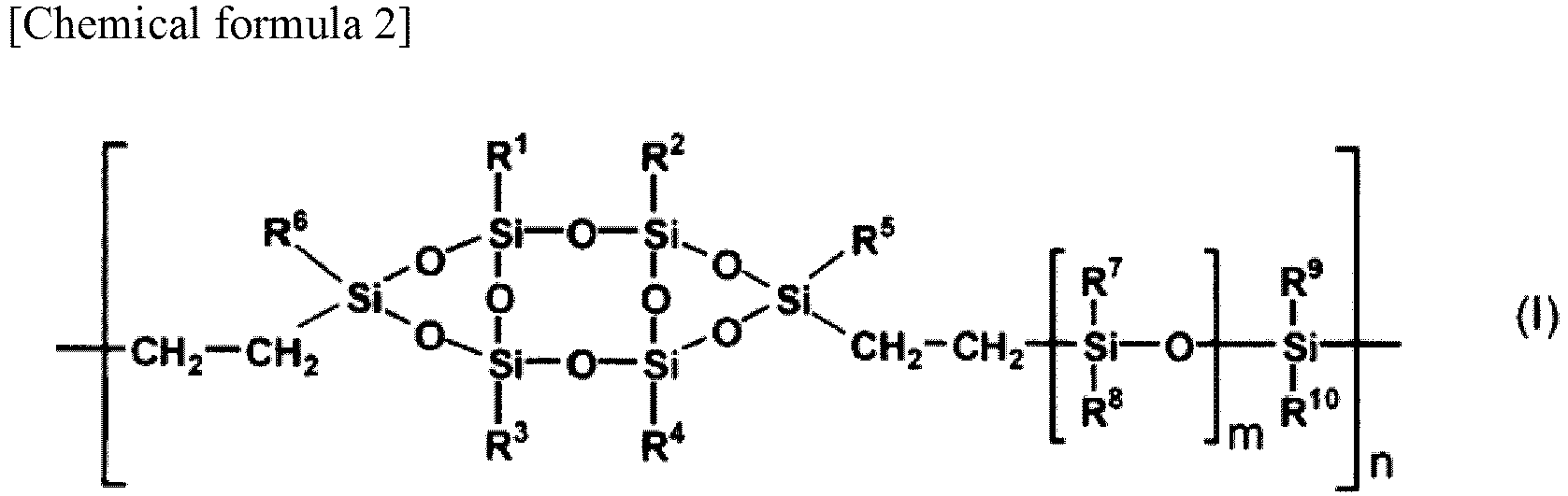
- [1] A silicon compound having a structural unit represented by general formula (I) shown below.

- [2] A method for producing a silicon compound having a structural unit represented by general formula (I) shown below, the method including a step of producing the silicon compound using a compound represented by general formula (II) shown below.


- [3] The method for producing a silicon compound according to [2], the method including a step of producing the silicon compound using a compound represented by general formula (III) shown below.

- An embodiment of the present invention are able to provide a polymer having a main chain into which has been introduced a ladder silsesquioxane of low cost and excellent heat resistance.
-
-
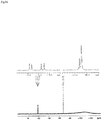
FIG. 1 is the 1H NMR spectrum for the three geometrical isomers of a compound represented by general formula (Z). -
FIG. 2 is the 13C NMR spectrum for the three geometrical isomers of a compound represented by general formula (Z). -
FIG. 3 is an expanded view of the 13C NMR spectrum for the three geometrical isomers of a compound represented by general formula (Z). -
FIG. 4 is the 29Si NMR spectrum for the three geometrical isomers of a compound represented by general formula (Z). - Embodiments of the present invention are described below, but the present invention is in no way limited by the following examples.
- The silicon compound according to one embodiment is characterized by having a structural unit represented by general formula (I) shown below.

- In general formula (I), m represents an integer of 1 to 30, n represents a number that ensures a weight average molecular weight of 5,000 to 1,000,000, each of R1 to R4 independently represents an alkyl group of 1 to 8 carbon atoms or an aryl group of 6 to 14 carbon atoms, each of R5 and R6 independently represents an alkyl group of 1 to 8 carbon atoms or an aryl group of 6 to 14 carbon atoms, each of R7 to R10 independently represents an alkyl group of 1 to 8 carbon atoms or an aryl group of 6 to 14 carbon atoms, and in the n structural units, the combinations of m and R1 to R10 may be all the same, partially different, or all mutually different.
- In general formula (I), each of R1, R2, R3 and R4 independently represents an alkyl group or an aryl group, and preferably represents an alkyl group of 1 to 8 carbon atoms or an aryl group of 6 to 14 carbon atoms.
- The alkyl group represented by R1 to R4 preferably has 1 to 8 carbon atoms, and more preferably 1 to 4 carbon atoms, may have a straight chain or a branched chain, and may be either acyclic or cyclic.
- The aryl group represented by R1 to R4 preferably has 6 to 14 carbon atoms, and more preferably 6 to 8 carbon atoms. Within this range for the number of carbon atoms, the aryl group may have an alkyl group having a straight chain or a branched chain bonded to at least one carbon atom that forms the carbon ring.
- Examples of R1 to R4 include, independently, a methyl group, ethyl group, isobutyl group, cyclohexyl group, isooctyl group, phenyl group and alkyl-substituted phenyl group, and an unsubstituted or substituted phenyl group of 6 to 8 carbon atoms is preferred.
- In general formula (I), each of R5 and R6 independently represents an alkyl group or an aryl group, and preferably represents an alkyl group of 1 to 8 carbon atoms or an aryl group of 6 to 14 carbon atoms.
- The alkyl group represented by R5 or R6 preferably has 1 to 8 carbon atoms, and more preferably 1 to 4 carbon atoms, may have a straight chain or a branched chain, and may be either acyclic or cyclic.
- The aryl group represented by R5 or R6 preferably has 6 to 14 carbon atoms, and more preferably 6 to 8 carbon atoms. Within this range for the number of carbon atoms, the aryl group may have an alkyl group having a straight chain or a branched chain bonded to at least one carbon atom that forms the carbon ring.
- Examples of R5 and R6 include, independently, a methyl group, ethyl group, isobutyl group, cyclohexyl group, isooctyl group, phenyl group and alkyl-substituted phenyl group, and an alkyl group of 1 to 4 carbon atoms, or an unsubstituted or substituted phenyl group of 6 to 8 carbon atoms is preferred.
- In general formula (I), each of R7, R8, R9 and R10 independently represents an alkyl group or an aryl group, and preferably represents an alkyl group of 1 to 8 carbon atoms or an aryl group of 6 to 14 carbon atoms.
- The alkyl group represented by R7 to R10 preferably has 1 to 8 carbon atoms, and more preferably 1 to 4 carbon atoms, may have a straight chain or a branched chain, and may be either acyclic or cyclic.
- The aryl group represented by R7 to R10 preferably has 6 to 14 carbon atoms, and more preferably 6 to 8 carbon atoms. Within this range for the number of carbon atoms, the aryl group may have an alkyl group having a straight chain or a branched chain bonded to at least one carbon atom that forms the carbon ring.
- Examples of R7 to R10 include, independently, a methyl group, ethyl group, isobutyl group, cyclohexyl group, isooctyl group, phenyl group and alkyl-substituted phenyl group, and an alkyl group of 1 to 4 carbon atoms, or an unsubstituted or alkyl-substituted phenyl group of 6 to 8 carbon atoms is preferred.
- Further, n is preferably a number that ensures a weight average molecular weight of 5,000 to 1,000,000.
- In those cases where n is small and the weight average molecular weight is less than 5,000, the 5% thermal weight reduction temperature decreases, and obtaining heat resistance exceeding 400°C becomes difficult. Further, if the weight average molecular weight exceeds 1,000,000, then the compatibility deteriorates, and use of the compound as a raw material for a composition becomes difficult. From the viewpoints of heat resistance and compatibility, n is more preferably a number that yields a weight average molecular weight of 3,000 to 500,000, and even more preferably a number that yields a weight average molecular weight of 4,000 to 100,000.
- Moreover, m is preferably an integer of 1 to 30.
- The siloxane main chain that links the ladder silsesquioxanes moves aggressively as a soft segment at high temperatures. On the other hand, the ladder silsesquioxanes exhibit powerful cohesiveness, and cohesive forces operate both intermolecularly and intramolecularly. Accordingly, under high temperatures, it is thought that the polymer main chain having the ladder silsesquioxanes linked with a soft segment undergoes unique molecular chain movement, resulting in an improvement in the heat resistance of the polymer of one embodiment. However, if m exceeds 30, then because the effects that the silsesquioxanes exert on the siloxane main chain are reduced, this heat resistance effect decreases markedly. In order to achieve this unique molecular movement that improves the heat resistance, m is more preferably from 1 to 25, and even more preferably from 1 to 20.
- In the n structural units of general formula (I), the combinations of R1 to R10 and m within the various structural units may be all the same, partially different, or all mutually different.
- One example of a method for producing a silicon compound having a structural unit represented by general formula (I) is described below. The silicon compound having a structural unit represented by general formula (I) is not limited to compounds produced using the following production method.
- The method for producing a silicon compound having a structural unit represented by general formula (I) preferably includes a step of producing the silicon compound using a compound represented by general formula (II) shown below. Moreover, a method that includes a step of producing the silicon compound using a compound represented by general formula (III) shown below is also preferred. A method that includes a step of reacting a compound represented by general formula (II) with a compound represented by general formula (III) is particularly preferred.

- In general formula (II), each of R1 to R4 independently represents an alkyl group of 1 to 8 carbon atoms or an aryl group of 6 to 14 carbon atoms, and each of R5 and R6 independently represents an alkyl group of 1 to 8 carbon atoms or an aryl group of 6 to 14 carbon atoms.
- In general formula (II), each of R1 to R4 independently represents an alkyl group or an aryl group, and preferably represents an alkyl group of 1 to 8 carbon atoms or an aryl group of 6 to 14 carbon atoms.
- The alkyl group represented by R1 to R4 preferably has 1 to 8 carbon atoms, and more preferably 1 to 4 carbon atoms, may have a straight chain or a branched chain, and may be either acyclic or cyclic.
- The aryl group represented by R1 to R4 preferably has 6 to 14 carbon atoms, and more preferably 6 to 8 carbon atoms. Within this range for the number of carbon atoms, the aryl group may have an alkyl group having a straight chain or a branched chain bonded to at least one carbon atom that forms the carbon ring.
- Examples of R1 to R4 include, independently, a methyl group, ethyl group, isobutyl group, cyclohexyl group, isooctyl group, phenyl group and alkyl-substituted phenyl group, and an unsubstituted or substituted phenyl group of 6 to 8 carbon atoms is preferred.
- In general formula (II), each of R5 and R6 independently represents an alkyl group or an aryl group, and preferably represents an alkyl group of 1 to 8 carbon atoms or an aryl group of 6 to 14 carbon atoms.
- The alkyl group represented by R5 or R6 preferably has 1 to 8 carbon atoms, and more preferably 1 to 4 carbon atoms, may have a straight chain or a branched chain, and may be either acyclic or cyclic.
- The aryl group represented by R5 or R6 preferably has 6 to 14 carbon atoms, and more preferably 6 to 8 carbon atoms. Within this range for the number of carbon atoms, the aryl group may have an alkyl group having a straight chain or a branched chain bonded to at least one carbon atom that forms the carbon ring.
- Examples of R5 and R6 include, independently, a methyl group, ethyl group, isobutyl group, cyclohexyl group, isooctyl group, phenyl group and alkyl-substituted phenyl group, and an alkyl group of 1 to 4 carbon atoms, or an unsubstituted or substituted phenyl group of 6 to 8 carbon atoms is preferred.
- In the method for producing a silicon compound having a structural unit represented by general formula (I), the compound represented by general formula (II) may use at least one compound, or a combination of two or more compounds, selected from among a plurality of compounds having different combinations of R1 to R6.

- In general formula (III), m represents an integer of 1 to 30, and each of R7 to R10 independently represents an alkyl group of 1 to 8 carbon atoms or an aryl group of 6 to 14 carbon atoms.
- In general formula (III), each of R7 to R10 independently represents an alkyl group or an aryl group, and preferably represents an alkyl group of 1 to 8 carbon atoms or an aryl group of 6 to 14 carbon atoms.
- The alkyl group represented by R7 to R10 preferably has 1 to 8 carbon atoms, and more preferably 1 to 4 carbon atoms, may have a straight chain or a branched chain, and may be either acyclic or cyclic.
- The aryl group represented by R7 to R10 preferably has 6 to 14 carbon atoms, and more preferably 6 to 8 carbon atoms. Within this range for the number of carbon atoms, the aryl group may have an alkyl group having a straight chain or a branched chain bonded to at least one carbon atom that forms the carbon ring.
- Examples of R7 to R10 include, independently, a methyl group, ethyl group, isobutyl group, cyclohexyl group, isooctyl group, phenyl group and alkyl-substituted phenyl group, and an alkyl group of 1 to 4 carbon atoms, or an unsubstituted or alkyl-substituted phenyl group of 6 to 8 carbon atoms is preferred.
- Further, m is preferably an integer of 1 to 30. In order to utilize the unique molecular movement that improves the heat resistance, m is more preferably from 1 to 25, and even more preferably from 1 to 20.
- In the method for producing a silicon compound having a structural unit represented by general formula (I), the compound represented by general formula (III) may use at least one compound, or a combination of two or more compounds, selected from among a plurality of compounds having different combinations of R7 to R10 and m.
- In those cases where the silicon compound having a structural unit represented by general formula (I) is produced using at least one of a compound represented by general formula (II) and a compound represented by general formula (III), the reaction is preferably performed in a solvent. There are no particular limitations on the solvent that is used, but specific examples include toluene, ethylbenzene, xylene, hexane, heptane, methyl ethyl ketone, methyl isobutyl ketone, cyclopentanone, tetrahydrofuran, propylene glycol monomethyl ether acetate, ethyl acetate and isobutyl acetate.
- In those cases where the silicon compound having a structural unit represented by general formula (I) is produced using at least one of a compound represented by general formula (II) and a compound represented by general formula (III), a platinum-based catalyst is preferably used. Examples of the platinum-based catalyst include platinic chloride, catalysts of platinic chloride with an alcohol, an aldehyde or a ketone, platinum-olefin complexes, platinum-carbonyl vinylmethyl complex (Ossko catalyst), platinum-divinyltetramethylsiloxane complex (Karstedt complex), platinum-cyclovinylmethylsiloxane complex, platinum-octylaldehyde complex, platinum-phosphine complexes such as Pt[P(C6H5)3]4, PtCl[P(C6H5)3]3 and Pt[P(C4H9)3]4, platinum-phosphite complexes such as Pt[P(OC6H5)3]4 and Pt(OC4H9)3]4, and dicarbonyldichloroplatinum.
- Compounds represented by general formula (II) have geometrical isomers. Specifically, there is a case in which the vinyl groups are both positioned facing inward, a case in which the vinyl groups are both positioned facing outward, and a case in which one of the vinyl groups is positioned facing inward and the other is positioned facing outward. For example, in the case where R1 to R4 in general formula (II) are phenyl groups (C6H5), and R5 and R6 are methyl groups (CH3), the three geometric isomers shown below are possible. In the method for producing a silicon compound having a structural unit represented by general formula (I), any one of these isomers may be used individually as the compound represented by general formula (II), or a combination of two or three isomers may be used.

- One example of a method for producing a compound represented by general formula (II) is described below. The compound represented by general formula (II) is not limited to compounds produced using the following production method.
- In the production of the compound represented by general formula (II), for example, at least one of a compound represented by general formula (IV) shown below and a compound represented by general formula (V) shown below may be used.

- In general formula (IV), each of R1 to R4 independently represents an alkyl group or an aryl group.
- In general formula (V), each of R1 to R4 independently represents an alkyl group or an aryl group, and X represents a monovalent metal element, wherein the four X groups may be all the same, a portion may be different, or all may be mutually different.
- R1 to R4 in general formula (IV) and general formula (V) are groups that are introduced as R1 to R4 into the compound represented by general formula (II), and details regarding these groups are as described above in relation to general formula (II).
- In general formula (V), X represents a monovalent metal element, and is preferably a metal selected from the group consisting of Li, Na and Ka, wherein the four X groups may be all the same, a portion may be different, or all may be mutually different.
- In the compound represented by general formula (V), as described in Angewandt Chemie International Edition, (2016), 55, 9336 to 9339, the orientations of the OX groups are preferably all in the same direction relative to the siloxane ring. Similarly, the OH groups of the compound represented by general formula (IV) are preferably all oriented in the same direction. This is because the compound represented by general formula (II) is produced by reacting a silane compound represented by general formula (VI) with one of these compounds.

- In general formula (VI), each of R5 and R6 independently represents an alkyl group or an aryl group.
- R5 and R6 in general formula (VI) are groups that are introduced as R5 and R6 into the compound represented by general formula (II), and details regarding these groups are as described above in relation to general formula (II).
- At least one of a compound represented by general formula (IV) and a compound represented by general formula (V), and a compound represented by general formula (VI) are preferably reacted together in a solvent in the presence of a base such as triethylamine. There are no particular limitations on the solvent used, and specific examples of solvents that may be used include toluene, ethylbenzene, xylene, hexane, heptane, methyl ethyl ketone, methyl isobutyl ketone, cyclopentanone, tetrahydrofuran, propylene glycol monomethyl ether acetate, ethyl acetate and isobutyl acetate.
- The compound represented by general formula (IV) and the compound represented by general formula (V) can each be obtained by hydrolyzing and condensing an organic silane compound having three hydrolyzable groups.
- For example, by reacting an organic silane compound having three hydrolyzable groups with a base represented by X(OH), a compound represented by general formula (V) can be obtained. Here, X represents a monovalent metal element. Further, by reacting a compound represented by general formula (V) with an acid such as hydrochloric acid, a compound represented by general formula (VI) can be obtained.
- In one example, a compound represented by general formula (V) can be produced using a compound represented by general formula (VII) shown below.

- In general formula (VII), each of R1 to R4 independently represents an alkyl group or an aryl group. R11 represents an alkyl group.
- R1 to R4 in general formula (VII) are groups that are introduced into general formula (V) as R1 to R4, and then introduced into the compound represented by general formula (II) as R1 to R4, and details regarding these groups are as described above in relation to general formula (II).
- In general formula (VII), R11 is preferably an alkyl group of 1 to 8 carbon atoms, and more preferably an alkyl group of 1 to 4 carbon atoms. Specific examples include a methyl group, an ethyl group and an isobutyl group.
- In those cases where the compound represented by general formula (V) is produced from a compound represented by general formula (VII), a base may be used to accelerate the reaction. There are no particular limitations on the base, and a basic compound represented by X(OH) may be used, with specific examples including lithium hydroxide, sodium hydroxide and potassium hydroxide.
- The compound represented by general formula (V) is preferably obtained by reacting a compound represented by general formula (VII) in a solvent in the presence of water and a base. There are no particular limitations on the solvent used, and specific examples include toluene, ethylbenzene, xylene, hexane, heptane, 2-propanol, methyl ethyl ketone, methyl isobutyl ketone, cyclopentanone, tetrahydrofuran, propylene glycol monomethyl ether acetate, ethyl acetate and isobutyl acetate.
- The compound represented by general formula (IV) is preferably obtained by reacting a compound represented by general formula (V) in a solvent in the presence of water and an acid. The compound represented by general formula (IV) is readily soluble in solvents, meaning there are no particular limitations on the solvent used, but specific examples include toluene, ethylbenzene, xylene, hexane, heptane, 2-propanol, methyl ethyl ketone, methyl isobutyl ketone, cyclopentanone, tetrahydrofuran, propylene glycol monomethyl ether acetate, ethyl acetate and isobutyl acetate.
- The present invention is described below in further detail using a series of examples, but the present invention is not limited to these examples.
- The structure and purity of each obtained compound was determined by 1H NMR, 13C NMR and 29Si NMR. The measurement conditions for the 1H NMR, 13C NMR and 29Si NMR were as follows.
-
- Apparatus: Avance 300 (manufactured by Bruker Corporation)
- Observed nucleus: 1H
- Resonance frequency: 300 MHz
- Measurement temperature: 25°C
-
- Apparatus: Avance 300 (manufactured by Bruker Corporation)
- Observed nucleus: 1H
- Resonance frequency: 75 MHz
- Measurement temperature: 25°C
-
- Apparatus: Avance 300 (manufactured by Bruker Corporation)
- Resonance frequency: 60 MHz
- Measurement temperature: 40°C
- A compound represented by general formula (X) shown below was synthesized using the following procedure. In general formula (X), C6H5 indicates a phenyl group (this also applies in all subsequent formulas). Components for which there is no particular description used reagents manufactured by Wako Pure Chemical Industries, Ltd., and components of the same label employed the same component through all of the examples (this also applies below).
- A 500 mL round-bottom flask was charged with 6.00 g of ground sodium hydroxide, 2.71 g of purified water and 117.61 g of 2-propanol. With the mixture undergo vigorous stirring with a magnetic stirrer, 29.98 g of phenyltrimethoxysilane (KBM-103, manufactured by Shin-Etsu Chemical Co., Ltd.) was added gradually in a dropwise manner. When stirring was continued, the contents inside the flask initially became uniformly transparent, and cloudiness then developed. After 18 hours, the contents were filtered using a Hirsch funnel to separate the white solid. This solid was washed with hexane and then dried under reduced pressure, yielding 24.71 g of a white powdery solid. The structure of this compound represented by general formula (X) was determined by NMR.
- 1H NMR (300 MHz, DMSO-d6) δ = 7.76 (br, 8H), 7.20 (br, 12H). 13C NMR (75 NHz, DMSO-d6) δ = 145.45, 135.35, 127.21. 29Si NMR (60 NHz, DMSO-d6) δ = -67.77.

- A compound represented by general formula (Y) shown below was synthesized using the following procedure.
- A 1 L round-bottom flask was charged with 8.53 g of the compound represented by general formula (X) shown above and 85 mL of tetrahydrofuran, the flask was immersed in an ice bath, and the contents were stirred with a magnetic stirrer. Moreover, 48.81 g of a 1 N hydrochloric acid solution and 448.24 g of purified water were weighed into a polybottle, which was then cooled by immersion in an ice bath. This hydrochloric acid solution was then added to the round-bottom flask over a period of 5 minutes. Stirring was continued for a further 10 minutes, and with the pH being evaluated using pH indicator paper, a saturated solution of sodium bicarbonate was added gradually to neutralize the flask contents. Subsequently, 180 mL of ethyl acetate was added, and the contents of the flask were transferred to a separating funnel and shaken vigorously. The aqueous lower layer was removed, and an operation in which 100 mL of purified water was added to the upper layer, shaken, left to separate, and the lower layer then removed was repeated three times, and anhydrous sodium sulfate was then added to the upper layer. The sodium sulfate was removed using filter paper, and the solution was dried under reduced pressure using a rotary evaporator and an oil pump, yielding 5.48 g of white crystals. The structure of the compound represented by general formula (Y) was determined by NMR.
- 1H NMR (300 MHz, THF-d8) δ = 7.64 to 7.57 (m, 8H), 7.40 to 7.32 (m, 4H), 7.27 to 7.20 (m, 8H), 6.61 (s, 4H). 13C NMR (75 NHz, THF-ds) δ = 135.35, 135.22, 130.64, 128.36. 29Si NMR (60 NHz, THF-d8) δ = -71.86.

- A compound represented by general formula (Z) shown below was synthesized using the following procedure.
- A 200 mL three-neck flask fitted with a Dimroth condenser and a dropping funnel was charged with 8.01 g of the compound represented by the above general formula (Y), and the atmosphere inside the flask was flushed with nitrogen. When 80 mL of tetrahydrofuran was added and stirred, the compound dissolved and formed a transparent solution. The flask was then cooled to 0°C in an ice bath. A separate 200 mL flask was charged with 4.40 g of dichloromethylvinylsilane (manufactured by Tokyo Chemical Industry Co., Ltd.), 6.00 g of triethylamine (manufactured by Wako Pure Chemical Industries, Ltd.) and 80 mL of tetrahydrofuran to prepare a transparent solution, and this solution was transferred to the dropping funnel. The transparent solution was added gradually in a dropwise manner over a period of about one hour while cooling was continued using the ice bath. Following completion of the dropwise addition, stirring was continued for 30 minutes while cooling in the ice bath was maintained, and the ice bath was then removed. Subsequently, the flask was immersed in an oil bath, and heated under reflux for 10 hours. The oil bath was then removed, the flask was left to cool, 50 mL of a saturated aqueous solution of ammonium chloride and 80 mL of ethyl acetate were added, and the contents of the flask were then transferred to a separating funnel. After layer separation, the lower water layer was removed, and the upper layer was washed twice with 50 mL portions of purified water, and then dried over anhydrous sodium sulfate. The sodium sulfate was filtered off using filter paper, the solvent was then removed using a rotary evaporator, and the product was then dried under reduced pressure using an oil pump, yielding 12.11 g of a viscous liquid. Subsequently, 10 mL of hexane was added to the liquid and shaken vigorously, a centrifugal separation was performed under conditions including 2,500 rpm, and the supernatant was transferred to a flask. Ten mL of hexane was added to the residual viscous liquid and shaken vigorously, a centrifugal separation was again performed under conditions including 2,500 rpm, and the supernatant was combined with the solution in the above flask. The solvent was removed using a rotary evaporator, yielding 7.22 g of a viscous liquid. Next, 20 mL of methanol was added and shaken vigorously, a centrifugal separation was performed under conditions including 2,500 rpm, and the supernatant was removed. The residue was then washed twice with 4 mL portions of methanol, and then dried under reduced pressure using an oil pump, yielding 1.97 g of white crystals. The compound represented by general formula (Z) was determined by NMR to be a mixture of three geometric isomers. Structures of the presumed isomers are shown below.


- The 1H NMR spectrum of the obtained compound represented by general formula (Z) is shown in
FIG. 1 , the 13C NMR spectrum is shown inFIG. 2 , an expanded view of that 13C NMR spectrum is shown inFIG. 3 , and the 29Si NMR spectrum is shown inFIG. 4 . InFIG. 1 ,FIG. 2 andFIG. 4 , the lower portion represents the entire spectrum, and the upper portion represents a partial expanded view. - A silicon compound having a structural unit represented by general formula (P) shown below (m=2) was synthesized using the following procedure.
- First, 0.678 g of the compound represented by general formula (Z) obtained using the method described above was weighed into a 30 mL two-neck flask, a Dimroth condenser was fitted to the flask, and the atmosphere inside the flask was flushed with nitrogen. Using a syringe, 8 mL of toluene, 0.332 mL of 1,1,3,3,5,5-hexamethyltrisiloxane (manufactured by Tokyo Chemical Industry Co., Ltd.) and 0.030 mL of a platinum(0)-2,4,6,8-tetramethyl-2,4,6,8-tetravinylcyclotetrasiloxane complex solution were added to the flask. The resulting mixture was heated under reflux conditions for 12 hours, the solvent was then removed using an evaporator, and the residue was dried under reduced pressure using an oil pump, yielding 0.99 g of a light brown transparent liquid. A 0.75 g portion of the light brown transparent liquid was fractionated by GPC using an LC-Forte/R apparatus manufactured by YMC Co., Ltd., yielding 0.40 g of a colorless solid. The weight average molecular weight was 10,400.

- In Comparative Example 1, a heat-resistant silicone oil composed of a methylphenylpolysiloxane (KF-54, manufactured by Shin-Etsu Chemical Co., Ltd.) was used.
- The 5% thermal weight reduction temperatures upon heating were compared as a method for evaluating the heat resistance. Using a thermogravimetric-differential thermal analysis simultaneous measuring instrument DHG-60H manufactured by Shimadzu Corporation, measurements were performed under a nitrogen atmosphere under conditions including a rate of temperature increase of 10 L/min, and the 5% thermal weight reduction temperature was recorded. The results are shown in Table 1.
[Table 1] Item 5% thermal weight reduction temperature [°C] Example 1 m=2 465.9 Comparative Example 1 346.2 - The present invention is related to the subject matter disclosed in prior Japanese Application
2017-108038 filed on May 31, 2017 - It should be noted that, besides the embodiments already described above, various modifications and variations can be made to these embodiments without departing from the novel and advantageous features of the present invention. Accordingly, it is intended that all such modifications and variations are included within the scope of the appended claims.
Claims (3)
- A silicon compound having a structural unit represented by general formula (I) shown below:
 m represents an integer of 1 to 30,n represents a number that ensures a weight average molecular weight of 5,000 to 1,000,000,each of R1 to R4 independently represents an alkyl group of 1 to 8 carbon atoms or an aryl group of 6 to 14 carbon atoms,each of R5 and R6 independently represents an alkyl group of 1 to 8 carbon atoms or an aryl group of 6 to 14 carbon atoms,each of R7 to R10 independently represents an alkyl group of 1 to 8 carbon atoms or an aryl group of 6 to 14 carbon atoms, andin the n structural units, combinations of m and R1 to R10 may be all the same, partially different, or all mutually different.
 - A method for producing a silicon compound having a structural unit represented by general formula (I) shown below, the method comprising a step of producing the silicon compound using a compound represented by general formula (II) shown below:

 m represents an integer of 1 to 30,n represents a number that ensures a weight average molecular weight of 5,000 to 1,000,000,each of R1 to R4 independently represents an alkyl group of 1 to 8 carbon atoms or an aryl group of 6 to 14 carbon atoms,each of R5 and R6 independently represents an alkyl group of 1 to 8 carbon atoms or an aryl group of 6 to 14 carbon atoms,each of R7 to R10 independently represents an alkyl group of 1 to 8 carbon atoms or an aryl group of 6 to 14 carbon atoms,in the n structural units, combinations of m and R1 to R10 may be all the same, partially different, or all mutually different, and
 each of R1 to R4 independently represents an alkyl group of 1 to 8 carbon atoms or an aryl group of 6 to 14 carbon atoms, andeach of R5 and R6 independently represents an alkyl group of 1 to 8 carbon atoms or an aryl group of 6 to 14 carbon atoms.
 - The method for producing a silicon compound according to Claim 2, the method comprising a step of producing the silicon compound using a compound represented by general formula (III) shown below:
 m represents an integer of 1 to 30, andeach of R7 to R10 independently represents an alkyl group of 1 to 8 carbon atoms or an aryl group of 6 to 14 carbon atoms.
Applications Claiming Priority (2)
| Application Number | Priority Date | Filing Date | Title |
|---|---|---|---|
| JP2017108038 | 2017-05-31 | ||
| PCT/JP2018/018906 WO2018221221A1 (en) | 2017-05-31 | 2018-05-16 | Silicon compound and method for producing same |
Publications (2)
| Publication Number | Publication Date |
|---|---|
| EP3632960A1 true EP3632960A1 (en) | 2020-04-08 |
| EP3632960A4 EP3632960A4 (en) | 2021-02-17 |
Family
ID=64454604
Family Applications (1)
| Application Number | Title | Priority Date | Filing Date |
|---|---|---|---|
| EP18810325.3A Withdrawn EP3632960A4 (en) | 2017-05-31 | 2018-05-16 | Silicon compound and method for producing same |
Country Status (7)
| Country | Link |
|---|---|
| US (1) | US20210054150A1 (en) |
| EP (1) | EP3632960A4 (en) |
| JP (1) | JPWO2018221221A1 (en) |
| KR (1) | KR20200014742A (en) |
| CN (1) | CN110650992A (en) |
| TW (1) | TW201902998A (en) |
| WO (1) | WO2018221221A1 (en) |
Family Cites Families (7)
| Publication number | Priority date | Publication date | Assignee | Title |
|---|---|---|---|---|
| JP5246679B2 (en) | 2007-05-09 | 2013-07-24 | Jnc株式会社 | Crosslinkable siloxane polymer, siloxane-based crosslinkable composition, and silicone film |
| JP5770975B2 (en) * | 2010-03-26 | 2015-08-26 | 国立大学法人群馬大学 | Polysilsesquioxane compound, optical device sealing material and use thereof |
| KR101249798B1 (en) * | 2010-08-18 | 2013-04-03 | 한국과학기술연구원 | A Method for Preparing a Controlled Structure of Polysilsesquioxane and Polysilsesquioxane Prepared by the Same |
| JP2013241497A (en) * | 2012-05-18 | 2013-12-05 | Gunma Univ | Polysilsesquioxane compound, optical device sealing material and use thereof |
| CN104262628B (en) * | 2014-09-28 | 2016-08-24 | 吉林大学 | Main chain organo silicone polyether sulphone resin containing line style and cage modle and preparation method thereof |
| JP6528203B2 (en) * | 2015-06-26 | 2019-06-12 | 国立大学法人 熊本大学 | Method for producing crosslinkable silicon compound |
| JP6662013B2 (en) | 2015-12-11 | 2020-03-11 | 株式会社リコー | Surface emitting laser, surface emitting laser array, laser device, ignition device, internal combustion engine, optical scanning device, image forming device, optical transmission module, and optical transmission system |
-
2018
- 2018-05-16 KR KR1020197032791A patent/KR20200014742A/en not_active Withdrawn
- 2018-05-16 US US16/617,182 patent/US20210054150A1/en not_active Abandoned
- 2018-05-16 JP JP2019522101A patent/JPWO2018221221A1/en active Pending
- 2018-05-16 EP EP18810325.3A patent/EP3632960A4/en not_active Withdrawn
- 2018-05-16 CN CN201880033283.6A patent/CN110650992A/en active Pending
- 2018-05-16 WO PCT/JP2018/018906 patent/WO2018221221A1/en not_active Ceased
- 2018-05-24 TW TW107117639A patent/TW201902998A/en unknown
Also Published As
| Publication number | Publication date |
|---|---|
| US20210054150A1 (en) | 2021-02-25 |
| JPWO2018221221A1 (en) | 2020-04-02 |
| KR20200014742A (en) | 2020-02-11 |
| CN110650992A (en) | 2020-01-03 |
| TW201902998A (en) | 2019-01-16 |
| WO2018221221A1 (en) | 2018-12-06 |
| EP3632960A4 (en) | 2021-02-17 |
Similar Documents
| Publication | Publication Date | Title |
|---|---|---|
| CN107849068B (en) | Method for preparing polyhedral oligomeric silsesquioxanes | |
| CN1181081C (en) | Fluorine-containing mixed cyclosiloxane, preparation method and use thereof | |
| US7956125B2 (en) | (Thio)phenoxy phenyl silane compostion and method for making same | |
| Lee et al. | Incompletely condensed silsesquioxanes: formation and reactivity | |
| KR20040030657A (en) | Silicone composition crosslinkable into elastomer by hydrosilylation, in the presence of carbene-based metal catalysts, and catalysts | |
| KR20130140900A (en) | Siloxane compound and cured product thereof | |
| WO2011028142A1 (en) | Synthesis of fluorocarbofunctional silsesquioxanes | |
| JPH0662647B2 (en) | Fluorine-containing organosilicon compound | |
| JP6111174B2 (en) | Glycoluril ring-containing organosilane, glycoluril ring-containing organosiloxane and process for producing them | |
| JPWO2005000857A1 (en) | Organosilicon compound and method for producing the same, and polysiloxane and method for producing the same | |
| JP4433740B2 (en) | Method for producing silicon compound and silicon compound | |
| JP2009263316A (en) | Method for producing incompletely condensed oligosilsesquioxane | |
| US20060041098A1 (en) | Synthesis and characterization of novel cyclosiloxanes and their self- and co-condensation with silanol-terminated polydimethylsiloxane | |
| EP3677586A1 (en) | Method for manufacturing silsesquioxane compound | |
| US20210054150A1 (en) | Silicon compound and method for producing same | |
| CA2092445A1 (en) | Phenol-modified silicones | |
| KR102320689B1 (en) | Isocyanuric acid derivative having an alkoxyalkyl group and method for producing the same | |
| EP1783131A1 (en) | Process for producing organosilicon compound | |
| KR101614590B1 (en) | Curable resin composition | |
| EP0570208A2 (en) | Phenol-modified silicones | |
| JP6844384B2 (en) | Liquid silicon compound and its manufacturing method | |
| JP2017141166A (en) | Manufacturing method of organic silicon compound containing trisilanol group and silsesquioxane derivative | |
| JP6225888B2 (en) | Organopolysiloxane compound and method for producing the same | |
| JP2007211138A (en) | Cycloaliphatic polyether, method for producing the same, and use thereof | |
| JPH11322937A (en) | Method for producing organopolysiloxane |
Legal Events
| Date | Code | Title | Description |
|---|---|---|---|
| STAA | Information on the status of an ep patent application or granted ep patent |
Free format text: STATUS: THE INTERNATIONAL PUBLICATION HAS BEEN MADE |
|
| PUAI | Public reference made under article 153(3) epc to a published international application that has entered the european phase |
Free format text: ORIGINAL CODE: 0009012 |
|
| STAA | Information on the status of an ep patent application or granted ep patent |
Free format text: STATUS: REQUEST FOR EXAMINATION WAS MADE |
|
| 17P | Request for examination filed |
Effective date: 20191118 |
|
| AK | Designated contracting states |
Kind code of ref document: A1 Designated state(s): AL AT BE BG CH CY CZ DE DK EE ES FI FR GB GR HR HU IE IS IT LI LT LU LV MC MK MT NL NO PL PT RO RS SE SI SK SM TR |
|
| AX | Request for extension of the european patent |
Extension state: BA ME |
|
| DAV | Request for validation of the european patent (deleted) | ||
| DAX | Request for extension of the european patent (deleted) | ||
| STAA | Information on the status of an ep patent application or granted ep patent |
Free format text: STATUS: EXAMINATION IS IN PROGRESS |
|
| A4 | Supplementary search report drawn up and despatched |
Effective date: 20210120 |
|
| RIC1 | Information provided on ipc code assigned before grant |
Ipc: C08G 77/20 20060101ALI20210114BHEP Ipc: C08G 77/06 20060101ALI20210114BHEP Ipc: C08G 77/50 20060101AFI20210114BHEP Ipc: C08G 77/44 20060101ALI20210114BHEP |
|
| 17Q | First examination report despatched |
Effective date: 20210201 |
|
| STAA | Information on the status of an ep patent application or granted ep patent |
Free format text: STATUS: THE APPLICATION HAS BEEN WITHDRAWN |
|
| 18W | Application withdrawn |
Effective date: 20210607 |