EP3629889B1 - Haarbehandlungsvorrichtung, haarbehandlungssystem und verfahren zum kosmetischen behandeln von haaren - Google Patents
Haarbehandlungsvorrichtung, haarbehandlungssystem und verfahren zum kosmetischen behandeln von haaren Download PDFInfo
- Publication number
- EP3629889B1 EP3629889B1 EP18728348.6A EP18728348A EP3629889B1 EP 3629889 B1 EP3629889 B1 EP 3629889B1 EP 18728348 A EP18728348 A EP 18728348A EP 3629889 B1 EP3629889 B1 EP 3629889B1
- Authority
- EP
- European Patent Office
- Prior art keywords
- hair
- hair treatment
- exemplary embodiments
- various exemplary
- sensor
- Prior art date
- Legal status (The legal status is an assumption and is not a legal conclusion. Google has not performed a legal analysis and makes no representation as to the accuracy of the status listed.)
- Active
Links
Images

Classifications
-
- A—HUMAN NECESSITIES
- A45—HAND OR TRAVELLING ARTICLES
- A45D—HAIRDRESSING OR SHAVING EQUIPMENT; EQUIPMENT FOR COSMETICS OR COSMETIC TREATMENTS, e.g. FOR MANICURING OR PEDICURING
- A45D2/00—Hair-curling or hair-waving appliances ; Appliances for hair dressing treatment not otherwise provided for
- A45D2/001—Hair straightening appliances
-
- A—HUMAN NECESSITIES
- A61—MEDICAL OR VETERINARY SCIENCE; HYGIENE
- A61B—DIAGNOSIS; SURGERY; IDENTIFICATION
- A61B5/00—Measuring for diagnostic purposes; Identification of persons
- A61B5/44—Detecting, measuring or recording for evaluating the integumentary system, e.g. skin, hair or nails
- A61B5/448—Hair evaluation, e.g. for hair disorder diagnosis
-
- A—HUMAN NECESSITIES
- A45—HAND OR TRAVELLING ARTICLES
- A45D—HAIRDRESSING OR SHAVING EQUIPMENT; EQUIPMENT FOR COSMETICS OR COSMETIC TREATMENTS, e.g. FOR MANICURING OR PEDICURING
- A45D19/00—Devices for washing the hair or the scalp; Similar devices for colouring the hair
- A45D19/0041—Processes for treating the hair of the scalp
- A45D19/0066—Coloring or bleaching
-
- A—HUMAN NECESSITIES
- A45—HAND OR TRAVELLING ARTICLES
- A45D—HAIRDRESSING OR SHAVING EQUIPMENT; EQUIPMENT FOR COSMETICS OR COSMETIC TREATMENTS, e.g. FOR MANICURING OR PEDICURING
- A45D44/00—Other cosmetic or toiletry articles, e.g. for hairdressers' rooms
-
- A—HUMAN NECESSITIES
- A61—MEDICAL OR VETERINARY SCIENCE; HYGIENE
- A61Q—SPECIFIC USE OF COSMETICS OR SIMILAR TOILETRY PREPARATIONS
- A61Q5/00—Preparations for care of the hair
-
- A—HUMAN NECESSITIES
- A45—HAND OR TRAVELLING ARTICLES
- A45D—HAIRDRESSING OR SHAVING EQUIPMENT; EQUIPMENT FOR COSMETICS OR COSMETIC TREATMENTS, e.g. FOR MANICURING OR PEDICURING
- A45D44/00—Other cosmetic or toiletry articles, e.g. for hairdressers' rooms
- A45D2044/007—Devices for determining the condition of hair or skin or for selecting the appropriate cosmetic or hair treatment
Definitions
- the invention relates to hair cosmetics, in particular a hair treatment device, a hair treatment system and a method for the cosmetic treatment of hair.
- the condition of the hair and in particular the degree of hair damage, can vary greatly depending on treatment history and predisposition. This information can be important so that a correct cosmetic hair treatment and/or cosmetic hair treatment agent, i.e. one that matches the degree of hair damage, can be selected.
- Areas of hair cosmetics relate, for example, to hair styling, hair care, hair shaping (e.g. straightening and/or curling, permanent, semi-permanent or temporary, with temporary hair shaping also being associated with the hair styling area) and/or hair coloring (also referred to as hair coloring, permanent or temporary ).
- hair shaping e.g. straightening and/or curling, permanent, semi-permanent or temporary, with temporary hair shaping also being associated with the hair styling area
- hair coloring also referred to as hair coloring, permanent or temporary .
- Hair styling and temporary hair shaping can essentially be based on an effect of hair styling agents.
- the hair is usually superficially coated with a styling agent. This coating causes a change in the holding properties of the hair.
- the styling products should be adapted to the individual condition of the hair or be selected taking into account the individual condition.
- care products should be adapted to the individual condition of the hair. Users often use the wrong care products, i.e. care products that are not tailored to their hair condition, which weigh down the hair or make it difficult to manage, for example.
- the hair structure is manipulated to achieve the cosmetic effect. This is done, for example, by heating the hair using a straightening iron or a curling iron. This process may not be harmless to the hair due to the high temperatures involved (120°C to 240°C). Pre-damaged hair in particular can be severely (further) damaged if semi-permanent hair shaping is applied incorrectly, for example if the heat from a straightening iron is too high.
- document US2012227758A1 describes a hair styling device with improved control over the temperature output.
- the document US2015342515A1 describes a connected hairbrush that is able to determine various hair properties using sensors.
- a hair treatment device which uses at least one integrated sensor to determine a hair condition and, based on the determined hair condition, controls a hair treatment parameter and doses at least one hair treatment agent and optionally provides a hair treatment recommendation and which uses at least one additional integrated sensor Movements and changes in location are determined and a spatial position and/or a speed is determined based on the movements and changes in location determined.
- the hair treatment parameter can be a parameter that can be set on the hair treatment device, for example a temperature of the hair treatment device.
- the hair treatment agent can be applied by means of the hair treatment device, for example to the hair and/or to the scalp, and metering, for example by means of valves, can take place by means of the hair treatment device.
- the hair treatment recommendation can refer to hair treatment parameters of a hair treatment carried out by means of the hair treatment device, which cannot be directly controlled by means of the hair treatment device, for example a recommendation as to which hair treatment agent should be filled into the tanks of the hair treatment device and/or at what speed along the hair a hair treatment has to be done, or the like.
- the dispensing of care and/or styling agents and the heating of the hair can be combined in one method step in the semi-permanent reshaping of the hair.
- methods are provided which are a combination of a styling device (e.g. comb, brush, curling iron, drying hood, in particular straightening irons), a sensor system, i.e. at least one sensor, the at least one sensor being integrated into the styling device or not integrated into the styling device can be, use a processor and an actuator.
- a styling device e.g. comb, brush, curling iron, drying hood, in particular straightening irons
- a sensor system i.e. at least one sensor, the at least one sensor being integrated into the styling device or not integrated into the styling device can be, use a processor and an actuator.
- hair treatment devices and hair treatment systems are provided which are a combination of a styling device (e.g. comb, brush, curling iron, drying hood, in particular straightening irons), a sensor system, i.e. at least one sensor, the at least one sensor being integrated into the styling device or not integrated into the styling device may be, having a processor and an actuator.
- a styling device e.g. comb, brush, curling iron, drying hood, in particular straightening irons
- a sensor system i.e. at least one sensor, the at least one sensor being integrated into the styling device or not integrated into the styling device may be, having a processor and an actuator.
- the processor can be set up to receive sensor data from the sensor, to evaluate the sensor data and, if necessary, to compare the evaluated sensor data with at least one external database (e.g. using a cloud).
- the processor can also be set up to derive instructions for action from the evaluated sensor data (eg a process profile including temperature and/or care and/or styling agents used).
- the processor can also be set up to derive instructions for action from the evaluated sensor data (eg a process profile including temperature and/or care and/or styling agents used).
- the processor can also be set up, if necessary, to transmit instructions to the actuator, in which case the actuator can be part of the hair treatment device or hair treatment system.
- the actuator can implement the instructions for action provided by the processor.
- An action performed by the actuator can have an optical effect in various exemplary embodiments (e.g. as a warning light, image, diagram, pictogram, film displayed on a screen, e.g. the screen of a smartphone, or the like).
- the action taken by the actuator may have a mechanical effect (e.g. as an automatic temperature setting and/or automatic dosage setting on the styling device and/or a vibration).
- the action performed by the actuator can have an acoustic effect (e.g. as a warning tone, voice output or the like).
- the sensor for detecting a hair condition parameter can have a hair damage sensor.
- the hair damage sensor can be set up to use near-infrared spectroscopy and/or fluorescence spectroscopy to determine a content of oxidative and/or chemical degradation products of hair ingredients, in particular a cysteic acid content, in the hair and to use this to determine the degree of damage to the hair.
- the hair damage sensor can be set up to record acoustic emissions detected while the hair is being combed and to use them to determine the degree of damage to the hair, possibly with the aid of the processor.
- the hair damage sensor can have a microscopic photo sensor.
- the microscopic photo sensor can be set up to determine a hair surface roughness or to enable the determination of the hair surface roughness.
- the sensor for detecting a hair condition parameter can have a hair thickness sensor.
- the hair thickness sensor can be set up to determine a hair thickness by means of a light sensor. For example, when determining the hair thickness, it can be taken into account that thicker hair absorbs more light.
- the hair thickness sensor can be set up in various exemplary embodiments in such a way that a predetermined quantity of hair, e.g reaches the sensor for detecting a hair condition parameter, can be measured by means of the sensor.
- the hair thickness sensor can also be used to determine a hair color and/or a gray component, for example if the hair thickness sensor has a color camera, possibly with the aid of the processor.
- the hair thickness sensor can have an ultrasonic sensor.
- the ultrasonic sensor can be set up to emit ultrasonic waves in the direction of the hair, to detect ultrasonic waves reflected by the hair and to determine the hair thickness from this, possibly in conjunction with the processor.
- the at least one sensor for detecting a hair condition parameter can have a hair length sensor.
- the hair length sensor can have at least one position sensor, for example, which enables a determination of a distance that has been covered in the hair.
- the hair length sensor can be combined with a sensor for calculating the combability of the hair (see below).
- the hair length can be provided by the user.
- the user can measure the hair length himself and provide the measured hair length value to the hair treatment device or the hair treatment system.
- the hair thickness sensor can have a photo-optical sensor, in which an image of at least one hair is recorded.
- the hair thickness sensor can have a thermal sensor.
- the at least one sensor for detecting a hair condition parameter can have a gray component sensor.
- An image of the hair can be recorded by the at least one gray component sensor using an optical sensor, e.g. using a camera.
- the image can be compared in various exemplary embodiments with at least one existing image, e.g. a reference image, which can be stored internally and/or externally, for example, in order to determine the gray component.
- the sensor for detecting a hair condition parameter can have a straightness/curl sensor, which can be set up to determine a hair structure in the sense of straight hair through to curly or frizzy hair.
- the smoothness/curl sensor can have a camera.
- the smoothness/curliness sensor can be set up in various exemplary embodiments, if necessary in conjunction with the processor, for example by means of an image processing program, to determine the smoothness or curliness of the hair.
- the sensor for detecting a hair condition parameter can have a hair moisture sensor.
- the hair moisture sensor can be set up to determine the water content of the hair.
- the hair moisture sensor can be designed, for example, as a near-infrared spectroscope, which can be set up to examine near-infrared (NIR) absorption structures of water and use this to determine the hair moisture, possibly with the help of the processor.
- NIR near-infrared
- the at least one sensor for detecting a hair condition parameter can have a combing work sensor.
- the combing work sensor can be set up to detect the effort (for example by means of strain gauges) that is expended when combing the hair.
- the at least one sensor for detecting a hair condition parameter can have a hair density sensor.
- the hair density sensor can, for example, have a camera or a camera attachment, which can be set up to be held directly at a hair root area, e.g. to be placed directly on a scalp.
- a hair density can be determined using the image, for example using a number of hairs and/or a distance between the hairs.
- the sensor for detecting a hair condition parameter can be set up to determine further hair condition parameters.
- the senor for detecting a hair condition parameter e.g. in the case of a spectrometer or a camera, can be set up to determine several hair condition parameters, e.g. both the degree of hair damage using the cysteic acid absorption structures in the NIR spectrum and the hair moisture using the water absorption structures in the NIR spectrum.
- the hair treatment device or the hair treatment system can have or be a heatable device. This means that the hair treatment device or the hair treatment system can have a heating device in various exemplary embodiments.
- the hair treatment device or the hair treatment system can be controlled or regulated. For example, with intact, thicker, curly and/or wetter hair, the hair treatment device or hair treatment system can be controlled or regulated such that the hair is treated at a higher temperature than when the hair is damaged, thinner, straighter and/or drier.
- the hair treatment device and/or the hair treatment system can have a straightening iron, a curling iron and/or a drying hood with a temperature controller and/or a temperature regulator.
- the hair treatment device and/or the hair treatment system can have a straightening iron, a curling iron and/or a drying hood with a (e.g. refillable) tank for receiving and dosed dispensing of a hair treatment agent (also referred to as an active substance tank) and a dosing device.
- a hair treatment agent also referred to as an active substance tank
- the hair treatment device and/or the hair treatment system can have a comb and/or a brush with a (e.g. refillable) tank for receiving and dosed dispensing of a hair treatment agent and a dosing device.
- a comb and/or a brush with a (e.g. refillable) tank for receiving and dosed dispensing of a hair treatment agent and a dosing device.
- the hair treatment device and/or the hair treatment system can have the sensor system in duplicate.
- a plurality of (e.g. similar) sensors can be arranged in such a way that the user can immediately receive feedback as to whether further treatment (also referred to as "post-treatment") is necessary.
- the hair treatment device and/or the hair treatment system e.g. the styling device, can have sensors on both sides of the heating device, with a sensor for detecting a hair condition parameter a hair condition parameter before and a sensor for detecting a hair condition parameter a (e.g. the same) hair condition parameter after the temperature treatment who measures hair.
- the hair treatment device and/or the hair treatment system can alternatively or additionally have a dispensing device.
- a hair treatment agent eg a care or styling agent, can be located in the dispensing device.
- the hair treatment agent which can have a (e.g. chemical) composition, can optionally be applied to the hair in different volumes/amounts depending on the position [root, middle, tips]. .
- the hair treatment device and/or the hair treatment system can be used to apply two or more agents in different mixing ratios depending on the position [root, middle, tips] or at different positions on the hair or can be applied to the hair.
- the hair treatment device and/or the hair treatment system can have a dispensing device, which can have pumps for dispensing the agents, which can be sent by the processor, for example using wireless instructions (e.g. instructions transmitted using WLAN, Bluetooth, or the like).
- wireless instructions e.g. instructions transmitted using WLAN, Bluetooth, or the like.
- a flow rate of the agent or agents can be adjusted.
- a user can obtain information about a condition of their hair (also referred to as hair status).
- a user can receive a personalized cosmetic treatment and/or treatment recommendation tailored to their hair status.
- a user can already receive information about the course of the application while a hair treatment is being carried out.
- a hair treatment result can still be optimized while the hair treatment is being carried out, so that frustration can be avoided.
- a time-saving hair treatment method can be provided, for example in that a (temporary, semi-permanent or permanent) hair reshaping treatment takes place at least partially together with a hair care treatment.
- a hair treatment device can be provided in the form of a straightening iron, in which the at least one sensor for detecting a hair condition parameter is integrated into the straightening iron, an electronic circuit device, which can have a processor into which the straightening iron is integrated, and a first actuator, which can have, for example, a temperature controller or a temperature regulator, which controls or regulates a temperature of heatable surfaces of the straightening iron into which the straightening iron is integrated.
- the straightening iron can have a second actuator, which can have a dosing device for a hair care and/or hair styling agent, for example.
- a hair treatment system can be provided in the form of a straightening iron, in which the at least one sensor for detecting a hair condition parameter is part of a first separate device capable of communication (i.e. having a data exchange device) (e.g. a smartphone having a camera, a spectrometer with the Data exchange device or a so-called "acoustic comb", which can be set up to detect noises generated during combing), an electronic circuit device, which can have a processor integrated into the straightening iron, and a first actuator, which can have a temperature control or a May have temperature control, which controls or regulates a temperature of heatable surfaces of the straightening iron is integrated into the straightening iron.
- a data exchange device e.g. a smartphone having a camera, a spectrometer with the Data exchange device or a so-called "acoustic comb", which can be set up to detect noises generated during combing
- an electronic circuit device which can have a processor integrated into the straightening iron
- the straightening iron can have a second actuator, which can have a dosing device for a hair care and/or hair styling agent, for example.
- the straightening iron can have a data exchange device, for example for receiving measured values recorded by means of the at least one sensor.
- a hair treatment system can be provided in the form of a straightening iron, in which the at least one sensor for detecting a hair condition parameter is part of a first separate device capable of communication (i.e. having a data exchange device) (e.g. a smartphone having a camera, a spectrometer with the Data exchange device or a so-called "acoustic comb", which can be set up to detect noises arising during combing), an electronic circuit device, which can have a processor, is integrated into the first separate communication-capable device, and a first actuator, for example a Can have temperature control or a temperature regulation, which controls or regulates a temperature of heatable surfaces of the straightening iron, in which the straightening iron is integrated.
- a data exchange device e.g. a smartphone having a camera, a spectrometer with the Data exchange device or a so-called "acoustic comb", which can be set up to detect noises arising during combing
- an electronic circuit device which can have a processor
- the straightening iron can have a second actuator, which can have a dosing device for a hair care and/or hair styling agent, for example.
- the straightening iron can have a data exchange device, for example for receiving recommendations and/or control instructions determined by means of the electronic circuit device.
- a hair treatment system can be provided in the form of a straightening iron, in which the at least one sensor for detecting a hair condition parameter, in which the at least one sensor for detecting a hair condition parameter is integrated into the straightening iron, an electronic circuit device, which can have a processor, part a second separate device capable of communication (ie having a data exchange device) is (e.g. part of a Smartphones, on which an app can be installed, for example, or for example a cloud or the like), and a first actuator, which can have a temperature controller or a temperature regulator, for example, which controls or regulates a temperature of heatable surfaces of the straightening iron, into which the straightening iron is integrated .
- an electronic circuit device which can have a processor, part a second separate device capable of communication (ie having a data exchange device) is (e.g. part of a Smartphones, on which an app can be installed, for example, or for example a cloud or the like)
- a first actuator which can have a temperature
- the straightening iron can have a second actuator, which can have a dosing device for a hair care and/or hair styling agent, for example.
- the straightening iron can have a data exchange device, for example for receiving recommendations and/or control instructions determined by means of the electronic circuit device.
- a hair treatment system can be provided in the form of a straightening iron, in which the at least one sensor for detecting a hair condition parameter is part of a first separate device capable of communication (i.e. having a data exchange device) (e.g. a smartphone having a camera, a spectrometer with the Data exchange device or a so-called "acoustic comb", which can be set up to determine noises arising during combing), an electronic circuit device, which can have a processor, is part of a second separate communication-capable (i.e. a data exchange device having) device (e.g.
- a first separate device capable of communication i.e. having a data exchange device
- a data exchange device e.g. a smartphone having a camera, a spectrometer with the Data exchange device or a so-called "acoustic comb", which can be set up to determine noises arising during combing
- an electronic circuit device which can have a processor, is part of a second separate communication-cap
- the straightening iron can have a second actuator, which can have a dosing device for a hair care and/or hair styling agent, for example.
- the straightening iron can have a data exchange device, for example for receiving recommendations and/or control instructions determined by means of the electronic circuit device.
- a hair treatment device can be provided in the form of a comb, in which the at least one sensor for detecting a hair condition parameter (e.g. in the form of a microphone or a camera for detecting hair condition parameters) is integrated into the comb, an electronic circuit device having a processor can have, is integrated into the comb, wherein the processor can be set up to use the detected hair condition parameters to determine, for example, a degree of hair damage and based thereon at least one control parameter and possibly at least one recommendation, and a first actuator, which, for example, has a dosing device for a hair care product - And/or can have hair styling agents, is integrated into the comb or can be connected to the comb to form an integrated system, for example in the form of an attachment for the comb.
- a hair condition parameter e.g. in the form of a microphone or a camera for detecting hair condition parameters
- a hair treatment system can be provided in the form of a comb, in which the at least one sensor for detecting a hair condition parameter is part of a first separate device capable of communication (i.e. having a data exchange device) (e.g.
- a smartphone having a camera, a spectrometer with the Data exchange device or a so-called "acoustic comb", an electronic circuit device that can have a processor into which the comb is integrated, wherein the processor can be set up to use the detected hair condition parameters, for example, to determine a degree of hair damage and based thereon at least one control parameter and possibly to determine at least one recommendation, and a first actuator, which can have a dispenser for a hair care and/or hair styling product, for example, which is integrated into the comb or can be connected to the comb to form an integrated system, for example in the form of an attachment for the comb .
- the comb can have a data exchange device, for example for receiving recommendations and/or control instructions determined by means of the electronic circuit device.
- a hair treatment system can be provided in the form of a comb, in which the at least one sensor for detecting a hair condition parameter is part of a first separate device capable of communication (i.e. having a data exchange device) (e.g. a smartphone having a camera, a spectrometer with the Data exchange device or a so-called "acoustic comb"), an electronic circuit device, which can have a processor, in which the first separate communication-capable device is integrated, and a first actuator, which can have, for example, a dispenser for a hair care and/or hair styling product, is integrated into the comb or can be connected to the comb to form an integrated system, for example in the form of an attachment for the comb.
- the comb can have a data exchange device, for example for receiving recommendations and/or control instructions determined by means of the electronic circuit device.
- a hair treatment system may be provided in the form of a comb, wherein the at least one sensor for detecting a hair condition parameter is integrated into the comb, an electronic circuit device, which may include a processor, part of a second separate communicable (ie, including a data exchange device)
- the device is (for example part of a smartphone on which an app can be installed, for example, or for example a cloud or similar), and a first actuator, which can have a dispenser for a hair care and/or hair styling product, for example, is integrated into the comb or can be connected to the comb to form an integrated system, for example in the form of an attachment for the comb.
- the comb can have a data exchange device, for example for receiving recommendations and/or control instructions determined by means of the electronic circuit device.
- a hair treatment system can be provided in the form of a comb, in which the at least one sensor for detecting a hair condition parameter is part of a first separate device capable of communication (i.e. having a data exchange device) (e.g. a smartphone having a camera, a spectrometer with the Data exchange device, a so-called "acoustic comb"), an electronic circuit device, which may have a processor, is part of a second separate communication-capable (i.e. having a data exchange device) device (e.g. part of a smartphone, on which e.g.
- an app can be installed, or for example a cloud or the like), and a first actuator, which can have a dispenser for a hair care and/or hair styling product, for example, which is integrated into the comb or can be connected to the comb to form an integrated system, for example in the form of an attachment for the Comb.
- the comb can have a data exchange device, for example for receiving recommendations and/or control instructions determined by means of the electronic circuit device.
- a hair treatment system can be provided which can have a hair treatment device (e.g. a straightening iron, a curling iron, a comb, a brush or the like), and also a hair condition determination device which can be set up to detect a degree of hair damage, for example by means of at least one sensor integrated into the hair condition determination device (the hair condition determination device can, for example, be a comb equipped with sensors or an NIR camera or an NIR spectrometer or a UV spectrometer or a UV/VIS spectrometer or a VIS/NIR have a spectrometer, which can be suitable for determining a hair condition parameter, eg a hair structure).
- a hair treatment device e.g. a straightening iron, a curling iron, a comb, a brush or the like
- a hair condition determination device which can be set up to detect a degree of hair damage, for example by means of at least one sensor integrated into the hair condition determination device
- the hair condition determination device can,
- Control instructions for controlling or regulating a hair treatment parameter and/or metering a hair treatment agent in the case of straightening irons, for example, a temperature can be set with which the hair can be treated without further damage.
- data can be exchanged wirelessly, for example via Bluetooth, WLAN or near field communication technology (NFC technology).
- a hair treatment system can be provided which can have a hair treatment device (e.g. a straightening iron, a curling iron, a comb, a brush or the like) and also a data connection (the term connectivity or Connectivity between an external app and the hair treatment device (e.g. a hair care/styling device).
- grooming/styling parameters can be provided, e.g. predetermined, (in a case that the hair treatment device comprises the flat iron or the curling iron, the parameter can have e.g. a maximum temperature), wherein the parameter provided can be related to a degree of damage of the hair, i.e. depending on the degree of damage to the hair, the parameter can have a different value.
- a temperature of a straightening iron can be controlled or regulated taking into account a degree of damage to the hair.
- a "smart" styling device e.g. a comb, a brush, a curling iron, a straightening iron or the like
- a "smart" end device e.g. a smartphone, a tablet, a smart mirror or the like
- the styling device and/or the end device can be set up to record one or more hair condition parameters, e.g. hair properties.
- the data collected can be evaluated using the styling device and/or the end device, for example using an app and/or a program that can be installed on the styling device and/or the end device, and the user can be provided with a (personalized) recommendation , for example in the form of so-called DOs (recommendations) and DON'Ts (warnings). An example of this would be "Take (n) a waxy product".
- the recommendation can be provided optically, e.g., by means of a display device, e.g., by means of a display.
- the recommendation can alternatively or additionally be provided acoustically, for example as a voice output.
- the recommendation can be provided by means of the styling device and/or by means of the end device.
- the hair treatment device or the hair treatment system can have an input device.
- the input device can be set up to receive at least one input from the user and to provide it to the electronic circuit device and/or to an external data processing device.
- Parameters to be entered by the user can include, for example, a desired hair color, a desired treatment (e.g. hair reshaping, styling, care), a hair length, a hair curl (for example, comparison images can be provided for an input) or the like.
- a desired hair color e.g. hair reshaping, styling, care
- a hair length e.g. hair length
- a hair curl for example, comparison images can be provided for an input
- the hair treatment device also has at least one sensor arranged in or on the device body for detecting movements and changes in location of the device body.
- the electronic circuit device arranged in or on the device body, which is coupled to the at least one sensor for detecting movements and changes in location of the device body and which receives the detected sensor data, a spatial position of the device body and/or the speed is determined based on the received sensor data of the device body is detected.
- the electronic circuit device further determines whether the determined speed of the device body satisfies a predetermined criterion according to an intended speed for applying the hair treatment device.
- the electronic circuit device is set up to emit a signal.
- the signal can include an acoustic signal, an optical signal and/or a haptic signal.
- the user can be informed of this by a sound signal, a light signal or a vibration of a part of the hair treatment device, for example a handle.
- the signal is emitted during use of the hair treatment device, preferably with a reaction time of less than 1 second for detecting the sensor data relating to the movements and changes in location of the device body.
- the electronic circuit device determines, based on the determined spatial position of the device body, which hair areas have already been treated with the hair treatment device, and transmits the determined hair areas to a display device, which is preferably part of a computer, a smartphone, a tablet, a smart mirror, a smart watch or a laptop.
- the data can be transmitted wirelessly, for example via Bluetooth, WLAN, ZigBee, Thread or Near Field Communication technology (NFC technology).
- the determined, already treated hair areas can be displayed on the display device in a representation of the user (e.g. a schematic representation or in a photo of the user).
- a representation of the user e.g. a schematic representation or in a photo of the user.
- areas that have already been treated with the hair treatment device and areas that have not been treated can be displayed with different colors and/or patterns, e.g. areas that have already been treated green and areas that have not been treated red or the like.
- a photo of the user e.g., a digital photo showing the user's hair or hairstyle, may have superimposed different patterns, e.g., a dot pattern for areas that have already been treated and a line pattern for areas that have not been treated, or the like.
- the real-time representation of a user on/in a smart mirror can be used to display the already treated and/or untreated hair areas.
- the sensor for detecting movements and changes in location of the device body is selected from the group consisting of magnetic field sensors, gyroscopes, acceleration sensors and mechanical displacement sensors.
- the sensor for detecting movements and changes in location of the device body is a gyroscope.
- the spatial position of the hair treatment device and the areas of hair already treated can be determined using an app or a program that is installed on a separate data processing device.
- the electronic circuit device transmits the detected sensor data for the movement and change of location of the device body, preferably wirelessly, to the separate data processing device. If the separate data processing device includes a display device, the areas of hair that have already been treated with the hair treatment device and/or have not been treated can be displayed using the display device of the separate data processing device.
- the sensor for detecting movements and changes in location can also be part of a hair treatment system.
- the sensor for detecting movements and changes in location can be part of a first separate communication-capable device, for example. It is particularly preferred that, in the case of a hair treatment system in the form of a straightening iron or a comb, the sensor for detecting movements and changes in location is integrated into the straightening iron or the comb.
- the hair treatment device eg the smart styling appliance
- a hair treatment agent for example a hair care agent, a hair styling agent or a hair coloring agent
- the hair treatment agent can be applied in different volumes or amounts depending on the position (e.g. roots/middle/tips), for example another one Volume/a different amount on the ends of the hair than on the roots.
- two or more hair treatment agents can be applied to the hair in different mixing ratios depending on the position (eg roots/middle/tips) or at different parts of the hair (eg as an ombré dye).
- the dispensing device can have at least one pump for dispensing the hair treatment agent.
- the at least one pump can be controlled or regulated, for example, using a smartphone or the like, for example using an app.
- a flow rate of the hair treatment agent can be set using the smartphone.
- the dispensing device may be separate from the hair treatment device.
- the dispensing device can be controlled by means of a wireless transmission device, for example by the dispensing device receiving control commands by means of the wireless transmission device.
- the wireless transmission device may be part of the electronic circuit device.
- the wireless transmission device can have a chip or tag that enables wireless data transmission, e.g. using Bluetooth, WLAN (WiFi), ZigBee, NFC, Wibree, Thread, WiMAX or the like.
- providing the recommendation to the user may include providing by transmitting the recommendation to a display device and displaying the recommendation.
- the transmission can take place by means of a wireless transmission device.
- the wireless transmission device may be part of the electronic circuit device.
- the wireless transmission device can have a chip or tag that enables wireless data transmission, e.g. using Bluetooth, WLAN (WiFi), ZigBee, NFC, Wibree, Thread, WiMAX or the like.
- data can be compared between the smart terminal device and/or the smart styling device and data, for example reference data, which can be stored in a cloud, for example.
- the data can be data from other users who have the same at least one hair condition parameter, for example, and corresponding derived recommendations/measures, for example.
- a user can already receive information about the course of the application while a hair treatment is being carried out. This can make it possible to optimize a hair treatment result even while it is being carried out. This avoids user frustration.
- a user can receive information about a hair condition, i.e. a status of the hair, which enables the generation of (e.g. direct) instructions, for example an instruction as to when a coloring process must be ended (e.g. by rinsing out the hair in good time in order to to avoid too dark coloring result).
- a hair condition i.e. a status of the hair
- the recommendation for care and styling products and/or the application instructions can relate to a chemical composition of the recommended and non-recommended care and styling products, for example in the form of so-called DOs (recommendations) and DON'Ts (warnings).
- DOs discommendations
- DON'Ts warnings
- An example of this would be "Take (n) a waxy product”.
- a suitable styling product can be recommended to the user in various exemplary embodiments.
- it can be disadvantageous to use a styling wax on thin, sparse hair, as it quickly becomes greasy and unkempt on such hair types.
- the "Wax” category includes products that are characterized by a high proportion of wax components, Vaseline, emulsifiers and oils or oily or oily components. Emulsions, which can also be characterized by a high proportion of the raw materials just described, are also not recommended for thin, sparse hair.
- the use of these ingredients for a determined hair type can be recommended to the user or their use can be discouraged.
- the user can be recommended a product in various embodiments that either supports his natural curl pattern or, in the case of waves, can also strengthen (also referred to as pushing) and stabilize it.
- Certain polymers such as Styleze CC10 (VP/DMAPA Acrylates Copolymer), Mirustyle CP (Polyquaternium-72) can be particularly helpful here.
- standard polymers such as PVP, PVP / VA, etc. can be quite suitable for holding the to support curls, and/or other polymers whose curl-retaining and/or curl-producing capabilities are known to those skilled in the art at the time of publication.
- Curls usually require a lot of care, so that a nourishing emulsion/lotion can also be beneficial for curly hair. Mousses can also be used to add bounce and bounce and to define curls.
- the polymers mentioned above for curl definition can be used. Curl definition can also succeed with a light wax, whereas a (heavy) wax tends to weigh down waves and probably cannot help the consumer to maintain the styling result over a longer period of time.
- additional support can also be provided here by polymers (for example as mentioned above) in order to prolong the result and the holding power.
- the use of a wax or gel can also be rather unusual for long hair.
- the user can be recommended to use lighter consistencies such as blow-dry sprays, mousses, lotions or similar to support their look.
- lighter consistencies such as blow-dry sprays, mousses, lotions or similar to support their look.
- sprayable or low-viscosity pumpable products can be well suited here, as they can be distributed particularly easily over the entire length of the hair.
- polymers e.g. PVP, PVP/VA, chitosan, polyquaternium types, etc.
- a choice of the right product can mostly be related to the desired styling result.
- a blow-dry spray or a mousse can be intended to help with blow-drying and can also contain caring styling components that allow you to work with a comb and brush on damp hair (e.g. Polyquaternium-4, Polyquaternium-11, Polyquaternium-46, etc., Chitosan, Polyacrylamidopropyltrimonium Chloride, etc.).
- a hairspray can be used to fix the final hairstyle and also to protect it from external influences endangering the hairstyle.
- An example of such an external influence would be the influence of high humidity.
- Certain polymers can counteract this, e.g. amphomer (see table).
- Short, thick hair can be easily styled and held with gels, waxes, pastes, creams and hairsprays (see table).
- short hair that has been styled with waxes, pastes, creams, gels or similar can usually be washed out quickly with water and also dried then quickly (possibly by using a hair dryer).
- Longer hair that is shaped with a styling mousse and/or fixed with a hairspray is often brushed out.
- the fixing polymer used becomes easily brittle and brittle and can be removed, for example, with the aid of a comb/brush.
- Said polymers would be, for example, PVP, PVP/VA, amphomer, etc. (see table).
- Afro-American hair Users with Afro-American hair may prefer products that offer one thing above all: lots of care.
- This target group can feel that their hair is very dry and brittle and needs a lot of moisture.
- rich, creamy textures can be desired here, but also oil sprays that make the user's hairstyle look healthy and well-groomed.
- Conditioning polymers can help hold hair in place without making it stiff and inflexible. Rich waxes and emulsions can provide the hair with additional care and can weigh the hair down slightly so that the hair does not fly (anti-frizz). So what would be a "no go" on European hair can't be nourishing/weakening/greasy enough for Afro-American hair.
- hairspray In addition to mousses and light sprays or emulsions for blow-drying, long-haired women can often use hairspray to fix their hairstyle. Again, a non-tacky product may or may not be preferred. In addition, however, it can be desirable for the hairspray to be distributed very finely on the hair in order to avoid the above-mentioned effect (a firmly cemented/unnatural-looking hairstyle).
- Curly users may also want to support their curls and keep them looking natural, rather than cementing their look.
- pastes, creams and gels with a high viscosity can be suitable here.
- a ready-made (also referred to as application form, application form, etc.) of the recommended and non-recommended care and styling products (DOs and DON'Ts, e.g. more spray than gel) be decisive or influential in determining whether or not a product is considered recommended for a given hair type. This is partly described above.
- the recommendation determined can be used to produce an optimal/personalized styling product, e.g. as an order for manufacturing an optimal/personalized styling product.
- the optimal/personalized hair treatment product can be a product specially manufactured for the customer or a so-called "mass customized” product.
- a “mass customized” product individualization can be achieved by varying a few features of a product that are crucial from the customer's point of view.
- These "mass customized” products are preferably based on the concept of modularization, which means that the product can be put together individually from various modules/components.
- the selection of chemically and/or physically incompatible ingredients or the selection of ingredients that are unsuitable for the determined hair condition can be avoided.
- the selection of suitable ingredients for the determined hair condition can be specified or suggested by the product configurator.
- user input can be used on a dispensing device for optimized dispensing of hair treatment product.
- This dispensing device can preferably be present at a hairdresser's or at a point of sale (POS) of hair treatment agents.
- POS point of sale
- the user can select the condition of his hair and, if necessary, the desired amount of product.
- a stored recommendation can already be programmed into the device, for example stored (i.e. stored) in a database.
- Such recommendations may be known from the package inserts for hair colorants, which often state that, for example, two colorant packs should be used for shoulder-length hair.
- a (quantity and) product recommendation can be made by entering the user's hair length beforehand. This can either be confirmed, expanded or reduced by the user if he already knows, for example, that he tends to use more/less product than is normally stated on the packaging.
- a method for the cosmetic treatment of hair which enables a correct product selection, i.e. one that suits the degree of hair damage.
- a correct product selection i.e. one that suits the degree of hair damage.
- an exactly fitting product for hair coloring, bleaching, permanent waving, hair care and/or hair styling can be used in view of the degree of hair damage.
- a user can determine the degree of hair damage and/or other hair condition parameters himself, for example without carrying out complex microscopy and/or without having background knowledge for a corresponding evaluation. It can thus be made possible for the user to do without expert help when determining the condition of his hair.
- the sensors for example with regard to data transmission between the sensors and a data processing device, an arrangement of the sensors, etc. This is to be understood in such a way that the sensors are a total of sensors arranged in the hair treatment device or the hair treatment system e.g. a set of camera/s, temperature sensor/s, microphone/s, etc., or, if clear from the context, a part of said sensors.
- the hair treatment system can have an electronic device, for example a mobile electronic device (also referred to as a mobile device), for example a smartphone or a tablet, or for example some other data processing device (for example a PC).
- the hair treatment system can also use a (possibly additional) external data processing device, eg a cloud, for signal evaluation, eg as an extension of the signal evaluation.
- the signals detected by means of the sensors can be compared with signals stored in a database (also referred to as comparison signals, comparison data, reference signals or reference data).
- a database also referred to as comparison signals, comparison data, reference signals or reference data.
- the degree of hair damage or another hair condition parameter can be classified using this, for example by assigning degrees of hair damage to the comparison signals and assigning the degree of hair damage or other hair condition parameter of the comparison signal most similar to the measured signal to the measured hairs.
- the reference data which can be provided as a database, for example, can be obtained empirically (e.g. in the laboratory) in various exemplary embodiments for hair whose degree of hair damage can be known and.
- further information about the hair can also be present, which serves as a basis for the reference spectra, e.g Reference spectra are used, a development of a hair condition, e.g. the degree of hair damage, can be provided, e.g. several reference spectra, each taken after a different hair treatment step, which hair treatment can comprise a conditioning hair treatment and/or a damaging hair treatment.
- a means (e.g. product and/or ingredient) used in a treatment may also have been recorded using the database.
- a user can also be provided with additional information (e.g. taken from the database), for example which degree of treatment his hair condition corresponds to and/or how his hair condition is likely to develop if he carries out a specific treatment, e.g. uses a specific agent.
- additional information e.g. taken from the database
- the database can be created using user data (and continuously supplemented, for example) as an alternative to being created in the laboratory.
- the database generated in the laboratory can be supplemented using user data, which can be provided using the cloud.
- the hair treatment device can be provided as an accessory, eg, a "smart accessory” (also referred to as “smart accessory”) for a smartphone (or a similar device such as a tablet, an iPod, etc.), which with connected to the smartphone, e.g. can be plugged into it, which can be used to to use the processing options and/or sensors of the smartphone.
- a “smart accessory” also referred to as “smart accessory”
- the hair treatment system can include such an accessory.
- the hair treatment system can be provided as an independent device which, for example, can have its own device for transmitting data and can therefore be a so-called “Internet of Things (loT)” device.
- the independent hair treatment device can transmit the recorded data (e.g. acoustic data and possibly speed data) to an external data processing device, e.g. to a cloud, for example using Bluetooth, WLAN (WiFi), NFC or the like.
- the recorded data may be analyzed using software algorithms to determine a hair condition parameter, such as a degree of hair damage.
- the reference data can be available to a user at any time in order to be used as reference data for a comparison.
- the data recorded using the hair treatment device or using the hair treatment system can be stored, for example in a memory integrated in the hair treatment device and/or in the external data processing device, e.g. the cloud.
- the stored data can be stored in such a way that at least the user is able to recognize this data as his data. This makes it possible to compare hair information obtained, for example, at different points in time (e.g. before and after a treatment).
- the hair treatment device and/or the hair treatment system can have a connection for transmitting data, for example between a smartphone/tablet, which can be part of the hair treatment system, and a cloud, and/or between the hair treatment device and a smartphone/tablet, and /or between a hair treatment device and a cloud.
- a known data transmission standard can be used for the data transmission, for example Bluetooth, WLAN (WiFi), NFC or the like.
- the hair treatment device or the hair treatment system can have a corresponding data transmission device for sending and/or receiving the data.
- data collected by means of the hair treatment device i.e. the determined at least one sensor value and/or data determined based thereon and/or recommendations and/or a control or regulation parameter
- the determined at least one sensor value and/or data determined based thereon and/or recommendations and/or a control or regulation parameter can be provided.
- the analysis can be carried out by the hair treatment device itself, for example by means of the circuit device, and an analysis result can be transmitted to a display device, for example a display, a loudspeaker, a smartphone or the like, in order to provide the analysis result.
- a display device for example a display, a loudspeaker, a smartphone or the like
- the data can be transferred to/from an external data processing device (also referred to as an external platform), e.g. to a smartphone with an app, to a cloud, etc. After the data has been transferred to the external data processing device, it can be used to examine the data be, for example, to determine a control or regulation parameter and / or a recommendation.
- an external data processing device also referred to as an external platform
- matching the cosmetic treatment with individualized consumer data can enable an iterative cosmetic treatment cycle, improve an outcome of the cosmetic treatment and/or increase a user's motivation to continue the treatment.
- a user can be provided with information about the status of the hair (also referred to as hair condition), which can also be used to determine an individual control or regulation of the hair treatment device tailored to the hair condition of the user and/or a recommendation , for example a product recommendation (e.g. for a hair care and/or a hair styling product and/or a hair coloring product) and/or a care recommendation, e.g. a care recommendation relating to the user's hair.
- a product recommendation e.g. for a hair care and/or a hair styling product and/or a hair coloring product
- care recommendation e.g. a care recommendation relating to the user's hair.
- a hair coloring product can be excluded from the hair treatment agents to be used.
- the control or regulation parameter or the recommendation can be determined directly by means of the hair treatment device, ie the electronic circuit device can be set up to determine the control/regulation parameter or the recommendation itself (also referred to as directly).
- the electronic circuit device may be or comprise a data processing device, e.g. it may be equipped with a memory and a processor, e.g. a microprocessor. which can be set up, eg by means of programming, to receive the sensor data and either provide it directly to the user, or to use the sensor data to provide the recommendation.
- the sensor data can be compared with a database, which can, for example, have been obtained empirically. Recommendations can be assigned to a plurality of sensor data in the database.
- the electronic circuit device can be set up to indirectly determine the control or regulation parameter or the recommendation, e.g. product or treatment recommendation.
- the electronic circuit device e.g. in addition to a memory and a processor, e.g. a microprocessor
- the electronic circuit device can be equipped with a data transmission device which can be set up to transmit the sensor data received from the electronic circuit device to an external data processing device, e.g. to a computer, e.g.
- the control or regulation parameter or the recommendation can be determined to the control or regulation parameter or to provide the recommendation, for example by means of transmission to a display device and/or by means of transmission of the recommendation back to the electronic circuit device (e.g. by means of the data transmission device).
- the data transmission can take place in several stages, for example by first transmitting the sensor data from the circuit device to the display device (e.g. a smartphone, a tablet or the like), and the display device transmitting the sensor data to the external data processing device (e.g. the cloud). .
- the provision of the control or regulation parameters or the recommendation can include the setting of control or regulation parameters in the device to be controlled or regulated (e.g. heatable part of the device, pump of a dispensing device or the like) and/or or providing by transmitting the recommendation to a display device and displaying the recommendation.
- control or regulation parameters in the device e.g. heatable part of the device, pump of a dispensing device or the like
- the transmission can take place by means of a wireless transmission device.
- the wireless transmission device may be part of the electronic circuit device.
- the wireless transmission device can have a chip or tag that enables wireless data transmission, for example by means of Bluetooth, WLAN (WiFi), ZigBee, NFC, Wibree, Threald, WiMAX or the like.
- the display device can have a computer screen, a smartphone, a tablet, an iPad, a smart mirror, a smart watch, a laptop or the like.
- a hair treatment device can have a device body, at least one sensor arranged in or on the device body for detecting a hair condition parameter and an electronic circuit device arranged in or on the device body, wherein the electronic circuit device can be coupled to the at least one sensor for detecting a hair condition parameter for receiving the detected hair condition parameter , and wherein the electronic circuit device can further be set up to control at least one hair treatment parameter and/or to dose at least one hair treatment agent and/or to provide a hair treatment recommendation based on the detected hair condition parameter received.
- the hair treatment device can have a straightening iron.
- the controlled hair treatment parameter may include a temperature of the hair treatment device.
- the at least one sensor for detecting a hair condition parameter can be set up to be brought into contact with the user's hair during the detection of the at least one hair condition parameter.
- the electronic circuit device can also be set up to determine hair condition information and/or a recommendation based on the received sensor value and to provide it to the user.
- the recommendation may include at least one recommendation selected from the group consisting of hair care product recommendations, hair styling product recommendations, and hair treatment recommendations.
- the at least one sensor may be sealed within the device body.
- the electronic circuit device may include a wireless data exchange device.
- the sensor for detecting a hair condition parameter can have at least one sensor selected from a group of sensors, the group of sensors having: a camera for taking a digital image of the hair, a temperature sensor, a moisture sensor, a microphone and a dynamometer.
- a hair treatment system can be a hair treatment device according to various exemplary embodiments and have a display device, wherein the at least one hair treatment device can be set up to transmit the hair condition information and/or the recommendation to the display device by means of the data exchange device.
- the display device can have a computer screen, a smartphone, a tablet, an iPad, a smart mirror, a smart watch or a laptop.
- a hair treatment system can have a device body, at least one sensor arranged in or on the device body for detecting a hair condition parameter, an electronic circuit device arranged in or on the device body with a wireless data exchange device and a data processing device, wherein the electronic circuit device can be coupled to the at least one sensor for receiving of the detected hair condition parameter, wherein the electronic circuit device can further be set up to transmit the received hair condition parameter to the data processing device by means of the wireless data exchange device, wherein the data processing device can be set up, based on the received detected hair condition parameter, a control of a hair treatment parameter and/or a dosage of a hair treatment agent and to transmit it to the electronic circuit device or to a further electronic circuit device arranged in a treatment device by means of the wireless data exchange device, and wherein the electronic circuit device or the further electronic circuit device can also be set up to control the at least one hair treatment parameter and/or to dose the at least one hair treatment agent.
- the data processing device can have a smartphone, an iPad or a tablet.
- a method for cosmetically treating a user's hair is provided.
- the method can include during and/or before treating the hair using a hair treatment device according to various embodiments or using a hair treatment system according to various embodiments, detecting a hair condition parameter using the at least one sensor and Controlling at least one hair treatment parameter and/or dosing at least one hair treatment agent and/or recommending at least one hair treatment based on the at least one hair condition parameter.
- the hair treatment parameter may include a temperature of the hair treatment device.
- the hair treatment device can have a straightening iron.
- the method can also include transmitting the detected hair condition parameter to the data processing device and receiving the information provided by the external data processing device, with the determination of the at least one hair treatment parameter and/or the hair treatment agent dosage based on the at least one hair condition parameter using the Data processing device can be done.
- the external data processing device may include or be a cloud.
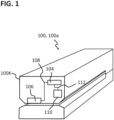
- FIG. 1 shows a schematic representation of a hair treatment device 100 according to various exemplary embodiments
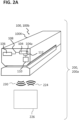
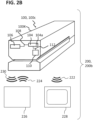
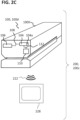
- FIG. 2A through FIG. 2C each show a schematic representation of a hair treatment system 200 according to various exemplary embodiments
- FIG. 3 shows a schematic representation of an application of a hair treatment device 100 according to various exemplary embodiments.
- a hair treatment device 100 (various embodiments are identified as 100a, 100b, etc.) is provided.
- the hair treatment device 100 is shown schematically as a straightening iron, it is to be understood that the hair treatment device can also be of another type, for example as described above.
- the hair treatment device can have a curling iron, a comb, a brush, a drying hood or the like. If applicable, it should be understood that the explanations in connection with the figures should also apply to such types of hair treatment devices.
- the hair treatment device 100 may include a device body 100K.
- the device body 100K may be formed of or include a rigid material such as plastic or metal.
- the device body may be 100K be formed of or comprise a material commonly used for a straightener, comb, brush or the like.
- the hair treatment device 100, 100a has a device for semi-permanent or temporary hair shaping, e.g. the straightening iron, the curling iron or the drying hood, the hair treatment device 100, 100a can also have a controllable or adjustable heating device (not shown). which can be integrated into the device body 100K, for example.
- a controllable or adjustable heating device not shown
- the hair treatment device 100 can have at least two sensors 106 arranged in or on the device body.
- a sensor is used to detect at least one hair condition parameter, and includes, for example, a hair condition parameter as set out above, e.g. a hair moisture sensor, a hair damage sensor, a hair thickness sensor, a gray component sensor, a hair density sensor, a curl sensor or the like.
- the second sensor is used to detect movements and changes in location and includes in particular a gyroscope.
- the at least one sensor for detecting a hair condition parameter can be set up to detect more than one parameter, for example the sensor can have an NIR spectrometer, which can be set up both parameters for determining the hair moisture and parameters for determining the degree of hair damage and/or the sensor for detecting a hair condition parameter can have a camera which can be set up to determine both parameters for determining the curliness and parameters for determining the gray component.
- the sensor can have an NIR spectrometer, which can be set up both parameters for determining the hair moisture and parameters for determining the degree of hair damage and/or the sensor for detecting a hair condition parameter can have a camera which can be set up to determine both parameters for determining the curliness and parameters for determining the gray component.
- the at least two sensors 106 can be installed in the device body 100K, for example installed in a sealed manner. This can make it possible for the hair treatment device 100 to be insensitive to moisture and dirt. For example, by means of the sealing, it can be achieved that the hair treatment device can be cleaned without damaging the sensors 106 or any other device.
- the sensors 106 can, for example, be cast in at the same time as the device body 100K is injection molded.
- the device body 100K can be transparent between the optical sensor and a surface of the device body 100K.
- the sensors 106 may be arranged in the device body 100 to be close to the hair 220H of the user 220 at a usual arrangement of the hair on or in the hair treatment device 100 or are in contact with the hair 220H.
- the hair treatment device may include an electronic circuit device 104 disposed in or on the device body 100K.
- the electronic circuit device 104 may, in various embodiments, be coupled to the at least two sensors 106, for example via a connection 108, for receiving the sensed sensor value.
- the circuit device 104 may have its own coupling to each of the sensors 106 .
- the coupling can have or be an electrically conductive connection, a (glass) fiber connection and/or a wireless connection.
- the electronic circuit device 104 may be configured to receive the at least two sensor values from the at least two sensors 106 .
- the electronic circuit device 104 may be or include a data processing device, e.g. it may be equipped with a memory and a processor, e.g. a microprocessor, which may be configured, e.g. by means of programming, to receive the data from the sensors 106 and either to directly control or regulate a hair treatment parameter, or to use the sensor data to provide the user 220 with a recommendation.
- a data processing device e.g. it may be equipped with a memory and a processor, e.g. a microprocessor, which may be configured, e.g. by means of programming, to receive the data from the sensors 106 and either to directly control or regulate a hair treatment parameter, or to use the sensor data to provide the user 220 with a recommendation.
- the electronic circuit device 104 can be set up to determine at least one recommendation based on the data received from the sensors 106 and to provide it to the user 220 .
- the hair treatment device can also have a controllable or regulatable actuator 110 .
- the actuator 110 can be set up to influence a hair treatment parameter.
- the actuator 110 can be controlled or regulated by means of the electronic circuit device 104 .
- the actuator 110 may be connected to the electronic circuit device 104 via a connection 112 in various embodiments.
- the connection 112 can have or be an electrically conductive connection, a (glass) fiber connection and/or a wireless connection.
- the actuator 110 can have temperature control or regulation of a heatable part of the hair treatment device 100 .
- the hair treatment device 100 can be set up to control the actuator 110, for example to set a temperature for the hair treatment, for example a straightening process or a curling process, that corresponds to the degree of hair damage, the curliness or the like.
- a hair temperature e.g. to set a temperature for the hair treatment, e.g. a straightening process or a curling process, which corresponds to the degree of hair damage, the curliness or similar, and to readjust it based on the recorded temperature (e.g. in particular the temperature behind the heating device, i.e. after the heat treatment).
- the hair treatment device 100 can be set up to regulate the actuator 110 solely on the basis of temperature sensor data.
- the actuator 110 can be configured to be set to a relatively high temperature, e.g. in a range from about 200°C to about 230°C, if it is determined that for example, hair 220H of user 220 is undamaged and/or thick, and being set to a relatively low temperature, e.g., in a range of about 150°C to about 180°C, if it is determined that hair 220H of user 220 For example, damaged and / or thin.
- a relatively high temperature e.g. in a range from about 200°C to about 230°C, if it is determined that for example, hair 220H of user 220 is undamaged and/or thick
- a relatively low temperature e.g., in a range of about 150°C to about 180°C, if it is determined that hair 220H of user 220 For example, damaged and / or thin.
- the user 220 may also be provided with a hair treatment recommendation, e.g., in the case of the flat iron or curling iron, a recommendation "treat each strand of hair for a maximum of five seconds" or the like.
- a hair treatment recommendation e.g., in the case of the flat iron or curling iron, a recommendation "treat each strand of hair for a maximum of five seconds" or the like.
- the actuator 110 can have, for example as an alternative or in addition to the temperature control or regulation, a controllable or regulatable dispensing device (also referred to as a dosing device), which can be set up to dose a hair treatment agent based on the detected sensor data.
- a controllable or regulatable dispensing device also referred to as a dosing device
- the dispensing device can have at least one pump and/or at least one valve, which can be controlled or regulated in such a way that a volume or an amount of the hair treatment agent can be metered.
- the dosing can take place as a function of a position of the hair treatment device 100 on the hair 220H, eg when it is determined that the hair treatment device 100 is located on the hairline, a different quantity of the hair treatment agent can be dispensed than upon determining that the hair treatment device 100 is at the ends of the hair.
- the ends of the hair may require a greater amount of hair conditioner than the roots of the hair, while the reverse may be true for a hair dye.
- a hair treatment system 200, 200a may be provided.
- the hair treatment system 200, 200a can have a hair treatment device 100, 100b, which can be similar or identical to the hair treatment device 100a in essential parts.
- the hair treatment device 100, 100b can also have a data exchange device 104a, which can be set up to transmit and receive data wirelessly.
- the hair treatment system 200, 200a can also have an external data processing device 226, which can be part of a smartphone, a tablet or the like, for example, or a cloud, for example.
- the data processing device 226 can be set up to receive the detected sensor data from the data processing device 100b, to determine the control or regulation parameters and/or the at least one recommendation and/or to determine the speed and to transmit this to the hair treatment device 100b to transfer.
- the hair treatment device 200b can be set up to indirectly determine the control or regulation parameters and/or the at least one recommendation and/or the speed.
- a hair treatment system 200, 200b may be provided.
- the hair treatment system 200, 200b can have a hair treatment device 100, 100c, which can be similar or identical to the hair treatment device 100a and/or the hair treatment device 100b in essential parts.
- the data exchange device 104a of the hair treatment device 100, 100c can be set up to transmit and receive data wirelessly.
- the hair treatment system 200, 200b can also have a display device 228 in various exemplary embodiments.
- the data processing device 226 can be set up to receive the detected sensor data from the data processing device 100c, to determine the control or regulation parameters and/or the at least one recommendation and/or the speed and to transmit this to the hair treatment device 100c.
- the hair treatment device can be set up to indirectly determine the control or regulation parameters and/or the at least one recommendation and/or the speed.
- the display device 228 can be set up to receive data from the hair treatment device 100c, for example a recommendation determined by means of the electronic circuit device 104 and/or the external data processing device 226, e.g. a hair treatment recommendation and/or a recommended hair care product.
- the display device 228 can also receive data relating to the spatial position of the hair treatment device 100c and/or data relating to areas of hair that have already been treated from the hair treatment device 100c.
- a hair treatment system 200, 200c may be provided.
- the hair treatment system 200, 200c can have a hair treatment device 100, 100d, which in essential parts can be similar or identical to the hair treatment device 100a and/or the hair treatment device 100b and/or the hair treatment device 100c.
- the data exchange device 104a of the hair treatment device 100, 100c can be set up to transmit and receive data wirelessly.
- the hair treatment system 200, 200c can have a display device 228 in various exemplary embodiments.
- the display device 228 can be set up to receive data from the hair treatment device 100d, for example a recommendation determined by means of the electronic circuit device 104, for example a hair treatment recommendation and/or a recommended hair care product or by means of the Electronic circuit device 104 determined data regarding the spatial position of the hair treatment device 100d.
- a database can be used to determine a hair condition, e.g. a degree of hair damage or the like, as described above, in which the sensor data or combinations of sensor data can be assigned to the hair conditions (e.g. degrees of hair damage).
- the database can be created in advance by means of tests and/or can be created or supplemented continuously, e.g. when using a cloud, using user data.
- the database may also provide a product recommendation based on hair condition, e.g., degree of hair damage.
- At least one product recommendation (or also a styling or other hair treatment recommendation) can be assigned to the degree of hair damage in the database.
- degree of hair damage product recommendation very low Product with a very low care content small amount Product with low care content middle Medium care product strong Product with a high level of care very strong Product with a very high care content
- the detected (measured) sensor values with regard to the hair condition parameter can either be evaluated directly in the hair treatment device 100, e.g. by means of the electronic circuit device 104, or evaluated indirectly by being transmitted to an external data processing device 226 in order to be evaluated there e.g. as described above.
- the sensor data or parts of the sensor data can be evaluated in various exemplary embodiments by means of a comparison with (e.g. empirically obtained) database entries.
- a determined hair condition (e.g., degree of hair damage) may be included in determining a recommendation, e.g., a product or treatment recommendation.
- the determined hair treatment agent such as hair care products
- the hair treatment device or the hair treatment system with control or regulation parameters for dosing the hair treatment agent using the electronic circuit device 104, the electronic Circuit device 1040 and/or the external data processing device 226 can be provided.
- FIG. 3 shows a schematic representation of an application of a hair treatment device 100 according to various exemplary embodiments.
- the hair treatment device 100 can be used for hair treatment in a manner that is usual for the hair treatment device.
- a straightening iron is shown, in which the hair 220H is clamped strand by strand and which is typically moved in the direction of the arrow, ie from the hairline in the direction of the hair tips.
- the hair is wound strand by strand onto the hair treatment device 100, when using a comb as a hair treatment device, the hair is combed through strand by strand, etc.
- programming e.g. software
- Any software that provides a functionality described above can be used.
- the software can be provided as an app.
- the circuit device integrated in the hair treatment device and/or an external data processing device can be suitable for carrying out the method for Provision of hair condition information, e.g. to be used in determination processes, e.g. by means of comparison with a database/reference values or the like.
- the programming/software need not be provided on the smartphone, tablet, laptop, etc. For example, it may be sufficient if the circuit device integrated into the hair treatment device and/or the smartphone or similar is connected to a (e.g. another) external data processing device, e.g.
- a computer for example a cloud, via the Internet, via WLAN or in another common way , connected is.
- the calculations can be carried out, for example, by means of the (further) external data processing device, e.g., by means of the computer, and the result can be provided to the smartphone/tablet or the like and/or the internal circuit device.
Landscapes
- Health & Medical Sciences (AREA)
- Life Sciences & Earth Sciences (AREA)
- General Health & Medical Sciences (AREA)
- Animal Behavior & Ethology (AREA)
- Veterinary Medicine (AREA)
- Public Health (AREA)
- Dermatology (AREA)
- Biophysics (AREA)
- Heart & Thoracic Surgery (AREA)
- Medical Informatics (AREA)
- Molecular Biology (AREA)
- Surgery (AREA)
- Biomedical Technology (AREA)
- Engineering & Computer Science (AREA)
- Pathology (AREA)
- Physics & Mathematics (AREA)
- Cosmetics (AREA)
Applications Claiming Priority (2)
| Application Number | Priority Date | Filing Date | Title |
|---|---|---|---|
| DE102017209339.0A DE102017209339A1 (de) | 2017-06-01 | 2017-06-01 | Haarbehandlungsvorrichtung, Haarbehandlungssystem und Verfahren zum kosmetischen Behandeln von Haaren |
| PCT/EP2018/063993 WO2018219899A1 (de) | 2017-06-01 | 2018-05-29 | Haarbehandlungsvorrichtung, haarbehandlungssystem und verfahren zum kosmetischen behandeln von haaren |
Publications (2)
| Publication Number | Publication Date |
|---|---|
| EP3629889A1 EP3629889A1 (de) | 2020-04-08 |
| EP3629889B1 true EP3629889B1 (de) | 2023-08-02 |
Family
ID=62486569
Family Applications (1)
| Application Number | Title | Priority Date | Filing Date |
|---|---|---|---|
| EP18728348.6A Active EP3629889B1 (de) | 2017-06-01 | 2018-05-29 | Haarbehandlungsvorrichtung, haarbehandlungssystem und verfahren zum kosmetischen behandeln von haaren |
Country Status (6)
| Country | Link |
|---|---|
| US (1) | US11896103B2 (pl) |
| EP (1) | EP3629889B1 (pl) |
| DE (1) | DE102017209339A1 (pl) |
| ES (1) | ES2957943T3 (pl) |
| PL (1) | PL3629889T3 (pl) |
| WO (1) | WO2018219899A1 (pl) |
Families Citing this family (20)
| Publication number | Priority date | Publication date | Assignee | Title |
|---|---|---|---|---|
| DE102017211781A1 (de) * | 2017-07-10 | 2019-01-10 | Henkel Ag & Co. Kgaa | Haarbehandlungssystem und Verfahren zum kosmetischen Behandeln von Haaren |
| EP3453280A1 (en) * | 2017-09-10 | 2019-03-13 | Koninklijke Philips N.V. | Hair styling device |
| US12108855B2 (en) * | 2019-05-21 | 2024-10-08 | L'oreal | Foil for a strand of keratinic fibers and related kit and illumination process |
| FR3103090B1 (fr) * | 2019-11-20 | 2024-08-09 | Oreal | Procédé de coloration ou d’éclaircissement mettant en œuvre un appareil de coiffure à main et un substrat |
| EP4125491B1 (en) * | 2020-04-02 | 2024-05-08 | Koninklijke Philips N.V. | Hair styling device comprising a hair wetness control mechanism |
| GB2597679B (en) * | 2020-07-29 | 2022-09-07 | Dyson Technology Ltd | Hairstyling device |
| GB2597683B (en) * | 2020-07-29 | 2022-11-23 | Dyson Technology Ltd | Hairstyling device |
| GB2597684B (en) * | 2020-07-29 | 2022-09-07 | Dyson Technology Ltd | Hairstyling device |
| GB2597678B (en) * | 2020-07-29 | 2022-11-30 | Dyson Technology Ltd | Hairstyling device |
| GB2597685B (en) * | 2020-07-29 | 2023-03-01 | Dyson Technology Ltd | Hairstyling device |
| GB2597687B (en) * | 2020-07-29 | 2022-11-30 | Dyson Technology Ltd | Hairstyling device |
| GB2597680B (en) * | 2020-07-29 | 2022-12-28 | Dyson Technology Ltd | Hairstyling device |
| GB2597688B (en) | 2020-07-29 | 2022-09-21 | Dyson Technology Ltd | Hairstyling device |
| GB2613605B (en) * | 2021-12-08 | 2024-06-26 | Dyson Technology Ltd | Hair styling apparatus |
| GB2617201A (en) * | 2022-04-01 | 2023-10-04 | Jemella Ltd | Apparatus and methods for drying or styling hair |
| US12376660B2 (en) | 2023-01-17 | 2025-08-05 | Sharkninja Operating Llc | Hot brush |
| US20240245190A1 (en) | 2023-01-19 | 2024-07-25 | Sharkninja Operating Llc | Identification of hair care appliance attachments |
| EP4651762A1 (en) | 2023-01-19 | 2025-11-26 | SharkNinja Operating LLC | Hair care appliance with powered attachment |
| GB2630287A (en) * | 2023-05-18 | 2024-11-27 | Dyson Technology Ltd | A haircare appliance |
| CN119477851B (zh) * | 2024-11-06 | 2025-10-17 | 绍兴市益强电器科技有限公司 | 一种长短发吹风调整方法、系统、智能终端及存储介质 |
Family Cites Families (13)
| Publication number | Priority date | Publication date | Assignee | Title |
|---|---|---|---|---|
| US5025514A (en) * | 1990-04-05 | 1991-06-25 | Iht, Inc. | Pressure means for automatic hair and scalp treatment apparatus |
| US7631646B2 (en) * | 2006-02-24 | 2009-12-15 | Mm&R Products, Inc. | Hair styling tool with rotatable cylinder |
| GB2477834B (en) * | 2010-08-31 | 2012-02-01 | Jemella Ltd | Hair styling appliance |
| CN202069097U (zh) * | 2011-01-18 | 2011-12-14 | 建福实业有限公司 | 头发定型熨斗 |
| KR20140058494A (ko) * | 2011-06-13 | 2014-05-14 | 쿨웨이 인코포레이티드 | 동적이고 최적인 모발 스타일링 온도 제어를 위한 모발 관리 도구 및 방법 |
| US20130319450A1 (en) * | 2012-06-03 | 2013-12-05 | M.M. & R. Products, Inc. | Hairstyling Tool With Automatically Reversing Cylinder |
| GB2500733B (en) * | 2012-06-25 | 2014-05-21 | Jemella Ltd | Hair styling appliance |
| FR3000877B1 (fr) | 2013-01-15 | 2018-09-07 | Withings | Brosse a cheveux instrumentee et connectee, et systeme informatif utilisant une telle brosse |
| FR3001112B1 (fr) * | 2013-01-18 | 2015-03-13 | Seb Sa | Appareil de coiffure a vapeur equipe d'une carte electronique de gestion deportee |
| WO2016033449A1 (en) * | 2014-08-29 | 2016-03-03 | T3 Micro, Inc. | Rotation responsive motorized hair curler |
| FI3922128T3 (fi) | 2015-04-03 | 2023-04-12 | Siirrettävä lämmitysjärjestelmä | |
| US20180246762A1 (en) * | 2017-02-28 | 2018-08-30 | Intel Corporation | Runtime processor optimization |
| IL269697B (en) * | 2017-03-31 | 2022-07-01 | Canvas Construction Inc | Automatic system for planning plaster walls and method |
-
2017
- 2017-06-01 DE DE102017209339.0A patent/DE102017209339A1/de not_active Ceased
-
2018
- 2018-05-29 WO PCT/EP2018/063993 patent/WO2018219899A1/de not_active Ceased
- 2018-05-29 EP EP18728348.6A patent/EP3629889B1/de active Active
- 2018-05-29 PL PL18728348.6T patent/PL3629889T3/pl unknown
- 2018-05-29 US US16/614,143 patent/US11896103B2/en active Active
- 2018-05-29 ES ES18728348T patent/ES2957943T3/es active Active
Also Published As
| Publication number | Publication date |
|---|---|
| PL3629889T3 (pl) | 2024-01-15 |
| WO2018219899A1 (de) | 2018-12-06 |
| ES2957943T3 (es) | 2024-01-30 |
| US11896103B2 (en) | 2024-02-13 |
| WO2018219899A9 (de) | 2019-10-03 |
| DE102017209339A1 (de) | 2018-12-06 |
| US20200146413A1 (en) | 2020-05-14 |
| EP3629889A1 (de) | 2020-04-08 |
Similar Documents
| Publication | Publication Date | Title |
|---|---|---|
| EP3565432B1 (de) | Haarbehandlungsvorrichtung, haarbehandlungssystem und verfahren zum kosmetischen behandeln von haaren | |
| WO2018219899A9 (de) | Haarbehandlungsvorrichtung, haarbehandlungssystem und verfahren zum kosmetischen behandeln von haaren | |
| EP3652746B1 (de) | System und verfahren zum verbessern eines kosmetischen haarzustands | |
| EP3651609B1 (de) | Haarbehandlungssystem und verfahren zum kosmetischen behandeln von haaren | |
| WO2019011699A1 (de) | Haartrocknersystem und verfahren zum fönen von haaren | |
| EP3629887B1 (de) | Haarzustands-ermittlungsvorrichtung, haarzustands-ermittlungssystem und verfahren zum ermitteln eines haarzustands | |
| US20110226273A1 (en) | Method for Targeted Application of Hair Care Products | |
| EP2272391A1 (de) | Automatisierter Haarpflegeprozess | |
| EP3793426B1 (de) | Bestimmung des reduktiven schädigungsgrades von haaren mit nir-spektroskopie | |
| WO2018007358A1 (de) | Verfahren zum ermitteln einer nutzerspezifischen haarbehandlung | |
| WO2018114717A1 (de) | Haarinformations-ermittlungsvorrichtung, haarinformations-ermittlungssystem und verfahren zum bereitstellen einer haarzustandsinformation | |
| DE102018207558A1 (de) | Ermitteln von äußeren Schäden von Haaren | |
| WO2019219350A1 (de) | Bestimmung eines dehnungsgrades von haar mit einem nir-sensor | |
| EP3559662B1 (de) | Haaruntersuchungsvorrichtung | |
| DE202011100349U1 (de) | Haarformgerät | |
| EP3679347B1 (de) | Verfahren und vorrichtung zum ermitteln eines thermischen schädigungsgrads von haar | |
| WO2019052737A1 (de) | Anordnung zum ermitteln von körperoberflächeneigenschaften |
Legal Events
| Date | Code | Title | Description |
|---|---|---|---|
| STAA | Information on the status of an ep patent application or granted ep patent |
Free format text: STATUS: UNKNOWN |
|
| STAA | Information on the status of an ep patent application or granted ep patent |
Free format text: STATUS: THE INTERNATIONAL PUBLICATION HAS BEEN MADE |
|
| PUAI | Public reference made under article 153(3) epc to a published international application that has entered the european phase |
Free format text: ORIGINAL CODE: 0009012 |
|
| STAA | Information on the status of an ep patent application or granted ep patent |
Free format text: STATUS: REQUEST FOR EXAMINATION WAS MADE |
|
| 17P | Request for examination filed |
Effective date: 20191211 |
|
| AK | Designated contracting states |
Kind code of ref document: A1 Designated state(s): AL AT BE BG CH CY CZ DE DK EE ES FI FR GB GR HR HU IE IS IT LI LT LU LV MC MK MT NL NO PL PT RO RS SE SI SK SM TR |
|
| AX | Request for extension of the european patent |
Extension state: BA ME |
|
| DAV | Request for validation of the european patent (deleted) | ||
| DAX | Request for extension of the european patent (deleted) | ||
| STAA | Information on the status of an ep patent application or granted ep patent |
Free format text: STATUS: EXAMINATION IS IN PROGRESS |
|
| 17Q | First examination report despatched |
Effective date: 20211203 |
|
| GRAP | Despatch of communication of intention to grant a patent |
Free format text: ORIGINAL CODE: EPIDOSNIGR1 |
|
| STAA | Information on the status of an ep patent application or granted ep patent |
Free format text: STATUS: GRANT OF PATENT IS INTENDED |
|
| INTG | Intention to grant announced |
Effective date: 20230320 |
|
| GRAS | Grant fee paid |
Free format text: ORIGINAL CODE: EPIDOSNIGR3 |
|
| GRAA | (expected) grant |
Free format text: ORIGINAL CODE: 0009210 |
|
| STAA | Information on the status of an ep patent application or granted ep patent |
Free format text: STATUS: THE PATENT HAS BEEN GRANTED |
|
| P01 | Opt-out of the competence of the unified patent court (upc) registered |
Effective date: 20230531 |
|
| AK | Designated contracting states |
Kind code of ref document: B1 Designated state(s): AL AT BE BG CH CY CZ DE DK EE ES FI FR GB GR HR HU IE IS IT LI LT LU LV MC MK MT NL NO PL PT RO RS SE SI SK SM TR |
|
| REG | Reference to a national code |
Ref country code: GB Ref legal event code: FG4D Free format text: NOT ENGLISH |
|
| REG | Reference to a national code |
Ref country code: CH Ref legal event code: EP |
|
| REG | Reference to a national code |
Ref country code: DE Ref legal event code: R096 Ref document number: 502018012862 Country of ref document: DE |
|
| REG | Reference to a national code |
Ref country code: IE Ref legal event code: FG4D Free format text: LANGUAGE OF EP DOCUMENT: GERMAN |
|
| REG | Reference to a national code |
Ref country code: LT Ref legal event code: MG9D |
|
| REG | Reference to a national code |
Ref country code: NL Ref legal event code: MP Effective date: 20230802 |
|
| PG25 | Lapsed in a contracting state [announced via postgrant information from national office to epo] |
Ref country code: GR Free format text: LAPSE BECAUSE OF FAILURE TO SUBMIT A TRANSLATION OF THE DESCRIPTION OR TO PAY THE FEE WITHIN THE PRESCRIBED TIME-LIMIT Effective date: 20231103 |
|
| PG25 | Lapsed in a contracting state [announced via postgrant information from national office to epo] |
Ref country code: IS Free format text: LAPSE BECAUSE OF FAILURE TO SUBMIT A TRANSLATION OF THE DESCRIPTION OR TO PAY THE FEE WITHIN THE PRESCRIBED TIME-LIMIT Effective date: 20231202 |
|
| REG | Reference to a national code |
Ref country code: ES Ref legal event code: FG2A Ref document number: 2957943 Country of ref document: ES Kind code of ref document: T3 Effective date: 20240130 |
|
| PG25 | Lapsed in a contracting state [announced via postgrant information from national office to epo] |
Ref country code: SE Free format text: LAPSE BECAUSE OF FAILURE TO SUBMIT A TRANSLATION OF THE DESCRIPTION OR TO PAY THE FEE WITHIN THE PRESCRIBED TIME-LIMIT Effective date: 20230802 Ref country code: RS Free format text: LAPSE BECAUSE OF FAILURE TO SUBMIT A TRANSLATION OF THE DESCRIPTION OR TO PAY THE FEE WITHIN THE PRESCRIBED TIME-LIMIT Effective date: 20230802 Ref country code: PT Free format text: LAPSE BECAUSE OF FAILURE TO SUBMIT A TRANSLATION OF THE DESCRIPTION OR TO PAY THE FEE WITHIN THE PRESCRIBED TIME-LIMIT Effective date: 20231204 Ref country code: NO Free format text: LAPSE BECAUSE OF FAILURE TO SUBMIT A TRANSLATION OF THE DESCRIPTION OR TO PAY THE FEE WITHIN THE PRESCRIBED TIME-LIMIT Effective date: 20231102 Ref country code: NL Free format text: LAPSE BECAUSE OF FAILURE TO SUBMIT A TRANSLATION OF THE DESCRIPTION OR TO PAY THE FEE WITHIN THE PRESCRIBED TIME-LIMIT Effective date: 20230802 Ref country code: LV Free format text: LAPSE BECAUSE OF FAILURE TO SUBMIT A TRANSLATION OF THE DESCRIPTION OR TO PAY THE FEE WITHIN THE PRESCRIBED TIME-LIMIT Effective date: 20230802 Ref country code: LT Free format text: LAPSE BECAUSE OF FAILURE TO SUBMIT A TRANSLATION OF THE DESCRIPTION OR TO PAY THE FEE WITHIN THE PRESCRIBED TIME-LIMIT Effective date: 20230802 Ref country code: IS Free format text: LAPSE BECAUSE OF FAILURE TO SUBMIT A TRANSLATION OF THE DESCRIPTION OR TO PAY THE FEE WITHIN THE PRESCRIBED TIME-LIMIT Effective date: 20231202 Ref country code: HR Free format text: LAPSE BECAUSE OF FAILURE TO SUBMIT A TRANSLATION OF THE DESCRIPTION OR TO PAY THE FEE WITHIN THE PRESCRIBED TIME-LIMIT Effective date: 20230802 Ref country code: GR Free format text: LAPSE BECAUSE OF FAILURE TO SUBMIT A TRANSLATION OF THE DESCRIPTION OR TO PAY THE FEE WITHIN THE PRESCRIBED TIME-LIMIT Effective date: 20231103 Ref country code: FI Free format text: LAPSE BECAUSE OF FAILURE TO SUBMIT A TRANSLATION OF THE DESCRIPTION OR TO PAY THE FEE WITHIN THE PRESCRIBED TIME-LIMIT Effective date: 20230802 |
|
| PG25 | Lapsed in a contracting state [announced via postgrant information from national office to epo] |
Ref country code: SM Free format text: LAPSE BECAUSE OF FAILURE TO SUBMIT A TRANSLATION OF THE DESCRIPTION OR TO PAY THE FEE WITHIN THE PRESCRIBED TIME-LIMIT Effective date: 20230802 Ref country code: RO Free format text: LAPSE BECAUSE OF FAILURE TO SUBMIT A TRANSLATION OF THE DESCRIPTION OR TO PAY THE FEE WITHIN THE PRESCRIBED TIME-LIMIT Effective date: 20230802 Ref country code: EE Free format text: LAPSE BECAUSE OF FAILURE TO SUBMIT A TRANSLATION OF THE DESCRIPTION OR TO PAY THE FEE WITHIN THE PRESCRIBED TIME-LIMIT Effective date: 20230802 Ref country code: DK Free format text: LAPSE BECAUSE OF FAILURE TO SUBMIT A TRANSLATION OF THE DESCRIPTION OR TO PAY THE FEE WITHIN THE PRESCRIBED TIME-LIMIT Effective date: 20230802 Ref country code: CZ Free format text: LAPSE BECAUSE OF FAILURE TO SUBMIT A TRANSLATION OF THE DESCRIPTION OR TO PAY THE FEE WITHIN THE PRESCRIBED TIME-LIMIT Effective date: 20230802 Ref country code: SK Free format text: LAPSE BECAUSE OF FAILURE TO SUBMIT A TRANSLATION OF THE DESCRIPTION OR TO PAY THE FEE WITHIN THE PRESCRIBED TIME-LIMIT Effective date: 20230802 |
|
| REG | Reference to a national code |
Ref country code: DE Ref legal event code: R097 Ref document number: 502018012862 Country of ref document: DE |
|
| PLBE | No opposition filed within time limit |
Free format text: ORIGINAL CODE: 0009261 |
|
| STAA | Information on the status of an ep patent application or granted ep patent |
Free format text: STATUS: NO OPPOSITION FILED WITHIN TIME LIMIT |
|
| 26N | No opposition filed |
Effective date: 20240503 |
|
| PG25 | Lapsed in a contracting state [announced via postgrant information from national office to epo] |
Ref country code: SI Free format text: LAPSE BECAUSE OF FAILURE TO SUBMIT A TRANSLATION OF THE DESCRIPTION OR TO PAY THE FEE WITHIN THE PRESCRIBED TIME-LIMIT Effective date: 20230802 |
|
| PG25 | Lapsed in a contracting state [announced via postgrant information from national office to epo] |
Ref country code: BG Free format text: LAPSE BECAUSE OF FAILURE TO SUBMIT A TRANSLATION OF THE DESCRIPTION OR TO PAY THE FEE WITHIN THE PRESCRIBED TIME-LIMIT Effective date: 20230802 |
|
| PG25 | Lapsed in a contracting state [announced via postgrant information from national office to epo] |
Ref country code: BG Free format text: LAPSE BECAUSE OF FAILURE TO SUBMIT A TRANSLATION OF THE DESCRIPTION OR TO PAY THE FEE WITHIN THE PRESCRIBED TIME-LIMIT Effective date: 20230802 |
|
| REG | Reference to a national code |
Ref country code: CH Ref legal event code: PL |
|
| PG25 | Lapsed in a contracting state [announced via postgrant information from national office to epo] |
Ref country code: MC Free format text: LAPSE BECAUSE OF FAILURE TO SUBMIT A TRANSLATION OF THE DESCRIPTION OR TO PAY THE FEE WITHIN THE PRESCRIBED TIME-LIMIT Effective date: 20230802 |
|
| PG25 | Lapsed in a contracting state [announced via postgrant information from national office to epo] |
Ref country code: LU Free format text: LAPSE BECAUSE OF NON-PAYMENT OF DUE FEES Effective date: 20240529 |
|
| PG25 | Lapsed in a contracting state [announced via postgrant information from national office to epo] |
Ref country code: MC Free format text: LAPSE BECAUSE OF FAILURE TO SUBMIT A TRANSLATION OF THE DESCRIPTION OR TO PAY THE FEE WITHIN THE PRESCRIBED TIME-LIMIT Effective date: 20230802 Ref country code: LU Free format text: LAPSE BECAUSE OF NON-PAYMENT OF DUE FEES Effective date: 20240529 Ref country code: CH Free format text: LAPSE BECAUSE OF NON-PAYMENT OF DUE FEES Effective date: 20240531 |
|
| REG | Reference to a national code |
Ref country code: BE Ref legal event code: MM Effective date: 20240531 |
|
| PG25 | Lapsed in a contracting state [announced via postgrant information from national office to epo] |
Ref country code: IE Free format text: LAPSE BECAUSE OF NON-PAYMENT OF DUE FEES Effective date: 20240529 |
|
| PG25 | Lapsed in a contracting state [announced via postgrant information from national office to epo] |
Ref country code: BE Free format text: LAPSE BECAUSE OF NON-PAYMENT OF DUE FEES Effective date: 20240531 |
|
| PGFP | Annual fee paid to national office [announced via postgrant information from national office to epo] |
Ref country code: PL Payment date: 20250515 Year of fee payment: 8 Ref country code: DE Payment date: 20250521 Year of fee payment: 8 |
|
| PGFP | Annual fee paid to national office [announced via postgrant information from national office to epo] |
Ref country code: IT Payment date: 20250527 Year of fee payment: 8 |
|
| REG | Reference to a national code |
Ref country code: AT Ref legal event code: MM01 Ref document number: 1593709 Country of ref document: AT Kind code of ref document: T Effective date: 20240529 |
|
| PGFP | Annual fee paid to national office [announced via postgrant information from national office to epo] |
Ref country code: FR Payment date: 20250528 Year of fee payment: 8 |
|
| PG25 | Lapsed in a contracting state [announced via postgrant information from national office to epo] |
Ref country code: AT Free format text: LAPSE BECAUSE OF NON-PAYMENT OF DUE FEES Effective date: 20240529 |
|
| PG25 | Lapsed in a contracting state [announced via postgrant information from national office to epo] |
Ref country code: CY Free format text: LAPSE BECAUSE OF FAILURE TO SUBMIT A TRANSLATION OF THE DESCRIPTION OR TO PAY THE FEE WITHIN THE PRESCRIBED TIME-LIMIT; INVALID AB INITIO Effective date: 20180529 |
|
| PGFP | Annual fee paid to national office [announced via postgrant information from national office to epo] |
Ref country code: ES Payment date: 20250630 Year of fee payment: 8 |
|
| PG25 | Lapsed in a contracting state [announced via postgrant information from national office to epo] |
Ref country code: HU Free format text: LAPSE BECAUSE OF FAILURE TO SUBMIT A TRANSLATION OF THE DESCRIPTION OR TO PAY THE FEE WITHIN THE PRESCRIBED TIME-LIMIT; INVALID AB INITIO Effective date: 20180529 |
|
| PGFP | Annual fee paid to national office [announced via postgrant information from national office to epo] |
Ref country code: GB Payment date: 20260306 Year of fee payment: 9 |