EP3628667A1 - Process and salts for the preparation of 2,5-furandicarboxylic acid - Google Patents
Process and salts for the preparation of 2,5-furandicarboxylic acid Download PDFInfo
- Publication number
- EP3628667A1 EP3628667A1 EP18197773.7A EP18197773A EP3628667A1 EP 3628667 A1 EP3628667 A1 EP 3628667A1 EP 18197773 A EP18197773 A EP 18197773A EP 3628667 A1 EP3628667 A1 EP 3628667A1
- Authority
- EP
- European Patent Office
- Prior art keywords
- furandicarboxylic acid
- mono salt
- fdca
- acid mono
- salt
- Prior art date
- Legal status (The legal status is an assumption and is not a legal conclusion. Google has not performed a legal analysis and makes no representation as to the accuracy of the status listed.)
- Withdrawn
Links
- CHTHALBTIRVDBM-UHFFFAOYSA-N furan-2,5-dicarboxylic acid Chemical compound OC(=O)C1=CC=C(C(O)=O)O1 CHTHALBTIRVDBM-UHFFFAOYSA-N 0.000 title claims abstract description 243
- 150000003839 salts Chemical class 0.000 title claims abstract description 103
- 238000000034 method Methods 0.000 title claims abstract description 30
- 238000002360 preparation method Methods 0.000 title claims abstract description 7
- 238000002425 crystallisation Methods 0.000 claims abstract description 38
- 230000008025 crystallization Effects 0.000 claims abstract description 34
- 239000000725 suspension Substances 0.000 claims abstract description 13
- 238000000746 purification Methods 0.000 claims abstract description 8
- 239000012530 fluid Substances 0.000 claims description 53
- 238000001914 filtration Methods 0.000 claims description 23
- 150000001768 cations Chemical class 0.000 claims description 9
- -1 ammonium cations Chemical class 0.000 claims description 7
- DGAQECJNVWCQMB-PUAWFVPOSA-M Ilexoside XXIX Chemical compound C[C@@H]1CC[C@@]2(CC[C@@]3(C(=CC[C@H]4[C@]3(CC[C@@H]5[C@@]4(CC[C@@H](C5(C)C)OS(=O)(=O)[O-])C)C)[C@@H]2[C@]1(C)O)C)C(=O)O[C@H]6[C@@H]([C@H]([C@@H]([C@H](O6)CO)O)O)O.[Na+] DGAQECJNVWCQMB-PUAWFVPOSA-M 0.000 claims description 6
- 239000007864 aqueous solution Substances 0.000 claims description 6
- 239000011734 sodium Substances 0.000 claims description 6
- 229910052708 sodium Inorganic materials 0.000 claims description 6
- 239000007787 solid Substances 0.000 claims description 6
- 229910052783 alkali metal Inorganic materials 0.000 claims description 4
- 150000001340 alkali metals Chemical class 0.000 claims description 4
- 150000004682 monohydrates Chemical group 0.000 claims description 4
- OYPRJOBELJOOCE-UHFFFAOYSA-N Calcium Chemical compound [Ca] OYPRJOBELJOOCE-UHFFFAOYSA-N 0.000 claims description 3
- WHXSMMKQMYFTQS-UHFFFAOYSA-N Lithium Chemical compound [Li] WHXSMMKQMYFTQS-UHFFFAOYSA-N 0.000 claims description 3
- FYYHWMGAXLPEAU-UHFFFAOYSA-N Magnesium Chemical compound [Mg] FYYHWMGAXLPEAU-UHFFFAOYSA-N 0.000 claims description 3
- ZLMJMSJWJFRBEC-UHFFFAOYSA-N Potassium Chemical compound [K] ZLMJMSJWJFRBEC-UHFFFAOYSA-N 0.000 claims description 3
- 229910052784 alkaline earth metal Inorganic materials 0.000 claims description 3
- 150000001342 alkaline earth metals Chemical class 0.000 claims description 3
- 229910052791 calcium Inorganic materials 0.000 claims description 3
- 239000011575 calcium Substances 0.000 claims description 3
- 229910052744 lithium Inorganic materials 0.000 claims description 3
- 229910052749 magnesium Inorganic materials 0.000 claims description 3
- 239000011777 magnesium Substances 0.000 claims description 3
- 229910052700 potassium Inorganic materials 0.000 claims description 3
- 239000011591 potassium Substances 0.000 claims description 3
- 125000005207 tetraalkylammonium group Chemical group 0.000 claims description 3
- QEMXHQIAXOOASZ-UHFFFAOYSA-N tetramethylammonium Chemical compound C[N+](C)(C)C QEMXHQIAXOOASZ-UHFFFAOYSA-N 0.000 claims description 3
- QGZKDVFQNNGYKY-UHFFFAOYSA-O Ammonium Chemical compound [NH4+] QGZKDVFQNNGYKY-UHFFFAOYSA-O 0.000 claims description 2
- OOKVMGDSHJVIJW-UHFFFAOYSA-N [Na].OC(=O)c1ccc(o1)C(O)=O Chemical compound [Na].OC(=O)c1ccc(o1)C(O)=O OOKVMGDSHJVIJW-UHFFFAOYSA-N 0.000 claims 1
- 239000007900 aqueous suspension Substances 0.000 claims 1
- 239000013078 crystal Substances 0.000 description 40
- 239000000243 solution Substances 0.000 description 25
- 239000000047 product Substances 0.000 description 19
- 239000012535 impurity Substances 0.000 description 18
- QAOWNCQODCNURD-UHFFFAOYSA-N Sulfuric acid Chemical compound OS(O)(=O)=O QAOWNCQODCNURD-UHFFFAOYSA-N 0.000 description 16
- 239000002253 acid Substances 0.000 description 10
- XLYOFNOQVPJJNP-UHFFFAOYSA-N water Substances O XLYOFNOQVPJJNP-UHFFFAOYSA-N 0.000 description 9
- 238000004458 analytical method Methods 0.000 description 8
- 230000003247 decreasing effect Effects 0.000 description 7
- 238000005406 washing Methods 0.000 description 7
- SHNRXUWGUKDPMA-UHFFFAOYSA-N 5-formyl-2-furoic acid Chemical compound OC(=O)C1=CC=C(C=O)O1 SHNRXUWGUKDPMA-UHFFFAOYSA-N 0.000 description 6
- 230000015572 biosynthetic process Effects 0.000 description 5
- 230000000052 comparative effect Effects 0.000 description 5
- 238000006116 polymerization reaction Methods 0.000 description 5
- 238000001953 recrystallisation Methods 0.000 description 5
- NOEGNKMFWQHSLB-UHFFFAOYSA-N 5-hydroxymethylfurfural Chemical compound OCC1=CC=C(C=O)O1 NOEGNKMFWQHSLB-UHFFFAOYSA-N 0.000 description 4
- 150000007942 carboxylates Chemical group 0.000 description 4
- 238000004128 high performance liquid chromatography Methods 0.000 description 4
- 238000009616 inductively coupled plasma Methods 0.000 description 4
- 238000002156 mixing Methods 0.000 description 4
- 150000007513 acids Chemical class 0.000 description 3
- 150000001875 compounds Chemical class 0.000 description 3
- 238000004090 dissolution Methods 0.000 description 3
- 238000004519 manufacturing process Methods 0.000 description 3
- 239000000463 material Substances 0.000 description 3
- VEXZGXHMUGYJMC-UHFFFAOYSA-N Hydrochloric acid Chemical compound Cl VEXZGXHMUGYJMC-UHFFFAOYSA-N 0.000 description 2
- 239000012670 alkaline solution Substances 0.000 description 2
- 238000010790 dilution Methods 0.000 description 2
- 239000012895 dilution Substances 0.000 description 2
- 238000011143 downstream manufacturing Methods 0.000 description 2
- 230000003993 interaction Effects 0.000 description 2
- 239000000203 mixture Substances 0.000 description 2
- 239000004033 plastic Substances 0.000 description 2
- 229920003023 plastic Polymers 0.000 description 2
- 229920000139 polyethylene terephthalate Polymers 0.000 description 2
- 239000005020 polyethylene terephthalate Substances 0.000 description 2
- 239000000843 powder Substances 0.000 description 2
- 238000004448 titration Methods 0.000 description 2
- KEAYESYHFKHZAL-UHFFFAOYSA-N Sodium Chemical class [Na] KEAYESYHFKHZAL-UHFFFAOYSA-N 0.000 description 1
- 125000000129 anionic group Chemical group 0.000 description 1
- 239000012296 anti-solvent Substances 0.000 description 1
- 230000004888 barrier function Effects 0.000 description 1
- 238000011138 biotechnological process Methods 0.000 description 1
- 239000006227 byproduct Substances 0.000 description 1
- 150000001732 carboxylic acid derivatives Chemical class 0.000 description 1
- 230000015556 catabolic process Effects 0.000 description 1
- 238000003889 chemical engineering Methods 0.000 description 1
- 238000000354 decomposition reaction Methods 0.000 description 1
- 238000006731 degradation reaction Methods 0.000 description 1
- PMEQUMNFOFODCU-UHFFFAOYSA-L disodium furan-2,5-dicarboxylate Chemical compound O1C(=CC=C1C(=O)[O-])C(=O)[O-].[Na+].[Na+] PMEQUMNFOFODCU-UHFFFAOYSA-L 0.000 description 1
- 230000002349 favourable effect Effects 0.000 description 1
- 239000000706 filtrate Substances 0.000 description 1
- 238000010438 heat treatment Methods 0.000 description 1
- 229910052500 inorganic mineral Inorganic materials 0.000 description 1
- 150000002500 ions Chemical class 0.000 description 1
- 238000002955 isolation Methods 0.000 description 1
- 239000007788 liquid Substances 0.000 description 1
- 239000011707 mineral Substances 0.000 description 1
- 238000006386 neutralization reaction Methods 0.000 description 1
- 238000010899 nucleation Methods 0.000 description 1
- 230000003647 oxidation Effects 0.000 description 1
- 238000007254 oxidation reaction Methods 0.000 description 1
- 239000002244 precipitate Substances 0.000 description 1
- 239000002904 solvent Substances 0.000 description 1
- 238000001228 spectrum Methods 0.000 description 1
- 238000010561 standard procedure Methods 0.000 description 1
- KKEYFWRCBNTPAC-UHFFFAOYSA-L terephthalate(2-) Chemical compound [O-]C(=O)C1=CC=C(C([O-])=O)C=C1 KKEYFWRCBNTPAC-UHFFFAOYSA-L 0.000 description 1
Images



Classifications
-
- C—CHEMISTRY; METALLURGY
- C07—ORGANIC CHEMISTRY
- C07D—HETEROCYCLIC COMPOUNDS
- C07D307/00—Heterocyclic compounds containing five-membered rings having one oxygen atom as the only ring hetero atom
- C07D307/02—Heterocyclic compounds containing five-membered rings having one oxygen atom as the only ring hetero atom not condensed with other rings
- C07D307/34—Heterocyclic compounds containing five-membered rings having one oxygen atom as the only ring hetero atom not condensed with other rings having two or three double bonds between ring members or between ring members and non-ring members
- C07D307/56—Heterocyclic compounds containing five-membered rings having one oxygen atom as the only ring hetero atom not condensed with other rings having two or three double bonds between ring members or between ring members and non-ring members with hetero atoms or with carbon atoms having three bonds to hetero atoms with at the most one bond to halogen, e.g. ester or nitrile radicals, directly attached to ring carbon atoms
- C07D307/68—Carbon atoms having three bonds to hetero atoms with at the most one bond to halogen
Definitions
- the invention is in the field of the preparation of 2,5-furandicarboxylic acid.
- the present invention is directed to the purification of 2,5-furandicarboxylic acid or a salt thereof.
- the compound 2,5-furandicarboxylic acid (2H-FDCA) is a promising starting point for the production of materials.
- 2H-FDCA has been suggested as bio-based replacement of terephthalate for the production of plastic materials.
- polyethylene furanoate (PEF) offers many advantages over polyethylene terephthalate (PET) with regards barrier and mechanical properties.
- a particular route for the preparation of FDCA comprises oxidation of 5-(hydroxymethyl)furfural (HMF) by for instance biotechnological processes, electrochemical processes or chemically by air (see e.g. Triebl et al. Computers and Chemical Engineering 52 (2013) 26- 34 and references cited therein). These processes generally result in a solution of 2H-FDCA or salt thereof from which 2H-FDCA must be isolated.
- HMF 5-(hydroxymethyl)furfural
- FFCA 5-formyl-2-furancarboxylic acid
- isolated 2H-FDCA may for instance be orange or brownish of color even if the amount of impurities is relatively low. Colored 2H-FDCA can result in colored plastic materials, which is not desirable.
- the intensity of the color can be taken as an indication of the amount of impurities, which may consequently interfere in the subsequent processing (e.g. polymerization) of the 2H-FDCA.
- FFCA is a mono-acid that can be present as an impurity and lead to chain termination in the polymerization process. As such, an effective and efficient method for purifying 2H-FDCA is desired to obtain a pure and an essentially colorless 2H-FDCA product.
- WO 2016/146753 and WO 2014/209112 disclose purification of 2H-FDCA by a crystallization of 2H-FDCA from a solution of disodium furan-2,5-dicarboxylate by reducing the pH of said solution.
- the present inventors surprisingly found that purification of 2H-FDCA can be improved using a 2,5-furandicarboxylic acid mono salt (FDCA mono salt). It was found that using the FDCA mono salt can result is a less colored 2H-FDCA and lower levels of impurities such as FFCA.
- the use of the FDCA mono salt enables a facile preparation method with particularly favorable down-stream processing (DSP) requirements, thereby enabling an improved efficiency of the overall 2H-FDCA production process.
- DSP down-stream processing
- the present inventors found that the FDCA mono salt can be crystallized as a monohydrate and, without wishing to be bound by theory, believe that this monohydrate results in a particularly pure salt form which can be used to increase the purity and colorlessness of the final 2H-FDCA product.
- the present invention is directed to a method for the preparation, in particular the purification of 2,5-furandicarboxylic acid or a salt thereof, comprising crystallization of a 2,5-furandicarboxylic acid mono salt.
- the present invention pertains to purification of 2,5-furandicarboxylic acid or a salt thereof comprising a two-step process comprising a first crystallization of the 2,5-furandicarboxylic acid mono salt, followed by a second step comprising crystallization of 2,5-furandicarboxylic acid.
- the two carboxylate moieties in the compound 2,5-furandicarboxylic acid are each capable of forming ionic bonds with cations.
- '2,5-furandicarboxylic acid mono salt' or 'FDCA mono salt' is meant herein that one of these carboxylate moieties has an ionic interaction with a cation other than a proton, while the other carboxylate moiety has an interaction with a proton and is thus neutralized to the carboxylic acid.
- the term '2,5-furandicarboxylic acid' herein means the fully neutralized or diacid form.
- the 2,5-furandicarboxylic acid mono salt comprises a cation selected from the group consisting of alkali metals, alkaline earth metals, ammonium cations, and combinations thereof, preferably sodium, potassium, magnesium, calcium, lithium, ammonium, tetraalkyl ammonium such a tetramethyl ammonium, and combinations thereof, more preferably sodium.
- the 2,5-furandicarboxylic acid mono salt particularly preferably comprises the mono sodium salt of 2,5-furandicarboxylic acid. It may be appreciated that in the embodiments wherein the cation comprises a multivalent cation such as an alkaline earth metal, one of these cations is shared between two molecules of 2,5-furandicarboxylate.
- the FDCA mono salt can be crystallized from a first aqueous fluid, typically an aqueous solution.
- a first aqueous fluid typically an aqueous solution.
- This can be carried out by a step comprising providing the first aqueous fluid, e.g. an aqueous alkaline solution, comprising 2,5-furandicarboxylate, i.e. an dianionic form or dicarboxylate ion of 2H-FDCA, and decreasing the pH of this alkaline solution to about the highest pK a -value of 2H-FDCA.
- the present inventors found that the pK a -values of 2H-FDCA can advantageously be used to provide FDCA mono salt because, in aqueous solutions, the solubility of 2H-FDCA is lower than the anionic forms thereof.
- decreasing the pH of a solution comprising 2,5-furandicarboxylate results in at least partial neutralization of the carboxylate moieties, a decreased solubility of the FDCA form and concomitant crystallization of the particular FDCA form.
- the specific form (i.e . charge and salt form) of the FDCA depend i.a . on the pH and polarity of the solution wherein the form is dissolved.
- the present invention typically comprises providing a first aqueous fluid, typically a solution, comprising the FDCA mono salt and crystallizing the FDCA mono salt from said first aqueous fluid to provide a crystallized FDCA mono salt.
- the crystallization can be carried out by decreasing the pH of the first aqueous fluid comprising 2,5-furandicarboxylate.
- the pH of the first aqueous fluid is adjusted to 1.8 or higher, more preferably to a pH in the range of 2 to 6, more preferably to a pH of about 3. It was found that such pH can result in crystallization of the FDCA mono salt, or a hydrate such as the monohydrate thereof. It may be appreciated that the mono-salt might also (temporary) contain H2-FDCA (due to localized low pH at the addition point of the acid).
- the crystallization of the FDCA mono salt is typically carried out at moderate temperatures, e.g. less than 50 °C, preferably less than 30 °C, more preferably less than 20 °C. At these temperatures, in particularly at the above-mentioned pH ranges, large crystals of FDCA mono salt can be formed (e.g. an average mesh size of >100 ⁇ m). These large crystals facilitate filtration and washing (which are optional) and have a relatively lower surface area with respect to smaller crystals to which impurity can adhere.
- decreasing the pH of the first aqueous fluid is carried out by contacting the fluid with a strong acid.
- a strong acid typically, the use of concentrated strong acids is preferred as this limits the require for addition of large volumes of additional water, preventing dilution of the 2,5-furandicarboxylate or FDCA mono salt.the amount of addition water and dilution of the 2,5-furandicarboxylate or FDCA mono salt. Adding more water is undesirable as this may increase dissolution and reduce isolated yield? Moreover, adding more water may require larger infrastructure and more associated costs.
- Particularly suitable strong acids include mineral acids such as sulfuric acid and/or hydrochloric acid.
- Adjusting the pH of a solution to induce crystallization of a compound is known in the art as pH-shift crystallization. Although such a method is preferred for the present invention, additional or alternative crystallization methods may also advantageously be used for the present invention. For instance, crystallization of the 2,5-furandicarboxylic acid mono salt can further be assisted by standard techniques such as decreasing the temperature, seeding, addition of anti-solvents and the like.
- the crystallization of the FDCA mono salt from the first aqueous fluid generally results in a fluid, such as a suspension, comprising the crystallized FDCA mono salt (herein also referred to as the FDCA mono salt product fluid).
- Further processing of the crystallized FDCA mono salt generally comprises providing a second aqueous fluid comprising the crystallized FDCA mono salt and subsequent crystallization of the neutralized FDCA from this second aqueous fluid.
- the crystallized FDCA mono salt can be maintained in the FDCA mono salt product fluid, or the crystallized FDCA mono salt can be isolated from the FDCA mono salt product fluid by filtration to form a residue comprising the FDCA mono salt, or a combination thereof ( i.e . a part of the FDCA mono salt is maintained in the FDCA mono salt product fluid and a part is isolated).
- said product fluid can be considered as the second aqueous fluid.
- the filtration of the FDCA mono salt product fluid generally includes washing of the residue in order to remove possible impurities.
- the residue comprising the FDCA mono salt is typically a solid residue which may contain some remaining amounts of solvents from the washing procedure. The solid residue is thus not necessarily dry.
- the second aqueous fluid is typically obtained by contacting (e.g. mixing, blending and/or combining) the residue comprising the FDCA mono salt with a fresh aqueous fluid, typically an aqueous solution or water. Filtration of the FDCA mono salt product fluid and contacting the obtained residue with said fresh aqueous fluid may particularly be advantageous since the crystallization of 2H-FDCA from a relatively clean fluid of the FDCA mono salt can provide higher purities of the crystallized 2H-FDCA.
- the intermediate filtration of the FDCA mono salt enables the possibility to carry out the subsequent steps (including crystallization of 2H-FDCA) at higher temperatures (e.g. 80 °C or more). Crystallization of 2H-FDCA at these higher temperatures can result in larger crystals of 2H-FDCA, which facilitates filtration and washing thereof.
- the embodiments that comprise maintaining the crystallized FDCA mono salt in the product fluid i.e . without the intermediate filtration
- no FDCA mono salt is lost due to washing of the residue and/or disposal of the mother liquid or filtrate. It may therefore be preferred to use a combination of both embodiments.
- the crystallized 2H-FDCA can be filtered and washed to obtain a residue comprising 2H-FDCA.
- This residue is typically solid, and preferably, but not necessarily, dry.
- the residue may also comprise minor amounts (e.g. trace amounts) FDCA mono salt, in particular if it is obtained from a continuous mixed-suspension mixed product removal crystallizer as described herein below.
- minor amounts are not typical since the FDCA mono salt dissolves readily at low pH such as about pH 1.
- the crystallization of 2H-FDCA from the second aqueous fluid can be carried out similarly as the crystallization of the FDCA mono salt, with typical differences being a different pH, temperature and concentration of the FDCA form in solution (due to solubility differences).
- 2H-FDCA is crystallized from the second aqueous fluid by adjusting the pH to below 1.8, preferably to a pH in the range of 0 to 1.7, more preferably in the range of 0.5 to 1.5 such as about 1.
- the crystallization of the 2H-FDCA is typically carried out at higher temperatures, e.g. more than 50 °C, preferably more than 80 °C, and more preferably between 80 °C and 130 °C. At these temperatures, in particular at the above-mentioned pH ranges, large crystals of 2H-FDCA can be formed (e.g. an average mesh size of >100 ⁇ m). These large crystals facilitate filtration and washing and have a relatively lower surface area with respect to smaller crystals to which impurity can adhere.
- the second aqueous fluid may be a suspension or a solution comprising the FDCA mono salt.
- the solution comprising the FDCA mono salt is herein referred to as the intermediate solution.
- the intermediate solution can be obtained by heating after or during contacting ( e.g. mixing, blending and/or combining) the residue comprising the FDCA mono salt with the fresh aqueous fluid as described herein-above.
- Dissolving the crystallized 2,5-furandicarboxylic acid mono salt can be carried out at moderate or elevated temperatures.
- moderate temperatures are preferred to limit degradation and/or polymerization of side-products resulting in coloration of the final 2H-FDCA product.
- Moderate temperatures herein typically mean temperatures in the range of 0 to 90 °C, while elevated temperatures herein typically mean temperatures of 90 °C or higher.
- the intermediate solution has a pH similar to that of the pH to which the first aqueous fluid is adjusted in induce crystallization of the FDCA mono salt.
- the pH may also be different and may for instance be higher to promote dissolution of the FDCA mono salt.
- the present method comprises reducing the pH of the intermediate solution is such that the second aqueous solution, i.e. the solution from which 2H-FDCA is crystallized, is obtained.
- the method of the present invention can be regarded as a two-step pH-shift crystallization method.
- An advantage of the two-step pH-shift crystallization method in accordance with the present invention over a one-step pH-shift crystallization is that a higher purity of 2H-FDCA can be achieved.
- crystals of 2H-FDCA can grow into crystals with less imperfections and inclusions of impurities compared to a conventional one-step pH-shift crystallization process.
- the present method is preferably at least partially carried out in a continuous or semi-continuous manner, for example at least partially in one or more continuous mixed-suspension mixed product removal (MSMPR) crystallizers in series. It was surprisingly found that the crystallization of 2H-FDCA from the second aqueous fluid in a continuous MSMPR crystallizer results in the formation of relatively large, e.g. an average mesh size of >100 ⁇ m, monodisperse crystals comprising 2H-FDCA.
- MSMPR mixed-suspension mixed product removal
- the present invention preferably comprises crystallization of the 2,5-furandicarboxylic acid mono salt from the first aqueous fluid carried out in one or more first continuous MSMPR and crystallization of 2,5-furandicarboxylic acid from the second aqueous solution fluid out in one or more second MSMPR crystallizer that is connected to the first MSMPR crystallizer.
- a stream of the first aqueous fluid (1) comprising the dicarboxylate of FDCA (FDCA 2- (aq) ) having a pH of more than 6 and a first stream of an acid (2, H + (aq) ) such as concentrated sulfuric acid are added to the first continuous MSMPR (3).
- FDCA 2- (aq) dicarboxylate of FDCA
- an acid (2, H + (aq) ) such as concentrated sulfuric acid
- the crystallized FDCA mono salt is maintained in the FDCA mono salt fluid (4) and directly added to a second MSMPR (4) as the second aqueous fluid (5), together with a second stream of an acid (6, H + (aq) ) such as concentrated sulfuric acid.
- a second MSMPR (4) As the second aqueous fluid (5), its pH is adjusted to around pH 0.5-1.5 at moderate temperature (preferably at less than 50 °C, more preferably less than 20 °C). This results in formation of a stream comprising the crystallized 2H-FDCA (7).
- This crystallized 2H-FDCA is then isolated by filtration and washed in a filtration device (8) to yield a residue comprising high purity, relatively low-colored 2H-FDCA product (9).
- the crystallized FDCA mono salt is isolated by filtration from FDCA mono salt fluid (4), and washed in filtration device (10) to remove a significant amount of the impurities (11).
- the residue comprising the FDCA mono salt is then re-suspended in water to form the second aqueous fluid (i.e . a suspension, 5) which is led into the second continuous MSMPR (4), together with a second stream of acid (6).
- the second aqueous fluid (5) to the second continuous MSMPR (4), its pH is adjusted to around pH 0.5-1 at high temperature (preferably at least 80 °C).
- the crystallized FDCA mono salt is isolated by filtration and washed, in filtration device (10) to remove a significant amount of the impurities (11).
- the residue comprising the FDCA mono salt is then re-suspended in water and the suspension is heated in a dissolution vessel (12), generally to a temperature of more than 80°C at a pH of about 3, to obtain the intermediate solution (5).
- the intermediate solution is led into the second continuous MSMPR (4), together with a second acid stream (6).
- the second aqueous fluid (5) to the second continuous MSMPR (4) its pH is adjusted to around pH 0.5-1 at high temperature (preferably at least 80 °C).
- the present invention can be further illustrated by the following non-limiting experimental examples.
- Comparative example 1 one-step batch crystallization of 2H-FDCA at ambient temperature
- Comparative example 2 one-step batch crystallization of 2H-FDCA at elevated temperature
- the NaHFDCA crystals were analyzed with (inductively coupled plasma-based analysis) ICP on Na + content, with HPLC on FDCA content (Table 1), and with pXRD the diffraction pattern was measured ( Figure 9 ). It was observed that the obtained crystals had a composition that corresponds with the mono-hydrate salt NaHFDCA.1H 2 O (see also Figure 14 ).
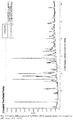
- verticle bars as indicated in figures 4 , 6 9 , 10 , 12 and 13 are the position of the peaks in a reference spectrum of pure 2H-FDCA.
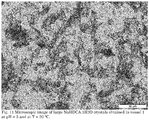
- a stream of a solution of 2,5-furandicarboxylate having a pH of 10 and a stream of sulfuric acid were continuously fed and mixed in an MSMPR crystallizer in such a ratio that the pH was kept to 3 while a product stream containing monoacid salt crystals was continuously removed. Samples of such crystals could be separated from the solution for analysis. With pXRD the diffraction pattern was measured ( Figure 12 ) and microscopic images were taken ( Figure 11 ).
- the NaHFDCA crystals were analyzed with H + titration, (inductively coupled plasma-based analysis) ICP on Na + content, with HPLC on FDCA content (Table 2). It was observed that the obtained crystals had a composition that corresponds with the mono-hydrate salt NaHFDCA.1H 2 O (see also Figure 14 ). Table 2.
Landscapes
- Chemical & Material Sciences (AREA)
- Organic Chemistry (AREA)
- Furan Compounds (AREA)
- Organic Low-Molecular-Weight Compounds And Preparation Thereof (AREA)
Abstract
The invention is directed to a method for the preparation, in particular for the purification of 2,5-furandicarboxylic acid or a salt thereof, comprising crystallization of a 2,5-furandicarboxylic acid mono salt and then crystallizing 2,5-furandicarboxylic diacid from this mono salt. Preferably, the method is at least partially carried out in a continuous or semi-continuous manner, preferably at least partially in one or more continuous mixed-suspension mixed product removal (MSMPR) crystallizers in series.
Description
- The invention is in the field of the preparation of 2,5-furandicarboxylic acid. In particular, the present invention is directed to the purification of 2,5-furandicarboxylic acid or a salt thereof.
- The
compound 2,5-furandicarboxylic acid (2H-FDCA) is a promising starting point for the production of materials. For instance, 2H-FDCA has been suggested as bio-based replacement of terephthalate for the production of plastic materials. Besides being bio-based, polyethylene furanoate (PEF) offers many advantages over polyethylene terephthalate (PET) with regards barrier and mechanical properties. - A particular route for the preparation of FDCA comprises oxidation of 5-(hydroxymethyl)furfural (HMF) by for instance biotechnological processes, electrochemical processes or chemically by air (see e.g. Triebl et al. Computers and Chemical Engineering 52 (2013) 26- 34 and references cited therein). These processes generally result in a solution of 2H-FDCA or salt thereof from which 2H-FDCA must be isolated. A particular challenge herein is the provision of essentially colorless 2H-FDCA and low levels of impurities such as 5-formyl-2-furancarboxylic acid (FFCA).
- Inter alia due to the instability of HMF, decomposition occurs which generally result in colored impurities, isolated 2H-FDCA may for instance be orange or brownish of color even if the amount of impurities is relatively low. Colored 2H-FDCA can result in colored plastic materials, which is not desirable. In addition, the intensity of the color can be taken as an indication of the amount of impurities, which may consequently interfere in the subsequent processing (e.g. polymerization) of the 2H-FDCA. For instance, FFCA is a mono-acid that can be present as an impurity and lead to chain termination in the polymerization process. As such, an effective and efficient method for purifying 2H-FDCA is desired to obtain a pure and an essentially colorless 2H-FDCA product.
-
WO 2016/146753 andWO 2014/209112 disclose purification of 2H-FDCA by a crystallization of 2H-FDCA from a solution of disodium furan-2,5-dicarboxylate by reducing the pH of said solution. - The present inventors surprisingly found that purification of 2H-FDCA can be improved using a 2,5-furandicarboxylic acid mono salt (FDCA mono salt). It was found that using the FDCA mono salt can result is a less colored 2H-FDCA and lower levels of impurities such as FFCA. In addition, the use of the FDCA mono salt enables a facile preparation method with particularly favorable down-stream processing (DSP) requirements, thereby enabling an improved efficiency of the overall 2H-FDCA production process.
- The present inventors found that the FDCA mono salt can be crystallized as a monohydrate and, without wishing to be bound by theory, believe that this monohydrate results in a particularly pure salt form which can be used to increase the purity and colorlessness of the final 2H-FDCA product.
- Accordingly, the present invention is directed to a method for the preparation, in particular the purification of 2,5-furandicarboxylic acid or a salt thereof, comprising crystallization of a 2,5-furandicarboxylic acid mono salt. In particular, the present invention pertains to purification of 2,5-furandicarboxylic acid or a salt thereof comprising a two-step process comprising a first crystallization of the 2,5-furandicarboxylic acid mono salt, followed by a second step comprising crystallization of 2,5-furandicarboxylic acid.
- The two carboxylate moieties in the
compound 2,5-furandicarboxylic acid are each capable of forming ionic bonds with cations. As such, with the term '2,5-furandicarboxylic acid mono salt' or 'FDCA mono salt' is meant herein that one of these carboxylate moieties has an ionic interaction with a cation other than a proton, while the other carboxylate moiety has an interaction with a proton and is thus neutralized to the carboxylic acid. Accordingly, without the addition 'salt' or 'mono salt', the term '2,5-furandicarboxylic acid' herein means the fully neutralized or diacid form. For sake of clarity the fully neutralized or diacid form of 2,5-furandicarboxylic acid is herein abbreviated as 2H-FDCA. FDCA mono salt and 2H-FDCA can be illustrated with the following structures.
- Preferably, the 2,5-furandicarboxylic acid mono salt comprises a cation selected from the group consisting of alkali metals, alkaline earth metals, ammonium cations, and combinations thereof, preferably sodium, potassium, magnesium, calcium, lithium, ammonium, tetraalkyl ammonium such a tetramethyl ammonium, and combinations thereof, more preferably sodium. As such, the 2,5-furandicarboxylic acid mono salt particularly preferably comprises the mono sodium salt of 2,5-furandicarboxylic acid. It may be appreciated that in the embodiments wherein the cation comprises a multivalent cation such as an alkaline earth metal, one of these cations is shared between two molecules of 2,5-furandicarboxylate.
- In accordance with the present invention, the FDCA mono salt can be crystallized from a first aqueous fluid, typically an aqueous solution. This can be carried out by a step comprising providing the first aqueous fluid, e.g. an aqueous alkaline solution, comprising 2,5-furandicarboxylate, i.e. an dianionic form or dicarboxylate ion of 2H-FDCA, and decreasing the pH of this alkaline solution to about the highest pKa-value of 2H-FDCA. The present inventors found that the pKa-values of 2H-FDCA can advantageously be used to provide FDCA mono salt because, in aqueous solutions, the solubility of 2H-FDCA is lower than the anionic forms thereof. As such, decreasing the pH of a solution comprising 2,5-furandicarboxylate results in at least partial neutralization of the carboxylate moieties, a decreased solubility of the FDCA form and concomitant crystallization of the particular FDCA form. The specific form (i.e. charge and salt form) of the FDCA depend i.a. on the pH and polarity of the solution wherein the form is dissolved.
- Accordingly, the present invention typically comprises providing a first aqueous fluid, typically a solution, comprising the FDCA mono salt and crystallizing the FDCA mono salt from said first aqueous fluid to provide a crystallized FDCA mono salt. The crystallization can be carried out by decreasing the pH of the first aqueous fluid comprising 2,5-furandicarboxylate. Preferably the pH of the first aqueous fluid is adjusted to 1.8 or higher, more preferably to a pH in the range of 2 to 6, more preferably to a pH of about 3. It was found that such pH can result in crystallization of the FDCA mono salt, or a hydrate such as the monohydrate thereof. It may be appreciated that the mono-salt might also (temporary) contain H2-FDCA (due to localized low pH at the addition point of the acid).
- The crystallization of the FDCA mono salt is typically carried out at moderate temperatures, e.g. less than 50 °C, preferably less than 30 °C, more preferably less than 20 °C. At these temperatures, in particularly at the above-mentioned pH ranges, large crystals of FDCA mono salt can be formed (e.g. an average mesh size of >100 µm). These large crystals facilitate filtration and washing (which are optional) and have a relatively lower surface area with respect to smaller crystals to which impurity can adhere.
- In preferred embodiments, decreasing the pH of the first aqueous fluid is carried out by contacting the fluid with a strong acid. Typically, the use of concentrated strong acids is preferred as this limits the require for addition of large volumes of additional water, preventing dilution of the 2,5-furandicarboxylate or FDCA mono salt.the amount of addition water and dilution of the 2,5-furandicarboxylate or FDCA mono salt. Adding more water is undesirable as this may increase dissolution and reduce isolated yield? Moreover, adding more water may require larger infrastructure and more associated costs. Particularly suitable strong acids include mineral acids such as sulfuric acid and/or hydrochloric acid.
- Adjusting the pH of a solution to induce crystallization of a compound is known in the art as pH-shift crystallization. Although such a method is preferred for the present invention, additional or alternative crystallization methods may also advantageously be used for the present invention. For instance, crystallization of the 2,5-furandicarboxylic acid mono salt can further be assisted by standard techniques such as decreasing the temperature, seeding, addition of anti-solvents and the like.
- The crystallization of the FDCA mono salt from the first aqueous fluid generally results in a fluid, such as a suspension, comprising the crystallized FDCA mono salt (herein also referred to as the FDCA mono salt product fluid). Further processing of the crystallized FDCA mono salt generally comprises providing a second aqueous fluid comprising the crystallized FDCA mono salt and subsequent crystallization of the neutralized FDCA from this second aqueous fluid.
- To provide said second aqueous fluid, the crystallized FDCA mono salt can be maintained in the FDCA mono salt product fluid, or the crystallized FDCA mono salt can be isolated from the FDCA mono salt product fluid by filtration to form a residue comprising the FDCA mono salt, or a combination thereof (i.e. a part of the FDCA mono salt is maintained in the FDCA mono salt product fluid and a part is isolated). In the embodiment wherein the crystallized FDCA mono salt in the aforementioned suspension is maintained in the fluid, said product fluid can be considered as the second aqueous fluid.
- The filtration of the FDCA mono salt product fluid generally includes washing of the residue in order to remove possible impurities. After the optional washing, the residue comprising the FDCA mono salt is typically a solid residue which may contain some remaining amounts of solvents from the washing procedure. The solid residue is thus not necessarily dry.
- In the embodiments that comprise filtration of the FDCA mono salt to form a solid residue comprising the FDCA mono salt, the second aqueous fluid is typically obtained by contacting (e.g. mixing, blending and/or combining) the residue comprising the FDCA mono salt with a fresh aqueous fluid, typically an aqueous solution or water. Filtration of the FDCA mono salt product fluid and contacting the obtained residue with said fresh aqueous fluid may particularly be advantageous since the crystallization of 2H-FDCA from a relatively clean fluid of the FDCA mono salt can provide higher purities of the crystallized 2H-FDCA. In addition, the intermediate filtration of the FDCA mono salt enables the possibility to carry out the subsequent steps (including crystallization of 2H-FDCA) at higher temperatures (e.g. 80 °C or more). Crystallization of 2H-FDCA at these higher temperatures can result in larger crystals of 2H-FDCA, which facilitates filtration and washing thereof. On the other hand, the embodiments that comprise maintaining the crystallized FDCA mono salt in the product fluid (i.e. without the intermediate filtration) can be advantageous for reasons of a higher possible final yield of the crystallized 2H-FDCA. In contrast to the embodiments comprising filtration, no FDCA mono salt is lost due to washing of the residue and/or disposal of the mother liquid or filtrate. It may therefore be preferred to use a combination of both embodiments.
- The crystallized 2H-FDCA can be filtered and washed to obtain a residue comprising 2H-FDCA. This residue is typically solid, and preferably, but not necessarily, dry. Besides 2H-FDCA, the residue may also comprise minor amounts (e.g. trace amounts) FDCA mono salt, in particular if it is obtained from a continuous mixed-suspension mixed product removal crystallizer as described herein below. However, such minor amounts are not typical since the FDCA mono salt dissolves readily at low pH such as about
pH 1. - The crystallization of 2H-FDCA from the second aqueous fluid can be carried out similarly as the crystallization of the FDCA mono salt, with typical differences being a different pH, temperature and concentration of the FDCA form in solution (due to solubility differences). Generally, 2H-FDCA is crystallized from the second aqueous fluid by adjusting the pH to below 1.8, preferably to a pH in the range of 0 to 1.7, more preferably in the range of 0.5 to 1.5 such as about 1.
- The crystallization of the 2H-FDCA is typically carried out at higher temperatures, e.g. more than 50 °C, preferably more than 80 °C, and more preferably between 80 °C and 130 °C. At these temperatures, in particular at the above-mentioned pH ranges, large crystals of 2H-FDCA can be formed (e.g. an average mesh size of >100 µm). These large crystals facilitate filtration and washing and have a relatively lower surface area with respect to smaller crystals to which impurity can adhere.
- The second aqueous fluid may be a suspension or a solution comprising the FDCA mono salt. The solution comprising the FDCA mono salt is herein referred to as the intermediate solution.
- The intermediate solution can be obtained by heating after or during contacting (e.g. mixing, blending and/or combining) the residue comprising the FDCA mono salt with the fresh aqueous fluid as described herein-above. Dissolving the crystallized 2,5-furandicarboxylic acid mono salt can be carried out at moderate or elevated temperatures. For the present invention moderate temperatures are preferred to limit degradation and/or polymerization of side-products resulting in coloration of the final 2H-FDCA product. Moderate temperatures herein typically mean temperatures in the range of 0 to 90 °C, while elevated temperatures herein typically mean temperatures of 90 °C or higher.
- Typically, the intermediate solution has a pH similar to that of the pH to which the first aqueous fluid is adjusted in induce crystallization of the FDCA mono salt. However, the pH may also be different and may for instance be higher to promote dissolution of the FDCA mono salt. In a preferred embodiment, the present method comprises reducing the pH of the intermediate solution is such that the second aqueous solution, i.e. the solution from which 2H-FDCA is crystallized, is obtained.
- In the embodiment wherein the pH of the first and second aqueous fluids are decreased, the method of the present invention can be regarded as a two-step pH-shift crystallization method. An advantage of the two-step pH-shift crystallization method in accordance with the present invention over a one-step pH-shift crystallization is that a higher purity of 2H-FDCA can be achieved. By using the present two-step pH-shift crystallization method, crystals of 2H-FDCA can grow into crystals with less imperfections and inclusions of impurities compared to a conventional one-step pH-shift crystallization process.
- The present inventors further surprisingly found that the present method is preferably at least partially carried out in a continuous or semi-continuous manner, for example at least partially in one or more continuous mixed-suspension mixed product removal (MSMPR) crystallizers in series. It was surprisingly found that the crystallization of 2H-FDCA from the second aqueous fluid in a continuous MSMPR crystallizer results in the formation of relatively large, e.g. an average mesh size of >100 µm, monodisperse crystals comprising 2H-FDCA. In comparison, a single step pH-shift process carried out in batch resulted in relative fine precipitates of 2H-FDCA that have a lot of surface area (difficult to wash) and likely contain inclusions and built-in impurities such a 5-formyl-2-furancarboxylic acid (FFCA) that is known to terminate polymerization of 2H-FDCA.
- More specifically, the present invention preferably comprises crystallization of the 2,5-furandicarboxylic acid mono salt from the first aqueous fluid carried out in one or more first continuous MSMPR and crystallization of 2,5-furandicarboxylic acid from the second aqueous solution fluid out in one or more second MSMPR crystallizer that is connected to the first MSMPR crystallizer. In particular on industrial scale, it might be advantageous to use more than two crystallizers in total - e.g. in a configuration when there is a maturing time at a specific pH in an intermediate MSMPR, or in a configuration where the pH is brought down through several MSMPR gradually (i.e. one MSMPR at
pH 5, one atpH 4, one apH 3, then isolation, then another MSMPR atpH 2 followed by one MSMPR at pH 1) to afford larger crystals. - To illustrate the present invention, three specific non-limiting embodiments in accordance with the present invention are provided and illustrated with
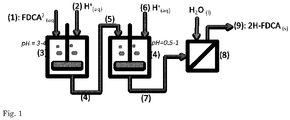
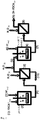
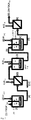
figures 1-3 . In each of these embodiments, a stream of the first aqueous fluid (1) comprising the dicarboxylate of FDCA (FDCA2- (aq)) having a pH of more than 6 and a first stream of an acid (2, H+ (aq)) such as concentrated sulfuric acid are added to the first continuous MSMPR (3). By addition of the first aqueous fluid (1) to the first continuous MSMPR (3), its pH is adjusted to around pH 3-4. This results in crystallization of the FDCA mono salt and the product fluid (i.e. a suspension) comprising the crystallized FDCA mono salt (4). - Subsequently, in a first particular embodiment which is illustrated in
figure 1 , the crystallized FDCA mono salt is maintained in the FDCA mono salt fluid (4) and directly added to a second MSMPR (4) as the second aqueous fluid (5), together with a second stream of an acid (6, H+ (aq)) such as concentrated sulfuric acid. By addition of the second aqueous fluid (5) to the second continuous MSMPR (4), its pH is adjusted to around pH 0.5-1.5 at moderate temperature (preferably at less than 50 °C, more preferably less than 20 °C). This results in formation of a stream comprising the crystallized 2H-FDCA (7). This crystallized 2H-FDCA is then isolated by filtration and washed in a filtration device (8) to yield a residue comprising high purity, relatively low-colored 2H-FDCA product (9). - Alternatively, in a second particular embodiment which is illustrated in
figure 2 , the crystallized FDCA mono salt is isolated by filtration from FDCA mono salt fluid (4), and washed in filtration device (10) to remove a significant amount of the impurities (11). The residue comprising the FDCA mono salt is then re-suspended in water to form the second aqueous fluid (i.e. a suspension, 5) which is led into the second continuous MSMPR (4), together with a second stream of acid (6). By addition of the second aqueous fluid (5) to the second continuous MSMPR (4), its pH is adjusted to around pH 0.5-1 at high temperature (preferably at least 80 °C). This results in formation of a stream comprising the crystallized 2H-FDCA (7). This crystallized 2H-FDCA is then isolated by filtration, and washed, in a filtration device (8) to yield the residue comprising high purity, relatively low-colored 2H-FDCA product (9). - In yet an alternative, third particular embodiment of the present invention, which is illustrated in
figure 3 , the crystallized FDCA mono salt is isolated by filtration and washed, in filtration device (10) to remove a significant amount of the impurities (11). The residue comprising the FDCA mono salt is then re-suspended in water and the suspension is heated in a dissolution vessel (12), generally to a temperature of more than 80°C at a pH of about 3, to obtain the intermediate solution (5). The intermediate solution is led into the second continuous MSMPR (4), together with a second acid stream (6). By addition of the second aqueous fluid (5) to the second continuous MSMPR (4), its pH is adjusted to around pH 0.5-1 at high temperature (preferably at least 80 °C). This results in formation of a stream comprising the crystallized 2H-FDCA (7). This crystallized 2H-FDCA is then isolated by filtration, and washed, in a filtration device (8) to yield the residue comprising high purity, relatively low-colored 2H-FDCA product (9). - The present invention can be further illustrated by the following non-limiting experimental examples.
- To a solution of 2,5-furandicarboxylate having a pH of 10 at 20 °C was added sulfuric acid to adjust the pH to 1. Small crystals of 2H-FDCA were formed which contain impurities and difficult to wash, though whitish.
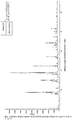
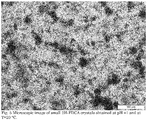
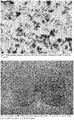
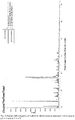
- A powder diffractogram was recorded (
Figure 4 ) and microscopic images were taken (Figure 5 ). - To a solution of 2,5-furandicarboxylate having a pH of 10 at 80 °C was added sulfuric acid to adjust the pH to 1. Larger crystals of 2H-FDCA were formed than in comparative example 1, likely to contain less impurities and easy to wash, but colored yellowish.
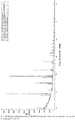
- A powder diffractogram was recorded (
Figure 6 ) and microscopic images were taken (Figure 7 ). - In
Figure 8 , a photograph is illustrated showing samples of 2H-FDCA crystals obtained at pH = 1 and at T = 20 °C (left, comparative example 1) and at pH = 1 and at T = 80 °C (right, comparative example 2). Crystals obtained at T=80 °C are more discolored - To a solution of 2,5-furandicarboxylate having a pH of 10 at 20 °C was added sulfuric acid at a range of 0.2 ml/min to adjust the pH to about 3. Formation of monoacid salts NaHFCDA, KHFDCA and NH4HFDCA was observed. Samples of such crystals could be separated from the solution for analysis. Next, to the suspension more sulfuric acid was added at a range of 0.2 ml/min to adjust the pH to about 1. Recrystallization took place with monoacid salt crystals recrystallizing into 2H-FDCA crystals. Samples of such crystals could be separated from the solution for analysis.
- At ambient temperature (i.e. about 20 °C) small 2H-FDCA crystals were obtained by recrystallization that are difficult to wash and that contain impurities, although whitish appearance. With pXRD the diffraction pattern was measured (
Figure 10 ). - At elevated temperature (i.e. about 80 °C) larger 2H-FDCA crystals were obtained by recrystallization that are easier to wash but with yellowish appearance.
- The NaHFDCA crystals were analyzed with (inductively coupled plasma-based analysis) ICP on Na+ content, with HPLC on FDCA content (Table 1), and with pXRD the diffraction pattern was measured (
Figure 9 ). It was observed that the obtained crystals had a composition that corresponds with the mono-hydrate salt NaHFDCA.1H2O (see alsoFigure 14 ). - It is noted that the verticle bars as indicated in
figures 4 ,6 9 ,10 ,12 and13 are the position of the peaks in a reference spectrum of pure 2H-FDCA.Table 1. Comparison of analysis results on samples of (a) NaHDCA.1H2O crystals obtained at pH = 3 and at T = 0 °C and (b) 2H-FDCA crystals obtained at pH = 1 and at T = 20 °C Samples HPLC FDCA [mg/mg] ICP Na+ [mg/L] pH = 3 T = 0 °C NaHFCDA.H2O 0.76 39 pH = 1 T= 20 °C 2-HFDCA 0.95 0,7 - A stream of a solution of 2,5-furandicarboxylate having a pH of 10 and a stream of sulfuric acid were continuously fed and mixed in an MSMPR crystallizer in such a ratio that the pH was kept to 3 while a product stream containing monoacid salt crystals was continuously removed. Samples of such crystals could be separated from the solution for analysis. With pXRD the diffraction pattern was measured (
Figure 12 ) and microscopic images were taken (Figure 11 ). - Next, a stream of suspension of monoacid salt crystals having a pH of 3 and a second stream of sulfuric acid were continuously fed and mixed in an MSMPR crystallizer in such a ratio that the pH was kept to 1 while a product stream containing 2H-FDCA crystals was continuously removed. Recrystallization took place in the second MSMPR with monoacid salt crystals recrystallizing into 2H-FDCA crystals. Samples of such crystals could be separated from the solution for analysis. With pXRD the diffraction pattern was measured (
Figure 13 ). - With the first step at pH = 3 in the first MSMPR at ambient temperature (i.e. about 20 °C), large NaHFDCA.1H2O crystals were obtained that are easy to wash and that contain little impurities and that have a whitish appearance. Transfer of these large NaHFDCA.1H2O crystals to the second step at pH =1 in the second MSMPR at elevated temperature (i.e. about 80 °C), resulted in recrystallization of the large NaHFDCA.1H2O crystals towards large 2H-FDCA crystals that are easy to wash and that contain little impurities, and also have a whitish appearance. These crystals meet the requirements for polymerization to PEF. The NaHFDCA crystals were analyzed with H+ titration, (inductively coupled plasma-based analysis) ICP on Na+ content, with HPLC on FDCA content (Table 2). It was observed that the obtained crystals had a composition that corresponds with the mono-hydrate salt NaHFDCA.1H2O (see also
Figure 14 ).Table 2. Comparison of analysis results on samples of (a) NaHDCA.1H2O obtained in vessel 1 at pH =3 and at T=20C and (b) 2H-FDCA crystals obtained invessel 2 at pH = 1 and at T=20CSamples Titration H+ [mmol/g] HPLC FDCA [mg/mg] ICP Na+ [mg/L] Vessel 1 pH = 3 T = 20 °C NaHFCDA.H2O5,9 0,68 46 Vessel 2 pH = 1 T = 20 °C 2-HFDCA (1)14,7 0,95 7,2 Vessel 2 pH = 1 T = 20 °C 2-HFDCA (2)14,5 0,91 9,4
Claims (15)
- Method for the preparation, in particular for the purification, of 2,5-furandicarboxylic acid or a salt thereof, comprising crystallization of a 2,5-furandicarboxylic acid mono salt.
- Method in accordance with the previous claim, wherein the 2,5-furandicarboxylic acid mono salt comprises a cation selected from the group consisting of alkali metals, alkaline earth metals, ammonium cations, and combinations thereof, preferably sodium, potassium, lithium, magnesium, calcium, ammonium (NH4 +), tetraalkyl ammonium such a tetramethyl ammonium, and combinations thereof, more preferably sodium.
- Method in accordance with any of the previous claims, comprising the steps of providing a first aqueous fluid comprising 2,5-furandicarboxylate and crystallizing the 2,5-furandicarboxylic acid mono salt from said first aqueous fluid to provide a crystallized 2,5-furandicarboxylic acid mono salt.
- Method in accordance with the previous claim, wherein crystallizing the 2,5-furandicarboxylic acid mono salt is carried out by adjusting the pH of the first aqueous solution to a pH of 1.8 or higher, preferably to a pH in the range of 2 to 6, more preferably to a pH of about 3.
- Method in accordance with any of the previous claims, wherein the method further comprises providing a second aqueous fluid, preferably an aqueous suspension, comprising the crystallized 2,5-furandicarboxylic acid mono salt and crystallize 2,5-furandicarboxylic diacid from said second aqueous fluid to provide crystallized 2,5-furandicarboxylic acid.
- Method in accordance with the previous claim, wherein crystallizing the 2,5-furandicarboxylic diacid is carried out by adjusting the pH of the second aqueous fluid to a pH lower than 1.8, preferably to a pH in the range of 0 to 1.7, more preferably in the range of 0.5 to 1.5 such as about 1.
- Method in accordance with any of the previous claims, wherein crystallizing the 2,5-furandicarboxylic acid mono salt results in a suspension comprising the crystallized 2,5-furandicarboxylic acid mono salt and wherein the method preferably further comprises filtration of the crystallized 2,5-furandicarboxylic acid mono salt to provide a residue comprising the 2,5-furandicarboxylic acid mono salt.
- Method in accordance with the previous claim, wherein said aqueous second fluid is obtained by contacting the residue comprising the 2,5-furandicarboxylic acid mono salt with an aqueous fluid, and then optionally heated to at least partially dissolve 2,5-furandicarboxylic acid mono salt.
- Method in accordance with any of claims 5-8, wherein the method further comprises filtration of the crystallized 2,5-furandicarboxylic acid to provide a solid 2,5-furandicarboxylic acid.
- Method in accordance with any of the previous claims, wherein said method is at least partially carried out in a continuous or semi-continuous manner, preferably at least partially in one or more continuous mixed-suspension mixed product removal (MSMPR) crystallizers in series.
- Method in accordance with any of claims 5-10 and the previous claim, wherein said crystallization of the 2,5-furandicarboxylic acid mono salt is carried out in one or more first continuous MSMPR crystallizer and said crystallization of 2,5-furandicarboxylic acid is carried out in one or more second continuous MSMPR crystallizer that is connected to the first MSMPR crystallizer, with optionally a filtration device located between said first and second MSMPR crystallizers.
- A 2,5-furandicarboxylic acid mono salt such as monosodium 2,5-furandicarboxylic acid, preferably obtainable in accordance with any of the previous claims.
- The 2,5-furandicarboxylic acid mono salt in accordance with the previous claim, wherein the 2,5-furandicarboxylic acid mono salt comprises a cation selected from the group consisting of alkali metals, earth alkali metals, ammonium cations, and combinations thereof, preferably from the group consisting of sodium, potassium, lithium, magnesium, calcium, tetraalkyl ammonium such a tetramethyl ammonium, and combinations thereof, more preferably sodium.
- The 2,5-furandicarboxylic acid mono salt in accordance with any of claims 12-13, wherein said 2,5-furandicarboxylic acid mono salt is a monohydrate.
- Use of a 2,5-furandicarboxylic acid mono salt for the purification of 2,5-furandicarboxylic acid or a salt thereof and/or for providing solid 2,5-furandicarboxylic acid.
Priority Applications (4)
| Application Number | Priority Date | Filing Date | Title |
|---|---|---|---|
| EP18197773.7A EP3628667A1 (en) | 2018-09-28 | 2018-09-28 | Process and salts for the preparation of 2,5-furandicarboxylic acid |
| US17/274,296 US11603361B2 (en) | 2018-09-28 | 2019-09-30 | Process and salts for the preparation of 2,5-furandicarboxylic acid |
| EP19828862.3A EP3856732B1 (en) | 2018-09-28 | 2019-09-30 | Process and salts for the preparation of 2,5-furandicarboxylic acid |
| PCT/NL2019/050654 WO2020067901A1 (en) | 2018-09-28 | 2019-09-30 | Process and salts for the preparation of 2,5-furandicarboxylic acid |
Applications Claiming Priority (1)
| Application Number | Priority Date | Filing Date | Title |
|---|---|---|---|
| EP18197773.7A EP3628667A1 (en) | 2018-09-28 | 2018-09-28 | Process and salts for the preparation of 2,5-furandicarboxylic acid |
Publications (1)
| Publication Number | Publication Date |
|---|---|
| EP3628667A1 true EP3628667A1 (en) | 2020-04-01 |
Family
ID=63713738
Family Applications (2)
| Application Number | Title | Priority Date | Filing Date |
|---|---|---|---|
| EP18197773.7A Withdrawn EP3628667A1 (en) | 2018-09-28 | 2018-09-28 | Process and salts for the preparation of 2,5-furandicarboxylic acid |
| EP19828862.3A Active EP3856732B1 (en) | 2018-09-28 | 2019-09-30 | Process and salts for the preparation of 2,5-furandicarboxylic acid |
Family Applications After (1)
| Application Number | Title | Priority Date | Filing Date |
|---|---|---|---|
| EP19828862.3A Active EP3856732B1 (en) | 2018-09-28 | 2019-09-30 | Process and salts for the preparation of 2,5-furandicarboxylic acid |
Country Status (3)
| Country | Link |
|---|---|
| US (1) | US11603361B2 (en) |
| EP (2) | EP3628667A1 (en) |
| WO (1) | WO2020067901A1 (en) |
Families Citing this family (2)
| Publication number | Priority date | Publication date | Assignee | Title |
|---|---|---|---|---|
| CN116120264A (en) * | 2021-11-12 | 2023-05-16 | 中国科学院宁波材料技术与工程研究所 | Method for regulating and controlling particle size of 2, 5-furandicarboxylic acid crystal |
| CN117229242A (en) * | 2023-08-14 | 2023-12-15 | 中科国生(杭州)科技有限公司 | A method of efficient acidification with FDCA |
Citations (2)
| Publication number | Priority date | Publication date | Assignee | Title |
|---|---|---|---|---|
| WO2014209112A1 (en) | 2013-06-24 | 2014-12-31 | Technische Universiteit Delft | Process for the preparation of 2,5-furandicarboxylic acid |
| WO2016146753A1 (en) | 2015-03-17 | 2016-09-22 | Purac Biochem Bv | Method for manufacturing furan-2,5-dicarboxylic acid (fdca) from a salt solution |
Family Cites Families (11)
| Publication number | Priority date | Publication date | Assignee | Title |
|---|---|---|---|---|
| IT1401911B1 (en) | 2010-08-06 | 2013-08-28 | Novamont Spa | PROCESS FOR SYNTHESIS OF 2,5-FURANDICARBOSSIC ACID |
| US8912349B2 (en) | 2012-06-22 | 2014-12-16 | Eastman Chemical Company | Method for producing purified dialkyl-furan-2,5-dicarboxylate separation and solid liquid separation |
| US8969404B2 (en) | 2012-06-22 | 2015-03-03 | Eastman Chemical Company | Purifying crude furan 2,5-dicarboxylic acid by hydrogenation |
| US9029580B2 (en) | 2012-07-20 | 2015-05-12 | Eastman Chemical Company | Oxidation process to produce a purified carboxylic acid product via solvent displacement and post oxidation |
| US8809556B2 (en) | 2012-07-20 | 2014-08-19 | Eastman Chemical Company | Oxidation process to produce a purified carboxylic acid product via solvent displacement and post oxidation |
| CN104781412A (en) | 2012-07-20 | 2015-07-15 | 诺维信公司 | Enzymatic oxidation of 5-hydroxymethylfurfural and derivatives thereof |
| HUE038483T2 (en) | 2013-03-14 | 2018-10-29 | Archer Daniels Midland Co | Process for making 2,5-furandicarboxylic acid |
| US10167268B2 (en) | 2014-11-10 | 2019-01-01 | Synvina C.V. | Process for purifying a crude composition of dialkyl ester of 2,5-furandicarboxylic acid |
| US10787748B2 (en) | 2015-05-21 | 2020-09-29 | Avantium Knowledge Centre B.V. | Process for the preparation of an aromatic dicarboxylic acid |
| JP6891129B2 (en) | 2015-05-22 | 2021-06-18 | メルク パテント ゲゼルシャフト ミット ベシュレンクテル ハフツングMerck Patent Gesellschaft mit beschraenkter Haftung | Liquid crystal medium |
| EP3366681A1 (en) | 2017-02-28 | 2018-08-29 | Nederlandse Organisatie voor toegepast- natuurwetenschappelijk onderzoek TNO | Production of 2,5-furandicarboxylic acid |
-
2018
- 2018-09-28 EP EP18197773.7A patent/EP3628667A1/en not_active Withdrawn
-
2019
- 2019-09-30 WO PCT/NL2019/050654 patent/WO2020067901A1/en not_active Ceased
- 2019-09-30 EP EP19828862.3A patent/EP3856732B1/en active Active
- 2019-09-30 US US17/274,296 patent/US11603361B2/en active Active
Patent Citations (2)
| Publication number | Priority date | Publication date | Assignee | Title |
|---|---|---|---|---|
| WO2014209112A1 (en) | 2013-06-24 | 2014-12-31 | Technische Universiteit Delft | Process for the preparation of 2,5-furandicarboxylic acid |
| WO2016146753A1 (en) | 2015-03-17 | 2016-09-22 | Purac Biochem Bv | Method for manufacturing furan-2,5-dicarboxylic acid (fdca) from a salt solution |
Non-Patent Citations (6)
| Title |
|---|
| CAROL HUA ET AL: "Systematic Tuning of Zn(II) Frameworks with Furan, Thiophene, and Selenophene Dipyridyl and Dicarboxylate Ligands", CRYSTAL GROWTH & DESIGN., vol. 17, no. 12, 6 December 2017 (2017-12-06), US, pages 6262 - 6272, XP055527224, ISSN: 1528-7483, DOI: 10.1021/acs.cgd.7b00940 * |
| DENIZ ERDEMIR ET AL: "Nucleation of Crystals from Solution: Classical and Two-Step Models", ACCOUNTS OF CHEMICAL RESEARCH., vol. 42, no. 5, 19 May 2009 (2009-05-19), US, pages 621 - 629, XP055527929, ISSN: 0001-4842, DOI: 10.1021/ar800217x * |
| JICONG LI ET AL: "Multistage Continuous Mixed-Suspension, Mixed-Product Removal (MSMPR) Crystallization with Solids Recycle", ORGANIC PROCESS RESEARCH AND DEVELOPMENT, vol. 20, no. 2, 29 December 2015 (2015-12-29), US, pages 510 - 516, XP055527927, ISSN: 1083-6160, DOI: 10.1021/acs.oprd.5b00306 * |
| PAR S JAULMES: "Furanne-2,5-dicarboxylate Acide de Potassium", ACTA CRYSTALLOGRAPHICA, SECTION B: STRUCTURAL CRYSTALLOGRAPHY AND CRYSTAL CHEMISTRY, 1 January 1982 (1982-01-01), pages 279 - 281, XP055527597, Retrieved from the Internet <URL:http://journals.iucr.org/b/issues/1982/01/00/a20842/a20842.pdf> [retrieved on 20181127] * |
| TIMOTHY SCOTT WIEDMANN ET AL: "Pharmaceutical salts: Theory, use in solid dosage forms and in situ preparation in an aerosol", ASIAN JOURNAL OF PHARMACEUTICAL SCIENCES, vol. 11, no. 6, 1 December 2016 (2016-12-01), NL, pages 722 - 734, XP055527885, ISSN: 1818-0876, DOI: 10.1016/j.ajps.2016.07.002 * |
| TRIEBL ET AL., COMPUTERS AND CHEMICAL ENGINEERING, vol. 52, 2013, pages 26 - 34 |
Also Published As
| Publication number | Publication date |
|---|---|
| EP3856732C0 (en) | 2023-09-13 |
| US11603361B2 (en) | 2023-03-14 |
| US20210332021A1 (en) | 2021-10-28 |
| EP3856732A1 (en) | 2021-08-04 |
| WO2020067901A1 (en) | 2020-04-02 |
| EP3856732B1 (en) | 2023-09-13 |
Similar Documents
| Publication | Publication Date | Title |
|---|---|---|
| USRE49370E1 (en) | Cyclic process for the production of taurine from monoethanolamine | |
| CA2787596C (en) | Process for manufacturing succinic acid | |
| US7915447B2 (en) | Process for producing succinic acid | |
| US20160145662A1 (en) | Process for the preparation of 2,5-furandicarboxylic acid | |
| EP3856732B1 (en) | Process and salts for the preparation of 2,5-furandicarboxylic acid | |
| DE69818105T2 (en) | METHOD FOR PRODUCING BETA-HALOGEN-ALPHA-AMINO-CARBONIC ACIDS, PHENYLCYSTEINE DERIVATIVES AND THEIR INTERMEDIATES | |
| JP5052234B2 (en) | Method for producing succinic acid | |
| KR100392740B1 (en) | Manufacturing method of adipic acid | |
| JP4104166B2 (en) | Method for producing a crystalline salt of amoxicillin | |
| SI9620018A (en) | Process for producing n-(d-alpha-methyl-beta-mercaptopropionyl)-l-proline and its intermediate | |
| US20240083858A1 (en) | Process for the diastereomerically pure preparation of dl/ld-methionylmethionine | |
| IE903759A1 (en) | Process for direct isolation of captopril | |
| EP0341991A2 (en) | Method for recovery of antibiotics from mother liquors and novel pharmaceutically-acceptable salts thereof | |
| JP4418995B2 (en) | Method for producing ascorbic acid 2-monophosphate salt | |
| SU1018951A1 (en) | Process for isolating and purifying sodium d-glucouronate and/or sodium 1,2-0-isopropylidene-d-glucouronate from mixtures also containing inorganic salts and/or carbonaceous impurities | |
| RU2537607C1 (en) | Method of barium nitrate purification | |
| RU1660357C (en) | Process for preparing hydroquinonesulfonic acid diethylammonium salt | |
| JPH08157444A (en) | Method for producing aminoethanesulfonic acid | |
| RU1781171C (en) | Process for producing decahydrate of sodium carbonate | |
| JP2006036699A (en) | alpha-HYDROXYCARBOXYLIC ACID ALUMINUM SALT, ITS COMPLEX SALT AND METHOD FOR PRODUCING THE SAME | |
| JP2003089673A (en) | Method for separation and purification of iodine / 2-methylbenzoic acid mixture | |
| JPS6284053A (en) | Production of beta-naphthalenesulfonic acid | |
| JPH04112851A (en) | Production of metallic salt of ether carboxylic acid | |
| CS252321B1 (en) | A method of purifying potassium chloride to pharmacopoeial quality | |
| JPH0478609B2 (en) |
Legal Events
| Date | Code | Title | Description |
|---|---|---|---|
| PUAI | Public reference made under article 153(3) epc to a published international application that has entered the european phase |
Free format text: ORIGINAL CODE: 0009012 |
|
| STAA | Information on the status of an ep patent application or granted ep patent |
Free format text: STATUS: THE APPLICATION HAS BEEN PUBLISHED |
|
| AK | Designated contracting states |
Kind code of ref document: A1 Designated state(s): AL AT BE BG CH CY CZ DE DK EE ES FI FR GB GR HR HU IE IS IT LI LT LU LV MC MK MT NL NO PL PT RO RS SE SI SK SM TR |
|
| AX | Request for extension of the european patent |
Extension state: BA ME |
|
| STAA | Information on the status of an ep patent application or granted ep patent |
Free format text: STATUS: THE APPLICATION IS DEEMED TO BE WITHDRAWN |
|
| 18D | Application deemed to be withdrawn |
Effective date: 20201002 |