EP3628649A1 - Ceramic composition and method of making the composition - Google Patents
Ceramic composition and method of making the composition Download PDFInfo
- Publication number
- EP3628649A1 EP3628649A1 EP19199692.5A EP19199692A EP3628649A1 EP 3628649 A1 EP3628649 A1 EP 3628649A1 EP 19199692 A EP19199692 A EP 19199692A EP 3628649 A1 EP3628649 A1 EP 3628649A1
- Authority
- EP
- European Patent Office
- Prior art keywords
- ceramic
- fluxing agent
- discrete
- components
- composite
- Prior art date
- Legal status (The legal status is an assumption and is not a legal conclusion. Google has not performed a legal analysis and makes no representation as to the accuracy of the status listed.)
- Granted
Links
Images


Classifications
-
- C—CHEMISTRY; METALLURGY
- C04—CEMENTS; CONCRETE; ARTIFICIAL STONE; CERAMICS; REFRACTORIES
- C04B—LIME, MAGNESIA; SLAG; CEMENTS; COMPOSITIONS THEREOF, e.g. MORTARS, CONCRETE OR LIKE BUILDING MATERIALS; ARTIFICIAL STONE; CERAMICS; REFRACTORIES; TREATMENT OF NATURAL STONE
- C04B35/00—Shaped ceramic products characterised by their composition; Ceramics compositions; Processing powders of inorganic compounds preparatory to the manufacturing of ceramic products
- C04B35/622—Forming processes; Processing powders of inorganic compounds preparatory to the manufacturing of ceramic products
- C04B35/626—Preparing or treating the powders individually or as batches ; preparing or treating macroscopic reinforcing agents for ceramic products, e.g. fibres; mechanical aspects section B
- C04B35/62605—Treating the starting powders individually or as mixtures
- C04B35/62625—Wet mixtures
-
- C—CHEMISTRY; METALLURGY
- C04—CEMENTS; CONCRETE; ARTIFICIAL STONE; CERAMICS; REFRACTORIES
- C04B—LIME, MAGNESIA; SLAG; CEMENTS; COMPOSITIONS THEREOF, e.g. MORTARS, CONCRETE OR LIKE BUILDING MATERIALS; ARTIFICIAL STONE; CERAMICS; REFRACTORIES; TREATMENT OF NATURAL STONE
- C04B37/00—Joining burned ceramic articles with other burned ceramic articles or other articles by heating
- C04B37/003—Joining burned ceramic articles with other burned ceramic articles or other articles by heating by means of an interlayer consisting of a combination of materials selected from glass, or ceramic material with metals, metal oxides or metal salts
-
- C—CHEMISTRY; METALLURGY
- C04—CEMENTS; CONCRETE; ARTIFICIAL STONE; CERAMICS; REFRACTORIES
- C04B—LIME, MAGNESIA; SLAG; CEMENTS; COMPOSITIONS THEREOF, e.g. MORTARS, CONCRETE OR LIKE BUILDING MATERIALS; ARTIFICIAL STONE; CERAMICS; REFRACTORIES; TREATMENT OF NATURAL STONE
- C04B35/00—Shaped ceramic products characterised by their composition; Ceramics compositions; Processing powders of inorganic compounds preparatory to the manufacturing of ceramic products
- C04B35/01—Shaped ceramic products characterised by their composition; Ceramics compositions; Processing powders of inorganic compounds preparatory to the manufacturing of ceramic products based on oxide ceramics
- C04B35/10—Shaped ceramic products characterised by their composition; Ceramics compositions; Processing powders of inorganic compounds preparatory to the manufacturing of ceramic products based on oxide ceramics based on aluminium oxide
-
- C—CHEMISTRY; METALLURGY
- C04—CEMENTS; CONCRETE; ARTIFICIAL STONE; CERAMICS; REFRACTORIES
- C04B—LIME, MAGNESIA; SLAG; CEMENTS; COMPOSITIONS THEREOF, e.g. MORTARS, CONCRETE OR LIKE BUILDING MATERIALS; ARTIFICIAL STONE; CERAMICS; REFRACTORIES; TREATMENT OF NATURAL STONE
- C04B35/00—Shaped ceramic products characterised by their composition; Ceramics compositions; Processing powders of inorganic compounds preparatory to the manufacturing of ceramic products
- C04B35/01—Shaped ceramic products characterised by their composition; Ceramics compositions; Processing powders of inorganic compounds preparatory to the manufacturing of ceramic products based on oxide ceramics
- C04B35/14—Shaped ceramic products characterised by their composition; Ceramics compositions; Processing powders of inorganic compounds preparatory to the manufacturing of ceramic products based on oxide ceramics based on silica
-
- C—CHEMISTRY; METALLURGY
- C04—CEMENTS; CONCRETE; ARTIFICIAL STONE; CERAMICS; REFRACTORIES
- C04B—LIME, MAGNESIA; SLAG; CEMENTS; COMPOSITIONS THEREOF, e.g. MORTARS, CONCRETE OR LIKE BUILDING MATERIALS; ARTIFICIAL STONE; CERAMICS; REFRACTORIES; TREATMENT OF NATURAL STONE
- C04B35/00—Shaped ceramic products characterised by their composition; Ceramics compositions; Processing powders of inorganic compounds preparatory to the manufacturing of ceramic products
- C04B35/01—Shaped ceramic products characterised by their composition; Ceramics compositions; Processing powders of inorganic compounds preparatory to the manufacturing of ceramic products based on oxide ceramics
- C04B35/46—Shaped ceramic products characterised by their composition; Ceramics compositions; Processing powders of inorganic compounds preparatory to the manufacturing of ceramic products based on oxide ceramics based on titanium oxides or titanates
-
- C—CHEMISTRY; METALLURGY
- C04—CEMENTS; CONCRETE; ARTIFICIAL STONE; CERAMICS; REFRACTORIES
- C04B—LIME, MAGNESIA; SLAG; CEMENTS; COMPOSITIONS THEREOF, e.g. MORTARS, CONCRETE OR LIKE BUILDING MATERIALS; ARTIFICIAL STONE; CERAMICS; REFRACTORIES; TREATMENT OF NATURAL STONE
- C04B35/00—Shaped ceramic products characterised by their composition; Ceramics compositions; Processing powders of inorganic compounds preparatory to the manufacturing of ceramic products
- C04B35/01—Shaped ceramic products characterised by their composition; Ceramics compositions; Processing powders of inorganic compounds preparatory to the manufacturing of ceramic products based on oxide ceramics
- C04B35/48—Shaped ceramic products characterised by their composition; Ceramics compositions; Processing powders of inorganic compounds preparatory to the manufacturing of ceramic products based on oxide ceramics based on zirconium or hafnium oxides, zirconates, zircon or hafnates
-
- C—CHEMISTRY; METALLURGY
- C04—CEMENTS; CONCRETE; ARTIFICIAL STONE; CERAMICS; REFRACTORIES
- C04B—LIME, MAGNESIA; SLAG; CEMENTS; COMPOSITIONS THEREOF, e.g. MORTARS, CONCRETE OR LIKE BUILDING MATERIALS; ARTIFICIAL STONE; CERAMICS; REFRACTORIES; TREATMENT OF NATURAL STONE
- C04B35/00—Shaped ceramic products characterised by their composition; Ceramics compositions; Processing powders of inorganic compounds preparatory to the manufacturing of ceramic products
- C04B35/622—Forming processes; Processing powders of inorganic compounds preparatory to the manufacturing of ceramic products
-
- C—CHEMISTRY; METALLURGY
- C04—CEMENTS; CONCRETE; ARTIFICIAL STONE; CERAMICS; REFRACTORIES
- C04B—LIME, MAGNESIA; SLAG; CEMENTS; COMPOSITIONS THEREOF, e.g. MORTARS, CONCRETE OR LIKE BUILDING MATERIALS; ARTIFICIAL STONE; CERAMICS; REFRACTORIES; TREATMENT OF NATURAL STONE
- C04B35/00—Shaped ceramic products characterised by their composition; Ceramics compositions; Processing powders of inorganic compounds preparatory to the manufacturing of ceramic products
- C04B35/622—Forming processes; Processing powders of inorganic compounds preparatory to the manufacturing of ceramic products
- C04B35/626—Preparing or treating the powders individually or as batches ; preparing or treating macroscopic reinforcing agents for ceramic products, e.g. fibres; mechanical aspects section B
- C04B35/62605—Treating the starting powders individually or as mixtures
- C04B35/62645—Thermal treatment of powders or mixtures thereof other than sintering
- C04B35/62655—Drying, e.g. freeze-drying, spray-drying, microwave or supercritical drying
-
- C—CHEMISTRY; METALLURGY
- C04—CEMENTS; CONCRETE; ARTIFICIAL STONE; CERAMICS; REFRACTORIES
- C04B—LIME, MAGNESIA; SLAG; CEMENTS; COMPOSITIONS THEREOF, e.g. MORTARS, CONCRETE OR LIKE BUILDING MATERIALS; ARTIFICIAL STONE; CERAMICS; REFRACTORIES; TREATMENT OF NATURAL STONE
- C04B35/00—Shaped ceramic products characterised by their composition; Ceramics compositions; Processing powders of inorganic compounds preparatory to the manufacturing of ceramic products
- C04B35/622—Forming processes; Processing powders of inorganic compounds preparatory to the manufacturing of ceramic products
- C04B35/626—Preparing or treating the powders individually or as batches ; preparing or treating macroscopic reinforcing agents for ceramic products, e.g. fibres; mechanical aspects section B
- C04B35/628—Coating the powders or the macroscopic reinforcing agents
-
- C—CHEMISTRY; METALLURGY
- C04—CEMENTS; CONCRETE; ARTIFICIAL STONE; CERAMICS; REFRACTORIES
- C04B—LIME, MAGNESIA; SLAG; CEMENTS; COMPOSITIONS THEREOF, e.g. MORTARS, CONCRETE OR LIKE BUILDING MATERIALS; ARTIFICIAL STONE; CERAMICS; REFRACTORIES; TREATMENT OF NATURAL STONE
- C04B35/00—Shaped ceramic products characterised by their composition; Ceramics compositions; Processing powders of inorganic compounds preparatory to the manufacturing of ceramic products
- C04B35/622—Forming processes; Processing powders of inorganic compounds preparatory to the manufacturing of ceramic products
- C04B35/626—Preparing or treating the powders individually or as batches ; preparing or treating macroscopic reinforcing agents for ceramic products, e.g. fibres; mechanical aspects section B
- C04B35/63—Preparing or treating the powders individually or as batches ; preparing or treating macroscopic reinforcing agents for ceramic products, e.g. fibres; mechanical aspects section B using additives specially adapted for forming the products, e.g.. binder binders
- C04B35/6303—Inorganic additives
-
- C—CHEMISTRY; METALLURGY
- C04—CEMENTS; CONCRETE; ARTIFICIAL STONE; CERAMICS; REFRACTORIES
- C04B—LIME, MAGNESIA; SLAG; CEMENTS; COMPOSITIONS THEREOF, e.g. MORTARS, CONCRETE OR LIKE BUILDING MATERIALS; ARTIFICIAL STONE; CERAMICS; REFRACTORIES; TREATMENT OF NATURAL STONE
- C04B35/00—Shaped ceramic products characterised by their composition; Ceramics compositions; Processing powders of inorganic compounds preparatory to the manufacturing of ceramic products
- C04B35/622—Forming processes; Processing powders of inorganic compounds preparatory to the manufacturing of ceramic products
- C04B35/653—Processes involving a melting step
-
- C—CHEMISTRY; METALLURGY
- C04—CEMENTS; CONCRETE; ARTIFICIAL STONE; CERAMICS; REFRACTORIES
- C04B—LIME, MAGNESIA; SLAG; CEMENTS; COMPOSITIONS THEREOF, e.g. MORTARS, CONCRETE OR LIKE BUILDING MATERIALS; ARTIFICIAL STONE; CERAMICS; REFRACTORIES; TREATMENT OF NATURAL STONE
- C04B2235/00—Aspects relating to ceramic starting mixtures or sintered ceramic products
- C04B2235/02—Composition of constituents of the starting material or of secondary phases of the final product
- C04B2235/30—Constituents and secondary phases not being of a fibrous nature
- C04B2235/32—Metal oxides, mixed metal oxides, or oxide-forming salts thereof, e.g. carbonates, nitrates, (oxy)hydroxides, chlorides
- C04B2235/3217—Aluminum oxide or oxide forming salts thereof, e.g. bauxite, alpha-alumina
-
- C—CHEMISTRY; METALLURGY
- C04—CEMENTS; CONCRETE; ARTIFICIAL STONE; CERAMICS; REFRACTORIES
- C04B—LIME, MAGNESIA; SLAG; CEMENTS; COMPOSITIONS THEREOF, e.g. MORTARS, CONCRETE OR LIKE BUILDING MATERIALS; ARTIFICIAL STONE; CERAMICS; REFRACTORIES; TREATMENT OF NATURAL STONE
- C04B2235/00—Aspects relating to ceramic starting mixtures or sintered ceramic products
- C04B2235/02—Composition of constituents of the starting material or of secondary phases of the final product
- C04B2235/30—Constituents and secondary phases not being of a fibrous nature
- C04B2235/32—Metal oxides, mixed metal oxides, or oxide-forming salts thereof, e.g. carbonates, nitrates, (oxy)hydroxides, chlorides
- C04B2235/3231—Refractory metal oxides, their mixed metal oxides, or oxide-forming salts thereof
- C04B2235/3232—Titanium oxides or titanates, e.g. rutile or anatase
-
- C—CHEMISTRY; METALLURGY
- C04—CEMENTS; CONCRETE; ARTIFICIAL STONE; CERAMICS; REFRACTORIES
- C04B—LIME, MAGNESIA; SLAG; CEMENTS; COMPOSITIONS THEREOF, e.g. MORTARS, CONCRETE OR LIKE BUILDING MATERIALS; ARTIFICIAL STONE; CERAMICS; REFRACTORIES; TREATMENT OF NATURAL STONE
- C04B2235/00—Aspects relating to ceramic starting mixtures or sintered ceramic products
- C04B2235/02—Composition of constituents of the starting material or of secondary phases of the final product
- C04B2235/30—Constituents and secondary phases not being of a fibrous nature
- C04B2235/32—Metal oxides, mixed metal oxides, or oxide-forming salts thereof, e.g. carbonates, nitrates, (oxy)hydroxides, chlorides
- C04B2235/3231—Refractory metal oxides, their mixed metal oxides, or oxide-forming salts thereof
- C04B2235/3244—Zirconium oxides, zirconates, hafnium oxides, hafnates, or oxide-forming salts thereof
-
- C—CHEMISTRY; METALLURGY
- C04—CEMENTS; CONCRETE; ARTIFICIAL STONE; CERAMICS; REFRACTORIES
- C04B—LIME, MAGNESIA; SLAG; CEMENTS; COMPOSITIONS THEREOF, e.g. MORTARS, CONCRETE OR LIKE BUILDING MATERIALS; ARTIFICIAL STONE; CERAMICS; REFRACTORIES; TREATMENT OF NATURAL STONE
- C04B2235/00—Aspects relating to ceramic starting mixtures or sintered ceramic products
- C04B2235/02—Composition of constituents of the starting material or of secondary phases of the final product
- C04B2235/30—Constituents and secondary phases not being of a fibrous nature
- C04B2235/34—Non-metal oxides, non-metal mixed oxides, or salts thereof that form the non-metal oxides upon heating, e.g. carbonates, nitrates, (oxy)hydroxides, chlorides
- C04B2235/3427—Silicates other than clay, e.g. water glass
-
- C—CHEMISTRY; METALLURGY
- C04—CEMENTS; CONCRETE; ARTIFICIAL STONE; CERAMICS; REFRACTORIES
- C04B—LIME, MAGNESIA; SLAG; CEMENTS; COMPOSITIONS THEREOF, e.g. MORTARS, CONCRETE OR LIKE BUILDING MATERIALS; ARTIFICIAL STONE; CERAMICS; REFRACTORIES; TREATMENT OF NATURAL STONE
- C04B2235/00—Aspects relating to ceramic starting mixtures or sintered ceramic products
- C04B2235/02—Composition of constituents of the starting material or of secondary phases of the final product
- C04B2235/30—Constituents and secondary phases not being of a fibrous nature
- C04B2235/44—Metal salt constituents or additives chosen for the nature of the anions, e.g. hydrides or acetylacetonate
- C04B2235/442—Carbonates
-
- C—CHEMISTRY; METALLURGY
- C04—CEMENTS; CONCRETE; ARTIFICIAL STONE; CERAMICS; REFRACTORIES
- C04B—LIME, MAGNESIA; SLAG; CEMENTS; COMPOSITIONS THEREOF, e.g. MORTARS, CONCRETE OR LIKE BUILDING MATERIALS; ARTIFICIAL STONE; CERAMICS; REFRACTORIES; TREATMENT OF NATURAL STONE
- C04B2235/00—Aspects relating to ceramic starting mixtures or sintered ceramic products
- C04B2235/02—Composition of constituents of the starting material or of secondary phases of the final product
- C04B2235/30—Constituents and secondary phases not being of a fibrous nature
- C04B2235/44—Metal salt constituents or additives chosen for the nature of the anions, e.g. hydrides or acetylacetonate
- C04B2235/447—Phosphates or phosphites, e.g. orthophosphate or hypophosphite
-
- C—CHEMISTRY; METALLURGY
- C04—CEMENTS; CONCRETE; ARTIFICIAL STONE; CERAMICS; REFRACTORIES
- C04B—LIME, MAGNESIA; SLAG; CEMENTS; COMPOSITIONS THEREOF, e.g. MORTARS, CONCRETE OR LIKE BUILDING MATERIALS; ARTIFICIAL STONE; CERAMICS; REFRACTORIES; TREATMENT OF NATURAL STONE
- C04B2235/00—Aspects relating to ceramic starting mixtures or sintered ceramic products
- C04B2235/02—Composition of constituents of the starting material or of secondary phases of the final product
- C04B2235/50—Constituents or additives of the starting mixture chosen for their shape or used because of their shape or their physical appearance
- C04B2235/52—Constituents or additives characterised by their shapes
- C04B2235/5208—Fibers
-
- C—CHEMISTRY; METALLURGY
- C04—CEMENTS; CONCRETE; ARTIFICIAL STONE; CERAMICS; REFRACTORIES
- C04B—LIME, MAGNESIA; SLAG; CEMENTS; COMPOSITIONS THEREOF, e.g. MORTARS, CONCRETE OR LIKE BUILDING MATERIALS; ARTIFICIAL STONE; CERAMICS; REFRACTORIES; TREATMENT OF NATURAL STONE
- C04B2235/00—Aspects relating to ceramic starting mixtures or sintered ceramic products
- C04B2235/02—Composition of constituents of the starting material or of secondary phases of the final product
- C04B2235/50—Constituents or additives of the starting mixture chosen for their shape or used because of their shape or their physical appearance
- C04B2235/52—Constituents or additives characterised by their shapes
- C04B2235/5208—Fibers
- C04B2235/5216—Inorganic
-
- C—CHEMISTRY; METALLURGY
- C04—CEMENTS; CONCRETE; ARTIFICIAL STONE; CERAMICS; REFRACTORIES
- C04B—LIME, MAGNESIA; SLAG; CEMENTS; COMPOSITIONS THEREOF, e.g. MORTARS, CONCRETE OR LIKE BUILDING MATERIALS; ARTIFICIAL STONE; CERAMICS; REFRACTORIES; TREATMENT OF NATURAL STONE
- C04B2235/00—Aspects relating to ceramic starting mixtures or sintered ceramic products
- C04B2235/02—Composition of constituents of the starting material or of secondary phases of the final product
- C04B2235/50—Constituents or additives of the starting mixture chosen for their shape or used because of their shape or their physical appearance
- C04B2235/52—Constituents or additives characterised by their shapes
- C04B2235/5208—Fibers
- C04B2235/5216—Inorganic
- C04B2235/522—Oxidic
-
- C—CHEMISTRY; METALLURGY
- C04—CEMENTS; CONCRETE; ARTIFICIAL STONE; CERAMICS; REFRACTORIES
- C04B—LIME, MAGNESIA; SLAG; CEMENTS; COMPOSITIONS THEREOF, e.g. MORTARS, CONCRETE OR LIKE BUILDING MATERIALS; ARTIFICIAL STONE; CERAMICS; REFRACTORIES; TREATMENT OF NATURAL STONE
- C04B2235/00—Aspects relating to ceramic starting mixtures or sintered ceramic products
- C04B2235/02—Composition of constituents of the starting material or of secondary phases of the final product
- C04B2235/50—Constituents or additives of the starting mixture chosen for their shape or used because of their shape or their physical appearance
- C04B2235/52—Constituents or additives characterised by their shapes
- C04B2235/5208—Fibers
- C04B2235/5216—Inorganic
- C04B2235/522—Oxidic
- C04B2235/5224—Alumina or aluminates
-
- C—CHEMISTRY; METALLURGY
- C04—CEMENTS; CONCRETE; ARTIFICIAL STONE; CERAMICS; REFRACTORIES
- C04B—LIME, MAGNESIA; SLAG; CEMENTS; COMPOSITIONS THEREOF, e.g. MORTARS, CONCRETE OR LIKE BUILDING MATERIALS; ARTIFICIAL STONE; CERAMICS; REFRACTORIES; TREATMENT OF NATURAL STONE
- C04B2235/00—Aspects relating to ceramic starting mixtures or sintered ceramic products
- C04B2235/02—Composition of constituents of the starting material or of secondary phases of the final product
- C04B2235/50—Constituents or additives of the starting mixture chosen for their shape or used because of their shape or their physical appearance
- C04B2235/52—Constituents or additives characterised by their shapes
- C04B2235/5208—Fibers
- C04B2235/5216—Inorganic
- C04B2235/522—Oxidic
- C04B2235/5228—Silica and alumina, including aluminosilicates, e.g. mullite
-
- C—CHEMISTRY; METALLURGY
- C04—CEMENTS; CONCRETE; ARTIFICIAL STONE; CERAMICS; REFRACTORIES
- C04B—LIME, MAGNESIA; SLAG; CEMENTS; COMPOSITIONS THEREOF, e.g. MORTARS, CONCRETE OR LIKE BUILDING MATERIALS; ARTIFICIAL STONE; CERAMICS; REFRACTORIES; TREATMENT OF NATURAL STONE
- C04B2235/00—Aspects relating to ceramic starting mixtures or sintered ceramic products
- C04B2235/02—Composition of constituents of the starting material or of secondary phases of the final product
- C04B2235/50—Constituents or additives of the starting mixture chosen for their shape or used because of their shape or their physical appearance
- C04B2235/52—Constituents or additives characterised by their shapes
- C04B2235/5208—Fibers
- C04B2235/5216—Inorganic
- C04B2235/522—Oxidic
- C04B2235/5232—Silica or silicates other than aluminosilicates, e.g. quartz
-
- C—CHEMISTRY; METALLURGY
- C04—CEMENTS; CONCRETE; ARTIFICIAL STONE; CERAMICS; REFRACTORIES
- C04B—LIME, MAGNESIA; SLAG; CEMENTS; COMPOSITIONS THEREOF, e.g. MORTARS, CONCRETE OR LIKE BUILDING MATERIALS; ARTIFICIAL STONE; CERAMICS; REFRACTORIES; TREATMENT OF NATURAL STONE
- C04B2235/00—Aspects relating to ceramic starting mixtures or sintered ceramic products
- C04B2235/02—Composition of constituents of the starting material or of secondary phases of the final product
- C04B2235/50—Constituents or additives of the starting mixture chosen for their shape or used because of their shape or their physical appearance
- C04B2235/52—Constituents or additives characterised by their shapes
- C04B2235/5208—Fibers
- C04B2235/5216—Inorganic
- C04B2235/522—Oxidic
- C04B2235/5236—Zirconia
-
- C—CHEMISTRY; METALLURGY
- C04—CEMENTS; CONCRETE; ARTIFICIAL STONE; CERAMICS; REFRACTORIES
- C04B—LIME, MAGNESIA; SLAG; CEMENTS; COMPOSITIONS THEREOF, e.g. MORTARS, CONCRETE OR LIKE BUILDING MATERIALS; ARTIFICIAL STONE; CERAMICS; REFRACTORIES; TREATMENT OF NATURAL STONE
- C04B2235/00—Aspects relating to ceramic starting mixtures or sintered ceramic products
- C04B2235/02—Composition of constituents of the starting material or of secondary phases of the final product
- C04B2235/50—Constituents or additives of the starting mixture chosen for their shape or used because of their shape or their physical appearance
- C04B2235/52—Constituents or additives characterised by their shapes
- C04B2235/5208—Fibers
- C04B2235/526—Fibers characterised by the length of the fibers
-
- C—CHEMISTRY; METALLURGY
- C04—CEMENTS; CONCRETE; ARTIFICIAL STONE; CERAMICS; REFRACTORIES
- C04B—LIME, MAGNESIA; SLAG; CEMENTS; COMPOSITIONS THEREOF, e.g. MORTARS, CONCRETE OR LIKE BUILDING MATERIALS; ARTIFICIAL STONE; CERAMICS; REFRACTORIES; TREATMENT OF NATURAL STONE
- C04B2235/00—Aspects relating to ceramic starting mixtures or sintered ceramic products
- C04B2235/02—Composition of constituents of the starting material or of secondary phases of the final product
- C04B2235/50—Constituents or additives of the starting mixture chosen for their shape or used because of their shape or their physical appearance
- C04B2235/52—Constituents or additives characterised by their shapes
- C04B2235/5208—Fibers
- C04B2235/5264—Fibers characterised by the diameter of the fibers
-
- C—CHEMISTRY; METALLURGY
- C04—CEMENTS; CONCRETE; ARTIFICIAL STONE; CERAMICS; REFRACTORIES
- C04B—LIME, MAGNESIA; SLAG; CEMENTS; COMPOSITIONS THEREOF, e.g. MORTARS, CONCRETE OR LIKE BUILDING MATERIALS; ARTIFICIAL STONE; CERAMICS; REFRACTORIES; TREATMENT OF NATURAL STONE
- C04B2235/00—Aspects relating to ceramic starting mixtures or sintered ceramic products
- C04B2235/60—Aspects relating to the preparation, properties or mechanical treatment of green bodies or pre-forms
- C04B2235/606—Drying
-
- C—CHEMISTRY; METALLURGY
- C04—CEMENTS; CONCRETE; ARTIFICIAL STONE; CERAMICS; REFRACTORIES
- C04B—LIME, MAGNESIA; SLAG; CEMENTS; COMPOSITIONS THEREOF, e.g. MORTARS, CONCRETE OR LIKE BUILDING MATERIALS; ARTIFICIAL STONE; CERAMICS; REFRACTORIES; TREATMENT OF NATURAL STONE
- C04B2235/00—Aspects relating to ceramic starting mixtures or sintered ceramic products
- C04B2235/70—Aspects relating to sintered or melt-casted ceramic products
- C04B2235/96—Properties of ceramic products, e.g. mechanical properties such as strength, toughness, wear resistance
Definitions
- the present disclosure is directed to a method of making a ceramic composite and the ceramic composite made therefrom.
- Ceramic composites such as ceramic oxide composites
- ceramic oxide composites are well known for use in a variety of applications, including insulating and thermal protection systems for aerospace vehicles.
- composites made from ceramic oxide fibers, such as alumina, and/or silica fiber-based ceramics are well known for use in light weight insulating tiles that can be employed as a heat shield for space flight vehicles, as well as in other applications where rapid heat dissipation, thermal insulation and the ability to maintain structural integrity at very high temperatures are useful.
- Ceramic oxide fibers are known to be bonded together using a solid particulate boron source.
- the solid particulate boron source allows the high melting point ceramic fibers to fuse and bond together in the vicinity of the solid particulates.
- the solid particulate boron source remains in solid form throughout the process of making the ceramic composite up to the sintering stage, where it decomposes and reacts with the oxide fibers within its vicinity.
- Lithium metaborate is a fluxing agent known for lowering the melting point of ceramic compositions, such as ceramic oxides, which can allow the ceramic to digest into liquid solution for chemical analysis.
- Fluxing agents such as lithium metaborate and others used for such chemical analysis processes, are generally used to completely melt or otherwise destroy the mechanical structure of the ceramic oxide.
- Ceramic materials in general can be brittle and lack strength. Novel materials and techniques for increasing strength of ceramic materials would be considered a valuable step forward in the art.
- the present disclosure is directed to a method of making a ceramic composite.
- the method comprises forming a wet ceramic composition comprising a plurality of discrete ceramic components and a fluxing agent dissolved in a solvent. At least a portion of the solvent is removed from the wet ceramic composition to form a dried ceramic composition comprising the plurality of discrete ceramic components coated with the fluxing agent.
- the dried ceramic composition is sintered to form the ceramic composite, the sintering being carried out at a sinter temperature sufficient to fuse the discrete ceramic components at bridging sites formed where two or more of the discrete ceramic components coated with fluxing agent are in physical contact.
- the present disclosure is also directed to a ceramic composite.
- the ceramic composite comprises a plurality of discrete ceramic components comprising (i) one or more ceramic compounds and (ii) one or more soluble fluxing agent atoms incorporated into a surface of the ceramic components, the ceramic components being fused together at bridging sites located where two or more of the discrete ceramic components are in physical contact.
- the present disclosure is also directed to a method of strengthening a ceramic composite.
- the method comprises forming a wet ceramic composition comprising a plurality of discrete ceramic components and a fluxing agent dissolved in a solvent. At least a portion of the solvent is removed from the wet ceramic composition to form a dried ceramic composition comprising the plurality of discrete ceramic components coated with the fluxing agent.
- the dried ceramic composition is sintered to form the ceramic composite, the sintering being carried out at a sinter temperature sufficient to fuse the discrete ceramic components at bridging sites formed where two or more of the discrete ceramic components coated with fluxing agent are in physical contact.
- the ceramic composite has a first tensile strength that is greater than a second tensile strength of a second ceramic composite, where the second ceramic composite is made using a similar process with the same ingredients in the same amounts by weight as the ceramic composite having the first tensile strength, except that the only fluxing agent of the second ceramic composite is non-soluble and remains in a solid form until sintering while making the second ceramic composite.
- non-soluble solid particulate boron sources traditionally used for fusing ceramics, do not initiate sufficient node sites to bond networks of ceramic fibers or other ceramic particulates, resulting in ceramic composites with low tensile strength.
- the present disclosure employs a soluble fluxing agent to increase bonding sites in the microstructure of the resulting ceramic composites after sintering. This novel technique has been shown to provide composites with improved tensile strength compared to composites made using processes that employ only non-soluble, solid fluxing agents, while maintaining thermal performance properties of the composites.
- the present disclosure is directed to a method of making a ceramic composite.
- the method comprises forming a wet ceramic composition comprising a plurality of discrete ceramic components and a soluble fluxing agent dissolved in a solvent.
- the soluble fluxing agent can be used with or without a non-soluble fluxing agent.
- discrete ceramic components refers to, for example, ceramic fibers or other ceramic particles, as described herein below.
- process 4 at least a portion of the solvent is removed from the wet ceramic composition to form a dried ceramic composition.
- the dried ceramic composition comprises the plurality of discrete ceramic components coated with the fluxing agent.
- the dried ceramic composition is sintered at a sinter temperature sufficient to fuse the discrete ceramic components to form bridging sites, where two or more of the discrete ceramic components coated with fluxing agent are in physical contact, without causing excessive melting that can compromise the tensile strength.
- the soluble fluxing agent has the ability to lower the melting temperature of the ceramic material at the surface of the ceramic components when incorporated therein. Further, the soluble fluxing agent may soften or partially dissolve the material at the surface of the ceramic components.
- the soluble fluxing agent is soluble in a solvent, such as, for example, any aqueous or non-aqueous solvent that is compatible with the method of FIG. 1 . Aqueous and non-aqueous solvents are described in more detail below.
- suitable fluxing agents can be chosen from borates, carbonates, phosphates, silicates, and combinations thereof.
- borates such as lithium metaborate, lithium tetraborate and other alkali metal borates or alkaline earth metal borates
- carbonates such as alkali metal carbonates (e.g., sodium carbonate, potassium carbonate and other alkali metal carbonates) and alkaline earth metal carbonates
- phosphates such as alkali metal phosphates or alkaline earth metal phosphates
- silicates such as alkali metal silicates and alkaline earth metal silicates, and combinations of any of the above borates, carbonates, phosphates and silicates.
- the total amount of fluxing agent coated on the discrete ceramic components can be tailored to sufficiently lower the melting temperature of the surfaces of the discrete ceramic components.
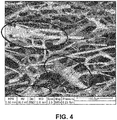
- the amount of fluxing agent used is sufficient to lower the melting temperature of the surfaces of the discrete ceramic components, without destroying the structure of the discrete ceramic components. Too much of either or both of a soluble or non-soluble fluxing agent can lead to nodes or nodules at the fiber junctions at which excessive melting occurs. Excessive melting at the fiber junctions does not enhance the tensile strength of the composite and may have undesirable effects, such as embrittlement or mechanical or thermal performance degradation. An example of such a sintered composite is shown in FIG. 4 , in which the regions with excessive melting have been circled.
- the composite of FIG. 4 was made using two flux agents (lithium metaborate and boron carbide).
- the undesirable excessive melting can result from too much fluxing agent (either soluble or non-soluble) or from employing very high sintering temperatures or a combination of both.
- too little soluble fluxing agent will result in insufficient fusing of the discrete ceramic components, and thus will not provide the desired increase in tensile strength.
- the amount of soluble fluxing agent e.g., lithium metaborate or any of the other soluble fluxing agents herein
- the amount of non-soluble fluxing agent can range from about 0.3 to 2 weight percent, based on the total weight of discrete ceramic components in the wet composition.
- About 0.01% to about 0.5% by weight is an estimated amount of total fluxing agent in the final product after forming and drying the ceramic, although if all of the fluxing agent is used up in reaction there may only be trace amounts, or none, left in the final product. Amounts of fluxing agents outside of the above ranges may be employed.
- the soluble fluxing agent can be dissolved in a solvent prior to or during the method of FIG. 1 .
- the soluble fluxing agent is added directly to the slurry in a powder form and is partially or completely dissolved in the slurry solvent.
- 80% to 100% by weight of the soluble fluxing agent may be dissolved in the solvent, such as 90% to 100% by weight, or 95% to 100% by weight.
- the solvent employed in the method of FIG. 1 has the ability to dissolve the fluxing agent without dissolving the discrete ceramic components.
- the solvent can be an aqueous solvent, non-aqueous solvent, or combinations thereof. Examples of aqueous solvents include water or any solvent that is primarily composed of water. Examples of non-aqueous solvents include polar solvents, such as alcohols.
- the plurality of discrete ceramic components from which the ceramic oxide is made can be in the form of particles or fibers, or in any other suitable form.
- suitable particles include spherical granules or non-spherical granules, such as flakes, tubes, whiskers, or other particles.
- Any suitable ceramic fibers can be employed. If the ceramic components are in the form of fibers, the fibers can have an aspect ratio of about as small as 1:10 or as large as 10,000 or more, such as 2 to 10,000, or about 5 to about 1000.
- the fibers can include solid fibers, tubular fibers, such as nanotubes, or mixtures thereof. Combinations of any of the particles and fibers listed herein can be employed.
- the plurality of discrete ceramic components can comprise any suitable ceramic material.
- suitable materials include ceramic oxides, such as a material selected from titania, silica, alumina, zirconia, and combinations thereof.
- An example of a combination of these oxides is silica aluminate, including zeolites.
- Other types of ceramics, such as clays and non-oxide ceramics can also be employed.
- the solubilized fluxing agent coats the discrete ceramic components upon removal of the solvent during the drying process.
- the drying process can be accomplished by any suitable technique, such as by air drying, heating, and/or reducing pressure to vaporize the solvent.
- the drying process may be carried out separately from, or simultaneous with, the heating process employed for the sintering process in the method of FIG. 1 .
- the sinter temperatures and times employed in the method of FIG. 1 will depend on the materials used for the discrete ceramic components and the type of fluxing agent employed. Sintering temperatures and times can be chosen to provide the desired degree of melting, or fusing, at the points where the discrete ceramic components contact each other. Over-sintering can result in problems, such as composites that are too rigid, or brittle. Examples of a suitable sinter temperature ranges from about 2000 °F to about 2700 °F, such as about 2200 °F to about 2600 °F, or about 2300 °F to about 2500 °F. The peak firing temperatures can be maintained for a suitable time period that will provide the desired amount of fusing of the ceramic components, such as, for example, about 1 hour to about 5 hours, or about 2 hours to about 3 hours.
- Optional ingredients can be added during process 2 of the method of FIG. 1 in addition to soluble fluxing agent, solvent and the discrete ceramic components already described.
- optional ingredients include colorants or emittance agents for modifying the optical properties of the ceramic composite, surfactants and granular fluxing agents. Any other desired optional ingredients could also be employed.
- the methods of the present disclosure do not employ a non-soluble fluxing agent (e.g., a granular fluxing agent that does not appreciably dissolve in the solvent at process temperatures so that 80% to 100% by weight of the non-soluble fluxing agent remains in solid form prior to sintering) to form the ceramic compositions.
- a non-soluble fluxing agent e.g., a granular fluxing agent that does not appreciably dissolve in the solvent at process temperatures so that 80% to 100% by weight of the non-soluble fluxing agent remains in solid form prior to sintering
- the compositions include non-soluble fluxing agents, in addition to the soluble fluxing agents.
- the non-soluble fluxing agents can be, for example, a granular fluxing agent that does not appreciably dissolve in the solvent so that 80% to 100% by weight of the non-soluble fluxing agent remains in solid form prior to sintering.
- non-soluble fluxing agents can include boron carbide (B 4 C), boron nitride powder, and aluminoborosilicate fiber, among others.
- B 4 C boron carbide
- boron nitride powder boron nitride powder
- aluminoborosilicate fiber among others.
- both one or more of the disclosed soluble fluxing agents and one or more of the disclosed non-soluble fluxing agents are employed.
- the "bridging sites" described herein can be formed using a soluble fluxing agent, with or without the use of a non-soluble (e.g., granular) fluxing agent.
- the present disclosure is also directed to a ceramic composite.
- the ceramic composite comprises a plurality of discrete ceramic components.
- the discrete ceramic components include (i) one or more ceramic compounds and (ii) one or more soluble fluxing agent atoms.
- the soluble fluxing agent atoms are incorporated into a surface of the ceramic components, thereby effectively lowering the melting temperature of the surface of the discrete ceramic components.
- the term "incorporated” as used in the phrase "soluble fluxing agent atoms are incorporated into a surface of the ceramic components,” means that atoms from the soluble fluxing agent coat, are infused into or otherwise mix with or are bound to the surface of the discrete ceramic composites.
- the fluxing agent atoms can be incorporated into 40 % to 100 % of the total surface of the discrete ceramic components, such as 50 % to 100 %, or 70 % to 100 %, or 90 % to 100 % of the total surface. Because the fluxing agent is incorporated into the surface of the discrete ceramic components, the discrete ceramic components are able to be fused together to form bridging sites at points where two or more of the discrete ceramic components are in physical contact. For example, the bridging sites can be formed at 30% to 100% of the contact points where two or more of the discrete ceramic components are in physical contact.
- the fluxing agent atoms incorporated into the discrete ceramic components can be any atom or combination of atoms that are derived from the fluxing agent compound.
- the atoms incorporated into the discrete ceramic components can include lithium atoms, as well as boron atoms, and/or oxygen atoms.
- the atoms can be bonded in any manner, such as ionically or covalently bonded, to the materials that make up the discrete ceramic components so as to form a modified ceramic compound with a reduced melting point compared to the melting point of the discrete ceramic components prior to incorporation of the fluxing agent.
- the discrete ceramic component comprises a ceramic oxide selected from titania, silica, alumina, zirconia, or a combination thereof
- the modified ceramic after introduction of the fluxing agent and sintering may be a titania, silica, alumina, and/or zirconia ceramic that includes lithium incorporated therein.
- FIG. 3 shows one example of a fiber that has been modified to include the fluxing agent.
- the fiber 100 comprises an inner core 102 of the ceramic oxide from which the fiber was made prior to introduction of the fluxing agent (e.g., titania, silica, alumina, and/or zirconia ceramic).
- a coating 104 surrounds the inner core.
- Coating 104 comprises the modified fiber material that incorporates the fluxing agent atoms mixed with the original ceramic fiber material, as described above.
- An example of the modified material of coating 104 is lithium alumina silicate, where lithium metaborate is used as the fluxing agent and the discrete ceramic components are alumina silicate fibers.
- the modified discrete ceramic components are not limited to fibers, but can be in any desired form, such as particles, as described herein.
- the discrete ceramic components are bound together at one or more bridging sites, as shown and described above with respect to FIG. 2 .
- the sintered ceramic composition does include at least one nodule formed from a non-soluble fluxing agent, as described herein above.
- the resulting composites can comprise any of the optional ingredients described herein, or any resulting compounds that are the products of any reactions between these and other ingredients during the making of the composites.
- Example optional ingredients including colorants, emittance agents, surfactants and non-soluble fluxing agents can be employed in any effective amounts, as could be determined by one of ordinary skill in the art.
- the composites of the present disclosure exhibit an increased tensile strength compared to composites made solely with granular fluxing agent.
- the tensile strength of the ceramic composite can be increased, such as by a range of 10 % to 40 % or more, compared to the tensile strength of a second ceramic composite that is made using granular fluxing agents that are not dissolved in a solvent prior to sintering.
- the tensile strength, as described herein, is measured by the ASTM D-1623-type B testing procedure (a tensile pull test) using a test specimen in the through-the-thickness ("TTT") or in-plane (IP) orientation.
- the number of bridging sites per unit volume of the ceramic composites of the present disclosure is greater than for a second ceramic composite, where the second ceramic composite is made using a similar process with the same ingredients in the same amounts by weight as the first ceramic composite, except that the only fluxing agent employed in the second ceramic composite is a non-soluble fluxing agent.
- Test specimens were machined from selected regions as representative of the entire fired and trimmed ceramic foam. Specimens were made with orientations along the through-the-thickness (TTT) and the in-plane (IP) direction of the ceramic foam. A band saw was used to perform the initial rough cuts. A radial-arm saw and/or disc sander with a diamond coated blade tip was used for all final machining to minimize initiating surface flaws. Each test specimen was bonded to tensile loading blocks using an epoxy adhesive. Once the adhesive had cured overnight under ambient condition, each specimen was loaded to the Instron machine with movable crosshead type, conforming to the requirements of ASTM E-4. Room temperature tensile pull test was conducted per ASTM D 1623, Type B.
- the % strength improvement of the Example 1 ceramic relative to the baseline was about a 29% increase for specimens with a through-the-thickness (TTT) orientation and a 37% increase for specimens with an in-plane (IP) orientation.
Landscapes
- Chemical & Material Sciences (AREA)
- Engineering & Computer Science (AREA)
- Ceramic Engineering (AREA)
- Manufacturing & Machinery (AREA)
- Structural Engineering (AREA)
- Materials Engineering (AREA)
- Organic Chemistry (AREA)
- Inorganic Chemistry (AREA)
- Composite Materials (AREA)
- Physics & Mathematics (AREA)
- Thermal Sciences (AREA)
- Compositions Of Oxide Ceramics (AREA)
- Ceramic Products (AREA)
- Nonmetallic Welding Materials (AREA)
Abstract
Description
- The present disclosure is directed to a method of making a ceramic composite and the ceramic composite made therefrom.
- Ceramic composites, such as ceramic oxide composites, are well known for use in a variety of applications, including insulating and thermal protection systems for aerospace vehicles. For example, composites made from ceramic oxide fibers, such as alumina, and/or silica fiber-based ceramics, are well known for use in light weight insulating tiles that can be employed as a heat shield for space flight vehicles, as well as in other applications where rapid heat dissipation, thermal insulation and the ability to maintain structural integrity at very high temperatures are useful.
- Ceramic oxide fibers are known to be bonded together using a solid particulate boron source. The solid particulate boron source allows the high melting point ceramic fibers to fuse and bond together in the vicinity of the solid particulates. The solid particulate boron source remains in solid form throughout the process of making the ceramic composite up to the sintering stage, where it decomposes and reacts with the oxide fibers within its vicinity.
- Lithium metaborate is a fluxing agent known for lowering the melting point of ceramic compositions, such as ceramic oxides, which can allow the ceramic to digest into liquid solution for chemical analysis. Fluxing agents, such as lithium metaborate and others used for such chemical analysis processes, are generally used to completely melt or otherwise destroy the mechanical structure of the ceramic oxide.
- Ceramic materials in general can be brittle and lack strength. Novel materials and techniques for increasing strength of ceramic materials would be considered a valuable step forward in the art.
- The present disclosure is directed to a method of making a ceramic composite. The method comprises forming a wet ceramic composition comprising a plurality of discrete ceramic components and a fluxing agent dissolved in a solvent. At least a portion of the solvent is removed from the wet ceramic composition to form a dried ceramic composition comprising the plurality of discrete ceramic components coated with the fluxing agent. The dried ceramic composition is sintered to form the ceramic composite, the sintering being carried out at a sinter temperature sufficient to fuse the discrete ceramic components at bridging sites formed where two or more of the discrete ceramic components coated with fluxing agent are in physical contact.
- The present disclosure is also directed to a ceramic composite. The ceramic composite comprises a plurality of discrete ceramic components comprising (i) one or more ceramic compounds and (ii) one or more soluble fluxing agent atoms incorporated into a surface of the ceramic components, the ceramic components being fused together at bridging sites located where two or more of the discrete ceramic components are in physical contact.
- The present disclosure is also directed to a method of strengthening a ceramic composite. The method comprises forming a wet ceramic composition comprising a plurality of discrete ceramic components and a fluxing agent dissolved in a solvent. At least a portion of the solvent is removed from the wet ceramic composition to form a dried ceramic composition comprising the plurality of discrete ceramic components coated with the fluxing agent. The dried ceramic composition is sintered to form the ceramic composite, the sintering being carried out at a sinter temperature sufficient to fuse the discrete ceramic components at bridging sites formed where two or more of the discrete ceramic components coated with fluxing agent are in physical contact. The ceramic composite has a first tensile strength that is greater than a second tensile strength of a second ceramic composite, where the second ceramic composite is made using a similar process with the same ingredients in the same amounts by weight as the ceramic composite having the first tensile strength, except that the only fluxing agent of the second ceramic composite is non-soluble and remains in a solid form until sintering while making the second ceramic composite.
- It is to be understood that both the foregoing general description and the following detailed description are exemplary and explanatory only and are not restrictive of the present teachings, as claimed.
- The accompanying drawings, which are incorporated in and constitute a part of this specification, illustrates aspects of the present teachings and together with the description, serve to explain the principles of the present teachings.
-
FIG. 1 shows a flowchart of a method of making a ceramic composite, according to an aspect of the present disclosure. -
FIG. 2 illustrates a SEM Micrograph of a sintered ceramic composite, according to an example of the present disclosure. -
FIG. 3 shows a cross-section of a fiber that has been modified to include fluxing agent, according to an example of the present disclosure. -
FIG. 4 illustrates a SEM Micrograph of a sintered ceramic composite with regions of excessive melting, according to an example of the present disclosure. - It should be noted that some details of the figures have been simplified and are drawn to facilitate understanding rather than to maintain strict structural accuracy, detail, and scale.
- Reference will now be made in detail to the present teachings, examples of which are illustrated in the accompanying drawings. In the drawings, like reference numerals have been used throughout to designate identical elements. In the following description, reference is made to the accompanying drawings that form a part thereof, and in which is shown by way of illustration specific examples of practicing the present teachings. The following description is, therefore, merely exemplary.
- The inventors of the present disclosure have found that non-soluble solid particulate boron sources, traditionally used for fusing ceramics, do not initiate sufficient node sites to bond networks of ceramic fibers or other ceramic particulates, resulting in ceramic composites with low tensile strength. The present disclosure employs a soluble fluxing agent to increase bonding sites in the microstructure of the resulting ceramic composites after sintering. This novel technique has been shown to provide composites with improved tensile strength compared to composites made using processes that employ only non-soluble, solid fluxing agents, while maintaining thermal performance properties of the composites.
- The present disclosure is directed to a method of making a ceramic composite. As shown at
process 2 ofFIG. 1 , the method comprises forming a wet ceramic composition comprising a plurality of discrete ceramic components and a soluble fluxing agent dissolved in a solvent. As described herein, the soluble fluxing agent can be used with or without a non-soluble fluxing agent. The term "discrete ceramic components" refers to, for example, ceramic fibers or other ceramic particles, as described herein below. Referring to process 4, at least a portion of the solvent is removed from the wet ceramic composition to form a dried ceramic composition. The dried ceramic composition comprises the plurality of discrete ceramic components coated with the fluxing agent. As shown atprocess 6, the dried ceramic composition is sintered at a sinter temperature sufficient to fuse the discrete ceramic components to form bridging sites, where two or more of the discrete ceramic components coated with fluxing agent are in physical contact, without causing excessive melting that can compromise the tensile strength. - The soluble fluxing agent has the ability to lower the melting temperature of the ceramic material at the surface of the ceramic components when incorporated therein. Further, the soluble fluxing agent may soften or partially dissolve the material at the surface of the ceramic components. The soluble fluxing agent is soluble in a solvent, such as, for example, any aqueous or non-aqueous solvent that is compatible with the method of
FIG. 1 . Aqueous and non-aqueous solvents are described in more detail below. The particular soluble fluxing agent employed will depend on, among other things, the material used for the discrete ceramic components. As examples, suitable fluxing agents can be chosen from borates, carbonates, phosphates, silicates, and combinations thereof. Specific examples include borates such as lithium metaborate, lithium tetraborate and other alkali metal borates or alkaline earth metal borates; carbonates such as alkali metal carbonates (e.g., sodium carbonate, potassium carbonate and other alkali metal carbonates) and alkaline earth metal carbonates; phosphates such as alkali metal phosphates or alkaline earth metal phosphates; and silicates such as alkali metal silicates and alkaline earth metal silicates, and combinations of any of the above borates, carbonates, phosphates and silicates. - By controlling the concentration of the soluble fluxing agent, the total amount of fluxing agent coated on the discrete ceramic components can be tailored to sufficiently lower the melting temperature of the surfaces of the discrete ceramic components. The amount of fluxing agent used is sufficient to lower the melting temperature of the surfaces of the discrete ceramic components, without destroying the structure of the discrete ceramic components. Too much of either or both of a soluble or non-soluble fluxing agent can lead to nodes or nodules at the fiber junctions at which excessive melting occurs. Excessive melting at the fiber junctions does not enhance the tensile strength of the composite and may have undesirable effects, such as embrittlement or mechanical or thermal performance degradation. An example of such a sintered composite is shown in
FIG. 4 , in which the regions with excessive melting have been circled. The composite ofFIG. 4 was made using two flux agents (lithium metaborate and boron carbide). The undesirable excessive melting can result from too much fluxing agent (either soluble or non-soluble) or from employing very high sintering temperatures or a combination of both. Using too little soluble fluxing agent will result in insufficient fusing of the discrete ceramic components, and thus will not provide the desired increase in tensile strength. In an example, the amount of soluble fluxing agent (e.g., lithium metaborate or any of the other soluble fluxing agents herein) ranges from about 0.5 to about 2 weight percent, based on the total weight of discrete ceramic components in the wet composition, such as about 0.6 to about 1.2 weight percent, or about 0.9 to about 1.0 weight percent. In an example, the amount of non-soluble fluxing agent (e.g., boron carbide or any of the other non-soluble fluxing agents herein) can range from about 0.3 to 2 weight percent, based on the total weight of discrete ceramic components in the wet composition. About 0.01% to about 0.5% by weight is an estimated amount of total fluxing agent in the final product after forming and drying the ceramic, although if all of the fluxing agent is used up in reaction there may only be trace amounts, or none, left in the final product. Amounts of fluxing agents outside of the above ranges may be employed. - The soluble fluxing agent can be dissolved in a solvent prior to or during the method of
FIG. 1 . In an example, the soluble fluxing agent is added directly to the slurry in a powder form and is partially or completely dissolved in the slurry solvent. In an example, 80% to 100% by weight of the soluble fluxing agent may be dissolved in the solvent, such as 90% to 100% by weight, or 95% to 100% by weight. The solvent employed in the method ofFIG. 1 has the ability to dissolve the fluxing agent without dissolving the discrete ceramic components. The solvent can be an aqueous solvent, non-aqueous solvent, or combinations thereof. Examples of aqueous solvents include water or any solvent that is primarily composed of water. Examples of non-aqueous solvents include polar solvents, such as alcohols. - The plurality of discrete ceramic components from which the ceramic oxide is made can be in the form of particles or fibers, or in any other suitable form. Examples of suitable particles include spherical granules or non-spherical granules, such as flakes, tubes, whiskers, or other particles. Any suitable ceramic fibers can be employed. If the ceramic components are in the form of fibers, the fibers can have an aspect ratio of about as small as 1:10 or as large as 10,000 or more, such as 2 to 10,000, or about 5 to about 1000. The fibers can include solid fibers, tubular fibers, such as nanotubes, or mixtures thereof. Combinations of any of the particles and fibers listed herein can be employed.
- The plurality of discrete ceramic components can comprise any suitable ceramic material. Examples of suitable materials include ceramic oxides, such as a material selected from titania, silica, alumina, zirconia, and combinations thereof. An example of a combination of these oxides is silica aluminate, including zeolites. Other types of ceramics, such as clays and non-oxide ceramics can also be employed.
- During the method of
FIG. 1 , the solubilized fluxing agent coats the discrete ceramic components upon removal of the solvent during the drying process. The drying process can be accomplished by any suitable technique, such as by air drying, heating, and/or reducing pressure to vaporize the solvent. The drying process may be carried out separately from, or simultaneous with, the heating process employed for the sintering process in the method ofFIG. 1 . - Contacting the discrete ceramic components with the fluxing agent during the processes of 2 and 4 of
FIG. 1 reduces the melting temperature of at least a surface portion of the discrete ceramic components compared to the melting temperature of untreated discrete ceramic components. During the subsequent sintering, the lower melting temperature ceramic surface portions of the discrete ceramic components can melt, or "sinter" together to form bridging sites that bond the ceramic components at locations where two or more of the discrete ceramic components physically contact one another, thereby encouraging the formation of sufficient bridging sites to bond the network of ceramic fibers or other discrete ceramic components and enhance the tensile strength of the sintered composite material. An example of a sinteredceramic composite 8 comprisingbridging sites 10 bonding together discrete ceramic components 12 is illustrated inFIG. 2 . - The sinter temperatures and times employed in the method of
FIG. 1 will depend on the materials used for the discrete ceramic components and the type of fluxing agent employed. Sintering temperatures and times can be chosen to provide the desired degree of melting, or fusing, at the points where the discrete ceramic components contact each other. Over-sintering can result in problems, such as composites that are too rigid, or brittle. Examples of a suitable sinter temperature ranges from about 2000 °F to about 2700 °F, such as about 2200 °F to about 2600 °F, or about 2300 °F to about 2500 °F. The peak firing temperatures can be maintained for a suitable time period that will provide the desired amount of fusing of the ceramic components, such as, for example, about 1 hour to about 5 hours, or about 2 hours to about 3 hours. - Optional ingredients can be added during
process 2 of the method ofFIG. 1 in addition to soluble fluxing agent, solvent and the discrete ceramic components already described. Examples of optional ingredients include colorants or emittance agents for modifying the optical properties of the ceramic composite, surfactants and granular fluxing agents. Any other desired optional ingredients could also be employed. - In an example, the methods of the present disclosure do not employ a non-soluble fluxing agent (e.g., a granular fluxing agent that does not appreciably dissolve in the solvent at process temperatures so that 80% to 100% by weight of the non-soluble fluxing agent remains in solid form prior to sintering) to form the ceramic compositions. In an alternative example, the compositions include non-soluble fluxing agents, in addition to the soluble fluxing agents. The non-soluble fluxing agents can be, for example, a granular fluxing agent that does not appreciably dissolve in the solvent so that 80% to 100% by weight of the non-soluble fluxing agent remains in solid form prior to sintering. Examples of suitable non-soluble fluxing agents can include boron carbide (B4C), boron nitride powder, and aluminoborosilicate fiber, among others. In an example, both one or more of the disclosed soluble fluxing agents and one or more of the disclosed non-soluble fluxing agents are employed. The "bridging sites" described herein can be formed using a soluble fluxing agent, with or without the use of a non-soluble (e.g., granular) fluxing agent.
- The present disclosure is also directed to a ceramic composite. The ceramic composite comprises a plurality of discrete ceramic components. The discrete ceramic components include (i) one or more ceramic compounds and (ii) one or more soluble fluxing agent atoms. The soluble fluxing agent atoms are incorporated into a surface of the ceramic components, thereby effectively lowering the melting temperature of the surface of the discrete ceramic components. The term "incorporated" as used in the phrase "soluble fluxing agent atoms are incorporated into a surface of the ceramic components," means that atoms from the soluble fluxing agent coat, are infused into or otherwise mix with or are bound to the surface of the discrete ceramic composites. For example, the fluxing agent atoms can be incorporated into 40 % to 100 % of the total surface of the discrete ceramic components, such as 50 % to 100 %, or 70 % to 100 %, or 90 % to 100 % of the total surface. Because the fluxing agent is incorporated into the surface of the discrete ceramic components, the discrete ceramic components are able to be fused together to form bridging sites at points where two or more of the discrete ceramic components are in physical contact. For example, the bridging sites can be formed at 30% to 100% of the contact points where two or more of the discrete ceramic components are in physical contact.
- The fluxing agent atoms incorporated into the discrete ceramic components can be any atom or combination of atoms that are derived from the fluxing agent compound. For example, if the fluxing agent is lithium metaborate, the atoms incorporated into the discrete ceramic components can include lithium atoms, as well as boron atoms, and/or oxygen atoms. The atoms can be bonded in any manner, such as ionically or covalently bonded, to the materials that make up the discrete ceramic components so as to form a modified ceramic compound with a reduced melting point compared to the melting point of the discrete ceramic components prior to incorporation of the fluxing agent.
- Any of the plurality of discrete ceramic component materials described herein can be employed. Where, for example, the discrete ceramic component comprises a ceramic oxide selected from titania, silica, alumina, zirconia, or a combination thereof, then the modified ceramic after introduction of the fluxing agent and sintering may be a titania, silica, alumina, and/or zirconia ceramic that includes lithium incorporated therein.
FIG. 3 shows one example of a fiber that has been modified to include the fluxing agent. Thefiber 100 comprises aninner core 102 of the ceramic oxide from which the fiber was made prior to introduction of the fluxing agent (e.g., titania, silica, alumina, and/or zirconia ceramic). Acoating 104 surrounds the inner core. Coating 104 comprises the modified fiber material that incorporates the fluxing agent atoms mixed with the original ceramic fiber material, as described above. An example of the modified material ofcoating 104 is lithium alumina silicate, where lithium metaborate is used as the fluxing agent and the discrete ceramic components are alumina silicate fibers. The modified discrete ceramic components are not limited to fibers, but can be in any desired form, such as particles, as described herein. The discrete ceramic components are bound together at one or more bridging sites, as shown and described above with respect toFIG. 2 . In an example, the sintered ceramic composition does include at least one nodule formed from a non-soluble fluxing agent, as described herein above. - The resulting composites can comprise any of the optional ingredients described herein, or any resulting compounds that are the products of any reactions between these and other ingredients during the making of the composites. Example optional ingredients, including colorants, emittance agents, surfactants and non-soluble fluxing agents can be employed in any effective amounts, as could be determined by one of ordinary skill in the art.
- The composites of the present disclosure exhibit an increased tensile strength compared to composites made solely with granular fluxing agent. For example, the tensile strength of the ceramic composite can be increased, such as by a range of 10 % to 40 % or more, compared to the tensile strength of a second ceramic composite that is made using granular fluxing agents that are not dissolved in a solvent prior to sintering. The tensile strength, as described herein, is measured by the ASTM D-1623-type B testing procedure (a tensile pull test) using a test specimen in the through-the-thickness ("TTT") or in-plane (IP) orientation. In an example, the number of bridging sites per unit volume of the ceramic composites of the present disclosure is greater than for a second ceramic composite, where the second ceramic composite is made using a similar process with the same ingredients in the same amounts by weight as the first ceramic composite, except that the only fluxing agent employed in the second ceramic composite is a non-soluble fluxing agent.
- Test specimens were machined from selected regions as representative of the entire fired and trimmed ceramic foam. Specimens were made with orientations along the through-the-thickness (TTT) and the in-plane (IP) direction of the ceramic foam. A band saw was used to perform the initial rough cuts. A radial-arm saw and/or disc sander with a diamond coated blade tip was used for all final machining to minimize initiating surface flaws. Each test specimen was bonded to tensile loading blocks using an epoxy adhesive. Once the adhesive had cured overnight under ambient condition, each specimen was loaded to the Instron machine with movable crosshead type, conforming to the requirements of ASTM E-4. Room temperature tensile pull test was conducted per ASTM D 1623, Type B.
Table 1 Average TTT Strength (psi) Average IP Strength (psi) Comparative Example: Ceramic foam made with Boron carbide flux agent alone. 67.9 266.9 Example 1: Ceramic foam made with both lithium metaborate and boron carbide flux agents 87.4 366.4 - The % strength improvement of the Example 1 ceramic relative to the baseline was about a 29% increase for specimens with a through-the-thickness (TTT) orientation and a 37% increase for specimens with an in-plane (IP) orientation.
- Further, the disclosure comprises examples according to the following clauses:
- Clause 1. A method of making a ceramic composite, the method comprising: forming a wet ceramic composition comprising a plurality of discrete ceramic components and a fluxing agent dissolved in a solvent; removing at least a portion of the solvent from the wet ceramic composition to form a dried ceramic composition comprising the plurality of discrete ceramic components coated with the fluxing agent; and sintering the dried ceramic composition to form the ceramic composite, the sintering being carried out at a sinter temperature sufficient to fuse the discrete ceramic components at bridging sites formed where two or more of the discrete ceramic components coated with fluxing agent are in physical contact.
-
Clause 2. The method of Clause 1, wherein the fluxing agent is chosen from lithium metaborate, carbonates, borates, phosphates, silicates, and combinations thereof. - Clause 3. The method of
Clause 1 or 2, wherein the fluxing agent is lithium metaborate. -
Clause 4. The method of any of Clauses 1-3, wherein the amount of soluble fluxing agent in the wet ceramic composition ranges from about 0.5 to about 2 weight percent based on the total weight of discrete ceramic components. - Clause 5. The method of any of Clauses 1-4, wherein the solvent comprises a compound chosen from water, a non-aqueous solvent, and mixtures thereof.
-
Clause 6. The method of any of Clauses 1-5, wherein the plurality of discrete ceramic components comprise a ceramic oxide. - Clause 7. The method of
Clause 6, wherein the ceramic oxide comprises a material selected from titania, silica, alumina, zirconia, and combinations thereof. -
Clause 8. The method of any of Clauses 1-7, wherein the plurality of discrete ceramic components are in a form of particles or fibers. - Clause 9. The method of any of Clauses 1-8, wherein the sinter temperature ranges from about 2200 °F to about 2700 °F.
-
Clause 10. The method of any of Clauses 1-9, wherein the wet ceramic composition does not include a non-soluble fluxing agent. - Clause 11. The method of any of Clauses 1-10, wherein the wet ceramic composition further comprises at least one non-soluble fluxing agent.
- Clause 12. The method of Clause 11, wherein the amount of non-soluble fluxing agent in the wet ceramic composition ranges from about 0.3 to about 2 weight percent based on the total weight of discrete ceramic components.
- Clause 13. A ceramic composite, comprising: a plurality of discrete ceramic components comprising (i) one or more ceramic compounds and (ii) one or more soluble fluxing agent atoms incorporated into at least a surface of the discrete ceramic components, the discrete ceramic components being fused together at bridging sites located where two or more of the discrete ceramic components are in physical contact.
- Clause 14. The ceramic composite of Clause 13, wherein the fluxing agent atoms comprise lithium.
- Clause 15. The ceramic composite of Clause 13 or 14, wherein the plurality of discrete ceramic components comprise a ceramic oxide.
- Clause 16. The ceramic composite of Clause 15, wherein the ceramic oxide comprises a material selected from titania, silica, alumina, zirconia, and combinations thereof.
- Clause 17. The ceramic composite of Clause 15 or 16, wherein the fluxing agent atoms comprise lithium atoms bonded to the ceramic oxide.
- Clause 18. The ceramic composite of any of Clauses 15-17, wherein the plurality of discrete ceramic components are in the form of particles or fibers.
- Clause 19. The ceramic composite of any of Clauses 13-18, wherein the bridging sites are formed without using a non-soluble fluxing agent.
- Clause 20. The ceramic composite of any of Clauses 13-19, wherein the wet ceramic composition further comprises at least one non-soluble fluxing agent.
- Clause 21. The ceramic composite of any of Clauses 13-20, wherein the number of bridging sites per unit volume of the first ceramic composite is greater than for a second ceramic composite, where the second ceramic composite is made using a similar process with the same ingredients in the same amounts by weight as the first ceramic composite, except that the only fluxing agent employed in the second ceramic composite is a non-soluble fluxing agent.
- Clause 22. A method of strengthening a ceramic composite, the method comprising: forming a wet ceramic composition comprising a plurality of discrete ceramic components and a fluxing agent dissolved in a solvent; removing at least a portion of the solvent from the wet ceramic composition to form a dried ceramic composition comprising the plurality of discrete ceramic components coated with the fluxing agent; and sintering the dried ceramic composition to form the ceramic composite, the sintering being carried out at a sinter temperature sufficient to fuse the discrete ceramic components at bridging sites formed where two or more of the discrete ceramic components coated with fluxing agent are in physical contact, the ceramic composite having a first tensile strength that is greater than a second tensile strength of a second ceramic composite, where the second ceramic composite is made using a similar process with the same ingredients in the same amounts by weight as the ceramic composite having the first tensile strength, except that the fluxing agent of the second ceramic composite is non-soluble and remains in a solid form that is not dissolved in a solvent while making the second ceramic composite.
- Clause 23. The method of Clause 22, wherein the first tensile strength is increased by a range of 10 % to 40 % compared to the second tensile strength, where both the first tensile strength and the second tensile strength are measured by the ASTM D-1623-type B testing procedure using a test specimen in the through-the-thickness ("TTT") orientation.
- Notwithstanding that the numerical ranges and parameters setting forth the broad scope of the disclosure are approximations, the numerical values set forth in the specific examples are reported as precisely as possible. Any numerical value, however, inherently contains certain errors necessarily resulting from the standard deviation found in their respective testing measurements. Moreover, all ranges disclosed herein are to be understood to encompass any and all sub-ranges subsumed therein.
- While the present teachings have been illustrated with respect to one or more implementations, alterations, and/or modifications can be made to the illustrated examples without departing from the spirit and scope of the appended claims. In addition, while a particular feature of the present teachings may have been disclosed with respect to only one of several implementations, such feature may be combined with one or more other features of the other implementations as may be desired and advantageous for any given or particular function. Furthermore, to the extent that the terms "including," "includes," "having," "has," "with," or variants thereof are used in either the detailed description and the claims, such terms are intended to be inclusive in a manner similar to the term "comprising." Further, in the discussion and claims herein, the term "about" indicates that the value listed may be somewhat altered, as long as the alteration does not result in nonconformance of the process or structure to the intended purpose described herein. Finally, "exemplary" indicates the description is used as an example, rather than implying that it is an ideal.
- It will be appreciated that variants of the above-disclosed and other features and functions, or alternatives thereof, may be combined into many other different systems or applications. Various presently unforeseen or unanticipated alternatives, modifications, variations, or improvements therein may be subsequently made by those skilled in the art which are also intended to be encompasses by the following claims.
Claims (15)
- A method of making a ceramic composite (8), the method comprising:forming a wet ceramic composition comprising a plurality of discrete ceramic components (12) and a fluxing agent dissolved in a solvent;removing at least a portion of the solvent from the wet ceramic composition to form a dried ceramic composition comprising the plurality of discrete ceramic components (12) coated with the fluxing agent; andsintering the dried ceramic composition to form the ceramic composite (8), the sintering being carried out at a sinter temperature sufficient to fuse the discrete ceramic components (12) at bridging sites (10) formed where two or more of the discrete ceramic components (12) coated with fluxing agent are in physical contact.
- The method of claim 1, wherein the fluxing agent is chosen from lithium metaborate, carbonates, borates, phosphates, silicates, and combinations thereof, wherein the fluxing agent is preferably lithium metaborate.
- The method of claim 1 or 2, wherein the amount of soluble fluxing agent in the wet ceramic composition ranges from about 0.5 to about 2 weight percent based on the total weight of discrete ceramic components (12).
- The method of any of claims 1-3, wherein the solvent comprises a compound chosen from water, a non-aqueous solvent, and mixtures thereof.
- The method of any of claims 1-4, wherein the plurality of discrete ceramic components (12) comprise a ceramic oxide, wherein the ceramic oxide preferably comprises a material selected from titania, silica, alumina, zirconia, and combinations thereof.
- The method of any of claims 1-5, wherein the plurality of discrete ceramic components (12) are in a form of particles or fibers.
- The method of any of claims 1-6, wherein the sinter temperature ranges from about 2200 °F to about 2700 °F.
- The method of any of claims 1-7, wherein the wet ceramic composition does not include a non-soluble fluxing agent or wherein the wet ceramic composition further comprises at least one non-soluble fluxing agent.
- The method of claim 8, wherein the amount of non-soluble fluxing agent in the wet ceramic composition ranges from about 0.3 to about 2 weight percent based on the total weight of discrete ceramic components (12).
- A ceramic composite (8), comprising:
a plurality of discrete ceramic components (12) comprising (i) one or more ceramic compounds and (ii) one or more soluble fluxing agent atoms incorporated into at least a surface of the discrete ceramic components (12), the discrete ceramic components (12) being fused together at bridging sites (10) located where two or more of the discrete ceramic components (12) are in physical contact. - The ceramic composite (8) of claim 10, wherein the fluxing agent atoms comprise lithium.
- The ceramic composite (8) of claim 10 or 11, wherein the plurality of discrete ceramic components (12) comprise a ceramic oxide, wherein the ceramic oxide preferably comprises a material selected from titania, silica, alumina, zirconia, and combinations thereof, wherein the fluxing agent atoms preferably comprise lithium atoms bonded to the ceramic oxide, wherein the plurality of discrete ceramic components (12) are preferably in the form of particles or fibers (100).
- The ceramic composite (8) of any of claims 10-12, wherein the bridging sites (10) are formed without using a non-soluble fluxing agent.
- The ceramic composite (8) of any of claims 10-13, wherein the wet ceramic composition further comprises at least one non-soluble fluxing agent.
- The ceramic composite (8) of any of claims 10-14, wherein the number of bridging sites (10) per unit volume of the first ceramic composite (8) is greater than for a second ceramic composite, where the second ceramic composite is made using a similar process with the same ingredients in the same amounts by weight as the first ceramic composite (8), except that the only fluxing agent employed in the second ceramic composite is a non-soluble fluxing agent.
Applications Claiming Priority (1)
| Application Number | Priority Date | Filing Date | Title |
|---|---|---|---|
| US16/143,319 US11028020B2 (en) | 2018-09-26 | 2018-09-26 | Ceramic composition and method of making the composition |
Publications (2)
| Publication Number | Publication Date |
|---|---|
| EP3628649A1 true EP3628649A1 (en) | 2020-04-01 |
| EP3628649B1 EP3628649B1 (en) | 2024-12-25 |
Family
ID=68136137
Family Applications (1)
| Application Number | Title | Priority Date | Filing Date |
|---|---|---|---|
| EP19199692.5A Active EP3628649B1 (en) | 2018-09-26 | 2019-09-25 | Ceramic composition and method of making the composition |
Country Status (8)
| Country | Link |
|---|---|
| US (1) | US11028020B2 (en) |
| EP (1) | EP3628649B1 (en) |
| JP (2) | JP7723467B2 (en) |
| CN (1) | CN110950647A (en) |
| AU (1) | AU2019236663B2 (en) |
| CA (1) | CA3056456C (en) |
| ES (1) | ES3014245T3 (en) |
| RU (1) | RU2019129780A (en) |
Families Citing this family (1)
| Publication number | Priority date | Publication date | Assignee | Title |
|---|---|---|---|---|
| US11866377B2 (en) * | 2021-04-21 | 2024-01-09 | Honeywell International Inc. | High temperature interfaces for ceramic composites |
Citations (4)
| Publication number | Priority date | Publication date | Assignee | Title |
|---|---|---|---|---|
| GB1481761A (en) * | 1974-12-24 | 1977-08-03 | Pfizer | Bonding agent for fusing porcelain to non-precious metal alloy |
| US4770707A (en) * | 1984-10-12 | 1988-09-13 | Manville Corporation | Method for forming a layer of refractory fibers on a surface and material produced thereby |
| EP3040322A2 (en) * | 2014-12-30 | 2016-07-06 | The Boeing Company | Process and formulation to join ceramic foams while maintaining structural and physical characteristics across the bond surface |
| CN107460545A (en) * | 2017-08-24 | 2017-12-12 | 台州学院 | A kind of preparation method of bar-shaped zirconium oxide whisker |
Family Cites Families (11)
| Publication number | Priority date | Publication date | Assignee | Title |
|---|---|---|---|---|
| US3855393A (en) * | 1971-12-09 | 1974-12-17 | Fiberglas Canada Ltd | Process for producing low thermal conductivity high strength silica foam |
| JPS59232693A (en) * | 1983-06-17 | 1984-12-27 | Ngk Spark Plug Co Ltd | Clad brazing filler metal for joining ceramics and metal or the like and composite body composed of ceramics and metal or the like using said brazing filler metal |
| JPS60141667A (en) * | 1983-12-28 | 1985-07-26 | 日本碍子株式会社 | Material for ceramic honeycomb structure |
| JPH02229770A (en) * | 1988-10-18 | 1990-09-12 | Ube Ind Ltd | Composite ceramic material and production thereof |
| US5804306A (en) * | 1996-11-27 | 1998-09-08 | Northrop Grumman Corporation | Ceramic matrix composite/organic matrix composite hybrid fire shield |
| US6897123B2 (en) * | 2001-03-05 | 2005-05-24 | Agityne Corporation | Bonding of parts with dissimilar thermal expansion coefficients |
| US6770584B2 (en) | 2002-08-16 | 2004-08-03 | The Boeing Company | Hybrid aerogel rigid ceramic fiber insulation and method of producing same |
| US8252131B2 (en) * | 2009-07-02 | 2012-08-28 | The Boeing Company | Reworking ceramic structures |
| US20140086670A1 (en) * | 2011-05-27 | 2014-03-27 | Toyo Tanso Co., Ltd. | Joint of metal material and ceramic-carbon composite material, method for producing same, carbon material joint, jointing material for carbon material joint, and method for producing carbon material joint |
| US9776282B2 (en) * | 2012-10-08 | 2017-10-03 | Siemens Energy, Inc. | Laser additive manufacture of three-dimensional components containing multiple materials formed as integrated systems |
| US9994489B2 (en) * | 2014-12-30 | 2018-06-12 | The Boeing Company | Bonding dissimilar ceramic components |
-
2018
- 2018-09-26 US US16/143,319 patent/US11028020B2/en active Active
-
2019
- 2019-09-20 CA CA3056456A patent/CA3056456C/en active Active
- 2019-09-23 RU RU2019129780A patent/RU2019129780A/en unknown
- 2019-09-25 AU AU2019236663A patent/AU2019236663B2/en active Active
- 2019-09-25 ES ES19199692T patent/ES3014245T3/en active Active
- 2019-09-25 EP EP19199692.5A patent/EP3628649B1/en active Active
- 2019-09-25 JP JP2019174241A patent/JP7723467B2/en active Active
- 2019-09-26 CN CN201910915390.8A patent/CN110950647A/en active Pending
-
2023
- 2023-12-27 JP JP2023221308A patent/JP2024023978A/en not_active Withdrawn
Patent Citations (4)
| Publication number | Priority date | Publication date | Assignee | Title |
|---|---|---|---|---|
| GB1481761A (en) * | 1974-12-24 | 1977-08-03 | Pfizer | Bonding agent for fusing porcelain to non-precious metal alloy |
| US4770707A (en) * | 1984-10-12 | 1988-09-13 | Manville Corporation | Method for forming a layer of refractory fibers on a surface and material produced thereby |
| EP3040322A2 (en) * | 2014-12-30 | 2016-07-06 | The Boeing Company | Process and formulation to join ceramic foams while maintaining structural and physical characteristics across the bond surface |
| CN107460545A (en) * | 2017-08-24 | 2017-12-12 | 台州学院 | A kind of preparation method of bar-shaped zirconium oxide whisker |
Also Published As
| Publication number | Publication date |
|---|---|
| CN110950647A (en) | 2020-04-03 |
| JP7723467B2 (en) | 2025-08-14 |
| CA3056456C (en) | 2023-08-22 |
| US20200095172A1 (en) | 2020-03-26 |
| AU2019236663B2 (en) | 2024-08-08 |
| ES3014245T3 (en) | 2025-04-21 |
| CA3056456A1 (en) | 2020-03-26 |
| RU2019129780A (en) | 2021-03-23 |
| JP2024023978A (en) | 2024-02-21 |
| EP3628649B1 (en) | 2024-12-25 |
| AU2019236663A1 (en) | 2020-04-09 |
| US11028020B2 (en) | 2021-06-08 |
| JP2020050583A (en) | 2020-04-02 |
Similar Documents
| Publication | Publication Date | Title |
|---|---|---|
| US6699555B2 (en) | Bonding of thermal tile insulation | |
| KR100785211B1 (en) | Inorganic fiber article | |
| US11780781B2 (en) | Bonding dissimilar ceramic components | |
| EP1444028B1 (en) | Silicon carbide filter and method for the manufacture thereof-- | |
| WO2002030567A1 (en) | Cordierite honeycomb structural body and method of manufacturing the structural body | |
| US11028020B2 (en) | Ceramic composition and method of making the composition | |
| CN103232216B (en) | Inner coating for improving glazing property of turned carbon-containing fireproof material and coating method thereof | |
| JP3195266B2 (en) | Multi-layer heat insulating material and its manufacturing method | |
| JP2003040685A (en) | Oxide fiber composite material and method for producing the same | |
| JP3302595B2 (en) | Insulation method | |
| KR100549030B1 (en) | Electronic component firing materials and jigs | |
| Kunza et al. | Laser-based manufacturing of ceramic matrix composites | |
| JP3186993B2 (en) | Insulation | |
| JPH0292880A (en) | Production of heat resistant and porous acoustical material | |
| JPS6263065A (en) | Binder for vitrified grinding wheel and superfinishing grinding wheel | |
| CN121342553A (en) | A laser cladding Si/SiC coating based on synchronous powder feeding and its preparation method | |
| JPS6278216A (en) | Production of formed article of composite ceramic fiber | |
| JPS60209016A (en) | Preparation of composite ceramic fiber | |
| KR101584748B1 (en) | Heat-resistant composition for a probe and heat-resistant protecting tube for a probe | |
| CN119301088A (en) | Compositions for direct production of ceramic matrix composites | |
| JP2000154069A (en) | Cordierite ceramic porous body and method for producing the same | |
| JPH05105535A (en) | Adhesive for alumina ceramics |
Legal Events
| Date | Code | Title | Description |
|---|---|---|---|
| PUAI | Public reference made under article 153(3) epc to a published international application that has entered the european phase |
Free format text: ORIGINAL CODE: 0009012 |
|
| STAA | Information on the status of an ep patent application or granted ep patent |
Free format text: STATUS: THE APPLICATION HAS BEEN PUBLISHED |
|
| AK | Designated contracting states |
Kind code of ref document: A1 Designated state(s): AL AT BE BG CH CY CZ DE DK EE ES FI FR GB GR HR HU IE IS IT LI LT LU LV MC MK MT NL NO PL PT RO RS SE SI SK SM TR |
|
| AX | Request for extension of the european patent |
Extension state: BA ME |
|
| STAA | Information on the status of an ep patent application or granted ep patent |
Free format text: STATUS: REQUEST FOR EXAMINATION WAS MADE |
|
| STAA | Information on the status of an ep patent application or granted ep patent |
Free format text: STATUS: EXAMINATION IS IN PROGRESS |
|
| 17P | Request for examination filed |
Effective date: 20200811 |
|
| RBV | Designated contracting states (corrected) |
Designated state(s): AL AT BE BG CH CY CZ DE DK EE ES FI FR GB GR HR HU IE IS IT LI LT LU LV MC MK MT NL NO PL PT RO RS SE SI SK SM TR |
|
| 17Q | First examination report despatched |
Effective date: 20200826 |
|
| RAP3 | Party data changed (applicant data changed or rights of an application transferred) |
Owner name: THE BOEING COMPANY |
|
| GRAP | Despatch of communication of intention to grant a patent |
Free format text: ORIGINAL CODE: EPIDOSNIGR1 |
|
| STAA | Information on the status of an ep patent application or granted ep patent |
Free format text: STATUS: GRANT OF PATENT IS INTENDED |
|
| INTG | Intention to grant announced |
Effective date: 20240723 |
|
| P01 | Opt-out of the competence of the unified patent court (upc) registered |
Free format text: CASE NUMBER: APP_44537/2024 Effective date: 20240731 |
|
| GRAS | Grant fee paid |
Free format text: ORIGINAL CODE: EPIDOSNIGR3 |
|
| GRAA | (expected) grant |
Free format text: ORIGINAL CODE: 0009210 |
|
| STAA | Information on the status of an ep patent application or granted ep patent |
Free format text: STATUS: THE PATENT HAS BEEN GRANTED |
|
| AK | Designated contracting states |
Kind code of ref document: B1 Designated state(s): AL AT BE BG CH CY CZ DE DK EE ES FI FR GB GR HR HU IE IS IT LI LT LU LV MC MK MT NL NO PL PT RO RS SE SI SK SM TR |
|
| REG | Reference to a national code |
Ref country code: GB Ref legal event code: FG4D |
|
| REG | Reference to a national code |
Ref country code: CH Ref legal event code: EP |
|
| REG | Reference to a national code |
Ref country code: DE Ref legal event code: R096 Ref document number: 602019063894 Country of ref document: DE |
|
| REG | Reference to a national code |
Ref country code: IE Ref legal event code: FG4D |
|
| REG | Reference to a national code |
Ref country code: LT Ref legal event code: MG9D |
|
| PG25 | Lapsed in a contracting state [announced via postgrant information from national office to epo] |
Ref country code: HR Free format text: LAPSE BECAUSE OF FAILURE TO SUBMIT A TRANSLATION OF THE DESCRIPTION OR TO PAY THE FEE WITHIN THE PRESCRIBED TIME-LIMIT Effective date: 20241225 |
|
| PG25 | Lapsed in a contracting state [announced via postgrant information from national office to epo] |
Ref country code: FI Free format text: LAPSE BECAUSE OF FAILURE TO SUBMIT A TRANSLATION OF THE DESCRIPTION OR TO PAY THE FEE WITHIN THE PRESCRIBED TIME-LIMIT Effective date: 20241225 |
|
| PG25 | Lapsed in a contracting state [announced via postgrant information from national office to epo] |
Ref country code: BG Free format text: LAPSE BECAUSE OF FAILURE TO SUBMIT A TRANSLATION OF THE DESCRIPTION OR TO PAY THE FEE WITHIN THE PRESCRIBED TIME-LIMIT Effective date: 20241225 |
|
| REG | Reference to a national code |
Ref country code: ES Ref legal event code: FG2A Ref document number: 3014245 Country of ref document: ES Kind code of ref document: T3 Effective date: 20250421 |
|
| PG25 | Lapsed in a contracting state [announced via postgrant information from national office to epo] |
Ref country code: NO Free format text: LAPSE BECAUSE OF FAILURE TO SUBMIT A TRANSLATION OF THE DESCRIPTION OR TO PAY THE FEE WITHIN THE PRESCRIBED TIME-LIMIT Effective date: 20250325 |
|
| PG25 | Lapsed in a contracting state [announced via postgrant information from national office to epo] |
Ref country code: GR Free format text: LAPSE BECAUSE OF FAILURE TO SUBMIT A TRANSLATION OF THE DESCRIPTION OR TO PAY THE FEE WITHIN THE PRESCRIBED TIME-LIMIT Effective date: 20250326 Ref country code: LV Free format text: LAPSE BECAUSE OF FAILURE TO SUBMIT A TRANSLATION OF THE DESCRIPTION OR TO PAY THE FEE WITHIN THE PRESCRIBED TIME-LIMIT Effective date: 20241225 |
|
| PG25 | Lapsed in a contracting state [announced via postgrant information from national office to epo] |
Ref country code: RS Free format text: LAPSE BECAUSE OF FAILURE TO SUBMIT A TRANSLATION OF THE DESCRIPTION OR TO PAY THE FEE WITHIN THE PRESCRIBED TIME-LIMIT Effective date: 20250325 |
|
| REG | Reference to a national code |
Ref country code: NL Ref legal event code: MP Effective date: 20241225 |
|
| PG25 | Lapsed in a contracting state [announced via postgrant information from national office to epo] |
Ref country code: NL Free format text: LAPSE BECAUSE OF FAILURE TO SUBMIT A TRANSLATION OF THE DESCRIPTION OR TO PAY THE FEE WITHIN THE PRESCRIBED TIME-LIMIT Effective date: 20241225 |
|
| REG | Reference to a national code |
Ref country code: AT Ref legal event code: MK05 Ref document number: 1754056 Country of ref document: AT Kind code of ref document: T Effective date: 20241225 |
|
| PG25 | Lapsed in a contracting state [announced via postgrant information from national office to epo] |
Ref country code: SM Free format text: LAPSE BECAUSE OF FAILURE TO SUBMIT A TRANSLATION OF THE DESCRIPTION OR TO PAY THE FEE WITHIN THE PRESCRIBED TIME-LIMIT Effective date: 20241225 |
|
| PG25 | Lapsed in a contracting state [announced via postgrant information from national office to epo] |
Ref country code: PL Free format text: LAPSE BECAUSE OF FAILURE TO SUBMIT A TRANSLATION OF THE DESCRIPTION OR TO PAY THE FEE WITHIN THE PRESCRIBED TIME-LIMIT Effective date: 20241225 |
|
| PG25 | Lapsed in a contracting state [announced via postgrant information from national office to epo] |
Ref country code: IS Free format text: LAPSE BECAUSE OF FAILURE TO SUBMIT A TRANSLATION OF THE DESCRIPTION OR TO PAY THE FEE WITHIN THE PRESCRIBED TIME-LIMIT Effective date: 20250425 |
|
| PG25 | Lapsed in a contracting state [announced via postgrant information from national office to epo] |
Ref country code: PT Free format text: LAPSE BECAUSE OF FAILURE TO SUBMIT A TRANSLATION OF THE DESCRIPTION OR TO PAY THE FEE WITHIN THE PRESCRIBED TIME-LIMIT Effective date: 20250428 |
|
| PG25 | Lapsed in a contracting state [announced via postgrant information from national office to epo] |
Ref country code: EE Free format text: LAPSE BECAUSE OF FAILURE TO SUBMIT A TRANSLATION OF THE DESCRIPTION OR TO PAY THE FEE WITHIN THE PRESCRIBED TIME-LIMIT Effective date: 20241225 |
|
| PG25 | Lapsed in a contracting state [announced via postgrant information from national office to epo] |
Ref country code: RO Free format text: LAPSE BECAUSE OF FAILURE TO SUBMIT A TRANSLATION OF THE DESCRIPTION OR TO PAY THE FEE WITHIN THE PRESCRIBED TIME-LIMIT Effective date: 20241225 Ref country code: AT Free format text: LAPSE BECAUSE OF FAILURE TO SUBMIT A TRANSLATION OF THE DESCRIPTION OR TO PAY THE FEE WITHIN THE PRESCRIBED TIME-LIMIT Effective date: 20241225 |
|
| PG25 | Lapsed in a contracting state [announced via postgrant information from national office to epo] |
Ref country code: SK Free format text: LAPSE BECAUSE OF FAILURE TO SUBMIT A TRANSLATION OF THE DESCRIPTION OR TO PAY THE FEE WITHIN THE PRESCRIBED TIME-LIMIT Effective date: 20241225 |
|
| PG25 | Lapsed in a contracting state [announced via postgrant information from national office to epo] |
Ref country code: CZ Free format text: LAPSE BECAUSE OF FAILURE TO SUBMIT A TRANSLATION OF THE DESCRIPTION OR TO PAY THE FEE WITHIN THE PRESCRIBED TIME-LIMIT Effective date: 20241225 |
|
| PG25 | Lapsed in a contracting state [announced via postgrant information from national office to epo] |
Ref country code: SE Free format text: LAPSE BECAUSE OF FAILURE TO SUBMIT A TRANSLATION OF THE DESCRIPTION OR TO PAY THE FEE WITHIN THE PRESCRIBED TIME-LIMIT Effective date: 20241225 |
|
| REG | Reference to a national code |
Ref country code: DE Ref legal event code: R097 Ref document number: 602019063894 Country of ref document: DE |
|
| PG25 | Lapsed in a contracting state [announced via postgrant information from national office to epo] |
Ref country code: DK Free format text: LAPSE BECAUSE OF FAILURE TO SUBMIT A TRANSLATION OF THE DESCRIPTION OR TO PAY THE FEE WITHIN THE PRESCRIBED TIME-LIMIT Effective date: 20241225 |
|
| PGFP | Annual fee paid to national office [announced via postgrant information from national office to epo] |
Ref country code: DE Payment date: 20250929 Year of fee payment: 7 |
|
| PGFP | Annual fee paid to national office [announced via postgrant information from national office to epo] |
Ref country code: IT Payment date: 20250919 Year of fee payment: 7 |
|
| PGFP | Annual fee paid to national office [announced via postgrant information from national office to epo] |
Ref country code: GB Payment date: 20250929 Year of fee payment: 7 |
|
| PGFP | Annual fee paid to national office [announced via postgrant information from national office to epo] |
Ref country code: FR Payment date: 20250925 Year of fee payment: 7 |
|
| PLBE | No opposition filed within time limit |
Free format text: ORIGINAL CODE: 0009261 |
|
| STAA | Information on the status of an ep patent application or granted ep patent |
Free format text: STATUS: NO OPPOSITION FILED WITHIN TIME LIMIT |
|
| REG | Reference to a national code |
Ref country code: CH Ref legal event code: L10 Free format text: ST27 STATUS EVENT CODE: U-0-0-L10-L00 (AS PROVIDED BY THE NATIONAL OFFICE) Effective date: 20251105 |
|
| 26N | No opposition filed |
Effective date: 20250926 |
|
| PGFP | Annual fee paid to national office [announced via postgrant information from national office to epo] |
Ref country code: ES Payment date: 20251001 Year of fee payment: 7 |
|
| REG | Reference to a national code |
Ref country code: CH Ref legal event code: H13 Free format text: ST27 STATUS EVENT CODE: U-0-0-H10-H13 (AS PROVIDED BY THE NATIONAL OFFICE) Effective date: 20260504 |