EP3627587B1 - Separator for secondary battery and lithium secondary battery comprising same - Google Patents
Separator for secondary battery and lithium secondary battery comprising same Download PDFInfo
- Publication number
- EP3627587B1 EP3627587B1 EP18802181.0A EP18802181A EP3627587B1 EP 3627587 B1 EP3627587 B1 EP 3627587B1 EP 18802181 A EP18802181 A EP 18802181A EP 3627587 B1 EP3627587 B1 EP 3627587B1
- Authority
- EP
- European Patent Office
- Prior art keywords
- separator
- group
- structural unit
- mol
- chemical formula
- Prior art date
- Legal status (The legal status is an assumption and is not a legal conclusion. Google has not performed a legal analysis and makes no representation as to the accuracy of the status listed.)
- Active
Links
Images
Classifications
-
- H—ELECTRICITY
- H01—ELECTRIC ELEMENTS
- H01M—PROCESSES OR MEANS, e.g. BATTERIES, FOR THE DIRECT CONVERSION OF CHEMICAL ENERGY INTO ELECTRICAL ENERGY
- H01M50/00—Constructional details or processes of manufacture of the non-active parts of electrochemical cells other than fuel cells, e.g. hybrid cells
- H01M50/40—Separators; Membranes; Diaphragms; Spacing elements inside cells
- H01M50/409—Separators, membranes or diaphragms characterised by the material
- H01M50/411—Organic material
- H01M50/414—Synthetic resins, e.g. thermoplastics or thermosetting resins
- H01M50/42—Acrylic resins
-
- C—CHEMISTRY; METALLURGY
- C09—DYES; PAINTS; POLISHES; NATURAL RESINS; ADHESIVES; COMPOSITIONS NOT OTHERWISE PROVIDED FOR; APPLICATIONS OF MATERIALS NOT OTHERWISE PROVIDED FOR
- C09D—COATING COMPOSITIONS, e.g. PAINTS, VARNISHES OR LACQUERS; FILLING PASTES; CHEMICAL PAINT OR INK REMOVERS; INKS; CORRECTING FLUIDS; WOODSTAINS; PASTES OR SOLIDS FOR COLOURING OR PRINTING; USE OF MATERIALS THEREFOR
- C09D7/00—Features of coating compositions, not provided for in group C09D5/00; Processes for incorporating ingredients in coating compositions
- C09D7/40—Additives
- C09D7/60—Additives non-macromolecular
- C09D7/61—Additives non-macromolecular inorganic
-
- C—CHEMISTRY; METALLURGY
- C08—ORGANIC MACROMOLECULAR COMPOUNDS; THEIR PREPARATION OR CHEMICAL WORKING-UP; COMPOSITIONS BASED THEREON
- C08F—MACROMOLECULAR COMPOUNDS OBTAINED BY REACTIONS ONLY INVOLVING CARBON-TO-CARBON UNSATURATED BONDS
- C08F220/00—Copolymers of compounds having one or more unsaturated aliphatic radicals, each having only one carbon-to-carbon double bond, and only one being terminated by only one carboxyl radical or a salt, anhydride ester, amide, imide or nitrile thereof
- C08F220/02—Monocarboxylic acids having less than ten carbon atoms; Derivatives thereof
- C08F220/42—Nitriles
- C08F220/44—Acrylonitrile
- C08F220/48—Acrylonitrile with nitrogen-containing monomers
-
- C—CHEMISTRY; METALLURGY
- C08—ORGANIC MACROMOLECULAR COMPOUNDS; THEIR PREPARATION OR CHEMICAL WORKING-UP; COMPOSITIONS BASED THEREON
- C08J—WORKING-UP; GENERAL PROCESSES OF COMPOUNDING; AFTER-TREATMENT NOT COVERED BY SUBCLASSES C08B, C08C, C08F, C08G or C08H
- C08J7/00—Chemical treatment or coating of shaped articles made of macromolecular substances
- C08J7/04—Coating
- C08J7/0427—Coating with only one layer of a composition containing a polymer binder
-
- C—CHEMISTRY; METALLURGY
- C08—ORGANIC MACROMOLECULAR COMPOUNDS; THEIR PREPARATION OR CHEMICAL WORKING-UP; COMPOSITIONS BASED THEREON
- C08J—WORKING-UP; GENERAL PROCESSES OF COMPOUNDING; AFTER-TREATMENT NOT COVERED BY SUBCLASSES C08B, C08C, C08F, C08G or C08H
- C08J7/00—Chemical treatment or coating of shaped articles made of macromolecular substances
- C08J7/04—Coating
- C08J7/043—Improving the adhesiveness of the coatings per se, e.g. forming primers
-
- C—CHEMISTRY; METALLURGY
- C08—ORGANIC MACROMOLECULAR COMPOUNDS; THEIR PREPARATION OR CHEMICAL WORKING-UP; COMPOSITIONS BASED THEREON
- C08K—Use of inorganic or non-macromolecular organic substances as compounding ingredients
- C08K3/00—Use of inorganic substances as compounding ingredients
- C08K3/18—Oxygen-containing compounds, e.g. metal carbonyls
- C08K3/20—Oxides; Hydroxides
- C08K3/22—Oxides; Hydroxides of metals
-
- C—CHEMISTRY; METALLURGY
- C09—DYES; PAINTS; POLISHES; NATURAL RESINS; ADHESIVES; COMPOSITIONS NOT OTHERWISE PROVIDED FOR; APPLICATIONS OF MATERIALS NOT OTHERWISE PROVIDED FOR
- C09D—COATING COMPOSITIONS, e.g. PAINTS, VARNISHES OR LACQUERS; FILLING PASTES; CHEMICAL PAINT OR INK REMOVERS; INKS; CORRECTING FLUIDS; WOODSTAINS; PASTES OR SOLIDS FOR COLOURING OR PRINTING; USE OF MATERIALS THEREFOR
- C09D133/00—Coating compositions based on homopolymers or copolymers of compounds having one or more unsaturated aliphatic radicals, each having only one carbon-to-carbon double bond, and at least one being terminated by only one carboxyl radical, or of salts, anhydrides, esters, amides, imides, or nitriles thereof; Coating compositions based on derivatives of such polymers
- C09D133/18—Homopolymers or copolymers of nitriles
- C09D133/20—Homopolymers or copolymers of acrylonitrile
-
- C—CHEMISTRY; METALLURGY
- C09—DYES; PAINTS; POLISHES; NATURAL RESINS; ADHESIVES; COMPOSITIONS NOT OTHERWISE PROVIDED FOR; APPLICATIONS OF MATERIALS NOT OTHERWISE PROVIDED FOR
- C09D—COATING COMPOSITIONS, e.g. PAINTS, VARNISHES OR LACQUERS; FILLING PASTES; CHEMICAL PAINT OR INK REMOVERS; INKS; CORRECTING FLUIDS; WOODSTAINS; PASTES OR SOLIDS FOR COLOURING OR PRINTING; USE OF MATERIALS THEREFOR
- C09D5/00—Coating compositions, e.g. paints, varnishes or lacquers, characterised by their physical nature or the effects produced; Filling pastes
- C09D5/18—Fireproof paints including high temperature resistant paints
-
- H—ELECTRICITY
- H01—ELECTRIC ELEMENTS
- H01M—PROCESSES OR MEANS, e.g. BATTERIES, FOR THE DIRECT CONVERSION OF CHEMICAL ENERGY INTO ELECTRICAL ENERGY
- H01M10/00—Secondary cells; Manufacture thereof
- H01M10/05—Accumulators with non-aqueous electrolyte
- H01M10/052—Li-accumulators
-
- H—ELECTRICITY
- H01—ELECTRIC ELEMENTS
- H01M—PROCESSES OR MEANS, e.g. BATTERIES, FOR THE DIRECT CONVERSION OF CHEMICAL ENERGY INTO ELECTRICAL ENERGY
- H01M10/00—Secondary cells; Manufacture thereof
- H01M10/05—Accumulators with non-aqueous electrolyte
- H01M10/052—Li-accumulators
- H01M10/0525—Rocking-chair batteries, i.e. batteries with lithium insertion or intercalation in both electrodes; Lithium-ion batteries
-
- H—ELECTRICITY
- H01—ELECTRIC ELEMENTS
- H01M—PROCESSES OR MEANS, e.g. BATTERIES, FOR THE DIRECT CONVERSION OF CHEMICAL ENERGY INTO ELECTRICAL ENERGY
- H01M4/00—Electrodes
- H01M4/02—Electrodes composed of, or comprising, active material
- H01M4/13—Electrodes for accumulators with non-aqueous electrolyte, e.g. for lithium-accumulators; Processes of manufacture thereof
- H01M4/131—Electrodes based on mixed oxides or hydroxides, or on mixtures of oxides or hydroxides, e.g. LiCoOx
-
- H—ELECTRICITY
- H01—ELECTRIC ELEMENTS
- H01M—PROCESSES OR MEANS, e.g. BATTERIES, FOR THE DIRECT CONVERSION OF CHEMICAL ENERGY INTO ELECTRICAL ENERGY
- H01M4/00—Electrodes
- H01M4/02—Electrodes composed of, or comprising, active material
- H01M4/13—Electrodes for accumulators with non-aqueous electrolyte, e.g. for lithium-accumulators; Processes of manufacture thereof
- H01M4/133—Electrodes based on carbonaceous material, e.g. graphite-intercalation compounds or CFx
-
- H—ELECTRICITY
- H01—ELECTRIC ELEMENTS
- H01M—PROCESSES OR MEANS, e.g. BATTERIES, FOR THE DIRECT CONVERSION OF CHEMICAL ENERGY INTO ELECTRICAL ENERGY
- H01M4/00—Electrodes
- H01M4/02—Electrodes composed of, or comprising, active material
- H01M4/36—Selection of substances as active materials, active masses, active liquids
- H01M4/48—Selection of substances as active materials, active masses, active liquids of inorganic oxides or hydroxides
- H01M4/50—Selection of substances as active materials, active masses, active liquids of inorganic oxides or hydroxides of manganese
- H01M4/505—Selection of substances as active materials, active masses, active liquids of inorganic oxides or hydroxides of manganese of mixed oxides or hydroxides containing manganese for inserting or intercalating light metals, e.g. LiMn2O4 or LiMn2OxFy
-
- H—ELECTRICITY
- H01—ELECTRIC ELEMENTS
- H01M—PROCESSES OR MEANS, e.g. BATTERIES, FOR THE DIRECT CONVERSION OF CHEMICAL ENERGY INTO ELECTRICAL ENERGY
- H01M4/00—Electrodes
- H01M4/02—Electrodes composed of, or comprising, active material
- H01M4/36—Selection of substances as active materials, active masses, active liquids
- H01M4/48—Selection of substances as active materials, active masses, active liquids of inorganic oxides or hydroxides
- H01M4/52—Selection of substances as active materials, active masses, active liquids of inorganic oxides or hydroxides of nickel, cobalt or iron
- H01M4/525—Selection of substances as active materials, active masses, active liquids of inorganic oxides or hydroxides of nickel, cobalt or iron of mixed oxides or hydroxides containing iron, cobalt or nickel for inserting or intercalating light metals, e.g. LiNiO2, LiCoO2 or LiCoOxFy
-
- H—ELECTRICITY
- H01—ELECTRIC ELEMENTS
- H01M—PROCESSES OR MEANS, e.g. BATTERIES, FOR THE DIRECT CONVERSION OF CHEMICAL ENERGY INTO ELECTRICAL ENERGY
- H01M4/00—Electrodes
- H01M4/02—Electrodes composed of, or comprising, active material
- H01M4/62—Selection of inactive substances as ingredients for active masses, e.g. binders, fillers
- H01M4/621—Binders
- H01M4/622—Binders being polymers
- H01M4/623—Binders being polymers fluorinated polymers
-
- H—ELECTRICITY
- H01—ELECTRIC ELEMENTS
- H01M—PROCESSES OR MEANS, e.g. BATTERIES, FOR THE DIRECT CONVERSION OF CHEMICAL ENERGY INTO ELECTRICAL ENERGY
- H01M4/00—Electrodes
- H01M4/02—Electrodes composed of, or comprising, active material
- H01M4/62—Selection of inactive substances as ingredients for active masses, e.g. binders, fillers
- H01M4/624—Electric conductive fillers
-
- H—ELECTRICITY
- H01—ELECTRIC ELEMENTS
- H01M—PROCESSES OR MEANS, e.g. BATTERIES, FOR THE DIRECT CONVERSION OF CHEMICAL ENERGY INTO ELECTRICAL ENERGY
- H01M4/00—Electrodes
- H01M4/02—Electrodes composed of, or comprising, active material
- H01M4/64—Carriers or collectors
- H01M4/66—Selection of materials
- H01M4/661—Metal or alloys, e.g. alloy coatings
-
- H—ELECTRICITY
- H01—ELECTRIC ELEMENTS
- H01M—PROCESSES OR MEANS, e.g. BATTERIES, FOR THE DIRECT CONVERSION OF CHEMICAL ENERGY INTO ELECTRICAL ENERGY
- H01M50/00—Constructional details or processes of manufacture of the non-active parts of electrochemical cells other than fuel cells, e.g. hybrid cells
- H01M50/40—Separators; Membranes; Diaphragms; Spacing elements inside cells
- H01M50/403—Manufacturing processes of separators, membranes or diaphragms
-
- H—ELECTRICITY
- H01—ELECTRIC ELEMENTS
- H01M—PROCESSES OR MEANS, e.g. BATTERIES, FOR THE DIRECT CONVERSION OF CHEMICAL ENERGY INTO ELECTRICAL ENERGY
- H01M50/00—Constructional details or processes of manufacture of the non-active parts of electrochemical cells other than fuel cells, e.g. hybrid cells
- H01M50/40—Separators; Membranes; Diaphragms; Spacing elements inside cells
- H01M50/403—Manufacturing processes of separators, membranes or diaphragms
- H01M50/406—Moulding; Embossing; Cutting
-
- H—ELECTRICITY
- H01—ELECTRIC ELEMENTS
- H01M—PROCESSES OR MEANS, e.g. BATTERIES, FOR THE DIRECT CONVERSION OF CHEMICAL ENERGY INTO ELECTRICAL ENERGY
- H01M50/00—Constructional details or processes of manufacture of the non-active parts of electrochemical cells other than fuel cells, e.g. hybrid cells
- H01M50/40—Separators; Membranes; Diaphragms; Spacing elements inside cells
- H01M50/409—Separators, membranes or diaphragms characterised by the material
- H01M50/411—Organic material
-
- H—ELECTRICITY
- H01—ELECTRIC ELEMENTS
- H01M—PROCESSES OR MEANS, e.g. BATTERIES, FOR THE DIRECT CONVERSION OF CHEMICAL ENERGY INTO ELECTRICAL ENERGY
- H01M50/00—Constructional details or processes of manufacture of the non-active parts of electrochemical cells other than fuel cells, e.g. hybrid cells
- H01M50/40—Separators; Membranes; Diaphragms; Spacing elements inside cells
- H01M50/409—Separators, membranes or diaphragms characterised by the material
- H01M50/411—Organic material
- H01M50/414—Synthetic resins, e.g. thermoplastics or thermosetting resins
-
- H—ELECTRICITY
- H01—ELECTRIC ELEMENTS
- H01M—PROCESSES OR MEANS, e.g. BATTERIES, FOR THE DIRECT CONVERSION OF CHEMICAL ENERGY INTO ELECTRICAL ENERGY
- H01M50/00—Constructional details or processes of manufacture of the non-active parts of electrochemical cells other than fuel cells, e.g. hybrid cells
- H01M50/40—Separators; Membranes; Diaphragms; Spacing elements inside cells
- H01M50/409—Separators, membranes or diaphragms characterised by the material
- H01M50/411—Organic material
- H01M50/414—Synthetic resins, e.g. thermoplastics or thermosetting resins
- H01M50/417—Polyolefins
-
- H—ELECTRICITY
- H01—ELECTRIC ELEMENTS
- H01M—PROCESSES OR MEANS, e.g. BATTERIES, FOR THE DIRECT CONVERSION OF CHEMICAL ENERGY INTO ELECTRICAL ENERGY
- H01M50/00—Constructional details or processes of manufacture of the non-active parts of electrochemical cells other than fuel cells, e.g. hybrid cells
- H01M50/40—Separators; Membranes; Diaphragms; Spacing elements inside cells
- H01M50/409—Separators, membranes or diaphragms characterised by the material
- H01M50/411—Organic material
- H01M50/414—Synthetic resins, e.g. thermoplastics or thermosetting resins
- H01M50/423—Polyamide resins
-
- H—ELECTRICITY
- H01—ELECTRIC ELEMENTS
- H01M—PROCESSES OR MEANS, e.g. BATTERIES, FOR THE DIRECT CONVERSION OF CHEMICAL ENERGY INTO ELECTRICAL ENERGY
- H01M50/00—Constructional details or processes of manufacture of the non-active parts of electrochemical cells other than fuel cells, e.g. hybrid cells
- H01M50/40—Separators; Membranes; Diaphragms; Spacing elements inside cells
- H01M50/409—Separators, membranes or diaphragms characterised by the material
- H01M50/411—Organic material
- H01M50/414—Synthetic resins, e.g. thermoplastics or thermosetting resins
- H01M50/426—Fluorocarbon polymers
-
- H—ELECTRICITY
- H01—ELECTRIC ELEMENTS
- H01M—PROCESSES OR MEANS, e.g. BATTERIES, FOR THE DIRECT CONVERSION OF CHEMICAL ENERGY INTO ELECTRICAL ENERGY
- H01M50/00—Constructional details or processes of manufacture of the non-active parts of electrochemical cells other than fuel cells, e.g. hybrid cells
- H01M50/40—Separators; Membranes; Diaphragms; Spacing elements inside cells
- H01M50/409—Separators, membranes or diaphragms characterised by the material
- H01M50/411—Organic material
- H01M50/429—Natural polymers
- H01M50/4295—Natural cotton, cellulose or wood
-
- H—ELECTRICITY
- H01—ELECTRIC ELEMENTS
- H01M—PROCESSES OR MEANS, e.g. BATTERIES, FOR THE DIRECT CONVERSION OF CHEMICAL ENERGY INTO ELECTRICAL ENERGY
- H01M50/00—Constructional details or processes of manufacture of the non-active parts of electrochemical cells other than fuel cells, e.g. hybrid cells
- H01M50/40—Separators; Membranes; Diaphragms; Spacing elements inside cells
- H01M50/409—Separators, membranes or diaphragms characterised by the material
- H01M50/44—Fibrous material
-
- H—ELECTRICITY
- H01—ELECTRIC ELEMENTS
- H01M—PROCESSES OR MEANS, e.g. BATTERIES, FOR THE DIRECT CONVERSION OF CHEMICAL ENERGY INTO ELECTRICAL ENERGY
- H01M50/00—Constructional details or processes of manufacture of the non-active parts of electrochemical cells other than fuel cells, e.g. hybrid cells
- H01M50/40—Separators; Membranes; Diaphragms; Spacing elements inside cells
- H01M50/409—Separators, membranes or diaphragms characterised by the material
- H01M50/443—Particulate material
-
- H—ELECTRICITY
- H01—ELECTRIC ELEMENTS
- H01M—PROCESSES OR MEANS, e.g. BATTERIES, FOR THE DIRECT CONVERSION OF CHEMICAL ENERGY INTO ELECTRICAL ENERGY
- H01M50/00—Constructional details or processes of manufacture of the non-active parts of electrochemical cells other than fuel cells, e.g. hybrid cells
- H01M50/40—Separators; Membranes; Diaphragms; Spacing elements inside cells
- H01M50/409—Separators, membranes or diaphragms characterised by the material
- H01M50/446—Composite material consisting of a mixture of organic and inorganic materials
-
- H—ELECTRICITY
- H01—ELECTRIC ELEMENTS
- H01M—PROCESSES OR MEANS, e.g. BATTERIES, FOR THE DIRECT CONVERSION OF CHEMICAL ENERGY INTO ELECTRICAL ENERGY
- H01M50/00—Constructional details or processes of manufacture of the non-active parts of electrochemical cells other than fuel cells, e.g. hybrid cells
- H01M50/40—Separators; Membranes; Diaphragms; Spacing elements inside cells
- H01M50/409—Separators, membranes or diaphragms characterised by the material
- H01M50/449—Separators, membranes or diaphragms characterised by the material having a layered structure
-
- H—ELECTRICITY
- H01—ELECTRIC ELEMENTS
- H01M—PROCESSES OR MEANS, e.g. BATTERIES, FOR THE DIRECT CONVERSION OF CHEMICAL ENERGY INTO ELECTRICAL ENERGY
- H01M50/00—Constructional details or processes of manufacture of the non-active parts of electrochemical cells other than fuel cells, e.g. hybrid cells
- H01M50/40—Separators; Membranes; Diaphragms; Spacing elements inside cells
- H01M50/409—Separators, membranes or diaphragms characterised by the material
- H01M50/449—Separators, membranes or diaphragms characterised by the material having a layered structure
- H01M50/451—Separators, membranes or diaphragms characterised by the material having a layered structure comprising layers of only organic material and layers containing inorganic material
-
- H—ELECTRICITY
- H01—ELECTRIC ELEMENTS
- H01M—PROCESSES OR MEANS, e.g. BATTERIES, FOR THE DIRECT CONVERSION OF CHEMICAL ENERGY INTO ELECTRICAL ENERGY
- H01M50/00—Constructional details or processes of manufacture of the non-active parts of electrochemical cells other than fuel cells, e.g. hybrid cells
- H01M50/40—Separators; Membranes; Diaphragms; Spacing elements inside cells
- H01M50/46—Separators, membranes or diaphragms characterised by their combination with electrodes
- H01M50/461—Separators, membranes or diaphragms characterised by their combination with electrodes with adhesive layers between electrodes and separators
-
- H—ELECTRICITY
- H01—ELECTRIC ELEMENTS
- H01M—PROCESSES OR MEANS, e.g. BATTERIES, FOR THE DIRECT CONVERSION OF CHEMICAL ENERGY INTO ELECTRICAL ENERGY
- H01M50/00—Constructional details or processes of manufacture of the non-active parts of electrochemical cells other than fuel cells, e.g. hybrid cells
- H01M50/40—Separators; Membranes; Diaphragms; Spacing elements inside cells
- H01M50/489—Separators, membranes, diaphragms or spacing elements inside the cells, characterised by their physical properties, e.g. swelling degree, hydrophilicity or shut down properties
- H01M50/491—Porosity
-
- C—CHEMISTRY; METALLURGY
- C08—ORGANIC MACROMOLECULAR COMPOUNDS; THEIR PREPARATION OR CHEMICAL WORKING-UP; COMPOSITIONS BASED THEREON
- C08J—WORKING-UP; GENERAL PROCESSES OF COMPOUNDING; AFTER-TREATMENT NOT COVERED BY SUBCLASSES C08B, C08C, C08F, C08G or C08H
- C08J2323/00—Characterised by the use of homopolymers or copolymers of unsaturated aliphatic hydrocarbons having only one carbon-to-carbon double bond; Derivatives of such polymers
- C08J2323/02—Characterised by the use of homopolymers or copolymers of unsaturated aliphatic hydrocarbons having only one carbon-to-carbon double bond; Derivatives of such polymers not modified by chemical after treatment
- C08J2323/04—Homopolymers or copolymers of ethene
- C08J2323/06—Polyethene
-
- C—CHEMISTRY; METALLURGY
- C08—ORGANIC MACROMOLECULAR COMPOUNDS; THEIR PREPARATION OR CHEMICAL WORKING-UP; COMPOSITIONS BASED THEREON
- C08J—WORKING-UP; GENERAL PROCESSES OF COMPOUNDING; AFTER-TREATMENT NOT COVERED BY SUBCLASSES C08B, C08C, C08F, C08G or C08H
- C08J2433/00—Characterised by the use of homopolymers or copolymers of compounds having one or more unsaturated aliphatic radicals, each having only one carbon-to-carbon double bond, and only one being terminated by only one carboxyl radical, or of salts, anhydrides, esters, amides, imides, or nitriles thereof; Derivatives of such polymers
- C08J2433/18—Homopolymers or copolymers of nitriles
- C08J2433/20—Homopolymers or copolymers of acrylonitrile
-
- C—CHEMISTRY; METALLURGY
- C08—ORGANIC MACROMOLECULAR COMPOUNDS; THEIR PREPARATION OR CHEMICAL WORKING-UP; COMPOSITIONS BASED THEREON
- C08K—Use of inorganic or non-macromolecular organic substances as compounding ingredients
- C08K3/00—Use of inorganic substances as compounding ingredients
- C08K3/18—Oxygen-containing compounds, e.g. metal carbonyls
- C08K3/20—Oxides; Hydroxides
- C08K3/22—Oxides; Hydroxides of metals
- C08K2003/2227—Oxides; Hydroxides of metals of aluminium
-
- H—ELECTRICITY
- H01—ELECTRIC ELEMENTS
- H01M—PROCESSES OR MEANS, e.g. BATTERIES, FOR THE DIRECT CONVERSION OF CHEMICAL ENERGY INTO ELECTRICAL ENERGY
- H01M4/00—Electrodes
- H01M4/02—Electrodes composed of, or comprising, active material
- H01M2004/026—Electrodes composed of, or comprising, active material characterised by the polarity
- H01M2004/027—Negative electrodes
-
- H—ELECTRICITY
- H01—ELECTRIC ELEMENTS
- H01M—PROCESSES OR MEANS, e.g. BATTERIES, FOR THE DIRECT CONVERSION OF CHEMICAL ENERGY INTO ELECTRICAL ENERGY
- H01M4/00—Electrodes
- H01M4/02—Electrodes composed of, or comprising, active material
- H01M2004/026—Electrodes composed of, or comprising, active material characterised by the polarity
- H01M2004/028—Positive electrodes
-
- Y—GENERAL TAGGING OF NEW TECHNOLOGICAL DEVELOPMENTS; GENERAL TAGGING OF CROSS-SECTIONAL TECHNOLOGIES SPANNING OVER SEVERAL SECTIONS OF THE IPC; TECHNICAL SUBJECTS COVERED BY FORMER USPC CROSS-REFERENCE ART COLLECTIONS [XRACs] AND DIGESTS
- Y02—TECHNOLOGIES OR APPLICATIONS FOR MITIGATION OR ADAPTATION AGAINST CLIMATE CHANGE
- Y02E—REDUCTION OF GREENHOUSE GAS [GHG] EMISSIONS, RELATED TO ENERGY GENERATION, TRANSMISSION OR DISTRIBUTION
- Y02E60/00—Enabling technologies; Technologies with a potential or indirect contribution to GHG emissions mitigation
- Y02E60/10—Energy storage using batteries
Definitions
- a separator for a secondary battery and a lithium secondary battery including the same are related.
- a separator for an electrochemical battery is an intermediate film that separates a positive electrode and a negative electrode in a battery, and maintains ion conductivity continuously to enable charge and discharge of a battery.
- a separator When a battery is exposed to a high temperature environment due to abnormal behavior, a separator may be mechanically shrinks or is damaged due to melting characteristics at a low temperature.
- the positive and negative electrodes contact each other and may cause an explosion of the battery.
- technology of suppressing shrinkage of a separator and ensuring stability is required.
- a separator for a secondary battery having high heat resistance and strong adherence is provided and a lithium secondary battery has improved heat resistance, stability, cycle-life characteristics, rate capability, oxidation resistance, and the like.
- a separator for a secondary battery includes a porous substrate and a heat-resistant layer disposed on at least one surface of the porous substrate, wherein the heat-resistant layer includes an acrylic heat-resistant binder, an adhering binder, and a filler.
- the acrylic heat-resistant binder includes a structural unit derived from (meth)acrylate or (meth)acrylic acid, a cyano group-containing structural unit, and a sulfonate group-containing structural unit
- the adhering binder includes a structural unit including a hydroxyl group, a structural unit including an acetate group, and a structural unit including an alkali metal.
- a lithium secondary battery includes a positive electrode, a negative electrode, and the beforementioned separator for a secondary battery disposed between the positive electrode and the negative electrode.
- the separator for a secondary battery according to an embodiment has improved heat resistance and adherence, and thus a lithium secondary battery including the same has improved heat resistance, stability, cycle-life characteristics, rate capability, and oxidation resistance.
- substituted refers to replacement of hydrogen of a compound by a substituent selected from a C1 to C30 alkyl group, a C2 to C30 alkenyl group, a C2 to C30 alkynyl group, a C6 to C30 aryl group, a C7 to C30 alkylaryl group, a C1 to C30 alkoxy group, a C1 to C30 heteroalkyl group, a C3 to C30 heteroalkylaryl group, a C3 to C30 cycloalkyl group, a C3 to C15 cycloalkenyl group, a C6 to C30 cycloalkynyl group, a C2 to C30 heterocycloalkyl group, a halogen (F, Cl, Br, or I), a hydroxy group (-OH), a nitro group (-NO 2 ), a cyano group (-CN), an amino group
- a C1 to C3 alkyl group may be a methyl group, an ethyl group, or a propyl group.
- a C1 to C10 alkylene group may be for example a C1 to C6 alkylene group, a C1 to C5 alkylene group, or a C1 to C3 alkylene group, and may be for example a methylene group, an ethylene group, or a propylene group.
- a C3 to C20 cycloalkylene group may be for example a C3 to C10 cycloalkylene group, or a C5 to C10 alkylene group, and may be for example a cyclohexylene group.
- a C6 to C20 arylene group may be for example a C6 to C10 arylene group and may be for example a phenylene group.
- a C3 to C20 heterocyclic group may be for example a C3 to C10 heterocyclic group and may be for example a pyridine group.
- hetero refers to one including at least one heteroatom selected from N, O, S, Si, and P.
- ⁇ refers to a point of attachment to an atom, a group, or a structural unit that may be the same or different.
- an alkali metal refers to an element of Group 1 of Periodic Table 1, lithium, sodium, potassium, rubidium, cesium, or francium and may be present in a cation state or neutral state.
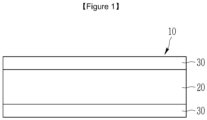
- FIG. 1 is a view showing a separator for a secondary battery according to an embodiment.
- a separator 10 for a secondary battery according to an embodiment includes a porous substrate 20 and a heat-resistant layer 30 disposed on one surface or both surfaces of the porous substrate 20.
- the porous substrate 20 may have a plurality of pore and may generally be a porous substrate used in an electrochemical device.
- the porous substrate 20 may be a polymer film formed of a polymer, or a copolymer or a mixture of two or more selected from polyolefin such as polyethylene, polypropylene, and the like, a polyester such as polyethylene terephthalate, polybutylene terephthalate, and the like, polyacetal, polyamide, polyimide, polycarbonate, polyetheretherketone, polyaryletherketone, polyetherimide, polyamideimide, polybenzimidazole, polyether sulfone, a polyphenylene oxide, a cyclic olefin copolymer, polyphenylene sulfide, polyethylene naphthalate, a glass fiber, Teflon, and polytetrafluoroethylene.
- the porous substrate 20 may be for example a polyolefin-based substrate, and the polyolefin-based substrate may improve has safety of a battery due to its improved shutdown function.
- the polyolefin-based substrate may be for example selected from a polyethylene single film, a polypropylene single film, a polyethylene/polypropylene double film, a polypropylene/polyethylene/polypropylene triple film, and a polyethylene/polypropylene/polyethylene triple film.
- the polyolefin-based resin may include a non-olefin resin in addition to an olefin resin or a copolymer of olefin and a non-olefin monomer.
- the porous substrate 20 may have a thickness of about 1 ⁇ m to 40 ⁇ m, for example 1 ⁇ m to 30 ⁇ m, 1 ⁇ m to 20 ⁇ m, 5 ⁇ m to 15 ⁇ m, or 10 ⁇ m to 15 ⁇ m.
- the heat-resistant layer 30 includes an acrylic heat-resistant binder, an adhering binder, and a filler.
- the acrylic heat-resistant binder includes a structural unit derived from (meth)acrylate or (meth)acrylic acid, a cyano group-containing structural unit, and a sulfonate group-containing structural unit.
- the acrylic heat-resistant binder may play a role of fixing the filler on the porous substrate 20, and may simultaneously provide an adhesion force to adhere the heat-resistant layer 30 on the porous substrate 20 and the electrode, and may contribute improvement of heat resistance, air permeability, and oxidation resistance of the separator 10.
- the (meth)acrylate may be a conjugate base of a (meth)acrylic acid, a (meth)acrylate salt, or a derivative thereof.
- the structural unit derived from (meth)acrylate or (meth)acrylic acid may be for example represented by Chemical Formula 1, Chemical Formula 2, Chemical Formula 3, or a combination thereof.
- the alkali metal may be for example lithium, sodium, potassium, rubidium, or cesium.
- the structural unit derived from (meth)acrylate or (meth)acrylic acid may be included in an amount of 10 mol% to 70 mol%, for example 20 mol% to 60 mol%, for example 30 mol% to 60 mol%, for example 40 mol% to 55 mol% based on a total amount of the acrylic heat-resistant binder.
- the acrylic heat-resistant binder and separator 10 including the same may exhibit excellent adherence, heat resistance, air permeability, and oxidation resistance.
- the structural unit derived from (meth)acrylate or (meth)acrylic acid may include a structural unit represented by Chemical Formula 2 and a structural unit represented by Chemical Formula 3 and the structural unit represented by Chemical Formula 2 and the structural unit represented by Chemical Formula 3 may be included in a mole ratio of 10:1 to 1:2, 10:1 to 1:1, or 5:1 to 1:1.
- the cyano group-containing structural unit may be for example represented by Chemical Formula 4.
- the cyano group-containing structural unit may be for example a structural unit derived from (meth)acrylonitrile, alkenenitrile, cyanoalkyl(meth)acrylate, or 2-(vinyloxy)alkanenitrile.
- the alkene may be C1 to C20 alkene, C1 to C10 alkene, or C1 to C6 alkene
- the alkyl may be C1 to C20 alkyl, C1 to C10 alkyl, or C1 to C6 alkyl
- the alkane may be C1 to C20 alkane, C1 to C10 alkane, or C1 to C6 alkane.
- the alkene nitrile may be for example allyl cyanide, 4-pentene nitrile, 3- pentene nitrile, 2-pentene nitrile, or 5-hexene nitrile, and the like.
- the cyanoalkyl(meth)acrylate may be for example cyanomethyl(meth)acrylate, cyanoethyl(meth)acrylate, cyanopropyl(meth)acrylate, or cyanooctyl(meth)acrylate.
- the 2-(vinyloxy)alkanenitrile may be for example 2-(vinyloxy)ethane nitrile, or 2-(vinyloxy)propane nitrile.
- the cyano group-containing structural unit may be included in an amount of 30 mol% to 85 mol%, for example 30 mol% to 70 mol%, for example 30 mol% to 60 mol%, for example 35 mol% to 55 mol% based on a total amount of the acrylic heat-resistant binder.
- the acrylic heat-resistant binder and the separator 10 including the same may ensure excellent oxidation resistance and exhibit adherence, heat resistance, and air permeability.
- the sulfonate group-containing structural unit may be a structural unit including a conjugate base of a sulfonic acid, a sulfonate salt, a sulfonic acid, or a derivative thereof.
- the sulfonate group-containing structural unit may be represented by Chemical Formula 5, Chemical Formula 6, Chemical Formula 7, or a combination thereof.
- M' is an alkali metal.
- the sulfonate group-containing structural unit may include one of a structural unit represented by Chemical Formula 5, a structural unit represented by Chemical Formula 6, and a structural unit represented by Chemical Formula 7 or two or more thereof.
- the sulfonate group-containing structural unit may include a structural unit represented by Chemical Formula 6 or for another example the sulfonate group-containing structural unit may include a structural unit represented by Chemical Formula 6 and a structural unit represented by Chemical Formula 7.
- the sulfonate group-containing structural unit may be for example a unit derived from vinyl sulfonic acid, allyl sulfonic acid, styrene sulfonic acid, anethole sulfonic acid, acryl amidoalkane sulfonic acid, sulfoalkyl (meth)acrylate, or a salt thereof.
- the alkane may be C1 to C20 alkane, C1 to C10 alkane, or C1 to C6 alkane and the alkyl may be C1 to C20 alkyl, C1 to C10 alkyl, or C1 to C6 alkyl.
- the salt refers to a salt consisting of the sulfonic acid and an appropriate ion.
- the ion may be for example an alkali metal ion and in this case, the salt may be an alkali metal sulfonate salt.
- the acryl amidoalkane sulfonic acid may be for example 2-acrylamido-2-methylpropane sulfonic acid and the sulfoalkyl (meth)acrylate may be for example 2-sulfoethyl (meth)acrylate, 3-sulfopropyl (meth)acrylate, and the like.
- the sulfonate group-containing structural unit may be included in an amount of 0.1 mol% to 20 mol%, for example 0.1 mol% to 10 mol%, for example 1 mol% to 20 mol%, for example 1 mol% to 10 mol% based on the acrylic heat-resistant binder.
- the acrylic heat-resistant binder and the separator 10 including the same may exhibit improved adherence, heat resistance, air permeability, and oxidation resistance.
- the acrylic heat-resistant binder may include an alkali metal.
- the alkali metal may be present in a cation state and may be for example lithium, sodium, potassium, rubidium, or cesium.
- the alkali metal may be bound to the acrylic heat-resistant binder and may be present in a form of a salt.
- the alkali metal may assist a synthesis of the acrylic heat-resistant binder in aqueous solvents, improve adherence of the heat-resistant layer 30, and improve heat resistance, air permeability, and oxidation resistance of the separator 10.
- the alkali metal may be included in an amount of 1 wt% to 40 wt%, for example 1 wt% to 30 wt%, or 1 wt% to 20 wt%, or 10 wt% to 20 wt% based on a total weight of the alkali metal and the acrylic heat-resistant binder.
- the acrylic heat-resistant binder and the alkali metal may be included in a weight ratio of 99:1 to 60:40, a weight ratio of 99:1 to 70:30, for example a weight ratio of 99:1 to 80:20, for example a weight ratio of 90:10 to 80:20.
- the alkali metal may be included in an amount of 0.1 mol% to 1.0 mol% based on a total amount of the alkali metal and the acrylic heat-resistant binder.
- the heat-resistant layer 30 may have improved adherence and the separator 10 including the same may exhibit excellent heat resistance, air permeability, and oxidation resistance.
- the acrylic heat-resistant binder may be represented by Chemical Formula 8.
- 0.1 ⁇ (k+l) ⁇ 0.5, 0.4 ⁇ m ⁇ 0.85, and 0.001 ⁇ n ⁇ 0.2 for example 0.1 ⁇ k ⁇ 0.5 and 0 ⁇ l ⁇ 0.25.
- L 6 may be a C1 to C10 alkylene group
- a substitution degree of the alkali metal (M + ) may be about 0.5 to about 1.0, for example about 0.6 to about 0.9, or about 0.7 to about 0.9 relative to (k+n).
- the acrylic heat-resistant binder and the separator 10 including the same may exhibit excellent adherence and heat resistance, and oxidation resistance.
- the acrylic heat-resistant binder may further include other structural units in addition to the aforementioned structural units.
- the acrylic heat-resistant binder may further include a structural unit derived from alkyl(meth)acrylate, a structural unit derived from a diene-based monomer, a structural unit derived from a styrene-based monomer, an ester group-containing structural unit, a carbonate group-containing structural unit, or a combination thereof.
- the acrylic heat-resistant binder may have various forms, that is, an alternate polymer where the structural units are alternately distributed, a random polymer the units are randomly distributed, or a graft polymer where a portion of structural units is grafted.
- a weight average molecular weight of the acrylic heat-resistant binder may be 200,000 g/mol to 700,000 g/mol, for example 200,000 g/mol to 600,000 g/mol, for example 300,000 g/mol to 600,000 g/mol.
- the acrylic heat-resistant binder and the separator 10 including the same may exhibit excellent adherence, heat resistance, air permeability, and oxidation resistance.
- the weight average molecular weight is polystyrene-reduced average molecular weight measured by gel permeation chromatography.
- a glass transition temperature of the acrylic heat-resistant binder may be 200 °C to 280 °C, for example 210 °C to 270 °C, for example 210 °C to 260 °C.
- the acrylic heat-resistant binder and the separator 10 including the same may exhibit excellent adherence, heat resistance, air permeability, and oxidation resistance.
- the glass transition temperature is measured by differential scanning calorimetry.
- the acrylic heat-resistant binder may be prepared by a solution polymerization method and formed into a film as described above and thus included in the heat-resistant layer 30.
- the adhering binder is water soluble and may be a copolymer including a structural unit including a structural unit including hydroxyl group, a structural unit including an acetate group, and a structural unit including an alkali metal.
- the structural unit including the hydroxyl group may be a structural unit derived from polyvinyl alcohol or a derivative of polyvinyl alcohol, and for example the adhering binder may be a binder including modified polyvinyl alcohol including acrylic acid.
- the structural unit including the acetate group may be a structural unit derived from polyvinyl acetate or a structural unit derived from a derivative of polyvinyl acetate.
- the structural unit including the alkali metal may be a structural unit derived from an alkali metal bound to a (meth)acrylate salt or a derivative of (meth)acrylate salt, which is represented by Chemical Formula 2.
- the alkali metal may be for example lithium, sodium, potassium, rubidium, or cesium and as in the Chemical Formula 2 or Chemical Formula 9 described later, the alkali metal may be present in a cation form in the structural unit or the copolymer.
- the adhering binder may be represented by Chemical Formula 9.
- the mole ratio of the o, p, and q is the within the ranges, an appropriate viscosity is maintained, it is easy to be processed, and excellent solubility for water may not only be obtained, but a polymerization degree may also be increased.
- the aforementioned acrylic heat-resistant binder functions for securing heat resistance in order to reduce a thermal shrinkage rate of the separator at a high temperature
- the adhering binder functions for securing adherence between the porous substrate 20 and the heat-resistant layer 30.
- the heat resistance and the adherence are properties having a trade-off relationship
- the acrylic heat-resistant binder forms an acryl-based terpolymer and simultaneously, further includes the adhering binder and thus may realize a separator having excellent heat resistance and adherence to a substrate.
- a weight average molecular weight of the adhering binder may be 50,000 g/mol to 1,000,000 g/mol, for example 150,000 g/mol to 750,000 g/mol, for example 250,000 g/mol to 450,000 g/mol.
- the adhering binder and the separator 10 including the same may exhibit excellent adherence, heat resistance, air permeability, and oxidation resistance.
- the weight average molecular weight is polystyrene-reduced average molecular weight measured by gel permeation chromatography.
- the acrylic heat-resistant binder and the adhering binder may be included in a weight ratio of 2:8 to 8:2, for example 5:5 to 8:2, for example 6:4 to 8:2.
- the separator 10 may exhibit excellent heat resistance, adherence, air permeability, and oxidation resistance.
- the heat-resistant layer 30 may include a filler in addition to the acrylic heat-resistant binder and the adhering binder.
- the filler may further increase heat resistance and may prevent abrupt shrinkage or deformation of a separator due to increase of a temperature.
- the filler may be for example an inorganic filler, an organic filler, an organic/inorganic filler, or a combination thereof.
- the inorganic filler may be a ceramic material capable of improving heat resistance, for example a metal oxide, a semi-metal oxide, a metal fluoride, a metal hydroxide, or a combination thereof.
- the inorganic filler may be for example Al 2 O 3 , SiO 2 , TiO 2 , SnO 2 , CeO 2 , MgO, NiO, CaO, GaO, ZnO, ZrO 2 , Y 2 O 3 , SrTiOs, BaTiOs, Mg(OH) 2 , boehmite, or a combination thereof, but is not limited thereto.
- the organic filler may include an acrylic compound, an imide compound, an amide compound, or a combination thereof, but is not limited thereto.
- the organic filler may have a core-shell structure, but is not limited thereto.
- the filler may have a spherical shape, sheet-shape, cubic-shape, or amorphous shape.
- An average particle diameter of the filler may range about 1 nm to 2500 nm, within the range 100 nm to 2000 nm, or 200 nm to 1000 nm, for example about 300 nm to 800 nm.
- the average particle diameter of the filler may be particle size (D 50 ) at a volume ratio of 50 % in a cumulative size-distribution curve.
- the heat-resistant layer 30 may have an appropriate strength, and the separator 10 may have improved heat resistance, durability, and stability.
- the filler may be used by mixing two or more different types of fillers or two or more fillers having different sizes.
- the filler may be included in amount of 50 wt% to 99 wt%, for example 70 wt% to 99 wt%, for example 75 wt% to 99 wt%, for example 80 wt% to 99 wt%, for example 85 wt% to 99 wt%, for example 90 wt% to 99 wt%, for example 95 wt% to 99 wt% based on a total amount of the heat-resistant layer 30.
- the separator 10 for a secondary battery may exhibit excellent heat resistance, durability, oxidation resistance, and stability. If the filler is not included within the content range, the thermal shrinkage rate of separator 10 may be significantly decreased.
- the heat-resistant layer 30 may further include a non-cross-linkable binder in addition to the first acryl-based binder and the adhering binder.
- the non-cross-linkable binder may be for example a vinylidene fluoride-based polymer, polymethylmethacrylate, polyacrylonitrile, polyvinyl pyrrolidone, polyvinyl acetate, a polyethylene-vinyl acetate copolymer, polyethylene oxide, cellulose acetate, cellulose acetate butyrate, cellulose acetate propionate, cyanoethyl pullulan, cyanoethyl polyvinyl alcohol, cyanoethyl cellulose, cyanoethyl sucrose, pullulan, carboxylmethyl cellulose, an acrylonitrile-styrene-butadiene copolymer, or a combination thereof, but is not limited thereto.
- the vinylidene fluoride-based polymer may be specifically a homopolymer including only vinylidene fluoride monomer-derived structural unit or a copolymer of a vinylidene fluoride-derived structural unit and other monomer-derived structural units.
- the copolymer may specifically include a vinylidene fluoride-derived structural unit and at least one of structural units derived from chlorotrifluoroethylene, trifluoroethylene, hexafluoropropylene, ethylene tetrafluoride and ethylene monomers, but is not limited thereto.
- the copolymer may be a polyvinylidene fluoride-hexafluoropropylene (PVdF-HFP) copolymer including a vinylidene fluoride monomer-derived structural unit and a hexafluoropropylene monomer-derived structural unit.
- PVdF-HFP polyvinylidene fluoride-hexafluoropropylene
- the non-cross-linkable binder may be a polyvinylidene fluoride (PVdF) homopolymer, a polyvinylidene fluoride-hexafluoropropylene (PVdF-HFP) copolymer, or a combination thereof.
- PVdF polyvinylidene fluoride
- PVdF-HFP polyvinylidene fluoride-hexafluoropropylene copolymer
- the heat-resistant layer 30 may have a thickness of about 0.01 ⁇ m to 20 ⁇ m, within the range, about 1 ⁇ m to 10 ⁇ m, or about 1 ⁇ m to 5 ⁇ m, or about 1 ⁇ m to 3 ⁇ m.
- a ratio of a thickness of the heat-resistant layer 30 relative to a thickness of the porous substrate 20 may be 0.05 to 0.5, for example 0.05 to 0.4, or 0.05 to 0.3, or 0.1 to 0.2.
- the separator 10 including them may exhibit excellent air permeability, heat resistance, and adherence.
- the separator 10 for a secondary battery has excellent heat resistance.
- the separator 10 may have a thermal shrinkage rate of less than or equal to 30 %, for example less than or equal to 10 %.
- each thermal shrinkage rate of the separator 10 may be less than or equal to 30 %, for example less than or equal to 10 % in a machine direction (MD) and in a traverse direction (TD).
- the separator 10 when the heat-resistant layer 30 is thick, a thermal shrinkage rate at a high temperature may be lowered.
- the separator 10 may realize a thermal shrinkage rate at a high temperature of less than or equal to 30 %, for example less than or equal to 10 % even if a thickness of the heat-resistant layer 30 is 1 ⁇ m to 5 ⁇ m, or 1 ⁇ m to 3 ⁇ m.
- the separator 10 for a secondary battery according to an embodiment is not broken or deformed and its shape is stably maintained at a high temperature of greater than or equal to 200 °C, for example 200 °C to 250 °C.
- the separator 10 for a secondary battery may exhibit excellent air permeability, and specifically less than 200 sec/100 cc, for example less than or equal to 190 sec/100 cc, or less than or equal to 180 sec/100 cc.
- the air permeability may be less than 40 sec/100cc ⁇ 1 ⁇ m per unit thickness, for example less than or equal to 30 sec/100cc ⁇ 1 ⁇ m per unit thickness, or less than or equal to 25 sec/100 cc1 ⁇ m per unit thickness.
- the air permeability refers to a time (seconds) until 100 cc of air passes through a unit thickness of the separator.
- the air permeability per unit thickness may be obtained by measuring air permeability with a respect to the entire thickness of the separator and then, dividing the air permeability by the thickness.
- the separator 10 for a secondary battery may be manufactured by known various methods.
- the separator 10 for a secondary battery may be formed by coating a composition for forming a heat-resistant layer and drying the same on one surface or both surfaces of the porous substrate 20.
- the composition for forming the heat-resistant layer may include the aforementioned acrylic heat-resistant binder, adhering binder, and filler and a solvent.
- the solvent is not particularly limited if the solvent may dissolve or disperse the acrylic heat-resistant binder, adhering binder, and filler.
- the solvent may be an aqueous solvent including water, an alcohol, or a combination thereof, which is environmentally-friendly.
- the coating may be, for example a spin coating, a dip coating, a bar coating, a die coating, a slit coating, a roll coating, an inkjet printing, and the like, but is not limited thereto.
- the drying may be for example performed through natural drying, drying with warm air, hot air, or low humid air, vacuum-drying, or radiation of a far-infrared ray, an electron beam, and the like, but the present disclosure is not limited thereto.
- the drying may be for example performed at a temperature of 25 °C to 120 °C.
- the separator 10 for a secondary battery may be manufactured by lamination, coextrusion, and the like in addition to the above method.
- a lithium secondary battery may be classified into a lithium ion battery, a lithium ion polymer battery, and a lithium polymer battery depending on kinds of a separator and an electrolyte. It also may be classified to be cylindrical, prismatic, coin-type, pouch-type, and the like depending on a shape. In addition, it may be bulk type and thin film type depending on sizes. Structures and manufacturing methods for these batteries pertaining to this disclosure are well known in the art.
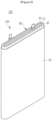
- FIG. 2 is an exploded perspective view showing a lithium secondary battery according to an embodiment.
- a lithium secondary battery 100 according to an embodiment includes an electrode assembly 60 manufactured by interposing a separator 10 between a positive electrode 40 and a negative electrode 50 and winding them, and a case 70 housing the electrode assembly 60.
- the electrode assembly 60 may have for example a jelly-roll shape formed by winding the positive electrode 40, the negative electrode 50, and the separator 10 disposed therebetween.
- the positive electrode 40, the negative electrode 50, and the separator 10 are impregnated in an electrolyte solution (not shown).
- the positive electrode 40 includes a positive current collector and a positive active material layer formed on the positive current collector.
- the positive active material layer includes a positive active material, a binder, and optionally a conductive material.
- the positive current collector may use aluminum, nickel, and the like, but is not limited thereto.
- the positive active material may use a compound being capable of intercalating and deintercalating lithium.
- a composite oxide or a composite phosphate of a metal selected from cobalt, manganese, nickel, aluminum, iron, or a combination thereof and lithium may be used.
- the positive active material may be a lithium cobalt oxide, a lithium nickel oxide, a lithium manganese oxide, a lithium nickel cobalt manganese oxide, a lithium nickel cobalt aluminum oxide, a lithium iron phosphate, or a combination thereof.
- the binder improves binding properties of positive active material particles with one another and with a current collector
- specific examples may be polyvinyl alcohol, carboxylmethyl cellulose, hydroxypropyl cellulose, diacetyl cellulose, polyvinylchloride, carboxylated polyvinylchloride, polyvinylfluoride, an ethylene oxide-containing polymer, polyvinylpyrrolidone, polyurethane, polytetrafluoroethylene, polyvinylidene fluoride, polyethylene, polypropylene, a styrene-butadiene rubber, an acrylated styrene-butadiene rubber, an epoxy resin, nylon, and the like, but are not limited thereto. These may be used alone or as a mixture of two or more.
- the conductive material improves conductivity of an electrode.
- Examples thereof may be natural graphite, artificial graphite, carbon black, a carbon fiber, a metal powder, a metal fiber, and the like, but are not limited thereto. These may be used alone or as a mixture of two or more.
- the metal powder and the metal fiber may use a metal of copper, nickel, aluminum, silver, and the like.
- the negative electrode 50 includes a negative current collector and a negative active material layer formed on the negative current collector.
- the negative current collector may use copper, gold, nickel, a copper alloy, and the like, but is not limited thereto.
- the negative active material layer may include a negative active material, a binder, and optionally a conductive material.
- the negative active material may be a material that reversibly intercalates/deintercalates lithium ions, a lithium metal, a lithium metal alloy, a material being capable of doping and dedoping lithium, a transition metal oxide, or a combination thereof.
- the material that reversibly intercalates/deintercalates lithium ions may be a carbon material which is any generally-used carbon-based negative active material, and examples thereof may be crystalline carbon, amorphous carbon, or a combination thereof.
- the crystalline carbon may be graphite such as amorphous, sheet-shape, flake, spherical shape or fiber-shaped natural graphite or artificial graphite.
- the amorphous carbon may be soft carbon or hard carbon, a mesophase pitch carbonized product, fired coke, and the like.
- the lithium metal alloy may be an alloy of lithium and a metal selected from Na, K, Rb, Cs, Fr, Be, Mg, Ca, Sr, Si, Sb, Pb, In, Zn, Ba, Ra, Ge, Al, and Sn.
- the material being capable of doping and dedoping lithium may be Si, SiO x (0 ⁇ x ⁇ 2), a Si-C composite, a Si-Y alloy, Sn, SnO 2 , a Sn-C composite, a Sn-Y alloy, and the like, and at least one of these may be mixed with SiO 2 .
- the element Y may be selected from Mg, Ca, Sr, Ba, Ra, Sc, Y, Ti, Zr, Hf, Rf, V, Nb, Ta, Db, Cr, Mo, W, Sg, Tc, Re, Bh, Fe, Pb, Ru, Os, Hs, Rh, Ir, Pd, Pt, Cu, Ag, Au, Zn, Cd, B, Al, Ga, Sn, In, TI, Ge, P, As, Sb, Bi, S, Se, Te, Po, and a combination thereof.
- the transition metal oxide may be vanadium oxide, lithium vanadium oxide, and the like.
- the binder and the conductive material used in the negative electrode 50 may be the same as the binder and conductive material of the positive electrode 40.
- the positive electrode 40 and the negative electrode 50 may be manufactured by mixing each active material composition including each active material and a binder, and optionally a conductive material in a solvent, and coating the active material composition on each current collector.
- the solvent may be N-methylpyrrolidone, and the like, but is not limited thereto.
- the electrode manufacturing method is well known, and thus is not described in detail in the present specification.
- the electrolyte solution includes an organic solvent a lithium salt.
- the organic solvent serves as a medium for transmitting ions taking part in the electrochemical reaction of a battery.
- Specific examples thereof may be selected from a carbonate-based solvent, an ester-based solvent, an ether-based solvent, a ketone-based solvent, an alcohol-based solvent, and an aprotic solvent.
- the carbonate-based solvent may be dimethylcarbonate, diethylcarbonate, dipropylcarbonate, methylpropylcarbonate, ethylpropylcarbonate, methylethylcarbonate, ethylenecarbonate, propylenecarbonate, butylenecarbonate, and the like
- the ester-based solvent may be methylacetate, ethylacetate, n-propylacetate, 1,1-dimethylethylacetate, methylpropionate, ethyl propionate, ⁇ -butyrolactone, decanolide, valerolactone, mevalonolactone, caprolactone, and the like.
- the ether-based solvent may be dibutyl ether, tetraglyme, diglyme, dimethoxyethane, 2-methyltetrahydrofuran, tetrahydrofuran, and the like, and the ketone-based solvent may be cyclohexanone, and the like.
- the alcohol-based solvent may be ethanol, isopropyl alcohol, and the like
- the aprotic solvent may be nitriles such as R-CN (R is a C2 to C20 linear or branched or cyclic hydrocarbon group, a double bond, an aromatic ring, or an ether bond), and the like, amides such as dimethyl formamide, dioxolanes such as 1,3-dioxolane, sulfolanes, and the like.
- the organic solvent may be used alone or in a mixture of two or more, and when the organic solvent is used in a mixture of two or more, the mixture ratio may be controlled in accordance with a desirable cell performance.
- the lithium salt is dissolved in an organic solvent, supplies lithium ions in a battery, basically operates the lithium secondary battery, and improves lithium ion transportation between positive and negative electrodes therein.
- the lithium salt may include LiPF 6 , LiBF 4 , LiSbF 6 , LiAsF 6 , LiN(SO 3 C 2 F 5 ) 2 , LiN(CF 3 SO 2 ) 2 , LiC 4 F 9 SO 3 , LiClO 4 , LiAlO 2 , LiAlCl 4 , LiN(C x' F 2x'+1 SO 2 )(C y' F 2y'+1 SO 2 ) (x' and y' are natural numbers), LiCI, Lil, LiB(C 2 O 4 ) 2 , or a combination thereof, but is not limited thereto.
- the lithium salt may be used in a concentration ranging from 0.1 M to 2.0 M.
- an electrolyte may have excellent performance and lithium ion mobility due to optimal electrolyte conductivity and viscosity.
- Distilled water (968 g), acrylic acid (45.00 g, 0.62 mol), ammonium persulfate (0.54 g, 2.39 mmol, 1500 ppm based on monomers), 2-acrylamido-2-methylpropane sulfonic acid (5.00 g, 0.02 mol), and a 5 N sodium hydroxide aqueous solution (0.8 equivalent based on a total amount of the acrylic acid and the 2-acrylamido-2-methylpropane sulfonic acid) were put in a 3 L four-necked flask equipped with a stirrer, a thermometer, and a condensing tube, and after three times repetitively reducing an internal pressure in the flask into 10 mmHg with a diaphragm pump and recovering it into a normal pressure with nitrogen, acrylonitrile (50.00 g, 0.94 mol) was added thereto.
- the reaction solution was controlled to have a stable temperature in a range of 65 °C to 70 °C and reacted for 18 hours, ammonium persulfate (0.23 g, 1.00 mmol, 630 ppm based on a monomer) was secondarily added thereto, and the obtained mixture was heated up to 80 °C and reacted again for 4 hours. After cooling the temperature down to room temperature, the reaction solution was adjusted to have pH in a range of 7 to 8 by using a 25 % ammonia aqueous solution.
- a poly(acrylic acid-co-acrylonitrile-co-2-acrylamido-2-methylpropane sulfonic acid) sodium salt was prepared in this method.
- the acrylic acid, the acrylonitrile, and the 2-acrylamido-2-methylpropane sulfonic acid were used in a mole ratio of 39:59:2.
- About 10 mL of the reaction solution (a reaction product) was taken to measure a non-volatile component, and the result was 9.0 wt% (a theoretical value: 10 %).
- An acryl-based copolymer was manufactured according to the same method as Synthesis Example 1 except for using acrylic acid (40 g, 0.56 mol), acrylonitrile (50 g, 0.94 mol), and 2-acrylamido-2-methylpropane sulfonic acid (10 g, 0.05 mol).
- the acrylic acid, the acrylonitrile, and the 2-acrylamido-2-methylpropane sulfonic acid were used in a mole ratio of 36:61:3.
- a non-volatile component of the reaction solution was 9.0 wt% (a theoretical value: 10 %).
- An acryl-based copolymer was manufactured according to the same method as Synthesis Example 1 except for using acrylic acid (35 g, 0.49 mol), acrylo nitrile (50 g, 0.94 mol), and 2-acrylamido-2-methylpropane sulfonic acid (15 g, 0.07 mol).
- the acrylic acid, the acrylonitrile, and the 2-acrylamido-2-methylpropane sulfonic acid were used in a mole ratio of 32:63:5.
- a non-volatile component of the reaction solution was 9.0 wt% (a theoretical value: 10 %).
- An acryl-based copolymer was manufactured according to the same method as Synthesis Example 1 except for using acrylic acid (30 g, 0.42 mol), acrylonitrile (50 g, 0.94 mol), and 2-acrylamido-2-methylpropane sulfonic acid (20 g, 0.10 mol).
- the acrylic acid, the acrylonitrile, and the 2-acrylamido-2-methylpropane sulfonic acid were used in a mole ratio of 28:65:7.
- a non-volatile component of the reaction solution was 9.0 wt% (a theoretical value: 10 %).
- An acryl-based copolymer was manufactured according to the same method as Synthesis Example 1 except for using acrylic acid (32 g, 0.49 mol), acrylonitrile (60 g, 1.13 mol), and 2-acrylamido-2-methylpropane sulfonic acid (5 g, 0.02 mol).
- the acrylic acid, the acrylonitrile, and the 2-acrylamido-2-methylpropane sulfonic acid were used in a mole ratio of 30:69:1.
- a non-volatile component of the reaction solution was 9.0 wt% (a theoretical value: 10 %).
- An acryl-based copolymer was manufactured according to the same method as Synthesis Example 1 except for using acrylic acid (30 g, 0.42 mol), acrylonitrile (60 g, 1.13 mol), and 2-acrylamido-2-methylpropane sulfonic acid (10 g, 0.05 mol).
- the acrylic acid, the acrylonitrile, and the 2-acrylamido-2-methylpropane sulfonic acid were used in a mole ratio of 26:71:3.
- a non-volatile component of the reaction solution was 9.0 wt% (a theoretical value: 10 %).
- An acryl-based copolymer was manufactured according to the same method as Synthesis Example 1 except for using acrylic acid (25 g, 0.35 mol), acrylonitrile (60 g, 1.13 mol), and 2-acrylamido-2-methylpropane sulfonic acid (15 g, 0.07 mol).
- the acrylic acid, the acrylonitrile, and the 2-acrylamido-2-methylpropane sulfonic acid were used in a mole ratio of 22:73:5.
- a non-volatile component of the reaction solution was 9.0 wt% (a theoretical value: 10 %).
- An acryl-based copolymer was manufactured according to the same method as Synthesis Example 1 except for using acrylic acid (20 g, 0.28 mol), acrylonitrile (60 g, 1.13 mol), and 2-acrylamido-2-methylpropane sulfonic acid (20 g, 0.10 mol).
- the acrylic acid, the acrylonitrile, and the 2-acrylamido-2-methylpropane sulfonic acid were used in a mole ratio of 18:75:7.
- a non-volatile component of the reaction solution was 9.0 wt% (a theoretical value: 10 %).
- Distilled water (1000 g), acrylic acid (36.03 g, 0.50 mol), and ammonium persulfate (0.54 g, 2.49 mmol, 500 ppm relative to a monomer) were put in a 3 L four-necked flask equipped with a stirrer, a thermometer, and a condensing tube, and vinyl acetate (172.18 g, 2.00 mol) and Dowfax2A1 (2 g) as an anion emulsifier were added thereto, and nitrogen was internally filled in the reactor.
- the reaction solution was reacted for 12 hours, while controlled to have a stable temperature in a range of 65 °C to 70 °C.
- the reaction solution was cooled down to room temperature, and a coagulant was added thereto to obtain a solid.
- the obtained solid was dissolved in methanol (2 L) in a 3 L four-necked flask equipped with a stirrer, a thermometer, and a condensing tube, sodium hydroxide (100 g, 2.5 mol) was added to the solution, and nitrogen was filled inside the reactor.
- reaction solution was reacted for 2 hours, while controlled to have a stable temperature in a range of 40 °C to 45 °C.
- the extracted solid was filtered and five times washed with methanol to obtain 190 g of a solid.
- An acryl-based copolymer was manufactured according to the same method as Synthesis Example 1-1 except that acrylic acid (50 g, 0.69 mol) and acrylonitrile (50 g, 0.94 mol) were used and 2-acrylamido-2-methylpropane sulfonic acid was not used.
- the acrylic acid and the acrylonitrile were used in a mole ratio of 42:58.
- a non-volatile component of the reaction solution was 9.0 wt% (theoretical value: 10 %).
- An acryl-based copolymer was manufactured according to the same method as Synthesis Example 1 except for acrylic acid (50 g, 0.69 mol) and 2-acrylamido-2-methylpropane sulfonic acid (50 g, 0.24 mol) were used and acrylonitrile was not used.
- the acrylic acid and the acrylamido-2-methylpropane sulfonic acid were used in a mole ratio of 74:26.
- a non-volatile component of the reaction solution was 9.0 wt% (theoretical value: 10%).
- Table 1 shows mole ratios, weight average molecular weights, and glass transition temperatures of monomers of each acryl-based copolymer according to Synthesis Examples 1-1 to 1-8 and Comparative Synthesis Examples 1 to 2.
- Table 1 Mole ratio of monomers Weight average molecular weight (g/mol) Glass transition temperature (°C) AA AN AMPS Synthesis Example 1-1 39 59 2 310,000 280 Synthesis Example 1-2 36 61 3 302,000 277 Synthesis Example 1-3 32 63 5 304,000 275 Synthesis Example 1-4 28 65 7 311,000 271 Synthesis Example 1-5 30 69 1 285,000 265 Synthesis Example 1-6 26 71 3 298,000 263 Synthesis Example 1-7 22 73 5 305,000 232 Synthesis Example 1-8 18 75 7 314,000 260 Comparative Synthesis Example 1 42 58 - 320,000 278 Comparative Synthesis Example 2 74 - 26 293,000 305
- AA acrylic acid
- AN indicates acrylonitrile
- AMPS 2-acrylamido-2-methylpropane sulfonic acid.
- the glass transition temperature was measured through a differential scanning calorimetry analysis.
- a composition for forming a heat-resistant layer was prepared by adding a binder obtained by mixing the acrylic heat-resistant binder (10 wt% in distilled water) according to Synthesis Example 1-1 and the adhering binder (a weight average molecular weight: 300,000 g/mol, a glass transition temperature: greater than or equal to 300°C) according to Synthesis Example 2 in a mass ratio of 9 : 1, and boehmite (an average particle diameter: 600 nm, AOH60, Nabaltec) in a mass ratio of 1:30 to water as a solvent, milling the obtained mixture with a beads mill at 25°C for 30 minutes, and adding water thereto to have a total solid content of 20 wt%.
- composition was die-coated to be 3 ⁇ m thick respectively on both surfaces of a 12.5 ⁇ m-thick polyethylene porous substrate (permeability: 113 sec/100 cc, puncture strength: 360 kgf, SK) and dried at 70 °C for 10 minutes to manufacture a separator for a secondary battery.
- a separator for a secondary battery was manufactured according to the same method as Example 1 except that the acrylic heat-resistant binder (10 wt% in distilled water) according to Synthesis Example 1-1 and the adhering binder according to Synthesis Example 2 were used in a weight ratio of 7 : 3.
- a separator for a secondary battery was manufactured according to the same method as Example 1 except that the acrylic heat-resistant binder (10 wt% in distilled water) according to Synthesis Example 1-1 and the adhering binder (a weight average molecular weight: 300,000 g/mol, a glass transition temperature: greater than or equal to 300 °C) were used in a weight ratio of 5 : 5.
- a separator for a secondary battery was manufactured according to the same method as Example 1 except that the acrylic heat-resistant binder (10 wt% in distilled water) according to Synthesis Example 1-1 and the adhering binder (a weight average molecular weight: 300,000 g/mol, a glass transition temperature: greater than or equal to 300 °C) were used in a weight ratio of 3 : 7.
- a separator for a secondary battery was manufactured according to the same method as Example 1 except that the acrylic heat-resistant binder (10 wt% in distilled water) according to Synthesis Example 1-1 and the adhering binder (a weight average molecular weight: 300,000 g/mol, a glass transition temperature: greater than or equal to 300 °C) were used in a weight ratio of 1 : 9.
- a separator for a secondary battery was manufactured according to the same method as Example 2 except that the acryl-based polymer according to Synthesis Example 1-2 was used instead of the acryl-based polymer according to Synthesis Example 1-1.
- a separator for a secondary battery was manufactured according to the same method as Example 2 except that the acryl-based polymer according to Synthesis Example 1-3 was used instead of the acryl-based polymer according to Synthesis Example 1-1.
- a separator for a secondary battery was manufactured according to the same method as Example 2 except that the acryl-based polymer according to Synthesis Example 1-4 was used instead of the acryl-based polymer according to Synthesis Example 1-1.
- a separator for a secondary battery was manufactured according to the same method as Example 2 except that the acryl-based polymer according to Synthesis Example 1-5 was used instead of the acryl-based polymer according to Synthesis Example 1-1.
- a separator for a secondary battery was manufactured according to the same method as Example 2 except that the acryl-based polymer according to Synthesis Example 1-6 was used instead of the acryl-based polymer according to Synthesis Example 1-1.
- a separator for a secondary battery was manufactured according to the same method as Example 2 except that the acryl-based polymer according to Synthesis Example 1-7 was used instead of the acryl-based polymer according to Synthesis Example 1-1.
- a separator for a secondary battery was manufactured according to the same method as Example 2 except that the acryl-based polymer according to Synthesis Example 1-8 was used instead of the acryl-based polymer according to Synthesis Example 1-1.
- a composition for forming a heat-resistant layer was prepared by adding the acryl-based polymer (10 wt% in distilled water) according to Synthesis Example 1-1 and boehmite (an average particle diameter: 600 nm, AOH60, Nabaltec) in a mass ratio of 1:30 to a water solvent, milling the obtained mixture with a beads mill at 25°C for 30 minutes, and adding water thereto to have a total solid content of 20 wt%.
- the composition for forming the heat-resistant layer was die-coated to be 3 ⁇ m thick on the cross section of a 12.5 ⁇ m-thick polyethylene porous substrate (permeability: 113 sec/100 cc, piercing strength: 360 kgf, SK) and then, dried at 70 °C for 10 minutes to manufacture a separator for a secondary battery.
- a separator for a secondary battery was manufactured according to the same method as Example 2 except that the acryl-based polymer of Comparative Synthesis Example 1 instead of the acryl-based polymer of Synthesis Example 1-1 was used.
- a separator for a secondary battery was manufactured according to the same method as Example 2 except that the acryl-based polymer of Comparative Synthesis Example 2 instead of the acryl-based polymer of Synthesis Example 1-1 was used.
- the separators for a secondary battery according to Example 1 to Example 12 and Comparative Example 1 to Comparative Example 3 were respectively cut into a size of 8 cm ⁇ 8 cm to prepare samples.
- the samples after drawing a 5 cm ⁇ 5 cm-size quadrangle on the surface were inserted between paper or alumina powder, allowed to stand at 150°C in an oven for 1 hour, and taken out of the oven, and each shrinkage rate between machine direction (MD) and in a traverse direction (TD) was calculated by measuring sides of the quadrangles drawn on the samples.
- MD machine direction
- TD traverse direction
- the separators for a secondary battery according to Examples 1 to 12 and Comparative Examples 1 to 3 were respectively cut into a size of 5 cm ⁇ 5 cm to obtain samples, and then were respectively attached on a cardboard having a 4 cm ⁇ 4 cm-sized hole by using a polyimide film and put in each oven heated up to 200 °C, 230 °C, and 250 °C.
- the separators were taken out of the ovens after 10 minutes to examine whether or not the samples were fractured, when fractured, O was given, while when not fractured, X was given, and the results are shown in Table 2.
- the separators according to Examples 1 to 12 exhibited excellent air permeability of less than or equal to 178 sec/100 cc and a shrinkage rate of less than or equal to 4 % at 150°C, but the separator according to Comparative Examples 1 to 2 exhibited similar air permeability to those of the separators according to Examples 1 to 12 but a deteriorated thermal shrinkage rate or heat resistant fracture as a result of evaluating heat resistance.
Landscapes
- Chemical & Material Sciences (AREA)
- Chemical Kinetics & Catalysis (AREA)
- Electrochemistry (AREA)
- General Chemical & Material Sciences (AREA)
- Engineering & Computer Science (AREA)
- Materials Engineering (AREA)
- Inorganic Chemistry (AREA)
- Manufacturing & Machinery (AREA)
- Organic Chemistry (AREA)
- Wood Science & Technology (AREA)
- Life Sciences & Earth Sciences (AREA)
- Polymers & Plastics (AREA)
- Health & Medical Sciences (AREA)
- Medicinal Chemistry (AREA)
- Composite Materials (AREA)
- Cell Separators (AREA)
Description
- A separator for a secondary battery and a lithium secondary battery including the same are related.
- A separator for an electrochemical battery is an intermediate film that separates a positive electrode and a negative electrode in a battery, and maintains ion conductivity continuously to enable charge and discharge of a battery. When a battery is exposed to a high temperature environment due to abnormal behavior, a separator may be mechanically shrinks or is damaged due to melting characteristics at a low temperature. Herein, the positive and negative electrodes contact each other and may cause an explosion of the battery. In order to overcome this problem, technology of suppressing shrinkage of a separator and ensuring stability is required.
- For example, a method of increasing thermal resistance of the separator by coating the separator with a mixture of inorganic particles having a large thermal resistance and an organic binder having adherence is well known. However, this conventional method may not sufficiently secure desired adherence and not uniformly applied to variously-sized separators. Accordingly, a separator having high heat resistance and excellent adherence needs to be developed.
- A separator for a secondary battery having high heat resistance and strong adherence is provided and a lithium secondary battery has improved heat resistance, stability, cycle-life characteristics, rate capability, oxidation resistance, and the like.
- The invention is as defined in claim 1. A separator for a secondary battery includes a porous substrate and a heat-resistant layer disposed on at least one surface of the porous substrate, wherein the heat-resistant layer includes an acrylic heat-resistant binder, an adhering binder, and a filler. The acrylic heat-resistant binder includes a structural unit derived from (meth)acrylate or (meth)acrylic acid, a cyano group-containing structural unit, and a sulfonate group-containing structural unit and the adhering binder includes a structural unit including a hydroxyl group, a structural unit including an acetate group, and a structural unit including an alkali metal.
- Another aspect pf the present invention as defined in claim 16 refers to a lithium secondary battery includes a positive electrode, a negative electrode, and the beforementioned separator for a secondary battery disposed between the positive electrode and the negative electrode.
- The separator for a secondary battery according to an embodiment has improved heat resistance and adherence, and thus a lithium secondary battery including the same has improved heat resistance, stability, cycle-life characteristics, rate capability, and oxidation resistance.
-
-
FIG. 1 is a cross-sectional view showing a separator for a secondary battery according to an embodiment. -
FIG. 2 is an exploded perspective view showing a lithium secondary battery according to an embodiment. - Hereinafter, embodiments of the present invention are described in detail.
- Hereinafter, as used herein, when a definition is not otherwise provided "substituted" refers to replacement of hydrogen of a compound by a substituent selected from a C1 to C30 alkyl group, a C2 to C30 alkenyl group, a C2 to C30 alkynyl group, a C6 to C30 aryl group, a C7 to C30 alkylaryl group, a C1 to C30 alkoxy group, a C1 to C30 heteroalkyl group, a C3 to C30 heteroalkylaryl group, a C3 to C30 cycloalkyl group, a C3 to C15 cycloalkenyl group, a C6 to C30 cycloalkynyl group, a C2 to C30 heterocycloalkyl group, a halogen (F, Cl, Br, or I), a hydroxy group (-OH), a nitro group (-NO2), a cyano group (-CN), an amino group (-NRR', wherein, wherein R and R' are each independently hydrogen or a C1 to C6 alkyl group), a sulfobetaine group (-RR'N+(CH2)nSO3 -), a carboxyl betaine group (-RR'N+(CH2)nCOO-, wherein, R and R' are each independently a C1 to C20 alkyl group), an azido group (-N3), an amidino group (-C(=NH)NH2), a hydrazino group (-NHNH2), a hydrazono group (=N(NH2), a carbamoyl group (-C(O)NH2), a thiol group (-SH), an acyl group (-C(=O)R, wherein R is hydrogen, a C1 to C6 alkyl group, a C1 to C6 alkoxy group, or a C6 to C12 aryl group), a carboxyl group (-COOH) or a salt thereof (-C(=O)OM, wherein M is an organic or inorganic cation), a sulfonic acid group (-SO3H), or a salt thereof (-SO3M, wherein M is an organic or inorganic cation), a phosphoric acid group (-PO3H2) or a salt thereof (-PO3MH or -PO3M2, wherein M is an organic or inorganic cation), and a combination thereof.
- Hereinafter, a C1 to C3 alkyl group may be a methyl group, an ethyl group, or a propyl group. A C1 to C10 alkylene group may be for example a C1 to C6 alkylene group, a C1 to C5 alkylene group, or a C1 to C3 alkylene group, and may be for example a methylene group, an ethylene group, or a propylene group. A C3 to C20 cycloalkylene group may be for example a C3 to C10 cycloalkylene group, or a C5 to C10 alkylene group, and may be for example a cyclohexylene group. A C6 to C20 arylene group may be for example a C6 to C10 arylene group and may be for example a phenylene group. A C3 to C20 heterocyclic group may be for example a C3 to C10 heterocyclic group and may be for example a pyridine group.
- Hereinafter, "hetero" refers to one including at least one heteroatom selected from N, O, S, Si, and P.
- Hereinafter, "combination thereof' refers to a mixture, a copolymer, a blend, an alloy, a composite, a reaction product of components.
- In addition, in chemical formula, " ∗ " refers to a point of attachment to an atom, a group, or a structural unit that may be the same or different.
- Hereinafter, "an alkali metal" refers to an element of Group 1 of Periodic Table 1, lithium, sodium, potassium, rubidium, cesium, or francium and may be present in a cation state or neutral state.
- Hereinafter, a separator for a secondary battery according to an embodiment is described.
FIG. 1 is a view showing a separator for a secondary battery according to an embodiment. Referring toFIG. 1 , aseparator 10 for a secondary battery according to an embodiment includes aporous substrate 20 and a heat-resistant layer 30 disposed on one surface or both surfaces of theporous substrate 20. - The
porous substrate 20 may have a plurality of pore and may generally be a porous substrate used in an electrochemical device. Non-limiting examples of theporous substrate 20 may be a polymer film formed of a polymer, or a copolymer or a mixture of two or more selected from polyolefin such as polyethylene, polypropylene, and the like, a polyester such as polyethylene terephthalate, polybutylene terephthalate, and the like, polyacetal, polyamide, polyimide, polycarbonate, polyetheretherketone, polyaryletherketone, polyetherimide, polyamideimide, polybenzimidazole, polyether sulfone, a polyphenylene oxide, a cyclic olefin copolymer, polyphenylene sulfide, polyethylene naphthalate, a glass fiber, Teflon, and polytetrafluoroethylene. - The
porous substrate 20 may be for example a polyolefin-based substrate, and the polyolefin-based substrate may improve has safety of a battery due to its improved shutdown function. The polyolefin-based substrate may be for example selected from a polyethylene single film, a polypropylene single film, a polyethylene/polypropylene double film, a polypropylene/polyethylene/polypropylene triple film, and a polyethylene/polypropylene/polyethylene triple film. In addition, the polyolefin-based resin may include a non-olefin resin in addition to an olefin resin or a copolymer of olefin and a non-olefin monomer. - The
porous substrate 20 may have a thickness of about 1 µm to 40 µm, for example 1 µm to 30 µm, 1 µm to 20 µm, 5 µm to 15 µm, or 10 µm to 15 µm. - The heat-
resistant layer 30 includes an acrylic heat-resistant binder, an adhering binder, and a filler. - The acrylic heat-resistant binder includes a structural unit derived from (meth)acrylate or (meth)acrylic acid, a cyano group-containing structural unit, and a sulfonate group-containing structural unit. The acrylic heat-resistant binder may play a role of fixing the filler on the
porous substrate 20, and may simultaneously provide an adhesion force to adhere the heat-resistant layer 30 on theporous substrate 20 and the electrode, and may contribute improvement of heat resistance, air permeability, and oxidation resistance of theseparator 10. - In the structural unit derived from (meth)acrylate or (meth)acrylic acid, the (meth)acrylate may be a conjugate base of a (meth)acrylic acid, a (meth)acrylate salt, or a derivative thereof. The structural unit derived from (meth)acrylate or (meth)acrylic acid may be for example represented by Chemical Formula 1, Chemical Formula 2, Chemical Formula 3, or a combination thereof.

- In Chemical Formula 1 to Chemical Formula 3,
- R1, R2, and R3 are independently hydrogen or a methyl group,
- In Chemical Formula 2,
- M is an alkali metal.
- The alkali metal may be for example lithium, sodium, potassium, rubidium, or cesium.
- The structural unit derived from (meth)acrylate or (meth)acrylic acid may be included in an amount of 10 mol% to 70 mol%, for example 20 mol% to 60 mol%, for example 30 mol% to 60 mol%, for example 40 mol% to 55 mol% based on a total amount of the acrylic heat-resistant binder. When the structural unit derived from (meth) acrylate or (meth) acrylic acid is included in the ranges, the acrylic heat-resistant binder and
separator 10 including the same may exhibit excellent adherence, heat resistance, air permeability, and oxidation resistance. - For example, the structural unit derived from (meth)acrylate or (meth)acrylic acid may include a structural unit represented by Chemical Formula 2 and a structural unit represented by Chemical Formula 3 and the structural unit represented by Chemical Formula 2 and the structural unit represented by Chemical Formula 3 may be included in a mole ratio of 10:1 to 1:2, 10:1 to 1:1, or 5:1 to 1:1.
- The cyano group-containing structural unit may be for example represented by Chemical Formula 4.


- In Chemical Formula 4,
- R4 is hydrogen or a C1 to C3 alkyl group,
- L1 is -C(=O)-, -C(=O)O-, -OC(=O)-, -O-, or-C(=O)NH-,
- x is an integer ranging from 0 to 2,
- L2 is a substituted or unsubstituted C1 to C10 alkylene group, a substituted or unsubstituted C3 to C20 cycloalkylene group, a substituted or unsubstituted C6 to C20 arylene group or a substituted or unsubstituted C3 to C20 heterocyclic group, and
- y is an integer ranging from 0 to 2.
- The cyano group-containing structural unit may be for example a structural unit derived from (meth)acrylonitrile, alkenenitrile, cyanoalkyl(meth)acrylate, or 2-(vinyloxy)alkanenitrile. Herein, the alkene may be C1 to C20 alkene, C1 to C10 alkene, or C1 to C6 alkene, the alkyl may be C1 to C20 alkyl, C1 to C10 alkyl, or C1 to C6 alkyl, and the alkane may be C1 to C20 alkane, C1 to C10 alkane, or C1 to C6 alkane.
- The alkene nitrile may be for example allyl cyanide, 4-pentene nitrile, 3- pentene nitrile, 2-pentene nitrile, or 5-hexene nitrile, and the like. The cyanoalkyl(meth)acrylate may be for example cyanomethyl(meth)acrylate, cyanoethyl(meth)acrylate, cyanopropyl(meth)acrylate, or cyanooctyl(meth)acrylate. The 2-(vinyloxy)alkanenitrile may be for example 2-(vinyloxy)ethane nitrile, or 2-(vinyloxy)propane nitrile.
- The cyano group-containing structural unit may be included in an amount of 30 mol% to 85 mol%, for example 30 mol% to 70 mol%, for example 30 mol% to 60 mol%, for example 35 mol% to 55 mol% based on a total amount of the acrylic heat-resistant binder. When the cyano group-containing structural unit is included within the ranges, the acrylic heat-resistant binder and the
separator 10 including the same may ensure excellent oxidation resistance and exhibit adherence, heat resistance, and air permeability. - The sulfonate group-containing structural unit may be a structural unit including a conjugate base of a sulfonic acid, a sulfonate salt, a sulfonic acid, or a derivative thereof. For example, the sulfonate group-containing structural unit may be represented by Chemical Formula 5, Chemical Formula 6, Chemical Formula 7, or a combination thereof.


- In Chemical Formula 5 to Chemical Formula 7,
- R5, R6, and R7 are each independently hydrogen or a C1 to C3 alkyl group,
- L3, L5, and L7 are each independently -C(=O)-, -C(=O)O-, -OC(=O)-, -O-, or - C(=O)NH-,
- L4, L6, and L8 are each independently substituted or unsubstituted C1 to C10 alkylene group, a substituted or unsubstituted C3 to C20 cycloalkylene group, a substituted or unsubstituted C6 to C20 arylene group, or a substituted or unsubstituted C3 to C20 heterocyclic group,
- a, b, c, d, e, and f are each independently an integer ranging from 0 to 2,
- in Chemical Formula 6,
M' is an alkali metal. - For example, in Chemical Formula 5 to Chemical Formula 7,
- L3, L5, and L7 may each independently be -C(=O)NH-,
- L4, L6, and L8 may each independently be a C1 to C10 alkylene group, and
- a, b, c, d, e, and f may be an integer of 1.
- The sulfonate group-containing structural unit may include one of a structural unit represented by Chemical Formula 5, a structural unit represented by Chemical Formula 6, and a structural unit represented by Chemical Formula 7 or two or more thereof. For example, the sulfonate group-containing structural unit may include a structural unit represented by Chemical Formula 6 or for another example the sulfonate group-containing structural unit may include a structural unit represented by Chemical Formula 6 and a structural unit represented by Chemical Formula 7.
- The sulfonate group-containing structural unit may be for example a unit derived from vinyl sulfonic acid, allyl sulfonic acid, styrene sulfonic acid, anethole sulfonic acid, acryl amidoalkane sulfonic acid, sulfoalkyl (meth)acrylate, or a salt thereof.
- Herein, the alkane may be C1 to C20 alkane, C1 to C10 alkane, or C1 to C6 alkane and the alkyl may be C1 to C20 alkyl, C1 to C10 alkyl, or C1 to C6 alkyl. The salt refers to a salt consisting of the sulfonic acid and an appropriate ion. The ion may be for example an alkali metal ion and in this case, the salt may be an alkali metal sulfonate salt.
- The acryl amidoalkane sulfonic acid may be for example 2-acrylamido-2-methylpropane sulfonic acid and the sulfoalkyl (meth)acrylate may be for example 2-sulfoethyl (meth)acrylate, 3-sulfopropyl (meth)acrylate, and the like.
- The sulfonate group-containing structural unit may be included in an amount of 0.1 mol% to 20 mol%, for example 0.1 mol% to 10 mol%, for example 1 mol% to 20 mol%, for example 1 mol% to 10 mol% based on the acrylic heat-resistant binder. When the sulfonate group-containing structural unit is included within the ranges, the acrylic heat-resistant binder and the
separator 10 including the same may exhibit improved adherence, heat resistance, air permeability, and oxidation resistance. - As described above, the acrylic heat-resistant binder may include an alkali metal. The alkali metal may be present in a cation state and may be for example lithium, sodium, potassium, rubidium, or cesium. For example, the alkali metal may be bound to the acrylic heat-resistant binder and may be present in a form of a salt. The alkali metal may assist a synthesis of the acrylic heat-resistant binder in aqueous solvents, improve adherence of the heat-
resistant layer 30, and improve heat resistance, air permeability, and oxidation resistance of theseparator 10. - The alkali metal may be included in an amount of 1 wt% to 40 wt%, for example 1 wt% to 30 wt%, or 1 wt% to 20 wt%, or 10 wt% to 20 wt% based on a total weight of the alkali metal and the acrylic heat-resistant binder. For example, the acrylic heat-resistant binder and the alkali metal may be included in a weight ratio of 99:1 to 60:40, a weight ratio of 99:1 to 70:30, for example a weight ratio of 99:1 to 80:20, for example a weight ratio of 90:10 to 80:20.
- The alkali metal may be included in an amount of 0.1 mol% to 1.0 mol% based on a total amount of the alkali metal and the acrylic heat-resistant binder.
- When the alkali metal is included within the ranges, the heat-
resistant layer 30 may have improved adherence and theseparator 10 including the same may exhibit excellent heat resistance, air permeability, and oxidation resistance. - The acrylic heat-resistant binder may be represented by Chemical Formula 8.

- In Chemical Formula 8,
- R11 and R12 are each independently hydrogen or a methyl group,
- R13 and R14 are each independently hydrogen or a C1 to C3 alkyl group,
- L1 and L5 are each independently -C(=O)-, -C(=O)O-, -OC(=O)-, -O-, or -C(=O)NH-,
- L2 and L6 are each independently a substituted or unsubstituted C1 to C10 alkylene group, a substituted or unsubstituted C3 to C20 cycloalkylene group, a substituted or unsubstituted C6 to C20 arylene group, or a substituted or unsubstituted C3 to C20 heterocyclic group,
- x, y, c, and d are each independently an integer ranging from 0 to 2,
- M is an alkali metal such as lithium, sodium, potassium, rubidium, cesium, or the like, and
- k, I, m, and n represent the mole ratios of each structural unit.
- For example, in Chemical Formula 8,
k+l+m+n = 1. - For example, 0.1≤(k+l)≤0.5, 0.4≤m≤0.85, and 0.001≤n≤0.2, for example 0.1≤k≤0.5 and 0≤l≤0.25.
- For example, in Chemical Formula 8,
x=y=0, L5 may be -C(=O)NH-, L6 may be a C1 to C10 alkylene group, and c=d=1. - In the acrylic heat-resistant binder, a substitution degree of the alkali metal (M+) may be about 0.5 to about 1.0, for example about 0.6 to about 0.9, or about 0.7 to about 0.9 relative to (k+n). When the substitution degree of the alkali metal satisfies the ranges, the acrylic heat-resistant binder and the
separator 10 including the same may exhibit excellent adherence and heat resistance, and oxidation resistance. - The acrylic heat-resistant binder may further include other structural units in addition to the aforementioned structural units. For example, the acrylic heat-resistant binder may further include a structural unit derived from alkyl(meth)acrylate, a structural unit derived from a diene-based monomer, a structural unit derived from a styrene-based monomer, an ester group-containing structural unit, a carbonate group-containing structural unit, or a combination thereof.
- The acrylic heat-resistant binder may have various forms, that is, an alternate polymer where the structural units are alternately distributed, a random polymer the units are randomly distributed, or a graft polymer where a portion of structural units is grafted.
- A weight average molecular weight of the acrylic heat-resistant binder may be 200,000 g/mol to 700,000 g/mol, for example 200,000 g/mol to 600,000 g/mol, for example 300,000 g/mol to 600,000 g/mol. When the weight average molecular weight of the acrylic heat-resistant binder satisfies the ranges, the acrylic heat-resistant binder and the
separator 10 including the same may exhibit excellent adherence, heat resistance, air permeability, and oxidation resistance. The weight average molecular weight is polystyrene-reduced average molecular weight measured by gel permeation chromatography. - A glass transition temperature of the acrylic heat-resistant binder may be 200 °C to 280 °C, for example 210 °C to 270 °C, for example 210 °C to 260 °C. When the glass transition temperature of the acrylic heat-resistant binder satisfies the ranges, the acrylic heat-resistant binder and the
separator 10 including the same may exhibit excellent adherence, heat resistance, air permeability, and oxidation resistance. The glass transition temperature is measured by differential scanning calorimetry. - The acrylic heat-resistant binder may be prepared by a solution polymerization method and formed into a film as described above and thus included in the heat-
resistant layer 30. - Hereinafter, the adhering binder included in the heat-
resistant layer 30 is described. - In the separator according to an embodiment, the adhering binder is water soluble and may be a copolymer including a structural unit including a structural unit including hydroxyl group, a structural unit including an acetate group, and a structural unit including an alkali metal.
- The structural unit including the hydroxyl group may be a structural unit derived from polyvinyl alcohol or a derivative of polyvinyl alcohol, and for example the adhering binder may be a binder including modified polyvinyl alcohol including acrylic acid.
- The structural unit including the acetate group may be a structural unit derived from polyvinyl acetate or a structural unit derived from a derivative of polyvinyl acetate.
- On the other hand, the structural unit including the alkali metal may be a structural unit derived from an alkali metal bound to a (meth)acrylate salt or a derivative of (meth)acrylate salt, which is represented by Chemical Formula 2. The alkali metal may be for example lithium, sodium, potassium, rubidium, or cesium and as in the Chemical Formula 2 or Chemical Formula 9 described later, the alkali metal may be present in a cation form in the structural unit or the copolymer.
- In the separator according to an embodiment, the adhering binder may be represented by Chemical Formula 9.

- R15 are each independently hydrogen or a C1 to C10 alkyl group, and
- M1 is an alkali metal.
- Herein, a mole ratio of the o:p:q may be in a range of 94:1:5 to 79:1:20, for example, 89:1:10 to 84:1:15, and o+p+q = 100. When the mole ratio of the o, p, and q is the within the ranges, an appropriate viscosity is maintained, it is easy to be processed, and excellent solubility for water may not only be obtained, but a polymerization degree may also be increased.
- In the separator according to an embodiment, the aforementioned acrylic heat-resistant binder functions for securing heat resistance in order to reduce a thermal shrinkage rate of the separator at a high temperature, and the adhering binder functions for securing adherence between the
porous substrate 20 and the heat-resistant layer 30. The heat resistance and the adherence are properties having a trade-off relationship, and in an embodiment, the acrylic heat-resistant binder forms an acryl-based terpolymer and simultaneously, further includes the adhering binder and thus may realize a separator having excellent heat resistance and adherence to a substrate. - A weight average molecular weight of the adhering binder may be 50,000 g/mol to 1,000,000 g/mol, for example 150,000 g/mol to 750,000 g/mol, for example 250,000 g/mol to 450,000 g/mol. When the weight average molecular weight of the adhering binder satisfies the ranges, the adhering binder and the
separator 10 including the same may exhibit excellent adherence, heat resistance, air permeability, and oxidation resistance. The weight average molecular weight is polystyrene-reduced average molecular weight measured by gel permeation chromatography. - The acrylic heat-resistant binder and the adhering binder may be included in a weight ratio of 2:8 to 8:2, for example 5:5 to 8:2, for example 6:4 to 8:2. When the acrylic heat-resistant binder and adhering binder are included in the weight ratios, the
separator 10 may exhibit excellent heat resistance, adherence, air permeability, and oxidation resistance. - The heat-
resistant layer 30 may include a filler in addition to the acrylic heat-resistant binder and the adhering binder. The filler may further increase heat resistance and may prevent abrupt shrinkage or deformation of a separator due to increase of a temperature. The filler may be for example an inorganic filler, an organic filler, an organic/inorganic filler, or a combination thereof. The inorganic filler may be a ceramic material capable of improving heat resistance, for example a metal oxide, a semi-metal oxide, a metal fluoride, a metal hydroxide, or a combination thereof. The inorganic filler may be for example Al2O3, SiO2, TiO2, SnO2, CeO2, MgO, NiO, CaO, GaO, ZnO, ZrO2, Y2O3, SrTiOs, BaTiOs, Mg(OH)2, boehmite, or a combination thereof, but is not limited thereto. The organic filler may include an acrylic compound, an imide compound, an amide compound, or a combination thereof, but is not limited thereto. The organic filler may have a core-shell structure, but is not limited thereto. - The filler may have a spherical shape, sheet-shape, cubic-shape, or amorphous shape. An average particle diameter of the filler may range about 1 nm to 2500 nm, within the
range 100 nm to 2000 nm, or 200 nm to 1000 nm, for example about 300 nm to 800 nm. The average particle diameter of the filler may be particle size (D50) at a volume ratio of 50 % in a cumulative size-distribution curve. By using the filler having an average particle diameter within the ranges, the heat-resistant layer 30 may have an appropriate strength, and theseparator 10 may have improved heat resistance, durability, and stability. The filler may be used by mixing two or more different types of fillers or two or more fillers having different sizes. - The filler may be included in amount of 50 wt% to 99 wt%, for example 70 wt% to 99 wt%, for example 75 wt% to 99 wt%, for example 80 wt% to 99 wt%, for example 85 wt% to 99 wt%, for example 90 wt% to 99 wt%, for example 95 wt% to 99 wt% based on a total amount of the heat-
resistant layer 30. When the filler is included within the ranges, theseparator 10 for a secondary battery according to an embodiment may exhibit excellent heat resistance, durability, oxidation resistance, and stability. If the filler is not included within the content range, the thermal shrinkage rate ofseparator 10 may be significantly decreased. - In addition, the heat-
resistant layer 30 may further include a non-cross-linkable binder in addition to the first acryl-based binder and the adhering binder. The non-cross-linkable binder may be for example a vinylidene fluoride-based polymer, polymethylmethacrylate, polyacrylonitrile, polyvinyl pyrrolidone, polyvinyl acetate, a polyethylene-vinyl acetate copolymer, polyethylene oxide, cellulose acetate, cellulose acetate butyrate, cellulose acetate propionate, cyanoethyl pullulan, cyanoethyl polyvinyl alcohol, cyanoethyl cellulose, cyanoethyl sucrose, pullulan, carboxylmethyl cellulose, an acrylonitrile-styrene-butadiene copolymer, or a combination thereof, but is not limited thereto. - The vinylidene fluoride-based polymer may be specifically a homopolymer including only vinylidene fluoride monomer-derived structural unit or a copolymer of a vinylidene fluoride-derived structural unit and other monomer-derived structural units. The copolymer may specifically include a vinylidene fluoride-derived structural unit and at least one of structural units derived from chlorotrifluoroethylene, trifluoroethylene, hexafluoropropylene, ethylene tetrafluoride and ethylene monomers, but is not limited thereto. For example, the copolymer may be a polyvinylidene fluoride-hexafluoropropylene (PVdF-HFP) copolymer including a vinylidene fluoride monomer-derived structural unit and a hexafluoropropylene monomer-derived structural unit.
- For example, the non-cross-linkable binder may be a polyvinylidene fluoride (PVdF) homopolymer, a polyvinylidene fluoride-hexafluoropropylene (PVdF-HFP) copolymer, or a combination thereof. In this case, adherence between the
porous substrate 20 and the heat-resistant layer 30 is increased, stability of theseparator 10 and impregnation properties of an electrolyte solution are improved, and thus high-rate charge and discharge characteristics of a battery are improved. - The heat-
resistant layer 30 may have a thickness of about 0.01 µm to 20 µm, within the range, about 1 µm to 10 µm, or about 1 µm to 5 µm, or about 1 µm to 3 µm. - A ratio of a thickness of the heat-
resistant layer 30 relative to a thickness of theporous substrate 20 may be 0.05 to 0.5, for example 0.05 to 0.4, or 0.05 to 0.3, or 0.1 to 0.2. When theporous substrate 20 and the heat-resistant layer 30 have a thickness ratio within the ranges, theseparator 10 including them may exhibit excellent air permeability, heat resistance, and adherence. - The
separator 10 for a secondary battery according to an embodiment has excellent heat resistance. Specifically, theseparator 10 may have a thermal shrinkage rate of less than or equal to 30 %, for example less than or equal to 10 %. For example, after theseparator 10 is allowed to stand at 150°C for 60 minutes, each thermal shrinkage rate of theseparator 10 may be less than or equal to 30 %, for example less than or equal to 10 % in a machine direction (MD) and in a traverse direction (TD). - In general, in the
separator 10, when the heat-resistant layer 30 is thick, a thermal shrinkage rate at a high temperature may be lowered. However, theseparator 10 according to an embodiment may realize a thermal shrinkage rate at a high temperature of less than or equal to 30 %, for example less than or equal to 10 % even if a thickness of the heat-resistant layer 30 is 1 µm to 5 µm, or 1 µm to 3 µm. - In addition, the
separator 10 for a secondary battery according to an embodiment is not broken or deformed and its shape is stably maintained at a high temperature of greater than or equal to 200 °C, for example 200 °C to 250 °C. - The
separator 10 for a secondary battery according to an embodiment may exhibit excellent air permeability, and specifically less than 200 sec/100 cc, for example less than or equal to 190 sec/100 cc, or less than or equal to 180 sec/100 cc. In other words, the air permeability may be less than 40 sec/100cc·1 µm per unit thickness, for example less than or equal to 30 sec/100cc·1 µm per unit thickness, or less than or equal to 25 sec/100 cc1 µm per unit thickness. Herein, the air permeability refers to a time (seconds) until 100 cc of air passes through a unit thickness of the separator. The air permeability per unit thickness may be obtained by measuring air permeability with a respect to the entire thickness of the separator and then, dividing the air permeability by the thickness. - The
separator 10 for a secondary battery according to an embodiment may be manufactured by known various methods. For example, theseparator 10 for a secondary battery may be formed by coating a composition for forming a heat-resistant layer and drying the same on one surface or both surfaces of theporous substrate 20. - The composition for forming the heat-resistant layer may include the aforementioned acrylic heat-resistant binder, adhering binder, and filler and a solvent. The solvent is not particularly limited if the solvent may dissolve or disperse the acrylic heat-resistant binder, adhering binder, and filler. In an embodiment, the solvent may be an aqueous solvent including water, an alcohol, or a combination thereof, which is environmentally-friendly.
- The coating may be, for example a spin coating, a dip coating, a bar coating, a die coating, a slit coating, a roll coating, an inkjet printing, and the like, but is not limited thereto.
- The drying may be for example performed through natural drying, drying with warm air, hot air, or low humid air, vacuum-drying, or radiation of a far-infrared ray, an electron beam, and the like, but the present disclosure is not limited thereto. The drying may be for example performed at a temperature of 25 °C to 120 °C.
- The
separator 10 for a secondary battery may be manufactured by lamination, coextrusion, and the like in addition to the above method. - Hereinafter, a lithium secondary battery including the
separator 10 for the secondary battery is described. - A lithium secondary battery may be classified into a lithium ion battery, a lithium ion polymer battery, and a lithium polymer battery depending on kinds of a separator and an electrolyte. It also may be classified to be cylindrical, prismatic, coin-type, pouch-type, and the like depending on a shape. In addition, it may be bulk type and thin film type depending on sizes. Structures and manufacturing methods for these batteries pertaining to this disclosure are well known in the art.
- Herein, as an example of a lithium secondary battery, a prismatic lithium secondary battery is for example described.
FIG. 2 is an exploded perspective view showing a lithium secondary battery according to an embodiment. Referring toFIG. 2 , a lithiumsecondary battery 100 according to an embodiment includes anelectrode assembly 60 manufactured by interposing aseparator 10 between apositive electrode 40 and anegative electrode 50 and winding them, and acase 70 housing theelectrode assembly 60. - The
electrode assembly 60 may have for example a jelly-roll shape formed by winding thepositive electrode 40, thenegative electrode 50, and theseparator 10 disposed therebetween. - The
positive electrode 40, thenegative electrode 50, and theseparator 10 are impregnated in an electrolyte solution (not shown). - The
positive electrode 40 includes a positive current collector and a positive active material layer formed on the positive current collector. The positive active material layer includes a positive active material, a binder, and optionally a conductive material. - The positive current collector may use aluminum, nickel, and the like, but is not limited thereto.
- The positive active material may use a compound being capable of intercalating and deintercalating lithium. Specifically, at least one of a composite oxide or a composite phosphate of a metal selected from cobalt, manganese, nickel, aluminum, iron, or a combination thereof and lithium may be used. For example, the positive active material may be a lithium cobalt oxide, a lithium nickel oxide, a lithium manganese oxide, a lithium nickel cobalt manganese oxide, a lithium nickel cobalt aluminum oxide, a lithium iron phosphate, or a combination thereof.
- The binder improves binding properties of positive active material particles with one another and with a current collector, and specific examples may be polyvinyl alcohol, carboxylmethyl cellulose, hydroxypropyl cellulose, diacetyl cellulose, polyvinylchloride, carboxylated polyvinylchloride, polyvinylfluoride, an ethylene oxide-containing polymer, polyvinylpyrrolidone, polyurethane, polytetrafluoroethylene, polyvinylidene fluoride, polyethylene, polypropylene, a styrene-butadiene rubber, an acrylated styrene-butadiene rubber, an epoxy resin, nylon, and the like, but are not limited thereto. These may be used alone or as a mixture of two or more.
- The conductive material improves conductivity of an electrode. Examples thereof may be natural graphite, artificial graphite, carbon black, a carbon fiber, a metal powder, a metal fiber, and the like, but are not limited thereto. These may be used alone or as a mixture of two or more. The metal powder and the metal fiber may use a metal of copper, nickel, aluminum, silver, and the like.
- The
negative electrode 50 includes a negative current collector and a negative active material layer formed on the negative current collector. - The negative current collector may use copper, gold, nickel, a copper alloy, and the like, but is not limited thereto.
- The negative active material layer may include a negative active material, a binder, and optionally a conductive material. The negative active material may be a material that reversibly intercalates/deintercalates lithium ions, a lithium metal, a lithium metal alloy, a material being capable of doping and dedoping lithium, a transition metal oxide, or a combination thereof.
- The material that reversibly intercalates/deintercalates lithium ions may be a carbon material which is any generally-used carbon-based negative active material, and examples thereof may be crystalline carbon, amorphous carbon, or a combination thereof. Examples of the crystalline carbon may be graphite such as amorphous, sheet-shape, flake, spherical shape or fiber-shaped natural graphite or artificial graphite. Examples of the amorphous carbon may be soft carbon or hard carbon, a mesophase pitch carbonized product, fired coke, and the like. The lithium metal alloy may be an alloy of lithium and a metal selected from Na, K, Rb, Cs, Fr, Be, Mg, Ca, Sr, Si, Sb, Pb, In, Zn, Ba, Ra, Ge, Al, and Sn. The material being capable of doping and dedoping lithium may be Si, SiOx (0<x<2), a Si-C composite, a Si-Y alloy, Sn, SnO2, a Sn-C composite, a Sn-Y alloy, and the like, and at least one of these may be mixed with SiO2. Specific examples of the element Y may be selected from Mg, Ca, Sr, Ba, Ra, Sc, Y, Ti, Zr, Hf, Rf, V, Nb, Ta, Db, Cr, Mo, W, Sg, Tc, Re, Bh, Fe, Pb, Ru, Os, Hs, Rh, Ir, Pd, Pt, Cu, Ag, Au, Zn, Cd, B, Al, Ga, Sn, In, TI, Ge, P, As, Sb, Bi, S, Se, Te, Po, and a combination thereof. The transition metal oxide may be vanadium oxide, lithium vanadium oxide, and the like.
- The binder and the conductive material used in the
negative electrode 50 may be the same as the binder and conductive material of thepositive electrode 40. - The
positive electrode 40 and thenegative electrode 50 may be manufactured by mixing each active material composition including each active material and a binder, and optionally a conductive material in a solvent, and coating the active material composition on each current collector. Herein, the solvent may be N-methylpyrrolidone, and the like, but is not limited thereto. The electrode manufacturing method is well known, and thus is not described in detail in the present specification. - The electrolyte solution includes an organic solvent a lithium salt.
- The organic solvent serves as a medium for transmitting ions taking part in the electrochemical reaction of a battery. Specific examples thereof may be selected from a carbonate-based solvent, an ester-based solvent, an ether-based solvent, a ketone-based solvent, an alcohol-based solvent, and an aprotic solvent. The carbonate-based solvent may be dimethylcarbonate, diethylcarbonate, dipropylcarbonate, methylpropylcarbonate, ethylpropylcarbonate, methylethylcarbonate, ethylenecarbonate, propylenecarbonate, butylenecarbonate, and the like, and the ester-based solvent may be methylacetate, ethylacetate, n-propylacetate, 1,1-dimethylethylacetate, methylpropionate, ethyl propionate, γ-butyrolactone, decanolide, valerolactone, mevalonolactone, caprolactone, and the like. The ether-based solvent may be dibutyl ether, tetraglyme, diglyme, dimethoxyethane, 2-methyltetrahydrofuran, tetrahydrofuran, and the like, and the ketone-based solvent may be cyclohexanone, and the like. The alcohol-based solvent may be ethanol, isopropyl alcohol, and the like, and the aprotic solvent may be nitriles such as R-CN (R is a C2 to C20 linear or branched or cyclic hydrocarbon group, a double bond, an aromatic ring, or an ether bond), and the like, amides such as dimethyl formamide, dioxolanes such as 1,3-dioxolane, sulfolanes, and the like.
- The organic solvent may be used alone or in a mixture of two or more, and when the organic solvent is used in a mixture of two or more, the mixture ratio may be controlled in accordance with a desirable cell performance.
- The lithium salt is dissolved in an organic solvent, supplies lithium ions in a battery, basically operates the lithium secondary battery, and improves lithium ion transportation between positive and negative electrodes therein. Examples of the lithium salt may include LiPF6, LiBF4, LiSbF6, LiAsF6, LiN(SO3C2F5)2, LiN(CF3SO2)2, LiC4F9SO3, LiClO4, LiAlO2, LiAlCl4, LiN(Cx'F2x'+1SO2)(Cy'F2y'+1SO2) (x' and y' are natural numbers), LiCI, Lil, LiB(C2O4)2, or a combination thereof, but is not limited thereto.
- The lithium salt may be used in a concentration ranging from 0.1 M to 2.0 M. When the lithium salt is included within the above concentration range, an electrolyte may have excellent performance and lithium ion mobility due to optimal electrolyte conductivity and viscosity.
- Hereinafter, the above aspects of the present disclosure are illustrated in more detail with reference to examples. However, these examples are exemplary, and the present disclosure is not limited thereto.
- Distilled water (968 g), acrylic acid (45.00 g, 0.62 mol), ammonium persulfate (0.54 g, 2.39 mmol, 1500 ppm based on monomers), 2-acrylamido-2-methylpropane sulfonic acid (5.00 g, 0.02 mol), and a 5 N sodium hydroxide aqueous solution (0.8 equivalent based on a total amount of the acrylic acid and the 2-acrylamido-2-methylpropane sulfonic acid) were put in a 3 L four-necked flask equipped with a stirrer, a thermometer, and a condensing tube, and after three times repetitively reducing an internal pressure in the flask into 10 mmHg with a diaphragm pump and recovering it into a normal pressure with nitrogen, acrylonitrile (50.00 g, 0.94 mol) was added thereto.
- The reaction solution was controlled to have a stable temperature in a range of 65 °C to 70 °C and reacted for 18 hours, ammonium persulfate (0.23 g, 1.00 mmol, 630 ppm based on a monomer) was secondarily added thereto, and the obtained mixture was heated up to 80 °C and reacted again for 4 hours. After cooling the temperature down to room temperature, the reaction solution was adjusted to have pH in a range of 7 to 8 by using a 25 % ammonia aqueous solution.
- A poly(acrylic acid-co-acrylonitrile-co-2-acrylamido-2-methylpropane sulfonic acid) sodium salt was prepared in this method. The acrylic acid, the acrylonitrile, and the 2-acrylamido-2-methylpropane sulfonic acid were used in a mole ratio of 39:59:2. About 10 mL of the reaction solution (a reaction product) was taken to measure a non-volatile component, and the result was 9.0 wt% (a theoretical value: 10 %).
- An acryl-based copolymer was manufactured according to the same method as Synthesis Example 1 except for using acrylic acid (40 g, 0.56 mol), acrylonitrile (50 g, 0.94 mol), and 2-acrylamido-2-methylpropane sulfonic acid (10 g, 0.05 mol). The acrylic acid, the acrylonitrile, and the 2-acrylamido-2-methylpropane sulfonic acid were used in a mole ratio of 36:61:3. A non-volatile component of the reaction solution was 9.0 wt% (a theoretical value: 10 %).
- An acryl-based copolymer was manufactured according to the same method as Synthesis Example 1 except for using acrylic acid (35 g, 0.49 mol), acrylo nitrile (50 g, 0.94 mol), and 2-acrylamido-2-methylpropane sulfonic acid (15 g, 0.07 mol). The acrylic acid, the acrylonitrile, and the 2-acrylamido-2-methylpropane sulfonic acid were used in a mole ratio of 32:63:5. A non-volatile component of the reaction solution was 9.0 wt% (a theoretical value: 10 %).
- An acryl-based copolymer was manufactured according to the same method as Synthesis Example 1 except for using acrylic acid (30 g, 0.42 mol), acrylonitrile (50 g, 0.94 mol), and 2-acrylamido-2-methylpropane sulfonic acid (20 g, 0.10 mol). The acrylic acid, the acrylonitrile, and the 2-acrylamido-2-methylpropane sulfonic acid were used in a mole ratio of 28:65:7. A non-volatile component of the reaction solution was 9.0 wt% (a theoretical value: 10 %).
- An acryl-based copolymer was manufactured according to the same method as Synthesis Example 1 except for using acrylic acid (32 g, 0.49 mol), acrylonitrile (60 g, 1.13 mol), and 2-acrylamido-2-methylpropane sulfonic acid (5 g, 0.02 mol). The acrylic acid, the acrylonitrile, and the 2-acrylamido-2-methylpropane sulfonic acid were used in a mole ratio of 30:69:1. A non-volatile component of the reaction solution was 9.0 wt% (a theoretical value: 10 %).
- An acryl-based copolymer was manufactured according to the same method as Synthesis Example 1 except for using acrylic acid (30 g, 0.42 mol), acrylonitrile (60 g, 1.13 mol), and 2-acrylamido-2-methylpropane sulfonic acid (10 g, 0.05 mol). The acrylic acid, the acrylonitrile, and the 2-acrylamido-2-methylpropane sulfonic acid were used in a mole ratio of 26:71:3. A non-volatile component of the reaction solution was 9.0 wt% (a theoretical value: 10 %).
- An acryl-based copolymer was manufactured according to the same method as Synthesis Example 1 except for using acrylic acid (25 g, 0.35 mol), acrylonitrile (60 g, 1.13 mol), and 2-acrylamido-2-methylpropane sulfonic acid (15 g, 0.07 mol). The acrylic acid, the acrylonitrile, and the 2-acrylamido-2-methylpropane sulfonic acid were used in a mole ratio of 22:73:5. A non-volatile component of the reaction solution was 9.0 wt% (a theoretical value: 10 %).
- An acryl-based copolymer was manufactured according to the same method as Synthesis Example 1 except for using acrylic acid (20 g, 0.28 mol), acrylonitrile (60 g, 1.13 mol), and 2-acrylamido-2-methylpropane sulfonic acid (20 g, 0.10 mol). The acrylic acid, the acrylonitrile, and the 2-acrylamido-2-methylpropane sulfonic acid were used in a mole ratio of 18:75:7. A non-volatile component of the reaction solution was 9.0 wt% (a theoretical value: 10 %).
- Distilled water (1000 g), acrylic acid (36.03 g, 0.50 mol), and ammonium persulfate (0.54 g, 2.49 mmol, 500 ppm relative to a monomer) were put in a 3 L four-necked flask equipped with a stirrer, a thermometer, and a condensing tube, and vinyl acetate (172.18 g, 2.00 mol) and Dowfax2A1 (2 g) as an anion emulsifier were added thereto, and nitrogen was internally filled in the reactor.
- The reaction solution was reacted for 12 hours, while controlled to have a stable temperature in a range of 65 °C to 70 °C. The reaction solution was cooled down to room temperature, and a coagulant was added thereto to obtain a solid.
- The obtained solid was dissolved in methanol (2 L) in a 3 L four-necked flask equipped with a stirrer, a thermometer, and a condensing tube, sodium hydroxide (100 g, 2.5 mol) was added to the solution, and nitrogen was filled inside the reactor.
- The reaction solution was reacted for 2 hours, while controlled to have a stable temperature in a range of 40 °C to 45 °C. The extracted solid was filtered and five times washed with methanol to obtain 190 g of a solid.
- An acryl-based copolymer was manufactured according to the same method as Synthesis Example 1-1 except that acrylic acid (50 g, 0.69 mol) and acrylonitrile (50 g, 0.94 mol) were used and 2-acrylamido-2-methylpropane sulfonic acid was not used. The acrylic acid and the acrylonitrile were used in a mole ratio of 42:58. A non-volatile component of the reaction solution was 9.0 wt% (theoretical value: 10 %).
- An acryl-based copolymer was manufactured according to the same method as Synthesis Example 1 except for acrylic acid (50 g, 0.69 mol) and 2-acrylamido-2-methylpropane sulfonic acid (50 g, 0.24 mol) were used and acrylonitrile was not used. The acrylic acid and the acrylamido-2-methylpropane sulfonic acid were used in a mole ratio of 74:26. A non-volatile component of the reaction solution was 9.0 wt% (theoretical value: 10%).
- Table 1 shows mole ratios, weight average molecular weights, and glass transition temperatures of monomers of each acryl-based copolymer according to Synthesis Examples 1-1 to 1-8 and Comparative Synthesis Examples 1 to 2.
(Table 1) Mole ratio of monomers Weight average molecular weight (g/mol) Glass transition temperature (°C) AA AN AMPS Synthesis Example 1-1 39 59 2 310,000 280 Synthesis Example 1-2 36 61 3 302,000 277 Synthesis Example 1-3 32 63 5 304,000 275 Synthesis Example 1-4 28 65 7 311,000 271 Synthesis Example 1-5 30 69 1 285,000 265 Synthesis Example 1-6 26 71 3 298,000 263 Synthesis Example 1-7 22 73 5 305,000 232 Synthesis Example 1-8 18 75 7 314,000 260 Comparative Synthesis Example 1 42 58 - 320,000 278 Comparative Synthesis Example 2 74 - 26 293,000 305 - In Table 1, AA indicates acrylic acid, AN indicates acrylonitrile, and AMPS indicates 2-acrylamido-2-methylpropane sulfonic acid. The glass transition temperature was measured through a differential scanning calorimetry analysis.
- A composition for forming a heat-resistant layer was prepared by adding a binder obtained by mixing the acrylic heat-resistant binder (10 wt% in distilled water) according to Synthesis Example 1-1 and the adhering binder (a weight average molecular weight: 300,000 g/mol, a glass transition temperature: greater than or equal to 300°C) according to Synthesis Example 2 in a mass ratio of 9 : 1, and boehmite (an average particle diameter: 600 nm, AOH60, Nabaltec) in a mass ratio of 1:30 to water as a solvent, milling the obtained mixture with a beads mill at 25°C for 30 minutes, and adding water thereto to have a total solid content of 20 wt%. The composition was die-coated to be 3 µm thick respectively on both surfaces of a 12.5 µm-thick polyethylene porous substrate (permeability: 113 sec/100 cc, puncture strength: 360 kgf, SK) and dried at 70 °C for 10 minutes to manufacture a separator for a secondary battery.
- A separator for a secondary battery was manufactured according to the same method as Example 1 except that the acrylic heat-resistant binder (10 wt% in distilled water) according to Synthesis Example 1-1 and the adhering binder according to Synthesis Example 2 were used in a weight ratio of 7 : 3.
- A separator for a secondary battery was manufactured according to the same method as Example 1 except that the acrylic heat-resistant binder (10 wt% in distilled water) according to Synthesis Example 1-1 and the adhering binder (a weight average molecular weight: 300,000 g/mol, a glass transition temperature: greater than or equal to 300 °C) were used in a weight ratio of 5 : 5.
- A separator for a secondary battery was manufactured according to the same method as Example 1 except that the acrylic heat-resistant binder (10 wt% in distilled water) according to Synthesis Example 1-1 and the adhering binder (a weight average molecular weight: 300,000 g/mol, a glass transition temperature: greater than or equal to 300 °C) were used in a weight ratio of 3 : 7.
- A separator for a secondary battery was manufactured according to the same method as Example 1 except that the acrylic heat-resistant binder (10 wt% in distilled water) according to Synthesis Example 1-1 and the adhering binder (a weight average molecular weight: 300,000 g/mol, a glass transition temperature: greater than or equal to 300 °C) were used in a weight ratio of 1 : 9.
- A separator for a secondary battery was manufactured according to the same method as Example 2 except that the acryl-based polymer according to Synthesis Example 1-2 was used instead of the acryl-based polymer according to Synthesis Example 1-1.
- A separator for a secondary battery was manufactured according to the same method as Example 2 except that the acryl-based polymer according to Synthesis Example 1-3 was used instead of the acryl-based polymer according to Synthesis Example 1-1.
- A separator for a secondary battery was manufactured according to the same method as Example 2 except that the acryl-based polymer according to Synthesis Example 1-4 was used instead of the acryl-based polymer according to Synthesis Example 1-1.
- A separator for a secondary battery was manufactured according to the same method as Example 2 except that the acryl-based polymer according to Synthesis Example 1-5 was used instead of the acryl-based polymer according to Synthesis Example 1-1.
- A separator for a secondary battery was manufactured according to the same method as Example 2 except that the acryl-based polymer according to Synthesis Example 1-6 was used instead of the acryl-based polymer according to Synthesis Example 1-1.
- A separator for a secondary battery was manufactured according to the same method as Example 2 except that the acryl-based polymer according to Synthesis Example 1-7 was used instead of the acryl-based polymer according to Synthesis Example 1-1.
- A separator for a secondary battery was manufactured according to the same method as Example 2 except that the acryl-based polymer according to Synthesis Example 1-8 was used instead of the acryl-based polymer according to Synthesis Example 1-1.
- A composition for forming a heat-resistant layer was prepared by adding the acryl-based polymer (10 wt% in distilled water) according to Synthesis Example 1-1 and boehmite (an average particle diameter: 600 nm, AOH60, Nabaltec) in a mass ratio of 1:30 to a water solvent, milling the obtained mixture with a beads mill at 25°C for 30 minutes, and adding water thereto to have a total solid content of 20 wt%. The composition for forming the heat-resistant layer was die-coated to be 3 µm thick on the cross section of a 12.5 µm-thick polyethylene porous substrate (permeability: 113 sec/100 cc, piercing strength: 360 kgf, SK) and then, dried at 70 °C for 10 minutes to manufacture a separator for a secondary battery.
- A separator for a secondary battery was manufactured according to the same method as Example 2 except that the acryl-based polymer of Comparative Synthesis Example 1 instead of the acryl-based polymer of Synthesis Example 1-1 was used.
- A separator for a secondary battery was manufactured according to the same method as Example 2 except that the acryl-based polymer of Comparative Synthesis Example 2 instead of the acryl-based polymer of Synthesis Example 1-1 was used.
- Each time (seconds) until 100 cc of air passed through each of the separators for a secondary battery according to Example 1 to Example 12 and Comparative Example 1 to Comparative Example 3 was measured by using a permeability measuring device (Asahi Seiko Co., Ltd., EG01-55-1MR), and the results are shown in Table 1.
- The separators for a secondary battery according to Example 1 to Example 12 and Comparative Example 1 to Comparative Example 3 were respectively cut into a size of 8 cm × 8 cm to prepare samples. The samples after drawing a 5 cm × 5 cm-size quadrangle on the surface were inserted between paper or alumina powder, allowed to stand at 150°C in an oven for 1 hour, and taken out of the oven, and each shrinkage rate between machine direction (MD) and in a traverse direction (TD) was calculated by measuring sides of the quadrangles drawn on the samples. The results are shown in Table 1.
- The separators for a secondary battery according to Examples 1 to 12 and Comparative Examples 1 to 3 were respectively cut into a size of 5 cm × 5 cm to obtain samples, and then were respectively attached on a cardboard having a 4 cm × 4 cm-sized hole by using a polyimide film and put in each oven heated up to 200 °C, 230 °C, and 250 °C. The separators were taken out of the ovens after 10 minutes to examine whether or not the samples were fractured, when fractured, O was given, while when not fractured, X was given, and the results are shown in Table 2.
(Table 2) Mole ratios of each monomer of acryl-based copolymer Ratio of heat-resistant binder: adhering binder Solid content of composi tion for forming a heat-resistant layer (wt%) Mass ratio of acryl-based copolym er and boehmit e Thickn ess of heat-resista nt layer (µm) Air perm eabili ty of separ ator (sec/ 100 cc) Therm al shrinka ge rate of separa tor (%) Heat-resistant fracture AA AN AM PS 200 °C 230 °C 250° C Exampl e 1 39 59 2 9:1 20 1:30 3 148 MD : 2 X X X TD : 1 Exampl e2 39 59 2 7 : 3 20 1:30 3 127 MD : 2 X X X TD : 1 Exampl e 3 39 59 2 5: 5 20 1:30 3 175 MD : 2 X X X TD : 1 Exampl e 4 39 59 2 3: 7 20 1:30 3 175 MD : 2 X X X TD : 1 Exampl e 5 39 59 2 1:9 20 1:30 3 178 MD : 2 X X X TD : 1 Exampl e6 36 61 3 7 : 3 20 1:30 3 151 MD : 4 X X X TD: 3 Exampl e 7 32 63 5 7: 3 20 1:30 3 137 MD : 4 X X X TD: 3 Exampl e 8 28 65 7 7 : 3 20 1:30 3 143 MD : 4 X X X TD: 3 Exampl e 9 30 69 1 7 : 3 20 1:30 3 142 MD : 4 X X X TD: 3 Exampl e 10 26 71 3 7 : 3 20 1:30 3 152 MD : 4 X X X TD: 3 Exampl e 11 22 73 5 7 : 3 20 1:30 3 143 MD : 4 X X X Exampl e 12 18 75 7 7 : 3 20 1:30 3 138 MD : 4 X X X TD: 3 Compa rative Exampl e 1 39 60 1 - 20 1:30 3 141 MD: >50 ○ ○ ○ TD : >50 Compa rative Exampl e2 42 58 - 7: 3 20 1:30 3 141 MD :>5 0 ○ ○ ○ TD :>5 0 Compa rative Exampl e 3 74 - 26 7: 3 20 1:30 3 158 MD :>5 0 ○ ○ ○ TD :>5 0 - Referring to Table 2, the separators according to Examples 1 to 12 exhibited excellent air permeability of less than or equal to 178 sec/100 cc and a shrinkage rate of less than or equal to 4 % at 150°C, but the separator according to Comparative Examples 1 to 2 exhibited similar air permeability to those of the separators according to Examples 1 to 12 but a deteriorated thermal shrinkage rate or heat resistant fracture as a result of evaluating heat resistance.
Claims (15)
- A separator (10) for a secondary battery, comprisinga porous substrate (20) and a heat-resistant layer (30) disposed on at least one surface of the porous substrate (20),wherein the heat-resistant layer (30) comprises an acrylic heat-resistant binder, an adhering binder, and a filler,the acrylic heat-resistant binder comprises a structural unit derived from (meth)acrylate or (meth)acrylic acid, a cyano group-containing structural unit, and a sulfonate group-containing structural unit, andthe adhering binder comprises a structural unit comprising a hydroxyl group, a structural unit comprising an acetate group, and a structural unit comprising an alkali metal.
- The separator (10) of claim 1, wherein the structural unit derived from (meth)acrylate or (meth)acrylic acid is represented by Chemical Formula 1, Chemical Formula 2, Chemical Formula 3, or a combination thereof:
 wherein, in Chemical Formula 1 to Chemical Formula 3,R1, R2, and R3 are each independently hydrogen or a methyl group,wherein, in Chemical Formula 2,M is an alkali metal.
 - The separator (10) of claim 1, wherein the cyano group-containing structural unit is represented by Chemical Formula 4:
 wherein, in Chemical Formula 4,R4 is hydrogen or a C1 to C3 alkyl group,L1 is -C(=O)-, -C(=O)O-, -OC(=O)-, -O-, or-C(=O)NH-,x is an integer ranging from 0 to 2,L2 is a substituted or unsubstituted C1 to C10 alkylene group, a substituted or unsubstituted C3 to C20 cycloalkylene group, a substituted or unsubstituted C6 to C20 arylene group or a substituted or unsubstituted C3 to C20 heterocyclic group, andy is an integer ranging from 0 to 2.
 - The separator (10) of claim 1, wherein the sulfonate group-containing structural unit is represented by Chemical Formula 5, Chemical Formula 6, Chemical Formula 7, or a combination thereof:
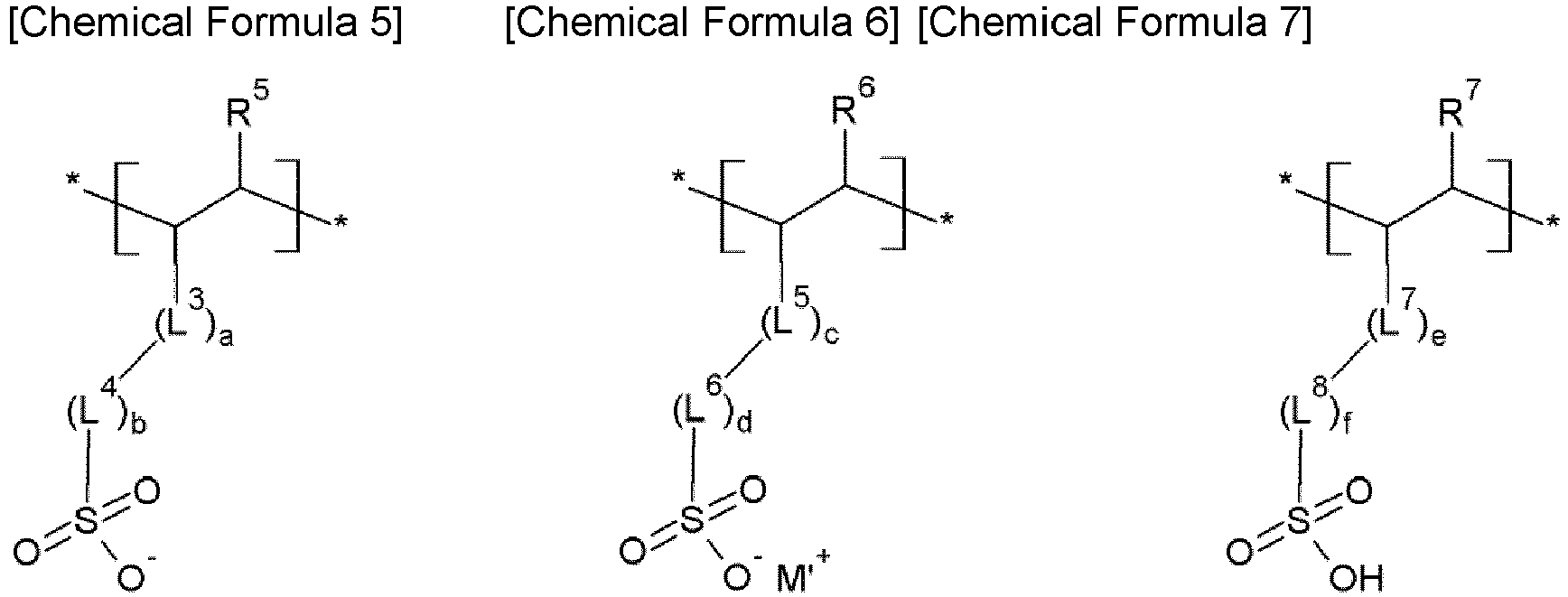 wherein, in Chemical Formula 5 to Chemical Formula 7,R5, R6, and R7 are each independently hydrogen or a C1 to C3 alkyl group,L3, L5, and L7 are each independently -C(=O)-, -C(=O)O-, -OC(=O)-, -O-, or - C(=O)NH-,L4, L6, and L8 are each independently a substituted or unsubstituted C1 to C10 alkylene group, a substituted or unsubstituted C3 to C20 cycloalkylene group, a substituted or unsubstituted C6 to C20 arylene group, or a substituted or unsubstituted C3 to C20 heterocyclic group, anda, b, c, d, e, and f are each independently an integer ranging from 0 to 2,wherein, in Chemical Formula 6,M' is an alkali metal.
 - The separator (10) of claim 1, whereinthe acrylic heat-resistant binder comprises20 mol% to 60 mol% of the structural unit derived from (meth)acrylate or (meth)acrylic acid;30 mol% to 70 mol% of the cyano group-containing structural unit; and0.1 mol% to 20 mol% of the sulfonate group-containing structural unit
- The separator (10) of claim 1, wherein a polystyrene reduced weight average molecular weight of the acrylic heat-resistant binder is 200,000 g/mol to 700,000 g/mol measured by gel permeation chromatography.
- The separator (10) of claim 1, wherein the acrylic heat-resistant binder further comprises an alkali metal.
- The separator (10) of claim 1, wherein the structural unit comprising the hydroxyl group is a structural unit derived from polyvinyl alcohol or a derivative of polyvinyl alcohol.
- The separator (10) of claim 1, wherein the structural unit comprising the acetate group is a structural unit derived from polyvinyl acetate or a derivative of polyvinyl acetate.
- The separator (10) of claim 1, wherein the structural unit comprising the alkali metal is a structural unit derived from an alkali metal bound to a (meth)acrylate salt or a derivative of (meth)acrylate salt.
- The separator (10) of claim 1, wherein the adhering binder is represented by Chemical Formula 9:
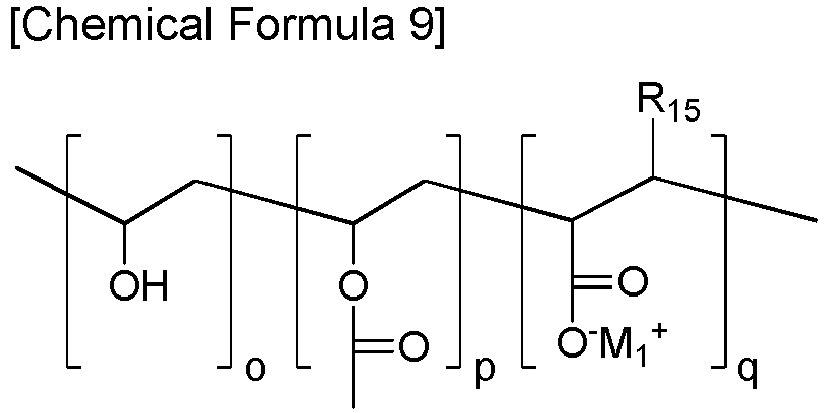 R15 is independently hydrogen or C1 to C10 alkyl group,M1 is an alkali metal, anda mole ratio of the o:p:q is 94:1:5 to 79:1:20.
 - The separator (10) of claim 11, wherein the mole ratio of the o:p:q is 89:1:10 to 84:1:15.
- The separator (10) of claim 1, wherein a polystyrene reduced weight average molecular weight of the adhering binder is 50,000 g/mol to 1,000,000 g/mol measured by gel permeation chromatography.
- The separator (10) of claim 1, wherein the acrylic heat-resistant binder and the adhering binder are included in a weight ratio of 2:8 to 8:2.
- A lithium secondary battery, comprisinga positive electrode (40),a negative electrode (50), andthe separator (10) for the secondary battery according to any one of claims 1 to 14 disposed between the positive electrode (40) and the negative electrode (50).
Applications Claiming Priority (3)
| Application Number | Priority Date | Filing Date | Title |
|---|---|---|---|
| KR1020160060152 | 2016-05-17 | ||
| KR1020170061284A KR102041592B1 (en) | 2016-05-17 | 2017-05-17 | Separator for rechargeable battery and rechargeable lithium battery including the same |
| PCT/KR2018/005568 WO2018212566A1 (en) | 2016-05-17 | 2018-05-15 | Separator for secondary battery and lithium secondary battery comprising same |
Publications (3)
| Publication Number | Publication Date |
|---|---|
| EP3627587A1 EP3627587A1 (en) | 2020-03-25 |
| EP3627587A4 EP3627587A4 (en) | 2021-03-03 |
| EP3627587B1 true EP3627587B1 (en) | 2023-07-19 |
Family
ID=58714997
Family Applications (2)
| Application Number | Title | Priority Date | Filing Date |
|---|---|---|---|
| EP17171385.2A Active EP3246969B1 (en) | 2016-05-17 | 2017-05-16 | Separator for rechargeable battery and rechargeable lithium battery including the same |
| EP18802181.0A Active EP3627587B1 (en) | 2016-05-17 | 2018-05-15 | Separator for secondary battery and lithium secondary battery comprising same |
Family Applications Before (1)
| Application Number | Title | Priority Date | Filing Date |
|---|---|---|---|
| EP17171385.2A Active EP3246969B1 (en) | 2016-05-17 | 2017-05-16 | Separator for rechargeable battery and rechargeable lithium battery including the same |
Country Status (6)
| Country | Link |
|---|---|
| US (3) | US11584861B2 (en) |
| EP (2) | EP3246969B1 (en) |
| JP (2) | JP7097674B2 (en) |
| KR (9) | KR102071387B1 (en) |
| CN (3) | CN107394087B (en) |
| WO (1) | WO2018212566A1 (en) |
Families Citing this family (62)
| Publication number | Priority date | Publication date | Assignee | Title |
|---|---|---|---|---|
| EP3246969B1 (en) | 2016-05-17 | 2018-12-12 | Samsung SDI Co., Ltd. | Separator for rechargeable battery and rechargeable lithium battery including the same |
| KR102428417B1 (en) | 2017-10-11 | 2022-08-01 | 주식회사 엘지에너지솔루션 | Battery Module and Manufacturing Method for the Same |
| KR102526758B1 (en) * | 2018-01-09 | 2023-04-27 | 삼성전자주식회사 | Composite membrane, Anode structure including composite membrane, Lithium battery including anode structure and Preparation method of composite membrane |
| JP7037946B2 (en) * | 2018-01-29 | 2022-03-17 | マクセル株式会社 | Porous layer for non-water batteries, its manufacturing method, separator for non-water batteries, electrodes for non-water batteries and non-water batteries |
| CN111052450B (en) | 2018-01-30 | 2022-10-25 | 株式会社Lg新能源 | Separator for electrochemical device and method of manufacturing the same |
| KR102211371B1 (en) * | 2018-02-12 | 2021-02-03 | 삼성에스디아이 주식회사 | Separator for lithium secondary battery and lithium secondary battery including the same |
| CN109776712B (en) * | 2018-08-16 | 2021-01-15 | 上海紫剑化工科技有限公司 | Acrylic polymer, silicon negative pole piece, and preparation method and application thereof |
| KR102279515B1 (en) * | 2018-09-03 | 2021-07-20 | 삼성에스디아이 주식회사 | Separator for rechargeable lithium battery and rechargeable lithium battery including the same |
| KR20200032542A (en) * | 2018-09-18 | 2020-03-26 | 삼성에스디아이 주식회사 | Separator for rechargeable lithium battery and rechargeable lithium battery including the same |
| JP7626542B2 (en) * | 2018-09-28 | 2025-02-07 | 日本ゼオン株式会社 | Binder composition for non-aqueous secondary battery, slurry composition for functional layer of non-aqueous secondary battery, functional layer for non-aqueous secondary battery, battery member for non-aqueous secondary battery, and non-aqueous secondary battery |
| CN109346703B (en) * | 2018-10-30 | 2022-06-03 | 肇庆市华师大光电产业研究院 | Nickel-lanthanum co-doped strontium titanate negative electrode material for lithium ion battery and preparation method thereof |
| CN109935762B (en) * | 2018-11-22 | 2022-03-18 | 万向一二三股份公司 | Coating diaphragm of lithium battery |
| KR102084099B1 (en) * | 2018-11-28 | 2020-03-04 | 삼성에스디아이 주식회사 | Composition for heat-resistance layer, separator for rechargeable lithium battery including heat-resistance layer formed therefrom and rechargeable lithium battery including the same |
| KR102757187B1 (en) * | 2018-12-11 | 2025-01-20 | 현대자동차주식회사 | Lithium secondary battery and manufacturing method thereof |
| DE102018131928A1 (en) * | 2018-12-12 | 2020-06-18 | Carl Freudenberg Kg | Separator for electrochemical energy storage and converters |
| KR102307978B1 (en) | 2018-12-20 | 2021-09-30 | 삼성에스디아이 주식회사 | Separator for rechargeable lithium battery and rechargeable lithium battery including the same |
| KR102312278B1 (en) | 2018-12-21 | 2021-10-12 | 삼성에스디아이 주식회사 | Separator for rechargeable lithium battery and rechargeable lithium battery including the same |
| KR102312280B1 (en) * | 2018-12-26 | 2021-10-12 | 삼성에스디아이 주식회사 | Separator for rechargeable lithium battery and rechargeable lithium battery including the same |
| KR102306447B1 (en) | 2018-12-26 | 2021-09-28 | 삼성에스디아이 주식회사 | Separator for rechargeable lithium battery and rechargeable lithium battery including the same |
| KR102306446B1 (en) * | 2018-12-28 | 2021-09-28 | 삼성에스디아이 주식회사 | Separator for rechargeable lithium battery and rechargeable lithium battery including the same |
| KR102342671B1 (en) * | 2019-01-04 | 2021-12-22 | 삼성에스디아이 주식회사 | Separator for rechargeable lithium battery and rechargeable lithium battery including the same |
| KR102342669B1 (en) | 2019-01-16 | 2021-12-22 | 삼성에스디아이 주식회사 | Separator for rechargeable lithium battery and rechargeable lithium battery including the same |
| KR102383075B1 (en) * | 2019-03-07 | 2022-04-04 | 삼성에스디아이 주식회사 | Separator for rechargeable lithium battery and rechargeable lithium battery including the same |
| CN113939949B (en) | 2019-03-21 | 2024-04-23 | 株式会社Lg新能源 | Separator for electrochemical device and method for manufacturing the same |
| KR102421618B1 (en) | 2019-03-25 | 2022-07-14 | 주식회사 엘지에너지솔루션 | Manufacturing method of separator for electrochemical device |
| KR102416526B1 (en) | 2019-06-07 | 2022-07-01 | 삼성에스디아이 주식회사 | Separator for rechargeable lithium battery and rechargeable lithium battery including the same |
| WO2020261742A1 (en) * | 2019-06-26 | 2020-12-30 | パナソニックIpマネジメント株式会社 | Electrode for secondary batteries, separator for secondary batteries, and secondary battery |
| KR102704393B1 (en) | 2019-07-30 | 2024-09-06 | 주식회사 엘지화학 | Composite separator for electrochemical device and electrochemical device containing the same |
| WO2021034130A1 (en) * | 2019-08-20 | 2021-02-25 | 삼성에스디아이주식회사 | Ion conductive polymer, and lithium secondary battery electrode and lithium secondary battery which comprise same |
| KR102867940B1 (en) * | 2019-10-25 | 2025-10-01 | 주식회사 엘지에너지솔루션 | Separator for lithium secandary battery, and lithium secandary battery containing the same |
| US12355103B2 (en) | 2020-02-27 | 2025-07-08 | Lg Energy Solution, Ltd. | Separator for lithium secondary battery and method for manufacturing the same |
| KR102301237B1 (en) * | 2020-03-09 | 2021-09-10 | 아라까와 가가꾸 고교 가부시끼가이샤 | Binder aqueous solution for electrode of lithium ion battery, slurry for negative electrode of lithium ion battery, negative electrode for lithium ion battery and lithium ion battery |
| US12107297B2 (en) | 2020-03-20 | 2024-10-01 | Samsung Sdi Co., Ltd. | Composition for coating layer including heat-resistant binder, hydroxy-containing polyimide particle, and silane crosslinker, separator for rechargeable lithium battery including coating layer formed therefrom and rechargeable lithium battery including the same |
| US12586868B2 (en) | 2020-04-06 | 2026-03-24 | Lg Energy Solution, Ltd. | Separator including inorganic porous coating layer including polar binder and acrylic binder with different glass transition temperatures, electrochemical device, and method for manufacturing the same |
| KR102629464B1 (en) | 2020-04-13 | 2024-01-25 | 삼성에스디아이 주식회사 | Separator and lithium battery including the separator |
| KR102598263B1 (en) * | 2020-04-16 | 2023-11-02 | 삼성에스디아이 주식회사 | Separator for rechargeable lithium battery and rechargeable lithium battery including the same |
| EP4169110B1 (en) * | 2020-06-17 | 2026-04-15 | Grst Singapore Pte. Ltd. | Method for composite delamination |
| CN111933865A (en) * | 2020-06-30 | 2020-11-13 | 河北金力新能源科技股份有限公司 | Preparation method of lithium battery composite coating diaphragm slurry, diaphragm and high-nickel system lithium battery |
| CN115803959B (en) | 2020-07-20 | 2025-10-24 | 株式会社Lg新能源 | Separator for secondary battery, method for manufacturing the same, method for manufacturing a secondary battery including the separator, and secondary battery manufactured by the method |
| FR3113194B1 (en) * | 2020-07-29 | 2022-10-14 | Univ Claude Bernard Lyon | Separator for an accumulator comprising a porous membrane functionalized by a copolymer comprising a crosslinkable unit and a unit comprising an alkaline or alkaline-earth cation and corresponding accumulator |
| EP3958364A1 (en) | 2020-08-21 | 2022-02-23 | SK Innovation Co., Ltd. | Composite separator and electrochemical device including the same |
| WO2022086193A1 (en) * | 2020-10-20 | 2022-04-28 | 주식회사 엘지에너지솔루션 | Separator and electrochemical device comprising same |
| KR102924315B1 (en) * | 2021-04-06 | 2026-02-05 | 삼성에스디아이 주식회사 | Composition for Coating Separator, Method for preparing Separator, Seaparator, and Lithium battery comprising the Separator |
| KR102630039B1 (en) * | 2021-04-12 | 2024-01-29 | 주식회사 한솔케미칼 | Binder for coating a secondary battery separator and a secondary battery comprising the same |
| KR102812661B1 (en) * | 2021-11-01 | 2025-05-26 | 한국전자통신연구원 | A method of fabricating aqueous slurry for uniform coating on hydrophobic separator and a functional separator fabricated through the method |
| CN117321846A (en) * | 2022-03-02 | 2023-12-29 | 株式会社Lg新能源 | Separator for lithium secondary battery and method for manufacturing same |
| CN114958106B (en) * | 2022-03-14 | 2023-11-28 | 昆山樱花涂料科技有限公司 | Zinc-free copper-free environment-friendly water-based finish paint for lithium battery industry and preparation method thereof |
| CN115668565B (en) * | 2022-03-30 | 2025-11-21 | 宁德新能源科技有限公司 | Electrochemical device and electronic device including the same |
| WO2023189442A1 (en) | 2022-03-31 | 2023-10-05 | 日本ゼオン株式会社 | Slurry composition for nonaqueous secondary battery functional layers, separator for nonaqueous secondary batteries, and nonaqueous secondary battery |
| KR102558448B1 (en) * | 2022-06-16 | 2023-07-24 | 주식회사 한솔케미칼 | Copolymer for separator and secondary battery using thereof |
| KR102866718B1 (en) * | 2022-10-21 | 2025-10-01 | 주식회사 한솔케미칼 | Copolymer for separator and secondary battery using thereof |
| CN115986311A (en) * | 2023-01-12 | 2023-04-18 | 珠海冠宇电池股份有限公司 | Diaphragm and battery |
| KR20250000492A (en) * | 2023-06-26 | 2025-01-03 | 주식회사 엘지화학 | Separator for an electrochemical device and electrochemical device containing the same |
| KR102737795B1 (en) * | 2023-11-09 | 2024-12-02 | 삼성에스디아이 주식회사 | Binder, separator and rechargeable lithium battery including the same |
| WO2025163412A1 (en) * | 2024-01-31 | 2025-08-07 | Ricoh Company, Ltd. | Insulating layer forming liquid composition, storage container, electrode and manufacturing apparatus thereof, and electricity storage device |
| KR20250152130A (en) * | 2024-04-15 | 2025-10-23 | 삼성에스디아이 주식회사 | Separator for rechargeable lithium battery and rechargeable lithium battery including the same |
| KR20250153906A (en) * | 2024-04-18 | 2025-10-28 | 삼성에스디아이 주식회사 | Separator for rechargeable lithium battery and rechargeable lithium battery including the same |
| KR20260021322A (en) * | 2024-08-06 | 2026-02-13 | 삼성에스디아이 주식회사 | Separator for rechargeable lithium battery and rechargeable lithium battery including the same |
| WO2026034896A1 (en) * | 2024-08-07 | 2026-02-12 | 주식회사 엘지에너지솔루션 | Separator for electrochemical device and electrochemical device comprising same |
| KR20260027408A (en) * | 2024-08-20 | 2026-03-03 | 삼성에스디아이 주식회사 | Separator for rechargeable lithium battery and rechargeable lithium battery including the same |
| CN118943658A (en) * | 2024-08-26 | 2024-11-12 | 宁德新能源科技有限公司 | Separator, secondary battery and electronic device |
| WO2026071828A1 (en) * | 2024-09-30 | 2026-04-02 | 주식회사 엘지에너지솔루션 | Separator for electrochemical device and electrochemical device comprising same |
Family Cites Families (71)
| Publication number | Priority date | Publication date | Assignee | Title |
|---|---|---|---|---|
| US4574110A (en) | 1983-07-28 | 1986-03-04 | Mitsui Toatsu Chemicals, Incorporated | Process for producing microcapsules and microcapsule slurry |
| JPH0263788A (en) | 1988-08-30 | 1990-03-05 | Arakawa Chem Ind Co Ltd | Binder for thermosensitive recording medium |
| JPH06172725A (en) | 1992-12-02 | 1994-06-21 | Mitsui Toatsu Chem Inc | Resin composition and adhesive sheet material |
| GB0113434D0 (en) | 2001-06-04 | 2001-07-25 | Amersham Pharm Biotech Uk Ltd | Quinacridone derivatives as labels for fluorescence detection of biological materials |
| CN1195036C (en) | 2001-06-08 | 2005-03-30 | 成都茵地乐电源科技有限公司 | Water adhesive for electrode material of secondary lithium ion battery and its preparing process |
| US8313853B2 (en) | 2002-06-06 | 2012-11-20 | Kaun Thomas D | Flexible, porous ceramic composite film |
| JP5148142B2 (en) | 2007-03-15 | 2013-02-20 | 日立マクセルエナジー株式会社 | Non-aqueous electrolyte battery |
| JP5286844B2 (en) | 2007-03-23 | 2013-09-11 | 住友化学株式会社 | Separator |
| US9159979B2 (en) | 2008-02-20 | 2015-10-13 | Carl Freudenberg Kg | Nonwoven fabric having cross-linking material |
| EP2262579A4 (en) * | 2008-04-08 | 2011-08-17 | Sk Energy Co Ltd | MICROPOROUS POLYOLEFIN COMPOSITE FILM WITH THERMALLY STABLE POROUS LAYER AT HIGH TEMPERATURE |
| JP5601472B2 (en) | 2008-08-29 | 2014-10-08 | 日本ゼオン株式会社 | Porous membrane, secondary battery electrode, and lithium ion secondary battery |
| JP5569515B2 (en) | 2009-02-25 | 2014-08-13 | 日本ゼオン株式会社 | Electrode for lithium ion secondary battery |
| JP5323590B2 (en) | 2009-06-19 | 2013-10-23 | 旭化成イーマテリアルズ株式会社 | Multilayer porous membrane, resin binder and coating solution |
| EP2485302B1 (en) | 2009-09-30 | 2017-03-08 | Zeon Corporation | Porous membrane for secondary battery, and secondary battery |
| JP2011108444A (en) | 2009-11-16 | 2011-06-02 | Teijin Ltd | Separator for nonaqueous secondary battery, and nonaqueous secondary battery |
| KR101187767B1 (en) | 2010-03-17 | 2012-10-05 | 주식회사 엘지화학 | A separator and electrochemical device containing the same |
| CN103119755B (en) | 2010-07-23 | 2015-07-15 | 日本瑞翁株式会社 | Secondary battery porous membrane, slurry for secondary battery porous membrane, and secondary battery |
| KR101801049B1 (en) | 2010-08-31 | 2017-11-24 | 제온 코포레이션 | Slurry composition for porous film in battery, method for manufacturing porous film for secondary battery, porous film for secondary battery, electrode for secondary battery, separator for secondary battery, and secondary battery |
| US9660238B2 (en) | 2010-10-07 | 2017-05-23 | Zeon Corporation | Slurry for secondary battery porous membrane, a secondary battery porous membrane, an electrode for secondary battery, a separator for secondary battery and a secondary battery |
| JP2012099324A (en) | 2010-11-01 | 2012-05-24 | Teijin Ltd | Separator for nonaqueous electrolyte secondary battery and nonaqueous electrolyte secondary battery |
| KR101247248B1 (en) | 2010-11-15 | 2013-03-25 | 한국생산기술연구원 | A porous separator having improved thermal resistance, manufacturing method thereof and electrochemical device comprising the same |
| KR101603628B1 (en) | 2011-02-24 | 2016-03-15 | 주식회사 엘지화학 | Separator and preparation method of separator thereof |
| JP5804048B2 (en) | 2011-02-25 | 2015-11-04 | 日本ゼオン株式会社 | Porous membrane for secondary battery, slurry for secondary battery porous membrane, and secondary battery |
| EP2695907B1 (en) | 2011-04-05 | 2016-11-30 | W-Scope Corporation | Method for manufacturing a porous membrane |
| KR101301595B1 (en) | 2011-10-06 | 2013-08-29 | 더블유스코프코리아 주식회사 | Micro porous separator coated with ceramics and its preparing method |
| CN103563130B (en) * | 2011-06-02 | 2017-03-15 | 日本合成化学工业株式会社 | Battery electrode or dividing plate coating agent composition |
| JP5946257B2 (en) | 2011-09-29 | 2016-07-06 | デクセリアルズ株式会社 | Battery separator sheet, method for producing the same, and battery |
| WO2013125645A1 (en) | 2012-02-23 | 2013-08-29 | 日本ゼオン株式会社 | Porous membrane for secondary batteries, electrode for secondary batteries, separator for secondary batteries, and secondary battery |
| KR101711982B1 (en) | 2012-03-22 | 2017-03-03 | 삼성에스디아이 주식회사 | Separator and lithium secondary battery |
| US10096810B2 (en) | 2012-05-10 | 2018-10-09 | Samsung Sdi Co., Ltd. | Separator and method of manufacturing the same and rechargeable lithium battery including the same |
| CN103579561B (en) * | 2012-07-25 | 2017-08-15 | 三星Sdi株式会社 | For the dividing plate of lithium rechargeable battery and the lithium rechargeable battery including it |
| WO2014025868A1 (en) | 2012-08-07 | 2014-02-13 | Celgard Llc | Improved separator membranes for lithium ion batteries and related methods |
| JP6120300B2 (en) | 2012-10-05 | 2017-04-26 | エルジー・ケム・リミテッド | Separator and electrochemical device including the same |
| KR101470696B1 (en) | 2012-10-10 | 2014-12-08 | 한국생산기술연구원 | Manufacturing method of separator of lithium secondary battery and the separator manufactured thereby and the lithium secondary battery having the separator |
| WO2014083988A1 (en) | 2012-11-30 | 2014-06-05 | 帝人株式会社 | Separator for nonaqueous secondary batteries, and nonaqueous secondary battery |
| JP2014149935A (en) | 2013-01-31 | 2014-08-21 | Nippon Zeon Co Ltd | Secondary battery separator, method for manufacturing secondary battery separator, and secondary battery |
| KR101365300B1 (en) | 2013-02-18 | 2014-02-20 | 삼성토탈 주식회사 | A coated porous separator and a secondary battery using the same |
| JP2014175055A (en) | 2013-03-06 | 2014-09-22 | Nippon Zeon Co Ltd | Porous film for secondary battery, slurry for secondary battery porous film, method of manufacturing porous film for secondary battery, electrode for secondary battery, separator for secondary battery, and secondary battery |
| WO2014147888A1 (en) | 2013-03-19 | 2014-09-25 | 帝人株式会社 | Separator for nonaqueous secondary batteries, and nonaqueous secondary battery |
| EP2978045B1 (en) * | 2013-03-21 | 2019-11-06 | Zeon Corporation | Slurry for lithium ion secondary battery porous film, separator for lithium ion secondary battery, and lithium ion secondary battery |
| JP6217133B2 (en) | 2013-05-17 | 2017-10-25 | 日本ゼオン株式会社 | Secondary battery porous membrane slurry, secondary battery separator, secondary battery electrode, and secondary battery |
| JP2014229427A (en) | 2013-05-21 | 2014-12-08 | 協立化学産業株式会社 | Coating material composition for battery electrodes or separators having excellent dispersibility |
| KR101640109B1 (en) | 2013-10-15 | 2016-07-15 | 주식회사 엘지화학 | Binder Composition for Secondary Battery Providing Improved Adhesion Strength, and Lithium Secondary Battery Comprising The Same |
| US9680143B2 (en) | 2013-10-18 | 2017-06-13 | Miltec Uv International Llc | Polymer-bound ceramic particle battery separator coating |
| RU2635919C1 (en) | 2013-10-18 | 2017-11-17 | ЭлДжи КЕМ, ЛТД. | Separating membrane and lithium-sulfur battery containing it |
| JP6311269B2 (en) | 2013-10-28 | 2018-04-18 | 日本ゼオン株式会社 | Adhesive for lithium ion secondary battery, separator for lithium ion secondary battery, and lithium ion secondary battery |
| JP2015118908A (en) | 2013-11-14 | 2015-06-25 | Jsr株式会社 | Binder composition for electricity storage device, slurry for electricity storage device, electricity storage device electrode, separator, and electricity storage device |
| KR20150057480A (en) * | 2013-11-19 | 2015-05-28 | 삼성에스디아이 주식회사 | Separator, lithium battery including the same, method for preparing the separator, and method for preparing the lithium battery |
| KR20150057481A (en) | 2013-11-19 | 2015-05-28 | 삼성에스디아이 주식회사 | Separator for lithium battery, lithium battery including the same, and method for preparing the lithium battery |
| KR101690515B1 (en) | 2013-11-21 | 2016-12-29 | 삼성에스디아이 주식회사 | Electrode assembly with improved flexural strength, a method for preparing the same and electro-chemical cell comprising the same |
| TWI580098B (en) | 2013-12-10 | 2017-04-21 | 財團法人工業技術研究院 | Organic-inorganic composite layer for lithium battery and electrode module |
| WO2015099190A1 (en) | 2013-12-26 | 2015-07-02 | 帝人株式会社 | Non-aqueous secondary cell separator and non-aqueous secondary cell |
| KR102219691B1 (en) | 2014-01-13 | 2021-02-24 | 에스케이이노베이션 주식회사 | Ceramic coated separator having excellent thermal property and electro-chemical stability and the manufacturing method of it |
| JP6340826B2 (en) | 2014-02-26 | 2018-06-13 | 日本ゼオン株式会社 | Secondary battery porous membrane slurry, manufacturing method, secondary battery porous membrane, and secondary battery |
| JP6221875B2 (en) | 2014-03-24 | 2017-11-01 | 日本ゼオン株式会社 | Nonaqueous secondary battery porous membrane binder, nonaqueous secondary battery porous membrane composition, nonaqueous secondary battery porous membrane and nonaqueous secondary battery |
| CN105018001B (en) | 2014-04-28 | 2016-08-31 | 成都中科来方能源科技有限公司 | Water adhesive for lithium ion battery and positive/negative plate and coating barrier film |
| JP2016062689A (en) | 2014-09-16 | 2016-04-25 | 三菱製紙株式会社 | Battery separator |
| KR101841809B1 (en) | 2014-10-31 | 2018-03-23 | 주식회사 엘지화학 | Electrode-adhesive layer composite, method of producing the same, and secondary battery comprising the same |
| JP5920441B2 (en) | 2014-11-11 | 2016-05-18 | 住友化学株式会社 | Laminated film and non-aqueous electrolyte secondary battery |
| US10319972B2 (en) | 2014-11-21 | 2019-06-11 | Samsung Sdi Co., Ltd. | Separator for rechargeable battery and rechargeable battery including the same |
| KR102439851B1 (en) | 2014-11-21 | 2022-09-01 | 삼성에스디아이 주식회사 | Separator for secondary battery and secondary battery including same |
| KR102295367B1 (en) | 2014-12-08 | 2021-08-31 | 삼성에스디아이 주식회사 | Composite separator for lithium secondary battery, and lithium secondary battery employing the same, and preparing method thereof |
| KR101551757B1 (en) | 2014-12-30 | 2015-09-10 | 삼성에스디아이 주식회사 | Composition for forming porous heat-resistance layer, separators comprising the porous heat-resistance layer, electrochemical battery using the separator, and method for preparing the separator |
| KR101618681B1 (en) * | 2014-12-30 | 2016-05-11 | 삼성에스디아이 주식회사 | Composition for forming porous heat-resistance layer, separators comprising the porous heat-resistance layer, electrochemical battery using the separator, and method for preparing the separator |
| KR20160115599A (en) | 2015-03-27 | 2016-10-06 | 삼성에스디아이 주식회사 | Separator for rechargeable lithium battery and rechargeable lithium battery including the same |
| JP2016216550A (en) | 2015-05-15 | 2016-12-22 | ダイセルファインケム株式会社 | Vinyl composition, coating agent and separator for non-aqueous secondary battery |
| CN105040150B (en) | 2015-07-10 | 2017-03-22 | 东华大学 | Low temperature dyeable contractile polyacrylonitrile fibre and preparation method thereof |
| JP6915538B2 (en) | 2015-08-24 | 2021-08-04 | 日本ゼオン株式会社 | Composition for non-aqueous secondary battery functional layer, non-aqueous secondary battery functional layer, and non-aqueous secondary battery |
| KR101792681B1 (en) | 2015-11-06 | 2017-11-02 | 삼성에스디아이 주식회사 | Separator for rechargeable battery and rechargeable battery including the same |
| KR101837562B1 (en) | 2015-11-06 | 2018-03-12 | 삼성에스디아이 주식회사 | Separator for rechargeable battery and rechargeable battery including the same |
| EP3246969B1 (en) | 2016-05-17 | 2018-12-12 | Samsung SDI Co., Ltd. | Separator for rechargeable battery and rechargeable lithium battery including the same |
-
2017
- 2017-05-16 EP EP17171385.2A patent/EP3246969B1/en active Active
- 2017-05-16 US US15/596,258 patent/US11584861B2/en active Active
- 2017-05-17 KR KR1020170061293A patent/KR102071387B1/en active Active
- 2017-05-17 KR KR1020170061283A patent/KR102041591B1/en active Active
- 2017-05-17 KR KR1020170061286A patent/KR102071382B1/en active Active
- 2017-05-17 KR KR1020170061284A patent/KR102041592B1/en active Active
- 2017-05-17 KR KR1020170061288A patent/KR102071383B1/en active Active
- 2017-05-17 JP JP2017098236A patent/JP7097674B2/en active Active
- 2017-05-17 KR KR1020170061285A patent/KR102071381B1/en active Active
- 2017-05-17 KR KR1020170061287A patent/KR102071384B1/en active Active
- 2017-05-17 CN CN201710347234.7A patent/CN107394087B/en active Active
- 2017-05-17 KR KR1020170061294A patent/KR102071386B1/en active Active
- 2017-05-17 KR KR1020170061289A patent/KR102071385B1/en active Active
-
2018
- 2018-05-15 US US16/603,649 patent/US11312871B2/en active Active
- 2018-05-15 JP JP2019563516A patent/JP6802392B2/en active Active
- 2018-05-15 WO PCT/KR2018/005568 patent/WO2018212566A1/en not_active Ceased
- 2018-05-15 CN CN201880031761.XA patent/CN110651381B/en active Active
- 2018-05-15 EP EP18802181.0A patent/EP3627587B1/en active Active
- 2018-05-17 CN CN201810477133.6A patent/CN108963148B/en active Active
- 2018-05-17 US US15/982,380 patent/US10840493B2/en active Active
Also Published As
Similar Documents
| Publication | Publication Date | Title |
|---|---|---|
| US11312871B2 (en) | Separator for secondary battery and lithium secondary battery comprising same | |
| EP3905380A1 (en) | Separator for lithium secondary battery, and lithium secondary battery comprising same | |
| US12531310B2 (en) | Separator for lithium secondary battery, and lithium secondary battery including same | |
| US20250337109A1 (en) | Heat resistant layer composition, lithium secondary battery separator comprising heat resistant layer formed therefrom, and lithium secondary battery comprising same | |
| KR102099276B1 (en) | Separator for rechargeable battery and rechargeable lithium battery including the same | |
| KR102138821B1 (en) | Separator for rechargeable battery and rechargeable lithium battery including the same | |
| EP3905379B1 (en) | Separator for lithium secondary battery and lithium secondary battery comprising same | |
| EP4571915A1 (en) | Separator for rechargeable lithium battery and rechargeable lithium battery including the same | |
| EP4715993A1 (en) | Separator for rechargeable lithium battery and rechargeable lithium battery including the same | |
| EP4636931A1 (en) | Separator for rechargeable lithium battery and rechargeable lithium battery including the same | |
| US20250316843A1 (en) | Separator for rechargeable lithium battery and rechargeable lithium battery including the same |
Legal Events
| Date | Code | Title | Description |
|---|---|---|---|
| STAA | Information on the status of an ep patent application or granted ep patent |
Free format text: STATUS: THE INTERNATIONAL PUBLICATION HAS BEEN MADE |
|
| PUAI | Public reference made under article 153(3) epc to a published international application that has entered the european phase |
Free format text: ORIGINAL CODE: 0009012 |
|
| STAA | Information on the status of an ep patent application or granted ep patent |
Free format text: STATUS: REQUEST FOR EXAMINATION WAS MADE |
|
| 17P | Request for examination filed |
Effective date: 20190927 |
|
| AK | Designated contracting states |
Kind code of ref document: A1 Designated state(s): AL AT BE BG CH CY CZ DE DK EE ES FI FR GB GR HR HU IE IS IT LI LT LU LV MC MK MT NL NO PL PT RO RS SE SI SK SM TR |
|
| AX | Request for extension of the european patent |
Extension state: BA ME |
|
| DAV | Request for validation of the european patent (deleted) | ||
| DAX | Request for extension of the european patent (deleted) | ||
| A4 | Supplementary search report drawn up and despatched |
Effective date: 20210201 |
|
| RIC1 | Information provided on ipc code assigned before grant |
Ipc: H01M 50/443 20210101ALI20210126BHEP Ipc: H01M 50/446 20210101ALI20210126BHEP Ipc: H01M 10/0525 20100101ALI20210126BHEP Ipc: C09D 7/61 20180101ALI20210126BHEP Ipc: H01M 50/42 20210101ALI20210126BHEP Ipc: H01M 50/449 20210101ALI20210126BHEP Ipc: H01M 50/414 20210101AFI20210126BHEP Ipc: H01M 10/052 20100101ALN20210126BHEP Ipc: H01M 50/46 20210101ALI20210126BHEP |
|
| REG | Reference to a national code |
Ref legal event code: R079 Free format text: PREVIOUS MAIN CLASS: H01M0002160000 Ipc: H01M0050414000 Ref country code: DE Ref legal event code: R079 Ref document number: 602018053708 Country of ref document: DE Free format text: PREVIOUS MAIN CLASS: H01M0002160000 Ipc: H01M0050414000 |
|
| RIC1 | Information provided on ipc code assigned before grant |
Ipc: H01M 10/052 20100101ALN20230228BHEP Ipc: H01M 50/426 20210101ALI20230228BHEP Ipc: H01M 50/423 20210101ALI20230228BHEP Ipc: H01M 50/417 20210101ALI20230228BHEP Ipc: H01M 50/406 20210101ALI20230228BHEP Ipc: H01M 50/403 20210101ALI20230228BHEP Ipc: C08J 7/043 20200101ALI20230228BHEP Ipc: C08J 7/04 20060101ALI20230228BHEP Ipc: H01M 50/451 20210101ALI20230228BHEP Ipc: H01M 50/449 20210101ALI20230228BHEP Ipc: H01M 50/446 20210101ALI20230228BHEP Ipc: C09D 7/61 20180101ALI20230228BHEP Ipc: H01M 50/46 20210101ALI20230228BHEP Ipc: H01M 50/443 20210101ALI20230228BHEP Ipc: H01M 50/42 20210101ALI20230228BHEP Ipc: H01M 10/0525 20100101ALI20230228BHEP Ipc: H01M 50/414 20210101AFI20230228BHEP |
|
| GRAP | Despatch of communication of intention to grant a patent |
Free format text: ORIGINAL CODE: EPIDOSNIGR1 |
|
| STAA | Information on the status of an ep patent application or granted ep patent |
Free format text: STATUS: GRANT OF PATENT IS INTENDED |
|
| RIC1 | Information provided on ipc code assigned before grant |
Ipc: H01M 10/052 20100101ALN20230321BHEP Ipc: H01M 50/426 20210101ALI20230321BHEP Ipc: H01M 50/423 20210101ALI20230321BHEP Ipc: H01M 50/417 20210101ALI20230321BHEP Ipc: H01M 50/406 20210101ALI20230321BHEP Ipc: H01M 50/403 20210101ALI20230321BHEP Ipc: C08J 7/043 20200101ALI20230321BHEP Ipc: C08J 7/04 20200101ALI20230321BHEP Ipc: H01M 50/451 20210101ALI20230321BHEP Ipc: H01M 50/449 20210101ALI20230321BHEP Ipc: H01M 50/446 20210101ALI20230321BHEP Ipc: C09D 7/61 20180101ALI20230321BHEP Ipc: H01M 50/46 20210101ALI20230321BHEP Ipc: H01M 50/443 20210101ALI20230321BHEP Ipc: H01M 50/42 20210101ALI20230321BHEP Ipc: H01M 10/0525 20100101ALI20230321BHEP Ipc: H01M 50/414 20210101AFI20230321BHEP |
|
| RIC1 | Information provided on ipc code assigned before grant |
Ipc: H01M 10/052 20100101ALN20230330BHEP Ipc: H01M 50/426 20210101ALI20230330BHEP Ipc: H01M 50/423 20210101ALI20230330BHEP Ipc: H01M 50/417 20210101ALI20230330BHEP Ipc: H01M 50/406 20210101ALI20230330BHEP Ipc: H01M 50/403 20210101ALI20230330BHEP Ipc: C08J 7/043 20200101ALI20230330BHEP Ipc: C08J 7/04 20200101ALI20230330BHEP Ipc: H01M 50/451 20210101ALI20230330BHEP Ipc: H01M 50/449 20210101ALI20230330BHEP Ipc: H01M 50/446 20210101ALI20230330BHEP Ipc: C09D 7/61 20180101ALI20230330BHEP Ipc: H01M 50/46 20210101ALI20230330BHEP Ipc: H01M 50/443 20210101ALI20230330BHEP Ipc: H01M 50/42 20210101ALI20230330BHEP Ipc: H01M 10/0525 20100101ALI20230330BHEP Ipc: H01M 50/414 20210101AFI20230330BHEP |
|
| INTG | Intention to grant announced |
Effective date: 20230418 |
|
| GRAS | Grant fee paid |
Free format text: ORIGINAL CODE: EPIDOSNIGR3 |
|
| GRAA | (expected) grant |
Free format text: ORIGINAL CODE: 0009210 |
|
| STAA | Information on the status of an ep patent application or granted ep patent |
Free format text: STATUS: THE PATENT HAS BEEN GRANTED |
|
| AK | Designated contracting states |
Kind code of ref document: B1 Designated state(s): AL AT BE BG CH CY CZ DE DK EE ES FI FR GB GR HR HU IE IS IT LI LT LU LV MC MK MT NL NO PL PT RO RS SE SI SK SM TR |
|
| REG | Reference to a national code |
Ref country code: GB Ref legal event code: FG4D |
|
| REG | Reference to a national code |
Ref country code: CH Ref legal event code: EP |
|
| REG | Reference to a national code |
Ref country code: DE Ref legal event code: R096 Ref document number: 602018053708 Country of ref document: DE |
|
| REG | Reference to a national code |
Ref country code: IE Ref legal event code: FG4D |
|
| REG | Reference to a national code |
Ref country code: LT Ref legal event code: MG9D |
|
| REG | Reference to a national code |
Ref country code: NL Ref legal event code: MP Effective date: 20230719 |
|
| REG | Reference to a national code |
Ref country code: AT Ref legal event code: MK05 Ref document number: 1590406 Country of ref document: AT Kind code of ref document: T Effective date: 20230719 |
|
| PG25 | Lapsed in a contracting state [announced via postgrant information from national office to epo] |
Ref country code: NL Free format text: LAPSE BECAUSE OF FAILURE TO SUBMIT A TRANSLATION OF THE DESCRIPTION OR TO PAY THE FEE WITHIN THE PRESCRIBED TIME-LIMIT Effective date: 20230719 |
|
| PG25 | Lapsed in a contracting state [announced via postgrant information from national office to epo] |
Ref country code: GR Free format text: LAPSE BECAUSE OF FAILURE TO SUBMIT A TRANSLATION OF THE DESCRIPTION OR TO PAY THE FEE WITHIN THE PRESCRIBED TIME-LIMIT Effective date: 20231020 |
|
| PG25 | Lapsed in a contracting state [announced via postgrant information from national office to epo] |
Ref country code: IS Free format text: LAPSE BECAUSE OF FAILURE TO SUBMIT A TRANSLATION OF THE DESCRIPTION OR TO PAY THE FEE WITHIN THE PRESCRIBED TIME-LIMIT Effective date: 20231119 |
|
| PG25 | Lapsed in a contracting state [announced via postgrant information from national office to epo] |
Ref country code: SE Free format text: LAPSE BECAUSE OF FAILURE TO SUBMIT A TRANSLATION OF THE DESCRIPTION OR TO PAY THE FEE WITHIN THE PRESCRIBED TIME-LIMIT Effective date: 20230719 Ref country code: RS Free format text: LAPSE BECAUSE OF FAILURE TO SUBMIT A TRANSLATION OF THE DESCRIPTION OR TO PAY THE FEE WITHIN THE PRESCRIBED TIME-LIMIT Effective date: 20230719 Ref country code: PT Free format text: LAPSE BECAUSE OF FAILURE TO SUBMIT A TRANSLATION OF THE DESCRIPTION OR TO PAY THE FEE WITHIN THE PRESCRIBED TIME-LIMIT Effective date: 20231120 Ref country code: NO Free format text: LAPSE BECAUSE OF FAILURE TO SUBMIT A TRANSLATION OF THE DESCRIPTION OR TO PAY THE FEE WITHIN THE PRESCRIBED TIME-LIMIT Effective date: 20231019 Ref country code: LV Free format text: LAPSE BECAUSE OF FAILURE TO SUBMIT A TRANSLATION OF THE DESCRIPTION OR TO PAY THE FEE WITHIN THE PRESCRIBED TIME-LIMIT Effective date: 20230719 Ref country code: LT Free format text: LAPSE BECAUSE OF FAILURE TO SUBMIT A TRANSLATION OF THE DESCRIPTION OR TO PAY THE FEE WITHIN THE PRESCRIBED TIME-LIMIT Effective date: 20230719 Ref country code: IS Free format text: LAPSE BECAUSE OF FAILURE TO SUBMIT A TRANSLATION OF THE DESCRIPTION OR TO PAY THE FEE WITHIN THE PRESCRIBED TIME-LIMIT Effective date: 20231119 Ref country code: HR Free format text: LAPSE BECAUSE OF FAILURE TO SUBMIT A TRANSLATION OF THE DESCRIPTION OR TO PAY THE FEE WITHIN THE PRESCRIBED TIME-LIMIT Effective date: 20230719 Ref country code: GR Free format text: LAPSE BECAUSE OF FAILURE TO SUBMIT A TRANSLATION OF THE DESCRIPTION OR TO PAY THE FEE WITHIN THE PRESCRIBED TIME-LIMIT Effective date: 20231020 Ref country code: FI Free format text: LAPSE BECAUSE OF FAILURE TO SUBMIT A TRANSLATION OF THE DESCRIPTION OR TO PAY THE FEE WITHIN THE PRESCRIBED TIME-LIMIT Effective date: 20230719 Ref country code: AT Free format text: LAPSE BECAUSE OF FAILURE TO SUBMIT A TRANSLATION OF THE DESCRIPTION OR TO PAY THE FEE WITHIN THE PRESCRIBED TIME-LIMIT Effective date: 20230719 |
|
| PG25 | Lapsed in a contracting state [announced via postgrant information from national office to epo] |
Ref country code: PL Free format text: LAPSE BECAUSE OF FAILURE TO SUBMIT A TRANSLATION OF THE DESCRIPTION OR TO PAY THE FEE WITHIN THE PRESCRIBED TIME-LIMIT Effective date: 20230719 |
|
| REG | Reference to a national code |
Ref country code: DE Ref legal event code: R097 Ref document number: 602018053708 Country of ref document: DE |
|
| PG25 | Lapsed in a contracting state [announced via postgrant information from national office to epo] |
Ref country code: ES Free format text: LAPSE BECAUSE OF FAILURE TO SUBMIT A TRANSLATION OF THE DESCRIPTION OR TO PAY THE FEE WITHIN THE PRESCRIBED TIME-LIMIT Effective date: 20230719 |
|
| PG25 | Lapsed in a contracting state [announced via postgrant information from national office to epo] |
Ref country code: SM Free format text: LAPSE BECAUSE OF FAILURE TO SUBMIT A TRANSLATION OF THE DESCRIPTION OR TO PAY THE FEE WITHIN THE PRESCRIBED TIME-LIMIT Effective date: 20230719 Ref country code: RO Free format text: LAPSE BECAUSE OF FAILURE TO SUBMIT A TRANSLATION OF THE DESCRIPTION OR TO PAY THE FEE WITHIN THE PRESCRIBED TIME-LIMIT Effective date: 20230719 Ref country code: ES Free format text: LAPSE BECAUSE OF FAILURE TO SUBMIT A TRANSLATION OF THE DESCRIPTION OR TO PAY THE FEE WITHIN THE PRESCRIBED TIME-LIMIT Effective date: 20230719 Ref country code: EE Free format text: LAPSE BECAUSE OF FAILURE TO SUBMIT A TRANSLATION OF THE DESCRIPTION OR TO PAY THE FEE WITHIN THE PRESCRIBED TIME-LIMIT Effective date: 20230719 Ref country code: DK Free format text: LAPSE BECAUSE OF FAILURE TO SUBMIT A TRANSLATION OF THE DESCRIPTION OR TO PAY THE FEE WITHIN THE PRESCRIBED TIME-LIMIT Effective date: 20230719 Ref country code: CZ Free format text: LAPSE BECAUSE OF FAILURE TO SUBMIT A TRANSLATION OF THE DESCRIPTION OR TO PAY THE FEE WITHIN THE PRESCRIBED TIME-LIMIT Effective date: 20230719 Ref country code: SK Free format text: LAPSE BECAUSE OF FAILURE TO SUBMIT A TRANSLATION OF THE DESCRIPTION OR TO PAY THE FEE WITHIN THE PRESCRIBED TIME-LIMIT Effective date: 20230719 |
|
| PLBE | No opposition filed within time limit |
Free format text: ORIGINAL CODE: 0009261 |
|
| STAA | Information on the status of an ep patent application or granted ep patent |
Free format text: STATUS: NO OPPOSITION FILED WITHIN TIME LIMIT |
|
| PG25 | Lapsed in a contracting state [announced via postgrant information from national office to epo] |
Ref country code: IT Free format text: LAPSE BECAUSE OF FAILURE TO SUBMIT A TRANSLATION OF THE DESCRIPTION OR TO PAY THE FEE WITHIN THE PRESCRIBED TIME-LIMIT Effective date: 20230719 |
|
| 26N | No opposition filed |
Effective date: 20240422 |
|
| PG25 | Lapsed in a contracting state [announced via postgrant information from national office to epo] |
Ref country code: SI Free format text: LAPSE BECAUSE OF FAILURE TO SUBMIT A TRANSLATION OF THE DESCRIPTION OR TO PAY THE FEE WITHIN THE PRESCRIBED TIME-LIMIT Effective date: 20230719 |
|
| PG25 | Lapsed in a contracting state [announced via postgrant information from national office to epo] |
Ref country code: BG Free format text: LAPSE BECAUSE OF FAILURE TO SUBMIT A TRANSLATION OF THE DESCRIPTION OR TO PAY THE FEE WITHIN THE PRESCRIBED TIME-LIMIT Effective date: 20230719 |
|
| PG25 | Lapsed in a contracting state [announced via postgrant information from national office to epo] |
Ref country code: BG Free format text: LAPSE BECAUSE OF FAILURE TO SUBMIT A TRANSLATION OF THE DESCRIPTION OR TO PAY THE FEE WITHIN THE PRESCRIBED TIME-LIMIT Effective date: 20230719 |
|
| REG | Reference to a national code |
Ref country code: CH Ref legal event code: PL |
|
| PG25 | Lapsed in a contracting state [announced via postgrant information from national office to epo] |
Ref country code: MC Free format text: LAPSE BECAUSE OF FAILURE TO SUBMIT A TRANSLATION OF THE DESCRIPTION OR TO PAY THE FEE WITHIN THE PRESCRIBED TIME-LIMIT Effective date: 20230719 |
|
| PG25 | Lapsed in a contracting state [announced via postgrant information from national office to epo] |
Ref country code: LU Free format text: LAPSE BECAUSE OF NON-PAYMENT OF DUE FEES Effective date: 20240515 |
|
| PG25 | Lapsed in a contracting state [announced via postgrant information from national office to epo] |
Ref country code: MC Free format text: LAPSE BECAUSE OF FAILURE TO SUBMIT A TRANSLATION OF THE DESCRIPTION OR TO PAY THE FEE WITHIN THE PRESCRIBED TIME-LIMIT Effective date: 20230719 Ref country code: LU Free format text: LAPSE BECAUSE OF NON-PAYMENT OF DUE FEES Effective date: 20240515 Ref country code: CH Free format text: LAPSE BECAUSE OF NON-PAYMENT OF DUE FEES Effective date: 20240531 |
|
| REG | Reference to a national code |
Ref country code: BE Ref legal event code: MM Effective date: 20240531 |
|
| PG25 | Lapsed in a contracting state [announced via postgrant information from national office to epo] |
Ref country code: IE Free format text: LAPSE BECAUSE OF NON-PAYMENT OF DUE FEES Effective date: 20240515 |
|
| PG25 | Lapsed in a contracting state [announced via postgrant information from national office to epo] |
Ref country code: BE Free format text: LAPSE BECAUSE OF NON-PAYMENT OF DUE FEES Effective date: 20240531 |
|
| PGFP | Annual fee paid to national office [announced via postgrant information from national office to epo] |
Ref country code: DE Payment date: 20250429 Year of fee payment: 8 |
|
| PGFP | Annual fee paid to national office [announced via postgrant information from national office to epo] |
Ref country code: GB Payment date: 20250501 Year of fee payment: 8 |
|
| PGFP | Annual fee paid to national office [announced via postgrant information from national office to epo] |
Ref country code: FR Payment date: 20250508 Year of fee payment: 8 |
|
| PG25 | Lapsed in a contracting state [announced via postgrant information from national office to epo] |
Ref country code: CY Free format text: LAPSE BECAUSE OF FAILURE TO SUBMIT A TRANSLATION OF THE DESCRIPTION OR TO PAY THE FEE WITHIN THE PRESCRIBED TIME-LIMIT; INVALID AB INITIO Effective date: 20180515 |
|
| PG25 | Lapsed in a contracting state [announced via postgrant information from national office to epo] |
Ref country code: HU Free format text: LAPSE BECAUSE OF FAILURE TO SUBMIT A TRANSLATION OF THE DESCRIPTION OR TO PAY THE FEE WITHIN THE PRESCRIBED TIME-LIMIT; INVALID AB INITIO Effective date: 20180515 |