EP3626829A1 - Marker and method for determination of parkinson's disease - Google Patents
Marker and method for determination of parkinson's disease Download PDFInfo
- Publication number
- EP3626829A1 EP3626829A1 EP18802093.7A EP18802093A EP3626829A1 EP 3626829 A1 EP3626829 A1 EP 3626829A1 EP 18802093 A EP18802093 A EP 18802093A EP 3626829 A1 EP3626829 A1 EP 3626829A1
- Authority
- EP
- European Patent Office
- Prior art keywords
- disease
- deterioration
- parkinson
- group
- intestinal bacteria
- Prior art date
- Legal status (The legal status is an assumption and is not a legal conclusion. Google has not performed a legal analysis and makes no representation as to the accuracy of the status listed.)
- Granted
Links
Images




Classifications
-
- C—CHEMISTRY; METALLURGY
- C12—BIOCHEMISTRY; BEER; SPIRITS; WINE; VINEGAR; MICROBIOLOGY; ENZYMOLOGY; MUTATION OR GENETIC ENGINEERING
- C12Q—MEASURING OR TESTING PROCESSES INVOLVING ENZYMES, NUCLEIC ACIDS OR MICROORGANISMS; COMPOSITIONS OR TEST PAPERS THEREFOR; PROCESSES OF PREPARING SUCH COMPOSITIONS; CONDITION-RESPONSIVE CONTROL IN MICROBIOLOGICAL OR ENZYMOLOGICAL PROCESSES
- C12Q1/00—Measuring or testing processes involving enzymes, nucleic acids or microorganisms; Compositions therefor; Processes of preparing such compositions
- C12Q1/02—Measuring or testing processes involving enzymes, nucleic acids or microorganisms; Compositions therefor; Processes of preparing such compositions involving viable microorganisms
- C12Q1/04—Determining presence or kind of microorganism; Use of selective media for testing antibiotics or bacteriocides; Compositions containing a chemical indicator therefor
- C12Q1/10—Enterobacteria
-
- C—CHEMISTRY; METALLURGY
- C12—BIOCHEMISTRY; BEER; SPIRITS; WINE; VINEGAR; MICROBIOLOGY; ENZYMOLOGY; MUTATION OR GENETIC ENGINEERING
- C12N—MICROORGANISMS OR ENZYMES; COMPOSITIONS THEREOF; PROPAGATING, PRESERVING, OR MAINTAINING MICROORGANISMS; MUTATION OR GENETIC ENGINEERING; CULTURE MEDIA
- C12N1/00—Microorganisms; Compositions thereof; Processes of propagating, maintaining or preserving microorganisms or compositions thereof; Processes of preparing or isolating a composition containing a microorganism; Culture media therefor
- C12N1/20—Bacteria; Culture media therefor
-
- C—CHEMISTRY; METALLURGY
- C12—BIOCHEMISTRY; BEER; SPIRITS; WINE; VINEGAR; MICROBIOLOGY; ENZYMOLOGY; MUTATION OR GENETIC ENGINEERING
- C12Q—MEASURING OR TESTING PROCESSES INVOLVING ENZYMES, NUCLEIC ACIDS OR MICROORGANISMS; COMPOSITIONS OR TEST PAPERS THEREFOR; PROCESSES OF PREPARING SUCH COMPOSITIONS; CONDITION-RESPONSIVE CONTROL IN MICROBIOLOGICAL OR ENZYMOLOGICAL PROCESSES
- C12Q1/00—Measuring or testing processes involving enzymes, nucleic acids or microorganisms; Compositions therefor; Processes of preparing such compositions
- C12Q1/02—Measuring or testing processes involving enzymes, nucleic acids or microorganisms; Compositions therefor; Processes of preparing such compositions involving viable microorganisms
- C12Q1/04—Determining presence or kind of microorganism; Use of selective media for testing antibiotics or bacteriocides; Compositions containing a chemical indicator therefor
- C12Q1/06—Quantitative determination
-
- C—CHEMISTRY; METALLURGY
- C12—BIOCHEMISTRY; BEER; SPIRITS; WINE; VINEGAR; MICROBIOLOGY; ENZYMOLOGY; MUTATION OR GENETIC ENGINEERING
- C12Q—MEASURING OR TESTING PROCESSES INVOLVING ENZYMES, NUCLEIC ACIDS OR MICROORGANISMS; COMPOSITIONS OR TEST PAPERS THEREFOR; PROCESSES OF PREPARING SUCH COMPOSITIONS; CONDITION-RESPONSIVE CONTROL IN MICROBIOLOGICAL OR ENZYMOLOGICAL PROCESSES
- C12Q1/00—Measuring or testing processes involving enzymes, nucleic acids or microorganisms; Compositions therefor; Processes of preparing such compositions
- C12Q1/68—Measuring or testing processes involving enzymes, nucleic acids or microorganisms; Compositions therefor; Processes of preparing such compositions involving nucleic acids
- C12Q1/6876—Nucleic acid products used in the analysis of nucleic acids, e.g. primers or probes
- C12Q1/6888—Nucleic acid products used in the analysis of nucleic acids, e.g. primers or probes for detection or identification of organisms
- C12Q1/689—Nucleic acid products used in the analysis of nucleic acids, e.g. primers or probes for detection or identification of organisms for bacteria
-
- G—PHYSICS
- G01—MEASURING; TESTING
- G01N—INVESTIGATING OR ANALYSING MATERIALS BY DETERMINING THEIR CHEMICAL OR PHYSICAL PROPERTIES
- G01N33/00—Investigating or analysing materials by specific methods not covered by groups G01N1/00 - G01N31/00
- G01N33/48—Biological material, e.g. blood, urine; Haemocytometers
- G01N33/50—Chemical analysis of biological material, e.g. blood, urine; Testing involving biospecific ligand binding methods; Immunological testing
- G01N33/53—Immunoassay; Biospecific binding assay; Materials therefor
- G01N33/569—Immunoassay; Biospecific binding assay; Materials therefor for microorganisms, e.g. protozoa, bacteria, viruses
- G01N33/56911—Bacteria
- G01N33/56916—Enterobacteria, e.g. shigella, salmonella, klebsiella, serratia
-
- G—PHYSICS
- G01—MEASURING; TESTING
- G01N—INVESTIGATING OR ANALYSING MATERIALS BY DETERMINING THEIR CHEMICAL OR PHYSICAL PROPERTIES
- G01N33/00—Investigating or analysing materials by specific methods not covered by groups G01N1/00 - G01N31/00
- G01N33/48—Biological material, e.g. blood, urine; Haemocytometers
- G01N33/50—Chemical analysis of biological material, e.g. blood, urine; Testing involving biospecific ligand binding methods; Immunological testing
- G01N33/68—Chemical analysis of biological material, e.g. blood, urine; Testing involving biospecific ligand binding methods; Immunological testing involving proteins, peptides or amino acids
-
- G—PHYSICS
- G01—MEASURING; TESTING
- G01N—INVESTIGATING OR ANALYSING MATERIALS BY DETERMINING THEIR CHEMICAL OR PHYSICAL PROPERTIES
- G01N33/00—Investigating or analysing materials by specific methods not covered by groups G01N1/00 - G01N31/00
- G01N33/48—Biological material, e.g. blood, urine; Haemocytometers
- G01N33/50—Chemical analysis of biological material, e.g. blood, urine; Testing involving biospecific ligand binding methods; Immunological testing
- G01N33/68—Chemical analysis of biological material, e.g. blood, urine; Testing involving biospecific ligand binding methods; Immunological testing involving proteins, peptides or amino acids
- G01N33/6893—Chemical analysis of biological material, e.g. blood, urine; Testing involving biospecific ligand binding methods; Immunological testing involving proteins, peptides or amino acids related to diseases not provided for elsewhere
- G01N33/6896—Neurological disorders, e.g. Alzheimer's disease
-
- G—PHYSICS
- G01—MEASURING; TESTING
- G01N—INVESTIGATING OR ANALYSING MATERIALS BY DETERMINING THEIR CHEMICAL OR PHYSICAL PROPERTIES
- G01N33/00—Investigating or analysing materials by specific methods not covered by groups G01N1/00 - G01N31/00
- G01N33/48—Biological material, e.g. blood, urine; Haemocytometers
- G01N33/50—Chemical analysis of biological material, e.g. blood, urine; Testing involving biospecific ligand binding methods; Immunological testing
- G01N33/92—Chemical analysis of biological material, e.g. blood, urine; Testing involving biospecific ligand binding methods; Immunological testing involving lipids, e.g. cholesterol, lipoproteins, or their receptors
-
- C—CHEMISTRY; METALLURGY
- C12—BIOCHEMISTRY; BEER; SPIRITS; WINE; VINEGAR; MICROBIOLOGY; ENZYMOLOGY; MUTATION OR GENETIC ENGINEERING
- C12Q—MEASURING OR TESTING PROCESSES INVOLVING ENZYMES, NUCLEIC ACIDS OR MICROORGANISMS; COMPOSITIONS OR TEST PAPERS THEREFOR; PROCESSES OF PREPARING SUCH COMPOSITIONS; CONDITION-RESPONSIVE CONTROL IN MICROBIOLOGICAL OR ENZYMOLOGICAL PROCESSES
- C12Q1/00—Measuring or testing processes involving enzymes, nucleic acids or microorganisms; Compositions therefor; Processes of preparing such compositions
- C12Q1/68—Measuring or testing processes involving enzymes, nucleic acids or microorganisms; Compositions therefor; Processes of preparing such compositions involving nucleic acids
- C12Q1/6844—Nucleic acid amplification reactions
- C12Q1/6851—Quantitative amplification
-
- C—CHEMISTRY; METALLURGY
- C12—BIOCHEMISTRY; BEER; SPIRITS; WINE; VINEGAR; MICROBIOLOGY; ENZYMOLOGY; MUTATION OR GENETIC ENGINEERING
- C12R—INDEXING SCHEME ASSOCIATED WITH SUBCLASSES C12C - C12Q, RELATING TO MICROORGANISMS
- C12R2001/00—Microorganisms ; Processes using microorganisms
- C12R2001/01—Bacteria or Actinomycetales ; using bacteria or Actinomycetales
- C12R2001/225—Lactobacillus
- C12R2001/24—Lactobacillus brevis
-
- C—CHEMISTRY; METALLURGY
- C12—BIOCHEMISTRY; BEER; SPIRITS; WINE; VINEGAR; MICROBIOLOGY; ENZYMOLOGY; MUTATION OR GENETIC ENGINEERING
- C12R—INDEXING SCHEME ASSOCIATED WITH SUBCLASSES C12C - C12Q, RELATING TO MICROORGANISMS
- C12R2001/00—Microorganisms ; Processes using microorganisms
- C12R2001/01—Bacteria or Actinomycetales ; using bacteria or Actinomycetales
- C12R2001/225—Lactobacillus
- C12R2001/25—Lactobacillus plantarum
-
- G—PHYSICS
- G01—MEASURING; TESTING
- G01N—INVESTIGATING OR ANALYSING MATERIALS BY DETERMINING THEIR CHEMICAL OR PHYSICAL PROPERTIES
- G01N2333/00—Assays involving biological materials from specific organisms or of a specific nature
- G01N2333/195—Assays involving biological materials from specific organisms or of a specific nature from bacteria
- G01N2333/24—Assays involving biological materials from specific organisms or of a specific nature from bacteria from Enterobacteriaceae (F), e.g. Citrobacter, Serratia, Proteus, Providencia, Morganella, Yersinia
-
- G—PHYSICS
- G01—MEASURING; TESTING
- G01N—INVESTIGATING OR ANALYSING MATERIALS BY DETERMINING THEIR CHEMICAL OR PHYSICAL PROPERTIES
- G01N2333/00—Assays involving biological materials from specific organisms or of a specific nature
- G01N2333/195—Assays involving biological materials from specific organisms or of a specific nature from bacteria
- G01N2333/335—Assays involving biological materials from specific organisms or of a specific nature from bacteria from Lactobacillus (G)
-
- G—PHYSICS
- G01—MEASURING; TESTING
- G01N—INVESTIGATING OR ANALYSING MATERIALS BY DETERMINING THEIR CHEMICAL OR PHYSICAL PROPERTIES
- G01N2400/00—Assays, e.g. immunoassays or enzyme assays, involving carbohydrates
- G01N2400/10—Polysaccharides, i.e. having more than five saccharide radicals attached to each other by glycosidic linkages; Derivatives thereof, e.g. ethers, esters
- G01N2400/50—Lipopolysaccharides; LPS
-
- G—PHYSICS
- G01—MEASURING; TESTING
- G01N—INVESTIGATING OR ANALYSING MATERIALS BY DETERMINING THEIR CHEMICAL OR PHYSICAL PROPERTIES
- G01N2800/00—Detection or diagnosis of diseases
- G01N2800/28—Neurological disorders
- G01N2800/2835—Movement disorders, e.g. Parkinson, Huntington, Tourette
Definitions
- the present invention relates to a marker and a method for determining Parkinson's disease.
- Parkinson's disease is known as a neurodegenerative disease which increases with aging, and the number of patients worldwide is estimated to reach 10 million by 2030. Study on healthy subjects also found ⁇ -synuclein-positive Lewy bodies in the gastrointestinal tract, olfactory tissue, and heart, although no PD symptoms were present, and suggests that these histological lesions occur before the onset, and the PD pathological condition gradually progresses to the central nervous system too.
- Non-Patent Literature 1 it was revealed that ⁇ -synuclein appears in the intestines of PD patients 20 years before the onset (Non-Patent Literature 1).
- olfactometry Non-Patent Literature 2
- MIBG myocardial scintigraphy Non-Patent Literature 3
- Constipation is a symptom observed before the onset of PD
- the cohort study in Honolulu revealed that constipation occurs 10 years or more before the onset of PD on average (Non-Patent Literature 4).
- the present inventors have studied whether a change with time in the microbiota in a single patient is involved in a change in the disease condition or not in order to clarify a relationship between the change in the PD pathological condition and intestinal bacteria, and conducted measurement of intestinal microbiota and blood components and a 2-year perspective study for PD patients and housemates thereof.
- the degree of deterioration of the PD condition can be determined by measuring an in vivo increase or decrease of intestinal bacteria of the PD patient and that intestinal bacteria can be a marker for detection of PD, and the present invention was accomplished.
- deterioration of the PD condition can be determined by using the blood lipopolysaccharide (LPS) level or the blood lipopolysaccharide-binding protein (LBP) level as an indicator.
- LPS blood lipopolysaccharide
- LBP blood lipopolysaccharide-binding protein
- the present invention relates to the following aspects [1] to [14]:
- a risk of deterioration of PD can be determined by measuring the number of specific intestinal bacteria or by measuring the numbers of specific intestinal bacteria at two or more different time points and comparing the numbers.
- deterioration of PD can be determined by comparing the blood LPS levels or blood LBP levels.
- the marker for determination of PD of the present invention is the number of one or more intestinal bacteria selected from the group consisting of Bifidobacterium, Bacteroides fragilis group, Lactobacillus brevis, and Lactobacillus plantarum subgroup and/or the total number of intestinal bacteria.
- intestinal bacteria selected from the group consisting of Bifidobacterium, Bacteroides fragilis group, Lactobacillus brevis, and Lactobacillus plantarum subgroup and/or the total number of intestinal bacteria.
- the total number of intestinal bacteria is, for example, the total bacterial number measured by a DAPI counting method but is not limited thereto.
- the total bacterial number may be the sum of the bacterial numbers of a plurality of dominant bacterial species in the intestine, which corresponds to about 70% or more of the total bacterial number measured by the DAPI counting method. Examples of the total bacterial number include the sum of the bacterial numbers of 19 bacterial species shown in Example (Table 1) below.
- deterioration of PD or deterioration of the condition of a PD patient means that the disease condition actually progresses and becomes severe.
- a risk of deterioration of PD or a risk of deterioration of the condition of a PD patient refers to a possibility that the condition of PD will further deteriorate in the future compared to the actual current disease condition.
- the risk of deterioration of PD may be determined by measuring the number of the intestinal bacteria in a sample and applying the number to an approximate line equation (for example, approximate line equations shown in Example (e.g., Figures 2 , 3 , 5 , and 6 ) below) created in advance for a correlation between the number of the intestinal bacteria and the deterioration of disease condition.
- an approximate line equation for example, approximate line equations shown in Example (e.g., Figures 2 , 3 , 5 , and 6 ) below
- the sample include subject-derived biological samples, for example, digestive tract contents such as intestinal fluid and feces. Because of its non-invasiveness, feces is preferred as a sample.
- the deterioration of PD can be determined by examining the change in the blood LPS level and/or the blood LBP level.
- the determination by measuring the numbers of one or more intestinal bacteria selected from the group consisting of Bifidobacterium, Bacteroides fragilis group, Lactobacillus brevis, and Lactobacillus plantarum subgroup and/or the total numbers of intestinal bacteria in the patient at two or more different time points and comparing the measured bacterial numbers.
- Measurement at two or more time points refers to that measurement of the intestinal bacteria is performed at a time point and is then performed at one or more time points after a certain interval.
- the interval varies depending on, for example, the condition and the pathological condition of the patient and is not particularly limited. For example, an arbitrary period of 1 week to 5 years, such as 1 week, 2 weeks, 3 weeks, 4 weeks, 1 month, 2 months, 3 months, 6 months, 9 months, 1 year, 2 years, 3 years, 4 years, or 5 years is suitably selected.
- the number of one or more bacteria selected from the group consisting of Bifidobacterium, Bacteroides fragilis group, Lactobacillus brevis, and Lactobacillus plantarum subgroup and/or the total number of intestinal bacteria is decreased, it can be determined that the PD condition is getting severe, and in contrast, when the number is increased, it can be determined that the condition is getting mild.
- determination of PD determination of a risk of deterioration of PD or determination of deterioration of the PD symptom
- a reference which is the value (Q) of the vertical axis at the time point of 0 in the horizontal axis
- deterioration of PD of a patient can be determined by measuring the blood LPS levels and/or the blood LBP levels of the PD patient at two or more different time points and comparing the measured levels (between the LPS levels or between the LBP levels).
- the phrase "two or more time points" has the same meaning as described above.
- the blood levels of LPS and/or LBP are preferably serum levels.
- the degree of severity of PD when the LPS levels and/or the LBP levels of a single PD patient are measured at two or more different time points, if the LPS level results in an increased tendency, it can be determined that the PD is getting severe. In contrast, if the LPS level results in a decreased tendency, it can be determined that the PD is getting mild. If the LBP level results in a decreased tendency, it can be determined that the PD is getting severe, and in contrast, the LBP level results in an increased tendency, it can be determined that the PD is getting mild.
- the measurement of intestinal bacteria in a sample include measurement (quantification) of the number of intestinal bacteria.
- the method for measuring the number of intestinal bacteria in a sample include a method involving culturing intestinal bacteria in an appropriate medium and counting the number of the bacteria, a method involving culturing intestinal bacteria in a liquid selection medium and measuring the turbidity or absorbance, a FISH method, and a quantitative RT-PCR method (RT-qPCR method).
- the RT-qPCR method is preferable.
- the analytical method by the RT-PCR method can be performed by, for example, (1) a step of extracting RNA of a bacterium of interest in a sample, (2) a step of synthesizing cDNA by a reverse transcription (RT) reaction using a nucleic acid fragment (primer) that hybridizes to the extracted RNA and subsequently performing PCR using the cDNA as a template, and (3) a step of detecting the DNA fragment amplified in the step (2).
- a DNA fragment (PCR product) specific to the intestinal bacterium of interest can be obtained by combining the nucleic acid fragment with the template cDNA derived from a sample and performing amplification reaction.
- the number of the intestinal bacterium of interest in the sample can be determined by observing the PCR product over time and identifying the number of PCR cycles at the time when the amount of DNA reaches a certain level.
- an amplified PCR product over time can be performed by labeling the PCR product with an intercalating fluorescent dye, such as SYBR(R) Green I, and measuring the fluorescence intensity at each PCR cycle.
- An intercalating dye has a property of being intercalated in a double-stranded nucleic acid and thereby increasing the fluorescence intensity and therefore it is possible to precisely measure the PCR product generated from cDNA of a target bacterium by PCR reaction.
- SYBR(R) Green I is suitably used.
- the intestinal bacterium of interest in a sample can be quantitatively determined by identifying the number of PCR cycles (threshold cycle: C T ) when the fluorescence intensity (DNA amount) reaches a certain level that has been arbitrarily set.
- a TaqMan probe or molecular beacon labeled with a fluorescent dye can also be used.
- the TaqMan probe and the molecular beacon are each a probe in which a fluorescent dye and a quencher are bonded to an oligonucleotide having homology with the internal sequence of the region to be amplified by PCR and are used in the PCR reaction by existing together. Since fluorescence is emitted according to the PCR amplification reaction by the interaction between the fluorescent dye and the quencher bounded to the probe, the amplified PCR product can be observed over time by measuring the fluorescence intensity at each PCR cycle.
- the intestinal bacterium of interest in a sample can be quantitatively determined by a calibration curve of the logarithmic values of the bacterial numbers measured by, for example, a DAPI counting method or a culture method and the C T values. That is, a calibration curve is created in advance by plotting the logarithmic values of the bacterial numbers of a target on the horizontal axis and the C T values on the vertical axis, and the C T value obtained as a result of PCR reaction is applied to the calibration curve to quantify the intestinal bacterium of interest in the sample.
- kits including a protocol for measuring the intestinal bacteria in a sample.
- the kit includes a measuring reagent for the marker of the present invention and a protocol (a protocol describing, for example, a method for measuring intestinal bacteria and a method for determining PD, in particular, a reference for determining the degree of severity, and factors that influence the measurement results and the degree of the influence).
- the determination can be performed as in the above-described determination method by using the reference.
- examples of the measuring reagent for the marker include a reagent for measuring the number of the intestinal bacteria described above, a reagent for detecting mRNA, and a reagent for detecting DNA.
- the bacterial number in vivo varies depending on, for example, the living environment and eating habits of each patient.
- the status of the progress of PD can be determined by comparing the bacterial numbers in samples of a single patient measured time-serially.
- Bacterial strains stored in the Yakult Central Institute, Yakult Honsha Co., Ltd. shown in Table 1 were used. The initial bacterial number of each bacterial strain was adjusted to about 1 ⁇ 10 4 cells.
- the culture conditions of each bacterial strain are shown in Table 1.
- the details of culture conditions A and B are as follows.
- Taxon Strain Culture condition Clostridium coccoides group Blautia producta JCM 1471 (ATCC 27340) Condition A Clostridium leptum subgroup Faecalibacterium prausnitzii ATCC 27768 Condition A Bacteroides fragilis group Bacteroides vulgatus ATCC 8482 Condition A Bifidobacterium Bifidobacterium adolescentis ATTC 15703 Condition A Atopobium cluster Collinsella aerofaciens DSM 3979 Condition A Genus Prevotella Prevotella melaninogenica ATCC 25845 Condition A Clostridium perfringens Clostridium perfringens JCM 1290 (ATCC 13124) Condition A Family Enterobacteriaceae Escherichia coli JCM 1649 (ATCC 11775) Condition C Lactobacillus casei
- Table 2 shows each primer used in measurement of the number of the intestinal bacteria. Table 2 also shows literatures describing each primer.
- Target gene Primer name Sequence (5' - 3') SEQ ID NO: Literature Clostridium coccoides group g-Cooc-F AAATGACGGTACCTGACTAA 1 1 g-Ccoc-R CTTTGAGTTTCATTCTTGCGAA 2 1 Clostridium leptum subgroup sg-Clept-F GCACAAOCAGTGGAGT 3 2 sg-Clept-R CTTCCTCCGTTTTGTCAA 4 2 Bacteroides fragilis group g-Rfra-F2 AYAGCCTTTCGAAAGRAAGAT 5 3 g-Bfra-R CCAGTATCAACTGCAATTTTA 6 1 Genus Bifidobacterium g-Bifid-F CTCCTGGAAACGGGTGG 7 1 g-Rifid-R GGTGTTCTTCCCCGATATCTACA 8
- a calibration curve to be used in quantification of intestinal bacteria of interest in samples was created. Specifically, according to the procedure shown below, a calibration curve was created by plotting the numbers of intestinal bacteria measured by a DAPI counting method on the horizontal axis and the C T values on the vertical axis.
- the intestinal microbiota of PD patients was examined carefully to evaluate the relationship between PD and intestinal microbiota.
- PD patients Male: 21, female: 31, age: 68.9 ⁇ 6.8 and 36 partners of the patients (male: 21, female: 15, age: 68.4 ⁇ 9.7) as controls.
- the clinical symptoms of PD were evaluated using Hoehn-Yahr (HY) severity classification and unified Parkinson's disease rating scale (UPDRS) Parts 1 to 4.
- HY Hoehn-Yahr
- UPDRS unified Parkinson's disease rating scale
- the serum lipopolysaccharide (LPS)-binding protein (LBP) level was measured with an ELISA kit (HK315-01, Hycult Biotech).
- the diamine oxidase (DAO) level was measured with an ELISA kit (K8500, Immundiagnostik AG).
- RNAlater (Ambion, Inc., 0.2 mL) was added to feces (4 mg) collected from a patient or a control, followed by leaving to stand at room temperature for 5 minutes. Subsequently, centrifugation was performed at 14,000g for 10 minutes, the supernatant was removed by decantation, and the residue was then used as a sample for RNA extraction.
- RNA sample prepared in (b) was subjected to measurement of bacterial number using an RT-qPCR method.
- the RT-qPCR was performed as in the method described in 14) and 15) of Reference Example 2.
- Table 3 shows score information on each parameter when the subjects were divided into healthy subjects and PD patients.
- UPDRS Part 1 (Mentation, behavior, and mood) score - 2.9 ⁇ 2.3
- UPDRS Part 2 (Activities of daily living) score - 11.7 ⁇ 6.8
- UPDRS Part 3 (Motor examination) score - 25.6 ⁇ 11.8
- UPDRS Part 4 (Complications of therapy) score - 3.4 ⁇ 2.4 a: showing mean and standard deviation.
- Table 3 demonstrates that the stool frequency of the PD patient group was lower than that of the healthy subject group.
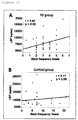
- Figure 1 shows a correlation between the serum LBP level and the stool frequency (A: PD group, B: Control group).
- A PD group
- B Control group
- a positive correlation was observed between the serum LBP level and the stool frequency, but this correlation was not observed in the healthy subject group ( Figure 1A and Figure 1B ). It is inferred from these results that a lower serum LBP level leads to worse deterioration of the PD condition. Accordingly, it is possible to determine deterioration of the disease condition of a PD patient by monitoring the blood LBP level in a single PD patient.
- PD patients were divided into two groups for comparison, a group (worsening group) in which the deterioration of the PD condition is large and a group (non-worsening group) of those other than the worsening group, using the change in the condition after 2 years relative to that at the start of observation (0 year) as an indicator.
- Patients who were worsened by 15 points or more in the total of UPDRS or who were admitted or could not attend a hospital due to deterioration of the PD condition were identified in the worsening group.
- Patients who were worsened by less than 15 points in the total score of UPDRS were identified in the non-worsening group.
- Table 4 shows the comparison of scores when the patients were divided into a worsening group and a non-worsening group.
- Table 5 shows the changes in serum LBP level by comparison of those at the start of observation and at the time point after 2 years. [Table 5] Change in serum LBP level after 2 years 0 year After 2 years LBP level (ng/ml) Worsening group 12890 ⁇ 3614 12449 ⁇ 3433 Non-worsening group 11925 ⁇ 3298 12545 ⁇ 3597
- Table 5 demonstrates that the serum LBP level in the worsening group decreases after 2 years, but the serum LBP level in the non-worsening group rather tends to increase.
- Figure 3 shows the results of examination of the correlation between the change in the serum LBP level (the change two years after the start of observation) and the bacterial number of Lactobacillus brevis or Lactobacillus plantarum subgroup at the start of observation (0 year).
- the change in the serum LBP level showed a significant positive correlation with the bacterial numbers of Lactobacillus plantarum subgroup and Lactobacillus brevis at the start of observation (0 year) ( Figure 3A and Figure 3B ). Strong correlations were observed in the groups in which samples below the detection limit of Lactobacillus plantarum subgroup or Lactobacillus brevis were excluded ( Figure 3C and Figure 3D ).
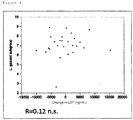
- Figure 4 shows the results of verification of the correlation between the change in the serum LBP level (the change two years after the start of observation) and the number of Lactobacillus gasseri subgroup at the start of observation (0 year).
- the bacteria intestinal bacteria of the present invention
- other intestinal bacteria 15 species
- Lactobacillus gasseri subgroup have no significant correlation with deterioration of Parkinson's disease (in particular, a risk of deterioration). Accordingly, it was confirmed that these intestinal bacteria cannot be used as a marker for determination of the present invention.
- Figure 5 shows a correlation between the change in L-dopa equivalent dose (the amount of change two years after the start of observation) and the number of Bifidobacterium (A) or the total number of intestinal bacteria (B).
- the total number of intestinal bacteria was determined as the sum of the bacterial numbers of 19 bacterial species shown in Table 1.
- the number of Bifidobacterium (A) and the total number of intestinal bacteria (B) were decreased by an increase of L-dopa equivalent dose (LED), which L-dopa is a PD therapeutic agent, to show a significant negative correlation.
- LED L-dopa equivalent dose
- Figure 6 shows a correlation between the change of a subscale of a PD unification scale, UPDRS, (the amount of change two years after the start of observation) and the bacterial number at the start of observation.
- UPDRS Part 1 mentation, behavior, and mood
- 1.1 intellectual impairment
- 1.2 thought disorder
- 1.4 motivation/initiative
- intestinal bacteria can be used for determination of progress of the pathological condition of PD.
Landscapes
- Life Sciences & Earth Sciences (AREA)
- Health & Medical Sciences (AREA)
- Chemical & Material Sciences (AREA)
- Engineering & Computer Science (AREA)
- Organic Chemistry (AREA)
- Molecular Biology (AREA)
- Immunology (AREA)
- Wood Science & Technology (AREA)
- Zoology (AREA)
- Biotechnology (AREA)
- Proteomics, Peptides & Aminoacids (AREA)
- Analytical Chemistry (AREA)
- Biomedical Technology (AREA)
- General Health & Medical Sciences (AREA)
- Microbiology (AREA)
- Biochemistry (AREA)
- Physics & Mathematics (AREA)
- Hematology (AREA)
- Urology & Nephrology (AREA)
- Bioinformatics & Cheminformatics (AREA)
- Genetics & Genomics (AREA)
- Biophysics (AREA)
- General Engineering & Computer Science (AREA)
- Medicinal Chemistry (AREA)
- General Physics & Mathematics (AREA)
- Cell Biology (AREA)
- Food Science & Technology (AREA)
- Pathology (AREA)
- Toxicology (AREA)
- Virology (AREA)
- Tropical Medicine & Parasitology (AREA)
- Endocrinology (AREA)
- Neurology (AREA)
- Neurosurgery (AREA)
- Measuring Or Testing Involving Enzymes Or Micro-Organisms (AREA)
- Investigating Or Analysing Biological Materials (AREA)
Abstract
Description
- The present invention relates to a marker and a method for determining Parkinson's disease.
- Parkinson's disease (PD) is known as a neurodegenerative disease which increases with aging, and the number of patients worldwide is estimated to reach 10 million by 2030. Study on healthy subjects also found α-synuclein-positive Lewy bodies in the gastrointestinal tract, olfactory tissue, and heart, although no PD symptoms were present, and suggests that these histological lesions occur before the onset, and the PD pathological condition gradually progresses to the central nervous system too.
- Similarly, it was revealed that α-synuclein appears in the intestines of
PD patients 20 years before the onset (Non-Patent Literature 1). In addition to these findings, olfactometry (Non-Patent Literature 2) and MIBG myocardial scintigraphy (Non-Patent Literature 3) are regarded as useful for discrimination of early PD, and presence of lesions in peripheral organs is suggested. Constipation is a symptom observed before the onset of PD, and the cohort study in Honolulu revealed that constipation occurs 10 years or more before the onset of PD on average (Non-Patent Literature 4). -
- Non-Patent Literature 1: Hawkes CH, et al., Parkinsonism Relat. Disord., 2010, 16(2): 79-84
- Non-Patent Literature 2: Katzenschlager R, et al., Curr. Opin. Neurol., 2004, 17(4): 417-423
- Non-Patent Literature 3: Hirayama M, et al., J. Auton. Nerv. Syst., 1995, 53(2-3): 230-234
- Non-Patent Literature 4: Abbott RD, et al., Neurology, 2001, 57(3): 456-462
- There is no knowledge about the change with time in microbiota in the intestine of a single PD patient. There is a need for a method for simply determining the progress of the pathological condition of PD.
- In view of the above-mentioned problems, the present inventors have studied whether a change with time in the microbiota in a single patient is involved in a change in the disease condition or not in order to clarify a relationship between the change in the PD pathological condition and intestinal bacteria, and conducted measurement of intestinal microbiota and blood components and a 2-year perspective study for PD patients and housemates thereof. As a result, they found that the degree of deterioration of the PD condition can be determined by measuring an in vivo increase or decrease of intestinal bacteria of the PD patient and that intestinal bacteria can be a marker for detection of PD, and the present invention was accomplished. In addition, they found that deterioration of the PD condition can be determined by using the blood lipopolysaccharide (LPS) level or the blood lipopolysaccharide-binding protein (LBP) level as an indicator.
- That is, the present invention relates to the following aspects [1] to [14]:
- [1] A marker for determination of Parkinson's disease, the marker being the number of one or more intestinal bacteria selected from the group consisting of Bifidobacterium, Bacteroides fragilis group, Lactobacillus brevis, and Lactobacillus plantarum subgroup and/or the total number of intestinal bacteria.
- [2] The marker according to [1], wherein the determination of Parkinson's disease is determination of a risk of deterioration of Parkinson's disease.
- [3] The marker according to [2], wherein the deterioration of Parkinson's disease is deterioration of a constipation symptom or a psychiatric symptom.
- [4] The marker according to [3], wherein the psychiatric symptom is one or more selected from the group consisting of hallucination, cognition, and motivation.
- [5] A method for determining deterioration of a disease condition of a Parkinson's disease patient, comprising measuring the numbers of one or more intestinal bacteria selected from the group consisting of Bifidobacterium, Bacteroides fragilis group, Lactobacillus brevis, and Lactobacillus plantarum subgroup and/or the total numbers of intestinal bacteria in the patient at two or more different time points and comparing the numbers.
- [6] The method according to [5], wherein the deterioration of a disease condition of a Parkinson's disease patient is deterioration of a constipation symptom or a psychiatric symptom.
- [7] The method according to [6], wherein the psychiatric symptom is one or more selected from the group consisting of hallucination, cognition, and motivation.
- [8] A marker for determination of Parkinson's disease, the marker being a blood LPS level and/or a blood LBP level.
- [9] The marker according to [8], wherein the determination of Parkinson's disease is determination of a risk of deterioration of Parkinson's disease.
- [10] The marker according to [9], wherein the deterioration of Parkinson's disease is deterioration of a constipation symptom or a psychiatric symptom.
- [11] The marker according to [10], wherein the psychiatric symptom is one or more selected from the group consisting of hallucination, cognition, and motivation.
- [12] A method for determining deterioration of a disease condition of a Parkinson's disease patient, comprising measuring blood LPS levels and/or blood LBP levels of the patient at two or more different time points and comparing the levels.
- [13] The method according to [12], wherein the deterioration of a disease condition of a Parkinson's disease patient is deterioration of a constipation symptom or a psychiatric symptom.
- [14] The method according to [13], wherein the psychiatric symptom is one or more selected from the group consisting of hallucination, cognition, and motivation.
- [15] A kit for conducting the method according to any one of [5] to [7], the kit comprising a protocol for measuring intestinal bacteria according to any one of [1] to [4].
- According to the present invention, a risk of deterioration of PD can be determined by measuring the number of specific intestinal bacteria or by measuring the numbers of specific intestinal bacteria at two or more different time points and comparing the numbers. In addition, deterioration of PD can be determined by comparing the blood LPS levels or blood LBP levels.
-
- [
Figure 1] Figure 1 shows a correlation between the serum LBP level and the frequency of excretion (A: PD group, B: Control group). - [
Figure 2] Figure 2 shows a correlation between the change in the UPDRSPart 1 score (the change two years after the start of observation) and the number of Bacteroides fragilis group (A) or Bifidobacterium (B) at the start of observation. - [
Figure 3] Figure 3 shows a correlation between the change in the serum LBP level (the change two years after the start of observation) and the number of Lactobacillus plantarum subgroup (A) or Lactobacillus brevis (B) at the start of observation. The graph (C) shows the correlation obtained by excluding samples in which the number of Lactobacillus plantarum subgroup is below the detection limit, and the graph (D) shows the correlation obtained by excluding samples in which the number of Lactobacillus brevis is below the detection limit. - [
Figure 4] Figure 4 shows a correlation between the change in the serum LBP level (the change two years after the start of observation) and the number of Lactobacillus gasseri subgroup at the start of observation. - [
Figure 5] Figure 5 shows a correlation between the amount of change in LED (L-dopa equivalent dose) and the amount of change in the number of Bifidobacterium (A) or the amount of change in the total number of intestinal bacteria in whole feces (B). - [
Figure 6] Figure 6 shows (A) a correlation between the change in intellectual impairment score (UPDRS 1.1) (the change two years after the start of observation) and the number of Bifidobacterium at the start of observation, (B) a correlation between the change in thought disorder score (UPDRS 1.2) (the change two years after the start of observation) and the number of Bifidobacterium at the start of observation, and (C) a correlation between the change in motivation/initiative score (UPDRS 1.4) (the change two years after the start of observation) and the number of Bacteroides fragilis group at the start of observation. - The marker for determination of PD of the present invention is the number of one or more intestinal bacteria selected from the group consisting of Bifidobacterium, Bacteroides fragilis group, Lactobacillus brevis, and Lactobacillus plantarum subgroup and/or the total number of intestinal bacteria. Although it is known that these intestinal bacteria are present in the human intestine, it has not been reported about the relationship between these intestinal bacteria and the progress of PD condition. Here, the total number of intestinal bacteria is, for example, the total bacterial number measured by a DAPI counting method but is not limited thereto. The total bacterial number may be the sum of the bacterial numbers of a plurality of dominant bacterial species in the intestine, which corresponds to about 70% or more of the total bacterial number measured by the DAPI counting method. Examples of the total bacterial number include the sum of the bacterial numbers of 19 bacterial species shown in Example (Table 1) below.
- As described in Example below, there was a significant correlation between the number of the intestinal bacteria in feces of a PD patient and deterioration of the condition of PD. Specifically, a decrease in the number of at least one, preferably two or more, intestinal bacteria selected from the group consisting of Bifidobacterium, Bacteroides fragilis group, Lactobacillus brevis, and Lactobacillus plantarum subgroup and/or in the total number of intestinal bacteria indicates an increase in the risk of deterioration of PD.
- Here, deterioration of PD or deterioration of the condition of a PD patient means that the disease condition actually progresses and becomes severe. A risk of deterioration of PD or a risk of deterioration of the condition of a PD patient refers to a possibility that the condition of PD will further deteriorate in the future compared to the actual current disease condition.
- The risk of deterioration of PD may be determined by measuring the number of the intestinal bacteria in a sample and applying the number to an approximate line equation (for example, approximate line equations shown in Example (e.g.,
Figures 2 ,3 ,5 , and6 ) below) created in advance for a correlation between the number of the intestinal bacteria and the deterioration of disease condition. Examples of the sample include subject-derived biological samples, for example, digestive tract contents such as intestinal fluid and feces. Because of its non-invasiveness, feces is preferred as a sample. - In addition, a significant correlation was also observed between the blood LBP level and constipation, which is a typical symptom of PD. That is, it is inferred that the LBP level decreases in a group where the stool frequency is low (being constipation symptom) and the PD condition is probably getting worse and that the LBP level increases in a group where the stool frequency is high (not being constipation symptom) and the PD condition is probably mild. In EID patients, since the LBP level and the LPS level inversely correlate with each other, it is inferred that the LPS level increases in the group where the PD condition is getting worse and that the LPS level decreases in the group where the PD condition is mild. Accordingly, the deterioration of PD can be determined by examining the change in the blood LPS level and/or the blood LBP level.
- Specifically, in order to determine deterioration of the disease condition of a PD patient, it is possible to perform the determination by measuring the numbers of one or more intestinal bacteria selected from the group consisting of Bifidobacterium, Bacteroides fragilis group, Lactobacillus brevis, and Lactobacillus plantarum subgroup and/or the total numbers of intestinal bacteria in the patient at two or more different time points and comparing the measured bacterial numbers.
- Measurement at two or more time points refers to that measurement of the intestinal bacteria is performed at a time point and is then performed at one or more time points after a certain interval. The interval varies depending on, for example, the condition and the pathological condition of the patient and is not particularly limited. For example, an arbitrary period of 1 week to 5 years, such as 1 week, 2 weeks, 3 weeks, 4 weeks, 1 month, 2 months, 3 months, 6 months, 9 months, 1 year, 2 years, 3 years, 4 years, or 5 years is suitably selected.
- In determination of deterioration of the disease condition of a PD patient, when the numbers of the intestinal bacteria in a single PD patient are measured at two or more different time points, if the number of the intestinal bacteria results in a decreased tendency, it can be determined that the PD is getting severe. In contrast, if the number of the intestinal bacteria results in an increased tendency, it can be determined that the PD is getting mild. Specifically, if the number of one or more bacteria selected from the group consisting of Bifidobacterium, Bacteroides fragilis group, Lactobacillus brevis, and Lactobacillus plantarum subgroup and/or the total number of intestinal bacteria is decreased, it can be determined that the PD condition is getting severe, and in contrast, when the number is increased, it can be determined that the condition is getting mild.
- In determination of PD (determination of a risk of deterioration of PD or determination of deterioration of the PD symptom), it is possible to perform the determination by measuring the number of the intestinal bacteria in a sample and comparing whether the number is larger or smaller than a reference which is the value (P) of the vertical axis at the time point of 0 in the horizontal axis in an approximate line equation created in advance for a correlation between the number of the intestinal bacteria (vertical axis) and the deterioration of disease condition (horizontal axis). In addition, it is also possible to perform the determination by comparing whether an amount of change in the number of the intestinal bacteria is larger or smaller than a reference which is the value (Q) of the vertical axis at the time point of 0 in the horizontal axis in an approximate line equation created in advance for a correlation between the amount of change in the number of the intestinal bacteria measured at two or more different time points (vertical axis) and the deterioration of disease condition (horizontal axis) of a single PD patient. For example, based on the approximate line equation shown in Example (e.g.,
Figures 2 ,3 ,5 , and6 ) below, when one or more of the following references are satisfied, it can be determined that the risk of deterioration of PD is high or the possibility of deterioration of PD symptom is high. These references can also be used in combination. -
- (1) The number of Bifidobacterium per 1 gram of a sample at an arbitrary time point is less than P1 cells (P1: the value of the vertical axis at the time point of 0 in the horizontal axis in
Figure 2B ). - (2) The number of Bacteroides fragilis group per 1 gram of a sample at an arbitrary time point is less than P2 cells (P2: the value of the vertical axis at the time point of 0 in the horizontal axis in
Figure 2A ). - (3) The number of Lactobacillus brevis per 1 gram of a sample at an arbitrary time point is less than P3 cells (P3: the value of the vertical axis at the time point of 0 in the horizontal axis in
Figure 3B or 3D ). - (4) The number of Lactobacillus plantarum subgroup per 1 gram of a sample at an arbitrary time point is less than P4 cells (P4: the value of the vertical axis at the time point of 0 in the horizontal axis in
Figure 3A or 3C ). - (5) The amount of change in the total number of intestinal bacteria per 1 gram of a sample at two or more time points is less than Q1 cells (Q1: the value of the vertical axis at the time point of 0 in the horizontal axis in
Figure 5B ). - (6) The amount of change in the number of Bifidobacterium per 1 gram of a sample at two or more time points is less than Q2 cells (Q2: the value of the vertical axis at the time point of 0 in the horizontal axis in
Figure 5A ). - In addition, deterioration of PD of a patient can be determined by measuring the blood LPS levels and/or the blood LBP levels of the PD patient at two or more different time points and comparing the measured levels (between the LPS levels or between the LBP levels). The phrase "two or more time points" has the same meaning as described above. The blood levels of LPS and/or LBP are preferably serum levels.
- In the determination of the degree of severity of PD, when the LPS levels and/or the LBP levels of a single PD patient are measured at two or more different time points, if the LPS level results in an increased tendency, it can be determined that the PD is getting severe. In contrast, if the LPS level results in a decreased tendency, it can be determined that the PD is getting mild. If the LBP level results in a decreased tendency, it can be determined that the PD is getting severe, and in contrast, the LBP level results in an increased tendency, it can be determined that the PD is getting mild.
- In the present invention, the measurement of intestinal bacteria in a sample include measurement (quantification) of the number of intestinal bacteria. Examples of the method for measuring the number of intestinal bacteria in a sample include a method involving culturing intestinal bacteria in an appropriate medium and counting the number of the bacteria, a method involving culturing intestinal bacteria in a liquid selection medium and measuring the turbidity or absorbance, a FISH method, and a quantitative RT-PCR method (RT-qPCR method). Among these methods, the RT-qPCR method is preferable.
- The RT-PCR method will now be described. The analytical method by the RT-PCR method can be performed by, for example, (1) a step of extracting RNA of a bacterium of interest in a sample, (2) a step of synthesizing cDNA by a reverse transcription (RT) reaction using a nucleic acid fragment (primer) that hybridizes to the extracted RNA and subsequently performing PCR using the cDNA as a template, and (3) a step of detecting the DNA fragment amplified in the step (2). A DNA fragment (PCR product) specific to the intestinal bacterium of interest can be obtained by combining the nucleic acid fragment with the template cDNA derived from a sample and performing amplification reaction. The number of the intestinal bacterium of interest in the sample can be determined by observing the PCR product over time and identifying the number of PCR cycles at the time when the amount of DNA reaches a certain level.
- The observation of an amplified PCR product over time can be performed by labeling the PCR product with an intercalating fluorescent dye, such as SYBR(R) Green I, and measuring the fluorescence intensity at each PCR cycle. An intercalating dye has a property of being intercalated in a double-stranded nucleic acid and thereby increasing the fluorescence intensity and therefore it is possible to precisely measure the PCR product generated from cDNA of a target bacterium by PCR reaction. In particular, SYBR(R) Green I is suitably used.
- The intestinal bacterium of interest in a sample can be quantitatively determined by identifying the number of PCR cycles (threshold cycle: CT) when the fluorescence intensity (DNA amount) reaches a certain level that has been arbitrarily set. In addition, for example, a TaqMan probe or molecular beacon labeled with a fluorescent dye can also be used. The TaqMan probe and the molecular beacon are each a probe in which a fluorescent dye and a quencher are bonded to an oligonucleotide having homology with the internal sequence of the region to be amplified by PCR and are used in the PCR reaction by existing together. Since fluorescence is emitted according to the PCR amplification reaction by the interaction between the fluorescent dye and the quencher bounded to the probe, the amplified PCR product can be observed over time by measuring the fluorescence intensity at each PCR cycle.
- The intestinal bacterium of interest in a sample can be quantitatively determined by a calibration curve of the logarithmic values of the bacterial numbers measured by, for example, a DAPI counting method or a culture method and the CT values. That is, a calibration curve is created in advance by plotting the logarithmic values of the bacterial numbers of a target on the horizontal axis and the CT values on the vertical axis, and the CT value obtained as a result of PCR reaction is applied to the calibration curve to quantify the intestinal bacterium of interest in the sample.
- In order to implement the method for determining PD of the present invention, it is preferable to use a kit including a protocol for measuring the intestinal bacteria in a sample. The kit includes a measuring reagent for the marker of the present invention and a protocol (a protocol describing, for example, a method for measuring intestinal bacteria and a method for determining PD, in particular, a reference for determining the degree of severity, and factors that influence the measurement results and the degree of the influence). The determination can be performed as in the above-described determination method by using the reference. Here, examples of the measuring reagent for the marker include a reagent for measuring the number of the intestinal bacteria described above, a reagent for detecting mRNA, and a reagent for detecting DNA.
- The bacterial number in vivo varies depending on, for example, the living environment and eating habits of each patient. The status of the progress of PD can be determined by comparing the bacterial numbers in samples of a single patient measured time-serially.
- The present invention will now be described in detail by way of examples but is not limited thereto.
- Bacterial strains stored in the Yakult Central Institute, Yakult Honsha Co., Ltd. shown in Table 1 were used. The initial bacterial number of each bacterial strain was adjusted to about 1×10⁴ cells.
- The culture conditions of each bacterial strain are shown in Table 1. The details of culture conditions A and B are as follows.
- Condition A: static culture was performed in a 1% glucose addition modified GAM broth at 37°C under an anaerobic condition for 24 to 72 hours.
- Condition B: static culture was performed in an MRS broth at 37°C under an anaerobic condition for 24 to 72 hours.
- Condition C: static culture was performed in a BHI broth at 37°C under an aerobic condition for 18 hours.
- These bacterial cells were counted by a DAPI method and were then appropriately diluted to a certain bacterial number to prepare each bacterial liquid.
[Table 1] Taxon Strain Culture condition Clostridium coccoides group Blautia producta JCM 1471 (ATCC 27340) Condition A Clostridium leptum subgroup Faecalibacterium prausnitzii ATCC 27768 Condition A Bacteroides fragilis group Bacteroides vulgatus ATCC 8482 Condition A Bifidobacterium Bifidobacterium adolescentis ATTC 15703 Condition A Atopobium cluster Collinsella aerofaciens DSM 3979 Condition A Genus Prevotella Prevotella melaninogenica ATCC 25845 Condition A Clostridium perfringens Clostridium perfringens JCM 1290 (ATCC 13124) Condition A Family Enterobacteriaceae Escherichia coli JCM 1649 (ATCC 11775) Condition C Lactobacillus casei subgroup Lactobacillus casei ATCC 334 Condition B Lactobacillus gasseri subgroup Lactobacillus acidophilus ATCC 4356 Condition B Lactobacillus plantarum subgroup Lactobacillus plantarum ATCC 14917 Condition B Lactobacillus reuteri subgroup Lactobacillus reuteri JCM 1112 (ATCC 23272) Condition B Lactobacillus ruminis subgroup Lactobacillus ruminis JCM 1152 (ATCC 27780) Condition B Lactobacillus sakei subgroup Lactobacillus sakei JCM 1157 (ATCC 15521) Condition B Lactobacillus brevis Lactobacillus brevis ATCC 14869 Condition B Lactobacillus fermentum Lactobacillus fermentum ATCC 14931 Condition B Genus Enterococcus Enterococcus faecalis ATCC 19433 Condition B Genus Staphylococcus Staphylococcus aureus GIFU 9120 (ATCC 12600) Condition C Genus Pseudomonas Pseudomonas aeruginosa IFO 12689 Condition C - Table 2 shows each primer used in measurement of the number of the intestinal bacteria. Table 2 also shows literatures describing each primer.
[Table 2] Target gene Primer name Sequence (5' - 3') SEQ ID NO: Literature Clostridium coccoides group g-Cooc-F AAATGACGGTACCTGACTAA 1 1 g-Ccoc-R CTTTGAGTTTCATTCTTGCGAA 2 1 Clostridium leptum subgroup sg-Clept-F GCACAAOCAGTGGAGT 3 2 sg-Clept-R CTTCCTCCGTTTTGTCAA 4 2 Bacteroides fragilis group g-Rfra-F2 AYAGCCTTTCGAAAGRAAGAT 5 3 g-Bfra-R CCAGTATCAACTGCAATTTTA 6 1 Genus Bifidobacterium g-Bifid-F CTCCTGGAAACGGGTGG 7 1 g-Rifid-R GGTGTTCTTCCCCGATATCTACA 8 1 Atopubium cluster c-Atopo-F GGGTTGAGAGACCGACC 9 2 c-Atopo-R CGGRGCTTCTTCTGCAGG 10 2 Genus Prevotella g-Prevo-F CACRGTAAACGATGGATGCC 11 1 g-Prevo-R GGTCGGGTTGCAGACC 12 1 Clostridium perfringens s-Clpet-F GGGGGTTTCAACACCTCC 13 4 ClPER-R GCAAGGGATGTCAAGTGT 14 5 Family Enterobacteriaceae f-Enbac-F TGCCGTAACTTCGGGAGAAGGCA 15 6 f-Enbac-R TCAAGGACCAGTGTTCAGTGTC 16 6 Lactobacillus casei subgroup sg-Lcas-F ACCGCATGGTTCTTGGC 17 4 sg-Lcss-R CCGACAACAGTTACTCTGCC 18 4 Lactobacillus gasseri subgroup sg-Lgas-F GATGCATAGCCGAGTTGAGAGACIGAT 19 4 sg-Lgas-R TAAAGGCCAGTTACTACCTCTATCC 20 4 Lactobacillus plantarum subgroup sg-Lpla-F CTCTGGTATTGATTGGTGCTTGCAT 21 4 sg-Lpla-R GTTCGGCACTCACTCAAATGTAAA 22 4 Lactobacillus reuteri subgroup sg-Lrcu-F GAACGCAYTGGCCCAA 23 4 sg-Lrcu-R TCCATTGTGGCCGATCAGT 24 4 Lactobacillus ruminis subgroup sg-Lrum-F CACCGAATGCTTGCAYTCACC 25 4 sg-Lrum-R GCCGCGGGTCCATCCAAAA 26 4 Lactobacillus sakei subgroup sg-Lsak-F CATAAAACTAMCACCGCATGG 27 4 sg-Lsak-R TCGTTACTATCAGATACRTTCTTCTC 28 4 Lactobacillus brevis s-Lbre-F ATTTTGTTTGAAAGGTGGCTTCGG 29 4 s-Lbre-R ACCCTTGAACAGTTACTCTCTCAAAGG 30 4 Lactobacillus fermentum LFer-1 CCTGATTGATTTTGGTCGCCAAC 31 4 LFer-2 ACGTATGAACAGTTACTCTCATACGT 32 4 Genus Enterococcus g-Encoc-F ATCAGAGGGGATAACACTT 33 4 g-Encoc-R ACTCTCATCCTTGTTCTTCTC 34 4 Genus Staphylococcus g-Staph-F TTTGGGCTACACAGGTGCTACAATGGACAA 35 4 g-Staph-R AACAACTTTATGGGATTTGCWTGA 36 4 Genus Pseudomonas PSD7F CAAAACTACTGAGCTAGAGTACG 37 6 PSD7R TAAGATCTCAAGGATCCCAACGGCT 38 6 1. Matsuki T, Watanabe K, Fujimoto J, Miyamoto Y, Takada T, Matsumoto K, et al. Development of 16S rRNA-gene-targeted group-specific primers for the detection and identification of predominant bacteria in human feces. Appl Environ Microbiol 2002;68: 5445-5451.
2. Matsuki T, Watanabe K, Fujimoto J, Takeda T, Tanaka R. Use of 16S rRNA gene-targeted group-specific primers for real-time PCR analysis of predominant bacteria in human feces. Appl Environ Microbiol 2004;70: 7220-7228.
3. Matsuki T. Development of quantitative PCR detection method with 16S rRNA gene-targeted genus- and species-specific primers for the analysis of human intestinal microflora and its application. Nihon Saikingaku Zasshi 2007;62: 255-261.
4. Matsuda K, Tsuji H, Asahara T, Matsumoto K, Takada T, Nomoto K. Establishment of an analytical system for the human fecal microbiota, based on reverse transcription-quantitative PCR targeting of multicopy rRNA molecules. Appl Environ Microbiol 2009;75: 1961-1969.
5. Kikuchi E, Miyamoto Y, Narushima S, Itoh K. Design of species specific primers to identify 13 species of Clostridium harbored in human intestinal tracts. Microbiol Immunol 2002;46: 353-358.
6. Matsuda K, Tsuji H, Asahara T, Kado Y, Nomoto K. Sensitive quantitative detection of commensal bacteria by rRNA-targeted reverse transcription-PCR. Appl Environ Microbiol 2007;73: 32-39. - A calibration curve to be used in quantification of intestinal bacteria of interest in samples was created. Specifically, according to the procedure shown below, a calibration curve was created by plotting the numbers of intestinal bacteria measured by a DAPI counting method on the horizontal axis and the CT values on the vertical axis.
- 1) RNAlater (Ambion, Inc., 400 µL) was added to a bacterial liquid (200 µL) of each bacterial strain prepared in the above paragraph "Bacterial strain used", followed by leaving to stand at room temperature for 5 minutes. Subsequently, centrifugation was performed at 13,000g for 5 minutes, and the supernatant was removed by decantation. A lysis buffer (450 µL, prepared by mixing 346.5 µL of RLT buffer, 100 µL of TE, and 3.5 µL of β-mercaptomethanol per one sample) and glass beads having a diameter of 0.1 mm (TOMY Seiko Co., Ltd., 300 mg) were added to the residue after the removal of the supernatant.
- 2) The sample tube was set on a shaker (ShakeMaster) and was then shaken for 5 minutes to disrupt the bacterial cells.
- 3) Water saturated phenol (500 µL) was added to the sample tube, followed by stirring with a vortex for 5 to 10 seconds.
- 4) The sample tube was set on a heat block of 60°C, followed by a reaction for 10 minutes (hot phenol method).
- 5) Chloroform/isoamyl alcohol (24:1, 100 µL) were added to the sample tube, followed by stirring with a vortex for 5 to 10 seconds.
- 6) After centrifugation (13,000g, for 5 minutes), 470 µL of the supernatant was transferred to another 1.5-mL microtube with lid.
- 7) Chloroform/isoamyl alcohol (24:1, 470 µL) were added to the microtube, followed by stirring with a vortex for 5 to 10 seconds.
- 8) After centrifugation (13,000g, for 5 minutes), 400 µL of the supernatant was transferred to another 1.5-mL microtube with lid.
- 9) 3 M Na acetate (pH 5.4, 40 µL) and isopropanol (400 µL) were added to the microtube, followed by inversion mixing.
- 10) Centrifugation (20,000g, for 10 minutes) was performed.
- 11) After removing the supernatant by decantation, 80% ethanol (500 µL) was added to the residue.
- 12) After centrifugation (20,000g, for 2 minutes), the supernatant was removed by decantation.
- 13) After air drying (for about 20 minutes with the opening up), Nuclease-free water (Ambion, Inc.) was added thereto so as to give a concentration of 2×10⁸ cells/mL based on the number of bacteria measured by a DAPI method, and the mixture was stirred for homogenous dissolution. Furthermore, 10-fold serial dilution with Nuclease-free water was performed. The samples diluted within a range of 2×10⁻³ to 2×10 cells/mL were used as RNA samples described in the following 14) and were subjected to RT-qPCR reaction.
- 14) RT-qPCR was performed using a QIAGEN OneStep RT-PCR Kit (QIAGEN). The composition of reaction solution (the total volume: 10 µL) was composed of 1 × QIAGEN OneStep RT-PCR Buffer, 0.5 × Q-Solution, 0.4 mM dNTP Mix, 1/25 quantity of QIAGEN OneStep RT-PCR Enzyme Mix, 1/100,000 quantity of SYBR(R) Green I (Molecular Probes, Inc.), 1 × ROX Reference Dye (Invitrogen), 0.60 µM of each primer shown in Table 2, and 5 µL of the RNA sample prepared in the above 13).
- 15) The reaction solution was subjected to reverse transcription at 50°C for 30 minutes, and the reverse transcriptase was then inactivated by heating at 95°C for 15 minutes. Subsequently, a cycle consisting of 94°C for 20 seconds, 55°C or 60°C (55°C for SEQ ID NOs: 1, 2, and 15 to 28 of Table 2, 60°C for SEQ ID NOs: 3 to 14, 29, and 30, 55°C for SEQ ID NOs: 31 to 34, and 60°C for SEQ ID NOs: 35 to 38) for 20 seconds, and 72°C for 50 seconds was repeated 45 cycles to obtain an amplification product. The amount of the amplification product was measured at each cycle as the fluorescence intensity of SYBR(R) Green I to create a PCR curve. The base line and threshold of fluorescence intensity were set, and the number of cycles (CT value) at which the PCR curve and the threshold intersects each other was determined. The resulting CT value was plotted on the vertical axis, and the bacterial number of the sample applied to the PCR reaction was plotted on the horizontal axis. In these analyses, Sequence Detection System (SDS) software (Applied Biosystems) was used. In addition, in order to verify whether the amplification by PCR was specifically performed or not, the denaturation temperature was separately measured. The denaturation temperature was measured by producing the amplification product, then performing a reaction at 94°C for 15 seconds, subsequently raising the temperature slowly from 55°C or 60°C to 99°C at a rate of 0.2°C/sec, plotting the temperature on the horizontal axis and the fluorescence intensity of SYBR(R) Green I on the vertical axis to create a denaturation curve of the amplification product, and measuring the temperature at which the fluorescence intensity sharply decreases. This series of reactions was performed by an ABI PRISM(R) 7900HT system (Applied Biosystems).
- 16) A calibration curve was created by plotting each of the bacterial numbers of intestinal bacteria measured by the DAPI method on the horizontal axis and the CT values corresponding thereto obtained by RT-qPCR on the vertical axis.
- The intestinal microbiota of PD patients was examined carefully to evaluate the relationship between PD and intestinal microbiota.
- Recruited were 52 PD patients (male: 21, female: 31, age: 68.9 ± 6.8) and 36 partners of the patients (male: 21, female: 15, age: 68.4 ± 9.7) as controls. The clinical symptoms of PD were evaluated using Hoehn-Yahr (HY) severity classification and unified Parkinson's disease rating scale (UPDRS)
Parts 1 to 4. - Among the recruited PD patients, 42 patients could be followed-up for 2 years. Furthermore, 6 patients who were found to have another disease during follow-up were excluded. Consequently, 36 patients in total were studied as subjects.
- The serum lipopolysaccharide (LPS)-binding protein (LBP) level was measured with an ELISA kit (HK315-01, Hycult Biotech). The diamine oxidase (DAO) level was measured with an ELISA kit (K8500, Immundiagnostik AG).
- RNAlater (Ambion, Inc., 0.2 mL) was added to feces (4 mg) collected from a patient or a control, followed by leaving to stand at room temperature for 5 minutes. Subsequently, centrifugation was performed at 14,000g for 10 minutes, the supernatant was removed by decantation, and the residue was then used as a sample for RNA extraction.
- RNA was extracted according to the following procedure.
- 1) A lysis buffer (450 µL, prepared by mixing 346.5 µL of RLT buffer, 100 µL of TE, and 3.5 µL of β-mercaptoethanol per one sample) and glass beads having a diameter of 0.1 mm (300 mg) were added to the sample for RNA extraction prepared in the above (a).
- 2) Nucleic acid was extracted as in the method described in 2) to 12) of Reference Example 2.
- 3) After air drying (for about 20 minutes with the opening up), Nuclease-free water (200 µL) was added thereto, and the mixture was stirred for homogenous dissolution to prepare an RNA sample.
- The RNA sample prepared in (b) was subjected to measurement of bacterial number using an RT-qPCR method. The RT-qPCR was performed as in the method described in 14) and 15) of Reference Example 2.
- Statistical analysis was performed by JMP Pro statistical software package version 11.0.0 (SAS Institute, Cary, NC). The analytical results are shown as mean ± standard deviation. Mann-Whitney's U-test and Student's t-test were used for comparison between groups, and Spearman's correlation analysis was used for correlation analysis. A p value of 0.05 or less or a correlation coefficient of 0.3 or more was regarded as statistically significant. Outliers that were apparent in Smirnov's rejection test were rejected.
- Table 3 shows score information on each parameter when the subjects were divided into healthy subjects and PD patients.
[Table 3] Patient information Healthy subject (control)a PDa Sex (actual number) Male 21 21 Female 15 31 Total 36 52 Age (year) 68.4 ± 9. 7 68.9 ± 6.8 LBP level 10140 ± 5061 7785 ± 2406 Stool frequency (/week) 7. 6 ± 4. 6 3.1 ± 1.2 Disease duration (year) - 9.5 ± 5.4 UPDRS Part 1 (Mentation, behavior, and mood) score - 2.9 ± 2.3 UPDRS Part 2 (Activities of daily living) score - 11.7 ± 6.8 UPDRS Part 3 (Motor examination) score - 25.6 ± 11.8 UPDRS Part 4 (Complications of therapy) score - 3.4 ± 2.4 a: showing mean and standard deviation. - Table 3 demonstrates that the stool frequency of the PD patient group was lower than that of the healthy subject group.
-
Figure 1 shows a correlation between the serum LBP level and the stool frequency (A: PD group, B: Control group). In the PD patient group, a positive correlation was observed between the serum LBP level and the stool frequency, but this correlation was not observed in the healthy subject group (Figure 1A and Figure 1B ). It is inferred from these results that a lower serum LBP level leads to worse deterioration of the PD condition. Accordingly, it is possible to determine deterioration of the disease condition of a PD patient by monitoring the blood LBP level in a single PD patient. - PD patients were divided into two groups for comparison, a group (worsening group) in which the deterioration of the PD condition is large and a group (non-worsening group) of those other than the worsening group, using the change in the condition after 2 years relative to that at the start of observation (0 year) as an indicator. Patients who were worsened by 15 points or more in the total of UPDRS or who were admitted or could not attend a hospital due to deterioration of the PD condition were identified in the worsening group. Patients who were worsened by less than 15 points in the total score of UPDRS were identified in the non-worsening group.
- Table 4 shows the comparison of scores when the patients were divided into a worsening group and a non-worsening group.
[Table 4] Comparison of patient background At the start of observation (0 year) After 2 years Worsening group (n=18) Non-worsening group (n=18) Worsening group (n=18) Non-worsening group (n=18) Age (year) 70.2±5.6 67.0±8.2 Sex (actual number, %) Male 10 (52.6%) 4 (22.2%) Female 8 (42.1%) 14 (77.8%) Disease duration (year) 9.2±4.6 9.8±6.1 BMI (kg/m2) 20.4±2.7 19.6±2.4 21.7±2.5 19.4±2.6 UPDRS Part 1 score3.17±2.4 2.4±1.9 5.1±3.8 1.9±1.9 UPDRS Part 2 score12.3±7.2 9.4±5.7 21.8±8.5 11.9±6.4 UPDRS Part 3 score28.9±13.5 21.6±8.1 36.5±15.9 20.2±8.1 UPDRS Part 4 score3.5±2.0 2.9±2.8 6.3±3.9 4.6±2.6 UPDRS total score 51.4±24.9 36.3±13.2 70.3±27.1 38.6±14.2 L-dopa equivalent dose 449±174 390±186 465.6±206 497±202 - Table 5 shows the changes in serum LBP level by comparison of those at the start of observation and at the time point after 2 years.
[Table 5] Change in serum LBP level after 2 years 0 year After 2 years LBP level (ng/ml) Worsening group 12890±3614 12449±3433 Non-worsening group 11925±3298 12545±3597 - Table 5 demonstrates that the serum LBP level in the worsening group decreases after 2 years, but the serum LBP level in the non-worsening group rather tends to increase.
- Correlation of the amount of change in the score (the amount of change two years after the start of observation) of the UPDRS Part 1 (mentation, behavior, and mood) score as the clinical symptom of PD with the bacterial number of Bacteroides fragilis group or Bifidobacterium at the start of observation (0 year) was examined. The results are shown in
Figure 2 . A significant negative correlation with the amount of change of the score ofUPDRS Part 1 after 2 years was observed (Figures 2A and 2B ). From the results, it is considered that the bacterial numbers of Bifidobacterium and Bacteroides fragilis group at the start of observation (0 year) can be used as a marker for determination of a risk of deterioration of PD (in particular, psychiatric symptom). -
Figure 3 shows the results of examination of the correlation between the change in the serum LBP level (the change two years after the start of observation) and the bacterial number of Lactobacillus brevis or Lactobacillus plantarum subgroup at the start of observation (0 year). The change in the serum LBP level showed a significant positive correlation with the bacterial numbers of Lactobacillus plantarum subgroup and Lactobacillus brevis at the start of observation (0 year) (Figure 3A and Figure 3B ). Strong correlations were observed in the groups in which samples below the detection limit of Lactobacillus plantarum subgroup or Lactobacillus brevis were excluded (Figure 3C and Figure 3D ). These results suggest that a larger bacterial number of Lactobacillus brevis at the start of observation (0 year) or a larger bacterial number of Lactobacillus plantarum subgroup at the start of observation (0 year) leads to a higher serum LBP level later (the condition of PD will become better) and that in contrast, a smaller bacterial number of Lactobacillus brevis at the start of observation (0 year) or a smaller bacterial number of Lactobacillus plantarum subgroup at the start of observation (0 year) leads to a lower serum LBP level later (the condition of PD will become severe). Since a change in the serum LBP level probably has a significant positive correlation with the bacterial numbers of Lactobacillus brevis and Lactobacillus plantarum subgroup at the start of observation (0 year), it is considered that the numbers of these bacteria at the start of observation (0 year) can be used as a marker for determination of a risk of deterioration of PD. -
Figure 4 shows the results of verification of the correlation between the change in the serum LBP level (the change two years after the start of observation) and the number of Lactobacillus gasseri subgroup at the start of observation (0 year). Unlike the bacteria (intestinal bacteria of the present invention) shown inFigure 3 , there was no significant correlation between the change in the serum LBP level and Lactobacillus gasseri subgroup. As a result of analysis performed by the present inventors for various intestinal bacteria, it was shown that other intestinal bacteria (15 species) including Lactobacillus gasseri subgroup have no significant correlation with deterioration of Parkinson's disease (in particular, a risk of deterioration). Accordingly, it was confirmed that these intestinal bacteria cannot be used as a marker for determination of the present invention. -
Figure 5 shows a correlation between the change in L-dopa equivalent dose (the amount of change two years after the start of observation) and the number of Bifidobacterium (A) or the total number of intestinal bacteria (B). The total number of intestinal bacteria was determined as the sum of the bacterial numbers of 19 bacterial species shown in Table 1. The number of Bifidobacterium (A) and the total number of intestinal bacteria (B) were decreased by an increase of L-dopa equivalent dose (LED), which L-dopa is a PD therapeutic agent, to show a significant negative correlation. There is a possibility that patients showing a larger decrease of Bifidobacterium consequently tend to cause deterioration of the symptom and need administration of a larger amount of medicine. From the results it is considered that the number of Bifidobacterium (amount of change) can be used as a marker for determination of a risk of deterioration of PD. -
Figure 6 shows a correlation between the change of a subscale of a PD unification scale, UPDRS, (the amount of change two years after the start of observation) and the bacterial number at the start of observation. Among sub-items of UPDRS Part 1 (mentation, behavior, and mood), 1.1 (intellectual impairment), 1.2 (thought disorder), and 1.4 (motivation/initiative) were examined. As a result, negative correlations were shown between Bifidobacterium and the change in 1.1 (intellectual impairment) or 1.2 (thought disorder) score (Figures 6A and 6B ) and between Bacteroides fragilis group and the change in 1.4 (motivation/initiative) score (Figure 6C ). This means that deterioration of PD condition can be determined by measuring the numbers of these bacteria. - As described above, intestinal bacteria can be used for determination of progress of the pathological condition of PD.


Claims (15)
- A marker for determination of Parkinson's disease, the marker being the number of one or more intestinal bacteria selected from the group consisting of Bifidobacterium, Bacteroides fragilis group, Lactobacillus brevis, and Lactobacillus plantarum subgroup and/or the total number of intestinal bacteria.
- The marker according to claim 1, wherein the determination of Parkinson's disease is determination of a risk of deterioration of Parkinson's disease.
- The marker according to claim 2, wherein the deterioration of Parkinson's disease is deterioration of a constipation symptom or a psychiatric symptom.
- The marker according to claim 3, wherein the psychiatric symptom is one or more selected from the group consisting of hallucination, cognition, and motivation.
- A method for determining deterioration of a disease condition of a Parkinson's disease patient, comprising measuring the numbers of one or more intestinal bacteria selected from the group consisting of Bifidobacterium, Bacteroides fragilis group, Lactobacillus brevis, and Lactobacillus plantarum subgroup and/or the total numbers of intestinal bacteria in the patient at two or more different time points and comparing the numbers.
- The method according to claim 5, wherein the deterioration of a disease condition of a Parkinson's disease patient is deterioration of a constipation symptom or a psychiatric symptom.
- The method according to claim 6, wherein the psychiatric symptom is one or more selected from the group consisting of hallucination, cognition, and motivation.
- A marker for determination of Parkinson's disease, the marker being a blood LPS level and/or a blood LBP level.
- The marker according to claim 8, wherein the determination of Parkinson's disease is determination of a risk of deterioration of Parkinson's disease.
- The marker according to claim 9, wherein the deterioration of Parkinson's disease is deterioration of a constipation symptom or a psychiatric symptom.
- The marker according to claim 10, wherein the psychiatric symptom is one or more selected from the group consisting of hallucination, cognition, and motivation.
- A method for determining deterioration of a disease condition of a Parkinson's disease patient, comprising measuring blood LPS levels and/or blood LBP levels of the patient at two or more different time points and comparing the levels.
- The method according to claim 12, wherein the deterioration of a disease condition of a Parkinson's disease patient is deterioration of a constipation symptom or a psychiatric symptom.
- The method according to claim 13, wherein the psychiatric symptom is one or more selected from the group consisting of hallucination, cognition, and motivation.
- A kit for conducting the method according to any one of claims 5 to 7, the kit comprising a protocol for measuring intestinal bacteria according to any one of claims 1 to 4.
Priority Applications (1)
| Application Number | Priority Date | Filing Date | Title |
|---|---|---|---|
| EP23210551.0A EP4306959B1 (en) | 2017-05-18 | 2018-05-17 | Method for determining deterioration of a disease condition of a parkinson's disease patient |
Applications Claiming Priority (2)
| Application Number | Priority Date | Filing Date | Title |
|---|---|---|---|
| JP2017098973 | 2017-05-18 | ||
| PCT/JP2018/019148 WO2018212288A1 (en) | 2017-05-18 | 2018-05-17 | Marker and method for determination of parkinson's disease |
Related Child Applications (1)
| Application Number | Title | Priority Date | Filing Date |
|---|---|---|---|
| EP23210551.0A Division EP4306959B1 (en) | 2017-05-18 | 2018-05-17 | Method for determining deterioration of a disease condition of a parkinson's disease patient |
Publications (3)
| Publication Number | Publication Date |
|---|---|
| EP3626829A1 true EP3626829A1 (en) | 2020-03-25 |
| EP3626829A4 EP3626829A4 (en) | 2021-05-05 |
| EP3626829B1 EP3626829B1 (en) | 2023-11-22 |
Family
ID=64273949
Family Applications (2)
| Application Number | Title | Priority Date | Filing Date |
|---|---|---|---|
| EP23210551.0A Active EP4306959B1 (en) | 2017-05-18 | 2018-05-17 | Method for determining deterioration of a disease condition of a parkinson's disease patient |
| EP18802093.7A Active EP3626829B1 (en) | 2017-05-18 | 2018-05-17 | Method for determining deterioration of parkinson's disease |
Family Applications Before (1)
| Application Number | Title | Priority Date | Filing Date |
|---|---|---|---|
| EP23210551.0A Active EP4306959B1 (en) | 2017-05-18 | 2018-05-17 | Method for determining deterioration of a disease condition of a parkinson's disease patient |
Country Status (5)
| Country | Link |
|---|---|
| US (1) | US11834695B2 (en) |
| EP (2) | EP4306959B1 (en) |
| JP (1) | JP7209930B2 (en) |
| CN (1) | CN110637093B (en) |
| WO (1) | WO2018212288A1 (en) |
Cited By (1)
| Publication number | Priority date | Publication date | Assignee | Title |
|---|---|---|---|---|
| EP4306959A2 (en) | 2017-05-18 | 2024-01-17 | Kabushiki Kaisha Yakult Honsha | Method for determining deterioration of a disease condition of a parkinson s disease patient |
Families Citing this family (2)
| Publication number | Priority date | Publication date | Assignee | Title |
|---|---|---|---|---|
| CN113288920B (en) * | 2021-06-10 | 2023-03-28 | 吉林省农业科学院 | Application of cannabidiol monomer and lactobacillus plantarum DP189 in preparation of medicine for preventing and/or treating Parkinson's disease |
| CN116516041A (en) * | 2022-01-20 | 2023-08-01 | 浙江养生堂天然药物研究所有限公司 | Biomarker related to parkinsonism and application thereof |
Family Cites Families (9)
| Publication number | Priority date | Publication date | Assignee | Title |
|---|---|---|---|---|
| JP2007525211A (en) | 2004-01-19 | 2007-09-06 | テクニオン リサーチ アンド ディベロップメント ファウンデーション リミテッド | Diagnostic test for Parkinson's disease |
| RU2420595C2 (en) * | 2005-01-31 | 2011-06-10 | Кабусики Кайся Якулт Хонса | METHOD OF QUANTITATIVE ANALYSIS OF CELL NUMBER OF ALIVE BACTERIUM OF INTEREST WITH APPLYING rRNA AS TARGET |
| US20140147856A1 (en) * | 2012-11-29 | 2014-05-29 | Rush University Medical Center | Intestinal Permeability Assay for Neurodegenerative Diseases |
| US20160106789A1 (en) * | 2013-03-14 | 2016-04-21 | Gil NOFAR | Inhibition of Neurodegenerative Disease by Grape Seed Extract, Green Tea Extract and Probiotic Bacteria |
| KR101445243B1 (en) | 2014-03-28 | 2014-09-29 | 서울대학교산학협력단 | Early diagnosis of obesity-related diseases using changes in the gut microbial community structure and function |
| FI127671B (en) * | 2014-05-28 | 2018-11-30 | Filip Scheperjans | A method for the diagnosis of Parkinson's disease |
| US11655493B2 (en) | 2015-04-16 | 2023-05-23 | National Center Of Neurology And Psychiatry | Biomarker for mental disease |
| CN105063194B (en) | 2015-07-31 | 2018-07-17 | 北京泱深生物信息技术有限公司 | The diagnosis marker of Parkinson a kind of and its application |
| JP7209930B2 (en) | 2017-05-18 | 2023-01-23 | 株式会社ヤクルト本社 | Parkinson's disease determination marker and determination method |
-
2018
- 2018-05-17 JP JP2019518871A patent/JP7209930B2/en active Active
- 2018-05-17 WO PCT/JP2018/019148 patent/WO2018212288A1/en not_active Ceased
- 2018-05-17 EP EP23210551.0A patent/EP4306959B1/en active Active
- 2018-05-17 US US16/612,968 patent/US11834695B2/en active Active
- 2018-05-17 CN CN201880032872.2A patent/CN110637093B/en active Active
- 2018-05-17 EP EP18802093.7A patent/EP3626829B1/en active Active
Cited By (1)
| Publication number | Priority date | Publication date | Assignee | Title |
|---|---|---|---|---|
| EP4306959A2 (en) | 2017-05-18 | 2024-01-17 | Kabushiki Kaisha Yakult Honsha | Method for determining deterioration of a disease condition of a parkinson s disease patient |
Also Published As
| Publication number | Publication date |
|---|---|
| RU2019141648A3 (en) | 2022-02-24 |
| US11834695B2 (en) | 2023-12-05 |
| JPWO2018212288A1 (en) | 2020-03-19 |
| EP4306959B1 (en) | 2026-02-18 |
| WO2018212288A1 (en) | 2018-11-22 |
| RU2019141648A (en) | 2021-06-18 |
| US20210010052A1 (en) | 2021-01-14 |
| EP3626829B1 (en) | 2023-11-22 |
| EP4306959A3 (en) | 2024-03-27 |
| CN110637093A (en) | 2019-12-31 |
| CN110637093B (en) | 2024-06-14 |
| JP7209930B2 (en) | 2023-01-23 |
| EP3626829A4 (en) | 2021-05-05 |
| EP4306959A2 (en) | 2024-01-17 |
Similar Documents
| Publication | Publication Date | Title |
|---|---|---|
| US11655493B2 (en) | Biomarker for mental disease | |
| EP2920321B1 (en) | Nucleic acid assay for diagnosing or monitoring a pathogen infection in a bodily fluid from a subject treated with an anti-pathogenic agent | |
| EP3626829B1 (en) | Method for determining deterioration of parkinson's disease | |
| ES2428146T3 (en) | Method to quantitatively analyze a microorganism by choosing a rRNA as a target | |
| CN107419008B (en) | Method and kit for accurately diagnosing Parkinson's disease in early stage | |
| CN111020042B (en) | Compositions and methods for detecting group A streptococci | |
| RU2785017C2 (en) | Method for diagnostics of parkinson's disease | |
| US20250320539A1 (en) | Method for determining risk of adverse event | |
| CN108342468A (en) | CircRNA markers, kit and genetic chip for AD screenings | |
| CN110699468B (en) | Composition, kit and method for detecting human intestinal bacteria | |
| EP3895716A1 (en) | Fmt performance prediction test to guide and optimize therapeutic management of gvhd patients | |
| KR20180044153A (en) | Composition for Diagnosing Tuberculosis Using Biomarker MicroRNA-144 | |
| JP7840033B2 (en) | Oxaliplatin-induced peripheral neuropathy biomarkers | |
| KR102926893B1 (en) | Composition for Predicting responsiveness to treatment of Nontuberculous mycobacteria infectious diseases using Microbiome | |
| JP2020130013A (en) | Determination method of onset risk of liver cancer, determination kit of onset risk of liver cancer, and pharmaceutical composition | |
| Stewart et al. | Characterizing the Intestinal Microbiome of Fibromyalgia Patients | |
| Cverenkárová et al. | ANTIBIOTIC RESISTANCE GENES IN GUT MICROBIOTA OF HEALTHY INDIVIDUALS AND PATIENTS WITH LIVER DISEASE | |
| JP5264239B2 (en) | How to assist cedar pollinosis testing | |
| US20230272481A1 (en) | Use of microrna as pancreatic cancer biomarker | |
| KR20250172268A (en) | A composition for diagnosing, predicting, treating or preventing food allergies | |
| JP2007020423A (en) | Nucleic acid fragments for enterobacteria group detection | |
| JP2009165401A (en) | Method for determining target substance | |
| Sawant et al. | Medicine in Microecology | |
| CN108350509A (en) | Biomarker constituent, diagnosis kit and offer information approach | |
| HK1215591B (en) | Nucleic acid assay for diagnosing or monitoring a pathogen infection in a bodily fluid from a subject treated with an anti-pathogenic agent |
Legal Events
| Date | Code | Title | Description |
|---|---|---|---|
| STAA | Information on the status of an ep patent application or granted ep patent |
Free format text: STATUS: THE INTERNATIONAL PUBLICATION HAS BEEN MADE |
|
| PUAI | Public reference made under article 153(3) epc to a published international application that has entered the european phase |
Free format text: ORIGINAL CODE: 0009012 |
|
| STAA | Information on the status of an ep patent application or granted ep patent |
Free format text: STATUS: REQUEST FOR EXAMINATION WAS MADE |
|
| 17P | Request for examination filed |
Effective date: 20191119 |
|
| AK | Designated contracting states |
Kind code of ref document: A1 Designated state(s): AL AT BE BG CH CY CZ DE DK EE ES FI FR GB GR HR HU IE IS IT LI LT LU LV MC MK MT NL NO PL PT RO RS SE SI SK SM TR |
|
| AX | Request for extension of the european patent |
Extension state: BA ME |
|
| DAV | Request for validation of the european patent (deleted) | ||
| DAX | Request for extension of the european patent (deleted) | ||
| RIC1 | Information provided on ipc code assigned before grant |
Ipc: G01N 33/68 20060101ALI20210119BHEP Ipc: C12Q 1/689 20180101ALI20210119BHEP Ipc: G01N 33/92 20060101ALI20210119BHEP Ipc: G01N 33/569 20060101ALI20210119BHEP Ipc: C12Q 1/10 20060101ALI20210119BHEP Ipc: C12N 1/20 20060101ALI20210119BHEP Ipc: C12Q 1/6851 20180101ALI20210119BHEP Ipc: C12Q 1/06 20060101AFI20210119BHEP |
|
| A4 | Supplementary search report drawn up and despatched |
Effective date: 20210401 |
|
| RIC1 | Information provided on ipc code assigned before grant |
Ipc: C12Q 1/06 20060101AFI20210326BHEP Ipc: C12N 1/20 20060101ALI20210326BHEP Ipc: G01N 33/68 20060101ALI20210326BHEP Ipc: G01N 33/92 20060101ALI20210326BHEP Ipc: C12Q 1/6851 20180101ALI20210326BHEP Ipc: C12Q 1/10 20060101ALI20210326BHEP Ipc: C12Q 1/689 20180101ALI20210326BHEP Ipc: G01N 33/569 20060101ALI20210326BHEP |
|
| STAA | Information on the status of an ep patent application or granted ep patent |
Free format text: STATUS: EXAMINATION IS IN PROGRESS |
|
| 17Q | First examination report despatched |
Effective date: 20211122 |
|
| GRAP | Despatch of communication of intention to grant a patent |
Free format text: ORIGINAL CODE: EPIDOSNIGR1 |
|
| STAA | Information on the status of an ep patent application or granted ep patent |
Free format text: STATUS: GRANT OF PATENT IS INTENDED |
|
| INTG | Intention to grant announced |
Effective date: 20230612 |
|
| RIN1 | Information on inventor provided before grant (corrected) |
Inventor name: OHNO, KINJI Inventor name: HIRAYAMA, MASAAKI Inventor name: NOMOTO, KOJI Inventor name: ASAHARA, TAKASHI Inventor name: TSUJI, HIROKAZU |
|
| RAP3 | Party data changed (applicant data changed or rights of an application transferred) |
Owner name: NATIONAL UNIVERSITY CORPORATION TOKAI NATIONAL HIGHER EDUCATION AND RESEARCH SYSTEM Owner name: KABUSHIKI KAISHA YAKULT HONSHA |
|
| GRAS | Grant fee paid |
Free format text: ORIGINAL CODE: EPIDOSNIGR3 |
|
| GRAA | (expected) grant |
Free format text: ORIGINAL CODE: 0009210 |
|
| STAA | Information on the status of an ep patent application or granted ep patent |
Free format text: STATUS: THE PATENT HAS BEEN GRANTED |
|
| RIN1 | Information on inventor provided before grant (corrected) |
Inventor name: OHNO, KINJI Inventor name: HIRAYAMA, MASAAKI Inventor name: NOMOTO, KOJI Inventor name: ASAHARA, TAKASHI Inventor name: TSUJI, HIROKAZU |
|
| AK | Designated contracting states |
Kind code of ref document: B1 Designated state(s): AL AT BE BG CH CY CZ DE DK EE ES FI FR GB GR HR HU IE IS IT LI LT LU LV MC MK MT NL NO PL PT RO RS SE SI SK SM TR |
|
| P01 | Opt-out of the competence of the unified patent court (upc) registered |
Effective date: 20231012 |
|
| RAP3 | Party data changed (applicant data changed or rights of an application transferred) |
Owner name: NATIONAL UNIVERSITY CORPORATION TOKAI NATIONAL HIGHER EDUCATION AND RESEARCH SYSTEM Owner name: KABUSHIKI KAISHA YAKULT HONSHA |
|
| REG | Reference to a national code |
Ref country code: GB Ref legal event code: FG4D |
|
| REG | Reference to a national code |
Ref country code: CH Ref legal event code: EP Ref country code: DE Ref legal event code: R096 Ref document number: 602018061514 Country of ref document: DE |
|
| REG | Reference to a national code |
Ref country code: IE Ref legal event code: FG4D |
|
| REG | Reference to a national code |
Ref country code: LT Ref legal event code: MG9D |
|
| REG | Reference to a national code |
Ref country code: NL Ref legal event code: MP Effective date: 20231122 |
|
| PG25 | Lapsed in a contracting state [announced via postgrant information from national office to epo] |
Ref country code: GR Free format text: LAPSE BECAUSE OF FAILURE TO SUBMIT A TRANSLATION OF THE DESCRIPTION OR TO PAY THE FEE WITHIN THE PRESCRIBED TIME-LIMIT Effective date: 20240223 |
|
| PG25 | Lapsed in a contracting state [announced via postgrant information from national office to epo] |
Ref country code: IS Free format text: LAPSE BECAUSE OF FAILURE TO SUBMIT A TRANSLATION OF THE DESCRIPTION OR TO PAY THE FEE WITHIN THE PRESCRIBED TIME-LIMIT Effective date: 20240322 |
|
| PG25 | Lapsed in a contracting state [announced via postgrant information from national office to epo] |
Ref country code: LT Free format text: LAPSE BECAUSE OF FAILURE TO SUBMIT A TRANSLATION OF THE DESCRIPTION OR TO PAY THE FEE WITHIN THE PRESCRIBED TIME-LIMIT Effective date: 20231122 |
|
| REG | Reference to a national code |
Ref country code: AT Ref legal event code: MK05 Ref document number: 1633893 Country of ref document: AT Kind code of ref document: T Effective date: 20231122 |
|
| PG25 | Lapsed in a contracting state [announced via postgrant information from national office to epo] |
Ref country code: NL Free format text: LAPSE BECAUSE OF FAILURE TO SUBMIT A TRANSLATION OF THE DESCRIPTION OR TO PAY THE FEE WITHIN THE PRESCRIBED TIME-LIMIT Effective date: 20231122 |
|
| PG25 | Lapsed in a contracting state [announced via postgrant information from national office to epo] |
Ref country code: AT Free format text: LAPSE BECAUSE OF FAILURE TO SUBMIT A TRANSLATION OF THE DESCRIPTION OR TO PAY THE FEE WITHIN THE PRESCRIBED TIME-LIMIT Effective date: 20231122 |
|
| PG25 | Lapsed in a contracting state [announced via postgrant information from national office to epo] |
Ref country code: ES Free format text: LAPSE BECAUSE OF FAILURE TO SUBMIT A TRANSLATION OF THE DESCRIPTION OR TO PAY THE FEE WITHIN THE PRESCRIBED TIME-LIMIT Effective date: 20231122 |
|
| PG25 | Lapsed in a contracting state [announced via postgrant information from national office to epo] |
Ref country code: NL Free format text: LAPSE BECAUSE OF FAILURE TO SUBMIT A TRANSLATION OF THE DESCRIPTION OR TO PAY THE FEE WITHIN THE PRESCRIBED TIME-LIMIT Effective date: 20231122 Ref country code: LT Free format text: LAPSE BECAUSE OF FAILURE TO SUBMIT A TRANSLATION OF THE DESCRIPTION OR TO PAY THE FEE WITHIN THE PRESCRIBED TIME-LIMIT Effective date: 20231122 Ref country code: IS Free format text: LAPSE BECAUSE OF FAILURE TO SUBMIT A TRANSLATION OF THE DESCRIPTION OR TO PAY THE FEE WITHIN THE PRESCRIBED TIME-LIMIT Effective date: 20240322 Ref country code: GR Free format text: LAPSE BECAUSE OF FAILURE TO SUBMIT A TRANSLATION OF THE DESCRIPTION OR TO PAY THE FEE WITHIN THE PRESCRIBED TIME-LIMIT Effective date: 20240223 Ref country code: ES Free format text: LAPSE BECAUSE OF FAILURE TO SUBMIT A TRANSLATION OF THE DESCRIPTION OR TO PAY THE FEE WITHIN THE PRESCRIBED TIME-LIMIT Effective date: 20231122 Ref country code: BG Free format text: LAPSE BECAUSE OF FAILURE TO SUBMIT A TRANSLATION OF THE DESCRIPTION OR TO PAY THE FEE WITHIN THE PRESCRIBED TIME-LIMIT Effective date: 20240222 Ref country code: AT Free format text: LAPSE BECAUSE OF FAILURE TO SUBMIT A TRANSLATION OF THE DESCRIPTION OR TO PAY THE FEE WITHIN THE PRESCRIBED TIME-LIMIT Effective date: 20231122 Ref country code: PT Free format text: LAPSE BECAUSE OF FAILURE TO SUBMIT A TRANSLATION OF THE DESCRIPTION OR TO PAY THE FEE WITHIN THE PRESCRIBED TIME-LIMIT Effective date: 20240322 |
|
| PG25 | Lapsed in a contracting state [announced via postgrant information from national office to epo] |
Ref country code: SE Free format text: LAPSE BECAUSE OF FAILURE TO SUBMIT A TRANSLATION OF THE DESCRIPTION OR TO PAY THE FEE WITHIN THE PRESCRIBED TIME-LIMIT Effective date: 20231122 Ref country code: RS Free format text: LAPSE BECAUSE OF FAILURE TO SUBMIT A TRANSLATION OF THE DESCRIPTION OR TO PAY THE FEE WITHIN THE PRESCRIBED TIME-LIMIT Effective date: 20231122 Ref country code: PL Free format text: LAPSE BECAUSE OF FAILURE TO SUBMIT A TRANSLATION OF THE DESCRIPTION OR TO PAY THE FEE WITHIN THE PRESCRIBED TIME-LIMIT Effective date: 20231122 Ref country code: NO Free format text: LAPSE BECAUSE OF FAILURE TO SUBMIT A TRANSLATION OF THE DESCRIPTION OR TO PAY THE FEE WITHIN THE PRESCRIBED TIME-LIMIT Effective date: 20240222 Ref country code: LV Free format text: LAPSE BECAUSE OF FAILURE TO SUBMIT A TRANSLATION OF THE DESCRIPTION OR TO PAY THE FEE WITHIN THE PRESCRIBED TIME-LIMIT Effective date: 20231122 Ref country code: HR Free format text: LAPSE BECAUSE OF FAILURE TO SUBMIT A TRANSLATION OF THE DESCRIPTION OR TO PAY THE FEE WITHIN THE PRESCRIBED TIME-LIMIT Effective date: 20231122 |
|
| PG25 | Lapsed in a contracting state [announced via postgrant information from national office to epo] |
Ref country code: DK Free format text: LAPSE BECAUSE OF FAILURE TO SUBMIT A TRANSLATION OF THE DESCRIPTION OR TO PAY THE FEE WITHIN THE PRESCRIBED TIME-LIMIT Effective date: 20231122 |
|
| PG25 | Lapsed in a contracting state [announced via postgrant information from national office to epo] |
Ref country code: CZ Free format text: LAPSE BECAUSE OF FAILURE TO SUBMIT A TRANSLATION OF THE DESCRIPTION OR TO PAY THE FEE WITHIN THE PRESCRIBED TIME-LIMIT Effective date: 20231122 |
|
| PG25 | Lapsed in a contracting state [announced via postgrant information from national office to epo] |
Ref country code: SK Free format text: LAPSE BECAUSE OF FAILURE TO SUBMIT A TRANSLATION OF THE DESCRIPTION OR TO PAY THE FEE WITHIN THE PRESCRIBED TIME-LIMIT Effective date: 20231122 |
|
| PG25 | Lapsed in a contracting state [announced via postgrant information from national office to epo] |
Ref country code: SM Free format text: LAPSE BECAUSE OF FAILURE TO SUBMIT A TRANSLATION OF THE DESCRIPTION OR TO PAY THE FEE WITHIN THE PRESCRIBED TIME-LIMIT Effective date: 20231122 Ref country code: SK Free format text: LAPSE BECAUSE OF FAILURE TO SUBMIT A TRANSLATION OF THE DESCRIPTION OR TO PAY THE FEE WITHIN THE PRESCRIBED TIME-LIMIT Effective date: 20231122 Ref country code: RO Free format text: LAPSE BECAUSE OF FAILURE TO SUBMIT A TRANSLATION OF THE DESCRIPTION OR TO PAY THE FEE WITHIN THE PRESCRIBED TIME-LIMIT Effective date: 20231122 Ref country code: EE Free format text: LAPSE BECAUSE OF FAILURE TO SUBMIT A TRANSLATION OF THE DESCRIPTION OR TO PAY THE FEE WITHIN THE PRESCRIBED TIME-LIMIT Effective date: 20231122 Ref country code: DK Free format text: LAPSE BECAUSE OF FAILURE TO SUBMIT A TRANSLATION OF THE DESCRIPTION OR TO PAY THE FEE WITHIN THE PRESCRIBED TIME-LIMIT Effective date: 20231122 Ref country code: CZ Free format text: LAPSE BECAUSE OF FAILURE TO SUBMIT A TRANSLATION OF THE DESCRIPTION OR TO PAY THE FEE WITHIN THE PRESCRIBED TIME-LIMIT Effective date: 20231122 |
|
| REG | Reference to a national code |
Ref country code: DE Ref legal event code: R097 Ref document number: 602018061514 Country of ref document: DE |
|
| PLBE | No opposition filed within time limit |
Free format text: ORIGINAL CODE: 0009261 |
|
| STAA | Information on the status of an ep patent application or granted ep patent |
Free format text: STATUS: NO OPPOSITION FILED WITHIN TIME LIMIT |
|
| PG25 | Lapsed in a contracting state [announced via postgrant information from national office to epo] |
Ref country code: SI Free format text: LAPSE BECAUSE OF FAILURE TO SUBMIT A TRANSLATION OF THE DESCRIPTION OR TO PAY THE FEE WITHIN THE PRESCRIBED TIME-LIMIT Effective date: 20231122 |
|
| 26N | No opposition filed |
Effective date: 20240823 |
|
| PG25 | Lapsed in a contracting state [announced via postgrant information from national office to epo] |
Ref country code: SI Free format text: LAPSE BECAUSE OF FAILURE TO SUBMIT A TRANSLATION OF THE DESCRIPTION OR TO PAY THE FEE WITHIN THE PRESCRIBED TIME-LIMIT Effective date: 20231122 |
|
| REG | Reference to a national code |
Ref country code: CH Ref legal event code: PL |
|
| PG25 | Lapsed in a contracting state [announced via postgrant information from national office to epo] |
Ref country code: MC Free format text: LAPSE BECAUSE OF FAILURE TO SUBMIT A TRANSLATION OF THE DESCRIPTION OR TO PAY THE FEE WITHIN THE PRESCRIBED TIME-LIMIT Effective date: 20231122 |
|
| PG25 | Lapsed in a contracting state [announced via postgrant information from national office to epo] |
Ref country code: LU Free format text: LAPSE BECAUSE OF NON-PAYMENT OF DUE FEES Effective date: 20240517 |
|
| PG25 | Lapsed in a contracting state [announced via postgrant information from national office to epo] |
Ref country code: MC Free format text: LAPSE BECAUSE OF FAILURE TO SUBMIT A TRANSLATION OF THE DESCRIPTION OR TO PAY THE FEE WITHIN THE PRESCRIBED TIME-LIMIT Effective date: 20231122 Ref country code: LU Free format text: LAPSE BECAUSE OF NON-PAYMENT OF DUE FEES Effective date: 20240517 Ref country code: CH Free format text: LAPSE BECAUSE OF NON-PAYMENT OF DUE FEES Effective date: 20240531 |
|
| REG | Reference to a national code |
Ref country code: BE Ref legal event code: MM Effective date: 20240531 |
|
| PG25 | Lapsed in a contracting state [announced via postgrant information from national office to epo] |
Ref country code: IE Free format text: LAPSE BECAUSE OF NON-PAYMENT OF DUE FEES Effective date: 20240517 |
|
| PG25 | Lapsed in a contracting state [announced via postgrant information from national office to epo] |
Ref country code: BE Free format text: LAPSE BECAUSE OF NON-PAYMENT OF DUE FEES Effective date: 20240531 |
|
| PG25 | Lapsed in a contracting state [announced via postgrant information from national office to epo] |
Ref country code: CY Free format text: LAPSE BECAUSE OF FAILURE TO SUBMIT A TRANSLATION OF THE DESCRIPTION OR TO PAY THE FEE WITHIN THE PRESCRIBED TIME-LIMIT; INVALID AB INITIO Effective date: 20180517 |
|
| PG25 | Lapsed in a contracting state [announced via postgrant information from national office to epo] |
Ref country code: HU Free format text: LAPSE BECAUSE OF FAILURE TO SUBMIT A TRANSLATION OF THE DESCRIPTION OR TO PAY THE FEE WITHIN THE PRESCRIBED TIME-LIMIT; INVALID AB INITIO Effective date: 20180517 |
|
| PG25 | Lapsed in a contracting state [announced via postgrant information from national office to epo] |
Ref country code: FI Free format text: LAPSE BECAUSE OF FAILURE TO SUBMIT A TRANSLATION OF THE DESCRIPTION OR TO PAY THE FEE WITHIN THE PRESCRIBED TIME-LIMIT Effective date: 20231122 |
|
| PG25 | Lapsed in a contracting state [announced via postgrant information from national office to epo] |
Ref country code: TR Free format text: LAPSE BECAUSE OF FAILURE TO SUBMIT A TRANSLATION OF THE DESCRIPTION OR TO PAY THE FEE WITHIN THE PRESCRIBED TIME-LIMIT Effective date: 20231122 |
|
| PGFP | Annual fee paid to national office [announced via postgrant information from national office to epo] |
Ref country code: GB Payment date: 20260522 Year of fee payment: 9 |
|
| PGFP | Annual fee paid to national office [announced via postgrant information from national office to epo] |
Ref country code: IT Payment date: 20260525 Year of fee payment: 9 |
|
| PGFP | Annual fee paid to national office [announced via postgrant information from national office to epo] |
Ref country code: DE Payment date: 20260522 Year of fee payment: 9 |
|
| PGFP | Annual fee paid to national office [announced via postgrant information from national office to epo] |
Ref country code: FR Payment date: 20260526 Year of fee payment: 9 |