EP3626757A1 - Verwendung von salzen als beschleuniger in einer epoxidharzmasse zur chemischen befestigung - Google Patents
Verwendung von salzen als beschleuniger in einer epoxidharzmasse zur chemischen befestigung Download PDFInfo
- Publication number
- EP3626757A1 EP3626757A1 EP18195409.0A EP18195409A EP3626757A1 EP 3626757 A1 EP3626757 A1 EP 3626757A1 EP 18195409 A EP18195409 A EP 18195409A EP 3626757 A1 EP3626757 A1 EP 3626757A1
- Authority
- EP
- European Patent Office
- Prior art keywords
- epoxy resin
- component
- salts
- salt
- resin composition
- Prior art date
- Legal status (The legal status is an assumption and is not a legal conclusion. Google has not performed a legal analysis and makes no representation as to the accuracy of the status listed.)
- Withdrawn
Links
Classifications
-
- C—CHEMISTRY; METALLURGY
- C08—ORGANIC MACROMOLECULAR COMPOUNDS; THEIR PREPARATION OR CHEMICAL WORKING-UP; COMPOSITIONS BASED THEREON
- C08G—MACROMOLECULAR COMPOUNDS OBTAINED OTHERWISE THAN BY REACTIONS ONLY INVOLVING UNSATURATED CARBON-TO-CARBON BONDS
- C08G59/00—Polycondensates containing more than one epoxy group per molecule; Macromolecules obtained by polymerising compounds containing more than one epoxy group per molecule using curing agents or catalysts which react with the epoxy groups
- C08G59/02—Polycondensates containing more than one epoxy group per molecule
- C08G59/022—Polycondensates containing more than one epoxy group per molecule characterised by the preparation process or apparatus used
-
- C—CHEMISTRY; METALLURGY
- C08—ORGANIC MACROMOLECULAR COMPOUNDS; THEIR PREPARATION OR CHEMICAL WORKING-UP; COMPOSITIONS BASED THEREON
- C08G—MACROMOLECULAR COMPOUNDS OBTAINED OTHERWISE THAN BY REACTIONS ONLY INVOLVING UNSATURATED CARBON-TO-CARBON BONDS
- C08G59/00—Polycondensates containing more than one epoxy group per molecule; Macromolecules obtained by polymerising compounds containing more than one epoxy group per molecule using curing agents or catalysts which react with the epoxy groups
- C08G59/18—Macromolecules obtained by polymerising compounds containing more than one epoxy group per molecule using curing agents or catalysts which react with the epoxy groups ; e.g. general methods of curing
- C08G59/68—Macromolecules obtained by polymerising compounds containing more than one epoxy group per molecule using curing agents or catalysts which react with the epoxy groups ; e.g. general methods of curing characterised by the catalysts used
-
- C—CHEMISTRY; METALLURGY
- C08—ORGANIC MACROMOLECULAR COMPOUNDS; THEIR PREPARATION OR CHEMICAL WORKING-UP; COMPOSITIONS BASED THEREON
- C08G—MACROMOLECULAR COMPOUNDS OBTAINED OTHERWISE THAN BY REACTIONS ONLY INVOLVING UNSATURATED CARBON-TO-CARBON BONDS
- C08G59/00—Polycondensates containing more than one epoxy group per molecule; Macromolecules obtained by polymerising compounds containing more than one epoxy group per molecule using curing agents or catalysts which react with the epoxy groups
- C08G59/18—Macromolecules obtained by polymerising compounds containing more than one epoxy group per molecule using curing agents or catalysts which react with the epoxy groups ; e.g. general methods of curing
- C08G59/20—Macromolecules obtained by polymerising compounds containing more than one epoxy group per molecule using curing agents or catalysts which react with the epoxy groups ; e.g. general methods of curing characterised by the epoxy compounds used
- C08G59/22—Di-epoxy compounds
- C08G59/24—Di-epoxy compounds carbocyclic
- C08G59/245—Di-epoxy compounds carbocyclic aromatic
-
- C—CHEMISTRY; METALLURGY
- C08—ORGANIC MACROMOLECULAR COMPOUNDS; THEIR PREPARATION OR CHEMICAL WORKING-UP; COMPOSITIONS BASED THEREON
- C08G—MACROMOLECULAR COMPOUNDS OBTAINED OTHERWISE THAN BY REACTIONS ONLY INVOLVING UNSATURATED CARBON-TO-CARBON BONDS
- C08G59/00—Polycondensates containing more than one epoxy group per molecule; Macromolecules obtained by polymerising compounds containing more than one epoxy group per molecule using curing agents or catalysts which react with the epoxy groups
- C08G59/18—Macromolecules obtained by polymerising compounds containing more than one epoxy group per molecule using curing agents or catalysts which react with the epoxy groups ; e.g. general methods of curing
- C08G59/40—Macromolecules obtained by polymerising compounds containing more than one epoxy group per molecule using curing agents or catalysts which react with the epoxy groups ; e.g. general methods of curing characterised by the curing agents used
- C08G59/50—Amines
- C08G59/5006—Amines aliphatic
-
- C—CHEMISTRY; METALLURGY
- C08—ORGANIC MACROMOLECULAR COMPOUNDS; THEIR PREPARATION OR CHEMICAL WORKING-UP; COMPOSITIONS BASED THEREON
- C08G—MACROMOLECULAR COMPOUNDS OBTAINED OTHERWISE THAN BY REACTIONS ONLY INVOLVING UNSATURATED CARBON-TO-CARBON BONDS
- C08G59/00—Polycondensates containing more than one epoxy group per molecule; Macromolecules obtained by polymerising compounds containing more than one epoxy group per molecule using curing agents or catalysts which react with the epoxy groups
- C08G59/18—Macromolecules obtained by polymerising compounds containing more than one epoxy group per molecule using curing agents or catalysts which react with the epoxy groups ; e.g. general methods of curing
- C08G59/40—Macromolecules obtained by polymerising compounds containing more than one epoxy group per molecule using curing agents or catalysts which react with the epoxy groups ; e.g. general methods of curing characterised by the curing agents used
- C08G59/50—Amines
- C08G59/5026—Amines cycloaliphatic
-
- C—CHEMISTRY; METALLURGY
- C08—ORGANIC MACROMOLECULAR COMPOUNDS; THEIR PREPARATION OR CHEMICAL WORKING-UP; COMPOSITIONS BASED THEREON
- C08G—MACROMOLECULAR COMPOUNDS OBTAINED OTHERWISE THAN BY REACTIONS ONLY INVOLVING UNSATURATED CARBON-TO-CARBON BONDS
- C08G59/00—Polycondensates containing more than one epoxy group per molecule; Macromolecules obtained by polymerising compounds containing more than one epoxy group per molecule using curing agents or catalysts which react with the epoxy groups
- C08G59/18—Macromolecules obtained by polymerising compounds containing more than one epoxy group per molecule using curing agents or catalysts which react with the epoxy groups ; e.g. general methods of curing
- C08G59/40—Macromolecules obtained by polymerising compounds containing more than one epoxy group per molecule using curing agents or catalysts which react with the epoxy groups ; e.g. general methods of curing characterised by the curing agents used
- C08G59/50—Amines
- C08G59/5033—Amines aromatic
-
- C—CHEMISTRY; METALLURGY
- C08—ORGANIC MACROMOLECULAR COMPOUNDS; THEIR PREPARATION OR CHEMICAL WORKING-UP; COMPOSITIONS BASED THEREON
- C08G—MACROMOLECULAR COMPOUNDS OBTAINED OTHERWISE THAN BY REACTIONS ONLY INVOLVING UNSATURATED CARBON-TO-CARBON BONDS
- C08G59/00—Polycondensates containing more than one epoxy group per molecule; Macromolecules obtained by polymerising compounds containing more than one epoxy group per molecule using curing agents or catalysts which react with the epoxy groups
- C08G59/18—Macromolecules obtained by polymerising compounds containing more than one epoxy group per molecule using curing agents or catalysts which react with the epoxy groups ; e.g. general methods of curing
- C08G59/40—Macromolecules obtained by polymerising compounds containing more than one epoxy group per molecule using curing agents or catalysts which react with the epoxy groups ; e.g. general methods of curing characterised by the curing agents used
- C08G59/50—Amines
- C08G59/56—Amines together with other curing agents
-
- C—CHEMISTRY; METALLURGY
- C08—ORGANIC MACROMOLECULAR COMPOUNDS; THEIR PREPARATION OR CHEMICAL WORKING-UP; COMPOSITIONS BASED THEREON
- C08K—Use of inorganic or non-macromolecular organic substances as compounding ingredients
- C08K3/00—Use of inorganic substances as compounding ingredients
- C08K3/16—Halogen-containing compounds
-
- C—CHEMISTRY; METALLURGY
- C08—ORGANIC MACROMOLECULAR COMPOUNDS; THEIR PREPARATION OR CHEMICAL WORKING-UP; COMPOSITIONS BASED THEREON
- C08K—Use of inorganic or non-macromolecular organic substances as compounding ingredients
- C08K3/00—Use of inorganic substances as compounding ingredients
- C08K3/28—Nitrogen-containing compounds
-
- C—CHEMISTRY; METALLURGY
- C08—ORGANIC MACROMOLECULAR COMPOUNDS; THEIR PREPARATION OR CHEMICAL WORKING-UP; COMPOSITIONS BASED THEREON
- C08K—Use of inorganic or non-macromolecular organic substances as compounding ingredients
- C08K5/00—Use of organic ingredients
- C08K5/36—Sulfur-, selenium-, or tellurium-containing compounds
- C08K5/41—Compounds containing sulfur bound to oxygen
- C08K5/42—Sulfonic acids; Derivatives thereof
-
- C—CHEMISTRY; METALLURGY
- C09—DYES; PAINTS; POLISHES; NATURAL RESINS; ADHESIVES; COMPOSITIONS NOT OTHERWISE PROVIDED FOR; APPLICATIONS OF MATERIALS NOT OTHERWISE PROVIDED FOR
- C09J—ADHESIVES; NON-MECHANICAL ASPECTS OF ADHESIVE PROCESSES IN GENERAL; ADHESIVE PROCESSES NOT PROVIDED FOR ELSEWHERE; USE OF MATERIALS AS ADHESIVES
- C09J163/00—Adhesives based on epoxy resins; Adhesives based on derivatives of epoxy resins
-
- C—CHEMISTRY; METALLURGY
- C09—DYES; PAINTS; POLISHES; NATURAL RESINS; ADHESIVES; COMPOSITIONS NOT OTHERWISE PROVIDED FOR; APPLICATIONS OF MATERIALS NOT OTHERWISE PROVIDED FOR
- C09K—MATERIALS FOR MISCELLANEOUS APPLICATIONS, NOT PROVIDED FOR ELSEWHERE
- C09K8/00—Compositions for drilling of boreholes or wells; Compositions for treating boreholes or wells, e.g. for completion or for remedial operations
- C09K8/42—Compositions for cementing, e.g. for cementing casings into boreholes; Compositions for plugging, e.g. for killing wells
- C09K8/44—Compositions for cementing, e.g. for cementing casings into boreholes; Compositions for plugging, e.g. for killing wells containing organic binders only
-
- C—CHEMISTRY; METALLURGY
- C08—ORGANIC MACROMOLECULAR COMPOUNDS; THEIR PREPARATION OR CHEMICAL WORKING-UP; COMPOSITIONS BASED THEREON
- C08K—Use of inorganic or non-macromolecular organic substances as compounding ingredients
- C08K3/00—Use of inorganic substances as compounding ingredients
- C08K3/28—Nitrogen-containing compounds
- C08K2003/287—Calcium, strontium or barium nitrates
Definitions
- the invention relates to the use of at least one salt (S) selected from the group consisting of salts of nitric acid, salts of nitrous acid, salts of halogens and salts of trifluoromethanesulfonic acid as accelerators in an epoxy resin composition for chemical fastening. Furthermore, the present invention relates to a method for the chemical fastening of structural elements and anchoring means, such as anchor rods, anchor bolts, (thread) rods, (thread) sleeves, concrete iron, screws and the like in boreholes in various substrates.
- structural elements and anchoring means such as anchor rods, anchor bolts, (thread) rods, (thread) sleeves, concrete iron, screws and the like in boreholes in various substrates.
- Multi-component mortar compounds based on hardenable epoxy resins and amine hardeners have been known for a long time and are used as adhesives, fillers for filling cracks and chemical dowels for fastening construction elements such as anchor rods, reinforcing bars and screws in boreholes of various substrates.
- the mortar masses For use on outdoor construction sites, the mortar masses must be easy to handle on the one hand over a wide temperature range and on the other hand should only show a low creep at elevated temperatures.
- the mortar compositions should have a long processing time and should cure quickly and completely in a wide temperature range, whereby the hardened mortar compositions should achieve high load values even with moist boreholes and high temperatures and should have good heat resistance.
- Mortar compositions based on epoxy amine also have slow curing kinetics, an extended pot or gel time and usually low heat resistance and creep resistance. This means that they can only be handled well in a narrow temperature range and achieve good load values.
- the setting time of mortar compositions based on epoxy amine is generally selected by selecting an appropriate amine and / or by adding catalysts such as tertiary amines, alcohols and acids.
- catalysts such as tertiary amines, alcohols and acids.
- these substances which can be used as accelerators, result in significant changes in the final properties of the hardened mortar and often lead to problems with the properties relevant to the application. In particular, negative effects on the strength (load values) of the hardened mortar can often be observed.
- compositions for use as coatings usually have a high mechanical extensibility and are therefore unsuitable for chemical fastening.
- Mortar compositions for chemical fastening must have a high brittleness in order to have the pull-out strength required for chemical fastening.
- the object of the invention is therefore to provide a solution for the chemical fastening of construction elements, which enables a considerable reduction in the hardening time without impairing the pull-out strength of the mortar composition.
- the mortar compositions should be able to withstand loads (90% of the reference load) within a time window of less than 7 hours, in particular less than 4 hours, and should have excellent pull-out strength.
- the invention further relates to a method for the chemical fastening of structural elements and / or anchoring means according to claim 12.
- Preferred embodiments of the use according to the invention are specified in the subclaims, which can optionally be combined with one another.
- the epoxy resin composition is preferably used for construction purposes.
- the term "for construction purposes” means the gluing of concrete / concrete, steel / concrete or steel / steel or one of the materials mentioned on other mineral materials, the structural reinforcement of components made of concrete, masonry and other mineral materials, the reinforcement applications with fiber-reinforced polymers of construction objects, chemical fastening on surfaces made of concrete, steel or other mineral materials, in particular the chemical fastening of construction elements and anchoring means, such as anchor rods, anchor bolts, (threaded) rods, (threaded) sleeves, concrete iron, screws and the like, in boreholes in various substrates, such as (steel) concrete, masonry, other mineral Materials, metals (e.g. steel), ceramics, plastics, glass and wood.
- the epoxy resin composition is preferably a multi-component epoxy resin composition, preferably a two-component epoxy resin composition, which comprises an epoxy resin component (A) and a hardener component (B).
- the epoxy resin component (A) comprises at least one curable epoxy resin.
- the hardener component (B) comprises at least one amine which is reactive towards epoxy groups.
- the epoxy resin component (A) and the hardener component (B) are present separately from one another to inhibit the reaction.
- the salt (S) used as accelerator can be contained in the epoxy resin component (A) or in the hardener component (B) or both in the epoxy resin component (A) and in the hardener component (B). It is preferred that the salt (S) is contained at least in the hardener component (B).
- the salt (S) is preferably contained in the hardener component (B).
- the salt (S) is at least one salt selected from the group consisting of salts of nitric acid, salts of nitrous acid, salts of halogens, salts of trifluoromethanesulfonic acid and combinations thereof.
- the salt (S) is preferably at least one salt selected from the group consisting of salts of nitric acid, salts of halogens, salts of trifluoromethanesulfonic acid and combinations thereof. It has turned out to be particularly preferred that the salt (S) is selected from the group consisting of nitrates (NO 3 - ), iodides (I - ), triflates (CF 3 SO 3 - ) and combinations thereof.
- Particularly suitable salts of nitric acid are alkali metal nitrates, alkaline earth metal nitrates, lanthanide nitrates, aluminum nitrate, ammonium nitrate and mixtures thereof.
- Corresponding salts of nitric acid are commercially available.
- Alkali metal nitrates are preferred as salts of nitric acid and / or alkaline earth metal nitrates, such as Ca (NO 3 ) 2 or NaNO 3 .
- a salt of a salt in nitric acid to be used as the salt (S), for example a solution containing Ca (NO 3 ) 2 / HNO 3 . To prepare this solution, CaCO 3 is dissolved in HNO 3 .
- Particularly suitable salts of nitrous acid are alkali metal nitrites, alkaline earth metal nitrites, lanthanide nitrites, aluminum nitrite, ammonium nitrite and mixtures thereof.
- Corresponding salts of nitrous acid are commercially available.
- Alkali metal nitrites and / or alkaline earth metal nitrites, such as Ca (NO 2 ) 2 are preferably used as salts of nitrous acid.
- Particularly suitable salts of the halogens are alkali metal halides, alkaline earth metal halides, lanthanide halides, aluminum halides, ammonium halides and mixtures thereof.
- Corresponding salts of the halogens are commercially available.
- the halogens are preferably selected from the group consisting of chloride, bromide, iodide and mixtures thereof, iodides in particular being preferred.
- Particularly suitable salts of trifluoromethanesulfonic acid are alkali metal triflates, alkaline earth metal triflates, lanthanide triflates, aluminum triflates, ammonium triflates and mixtures thereof.
- Corresponding salts of trifluoromethanesulfonic acid are commercially available.
- Alkali metal nitrates and / or alkaline earth metal nitrates, such as, for example, Ca (CF 3 SO 3 ) 2 are preferably used as salts of trifluoromethanesulfonic acid.
- the cations of the salt (S) can be organic, inorganic or a mixture thereof.
- the cation of the salt (S) is preferably an inorganic cation.
- Suitable organic cations are, for example, ammonium cations substituted with organic radicals, such as, for example, C 1 -C 6 -alkyl radicals, such as tetraethylammonium cations.
- Suitable inorganic cations of the salt (S) are preferably cations which are selected from the group consisting of alkali metals, alkaline earth metals, lanthanides, aluminum, ammonium (NH 4 + ) and mixtures thereof, more preferably from the group consisting of alkali metals, alkaline earth metals, Aluminum, ammonium and mixtures thereof and more preferably from the group consisting of alkali metals, alkaline earth metals, aluminum and mixtures thereof. It is particularly preferred that the cation of the salt (S) is selected from the group consisting of sodium, calcium, aluminum, ammonium and mixtures thereof.
- the following compounds or components are therefore particularly suitable as salt (S): Ca (NO 3 ) 2 (calcium nitrate, usually used as Ca (NO 3 ) 2 tetrahydrate), a mixture of Ca (NO 3 ) 2 / HNO 3 , KNO 3 (potassium nitrate), NaNO 3 (sodium nitrate), Mg (NO 3 ) 2 (magnesium nitrate, commonly used as Mg (NO 3 ) 2 hexahydrate), Al (NO 3 ) 3 (aluminum nitrate, commonly used as Al (NO 3 ) 3 nonahydrate), NH 4 NO 3 (ammonium nitrate), Ca (NO 2 ) 2 (calcium nitrite), NaCl (sodium chloride), NaBr (sodium bromide), Nal (sodium iodide), Ca (CF 3 SO 3 ) 2 (calcium triflate), Mg (CF 3 SO 3 ) 2 (magnesium triflate) and Li (CF 3
- the epoxy resin component and / or the hardener component can have one or more salts (S).
- the salts can be used both individually and in a mixture of two or more of the salts mentioned.
- the salt (S) is dissolved in a suitable solvent and used accordingly as a solution.
- Organic solvents such as methanol, ethanol and glycerin are suitable for this.
- water can also be used as the solvent, if appropriate also in a mixture with the abovementioned organic solvents.
- the salt (S) is added to the solvent and stirred, preferably until it is completely dissolved.
- the salt (S) is preferably present in the epoxy resin composition in a proportion of 0.1 to 4% by weight, preferably 0.1 to 3% by weight, based on the total weight of the epoxy resin composition.
- the salt (S) is contained in the hardener component
- this is preferably contained in the hardener component in a proportion of 0.1 to 15% by weight, based on the total weight of the hardener component.
- the salt (S) is preferably present in a proportion of 0.5 to 12% by weight, more preferably in a proportion of 1.0 to 10% by weight, more preferably in a proportion of 1.5 to 8.0% by weight the total weight of the hardener component contained in the hardener component.
- the salt (S) is contained in the epoxy resin component, this is preferably contained in a proportion of 0.1 to 5% by weight, based on the total weight of the epoxy resin component, in the epoxy resin component.
- the salt (S) is preferably present in the epoxy resin component in a proportion of 0.5 to 4% by weight, based on the total weight of the epoxy resin component.
- the hardener component (B) of the multi-component epoxy resin composition comprises at least one amine which is reactive towards epoxy resins as the hardener.
- the amine used as the hardener is a diamine or polyamine selected from the group consisting of aliphatic, alicyclic, aromatic and araliphatic amines and has on average at least two reactive hydrogen atoms bound to a nitrogen atom per molecule.
- the amine can be selected from the amines customary for epoxy-amine systems and known to the person skilled in the art.
- 1,2-diaminoethane ethylenediamine
- 1,2-propanediamine 1,3-propanediamine
- 1,4-diaminobutane 2,2-dimethyl-1 , 3-propanediamine (neopentanediamine), diethylaminopropylamine (DEAPA)
- 2-methyl-1,5-diaminopentane 1,3-diaminopentane
- 1,3-diaminopentane 2,2,4- or 2,4,4-trimethyl-1,6-diaminohexane
- TMD 1,3-bis (aminomethyl) cyclohexane
- 1,2-BAC 1,2-bis (aminomethyl) cyclohexane
- HMD hexamethylene diamine
- 1,2- and 1,4-diaminocyclohexane 1,2-DACH and 1,4-DACH)
- Ancamine 2168 Dimethyldiaminodicyclohexylmethane (Laromin C260), 2,2-bis (4-aminocyclohexyl) propane, (3 (4), 8 (9) bis (aminomethyldicyclo [5.2.1.0 2,6 ] decane (mixture of isomers, tricyclic primary amines; TCD-diamine), 4-methylcyclohexyl-diamine (mCDA), N, N'-diaminopropyl-2-methyl-cyclohexane-1,3-diamine, N, N'-diaminopropyl-4-methyl-cyclohexane-1,3- diamine, N- (3-aminopropyl) cyclohexylamine, and 2- (2,2,6,6-tetramethylpiperidin-4-yl) propane-1,3-diamine.
- TCD-diamine 4-methylcyclohexyl-diamine
- mCDA 4-methylcyclohe
- Preferred amines in the hardener component are polyamines, such as 2-methylpentanediamine (DYTEK A), 3-aminomethyl-3, 5,5-trimethylcyclohexane (IPDA), 1,3-benzenedimethanamine (m-xylylenediamine, mXDA), 4,4'- Methylenebis (cyclohexylamine) (PACM), 1,4-benzenedimethanamine (p-xylylenediamine, PXDA), 1,6-diamino-2,2,4-trimethylhexane (TMD), diethylenetriamine (DETA), triethylenetetramine (TETA), Tetraethylene pentamine (TEPA), pentaethylene hexamine (PEHA), N-ethylaminopiperazine (N-EAP), (3 (4), 8 (9) bis (aminomethyl) dicyclo [5.
- DYTEK A 2-methylpentanediamine
- IPDA 1,3-benzenedimethanamine
- the amine reactive towards epoxy groups is preferably selected from 3-aminomethyl-3,5,5-trimethylcyclohexane (IPDA), 2-methyl-1,5-pentanediamine (DYTEK A), m-xylylenediamine (mXDA), 1,3- Bis (aminomethyl) cyclohexane (1,3-BAC), 1,2-bis (aminomethyl) cyclohexane (1,2-BAC), 4,4'-methylenebis (cyclohexylamine) (PACM), 4-methylcyclohexyl- diamine (mCDA) and mixtures thereof.
- the salt (S) is very particularly used in a hardener component which comprises aminomethyl-3,5,5-trimethylcyclohexane.
- the amines can be used both individually and in a mixture of two or more of the amines mentioned.
- the amine reactive towards epoxy groups is preferably contained in the hardener component in a proportion of 10 to 90% by weight, particularly preferably 35 to 60% by weight, based on the total weight of the hardener component.
- the hardener component can comprise further additives from the group of the solvents, further phenolic accelerators, co-accelerators, adhesion promoters and inorganic fillers.
- Non-reactive diluents can preferably be contained in an amount of up to 30% by weight, based on the total weight of the hardener component, for example from 1 to 20% by weight.
- suitable solvents are alcohols, such as methanol, ethanol or glycols, lower alkyl ketones such as acetone, di-lower alkyl lower alkanoylamides such as dimethylacetamide, lower alkyl benzenes such as xylenes or toluene, phthalic acid esters or paraffins.
- the amount of solvents is preferably 5 5% by weight, based on the total weight of the hardener component.
- the phenolic accelerators are preferably selected from salicylic acid, styrolyzed phenols and cardanol, and mixtures thereof. These can be present in the hardener component in a proportion of 0 to 10% by weight, based on the total weight of the hardener component.
- benzyl alcohol, tertiary amines, novolak resins, imidazoles or tertiary aminophenols, organophosphines, Lewis bases or acids such as phosphoric acid esters, or mixtures of two or more thereof can be used as co-accelerators.
- the co-accelerators are preferably contained in the hardener component in a weight fraction of 0.001 to 5% by weight, based on the total weight of the hardener component.
- suitable co-accelerators are in particular tris-2,4,6-dimethylaminomethylphenol, 2,4,6-tris (dimethylamino) phenol and bis [(dimethylamino) methyl] phenol.
- a suitable co-accelerator mixture contains 2,4,6-tris (dimethylaminomethyl) phenol and bis (dimethylaminomethyl) phenol.
- Such mixtures are commercially available, for example as Ancamine® K54 (Evonik, Germany).
- adhesion promoter improves the networking of the borehole wall with the mortar compound, so that the adhesion increases in the hardened state.
- Suitable adhesion promoters are selected from the group of silanes which have at least one Si-bonded hydrolyzable group, such as, for example, 3-glycidoxypropyltrimethoxysilane, 3-glycidoxypropyltriethoxysilane, 2- (3,4-epoxycyclohexyl) ethyltrimethoxysilane, N-2- (aminoethyl) -3 -aminopropylmethyldiethoxysilane, N-2- (aminoethyl) -3-aminopropyl-triethoxysilane, 3-aminopropyltrimethoxysilane, 3-aminopropyltriethoxysilane, N-phenyl-3-aminoethyl-3-aminopropyltrimethoxysilane, 3-mer
- 3-mercaptopropyltrimethoxysilane 3-aminopropyltrimethoxysilane (AMMO), 3-aminopropyltriethoxysilane (AMEO), 2-aminoethyl-3-aminopropyltrimethoxysilane (DAMO) and trimethoxysilylpropyldiethylenetetramine (TRIAMO) are preferred as adhesion promoters.
- AMMO 3-aminopropyltrimethoxysilane
- AMEO 3-aminopropyltriethoxysilane
- DAMO 2-aminoethyl-3-aminopropyltrimethoxysilane
- TMAMO trimethoxysilylpropyldiethylenetetramine
- Other silanes are for example in the EP3000792 A1 described, the content of which is hereby incorporated into the present application.
- the adhesion promoter can be contained in an amount of up to 10% by weight, preferably 0.1 to 5% by weight, more preferably 1.0 to 2.5% by weight, based on the total weight of the hardener component.
- the fillers used are inorganic fillers, in particular cements such as Portland cement or aluminate cement and other hydraulically setting inorganic substances, quartz, glass, corundum, porcelain, earthenware, heavy spar, light spar, gypsum, talc and / or chalk and mixtures thereof.
- thickeners such as pyrogenic silica can also be used as an inorganic filler.
- Particularly suitable fillers are quartz flours, fine quartz flours and fine quartz flours, such as Millisil W3, Millisil W6, Millisil W8 and Millisil W12, preferably Millisil W12. Silanized quartz flours, fine quartz flours and fine quartz flours can also be used.
- Silbond product series from Quarzwerke.
- the Silbond EST (epoxy silane modified) and Silbond AST (amino silane treated) product series are particularly preferred.
- the inorganic fillers can be added in the form of sands, flours or moldings, preferably in the form of fibers or balls.
- the fillers can be present in one or all components of the multicomponent mortar.
- the proportion of fillers is preferably 0 to 75% by weight, for example 10 to 75% by weight, preferably 15 to 75% by weight and more preferably 20 to 50% by weight, even more preferably 25 to 40% by weight. -%, based on the total weight of the hardener component.
- the epoxy resin component (A) preferably comprises at least one curable epoxy resin.
- curable epoxy in the epoxy resin component (A) which on average contain more than one epoxy group, preferably two epoxy groups, per molecule.
- These epoxy resins can be both saturated and unsaturated as well as aliphatic, alicyclic, aromatic or heterocyclic and can also have hydroxyl groups. They may furthermore contain substituents which do not cause any undesirable side reactions under the mixing or reaction conditions, for example alkyl or aryl substituents, ether groups and the like. Trimeric and tetrameric epoxides are also suitable for the purposes of the invention.
- the epoxy resins are preferably glycidyl ethers which are derived from polyhydric alcohols, in particular from polyhydric phenols such as, for example, bisphenols and novolaks, in particular those with an average glycidyl group functionality of 1.5 or greater, in particular of 2 or greater, for example of 2 until 10.
- the epoxy resins can have an epoxy equivalent weight (EEW) of 120 to 2000 g / EQ, preferably 140 to 400, in particular 155 to 195, for example 165 to 185. Mixtures of several epoxy resins can also be used.
- EW epoxy equivalent weight
- polyhydric phenols used to prepare the epoxy resins are resorcinol, hydroquinone, 2,2-bis (4-hydroxyphenyl) propane (bisphenol A), isomer mixtures of dihydroxyphenylmethane (bisphenol F), tetrabromo-bisphenol A, novolaks, 4, 4'-dihydroxyphenylcyclohexane and 4,4'-dihydroxy-3,3'-dimethyldiphenylpropane.
- the epoxy resin is preferably a diglycidyl ether of bisphenol A or of bisphenol F or a mixture thereof. Liquid diglycidyl ethers based on bisphenol A and / or F with an EEW of 180 to 190 g / EQ are particularly preferably used.
- hexanediol diglycidyl ether trimethylolpropane triglycidyl ether, bisphenol-A-epichlorohydrin resins and / or bisphenol-F-epichlorohydrin resins, for example with an average molecular weight of Mn 2000 2000 g / mol.
- the proportion of epoxy resin is> 0 to 100% by weight, preferably 10 to 70% by weight and particularly preferably 30 to 60% by weight, based on the total weight of the epoxy resin component (A).
- the epoxy resin component (A) can optionally contain at least one reactive diluent.
- Glycidyl ethers of aliphatic, alicyclic or aromatic mono- or in particular polyalcohols, which have a lower viscosity than epoxides containing aromatic groups, are used as reactive diluents.
- Examples of reactive diluents are monoglycidyl ethers, e.g.
- BDDGE 1,4-butanediol diglycidyl ether
- cyclohexanedimethanol diglycidyl ether cyclohexanedimethanol diglycidyl ether
- tri- or higher glycidyl ether trimethylglypidyl ether trimethylglycidyl ether, trima , with trimethylolethane triglycidyl ether being preferred.
- Mixtures of two or more of these reactive diluents can also be used, preferably mixtures containing triglycidyl ether, particularly preferably as a mixture of 1,4-butanediol diglycidyl ether (BDDGE) and trimethylolpropane triglycidyl ether (TMPTGE) or 1,4-butanediol diglycidyl ether (BDDGE) and trimethylolyl ether triglycetyl ether .
- BDDGE 1,4-butanediol diglycidyl ether
- TMPTGE trimethylolpropane triglycidyl ether
- BDDGE 1,4-butanediol diglycidyl ether
- the reactive diluents are preferably present in an amount of 0 to 60% by weight, in particular 1 to 20% by weight, based on the total weight of the resin component (A).
- the proportion of epoxy component (A) in the total mass of the multicomponent mortar composition is preferably 5 to 90% by weight, in particular 20 to 80% by weight, 30 to 70% by weight or 40 to 60% by weight.
- Suitable epoxy resins and reactive thinners are also in the standard work of Michael Dornbusch, Ulrich Christ and Rob Rasing, "Epoxidharze”, Vincentz Network GmbH & Co KG (2015), ISBN 13: 9783866308770 , to find. These connections are incorporated here by reference.
- epoxy resin component (A) can contain customary additives, in particular adhesion promoters and fillers, as already described for the hardener component.
- the adhesion promoter may contain up to 10% by weight, preferably 0.1 to 5% by weight, particularly preferably 1.0 to 5.0% by weight, based on the total weight of the epoxy resin component (A) be.
- the proportion of fillers is preferably 0 to 75% by weight, for example 10 to 75% by weight, preferably 15 to 75% by weight and more preferably 20 to 50% by weight, even more preferably 25 to 40% by weight. -%, based on the total weight of the epoxy resin component (A).
- additives to the multicomponent epoxy resin composition are also thixotropic agents such as, if appropriate, organically aftertreated fumed silica, bentonites, alkyl and methyl celluloses and castor oil derivatives, plasticizers such as phthalic or sebacic acid esters, stabilizers, antistatic agents, thickeners, flexibilizers, curing catalysts, wetting agents and rheological auxiliaries, rheological auxiliaries and rheological auxiliaries Dyes or pigments, for example for differently coloring the components for better control of their mixing, as well as wetting agents, desensitizers, dispersants and other control agents for the reaction rate, or mixtures of two or more thereof.
- plasticizers such as phthalic or sebacic acid esters, stabilizers, antistatic agents, thickeners, flexibilizers, curing catalysts, wetting agents and rheological auxiliaries, rheological auxiliaries and rheological auxiliaries Dyes or pigments, for example for differently coloring the components for
- the multicomponent epoxy resin composition is preferably present in cartridges, cartridges or foil bags which comprise two or more separate chambers in which the epoxy resin component (A) and the hardener component (B) of the mortar composition are arranged separately from one another in a reaction-inhibiting manner.
- the epoxy resin component (A) and the hardener component (B) are emptied from the separate chambers and mixed in a suitable device, for example a static mixer or a dissolver.
- a suitable device for example a static mixer or a dissolver.
- the mixture of epoxy resin component (A) and hardener component (B) is then introduced into the previously cleaned borehole by means of a known injection device.
- the component to be fixed is then inserted into the mortar and adjusted.
- the reactive components of the hardener component (B) react with the epoxy resin of the resin component (A) with polyaddition, so that the epoxy resin composition cures under ambient conditions within a desired time, preferably within a few minutes or hours.
- Components A and B are preferably mixed in a ratio which results in a balanced stoichiometry in accordance with the EEW and AHEW values.
- the AHEW value indicates the amount of hardener component which contains 1 mol of reactive H.
- the AHEW is determined in a manner known to those skilled in the art on the basis of the formulation of the reaction mixture from the known H equivalents of used educts and raw materials from which they are calculated.
- the EEW ( epoxide equivalent weight ) are usually specified by the manufacturers of the epoxy resin components used or they are calculated using known methods.
- the EEW indicate the amount in g of epoxy resin that contains 1 mole of epoxy groups.
- the AHEW was obtained experimentally by determining the glass transition temperature (Tg) of a mixture of epoxy resin (with known EEW) and amine component.
- Tg glass transition temperature
- the glass transition temperatures of epoxy resin / amine mixtures with different ratios were determined.
- the sample was cooled from 21 to -70 ° C at a heating rate of -20 K / min, heated to 250 ° C in a first heating run (heating rate 10 K / min), then cooled again to -70 ° C (heating rate -20 K / min) and heated to 200 ° C in the last step (20 K / min).
- T g 2 The mixture with the highest glass transition temperature in the second heating run
- the AHEW value can be calculated from the known EEW and the optimal epoxy resin / amine ratio.
- Example: EEW 158 g / mol
- Another object of the present invention is a method for the chemical fastening of structural elements and / or anchoring means in boreholes, a multi-component epoxy resin composition as described above being used for the chemical fastening of the structural elements.
- the method according to the invention is particularly suitable for gluing concrete / concrete, steel / concrete or steel / steel or one of the materials mentioned on other mineral materials, the structural reinforcement of components made of concrete, masonry and other mineral materials, the reinforcement applications with fiber-reinforced polymers Construction objects, the chemical fastening on surfaces made of concrete, steel or other mineral materials, in particular the chemical fastening of construction elements and anchoring means, such as anchor rods, anchor bolts, (thread) rods,
- (Threaded) sleeves, concrete iron, screws and the like, in boreholes in various substrates such as (steel) concrete, masonry, other mineral materials, metals (e.g. steel), ceramics, plastics, glass and wood.
- the method according to the invention very particularly preferably serves for the chemical fastening of anchoring means.
- Table 1 The chemicals listed in Table 1 below were used to illustrate the exemplary embodiments: ⁇ b> Table 1: ⁇ /b> List of chemicals used material Trade name CAS number Manufacturer country 1,2,3-propanetriol Glycerin 56-81-5 Merck D 1,2-diaminocyclohexane Dytek DCH-99 694-83-7 Invista NL 1,3-cyclohexanedimethanamine 1,3-BAC 2579-20-6 Itochu Germany D 1,3-dihydroxybenzene Resorcinol 108-46-3 Sigma-Aldrich D 2,4,6-tris (dimethylaminomethyl) phenol, bis [(dimethylamino) methyl] phenol Ancamine K54 90-72-2, 71074-89-0 Air Products NL 2-methyl-1,5-pentamethylene diamine Dytek A 15520-10-2 Invista NL 4,4'-methylenebis (2-methylcyclohexylamine) MACM 6864-37-5 Sigma-Aldrich D Aluminum nitrate
- the epoxy resins used in the examples were the bisphenol A-based or bisphenol F-based epoxy resins commercially available under the names Araldite GY 240 and Araldite GY 282 (Huntsman).
- epoxy resin component (A) with the composition shown in Table 2 below was produced. The components were mixed and stirred in a dissolver (PC laboratory system, volume 1L) at a negative pressure of 80 mbar for 10 minutes at 3500 rpm.
- Table 2 ⁇ /b> Composition of epoxy resin component (A) material function Percent by weight Bisphenol A based epoxy resin Epoxy resin 52 Bisphenol F-based epoxy resin Epoxy resin 28 1,4-butanediol diglycidyl ether Reactive thinner 10th Trimethyolpropane triglycidyl ether Reactive thinner 10th EEW [g / Eq] 158
- IPDA amine isophoronediamine
- S salt
- This mixture was used as the hardener component.
- the mixing ratios were calculated based on the AHEW content of IPDA (42.6 g / EQ), the accelerator content and the EEW content of the epoxy resin component (A).
- the epoxy resin component (A) was filled with the hardener component in a 20 ml rolled rim glass.
- a temperature sensor was placed in the center of the rolled edge glass.
- the temperature change was recorded (device: Yokogawa, DAQ station, model: DX1006-3-4-2). With this method, the hardening of the mortar could be followed over the course of the temperature development. If there was an acceleration during curing, the temperature maximum is shifted towards shorter times, combined with a higher temperature. T max ( maximum temperature reached) and t Tmax (time after which the maximum temperature was reached) were measured.
- the hardener component (B) was modified in such a way that the amine IPDA was replaced by the amines listed in Table 5 below and combined with the salts (S) specified in each case.
- the results of the determination of the reaction kinetics by temperature measurement are given in Tables 5 (according to the invention) and 6 (comparative examples) below.
- the epoxy resins used in the examples were the bisphenol A-based or bisphenol F-based epoxy resins commercially available under the names Araldite GY 240 and Araldite GY 282 (Huntsman).
- composition of the epoxy resin component (A) used in the examples is given in Table 7 below.
- Bisphenol A based epoxy resin Epoxy resin 31.3
- Bisphenol F-based epoxy resin Epoxy resin 16.9 1,4-butanediol diglycidyl ether Reactive thinner 6.0
- Trimethylolpropane triglycidyl ether Reactive thinner 6.0 quartz filler 34.4 Silica Thickener 2.7 EEW [g / Eq] 255
- IPDA Isophoronediamine
- mXDA m-xylylenediamine
- Dytek A 2-methypentamethylenediamine
- Quartz from Quarzwerke Frechen
- calcium aluminate cement from Kerneos SA
- pyrogenic silica Cab-O-Sil TM TS-720 from Cabot Rheinfelden
- the salts calcium nitrate and sodium iodide were used as solutions in glycerol (1,2,3-propanetriol, CAS No. 56-81-5, Merck, D).
- glycerol 1,2,3-propanetriol
- CAS No. 56-81-5 Merck, D
- To prepare the calcium nitrate solution 400.0 g of calcium nitrate tetrahydrate were added to 100.0 g of glycerol and the mixture was stirred at 50 ° C. until complete dissolution (approx. 3 hours). The solution thus prepared contained 80.0% calcium nitrate tetrahydrate.
- For the preparation of the sodium iodide solution 36.4 g of sodium iodide were added to 63.6 glycerol and stirred at 50 ° C. until completely dissolved. The solution thus prepared contained 36.4% sodium iodide.
- Calcium triflate was dissolved as a solid in the amine of the respective hardener.
- a calcium nitrate / nitric acid solution was also used as the salt (S). To prepare this solution, 52.6 g of calcium carbonate were slowly added to 135.2 g of nitric acid and then stirred for 5 minutes.
- the liquid components were mixed to produce the hardener components (B).
- the accelerator was added and then quartz powder and silica were added and the mixture was stirred in a dissolver (PC laboratory system, volume 1 L) at 80 mbar at 2500 rpm for 10 min.
- composition of the hardener components (B) thus prepared is given in Tables 8 (according to the invention) and 9 (comparative examples) below: ⁇ b> Table 8: ⁇ /b> Composition of the hardener component (B) in% by weight example 1 2nd 3rd 4th Amine 1,3-BAC 36.75 - - - mXDA - 41.2 - - IPDA - - 42.0 - DYTEK A - - - 42.0 accelerator Sodium iodide 8.25 - - - Calcium nitrate - 3.8 - - Calcium nitrate / nitric acid - - 3.0 - Calcium triflate - - - 3.0 quartz 25.0 25.0 25.0 25.0 25.0 Calcium aluminate cement 25.0 25.0 25.0 25.0 Thickener 5.0 5.0 5.0 5.0 AHEW [g / Eq] 97 83 101 69 example 1 2nd 3rd 4th 5 Amine 1,3-BAC 36.6
- the epoxy resin component (A) and the hardener component (B) were mixed in a speed mixer in a ratio which gave a balanced stoichiometry in accordance with the EEW and AHEW values.
- the mixture was filled into a 1-component cartridge as bubble-free as possible and immediately injected into the borehole prepared for the extraction tests.
- the pull-out strength of the mortar compositions obtained by mixing the epoxy resin component (A) and hardener component (B) according to the examples given above was determined using a high-strength M12 anchor threaded rod according to ETAG 001 Part 5, which was drilled into a hammer-drilled borehole with a diameter of 14 mm and a borehole depth of 69 mm was dowelled with the respective mortar mass in C20 / 25 concrete.
- the drill holes were cleaned with compressed air (2 x 6 bar), a wire brush (2 x) and then again compressed air (2 x 6 bar).
- test 1 The curing time in test 1 was 4 h at 25 ° C. In test 2, the curing time was 24 hours at 25 ° C.
- the failure load was determined by centrally pulling out the anchor threaded rod with a narrow support.
- the load values obtained with the mortar compositions using a hardener component (B) according to Examples 1 to 4 and Comparative Examples 1 to 5 are shown in Table 10 below.
- Table 10 ⁇ /b> Determination of the load values Examples Comparative examples 1 2nd 3rd 4th 1 2nd 3rd 4th 5 Attempts to move out Attempt number Load value [N / mm 2 ] Curing 4h 1 31.1 29.1 7.4 24.6 25.8 18.9 1.7 0.4 17.9 Curing 24h 2nd 34.4 38.8 35.5 35.0 37.3 38.2 36.5 36.8 36.1
Landscapes
- Chemical & Material Sciences (AREA)
- Organic Chemistry (AREA)
- Health & Medical Sciences (AREA)
- Chemical Kinetics & Catalysis (AREA)
- Medicinal Chemistry (AREA)
- Polymers & Plastics (AREA)
- Life Sciences & Earth Sciences (AREA)
- General Life Sciences & Earth Sciences (AREA)
- Engineering & Computer Science (AREA)
- Materials Engineering (AREA)
- Epoxy Resins (AREA)
- Adhesives Or Adhesive Processes (AREA)
- Piles And Underground Anchors (AREA)
- Joining Of Building Structures In Genera (AREA)
Abstract
Die Erfindung betrifft die Verwendung wenigstens eines Salzes (S) ausgewählt aus der Gruppe bestehend aus Salzen der Salpetersäure, Salzen der Salpetrigen Säure, Salzen der Halogene und Salzen der Trifluormethansulfonsäure als Beschleuniger in einer Epoxidharzmasse zur chemischen Befestigung. Weiterhin betrifft die vorliegende Erfindung ein Verfahren zur chemischen Befestigung von Konstruktionselementen und Verankerungsmittels, wie Ankerstangen, Ankerbolzen, (Gewinde)stangen, (Gewinde)hülsen, Betoneisen, Schrauben und dergleichen in Bohrlöchern in verschiedenen Untergründen.
Description
- Die Erfindung betrifft die Verwendung wenigstens eines Salzes (S) ausgewählt aus der Gruppe bestehend aus Salzen der Salpetersäure, Salzen der Salpetrigen Säure, Salzen der Halogene und Salzen der Trifluormethansulfonsäure als Beschleuniger in einer Epoxidharzmasse zur chemischen Befestigung. Weiterhin betrifft die vorliegende Erfindung ein Verfahren zur chemischen Befestigung von Konstruktionselementen und Verankerungsmittels, wie Ankerstangen, Ankerbolzen, (Gewinde)stangen, (Gewinde)hülsen, Betoneisen, Schrauben und dergleichen in Bohrlöchern in verschiedenen Untergründen.
- Mehrkomponenten-Mörtelmassen auf der Grundlage von härtbaren Epoxidharzen und Aminhärtern sind seit langem bekannt und werden als Klebstoffe, Spachtelmassen zur Rissverfüllung und chemische Dübel zur Befestigung von Konstruktionselementen wie Ankerstangen, Bewehrungseisen und Schrauben in Bohrlöchern verschiedenen Untergrunds verwendet. Zur Anwendung auf Baustellen im Freien müssen die Mörtelmassen einerseits in einem breiten Temperaturbereich gut handhabbar sein und sollen andererseits bei erhöhten Temperaturen ein nur geringes Kriechen zeigen. Gleichzeitig sollen die Mörtelmassen eine lange Verarbeitungsdauer besitzen und in einem breiten Temperaturbereich schnell und vollständig aushärten, wobei die ausgehärteten Mörtelmassen auch bei feuchten Bohrlöchern und hohen Temperaturen hohe Lastwerte erzielen und eine gute Wärmeformbeständigkeit aufweisen sollen.
- Diese Eigenschaftsprofile sind nicht ohne weiteres zu erfüllen. So ist es bei herkömmlichen Mörtelmassen üblich, zur Erzielung einer guten Handhabbarkeit einen hohen Anteil von niedrigviskosen Bestandteilen, einen geringen Füllstoffanteil und grobe Füllstoffe vorzusehen, was allerdings für ein geringes Kriechverhalten unter Last bei erhöhten Temperaturen von Nachteil ist. Andererseits wird eine lange Verarbeitungszeit durch einen hohen Anteil an nicht reaktiven bzw. nicht vernetzenden Verdünnern und wenig reaktiven Komponenten erreicht, was einer kurzen Aushärtezeit entgegensteht.
- Mörtelmassen auf Epoxid-Amin-Basis weisen außerdem eine langsame Aushärtekinetik, eine verlängerte Topf- bzw. Gelzeit sowie gewöhnlich eine geringe Wärmebeständigkeit und Kriechfestigkeit auf. Dies führt dazu, dass sie nur in einem engen Temperaturbereich gut handhabbar sind und gute Lastwerte erreichen. Das Einstellen der Aushärtezeit von Mörtelmassen auf Epoxid-Amin-Basis erfolgt in der Regel durch die Auswahl eines entsprechenden Amins und/oder durch Zugabe von Katalysatoren wie beispielsweise tertiären Aminen, Alkoholen und Säuren. Diese Substanzen, die als Beschleuniger verwendet werden können, haben jedoch deutliche Veränderungen der Endeigenschaften der ausgehärteten Mörtelmasse zur Folge und führen nicht selten zu Problemen bei den applickationsrelevanten Eigenschaften. Insbesondere sind häufig negative Auswirkungen auf die Ausfestigkeit (Lastwerte) des ausgehärteten Mörtels zu beobachten.
- In der
GB1105772 A US2016/053108 A1 , derUS2003/130481 A1 oder derUS5958593 beschrieben. Zusammensetzungen zum Einsatz als Beschichtungen zeigen üblicherweise eine hohe mechanische Dehnbarkeit und sind daher zur chemischen Befestigung ungeeignet. Mörtelmassen zur chemischen Befestigung müssen eine hohe Sprödigkeit aufweisen, um die für die chemische Befestigung geforderte Auszugsfestigkeit zu haben. - Die Aufgabe der Erfindung ist daher, eine Lösung zur chemischen Befestigung von Konstruktionselementen bereitzustellen, die eine erhebliche Verkürzung der Aushärtezeit ermöglicht ohne die Auszugsfestigkeit der Mörtelmasse zu beeinträchtigen. Insbesondere sollen die Mörtelmassen innerhalb eines Zeitfensters von weniger als 7 Stunden, insbesondere von weniger als 4 Stunden, belastbar sein (90 % der Referenzlast) und hervorragende Auszugsfestigkeit aufweisen.
- Die der Erfindung zugrundeliegende Aufgabe wird durch die Verwendung eines Salzes (S) als Beschleuniger in einer Epoxidharzmasse zur chemischen Befestigung gemäß Anspruch 1 gelöst. Bevorzugte Ausführungsformen der erfindungsgemäßen Verwendung sind in den Unteransprüchen angegeben, die wahlweise miteinander kombiniert werden können.
- Gegenstand der Erfindung ist ferner ein Verfahren zur chemischen Befestigung von Konstruktionselementen und/oder Verankerungsmittels gemäß Anspruch 12. Bevorzugte Ausführungsformen der erfindungsgemäßen Verwendung sind in den Unteransprüchen angegeben, die wahlweise miteinander kombiniert werden können.
- Im Sinne der Erfindung haben die hier und in der nachfolgenden Beschreibung verwendeten Begriffe die folgende Bedeutung:
- "aliphatische Verbindungen" sind acyclische oder cyclische, gesättigte oder ungesättigte Kohlenstoffverbindungen, ausgenommen aromatische Verbindungen;
- "alicyclische Verbindungen" sind Verbindungen mit einer carbocyclischen Ringstruktur, ausgenommen Benzolderivate oder andere aromatische Systeme;
- "araliphatische Verbindungen" sind aliphatische Verbindungen mit einem aromatischen Grundgerüst, so dass im Falle einer funktionalisierten araliphatischen Verbindung eine vorhandene funktionelle Gruppe an den aliphatischen und nicht den aromatischen Teil der Verbindung angebunden ist;
- "aromatische Verbindungen" sind Verbindungen, die der Hückel (4n+2)-Regel folgen;
- "Amine" sind Verbindungen, die durch Austausch von einem, zwei oder drei Wasserstoffatomen durch Kohlenwasserstoffgruppen aus Ammoniak abgeleitet sind und die allgemeinen Strukturen RNH2 (primäre Amine), R2NH (sekundäre Amine) und R3N (tertiäre Amine) aufweisen (siehe: IUPAC Compendium of Chemical Terminology, 2nd ed. (the "Gold Book"), Compiled by A. D. McNaught and A. Wilkinson, Blackwell Scientific Publications, Oxford (1997)): und
- "Salze" sind Verbindungen, die aus positiv geladenen Ionen (Kationen) und negativ geladenen Ionen (Anionen) aufgebaut sind. Zwischen diesen Ionen liegen ionische Bindungen vor. Der Ausdruck "Salze der Salpetersäure" beschreibt Verbindungen, die von Salpetersäure (HNO3) abgeleitet werden und als Anion ein Nitrat (NO3 -) umfassen. Der Ausdruck "Salze der Salpetrige Säure" beschreibt Verbindungen, die von der Salpetrigen Säure (HNO2) abgeleitet werden und als Anion ein Nitrit (NO2 -) umfassen. Der Ausdruck "Salze der Halogene" beschreibt Verbindungen, die als Anion ein Element der 7. Hauptgruppe des Periodensystems umfassen. Insbesondere sind unter dem Ausdruck der "Salze der Halogene" solche Verbindungen zu verstehen, die die als Anion ein Fluorid (F-), Chlorid (Cl-), ein Bromid (Br) oder lodid (I-) umfassen. Der Ausdruck "Salze der Trifluormethansulfonsäure" beschreibt Verbindungen, die von der Trifluormethansulfonsäure (CF3SO3H) abgeleitet werden und als Anion ein Triflat (CF3SO3 -) umfassen. Der Begriff Salz im Sinne der vorliegenden Erfindung umfasst auch die entsprechenden Hydrate der Salze. Die Salze (S), welche als Beschleuniger eingesetzt werden, werden auch als Salze im Sinne der vorliegenden Erfindung bezeichnet.
- Es wurde nunmehr überraschend gefunden, dass die Zugabe wenigstens eines Salzes (S) zu einer Epoxidharzmasse zur chemischen Befestigung zu einer erheblichen Beschleunigung der Aushärtereaktion führt. Die gehärteten Massen zeigen eine hervorragende Auszugsfestigkeit und können bereits nach kurzer Zeit, innerhalb von etwa 4 bis 6 Stunden, teilweise sogar noch wesentlich früher, wie beispielsweise nach weniger als 1 Stunde, belastet werden. Selbst bei der Verwendung von Aminen, die sehr lange Aushärtezeiten haben, sind nur geringe Mengen des Salzes (S) notwendig, um hervorragende Auszugsfestigkeiten nach kurzer Zeit realisieren zu können. Dadurch, dass bereits geringe Mengen des Salzes (S) als Beschleuniger ausreichen, hat das Salz (S) selbst keinen negativen Einfluss auf applikationsrelevanten Eigenschaften, wie beispielsweise die rheologischen Eigenschaften, der Epoxidharzmasse.
- Die Epoxidharzmasse wird bevorzugt für Bauzwecke eingesetzt. Der Begriff "für Bauzwecke" bedeutet das Baukleben von Beton/Beton, Stahl/Beton oder Stahl/Stahl oder einer der genannten Materialien auf anderen mineralischen Materialien, die strukturelle Verstärkung von Bauteilen aus Beton, Mauerwerk und anderen mineralischen Materialien, die Armierungsanwendungen mit faserverstärkten Polymeren von Bauobjekten, die chemische Befestigung auf Oberflächen aus Beton, Stahl oder anderen mineralischen Materialien, insbesondere die chemische Befestigung von Konstruktionselementen und Verankerungsmitteln, wie Ankerstangen, Ankerbolzen, (Gewinde)stangen, (Gewinde)hülsen, Betoneisen, Schrauben und dergleichen, in Bohrlöchern in verschiedenen Untergründen, wie (Stahl)beton, Mauerwerk, anderen mineralischen Materialien, Metallen (z.B. Stahl), Keramiken, Kunststoffen, Glas und Holz.
- Die Epoxidharzmasse ist bevorzugt eine Mehrkomponenten-Epoxidharzmasse, vorzugsweise eine Zweikomponenten-Epoxidharzmasse, die eine Epoxidharzkomponente (A) und eine Härterkomponente (B) umfasst. Die Epoxidharzkomponente (A) umfasst mindestens ein härtbares Epoxidharz. Die Härterkomponente (B) umfasst mindestens ein gegenüber Epoxidgruppen reaktives Amin. In der Mehrkomponenten-Epoxidharzmasse liegen die Epoxidharzkomponente (A) und die Härterkomponente (B) reaktionsinhibierend getrennt voneinander vor. Das als Beschleuniger eingesetzte Salz (S) kann in der Epoxidharzkomponente (A) oder in der Härterkomponente (B) oder sowohl in der Epoxidharzkomponente (A) als auch in der Härterkomponente (B) enthalten sein. Es ist bevorzugt, dass das Salz (S) mindestens in der Härterkomponente (B) enthalten ist. Bevozugt ist das Salz (S) in der Härterkomponente (B) enthalten.
- Das Salz (S) ist erfindungsgemäß mindestens ein Salz ausgewählt aus der Gruppe bestehend aus Salzen der Salpetersäure, Salzen der Salpetrigen Säure, Salzen der Halogene, Salzen der Trifluormethansulfonsäure sowie Kombinationen davon. Vorzugsweise ist das Salz (S) mindestens ein Salz ausgewählt aus der Gruppe bestehend aus Salzen der Salpetersäure, Salzen der Halogene, Salzen der Trifluormethansulfonsäure sowie Kombinationen davon. Es hat sich als besonders bevorzugt herausgestellt, dass das Salz (S) ausgewählt ist aus der Gruppe bestehend aus Nitraten (NO3 -), Iodiden (I-), Triflaten (CF3SO3 -) sowie Kombinationen davon.
- Als Salze der Salpetersäure eignen sich insbesondere Alkalimetallnitrate, Erdalkalimetallnitrate, Lanthanoidnitrate, Aluminiumnitrat, Ammoniumnitrat sowie Mischungen davon. Entsprechende Salze der Salpetersäure sind im Handel käuflich erhältlich. Vorzugsweise werden als Salze der Salpetersäure Alkalimetallnitrate und/oder Erdalkalimetallnitrate verwendet, wie beispielsweise Ca(NO3)2 oder NaNO3. Es ist auch möglich, dass als Salz (S) eine Lösung eines Salzes in Salpetersäure eingesetzt wird, wie beispielsweise eine Lösung enthaltend Ca(NO3)2/HNO3. Zur Herstellung dieser Lösung wird CaCO3 in HNO3 gelöst.
- Als Salze der Salpetrigen Säure eignen sich insbesondere Alkalimetallnitrite, Erdalkalimetallnitrite, Lanthanoidnitrite, Aluminiumnitrit, Ammoniumnitrit sowie Mischungen davon. Entsprechende Salze der Salpetrigen Säure sind im Handel käuflich erhältlich. Vorzugsweise werden als Salze der Salpetrigen Säure Alkalimetallnitrite und/oder Erdalkalimetallnitrite verwendet, wie beispielsweise Ca(NO2)2.
- Als Salze der Halogene eignen sich insbesondere Alkalimetallhalogenide, Erdalkalimetallhalogenide, Lanthanoidhalogenide, Aluminiumhalogenide, Ammoniumhalogenide sowie Mischungen davon. Entsprechende Salze der Halogene sind im Handel käuflich erhältlich. Vorzugsweise werden die Halogene ausgewählt aus der Gruppe bestehend aus Chlorid, Bromid, lodid sowie Mischungen davon, wobei insbesondere lodide bevorzugt verwendet werden.
- Als Salze der Trifluormethansulfonsäure eignen sich insbesondere Alkalimetalltriflate, Erdalkalimetalltriflate, Lanthanoidtriflate, Aluminiumtriflat, Ammoniumtriflat sowie Mischungen davon. Entsprechende Salze der Trifluormethansulfonsäure sind im Handel käuflich erhältlich. Vorzugsweise werden als Salze der Trifluormethansulfonsäure Alkalimetallnitrate und/oder Erdalkalimetallnitrate verwendet, wie beispielsweise Ca(CF3SO3)2.
- Prinzipiell können die Kationen des Salzes (S) organisch, anorganisch oder eine Mischung daraus sein. Vorzugsweise ist das Kation des Salzes (S) ein anorganisches Kation.
- Als organische Kationen kommen beispielsweise mit organischen Resten, wie beispielsweise mit C1-C6-Alkylresten substituierte Ammoniumkationen, wie Tetraethylammoniumkationen, in Betracht.
- Als anorganische Kationen des Salzes (S) kommen vorzugsweise Kationen in Betracht, die ausgewählt werden aus der Gruppe bestehend aus Alkalimetallen, Erdalkalimetallen, Lanthanoiden, Aluminium, Ammonium (NH4 +) sowie Mischungen davon, bevorzugter aus der Gruppe bestehend aus Alkalimetallen, Erdalkalimetallen, Aluminium, Ammonium sowie Mischungen davon und noch bevorzugter aus der Gruppe bestehend aus Alkalimetallen, Erdalkalimetallen, Aluminium sowie Mischungen davon. Es ist insbesondere bevorzugt, dass das Kation des Salzes (S) ausgewählt ist aus der Gruppe bestehend aus Natrium, Calcium, Aluminium, Ammonium sowie Mischungen davon.
- Somit eignen sich als Salz (S) insbesondere die folgenden Verbindungen bzw. Komponenten: Ca(NO3)2 (Calciumnitrat, üblicherweise eingesetzt als Ca(NO3)2 Tetrahydrat), eine Mischung aus Ca(NO3)2/HNO3, KNO3 (Kaliumnitrat), NaNO3 (Natriumnitrat), Mg(NO3)2 (Magnesiumnitrat, üblicherweise eingesetzt als Mg(NO3)2 Hexahydrat), Al(NO3)3 (Aluminiumnitrat, üblicherweise eingesetzt als Al(NO3)3 Nonahydrat), NH4NO3 (Ammoniumnitrat), Ca(NO2)2 (Calciumnitrit), NaCl (Natriumchlorid), NaBr (Natriumbromid), Nal (Natriumiodid), Ca(CF3SO3)2 (Calciumtriflat), Mg(CF3SO3)2 (Magnesiumtriflat) und Li(CF3SO3)2 (Lithiumtriflat).
- Die Epoxidharzkomponente und/oder die Härterkomponente kann ein oder mehrere Salze (S) aufweisen. Die Salze können sowohl einzeln als auch im Gemisch von zwei oder mehreren der genannten Salze eingesetzt werden.
- Zur Verbesserung der Löslichkeitseigenschaften des Salzes (S) in der Epoxidharzkomponente und/oder der Härterkomponente kann es vorgesehen sein, dass das Salz (S) in einem geeignete Lösemittel gelöst wird und entsprechend als Lösung eingesetzt wird. Hierfür eignen sich sich beispielsweise organische Lösemittel wie Methanol, Ethanol und Glycerin. Als Lösemittel kann aber auch Wasser verwendet werden, gegebenfalls auch in Mischung mit den vorgenannten organischen Lösemitteln. Zur Herstellung der entsprechenden Salzlösungen wird das Salz (S) in das Lösemittel gegeben und gerührt, vorzugsweise bis zur bis zur vollständigen Lösung.
- Das Salz (S) ist in der Epoxidharzmasse bevorzugt in einem Anteil von 0,1 bis 4 Gew.-%, bevorzugt 0,1 bis 3 Gew.-% bezogen auf das Gesamtgewicht der Epoxidharzmasse enthalten.
- In der bevorzugten Ausführungsform, in der das Salz (S) in der Härterkomponente enhalten ist, ist dieses vorzugsweise in einem Anteil von 0,1 bis 15 Gew.-% bezogen auf das Gesamtgewicht der Härterkomponente in der Härterkomponente enthalten. Vorzugsweise ist das Salz (S) in einem Anteil von 0,5 bis 12 Gew.-%, bevorzugter in einem Anteil 1,0 bis 10, noch bevorzugter in einem Anteil von 1,5 bis 8,0 Gew.-% bezogen auf das Gesamtgewicht der Härterkomponente in der Härterkomponente enthalten.
- In der Ausführungsform, in der das Salz (S) in der Epoxidharzkomponente enhalten ist, ist dieses vorzugsweise in einem Anteil von 0,1 bis 5 Gew.-% bezogen auf das Gesamtgewicht der Epoxidharzkomponente in der Epoxidharzkomponente enthalten. Vorzugsweise ist das Salz (S) in einem Anteil von 0,5 bis 4 Gew.-%, bezogen auf das Gesamtgewicht der Epoxidharzkomponente in der Epoxidharzkomponente enthalten.
- Die Härterkomponente (B) der Mehrkomponenten-Epoxidharzmasse umfasst mindestens ein gegenüber Epoxidharzen reaktives Amin als Härter. Das als Härter verwendete Amin ist ein Diamin oder Polyamin, das aus der Gruppe bestehend aus aliphatischen, alicyclischen, aromatischen und araliphatischen Aminen ausgewählt ist, und weist pro Molekül im Mittel mindestens zwei an ein Stickstoffatom gebundene reaktive Wasserstoffatome auf. Das Amin kann aus den für Epoxid-Amin-Systeme üblichen und dem Fachmann bekannten Aminen ausgewählt werden.
- Beispiele geeigneter Amine sind im Folgenden angegeben, ohne jedoch den Umfang der Erfindung einzuschränken: 1,2-Diaminoethan(ethylendiamin), 1,2-Propandiamin, 1,3-Propandiamin, 1,4-Diaminobutan, 2,2-Dimethyl-1,3-propandiamin(neopentandiamin), Diethylaminopropylamin (DEAPA), 2-Methyl-1,5-diaminopentan, 1,3-Diaminopentan, 2,2,4- oder 2,4,4-Trimethyl-1,6-diaminohexan und Gemische davon (TMD), 1,3-Bis(aminomethyl)-cyclohexan (1,3-BAC), 1,2-Bis(aminomethyl)cyclohexan (1,2-BAC), Hexamethylendiamin (HMD), 1,2- und 1,4-Diaminocyclohexan (1,2-DACH und 1,4-DACH), Bis(4-aminocyclohexyl)methan (PACM) Bis(4-amino-3-methylcyclohexyl)methan, Diethylentriamin (DETA), 4-Azaheptan-1, 7-diamin, 1,11-Diamino-3, 6,9-trioxundecan, 1,8-Diamino-3, 6-dioxaoctan, 1,5-Diaminomethyl-3-azapentan, 1,10-Diamino-4, 7-dioxadecan, Bis(3-aminopropyl)amin, 1,13-Diamino-4,7, 10-trioxatridecan, 4-Aminomethyl-1, 8-diaminooctan, 2-Butyl-2-ethyl-1, 5-diaminopentan, N, N-Bis-(3-aminopropyl)methylamin, Triethylentetramin (TETA), Tetraethylenpentamin (TEPA), Pentaethylenhexamin (PEHA), 1,3-Benzoldimethanamin (m-Xylylendiamin, mXDA), 1,4-Benzoldimethanamin (p-Xylylendiamin, pXDA), 5-(Aminomethyl)bicyclo[[2.2.1]hept-2-yl]methylamin (NBDA, Norbornandiamin), Dimethyldipropylentriamin, Dimethylaminopropyl-aminopropylamin (DMAPAPA), 3-Aminomethyl-3,5,5-trimethylcyclohexylamin (Isophorondiamin (IPDA)), Diaminodicyclohexylmethan (PACM), Diethylmethylbenzoldiamin (DETDA), 4,4'-Diaminodiphenylsulfon (Dapson), gemischte polycyclische Amine (MPCA) (z.B. Ancamine 2168), Dimethyldiaminodicyclohexylmethan (Laromin C260), 2,2-Bis(4-aminocyclohexyl)propan, (3(4),8(9)Bis(aminomethyldicyclo[5.2.1.02,6]decan (Isomerengemisch, tricyclischer primärer Amine; TCD-Diamin), 4-Methylcyclohexyl-diamin (mCDA), N,N'-Diaminopropyl-2-methyl-cyclohexan-1,3-diamin, N,N'-Diaminopropyl-4-methyl-cyclohexan-1,3-diamin, N-(3-Aminopropyl)cyclohexylamin, und 2-(2,2,6,6-tetramethylpiperidin-4-yl)propan-1,3-diamin.
- Bevorzugte Amine in der Härterkomponente sind Polyamine, wie 2-Methylpentandiamin (DYTEK A), 3-Aminomethyl-3, 5,5-trimethylcyclohexan (IPDA), 1,3-Benzoldimethanamin (m-Xylylendiamin, mXDA), 4,4'-Methylenbis(cyclohexyl-amin) (PACM), 1,4-Benzoldimethanamin (p-Xylylendiamin, PXDA), 1,6-Diamino-2,2,4-trimethylhexan (TMD), Diethylentriamin (DETA), Triethylentetramin (TETA), Tetraethylenpentamin (TEPA), Pentaethylenhexamin (PEHA), N-Ethylaminopiperazin (N-EAP), (3(4),8(9)Bis(aminomethyl)dicyclo[5. 2.1.02,6]decan (Isomerengemisch, tricyclischer primärer Amine; TCD-Diamin), 1,14-Diamino-4,11-dioxatetradecan, Dipropylentriamin, 2-Methyl-1, 5-pentandiamin, N, N'-Dicyclohexyl-1, 6-hexandiamin, N, N'-Dimethyl-1, 3-diaminopropan, N, N'-Diethyl-1, 3-diaminopropan, N, N-Dimethyl-1, 3-diaminopropan, sekundäre Polyoxypropylendi- und triamine, 2,5-Diamino-2, 5-dimethylhexan, Bis(amino-methyl)tricyclopentadien, 1,8-Diamino-p-menthan, Bis-(4-amino-3,5-dimethylcyclohexyl)methan, 1,3-Bis(aminomethyl)cyclohexan (1,3-BAC), 1,2-Bis(aminomethyl)cyclohexan (1,2-BAC), Dipentylamin, N-2-(Aminoethyl)piperazin (N-AEP), N-3-(Aminopropyl)piperazin, Piperazin und Methylcyclohexyl-diamin (mCDA), N,N'-Diaminopropyl-2-methyl-cyclohexan-1,3-diamin, N,N'-Diaminopropyl-4-methyl-cyclohexan-1,3-diamin, N-(3-Aminopropyl)cyclohexylamin, und 2-(2,2,6,6-tetramethylpiperidin-4-yl)propan-1,3-diamin.
- Bevorzugt ist das gegenüber Epoxidgruppen reaktive Amin ausgewählt ist aus 3-Aminomethyl-3,5,5-trimethylcyclohexan (IPDA), 2-Methyl-1,5-pentandiamin (DYTEK A), m-Xylylendiamin (mXDA), 1,3-Bis(aminomethyl)-cyclohexan (1,3-BAC), 1,2-Bis(aminomethyl)cyclohexan (1,2-BAC), 4,4'-Methylenbis(cyclohexyl-amin) (PACM), 4-Methylcyclohexyl-diamin (mCDA) sowie Mischungen daraus. Ganz besonders wird das Salz (S) in einer Härterkomponente verwendet, die Aminomethyl-3,5,5-trimethylcyclohexan umfasst.
- Die Amine können sowohl einzeln als auch im Gemisch von zwei oder mehreren der genannten Amine eingesetzt werden.
- Das gegenüber Epoxidgruppen reaktive Amin ist in der Härterkomponente bevorzugt in einem Anteil von 10 bis 90 Gew.-%, besonders bevorzugt 35 bis 60 Gew.-% bezogen auf das Gesamtgewicht der Härterkomponente enthalten.
- Die Härterkomponente kann weitere Additive aus der Gruppe der Lösemittel, weitere phenolische Beschleuniger, Co-Beschleuniger, Haftvermittler und anorganischen Füllstoffe umfassen.
- Nicht reaktive Verdünnungsmittel (Lösungsmittel) können vorzugsweise in einer Menge bis zu 30 Gew.-% enthalten sein, bezogen auf das Gesamtgewicht der Härterkomponente, beispielsweise von 1 bis 20 Gew.-%. Beispiele für geeignete Lösungsmittel sind Alkohole, wie Methanol, Ethanol oder Glycole, Niederalkylketone wie Aceton, Diniederalkylniederalkanoylamide wie Dimethylacetamid, Niederalkylbenzole wie Xylole oder Toluol, Phthalsäureester oder Paraffine. Vorzugsweise liegt die Menge an Lösungsmitteln bei ≤ 5 Gew.-% bezogen auf das Gesamtgewicht der Härterkomponente.
- Die phenolischen Beschleuniger sind vorzugsweise ausgewählt aus Salicylsäure, styrolysierten Phenolen und Cardanol, sowie Mischungen davon. Diese können in einem Anteil von 0 bis 10 Gew.-% in der Härterkomponente vorliegen, bezogen auf das Gesamtgewicht der Härterkomponente.
- Als Co-Beschleuniger können beispielsweise Benzylalkohol, tertiäre Amine, Novolakharze, Imidazole oder tertiäre Aminophenole, Organophosphine, Lewis-Basen oder -Säuren wie Phosphorsäureester, oder Gemische von zwei oder mehr davon verwendet werden. Bevorzugt sind die Co-Beschleuniger in der Härterkomponente in einem Gewichtsanteil von 0,001 bis 5 Gew.-% enthalten, bezogen auf das Gesamtgewicht der Härterkomponente.
- Beispiele für geeignete Co-Beschleuniger sind insbesondere Tris-2,4,6-dimethylaminomethylphenol, 2,4,6-Tris(dimethylamino)phenol und Bis[(dimethylamino)methyl]phenol. Ein geeignetes Co-Beschleunigergemisch enthält 2,4,6-Tris(dimethylaminomethyl)phenol und Bis(dimethylaminomethyl)phenol. Solche Gemische sind kommerziell erhältlich, beispielsweise als Ancamine® K54 (Evonik, Deutschland).
- Durch den Einsatz eines Haftvermittlers wird die Vernetzung der Bohrlochwand mit der Mörtelmasse verbessert, so dass sich die Haftung im ausgehärteten Zustand erhöht. Geeignete Haftvermittler sind aus der Gruppe der Silane ausgewählt, die mindestens eine Si-gebundene hydrolisierbare Gruppe aufweisen, wie beispielsweise 3-Glycidoxypropyltrimethoxysilan, 3-Glycidoxypropyltriethoxysilan, 2-(3,4-Epoxycyclohexyl)ethyltrimethoxysilan, N-2-(Aminoethyl)-3-aminopropylmethyldiethoxysilan, N-2-(Aminoethyl)-3-aminopropyl-triethoxysilan, 3-Aminopropyltrimethoxysilan, 3-Aminopropyltriethoxysilan, N-Phenyl-3-aminoethyl-3-aminopropyltrimethoxysilan, 3-Mercaptopropyltrimethoxysilan und 3-Mercaptopropylmethyldimethoxysilan. Als Haftvermittler sind insbesondere 3-Aminopropyl-trimethoxysilan (AMMO), 3-Aminopropyltriethoxysilan (AMEO), 2-Aminoethyl-3-aminopropyl-trimethoxysilan (DAMO) und Trimethoxysilylpropyldiethylentetramin (TRIAMO) bevorzugt. Weitere Silane sind beispielsweise in der
EP3000792 A1 beschrieben, deren Inhalt hiermit in die vorliegende Anmeldung mit aufgenommen wird. - Der Haftvermittler kann in einer Menge bis zu 10 Gew.-%, bevorzugt 0,1 bis 5 Gew.-%, weiter bevorzugt 1,0 bis 2,5 Gew.-% bezogen auf das Gesamtgewicht der Härterkomponente enthalten sein.
- Als Füllstoffe dienen anorganische Füllstoffe, insbesondere Zemente wie Portlandzement oder Aluminatzement sowie andere hydraulisch abbindende anorganische Stoffe, Quarz, Glas, Korund, Porzellan, Steingut, Schwerspat, Leichtspat, Gips, Talkum und/oder Kreide sowie deren Mischungen. Des Weiteren können auch Verdicker wie pyrogene Kieselsäure als anorganischer Füllstoff verwendet werden. Als Füllstoffe kommen insbesondere nicht oberflächenbehandelte Quarzmehle, Feinquarzmehle und Feinstquarzmehle, wie beispielsweise Millisil W3, Millisil W6, Millisil W8 und Millisil W12, bevorzugt Millisil W12, in Frage. Ferner können silanisierte Quarzmehle, Feinquarzmehle und Feinstquarzmehl eingesetzt werden. Diese sind beispielsweils käuflich unter der Produktserie Silbond der Firma Quarzwerke erhältlich. Hierbei sind die Produktserien Silbond EST (Epoxysilanmodifiziert) und Silbond AST (aminosilanbehandelt) besonders bevorzugt. Ferner können Aluminiumoxid basierte Füllstoffe wie beispielsweise Aluminiumoxidfeinstfüller vom Typ ASFP der Firma Denka, Japan, (d50 = 0,3 µm) oder Qualitäten wie DAW oder DAM mit den Typenbezeichnungen 45 (d50 < 0,44 µm), 07 (d50 > 8,4µm), 05 (d50 < 5,5 µm), 03 (d50 < 4,1µm). Weiterhin können oberflächenbehandelte Fein- und Feinstfüllstoffe vom Typ Aktisil AM (aminosilanbehandelt, d50 = 2,2 µm) und Aktisil EM (epoxysilanbehandelt, d50=2,2 µm) von Hoffman Mineral verwendet werden.
- Die anorganischen Füllstoffe können in Form von Sanden, Mehlen oder Formkörpern, vorzugsweise in Form von Fasern oder Kugeln, zugesetzt werden. Die Füllstoffe können in einer oder in allen Komponenten der Mehrkomponenten-Mörtelmasse vorhanden sein. Durch eine geeignete Auswahl der Füllstoffe hinsichtlich Art und Korngrößenverteilung/(Faser)länge können applikationsrelevante Eigenschaften, wie rheologisches Verhalten, Auspresskräfte, innere Festigkeit, Zugfestigkeit, Auszugskräfte und Schlagzähigkeit gesteuert werden.
- Der Anteil an Füllstoffen beträgt vorzugsweise 0 bis 75 Gew.-%, beispielsweise 10 bis 75 Gew.-%, bevorzugt 15 bis 75 Gew.-% und weiter bevorzugt 20 bis 50 Gew.-%, noch weiter bevorzugt 25 bis 40 Gew.-%, bezogen auf das Gesamtgewicht der Härterkomponente.
- Die Epoxidharzkomponente (A) umfasst vorzugsweise wenigstens ein härtbares Epoxidharz. Als härtbares Epoxid in der Epoxidharzkomponente (A) kommt eine Vielzahl der hierfür dem Fachmann bekannten und kommerziell erhältlichen Verbindungen in Betracht, die im Mittel mehr als eine Epoxid-Gruppe, vorzugsweise zwei EpoxidGruppen, pro Molekül enthalten. Diese Epoxidharze können sowohl gesättigt als auch ungesättigt sowie aliphatisch, alicyclisch, aromatisch oder heterocyclisch sein und auch Hydroxylgruppen aufweisen. Sie können weiterhin solche Substituenten enthalten, die unter den Mischungs- oder Reaktionsbedingungen keine störenden Nebenreaktionen verursachen, beispielsweise Alkyl- oder Arylsubstituenten, Ethergruppen und ähnliche. Im Rahmen der Erfindung sind auch trimere und tetramere Epoxide geeignet.
- Vorzugsweise handelt es sich bei den Epoxidharzen um Glycidylether, die sich von mehrwertigen Alkoholen, insbesondere von mehrwertigen Phenolen wie beispielsweise Bisphenolen und Novolaken, ableiten, insbesondere solchen mit einer durchschnittlichen Glycidylgruppenfunktionalität von 1,5 oder größer, insbesondere von 2 oder größer, beispielsweise von 2 bis 10.
- Die Epoxidharze können ein Epoxyäquivalentgewicht (EEW) von 120 bis 2000 g/EQ aufweisen, vorzugsweise von 140 bis 400, insbesondere 155 bis 195, beispielsweise 165 bis 185 aufweisen. Es können auch Mischungen mehrerer Epoxidharze verwendet werden.
- Beispiele für die zur Herstellung der Epoxidharze eingesetzten mehrwertige Phenole sind Resorcin, Hydrochinon, 2,2-Bis-(4-Hydroxyphenyl)-propan (Bisphenol A), Isomerengemische des Dihydroxyphenylmethans (Bisphenol F), Tetrabrom-Bisphenol A, Novolake, 4,4'-Dihydroxyphenylcyclohexan und 4,4'-Dihydroxy-3,3'-dimethyldiphenylpropan.
- Bevorzugt ist das Epoxidharz ein Diglycidylether von Bisphenol A oder von Bisphenol F oder einem Gemisch davon. Besonders bevorzugt werden flüssige Diglycidylether auf Basis von Bisphenol A und/oder F mit einem EEW von 180 bis 190 g/EQ verwendet.
- Weitere Beispiele sind Hexandioldiglycidylether, Trimethylolpropan-triglycidylether, Bisphenol-A-Epichlorhydrinharze und/oder Bisphenol-F-Epichlorhydrinharze, beispielsweise mit einem durchschnittlichen Molekulargewicht von Mn ≤ 2000 g/mol.
- Der Anteil an Epoxidharz beträgt >0 bis 100 Gew.-%, bevorzugt 10 bis 70 Gew.-% und besonders bevorzugt 30 bis 60 Gew.-%, bezogen auf das Gesamtgewicht der Epoxidharzkomponente (A).
- Neben den Epoxidharzen kann die Epoxidharzkomponente (A) wahlweise mindestens einen Reaktivverdünner enthalten. Als Reaktivverdünner werden Glycidylether von aliphatischen, alicyclischen oder aromatischen Mono- oder insbesondere Polyalkoholen verwendet, die eine geringere Viskosität als aromatische Gruppen enthaltende Epoxide aufweisen. Beispiele für Reaktivverdünner sind Monoglycidylether, z.B. o-Kresylglycidylether, und Glycidylether mit einer Epoxid-Funktionalität von mindestens 2, wie 1,4-Butandioldiglycidylether (BDDGE), Cyclohexandimethanoldiglycidylether und Hexandioldiglycidylether, sowie Tri- oder höhere Glycidylether, wie Glycerintriglycidylether, Pentaerythrittetraglycidylether, Trimethylolpropantriglycidylether (TMPTGE) oder Trimethylolethantriglycidylether (TMETGE), wobei Trimethylolethantriglycidylether bevorzugt ist. Es können auch Mischungen von zwei oder mehr dieser Reaktivverdünner verwendet werden, vorzugsweise Triglycidylether enthaltende Mischungen, besonders bevorzugt als Gemisch aus 1,4-Butandioldiglycidylether (BDDGE) und Trimethylolpropantriglycidylether (TMPTGE) oder 1,4-Butandioldiglycidylether (BDDGE) und Trimethylolethantriglycidylether (TMETGE).
- Die Reaktivverdünner liegen bevorzugt in einer Menge von 0 bis 60 Gew.-% vor, insbesondere von 1 bis 20 Gew.-%, bezogen auf das Gesamtgewicht der Harzkomponente (A).
- Der Anteil der Epoxidkomponente (A) an der Gesamtmasse der Mehrkomponenten-Mörtelmasse beträgt vorzugsweise 5 bis 90 Gew.-%, insbesondere 20 bis 80 Gew.-%, 30 bis 70 Gew.-% oder 40 bis 60 Gew.-%.
- Geeignete Epoxidharze und Reaktivverdünner sind auch in dem Standardwerk von Michael Dornbusch, Ulrich Christ und Rob Rasing, "Epoxidharze", Vincentz Network GmbH & Co KG (2015), ISBN 13: 9783866308770, zu finden. Diese Verbindungen werden hier durch Bezugnahme aufgenommen.
- Des Weiteren kann die Epoxidharzkomponente (A) übliche Zusätze enthalten, insbesondere Haftvermittler und Füllstoffe, wie bereits für die Härterkomponente beschrieben.
- Der Haftvermittler kann in einer Menge bis zu 10 Gew.-%, bevorzugt 0,1 bis 5 Gew.-%, besonders bevorzugt 1,0 bis 5,0 Gew.-%, bezogen auf das Gesamtgewicht der Epoxidharzkomponente (A), enthalten sein.
- Der Anteil an Füllstoffen beträgt vorzugsweise 0 bis 75 Gew.-%, beispielsweise 10 bis 75 Gew.-%, bevorzugt 15 bis 75 Gew.-% und weiter bevorzugt 20 bis 50 Gew.-%, noch weiter bevorzugt 25 bis 40 Gew.-%, bezogen auf das Gesamtgewicht der Epoxidharzkomponente (A).
- Weitere denkbare Zusätze zur Mehrkomponenten-Epoxidharzmasse sind ferner Thixotropiermittel wie gegebenenfalls organisch nachbehandelte pyrogene Kieselsäure, Bentonite, Alkyl- und Methylcellulosen und Rhizinusölderivate, Weichmacher wie Phthalsäure- oder Sebacinsäureester, Stabilisatoren, Antistatikmittel, Verdickungsmittel, Flexibilisatoren, Härtungskatalysatoren, Rheologiehilfsmittel, Netzmittel, färbende Zusätze wie Farbstoffe oder Pigmente, beispielsweise zum unterschiedlichen Anfärben der Komponenten zur besseren Kontrolle von deren Durchmischung, ebenso wie Netzmittel, Phlegmatisiermittel, Dispergiermittel und weitere Steuerungsmittel für die Reaktionsgeschwindigkeit, oder Gemische von zwei oder mehreren davon.
- Die Mehrkomponenten-Epoxidharzmasse liegt vorzugsweise in Patronen, Kartuschen oder Folienbeuteln vor, die zwei oder mehrere voneinander getrennte Kammern umfassen, in welchen die Epoxidharzkomponente (A) und die Härterkomponente (B) der Mörtelmasse reaktionsinhibierend voneinander getrennt angeordnet sind.
- Bei der bestimmungsgemäßen Anwendung werden die Epoxidharzkomponente (A) und die Härterkomponente (B) aus den getrennten Kammern entleert und in einer geeigneten Vorrichtung, beispielsweise einem Statikmischer oder einem Dissolver, gemischt. Die Mischung aus Epoxidharzkomponente (A) und Härterkomponente (B) wird danach mittels einer bekannten Injektionsvorrichtung in das zuvor gereinigte Bohrloch eingebracht. Anschließend wird das zu fixierende Bauteil in die Mörtelmasse eingesetzt und justiert. Die reaktiven Bestandteile der Härterkomponente (B) reagieren mit den Epoxidharz der Harzkomponente (A) unter Polyaddition, sodass die Epoxidharzmasse unter Umgebungsbedingungen innerhalb einer gewünschten Zeit, vorzugsweise innerhalb weniger Minuten oder Stunden, aushärtet.
- Die Komponenten A und B werden bevorzugt in einem Verhältnis gemischt, das entsprechend der EEW- und AHEW-Werte eine ausgeglichene Stöchiometrie ergibt.
- Der AHEW-Wert (amine hydrogen equivalent weight, H-Äquivalent) gibt die Menge der Härterkomponente an, die 1 mol reaktives H enthält Die Bestimmung des AHEW erfolgt in für den Fachmann bekannter Weise anhand der Formulierung der Reaktionsmischung aus den bekannten H-Äquivalenten der verwendeten Edukte und Rohstoffe, aus denen sie errechnet werden.
- Am Beispiel von meta-Xylylendiamin (Mw = 136 g/mol, Funktionalität = 4 eq/mol) ist die Errechnung des AHEW nachfolgend exemplarisch erläutert:

- Die EEW (epoxide equivalent weight, Epoxidäquivalentwerte) werden in der Regel von den Herstellern der jeweils verwendeten Epoxidharzkomponenten angegeben oder sie werden nach bekannten Methoden berechnet. Die EEW geben die Menge in g Epoxidharz an, die 1 Mol Epoxidgruppen enthält.
- Experimentell wurde die AHEW durch Bestimmung der Glasübergangstemperatur (Tg) einer Mischung aus Epoxidharz (mit bekanntem EEW) und Aminkomponente erhalten. Es wurden dabei die Glasübergangstemperaturen von Epoxidharz/Amin-Mischungen mit unterschiedlichen Verhältnissen bestimmt. Die Probe wurde mit einer Heizrate von -20 K/min von 21 auf -70°C abgekühlt, in einem ersten Heizlauf auf 250°C erwärmt (Heizrate 10 K/min), anschließend wieder auf -70°C gekühlt (Heizrate -20 K/min) und im letzten Schritt auf 200°C erwärmt (20 K/min). Die Mischung mit der höchsten Glasübergangstemperatur im zweiten Heizlauf ("Tg2") besitzt das optimale Verhältnis von Epoxidharz und Amin. Aus dem bekannten EEW und dem optimalen Epoxidharz/Amin-Verhältnis lässt sich der AHEW-Wert berechnen.
Beispiel: EEW = 158 g/mol - Mischung Amin/Epoxidharz mit maximaler Tg2: 1 g Amin mit 4,65 g Epoxidharz
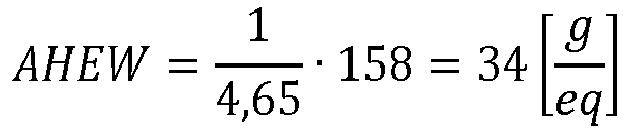
- Ein weiterer Gegenstand der vorliegenden Erfindung ist ein Verfahren zur chemischen Befestigung von Konstruktionselementen und/oder Verankerungsmittelsn in Bohrlöchern, wobei zur chemischen Befestigung der Konstruktionselemente eine Mehrkomponenten-Epoxidharzmasse wie zuvor beschrieben verwendet wird. Das erfindungsgemäße Verfahren eignet sich insbesondere zum Baukleben von Beton/Beton, Stahl/Beton oder Stahl/Stahl oder einer der genannten Materialien auf anderen mineralischen Materialien, die strukturelle Verstärkung von Bauteilen aus Beton, Mauerwerk und anderen mineralischen Materialien, die Armierungsanwendungen mit faserverstärkten Polymeren von Bauobjekten, die chemische Befestigung auf Oberflächen aus Beton, Stahl oder anderen mineralischen Materialien, insbesondere die chemische Befestigung von Konstruktionselementen und Verankerungsmitteln, wie Ankerstangen, Ankerbolzen, (Gewinde)stangen,
- (Gewinde)hülsen, Betoneisen, Schrauben und dergleichen, in Bohrlöchern in verschiedenen Untergründen, wie (Stahl)beton, Mauerwerk, anderen mineralischen Materialien, Metallen (z.B. Stahl), Keramiken, Kunststoffen, Glas und Holz. Ganz besonders bevorzugt dient das erfindungsgemäße Verfahren zur chemischen Befestigung von Verankerungsmitteln.
- Soweit anwendbar, gelten die vorstehenden Ausführungen zur erfindungsgemäßen Verwendung gleichermaßen für das erfindungsgemäße Verfahren.
- Weitere Vorteile der Erfindung ergeben sich aus der nachfolgenden Beschreibung von bevorzugten Ausführungsbeispielen, die jedoch in keiner Weise als einschränkend zu verstehen sind. Alle Ausführungsformen der Erfindung können im Rahmen der Erfindung miteinander kombiniert werden.
- Zur Darstellung der Ausführungsbeispiele wurden die in der nachstehenden Tabelle 1 aufgeführten Chemikalien verwendet:
Tabelle 1: Liste der verwendeten Chemikalien Stoff Handelsname CAS- Nummer Hersteller Land 1,2,3-Propantriol Glycerin 56-81-5 Merck D 1,2-Diaminocyclohexan Dytek DCH-99 694-83-7 Invista NL 1,3-Cyclohexandimethanamin 1,3-BAC 2579-20-6 Itochu Deutschland D 1,3-Dihydroxybenzol Resorcin 108-46-3 Sigma-Aldrich D 2,4,6-Tris(dimethylaminomethyl)phenol, Bis[(dimethylamino)methyl]phenol Ancamine K54 90-72-2, 71074-89-0 Air Products NL 2-Methyl-1,5-pentamethylendiamin Dytek A 15520-10-2 Invista NL 4,4'-Methylenbis(2-methylcyclohexylamin) MACM 6864-37-5 Sigma-Aldrich D Aluminiumnitrat-Nonahydrat Aluminiumnitrat 7784-27-2 Sigma-Aldrich D Ammoniumnitrat Ammoniumnitrat 6484-52-2 Sigma-Aldrich D Calciumcarbonat Calciumcarbonat 471-34-1 Sigma-Aldrich D Calciumnitrat-Tetrahydrat Calciumnitrat 13477-34-4 Sigma-Aldrich D Calciumnitrit-Lösung, 30 % Calciumnitrit-Lösung, 30 % in Wasser 13780-06-8 Sigma-Aldrich D Calciumoxid Calciumoxid 1305-78-8 Sigma-Aldrich D Calciumpropionat Calciumpropionat 4075-81-4 Sigma-Aldrich D Calciumsulfat-Dihydrat Calciumsulfat-Dihydrat 75 10101-41-1 Hilliges Gipswerk D Calciumtrifluoromethansulfonat Calciumtriflat 55120-75-7 Sigma-Aldrich D Isophorondiamin Vestamin IPD 2855-13-2 Evonik Degussa D Kaliumnitrat Kaliumnitrat 7757-79-1 Sigma-Aldrich D Kaliumsulfat Kaliumsulfat 7778-80-5 Sigma-Aldrich D Lithiumhydroxid Lithiumhydroxid 1310-65-2 Sigma-Aldrich D Lithiumtrifluoromethansulfonat Lithiumtriflat 33454-82-9 TCI Europe B Magnesiumnitrat Magnesiumnitrat-Hexahydrat 13446-18-9 Sigma-Aldrich D Magnesiumtrifluoromethansulfonat Magnesiumtriflat 60871-83-2 Alfa Aesar D m-Xylylendiamin mXDA 1477-55-0 Itochu Deutschland D Natriumbromid Natriumbromid 7647-15-6 Sigma-Aldrich D Natriumchlorid Natriumchlorid 7647-14-5 VWR Prolabo D Natriumiodid Natriumiodid 7681-82-5 Sigma-Aldrich D Natriumnitrat Chile-Salpeter 7631-99-4 Sigma-Aldrich D 4-Hydroxyphenylessigsäure 4-Hydroxyphenylessigsäure 156-38-7 TCI Europe B Phenol-Novolakharz Phenolite TD-2131 9003-35-4 DIC Europe D p-Toluolsulfonsäure-Monohydrat p-Toluolsulfonsäure 6192-52-5 TCI Europe B Salicylsäure Salicylsäure 69-72-7 Merck D Salpetersäure 70% Salpetersäure 7697-37-2 Sigma-Aldrich D Styrolisiertes Phenol Novares LS 500 61788-44-1 Rütgers Novares GmbH D Tetrabutylammoniumnitrat Tetrabutylammoniumnitrat 1941-27-1 Sigma-Aldrich D Trifluoressigsäure Trifluoressigsäure 76-05-1 TCI Europe B - Als Epoxidharze wurden in den Beispielen die im Handel unter den Bezeichnungen Araldite GY 240 und Araldite GY 282 (Huntsman) erhältlichen Bisphenol A-basierten beziehungsweise Bisphenol F-basierten Epoxidharze verwendet.
- Als Reaktivverdünner wurden die im Handel unter den Bezeichnungen Araldite DY-026 und AralditeTM DY-T (Huntsman) erhältlichen 1,4-Butandiol-diglycidylether und Trimethyolpropan-triglycidylether verwendet.
- Es wurde eine Epoxidharzkomponente (A) mit der in der nachfolgenden Tabelle 2 angegebenen Zusammensetzung hergestellt. Die Komponenten wurden gemischt und im Dissolver (PC Laborsystem, Volumen 1L) bei einem Unterdruck von 80 mbar 10 min lang bei 3500 U/min gerührt.
Tabelle 2: Zusammensetzung Epoxidharzkomponente (A) Stoff Funktion Gewichtsprozent Bisphenol A-basiertes Epoxidharz Epoxidharz 52 Bisphenol F-basiertes Epoxidharz Epoxidharz 28 1,4-Butanediol-diglycidyl ether Reaktivverdünner 10 Trimethyolpropan-triglycidylether Reaktivverdünner 10 EEW [g/Eq] 158 - Als Härterkomponente (B) wurde das Amin Isophorondiamin (IPDA, Handelsname Vestamin IPD) der Firma Evonik Degussa, Deutschland eingesetzt. Zur Herstellung der Härterkomponente (B) wurde die in der Tabelle 3 angegebene Menge an Salz (S) zu IPDA hinzugegeben und soweit wie möglich gelöst. Dieses Gemisch wurde als Härterkomponente eingesetzt. Die Mischverhältnisse wurden basierend auf dem AHEW-Gehalts von IPDA (42,6 g/EQ), dem Gehalt an Beschleuniger und dem EEW-Gehalt der Epoxidharzkomponente (A) berechnet.
- Zur Bestimmung der Reaktionskinetik durch Temperaturmessung wurde die Epoxidharzkomponente (A) jeweils mit der Härterkomponente in ein 20 ml Rollrandglas gefüllt. Es wurde ein Temperaturfühler mittig im Rollrandglas platziert. Die Temperaturänderung wurde aufgezeichnet (Gerät: Yokogawa, DAQ-Station, Model: DX1006-3-4-2). Die Aushärtung des Mörtels konnte durch diese Methode über den Zeitverlauf der Temperaturentwicklung verfolgt werden. Fand eine Beschleunigung bei der Aushärtung statt, ist das Temperaturmaximum zu kürzeren Zeiten hin verschoben, verbunden mit einer höheren Temperatur. Es wurden Tmax (erreichtes Temperaturmaximum) und tTmax (Zeit, nach der das Temperaturmaximum erreicht wurde) gemessen.
- Die Ergebnisse der Bestimmung der Reaktionskinetik durch Temperaturmessung für unterschiedliche Salze (S) als Beschleuniger sind in der nachstehenden Tabelle 3 aufgeführt.
Tabelle 3: Ergebnisse der Bestimmung der Reaktionskinetik Salz (S) Anteil [Gew.-%] Tmax [°C] tmax [hh:mm:ss] Calciumnitrat-Tetrahydrat 2 193 00:29:13 5 189 00:12:34 Calciumnitrat-Tetrahydrat/Ancamin K54 2/2 85 00:19:05 Caciumnitrat-Tetrahydrat/Calciumtriflat/ Ancamin K54 2/2/2 111 00:07:34 Calciumnitrat/Salpetersäure-Lösung 2 159 00:20:26 5 176 00:09:32 Kaliumnitrat (25,0 % in H2O) 8 153,2 00:43:50 20 145,8 00:19:25 Natriumnitrat (46,6 % in H2O) 4,3 125,2 01:10:58 10,7 135,1 00:38:06 Magnesiumnitrat-Hexahydrat 2 36 01:12:52 5 152 00:38:21 Aluminiumnitrat-Nonahydrat 2 55 01:11:33 5 169 00:38:52 Ammoniumnitrat 2 173,3 00:39:11 5 195,9 00:19:40 Calciumnitrit (30,0 % in H2O) 6,7 207 00:12:53 16,7 164,7 00:06:41 Natriumchlorid (26,4 % in H2O) 7,6 130 00:43:56 18,9 157,7 00:27:29 Nathumbromid (47,56 % in H2O) 4,2 157,2 00:47:22 10,5 145,8 00:29:37 Natriumiodid 2 135 01:13:03 5 152 00:24:46 Calciumtriflat 2 212 00:21:49 5 230 00:07:05 Calciumtriflat/Ancamine K54 2/2 141 00:16:53 Magnesiumtriflat 2 46,2 02:34:25 5 100,5 01:35:59 Lithiumtriflat 2 183,5 00:34:48 5 222,6 00:14:56 - Zum Vergleich wurde die Reaktionskinetik durch Temperaturmessung für zahlreiche Beschleuniger, die aus dem Stand der Technik bekannt sind, durchgeführt. Die Ergebnisse dieser Messung sind in der nachstehenden Tabelle 4 aufgeführt.
Tabelle 4: Ergebnisse der Bestimmung der Reaktionskinetik durch Temperaturmessung für unterschiedliche Beschleuniger (Vergleichsbeispiele) Beschleuniger Konzentration [Gew.-%] Tmax [°C] tmax [hh:mm:ss] -- 36,8 02:17:03 H2O 5 65,5 01:18:12 10 86,8 00:36:45 Resorcin 10 81 01:18:20 20 172 00:27:48 Glycerin 5 24 04:55:38 10 32 02:15:26 Calciumoxid 2 23 05:04:05 5 27 00:51:02 Phenolessigsäure 5 28 00:23:14 10 23 00:16:37 Styrolisiertes Phenol 'LS 500' 10 27 03:06:47 20 29 02:28:30 p-Toluolsulfonsäure 2 26 03:02:25 5 25 03:04:48 Ancamin K54 2 25 03:57:52 5 24 05:34:45 Salicylsäure 2 32 01:16:25 5 36 01:30:38 Phenolite TD-2131 15 165 00:54:23 25 147 00:38:37 Trifluoressigsäure 2 31 01:47:13 5 73 01:22:20 Lithiumhydroxid 2 23 00:17:00 5 23 05:21:27 Kaliumsulfat 2 45,4 03:07:59 5 46,8 02:29:52 Calciumsulfat 2 25 05:14:48 5 24 04:41:34 Calciumpropionat 2 36,5 03:26:25 5 41,5 03:22:06 Tetrabutylammoniumnitrat 2 43 02:21:04 5 38 02:27:56 Kaliumsulfat (10,02 % in H2O) 20,0 136,9 00:17:50 49,9 98,2 00:12:12 - Die Härterkomponente (B) wurde dahingehend modifiziert, dass das Amin IPDA durch die in der nachstehenden Tabelle 5 aufgeführten Amine ausgetauscht wurde und mit den jeweilig angegebenen Salzen (S) kombiniert wurde. Die Ergebnisse der Bestimmung der Reaktionskinetik durch Temperaturmessung sind in den nachstehenden Tabellen 5 (erfindungsgemäß) und 6 (Vergleichsbeispiele) angegeben.
Tabelle 5: Ergebnisse der Bestimmung der Reaktionskinetik durch Temperaturmessung bei Variation der des Amins in der Härterkomponente Amin Salz (S) Anteil [Gew.-%] Tmax [°C] tmax [hh:mm:ss] 1,3-BAC Calciumnitrat-Tetrahydrat 2 165 00:11:45 1,3-BAC Calciumnitrat-Tetrahydrat in Glycerin (80%ige Lösung) 2,5 257,5 00:13:20 MACM Calciumnitrat-Tetrahydrat 2 61 00:55:29 Dytek A Calciumnitrat-Tetrahydrat in Glycerin (80%ige Lösung) 2,5 226,5 00:15:32 1,2-BAC Calciumtriflat 2 146,5 01:14:13 mXDA Natriumiodid in Glycerin (36,4%ige Lösung) 5,5 239,0 00:40:52 Tabelle 6: Ergebnisse der Bestimmung der Reaktionskinetik durch Temperaturmessung bei Variation der des Amins in der Härterkomponente unter Verwendung eines Novolak-Beschleunigers Amine Beschleuniger Konzentration [%] Tmax [°C] tmax [hh:mm:ss] 1,3-BAC -- 33 03:08:35 MACM -- 22 03:12:37 MACM Phenolite TD-2131 15 50 01:20:40 Dytek A Phenolite TD-2131 15 222,7 00:33:17 1,2-BAC Phenolite TD-2131 15 57,1 01:25:53 1,3-BAC Phenolite TD-2131 15 209,5 00:25:07 mXDA Phenolite TD-2131 15 224,9 00:38:46 - Als Epoxidharze wurden in den Beispielen die im Handel unter den Bezeichnungen Araldite GY 240 und Araldite GY 282 (Huntsman) erhältlichen Bisphenol A-basierten beziehungsweise Bisphenol F-basierten Epoxidharze verwendet.
- Als Reaktivverdünner wurden die im Handel unter den Bezeichnungen Araldite DY-026 und AralditeTM DY-T (Huntsman) erhältlichen 1,4-Butandiol-diglycidylether und Trimethyolpropan-triglycidylether verwendet.
- Als Haftvermittler wurde 3-Glycidyloxypropyl-trimethoxysilan erhältlich unter der Bezeichnung Dynalsylan GLYMO™ (Evonik Industries) verwendet.
- Die flüssigen Komponenten wurden per Hand vorgemischt. Anschließend wurden als Füllstoff Quarz (Millisil™ W12 der Firma Quarzwerke Frechen) und als Verdicker pyrogene Kieselsäure (Cab-O-Sil™ TS- 720 der Firma Cabot Rheinfelden) zugegeben und die Mischung im Dissolver (PC Laborsystem, Volumen 1L) 10 min lang bei einem Unterdruck von 80 mbar bei 3500 U/min gerührt.
- Die Zusammensetzung der in den Beispielen verwendeten Epoxidharzkomponente (A) ist in der nachfolgenden Tabelle 7 angegeben.
Tabelle 7: Zusammensetzung der Epoxidharzkomponente (A) in Gew.-% Stoff Funktion Gewichtsprozent [Gew.- %] 3-Glycidyloxypropyl-trimethoxsysilan Haftvermittler 2,8 Bisphenol A-basiertes Epoxidharz Epoxidharz 31,3 Bisphenol F-basiertes Epoxidharz Epoxidharz 16,9 1,4-Butanediol-diglycidylether Reaktivverdünner 6,0 Trimethylolpropan-triglycidylether Reaktivverdünner 6,0 Quarz Füllstoff 34,4 Kieselsäure Verdicker 2,7 EEW [g/Eq] 255 - Als Amine wurden Isophorondiamin (IPDA) der Firma Evonik Degussa, Deutschland, 1,3-Cyclohexandimethanamin (1,3-BAC), m-Xylylendiamin (mXDA) der Firma MGC, Japan, sowie 2-Methlypentamethylendiamin (Dytek A) der Firma Invista, Niederlande, zur Herstellung der Härterkomponente (B) verwendet.
- Als Füllstoff wurde Quarz (Millisil™ W12 der Firma Quarzwerke Frechen) sowie Calciumaluminatzement (Secar 80 der Firma Kerneos SA) und als Verdicker pyrogene Kieselsäure (Cab-O-Sil™ TS-720 der Firma Cabot Rheinfelden) verwendet.
- Die Salze Calciumnitrat und Natriumiodid wurden als Lösungen in Glycerin (1,2,3-Propantriol, CAS-Nr. 56-81-5, Merck, D) eingesetzt. Zur Herstellung der Calciumnitrat-Lösung wurden 400,0g Calciumnitrat-Tetrahydrat zu 100,0 g Glycerin gegeben und bei 50 °C bis zur vollständigen Lösung gerührt (ca. 3 Stunden). Die so hergestellte Lösung enthielt 80,0 % Calciumnitrat-Tetrahydrat. Zur Herstellung der Natriumiodid-Lösung wurden 36,4 g Natriumiodid zu 63,6 Glycerin gegeben und bei 50 °C bis zur vollständigen Lösung gerührt. Die so hergestellte Lösung enthielt 36,4 % Natriumiodid.
- Calciumtriflat wurde als Feststoff im Amin des jeweiligen Härters gelöst.
- Weiterhin wurde ein Calciumnitrat/Salpetersäure-Lösung als Salz (S) eingesetzt. Zur Herstellung dieser Lösung wurden 52,6 g Calciumcarbonat langsam zu 135,2 g Salpetersäure gegeben und anschließend 5 min gerührt.
- Zur Herstellung der Härterkomponenten (B) wurden die flüssigen Komponenten gemischt. Der Beschleuniger wurde hinzugegeben und anschließend wurden Quarzmehl und Kieselsäure zugegeben und im Dissolver (PC Laborsystem, Volumen 1L) bei einem Unterdruck von 80 mbar bei 2500 U/min für 10 min gerührt.
- Die Zusammensetzung der so hergestellten Härterkomponenten (B) ist in den nachfolgenden Tabellen 8 (erfindungsgemäß) und 9 (Vergleichsbeispiele) angegeben:
Tabelle 8: Zusammensetzung der Härterkomponente (B) in Gew.-% Beispiel 1 2 3 4 Amin 1,3-BAC 36,75 - - - mXDA - 41,2 - - IPDA - - 42,0 - DYTEK A - - - 42,0 Beschleuniger Natriumiodid 8,25 - - - Calciumnitrat - 3,8 - - Calciumnitrat/Salpetersäure - - 3,0 - Calciumtriflat - - - 3,0 Quarz 25,0 25,0 25,0 25,0 Calciumaluminatzement 25,0 25,0 25,0 25,0 Verdicker 5,0 5,0 5,0 5,0 AHEW [g/Eq] 97 83 101 69 Tabelle 9: Zusammensetzung der Härterkomponente (B) der Vergleichsbeispiele 1 bis 5 in Gew.-% Beispiel 1 2 3 4 5 Amin 1,3-BAC 36,6 - - - - mXDA - 36,6 - - - IPDA - - 27,6 36,6 - DYTEK A - - - - 36,6 Beschleuniger Phenolite TD-2131 6,0 6,0 - 6,0 6,0 Ancamine K54 2,4 2,4 2,4 2,4 2,4 Novares LS 500 - - 15,0 - - Quarz 25,0 25,0 25,0 25,0 25,0 Calciumaluminatzement 25,0 25,0 25,0 25,0 25,0 Verdicker 5,0 5,0 5,0 5,0 5,0 AHEW [g/Eq] 97 93 154 116 79 - Die Epoxidharzkomponente (A) und die Härterkomponente (B) wurden in einem Speedmixer in einem Verhältnis gemischt, das entsprechend der EEW- und AHEW-Werte eine ausgeglichene Stöchiometrie ergab. Das Gemisch wurde möglichst blasenfrei in eine 1K-Kartusche gefüllt und sofort in das für die Auszugsversuche präparierte Bohrloch injiziert.
- Die Auszugsfestigkeit der durch Mischen der Epoxidharzkomponente (A) und Härterkomponente (B) gemäß den oben angegebenen Beispielen erhaltenen Mörtelmassen wurden unter Verwendung einer hochfesten Ankergewindestange M12 gemäß ETAG 001 Part 5 bestimmt, die in ein hammergebohrtes Bohrloch mit einem Durchmesser von 14 mm und einer Bohrlochtiefe von 69 mm mit der jeweiligen Mörtelmasse in C20/25 Beton eingedübelt wurde. Die Bohrlöcher wurden mit Druckluft (2 x 6 bar), einer Drahtbürste (2 x) und anschließend wieder Druckluft (2 x 6 bar) gereinigt.
- Die Bohrlöcher wurden vom Bohrgrund her mit der jeweils zu prüfenden Mörtelmasse zu zwei Dritteln befüllt. Die Gewindestange wurde von Hand eingedrückt. Der Mörtelüberschuss wurde mittels eines Spachtels entfernt.
- Die Aushärtezeit bei Versuch 1 betrug 4 h bei 25 °C. Bei Versuch 2 betrug die Aushärtezeit 24 Stunden bei 25 °C.
- Die Versagenslast wurde durch zentrisches Ausziehen der Ankergewindestange mit enger Abstützung ermittelt. Die mit den Mörtelmassen unter Verwendung einer Härterkomponente (B) gemäß den Beispielen 1 bis 4 und den Vergleichsbeispielen 1 bis 5 erhaltenen Lastwerte sind der folgenden Tabelle 10 zu entnehmen.
Tabelle 10: Bestimmung der Lastwerte Beispiele Vergleichsbeispiele 1 2 3 4 1 2 3 4 5 Auszugsversuche Versuch Nummer Lastwert [N/mm2] Aushärtung 4h 1 31,1 29,1 7,4 24,6 25,8 18,9 1,7 0,4 17,9 Aushärtung 24h 2 34,4 38,8 35,5 35,0 37,3 38,2 36,5 36,8 36,1
Claims (15)
- Verwendung mindestens eines Salzes (S) ausgewählt aus der Gruppe bestehend aus Salzen der Salpetersäure, Salzen der Salpetrigen Säure, Salzen der Halogene, Salzen der Trifluormethansulfonsäure sowie Kombinationen davon als Beschleuniger in einer Epoxidharzmasse zur chemischen Befestigung.
- Verwendung gemäß Anspruch 1, dadurch gekennzeichnet, dass die Epoxidharzmasse eine Mehrkomponenten-Epoxidharzmasse ist.
- Verwendung nach Anspruch 2, dadurch gekennzeichnet, dass die Mehrkomponenten-Epoxidharzmasse eine Epoxidharzkomponente (A), die wenigstens ein härtbares Epoxidharz enthält, und eine Härterkomponente (B), die mindestens ein gegenüber Epoxidgruppen reaktives Amin enthält, umfasst, wobei die Epoxidharzkomponente (A) und die Härterkomponente (B) reaktionsinhibierend getrennt voneinander vorliegen,
- Verwendung nach Anspruch 3, dadurch gekennzeichnet, dass die Mehrkomponenten-Epoxidharzmasse in Patronen, Kartuschen oder Folienbeuteln vorliegt, die zwei oder mehrere voneinander getrennte Kammern umfassen, in welchen die Epoxidharzkomponente (A) und die Härterkomponente (B) reaktionsinhibierend voneinander getrennt angeordnet sind.
- Verwendung nach einem der vorhergehenden Ansprüche zur chemischen Befestigung von Konstruktionselementen und Verankerungsmitteln, insbesondere von Ankerstangen, Ankerbolzen, (Gewinde)stangen, (Gewinde)hülsen, Betoneisen, und/oder Schrauben in Bohrlöchern.
- Verwendung nach einem der vorhergehenden Ansprüche, dadurch gekennzeichnet, dass das Salz (S) ausgewählt ist aus der Gruppe bestehend aus Nitrat (NO3 -), Iodid (I-), Triflat (CF3SO3 -) sowie Mischungen daraus.
- Verwendung nach einem der vorhergehenden Ansprüche, dadurch gekennzeichnet, dass das Salz (S) ein Kation umfasst ausgewählt aus der Gruppe bestehend aus Alkalimetallen, Erdalkalimetallen, Lanthanoiden, Aluminium, Ammonium und Kombinationen davon.
- Verwendung nach einem der Ansprüche 3 bis 7, dadurch gekennzeichnet, dass das gegenüber Epoxidgruppen reaktive Amin ausgewählt ist aus 3-Aminomethyl-3,5,5-trimethylcyclohexan (IPDA), 2-Methyl-1,5-pentandiamin (DYTEK A), m-Xylylendiamin (mXDA), 1,3-Bis(aminomethyl)-cyclohexan (1,3-BAC), 4,4'-Methylenbis(cyclohexyl-amin) (PACM), 4-Methylcyclohexan-1,3-diamin (mCDA), 1,2-Diaminocyclohexan (1,2-BAC) sowie Mischungen daraus.
- Verwendung nach einem der vorhergehenden Ansprüche, dadurch gekennzeichnet, dass das Salz (S) mindestens in der Härterkomponente (B) enthalten ist.
- Verwendung nach einem der vorhergehenden Ansprüche, dadurch gekennzeichnet, dass das Salz (S) in einem Anteil von 0,1 bis 4 Gew.-% bezogen auf das Gesamtgewicht der Epoxidharzmasse in der Epoxidharzmasse enthalten ist.
- Verwendung gemäß einem der Ansprüche 3 bis 10, dadurch gekennzeichnet, dass das härtbare Epoxidharz ein Diglycidylether von Bisphenol A oder von Bisphenol F oder einem Gemisch davon ist.
- Verfahren zur chemischen Befestigung von Konstruktionsmitteln und/oder Verankerungsmitteln, wobei eine Mehrkomponenten-Epoxidharzmasse verwendet wird, die eine Epoxidharzkomponente (A), die wenigstens ein härtbares Epoxidharz enthält, und eine Härterkomponente (B), die mindestens ein gegenüber Epoxidgruppen reaktives Amin enthält, umfasst, und in der die Epoxidharzkomponente (A) und die Härterkomponente (B) reaktionsinhibierend getrennt voneinander vorliegen, wobei die Epoxidharzkomponente (A) und/oder die Härterkomponente (B) als Beschleuniger wenigstens ein Salz (S) umfasst, wobei das Salz (S) ausgewählt ist aus der Gruppe bestehend aus Salzen der Salpetersäure, Salzen der Salpetrigen Säure, Salzen der Halogene, Salzen der Trifluormethansulfonsäure sowie Kombinationen davon.
- Verfahren gemäß Anspruch 12, wobei die Mehrkomponenten-Epoxidharzmasse in Patronen, Kartuschen oder Folienbeuteln vorliegt, die zwei oder mehrere voneinander getrennte Kammern umfassen, in welchen die Epoxidharzkomponente (A) und die Härterkomponente (B) reaktionsinhibierend voneinander getrennt angeordnet sind.
- Verfahren gemäß Anspruch 13, wobei die Epoxidharz-komponente (A) und die Härterkomponente (B) aus den getrennten Kammern entleert werden und in einem Statikmischer oder Dissolver gemischt werden.
- Verfahren gemäß Anspruch 14, wobei die gemischte Mehrkomponenten-Epoxidharzmasse in ein Bohrloch, vorzusgweise in ein zuvor gereinigtes Bohrloch, eingebracht wird.
Priority Applications (11)
| Application Number | Priority Date | Filing Date | Title |
|---|---|---|---|
| EP18195409.0A EP3626757A1 (de) | 2018-09-19 | 2018-09-19 | Verwendung von salzen als beschleuniger in einer epoxidharzmasse zur chemischen befestigung |
| JP2021515224A JP7147056B2 (ja) | 2018-09-19 | 2019-09-09 | 化学的締結用のエポキシ樹脂化合物における加速剤としての塩の使用 |
| ES19765480T ES2980193T3 (es) | 2018-09-19 | 2019-09-09 | Uso de sales como acelerantes en una masa de resina de epóxido, para la fijación química |
| US17/276,968 US11673993B2 (en) | 2018-09-19 | 2019-09-09 | Use of salts as accelerators in an epoxy resin compound for chemical fastening |
| EP19765480.9A EP3853286B1 (de) | 2018-09-19 | 2019-09-09 | Verwendung von salzen als beschleuniger in einer epoxidharzmasse zur chemischen befestigung |
| CA3107089A CA3107089A1 (en) | 2018-09-19 | 2019-09-09 | Use of salts as accelerators in an epoxy resin compound for chemical fastening |
| PCT/EP2019/073941 WO2020058018A1 (de) | 2018-09-19 | 2019-09-09 | Verwendung von salzen als beschleuniger in einer epoxidharzmasse zur chemischen befestigung |
| PL19765480.9T PL3853286T3 (pl) | 2018-09-19 | 2019-09-09 | Zastosowanie soli jako przyspieszaczy w masie żywicy epoksydowej do mocowania chemicznego |
| CN201980059661.2A CN112673045B (zh) | 2018-09-19 | 2019-09-09 | 盐在用于化学紧固的环氧树脂化合物中作为促进剂的用途 |
| AU2019343453A AU2019343453B2 (en) | 2018-09-19 | 2019-09-09 | Use of salts as accelerators in an epoxy resin compound for chemical fastening |
| US18/311,268 US20230272154A1 (en) | 2018-09-19 | 2023-05-03 | Use of salts as accelerators in an epoxy resin compound for chemical fastening |
Applications Claiming Priority (1)
| Application Number | Priority Date | Filing Date | Title |
|---|---|---|---|
| EP18195409.0A EP3626757A1 (de) | 2018-09-19 | 2018-09-19 | Verwendung von salzen als beschleuniger in einer epoxidharzmasse zur chemischen befestigung |
Publications (1)
| Publication Number | Publication Date |
|---|---|
| EP3626757A1 true EP3626757A1 (de) | 2020-03-25 |
Family
ID=63798759
Family Applications (2)
| Application Number | Title | Priority Date | Filing Date |
|---|---|---|---|
| EP18195409.0A Withdrawn EP3626757A1 (de) | 2018-09-19 | 2018-09-19 | Verwendung von salzen als beschleuniger in einer epoxidharzmasse zur chemischen befestigung |
| EP19765480.9A Active EP3853286B1 (de) | 2018-09-19 | 2019-09-09 | Verwendung von salzen als beschleuniger in einer epoxidharzmasse zur chemischen befestigung |
Family Applications After (1)
| Application Number | Title | Priority Date | Filing Date |
|---|---|---|---|
| EP19765480.9A Active EP3853286B1 (de) | 2018-09-19 | 2019-09-09 | Verwendung von salzen als beschleuniger in einer epoxidharzmasse zur chemischen befestigung |
Country Status (9)
| Country | Link |
|---|---|
| US (2) | US11673993B2 (de) |
| EP (2) | EP3626757A1 (de) |
| JP (1) | JP7147056B2 (de) |
| CN (1) | CN112673045B (de) |
| AU (1) | AU2019343453B2 (de) |
| CA (1) | CA3107089A1 (de) |
| ES (1) | ES2980193T3 (de) |
| PL (1) | PL3853286T3 (de) |
| WO (1) | WO2020058018A1 (de) |
Cited By (3)
| Publication number | Priority date | Publication date | Assignee | Title |
|---|---|---|---|---|
| EP3960718A1 (de) * | 2020-08-24 | 2022-03-02 | Hilti Aktiengesellschaft | Mörtelsystem |
| EP3981817A1 (de) * | 2020-10-12 | 2022-04-13 | Evonik Operations GmbH | Zusammensetzungen umfassend brönstedtsäuren und monoamine |
| US11453744B2 (en) | 2019-10-15 | 2022-09-27 | Evonik Operations Gmbh | Compositions consisting of BrØnsted acids and monoamines |
Families Citing this family (7)
| Publication number | Priority date | Publication date | Assignee | Title |
|---|---|---|---|---|
| EP4177235A1 (de) | 2021-11-09 | 2023-05-10 | HILTI Aktiengesellschaft | Pulverisierte recyclingmaterialien als füllstoffe für mehrkomponenten-systeme zur chemischen befestigung |
| EP4177229A1 (de) | 2021-11-09 | 2023-05-10 | Hilti Aktiengesellschaft | Ziegelmehl als füllstoff in mehrkomponenten-systemen für die chemische befestigung |
| CN114525843B (zh) * | 2022-03-01 | 2024-02-06 | 瑞洲建设集团有限公司 | 地下室施工方法 |
| WO2023210628A1 (ja) * | 2022-04-26 | 2023-11-02 | サカタインクス株式会社 | フェノキシ(メタ)アクリレート樹脂、組成物、硬化物及びフェノキシ(メタ)アクリレート樹脂の製造方法 |
| EP4310127B1 (de) * | 2022-07-19 | 2025-05-14 | 3M Innovative Properties Company | Vergusskleber mit niedriger dichte |
| EP4310125A1 (de) * | 2022-07-20 | 2024-01-24 | Hilti Aktiengesellschaft | Tertiäre amine zur verbesserung des kriechverhaltens von chemischen dübeln |
| CN118955868B (zh) * | 2024-09-20 | 2026-02-13 | 信和新材料股份有限公司 | 一种改性胺树脂及其制备方法与应用 |
Citations (7)
| Publication number | Priority date | Publication date | Assignee | Title |
|---|---|---|---|---|
| GB1105772A (en) | 1964-03-26 | 1968-03-13 | Dynamit Nobel Ag | Process for hardening polyepoxides |
| US5629380A (en) * | 1994-09-19 | 1997-05-13 | Minnesota Mining And Manufacturing Company | Epoxy adhesive composition comprising a calcium salt and mannich base |
| US5958593A (en) | 1994-05-23 | 1999-09-28 | Shomer; John | Hardener for epoxy resins |
| EP1319677A1 (de) * | 2001-12-12 | 2003-06-18 | Hexcel Composites Limited | Beschleunigersystem für Epoxydharze |
| WO2015049229A1 (de) * | 2013-10-01 | 2015-04-09 | Basf Se | Mehrkomponenten-epoxidharzzusammensetzung |
| US20160053108A1 (en) | 2013-05-17 | 2016-02-25 | Blue Cube Ip Llc | Hardeners for cold-curing epoxy systems |
| EP3000792A1 (de) | 2014-09-23 | 2016-03-30 | fischerwerke GmbH & Co. KG | Befestigungssysteme mit feinteiligen füllstoffen |
Family Cites Families (5)
| Publication number | Priority date | Publication date | Assignee | Title |
|---|---|---|---|---|
| US4397998A (en) * | 1981-12-14 | 1983-08-09 | Shell Oil Company | Curable epoxy compositions suitable for use in RIM processes |
| ES2194058T3 (es) | 1994-09-19 | 2003-11-16 | Minnesota Mining & Mfg | Composicion epoxidica adhesiva. |
| DE102012010583A1 (de) * | 2012-05-21 | 2013-11-21 | Mankiewicz Gebr. & Co. Gmbh & Co. Kg | Gelcoat auf Epoxidharzbasis zur Oberflächenvergütung von Bauteilen aus faserverstärkten Kunststoffen |
| EP2826796A1 (de) | 2013-07-18 | 2015-01-21 | HILTI Aktiengesellschaft | Verwendung einer Mehrkomponenten-Mörtelmasse auf Epoxid-Amin-Basis |
| EP2957584B1 (de) * | 2014-06-17 | 2017-03-01 | 3M Innovative Properties Company | Schnellhärtende epoxyhaftmittelzusammensetzungen |
-
2018
- 2018-09-19 EP EP18195409.0A patent/EP3626757A1/de not_active Withdrawn
-
2019
- 2019-09-09 AU AU2019343453A patent/AU2019343453B2/en active Active
- 2019-09-09 PL PL19765480.9T patent/PL3853286T3/pl unknown
- 2019-09-09 CN CN201980059661.2A patent/CN112673045B/zh active Active
- 2019-09-09 EP EP19765480.9A patent/EP3853286B1/de active Active
- 2019-09-09 US US17/276,968 patent/US11673993B2/en active Active
- 2019-09-09 WO PCT/EP2019/073941 patent/WO2020058018A1/de not_active Ceased
- 2019-09-09 CA CA3107089A patent/CA3107089A1/en active Pending
- 2019-09-09 JP JP2021515224A patent/JP7147056B2/ja active Active
- 2019-09-09 ES ES19765480T patent/ES2980193T3/es active Active
-
2023
- 2023-05-03 US US18/311,268 patent/US20230272154A1/en not_active Abandoned
Patent Citations (8)
| Publication number | Priority date | Publication date | Assignee | Title |
|---|---|---|---|---|
| GB1105772A (en) | 1964-03-26 | 1968-03-13 | Dynamit Nobel Ag | Process for hardening polyepoxides |
| US5958593A (en) | 1994-05-23 | 1999-09-28 | Shomer; John | Hardener for epoxy resins |
| US5629380A (en) * | 1994-09-19 | 1997-05-13 | Minnesota Mining And Manufacturing Company | Epoxy adhesive composition comprising a calcium salt and mannich base |
| EP1319677A1 (de) * | 2001-12-12 | 2003-06-18 | Hexcel Composites Limited | Beschleunigersystem für Epoxydharze |
| US20030130481A1 (en) | 2001-12-12 | 2003-07-10 | Hexcel Composites, Ltd. | Accelerated curing of epoxy gelcoats |
| US20160053108A1 (en) | 2013-05-17 | 2016-02-25 | Blue Cube Ip Llc | Hardeners for cold-curing epoxy systems |
| WO2015049229A1 (de) * | 2013-10-01 | 2015-04-09 | Basf Se | Mehrkomponenten-epoxidharzzusammensetzung |
| EP3000792A1 (de) | 2014-09-23 | 2016-03-30 | fischerwerke GmbH & Co. KG | Befestigungssysteme mit feinteiligen füllstoffen |
Non-Patent Citations (2)
| Title |
|---|
| "IUPAC Compendium of Chemical Terminology", 1997, BLACKWELL SCIENTIFIC PUBLICATIONS |
| ULRICH CHRIST; ROB RASING: "Epoxidharze", 2015, VINCENTZ NETWORK GMBH & CO KG |
Cited By (3)
| Publication number | Priority date | Publication date | Assignee | Title |
|---|---|---|---|---|
| US11453744B2 (en) | 2019-10-15 | 2022-09-27 | Evonik Operations Gmbh | Compositions consisting of BrØnsted acids and monoamines |
| EP3960718A1 (de) * | 2020-08-24 | 2022-03-02 | Hilti Aktiengesellschaft | Mörtelsystem |
| EP3981817A1 (de) * | 2020-10-12 | 2022-04-13 | Evonik Operations GmbH | Zusammensetzungen umfassend brönstedtsäuren und monoamine |
Also Published As
| Publication number | Publication date |
|---|---|
| US20220041797A1 (en) | 2022-02-10 |
| CN112673045A (zh) | 2021-04-16 |
| JP2022500544A (ja) | 2022-01-04 |
| ES2980193T3 (es) | 2024-09-30 |
| AU2019343453B2 (en) | 2024-08-01 |
| US11673993B2 (en) | 2023-06-13 |
| EP3853286C0 (de) | 2024-05-01 |
| US20230272154A1 (en) | 2023-08-31 |
| JP7147056B2 (ja) | 2022-10-04 |
| CN112673045B (zh) | 2024-04-02 |
| AU2019343453A1 (en) | 2021-04-15 |
| WO2020058018A1 (de) | 2020-03-26 |
| PL3853286T3 (pl) | 2024-09-09 |
| CA3107089A1 (en) | 2020-03-26 |
| EP3853286A1 (de) | 2021-07-28 |
| EP3853286B1 (de) | 2024-05-01 |
Similar Documents
| Publication | Publication Date | Title |
|---|---|---|
| EP3853286B1 (de) | Verwendung von salzen als beschleuniger in einer epoxidharzmasse zur chemischen befestigung | |
| EP3853285B1 (de) | Härterzusammensetzung für eine epoxidharzmasse, epoxidharzmasse und mehrkomponenten-epoxidharzsystem | |
| EP3853281B1 (de) | Härterzusammensetzung für eine epoxidharzmasse, epoxidharzmasse und mehrkomponenten-epoxidharzsystem | |
| EP3853280B1 (de) | Härterzusammensetzung für eine epoxidharzmasse, epoxidharzmasse und mehrkomponenten-epoxidharzsystem | |
| EP3707189B1 (de) | Mehrkomponenten-epoxidharzmasse und härterkomponente dafür | |
| EP3962984A1 (de) | Härterzusammensetzung für eine epoxidharzmasse, epoxidharzmasse und mehrkomponenten-epoxidharzsystem mit verbesserter tieftemperaturhärtung | |
| EP4121474B1 (de) | Härterzusammensetzung auf basis von diaminomethylcyclohexan und 1,3- cyclo-hexan-bis(methylamin) für eine epoxidharzmasse, epoxidharzmasse und mehrkomponenten-epoxidharzsystem | |
| EP3724252B1 (de) | Härterkomponente für mehrkomponenten-epoxidharzmasse und mehrkomponenten-epoxidharzmasse | |
| EP3392287A1 (de) | Mehrkomponenten-epoxidharzmasse und verfahren zur steuerung der aushärtezeit einer epoxidharzmasse | |
| EP3786133A1 (de) | Mörtelmasse mit mannichbasen für befestigungszwecke mit verbesserter temperaturfestigkeit | |
| EP4310124A1 (de) | Mehrkomponenten-zusammensetzung für befestigungszwecke mit nicht stöchiometrischen eew/ahew anteilen, daraus hergestellte mörtelmasse und daraus hergestellter chemischer dübel | |
| EP4310125A1 (de) | Tertiäre amine zur verbesserung des kriechverhaltens von chemischen dübeln | |
| EP4563613A1 (de) | Verwendung einer trifunktionellen epoxidverbindung zur verbesserung von eigenschaften eines chemischen dübels | |
| HK40032553B (en) | Curing components for multi-component epoxy resin mass and multi-component epoxy resin mass | |
| EP4563615A1 (de) | Verwendung polyfunktioneller epoxidverbindungen zur verbesserung von eigenschaften eines chemischen dübels | |
| EP3945082A1 (de) | Härter für epoxidharzmassen zu befestigungszwecken |
Legal Events
| Date | Code | Title | Description |
|---|---|---|---|
| PUAI | Public reference made under article 153(3) epc to a published international application that has entered the european phase |
Free format text: ORIGINAL CODE: 0009012 |
|
| STAA | Information on the status of an ep patent application or granted ep patent |
Free format text: STATUS: THE APPLICATION HAS BEEN PUBLISHED |
|
| AK | Designated contracting states |
Kind code of ref document: A1 Designated state(s): AL AT BE BG CH CY CZ DE DK EE ES FI FR GB GR HR HU IE IS IT LI LT LU LV MC MK MT NL NO PL PT RO RS SE SI SK SM TR |
|
| AX | Request for extension of the european patent |
Extension state: BA ME |
|
| STAA | Information on the status of an ep patent application or granted ep patent |
Free format text: STATUS: THE APPLICATION IS DEEMED TO BE WITHDRAWN |
|
| 18D | Application deemed to be withdrawn |
Effective date: 20210211 |