EP3625792B1 - System und verfahren zum sprachbasierten dienstrufen - Google Patents
System und verfahren zum sprachbasierten dienstrufen Download PDFInfo
- Publication number
- EP3625792B1 EP3625792B1 EP17920512.5A EP17920512A EP3625792B1 EP 3625792 B1 EP3625792 B1 EP 3625792B1 EP 17920512 A EP17920512 A EP 17920512A EP 3625792 B1 EP3625792 B1 EP 3625792B1
- Authority
- EP
- European Patent Office
- Prior art keywords
- language
- voice input
- voice
- neural network
- applying
- Prior art date
- Legal status (The legal status is an assumption and is not a legal conclusion. Google has not performed a legal analysis and makes no representation as to the accuracy of the status listed.)
- Active
Links
Images


Classifications
-
- G—PHYSICS
- G10—MUSICAL INSTRUMENTS; ACOUSTICS
- G10L—SPEECH ANALYSIS TECHNIQUES OR SPEECH SYNTHESIS; SPEECH RECOGNITION; SPEECH OR VOICE PROCESSING TECHNIQUES; SPEECH OR AUDIO CODING OR DECODING
- G10L15/00—Speech recognition
- G10L15/005—Language recognition
-
- G—PHYSICS
- G10—MUSICAL INSTRUMENTS; ACOUSTICS
- G10L—SPEECH ANALYSIS TECHNIQUES OR SPEECH SYNTHESIS; SPEECH RECOGNITION; SPEECH OR VOICE PROCESSING TECHNIQUES; SPEECH OR AUDIO CODING OR DECODING
- G10L15/00—Speech recognition
- G10L15/08—Speech classification or search
- G10L15/16—Speech classification or search using artificial neural networks
-
- G—PHYSICS
- G06—COMPUTING OR CALCULATING; COUNTING
- G06F—ELECTRIC DIGITAL DATA PROCESSING
- G06F40/00—Handling natural language data
- G06F40/20—Natural language analysis
- G06F40/263—Language identification
-
- G—PHYSICS
- G10—MUSICAL INSTRUMENTS; ACOUSTICS
- G10L—SPEECH ANALYSIS TECHNIQUES OR SPEECH SYNTHESIS; SPEECH RECOGNITION; SPEECH OR VOICE PROCESSING TECHNIQUES; SPEECH OR AUDIO CODING OR DECODING
- G10L15/00—Speech recognition
- G10L15/06—Creation of reference templates; Training of speech recognition systems, e.g. adaptation to the characteristics of the speaker's voice
- G10L15/063—Training
Definitions
- This disclosure generally relates to approaches and techniques for language detection and service hailing.
- the embodiments of the present invention include systems, methods, and a non-transitory computer readable medium configured to perform language-based service hailing according to claims 1-13, respectively.
- the system may be caused to convert the speech samples to spectrograms and train the neural network model with the spectrograms.
- the computing system may be further caused to obtain at least one of an image or a video of a user associated with the voice input, and determine a first set of candidate languages based on at least one of the image or the video.
- the computing system may be caused to identify the language corresponding to the voice based at least on applying the trained model to the voice input and on the determined first set of candidate languages.
- the computing system may be further caused to obtain a location of a user associated with the voice input, and determine a second set of candidate languages based on the location.
- the computing system may be caused to identify the language corresponding to the voice based at least on applying the trained model to the voice input and on the determined second set of candidate languages.
- the system may be coupled to a computing device, and the computing device may comprise a microphone configured to receive the voice input and transmit the received voice input to the one or more processors.
- the message may comprise at least one of a voice or a text
- the system may be caused to perform at least one of playing the message via the computing device or identifying a person at least knowing the identified language to play the message.
- the computing device may be a mobile phone associated with a user
- the system may be a vehicle information platform
- the message may be associated with a vehicle for servicing the user.
- the one or more words comprise one or more phrases for starting a phone call conversation, and the one or more phrases comprise "hi" in various languages.
- a computing system for language-based service hailing may comprise one or more processors and a memory storing instructions.
- the instructions when executed by the one or more processors, may cause the computing system to obtain a plurality of speech samples, each speech sample comprising one or more words spoken in a language, train a neural network model with the speech samples to obtain a trained model for determining languages of speeches, obtain a voice input, identify a language corresponding to the voice based at least on applying the trained model to the voice input, and communicate a message in the identified language.
- the neural network model may comprise various examples, such as a convoluted neural network (CNN), a recurrent neural network, or a combination of both.
- the neural network may receive the obtained speech samples (e.g., spectrograms of speeches of known languages).
- a spectrogram is a visual representation of the frequency spectrum of a sound signal. For example, a record of a speech can be converted to a 2D spectrogram with the x-axis representing the time and the y-axis representing the frequency. Such spectrogram can be used as matrices for further processing and analysis.
- Each word or phrase of each language as represented in the spectrogram or an alternative representation may correspond to a unique pattern.
- the training of the model can lead to an accurate identification of the language of the speech based on the pattern analysis.
- the neural networks are trained to accurately identify the language based on the spectrograms or an alternative representation through a machine learning process.
- the CNN model may be configured to transform the voice input by applying multiple layers to determine its language.
- the neural network model may further comprise one or more Gated Recurrent Units (GRUs) applied to each channel output of the CNN model to further improve the accuracy of the determination.
- GRUs Gated Recurrent Units
- the system may apply the model to a voice input with an unknown language.
- the system may be coupled to a computing device, and the computing device may comprise a microphone configured to receive the voice input and transmit the received voice input to the one or more processors.
- the system may communicate a message in the identified language to a user by playing the message via the computing device, or by identifying a person at least knowing the identified language to play the message.
- the message may comprise at least one of a voice or a text.
- the system may be a vehicle information platform.
- the speech samples may comprise one or more phrases for starting a phone call conversation, such as "hi,” “can you hear me,” or "good morning,” in various languages.
- the one or more phrases may comprise many more examples depending on the culture and user habits.
- training the neural network model with the one or more phrases can allow the model to determine the language of a voice input by only analyzing a reasonable portion thereof (e.g., the beginning of a voice input).
- the computing device may be a mobile phone associated with a user.
- the vehicle information platform may be accessible to the mobile phone (e.g., via a website, an application, etc.). The user may request for vehicle service from the vehicle information system by speaking into the mobile phone.
- the user's voice may be captured by the mobile phone and transmitted to the vehicle information platform, which applies the trained neural network model to identify the language.
- the vehicle information platform may provide various services based on the identified language: machine-replying a message to the user in the identified language, identifying a customer service person at least knowing the identified language to assist the user, identifying a vehicle driver at least knowing the identified language and sending the driver's information in a message to the user, etc.
- FIG. 1 illustrates an example environment 100 for language-based service hailing, in accordance with various embodiments.
- the example environment 100 can comprise at least one computing system 102 that includes one or more processors 104 and memory 106.
- the memory 106 may be non-transitory and computer-readable.
- the memory 106 may store instructions that, when executed by the one or more processors 104, cause the one or more processors 104 to perform various operations described herein.
- the environment 100 may include one or more data stores (e.g., a data store 108) and one or more computing devices (e.g., a computing device 109) that are accessible to the system 102.
- the system 102 may be configured to obtain speech samples from the data store 108 and/or the computing device 109.
- the computing device 109 may be a voice recorder, mobile phone, or computer configured to record a speech.
- the speech may be tagged with the corresponding language.
- the system may use the speech samples to train models for identifying languages of voice inputs.
- the environment 100 may further include one or more computing devices 110, 111, 112, and 113 (e.g., cellphone, tablet, computer, wearable device (smart watch), etc.) coupled to the system 102.
- the computing devices may transmit or receive data (e.g., voice, text, video, information, etc.) to or from the system 102.
- the system 102 may implement an online information or service platform.
- the computing devices 110 and 111 (and many more similar devices) may represent user devices accessing the service platform.
- the computing devices 112 and 113 (and other similar devices) may represent devices associated with or supporting the service platform.
- the computing devices above may be installed with appropriate software (e.g., Application, platform program, etc.) and/or hardware (e.g., wires, wireless connections, etc.) to access the system 102.
- the service may be associated with vehicles (e.g., cars, bikes, boats, airplanes, etc.), and the system 102 may be referred to as an information, service, or service hailing platform (e.g., a vehicle information platform providing information of vehicles, and the vehicle information can be provided by one party to service another party, shared by multiple parties, exchanged among multiple parties, etc.).
- Some platform data e.g., vehicle information, vehicle driver information, language prowess of the vehicle driver, etc.
- the computing devices 110 and 111 may be associated with users of the platform (e.g., a user's cellphone installed with an Application of the platform).
- the computing devices 112 and 113 may be associated with operators of the platform (e.g., customer service personnel of the platform, etc.) and/or operators of the vehicles (e.g., drivers, schedulers, etc.).
- system 102 is shown as a single component in this figure, it is appreciated that the system 102 can be implemented as a single device or multiple devices (e.g., computers, servers, etc.) coupled together.
- the system 102 may be implemented as a computer, a first server, and a second server coupled together, and the computer may be configured to obtain speech samples from the data store 108 and the computing device 109, the first server may be configured to interact with the computing devices 110 and 111, and the second server may be configured to interact with the computing devices 112 and 113.
- the system 102 and one or more of the computing devices may be integrated in a single device or system.
- the system 102 and the computing devices may operate as separate devices.
- the computing devices 110, 111, 112, and 113 may be computers or mobile phones, and the system 102 may be a server.
- the data store(s) may be anywhere accessible to the system 102, for example, in the memory 106, in the computing device 109, 112, or 113, in another device (e.g., network storage device) coupled to the system 102, or another storage location (e.g., cloud-based storage system, network file system, etc.), etc.
- system 102 the computing devices 110, 111, 112, and 113, and the data store 108 may be able to communicate with one another through one or more wired or wireless networks (e.g., the Internet) through which data can be communicated.
- wired or wireless networks e.g., the Internet
- FIG. 2 illustrates an example system 200 for language-based service hailing, in accordance with various embodiments.
- the system 102 may obtain a plurality of speech samples 202 from the data store 108 and/or the computing device 109.
- Each speech sample (e.g., a speech voice record) may comprise one or more words spoken in a language.
- the obtained speech sample may be stored in the memory 106.
- the system 102 may train a neural network model with the speech samples to obtain a trained model for determining languages of speeches. An example training is described below with references to FIG. 3 .
- FIG. 3 illustrates an example training 300 of a neural network model for language-based service hailing, in accordance with various embodiments of the present invention.
- the training 300 may be implemented in various environments including, for example, the environment 100 of FIG. 1 .
- the training steps below may be implemented by one or more components of the system 102 (e.g., the processor 104, the memory 106).
- the description of FIG. 3 is intended to be illustrative and may be modified in various ways according to the implementation. A person skilled in the art would appreciate the description herein as to enable training of the model for language-based service hailing.
- the obtained speech samples 302 may be converted to an appropriate format for model training, if not already converted.
- the conversion may result in converted speech samples 304.
- the speech samples 302 may be captured from microphones and stored as audio files (e.g., .WAV, .MP3, etc.).
- the converted speech samples 304 may be a spectrogram or an alternative representation.
- a spectrogram is a visual representation of the frequency spectrum of a sound signal.
- an audio file can be converted to a 2D spectrogram with the x-axis representing the time or some other variable and the y-axis representing the frequency. Additionally, a z-axis can be used to represent the amplitude of the sound.
- Such spectrograms can also be represented mathematically (e.g., as matrices) for further processing and analysis.
- spectrograms or matrices can be represented mathematically (e.g., as matrices) for further processing and analysis.
- at least two methods can be used: (1) approximation to band-pass filters, or (2) calculation from the time signal using Fourier transform.
- the system may be a vehicle information platform.
- the speech samples may comprise one or more phrases for starting a phone call conversation, such as "hi,” "can you hear me,” or "good morning,” in various languages.
- the one or more phrases may comprise many more examples depending on the culture and user habits. Since each phrase of each language as represented by the spectrogram, matrix, or an alternative representation may correspond to a unique pattern, training the neural network model with the one or more phrases can allow the model to determine the language of a voice input by analyzing the frequency patterns. Thus, the automatic identification of the language of a voice input can be achieved efficiently by machine alone. Further, since the analysis of a reasonable portion of the voice input (e.g., the beginning of a voice input) can suffice the purpose of language identification, the demand for computing power can be kept non-burdening.
- a neural network model may be trained with the converted speech samples 304. Since the language of the speech sample can be associated with or depend on local patterns of the spectrograms or similar representations, a neural network model is applicable and appropriate to achieve accurate language identification.
- the neural network model may comprise various examples, such as a convoluted neural network (CNN), a recurrent neural network (RNN), or a combination of both.
- a person skilled in the art would appreciate the application of various mathematical transformation layers to the converted speech samples 304 layer by layer (the output of one layer fed to the input of another layer).
- Such layers may include the convolution layer, ReLU (Rectified Linear) layer, pooling layer, etc.
- the layers can also be referred to as neuron layers 306 that process information as if biological neurons.
- Each convolution layer can be an application of a preset filter across a previously processed speech sample.
- Each ReLU layer can be an application of a non-saturating function across a previously processed speech sample.
- Each pooling layer can be an application of a pooling window of a preset window size and stride across a previously processed speech sample.
- the filters and neurons such as the number of filters, size of the filter, pooling window size, pooling window stride, and number of neurons can be preset.
- Each layer may be applied for one or more times in a preset order to obtain a fully connected layer 310.
- the fully connected layer 310 may comprise multiple fields connected to an answer 312 to the identity of the language of the speech sample.
- the fully connect layer 310 may comprise multiple fields each corresponding to a language, and each field value may correspond to a probability that the language corresponds to the speech sample. Since the real language of the speech samples are known, the accuracy of a trained model can be determined by comparing the answer 312 (determined language) with the known language, and the various configurations can be tuned to improve the accuracy level.
- one or more Gated Recurrent Units (GRUs) 308 may be applied to each channel output of the CNN neural network model.
- the one or more GRUs can be used to gate the results of the previous layer processing and improve the accuracy of the fully connect layer to achieve better determination.
- the neural network model can be trained with the speech samples to accurately identify the language of a voice input.
- the trained model can be applied in language-based service hailing.
- the computing devices 110 and 111 may be associated with users of the platform (e.g., a user's cellphone installed with an Application of the platform, e.g., Application for hailing a vehicle).
- the computing devices 112 and 113 may be associated with operators of the platform (e.g., customer service personnel of the platform, etc.) and/or operators of the vehicles (e.g., drivers, schedulers, etc.).
- the system 102 may be an online (vehicle) service platform and a user may use the Application of the computing device 110 to contact the platform (e.g., for hailing a vehicle, for making a complaint, for making an inquiry, etc.).
- the computing device 110 may capture a voice input 204 of the user and transmit the system 102, or the system 102 may directly capture such voice input. For efficiency and cost reasons, the contact may be received and handled by a machine at the system 102's end instead of a human. At this stage, the language of the user is to be identified based on the voice input 204.
- the system 102 may apply the model to the voice input 204 to determine the language corresponding to the voice.
- the voice input 204 may be converted to a spectrogram and processed as discussed above to obtain an answer (a determined language of the voice input 204).
- the determination of the language corresponding to the voice can be determined based on the voice input and various other factors to further enhance the accuracy.
- an image and/or a video of a user associated with the voice input can be obtained from the computing device 110 (e.g., as the user uploads an image of himself/herself or uploads a video while inputting the voice).
- the Application of computing device 110 may automatically turn on the camera to record a video or take a picture of the user when user opens the Application.
- the system 102 may determine a first set of candidate languages based on the image and/or the video.
- the system 102 may apply (machine learning) methods such as image matching, image segmentation, and/or image recognition to extract various features that commonly associate with various languages, such as facial feature (e.g., people of certain facial features are associated with certain races speaking certain languages), posture (e.g., people speaking certain languages predominantly use certain hand signs), outfit or an item carried by the user (e.g., certain brands of clothing are unique to a certain nation speaking certain languages), surrounding environment (e.g., a background of Eiffel Tower would indicate French as the first candidate language), or conspicuous object (e.g., languages used on a name tag worn by the user may comprise the first candidate languages, an insignia worn by the user can be used to identify the country or organization affiliation of the user and associated languages).
- Each of the first set of candidate languages may have a corresponding weight depending on factors such as the probability of the language association.
- a location of the user can be obtained from the computing device 110 (e.g., the computing device 110 may comprise a global positioning module that tracks the location of the computing device in real-time and uploads the location to the system 102).
- the system 102 may determine a second set of candidate languages based on the location.
- the location can comprise the current country, state/province, region, or another area of the user, each geographic range being commonly associated with one or more languages and/or dialects.
- Each of the second set of candidate languages or dialects may have an associated weight depending on factors such as the population speaking the language or dialect. For example, a location in United States may render English and Spanish as two of the second set of candidate languages, with English having a larger weight (or probability) than Spanish.
- the first and second sets of candidate languages are not mutually exclusive, and overlaps may occur.
- the system 102 may identify a language corresponding to the voice (of the voice input 204) based on applying the trained model to the voice input, on the first set of candidate languages, and/or on the second set of candidate languages.
- the first and second sets of languages can also be used as inputs to the neural network model described above to enhance the accuracy of the language determination.
- the various configurations of the filters and neurons such as the number of filters, size of the filter, pooling window size, pooling window stride, and number of neurons can be preset, in turn, according to the first and second sets of candidate languages in a decreasing probability to process the speech samples with the neural network model.
- the answer 312 obtained in this case would be even more accurate or be obtained more quickly than that obtained without factoring in the first and second sets of candidate languages.
- the language determined by applying the trained model to the voice input, the first set of candidate languages, and the second set of candidate languages can be weighted to obtain the language of the voice.
- Each weight may be preset and adjustable.
- the language determined by applying the trained model may be given the largest weight because it directly analyzes the voice input.
- the system 102 may implement various steps to service the user.
- the system 102 may communicate a preset message 207 in the identified language to the computing device 110.
- the system 102 may identify from a database a person at least knowing the identified language to service the user. For example, the system 102 may identify a computing device 112 associated with a customer service member speaking the identified language, and communicate a message 205 to the computing device 112 to inform the customer service member of the voice input 204.
- the customer service member may communicate a message 206 to the system 102, which can be relayed to the computing device 110 as a message 207 to service the user.
- the system 102 may be a vehicle information platform accessible to the computing device 110 through an application.
- a user may request for vehicle service from the vehicle information platform by speaking into the computing device 110.
- the user's voice may be captured by the vehicle information platform, which applies the trained neural network model to identify the language.
- the vehicle information platform may further identify from a database a vehicle driver at least knowing the identified language and send the driver's information in a message 207 to the user.
- the vehicle information platform may further analyze the content of the voice input 204 and identify one or more drivers fitting the user's request (e.g., a request for car service in the vicinity of the user) from a pool of drivers matching the language.
- the vehicle information platform may send a message 205 to the identified vehicle driver at the computing device 112 to convey the user's request.
- the message 205 may be a direct copy of the voice input 204.
- the driver may then contact the user directly or through the vehicle information platform.
- the messages 205, 206, and 207 above may comprise voice, text, video, image, etc.
- the system can determine the appropriate language-based services to provide to the user.
- the user would have a seamless experience without any hassle for navigating through language options.
- the system can scale its service globally.
- FIG. 4 illustrates a flowchart of an example method 400, according to various embodiments of the present disclosure.
- the method 400 may be implemented in various environments including, for example, the environment 100 of FIG. 1 .
- the example method 400 may be implemented by one or more components of the system 102 (e.g., the processor 104, the memory 106).
- the example method 400 may be implemented by multiple systems similar to the system 102.
- blocks 402-404 describe below may be implemented by a first system
- blocks 406-410 described below may be implemented by a second system coupled to the first system.
- the operations of method 400 presented below are intended to be illustrative. Depending on the implementation, the example method 400 may include additional, fewer, or alternative steps performed in various orders or in parallel.
- a plurality of speech samples may be obtained, each speech sample comprising one or more words spoken in a language.
- a neural network model may be trained with the speech samples to obtain a trained model for determining languages of speeches.
- a voice input may be obtained.
- one or more first candidate languages may be determined based on at least one of the image or the video, and one or more second candidate languages may be determined based on the location.
- a language corresponding to the voice may be identified based at least on applying the trained model to the voice input, on the one or more first candidate languages, and/or on the one or more second candidate languages.
- a message may be communicated in the identified language.
- a method for language-based service hailing may comprise the following steps: obtaining a voice input, identifying a language corresponding to the voice based at least on applying a trained neural network model to the voice input, and communicating a message in the identified language.
- the trained neural network model has been trained with a plurality of speech samples to determine languages of speeches, and each of the speech samples comprises one or more words spoken in a language
- the techniques described herein are implemented by one or more special-purpose computing devices.
- the special-purpose computing devices may be hard-wired to perform the techniques, or may include circuitry or digital electronic devices such as one or more application-specific integrated circuits (ASICs) or field programmable gate arrays (FPGAs) that are persistently programmed to perform the techniques, or may include one or more hardware processors programmed to perform the techniques pursuant to program instructions in firmware, memory, other storage, or a combination.
- ASICs application-specific integrated circuits
- FPGAs field programmable gate arrays
- Such special-purpose computing devices may also combine custom hard-wired logic, ASICs, or FPGAs with custom programming to accomplish the techniques.
- the special-purpose computing devices may be desktop computer systems, server computer systems, portable computer systems, handheld devices, networking devices or any other device or combination of devices that incorporate hard-wired and/or program logic to implement the techniques.
- Computing device(s) are generally controlled and coordinated by operating system software.
- Conventional operating systems control and schedule computer processes for execution, perform memory management, provide file system, networking, I/O services, and provide a user interface functionality, such as a graphical user interface ("GUI”), among other things.
- GUI graphical user interface
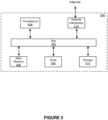
- FIG. 5 is a block diagram that illustrates a computer system 500 upon which any of the embodiments described herein may be implemented.
- the system 500 may correspond to the system 102 described above.
- the computer system 500 includes a bus 502 or other communication mechanism for communicating information, one or more hardware processors 504 coupled with bus 502 for processing information.
- Hardware processor(s) 504 may be, for example, one or more general purpose microprocessors.
- the processor(s) 504 may correspond to the processor 104 described above.
- the computer system 500 also includes a main memory 506, such as a random access memory (RAM), cache and/or other dynamic storage devices, coupled to bus 502 for storing information and instructions to be executed by processor 504.
- Main memory 506 also may be used for storing temporary variables or other intermediate information during execution of instructions to be executed by processor 504. Such instructions, when stored in storage media accessible to processor 504, render computer system 500 into a special-purpose machine that is customized to perform the operations specified in the instructions.
- the computer system 500 further includes a read only memory (ROM) 508 or other static storage device coupled to bus 502 for storing static information and instructions for processor 504.
- ROM read only memory
- a storage device 510 such as a magnetic disk, optical disk, or USB thumb drive (Flash drive), etc., is provided and coupled to bus 502 for storing information and instructions.
- the main memory 506, the ROM 508, and/or the storage 510 may correspond to the memory 106 described above.
- the computer system 500 may implement the techniques described herein using customized hard-wired logic, one or more ASICs or FPGAs, firmware and/or program logic which in combination with the computer system causes or programs computer system 500 to be a special-purpose machine. According to one embodiment, the techniques herein are performed by computer system 500 in response to processor(s) 504 executing one or more sequences of one or more instructions contained in main memory 506. Such instructions may be read into main memory 506 from another storage medium, such as storage device 510. Execution of the sequences of instructions contained in main memory 506 causes processor(s) 504 to perform the process steps described herein. In alternative embodiments, hard-wired circuitry may be used in place of or in combination with software instructions.
- the main memory 506, the ROM 508, and/or the storage 510 may include non-transitory storage media.
- non-transitory media refers to any media that store data and/or instructions that cause a machine to operate in a specific fashion. Such non-transitory media may comprise non-volatile media and/or volatile media.
- Non-volatile media includes, for example, optical or magnetic disks, such as storage device 510.
- Volatile media includes dynamic memory, such as main memory 506.
- non-transitory media include, for example, a floppy disk, a flexible disk, hard disk, solid state drive, magnetic tape, or any other magnetic data storage medium, a CD-ROM, any other optical data storage medium, any physical medium with patterns of holes, a RAM, a PROM, and EPROM, a FLASH-EPROM, NVRAM, any other memory chip or cartridge, and networked versions of the same.
- the computer system 500 also includes a communication interface 518 coupled to bus 502.
- Communication interface 518 provides a two-way data communication coupling to one or more network links that are connected to one or more local networks.
- communication interface 518 may be an integrated services digital network (ISDN) card, cable modem, satellite modem, or a modem to provide a data communication connection to a corresponding type of telephone line.
- ISDN integrated services digital network
- communication interface 518 may be a local area network (LAN) card to provide a data communication connection to a compatible LAN (or WAN component to communicated with a WAN).
- LAN local area network
- Wireless links may also be implemented.
- communication interface 518 sends and receives electrical, electromagnetic or optical signals that carry digital data streams representing various types of information.
- the computer system 500 can send messages and receive data, including program code, through the network(s), network link and communication interface 518.
- a server might transmit a requested code for an application program through the Internet, the ISP, the local network and the communication interface 518.
- the received code may be executed by processor 504 as it is received, and/or stored in storage device 510, or other non-volatile storage for later execution.
- processors may be temporarily configured (e.g., by software) or permanently configured to perform the relevant operations.
- processors may constitute processor-implemented engines that operate to perform one or more operations or functions described herein.
- the methods described herein may be at least partially processor-implemented, with a particular processor or processors being an example of hardware.
- a particular processor or processors being an example of hardware.
- the operations of a method may be performed by one or more processors or processor-implemented engines.
- the one or more processors may also operate to support performance of the relevant operations in a "cloud computing" environment or as a "software as a service” (SaaS).
- SaaS software as a service
- at least some of the operations may be performed by a group of computers (as examples of machines including processors), with these operations being accessible via a network (e.g., the Internet) and via one or more appropriate interfaces (e.g., an Application Program Interface (API)).
- API Application Program Interface
- processors or processor-implemented engines may be located in a single geographic location (e.g., within a home environment, an office environment, or a server farm). In other example embodiments, the processors or processor-implemented engines may be distributed across a number of geographic locations.
- the term "or" may be construed in either an inclusive or exclusive sense. Moreover, plural instances may be provided for resources, operations, or structures described herein as a single instance. Additionally, boundaries between various resources, operations, engines, and data stores are somewhat arbitrary, and particular operations are illustrated in a context of specific illustrative configurations. Other allocations of functionality are envisioned and may fall within a scope of various embodiments of the present disclosure. In general, structures and functionality presented as separate resources in the example configurations may be implemented as a combined structure or resource. Similarly, structures and functionality presented as a single resource may be implemented as separate resources. These and other variations, modifications, additions, and improvements fall within a scope of embodiments of the present disclosure as represented by the appended claims. The specification and drawings are, accordingly, to be regarded in an illustrative rather than a restrictive sense.
Landscapes
- Engineering & Computer Science (AREA)
- Computational Linguistics (AREA)
- Health & Medical Sciences (AREA)
- Audiology, Speech & Language Pathology (AREA)
- Physics & Mathematics (AREA)
- Human Computer Interaction (AREA)
- Acoustics & Sound (AREA)
- Multimedia (AREA)
- Artificial Intelligence (AREA)
- Theoretical Computer Science (AREA)
- Evolutionary Computation (AREA)
- General Health & Medical Sciences (AREA)
- General Engineering & Computer Science (AREA)
- General Physics & Mathematics (AREA)
- Machine Translation (AREA)
- User Interface Of Digital Computer (AREA)
Claims (13)
- Rechensystem zum sprachbasierten Rufen von Diensten, umfassend:einen oder mehrere Prozessoren; undeinen Speicher, der Anweisungen speichert, die, wenn sie von dem einen oder den mehreren Prozessoren ausgeführt werden, das Rechensystem dazu bringen:eine Vielzahl von Sprechproben zu erhalten, wobei jede Sprechprobe ein oder mehrere Wörter umfasst, die in einer Sprache gesprochen werden;ein neuronales Netzwerkmodell mit den Sprechproben zu trainieren, um ein trainiertes Modell zum Bestimmen von Sprachen von Sprechbeiträgen zu erhalten;eine Stimmeingabe zu erhalten;eine Sprache, die der Stimme entspricht, auf Basis mindestens des Anwendens des trainierten Modells auf die Stimmeingabe zu identifizieren; undeine Nachricht in der identifizierten Sprache zu kommunizieren,dadurch gekennzeichnet, dassdas neuronale Netzwerkmodell ein gefaltetes neuronales Netzwerk, Convoluted Neural Network, CNN, und eine oder mehrere rekurrente Einheiten mit Gates, Gated Recurrent Units, GRUs, umfasst, wobei das CNN Neuronenschichten und eine vollständig verbundene Schicht beinhaltet, wobeidie Neuronenschichten so ausgelegt sind, dass sie die Sprechproben verarbeiten, unddie vollständig verbundene Schicht eine Vielzahl von Feldern und eine Vielzahl von Feldwerten beinhaltet, jedes der Vielzahl von Feldern einer Sprache entspricht, und jeder der Vielzahl von Feldwerten einer Wahrscheinlichkeit entspricht, dass die Sprechprobe der Sprache des Feldes entspricht; undvor dem Erhalten der vollständig verbundenen Schicht des CNN die eine oder die mehreren GRUs auf jeden Kanalausgang des CNN angewendet werden, um Ergebnisse der Neuronenschichten zu gaten.
- System nach Anspruch 1, wobei:
um das neuronale Netzwerkmodell mit den Sprechproben zu trainieren, die Anweisungen das System dazu bringen, die Sprechproben in Spektrogramme umzuwandeln und das neuronale Netzwerkmodell mit den Spektrogrammen zu trainieren. - System nach Anspruch 1 oder Anspruch 2, wobei:vor dem Identifizieren der Sprache, die der Stimme entspricht, das Rechensystem weiter dazu gebracht wird:mindestens eines aus einem Bild oder einem Video eines Benutzers, der mit der Stimmeingabe assoziiert ist, zu erhalten; undauf Basis von mindestens einem aus dem Bild oder dem Video eine erste Menge von Kandidatensprachen zu bestimmen; undum auf Basis mindestens des Anwendens des trainierten Modells auf die Stimmeingabe die Sprache zu identifizieren, die der Stimme entspricht, das Rechensystem dazu gebracht wird, die Sprache, die der Stimme entspricht, auf Basis mindestens des Anwendens des trainierten Modells auf die Stimmeingabe und auf die bestimmte erste Menge von Kandidatensprachen zu identifizieren.
- System nach Anspruch 1 oder Anspruch 2, wobei:
vor dem Identifizieren der Sprache, die der Stimme entspricht, das Rechensystem weiter dazu gebracht wird:einen Standort eines Benutzers, der mit der Stimmeingabe assoziiert ist, zu erhalten; undauf Basis des Standorts eine zweite Menge von Kandidatensprachen zu bestimmen; und um auf Basis mindestens des Anwendens des trainierten Modells auf die Stimmeingabe die Sprache zu identifizieren, die der Stimme entspricht, das Rechensystem dazu gebracht wird, die Sprache, die der Stimme entspricht, auf Basis mindestens des Anwendens des trainierten Modells auf die Stimmeingabe und auf die bestimmte zweite Menge von Kandidatensprachen zu identifizieren. - System nach einem der Ansprüche 1-4, wobei:das System mit einer Rechenvorrichtung gekoppelt ist; unddie Rechenvorrichtung ein Mikrofon umfasst, das so ausgelegt ist, dass es die Stimmeingabe empfängt und die empfangene Stimmeingabe an den einen oder die mehreren Prozessoren überträgt.
- System nach Anspruch 5, wobei:die Nachricht mindestens eines aus einer Stimme oder einem Text umfasst; undum die Nachricht in der identifizierten Sprache zu kommunizieren, die Anweisungen das System dazu bringen, mindestens eines aus Wiedergeben der Nachricht über die Rechenvorrichtung, oder Identifizieren einer Person, die mindestens die identifizierte Sprache beherrscht, durchzuführen, um die Nachricht wiederzugeben.
- System nach Anspruch 5, wobei:es sich bei der Rechenvorrichtung um ein Mobiltelefon handelt, das mit einem Benutzer assoziiert ist;es sich bei dem System um eine Fahrzeuginformationsplattform handelt; unddie Nachricht mit einem Fahrzeug zum Bedienen des Benutzers assoziiert ist.
- System nach einem der Ansprüche 1-7, wobei:das eine oder die mehreren Wörter einen oder mehrere Ausdrücke zum Starten eines Telefongespräches umfassen; undder eine oder die mehreren Ausdrücke "Hallo" in verschiedenen Sprachen umfassen.
- Verfahren zum sprachbasierten Rufen von Diensten, umfassend:Erhalten einer Stimmeingabe;Identifizieren einer Sprache, die der Stimme entspricht, auf Basis mindestens des Anwendens eines trainierten neuronalen Netzwerkmodells auf die Stimmeingabe, wobei das trainierte neuronale Netzwerkmodell mit einer Vielzahl von Sprechproben trainiert wurde, um Sprachen von Sprechbeiträgen zu bestimmen, und jede der Sprechproben ein oder mehrere Wörter umfasst, die in einer Sprache gesprochen werden; undKommunizieren einer Nachricht in der identifizierten Sprache,dadurch gekennzeichnet, dassdas neuronale Netzwerkmodell ein gefaltetes neuronales Netzwerk, CNN, und eine oder mehrere rekurrente Einheiten mit Gates, GRUs, umfasst, wobei das CNN Neuronenschichten und eine vollständig verbundene Schicht beinhaltet, wobei die Neuronenschichten so ausgelegt sind, dass sie die Sprechproben verarbeiten, unddie vollständig verbundene Schicht eine Vielzahl von Feldern und eine Vielzahl von Feldwerten beinhaltet, jedes der Vielzahl von Feldern einer Sprache entspricht, und jeder der Vielzahl von Feldwerten einer Wahrscheinlichkeit entspricht, dass die Sprechprobe der Sprache des Feldes entspricht;und vor dem Erhalten der vollständig verbundenen Schicht des CNN die eine oder die mehreren GRUs auf jeden Kanalausgang des CNN angewendet werden, um Ergebnisse der Neuronenschichten zu gaten.
- Verfahren nach Anspruch 9, wobei:
das Anwenden eines trainierten neuronalen Netzwerkmodells auf die Stimmeingabe das Umwandeln der Sprechproben in Spektrogramme und Trainieren des neuronalen Netzwerkmodells mit den Spektrogrammen umfasst. - Verfahren nach Anspruch 9 oder Anspruch 10, wobei:vor dem Identifizieren der Sprache, die der Stimme entspricht, das Verfahren weiter umfasst:Erhalten von mindestens einem aus einem Bild oder einem Video eines Benutzers, der mit der Stimmeingabe assoziiert ist; undBestimmen einer ersten Menge von Kandidatensprachen auf Basis von mindestens einem aus dem Bild oder dem Video; unddas Identifizieren der Sprache, die der Stimme entspricht, auf Basis mindestens des Anwendens des trainierten Modells auf die Stimmeingabe das Identifizieren der Sprache, die der Stimme entspricht, auf Basis mindestens des Anwendens des trainierten Modells auf die Stimmeingabe und auf die bestimmte erste Menge von Kandidatensprachen umfasst.
- Verfahren nach Anspruch 9 oder Anspruch 10, wobei:vor dem Identifizieren der Sprache, die der Stimme entspricht, das Verfahren weiter umfasst:Erhalten eines Standorts eines Benutzers, der mit der Stimmeingabe assoziiert ist; undBestimmen einer zweiten Menge von Kandidatensprachen auf Basis des Standorts; unddas Identifizieren der Sprache, die der Stimme entspricht, auf Basis mindestens des Anwendens des trainierten Modells auf die Stimmeingabe das Identifizieren der Sprache, die der Stimme entspricht, auf Basis mindestens des Anwendens des trainierten Modells auf die Stimmeingabe und auf die bestimmte zweite Menge von Kandidatensprachen umfasst.
- Nichtflüchtiges computerlesbares Medium zum sprachbasierten Rufen von Fahrzeugen, das darauf gespeicherte Anweisungen umfasst, wobei die Anweisungen, wenn sie von einem oder mehreren Prozessoren ausgeführt werden, die folgenden Schritte durchführen:Erhalten einer Vielzahl von Sprechproben, wobei jede Sprechprobe ein oder mehrere Wörter umfasst, die in einer Sprache gesprochen werden;Trainieren eines neuronalen Netzwerkmodells mit den Sprechproben, um ein trainiertes Modell zum Bestimmen von Sprachen von Sprechbeiträgen zu erhalten;Erhalten einer Stimmeingabe; undIdentifizieren einer Sprache, die der Stimme entspricht, auf Basis mindestens des Anwendens des trainierten Modells auf die Stimmeingabe, dadurch gekennzeichnet, dassdas neuronale Netzwerkmodell ein gefaltetes neuronales Netzwerk, CNN, und eine oder mehrere rekurrente Einheiten mit Gates, GRUs, umfasst, wobei das CNN Neuronenschichten und eine vollständig verbundene Schicht beinhaltet, wobeidie Neuronenschichten so ausgelegt sind, dass sie die Sprechproben verarbeiten, unddie vollständig verbundene Schicht eine Vielzahl von Feldern und eine Vielzahl von Feldwerten beinhaltet, jedes der Vielzahl von Feldern einer Sprache entspricht, und jeder der Vielzahl von Feldwerten einer Wahrscheinlichkeit entspricht, dass die Sprechprobe der Sprache des Feldes entspricht; und vor dem Erhalten der vollständig verbundenen Schicht des CNN die eine oder die mehreren GRUs auf jeden Kanalausgang des CNN angewendet werden, um Ergebnisse der Neuronenschichten zu gaten.
Applications Claiming Priority (1)
| Application Number | Priority Date | Filing Date | Title |
|---|---|---|---|
| PCT/CN2017/095331 WO2019023908A1 (en) | 2017-07-31 | 2017-07-31 | SYSTEM AND METHOD FOR LANGUAGE SERVICE CALL |
Publications (3)
| Publication Number | Publication Date |
|---|---|
| EP3625792A1 EP3625792A1 (de) | 2020-03-25 |
| EP3625792A4 EP3625792A4 (de) | 2020-04-08 |
| EP3625792B1 true EP3625792B1 (de) | 2023-05-10 |
Family
ID=65232314
Family Applications (1)
| Application Number | Title | Priority Date | Filing Date |
|---|---|---|---|
| EP17920512.5A Active EP3625792B1 (de) | 2017-07-31 | 2017-07-31 | System und verfahren zum sprachbasierten dienstrufen |
Country Status (6)
| Country | Link |
|---|---|
| US (1) | US11545140B2 (de) |
| EP (1) | EP3625792B1 (de) |
| JP (1) | JP2020529035A (de) |
| AU (1) | AU2017425736A1 (de) |
| TW (1) | TW201911290A (de) |
| WO (1) | WO2019023908A1 (de) |
Families Citing this family (8)
| Publication number | Priority date | Publication date | Assignee | Title |
|---|---|---|---|---|
| CN112673421B (zh) * | 2018-11-28 | 2024-07-16 | 谷歌有限责任公司 | 训练和/或使用语言选择模型以自动确定用于口头话语的话音辨识的语言 |
| JP7343615B2 (ja) * | 2019-05-28 | 2023-09-12 | グーグル エルエルシー | ストリーミングエンドツーエンドモデルを用いる大規模多言語音声認識 |
| KR20190114938A (ko) * | 2019-09-20 | 2019-10-10 | 엘지전자 주식회사 | 다국어 커뮤니케이션을 수행하기 위한 장치 및 방법 |
| CN112699671B (zh) | 2020-12-31 | 2023-11-17 | 百果园技术(新加坡)有限公司 | 一种语言标注方法、装置、计算机设备和存储介质 |
| US12118983B2 (en) * | 2021-04-02 | 2024-10-15 | Samsung Electronics Co., Ltd. | Electronic device and operation method thereof |
| US12309110B2 (en) | 2021-06-15 | 2025-05-20 | Hewlett-Packard Development Company, L.P. | Acknowledgement based audio communications |
| US20230352011A1 (en) * | 2022-04-29 | 2023-11-02 | Zoom Video Communications, Inc. | Automatic switching between languages during virtual conferences |
| US12367872B2 (en) * | 2022-06-27 | 2025-07-22 | Samsung Electronics Co., Ltd. | Personalized multi-modal spoken language identification |
Family Cites Families (24)
| Publication number | Priority date | Publication date | Assignee | Title |
|---|---|---|---|---|
| JP3908437B2 (ja) | 2000-04-14 | 2007-04-25 | アルパイン株式会社 | ナビゲーションシステム |
| US7272377B2 (en) * | 2002-02-07 | 2007-09-18 | At&T Corp. | System and method of ubiquitous language translation for wireless devices |
| DE10256935A1 (de) * | 2002-12-05 | 2004-07-01 | Siemens Ag | Auswahl der Benutzersprache an einem rein akustisch gesteuerten Telefon |
| JP2006268710A (ja) * | 2005-03-25 | 2006-10-05 | Nec Corp | 翻訳システム |
| GB2458461A (en) * | 2008-03-17 | 2009-09-23 | Kai Yu | Spoken language learning system |
| US8311824B2 (en) * | 2008-10-27 | 2012-11-13 | Nice-Systems Ltd | Methods and apparatus for language identification |
| JP2010186317A (ja) * | 2009-02-12 | 2010-08-26 | Seiko Epson Corp | 指示方法、指示プログラムおよび指示システム |
| JP5180116B2 (ja) * | 2009-02-16 | 2013-04-10 | 富士フイルム株式会社 | 国籍判定装置、方法およびプログラム |
| CN102376182B (zh) * | 2010-08-26 | 2014-08-27 | 财团法人工业技术研究院 | 语言学习系统、语言学习方法及其程序产品 |
| US9129591B2 (en) * | 2012-03-08 | 2015-09-08 | Google Inc. | Recognizing speech in multiple languages |
| KR20140049922A (ko) | 2012-10-18 | 2014-04-28 | 한국전자통신연구원 | 사용자 정보를 이용한 다국어 자동통역기의 언어인식 장치 |
| TW201426733A (zh) | 2012-12-26 | 2014-07-01 | Univ Kun Shan | 唇形語音辨識方法 |
| US9530416B2 (en) * | 2013-10-28 | 2016-12-27 | At&T Intellectual Property I, L.P. | System and method for managing models for embedded speech and language processing |
| US20160035344A1 (en) * | 2014-08-04 | 2016-02-04 | Google Inc. | Identifying the language of a spoken utterance |
| CN104462064B (zh) | 2014-12-15 | 2017-11-03 | 陈包容 | 一种移动终端信息通讯提示输入内容的方法和系统 |
| JP6521705B2 (ja) * | 2015-04-13 | 2019-05-29 | 矢崎エナジーシステム株式会社 | タクシーメータシステム及び外部機器 |
| TW201721510A (zh) | 2015-12-08 | 2017-06-16 | Trusted Solutions Corp | 人臉及聲紋語音之複合辨識系統 |
| WO2017112813A1 (en) * | 2015-12-22 | 2017-06-29 | Sri International | Multi-lingual virtual personal assistant |
| CN105590623B (zh) * | 2016-02-24 | 2019-07-30 | 百度在线网络技术(北京)有限公司 | 基于人工智能的字母音素转换模型生成方法及装置 |
| WO2017163719A1 (ja) * | 2016-03-23 | 2017-09-28 | 日本電気株式会社 | 出力制御装置、出力制御方法、およびプログラム |
| CN105912532B (zh) * | 2016-04-08 | 2020-11-20 | 华南师范大学 | 基于地理位置信息的语言翻译方法及系统 |
| US20180018973A1 (en) * | 2016-07-15 | 2018-01-18 | Google Inc. | Speaker verification |
| CN106782501B (zh) * | 2016-12-28 | 2020-07-24 | 百度在线网络技术(北京)有限公司 | 基于人工智能的语音特征提取方法和装置 |
| WO2018167960A1 (ja) * | 2017-03-17 | 2018-09-20 | ヤマハ株式会社 | 音声処理装置、音声処理システム、音声処理方法、および音声処理プログラム |
-
2017
- 2017-07-31 EP EP17920512.5A patent/EP3625792B1/de active Active
- 2017-07-31 AU AU2017425736A patent/AU2017425736A1/en not_active Abandoned
- 2017-07-31 JP JP2019572145A patent/JP2020529035A/ja active Pending
- 2017-07-31 US US16/314,455 patent/US11545140B2/en active Active
- 2017-07-31 WO PCT/CN2017/095331 patent/WO2019023908A1/en not_active Ceased
-
2018
- 2018-07-31 TW TW107126575A patent/TW201911290A/zh unknown
Also Published As
| Publication number | Publication date |
|---|---|
| WO2019023908A1 (en) | 2019-02-07 |
| AU2017425736A1 (en) | 2020-01-23 |
| EP3625792A4 (de) | 2020-04-08 |
| TW201911290A (zh) | 2019-03-16 |
| US20210233517A1 (en) | 2021-07-29 |
| US11545140B2 (en) | 2023-01-03 |
| EP3625792A1 (de) | 2020-03-25 |
| JP2020529035A (ja) | 2020-10-01 |
Similar Documents
| Publication | Publication Date | Title |
|---|---|---|
| US11545140B2 (en) | System and method for language-based service hailing | |
| JP7690651B2 (ja) | 話者埋め込みと訓練された生成モデルとを使用する話者ダイアライゼーション | |
| CN110444198B (zh) | 检索方法、装置、计算机设备和存储介质 | |
| CN107657017B (zh) | 用于提供语音服务的方法和装置 | |
| CN107945792B (zh) | 语音处理方法和装置 | |
| CN109002510B (zh) | 一种对话处理方法、装置、设备和介质 | |
| CN110415679B (zh) | 语音纠错方法、装置、设备和存储介质 | |
| US20190221208A1 (en) | Method, user interface, and device for audio-based emoji input | |
| US20190370398A1 (en) | Method and apparatus for searching historical data | |
| CN111739537B (zh) | 语义识别方法、装置、存储介质及处理器 | |
| CN112929501B (zh) | 语音通话服务方法、装置、设备、介质及计算机程序产品 | |
| CN109326285A (zh) | 语音信息处理方法、装置及非暂态计算机可读存储介质 | |
| WO2023132828A1 (en) | System and method for speaker verification | |
| JP7717822B2 (ja) | 音声類似度決定方法及び装置、プログラム製品 | |
| CN117877482A (zh) | 一种基于人脸唇动语音分离的声纹识别方法及装置 | |
| CN117275466A (zh) | 一种业务意图识别方法、装置、设备及其存储介质 | |
| CN111899718B (zh) | 用于识别合成语音的方法、装置、设备和介质 | |
| US10789946B2 (en) | System and method for speech recognition with decoupling awakening phrase | |
| CN114023309A (zh) | 语音识别系统、相关方法、装置及设备 | |
| KR102758916B1 (ko) | 음성 합성을 기초로 고인과의 통화 서비스를 제공하는 방법 및 시스템 | |
| CN111326142A (zh) | 基于语音转文本的文本信息提取方法、系统和电子设备 | |
| JP7046888B2 (ja) | 出力システムおよびその制御方法、並びにプログラム | |
| US12374329B2 (en) | System and method for speech to text conversion | |
| CN108710697B (zh) | 用于生成信息的方法和装置 | |
| CN115223562A (zh) | 语音识别方法及装置 |
Legal Events
| Date | Code | Title | Description |
|---|---|---|---|
| STAA | Information on the status of an ep patent application or granted ep patent |
Free format text: STATUS: THE INTERNATIONAL PUBLICATION HAS BEEN MADE |
|
| PUAI | Public reference made under article 153(3) epc to a published international application that has entered the european phase |
Free format text: ORIGINAL CODE: 0009012 |
|
| STAA | Information on the status of an ep patent application or granted ep patent |
Free format text: STATUS: REQUEST FOR EXAMINATION WAS MADE |
|
| 17P | Request for examination filed |
Effective date: 20191219 |
|
| AK | Designated contracting states |
Kind code of ref document: A1 Designated state(s): AL AT BE BG CH CY CZ DE DK EE ES FI FR GB GR HR HU IE IS IT LI LT LU LV MC MK MT NL NO PL PT RO RS SE SI SK SM TR |
|
| AX | Request for extension of the european patent |
Extension state: BA ME |
|
| A4 | Supplementary search report drawn up and despatched |
Effective date: 20200306 |
|
| RIC1 | Information provided on ipc code assigned before grant |
Ipc: G06F 40/263 20200101ALI20200302BHEP Ipc: G10L 15/00 20130101AFI20200302BHEP Ipc: G10L 15/16 20060101ALN20200302BHEP |
|
| DAV | Request for validation of the european patent (deleted) | ||
| DAX | Request for extension of the european patent (deleted) | ||
| STAA | Information on the status of an ep patent application or granted ep patent |
Free format text: STATUS: EXAMINATION IS IN PROGRESS |
|
| 17Q | First examination report despatched |
Effective date: 20210203 |
|
| REG | Reference to a national code |
Ref country code: DE Ref legal event code: R079 Free format text: PREVIOUS MAIN CLASS: G10L0015160000 Ipc: G10L0015000000 Ref country code: DE Ref legal event code: R079 Ref document number: 602017068775 Country of ref document: DE Free format text: PREVIOUS MAIN CLASS: G10L0015160000 Ipc: G10L0015000000 |
|
| GRAP | Despatch of communication of intention to grant a patent |
Free format text: ORIGINAL CODE: EPIDOSNIGR1 |
|
| STAA | Information on the status of an ep patent application or granted ep patent |
Free format text: STATUS: GRANT OF PATENT IS INTENDED |
|
| RIC1 | Information provided on ipc code assigned before grant |
Ipc: G10L 15/16 20000101ALN20230109BHEP Ipc: G06F 40/263 20200101ALI20230109BHEP Ipc: G10L 15/00 20000101AFI20230109BHEP |
|
| RIC1 | Information provided on ipc code assigned before grant |
Ipc: G10L 15/16 20060101ALN20230125BHEP Ipc: G06F 40/263 20200101ALI20230125BHEP Ipc: G10L 15/00 20060101AFI20230125BHEP |
|
| INTG | Intention to grant announced |
Effective date: 20230208 |
|
| RIC1 | Information provided on ipc code assigned before grant |
Ipc: G10L 15/16 20060101ALN20230127BHEP Ipc: G06F 40/263 20200101ALI20230127BHEP Ipc: G10L 15/00 20060101AFI20230127BHEP |
|
| GRAS | Grant fee paid |
Free format text: ORIGINAL CODE: EPIDOSNIGR3 |
|
| GRAA | (expected) grant |
Free format text: ORIGINAL CODE: 0009210 |
|
| STAA | Information on the status of an ep patent application or granted ep patent |
Free format text: STATUS: THE PATENT HAS BEEN GRANTED |
|
| AK | Designated contracting states |
Kind code of ref document: B1 Designated state(s): AL AT BE BG CH CY CZ DE DK EE ES FI FR GB GR HR HU IE IS IT LI LT LU LV MC MK MT NL NO PL PT RO RS SE SI SK SM TR |
|
| REG | Reference to a national code |
Ref country code: GB Ref legal event code: FG4D |
|
| REG | Reference to a national code |
Ref country code: AT Ref legal event code: REF Ref document number: 1567523 Country of ref document: AT Kind code of ref document: T Effective date: 20230515 Ref country code: CH Ref legal event code: EP |
|
| REG | Reference to a national code |
Ref country code: DE Ref legal event code: R096 Ref document number: 602017068775 Country of ref document: DE |
|
| REG | Reference to a national code |
Ref country code: IE Ref legal event code: FG4D |
|
| REG | Reference to a national code |
Ref country code: LT Ref legal event code: MG9D |
|
| REG | Reference to a national code |
Ref country code: NL Ref legal event code: MP Effective date: 20230510 |
|
| REG | Reference to a national code |
Ref country code: AT Ref legal event code: MK05 Ref document number: 1567523 Country of ref document: AT Kind code of ref document: T Effective date: 20230510 |
|
| PG25 | Lapsed in a contracting state [announced via postgrant information from national office to epo] |
Ref country code: SE Free format text: LAPSE BECAUSE OF FAILURE TO SUBMIT A TRANSLATION OF THE DESCRIPTION OR TO PAY THE FEE WITHIN THE PRESCRIBED TIME-LIMIT Effective date: 20230510 Ref country code: PT Free format text: LAPSE BECAUSE OF FAILURE TO SUBMIT A TRANSLATION OF THE DESCRIPTION OR TO PAY THE FEE WITHIN THE PRESCRIBED TIME-LIMIT Effective date: 20230911 Ref country code: NO Free format text: LAPSE BECAUSE OF FAILURE TO SUBMIT A TRANSLATION OF THE DESCRIPTION OR TO PAY THE FEE WITHIN THE PRESCRIBED TIME-LIMIT Effective date: 20230810 Ref country code: NL Free format text: LAPSE BECAUSE OF FAILURE TO SUBMIT A TRANSLATION OF THE DESCRIPTION OR TO PAY THE FEE WITHIN THE PRESCRIBED TIME-LIMIT Effective date: 20230510 Ref country code: ES Free format text: LAPSE BECAUSE OF FAILURE TO SUBMIT A TRANSLATION OF THE DESCRIPTION OR TO PAY THE FEE WITHIN THE PRESCRIBED TIME-LIMIT Effective date: 20230510 Ref country code: AT Free format text: LAPSE BECAUSE OF FAILURE TO SUBMIT A TRANSLATION OF THE DESCRIPTION OR TO PAY THE FEE WITHIN THE PRESCRIBED TIME-LIMIT Effective date: 20230510 |
|
| PG25 | Lapsed in a contracting state [announced via postgrant information from national office to epo] |
Ref country code: RS Free format text: LAPSE BECAUSE OF FAILURE TO SUBMIT A TRANSLATION OF THE DESCRIPTION OR TO PAY THE FEE WITHIN THE PRESCRIBED TIME-LIMIT Effective date: 20230510 Ref country code: PL Free format text: LAPSE BECAUSE OF FAILURE TO SUBMIT A TRANSLATION OF THE DESCRIPTION OR TO PAY THE FEE WITHIN THE PRESCRIBED TIME-LIMIT Effective date: 20230510 Ref country code: LV Free format text: LAPSE BECAUSE OF FAILURE TO SUBMIT A TRANSLATION OF THE DESCRIPTION OR TO PAY THE FEE WITHIN THE PRESCRIBED TIME-LIMIT Effective date: 20230510 Ref country code: LT Free format text: LAPSE BECAUSE OF FAILURE TO SUBMIT A TRANSLATION OF THE DESCRIPTION OR TO PAY THE FEE WITHIN THE PRESCRIBED TIME-LIMIT Effective date: 20230510 Ref country code: IS Free format text: LAPSE BECAUSE OF FAILURE TO SUBMIT A TRANSLATION OF THE DESCRIPTION OR TO PAY THE FEE WITHIN THE PRESCRIBED TIME-LIMIT Effective date: 20230910 Ref country code: HR Free format text: LAPSE BECAUSE OF FAILURE TO SUBMIT A TRANSLATION OF THE DESCRIPTION OR TO PAY THE FEE WITHIN THE PRESCRIBED TIME-LIMIT Effective date: 20230510 Ref country code: GR Free format text: LAPSE BECAUSE OF FAILURE TO SUBMIT A TRANSLATION OF THE DESCRIPTION OR TO PAY THE FEE WITHIN THE PRESCRIBED TIME-LIMIT Effective date: 20230811 |
|
| PG25 | Lapsed in a contracting state [announced via postgrant information from national office to epo] |
Ref country code: FI Free format text: LAPSE BECAUSE OF FAILURE TO SUBMIT A TRANSLATION OF THE DESCRIPTION OR TO PAY THE FEE WITHIN THE PRESCRIBED TIME-LIMIT Effective date: 20230510 |
|
| PG25 | Lapsed in a contracting state [announced via postgrant information from national office to epo] |
Ref country code: SK Free format text: LAPSE BECAUSE OF FAILURE TO SUBMIT A TRANSLATION OF THE DESCRIPTION OR TO PAY THE FEE WITHIN THE PRESCRIBED TIME-LIMIT Effective date: 20230510 |
|
| PG25 | Lapsed in a contracting state [announced via postgrant information from national office to epo] |
Ref country code: SM Free format text: LAPSE BECAUSE OF FAILURE TO SUBMIT A TRANSLATION OF THE DESCRIPTION OR TO PAY THE FEE WITHIN THE PRESCRIBED TIME-LIMIT Effective date: 20230510 Ref country code: SK Free format text: LAPSE BECAUSE OF FAILURE TO SUBMIT A TRANSLATION OF THE DESCRIPTION OR TO PAY THE FEE WITHIN THE PRESCRIBED TIME-LIMIT Effective date: 20230510 Ref country code: RO Free format text: LAPSE BECAUSE OF FAILURE TO SUBMIT A TRANSLATION OF THE DESCRIPTION OR TO PAY THE FEE WITHIN THE PRESCRIBED TIME-LIMIT Effective date: 20230510 Ref country code: EE Free format text: LAPSE BECAUSE OF FAILURE TO SUBMIT A TRANSLATION OF THE DESCRIPTION OR TO PAY THE FEE WITHIN THE PRESCRIBED TIME-LIMIT Effective date: 20230510 Ref country code: DK Free format text: LAPSE BECAUSE OF FAILURE TO SUBMIT A TRANSLATION OF THE DESCRIPTION OR TO PAY THE FEE WITHIN THE PRESCRIBED TIME-LIMIT Effective date: 20230510 Ref country code: CZ Free format text: LAPSE BECAUSE OF FAILURE TO SUBMIT A TRANSLATION OF THE DESCRIPTION OR TO PAY THE FEE WITHIN THE PRESCRIBED TIME-LIMIT Effective date: 20230510 |
|
| REG | Reference to a national code |
Ref country code: DE Ref legal event code: R097 Ref document number: 602017068775 Country of ref document: DE |
|
| PG25 | Lapsed in a contracting state [announced via postgrant information from national office to epo] |
Ref country code: MC Free format text: LAPSE BECAUSE OF FAILURE TO SUBMIT A TRANSLATION OF THE DESCRIPTION OR TO PAY THE FEE WITHIN THE PRESCRIBED TIME-LIMIT Effective date: 20230510 |
|
| PG25 | Lapsed in a contracting state [announced via postgrant information from national office to epo] |
Ref country code: MC Free format text: LAPSE BECAUSE OF FAILURE TO SUBMIT A TRANSLATION OF THE DESCRIPTION OR TO PAY THE FEE WITHIN THE PRESCRIBED TIME-LIMIT Effective date: 20230510 |
|
| REG | Reference to a national code |
Ref country code: CH Ref legal event code: PL |
|
| PLBE | No opposition filed within time limit |
Free format text: ORIGINAL CODE: 0009261 |
|
| STAA | Information on the status of an ep patent application or granted ep patent |
Free format text: STATUS: NO OPPOSITION FILED WITHIN TIME LIMIT |
|
| REG | Reference to a national code |
Ref country code: BE Ref legal event code: MM Effective date: 20230731 |
|
| PG25 | Lapsed in a contracting state [announced via postgrant information from national office to epo] |
Ref country code: LU Free format text: LAPSE BECAUSE OF NON-PAYMENT OF DUE FEES Effective date: 20230731 |
|
| PG25 | Lapsed in a contracting state [announced via postgrant information from national office to epo] |
Ref country code: LU Free format text: LAPSE BECAUSE OF NON-PAYMENT OF DUE FEES Effective date: 20230731 |
|
| 26N | No opposition filed |
Effective date: 20240213 |
|
| REG | Reference to a national code |
Ref country code: IE Ref legal event code: MM4A |
|
| PG25 | Lapsed in a contracting state [announced via postgrant information from national office to epo] |
Ref country code: CH Free format text: LAPSE BECAUSE OF NON-PAYMENT OF DUE FEES Effective date: 20230731 |
|
| PG25 | Lapsed in a contracting state [announced via postgrant information from national office to epo] |
Ref country code: SI Free format text: LAPSE BECAUSE OF FAILURE TO SUBMIT A TRANSLATION OF THE DESCRIPTION OR TO PAY THE FEE WITHIN THE PRESCRIBED TIME-LIMIT Effective date: 20230510 |
|
| PG25 | Lapsed in a contracting state [announced via postgrant information from national office to epo] |
Ref country code: SI Free format text: LAPSE BECAUSE OF FAILURE TO SUBMIT A TRANSLATION OF THE DESCRIPTION OR TO PAY THE FEE WITHIN THE PRESCRIBED TIME-LIMIT Effective date: 20230510 Ref country code: IT Free format text: LAPSE BECAUSE OF FAILURE TO SUBMIT A TRANSLATION OF THE DESCRIPTION OR TO PAY THE FEE WITHIN THE PRESCRIBED TIME-LIMIT Effective date: 20230510 Ref country code: BE Free format text: LAPSE BECAUSE OF NON-PAYMENT OF DUE FEES Effective date: 20230731 |
|
| PG25 | Lapsed in a contracting state [announced via postgrant information from national office to epo] |
Ref country code: IE Free format text: LAPSE BECAUSE OF NON-PAYMENT OF DUE FEES Effective date: 20230731 |
|
| PG25 | Lapsed in a contracting state [announced via postgrant information from national office to epo] |
Ref country code: IE Free format text: LAPSE BECAUSE OF NON-PAYMENT OF DUE FEES Effective date: 20230731 |
|
| PGFP | Annual fee paid to national office [announced via postgrant information from national office to epo] |
Ref country code: DE Payment date: 20240719 Year of fee payment: 8 |
|
| PGFP | Annual fee paid to national office [announced via postgrant information from national office to epo] |
Ref country code: GB Payment date: 20240725 Year of fee payment: 8 |
|
| PGFP | Annual fee paid to national office [announced via postgrant information from national office to epo] |
Ref country code: FR Payment date: 20240730 Year of fee payment: 8 |
|
| PG25 | Lapsed in a contracting state [announced via postgrant information from national office to epo] |
Ref country code: BG Free format text: LAPSE BECAUSE OF FAILURE TO SUBMIT A TRANSLATION OF THE DESCRIPTION OR TO PAY THE FEE WITHIN THE PRESCRIBED TIME-LIMIT Effective date: 20230510 |
|
| PG25 | Lapsed in a contracting state [announced via postgrant information from national office to epo] |
Ref country code: BG Free format text: LAPSE BECAUSE OF FAILURE TO SUBMIT A TRANSLATION OF THE DESCRIPTION OR TO PAY THE FEE WITHIN THE PRESCRIBED TIME-LIMIT Effective date: 20230510 |
|
| PG25 | Lapsed in a contracting state [announced via postgrant information from national office to epo] |
Ref country code: CY Free format text: LAPSE BECAUSE OF FAILURE TO SUBMIT A TRANSLATION OF THE DESCRIPTION OR TO PAY THE FEE WITHIN THE PRESCRIBED TIME-LIMIT; INVALID AB INITIO Effective date: 20170731 |
|
| PG25 | Lapsed in a contracting state [announced via postgrant information from national office to epo] |
Ref country code: HU Free format text: LAPSE BECAUSE OF FAILURE TO SUBMIT A TRANSLATION OF THE DESCRIPTION OR TO PAY THE FEE WITHIN THE PRESCRIBED TIME-LIMIT; INVALID AB INITIO Effective date: 20170731 |
|
| PG25 | Lapsed in a contracting state [announced via postgrant information from national office to epo] |
Ref country code: TR Free format text: LAPSE BECAUSE OF FAILURE TO SUBMIT A TRANSLATION OF THE DESCRIPTION OR TO PAY THE FEE WITHIN THE PRESCRIBED TIME-LIMIT Effective date: 20230510 |
|
| REG | Reference to a national code |
Ref country code: DE Ref legal event code: R119 Ref document number: 602017068775 Country of ref document: DE |
|
| GBPC | Gb: european patent ceased through non-payment of renewal fee |
Effective date: 20250731 |
|
| PG25 | Lapsed in a contracting state [announced via postgrant information from national office to epo] |
Ref country code: GB Free format text: LAPSE BECAUSE OF NON-PAYMENT OF DUE FEES Effective date: 20250731 |
|
| PG25 | Lapsed in a contracting state [announced via postgrant information from national office to epo] |
Ref country code: DE Free format text: LAPSE BECAUSE OF NON-PAYMENT OF DUE FEES Effective date: 20260203 |
|
| PG25 | Lapsed in a contracting state [announced via postgrant information from national office to epo] |
Ref country code: FR Free format text: LAPSE BECAUSE OF NON-PAYMENT OF DUE FEES Effective date: 20250731 |