EP3620737B1 - Kühlschrank - Google Patents
Kühlschrank Download PDFInfo
- Publication number
- EP3620737B1 EP3620737B1 EP19194152.5A EP19194152A EP3620737B1 EP 3620737 B1 EP3620737 B1 EP 3620737B1 EP 19194152 A EP19194152 A EP 19194152A EP 3620737 B1 EP3620737 B1 EP 3620737B1
- Authority
- EP
- European Patent Office
- Prior art keywords
- lid
- drawer
- opening
- storage compartment
- limiting groove
- Prior art date
- Legal status (The legal status is an assumption and is not a legal conclusion. Google has not performed a legal analysis and makes no representation as to the accuracy of the status listed.)
- Active
Links
Images




Classifications
-
- F—MECHANICAL ENGINEERING; LIGHTING; HEATING; WEAPONS; BLASTING
- F25—REFRIGERATION OR COOLING; COMBINED HEATING AND REFRIGERATION SYSTEMS; HEAT PUMP SYSTEMS; MANUFACTURE OR STORAGE OF ICE; LIQUEFACTION SOLIDIFICATION OF GASES
- F25D—REFRIGERATORS; COLD ROOMS; ICE-BOXES; COOLING OR FREEZING APPARATUS NOT OTHERWISE PROVIDED FOR
- F25D25/00—Charging, supporting, and discharging the articles to be cooled
- F25D25/02—Charging, supporting, and discharging the articles to be cooled by shelves
- F25D25/024—Slidable shelves
- F25D25/025—Drawers
-
- F—MECHANICAL ENGINEERING; LIGHTING; HEATING; WEAPONS; BLASTING
- F25—REFRIGERATION OR COOLING; COMBINED HEATING AND REFRIGERATION SYSTEMS; HEAT PUMP SYSTEMS; MANUFACTURE OR STORAGE OF ICE; LIQUEFACTION SOLIDIFICATION OF GASES
- F25D—REFRIGERATORS; COLD ROOMS; ICE-BOXES; COOLING OR FREEZING APPARATUS NOT OTHERWISE PROVIDED FOR
- F25D23/00—General constructional features
- F25D23/02—Doors; Covers
Definitions
- the present invention relates to a refrigerator.
- a refrigerator is used as an example.
- one or more drawers are disposed in a storage compartment (such as a refrigerating compartment) of the refrigerator to help take food.
- a storage compartment such as a refrigerating compartment
- a user may pull out the drawer to take the required stored product. Afterwards the user may push the drawer back into the storage compartment so that the entire taking process is completed.
- CN 106225407 A discloses a refrigerator and a storage device thereof.
- the storage device comprises a shelf arranged in a storage chamber of the refrigerator, a drawer with an upper-side opening and installed on the shelf in a manner of moving forwards and backwards below the shelf, and an upper cover used for sealing the upper-side opening, arranged above the upper-side opening in a manner of moving forwards and backwards, and configured to be capable of synchronously moving forwards with the drawer, and sliding backwards relative to the drawer to open the upper-side opening after moving forwards with the drawer by a predetermined distance. Independent storage for foods is facilitated due to the arrangement of the drawer.
- KR 10 2011 0080523 discloses a refrigerator including a drawer partition having a cover assembly comprising a main body provided with a storage space; a drawer partition formed in the main body to be drawable; and a cover assembly provided with plural cover members to open and close the upper left and right sides of the drawer partition independently.
- US 2007/0262686 A1 discloses a refrigerator comprising a drawer that is selectively drawn in a storage space; a storage container for storing foodstuffs, the storage container being received in the drawer; a container cover for closing the storage container; and an opening device that restricts the container cover when the drawer is drawn out by a predetermined distance, thereby slide-opening the storage container.
- WO 2017/113635 A1 discloses an airtight box comprising a box body and a cover covering the box body to close the box body tightly, wherein the box body is provided with a receiving chamber with an opening which opens upwards and two side walls respectively located on both sides of the receiving chamber, and a sliding groove extending longitudinally is provided on an outer side of each side wall; the airtight box being characterized in that: the airtight box is further provided with an opening and locking mechanism slidably connecting the cover and the box body, wherein the opening and locking mechanism is provided with a pushing member slidably fixed in the sliding groove and a connecting rod rotatably fixed on the pushing member and mounted inside the cover, and the connecting rod, under an action of the pushing member, presses upwards and drives the cover backwards to expose the receiving chamber to the outside.
- Embodiments of the present invention are intended to provide an improved refrigerator.
- the object is solved by the features of independent claim 1.
- Preferred embodiments are subject of the dependent claims.
- the embodiments of the present invention provide a refrigerator, including: a storage compartment; a drawer located within the storage compartment and including a bottom wall, a front wall, a rear wall, a pair of side walls, and an accommodation space enclosed by the bottom wall, the front wall, the rear wall, and the pair of side walls, where the drawer has an opening facing upward, the opening exposing the accommodation space; a lid for uncovering or covering the opening, the lid being slidably supported on an upper portion of the drawer, when the drawer is pulled out of the storage compartment, the lid being pulled out with the drawer and keeping the opening covered, and the lid may slide relative to the drawer to be pushed back into the storage compartment to uncover the opening, and cover the opening when the drawer is pushed into the storage compartment; a block, configured to prevent the lid from continuing moving rearward to keep the lid supported on the drawer that is pulled out.
- the solutions of the embodiments of the present invention provide a refrigerator with a drawer.
- a lid supported on the drawer covers an opening of the drawer, so that sealing performance of the drawer can be effectively improved, and stored products within the drawer are prevented from being tainted by other stored products in the storage compartment because of being directly exposed in the storage compartment, thereby helping improve food hygiene.
- the lid may be pushed by a user to slide forward/rearward relative to the drawer, so as to uncover or cover the opening of the drawer, thereby helping the user conveniently take the stored products within the drawer.
- the lid can be prevented from moving excessively rearward to detach from the drawer, thereby ensuring that the lid is always supported on the drawer during frontward/rearward sliding, and helping quickly pull the lid forward to cover the opening of the drawer when necessary.
- the drawer provided with the lid in the embodiments of the invention has a simple overall structure, and is easy to manufacture.
- the refrigerator includes a guide rail configured to movably fix the drawer within the storage compartment, the drawer being adapted to be pulled out of or pushed back into the storage compartment along the guide rail. Accordingly, the user can conveniently pull out or push back the drawer as needed, and the drawer and/or the storage compartment are/is prevented from being damaged due to dry friction with an inner wall of the storage compartment during frontward/rearward movement of the drawer relative to the storage compartment, thereby helping effectively improve user experience.
- the block is located on at least one side wall.
- the lid has a stop, the lid moving rearward relative to the drawer until the stop abuts against the block to prevent the lid from continuing moving rearward. Accordingly, through the cooperation of the block with stop, when the lid is pushed toward the storage compartment to uncover the opening of the drawer, the lid can be prevented from moving excessively rearward and from detaching from the drawer, thereby ensuring that the lid is always supported on the drawer, and helping quickly pull the lid forward to cover the opening of the drawer when necessary.
- the stop is connected to a handle of the lid, improving an overall aesthetic appearance of the drawer.
- the refrigerator further includes: an anti-tilting portion, configured to prevent a rear end of the lid from rotating downward while the lid is being pushed back. Accordingly, when the lid is pushed toward the storage compartment to uncover more than half of the opening of the drawer, the lid can be prevented from tilting relative to the drawer due to an offset of a center of gravity of the lid (that is, the rear end of the lid rotates downward, and a front end of the lid rotates upward) when the lid continues moving rearward, to ensure that the lid is always supported on the drawer, thereby preventing the lid from rotating randomly on the drawer, and helping quickly pull the lid forward to cover the opening of the drawer when necessary.
- an anti-tilting portion configured to prevent a rear end of the lid from rotating downward while the lid is being pushed back.
- the anti-tilting portion is located on at least one side wall of the drawer, the anti-tilting portion bending toward the accommodation space to form a limiting groove; the lid has an anti-tilting rib, and when the lid is pushed back, the anti-tilting rib entering the limiting groove to abut against an inner wall of the limiting groove. Accordingly, through the cooperation of the anti-tilting portion with the anti-tilting rib, the lid can be kept supported on the drawer when being pushed back, to prevent the lid from overturning unexpectedly, and ensure that the lid always slides frontward/rearward along an upper edge of the drawer.
- the anti-tilting portion is integrally formed with the stop, to reduce a number of parts, facilitate assembling, and simplify an overall structure of the drawer.
- the lid has a protrusion, the protrusion of the lid abutting against the back plate of the storage compartment when the drawer is pushed into the storage compartment. Accordingly, accuracy of contact with the back plate is improved through point contact. Further, a location of the protrusion on the lid can avoid designed components such as an air duct and a cooling tube on the back plate, to prevent the lid from damaging the refrigerator because of touching the components of the back plate when moving rearward.
- the lid has a buffer portion, when the lid covers the opening, the buffer portion abutting against the front wall of the drawer, to buffer impact on the drawer when the lid moves forward to cover the opening of the drawer.
- the buffer portion is a rubber block to play an effective buffer function between the lid and the drawer.
- the front end of the lid is provided with a first rolling wheel, the front end of the lid being one end close to the front wall; an upper edge of the pair of side walls of the drawer has a first limiting groove, when the lid covers the opening, the first rolling wheel falling into the first limiting groove, and when the lid is pushed back into the storage compartment, the first rolling wheel sliding out of the first limiting groove and rolling on the upper edge of the pair of side walls. Accordingly, a sliding effect of the lid can be significantly improved, and user experience can be optimized.
- the first rolling wheel falls into the first limiting groove, so that the lid wholly sinks to fit closely with the upper edge of the drawer, thereby helping improve sealing performance of the drawer, and preventing the sealing performance from being affected due to unexpected displacement while lid is covering the opening.
- the lid moves rearward relative to the drawer until the first rolling wheel abuts against the block to prevent the lid from continuing moving rearward. Accordingly, through the cooperation of the block with the first rolling wheel, when the lid is pushed toward the storage compartment to uncover the opening of the drawer, the lid can be prevented from moving excessively rearward and from detaching from the drawer, thereby ensuring that the lid is always supported on the drawer, and helping quickly pull the lid forward to cover the opening of the drawer when necessary.
- the refrigerator further includes an anti-tilting portion configured to keep the lid being on the drawer while the lid is being pushed back. Accordingly, when the lid is pushed toward the storage compartment to uncover more than half of the opening of the drawer, the lid can be prevented from tilting relative to the drawer due to the offset of the center of gravity of the lid (that is, the rear end of the lid rotates downward, and the front end of the lid rotates upward) when the lid continues moving rearward, to ensure that the lid is always supported on the drawer, thereby preventing the lid from rotating randomly on the drawer, and helping quickly pull the lid forward to cover the opening of the drawer when necessary.
- an anti-tilting portion configured to keep the lid being on the drawer while the lid is being pushed back. Accordingly, when the lid is pushed toward the storage compartment to uncover more than half of the opening of the drawer, the lid can be prevented from tilting relative to the drawer due to the offset of the center of gravity of the lid (that is, the rear end of the lid rotates downward, and the front end of the lid rotates upward)
- the anti-tilting portion is located on at least one side wall of the drawer, the anti-tilting portion bending toward the accommodation space to form a limiting groove; when the lid is pushed back, the anti-tilting rib entering the limiting groove to abutting against an inner wall of the limiting groove. Accordingly, through the cooperation of the anti-tilting portion with the first rolling wheel, the lid can be kept supported on the drawer when being pushed back, to prevent the lid from over turning unexpectedly, and ensure that the lid always slides frontward/rearward along the upper edge of the drawer.
- a rear end of the upper edge located on the pair of side walls of the drawer is provided with a second rolling wheel, the rear end being one end close to the rear wall;
- the lid has a second limiting groove, when the lid covers the opening, the second rolling wheel being located within the second limiting groove, and when the lid is pushed back into the storage compartment, the second rolling wheel sliding out of the second limiting groove.
- the second rolling wheel is located within the second limiting groove, so that the lid wholly sinks to fit closely with the upper edge of the drawer, thereby helping improve sealing performance of the drawer, and preventing the sealing performance from being affected due to unexpected displacement while the lid is covering the opening.
- the lid has a sliding rib, two ends of the sliding rib being respectively connected to the first rolling wheel and the second limiting groove, and when the lid is pushed back into the storage compartment, the second rolling wheel rolling on the sliding rib. Accordingly, during forward/rearward movement of the lid relative to the drawer, the second rolling wheel rolls on the sliding rib of the lid, facilitating better improvement of the sliding effect of the lid. Further, when the lid covers the opening of the drawer, the sliding rib fits with the upper edge of the drawer, facilitating better improvement of the sealing performance of the drawer.
- the lid includes a frame, the frame enclosing a viewing port, and a transparent member disposed within the viewing port and connected to the frame. Accordingly, when the drawer is pulled out of the storage compartment, an interior of the drawer is directly visible without a need to push away the lid, and a user can accurately and quickly determine whether a stored product being sought is stored in the drawer, thereby helping reduce a number of times of unnecessary uncovering and covering of the drawer. In other words, the user can push away the lid of the drawer to take the stored product after determining that the required stored product is indeed stored in the drawer, instead of uncovering the lid first to determine whether the stored product is in the drawer. This further reduces a possibility of odor tainting.
- the lid includes a sealing strip, when the lid covers the opening, the sealing strip contacting closely with the front wall, the rear wall, and the upper edge of the pair of side walls of the drawer, to form a sealed space in the drawer, so that the drawer has better sealing performance.
- the drawer further includes at least one separator located within the accommodation space, the at least one separator separating the accommodation space into at least two side-by-side accommodation subspaces, and the at least two accommodation subspaces including a first accommodation subspace and a second accommodation subspace, the first accommodation subspace having a first opening facing upward, and the second accommodation subspace having a second opening facing upward;
- the lid includes a first lid and a second lid, the first lid being configured to uncover or cover the first opening, and the second lid being configured to uncover or cover the second opening.
- the drawer may be separated into a plurality of mutually independent accommodation subspaces, and each accommodation subspace may be uncovered or covered respectively, and the drawer may be wholly pulled out of or pushed into the storage compartment, not only facilitating separate storage of different foods to avoid odor tainting, but also helping a user take the food.
- drawers in an existing refrigerator are all without lids, and consequently products cannot be stored in the drawer in a sealed manner.
- a refrigerator including: a storage compartment; a drawer located within the storage compartment and including a bottom wall, a front wall, a rear wall, a pair of side walls, and an accommodation space enclosed by the bottom wall, the front wall, the rear wall, and the pair of side walls, the drawer having an opening facing upward, the opening exposing the accommodation space; a lid for uncovering or covering the opening, the lid being slidably supported on an upper portion of the drawer, when the drawer is pulled out of the storage compartment, the lid being pulled out with the drawer and keeping the opening covered, and the lid may slide relative to the drawer to be pushed back into the storage compartment to uncover the opening, and cover the opening when the drawer is pushed into the storage compartment; a block, configured to prevent the lid from continuing moving rearward to keep the lid supported on the drawer that is pulled out.
- the solutions of the embodiments of the present invention provide a refrigerator with a drawer.
- a lid supported on the drawer covers an opening of the drawer, so that sealing performance of the drawer can be effectively improved, and stored products in the drawer are prevented from being tainted by other stored products in the storage compartment because of being directly exposed in the storage compartment, thereby helping improve food hygiene.
- the lid when the drawer is pulled out of the storage compartment, the lid may be pushed by a user to slide forward/rearward relative to the drawer, so as to uncover or cover the opening of the drawer, thereby helping the user conveniently take the stored products within the drawer.
- the lid can be prevented from moving excessively rearward to detach from the drawer, thereby ensuring that the lid is always supported on the drawer during frontward/rearward sliding, and helping quickly pull the lid forward to cover the opening of the drawer when necessary.
- the drawer provided with the lid in the embodiments of the invention has a simple overall structure, and is easy to manufacture.
- FIG. 1 is a partial schematic structural diagram of a refrigerator according to a first embodiment, which is not part of the present invention.
- a storage compartment of the refrigerator and a drawer disposed therein are mainly used as an example in FIG. 1 , and a specific structure of the drawer is further illustrated.
- a design of this embodiment may be further applied to refrigeration apparatuses that need to store articles in a separated and sealed manner such as a refrigerated cabinet or a freezer.
- a refrigerator 100 may include a storage compartment 110 and a drawer 120 located within the storage compartment 110.
- the storage compartment 110 may include a back plate 111 and a pair of side walls 112, and an accommodation space enclosed by the back plate 111 and the pair of side walls 112 for accommodating the drawer 120.
- a size of the accommodation space of the storage compartment 110 may be adapted to a size of the drawer 120, and the accommodation space may be adapted to accommodate one or more drawers 120.
- the drawer 120 may include a bottom wall 120a, a front wall 120b, a rear wall 120c, and a pair of side walls 120d, and may further include an accommodation space 121 enclosed by the bottom wall 120a, the front wall 120b, the pair of side walls 120d, and the rear wall 120c, and the drawer 120 has an opening 122 facing upward, the opening 122 exposing the accommodation space 121.
- the accommodation space 121 may be adapted to accommodate stored products, and a user may take the stored products placed within the accommodation space 121 from the opening 122, or the user may place the stored products from the opening 122 within the accommodation space 121.
- a width direction of the refrigerator 100 is set to a direction x
- a depth direction of the refrigerator 100 is set to a direction y
- a height direction of the refrigerator 100 is set to a direction z.
- a direction from the back plate 111 of the storage compartment 110 to outside of the storage compartment 110 is a positive direction of the direction y (that is, a direction +y shown in the figure).
- a direction in which the drawer 120 is pulled out of the storage compartment 110 is the positive direction of the direction y.
- the plurality of the drawers 120 may be arranged in parallel along the direction x, the direction y, and/or the direction z within the storage compartment 110.
- one drawer 120 placed within the storage compartment 110 is used as an example for specific description.
- the refrigerator 100 may further include a lid 130 for uncovering or covering the opening 122, the lid 130 being slidably supported on an upper portion of the drawer 120.
- the upper portion of the drawer 120 may refer to an upper edge 124 of at least one of the front wall 120b, the pair of side walls 120d, and the rear wall 120c of the drawer 120.
- a pull-out direction is the direction +y shown in the figure.
- the lid 130 may slide relative to the drawer 120 to be pushed back into the storage compartment 110 to uncover the opening 122 and cover the opening 122 when the drawer 120 is pushed into the storage compartment 110.
- a relative position relationship between the drawer 120, the lid 130, and the storage compartment 110 after the opening is covered is shown in FIG. 1 .
- a push-back direction is a direction -y shown in the figure.
- the refrigerator 100 may further include a block 123 configured to prevent the lid 130 from continuing moving rearward to keep the lid 130 supported on the drawer 120 that is pulled out.
- the block 123 may be located on at least one side wall 120d.
- the block 123 may be located on the pair of the side walls 120d of the drawer 120 and extend to the upper portion of the drawer 120.
- the refrigerator 100 may further include a guide rail 140 configured to movably fix the drawer 120 within the storage compartment 110, the drawer 120 being adapted to be pulled out of or pushed back into the storage compartment 110 along the guide rail 140. Accordingly, the user can conveniently pull out or push back the drawer 120 as needed, and the drawer 120 and/or the storage compartment 110 are/is prevented from being damaged due to dry friction with an inner wall of the storage compartment 110 during frontward/rearward movement of the drawer 120 relative to the storage compartment 110, thereby helping effectively improve user experience.
- a guide rail 140 configured to movably fix the drawer 120 within the storage compartment 110, the drawer 120 being adapted to be pulled out of or pushed back into the storage compartment 110 along the guide rail 140. Accordingly, the user can conveniently pull out or push back the drawer 120 as needed, and the drawer 120 and/or the storage compartment 110 are/is prevented from being damaged due to dry friction with an inner wall of the storage compartment 110 during frontward/rearward movement of the drawer 120 relative to the storage compartment 110, thereby helping effectively improve user experience.
- the guide rail 140 may include a fixed rail 141 (shown in FIG. 19 ) fixed to the inner wall of the storage compartment 110 and a movable rail 142 fixed to an outer wall of the drawer 120 and coupled to the fixed rail 141, the movable rail 142 sliding frontward/rearward relative to the fixed rail 141.
- the frontward/rearward movement refers to frontward/rearward movement along the direction ⁇ y.
- the fixed rail 141 may be fixed to a pair of inner side walls 112 of the storage compartment 110, and the movable rail 142 is fixed to outside of the pair of side walls 120d of the drawer 120.
- the fixed rail 141 may be fixed to the pair of inner side walls 112 of the storage compartment 110, and the movable rail 142 is fixed to outside of the bottom wall 120a of the drawer 120.
- the guide rail 140 may be selected from a roller-type guide rail, a steel-ball-type guide rail, a gear-type guide rail, or a damping-type sliding rail.
- a roller-type guide rail a steel-ball-type guide rail
- a gear-type guide rail a gear-type guide rail
- a damping-type sliding rail a guide rail 140 that may be selected from a roller-type guide rail, a steel-ball-type guide rail, a gear-type guide rail, or a damping-type sliding rail.
- Those skilled in the art may also select other types of guide rails as needed, and details are not described herein.
- the fixed rail 141 may be fixed to the inner wall of the storage compartment 110 through bolting.
- the movable rail 142 may also be fixed to the outer wall of the drawer 120 through bolting and coupled to the fixed rail 141.
- the fixed rail 141 and/or the movable rail 142 may also be fixed to the inner wall of the storage compartment 110 and/or the outer wall of the drawer 120 respectively through interference fit, bonding, or the like.
- the lid 130 may have a stop 131, and the lid 130 may move rearward relative to the drawer 120 until the stop 131 abuts against the block 123 to prevent the lid 130 from continuing moving rearward.
- the lid 130 can be prevented from detaching from the drawer 120 as a result of an excessive rearward movement of the lid, thereby ensuring that the lid 130 is always supported on the drawer 120, and helping quickly pull the lid 130 forward to cover the opening 122 of the drawer 120 when necessary.
- a height of the stop 131 along the direction z may be greater than a height of the block 123 to ensure that the stop 131 can abut against the block 123 when the stop 131 moves with the lid 130 relative to the drawer 120 and along the direction -y to the block 123, thereby preventing the lid 130 from continuing moving rearward.
- an uppermost end of the stop 131 is higher than a lowermost end of the block 123, to ensure that the stop 131 can abut against the block 123 when the stop 131 moves with the lid 130 relative to the drawer 120 and along the direction -y to the block 123.
- the stop 131 and the lid 130 may be integrally formed.
- the stop 131 may be fixed on an upper surface of the lid 130 through bonding, interference fit, or bolting.
- a distance for the lid 130 to slide rearward relative to the drawer 120 can be adjusted by adjusting a specific position of the stop 131 on the lid 130 and/or a specific position of the block 123 on the drawer 120, thereby adjusting an uncovered area of the opening 122.
- the stop 131 may be located at a front end of the upper surface of the lid 130, the front end being one end close to the front wall 120b of the drawer 120; the block 123 may be located at an end on the pair of the side walls 120d of the drawer 120 that is close to the rear wall 120c, so that the lid 130 is prevented by the block 123 from continuing moving rearward only when moving rearward relative to the drawer 120 to a place close to the rear wall 120c of the drawer 120.
- the stop 131 may be connected to a handle 132 of the lid 130, improving an overall aesthetic appearance of the drawer 120.
- the uncovered area of the opening 122 can also be adjusted by adjusting a length of the stop 131 extending from the handle 132 of the lid 130 along the direction -y.
- a height of the handle 132 of the lid 130 in the direction z may also be higher than the height of the block 123 to assist the stop 131 in preventing the lid 130 from continuing moving rearward relative to the drawer 120.
- the refrigerator 100 may further include an anti-tilting portion 125 configured to prevent a rear end 133 of the lid 130 from rotating downward (that is, in a direction opposite to the direction z shown in the figure) while the lid 130 is being pushed back.
- the lid 130 when the lid 130 is pushed toward the storage compartment 110 to uncover more than half of the opening 122 of the drawer 120, the lid 130 can be prevented from tilting relative to the drawer 120 due to an offset of a center of gravity of the lid 130 (that is, the rear end 133 of the lid 130 rotates downward, and a front end 134 of the lid 130 rotates upward) when the lid 130 continues moving rearward, to ensure that the lid 130 is always supported on the drawer 120, thereby preventing the lid 130 from rotating randomly along the direction z on the drawer 120, and helping quickly pull the lid 130 forward to cover the opening 122 of the drawer 120 when necessary.
- Rotating upward is to rotate along the direction z shown in the figure, and rotating downward is to rotate along a direction opposite to the direction z shown in the figure.
- the anti-tilting portion 125 may be located on at least one side wall 120d of the drawer 120, the anti-tilting portion 125 bending toward the accommodation space 121 to form a limiting groove 126; the lid 130 may have an anti-tilting rib 135, and when the lid 130 is pushed back, the anti-tilting rib 135 entering the limiting groove 126 to abut against an inner wall of the limiting groove 126.
- the lid 130 can be kept supported on the drawer 120 when being pushed back, to prevent the lid 130 from over turning unexpectedly, and ensure that the lid 130 always slides frontward/rearward along the upper edge 124 of the drawer 120.
- the anti-tilting portion 125 may be located at a top (such as the upper edge 124 of the pair of side walls 120d) of drawer 120, and at least one face of the anti-tilting portion 125 bends downward toward the accommodation space 121, to form a ⁇ -shaped structure shown in FIG. 13 or an inverted L-shaped structure shown in FIG. 14 .
- a space between the structure and the lid 130 encloses the limiting groove 126.
- a difference between the structures shown in FIG. 13 and FIG. 14 lies in that the limiting groove 126 shown in FIG. 13 has three inner walls but the limiting groove 126 shown in FIG. 14 has two inner walls.
- a cross-sectional shape of the anti-tilting rib 135 on a plane formed in the direction y and the direction z matches a shape of the limiting groove 126, so that the anti-tilting rib 135 can extend into the limiting groove 126 to abut against the inner wall of the limiting groove 126 when the lid 130 slides rearward relative to the drawer 120, thereby preventing the front end 134 and the rear end 133 of the lid 130 from rotating along the direction z.
- the anti-tilting portion 125 may be integrally formed with the block 123, to reduce a number of parts, facilitate assembling, and simplify an overall structure of the drawer 120.
- the lid 130 may have a protrusion 136, when the drawer 120 is pushed into the storage compartment 110, the protrusion 136 of the lid 130 abutting against a back plate 111 of the storage compartment 110.
- a location of the protrusion 136 on the lid 130 can avoid designed components such as an air duct and a cooling tube on the back plate 111, to prevent the lid 130 from damaging the refrigerator 100 because of touching the components of the back plate 111 when moving rearward.
- protrusions 136 there may be two protrusions 136. Those skilled in the art may also adjust a number of the protrusions 136 and a length of the protrusion 136 extending along the direction -y as needed.
- the lid 130 may have a buffer portion 137, when the lid 130 covers the opening 122, the buffer portion 137 abutting against the front wall 120b of the drawer 120, to buffer impact on the drawer 120 when the lid 130 moves forward to cover the opening 122 of the drawer 120.
- the buffer portion 137 may be a rubber block to play an effective buffer function between the lid 130 and the drawer 120.
- buffer portions 137 there may be two buffer portions 137, which are respectively located on both sides of the handle 132 along the direction x.
- those skilled in the art may also adjust a number of the buffer portions 137 and specific positions for the buffer portions to be disposed on the front end 134 of the lid 130.
- the lid 130 may be disassembled from the drawer 120 to clean the lid 130 and/or the drawer 120.
- the handle 132 of the lid 130 may be grasped to lift the front end 134 of the lid 130 and pulled along the directions +y and z, to remove the lid 130 from the drawer 120.
- inverted implementation may be made according to the process shown in FIG. 15 .
- the rear end 133 of the lid 130 is placed on the upper edge 124 of the pair of side walls 120d of the drawer 120 and is pushed along a direction opposite to the direction -y and the direction z, to place the lid 130 on the upper portion of the drawer 120.
- the drawer 120 may also have a handle portion 128 for pulling or pushing the drawer 120.
- the solutions of this embodiment provide the refrigerator 100 with the drawer 120 having sealing performance, the drawer 120 having the lid 130 that can be covered or uncovered.
- the opening 122 of the drawer 120 is covered with the lid 130 supported on the drawer 120, so that the sealing performance of the drawer 120 can be effectively improved, and the stored products within the drawer 120 can be prevented from being tainted by other stored products within the storage compartment 110 because of being directly exposed in the storage compartment 110, thereby helping improve food hygiene.
- the lid 130 may be pushed to slide frontward/rearward relative to the drawer 120, so as to uncover or cover the opening 122 of the drawer 120, thereby helping a user conveniently take the stored products within the drawer 120.
- the lid 130 can be prevented from detaching from the drawer 120 as a result of an excessive rearward movement of the lid, thereby ensuring that the lid 130 is always supported on the drawer 120 during frontward/rearward sliding, and helping quickly pull the lid 130 forward to cover the opening 122 of the drawer 120 when necessary.
- the drawer 120 provided with the lid 130 in this embodiment has a simple overall structure, and is easy to manufacture.
- FIG. 16 is a partial schematic structural diagram of a refrigerator according to the present invention.
- a difference from the foregoing refrigerator 100 shown in FIG. 1 to FIG. 15 lies in that a lid 130 and/or a drawer 120 of a refrigerator 100 shown in this embodiment further have/has a sliding structure, to significantly improve a sliding effect of the lid 130 relative to the drawer 120, thereby optimizing user experience.
- the roller structure includes a rolling wheel and a limiting groove.
- the front end 134 of the lid 130 is provided with a first rolling wheel 150, the front end 134 of the lid 130 being one end close to the front wall 120b; an upper edge 124 of the pair of side walls 120d of the drawer 120 may have a first limiting groove 151, when the lid 130 covers the opening 122, the first rolling wheel 150 falling into the first limiting groove 151, and when the lid 130 is pushed back into the storage compartment 110, the first rolling wheel 150 sliding out of the first limiting groove 151 and rolling on the upper edge 124 of the pair of side walls 120d.
- a sliding effect of the lid 130 can be significantly improved, and user experience can be optimized.
- a properly designed spacing of the lid 130 in a height direction (that is, the direction z) relative to the drawer 120 during frontward/rearward movement (that is, along the direction ⁇ y) it is possible to provide a sealing strip 162 between the lid 130 and the drawer 120. Therefore, friction between the sealing strip 162 and the lid 130/drawer 120 during movement of the raised lid 130 may be avoided.
- the upper edge 124 of the side wall 120d may be understood as a support portion for cooperating with the first rolling wheel 150 when the lid 130 uncovers or covers the drawer 120, to support the lid 130.
- first limiting groove 151 may be located at an end of the upper edge 124 of the side wall 120d close to the front wall 120b. Accordingly, when the lid 130 covers the drawer 120, the first limiting groove 151 is used to give way to the first rolling wheel 150 on the lid 130, so that the lid 130 can seal the drawer 120 after freely falling.
- the first rolling wheel 150 falls into the first limiting groove 151, so that the lid 130 wholly sinks along a direction opposite to the direction z to fit closely with the upper edge 124 of the drawer 120, thereby helping improve sealing performance of the drawer 120, and preventing the sealing performance from being affected due to unexpected displacement while the lid 130 is covering the opening 122.
- the lid 130 moves rearward relative to the drawer 120 until the first rolling wheel 150 abuts against the block 123 to prevent the lid 130 from continuing moving rearward.
- the first rolling wheel 150 can function as the stop 131 described in the foregoing first embodiment.
- the lid 130 can be prevented from detaching from the drawer 120 as a result of an excessive rearward movement of the lid, thereby ensuring that the lid 130 is always supported on the drawer 120, and helping quickly pull the lid 130 forward to cover the opening 122 of the drawer 120 when necessary.
- a diameter of the first rolling wheel 150 may be greater than a height of the block 123 along the direction z (or at least higher than a lowermost end of the block 123 along the direction z), to ensure that the first rolling wheel 150 can abut against the block 123.
- the anti-tilting portion 125 is located on at least one side wall 120d of the drawer 120, and bends toward the accommodation space 121 to form a limiting groove 126; when the lid 130 is pushed back, the first rolling wheel 150 enters the limiting groove 126 to abut against an inner wall of the limiting groove 126.
- the first rolling wheel 150 can further function as the anti-tilting rib 135 described in the foregoing first embodiment.
- the lid 130 can be kept supported on the drawer 120 when being pushed back, to prevent the lid 130 from over turning unexpectedly, and ensure that the lid 130 always slides frontward/rearward along the upper edge 124 of the drawer 120.
- the first limiting groove 151 may be recessed from the upper edge 124 of the side wall 120d along a direction opposite to the direction z shown in the figure, to ensure that the lid 130 can wholly sink along the direction opposite to direction z when the first rolling wheel 150 falls into the first limiting groove 151, thereby having a better sealing effect.
- a rear end 129 (which may be referred to as a rear end 129 of the drawer 120 for short) located on the upper edge 124 of the pair of side walls 120d of the drawer 120 may be further provided with a second rolling wheel 152, the rear end 129 being one end of the drawer 120 close to the rear wall 120c; the lid 130 may have a second limiting groove 153, when the lid 130 covers the opening 122, the second rolling wheel 152 being located within the second limiting groove 153, and when the lid 130 is pushed back into the storage compartment 110, the second rolling wheel 152 sliding out of the second limiting groove 153.
- a sliding effect of the lid 130 can be significantly improved, and user experience can be optimized. Further, when the lid 130 covers the opening 122 of the drawer 120, the second rolling wheel 152 falls into the second limiting groove 153, so that the lid 130 wholly sinks to fit closely with the upper edge 124 of the drawer 120, thereby helping improve sealing performance of the drawer 120, and preventing the sealing performance from being affected due to unexpected displacement while the lid 130 is covering the opening 122.
- depths of the first limiting groove 151 and the second limiting groove 153 may be the same, and radiuses of the first rolling wheel 150 and the second rolling wheel 152 may also be the same, so that the lid 130 always slides forward/rearward parallel to the upper edge 124 of the drawer 120 relative to the drawer 120.
- the lid 130 may have a sliding rib 138, and two ends of the sliding rib 138 are respectively connected to the first rolling wheel 150 and the second limiting groove 153.
- the second rolling wheel 152 rolls on the sliding rib 138.
- the second rolling wheel 152 rolls on the sliding rib 138 of the lid 130, facilitating better improvement of the sliding effect of the lid 130 on the drawer 120.
- the sliding rib 138 fits with the upper edge 124 of the drawer 120, facilitating better improvement of the sealing performance of the drawer 120.
- the sliding rib 138 may extend parallel to the upper edge 124 of the side wall 120d of the drawer 120, so that the second rolling wheel 152 can roll synchronously on the sliding rib 138 when the first rolling wheel 150 rolls on the upper edge 124 of the side wall 120d of the drawer 120, to ensure that the lid 130 keeps sliding forward/rearward parallel to the drawer 120.
- a frame 139 of the lid 130 may have one sliding rib 138 on each of two sides along the direction x.
- the sliding rib 138 cooperates with the second rolling wheel 152 on the drawer 120, so that the lid 130 is supported on the drawer 120 to slide forward/rearward.
- the second limiting groove 153 may be located at an end of the sliding rib 138 close to the rear end 133 of the lid 130. Accordingly, when the lid 130 covers the drawer 120, the sliding rib 138 gives way to the second rolling wheel 152 on the drawer 120 using the second limiting groove 152, so that the lid 130 can seal the drawer 120 wholly after freely falling.
- a transparent member 161 of the lid 130 may be made of glass, not only helping a user observe stored products in the drawer, but also enabling the lid 130 to closely press against the drawer 120 due to a relatively large weight of glass, thereby optimizing the sealing effect.
- the drawer 120 may initially be located within the storage compartment 110, and the lid 130 covers the opening 122 of the drawer 120.
- the lid 130 is pulled out of the storage compartment 110 with the drawer 120 and keeps the opening 122 of the drawer 120 covered.
- the handle portion 128 of the drawer 120 may be grasped and pulled toward the direction +y to pull the drawer 120 out of the storage compartment 110.
- the lid 130 is pushed along the direction -y, and the lid 130 is pushed back into the storage compartment 110 along the direction -y relative to the drawer 120 to reach the state shown in FIG. 20 .
- the handle 132 of the lid 130 may be grasped and pulled toward the direction -y to push the lid 130 back into the storage compartment 110.
- the opening 122 of the drawer 120 is gradually uncovered, and a user may adjust a distance for which the lid 130 is pushed along the direction -y as needed to cover the opening 122 to a required size.
- a maximum distance for the lid 130 to slide rearward relative to the drawer 120 may be less than a maximum distance for the drawer 120 to be pulled out of the storage compartment 110.
- a length of the lid 130 along the direction y may be less than a depth of the storage compartment 110. Accordingly, when the lid 130 is completely pushed back into the storage compartment 110, a gap may still exist between the rear end 133 (including the protrusion 136) of the lid 130 and the back plate 111 of the storage compartment 110, to better prevent a damage between the lid 130 and the back plate 111 of the storage compartment 110 due to frequent collisions.
- the lid 130 may be pulled to slide along the direction +y in the state shown in FIG. 20 , to cover the opening 122.
- a relative position relationship between the lid 130, the drawer 120, and the storage compartment 110 is shown in FIG. 19 .
- the drawer 120 is pushed toward the direction -y again to integrally push the drawer 120 together with the lid 130 covering the upper portion thereof into the storage compartment 110 to reach the state shown in FIG. 16 .
- the drawer 120 may also be directly pushed along the direction -y in the state shown in FIG. 20 , to push the drawer 120 together with the lid 130 supported thereon into the storage compartment 110.
- the lid 130 is still in a state for keeping the opening 122 of the drawer 120 uncovered, as the drawer 120 is pushed into the storage compartment 110, the protrusion 136 of the lid 130 abuts against the back plate 111 of the storage compartment 110.
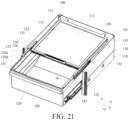
- the lid 130 remains in the storage compartment 110 and no longer moves toward the direction -y (shown in FIG. 21 ), and the drawer 120 continues moving along the direction -y until the drawer 120 is completely pushed into the storage compartment 110 (shown in FIG. 16 ).
- the first rolling wheel 150 of the lid 130 falls into the first limiting groove 151 of the drawer 120
- the second rolling wheel 152 of the drawer 120 is located within the second limiting groove 153 of the lid 130, not only preventing relative displacement from occurring between the lid 130 and the drawer 120, but also sealing the accommodation 121 in that the lid 130 sinks to cover the upper portion of the drawer 120 due to weight of the lid 130.
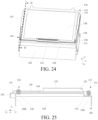
- the lid 130 may include a frame 139, the frame 139 enclosing a viewing port 160, and a transparent member 161 disposed within the viewing port 160 and connected to the frame 139.
- the drawer 120 when the drawer 120 is pulled out of the storage compartment 110, an interior of the drawer 120 is directly visible without a need to push away the lid 130, and a user can accurately and quickly determine whether a stored product being sought is stored in the drawer 120, thereby helping reduce a number of times of unnecessary uncovering and covering of the drawer 120.
- the user can push away the lid 130 of the drawer 120 to take the stored product after determining that the required stored product is indeed stored in the drawer 120, instead of uncovering the lid 130 first to determine whether the stored product is in the drawer. This further reduces a possibility of odor tainting.
- the transparent member 161 may be made of glass to enable the lid 130 to press against the upper edge 124 of the drawer 120 due to a weight of the lid 130 while satisfying a transparency of the viewing port, thereby improving the sealing performance of the drawer 120.
- the lid 130 may further include a sealing strip 162, when the lid 130 covers the opening 122, the sealing strip contacting closely with the front wall 120b, the rear wall 120c, and the upper edge 124 of the pair of side walls 120d of the drawer 120, to form a sealed space within the drawer 120, so that the drawer 120 has better sealing performance.
- the sealing strip 162 may be disposed on the frame 139.
- the sealing strip 162 may be a sealing rubber strip.
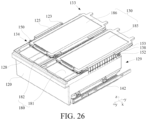
- FIG. 26 is a partial schematic structural diagram of a refrigerator according to an embodiment of the present invention.
- a difference from the refrigerator 100 shown in FIG. 16 to FIG. 25 lies in that a drawer 120 of a refrigerator 100 shown in this embodiment is separated into a plurality of mutually independent sealable accommodation subspaces 180.
- the drawer 120 may further include at least one separator 170 located within the accommodation space 121, where the at least one separator 170 may separate the accommodation space 121 into at least two side-by-side accommodation subspaces 180, the at least two accommodation subspaces 180 may include a first accommodation subspace 181 and a second accommodation subspace 182, the first accommodation subspace 181 may have a first opening 183 facing upward, and the second accommodation subspace 182 may have a second opening 184 facing upward; the lid 130 may include a first lid 185 and a second lid 186, where the first lid 185 may be configured to uncover or cover the first opening 183, and the second lid 186 may be configured to uncover or cover the second opening 186.
- FIG. 26 A structure shown in FIG. 26 is used as an example. It may be understood that one separator 170 is disposed in the drawer shown in FIG. 1 to FIG. 25 , so that the foregoing accommodation space 121 shown in FIG. 1 to FIG. 25 is separated into two accommodation subspaces 180: a first accommodation subspace 181 and a second accommodation subspace 182.
- the foregoing opening 122 shown in FIG. 1 to FIG. 25 can be separated into a first opening 183 and a second opening 184 arranged side by side along the direction x.
- first lid 185 may uncover or cover the first opening 183 using the foregoing structure shown in FIG. 1 to FIG. 15 or the foregoing structure shown in FIG. 16 to FIG. 25 ; and/or the second lid 186 can uncover or cover the second opening 184 using the foregoing structure shown in FIG. 1 to FIG. 15 or the foregoing structure shown in FIG. 16 to FIG. 25 .
- the first lid 185 is pulled out with the drawer 120 and keeps the first accommodation subspace 181 covered (that is, covering the first opening 183).
- the second lid 186 is pulled out with the drawer 120 and keeps the second accommodation subspace 182 covered (that is, covering the second opening 184).
- first lid 185 may slide relative to the drawer 120 to be pushed back into the storage compartment 110 to uncover the first opening 183.
- the second lid 186 may slide relative to the drawer 120 to be pushed back into the storage compartment 110 to uncover the second opening 184.
- the drawer 120 may be separated into a plurality of mutually independent accommodation subspaces 180, and each accommodation subspace 180 may be uncovered or covered respectively, and the drawer 120 may be wholly pulled out of or pushed into the storage compartment 110, not only facilitating separate storage of different foods to avoid odor tainting, but also helping a user take the food.
- the first accommodation subspace 181 and the second accommodation subspace 182 may be arranged side by side in the direction x.
- one end of the separator 170 may be connected to the front wall 120b of the drawer 120, and another opposite end of the separator 170 may be connected to the rear wall 120c of the drawer 120, to separate the accommodation space 121 into two side-by-side accommodation subspaces 180 along the direction x.
- the separator 170 is integrally formed with the front wall 120b and the rear wall 120c.
- At least one of the first lid 185 and the second lid 186 may include a sealing strip 162, when the lid covers the corresponding accommodation subspace 180, the sealing strip contacting with an upper edge of the accommodation subspace 180.
- At least one of the first lid 185 and the second lid 186 may include the frame 139, a viewing port 160 enclosed by the frame 139, and a transparent member 161 disposed within the viewing port 160 and connected to the frame 139.
- At least one of the first lid 185 and the second lid 186 may have one or more buffer portions 137, when the lid covers the corresponding opening (that is, the corresponding accommodation subspace 180), the buffer portion 137 abutting against the front wall 120b of the drawer 120.
- the block 123 may be further located on the separator 170.
Landscapes
- Engineering & Computer Science (AREA)
- Chemical & Material Sciences (AREA)
- Combustion & Propulsion (AREA)
- Physics & Mathematics (AREA)
- Mechanical Engineering (AREA)
- Thermal Sciences (AREA)
- General Engineering & Computer Science (AREA)
- Refrigerator Housings (AREA)
Claims (11)
- Kühlschrank (100), der Folgendes umfasst:ein Aufbewahrungsfach (110),einen Einschub (120), der sich in dem Aufbewahrungsfach (110) befindet und eine Bodenwand (120a), eine Vorderwand (120b), eine Rückwand (120c), zwei Seitenwände (120d) und einen von der Bodenwand (120a), der Vorderwand (120b),der Rückwand (120c) und den beiden Seitenwänden (120d) umgebenen Aufnahmeraum (121) umfasst, wobei der Einschub (120) eine nach oben weisende Öffnung (122) aufweist, die den Aufnahmeraum (121) freilegt,einen Deckel (130) zum Abdecken der Öffnung (122), wobei der Deckel (130) an einem oberen Abschnitt des Einschubs (120) verschiebbar gelagert ist und, wenn der Einschub (120) aus dem Aufbewahrungsfach (110) herausgezogen wird, zusammen mit dem Einschub (120) herausgezogen wird und dabei die Öffnung (122) geschlossen hält, und so konfiguriert ist, dass er in Bezug auf den Einschub (120) so verschiebbar ist, dass er sich in das Aufbewahrungsfach (110) zurückschieben lässt und so die Öffnung (122) freigibt, und die Öffnung (122) abdeckt, wenn der Einschub (120) in das Aufbewahrungsfach (110) hineingeschoben wird,eine Sperre (123), die so konfiguriert ist, dass sie ein weiteres Gleiten des Deckels (130) nach hinten verhindert und dieser so weiterhin von dem Einschub (120) gehalten wird, der herausgezogen wird, dadurch gekennzeichnet, dass ein vorderes Ende (134) des Deckels (130) mit einer ersten Rolle (150) versehen ist, wobei es sich bei dem vorderen Ende (134) des Deckels (130) um ein Ende in der Nähe der Vorderwand (120b) handelt, eine obere Kante (124) der zwei Seitenwände (120d) des Einschubs (120) eine erste Begrenzungsnut (151) aufweist, wobei die erste Rolle (150), wenn der Deckel (130) die Öffnung (122) abdeckt, in die erste Begrenzungsnut (151) fällt und,wenn der Deckel (130) wieder in das Aufbewahrungsfach (110) hineingeschoben wird, aus der ersten Begrenzungsnut (151) gleitet und an der oberen Kante (124) der beiden Seitenwände (120d) entlangrollt, wobei sich der Deckel (130) in Bezug auf den Einschub (120) nach hinten bewegt, bis die erste Rolle (150) an der Sperre (123) anliegt und so verhindert, dass sich der Deckel (130) weiter nach hinten bewegt,wobei sich ein Kippschutzabschnitt (125), der so konfiguriert ist, dass er den Deckel (130) auf dem Einschub (120) hält, wenn der Deckel (130) nach hinten geschoben wird, und sich an mindestens einer Seitenwand (120d) des Einschubs (120) befindet,zum Aufnahmeraum (121) hin neigt und so eine Begrenzungsnut (126) bildet, und die erste Rolle (150), wenn der Deckel (130) nach hinten geschoben wird, in die Begrenzungsnut (126) rollt und so an einer Innenwand der Begrenzungsnut (126) zum Anliegen kommt.
- Kühlschrank (100) nach Anspruch 1, dadurch gekennzeichnet, dass sich die Sperre (123) an mindestens einer Seitenwand (120d) befindet,
der Deckel (130) einen Anschlag (131) aufweist, wobei sich der Deckel (130) in Bezug auf den Einschub (120) nach hinten bewegt, bis der Anschlag (131) an der Sperre (123) anliegt und so verhindert, dass sich der Deckel (130) weiter nach hinten bewegt. - Kühlschrank (100) nach Anspruch 2, dadurch gekennzeichnet, dass der Anschlag (131) mit einem Griff (132) des Deckels (130) verbunden ist.
- Kühlschrank (100) nach einem der Ansprüche 1 bis 3, gekennzeichnet durch den Kippschutzabschnitt (125), der so konfiguriert ist, dass er ein Rotieren eines hinteren Endes (133) des Deckels (130) nach unten verhindert, wenn dieser nach hinten verschoben wird.
- Kühlschrank (100) nach Anspruch 4, dadurch gekennzeichnet, dass der Deckel (130) eine Kippschutzrippe (135) aufweist, die in die Begrenzungsnut (126) rutscht, wenn der Deckel (130) nach hinten geschoben wird, und so an einer Innenwand der Begrenzungsnut (126) zum Anliegen kommt, und/oder der Kippschutzabschnitt (125) einstückig mit der Sperre (123) ausgebildet ist.
- Kühlschrank (100) nach einem der Ansprüche 1 bis 5, dadurch gekennzeichnet, dass der Deckel (130) einen Vorsprung (136) aufweist, der an einer hinteren Platte (111) des Aufbewahrungsfachs (110) anliegt, wenn der Einschub (120) in das Aufbewahrungsfach (110) hineingeschoben ist.
- Kühlschrank (100) nach einem der Ansprüche 1 bis 6, dadurch gekennzeichnet, dass der Deckel (130) einen Pufferabschnitt (137) aufweist, der an der Vorderwand (120b) des Einschubs (120) anliegt, wenn der Deckel (130) die Öffnung (122) abdeckt.
- Kühlschrank (100) nach einem der Ansprüche 1 bis 7, dadurch gekennzeichnet, dass ein hinteres Ende (129) der oberen Kante (124) der beiden Seitenwände (120d) des Einschubs (120) mit einer zweiten Rolle (152) versehen ist, wobei es sich bei dem hinteren Ende (129) um ein Ende in der Nähe der Rückwand (120c) handelt,der Deckel (130) eine zweite Begrenzungsnut (153) aufweist,wobei sich die zweite Rolle (152) in der zweiten Begrenzungsnut (153) befindet, wenn der Deckel (130) die Öffnung (122) abdeckt, und aus der zweiten Begrenzungsnut (153) gleitet, wenn der Deckel (130) wieder in das Aufbewahrungsfach (110) hineingeschoben wird.
- Kühlschrank (100) nach Anspruch 8, dadurch gekennzeichnet, dass der Deckel (130) eine Gleitrippe (138) aufweist, wobei zwei Enden der Gleitrippe (138) mit der ersten Rolle (150) beziehungsweise der zweiten Begrenzungsnut (153) verbunden sind und die zweite Rolle (152) an der Gleitrippe (138) entlangrollt, wenn der Deckel (130) wieder in das Aufbewahrungsfach (110) hineingeschoben wird.
- Kühlschrank (100) nach einem der Ansprüche 1 bis 9, dadurch gekennzeichnet, dass der Deckel (130) Folgendes umfasst:einen Rahmen (139), der ein Sichtfenster (160) umgibt, undein lichtdurchlässiges Element (161), das in dem Sichtfenster (160) angeordnet undmit dem Rahmen (139) verbunden ist, und/odereinen Dichtstreifen (162), der sich in engem Kontakt mit der Vorderwand (120b), der Rückwand (120c) und der oberen Kante (124) der beiden Seitenwände (120d) des Einschubs (120) befindet, wenn der Deckel (130) die Öffnung (122) abdeckt.
- Kühlschrank (100) nach einem der Ansprüche 1 bis 9, dadurch gekennzeichnet, dass der Einschub (120) ferner mindestens eine Trennwand (170) umfasst, die sich in dem Aufbewahrungsraum (121) befindet, wobei die mindestens eine Trennwand (170) den Aufbewahrungsraum (121) in mindestens zwei nebeneinanderliegende Aufbewahrungsteilräume (180) unterteilt und die mindestens zwei Aufbewahrungsteilräume (180) einen ersten Aufbewahrungsteilraum (181) und einen zweiten Aufbewahrungsteilraum (182) umfassen, wobei der erste Aufbewahrungsteilraum (181) eine erste nach oben weisende Öffnung (183) und der zweite Aufbewahrungsteilraum (182) eine zweite nach oben weisende Öffnung (184) aufweist, der Deckel (130) einen ersten Deckel (185) und einen zweiten Deckel (186) umfasst, wobei der erste Deckel (185) so konfiguriert ist, dass er die erste Öffnung (183) freigibt oder abdeckt, und der zweite Deckel (186) so konfiguriert ist, dass er die zweite Öffnung (184) freigibt oder abdeckt.
Applications Claiming Priority (1)
| Application Number | Priority Date | Filing Date | Title |
|---|---|---|---|
| CN201811053328 | 2018-09-10 |
Publications (2)
| Publication Number | Publication Date |
|---|---|
| EP3620737A1 EP3620737A1 (de) | 2020-03-11 |
| EP3620737B1 true EP3620737B1 (de) | 2023-10-11 |
Family
ID=67777241
Family Applications (1)
| Application Number | Title | Priority Date | Filing Date |
|---|---|---|---|
| EP19194152.5A Active EP3620737B1 (de) | 2018-09-10 | 2019-08-28 | Kühlschrank |
Country Status (3)
| Country | Link |
|---|---|
| EP (1) | EP3620737B1 (de) |
| CN (2) | CN110887331A (de) |
| PL (1) | PL3620737T3 (de) |
Families Citing this family (6)
| Publication number | Priority date | Publication date | Assignee | Title |
|---|---|---|---|---|
| CN111829280B (zh) * | 2020-08-12 | 2021-10-08 | 长虹美菱股份有限公司 | 一种冰箱储物专区 |
| CN111981745A (zh) * | 2020-08-24 | 2020-11-24 | 珠海格力电器股份有限公司 | 储存装置及设有其的冰箱 |
| CN114268043B (zh) * | 2021-12-24 | 2024-01-09 | 苏州沪港科技股份有限公司 | 一种mns低压抽屉式开关柜 |
| CN116428808A (zh) * | 2022-01-04 | 2023-07-14 | 青岛海尔电冰箱有限公司 | 一种冰箱及其抽屉总成 |
| CN218009403U (zh) * | 2022-07-20 | 2022-12-13 | 宁波吉盛电器有限公司 | 一种食物烹调装置 |
| CN115265080A (zh) * | 2022-08-23 | 2022-11-01 | 海信冰箱有限公司 | 一种冰箱 |
Citations (2)
| Publication number | Priority date | Publication date | Assignee | Title |
|---|---|---|---|---|
| JPH0875346A (ja) * | 1994-09-06 | 1996-03-19 | Fujitsu General Ltd | 冷蔵庫 |
| KR20100134962A (ko) * | 2009-06-16 | 2010-12-24 | 엘지전자 주식회사 | 냉장고 및 냉장고 서랍장치 |
Family Cites Families (23)
| Publication number | Priority date | Publication date | Assignee | Title |
|---|---|---|---|---|
| GB2354061B (en) * | 1999-09-13 | 2001-08-08 | Ian David Wood | Cold-storage appliance |
| US20070262686A1 (en) * | 2006-05-10 | 2007-11-15 | Lg Electronics Inc. | Refrigerator |
| KR20090106935A (ko) * | 2008-04-07 | 2009-10-12 | 엘지전자 주식회사 | 드로어커버를 구비한 냉장고 |
| KR20110036446A (ko) * | 2009-10-01 | 2011-04-07 | 삼성전자주식회사 | 냉장고의 선반조립체 및 이의 제조방법 |
| KR20110080523A (ko) * | 2010-01-06 | 2011-07-13 | 엘지전자 주식회사 | 커버어셈블리를 가진 서랍칸을 포함하는 냉장고 |
| KR101362920B1 (ko) * | 2011-04-01 | 2014-02-18 | 위니아만도 주식회사 | 보관 박스 |
| CN103575046A (zh) * | 2012-07-31 | 2014-02-12 | 海尔集团公司 | 一种冰箱果蔬盒及包括该果蔬盒的冰箱 |
| CN202836041U (zh) * | 2012-10-16 | 2013-03-27 | 惠而浦(中国)投资有限公司 | 冰箱可滑动式隐形库 |
| KR101995427B1 (ko) * | 2012-10-29 | 2019-07-02 | 엘지전자 주식회사 | 냉장고 |
| KR102001929B1 (ko) * | 2013-03-08 | 2019-10-01 | 엘지전자 주식회사 | 냉장고 |
| CN103196271B (zh) * | 2013-04-09 | 2015-06-24 | 海信容声(广东)冰箱有限公司 | 一种保鲜密封装置及冰箱 |
| CN104019614B (zh) * | 2014-05-30 | 2017-02-08 | 青岛海尔电冰箱有限公司 | 密封容器及冰箱 |
| CN104764281B (zh) * | 2015-04-15 | 2018-02-13 | 合肥华凌股份有限公司 | 冰箱 |
| CN106322875A (zh) * | 2015-06-15 | 2017-01-11 | 博西华电器(江苏)有限公司 | 制冷设备 |
| KR101716033B1 (ko) * | 2015-06-16 | 2017-03-13 | 엘지전자 주식회사 | 냉장고 |
| CN205156500U (zh) * | 2015-07-08 | 2016-04-13 | 博西华电器(江苏)有限公司 | 制冷设备 |
| CN105674675B (zh) * | 2015-12-29 | 2018-07-13 | 青岛海尔股份有限公司 | 密闭盒 |
| CN105627682B (zh) * | 2015-12-29 | 2018-05-11 | 青岛海尔股份有限公司 | 密闭盒 |
| CN106225407B (zh) * | 2016-07-25 | 2019-01-18 | 青岛海尔股份有限公司 | 冰箱及其储物装置 |
| CN106595212B (zh) * | 2016-12-30 | 2018-05-29 | 青岛海尔股份有限公司 | 抽屉组件及具有该抽屉组件的冰箱 |
| CN206459415U (zh) * | 2017-02-06 | 2017-09-01 | 海信(山东)冰箱有限公司 | 一种冰箱的盖板以及冰箱 |
| CN107144083B (zh) * | 2017-05-24 | 2021-12-21 | 重庆海尔制冷电器有限公司 | 制冷间室及具有其的冰箱 |
| CN108302888B (zh) * | 2017-11-30 | 2019-12-06 | 青岛海尔股份有限公司 | 冰箱及其抽屉组件 |
-
2019
- 2019-08-23 CN CN201910787414.6A patent/CN110887331A/zh active Pending
- 2019-08-23 CN CN201910788518.9A patent/CN110887332A/zh active Pending
- 2019-08-28 PL PL19194152.5T patent/PL3620737T3/pl unknown
- 2019-08-28 EP EP19194152.5A patent/EP3620737B1/de active Active
Patent Citations (2)
| Publication number | Priority date | Publication date | Assignee | Title |
|---|---|---|---|---|
| JPH0875346A (ja) * | 1994-09-06 | 1996-03-19 | Fujitsu General Ltd | 冷蔵庫 |
| KR20100134962A (ko) * | 2009-06-16 | 2010-12-24 | 엘지전자 주식회사 | 냉장고 및 냉장고 서랍장치 |
Also Published As
| Publication number | Publication date |
|---|---|
| CN110887332A (zh) | 2020-03-17 |
| CN110887331A (zh) | 2020-03-17 |
| PL3620737T3 (pl) | 2024-03-04 |
| EP3620737A1 (de) | 2020-03-11 |
Similar Documents
| Publication | Publication Date | Title |
|---|---|---|
| EP3620737B1 (de) | Kühlschrank | |
| EP2420776B1 (de) | Kühlschrank | |
| EP2314965B1 (de) | Kühlschrank mit unterteilten Regalböden | |
| US9146053B2 (en) | Refrigerator | |
| US9103579B2 (en) | Refrigerator | |
| EP2059751B1 (de) | Kühlschrank mit einer vorrichtung zur verhinderung einer leckage von kühlluft | |
| EP2581694B1 (de) | Kühlschrank | |
| KR101995427B1 (ko) | 냉장고 | |
| KR20100008104A (ko) | 냉장고용 야채박스 및 그를 구비한 냉장고 | |
| EP3620736A1 (de) | Kühlschrank | |
| KR101694534B1 (ko) | 냉장고 및 냉장고 서랍장치 | |
| EP2049853B1 (de) | Kühlvorrichtung | |
| EP3620733B1 (de) | Kühlschrank | |
| AU2022256014A1 (en) | Assembly for food storage with a slide out shelf | |
| JP4483032B2 (ja) | 冷蔵庫の収納容器 | |
| EP2645030B1 (de) | Kühlvorrichtung mit beweglichem Separator | |
| KR101548993B1 (ko) | 냉장고 | |
| US20210310722A1 (en) | Refrigerator | |
| KR101269831B1 (ko) | 멀티도어 홈바가 구비된 냉장고도어 | |
| KR20200127792A (ko) | 냉장고 | |
| JP2001263930A (ja) | 冷却貯蔵庫 |
Legal Events
| Date | Code | Title | Description |
|---|---|---|---|
| PUAI | Public reference made under article 153(3) epc to a published international application that has entered the european phase |
Free format text: ORIGINAL CODE: 0009012 |
|
| STAA | Information on the status of an ep patent application or granted ep patent |
Free format text: STATUS: THE APPLICATION HAS BEEN PUBLISHED |
|
| AK | Designated contracting states |
Kind code of ref document: A1 Designated state(s): AL AT BE BG CH CY CZ DE DK EE ES FI FR GB GR HR HU IE IS IT LI LT LU LV MC MK MT NL NO PL PT RO RS SE SI SK SM TR |
|
| AX | Request for extension of the european patent |
Extension state: BA ME |
|
| STAA | Information on the status of an ep patent application or granted ep patent |
Free format text: STATUS: REQUEST FOR EXAMINATION WAS MADE |
|
| 17P | Request for examination filed |
Effective date: 20200911 |
|
| RBV | Designated contracting states (corrected) |
Designated state(s): AL AT BE BG CH CY CZ DE DK EE ES FI FR GB GR HR HU IE IS IT LI LT LU LV MC MK MT NL NO PL PT RO RS SE SI SK SM TR |
|
| STAA | Information on the status of an ep patent application or granted ep patent |
Free format text: STATUS: EXAMINATION IS IN PROGRESS |
|
| 17Q | First examination report despatched |
Effective date: 20210326 |
|
| GRAP | Despatch of communication of intention to grant a patent |
Free format text: ORIGINAL CODE: EPIDOSNIGR1 |
|
| STAA | Information on the status of an ep patent application or granted ep patent |
Free format text: STATUS: GRANT OF PATENT IS INTENDED |
|
| INTG | Intention to grant announced |
Effective date: 20230104 |
|
| GRAJ | Information related to disapproval of communication of intention to grant by the applicant or resumption of examination proceedings by the epo deleted |
Free format text: ORIGINAL CODE: EPIDOSDIGR1 |
|
| STAA | Information on the status of an ep patent application or granted ep patent |
Free format text: STATUS: EXAMINATION IS IN PROGRESS |
|
| GRAP | Despatch of communication of intention to grant a patent |
Free format text: ORIGINAL CODE: EPIDOSNIGR1 |
|
| STAA | Information on the status of an ep patent application or granted ep patent |
Free format text: STATUS: GRANT OF PATENT IS INTENDED |
|
| INTC | Intention to grant announced (deleted) | ||
| INTG | Intention to grant announced |
Effective date: 20230525 |
|
| GRAS | Grant fee paid |
Free format text: ORIGINAL CODE: EPIDOSNIGR3 |
|
| GRAA | (expected) grant |
Free format text: ORIGINAL CODE: 0009210 |
|
| STAA | Information on the status of an ep patent application or granted ep patent |
Free format text: STATUS: THE PATENT HAS BEEN GRANTED |
|
| AK | Designated contracting states |
Kind code of ref document: B1 Designated state(s): AL AT BE BG CH CY CZ DE DK EE ES FI FR GB GR HR HU IE IS IT LI LT LU LV MC MK MT NL NO PL PT RO RS SE SI SK SM TR |
|
| REG | Reference to a national code |
Ref country code: GB Ref legal event code: FG4D |
|
| REG | Reference to a national code |
Ref country code: CH Ref legal event code: EP |
|
| REG | Reference to a national code |
Ref country code: DE Ref legal event code: R096 Ref document number: 602019039030 Country of ref document: DE |
|
| REG | Reference to a national code |
Ref country code: IE Ref legal event code: FG4D |
|
| REG | Reference to a national code |
Ref country code: LT Ref legal event code: MG9D |
|
| REG | Reference to a national code |
Ref country code: NL Ref legal event code: MP Effective date: 20231011 |
|
| REG | Reference to a national code |
Ref country code: AT Ref legal event code: MK05 Ref document number: 1620597 Country of ref document: AT Kind code of ref document: T Effective date: 20231011 |
|
| PG25 | Lapsed in a contracting state [announced via postgrant information from national office to epo] |
Ref country code: NL Free format text: LAPSE BECAUSE OF FAILURE TO SUBMIT A TRANSLATION OF THE DESCRIPTION OR TO PAY THE FEE WITHIN THE PRESCRIBED TIME-LIMIT Effective date: 20231011 |
|
| PG25 | Lapsed in a contracting state [announced via postgrant information from national office to epo] |
Ref country code: GR Free format text: LAPSE BECAUSE OF FAILURE TO SUBMIT A TRANSLATION OF THE DESCRIPTION OR TO PAY THE FEE WITHIN THE PRESCRIBED TIME-LIMIT Effective date: 20240112 |
|
| PG25 | Lapsed in a contracting state [announced via postgrant information from national office to epo] |
Ref country code: IS Free format text: LAPSE BECAUSE OF FAILURE TO SUBMIT A TRANSLATION OF THE DESCRIPTION OR TO PAY THE FEE WITHIN THE PRESCRIBED TIME-LIMIT Effective date: 20240211 |
|
| PG25 | Lapsed in a contracting state [announced via postgrant information from national office to epo] |
Ref country code: LT Free format text: LAPSE BECAUSE OF FAILURE TO SUBMIT A TRANSLATION OF THE DESCRIPTION OR TO PAY THE FEE WITHIN THE PRESCRIBED TIME-LIMIT Effective date: 20231011 |
|
| PG25 | Lapsed in a contracting state [announced via postgrant information from national office to epo] |
Ref country code: AT Free format text: LAPSE BECAUSE OF FAILURE TO SUBMIT A TRANSLATION OF THE DESCRIPTION OR TO PAY THE FEE WITHIN THE PRESCRIBED TIME-LIMIT Effective date: 20231011 |
|
| PG25 | Lapsed in a contracting state [announced via postgrant information from national office to epo] |
Ref country code: ES Free format text: LAPSE BECAUSE OF FAILURE TO SUBMIT A TRANSLATION OF THE DESCRIPTION OR TO PAY THE FEE WITHIN THE PRESCRIBED TIME-LIMIT Effective date: 20231011 |
|
| PG25 | Lapsed in a contracting state [announced via postgrant information from national office to epo] |
Ref country code: LT Free format text: LAPSE BECAUSE OF FAILURE TO SUBMIT A TRANSLATION OF THE DESCRIPTION OR TO PAY THE FEE WITHIN THE PRESCRIBED TIME-LIMIT Effective date: 20231011 Ref country code: IS Free format text: LAPSE BECAUSE OF FAILURE TO SUBMIT A TRANSLATION OF THE DESCRIPTION OR TO PAY THE FEE WITHIN THE PRESCRIBED TIME-LIMIT Effective date: 20240211 Ref country code: GR Free format text: LAPSE BECAUSE OF FAILURE TO SUBMIT A TRANSLATION OF THE DESCRIPTION OR TO PAY THE FEE WITHIN THE PRESCRIBED TIME-LIMIT Effective date: 20240112 Ref country code: ES Free format text: LAPSE BECAUSE OF FAILURE TO SUBMIT A TRANSLATION OF THE DESCRIPTION OR TO PAY THE FEE WITHIN THE PRESCRIBED TIME-LIMIT Effective date: 20231011 Ref country code: BG Free format text: LAPSE BECAUSE OF FAILURE TO SUBMIT A TRANSLATION OF THE DESCRIPTION OR TO PAY THE FEE WITHIN THE PRESCRIBED TIME-LIMIT Effective date: 20240111 Ref country code: AT Free format text: LAPSE BECAUSE OF FAILURE TO SUBMIT A TRANSLATION OF THE DESCRIPTION OR TO PAY THE FEE WITHIN THE PRESCRIBED TIME-LIMIT Effective date: 20231011 Ref country code: PT Free format text: LAPSE BECAUSE OF FAILURE TO SUBMIT A TRANSLATION OF THE DESCRIPTION OR TO PAY THE FEE WITHIN THE PRESCRIBED TIME-LIMIT Effective date: 20240212 |
|
| PG25 | Lapsed in a contracting state [announced via postgrant information from national office to epo] |
Ref country code: SE Free format text: LAPSE BECAUSE OF FAILURE TO SUBMIT A TRANSLATION OF THE DESCRIPTION OR TO PAY THE FEE WITHIN THE PRESCRIBED TIME-LIMIT Effective date: 20231011 Ref country code: RS Free format text: LAPSE BECAUSE OF FAILURE TO SUBMIT A TRANSLATION OF THE DESCRIPTION OR TO PAY THE FEE WITHIN THE PRESCRIBED TIME-LIMIT Effective date: 20231011 Ref country code: NO Free format text: LAPSE BECAUSE OF FAILURE TO SUBMIT A TRANSLATION OF THE DESCRIPTION OR TO PAY THE FEE WITHIN THE PRESCRIBED TIME-LIMIT Effective date: 20240111 Ref country code: LV Free format text: LAPSE BECAUSE OF FAILURE TO SUBMIT A TRANSLATION OF THE DESCRIPTION OR TO PAY THE FEE WITHIN THE PRESCRIBED TIME-LIMIT Effective date: 20231011 Ref country code: HR Free format text: LAPSE BECAUSE OF FAILURE TO SUBMIT A TRANSLATION OF THE DESCRIPTION OR TO PAY THE FEE WITHIN THE PRESCRIBED TIME-LIMIT Effective date: 20231011 |
|
| PG25 | Lapsed in a contracting state [announced via postgrant information from national office to epo] |
Ref country code: DK Free format text: LAPSE BECAUSE OF FAILURE TO SUBMIT A TRANSLATION OF THE DESCRIPTION OR TO PAY THE FEE WITHIN THE PRESCRIBED TIME-LIMIT Effective date: 20231011 |
|
| REG | Reference to a national code |
Ref country code: DE Ref legal event code: R097 Ref document number: 602019039030 Country of ref document: DE |
|
| PG25 | Lapsed in a contracting state [announced via postgrant information from national office to epo] |
Ref country code: CZ Free format text: LAPSE BECAUSE OF FAILURE TO SUBMIT A TRANSLATION OF THE DESCRIPTION OR TO PAY THE FEE WITHIN THE PRESCRIBED TIME-LIMIT Effective date: 20231011 |
|
| PG25 | Lapsed in a contracting state [announced via postgrant information from national office to epo] |
Ref country code: SK Free format text: LAPSE BECAUSE OF FAILURE TO SUBMIT A TRANSLATION OF THE DESCRIPTION OR TO PAY THE FEE WITHIN THE PRESCRIBED TIME-LIMIT Effective date: 20231011 |
|
| PG25 | Lapsed in a contracting state [announced via postgrant information from national office to epo] |
Ref country code: SM Free format text: LAPSE BECAUSE OF FAILURE TO SUBMIT A TRANSLATION OF THE DESCRIPTION OR TO PAY THE FEE WITHIN THE PRESCRIBED TIME-LIMIT Effective date: 20231011 Ref country code: SK Free format text: LAPSE BECAUSE OF FAILURE TO SUBMIT A TRANSLATION OF THE DESCRIPTION OR TO PAY THE FEE WITHIN THE PRESCRIBED TIME-LIMIT Effective date: 20231011 Ref country code: RO Free format text: LAPSE BECAUSE OF FAILURE TO SUBMIT A TRANSLATION OF THE DESCRIPTION OR TO PAY THE FEE WITHIN THE PRESCRIBED TIME-LIMIT Effective date: 20231011 Ref country code: IT Free format text: LAPSE BECAUSE OF FAILURE TO SUBMIT A TRANSLATION OF THE DESCRIPTION OR TO PAY THE FEE WITHIN THE PRESCRIBED TIME-LIMIT Effective date: 20231011 Ref country code: EE Free format text: LAPSE BECAUSE OF FAILURE TO SUBMIT A TRANSLATION OF THE DESCRIPTION OR TO PAY THE FEE WITHIN THE PRESCRIBED TIME-LIMIT Effective date: 20231011 Ref country code: DK Free format text: LAPSE BECAUSE OF FAILURE TO SUBMIT A TRANSLATION OF THE DESCRIPTION OR TO PAY THE FEE WITHIN THE PRESCRIBED TIME-LIMIT Effective date: 20231011 Ref country code: CZ Free format text: LAPSE BECAUSE OF FAILURE TO SUBMIT A TRANSLATION OF THE DESCRIPTION OR TO PAY THE FEE WITHIN THE PRESCRIBED TIME-LIMIT Effective date: 20231011 |
|
| PLBE | No opposition filed within time limit |
Free format text: ORIGINAL CODE: 0009261 |
|
| STAA | Information on the status of an ep patent application or granted ep patent |
Free format text: STATUS: NO OPPOSITION FILED WITHIN TIME LIMIT |
|
| 26N | No opposition filed |
Effective date: 20240712 |
|
| PG25 | Lapsed in a contracting state [announced via postgrant information from national office to epo] |
Ref country code: SI Free format text: LAPSE BECAUSE OF FAILURE TO SUBMIT A TRANSLATION OF THE DESCRIPTION OR TO PAY THE FEE WITHIN THE PRESCRIBED TIME-LIMIT Effective date: 20231011 |
|
| PG25 | Lapsed in a contracting state [announced via postgrant information from national office to epo] |
Ref country code: SI Free format text: LAPSE BECAUSE OF FAILURE TO SUBMIT A TRANSLATION OF THE DESCRIPTION OR TO PAY THE FEE WITHIN THE PRESCRIBED TIME-LIMIT Effective date: 20231011 |
|
| REG | Reference to a national code |
Ref country code: CH Ref legal event code: PL |
|
| PG25 | Lapsed in a contracting state [announced via postgrant information from national office to epo] |
Ref country code: LU Free format text: LAPSE BECAUSE OF NON-PAYMENT OF DUE FEES Effective date: 20240828 |
|
| GBPC | Gb: european patent ceased through non-payment of renewal fee |
Effective date: 20240828 |
|
| PG25 | Lapsed in a contracting state [announced via postgrant information from national office to epo] |
Ref country code: MC Free format text: LAPSE BECAUSE OF FAILURE TO SUBMIT A TRANSLATION OF THE DESCRIPTION OR TO PAY THE FEE WITHIN THE PRESCRIBED TIME-LIMIT Effective date: 20231011 Ref country code: CH Free format text: LAPSE BECAUSE OF NON-PAYMENT OF DUE FEES Effective date: 20240831 |
|
| REG | Reference to a national code |
Ref country code: BE Ref legal event code: MM Effective date: 20240831 |
|
| PG25 | Lapsed in a contracting state [announced via postgrant information from national office to epo] |
Ref country code: GB Free format text: LAPSE BECAUSE OF NON-PAYMENT OF DUE FEES Effective date: 20240828 |
|
| PG25 | Lapsed in a contracting state [announced via postgrant information from national office to epo] |
Ref country code: BE Free format text: LAPSE BECAUSE OF NON-PAYMENT OF DUE FEES Effective date: 20240831 |
|
| PG25 | Lapsed in a contracting state [announced via postgrant information from national office to epo] |
Ref country code: FR Free format text: LAPSE BECAUSE OF NON-PAYMENT OF DUE FEES Effective date: 20240831 |
|
| PG25 | Lapsed in a contracting state [announced via postgrant information from national office to epo] |
Ref country code: IE Free format text: LAPSE BECAUSE OF NON-PAYMENT OF DUE FEES Effective date: 20240828 |
|
| PG25 | Lapsed in a contracting state [announced via postgrant information from national office to epo] |
Ref country code: FI Free format text: LAPSE BECAUSE OF FAILURE TO SUBMIT A TRANSLATION OF THE DESCRIPTION OR TO PAY THE FEE WITHIN THE PRESCRIBED TIME-LIMIT Effective date: 20231011 |
|
| PGFP | Annual fee paid to national office [announced via postgrant information from national office to epo] |
Ref country code: DE Payment date: 20250831 Year of fee payment: 7 |
|
| PGFP | Annual fee paid to national office [announced via postgrant information from national office to epo] |
Ref country code: TR Payment date: 20250821 Year of fee payment: 7 Ref country code: PL Payment date: 20250818 Year of fee payment: 7 |
|
| PG25 | Lapsed in a contracting state [announced via postgrant information from national office to epo] |
Ref country code: CY Free format text: LAPSE BECAUSE OF FAILURE TO SUBMIT A TRANSLATION OF THE DESCRIPTION OR TO PAY THE FEE WITHIN THE PRESCRIBED TIME-LIMIT; INVALID AB INITIO Effective date: 20190828 |