EP3620712B1 - Sportstättenbeleuchtung zur förderung des rasenwachstums - Google Patents
Sportstättenbeleuchtung zur förderung des rasenwachstums Download PDFInfo
- Publication number
- EP3620712B1 EP3620712B1 EP19196165.5A EP19196165A EP3620712B1 EP 3620712 B1 EP3620712 B1 EP 3620712B1 EP 19196165 A EP19196165 A EP 19196165A EP 3620712 B1 EP3620712 B1 EP 3620712B1
- Authority
- EP
- European Patent Office
- Prior art keywords
- leds
- led
- type
- floodlight
- lawn
- Prior art date
- Legal status (The legal status is an assumption and is not a legal conclusion. Google has not performed a legal analysis and makes no representation as to the accuracy of the status listed.)
- Active
Links
Images

Classifications
-
- F—MECHANICAL ENGINEERING; LIGHTING; HEATING; WEAPONS; BLASTING
- F21—LIGHTING
- F21S—NON-PORTABLE LIGHTING DEVICES; SYSTEMS THEREOF; VEHICLE LIGHTING DEVICES SPECIALLY ADAPTED FOR VEHICLE EXTERIORS
- F21S10/00—Lighting devices or systems producing a varying lighting effect
- F21S10/02—Lighting devices or systems producing a varying lighting effect changing colors
- F21S10/023—Lighting devices or systems producing a varying lighting effect changing colors by selectively switching fixed light sources
-
- F—MECHANICAL ENGINEERING; LIGHTING; HEATING; WEAPONS; BLASTING
- F21—LIGHTING
- F21W—INDEXING SCHEME ASSOCIATED WITH SUBCLASSES F21K, F21L, F21S and F21V, RELATING TO USES OR APPLICATIONS OF LIGHTING DEVICES OR SYSTEMS
- F21W2131/00—Use or application of lighting devices or systems not provided for in codes F21W2102/00-F21W2121/00
- F21W2131/10—Outdoor lighting
- F21W2131/105—Outdoor lighting of arenas or the like
-
- F—MECHANICAL ENGINEERING; LIGHTING; HEATING; WEAPONS; BLASTING
- F21—LIGHTING
- F21Y—INDEXING SCHEME ASSOCIATED WITH SUBCLASSES F21K, F21L, F21S and F21V, RELATING TO THE FORM OR THE KIND OF THE LIGHT SOURCES OR OF THE COLOUR OF THE LIGHT EMITTED
- F21Y2105/00—Planar light sources
- F21Y2105/10—Planar light sources comprising a two-dimensional [2D] array of point-like light-generating elements
-
- F—MECHANICAL ENGINEERING; LIGHTING; HEATING; WEAPONS; BLASTING
- F21—LIGHTING
- F21Y—INDEXING SCHEME ASSOCIATED WITH SUBCLASSES F21K, F21L, F21S and F21V, RELATING TO THE FORM OR THE KIND OF THE LIGHT SOURCES OR OF THE COLOUR OF THE LIGHT EMITTED
- F21Y2113/00—Combination of light sources
- F21Y2113/10—Combination of light sources of different colours
- F21Y2113/13—Combination of light sources of different colours comprising an assembly of point-like light sources
-
- F—MECHANICAL ENGINEERING; LIGHTING; HEATING; WEAPONS; BLASTING
- F21—LIGHTING
- F21Y—INDEXING SCHEME ASSOCIATED WITH SUBCLASSES F21K, F21L, F21S and F21V, RELATING TO THE FORM OR THE KIND OF THE LIGHT SOURCES OR OF THE COLOUR OF THE LIGHT EMITTED
- F21Y2115/00—Light-generating elements of semiconductor light sources
- F21Y2115/10—Light-emitting diodes [LED]
-
- Y—GENERAL TAGGING OF NEW TECHNOLOGICAL DEVELOPMENTS; GENERAL TAGGING OF CROSS-SECTIONAL TECHNOLOGIES SPANNING OVER SEVERAL SECTIONS OF THE IPC; TECHNICAL SUBJECTS COVERED BY FORMER USPC CROSS-REFERENCE ART COLLECTIONS [XRACs] AND DIGESTS
- Y02—TECHNOLOGIES OR APPLICATIONS FOR MITIGATION OR ADAPTATION AGAINST CLIMATE CHANGE
- Y02P—CLIMATE CHANGE MITIGATION TECHNOLOGIES IN THE PRODUCTION OR PROCESSING OF GOODS
- Y02P60/00—Technologies relating to agriculture, livestock or agroalimentary industries
- Y02P60/14—Measures for saving energy, e.g. in green houses
Definitions
- the present invention relates to a headlight for illuminating sports facilities with lawns, in particular a stadium headlight, as well as the use of the headlight and a sports facility with corresponding headlights.
- the lawns of the sports facility are very heavily used.
- the metal halide lamps are suspended on rolling scaffolding above the lawn, with the lamps being arranged a few meters above the lawn. This lighting for promoting lawn growth is therefore very expensive and provided independently of the other lighting of the sports facility.
- the additional energy costs for a lawn can easily amount to several hundred thousand euros per year, not to mention the initial cost of such a system.
- Another disadvantage of such a system is that the trolleys on which the metal halide lamps are suspended must be moved mechanically. Moving the lighting system puts additional strain on the lawn area. The entire lawn cannot be illuminated at the same time. In addition, in summer or in southern countries, there can be another problem that the heat generated by the metal vapor lamps accumulates over the lawn. This heat build-up can damage the lawn. In the worst case, a separate fan must be installed to reduce the heat build-up. Another disadvantage of the system is that while the lawn is being illuminated, training or further maintenance of the lawn, e.g. using sprinkler systems, is no longer possible.
- the US 2013/076262 A1 and the DE 11 2013 005 481 T5 disclose lights according to the preamble of claim 1.
- the US 2010/315012 A1 discloses a further luminaire with LEDs that have different color rendering indices.
- the object of the present invention is to provide sports facility lighting for promoting lawn growth which overcomes the disadvantages known in the prior art, in particular the high energy costs, the build-up of heat and the laborious shifting of roller systems.
- the object is achieved by a headlight for illuminating sports facilities according to claim 1, by using the headlight according to claim 10 and by a sports facility with a plurality of such headlights according to claim 12.
- a special feature of the present invention is that a headlight, which is provided for illuminating the sports facility, can be used at the same time to illuminate the sports facility during gaming operations and also to promote the growth of the lawn.
- no separate headlights are required for the floodlight system, for example in a stadium, and for the headlights to promote the growth of the lawn.
- two different types of LEDs are provided in the same headlight.
- a first type of LED in the headlight has LEDs with a color rendering index of less than 80, preferably about 70 with, for example, 4000K.
- the second type of LED has a full spectrum which is close to that of natural sunlight, with a color rendering index of over 90, in particular at least 95 with, for example, 5700K.
- This type of LED is suitable for promoting lawn growth due to its spectral properties close to natural sunlight. Lighting with only full-spectrum LEDs would have the disadvantage of lower efficiency at higher costs compared to standard-compliant stadium lighting with a color rendering index of at least 80. In addition, for stadium lighting, 5000K is sufficient in most cases for standard-compliant lighting, which is achieved by mixing the first and second type of LEDs.
- the mixture of the two LED types offers the advantage of higher efficiency and at the same time the possibility of saving the additional costs for separate lawn lighting.
- the light color and not just the color rendering index can be set.
- the LEDs of the headlight are 20% to 40% of the first LED type and 60% to 80% of the second LED type. Preferably about 30% are formed by the first LED type and about 70% by the second LED type, with a tolerance of ⁇ 5% being provided.
- the two LED types in the headlight can be controlled separately, in particular dimmed separately.
- the proportion of light from the first LED type can be increased during use of the sports facility in order to fulfill the necessary lighting task.
- the proportion of light from the second LED type to promote lawn growth can be increased.
- the lighting can also be used to promote the growth of the lawn conventional system of metal halide lamps on trolleys is not possible.
- the LEDs of the second type can be supplied with higher current than the LEDs of the first type.
- the proportion of the spectral range that is conducive to turf growth can be increased in the times outside of the time when the sports facility is being used.
- the portion of the first LED type can be switched on in order to implement the necessary lighting task, which is necessary for television broadcasts, for example.
- the LEDs of the first and the second type can be arranged differently within the headlight. For example, it is possible to arrange the LEDs individually in the headlight, with the different LED types alternating. Since more LEDs of the second type are preferred over the first type, each LED of the first type preferably has nearest neighbors which are formed by LEDs of the second type.
- the LEDs can also be arranged in clusters.
- a cluster can only have LEDs of one of the two types. More clusters are then preferably provided which have the second LED type. Alternatively, it can also be provided that some of the clusters have mixed LEDs of both types.
- the clusters are each arranged on their own printed circuit board (PCB).
- PCB printed circuit board
- the clusters can be electrically connected separately in order, for example, to be able to control the clusters and / or the LED types differently.
- the two types of LEDs can be supplied with different current as a function of time.
- the Sports facility lighting has a higher proportion of the first LED type during the use of the sports facility and a lower proportion of the light of the first LED type during the training phase or during other maintenance and repair work on the sports facility.
- the two LED types of the headlights can also be controlled as a function of a measurement result of at least one environmental sensor (for example light sensor, rain sensor, temperature sensor, etc.).
- a sports facility is equipped with a large number of such headlights, the headlights partially illuminating the lawn. Additional light from the headlights can also be directed onto the spectator stands or other facilities in the sports facility.
- the advantage here is that the same headlights can be used to illuminate the lawn to promote lawn growth and to illuminate the sports facility when the sports facility is being used.
- the headlights are relatively far away from the lawn. A build-up of heat directly above the lawn, as occurs with metal halide lamps on a scaffolding directly on the lawn, can be avoided without separate fans or the like having to be provided.
- the stadium spotlights in the sports facility are preferably at least 20 m away from the lawn area.
- the invention relates to outdoor lighting applications, in particular a stadium spotlight.
- An LED combination is used that is ideal for lawn growth as well as for sports in the stadium.
- 70% full-spectrum LEDs with a color rendering index of 95 with 30% LEDs with a color rendering index of 70 are obtained as the resulting light color, for example 5000K with a color rendering index of at least 80, which corresponds to ideal standard-compliant sports facility lighting.
- Average sports facility lighting comprises around 400 lights that illuminate the lawn area evenly.
- illuminance levels of over 2000 lx are required and can be achieved.
- the playing field In order to create ideal lighting conditions for the audience and cameras, the playing field must be illuminated evenly from all sides. This lighting from all sides is also ideal for the growth of the lawn.
- one embodiment of the present invention provides a stadium spotlight which has LEDs, which are formed to 30% by a first LED type 1 with a color rendering value of about 70, and a second LED type 2 to 70% in the form of full- Spectrum LEDs, ie with a color rendering index of around 95 and a spectrum close to natural sunlight.
- the LEDs of the first type 1 can be switched off and, if necessary, the LEDs of the second type 2 can be supplied with higher current.
- the stadium lighting can therefore only be used for lawn growth and maintenance of the lawns without the need for an extra cost-intensive special solution. With the resulting reduced light level, training is even feasible.
- the lawn can be completely or only partially illuminated.
- the lack of sun can be compensated for as required.
- Software in optional combination with appropriate environmental sensors e.g. light sensor, temperature sensor and / or rain sensor
- the LED combination of the two LED types 1, 2 can take place in various ways and is described in more detail in the following figures.
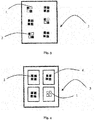
- Figure 1 shows a headlight 3 in which LEDs of the first type 1 and LEDs of the second type 2 are each arranged individually on a carrier surface. There are more LEDs of the second type 2 than of the first type 1. Furthermore, each LED of the first type 1 is surrounded by nearest neighbors which are formed by the second type 2.
- Figure 2 shows an embodiment in which the LEDs are arranged in clusters 4 and 5.
- the clusters 4 only include LEDs of the first type 1 and the clusters 5 only include LEDs of the second type 2.
- the ratio of approximately 70% of the second type and 30% of the first type is also implemented in this embodiment.
- LED clusters are formed, which consist of a mixture of LEDs of the first and second types. Furthermore, clusters are also provided which only consist of LEDs of the second type. In this way, too, a ratio of approximately 70% to 30% can be achieved between the first and second LED types.
- FIG. 11 shows an embodiment with LED clusters, each cluster being arranged on a single PCB 6.
- the PCBs 6 are electronically controlled separately (not shown in the figure) in order to be able to switch the LED clusters separately.
Landscapes
- Engineering & Computer Science (AREA)
- General Engineering & Computer Science (AREA)
- Circuit Arrangement For Electric Light Sources In General (AREA)
Description
- Die vorliegende Erfindung betrifft einen Scheinwerfer für die Beleuchtung von Sportstätten mit Rasenflächen, insbesondere einen Stadionscheinwerfer, sowie die Verwendung des Scheinwerfers und eine Sportstätte mit entsprechenden Scheinwerfern.
- Die Rasenflächen der Sportstätte sind sehr stark beansprucht. Um die Rasenfläche regenerieren zu können, wurde im Stand der Technik vorgesehen, die Rasenfläche mit einer Vielzahl von Metalldampflampen, insbesondere Natriumdampflampen, zu beleuchten, um das Wachstum des Rasens zu fördern. Die Metalldampflampen werden auf rollenden Gerüsten hängend über der Rasenfläche platziert, wobei die Lampen in wenigen Metern über der Rasenfläche angeordnet sind. Diese Beleuchtung für die Förderung des Rasenwachstums ist daher sehr aufwendig und unabhängig von der sonstigen Beleuchtung der Sportstätte vorgesehen. Die zusätzlichen Energiekosten für eine Rasenfläche können sich leicht auf mehrere hundert tausend Euro pro Jahr belaufen, von den Anschaffungskosten eines solchen System ganz abgesehen.
- Ein weiterer Nachteil eines solchen Systems ist, dass die Rollwägen, an denen die Metalldampflampen aufgehängt sind, mechanisch bewegt werden müssen. Durch das Verschieben des Beleuchtungssystems wird die Rasenfläche zusätzlich belastet. Es kann nicht gleichzeitig die gesamte Rasenfläche beleuchtet werden. Außerdem kann im Sommer oder in südlichen Ländern das weitere Problem hinzutreten, dass sich die von den Metalldampfleuchten erzeugte Wärme über dem Rasen staut. Dieser Hitzestau kann die Rasenfläche schädigen. Im ungünstigsten Fall muss zum Abbau des Hitzestaus ein separates Gebläse installiert werden. Ein weiterer Nachteil des Systems ist, dass während der Beleuchtung der Rasenfläche kein Training oder keine weiter Pflege des Rasens z.B. durch Sprinkleranlagen mehr möglich ist.
- Die
US 2013/076262 A1 und dieDE 11 2013 005 481 T5 offenbaren Leuchten gemäß dem Oberbegriff des Anspruchs 1. DieUS 2010/315012 A1 offenbart eine weitere Leuchte mit LEDs, die unterschiedliche Farbwidergabeindizes aufweisen. - Aufgabe der vorliegenden Erfindung ist es, eine Sportstättenbeleuchtung zur Förderung des Rasenwachstums bereitzustellen, welche die im Stand der Technik bekannten Nachteile, insbesondere die hohen Energiekosten, den Hitzestau und das aufwendige Verschieben von Rollsystemen, überwindet.
- Gelöst wird die Aufgabe durch einen Scheinwerfer zur Beleuchtung von Sportstätten nach Anspruch 1, durch eine Verwendung des Scheinwerfers nach Anspruch 10 sowie durch eine Sportstätte mit einer Vielzahl derartiger Scheinwerfer nach Anspruch 12.
- Eine Besonderheit der vorliegenden Erfindung besteht darin, dass ein Scheinwerfer, der für die Beleuchtung der Sportstätte vorgesehen ist, gleichzeitig zur Ausleuchtung der Sportstätte im Spielbetrieb und auch Förderung des Rasenwachstums eingesetzt werden kann. D.h., es sind keine separaten Scheinwerfer für die Flutlichtanlage z.B. in einem Stadion und für die Scheinwerfer zur Förderung des Rasenwachstums erforderlich. In dem gleichen Scheinwerfer sind dazu zwei verschiedene Typen von LEDs (lichtemittierenden Dioden, worunter jede Art von Halbleiterlichtquelle einschließlich organischer LED verstanden wird) vorgesehen. Ein erster LED-Typ in dem Scheinwerfer weist LEDs mit einem Farbwidergabeindex von unter 80, vorzugsweise etwa 70 mit beispielsweise 4000K, auf. Der zweite LED-Typ weist ein Full-Spektrum auf, das nahe dem des natürlichen Sonnenlicht ist, mit einem Farbwidergabeindex von über 90, insbesondere wenigstens 95 mit beispielsweise 5700K auf. Dieser LED-Typ ist aufgrund der spektralen Eigenschaften nahe dem natürlichen Sonnenlicht für die Förderung des Rasenwachstums geeignet. Eine Beleuchtung nur mit Full-Spektrum-LEDs hätte im Vergleich zu einer normgerechten Stadionbeleuchtung mit einem Farbwidergabeindex von mindestens 80 den Nachteil einer geringeren Effizienz bei höheren Kosten. Außerdem reicht bei der Stadionbeleuchtung in den meisten Fällen für eine normgerechte Beleuchtung 5000K, das durch das Mischen der LEDS vom ersten und zweiten Typ erzielt wird. Die Mischung der beiden LED-Typen bietet den Vorteil einer höheren Effizienz und gleichzeitig die Möglichkeit, die zusätzlichen Kosten für die separate Rasenbeleuchtung einzusparen. Je nach Mischungsverhältnis der beiden LED-Typen kann auch die Lichtfarbe und nicht nur der Farbwidergabeindex eingestellt werden.
- Erfindungsgemäß sind die LEDs des Scheinwerfers zu 20% bis 40% vom ersten LED-Typ und zu 60% bis 80% vom zweiten LED-Typ. Vorzugsweise sind etwa 30% von dem ersten LED-Typ und etwa 70% vom zweiten LED-Typ gebildet, wobei einer Toleranz von ± 5% vorgesehen ist.
- Gemäß einer bevorzugten Ausführungsform sind die zwei LED-Typen in dem Scheinwerfer separat ansteuerbar, insbesondere separat dimmbar. Dadurch kann beispielsweise während des Gebrauchs der Sportstätte der Anteil des Lichts von dem ersten LED-Typ erhöht werden, um die notwendige Beleuchtungsaufgabe zu erfüllen. Nach dem Spielbetrieb kann der Anteil des Lichts vom zweiten LED-Typ zur Förderung des Rasenwachstums erhöht werden. Dabei kann während dem Trainingsbetrieb oder bei Wartungsarbeiten in der Anlage auch die Beleuchtung zur Förderung des Rasenwachstums eingesetzt werden, was bei einem herkömmlichen System von Metalldampflampen auf Rollwagen nicht möglich ist.
- Insbesondere ist vorgesehen, dass die LEDs vom zweiten Typ höher bestrombar sind als die LEDs vom ersten Typ. Dadurch kann der Anteil des zum Rasenwachstum förderlichen Spektralbereichs in dem Zeiten außerhalb der Zeit der Bespielung der Sportstätte erhöht werden.
- Während der Bespielung der Sportstätte kann der Anteil des ersten LED-Typs hinzugeschaltet werden, um die notwendige Beleuchtungsaufgabe, welche z.B. für Fernsehübertragungen notwendig ist, zu realisieren.
- In unterschiedlichen Ausführungsformen können die LEDs des ersten und des zweiten Typs innerhalb des Scheinwerfers unterschiedlich angeordnet sein. Beispielsweise ist es möglich, die LEDs einzeln im Scheinwerfer anzuordnen, wobei sich die unterschiedlichen LED-Typen abwechseln. Da mehr LEDs vom zweiten Typ gegenüber dem ersten Typ bevorzugt sind, weist vorzugsweise jede LED des ersten Typs nächste Nachbarn auf, die durch LEDs vom zweiten Typ gebildet sind.
- Alternativ können die LEDs auch in Clustern angeordnet sein. Beispielsweise kann ein Cluster jeweils nur LEDs von einem der beiden Typen aufweisen. Dann sind vorzugsweise mehr Cluster vorgesehen, welche den zweiten LED-Typ aufweisen. Alternativ kann auch vorgesehen sein, dass einige der Cluster gemischte LEDs von beiden Typen aufweisen.
- Gemäß einer bevorzugten Ausführungsform sind die Cluster jeweils auf einem eigenen Printed Circuit Board (PCB) angeordnet. Dadurch lassen sich die Cluster separat elektrisch anschließen, um beispielsweise die Cluster und/oder die LED-Typen unterschiedlich ansteuern zu können.
- Bei der Verwendung der Scheinwerfer zur Beleuchtung einer Rasenfläche kann vorgesehen sein, die beiden LED-Typen zeitabhängig voneinander unterschiedlich zu bestromen. Insbesondere kann nach einem vorgegebenen Zeitprogramm die Sportstättenbeleuchtung einen höheren Teil des ersten LED-Typs während der Bespielung der Sportstätte und einen geringeren Anteil des Lichts des ersten LED-Typs während der Trainingsphase oder während sonstiger Wartungs- und Reparaturarbeiten an der Sportstätte aufweist. Ferner können die beiden LED-Typen der Scheinwerfer auch abhängig von einem Messergebnis wenigstens eines Umweltsensors (z.B. Lichtsensor, Regensensor, Temperatursensor etc.) gesteuert werden.
- Eine Sportstätte ist erfindungsgemäß mit einer Vielzahl derartiger Scheinwerfer ausgestattet, wobei die Scheinwerfer zum Teil die Rasenfläche ausleuchten. Weiteres Licht der Scheinwerfer kann auch auf die Zuschauertribünen oder auf sonstige Einrichtungen der Sportstätte gerichtet sein. Dabei ist von Vorteil, dass die gleichen Scheinwerfer für die Beleuchtung der Rasenfläche zur Förderung des Rasenwachstums und zur Beleuchtung der Sportstätte bei der Bespielung der Sportstätte genutzt werden können. Ferner ergibt sich der Vorteil, dass dadurch die Scheinwerfer verhältnismäßig weit von der Rasenfläche entfernt sind. Ein Hitzestau unmittelbar über der Rasenfläche, wie bei Metalldampflampen auf einem Gerüst unmittelbar an der Rasenfläche entsteht, kann dadurch vermieden werden, ohne dass separate Gebläse oder ähnliches vorgesehen werden müssen. Vorzugsweise sind die Stadionscheinwerfer in der Sportstätte wenigstens 20 m von der Rasenfläche entfernt.
- Weitere Merkmale und Vorteile der vorliegenden Erfindung werden aus der nachfolgenden Beschreibung bevorzugter Ausführungsformen deutlich, die in Verbindung mit den beigefügten Figuren gegeben wird. In den Figuren ist Folgendes dargestellt:
-
Figur 1 zeigt die schematische Anordnung von zwei LED-Typen in einem Scheinwerfer gemäß einer ersten Ausführungsform. -
Figur 2 zeigt eine schematische Anordnung von zwei LED-Typen in einem Scheinwerfer gemäß einer zweiten Ausführungsform. -
Figur 3 zeigt eine schematische Anordnung von zwei LED-Typen in einem Scheinwerfer gemäß einer dritten Ausführungsform. -
Figur 4 zeigt eine schematische Anordnung von zwei LED-Typen auf Printed Circuit Boards in einem Scheinwerfer gemäß einer vierten Ausführungsform. - Die Erfindung bezieht sich auf Anwendungen in der Außenbeleuchtung insbesondere einen Stadionscheinwerfer. Dabei kommt eine LED-Kombination zum Einsatz die ideal für das Rasenwachstum als auch für den Sportbetrieb im Stadion geeignet ist. Durch definierte Mischung von bsp. 70% Full-Spektrum LEDs mit einem Farbwidergabeindex von 95 mit 30% LEDs mit einem Farbwidergabeindex von 70 erhält man als resultierende Lichtfarbe beispielsweise 5000K mit einem Farbwidergabeindex von mindestens 80, was einer idealen normgerechten Sportstättenbeleuchtung entspricht. Eine durchschnittliche Sportstättenbeleuchtung umfasst ca. 400 Leuchten, die die Rasenflache gleichmäßig verteilt beleuchten. Je nach Wettbewerbs-Anforderungen sind Beleuchtungsstärken von über 2000 lx gefordert und realisierbar. Um auch für Publikum und Kameras ideale Beleuchtungsverhältnisse zu schaffen, muss das Spielfeld von allen Seiten gleichmäßig beleuchtet werden. Diese Beleuchtung von allen Seiten ist auch für das Wachstum des Rasens eine ideale Beleuchtung.
- Daher sieht eine Ausführungsform der vorliegenden Erfindung einen Stadionscheinwerfer vor, welcher LEDs aufweist, die zu 30% von einem ersten LED-Typ 1 gebildet sind mit einem Farbwidergabewert von etwa 70, und einem zweiten LED-Typ 2 zu 70% in Form von Full-Spektrum-LEDs, d.h. mit einem Farbwidergabeindex von etwa 95 und einem Spektrum nahe dem natürlichen Sonnenlicht.
- Durch den 70% Anteil des zweiten LED-Typs in den Scheinwerfern tragen diese auch während des Spielbetriebs zu der Rasenbeleuchtung/-wachstum bei. Eine Beleuchtung nur mit Full-Spektrum LEDs hat im Vergleich zur normgerechten Stadionbeleuchtung mit einem Farbwidergabeindex von mindestens 80 durch den hohen Farbwidergabeindex eine geringere Effizienz bei höheren Kosten. Dadurch ist die Verwendung dieser LEDs zur Erfüllung der notwendigen Beleuchtungsaufgabe nicht zielführend und eine Mischung der LEDs ideal.
- Wird die Beleuchtung nicht mehr für die normgerechte Beleuchtung beim Spielbetrieb benötigt, können die LEDs des ersten Typs 1 ausgeschaltet und gegebenenfalls die LEDs des zweiten Typs 2 höher bestromt werden. Somit kann die Stadionbeleuchtung ausschlich für das Rasenwachstum, Pflege der Rasenflächen verwendet werden, ohne dass eine extra kostenintensive Sonderlösung benötigt wird. Bei dem daraus entstandenen reduzierten Lichtniveau ist sogar auch ein Trainingsbetrieb machbar.
- Durch eine individuelle Ansteuerung der Scheinwerfer kann der Rasen komplett oder auch nur partiell beleuchtet werden. So kann für Rasenflächen die durch das Stadion selbst (z.B. Stadiondach) abgeschaltet werden, die fehlende Sonne bedarfsgerecht kompensiert werden. Eine Software in optionaler Kombination mit entsprechenden Umweltsensoren (z.B. Lichtsensor, Temperatursensor und/oder Regensensor) kann dann gezielt und automatisiert ein für jedes Stadion angepasstes Programm abfahren und so eine bestmögliche Pflege bei minimierten Energiekosten ermöglichen. Tage, an denen keine Sonne scheint, könnten so auch für den Rasen automatisiert über die Leuchten kompensiert werden.
- Durch die Verwendung der Sportstättenbeleuchtung, die z.B. wenigstens 20m über der Rasenfläche angeordnet ist, ist ein Hitzestau ausgeschlossen. Gebläseeinrichtungen sind nicht mehr notwendig. Dies ist ein erheblicher Vorteil für Sportstätteneinrichtungen in südlichen Ländern.
- Da die Stadionbeleuchtung in der Regel nach Spielende noch für mehrere Stunden zur Reinigung des Stadion im Betrieb gelassen wird, mit Änderung des Spektrums kann diese Zeit gleichzeitig auch zur Pflege der Rasenflächen genutzt werden.
- Die LED-Kombination der zwei LED-Typen 1, 2 kann auf verschiedene Weise geschehen, und wird in den folgenden Figuren ausführlicher beschrieben.
-
Figur 1 zeigt einen Scheinwerfer 3, in welchem LEDs des ersten Typs 1 und LEDs des zweiten Typs 2 jeweils einzeln auf einer Trägerfläche angeordnet sind. Es sind mehr LEDs des zweiten Typs 2 als des ersten Typs 1 vorhanden. Ferner ist jede LED des ersten Typs 1 von nächsten Nachbarn umgeben, die vom zweiten Typ 2 gebildet sind. -
Figur 2 zeigt eine Ausführungsform, in welcher die LEDs in Clustern 4 und 5 angeordnet sind. Die Cluster 4 umfassen nur LEDs des ersten Typs 1 und die Cluster 5 umfassen nur LEDs des zweiten Typs 2. Auch in dieser Ausführungsform ist das Verhältnis von etwa 70% des zweiten Typs und 30% des ersten Typs realisiert. - In der Ausführungsform nach
Figur 3 sind LED-Cluster gebildet, die gemischt aus LEDs vom ersten und zweiten Typ bestehen. Ferner sind noch Cluster vorgesehen, die nur aus LEDs des zweiten Typs bestehen. Auch dadurch kann ein Verhältnis von etwa 70% zu 30% zwischen dem ersten und zweiten LED-Typ realisiert werden. -
Figur 4 zeigt eine Ausführungsform mit LED-Clustern, wobei jedes Cluster auf einem einzelnen PCB 6 angeordnet ist. Die PCBs 6 sind separat elektronisch angesteuert (in der Figur nicht dargestellt), um die LED-Cluster separat schalten zu können. -
- 1
- erster LED-Typ
- 2
- zweiter LED-Typ
- 3
- Scheinwerfer
- 4
- LED-Cluster des ersten LED-Typs
- 5
- LED-Cluster des zweiten LED-Typs
- 6
- PCB
Claims (11)
- Scheinwerfer (3) für eine Beleuchtung von Sportstätten mit Rasenflächen, insbesondere Stadionscheinwerfer, mit Lichtquellen in Form von LEDs, wobei der Scheinwerfer (3) wenigstens einen ersten LED-Typ (1) und einen zweiten LED-Typ (2) aufweist, wobei der zweite LED-Typ (2) Full-Spektrum-LEDs mit einem Farbwidergabeindex von über 90, insbesondere wenigstens 95, und der erste LED-Typ (1) LEDs mit einem Farbwidergabeindex von unter 80, vorzugsweise 70 oder weniger, aufweist, dadurch gekennzeichnet, dass die LEDs des Scheinwerfers zu 20% bis 40% von dem ersten LED-Typ (1) und zu 60% bis 80% von dem zweiten LED-Typ (2) gebildet sind.
- Scheinwerfer (3) nach Anspruch 1, wobei die LEDs des Scheinwerfers zu 30% ± 5% von dem ersten LED-Typ (1) und zu 70% ± 5% von dem zweiten LED-Typ (2) gebildet sind.
- Scheinwerfer (3) nach einem der vorhergehenden Ansprüche, wobei die zwei LED-Typen (1, 2) in dem Scheinwerfer separat ansteuerbar, insbesondere separat dimmbar, sind.
- Scheinwerfer (3) nach Anspruch 3, wobei die LEDs vom zweiten Typ (2) höher bestrombar sind als die LEDs vom ersten Typ (1).
- Scheinwerfer (3) nach einem der vorhergehenden Ansprüche, wobei die LEDs in der Leuchte einzeln angeordnet sind und die nächsten Nachbarn einer LED des ersten Typs (1) wenigstens zum Teil durch LEDs des zweiten LED-Typs (2) gebildet sind.
- Scheinwerfer (3) nach einem der Ansprüche 1 bis 4, wobei die LEDs in Clustern (4, 5) von jeweils einem der beiden LED-Typen (1, 2) angeordnet sind.
- Scheinwerfer (3) nach einem der Ansprüche 1 bis 4, wobei die LEDs in Clustern angeordnet sind und wenigstens einige der Cluster LEDs von beiden LED-Typen (1, 2) umfassen.
- Scheinwerfer (3) nach Anspruch 6 oder 7, wobei jedes der Cluster auf jeweils einer eigenen Printed Circuit Board, PCB, (6) angeordnet ist.
- Verwendung eines oder mehrerer der Scheinwerfer (3) nach einem der vorhergehenden Ansprüche zur Beleuchtung einer Rasenfläche.
- Verwendung nach Anspruch 9, wobei eine Steuersoftware die LEDs der beiden Typen (1, 2) zeitabhängig und/oder in Abhängigkeit von Messwerten wenigstens eines Umweltsensors unterschiedlich bestromt.
- Sportstätte mit einer Vielzahl von Scheinwerfern (3) nach einem der Ansprüche 1 bis 8, wobei die Scheinwerfer (3) wenigstens zum Teil auf einer Rasenfläche der Sportstätte ausgerichtet sind.
Applications Claiming Priority (1)
| Application Number | Priority Date | Filing Date | Title |
|---|---|---|---|
| DE102018121898.2A DE102018121898A1 (de) | 2018-09-07 | 2018-09-07 | Sportstättenbeleuchtung zur Förderung des Rasenwachstums |
Publications (2)
| Publication Number | Publication Date |
|---|---|
| EP3620712A1 EP3620712A1 (de) | 2020-03-11 |
| EP3620712B1 true EP3620712B1 (de) | 2021-04-14 |
Family
ID=67999542
Family Applications (1)
| Application Number | Title | Priority Date | Filing Date |
|---|---|---|---|
| EP19196165.5A Active EP3620712B1 (de) | 2018-09-07 | 2019-09-09 | Sportstättenbeleuchtung zur förderung des rasenwachstums |
Country Status (2)
| Country | Link |
|---|---|
| EP (1) | EP3620712B1 (de) |
| DE (1) | DE102018121898A1 (de) |
Families Citing this family (1)
| Publication number | Priority date | Publication date | Assignee | Title |
|---|---|---|---|---|
| CN213983155U (zh) * | 2020-11-27 | 2021-08-17 | 晨辉光宝科技股份有限公司 | 发光可调的直下式面板灯 |
Family Cites Families (9)
| Publication number | Priority date | Publication date | Assignee | Title |
|---|---|---|---|---|
| KR101318968B1 (ko) * | 2006-06-28 | 2013-10-17 | 서울반도체 주식회사 | 발광 다이오드를 이용한 인공태양광 시스템 |
| US8339029B2 (en) * | 2009-02-19 | 2012-12-25 | Cree, Inc. | Light emitting devices and systems having tunable chromaticity |
| EP2574148A2 (de) * | 2011-09-26 | 2013-03-27 | Toshiba Lighting & Technology Corporation | Beleuchtungsvorrichtung, Beleuchtungsausrüstung und Beleuchtungssteuerungssystem |
| US9066405B2 (en) * | 2012-07-30 | 2015-06-23 | Cree, Inc. | Lighting device with variable color rendering based on ambient light |
| JP5870312B2 (ja) * | 2012-11-16 | 2016-02-24 | パナソニックIpマネジメント株式会社 | 照明装置および発光装置 |
| WO2015014936A1 (en) * | 2013-08-02 | 2015-02-05 | Koninklijke Philips N.V. | Color rendering index tunable lamp and luminaire |
| CN106538063B (zh) * | 2014-03-17 | 2019-11-01 | 飞利浦灯具控股公司 | 用于光照物品的照明系统 |
| US9192013B1 (en) * | 2014-06-06 | 2015-11-17 | Cree, Inc. | Lighting devices with variable gamut |
| KR102306671B1 (ko) * | 2015-06-16 | 2021-09-29 | 삼성전자주식회사 | 발광 소자 패키지 |
-
2018
- 2018-09-07 DE DE102018121898.2A patent/DE102018121898A1/de not_active Withdrawn
-
2019
- 2019-09-09 EP EP19196165.5A patent/EP3620712B1/de active Active
Non-Patent Citations (1)
| Title |
|---|
| None * |
Also Published As
| Publication number | Publication date |
|---|---|
| EP3620712A1 (de) | 2020-03-11 |
| DE102018121898A1 (de) | 2020-03-12 |
Similar Documents
| Publication | Publication Date | Title |
|---|---|---|
| EP1353117B1 (de) | Leuchte | |
| EP3293441A1 (de) | Leuchte | |
| DE102016120256A1 (de) | Beleuchtungsvorrichtung mit variabler lichtverteilung | |
| EP3583353B1 (de) | Hochleistungs-led-flutlichtleuchten sowie diese verwendende flutlichtanlagen zur beleuchtung von sportplätzen | |
| EP3142464B1 (de) | Beleuchtungssystem | |
| EP0905439A2 (de) | Signalgeber mit mehreren Lichtquellen | |
| EP2661946B1 (de) | Leuchtmodul, anordnung von leuchtmodulen und verfahren zur adressvergabe für leuchtmodule | |
| EP3620712A1 (de) | Sportstättenbeleuchtung zur förderung des rasenwachstums | |
| DE202010004777U1 (de) | Anordnung zur Lichtabgabe mit mehreren Lichtquellen und transparentem Lichtabstrahlelement | |
| DE102013213870A1 (de) | Anordnung zur Lichtabgabe | |
| CH700022B1 (de) | Stehleuchte. | |
| DE202023105901U1 (de) | Leuchtsystem zur Beleuchtung eines Arbeitsbereichs einer Hebebühne | |
| EP1738617B1 (de) | Vorrichtung zur lichtregelung | |
| DE102011113653B4 (de) | LED-Hochleistungsspot | |
| EP3081855A1 (de) | Scheinwerfer | |
| WO2017081313A1 (de) | Led-leuchte und verfahren zur beeinflussung der spektralverteilung der led-leuchte | |
| DE202014102004U1 (de) | Anordnung zur Lichtabgabe für die Raumbeleuchtung | |
| DE102013207663A1 (de) | LED-Leuchte mit unterschiedlich einstellbaren Lichtverteilungen | |
| DE102019104808A1 (de) | Stehtisch mit Beleuchtung | |
| DE29701066U1 (de) | Beleuchtungssystem für eine Verkehrsfläche | |
| EP1809078A2 (de) | Dimmersteuerung | |
| EP3138369B1 (de) | Verfahren zum betreiben einer leuchte mit mehreren hintereinander angeordneten leuchtmittel-einheiten | |
| DE202021103709U1 (de) | LED-Leuchte | |
| DE20122591U1 (de) | Leuchte | |
| WO2017108174A1 (de) | Leuchtmodul zur seitlichen beleuchtung von leuchtflächen |
Legal Events
| Date | Code | Title | Description |
|---|---|---|---|
| PUAI | Public reference made under article 153(3) epc to a published international application that has entered the european phase |
Free format text: ORIGINAL CODE: 0009012 |
|
| STAA | Information on the status of an ep patent application or granted ep patent |
Free format text: STATUS: THE APPLICATION HAS BEEN PUBLISHED |
|
| AK | Designated contracting states |
Kind code of ref document: A1 Designated state(s): AL AT BE BG CH CY CZ DE DK EE ES FI FR GB GR HR HU IE IS IT LI LT LU LV MC MK MT NL NO PL PT RO RS SE SI SK SM TR |
|
| AX | Request for extension of the european patent |
Extension state: BA ME |
|
| RAP1 | Party data changed (applicant data changed or rights of an application transferred) |
Owner name: SITECO GMBH |
|
| STAA | Information on the status of an ep patent application or granted ep patent |
Free format text: STATUS: REQUEST FOR EXAMINATION WAS MADE |
|
| 17P | Request for examination filed |
Effective date: 20200911 |
|
| RBV | Designated contracting states (corrected) |
Designated state(s): AL AT BE BG CH CY CZ DE DK EE ES FI FR GB GR HR HU IE IS IT LI LT LU LV MC MK MT NL NO PL PT RO RS SE SI SK SM TR |
|
| GRAP | Despatch of communication of intention to grant a patent |
Free format text: ORIGINAL CODE: EPIDOSNIGR1 |
|
| STAA | Information on the status of an ep patent application or granted ep patent |
Free format text: STATUS: GRANT OF PATENT IS INTENDED |
|
| RIC1 | Information provided on ipc code assigned before grant |
Ipc: F21Y 113/13 20160101ALN20201023BHEP Ipc: F21Y 115/10 20160101ALN20201023BHEP Ipc: F21W 131/105 20060101ALN20201023BHEP Ipc: F21Y 105/10 20160101ALN20201023BHEP Ipc: F21S 10/02 20060101AFI20201023BHEP |
|
| INTG | Intention to grant announced |
Effective date: 20201111 |
|
| GRAS | Grant fee paid |
Free format text: ORIGINAL CODE: EPIDOSNIGR3 |
|
| GRAA | (expected) grant |
Free format text: ORIGINAL CODE: 0009210 |
|
| STAA | Information on the status of an ep patent application or granted ep patent |
Free format text: STATUS: THE PATENT HAS BEEN GRANTED |
|
| AK | Designated contracting states |
Kind code of ref document: B1 Designated state(s): AL AT BE BG CH CY CZ DE DK EE ES FI FR GB GR HR HU IE IS IT LI LT LU LV MC MK MT NL NO PL PT RO RS SE SI SK SM TR |
|
| REG | Reference to a national code |
Ref country code: GB Ref legal event code: FG4D Free format text: NOT ENGLISH |
|
| REG | Reference to a national code |
Ref country code: CH Ref legal event code: EP |
|
| REG | Reference to a national code |
Ref country code: CH Ref legal event code: NV Representative=s name: ISLER AND PEDRAZZINI AG, CH |
|
| REG | Reference to a national code |
Ref country code: DE Ref legal event code: R096 Ref document number: 502019001222 Country of ref document: DE |
|
| REG | Reference to a national code |
Ref country code: IE Ref legal event code: FG4D Free format text: LANGUAGE OF EP DOCUMENT: GERMAN |
|
| REG | Reference to a national code |
Ref country code: AT Ref legal event code: REF Ref document number: 1382715 Country of ref document: AT Kind code of ref document: T Effective date: 20210515 |
|
| REG | Reference to a national code |
Ref country code: LT Ref legal event code: MG9D |
|
| REG | Reference to a national code |
Ref country code: NL Ref legal event code: MP Effective date: 20210414 |
|
| PG25 | Lapsed in a contracting state [announced via postgrant information from national office to epo] |
Ref country code: NL Free format text: LAPSE BECAUSE OF FAILURE TO SUBMIT A TRANSLATION OF THE DESCRIPTION OR TO PAY THE FEE WITHIN THE PRESCRIBED TIME-LIMIT Effective date: 20210414 Ref country code: BG Free format text: LAPSE BECAUSE OF FAILURE TO SUBMIT A TRANSLATION OF THE DESCRIPTION OR TO PAY THE FEE WITHIN THE PRESCRIBED TIME-LIMIT Effective date: 20210714 Ref country code: FI Free format text: LAPSE BECAUSE OF FAILURE TO SUBMIT A TRANSLATION OF THE DESCRIPTION OR TO PAY THE FEE WITHIN THE PRESCRIBED TIME-LIMIT Effective date: 20210414 Ref country code: LT Free format text: LAPSE BECAUSE OF FAILURE TO SUBMIT A TRANSLATION OF THE DESCRIPTION OR TO PAY THE FEE WITHIN THE PRESCRIBED TIME-LIMIT Effective date: 20210414 Ref country code: HR Free format text: LAPSE BECAUSE OF FAILURE TO SUBMIT A TRANSLATION OF THE DESCRIPTION OR TO PAY THE FEE WITHIN THE PRESCRIBED TIME-LIMIT Effective date: 20210414 |
|
| PG25 | Lapsed in a contracting state [announced via postgrant information from national office to epo] |
Ref country code: PL Free format text: LAPSE BECAUSE OF FAILURE TO SUBMIT A TRANSLATION OF THE DESCRIPTION OR TO PAY THE FEE WITHIN THE PRESCRIBED TIME-LIMIT Effective date: 20210414 Ref country code: NO Free format text: LAPSE BECAUSE OF FAILURE TO SUBMIT A TRANSLATION OF THE DESCRIPTION OR TO PAY THE FEE WITHIN THE PRESCRIBED TIME-LIMIT Effective date: 20210714 Ref country code: LV Free format text: LAPSE BECAUSE OF FAILURE TO SUBMIT A TRANSLATION OF THE DESCRIPTION OR TO PAY THE FEE WITHIN THE PRESCRIBED TIME-LIMIT Effective date: 20210414 Ref country code: PT Free format text: LAPSE BECAUSE OF FAILURE TO SUBMIT A TRANSLATION OF THE DESCRIPTION OR TO PAY THE FEE WITHIN THE PRESCRIBED TIME-LIMIT Effective date: 20210816 Ref country code: SE Free format text: LAPSE BECAUSE OF FAILURE TO SUBMIT A TRANSLATION OF THE DESCRIPTION OR TO PAY THE FEE WITHIN THE PRESCRIBED TIME-LIMIT Effective date: 20210414 Ref country code: RS Free format text: LAPSE BECAUSE OF FAILURE TO SUBMIT A TRANSLATION OF THE DESCRIPTION OR TO PAY THE FEE WITHIN THE PRESCRIBED TIME-LIMIT Effective date: 20210414 Ref country code: GR Free format text: LAPSE BECAUSE OF FAILURE TO SUBMIT A TRANSLATION OF THE DESCRIPTION OR TO PAY THE FEE WITHIN THE PRESCRIBED TIME-LIMIT Effective date: 20210715 Ref country code: IS Free format text: LAPSE BECAUSE OF FAILURE TO SUBMIT A TRANSLATION OF THE DESCRIPTION OR TO PAY THE FEE WITHIN THE PRESCRIBED TIME-LIMIT Effective date: 20210814 |
|
| REG | Reference to a national code |
Ref country code: DE Ref legal event code: R097 Ref document number: 502019001222 Country of ref document: DE |
|
| PG25 | Lapsed in a contracting state [announced via postgrant information from national office to epo] |
Ref country code: RO Free format text: LAPSE BECAUSE OF FAILURE TO SUBMIT A TRANSLATION OF THE DESCRIPTION OR TO PAY THE FEE WITHIN THE PRESCRIBED TIME-LIMIT Effective date: 20210414 Ref country code: SM Free format text: LAPSE BECAUSE OF FAILURE TO SUBMIT A TRANSLATION OF THE DESCRIPTION OR TO PAY THE FEE WITHIN THE PRESCRIBED TIME-LIMIT Effective date: 20210414 Ref country code: CZ Free format text: LAPSE BECAUSE OF FAILURE TO SUBMIT A TRANSLATION OF THE DESCRIPTION OR TO PAY THE FEE WITHIN THE PRESCRIBED TIME-LIMIT Effective date: 20210414 Ref country code: DK Free format text: LAPSE BECAUSE OF FAILURE TO SUBMIT A TRANSLATION OF THE DESCRIPTION OR TO PAY THE FEE WITHIN THE PRESCRIBED TIME-LIMIT Effective date: 20210414 Ref country code: SK Free format text: LAPSE BECAUSE OF FAILURE TO SUBMIT A TRANSLATION OF THE DESCRIPTION OR TO PAY THE FEE WITHIN THE PRESCRIBED TIME-LIMIT Effective date: 20210414 Ref country code: EE Free format text: LAPSE BECAUSE OF FAILURE TO SUBMIT A TRANSLATION OF THE DESCRIPTION OR TO PAY THE FEE WITHIN THE PRESCRIBED TIME-LIMIT Effective date: 20210414 Ref country code: ES Free format text: LAPSE BECAUSE OF FAILURE TO SUBMIT A TRANSLATION OF THE DESCRIPTION OR TO PAY THE FEE WITHIN THE PRESCRIBED TIME-LIMIT Effective date: 20210414 |
|
| PLBE | No opposition filed within time limit |
Free format text: ORIGINAL CODE: 0009261 |
|
| STAA | Information on the status of an ep patent application or granted ep patent |
Free format text: STATUS: NO OPPOSITION FILED WITHIN TIME LIMIT |
|
| 26N | No opposition filed |
Effective date: 20220117 |
|
| REG | Reference to a national code |
Ref country code: BE Ref legal event code: MM Effective date: 20210930 |
|
| PG25 | Lapsed in a contracting state [announced via postgrant information from national office to epo] |
Ref country code: IS Free format text: LAPSE BECAUSE OF FAILURE TO SUBMIT A TRANSLATION OF THE DESCRIPTION OR TO PAY THE FEE WITHIN THE PRESCRIBED TIME-LIMIT Effective date: 20210814 Ref country code: MC Free format text: LAPSE BECAUSE OF FAILURE TO SUBMIT A TRANSLATION OF THE DESCRIPTION OR TO PAY THE FEE WITHIN THE PRESCRIBED TIME-LIMIT Effective date: 20210414 Ref country code: AL Free format text: LAPSE BECAUSE OF FAILURE TO SUBMIT A TRANSLATION OF THE DESCRIPTION OR TO PAY THE FEE WITHIN THE PRESCRIBED TIME-LIMIT Effective date: 20210414 |
|
| PG25 | Lapsed in a contracting state [announced via postgrant information from national office to epo] |
Ref country code: LU Free format text: LAPSE BECAUSE OF NON-PAYMENT OF DUE FEES Effective date: 20210909 Ref country code: IT Free format text: LAPSE BECAUSE OF FAILURE TO SUBMIT A TRANSLATION OF THE DESCRIPTION OR TO PAY THE FEE WITHIN THE PRESCRIBED TIME-LIMIT Effective date: 20210414 Ref country code: IE Free format text: LAPSE BECAUSE OF NON-PAYMENT OF DUE FEES Effective date: 20210909 Ref country code: BE Free format text: LAPSE BECAUSE OF NON-PAYMENT OF DUE FEES Effective date: 20210930 |
|
| PG25 | Lapsed in a contracting state [announced via postgrant information from national office to epo] |
Ref country code: CY Free format text: LAPSE BECAUSE OF FAILURE TO SUBMIT A TRANSLATION OF THE DESCRIPTION OR TO PAY THE FEE WITHIN THE PRESCRIBED TIME-LIMIT Effective date: 20210414 |
|
| PG25 | Lapsed in a contracting state [announced via postgrant information from national office to epo] |
Ref country code: HU Free format text: LAPSE BECAUSE OF FAILURE TO SUBMIT A TRANSLATION OF THE DESCRIPTION OR TO PAY THE FEE WITHIN THE PRESCRIBED TIME-LIMIT; INVALID AB INITIO Effective date: 20190909 |
|
| PG25 | Lapsed in a contracting state [announced via postgrant information from national office to epo] |
Ref country code: MK Free format text: LAPSE BECAUSE OF FAILURE TO SUBMIT A TRANSLATION OF THE DESCRIPTION OR TO PAY THE FEE WITHIN THE PRESCRIBED TIME-LIMIT Effective date: 20210414 |
|
| GBPC | Gb: european patent ceased through non-payment of renewal fee |
Effective date: 20230909 |
|
| PG25 | Lapsed in a contracting state [announced via postgrant information from national office to epo] |
Ref country code: GB Free format text: LAPSE BECAUSE OF NON-PAYMENT OF DUE FEES Effective date: 20230909 |
|
| PG25 | Lapsed in a contracting state [announced via postgrant information from national office to epo] |
Ref country code: GB Free format text: LAPSE BECAUSE OF NON-PAYMENT OF DUE FEES Effective date: 20230909 |
|
| PG25 | Lapsed in a contracting state [announced via postgrant information from national office to epo] |
Ref country code: MT Free format text: LAPSE BECAUSE OF FAILURE TO SUBMIT A TRANSLATION OF THE DESCRIPTION OR TO PAY THE FEE WITHIN THE PRESCRIBED TIME-LIMIT Effective date: 20210414 |
|
| REG | Reference to a national code |
Ref country code: CH Ref legal event code: U11 Free format text: ST27 STATUS EVENT CODE: U-0-0-U10-U11 (AS PROVIDED BY THE NATIONAL OFFICE) Effective date: 20251001 |
|
| PGFP | Annual fee paid to national office [announced via postgrant information from national office to epo] |
Ref country code: DE Payment date: 20250919 Year of fee payment: 7 |
|
| PGFP | Annual fee paid to national office [announced via postgrant information from national office to epo] |
Ref country code: AT Payment date: 20250918 Year of fee payment: 7 Ref country code: FR Payment date: 20250922 Year of fee payment: 7 |
|
| PG25 | Lapsed in a contracting state [announced via postgrant information from national office to epo] |
Ref country code: TR Free format text: LAPSE BECAUSE OF FAILURE TO SUBMIT A TRANSLATION OF THE DESCRIPTION OR TO PAY THE FEE WITHIN THE PRESCRIBED TIME-LIMIT Effective date: 20210414 |
|
| PGFP | Annual fee paid to national office [announced via postgrant information from national office to epo] |
Ref country code: CH Payment date: 20251001 Year of fee payment: 7 |