EP3620695B1 - Radially displaceable brush seal - Google Patents
Radially displaceable brush seal Download PDFInfo
- Publication number
- EP3620695B1 EP3620695B1 EP19192037.0A EP19192037A EP3620695B1 EP 3620695 B1 EP3620695 B1 EP 3620695B1 EP 19192037 A EP19192037 A EP 19192037A EP 3620695 B1 EP3620695 B1 EP 3620695B1
- Authority
- EP
- European Patent Office
- Prior art keywords
- downstream
- radial
- downstream outer
- upstream
- contact
- Prior art date
- Legal status (The legal status is an assumption and is not a legal conclusion. Google has not performed a legal analysis and makes no representation as to the accuracy of the status listed.)
- Active
Links
Images



Classifications
-
- F—MECHANICAL ENGINEERING; LIGHTING; HEATING; WEAPONS; BLASTING
- F16—ENGINEERING ELEMENTS AND UNITS; GENERAL MEASURES FOR PRODUCING AND MAINTAINING EFFECTIVE FUNCTIONING OF MACHINES OR INSTALLATIONS; THERMAL INSULATION IN GENERAL
- F16J—PISTONS; CYLINDERS; SEALINGS
- F16J15/00—Sealings
- F16J15/16—Sealings between relatively-moving surfaces
- F16J15/32—Sealings between relatively-moving surfaces with elastic sealings, e.g. O-rings
- F16J15/3284—Sealings between relatively-moving surfaces with elastic sealings, e.g. O-rings characterised by their structure; Selection of materials
- F16J15/3288—Filamentary structures, e.g. brush seals
-
- F—MECHANICAL ENGINEERING; LIGHTING; HEATING; WEAPONS; BLASTING
- F01—MACHINES OR ENGINES IN GENERAL; ENGINE PLANTS IN GENERAL; STEAM ENGINES
- F01D—NON-POSITIVE DISPLACEMENT MACHINES OR ENGINES, e.g. STEAM TURBINES
- F01D11/00—Preventing or minimising internal leakage of working-fluid, e.g. between stages
- F01D11/08—Preventing or minimising internal leakage of working-fluid, e.g. between stages for sealing space between rotor blade tips and stator
- F01D11/12—Preventing or minimising internal leakage of working-fluid, e.g. between stages for sealing space between rotor blade tips and stator using a rubstrip, e.g. erodible. deformable or resiliently-biased part
- F01D11/127—Preventing or minimising internal leakage of working-fluid, e.g. between stages for sealing space between rotor blade tips and stator using a rubstrip, e.g. erodible. deformable or resiliently-biased part with a deformable or crushable structure, e.g. honeycomb
-
- F—MECHANICAL ENGINEERING; LIGHTING; HEATING; WEAPONS; BLASTING
- F01—MACHINES OR ENGINES IN GENERAL; ENGINE PLANTS IN GENERAL; STEAM ENGINES
- F01D—NON-POSITIVE DISPLACEMENT MACHINES OR ENGINES, e.g. STEAM TURBINES
- F01D11/00—Preventing or minimising internal leakage of working-fluid, e.g. between stages
- F01D11/001—Preventing or minimising internal leakage of working-fluid, e.g. between stages for sealing space between stator blade and rotor
-
- F—MECHANICAL ENGINEERING; LIGHTING; HEATING; WEAPONS; BLASTING
- F05—INDEXING SCHEMES RELATING TO ENGINES OR PUMPS IN VARIOUS SUBCLASSES OF CLASSES F01-F04
- F05D—INDEXING SCHEME FOR ASPECTS RELATING TO NON-POSITIVE-DISPLACEMENT MACHINES OR ENGINES, GAS-TURBINES OR JET-PROPULSION PLANTS
- F05D2220/00—Application
- F05D2220/30—Application in turbines
- F05D2220/32—Application in turbines in gas turbines
- F05D2220/323—Application in turbines in gas turbines for aircraft propulsion, e.g. jet engines
-
- F—MECHANICAL ENGINEERING; LIGHTING; HEATING; WEAPONS; BLASTING
- F05—INDEXING SCHEMES RELATING TO ENGINES OR PUMPS IN VARIOUS SUBCLASSES OF CLASSES F01-F04
- F05D—INDEXING SCHEME FOR ASPECTS RELATING TO NON-POSITIVE-DISPLACEMENT MACHINES OR ENGINES, GAS-TURBINES OR JET-PROPULSION PLANTS
- F05D2230/00—Manufacture
- F05D2230/60—Assembly methods
- F05D2230/64—Assembly methods using positioning or alignment devices for aligning or centring, e.g. pins
- F05D2230/642—Assembly methods using positioning or alignment devices for aligning or centring, e.g. pins using maintaining alignment while permitting differential dilatation
-
- F—MECHANICAL ENGINEERING; LIGHTING; HEATING; WEAPONS; BLASTING
- F05—INDEXING SCHEMES RELATING TO ENGINES OR PUMPS IN VARIOUS SUBCLASSES OF CLASSES F01-F04
- F05D—INDEXING SCHEME FOR ASPECTS RELATING TO NON-POSITIVE-DISPLACEMENT MACHINES OR ENGINES, GAS-TURBINES OR JET-PROPULSION PLANTS
- F05D2240/00—Components
- F05D2240/55—Seals
- F05D2240/56—Brush seals
-
- F—MECHANICAL ENGINEERING; LIGHTING; HEATING; WEAPONS; BLASTING
- F05—INDEXING SCHEMES RELATING TO ENGINES OR PUMPS IN VARIOUS SUBCLASSES OF CLASSES F01-F04
- F05D—INDEXING SCHEME FOR ASPECTS RELATING TO NON-POSITIVE-DISPLACEMENT MACHINES OR ENGINES, GAS-TURBINES OR JET-PROPULSION PLANTS
- F05D2250/00—Geometry
- F05D2250/20—Three-dimensional
- F05D2250/23—Three-dimensional prismatic
- F05D2250/232—Three-dimensional prismatic conical
-
- F—MECHANICAL ENGINEERING; LIGHTING; HEATING; WEAPONS; BLASTING
- F05—INDEXING SCHEMES RELATING TO ENGINES OR PUMPS IN VARIOUS SUBCLASSES OF CLASSES F01-F04
- F05D—INDEXING SCHEME FOR ASPECTS RELATING TO NON-POSITIVE-DISPLACEMENT MACHINES OR ENGINES, GAS-TURBINES OR JET-PROPULSION PLANTS
- F05D2250/00—Geometry
- F05D2250/30—Arrangement of components
- F05D2250/31—Arrangement of components according to the direction of their main axis or their axis of rotation
- F05D2250/314—Arrangement of components according to the direction of their main axis or their axis of rotation the axes being inclined in relation to each other
-
- Y—GENERAL TAGGING OF NEW TECHNOLOGICAL DEVELOPMENTS; GENERAL TAGGING OF CROSS-SECTIONAL TECHNOLOGIES SPANNING OVER SEVERAL SECTIONS OF THE IPC; TECHNICAL SUBJECTS COVERED BY FORMER USPC CROSS-REFERENCE ART COLLECTIONS [XRACs] AND DIGESTS
- Y02—TECHNOLOGIES OR APPLICATIONS FOR MITIGATION OR ADAPTATION AGAINST CLIMATE CHANGE
- Y02T—CLIMATE CHANGE MITIGATION TECHNOLOGIES RELATED TO TRANSPORTATION
- Y02T50/00—Aeronautics or air transport
- Y02T50/60—Efficient propulsion technologies, e.g. for aircraft
Definitions
- the present disclosure concerns a fluid seal. More particularly, the present disclosure concerns a brush seal for sealing a leakage path between relatively movable parts.
- a brush seal comprises a pack of resilient bristles that are fixed to one of the components and are in sliding relationship with the other component.
- an annular brush seal positioned in a leakage path between a rotatable shaft and static structure surrounding the shaft.
- the seal bristles in such an application are normally bonded to a mounting ring in turn carried in the static structure.
- the bristles are generally radially inwardly directed so that their free ends engage the shaft in sliding relationship. Together, the bristle pack and the shaft surface cooperate to define a leakage barrier between a region of high fluid pressure and low fluid pressure.
- a backing member is used to provide additional support for the bristles on the downstream, low pressure side of the bristles and extends from the mounting member alongside the downstream face of the bristle pack to terminate short of the free ends of the bristles, thereby providing the necessary degree of axial support for the bristles.
- Such backing members may be statically configured, or may be radially displaceable, relative to an axis of rotation of the rotatable shaft and static structure surrounding the shaft.
- a drawback of such arrangements is that large build offsets and non-axisymmetric movements provide a requirement to increase the backing member to rotor clearance, which is detrimental to brush seal performance and component life expectancy.
- a pin and slot has previously been suggested, which allows both sliding and pivoting within the arrangement, and creates a seal, where the position of the pin within the slot is crucial for its behaviour and in particular, its dynamic behaviour.
- the metal-on-metal contact at the sliding interface gave rise to fretting wear susceptibility.
- either or both of excessive and repetitive bristle pack movement can score and scratch the backing member, eventually leading to fretting wear. Principally this is possible because of an unlubricated contact between the bristles and the backing member.
- Passive pressure-balanced brush seals provide an improvement over standard plain backing member brush seals in this regard.
- the contact loading at the backing member interface is reduced by encouraging upstream air to pressurise a cavity in the backing member. While this is advantageous from an overall sealing performance point of view, reduced contact loading can reduce the friction between the bristles and the backing member, allowing greater circumferential and radial movement of the bristles within the bristle pack.
- the inclusion of the cavity in the backing member can limit the surface for bristle contact with the backing ring.
- the contact pressure may be higher than desired.
- wear has been found to correlate with contact pressure, and may be further influenced by surface speed and interface temperature.
- a seal is desired which provides improved resistance to fretting wear, whilst providing improved stiffness and dynamic behaviour.
- a brush seal for sealing a leakage gap in an axial flow path between a relatively higher fluid pressure region and a relatively lower fluid pressure region.
- the brush seal may comprise an outer housing and an inner housing located at least partially within and configured for radial displacement relative to the outer housing.
- the outer housing may comprise a first downstream outer contact member comprising a first upstream facing outer contact surface configured along a first radial contact line.
- the outer housing may comprise a second downstream outer contact member comprising a second upstream facing outer contact surface configured, and radially spaced from the first upstream facing outer contact surface, along the first radial contact line to define a downstream outer chamber opening of a downstream outer housing chamber therebetween.
- the inner housing may comprise a first bristle layer in physical communication with a first upstream facing inner contact surface configured along a second radial contact line.
- a downstream facing surface of the inner housing may be maintained in physical communication with at least the first upstream facing outer contact surface and the second upstream facing outer contact surface during radial displacement thereof.
- a collective contact surface along the first radial contact line between the downstream facing surface of the inner housing and both the first upstream facing outer contact surface and the second upstream facing outer contact surface may be greater than a collective surface of the downstream outer chamber opening along the first radial contact line.
- the arrangement may provide reduced wear between the inner housing and the outer housing. Furthermore, the arrangement may provide reduced fretting wear between the inner housing and the outer housing.
- the inner housing may, in some examples, be a backing member. By maximising the surface area of outer housing in contact with the inner housing, the contact surface between the outer housing and the inner housing may be increased so that the contact pressure may be reduced. Additionally or alternatively, by increasing the area of contact while maintaining the pressure balancing effect to reduce contact loading, fretting wear between the inner backing ring and outer backing ring may be reduced.
- the first and second radial contact line may respectively extend along a respective first and second radial-azimuthal contact plane.
- the first and second radial contact lines may refer to respective first and second radial lines extending parallel to respective first and second radial-azimuthal contact planes.
- the first upstream facing outer contact surface may be configured along a first radial-azimuthal contact plane, and the second upstream facing outer contact surface configured, and radially spaced from the first upstream facing outer contact surface, along the first radial-azimuthal contact plane to define the downstream outer chamber opening therebetween.
- first bristle layer may be in physical communication with the first upstream facing inner contact surface configured along a second radial-azimuthal contact plane, the downstream face of the inner housing being maintained in physical communication with at least the first upstream facing outer contact surface and the second upstream facing outer contact surface during radial displacement thereof.
- a substantial part (e.g., at least 30% of the radial length) of the inner housing along the first radial contact line may be, in use, maintained in contact with and supported by two or more contact surfaces of the outer housing.
- between about 35% and about 100% of the inner housing along the first radial- contact line may be, in use, maintained in contact with and supported by two or more contact surfaces of the outer housing.
- between about 40% and about 100% of the inner housing along the first radial contact line may be, in use, maintained in contact with and supported by two or more contact surfaces of the outer housing.
- between about 50% and about 100% of the inner housing along the first radial contact line may be, in use, maintained in contact with and supported by two or more contact surfaces of the outer housing.
- the outer housing may comprise a first upstream outer contact member comprising a first downstream facing outer surface configured along a third radial contact line.
- the third radial contact line may extend along a third radial-azimuthal contact plane.
- the third radial contact line may refer to a third radial line extending parallel to a third radial-azimuthal contact plane.
- an upstream facing surface of the inner housing may be axially spaced from the first downstream facing outer surface along the third radial contact line.
- at least a portion of the upstream facing surface of the inner housing may be in contact with the first downstream facing outer surface along the third radial contact line.
- at least a portion of the upstream facing surface of the inner housing may be, in use, maintained in contact with and axially supported by one or more downstream facing outer surfaces of the outer housing.
- the outer housing may comprise a second upstream outer contact member comprising a second downstream facing outer surface configured, and radially spaced from the first downstream facing outer surface, along the third radial contact line to define an upstream outer chamber opening therebetween.
- at least a portion of the upstream facing surface of the inner housing may be in contact with the first downstream facing outer surface and the second downstream facing outer surface along the third radial contact line.
- at least a portion of the upstream facing surface of the inner housing may be, in use, maintained in contact with and axially supported by at least the first downstream facing outer surface and the second downstream facing outer surface of the outer housing.
- a collective contact surface along the third radial contact line between the upstream facing surface of the inner housing and the or each downstream facing outer surface of the outer housing may be greater than a collective surface of the upstream outer chamber opening along the third radial contact line.
- the inner housing may comprise a second upstream facing inner contact surface configured, and radially displaced from the first upstream facing contact surface, along the second radial contact line to define a downstream inner chamber opening of a downstream inner housing chamber therebetween.
- the first bristle layer may be in physical communication with both the first upstream facing inner contact surface and the second upstream facing inner contact surface along the second radial contact line. Resolved adjacent to the second radial contact line, a collective contact surface between each of the respective upstream facing inner contact surfaces of the inner housing and the first bristle layer may be greater than a collective surface area of the downstream inner chamber opening.
- the arrangement may provide reduced wear between the bristle layer and the inner housing. In particular, the arrangement may provide reduced fretting wear between the bristle layer and the inner housing. By maximising the surface of the inner housing in contact with the bristle layer, the contact surface between the inner housing and the bristle layer may be increased so that the contact pressure may be reduced.
- the majority (e.g., at least 30% of the length) of the bristle layer along the second radial contact line may be, in use, maintained in contact with and supported by two or more upstream facing contact surfaces of the inner housing.
- between about 30% and about 100% of the bristle layer along the radial contact line may be, in use, maintained in contact with and supported by two or more upstream facing contact surfaces of the inner housing.
- between about 40% and about 100% of the bristle layer along the radial contact line may be, in use, maintained in contact with and supported by two or more upstream facing contact surfaces of the inner housing.
- between about 50% and about 100% of the bristle layer along the radial contact line may be, in use, maintained in contact with and supported by one or more upstream facing contact surfaces of the inner housing.
- about 60%, about 70%, about 80% or about 90% of the bristle layer along the radial contact line may be, in use, maintained in contact with and supported by two or more upstream facing contact surfaces of the inner housing.
- the one or more contact surfaces of the inner housing may be a plain or a pressure-balanced inner housing.
- the pressure-balanced inner housing may be supplied with a pressurised fluid, or may rely on leakage of pressurised fluid through the bristles, from the upstream region.
- the second downstream outer contact member and second upstream facing outer contact surface may be configured, and radially spaced from a radially outer wall of the outer housing, along the first radial contact line.
- the second downstream outer contact member and second upstream facing outer contact surface may at least partially define and separate a first downstream outer chamber opening of a first downstream outer chamber and a second downstream outer chamber opening of a second downstream outer chamber.
- the outer housing may comprise a third or further downstream outer contact member comprising a third or further upstream facing outer contact surface configured along the first radial contact line.
- the third or further upstream facing outer contact surface may be both configured between and radially displaced along the first radial contact line from the first upstream facing outer contact surface and the second upstream facing outer contact surface to at least partially define either or both of a first downstream outer chamber opening of a first downstream outer chamber and a third or further downstream outer chamber opening of a third or further downstream outer chamber.
- the third or further upstream facing outer contact surface may at least partially define a third or further downstream outer chamber opening of a third of further downstream chamber.
- the outer housing may comprise a fourth or further downstream outer contact member comprising a fourth or further upstream facing outer contact surface configured along the first radial contact line.
- the fourth or further upstream facing outer contact surface may be both configured between and radially displaced along the first radial contact line from the third upstream facing outer contact surface and the second upstream facing outer contact surface to at least partially define either or both of a third downstream outer chamber opening of a third downstream outer chamber and a fourth or further downstream outer chamber opening of a fourth or further downstream outer chamber.
- the fourth or further upstream facing outer contact surface may at least partially define a fourth or further downstream outer chamber opening of a fourth of further downstream chamber.
- the second contact member may comprise a first downstream outer passageway configured to fluidly connect either the second downstream outer chamber and the first downstream outer chamber or the second downstream outer chamber and the third or further downstream outer chamber.
- the first downstream outer passageway may provide fluid communication, in use, between the second downstream outer chamber and the first downstream outer chamber.
- the third downstream outer contact member may comprise a second downstream outer passageway configured to fluidly connect at least the third downstream outer chamber and the first downstream outer chamber.
- the first downstream outer passageway may provide fluid communication, in use, between the second downstream outer chamber and the third or further downstream outer chamber.
- the first chamber, third chamber, and the second chamber may be fluidly connected by the respective second passageway and the first passageway, at least.
- the first downstream outer passageway may be configured so as to fluidly connect a source of pressurised fluid and either the second downstream outer chamber and the first downstream outer chamber, or the second downstream outer chamber and the third downstream outer chamber.
- the first downstream outer passageway may be configured so as to fluidly connect a source of pressurised fluid and the second downstream outer chamber with a fourth downstream outer chamber.
- the second downstream outer passageway may be configured to fluidly connect the source of pressurised fluid and at least the third downstream outer chamber and the first downstream outer chamber.
- pressurised fluid may be further communicated to the first downstream outer chamber via the second downstream outer passageway.
- the source of pressurised fluid may be located in a preferential axially upstream position to supply the pressurised fluid to one or more of the first downstream outer chamber, the second downstream outer chamber, and the third downstream outer chamber at a desired pressure.
- the source of pressurised fluid may be discrete from the axial fluid flow upstream of the brush seal, and the pressurised fluid may be sourced from either a further location within the engine, or a means for pressurising fluid.
- the third downstream outer chamber may be the sole chamber fed by the source of pressurised fluid.
- one or more chambers may be fed with the pressurised fluid sourced from the axial fluid flow upstream of the brush seal. Additionally or alternatively, one or more chambers may be fed with the pressurised fluid sourced from the further location within the engine, or the means for pressurising fluid.
- pressurised fluid may be supplied through holes in the inner housing. Such holes may directly connect the upstream region to the outer housing bypassing the first bristle layer. Additionally or alternatively, holes in the inner housing may connect the fluid zone behind the first bristle layer with the or each downstream outer chamber of the outer housing. The holes may be used, in conjunction with other pressurisation means already described, to allow high pressure fluid to back pressure the inner housing behind the first bristle layer. Thus, the pressurising flow could be from the inner housing to the outer housing, or from the outer housing to the inner housing.
- the pressurised fluid may pressurise one or more of the downstream outer chambers, in use, to a pressure higher than that of the pressure of the relatively lower fluid pressure region.
- the pressurised fluid may pressurise one or more of the downstream outer chambers, in use, to a pressure substantially equal to or less than that of the pressure of the relatively higher fluid pressure region.
- the pressurised fluid may pressurise one or more of the downstream outer chambers, in use, to a pressure substantially equal to or greater than that of the pressure of the relatively higher fluid pressure region.
- the pressurised fluid may pressurise one or more of the respective downstream outer chambers, in use, to a pressure substantially equal to or greater than that of the pressure of the relatively higher fluid pressure region.
- the pressurised fluid, in use may at least partially react axially applied forces on the inner housing against the outer housing.
- the pressure within either or both of the first downstream outer chamber and the second downstream outer chamber may infer the reaction force applied to the inner housing.
- Each downstream outer contact member may comprise an intrinsic or extrinsic axially extending portion upstanding from a face of the outer housing.
- one or more axially extending portions may be integrally formed with the outer housing, forming an outer housing of unitary construction.
- one or more upstream outer chambers may be formed by machining a recess between the or each respective contact member, cast, or formed as a unitary body.
- at least a portion of either or both of the outer housing or inner housing may be manufactured using 3D printing or additive manufacturing methods. Such arrangements may, for example, allow one or more of the passageways to be added to one or more of the respective downstream outer contact members during manufacture.
- one or more axially extending portions may be added during manufacture to the outer body, forming an outer body of two or more part construction.
- Such extending portions may be added during manufacture by traditional or non-traditional forms of manufacture, including for example welding, brazing, bonding, or diffusion bonding. Bonding may refer to the use of adhesives.
- Such arrangements may, for example, allow one or more of the passageways to be added to one or more of the respective downstream outer contact members before being added to the outer body during manufacture.
- Such construction processes may be simpler and cheaper than such one-part or unitary construction processes.
- One or more of the downstream outer contact members may comprise an axially extending flange upstanding from the face of the outer housing which engages the inner housing.
- the flange may be shaped or formed according to specific requirements.
- the or each downstream outer contact surface may be shaped, or modified as required.
- a passageway axis of the first downstream outer passageway may extend in a direction at least substantially parallel to the first radial contact line.
- one or more passageway axes of the one or more first downstream outer passageways may extend in a direction at least substantially parallel to the first radial contact line.
- a passageway axis of the second downstream outer passageway may extend in a direction at least substantially parallel to the first radial contact line.
- one or more passageway axes of the one or more second downstream outer passageways may extend in a direction at least substantially parallel to the first radial contact line.
- a passageway axis of the or each respective first or second downstream outer passageway may extend in a direction at least substantially parallel to the first radial contact line.
- at least substantially parallel it is meant that the direction is, or is close to being, parallel to the first radial contact line of the first radial-azimuthal contact plane.
- a passageway axis of the first downstream outer passageway may extend in a direction which is canted in a circumferential direction away from the first radial contact line.
- one or more passageway axes of the one or more first downstream outer passageways may extend in a direction which is canted away from the first radial contact line.
- a passageway axis of the second downstream outer passageway may extend in a direction which is canted away from the first radial contact line.
- one or more passageway axes of the one or more second downstream outer passageways may extend in a direction which is canted away from the first radial contact line on the first radial-azimuthal contact plane.
- a passageway axis of the or each respective first or second downstream outer passageway may extend in a direction which is canted away from the first radial contact line.
- the or each first downstream outer passageway axis may extend at an angle between about 0° to about 75° relative to the first radial contact line.
- the or each first downstream outer passageway axis may extend at an angle between about 0° to about 60° relative to the first radial contact line.
- the or each first downstream outer passageway axis may extend at an angle between about 0° to about 45° relative to the first radial contact line.
- a passageway axis of the first downstream inner passageway may extend in a direction at least substantially parallel to the second radial contact line.
- one or more passageway axes of the one or more first downstream inner passageways may extend in a direction at least substantially parallel to the second radial contact line.
- a passageway axis of the second downstream inner passageway may extend in a direction at least substantially parallel to the second radial contact line.
- one or more passageway axes of the one or more second downstream inner passageways may extend in a direction at least substantially parallel to the second radial contact line.
- a passageway axis of the or each respective first or second downstream inner passageway may extend in a direction at least substantially parallel to the second radial contact line.
- at least substantially parallel it is meant that the direction is, or is close to being, parallel to the second radial contact line of the second radial-azimuthal contact plane.
- a passageway axis of the first downstream inner passageway may extend in a direction which is canted in a circumferential direction away from the second radial contact line.
- one or more passageway axes of the one or more first downstream inner passageways may extend in a direction which is canted away from the second radial contact line.
- a passageway axis of the second downstream inner passageway may extend in a direction which is canted away from the second radial contact line on the second radial-azimuthal contact plane.
- one or more passageway axes of the one or more second downstream inner passageways may extend in a direction which is canted away from the second radial contact line.
- a passageway axis of the or each respective first or second downstream inner passageway may extend in a direction which is canted away from the second radial contact line.
- the or each first downstream inner passageway axis may extend at an angle between about 0° to about 75° relative to the second radial contact line.
- the or each first downstream inner passageway axis may extend at an angle between about 30° to about 70° relative to the second radial contact line.
- the or each first downstream inner passageway axis may extend at an angle between about 45° to about 60° relative to the second radial contact line.
- the respective bristles may extend at an angle between about 10° to about 70° relative to the second radial contact line when the bristles are nominally undeflected. In further examples, the respective bristles may extend at an angle between about 15° to about 65° relative to the second radial contact line when the bristles are nominally undeflected. In yet further examples, the respective bristles may extend at an angle between about 20° to about 60° relative to the second radial contact line when the bristles are nominally undeflected. In yet further examples, the respective bristles may extend at an angle between about 30° to about 55° relative to the second radial contact line when the bristles are nominally undeflected. The respective bristles, when the bristles are nominally undeflected, may extend at an angle which is about 90° to the passageway axis.
- the first downstream outer passageway may be formed within a portion of the outer housing.
- one or more of the first downstream outer passageways may be formed within a portion of the outer housing.
- the second passageway may be formed within a portion of the outer housing.
- one or more of the second passageways may be formed within a portion of the outer housing.
- one or more of the first or second passageways may be formed within a portion of the outer housing.
- the first downstream outer passageway may be formed by drilling holes radially inwards through a portion of the outer housing.
- the holes may be left free flowing, or may be blocked off at a radially inner or radially outer location within the passageway.
- the outer housing may also be formed using a multi-part construction process, with subsequent formation of the two or more parts.
- the first downstream outer passageway may be formed upon a portion of the outer housing.
- one or more of the first passageways may be formed upon a portion of the outer housing.
- the second passageway may be formed upon a portion of the outer housing.
- one or more of the second passageways may be formed upon a portion of the outer housing.
- one or more of the first or second passageways may be formed upon a portion of the outer housing.
- fluid in the passageways passing between the first chamber and the second chamber may aid in reacting axial forces on the inner housing. In this way, the size of the chambers may be reduced accordingly.
- the inner housing and the outer housing may be annular and the first upstream facing outer contact surface and the second upstream facing outer contact surface may each define a circumferential region.
- the or each of the first downstream outer chamber and second downstream outer chamber may be annular, the or each chamber defining a circumferential region.
- the or each of the first downstream outer chamber and second downstream outer chamber may extend entirely around the axis of the engine, forming one or more respective continuous chambers.
- One or more of the respective upstream facing or downstream facing inner or outer contact surfaces may comprise a hardened surface layer which is relatively harder than a further portion of the outer housing spaced from the or each contact surface. Additionally or alternatively, one or more of the respective upstream facing or downstream facing inner or outer contact surfaces of the inner or outer housing may comprise a surface layer which comprises either or both of a relatively lower surface roughness and a relatively lower frictional coefficient than a further portion of the outer housing spaced from the or each outer housing contact surface.
- the or each upstream facing or downstream facing inner or outer contact surface of the respective inner or outer housing may comprise a diamond-like-carbon coating.
- the or each upstream facing or downstream facing inner or outer contact surface of the respective inner or outer housing may comprise an oxidised surface layer.
- the or each upstream facing or downstream facing inner or outer contact surface of the respective inner or outer housing may comprise a wear resistant surface layer which is relatively more wear resistant than a further portion of the outer housing spaced from the or each outer housing contact surface.
- a surface layer may be deposited by one or more of electro-deposition, electro-coating, sputtering, physical vapour deposition or chemical vapour deposition.
- the seal arrangement may comprise an anti-rotation feature configured between the inner housing and the outer housing to at least substantially prevent circumferential rotation of the inner housing relative to the outer housing.
- the anti-rotation feature may at least substantially prevent the inner housing and brush pack from being rotated by the rotating shaft inside the outer housing.
- the anti-rotation feature may also allow the radial movement of the inner housing and brush pack relative to the outer housing.
- the anti-rotation feature may allow radial movement whilst preventing azimuthal or circumferential movement such that axial movement may be prevented by the outer housing geometry.
- the anti-rotation means may also act as a biasing or centring device.
- Configurations which may be employed in such configurations may include, for example, pins in slots, radial springs, and wave springs around the outer circumference of the inner housing.
- a gas turbine engine comprising the brush seal as described in relation to the first aspect.
- a method for sealing a leakage gap between relatively movable parts in an axial flow path between a relatively higher fluid pressure region and a relatively lower fluid pressure region may comprise, configuring a brush seal of the type described in the first aspect between the relatively higher fluid pressure region and the relatively lower fluid pressure region.
- the method may comprise supplying one or more of the first downstream outer chamber and the second downstream outer chamber with a pressurised fluid to at least partially react axially applied forces on the inner housing against the outer housing.
- a brush seal as described in relation to the first, second, or third aspect for sealing, in use, a leakage gap between relatively movable parts in an axial flow path between a relatively higher fluid pressure region and a relatively lower fluid pressure region.
- the brush seal may further comprise an inner housing comprising a first downstream inner contact member and a second downstream inner contact member.
- a first of the downstream inner contact members may comprise a first upstream facing inner contact surface.
- a second of the contact members may comprise a second upstream facing contact surface.
- the second upstream facing inner contact surface may be both distinct from and radially displaced from the first upstream facing inner contact surface along a second radial contact line to define one or more downstream inner chamber openings of one or more downstream inner chambers therebetween.
- the brush seal may further comprise a first bristle layer in physical communication with both the first upstream facing inner contact surface and the second upstream facing inner contact surface along the second radial contact line.
- the first bristle layer may be configured in use between the high pressure region and the inner housing. Resolved adjacent to the second radial contact line, a collective contact surface of the inner housing between the first bristle layer and each of the respective upstream facing inner contact surfaces may be greater than a collective surface of the or each respective chamber opening.
- the arrangement may provide reduced wear between the bristle layer and the inner housing. In particular, the arrangement provides reduced fretting wear between the bristle layer and the inner housing. By maximising the surface of inner housing in contact with the bristle layer, the contact surface between the inner housing and the bristle layer may be increased so that the contact pressure may be reduced.
- a gas turbine engine for an aircraft comprising an engine core comprising a turbine, a compressor, and a core shaft connecting the turbine to the compressor; a fan located upstream of the engine core, the fan comprising a plurality of fan blades; and a gearbox that receives an input from the core shaft and outputs drive to the fan so as to drive the fan at a lower rotational speed than the core shaft, wherein: the gas turbine engine comprises a brush seal as provided in any other aspect.
- the turbine may be a first turbine, the compressor may be a first compressor, and the core shaft may be a first core shaft.
- the engine core further may comprise a second turbine, a second compressor, and a second core shaft connecting the second turbine to the second compressor.
- the second turbine, second compressor, and second core shaft may be arranged to rotate at a higher rotational speed than the first core shaft.
- Such a gas turbine engine may comprise an engine core comprising a turbine, a combustor, a compressor, and a core shaft connecting the turbine to the compressor.
- a gas turbine engine may comprise a fan (having fan blades) located upstream of the engine core.
- the gas turbine engine may comprise a gearbox that receives an input from the core shaft and outputs drive to the fan so as to drive the fan at a lower rotational speed than the core shaft.
- the input to the gearbox may be directly from the core shaft, or indirectly from the core shaft, for example via a spur shaft and/or gear.
- the core shaft may rigidly connect the turbine and the compressor, such that the turbine and compressor rotate at the same speed (with the fan rotating at a lower speed).
- the gas turbine engine as described and/or claimed herein may have any suitable general architecture.
- the gas turbine engine may have any desired number of shafts that connect turbines and compressors, for example one, two or three shafts.
- the turbine connected to the core shaft may be a first turbine
- the compressor connected to the core shaft may be a first compressor
- the core shaft may be a first core shaft.
- the engine core may further comprise a second turbine, a second compressor, and a second core shaft connecting the second turbine to the second compressor.
- the second turbine, second compressor, and second core shaft may be arranged to rotate at a higher rotational speed than the first core shaft.
- the second compressor may be positioned axially downstream of the first compressor.
- the second compressor may be arranged to receive (for example directly receive, for example via a generally annular duct) flow from the first compressor.
- the gearbox may be arranged to be driven by the core shaft that is configured to rotate (for example in use) at the lowest rotational speed (for example the first core shaft in the example above).
- the gearbox may be arranged to be driven only by the core shaft that is configured to rotate (for example in use) at the lowest rotational speed (for example only be the first core shaft, and not the second core shaft, in the example above).
- the gearbox may be arranged to be driven by any one or more shafts, for example the first and/or second shafts in the example above.
- the gearbox may be a reduction gearbox (in that the output to the fan is a lower rotational rate than the input from the core shaft). Any type of gearbox may be used.
- the gearbox may be a "planetary” or “star” gearbox, as described in more detail elsewhere herein.
- the gearbox may have any desired reduction ratio (defined as the rotational speed of the input shaft divided by the rotational speed of the output shaft), for example greater than 2.5, for example in the range of from 3 to 4.2, or 3.2 to 3.8, for example on the order of or at least 3, 3.1, 3.2, 3.3, 3.4, 3.5, 3.6, 3.7, 3.8, 3.9, 4, 4.1 or 4.2.
- the gear ratio may be, for example, between any two of the values in the previous sentence.
- the gearbox may be a "star” gearbox having a ratio in the range of from 3.1 or 3.2 to 3.8. In some arrangements, the gear ratio may be outside these ranges.
- a combustor may be provided axially downstream of the fan and compressor(s).
- the combustor may be directly downstream of (for example at the exit of) the second compressor, where a second compressor is provided.
- the flow at the exit to the combustor may be provided to the inlet of the second turbine, where a second turbine is provided.
- the combustor may be provided upstream of the turbine(s).
- each compressor may comprise any number of stages, for example multiple stages.
- Each stage may comprise a row of rotor blades and a row of stator vanes, which may be variable stator vanes (in that their angle of incidence may be variable).
- the row of rotor blades and the row of stator vanes may be axially offset from each other.
- each turbine may comprise any number of stages, for example multiple stages.
- Each stage may comprise a row of rotor blades and a row of stator vanes.
- the row of rotor blades and the row of stator vanes may be axially offset from each other.
- Each fan blade may be defined as having a radial span extending from a root (or hub) at a radially inner gas-washed location, or 0% span position, to a tip at a 100% span position.
- the ratio of the radius of the fan blade at the hub to the radius of the fan blade at the tip may be less than (or on the order of) any of: 0.4, 0.39, 0.38 0.37, 0.36, 0.35, 0.34, 0.33, 0.32, 0.31, 0.3, 0.29, 0.28, 0.27, 0.26, or 0.25.
- the ratio of the radius of the fan blade at the hub to the radius of the fan blade at the tip may be in an inclusive range bounded by any two of the values in the previous sentence (i.e.
- the values may form upper or lower bounds), for example in the range of from 0.28 to 0.32. These ratios may commonly be referred to as the hub-to-tip ratio.
- the radius at the hub and the radius at the tip may both be measured at the leading edge (or axially forwardmost) part of the blade.
- the hub-to-tip ratio refers, of course, to the gas-washed portion of the fan blade, i.e. the portion radially outside any platform.
- the radius of the fan may be measured between the engine centreline and the tip of a fan blade at its leading edge.
- the fan diameter (which may simply be twice the radius of the fan) may be greater than (or on the order of) any of: 220 cm, 230 cm, 240 cm, 250 cm (around 100 inches), 260 cm, 270 cm (around 105 inches), 280 cm (around 110 inches), 290 cm (around 115 inches), 300 cm (around 120 inches), 310 cm, 320 cm (around 125 inches), 330 cm (around 130 inches), 340 cm (around 135 inches), 350cm, 360cm (around 140 inches), 370 cm (around 145 inches), 380 (around 150 inches) cm, 390 cm (around 155 inches), 400 cm, 410 cm (around 160 inches) or 420 cm (around 165 inches).
- the fan diameter may be in an inclusive range bounded by any two of the values in the previous sentence (i.e. the values may form upper or lower bounds), for example in the range of from 240 cm to 280 cm or 330 cm to 380 cm.
- the rotational speed of the fan may vary in use. Generally, the rotational speed is lower for fans with a higher diameter. Purely by way of non-limitative example, the rotational speed of the fan at cruise conditions may be less than 2500 rpm, for example less than 2300 rpm. Purely by way of further non-limitative example, the rotational speed of the fan at cruise conditions for an engine having a fan diameter in the range of from 220 cm to 300 cm (for example 240 cm to 280 cm or 250 cm to 270cm) may be in the range of from 1700 rpm to 2500 rpm, for example in the range of from 1800 rpm to 2300 rpm, for example in the range of from 1900 rpm to 2100 rpm.
- the rotational speed of the fan at cruise conditions for an engine having a fan diameter in the range of from 330 cm to 380 cm may be in the range of from 1200 rpm to 2000 rpm, for example in the range of from 1300 rpm to 1800 rpm, for example in the range of from 1400 rpm to 1800 rpm.
- the fan In use of the gas turbine engine, the fan (with associated fan blades) rotates about a rotational axis. This rotation results in the tip of the fan blade moving with a velocity U tip .
- the work done by the fan blades 13 on the flow results in an enthalpy rise dH of the flow.
- a fan tip loading may be defined as dH/U tip 2 , where dH is the enthalpy rise (for example the 1-D average enthalpy rise) across the fan and U tip is the (translational) velocity of the fan tip, for example at the leading edge of the tip (which may be defined as fan tip radius at leading edge multiplied by angular speed).
- the fan tip loading at cruise conditions may be greater than (or on the order of) any of: 0.28, 0.29, 0.30, 0.31, 0.32, 0.33, 0.34, 0.35, 0.36, 0.37, 0.38, 0.39 or 0.4 (all values being dimensionless).
- the fan tip loading may be in an inclusive range bounded by any two of the values in the previous sentence (i.e. the values may form upper or lower bounds), for example in the range of from 0.28 to 0.31, or 0.29 to 0.3.
- Gas turbine engines in accordance with the present disclosure may have any desired bypass ratio, where the bypass ratio is defined as the ratio of the mass flow rate of the flow through the bypass duct to the mass flow rate of the flow through the core at cruise conditions.
- the bypass ratio may be greater than (or on the order of) any of the following: 10, 10.5, 11, 11.5, 12, 12.5, 13, 13.5, 14, 14.5, 15, 15.5, 16, 16.5, 17, 17.5, 18, 18.5, 19, 19.5 or 20.
- the bypass ratio may be in an inclusive range bounded by any two of the values in the previous sentence (i.e. the values may form upper or lower bounds), for example in the range of form 12 to 16, 13 to 15, or 13 to 14.
- the bypass duct may be substantially annular.
- the bypass duct may be radially outside the core engine.
- the radially outer surface of the bypass duct may be defined by a nacelle and/or a fan case.
- the overall pressure ratio of a gas turbine engine as described and/or claimed herein may be defined as the ratio of the stagnation pressure upstream of the fan to the stagnation pressure at the exit of the highest pressure compressor (before entry into the combustor).
- the overall pressure ratio of a gas turbine engine as described and/or claimed herein at cruise may be greater than (or on the order of) any of the following: 35, 40, 45, 50, 55, 60, 65, 70, 75.
- the overall pressure ratio may be in an inclusive range bounded by any two of the values in the previous sentence (i.e. the values may form upper or lower bounds), for example in the range of from 50 to 70.
- Specific thrust of an engine may be defined as the net thrust of the engine divided by the total mass flow through the engine. At cruise conditions, the specific thrust of an engine described and/or claimed herein may be less than (or on the order of) any of the following: 110 Nkg -1 s, 105 Nkg -1 s, 100 Nkg -1 s, 95 Nkg -1 s, 90 Nkg -1 s, 85 Nkg -1 s or 80 Nkg -1 s.
- the specific thrust may be in an inclusive range bounded by any two of the values in the previous sentence (i.e. the values may form upper or lower bounds), for example in the range of from 80 Nkg -1 s to 100 Nkg -1 s, or 85 Nkg -1 s to 95 Nkg -1 s.
- Such engines may be particularly efficient in comparison with conventional gas turbine engines.
- a gas turbine engine as described and/or claimed herein may have any desired maximum thrust.
- a gas turbine as described and/or claimed herein may be capable of producing a maximum thrust of at least (or on the order of) any of the following: 160kN, 170kN, 180kN, 190kN, 200kN, 250kN, 300kN, 350kN, 400kN, 450kN, 500kN, or 550kN.
- the maximum thrust may be in an inclusive range bounded by any two of the values in the previous sentence (i.e. the values may form upper or lower bounds).
- a gas turbine as described and/or claimed herein may be capable of producing a maximum thrust in the range of from 330kN to 420 kN, for example 350kN to 400kN.
- the thrust referred to above may be the maximum net thrust at standard atmospheric conditions at sea level plus 15 degrees C (ambient pressure 101.3kPa, temperature 30 degrees C), with the engine static.
- the temperature of the flow at the entry to the high pressure turbine may be particularly high.
- This temperature which may be referred to as TET
- TET may be measured at the exit to the combustor, for example immediately upstream of the first turbine vane, which itself may be referred to as a nozzle guide vane.
- the TET may be at least (or on the order of) any of the following: 1400K, 1450K, 1500K, 1550K, 1600K or 1650K.
- the TET at cruise may be in an inclusive range bounded by any two of the values in the previous sentence (i.e. the values may form upper or lower bounds).
- the maximum TET in use of the engine may be, for example, at least (or on the order of) any of the following: 1700K, 1750K, 1800K, 1850K, 1900K, 1950K or 2000K.
- the maximum TET may be in an inclusive range bounded by any two of the values in the previous sentence (i.e. the values may form upper or lower bounds), for example in the range of from 1800K to 1950K.
- the maximum TET may occur, for example, at a high thrust condition, for example at a maximum take-off (MTO) condition.
- MTO maximum take-off
- a fan blade and/or aerofoil portion of a fan blade described and/or claimed herein may be manufactured from any suitable material or combination of materials.
- at least a part of the fan blade and/or aerofoil may be manufactured at least in part from a composite, for example a metal matrix composite and/or an organic matrix composite, such as carbon fibre.
- at least a part of the fan blade and/or aerofoil may be manufactured at least in part from a metal, such as a titanium based metal or an aluminium based material (such as an aluminium-lithium alloy) or a steel based material.
- the fan blade may comprise at least two regions manufactured using different materials.
- the fan blade may have a protective leading edge, which may be manufactured using a material that is better able to resist impact (for example from birds, ice or other material) than the rest of the blade.
- a leading edge may, for example, be manufactured using titanium or a titanium-based alloy.
- the fan blade may have a carbon-fibre or aluminium based body (such as an aluminium lithium alloy) with a titanium leading edge.
- a fan as described and/or claimed herein may comprise a central portion, from which the fan blades may extend, for example in a radial direction.
- the fan blades may be attached to the central portion in any desired manner.
- each fan blade may comprise a fixture which may engage a corresponding slot in the hub (or disc).
- a fixture may be in the form of a dovetail that may slot into and/or engage a corresponding slot in the hub/disc in order to fix the fan blade to the hub/disc.
- the fan blades maybe formed integrally with a central portion. Such an arrangement may be referred to as a bladed disc or a bladed ring.
- any suitable method may be used to manufacture such a bladed disc or bladed ring.
- at least a part of the fan blades may be machined from a block and/or at least part of the fan blades may be attached to the hub/disc by welding, such as linear friction welding.
- variable area nozzle may allow the exit area of the bypass duct to be varied in use.
- the general principles of the present disclosure may apply to engines with or without a VAN.
- the fan of a gas turbine as described and/or claimed herein may have any desired number of fan blades, for example 14, 16, 18, 20, 22, 24 or 26 fan blades.
- cruise conditions have the conventional meaning and would be readily understood by the skilled person.
- the skilled person would immediately recognise cruise conditions to mean the operating point of the engine at mid-cruise of a given mission (which may be referred to in the industry as the "economic mission") of an aircraft to which the gas turbine engine is designed to be attached.
- mid-cruise is the point in an aircraft flight cycle at which 50% of the total fuel that is burned between top of climb and start of descent has been burned (which may be approximated by the midpoint - in terms of time and/or distance- between top of climb and start of descent.
- Cruise conditions thus define an operating point of the gas turbine engine that provides a thrust that would ensure steady state operation (i.e.
- cruise conditions are defined as the operating point of the engine that provides a specified thrust (required to provide - in combination with any other engines on the aircraft - steady state operation of the aircraft to which it is designed to be attached at a given mid-cruise Mach Number) at the mid-cruise atmospheric conditions (defined by the International Standard Atmosphere according to ISO 2533 at the mid-cruise altitude).
- the mid-cruise thrust, atmospheric conditions and Mach Number are known, and thus the operating point of the engine at cruise conditions is clearly defined.
- the forward speed at the cruise condition may be any point in the range of from Mach 0.7 to 0.9, for example 0.75 to 0.85, for example 0.76 to 0.84, for example 0.77 to 0.83, for example 0.78 to 0.82, for example 0.79 to 0.81, for example on the order of Mach 0.8, on the order of Mach 0.85 or in the range of from 0.8 to 0.85. Any single speed within these ranges may be part of the cruise condition. For some aircraft, the cruise conditions may be outside these ranges, for example below Mach 0.7 or above Mach 0.9.
- the cruise conditions may correspond to standard atmospheric conditions (according to the International Standard Atmosphere, ISA) at an altitude that is in the range of from 10000m to 15000m, for example in the range of from 10000m to 12000m, for example in the range of from 10400m to 11600m (around 38000 ft), for example in the range of from 10500m to 11500m, for example in the range of from 10600m to 11400m, for example in the range of from 10700m (around 35000 ft) to 11300m, for example in the range of from 10800m to 11200m, for example in the range of from 10900m to 11100m, for example on the order of 11000m.
- the cruise conditions may correspond to standard atmospheric conditions at any given altitude in these ranges.
- the cruise conditions may correspond to an operating point of the engine that provides a known required thrust level (for example a value in the range of from 30kN to 35kN) at a forward Mach number of 0.8 and standard atmospheric conditions (according to the International Standard Atmosphere) at an altitude of 38000ft (11582m).
- the cruise conditions may correspond to an operating point of the engine that provides a known required thrust level (for example a value in the range of from 50kN to 65kN) at a forward Mach number of 0.85 and standard atmospheric conditions (according to the International Standard Atmosphere) at an altitude of 35000ft (10668m).
- a gas turbine engine described and/or claimed herein may operate at the cruise conditions defined elsewhere herein.
- cruise conditions may be determined by the cruise conditions (for example the mid-cruise conditions) of an aircraft to which at least one (for example 2 or 4) gas turbine engine may be mounted in order to provide propulsive thrust.
- an aircraft comprising a gas turbine engine as described and/or claimed herein.
- the aircraft according to this aspect is the aircraft for which the gas turbine engine has been designed to be attached. Accordingly, the cruise conditions according to this aspect correspond to the mid-cruise of the aircraft, as defined elsewhere herein.
- a method of operating a gas turbine engine as described and/or claimed herein may be at the cruise conditions as defined elsewhere herein (for example in terms of the thrust, atmospheric conditions and Mach Number).
- a method of operating an aircraft comprising a gas turbine engine as described and/or claimed herein.
- the operation according to this aspect may include (or may be) operation at the mid-cruise of the aircraft, as defined elsewhere herein.
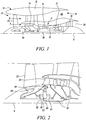
- FIG. 1 illustrates a gas turbine engine 10 having a principal rotational axis 9.
- the engine 10 comprises an air intake 12 and a propulsive fan 23 that generates two airflows: a core airflow A and a bypass airflow B.
- the gas turbine engine 10 comprises a core 11 that receives the core airflow A.
- the engine core 11 comprises, in axial flow series, a low pressure compressor 14, a high-pressure compressor 15, combustion equipment 16, a high-pressure turbine 17, a low pressure turbine 19 and a core exhaust nozzle 20.
- a nacelle 21 surrounds the gas turbine engine 10 and defines a bypass duct 22 and a bypass exhaust nozzle 18.
- the bypass airflow B flows through the bypass duct 22.
- the fan 23 is attached to and driven by the low pressure turbine 19 via a shaft 26 and an epicyclic gearbox 30.
- the core airflow A is accelerated and compressed by the low pressure compressor 14 and directed into the high pressure compressor 15 where further compression takes place.
- the compressed air exhausted from the high pressure compressor 15 is directed into the combustion equipment 16 where it is mixed with fuel and the mixture is combusted.
- the resultant hot combustion products then expand through, and thereby drive, the high pressure and low pressure turbines 17, 19 before being exhausted through the nozzle 20 to provide some propulsive thrust.
- the high pressure turbine 17 drives the high pressure compressor 15 by a suitable interconnecting shaft 27.
- the fan 23 generally provides the majority of the propulsive thrust.
- the epicyclic gearbox 30 is a reduction gearbox.
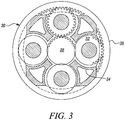
- FIG. 2 An exemplary arrangement for a geared fan gas turbine engine 10 is shown in Figure 2 .
- the low pressure turbine 19 (see Figure 1 ) drives the shaft 26, which is coupled to a sun wheel, or sun gear, 28 of the epicyclic gear arrangement 30.
- a sun wheel, or sun gear, 28 of the epicyclic gear arrangement 30 Radially outwardly of the sun gear 28 and intermeshing therewith is a plurality of planet gears 32 that are coupled together by a planet carrier 34.
- the planet carrier 34 constrains the planet gears 32 to precess around the sun gear 28 in synchronicity whilst enabling each planet gear 32 to rotate about its own axis.
- the planet carrier 34 is coupled via linkages 36 to the fan 23 in order to drive its rotation about the engine axis 9.
- an annulus or ring gear 38 Radially outwardly of the planet gears 32 and intermeshing therewith is an annulus or ring gear 38 that is coupled, via linkages 40, to a stationary supporting structure 24.
- low pressure turbine and “low pressure compressor” as used herein may be taken to mean the lowest pressure turbine stages and lowest pressure compressor stages (i.e. not including the fan 23) respectively and/or the turbine and compressor stages that are connected together by the interconnecting shaft 26 with the lowest rotational speed in the engine (i.e. not including the gearbox output shaft that drives the fan 23).
- the "low pressure turbine” and “low pressure compressor” referred to herein may alternatively be known as the "intermediate pressure turbine” and “intermediate pressure compressor”. Where such alternative nomenclature is used, the fan 23 may be referred to as a first, or lowest pressure, compression stage.
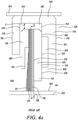
- the epicyclic gearbox 30 is shown by way of example in greater detail in Figure 3 .
- Each of the sun gear 28, planet gears 32 and ring gear 38 comprise teeth about their periphery to intermesh with the other gears. However, for clarity only exemplary portions of the teeth are illustrated in Figure 3 .
- Practical applications of a planetary epicyclic gearbox 30 generally comprise at least three planet gears 32.
- the epicyclic gearbox 30 illustrated by way of example in Figures 2 and 3 is of the planetary type, in that the planet carrier 34 is coupled to an output shaft via linkages 36, with the ring gear 38 fixed.
- the epicyclic gearbox 30 may be a star arrangement, in which the planet carrier 34 is held fixed, with the ring (or annulus) gear 38 allowed to rotate. In such an arrangement the fan 23 is driven by the ring gear 38.
- the gearbox 30 may be a differential gearbox in which the ring gear 38 and the planet carrier 34 are both allowed to rotate.
- any suitable arrangement may be used for locating the gearbox 30 in the engine 10 and/or for connecting the gearbox 30 to the engine 10.
- the connections (such as the linkages 36, 40 in the Figure 2 example) between the gearbox 30 and other parts of the engine 10 (such as the input shaft 26, the output shaft and the fixed structure 24) may have any desired degree of stiffness or flexibility.
- any suitable arrangement of the bearings between rotating and stationary parts of the engine may be used, and the disclosure is not limited to the exemplary arrangement of Figure 2 .
- the gearbox 30 has a star arrangement (described above)
- the skilled person would readily understand that the arrangement of output and support linkages and bearing locations would typically be different to that shown by way of example in Figure 2 .
- the present disclosure extends to a gas turbine engine having any arrangement of gearbox styles (for example star or planetary), support structures, input and output shaft arrangement, and bearing locations.
- gearbox styles for example star or planetary
- support structures for example star or planetary
- input and output shaft arrangement for example star or planetary
- bearing locations for example star or planetary
- the gearbox may drive additional and/or alternative components (e.g. the intermediate pressure compressor and/or a booster compressor).
- additional and/or alternative components e.g. the intermediate pressure compressor and/or a booster compressor.
- gas turbine engines to which the present disclosure may be applied may have alternative configurations.
- such engines may have an alternative number of compressors and/or turbines and/or an alternative number of interconnecting shafts.
- the gas turbine engine shown in Figure 1 has a split flow nozzle 18, 20 meaning that the flow through the bypass duct 22 has its own nozzle 18 that is separate to and radially outside the core engine nozzle 20.
- this is not limiting, and any aspect of the present disclosure may also apply to engines in which the flow through the bypass duct 22 and the flow through the core 11 are mixed, or combined, before (or upstream of) a single nozzle, which may be referred to as a mixed flow nozzle.
- One or both nozzles may have a fixed or variable area.
- the described example relates to a turbofan engine, the disclosure may apply, for example, to any type of gas turbine engine, such as an open rotor (in which the fan stage is not surrounded by a nacelle) or turboprop engine, for example.
- the gas turbine engine 10 may not comprise a gearbox 30.
- the geometry of the gas turbine engine 10, and components thereof, is defined by a conventional axis system, comprising an axial direction (which is aligned with the rotational axis 9), a radial direction (in the bottom-to-top direction in Figure 1 ), and a circumferential direction (perpendicular to the page in the Figure 1 view).
- the axial, radial and circumferential directions are mutually perpendicular.
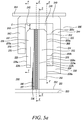
- Fig.4a shows an arrangement described in European patent EP1653129 , showing a cross-section through part of a gas turbine engine, in which a rotatable shaft 102, with axis 103, is mounted, within a static, concentric, casing 104.
- the annular gap between shaft 102 and casing 104 is closed by a compliant seal 106, which seals a first, upstream region 108 from a second, downstream region 110.
- air in the first upstream region 108 is pressurised to a relatively higher pressure than air in the low pressure downstream region 110.
- the brush seal 106 isolates the regions 108,110 from one another.
- the brush seal 106 comprises a seal pack 112 slidably mounted within an annular seal pack carrier 114.
- the seal pack 112 comprises a compliant annulus 113, which comprises a dense annular array of bristles 116, known as a bristle pack 117, bound about its external circumference by a retaining member 118.
- the seal pack 112 further comprises an upstream annular cover plate 120 which comprises a downstream facing surface 121 of the seal pack 112, and a downstream annular backing plate 122, which forms an upstream facing surface 123 of the seal pack 112.
- the seal pack carrier 114 comprises an annular retaining wall 140, first upstream radial wall 142, and second downstream radial wall 144.
- the retaining wall 140 is attached to the engine casing 104, and comprises an annular clearance C between the seal pack 112 and the annular retaining wall 140. This clearance C accommodates the radial movement of the seal pack 112. It is sized to accommodate the maximum eccentric excursion between shaft 102 and engine casing 104 during engine operation, and the maximum radial growth of the seal pack 112 relative to the carrier 114.
- the radial walls 142,144 project radially inwards from, respectively, the upstream and downstream ends of the retaining wall 140, in spaced apart arrangement, to define an annular slot 146, open radially inwards of the retaining wall 140.
- the slot's upstream surface 148 is formed by the downstream facing surface of the first upstream radial wall 142, which extends radially inwards to an internal diameter.
- the upstream facing surface of the same radial wall 142 forms the external, upstream face 151 of the carrier 114.
- the slot's downstream surface is formed by the upstream facing surface 152 of the second radial wall 144, which extends radially inwards to an internal diameter, and which defines an annular clearance about the engine shaft 102.
- the downstream facing surface 155 of the wall 144 defines the downstream face of the carrier 114.
- An annular chamber 156 is formed in the upstream facing surface 152 of the second downstream radial wall 144, bound at its outboard circumference by a second upstream facing contact surface 166, and at its inner radius by a first upstream facing annular contact member 168 defining a first upstream facing contact surface 158.
- the first upstream facing contact surface 158 of the downstream radial wall 144 is both distinct from and radially displaced from the second upstream facing contact surface 166 of the downstream radial wall 144 along a radial contact line on the downstream radial-azimuthal contact plane to define a first downstream chamber opening 159 therebetween.
- a collective contact surface adjacent to the radial contact line between the downstream surface 124 of the seal pack 112 and both the first upstream facing contact surface 158 and the second upstream facing contact surface 166 is less than a collective surface adjacent to the radial contact line of the downstream outer chamber opening 159 in order to maximise the pressure-balancing of the arrangement.
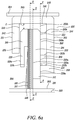
- Fig.5a shows an arrangement according to the present invention, showing a cross-section through part of a gas turbine engine, in which a rotatable shaft 202, with axis of rotation 203, is mounted, within a static, concentric, casing 204.
- the annular gap between shaft 202 and casing 204 is closed by a compliant seal 206, which seals a first, high fluid pressure upstream region 208 from a second, downstream relatively lower fluid pressure region 210.
- air in the first upstream region 208 is pressurised to a relatively higher pressure than air in the low pressure downstream region 210.
- the brush seal 206 isolates the regions 208,210 from one another.
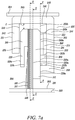
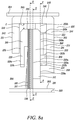
- the brush seal 206 comprises a seal pack forming an inner housing 212 slidably mounted within an annular seal pack carrier forming an outer housing 214.
- the inner housing 212 is located at least partially within and configured for radial displacement relative to both the outer housing 214 and either or both of the axial flow path and the axis of rotation 203.
- the inner housing 212 is slidably mounted within the outer housing 214 with only frictional engagement between the facing surfaces of the inner housing 212 and the outer housing 214. With slidable mounting of the inner housing 212 and brush relative to the outer housing 214, the brush seal 206 can slide when the bristle loads become higher than a threshold value.
- This threshold value is generally a function of the differential pressure across the brush seal 206 for a given brush pack.
- the working of this has been published in GT2012-68891, Franceschini G, Jones T.V, Gillespie D. R. H. "The Development of a Large Radial Movement Brush Seal", ASME Gas Turbine and Aeroengine Congress, Copenhagen, Denmark, June 2012 , the teaching of which is hereby incorporated by reference.
- the inner housing 212 comprises a compliant annulus, which comprises a dense annular array of bristles, configured as a bristle pack 216, or more specifically as a first bristle layer 217, bound about its external circumference by a retaining member 218.
- the seal pack 212 shown further comprises an upstream annular cover plate 220 comprising an upstream facing surface 221a and a downstream facing surface 221b.
- the inner housing 212 shown further comprises a downstream annular backing member 222 comprising an upstream facing surface 223a and a downstream facing surface 223b.
- the first bristle layer 217 is in physical communication with at least a first upstream facing inner contact surface, shown in the specific example of Fig.5a as the upstream facing surface 223a, configured along a second radial contact line S-S.
- the second radial contact line S-S may extend along a second radial-azimuthal contact plane.
- the second radial contact line S-S may refer to a second radial line extending parallel to the second radial-azimuthal contact plane.
- the inner housing 212 may comprise one or more contact members comprising one or more contact surfaces, and where applicable, one or more chambers therebetween.
- the inner housing 212 may comprise a first downstream inner contact member defining a first upstream facing inner contact surface, and a second downstream inner contact member defining a second upstream facing inner contact surface.
- bristles forming part of the bristle pack 216, are arranged to point inwards from this retaining member 218 to form a sealing face 226 at their internal diameter.
- the bristles are inclined at a lay angle to the radial direction such that each bristle 216, at its radially inner end, lays adjacent to the surface of the shaft 202.
- the cover plate 220 is axially spaced from the bristle pack 216. It extends radially inboards such that an annular gap is defined between the cover plate 220 and the sealing face 226.
- the downstream annular backing member 222 extends radially inwards from the retaining member 218 such that annular gap is defined between the downstream annular backing member 222 and the sealing face 226, sized to accommodate the maximum likely deflection of the sealing face 226 through radial growth of the shaft 202 relative to the seal during engine operation. Furthermore, in the example shown, the downstream annular backing member 222 supports the downstream face of the bristle pack 216 over the entire length of the downstream annular backing member 222.
- the seal outer housing 214 comprises an annular retaining wall 240 comprising a radially inward facing surface 245, an upstream radial wall 242, and a downstream radial wall 244.
- the retaining wall 240 is attached to the engine casing 204, and comprises an annular clearance C between the seal pack 212 and the radially inward facing surface 245. Clearance C accommodates the radial movement of the seal pack 212. Clearance C is sized to accommodate the maximum eccentric excursion between shaft 202 and engine casing 204 during engine operation, and the maximum radial growth of the seal pack 212 relative to the outer housing 214.
- the radial walls 242,244 project radially inwards from, respectively, the upstream and downstream ends of the retaining wall 240, in an axially spaced configuration, to define a second downstream outer chamber 246, open radially inwards of the retaining wall 240.
- the upstream radial wall 242 of the outer housing 214 further comprises an upstream facing outer surface 251 and a downstream facing inner surface 248.
- the downstream radial wall 244 of the outer housing 214 further comprises an upstream facing inner surface 252 and a downstream facing outer surface 255.
- the upstream inner surface of the outer housing 214 is formed by the downstream facing surface 248 of the upstream radial wall 242, which extends radially inwards to an internal diameter.
- the downstream inner surface of the outer housing 214 is formed by the upstream facing surface 252 of the downstream radial wall 244, which extends radially inwards to an internal diameter, which defines an annular clearance about the engine shaft 202.
- the upstream inner surface 248 and the downstream inner surface 252 of the respective radial walls 242,244 form the internal facing surfaces of a slot within which the inner housing 212 is slidably configured.
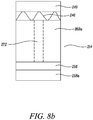
- the downstream radial wall 244 comprises a first upstream facing outer contact member, termed the first downstream outer contact member 258, defining a first upstream facing outer contact surface 258a, and a second upstream facing outer contact member termed the second downstream outer contact member 268 defining a second upstream facing outer contact surface 268a.
- first downstream outer contact member 258 and the second downstream outer contact member 268 may be annular.
- first upstream facing outer contact surface 258a and the second upstream facing outer contact surface 268a may be annular.
- a first downstream outer chamber 256 is formed in the upstream facing surface 252 of the downstream radial wall 244, bound at its inner radius by the first downstream outer contact member 258 defining the first upstream facing outer contact surface 258a, and at its outboard circumference by the second downstream outer contact member 268 defining the second upstream facing outer contact surface 268a.
- the first downstream outer chamber 256 may be annular. Both the first upstream facing outer contact surface 258a and the second upstream facing outer contact surface 268a are configured along a first radial contact line F-F.
- the first radial contact line F-F may extend along a first radial-azimuthal contact plane.
- the first radial contact line F-F may refer to a first radial line extending parallel to the first radial-azimuthal contact plane.
- the first upstream facing outer contact surface 258a is both distinct from and radially spaced from the second upstream facing outer contact surface 268a along the first radial contact line F-F to define a first downstream outer chamber opening 259a therebetween.
- the second downstream outer contact member 268, which defines the second upstream facing outer contact surface 268a extends partly along the downstream radial wall 244.
- the second downstream outer contact member 268 extends over the full radial distance between the first downstream outer chamber 256 and the retaining wall 240.
- the second downstream outer contact member 268 further comprises a second radially inner endwall 268b which partly defines a radially outer surface of the first downstream outer chamber 256.
- the second downstream outer chamber 246 axially extends between the downstream facing inner surface 248 and the second downstream outer contact member 268.
- the downstream facing surface 223b of the annular backing member 222 is maintained in physical communication with at least the first upstream facing outer contact surface 258a and at least a portion of the second upstream facing outer contact surface 268a during all relative radial displacements therebetween, which are expected to arise during normal use.
- the values of clearance C may vary to accommodate either or both of the maximum eccentric excursion between shaft 202 and engine casing 204 during normal engine operation, and the maximum radial growth of the seal pack 212 relative to the outer housing 214.
- a collective contact surface along the first radial contact line F-F between the inner housing 212 and the outer housing 214 is greater than a collective surface along the first radial contact line F-F of the downstream outer chamber opening 259a.
- Fig.5b shows a front view (viewed from upstream) of the outer housing 214, viewed on the first radial-azimuthal contact plane.
- the downstream radial wall 244 and the second downstream outer contact member 268 extend radially inwards from the retaining wall 240.
- the second downstream outer contact member 268 and the second upstream facing outer contact surface 268a are radially spaced from the first downstream outer contact member 258 and the first upstream facing outer contact surface 258a to define the first downstream outer chamber 256 therebetween.
- both the first downstream outer contact member 258 defining the first upstream facing outer contact surface 258a and the second downstream outer contact member 268 defining the second upstream facing outer contact surface 268a support the downstream face of the inner housing 212.
- a radially extending gap 270 is maintained between the upstream inner surface 248 of the upstream radial wall 242 and the upstream facing surface 221a of the upstream annular cover plate 220.
- the radially extending gap 270 may be annular. As shown, the gap extends along the radial length of the upstream radial wall 242 between the second downstream outer chamber 246 and the relatively high fluid pressure upstream region 208.
- the second downstream outer chamber 246 is maintained in fluidic communication with the relatively high fluid pressure upstream region 208 in order to supply the second downstream outer chamber 246 with the high pressure fluid.
- the inner housing 212 is provided with a radially directed inward force to force the inner housing 212 radially inwards towards the rotatable shaft 202 and maintain an annular clearance C between the inner housing 212 and the outer housing 214.
- the gap 270 may instead be formed into the downstream facing inner surface 248 to provide a channel therein.
- the gap 270 may be formed into the radially inward facing surface 245 of the annular retaining wall 240.
- the gap 270 may instead be formed through upstream radial wall 242 to provide a channel or orifice therein.
- the gap 270 may be formed through the annular retaining wall 240 to provide a channel or orifice therein.
- the upstream inner surface 248 of the upstream radial wall 242 comprises a first upstream outer contact member 278 comprising a first downstream facing outer surface 278a configured along a third radial contact line T-T.
- the third radial contact line T-T may extend along a third radial-azimuthal contact plane.
- the third radial contact line T-T may refer to a third radial line extending parallel to the third radial-azimuthal contact plane.
- at least a portion of the upstream facing surface 221a of the inner housing 212 may be in contact with the first downstream facing outer surface 278a along the third radial contact line T-T.
- the upstream facing surface 221a of the inner housing 212 may be, in use, maintained in contact with and axially supported by one or more downstream facing outer surfaces 278a of the outer housing 214.
- the outer housing 214 may comprise a second upstream outer contact member (not shown) comprising a second downstream facing outer surface (not shown) configured, and radially spaced from the first downstream facing outer surface, along the third radial contact line T-T to define an upstream outer chamber opening (not shown) therebetween, which may be supplied with a pressurised fluid of relatively similar or relatively higher pressure than that of the air in the low pressure downstream region 210.
- fluid in the first chamber may be vented to the low pressure downstream region 210, such that in use, the inner housing 212 is offloaded axially.
- the downstream radial wall 244 comprises the first downstream outer contact member 258 defining the first upstream facing outer contact surface 258a, and the second downstream outer contact member 268 defining the second upstream facing outer contact surface 268a.
- the first downstream outer chamber 256 is formed in the upstream facing surface 252 of the downstream radial wall 244, bound at its inner radius by the first downstream outer contact member 258 defining the first upstream facing outer contact surface 258a, and at its outboard circumference by the second downstream outer contact member 268 defining the second upstream facing outer contact surface 268a. As shown and described in relation to Fig.5a , both the first upstream facing outer contact surface 258a and the second upstream facing outer contact surface 268a are configured along the first radial contact line F-F.
- the first upstream facing outer contact surface 258a is both distinct from and radially spaced from the second upstream facing outer contact surface 268a along the first radial contact line F-F to define a first downstream outer chamber opening 259a therebetween.
- the second downstream outer contact member 268 and second upstream facing outer contact surface 268a are configured, and radially spaced from a radially outer retaining wall 240 of the outer housing to define a second downstream outer chamber 246 therebetween.
- the second upstream facing outer contact surface 268a is both distinct from and radially spaced from the radially inward facing surface 245 of the annular retaining wall 240 along the first radial contact line F-F to define a second downstream outer chamber opening 259b therebetween.
- the second downstream outer contact member 268 comprises a second radially inner endwall 268b which partly defines a radially outer surface of the first downstream outer chamber 256, and a second radially outer endwall 268c which partly defines a radially inner surface of a second downstream outer chamber 246. Accordingly, the second downstream outer contact member 268 at least partially defines and separates a first downstream outer chamber opening 259a of a first downstream outer chamber 256 and a second downstream outer chamber opening 259b of a second downstream outer chamber 246.
- the second downstream outer chamber 246 axially extends between the downstream facing inner surface 248 and an upstream facing surface of the downstream radial wall 244.
- the downstream facing surface 223b of the annular backing member 222 is maintained in physical communication with at least the first upstream facing outer contact surface 258a and at least a portion of the second upstream facing outer contact surface 268a during all relative radial displacements therebetween, which are expected to arise during normal use.
- the values of clearance C may vary to accommodate either or both of the maximum eccentric excursion between shaft 202 and engine casing 204 during normal engine operation, and the maximum radial growth of the seal pack 212 relative to the outer housing 214.
- a collective contact surface along the first radial contact line F-F between the inner housing 212 and the outer housing 214 is greater than a collective surface along the first radial contact line F-F of the first downstream outer chamber opening 259a.
- a collective contact surface along the first radial contact line F-F between the inner housing 212 and the outer housing 214 is greater than a collective surface along the first radial contact line F-F of both the first downstream outer chamber opening 259a and the second downstream outer chamber opening 259b.
- the outer housing may comprise a third or further downstream outer contact member comprising a third or further upstream facing outer contact surface configured along the first radial contact line F-F.
- the third or further upstream facing outer contact surface may be both configured between and radially displaced along the first radial contact line F-F from the first upstream facing outer contact surface 258a and the second upstream facing outer contact surface 268a to at least partially define either or both of a first downstream outer chamber opening 259a of a first downstream outer chamber 256 and a third downstream outer chamber opening of a third downstream outer chamber.
- the third or further upstream facing outer contact surface may at least partially define a third or further downstream outer chamber opening of a third of further downstream chamber.
- Fig.6b shows a front view (viewed from upstream) of the outer housing 214 previously shown in Fig.6a , viewed on the first radial-azimuthal contact plane.
- the downstream radial wall 244 extends radially inwards from the retaining wall 240.
- the second downstream outer contact member 268 and the second upstream facing outer contact surface 268a are spaced from, and extend radially inwards relative to the retaining wall 240, such that the second downstream outer chamber 246 is defined between the retaining wall 240 and both the second downstream outer contact member 268 and the second upstream facing outer contact surface 268a.
- both the first downstream outer contact member 258 defining the first upstream facing outer contact surface 258a and the second downstream outer contact member 268 defining the second upstream facing outer contact surface 268a support the downstream face of the inner housing 212.
- the second downstream outer contact member 268 in the downstream radial wall 244 comprises one or more first downstream outer passageways 272 or channels therein.
- the or each first downstream outer passageway 272 may comprise a passageway, recess or groove formed into the second upstream facing outer contact surface 268a.
- the first downstream outer passageway 272 is configured to fluidly connect at least the first downstream outer chamber 256 and the second downstream outer chamber.
- a third or further downstream outer contact member may comprise a second downstream outer passageway configured to fluidly connect at least the third downstream outer chamber and the first downstream outer chamber 256.
- one or more first downstream outer passageways 272 may comprise a defined diameter or depth.
- the diameter or depth of one or more of the first downstream outer passageways 272 may be between about 20% to about 80% of the axial thickness of the downstream radial wall 244. In further examples, the diameter or depth of one or more of the first downstream outer passageways 272 may be between about 40% to about 80% of the axial thickness of the downstream radial wall 244. In yet further examples, the diameter or depth of one or more of the first downstream outer passageways 272 may be between about 50% to about 75% of the axial thickness of the downstream radial wall 244. In some examples, the first passageways 240 may be provided between pillars, using a deposition or layered construction method.
- the axis of the first passageway may extend in a direction which is canted away from the first radial contact line F-F.
- the first downstream outer passageway 272 and, where applicable, the second downstream outer passageway may be configured to fluidly connect a source of pressurised fluid and either or both of the first downstream outer chamber 256 and the second downstream outer chamber 246.
- the first downstream outer passageway may be configured to fluidly connect a source of pressurised fluid and either the second downstream outer chamber or the first downstream outer chamber.
- the second downstream outer passageway may be configured to fluidly connect a source of pressurised fluid and at least the third downstream outer chamber and the first downstream outer chamber.
- first downstream outer passageway 272 and, where applicable, the second downstream outer passageway may be configured to fluidly connect the first downstream outer chamber 256 and the second downstream outer chamber 246 only, without any further fluid connection to the relatively high fluid pressure upstream region 208, or a further source of pressurised fluid.
- first downstream outer passageway 272 may be configured to fluidly connect the first downstream outer chamber 256 and the third or further downstream outer chamber only, without any further fluid connection to the relatively high fluid pressure upstream region 208, a further source of pressurised fluid, or the second downstream outer chamber 246.
- the radially extending gap 270 extends along the radial length of the upstream radial wall 242 between the second downstream outer chamber 246 and the relatively high fluid pressure upstream region 208.
- the second downstream outer chamber 246 is maintained in fluidic communication with the relatively high fluid pressure upstream region 208 in order to supply the second downstream outer chamber 246 with the high pressure fluid.
- high pressure fluid in use, at least partially reacts axially applied forces on the inner housing 212 against the outer housing 214.
- first downstream outer passageway 272 By means of the first downstream outer passageway 272 as shown in Fig.6b , during use, high pressure fluid flows between the second downstream outer chamber 246 and the first downstream outer chamber 256. Thus, high pressure fluid, in use, at least partially reacts radially applied forces on the inner housing 212 against the outer housing 214. Thus, by supplying the second downstream outer chamber 246 with high pressure fluid, the high pressure fluid may be transferred to first downstream outer chamber 256 via the first downstream outer passageway 272, and where relevant, the second or further downstream outer passageway, in order to pressurise both the third or further outer chamber and the first downstream outer chamber 256.
- the pressurised fluid may pressurise either or both of the first downstream outer chamber 256 and the second downstream outer chamber 246, in use, to a pressure substantially equal to or less than that of the pressure of the relatively higher pressure upstream region 208, depending on the location of the source of the pressurised fluid.
- the pressurised fluid may pressurise either or both of the first downstream outer chamber 256 and the second downstream outer chamber 246, in use, to a pressure substantially equal to or greater than that of the pressure of the relatively higher pressure upstream region 208, depending on the location of the source of the pressurised fluid.
- the pressurised fluid may pressurise either or both of the first downstream outer chamber 256 and the second downstream outer chamber 246, in use, to a pressure higher than that of the pressure of the relatively lower fluid pressure region 210.
- the pressurised fluid refers to a fluid pressurised to a static fluid pressure which is relatively greater than the static fluid pressure of the downstream region.
- the pressurised fluid refers to a fluid pressurised to a static fluid pressure which is greater than about 1atm.
- the quotient of the static pressure above downstream and the differential pressure (upstream above downstream) can be called the pressure balancing ratio.
- the fluid may be pressurised to a pressure balancing ratio between about 0.8 to about 1.1.
- the fluid may be pressurised to a pressure balancing ratio between about 0.9 to about 1.05. In yet further examples, the fluid may be pressurised to a pressure balancing ratio between about 0.95 to about 1.0.
- the fluid is a gas.
- the fluid may be a working gas. In most preferred examples, the working gas is air.
- the source of pressurised fluid may be provided to either or both of the first downstream outer chamber 256 and the second downstream outer chamber 246 from a location axially upstream of one or more of the first downstream outer passageways 272, outer housing 214, and radially extending gap 270 in fluidic communication with the relatively higher pressure upstream region 208.
- the fluid pressure in either or both of the first downstream outer chamber 256 and the second downstream outer chamber 246 may be reduced or modified by locating a constant or variable constriction, seal, or valve, for example, in one or more of the radially extending gap 270, the first passageway 272, or the second or further passageway.
- Such an arrangement may comprise one or more pressure sensors and controllers configured to measure, monitor and control the fluid pressure in either or both of the first downstream outer chamber 256 and the second downstream outer chamber 246.
- the fluid pressure in either or both of the first downstream outer chamber 256 and the second downstream outer chamber 246 may be tailored or controlled to enable a balancing of axially applied forces on the inner housing 212 against the outer housing 214.
- Particular passageway configurations for transferring pressurised fluid to either or both of the first downstream outer chamber 256 and the second downstream outer chamber 246 from the source of pressurised fluid may, in some examples, be equivalent to those described in United States patent US 6,173,962 , which is hereby incorporated by reference.
- the pressurised fluid within either or both of the first downstream outer chamber 256 and the second downstream outer chamber 246 at least partially reacts forces exerted on the inner housing 212 against the outer housing 214.
- the net axial force between the inner housing 212, the first upstream facing outer contact surface 258a and either or both of the second upstream facing outer contact surface 268a and third or further contact surfaces is at least partially reduced.
- the pressure of the fluid, and hence the force exerted on the inner housing 212 may be such that the net axial forces between the inner housing 212, the first upstream facing outer contact surface 258a and either or both of the second upstream facing outer contact surface 268a and third or further upstream facing outer contact surfaces are either substantially reduced or at least substantially eliminated.
- the at least partial reduction of net axial forces between the inner housing 212, the first upstream facing outer contact surface 258a and either or both of the second upstream facing outer contact surface 268a and third or further contact surfaces may at least partially reduce radially directed constraining frictional forces between the inner housing 212 and the outer housing 214.
- the at least partial reduction of net axial forces between the inner housing 212, the first upstream facing outer contact surface 258a and either or both of the second upstream facing outer contact surface 268a and third or further contact surfaces may at least substantially reduce, or at least substantially eliminate radially directed constraining frictional forces between the inner housing 212 and the outer housing 214.
- the fluid pressure in either or both of the first downstream outer chamber 256 and the second downstream outer chamber 246 may be reduced or modified by providing a constant or variable constriction, or valve, in either or both of the he first passageway 272 and the second or further passageway.
- the force exerted on the inner housing 212 by pressurised fluid in one or more of the first downstream outer chamber 256, second downstream outer chamber 246, and the third or further downstream outer chamber only partially balances the opposing forces exerted on the inner housing 212 and bristle layer 217 by the fluid in the upstream region 208, so that there is generally a net axial force between the inner housing 212, the first upstream facing outer contact surface 258a and either or both of the second upstream facing outer contact surface 268a and third or further contact surfaces. This gives rise to a radially constraining frictional force on the inner housing 212.
- the downstream radial wall 244 comprises the first downstream outer contact member 258 defining the first upstream facing outer contact surface 258a, and the second downstream outer contact member 268 defining the second upstream facing outer contact surface 268a.
- the first downstream outer chamber 256 is formed in the upstream facing surface 252 of the downstream radial wall 244, bound at its inner radius by the first downstream outer contact member 258 defining the first upstream facing outer contact surface 258a, and at its outboard circumference by the second downstream outer contact member 268 defining the second upstream facing outer contact surface 268a. As shown and described in relation to Figs.5a to 6b , both the first upstream facing outer contact surface 258a and the second upstream facing outer contact surface 268a are configured along the first radial contact line F-F.
- the first upstream facing outer contact surface 258a is both distinct from and radially spaced from the second upstream facing outer contact surface 268a along the first radial contact line F-F to define a first downstream outer chamber opening 259a therebetween.
- the second downstream outer contact member 268 and second upstream facing outer contact surface 268a are configured, and radially spaced from a radially outer retaining wall 240 of the outer housing to define a second downstream outer chamber 246 therebetween. Furthermore, the second upstream facing outer contact surface 268a is both distinct from and radially spaced from the downstream radial wall 244 along the first radial contact line F-F to define a second downstream outer chamber opening 259b therebetween. As shown, the second downstream outer contact member 268 comprises a second radially inner endwall 268b which partly defines a radially outer surface of the first downstream outer chamber 256, and a second radially outer endwall 268c which partly defines a radially outer surface of a second downstream outer chamber 246.
- the second downstream outer contact member 268 at least partially defines and separates a first downstream outer chamber opening 259a of a first downstream outer chamber 256 and a second downstream outer chamber opening 259b of a second downstream outer chamber 246.
- the second downstream outer chamber 246 axially extends between the downstream facing inner surface 248 and an upstream facing surface of the downstream radial wall 244.
- a collective contact surface along the first radial contact line F-F between the inner housing 212 and the outer housing 214 is greater than a collective surface along the first radial contact line F-F of the downstream outer chamber opening 259a.
- a collective contact surface along the first radial contact line F-F between the inner housing 212 and the outer housing 214 is greater than a collective surface along the first radial contact line F-F of both the downstream outer chamber opening 259a and the second downstream outer chamber opening 259b.
- the outer housing 214 may comprise a third or further downstream outer contact member comprising a third or further upstream facing outer contact surface configured along the first radial contact line F-F.
- the third or further upstream facing outer contact surface may be both located between and radially displaced along the first radial contact line F-F from the first upstream facing outer contact surface 258a and the second upstream facing outer contact surface 268a to at least partially define either or both of a first downstream outer chamber opening 259a of a first downstream outer chamber 256 and a second downstream outer chamber opening 259b of a second downstream outer chamber 246.
- the third or further upstream facing outer contact surface may further define third or further downstream outer chamber openings of a third or further downstream chambers.
- Fig.7b shows a front view (viewed from upstream) of the outer housing 214 previously shown in Fig.7a , viewed on the first radial-azimuthal contact plane.
- the downstream radial wall 244 extends radially inwards from the retaining wall 240.
- the second downstream outer contact member 268 and the second upstream facing outer contact surface 268a are spaced from, and extend radially inwards relative to the retaining wall 240, such that the second downstream outer chamber 246 is defined between the retaining wall 240 and both the second downstream outer contact member 268 and the second upstream facing outer contact surface 268a.
- both the first downstream outer contact member 258 defining the first upstream facing outer contact surface 258a and the second downstream outer contact member 268 defining the second upstream facing outer contact surface 268a support the downstream face of the inner housing 212.
- both Fig.7a and 7b show the second downstream outer contact member 268, comprising one or more first downstream outer passageways 272 or channels integrally formed therein.
- the or each first downstream outer passageway 272 comprises a passageway formed within and through the body of the second outer contact member 268.
- the first downstream outer passageway 272 is configured to fluidly connect at least the first downstream outer chamber 256 and the second downstream outer chamber in the manner described in relation to Fig.6b .
- a third or further downstream outer contact member may comprise a second or further downstream outer passageway formed within and through the body of the respective outer contact member, and configured to fluidly connect at least the third downstream outer chamber and the first downstream outer chamber 256.
- the first downstream outer passageway 272 and, where applicable, the second downstream outer passageway may be configured to fluidly connect a source of pressurised fluid and either or both of the first downstream outer chamber 256 and the second downstream outer chamber 246.
- first downstream outer passageway 272 and, where applicable, the second downstream outer passageway may be configured to fluidly connect the first downstream outer chamber 256 and the second downstream outer chamber 246 only, without any further fluid connection to the relatively high fluid pressure upstream region 208, or a further source of pressurised fluid.
- first downstream outer passageway 272 may be configured to fluidly connect the first downstream outer chamber 256 and the third or further downstream outer chamber only, without any further fluid connection to the relatively high fluid pressure upstream region 208, a further source of pressurised fluid, or the second downstream outer chamber 246.
- the radially extending gap 270 extends along the radial length of the upstream radial wall 242 between the second downstream outer chamber 246 and the relatively high fluid pressure upstream region 208.
- the second downstream outer chamber 246 is maintained in fluidic communication with the relatively high fluid pressure upstream region 208 in order to supply the second downstream outer chamber 246 with the high pressure fluid.
- high pressure fluid in use, at least partially reacts axially applied forces on the inner housing 212 against the outer housing 214.
- first downstream outer passageway 272 By means of the first downstream outer passageway 272, as shown in Fig.7b , during use, high pressure fluid flows between the second downstream outer chamber 246 and the first downstream outer chamber 256. Thus, high pressure fluid, in use, at least partially reacts radially applied forces on the inner housing 212 against the outer housing 214. Thus, by supplying the second downstream outer chamber 246 with high pressure fluid, the high pressure fluid may be transferred to first downstream outer chamber 256 via the first downstream outer passageway 272, and where relevant, the second or further downstream outer passageway, in order to pressurise both the third or further outer chamber and the first downstream outer chamber 256.
- the at least partial reduction of net axial forces between the inner housing 212, the first upstream facing outer contact surface 258a and either or both of the second upstream facing outer contact surface 268a and third or further contact surfaces may at least partially reduce radially directed constraining frictional forces between the inner housing 212 and the outer housing 214.
- the at least partial reduction of net axial forces between the inner housing 212, the first upstream facing outer contact surface 258a and either or both of the second upstream facing outer contact surface 268a and third or further upstream facing contact surfaces may at least substantially reduce, or at least substantially eliminate radially directed constraining frictional forces between the inner housing 212 and the outer housing 214.
- the incorporation of the one or more first downstream outer passageways 272 or channels within the second downstream outer contact member 268 enables the second upstream facing outer contact surface 268a area to be maximised.
- contact pressure may be reduced.
- a reduction in contact pressure may lead to a further improvement in fretting wear resistance between the inner housing 212 and the outer housing 214 during use. Wear typically correlates with contact pressure, and may be further influenced by surface speed and interface temperature. The contact load is fixed by the pressures around the inner housing 212 and bristle pack 216.
- the axially directed contact load may be resisted by the downstream radial wall 244 of the outer housing 214.
- the contact pressure may be reduced by increasing the surface area of the or each contact area 258a,268a while at the same time leaving the pressures surrounding the inner housing 212 unchanged.
- FIG.8a depicts a similar arrangement to that of Figs. 7a and 7b , with the addition of an anti-rotation feature 280.
- the anti-rotation feature is located between the inner housing 212 and the outer housing 214.
- the anti-rotation 280 feature is located between the retaining member 218 of the inner housing 212 and the annular retaining wall 240 of the outer housing 214.
- the anti-rotation feature is provided in the form of a wave spring, which is more clearly shown in Fig.8b , showing a front view of the outer housing 214.
- pin and slot anti-rotation features may be replaced with an annular wave spring of low radial stiffness.
- the annular wave spring of low radial stiffness may be spot welded to either or both of the inner housing 212 and the outer housing 214 either partially around, or around the entire circumference of the brush seal 206 arrangement.
- the inner housing 212 may slide relative to the outer housing 214.
- the brush seal 206 For some engine locations where the stack of tolerances is large, the benefit of the sliding occurring, even at very low pressures gives the brush seal 206 the ability to initially "self-centre" and thereby remove the need for increasing the clearance between the inner housing 212 and the shaft 203. The benefit of this is lower leakage through the brush seal 206 and lower bristle tip forces, giving a longer-lasting brush pack. Anti-rotation may be accomplished using a circumferential wave spring arrangement or by a set of radial springs dispersed around the circumference, or a pin and slot.
- each of the examples shown and described in relation to Figs. 5a-8b may be modified by overlaying an additional porous layer over, or axially upstream of the bristle layer 217, or either or both of the first downstream outer chamber 256 and the second downstream outer chamber 246.
- the additional porous layer may be located immediately upstream of the bristle layer 217.
- the additional porous layer may be located immediately upstream of only a portion of the bristle layer 217. Where applicable, such an additional layer should not significantly damp the bristles to inhibit their ability to accommodate shaft movement etc.
- the previously described brush seal arrangements may be located in series relationship with an additional sealing element, so that a further chamber is defined between the respective brush seal arrangement and the fluid in the upstream region 208.
- fluid in the further chamber may be maintained or controlled, in use, at a pressure between that of the fluid in the upstream region 208 and the relatively lower pressure downstream region 210. In this way, the fluid pressure supplied to either or both of the first downstream outer chamber 256 and the second downstream outer chamber 246 may be reduced to achieve the described pressure balancing effect.
- the bristle layer 217 may be formed from a number of various materials exhibiting suitable stiffness, temperature resistance, creep resistance, erosion resistance and corrosion resistance characteristics.
- the bristle layer 217 may be formed from a multiplicity of tufts of lengths of resilient wire secured to the inner housing 212 by any suitable joining technique, such as welding or brazing or crimping. The particular technique employed will, of course, be dictated by the particular choice of materials employed and the temperatures at which they will be expected to operate.
- the bristles comprised within the bristle layer 217 are cobalt alloy wire.
- the bristles comprised within the bristle layer 217 may be comprised of a nickel-based alloy.
- the inner housing 212, the outer housing 214, and the respective contact members are nickel based, or a compatible alloy, and are welded together to provide an integral unit.
- further materials may be employed, separately or in combination with those disclosed, in order to achieve or provide similar or substantially similar performance, characteristics or material behaviours.
- one or more of the bristle layer 217, the inner housing 212, the outer housing 214, or the respective contact members may comprise a number of further alloy-constituents commonly used in gas turbine engine, or high-temperature applications.
- one or more of the respective contact surfaces 258a,268a shown or described in relation to any of Figs.5a-8b may comprise a hardened surface layer which is relatively harder than a further portion of the outer housing 214 spaced from the or each contact surface 258a,268a. Additionally or alternatively, one or more of the respective contact surfaces 258a,268a shown or described in relation to any of Figs.5a-8b may comprise a surface layer which comprises either or both of a relatively lower surface roughness and a relatively lower frictional coefficient than a further portion of the outer housing 214 spaced from the or each contact surface 258a,268a.
- a diamond like carbon surface treatment may be used on any one or more of the radially inner, radially outer, upstream or downstream surfaces or contact surfaces of either or both of the inner housing 212 and the outer housing 214.
- Such a diamond like carbon surface treatment may provide any one or more of the treated surfaces with a superior fretting resistance.
Landscapes
- Engineering & Computer Science (AREA)
- General Engineering & Computer Science (AREA)
- Mechanical Engineering (AREA)
- Turbine Rotor Nozzle Sealing (AREA)
- Sealing Devices (AREA)
Applications Claiming Priority (1)
| Application Number | Priority Date | Filing Date | Title |
|---|---|---|---|
| GBGB1814673.8A GB201814673D0 (en) | 2018-09-10 | 2018-09-10 | Radially displaceable brush seal |
Publications (2)
| Publication Number | Publication Date |
|---|---|
| EP3620695A1 EP3620695A1 (en) | 2020-03-11 |
| EP3620695B1 true EP3620695B1 (en) | 2021-03-17 |
Family
ID=63921264
Family Applications (1)
| Application Number | Title | Priority Date | Filing Date |
|---|---|---|---|
| EP19192037.0A Active EP3620695B1 (en) | 2018-09-10 | 2019-08-16 | Radially displaceable brush seal |
Country Status (4)
| Country | Link |
|---|---|
| US (1) | US20200080440A1 (enExample) |
| EP (1) | EP3620695B1 (enExample) |
| JP (1) | JP2020041698A (enExample) |
| GB (1) | GB201814673D0 (enExample) |
Family Cites Families (5)
| Publication number | Priority date | Publication date | Assignee | Title |
|---|---|---|---|---|
| US6173962B1 (en) | 1995-12-09 | 2001-01-16 | Rolls Royce Plc | Brush seal |
| GB0423923D0 (en) | 2004-10-28 | 2004-12-01 | Rolls Royce Plc | Segmented annular seal for a gas turbine engine |
| US7413194B2 (en) * | 2004-10-28 | 2008-08-19 | Rolls-Royce Plc | Pressure balanced annular seal |
| EP2128524A1 (de) * | 2008-05-26 | 2009-12-02 | Siemens Aktiengesellschaft | Bauteilanordnung, Brennkammeranordnung und Gasturbine |
| US8454023B2 (en) * | 2011-05-10 | 2013-06-04 | General Electric Company | Retractable seal system |
-
2018
- 2018-09-10 GB GBGB1814673.8A patent/GB201814673D0/en not_active Ceased
-
2019
- 2019-08-16 EP EP19192037.0A patent/EP3620695B1/en active Active
- 2019-09-06 JP JP2019163164A patent/JP2020041698A/ja active Pending
- 2019-09-10 US US16/565,572 patent/US20200080440A1/en not_active Abandoned
Also Published As
| Publication number | Publication date |
|---|---|
| EP3620695A1 (en) | 2020-03-11 |
| US20200080440A1 (en) | 2020-03-12 |
| JP2020041698A (ja) | 2020-03-19 |
| GB201814673D0 (en) | 2018-10-24 |
Similar Documents
| Publication | Publication Date | Title |
|---|---|---|
| EP3808963B1 (en) | Gas turbine engine | |
| US11624325B2 (en) | Face seal arrangement for reduced force and pressure | |
| US11174944B2 (en) | Radially displaceable brush seal | |
| EP3875733B1 (en) | Blade assembly for gas turbine engine | |
| EP3045681B1 (en) | Gas turbine engine with high temperature spool and associated cooling system | |
| US20200191276A1 (en) | Device with two structural components and gas turbine engine | |
| US20220389873A1 (en) | Gearbox and gas turbine propulsion unit | |
| US10995676B2 (en) | Planetary gear device, gas turbine engine and method for manufacturing a planetary gear device | |
| US11970981B2 (en) | Planetary gearbox | |
| US12180840B1 (en) | Seal assembly for a turbine engine | |
| US12331654B2 (en) | Bathtub seal for damping CMC vane platform | |
| EP3620695B1 (en) | Radially displaceable brush seal | |
| EP3620694A1 (en) | Brush seal | |
| EP3712394A1 (en) | A gas turbine bearing support structure | |
| US11073035B2 (en) | Labyrinth sealing system and gas turbine engine with a labyrinth sealing system | |
| EP4006310A1 (en) | Face seal arrangement with reduced balance ratio | |
| US12338737B1 (en) | Seal assembly for a turbine engine | |
| US12326099B2 (en) | Bathtub seal integrated into CMC vane load path | |
| US12281597B2 (en) | CMC vane with rotatable baffle design to accommodate re-stagger | |
| US11867282B1 (en) | Planetary gear box | |
| EP4379189A1 (en) | Machinable coating for cmc and metal interface in a turbine section | |
| EP3663542B1 (en) | Oil supply arrangement for bearing | |
| US20200032673A1 (en) | Casing arrangement for an axial compressor of a gas turbine engine | |
| US20200182151A1 (en) | Oil supply arrangement for bearing |
Legal Events
| Date | Code | Title | Description |
|---|---|---|---|
| PUAI | Public reference made under article 153(3) epc to a published international application that has entered the european phase |
Free format text: ORIGINAL CODE: 0009012 |
|
| STAA | Information on the status of an ep patent application or granted ep patent |
Free format text: STATUS: THE APPLICATION HAS BEEN PUBLISHED |
|
| AK | Designated contracting states |
Kind code of ref document: A1 Designated state(s): AL AT BE BG CH CY CZ DE DK EE ES FI FR GB GR HR HU IE IS IT LI LT LU LV MC MK MT NL NO PL PT RO RS SE SI SK SM TR |
|
| AX | Request for extension of the european patent |
Extension state: BA ME |
|
| STAA | Information on the status of an ep patent application or granted ep patent |
Free format text: STATUS: REQUEST FOR EXAMINATION WAS MADE |
|
| 17P | Request for examination filed |
Effective date: 20200911 |
|
| RBV | Designated contracting states (corrected) |
Designated state(s): AL AT BE BG CH CY CZ DE DK EE ES FI FR GB GR HR HU IE IS IT LI LT LU LV MC MK MT NL NO PL PT RO RS SE SI SK SM TR |
|
| GRAP | Despatch of communication of intention to grant a patent |
Free format text: ORIGINAL CODE: EPIDOSNIGR1 |
|
| STAA | Information on the status of an ep patent application or granted ep patent |
Free format text: STATUS: GRANT OF PATENT IS INTENDED |
|
| GRAS | Grant fee paid |
Free format text: ORIGINAL CODE: EPIDOSNIGR3 |
|
| GRAA | (expected) grant |
Free format text: ORIGINAL CODE: 0009210 |
|
| STAA | Information on the status of an ep patent application or granted ep patent |
Free format text: STATUS: THE PATENT HAS BEEN GRANTED |
|
| INTG | Intention to grant announced |
Effective date: 20210127 |
|
| AK | Designated contracting states |
Kind code of ref document: B1 Designated state(s): AL AT BE BG CH CY CZ DE DK EE ES FI FR GB GR HR HU IE IS IT LI LT LU LV MC MK MT NL NO PL PT RO RS SE SI SK SM TR |
|
| REG | Reference to a national code |
Ref country code: GB Ref legal event code: FG4D |
|
| REG | Reference to a national code |
Ref country code: CH Ref legal event code: EP |
|
| REG | Reference to a national code |
Ref country code: DE Ref legal event code: R096 Ref document number: 602019003235 Country of ref document: DE |
|
| REG | Reference to a national code |
Ref country code: IE Ref legal event code: FG4D |
|
| REG | Reference to a national code |
Ref country code: AT Ref legal event code: REF Ref document number: 1372548 Country of ref document: AT Kind code of ref document: T Effective date: 20210415 |
|
| REG | Reference to a national code |
Ref country code: LT Ref legal event code: MG9D |
|
| PG25 | Lapsed in a contracting state [announced via postgrant information from national office to epo] |
Ref country code: NO Free format text: LAPSE BECAUSE OF FAILURE TO SUBMIT A TRANSLATION OF THE DESCRIPTION OR TO PAY THE FEE WITHIN THE PRESCRIBED TIME-LIMIT Effective date: 20210617 Ref country code: GR Free format text: LAPSE BECAUSE OF FAILURE TO SUBMIT A TRANSLATION OF THE DESCRIPTION OR TO PAY THE FEE WITHIN THE PRESCRIBED TIME-LIMIT Effective date: 20210618 Ref country code: FI Free format text: LAPSE BECAUSE OF FAILURE TO SUBMIT A TRANSLATION OF THE DESCRIPTION OR TO PAY THE FEE WITHIN THE PRESCRIBED TIME-LIMIT Effective date: 20210317 Ref country code: HR Free format text: LAPSE BECAUSE OF FAILURE TO SUBMIT A TRANSLATION OF THE DESCRIPTION OR TO PAY THE FEE WITHIN THE PRESCRIBED TIME-LIMIT Effective date: 20210317 Ref country code: BG Free format text: LAPSE BECAUSE OF FAILURE TO SUBMIT A TRANSLATION OF THE DESCRIPTION OR TO PAY THE FEE WITHIN THE PRESCRIBED TIME-LIMIT Effective date: 20210617 |
|
| REG | Reference to a national code |
Ref country code: AT Ref legal event code: MK05 Ref document number: 1372548 Country of ref document: AT Kind code of ref document: T Effective date: 20210317 |
|
| REG | Reference to a national code |
Ref country code: NL Ref legal event code: MP Effective date: 20210317 |
|
| PG25 | Lapsed in a contracting state [announced via postgrant information from national office to epo] |
Ref country code: LV Free format text: LAPSE BECAUSE OF FAILURE TO SUBMIT A TRANSLATION OF THE DESCRIPTION OR TO PAY THE FEE WITHIN THE PRESCRIBED TIME-LIMIT Effective date: 20210317 Ref country code: RS Free format text: LAPSE BECAUSE OF FAILURE TO SUBMIT A TRANSLATION OF THE DESCRIPTION OR TO PAY THE FEE WITHIN THE PRESCRIBED TIME-LIMIT Effective date: 20210317 Ref country code: SE Free format text: LAPSE BECAUSE OF FAILURE TO SUBMIT A TRANSLATION OF THE DESCRIPTION OR TO PAY THE FEE WITHIN THE PRESCRIBED TIME-LIMIT Effective date: 20210317 |
|
| PG25 | Lapsed in a contracting state [announced via postgrant information from national office to epo] |
Ref country code: NL Free format text: LAPSE BECAUSE OF FAILURE TO SUBMIT A TRANSLATION OF THE DESCRIPTION OR TO PAY THE FEE WITHIN THE PRESCRIBED TIME-LIMIT Effective date: 20210317 |
|
| PG25 | Lapsed in a contracting state [announced via postgrant information from national office to epo] |
Ref country code: LT Free format text: LAPSE BECAUSE OF FAILURE TO SUBMIT A TRANSLATION OF THE DESCRIPTION OR TO PAY THE FEE WITHIN THE PRESCRIBED TIME-LIMIT Effective date: 20210317 Ref country code: CZ Free format text: LAPSE BECAUSE OF FAILURE TO SUBMIT A TRANSLATION OF THE DESCRIPTION OR TO PAY THE FEE WITHIN THE PRESCRIBED TIME-LIMIT Effective date: 20210317 Ref country code: EE Free format text: LAPSE BECAUSE OF FAILURE TO SUBMIT A TRANSLATION OF THE DESCRIPTION OR TO PAY THE FEE WITHIN THE PRESCRIBED TIME-LIMIT Effective date: 20210317 Ref country code: SM Free format text: LAPSE BECAUSE OF FAILURE TO SUBMIT A TRANSLATION OF THE DESCRIPTION OR TO PAY THE FEE WITHIN THE PRESCRIBED TIME-LIMIT Effective date: 20210317 Ref country code: AT Free format text: LAPSE BECAUSE OF FAILURE TO SUBMIT A TRANSLATION OF THE DESCRIPTION OR TO PAY THE FEE WITHIN THE PRESCRIBED TIME-LIMIT Effective date: 20210317 |
|
| PG25 | Lapsed in a contracting state [announced via postgrant information from national office to epo] |
Ref country code: PL Free format text: LAPSE BECAUSE OF FAILURE TO SUBMIT A TRANSLATION OF THE DESCRIPTION OR TO PAY THE FEE WITHIN THE PRESCRIBED TIME-LIMIT Effective date: 20210317 Ref country code: RO Free format text: LAPSE BECAUSE OF FAILURE TO SUBMIT A TRANSLATION OF THE DESCRIPTION OR TO PAY THE FEE WITHIN THE PRESCRIBED TIME-LIMIT Effective date: 20210317 Ref country code: PT Free format text: LAPSE BECAUSE OF FAILURE TO SUBMIT A TRANSLATION OF THE DESCRIPTION OR TO PAY THE FEE WITHIN THE PRESCRIBED TIME-LIMIT Effective date: 20210719 Ref country code: SK Free format text: LAPSE BECAUSE OF FAILURE TO SUBMIT A TRANSLATION OF THE DESCRIPTION OR TO PAY THE FEE WITHIN THE PRESCRIBED TIME-LIMIT Effective date: 20210317 Ref country code: IS Free format text: LAPSE BECAUSE OF FAILURE TO SUBMIT A TRANSLATION OF THE DESCRIPTION OR TO PAY THE FEE WITHIN THE PRESCRIBED TIME-LIMIT Effective date: 20210717 |
|
| REG | Reference to a national code |
Ref country code: DE Ref legal event code: R097 Ref document number: 602019003235 Country of ref document: DE |
|
| PLBE | No opposition filed within time limit |
Free format text: ORIGINAL CODE: 0009261 |
|
| STAA | Information on the status of an ep patent application or granted ep patent |
Free format text: STATUS: NO OPPOSITION FILED WITHIN TIME LIMIT |
|
| PG25 | Lapsed in a contracting state [announced via postgrant information from national office to epo] |
Ref country code: DK Free format text: LAPSE BECAUSE OF FAILURE TO SUBMIT A TRANSLATION OF THE DESCRIPTION OR TO PAY THE FEE WITHIN THE PRESCRIBED TIME-LIMIT Effective date: 20210317 Ref country code: AL Free format text: LAPSE BECAUSE OF FAILURE TO SUBMIT A TRANSLATION OF THE DESCRIPTION OR TO PAY THE FEE WITHIN THE PRESCRIBED TIME-LIMIT Effective date: 20210317 Ref country code: ES Free format text: LAPSE BECAUSE OF FAILURE TO SUBMIT A TRANSLATION OF THE DESCRIPTION OR TO PAY THE FEE WITHIN THE PRESCRIBED TIME-LIMIT Effective date: 20210317 |
|
| 26N | No opposition filed |
Effective date: 20211220 |
|
| PG25 | Lapsed in a contracting state [announced via postgrant information from national office to epo] |
Ref country code: SI Free format text: LAPSE BECAUSE OF FAILURE TO SUBMIT A TRANSLATION OF THE DESCRIPTION OR TO PAY THE FEE WITHIN THE PRESCRIBED TIME-LIMIT Effective date: 20210317 |
|
| PG25 | Lapsed in a contracting state [announced via postgrant information from national office to epo] |
Ref country code: MC Free format text: LAPSE BECAUSE OF FAILURE TO SUBMIT A TRANSLATION OF THE DESCRIPTION OR TO PAY THE FEE WITHIN THE PRESCRIBED TIME-LIMIT Effective date: 20210317 |
|
| REG | Reference to a national code |
Ref country code: BE Ref legal event code: MM Effective date: 20210831 |
|
| PG25 | Lapsed in a contracting state [announced via postgrant information from national office to epo] |
Ref country code: IT Free format text: LAPSE BECAUSE OF FAILURE TO SUBMIT A TRANSLATION OF THE DESCRIPTION OR TO PAY THE FEE WITHIN THE PRESCRIBED TIME-LIMIT Effective date: 20210317 |
|
| PG25 | Lapsed in a contracting state [announced via postgrant information from national office to epo] |
Ref country code: IS Free format text: LAPSE BECAUSE OF FAILURE TO SUBMIT A TRANSLATION OF THE DESCRIPTION OR TO PAY THE FEE WITHIN THE PRESCRIBED TIME-LIMIT Effective date: 20210717 Ref country code: LU Free format text: LAPSE BECAUSE OF NON-PAYMENT OF DUE FEES Effective date: 20210816 |
|
| PG25 | Lapsed in a contracting state [announced via postgrant information from national office to epo] |
Ref country code: IE Free format text: LAPSE BECAUSE OF NON-PAYMENT OF DUE FEES Effective date: 20210816 Ref country code: BE Free format text: LAPSE BECAUSE OF NON-PAYMENT OF DUE FEES Effective date: 20210831 |
|
| REG | Reference to a national code |
Ref country code: CH Ref legal event code: PL |
|
| PG25 | Lapsed in a contracting state [announced via postgrant information from national office to epo] |
Ref country code: LI Free format text: LAPSE BECAUSE OF NON-PAYMENT OF DUE FEES Effective date: 20220831 Ref country code: CH Free format text: LAPSE BECAUSE OF NON-PAYMENT OF DUE FEES Effective date: 20220831 |
|
| PG25 | Lapsed in a contracting state [announced via postgrant information from national office to epo] |
Ref country code: CY Free format text: LAPSE BECAUSE OF FAILURE TO SUBMIT A TRANSLATION OF THE DESCRIPTION OR TO PAY THE FEE WITHIN THE PRESCRIBED TIME-LIMIT Effective date: 20210317 |
|
| P01 | Opt-out of the competence of the unified patent court (upc) registered |
Effective date: 20230528 |
|
| PG25 | Lapsed in a contracting state [announced via postgrant information from national office to epo] |
Ref country code: HU Free format text: LAPSE BECAUSE OF FAILURE TO SUBMIT A TRANSLATION OF THE DESCRIPTION OR TO PAY THE FEE WITHIN THE PRESCRIBED TIME-LIMIT; INVALID AB INITIO Effective date: 20190816 |
|
| PG25 | Lapsed in a contracting state [announced via postgrant information from national office to epo] |
Ref country code: MK Free format text: LAPSE BECAUSE OF FAILURE TO SUBMIT A TRANSLATION OF THE DESCRIPTION OR TO PAY THE FEE WITHIN THE PRESCRIBED TIME-LIMIT Effective date: 20210317 |
|
| PG25 | Lapsed in a contracting state [announced via postgrant information from national office to epo] |
Ref country code: MT Free format text: LAPSE BECAUSE OF FAILURE TO SUBMIT A TRANSLATION OF THE DESCRIPTION OR TO PAY THE FEE WITHIN THE PRESCRIBED TIME-LIMIT Effective date: 20210317 |
|
| PGFP | Annual fee paid to national office [announced via postgrant information from national office to epo] |
Ref country code: DE Payment date: 20250827 Year of fee payment: 7 |
|
| PGFP | Annual fee paid to national office [announced via postgrant information from national office to epo] |
Ref country code: GB Payment date: 20250826 Year of fee payment: 7 |
|
| PGFP | Annual fee paid to national office [announced via postgrant information from national office to epo] |
Ref country code: FR Payment date: 20250825 Year of fee payment: 7 |
|
| PG25 | Lapsed in a contracting state [announced via postgrant information from national office to epo] |
Ref country code: TR Free format text: LAPSE BECAUSE OF FAILURE TO SUBMIT A TRANSLATION OF THE DESCRIPTION OR TO PAY THE FEE WITHIN THE PRESCRIBED TIME-LIMIT Effective date: 20210317 |