EP3619328B1 - Method of processing sugar cane - Google Patents
Method of processing sugar cane Download PDFInfo
- Publication number
- EP3619328B1 EP3619328B1 EP18794411.1A EP18794411A EP3619328B1 EP 3619328 B1 EP3619328 B1 EP 3619328B1 EP 18794411 A EP18794411 A EP 18794411A EP 3619328 B1 EP3619328 B1 EP 3619328B1
- Authority
- EP
- European Patent Office
- Prior art keywords
- juice
- sugar cane
- cane
- unit
- fibre
- Prior art date
- Legal status (The legal status is an assumption and is not a legal conclusion. Google has not performed a legal analysis and makes no representation as to the accuracy of the status listed.)
- Active
Links
Images


Classifications
-
- C—CHEMISTRY; METALLURGY
- C13—SUGAR INDUSTRY
- C13B—PRODUCTION OF SUCROSE; APPARATUS SPECIALLY ADAPTED THEREFOR
- C13B20/00—Purification of sugar juices
- C13B20/16—Purification of sugar juices by physical means, e.g. osmosis or filtration
-
- C—CHEMISTRY; METALLURGY
- C13—SUGAR INDUSTRY
- C13B—PRODUCTION OF SUCROSE; APPARATUS SPECIALLY ADAPTED THEREFOR
- C13B10/00—Production of sugar juices
- C13B10/006—Conservation of sugar juices
-
- A—HUMAN NECESSITIES
- A23—FOODS OR FOODSTUFFS; TREATMENT THEREOF, NOT COVERED BY OTHER CLASSES
- A23B—PRESERVATION OF FOODS, FOODSTUFFS OR NON-ALCOHOLIC BEVERAGES; CHEMICAL RIPENING OF FRUIT OR VEGETABLES
- A23B2/00—Preservation of foods or foodstuffs, in general
- A23B2/40—Preservation of foods or foodstuffs, in general by heating loose unpacked materials
-
- A—HUMAN NECESSITIES
- A23—FOODS OR FOODSTUFFS; TREATMENT THEREOF, NOT COVERED BY OTHER CLASSES
- A23B—PRESERVATION OF FOODS, FOODSTUFFS OR NON-ALCOHOLIC BEVERAGES; CHEMICAL RIPENING OF FRUIT OR VEGETABLES
- A23B2/00—Preservation of foods or foodstuffs, in general
- A23B2/60—Preservation of foods or foodstuffs, in general by treatment with electric currents without heating effect
-
- A—HUMAN NECESSITIES
- A23—FOODS OR FOODSTUFFS; TREATMENT THEREOF, NOT COVERED BY OTHER CLASSES
- A23B—PRESERVATION OF FOODS, FOODSTUFFS OR NON-ALCOHOLIC BEVERAGES; CHEMICAL RIPENING OF FRUIT OR VEGETABLES
- A23B2/00—Preservation of foods or foodstuffs, in general
- A23B2/70—Preservation of foods or foodstuffs, in general by treatment with chemicals
- A23B2/725—Preservation of foods or foodstuffs, in general by treatment with chemicals in the form of liquids or solids
- A23B2/729—Organic compounds; Microorganisms; Enzymes
- A23B2/742—Organic compounds containing oxygen
- A23B2/754—Organic compounds containing oxygen containing carboxyl groups
-
- A—HUMAN NECESSITIES
- A23—FOODS OR FOODSTUFFS; TREATMENT THEREOF, NOT COVERED BY OTHER CLASSES
- A23L—FOODS, FOODSTUFFS OR NON-ALCOHOLIC BEVERAGES, NOT OTHERWISE PROVIDED FOR; PREPARATION OR TREATMENT THEREOF
- A23L2/00—Non-alcoholic beverages; Dry compositions or concentrates therefor; Preparation or treatment thereof
- A23L2/02—Non-alcoholic beverages; Dry compositions or concentrates therefor; Preparation or treatment thereof containing fruit or vegetable juices
- A23L2/04—Extraction of juices
-
- A—HUMAN NECESSITIES
- A23—FOODS OR FOODSTUFFS; TREATMENT THEREOF, NOT COVERED BY OTHER CLASSES
- A23L—FOODS, FOODSTUFFS OR NON-ALCOHOLIC BEVERAGES, NOT OTHERWISE PROVIDED FOR; PREPARATION OR TREATMENT THEREOF
- A23L2/00—Non-alcoholic beverages; Dry compositions or concentrates therefor; Preparation or treatment thereof
- A23L2/52—Adding ingredients
- A23L2/68—Acidifying substances
-
- A—HUMAN NECESSITIES
- A23—FOODS OR FOODSTUFFS; TREATMENT THEREOF, NOT COVERED BY OTHER CLASSES
- A23L—FOODS, FOODSTUFFS OR NON-ALCOHOLIC BEVERAGES, NOT OTHERWISE PROVIDED FOR; PREPARATION OR TREATMENT THEREOF
- A23L2/00—Non-alcoholic beverages; Dry compositions or concentrates therefor; Preparation or treatment thereof
- A23L2/70—Clarifying or fining of non-alcoholic beverages; Removing unwanted matter
-
- A—HUMAN NECESSITIES
- A23—FOODS OR FOODSTUFFS; TREATMENT THEREOF, NOT COVERED BY OTHER CLASSES
- A23L—FOODS, FOODSTUFFS OR NON-ALCOHOLIC BEVERAGES, NOT OTHERWISE PROVIDED FOR; PREPARATION OR TREATMENT THEREOF
- A23L2/00—Non-alcoholic beverages; Dry compositions or concentrates therefor; Preparation or treatment thereof
- A23L2/70—Clarifying or fining of non-alcoholic beverages; Removing unwanted matter
- A23L2/72—Clarifying or fining of non-alcoholic beverages; Removing unwanted matter by filtration
-
- A—HUMAN NECESSITIES
- A23—FOODS OR FOODSTUFFS; TREATMENT THEREOF, NOT COVERED BY OTHER CLASSES
- A23L—FOODS, FOODSTUFFS OR NON-ALCOHOLIC BEVERAGES, NOT OTHERWISE PROVIDED FOR; PREPARATION OR TREATMENT THEREOF
- A23L29/00—Foods or foodstuffs containing additives; Preparation or treatment thereof
- A23L29/30—Foods or foodstuffs containing additives; Preparation or treatment thereof containing carbohydrate syrups; containing sugars; containing sugar alcohols, e.g. xylitol; containing starch hydrolysates, e.g. dextrin
-
- B—PERFORMING OPERATIONS; TRANSPORTING
- B01—PHYSICAL OR CHEMICAL PROCESSES OR APPARATUS IN GENERAL
- B01D—SEPARATION
- B01D21/00—Separation of suspended solid particles from liquids by sedimentation
- B01D21/26—Separation of sediment aided by centrifugal force or centripetal force
- B01D21/262—Separation of sediment aided by centrifugal force or centripetal force by using a centrifuge
-
- B—PERFORMING OPERATIONS; TRANSPORTING
- B01—PHYSICAL OR CHEMICAL PROCESSES OR APPARATUS IN GENERAL
- B01D—SEPARATION
- B01D61/00—Processes of separation using semi-permeable membranes, e.g. dialysis, osmosis or ultrafiltration; Apparatus, accessories or auxiliary operations specially adapted therefor
- B01D61/14—Ultrafiltration; Microfiltration
- B01D61/16—Feed pretreatment
-
- C—CHEMISTRY; METALLURGY
- C13—SUGAR INDUSTRY
- C13B—PRODUCTION OF SUCROSE; APPARATUS SPECIALLY ADAPTED THEREFOR
- C13B10/00—Production of sugar juices
-
- C—CHEMISTRY; METALLURGY
- C13—SUGAR INDUSTRY
- C13B—PRODUCTION OF SUCROSE; APPARATUS SPECIALLY ADAPTED THEREFOR
- C13B20/00—Purification of sugar juices
-
- C—CHEMISTRY; METALLURGY
- C13—SUGAR INDUSTRY
- C13B—PRODUCTION OF SUCROSE; APPARATUS SPECIALLY ADAPTED THEREFOR
- C13B25/00—Evaporators or boiling pans specially adapted for sugar juices; Evaporating or boiling sugar juices
-
- A—HUMAN NECESSITIES
- A23—FOODS OR FOODSTUFFS; TREATMENT THEREOF, NOT COVERED BY OTHER CLASSES
- A23V—INDEXING SCHEME RELATING TO FOODS, FOODSTUFFS OR NON-ALCOHOLIC BEVERAGES AND LACTIC OR PROPIONIC ACID BACTERIA USED IN FOODSTUFFS OR FOOD PREPARATION
- A23V2002/00—Food compositions, function of food ingredients or processes for food or foodstuffs
Definitions
- the present invention relates to a method of processing raw sugar cane juice, as defined in the appended claims.
- Sugar cane is a tall growing monocotyledonous crop plant that is cultivated in the tropical and subtropical regions of the world primarily for its ability to store high concentrations of sucrose, or sugar, in the internodes of the stem.
- Sorghum is a close relative of sugarcane and like sugarcane, particular varieties of sorghum, known as "sweet sorghums", also accumulate large amounts of sugar in their stems. Near the time of grain maturity, sweet sorghums have 10 to 25% sugar in stalk juice, with sucrose being the predominant disaccharide.
- sugar cane grows for 10 to 18 months before harvest and mature sugar cane stands between two to four metres high and is ideally harvested when the sugar content is at its highest.
- sugar cane is harvested by a variety of mechanical harvesters. The harvesters cut the cane stalks at their base, close to the ground, and feed the cane stalks through a variety of cutting implements to produce billets of cane which can be readily collected and transported to the mills for further processing.
- the billets of cane are typically collected in bins and are hauled to sugar cane mills by a variety of methods, such as diesel locomotives or the like.
- the cane is typically processed such that the cane harvested earliest is processed first to maintain a fresh cane supply to the mill.
- the cane is then typically shredded in a hammermill to shred the cane into fibrous material.
- the shredded cane is then typically fed through a series of crushing mills to extract the sugar rich juice from the fibrous material.
- the juice is then dehydrated by boiling, leaving a dry crystalline sugar product.
- the non-sugar part of the juice has many positive health effects when consumed.
- This part of the juice has an abundance of vitamins and minerals including calcium, chromium, cobalt, copper, magnesium, manganese, phosphorous, potassium and zinc. It may also contains iron and vitamins A, C, B1, B2, B3, B5 and B6 alongside a high concentration of phytonutrients, antioxidants and other health-promoting compounds.
- sugar cane juice reduces exponentially after the cane is cut.
- Traditional methods of processing sugar cane into a final, food grade, juice introduce significant delays during and between each step of processing (from harvesting to the output of the final product), thereby reducing the quality and health benefits of the final product along the way. Additionally, traditional processing methods produce sugar cane juice which is discoloured due to enzymatic browning.
- FR3018080A1 relates to a process and system which ensure a long shelf life of the obtained sugar cane juice, without browning or modifying its organoleptic properties.
- the method may further comprise increasing the pH of the sugar cane juice after denaturing the PPO and before separating the denatured PPO from the sugar cane juice.
- the method may further comprise heating the reduced pH sugar cane juice to between 50°C and 70°C before separating the chlorophyll and cellulose from the reduced pH sugar cane juice.
- one or more of the separating of chlorophyll and cellulose, the separating of the particles having a diameter greater than 0.5 microns, and the separating of denatured polyphenol oxidase from the sugar cane juice may be by centrifuging the sugar cane juice.
- Separating of the particles having a diameter greater than 0.5 microns from the sugar cane may comprise micro-filtering the sugar cane juice or bactofuging the sugar cane juice.
- the pasteurisation step comprises a heat treatment to a temperature as defined in claim 1.
- a pasteurisation which may comprise one or more of:
- Reducing the pH may comprise reducing the pH to between 3.8 and 4.2.
- Reducing the pH of the raw sugar cane juice may comprise reducing the pH to the isoelectric point of a centrepiece constituent of chlorophyll present in the raw sugar cane juice.
- the pH may be reduced using citric acid.
- Increasing of the pH may comprise increasing the pH to between 4.2 and 7.
- the pH may be increased using sodium bicarbonate.
- the filtering may comprise removing particles having a diameter greater than 0.2 microns.
- the pasteurisation may comprise heating the filtered sugar cane juice to between 80°C and 100°C for between 10 and 20 seconds.
- the pasteurisation comprises heating the filtered sugar cane juice.
- the sugar cane juices may be cooled before increasing the pH of the pasteurised sugar cane juice.
- the sugar cane juice may be agitated during one or more of the steps of reducing pH, increasing pH, and pasteurisation.
- the method may further comprise concentrating the sugar cane juice by evaporation to form a concentrated sugar cane syrup.
- the method may further comprise cleaning sugar cane; and extracting the raw sugar cane juice from the cleaned sugar cane.
- the cleaning of the sugar cane may comprise pressure washing, tumbling and/or scrubbing the sugar cane.
- Cleaning of the sugar cane may comprise irrigating the sugar cane with a biocide or a peroxide.
- the extracting may comprise separating sugar cane fibre from the extracted sugar cane juice.
- the method may further comprise drying the sugar cane fibre.
- the method may further comprise, before drying the sugar cane fibre, macerating and washing the sugar cane fibre to remove left over sugars.
- the sugar cane fibre may be dried using hot air.
- the method may further comprise removing excess moisture from the washed sugar cane fibre before drying the sugar cane fibre.
- the sugar cane fibre may be transported on a conveyer during the drying.
- the method may further comprise grinding the dried sugar cane fibre into a powder.
- the dried sugar cane fibre may be ground to between 1 and 2 microns.
- the excess heat energy generated during one or more of the steps of pasteurising and separating of the sugar cane juice may be used to dry the sugar cane fibre.
- a system for processing raw sugar cane juice comprising: an acidification unit for reducing the pH of the sugar cane juice to a pH at which microbiological activity is substantially eliminated; a first separation unit for separating chlorophyll from the sugar cane juice; a second separation unit for separating particles having a diameter greater than 0.5 microns from the sugar cane juice; a pasteurisation unit for denaturing polyphenol oxidase (PPO) in the sugar cane juice by pasteurisation; a third separation unit for separating the denatured polyphenol oxidase from the sugar cane juice.
- PPO polyphenol oxidase
- the system may further comprise a neutralisation unit for increasing the pH of the sugar cane juice after denaturing the PPO and before separating the denatured PPO from the sugar cane juice.
- the system may further comprise a heater for heating the reduced pH sugar cane juice to between 50°C and 70°C before separating the chlorophyll from the reduced pH sugar cane juice.
- One or more of the first separation unit, the second separation unit and the third separation unit may comprise a centrifuge.
- the second separation unit may comprise a micro-filtration unit.
- the pasteurisation unit may comprise one or more of:
- the acidification unit may be configured to reduce the pH of the sugar cane juice to between 3.8 and 4.2.
- the acidification unit may be configured to reduce the pH of the sugar cane juice to the isoelectric point of a centrepiece constituent of chlorophyll present in the sugar cane juice.
- the neutralisation unit may be configured to increase the pH of the sugar cane juice to between 4.2 and 7.
- the acidification unit may be configured to reduce the pH of the sugar cane juice using citric acid.
- the neutralisation unit may be configured to reduce the pH of the sugar cane juice using sodium bicarbonate.
- the second separation unit may be configured to remove particles having a diameter greater than 0.2 microns.
- the pasteurisation unit may be configured to heat the filtered sugar cane juice to between 80°C and 100°C for between 10 and 20 seconds.
- the pasteurisation unit may be configured to heat the filtered sugar cane juice.
- the sugar cane juices may be cooled before increasing the pH of the pasteurised sugar cane juice.
- the system may further comprise one or more agitators for agitating the sugar cane juice during one or more of the steps of reducing pH, increasing pH, and pasteurisation.
- the system may further comprise a brix adjustment unit for concentrating the sugar cane juice by evaporation to form a concentrated sugar cane syrup.
- the system may further comprise a cleaning unit for cleaning sugar cane; and an extraction unit for extracting the raw sugar cane juice from the cleaned sugar cane.
- the cleaning unit may be configured to pressure wash, tumble and/or scrub the sugar cane.
- the cleaning unit may be configured to irrigate the sugar cane with a biocide or a peroxide.
- the cleaning unit may be configured to irrigate the sugar cane with water at a predetermined temperature after irrigation with the biocide or peroxide.
- the extracting unit may be configured to separate sugar cane fibre from the extracted sugar cane juice.
- the system may further comprises a drying unit for drying the sugar cane fibre.
- the system may further comprise a preparation unit for macerating and washing the sugar cane fibre to remove left over sugars before drying the sugar cane fibre.
- the sugar cane fibre may be dried using hot air.
- the preparation unit may be further configured to remove excess moisture from the washed sugar cane fibre before drying of the sugar cane fibre.
- the system may further comprise a conveyer for transporting the sugar cane.
- the system may further comprise a grinding unit for grinding the dried sugar cane fibre into a powder.
- the grinding unit may be configured to grind the dried sugar cane fibre to between 1 and 2 microns.
- Excess heat energy generated during one or more of the steps of pasteurising and separating of the sugar cane juice is used to dry the sugar cane fibre.
- the present disclosure encompasses a whole-of-process approach to sugar cane juice and fibre production which can achieve highly efficient conversion of freshly cut sugar cane into food-grade stabilised sugar cane juice, syrup, and powder thereby maximising the maintenance of vitamin and mineral levels present in the sugar cane product.
- the present disclosure may aid in increasing the efficiency of processing sugar cane in a microbiologically controlled environment with little or no loss of health-promoting compounds in the final product.
- the inventors have developed a two stage process involving separate juice clarification steps.
- a first clarification step cellulose and chlorophyll are aggregated and removed from the juice.
- PPO polyphenol oxidase
- enzymatic browning is substantially eliminated.
- the resultant sugar cane juice product can maintain all of the flavonoids and mineral components present in the original raw sugar cane, whilst its clarity and stability may be greatly improved compared to juice manufactured from prior art processes.
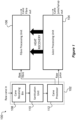
- FIG. 1 is a schematic diagram of a sugar cane processing system 100 which does not form part of the present invention and is only disclosed for illustration purposes.
- the system 100 comprises a raw cane preparation unit 102, a juice processing unit 104 and a fibre processing unit 106.
- the cane preparation unit 102 comprises a cane receiving bin 108, a sanitisation unit 110 and a cane processor 112.
- the cane preparation unit 102 is operable to receive harvested cane and turn it into raw cane juice and raw cane fibre which are then passed to the juice processing unit 104 and fibre processing unit 106 respectively.
- the system 100 is preferably located in close proximity to the grow site of the cane being processed.
- Raw cane may be transported through the system 100 in any suitable manner. However, it is preferable that many or all of the units of the system 100 are in close proximity. Suitable apparatus for transporting the cane through each of the units and from one unit to another include conveyors, shoots, hoppers and feeding gear. However, other methods of automated transport of the cane through the system are known in the art.
- raw sugar cane is received at the cane receiving bin 108.
- the cane may be received at the receiving bin 108 in harvested billets or as whole stick cut cane.
- billets are produced by removing the top, leafy end of the cane and a portion of the lower part of the cane closest to the ground. The remaining cane is then chopped into short sections (20-30 cm in length) to form the billets.
- whole stick cut cane is provided to the receiving bin 108, the cane stalks may be broken down in or near the receiving bin by a shredder or a forage header arrangement before or after proceeding through the subsequent sanitisation unit 110. In either circumstance, the cane is preferably free of any green leaves, known as trash.
- the cane proceeds to the sanitisation unit 110 in any known manner, for example, via a conveyer.
- steps 204 and 206 are carried out.
- the raw cane is washed, tumbled and scrubbed to remove any excess debris and impurities picked up from the field or during harvesting and transport. This sanitisation process may be performed using vibrating washing screens.
- the cane is preferably washed in a two-step process.
- the cane may be irrigated with a biocide, such as an organic biocide, an example of which is Tsunami (RTM), to sterilize and destroy any harmful organisms on the surface of the cane.
- a peroxide may also In be used to wash the sugar cane.
- the raw cane is sprayed with warm or hot water to remove the biocide or other sanitiser and to maintain biological control in the sanitisation unit 110.
- the water used to wash the raw cane is preferably at a temperature between 30°C and 80°C.
- the water used to wash the cane may be at a temperature less than 50°C, 55°C, 60°C, 65°C, 70°C, 75°C or 80°C.
- the water used to wash the cane may be at a temperature greater than 30°C, 35°C, 40°C, 45°C, 50°C, 60°C, 65°C.
- the washed cane is then transported to the cane processor 112 using, for example, hoppers and feeding gear.
- the cane processor 112 then separates the cane at step 210 into raw juice and fibre.
- This process may involve shredding and crushing of the cane in a known manner, for example, using an extraction device such as a belt press, hammer, roller, screw press, centrifugal separator or any other mechanical juice extractor device operable to extract juice from the raw cane juice and separate the fibre.
- the raw juice is output at step 212 to the juice processing unit 104 and the raw fibre is output at step 214 to the fibre processing unit 106 to be further processed.
- the raw fibre is discarded and only the raw juice is further processed.
- the raw juice output to the juice processing unit 104 typically has a sugar concentration of 23°Br and a pH of around 5.45.
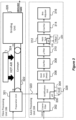
- the juice processing unit 104 comprises a plurality of processing modules connected in line (as denoted in Figure 3 by arrows shown therebetween).
- the juice can be pumped through the juice processing unit 104 by one or more pumps (not shown). It will be appreciated that any suitable pump arrangement may be used for this purpose, provided that the juice is not damaged when pumped through the processing unit 104.
- One or more lobe pumps may be used.
- Components of the juice processing unit 104 may include a coarse filter 302, an acidification unit 304, a first holding tank 306, a first clarifier 308, a microfiltration unit 310, a second holding tank 312, and a second clarifier 314.
- the juice processing unit 104 may further comprise a brix adjustment unit 316 for increasing the concentration of the sugar cane product, as will be described in more detail below.
- a pasteuriser (not shown) may also be provided to pasteurise the sugar cane juice.
- the pasteuriser may be positioned at the output of the second clarifier 314, integrated into the brix adjustment unit 308, or positioned at the output of the brix adjustment unit 308. Equally, one or more additional pasteurisation units may be provided in any of the above described positions in the processing unit 104.
- the coarse filter 302 is provided with a juice input for receiving raw sugar cane juice from the cane processor 112.
- the filter 302 is configured to remove large particulate matter from the raw juice, such as cellulose or fibre left over in the raw sugar can juice from juice extraction.
- the filter 302 may be in the form of a mesh bag or grating.
- the coarse filter 302 may be configured to remove particles greater than 10 microns in diameter and preferably 5 microns in diameter.
- the acidification unit 304 is provided to receive juice output from the cane processor 112 via the coarse filter 302.
- the acidification unit 304 is provided with one or more agitators configured to stir the juice together with an acid injection unit 328 configured to inject acid, such as food acid, into the acidification unit 304 for acidification of the raw sugar cane in the acidification unit 304.
- the acid injection unit 328 may comprise one or more inline injectors and a controller (not shown) for controlling the rate of injection of acid into the acidification unit 304.
- the acidification unit 304 may also comprise a pH meter 330 configured to measure the pH of the juice/acid mixture in the acidification unit 304 and feed this information back to the to the acid injection unit 328. Based on this received pH information, the acid injection unit 312 is configured to control the amount of acid injected into the acidification unit so as to maintain the pH of the contents of the acidification unit 304 at a predetermined pH level.
- the first holding tank 306 comprises a heater and one or more agitators for heating juice output from the acidification unit 304.
- the acidification unit 304 itself may be used to heat the juice after acidification.
- the first and second clarifiers 308, 314 are provided to remove aggregated solids from the juice at various stages of the process, as will be described in more detail below.
- the first and second clarifiers 308, 314 each comprise a centrifuge as is known in the art.
- the first and second clarifiers 308, 314 may comprise a separator or decanter.
- the microfiltration unit 310 is configured to remove fine particulate matter from the juice.
- the microfiltration unit is operable to filter out particles having a diameter larger than 0.5 microns. By doing so, bacteria and larger proteins (which cause the juice to discolour) can be filtered out of the juice whilst allowing flavonoids and mineral components to pass.
- the second holding tank 312 receives juice from the microfiltration unit 310 and comprises a pH meter 318 configured to measure the pH of the juice and feed this information back to an alkali injection unit 320. Based on this received pH information, the alkali injection unit 312 is configured to control the amount of alkali injected into the acidification unit so as to maintain the pH of the contents of the holding tank 312 at a predetermined pH level.
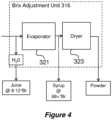
- the brix adjustment unit 316 is shown in more detail in Figure 4 and comprises an evaporator 321 for increasing the sugar concentration of the raw cane juice to produce syrup, together with a dryer 323 configured to substantially remove all water from the juice, thus producing a dry powder.
- the evaporator 321 may be a falling film type and may have multiple effects.
- the evaporator 321 may comprise multiple falling film evaporators, the condensate of a first falling film evaporator (known as the first effect) providing the input to a second falling film evaporator (known as the second effect) and so on.
- the evaporator 321 comprises a multi-effect falling film evaporator comprising three or more effects.
- the dryer 323 is operable to produce a dry powder from the sugar cane syrup output from the evaporator 321.
- the dryer 323 is a spray dryer.
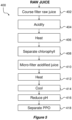
- the raw sugar cane juice received from the cane processor 112 is filtered using the coarse filter 302 to remove cellulose or fibre left over in the raw sugar cane juice from juice extraction.
- the coarse filtered sugar cane juice is then acidified at step 404 by addition of acid by the acid injection unit 312.
- the pH of the juice is lowered at least to a point at which microbiological activity is substantially ceased, i.e. to below pH 4.2.
- the pH of the juice is reduced to substantially at the isoelectric point of chlorophyll.
- the isoelectric point of chlorophyll is around 3.86, but can vary depending on the amount of sugar present in the sugar cane being processed which, in turn, may depend on the maturity of the sugar cane (where it was in its development cycle when harvested) and the amount of nitrates present in the soil.
- the target pH may be adjusted to account for seasonal and compositional variations in the sugar cane being provided to the cane preparation unit 102. Accordingly, in some embodiments, the pH of the juice can be reduced and maintained at between 3.7 and 4.
- reducing the pH of the juice to below 4.0 inactivates any polyphenol oxidase (PPO) present in the juice, thereby substantially reducing PPO-related enzymatic browning of the juice during subsequent processing steps; a further benefit of acidifying the juice at the start of the process.
- PPO polyphenol oxidase
- a relatively weak acid at high concentrations allows for better control of pH.
- An example of a suitable weak acid is ascorbic acid which may be injected by the acid injection unit 312 into the acidification unit 302.
- a solution of approximately 20% concentration ascorbic acid may be used. This solution may be made at 50°C by combining 600 grams of ascorbic acid with 2400 grams of water.
- citric acid may be used.
- relatively acidic fruit juices such as lemon juice or lime juice may be used to reduce the pH of the sugar cane juice.
- the juice may be heated to a temperature of between 50°C and 70°C, preferably 60°C to 70°C and more preferably 65°C.
- the temperature of the juice By increasing the temperature of the juice the density differential between the chlorophyll and any remaining cellulose on the one hand and the aqueous juice solution on the other hand is increased. This causes the chlorophyll to aggregate and flocculate in preparation for the next step of the process 400 in which the chlorophyll is removed from the juice.
- step 408 the chlorophyll and remaining cellulose present in the acidified juice is separated from the juice product in the first clarifier 308. This step is preferably by centrifuge, but may alternatively be performed using a filter.
- the juice passes into the microfiltration unit 306 where fine particulate matter, such as proteins, are separated from the juice.
- Particulate matter greater than 0.5 microns in diameter is separated from the juice at this stage. This may include bacteria and particulate matter which has a diameter greater than 0.5 microns but which does not have a large enough density differential relative to the bulk aqueous juice to be separated in the first clarifier 308 at step 408.
- a centrifuge such as a bactofuge, may be used.
- steps 408, 410 of separating, on the one hand chlorophyll from the juice, and on the other hand other fine particular matter from the juice are performed in two separate steps. In other embodiments, however, these two steps may be combined into a single step in which both chlorophyll and other fine particulate matter having a diameter greater than, e.g. 0.5 microns, is separated from the juice at the same time. In such embodiments, a bactofuge may be used to perform this process.
- the result of microfiltration at step 410 is an acidified juice product containing sugars, flavonoids, minerals and inactivated PPO.
- the juice typically has a pH of below 4.0 so as to inactivate PPO present in the juice.
- raising the pH of the juice to a neutral state would cause the PPO and other enzymes to activate and begin the process of browning the juice to its detriment.
- the juice is heated to a temperature which denatures any PPO enzymes and other enzymes present in the juice.
- the juice is heated to a temperature of 95°C for 10 minutes.
- the used heat treatment leads to the denaturing of the PPO and other enzymes contained in the juice whilst not affecting the juice's flavonoids and mineral components.
- the juice is heated to 80°C, 85°C, 90°C, 95°C, 100°C,105°C, 110°C, 115°C, or 120°C.
- the time at which the juice is maintained at any one of those temperatures may be 5 seconds, 10 seconds, 15 seconds, 20 seconds, 25 seconds, 30 seconds, 35 seconds, 40 seconds, 45 seconds or 50 seconds, for example.
- This heat treatment step 412 may be performed in the second holding tank 312 or, alternatively, in a separate holding tank positioned between the microfiltration unit 310 and the second holding tank 312.
- the temperature differential ⁇ T across the walls of the tank in which the juice is heated is preferably maintained to as low as possible to prevent caramelisation of sugars from the juice at the walls of the tank.
- the tank may be agitated and/or be provided with a water jacket.
- the juice may be passed through a heat exchanger to raise its temperature.
- the method of the present invention uses a heat treatment as defined in claim 1.
- Other pasteurisation techniques disclosed herein for illustration purposes but not forming part of the present invention are pulsed electric field pasteurisation and high pressure processing.
- the juice may be cooled (passively or actively) at step 414 to the temperature it was before heat treatment.
- the juice may be cooled to between 50°C and 70°C, preferably 60°C to 70°C and more preferably 65°C. This cooling may be performed in the holding tank 312 or in a separate tank (not shown) or may be performed using a heat exchanger such as a tubular heat exchanger.
- the pH of the juice can be raised at step 416 without risk of spoiling the clarity of the juice due to enzymatic browning.
- the pH of the juice can be raised to between 4 and 7. Raising the pH of the juice to 6.5 enables the juice to be mixed with products having key ingredients with an isoelectric point of around 6.5.
- the pH of the juice is raised using a weak alkali so as to prevent sugars in the juice from burning when coming into contact with the alkali.
- a weak alkali such as bicarbonate soda
- a stronger alkali can also be used to neutralise the acidified juice.
- the alkali may be added to the juice using a turbo mixer or the like, again so as to prevent burning of sugars in the juice.
- step 416 of increasing the pH of the juice is optional, therefore, and may be left out of the process 400.
- raising of the pH of the juice also causes denatured PPO enzymes contained therein to aggregate which in turn increases the efficiency of removal of such PPO enzymes in subsequent process steps.
- the neutralised juice may be left to stand (without agitation) to allow the flocculated PPO enzymes to settle at the bottom of the tank.
- the juice can then be separated from the majority of the PPO before being clarified at step 418, for example in the second clarifier 314.
- Clarification at step 418 the juice is separated from the remaining PPO, other enzymes, and the vast majority of microbiological organisms still remaining in the juice. Clarification at step 418 may be performed by centrifuging, filtering and/or by decanting the supernatant juice after flocculation of the enzymes during settling.
- the resultant juice product after clarification at step 418 is a substantially transparent aqueous sugar cane product absent of cellulose, chlorophyll and PPO enzymes and rich in flavonoids and minerals which were originally present in the raw sugar cane juice.
- the juice may then pass into the brix adjustment unit 316 to be processed into a final product, be it juice, syrup or powder.
- the brix adjustment unit 316 may be configured to process the raw juice into all three final products or one or two of juice, syrup and powder.
- the brix concentration of the juice may be adjusted to between 8°Br and 12°Br by addition of water at step 420.
- the final product is a food grade, sterile sugar cane juice having a high mineral and vitamin content.
- the juice may be discharged via an industry standard aseptic filler into bulk containers or chilled tankers, depending on distribution requirements.
- the final juice product may be packaged using any suitable process known in the art.
- the juice is pumped into the evaporation unit 321 to increase the sugar concentration (brix) in the juice by evaporation of water out of the juice.
- the temperature for evaporation is chosen so as limit damage to the juice whilst still achieving the required evaporation.
- the evaporator may operates at between 40 and 45°C, between 45 and 50°C, between 55 and 60°C, between 60 and 65°C, or between 65 and 70°C.
- the pressure in the evaporation unit 321 may be increased. Where a falling film evaporator is used, the vapour from each effect may be used in the production of sugar cane essence.
- the concentrated sugar cane syrup produced in the evaporation unit 321 will have a reduced pH relative to the sugar cane juice provided to the evaporation unit 321 due to its increased concentration. Accordingly and as mentioned above, at step 416, the pH of the juice is adjusted to take into account for evaporation during step 422.
- the concentrated syrup may optionally be pasteurised by heating to between 60°C and 120°C for between 10 and 50 seconds.
- the concentrated syrup may be heated to 60°C, 65°C, 70°C, 75°C, 80°C, 85°C, 90°C, 95°C, 100°C, 105°C, 110°C, 115°C, or 120°C.
- the time at which the syrup is maintained at any one of those temperatures may be 10 seconds, 15 seconds, 20 seconds, 25 seconds, 30 seconds, 35 seconds, 40 seconds, 45 seconds, or 50 seconds.
- the syrup may then be discharged to an aseptic filler to be distributed as required (bottled, placed in bulk containers, chilled tankers etc.).
- the syrup produced in the evaporation unit 321 is input into the dryer 323 and atomized using an atomiser, such as a rotating disc or a high pressure single or two-fluid nozzle, which atomises the syrup as it is fed into a hot vapour stream and vaporised. Due to the high surface tension of water, solids form as the moisture quickly leaves the atomised droplets thereby forming dry solids which fall to the bottom of the dryer 323.
- an atomiser such as a rotating disc or a high pressure single or two-fluid nozzle
- the atomizer may be a two-fluid nozzle atomizer.
- a pressurized gas such as carbon dioxide, is provided as the second fluid in combination with the sugar syrup (the first fluid).
- the juice processing unit 104 may produce final juice and syrup/powder products in parallel.
- the fibre separated at the cane processor 112 may be processed by the fibre processing unit 106.
- the fibre processing unit 106 comprises a preparation unit 321, a conveyer 322, one or more cane dryers 324 and a grinding unit 326.
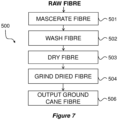
- Figure 5 shows a flow diagram of the process 500 performed by the fibre processing unit 106.
- raw cane fibre is received by the fibre processing unit 106 from the cane processor 112 and enters the preparation unit 321 configured to remove any excess sugars from the fibre which would otherwise cause browning of the fibre.
- the processing unit 321 comprises a macerator which macerates the fibre to reduce the particle size of the fibre.
- the processing unit 321 further comprises a washer, such as a counter-flow washer. At step 502, the fibre is washed by the washer to remove excess sugars.
- the preparation unit 321 may further comprise a decanter or other means for removing excess moisture from the fibre before drying.
- Juice extracted from the sugar fibre may optionally be added to the sugar cane juice during processing in the juice processing unit 104.
- the extracted juice from the preparation unit 321 may be fed into the acidification unit 304 as denoted by arrow 323, or via the coarse filter 302 to the acidification unit 304.
- a decision as to whether to add the juice extracted in the preparation unit to the juice being processed in the juice processing unit 104 may be based on the quality of the sugars removed and the use of the juice being processed.
- the raw cane may be transported through the fibre processing unit 106 on the conveyer 322.
- the raw macerated and washed cane is dried by hot air output from the one or more cane dryers 324 as the cane moves along the conveyer 322.
- the conveyer 322 then transports the dried cane to the grinding unit 326 where, at step 504, it is ground in any known manner.
- the fibre is ground to between 1 and 2 microns, 2 and 3 microns, 3 and 4 microns or 4 and 5 microns.
- the dry ground cane fibre is then output at step 506 and packaged in any known manner.
- the holding tanks 306, 312, evaporation unit 321 and dryer 323 are not 100% efficient and so each produce at least some excess heat when in use.
- the inventors have determined that this lost heat energy can be harnessed to provide heat to the fibre processing unit 106, thus reducing overall power consumption.
- Heat radiating from apparatus in the juice processing unit may be ducted into the fibre processing unit and used to heat or preheat air entering the cane dryers 324 so as to reduce the load on the heaters disposed therein. Additionally or alternatively, this warm air may be fed through heat exchangers located in the fibre processing unit 106 to increase the ambient temperature therein, again thereby reducing the load (and therefore energy consumption) on the cane dryers 324.
Landscapes
- Chemical & Material Sciences (AREA)
- Life Sciences & Earth Sciences (AREA)
- Engineering & Computer Science (AREA)
- Food Science & Technology (AREA)
- Polymers & Plastics (AREA)
- Health & Medical Sciences (AREA)
- Biochemistry (AREA)
- Organic Chemistry (AREA)
- Nutrition Science (AREA)
- Wood Science & Technology (AREA)
- Zoology (AREA)
- Water Supply & Treatment (AREA)
- Chemical Kinetics & Catalysis (AREA)
- Molecular Biology (AREA)
- Non-Alcoholic Beverages (AREA)
- Preparation Of Fruits And Vegetables (AREA)
- Apparatus For Disinfection Or Sterilisation (AREA)
Description
- The present invention relates to a method of processing raw sugar cane juice, as defined in the appended claims.
- Sugar cane is a tall growing monocotyledonous crop plant that is cultivated in the tropical and subtropical regions of the world primarily for its ability to store high concentrations of sucrose, or sugar, in the internodes of the stem. Sorghum is a close relative of sugarcane and like sugarcane, particular varieties of sorghum, known as "sweet sorghums", also accumulate large amounts of sugar in their stems. Near the time of grain maturity, sweet sorghums have 10 to 25% sugar in stalk juice, with sucrose being the predominant disaccharide.
- Typically, the sugar cane grows for 10 to 18 months before harvest and mature sugar cane stands between two to four metres high and is ideally harvested when the sugar content is at its highest. In Australia and other technically advanced countries, sugar cane is harvested by a variety of mechanical harvesters. The harvesters cut the cane stalks at their base, close to the ground, and feed the cane stalks through a variety of cutting implements to produce billets of cane which can be readily collected and transported to the mills for further processing.
- The billets of cane are typically collected in bins and are hauled to sugar cane mills by a variety of methods, such as diesel locomotives or the like. The cane is typically processed such that the cane harvested earliest is processed first to maintain a fresh cane supply to the mill. The cane is then typically shredded in a hammermill to shred the cane into fibrous material. The shredded cane is then typically fed through a series of crushing mills to extract the sugar rich juice from the fibrous material. Typically, the juice is then dehydrated by boiling, leaving a dry crystalline sugar product.
- It has been found that the non-sugar part of the juice has many positive health effects when consumed. This part of the juice has an abundance of vitamins and minerals including calcium, chromium, cobalt, copper, magnesium, manganese, phosphorous, potassium and zinc. It may also contains iron and vitamins A, C, B1, B2, B3, B5 and B6 alongside a high concentration of phytonutrients, antioxidants and other health-promoting compounds.
- The nutritional value of sugar cane juice reduces exponentially after the cane is cut. Traditional methods of processing sugar cane into a final, food grade, juice introduce significant delays during and between each step of processing (from harvesting to the output of the final product), thereby reducing the quality and health benefits of the final product along the way. Additionally, traditional processing methods produce sugar cane juice which is discoloured due to enzymatic browning.
-
FR3018080A1 - The present invention is defined in the appended claims.
- According to the present invention as defined in independent claim 1, there is provided a method of processing raw sugar cane juice, comprising:
- performing a first clarification step to aggregate and remove cellulose and chlorophyll from the juice wherein:
- the pH of the juice is reduced to below pH 4.2;
- chlorophyll and cellulose is separated from the juice; and
- particulate mater greater than 0.5 microns in diameter is separated from the juice, and
- performing a second clarification step to remove polyphenol oxidase (PPO) from the juice wherein:
- the juice is heat treated to 80°C, 85°C, 90°C, 95°C, 100°C, 105°C, 110°C, 115°C, or 120°C to denature PPO by pasteurisation;
- denatured PPO is separated from the juice, to provide a substantially transparent aqueous sugar cane product.
- Preferred embodiments of the method of the present invention are defined in appended claims 2-9.
- The method may further comprise increasing the pH of the sugar cane juice after denaturing the PPO and before separating the denatured PPO from the sugar cane juice.
- The method may further comprise heating the reduced pH sugar cane juice to between 50°C and 70°C before separating the chlorophyll and cellulose from the reduced pH sugar cane juice.
- In the method, one or more of the separating of chlorophyll and cellulose, the separating of the particles having a diameter greater than 0.5 microns, and the separating of denatured polyphenol oxidase from the sugar cane juice may be by centrifuging the sugar cane juice.
- Separating of the particles having a diameter greater than 0.5 microns from the sugar cane may comprise micro-filtering the sugar cane juice or bactofuging the sugar cane juice.
- In the method of the present invention, the pasteurisation step comprises a heat treatment to a temperature as defined in claim 1.
- Also disclosed for illustration purposes but not forming part of the present invention, is a pasteurisation which may comprise one or more of:
- a) heat pasteurisation;
- b) pulsed electric field (PEF) pasteurisation; and
- c) high pressure pasteurisation.
- Reducing the pH may comprise reducing the pH to between 3.8 and 4.2.
- Reducing the pH of the raw sugar cane juice may comprise reducing the pH to the isoelectric point of a centrepiece constituent of chlorophyll present in the raw sugar cane juice. The pH may be reduced using citric acid.
- Increasing of the pH may comprise increasing the pH to between 4.2 and 7. The pH may be increased using sodium bicarbonate.
- The filtering may comprise removing particles having a diameter greater than 0.2 microns.
- The pasteurisation may comprise heating the filtered sugar cane juice to between 80°C and 100°C for between 10 and 20 seconds.
- The pasteurisation comprises heating the filtered sugar cane juice. The sugar cane juices may be cooled before increasing the pH of the pasteurised sugar cane juice.
- The sugar cane juice may be agitated during one or more of the steps of reducing pH, increasing pH, and pasteurisation.
- The method may further comprise concentrating the sugar cane juice by evaporation to form a concentrated sugar cane syrup.
- The method may further comprise cleaning sugar cane; and extracting the raw sugar cane juice from the cleaned sugar cane. The cleaning of the sugar cane may comprise pressure washing, tumbling and/or scrubbing the sugar cane. Cleaning of the sugar cane may comprise irrigating the sugar cane with a biocide or a peroxide.
- The extracting may comprise separating sugar cane fibre from the extracted sugar cane juice.The method may further comprise drying the sugar cane fibre.
- The method may further comprise, before drying the sugar cane fibre, macerating and washing the sugar cane fibre to remove left over sugars. The sugar cane fibre may be dried using hot air.
- The method may further comprise removing excess moisture from the washed sugar cane fibre before drying the sugar cane fibre.
- The sugar cane fibre may be transported on a conveyer during the drying.
- The method may further comprise grinding the dried sugar cane fibre into a powder.
- The dried sugar cane fibre may be ground to between 1 and 2 microns.
- The excess heat energy generated during one or more of the steps of pasteurising and separating of the sugar cane juice may be used to dry the sugar cane fibre.
- According to a further aspect which is disclosed for illustration purposes but does not form part of the present invention, there is disclosed a system for processing raw sugar cane juice, comprising: an acidification unit for reducing the pH of the sugar cane juice to a pH at which microbiological activity is substantially eliminated; a first separation unit for separating chlorophyll from the sugar cane juice; a second separation unit for separating particles having a diameter greater than 0.5 microns from the sugar cane juice; a pasteurisation unit for denaturing polyphenol oxidase (PPO) in the sugar cane juice by pasteurisation; a third separation unit for separating the denatured polyphenol oxidase from the sugar cane juice.
- The system may further comprise a neutralisation unit for increasing the pH of the sugar cane juice after denaturing the PPO and before separating the denatured PPO from the sugar cane juice.
- The system may further comprise a heater for heating the reduced pH sugar cane juice to between 50°C and 70°C before separating the chlorophyll from the reduced pH sugar cane juice.
- One or more of the first separation unit, the second separation unit and the third separation unit may comprise a centrifuge.
- The second separation unit may comprise a micro-filtration unit.
- The pasteurisation unit may comprise one or more of:
- a) a heat pasteuriser;
- b) a pulsed electric field (PEF) pasteuriser;
- c) a high pressure pasteuriser.
- The acidification unit may be configured to reduce the pH of the sugar cane juice to between 3.8 and 4.2.
- The acidification unit may be configured to reduce the pH of the sugar cane juice to the isoelectric point of a centrepiece constituent of chlorophyll present in the sugar cane juice.
- The neutralisation unit may be configured to increase the pH of the sugar cane juice to between 4.2 and 7.
- The acidification unit may be configured to reduce the pH of the sugar cane juice using citric acid.
- The neutralisation unit may be configured to reduce the pH of the sugar cane juice using sodium bicarbonate.
- The second separation unit may be configured to remove particles having a diameter greater than 0.2 microns.
- The pasteurisation unit may be configured to heat the filtered sugar cane juice to between 80°C and 100°C for between 10 and 20 seconds.
- The pasteurisation unit may be configured to heat the filtered sugar cane juice. The sugar cane juices may be cooled before increasing the pH of the pasteurised sugar cane juice.
- The system may further comprise one or more agitators for agitating the sugar cane juice during one or more of the steps of reducing pH, increasing pH, and pasteurisation.
- The system may further comprise a brix adjustment unit for concentrating the sugar cane juice by evaporation to form a concentrated sugar cane syrup.
- The system may further comprise a cleaning unit for cleaning sugar cane; and an extraction unit for extracting the raw sugar cane juice from the cleaned sugar cane.
- The cleaning unit may be configured to pressure wash, tumble and/or scrub the sugar cane.
- The cleaning unit may be configured to irrigate the sugar cane with a biocide or a peroxide.
- The cleaning unit may be configured to irrigate the sugar cane with water at a predetermined temperature after irrigation with the biocide or peroxide.
- The extracting unit may be configured to separate sugar cane fibre from the extracted sugar cane juice.
- The system may further comprises a drying unit for drying the sugar cane fibre.
- The system may further comprise a preparation unit for macerating and washing the sugar cane fibre to remove left over sugars before drying the sugar cane fibre.
- The sugar cane fibre may be dried using hot air.
- The preparation unit may be further configured to remove excess moisture from the washed sugar cane fibre before drying of the sugar cane fibre.
- The system may further comprise a conveyer for transporting the sugar cane.
- The system may further comprise a grinding unit for grinding the dried sugar cane fibre into a powder.
- The grinding unit may be configured to grind the dried sugar cane fibre to between 1 and 2 microns.
- Excess heat energy generated during one or more of the steps of pasteurising and separating of the sugar cane juice is used to dry the sugar cane fibre.
- Throughout this specification the word "comprise", or variations such as "comprises" or "comprising", will be understood to imply the inclusion of a stated element, integer or step, or group of elements, integers or steps, but not the exclusion of any other element, integer or step, or group of elements, integers or steps.
- The present disclosure will now be described with reference to the accompanying drawings, in which:
-
Figure 1 is a schematic diagram of a sugar cane processing system according the present disclosure; -
Figure 2 is a flow diagram of the process performed by a module of the system ofFigure 1 ; -
Figure 3 is a detailed schematic diagram of the fibre processing unit and the juice processing unit shown inFigure 1 ; -
Figure 4 is a detailed schematic diagram of the brix adjustment module shown inFigure 3 . -
Figure 5 is a flow diagram illustrating a method of processing raw sugar cane juice; -
Figure 6 is a flow diagram illustrating a method of adjusting brix concentration of juice processed using the method shown inFigure 5 ; and -
Figure 7 is a flow diagram of a process performed by the fibre processing unit shown inFigures 1 and3 . - The present disclosure encompasses a whole-of-process approach to sugar cane juice and fibre production which can achieve highly efficient conversion of freshly cut sugar cane into food-grade stabilised sugar cane juice, syrup, and powder thereby maximising the maintenance of vitamin and mineral levels present in the sugar cane product. The present disclosure may aid in increasing the efficiency of processing sugar cane in a microbiologically controlled environment with little or no loss of health-promoting compounds in the final product.
- For example, the inventors have developed a two stage process involving separate juice clarification steps. In a first clarification step, cellulose and chlorophyll are aggregated and removed from the juice. In a second clarification step, polyphenol oxidase (PPO) is removed from the juice. By inactivating the chlorophyll and PPO during the removal process, enzymatic browning is substantially eliminated. The resultant sugar cane juice product can maintain all of the flavonoids and mineral components present in the original raw sugar cane, whilst its clarity and stability may be greatly improved compared to juice manufactured from prior art processes.
-
Figure 1 is a schematic diagram of a sugarcane processing system 100 which does not form part of the present invention and is only disclosed for illustration purposes. Thesystem 100 comprises a rawcane preparation unit 102, ajuice processing unit 104 and afibre processing unit 106. Thecane preparation unit 102 comprises acane receiving bin 108, asanitisation unit 110 and acane processor 112. Thecane preparation unit 102 is operable to receive harvested cane and turn it into raw cane juice and raw cane fibre which are then passed to thejuice processing unit 104 andfibre processing unit 106 respectively. - In order to maximise the preservation of health-promoting compounds in the cane, it is important that there is as little delay as possible between harvesting and processing of the cane. Accordingly, the
system 100 is preferably located in close proximity to the grow site of the cane being processed. - Raw cane may be transported through the
system 100 in any suitable manner. However, it is preferable that many or all of the units of thesystem 100 are in close proximity. Suitable apparatus for transporting the cane through each of the units and from one unit to another include conveyors, shoots, hoppers and feeding gear. However, other methods of automated transport of the cane through the system are known in the art. - Referring to
Figure 2 , aprocess 200 performed by thecane preparation unit 102 will now be described. Atstep 202 raw sugar cane is received at thecane receiving bin 108. The cane may be received at the receivingbin 108 in harvested billets or as whole stick cut cane. During harvesting, billets are produced by removing the top, leafy end of the cane and a portion of the lower part of the cane closest to the ground. The remaining cane is then chopped into short sections (20-30 cm in length) to form the billets. If whole stick cut cane is provided to the receivingbin 108, the cane stalks may be broken down in or near the receiving bin by a shredder or a forage header arrangement before or after proceeding through thesubsequent sanitisation unit 110. In either circumstance, the cane is preferably free of any green leaves, known as trash. - It is common for farmers to irrigate sugar cane plots before harvesting. In doing so, bacteria from rotten vegetation on the field floor is absorbed by the sugar cane. It is preferable to remove as much of this bacteria as possible before extraction of juice from the cane. Accordingly, from the receiving
bin 108, the cane proceeds to thesanitisation unit 110 in any known manner, for example, via a conveyer. In thesanitisation unit 104,steps step 204, the raw cane is washed, tumbled and scrubbed to remove any excess debris and impurities picked up from the field or during harvesting and transport. This sanitisation process may be performed using vibrating washing screens. The cane is preferably washed in a two-step process. In thefirst step 206 of this process, the cane may be irrigated with a biocide, such as an organic biocide, an example of which is Tsunami (RTM), to sterilize and destroy any harmful organisms on the surface of the cane. A peroxide may also In be used to wash the sugar cane. In asecond step 208, whilst still on the washing screens, the raw cane is sprayed with warm or hot water to remove the biocide or other sanitiser and to maintain biological control in thesanitisation unit 110. The water used to wash the raw cane is preferably at a temperature between 30°C and 80°C. For example, the water used to wash the cane may be at a temperature less than 50°C, 55°C, 60°C, 65°C, 70°C, 75°C or 80°C. For any of these upper temperature limits, where applicable, the water used to wash the cane may be at a temperature greater than 30°C, 35°C, 40°C, 45°C, 50°C, 60°C, 65°C. - The washed cane is then transported to the
cane processor 112 using, for example, hoppers and feeding gear. Thecane processor 112 then separates the cane atstep 210 into raw juice and fibre. This process may involve shredding and crushing of the cane in a known manner, for example, using an extraction device such as a belt press, hammer, roller, screw press, centrifugal separator or any other mechanical juice extractor device operable to extract juice from the raw cane juice and separate the fibre. - Once the juice and fibre have been extracted and separated, the raw juice is output at
step 212 to thejuice processing unit 104 and the raw fibre is output atstep 214 to thefibre processing unit 106 to be further processed. Alternatively, the raw fibre is discarded and only the raw juice is further processed. - The raw juice output to the
juice processing unit 104 typically has a sugar concentration of 23°Br and a pH of around 5.45. - Referring to
Figure 3 , a detailed schematic diagram of thejuice processing unit 104 and thefibre processing unit 106 is shown. Thejuice processing unit 104 comprises a plurality of processing modules connected in line (as denoted inFigure 3 by arrows shown therebetween). The juice can be pumped through thejuice processing unit 104 by one or more pumps (not shown). It will be appreciated that any suitable pump arrangement may be used for this purpose, provided that the juice is not damaged when pumped through theprocessing unit 104. One or more lobe pumps may be used. - Components of the
juice processing unit 104 may include acoarse filter 302, anacidification unit 304, afirst holding tank 306, afirst clarifier 308, amicrofiltration unit 310, asecond holding tank 312, and asecond clarifier 314. Thejuice processing unit 104 may further comprise abrix adjustment unit 316 for increasing the concentration of the sugar cane product, as will be described in more detail below. A pasteuriser (not shown) may also be provided to pasteurise the sugar cane juice. The pasteuriser may be positioned at the output of thesecond clarifier 314, integrated into thebrix adjustment unit 308, or positioned at the output of thebrix adjustment unit 308. Equally, one or more additional pasteurisation units may be provided in any of the above described positions in theprocessing unit 104. - The
coarse filter 302 is provided with a juice input for receiving raw sugar cane juice from thecane processor 112. Thefilter 302 is configured to remove large particulate matter from the raw juice, such as cellulose or fibre left over in the raw sugar can juice from juice extraction. Thefilter 302 may be in the form of a mesh bag or grating. Thecoarse filter 302 may be configured to remove particles greater than 10 microns in diameter and preferably 5 microns in diameter. - It is advantageous to acidify the raw juice as early as possible to prevent the juice from undergoing enzymatic browning. Accordingly, the
acidification unit 304 is provided to receive juice output from thecane processor 112 via thecoarse filter 302. Theacidification unit 304 is provided with one or more agitators configured to stir the juice together with an acid injection unit 328 configured to inject acid, such as food acid, into theacidification unit 304 for acidification of the raw sugar cane in theacidification unit 304. The acid injection unit 328 may comprise one or more inline injectors and a controller (not shown) for controlling the rate of injection of acid into theacidification unit 304. Theacidification unit 304 may also comprise apH meter 330 configured to measure the pH of the juice/acid mixture in theacidification unit 304 and feed this information back to the to the acid injection unit 328. Based on this received pH information, theacid injection unit 312 is configured to control the amount of acid injected into the acidification unit so as to maintain the pH of the contents of theacidification unit 304 at a predetermined pH level. - The
first holding tank 306 comprises a heater and one or more agitators for heating juice output from theacidification unit 304. In place of thefirst holding tank 306, theacidification unit 304 itself may be used to heat the juice after acidification. - The first and
second clarifiers second clarifiers second clarifiers - The
microfiltration unit 310 is configured to remove fine particulate matter from the juice. Preferably, the microfiltration unit is operable to filter out particles having a diameter larger than 0.5 microns. By doing so, bacteria and larger proteins (which cause the juice to discolour) can be filtered out of the juice whilst allowing flavonoids and mineral components to pass. - The
second holding tank 312 receives juice from themicrofiltration unit 310 and comprises apH meter 318 configured to measure the pH of the juice and feed this information back to analkali injection unit 320. Based on this received pH information, thealkali injection unit 312 is configured to control the amount of alkali injected into the acidification unit so as to maintain the pH of the contents of theholding tank 312 at a predetermined pH level. - The
brix adjustment unit 316 is shown in more detail inFigure 4 and comprises anevaporator 321 for increasing the sugar concentration of the raw cane juice to produce syrup, together with adryer 323 configured to substantially remove all water from the juice, thus producing a dry powder. - The
evaporator 321 may be a falling film type and may have multiple effects. In other words, theevaporator 321 may comprise multiple falling film evaporators, the condensate of a first falling film evaporator (known as the first effect) providing the input to a second falling film evaporator (known as the second effect) and so on. Preferably, theevaporator 321 comprises a multi-effect falling film evaporator comprising three or more effects. - The
dryer 323 is operable to produce a dry powder from the sugar cane syrup output from theevaporator 321. In some embodiments, thedryer 323 is a spray dryer. - Operation of the
juice processing unit 104 shown inFigures 3 and4 will now be described with reference to the flow diagram shown inFigure 5 . - At
step 402, the raw sugar cane juice received from thecane processor 112 is filtered using thecoarse filter 302 to remove cellulose or fibre left over in the raw sugar cane juice from juice extraction. - The coarse filtered sugar cane juice is then acidified at
step 404 by addition of acid by theacid injection unit 312. The pH of the juice is lowered at least to a point at which microbiological activity is substantially ceased, i.e. to below pH 4.2. - Preferably, the pH of the juice is reduced to substantially at the isoelectric point of chlorophyll. By doing so, the net electrical charge of the chlorophyll can be reduced to substantially zero, enabling the chlorophyll to be more easily removed during clarification. The isoelectric point of chlorophyll is around 3.86, but can vary depending on the amount of sugar present in the sugar cane being processed which, in turn, may depend on the maturity of the sugar cane (where it was in its development cycle when harvested) and the amount of nitrates present in the soil. Accordingly, the target pH may be adjusted to account for seasonal and compositional variations in the sugar cane being provided to the
cane preparation unit 102. Accordingly, in some embodiments, the pH of the juice can be reduced and maintained at between 3.7 and 4. - In addition to the above, reducing the pH of the juice to below 4.0 inactivates any polyphenol oxidase (PPO) present in the juice, thereby substantially reducing PPO-related enzymatic browning of the juice during subsequent processing steps; a further benefit of acidifying the juice at the start of the process.
- The inventors have found that the addition of a relatively weak acid at high concentrations allows for better control of pH. An example of a suitable weak acid is ascorbic acid which may be injected by the
acid injection unit 312 into theacidification unit 302. A solution of approximately 20% concentration ascorbic acid may be used. This solution may be made at 50°C by combining 600 grams of ascorbic acid with 2400 grams of water. Alternatively, citric acid may be used. Alternatively, relatively acidic fruit juices such as lemon juice or lime juice may be used to reduce the pH of the sugar cane juice. - With the pH of the sugar cane juice product reduced to a point at which a) microbiological activity is substantially ceased, b) PPO is inactive and c) chlorophyll in the juice is at substantially zero net electrical charge, at
step 406 the juice may be heated to a temperature of between 50°C and 70°C, preferably 60°C to 70°C and more preferably 65°C. By increasing the temperature of the juice the density differential between the chlorophyll and any remaining cellulose on the one hand and the aqueous juice solution on the other hand is increased. This causes the chlorophyll to aggregate and flocculate in preparation for the next step of theprocess 400 in which the chlorophyll is removed from the juice. - At
step 408 the chlorophyll and remaining cellulose present in the acidified juice is separated from the juice product in thefirst clarifier 308. This step is preferably by centrifuge, but may alternatively be performed using a filter. - From the
first clarifier 308, atstep 410, the juice passes into themicrofiltration unit 306 where fine particulate matter, such as proteins, are separated from the juice. - Particulate matter greater than 0.5 microns in diameter is separated from the juice at this stage. This may include bacteria and particulate matter which has a diameter greater than 0.5 microns but which does not have a large enough density differential relative to the bulk aqueous juice to be separated in the
first clarifier 308 atstep 408. Instead of using a microfiltration device to separate this matter from the juice, a centrifuge, such as a bactofuge, may be used. - It is noted that the
steps - The result of microfiltration at
step 410 is an acidified juice product containing sugars, flavonoids, minerals and inactivated PPO. At this point, the juice typically has a pH of below 4.0 so as to inactivate PPO present in the juice. However, without removing the PPOs, raising the pH of the juice to a neutral state would cause the PPO and other enzymes to activate and begin the process of browning the juice to its detriment. - Accordingly, at
step 412, the juice is heated to a temperature which denatures any PPO enzymes and other enzymes present in the juice. In some embodiments, the juice is heated to a temperature of 95°C for 10 minutes. The used heat treatment leads to the denaturing of the PPO and other enzymes contained in the juice whilst not affecting the juice's flavonoids and mineral components. Accordingly, the juice is heated to 80°C, 85°C, 90°C, 95°C, 100°C,105°C, 110°C, 115°C, or 120°C. The time at which the juice is maintained at any one of those temperatures may be 5 seconds, 10 seconds, 15 seconds, 20 seconds, 25 seconds, 30 seconds, 35 seconds, 40 seconds, 45 seconds or 50 seconds, for example. - This
heat treatment step 412 may be performed in thesecond holding tank 312 or, alternatively, in a separate holding tank positioned between themicrofiltration unit 310 and thesecond holding tank 312. In either case, the temperature differential ΔT across the walls of the tank in which the juice is heated is preferably maintained to as low as possible to prevent caramelisation of sugars from the juice at the walls of the tank. Accordingly, the tank may be agitated and/or be provided with a water jacket. Alternatively, the juice may be passed through a heat exchanger to raise its temperature. - The method of the present invention uses a heat treatment as defined in claim 1. Other pasteurisation techniques disclosed herein for illustration purposes but not forming part of the present invention are pulsed electric field pasteurisation and high pressure processing.
- Subsequent to the
heat treatment step 414 described above, the juice may be cooled (passively or actively) atstep 414 to the temperature it was before heat treatment. For example, the juice may be cooled to between 50°C and 70°C, preferably 60°C to 70°C and more preferably 65°C. This cooling may be performed in theholding tank 312 or in a separate tank (not shown) or may be performed using a heat exchanger such as a tubular heat exchanger. - Now that the PPO enzymes (and other enzymes present in the juice) are no longer live, the pH of the juice can be raised at
step 416 without risk of spoiling the clarity of the juice due to enzymatic browning. Depending on the brix concentration of the desired final product, the pH of the juice can be raised to between 4 and 7. Raising the pH of the juice to 6.5 enables the juice to be mixed with products having key ingredients with an isoelectric point of around 6.5. - Preferably, the pH of the juice is raised using a weak alkali so as to prevent sugars in the juice from burning when coming into contact with the alkali. For example, an 8% saturated solution of sodium bicarbonate (having a pH of 7.7) may be used. Even using a weak alkali such as bicarbonate soda, it is advantageous to agitate the juice alkali mixture to prevent molecular sugar in the juice from burning and to ensure even distribution of the alkali in the solution. A stronger alkali can also be used to neutralise the acidified juice. In such instances, the alkali may be added to the juice using a turbo mixer or the like, again so as to prevent burning of sugars in the juice.
- It will be appreciated that a final product having a pH of around 4 may be desirable. The
step 416 of increasing the pH of the juice is optional, therefore, and may be left out of theprocess 400. - As well as preparing the juice for brix adjustment, raising of the pH of the juice also causes denatured PPO enzymes contained therein to aggregate which in turn increases the efficiency of removal of such PPO enzymes in subsequent process steps. To further improve the efficiency of separation of the PPO from the juice, the neutralised juice may be left to stand (without agitation) to allow the flocculated PPO enzymes to settle at the bottom of the tank. The juice can then be separated from the majority of the PPO before being clarified at
step 418, for example in thesecond clarifier 314. - During clarification at
step 418, the juice is separated from the remaining PPO, other enzymes, and the vast majority of microbiological organisms still remaining in the juice. Clarification atstep 418 may be performed by centrifuging, filtering and/or by decanting the supernatant juice after flocculation of the enzymes during settling. - The resultant juice product after clarification at
step 418 is a substantially transparent aqueous sugar cane product absent of cellulose, chlorophyll and PPO enzymes and rich in flavonoids and minerals which were originally present in the raw sugar cane juice. - After the juice has been clarified at
step 418, it may then pass into thebrix adjustment unit 316 to be processed into a final product, be it juice, syrup or powder. Thebrix adjustment unit 316 may be configured to process the raw juice into all three final products or one or two of juice, syrup and powder. - Referring now to
Figure 6 , if the desired end product is sugar cane juice, the brix concentration of the juice may be adjusted to between 8°Br and 12°Br by addition of water atstep 420. The final product is a food grade, sterile sugar cane juice having a high mineral and vitamin content. The juice may be discharged via an industry standard aseptic filler into bulk containers or chilled tankers, depending on distribution requirements. The final juice product may be packaged using any suitable process known in the art. - If the desired end product is sugar cane syrup, at
step 422, the juice is pumped into theevaporation unit 321 to increase the sugar concentration (brix) in the juice by evaporation of water out of the juice. The temperature for evaporation is chosen so as limit damage to the juice whilst still achieving the required evaporation. In examples, the evaporator may operates at between 40 and 45°C, between 45 and 50°C, between 55 and 60°C, between 60 and 65°C, or between 65 and 70°C. To reduce the temperature of evaporation of water in theevaporation unit 321, the pressure in theevaporation unit 321 may be increased. Where a falling film evaporator is used, the vapour from each effect may be used in the production of sugar cane essence. - It will be appreciated that the concentrated sugar cane syrup produced in the
evaporation unit 321 will have a reduced pH relative to the sugar cane juice provided to theevaporation unit 321 due to its increased concentration. Accordingly and as mentioned above, atstep 416, the pH of the juice is adjusted to take into account for evaporation duringstep 422. - The concentrated syrup may optionally be pasteurised by heating to between 60°C and 120°C for between 10 and 50 seconds. The concentrated syrup may be heated to 60°C, 65°C, 70°C, 75°C, 80°C, 85°C, 90°C, 95°C, 100°C, 105°C, 110°C, 115°C, or 120°C. The time at which the syrup is maintained at any one of those temperatures may be 10 seconds, 15 seconds, 20 seconds, 25 seconds, 30 seconds, 35 seconds, 40 seconds, 45 seconds, or 50 seconds.
- Whether or not the above pasteurisation step takes place, the syrup may then be discharged to an aseptic filler to be distributed as required (bottled, placed in bulk containers, chilled tankers etc.).
- If the desired end product is sugar cane powder in dry form, then at
step 416, the syrup produced in theevaporation unit 321 is input into thedryer 323 and atomized using an atomiser, such as a rotating disc or a high pressure single or two-fluid nozzle, which atomises the syrup as it is fed into a hot vapour stream and vaporised. Due to the high surface tension of water, solids form as the moisture quickly leaves the atomised droplets thereby forming dry solids which fall to the bottom of thedryer 323. - The atomizer may be a two-fluid nozzle atomizer. In such cases, a pressurized gas, such as carbon dioxide, is provided as the second fluid in combination with the sugar syrup (the first fluid).
- It will be appreciated that the
juice processing unit 104 may produce final juice and syrup/powder products in parallel. - In addition to the production of refined sugar cane juice and/or syrup, the fibre separated at the
cane processor 112 may be processed by thefibre processing unit 106. Thefibre processing unit 106 comprises apreparation unit 321, aconveyer 322, one ormore cane dryers 324 and a grindingunit 326.Figure 5 shows a flow diagram of theprocess 500 performed by thefibre processing unit 106. Atstep 501 raw cane fibre is received by thefibre processing unit 106 from thecane processor 112 and enters thepreparation unit 321 configured to remove any excess sugars from the fibre which would otherwise cause browning of the fibre. Theprocessing unit 321 comprises a macerator which macerates the fibre to reduce the particle size of the fibre. This improves water transfer through the fibre which in turn increases the efficiency and removal of sugars from the fibre. Theprocessing unit 321 further comprises a washer, such as a counter-flow washer. Atstep 502, the fibre is washed by the washer to remove excess sugars. In addition, thepreparation unit 321 may further comprise a decanter or other means for removing excess moisture from the fibre before drying. Juice extracted from the sugar fibre may optionally be added to the sugar cane juice during processing in thejuice processing unit 104. For example, the extracted juice from thepreparation unit 321 may be fed into theacidification unit 304 as denoted byarrow 323, or via thecoarse filter 302 to theacidification unit 304. A decision as to whether to add the juice extracted in the preparation unit to the juice being processed in thejuice processing unit 104 may be based on the quality of the sugars removed and the use of the juice being processed. - From the
preparation unit 321, the raw cane may be transported through thefibre processing unit 106 on theconveyer 322. Atstep 503, the raw macerated and washed cane is dried by hot air output from the one ormore cane dryers 324 as the cane moves along theconveyer 322. Theconveyer 322 then transports the dried cane to the grindingunit 326 where, atstep 504, it is ground in any known manner. Preferably, the fibre is ground to between 1 and 2 microns, 2 and 3 microns, 3 and 4 microns or 4 and 5 microns. The dry ground cane fibre is then output atstep 506 and packaged in any known manner. - It will be appreciated that the holding
tanks evaporation unit 321 anddryer 323 are not 100% efficient and so each produce at least some excess heat when in use. The inventors have determined that this lost heat energy can be harnessed to provide heat to thefibre processing unit 106, thus reducing overall power consumption. - Heat radiating from apparatus in the juice processing unit may be ducted into the fibre processing unit and used to heat or preheat air entering the
cane dryers 324 so as to reduce the load on the heaters disposed therein. Additionally or alternatively, this warm air may be fed through heat exchangers located in thefibre processing unit 106 to increase the ambient temperature therein, again thereby reducing the load (and therefore energy consumption) on thecane dryers 324.
Claims (9)
- A method of processing raw sugar cane juice, comprising:performing a first clarification step to aggregate and remove cellulose and chlorophyll from the juice wherein:the pH of the juice is reduced to below pH 4.2;chlorophyll and cellulose is separated from the juice; andparticulate matter greater than 0.5 microns in diameter is separated from the juice, andperforming a second clarification step to remove polyphenol oxidase (PPO) from the juicewherein:the juice is heat treated to 80°C, 85°C, 90°C, 95°C, 100°C,105°C, 110°C, 115°C, or 120°C to denature PPO by pasteurisation;denatured PPO is separated from the juice, to provide a substantially transparent aqueous sugar cane product.
- The method of claim 1, wherein, in the second clarification step, the pH of the juice is increased to between 4.2 and 7 after denaturing the PPO and before separating the denatured PPO from the juice.
- The method of claim 1, wherein, in the first clarification step, the reduced pH juice is heated to a temperature of between 50°C and 70°C before the chlorophyll and cellulose are separated from the juice.
- The method of any one of claims 1 to 3, wherein the chlorophyll and cellulose are separated from the juice by centrifuge, the particulate matter greater than 0.5 microns in diameter is separated from the juice by centrifuge, and/or the denatured PPO is separated from the juice by centrifuge.
- The method of any one of the claims 1 to 3, wherein the particulate matter greater than 0.5 microns in diameter is separated from the juice by microfiltration.
- The method of any one of the preceding claims, wherein, in the first clarification step, the pH of the juice is reduced to a pH between 3.8 and 4.2.
- The method of any one of claims 1 to 5, wherein, in the first clarification step, the pH of the juice is reduced and maintained to a pH between 3.7 and 4.
- The method of any one of the preceding claims, followed by the step of
concentrating the substantially transparent aqueous sugar cane product by evaporation to form a concentrated sugar cane syrup. - The method of claim 8, followed by the step of drying the concentrated sugar cane syrup to produce a sugar cane powder in dry form.
Applications Claiming Priority (2)
| Application Number | Priority Date | Filing Date | Title |
|---|---|---|---|
| AU2017901576A AU2017901576A0 (en) | 2017-05-01 | System and method for processing sugar cane | |
| PCT/AU2018/050338 WO2018201183A1 (en) | 2017-05-01 | 2018-04-13 | System for and method of processing sugar cane |
Publications (4)
| Publication Number | Publication Date |
|---|---|
| EP3619328A1 EP3619328A1 (en) | 2020-03-11 |
| EP3619328A4 EP3619328A4 (en) | 2020-10-07 |
| EP3619328B1 true EP3619328B1 (en) | 2024-05-22 |
| EP3619328C0 EP3619328C0 (en) | 2024-05-22 |
Family
ID=64015688
Family Applications (1)
| Application Number | Title | Priority Date | Filing Date |
|---|---|---|---|
| EP18794411.1A Active EP3619328B1 (en) | 2017-05-01 | 2018-04-13 | Method of processing sugar cane |
Country Status (8)
| Country | Link |
|---|---|
| US (1) | US11453921B2 (en) |
| EP (1) | EP3619328B1 (en) |
| JP (1) | JP7072000B2 (en) |
| CN (2) | CN116555498A (en) |
| AU (1) | AU2018263278B2 (en) |
| ES (1) | ES2983617T3 (en) |
| WO (1) | WO2018201183A1 (en) |
| ZA (1) | ZA201907738B (en) |
Families Citing this family (1)
| Publication number | Priority date | Publication date | Assignee | Title |
|---|---|---|---|---|
| EP4686767A1 (en) * | 2024-08-02 | 2026-02-04 | Gonzalez Ulloa, Jorge Enrique | System and method for manufacturing a policosanol-rich granulated sugar cane juice product |
Citations (1)
| Publication number | Priority date | Publication date | Assignee | Title |
|---|---|---|---|---|
| FR2791702B1 (en) * | 1999-03-29 | 2001-06-15 | Agronomique Inst Nat Rech | PROCESS FOR OBTAINING A FRESH SUGAR CANE JUICE WITH IMPROVED PROPERTIES AND CORRESPONDING PRODUCTS |
Family Cites Families (33)
| Publication number | Priority date | Publication date | Assignee | Title |
|---|---|---|---|---|
| US2261919A (en) * | 1938-12-30 | 1941-11-04 | Girdler Corp | Manufacture of sirup |
| US2261917A (en) * | 1939-01-04 | 1941-11-04 | Girdler Corp | Treatment of sugar bearing materials |
| US2526111A (en) * | 1949-04-19 | 1950-10-17 | Bartz John Paul | Production of white sugar from colored sugar bearing fluids without molasses as a by-product |
| US2949364A (en) * | 1957-01-09 | 1960-08-16 | Curtiss Wright Corp | Methods of making beverage concentrate |
| SU654149A3 (en) | 1971-05-28 | 1979-03-25 | Kohler George O | Method of obtaining protein feed additive from green mass |
| JPS54119066A (en) | 1978-03-07 | 1979-09-14 | Saito Taiichi | Production of sugar juice |
| JPS5856642A (en) | 1981-09-30 | 1983-04-04 | Yasuo Hamaya | Preparation of dried powder of tasteless and odorless decomposed milk protein substance in state of peptide, easily soluble in aqueous solution of edible organic weak acid and aqueous solution of edible organic weak alkali |
| US4784859A (en) * | 1987-07-14 | 1988-11-15 | William D. Ramjallacksingh | Process for producing an alcoholic sugar cane juice beverage |
| US5468300A (en) * | 1994-04-07 | 1995-11-21 | International Food Processing Incorporated | Process for producing refined sugar directly from sugarcane |
| AU5628898A (en) | 1998-02-24 | 1999-09-09 | Jucana Investments Cc | A method of producing a stabilised sugar cane juice product |
| EP1048224B1 (en) * | 1999-04-26 | 2005-08-17 | Toyo Shinyaku Co., Ltd. | Method for enriching gamma-aminobutyric acid in green grass leaves |
| WO2003079823A1 (en) | 2002-03-26 | 2003-10-02 | Council Of Scientific And Industrial Research | Process for preparing ready-to-drink shelf stable sugarcane juice beverage |
| JP2003289833A (en) | 2002-04-01 | 2003-10-14 | Nanto Shuhan Kk | Beverage of sugar cane juice |
| US20060216385A1 (en) * | 2003-03-25 | 2006-09-28 | Kargel B Colleen | Method of treating avocados and method of preparing guacamole therefrom |
| US7264829B2 (en) * | 2004-03-08 | 2007-09-04 | Tahitian Noni International, Inc. | Morinda citrifolia leaf extract compositions and methods of obtaining the same |
| JP4530342B2 (en) | 2004-07-06 | 2010-08-25 | 月島機械株式会社 | Method and apparatus for producing honey-containing sugar |
| EP1693471A1 (en) * | 2005-02-16 | 2006-08-23 | Nederlandse Organisatie Voor Toegepast-Natuurwetenschappelijk Onderzoek Tno | Method for refining a liquor, comprising an aqueous solution of a carbohydrate |
| MX2009002413A (en) | 2006-09-19 | 2009-03-20 | Horizon Science Pty Ltd | Extracts derived from sugar cane and a process for their manufacture. |
| US20090022830A1 (en) * | 2007-07-17 | 2009-01-22 | Afa Kehaati Palu | Morinda citrifolia leaf extract compositions and methods of obtaining the same |
| WO2009155675A2 (en) * | 2008-06-27 | 2009-12-30 | Dedini S/A. Indústrias De Base | Process for the recovery of water and energy from the processing of sugar cane in sugar and ethanol production mills |
| IL206678A0 (en) * | 2010-06-28 | 2010-12-30 | Hcl Cleantech Ltd | A method for the production of fermentable sugars |
| WO2012138625A2 (en) | 2011-04-04 | 2012-10-11 | Kanasao Bv | System and method for preparing a shelf-stable botanical extract |
| US9206485B2 (en) * | 2011-08-19 | 2015-12-08 | J. Edwin Roy | Portable sugar mill |
| HRP20201664T1 (en) | 2012-01-01 | 2020-12-25 | Botanical Water Technologies Ip Ltd | Methods for preparation of plant based beverages |
| CN103330250A (en) * | 2013-07-10 | 2013-10-02 | 合浦果香园食品有限公司 | Preparation method of concentrated sugarcane juice |
| CN105578893A (en) * | 2013-10-11 | 2016-05-11 | 诺维信公司 | Method for decolorizing sugar solutions using enzymes |
| FR3018080A1 (en) | 2014-03-03 | 2015-09-04 | Jean Patrick Turpin | PROCESS FOR OBTAINING FRESH SUGAR CANE JUICE |
| JP6291317B2 (en) | 2014-03-31 | 2018-03-14 | 三井製糖株式会社 | Flavor improver, perfume composition and food and drink containing these |
| EP3160254A4 (en) * | 2014-06-26 | 2018-04-11 | Biotest ApS | A method of providing functional proteins from a plant material |
| CN104489827A (en) * | 2014-12-11 | 2015-04-08 | 广西大学 | Processing technology of sugarcane concentrated juice |
| CN104585817B (en) * | 2015-01-30 | 2016-08-17 | 广西大学 | A kind of processing technology of natural sugarcane juice |
| US10231475B2 (en) | 2015-10-27 | 2019-03-19 | Sdic Zhonglu Fruit Juice Co., Ltd. | Method for processing Pachyrhizus juice concentrate with good taste and stable color value |
| US20180298457A1 (en) * | 2017-04-12 | 2018-10-18 | Whole Cane | Systems and methods for producing syrups and powders from sugar cane using cold technology and products containing same |
-
2018
- 2018-04-13 EP EP18794411.1A patent/EP3619328B1/en active Active
- 2018-04-13 US US16/610,023 patent/US11453921B2/en active Active
- 2018-04-13 JP JP2019560692A patent/JP7072000B2/en active Active
- 2018-04-13 WO PCT/AU2018/050338 patent/WO2018201183A1/en not_active Ceased
- 2018-04-13 CN CN202310338840.8A patent/CN116555498A/en active Pending
- 2018-04-13 AU AU2018263278A patent/AU2018263278B2/en active Active
- 2018-04-13 ES ES18794411T patent/ES2983617T3/en active Active
- 2018-04-13 CN CN201880040601.1A patent/CN110799655A/en active Pending
-
2019
- 2019-11-22 ZA ZA2019/07738A patent/ZA201907738B/en unknown
Patent Citations (1)
| Publication number | Priority date | Publication date | Assignee | Title |
|---|---|---|---|---|
| FR2791702B1 (en) * | 1999-03-29 | 2001-06-15 | Agronomique Inst Nat Rech | PROCESS FOR OBTAINING A FRESH SUGAR CANE JUICE WITH IMPROVED PROPERTIES AND CORRESPONDING PRODUCTS |
Also Published As
| Publication number | Publication date |
|---|---|
| EP3619328A4 (en) | 2020-10-07 |
| ES2983617T3 (en) | 2024-10-23 |
| US20200063222A1 (en) | 2020-02-27 |
| WO2018201183A1 (en) | 2018-11-08 |
| US11453921B2 (en) | 2022-09-27 |
| JP7072000B2 (en) | 2022-05-19 |
| AU2018263278A1 (en) | 2019-12-05 |
| CN110799655A (en) | 2020-02-14 |
| AU2018263278B2 (en) | 2020-05-14 |
| JP2020520234A (en) | 2020-07-09 |
| EP3619328C0 (en) | 2024-05-22 |
| CN116555498A (en) | 2023-08-08 |
| ZA201907738B (en) | 2022-03-30 |
| EP3619328A1 (en) | 2020-03-11 |
Similar Documents
| Publication | Publication Date | Title |
|---|---|---|
| US10557105B1 (en) | Extraction systems and methods | |
| EP2665372B1 (en) | Method of obtaining hemp plant juice and use of same for the production of beverages | |
| Abraham et al. | A comprehensive review of pineapple processing and its by-product valorization in India | |
| US10568343B2 (en) | Methods and systems for extracting protein and carbohydrate rich products from a microcrop and compositions thereof | |
| CN103622107A (en) | Deep processing method of honey raisin tree | |
| US9635877B2 (en) | Process for obtaining honey and/or flour of coffee from the pulp or husk and the mucilage of the coffee bean | |
| US11453921B2 (en) | System for and method of processing sugar cane | |
| US6312748B1 (en) | Method for increasing the yield of fruit juice in the extraction of fruit juice concentrate | |
| Horváth‐Kerkai et al. | Manufacturing fruit beverages and concentrates | |
| Kadian et al. | Utilization of food industry wastes | |
| WO2024136679A1 (en) | Extraction process and apparatus | |
| US10010093B2 (en) | Coffee honey obtained from the mucilage of coffee beans | |
| RU2764298C1 (en) | System and method for processing kernels of hemp seeds | |
| KR101474939B1 (en) | Functional beverage containing vinegar using Japanese apricots and Artemisia annua L and the manufacturing method thereof | |
| EP0785218B1 (en) | Method for making industrial products from agricultural raw materials either containing or not starch | |
| Pîrgari | Sweet sorghum ̶ natural sweetener for foods | |
| KR101693963B1 (en) | Manufacturing method of barley extract granule | |
| WO2004011850A1 (en) | Improved agricultural method | |
| Kadian et al. | 1 Utilization of Food Industry | |
| WO2006119553A1 (en) | Process and apparatus for the extraction of vegetable juices involving further extraction of bio-nutrients from the skin, seeds, pulp or other solids | |
| WO2026034636A1 (en) | Plant growth–promoting composition | |
| Martín‐Belloso et al. | Grape juice | |
| RU2539500C1 (en) | Complex processing of vegetable stock and process flow sheet to this end | |
| CN102406206A (en) | Preparation method of kiwi fruit juice | |
| BR102014028508A2 (en) | integrated technological process for obtaining sugar and phytochemical compounds present in the coffee juice processing broth and its applications |
Legal Events
| Date | Code | Title | Description |
|---|---|---|---|
| STAA | Information on the status of an ep patent application or granted ep patent |
Free format text: STATUS: THE INTERNATIONAL PUBLICATION HAS BEEN MADE |
|
| PUAI | Public reference made under article 153(3) epc to a published international application that has entered the european phase |
Free format text: ORIGINAL CODE: 0009012 |
|
| STAA | Information on the status of an ep patent application or granted ep patent |
Free format text: STATUS: REQUEST FOR EXAMINATION WAS MADE |
|
| 17P | Request for examination filed |
Effective date: 20191114 |
|
| AK | Designated contracting states |
Kind code of ref document: A1 Designated state(s): AL AT BE BG CH CY CZ DE DK EE ES FI FR GB GR HR HU IE IS IT LI LT LU LV MC MK MT NL NO PL PT RO RS SE SI SK SM TR |
|
| AX | Request for extension of the european patent |
Extension state: BA ME |
|
| DAV | Request for validation of the european patent (deleted) | ||
| DAX | Request for extension of the european patent (deleted) | ||
| A4 | Supplementary search report drawn up and despatched |
Effective date: 20200908 |
|
| RIC1 | Information provided on ipc code assigned before grant |
Ipc: C13B 20/18 20110101ALI20200903BHEP Ipc: C13B 20/00 20110101ALI20200903BHEP Ipc: A23L 2/72 20060101ALI20200903BHEP Ipc: A23L 2/68 20060101ALI20200903BHEP Ipc: C13B 10/10 20110101ALI20200903BHEP Ipc: A23L 3/32 20060101ALI20200903BHEP Ipc: A23L 3/3508 20060101ALI20200903BHEP Ipc: C13B 20/16 20110101ALI20200903BHEP Ipc: C13B 10/00 20110101ALI20200903BHEP Ipc: C13B 10/12 20110101AFI20200903BHEP Ipc: A23L 3/16 20060101ALI20200903BHEP Ipc: A23L 2/70 20060101ALI20200903BHEP Ipc: A23L 2/04 20060101ALI20200903BHEP |
|
| GRAP | Despatch of communication of intention to grant a patent |
Free format text: ORIGINAL CODE: EPIDOSNIGR1 |
|
| STAA | Information on the status of an ep patent application or granted ep patent |
Free format text: STATUS: GRANT OF PATENT IS INTENDED |
|
| INTG | Intention to grant announced |
Effective date: 20231214 |
|
| GRAS | Grant fee paid |
Free format text: ORIGINAL CODE: EPIDOSNIGR3 |
|
| GRAA | (expected) grant |
Free format text: ORIGINAL CODE: 0009210 |
|
| STAA | Information on the status of an ep patent application or granted ep patent |
Free format text: STATUS: THE PATENT HAS BEEN GRANTED |
|
| AK | Designated contracting states |
Kind code of ref document: B1 Designated state(s): AL AT BE BG CH CY CZ DE DK EE ES FI FR GB GR HR HU IE IS IT LI LT LU LV MC MK MT NL NO PL PT RO RS SE SI SK SM TR |
|
| REG | Reference to a national code |
Ref country code: GB Ref legal event code: FG4D |
|
| REG | Reference to a national code |
Ref country code: CH Ref legal event code: EP |
|
| REG | Reference to a national code |
Ref country code: DE Ref legal event code: R096 Ref document number: 602018069821 Country of ref document: DE |
|
| REG | Reference to a national code |
Ref country code: IE Ref legal event code: FG4D |
|
| U01 | Request for unitary effect filed |
Effective date: 20240529 |
|
| U07 | Unitary effect registered |
Designated state(s): AT BE BG DE DK EE FI FR IT LT LU LV MT NL PT SE SI Effective date: 20240610 |
|
| PG25 | Lapsed in a contracting state [announced via postgrant information from national office to epo] |
Ref country code: IS Free format text: LAPSE BECAUSE OF FAILURE TO SUBMIT A TRANSLATION OF THE DESCRIPTION OR TO PAY THE FEE WITHIN THE PRESCRIBED TIME-LIMIT Effective date: 20240922 |
|
| PG25 | Lapsed in a contracting state [announced via postgrant information from national office to epo] |
Ref country code: HR Free format text: LAPSE BECAUSE OF FAILURE TO SUBMIT A TRANSLATION OF THE DESCRIPTION OR TO PAY THE FEE WITHIN THE PRESCRIBED TIME-LIMIT Effective date: 20240522 |
|
| PG25 | Lapsed in a contracting state [announced via postgrant information from national office to epo] |
Ref country code: GR Free format text: LAPSE BECAUSE OF FAILURE TO SUBMIT A TRANSLATION OF THE DESCRIPTION OR TO PAY THE FEE WITHIN THE PRESCRIBED TIME-LIMIT Effective date: 20240823 |
|
| REG | Reference to a national code |
Ref country code: ES Ref legal event code: FG2A Ref document number: 2983617 Country of ref document: ES Kind code of ref document: T3 Effective date: 20241023 |
|
| PG25 | Lapsed in a contracting state [announced via postgrant information from national office to epo] |
Ref country code: PL Free format text: LAPSE BECAUSE OF FAILURE TO SUBMIT A TRANSLATION OF THE DESCRIPTION OR TO PAY THE FEE WITHIN THE PRESCRIBED TIME-LIMIT Effective date: 20240522 |
|
| PG25 | Lapsed in a contracting state [announced via postgrant information from national office to epo] |
Ref country code: PL Free format text: LAPSE BECAUSE OF FAILURE TO SUBMIT A TRANSLATION OF THE DESCRIPTION OR TO PAY THE FEE WITHIN THE PRESCRIBED TIME-LIMIT Effective date: 20240522 Ref country code: NO Free format text: LAPSE BECAUSE OF FAILURE TO SUBMIT A TRANSLATION OF THE DESCRIPTION OR TO PAY THE FEE WITHIN THE PRESCRIBED TIME-LIMIT Effective date: 20240822 Ref country code: IS Free format text: LAPSE BECAUSE OF FAILURE TO SUBMIT A TRANSLATION OF THE DESCRIPTION OR TO PAY THE FEE WITHIN THE PRESCRIBED TIME-LIMIT Effective date: 20240922 Ref country code: HR Free format text: LAPSE BECAUSE OF FAILURE TO SUBMIT A TRANSLATION OF THE DESCRIPTION OR TO PAY THE FEE WITHIN THE PRESCRIBED TIME-LIMIT Effective date: 20240522 Ref country code: GR Free format text: LAPSE BECAUSE OF FAILURE TO SUBMIT A TRANSLATION OF THE DESCRIPTION OR TO PAY THE FEE WITHIN THE PRESCRIBED TIME-LIMIT Effective date: 20240823 Ref country code: RS Free format text: LAPSE BECAUSE OF FAILURE TO SUBMIT A TRANSLATION OF THE DESCRIPTION OR TO PAY THE FEE WITHIN THE PRESCRIBED TIME-LIMIT Effective date: 20240822 |
|
| PG25 | Lapsed in a contracting state [announced via postgrant information from national office to epo] |
Ref country code: CZ Free format text: LAPSE BECAUSE OF FAILURE TO SUBMIT A TRANSLATION OF THE DESCRIPTION OR TO PAY THE FEE WITHIN THE PRESCRIBED TIME-LIMIT Effective date: 20240522 |
|
| PG25 | Lapsed in a contracting state [announced via postgrant information from national office to epo] |
Ref country code: SK Free format text: LAPSE BECAUSE OF FAILURE TO SUBMIT A TRANSLATION OF THE DESCRIPTION OR TO PAY THE FEE WITHIN THE PRESCRIBED TIME-LIMIT Effective date: 20240522 Ref country code: RO Free format text: LAPSE BECAUSE OF FAILURE TO SUBMIT A TRANSLATION OF THE DESCRIPTION OR TO PAY THE FEE WITHIN THE PRESCRIBED TIME-LIMIT Effective date: 20240522 |
|
| PG25 | Lapsed in a contracting state [announced via postgrant information from national office to epo] |
Ref country code: SM Free format text: LAPSE BECAUSE OF FAILURE TO SUBMIT A TRANSLATION OF THE DESCRIPTION OR TO PAY THE FEE WITHIN THE PRESCRIBED TIME-LIMIT Effective date: 20240522 |
|
| PG25 | Lapsed in a contracting state [announced via postgrant information from national office to epo] |
Ref country code: SM Free format text: LAPSE BECAUSE OF FAILURE TO SUBMIT A TRANSLATION OF THE DESCRIPTION OR TO PAY THE FEE WITHIN THE PRESCRIBED TIME-LIMIT Effective date: 20240522 Ref country code: SK Free format text: LAPSE BECAUSE OF FAILURE TO SUBMIT A TRANSLATION OF THE DESCRIPTION OR TO PAY THE FEE WITHIN THE PRESCRIBED TIME-LIMIT Effective date: 20240522 Ref country code: RO Free format text: LAPSE BECAUSE OF FAILURE TO SUBMIT A TRANSLATION OF THE DESCRIPTION OR TO PAY THE FEE WITHIN THE PRESCRIBED TIME-LIMIT Effective date: 20240522 Ref country code: CZ Free format text: LAPSE BECAUSE OF FAILURE TO SUBMIT A TRANSLATION OF THE DESCRIPTION OR TO PAY THE FEE WITHIN THE PRESCRIBED TIME-LIMIT Effective date: 20240522 |
|
| REG | Reference to a national code |
Ref country code: DE Ref legal event code: R097 Ref document number: 602018069821 Country of ref document: DE |
|
| PLBE | No opposition filed within time limit |
Free format text: ORIGINAL CODE: 0009261 |
|
| STAA | Information on the status of an ep patent application or granted ep patent |
Free format text: STATUS: NO OPPOSITION FILED WITHIN TIME LIMIT |
|
| U20 | Renewal fee for the european patent with unitary effect paid |
Year of fee payment: 8 Effective date: 20250313 |
|
| PGFP | Annual fee paid to national office [announced via postgrant information from national office to epo] |
Ref country code: GB Payment date: 20250313 Year of fee payment: 8 |
|
| 26N | No opposition filed |
Effective date: 20250225 |
|
| PGFP | Annual fee paid to national office [announced via postgrant information from national office to epo] |
Ref country code: ES Payment date: 20250530 Year of fee payment: 8 |
|
| PGFP | Annual fee paid to national office [announced via postgrant information from national office to epo] |
Ref country code: CH Payment date: 20250501 Year of fee payment: 8 |
|
| PG25 | Lapsed in a contracting state [announced via postgrant information from national office to epo] |
Ref country code: MC Free format text: LAPSE BECAUSE OF FAILURE TO SUBMIT A TRANSLATION OF THE DESCRIPTION OR TO PAY THE FEE WITHIN THE PRESCRIBED TIME-LIMIT Effective date: 20240522 |
|
| PG25 | Lapsed in a contracting state [announced via postgrant information from national office to epo] |
Ref country code: IE Free format text: LAPSE BECAUSE OF NON-PAYMENT OF DUE FEES Effective date: 20250413 |
|
| REG | Reference to a national code |
Ref country code: CH Ref legal event code: U11 Free format text: ST27 STATUS EVENT CODE: U-0-0-U10-U11 (AS PROVIDED BY THE NATIONAL OFFICE) Effective date: 20260501 |