EP3619016B1 - Elektrowerkzeug und verfahren zum erkennen eines ereignisses und/oder zustands eines elektrowerkzeugs - Google Patents
Elektrowerkzeug und verfahren zum erkennen eines ereignisses und/oder zustands eines elektrowerkzeugs Download PDFInfo
- Publication number
- EP3619016B1 EP3619016B1 EP17743324.0A EP17743324A EP3619016B1 EP 3619016 B1 EP3619016 B1 EP 3619016B1 EP 17743324 A EP17743324 A EP 17743324A EP 3619016 B1 EP3619016 B1 EP 3619016B1
- Authority
- EP
- European Patent Office
- Prior art keywords
- tool
- power tool
- event
- mechanical
- vector quantity
- Prior art date
- Legal status (The legal status is an assumption and is not a legal conclusion. Google has not performed a legal analysis and makes no representation as to the accuracy of the status listed.)
- Active
Links
Images



Classifications
-
- B—PERFORMING OPERATIONS; TRANSPORTING
- B25—HAND TOOLS; PORTABLE POWER-DRIVEN TOOLS; MANIPULATORS
- B25F—COMBINATION OR MULTI-PURPOSE TOOLS NOT OTHERWISE PROVIDED FOR; DETAILS OR COMPONENTS OF PORTABLE POWER-DRIVEN TOOLS NOT PARTICULARLY RELATED TO THE OPERATIONS PERFORMED AND NOT OTHERWISE PROVIDED FOR
- B25F5/00—Details or components of portable power-driven tools not particularly related to the operations performed and not otherwise provided for
-
- B—PERFORMING OPERATIONS; TRANSPORTING
- B25—HAND TOOLS; PORTABLE POWER-DRIVEN TOOLS; MANIPULATORS
- B25F—COMBINATION OR MULTI-PURPOSE TOOLS NOT OTHERWISE PROVIDED FOR; DETAILS OR COMPONENTS OF PORTABLE POWER-DRIVEN TOOLS NOT PARTICULARLY RELATED TO THE OPERATIONS PERFORMED AND NOT OTHERWISE PROVIDED FOR
- B25F5/00—Details or components of portable power-driven tools not particularly related to the operations performed and not otherwise provided for
- B25F5/001—Gearings, speed selectors, clutches or the like specially adapted for rotary tools
-
- B—PERFORMING OPERATIONS; TRANSPORTING
- B27—WORKING OR PRESERVING WOOD OR SIMILAR MATERIAL; NAILING OR STAPLING MACHINES IN GENERAL
- B27B—SAWS FOR WOOD OR SIMILAR MATERIAL; COMPONENTS OR ACCESSORIES THEREFOR
- B27B5/00—Sawing machines working with circular or cylindrical saw blades; Components or equipment therefor
- B27B5/29—Details; Component parts; Accessories
- B27B5/38—Devices for braking the circular saw blade or the saw spindle; Devices for damping vibrations of the circular saw blade, e.g. silencing
-
- B—PERFORMING OPERATIONS; TRANSPORTING
- B27—WORKING OR PRESERVING WOOD OR SIMILAR MATERIAL; NAILING OR STAPLING MACHINES IN GENERAL
- B27G—ACCESSORY MACHINES OR APPARATUS FOR WORKING WOOD OR SIMILAR MATERIALS; TOOLS FOR WORKING WOOD OR SIMILAR MATERIALS; SAFETY DEVICES FOR WOOD WORKING MACHINES OR TOOLS
- B27G19/00—Safety guards or devices specially adapted for wood saws; Auxiliary devices facilitating proper operation of wood saws
- B27G19/02—Safety guards or devices specially adapted for wood saws; Auxiliary devices facilitating proper operation of wood saws for circular saws
-
- B—PERFORMING OPERATIONS; TRANSPORTING
- B27—WORKING OR PRESERVING WOOD OR SIMILAR MATERIAL; NAILING OR STAPLING MACHINES IN GENERAL
- B27G—ACCESSORY MACHINES OR APPARATUS FOR WORKING WOOD OR SIMILAR MATERIALS; TOOLS FOR WORKING WOOD OR SIMILAR MATERIALS; SAFETY DEVICES FOR WOOD WORKING MACHINES OR TOOLS
- B27G19/00—Safety guards or devices specially adapted for wood saws; Auxiliary devices facilitating proper operation of wood saws
- B27G19/02—Safety guards or devices specially adapted for wood saws; Auxiliary devices facilitating proper operation of wood saws for circular saws
- B27G19/04—Safety guards or devices specially adapted for wood saws; Auxiliary devices facilitating proper operation of wood saws for circular saws for manually-operated power-driven circular saws
-
- F—MECHANICAL ENGINEERING; LIGHTING; HEATING; WEAPONS; BLASTING
- F16—ENGINEERING ELEMENTS AND UNITS; GENERAL MEASURES FOR PRODUCING AND MAINTAINING EFFECTIVE FUNCTIONING OF MACHINES OR INSTALLATIONS; THERMAL INSULATION IN GENERAL
- F16P—SAFETY DEVICES IN GENERAL; SAFETY DEVICES FOR PRESSES
- F16P3/00—Safety devices acting in conjunction with the control or operation of a machine; Control arrangements requiring the simultaneous use of two or more parts of the body
- F16P3/12—Safety devices acting in conjunction with the control or operation of a machine; Control arrangements requiring the simultaneous use of two or more parts of the body with means, e.g. feelers, which in case of the presence of a body part of a person in or near the danger zone influence the control or operation of the machine
-
- B—PERFORMING OPERATIONS; TRANSPORTING
- B23—MACHINE TOOLS; METAL-WORKING NOT OTHERWISE PROVIDED FOR
- B23D—PLANING; SLOTTING; SHEARING; BROACHING; SAWING; FILING; SCRAPING; LIKE OPERATIONS FOR WORKING METAL BY REMOVING MATERIAL, NOT OTHERWISE PROVIDED FOR
- B23D59/00—Accessories specially designed for sawing machines or sawing devices
- B23D59/001—Measuring or control devices, e.g. for automatic control of work feed pressure on band saw blade
-
- B—PERFORMING OPERATIONS; TRANSPORTING
- B25—HAND TOOLS; PORTABLE POWER-DRIVEN TOOLS; MANIPULATORS
- B25D—PERCUSSIVE TOOLS
- B25D2250/00—General details of portable percussive tools; Components used in portable percussive tools
- B25D2250/221—Sensors
-
- F—MECHANICAL ENGINEERING; LIGHTING; HEATING; WEAPONS; BLASTING
- F16—ENGINEERING ELEMENTS AND UNITS; GENERAL MEASURES FOR PRODUCING AND MAINTAINING EFFECTIVE FUNCTIONING OF MACHINES OR INSTALLATIONS; THERMAL INSULATION IN GENERAL
- F16P—SAFETY DEVICES IN GENERAL; SAFETY DEVICES FOR PRESSES
- F16P3/00—Safety devices acting in conjunction with the control or operation of a machine; Control arrangements requiring the simultaneous use of two or more parts of the body
- F16P3/12—Safety devices acting in conjunction with the control or operation of a machine; Control arrangements requiring the simultaneous use of two or more parts of the body with means, e.g. feelers, which in case of the presence of a body part of a person in or near the danger zone influence the control or operation of the machine
- F16P3/14—Safety devices acting in conjunction with the control or operation of a machine; Control arrangements requiring the simultaneous use of two or more parts of the body with means, e.g. feelers, which in case of the presence of a body part of a person in or near the danger zone influence the control or operation of the machine the means being photocells or other devices sensitive without mechanical contact
- F16P3/148—Safety devices acting in conjunction with the control or operation of a machine; Control arrangements requiring the simultaneous use of two or more parts of the body with means, e.g. feelers, which in case of the presence of a body part of a person in or near the danger zone influence the control or operation of the machine the means being photocells or other devices sensitive without mechanical contact using capacitive technology
Definitions
- the invention relates to a power tool according to the preamble of patent claim 1, with a rotatable tool designed as a saw blade or milling cutter, a sensor device for detecting a mechanical variable that depends on a force emanating from the tool, and a control device communicatively coupled to the sensor device, which is designed to detect an event of the power tool according to the detected mechanical variable.
- the WO 2014/105935 describes a table saw with a kickback detection system that includes a sensor configured to detect a deflection of a shaft as a scalar quantity. A controller compares the detected deflection with a scalar threshold to determine whether a kickback is present.
- the US 2014/166323 A1 relates to a power tool with a 3-axis acceleration sensor.
- the sensor can be used to detect the acceleration of a handle of the power tool.
- the sensor provides acceleration information for the tool and in particular the acceleration of the handle should it rotate in a direction opposite to the direction of the bit, thereby indicating a stuck bit, or in the same direction as the bit, indicating a broken bit.
- the WO 01/26064 A2 concerns a table saw with a detection system for detecting a kickback. In response to the detection, the movement of the saw blade is stopped.
- the DE 10 2015 211584 A1 relates to a diagnostic device for a hand-held power tool.
- a vibration is detected using an acceleration sensor and a wear condition is determined based on a vibration value.
- the US 4 802 095 A describes a system for measuring tool wear of a rotary end mill.
- the system measures wear by monitoring side load forces on the tool during cutting.
- the resulting side load forces FRES have tangential FT and radial FR components.
- the radial component FR increases accordingly with tool wear.
- FRES and FT are measured directly and based on these measurements FR is determined mathematically to provide an indication of tool wear.
- An object of the invention is to modify the power tool mentioned at the outset in such a way that the detection carried out by the control device is improved.
- the sensor device serves to detect a mechanical vector quantity which depends on a force emanating from the tool.
- the direction of the detected vector quantity corresponds to the direction in which the Tool relative to another component of the power tool.
- the mechanical vector variable is, for example, a force, an acceleration, a speed, a deflection, a deformation and/or a mechanical stress.
- the control device is designed to detect an event and/or a state of the power tool according to a change in direction of the mechanical vector variable detected by the sensor device.
- the control device is designed to detect a kickback, forward sawing, backward sawing and/or plunging of the tool into a workpiece as the event and/or state to be detected.
- a vector quantity is thus detected and the event and/or the state of the power tool is recognized on the basis of the change in direction (and optionally the direction) of this vector quantity.
- This approach is based on the knowledge that the tool pushes in certain directions in the case of certain events and/or states of the power tool and that for this reason the change in direction (and optionally the direction) of a mechanical vector quantity, which depends on the force emanating from the tool, is a good indicator for the detection of these events and/or states.
- an event and/or state can be detected earlier in particular than if the detection is based solely on a scalar quantity.
- the recorded mechanical vector quantity represents a force, acceleration, speed, deflection, deformation or mechanical stress and is preferably two-dimensional.
- the mechanical vector quantity is dependent on a force emanating from the tool.
- the direction of the recorded vector quantity corresponds to the direction of the force emanating from the tool or the direction in which the tool pushes, relative to another component of the power tool.
- the vector quantity is expediently recorded in a force flow emanating from the tool.
- the state to be determined by the control device is in particular a so-called “kickback" of the power tool.
- the term “kickback” typically refers to an event in which, while the power tool is processing a workpiece, a sudden and unexpected force occurs between the power tool and the workpiece, which then accelerates the power tool or the workpiece and sets it in motion.
- a kickback usually leads to an unexpected acceleration of the workpiece in the direction of the user.
- hand-held circular saws a kickback can lead to unexpected movements of the tool. Kickbacks can lead to injuries to the user and therefore represent a detriment to operational safety.
- a kickback can occur in particular when the tool is plunged into the workpiece too quickly, when sawing backwards, when the tool jams in the workpiece, when the workpiece has certain properties (e.g. inhomogeneous wood, tensions) and/or when the tool is blunt.
- the event detection described above based on the change in direction (and optionally the direction) of the recorded mechanical vector quantity allows a kickback event can be recognized particularly well.
- the kickback or kickback event to be recognized here also refers in particular to an imminent kickback, i.e. an event in which the causes of the kickback are already present, but no or no significant acceleration of the power tool and/or the workpiece has taken place.
- the kickback Before the power tool 10 or the workpiece is set in motion or significantly accelerated by the kickback, the kickback is already announced by the force vector emanating from the tool changing direction. The tool therefore pushes in a different direction than in normal operation shortly before a kickback or at the start of a kickback. This pushing in a different direction can be detected by recording the mechanical vector size in order to conclude that a kickback condition exists.
- the event to be detected can be a plunge of the tool into the workpiece, forward sawing or backward sawing.
- the invention further relates to a method, according to claim 13, for detecting an event and/or a state of a power tool with a rotatable tool designed as a saw blade or milling cutter.
- the method comprises the steps of: detecting a mechanical vector quantity, namely a force, an acceleration, a speed, a deflection, a deformation and/or a mechanical stress, which depends on a force emanating from the tool, wherein the direction of the detected vector quantity corresponds to the direction in which the tool is pushing. and detecting the event and/or condition of the power tool according to a change in direction of the detected mechanical vector quantity.
- the event and/or condition includes a kickback, a forward sawing, a backward sawing and/or a plunging of the tool into a workpiece.
- the procedure is conveniently carried out using a power tool as described here.
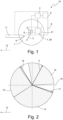
- the Figure 1 shows a power tool 10 according to a first embodiment.
- the power tool 10 has a rotatable tool 1 designed as a saw blade or milling cutter, a sensor device 2 and a control device 4.
- the sensor device 2 is designed to detect a mechanical vector variable 3.
- the mechanical vector variable 3 is a force, an acceleration, a speed, a deflection, a deformation and/or a mechanical stress. Furthermore, the mechanical vector variable 3 depends on a force that emanates from the tool 1.
- the control device 4 is communicatively connected to the sensor device 2 and designed to detect an event and/or a state of the power tool 10 according to a change in direction (and optionally a direction) of the mechanical vector variable 3 detected by the sensor device 2.
- event and/or state detection of the power tool 10 is carried out on the basis of a change in direction (and optionally a direction) of a detected mechanical vector quantity 3, an event or a change in state of the power tool 10 can already be can be detected at a very early stage. Event and/or condition detection is thus improved.
- the power tool 10 is preferably a saw, in particular a hand-held circular saw or a plunge saw.
- the power tool 10 can also be designed as a biscuit joiner.
- the tool 1 is in particular circular and rotates in an exemplary clockwise direction during operation.
- the power tool 10 has a drive device 7.
- the drive device 7 comprises, for example, an electric motor and a gear.
- the drive device 7 is preferably controlled by the control device 4.
- the power tool 10 also has an output shaft 8 which can be driven by the drive device 7.
- the tool 1 is mechanically coupled to the output shaft 8.
- the tool 1 is expediently attached to the output shaft 8.
- the power tool 10 also has a support structure 21, which is expediently arranged in the housing 6.
- the output shaft 8 is, for example, attached to the support structure 21.
- the support structure 21 can be designed as a housing for the drive device 7.
- the support structure 21 can, for example, represent or comprise a drive housing, in particular a gear housing.
- the sensor device 2 is exemplarily coupled to the output shaft 8 and designed to detect the mechanical vector variable 3 - namely a force, acceleration, speed, deflection, deformation and/or mechanical stress - of the output shaft 8.
- the sensor device 2 is designed to continuously detect the mechanical vector quantity 3, so that a change, in particular a change in direction of the mechanical vector quantity 3 can be detected.
- the control device 4 is designed as a microcontroller, for example.
- the control device 4 is designed to determine an event and/or a state of the power tool 10 based on the mechanical vector variable 3. For example, the control device 4 is designed to determine whether the direction of the detected mechanical vector variable 3 is within or outside a certain direction range and to decide based on this determination whether a certain state exists or not.
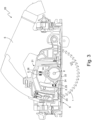
- the Figure 2 shows a diagram with different direction ranges 14, 15 and 16, two direction thresholds 17, 18 and the recorded mechanical vector quantity 3.
- the diagram is divided into four quadrants. Each quadrant covers 90 degrees.
- the reference number 19 indicates the zero-degree line.
- the angle coordinates or degrees mentioned below are to be understood in the mathematically positive direction of rotation (counterclockwise).
- the zero-degree line expediently runs parallel to the support surface 9 and/or the feed direction 12.
- the directional areas 14, 15 and 16 are exemplary two-dimensional directional areas.
- the directional areas 14, 15 and 16 can also be referred to as angular areas here.
- the directional areas 14, 15, 16 are expediently located in one plane.
- the plane is expediently aligned parallel to the plane of the tool 1 or perpendicular to the axial direction of the output shaft 8.
- the directional areas 14, 15, 16 preferably do not overlap one another.
- the control device 4 is designed to provide at least one direction range 14, 15 or 16.
- the at least one direction range is stored in a memory in the control device 4.
- the control device 4 can also be designed to generate the at least one direction range itself.
- the control device 4 is also designed to determine whether the detected mechanical vector variable 3 lies within or outside the direction range 14, 15 or 16 and to recognize the state of the power tool 10 based on this determination.
- the control device 4 is expediently designed to provide a plurality of direction areas 14, 15, 16 and to recognize various events and/or states based on which of the direction areas 14, 15, 16 the direction of the mechanical vector quantity 3 lies in. In particular, a respective event and/or state is assigned to each of the direction areas 14, 15, 16.
- the first direction range 14 represents a direction range in which the mechanical vector quantity 3 lies when the tool 1 is immersed in the workpiece 1 and the power tool 10 is moved relative to the workpiece 1 in the feed direction 12.
- the first direction range 14 is located in the two lower quadrants, i.e. within a range between 180 degrees and 360 degrees.
- the first directional range 14 extends from 220 degrees to 330 degrees.
- a mechanical vector quantity 3 that lies in the first direction range 14 is an indicator that the event or the state is present that the power tool 10 is sawing forward in the feed direction 12. Accordingly, the control device 4 is designed to recognize that a "forward sawing event” or “forward sawing state” is present when the mechanical vector quantity 3 lies in the first direction range 14.
- the second direction range 15 represents a direction range in which the mechanical vector variable lies when the tool 1 is immersed in the workpiece 11 and the power tool 10 is moved relative to the workpiece 11 opposite to the normal feed direction 12 - i.e. in the reverse direction. Furthermore, the second direction range 15 represents a direction range in which the mechanical vector variable 3 lies when the tool 1 is immersed in the workpiece 11.
- the second direction range 15 is located in the two left quadrants, i.e. within a range between 90 degrees and 270 degrees. In the example shown, the second direction range 14 extends from 125 degrees to 220 degrees.
- a mechanical vector quantity 3 that lies in the second direction range 15 is an indicator that the event or the state is present that the power tool 10 is sawing backwards or that the tool 1 is immersed in the workpiece 11. Accordingly, the control device 4 is designed to recognize that a "backward sawing event” or “backward sawing state” or a “immersion event” is present when the mechanical vector quantity 3 lies in the second direction range 15.
- the first direction range 14 and the second direction range 15 together represent a normal range. As long as the mechanical vector variable 3 is in the normal range, the control device 4 can assume that the power tool 10 is operating safely and, for example, provide a corresponding signal.
- the third direction range 16 represents a direction range in which the mechanical vector variable lies when a kickback event occurs.
- the third direction range 16 is located in the two upper quadrants, i.e. within a range between 0 degrees and 180 degrees. In the example shown, the third direction range 16 extends from 5 degrees to 100 degrees.
- the control device 4 is expediently designed to detect the kickback event when the mechanical vector variable 3 lies in the third direction range 16.
- the directional range in which the control device 4 concludes that a kickback event has occurred can also be defined larger.
- the limits of this directional range can be placed between the limits of the normal range and the limits of the third directional range 16.
- the direction threshold values 17, 18 adjoin the limits of the normal range.
- the direction threshold values can also lie on the limits of the normal range.
- the direction range extending clockwise from the second direction threshold value 18 to the first direction threshold value 17 can be used instead of the third direction range 16.
- the (in the Figure 2 The third direction area 16 (shown) is optional in this case.
- the control device 4 is expediently designed to detect the kickback event when the mechanical vector variable 3 is between the two direction threshold values 17, 18 - i.e. counterclockwise behind the first direction threshold value 17 and before the second direction threshold value 18.
- the kickback event can thus be detected at a time when the cause of the kickback has already occurred, but the power tool 10 or the workpiece 11 have not yet been significantly accelerated or have not yet exerted any recoil or kickback.
- the control device 4 can expediently be designed to detect the kickback event 50 ms to 100 ms before an acceleration of the power tool 10 relative to the workpiece 11 occurs (without detection and reaction to the kickback).
- the acceleration is, for example, an acceleration with an upward component or a component in the 90-degree direction in the diagram shown.
- the event and/or state detection is carried out based on a change in direction of the mechanical vector quantity 3.
- this event and/or state detection can be carried out based on the change in direction of the mechanical vector quantity 3 in addition to the event and/or state detection described above based on the direction of the detected mechanical vector quantity 3.
- the control device 4 can be designed accordingly to recognize an event and/or state based on a detected rotation of the mechanical vector variable 3. For example, the control device 4 is designed to compare the angular velocity of the mechanical vector variable with a speed threshold value and to recognize the event and/or state if the speed threshold value is exceeded. Furthermore, the control device 4 can be designed to determine by which angle of change the mechanical vector variable 3 has changed, in particular within a certain time window, and to compare this angle of change with an angle threshold value in order to recognize the event and/or state.
- the control device 4 can also be designed to distinguish between different types of kickbacks. For example, if a kickback is imminent and occurs during reverse sawing or plunging, the mechanical vector variable 3 rotates counterclockwise (starting from the second direction range 15), while the mechanical vector variable 3 rotates clockwise in the case of a kickback caused by the tool 1 getting jammed in the workpiece 11.
- the control device 4 can accordingly be designed to take the direction of rotation of the mechanical vector variable 3 into account when detecting the event and/or state.
- control device 4 can be designed to also determine an amount of the detected mechanical vector quantity 3. For example, the control device 4 can be designed to only recognize the state and/or the event if the amount of the mechanical vector quantity 3 is greater than a threshold value. In this way, it can be prevented that weak shocks occurring during operation are incorrectly recognized as kickbacks.
- control device 4 can be designed to determine whether a state of wear exists based on the direction of the detected mechanical vector variable 3.
- the state of wear can in particular be a state of wear of the tool 1.
- the control device 4 can be designed to provide a direction range and, based on whether the mechanical vector variable 3 is inside or outside the direction range, to determine a state of wear.
- the control device 4 can detect a reversal of direction, for example a reversal of the direction of force, of the mechanical vector variable 3 and use this to conclude the state of wear.
- the control device 4 can then output an acoustic or visual signal via a corresponding signaling means that indicates that the state of wear exists.
- the control device 4 is expediently designed to calibrate one or more directional ranges 14, 15, 16. For example, the calibration can be initiated using the user interface 5.
- the control device 4 can then drive the tool 1 via the drive device 7 and, in doing so, detect the mechanical vector variable 3 via the sensor device 2. Based on the detected mechanical vector variable 3, the control device 4 can then create a directional range and/or one or more threshold values and store them in a memory of the control device 2. This process can be carried out, for example, when a new tool 1 is mounted. The wear detection of the tool 1 can thus be improved.
- the sensor device 2 is expediently designed to detect the mechanical vector quantity 3 as at least a two-dimensional vector.
- the sensor device 2 is designed to convert the mechanical quantity underlying the mechanical vector quantity 3 into at least two different spatial directions.
- the two spatial directions are, for example, a spatial direction that runs parallel to the feed direction 12 and a spatial direction that runs perpendicular to the feed direction 12. Both spatial directions are expediently perpendicular to the axial direction of the output shaft 8.
- the sensor device 2 has at least two sensor elements 25, 26. Each of the sensor elements 25, 26 expediently serves to measure the underlying mechanical variable - i.e. a force, an acceleration, a speed, a deflection, a deformation and/or a mechanical stress - in a different spatial direction.
- the mechanical vector quantity 3 is in particular a force vector, an acceleration vector, a speed vector, a deflection vector, a deformation vector and/or a mechanical stress vector or stress tensor. Accordingly, the sensor device 2 can be designed to measure a force, an acceleration, a speed, a deflection, a deformation and/or a mechanical stress in at least two spatial directions.
- the sensor device 2 can in particular comprise a radial measuring bearing 28, with which, for example, the output shaft 8 is mounted.
- the radial measuring bearing 28 can be designed to detect the force between the output shaft 8 and the measuring bearing 28 as the mechanical vector variable 3 by means of force or voltage sensors, for example piezoresistive sensors.
- the sensor device 2 can have distance sensors spaced apart from the output shaft 8 which are designed to detect the deflection of the output shaft 8 as the mechanical vector quantity 8.
- the sensor device 2 can comprise stress sensors, in particular strain gauges (DMS), fastened in particular to the support structure 21.
- DMS strain gauges
- the sensor device 2 can be designed to measure the mechanical vector variable 3 at any part within the force flow emanating from the tool 1.
- the force flow runs, for example, from the tool 1 via the output shaft 8, a bearing device 27, the support structure 21, the housing 6 and the support surface 9 to the workpiece 11.
- the sensor device 2 is designed to measure the mechanical vector variable 3 between two parts lying one behind the other in the force flow.
- FIGS. 3 to 6 show a second, third, fourth and fifth exemplary embodiment, in which the detection of the mechanical vector quantity 3 is carried out in a different manner. Except for the design and arrangement of the support structure 21 and the sensor device 2, the second to fifth embodiments correspond to the first embodiment discussed above. The features already explained above in connection with the first embodiment also apply to the second, third, fourth and fifth embodiments.
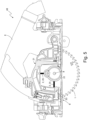
- the Figure 3 shows a power tool 20 according to the second embodiment.
- the sensor device 2 comprises two sensor elements 25, 26, both of which are arranged on the support structure 21.
- the sensor elements 25, 26 are glued to the support structure 21.
- the sensor elements 25, 26 are in particular sensors for detecting a deformation of the support structure 21, which is caused by a force exerted by the output shaft 8 on the support structure 21.
- the sensor elements 25, 26 are, for example, force-voltage sensors, in particular strain gauges (DMS), piezo elements and/or fiber optic sensors.
- the sensor elements 25, 26 are expediently arranged on two sections 24 of the support structure 21 that extend radially outwards relative to the output shaft 8.
- the sensor element 25 is arranged on a horizontally extending section 24, and the sensor element 26 is arranged on a vertically extending section 24.
- the sections 24 are in particular web-shaped.
- the sections 24 expediently connect a first section 22 and a second section 23 of the support structure 21 to one another.
- the first section 22 surrounds the output shaft 8.
- the first section 22 represents a gear housing or includes a gear housing.
- the output shaft 8 is preferably mounted on the first section 22.
- the second section 23 is expediently located behind - i.e. downstream from - the first section 22 in the power flow emanating from the tool 1.
- the Figure 4 shows a power tool 30 according to the third embodiment.
- the support structure 21 is expediently designed as in the second embodiment discussed above.
- the sensor device 2 comprises two sensor elements 25, 26, which are designed to Deflection of the output shaft 8 in two different spatial directions.
- the sensor element 25 detects the deflection of the output shaft 8 in a first spatial direction and the sensor element 26 detects the deflection in a second spatial direction, in particular rotated by 90 degrees relative to the output shaft 8.
- the sensor elements 25, 26 are expediently distance sensors, for example eddy current sensors, capacitive sensors and/or inductive sensors. If they are inductive sensors, magnetic particles can be arranged in or on the output shaft 8.
- the two sensor elements 25, 26 are arranged on the support structure 21.
- the sensor elements 25, 26 are expediently arranged in bores, in particular screwed, which are preferably provided on the support structure 21.
- the two sensor elements 25, 26 are arranged on the inner section 22 of the support structure 21.
- the Figure 5 shows a power tool 40 according to a fourth embodiment.
- the fourth embodiment is based on a support structure 21 as described above in connection with the second embodiment, but has, in particular, the modifications explained below compared to the second embodiment.
- the sensor elements 25, 26 are arranged between the first section 22 and the second section 23 of the support structure 21.
- the sensor elements 25, 26 represent connecting elements that mechanically connect the second section 23 to the first section 22.
- the Sensor elements 25, 26 the sections 24 discussed above in connection with the second embodiment.
- the sensor elements 25, 26 are expediently designed as force sensors and measure the force present between the first section 22 and the second section 23 in two different spatial directions.
- the two spatial directions are expediently aligned orthogonally to one another.
- the first spatial direction runs parallel to the support surface 9 and/or feed direction 12 and the second spatial direction runs perpendicular to it.
- the first subsection 22 represents a transmission housing and is suspended from the second subsection 23 and/or the remaining support structure 21 via the sensor elements 25, 26, preferably exclusively via the sensor elements 25, 26.
- the Figure 6 shows a power tool 50 according to a fifth embodiment.
- the support structure 21 is expediently designed as in the second embodiment explained above.
- the Figure 6 shows an example of a bearing device 27.
- the bearing device 27 is expediently provided on the support structure 21 and supports the output shaft 8 relative to the support structure 21.
- the bearing device 27 expediently comprises one or more bearings 31, 32, in particular radial and/or radial axial bearings, preferably ball bearings.
- At least one bearing 31, 32 of the bearing device 27 is designed as a measuring bearing 28, in particular a radial measuring bearing, and thus represents the sensor device 2.
- the measuring bearing 28 is preferably designed to measure a force present between the output shaft 8 and the support structure 21 in at least two different spatial directions.
- the measuring bearing 28 has a plurality of sensor elements, for example piezoresistive sensor elements, in particular piezoresistive thin-film sensor elements, which are expediently arranged in the circumferential direction around the output shaft 8.
- the sensor elements are arranged on an outer bearing component of the measuring bearing 28 - that is, a bearing component that is stationary relative to the support structure 21 or a bearing component that does not rotate with the output shaft 8, such as an outer ring.
- eight sensor elements are provided, each of which is arranged offset from one another by 45 degrees.
- the Figure 6 shows the output shaft 8 together with two bearings 31, 32 of the bearing device 27.
- the first bearing 31 is arranged in the region of a distal end of the output shaft 8 assigned to the tool 1 and the second bearing 32 is arranged in the region of a distal end of the output shaft 8 facing away from the tool 1.
- one or both bearings 1, 2 are designed as the measuring bearing 28 explained above.
- the sensor device 2 can also be arranged between one or more bearings 31, 32 and the support structure 21.
- the Figure 8 shows a power tool 60 according to a sixth embodiment.
- the power tool 60 is shown here as an example as a stationary saw, in particular as a table saw.
- the power tool 60 comprises the features already discussed above in connection with the power tool 10.
- the sensor device 2 and/or support structure 21 can be designed in accordance with the second to fifth embodiments.
- the tool 1 rotates counterclockwise here.
- the workpiece 11 is expediently pushed into the tool 1, which is designed as a saw blade, in such a way that the saw teeth saw into the workpiece 11 from top to bottom.
- a corresponding feed direction 12 is shown.
- the direction ranges 14, 15, 16 and/or direction threshold values 17, 18 are adapted accordingly in the power tool 60.
- the Figure 2 shown direction ranges 14, 15, 16 and/or direction thresholds 17, 18 are mirrored around the center of the diagram.
- control device 4 is designed to provide a corresponding signal in response to the detected event and/or state.
- the control device 4 can, for example, be designed to store the signal in a memory and/or to output it via an acoustic or visual signal output means of the power tool.
- the stored signal can in particular be a data recording in which the data detected by the sensor device 2 is recorded. For example, this is a data recording for the purpose of recording the course of an accident.
- control device 4 can be designed to carry out a specific control of the drive device 7 in response to the detected event and/or state, for example to ensure that the tool 1 is no longer driven and/or is braked, in particular is braked completely. This is particularly useful if the detected event is a kickback event. Braking can in particular be carried out using the same electric motor with which the tool 1 is otherwise driven.
- the power tool may comprise a braking means and the control device may be designed to control the braking means in response to the detected event and/or signal such that the tool 1 is braked.
- the control device 4 is expediently designed to cause the tool 1 to be braked at a time when a kickback event is detected via the drive device 7 and/or the braking means, at a time when no recoil or kickback of the power tool and/or the workpiece 11 has yet occurred.
- the braking can take place at a time when, returning to the Figure 2 , the direction threshold value 17 or 18 has already been exceeded, but the mechanical vector quantity 3 is preferably not yet in the third direction range 16. In this way, the recoil or recoil caused by the kickback can be reduced or completely prevented.
- the power tool 10, 60 can comprise a positioning device 29 which is designed to position the tool 1 selectively in an operating position or a safety position.
- the control device 4 can be designed to control the positioning device 29 in response to the detected event and/or the detected state, so that the tool 1 is positioned in the operating position or the safety position.
- the positioning device 29 is designed, for example, to move and/or pivot the tool 1 between the operating position and the safety position.
- the tool 1 is expediently positioned further into the housing 6 in the safety position than in the operating position.
- the tool 1 is expediently positioned in the safety position in response to a kickback event.
- the Figure 9 shows a flow chart of a method for detecting an event and/or a state of a power tool 10, 20, 30, 40, 50, 60 with a rotatable tool 1 designed as a saw blade or milling cutter.
- the method comprises the steps: detecting, S1, a mechanical vector quantity 3, namely a force, an acceleration, a speed, a deflection, a deformation and/or a mechanical stress that depends on a force emanating from the tool 1, and detecting the event and/or state of the power tool according to a change in direction (and optionally a direction) of the detected mechanical vector quantity 3.
- the method is expediently carried out by means of one of the power tools 10; 20; 30; 40; 50; 60 explained above.
- the method comprises a further step in which one of the reactions discussed above to the detected event and/or the detected state is carried out.
Landscapes
- Life Sciences & Earth Sciences (AREA)
- Engineering & Computer Science (AREA)
- Mechanical Engineering (AREA)
- Wood Science & Technology (AREA)
- Forests & Forestry (AREA)
- General Engineering & Computer Science (AREA)
- Machine Tool Sensing Apparatuses (AREA)
- Sawing (AREA)
- Milling Processes (AREA)
Applications Claiming Priority (1)
| Application Number | Priority Date | Filing Date | Title |
|---|---|---|---|
| PCT/EP2017/068649 WO2019020165A1 (de) | 2017-07-24 | 2017-07-24 | Elektrowerkzeug und verfahren zum erkennen eines ereignisses und/oder zustands eines elektrowerkzeugs |
Publications (2)
| Publication Number | Publication Date |
|---|---|
| EP3619016A1 EP3619016A1 (de) | 2020-03-11 |
| EP3619016B1 true EP3619016B1 (de) | 2025-01-08 |
Family
ID=59399423
Family Applications (1)
| Application Number | Title | Priority Date | Filing Date |
|---|---|---|---|
| EP17743324.0A Active EP3619016B1 (de) | 2017-07-24 | 2017-07-24 | Elektrowerkzeug und verfahren zum erkennen eines ereignisses und/oder zustands eines elektrowerkzeugs |
Country Status (6)
| Country | Link |
|---|---|
| US (1) | US11534902B2 (https=) |
| EP (1) | EP3619016B1 (https=) |
| JP (1) | JP7270601B2 (https=) |
| KR (2) | KR20200022423A (https=) |
| CN (1) | CN110914028B (https=) |
| WO (1) | WO2019020165A1 (https=) |
Cited By (1)
| Publication number | Priority date | Publication date | Assignee | Title |
|---|---|---|---|---|
| EP4552806A4 (en) * | 2022-07-04 | 2025-10-29 | Panasonic Holdings Corp | POWER TOOL SYSTEM, DIAGNOSTIC PROCEDURE AND PROGRAM |
Families Citing this family (6)
| Publication number | Priority date | Publication date | Assignee | Title |
|---|---|---|---|---|
| EP3825066A1 (de) | 2019-11-21 | 2021-05-26 | Hilti Aktiengesellschaft | Verfahren zum betreiben einer handgeführten werkzeugmaschine und handgeführte werkzeugmaschine |
| EP3825067A1 (de) * | 2019-11-21 | 2021-05-26 | Hilti Aktiengesellschaft | Verfahren zum betreiben einer werkzeugmaschine und werkzeugmaschine |
| SE544811C2 (en) | 2020-10-19 | 2022-11-29 | Husqvarna Ab | A hand-held electrically powered cut-off tool with a kickback mitigation function |
| EP4488006A3 (en) | 2020-10-19 | 2025-03-26 | Husqvarna AB | A hand-held electrically powered cut-off tool with a kickback mitigation function |
| US12330225B2 (en) | 2021-06-28 | 2025-06-17 | Milwaukee Electric Tool Corporation | Cut-off saw including forward and reverse blade rotation |
| CN113997358A (zh) * | 2021-11-07 | 2022-02-01 | 创识(海南)科技有限公司 | 一种木材加工用切割机刀片防切伤急停装置 |
Citations (1)
| Publication number | Priority date | Publication date | Assignee | Title |
|---|---|---|---|---|
| US4802095A (en) * | 1986-12-24 | 1989-01-31 | The Boeing Company | Method for indicating end mill wear |
Family Cites Families (28)
| Publication number | Priority date | Publication date | Assignee | Title |
|---|---|---|---|---|
| US3797781A (en) * | 1972-10-30 | 1974-03-19 | Us Air Force | Deceleration responsive flow valve |
| US3923126A (en) | 1974-06-25 | 1975-12-02 | Textron Inc | Band type brake for a chain saw |
| JPS5822288B2 (ja) * | 1979-06-18 | 1983-05-07 | 株式会社 アマダ | 鋸盤の切込量制御方法及び制御装置 |
| US5125160A (en) | 1991-05-15 | 1992-06-30 | Textron Inc. | Power tool inertia brake |
| EP1234285B1 (en) | 1999-10-01 | 2016-06-15 | Sd3, Llc | Table saw safety system |
| US20040181951A1 (en) | 2003-03-17 | 2004-09-23 | Wittke Edward R. | Chain saw safety system |
| US7410006B2 (en) | 2004-10-20 | 2008-08-12 | Black & Decker Inc. | Power tool anti-kickback system with rotational rate sensor |
| DE112005003148T5 (de) | 2004-12-17 | 2007-10-31 | Milwaukee Electric Tool Corp., Brookfield | Intelligentes Zubehör für Elektrowerkzeuge |
| US20090065225A1 (en) * | 2007-09-07 | 2009-03-12 | Black & Decker Inc. | Switchable anti-lock control |
| FR2935496B1 (fr) * | 2008-08-29 | 2014-05-16 | Pellenc Sa | Procede permettant l'arret des outils portatifs lors de mouvements brusques imprevus, et outils portatifs en faisant application |
| US7739934B2 (en) * | 2008-09-08 | 2010-06-22 | Power Tool Institute | Detection system for power tool |
| US8752301B2 (en) * | 2009-04-08 | 2014-06-17 | Rex George | Chainsaw incorporating a safety device system |
| US8635935B2 (en) * | 2010-03-16 | 2014-01-28 | Harris Waste Management Group, Inc. | Shear deflection detection |
| CA2807990A1 (en) * | 2010-08-11 | 2012-02-16 | Blount, Inc. | Kickback detection method and apparatus |
| US9352456B2 (en) | 2011-10-26 | 2016-05-31 | Black & Decker Inc. | Power tool with force sensing electronic clutch |
| US20140166323A1 (en) * | 2012-09-16 | 2014-06-19 | J. Carl Cooper | Kickback Reduction for Power Tools and Machines |
| EP2976195B1 (en) | 2012-12-31 | 2017-08-02 | Robert Bosch GmbH | Table saw with a kickback detection system |
| CN104014868B (zh) * | 2013-03-01 | 2017-09-26 | 博世电动工具(中国)有限公司 | 圆锯 |
| US10245660B2 (en) * | 2013-12-08 | 2019-04-02 | Warren L Myrfield | Saw guide pressure feed speed control systems and methods |
| US20150159097A1 (en) * | 2013-12-11 | 2015-06-11 | General Electric Company | System and method for continuous slag handling with direct cooling |
| DE102014209009A1 (de) * | 2014-01-27 | 2015-07-30 | Robert Bosch Gmbh | Werkzeugmaschinenvorrichtung |
| DE102015211584A1 (de) | 2015-06-23 | 2016-12-29 | Robert Bosch Gmbh | Diagnosevorrichtung für eine Handwerkzeugmaschine |
| US10339831B2 (en) * | 2015-11-20 | 2019-07-02 | United Arab Emirates University | Smart drill guide device for muscle training of hand drilling operations |
| EP3411204B1 (en) * | 2016-02-03 | 2021-07-28 | Milwaukee Electric Tool Corporation | System and methods for configuring a reciprocating saw |
| US20180085965A1 (en) * | 2016-09-28 | 2018-03-29 | Jeffrey A. Boerner | Safety Warning System for Detecting Non-Powered Freewheeling in High-Speed Cutting Machinery |
| WO2019165079A2 (en) * | 2018-02-21 | 2019-08-29 | Lantern Safety Kinetics, Llc | High-precision abnormal motion detection for power tools |
| EP3872978B1 (en) * | 2018-11-28 | 2022-12-21 | Nanjing Chervon Industry Co., Ltd. | Chainsaw |
| JP2021191110A (ja) * | 2020-05-29 | 2021-12-13 | 株式会社マキタ | 電動作業機 |
-
2017
- 2017-07-24 US US16/632,988 patent/US11534902B2/en active Active
- 2017-07-24 CN CN201780093369.3A patent/CN110914028B/zh active Active
- 2017-07-24 WO PCT/EP2017/068649 patent/WO2019020165A1/de not_active Ceased
- 2017-07-24 KR KR1020207000008A patent/KR20200022423A/ko not_active Ceased
- 2017-07-24 EP EP17743324.0A patent/EP3619016B1/de active Active
- 2017-07-24 JP JP2020503747A patent/JP7270601B2/ja active Active
- 2017-07-24 KR KR1020237007195A patent/KR102613417B1/ko active Active
Patent Citations (1)
| Publication number | Priority date | Publication date | Assignee | Title |
|---|---|---|---|---|
| US4802095A (en) * | 1986-12-24 | 1989-01-31 | The Boeing Company | Method for indicating end mill wear |
Cited By (1)
| Publication number | Priority date | Publication date | Assignee | Title |
|---|---|---|---|---|
| EP4552806A4 (en) * | 2022-07-04 | 2025-10-29 | Panasonic Holdings Corp | POWER TOOL SYSTEM, DIAGNOSTIC PROCEDURE AND PROGRAM |
Also Published As
| Publication number | Publication date |
|---|---|
| KR102613417B1 (ko) | 2023-12-14 |
| JP2020528362A (ja) | 2020-09-24 |
| WO2019020165A1 (de) | 2019-01-31 |
| EP3619016A1 (de) | 2020-03-11 |
| US20200206887A1 (en) | 2020-07-02 |
| JP7270601B2 (ja) | 2023-05-10 |
| CN110914028A (zh) | 2020-03-24 |
| KR20200022423A (ko) | 2020-03-03 |
| KR20230036160A (ko) | 2023-03-14 |
| US11534902B2 (en) | 2022-12-27 |
| CN110914028B (zh) | 2022-03-22 |
Similar Documents
| Publication | Publication Date | Title |
|---|---|---|
| EP3619016B1 (de) | Elektrowerkzeug und verfahren zum erkennen eines ereignisses und/oder zustands eines elektrowerkzeugs | |
| EP3618999B1 (de) | Elektrowerkzeug und verfahren | |
| EP2482156B1 (de) | Werkzeugmaschine mit einer Vorrichtung zur Kollisionsüberwachung | |
| DE10351347B4 (de) | Meß- und Überwachungseinrichtung für Bearbeitungsmaschinen | |
| EP3621777B1 (de) | Elektrowerkzeug und verfahren zum erkennen eines kickback-ereignisses eines elektrowerkzeugs | |
| EP2124117B1 (de) | Bedieneinrichtung zur Bedienung einer Werkzeugmaschine | |
| DE2846337A1 (de) | Werkstueckhalter | |
| EP2156921A1 (de) | Vorrichtung zur Verminderung von Schwingungen einer Werkzeugspindel | |
| DE112017000143T5 (de) | Verfahren zur Anormalitätsdiagnostik für eine Vorschubachse und Anormalitätsdiagnostik-Vorrichtung dafür | |
| EP3363573A1 (de) | Vorrichtung und verfahren zur werkstückbearbeitung auf einer verzahnmaschine | |
| EP3520958B1 (de) | Verfahren und vorrichtung zum überwachen eines werkzeugspannsystems einer arbeitsspindel einer numerisch gesteuerten werkzeugmaschine | |
| EP2329913B1 (de) | Vertikales Bearbeitungszentrum in Gantry-Bauform mit einer Auswuchteinrichtung für den Werkstücktisch | |
| EP2517825B1 (de) | Werkzeugmaschine mit Steuereinheit | |
| DE3911383A1 (de) | Einrichtung zum erfassen und steuern der drehzahl einer pneumatisch angetriebenen spindel | |
| DE102015100844B4 (de) | Werkzeugwechsler | |
| EP3233395B1 (de) | Verfahren und vorrichtung zum steuern einer antriebsanordnung zum bewegen eines, insbesondere robotergeführten, werkzeugs | |
| EP4061581B1 (de) | Verfahren zum betreiben einer werkzeugmaschine und werkzeugmaschine | |
| DE3411113A1 (de) | Verfahren zum bestimmen der abnutzung von werkzeugen | |
| DE102008055977A1 (de) | Verfahren und Vorrichtung zur Bestimmung der Verformung eines rotierenden spanenden Werkzeugs | |
| DE112021004538T5 (de) | Entgratungssteuervorrichtung und Entgratungssystem | |
| DE102018001505A1 (de) | Verfahren zum spanenden Bearbeiten eines Werkstückes mittels einem Knickarmroboter | |
| EP3873697A1 (de) | Sicherheitsbremsvorrichtung mit zwei bremsstufen | |
| DE102019115715A1 (de) | Wechselvorrichtung zum Auswechseln von Werkzeugen und/oder Werkstücken | |
| EP3957423B1 (de) | Sicherheitsarchitektur für holzbearbeitungsmaschinen | |
| DE102014208854B4 (de) | Verfahren zur Überprüfung einer Werkzeugmaschine sowie eine entsprechende Werkzeugmaschine |
Legal Events
| Date | Code | Title | Description |
|---|---|---|---|
| STAA | Information on the status of an ep patent application or granted ep patent |
Free format text: STATUS: UNKNOWN |
|
| STAA | Information on the status of an ep patent application or granted ep patent |
Free format text: STATUS: THE INTERNATIONAL PUBLICATION HAS BEEN MADE |
|
| PUAI | Public reference made under article 153(3) epc to a published international application that has entered the european phase |
Free format text: ORIGINAL CODE: 0009012 |
|
| STAA | Information on the status of an ep patent application or granted ep patent |
Free format text: STATUS: REQUEST FOR EXAMINATION WAS MADE |
|
| 17P | Request for examination filed |
Effective date: 20191203 |
|
| AK | Designated contracting states |
Kind code of ref document: A1 Designated state(s): AL AT BE BG CH CY CZ DE DK EE ES FI FR GB GR HR HU IE IS IT LI LT LU LV MC MK MT NL NO PL PT RO RS SE SI SK SM TR |
|
| AX | Request for extension of the european patent |
Extension state: BA ME |
|
| RIN1 | Information on inventor provided before grant (corrected) |
Inventor name: LOERTSCHER, LUCA Inventor name: RUSCH, MARC Inventor name: EVERTZ, JOERG Inventor name: NIETLISPACH, MIRIAM Inventor name: STAEUBLI, TOM Inventor name: SOMMER, REMO Inventor name: SCHMID, MARKUS Inventor name: WERNER, UWE |
|
| RIN1 | Information on inventor provided before grant (corrected) |
Inventor name: SOMMER, REMO Inventor name: LOERTSCHER, LUCA Inventor name: RUSCH, MARC Inventor name: STAEUBLI, TOM Inventor name: SCHMID, MARKUS Inventor name: NIETLISPACH, MIRIAM Inventor name: WERNER, UWE Inventor name: EVERTZ, JOERG |
|
| DAV | Request for validation of the european patent (deleted) | ||
| DAX | Request for extension of the european patent (deleted) | ||
| STAA | Information on the status of an ep patent application or granted ep patent |
Free format text: STATUS: EXAMINATION IS IN PROGRESS |
|
| 17Q | First examination report despatched |
Effective date: 20210629 |
|
| GRAP | Despatch of communication of intention to grant a patent |
Free format text: ORIGINAL CODE: EPIDOSNIGR1 |
|
| STAA | Information on the status of an ep patent application or granted ep patent |
Free format text: STATUS: GRANT OF PATENT IS INTENDED |
|
| INTG | Intention to grant announced |
Effective date: 20230324 |
|
| TPAC | Observations filed by third parties |
Free format text: ORIGINAL CODE: EPIDOSNTIPA |
|
| GRAJ | Information related to disapproval of communication of intention to grant by the applicant or resumption of examination proceedings by the epo deleted |
Free format text: ORIGINAL CODE: EPIDOSDIGR1 |
|
| STAA | Information on the status of an ep patent application or granted ep patent |
Free format text: STATUS: EXAMINATION IS IN PROGRESS |
|
| INTC | Intention to grant announced (deleted) | ||
| P01 | Opt-out of the competence of the unified patent court (upc) registered |
Effective date: 20230519 |
|
| GRAP | Despatch of communication of intention to grant a patent |
Free format text: ORIGINAL CODE: EPIDOSNIGR1 |
|
| STAA | Information on the status of an ep patent application or granted ep patent |
Free format text: STATUS: GRANT OF PATENT IS INTENDED |
|
| INTG | Intention to grant announced |
Effective date: 20240402 |
|
| GRAJ | Information related to disapproval of communication of intention to grant by the applicant or resumption of examination proceedings by the epo deleted |
Free format text: ORIGINAL CODE: EPIDOSDIGR1 |
|
| STAA | Information on the status of an ep patent application or granted ep patent |
Free format text: STATUS: EXAMINATION IS IN PROGRESS |
|
| GRAP | Despatch of communication of intention to grant a patent |
Free format text: ORIGINAL CODE: EPIDOSNIGR1 |
|
| STAA | Information on the status of an ep patent application or granted ep patent |
Free format text: STATUS: GRANT OF PATENT IS INTENDED |
|
| INTC | Intention to grant announced (deleted) | ||
| INTG | Intention to grant announced |
Effective date: 20240828 |
|
| GRAS | Grant fee paid |
Free format text: ORIGINAL CODE: EPIDOSNIGR3 |
|
| GRAA | (expected) grant |
Free format text: ORIGINAL CODE: 0009210 |
|
| STAA | Information on the status of an ep patent application or granted ep patent |
Free format text: STATUS: THE PATENT HAS BEEN GRANTED |
|
| AK | Designated contracting states |
Kind code of ref document: B1 Designated state(s): AL AT BE BG CH CY CZ DE DK EE ES FI FR GB GR HR HU IE IS IT LI LT LU LV MC MK MT NL NO PL PT RO RS SE SI SK SM TR |
|
| REG | Reference to a national code |
Ref country code: GB Ref legal event code: FG4D Free format text: NOT ENGLISH |
|
| REG | Reference to a national code |
Ref country code: CH Ref legal event code: EP |
|
| REG | Reference to a national code |
Ref country code: DE Ref legal event code: R096 Ref document number: 502017016647 Country of ref document: DE |
|
| REG | Reference to a national code |
Ref country code: IE Ref legal event code: FG4D Free format text: LANGUAGE OF EP DOCUMENT: GERMAN |
|
| REG | Reference to a national code |
Ref country code: NL Ref legal event code: FP |
|
| REG | Reference to a national code |
Ref country code: LT Ref legal event code: MG9D |
|
| PG25 | Lapsed in a contracting state [announced via postgrant information from national office to epo] |
Ref country code: RS Free format text: LAPSE BECAUSE OF FAILURE TO SUBMIT A TRANSLATION OF THE DESCRIPTION OR TO PAY THE FEE WITHIN THE PRESCRIBED TIME-LIMIT Effective date: 20250408 |
|
| PG25 | Lapsed in a contracting state [announced via postgrant information from national office to epo] |
Ref country code: FI Free format text: LAPSE BECAUSE OF FAILURE TO SUBMIT A TRANSLATION OF THE DESCRIPTION OR TO PAY THE FEE WITHIN THE PRESCRIBED TIME-LIMIT Effective date: 20250108 |
|
| PG25 | Lapsed in a contracting state [announced via postgrant information from national office to epo] |
Ref country code: PL Free format text: LAPSE BECAUSE OF FAILURE TO SUBMIT A TRANSLATION OF THE DESCRIPTION OR TO PAY THE FEE WITHIN THE PRESCRIBED TIME-LIMIT Effective date: 20250108 |
|
| PG25 | Lapsed in a contracting state [announced via postgrant information from national office to epo] |
Ref country code: ES Free format text: LAPSE BECAUSE OF FAILURE TO SUBMIT A TRANSLATION OF THE DESCRIPTION OR TO PAY THE FEE WITHIN THE PRESCRIBED TIME-LIMIT Effective date: 20250108 |
|
| PG25 | Lapsed in a contracting state [announced via postgrant information from national office to epo] |
Ref country code: NO Free format text: LAPSE BECAUSE OF FAILURE TO SUBMIT A TRANSLATION OF THE DESCRIPTION OR TO PAY THE FEE WITHIN THE PRESCRIBED TIME-LIMIT Effective date: 20250408 Ref country code: IS Free format text: LAPSE BECAUSE OF FAILURE TO SUBMIT A TRANSLATION OF THE DESCRIPTION OR TO PAY THE FEE WITHIN THE PRESCRIBED TIME-LIMIT Effective date: 20250508 |
|
| PG25 | Lapsed in a contracting state [announced via postgrant information from national office to epo] |
Ref country code: HR Free format text: LAPSE BECAUSE OF FAILURE TO SUBMIT A TRANSLATION OF THE DESCRIPTION OR TO PAY THE FEE WITHIN THE PRESCRIBED TIME-LIMIT Effective date: 20250108 |
|
| PG25 | Lapsed in a contracting state [announced via postgrant information from national office to epo] |
Ref country code: LV Free format text: LAPSE BECAUSE OF FAILURE TO SUBMIT A TRANSLATION OF THE DESCRIPTION OR TO PAY THE FEE WITHIN THE PRESCRIBED TIME-LIMIT Effective date: 20250108 Ref country code: PT Free format text: LAPSE BECAUSE OF FAILURE TO SUBMIT A TRANSLATION OF THE DESCRIPTION OR TO PAY THE FEE WITHIN THE PRESCRIBED TIME-LIMIT Effective date: 20250508 |
|
| PG25 | Lapsed in a contracting state [announced via postgrant information from national office to epo] |
Ref country code: BG Free format text: LAPSE BECAUSE OF FAILURE TO SUBMIT A TRANSLATION OF THE DESCRIPTION OR TO PAY THE FEE WITHIN THE PRESCRIBED TIME-LIMIT Effective date: 20250108 Ref country code: GR Free format text: LAPSE BECAUSE OF FAILURE TO SUBMIT A TRANSLATION OF THE DESCRIPTION OR TO PAY THE FEE WITHIN THE PRESCRIBED TIME-LIMIT Effective date: 20250409 |
|
| PGFP | Annual fee paid to national office [announced via postgrant information from national office to epo] |
Ref country code: NL Payment date: 20250723 Year of fee payment: 9 |
|
| PG25 | Lapsed in a contracting state [announced via postgrant information from national office to epo] |
Ref country code: SE Free format text: LAPSE BECAUSE OF FAILURE TO SUBMIT A TRANSLATION OF THE DESCRIPTION OR TO PAY THE FEE WITHIN THE PRESCRIBED TIME-LIMIT Effective date: 20250108 |
|
| PG25 | Lapsed in a contracting state [announced via postgrant information from national office to epo] |
Ref country code: SM Free format text: LAPSE BECAUSE OF FAILURE TO SUBMIT A TRANSLATION OF THE DESCRIPTION OR TO PAY THE FEE WITHIN THE PRESCRIBED TIME-LIMIT Effective date: 20250108 |
|
| REG | Reference to a national code |
Ref country code: DE Ref legal event code: R097 Ref document number: 502017016647 Country of ref document: DE |
|
| PG25 | Lapsed in a contracting state [announced via postgrant information from national office to epo] |
Ref country code: DK Free format text: LAPSE BECAUSE OF FAILURE TO SUBMIT A TRANSLATION OF THE DESCRIPTION OR TO PAY THE FEE WITHIN THE PRESCRIBED TIME-LIMIT Effective date: 20250108 |
|
| PGFP | Annual fee paid to national office [announced via postgrant information from national office to epo] |
Ref country code: DE Payment date: 20250708 Year of fee payment: 9 |
|
| PGFP | Annual fee paid to national office [announced via postgrant information from national office to epo] |
Ref country code: GB Payment date: 20250724 Year of fee payment: 9 |
|
| PGFP | Annual fee paid to national office [announced via postgrant information from national office to epo] |
Ref country code: FR Payment date: 20250723 Year of fee payment: 9 |
|
| PG25 | Lapsed in a contracting state [announced via postgrant information from national office to epo] |
Ref country code: CZ Free format text: LAPSE BECAUSE OF FAILURE TO SUBMIT A TRANSLATION OF THE DESCRIPTION OR TO PAY THE FEE WITHIN THE PRESCRIBED TIME-LIMIT Effective date: 20250108 Ref country code: EE Free format text: LAPSE BECAUSE OF FAILURE TO SUBMIT A TRANSLATION OF THE DESCRIPTION OR TO PAY THE FEE WITHIN THE PRESCRIBED TIME-LIMIT Effective date: 20250108 |
|
| PG25 | Lapsed in a contracting state [announced via postgrant information from national office to epo] |
Ref country code: RO Free format text: LAPSE BECAUSE OF FAILURE TO SUBMIT A TRANSLATION OF THE DESCRIPTION OR TO PAY THE FEE WITHIN THE PRESCRIBED TIME-LIMIT Effective date: 20250108 |
|
| PG25 | Lapsed in a contracting state [announced via postgrant information from national office to epo] |
Ref country code: SK Free format text: LAPSE BECAUSE OF FAILURE TO SUBMIT A TRANSLATION OF THE DESCRIPTION OR TO PAY THE FEE WITHIN THE PRESCRIBED TIME-LIMIT Effective date: 20250108 |
|
| PLBE | No opposition filed within time limit |
Free format text: ORIGINAL CODE: 0009261 |
|
| STAA | Information on the status of an ep patent application or granted ep patent |
Free format text: STATUS: NO OPPOSITION FILED WITHIN TIME LIMIT |
|
| REG | Reference to a national code |
Ref country code: CH Ref legal event code: L10 Free format text: ST27 STATUS EVENT CODE: U-0-0-L10-L00 (AS PROVIDED BY THE NATIONAL OFFICE) Effective date: 20251119 |
|
| 26N | No opposition filed |
Effective date: 20251009 |
|
| PG25 | Lapsed in a contracting state [announced via postgrant information from national office to epo] |
Ref country code: IT Free format text: LAPSE BECAUSE OF FAILURE TO SUBMIT A TRANSLATION OF THE DESCRIPTION OR TO PAY THE FEE WITHIN THE PRESCRIBED TIME-LIMIT Effective date: 20250108 |
|
| REG | Reference to a national code |
Ref country code: CH Ref legal event code: H13 Free format text: ST27 STATUS EVENT CODE: U-0-0-H10-H13 (AS PROVIDED BY THE NATIONAL OFFICE) Effective date: 20260224 |
|
| PG25 | Lapsed in a contracting state [announced via postgrant information from national office to epo] |
Ref country code: LU Free format text: LAPSE BECAUSE OF NON-PAYMENT OF DUE FEES Effective date: 20250724 |
|
| REG | Reference to a national code |
Ref country code: BE Ref legal event code: MM Effective date: 20250731 |
|
| PG25 | Lapsed in a contracting state [announced via postgrant information from national office to epo] |
Ref country code: BE Free format text: LAPSE BECAUSE OF NON-PAYMENT OF DUE FEES Effective date: 20250731 |
|
| PG25 | Lapsed in a contracting state [announced via postgrant information from national office to epo] |
Ref country code: CH Free format text: LAPSE BECAUSE OF NON-PAYMENT OF DUE FEES Effective date: 20250731 |