EP3617344A1 - Silica sol containing phenylphosphonic acid and applications thereof - Google Patents
Silica sol containing phenylphosphonic acid and applications thereof Download PDFInfo
- Publication number
- EP3617344A1 EP3617344A1 EP19196654.8A EP19196654A EP3617344A1 EP 3617344 A1 EP3617344 A1 EP 3617344A1 EP 19196654 A EP19196654 A EP 19196654A EP 3617344 A1 EP3617344 A1 EP 3617344A1
- Authority
- EP
- European Patent Office
- Prior art keywords
- coating
- mass
- steel sheet
- electrical steel
- particle diameter
- Prior art date
- Legal status (The legal status is an assumption and is not a legal conclusion. Google has not performed a legal analysis and makes no representation as to the accuracy of the status listed.)
- Granted
Links
- QLZHNIAADXEJJP-UHFFFAOYSA-N OP(c1ccccc1)(O)=O Chemical compound OP(c1ccccc1)(O)=O QLZHNIAADXEJJP-UHFFFAOYSA-N 0.000 description 1
Classifications
-
- C—CHEMISTRY; METALLURGY
- C23—COATING METALLIC MATERIAL; COATING MATERIAL WITH METALLIC MATERIAL; CHEMICAL SURFACE TREATMENT; DIFFUSION TREATMENT OF METALLIC MATERIAL; COATING BY VACUUM EVAPORATION, BY SPUTTERING, BY ION IMPLANTATION OR BY CHEMICAL VAPOUR DEPOSITION, IN GENERAL; INHIBITING CORROSION OF METALLIC MATERIAL OR INCRUSTATION IN GENERAL
- C23C—COATING METALLIC MATERIAL; COATING MATERIAL WITH METALLIC MATERIAL; SURFACE TREATMENT OF METALLIC MATERIAL BY DIFFUSION INTO THE SURFACE, BY CHEMICAL CONVERSION OR SUBSTITUTION; COATING BY VACUUM EVAPORATION, BY SPUTTERING, BY ION IMPLANTATION OR BY CHEMICAL VAPOUR DEPOSITION, IN GENERAL
- C23C22/00—Chemical surface treatment of metallic material by reaction of the surface with a reactive liquid, leaving reaction products of surface material in the coating, e.g. conversion coatings, passivation of metals
- C23C22/05—Chemical surface treatment of metallic material by reaction of the surface with a reactive liquid, leaving reaction products of surface material in the coating, e.g. conversion coatings, passivation of metals using aqueous solutions
- C23C22/06—Chemical surface treatment of metallic material by reaction of the surface with a reactive liquid, leaving reaction products of surface material in the coating, e.g. conversion coatings, passivation of metals using aqueous solutions using aqueous acidic solutions with pH less than 6
- C23C22/07—Chemical surface treatment of metallic material by reaction of the surface with a reactive liquid, leaving reaction products of surface material in the coating, e.g. conversion coatings, passivation of metals using aqueous solutions using aqueous acidic solutions with pH less than 6 containing phosphates
- C23C22/08—Orthophosphates
-
- C—CHEMISTRY; METALLURGY
- C09—DYES; PAINTS; POLISHES; NATURAL RESINS; ADHESIVES; COMPOSITIONS NOT OTHERWISE PROVIDED FOR; APPLICATIONS OF MATERIALS NOT OTHERWISE PROVIDED FOR
- C09D—COATING COMPOSITIONS, e.g. PAINTS, VARNISHES OR LACQUERS; FILLING PASTES; CHEMICAL PAINT OR INK REMOVERS; INKS; CORRECTING FLUIDS; WOODSTAINS; PASTES OR SOLIDS FOR COLOURING OR PRINTING; USE OF MATERIALS THEREFOR
- C09D5/00—Coating compositions, e.g. paints, varnishes or lacquers, characterised by their physical nature or the effects produced; Filling pastes
- C09D5/08—Anti-corrosive paints
- C09D5/082—Anti-corrosive paints characterised by the anti-corrosive pigment
- C09D5/086—Organic or non-macromolecular compounds
-
- C—CHEMISTRY; METALLURGY
- C09—DYES; PAINTS; POLISHES; NATURAL RESINS; ADHESIVES; COMPOSITIONS NOT OTHERWISE PROVIDED FOR; APPLICATIONS OF MATERIALS NOT OTHERWISE PROVIDED FOR
- C09D—COATING COMPOSITIONS, e.g. PAINTS, VARNISHES OR LACQUERS; FILLING PASTES; CHEMICAL PAINT OR INK REMOVERS; INKS; CORRECTING FLUIDS; WOODSTAINS; PASTES OR SOLIDS FOR COLOURING OR PRINTING; USE OF MATERIALS THEREFOR
- C09D7/00—Features of coating compositions, not provided for in group C09D5/00; Processes for incorporating ingredients in coating compositions
- C09D7/40—Additives
- C09D7/60—Additives non-macromolecular
- C09D7/61—Additives non-macromolecular inorganic
-
- C—CHEMISTRY; METALLURGY
- C09—DYES; PAINTS; POLISHES; NATURAL RESINS; ADHESIVES; COMPOSITIONS NOT OTHERWISE PROVIDED FOR; APPLICATIONS OF MATERIALS NOT OTHERWISE PROVIDED FOR
- C09D—COATING COMPOSITIONS, e.g. PAINTS, VARNISHES OR LACQUERS; FILLING PASTES; CHEMICAL PAINT OR INK REMOVERS; INKS; CORRECTING FLUIDS; WOODSTAINS; PASTES OR SOLIDS FOR COLOURING OR PRINTING; USE OF MATERIALS THEREFOR
- C09D1/00—Coating compositions, e.g. paints, varnishes or lacquers, based on inorganic substances
-
- C—CHEMISTRY; METALLURGY
- C09—DYES; PAINTS; POLISHES; NATURAL RESINS; ADHESIVES; COMPOSITIONS NOT OTHERWISE PROVIDED FOR; APPLICATIONS OF MATERIALS NOT OTHERWISE PROVIDED FOR
- C09D—COATING COMPOSITIONS, e.g. PAINTS, VARNISHES OR LACQUERS; FILLING PASTES; CHEMICAL PAINT OR INK REMOVERS; INKS; CORRECTING FLUIDS; WOODSTAINS; PASTES OR SOLIDS FOR COLOURING OR PRINTING; USE OF MATERIALS THEREFOR
- C09D5/00—Coating compositions, e.g. paints, varnishes or lacquers, characterised by their physical nature or the effects produced; Filling pastes
- C09D5/08—Anti-corrosive paints
-
- C—CHEMISTRY; METALLURGY
- C09—DYES; PAINTS; POLISHES; NATURAL RESINS; ADHESIVES; COMPOSITIONS NOT OTHERWISE PROVIDED FOR; APPLICATIONS OF MATERIALS NOT OTHERWISE PROVIDED FOR
- C09D—COATING COMPOSITIONS, e.g. PAINTS, VARNISHES OR LACQUERS; FILLING PASTES; CHEMICAL PAINT OR INK REMOVERS; INKS; CORRECTING FLUIDS; WOODSTAINS; PASTES OR SOLIDS FOR COLOURING OR PRINTING; USE OF MATERIALS THEREFOR
- C09D5/00—Coating compositions, e.g. paints, varnishes or lacquers, characterised by their physical nature or the effects produced; Filling pastes
- C09D5/08—Anti-corrosive paints
- C09D5/082—Anti-corrosive paints characterised by the anti-corrosive pigment
- C09D5/084—Inorganic compounds
-
- C—CHEMISTRY; METALLURGY
- C09—DYES; PAINTS; POLISHES; NATURAL RESINS; ADHESIVES; COMPOSITIONS NOT OTHERWISE PROVIDED FOR; APPLICATIONS OF MATERIALS NOT OTHERWISE PROVIDED FOR
- C09D—COATING COMPOSITIONS, e.g. PAINTS, VARNISHES OR LACQUERS; FILLING PASTES; CHEMICAL PAINT OR INK REMOVERS; INKS; CORRECTING FLUIDS; WOODSTAINS; PASTES OR SOLIDS FOR COLOURING OR PRINTING; USE OF MATERIALS THEREFOR
- C09D7/00—Features of coating compositions, not provided for in group C09D5/00; Processes for incorporating ingredients in coating compositions
- C09D7/40—Additives
-
- C—CHEMISTRY; METALLURGY
- C09—DYES; PAINTS; POLISHES; NATURAL RESINS; ADHESIVES; COMPOSITIONS NOT OTHERWISE PROVIDED FOR; APPLICATIONS OF MATERIALS NOT OTHERWISE PROVIDED FOR
- C09D—COATING COMPOSITIONS, e.g. PAINTS, VARNISHES OR LACQUERS; FILLING PASTES; CHEMICAL PAINT OR INK REMOVERS; INKS; CORRECTING FLUIDS; WOODSTAINS; PASTES OR SOLIDS FOR COLOURING OR PRINTING; USE OF MATERIALS THEREFOR
- C09D7/00—Features of coating compositions, not provided for in group C09D5/00; Processes for incorporating ingredients in coating compositions
- C09D7/40—Additives
- C09D7/60—Additives non-macromolecular
- C09D7/63—Additives non-macromolecular organic
-
- C—CHEMISTRY; METALLURGY
- C09—DYES; PAINTS; POLISHES; NATURAL RESINS; ADHESIVES; COMPOSITIONS NOT OTHERWISE PROVIDED FOR; APPLICATIONS OF MATERIALS NOT OTHERWISE PROVIDED FOR
- C09D—COATING COMPOSITIONS, e.g. PAINTS, VARNISHES OR LACQUERS; FILLING PASTES; CHEMICAL PAINT OR INK REMOVERS; INKS; CORRECTING FLUIDS; WOODSTAINS; PASTES OR SOLIDS FOR COLOURING OR PRINTING; USE OF MATERIALS THEREFOR
- C09D7/00—Features of coating compositions, not provided for in group C09D5/00; Processes for incorporating ingredients in coating compositions
- C09D7/40—Additives
- C09D7/66—Additives characterised by particle size
- C09D7/67—Particle size smaller than 100 nm
-
- C—CHEMISTRY; METALLURGY
- C09—DYES; PAINTS; POLISHES; NATURAL RESINS; ADHESIVES; COMPOSITIONS NOT OTHERWISE PROVIDED FOR; APPLICATIONS OF MATERIALS NOT OTHERWISE PROVIDED FOR
- C09D—COATING COMPOSITIONS, e.g. PAINTS, VARNISHES OR LACQUERS; FILLING PASTES; CHEMICAL PAINT OR INK REMOVERS; INKS; CORRECTING FLUIDS; WOODSTAINS; PASTES OR SOLIDS FOR COLOURING OR PRINTING; USE OF MATERIALS THEREFOR
- C09D7/00—Features of coating compositions, not provided for in group C09D5/00; Processes for incorporating ingredients in coating compositions
- C09D7/40—Additives
- C09D7/66—Additives characterised by particle size
- C09D7/68—Particle size between 100-1000 nm
-
- C—CHEMISTRY; METALLURGY
- C23—COATING METALLIC MATERIAL; COATING MATERIAL WITH METALLIC MATERIAL; CHEMICAL SURFACE TREATMENT; DIFFUSION TREATMENT OF METALLIC MATERIAL; COATING BY VACUUM EVAPORATION, BY SPUTTERING, BY ION IMPLANTATION OR BY CHEMICAL VAPOUR DEPOSITION, IN GENERAL; INHIBITING CORROSION OF METALLIC MATERIAL OR INCRUSTATION IN GENERAL
- C23C—COATING METALLIC MATERIAL; COATING MATERIAL WITH METALLIC MATERIAL; SURFACE TREATMENT OF METALLIC MATERIAL BY DIFFUSION INTO THE SURFACE, BY CHEMICAL CONVERSION OR SUBSTITUTION; COATING BY VACUUM EVAPORATION, BY SPUTTERING, BY ION IMPLANTATION OR BY CHEMICAL VAPOUR DEPOSITION, IN GENERAL
- C23C22/00—Chemical surface treatment of metallic material by reaction of the surface with a reactive liquid, leaving reaction products of surface material in the coating, e.g. conversion coatings, passivation of metals
-
- C—CHEMISTRY; METALLURGY
- C23—COATING METALLIC MATERIAL; COATING MATERIAL WITH METALLIC MATERIAL; CHEMICAL SURFACE TREATMENT; DIFFUSION TREATMENT OF METALLIC MATERIAL; COATING BY VACUUM EVAPORATION, BY SPUTTERING, BY ION IMPLANTATION OR BY CHEMICAL VAPOUR DEPOSITION, IN GENERAL; INHIBITING CORROSION OF METALLIC MATERIAL OR INCRUSTATION IN GENERAL
- C23C—COATING METALLIC MATERIAL; COATING MATERIAL WITH METALLIC MATERIAL; SURFACE TREATMENT OF METALLIC MATERIAL BY DIFFUSION INTO THE SURFACE, BY CHEMICAL CONVERSION OR SUBSTITUTION; COATING BY VACUUM EVAPORATION, BY SPUTTERING, BY ION IMPLANTATION OR BY CHEMICAL VAPOUR DEPOSITION, IN GENERAL
- C23C22/00—Chemical surface treatment of metallic material by reaction of the surface with a reactive liquid, leaving reaction products of surface material in the coating, e.g. conversion coatings, passivation of metals
- C23C22/05—Chemical surface treatment of metallic material by reaction of the surface with a reactive liquid, leaving reaction products of surface material in the coating, e.g. conversion coatings, passivation of metals using aqueous solutions
- C23C22/06—Chemical surface treatment of metallic material by reaction of the surface with a reactive liquid, leaving reaction products of surface material in the coating, e.g. conversion coatings, passivation of metals using aqueous solutions using aqueous acidic solutions with pH less than 6
- C23C22/07—Chemical surface treatment of metallic material by reaction of the surface with a reactive liquid, leaving reaction products of surface material in the coating, e.g. conversion coatings, passivation of metals using aqueous solutions using aqueous acidic solutions with pH less than 6 containing phosphates
- C23C22/08—Orthophosphates
- C23C22/20—Orthophosphates containing aluminium cations
-
- C—CHEMISTRY; METALLURGY
- C08—ORGANIC MACROMOLECULAR COMPOUNDS; THEIR PREPARATION OR CHEMICAL WORKING-UP; COMPOSITIONS BASED THEREON
- C08K—Use of inorganic or non-macromolecular organic substances as compounding ingredients
- C08K3/00—Use of inorganic substances as compounding ingredients
- C08K3/34—Silicon-containing compounds
- C08K3/36—Silica
-
- C—CHEMISTRY; METALLURGY
- C08—ORGANIC MACROMOLECULAR COMPOUNDS; THEIR PREPARATION OR CHEMICAL WORKING-UP; COMPOSITIONS BASED THEREON
- C08K—Use of inorganic or non-macromolecular organic substances as compounding ingredients
- C08K5/00—Use of organic ingredients
- C08K5/49—Phosphorus-containing compounds
- C08K5/51—Phosphorus bound to oxygen
- C08K5/52—Phosphorus bound to oxygen only
Definitions
- the present invention relates to a coating-forming composition for an electrical steel sheet, and specifically relates to a coating-forming composition for an electrical steel sheet that maintains excellent insulating properties, corrosion resistance, adhesion, and the like required in a coating for an electrical steel sheet, and exhibits excellent viscosity stability, with an increase in viscosity over time being kept gradual.
- the surface of an electrical steel sheet has an insulating coating for reducing eddy current loss, and the insulating coating is required to have coating characteristics such as corrosion resistance and adhesion, in addition to the insulating properties.
- insulating coatings include an insulating coating containing a phosphate, an organic resin, and the like as main components, an insulating coating containing silica, an organic resin, and the like as main components, an insulating coating containing silica, a phosphate, and the like as main components, and an insulating coating containing alumina, boric acid, and the like as main components.
- An insulating coating is typically formed by applying a solution containing these components to a surface-treated silicon steel sheet, and baking it.
- the viscosity may increase due to agglomeration or the like, which may cause problems during coating, or have an adverse effect on the characteristics of the insulating coating.
- Patent Document 1 discloses using a mixture of an alumina sol, boric acid, and nitric acid as an insulating coating for an electrical steel sheet. This document describes that the viscosity stability of the coating solution can be ensured by using an alumina sol having specific properties, and setting the molar ratio between the alumina sol and boric acid within a specific range.
- Patent Documents 2 to 7 disclose insulating coatings for electrical steel sheets each containing silica, a phosphate, and the like as main components. These documents describe that excellent performance can be imparted to the insulating coatings to be formed, by adding specific metal compounds, limiting the proportions of the components, or using specific phosphates, for example.
- a coating for an electrical steel sheet formed using the composition maintains excellent insulating properties, corrosion resistance, adhesion, and the like required in a coating for an electrical steel sheet, and exhibits excellent viscosity stability, with an increase in viscosity over time in the composition being kept gradual, thus completing the present invention.
- a first aspect of the present invention relates to a coating-forming composition for an electrical steel sheet comprising colloidal silica, a phosphate, phenylphosphonic acid or a salt thereof, and an aqueous medium.
- a second aspect of the present invention relates to the composition according to claim 1, wherein the colloidal silica is colloidal silica having an average particle diameter of 1 to 500 nm.
- a third aspect of the present invention relates to the composition according to claim 1, wherein the phosphate is aluminium dihydrogen phosphate, monomagnesium phosphate (primary magnesium phosphate), or monocalcium phosphate (primary calcium phosphate).
- a fourth aspect of the present invention relates to the composition according to any one of claims 1 to 3, wherein an amount of the phosphate is 50 to 700 parts by mass, and an amount of the phenylphosphonic acid or a salt thereof is 0.05 to 10 parts by mass, per 100 parts by mass of the colloidal silica.
- a fifth aspect of the present invention relates to the composition according to any one of claims 1 to 4, further comprising a colloidal metal oxide.
- a sixth aspect of the present invention relates to the composition according to claim 5, wherein the colloidal metal oxide is colloidal zirconia, colloidal titania, or colloidal ceria having an average particle diameter of 1 to 500 nm.
- a seventh aspect of the present invention relates to a method for producing the coating-forming composition for an electrical steel sheet according to claim 2, comprising the step of mixing a silica sol comprising colloidal silica having an average particle diameter of 1 to 500 nm, a phosphate, and phenylphosphonic acid or a salt thereof.
- An eighth aspect of the present invention relates to a method for producing the coating-forming composition for an electrical steel sheet according to claim 6, comprising the step of mixing a silica sol comprising colloidal silica having an average particle diameter of 1 to 500 nm, a metal oxide sol comprising a colloidal metal oxide having an average particle diameter of 1 to 500 nm, a phosphate, and phenylphosphonic acid or a salt thereof.
- a ninth aspect of the present invention relates to a method for producing the coating-forming composition for an electrical steel sheet according to claim 2, comprising the step of mixing a silica sol comprising phenylphosphonic acid or a salt thereof and colloidal silica having an average particle diameter of 1 to 500 nm, and a phosphate.
- a tenth aspect of the present invention relates to a method for producing the coating-forming composition for an electrical steel sheet according to claim 6, comprising the step of mixing a silica sol comprising phenylphosphonic acid or a salt thereof and colloidal silica having an average particle diameter of 1 to 500 nm, a metal oxide sol comprising a colloidal metal oxide having an average particle diameter of 1 to 500 nm, and a phosphate.
- An eleventh aspect of the present invention relates to a sol in which phenylphosphonic acid or a salt thereof and colloidal silica having an average particle diameter of 1 to 500 nm are dispersed in an aqueous medium, wherein the phenylphosphonic acid or a salt thereof is contained in an amount of 0.05 to 10% by mass based on a total mass of SiO 2 contained in the sol.
- a twelfth aspect of the present invention relates to the sol according to claim 11 for use as a coating material.
- a coating-forming composition for an electrical steel sheet that maintains excellent insulating properties, corrosion resistance, adhesion, and the like required in a coating for an electrical steel sheet, and exhibits excellent viscosity stability, with an increase in viscosity over time being kept gradual.
- a coating-forming composition for an electrical steel sheet of the present invention is characterized by comprising colloidal silica, a phosphate, phenylphosphonic acid or a salt thereof, and an aqueous medium.
- colloidal silica that can be used in the coating-forming composition for an electrical steel sheet of the present invention
- a sol sica sol in which colloidal silica having an average particle diameter of 1 to 500 nm is dispersed in an aqueous medium can be used.
- silica sol a silica sol containing colloidal silica having a particle size having sharp distribution, a silica sol containing colloidal silica having a particle size having broad distribution, or a mixture thereof may be used. Any of these silica sols can be used in the present invention.
- the average particle diameter of the colloidal silica in the silica sol is from 1 to 500 nm, 5 to 500 nm, or 5 to 200 nm.
- average particle diameter as used herein include an average particle diameter in accordance with the BET method and an average particle diameter in accordance with the DLS (Dynamic Light Scattering) method
- the average particle diameter in accordance with the BET method can be used as the average particle diameter of the present invention.
- silica sol As the silica sol, a silica sol having a silica content (as the mass of SiO 2 based on the total mass of the silica sol) of 0.1 to 50% by mass or 10 to 50% by mass can be used.
- preferred phosphates include aluminium dihydrogen phosphate, monomagnesium phosphate, or monocalcium phosphate.
- the phosphate is preferably used in an amount of 50 to 700 parts by mass per 100 parts by mass of the colloidal silica (SiO 2 contained in the composition).
- phenylphosphonic acid or a salt thereof examples include phenylphosphonic acid, lithium phenylphosphonate, sodium phenylphosphonate, potassium phenylphosphonate, and ammonium phenylphosphonate.
- phenylphosphonic acid or a salt thereof one of the above can be used, or a mixture obtained by mixing two or more of the above at any ratio can be used.
- the phenylphosphonic acid or a salt thereof can be used in an amount of 0.05 to 10% by mass, 0.05 to 5% by mass, 0.05 to 3% by mass, 0.05 to 1.00% by mass, or 0.1 to 1.0% by mass, based on the total mass of SiO 2 contained in the composition.
- the coating-forming composition for an electrical steel sheet of the present invention can further contain a colloidal metal oxide.
- colloidal metal oxide examples include colloidal zirconia, colloidal titania, or colloidal ceria having an average particle diameter of 1 to 500 nm.
- the colloidal metal oxide can be used as a zirconia sol containing the colloidal zirconia, a titania sol containing the colloidal titania, or a ceria sol containing the colloidal ceria.
- the average particle diameter of the colloidal metal oxide is from 1 to 500 nm, 5 to 500 nm, or 5 to 200 nm.
- the content of the metal oxide (ZrO 2 , TiO 2 , or CeO 2 ) in the metal oxide sol (zirconia sol, titania sol, or ceria sol) is 0.1 to 50% by mass or 10 to 40% by mass.
- These metal oxide sols can be used in an acidic or alkaline state, and have a pH of 1 to 13.
- the amount of the colloidal metal oxide is 10 to 100 parts by mass per 100 parts by mass of the colloidal silica.
- the content of solids in the coating-forming composition for an electrical steel sheet is 15 to 45% by mass, preferably 25 to 40% by mass, based on the total mass of the coating-forming composition for an electrical steel sheet.
- solids refers to a portion that remains after removing the solvent (water as the solvent) from the coating-forming composition for an electrical steel sheet.
- the coating-forming composition for an electrical steel sheet can contain 50 to 700 parts by mass of the phosphate and 0.05 to 10 parts by mass of the phenylphosphonic acid or a salt thereof, per 100 parts by mass of the colloidal silica (SiO 2 contained in the composition), and preferably 70 to 500 parts by mass of the phosphate and 0.2 to 7 parts by mass of the phenylphosphonic acid or a salt thereof, per 100 parts by mass of the colloidal silica.
- the coating-forming composition for an electrical steel sheet can contain, in addition to the colloidal silica, the phosphate, the phenylphosphonic acid or a salt thereof, and the aqueous medium, 10 to 100 parts by mass of the colloidal metal oxide, a surfactant, and an organic resin emulsion (such as an acrylic-based resin emulsion, an epoxy-based resin emulsion, or a polyester-based resin emulsion), as required, per 100 parts by mass of the colloidal silica.
- an organic resin emulsion such as an acrylic-based resin emulsion, an epoxy-based resin emulsion, or a polyester-based resin emulsion
- a method for producing the coating-forming composition for an electrical steel sheet of the present invention will be hereinafter described.
- the coating-forming composition for an electrical steel sheet of the present invention can be produced by mixing a silica sol comprising colloidal silica having an average particle diameter of 1 to 500 nm, a phosphate, and phenylphosphonic acid or a salt thereof.
- the coating-forming composition for an electrical steel sheet comprising a colloidal metal oxide can be produced by mixing a silica sol comprising colloidal silica having an average particle diameter of 1 to 500 nm, a metal oxide sol comprising a colloidal metal oxide having an average particle diameter of 1 to 500 nm, a phosphate, and phenylphosphonic acid or a salt thereof.
- the coating-forming composition for an electrical steel sheet of the present invention can also be produced by mixing a silica sol comprising phenylphosphonic acid or a salt thereof and colloidal silica having an average particle diameter of 1 to 500 nm, and a phosphate.
- the coating-forming composition for an electrical steel sheet comprising a colloidal metal oxide can also be produced by mixing a silica sol comprising phenylphosphonic acid or a salt thereof and colloidal silica having an average particle diameter of 1 to 500 nm, a metal oxide sol comprising a colloidal metal oxide having an average particle diameter of 1 to 500 nm, and a phosphate.
- the coating-forming composition for an electrical steel sheet of the present invention is applied to a surface-treated silicon steel sheet and baked to form a coating for an electrical steel sheet.
- the baking temperature for the coating formed by applying the coating-forming composition for an electrical steel sheet to the surface-treated silicon steel sheet is 150 to 350°C for a non-grain-oriented electrical steel sheet, and 800 to 1000°C for a grain-oriented electrical steel sheet.
- the amount of the coating of the coating-forming composition for an electrical steel sheet on the surface-treated silicon steel sheet is preferably such that the amount of the coating-forming composition for an electrical steel sheet adhering to the surface-treated silicon steel sheet is 2 to 7 g/m 2 . If the amount of the composition is less than 2 g/m 2 , high tension is unlikely to be obtained, and sufficient insulating performance cannot be maintained. If the amount of the composition is more than 7 g/m 2 , blistering will occur on the coating surface, resulting in a poor appearance.
- the present invention also relates to a sol in which phenylphosphonic acid or a salt thereof and colloidal silica having an average particle diameter of 1 to 500 nm are dispersed in an aqueous medium, wherein the phenylphosphonic acid or a salt thereof is contained in an amount of 0.05 to 10% by mass based on a total mass of SiO 2 contained in the sol.
- the silica sol containing phenylphosphonic acid or a salt thereof can be used as an acidic or alkaline silica sol, which has a pH of 1 to 13.
- the present invention also relates to the sol for use as a coating material.
- a silica sol (from Nissan Chemical Industries, Ltd.; containing 30.5% by mass of SiO 2 ; pH 10.2; particle diameter: 22 nm) was placed in a polyethylene container, and 16.2 g of the 25% by mass aqueous solution of phenylphosphonic acid was gradually added with stirring. After the completion of the addition, stirring was continued for 30 minutes.
- the resulting phenylphosphonic acid-containing silica sol contained 29.5% by mass of SiO 2 and 0.78% by mass of phenylphosphonic acid, i.e., contained 2.65% by mass of phenylphosphonic acid based on the total mass of SiO 2 .
- the silica sol had a pH of 2.9 and an electrical conductivity of 3.6 ms/cm.
- This silica sol was stable without showing an increase in viscosity for 30 days at a storage temperature of 50°C.
- the resulting coating-forming composition for an electrical steel sheet had a pH of 1.5 and an electrical conductivity of 11.5 ms/cm.
- Phenylphosphonic acid has the following structure:
- a 100g portion of this mixture was transferred into each of three containers, which were placed in a thermostat at 22°C, and allowed to stand. After 1, 2, or 3 days, each of the containers was removed from the thermostat, and the mixture was heated to 25°C. With a Brookfield viscometer, the viscosity after 60 seconds from the start of rotation was measured.
- a viscosity (1) was measured, and then a viscosity (2) was measured.
- an average particle diameter (nm) in accordance with the BET method and an average particle diameter (nm) in accordance with the DLS method were measured for the coating-forming composition for an electrical steel sheet.
- Average particle diameter (1) the average particle diameter in accordance with the BET method was measured as follows: A cation exchange resin was added to the alkaline silica sol to eliminate sodium ions, and the coating-forming composition for an electrical steel sheet was dried at 110°C and then ground in a mortar.
- composition was subsequently baked at 300°C, and then the specific surface area was measured with Monosorb from Yuasa Ionics Inc., for example, and the specific surface area was converted to the average particle diameter.
- Average particle diameter (2) the average particle diameter in accordance with the DLS method was measured as follows: The coating-forming composition for an electrical steel sheet was diluted with a 0.15% by mass NaCl solution, and the average particle diameter in the solution was measured with a dynamic light scattering particle size measurement apparatus such as the ZETASIZER Nano series from Malvern Instruments Ltd., for example.
- a coating-forming composition for an electrical steel sheet was prepared as in Example 1, except that the silica sol containing 2.65% by mass of phenylphosphonic acid based on the total mass of SiO 2 was replaced with a silica sol containing 1.77% by mass of phenylphosphonic acid based on the total mass of SiO 2 , and the composition was evaluated in the same manner.
- Table 2 Number of Days (Day) 0 1 2 3 Viscosity (1) (mPa ⁇ s) 15 15 18 25 Viscosity (2) (mPa ⁇ s) 15 15 18 25 Average Particle Diameter (2) (nm) 37 57 Average Particle Diameter Ratio (3) 2 3
- a coating-forming composition for an electrical steel sheet was prepared as in Example 1, except that the silica sol containing 2.65% by mass of phenylphosphonic acid based on the total mass of SiO 2 was replaced with a silica sol containing 0.88% by mass of phenylphosphonic acid based on the total mass of SiO 2 , and the composition was evaluated in the same manner.
- Table 3 Number of Days (Day) 0 1 2 3 Viscosity (1) (mPa ⁇ s) 14 18 45 1125 Viscosity (2) (mPa ⁇ s) 14 13 27 38 Average Particle Diameter (2) (nm) 38 105 Average Particle Diameter Ratio (3) 2 5
- a coating-forming composition for an electrical steel sheet was prepared as in Example 1, except that the silica sol containing 2.65% by mass of phenylphosphonic acid based on the total mass of SiO 2 was replaced with a silica sol containing 0.30% by mass of phenylphosphonic acid based on the total mass of SiO 2 , and the composition was evaluated in the same manner.
- Table 4 Number of Days (Day) 0 1 2 3 Viscosity (1) (mPa ⁇ s) 13 23 610 1625 Viscosity (2) (mPa ⁇ s) 13 13 45 51 Average Particle Diameter (2) (nm) 39 151 Average Particle Diameter Ratio (3) 2 7
- a coating-forming composition for an electrical steel sheet was prepared as in Example 1, except that the silica sol containing 2.65% by mass of phenylphosphonic acid based on the total mass of SiO 2 was replaced with a silica sol not containing phenylphosphonic acid, and the composition was evaluated in the same manner.
- Table 5 Number of Days (Day) 0 1 2 3 Viscosity (1) (mPa ⁇ s) 15 460 4750 5000 or more Viscosity (2) (mPa ⁇ s) 15 46 69 73 Average Particle Diameter (2) (nm) 46 247 Average Particle Diameter Ratio (3) 2 11
- a coating-forming composition for an electrical steel sheet was prepared as in Example 1, except that the silica sol containing 2.65% by mass of phenylphosphonic acid based on the total mass of SiO 2 was replaced with a silica sol containing 0.88% by mass of trade name HL-415 from Nippon Shokubai Co., Ltd. based on the total mass of SiO 2 , and the composition was evaluated in the same manner.
- Table 6 Number of Days (Day) 0 1 2 3 Viscosity (1) (mPa ⁇ s) 14 155 3350 3550 Viscosity (2) (mPa ⁇ s) 14 37 70 94 Average Particle Diameter (2) (nm) 45 266 Average Particle Diameter Ratio (3) 2 12
- HL-415 is polyacrylic acid shown below:
- a coating-forming composition for an electrical steel sheet was prepared as in Example 1, except that the silica sol containing 2.65% by mass of phenylphosphonic acid based on the total mass of SiO 2 was replaced with a silica sol containing 3.54% by mass of trade name HL-415 from Nippon Shokubai Co., Ltd. based on the total mass of SiO 2 , and the composition was evaluated in the same manner.
- Table 7 Number of Days (Day) 0 1 2 3 Viscosity (1) (mPa ⁇ s) 128 635 2900 2400 Viscosity (2) (mPa ⁇ s) 128 175 103 103
- a coating-forming composition for an electrical steel sheet was prepared as in Example 1, except that the silica sol containing 2.65% by mass of phenylphosphonic acid based on the total mass of SiO 2 was replaced with a silica sol containing 0.88% by mass of trade name Dequest 2010 from Italmatch Japan Ltd. based on the total mass of SiO 2 , and the composition was evaluated in the same manner.
- Table 8 Number of Days (Day) 0 1 2 3 Viscosity (1) (mPa ⁇ s) 14 245 3000 3600 Viscosity (2) (mPa ⁇ s) 14 100 105 115 Average Particle Diameter (2) (nm) 46 267 Average Particle Diameter Ratio (3) 2 12
- Dequest 2010 is 1-hydroxyethylidene-1,1-diphosphonic acid having the following structure:
- the phenylphosphonic acid-containing silica sol and the aqueous solution of aluminium dihydrogen phosphate used in Example 1 were used, and additionally, a zirconia sol (from Nissan Chemical Industries, Ltd.; trade name ZR-40BL; ZrO 2 content: 40% by mass; pH 9.4; average particle diameter: 7 nm) adjusted to a ZrO 2 content of 30% by mass was used.
- a zirconia sol from Nissan Chemical Industries, Ltd.; trade name ZR-40BL; ZrO 2 content: 40% by mass; pH 9.4; average particle diameter: 7 nm
- the resulting mixture had a pH of 1.77 and an electrical conductivity of 10.6 ms/cm.
- the mass ratio of the aqueous solution of aluminium dihydrogen phosphate to the silica sol to the zirconia sol was 41/47/12.
- a coating-forming composition for an electrical steel sheet was prepared as in Example 5, except that the silica sol containing 2.65% by mass of phenylphosphonic acid based on the total mass of SiO 2 was replaced with a silica sol containing 1.77% by mass of phenylphosphonic acid based on the total mass of SiO 2 , and the composition was evaluated in the same manner.
- Table 10 Number of Days (Day) 0 1 2 Viscosity (1) (mPa ⁇ s) 17 1525 3100 Viscosity (2) (mPa ⁇ s) 17 78 115 Average Particle Diameter (2) (nm) 879 573 Average Particle Diameter Ratio (3) 40 26
- a coating-forming composition for an electrical steel sheet was prepared as in Example 5, except that the silica sol containing 2.65% by mass of phenylphosphonic acid based on the total mass of SiO 2 was replaced with a silica sol containing 0.88% by mass of phenylphosphonic acid based on the total mass of SiO 2 , and the composition was evaluated in the same manner.
- Table 11 Number of Days (Day) 0 1 2 Viscosity (1) (mPa ⁇ s) 78 1400 2850 Viscosity (2) (mPa ⁇ s) 78 162 175 Average Particle Diameter (2) (nm) 885 839 Average Particle Diameter Ratio (3) 40 38
- a coating-forming composition for an electrical steel sheet was prepared as in Example 5, except that the silica sol containing 2.65% by mass of phenylphosphonic acid based on the total mass of SiO 2 was replaced with a silica sol containing 0.30% by mass of phenylphosphonic acid based on the total mass of SiO 2 , and the composition was evaluated in the same manner.
- Table 12 Number of Days (Day) 0 1 2 Viscosity (1) (mPa ⁇ s) 188 1450 3150 Viscosity (2) (mPa ⁇ s) 188 225 235 Average Particle Diameter (2) (nm) 905 860 Average Particle Diameter Ratio (3) 41 39
- a coating-forming composition for an electrical steel sheet was prepared as in Example 5, except that the silica sol containing 2.65% by mass of phenylphosphonic acid based on the total mass of SiO 2 was replaced with a silica sol not containing phenylphosphonic acid, and the composition was evaluated in the same manner.
- Table 13 Number of Days (Day) 0 1 2 Viscosity (1) (mPa ⁇ s) 270 2500 3500 Viscosity (2) (mPa ⁇ s) 270 288 275 Average Particle Diameter (2) (nm) 946 1187 Average Particle Diameter Ratio (3) 43 53
- a coating-forming composition for an electrical steel sheet was prepared as in Example 5, except that the silica sol containing 2.65% by mass of phenylphosphonic acid based on the total mass of SiO 2 was replaced with a silica sol containing 0.88% by mass of trade name HL-415 from Nippon Shokubai Co., Ltd. based on the total mass of SiO 2 , and the composition was evaluated in the same manner.
- Table 14 Number of Days (Day) 0 1 2 Viscosity (1) (mPa ⁇ s) 260 2600 2650 Viscosity (2) (mPa ⁇ s) 260 250 220 Average Particle Diameter (2) (nm) 892 1057 Average Particle Diameter Ratio (3) 40 48
- a coating-forming composition for an electrical steel sheet was prepared as in Example 5, except that the silica sol containing 2.65% by mass of phenylphosphonic acid based on the total mass of SiO 2 was replaced with a silica sol containing 3.54% by mass of trade name HL-415 from Nippon Shokubai Co., Ltd. based on the total mass of SiO 2 , and the composition was evaluated in the same manner.
- Table 15 Number of Days (Day) 0 1 2 Viscosity (1) (mPa ⁇ s) 250 2050 2500 Viscosity (2) (mPa ⁇ s) 250 250 195
- a coating-forming composition for an electrical steel sheet was prepared as in Example 5, except that the silica sol containing 2.65% by mass of phenylphosphonic acid based on the total mass of SiO 2 was replaced with a silica sol containing 0.88% by mass of trade name Dequest 2010 from Italmatch Japan Ltd. based on the total mass of SiO 2 , and the composition was evaluated in the same manner.
- Table 16 Number of Days (Day) 0 1 2 Viscosity (1) (mPa ⁇ s) 280 2700 3050 Viscosity (2) (mPa ⁇ s) 280 270 235 Average Particle Diameter (2) (nm) 920 1082 Average Particle Diameter Ratio (3) 41 49
- Examples 1 to 4 and Comparative Examples 1 to 4 described above have shown that in a coating-forming composition for an electrical steel sheet obtained using the silica sol containing phenylphosphonic acid, an increase in viscosity is reduced when the composition contains 0.30 to 2.65% by mass of phenylphosphonic acid based on the total mass of SiO 2 .
- the average particle diameter in accordance with the DLS method denotes the particle diameter of the composition in the solution.
- a smaller variation in the ratio (average particle diameter ratio (3)) of the value of the average particle diameter (2) to the value of the average particle diameter in accordance with the BET method (average particle diameter (1)) means that agglomeration is less likely to occur in the composition, which shows that the composition is stable.
- the variations in the average particle diameter ratio (3) in the coating-forming compositions for electrical steel sheets according to Examples 1 to 4 are clearly smaller than the variations in the average particle diameter ratio (3) in the coating-forming compositions for electrical steel sheets according to Comparative Examples 1 to 4. This has also shown that because the coating-forming compositions for electrical steel sheets according to Examples 1 to 4 each contained 0.30 to 2.65% by mass of phenylphosphonic acid based on the total mass of SiO 2 , these compositions were stable.
- the silica sol containing phenylphosphonic acid which forms a stable composition when it is used for a coating-forming composition for an electrical steel sheet, exhibits excellent stability as a general coating composition.
- the coating-forming compositions for electrical steel sheets each obtained using the silica sol not containing phenylphosphonic acid can be said to be compositions that exhibit thixotropic properties, because they show a decrease in viscosity when shaking is applied.
- the coating-forming compositions for electrical steel sheets of the present application do not exhibit thixotropic properties. These properties are believed to be derived from the silica sol containing phenylphosphonic acid.
Landscapes
- Chemical & Material Sciences (AREA)
- Engineering & Computer Science (AREA)
- Organic Chemistry (AREA)
- Materials Engineering (AREA)
- Life Sciences & Earth Sciences (AREA)
- Wood Science & Technology (AREA)
- Inorganic Chemistry (AREA)
- Nanotechnology (AREA)
- General Chemical & Material Sciences (AREA)
- Chemical Kinetics & Catalysis (AREA)
- Mechanical Engineering (AREA)
- Metallurgy (AREA)
- Chemical Treatment Of Metals (AREA)
- Soft Magnetic Materials (AREA)
Abstract
Description
- The present invention relates to a coating-forming composition for an electrical steel sheet, and specifically relates to a coating-forming composition for an electrical steel sheet that maintains excellent insulating properties, corrosion resistance, adhesion, and the like required in a coating for an electrical steel sheet, and exhibits excellent viscosity stability, with an increase in viscosity over time being kept gradual.
- Typically, the surface of an electrical steel sheet has an insulating coating for reducing eddy current loss, and the insulating coating is required to have coating characteristics such as corrosion resistance and adhesion, in addition to the insulating properties.
- Those that are known as such insulating coatings include an insulating coating containing a phosphate, an organic resin, and the like as main components, an insulating coating containing silica, an organic resin, and the like as main components, an insulating coating containing silica, a phosphate, and the like as main components, and an insulating coating containing alumina, boric acid, and the like as main components. An insulating coating is typically formed by applying a solution containing these components to a surface-treated silicon steel sheet, and baking it.
- However, when this solution is allowed to stand, the viscosity may increase due to agglomeration or the like, which may cause problems during coating, or have an adverse effect on the characteristics of the insulating coating.
- Patent Document 1 discloses using a mixture of an alumina sol, boric acid, and nitric acid as an insulating coating for an electrical steel sheet. This document describes that the viscosity stability of the coating solution can be ensured by using an alumina sol having specific properties, and setting the molar ratio between the alumina sol and boric acid within a specific range.
- Patent Documents 2 to 7 disclose insulating coatings for electrical steel sheets each containing silica, a phosphate, and the like as main components. These documents describe that excellent performance can be imparted to the insulating coatings to be formed, by adding specific metal compounds, limiting the proportions of the components, or using specific phosphates, for example.
- However, in an insulating coating for an electrical steel sheet containing silica, a phosphate, and the like as main components, no proposal has been made to improve the viscosity stability of the coating solution for forming the insulting coating.
-
- Patent Document 1: Japanese Patent Application Publication No.
2004-099929 JP 2004-099929 A - Patent Document 2: Japanese Patent Application Publication No.
2010-013692 JP 2010-013692 A - Patent Document 3: Japanese Patent Application Publication No.
2008-266743 JP 2008-266743 A - Patent Document 4: Japanese Patent Application Publication No.
2007-217758 JP 2007-217758 A - Patent Document 5:
WO 2009/123156 - Patent Document 6:
WO 2007/136115 - Patent Document 7:
WO 2007/007417 - It is an object of the present invention to provide a coating-forming composition for an electrical steel sheet that maintains excellent insulating properties, corrosion resistance, adhesion, and the like required in a coating for an electrical steel sheet, and exhibits excellent viscosity stability, with an increase in viscosity over time being kept gradual.
- As a result of diligent study to achieve the aforementioned object, the inventors of the present invention found that when phenylphosphonic acid or a salt thereof is added to a coating-forming composition for an electrical steel sheet containing colloidal silica and a phosphate as main components, a coating for an electrical steel sheet formed using the composition maintains excellent insulating properties, corrosion resistance, adhesion, and the like required in a coating for an electrical steel sheet, and exhibits excellent viscosity stability, with an increase in viscosity over time in the composition being kept gradual, thus completing the present invention.
- In summary, a first aspect of the present invention relates to a coating-forming composition for an electrical steel sheet comprising colloidal silica, a phosphate, phenylphosphonic acid or a salt thereof, and an aqueous medium.
- A second aspect of the present invention relates to the composition according to claim 1, wherein the colloidal silica is colloidal silica having an average particle diameter of 1 to 500 nm.
- A third aspect of the present invention relates to the composition according to claim 1, wherein the phosphate is aluminium dihydrogen phosphate, monomagnesium phosphate (primary magnesium phosphate), or monocalcium phosphate (primary calcium phosphate).
- A fourth aspect of the present invention relates to the composition according to any one of claims 1 to 3, wherein an amount of the phosphate is 50 to 700 parts by mass, and an amount of the phenylphosphonic acid or a salt thereof is 0.05 to 10 parts by mass, per 100 parts by mass of the colloidal silica.
- A fifth aspect of the present invention relates to the composition according to any one of claims 1 to 4, further comprising a colloidal metal oxide.
- A sixth aspect of the present invention relates to the composition according to claim 5, wherein the colloidal metal oxide is colloidal zirconia, colloidal titania, or colloidal ceria having an average particle diameter of 1 to 500 nm.
- A seventh aspect of the present invention relates to a method for producing the coating-forming composition for an electrical steel sheet according to claim 2, comprising the step of mixing a silica sol comprising colloidal silica having an average particle diameter of 1 to 500 nm, a phosphate, and phenylphosphonic acid or a salt thereof.
- An eighth aspect of the present invention relates to a method for producing the coating-forming composition for an electrical steel sheet according to claim 6, comprising the step of mixing a silica sol comprising colloidal silica having an average particle diameter of 1 to 500 nm, a metal oxide sol comprising a colloidal metal oxide having an average particle diameter of 1 to 500 nm, a phosphate, and phenylphosphonic acid or a salt thereof.
- A ninth aspect of the present invention relates to a method for producing the coating-forming composition for an electrical steel sheet according to claim 2, comprising the step of mixing a silica sol comprising phenylphosphonic acid or a salt thereof and colloidal silica having an average particle diameter of 1 to 500 nm, and a phosphate.
- A tenth aspect of the present invention relates to a method for producing the coating-forming composition for an electrical steel sheet according to claim 6, comprising the step of mixing a silica sol comprising phenylphosphonic acid or a salt thereof and colloidal silica having an average particle diameter of 1 to 500 nm, a metal oxide sol comprising a colloidal metal oxide having an average particle diameter of 1 to 500 nm, and a phosphate.
- An eleventh aspect of the present invention relates to a sol in which phenylphosphonic acid or a salt thereof and colloidal silica having an average particle diameter of 1 to 500 nm are dispersed in an aqueous medium, wherein the phenylphosphonic acid or a salt thereof is contained in an amount of 0.05 to 10% by mass based on a total mass of SiO2 contained in the sol.
- A twelfth aspect of the present invention relates to the sol according to claim 11 for use as a coating material.
- In accordance with the present invention, there is provided a coating-forming composition for an electrical steel sheet that maintains excellent insulating properties, corrosion resistance, adhesion, and the like required in a coating for an electrical steel sheet, and exhibits excellent viscosity stability, with an increase in viscosity over time being kept gradual.
- The present invention will be further described in more detail.
- A coating-forming composition for an electrical steel sheet of the present invention is characterized by comprising colloidal silica, a phosphate, phenylphosphonic acid or a salt thereof, and an aqueous medium.
- As colloidal silica that can be used in the coating-forming composition for an electrical steel sheet of the present invention, a sol (silica sol) in which colloidal silica having an average particle diameter of 1 to 500 nm is dispersed in an aqueous medium can be used.
- As the silica sol, a silica sol containing colloidal silica having a particle size having sharp distribution, a silica sol containing colloidal silica having a particle size having broad distribution, or a mixture thereof may be used. Any of these silica sols can be used in the present invention.
- The average particle diameter of the colloidal silica in the silica sol is from 1 to 500 nm, 5 to 500 nm, or 5 to 200 nm.
- While examples of the average particle diameter as used herein include an average particle diameter in accordance with the BET method and an average particle diameter in accordance with the DLS (Dynamic Light Scattering) method, the average particle diameter in accordance with the BET method can be used as the average particle diameter of the present invention.
- As the silica sol, a silica sol having a silica content (as the mass of SiO2 based on the total mass of the silica sol) of 0.1 to 50% by mass or 10 to 50% by mass can be used.
- Examples of phosphates that can be used in the coating-forming composition for an electrical steel sheet of the present invention include phosphates containing one or more metals from Al, Mg, Ni, Mn, Co, Mo, Zr, and Sr, for example.
- Specific examples of preferred phosphates include aluminium dihydrogen phosphate, monomagnesium phosphate, or monocalcium phosphate.
- The phosphate is preferably used in an amount of 50 to 700 parts by mass per 100 parts by mass of the colloidal silica (SiO2 contained in the composition).
- Examples of phenylphosphonic acid or a salt thereof that can be used in the coating-forming composition for an electrical steel sheet of the present invention include phenylphosphonic acid, lithium phenylphosphonate, sodium phenylphosphonate, potassium phenylphosphonate, and ammonium phenylphosphonate. As the phenylphosphonic acid or a salt thereof, one of the above can be used, or a mixture obtained by mixing two or more of the above at any ratio can be used.
- The phenylphosphonic acid or a salt thereof can be used in an amount of 0.05 to 10% by mass, 0.05 to 5% by mass, 0.05 to 3% by mass, 0.05 to 1.00% by mass, or 0.1 to 1.0% by mass, based on the total mass of SiO2 contained in the composition.
- The coating-forming composition for an electrical steel sheet of the present invention can further contain a colloidal metal oxide.
- Examples of the colloidal metal oxide include colloidal zirconia, colloidal titania, or colloidal ceria having an average particle diameter of 1 to 500 nm. The colloidal metal oxide can be used as a zirconia sol containing the colloidal zirconia, a titania sol containing the colloidal titania, or a ceria sol containing the colloidal ceria.
- The average particle diameter of the colloidal metal oxide is from 1 to 500 nm, 5 to 500 nm, or 5 to 200 nm.
- The content of the metal oxide (ZrO2, TiO2, or CeO2) in the metal oxide sol (zirconia sol, titania sol, or ceria sol) is 0.1 to 50% by mass or 10 to 40% by mass.
- These metal oxide sols can be used in an acidic or alkaline state, and have a pH of 1 to 13.
- When a colloidal metal oxide is used, the amount of the colloidal metal oxide is 10 to 100 parts by mass per 100 parts by mass of the colloidal silica.
- The content of solids in the coating-forming composition for an electrical steel sheet is 15 to 45% by mass, preferably 25 to 40% by mass, based on the total mass of the coating-forming composition for an electrical steel sheet.
- As used herein, "solids" refers to a portion that remains after removing the solvent (water as the solvent) from the coating-forming composition for an electrical steel sheet.
- The coating-forming composition for an electrical steel sheet can contain 50 to 700 parts by mass of the phosphate and 0.05 to 10 parts by mass of the phenylphosphonic acid or a salt thereof, per 100 parts by mass of the colloidal silica (SiO2 contained in the composition), and preferably 70 to 500 parts by mass of the phosphate and 0.2 to 7 parts by mass of the phenylphosphonic acid or a salt thereof, per 100 parts by mass of the colloidal silica.
- The coating-forming composition for an electrical steel sheet can contain, in addition to the colloidal silica, the phosphate, the phenylphosphonic acid or a salt thereof, and the aqueous medium, 10 to 100 parts by mass of the colloidal metal oxide, a surfactant, and an organic resin emulsion (such as an acrylic-based resin emulsion, an epoxy-based resin emulsion, or a polyester-based resin emulsion), as required, per 100 parts by mass of the colloidal silica.
- A method for producing the coating-forming composition for an electrical steel sheet of the present invention will be hereinafter described.
- The coating-forming composition for an electrical steel sheet of the present invention can be produced by mixing a silica sol comprising colloidal silica having an average particle diameter of 1 to 500 nm, a phosphate, and phenylphosphonic acid or a salt thereof.
- The coating-forming composition for an electrical steel sheet comprising a colloidal metal oxide can be produced by mixing a silica sol comprising colloidal silica having an average particle diameter of 1 to 500 nm, a metal oxide sol comprising a colloidal metal oxide having an average particle diameter of 1 to 500 nm, a phosphate, and phenylphosphonic acid or a salt thereof.
- The coating-forming composition for an electrical steel sheet of the present invention can also be produced by mixing a silica sol comprising phenylphosphonic acid or a salt thereof and colloidal silica having an average particle diameter of 1 to 500 nm, and a phosphate.
- The coating-forming composition for an electrical steel sheet comprising a colloidal metal oxide can also be produced by mixing a silica sol comprising phenylphosphonic acid or a salt thereof and colloidal silica having an average particle diameter of 1 to 500 nm, a metal oxide sol comprising a colloidal metal oxide having an average particle diameter of 1 to 500 nm, and a phosphate.
- The coating-forming composition for an electrical steel sheet of the present invention is applied to a surface-treated silicon steel sheet and baked to form a coating for an electrical steel sheet.
- The baking temperature for the coating formed by applying the coating-forming composition for an electrical steel sheet to the surface-treated silicon steel sheet is 150 to 350°C for a non-grain-oriented electrical steel sheet, and 800 to 1000°C for a grain-oriented electrical steel sheet.
- When a surface-treated silicon steel sheet is coated with the coating-forming composition for an electrical steel sheet and baked, an electrical steel sheet having high insulating properties and high tension can be obtained. The amount of the coating of the coating-forming composition for an electrical steel sheet on the surface-treated silicon steel sheet is preferably such that the amount of the coating-forming composition for an electrical steel sheet adhering to the surface-treated silicon steel sheet is 2 to 7 g/m2. If the amount of the composition is less than 2 g/m2, high tension is unlikely to be obtained, and sufficient insulating performance cannot be maintained. If the amount of the composition is more than 7 g/m2, blistering will occur on the coating surface, resulting in a poor appearance.
- The present invention also relates to a sol in which phenylphosphonic acid or a salt thereof and colloidal silica having an average particle diameter of 1 to 500 nm are dispersed in an aqueous medium, wherein the phenylphosphonic acid or a salt thereof is contained in an amount of 0.05 to 10% by mass based on a total mass of SiO2 contained in the sol.
- The silica sol containing phenylphosphonic acid or a salt thereof can be used as an acidic or alkaline silica sol, which has a pH of 1 to 13.
- The present invention also relates to the sol for use as a coating material.
- The present invention will be hereinafter described more specifically with examples, although the present invention is not limited to these examples.
- 150 g of warm water at 40°C was placed in a polyethylene container, and 50 g of powdery phenylphosphonic acid (from Nissan Chemical Industries, Ltd.) was gradually added while stirring with a stirrer, and completely dissolved. A 25% by mass solution having a pH of 0.7 was thus prepared.
- Separately, 500 g of a silica sol (from Nissan Chemical Industries, Ltd.; containing 30.5% by mass of SiO2; pH 10.2; particle diameter: 22 nm) was placed in a polyethylene container, and 16.2 g of the 25% by mass aqueous solution of phenylphosphonic acid was gradually added with stirring. After the completion of the addition, stirring was continued for 30 minutes. The resulting phenylphosphonic acid-containing silica sol contained 29.5% by mass of SiO2 and 0.78% by mass of phenylphosphonic acid, i.e., contained 2.65% by mass of phenylphosphonic acid based on the total mass of SiO2. The silica sol had a pH of 2.9 and an electrical conductivity of 3.6 ms/cm.
- This silica sol was stable without showing an increase in viscosity for 30 days at a storage temperature of 50°C.
- 139.8 g of a commercially available aqueous solution of aluminium dihydrogen phosphate (from Yoneyama Chemical Industry Co., Ltd.; trade name: aluminium dihydrogen phosphate (50% solution), Al(H2PO4)3) was placed in a polyethylene container, and 160.8 g of the phenylphosphonic acid-containing silica sol was gradually added with stirring. A coating-forming composition for an electrical steel sheet was thus obtained. After the completion of the addition, stirring was continued for 30 minutes. The mass ratio of the aqueous solution of aluminium dihydrogen phosphate to the silica sol was 46.6/53.4. When this was converted to a mass ratio of aluminium dihydrogen phosphate to silica, the mass ratio was 23.3/15.8.
- The resulting coating-forming composition for an electrical steel sheet had a pH of 1.5 and an electrical conductivity of 11.5 ms/cm.
- Phenylphosphonic acid has the following structure:
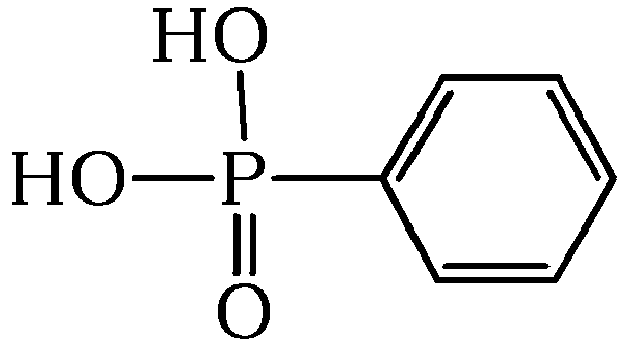
- A 100g portion of this mixture was transferred into each of three containers, which were placed in a thermostat at 22°C, and allowed to stand. After 1, 2, or 3 days, each of the containers was removed from the thermostat, and the mixture was heated to 25°C. With a Brookfield viscometer, the viscosity after 60 seconds from the start of rotation was measured.
- For viscosity measurement, a viscosity (1) was measured, and then a viscosity (2) was measured.
- Viscosity (1): the viscosity was measured without shaking the container.
- Viscosity (2): the viscosity was measured after the container was shaken strongly for 15 seconds (30 times) at a speed of twice/second and then allowed to stand for 30 minutes.
- Furthermore, an average particle diameter (nm) in accordance with the BET method and an average particle diameter (nm) in accordance with the DLS method were measured for the coating-forming composition for an electrical steel sheet.
- Average particle diameter (1): the average particle diameter in accordance with the BET method was measured as follows: A cation exchange resin was added to the alkaline silica sol to eliminate sodium ions, and the coating-forming composition for an electrical steel sheet was dried at 110°C and then ground in a mortar.
- The composition was subsequently baked at 300°C, and then the specific surface area was measured with Monosorb from Yuasa Ionics Inc., for example, and the specific surface area was converted to the average particle diameter.
- Average particle diameter (2): the average particle diameter in accordance with the DLS method was measured as follows: The coating-forming composition for an electrical steel sheet was diluted with a 0.15% by mass NaCl solution, and the average particle diameter in the solution was measured with a dynamic light scattering particle size measurement apparatus such as the ZETASIZER Nano series from Malvern Instruments Ltd., for example.
- Then, (average particle diameter (nm) in accordance with the DLS method)/(average particle diameter (nm) in accordance with the BET method) was determined as the average particle diameter ratio (3).
Table 1 Number of Days (Day) 0 1 2 3 Viscosity (1) (mPa·s) 13 15 18 18 Viscosity (2) (mPa·s) 13 13 18 18 Average Particle Diameter (2) (nm) 37 50 Average Particle Diameter Ratio (3) 2 2 - A coating-forming composition for an electrical steel sheet was prepared as in Example 1, except that the silica sol containing 2.65% by mass of phenylphosphonic acid based on the total mass of SiO2 was replaced with a silica sol containing 1.77% by mass of phenylphosphonic acid based on the total mass of SiO2, and the composition was evaluated in the same manner.
Table 2 Number of Days (Day) 0 1 2 3 Viscosity (1) (mPa·s) 15 15 18 25 Viscosity (2) (mPa·s) 15 15 18 25 Average Particle Diameter (2) (nm) 37 57 Average Particle Diameter Ratio (3) 2 3 - A coating-forming composition for an electrical steel sheet was prepared as in Example 1, except that the silica sol containing 2.65% by mass of phenylphosphonic acid based on the total mass of SiO2 was replaced with a silica sol containing 0.88% by mass of phenylphosphonic acid based on the total mass of SiO2, and the composition was evaluated in the same manner.
Table 3 Number of Days (Day) 0 1 2 3 Viscosity (1) (mPa·s) 14 18 45 1125 Viscosity (2) (mPa·s) 14 13 27 38 Average Particle Diameter (2) (nm) 38 105 Average Particle Diameter Ratio (3) 2 5 - A coating-forming composition for an electrical steel sheet was prepared as in Example 1, except that the silica sol containing 2.65% by mass of phenylphosphonic acid based on the total mass of SiO2 was replaced with a silica sol containing 0.30% by mass of phenylphosphonic acid based on the total mass of SiO2, and the composition was evaluated in the same manner.
Table 4 Number of Days (Day) 0 1 2 3 Viscosity (1) (mPa·s) 13 23 610 1625 Viscosity (2) (mPa·s) 13 13 45 51 Average Particle Diameter (2) (nm) 39 151 Average Particle Diameter Ratio (3) 2 7 - A coating-forming composition for an electrical steel sheet was prepared as in Example 1, except that the silica sol containing 2.65% by mass of phenylphosphonic acid based on the total mass of SiO2 was replaced with a silica sol not containing phenylphosphonic acid, and the composition was evaluated in the same manner.
Table 5 Number of Days (Day) 0 1 2 3 Viscosity (1) (mPa·s) 15 460 4750 5000 or more Viscosity (2) (mPa·s) 15 46 69 73 Average Particle Diameter (2) (nm) 46 247 Average Particle Diameter Ratio (3) 2 11 - A coating-forming composition for an electrical steel sheet was prepared as in Example 1, except that the silica sol containing 2.65% by mass of phenylphosphonic acid based on the total mass of SiO2 was replaced with a silica sol containing 0.88% by mass of trade name HL-415 from Nippon Shokubai Co., Ltd. based on the total mass of SiO2, and the composition was evaluated in the same manner.
Table 6 Number of Days (Day) 0 1 2 3 Viscosity (1) (mPa·s) 14 155 3350 3550 Viscosity (2) (mPa·s) 14 37 70 94 Average Particle Diameter (2) (nm) 45 266 Average Particle Diameter Ratio (3) 2 12 - HL-415 is polyacrylic acid shown below:

- A coating-forming composition for an electrical steel sheet was prepared as in Example 1, except that the silica sol containing 2.65% by mass of phenylphosphonic acid based on the total mass of SiO2 was replaced with a silica sol containing 3.54% by mass of trade name HL-415 from Nippon Shokubai Co., Ltd. based on the total mass of SiO2, and the composition was evaluated in the same manner.
Table 7 Number of Days (Day) 0 1 2 3 Viscosity (1) (mPa·s) 128 635 2900 2400 Viscosity (2) (mPa·s) 128 175 103 103 - A coating-forming composition for an electrical steel sheet was prepared as in Example 1, except that the silica sol containing 2.65% by mass of phenylphosphonic acid based on the total mass of SiO2 was replaced with a silica sol containing 0.88% by mass of trade name Dequest 2010 from Italmatch Japan Ltd. based on the total mass of SiO2, and the composition was evaluated in the same manner.
Table 8 Number of Days (Day) 0 1 2 3 Viscosity (1) (mPa·s) 14 245 3000 3600 Viscosity (2) (mPa·s) 14 100 105 115 Average Particle Diameter (2) (nm) 46 267 Average Particle Diameter Ratio (3) 2 12 - Dequest 2010 is 1-hydroxyethylidene-1,1-diphosphonic acid having the following structure:

- The phenylphosphonic acid-containing silica sol and the aqueous solution of aluminium dihydrogen phosphate used in Example 1 were used, and additionally, a zirconia sol (from Nissan Chemical Industries, Ltd.; trade name ZR-40BL; ZrO2 content: 40% by mass; pH 9.4; average particle diameter: 7 nm) adjusted to a ZrO2 content of 30% by mass was used.
- 123 g of the aqueous solution of aluminium dihydrogen phosphate was placed in a polyethylene container, and 141 g of the phenylphosphonic acid-containing silica sol was gradually added with stirring. After the completion of the addition, stirring was continued for 30 minutes.
- Then, 36 g of the zirconia sol was gradually added, and stirring was continued for 30 minutes. The resulting mixture had a pH of 1.77 and an electrical conductivity of 10.6 ms/cm.
- The mass ratio of the aqueous solution of aluminium dihydrogen phosphate to the silica sol to the zirconia sol was 41/47/12.
- When this was converted to a mass ratio of aluminium dihydrogen phosphate and silica (SiO2) and zirconia (ZrO2), the mass ratio was 20.5/13.9/3.6.
- A 100-g portion of this mixture was transferred into each of three containers, which were placed in a thermostat at 22°C, and allowed to stand.
- The containers were removed as in Example 1, and the viscosities and the particle diameters were measured.
Table 9 Number of Days (Day) 0 1 2 Viscosity (1) (mPa·s) 16 1400 3050 Viscosity (2) (mPa·s) 16 70 100 Average Particle Diameter (2) (nm) 825 510 Average Particle Diameter Ratio (3) 37 23 - A coating-forming composition for an electrical steel sheet was prepared as in Example 5, except that the silica sol containing 2.65% by mass of phenylphosphonic acid based on the total mass of SiO2 was replaced with a silica sol containing 1.77% by mass of phenylphosphonic acid based on the total mass of SiO2, and the composition was evaluated in the same manner.
Table 10 Number of Days (Day) 0 1 2 Viscosity (1) (mPa·s) 17 1525 3100 Viscosity (2) (mPa·s) 17 78 115 Average Particle Diameter (2) (nm) 879 573 Average Particle Diameter Ratio (3) 40 26 - A coating-forming composition for an electrical steel sheet was prepared as in Example 5, except that the silica sol containing 2.65% by mass of phenylphosphonic acid based on the total mass of SiO2 was replaced with a silica sol containing 0.88% by mass of phenylphosphonic acid based on the total mass of SiO2, and the composition was evaluated in the same manner.
Table 11 Number of Days (Day) 0 1 2 Viscosity (1) (mPa·s) 78 1400 2850 Viscosity (2) (mPa·s) 78 162 175 Average Particle Diameter (2) (nm) 885 839 Average Particle Diameter Ratio (3) 40 38 - A coating-forming composition for an electrical steel sheet was prepared as in Example 5, except that the silica sol containing 2.65% by mass of phenylphosphonic acid based on the total mass of SiO2 was replaced with a silica sol containing 0.30% by mass of phenylphosphonic acid based on the total mass of SiO2, and the composition was evaluated in the same manner.
Table 12 Number of Days (Day) 0 1 2 Viscosity (1) (mPa·s) 188 1450 3150 Viscosity (2) (mPa·s) 188 225 235 Average Particle Diameter (2) (nm) 905 860 Average Particle Diameter Ratio (3) 41 39 - A coating-forming composition for an electrical steel sheet was prepared as in Example 5, except that the silica sol containing 2.65% by mass of phenylphosphonic acid based on the total mass of SiO2 was replaced with a silica sol not containing phenylphosphonic acid, and the composition was evaluated in the same manner.
Table 13 Number of Days (Day) 0 1 2 Viscosity (1) (mPa·s) 270 2500 3500 Viscosity (2) (mPa·s) 270 288 275 Average Particle Diameter (2) (nm) 946 1187 Average Particle Diameter Ratio (3) 43 53 - A coating-forming composition for an electrical steel sheet was prepared as in Example 5, except that the silica sol containing 2.65% by mass of phenylphosphonic acid based on the total mass of SiO2 was replaced with a silica sol containing 0.88% by mass of trade name HL-415 from Nippon Shokubai Co., Ltd. based on the total mass of SiO2, and the composition was evaluated in the same manner.
Table 14 Number of Days (Day) 0 1 2 Viscosity (1) (mPa·s) 260 2600 2650 Viscosity (2) (mPa·s) 260 250 220 Average Particle Diameter (2) (nm) 892 1057 Average Particle Diameter Ratio (3) 40 48 - A coating-forming composition for an electrical steel sheet was prepared as in Example 5, except that the silica sol containing 2.65% by mass of phenylphosphonic acid based on the total mass of SiO2 was replaced with a silica sol containing 3.54% by mass of trade name HL-415 from Nippon Shokubai Co., Ltd. based on the total mass of SiO2, and the composition was evaluated in the same manner.
Table 15 Number of Days (Day) 0 1 2 Viscosity (1) (mPa·s) 250 2050 2500 Viscosity (2) (mPa·s) 250 250 195 - A coating-forming composition for an electrical steel sheet was prepared as in Example 5, except that the silica sol containing 2.65% by mass of phenylphosphonic acid based on the total mass of SiO2 was replaced with a silica sol containing 0.88% by mass of trade name Dequest 2010 from Italmatch Japan Ltd. based on the total mass of SiO2, and the composition was evaluated in the same manner.
Table 16 Number of Days (Day) 0 1 2 Viscosity (1) (mPa·s) 280 2700 3050 Viscosity (2) (mPa·s) 280 270 235 Average Particle Diameter (2) (nm) 920 1082 Average Particle Diameter Ratio (3) 41 49 - The results in Examples 1 to 4 and Comparative Examples 1 to 4 described above have shown that in a coating-forming composition for an electrical steel sheet obtained using the silica sol containing phenylphosphonic acid, an increase in viscosity is reduced when the composition contains 0.30 to 2.65% by mass of phenylphosphonic acid based on the total mass of SiO2. Furthermore, the average particle diameter in accordance with the DLS method (average particle diameter (2)) denotes the particle diameter of the composition in the solution. A smaller variation in the ratio (average particle diameter ratio (3)) of the value of the average particle diameter (2) to the value of the average particle diameter in accordance with the BET method (average particle diameter (1)) means that agglomeration is less likely to occur in the composition, which shows that the composition is stable. The variations in the average particle diameter ratio (3) in the coating-forming compositions for electrical steel sheets according to Examples 1 to 4 are clearly smaller than the variations in the average particle diameter ratio (3) in the coating-forming compositions for electrical steel sheets according to Comparative Examples 1 to 4. This has also shown that because the coating-forming compositions for electrical steel sheets according to Examples 1 to 4 each contained 0.30 to 2.65% by mass of phenylphosphonic acid based on the total mass of SiO2, these compositions were stable.
- Furthermore, from the results of Examples 5 to 8 and Comparative Examples 5 to 8, a similar tendency was also obtained when a metal oxide sol (the zirconia sol, for example) was added to the silica sol containing phenylphosphonic acid.
- The silica sol containing phenylphosphonic acid, which forms a stable composition when it is used for a coating-forming composition for an electrical steel sheet, exhibits excellent stability as a general coating composition.
- The coating-forming compositions for electrical steel sheets each obtained using the silica sol not containing phenylphosphonic acid can be said to be compositions that exhibit thixotropic properties, because they show a decrease in viscosity when shaking is applied. The coating-forming compositions for electrical steel sheets of the present application do not exhibit thixotropic properties. These properties are believed to be derived from the silica sol containing phenylphosphonic acid.
- Furthermore, all the coatings for electrical steel sheets formed by applying the coating-forming compositions for electrical steel sheets according to Examples 1 to 8 to the surfaces of surface-treated silicon steel sheets and baking them exhibited excellent insulating properties, corrosion resistance, adhesion, and the like required in coatings for electrical steel sheets.
Claims (2)
- A sol in which phenylphosphonic acid or a salt thereof and colloidal silica having an average particle diameter of 1 to 500 nm are dispersed in an aqueous medium, wherein the phenylphosphonic acid or a salt thereof is contained in an amount of 0.05 to 10% by mass based on a total mass of SiO2 contained in the sol.
- Use of the sol according to claim 1 as a coating material.
Applications Claiming Priority (3)
| Application Number | Priority Date | Filing Date | Title |
|---|---|---|---|
| JP2016041154 | 2016-03-03 | ||
| EP17759849.7A EP3425086B1 (en) | 2016-03-03 | 2017-02-24 | Silica sol containing phenylphosphonic acid, and application for same |
| PCT/JP2017/007165 WO2017150383A1 (en) | 2016-03-03 | 2017-02-24 | Silica sol containing phenylphosphonic acid, and application for same |
Related Parent Applications (2)
| Application Number | Title | Priority Date | Filing Date |
|---|---|---|---|
| EP17759849.7A Division-Into EP3425086B1 (en) | 2016-03-03 | 2017-02-24 | Silica sol containing phenylphosphonic acid, and application for same |
| EP17759849.7A Division EP3425086B1 (en) | 2016-03-03 | 2017-02-24 | Silica sol containing phenylphosphonic acid, and application for same |
Publications (2)
| Publication Number | Publication Date |
|---|---|
| EP3617344A1 true EP3617344A1 (en) | 2020-03-04 |
| EP3617344B1 EP3617344B1 (en) | 2020-11-25 |
Family
ID=59743913
Family Applications (2)
| Application Number | Title | Priority Date | Filing Date |
|---|---|---|---|
| EP19196654.8A Active EP3617344B1 (en) | 2016-03-03 | 2017-02-24 | Silica sol containing phenylphosphonic acid and applications thereof |
| EP17759849.7A Active EP3425086B1 (en) | 2016-03-03 | 2017-02-24 | Silica sol containing phenylphosphonic acid, and application for same |
Family Applications After (1)
| Application Number | Title | Priority Date | Filing Date |
|---|---|---|---|
| EP17759849.7A Active EP3425086B1 (en) | 2016-03-03 | 2017-02-24 | Silica sol containing phenylphosphonic acid, and application for same |
Country Status (8)
| Country | Link |
|---|---|
| US (1) | US10662339B2 (en) |
| EP (2) | EP3617344B1 (en) |
| JP (1) | JP6781414B2 (en) |
| KR (1) | KR102710313B1 (en) |
| CN (1) | CN108699698B (en) |
| PL (1) | PL3425086T3 (en) |
| TW (1) | TWI727007B (en) |
| WO (1) | WO2017150383A1 (en) |
Families Citing this family (3)
| Publication number | Priority date | Publication date | Assignee | Title |
|---|---|---|---|---|
| EP3831980A4 (en) * | 2018-07-31 | 2021-08-25 | JFE Steel Corporation | INSULATING COATING SOLUTION AND GRAIN ORIENTED ELECTRIC STEEL SHEET WITH INSULATING COATING FILM ATTACHED TO IT AND METHOD FOR MANUFACTURING IT |
| RU2753539C1 (en) * | 2018-08-17 | 2021-08-17 | ДжФЕ СТИЛ КОРПОРЕЙШН | Method for producing treatment for processing insulating coating, method for producing steel sheet with insulating coating and device for producing mortar for processing for formation of insulation |
| KR20250093084A (en) * | 2023-12-15 | 2025-06-24 | 주식회사 포스코 | Insulation coating composition for electrical steel sheet, electrical steel sheet, and method for manufacturing the same |
Citations (8)
| Publication number | Priority date | Publication date | Assignee | Title |
|---|---|---|---|---|
| JP2004099929A (en) | 2002-09-05 | 2004-04-02 | Nippon Steel Corp | Method for forming insulating film of grain-oriented electrical steel sheet |
| WO2007007417A1 (en) | 2005-07-14 | 2007-01-18 | Nippon Steel Corporation | Grain-oriented electromagnetic steel sheet having chromium-free insulation coating and insulation coating agent therefor |
| JP2007217758A (en) | 2006-02-17 | 2007-08-30 | Nippon Steel Corp | Oriented electrical steel sheet and method for treating insulating film |
| WO2007136115A1 (en) | 2006-05-19 | 2007-11-29 | Nippon Steel Corporation | Directional electromagnetic steel sheet having high tension insulating coating film and method for processing the insulating coating film |
| JP2008266743A (en) | 2007-04-23 | 2008-11-06 | Nippon Steel Corp | Oriented electrical steel sheet and manufacturing method thereof |
| WO2009123156A1 (en) | 2008-03-31 | 2009-10-08 | 新日本製鐵株式会社 | Grain-oriented magnetic steel sheet and process for producing the same |
| JP2010013692A (en) | 2008-07-03 | 2010-01-21 | Nippon Steel Corp | Insulating film treatment agent, grain-oriented electrical steel sheet coated with the film treatment agent and insulating film treatment method therefor |
| US20100261825A1 (en) * | 2009-04-13 | 2010-10-14 | Senkfor Howard L | Coating compositions comprising polyurea and an anti-oxidant compound |
Family Cites Families (9)
| Publication number | Priority date | Publication date | Assignee | Title |
|---|---|---|---|---|
| TW387926B (en) * | 1998-05-15 | 2000-04-21 | Nippon Dacro Shamrock Co | Surface treatment agent for metals, surface treatment method for metals, and pre-coated steel plate |
| JP3935664B2 (en) * | 2000-08-01 | 2007-06-27 | 住友金属工業株式会社 | Treatment liquid for insulating film formation of electrical steel sheet and method |
| JP2002107956A (en) * | 2000-09-28 | 2002-04-10 | Mitsubishi Paper Mills Ltd | Non-image area modifier for lithographic printing plates |
| JP4577467B2 (en) | 2000-11-02 | 2010-11-10 | 戸田工業株式会社 | Composite metal magnetic particle powder and magnetic recording medium |
| JP5082601B2 (en) * | 2007-06-05 | 2012-11-28 | 住友金属工業株式会社 | Treatment liquid for insulating film formation of electrical steel sheets |
| JP5245400B2 (en) * | 2007-12-27 | 2013-07-24 | 新日鐵住金株式会社 | Treatment liquid for insulating film formation of electrical steel sheets |
| WO2012011576A1 (en) | 2010-07-23 | 2012-01-26 | 日産化学工業株式会社 | Crystalline resin composition |
| JP5978009B2 (en) * | 2012-05-30 | 2016-08-24 | 新日鐵住金株式会社 | INSULATION COATING FORMING LIQUID AND METHOD FOR PRODUCING ELECTRIC STEEL STEEL WITH INSULATING COATING |
| KR101632876B1 (en) * | 2013-12-23 | 2016-06-23 | 주식회사 포스코 | Coating composition for electrical steel sheet, method for producing the same, and method for coating the electrical steel sheet using the same |
-
2017
- 2017-02-24 JP JP2018503107A patent/JP6781414B2/en active Active
- 2017-02-24 EP EP19196654.8A patent/EP3617344B1/en active Active
- 2017-02-24 KR KR1020187022911A patent/KR102710313B1/en active Active
- 2017-02-24 EP EP17759849.7A patent/EP3425086B1/en active Active
- 2017-02-24 CN CN201780013793.2A patent/CN108699698B/en active Active
- 2017-02-24 WO PCT/JP2017/007165 patent/WO2017150383A1/en not_active Ceased
- 2017-02-24 US US16/082,000 patent/US10662339B2/en active Active
- 2017-02-24 PL PL17759849T patent/PL3425086T3/en unknown
- 2017-03-03 TW TW106107062A patent/TWI727007B/en active
Patent Citations (8)
| Publication number | Priority date | Publication date | Assignee | Title |
|---|---|---|---|---|
| JP2004099929A (en) | 2002-09-05 | 2004-04-02 | Nippon Steel Corp | Method for forming insulating film of grain-oriented electrical steel sheet |
| WO2007007417A1 (en) | 2005-07-14 | 2007-01-18 | Nippon Steel Corporation | Grain-oriented electromagnetic steel sheet having chromium-free insulation coating and insulation coating agent therefor |
| JP2007217758A (en) | 2006-02-17 | 2007-08-30 | Nippon Steel Corp | Oriented electrical steel sheet and method for treating insulating film |
| WO2007136115A1 (en) | 2006-05-19 | 2007-11-29 | Nippon Steel Corporation | Directional electromagnetic steel sheet having high tension insulating coating film and method for processing the insulating coating film |
| JP2008266743A (en) | 2007-04-23 | 2008-11-06 | Nippon Steel Corp | Oriented electrical steel sheet and manufacturing method thereof |
| WO2009123156A1 (en) | 2008-03-31 | 2009-10-08 | 新日本製鐵株式会社 | Grain-oriented magnetic steel sheet and process for producing the same |
| JP2010013692A (en) | 2008-07-03 | 2010-01-21 | Nippon Steel Corp | Insulating film treatment agent, grain-oriented electrical steel sheet coated with the film treatment agent and insulating film treatment method therefor |
| US20100261825A1 (en) * | 2009-04-13 | 2010-10-14 | Senkfor Howard L | Coating compositions comprising polyurea and an anti-oxidant compound |
Also Published As
| Publication number | Publication date |
|---|---|
| EP3425086B1 (en) | 2021-05-26 |
| WO2017150383A1 (en) | 2017-09-08 |
| US10662339B2 (en) | 2020-05-26 |
| PL3425086T3 (en) | 2021-11-02 |
| KR102710313B1 (en) | 2024-09-26 |
| US20190153240A1 (en) | 2019-05-23 |
| TWI727007B (en) | 2021-05-11 |
| KR20180119565A (en) | 2018-11-02 |
| EP3425086A1 (en) | 2019-01-09 |
| TW201803940A (en) | 2018-02-01 |
| EP3425086A4 (en) | 2019-05-08 |
| JP6781414B2 (en) | 2020-11-04 |
| CN108699698A (en) | 2018-10-23 |
| CN108699698B (en) | 2020-11-20 |
| EP3617344B1 (en) | 2020-11-25 |
| JPWO2017150383A1 (en) | 2018-12-20 |
Similar Documents
| Publication | Publication Date | Title |
|---|---|---|
| RU2386587C2 (en) | Aluminium oxide dispersion | |
| CN111132931B (en) | Method for producing aluminum hydroxide-coated silicon carbide particle powder, and method for producing a dispersion comprising the powder and a dispersion medium | |
| CN103228574B (en) | Plate-like type zirconium phosphate and manufacture method thereof | |
| EP3425086B1 (en) | Silica sol containing phenylphosphonic acid, and application for same | |
| US20100294168A1 (en) | Transparent Coatings | |
| JP2012500766A (en) | Hydrophobic silica dispersion | |
| JP5139260B2 (en) | Process for producing a dispersion of calcined silica | |
| KR102706846B1 (en) | Coating agent for forming grain-oriented electrical steel sheet film and method for manufacturing grain-oriented electrical steel sheet | |
| BRPI0616003B1 (en) | COMPOSITION AND METHOD FOR SURFACE CONDITIONING AND METHOD FOR PRODUCTION OF A SURFACE CONDITIONING COMPOSITION | |
| JP6249547B2 (en) | Silica-aluminum-containing colloidal aqueous solution | |
| JP2014227320A (en) | Method for producing alumina dispersion liquid | |
| JP3369840B2 (en) | Method for producing low iron loss unidirectional silicon steel sheet | |
| US5968246A (en) | Stabilized composition for treatment of metal surfaces | |
| CN107709614A (en) | The metal material of surface treating agent for metallic materials and belt surface processing envelope | |
| JP2005154714A (en) | Improved coating material preparation containing hectolite composition | |
| JP2003012320A (en) | Silica-based inorganic compound organosol | |
| JP2020147465A (en) | Method for producing modified silica fine particle dispersion | |
| RU2774128C1 (en) | Coating agent for forming coating of anisotropic electric steel sheet and method for producing anisotropic electric steel sheet | |
| JP6406524B2 (en) | Silica-based fine particle sol and method for producing the same | |
| JP4723370B2 (en) | Stock solution for coating composition | |
| JP2001011389A (en) | Water-based metallic paint composition | |
| CN119192895A (en) | Aqueous stabilizer composition, aqueous dispersion, use thereof and production method thereof | |
| US20130189425A1 (en) | Transparent Coatings |
Legal Events
| Date | Code | Title | Description |
|---|---|---|---|
| PUAI | Public reference made under article 153(3) epc to a published international application that has entered the european phase |
Free format text: ORIGINAL CODE: 0009012 |
|
| STAA | Information on the status of an ep patent application or granted ep patent |
Free format text: STATUS: REQUEST FOR EXAMINATION WAS MADE |
|
| 17P | Request for examination filed |
Effective date: 20190911 |
|
| AC | Divisional application: reference to earlier application |
Ref document number: 3425086 Country of ref document: EP Kind code of ref document: P |
|
| AK | Designated contracting states |
Kind code of ref document: A1 Designated state(s): AL AT BE BG CH CY CZ DE DK EE ES FI FR GB GR HR HU IE IS IT LI LT LU LV MC MK MT NL NO PL PT RO RS SE SI SK SM TR |
|
| GRAP | Despatch of communication of intention to grant a patent |
Free format text: ORIGINAL CODE: EPIDOSNIGR1 |
|
| STAA | Information on the status of an ep patent application or granted ep patent |
Free format text: STATUS: GRANT OF PATENT IS INTENDED |
|
| INTG | Intention to grant announced |
Effective date: 20200619 |
|
| GRAS | Grant fee paid |
Free format text: ORIGINAL CODE: EPIDOSNIGR3 |
|
| GRAA | (expected) grant |
Free format text: ORIGINAL CODE: 0009210 |
|
| STAA | Information on the status of an ep patent application or granted ep patent |
Free format text: STATUS: THE PATENT HAS BEEN GRANTED |
|
| AC | Divisional application: reference to earlier application |
Ref document number: 3425086 Country of ref document: EP Kind code of ref document: P |
|
| AK | Designated contracting states |
Kind code of ref document: B1 Designated state(s): AL AT BE BG CH CY CZ DE DK EE ES FI FR GB GR HR HU IE IS IT LI LT LU LV MC MK MT NL NO PL PT RO RS SE SI SK SM TR |
|
| REG | Reference to a national code |
Ref country code: GB Ref legal event code: FG4D |
|
| REG | Reference to a national code |
Ref country code: CH Ref legal event code: EP |
|
| REG | Reference to a national code |
Ref country code: AT Ref legal event code: REF Ref document number: 1338403 Country of ref document: AT Kind code of ref document: T Effective date: 20201215 |
|
| REG | Reference to a national code |
Ref country code: DE Ref legal event code: R096 Ref document number: 602017028593 Country of ref document: DE |
|
| REG | Reference to a national code |
Ref country code: IE Ref legal event code: FG4D |
|
| REG | Reference to a national code |
Ref country code: AT Ref legal event code: MK05 Ref document number: 1338403 Country of ref document: AT Kind code of ref document: T Effective date: 20201125 |
|
| REG | Reference to a national code |
Ref country code: NL Ref legal event code: MP Effective date: 20201125 |
|
| PG25 | Lapsed in a contracting state [announced via postgrant information from national office to epo] |
Ref country code: GR Free format text: LAPSE BECAUSE OF FAILURE TO SUBMIT A TRANSLATION OF THE DESCRIPTION OR TO PAY THE FEE WITHIN THE PRESCRIBED TIME-LIMIT Effective date: 20210226 Ref country code: NO Free format text: LAPSE BECAUSE OF FAILURE TO SUBMIT A TRANSLATION OF THE DESCRIPTION OR TO PAY THE FEE WITHIN THE PRESCRIBED TIME-LIMIT Effective date: 20210225 Ref country code: FI Free format text: LAPSE BECAUSE OF FAILURE TO SUBMIT A TRANSLATION OF THE DESCRIPTION OR TO PAY THE FEE WITHIN THE PRESCRIBED TIME-LIMIT Effective date: 20201125 Ref country code: RS Free format text: LAPSE BECAUSE OF FAILURE TO SUBMIT A TRANSLATION OF THE DESCRIPTION OR TO PAY THE FEE WITHIN THE PRESCRIBED TIME-LIMIT Effective date: 20201125 Ref country code: PT Free format text: LAPSE BECAUSE OF FAILURE TO SUBMIT A TRANSLATION OF THE DESCRIPTION OR TO PAY THE FEE WITHIN THE PRESCRIBED TIME-LIMIT Effective date: 20210325 |
|
| PG25 | Lapsed in a contracting state [announced via postgrant information from national office to epo] |
Ref country code: AT Free format text: LAPSE BECAUSE OF FAILURE TO SUBMIT A TRANSLATION OF THE DESCRIPTION OR TO PAY THE FEE WITHIN THE PRESCRIBED TIME-LIMIT Effective date: 20201125 Ref country code: BG Free format text: LAPSE BECAUSE OF FAILURE TO SUBMIT A TRANSLATION OF THE DESCRIPTION OR TO PAY THE FEE WITHIN THE PRESCRIBED TIME-LIMIT Effective date: 20210225 Ref country code: LV Free format text: LAPSE BECAUSE OF FAILURE TO SUBMIT A TRANSLATION OF THE DESCRIPTION OR TO PAY THE FEE WITHIN THE PRESCRIBED TIME-LIMIT Effective date: 20201125 Ref country code: IS Free format text: LAPSE BECAUSE OF FAILURE TO SUBMIT A TRANSLATION OF THE DESCRIPTION OR TO PAY THE FEE WITHIN THE PRESCRIBED TIME-LIMIT Effective date: 20210325 Ref country code: SE Free format text: LAPSE BECAUSE OF FAILURE TO SUBMIT A TRANSLATION OF THE DESCRIPTION OR TO PAY THE FEE WITHIN THE PRESCRIBED TIME-LIMIT Effective date: 20201125 |
|
| REG | Reference to a national code |
Ref country code: LT Ref legal event code: MG9D |
|
| PG25 | Lapsed in a contracting state [announced via postgrant information from national office to epo] |
Ref country code: HR Free format text: LAPSE BECAUSE OF FAILURE TO SUBMIT A TRANSLATION OF THE DESCRIPTION OR TO PAY THE FEE WITHIN THE PRESCRIBED TIME-LIMIT Effective date: 20201125 |
|
| PG25 | Lapsed in a contracting state [announced via postgrant information from national office to epo] |
Ref country code: CZ Free format text: LAPSE BECAUSE OF FAILURE TO SUBMIT A TRANSLATION OF THE DESCRIPTION OR TO PAY THE FEE WITHIN THE PRESCRIBED TIME-LIMIT Effective date: 20201125 Ref country code: SM Free format text: LAPSE BECAUSE OF FAILURE TO SUBMIT A TRANSLATION OF THE DESCRIPTION OR TO PAY THE FEE WITHIN THE PRESCRIBED TIME-LIMIT Effective date: 20201125 Ref country code: SK Free format text: LAPSE BECAUSE OF FAILURE TO SUBMIT A TRANSLATION OF THE DESCRIPTION OR TO PAY THE FEE WITHIN THE PRESCRIBED TIME-LIMIT Effective date: 20201125 Ref country code: EE Free format text: LAPSE BECAUSE OF FAILURE TO SUBMIT A TRANSLATION OF THE DESCRIPTION OR TO PAY THE FEE WITHIN THE PRESCRIBED TIME-LIMIT Effective date: 20201125 Ref country code: LT Free format text: LAPSE BECAUSE OF FAILURE TO SUBMIT A TRANSLATION OF THE DESCRIPTION OR TO PAY THE FEE WITHIN THE PRESCRIBED TIME-LIMIT Effective date: 20201125 Ref country code: RO Free format text: LAPSE BECAUSE OF FAILURE TO SUBMIT A TRANSLATION OF THE DESCRIPTION OR TO PAY THE FEE WITHIN THE PRESCRIBED TIME-LIMIT Effective date: 20201125 |
|
| REG | Reference to a national code |
Ref country code: DE Ref legal event code: R097 Ref document number: 602017028593 Country of ref document: DE |
|
| PG25 | Lapsed in a contracting state [announced via postgrant information from national office to epo] |
Ref country code: DK Free format text: LAPSE BECAUSE OF FAILURE TO SUBMIT A TRANSLATION OF THE DESCRIPTION OR TO PAY THE FEE WITHIN THE PRESCRIBED TIME-LIMIT Effective date: 20201125 |
|
| PG25 | Lapsed in a contracting state [announced via postgrant information from national office to epo] |
Ref country code: MC Free format text: LAPSE BECAUSE OF FAILURE TO SUBMIT A TRANSLATION OF THE DESCRIPTION OR TO PAY THE FEE WITHIN THE PRESCRIBED TIME-LIMIT Effective date: 20201125 |
|
| PLBE | No opposition filed within time limit |
Free format text: ORIGINAL CODE: 0009261 |
|
| STAA | Information on the status of an ep patent application or granted ep patent |
Free format text: STATUS: NO OPPOSITION FILED WITHIN TIME LIMIT |
|
| REG | Reference to a national code |
Ref country code: BE Ref legal event code: MM Effective date: 20210228 |
|
| PG25 | Lapsed in a contracting state [announced via postgrant information from national office to epo] |
Ref country code: CH Free format text: LAPSE BECAUSE OF NON-PAYMENT OF DUE FEES Effective date: 20210228 Ref country code: IT Free format text: LAPSE BECAUSE OF FAILURE TO SUBMIT A TRANSLATION OF THE DESCRIPTION OR TO PAY THE FEE WITHIN THE PRESCRIBED TIME-LIMIT Effective date: 20201125 Ref country code: LI Free format text: LAPSE BECAUSE OF NON-PAYMENT OF DUE FEES Effective date: 20210228 Ref country code: LU Free format text: LAPSE BECAUSE OF NON-PAYMENT OF DUE FEES Effective date: 20210224 Ref country code: NL Free format text: LAPSE BECAUSE OF FAILURE TO SUBMIT A TRANSLATION OF THE DESCRIPTION OR TO PAY THE FEE WITHIN THE PRESCRIBED TIME-LIMIT Effective date: 20201125 Ref country code: AL Free format text: LAPSE BECAUSE OF FAILURE TO SUBMIT A TRANSLATION OF THE DESCRIPTION OR TO PAY THE FEE WITHIN THE PRESCRIBED TIME-LIMIT Effective date: 20201125 |
|
| 26N | No opposition filed |
Effective date: 20210826 |
|
| PG25 | Lapsed in a contracting state [announced via postgrant information from national office to epo] |
Ref country code: SI Free format text: LAPSE BECAUSE OF FAILURE TO SUBMIT A TRANSLATION OF THE DESCRIPTION OR TO PAY THE FEE WITHIN THE PRESCRIBED TIME-LIMIT Effective date: 20201125 |
|
| PG25 | Lapsed in a contracting state [announced via postgrant information from national office to epo] |
Ref country code: IE Free format text: LAPSE BECAUSE OF NON-PAYMENT OF DUE FEES Effective date: 20210224 Ref country code: ES Free format text: LAPSE BECAUSE OF FAILURE TO SUBMIT A TRANSLATION OF THE DESCRIPTION OR TO PAY THE FEE WITHIN THE PRESCRIBED TIME-LIMIT Effective date: 20201125 |
|
| PG25 | Lapsed in a contracting state [announced via postgrant information from national office to epo] |
Ref country code: IS Free format text: LAPSE BECAUSE OF FAILURE TO SUBMIT A TRANSLATION OF THE DESCRIPTION OR TO PAY THE FEE WITHIN THE PRESCRIBED TIME-LIMIT Effective date: 20210325 |
|
| PG25 | Lapsed in a contracting state [announced via postgrant information from national office to epo] |
Ref country code: BE Free format text: LAPSE BECAUSE OF NON-PAYMENT OF DUE FEES Effective date: 20210228 |
|
| P01 | Opt-out of the competence of the unified patent court (upc) registered |
Effective date: 20230522 |
|
| PG25 | Lapsed in a contracting state [announced via postgrant information from national office to epo] |
Ref country code: CY Free format text: LAPSE BECAUSE OF FAILURE TO SUBMIT A TRANSLATION OF THE DESCRIPTION OR TO PAY THE FEE WITHIN THE PRESCRIBED TIME-LIMIT Effective date: 20201125 |
|
| PG25 | Lapsed in a contracting state [announced via postgrant information from national office to epo] |
Ref country code: HU Free format text: LAPSE BECAUSE OF FAILURE TO SUBMIT A TRANSLATION OF THE DESCRIPTION OR TO PAY THE FEE WITHIN THE PRESCRIBED TIME-LIMIT; INVALID AB INITIO Effective date: 20170224 |
|
| PG25 | Lapsed in a contracting state [announced via postgrant information from national office to epo] |
Ref country code: MK Free format text: LAPSE BECAUSE OF FAILURE TO SUBMIT A TRANSLATION OF THE DESCRIPTION OR TO PAY THE FEE WITHIN THE PRESCRIBED TIME-LIMIT Effective date: 20201125 |
|
| PG25 | Lapsed in a contracting state [announced via postgrant information from national office to epo] |
Ref country code: TR Free format text: LAPSE BECAUSE OF FAILURE TO SUBMIT A TRANSLATION OF THE DESCRIPTION OR TO PAY THE FEE WITHIN THE PRESCRIBED TIME-LIMIT Effective date: 20201125 |
|
| PG25 | Lapsed in a contracting state [announced via postgrant information from national office to epo] |
Ref country code: MT Free format text: LAPSE BECAUSE OF FAILURE TO SUBMIT A TRANSLATION OF THE DESCRIPTION OR TO PAY THE FEE WITHIN THE PRESCRIBED TIME-LIMIT Effective date: 20201125 |
|
| PGFP | Annual fee paid to national office [announced via postgrant information from national office to epo] |
Ref country code: FR Payment date: 20251231 Year of fee payment: 10 |
|
| PGFP | Annual fee paid to national office [announced via postgrant information from national office to epo] |
Ref country code: PL Payment date: 20251230 Year of fee payment: 10 |
|
| PGFP | Annual fee paid to national office [announced via postgrant information from national office to epo] |
Ref country code: GB Payment date: 20260106 Year of fee payment: 10 |
|
| PGFP | Annual fee paid to national office [announced via postgrant information from national office to epo] |
Ref country code: DE Payment date: 20260102 Year of fee payment: 10 |