EP3616695B1 - Ceftolozane/tazobactam for treating intrapulmonary infections - Google Patents
Ceftolozane/tazobactam for treating intrapulmonary infections Download PDFInfo
- Publication number
- EP3616695B1 EP3616695B1 EP19203616.8A EP19203616A EP3616695B1 EP 3616695 B1 EP3616695 B1 EP 3616695B1 EP 19203616 A EP19203616 A EP 19203616A EP 3616695 B1 EP3616695 B1 EP 3616695B1
- Authority
- EP
- European Patent Office
- Prior art keywords
- ceftolozane
- tazobactam
- cxa
- elf
- concentration
- Prior art date
- Legal status (The legal status is an assumption and is not a legal conclusion. Google has not performed a legal analysis and makes no representation as to the accuracy of the status listed.)
- Active
Links
Images



Classifications
-
- A—HUMAN NECESSITIES
- A61—MEDICAL OR VETERINARY SCIENCE; HYGIENE
- A61K—PREPARATIONS FOR MEDICAL, DENTAL OR TOILETRY PURPOSES
- A61K31/00—Medicinal preparations containing organic active ingredients
- A61K31/33—Heterocyclic compounds
- A61K31/395—Heterocyclic compounds having nitrogen as a ring hetero atom, e.g. guanethidine or rifamycins
- A61K31/54—Heterocyclic compounds having nitrogen as a ring hetero atom, e.g. guanethidine or rifamycins having six-membered rings with at least one nitrogen and one sulfur as the ring hetero atoms, e.g. sulthiame
- A61K31/542—Heterocyclic compounds having nitrogen as a ring hetero atom, e.g. guanethidine or rifamycins having six-membered rings with at least one nitrogen and one sulfur as the ring hetero atoms, e.g. sulthiame ortho- or peri-condensed with heterocyclic ring systems
- A61K31/545—Compounds containing 5-thia-1-azabicyclo [4.2.0] octane ring systems, i.e. compounds containing a ring system of the formula:, e.g. cephalosporins, cefaclor, or cephalexine
- A61K31/546—Compounds containing 5-thia-1-azabicyclo [4.2.0] octane ring systems, i.e. compounds containing a ring system of the formula:, e.g. cephalosporins, cefaclor, or cephalexine containing further heterocyclic rings, e.g. cephalothin
-
- A—HUMAN NECESSITIES
- A61—MEDICAL OR VETERINARY SCIENCE; HYGIENE
- A61K—PREPARATIONS FOR MEDICAL, DENTAL OR TOILETRY PURPOSES
- A61K31/00—Medicinal preparations containing organic active ingredients
- A61K31/33—Heterocyclic compounds
- A61K31/395—Heterocyclic compounds having nitrogen as a ring hetero atom, e.g. guanethidine or rifamycins
- A61K31/41—Heterocyclic compounds having nitrogen as a ring hetero atom, e.g. guanethidine or rifamycins having five-membered rings with two or more ring hetero atoms, at least one of which being nitrogen, e.g. tetrazole
- A61K31/425—Thiazoles
- A61K31/429—Thiazoles condensed with heterocyclic ring systems
- A61K31/43—Compounds containing 4-thia-1-azabicyclo [3.2.0] heptane ring systems, i.e. compounds containing a ring system of the formula, e.g. penicillins, penems
- A61K31/431—Compounds containing 4-thia-1-azabicyclo [3.2.0] heptane ring systems, i.e. compounds containing a ring system of the formula, e.g. penicillins, penems containing further heterocyclic rings, e.g. ticarcillin, azlocillin, oxacillin
-
- A—HUMAN NECESSITIES
- A61—MEDICAL OR VETERINARY SCIENCE; HYGIENE
- A61K—PREPARATIONS FOR MEDICAL, DENTAL OR TOILETRY PURPOSES
- A61K9/00—Medicinal preparations characterised by special physical form
- A61K9/0012—Galenical forms characterised by the site of application
- A61K9/0019—Injectable compositions; Intramuscular, intravenous, arterial, subcutaneous administration; Compositions to be administered through the skin in an invasive manner
-
- A—HUMAN NECESSITIES
- A61—MEDICAL OR VETERINARY SCIENCE; HYGIENE
- A61K—PREPARATIONS FOR MEDICAL, DENTAL OR TOILETRY PURPOSES
- A61K9/00—Medicinal preparations characterised by special physical form
- A61K9/0012—Galenical forms characterised by the site of application
- A61K9/007—Pulmonary tract; Aromatherapy
-
- A—HUMAN NECESSITIES
- A61—MEDICAL OR VETERINARY SCIENCE; HYGIENE
- A61P—SPECIFIC THERAPEUTIC ACTIVITY OF CHEMICAL COMPOUNDS OR MEDICINAL PREPARATIONS
- A61P31/00—Antiinfectives, i.e. antibiotics, antiseptics, chemotherapeutics
- A61P31/04—Antibacterial agents
-
- Y—GENERAL TAGGING OF NEW TECHNOLOGICAL DEVELOPMENTS; GENERAL TAGGING OF CROSS-SECTIONAL TECHNOLOGIES SPANNING OVER SEVERAL SECTIONS OF THE IPC; TECHNICAL SUBJECTS COVERED BY FORMER USPC CROSS-REFERENCE ART COLLECTIONS [XRACs] AND DIGESTS
- Y02—TECHNOLOGIES OR APPLICATIONS FOR MITIGATION OR ADAPTATION AGAINST CLIMATE CHANGE
- Y02A—TECHNOLOGIES FOR ADAPTATION TO CLIMATE CHANGE
- Y02A50/00—TECHNOLOGIES FOR ADAPTATION TO CLIMATE CHANGE in human health protection, e.g. against extreme weather
- Y02A50/30—Against vector-borne diseases, e.g. mosquito-borne, fly-borne, tick-borne or waterborne diseases whose impact is exacerbated by climate change
Definitions
- This disclosure relates to the treatment of intrapulmonary bacterial infections, including the treatment of nosocomial pneumonia infections, with a cephalosporin.
- Cubist Pharmaceuticals Corporate Presentation, Sep. 2011 concerns possible plans for development of Cubicin.
- cephalosporin (6R,7R)-3-[5-Amino-4-[3-(2-aminoethyl)ureido]-1-methyl-1H-pyrazol-2-ium-2-ylmethyl]-7-[2-(5-amino-1,2,4-thiadiazol-3-yl)-2-[(Z)-1-carboxy-1-methylethoxyimino]acetamido]-3-cephem-4-carboxylic acid (also referred to as "CXA-101" and previously designated FR264205) is an antibacterial agent.
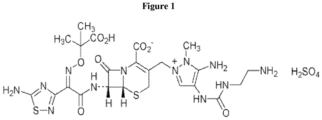
- CXA-101 can be provided as the compound shown in Figure 1 .
- CXA-101 The antibacterial activity of CXA-101 is believed to result from its interaction with penicillin binding proteins (PBPs) to inhibit the biosynthesis of the bacterial cell wall which acts to stop bacterial replication.
- CXA-101 can be combined (e.g., mixed) with a ⁇ -lactamase inhibitor ("BLI”), such as tazobactam.
- BLI ⁇ -lactamase inhibitor
- Tazobactam is a BLI against Class A and some Class C ⁇ -lactamases, with well established in vitro and in vivo efficacy in combination with active ⁇ -lactam antibiotics.
- the combination of CXA-101 and tazobactam in a 2:1 weight ratio is an antibiotic pharmaceutical composition ("CXA-201”) for parenteral administration.
- CXA-201 displays potent antibacterial activity in vitro against common Gram-negative and selected Gram-positive organisms.
- CXA-201 is a combination antibacterial with activity against many Gram-negative pathogens known to cause intrapulmonary infections, including nosocomial pneumonia caused by P. aeruginosa.
- Intrapulmonary infections such as nosocomial pneumonia, remain a major cause of morbidity and mortality, especially infections caused by drug resistant pathogens such as P. aeruginosa.
- One challenge in treating intrapulmonary infections with systemic administration of an antibiotic is determining the antibiotic dose that will provide a therapeutically safe and effective concentration of the antibiotic at the site of an infection on the mucosal side of the bronchi in the lung (i.e., in the bronchial secretions).
- Many antibiotics diffuse poorly from the bloodstream across the bronchi [e.g., Pennington, J.
- ELF epithelial lining fluid
- the concentration of antibiotics measured in the ELF of the lung has varied widely.
- the reported penetration ratio of telavancin in healthy human volunteers ranges widely between 0.43 and 1.24 ( Lodise, Gottokd, Drusano, 2008 Antimicrobial Agents and Chemotherapy ).
- predicting the penetration of a drug into the ELF a priori based on the structure, molecular weight, size and solubility is difficult due to the limited data available on the effect of physicochemical properties on the lung penetration of drugs.
- the efficacy of a particular drug in treating intrapulmonary infections cannot be predicted solely on the basis of data, such as in vitro data relating to the activity of that drug against a particular bacterium, which does not give any indication as whether the drug will accumulate at a therapeutically safe and effective concentration at the site of an infection on the mucosal side of the bronchi in the lung (i.e., in the bronchial secretions).
- data such as in vitro data relating to the activity of that drug against a particular bacterium, which does not give any indication as whether the drug will accumulate at a therapeutically safe and effective concentration at the site of an infection on the mucosal side of the bronchi in the lung (i.e., in the bronchial secretions).
- tigicycline a glycylcycline antimicrobial
- aeruginosa aeruginosa
- it has been approved by the FDA for the treatment of complicated skin and skin structure infections, complicated intra-abdominal infections, and community acquired pneumonia.
- tigicycline is not approved for the treatment of nosocomial pneumonia, in view of an increased mortality risk associated with the use of tigicycline compared to other drugs in patients treated for nosocomial pneumonia.
- the present invention provides ceftolozane (CXA-101) and tazobactam in a 2:1 (ceftolozane:tazobactam) weight ratio at a dose of 3.0 g for use in a method of treating nosocomial pneumonia caused by Gram-negative pathogens in a human, wherein the ceftolozane and tazobactam is administered intravenously once every 8 hours, and wherein the ceftolozane is in its free-base form or in its salt form.
- the invention is based in part on results from a human clinical study designed to assess the ELF penetration of CXA-201 in comparison to piperacillin/tazobactam, indicated for the treatment of nosocomial pneumonia.
- the study described herein quantified the penetration of CXA-201 into the lung, as measured by the ratio of area under the concentration-time curve (AUC) in epithelial lining fluid (ELF) to AUC in plasma (AUC(ELF)/AUC(plasma) ratio).
- AUC area under the concentration-time curve
- ELF epithelial lining fluid
- AUC(ELF)/AUC(plasma) ratio AUC in plasma
- the results of the study indicate that CXA-201 penetrated into the ELF of human patients, with a ceftolozane ELF/plasma AUC ratio of 0.48.
- the measured ELF concentrations of ceftolozane exceeded 8 ⁇ g/mL for 60% of the 8-hour dosing interval, a concentration that is predicted to inhibit 99% of Pseudomonas aeruginosa based on current surveillance data.
- CXA-201 penetrated well into the ELF of healthy volunteers compared to piperacillin/tazobactam, an agent widely used for treatment of lower respiratory infections.
- the intrapulmonary pharmacokinetics measured in the study supports the use of CXA-201 as a parenteral (e.g., intravenous) antibiotic for treatment of intrapulmonary infections, such as nosocomial pneumonia or other lower respiratory tract infections.
- the present invention relates to ceftolozane (CXA-101) and tazobactam in a 2:1 (ceftolozane:tazobactam) weight ratio at a dose of 3.0 g for use in the treatment of nosocomial pneumonia caused by Gram-negative pathogens in a human, wherein the ceftolozane and tazobactam is administered intravenously once every 8 hours, and wherein the ceftolozane is in its free-base form or in its salt form.
- the term "ceftolozane” means CXA-101 in a free-base or salt form, preferably a hydrogen sulfate form (illustrated in figure 1 ).
- ceftolozane is CXA-101 in its free-base form.
- ceftolozane is CXA-101 in its salt form, preferably a hydrogen sulfate form.
- Ceftolozane (in free base or salt form, preferably hydrogen sulfate form) and tazobactam are in a 2:1 (ceftolozane:tazobactam) weight ratio.
- ceftolozane and tazobactam for use in methods of treating nosocomial pneumonia as defined by the claims.
- Ceftolozane hydrogen sulfate and tazobactam are in a 2:1 weight ratio.
- the combination of ceftolozane hydrogen sulfate and tazobactam in a 2:1 weight ratio is referred to herein and in the examples as "CXA-201.”
- the invention provides ceftolozane and tazobactam for use in a method of treating an intrapulmonary infection as defined in the claims.
- the method comprises administering ceftolozane in combination with tazobactam.
- the invention comprises administering CXA-201 and the infection comprises Gram-negative bacteria.
- the amount of the ceftolozane in the ELF of the subject effective to treat an intrapulmonary infection is at least about 8 ⁇ g/ml.
- the ELF concentration of ceftolozane in the ELF may reach at least about 8 ⁇ g/ml after administration of ceftolozane (CXA-101) and tazobactam as defined by the claims.
- the subject is a human having nosocomial pneumonia.
- the subject (or patient) may, in some embodiments, have ventilator acquired pneumonia or hospital acquired pneumonia.
- the intrapulmonary infection is nosocomial pneumonia.
- the intrapulmonary infection may comprise Pseudomonas aeruginosa, Enterobacteriaceae, or a combination thereof.
- the intrapulmonary infection comprises Pseudomonas aeruginosa.
- the intrapulmonary infection may comprise a pathogen with minimum inhibitory concentration for CXA-201 of ⁇ 8 ⁇ g/ml.
- the intrapulmonary infection may comprise a pathogen with minimum inhibitory concentration for ceftolozane of ⁇ 8 ⁇ g/ml.
- the invention provides ceftolozane, for use in a method of treating an intrapulmonary infection as defined by the claims.
- the ceftolozane is intravenously administered.
- the ceftolozane is administered once every 8 hours as an infusion.
- the ceftolozane is intravenously administered as a 60-minute infusion.
- the ceftolozane is for use in a method of treating an intrapulmonary infection as defined in the claims.
- the ceftolozane is for use in a method of treating nosocomial pneumonia.
- the intrapulmonary infection may comprise Pseudomonas aeruginosa, Enterobacteriaceae, or a combination thereof.
- the intrapulmonary infection comprises Pseudomonas aeruginosa.
- the intrapulmonary infection may comprise a pathogen with minimum inhibitory concentration for ceftolozane and tazobactam of ⁇ 8 ⁇ g/ml.
- the intrapulmonary infection may comprise a pathogen with minimum inhibitory concentration for ceftolozane of ⁇ 8 ⁇ g/ml.
- the invention also provides ceftolozane, for use in a method of treating an intrapulmonary infection, comprising administration of ceftolozane in combination with tazobactam as defined in the claims.
- the ceftolozane and tazobactam are intravenously administered.
- the ceftolozane and tazobactam are administered once every 8 hours as an infusion.
- the ceftolozane and/or tazobactam is intravenously administered as a 60-minute infusion.
- Both the ceftolozane and tazobactam are intravenously administered.
- both the ceftolozane and tazobactam are administered once every 8 hours as an infusion.
- both the ceftolozane and tazobactam are intravenously administered as a 60-minute infusion.
- the ceftolozane is for use in a method of treating an intrapulmonary infection as defined in the claims.
- the ceftolozane is for use in a method of treating nosocomial pneumonia.
- the intrapulmonary infection may comprise Pseudomonas aeruginosa, Enterobacteriaceae, or a combination thereof.
- the intrapulmonary infection comprises Pseudomonas aeruginosa.
- the intrapulmonary infection may comprise a pathogen with minimum inhibitory concentration for ceftolozane and tazobactam of ⁇ 8 ⁇ g/ml.
- the intrapulmonary infection may comprise a pathogen with minimum inhibitory concentration for ceftolozane of ⁇ 8 ⁇ g/ml.
- the invention provides tazobactam, for use in a method of treating an intrapulmonary infection, comprising administration of tazobactam in combination with ceftolozane as defined in the claims.
- the tazobactam and ceftolozane is intravenously administered.
- the tazobactam and ceftolozane is administered once every 8 hours as an infusion.
- the tazobactam and/or ceftolozane is intravenously administered as a 60-minute infusion. Both the tazobactam and ceftolozane are intravenously administered.
- Both the tazobactam and ceftolozane are administered about once every 8 hours as an infusion.
- both the tazobactam and ceftolozane are intravenously administered as a 60-minute infusion.
- the tazobactam is for use in a method of treating an intrapulmonary infection as defined in the claims.
- the tazobactam is for use in a method of treating nosocomial pneumonia as defined in the claims.
- the intrapulmonary infection may comprise Pseudomonas aeruginosa, Enterobacteriaceae, or a combination thereof. Typically, the intrapulmonary infection comprises Pseudomonas aeruginosa.
- the intrapulmonary infection may comprise a pathogen with minimum inhibitory concentration for ceftolozane and tazobactam of ⁇ 8 ⁇ g/ml.
- the intrapulmonary infection may comprise a pathogen with minimum inhibitory concentration for ceftolozane of ⁇ 8 ⁇ g/ml.
- the invention provides ceftolozane and tazobactam, as a combined preparation for simultaneous, separate or sequential use in a method of treating an intrapulmonary infection as defined in the claims.
- the ceftolozane and tazobactam are intravenously administered.
- the ceftolozane and tazobactam are administered once every 8 hours as an infusion.
- the ceftolozane and tazobactam are intravenously administered as a 60-minute infusion.
- the ceftolozane and tazobactam are for use in a method of treating an intrapulmonary infection as defined in the claims.
- the intrapulmonary infection is nosocomial pneumonia.
- the intrapulmonary infection may comprise Pseudomonas aeruginosa, Enterobacteriaceae, or a combination thereof.
- the intrapulmonary infection comprises Pseudomonas aeruginosa.
- the intrapulmonary infection may comprise a pathogen with minimum inhibitory concentration for ceftolozane and tazobactam of ⁇ 8 ⁇ g/ml.
- the intrapulmonary infection may comprise a pathogen with minimum inhibitory concentration for ceftolozane of ⁇ 8 ⁇ g/ml.
- Ceftolozane is administered in combination with tazobactam, e,g, CXA-201 is administered. 3.0 g of ceftolozane and tazobactam is administered every 8 hours.
- the amount of the ceftolozane in the ELF of the subject effective to treat an intrapulmonary infection is at least about 8 ⁇ g/ml.
- the ELF concentration of ceftolozane in the ELF may reach at least about 8 ⁇ g/ml after administration of the ceftolozane.
- the subject is a human having nosocomial pneumonia.
- the subject (or patient) may, in some embodiments, have ventilator acquired pneumonia or hospital acquired pneumonia.
- the safe and effective treatment of intrapulmonary infection with CXA-201 includes administration of an amount of the CXA-201 selected to provide a therapeutically effective dose of the CXA-201 antibiotic in the epithelial lining fluid (ELF).
- ELF epithelial lining fluid
- the penetration of CXA-201 into the ELF compared to a piperacillin/tazobactam comparator was assessed in a Phase 1 clinical study in healthy adult volunteers.
- the piperacillin/tazobactam comparator contained piperacillin/tazobactam in an 8:1 weight ratio with a total of 2.79 mEq of sodium per gram of piperacillin, FDA approved under the tradename ZOSYN ® ("Zosyn").
- the study results evaluate the penetration of intravenously administered CXA-201 into healthy human lungs, as measured by the ratio of area under the concentration-time curve (AUC) in epithelial lining fluid (ELF) to AUC in plasma (AUC(ELF)/AUC(plasma) ratio).
- AUC area under the concentration-time curve
- a 4.5 g amount of piperacillin/tazobactam incorporates the same dose of tazobactam (0.5 g) as 1.5 g of CXA-201.
- a multiple-dose regimen was used in this study to ensure that the concentrations of the analytes reached steady-state in both plasma and ELF prior to assessment. Healthy volunteers were chosen to standardize the subject population and minimize the variability associated with using actively ill patients. The objectives of the study included: (1) determination and comparison of the ELF to plasma concentration ratios of multiple-doses of intravenous CXA-201 compared to piperacillin/tazobactam in healthy adult volunteers, and (2) assessment of the safety and tolerability of multiple-doses of intravenous CXA-201 in healthy adult volunteers.
- BAL bronchoalveolar lavage
- Table 1 Plasma Sampling and BAL Timepoints Plasma Sampling Timepoints BAL Timepoints Intensive plasma sampling from all 25 subjects for one dosing interval 5 subjects per timepoint per treatment group; in hours from start of the third infusion CXA-201 0 (pre-PK dose trough) ,1,2,4,6,8 hours post start of infusion of the third dose of CXA 201 1,2,4,6,8 hours post start of infusion of the third dose of CXA 201 Piperacillin/tazobactam 0 (pre-PK dose trough) ,0.5,1,2,4,6 hours post start of infusion of the third dose of piperacillin/tazobactam 0.5,1,2,4,6 hours post start of infusion of the third dose of piperacillin/tazobactam
- Plasma and BAL datapoints were used to construct one concentration-time profile in the ELF using the mean concentrations at each time point.
- a single ELF sample was obtained by bronchoalveolar lavage (BAL) from each healthy volunteer at one of 5 scheduled time points (5 subjects/time point/treatment group).
- the ELF to plasma concentrations of multiple-doses was determined.
- Serial plasma samples were collected pre- and post-treatment over a 6-hour (piperacillin/tazobactam) or 8-hour (CXA-201) time period.
- Urea levels in the plasma and BAL were used to calculate the ELF drug concentrations (see Table 1).
- Pharmacokinetic parameters for ELF were calculated by non-compartmental analysis using the mean concentrations at each time point.
- the intrapulmonary penetration of CXA-201 into the ELF was determined by dividing the ELF AUC 0-t by mean plasma AUC 0-t .
- [CXA/T] BAL is the concentration of CXA-201 in BAL fluid;
- V BAL is the volume of aspirated BAL fluid (total);
- V ELF is V BAL ⁇ [urea] BAL /[urea] plasma , where [urea] BAL is the concentration of urea in the BAL fluid (supernatant) and [urea] plasma is the concentration of urea in the plasma specimens.
- Piperacillin/tazobactam PIP/T BAL ⁇ V BAL /V ELF
- [PIP/T]BAL is the concentration of piperacillin/tazobactam in BAL fluid
- V BAL is the volume of aspirated BAL fluid (total)
- V ELF is V BAL ⁇ [urea] BAL /[urea] plasma , where [urea] BAL is the concentration of urea in the BAL fluid (supernatant) and [urea] plasma is the concentration of urea in the plasma specimens.
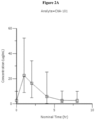
- the ELF concentration vs. time profiles for ceftolozane and tazobactam components of CXA-201 are shown in Figures 2A and 2B , respectively.
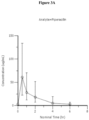
- Comparative data showing the ELF concentration vs. time profiles for piperacillin and tazobactam components of the comparator drug are shown in Figures 3A and 3B , respectively.
- the ELF to plasma penetration ratios are shown in Table 2.
- the PK parameters were determined by non-compartmental PK analysis. PHOENIX ® WinNonlin v 6.1 (PHARSIGHT ® , Mountain View, California) was used for the derivation of all PK individual measures for each subject.
- the PK parameters for ELF were calculated by taking the mean concentrations of the 5 subjects at each time point and constructing a single profile over the duration of sampling. In the event that the urea concentrations determined in plasma or ELF were below quantifiable limits, thereby providing only an estimate of concentration, those values were not used in the calculation of mean concentration at that time point.
- the ceftolozane, piperacillin, and tazobactam PK parameters that were computed in plasma and ELF were:
- the ELF/plasma AUC ratio for the ceftolozane component of CXA-201 was 0.48, compared to 0.26 for the piperacillin component of the comparator drug (piperacillin/tazobactam).
- the ELF/plasma AUC ratio for tazobactam was 0.44 and 0.54 when given as part of CXA-201 and piperacillin/tazobactam, respectively.
- the ELF concentrations of ceftolozane exceeded 8 ⁇ g/mL for 60% of the 8-hour dosing interval.
- the plasma and ELF concentrations of tazobactam when given as piperacillin/tazobactam was approximately 2-fold higher than when an equivalent dose was given as CXA-201.
- ceftolozane and tazobactam i.e., administered as CXA-201 penetrated well into the ELF of healthy volunteers compared to piperacillin/tazobactam, an agent widely used for treatment of lower respiratory infections.
- CXA-201's intrapulmonary pharmacokinetics support use of CXA-201 as a parenteral (e.g., intravenous) antibiotic for treatment of lower respiratory tract infections, including infections caused by pathogens with minimum inhibitory concentrations of ⁇ 8 ⁇ g/ml.
- the concentrations of ceftolozane in ELF exceeded 8 ⁇ g/mL, a concentration that inhibits 99% of P. aeruginosa, for approximately 60% of the 8-hour dosing interval for the CXA-201 regimen of 1.5 grams every eight hours as a 60 minute infusion.
- TEAEs treatment-emergent AEs
- Table 4 TEAEs by Preferred Term (Safety Population) Subjects with at least 1 TEAE 5 (20.0) 6 (23.1) Diarrhea 1 (4.0) 3 (11.5) Viral Upper Respiratory Infection 1 (4.0) 0 (0) Musculoskeletal Chest Pain 1 (4.0) 0 (0) Somnolence 1 (4.0) 0 (0) Hematuria 1 (4.0) 0 (0) Cough 1 (4.0) 0 (0) Type I Hypersensitivity 0 (0) 1 (3.8) Alanine Aminotransferase Increased 0 (0) 1 (3.8) Aspartate Aminotransferase Increased 0 (0) 1 (3.8) Blood Creatine Phosphokinase Increased 0 (0) 1 (3.8) Hyperkalemia 0 (0) 1 (3.8)
- a Monte Carlo simulation was performed based on clinical trial data to predict an effective CXA-201 dose for treating nosocomial pneumonia using PHOENIX ® NLME (PHARSIGHT ® , Mountain View, CA) software, a tool for data processing and modeling for population PK/PD analysis.
- a population pharmacokinetic (PK) model was developed using the CXA-201 plasma concentration versus time data from a previously conducted Phase 2 study in patients with complicated intra abdominal infections. Estimates of clearance and volume of distribution along with the associated inter-individual variability were obtained from these analyses.
- the outputs from the PK population model served as inputs for a clinical trial simulation performed using PHARSIGHT ® Trial Simulator (PHARSIGHT ® ) software, a tool for defining and testing interactive drug models, exploring and communicating study design attributes, and performing statistical and sensitivity analysis through graphical and statistical summaries.
- PHARSIGHT ® PHARSIGHT ® Trial Simulator
- an ELF/Plasma AUC ratio of 0.48 for ceftolozane (modeled as a numerical range of 0.25-0.65) calculated from the ceftolozane ELF study mentioned above was used to generate a random /Plasma AUC ratio from the range 0.25 - 0.65 for each simulated patient. This range reflects a conservative estimate of the potential distribution in a patient population.
- the model simulated plasma and ELF concentration of CXA-201 versus time profiles for 1,000 hypothetical clinical trial patients with nosocomial pneumonia.
- the model evaluated the probability of clinical success of the 3.0 g every 8 hour (q8h) dose of CXA-201 against three key pathogens in nosocomial pneumonia.
- the MIC distribution for these pathogens was imputed from 2008 United States surveillance data.
- Clinical success was defined as the achievement of an ELF or plasma concentration of ceftolozane higher than the MIC(s) of the lower respiratory pathogen(s) for a given patient.
- the relavent PK/PD driver for CXA-201 is the percentage of time above MIC during the dosing interval.
- the target is to achieve concentrations that exceed the MIC of the pathogen for 45-50% of the time between each q8H dose.
- a threshold of 50% time above the minimum inhibitory concentration [T>MIC] on Day 7 of treatment was used.
- Plasma and ELF concentrations were estimated at 15 time-points post-administration on Day 7 when dosed every 8 hours. The results of these simulations are shown in Table 5.
- CXA-201 can be prepared by combining ceftolozane and tazobactam in a 2:1 weight ratio.
- CXA-201 can be obtained using methods described in US patent 7,129,232 and Toda et al., "Synthesis and SAR of novel parenteral anti-pseudomonal cephalosporins: Discovery of FR264205," Bioorganic & Medicinal Chemistry Letters, 18, 4849-4852 (2008 ).
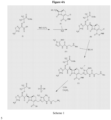
- ceftolozane can be obtained by the synthetic schemes of Figures 4A and 4B .
- ceftolozane can be performed via activation of the thiadiazolyl-oximinoacetic acid derivative (I) with methanesulfonyl chloride and K 2 CO 3 in DMA at 10°C, followed by coupling with the 7-aminocephem (II) by means of Et 3 N in cold EtOAc/H 2 O, affords amide (III) (1).
- the antibacterial activity of the CXA-201 or other compounds can be measured by the minimum inhibitory concentrations (MIC) of the compounds against various bacteria measured by using the broth microdilution method performed according to Clinical and Laboratory Standards Institute (CLSI) guidelines with modifications as described below (CLSI guidelines can be derived from the CLSI document M7-A8 published in January 2009: "Methods for Dilution Antimicrobial Susceptibility Tests for Bacteria That Grow Aerobically; Approved Standard-Eighth Editi on”).
- CLSI Clinical and Laboratory Standards Institute
- individual colonies can be isolated by streaking frozen glycerol material containing Staphylococcus or Pseudomonas spp. onto rich, non-selective, tryptic soy agar containing 5% sheep's blood (TSAB), and incubated at 37°C for 18-24 hrs.
- TSAB sheep's blood
- Plates can be incubated for 18-20 hours at 37°C with aeration (200 rpm). Following incubation, growth can be confirmed visually placing plates over a viewing apparatus (stand with a mirror underneath) and then OD 600 can be measured using a SpectraMax 340PC384 plate reader (Molecular Devices, Sunnyvale, CA). Growth was defined as turbidity that could be detected with the naked eye or achieving minimum OD 600 of 0.1. MIC values were defined as the lowest concentration producing no visible turbidity.
Landscapes
- Health & Medical Sciences (AREA)
- General Health & Medical Sciences (AREA)
- Chemical & Material Sciences (AREA)
- Medicinal Chemistry (AREA)
- Veterinary Medicine (AREA)
- Public Health (AREA)
- Pharmacology & Pharmacy (AREA)
- Life Sciences & Earth Sciences (AREA)
- Animal Behavior & Ethology (AREA)
- Epidemiology (AREA)
- Dermatology (AREA)
- Pulmonology (AREA)
- Chemical Kinetics & Catalysis (AREA)
- Organic Chemistry (AREA)
- Nuclear Medicine, Radiotherapy & Molecular Imaging (AREA)
- General Chemical & Material Sciences (AREA)
- Oncology (AREA)
- Communicable Diseases (AREA)
- Pharmaceuticals Containing Other Organic And Inorganic Compounds (AREA)
Description
- This disclosure relates to the treatment of intrapulmonary bacterial infections, including the treatment of nosocomial pneumonia infections, with a cephalosporin.
- H. S. Sader et al., Antimicrobial Agents and Chemotherapy, (2011), vol. 55, no. 5, pages 2390-2394, concerns "Antimicrobial Activity of CXA-101, a Novel Cephalosporin Tested in Combination with Tazobactam against Enterobacteriaceae, Pseudomonas aeruginosa, and Bacteroides fragilis Strains Having Various Resistance Phenotypes".
- Cubist Pharmaceuticals Corporate Presentation, Sep. 2011 concerns possible plans for development of Cubicin.
- L. Zamorano et al., Clinical Microbiology and Infection, (2009), vol. 16, no. 9, concerns "Activity of the new cephalosporin CXA-101 (FR264205) against Pseudomonas aeruginosa isolates from chronically-infected cystic fibrosis patients".
- C. Jacqueline et al., Abstracts Book, Interscience Conference on Antimicrobial Agents & Chemotherapy, US, (2010), vol. 50, pages B - 1401, concerns "Assessment of the In Vivo Activity of CXA-101 in a Murine Model of Pseudomonas aeruginosa Pneumonia: Comparison with Ceftazidime and Piperacillin-Tazobactam".
- Y. Ge et al., Antimicrobial Agents and Chemotherapy, (2010), vol. 54, no. 8, pages 3427-3431, concerns "Pharmacokinetics and Safety of CXA-101, a New Antipseudomonal Cephalosporin, in Healthy Adult Male and Female Subjects Receiving Single- and Multiple-Dose Intravenous Infusions".
- J. F. Marier et al., Abstracts Book, Interscience Conference on Antimicrobial Agents & Chemotherapy, US, (2010), vol. 50, pages A - 1391, concerns "Pharmacokinetics of a Novel Anti-Pseudomonal Cephalosporin, CXA-101, and Tazobactam (CXA/TAZ) in Healthy Adult Subjects".
- B. Miller et al., Antimicrobial Agents and Chemotherapy, (2012) vol. 56, no. 6, pages 3086 - 3091, concerns "Pharmacokinetics and Safety of Intravenous Ceftolozane-Tazobactam in Healthy Adult Subjects following Single and Multiple Ascending Doses".
- The cephalosporin (6R,7R)-3-[5-Amino-4-[3-(2-aminoethyl)ureido]-1-methyl-1H-pyrazol-2-ium-2-ylmethyl]-7-[2-(5-amino-1,2,4-thiadiazol-3-yl)-2-[(Z)-1-carboxy-1-methylethoxyimino]acetamido]-3-cephem-4-carboxylic acid (also referred to as "CXA-101" and previously designated FR264205) is an antibacterial agent. CXA-101 can be provided as the compound shown in
Figure 1 . The antibacterial activity of CXA-101 is believed to result from its interaction with penicillin binding proteins (PBPs) to inhibit the biosynthesis of the bacterial cell wall which acts to stop bacterial replication. CXA-101 can be combined (e.g., mixed) with a β-lactamase inhibitor ("BLI"), such as tazobactam. Tazobactam is a BLI against Class A and some Class C β-lactamases, with well established in vitro and in vivo efficacy in combination with active β-lactam antibiotics. The combination of CXA-101 and tazobactam in a 2:1 weight ratio is an antibiotic pharmaceutical composition ("CXA-201") for parenteral administration. CXA-201 displays potent antibacterial activity in vitro against common Gram-negative and selected Gram-positive organisms. CXA-201 is a broad-spectrum antibacterial with in vitro activity against Enterobacteriaceae including strains expressing extended spectrum β-lactamases-resistant (MIC90 = 1 µg/mL), as well as Pseudomonas aeruginosa (P. aeruginosa) including multi-drug resistant strains (MIC90= 2 µg/mL). CXA-201 is a combination antibacterial with activity against many Gram-negative pathogens known to cause intrapulmonary infections, including nosocomial pneumonia caused by P. aeruginosa. - Intrapulmonary infections, such as nosocomial pneumonia, remain a major cause of morbidity and mortality, especially infections caused by drug resistant pathogens such as P. aeruginosa. One challenge in treating intrapulmonary infections with systemic administration of an antibiotic is determining the antibiotic dose that will provide a therapeutically safe and effective concentration of the antibiotic at the site of an infection on the mucosal side of the bronchi in the lung (i.e., in the bronchial secretions). Many antibiotics diffuse poorly from the bloodstream across the bronchi [e.g., Pennington, J. E., "Penetration of antibiotics into respiratory secretions," Rev Infect Dis 3(1):67-73 (1981)], which can result in the administration of higher doses of antibiotic than would be prescribed for a truly systemic infection. Furthermore, the purulent sputum that characterizes infected patients tends to compromise the potency of many antibiotics (See e.g., Levy, J., et al., "Bioactivity of gentamicin in purulent sputum from patients with cystic fibrosis or bronchiectasis: comparison with activity in serum," J Infect Dis 148(6): 1069-76 (1983)). In some cases, the result is the prescription of large amounts of a systemically administered antibiotic to treat an intrapulmonary infection.
- The efficacy of an antibiotic depends in part on the concentration of the drug at the site of action. Efficacy of antimicrobial therapy requires adequate antibiotic concentrations at the site of bacterial infection, and some authorities believe that epithelial lining fluid (ELF) concentrations are a reasonable surrogate for predicting effective concentrations for treating intrapulmonary infections such as pneumonia. For many antibiotics, clinical data correlating ELF concentrations to clinical outcome is unavailable and the clinical significance of differences in pulmonary penetration of antibiotics is unknown or poorly characterized. Few studies have quantified the penetration of β-lactam agents into the lung, as measured by the ratio of area under the concentration-time curve (AUC) in ELF to AUC in plasma (AUC(ELF)/AUC(plasma) ratio). For some published studies, the concentration of antibiotics measured in the ELF of the lung has varied widely. For example, the reported penetration ratio of telavancin in healthy human volunteers ranges widely between 0.43 and 1.24 (Lodise, Gottfreid, Drusano, 2008 Antimicrobial Agents and Chemotherapy). Thus, predicting the penetration of a drug into the ELF a priori, based on the structure, molecular weight, size and solubility is difficult due to the limited data available on the effect of physicochemical properties on the lung penetration of drugs.
- Accordingly, the efficacy of a particular drug in treating intrapulmonary infections, in particular nosocomial pneumonia, cannot be predicted solely on the basis of data, such as in vitro data relating to the activity of that drug against a particular bacterium, which does not give any indication as whether the drug will accumulate at a therapeutically safe and effective concentration at the site of an infection on the mucosal side of the bronchi in the lung (i.e., in the bronchial secretions). For instance, tigicycline, a glycylcycline antimicrobial, has in vitro activity against many species of Gram-positive and Gram-negative bacteria, including P. aeruginosa, and it has been approved by the FDA for the treatment of complicated skin and skin structure infections, complicated intra-abdominal infections, and community acquired pneumonia. However, tigicycline is not approved for the treatment of nosocomial pneumonia, in view of an increased mortality risk associated with the use of tigicycline compared to other drugs in patients treated for nosocomial pneumonia.
- The present invention provides ceftolozane (CXA-101) and tazobactam in a 2:1 (ceftolozane:tazobactam) weight ratio at a dose of 3.0 g for use in a method of treating nosocomial pneumonia caused by Gram-negative pathogens in a human, wherein the ceftolozane and tazobactam is administered intravenously once every 8 hours, and wherein the ceftolozane is in its free-base form or in its salt form. The invention is based in part on results from a human clinical study designed to assess the ELF penetration of CXA-201 in comparison to piperacillin/tazobactam, indicated for the treatment of nosocomial pneumonia. The study described herein quantified the penetration of CXA-201 into the lung, as measured by the ratio of area under the concentration-time curve (AUC) in epithelial lining fluid (ELF) to AUC in plasma (AUC(ELF)/AUC(plasma) ratio). The results of the study indicate that CXA-201 penetrated into the ELF of human patients, with a ceftolozane ELF/plasma AUC ratio of 0.48. The measured ELF concentrations of ceftolozane exceeded 8 µg/mL for 60% of the 8-hour dosing interval, a concentration that is predicted to inhibit 99% of Pseudomonas aeruginosa based on current surveillance data.
- The study showed that CXA-201 penetrated well into the ELF of healthy volunteers compared to piperacillin/tazobactam, an agent widely used for treatment of lower respiratory infections. The intrapulmonary pharmacokinetics measured in the study supports the use of CXA-201 as a parenteral (e.g., intravenous) antibiotic for treatment of intrapulmonary infections, such as nosocomial pneumonia or other lower respiratory tract infections.
-
-
Figure 1 is the chemical structure of a salt of ceftolozane hydrogen sulfate salt . -
Figure 2A is a graph showing the ELF Concentration vs. Time Profile for ceftolozane hydrogen sulfate salt (Median and Range) for CXA-201. -
Figure 2B is a graph showing the ELF Concentration vs. Time Profile for Tazobactam (Median and Range) for CXA-201. -
Figure 3A is a graph showing the (Comparative) ELF Concentration vs. Time Profile for Piperacillin (Median and Range) for a piperacillin/tazobactam comparator (ZOSYN®). -
Figure 3B is a graph showing the (Comparative) ELF Concentration vs. Time Profile for Tazobactam (Median and Range) for a piperacillin/tazobactam comparator (ZOSYN®). -
Figures 4A and4B are synthetic schemes for preparing ceftolozane hydrogen sulfate salt . - The present invention relates to ceftolozane (CXA-101) and tazobactam in a 2:1 (ceftolozane:tazobactam) weight ratio at a dose of 3.0 g for use in the treatment of nosocomial pneumonia caused by Gram-negative pathogens in a human, wherein the ceftolozane and tazobactam is administered intravenously once every 8 hours, and wherein the ceftolozane is in its free-base form or in its salt form. As used herein, the term "ceftolozane" means CXA-101 in a free-base or salt form, preferably a hydrogen sulfate form (illustrated in
figure 1 ). In one embodiment, ceftolozane is CXA-101 in its free-base form. In another embodiment, ceftolozane is CXA-101 in its salt form, preferably a hydrogen sulfate form. - Ceftolozane (in free base or salt form, preferably hydrogen sulfate form) and tazobactam are in a 2:1 (ceftolozane:tazobactam) weight ratio. Provided herein are ceftolozane and tazobactam for use in methods of treating nosocomial pneumonia as defined by the claims. Ceftolozane hydrogen sulfate and tazobactam are in a 2:1 weight ratio. The combination of ceftolozane hydrogen sulfate and tazobactam in a 2:1 weight ratio is referred to herein and in the examples as "CXA-201."
- The invention provides ceftolozane and tazobactam for use in a method of treating an intrapulmonary infection as defined in the claims. The method comprises administering ceftolozane in combination with tazobactam.
- The invention comprises administering CXA-201 and the infection comprises Gram-negative bacteria.
- In one embodiment, the amount of the ceftolozane in the ELF of the subject effective to treat an intrapulmonary infection is at least about 8 µg/ml. The ELF concentration of ceftolozane in the ELF may reach at least about 8 µg/ml after administration of ceftolozane (CXA-101) and tazobactam as defined by the claims. The subject is a human having nosocomial pneumonia. The subject (or patient) may, in some embodiments, have ventilator acquired pneumonia or hospital acquired pneumonia.
- In the invention, the intrapulmonary infection is nosocomial pneumonia. The intrapulmonary infection may comprise Pseudomonas aeruginosa, Enterobacteriaceae, or a combination thereof. Typically, the intrapulmonary infection comprises Pseudomonas aeruginosa. The intrapulmonary infection may comprise a pathogen with minimum inhibitory concentration for CXA-201 of ≤ 8µg/ml. The intrapulmonary infection may comprise a pathogen with minimum inhibitory concentration for ceftolozane of ≤ 8µg/ml.
- In another aspect, the invention provides ceftolozane, for use in a method of treating an intrapulmonary infection as defined by the claims. The ceftolozane is intravenously administered. The ceftolozane is administered once every 8 hours as an infusion. In some embodiments, the ceftolozane is intravenously administered as a 60-minute infusion.
- In one embodiment, the ceftolozane is for use in a method of treating an intrapulmonary infection as defined in the claims. The ceftolozane is for use in a method of treating nosocomial pneumonia. The intrapulmonary infection may comprise Pseudomonas aeruginosa, Enterobacteriaceae, or a combination thereof. Typically, the intrapulmonary infection comprises Pseudomonas aeruginosa. The intrapulmonary infection may comprise a pathogen with minimum inhibitory concentration for ceftolozane and tazobactam of ≤ 8µg/ml. The intrapulmonary infection may comprise a pathogen with minimum inhibitory concentration for ceftolozane of ≤ 8µg/ml.
- The invention also provides ceftolozane, for use in a method of treating an intrapulmonary infection, comprising administration of ceftolozane in combination with tazobactam as defined in the claims. The ceftolozane and tazobactam are intravenously administered. The ceftolozane and tazobactam are administered once every 8 hours as an infusion. In some embodiments, the ceftolozane and/or tazobactam is intravenously administered as a 60-minute infusion. Both the ceftolozane and tazobactam are intravenously administered. In some embodiments, both the ceftolozane and tazobactam are administered once every 8 hours as an infusion. In some embodiments, both the ceftolozane and tazobactam are intravenously administered as a 60-minute infusion. The ceftolozane is for use in a method of treating an intrapulmonary infection as defined in the claims. The ceftolozane is for use in a method of treating nosocomial pneumonia. The intrapulmonary infection may comprise Pseudomonas aeruginosa, Enterobacteriaceae, or a combination thereof. Typically, the intrapulmonary infection comprises Pseudomonas aeruginosa. The intrapulmonary infection may comprise a pathogen with minimum inhibitory concentration for ceftolozane and tazobactam of ≤ 8µg/ml. The intrapulmonary infection may comprise a pathogen with minimum inhibitory concentration for ceftolozane of ≤ 8µg/ml.
- In another aspect, the invention provides tazobactam, for use in a method of treating an intrapulmonary infection, comprising administration of tazobactam in combination with ceftolozane as defined in the claims. The tazobactam and ceftolozane is intravenously administered. In some embodiments, the tazobactam and ceftolozane is administered once every 8 hours as an infusion. In some embodiments, the tazobactam and/or ceftolozane is intravenously administered as a 60-minute infusion. Both the tazobactam and ceftolozane are intravenously administered. Both the tazobactam and ceftolozane are administered about once every 8 hours as an infusion. In another embodiments, both the tazobactam and ceftolozane are intravenously administered as a 60-minute infusion.
- The tazobactam is for use in a method of treating an intrapulmonary infection as defined in the claims. The tazobactam is for use in a method of treating nosocomial pneumonia as defined in the claims. The intrapulmonary infection may comprise Pseudomonas aeruginosa, Enterobacteriaceae, or a combination thereof. Typically, the intrapulmonary infection comprises Pseudomonas aeruginosa. The intrapulmonary infection may comprise a pathogen with minimum inhibitory concentration for ceftolozane and tazobactam of ≤ 8µg/ml. The intrapulmonary infection may comprise a pathogen with minimum inhibitory concentration for ceftolozane of ≤ 8µg/ml.
- In another aspect, the invention provides ceftolozane and tazobactam, as a combined preparation for simultaneous, separate or sequential use in a method of treating an intrapulmonary infection as defined in the claims. The ceftolozane and tazobactam are intravenously administered. In some embodiments, the ceftolozane and tazobactam are administered once every 8 hours as an infusion. In some embodiments, the ceftolozane and tazobactam, are intravenously administered as a 60-minute infusion.
- In one embodiment, the ceftolozane and tazobactam are for use in a method of treating an intrapulmonary infection as defined in the claims. The intrapulmonary infection is nosocomial pneumonia. The intrapulmonary infection may comprise Pseudomonas aeruginosa, Enterobacteriaceae, or a combination thereof. Typically, the intrapulmonary infection comprises Pseudomonas aeruginosa. The intrapulmonary infection may comprise a pathogen with minimum inhibitory concentration for ceftolozane and tazobactam of ≤ 8µg/ml. The intrapulmonary infection may comprise a pathogen with minimum inhibitory concentration for ceftolozane of ≤ 8µg/ml.
- Ceftolozane is administered in combination with tazobactam, e,g, CXA-201 is administered. 3.0 g of ceftolozane and tazobactam is administered every 8 hours. In one embodiment, the amount of the ceftolozane in the ELF of the subject effective to treat an intrapulmonary infection is at least about 8 µg/ml. The ELF concentration of ceftolozane in the ELF may reach at least about 8 µg/ml after administration of the ceftolozane. The subject is a human having nosocomial pneumonia. The subject (or patient) may, in some embodiments, have ventilator acquired pneumonia or hospital acquired pneumonia.
- The safe and effective treatment of intrapulmonary infection with CXA-201 includes administration of an amount of the CXA-201 selected to provide a therapeutically effective dose of the CXA-201 antibiotic in the epithelial lining fluid (ELF). The penetration of CXA-201 into the ELF compared to a piperacillin/tazobactam comparator was assessed in a
Phase 1 clinical study in healthy adult volunteers. The piperacillin/tazobactam comparator contained piperacillin/tazobactam in an 8:1 weight ratio with a total of 2.79 mEq of sodium per gram of piperacillin, FDA approved under the tradename ZOSYN® ("Zosyn"). The study results evaluate the penetration of intravenously administered CXA-201 into healthy human lungs, as measured by the ratio of area under the concentration-time curve (AUC) in epithelial lining fluid (ELF) to AUC in plasma (AUC(ELF)/AUC(plasma) ratio). - In the study, a 4.5 g amount of piperacillin/tazobactam incorporates the same dose of tazobactam (0.5 g) as 1.5 g of CXA-201. A multiple-dose regimen was used in this study to ensure that the concentrations of the analytes reached steady-state in both plasma and ELF prior to assessment. Healthy volunteers were chosen to standardize the subject population and minimize the variability associated with using actively ill patients. The objectives of the study included: (1) determination and comparison of the ELF to plasma concentration ratios of multiple-doses of intravenous CXA-201 compared to piperacillin/tazobactam in healthy adult volunteers, and (2) assessment of the safety and tolerability of multiple-doses of intravenous CXA-201 in healthy adult volunteers.
- The study was a
Phase 1 prospective, randomized (1:1), comparator controlled, open-label study of 50 healthy adult volunteers. Each healthy volunteer received 3 doses of either CXA-201(1.5 grams every 8 hours as a 60-minute infusion) or piperacillin/tazobactam (4.5 grams every 6 hours as a 30-minute infusion). Subjects received 3 doses of a study drug, underwent serial blood draws at planned plasma sampling timepoints, and underwent a single bronchoalveolar lavage (BAL) procedure at one of the scheduled timepoints (Table 1).Table 1: Plasma Sampling and BAL Timepoints Plasma Sampling Timepoints BAL Timepoints Intensive plasma sampling from all 25 subjects for one dosing interval 5 subjects per timepoint per treatment group; in hours from start of the third infusion CXA-201 0 (pre-PK dose trough) ,1,2,4,6,8 hours post start of infusion of the third dose of CXA 2011,2,4,6,8 hours post start of infusion of the third dose of CXA 201Piperacillin/tazobactam 0 (pre-PK dose trough) ,0.5,1,2,4,6 hours post start of infusion of the third dose of piperacillin/tazobactam 0.5,1,2,4,6 hours post start of infusion of the third dose of piperacillin/tazobactam - A total of 51 subjects were enrolled; 25 in the CXA-201 group and 26 in the piperacillin/tazobactam group. Key Inclusion Criteria for the study were: (1) healthy adult male or non-pregnant females between 18 and 50 years, inclusive; (2) body mass index between 18.5 and 30; and (3) forced Expiratory Volume in 1 second (FEV1) ≥ 80%. Key Exclusion Criteria for the study were: (1) pregnancy or lactation; (2) clinically significant systemic disease or the existence of any surgical or medical condition that may have interfered with the distribution, metabolism, or excretion of CXA-201; (3) history of asthma or any restrictive or obstructive lung disease; (4) history of smoking or abuse of narcotics or alcohol; (5) positive test for human immunodeficiency virus, Hepatitis B surface antigen, or Hepatitis C antibodies; (6) any condition or situation where bronchoscopy was not advisable; and (7) impairment of renal function (CrCl < 90 mL/min).
- Plasma and BAL datapoints were used to construct one concentration-time profile in the ELF using the mean concentrations at each time point. After dosing, a single ELF sample was obtained by bronchoalveolar lavage (BAL) from each healthy volunteer at one of 5 scheduled time points (5 subjects/time point/treatment group). The ELF to plasma concentrations of multiple-doses was determined. Serial plasma samples were collected pre- and post-treatment over a 6-hour (piperacillin/tazobactam) or 8-hour (CXA-201) time period. Urea levels in the plasma and BAL were used to calculate the ELF drug concentrations (see Table 1). Pharmacokinetic parameters for ELF were calculated by non-compartmental analysis using the mean concentrations at each time point. The intrapulmonary penetration of CXA-201 into the ELF was determined by dividing the ELF AUC0-t by mean plasma AUC0-t.
- The concentration of CXA-201 and piperacillin/tazobactam in ELF were estimated from the concentration of drug in BAL fluid, the volume of BAL fluid collected, and the ratio of urea concentration in BAL fluid to that in plasma. Calculation of ELF volume was determined by the urea dilution method, using urea as an endogenous marker of ELF recovered by BAL. Concentration of CXA-201 and piperacillin/tazobactam in ELF was estimated from the concentration of drug in BAL fluid, the volume of BAL fluid collected, and the ratio of urea concentration in BAL fluid to that in plasma. The following formulas represent these calculations:

- [CXA/T]BAL is the concentration of CXA-201 in BAL fluid; VBAL is the volume of aspirated BAL fluid (total); VELF is VBAL × [urea]BAL/[urea]plasma, where [urea]BAL is the concentration of urea in the BAL fluid (supernatant) and [urea]plasma is the concentration of urea in the plasma specimens.

- [PIP/T]BAL is the concentration of piperacillin/tazobactam in BAL fluid; VBAL is the volume of aspirated BAL fluid (total); VELF is VBAL × [urea]BAL/[urea]plasma, where [urea]BAL is the concentration of urea in the BAL fluid (supernatant) and [urea]plasma is the concentration of urea in the plasma specimens.
- No oral antibiotic therapy was permitted. Safety was monitored through the review of vital signs, laboratory and physical examinations and the occurrence of adverse events (AEs). Subjects who received three doses of study medication and had both BAL and plasma samples collected were included in the pharmacokinetic (PK) analysis population. All randomized subjects who received any dose (including partial doses) of study medication were included in the safety analysis population.
- The results of the study (Table 2) indicate that CXA-201 penetrated well into ELF. The ceftolozane component of CXA-201 ELF/plasma AUC ratio was 0.48, compared to 0.26 for the piperacillin component of piperacillin/tazobactam. The ELF concentrations of ceftolozane exceeded 8 µg/mL for 60% of the 8-hour dosing interval. The plasma concentrations for ceftolozane were consistent with those seen previously at this dose.
- The ELF concentration vs. time profiles for ceftolozane and tazobactam components of CXA-201 are shown in
Figures 2A and2B , respectively. Comparative data showing the ELF concentration vs. time profiles for piperacillin and tazobactam components of the comparator drug are shown inFigures 3A and3B , respectively. The ELF to plasma penetration ratios are shown in Table 2. - The PK parameters were determined by non-compartmental PK analysis. PHOENIX® WinNonlin v 6.1 (PHARSIGHT®, Mountain View, California) was used for the derivation of all PK individual measures for each subject. The PK parameters for ELF were calculated by taking the mean concentrations of the 5 subjects at each time point and constructing a single profile over the duration of sampling. In the event that the urea concentrations determined in plasma or ELF were below quantifiable limits, thereby providing only an estimate of concentration, those values were not used in the calculation of mean concentration at that time point. The ceftolozane, piperacillin, and tazobactam PK parameters that were computed in plasma and ELF were:
- Cmax (µg/mL): Maximum plasma and ELF concentration over the entire sampling phase directly obtained from the experimental plasma concentration time data, without interpolation.
- Tmax (hr): Sampling time at which Cmax occurred, obtained directly from the experimental plasma and ELF concentration time data, without interpolation.
- Clast (µg/mL): Plasma or ELF concentration when last quantifiable concentration was observed, relative to the end of infusion.
- Tlast (hr): Time when the last quantifiable concentration was observed.
- AUC0-t (µg*hr/mL): An area under the concentration time curve from the time of the dose to the end of the dosing interval.
- Percent penetration into ELF: Calculated as the ratio of AUC0-tELF and mean AUC0-tPlasma.
- The ELF/plasma AUC ratio for the ceftolozane component of CXA-201 was 0.48, compared to 0.26 for the piperacillin component of the comparator drug (piperacillin/tazobactam). The ELF/plasma AUC ratio for tazobactam was 0.44 and 0.54 when given as part of CXA-201 and piperacillin/tazobactam, respectively. The ELF concentrations of ceftolozane exceeded 8 µg/mL for 60% of the 8-hour dosing interval. The plasma and ELF concentrations of tazobactam when given as piperacillin/tazobactam was approximately 2-fold higher than when an equivalent dose was given as CXA-201.
- The results show that ceftolozane and tazobactam (i.e., administered as CXA-201) penetrated well into the ELF of healthy volunteers compared to piperacillin/tazobactam, an agent widely used for treatment of lower respiratory infections. CXA-201's intrapulmonary pharmacokinetics support use of CXA-201 as a parenteral (e.g., intravenous) antibiotic for treatment of lower respiratory tract infections, including infections caused by pathogens with minimum inhibitory concentrations of ≤ 8µg/ml. The concentrations of ceftolozane in ELF exceeded 8 µg/mL, a concentration that inhibits 99% of P. aeruginosa, for approximately 60% of the 8-hour dosing interval for the CXA-201 regimen of 1.5 grams every eight hours as a 60 minute infusion.
- Among the subjects, 50 of the 51 (98%) subjects received all 3 doses of study medication and completed the BAL procedure. One subject prematurely discontinued piperacillin/tazobactam and terminated their participation in the study due to an AE of hypersensitivity that occurred during administration of the first dose. Demographics and baseline characteristics are summarized in Table 3, the two treatment arms were well balanced.
Table 3: Demographics and Baseline Characteristics (Safety Population) CXA-201 1.5 grams (N=25) Piperacillin/ tazobactam 4.5 grams (N=26) Sex, n (%) Female 11 (44.0) 11 (42.3) Male 14 (56.0) 15 (57.7) Age, years Mean (SD) 32.6 (7.8) 34.2 (8.5) Minimum, Maximum 21, 47 22, 49 Race, n (%) White 20 (80.0) 21 (80.8) Black or African American 2 (8.0) 2 (7.7) Asian 1 (4.0) 0 (0.0) CXA-201 1.5 grams (N=25) Piperacillin/ tazobactam 4.5 grams (N=26) American Indian or Alaska Native 0 (0.0) 1 (3.8) Native Hawaiian or Pacific Islander 1 (4.0) 0 (0.0) Other 1 (4.0) 2 (7.7) BMI, kg/m2 Mean (SD) 26.21 (2.6) 23.23 (2.4) Minimum, Maximum 22.3, 30.0 20.6, 29.9 - During the study, treatment-emergent AEs (TEAEs) occurred in 20.0% (5/25) of subjects receiving CXA-201 and 23.1% (6/26) of subjects receiving piperacillin/tazobactam. No serious AEs were reported in either treatment group. All AEs were mild in severity. The incidence and pattern of AEs were generally similar in the 2 treatment groups, Table 4.
Table 4: TEAEs by Preferred Term (Safety Population) Subjects with at least 1 TEAE 5 (20.0) 6 (23.1) Diarrhea 1 (4.0) 3 (11.5) Viral Upper Respiratory Infection 1 (4.0) 0 (0) Musculoskeletal Chest Pain 1 (4.0) 0 (0) Somnolence 1 (4.0) 0 (0) Hematuria 1 (4.0) 0 (0) Cough 1 (4.0) 0 (0) Type I Hypersensitivity 0 (0) 1 (3.8) Alanine Aminotransferase Increased 0 (0) 1 (3.8) Aspartate Aminotransferase Increased 0 (0) 1 (3.8) Blood Creatine Phosphokinase Increased 0 (0) 1 (3.8) Hyperkalemia 0 (0) 1 (3.8) - Eight subjects had TEAEs assessed as related to study drug; two in the CXA-201 group (diarrhea and somnolence in 1 subject each) and six in the piperacillin/tazobactam group (diarrhea in 3 subjects, type I hypersensitivity in 1 subject, blood creatine phosphokinase increased in 1 subject, and alanine aminotransferase increased, aspartate aminotransferase increased, and hyperkalaemia all in the same 1 subject). One piperacillin/tazobactam-treated subject discontinued study drug due to an adverse event, type I hypersensitivity. There were no clinically significant changes in safety laboratory assessments or vital signs.
- CXA-201 appeared safe and well tolerated in this group of healthy adult subjects.
- A Monte Carlo simulation was performed based on clinical trial data to predict an effective CXA-201 dose for treating nosocomial pneumonia using PHOENIX® NLME (PHARSIGHT®, Mountain View, CA) software, a tool for data processing and modeling for population PK/PD analysis. A population pharmacokinetic (PK) model was developed using the CXA-201 plasma concentration versus time data from a previously conducted
Phase 2 study in patients with complicated intra abdominal infections. Estimates of clearance and volume of distribution along with the associated inter-individual variability were obtained from these analyses. The outputs from the PK population model served as inputs for a clinical trial simulation performed using PHARSIGHT® Trial Simulator (PHARSIGHT®) software, a tool for defining and testing interactive drug models, exploring and communicating study design attributes, and performing statistical and sensitivity analysis through graphical and statistical summaries. Based on the mean ELF penetration data, an ELF/Plasma AUC ratio of 0.48 for ceftolozane (modeled as a numerical range of 0.25-0.65) calculated from the ceftolozane ELF study mentioned above was used to generate a random /Plasma AUC ratio from the range 0.25 - 0.65 for each simulated patient. This range reflects a conservative estimate of the potential distribution in a patient population. Using the results from the PK population model and the ELF/Plasma AUC ratio, the model simulated plasma and ELF concentration of CXA-201 versus time profiles for 1,000 hypothetical clinical trial patients with nosocomial pneumonia. The model evaluated the probability of clinical success of the 3.0 g every 8 hour (q8h) dose of CXA-201 against three key pathogens in nosocomial pneumonia. The MIC distribution for these pathogens was imputed from 2008 United States surveillance data. Clinical success was defined as the achievement of an ELF or plasma concentration of ceftolozane higher than the MIC(s) of the lower respiratory pathogen(s) for a given patient. In vivo models have demonstrated that, as for typical cephlaosporins, the relavent PK/PD driver for CXA-201 is the percentage of time above MIC during the dosing interval. The target is to achieve concentrations that exceed the MIC of the pathogen for 45-50% of the time between each q8H dose. Thus, a threshold of 50% time above the minimum inhibitory concentration [T>MIC] on Day 7 of treatment was used. Plasma and ELF concentrations were estimated at 15 time-points post-administration on Day 7 when dosed every 8 hours. The results of these simulations are shown in Table 5.Table 5: Probability of Target Attainment versus Key Pathogens in Nosocomial Pneumonia Using the Simulated 3.0 g versus the 1.5 g Dose of Ceftolozane/tazobactam Pathogen Dosing Regimen 50% T>MIC in Plasma 50% T>MIC in ELF P. aeruginosa 1.5 g q8h 98.2 94.6 3.0 g q8h 99.4 98.5 E. coli 1.5 g q8h 96.3 94.2 3.0 g q8h 98.8 95.5 K. pneumoniae 1.5 g q8h 90.2 87.3 3.0 g q8h 92.6 89.3 Abbreviation: T > MIC = Time above minimum inhibitory concentration. - These simulations demonstrate that the 3.0 g dose of CXA-201 administered every 8 hours is expected to provide adequate concentrations for treatment of the vast majority of lower respiratory infections caused by these pathogens.
- Following these simulations, the safety and tolerability of a 10 day course of CXA-201 3.0 g IV q8h was evaluated in healthy human volunteers. Subjects were randomized to receive either 3.0 g (2.0/1.0 g) CXA-201 (n=8), 1.5 g (1.0/0.5 g) CXA-201 (n=4), or placebo (n=4). The data showed that CXA-201 was generally safe and well tolerated in this study. There were no serious adverse events or deaths reported in this study.
- In conclusion, given the pharmacokinetic simulations conducted, the favorable data from the intrapulmonary PK study and demonstrated safety and tolerability of the higher dose of CXA-201 in the
Phase 1 study mentioned above, the data provide justification for the use of 3.0 g CXA-201 IV q8h for the treatment of patients with nosocomial pneumonia caused by Gram-negative pathogens. - CXA-201 can be prepared by combining ceftolozane and tazobactam in a 2:1 weight ratio. CXA-201 can be obtained using methods described in
US patent 7,129,232 and Toda et al., "Synthesis and SAR of novel parenteral anti-pseudomonal cephalosporins: Discovery of FR264205," Bioorganic & Medicinal Chemistry Letters, 18, 4849-4852 (2008). - According to the method disclosed in Toda et al., "Synthesis and SAR of novel parenteral anti-pseudomonal cephalosporins: Discovery of FR264205," Bioorganic & Medicinal Chemistry Letters, 18, 4849-4852 (2008), ceftolozane can be obtained by the synthetic schemes of
Figures 4A and4B . Referring toFigures 4A and4B , synthesis of ceftolozane can be performed via activation of the thiadiazolyl-oximinoacetic acid derivative (I) with methanesulfonyl chloride and K2CO3 in DMA at 10°C, followed by coupling with the 7-aminocephem (II) by means of Et3N in cold EtOAc/H2O, affords amide (III) (1). Substitution of the allylic chloride of compound (III) with 4-[(N-Boc-aminoethyl)carbamoylamino]-1-methyl-5-tritylaminopyrazole (IV) in the presence of 1,3-bis(trimethylsilyl)urea (BSU) and KI in DMF then affords the protected pyrazolium adduct (V), which, after full deprotection with trifluoroacetic acid in anisole/CH2Cl2,can be isolated as the hydrogensulfate salt by treatment with H2SO4 in i-PrOH/H2O (1, 2).Scheme 1. The pyrazolyl urea intermediate (IV) can be prepared as follows. Treatment of 5-amino-1-methylpyrazole (VI) with NaNO2/HCl in water at 5°C gives the 4-nitrosopyrazole derivative (VII), which can be reduced to the diaminopyrazole (VIII) by catalytic hydrogenation over Pd/C in the presence of H2SO4. Selective acylation of the 4-amino group of compound (VIII) with phenyl chloroformate in the presence of NaOH in H2O/dioxane at 10°C then yields the phenyl carbamate (IX). After protection of the free amine group of carbamate (IX) with chlorotriphenylmethane in the presence of Et3N in THF, the resulting N-trityl derivative (X)can be coupled with N-Boc-ethylenediamine (XI) in the presence of Et3N in DMF to afford pyrazolyl urea (IV). - The antibacterial activity of the CXA-201 or other compounds can be measured by the minimum inhibitory concentrations (MIC) of the compounds against various bacteria measured by using the broth microdilution method performed according to Clinical and Laboratory Standards Institute (CLSI) guidelines with modifications as described below (CLSI guidelines can be derived from the CLSI document M7-A8 published in January 2009: "Methods for Dilution Antimicrobial Susceptibility Tests for Bacteria That Grow Aerobically; Approved Standard-Eighth Edition").
- To prepare for MIC testing, individual colonies can be isolated by streaking frozen glycerol material containing Staphylococcus or Pseudomonas spp. onto rich, non-selective, tryptic soy agar containing 5% sheep's blood (TSAB), and incubated at 37°C for 18-24 hrs.
- On the day of testing, primary cultures can be started by scraping off 5-10 colonies from the TSAB plates. The material can be suspended in ~5 mL of cation adjusted Mueller Hinton Broth (CAMHB) in 14 mL culture tubes and can be incubated at 37°C with aeration (200 rpm) for ~2 hrs until the OD600 was ≥0.1.
- Inoculum cultures can be prepared by standardizing the primary cultures to OD600 = 0.1 and then adding 20 µL of the adjusted primary culture per 1 mL CAMHB for Pseudomonas and CAMHB plus 4% NaCl for MRSA so that the final inoculum density was ~105 colony forming units per milliliter. Diluted inoculum cultures can be used to inoculate 50 µL per well in 96 well broth microdilution assay plates. 50 µL of CAMHB that contained compound concentrations ranging from 64 - 0.06 µg/mL in two-fold dilutions can also be added to the broth microdilution assay plates for a final volume 100 µL per well, therefore final culture OD600 was approximately 0.001 and the final NaCl concentration for the MRSA strain was 2%.
- Plates can be incubated for 18-20 hours at 37°C with aeration (200 rpm). Following incubation, growth can be confirmed visually placing plates over a viewing apparatus (stand with a mirror underneath) and then OD600 can be measured using a SpectraMax 340PC384 plate reader (Molecular Devices, Sunnyvale, CA). Growth was defined as turbidity that could be detected with the naked eye or achieving minimum OD600 of 0.1. MIC values were defined as the lowest concentration producing no visible turbidity.
| Analyte | Mean Plasma AUC0-τ (µg*hr/mL) | ELF AUC0-τ (µg*hr/mL) | ELF Penetration Ratio |
| ceftolozane (in CXA-201) | 158.5 | 75.1 | 0.48 |
| Tazobactam (in CXA-201) | 19.3 | 8.5 | 0.44 |
| Piperacillin (in piperacillin/tazobactam) | 357.3 | 94.5 | 0.26 |
| Tazobactam (in piperacillin/tazobactam) | 46.1 | 24.7 | 0.54 |
Claims (9)
- Ceftolozane (CXA-101) and tazobactam in a 2:1 (ceftolozane:tazobactam) weight ratio at a dose of 3.0 g for use in a method of treating nosocomial pneumonia caused by Gram-negative pathogens in a human, wherein the ceftolozane and tazobactam is administered intravenously once every 8 hours, and wherein the ceftolozane is in its free-base form or in its salt form.
- The ceftolozane and tazobactam for use as claimed in claim 1, wherein the ceftolozane and tazobactam is administered intravenously once every 8 hours as an infusion.
- The ceftolozane and tazobactam for use as claimed in claim 2, wherein the ceftolozane and tazobactam is administered as a 60-minute infusion.
- The ceftolozane and tazobactam for use as claimed in any one of claims 1 to 3, wherein the intrapulmonary infection comprises Pseudomonas aeruginosa, Enterobacteriaceae, or a combination thereof.
- The ceftolozane and tazobactam for use as claimed in claim 4, wherein the intrapulmonary infection comprises Pseudomonas aeruginosa.
- The ceftolozane and tazobactam for use as claimed in any one of claims 1 to 5, wherein the ceftolozane is in its free-base form.
- The ceftolozane and tazobactam for use as claimed in any one of claims 1 to 6, wherein the ceftolozane is in its salt form.
- The ceftolozane and tazobactam for use as claimed in claim 7, wherein the ceftolozane is in its hydrogen sulphate form.
- The ceftolozane and tazobactam for use as claimed in any one of claims 1 to 8, wherein the ceftolozane and tazobactam are in a pharmaceutical composition.
Priority Applications (3)
| Application Number | Priority Date | Filing Date | Title |
|---|---|---|---|
| HRP20241744TT HRP20241744T1 (en) | 2011-09-09 | 2012-09-07 | CEFTOLOZAN/TAZOBACTAM FOR THE TREATMENT OF INTRAPULMONARY INFECTIONS |
| SI201232076T SI3616695T1 (en) | 2011-09-09 | 2012-09-07 | Ceftolozane/tazobactam for treating intrapulmonary infections |
| RS20241416A RS66326B1 (en) | 2011-09-09 | 2012-09-07 | Ceftolozane/tazobactam for treating intrapulmonary infections |
Applications Claiming Priority (4)
| Application Number | Priority Date | Filing Date | Title |
|---|---|---|---|
| US201161532914P | 2011-09-09 | 2011-09-09 | |
| US201261657386P | 2012-06-08 | 2012-06-08 | |
| EP12830073.8A EP2753326A4 (en) | 2011-09-09 | 2012-09-07 | METHODS OF TREATING INTRAPULMONARY INFECTIONS |
| PCT/US2012/054191 WO2013036783A2 (en) | 2011-09-09 | 2012-09-07 | Methods for treating intrapulmonary infections |
Related Parent Applications (1)
| Application Number | Title | Priority Date | Filing Date |
|---|---|---|---|
| EP12830073.8A Division EP2753326A4 (en) | 2011-09-09 | 2012-09-07 | METHODS OF TREATING INTRAPULMONARY INFECTIONS |
Publications (2)
| Publication Number | Publication Date |
|---|---|
| EP3616695A1 EP3616695A1 (en) | 2020-03-04 |
| EP3616695B1 true EP3616695B1 (en) | 2024-10-23 |
Family
ID=47830390
Family Applications (3)
| Application Number | Title | Priority Date | Filing Date |
|---|---|---|---|
| EP12830073.8A Withdrawn EP2753326A4 (en) | 2011-09-09 | 2012-09-07 | METHODS OF TREATING INTRAPULMONARY INFECTIONS |
| EP20140199818 Withdrawn EP2862569A1 (en) | 2011-09-09 | 2012-09-07 | Methods for treating intrapulmonary infections |
| EP19203616.8A Active EP3616695B1 (en) | 2011-09-09 | 2012-09-07 | Ceftolozane/tazobactam for treating intrapulmonary infections |
Family Applications Before (2)
| Application Number | Title | Priority Date | Filing Date |
|---|---|---|---|
| EP12830073.8A Withdrawn EP2753326A4 (en) | 2011-09-09 | 2012-09-07 | METHODS OF TREATING INTRAPULMONARY INFECTIONS |
| EP20140199818 Withdrawn EP2862569A1 (en) | 2011-09-09 | 2012-09-07 | Methods for treating intrapulmonary infections |
Country Status (19)
| Country | Link |
|---|---|
| US (5) | US20130065874A1 (en) |
| EP (3) | EP2753326A4 (en) |
| JP (1) | JP6151257B2 (en) |
| CN (1) | CN103945842A (en) |
| CA (1) | CA2848012A1 (en) |
| DK (1) | DK3616695T3 (en) |
| EA (1) | EA028342B1 (en) |
| ES (1) | ES2992403T3 (en) |
| FI (1) | FI3616695T3 (en) |
| HK (1) | HK1200096A1 (en) |
| HR (1) | HRP20241744T1 (en) |
| HU (1) | HUE070342T2 (en) |
| LT (1) | LT3616695T (en) |
| MX (1) | MX352760B (en) |
| PL (1) | PL3616695T3 (en) |
| PT (1) | PT3616695T (en) |
| RS (1) | RS66326B1 (en) |
| SI (1) | SI3616695T1 (en) |
| WO (1) | WO2013036783A2 (en) |
Families Citing this family (13)
| Publication number | Priority date | Publication date | Assignee | Title |
|---|---|---|---|---|
| US8513305B2 (en) | 2007-05-14 | 2013-08-20 | Research Foundation Of State University Of New York | Induction of a physiological dispersion response in bacterial cells in a biofilm |
| PT3616695T (en) | 2011-09-09 | 2024-11-18 | Merck Sharp & Dohme | Methods for treating intrapulmonary infections |
| US8809314B1 (en) | 2012-09-07 | 2014-08-19 | Cubist Pharmacueticals, Inc. | Cephalosporin compound |
| US8476425B1 (en) | 2012-09-27 | 2013-07-02 | Cubist Pharmaceuticals, Inc. | Tazobactam arginine compositions |
| PE20160048A1 (en) * | 2013-03-15 | 2016-02-12 | Merck Sharp & Dohme | ANTIBIOTIC COMPOSITIONS OF CEFTOLOZANE |
| US20140274996A1 (en) | 2013-03-15 | 2014-09-18 | Cubist Pharmaceuticals, Inc. | Tazobactam and ceftolozane antibiotic compositions |
| US9872906B2 (en) * | 2013-03-15 | 2018-01-23 | Merck Sharp & Dohme Corp. | Ceftolozane antibiotic compositions |
| WO2015035376A2 (en) * | 2013-09-09 | 2015-03-12 | Calixa Therapeutics, Inc. | Treating infections with ceftolozane/tazobactam in subjects having impaired renal function |
| US8906898B1 (en) * | 2013-09-27 | 2014-12-09 | Calixa Therapeutics, Inc. | Solid forms of ceftolozane |
| WO2015196077A1 (en) * | 2014-06-20 | 2015-12-23 | Merck Sharp & Dohme Corp. | Reactions of thiadiazolyl-oximinoacetic acid derivative compounds |
| WO2016028670A1 (en) * | 2014-08-18 | 2016-02-25 | Merck Sharp & Dohme Corp. | Salt forms of ceftolozane |
| US10214543B2 (en) | 2014-12-30 | 2019-02-26 | Merck Sharp & Dohme Corp. | Synthesis of cephalosporin compounds |
| US11541105B2 (en) | 2018-06-01 | 2023-01-03 | The Research Foundation For The State University Of New York | Compositions and methods for disrupting biofilm formation and maintenance |
Family Cites Families (192)
| Publication number | Priority date | Publication date | Assignee | Title |
|---|---|---|---|---|
| IL37879A (en) | 1970-10-27 | 1974-12-31 | Ciba Geigy Ag | 3-unsubstituted cephalosporin derivatives,process for their manufacture and compositions containing them |
| US4299829A (en) | 1976-03-12 | 1981-11-10 | Fujisawa Pharmaceutical Co., Ltd. | 2-Lower alkyl-7-substituted-2 or 3-cephem 4-carboxylic acid compounds |
| US4409217A (en) | 1977-03-14 | 1983-10-11 | Fujisawa Pharmaceutical Co., Ltd. | Cephem compounds |
| PH17188A (en) | 1977-03-14 | 1984-06-14 | Fujisawa Pharmaceutical Co | New cephem and cepham compounds and their pharmaceutical compositions and method of use |
| US4496562A (en) | 1977-03-14 | 1985-01-29 | Fujisawa Pharmaceutical Co., Ltd. | 7-Substituted-3-cephem-4-carboxylic acid esters |
| US4464369A (en) | 1977-03-14 | 1984-08-07 | Fujisawa Pharmaceutical Co., Ltd. | 7-Acylamino-3-cephem-4-carboxylic acid derivatives and pharmaceutical compositions |
| JPS543087A (en) | 1977-06-03 | 1979-01-11 | Fujisawa Pharmaceut Co Ltd | Preparation of cephalosporin compound |
| GB1604738A (en) | 1977-07-28 | 1981-12-16 | Yamanouchi Pharma Co Ltd | 1,3-dithietane-2-carboxylic acid derivatives and the preparation thereof |
| JPS609719B2 (en) | 1977-08-06 | 1985-03-12 | 武田薬品工業株式会社 | Cephalosporin derivatives and their production method |
| US4370326A (en) | 1977-09-13 | 1983-01-25 | Fujisawa Pharmaceutical Co., Ltd. | Cephem compounds and composition |
| IT1192287B (en) | 1977-11-14 | 1988-03-31 | Fujisawa Pharmaceutical Co | PHARMACEUTICAL ACTION DERIVATIVES OF CEPHALOSPORANIC ACID AND RELATED PREPARATION PROCEDURE |
| US4363807A (en) | 1978-04-06 | 1982-12-14 | Fujisawa Pharmaceutical Company, Limited | Cepham compounds |
| SE7804231L (en) | 1978-04-14 | 1979-10-15 | Haessle Ab | Gastric acid secretion |
| AR228726A1 (en) | 1978-05-26 | 1983-04-15 | Glaxo Group Ltd | PROCEDURE FOR THE PREPARATION OF ANTIBIOTIC (6R, 7R) -7 - ((Z) -2- (2-AMINOTIAZOL-4-IL) -2- (2-CARBOXIPROP-2-OXIIMINO) ACETAMIDO) -3- (1- PIRIDINIOMETIL) CEF-3-EM-4-CARBOXILATO |
| US4264597A (en) | 1978-06-06 | 1981-04-28 | Masashi Hashimoto | Cephalosporin analogues and processes for the preparation thereof |
| US4268509A (en) | 1978-07-10 | 1981-05-19 | Fujisawa Pharmaceutical Co., Ltd. | New cephem compounds and processes for preparation thereof |
| US4284631A (en) | 1978-07-31 | 1981-08-18 | Fujisawa Pharmaceutical Co., Ltd. | 7-Substituted cephem compounds and pharmaceutical antibacterial compositions containing them |
| US4305937A (en) | 1978-08-17 | 1981-12-15 | Fujisawa Pharmaceutical Co., Ltd. | 2-Lower alkyl-7-substituted-2 or 3-cephem-4-carboxylic acid compounds and antibacterial pharmaceutical compositions containing them |
| US4703046A (en) | 1978-09-08 | 1987-10-27 | Fujisawa Pharmaceutical Co., Ltd. | Cephem compounds and processes for preparation thereof |
| EP0009671B1 (en) | 1978-09-12 | 1984-06-13 | Fujisawa Pharmaceutical Co., Ltd. | Starting compounds for preparing cephem compounds and processes for their preparation |
| US4327093A (en) | 1978-10-24 | 1982-04-27 | Fujisawa Pharmaceutical Co., Ltd. | 3,7-Disubstituted-2 or 3-cephem-4-carboxylic acid compounds |
| DE2945248A1 (en) | 1978-11-13 | 1980-05-22 | Fujisawa Pharmaceutical Co | CEPHEM COMPOUNDS, METHOD FOR THEIR PRODUCTION AND ANTIBACTERIAL PHARMACEUTICAL AGENTS CONTAINING THE SAME |
| US4390534A (en) | 1978-12-29 | 1983-06-28 | Fujisawa Pharmaceutical Co., Ltd. | Cephem and cepham compounds |
| US4332798A (en) | 1978-12-29 | 1982-06-01 | Fujisawa Pharmaceutical Co., Ltd. | 7-Amino-thia-diazole oxyimino derivatives of cephem and cephem compounds |
| AU536842B2 (en) | 1978-12-29 | 1984-05-24 | Fujisawa Pharmaceutical Co., Ltd. | Cephalosporin antibiotics |
| US4291031A (en) | 1979-02-19 | 1981-09-22 | Fujisawa Pharmaceutical Co., Ltd. | 3-Phosphonocephalosporanic acid derivatives, and pharmaceutical composition comprising the same |
| US4339449A (en) | 1979-03-27 | 1982-07-13 | Fujisawa Pharmaceutical Company, Limited | Analogous compounds of cephalosporins, and pharmaceutical composition comprising the same |
| FR2462439A1 (en) | 1979-07-26 | 1981-02-13 | Roussel Uclaf | NOVEL PROCESS FOR THE PREPARATION OF PRODUCTS DERIVED FROM 7 - / (2-ARYL) 2-HYDROXYIMINO ACETAMIDO / CEPHALOSPORANIC ACID |
| EP0025199B1 (en) | 1979-09-03 | 1984-10-31 | Fujisawa Pharmaceutical Co., Ltd. | Cephem compounds, processes for their preparation and pharmaceutical compositions containing them |
| US4332800A (en) | 1979-10-12 | 1982-06-01 | Fujisawa Pharmaceutical Co., Ltd. | Cephem compounds |
| US4381299A (en) | 1980-03-07 | 1983-04-26 | Fujisawa Pharmaceutical Co., Ltd. | 7-Amino-thiadiazole oxyimino derivatives of cephem and cepham compounds |
| US4338313A (en) | 1979-10-12 | 1982-07-06 | Fujisawa Pharmaceutical Co., Ltd. | Cephem compounds |
| US4409214A (en) | 1979-11-19 | 1983-10-11 | Fujisawa Pharmaceutical, Co., Ltd. | 7-Acylamino-3-vinylcephalosporanic acid derivatives and processes for the preparation thereof |
| US4409215A (en) | 1979-11-19 | 1983-10-11 | Fujisawa Pharmaceutical Co., Ltd. | 7-Acylamino-3-substituted cephalosporanic acid derivatives and processes for the preparation thereof |
| US4420477A (en) | 1979-11-30 | 1983-12-13 | Fujisawa Pharmaceutical Co., Ltd. | Cephem compounds |
| US4443443A (en) | 1979-12-17 | 1984-04-17 | Fujisawa Pharmaceutical Co., Ltd. | Cephem compounds |
| US4405617A (en) | 1980-02-11 | 1983-09-20 | Fujisawa Pharmaceutical Co., Ltd. | 3-(Propynyltetrazol)thiomethyl-3-cephems |
| JPS56125392A (en) | 1980-03-06 | 1981-10-01 | Fujisawa Pharmaceut Co Ltd | Cepham and cephem compound and preparation thereof |
| US4470980A (en) | 1980-03-07 | 1984-09-11 | Interx Research Corp. | Method of increasing oral absorption of β-lactam antibiotics |
| DE3173613D1 (en) | 1980-07-04 | 1986-03-13 | Fujisawa Pharmaceutical Co | 7-oxo-cephalosporins and 6-oxo-penicillins, their analogues and process for their preparation |
| US4443444A (en) | 1980-08-11 | 1984-04-17 | Fujisawa Pharmaceutical Co., Ltd. | Cephem compounds |
| EP0156118A1 (en) | 1980-08-29 | 1985-10-02 | Fujisawa Pharmaceutical Co., Ltd. | New starting compounds for the preparation of cephem compounds and processes for preparation thereof |
| US4416879A (en) | 1980-09-08 | 1983-11-22 | Fujisawa Pharmaceutical Co., Ltd. | Cephem compounds |
| GR78245B (en) | 1980-09-12 | 1984-09-26 | Ciba Geigy Ag | |
| US4367228A (en) | 1980-10-29 | 1983-01-04 | Fujisawa Pharmaceutical Co., Ltd. | Cephem compound and composition |
| US4431642A (en) | 1980-12-01 | 1984-02-14 | Fujisawa Pharmaceutical Co., Ltd. | Cephem compounds |
| IT1142096B (en) | 1980-12-15 | 1986-10-08 | Fujisawa Pharmaceutical Co | 7-ACHYLAMINE CEPHALOSPORANIC ACID DERIVATIVES AND PROCEDURES FOR THEIR PREPARATION |
| US4427677A (en) | 1980-12-31 | 1984-01-24 | Fujisawa Pharmaceutical Co., Ltd. | Cephem compounds |
| EP0055465B1 (en) | 1980-12-31 | 1989-08-23 | Fujisawa Pharmaceutical Co., Ltd. | 7-acylaminocephalosporanic acid derivatives and processes for the preparation thereof |
| GR76342B (en) | 1981-02-02 | 1984-08-06 | Fujisawa Pharmaceutical Co | |
| US4336253A (en) | 1981-03-11 | 1982-06-22 | Eli Lilly And Company | Cephalosporin antibiotics |
| JPS6011917B2 (en) | 1981-04-09 | 1985-03-28 | 山之内製薬株式会社 | Novel cephalosporin compounds |
| DE3118732A1 (en) | 1981-05-12 | 1982-12-02 | Hoechst Ag, 6000 Frankfurt | CEPHALOSPORINE DERIVATIVES AND METHOD FOR THEIR PRODUCTION |
| JPS57193489A (en) | 1981-05-21 | 1982-11-27 | Fujisawa Pharmaceut Co Ltd | Syn-isomer of 7-substituted-3-cephem-4-carboxylic acid ester and its preparation |
| GR75487B (en) | 1981-06-22 | 1984-07-23 | Fujisawa Pharmaceutical Co | |
| IE53429B1 (en) | 1981-08-03 | 1988-11-09 | Fujisawa Pharmaceutical Co | New cephem compounds and processes for preparation thereof |
| US4577014A (en) | 1981-09-08 | 1986-03-18 | Eli Lilly And Company | Thieno and furopyridinium-substituted cephalosporins |
| US4430499A (en) | 1981-09-08 | 1984-02-07 | Eli Lilly And Company | 7-[2-(2-Aminooxazol-4-yl)-2-(oximino)acetamido]cephalosporin antibiotics |
| US4436912A (en) | 1981-09-08 | 1984-03-13 | Eli Lilly And Company | 7-[2-(2-Aminooxazol-4-yl)-2-(oximino)acetamido cephalosporin antibiotics and intermediates therefor |
| JPS5859991A (en) | 1981-09-14 | 1983-04-09 | Fujisawa Pharmaceut Co Ltd | Novel cephem compound and its preparation |
| US4521413A (en) | 1981-09-14 | 1985-06-04 | Fujisawa Pharmaceutical Co., Ltd. | Cephem compounds |
| US4402955A (en) | 1981-10-02 | 1983-09-06 | Eli Lilly And Company | Dioximino cephalosporin antibiotics |
| US4450270A (en) | 1981-10-02 | 1984-05-22 | Eli Lilly And Company | Dioximino cephalosporin antibiotics |
| US4501739A (en) | 1982-01-19 | 1985-02-26 | Eli Lilly And Company | Thieno and furopyridinium-substituted cephalosporins |
| DE3207840A1 (en) | 1982-03-04 | 1983-09-15 | Hoechst Ag, 6230 Frankfurt | "CEPHALOSPORINE DERIVATIVES AND METHOD FOR THE PRODUCTION THEREOF" |
| US4640915A (en) | 1982-03-29 | 1987-02-03 | Fujisawa Pharmaceutical Co., Ltd. | 1-azabicyclo[3.2.0]hept-2-ene-2-carboxylic acid derivatives |
| US4563449A (en) | 1982-07-19 | 1986-01-07 | Fujisawa Pharmaceutical Co., Ltd. | Cephem compounds |
| US4546101A (en) | 1982-09-10 | 1985-10-08 | Fujisawa Pharmaceutical Co., Ltd. | New cephem compounds useful for treating infectious diseases in human being and animals and processes for preparation thereof |
| GB8323034D0 (en) | 1983-08-26 | 1983-09-28 | Fujisawo Pharmaceutical Co Ltd | 7-substituted-3-vinyl-3-cephem compounds |
| US4609730A (en) | 1982-11-22 | 1986-09-02 | Fujisawa Pharmaceutical Co., Ltd. | 7-[substituted imino-2-(2-aminothiazol-4-yl)-acetamido]-3(2,2-dihalovinyl or ethynyl)-3-cephem-4-carboxylic acid (syn isomers), having antimicrobial activities |
| GR79043B (en) | 1982-12-06 | 1984-10-02 | Fujisawa Pharmaceutical Co | |
| US4608373A (en) | 1982-12-13 | 1986-08-26 | Yamanouchi Pharmaceutical Co., Ltd. | Cephem compounds |
| US4487768A (en) | 1982-12-22 | 1984-12-11 | Fujisawa Pharmaceutical Co., Ltd. | Cephem compounds |
| US4463003A (en) | 1982-12-22 | 1984-07-31 | Fujisawa Pharmaceutical Co., Ltd. | Cephem compounds |
| DE3247613A1 (en) | 1982-12-23 | 1984-07-05 | Hoechst Ag, 6230 Frankfurt | CEPHALOSPORINE DERIVATIVES AND METHOD FOR THEIR PRODUCTION |
| US4499088A (en) | 1983-01-04 | 1985-02-12 | Fujisawa Pharmaceutical Co., Ltd. | Cephem compounds |
| DE3316798A1 (en) | 1983-05-07 | 1984-11-08 | Hoechst Ag, 6230 Frankfurt | METHOD FOR PRODUCING CEPHEM COMPOUNDS |
| FR2550200B1 (en) | 1983-08-01 | 1988-04-08 | Fujisawa Pharmaceutical Co | PROCESS FOR THE PREPARATION OF CEPHEM COMPOUNDS WITH ANTIMICROBIAL ACTIVITY AND NOVEL PRODUCTS THUS OBTAINED |
| EP0137442A3 (en) | 1983-10-08 | 1986-01-15 | Hoechst Aktiengesellschaft | Cephalosporin derivatives and process for their preparation |
| US4690921A (en) | 1983-10-11 | 1987-09-01 | Yamanouchi Pharmaceutical Co., Ltd. | Cephalosporin compounds and salts thereof |
| US4692443A (en) | 1983-10-17 | 1987-09-08 | Eli Lilly And Company | 3-bicyclicpyridinium-methyl cephalosporins |
| US4748172A (en) | 1983-10-17 | 1988-05-31 | Eli Lilly And Company | 3-bicyclicpyridinium-methyl cephalosporins |
| GB8329030D0 (en) | 1983-10-31 | 1983-11-30 | Fujisawa Pharmaceutical Co | Cephem compounds |
| GB8401093D0 (en) | 1984-01-16 | 1984-02-15 | Fujisawa Pharmaceutical Co | Cephem compounds |
| JPS60169486A (en) | 1984-02-10 | 1985-09-02 | Yamanouchi Pharmaceut Co Ltd | Preparation of 7-amino-3-substituted methyl-3-cephem-4- carboxylic acid and lower alkylsilyl derivative thereof |
| GB8406231D0 (en) | 1984-03-09 | 1984-04-11 | Fujisawa Pharmaceutical Co | Cephem compounds |
| JPS60214792A (en) | 1984-04-06 | 1985-10-28 | Taiho Yakuhin Kogyo Kk | Penamic acid ester derivatives |
| US4751295A (en) | 1984-04-09 | 1988-06-14 | Bristol-Myers Company | Cephalosporin derivatives |
| US4705851A (en) | 1984-09-28 | 1987-11-10 | Fujisawa Pharmaceutical Co., Ltd. | Process for the preparation of 3-phosphoniummethyl-3-cephem compounds |
| US4761410A (en) | 1985-01-14 | 1988-08-02 | Fujisawa Pharmaceutical Co., Ltd. | Cephem Compounds |
| AU586215B2 (en) | 1985-01-21 | 1989-07-06 | Nippon Pharmaceutical Development Institute Company Limited | Novel ```-lactam antibiotics |
| GB8504072D0 (en) | 1985-02-18 | 1985-03-20 | Fujisawa Pharmaceutical Co | Cephem compounds |
| JPS62103092A (en) | 1985-07-18 | 1987-05-13 | Sagami Chem Res Center | Beta-lactam derivative |
| JPS6230789A (en) | 1985-08-01 | 1987-02-09 | Yamanouchi Pharmaceut Co Ltd | 7-formylaminocephalosporin compound and production thereof |
| CN86107947A (en) | 1985-11-22 | 1987-05-27 | 藤沢药品工业株式会社 | New cephem compounds and preparation method thereof |
| JPS62158290A (en) | 1985-12-28 | 1987-07-14 | Banyu Pharmaceut Co Ltd | Novel cephalosporin derivative |
| DE3789466T2 (en) | 1986-03-17 | 1994-07-28 | Fujisawa Pharmaceutical Co | 3,7-disubstituted-3-cephem compounds and process for their preparation. |
| US4833134A (en) | 1986-08-19 | 1989-05-23 | Takeda Chemical Industries, Ltd. | Cephem compounds |
| JPS6351388A (en) | 1986-08-22 | 1988-03-04 | Teijin Ltd | Cephalosporin derivative, production thereof and composition having antimicrobial activity |
| JPS6351389A (en) | 1986-08-22 | 1988-03-04 | Teijin Ltd | Cephalosporin derivative, production thereof and composition having antimicrobial activity |
| CA1293719C (en) | 1986-09-22 | 1991-12-31 | Takao Takaya | Cephem compounds and processes for preparation thereof |
| US5162520A (en) | 1986-09-22 | 1992-11-10 | Fujisawa Pharmaceutical Co., Ltd. | Intermediates for cephem compounds |
| US4882434A (en) | 1986-10-29 | 1989-11-21 | Takeda Chemical Industries, Ltd. | Gamma-lactonecarboxylic acid derivatives and their use as antibacterial agents or intermediates |
| KR880006244A (en) | 1986-11-24 | 1988-07-22 | 후지사와 도모 기찌 로 | 3-Pyrrolidinylthio-1-azabibischloro [3.2.0] hapt2-ene-2-carboxylic acid compound and preparation method thereof |
| EP0272455B1 (en) | 1986-11-24 | 1993-02-10 | Fujisawa Pharmaceutical Co., Ltd. | 3-Pyrrolidinylthio-1-azabicyclo [3.2.0] hept-2-ene-2-carboxylic acid compounds |
| AU1630988A (en) | 1987-05-30 | 1988-12-01 | Kyoto Pharmaceutical Industries, Ltd. | Cephalosporin compound and pharmaceutical composition thereof |
| IE61679B1 (en) | 1987-08-10 | 1994-11-16 | Fujisawa Pharmaceutical Co | Water-soluble antibiotic composition and water-soluble salts of new cephem compounds |
| EP0303172A3 (en) | 1987-08-14 | 1991-05-15 | F. Hoffmann-La Roche Ag | Oxyimino-cephalosporins |
| US5073550A (en) | 1987-08-14 | 1991-12-17 | Hoffmann-La Roche Inc. | Cephalosphorins with sulfur-containing oxyimino side chain |
| US5138066A (en) | 1987-08-14 | 1992-08-11 | Hoffmann-La Roche, Inc. | Intermediates for cephalosporins with sulfur-containing oxyimino side chain |
| ZA885709B (en) | 1987-08-19 | 1989-04-26 | Fujisawa Pharmaceutical Co | Novel crystalline 7-(2-(2-aminothiazol-4-yl)-2-hydroxyiminoacetamido)-3-vinyl-3-cephem-4-carboxylic acid(syn isomer) |
| US5663163A (en) | 1987-09-07 | 1997-09-02 | Fujisawa Pharmaceutical Co., Ltd. | Cephem compounds and processes for preparation thereof |
| US5210080A (en) | 1987-09-07 | 1993-05-11 | Fujisawa Pharmaceutical Co., Ltd. | Cephem compounds |
| IE63094B1 (en) | 1987-09-14 | 1995-03-22 | Fujisawa Pharmaceutical Co | Cephem compound and a process for preparation thereof |
| DK637888A (en) | 1987-11-24 | 1989-05-25 | Hoffmann La Roche | carboxylic esters |
| GB8804058D0 (en) | 1988-02-22 | 1988-03-23 | Fujisawa Pharmaceutical Co | 3-alkenyl-1-azabicyclo(3 2 0)hept-2-ene-2-carboxylic acid compounds |
| US5173485A (en) | 1988-03-09 | 1992-12-22 | Fujisawa Pharmaceutical Company, Ltd. | Cephem compounds |
| US5336768A (en) | 1988-05-24 | 1994-08-09 | Hoffmann-La Roche Inc. | Antibacterial cephalosporin compounds |
| CS273349B2 (en) | 1988-03-31 | 1991-03-12 | Hoffmann La Roche | Method of cephalosporin's new derivatives production |
| KR900006811B1 (en) | 1988-05-11 | 1990-09-21 | 주식회사 럭 키 | Cephalosphorin derivatives and its process |
| US4963544A (en) | 1988-05-23 | 1990-10-16 | Fujisawa Pharmaceutical Company, Ltd. | 3-pyrrolidinylthio-1-azabicyclo[3.2.0]-hept-2-ene-2-carboxylic acid compounds |
| US5244890A (en) | 1988-06-06 | 1993-09-14 | Fujisawa Pharmaceutical Co., Ltd. | Cephem compounds |
| GB8817653D0 (en) | 1988-07-25 | 1988-09-01 | Fujisawa Pharmaceutical Co | New cephem compounds & processes for preparation thereof |
| JPH0288582A (en) | 1988-09-24 | 1990-03-28 | Katayama Seiyakushiyo:Kk | Novel cephem compound and production thereof |
| EP0997466A1 (en) | 1988-10-24 | 2000-05-03 | PROCTER & GAMBLE PHARMACEUTICALS, INC. | Novel antimicrobial lactam-quinolones |
| GB8905301D0 (en) | 1989-03-08 | 1989-04-19 | Fujisawa Pharmaceutical Co | New cephem compound and a process for preparation thereof |
| JPH0347187A (en) | 1989-04-12 | 1991-02-28 | Yamanouchi Pharmaceut Co Ltd | New cephalosporin derivative |
| US5102877A (en) | 1989-04-28 | 1992-04-07 | Fujisawa Pharmaceutical Co., Ltd. | 1-azabicyclo[3.2.0]hept-2-ene-2-carboxylic acid compounds |
| NO903360L (en) | 1989-08-11 | 1991-02-12 | Ici Pharma | ANTIBIOTIC COMPOUNDS. |
| GB8923844D0 (en) | 1989-10-23 | 1989-12-13 | Fujisawa Pharmaceutical Co | Carbapenem compounds |
| US5215982A (en) | 1989-11-10 | 1993-06-01 | Fujisawa Pharmaceutical Co., Ltd. | Cephem compounds |
| US4982596A (en) | 1990-01-26 | 1991-01-08 | Buell Industries, Inc. | Die for manufacturing a fastener blank |
| KR910015587A (en) | 1990-02-27 | 1991-09-30 | 후지사와 토모키치로 | Cefem compound |
| US5234920A (en) | 1990-08-23 | 1993-08-10 | Bristol-Myers Squibb Company | Antibiotic C-7 catechol-substituted cephalosporin compounds, compositions, and method of use thereof |
| US5095012A (en) | 1990-08-23 | 1992-03-10 | Bristol-Myers Squibb Company | Antibiotic c-7 catechol-substituted cephalosporin compounds, compositions, and method of use thereof |
| US5286721A (en) | 1990-10-15 | 1994-02-15 | Fujisawa Pharmaceutical Co., Ltd. | 1-azabicyclo[3.2.0]hept-2-ene-2-carboxylic acid compounds |
| GB9023479D0 (en) | 1990-10-29 | 1990-12-12 | Fujisawa Pharmaceutical Co | New cephem compounds and processes for preparation thereof |
| US5281589A (en) | 1991-06-15 | 1994-01-25 | Cheil Foods & Chemicals, Inc. | 3-fused pyridiniummethyl cephalosporins |
| JPH0656848A (en) | 1992-02-17 | 1994-03-01 | Fujisawa Pharmaceut Co Ltd | New cephem compound and its salt |
| JPH05222058A (en) | 1992-02-17 | 1993-08-31 | Fujisawa Pharmaceut Co Ltd | New cephem compound and its salt |
| JPH06128268A (en) | 1992-10-16 | 1994-05-10 | Takeda Chem Ind Ltd | Cephem compound, production method thereof and antibacterial composition |
| US5523400A (en) | 1993-04-16 | 1996-06-04 | Hoffmann-La Roche Inc. | Cephalosporin antibiotics |
| KR100194994B1 (en) | 1993-06-05 | 1999-06-15 | 손경식 | New cefem compound |
| EP0678095A1 (en) | 1993-11-06 | 1995-10-25 | Taiho Pharmaceutical Co., Ltd. | Crystalline penicillin derivative, and its production and use |
| EP0664117A1 (en) | 1994-01-25 | 1995-07-26 | F. Hoffmann-La Roche Ag | Liposome solutions |
| TW293010B (en) | 1994-04-20 | 1996-12-11 | Hui-Po Wang | Method for preparing cephalosporin derivatives |
| EP0723966A4 (en) | 1994-08-16 | 1997-01-29 | Meiji Seika Co | Novel cephem derivative |
| DE4440141A1 (en) | 1994-11-10 | 1996-05-15 | Hoechst Ag | Novel crystalline cephem acid addition salts and process for their preparation |
| CN1088711C (en) | 1996-04-04 | 2002-08-07 | 盐野义制药株式会社 | Cephem compound and medicine containing the compound |
| WO1999028308A1 (en) | 1997-11-29 | 1999-06-10 | Truett William L | Antibiotics and process for preparation |
| AU4543899A (en) | 1998-06-08 | 1999-12-30 | Advanced Medicine, Inc. | Multibinding inhibitors of microsomal triglyceride transferase protein |
| WO2000004915A1 (en) * | 1998-07-23 | 2000-02-03 | Intrabiotics Pharmaceuticals, Inc. | Compositions and methods for the treatment or prevention of pulmonary infections |
| TW526202B (en) | 1998-11-27 | 2003-04-01 | Shionogi & Amp Co | Broad spectrum cephem having benzo[4,5-b]pyridium methyl group of antibiotic activity |
| US6207661B1 (en) | 1999-02-22 | 2001-03-27 | Baxter International Inc. | Premixed formulation of piperacillin sodium and tazobactam sodium injection |
| US6599893B2 (en) | 2000-08-29 | 2003-07-29 | Essential Therapeutics, Inc. | Cephalosporin antibiotics and prodrugs thereof |
| MXPA03010002A (en) | 2001-05-01 | 2004-06-30 | Fujisawa Pharmaceutical Co | Cephem compounds. |
| TWI335332B (en) | 2001-10-12 | 2011-01-01 | Theravance Inc | Cross-linked vancomycin-cephalosporin antibiotics |
| TW200305422A (en) | 2002-03-18 | 2003-11-01 | Shionogi & Co | Broad spectrum cefem compounds |
| TWI325323B (en) | 2002-05-24 | 2010-06-01 | Theravance Inc | Cross-linked glycopeptide-cephalosporin antibiotics |
| JP2005534662A (en) | 2002-06-07 | 2005-11-17 | オーキッド ケミカルズ アンド ファーマシューティカルズ リミテッド | Process for producing penum derivatives from cefam derivatives |
| ES2290498T7 (en) | 2002-10-30 | 2015-07-10 | Astellas Pharma Inc. | Cefem compounds |
| AU2002952355A0 (en) * | 2002-10-30 | 2002-11-14 | Fujisawa Pharmaceutical Co., Ltd. | Cephem compounds |
| NZ540288A (en) | 2002-11-22 | 2009-06-26 | Univ Johns Hopkins | Target for therapy of cognitive impairment |
| DE10304403A1 (en) | 2003-01-28 | 2004-08-05 | Röhm GmbH & Co. KG | Process for the preparation of an oral dosage form with immediate disintegration and drug release |
| US7067481B2 (en) | 2003-05-23 | 2006-06-27 | Theravance, Inc. | Cross-linked glycopeptide-cephalosporin antibiotics |
| ATE388153T1 (en) | 2003-07-11 | 2008-03-15 | Theravance Inc | CROSS-LINKED GLYCOPEPTIDE CEPHALOSPORIN ANTIBIOTICS |
| US7589233B2 (en) | 2003-07-29 | 2009-09-15 | Signature R&D Holdings, Llc | L-Threonine derivatives of high therapeutic index |
| US8173840B2 (en) | 2003-07-29 | 2012-05-08 | Signature R&D Holdings, Llc | Compounds with high therapeutic index |
| WO2005027909A1 (en) | 2003-09-18 | 2005-03-31 | Astellas Pharma Inc. | Cephem compounds |
| JP4535366B2 (en) | 2003-12-03 | 2010-09-01 | 塩野義製薬株式会社 | Method for producing cephem agent |
| CA2553038A1 (en) | 2004-01-30 | 2005-08-18 | Wyeth | Compositions substantially free of galactomannan containing piperacillin and tazobactam |
| US20060019914A1 (en) | 2004-02-11 | 2006-01-26 | University Of Tennessee Research Foundation | Inhibition of tumor growth and invasion by anti-matrix metalloproteinase DNAzymes |
| CN1922190A (en) | 2004-03-05 | 2007-02-28 | 盐野义制药株式会社 | 3-pyridylmethyl cephalosporins |
| US7417143B2 (en) | 2004-04-07 | 2008-08-26 | Orchid Chemicals & Pharmaceuticals Limited | Process for the preparation of Tazobactam in pure form |
| EP1799209A1 (en) | 2004-10-14 | 2007-06-27 | Wyeth | Compositions containing piperacillin, tazobactam and a aminocarboxilic acid in a sodium lactate diluent |
| WO2007099396A2 (en) | 2005-06-07 | 2007-09-07 | Foamix Ltd. | Antibiotic kit and composition and uses thereof |
| US20090186865A1 (en) | 2005-12-05 | 2009-07-23 | Sandoz Ag | Lyophilization Process |
| US20090275552A1 (en) | 2006-04-28 | 2009-11-05 | Mahesh Vithalbhai Patel | Therapy for Treating Resistant Bacterial Infections |
| CN101129381B (en) * | 2006-08-25 | 2012-02-01 | 天津和美生物技术有限公司 | Combination of Antibiotics Containing β-Lactam Antibiotics and Ion Chelating Agents |
| CA2662827C (en) | 2006-09-07 | 2015-04-07 | Merial Limited | Soft chewable, tablet, and long-acting injectable veterinary antibiotic formulations |
| FI119678B (en) | 2006-11-28 | 2009-02-13 | Ipsat Therapies Oy | Use of beta-lactamase |
| DE102007009242A1 (en) | 2007-02-22 | 2008-09-18 | Evonik Röhm Gmbh | Pellets with enteric-coated matix |
| EP2136844B1 (en) | 2007-03-20 | 2018-10-31 | SCF Pharma Inc. | Compositions comprising polyunsaturated fatty acid monoglycerides or derivatives thereof and uses thereof |
| WO2009049086A1 (en) | 2007-10-09 | 2009-04-16 | Larry Sutton | Broad spectrum beta-lactamase inhibitors |
| US20090098088A1 (en) | 2007-10-10 | 2009-04-16 | The Procter & Gamble Company | Methods And Kits For The Treatment Of Diverticular Conditions |
| EP2285216A4 (en) | 2008-02-21 | 2012-09-19 | Sequoia Pharmaceuticals Inc | Hiv protease inhibitor and cytochrome p450 inhibitor combinations |
| EP2280713A1 (en) | 2008-05-01 | 2011-02-09 | The Procter & Gamble Company | Methods and kits for the treatment of inflammatory bowel disorder conditions |
| KR102102972B1 (en) | 2009-06-10 | 2020-04-22 | 테크필즈 바이오켐 코., 엘티디. | High penetration compositions or prodrugs of antimicrobials and antimicrobial-related compounds |
| KR20130031233A (en) * | 2009-07-28 | 2013-03-28 | 아나코르 파마슈티칼스 인코포레이티드 | Trisubstituted boron-containing molecules |
| PT3616695T (en) | 2011-09-09 | 2024-11-18 | Merck Sharp & Dohme | Methods for treating intrapulmonary infections |
| US20140274996A1 (en) | 2013-03-15 | 2014-09-18 | Cubist Pharmaceuticals, Inc. | Tazobactam and ceftolozane antibiotic compositions |
| PE20160048A1 (en) | 2013-03-15 | 2016-02-12 | Merck Sharp & Dohme | ANTIBIOTIC COMPOSITIONS OF CEFTOLOZANE |
-
2012
- 2012-09-07 PT PT192036168T patent/PT3616695T/en unknown
- 2012-09-07 EP EP12830073.8A patent/EP2753326A4/en not_active Withdrawn
- 2012-09-07 SI SI201232076T patent/SI3616695T1/en unknown
- 2012-09-07 HR HRP20241744TT patent/HRP20241744T1/en unknown
- 2012-09-07 HU HUE19203616A patent/HUE070342T2/en unknown
- 2012-09-07 EP EP20140199818 patent/EP2862569A1/en not_active Withdrawn
- 2012-09-07 RS RS20241416A patent/RS66326B1/en unknown
- 2012-09-07 EP EP19203616.8A patent/EP3616695B1/en active Active
- 2012-09-07 HK HK15100525.7A patent/HK1200096A1/en unknown
- 2012-09-07 US US13/607,138 patent/US20130065874A1/en not_active Abandoned
- 2012-09-07 PL PL19203616.8T patent/PL3616695T3/en unknown
- 2012-09-07 DK DK19203616.8T patent/DK3616695T3/en active
- 2012-09-07 LT LTEP19203616.8T patent/LT3616695T/en unknown
- 2012-09-07 FI FIEP19203616.8T patent/FI3616695T3/en active
- 2012-09-07 CN CN201280050039.3A patent/CN103945842A/en active Pending
- 2012-09-07 ES ES19203616T patent/ES2992403T3/en active Active
- 2012-09-07 WO PCT/US2012/054191 patent/WO2013036783A2/en not_active Ceased
- 2012-09-07 MX MX2014002758A patent/MX352760B/en active IP Right Grant
- 2012-09-07 JP JP2014529902A patent/JP6151257B2/en active Active
- 2012-09-07 CA CA2848012A patent/CA2848012A1/en not_active Abandoned
- 2012-09-07 EA EA201490590A patent/EA028342B1/en not_active IP Right Cessation
-
2014
- 2014-10-13 US US14/512,608 patent/US9724353B2/en active Active
- 2014-11-21 US US14/550,125 patent/US20150080360A1/en not_active Abandoned
-
2017
- 2017-06-21 US US15/629,360 patent/US10028963B2/en active Active
-
2018
- 2018-06-22 US US16/016,524 patent/US20180296567A1/en not_active Abandoned
Non-Patent Citations (18)
| Title |
|---|
| ALAN J. XIAO, BENJAMIN W. MILLER, JENNIFER A. HUNTINGTON, DAVID P. NICOLAU: "Ceftolozane/tazobactam pharmacokinetic/pharmacodynamic-derived dose justification for phase 3 studies in patients with nosocomial pneumonia", THE JOURNAL OF CLINICAL PHARMACOLOGY, LIPPINCOTT CO, HAGERSTOWN, MD, US, vol. 56, no. 1, 1 January 2016 (2016-01-01), US , pages 56 - 66, XP055576838, ISSN: 0091-2700, DOI: 10.1002/jcph.566 |
| ANONYMOUS: "Assessment report Zerbaxa : EMA/463294/2019 : Procedure No. EMEA/H/C/003772/II/0020 ", ASSESSMENT REPORT ZERBAXA, EUROPEAN MEDICINES AGENCY, 25 July 2019 (2019-07-25), pages 1 - 125, XP093302076, Retrieved from the Internet <URL:https://www.ema.europa.eu/en/documents/variation-report/zerbaxa-h-c-3772-ii-0020-epar-assessment-report-variation_en.pdf> |
| ANONYMOUS: "Cubist Pharmaceuticals Corporate Presentation ", 1 February 2010 (2010-02-01), XP055174525, Retrieved from the Internet <URL:http://rationalinvesting.com/present/CBST.pdf> [retrieved on 20150306] |
| ANONYMOUS: "Cubist Pharmaceuticals Corporate Presentation", 1 February 2010 (2010-02-01), XP055174525, Retrieved from the Internet <URL:http://rationalinvesting.com/present/CBST.pdf> [retrieved on 20150306] * |
| ANONYMOUS: "Cubist Pharmaceuticals Corporate Presentation", 1 September 2011 (2011-09-01), XP055174365, Retrieved from the Internet <URL:http://www.snl.com/interactive/lookandfeel/4093793/Cubist.IP.09.06.pdf> [retrieved on 20150306] |
| ANONYMOUS: "Cubist Pharmaceuticals presentation: CXA-201 A novel cephalosporin/tazobactam combination product being developed for the treatment of infections due to drug-resistant Pseudomonas aeruginosa and other Gram-negative pathogens (Board of Director’s Meeting December 3, 2009 Commercial Presentation)", INVESTOR PIPELINE AND R&D EVENT HELD AT NASDAQ MARKETSITE ON 09.20/10;, 6 February 2011 (2011-02-06) - 20 September 2010 (2010-09-20), pages 1 - 21, XP093302006 |
| ANONYMOUS: "Cubist Pharmaceuticals to Acquire Calixa Therapeutics", 14 December 2009 (2009-12-14), XP055174426, Retrieved from the Internet <URL:http://investors.cubist.com/Mobile/file.aspx?IID=4093793&FID=8747721> [retrieved on 20150306] * |
| B. MILLER, E. HERSHBERGER, D. BENZIGER, M. TRINH, I. FRIEDLAND: "Pharmacokinetics and Safety of Intravenous Ceftolozane-Tazobactam in Healthy Adult Subjects following Single and Multiple Ascending Doses", ANTIMICROBIAL AGENTS AND CHEMOTHERAPY, AMERICAN SOCIETY FOR MICROBIOLOGY., vol. 56, no. 6, 1 June 2012 (2012-06-01), pages 3086 - 3091, XP055116077, ISSN: 00664804, DOI: 10.1128/AAC.06349-11 |
| BOSELLI EMMANUEL; BREILH DOMINIQUE; RIMMELÉ THOMAS; POUPELIN JEAN-CHARLES; SAUX MARIE-CLAUDE; CHASSARD DOMINIQUE; ALLAOUCHICHE BER: "Plasma and lung concentrations of ceftazidime administered in continuous infusion to critically ill patients with severe nosocomial pneumonia", INTENSIVE CARE MEDICINE, SPRINGER BERLIN HEIDELBERG, BERLIN/HEIDELBERG, vol. 30, no. 5, 24 February 2004 (2004-02-24), Berlin/Heidelberg, pages 989 - 991, XP038160250, ISSN: 0342-4642, DOI: 10.1007/s00134-004-2171-2 |
| CHANDORKAR G, J HUNTINGTON, T PARSONS, M GOTFRIED, O UMEH: "POSTER # P1627 PENETRATION OF CEFTOLOZANE/TAZOBACTAM AND PIPERACILLIN/TAZOBACTAM INTO THE EPITHELIAL LINING FLUID OF HEALTHY VOLUNTEERS", ECCMID 2012; 22ND EUROPEAN CONGRESS OF CLINICAL MICROBIOLOGY AND INFECTIOUS DISEASES; MARCH 31 - APRIL 3, 2012, LONDON, UK, ESCMID SOCIETY, 31 March 2012 (2012-03-31) - 3 April 2012 (2012-04-03), pages 1 - 1, XP093302035 |
| D17 - Printout of a ChatGPT simulation of a skilled person in the field of antibiotics on the priority date of 07 June 2012; Accessed via https://chat.openai.com/ |
| H. S. SADER, RHOMBERG P. R., FARRELL D. J., JONES R. N.: "Antimicrobial Activity of CXA-101, a Novel Cephalosporin Tested in Combination with Tazobactam against Enterobacteriaceae, Pseudomonas aeruginosa, and Bacteroides fragilis Strains Having Various Resistance Phenotypes", ANTIMICROBIAL AGENTS AND CHEMOTHERAPY, AMERICAN SOCIETY FOR MICROBIOLOGY., vol. 55, no. 5, 1 May 2011 (2011-05-01), pages 2390 - 2394, XP055065385, ISSN: 00664804, DOI: 10.1128/AAC.01737-10 |
| L. ZAMORANO, C. JUAN, A. FERNÁNDEZ-OLMOS, Y. GE, R. CANTÓN, A. OLIVER: "Activity of the new cephalosporin CXA-101 (FR264205) against Pseudomonas aeruginosa isolates from chronically-infected cystic fibrosis patients", CLINICAL MICROBIOLOGY AND INFECTION, vol. 16, no. 9, 1 September 2010 (2010-09-01), pages 1482 - 1487, XP055174517, ISSN: 1198743X, DOI: 10.1111/j.1469-0691.2010.03130.x |
| MARIER J F; TRINH M M; CHANG C; GE Y; BENZIGER D: "Pharmacokinetics of a Novel Anti-Pseudomonal Cephalosporin, CXA-101, and Tazobactam (CXA/TAZ) in Healthy Adult Subjects", ABSTRACTS BOOK, INTERSCIENCE CONFERENCE ON ANTIMICROBIAL AGENTS & CHEMOTHERAPY (ICAAC), AMERICAN SOCIETY FOR MICROBIOLOGY, US, vol. 50, 14 September 2010 (2010-09-14), US , pages A - 1391, XP055174470, ISSN: 0733-6373 |
| MORIYAMA BRAD, HENNING STACEY A, CHILDS RICHARD, HOLLAND STEVEN M, ANDERSON VICTORIA L, MORRIS JOHN C, WILSON WYNDHAM H, DRUSANO G: "High-Dose Continuous Infusion β-Lactam Antibiotics for the Treatment of Resistant Pseudomonas Aeruginosa Infections in Immunocompromised Patients", ANNALS OF PHARMACOTHERAPY, SAGE PUBLICATIONS, LOS ANGELES, CA, vol. 44, no. 5, 1 May 2010 (2010-05-01), Los Angeles, CA, pages 929 - 935, XP093301998, ISSN: 1060-0280, DOI: 10.1345/aph.1M717 |
| ROBERTS J. A., KIRKPATRICK C. M. J., LIPMAN J.: "Monte Carlo simulations: maximizing antibiotic pharmacokinetic data to optimize clinical practice for critically ill patients", JOURNAL OF ANTIMICROBIAL CHEMOTHERAPY, OXFORD UNIVERSITY PRESS, GB, vol. 66, no. 2, 1 February 2011 (2011-02-01), GB , pages 227 - 231, XP093302000, ISSN: 0305-7453, DOI: 10.1093/jac/dkq449 |
| ROBERTS JASON A., KRUGER PETER, PATERSON DAVID L., LIPMAN JEFFREY: "Antibiotic resistance—What’s dosing got to do with it?", CRITICAL CARE MEDICINE, LIPPINCOTT WILLIAMS & WILKINS, vol. 36, no. 8, 1 August 2008 (2008-08-01), pages 2433 - 2440, XP009562302, ISSN: 0090-3493, DOI: 10.1097/CCM.0b013e318180fe62 |
| Y. GE, WHITEHOUSE M. J., FRIEDLAND I., TALBOT G. H.: "Pharmacokinetics and Safety of CXA-101, a New Antipseudomonal Cephalosporin, in Healthy Adult Male and Female Subjects Receiving Single- and Multiple-Dose Intravenous Infusions", ANTIMICROBIAL AGENTS AND CHEMOTHERAPY, AMERICAN SOCIETY FOR MICROBIOLOGY, US, vol. 54, no. 8, 1 August 2010 (2010-08-01), US , pages 3427 - 3431, XP055174519, ISSN: 0066-4804, DOI: 10.1128/AAC.01753-09 |
Also Published As
| Publication number | Publication date |
|---|---|
| CN103945842A (en) | 2014-07-23 |
| EP2862569A1 (en) | 2015-04-22 |
| US20150045338A1 (en) | 2015-02-12 |
| EP2753326A4 (en) | 2015-04-15 |
| HRP20241744T1 (en) | 2025-02-28 |
| PL3616695T3 (en) | 2025-03-10 |
| US20180296567A1 (en) | 2018-10-18 |
| SI3616695T1 (en) | 2025-01-31 |
| EP3616695A1 (en) | 2020-03-04 |
| WO2013036783A3 (en) | 2013-05-02 |
| LT3616695T (en) | 2024-11-25 |
| US20130065874A1 (en) | 2013-03-14 |
| WO2013036783A2 (en) | 2013-03-14 |
| US20150080360A1 (en) | 2015-03-19 |
| DK3616695T3 (en) | 2025-01-02 |
| HUE070342T2 (en) | 2025-05-28 |
| US20180064724A1 (en) | 2018-03-08 |
| JP6151257B2 (en) | 2017-06-21 |
| EA028342B1 (en) | 2017-11-30 |
| US9724353B2 (en) | 2017-08-08 |
| EA201490590A1 (en) | 2015-04-30 |
| CA2848012A1 (en) | 2013-03-14 |
| ES2992403T3 (en) | 2024-12-12 |
| EP2753326A2 (en) | 2014-07-16 |
| MX2014002758A (en) | 2014-10-17 |
| MX352760B (en) | 2017-12-07 |
| US10028963B2 (en) | 2018-07-24 |
| HK1200096A1 (en) | 2015-07-31 |
| RS66326B1 (en) | 2025-01-31 |
| FI3616695T3 (en) | 2024-12-27 |
| PT3616695T (en) | 2024-11-18 |
| JP2014526468A (en) | 2014-10-06 |
Similar Documents
| Publication | Publication Date | Title |
|---|---|---|
| US10028963B2 (en) | Methods for treating intrapulmonary infections | |
| TWI690317B (en) | Combination therapy for the treatment of drug-resistant bacterial infections | |
| JP6870029B2 (en) | Ceftrozan antibiotic composition | |
| US11278622B2 (en) | Ceftolozane antibiotic compositions | |
| US20100197650A1 (en) | Compositions and methods of treatment comprising ceftaroline | |
| US20150045336A1 (en) | Tazobactam and ceftolozane antibiotic compositions | |
| HK40023275B (en) | Ceftolozane/tazobactam for treating intrapulmonary infections | |
| Solomkin et al. | Principles of antibiotic therapy | |
| HK40023275A (en) | Ceftolozane/tazobactam for treating intrapulmonary infections | |
| KR20120083344A (en) | Compositions and methods for treating bacterial infections using ceftaroline | |
| AU2017279686B2 (en) | Treating Infections with Ceftolozane/Tazobactam in Subjects Having Impaired Renal Function | |
| James et al. | Antimicrobial therapy | |
| Schriever et al. | Antimicrobial Agents | |
| Guay | Ceftaroline Fosamil--A New Broad-Spectrum Cephalosporin with Significant Activity against Methicillin-Resistant Staphylococci. | |
| Carrasco | Microbiological and Pharmacological Principles of Recent Antibiotic Therapy |
Legal Events
| Date | Code | Title | Description |
|---|---|---|---|
| REG | Reference to a national code |
Ref country code: HR Ref legal event code: TUEP Ref document number: P20241744T Country of ref document: HR |
|
| PUAI | Public reference made under article 153(3) epc to a published international application that has entered the european phase |
Free format text: ORIGINAL CODE: 0009012 |
|
| STAA | Information on the status of an ep patent application or granted ep patent |
Free format text: STATUS: THE APPLICATION HAS BEEN PUBLISHED |
|
| AC | Divisional application: reference to earlier application |
Ref document number: 2753326 Country of ref document: EP Kind code of ref document: P |
|
| AK | Designated contracting states |
Kind code of ref document: A1 Designated state(s): AL AT BE BG CH CY CZ DE DK EE ES FI FR GB GR HR HU IE IS IT LI LT LU LV MC MK MT NL NO PL PT RO RS SE SI SK SM TR |
|
| AX | Request for extension of the european patent |
Extension state: BA ME |
|
| STAA | Information on the status of an ep patent application or granted ep patent |
Free format text: STATUS: REQUEST FOR EXAMINATION WAS MADE |
|
| 17P | Request for examination filed |
Effective date: 20200903 |
|
| RBV | Designated contracting states (corrected) |
Designated state(s): AL AT BE BG CH CY CZ DE DK EE ES FI FR GB GR HR HU IE IS IT LI LT LU LV MC MK MT NL NO PL PT RO RS SE SI SK SM TR |
|
| REG | Reference to a national code |
Ref country code: HK Ref legal event code: DE Ref document number: 40023275 Country of ref document: HK |
|
| STAA | Information on the status of an ep patent application or granted ep patent |
Free format text: STATUS: EXAMINATION IS IN PROGRESS |
|
| 17Q | First examination report despatched |
Effective date: 20220324 |
|
| RAP1 | Party data changed (applicant data changed or rights of an application transferred) |
Owner name: MERCK SHARP & DOHME LLC |
|
| GRAP | Despatch of communication of intention to grant a patent |
Free format text: ORIGINAL CODE: EPIDOSNIGR1 |
|
| STAA | Information on the status of an ep patent application or granted ep patent |
Free format text: STATUS: GRANT OF PATENT IS INTENDED |
|
| INTG | Intention to grant announced |
Effective date: 20240514 |
|
| GRAS | Grant fee paid |
Free format text: ORIGINAL CODE: EPIDOSNIGR3 |
|
| GRAA | (expected) grant |
Free format text: ORIGINAL CODE: 0009210 |
|
| STAA | Information on the status of an ep patent application or granted ep patent |
Free format text: STATUS: THE PATENT HAS BEEN GRANTED |
|
| P01 | Opt-out of the competence of the unified patent court (upc) registered |
Free format text: CASE NUMBER: APP_47281/2024 Effective date: 20240815 |
|
| AC | Divisional application: reference to earlier application |
Ref document number: 2753326 Country of ref document: EP Kind code of ref document: P |
|
| AK | Designated contracting states |
Kind code of ref document: B1 Designated state(s): AL AT BE BG CH CY CZ DE DK EE ES FI FR GB GR HR HU IE IS IT LI LT LU LV MC MK MT NL NO PL PT RO RS SE SI SK SM TR |
|
| REG | Reference to a national code |
Ref country code: GB Ref legal event code: FG4D |
|
| REG | Reference to a national code |
Ref country code: CH Ref legal event code: EP |
|
| REG | Reference to a national code |
Ref country code: DE Ref legal event code: R096 Ref document number: 602012081163 Country of ref document: DE |
|
| REG | Reference to a national code |
Ref country code: PT Ref legal event code: SC4A Ref document number: 3616695 Country of ref document: PT Date of ref document: 20241118 Kind code of ref document: T Free format text: AVAILABILITY OF NATIONAL TRANSLATION Effective date: 20241112 |
|
| REG | Reference to a national code |
Ref country code: IE Ref legal event code: FG4D |
|
| REG | Reference to a national code |
Ref country code: ES Ref legal event code: FG2A Ref document number: 2992403 Country of ref document: ES Kind code of ref document: T3 Effective date: 20241212 |
|
| REG | Reference to a national code |
Ref country code: NL Ref legal event code: FP |
|
| REG | Reference to a national code |
Ref country code: FI Ref legal event code: FGE |
|
| REG | Reference to a national code |
Ref country code: DK Ref legal event code: T3 Effective date: 20241219 Ref country code: SE Ref legal event code: TRGR |
|
| REG | Reference to a national code |
Ref country code: SK Ref legal event code: T3 Ref document number: E 45513 Country of ref document: SK |
|
| REG | Reference to a national code |
Ref country code: EE Ref legal event code: FG4A Ref document number: E024792 Country of ref document: EE Effective date: 20241219 |
|
| REG | Reference to a national code |
Ref country code: HR Ref legal event code: T1PR Ref document number: P20241744 Country of ref document: HR |
|
| REG | Reference to a national code |
Ref country code: GR Ref legal event code: EP Ref document number: 20240402952 Country of ref document: GR Effective date: 20250211 |
|
| REG | Reference to a national code |
Ref country code: CH Ref legal event code: SPCF Free format text: PRODUCT NAME: CEFTOZOLAN UND TAZOBACTAM; REGISTRATION NO/DATE: SWISSMEDIC-ZULASSUNG 65472 04.03.2020 Filing date: 20250417 |
|
| REG | Reference to a national code |
Ref country code: HU Ref legal event code: AG4A Ref document number: E070342 Country of ref document: HU |
|
| PG25 | Lapsed in a contracting state [announced via postgrant information from national office to epo] |
Ref country code: SM Free format text: LAPSE BECAUSE OF FAILURE TO SUBMIT A TRANSLATION OF THE DESCRIPTION OR TO PAY THE FEE WITHIN THE PRESCRIBED TIME-LIMIT Effective date: 20241023 |
|
| PGFP | Annual fee paid to national office [announced via postgrant information from national office to epo] |
Ref country code: PL Payment date: 20250617 Year of fee payment: 14 |
|
| PGFP | Annual fee paid to national office [announced via postgrant information from national office to epo] |
Ref country code: RS Payment date: 20250623 Year of fee payment: 14 |
|
| PGFP | Annual fee paid to national office [announced via postgrant information from national office to epo] |
Ref country code: PT Payment date: 20250625 Year of fee payment: 14 |
|
| PGFP | Annual fee paid to national office [announced via postgrant information from national office to epo] |
Ref country code: MT Payment date: 20250624 Year of fee payment: 14 Ref country code: BG Payment date: 20250623 Year of fee payment: 14 |
|
| REG | Reference to a national code |
Ref country code: DE Ref legal event code: R026 Ref document number: 602012081163 Country of ref document: DE |
|
| PGFP | Annual fee paid to national office [announced via postgrant information from national office to epo] |
Ref country code: SK Payment date: 20250630 Year of fee payment: 14 |
|
| PLBI | Opposition filed |
Free format text: ORIGINAL CODE: 0009260 |
|
| PLAX | Notice of opposition and request to file observation + time limit sent |
Free format text: ORIGINAL CODE: EPIDOSNOBS2 |
|
| 26 | Opposition filed |
Opponent name: ADALVO LTD. Effective date: 20250723 |
|
| PGFP | Annual fee paid to national office [announced via postgrant information from national office to epo] |
Ref country code: LU Payment date: 20250811 Year of fee payment: 14 Ref country code: NL Payment date: 20250812 Year of fee payment: 14 |
|
| REG | Reference to a national code |
Ref country code: HR Ref legal event code: ODRP Ref document number: P20241744 Country of ref document: HR Payment date: 20250812 Year of fee payment: 14 |
|
| REG | Reference to a national code |
Ref country code: CH Ref legal event code: U11 Free format text: ST27 STATUS EVENT CODE: U-0-0-U10-U11 (AS PROVIDED BY THE NATIONAL OFFICE) Effective date: 20251001 |
|
| PGFP | Annual fee paid to national office [announced via postgrant information from national office to epo] |
Ref country code: FI Payment date: 20250828 Year of fee payment: 14 |
|
| PGFP | Annual fee paid to national office [announced via postgrant information from national office to epo] |
Ref country code: LT Payment date: 20250825 Year of fee payment: 14 Ref country code: DE Payment date: 20250808 Year of fee payment: 14 Ref country code: DK Payment date: 20250828 Year of fee payment: 14 |
|
| PGFP | Annual fee paid to national office [announced via postgrant information from national office to epo] |
Ref country code: NO Payment date: 20250827 Year of fee payment: 14 Ref country code: GR Payment date: 20250827 Year of fee payment: 14 |
|
| PGFP | Annual fee paid to national office [announced via postgrant information from national office to epo] |
Ref country code: IT Payment date: 20250909 Year of fee payment: 14 Ref country code: TR Payment date: 20250820 Year of fee payment: 14 |
|
| PGFP | Annual fee paid to national office [announced via postgrant information from national office to epo] |
Ref country code: HU Payment date: 20250904 Year of fee payment: 14 Ref country code: BE Payment date: 20250812 Year of fee payment: 14 Ref country code: GB Payment date: 20250814 Year of fee payment: 14 |
|
| PGFP | Annual fee paid to national office [announced via postgrant information from national office to epo] |
Ref country code: HR Payment date: 20250812 Year of fee payment: 14 |
|
| PGFP | Annual fee paid to national office [announced via postgrant information from national office to epo] |
Ref country code: AL Payment date: 20250903 Year of fee payment: 14 Ref country code: AT Payment date: 20250827 Year of fee payment: 14 Ref country code: FR Payment date: 20250808 Year of fee payment: 14 |
|
| PGFP | Annual fee paid to national office [announced via postgrant information from national office to epo] |
Ref country code: SE Payment date: 20250908 Year of fee payment: 14 |
|
| PGFP | Annual fee paid to national office [announced via postgrant information from national office to epo] |
Ref country code: EE Payment date: 20250815 Year of fee payment: 14 Ref country code: IE Payment date: 20250808 Year of fee payment: 14 Ref country code: CZ Payment date: 20250813 Year of fee payment: 14 |
|
| PGFP | Annual fee paid to national office [announced via postgrant information from national office to epo] |
Ref country code: RO Payment date: 20250829 Year of fee payment: 14 |
|
| PGFP | Annual fee paid to national office [announced via postgrant information from national office to epo] |
Ref country code: IS Payment date: 20250910 Year of fee payment: 14 |
|
| PGFP | Annual fee paid to national office [announced via postgrant information from national office to epo] |
Ref country code: LV Payment date: 20250811 Year of fee payment: 14 |
|
| PGFP | Annual fee paid to national office [announced via postgrant information from national office to epo] |
Ref country code: SI Payment date: 20250811 Year of fee payment: 14 |
|
| PGFP | Annual fee paid to national office [announced via postgrant information from national office to epo] |
Ref country code: MK Payment date: 20250815 Year of fee payment: 14 |
|
| REG | Reference to a national code |
Ref country code: AT Ref legal event code: UEP Ref document number: 1734271 Country of ref document: AT Kind code of ref document: T Effective date: 20241023 |
|
| PLBB | Reply of patent proprietor to notice(s) of opposition received |
Free format text: ORIGINAL CODE: EPIDOSNOBS3 |
|
| PGFP | Annual fee paid to national office [announced via postgrant information from national office to epo] |
Ref country code: CH Payment date: 20251001 Year of fee payment: 14 |
|
| PGFP | Annual fee paid to national office [announced via postgrant information from national office to epo] |
Ref country code: CY Payment date: 20250814 Year of fee payment: 14 |
|
| PGFP | Annual fee paid to national office [announced via postgrant information from national office to epo] |
Ref country code: ES Payment date: 20251003 Year of fee payment: 14 |