EP3616334B1 - Sonnensynchrone umlaufbahn - Google Patents
Sonnensynchrone umlaufbahn Download PDFInfo
- Publication number
- EP3616334B1 EP3616334B1 EP18721551.2A EP18721551A EP3616334B1 EP 3616334 B1 EP3616334 B1 EP 3616334B1 EP 18721551 A EP18721551 A EP 18721551A EP 3616334 B1 EP3616334 B1 EP 3616334B1
- Authority
- EP
- European Patent Office
- Prior art keywords
- satellites
- communications
- satellite
- orbit
- orbits
- Prior art date
- Legal status (The legal status is an assumption and is not a legal conclusion. Google has not performed a legal analysis and makes no representation as to the accuracy of the status listed.)
- Active
Links
Images



Classifications
-
- B—PERFORMING OPERATIONS; TRANSPORTING
- B64—AIRCRAFT; AVIATION; COSMONAUTICS
- B64G—COSMONAUTICS; VEHICLES OR EQUIPMENT THEREFOR
- B64G1/00—Cosmonautic vehicles
- B64G1/10—Artificial satellites; Systems of such satellites; Interplanetary vehicles
- B64G1/1007—Communications satellites
-
- H—ELECTRICITY
- H04—ELECTRIC COMMUNICATION TECHNIQUE
- H04B—TRANSMISSION
- H04B7/00—Radio transmission systems, i.e. using radiation field
- H04B7/14—Relay systems
- H04B7/15—Active relay systems
- H04B7/185—Space-based or airborne stations; Stations for satellite systems
- H04B7/18578—Satellite systems for providing broadband data service to individual earth stations
- H04B7/18584—Arrangements for data networking, i.e. for data packet routing, for congestion control
-
- H—ELECTRICITY
- H04—ELECTRIC COMMUNICATION TECHNIQUE
- H04B—TRANSMISSION
- H04B7/00—Radio transmission systems, i.e. using radiation field
- H04B7/14—Relay systems
- H04B7/15—Active relay systems
- H04B7/185—Space-based or airborne stations; Stations for satellite systems
- H04B7/19—Earth-synchronous stations
-
- H—ELECTRICITY
- H04—ELECTRIC COMMUNICATION TECHNIQUE
- H04B—TRANSMISSION
- H04B7/00—Radio transmission systems, i.e. using radiation field
- H04B7/14—Relay systems
- H04B7/15—Active relay systems
- H04B7/185—Space-based or airborne stations; Stations for satellite systems
- H04B7/1853—Satellite systems for providing telephony service to a mobile station, i.e. mobile satellite service
- H04B7/18532—Arrangements for managing transmission, i.e. for transporting data or a signalling message
- H04B7/18534—Arrangements for managing transmission, i.e. for transporting data or a signalling message for enhancing link reliablility, e.g. satellites diversity
Definitions
- This disclosure relates generally to satellite constellations of communications satellites, including the use of a sun synchronous orbit to provide coverage in a period of high demand.
- Satellite-based systems allow information to be conveyed wirelessly over large distances, such as oceans.
- satellite-based systems can be used to convey information to land-based devices such as handheld equipment and home or office equipment.
- satellite communications systems can be used to provide coverage where physical infrastructure has not been installed and/or to mobile devices that do not remain attached to an infrastructure resource.
- satellites may be deployed inefficiently, leading to elevated costs and suboptimal ground coverage.
- a satellite-based communications system is designed to serve a period of highest demand, resources may remain idle during periods of lower demand.
- a conventional satellite-based communication system designed for a particular demand level may not be able to dynamically increase capacity in response to higher demand.
- WO96/12356A2 discloses a telecommunications system which includes a constellation of satellites equally deployed in four pairs of circular, low Earth orbits inclined at fifty degrees with an interplane phase angle of zero degrees. The system enables two terminals on the ground to communicate through a store-and-forward network.
- WO97/18128A1 discloses a satellite-based telecommunications system comprising a constellation of satellites in circular, sun-synchronous orbits at specific altitudes and inclination angles so as to orbit the earth an integer number of times per solar day. These orbits mean that any given satellite in the constellation services the same region on earth at the same time every day. Hence, the capacity of each satellite can be tailored to meet time of day dependent peak traffic requirements characteristic of cellular communications.
- the satellite constellation comprises a first set of communications satellites, a second set of communications satellites, and a third set of communications satellites.
- Each of the communications satellites in the first set of communications satellites is an inclined circular orbit having a first inclination.
- Each of the communications satellites in the second set of communications satellites is an inclined circular orbit having a second inclination that is different than the first inclination.
- Each of the communications satellites in the third set of communications satellites have sun synchronous orbits, and are configured to provide communications capacity to a geographic region during a predetermined time of day.
- a communications network may include one or more communications satellites and other equipment, including ground-based communications equipment and user terminals (or user equipment (UE)).
- One or more of the satellites may be used to deliver wireless services, e.g., to portable electronic devices, home and/or office equipment, and other equipment.
- wireless services can be provided to handheld devices, wearable devices, set-top boxes, media devices, mobile terminals, computing devices, sensors, etc.
- FIG. 1 An illustrative communications system with satellites is shown in FIG. 1 .
- system 10 may include one or more constellations of communications satellites 22.
- Satellites 22 may be placed in any/all of low earth orbit (LEO) (e.g., at altitudes of 500-1500 km or other suitable altitudes), geosynchronous orbit, and/or medium earth orbit (MEO) around the Earth 12. Satellites 22 form a satellite constellation having sets of satellites with different types of orbits, e.g., that are synchronized with each other to provide user populations (or geographic regions) with desired amounts of coverage. There may be any suitable number of satellites 22 in the satellite constellation(s) of system 10 (e.g., 10-100, 1,000-10,000, more than 100, more than 1000, fewer than 10,000, etc.).
- LEO low earth orbit
- MEO medium earth orbit
- Satellites 22 may deliver wireless services to equipment such as electronic devices 18.
- Electronic devices 18 may include handheld devices and/or other mobile devices, such as cellular telephones, tablet computers, laptop computers, wristwatches and other wearable devices, mobile terminals, drones, robots, and other portable electronic devices.
- Electronic devices 18 may also include stationary (or less portable) equipment, such as set-top boxes (e.g., satellite receivers), routers, home base stations, televisions, desktop computers, ground terminals (e.g., gateways), and other electronic equipment.
- Electronic devices 18 may be located anywhere on or above the Earth, e.g., on land, at sea, or in the air.
- the services provided by satellites 22 may include telephone (voice) service, broadband internet access, media distribution services such as satellite audio (satellite radio and/or streaming audio services) and satellite television (video), data communications, location, and/or other services.
- System 10 may include one or more network operations centers (NOCs) such as NOC 16, which can be coupled to one or more gateways, e.g., gateways 14.
- NOCs network operations centers
- Gateways 14 may have transceivers that allow the gateways to transmit wireless signals to satellites 22 over wireless links 20 and that allow the gateways to receive wireless signals from satellites 22 over wireless links 20.
- Wireless links 20 may also be used to support communications between satellites 22 and electronic devices 18.
- a gateway 14 may send traffic over an uplink (one of links 20) to a given satellite 22 that is then routed via a downlink (one of links 20) to one or more electronic devices 18.
- Gateways 14 may perform a variety of services, including supplying media for electronic devices 18, routing telephone calls (e.g., voice and/or video calls) between electronic devices 18 and/or other equipment, providing electronic devices 18 with internet access, and/or delivering other communications and/or data services to electronic devices 18.
- Gateways 14 may communicate with each other via satellites 22 and/or using ground-based communications networks.
- NOC 16 may be used to manage the operations of one or more gateways 14 and/or the operations of one or more satellites 22. For example, NOC 16 may monitor network performance and take appropriate corrective actions if warranted. During these operations, NOC 16 may update software for one or more satellites 22 and/or electronic devices 18, may adjust satellite 22 altitude and/or other orbital parameters, may direct one or more satellites 22 to perform operations to adjust satellite solar panels and/or other satellite components, and/or may otherwise control and maintain one or more of the satellites 22 in the constellation of satellites orbiting the Earth 12. Further, NOC 16 also may be configured to perform maintenance operations on one or more gateways 14.
- Gateways 14, satellites 22, NOC 16, and electronic devices 18 may be configured to support encrypted communications.
- NOC 16 and gateways 14 may communicate using encrypted communications.
- gateways 14, satellites 22, and electronic devices 18 may communicate using encrypted communications. This allows NOC 16 to issue secure commands and to receive secure information when communicating with gateways 14, satellites 22, and/or electronic devices 18.
- the use of encrypted communications within system 10 also allows electronic devices 18 to securely communicate with each other and with gateways 14, and also allows gateways 14 to securely distribute media and/or other information to electronic devices 18, e.g., in compliance with digital protection requirements.
- satellites 22 may serve as orbiting relay stations. For example, when a gateway 14 transmits a wireless uplink signal, one or more satellites 22 may forward these signals as downlink signals to one or more electronic devices 18. Some electronic devices 18 may be receive-only devices while other electronic devices 18 may support bidirectional communications with satellites. In scenarios in which an electronic device 18 supports bidirectional communications, an electronic device 18 may transmit wireless signals to one or more satellites 22, so that the one or more satellites 22 may relay this information to one or more appropriate destinations (e.g., gateways 14, other electronic devices 18, etc.).
- appropriate destinations e.g., gateways 14, other electronic devices 18, etc.
- Satellites 22 and links 20 may support any suitable satellite communications bands (e.g., IEEE bands), such as the L-band (1-2 GHz), S-band (2-4 GHz), C-band (4-8 GHz), Ka-band (27-40 GHz), V-band (40-75 GHz), W-band (75-110 GHz), and/or other bands suitable for space communications (e.g., frequencies above 1 GHz, below 110 GHz, and/or other suitable frequencies).
- satellite communications bands e.g., IEEE bands
- L-band 1-2 GHz
- S-band 2-4 GHz
- Ka-band 27-40 GHz
- V-band 40-75 GHz
- W-band 75-110 GHz
- other suitable for space communications e.g., frequencies above 1 GHz, below 110 GHz, and/or other suitable frequencies.
- Some frequencies may penetrate buildings and may therefore be suitable for communicating with electronic devices located indoors at least some of the time, e.g., handheld electronic devices 18 (e.g., devices that are mobile and that may sometimes be indoors and may sometimes be outdoors) and/or electronic devices 18 without an external antenna/receiver.
- Other frequencies e.g., V-band frequencies and other high frequencies such as Ka-band and W-band frequencies
- satellites 22 may, for example, include C-band satellites (or other low band satellites such as L-band or S-band satellites), V-band satellites (or other high band satellites such as Ka-band or W-band satellites) and/or dual-band satellites (e.g., satellites that that support C-band and V-band communications or other low and high band communications).
- C-band satellites or other low band satellites such as L-band or S-band satellites
- V-band satellites or other high band satellites such as Ka-band or W-band satellites
- dual-band satellites e.g., satellites that that support C-band and V-band communications or other low and high band communications.
- the demand for communications services can be represented as a function of location and time of day. For example, densely populated regions (e.g., cities) can have higher demand than less populated regions (e.g., mountain and/or rural areas). Further, the demand in a given area may not be constant throughout the day, e.g., because user activity / demand (individually and/or as a group) such as business and social activities, may vary throughout the day. Accordingly, there may be a greater demand for communications services during one or more periods of the day than at other times of the same day, e.g., early evening hours compared to late night hours.
- a constellation can be implemented with one or more assets that provide "surge" capacity, e.g., additional capacity relative to a baseline capability that is available only during one or more higher demand periods of the day (e.g., during a predetermined daylight period, during a predetermined period of time after dark, during a high-demand period such as from 7 PM to 10 PM, etc.).
- surge capacity can be implemented using one or more satellites in a sun synchronous orbit, where the sun synchronous satellite provides coverage over a particular region during a period of high demand.
- a constellation can be structured to provide a lower average-capacity level throughout a day, while utilizing a smaller number of satellites, e.g., in sun synchronous orbit, to efficiently meet demand in particular regions during specific periods of increased demand.
- a sun synchronous orbit can be implemented as a near polar orbit in which the altitude and inclination of a satellite are configured such that the nodal regression rate matches the Earth's orbit rate and consequently, the sun synchronous satellite crosses the equator at the same local time of day during each orbit.
- the sun synchronous satellite passes overhead at the same time of day each day.
- variable capacity can be supplied for a geographic region in order to satisfy demand that varies based on time of day.
- orbit planes can be selected such that one or more satellites pass over a region every day during a period of increased demand, e.g., during peak traffic hours.
- a constellation configuration can provide increased (e.g., peak) capacity where and when it is needed, without increasing the capacity of the constellation at all times and locations. Therefore, the constellation can be implemented using a reduced number of satellites, which decreases the cost of the constellation, the number of launches needed to implement the constellation, and the time needed to bring the constellation's services to market, among other advantages.
- a constellation including sun synchronous satellites provides an economical means to supplement other orbits to meet global services with daily time of day demand cycles. By way of example, use of satellites in sun synchronous orbits in this manner can effectively double the constellation capacity while only increasing the number of satellites by approximately 30%.
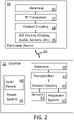
- FIG. 2 presents a schematic diagram of an illustrative electronic device 18 in communication, over a wireless communications link 20, with an illustrative satellite 22.
- electronic device 18 may include one or more antennas 30.
- Antennas 30 may include monopoles, dipoles, and/or other types of antenna elements.
- Antennas 30 may, for example, include loop antennas, helical antennas, patch antennas, inverted-F antennas, Yagi antennas, slot antennas, horn antennas, cavity antennas, dish antennas, arrays of antennas (e.g., a phased antenna array that supports beam steering operations), or other suitable antennas.
- Radio-frequency transceiver circuitry 32 may include radio-frequency receiver circuitry and/or radio-frequency transmitter circuitry that allows electronic device 18 to transmit and/or receive wireless signals over wireless communications link 20 using one or more antennas 30.
- Electronic device 18 may also include control circuitry 34 and input-output devices 36.
- Control circuitry 34 may include storage, such as solid-state drives, random-access memory, and/or hard disk drives and other volatile and/or nonvolatile memory.
- Control circuitry 34 may also include one or more microcontrollers, microprocessors, digital signal processors, communications circuits with processors, application specific integrated circuits, programmable logic devices, field programmable gate arrays, and/or other processing circuitry. During operation, control circuitry 34 may run code (instructions) that is stored in the storage of control circuitry 34 to implement desired functions for electronic device 18.
- Control circuitry 34 may use input-output devices 36 to supply output to an interface configured to render output perceivable by a user and/or to external equipment, and may gather input received from a user and/or external source(s).
- Input-output devices 36 may include displays configured to present images, audio devices (e.g., speakers and/or microphones), sensors, controls, and other components.
- input-output devices 36 may include user input devices such as one or more buttons, touch screens, sensors (e.g., accelerometers and/or gyroscopes), microphones for gathering voice commands, and/or other components for gathering input from a user.
- input-output devices 36 may include speakers, light-emitting components, displays, vibrators and/or other haptic output devices, and other equipment for supplying a user with output.
- Input-output devices 36 may include sensors such as force sensors, position sensors, gyroscopes, magnetic sensors, accelerometers, capacitive touch sensors, proximity sensors, ambient light sensors, temperature sensors, moisture sensors, gas sensors, pressure sensors, and other sensors for gathering information representative of the environment in which electronic device 18 is located.
- a satellite such as satellite 22, may include one or more antennas 40.
- Antennas 40 may be based on any suitable type(s) of antenna elements (e.g., antenna elements such as monopoles or dipoles, loop antennas, helical antennas, patch antennas, inverted-F antennas, Yagi antennas, slot antennas, horn antennas, cavity antennas, etc.).
- Antennas 40 may be used in any suitable type(s) of antenna arrays (e.g., phased antenna arrays, fixed direct radiating arrays, deployable direct radiating antenna arrays, space fed arrays, reflector fed arrays, etc.).
- the antennas 40 can be implemented such that they are suitable for communication with one or more electronic devices 18, gateways 14, or other communication devices/nodes using one or more satellite communications bands.
- Satellite 22 may include transceiver circuitry that is communicatively coupled (directly or indirectly) to antennas 40.
- the transceiver circuitry may include one or more components, such as one or more transponders 42 for receiving uplink signals and transmitting downlink signals, e.g., over links 20.
- control circuitry 44 may be used to control the operation of satellite 22.
- Control circuitry 44 may include storage and/or processing circuits of the type used in control circuitry 34.
- Power may be supplied to satellite 22 from power system 46.
- Power system 46 may include one or more solar panels 48 (or arrays of solar panels) for converting energy from the sun into electrical power.
- Power system 46 may include power regulator circuitry and batteries for storing electrical power generated by solar panels 48, and for distributing power to the components of satellite 22.
- Control circuitry 44 may receive information from one or more sensors 50. Further, control circuitry 44 may receive commands from NOC 16 and, using information from one or more sensors and/or received commands, may perform maintenance and/or control operations (e.g., software updates, operations related to the deployment and operation of solar panels 48, diagnostic routines, altitude adjustments and other orbital adjustments using propulsion system 52, etc.).
- maintenance and/or control operations e.g., software updates, operations related to the deployment and operation of solar panels 48, diagnostic routines, altitude adjustments and other orbital adjustments using propulsion system 52, etc.
- Sensors 50 may include light-based sensors (e.g., infrared cameras, visible light cameras, etc.), lidar, radar, sensors that measure backscattered light and/or backscattered radio-frequency signals, temperature sensors, radiation sensors, accelerometers, gyroscopes, magnetic sensors, spectrometers, and/or other sensors. Sensors 50 may be used in performing remote sensing operations, fault detection, satellite positioning, and other operations.
- the constellation of satellites 22 in system 10 includes satellites with different types of orbits.
- satellites 22 may include orbits with different altitudes, eccentricities, inclinations, and other orbital attributes.
- One or more sun synchronous satellites (or a satellite in a sun synchronous orbit) are included in the constellation of satellites 22 in system 10.
- the one or more sun synchronous satellites are configured to help meet demand (e.g., as measured in throughput, the number of simultaneous connections, or other such measures) during a high-demand period, such as during an afternoon or evening period.
- demand e.g., as measured in throughput, the number of simultaneous connections, or other such measures
- FIG. 3 is a diagram of two illustrative satellite orbits (geocentric orbits) about the Earth 12. Satellites 22 may orbit in a circular orbit as shown by illustrative circular orbit 56 or in an elliptic orbit such as elliptic orbit 58. Two or more of satellites 22 in the satellite constellation of system 10 have a circular orbit. A circular orbit is characterized by an eccentricity of 0. An elliptical orbit has an eccentricity of greater than 0.
- a satellite in a circular orbit may be characterized by an orbital altitude A, as shown in FIG. 3 .
- Satellites 22 may orbit at any altitude suitable for their intended purpose.
- a satellite 22 may orbit Earth 12 in low earth orbit (e.g., at an altitude A of 500-1500 km), in geosynchronous orbit (at an altitude A of approximately 35,800 km), or in medium earth orbit (e.g., between low earth orbit and geosynchronous orbit).
- medium earth orbits include semi-synchronous orbits and Molniya orbits.
- Semi-synchronous orbits have an altitude of about 20,000 km and are characterized by an orbital period of half of one sidereal day.
- a Molniya orbit has an eccentricity of greater than zero and a perigree location in the Southern Hemisphere so a satellite in this type of orbit will spend most of its orbital time above the Northern Hemisphere or vice versa.
- a Tundra orbit is an elliptical orbit (with an eccentricity greater than zero) that has twice the orbital period of a Molniya orbit.
- Other elliptical orbits may be used, if desired (e.g., orbits with eccentricities of at least 0.3, at least 0.5, at least 0.7, less than 0.8, etc.).
- Two or more satellites 22 in the satellite constellation of system 10 have an inclined circular orbit (a circular orbit out of the equatorial plane).
- satellite 22 of FIG. 4 In the diagram of FIG. 4 , satellite 22 is orbiting about Earth 12 in satellite orbital plane SP. Plane SP is inclined at inclination (inclination angle) I with respect to equatorial plane EP, which is a plane that is aligned with the Earth's equator.
- Polar orbits (sometimes referred to as nearly polar orbits) are orbits that pass over the north and south poles and are therefore characterized by inclinations of about 90° (e.g., at least 85°, at least 88°, at least 89°, 90°, less than 90°, or other suitable polar orbit inclination).
- Sun synchronous orbits are polar orbits (near polar orbits) that pass the equator (or other given latitude) at the same local time each day.
- the altitude and inclination of a sun synchronous orbit are such that the nodal regression rate matches the Earth orbit rate.
- a sun synchronous satellite will pass overhead at the same time of day each day. Because satellites with sun synchronous orbits are available to handle communications traffic at the same local time each day, the inclusion of one or more sun synchronous satellites in the satellite constellation of system 10 may help the satellite constellation to efficiently meet peak traffic demands.
- each type of orbit that is included in the satellite constellation of system 10 may help augment the performance of the constellation in a different way.
- an elliptic orbit such as Molniya or Tundra orbit may be used to provide capacity to a user population center at a particular longitude and/or latitude (or range(s) thereof) in the Northern or Southern Hemisphere (e.g., a population center in Europe, North America, Australia, or Asia).
- sun synchronous orbits may be used to provide capacity that is concentrated on one or more high-demand times of day (e.g., mornings or evenings).
- Inclined circular orbits may be used to provide coverage over a desired range of latitudes.
- Low-earth orbits may help reduce latency (e.g., for traffic that involves voice telephone calls and other latency-sensitive traffic) and may help reduce transmit and receive powers.
- Medium-earth orbits and geosynchronous orbits may help increase coverage, reducing the total number of satellites needed to service a given region and may be well suited to broadcast-type traffic (e.g., media distribution services such as television services, music services, etc.).
- the satellite constellation may effectively serve the user population concentrations at these two latitudes by including at least a first set of satellites with a 55° orbital inclination and a second set of satellites with a 48° orbital inclination.
- One or more additional sets of (one or more) satellites with different respective orbital inclinations may be included, if desired (e.g., one or more additional sets, two or more additional sets, 2-5 additional sets, 3-10 additional sets, etc., with each set including one or more satellites).
- the satellite constellation of system 10 may include one or more sun synchronous satellites 22 to accommodate peaks in traffic (e.g., as measured by throughput, number of simultaneous connections, etc.) at one or more high-demand times of day.
- the communications services provided by the satellite constellation of system 10 may experience significant variations in demand throughout the day.
- the services provided by system 10 may include, for example, any/all of voice and video calling services, data services, and media distribution services (television, audio, etc.).
- demand is low (see, e.g., low demand period 84 of curve 80 of FIG. 5 ).
- demand for communications tends to rise.
- Data traffic can increase, and possibly peak, in the evening hours, e.g., as users returning home from work begin to watch television, communicate, access social media, and consume other media/content.
- peak 82 of curve 80 for example, demand for communications services may increase (and possibly peak) between about 5 PM and 10 PM in the evening.
- the satellite constellation of system 10 includes one or more sun synchronous satellites that pass over a particular latitude or range of latitudes (e.g., Northern Hemisphere latitudes) during a period of relatively higher demand, e.g., the 5PM to 10PM traffic peak.
- a particular latitude or range of latitudes e.g., Northern Hemisphere latitudes
- a first set of sun synchronous satellites 22 may be used to provide additional coverage during a period of increased demand, e.g., at about 5PM, and may pass overhead at the time of the increased demand, e.g., 5PM, each day.
- a period of increased demand e.g., at about 5PM
- one or more additional sets of sun synchronous satellites can be included in the constellation.
- a second set of sun synchronous satellites 22, which can be located in a different sun synchronous orbital plane than the first set of sun synchronous satellites 22, may be used to provide additional coverage during another period of increased demand, e.g., occurring at around 7PM, and may pass overhead at the time of the increased demand, e.g., 7PM, each day.
- Additional sets of sun synchronous satellites, e.g., each in a respective different sun synchronous orbital plane may be used to address increased demand at other times, such as 8PM, 9PM, and/or 10PM (as examples).
- the number of sets of one or more sun synchronous satellites included in the constellation can be selected to correspond to the periods and/or durations of increased demands in one or more regions serviced by the constellation.
- the sun synchronous orbital planes may have a near polar inclination (e.g., 97.6° or other suitable inclination) and may have an altitude of approximately 550 km (e.g., more than 500 km, less than 600 km, or other suitable altitude).
- There may be any suitable number of satellites 22 orbiting within each of these six sun synchronous orbital planes e.g., 3-10 satellites per plane, up to 50 satellites per plane, more than 25 satellites per plane, fewer than 100 satellites per plane, etc.).
- the sun synchronous orbital planes may have a different inclination and/or altitude. Further, the inclination and/or altitude can differ between the sets of satellites in the sun synchronous orbital planes.
- sun synchronous satellites may, for example, handle increased (e.g., peak) traffic T2
- other satellites in the constellation e.g., low earth orbiting satellites with a series of different orbital inclinations (e.g., orbital inclinations of less than 70°, less than 65°, etc.) may be used to handle traffic T1.
- one or more geostationary satellites e.g., geostationary satellites with inclined orbits
- medium earth orbit satellites, and/or satellites with elliptical orbits may be included in the constellation to handle traffic that is concentrated at particular geographic locations (e.g., particular longitudes and latitudes, such as the eastern part of North America, etc.).
- sets of satellites in sun synchronous orbits e.g., sun synchronous orbits aligned with one or more increased (e.g., peak) traffic time periods during the day
- sets of satellites with geosynchronous orbits e.g., sets of satellites with medium earth orbits (e.g., circular and/or elliptical) may satisfy traffic demands effectively without requiring excessive satellites resources (e.g., resources that would remain idle at other periods of the day).
- each group of satellites 22 that share a common orbit may include any suitable number N of satellites 22.
- N may be 1-100, 10-1000, 10-10,000, 20-500, at least 10, at least 50, at least 100, at least 200, fewer than 10,000, fewer than 1000, fewer than 500, fewer than 100, or other suitable number.
- the number of satellites 22 that share a common orbit may be adjusted over time.
- Satellites 22 in the constellation of satellites may have the same types of antenna arrays (with the same types of antenna elements), may have different types of antennas (e.g., one type of antenna array may be used for low earth orbit satellites, another type of antenna array may be used for sun synchronous satellites, and another type of antenna array may be used for geosynchronous satellites), may have different types of power systems (e.g., different power sources, different numbers of solar panels per satellite, etc.), or may have a common type of power system (e.g., a power system that has the same type and number of solar panels, etc.), may have different satellite buses or may share a common satellite bus architecture, may have different propulsion systems, may share a common type of propulsion system, etc.
- power systems e.g., different power sources, different numbers of solar panels per satellite, etc.
- a common type of power system e.g., a power system that has the same type and number of solar panels, etc.
- the satellites in the satellite constellation of system 10 are communications satellites (e.g., satellites that handle voice and data traffic, audio and/or video media broadcasts such as broadcasts of television traffic, and/or that handle other suitable types of communications traffic).
- communications satellites e.g., satellites that handle voice and data traffic, audio and/or video media broadcasts such as broadcasts of television traffic, and/or that handle other suitable types of communications traffic.
- Different sets of satellites may have different eccentricities, altitudes (e.g., different circular orbit altitudes), inclinations, and/or other different orbital attributes.
- one, two, three, four, or five or more sets of satellites may have circular low earth orbits with different respective inclinations (e.g., inclinations of 0-80°, 10-60°, 30-60°, more than 30° less than 80°, less than 60°, less than 70°, or other suitable inclinations) and one, two, three, four, or five or more of these orbits may have altitudes that are under a given altitude, whereas one or more additional sets of satellites may have altitudes that are greater than the given altitude.
- one or more of these additional sets of satellites may be geosynchronous and one or more of these additional sets of satellites may be characterized by medium earth orbits.
- One or more sets of satellites with one or more different respective elliptic orbits may be included in the satellite constellation, if desired.
- Sets (groups) of satellites with sun synchronous orbits are included to help accommodate one or more daily peaks in traffic.
Landscapes
- Engineering & Computer Science (AREA)
- Physics & Mathematics (AREA)
- Astronomy & Astrophysics (AREA)
- Aviation & Aerospace Engineering (AREA)
- General Physics & Mathematics (AREA)
- Computer Networks & Wireless Communication (AREA)
- Signal Processing (AREA)
- Computing Systems (AREA)
- Remote Sensing (AREA)
- Radio Relay Systems (AREA)
Claims (12)
- Satellitenkonstellation, umfassend:einen ersten Satz von Kommunikationssatelliten (22), wobei jeder der Kommunikationssatelliten (22) in dem ersten Satz von Kommunikationssatelliten eine geneigte kreisförmige Umlaufbahn (56) ist, die eine erste Neigung (I) aufweist;einen zweiten Satz von Kommunikationssatelliten (22), wobei jeder der Kommunikationssatelliten (22) in dem zweiten Satz von Kommunikationssatelliten (22) eine geneigte kreisförmige Umlaufbahn (56) ist, die eine zweite Neigung (I) aufweist, die sich von der ersten Neigung unterscheidet; und gekennzeichnet durch:
einen dritten Satz von Kommunikationssatelliten (22), die sonnensynchrone Umlaufbahnen aufweisen, wobei der dritte Satz von Satelliten (22), die sonnensynchrone Umlaufbahnen aufweisen, konfiguriert ist, um eine Kommunikationskapazität an eine geographische Region während einer vorbestimmten Tageszeit bereitzustellen. - Satellitenkonstellation nach Anspruch 1, wobei die vorbestimmte Tageszeit einen Tageslichtzeitraum umfasst.
- Satellitenkonstellation nach Anspruch 1, wobei die vorbestimmte Tageszeit einen Zeitraum nach Einbruch der Dunkelheit umfasst.
- Satellitenkonstellation nach Anspruch 1, wobei die vorbestimmte Tageszeit eine Tageszeit mit hoher Nachfrage umfasst.
- Satellitenkonstellation nach Anspruch 1, wobei die Kommunikationssatelliten (22) in dem ersten Satz von Kommunikationssatelliten durch erdnahe Umlaufbahnen gekennzeichnet sind.
- Satellitenkonstellation nach Anspruch 5, wobei die Kommunikationssatelliten (22) in dem zweiten Satz von Kommunikationssatelliten durch erdnahe Umlaufbahnen gekennzeichnet sind.
- Satellitenkonstellation nach Anspruch 6, wobei der Kommunikationssatellit (22) in dem dritten Satz von Kommunikationssatelliten durch erdnahe Umlaufbahnen gekennzeichnet sind.
- Satellitenkonstellation nach Anspruch 7, ferner umfassend einen vierten Satz von Kommunikationssatelliten (22), die mittlere Erdumlaufbahnen aufweisen.
- Satellitenkonstellation nach Anspruch 7, ferner umfassend einen vierten Satz von Kommunikationssatelliten (22), die geneigte geosynchrone Umlaufbahnen aufweisen.
- Satellitenkonstellation nach Anspruch 1, wobei der erste Satz von Kommunikationssatelliten (22) umfasst:eine erste Gruppe von einem oder mehreren Satelliten mit erdnaher Umlaufbahn mit einer ersten Umlaufhöhe; undeine zweite Gruppe von einem oder mehreren Satelliten mit erdnaher Umlaufbahn mit einer zweiten Umlaufhöhe, die sich von der ersten Umlaufhöhe unterscheidet.
- Satellitenkonstellation nach Anspruch 10, wobei der dritte Satz von Kommunikationssatelliten (22), die sonnensynchrone Umlaufbahnen aufweisen, umfasst:eine erste Gruppe von Kommunikationssatelliten, die sich in einer ersten sonnensynchronen Umlaufebene in der Umlaufbahn bewegen; undeine zweite Gruppe von Kommunikationssatelliten, die sich in einer zweiten sonnensynchronen Umlaufebene in der Umlaufbahn bewegen, die sich von der ersten sonnensynchronen Umlaufebene unterscheidet.
- Satellitenkonstellation nach Anspruch 11, wobei zu einer bestimmten Tageszeit die erste Gruppe von Kommunikationssatelliten (22) in der ersten sonnensynchronen Umlaufebene eine unterschiedliche geographische Abdeckung als die zweite Gruppe von Kommunikationssatelliten in der zweiten sonnensynchronen Umlaufebene bereitstellt.
Applications Claiming Priority (3)
| Application Number | Priority Date | Filing Date | Title |
|---|---|---|---|
| US201762489383P | 2017-04-24 | 2017-04-24 | |
| US15/672,158 US10807740B2 (en) | 2017-04-24 | 2017-08-08 | Sun synchronous orbit |
| PCT/US2018/026722 WO2018200180A1 (en) | 2017-04-24 | 2018-04-09 | Sun synchronous orbit |
Publications (2)
| Publication Number | Publication Date |
|---|---|
| EP3616334A1 EP3616334A1 (de) | 2020-03-04 |
| EP3616334B1 true EP3616334B1 (de) | 2023-03-22 |
Family
ID=63852663
Family Applications (1)
| Application Number | Title | Priority Date | Filing Date |
|---|---|---|---|
| EP18721551.2A Active EP3616334B1 (de) | 2017-04-24 | 2018-04-09 | Sonnensynchrone umlaufbahn |
Country Status (4)
| Country | Link |
|---|---|
| US (2) | US10807740B2 (de) |
| EP (1) | EP3616334B1 (de) |
| CN (2) | CN114826382B (de) |
| WO (1) | WO2018200180A1 (de) |
Families Citing this family (7)
| Publication number | Priority date | Publication date | Assignee | Title |
|---|---|---|---|---|
| US20210391921A1 (en) * | 2018-10-08 | 2021-12-16 | Azuries Space Mission Studios Ltd | Satellite systems and methods for providing communications |
| WO2021107051A1 (ja) | 2019-11-28 | 2021-06-03 | 三菱電機株式会社 | 宇宙交通管理システム、宇宙交通管理装置、衛星事業装置、衛星コンステレーション事業装置、メガコンステレーション事業装置、ロケット打ち上げ事業装置、デブリ除去事業装置、宇宙状況監視事業装置、危険回避支援事業装置、宇宙保険事業装置、衛星事業装置、宇宙情報レコーダー、危険警報装置、危険解析装置、危険回避行動支援装置、セキュリティー装置、宇宙情報レコーダー、端末、携帯端末、宇宙交通管理ポータルおよび危険警報ツール |
| JP7228057B2 (ja) * | 2019-11-28 | 2023-02-22 | 三菱電機株式会社 | 宇宙交通管理システム、宇宙交通管理装置、メガコンステレーション衛星事業装置、コンステレーション衛星事業装置、衛星事業装置、および、宇宙情報レコーダー |
| US11411638B2 (en) * | 2020-02-13 | 2022-08-09 | Ast & Science, Llc | AI power management system for effective duty cycle for space constellations |
| WO2021193411A1 (ja) * | 2020-03-26 | 2021-09-30 | 三菱電機株式会社 | 衛星コンステレーション形成システム、メガコンステレーション事業装置、衛星コンステレーション、衛星、および地上設備 |
| US20220135255A1 (en) * | 2020-11-03 | 2022-05-05 | Raytheon Company | Space surveillance orbit |
| US20240118377A1 (en) * | 2022-10-11 | 2024-04-11 | Charter Communications Operating, Llc | Determination of communication device location in a wireless network |
Family Cites Families (31)
| Publication number | Priority date | Publication date | Assignee | Title |
|---|---|---|---|---|
| IT1261940B (it) * | 1993-09-24 | 1996-06-04 | Alenia Spazio Spa | Sistema per telecomunicazioni e telerilevamento via satellite basato sull'uso di orbite eliosincrone ellittiche di breve periodo. |
| US5666648A (en) * | 1993-11-09 | 1997-09-09 | Leo One Ip, L.L.C. | Polar relay system for satellite communication |
| US5589834A (en) * | 1994-04-22 | 1996-12-31 | Stanford Telecommunications, Inc. | Cost effective geosynchronous mobile satellite communication system |
| CA2201470A1 (en) | 1994-10-12 | 1996-04-25 | James R. Stuart | Optimal coverage satellite system for a low earth orbit store-and-forward telecommunication network |
| US5619211A (en) * | 1994-11-17 | 1997-04-08 | Motorola, Inc. | Position locating and communication system using multiple satellite constellations |
| WO1997018128A1 (en) | 1995-11-13 | 1997-05-22 | Iridium, Ip Llc | Applications of sun-synchronous satellite orbits to communications satellites |
| US5887257A (en) | 1996-12-05 | 1999-03-23 | Motorola, Inc. | Hybrid constellation satellite comunication systems and methods with efficient signaling and control |
| US6011951A (en) * | 1997-08-22 | 2000-01-04 | Teledesic Llc | Technique for sharing radio frequency spectrum in multiple satellite communication systems |
| US6678520B1 (en) * | 1999-01-07 | 2004-01-13 | Hughes Electronics Corporation | Method and apparatus for providing wideband services using medium and low earth orbit satellites |
| US6327523B2 (en) | 1999-01-21 | 2001-12-04 | Hughes Electronics Corporation | Overhead system of inclined eccentric geosynchronous orbitting satellites |
| CN1119876C (zh) * | 1999-03-31 | 2003-08-27 | 电子科技大学 | 一种综合卫星通信系统 |
| US7120139B1 (en) | 1999-12-30 | 2006-10-10 | At&T Corp. | Broadband cable telephony network architecture IP ITN network architecture reference model |
| US6519773B1 (en) | 2000-02-08 | 2003-02-11 | Sherjil Ahmed | Method and apparatus for a digitized CATV network for bundled services |
| US6731613B1 (en) * | 2000-06-14 | 2004-05-04 | Motorola, Inc. | Power management using a bandwidth control mechanism |
| US6714521B2 (en) * | 2000-12-29 | 2004-03-30 | Space Resources International Ltd. | System and method for implementing a constellation of non-geostationary satellites that provides simplified satellite tracking |
| US7255308B1 (en) * | 2004-03-23 | 2007-08-14 | Northrop Grumman Corporation | Solar dominated satellite constellations capable of having repeating common ground tracks |
| US20090161797A1 (en) | 2007-06-08 | 2009-06-25 | Cowles Philip R | Satellite detection of automatic identification system signals |
| EP2273692B1 (de) * | 2009-07-06 | 2016-08-31 | Airbus Defence and Space SAS | Virtuelle Polarsatellitenbodenstation für Erdbeobachtungssatelliten mit niedriger Umlaufbahn basierend auf einem geostationären Satelliten mit einer über einem Erdpol ausgerichteten Antenne |
| US8800932B2 (en) | 2010-07-26 | 2014-08-12 | Lockheed Martin Corporation | Medium earth orbit constellation with simple satellite network topology |
| US8930048B1 (en) * | 2011-04-14 | 2015-01-06 | The Boeing Company | Enhanced compound steering law for general low thrust mission |
| FR2976750B1 (fr) * | 2011-06-16 | 2013-07-19 | Astrium Sas | Charge utile de satellite repeteur, systeme et procede de telecommunications par satellite. |
| ITTO20121117A1 (it) * | 2012-12-20 | 2014-06-21 | Thales Alenia Space Italia S P A C On Unico Socio | Innovativo design orbitale per missioni spaziali di osservazione della terra |
| WO2016069077A1 (en) | 2014-08-03 | 2016-05-06 | Hughes Network Systems, Llc | Centralized ground-based route determination and traffic engineering for software defined satellite communications networks |
| US9647749B2 (en) * | 2014-09-30 | 2017-05-09 | Google Inc. | Satellite constellation |
| CN104743141B (zh) * | 2015-04-03 | 2017-01-18 | 上海微小卫星工程中心 | 一种采用卫星星座的高速航空器定位方法 |
| EP3311195A4 (de) * | 2015-06-16 | 2018-09-12 | King Abdulaziz City for Science and Technology | Systeme und verfahren zur fernerkundung der erde aus dem weltraum |
| US10177837B2 (en) | 2015-06-17 | 2019-01-08 | Hughes Network Systems, Llc | Approaches for high speed global packet data services for LEO/MEO satellite systems |
| CA2927217A1 (en) * | 2016-04-14 | 2017-10-14 | Telesat Canada | Dual leo satellite system and method for global coverage |
| US20170373754A1 (en) * | 2016-06-27 | 2017-12-28 | Espacesynergy | System and method for communicating with deep space spacecraft using spaced based communications system |
| CN106202837B (zh) * | 2016-08-26 | 2019-07-12 | 哈尔滨工业大学深圳研究生院 | 一种基于无人机辅助覆盖的小卫星星座遥感系统模型的方法 |
| FR3064856B1 (fr) * | 2017-04-04 | 2020-03-20 | Thales | Procede de communication spatiale pour des services iot et systemes spatial de telecommunications correspondant |
-
2017
- 2017-08-08 US US15/672,158 patent/US10807740B2/en active Active
-
2018
- 2018-04-09 CN CN202210462013.5A patent/CN114826382B/zh active Active
- 2018-04-09 CN CN201880026680.0A patent/CN110754049B/zh active Active
- 2018-04-09 EP EP18721551.2A patent/EP3616334B1/de active Active
- 2018-04-09 WO PCT/US2018/026722 patent/WO2018200180A1/en not_active Ceased
-
2020
- 2020-10-15 US US17/071,756 patent/US12515818B2/en active Active
Also Published As
| Publication number | Publication date |
|---|---|
| CN110754049A (zh) | 2020-02-04 |
| US20180305042A1 (en) | 2018-10-25 |
| EP3616334A1 (de) | 2020-03-04 |
| WO2018200180A1 (en) | 2018-11-01 |
| US12515818B2 (en) | 2026-01-06 |
| CN114826382A (zh) | 2022-07-29 |
| US10807740B2 (en) | 2020-10-20 |
| CN114826382B (zh) | 2024-03-22 |
| CN110754049B (zh) | 2022-05-13 |
| US20210086917A1 (en) | 2021-03-25 |
Similar Documents
| Publication | Publication Date | Title |
|---|---|---|
| US12199739B2 (en) | Satellite constellation having multiple orbital inclinations | |
| US12515818B2 (en) | Sun synchronous orbit | |
| US12512905B2 (en) | Broadband satellite terminal | |
| CA2841393C (fr) | Systeme de communication par satellite, un satellite leo relayant des communications entre un satellite geo et des stations terrestres, les liaisons montantes et descendantes utilisant la meme bande de frequences et le multiplexage temporel | |
| US9941967B2 (en) | Satellite laser communications relay network | |
| US12296987B2 (en) | Methods and systems for deploying satellite constellations | |
| US12308884B1 (en) | Satellite system with networked gateways | |
| Benson | Design options for small satellite communications | |
| Windred | EAST and other applications for future European telecommunications |
Legal Events
| Date | Code | Title | Description |
|---|---|---|---|
| STAA | Information on the status of an ep patent application or granted ep patent |
Free format text: STATUS: UNKNOWN |
|
| STAA | Information on the status of an ep patent application or granted ep patent |
Free format text: STATUS: THE INTERNATIONAL PUBLICATION HAS BEEN MADE |
|
| PUAI | Public reference made under article 153(3) epc to a published international application that has entered the european phase |
Free format text: ORIGINAL CODE: 0009012 |
|
| STAA | Information on the status of an ep patent application or granted ep patent |
Free format text: STATUS: REQUEST FOR EXAMINATION WAS MADE |
|
| 17P | Request for examination filed |
Effective date: 20191104 |
|
| AK | Designated contracting states |
Kind code of ref document: A1 Designated state(s): AL AT BE BG CH CY CZ DE DK EE ES FI FR GB GR HR HU IE IS IT LI LT LU LV MC MK MT NL NO PL PT RO RS SE SI SK SM TR |
|
| AX | Request for extension of the european patent |
Extension state: BA ME |
|
| DAV | Request for validation of the european patent (deleted) | ||
| DAX | Request for extension of the european patent (deleted) | ||
| STAA | Information on the status of an ep patent application or granted ep patent |
Free format text: STATUS: EXAMINATION IS IN PROGRESS |
|
| 17Q | First examination report despatched |
Effective date: 20210507 |
|
| GRAP | Despatch of communication of intention to grant a patent |
Free format text: ORIGINAL CODE: EPIDOSNIGR1 |
|
| STAA | Information on the status of an ep patent application or granted ep patent |
Free format text: STATUS: GRANT OF PATENT IS INTENDED |
|
| INTG | Intention to grant announced |
Effective date: 20221019 |
|
| GRAS | Grant fee paid |
Free format text: ORIGINAL CODE: EPIDOSNIGR3 |
|
| GRAA | (expected) grant |
Free format text: ORIGINAL CODE: 0009210 |
|
| STAA | Information on the status of an ep patent application or granted ep patent |
Free format text: STATUS: THE PATENT HAS BEEN GRANTED |
|
| AK | Designated contracting states |
Kind code of ref document: B1 Designated state(s): AL AT BE BG CH CY CZ DE DK EE ES FI FR GB GR HR HU IE IS IT LI LT LU LV MC MK MT NL NO PL PT RO RS SE SI SK SM TR |
|
| REG | Reference to a national code |
Ref country code: GB Ref legal event code: FG4D |
|
| REG | Reference to a national code |
Ref country code: CH Ref legal event code: EP |
|
| REG | Reference to a national code |
Ref country code: IE Ref legal event code: FG4D |
|
| REG | Reference to a national code |
Ref country code: DE Ref legal event code: R096 Ref document number: 602018047471 Country of ref document: DE |
|
| REG | Reference to a national code |
Ref country code: AT Ref legal event code: REF Ref document number: 1555899 Country of ref document: AT Kind code of ref document: T Effective date: 20230415 |
|
| REG | Reference to a national code |
Ref country code: LT Ref legal event code: MG9D |
|
| REG | Reference to a national code |
Ref country code: NL Ref legal event code: MP Effective date: 20230322 |
|
| PG25 | Lapsed in a contracting state [announced via postgrant information from national office to epo] |
Ref country code: RS Free format text: LAPSE BECAUSE OF FAILURE TO SUBMIT A TRANSLATION OF THE DESCRIPTION OR TO PAY THE FEE WITHIN THE PRESCRIBED TIME-LIMIT Effective date: 20230322 Ref country code: NO Free format text: LAPSE BECAUSE OF FAILURE TO SUBMIT A TRANSLATION OF THE DESCRIPTION OR TO PAY THE FEE WITHIN THE PRESCRIBED TIME-LIMIT Effective date: 20230622 Ref country code: LV Free format text: LAPSE BECAUSE OF FAILURE TO SUBMIT A TRANSLATION OF THE DESCRIPTION OR TO PAY THE FEE WITHIN THE PRESCRIBED TIME-LIMIT Effective date: 20230322 Ref country code: LT Free format text: LAPSE BECAUSE OF FAILURE TO SUBMIT A TRANSLATION OF THE DESCRIPTION OR TO PAY THE FEE WITHIN THE PRESCRIBED TIME-LIMIT Effective date: 20230322 Ref country code: HR Free format text: LAPSE BECAUSE OF FAILURE TO SUBMIT A TRANSLATION OF THE DESCRIPTION OR TO PAY THE FEE WITHIN THE PRESCRIBED TIME-LIMIT Effective date: 20230322 |
|
| REG | Reference to a national code |
Ref country code: AT Ref legal event code: MK05 Ref document number: 1555899 Country of ref document: AT Kind code of ref document: T Effective date: 20230322 |
|
| PG25 | Lapsed in a contracting state [announced via postgrant information from national office to epo] |
Ref country code: SE Free format text: LAPSE BECAUSE OF FAILURE TO SUBMIT A TRANSLATION OF THE DESCRIPTION OR TO PAY THE FEE WITHIN THE PRESCRIBED TIME-LIMIT Effective date: 20230322 Ref country code: NL Free format text: LAPSE BECAUSE OF FAILURE TO SUBMIT A TRANSLATION OF THE DESCRIPTION OR TO PAY THE FEE WITHIN THE PRESCRIBED TIME-LIMIT Effective date: 20230322 Ref country code: GR Free format text: LAPSE BECAUSE OF FAILURE TO SUBMIT A TRANSLATION OF THE DESCRIPTION OR TO PAY THE FEE WITHIN THE PRESCRIBED TIME-LIMIT Effective date: 20230623 Ref country code: FI Free format text: LAPSE BECAUSE OF FAILURE TO SUBMIT A TRANSLATION OF THE DESCRIPTION OR TO PAY THE FEE WITHIN THE PRESCRIBED TIME-LIMIT Effective date: 20230322 |
|
| PG25 | Lapsed in a contracting state [announced via postgrant information from national office to epo] |
Ref country code: SM Free format text: LAPSE BECAUSE OF FAILURE TO SUBMIT A TRANSLATION OF THE DESCRIPTION OR TO PAY THE FEE WITHIN THE PRESCRIBED TIME-LIMIT Effective date: 20230322 Ref country code: RO Free format text: LAPSE BECAUSE OF FAILURE TO SUBMIT A TRANSLATION OF THE DESCRIPTION OR TO PAY THE FEE WITHIN THE PRESCRIBED TIME-LIMIT Effective date: 20230322 Ref country code: PT Free format text: LAPSE BECAUSE OF FAILURE TO SUBMIT A TRANSLATION OF THE DESCRIPTION OR TO PAY THE FEE WITHIN THE PRESCRIBED TIME-LIMIT Effective date: 20230724 Ref country code: ES Free format text: LAPSE BECAUSE OF FAILURE TO SUBMIT A TRANSLATION OF THE DESCRIPTION OR TO PAY THE FEE WITHIN THE PRESCRIBED TIME-LIMIT Effective date: 20230322 Ref country code: EE Free format text: LAPSE BECAUSE OF FAILURE TO SUBMIT A TRANSLATION OF THE DESCRIPTION OR TO PAY THE FEE WITHIN THE PRESCRIBED TIME-LIMIT Effective date: 20230322 Ref country code: AT Free format text: LAPSE BECAUSE OF FAILURE TO SUBMIT A TRANSLATION OF THE DESCRIPTION OR TO PAY THE FEE WITHIN THE PRESCRIBED TIME-LIMIT Effective date: 20230322 |
|
| PG25 | Lapsed in a contracting state [announced via postgrant information from national office to epo] |
Ref country code: SK Free format text: LAPSE BECAUSE OF FAILURE TO SUBMIT A TRANSLATION OF THE DESCRIPTION OR TO PAY THE FEE WITHIN THE PRESCRIBED TIME-LIMIT Effective date: 20230322 Ref country code: PL Free format text: LAPSE BECAUSE OF FAILURE TO SUBMIT A TRANSLATION OF THE DESCRIPTION OR TO PAY THE FEE WITHIN THE PRESCRIBED TIME-LIMIT Effective date: 20230322 Ref country code: IS Free format text: LAPSE BECAUSE OF FAILURE TO SUBMIT A TRANSLATION OF THE DESCRIPTION OR TO PAY THE FEE WITHIN THE PRESCRIBED TIME-LIMIT Effective date: 20230722 |
|
| REG | Reference to a national code |
Ref country code: CH Ref legal event code: PL |
|
| PG25 | Lapsed in a contracting state [announced via postgrant information from national office to epo] |
Ref country code: LU Free format text: LAPSE BECAUSE OF NON-PAYMENT OF DUE FEES Effective date: 20230409 |
|
| REG | Reference to a national code |
Ref country code: DE Ref legal event code: R097 Ref document number: 602018047471 Country of ref document: DE |
|
| PG25 | Lapsed in a contracting state [announced via postgrant information from national office to epo] |
Ref country code: MC Free format text: LAPSE BECAUSE OF FAILURE TO SUBMIT A TRANSLATION OF THE DESCRIPTION OR TO PAY THE FEE WITHIN THE PRESCRIBED TIME-LIMIT Effective date: 20230322 |
|
| PLBE | No opposition filed within time limit |
Free format text: ORIGINAL CODE: 0009261 |
|
| STAA | Information on the status of an ep patent application or granted ep patent |
Free format text: STATUS: NO OPPOSITION FILED WITHIN TIME LIMIT |
|
| PG25 | Lapsed in a contracting state [announced via postgrant information from national office to epo] |
Ref country code: SI Free format text: LAPSE BECAUSE OF FAILURE TO SUBMIT A TRANSLATION OF THE DESCRIPTION OR TO PAY THE FEE WITHIN THE PRESCRIBED TIME-LIMIT Effective date: 20230322 Ref country code: MC Free format text: LAPSE BECAUSE OF FAILURE TO SUBMIT A TRANSLATION OF THE DESCRIPTION OR TO PAY THE FEE WITHIN THE PRESCRIBED TIME-LIMIT Effective date: 20230322 Ref country code: LI Free format text: LAPSE BECAUSE OF NON-PAYMENT OF DUE FEES Effective date: 20230430 Ref country code: DK Free format text: LAPSE BECAUSE OF FAILURE TO SUBMIT A TRANSLATION OF THE DESCRIPTION OR TO PAY THE FEE WITHIN THE PRESCRIBED TIME-LIMIT Effective date: 20230322 Ref country code: CZ Free format text: LAPSE BECAUSE OF FAILURE TO SUBMIT A TRANSLATION OF THE DESCRIPTION OR TO PAY THE FEE WITHIN THE PRESCRIBED TIME-LIMIT Effective date: 20230322 Ref country code: CH Free format text: LAPSE BECAUSE OF NON-PAYMENT OF DUE FEES Effective date: 20230430 |
|
| REG | Reference to a national code |
Ref country code: IE Ref legal event code: MM4A |
|
| 26N | No opposition filed |
Effective date: 20240102 |
|
| PG25 | Lapsed in a contracting state [announced via postgrant information from national office to epo] |
Ref country code: IE Free format text: LAPSE BECAUSE OF NON-PAYMENT OF DUE FEES Effective date: 20230409 |
|
| PG25 | Lapsed in a contracting state [announced via postgrant information from national office to epo] |
Ref country code: IE Free format text: LAPSE BECAUSE OF NON-PAYMENT OF DUE FEES Effective date: 20230409 |
|
| PG25 | Lapsed in a contracting state [announced via postgrant information from national office to epo] |
Ref country code: IT Free format text: LAPSE BECAUSE OF FAILURE TO SUBMIT A TRANSLATION OF THE DESCRIPTION OR TO PAY THE FEE WITHIN THE PRESCRIBED TIME-LIMIT Effective date: 20230322 |
|
| PG25 | Lapsed in a contracting state [announced via postgrant information from national office to epo] |
Ref country code: BG Free format text: LAPSE BECAUSE OF FAILURE TO SUBMIT A TRANSLATION OF THE DESCRIPTION OR TO PAY THE FEE WITHIN THE PRESCRIBED TIME-LIMIT Effective date: 20230322 |
|
| PG25 | Lapsed in a contracting state [announced via postgrant information from national office to epo] |
Ref country code: BG Free format text: LAPSE BECAUSE OF FAILURE TO SUBMIT A TRANSLATION OF THE DESCRIPTION OR TO PAY THE FEE WITHIN THE PRESCRIBED TIME-LIMIT Effective date: 20230322 |
|
| PGFP | Annual fee paid to national office [announced via postgrant information from national office to epo] |
Ref country code: DE Payment date: 20250424 Year of fee payment: 8 |
|
| PGFP | Annual fee paid to national office [announced via postgrant information from national office to epo] |
Ref country code: BE Payment date: 20250422 Year of fee payment: 8 |
|
| PGFP | Annual fee paid to national office [announced via postgrant information from national office to epo] |
Ref country code: FR Payment date: 20250422 Year of fee payment: 8 |
|
| PG25 | Lapsed in a contracting state [announced via postgrant information from national office to epo] |
Ref country code: CY Free format text: LAPSE BECAUSE OF FAILURE TO SUBMIT A TRANSLATION OF THE DESCRIPTION OR TO PAY THE FEE WITHIN THE PRESCRIBED TIME-LIMIT; INVALID AB INITIO Effective date: 20180409 |
|
| PG25 | Lapsed in a contracting state [announced via postgrant information from national office to epo] |
Ref country code: HU Free format text: LAPSE BECAUSE OF FAILURE TO SUBMIT A TRANSLATION OF THE DESCRIPTION OR TO PAY THE FEE WITHIN THE PRESCRIBED TIME-LIMIT; INVALID AB INITIO Effective date: 20180409 |
|
| PG25 | Lapsed in a contracting state [announced via postgrant information from national office to epo] |
Ref country code: TR Free format text: LAPSE BECAUSE OF FAILURE TO SUBMIT A TRANSLATION OF THE DESCRIPTION OR TO PAY THE FEE WITHIN THE PRESCRIBED TIME-LIMIT Effective date: 20230322 |
|
| PGFP | Annual fee paid to national office [announced via postgrant information from national office to epo] |
Ref country code: GB Payment date: 20260217 Year of fee payment: 9 |