EP3609630B1 - Verfahren zur sammlung und verarbeitung von glas - Google Patents
Verfahren zur sammlung und verarbeitung von glas Download PDFInfo
- Publication number
- EP3609630B1 EP3609630B1 EP18719666.2A EP18719666A EP3609630B1 EP 3609630 B1 EP3609630 B1 EP 3609630B1 EP 18719666 A EP18719666 A EP 18719666A EP 3609630 B1 EP3609630 B1 EP 3609630B1
- Authority
- EP
- European Patent Office
- Prior art keywords
- glass
- collection
- truck
- machine
- paths
- Prior art date
- Legal status (The legal status is an assumption and is not a legal conclusion. Google has not performed a legal analysis and makes no representation as to the accuracy of the status listed.)
- Active
Links
Images


Classifications
-
- G—PHYSICS
- G06—COMPUTING OR CALCULATING; COUNTING
- G06Q—INFORMATION AND COMMUNICATION TECHNOLOGY [ICT] SPECIALLY ADAPTED FOR ADMINISTRATIVE, COMMERCIAL, FINANCIAL, MANAGERIAL OR SUPERVISORY PURPOSES; SYSTEMS OR METHODS SPECIALLY ADAPTED FOR ADMINISTRATIVE, COMMERCIAL, FINANCIAL, MANAGERIAL OR SUPERVISORY PURPOSES, NOT OTHERWISE PROVIDED FOR
- G06Q10/00—Administration; Management
- G06Q10/08—Logistics, e.g. warehousing, loading or distribution; Inventory or stock management
-
- B—PERFORMING OPERATIONS; TRANSPORTING
- B09—DISPOSAL OF SOLID WASTE; RECLAMATION OF CONTAMINATED SOIL
- B09B—DISPOSAL OF SOLID WASTE NOT OTHERWISE PROVIDED FOR
- B09B3/00—Destroying solid waste or transforming solid waste into something useful or harmless
- B09B3/30—Destroying solid waste or transforming solid waste into something useful or harmless involving mechanical treatment
- B09B3/35—Shredding, crushing or cutting
-
- B—PERFORMING OPERATIONS; TRANSPORTING
- B65—CONVEYING; PACKING; STORING; HANDLING THIN OR FILAMENTARY MATERIAL
- B65F—GATHERING OR REMOVAL OF DOMESTIC OR LIKE REFUSE
- B65F1/00—Refuse receptacles; Accessories therefor
-
- B—PERFORMING OPERATIONS; TRANSPORTING
- B65—CONVEYING; PACKING; STORING; HANDLING THIN OR FILAMENTARY MATERIAL
- B65F—GATHERING OR REMOVAL OF DOMESTIC OR LIKE REFUSE
- B65F1/00—Refuse receptacles; Accessories therefor
- B65F1/14—Other constructional features; Accessories
-
- G—PHYSICS
- G01—MEASURING; TESTING
- G01G—WEIGHING
- G01G19/00—Weighing apparatus or methods adapted for special purposes not provided for in the preceding groups
- G01G19/02—Weighing apparatus or methods adapted for special purposes not provided for in the preceding groups for weighing wheeled or rolling bodies, e.g. vehicles
- G01G19/021—Weighing apparatus or methods adapted for special purposes not provided for in the preceding groups for weighing wheeled or rolling bodies, e.g. vehicles having electrical weight-sensitive devices
-
- G—PHYSICS
- G06—COMPUTING OR CALCULATING; COUNTING
- G06Q—INFORMATION AND COMMUNICATION TECHNOLOGY [ICT] SPECIALLY ADAPTED FOR ADMINISTRATIVE, COMMERCIAL, FINANCIAL, MANAGERIAL OR SUPERVISORY PURPOSES; SYSTEMS OR METHODS SPECIALLY ADAPTED FOR ADMINISTRATIVE, COMMERCIAL, FINANCIAL, MANAGERIAL OR SUPERVISORY PURPOSES, NOT OTHERWISE PROVIDED FOR
- G06Q10/00—Administration; Management
- G06Q10/10—Office automation; Time management
-
- G—PHYSICS
- G06—COMPUTING OR CALCULATING; COUNTING
- G06Q—INFORMATION AND COMMUNICATION TECHNOLOGY [ICT] SPECIALLY ADAPTED FOR ADMINISTRATIVE, COMMERCIAL, FINANCIAL, MANAGERIAL OR SUPERVISORY PURPOSES; SYSTEMS OR METHODS SPECIALLY ADAPTED FOR ADMINISTRATIVE, COMMERCIAL, FINANCIAL, MANAGERIAL OR SUPERVISORY PURPOSES, NOT OTHERWISE PROVIDED FOR
- G06Q10/00—Administration; Management
- G06Q10/30—Administration of product recycling or disposal
-
- G—PHYSICS
- G06—COMPUTING OR CALCULATING; COUNTING
- G06Q—INFORMATION AND COMMUNICATION TECHNOLOGY [ICT] SPECIALLY ADAPTED FOR ADMINISTRATIVE, COMMERCIAL, FINANCIAL, MANAGERIAL OR SUPERVISORY PURPOSES; SYSTEMS OR METHODS SPECIALLY ADAPTED FOR ADMINISTRATIVE, COMMERCIAL, FINANCIAL, MANAGERIAL OR SUPERVISORY PURPOSES, NOT OTHERWISE PROVIDED FOR
- G06Q50/00—Information and communication technology [ICT] specially adapted for implementation of business processes of specific business sectors, e.g. utilities or tourism
- G06Q50/10—Services
- G06Q50/26—Government or public services
-
- B—PERFORMING OPERATIONS; TRANSPORTING
- B65—CONVEYING; PACKING; STORING; HANDLING THIN OR FILAMENTARY MATERIAL
- B65F—GATHERING OR REMOVAL OF DOMESTIC OR LIKE REFUSE
- B65F2210/00—Equipment of refuse receptacles
- B65F2210/128—Data transmitting means
-
- B—PERFORMING OPERATIONS; TRANSPORTING
- B65—CONVEYING; PACKING; STORING; HANDLING THIN OR FILAMENTARY MATERIAL
- B65F—GATHERING OR REMOVAL OF DOMESTIC OR LIKE REFUSE
- B65F2210/00—Equipment of refuse receptacles
- B65F2210/144—Level detecting means
-
- B—PERFORMING OPERATIONS; TRANSPORTING
- B65—CONVEYING; PACKING; STORING; HANDLING THIN OR FILAMENTARY MATERIAL
- B65F—GATHERING OR REMOVAL OF DOMESTIC OR LIKE REFUSE
- B65F2210/00—Equipment of refuse receptacles
- B65F2210/168—Sensing means
-
- B—PERFORMING OPERATIONS; TRANSPORTING
- B65—CONVEYING; PACKING; STORING; HANDLING THIN OR FILAMENTARY MATERIAL
- B65F—GATHERING OR REMOVAL OF DOMESTIC OR LIKE REFUSE
- B65F2210/00—Equipment of refuse receptacles
- B65F2210/184—Weighing means
-
- B—PERFORMING OPERATIONS; TRANSPORTING
- B65—CONVEYING; PACKING; STORING; HANDLING THIN OR FILAMENTARY MATERIAL
- B65F—GATHERING OR REMOVAL OF DOMESTIC OR LIKE REFUSE
- B65F2240/00—Types of refuse collected
- B65F2240/112—Bottles
- B65F2240/1123—Glass
-
- Y—GENERAL TAGGING OF NEW TECHNOLOGICAL DEVELOPMENTS; GENERAL TAGGING OF CROSS-SECTIONAL TECHNOLOGIES SPANNING OVER SEVERAL SECTIONS OF THE IPC; TECHNICAL SUBJECTS COVERED BY FORMER USPC CROSS-REFERENCE ART COLLECTIONS [XRACs] AND DIGESTS
- Y02—TECHNOLOGIES OR APPLICATIONS FOR MITIGATION OR ADAPTATION AGAINST CLIMATE CHANGE
- Y02W—CLIMATE CHANGE MITIGATION TECHNOLOGIES RELATED TO WASTEWATER TREATMENT OR WASTE MANAGEMENT
- Y02W30/00—Technologies for solid waste management
- Y02W30/50—Reuse, recycling or recovery technologies
- Y02W30/60—Glass recycling
-
- Y—GENERAL TAGGING OF NEW TECHNOLOGICAL DEVELOPMENTS; GENERAL TAGGING OF CROSS-SECTIONAL TECHNOLOGIES SPANNING OVER SEVERAL SECTIONS OF THE IPC; TECHNICAL SUBJECTS COVERED BY FORMER USPC CROSS-REFERENCE ART COLLECTIONS [XRACs] AND DIGESTS
- Y02—TECHNOLOGIES OR APPLICATIONS FOR MITIGATION OR ADAPTATION AGAINST CLIMATE CHANGE
- Y02W—CLIMATE CHANGE MITIGATION TECHNOLOGIES RELATED TO WASTEWATER TREATMENT OR WASTE MANAGEMENT
- Y02W90/00—Enabling technologies or technologies with a potential or indirect contribution to greenhouse gas [GHG] emissions mitigation
Definitions
- the present invention pertains to the field of techniques for recycling waste through the collection and processing of glass, in particular it refers to procedures for the collection and processing of hollow glass such as bottles, containers or packages, in general made of glass.
- glass collection it is intended the set of strategies and methods aimed to recover glass from waste, so as to reuse it rather than dispose of it in dumps.
- Drinking bottles were for the first time recycled with reimbursable deposit by some beverage producers in Great Britain and Ireland around 1800 - in particular the famous brand Schweppes.
- An official recycling system with reimbursable deposits for bottles and cans was established in Sweden in 1884.
- the object of the present invention is to provide a method for the volumetric reduction of glass packages obtained by means of the use of a dedicated glass crusher machine, first of all for uses of the HORECA sector, where glass packaging is most used, in order to then be distributed in ecological disposal areas, condominiums, hospitals, ships,...
- a further object of the present invention is to provide a method with an apparatus that has reduced bulk and is provided with directional wheels. Its appearance is subjected to numerous versions and/or variants that configure multiple applications thereof; in the current case, the machine will be contained, entirely and/or in part, in pre-molded forms of various type, for example depicting bottles of various type, demijohns and/or similar products such to allow the use thereof in public places.
- Such versions are provided with multiple containers mounted on a "carousel" so as to allow more space for the glass storage, and a remote control for management of the machine, connected to a SIM, will notify the collection station so that it provides, over time, for the replacement of the full trash containers.
- the problem is analyzed relative to the transmission of geolocation data of a plurality of client units active in the recycling system, in which it is provided that the detections are automatically collected by a central server. These are then retransmitted as geolocation data towards a further plurality of client units (i.e. the trucks charged with the collection), upon reception by the central server unit of a proximity map - with relative paths - of the sites at which the collection of glass is carried out.
- a trip requires a time unit (e.g. 10 minutes) on each road segment and more than one trip on each road segment can be carried out in each time unit; a weight is then established corresponding to the times necessary for the path to be followed: the verification that is usually required is to establish if it is possible to transfer any one good from the junction 1 of the network to the junction 4, within a certain number of time units.
- a time unit e.g. 10 minutes
- a network is termed minimum if the route for connecting all the junctions has the smallest possible length. Once a set of points is fixed in the plane, a network that connects them is any one graph that contains those points among its junctions.
- the object of the invention is also that of establishing the techniques for being able to minimize such paths - that each truck in charge of the collection must follow - and then find the so-called minimum travel based on a series of predetermined characteristics. Among these characteristics, the possibility of following optimized paths for the collection of glass with particular characteristics (color, grain size, ...) must be underlined.
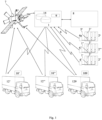
- a computer network system and architecture is overall reported which is based on a machine 2 for crushing glass that is connected online, since it is provided with a SIM 4 card for communications over public telephone network 6; also the trucks 12 for the collection are connected online, such trucks being followed through satellite detection 7.
- the machine 2 is equipped with sensors 5 connected to an electronic circuit board which, with dedicated detectors, count the bottles ground in each bucket 3.
- An "App” is configured for providing all the information through a remote device.
- the remote control of management of the machine 2 is connected to the SIM 4, which notifies the collection station 1 so that it provides for the substitution of the full trash containers 3 in time.
- the apparatus 2 is provided with an automatic starting control with activation through a sensor placed on the bottle insertion door.
- the machine is provided with a screen that determines the maximum grain size that one wishes to obtain from the glass grinding, and this simplifies the processing of sand. Said screen is divided into three sections mounted on hinges openable by the same primary user, in order to facilitate the maintenance and cleaning thereof. It can in fact happen that an incorrect grinding leads to a blocking of the hammers, the unblocking occurring through the opening of the screen, which allows the exit of stuck material and the restoration of the operation.
- An inverter manages the operation of the motor in opposite sense, upon command, so as to allow a more facilitated control of the machine.
- the machine 2 depending on the version and on the field of use for which it is intended, has an optical reader that recognizes the color of glass introduced and aims the ground glass into different containers 3 i through a "carousel" device lying beneath the grinding chamber. The differentiation by color gives added value to the product which has various applications on the market, and has its greatest application in ecological disposal areas, in medium-large size companies and/or plants.
- the machine 2 is provided with a system of load cells 3 which determine the weight of processed glass (25 Kg as by law), automatically blocking the introduction of new glass cases while awaiting the substitution of the collection bucket.
- the machine 2 has on the buckets 3, made of transparent PVC, a calibration system per Kg of product; the bucket is identified with a bar code ID that attributes the origin thereto.
- the control center 1 knows the amounts of glass processed by each single user, and this allows administrators to better determine the attribution of the costs for management of the separate disposal collection and of the award aspects connected thereto, also creating the bases for market analysis aimed to implement the use of glass.
- the apparatus is situated on trucks 12 dedicated for road collection, and the operator - once the vehicle is stopped - is capable, through slits situated on the perimeter faces of the means, of proceeding with the volumetric reduction of the collected glass packages by making a manual and/or automatic selection by color.
- Said means has, depending on the size thereof, a zone dedicated to the emptying, into the tank, of the buckets 3 coming from the door-to-door collection.
- Such means 12 due in fact to their versatility and to the type of material transported, contribute to lowering the acoustic pollution caused by current compactors.
- the glass sand thus collected is sent to a dedicated plant 8 where it is subjected to the abovementioned screening and cleaning treatments. It should be stated that currently such plants do not exist in Italy, since the few plants that produce glass sand use discard material obtained from the preprocessing of the glass fractions in the authorized platforms; such discards also contain variable percentages of porcelain and crystal, and such sand is micronized through grinding mills which determine a single maximum grain size for the reuse in glassworks.
- the originality of the described finding lies in the different grain size that, upstream of each industrial process, is obtained from using the apparatus, and such grain size diversity ensures that in the industrial separation treatment thereof screens are applied with the size that one wishes to obtain in order to direct the product to different application fields and, depending on their specificity, they can be further treated with washing and/or thermal systems such to lower the COD level well below the reference parameters, until a product is obtained that is entirely free of bacteriological agents.
- the sand is unloaded at the company 8, by the trucks 12, on a vibrating belt that, at low speed, brings the material into a hopper; this preloading step serves to visually check the contents of the unloaded bucket in order to verify that bodies extraneous to the collection are not found at its interior, and in case of detection of material extraneous to glass it is possible to trace back to the waste producer through the bar code reported on the bucket.
- the material through conveyor belts, is sent to ferrous and non-ferrous material selectors, it traverses a vibrating fluid bed with hot air induction and suction-depulverization system such to eliminate the residual moisture and the paper parts of the labels, and subsequently the material is brought into a vibrating-sieve with different sections, where the selection of the desired grain sizes occurs.
- the subsequent step is that of treating the already-separated material in order to lower the COD, said step executed by washing if the material does not require particular attention and/or with thermal treatment, through a calcination device that by adjusting the temperature up to 700 degrees ensures that the final product is free of bacteria.
- the subsequent step is that of packaging the sand, which can be placed on the market in big bags and/or sacks of various piece size.
- the apparatus due in fact to its ductility characteristics, can be have wide circulation both in the HORECA sector and in the private sector, by the operator assigned for collection who can even possess the Italian B driving license since the collection, above all in large city centers, can be made with medium-capacity trucks 12, even and above all ecological vehicles, and in such a manner the operators are increased, the size and relative pollution due to the use of heavy vehicles is decreased, the acoustic pollution due to the glass spilling as currently conceived is eliminated, the times for the glass collection are extended since the minimum bulk of the buckets allows a stacking thereof at the place of production.
- the problem relative to the transmission of the geolocation data of a plurality of glass collection points 2 i is resolved, since starting from these the detections are automatically collected by the central server 1 and are then retransmitted as geolocation data towards a further plurality of trucks 12 i , with medium capacity, at the time of reception by the central server unit 1 of a given update request for the filling of the single cells 3 of the apparatuses 2.
- the control center 1 periodically sends a screen in 9/13 inch format (since this is the most widespread video format) to the single trucks 12 in order to update them regarding the distribution of glass to be collected throughout the territory.
- the central server 1 accomplishes the task of automatically transmitting said information regarding the filling of the baskets towards the display arranged on the truck or on the smartphone - by means of App - possessed by the driver.
- the request of transmission of geolocation data of a plurality of apparatuses 2 i and relative collection baskets 3 m is executed.
- the step of transmission request is automatically generated by the central server unit 1, with the retransmission of said geolocation data, on the map 10, towards a plurality of viewers upon reception by the central server unit of update data for the proximity map 10 regarding the sites at which the collection is operated.
- the system is seen as an infrastructure comprising:
- the central system 1 is capable of accounting for the filling level of the single bucket 3', 3"...3 m , so as to establish the priority emptying of the same.
- all the network architecture operates on a system of queues 9. In particular, it is based on a queue base foreground 20 - background 21 as reported in figure 2 .
- the queue foreground 20 has priority over that of background 21, in which the unloading is inserted that must be carried out when it has a specific glass characteristic, to be detected. In other words, that the processes of unloading of the queue background 21 are only attended to if the queue foreground 20 is empty.
- the queue 20 of the level 1 corresponds with the queue foreground and has the maximum priority of being attended to. Then there are other processes that fall within other queues of lower priority, as reported in figure 3 , receiving a subordinate priority.
- the first priority queue 20 is that which produces a path that favors the sites in which the generic cell 3 is filled.
- the established path considers the specific requests of the single recipient plant 8, which may need a certain type of glass (e.g. from the standpoint of the grain size 21', and/or of the color 21"%) and not other types.
- the trucks 12, based on availability of a series of full cells, first access only those sites 2 i at which it is certain that crushed glass of such type can be detected.
- the IDs of the machines 2 at which the cells 3 in charge of the green glass collection are filled (or are about to be filled) will be moved in the queue foreground.
- the priority it is even possible to move into the queue background those cell IDs which - even if full - at the moment are not of the requested color.
- the machine 2 is provided with a system of load cells 3 which determine the weight of processed glass (25 Kg as by law), automatically blocking the introduction of new glass cases while awaiting the substitution of the collection bucket.
- the communication by means of public telephone network 6 of the weight/number of bottles, in each cell 3 of the apparatus 2, ensures that the control center 1 has instantaneous knowledge of the glass loaded in each cell 3 1 , 3 2 ,.. 3 p of each machine 2 distributed throughout the territory.
- the GPS detection of the current position of the truck 12 1 , 12 2 ...12 q ensures that an optimal path can be generated based on the most recent requests coming from the plant 8 that requires a single supply with a particular glass.
- a further possibility of management of the different priority types is provided by a multiple list organization of the type reported in fig. 4 , which can be accessed through a secondary key - e.g. glass color.
- a secondary key e.g. glass color.
- the first column of the table 30 there are the weights of the single cells, in the second column the number of cells associated with a certain weight of the cell, the table 32 coming to represent the primary archive.
- the three color types XXX, YYY, ZZZ are also reported, with the relative pointers at the head of the list.
- the idea is to bind together in a concatenate list all the recordings that have the same as the secondary key.
- different types of compound queries can be effectively and immediately satisfied; for example: how many Kg of white glass are currently available and which are the sites where they can be loaded?
- the glass collection management and control server 1 operates by also accounting for, in real time, the pick-ups made of glassy material at the very moment when the loading occurs from the single cell 3 to the truck 12.
- weight sensors 5 are provided that are located both at each bucket 3 - at each section of the collection machine 2, a weight sensor 5 is provided - and on board the truck 12 charged for the collection.
- the central system 1 records, in a computer mode - simultaneously - a decrease of weight in the set of collection baskets 3 i and simultaneously an increase ⁇ p of the load on the truck 12.
- one or more SIM 4 at the collection site 2 are connected to a device for detecting the weights of the single baskets 3, or the number of bottles, which have been inserted in the single containment apparatus/basket 2, 3.
- a data bank 14 of the various users and of the relative containers/buckets 2, 3 stores, in real time, how much glass has been loaded in each bucket 3. A picture is therefore available regarding the distribution of the glass loads over a specific territory.
- the baskets are unloaded and then the weight sensors 5 are themselves set to detect the emptying and to communicate it to the central system 1.
- a system for detecting the weights is also present on the truck 12 (e.g. through a device which evaluates the different degree of damping of the oscillations, by the shock absorbers, due to the increased/decreased load).
- the truck 12 e.g. through a device which evaluates the different degree of damping of the oscillations, by the shock absorbers, due to the increased/decreased load.
- the same central server 1 supplies a graph regarding the paths to be followed for the glass loading, it is important that the human factor also be considered, so that each time a certain graph is configured it is the same driver of the truck 12 who inserts an indication of the path he/she prefers at that moment, notwithstanding the existence of an "objective" classification based on the information regarding the filling of the baskets 3 compiled by the central server 1.
- the driver of the truck 12 himself/herself takes care to select - from among the various locations - those which are most convenient beyond the classification enacted by the central server 1. In this manner, he/she manages a geographic map 10 of interest, with the sites of easiest access highlighted. In substance, he/she could for example discard a site 2 with the maximum filling of the baskets 3 i and consider a lower-priority site in the classification for his/her own present grounds (momentary inaccessibility, car accident, parade/protest, municipal street cleaning and refusal disposal vehicle or truck... traffic therefore being slowed).
- the user is capable of creating a map or a physical geographic map 10 as desired, starting from classifications recommended through the information regarding the filling of the baskets 3, and he/she can thus modify, as desired, the same geographic map 10 on the screen. It is important that such path on the map 10 - and the relative variations - be transmitted in real time to the server 1 in order to prevent that two trucks simultaneously go towards the same site 2.
- each driver receives a map 10 with pre-established paths.
- the same driver then has ample freedom in the selection, such driver in any case having an essential role in the manipulation of the different indicators regarding the emptying of the collection baskets 3 at each crushing apparatus 1. It is thus preferred to maintain a small level of automation in order to have the possibility for driver intervention, in a flexible manner.
- the present invention provides for a small degree of automation and the possibility that this type of evaluation is executed directly at the client.
- an essential principle of the invention is that of referring to a limited degree of automation in the use of the application SW which would provide the described optimized path to be followed.
- dedicated displays / maps are made.
- the map be constituted by a semi-transparent upper paper layer.
- the geographic map of the sites is reported thereon, and below such upper layer a matrix is provided of micro-LEDs which are illuminated in relation to the path already completed by the motor vehicle.
- An App is capable of providing information in order to be able to define an optimized route which is illuminated and which the driver can follow.
- the results of the summation of the information regarding the filling of the baskets 3, at the sites 2 where the glass of a given color is found, are in turn indicated on the map itself with blinking lights, in turn controlled by the App itself.
- a series of business enterprises (or more in general entities) that fall within a particular program for the management of the information regarding the filling of the baskets 3 with glass of a given color, or of a given grain size, are indicated on the map device with LED illumination, as is moreover already known for various cartographic services provided on the web.
- the message regarding the availability of sites where to find glass of a specific color is dynamically provided. In fact, for example if the glass load of a given color has already been unloaded at a particular site, this is indicated by means of a blinking light activity in real time, based on the information regarding the filling of the recorded baskets.
- the described machine allows the operator to reduce the processed volumes down to a tenth, and to store them by means of PVC containers with 25 Kg capacity up to collection.
- the product fields to which the various grain sizes will be dedicated, in the various types of thermal processing and otherwise, will be the following: construction, paints, water filtering, bricolage, production of embankment-saving sacks, production of sand, as a non-limiting example for beach nourishment, thus avoiding harmful dredging works and/or quarrying works.
- the glass remains confined within a closed bucket up to its emptying at the specifically dedicated processing site, in order to underline that this system ensures that the glass doe not undergo contamination, as currently occurs.
- the factory processing of glass, its reuse in channels other than that of the foundry ensure that high-quality secondary raw material can be created, contributing to the making of a virtuous and ethical induced activity for the entire supply chain.
- the advantageous solutions provided for the problems related to the glass transportation networks are evident, in relation to the delays that occur based on the travel route selection.
- the definition of a minimum network each time, based on the selections made by the user can be acquired in real time by providing a route for connecting the sites with the machines 2 i with the smallest possible length.
- the finding is capable of establishing techniques for being able to minimize the paths and thus find the so-called minimum travel based on any one series of predetermined characteristics.
Landscapes
- Business, Economics & Management (AREA)
- Engineering & Computer Science (AREA)
- Human Resources & Organizations (AREA)
- Economics (AREA)
- General Physics & Mathematics (AREA)
- Tourism & Hospitality (AREA)
- Strategic Management (AREA)
- Physics & Mathematics (AREA)
- General Business, Economics & Management (AREA)
- Theoretical Computer Science (AREA)
- Entrepreneurship & Innovation (AREA)
- Marketing (AREA)
- Operations Research (AREA)
- Quality & Reliability (AREA)
- Mechanical Engineering (AREA)
- Development Economics (AREA)
- Environmental & Geological Engineering (AREA)
- Life Sciences & Earth Sciences (AREA)
- Sustainable Development (AREA)
- Primary Health Care (AREA)
- Educational Administration (AREA)
- General Health & Medical Sciences (AREA)
- Data Mining & Analysis (AREA)
- Health & Medical Sciences (AREA)
- Management, Administration, Business Operations System, And Electronic Commerce (AREA)
- Processing Of Solid Wastes (AREA)
- Control Of Position, Course, Altitude, Or Attitude Of Moving Bodies (AREA)
- Automobile Manufacture Line, Endless Track Vehicle, Trailer (AREA)
- Refuse Collection And Transfer (AREA)
Claims (8)
- Verfahren zum Verwalten von virtualisierten Zugriffswarteschlangen und Pfaden zu mehreren Maschinen (2', 2", ... 2n) zum Zerkleinern und Sammeln von Glas, die über das Gebiet verteilt sind, dadurch gekennzeichnet, dass es Anfragen zum Entladen von vollen Behältern (3) verwaltet, die in jeder Maschine enthalten sind, verwaltet, basierend auf der Konfiguration von:einem ersten Teil, bestehend aus der einzelnen Maschine (2', 2", ... 2n), die eine lokale Steuerung durchführt an den ZellenBehältern (3), Behälter für zerkleinertes Glas;einem zweiten Teil auf einem zentralen Server (1), der die Warteschlangenverwaltung (9) fernsteuert durch Eingeben einer Zellen-ID in die Warteschlangen voller Zellen und/oder in den Warteschlangen von Zellen mit Glas mit besonderen Anforderungen, basierend auf vorgegebenen Auswahlkriterien;einem dritten Teil, der der Anlage (8) entspricht, die das von der Sammlung kommende Glas verwendet, um es zu verarbeiten;einem vierten Teil, der aus der Flotte von Lastwagen oder Transportfahrzeugen (12', 12" ... 12q) besteht, die für die die für die Sammlung zuständig sind und die einem bestimmten Pfad bei der Sammlung, der durch die Datenbank (14), die sich auf dem zentralen Server (1) befindet, vorgeschlagen wird, folgen;wobei der zentrale Server (1) in der Lage ist, den Füllstand des einzelnen Kübels (3', 3" ... 3m) auf jeder Maschine (2', 2" ... 2n) in Echtzeit zu erfassen und zu speichern. um einen Prioritätsentleerungsvorgang hiervon mittels einer dynamischen Vordergrund-Hintergrund-Mehrfachschlangen-Steuerung (9) zu errichten,wobei das Verfahren die folgenden Arbeitsschritte aufweist:a- die Steuerungszentrale (1) überwacht dieI- Verfügbarkeit von zerkleinertem Glas an den einzelnen Maschinen (2', 2", ... 2n), undII- Nachfrage nach Glas eines bestimmten Typs durch jede Produktionsanlage (8);b- wenn eine Entleerungsanforderung von einer Maschine (2', 2", ... 2n) eintrifft, in der eine oder mehr Glaseinhegungszellen (3) befüllt wurden, bearbeitet die Steuerungszentrale (1) aktualisierte Pfade - für die Flotte von Lastwagen oder Fahrzeugen (12', 12" ... 12q) - zum Entladen aus der Maschine/Zelle (3) auf den Lastwagen (12) basierend auf Kriterien für einen minimale Fahrt und/oder basierend auf Kontingentanfragen von jeder Produktionsanlage (8) neu;c- nach dem Entleeren jeder in der Maschine (2', 2", ... 2n) vorhandenen Zelle (3) wird eine Aktualisierung der Gewichte des Glasinhalts jedes Behälters auf den Lastwagen (12', 12" ... 12q) durchgeführt;d- bei Erreichen eines gegebenen Gewichts auf dem Lastwagen (12) für eine oder mehr Glasarten mit bestimmten Anforderungen wird die Lieferung an die Anlage (8), die von der obigen Glasart betroffen ist, durchgeführt.
- Verfahren zum Verwalten von virtualisierten Zugriffswarteschlangen und Pfaden zu mehreren Maschinen (2', 2", ... 2n) zum Zerkleinern und Sammeln von Glas, die über das Gebiet verteilt sind, gemäß Anspruch 1, dadurch gekennzeichnet, dass die Maschinen (2', 2", ... 2n), die bereits auf dem Gebiet verteilt sind, mit unterschiedlichen Korngrößen des zerkleinerten Glases arbeiten, um das Produkt entsprechend ihrer Spezifizität an verschiedene Anwendungsbereiche der Anlage (8) zu leiten.
- Verfahren zum Verwalten von virtualisierten Zugriffswarteschlangen und Pfaden zu mehreren Maschinen (2', 2", ... 2n) zum Zerkleinern und Sammeln von Glas, die über das Gebiet verteilt sind, gemäß Anspruch 1, dadurch gekennzeichnet, dass die Maschinen (2', 2", ... 2n), die über das Gebiet verteilt sind, entsprechend der Farbe des zu zerkleinernden Glases mit unterschiedlichen Auswahlen arbeiten, so dass das Verfahren beim industriellen Verarbeiten des Glases zur Herstellung von Produkten in den verschiedenen Anwendungsbereichen abhängig von der Farbe des Glases arbeitet.
- Verfahren zum Verwalten von virtualisierten Zugriffswarteschlangen und Pfaden zu mehreren Maschinen (2', 2", ... 2n) zum Zerkleinern und Sammeln von Glas, die über das Gebiet verteilt sind, gemäß jedem der vorhergehenden Ansprüche, dadurch gekennzeichnet, dass es auf der Grundlage einer umfassenden Übertragung von Informationen über das Befüllen der Zellen (3) in jeder Maschine (2', 2" ... 2n) arbeitet, wobei der zentrale Server (1) automatisch Informationen betreffend die Befüllung der Zellen (3', 3" ... 3m) an jedes Display-System, das sich auf dem Lastwagen oder auf dem Smartphone des Fahrers, der für die Sammlung zuständig ist, befindet, übermittelt.
- Verfahren zum Verwalten von virtualisierten Zugriffswarteschlangen und Pfaden zu mehreren Maschinen (2', 2", ... 2n) zum Zerkleinern und Sammeln von Glas, die über das Gebiet verteilt sind, gemäß jedem der vorhergehenden Ansprüche, dadurch gekennzeichnet, dass das Steuerungs- und Verwaltungssystem (1) zur Glassammlung durchgeführt wird, und zwar unter Berücksichtigung auch der abgeschlossenen Sammlung des Glasmaterials in dem Moment, in dem das Verladen von der einzelnen Zelle (3) auf den Lastwagen (12) durch bereitstellen von Gewichtssensoren (5), die an jeder Zelle (3) angeordnet sind, in Echtzeit erfolgt, mit der Verladung von Glas auf den Lastwagen, wobei der zentrale Server (1) im Computer-Modus gleichzeitig eine Gewichtsabnahme in dem Sammelzellensatz (3i) und gleichzeitig eine Zunahme Δp der Glasladung auf dem Lastwagen (12) aufzeichnet.
- Verfahren zum Verwalten von virtualisierten Zugriffswarteschlangen und Pfaden zu mehreren Maschinen (2', 2", ... 2n) zum Zerkleinern und Sammeln von Glas, die über das Gebiet verteilt sind, gemäß jedem der vorhergehenden Ansprüche, dadurch gekennzeichnet, dass, wenn der Lastwagen (12) auf die Maschine (2) zugreift,a. die Zellen (3) entladen werden, dannb. die Gewichtssensoren (5) das Entleeren detektieren, undc. die relevanten digitalen Informationen über ein öffentliches Telefonnetz (6) an den zentralen Server (1) übermittelt werden.
- Verfahren zum Verwalten von virtualisierten Zugriffswarteschlangen und Pfaden zu mehreren Maschinen (2', 2", ... 2n) zum Zerkleinern und Sammeln von Glas, die über das Gebiet verteilt sind, gemäß jedem der vorhergehenden Ansprüche, dadurch gekennzeichnet, dass es eine oder mehrere SIM (4) an der Sammelstelle (2) verwendet, die mit der Einrichtung zum Ermitteln der Glasgewichte der einzelnen Zellen (3) oder der Anzahl von Flaschen, die in die/den einzelne(n) Einhegungsvorrichtung/Korb (2, 3) gegeben sind, verbunden ist, wobei auf dem zentralen Server (1) eine Datenbank (14) der verschiedenen Nutzer und ihrer jeweiligen Behälter/Kübel (2, 3), die die Daten betreffend die in jeder Zelle (3i) geladene Glasmenge in Echtzeit speichert.
- Verfahren zum Verwalten von virtualisierten Zugriffswarteschlangen und Pfaden zu mehreren Maschinen (2', 2", ... 2n) zum Zerkleinern und Sammeln von Glas, die über das Gebiet verteilt sind, gemäß jedem der vorhergehenden Ansprüche, dadurch gekennzeichnet, dass die Gewichte auch auf dem Lastwagen (12) ermittelt werden, und zwar mittels Erfassungseinrichtungen, die den unterschiedlichen Grad der Dämpfung der Schwingungen des Motorfahrzeugs (12) durch die Stoßdämpfer aufgrund von erhöhter/verringerter Last auswerten, und daher zum einen in der Lage ist:- das tatsächliche Entladen des Glasinhalts der Zelle (3) auf dem Lastwagen (12) zu überprüfen;- und gleichzeitig das Entladen von dem Lastwagen (12) zu einem Endempfänger (8) des zu liefernden Produkts zu überwachen.
Applications Claiming Priority (2)
| Application Number | Priority Date | Filing Date | Title |
|---|---|---|---|
| IT102017000040821A IT201700040821A1 (it) | 2017-04-12 | 2017-04-12 | Sistema e metodo di raccolta e lavorazione del vetro. |
| PCT/IB2018/052492 WO2018189668A1 (en) | 2017-04-12 | 2018-04-10 | System and method for collecting and processing glass |
Publications (3)
| Publication Number | Publication Date |
|---|---|
| EP3609630A1 EP3609630A1 (de) | 2020-02-19 |
| EP3609630B1 true EP3609630B1 (de) | 2024-05-29 |
| EP3609630C0 EP3609630C0 (de) | 2024-05-29 |
Family
ID=59859461
Family Applications (1)
| Application Number | Title | Priority Date | Filing Date |
|---|---|---|---|
| EP18719666.2A Active EP3609630B1 (de) | 2017-04-12 | 2018-04-10 | Verfahren zur sammlung und verarbeitung von glas |
Country Status (11)
| Country | Link |
|---|---|
| US (1) | US11983679B2 (de) |
| EP (1) | EP3609630B1 (de) |
| JP (1) | JP7545325B2 (de) |
| KR (1) | KR102680538B1 (de) |
| CN (1) | CN110612168B (de) |
| AU (1) | AU2018252292C1 (de) |
| CA (1) | CA3059853A1 (de) |
| EA (1) | EA201992171A1 (de) |
| IT (1) | IT201700040821A1 (de) |
| MX (1) | MX2019012224A (de) |
| WO (1) | WO2018189668A1 (de) |
Families Citing this family (7)
| Publication number | Priority date | Publication date | Assignee | Title |
|---|---|---|---|---|
| US9626729B2 (en) * | 2014-12-22 | 2017-04-18 | Amplisine Labs, LLC | Oil-field trucking dispatch |
| US10633180B2 (en) | 2016-06-10 | 2020-04-28 | The Heil Co. | Refuse vehicle dump verification system and apparatus |
| US11222491B2 (en) | 2018-06-19 | 2022-01-11 | The Heil Co. | Refuse container identification using parcel data |
| US11875301B2 (en) * | 2018-07-27 | 2024-01-16 | The Heil Co. | Refuse contamination analysis |
| CN109784953A (zh) * | 2019-01-31 | 2019-05-21 | 天津和或节能科技有限公司 | 基于二维码的废纸溯源方法及废纸溯源系统 |
| IT202100010517A1 (it) * | 2021-04-26 | 2022-10-26 | Slp Srl | Sistema di lettura personalizzata di informazioni |
| US12378068B2 (en) | 2021-07-08 | 2025-08-05 | The Heil Co. | Refuse collection with auger and contamination detection panel |
Family Cites Families (17)
| Publication number | Priority date | Publication date | Assignee | Title |
|---|---|---|---|---|
| US6447595B1 (en) * | 1999-07-02 | 2002-09-10 | Ameritech Holdings Corporation | Systems and methods for producing and using fine particle materials |
| JP2001300433A (ja) * | 2000-04-28 | 2001-10-30 | Fuji Heavy Ind Ltd | ガラスびん色別回収装置及び回収方法 |
| US6643718B1 (en) * | 2000-07-21 | 2003-11-04 | Silicon Integrated Systems Corporation | Method and apparatus for controlling order dependency of items in a multiple FIFO queue structure |
| US20020091595A1 (en) * | 2000-12-28 | 2002-07-11 | Yoshio Itoi | System and method of assisting goods collection and recording medium |
| JP2002318847A (ja) * | 2001-04-23 | 2002-10-31 | Matsushita Seiko Co Ltd | リサイクル回収システム |
| JP2003212303A (ja) * | 2002-01-17 | 2003-07-30 | Nisscom Corp | 廃棄物処理情報システム |
| JP2004030520A (ja) * | 2002-06-28 | 2004-01-29 | Nihon Yamamura Glass Co Ltd | ガラスびんカレット取引システム |
| JP2004299903A (ja) | 2003-04-01 | 2004-10-28 | Maeda Corp | 廃棄物収集支援方法 |
| JP2006127037A (ja) | 2004-10-27 | 2006-05-18 | Kyokuto Kaihatsu Kogyo Co Ltd | 廃棄物収集システム |
| EP1818281A1 (de) * | 2006-02-02 | 2007-08-15 | Acegas-Aps, Spa | System und Verfahren zum Sammeln oder Transportieren von Materialien, wie Müll |
| CN101118616A (zh) * | 2006-07-31 | 2008-02-06 | 中国科学院自动化研究所 | 基于射频识别技术的行李追溯和错件跟踪管理方法 |
| TW200900672A (en) * | 2007-06-22 | 2009-01-01 | Univ Mingchi Technology | Intelligent vehicle weight measuring system and method |
| GB2508209A (en) * | 2012-11-25 | 2014-05-28 | Enevo Oy | Waste collection management system |
| KR101699537B1 (ko) * | 2014-10-13 | 2017-01-24 | 나용훈 | 커피찌꺼기 수거 시스템 및 이를 이용한 커피찌꺼기 수거방법 |
| KR20160043671A (ko) * | 2014-10-14 | 2016-04-22 | 김보성 | 폐페트병 회수 및 분쇄 시스템 |
| CN204204030U (zh) * | 2014-11-28 | 2015-03-11 | 淮矿现代物流有限责任公司 | 一种基于蓝牙技术的智能商务物流系统 |
| US11080628B2 (en) * | 2015-06-23 | 2021-08-03 | Rubicon Technologies, Llc | Waste management system having service confirmation |
-
2017
- 2017-04-12 IT IT102017000040821A patent/IT201700040821A1/it unknown
-
2018
- 2018-04-10 WO PCT/IB2018/052492 patent/WO2018189668A1/en not_active Ceased
- 2018-04-10 EP EP18719666.2A patent/EP3609630B1/de active Active
- 2018-04-10 EA EA201992171A patent/EA201992171A1/ru unknown
- 2018-04-10 AU AU2018252292A patent/AU2018252292C1/en active Active
- 2018-04-10 US US16/603,945 patent/US11983679B2/en active Active
- 2018-04-10 MX MX2019012224A patent/MX2019012224A/es unknown
- 2018-04-10 CA CA3059853A patent/CA3059853A1/en active Pending
- 2018-04-10 KR KR1020197033483A patent/KR102680538B1/ko active Active
- 2018-04-10 CN CN201880030600.9A patent/CN110612168B/zh active Active
- 2018-04-10 JP JP2020505545A patent/JP7545325B2/ja active Active
Also Published As
| Publication number | Publication date |
|---|---|
| AU2018252292A1 (en) | 2019-10-17 |
| CN110612168B (zh) | 2022-11-25 |
| CA3059853A1 (en) | 2018-10-18 |
| NZ757596A (en) | 2025-07-25 |
| JP2020516457A (ja) | 2020-06-11 |
| US11983679B2 (en) | 2024-05-14 |
| JP7545325B2 (ja) | 2024-09-04 |
| KR20190139948A (ko) | 2019-12-18 |
| US20200118087A1 (en) | 2020-04-16 |
| EA201992171A1 (ru) | 2020-02-28 |
| CN110612168A (zh) | 2019-12-24 |
| AU2018252292C1 (en) | 2025-10-09 |
| IT201700040821A1 (it) | 2018-10-12 |
| AU2018252292B2 (en) | 2023-09-21 |
| WO2018189668A1 (en) | 2018-10-18 |
| MX2019012224A (es) | 2020-02-07 |
| KR102680538B1 (ko) | 2024-07-04 |
| EP3609630C0 (de) | 2024-05-29 |
| EP3609630A1 (de) | 2020-02-19 |
Similar Documents
| Publication | Publication Date | Title |
|---|---|---|
| EP3609630B1 (de) | Verfahren zur sammlung und verarbeitung von glas | |
| Pires et al. | Sustainable solid waste collection and management | |
| US11977381B1 (en) | System and method for autonomous waste collection by a waste services provider during performance of a waste service activity | |
| Palomar et al. | End-of-pipe waste analysis and integrated solid waste management plan | |
| Tripathi | Plastic waste crisis: how smart cities can lead the change | |
| Slavík et al. | Biowaste separation at source and its limitations based on spatial conditions | |
| US20250217780A1 (en) | System and method of recycling recyclable materials | |
| Komyshova et al. | Guidelines of digitalizing waste industry infrastructure | |
| EA041367B1 (ru) | Система и способ для сбора и обработки стекла | |
| Campuzano et al. | Internet of Things for plastic bottle recycling: A case study for Salinas | |
| US20250135497A1 (en) | System and method for materials recovery using a mobile materials recovery facility (mmrf) | |
| Jambeck et al. | Solid waste | |
| Vanderreydt et al. | Deliverable 2.2 | |
| Pires et al. | Technology status of waste collection systems | |
| Narra et al. | Strategy for Closing the Gap in Collected MSW and Transportation | |
| Badhiye et al. | A geospatial perspective on solid waste management | |
| van der Made | Designing better waste-collection systems for urban high-rise buildings | |
| Do | Plastic Waste Management and Policy in the Fast Food Industry in Vietnam | |
| Daley | Will CDS be a game changer or disruptor in the Eastern States? | |
| Rogoff et al. | High Costs and Limited Markets Put a Crack in Glass Recycling | |
| Pır et al. | WASTE GLASS MANAGEMENT FOR BAKIRKOY MUNICIPALITY: A CASE STUDY | |
| Kabugu | Deposit-refund system: feasibility study on how to introduce a deposit-refund system in Nairobi, Kenya | |
| Imam et al. | Recycling in a supply chain context-A case study regarding sorting and collection of four materials; plastics, paper, glass and metal in Eskilstuna Energi & Miljö, Sweden and Department Of Public Cleansing, Bangkok Metropolitan Administration, Thailand | |
| Lorente | The Establishment of a New Recycling System for the Historical Center of Venice | |
| Popescu et al. | Modular Automated Installation for Separate Waste Collecting |
Legal Events
| Date | Code | Title | Description |
|---|---|---|---|
| STAA | Information on the status of an ep patent application or granted ep patent |
Free format text: STATUS: UNKNOWN |
|
| STAA | Information on the status of an ep patent application or granted ep patent |
Free format text: STATUS: THE INTERNATIONAL PUBLICATION HAS BEEN MADE |
|
| PUAI | Public reference made under article 153(3) epc to a published international application that has entered the european phase |
Free format text: ORIGINAL CODE: 0009012 |
|
| STAA | Information on the status of an ep patent application or granted ep patent |
Free format text: STATUS: REQUEST FOR EXAMINATION WAS MADE |
|
| 17P | Request for examination filed |
Effective date: 20191018 |
|
| AK | Designated contracting states |
Kind code of ref document: A1 Designated state(s): AL AT BE BG CH CY CZ DE DK EE ES FI FR GB GR HR HU IE IS IT LI LT LU LV MC MK MT NL NO PL PT RO RS SE SI SK SM TR |
|
| AX | Request for extension of the european patent |
Extension state: BA ME |
|
| DAV | Request for validation of the european patent (deleted) | ||
| RAP1 | Party data changed (applicant data changed or rights of an application transferred) |
Owner name: ECO SISTEM SAN FELICE S.R.L. |
|
| STAA | Information on the status of an ep patent application or granted ep patent |
Free format text: STATUS: EXAMINATION IS IN PROGRESS |
|
| 17Q | First examination report despatched |
Effective date: 20220103 |
|
| GRAP | Despatch of communication of intention to grant a patent |
Free format text: ORIGINAL CODE: EPIDOSNIGR1 |
|
| STAA | Information on the status of an ep patent application or granted ep patent |
Free format text: STATUS: GRANT OF PATENT IS INTENDED |
|
| INTG | Intention to grant announced |
Effective date: 20231208 |
|
| GRAS | Grant fee paid |
Free format text: ORIGINAL CODE: EPIDOSNIGR3 |
|
| GRAA | (expected) grant |
Free format text: ORIGINAL CODE: 0009210 |
|
| STAA | Information on the status of an ep patent application or granted ep patent |
Free format text: STATUS: THE PATENT HAS BEEN GRANTED |
|
| AK | Designated contracting states |
Kind code of ref document: B1 Designated state(s): AL AT BE BG CH CY CZ DE DK EE ES FI FR GB GR HR HU IE IS IT LI LT LU LV MC MK MT NL NO PL PT RO RS SE SI SK SM TR |
|
| REG | Reference to a national code |
Ref country code: CH Ref legal event code: EP |
|
| REG | Reference to a national code |
Ref country code: IE Ref legal event code: FG4D |
|
| REG | Reference to a national code |
Ref country code: DE Ref legal event code: R096 Ref document number: 602018070018 Country of ref document: DE |
|
| U01 | Request for unitary effect filed |
Effective date: 20240621 |
|
| U07 | Unitary effect registered |
Designated state(s): AT BE BG DE DK EE FI FR IT LT LU LV MT NL PT SE SI Effective date: 20240710 |
|
| PG25 | Lapsed in a contracting state [announced via postgrant information from national office to epo] |
Ref country code: IS Free format text: LAPSE BECAUSE OF FAILURE TO SUBMIT A TRANSLATION OF THE DESCRIPTION OR TO PAY THE FEE WITHIN THE PRESCRIBED TIME-LIMIT Effective date: 20240929 |
|
| PG25 | Lapsed in a contracting state [announced via postgrant information from national office to epo] |
Ref country code: HR Free format text: LAPSE BECAUSE OF FAILURE TO SUBMIT A TRANSLATION OF THE DESCRIPTION OR TO PAY THE FEE WITHIN THE PRESCRIBED TIME-LIMIT Effective date: 20240529 |
|
| PG25 | Lapsed in a contracting state [announced via postgrant information from national office to epo] |
Ref country code: GR Free format text: LAPSE BECAUSE OF FAILURE TO SUBMIT A TRANSLATION OF THE DESCRIPTION OR TO PAY THE FEE WITHIN THE PRESCRIBED TIME-LIMIT Effective date: 20240830 |
|
| PG25 | Lapsed in a contracting state [announced via postgrant information from national office to epo] |
Ref country code: ES Free format text: LAPSE BECAUSE OF FAILURE TO SUBMIT A TRANSLATION OF THE DESCRIPTION OR TO PAY THE FEE WITHIN THE PRESCRIBED TIME-LIMIT Effective date: 20240529 |
|
| PG25 | Lapsed in a contracting state [announced via postgrant information from national office to epo] |
Ref country code: PL Free format text: LAPSE BECAUSE OF FAILURE TO SUBMIT A TRANSLATION OF THE DESCRIPTION OR TO PAY THE FEE WITHIN THE PRESCRIBED TIME-LIMIT Effective date: 20240529 |
|
| PG25 | Lapsed in a contracting state [announced via postgrant information from national office to epo] |
Ref country code: PL Free format text: LAPSE BECAUSE OF FAILURE TO SUBMIT A TRANSLATION OF THE DESCRIPTION OR TO PAY THE FEE WITHIN THE PRESCRIBED TIME-LIMIT Effective date: 20240529 Ref country code: NO Free format text: LAPSE BECAUSE OF FAILURE TO SUBMIT A TRANSLATION OF THE DESCRIPTION OR TO PAY THE FEE WITHIN THE PRESCRIBED TIME-LIMIT Effective date: 20240829 Ref country code: IS Free format text: LAPSE BECAUSE OF FAILURE TO SUBMIT A TRANSLATION OF THE DESCRIPTION OR TO PAY THE FEE WITHIN THE PRESCRIBED TIME-LIMIT Effective date: 20240929 Ref country code: HR Free format text: LAPSE BECAUSE OF FAILURE TO SUBMIT A TRANSLATION OF THE DESCRIPTION OR TO PAY THE FEE WITHIN THE PRESCRIBED TIME-LIMIT Effective date: 20240529 Ref country code: GR Free format text: LAPSE BECAUSE OF FAILURE TO SUBMIT A TRANSLATION OF THE DESCRIPTION OR TO PAY THE FEE WITHIN THE PRESCRIBED TIME-LIMIT Effective date: 20240830 Ref country code: ES Free format text: LAPSE BECAUSE OF FAILURE TO SUBMIT A TRANSLATION OF THE DESCRIPTION OR TO PAY THE FEE WITHIN THE PRESCRIBED TIME-LIMIT Effective date: 20240529 Ref country code: RS Free format text: LAPSE BECAUSE OF FAILURE TO SUBMIT A TRANSLATION OF THE DESCRIPTION OR TO PAY THE FEE WITHIN THE PRESCRIBED TIME-LIMIT Effective date: 20240829 |
|
| PG25 | Lapsed in a contracting state [announced via postgrant information from national office to epo] |
Ref country code: CZ Free format text: LAPSE BECAUSE OF FAILURE TO SUBMIT A TRANSLATION OF THE DESCRIPTION OR TO PAY THE FEE WITHIN THE PRESCRIBED TIME-LIMIT Effective date: 20240529 |
|
| PG25 | Lapsed in a contracting state [announced via postgrant information from national office to epo] |
Ref country code: SK Free format text: LAPSE BECAUSE OF FAILURE TO SUBMIT A TRANSLATION OF THE DESCRIPTION OR TO PAY THE FEE WITHIN THE PRESCRIBED TIME-LIMIT Effective date: 20240529 Ref country code: RO Free format text: LAPSE BECAUSE OF FAILURE TO SUBMIT A TRANSLATION OF THE DESCRIPTION OR TO PAY THE FEE WITHIN THE PRESCRIBED TIME-LIMIT Effective date: 20240529 |
|
| PG25 | Lapsed in a contracting state [announced via postgrant information from national office to epo] |
Ref country code: SM Free format text: LAPSE BECAUSE OF FAILURE TO SUBMIT A TRANSLATION OF THE DESCRIPTION OR TO PAY THE FEE WITHIN THE PRESCRIBED TIME-LIMIT Effective date: 20240529 |
|
| PG25 | Lapsed in a contracting state [announced via postgrant information from national office to epo] |
Ref country code: SM Free format text: LAPSE BECAUSE OF FAILURE TO SUBMIT A TRANSLATION OF THE DESCRIPTION OR TO PAY THE FEE WITHIN THE PRESCRIBED TIME-LIMIT Effective date: 20240529 Ref country code: SK Free format text: LAPSE BECAUSE OF FAILURE TO SUBMIT A TRANSLATION OF THE DESCRIPTION OR TO PAY THE FEE WITHIN THE PRESCRIBED TIME-LIMIT Effective date: 20240529 Ref country code: RO Free format text: LAPSE BECAUSE OF FAILURE TO SUBMIT A TRANSLATION OF THE DESCRIPTION OR TO PAY THE FEE WITHIN THE PRESCRIBED TIME-LIMIT Effective date: 20240529 Ref country code: CZ Free format text: LAPSE BECAUSE OF FAILURE TO SUBMIT A TRANSLATION OF THE DESCRIPTION OR TO PAY THE FEE WITHIN THE PRESCRIBED TIME-LIMIT Effective date: 20240529 |
|
| PLBE | No opposition filed within time limit |
Free format text: ORIGINAL CODE: 0009261 |
|
| STAA | Information on the status of an ep patent application or granted ep patent |
Free format text: STATUS: NO OPPOSITION FILED WITHIN TIME LIMIT |
|
| 26N | No opposition filed |
Effective date: 20250303 |
|
| U20 | Renewal fee for the european patent with unitary effect paid |
Year of fee payment: 8 Effective date: 20250428 |
|
| REG | Reference to a national code |
Ref country code: CH Ref legal event code: H13 Free format text: ST27 STATUS EVENT CODE: U-0-0-H10-H13 (AS PROVIDED BY THE NATIONAL OFFICE) Effective date: 20251125 |
|
| PG25 | Lapsed in a contracting state [announced via postgrant information from national office to epo] |
Ref country code: MC Free format text: LAPSE BECAUSE OF FAILURE TO SUBMIT A TRANSLATION OF THE DESCRIPTION OR TO PAY THE FEE WITHIN THE PRESCRIBED TIME-LIMIT Effective date: 20240529 |
|
| GBPC | Gb: european patent ceased through non-payment of renewal fee |
Effective date: 20250410 |
|
| PG25 | Lapsed in a contracting state [announced via postgrant information from national office to epo] |
Ref country code: GB Free format text: LAPSE BECAUSE OF NON-PAYMENT OF DUE FEES Effective date: 20250410 |
|
| PG25 | Lapsed in a contracting state [announced via postgrant information from national office to epo] |
Ref country code: CH Free format text: LAPSE BECAUSE OF NON-PAYMENT OF DUE FEES Effective date: 20250430 |
|
| PG25 | Lapsed in a contracting state [announced via postgrant information from national office to epo] |
Ref country code: IE Free format text: LAPSE BECAUSE OF NON-PAYMENT OF DUE FEES Effective date: 20250410 |