EP3609123B1 - Verfahren und vorrichtung zum prüfen eines sachverhaltes in einem dezentralen transaktionssystem - Google Patents
Verfahren und vorrichtung zum prüfen eines sachverhaltes in einem dezentralen transaktionssystem Download PDFInfo
- Publication number
- EP3609123B1 EP3609123B1 EP19187884.2A EP19187884A EP3609123B1 EP 3609123 B1 EP3609123 B1 EP 3609123B1 EP 19187884 A EP19187884 A EP 19187884A EP 3609123 B1 EP3609123 B1 EP 3609123B1
- Authority
- EP
- European Patent Office
- Prior art keywords
- data
- transaction system
- situation
- logged
- further devices
- Prior art date
- Legal status (The legal status is an assumption and is not a legal conclusion. Google has not performed a legal analysis and makes no representation as to the accuracy of the status listed.)
- Active
Links
Images



Classifications
-
- G—PHYSICS
- G06—COMPUTING OR CALCULATING; COUNTING
- G06Q—INFORMATION AND COMMUNICATION TECHNOLOGY [ICT] SPECIALLY ADAPTED FOR ADMINISTRATIVE, COMMERCIAL, FINANCIAL, MANAGERIAL OR SUPERVISORY PURPOSES; SYSTEMS OR METHODS SPECIALLY ADAPTED FOR ADMINISTRATIVE, COMMERCIAL, FINANCIAL, MANAGERIAL OR SUPERVISORY PURPOSES, NOT OTHERWISE PROVIDED FOR
- G06Q10/00—Administration; Management
-
- H—ELECTRICITY
- H04—ELECTRIC COMMUNICATION TECHNIQUE
- H04L—TRANSMISSION OF DIGITAL INFORMATION, e.g. TELEGRAPHIC COMMUNICATION
- H04L9/00—Cryptographic mechanisms or cryptographic arrangements for secret or secure communications; Network security protocols
- H04L9/32—Cryptographic mechanisms or cryptographic arrangements for secret or secure communications; Network security protocols including means for verifying the identity or authority of a user of the system or for message authentication, e.g. authorization, entity authentication, data integrity or data verification, non-repudiation, key authentication or verification of credentials
- H04L9/3236—Cryptographic mechanisms or cryptographic arrangements for secret or secure communications; Network security protocols including means for verifying the identity or authority of a user of the system or for message authentication, e.g. authorization, entity authentication, data integrity or data verification, non-repudiation, key authentication or verification of credentials using cryptographic hash functions
- H04L9/3239—Cryptographic mechanisms or cryptographic arrangements for secret or secure communications; Network security protocols including means for verifying the identity or authority of a user of the system or for message authentication, e.g. authorization, entity authentication, data integrity or data verification, non-repudiation, key authentication or verification of credentials using cryptographic hash functions involving non-keyed hash functions, e.g. modification detection codes [MDCs], MD5, SHA or RIPEMD
-
- G—PHYSICS
- G06—COMPUTING OR CALCULATING; COUNTING
- G06F—ELECTRIC DIGITAL DATA PROCESSING
- G06F16/00—Information retrieval; Database structures therefor; File system structures therefor
- G06F16/20—Information retrieval; Database structures therefor; File system structures therefor of structured data, e.g. relational data
- G06F16/23—Updating
- G06F16/2379—Updates performed during online database operations; commit processing
-
- G—PHYSICS
- G06—COMPUTING OR CALCULATING; COUNTING
- G06F—ELECTRIC DIGITAL DATA PROCESSING
- G06F16/00—Information retrieval; Database structures therefor; File system structures therefor
- G06F16/20—Information retrieval; Database structures therefor; File system structures therefor of structured data, e.g. relational data
- G06F16/27—Replication, distribution or synchronisation of data between databases or within a distributed database system; Distributed database system architectures therefor
-
- G—PHYSICS
- G06—COMPUTING OR CALCULATING; COUNTING
- G06F—ELECTRIC DIGITAL DATA PROCESSING
- G06F21/00—Security arrangements for protecting computers, components thereof, programs or data against unauthorised activity
- G06F21/60—Protecting data
- G06F21/64—Protecting data integrity, e.g. using checksums, certificates or signatures
-
- G—PHYSICS
- G06—COMPUTING OR CALCULATING; COUNTING
- G06Q—INFORMATION AND COMMUNICATION TECHNOLOGY [ICT] SPECIALLY ADAPTED FOR ADMINISTRATIVE, COMMERCIAL, FINANCIAL, MANAGERIAL OR SUPERVISORY PURPOSES; SYSTEMS OR METHODS SPECIALLY ADAPTED FOR ADMINISTRATIVE, COMMERCIAL, FINANCIAL, MANAGERIAL OR SUPERVISORY PURPOSES, NOT OTHERWISE PROVIDED FOR
- G06Q10/00—Administration; Management
- G06Q10/10—Office automation; Time management
-
- G—PHYSICS
- G06—COMPUTING OR CALCULATING; COUNTING
- G06Q—INFORMATION AND COMMUNICATION TECHNOLOGY [ICT] SPECIALLY ADAPTED FOR ADMINISTRATIVE, COMMERCIAL, FINANCIAL, MANAGERIAL OR SUPERVISORY PURPOSES; SYSTEMS OR METHODS SPECIALLY ADAPTED FOR ADMINISTRATIVE, COMMERCIAL, FINANCIAL, MANAGERIAL OR SUPERVISORY PURPOSES, NOT OTHERWISE PROVIDED FOR
- G06Q20/00—Payment architectures, schemes or protocols
- G06Q20/08—Payment architectures
- G06Q20/12—Payment architectures specially adapted for electronic shopping systems
- G06Q20/127—Shopping or accessing services according to a time-limitation
-
- G—PHYSICS
- G06—COMPUTING OR CALCULATING; COUNTING
- G06Q—INFORMATION AND COMMUNICATION TECHNOLOGY [ICT] SPECIALLY ADAPTED FOR ADMINISTRATIVE, COMMERCIAL, FINANCIAL, MANAGERIAL OR SUPERVISORY PURPOSES; SYSTEMS OR METHODS SPECIALLY ADAPTED FOR ADMINISTRATIVE, COMMERCIAL, FINANCIAL, MANAGERIAL OR SUPERVISORY PURPOSES, NOT OTHERWISE PROVIDED FOR
- G06Q20/00—Payment architectures, schemes or protocols
- G06Q20/08—Payment architectures
- G06Q20/20—Point-of-sale [POS] network systems
- G06Q20/202—Interconnection or interaction of plural electronic cash registers [ECR] or to host computer, e.g. network details, transfer of information from host to ECR or from ECR to ECR
-
- G—PHYSICS
- G06—COMPUTING OR CALCULATING; COUNTING
- G06Q—INFORMATION AND COMMUNICATION TECHNOLOGY [ICT] SPECIALLY ADAPTED FOR ADMINISTRATIVE, COMMERCIAL, FINANCIAL, MANAGERIAL OR SUPERVISORY PURPOSES; SYSTEMS OR METHODS SPECIALLY ADAPTED FOR ADMINISTRATIVE, COMMERCIAL, FINANCIAL, MANAGERIAL OR SUPERVISORY PURPOSES, NOT OTHERWISE PROVIDED FOR
- G06Q20/00—Payment architectures, schemes or protocols
- G06Q20/22—Payment schemes or models
- G06Q20/223—Payment schemes or models based on the use of peer-to-peer networks
-
- G—PHYSICS
- G06—COMPUTING OR CALCULATING; COUNTING
- G06Q—INFORMATION AND COMMUNICATION TECHNOLOGY [ICT] SPECIALLY ADAPTED FOR ADMINISTRATIVE, COMMERCIAL, FINANCIAL, MANAGERIAL OR SUPERVISORY PURPOSES; SYSTEMS OR METHODS SPECIALLY ADAPTED FOR ADMINISTRATIVE, COMMERCIAL, FINANCIAL, MANAGERIAL OR SUPERVISORY PURPOSES, NOT OTHERWISE PROVIDED FOR
- G06Q50/00—Information and communication technology [ICT] specially adapted for implementation of business processes of specific business sectors, e.g. utilities or tourism
- G06Q50/10—Services
-
- G—PHYSICS
- G07—CHECKING-DEVICES
- G07F—COIN-FREED OR LIKE APPARATUS
- G07F17/00—Coin-freed apparatus for hiring articles; Coin-freed facilities or services
- G07F17/24—Coin-freed apparatus for hiring articles; Coin-freed facilities or services for parking meters
-
- H—ELECTRICITY
- H04—ELECTRIC COMMUNICATION TECHNIQUE
- H04L—TRANSMISSION OF DIGITAL INFORMATION, e.g. TELEGRAPHIC COMMUNICATION
- H04L67/00—Network arrangements or protocols for supporting network services or applications
- H04L67/01—Protocols
- H04L67/12—Protocols specially adapted for proprietary or special-purpose networking environments, e.g. medical networks, sensor networks, networks in vehicles or remote metering networks
-
- H—ELECTRICITY
- H04—ELECTRIC COMMUNICATION TECHNIQUE
- H04L—TRANSMISSION OF DIGITAL INFORMATION, e.g. TELEGRAPHIC COMMUNICATION
- H04L9/00—Cryptographic mechanisms or cryptographic arrangements for secret or secure communications; Network security protocols
- H04L9/50—Cryptographic mechanisms or cryptographic arrangements for secret or secure communications; Network security protocols using hash chains, e.g. blockchains or hash trees
-
- H—ELECTRICITY
- H04—ELECTRIC COMMUNICATION TECHNIQUE
- H04W—WIRELESS COMMUNICATION NETWORKS
- H04W4/00—Services specially adapted for wireless communication networks; Facilities therefor
- H04W4/30—Services specially adapted for particular environments, situations or purposes
- H04W4/38—Services specially adapted for particular environments, situations or purposes for collecting sensor information
-
- G—PHYSICS
- G06—COMPUTING OR CALCULATING; COUNTING
- G06Q—INFORMATION AND COMMUNICATION TECHNOLOGY [ICT] SPECIALLY ADAPTED FOR ADMINISTRATIVE, COMMERCIAL, FINANCIAL, MANAGERIAL OR SUPERVISORY PURPOSES; SYSTEMS OR METHODS SPECIALLY ADAPTED FOR ADMINISTRATIVE, COMMERCIAL, FINANCIAL, MANAGERIAL OR SUPERVISORY PURPOSES, NOT OTHERWISE PROVIDED FOR
- G06Q2220/00—Business processing using cryptography
-
- H—ELECTRICITY
- H04—ELECTRIC COMMUNICATION TECHNIQUE
- H04L—TRANSMISSION OF DIGITAL INFORMATION, e.g. TELEGRAPHIC COMMUNICATION
- H04L2209/00—Additional information or applications relating to cryptographic mechanisms or cryptographic arrangements for secret or secure communication H04L9/00
- H04L2209/56—Financial cryptography, e.g. electronic payment or e-cash
Definitions
- the present invention relates to a method for checking a fact in a decentralized transaction system.
- the present invention also relates to a corresponding device, a corresponding computer program and a corresponding storage medium.
- a decentralized transaction system In computer science, a decentralized transaction system, transaction database or decentralized account book (distributed ledger ) is any computer network that uses a common consensus protocol to come to an agreement on the sequence and content of certain transactions.
- distributed ledger distributed ledger
- EP3295349A1 discloses a computer-implemented method and system for verifying the integrity of computer software for installation using a distributed hash table and ledger distributed in a peer-to-peer network (P2P).
- the method includes determining metadata associated with a transaction record stored in the distributed ledger. A reference to an entry stored in the distributed hash table can be determined from the metadata.
- the method further includes determining a third hash value based on the computer software and determining a fourth hash value from the entry in the distributed hash table.
- the method further includes comparing the third hash value and the fourth hash value and verifying the integrity of the computer software based on comparing the third hash value and the fourth hash value.
- the invention provides a method for checking a fact in a decentralized transaction system, a corresponding device, a corresponding computer program and a corresponding storage medium according to the independent claims.
- the proposed approach is based on the knowledge that an entry in a decentralized transaction system can be compromised by a faulty device or by other external influences.
- the mere fact that it is a single device that has determined the event can mean that data, information and their truth value in a decentralized transaction system are not recognized by third parties.
- the correctness of the data can be challenged by the named third party.
- the device commissioned in this way stores the data on behalf of the first device and thus fulfills the function of a witness for a specific state at a specific point in time.
- the data concerned can be stored either directly in the decentralized transaction system or in a central storage location.
- the "proving" device When storing at a central storage location, the "proving" device forms the checksum of the data record and stores it in the decentralized transaction system, specifying the storage location of the data record.
- An advantage of this solution lies in the chronological, tamper-proof and thus verifiable documentation of certain states, environmental variables and their deviations without the need for manual intervention.
- the commissioned devices can use digital contracts in the transaction system to bill their service to the commissioning device, which pays the fee directly in this very system.
- figure 1 illustrates the basic sequence of a method (10) according to the invention, the sequence of which is now exemplary based on the block diagrams according to FIG figure 2 and figure 3 explained.
- the devices involved (21, 22, 23, 24) register with each other and inform each other of the capabilities they have.
- the devices (21, 22, 23, 24) can form a P2P computer network, or part of an existing network in which data can be exchanged directly between two or more nodes.
- These include, in particular, devices (21), the task of which is, among other things, to observe certain situations. Deviations (11) from predefined target states or other states defined as unexpected may require logging (12).
- the relevant data is stored in a decentralized transaction system (20).
- the data can be stored directly as part of the transaction or in a central storage location will. If the data is stored as part of the transaction in the decentralized transaction system (20), then at least an identifier of the device and the data of the deviation (11) itself are noted. If the data is stored in a central storage location, the address of the stored data record of the deviation (11) and its checksum or hash value are saved instead of the data of the deviation itself (11).
- the first device (21) now requests (13) other devices (22, 23, 24) to confirm the ascertained state.
- the data that verify the event can represent other measurement variables than those that define the event itself.
- This confirmation takes place by means of a call to all other devices (22, 23, 24) registered in the network (21, 22, 23, 24) described above.
- the other devices (22, 23, 24) are informed, in addition to the identifier of the calling device (21), what is to be determined or recorded - for example a temperature measurement or an image recording of the environment.
- the decision as to what exactly should be done can be made by the first device (21) as well as by the other devices (22, 23, 24) confirming the event.
- AI artificial intelligence, AI
- see also artificial intelligence systems can come to use.
- the status determined by the caller (21) is deliberately not communicated to the other devices (22, 23, 24) in order not to influence the independence of their own measurements. This reduces the risk of manipulation of the results. For example, only the measured variable and not the expected measured value is designated.
- the devices (22, 23, 24) commissioned in this way also record (14) and log (15) the desired status either directly in the decentralized transaction system (20) or, as described above, at a central storage location and note their own ID , data of the deviation (11) and the transmitted identifier of the calling device (21). If the data of the deviation (11) is stored in a central storage location, the address of the stored data record of the deviation (11) and its checksum or Scatter value secured. It goes without saying that there is no logging (15) for those devices (23) which cannot determine the requested size (16).
- deviation (11) can ultimately either be confirmed or refuted.
- device 21 determines a magnitude of 120 for a given measurand X, device 22 a magnitude of 119 for metric Y, and device 24 a magnitude of 121 for metric Z, the event would have a magnitude of
- 120, with a general consensus on the verification of the deviation (11).
- device 22 logged an amount of 87 for measured variable Y and device 24 logged an amount of 89 for measured variable Z, there would be disagreement with regard to the alleged event, which in the present case is more likely to be
- 88 would be described.
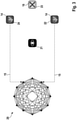
- figure 4 illustrates this approach using the parking lot damage of a car.
- a parked vehicle (21) is damaged by another vehicle (34) in a parking garage (30) in the absence of the driver.
- the accident event (11) is determined by sensors installed in the damaged vehicle (21) and documented in a decentralized transaction system (20) using the sensor data collected.
- the data required for determination and documentation can be vibration data, for example.
- the damaged vehicle (21) nevertheless asks the other vehicles (23, 24) and a camera (21) installed in the multi-storey car park (30) to verify the event (11) using images and thus to witness the accident.
- the vehicle (23) that is able to take a picture of the accident (11) and is in a corresponding position to the damaged vehicle (21) takes the picture, for example with a built-in reversing camera (14).
- the surveillance camera (21) in the multi-storey car park (30) is asked to take a picture of the accident (11) (14).
- People who are not shown in the drawing can also be asked to witness the accident (11) via an application on their mobile phone. In this case, they would themselves testify to the accident (11) by taking a photo of the event (11).
- another vehicle (24) is not able to document the accident (11) in the image (16).
- Check sums (33) are then calculated from the photos, which in this case serve as evidence of the accident (11), and then stored in a central memory (31) or kept in the vehicle for a long time. If the images are kept in the vehicle for a long time, the corresponding address of the image material is stored in the decentralized transaction system and made available when release is required.
- the devices (22, 23) acting as witnesses each store a transaction (12) in the decentralized transaction system (20), in which they enter their identification, the address of the stored data record (32), here in the form of an image, its checksum and the Save identification of the damaged vehicle (21) requesting logging.
- the person who caused the accident (34) can be shown in the pictures (32) that were made (14) by the devices (23, 24) and thus a corresponding responsibility can be determined.
- the ordering vehicle (21) can use the decentralized transaction system (20) used to send the proving devices (22, 23) an appropriate expense allowance.
Landscapes
- Engineering & Computer Science (AREA)
- Business, Economics & Management (AREA)
- Theoretical Computer Science (AREA)
- General Physics & Mathematics (AREA)
- Physics & Mathematics (AREA)
- Strategic Management (AREA)
- General Business, Economics & Management (AREA)
- Databases & Information Systems (AREA)
- Accounting & Taxation (AREA)
- Computer Security & Cryptography (AREA)
- Computer Networks & Wireless Communication (AREA)
- Human Resources & Organizations (AREA)
- Tourism & Hospitality (AREA)
- Signal Processing (AREA)
- General Engineering & Computer Science (AREA)
- Data Mining & Analysis (AREA)
- Entrepreneurship & Innovation (AREA)
- Marketing (AREA)
- General Health & Medical Sciences (AREA)
- Economics (AREA)
- Health & Medical Sciences (AREA)
- Computing Systems (AREA)
- Finance (AREA)
- Operations Research (AREA)
- Quality & Reliability (AREA)
- Medical Informatics (AREA)
- Primary Health Care (AREA)
- Bioethics (AREA)
- Computer Hardware Design (AREA)
- Software Systems (AREA)
- Information Retrieval, Db Structures And Fs Structures Therefor (AREA)
- Management, Administration, Business Operations System, And Electronic Commerce (AREA)
- Traffic Control Systems (AREA)
Description
- Die vorliegende Erfindung betrifft ein Verfahren zum Prüfen eines Sachverhaltes in einem dezentralen Transaktionssystem. Die vorliegende Erfindung betrifft darüber hinaus eine entsprechende Vorrichtung, ein entsprechendes Computerprogramm sowie ein entsprechendes Speichermedium.
- Als dezentrales Transaktionssystem, Transaktionsdatenbank oder dezentral geführtes Kontobuch (distributed ledger) wird in der Informatik jedwedes Rechnernetz verstanden, das mittels eines gemeinsamen Konsensusprotokolls eine Übereinkunft über Reihenfolge und Inhalt bestimmter Transaktionen trifft. Im Folgenden wird der Begriff in einem weiten Sinne verwendet, der private und öffentliche Systeme gleichermaßen erfasst.
-
EP3295349A1 offenbart ein computerimplementiertes Verfahren und System zur Überprüfung der Integrität einer Computersoftware zur Installation unter Verwendung einer verteilten Hash-Tabelle und eines in einem Rechner-Rechner-Netzwerk (peer-to-peernetwork, P2P) verteilten Hauptbuchs. Das Verfahren umfasst das Bestimmen von Metadaten, die mit einem Transaktionsdatensatz verknüpft sind, der in dem verteilten Hauptbuch gespeichert ist. Ein Hinweis auf einen Eintrag, der in der verteilten Hash-Tabelle gespeichert ist, kann aus den Metadaten bestimmt werden. Das Verfahren umfasst ferner das Bestimmen eines dritten Hash-Werts basierend auf der Computersoftware und das Bestimmen eines vierten Hash-Werts aus dem Eintrag in der verteilten Hash-Tabelle. Das Verfahren umfasst ferner das Vergleichen des dritten Hash-Werts und des vierten Hash-Werts und das Verifizieren der Integrität der Computersoftware basierend auf dem Vergleichen des dritten Hash-Werts und des vierten Hash-Werts. -
WO 2017/180382 A1 (PCMS HOLDINGS INC [US]) 19. Oktober 2017 sowieEP 3 576 031 A1 (BOSCH GMBH ROBERT [DE]) 4. Dezember 2019 offenbaren Verfahren nach dem Oberbegriff des Anspruchs 1. - Die Erfindung stellt ein Verfahren zum Prüfen eines Sachverhaltes in einem dezentralen Transaktionssystem, eine entsprechende Vorrichtung, ein entsprechendes Computerprogramm sowie ein entsprechendes Speichermedium gemäß den unabhängigen Ansprüchen bereit.
- Der vorgeschlagene Ansatz fußt auf der Erkenntnis, dass ein Eintrag in einem dezentralen Transaktionssystem durch ein fehlerhaftes Gerät oder durch andere äußere Einflüsse kompromittiert sein kann. Neben diesen Einflüssen kann alleine die Tatsache, dass es ein einziges Gerät ist, welches das Ereignis ermittelt hat, dazu führen, dass Daten, Informationen und deren Wahrheitswert in einem dezentralen Transaktionssystem von Dritten nicht anerkannt werden. Insbesondere in Szenarien, in welchen die gespeicherten Daten als Beweis für die Verantwortung eines Dritten für einen bestimmten Zustand dienen sollen, kann die Korrektheit der Daten von dem genannten Dritten angefochten werden.
- Um diesen Mangel zu beheben, besteht ein Grundgedanke des nachfolgend beschriebenen Verfahrens darin, durch das "Beauftragen" weiterer Geräte gewisse Umweltgrößen (beispielsweise Temperatur, Luftfeuchtigkeit, Helligkeit oder Erschütterung) oder auch andere Zustände zu dokumentieren (etwa in Bild- oder Videoaufnahmen) und diese Dokumentation für das im obigen Sinne "beauftragende" Gerät in ein dezentrales Transaktionssystem zu speichern.
- Das solchermaßen beauftragte Gerät speichert die Daten im Auftrag des ersten Geräts und erfüllt somit gleichsam die Funktion eines Zeugen für einen bestimmten Zustand zu einem bestimmten Zeitpunkt. Die betreffenden Daten können hierzu sowohl direkt in das dezentrale Transaktionssystem als auch an einem zentralen Speicherort abgelegt werden.
- Bei der Speicherung an einem zentralen Speicherort bildet das "beweisende" Gerät die Prüfsumme des Datensatzes und legt diesen unter Angabe des Speicherortes des Datensatzes in das dezentrale Transaktionssystem ab.
- Ähnlich dem Vorgehen, nach dem in einem dezentralen Transaktionssystem Transaktionen von mehreren unabhängigen Parteien bestätigt werden und somit ein Konsens über den Stand der Informationen hergestellt wird, wird bei der vorliegenden Lösung somit gewissermaßen ein Konsens auf der Ebene der Datenquellen erzeugt.
- Ein Vorzug dieser Lösung liegt in der chronologischen, manipulationssicheren und somit beweisfähigen Dokumentation bestimmter Zustände, Umweltgrößen und deren Abweichungen ohne die Notwendigkeit eines manuellen Eingriffs. Die beauftragten Geräte können ihren Dienst mittels digitaler Verträge im Transaktionssystem selbst gegenüber dem beauftragenden Gerät abrechnen, welches die erhobene Gebühr in eben diesem System direkt begleicht.
- Durch die in den abhängigen Ansprüchen aufgeführten Maßnahmen sind vorteilhafte Weiterbildungen und Verbesserungen des im unabhängigen Anspruch angegebenen Grundgedankens möglich.
- Ausführungsbeispiele der Erfindung sind in den Zeichnungen dargestellt und in der nachfolgenden Beschreibung näher erläutert. Es zeigt:
-
Figur 1 das Flussdiagramm eines Verfahrens gemäß einer ersten Ausführungsform. -
Figur 2 eine erste Phase des Verfahrens. -
Figur 3 eine zweite Phase des Verfahrens. -
Figur 4 ein Beispiel für den Beweis von Unfällen in Parkhäusern. -
Figur 1 illustriert den grundlegenden Ablauf eines erfindungsgemäßen Verfahrens (10), dessen Ablauf nunmehr beispielhaft anhand der Blockdiagramme gemäßFigur 2 undFigur 3 erläutert sei. - In einem vorbereitenden, zeichnerisch nicht dargestellten Schritt melden sich die beteiligten Geräte (21, 22, 23, 24) gegenseitig an und setzen einander davon in Kenntnis, über welche Fähigkeiten sie verfügen. Auf diese Weise können die Geräte (21, 22, 23, 24) ein P2P-Rechnernetz bilden, oder aber ein Teil eines vorhandenen Netzwerks, in welchem Daten direkt zwischen zwei Knoten oder mehreren ausgetauscht werden können. Darunter sind insbesondere Geräte (21), deren Aufgabe unter anderem darin besteht, bestimmte Situationen zu beobachten. Abweichungen (11) von vordefinierten Soll-Zuständen oder andere als unerwartet definierte Zustände können hierbei eine Protokollierung (12) erfordern.
- Erkennt nun ein derartiges Gerät (21) einen solchen Zustand, so wird dieser protokolliert (12). Hierzu werden die betreffenden Daten in einem dezentralen Transaktionssystem (20) abgelegt. Die Daten können, wie oben beschrieben, direkt als Teil der Transaktion oder an einem zentralen Speicherort abgelegt werden. Werden die Daten als Teil der Transaktion im dezentralen Transaktionssystem (20) abgelegt, so werden zumindest eine Kennung des Gerätes und die Daten der Abweichung (11) selbst vermerkt. Werden die Daten an einem zentralen Speicherort gespeichert, so wird anstelle der Daten der Abweichung selbst (11) die Adresse des gespeicherten Datensatzes der Abweichung (11) sowie dessen Prüfsumme oder Streuwert (hash) gesichert.
- Zur Verifikation der Daten fordert das erste Gerät (21) nunmehr andere Geräte (22, 23, 24) dazu auf (13), den ermittelten Zustand zu bestätigen. Dabei können die Daten, die das Ereignis verifizieren, andere Messgrößen abbilden als diejenige, durch welche das Ereignis selbst definiert ist. Diese Bestätigung geschieht mittels eines Aufrufs an alle übrigen in dem oben beschriebenen Verbund (21, 22, 23, 24) angemeldeten Geräte (22, 23, 24). Dabei wird den weiteren Geräten (22, 23, 24) neben der Kennung des aufrufenden Gerätes (21) mitgeteilt, was ermittelt oder erfasst werden soll - etwa eine Messung der Temperatur oder eine Bildaufnahme der Umgebung. Die Entscheidung, was genau getan werden soll, kann sowohl vom ersten Gerät (21) als auch von den anderen, das Ereignis bestätigenden Geräten (22, 23, 24) getroffen werden. Hierzu können auch Systeme der künstlichen Intelligenz (KI; artificial intelligence, AI) zur Verwendung kommen.
- In einer bevorzugten Ausführungsform wird der von dem Aufrufer (21) ermittelte Zustand den weiteren Geräten (22, 23, 24) bewusst nicht mitgeteilt, um die Unabhängigkeit deren eigener Messungen nicht zu beeinflussen. Dies vermindert die Gefahr einer Manipulation der Ergebnisse. Es wird beispielsweise lediglich die Messgröße und nicht der erwartete Messwert bezeichnet.
- Die auf diese Weise beauftragten Geräte (22, 23, 24) erfassen (14) und protokollieren (15) den gewünschten Zustand ebenfalls entweder direkt im dezentralen Transaktionssystem (20) oder, wie oben beschrieben, an einem zentralen Speicherort und vermerken dabei die eigene Kennung, Daten der Abweichung (11) sowie die übermittelte Kennung des aufrufenden Gerätes (21). Werden die Daten der Abweichung (11) an einem zentralen Speicherort gespeichert, so wird an ihrer Stelle auch in diesem Fall die Adresse des gespeicherten Datensatzes der Abweichung (11) sowie dessen Prüfsumme oder Streuwert gesichert. Es versteht sich, dass eine Protokollierung (15) für diejenigen Geräte (23) entfällt, welche die angeforderte Größe nicht ermitteln können (16).
- Anhand der solchermaßen protokollierten Daten kann die Abweichung (11) schließlich entweder bestätigt oder widerlegt werden. Würde im Szenario gemäß der
Figuren 2 und3 etwa das Gerät 21 einen Betrag von 120 für eine gegebene Messgröße X, das Gerät 22 einen Betrag von 119 für die Messgröße Y und das Gerät 24 einen Betrag von 121 für die Messgröße Z bestimmen, so würde das Ereignis mit einem Betrag von |X| = 120 beschrieben, wobei ein allgemeiner Konsens über die Verifikation der Abweichung (11) bestünde. Würde hingegen das Gerät 22 einen Betrag von 87 für die Messgröße Y und das Gerät 24 einen Betrag von 89 für die Messgröße Z protokollieren, so bestünde ein Dissens hinsichtlich des behaupteten Ereignisses, das vorliegend vielmehr mit einem Betrag von |X| = 88 beschrieben würde. -
Figur 4 verdeutlich diese Herangehensweise anhand des Parkplatzschadens eines Autos. - Ein geparktes Fahrzeug (21) wird in Abwesenheit des Fahrers auf einem Parkhaus (30) von einem anderen Fahrzeug (34) beschädigt. Der Fahrer des Fahrzeugs (34), der den Unfall (11) verschuldet, verlässt den Unfallort, entweder bewusst, oder weil er den Unfall (11) nicht bemerkt hat.
- Das Unfallereignis (11) wird über Sensoren, die im beschädigten Fahrzeug (21) verbaut sind, ermittelt und mithilfe der erhobenen Sensordaten in einem dezentralen Transaktionssystem (20) dokumentiert. Die zur Ermittlung und Dokumentation notwendigen Daten können beispielweise Erschütterungsdaten sein.
- Nun ist es anderen, mit Sensoren ausgestatteten Fahrzeugen (23, 24) allerdings nicht möglich, dieses Ereignis (11) mithilfe von Daten gleicher Art zu verifizieren, da diese die Erschütterung eines anderen Fahrzeugs nicht ermitteln können.
- Das beschädigte Fahrzeug (21) fordert dennoch die anderen Fahrzeuge (23, 24) und eine im Parkhaus (30) verbaute Kamera (21) auf, das Ereignis (11) mithilfe von Bildern zu verifizieren und somit den Unfall zu bezeugen. Dasjenige Fahrzeug (23), welches die Möglichkeit hat, ein Bild des Unfalls (11) zu machen und in entsprechender Position zum beschädigten Fahrzeug (21) steht, nimmt das Bild beispielsweise mit einer verbauten Rückfahrkamera auf (14). Weiter wird, wie bereits beschrieben, die Überwachungskamera (21) im Parkhaus (30) aufgefordert, ein Bild des Unfalls (11) zu machen (14). Es können auch zeichnerisch nicht dargestellte Personen über eine Applikation auf deren Mobiltelefon zur Bezeugung des Unfalls (11) aufgefordert werden. Diese würden den Unfall (11) in diesem Fall ihrerseits durch ein Foto des Ereignisses (11) bezeugen. Ein weiteres Fahrzeug (24) ist im vorliegenden Beispiel nicht in der Lage, den Unfall (11) im Bild zu dokumentieren (16).
- Von den Fotos, welche in diesem Fall als Beweis für den Unfall (11) dienen, werden anschließend Prüfsummen (33) errechnet und danach auf einem zentralen Speicher (31) abgelegt oder langfristig im Fahrzeug gehalten. Werden die Bilder langfristig im Fahrzeug gehalten, wird die entsprechende Adresse des Bildmaterials im dezentralen Transaktionssystem abgelegt und zum Zeitpunkt einer notwendigen Freigabe zur Verfügung gestellt. Die als Zeugen fungierenden Geräte (22, 23) legen im dezentralen Transaktionssystem (20) jeweils eine Transaktion ab (12), in welcher sie ihre Identifikation, die Adresse des gespeicherten Datensatzes (32), hier in Gestalt eines Bildes, dessen Prüfsumme und die Identifikation des beschädigten und zur Protokollierung auffordernden Fahrzeugs (21) speichern.
- Auf den Bildern (32), die von den Geräten (23, 24) gemacht wurden (14), kann der Unfallverursacher (34) abgebildet sein und somit eine entsprechende Verantwortlichkeit ermittelt werden.
- Anhand der besagten Transaktion, welche die Unveränderbarkeit der beweisenden Daten, in diesem Fall der Fotos (32), sicherstellt, kann die Schuld am Unfallereignis (11) eindeutig dem Verursacher (34) zugewiesen werden, ohne dass dem geschädigten Fahrzeug (21) eine Manipulation der Daten oder eine Kompromittierung der Daten durch Fehlfunktion vorgeworfen werden könnten.
- Das beauftragende Fahrzeug (21) kann über das verwendete dezentrale Transaktionssystem (20) den beweisenden Geräten (22, 23) eine angemessene Aufwandsentschädigung zukommen lassen.
Claims (7)
- Verfahren (10) zum Prüfen eines durch eine Abweichung (11) von einem vorgegebenen Zustand definierten Sachverhaltes (11) in einem dezentralen Transaktionssystem (20),mit folgenden Merkmalen:- der Sachverhalt (11) wird durch ein erstes Gerät (21) in dem Transaktionssystem (20) erkannt,- der Sachverhalt (11) wird durch das erste Gerät (21) mittels des Transaktionssystems (20) protokolliert (12),- weitere Geräte (22, 23, 24) in dem Transaktionssystem (20) werden vom ersten Gerät (21) aufgefordert (13), bestimmte Daten zu erfassen (14),- die Daten werden durch die weiteren Geräte (22, 23) erfasst (14),- die erfassten Daten werden durch die weiteren Geräte (22, 23) mittels des Transaktionssystems (20) protokolliert (15) und- der Sachverhalt (11) wird in dem Transaktionssystem (20) anhand der protokollierten Daten bestätigt oder widerlegt,gekennzeichnet durch folgendes Merkmal:- das Protokollieren (12, 15) erfolgt durch ein Ablegen eines Datensatzes (32) in einem zentralen Speicher (31) und eines Streuwertes (33) des Datensatzes im Transaktionssystem (20).
- Verfahren (10) nach Anspruch 1, gekennzeichnet durch folgende Merkmale:- den weiteren Geräten (22, 23, 24) wird eine Kennung des ersten Gerätes (21) übermittelt und- die Kennung wird durch die weiteren Geräte (22, 23) gemeinsam mit den Daten protokolliert (15).
- Verfahren (10) nach einem der Ansprüche 1 oder 2, gekennzeichnet durch mindestens eines der folgenden Merkmale:- die zu erfassenden Daten umfassen Bilddaten oder- die zu erfassenden Daten umfassen physikalische Messdaten.
- Verfahren (10) nach einem der Ansprüche 1 bis 3, gekennzeichnet durch folgendes Merkmal:- das Protokollieren (12, 15) umfasst das Ablegen eines Zeitstempels.
- Computerprogramm, welches Anweisungen umfasst, die bei der Ausführung des Programms durch einen Computer diesen veranlassen, das Verfahren (10) nach einem der Ansprüche 1 bis 4 auszuführen.
- Maschinenlesbares Speichermedium, auf dem das Computerprogramm nach Anspruch 5 gespeichert ist.
- Vorrichtung (20, 21, 22, 23, 24), die eingerichtet ist, das Verfahren (10) nach einem der Ansprüche 1 bis 4 auszuführen.
Applications Claiming Priority (1)
| Application Number | Priority Date | Filing Date | Title |
|---|---|---|---|
| DE102018213304.2A DE102018213304A1 (de) | 2018-08-08 | 2018-08-08 | Verfahren und Vorrichtung zum Prüfen eines Sachverhaltes in einem dezentralen Transaktionssystem |
Publications (2)
| Publication Number | Publication Date |
|---|---|
| EP3609123A1 EP3609123A1 (de) | 2020-02-12 |
| EP3609123B1 true EP3609123B1 (de) | 2022-01-26 |
Family
ID=67438575
Family Applications (1)
| Application Number | Title | Priority Date | Filing Date |
|---|---|---|---|
| EP19187884.2A Active EP3609123B1 (de) | 2018-08-08 | 2019-07-23 | Verfahren und vorrichtung zum prüfen eines sachverhaltes in einem dezentralen transaktionssystem |
Country Status (4)
| Country | Link |
|---|---|
| US (1) | US11269862B2 (de) |
| EP (1) | EP3609123B1 (de) |
| DE (1) | DE102018213304A1 (de) |
| GB (1) | GB2577382A (de) |
Family Cites Families (23)
| Publication number | Priority date | Publication date | Assignee | Title |
|---|---|---|---|---|
| US7043237B2 (en) * | 2002-01-14 | 2006-05-09 | Agilent Technologies, Inc. | Method and system for improved monitoring, measurement and analysis of communication networks utilizing dynamically and remotely configurable probes |
| US20110320492A1 (en) * | 2010-06-24 | 2011-12-29 | DriveMeCrazy, Inc. | System and method for tracking vehicle operation through user-generated driving incident reports |
| US9147343B2 (en) * | 2011-11-30 | 2015-09-29 | Ecofit Networks Inc. | Exercise usage monitoring system |
| US11232466B2 (en) * | 2015-01-29 | 2022-01-25 | Affectomatics Ltd. | Recommendation for experiences based on measurements of affective response that are backed by assurances |
| US10515417B2 (en) * | 2015-10-16 | 2019-12-24 | Accenture Global Services Limited | Device based incident detection and notification |
| US10049566B2 (en) * | 2016-03-02 | 2018-08-14 | Michael E. Shanahan | Systems and methods for intra-vehicle pedestrian and infrastructure communication |
| WO2017180382A1 (en) | 2016-04-12 | 2017-10-19 | Pcms Holdings, Inc. | System and method for data validation in a decentralized sensor network |
| BR112018072929A2 (pt) | 2016-05-13 | 2019-02-19 | nChain Holdings Limited | método e sistema para verificar a integridade de um software de computador e programa de software de computador |
| US10755327B2 (en) | 2016-07-18 | 2020-08-25 | Royal Bank Of Canada | Distributed ledger platform for vehicle records |
| US10158527B2 (en) * | 2016-10-28 | 2018-12-18 | International Business Machines Corporation | Changing an existing blockchain trust configuration |
| US11128528B2 (en) * | 2016-12-30 | 2021-09-21 | Intel Corporation | Decentralized data storage and processing for IoT devices |
| US10062277B2 (en) * | 2017-01-24 | 2018-08-28 | International Business Machines Corporation | Information sharing among mobile apparatus |
| US10225273B2 (en) | 2017-01-27 | 2019-03-05 | International Business Machines Corporation | Secured event monitoring leveraging blockchain |
| EP3382629A1 (de) * | 2017-03-31 | 2018-10-03 | Siemens Aktiengesellschaft | Verfahren und zeitgeber zum bereitstellen von sicherheitsgeschützten zeitangaben |
| US10771421B2 (en) * | 2017-03-31 | 2020-09-08 | Intel Corporation | Systems and methods for fair information exchange using publish-subscribe with blockchain |
| CN110998634A (zh) * | 2017-08-08 | 2020-04-10 | 3M创新有限公司 | 使用区块链的制品认证系统 |
| US10891694B1 (en) * | 2017-09-06 | 2021-01-12 | State Farm Mutual Automobile Insurance Company | Using vehicle mode for subrogation on a distributed ledger |
| US10796393B2 (en) | 2018-03-14 | 2020-10-06 | Motorola Solutions, Inc. | System for validating and appending incident-related data records in an inter-agency distributed electronic ledger |
| US10984122B2 (en) * | 2018-04-13 | 2021-04-20 | Sophos Limited | Enterprise document classification |
| US10747201B2 (en) * | 2018-05-02 | 2020-08-18 | Rockwell Automation Technologies, Inc. | Subscription-based services using industrial blockchains |
| US20190347628A1 (en) * | 2018-05-08 | 2019-11-14 | Intangible Labs, Inc | Cryptocurrency protocol with built-in intervention responsive to a cryptocurrency exchange rate |
| DE102018208591A1 (de) | 2018-05-30 | 2019-12-05 | Robert Bosch Gmbh | Verfahren und Vorrichtung zum Prüfen eines Sachverhaltes in einem dezentralen Transaktionssystem |
| US10606669B2 (en) * | 2018-06-08 | 2020-03-31 | Optum, Inc. | Domain and event type-specific consensus process for a distributed ledger |
-
2018
- 2018-08-08 DE DE102018213304.2A patent/DE102018213304A1/de active Pending
-
2019
- 2019-07-19 US US16/516,548 patent/US11269862B2/en active Active
- 2019-07-23 EP EP19187884.2A patent/EP3609123B1/de active Active
- 2019-08-06 GB GB1911205.1A patent/GB2577382A/en not_active Withdrawn
Also Published As
| Publication number | Publication date |
|---|---|
| US11269862B2 (en) | 2022-03-08 |
| EP3609123A1 (de) | 2020-02-12 |
| GB2577382A (en) | 2020-03-25 |
| US20200050600A1 (en) | 2020-02-13 |
| DE102018213304A1 (de) | 2020-02-13 |
| GB201911205D0 (en) | 2019-09-18 |
Similar Documents
| Publication | Publication Date | Title |
|---|---|---|
| DE102016223422A1 (de) | Verfahren zur automatischen Ermittlung extrinsischer Parameter einer Kamera eines Fahrzeugs | |
| DE102019002487A1 (de) | Verfahren zur Überprüfung eines Umfelderfassungssensors eines Fahrzeugs und Verfahren zum Betrieb eines Fahrzeugs | |
| DE102017105174A1 (de) | Verfahren zum Erzeugen von Trainingsdaten für die Überwachung einer Gefahrenquelle | |
| DE102018212238A1 (de) | Kontosystem, anbieter-endgerät, benutzer-endgerät, und knoten | |
| DE102015209229A1 (de) | Verfahren zum Überwachen eines Kraftfahrzeugs | |
| DE102020206755A1 (de) | Redundanzinformationen für objektschnittstelle für hoch und vollautomatisiertes fahren | |
| WO2017102150A1 (de) | Verfahren zum bewerten einer durch zumindest einen sensor eines fahrzeugs erfassten gefahrensituation, verfahren zum steuern einer wiedergabe einer gefahrenwarnung und verfahren zum wiedergeben einer gefahrenwarnung | |
| DE102011050660B4 (de) | Verfahren zur Ausrichtung und Verfahren zur Kontrolle der Ausrichtung eines Verkehrsüberwachungsgerätes zu einem Fahrbahnrand | |
| DE102013206308A1 (de) | Verfahren und System zum Adaptieren von Modellparametern eines in einem Steuergerät eines Kraftfahrzeugs implementierten Funktionmodells | |
| DE102016224351A1 (de) | Konzept zum Prüfen eines Sensorsystems zum Erfassen eines Belegungszustands eines Stellplatzes auf Fehler | |
| EP4032243B1 (de) | System und verfahren zum manipulationssicheren verwalten von daten eines feldgeräts der automatisierungstechnik | |
| WO2011131752A1 (de) | Aufzeichnung von history-informationen in einem feldgerät | |
| DE102021121184A1 (de) | Verfahren und Einrichtung für eine Kamera-Lidar-Kalibrierung und Kraftfahrzeug | |
| EP3609123A1 (de) | Verfahren und vorrichtung zum prüfen eines sachverhaltes in einem dezentralen transaktionssystem | |
| DE102020007072A1 (de) | Verfahren zur Datenerhebung über eine Mehrzahl von verbundenen Diensteanbietern | |
| DE102022002085A1 (de) | Verfahren und System zur Anpassung einer kombinierten Datensammlungs- und Softwareupdate-Kampagne in einer Fahrzeugflotte | |
| DE102023205046A1 (de) | Verfahren zum Betreiben zumindest einer Funktionseinheit eines Fahrzeugs auf Basis von Sensordaten anderer Fahrzeuge sowie Steuervorrichtung, Computerprogramm und Fahrzeug | |
| DE102013218299A1 (de) | Verfahren zum Detektieren eines Schadens eines Fahrzeugs anhand eines Prüfbilds, entsprechendes System und Computerprogrammprodukt | |
| EP3576031A1 (de) | Verfahren und vorrichtung zum prüfen eines sachverhaltes in einem dezentralen transaktionssystem | |
| DE102011110965A1 (de) | Verfahren zur Manipulationssicherng und zum Schutz von Daten, insbesondere von auf ein Kraftfahrzeug bezogenen Daten. Verwendung eines Identitätsmoduls. Identitätsmodul und Computerprogramm | |
| WO2023001542A1 (de) | Verfahren und system zur überwachung eines laderaums | |
| DE102021001767A1 (de) | Verfahren zum Erstellen eines zumindest auf einer Umgebungserfassung basierenden Modells einer Umgebungsbeschreibung | |
| WO2020207521A1 (de) | Funktionsbaugruppe mit einem rohdatenspeicher | |
| DE102019202258A1 (de) | Verfahren zum Betrieb von Umgebungssensoren in einem Kraftfahrzeug und Kraftfahrzeug | |
| EP4031943B1 (de) | Selbstüberprüfendes system der automatisierungstechnik |
Legal Events
| Date | Code | Title | Description |
|---|---|---|---|
| PUAI | Public reference made under article 153(3) epc to a published international application that has entered the european phase |
Free format text: ORIGINAL CODE: 0009012 |
|
| STAA | Information on the status of an ep patent application or granted ep patent |
Free format text: STATUS: THE APPLICATION HAS BEEN PUBLISHED |
|
| AK | Designated contracting states |
Kind code of ref document: A1 Designated state(s): AL AT BE BG CH CY CZ DE DK EE ES FI FR GB GR HR HU IE IS IT LI LT LU LV MC MK MT NL NO PL PT RO RS SE SI SK SM TR |
|
| AX | Request for extension of the european patent |
Extension state: BA ME |
|
| RAP1 | Party data changed (applicant data changed or rights of an application transferred) |
Owner name: ROBERT BOSCH GMBH |
|
| STAA | Information on the status of an ep patent application or granted ep patent |
Free format text: STATUS: REQUEST FOR EXAMINATION WAS MADE |
|
| 17P | Request for examination filed |
Effective date: 20200812 |
|
| RBV | Designated contracting states (corrected) |
Designated state(s): AL AT BE BG CH CY CZ DE DK EE ES FI FR GB GR HR HU IE IS IT LI LT LU LV MC MK MT NL NO PL PT RO RS SE SI SK SM TR |
|
| STAA | Information on the status of an ep patent application or granted ep patent |
Free format text: STATUS: EXAMINATION IS IN PROGRESS |
|
| 17Q | First examination report despatched |
Effective date: 20210211 |
|
| GRAP | Despatch of communication of intention to grant a patent |
Free format text: ORIGINAL CODE: EPIDOSNIGR1 |
|
| STAA | Information on the status of an ep patent application or granted ep patent |
Free format text: STATUS: GRANT OF PATENT IS INTENDED |
|
| RIC1 | Information provided on ipc code assigned before grant |
Ipc: G07F 17/24 20060101ALI20211027BHEP Ipc: G06Q 20/22 20120101ALI20211027BHEP Ipc: G06Q 20/20 20120101ALI20211027BHEP Ipc: G06Q 20/12 20120101ALI20211027BHEP Ipc: G06Q 10/10 20120101ALI20211027BHEP Ipc: G06F 21/64 20130101ALI20211027BHEP Ipc: H04L 9/32 20060101AFI20211027BHEP |
|
| INTG | Intention to grant announced |
Effective date: 20211117 |
|
| GRAS | Grant fee paid |
Free format text: ORIGINAL CODE: EPIDOSNIGR3 |
|
| GRAA | (expected) grant |
Free format text: ORIGINAL CODE: 0009210 |
|
| STAA | Information on the status of an ep patent application or granted ep patent |
Free format text: STATUS: THE PATENT HAS BEEN GRANTED |
|
| AK | Designated contracting states |
Kind code of ref document: B1 Designated state(s): AL AT BE BG CH CY CZ DE DK EE ES FI FR GB GR HR HU IE IS IT LI LT LU LV MC MK MT NL NO PL PT RO RS SE SI SK SM TR |
|
| REG | Reference to a national code |
Ref country code: GB Ref legal event code: FG4D Free format text: NOT ENGLISH |
|
| REG | Reference to a national code |
Ref country code: CH Ref legal event code: EP |
|
| REG | Reference to a national code |
Ref country code: AT Ref legal event code: REF Ref document number: 1466136 Country of ref document: AT Kind code of ref document: T Effective date: 20220215 |
|
| REG | Reference to a national code |
Ref country code: IE Ref legal event code: FG4D Free format text: LANGUAGE OF EP DOCUMENT: GERMAN |
|
| REG | Reference to a national code |
Ref country code: DE Ref legal event code: R096 Ref document number: 502019003303 Country of ref document: DE |
|
| REG | Reference to a national code |
Ref country code: LT Ref legal event code: MG9D |
|
| REG | Reference to a national code |
Ref country code: NL Ref legal event code: MP Effective date: 20220126 |
|
| PG25 | Lapsed in a contracting state [announced via postgrant information from national office to epo] |
Ref country code: NL Free format text: LAPSE BECAUSE OF FAILURE TO SUBMIT A TRANSLATION OF THE DESCRIPTION OR TO PAY THE FEE WITHIN THE PRESCRIBED TIME-LIMIT Effective date: 20220126 |
|
| PG25 | Lapsed in a contracting state [announced via postgrant information from national office to epo] |
Ref country code: SE Free format text: LAPSE BECAUSE OF FAILURE TO SUBMIT A TRANSLATION OF THE DESCRIPTION OR TO PAY THE FEE WITHIN THE PRESCRIBED TIME-LIMIT Effective date: 20220126 Ref country code: RS Free format text: LAPSE BECAUSE OF FAILURE TO SUBMIT A TRANSLATION OF THE DESCRIPTION OR TO PAY THE FEE WITHIN THE PRESCRIBED TIME-LIMIT Effective date: 20220126 Ref country code: PT Free format text: LAPSE BECAUSE OF FAILURE TO SUBMIT A TRANSLATION OF THE DESCRIPTION OR TO PAY THE FEE WITHIN THE PRESCRIBED TIME-LIMIT Effective date: 20220526 Ref country code: NO Free format text: LAPSE BECAUSE OF FAILURE TO SUBMIT A TRANSLATION OF THE DESCRIPTION OR TO PAY THE FEE WITHIN THE PRESCRIBED TIME-LIMIT Effective date: 20220426 Ref country code: LT Free format text: LAPSE BECAUSE OF FAILURE TO SUBMIT A TRANSLATION OF THE DESCRIPTION OR TO PAY THE FEE WITHIN THE PRESCRIBED TIME-LIMIT Effective date: 20220126 Ref country code: HR Free format text: LAPSE BECAUSE OF FAILURE TO SUBMIT A TRANSLATION OF THE DESCRIPTION OR TO PAY THE FEE WITHIN THE PRESCRIBED TIME-LIMIT Effective date: 20220126 Ref country code: ES Free format text: LAPSE BECAUSE OF FAILURE TO SUBMIT A TRANSLATION OF THE DESCRIPTION OR TO PAY THE FEE WITHIN THE PRESCRIBED TIME-LIMIT Effective date: 20220126 Ref country code: BG Free format text: LAPSE BECAUSE OF FAILURE TO SUBMIT A TRANSLATION OF THE DESCRIPTION OR TO PAY THE FEE WITHIN THE PRESCRIBED TIME-LIMIT Effective date: 20220426 |
|
| PG25 | Lapsed in a contracting state [announced via postgrant information from national office to epo] |
Ref country code: PL Free format text: LAPSE BECAUSE OF FAILURE TO SUBMIT A TRANSLATION OF THE DESCRIPTION OR TO PAY THE FEE WITHIN THE PRESCRIBED TIME-LIMIT Effective date: 20220126 Ref country code: LV Free format text: LAPSE BECAUSE OF FAILURE TO SUBMIT A TRANSLATION OF THE DESCRIPTION OR TO PAY THE FEE WITHIN THE PRESCRIBED TIME-LIMIT Effective date: 20220126 Ref country code: GR Free format text: LAPSE BECAUSE OF FAILURE TO SUBMIT A TRANSLATION OF THE DESCRIPTION OR TO PAY THE FEE WITHIN THE PRESCRIBED TIME-LIMIT Effective date: 20220427 Ref country code: FI Free format text: LAPSE BECAUSE OF FAILURE TO SUBMIT A TRANSLATION OF THE DESCRIPTION OR TO PAY THE FEE WITHIN THE PRESCRIBED TIME-LIMIT Effective date: 20220126 |
|
| PG25 | Lapsed in a contracting state [announced via postgrant information from national office to epo] |
Ref country code: IS Free format text: LAPSE BECAUSE OF FAILURE TO SUBMIT A TRANSLATION OF THE DESCRIPTION OR TO PAY THE FEE WITHIN THE PRESCRIBED TIME-LIMIT Effective date: 20220526 |
|
| REG | Reference to a national code |
Ref country code: DE Ref legal event code: R097 Ref document number: 502019003303 Country of ref document: DE |
|
| PG25 | Lapsed in a contracting state [announced via postgrant information from national office to epo] |
Ref country code: SM Free format text: LAPSE BECAUSE OF FAILURE TO SUBMIT A TRANSLATION OF THE DESCRIPTION OR TO PAY THE FEE WITHIN THE PRESCRIBED TIME-LIMIT Effective date: 20220126 Ref country code: SK Free format text: LAPSE BECAUSE OF FAILURE TO SUBMIT A TRANSLATION OF THE DESCRIPTION OR TO PAY THE FEE WITHIN THE PRESCRIBED TIME-LIMIT Effective date: 20220126 Ref country code: RO Free format text: LAPSE BECAUSE OF FAILURE TO SUBMIT A TRANSLATION OF THE DESCRIPTION OR TO PAY THE FEE WITHIN THE PRESCRIBED TIME-LIMIT Effective date: 20220126 Ref country code: EE Free format text: LAPSE BECAUSE OF FAILURE TO SUBMIT A TRANSLATION OF THE DESCRIPTION OR TO PAY THE FEE WITHIN THE PRESCRIBED TIME-LIMIT Effective date: 20220126 Ref country code: DK Free format text: LAPSE BECAUSE OF FAILURE TO SUBMIT A TRANSLATION OF THE DESCRIPTION OR TO PAY THE FEE WITHIN THE PRESCRIBED TIME-LIMIT Effective date: 20220126 Ref country code: CZ Free format text: LAPSE BECAUSE OF FAILURE TO SUBMIT A TRANSLATION OF THE DESCRIPTION OR TO PAY THE FEE WITHIN THE PRESCRIBED TIME-LIMIT Effective date: 20220126 |
|
| PG25 | Lapsed in a contracting state [announced via postgrant information from national office to epo] |
Ref country code: AL Free format text: LAPSE BECAUSE OF FAILURE TO SUBMIT A TRANSLATION OF THE DESCRIPTION OR TO PAY THE FEE WITHIN THE PRESCRIBED TIME-LIMIT Effective date: 20220126 |
|
| PLBE | No opposition filed within time limit |
Free format text: ORIGINAL CODE: 0009261 |
|
| STAA | Information on the status of an ep patent application or granted ep patent |
Free format text: STATUS: NO OPPOSITION FILED WITHIN TIME LIMIT |
|
| 26N | No opposition filed |
Effective date: 20221027 |
|
| PG25 | Lapsed in a contracting state [announced via postgrant information from national office to epo] |
Ref country code: SI Free format text: LAPSE BECAUSE OF FAILURE TO SUBMIT A TRANSLATION OF THE DESCRIPTION OR TO PAY THE FEE WITHIN THE PRESCRIBED TIME-LIMIT Effective date: 20220126 Ref country code: MC Free format text: LAPSE BECAUSE OF FAILURE TO SUBMIT A TRANSLATION OF THE DESCRIPTION OR TO PAY THE FEE WITHIN THE PRESCRIBED TIME-LIMIT Effective date: 20220126 |
|
| REG | Reference to a national code |
Ref country code: CH Ref legal event code: PL |
|
| REG | Reference to a national code |
Ref country code: BE Ref legal event code: MM Effective date: 20220731 |
|
| PG25 | Lapsed in a contracting state [announced via postgrant information from national office to epo] |
Ref country code: LU Free format text: LAPSE BECAUSE OF NON-PAYMENT OF DUE FEES Effective date: 20220723 Ref country code: LI Free format text: LAPSE BECAUSE OF NON-PAYMENT OF DUE FEES Effective date: 20220731 Ref country code: CH Free format text: LAPSE BECAUSE OF NON-PAYMENT OF DUE FEES Effective date: 20220731 |
|
| PG25 | Lapsed in a contracting state [announced via postgrant information from national office to epo] |
Ref country code: BE Free format text: LAPSE BECAUSE OF NON-PAYMENT OF DUE FEES Effective date: 20220731 |
|
| PG25 | Lapsed in a contracting state [announced via postgrant information from national office to epo] |
Ref country code: IT Free format text: LAPSE BECAUSE OF FAILURE TO SUBMIT A TRANSLATION OF THE DESCRIPTION OR TO PAY THE FEE WITHIN THE PRESCRIBED TIME-LIMIT Effective date: 20220126 Ref country code: IE Free format text: LAPSE BECAUSE OF NON-PAYMENT OF DUE FEES Effective date: 20220723 |
|
| GBPC | Gb: european patent ceased through non-payment of renewal fee |
Effective date: 20230723 |
|
| PG25 | Lapsed in a contracting state [announced via postgrant information from national office to epo] |
Ref country code: HU Free format text: LAPSE BECAUSE OF FAILURE TO SUBMIT A TRANSLATION OF THE DESCRIPTION OR TO PAY THE FEE WITHIN THE PRESCRIBED TIME-LIMIT; INVALID AB INITIO Effective date: 20190723 |
|
| PG25 | Lapsed in a contracting state [announced via postgrant information from national office to epo] |
Ref country code: MK Free format text: LAPSE BECAUSE OF FAILURE TO SUBMIT A TRANSLATION OF THE DESCRIPTION OR TO PAY THE FEE WITHIN THE PRESCRIBED TIME-LIMIT Effective date: 20220126 Ref country code: CY Free format text: LAPSE BECAUSE OF FAILURE TO SUBMIT A TRANSLATION OF THE DESCRIPTION OR TO PAY THE FEE WITHIN THE PRESCRIBED TIME-LIMIT Effective date: 20220126 Ref country code: GB Free format text: LAPSE BECAUSE OF NON-PAYMENT OF DUE FEES Effective date: 20230723 |
|
| PG25 | Lapsed in a contracting state [announced via postgrant information from national office to epo] |
Ref country code: MT Free format text: LAPSE BECAUSE OF FAILURE TO SUBMIT A TRANSLATION OF THE DESCRIPTION OR TO PAY THE FEE WITHIN THE PRESCRIBED TIME-LIMIT Effective date: 20220126 |
|
| REG | Reference to a national code |
Ref country code: AT Ref legal event code: MM01 Ref document number: 1466136 Country of ref document: AT Kind code of ref document: T Effective date: 20240723 |
|
| PGFP | Annual fee paid to national office [announced via postgrant information from national office to epo] |
Ref country code: DE Payment date: 20250924 Year of fee payment: 7 |
|
| PG25 | Lapsed in a contracting state [announced via postgrant information from national office to epo] |
Ref country code: AT Free format text: LAPSE BECAUSE OF NON-PAYMENT OF DUE FEES Effective date: 20240723 |
|
| PGFP | Annual fee paid to national office [announced via postgrant information from national office to epo] |
Ref country code: FR Payment date: 20250723 Year of fee payment: 7 |
|
| PG25 | Lapsed in a contracting state [announced via postgrant information from national office to epo] |
Ref country code: TR Free format text: LAPSE BECAUSE OF FAILURE TO SUBMIT A TRANSLATION OF THE DESCRIPTION OR TO PAY THE FEE WITHIN THE PRESCRIBED TIME-LIMIT Effective date: 20220126 |
|
| PGFP | Annual fee paid to national office [announced via postgrant information from national office to epo] |
Ref country code: AT Payment date: 20260410 Year of fee payment: 5 |