EP3608241A1 - Food and beverage composition packed in dual container - Google Patents
Food and beverage composition packed in dual container Download PDFInfo
- Publication number
- EP3608241A1 EP3608241A1 EP18781017.1A EP18781017A EP3608241A1 EP 3608241 A1 EP3608241 A1 EP 3608241A1 EP 18781017 A EP18781017 A EP 18781017A EP 3608241 A1 EP3608241 A1 EP 3608241A1
- Authority
- EP
- European Patent Office
- Prior art keywords
- container
- food
- beverage composition
- double
- polyethylene terephthalate
- Prior art date
- Legal status (The legal status is an assumption and is not a legal conclusion. Google has not performed a legal analysis and makes no representation as to the accuracy of the status listed.)
- Pending
Links
- 235000013305 food Nutrition 0.000 title claims abstract description 50
- 235000013361 beverage Nutrition 0.000 title claims abstract description 48
- 239000000203 mixture Substances 0.000 title claims abstract description 46
- 230000009977 dual effect Effects 0.000 title 1
- 229920005989 resin Polymers 0.000 claims abstract description 105
- 239000011347 resin Substances 0.000 claims abstract description 105
- -1 polyethylene terephthalate Polymers 0.000 claims abstract description 82
- 229920000139 polyethylene terephthalate Polymers 0.000 claims abstract description 80
- 239000005020 polyethylene terephthalate Substances 0.000 claims abstract description 80
- 235000013555 soy sauce Nutrition 0.000 claims description 70
- QVGXLLKOCUKJST-UHFFFAOYSA-N atomic oxygen Chemical compound [O] QVGXLLKOCUKJST-UHFFFAOYSA-N 0.000 claims description 44
- 239000001301 oxygen Substances 0.000 claims description 44
- 229910052760 oxygen Inorganic materials 0.000 claims description 44
- 125000004494 ethyl ester group Chemical group 0.000 claims description 41
- 239000006096 absorbing agent Substances 0.000 claims description 40
- 150000003505 terpenes Chemical class 0.000 claims description 37
- 235000007586 terpenes Nutrition 0.000 claims description 37
- 235000011194 food seasoning agent Nutrition 0.000 claims description 35
- 239000007788 liquid Substances 0.000 claims description 24
- 230000007423 decrease Effects 0.000 claims description 20
- 238000000034 method Methods 0.000 claims description 17
- 125000004432 carbon atom Chemical group C* 0.000 claims description 12
- 238000004519 manufacturing process Methods 0.000 claims description 8
- 238000011049 filling Methods 0.000 claims description 4
- 238000004891 communication Methods 0.000 description 43
- 238000012360 testing method Methods 0.000 description 40
- 229920000219 Ethylene vinyl alcohol Polymers 0.000 description 28
- 239000000463 material Substances 0.000 description 25
- 238000003860 storage Methods 0.000 description 24
- 230000008878 coupling Effects 0.000 description 21
- 238000010168 coupling process Methods 0.000 description 21
- 238000005859 coupling reaction Methods 0.000 description 21
- 238000011156 evaluation Methods 0.000 description 21
- 230000001953 sensory effect Effects 0.000 description 21
- 230000002093 peripheral effect Effects 0.000 description 16
- 239000000047 product Substances 0.000 description 13
- XMGQYMWWDOXHJM-UHFFFAOYSA-N limonene Chemical compound CC(=C)C1CCC(C)=CC1 XMGQYMWWDOXHJM-UHFFFAOYSA-N 0.000 description 12
- CDOSHBSSFJOMGT-UHFFFAOYSA-N linalool Chemical compound CC(C)=CCCC(C)(O)C=C CDOSHBSSFJOMGT-UHFFFAOYSA-N 0.000 description 12
- NDVASEGYNIMXJL-UHFFFAOYSA-N sabinene Chemical compound C=C1CCC2(C(C)C)C1C2 NDVASEGYNIMXJL-UHFFFAOYSA-N 0.000 description 12
- 235000021419 vinegar Nutrition 0.000 description 12
- 239000000052 vinegar Substances 0.000 description 12
- 230000008859 change Effects 0.000 description 11
- 238000006392 deoxygenation reaction Methods 0.000 description 11
- 235000013311 vegetables Nutrition 0.000 description 11
- 238000005259 measurement Methods 0.000 description 10
- 238000002470 solid-phase micro-extraction Methods 0.000 description 10
- 239000004952 Polyamide Substances 0.000 description 9
- 238000006073 displacement reaction Methods 0.000 description 9
- 229920002647 polyamide Polymers 0.000 description 9
- 241000512259 Ascophyllum nodosum Species 0.000 description 8
- 229910017052 cobalt Inorganic materials 0.000 description 8
- 239000010941 cobalt Substances 0.000 description 8
- 150000001875 compounds Chemical class 0.000 description 8
- 229920001577 copolymer Polymers 0.000 description 8
- 230000003247 decreasing effect Effects 0.000 description 8
- 230000000694 effects Effects 0.000 description 8
- SJWFXCIHNDVPSH-UHFFFAOYSA-N octan-2-ol Chemical compound CCCCCCC(C)O SJWFXCIHNDVPSH-UHFFFAOYSA-N 0.000 description 8
- XEEYBQQBJWHFJM-UHFFFAOYSA-N Iron Chemical compound [Fe] XEEYBQQBJWHFJM-UHFFFAOYSA-N 0.000 description 7
- 238000000605 extraction Methods 0.000 description 7
- 229910052751 metal Inorganic materials 0.000 description 7
- 239000002184 metal Substances 0.000 description 7
- NDVASEGYNIMXJL-NXEZZACHSA-N (+)-sabinene Natural products C=C1CC[C@@]2(C(C)C)[C@@H]1C2 NDVASEGYNIMXJL-NXEZZACHSA-N 0.000 description 6
- 239000001490 (3R)-3,7-dimethylocta-1,6-dien-3-ol Substances 0.000 description 6
- CDOSHBSSFJOMGT-JTQLQIEISA-N (R)-linalool Natural products CC(C)=CCC[C@@](C)(O)C=C CDOSHBSSFJOMGT-JTQLQIEISA-N 0.000 description 6
- ZPVFWPFBNIEHGJ-UHFFFAOYSA-N 2-octanone Chemical compound CCCCCCC(C)=O ZPVFWPFBNIEHGJ-UHFFFAOYSA-N 0.000 description 6
- 239000004278 EU approved seasoning Substances 0.000 description 6
- XEKOWRVHYACXOJ-UHFFFAOYSA-N Ethyl acetate Chemical compound CCOC(C)=O XEKOWRVHYACXOJ-UHFFFAOYSA-N 0.000 description 6
- PXHVJJICTQNCMI-UHFFFAOYSA-N Nickel Chemical compound [Ni] PXHVJJICTQNCMI-UHFFFAOYSA-N 0.000 description 6
- KQAZVFVOEIRWHN-UHFFFAOYSA-N alpha-thujene Natural products CC1=CCC2(C(C)C)C1C2 KQAZVFVOEIRWHN-UHFFFAOYSA-N 0.000 description 6
- 229930007927 cymene Natural products 0.000 description 6
- 239000000835 fiber Substances 0.000 description 6
- 238000002290 gas chromatography-mass spectrometry Methods 0.000 description 6
- 235000001510 limonene Nutrition 0.000 description 6
- 229940087305 limonene Drugs 0.000 description 6
- 229930007744 linalool Natural products 0.000 description 6
- HFPZCAJZSCWRBC-UHFFFAOYSA-N p-cymene Chemical compound CC(C)C1=CC=C(C)C=C1 HFPZCAJZSCWRBC-UHFFFAOYSA-N 0.000 description 6
- 229920000642 polymer Polymers 0.000 description 6
- 229930006696 sabinene Natural products 0.000 description 6
- 235000014214 soft drink Nutrition 0.000 description 6
- 229930006978 terpinene Natural products 0.000 description 6
- 150000003507 terpinene derivatives Chemical class 0.000 description 6
- FERIUCNNQQJTOY-UHFFFAOYSA-M Butyrate Chemical compound CCCC([O-])=O FERIUCNNQQJTOY-UHFFFAOYSA-M 0.000 description 5
- FERIUCNNQQJTOY-UHFFFAOYSA-N Butyric acid Natural products CCCC(O)=O FERIUCNNQQJTOY-UHFFFAOYSA-N 0.000 description 5
- 240000007594 Oryza sativa Species 0.000 description 5
- 235000007164 Oryza sativa Nutrition 0.000 description 5
- KDLHZDBZIXYQEI-UHFFFAOYSA-N Palladium Chemical compound [Pd] KDLHZDBZIXYQEI-UHFFFAOYSA-N 0.000 description 5
- 239000003054 catalyst Substances 0.000 description 5
- GUTLYIVDDKVIGB-UHFFFAOYSA-N cobalt atom Chemical compound [Co] GUTLYIVDDKVIGB-UHFFFAOYSA-N 0.000 description 5
- 239000000284 extract Substances 0.000 description 5
- 239000000796 flavoring agent Substances 0.000 description 5
- 235000019634 flavors Nutrition 0.000 description 5
- BASFCYQUMIYNBI-UHFFFAOYSA-N platinum Chemical compound [Pt] BASFCYQUMIYNBI-UHFFFAOYSA-N 0.000 description 5
- 235000009566 rice Nutrition 0.000 description 5
- 150000003839 salts Chemical class 0.000 description 5
- 229910052723 transition metal Inorganic materials 0.000 description 5
- 150000003624 transition metals Chemical class 0.000 description 5
- 235000015192 vegetable juice Nutrition 0.000 description 5
- 241000251468 Actinopterygii Species 0.000 description 4
- 230000004888 barrier function Effects 0.000 description 4
- 235000008504 concentrate Nutrition 0.000 description 4
- 239000012141 concentrate Substances 0.000 description 4
- 235000013399 edible fruits Nutrition 0.000 description 4
- 238000005516 engineering process Methods 0.000 description 4
- XIRNKXNNONJFQO-UHFFFAOYSA-N ethyl hexadecanoate Chemical compound CCCCCCCCCCCCCCCC(=O)OCC XIRNKXNNONJFQO-UHFFFAOYSA-N 0.000 description 4
- MMKRHZKQPFCLLS-UHFFFAOYSA-N ethyl myristate Chemical compound CCCCCCCCCCCCCC(=O)OCC MMKRHZKQPFCLLS-UHFFFAOYSA-N 0.000 description 4
- MVLVMROFTAUDAG-UHFFFAOYSA-N ethyl octadecanoate Chemical compound CCCCCCCCCCCCCCCCCC(=O)OCC MVLVMROFTAUDAG-UHFFFAOYSA-N 0.000 description 4
- 235000015203 fruit juice Nutrition 0.000 description 4
- 238000010438 heat treatment Methods 0.000 description 4
- 229920001519 homopolymer Polymers 0.000 description 4
- 235000014058 juice drink Nutrition 0.000 description 4
- 238000000691 measurement method Methods 0.000 description 4
- 235000015067 sauces Nutrition 0.000 description 4
- 238000000926 separation method Methods 0.000 description 4
- 239000004953 Aliphatic polyamide Substances 0.000 description 3
- RYGMFSIKBFXOCR-UHFFFAOYSA-N Copper Chemical compound [Cu] RYGMFSIKBFXOCR-UHFFFAOYSA-N 0.000 description 3
- LVGKNOAMLMIIKO-UHFFFAOYSA-N Elaidinsaeure-aethylester Natural products CCCCCCCCC=CCCCCCCCC(=O)OCC LVGKNOAMLMIIKO-UHFFFAOYSA-N 0.000 description 3
- 235000010469 Glycine max Nutrition 0.000 description 3
- 244000068988 Glycine max Species 0.000 description 3
- 241001465754 Metazoa Species 0.000 description 3
- FDLQZKYLHJJBHD-UHFFFAOYSA-N [3-(aminomethyl)phenyl]methanamine Chemical compound NCC1=CC=CC(CN)=C1 FDLQZKYLHJJBHD-UHFFFAOYSA-N 0.000 description 3
- 229920003231 aliphatic polyamide Polymers 0.000 description 3
- 239000004760 aramid Substances 0.000 description 3
- 229920003235 aromatic polyamide Polymers 0.000 description 3
- 229940041514 candida albicans extract Drugs 0.000 description 3
- 229910052802 copper Inorganic materials 0.000 description 3
- 239000010949 copper Substances 0.000 description 3
- HPXRVTGHNJAIIH-UHFFFAOYSA-N cyclohexanol Chemical compound OC1CCCCC1 HPXRVTGHNJAIIH-UHFFFAOYSA-N 0.000 description 3
- 238000011038 discontinuous diafiltration by volume reduction Methods 0.000 description 3
- 238000009826 distribution Methods 0.000 description 3
- 125000001495 ethyl group Chemical group [H]C([H])([H])C([H])([H])* 0.000 description 3
- FMMOOAYVCKXGMF-MURFETPASA-N ethyl linoleate Chemical compound CCCCC\C=C/C\C=C/CCCCCCCC(=O)OCC FMMOOAYVCKXGMF-MURFETPASA-N 0.000 description 3
- 229940031016 ethyl linoleate Drugs 0.000 description 3
- LVGKNOAMLMIIKO-QXMHVHEDSA-N ethyl oleate Chemical compound CCCCCCCC\C=C/CCCCCCCC(=O)OCC LVGKNOAMLMIIKO-QXMHVHEDSA-N 0.000 description 3
- 229940093471 ethyl oleate Drugs 0.000 description 3
- RIDOSNBWMUADGT-AFSLFLIVSA-N ethyl stearidonate Chemical compound CCOC(=O)CCCC\C=C/C\C=C/C\C=C/C\C=C/CC RIDOSNBWMUADGT-AFSLFLIVSA-N 0.000 description 3
- 238000004817 gas chromatography Methods 0.000 description 3
- 239000001307 helium Substances 0.000 description 3
- 229910052734 helium Inorganic materials 0.000 description 3
- SWQJXJOGLNCZEY-UHFFFAOYSA-N helium atom Chemical compound [He] SWQJXJOGLNCZEY-UHFFFAOYSA-N 0.000 description 3
- 229910052742 iron Inorganic materials 0.000 description 3
- FMMOOAYVCKXGMF-UHFFFAOYSA-N linoleic acid ethyl ester Natural products CCCCCC=CCC=CCCCCCCCC(=O)OCC FMMOOAYVCKXGMF-UHFFFAOYSA-N 0.000 description 3
- 108020004707 nucleic acids Proteins 0.000 description 3
- 150000007523 nucleic acids Chemical class 0.000 description 3
- 102000039446 nucleic acids Human genes 0.000 description 3
- 230000008569 process Effects 0.000 description 3
- 235000014102 seafood Nutrition 0.000 description 3
- 239000007787 solid Substances 0.000 description 3
- 235000014347 soups Nutrition 0.000 description 3
- 239000012138 yeast extract Substances 0.000 description 3
- HNAGHMKIPMKKBB-UHFFFAOYSA-N 1-benzylpyrrolidine-3-carboxamide Chemical compound C1C(C(=O)N)CCN1CC1=CC=CC=C1 HNAGHMKIPMKKBB-UHFFFAOYSA-N 0.000 description 2
- ALYNCZNDIQEVRV-UHFFFAOYSA-N 4-aminobenzoic acid Chemical compound NC1=CC=C(C(O)=O)C=C1 ALYNCZNDIQEVRV-UHFFFAOYSA-N 0.000 description 2
- 241000234282 Allium Species 0.000 description 2
- 235000002732 Allium cepa var. cepa Nutrition 0.000 description 2
- 240000006439 Aspergillus oryzae Species 0.000 description 2
- 235000002247 Aspergillus oryzae Nutrition 0.000 description 2
- 240000007124 Brassica oleracea Species 0.000 description 2
- 235000003899 Brassica oleracea var acephala Nutrition 0.000 description 2
- 235000011299 Brassica oleracea var botrytis Nutrition 0.000 description 2
- 240000003259 Brassica oleracea var. botrytis Species 0.000 description 2
- 244000221633 Brassica rapa subsp chinensis Species 0.000 description 2
- 235000010149 Brassica rapa subsp chinensis Nutrition 0.000 description 2
- 235000009854 Cucurbita moschata Nutrition 0.000 description 2
- 229920006060 Grivory® Polymers 0.000 description 2
- 101000576320 Homo sapiens Max-binding protein MNT Proteins 0.000 description 2
- DGAQECJNVWCQMB-PUAWFVPOSA-M Ilexoside XXIX Chemical compound C[C@@H]1CC[C@@]2(CC[C@@]3(C(=CC[C@H]4[C@]3(CC[C@@H]5[C@@]4(CC[C@@H](C5(C)C)OS(=O)(=O)[O-])C)C)[C@@H]2[C@]1(C)O)C)C(=O)O[C@H]6[C@@H]([C@H]([C@@H]([C@H](O6)CO)O)O)O.[Na+] DGAQECJNVWCQMB-PUAWFVPOSA-M 0.000 description 2
- UQSXHKLRYXJYBZ-UHFFFAOYSA-N Iron oxide Chemical compound [Fe]=O UQSXHKLRYXJYBZ-UHFFFAOYSA-N 0.000 description 2
- OFOBLEOULBTSOW-UHFFFAOYSA-N Malonic acid Chemical compound OC(=O)CC(O)=O OFOBLEOULBTSOW-UHFFFAOYSA-N 0.000 description 2
- GXCLVBGFBYZDAG-UHFFFAOYSA-N N-[2-(1H-indol-3-yl)ethyl]-N-methylprop-2-en-1-amine Chemical compound CN(CCC1=CNC2=C1C=CC=C2)CC=C GXCLVBGFBYZDAG-UHFFFAOYSA-N 0.000 description 2
- 239000004677 Nylon Substances 0.000 description 2
- 229920002302 Nylon 6,6 Polymers 0.000 description 2
- GLUUGHFHXGJENI-UHFFFAOYSA-N Piperazine Chemical compound C1CNCCN1 GLUUGHFHXGJENI-UHFFFAOYSA-N 0.000 description 2
- 229920006121 Polyxylylene adipamide Polymers 0.000 description 2
- 108010009736 Protein Hydrolysates Proteins 0.000 description 2
- 244000088415 Raphanus sativus Species 0.000 description 2
- 235000006140 Raphanus sativus var sativus Nutrition 0.000 description 2
- KJTLSVCANCCWHF-UHFFFAOYSA-N Ruthenium Chemical compound [Ru] KJTLSVCANCCWHF-UHFFFAOYSA-N 0.000 description 2
- 235000009337 Spinacia oleracea Nutrition 0.000 description 2
- 244000300264 Spinacia oleracea Species 0.000 description 2
- KKEYFWRCBNTPAC-UHFFFAOYSA-N Terephthalic acid Chemical compound OC(=O)C1=CC=C(C(O)=O)C=C1 KKEYFWRCBNTPAC-UHFFFAOYSA-N 0.000 description 2
- 235000021307 Triticum Nutrition 0.000 description 2
- 244000098338 Triticum aestivum Species 0.000 description 2
- WNLRTRBMVRJNCN-UHFFFAOYSA-N adipic acid Chemical compound OC(=O)CCCCC(O)=O WNLRTRBMVRJNCN-UHFFFAOYSA-N 0.000 description 2
- 238000013019 agitation Methods 0.000 description 2
- VSCWAEJMTAWNJL-UHFFFAOYSA-K aluminium trichloride Chemical compound Cl[Al](Cl)Cl VSCWAEJMTAWNJL-UHFFFAOYSA-K 0.000 description 2
- 150000001413 amino acids Chemical class 0.000 description 2
- 150000001450 anions Chemical class 0.000 description 2
- FAPDDOBMIUGHIN-UHFFFAOYSA-K antimony trichloride Chemical compound Cl[Sb](Cl)Cl FAPDDOBMIUGHIN-UHFFFAOYSA-K 0.000 description 2
- 125000003118 aryl group Chemical group 0.000 description 2
- OBNCKNCVKJNDBV-UHFFFAOYSA-N butanoic acid ethyl ester Natural products CCCC(=O)OCC OBNCKNCVKJNDBV-UHFFFAOYSA-N 0.000 description 2
- 235000013339 cereals Nutrition 0.000 description 2
- 230000032798 delamination Effects 0.000 description 2
- 238000003795 desorption Methods 0.000 description 2
- 238000010586 diagram Methods 0.000 description 2
- 239000004205 dimethyl polysiloxane Substances 0.000 description 2
- 235000013870 dimethyl polysiloxane Nutrition 0.000 description 2
- JBKVHLHDHHXQEQ-UHFFFAOYSA-N epsilon-caprolactam Chemical compound O=C1CCCCCN1 JBKVHLHDHHXQEQ-UHFFFAOYSA-N 0.000 description 2
- MZCUMMBTDLDIGZ-UHFFFAOYSA-N ethyl hexadeca-6,9,12-trienoate Chemical compound CCCC=CCC=CCC=CCCCCC(=O)OCC MZCUMMBTDLDIGZ-UHFFFAOYSA-N 0.000 description 2
- FKRCODPIKNYEAC-UHFFFAOYSA-N ethyl propionate Chemical compound CCOC(=O)CC FKRCODPIKNYEAC-UHFFFAOYSA-N 0.000 description 2
- 238000001914 filtration Methods 0.000 description 2
- 239000007789 gas Substances 0.000 description 2
- NAQMVNRVTILPCV-UHFFFAOYSA-N hexane-1,6-diamine Chemical compound NCCCCCCN NAQMVNRVTILPCV-UHFFFAOYSA-N 0.000 description 2
- 235000021056 liquid food Nutrition 0.000 description 2
- 150000002739 metals Chemical class 0.000 description 2
- 229910052759 nickel Inorganic materials 0.000 description 2
- 229920001778 nylon Polymers 0.000 description 2
- CXQXSVUQTKDNFP-UHFFFAOYSA-N octamethyltrisiloxane Chemical compound C[Si](C)(C)O[Si](C)(C)O[Si](C)(C)C CXQXSVUQTKDNFP-UHFFFAOYSA-N 0.000 description 2
- 239000003960 organic solvent Substances 0.000 description 2
- 229910052763 palladium Inorganic materials 0.000 description 2
- 238000004987 plasma desorption mass spectroscopy Methods 0.000 description 2
- 229910052697 platinum Inorganic materials 0.000 description 2
- 229920000435 poly(dimethylsiloxane) Polymers 0.000 description 2
- 238000012545 processing Methods 0.000 description 2
- HUAZGNHGCJGYNP-UHFFFAOYSA-N propyl butyrate Chemical compound CCCOC(=O)CCC HUAZGNHGCJGYNP-UHFFFAOYSA-N 0.000 description 2
- MCSINKKTEDDPNK-UHFFFAOYSA-N propyl propionate Chemical compound CCCOC(=O)CC MCSINKKTEDDPNK-UHFFFAOYSA-N 0.000 description 2
- 239000003531 protein hydrolysate Substances 0.000 description 2
- 229910052703 rhodium Inorganic materials 0.000 description 2
- 239000010948 rhodium Substances 0.000 description 2
- MHOVAHRLVXNVSD-UHFFFAOYSA-N rhodium atom Chemical compound [Rh] MHOVAHRLVXNVSD-UHFFFAOYSA-N 0.000 description 2
- 229910052707 ruthenium Inorganic materials 0.000 description 2
- 239000013049 sediment Substances 0.000 description 2
- 239000011734 sodium Substances 0.000 description 2
- 229910052708 sodium Inorganic materials 0.000 description 2
- GEHJYWRUCIMESM-UHFFFAOYSA-L sodium sulfite Chemical compound [Na+].[Na+].[O-]S([O-])=O GEHJYWRUCIMESM-UHFFFAOYSA-L 0.000 description 2
- 229940088594 vitamin Drugs 0.000 description 2
- 229930003231 vitamin Natural products 0.000 description 2
- AUHDWARTFSKSAC-HEIFUQTGSA-N (2S,3R,4S,5R)-3,4-dihydroxy-5-(hydroxymethyl)-2-(6-oxo-1H-purin-9-yl)oxolane-2-carboxylic acid Chemical compound [C@]1([C@H](O)[C@H](O)[C@@H](CO)O1)(N1C=NC=2C(O)=NC=NC12)C(=O)O AUHDWARTFSKSAC-HEIFUQTGSA-N 0.000 description 1
- FVHFDNYRMIWPRS-UHFFFAOYSA-N 2-[4-(2-aminoethyl)phenyl]ethanamine Chemical compound NCCC1=CC=C(CCN)C=C1 FVHFDNYRMIWPRS-UHFFFAOYSA-N 0.000 description 1
- QTBSBXVTEAMEQO-UHFFFAOYSA-M Acetate Chemical compound CC([O-])=O QTBSBXVTEAMEQO-UHFFFAOYSA-M 0.000 description 1
- 240000008654 Allium ramosum Species 0.000 description 1
- 240000002234 Allium sativum Species 0.000 description 1
- 241001280436 Allium schoenoprasum Species 0.000 description 1
- 235000001270 Allium sibiricum Nutrition 0.000 description 1
- 235000005338 Allium tuberosum Nutrition 0.000 description 1
- 241001116389 Aloe Species 0.000 description 1
- 244000144730 Amygdalus persica Species 0.000 description 1
- 244000099147 Ananas comosus Species 0.000 description 1
- 235000007119 Ananas comosus Nutrition 0.000 description 1
- 240000007087 Apium graveolens Species 0.000 description 1
- 235000015849 Apium graveolens Dulce Group Nutrition 0.000 description 1
- 235000010591 Appio Nutrition 0.000 description 1
- 241001489705 Aquarius Species 0.000 description 1
- 240000005528 Arctium lappa Species 0.000 description 1
- 235000003130 Arctium lappa Nutrition 0.000 description 1
- 235000008078 Arctium minus Nutrition 0.000 description 1
- 235000003826 Artemisia Nutrition 0.000 description 1
- 235000003261 Artemisia vulgaris Nutrition 0.000 description 1
- 235000000832 Ayote Nutrition 0.000 description 1
- 235000016068 Berberis vulgaris Nutrition 0.000 description 1
- 241000335053 Beta vulgaris Species 0.000 description 1
- 241000219198 Brassica Species 0.000 description 1
- 235000003351 Brassica cretica Nutrition 0.000 description 1
- 244000178993 Brassica juncea Species 0.000 description 1
- 235000011332 Brassica juncea Nutrition 0.000 description 1
- 235000011293 Brassica napus Nutrition 0.000 description 1
- 235000011301 Brassica oleracea var capitata Nutrition 0.000 description 1
- 235000017647 Brassica oleracea var italica Nutrition 0.000 description 1
- 235000001169 Brassica oleracea var oleracea Nutrition 0.000 description 1
- 235000012905 Brassica oleracea var viridis Nutrition 0.000 description 1
- 240000008100 Brassica rapa Species 0.000 description 1
- 235000000536 Brassica rapa subsp pekinensis Nutrition 0.000 description 1
- 235000000540 Brassica rapa subsp rapa Nutrition 0.000 description 1
- 235000003343 Brassica rupestris Nutrition 0.000 description 1
- 235000004936 Bromus mango Nutrition 0.000 description 1
- 241000219357 Cactaceae Species 0.000 description 1
- 235000002566 Capsicum Nutrition 0.000 description 1
- 235000008534 Capsicum annuum var annuum Nutrition 0.000 description 1
- 235000002568 Capsicum frutescens Nutrition 0.000 description 1
- KXDHJXZQYSOELW-UHFFFAOYSA-N Carbamic acid Chemical compound NC(O)=O KXDHJXZQYSOELW-UHFFFAOYSA-N 0.000 description 1
- 235000009467 Carica papaya Nutrition 0.000 description 1
- 240000006432 Carica papaya Species 0.000 description 1
- VEXZGXHMUGYJMC-UHFFFAOYSA-M Chloride anion Chemical compound [Cl-] VEXZGXHMUGYJMC-UHFFFAOYSA-M 0.000 description 1
- 235000007871 Chrysanthemum coronarium Nutrition 0.000 description 1
- 244000067456 Chrysanthemum coronarium Species 0.000 description 1
- 235000010523 Cicer arietinum Nutrition 0.000 description 1
- 244000045195 Cicer arietinum Species 0.000 description 1
- 244000241235 Citrullus lanatus Species 0.000 description 1
- 235000012828 Citrullus lanatus var citroides Nutrition 0.000 description 1
- 235000005979 Citrus limon Nutrition 0.000 description 1
- 244000131522 Citrus pyriformis Species 0.000 description 1
- 241000675108 Citrus tangerina Species 0.000 description 1
- 240000000560 Citrus x paradisi Species 0.000 description 1
- 244000205754 Colocasia esculenta Species 0.000 description 1
- QPLDLSVMHZLSFG-UHFFFAOYSA-N Copper oxide Chemical compound [Cu]=O QPLDLSVMHZLSFG-UHFFFAOYSA-N 0.000 description 1
- 239000005751 Copper oxide Substances 0.000 description 1
- 241000195493 Cryptophyta Species 0.000 description 1
- 241000219112 Cucumis Species 0.000 description 1
- 235000015510 Cucumis melo subsp melo Nutrition 0.000 description 1
- 240000008067 Cucumis sativus Species 0.000 description 1
- 235000010799 Cucumis sativus var sativus Nutrition 0.000 description 1
- 240000004244 Cucurbita moschata Species 0.000 description 1
- 240000001980 Cucurbita pepo Species 0.000 description 1
- 235000009852 Cucurbita pepo Nutrition 0.000 description 1
- 235000009804 Cucurbita pepo subsp pepo Nutrition 0.000 description 1
- 229910000570 Cupronickel Inorganic materials 0.000 description 1
- 244000000626 Daucus carota Species 0.000 description 1
- 235000002767 Daucus carota Nutrition 0.000 description 1
- 235000006025 Durio zibethinus Nutrition 0.000 description 1
- 240000000716 Durio zibethinus Species 0.000 description 1
- 241000196324 Embryophyta Species 0.000 description 1
- 108090000790 Enzymes Proteins 0.000 description 1
- 102000004190 Enzymes Human genes 0.000 description 1
- 235000014755 Eruca sativa Nutrition 0.000 description 1
- 244000024675 Eruca sativa Species 0.000 description 1
- 235000016623 Fragaria vesca Nutrition 0.000 description 1
- 240000009088 Fragaria x ananassa Species 0.000 description 1
- 235000011363 Fragaria x ananassa Nutrition 0.000 description 1
- 241000233866 Fungi Species 0.000 description 1
- 235000017048 Garcinia mangostana Nutrition 0.000 description 1
- 240000006053 Garcinia mangostana Species 0.000 description 1
- 235000018481 Hylocereus undatus Nutrition 0.000 description 1
- 244000157072 Hylocereus undatus Species 0.000 description 1
- GRSZFWQUAKGDAV-UHFFFAOYSA-N Inosinic acid Natural products OC1C(O)C(COP(O)(O)=O)OC1N1C(NC=NC2=O)=C2N=C1 GRSZFWQUAKGDAV-UHFFFAOYSA-N 0.000 description 1
- 244000017020 Ipomoea batatas Species 0.000 description 1
- 235000002678 Ipomoea batatas Nutrition 0.000 description 1
- 150000000996 L-ascorbic acids Chemical class 0.000 description 1
- WHUUTDBJXJRKMK-VKHMYHEASA-N L-glutamic acid Chemical compound OC(=O)[C@@H](N)CCC(O)=O WHUUTDBJXJRKMK-VKHMYHEASA-N 0.000 description 1
- 240000008415 Lactuca sativa Species 0.000 description 1
- 235000003228 Lactuca sativa Nutrition 0.000 description 1
- 235000014647 Lens culinaris subsp culinaris Nutrition 0.000 description 1
- 244000043158 Lens esculenta Species 0.000 description 1
- 241000234280 Liliaceae Species 0.000 description 1
- 235000007688 Lycopersicon esculentum Nutrition 0.000 description 1
- 235000014826 Mangifera indica Nutrition 0.000 description 1
- 240000007228 Mangifera indica Species 0.000 description 1
- 244000131360 Morinda citrifolia Species 0.000 description 1
- 240000005561 Musa balbisiana Species 0.000 description 1
- 235000018290 Musa x paradisiaca Nutrition 0.000 description 1
- 235000017879 Nasturtium officinale Nutrition 0.000 description 1
- 240000005407 Nasturtium officinale Species 0.000 description 1
- 229920000571 Nylon 11 Polymers 0.000 description 1
- 229920002292 Nylon 6 Polymers 0.000 description 1
- 229920000305 Nylon 6,10 Polymers 0.000 description 1
- 235000003140 Panax quinquefolius Nutrition 0.000 description 1
- 240000005373 Panax quinquefolius Species 0.000 description 1
- 235000000370 Passiflora edulis Nutrition 0.000 description 1
- 244000288157 Passiflora edulis Species 0.000 description 1
- 239000006002 Pepper Substances 0.000 description 1
- 235000004347 Perilla Nutrition 0.000 description 1
- 244000124853 Perilla frutescens Species 0.000 description 1
- 244000062780 Petroselinum sativum Species 0.000 description 1
- 235000006089 Phaseolus angularis Nutrition 0.000 description 1
- 235000010627 Phaseolus vulgaris Nutrition 0.000 description 1
- 244000046052 Phaseolus vulgaris Species 0.000 description 1
- 235000016761 Piper aduncum Nutrition 0.000 description 1
- 240000003889 Piper guineense Species 0.000 description 1
- 235000017804 Piper guineense Nutrition 0.000 description 1
- 235000008184 Piper nigrum Nutrition 0.000 description 1
- 235000003406 Polymnia sonchifolia Nutrition 0.000 description 1
- 244000134540 Polymnia sonchifolia Species 0.000 description 1
- 235000006040 Prunus persica var persica Nutrition 0.000 description 1
- 235000014443 Pyrus communis Nutrition 0.000 description 1
- 241000269851 Sarda sarda Species 0.000 description 1
- 241001247145 Sebastes goodei Species 0.000 description 1
- VYPSYNLAJGMNEJ-UHFFFAOYSA-N Silicium dioxide Chemical compound O=[Si]=O VYPSYNLAJGMNEJ-UHFFFAOYSA-N 0.000 description 1
- PMZURENOXWZQFD-UHFFFAOYSA-L Sodium Sulfate Chemical compound [Na+].[Na+].[O-]S([O-])(=O)=O PMZURENOXWZQFD-UHFFFAOYSA-L 0.000 description 1
- 240000003768 Solanum lycopersicum Species 0.000 description 1
- 244000061458 Solanum melongena Species 0.000 description 1
- 235000002595 Solanum tuberosum Nutrition 0.000 description 1
- 244000061456 Solanum tuberosum Species 0.000 description 1
- 244000062793 Sorghum vulgare Species 0.000 description 1
- 235000009184 Spondias indica Nutrition 0.000 description 1
- 235000010749 Vicia faba Nutrition 0.000 description 1
- 240000006677 Vicia faba Species 0.000 description 1
- 235000002098 Vicia faba var. major Nutrition 0.000 description 1
- 240000007098 Vigna angularis Species 0.000 description 1
- 235000010711 Vigna angularis Nutrition 0.000 description 1
- 240000004922 Vigna radiata Species 0.000 description 1
- 235000010721 Vigna radiata var radiata Nutrition 0.000 description 1
- 235000011469 Vigna radiata var sublobata Nutrition 0.000 description 1
- 235000009754 Vitis X bourquina Nutrition 0.000 description 1
- 235000012333 Vitis X labruscana Nutrition 0.000 description 1
- 240000006365 Vitis vinifera Species 0.000 description 1
- 235000014787 Vitis vinifera Nutrition 0.000 description 1
- HCHKCACWOHOZIP-UHFFFAOYSA-N Zinc Chemical compound [Zn] HCHKCACWOHOZIP-UHFFFAOYSA-N 0.000 description 1
- GKXVJHDEWHKBFH-UHFFFAOYSA-N [2-(aminomethyl)phenyl]methanamine Chemical compound NCC1=CC=CC=C1CN GKXVJHDEWHKBFH-UHFFFAOYSA-N 0.000 description 1
- FJJCIZWZNKZHII-UHFFFAOYSA-N [4,6-bis(cyanoamino)-1,3,5-triazin-2-yl]cyanamide Chemical compound N#CNC1=NC(NC#N)=NC(NC#N)=N1 FJJCIZWZNKZHII-UHFFFAOYSA-N 0.000 description 1
- ISKQADXMHQSTHK-UHFFFAOYSA-N [4-(aminomethyl)phenyl]methanamine Chemical compound NCC1=CC=C(CN)C=C1 ISKQADXMHQSTHK-UHFFFAOYSA-N 0.000 description 1
- 238000010521 absorption reaction Methods 0.000 description 1
- 239000002253 acid Substances 0.000 description 1
- 235000011037 adipic acid Nutrition 0.000 description 1
- 239000001361 adipic acid Substances 0.000 description 1
- 125000001931 aliphatic group Chemical group 0.000 description 1
- 235000011399 aloe vera Nutrition 0.000 description 1
- CAVCGVPGBKGDTG-UHFFFAOYSA-N alumanylidynemethyl(alumanylidynemethylalumanylidenemethylidene)alumane Chemical compound [Al]#C[Al]=C=[Al]C#[Al] CAVCGVPGBKGDTG-UHFFFAOYSA-N 0.000 description 1
- XAGFODPZIPBFFR-UHFFFAOYSA-N aluminium Chemical compound [Al] XAGFODPZIPBFFR-UHFFFAOYSA-N 0.000 description 1
- 150000001408 amides Chemical class 0.000 description 1
- 229960004050 aminobenzoic acid Drugs 0.000 description 1
- 238000004458 analytical method Methods 0.000 description 1
- 229910052787 antimony Inorganic materials 0.000 description 1
- WATWJIUSRGPENY-UHFFFAOYSA-N antimony atom Chemical compound [Sb] WATWJIUSRGPENY-UHFFFAOYSA-N 0.000 description 1
- 229910000410 antimony oxide Inorganic materials 0.000 description 1
- 150000004984 aromatic diamines Chemical class 0.000 description 1
- 244000030166 artemisia Species 0.000 description 1
- 235000009052 artemisia Nutrition 0.000 description 1
- 235000010323 ascorbic acid Nutrition 0.000 description 1
- RWCCWEUUXYIKHB-UHFFFAOYSA-N benzophenone Chemical compound C=1C=CC=CC=1C(=O)C1=CC=CC=C1 RWCCWEUUXYIKHB-UHFFFAOYSA-N 0.000 description 1
- 239000012965 benzophenone Substances 0.000 description 1
- QKSKPIVNLNLAAV-UHFFFAOYSA-N bis(2-chloroethyl) sulfide Chemical compound ClCCSCCCl QKSKPIVNLNLAAV-UHFFFAOYSA-N 0.000 description 1
- 235000013605 boiled eggs Nutrition 0.000 description 1
- 235000008429 bread Nutrition 0.000 description 1
- 230000015556 catabolic process Effects 0.000 description 1
- 238000005119 centrifugation Methods 0.000 description 1
- 239000007795 chemical reaction product Substances 0.000 description 1
- 235000020971 citrus fruits Nutrition 0.000 description 1
- 238000005352 clarification Methods 0.000 description 1
- 150000001869 cobalt compounds Chemical class 0.000 description 1
- GVPFVAHMJGGAJG-UHFFFAOYSA-L cobalt dichloride Chemical compound [Cl-].[Cl-].[Co+2] GVPFVAHMJGGAJG-UHFFFAOYSA-L 0.000 description 1
- 229910000428 cobalt oxide Inorganic materials 0.000 description 1
- QRXDDLFGCDQOTA-UHFFFAOYSA-N cobalt(2+) iron(2+) oxygen(2-) Chemical compound [O-2].[Fe+2].[Co+2].[O-2] QRXDDLFGCDQOTA-UHFFFAOYSA-N 0.000 description 1
- BZRRQSJJPUGBAA-UHFFFAOYSA-L cobalt(ii) bromide Chemical compound Br[Co]Br BZRRQSJJPUGBAA-UHFFFAOYSA-L 0.000 description 1
- IVMYJDGYRUAWML-UHFFFAOYSA-N cobalt(ii) oxide Chemical compound [Co]=O IVMYJDGYRUAWML-UHFFFAOYSA-N 0.000 description 1
- 235000021443 coca cola Nutrition 0.000 description 1
- 239000002131 composite material Substances 0.000 description 1
- 238000012790 confirmation Methods 0.000 description 1
- 229910000431 copper oxide Inorganic materials 0.000 description 1
- 238000012258 culturing Methods 0.000 description 1
- 125000000596 cyclohexenyl group Chemical group C1(=CCCCC1)* 0.000 description 1
- 238000006731 degradation reaction Methods 0.000 description 1
- JVLRYPRBKSMEBF-UHFFFAOYSA-K diacetyloxystibanyl acetate Chemical compound [Sb+3].CC([O-])=O.CC([O-])=O.CC([O-])=O JVLRYPRBKSMEBF-UHFFFAOYSA-K 0.000 description 1
- 239000003085 diluting agent Substances 0.000 description 1
- 235000015071 dressings Nutrition 0.000 description 1
- 230000005489 elastic deformation Effects 0.000 description 1
- 238000010304 firing Methods 0.000 description 1
- 235000013373 food additive Nutrition 0.000 description 1
- 239000002778 food additive Substances 0.000 description 1
- 235000004611 garlic Nutrition 0.000 description 1
- 229930195712 glutamate Natural products 0.000 description 1
- 235000021384 green leafy vegetables Nutrition 0.000 description 1
- 238000000227 grinding Methods 0.000 description 1
- RQFCJASXJCIDSX-UUOKFMHZSA-N guanosine 5'-monophosphate Chemical compound C1=2NC(N)=NC(=O)C=2N=CN1[C@@H]1O[C@H](COP(O)(O)=O)[C@@H](O)[C@H]1O RQFCJASXJCIDSX-UUOKFMHZSA-N 0.000 description 1
- 235000013928 guanylic acid Nutrition 0.000 description 1
- 239000004226 guanylic acid Substances 0.000 description 1
- 150000004820 halides Chemical class 0.000 description 1
- 235000013902 inosinic acid Nutrition 0.000 description 1
- 239000004245 inosinic acid Substances 0.000 description 1
- 229940028843 inosinic acid Drugs 0.000 description 1
- 235000008446 instant noodles Nutrition 0.000 description 1
- 150000002500 ions Chemical class 0.000 description 1
- 229910052741 iridium Inorganic materials 0.000 description 1
- GKOZUEZYRPOHIO-UHFFFAOYSA-N iridium atom Chemical compound [Ir] GKOZUEZYRPOHIO-UHFFFAOYSA-N 0.000 description 1
- 238000005304 joining Methods 0.000 description 1
- 229920001684 low density polyethylene Polymers 0.000 description 1
- 239000004702 low-density polyethylene Substances 0.000 description 1
- 150000002697 manganese compounds Chemical class 0.000 description 1
- WPBNNNQJVZRUHP-UHFFFAOYSA-L manganese(2+);methyl n-[[2-(methoxycarbonylcarbamothioylamino)phenyl]carbamothioyl]carbamate;n-[2-(sulfidocarbothioylamino)ethyl]carbamodithioate Chemical compound [Mn+2].[S-]C(=S)NCCNC([S-])=S.COC(=O)NC(=S)NC1=CC=CC=C1NC(=S)NC(=O)OC WPBNNNQJVZRUHP-UHFFFAOYSA-L 0.000 description 1
- 235000013372 meat Nutrition 0.000 description 1
- 235000013622 meat product Nutrition 0.000 description 1
- 244000005700 microbiome Species 0.000 description 1
- 235000019713 millet Nutrition 0.000 description 1
- 229930003658 monoterpene Natural products 0.000 description 1
- 150000002773 monoterpene derivatives Chemical class 0.000 description 1
- 235000002577 monoterpenes Nutrition 0.000 description 1
- 235000010460 mustard Nutrition 0.000 description 1
- 239000002105 nanoparticle Substances 0.000 description 1
- 229940031182 nanoparticles iron oxide Drugs 0.000 description 1
- 235000017524 noni Nutrition 0.000 description 1
- 235000012149 noodles Nutrition 0.000 description 1
- QIQXTHQIDYTFRH-UHFFFAOYSA-N octadecanoic acid Chemical compound CCCCCCCCCCCCCCCCCC(O)=O QIQXTHQIDYTFRH-UHFFFAOYSA-N 0.000 description 1
- 125000005474 octanoate group Chemical group 0.000 description 1
- 235000008390 olive oil Nutrition 0.000 description 1
- 239000004006 olive oil Substances 0.000 description 1
- 150000007524 organic acids Chemical class 0.000 description 1
- 229910052762 osmium Inorganic materials 0.000 description 1
- SYQBFIAQOQZEGI-UHFFFAOYSA-N osmium atom Chemical compound [Os] SYQBFIAQOQZEGI-UHFFFAOYSA-N 0.000 description 1
- VTRUBDSFZJNXHI-UHFFFAOYSA-N oxoantimony Chemical compound [Sb]=O VTRUBDSFZJNXHI-UHFFFAOYSA-N 0.000 description 1
- 238000005192 partition Methods 0.000 description 1
- 230000000149 penetrating effect Effects 0.000 description 1
- 235000011197 perejil Nutrition 0.000 description 1
- 230000000737 periodic effect Effects 0.000 description 1
- 230000035699 permeability Effects 0.000 description 1
- 229950004889 piperamide Drugs 0.000 description 1
- 229920006149 polyester-amide block copolymer Polymers 0.000 description 1
- 238000006116 polymerization reaction Methods 0.000 description 1
- 239000000843 powder Substances 0.000 description 1
- 235000021251 pulses Nutrition 0.000 description 1
- 235000015136 pumpkin Nutrition 0.000 description 1
- 238000011084 recovery Methods 0.000 description 1
- 235000021067 refined food Nutrition 0.000 description 1
- 230000001105 regulatory effect Effects 0.000 description 1
- 235000013580 sausages Nutrition 0.000 description 1
- 235000011888 snacks Nutrition 0.000 description 1
- 235000010265 sodium sulphite Nutrition 0.000 description 1
- 235000020354 squash Nutrition 0.000 description 1
- 238000010025 steaming Methods 0.000 description 1
- 239000000126 substance Substances 0.000 description 1
- 230000001629 suppression Effects 0.000 description 1
- 230000007704 transition Effects 0.000 description 1
- 229930195735 unsaturated hydrocarbon Natural products 0.000 description 1
- 235000013343 vitamin Nutrition 0.000 description 1
- 239000011782 vitamin Substances 0.000 description 1
- 150000003722 vitamin derivatives Chemical class 0.000 description 1
- XLYOFNOQVPJJNP-UHFFFAOYSA-N water Substances O XLYOFNOQVPJJNP-UHFFFAOYSA-N 0.000 description 1
- 229910052725 zinc Inorganic materials 0.000 description 1
- 239000011701 zinc Substances 0.000 description 1
Images





Classifications
-
- B—PERFORMING OPERATIONS; TRANSPORTING
- B65—CONVEYING; PACKING; STORING; HANDLING THIN OR FILAMENTARY MATERIAL
- B65D—CONTAINERS FOR STORAGE OR TRANSPORT OF ARTICLES OR MATERIALS, e.g. BAGS, BARRELS, BOTTLES, BOXES, CANS, CARTONS, CRATES, DRUMS, JARS, TANKS, HOPPERS, FORWARDING CONTAINERS; ACCESSORIES, CLOSURES, OR FITTINGS THEREFOR; PACKAGING ELEMENTS; PACKAGES
- B65D77/00—Packages formed by enclosing articles or materials in preformed containers, e.g. boxes, cartons, sacks or bags
- B65D77/04—Articles or materials enclosed in two or more containers disposed one within another
- B65D77/06—Liquids or semi-liquids or other materials or articles enclosed in flexible containers disposed within rigid containers
-
- B—PERFORMING OPERATIONS; TRANSPORTING
- B65—CONVEYING; PACKING; STORING; HANDLING THIN OR FILAMENTARY MATERIAL
- B65D—CONTAINERS FOR STORAGE OR TRANSPORT OF ARTICLES OR MATERIALS, e.g. BAGS, BARRELS, BOTTLES, BOXES, CANS, CARTONS, CRATES, DRUMS, JARS, TANKS, HOPPERS, FORWARDING CONTAINERS; ACCESSORIES, CLOSURES, OR FITTINGS THEREFOR; PACKAGING ELEMENTS; PACKAGES
- B65D47/00—Closures with filling and discharging, or with discharging, devices
- B65D47/04—Closures with discharging devices other than pumps
- B65D47/06—Closures with discharging devices other than pumps with pouring spouts or tubes; with discharge nozzles or passages
- B65D47/08—Closures with discharging devices other than pumps with pouring spouts or tubes; with discharge nozzles or passages having articulated or hinged closures
- B65D47/0804—Closures with discharging devices other than pumps with pouring spouts or tubes; with discharge nozzles or passages having articulated or hinged closures integrally formed with the base element provided with the spout or discharge passage
- B65D47/0833—Hinges without elastic bias
- B65D47/0838—Hinges without elastic bias located at an edge of the base element
-
- A—HUMAN NECESSITIES
- A23—FOODS OR FOODSTUFFS; TREATMENT THEREOF, NOT COVERED BY OTHER CLASSES
- A23L—FOODS, FOODSTUFFS OR NON-ALCOHOLIC BEVERAGES, NOT OTHERWISE PROVIDED FOR; PREPARATION OR TREATMENT THEREOF
- A23L27/00—Spices; Flavouring agents or condiments; Artificial sweetening agents; Table salts; Dietetic salt substitutes; Preparation or treatment thereof
- A23L27/50—Soya sauce
-
- A—HUMAN NECESSITIES
- A23—FOODS OR FOODSTUFFS; TREATMENT THEREOF, NOT COVERED BY OTHER CLASSES
- A23L—FOODS, FOODSTUFFS OR NON-ALCOHOLIC BEVERAGES, NOT OTHERWISE PROVIDED FOR; PREPARATION OR TREATMENT THEREOF
- A23L5/00—Preparation or treatment of foods or foodstuffs, in general; Food or foodstuffs obtained thereby; Materials therefor
-
- B—PERFORMING OPERATIONS; TRANSPORTING
- B65—CONVEYING; PACKING; STORING; HANDLING THIN OR FILAMENTARY MATERIAL
- B65D—CONTAINERS FOR STORAGE OR TRANSPORT OF ARTICLES OR MATERIALS, e.g. BAGS, BARRELS, BOTTLES, BOXES, CANS, CARTONS, CRATES, DRUMS, JARS, TANKS, HOPPERS, FORWARDING CONTAINERS; ACCESSORIES, CLOSURES, OR FITTINGS THEREFOR; PACKAGING ELEMENTS; PACKAGES
- B65D1/00—Rigid or semi-rigid containers having bodies formed in one piece, e.g. by casting metallic material, by moulding plastics, by blowing vitreous material, by throwing ceramic material, by moulding pulped fibrous material or by deep-drawing operations performed on sheet material
- B65D1/02—Bottles or similar containers with necks or like restricted apertures, designed for pouring contents
- B65D1/0207—Bottles or similar containers with necks or like restricted apertures, designed for pouring contents characterised by material, e.g. composition, physical features
-
- B—PERFORMING OPERATIONS; TRANSPORTING
- B65—CONVEYING; PACKING; STORING; HANDLING THIN OR FILAMENTARY MATERIAL
- B65D—CONTAINERS FOR STORAGE OR TRANSPORT OF ARTICLES OR MATERIALS, e.g. BAGS, BARRELS, BOTTLES, BOXES, CANS, CARTONS, CRATES, DRUMS, JARS, TANKS, HOPPERS, FORWARDING CONTAINERS; ACCESSORIES, CLOSURES, OR FITTINGS THEREFOR; PACKAGING ELEMENTS; PACKAGES
- B65D1/00—Rigid or semi-rigid containers having bodies formed in one piece, e.g. by casting metallic material, by moulding plastics, by blowing vitreous material, by throwing ceramic material, by moulding pulped fibrous material or by deep-drawing operations performed on sheet material
- B65D1/02—Bottles or similar containers with necks or like restricted apertures, designed for pouring contents
- B65D1/0207—Bottles or similar containers with necks or like restricted apertures, designed for pouring contents characterised by material, e.g. composition, physical features
- B65D1/0215—Bottles or similar containers with necks or like restricted apertures, designed for pouring contents characterised by material, e.g. composition, physical features multilayered
-
- B—PERFORMING OPERATIONS; TRANSPORTING
- B65—CONVEYING; PACKING; STORING; HANDLING THIN OR FILAMENTARY MATERIAL
- B65D—CONTAINERS FOR STORAGE OR TRANSPORT OF ARTICLES OR MATERIALS, e.g. BAGS, BARRELS, BOTTLES, BOXES, CANS, CARTONS, CRATES, DRUMS, JARS, TANKS, HOPPERS, FORWARDING CONTAINERS; ACCESSORIES, CLOSURES, OR FITTINGS THEREFOR; PACKAGING ELEMENTS; PACKAGES
- B65D1/00—Rigid or semi-rigid containers having bodies formed in one piece, e.g. by casting metallic material, by moulding plastics, by blowing vitreous material, by throwing ceramic material, by moulding pulped fibrous material or by deep-drawing operations performed on sheet material
- B65D1/32—Containers adapted to be temporarily deformed by external pressure to expel contents
-
- B—PERFORMING OPERATIONS; TRANSPORTING
- B65—CONVEYING; PACKING; STORING; HANDLING THIN OR FILAMENTARY MATERIAL
- B65D—CONTAINERS FOR STORAGE OR TRANSPORT OF ARTICLES OR MATERIALS, e.g. BAGS, BARRELS, BOTTLES, BOXES, CANS, CARTONS, CRATES, DRUMS, JARS, TANKS, HOPPERS, FORWARDING CONTAINERS; ACCESSORIES, CLOSURES, OR FITTINGS THEREFOR; PACKAGING ELEMENTS; PACKAGES
- B65D1/00—Rigid or semi-rigid containers having bodies formed in one piece, e.g. by casting metallic material, by moulding plastics, by blowing vitreous material, by throwing ceramic material, by moulding pulped fibrous material or by deep-drawing operations performed on sheet material
- B65D1/40—Details of walls
-
- B—PERFORMING OPERATIONS; TRANSPORTING
- B65—CONVEYING; PACKING; STORING; HANDLING THIN OR FILAMENTARY MATERIAL
- B65D—CONTAINERS FOR STORAGE OR TRANSPORT OF ARTICLES OR MATERIALS, e.g. BAGS, BARRELS, BOTTLES, BOXES, CANS, CARTONS, CRATES, DRUMS, JARS, TANKS, HOPPERS, FORWARDING CONTAINERS; ACCESSORIES, CLOSURES, OR FITTINGS THEREFOR; PACKAGING ELEMENTS; PACKAGES
- B65D47/00—Closures with filling and discharging, or with discharging, devices
- B65D47/04—Closures with discharging devices other than pumps
- B65D47/20—Closures with discharging devices other than pumps comprising hand-operated members for controlling discharge
-
- B—PERFORMING OPERATIONS; TRANSPORTING
- B65—CONVEYING; PACKING; STORING; HANDLING THIN OR FILAMENTARY MATERIAL
- B65D—CONTAINERS FOR STORAGE OR TRANSPORT OF ARTICLES OR MATERIALS, e.g. BAGS, BARRELS, BOTTLES, BOXES, CANS, CARTONS, CRATES, DRUMS, JARS, TANKS, HOPPERS, FORWARDING CONTAINERS; ACCESSORIES, CLOSURES, OR FITTINGS THEREFOR; PACKAGING ELEMENTS; PACKAGES
- B65D47/00—Closures with filling and discharging, or with discharging, devices
- B65D47/04—Closures with discharging devices other than pumps
- B65D47/20—Closures with discharging devices other than pumps comprising hand-operated members for controlling discharge
- B65D47/2006—Closures with discharging devices other than pumps comprising hand-operated members for controlling discharge formed by a rigid spout outlet opened by tilting of the spout outlet
-
- B—PERFORMING OPERATIONS; TRANSPORTING
- B65—CONVEYING; PACKING; STORING; HANDLING THIN OR FILAMENTARY MATERIAL
- B65D—CONTAINERS FOR STORAGE OR TRANSPORT OF ARTICLES OR MATERIALS, e.g. BAGS, BARRELS, BOTTLES, BOXES, CANS, CARTONS, CRATES, DRUMS, JARS, TANKS, HOPPERS, FORWARDING CONTAINERS; ACCESSORIES, CLOSURES, OR FITTINGS THEREFOR; PACKAGING ELEMENTS; PACKAGES
- B65D47/00—Closures with filling and discharging, or with discharging, devices
- B65D47/04—Closures with discharging devices other than pumps
- B65D47/20—Closures with discharging devices other than pumps comprising hand-operated members for controlling discharge
- B65D47/2018—Closures with discharging devices other than pumps comprising hand-operated members for controlling discharge comprising a valve or like element which is opened or closed by deformation of the container or closure
- B65D47/2056—Closures with discharging devices other than pumps comprising hand-operated members for controlling discharge comprising a valve or like element which is opened or closed by deformation of the container or closure lift valve type
- B65D47/2081—Closures with discharging devices other than pumps comprising hand-operated members for controlling discharge comprising a valve or like element which is opened or closed by deformation of the container or closure lift valve type in which the deformation raises or lowers the valve port
-
- B—PERFORMING OPERATIONS; TRANSPORTING
- B65—CONVEYING; PACKING; STORING; HANDLING THIN OR FILAMENTARY MATERIAL
- B65D—CONTAINERS FOR STORAGE OR TRANSPORT OF ARTICLES OR MATERIALS, e.g. BAGS, BARRELS, BOTTLES, BOXES, CANS, CARTONS, CRATES, DRUMS, JARS, TANKS, HOPPERS, FORWARDING CONTAINERS; ACCESSORIES, CLOSURES, OR FITTINGS THEREFOR; PACKAGING ELEMENTS; PACKAGES
- B65D81/00—Containers, packaging elements, or packages, for contents presenting particular transport or storage problems, or adapted to be used for non-packaging purposes after removal of contents
- B65D81/24—Adaptations for preventing deterioration or decay of contents; Applications to the container or packaging material of food preservatives, fungicides, pesticides or animal repellants
- B65D81/26—Adaptations for preventing deterioration or decay of contents; Applications to the container or packaging material of food preservatives, fungicides, pesticides or animal repellants with provision for draining away, or absorbing, or removing by ventilation, fluids, e.g. exuded by contents; Applications of corrosion inhibitors or desiccators
- B65D81/266—Adaptations for preventing deterioration or decay of contents; Applications to the container or packaging material of food preservatives, fungicides, pesticides or animal repellants with provision for draining away, or absorbing, or removing by ventilation, fluids, e.g. exuded by contents; Applications of corrosion inhibitors or desiccators for absorbing gases, e.g. oxygen absorbers or desiccants
-
- B—PERFORMING OPERATIONS; TRANSPORTING
- B65—CONVEYING; PACKING; STORING; HANDLING THIN OR FILAMENTARY MATERIAL
- B65D—CONTAINERS FOR STORAGE OR TRANSPORT OF ARTICLES OR MATERIALS, e.g. BAGS, BARRELS, BOTTLES, BOXES, CANS, CARTONS, CRATES, DRUMS, JARS, TANKS, HOPPERS, FORWARDING CONTAINERS; ACCESSORIES, CLOSURES, OR FITTINGS THEREFOR; PACKAGING ELEMENTS; PACKAGES
- B65D83/00—Containers or packages with special means for dispensing contents
- B65D83/771—Containers or packages with special means for dispensing contents for dispensing fluent contents by means of a flexible bag or a deformable membrane or diaphragm
-
- B—PERFORMING OPERATIONS; TRANSPORTING
- B65—CONVEYING; PACKING; STORING; HANDLING THIN OR FILAMENTARY MATERIAL
- B65D—CONTAINERS FOR STORAGE OR TRANSPORT OF ARTICLES OR MATERIALS, e.g. BAGS, BARRELS, BOTTLES, BOXES, CANS, CARTONS, CRATES, DRUMS, JARS, TANKS, HOPPERS, FORWARDING CONTAINERS; ACCESSORIES, CLOSURES, OR FITTINGS THEREFOR; PACKAGING ELEMENTS; PACKAGES
- B65D85/00—Containers, packaging elements or packages, specially adapted for particular articles or materials
- B65D85/70—Containers, packaging elements or packages, specially adapted for particular articles or materials for materials not otherwise provided for
- B65D85/72—Containers, packaging elements or packages, specially adapted for particular articles or materials for materials not otherwise provided for for edible or potable liquids, semiliquids, or plastic or pasty materials
-
- C—CHEMISTRY; METALLURGY
- C08—ORGANIC MACROMOLECULAR COMPOUNDS; THEIR PREPARATION OR CHEMICAL WORKING-UP; COMPOSITIONS BASED THEREON
- C08L—COMPOSITIONS OF MACROMOLECULAR COMPOUNDS
- C08L67/00—Compositions of polyesters obtained by reactions forming a carboxylic ester link in the main chain; Compositions of derivatives of such polymers
- C08L67/02—Polyesters derived from dicarboxylic acids and dihydroxy compounds
-
- A—HUMAN NECESSITIES
- A23—FOODS OR FOODSTUFFS; TREATMENT THEREOF, NOT COVERED BY OTHER CLASSES
- A23V—INDEXING SCHEME RELATING TO FOODS, FOODSTUFFS OR NON-ALCOHOLIC BEVERAGES AND LACTIC OR PROPIONIC ACID BACTERIA USED IN FOODSTUFFS OR FOOD PREPARATION
- A23V2002/00—Food compositions, function of food ingredients or processes for food or foodstuffs
-
- B—PERFORMING OPERATIONS; TRANSPORTING
- B65—CONVEYING; PACKING; STORING; HANDLING THIN OR FILAMENTARY MATERIAL
- B65D—CONTAINERS FOR STORAGE OR TRANSPORT OF ARTICLES OR MATERIALS, e.g. BAGS, BARRELS, BOTTLES, BOXES, CANS, CARTONS, CRATES, DRUMS, JARS, TANKS, HOPPERS, FORWARDING CONTAINERS; ACCESSORIES, CLOSURES, OR FITTINGS THEREFOR; PACKAGING ELEMENTS; PACKAGES
- B65D2205/00—Venting means
- B65D2205/02—Venting holes
-
- Y—GENERAL TAGGING OF NEW TECHNOLOGICAL DEVELOPMENTS; GENERAL TAGGING OF CROSS-SECTIONAL TECHNOLOGIES SPANNING OVER SEVERAL SECTIONS OF THE IPC; TECHNICAL SUBJECTS COVERED BY FORMER USPC CROSS-REFERENCE ART COLLECTIONS [XRACs] AND DIGESTS
- Y02—TECHNOLOGIES OR APPLICATIONS FOR MITIGATION OR ADAPTATION AGAINST CLIMATE CHANGE
- Y02A—TECHNOLOGIES FOR ADAPTATION TO CLIMATE CHANGE
- Y02A40/00—Adaptation technologies in agriculture, forestry, livestock or agroalimentary production
- Y02A40/90—Adaptation technologies in agriculture, forestry, livestock or agroalimentary production in food processing or handling, e.g. food conservation
-
- Y—GENERAL TAGGING OF NEW TECHNOLOGICAL DEVELOPMENTS; GENERAL TAGGING OF CROSS-SECTIONAL TECHNOLOGIES SPANNING OVER SEVERAL SECTIONS OF THE IPC; TECHNICAL SUBJECTS COVERED BY FORMER USPC CROSS-REFERENCE ART COLLECTIONS [XRACs] AND DIGESTS
- Y02—TECHNOLOGIES OR APPLICATIONS FOR MITIGATION OR ADAPTATION AGAINST CLIMATE CHANGE
- Y02W—CLIMATE CHANGE MITIGATION TECHNOLOGIES RELATED TO WASTEWATER TREATMENT OR WASTE MANAGEMENT
- Y02W90/00—Enabling technologies or technologies with a potential or indirect contribution to greenhouse gas [GHG] emissions mitigation
- Y02W90/10—Bio-packaging, e.g. packing containers made from renewable resources or bio-plastics
Definitions
- the present invention generally relates to a food and beverage composition contained in a novel container, and particularly relates to a liquid seasoning.
- a dispensing container as disclosed in Patent Document 1 below has been known, for example.
- This dispensing container includes: a container body including an inner container that holds contents, and deflates as the contents decrease, and an outer container encompassing the inner container and having an intake hole through which external air is taken into a space between the inner and outer containers; a discharge cap mounted on a mouth portion of the container body and having a discharge port through which the contents are discharged; and an external air introduction hole that provides communication between the outside and the intake hole.
- the discharge cap includes a body tubular member having a topped tubular shape, a pour-out tube communicated with the inside of the body tubular member, and a check valve that switches to provide and cut off communication between the inside of the body tubular member and the inside of the pour-out tube.
- Patent Document 1 Japanese Patent Laid-open No. 2004-231280
- the inventors of the present application studied changes in aroma components over time, focusing on the material of a dispensing container, and found that a container made of a polyethylene terephthalate resin and having a double-layered structure has excellent capability of holding particular aroma components (aroma retaining property) as compared to a container made of an ethylene-vinyl alcohol copolymer resin film, which led to completion of the present invention.
- the present application includes the following invention.
- a container has at least a double-layered structure and includes an innermost layer made of a polyethylene terephthalate resin, and thus it is possible to provide a food and beverage composition with fewer changes in the concentration of a particular aroma component such as ethyl esters or terpenes and in the color tone over time so that the quality of a product containing the food and beverage composition is maintained for a long period of time.
- a particular aroma component such as ethyl esters or terpenes
- the concentration after storage increases rather than is maintained, and thus it is possible to enhance desired flavor over time.
- the container includes an innermost layer made of a polyethylene terephthalate resin.
- the number of layers of the container may be 3 or more as long as the effects of the present invention are achieved.
- a container (also referred to as an inner container, more specifically, an innermost layer) that is disposed innermost and contacts the food and beverage composition is substantially made of a polyethylene terephthalate resin but may optionally contain an oxygen absorber to provide the container with a gas barrier property and an oxygen absorption property.
- outer container other than the inner container is not limited to a particular material, but may be partially or entirely made of a polyethylene terephthalate resin or another resin such as an ethylene-vinyl alcohol copolymer resin film. However, to reuse (recycle) the container, it is preferable that the entire container is mainly made of a polyethylene terephthalate resin.
- the container mainly made of a polyethylene terephthalate resin is better in aesthetics than a conventional dispensing container (made of, for example, low-density polyethylene), and can directly and clearly show the color of contents.
- the polyethylene terephthalate resin has an oxygen absorber to further improve the storage stability of the contents.
- the oxygen absorber is not particularly limited but only needs to be disposed inside or on the surface the polyethylene terephthalate resin, and may be, for example, an oxygen absorber (also referred to as a polyamide/transition metal catalyst oxygen absorber) containing a polyamide material and a deoxygenation material as disclosed in Japanese Patent No. 5161462 (International Publication No. WO 2005/083003 ).
- any other well-known oxygen absorber such as an inorganic oxygen absorber (for example, reduced iron or sodium sulfite) or an organic oxygen absorber (for example, ascorbic acids, ethylenic unsaturated hydrocarbon/transition metal catalyst, or cyclohexene side chain containing polymer/transition metal catalyst) may be used.
- the oxygen absorber is preferably impregnated in the resin.
- the kind and amount to be mixed of the oxygen absorber may be appropriately selected by the skilled person in the art in accordance with a desired effect of a barrier function or the like.
- the polyamide/transition metal catalyst oxygen absorber may be mixed in the polyethylene terephthalate resin at 0.1 to 20% by weight, preferably 1 to 10% by weight, more preferably 1 to 3% by weight.
- the polyamide material may be an aromatic polyamide or an aliphatic polyamide.
- the polyamide material may be a homopolymer material or a copolymer amide material.
- the aromatic polyamide may be a homopolymer or copolymer.
- a preferable kind of the polyamide material is MX nylon.
- the MX nylon is a polymer containing at least 70 mol % of a structural unit obtained from a xylylene diamine mixture containing m-xylylene diamine alone or m-xylylene diamine and p-xylylene diamine in an amount smaller than 30% of the entire material and containing an ⁇ , ⁇ -aliphatic dicarboxylic acid having 6 to 10 carbon atoms.
- MX polymer examples include homopolymers such as poly-m-xylylene adipamide and poly-m-xylylene sebacamide, copolymers such as an m-xylylene/p-xylylene adipamide copolymer, an m-xylylene/p-xylylene piperamide copolymer and an m-xylylene/p-xylylene azelamide copolymer, and a copolymer of the above homopolymer or copolymer component with an aliphatic diamine such as hexamethylenediamine, a cyclic diamine such as piperazine, an aromatic diamine such as p-bis(2-aminoethyl)benzene, an aromatic dicarboxylic acid such as terephthalic acid, an ⁇ -amino carboxylic acid such as ⁇ -caprolactam, ⁇ -aminoheptane acid, or an aromatic aminocarboxylic acid such as p
- a particularly preferable aromatic polyamide is, for example, a polymer formed by polymerization of metaxylylenediamine (H 2 NCH 2 -m-C 6 H 4 -CH 2 NH 2 ) and adipic acid (HO 2 C(CH 2 ) 4 CO 2 H), and is a product manufactured and sold in the name of MXD6 by Mitsubishi Gas Chemical Company, Inc. Various kinds of grades of MXD6, such as Grades 6001, 6007, and 6021 may be used.
- a preferable aliphatic polyamide material is nylon 66.
- GRIVORY registered trademark
- GRIVORY registered trademark
- G16 and G21 copolyamides containing a linear aliphatic unit and a cyclic aromatic component and can be obtained from EMS-Chemie Inc.
- VERSAMID registered trademark
- a preblend contains a deoxygenation material in addition to diluent polyester and polyamide material.
- the preblend is present at about 20 ppm to about 2000 ppm, preferably about 50 ppm to about 1500 ppm, with respect to the weight of the deoxygenation material.
- the preblend preferably contains the deoxygenation material at about 100 ppm to about 1000 ppm with respect to the weight of the preblend material.
- the deoxygenation material may be, for example, a metal selected from the first, second and third transition columns of the periodic table, a complex, or a salt.
- the metals usable as the deoxygenation material include iron, cobalt, copper, manganese, zinc, nickel, ruthenium, rhodium, palladium, osmium, iridium, and platinum.
- Examples of the deoxygenation material also include aluminum powder, aluminum carbide, aluminum chloride, cobalt powder, cobalt oxide, cobalt chloride, antimony powder, antimony oxide, antimony triacetate, antimony chloride III, antimony chloride V, iron, electrolytic iron, iron oxide, platinum, platinum on alumina, palladium, palladium on alumina, ruthenium, rhodium, copper, copper oxide, nickel, and nanoparticles of a mixed metal (that is, cobalt iron oxide nanoparticles).
- a cobalt, iron, nickel, copper, or manganese compound is a preferable deoxygenation material.
- the cobalt compound as a most preferable deoxygenation material typically exists as a metal salt or complex.
- Anions of the salt may be inorganic or organic. Examples of the anions include halide, in particular, chloride, acetate, stearate, and octoate.
- Other deoxygenation materials include cobalt bromide (II) and cobalt carboxylate.
- the cobalt carboxylate can be obtained as cobalt SICCATOL (R).
- the cobalt carboxylate is a solution of cobalt carboxylate of C8 to C10, and the concentration of cobalt (as a metal) is about 10% by weight of the solution.
- Benzophenone or the like may be additionally blended as an ultraviolet sensitizer for use.
- the disposition and amount of the deoxygenation material in the innermost layer of the container may be determined as appropriate by the skilled person in the art.
- the food and beverage composition as contents contained in the container may be any food and beverage product containing, as an aroma component, at least one of low-molecule ethyl esters, preferably ethyl esters and/or terpenes having 6 to 20 carbon atoms, preferably terpenes having 10 carbon atoms, i.e., a monoterpene, at manufacturing.
- a food and beverage product with ethyl esters and terpenes which are aroma components unique to the end product and are desired to be maintained or enhanced, is preferred.
- Such food and beverage products include a liquid seasoning, preferably soy sauce or a soy-sauce-like seasoning containing soy sauce, such as kelp soy sauce, and other seasonings such as Ponzu vinegar, stock sauce, sauce, and dressing, olive oil, and drinks such as a vegetable drink and a soft drink.
- the food and beverage product is not limited to liquid but may be semi-liquid, semi-solid, or solid as long as the effects of the present invention are achieved.
- the food and beverage composition includes products (soy sauce products such as kelp soy sauce, bonito stock soy sauce, and raw-egg-rice soy sauce) manufactured by using soy sauce and a soy-sauce-like seasoning.
- ethyl esters contained in the food and beverage composition include ethyl esters having 6 to 20 carbon atoms, such as 2-methylethyl propanoate, ethyl butyrate, 2-methylethyl butyrate, 3-methylethyl butyrate, ethyl tetradecanoate, ethyl hexadecanoate, ethyl octadecanoate, ethyl oleate, ethyl linoleate, ethyl 6,9,12-hexadecatrienoate, ethyl 9,12,15-hexadecatrienoate, and ethyl 6,9,12,15-octadecatetraenoate, but are not limited thereto.
- terpenes contained in the food and beverage composition include sabinene, pinene, limonene, terpinene, cymene, and linalool.
- the concentration of a particular aroma component contained in the food and beverage composition is maintained at 80%, preferably 90% or higher of the concentration on day 0 after manufacturing, more specifically, the concentration measured right before or right after filling of the container, or increases to 100% or higher, preferably 110% or higher, more preferably 120% or higher of the day 0 concentration.
- soy sauce described in the present specification is a concept identical to soy sauce according to Japan Agricultural Standards.
- authentically brewed soy sauce is soy sauce according to an authentically brewed scheme in Japan Agricultural Standards for soy sauce.
- the soy sauce according to the authentically brewed scheme is a clear liquid seasoning obtained by processing soybean or grain such as soybean, wheat, and rice by steaming or another method and fermenting and maturing, with added salt water or mash-squeezed liquid, soy sauce malt obtained by inoculating and culturing Aspergillus oryzae, or the soy sauce malt to which steamed or puffed rice, or glycosylated rice with Aspergillus oryzae is added.
- the soy sauce according to the authentically brewed scheme may be fired (sterilized by heating) to obtain authentically brewed fired soy sauce.
- the authentically brewed pure soy sauce is classified as a mash-squeezed liquid in Japan Agricultural Standards, and is soy sauce obtained by squishing maturing mash of soy sauce and manufactured in the authentically brewed scheme without firing.
- Pure soy sauce refers to soy sauce from which, for clarification after the squishing, sediments and solid matters are separated and removed by being placed still or remaining sediments and microorganisms are removed through diatomite filtration or MF film processing.
- a "soy-sauce-like seasoning” in the present specification means seasonings manufactured from the authentically brewed soy sauce (fired soy sauce or pure soy sauce) subjected to the above process among liquid seasonings used for purposes the same as those of "soy sauce” defined in Japan Agricultural Standards.
- the soy-sauce-like seasoning may include soy sauce.
- the soy-sauce-like seasoning may contain other flavor and taste components.
- the flavor and taste components include yeast extract, seafood extract, fed animal extract, an amino acid, a nucleic acid, an organic acid, and protein hydrolysate.
- glutamate as the amino acid, nucleic acid, and yeast extract are preferable, in particular, to add flavor to the soy-sauce-like seasoning or soy sauce.
- These flavor and taste components may be added alone or in combination.
- the soy-sauce-like seasoning can be used for, without limitation in particular: various food and beverage products to which the soy-sauce-like seasoning needs to be added, such as various foods and drinks, meats, seafoods, vegetables, algae, fungi, fruits, nuts; processed foods cooked by using them, such as cooked products, rice foods, noodles, breads, vegetables, pickled vegetables, tempura, boiled eggs, snacks, stirfries, meat products, soups (cup soups and soups of instant noodles), and roux; fish/fed animal processed products such as boiled fish paste, fish sausage, fried fish paste; various soy sauces such as a koikuchi soy sauce and various low-salt soy sauces; various stock sauces, various sauces; yeast extract; fed animal extract; seafood extract; a seasoning such as protein hydrolysate; and a seasoning containing nucleic acid (such as inosinic acid sodium or guanylic acid sodium).
- nucleic acid such as inosinic acid sodium or
- a vegetable drink contains vegetable juice or/and fruit juice and may contain food additives as necessary.
- the vegetable juice or the fruit juice is acquired as a liquid through processes of, for example, heating a vegetable or a fruit as necessary, removing its non-edible part, shredding and grinding the vegetable or the fruit, and squishing, centrifugation, and the like. Any other processes such as filtration and enzyme treatment may be performed.
- the vegetable juice and the fruit juice may be not from concentrate or from concentrate.
- Examples of vegetables and fruits as the materials of the vegetable juice and the fruit juice include tomato, carrot (Panax quinquefolius), apple, orange, tangerine, grapefruit, lemon, other citrus fruits, grape, pear, plum, peach, strawberry, melon, watermelon, pineapple, banana, mango, papaya, passion fruit, mangosteen, dragon fruit, durian, noni, edible cactus, aloe, celery, parsley, pumpkin, squash, cucumber, bean sprout, various sprouts, burdock, pepper, chili pepper, aubergine, sweet potato, potato, taro plant, yacon, radish, turnip, kale, cabbage, broccoli, cauliflower, rape plant, mustard spinach, Chinese cabbage, pak-choi, tatsoi, Japanese mustard green, radish, watercress, salad rocket, other cruciferous leaf and root vegetable flower buds, lettuce, artemisia, chop-suey greens, other composite leaf vegetables, spinach, beet, other chenopod
- the food and beverage composition contained in a container having at least a double-layered structure according to the present invention is unlikely to suffer degradation over time as compared to conventional ones.
- the composition is soy sauce.
- the soy sauce may have a color number of a different kind from that at manufacturing.
- soy sauce having a color number of 18 is stored in a single layered bottle made of a polyethylene terephthalate resin at room temperature for 30 days, the color number potentially decreases to 6 approximately.
- the color number can be maintained at 16 approximately.
- the color number of soy sauce means the color number of soy sauce standard color (a smaller color number indicates a darker color, and a larger color number indicates a lighter color) defined by JAS standards, and has a value of 2 to 56.
- a dispensing container 10 includes: a container body 13 including an inner container 11 that holds a content M (refer to Figure 5 ) and deflates as the amount of the content M decreases and an outer container 12 that is elastically deformable and encompasses the inner container 11; a discharge cap 15 that is mounted on a mouth portion 13a of the container body 13 and has a discharge port 14 through which the content M is discharged; and an upper cap 16 that is detachably disposed on the discharge cap 15 (refer to Figures 1 and 8 , for example).
- the container body 13 of the dispensing container 10 includes the mouth portion 13a and a body portion 13b.
- the body portion 13b includes a shoulder part 13c, a waist part 13d, a lower body part 13e, and a bottom part 13f (refer to Figure 8 , for example).
- the container body 13 is formed in a bottomed tubular shape, and the upper cap 16 is formed in a topped tubular shape.
- the central axes of the container body 13 and the upper cap 16 are aligned with a common axis when the container body 13 is lidded with the upper cap 16.
- this common axis is referred to as a container axis O
- a side closer to the upper cap 16 in the direction of the container axis O is referred to as an upper side
- a side closer to the bottom part 13f of the container body 13 is referred to as a lower side
- a direction orthogonal to the container axis O is referred to as a radial direction
- a direction orbiting about the container axis O is referred to as a circumferential direction.
- the container body 13 is what is called a delamination bottle in which the inner container 11 is laminated on the inner surface of the outer container 12 in a delaminatable manner.
- the inner container 11 and the outer container 12 are both made of a polyethylene terephthalate resin.
- the dispensing container 10 according to the present embodiment can be reused (recycled) after use unlike a conventional dispensing container made of PP or the like, which needs to be discarded, and has such aesthetics that the color of the content M can be directly and clearly shown.
- the discharge cap 15 is not made of a polyethylene terephthalate resin, the container body 13 from which the discharge cap 15 is removed as needed at a stage of a recovery process is reused.
- the dispensing container 10 according to the present embodiment in which the inner container 11 and the outer container 12 are both made of a polyethylene terephthalate resin, is excellent in the capability of holding the aroma of the contents, in other words, has an excellent aroma retaining property as compared to the conventional dispensing container made of PP or the like as described in the following embodiment.
- the inner container 11 needs to have a small thickness to efficiently discharge the contents when the inner container 11 and the outer container 12 are made of a polyethylene terephthalate resin.
- the thickness of the inner container 11 is equal to or smaller than 2/3 to 1/6, preferably 1/2 to 1/4 approximately, of the thickness of a normal PET container (the thickness of the PET bottle (container) differs depending on the purpose of use or a site and is, for example, 0.2 to 0.3 mm approximately in a case of a 1L soy sauce PET bottle).
- Exemplary numerical values thereof are 0.03 to 0.2 mm, preferably 0.04 to 0.15 mm, and more preferably 0.05 to 0.10 mm.
- the inner container 11 is laminated on the inner surface of the outer container 12 in a delaminatable manner, and is flexible so that the container can be filled with contents and deflate as the amount of the contents decrease. Accordingly, in the present embodiment, a reusable PET dispensing container (PET delamination container) is achieved.
- PET delamination container PET delamination container
- the thickness of the inner container 11 is 2/3 to 1/6, preferably 1/2 to about 1/4 or less, of the thickness of a normal PET container, or is 0.03 to 0.2 mm, preferably 0.04 to 0.15 mm, and more preferably 0.05 to 0.10 mm in numerical values so that the flexibility can be achieved, the inner container 11 has oxygen permeability, and the function (oxygen barrier function) of preventing oxygen permeation potentially becomes insufficient.
- the inner container 11 is made of a polyethylene terephthalate resin containing an oxygen absorber in the present embodiment.
- the outer container 12 may be made of a polyethylene terephthalate resin containing an oxygen absorber.
- the outer container 12 may be made of a polyethylene terephthalate resin containing an oxygen absorber in place of the inner container 11, or the inner container 11 and the outer container 12 may be both made of a polyethylene terephthalate resin containing an oxygen absorber. In the latter case, the barrier function can be achieved more strongly.
- the mouth portion 13a of the container body 13 has a double tubular shape including an upper tubular part 17 positioned on the upper side and a lower tubular part 18 positioned on the lower side and having a diameter larger than that of the upper tubular part 17.
- a male screw part 29 is formed on the outer peripheral surface of a part (hereinafter referred to as an outer upper cylindrical part) 17a of the upper tubular part 17, which is made of the outer container 12.
- an intake hole 19 through which external air is taken into the space between the inner container 11 and the outer container 12 is formed at a part of the outer upper cylindrical part 17a, which is positioned on the lower side of the male screw part 29.
- a communication groove 20 extending in the direction of the container axis O is formed at a part of the male screw part 29, which is positioned on the upper side of the intake hole 19.
- the inner peripheral surface of the outer upper cylindrical part 17a is a cylindrical surface, and a part (hereinafter referred to as an inner upper tubular part) 17b of the upper tubular part 17, which is made of the inner container 11 is laminated on the inner peripheral surface.
- An upper end part of the inner upper tubular part 17b is folded toward the outer side in the radial direction and disposed on an opening end of the outer upper cylindrical part 17a.
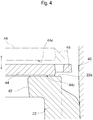
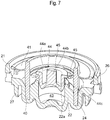
- the discharge cap 15 includes an inside plug member 21 closing the mouth portion 13a of the container body 13, and a body tubular member 23 having a topped tubular shape, covering the inside plug member 21, and including the discharge port 14.
- the inside plug member 21 includes a plug body 47, an outer peripheral part of which is disposed on an opening end of the mouth portion 13a of the container body 13, and a communication tubular part 22 erected on the plug body 47.
- the plug body 47 includes an inner tubular part 24 having a bottomed tubular shape and disposed in the mouth portion 13a of the container body 13 at an interval from the mouth portion 13a, a flange part 25 provided as an extension from the upper end of the inner tubular part 24 toward the outer side in the radial direction and disposed on the opening end of the mouth portion 13a of the container body 13, an outer tubular part 26 extending upward from the outer periphery of the flange part 25, and a middle tubular part 27 extending downward from the flange part 25, surrounding the inner tubular part 24 from the outer side in the radial direction, and fitted in the mouth portion 13a of the container body 13 in a liquid-tight manner.
- the inner tubular part 24, the flange part 25, the outer tubular part 26, and the middle tubular part 27 are disposed coaxially with the container axis O.
- An external air communication hole 28 penetrating in the radial direction and opened downward is formed at a lower end part of the outer tubular part 26.
- the communication tubular part 22 is disposed at a bottom wall part of the inner tubular part 24.
- a through-hole 42 opened to both the inside of the inner container 11 and of the communication tubular part 22 is provided through the bottom wall part.
- the through-hole 42 is disposed coaxially with the container axis O and has a diameter smaller than the inner diameter of the communication tubular part 22, and the size of the through-hole 42 in the direction of the container axis O is smaller than the size of the communication tubular part 22 in the direction of the container axis O.
- the body tubular member 23 has a topped tubular shape disposed coaxially with the container axis O.
- a female screw part 30 screwed with the male screw part 29 of the mouth portion 13a of the container body 13 is formed on the inner peripheral surface of a peripheral wall part 23a of the body tubular member 23.
- the lower tubular part 18 of the mouth portion 13a of the container body 13 is fitted in an air-tight manner in a lower end part of the peripheral wall part 23a, which is positioned on the lower side of a screw part where the female screw part 30 is formed, and the outer tubular part 26 of the inside plug member 21 is fitted in an upper end part of the peripheral wall part 23a, which is positioned on the upper side of the screw part.
- a top wall part 23b of the body tubular member 23 includes an annular lower plate part 31 extending toward the inner side in the radial direction from the upper end of the peripheral wall part 23a, an upper plate part 32 having a diameter smaller than the inner diameter of the lower plate part 31 and disposed on the upper side of the lower plate part 31, and a coupling annular part 33 coupling the inner periphery of the lower plate part 31 and the outer periphery of the upper plate part 32.
- the lower plate part 31, the upper plate part 32, and the coupling annular part 33 are disposed coaxially with the container axis O.
- the upper plate part 32 includes an external air introduction protrusion 34a having an external air introduction hole 34 that provides communication between the inside of the body tubular member 23 and the outside.
- the upper plate part 32 also includes a reception tubular part 35 extending downward and having an inner diameter equivalent to the inner diameter of the inner tubular part 24 of the inside plug member 21.
- a discharge tube 36 the inside of which serves as the discharge port 14 is provided through the upper plate part 32.
- An inner seal tubular part (seal part) 37 extending downward from the upper cap 16 is fitted in the discharge port 14.
- the discharge port 14 has an axis line direction aligned with the direction of the container axis O.
- An externally fitting tubular part 40 as a tubular member externally fitted to the communication tubular part 22 of the inside plug member 21 is disposed between the inside plug member 21 and the body tubular member 23.
- the externally fitting tubular part 40 is disposed coaxially with the container axis O, and has a lower end part externally fitted to the communication tubular part 22 and fitted in the inner tubular part 24 of the inside plug member 21, and an upper end part fitted in the reception tubular part 35 of the body tubular member 23.
- An annular air valve part 41 provided as an extension toward the outer side in the radial direction is formed at a middle part of the externally fitting tubular part 40 in the direction of the container axis O.
- the air valve part 41 is disposed to cover the space between the reception tubular part 35 and the coupling annular part 33 from below.
- the air valve part 41 is elastically deformable and switches to provide and cut off communication between the intake hole 19 and the external air introduction hole 34.
- the inside plug member 21 includes a communication hole 43 that provides communication between the discharge port 14 and the inside of the inner container 11.
- the communication hole 43 is made of the inside of the communication tubular part 22 and disposed coaxially with the container axis O. Accordingly, the communication hole 43 has an axis line direction aligned with the direction of the container axis O.
- the communication hole 43 is positioned on the lower side of the discharge port 14, in other words, on the inner side of the inner container 11 in the direction of the container axis O.
- the inner volume of the communication hole 43 is larger than the inner volume of the discharge port 14.
- a valve element 44 that is slidably fitted in the direction of the container axis O and elastically displaces in the direction of the container axis O to open and close the communication hole 43 is disposed in the communication hole 43.
- the valve element 44 has a bottomed cylindrical shape disposed coaxially with the container axis O, and includes a periphery upper end part as an annular flange part 44a protruding toward the outer side in the radial direction.
- the valve element 44 (flange part 44a) contacts on an opening surface at the upper end of the communication tubular part 22 to cut off communication between the through-hole 42 and the communication hole 43.
- a protrusion part 44b that contacts a lower end part 37a of the inner seal tubular part 37 is formed at a central part of the valve element 44 (refer to Figure 1 ).
- the periphery upper end of the valve element 44 is positioned on the upper side of the upper end of the communication tubular part 22, and coupled with one end of an elastic coupling piece 45 that couples the valve element 44 and the externally fitting tubular part 40.
- a plurality, three in the illustrated example, of elastic coupling pieces 45 are provided at intervals in the circumferential direction, and each elastic coupling piece 45 extends in a curved shape in the circumferential direction.
- the positions of both end parts of each elastic coupling piece 45 in the direction of the container axis O are equivalent to each other.
- valve element 44 the externally fitting tubular part 40, the elastic coupling pieces 45, and the air valve part 41 are integrally shaped.
- the elastic coupling pieces 45 elastically deform to allow the valve element 44 to be displaced in the direction of the container axis O (in the present specification, the displacement of the valve element 44 as the elastic coupling pieces 45 elastically deform in this manner is referred to as elastic displacement).
- the elastic coupling pieces 45 are preferably disposed at intervals equal to each other in the circumferential direction.
- each elastic coupling piece 45 elastically deforms with twist partially added and becomes tilted as a whole (refer to Figure 7 ).
- the elastic coupling piece 45 itself becomes partially twisted and entirely elongated in accordance with the state, and elastic restoring force of the elastic coupling piece 45 acts as force restoring and displacing (returning) the valve element 44 to a position before the displacement.
- the valve element 44 may rotate in the circumferential direction (clockwise or anticlockwise) about the container axis O.
- Each elastic coupling piece 45 extends in a curved shape in the circumferential direction as described above, and is simply housed in the narrow gap between the valve element 44 and the externally fitting tubular part 40 (in the present embodiment, between the flange part 44a of the valve element 44 and the inner peripheral surface of the externally fitting tubular part 40) in the initial state of the valve element 44 or a state in which the valve element 44 is restored and displaced toward the inner side of the inner container 11 in the direction of the container axis O.
- the dispensing container 10 including the upper cap 16 as in the present embodiment preferably has a structure for avoiding overflow of the content M when the dispensing container 10 is lidded with the upper cap 16. Such a structure will be described below with a specific example.
- the annular upper end surface of the communication tubular part 22 contacts the annular flange part 44a provided to a periphery upper end part of the valve element 44, and functions as a valve seat (valve holder) 22a that receives the valve element 44.
- the bottom surface of the valve element 44 may or may not contact a part of the plug body 47, which is positioned on the inner side of the communication tubular part 22 in the radial direction.
- a circulation allowable groove 44c that allows circulation of the content M is formed at part of a site of the valve element 44, which contacts the valve seat 22a (refer to Figure 2 ).
- the circulation allowable groove 44c is preferably set to have a size with which the content M remaining in an inner space 46 is returned into the inner container 11 after the valve element 44 sits on the valve seat 22a, and the content M closes the circulation allowable groove 44c (prevents air circulation) by surface tension at the final stage. At least part of the contents remaining in the inner space 46 may be returned to the inner container through the circulation allowable groove 44c.
- the specific shape of the circulation allowable groove 44c and the number thereof are not particularly limited.
- the valve element 44 having a flat plate shape and a substantially circular shape in a plan view is employed.
- the circulation allowable groove 44c that allows circulation of the content M is formed at part of the site of the valve element 44, which contacts the valve seat 22a (refer to Figures 3 and 4 ).
- the circulation allowable groove 44c is preferably set to have a size with which the content M remaining in the inner space 46 is returned into the inner container 11 after the valve element 44 sits on the valve seat 22a, and the content M closes the circulation allowable groove 44c (prevents air circulation) by surface tension at the final stage.
- the circulation allowable groove 44c may be provided, for example, in a length equal to the diameter on a straight line between outer edges in the radial direction on the back surface of the valve element 44, or in a length from an outer edge to an optional position at a central part of the back surface.
- the remaining content M potentially dirties the surrounding by leakage and scattering upon impact application or the like at use again or at storage.
- the content M remaining in the inner space 46 is pushed out the content M by the inner seal tubular part 37 that enters the discharge port 14 for fitting.
- the content M accumulating near the discharge port 14 or in the inner space 46 can circulate through the circulation allowable groove 44c and return to the inner container 11 through the through-hole 42.
- the upper cap 16 is removed from the discharge cap 15. Thereafter, while the dispensing container 10 is tilted to a discharge posture in which the discharge port 14 points downward (refer to Figure 5 ), the dispensing container 10 is pushed inward in the radial direction for squeezed deformation (elastic deformation) to achieve volume reduction of the inner container 11 through deformation together with the outer container 12.
- squeezed deformation elastic deformation
- the pressure in the inner container 11 rises and the content M in the inner container 11 pushes the valve element 44 through the through-hole 42 to elastically deform the elastic coupling pieces 45 so that the valve element 44 is elastically displaced toward the outside of the inner container 11 in the direction of the container axis O, thereby opening the communication hole 43.
- the content M in the inner container 11 is externally discharged through the through-hole 42, the communication hole 43, the inside of the externally fitting tubular part 40, and the discharge port 14 (refer to Figure 5 ).
- valve element 44 is restored and displaced toward the inner side of the inner container 11 in the direction of the container axis O by the elastic restoring force of the elastic coupling pieces 45.
- the inner volume of the inner space 46 increases along with the restoring displacement of the valve element 44 as the valve element 44 is continuously restored and displaced and slides in the communication hole 43 in the direction of the container axis O. Accordingly, the content M in the discharge port 14 can be sucked into the inner space 46, and air A can be sucked from the outside into the discharge port 14.
- the outer container 12 is deformed and restored with the inner container 11 deformed by volume reduction.
- negative pressure occurs between the inner container 11 and the outer container 12 and acts on the air valve part 41 through the intake hole 19, thereby opening the air valve part 41.
- external air is taken into the space between the outer container 12 and the inner container 11 through the external air introduction hole 34, the external air communication hole 28, the communication groove 20, and the intake hole 19.
- the air valve part 41 is deformed and restored to cut off the intake hole 19 from the outside. Accordingly, the shape of the inner container 11 with reduced volume is maintained after the content M is discharged.
- any remaining content M in the inner space 46 when the valve element 44 sits on the valve seat 22a to achieve closing can return into the inner container 11 through the circulation allowable groove 44c and the gap between the outer peripheral surface of the valve element 44 and the inner peripheral surface of the communication tubular part 22.
- the content M closes the circulation allowable groove 44c by surface tension at the final stage, thereby preventing air circulation.
- the dispensing container 10 according to the present embodiment can be reused (recycled) after use since the inner container 11 and the outer container 12 are both made of a polyethylene terephthalate resin.
- the dispensing container 10 according to the present embodiment has an excellent aroma retaining property (capability of holding aroma of the contents) as compared to the conventional dispensing container made of PP or the like.
- the content M in the discharge port 14 can be sucked into the inner space 46 and air A can be sucked from the outside into the discharge port 14, and thus the content M not returned to the inner container 11 can be prevented from remaining in the discharge port 14. Accordingly, it is possible to prevent leakage of the content M from the discharge port 14 after the content M is discharged.
- the valve element 44 Since the through-hole 42 has a diameter smaller than that of the communication hole 43, the valve element 44 contacts the part of the plug body 47, which is positioned on the inner side of the communication tubular part 22 in the radial direction, when the valve element 44 is unintentionally displaced toward the inner side of the inner container 11 in the above axis line direction, and thus the displacement of the valve element 44 can be regulated.
- the upper cap 16 is provided with the inner seal tubular part 37, the content M can be prevented from unexpectedly leaking from the discharge port 14 while the upper cap 16 is closed.
- the present invention is also applicable to a dispensing container including no air valve part.
- part or all of the inner container 11 and the outer container 12 of the container body 13 may be made of a polyethylene terephthalate resin.
- the dispensing container 10 as described above is applicable when the content M is various kinds of liquid such as liquid food.
- liquid food include soy sauce containing seasonings such as soy sauce and a soy sauce product, and any other seasonings.
- a method for suppressing a decrease in the above aroma components contained in a liquid seasoning over time includes a step of filling, with the liquid seasoning, a container made of a polyethylene terephthalate resin and having at least a double-layered structure.
- the double-layered container used in the suppression method may be that described above.
- the container body 13 made of a polyethylene terephthalate resin was experimentally produced, and the actual thicknesses of the inner container 11 and the outer container 12 thereof were measured. The measurement was performed based on an instrument, a measurement method, and other conditions described below.
- the average value and the standard deviation of the thickness of the inner container over the positions were as follows.
- the average value and the standard deviation of the thickness of the outer container over the positions were as follows.
- the thickness distributions of the inner container 11 and the outer container 12 obtained from the above measurement results were as described below.
- the inner container of the double-layered container described above was made of a material into which about 2% of an oxygen absorber of a polyamide/transition metal catalyst prepared according to Japanese Patent No. 5161462 (described above) was kneaded and used below.
- Example 1 Changes in ethyl esters in fired soy sauce and sensory evaluation
- the above double-layered container body was filled with fired soy sauce (manufactured by Kikkoman Corporation), and the discharge cap was mounted on the container body filled with the fired soy sauce.
- the container body was stored at room temperature for 30 days. After the storage, the concentration of each ethyl ester contained in the fired soy sauce was measured. The ethyl ester concentration was determined as described above. The ethyl ester concentration at the start of the storage is taken to be 100%.
- Example 2 Changes in ethyl esters in pure soy sauce and sensory evaluation
- the container body was filled with pure soy sauce (manufactured by Kikkoman Corporation), and the discharge cap was mounted on the container body filled with the pure soy sauce.
- the container body was stored at room temperature for 30 days. After the storage, the concentration of each ethyl ester contained in the pure soy sauce was measured. The ethyl ester concentration was determined as described above. The ethyl ester concentration at the start of the storage is taken to be 100%.
- Example 3 Changes in ethyl esters in kelp soy sauce and sensory evaluation
- the container body was filled with kelp soy sauce (manufactured by Kikkoman Corporation), and the discharge cap was mounted on the container body filled with the kelp soy sauce.
- the container body was stored at room temperature for 30 days. After the storage, the concentration of each ethyl ester contained in the kelp soy sauce was measured. The ethyl ester concentration was determined as described above. The ethyl ester concentration at the start of the storage is taken to be 100%.
- the double-layered container made of an ethylene-vinyl alcohol copolymer resin film As indicated in Tables 3 and 4, in the double-layered container made of an ethylene-vinyl alcohol copolymer resin film, the ethyl esters decreased remarkably, but in the double-layered container made of a polyethylene terephthalate resin, the decrease in the ethyl esters was small.
- the double-layered container made of a polyethylene terephthalate resin obtained a high sensory evaluation for aroma and taste as compared to the double-layered container made of ethylene-vinyl alcohol copolymer resin.
- the container body was filled with Ponzu vinegar (manufactured by Yamasa Corporation), and the discharge cap was mounted on the container body filled with the Ponzu vinegar.
- the container body was stored at room temperature for 30 days. After the storage, the concentration of each ethyl ester contained in the Ponzu vinegar was measured. The ethyl ester concentration was determined as described above. The ethyl ester concentration at the start of the storage is taken to be 100%.
- Test target 1 Double-layered container made of a polyethylene terephthalate resin (PET resin) (containing an oxygen absorber)
- Gas chromatography mass spectrometry was employed to measure the peak area of each ethyl ester and the peak area of the internal standard compound in a liquid seasoning and a drink in accordance with conditions below.
- the container body was filled with Ponzu vinegar (manufactured by Mizkan Holdings Co., Ltd.), and the discharge cap was mounted on the container body filled with the Ponzu vinegar.
- the container body was stored at room temperature for 30 days. After the storage, the amount of each terpene contained in the Ponzu vinegar was measured. The terpene concentration was determined as described above. The terpene concentration at the start of the storage is taken to be 100%.
- Example 7 Change in terpenes in vegetable-fruit mixed juice drink
- the container body was filled with a vegetable-fruit mixed juice drink (vegetable juice 65%; manufactured by Ito En Ltd.), and the discharge cap was mounted on the container body filled with the pure soy sauce.
- the container body was stored at room temperature for 30 days. After the storage, the concentration of each terpene contained in the vegetable-fruit mixed juice drink was measured. The terpene concentration was determined as described above. The terpene concentration at the start of the storage is taken to be 100%.
- Example 8 Change in terpenes in soft drink
- the container body was filled with a soft drink (AQUARIUS VITAMIN (manufactured by Coca-Cola Customer Marketing Company, Limited)), and the discharge cap was mounted on the container body filled with the soft drink.
- the container body was stored at room temperature for 30 days. After the storage, the concentration of each terpene contained in the soft drink was measured. The terpene concentration was determined as described above. The terpene concentration at the start of the storage is taken to be 100%.
- the container body was filled with a dressing type seasoning (green perilla dressing (manufactured by RIKEN VITAMIN Co., Ltd.)), and the discharge cap was mounted on the container body filled with the dressing type seasoning.
- the container body was stored at room temperature for 30 days. After the storage, the concentration of each terpene contained in the dressing type seasoning was measured. The terpene concentration was determined as described above. The terpene concentration at the start of the storage is taken to be 100%.
- the present invention can provide a food and beverage composition, a liquid seasoning in particular, contained in a container capable of maintaining an aroma retaining property for a long period of time with a small change in aroma components after opened.
Landscapes
- Engineering & Computer Science (AREA)
- Mechanical Engineering (AREA)
- Chemical & Material Sciences (AREA)
- Food Science & Technology (AREA)
- Ceramic Engineering (AREA)
- Polymers & Plastics (AREA)
- Health & Medical Sciences (AREA)
- Life Sciences & Earth Sciences (AREA)
- Nutrition Science (AREA)
- Chemical Kinetics & Catalysis (AREA)
- Medicinal Chemistry (AREA)
- Organic Chemistry (AREA)
- Closures For Containers (AREA)
- Containers Having Bodies Formed In One Piece (AREA)
- Packages (AREA)
- Wrappers (AREA)
Abstract
Description
- The present invention generally relates to a food and beverage composition contained in a novel container, and particularly relates to a liquid seasoning.
- Conventionally, as a container for a liquid seasoning such as soy sauce, a dispensing container as disclosed in Patent Document 1 below has been known, for example. This dispensing container includes: a container body including an inner container that holds contents, and deflates as the contents decrease, and an outer container encompassing the inner container and having an intake hole through which external air is taken into a space between the inner and outer containers; a discharge cap mounted on a mouth portion of the container body and having a discharge port through which the contents are discharged; and an external air introduction hole that provides communication between the outside and the intake hole. The discharge cap includes a body tubular member having a topped tubular shape, a pour-out tube communicated with the inside of the body tubular member, and a check valve that switches to provide and cut off communication between the inside of the body tubular member and the inside of the pour-out tube.
- Patent Document 1: Japanese Patent Laid-open No.
2004-231280 - The applicant found through studies of the conventional dispensing container that the concentration of a particular aroma component contained in contents (for example, a soy sauce containing seasoning) in the container changes over time.
- It is an object of the present invention to provide a food and beverage composition, a liquid seasoning in particular, contained in a container capable of maintaining an aroma retaining property for a long period of time with fewer changes in aroma components after opened.
- To achieve such an object, the inventors of the present application studied changes in aroma components over time, focusing on the material of a dispensing container, and found that a container made of a polyethylene terephthalate resin and having a double-layered structure has excellent capability of holding particular aroma components (aroma retaining property) as compared to a container made of an ethylene-vinyl alcohol copolymer resin film, which led to completion of the present invention.
- The present application includes the following invention.
- [1] A food and beverage composition contained in a container having at least a double-layered structure and including an innermost layer made of a polyethylene terephthalate resin.
- [2] The food and beverage composition according to [1], in which the container is a dispensing container including:
- a double-layered container body including
- an inner container that contains the food and beverage composition and deflates as the amount of the food and beverage composition decreases, and
- an outer container encompassing the inner container and having an intake hole through which external air is taken into a space between the inner container and the outer container; and
- a discharge cap mounted on a mouth portion of the container body and having a discharge port through which the food and beverage composition is discharged.
- [3] The food and beverage composition according to [1] or [2], in which at least one of the containers contains an oxygen absorber.
- [4] The food and beverage composition according to [3], in which the concentration of ethyl esters having 6 to 20 carbon atoms and/or terpenes having 10 carbon atoms contained in the food and beverage composition stored at room temperature for 30 days after manufacturing is 80% or higher of the concentration on day 0 after manufacturing.
- [5] The food and beverage composition according to any one of [1] to [4], which is a liquid seasoning.
- [6] The food and beverage composition according to [5], in which the liquid seasoning is soy sauce or a soy sauce product.
- [7] A method for suppressing a decrease in aroma components contained in a food and beverage composition over time, the method including a step of filling, with the food and beverage composition, a container made of a polyethylene terephthalate resin and having at least a double-layered structure.
- [8] The method according to [7], in which the aroma components are ethyl esters having 6 to 20 carbon atoms and/or terpenes having 10 carbon atoms.
- According to the present invention, a container has at least a double-layered structure and includes an innermost layer made of a polyethylene terephthalate resin, and thus it is possible to provide a food and beverage composition with fewer changes in the concentration of a particular aroma component such as ethyl esters or terpenes and in the color tone over time so that the quality of a product containing the food and beverage composition is maintained for a long period of time. In addition, depending on the aroma component, the concentration after storage increases rather than is maintained, and thus it is possible to enhance desired flavor over time.
-
- [
Figure 1] Figure 1 is a longitudinal sectional view of illustrating, in an enlarged manner, part of a dispensing container in which a circulation allowable groove is formed at part of a valve element. - [
Figure 2] Figure 2 is a diagram illustrating the circulation allowable groove inFigure 1 and a peripheral part thereof in a further enlarged manner. - [
Figure 3] Figure 3 is a longitudinal sectional view illustrating, in an enlarged manner, part of a dispensing container in which a circulation allowable groove is formed at part of a valve element in a form different from that inFigure 1 . - [
Figure 4] Figure 4 is a diagram illustrating the circulation allowable groove inFigure 3 and a peripheral part thereof in a further enlarged manner. - [
Figure 5] Figure 5 is a longitudinal sectional view for description of effects of the dispensing container illustrated inFigure 1 . - [
Figure 6] Figure 6 is a longitudinal sectional view for description of the effects of the dispensing container illustrated inFigure 1 . - [
Figure 7] Figure 7 is a perspective view illustrating an exemplary sectional structure such as a coupling member included in the dispensing container. - [
Figure 8] Figure 8 is an overall view illustrating an exemplary dispensing container. - For a food and beverage composition contained in a container having at least a double-layered structure according to the present invention, the container includes an innermost layer made of a polyethylene terephthalate resin. The number of layers of the container may be 3 or more as long as the effects of the present invention are achieved. A container (also referred to as an inner container, more specifically, an innermost layer) that is disposed innermost and contacts the food and beverage composition is substantially made of a polyethylene terephthalate resin but may optionally contain an oxygen absorber to provide the container with a gas barrier property and an oxygen absorption property.
- Any outer container (outer container) other than the inner container is not limited to a particular material, but may be partially or entirely made of a polyethylene terephthalate resin or another resin such as an ethylene-vinyl alcohol copolymer resin film. However, to reuse (recycle) the container, it is preferable that the entire container is mainly made of a polyethylene terephthalate resin.
- The container mainly made of a polyethylene terephthalate resin is better in aesthetics than a conventional dispensing container (made of, for example, low-density polyethylene), and can directly and clearly show the color of contents.
- In a further preferable aspect, the polyethylene terephthalate resin has an oxygen absorber to further improve the storage stability of the contents. The oxygen absorber is not particularly limited but only needs to be disposed inside or on the surface the polyethylene terephthalate resin, and may be, for example, an oxygen absorber (also referred to as a polyamide/transition metal catalyst oxygen absorber) containing a polyamide material and a deoxygenation material as disclosed in Japanese Patent No.
5161462 WO 2005/083003 ). Any other well-known oxygen absorber such as an inorganic oxygen absorber (for example, reduced iron or sodium sulfite) or an organic oxygen absorber (for example, ascorbic acids, ethylenic unsaturated hydrocarbon/transition metal catalyst, or cyclohexene side chain containing polymer/transition metal catalyst) may be used. The oxygen absorber is preferably impregnated in the resin. The kind and amount to be mixed of the oxygen absorber may be appropriately selected by the skilled person in the art in accordance with a desired effect of a barrier function or the like. For example, the polyamide/transition metal catalyst oxygen absorber may be mixed in the polyethylene terephthalate resin at 0.1 to 20% by weight, preferably 1 to 10% by weight, more preferably 1 to 3% by weight. - The polyamide material may be an aromatic polyamide or an aliphatic polyamide. The polyamide material may be a homopolymer material or a copolymer amide material. The aromatic polyamide may be a homopolymer or copolymer.
- A preferable kind of the polyamide material is MX nylon. The MX nylon is a polymer containing at least 70 mol % of a structural unit obtained from a xylylene diamine mixture containing m-xylylene diamine alone or m-xylylene diamine and p-xylylene diamine in an amount smaller than 30% of the entire material and containing an α,ω-aliphatic dicarboxylic acid having 6 to 10 carbon atoms.
- Examples of the MX polymer include homopolymers such as poly-m-xylylene adipamide and poly-m-xylylene sebacamide, copolymers such as an m-xylylene/p-xylylene adipamide copolymer, an m-xylylene/p-xylylene piperamide copolymer and an m-xylylene/p-xylylene azelamide copolymer, and a copolymer of the above homopolymer or copolymer component with an aliphatic diamine such as hexamethylenediamine, a cyclic diamine such as piperazine, an aromatic diamine such as p-bis(2-aminoethyl)benzene, an aromatic dicarboxylic acid such as terephthalic acid, an ω-amino carboxylic acid such as ε-caprolactam, ω-aminoheptane acid, or an aromatic aminocarboxylic acid such as p-aminobenzoic acid. The MX polymer may be optionally used in combination with a polymer such as nylon 6, nylon 66, nylon 610, or
nylon 11. - A particularly preferable aromatic polyamide is, for example, a polymer formed by polymerization of metaxylylenediamine (H2NCH2-m-C6H4-CH2NH2) and adipic acid (HO2C(CH2)4CO2H), and is a product manufactured and sold in the name of MXD6 by Mitsubishi Gas Chemical Company, Inc. Various kinds of grades of MXD6, such as Grades 6001, 6007, and 6021 may be used. A preferable aliphatic polyamide material is nylon 66. Other appropriate polyamides include GRIVORY (registered trademark) (for example, GRIVORY (registered trademark) G16 and G21, which are copolyamides containing a linear aliphatic unit and a cyclic aromatic component and can be obtained from EMS-Chemie Inc.), and VERSAMID (registered trademark) (aliphatic polyamide typically used as ink resin, which can be obtained from Cognis Corporation).
- A preblend contains a deoxygenation material in addition to diluent polyester and polyamide material. The preblend is present at about 20 ppm to about 2000 ppm, preferably about 50 ppm to about 1500 ppm, with respect to the weight of the deoxygenation material. In a more preferable embodiment, the preblend preferably contains the deoxygenation material at about 100 ppm to about 1000 ppm with respect to the weight of the preblend material.
- The deoxygenation material may be, for example, a metal selected from the first, second and third transition columns of the periodic table, a complex, or a salt.
- The metals usable as the deoxygenation material include iron, cobalt, copper, manganese, zinc, nickel, ruthenium, rhodium, palladium, osmium, iridium, and platinum. Examples of the deoxygenation material also include aluminum powder, aluminum carbide, aluminum chloride, cobalt powder, cobalt oxide, cobalt chloride, antimony powder, antimony oxide, antimony triacetate, antimony chloride III, antimony chloride V, iron, electrolytic iron, iron oxide, platinum, platinum on alumina, palladium, palladium on alumina, ruthenium, rhodium, copper, copper oxide, nickel, and nanoparticles of a mixed metal (that is, cobalt iron oxide nanoparticles).
- Among the above metals, a cobalt, iron, nickel, copper, or manganese compound is a preferable deoxygenation material. In particular, the cobalt compound as a most preferable deoxygenation material typically exists as a metal salt or complex. Anions of the salt may be inorganic or organic. Examples of the anions include halide, in particular, chloride, acetate, stearate, and octoate. Other deoxygenation materials include cobalt bromide (II) and cobalt carboxylate. The cobalt carboxylate can be obtained as cobalt SICCATOL (R). The cobalt carboxylate is a solution of cobalt carboxylate of C8 to C10, and the concentration of cobalt (as a metal) is about 10% by weight of the solution. Benzophenone or the like may be additionally blended as an ultraviolet sensitizer for use.
- The disposition and amount of the deoxygenation material in the innermost layer of the container may be determined as appropriate by the skilled person in the art.
- The food and beverage composition as contents contained in the container may be any food and beverage product containing, as an aroma component, at least one of low-molecule ethyl esters, preferably ethyl esters and/or terpenes having 6 to 20 carbon atoms, preferably terpenes having 10 carbon atoms, i.e., a monoterpene, at manufacturing. Among others, however, a food and beverage product with ethyl esters and terpenes which are aroma components unique to the end product and are desired to be maintained or enhanced, is preferred. Examples of such food and beverage products include a liquid seasoning, preferably soy sauce or a soy-sauce-like seasoning containing soy sauce, such as kelp soy sauce, and other seasonings such as Ponzu vinegar, stock sauce, sauce, and dressing, olive oil, and drinks such as a vegetable drink and a soft drink. The food and beverage product is not limited to liquid but may be semi-liquid, semi-solid, or solid as long as the effects of the present invention are achieved. The food and beverage composition includes products (soy sauce products such as kelp soy sauce, bonito stock soy sauce, and raw-egg-rice soy sauce) manufactured by using soy sauce and a soy-sauce-like seasoning.
- Examples of the ethyl esters contained in the food and beverage composition include ethyl esters having 6 to 20 carbon atoms, such as 2-methylethyl propanoate, ethyl butyrate, 2-methylethyl butyrate, 3-methylethyl butyrate, ethyl tetradecanoate, ethyl hexadecanoate, ethyl octadecanoate, ethyl oleate, ethyl linoleate, ethyl 6,9,12-hexadecatrienoate,
ethyl 9,12,15-hexadecatrienoate, andethyl 6,9,12,15-octadecatetraenoate, but are not limited thereto. - Examples of terpenes contained in the food and beverage composition include sabinene, pinene, limonene, terpinene, cymene, and linalool.
- When the food and beverage composition is stored in a container having at least a double-layered structure at room temperature for 30 days from manufacturing, the concentration of a particular aroma component contained in the food and beverage composition is maintained at 80%, preferably 90% or higher of the concentration on day 0 after manufacturing, more specifically, the concentration measured right before or right after filling of the container, or increases to 100% or higher, preferably 110% or higher, more preferably 120% or higher of the day 0 concentration.
- "Soy sauce" described in the present specification is a concept identical to soy sauce according to Japan Agricultural Standards. For example, authentically brewed soy sauce is soy sauce according to an authentically brewed scheme in Japan Agricultural Standards for soy sauce. Specifically, the soy sauce according to the authentically brewed scheme is a clear liquid seasoning obtained by processing soybean or grain such as soybean, wheat, and rice by steaming or another method and fermenting and maturing, with added salt water or mash-squeezed liquid, soy sauce malt obtained by inoculating and culturing Aspergillus oryzae, or the soy sauce malt to which steamed or puffed rice, or glycosylated rice with Aspergillus oryzae is added. The soy sauce according to the authentically brewed scheme may be fired (sterilized by heating) to obtain authentically brewed fired soy sauce.
- The authentically brewed pure soy sauce is classified as a mash-squeezed liquid in Japan Agricultural Standards, and is soy sauce obtained by squishing maturing mash of soy sauce and manufactured in the authentically brewed scheme without firing. Pure soy sauce refers to soy sauce from which, for clarification after the squishing, sediments and solid matters are separated and removed by being placed still or remaining sediments and microorganisms are removed through diatomite filtration or MF film processing.
- A "soy-sauce-like seasoning" in the present specification means seasonings manufactured from the authentically brewed soy sauce (fired soy sauce or pure soy sauce) subjected to the above process among liquid seasonings used for purposes the same as those of "soy sauce" defined in Japan Agricultural Standards. The soy-sauce-like seasoning may include soy sauce.
- The soy-sauce-like seasoning may contain other flavor and taste components. Examples of the flavor and taste components include yeast extract, seafood extract, fed animal extract, an amino acid, a nucleic acid, an organic acid, and protein hydrolysate. Among these, glutamate as the amino acid, nucleic acid, and yeast extract are preferable, in particular, to add flavor to the soy-sauce-like seasoning or soy sauce. These flavor and taste components may be added alone or in combination.
- The soy-sauce-like seasoning can be used for, without limitation in particular: various food and beverage products to which the soy-sauce-like seasoning needs to be added, such as various foods and drinks, meats, seafoods, vegetables, algae, fungi, fruits, nuts; processed foods cooked by using them, such as cooked products, rice foods, noodles, breads, vegetables, pickled vegetables, tempura, boiled eggs, snacks, stirfries, meat products, soups (cup soups and soups of instant noodles), and roux; fish/fed animal processed products such as boiled fish paste, fish sausage, fried fish paste; various soy sauces such as a koikuchi soy sauce and various low-salt soy sauces; various stock sauces, various sauces; yeast extract; fed animal extract; seafood extract; a seasoning such as protein hydrolysate; and a seasoning containing nucleic acid (such as inosinic acid sodium or guanylic acid sodium).
- A vegetable drink contains vegetable juice or/and fruit juice and may contain food additives as necessary. The vegetable juice or the fruit juice is acquired as a liquid through processes of, for example, heating a vegetable or a fruit as necessary, removing its non-edible part, shredding and grinding the vegetable or the fruit, and squishing, centrifugation, and the like. Any other processes such as filtration and enzyme treatment may be performed. The vegetable juice and the fruit juice may be not from concentrate or from concentrate. Examples of vegetables and fruits as the materials of the vegetable juice and the fruit juice include tomato, carrot (Panax quinquefolius), apple, orange, tangerine, grapefruit, lemon, other citrus fruits, grape, pear, plum, peach, strawberry, melon, watermelon, pineapple, banana, mango, papaya, passion fruit, mangosteen, dragon fruit, durian, noni, edible cactus, aloe, celery, parsley, pumpkin, squash, cucumber, bean sprout, various sprouts, burdock, pepper, chili pepper, aubergine, sweet potato, potato, taro plant, yacon, radish, turnip, kale, cabbage, broccoli, cauliflower, rape plant, mustard spinach, Chinese cabbage, pak-choi, tatsoi, Japanese mustard green, radish, watercress, salad rocket, other cruciferous leaf and root vegetable flower buds, lettuce, artemisia, chop-suey greens, other composite leaf vegetables, spinach, beet, other chenopodiaceous leaf and root vegetables, onion, green onion, garlic, chive, Chinese leek, other liliaceae leaf and root vegetables, soybean, azuki bean, mung bean, chickpea, lentil, broad bean, other leguminous pulses, rice, wheat, millet, other leguminous grains, and the like. These may be used alone or in combinations of two or more, but are not particularly limited.
- The food and beverage composition contained in a container having at least a double-layered structure according to the present invention is unlikely to suffer degradation over time as compared to conventional ones. This is illustrated with an example wherein the composition is soy sauce. Depending on storage conditions, not only the concentration of aroma components but also the color tone change over time, and the soy sauce may have a color number of a different kind from that at manufacturing. For example, when soy sauce having a color number of 18 is stored in a single layered bottle made of a polyethylene terephthalate resin at room temperature for 30 days, the color number potentially decreases to 6 approximately. However, with a double-layered bottle made of a polyethylene terephthalate resin, the color number can be maintained at 16 approximately. The color number of soy sauce means the color number of soy sauce standard color (a smaller color number indicates a darker color, and a larger color number indicates a lighter color) defined by JAS standards, and has a value of 2 to 56.
- The following describes a dispensing container according to an embodiment of the present invention with reference to the accompanying drawings.
- A dispensing
container 10 includes: acontainer body 13 including aninner container 11 that holds a content M (refer toFigure 5 ) and deflates as the amount of the content M decreases and anouter container 12 that is elastically deformable and encompasses theinner container 11; adischarge cap 15 that is mounted on amouth portion 13a of thecontainer body 13 and has adischarge port 14 through which the content M is discharged; and anupper cap 16 that is detachably disposed on the discharge cap 15 (refer toFigures 1 and8 , for example). - The
container body 13 of the dispensingcontainer 10 includes themouth portion 13a and abody portion 13b. Thebody portion 13b includes ashoulder part 13c, awaist part 13d, alower body part 13e, and abottom part 13f (refer toFigure 8 , for example). - The
container body 13 is formed in a bottomed tubular shape, and theupper cap 16 is formed in a topped tubular shape. The central axes of thecontainer body 13 and theupper cap 16 are aligned with a common axis when thecontainer body 13 is lidded with theupper cap 16. Hereinafter, this common axis is referred to as a container axis O, a side closer to theupper cap 16 in the direction of the container axis O is referred to as an upper side, a side closer to thebottom part 13f of thecontainer body 13 is referred to as a lower side, a direction orthogonal to the container axis O is referred to as a radial direction, and a direction orbiting about the container axis O is referred to as a circumferential direction. - The
container body 13 is what is called a delamination bottle in which theinner container 11 is laminated on the inner surface of theouter container 12 in a delaminatable manner. In the present embodiment, theinner container 11 and theouter container 12 are both made of a polyethylene terephthalate resin. With this configuration, the dispensingcontainer 10 according to the present embodiment can be reused (recycled) after use unlike a conventional dispensing container made of PP or the like, which needs to be discarded, and has such aesthetics that the color of the content M can be directly and clearly shown. When thedischarge cap 15 is not made of a polyethylene terephthalate resin, thecontainer body 13 from which thedischarge cap 15 is removed as needed at a stage of a recovery process is reused. - The dispensing
container 10 according to the present embodiment, in which theinner container 11 and theouter container 12 are both made of a polyethylene terephthalate resin, is excellent in the capability of holding the aroma of the contents, in other words, has an excellent aroma retaining property as compared to the conventional dispensing container made of PP or the like as described in the following embodiment. - The
inner container 11 needs to have a small thickness to efficiently discharge the contents when theinner container 11 and theouter container 12 are made of a polyethylene terephthalate resin. In the present embodiment, the thickness of theinner container 11 is equal to or smaller than 2/3 to 1/6, preferably 1/2 to 1/4 approximately, of the thickness of a normal PET container (the thickness of the PET bottle (container) differs depending on the purpose of use or a site and is, for example, 0.2 to 0.3 mm approximately in a case of a 1L soy sauce PET bottle). Exemplary numerical values thereof are 0.03 to 0.2 mm, preferably 0.04 to 0.15 mm, and more preferably 0.05 to 0.10 mm. With this configuration, theinner container 11 is laminated on the inner surface of theouter container 12 in a delaminatable manner, and is flexible so that the container can be filled with contents and deflate as the amount of the contents decrease. Accordingly, in the present embodiment, a reusable PET dispensing container (PET delamination container) is achieved. - When, as described above, the thickness of the
inner container 11 is 2/3 to 1/6, preferably 1/2 to about 1/4 or less, of the thickness of a normal PET container, or is 0.03 to 0.2 mm, preferably 0.04 to 0.15 mm, and more preferably 0.05 to 0.10 mm in numerical values so that the flexibility can be achieved, theinner container 11 has oxygen permeability, and the function (oxygen barrier function) of preventing oxygen permeation potentially becomes insufficient. To avoid this, theinner container 11 is made of a polyethylene terephthalate resin containing an oxygen absorber in the present embodiment. Theouter container 12 may be made of a polyethylene terephthalate resin containing an oxygen absorber. In this case, theouter container 12 may be made of a polyethylene terephthalate resin containing an oxygen absorber in place of theinner container 11, or theinner container 11 and theouter container 12 may be both made of a polyethylene terephthalate resin containing an oxygen absorber. In the latter case, the barrier function can be achieved more strongly. - The
mouth portion 13a of thecontainer body 13 has a double tubular shape including an uppertubular part 17 positioned on the upper side and a lowertubular part 18 positioned on the lower side and having a diameter larger than that of the uppertubular part 17. - A
male screw part 29 is formed on the outer peripheral surface of a part (hereinafter referred to as an outer upper cylindrical part) 17a of the uppertubular part 17, which is made of theouter container 12. In addition, anintake hole 19 through which external air is taken into the space between theinner container 11 and theouter container 12 is formed at a part of the outer uppercylindrical part 17a, which is positioned on the lower side of themale screw part 29. Acommunication groove 20 extending in the direction of the container axis O is formed at a part of themale screw part 29, which is positioned on the upper side of theintake hole 19. - The inner peripheral surface of the outer upper
cylindrical part 17a is a cylindrical surface, and a part (hereinafter referred to as an inner upper tubular part) 17b of the uppertubular part 17, which is made of theinner container 11 is laminated on the inner peripheral surface. An upper end part of the inner uppertubular part 17b is folded toward the outer side in the radial direction and disposed on an opening end of the outer uppercylindrical part 17a. - The
discharge cap 15 includes aninside plug member 21 closing themouth portion 13a of thecontainer body 13, and abody tubular member 23 having a topped tubular shape, covering theinside plug member 21, and including thedischarge port 14. - The
inside plug member 21 includes aplug body 47, an outer peripheral part of which is disposed on an opening end of themouth portion 13a of thecontainer body 13, and acommunication tubular part 22 erected on theplug body 47. - The
plug body 47 includes an innertubular part 24 having a bottomed tubular shape and disposed in themouth portion 13a of thecontainer body 13 at an interval from themouth portion 13a, aflange part 25 provided as an extension from the upper end of the innertubular part 24 toward the outer side in the radial direction and disposed on the opening end of themouth portion 13a of thecontainer body 13, an outertubular part 26 extending upward from the outer periphery of theflange part 25, and a middletubular part 27 extending downward from theflange part 25, surrounding the innertubular part 24 from the outer side in the radial direction, and fitted in themouth portion 13a of thecontainer body 13 in a liquid-tight manner. - The inner
tubular part 24, theflange part 25, the outertubular part 26, and the middletubular part 27 are disposed coaxially with the container axis O. An externalair communication hole 28 penetrating in the radial direction and opened downward is formed at a lower end part of the outertubular part 26. - The
communication tubular part 22 is disposed at a bottom wall part of the innertubular part 24. In addition, a through-hole 42 opened to both the inside of theinner container 11 and of thecommunication tubular part 22 is provided through the bottom wall part. The through-hole 42 is disposed coaxially with the container axis O and has a diameter smaller than the inner diameter of thecommunication tubular part 22, and the size of the through-hole 42 in the direction of the container axis O is smaller than the size of thecommunication tubular part 22 in the direction of the container axis O. - The
body tubular member 23 has a topped tubular shape disposed coaxially with the container axis O. - A
female screw part 30 screwed with themale screw part 29 of themouth portion 13a of thecontainer body 13 is formed on the inner peripheral surface of aperipheral wall part 23a of thebody tubular member 23. The lowertubular part 18 of themouth portion 13a of thecontainer body 13 is fitted in an air-tight manner in a lower end part of theperipheral wall part 23a, which is positioned on the lower side of a screw part where thefemale screw part 30 is formed, and the outertubular part 26 of theinside plug member 21 is fitted in an upper end part of theperipheral wall part 23a, which is positioned on the upper side of the screw part. - A
top wall part 23b of thebody tubular member 23 includes an annularlower plate part 31 extending toward the inner side in the radial direction from the upper end of theperipheral wall part 23a, anupper plate part 32 having a diameter smaller than the inner diameter of thelower plate part 31 and disposed on the upper side of thelower plate part 31, and a couplingannular part 33 coupling the inner periphery of thelower plate part 31 and the outer periphery of theupper plate part 32. Thelower plate part 31, theupper plate part 32, and the couplingannular part 33 are disposed coaxially with the container axis O. - The
upper plate part 32 includes an externalair introduction protrusion 34a having an externalair introduction hole 34 that provides communication between the inside of thebody tubular member 23 and the outside. Theupper plate part 32 also includes a receptiontubular part 35 extending downward and having an inner diameter equivalent to the inner diameter of the innertubular part 24 of theinside plug member 21. - In addition, a
discharge tube 36, the inside of which serves as thedischarge port 14 is provided through theupper plate part 32. - An inner seal tubular part (seal part) 37 extending downward from the
upper cap 16 is fitted in thedischarge port 14. Thedischarge port 14 has an axis line direction aligned with the direction of the container axis O. - An externally fitting
tubular part 40 as a tubular member externally fitted to thecommunication tubular part 22 of theinside plug member 21 is disposed between theinside plug member 21 and thebody tubular member 23. The externally fittingtubular part 40 is disposed coaxially with the container axis O, and has a lower end part externally fitted to thecommunication tubular part 22 and fitted in the innertubular part 24 of theinside plug member 21, and an upper end part fitted in the receptiontubular part 35 of thebody tubular member 23. - An annular
air valve part 41 provided as an extension toward the outer side in the radial direction is formed at a middle part of the externally fittingtubular part 40 in the direction of the container axis O. Theair valve part 41 is disposed to cover the space between the receptiontubular part 35 and the couplingannular part 33 from below. Theair valve part 41 is elastically deformable and switches to provide and cut off communication between theintake hole 19 and the externalair introduction hole 34. - The
inside plug member 21 includes acommunication hole 43 that provides communication between thedischarge port 14 and the inside of theinner container 11. Thecommunication hole 43 is made of the inside of thecommunication tubular part 22 and disposed coaxially with the container axis O. Accordingly, thecommunication hole 43 has an axis line direction aligned with the direction of the container axis O. In the illustrated example, thecommunication hole 43 is positioned on the lower side of thedischarge port 14, in other words, on the inner side of theinner container 11 in the direction of the container axis O. The inner volume of thecommunication hole 43 is larger than the inner volume of thedischarge port 14. - In the present embodiment, a
valve element 44 that is slidably fitted in the direction of the container axis O and elastically displaces in the direction of the container axis O to open and close thecommunication hole 43 is disposed in thecommunication hole 43. - The
valve element 44 has a bottomed cylindrical shape disposed coaxially with the container axis O, and includes a periphery upper end part as anannular flange part 44a protruding toward the outer side in the radial direction. The valve element 44 (flange part 44a) contacts on an opening surface at the upper end of thecommunication tubular part 22 to cut off communication between the through-hole 42 and thecommunication hole 43. - A
protrusion part 44b that contacts alower end part 37a of the inner sealtubular part 37 is formed at a central part of the valve element 44 (refer toFigure 1 ). - The periphery upper end of the
valve element 44 is positioned on the upper side of the upper end of thecommunication tubular part 22, and coupled with one end of anelastic coupling piece 45 that couples thevalve element 44 and the externally fittingtubular part 40. A plurality, three in the illustrated example, ofelastic coupling pieces 45 are provided at intervals in the circumferential direction, and eachelastic coupling piece 45 extends in a curved shape in the circumferential direction. The positions of both end parts of eachelastic coupling piece 45 in the direction of the container axis O are equivalent to each other. - The
valve element 44, the externally fittingtubular part 40, theelastic coupling pieces 45, and theair valve part 41 are integrally shaped. - The
elastic coupling pieces 45 elastically deform to allow thevalve element 44 to be displaced in the direction of the container axis O (in the present specification, the displacement of thevalve element 44 as theelastic coupling pieces 45 elastically deform in this manner is referred to as elastic displacement). When a plurality (in the illustrated example, three) ofelastic coupling pieces 45 are provided as in the present embodiment, theelastic coupling pieces 45 are preferably disposed at intervals equal to each other in the circumferential direction. When theelastic coupling pieces 45 are disposed at the equal intervals in this manner, it is possible to assist smooth displacement of thevalve element 44 while preventing a state (tilted state) in which thevalve element 44 is tilted relative to a surface orthogonal to the container axis O at the elastic displacement (refer toFigure 7 ). - When the
valve element 44 is elastically displaced, eachelastic coupling piece 45 elastically deforms with twist partially added and becomes tilted as a whole (refer toFigure 7 ). In this case, theelastic coupling piece 45 itself becomes partially twisted and entirely elongated in accordance with the state, and elastic restoring force of theelastic coupling piece 45 acts as force restoring and displacing (returning) thevalve element 44 to a position before the displacement. At the elastic displacement or the restoring displacement, thevalve element 44 may rotate in the circumferential direction (clockwise or anticlockwise) about the container axis O. - Each
elastic coupling piece 45 according to the present embodiment extends in a curved shape in the circumferential direction as described above, and is simply housed in the narrow gap between thevalve element 44 and the externally fitting tubular part 40 (in the present embodiment, between theflange part 44a of thevalve element 44 and the inner peripheral surface of the externally fitting tubular part 40) in the initial state of thevalve element 44 or a state in which thevalve element 44 is restored and displaced toward the inner side of theinner container 11 in the direction of the container axis O. - The dispensing
container 10 including theupper cap 16 as in the present embodiment preferably has a structure for avoiding overflow of the content M when the dispensingcontainer 10 is lidded with theupper cap 16. Such a structure will be described below with a specific example. - In the dispensing
container 10 illustrated inFigure 1 , the annular upper end surface of thecommunication tubular part 22 contacts theannular flange part 44a provided to a periphery upper end part of thevalve element 44, and functions as a valve seat (valve holder) 22a that receives thevalve element 44. In this case, the bottom surface of thevalve element 44 may or may not contact a part of theplug body 47, which is positioned on the inner side of thecommunication tubular part 22 in the radial direction. A circulationallowable groove 44c that allows circulation of the content M is formed at part of a site of thevalve element 44, which contacts thevalve seat 22a (refer toFigure 2 ). The circulationallowable groove 44c is preferably set to have a size with which the content M remaining in aninner space 46 is returned into theinner container 11 after thevalve element 44 sits on thevalve seat 22a, and the content M closes the circulationallowable groove 44c (prevents air circulation) by surface tension at the final stage. At least part of the contents remaining in theinner space 46 may be returned to the inner container through the circulationallowable groove 44c. - The specific shape of the circulation
allowable groove 44c and the number thereof are not particularly limited. - The following describes another example of the circulation
allowable groove 44c. In the dispensingcontainer 10 illustrated inFigures 3 and4 , thevalve element 44 having a flat plate shape and a substantially circular shape in a plan view is employed. The circulationallowable groove 44c that allows circulation of the content M is formed at part of the site of thevalve element 44, which contacts thevalve seat 22a (refer toFigures 3 and4 ). The circulationallowable groove 44c is preferably set to have a size with which the content M remaining in theinner space 46 is returned into theinner container 11 after thevalve element 44 sits on thevalve seat 22a, and the content M closes the circulationallowable groove 44c (prevents air circulation) by surface tension at the final stage. The circulationallowable groove 44c may be provided, for example, in a length equal to the diameter on a straight line between outer edges in the radial direction on the back surface of thevalve element 44, or in a length from an outer edge to an optional position at a central part of the back surface. - Typically, when the content M remains at the discharge port, the remaining content M potentially dirties the surrounding by leakage and scattering upon impact application or the like at use again or at storage. In addition, when the
upper cap 16 is closed to lid the dispensing container, the content M remaining in theinner space 46 is pushed out the content M by the inner sealtubular part 37 that enters thedischarge port 14 for fitting. However, in the dispensing container illustrated in, for example,Figure 1 , the content M accumulating near thedischarge port 14 or in theinner space 46 can circulate through the circulationallowable groove 44c and return to theinner container 11 through the through-hole 42. Thus, when theupper cap 16 is closed to lid the dispensing container, it is possible to prevent the inner side of theupper cap 16 and the surface of thedischarge cap 15 from becoming dirty due to overflow of the content M. - Although this example specifically describes the configuration in which the circulation
allowable groove 44c is provided only to thevalve element 44, an additional circulation allowable groove may be provided to thevalve seat 22a although not particularly illustrated. - The following describes effects of the dispensing
container 10 configured as described above. - To discharge the content M from the dispensing
container 10, first, theupper cap 16 is removed from thedischarge cap 15. Thereafter, while the dispensingcontainer 10 is tilted to a discharge posture in which thedischarge port 14 points downward (refer toFigure 5 ), the dispensingcontainer 10 is pushed inward in the radial direction for squeezed deformation (elastic deformation) to achieve volume reduction of theinner container 11 through deformation together with theouter container 12. - Accordingly, the pressure in the
inner container 11 rises and the content M in theinner container 11 pushes thevalve element 44 through the through-hole 42 to elastically deform theelastic coupling pieces 45 so that thevalve element 44 is elastically displaced toward the outside of theinner container 11 in the direction of the container axis O, thereby opening thecommunication hole 43. Accordingly, the content M in theinner container 11 is externally discharged through the through-hole 42, thecommunication hole 43, the inside of the externally fittingtubular part 40, and the discharge port 14 (refer toFigure 5 ). - Thereafter, when the pushing force on the
valve element 44 by the content M in theinner container 11 is reduced by stopping or canceling the pushing of the dispensingcontainer 10, thevalve element 44 is restored and displaced toward the inner side of theinner container 11 in the direction of the container axis O by the elastic restoring force of theelastic coupling pieces 45. - In this state, when the
valve element 44 enters thecommunication hole 43 as illustrated inFigure 6 , the outer peripheral surface of thevalve element 44 slidably contacts the inner peripheral surface of thecommunication hole 43 so that thecommunication hole 43 is closed. Accordingly, theinner space 46 in which the content M not returned to theinner container 11 remains is formed between thebody tubular member 23 and theinside plug member 21. Theinner space 46 is communicated with thedischarge port 14, and its communication with thecommunication hole 43 is cut off by thevalve element 44 functioning as part of a partition wall. - Then, after the
inner space 46 is formed in this manner, the inner volume of theinner space 46 increases along with the restoring displacement of thevalve element 44 as thevalve element 44 is continuously restored and displaced and slides in thecommunication hole 43 in the direction of the container axis O. Accordingly, the content M in thedischarge port 14 can be sucked into theinner space 46, and air A can be sucked from the outside into thedischarge port 14. - Then, when the pushing of the
container body 13 is canceled while thecommunication hole 43 is closed by thevalve element 44, theouter container 12 is deformed and restored with theinner container 11 deformed by volume reduction. In this case, negative pressure occurs between theinner container 11 and theouter container 12 and acts on theair valve part 41 through theintake hole 19, thereby opening theair valve part 41. Accordingly, external air is taken into the space between theouter container 12 and theinner container 11 through the externalair introduction hole 34, the externalair communication hole 28, thecommunication groove 20, and theintake hole 19. Then, when the internal pressure of the space between theouter container 12 and theinner container 11 increases to atmospheric pressure, theair valve part 41 is deformed and restored to cut off theintake hole 19 from the outside. Accordingly, the shape of theinner container 11 with reduced volume is maintained after the content M is discharged. - Any remaining content M in the
inner space 46 when thevalve element 44 sits on thevalve seat 22a to achieve closing can return into theinner container 11 through the circulationallowable groove 44c and the gap between the outer peripheral surface of thevalve element 44 and the inner peripheral surface of thecommunication tubular part 22. In addition, the content M closes the circulationallowable groove 44c by surface tension at the final stage, thereby preventing air circulation. - In this state, when the
outer container 12 of thecontainer body 13 is deformed by squeezing again, the internal pressure of the space between theouter container 12 and theinner container 11 becomes positive since theair valve part 41 is cut off, and this positive pressure deforms theinner container 11 through volume reduction so that the content M is discharged by the above effect. - When the pushing of the dispensing
container 10 is stopped and canceled before thecommunication hole 43 is closed by thevalve element 44 after the content M is discharged, theinner container 11 becomes deformed and restored, following theouter container 12. Accordingly, the pressure in theinner container 11 decreases and negative pressure occurs, and thus thevalve element 44 is smoothly displaced and restored toward the inner side of theinner container 11 in the direction of the container axis O as the negative pressure acts on thevalve element 44. - As described so far, the dispensing
container 10 according to the present embodiment can be reused (recycled) after use since theinner container 11 and theouter container 12 are both made of a polyethylene terephthalate resin. In addition, the dispensingcontainer 10 according to the present embodiment has an excellent aroma retaining property (capability of holding aroma of the contents) as compared to the conventional dispensing container made of PP or the like. - According to the dispensing
container 10 according to the present embodiment, after the content M is discharged, the content M in thedischarge port 14 can be sucked into theinner space 46 and air A can be sucked from the outside into thedischarge port 14, and thus the content M not returned to theinner container 11 can be prevented from remaining in thedischarge port 14. Accordingly, it is possible to prevent leakage of the content M from thedischarge port 14 after the content M is discharged. - Since the through-
hole 42 has a diameter smaller than that of thecommunication hole 43, thevalve element 44 contacts the part of theplug body 47, which is positioned on the inner side of thecommunication tubular part 22 in the radial direction, when thevalve element 44 is unintentionally displaced toward the inner side of theinner container 11 in the above axis line direction, and thus the displacement of thevalve element 44 can be regulated. - Since the
upper cap 16 is provided with the inner sealtubular part 37, the content M can be prevented from unexpectedly leaking from thedischarge port 14 while theupper cap 16 is closed. - Since the content M not returned to the
inner container 11 is unlikely to remain in thedischarge port 14 after the content M is discharged as described above, it is possible to prevent, when theupper cap 16 is mounted on thedischarge cap 15 and the inner sealtubular part 37 is fitted in thedischarge port 14 after the content M is discharged, the content M from being pushed out through thedischarge port 14 by the inner sealtubular part 37 and prevent the content M from adhering to the inner sealtubular part 37. - The technical scope of the present invention is not limited to the above embodiment but may be changed in various kinds of manners without departing from the gist of the present invention.
- For example, although the above embodiment describes the dispensing
container 10 including the air valve part, the present invention is also applicable to a dispensing container including no air valve part. Specifically, for example, in a dispensing container having a double structure and including no air valve part but an extremely narrow external air introduction hole, part or all of theinner container 11 and theouter container 12 of thecontainer body 13 may be made of a polyethylene terephthalate resin. - Although not particularly described in the above embodiment, the dispensing
container 10 as described above is applicable when the content M is various kinds of liquid such as liquid food. Specific examples of liquid food include soy sauce containing seasonings such as soy sauce and a soy sauce product, and any other seasonings. - A method for suppressing a decrease in the above aroma components contained in a liquid seasoning over time according to the present invention includes a step of filling, with the liquid seasoning, a container made of a polyethylene terephthalate resin and having at least a double-layered structure. The double-layered container used in the suppression method may be that described above.
- The following specifically describes the present invention by Examples.
- The
container body 13 made of a polyethylene terephthalate resin was experimentally produced, and the actual thicknesses of theinner container 11 and theouter container 12 thereof were measured. The measurement was performed based on an instrument, a measurement method, and other conditions described below. - Instrument: OLYMPUS Magna-Mike 8600
- Measurement metal ball: 1/16 IN
- Measurement method: although not particularly illustrated in detail, the shoulder part is provided with four ribs (protrusions) in the longitudinal direction, and the thicknesses of the
inner container 11 and theouter container 12 were measured at four places on lines along which the ribs extend and at heights separated from each other by 30 mm from thebottom part 13f of thecontainer body 13. The thicknesses of theinner container 11 and theouter container 12 obtained through the measurement were as described below. The thicknesses are in the unit of [mm], and <1> to <4> denote the four places on the lines along which the shoulder part ribs extend. The joining line ("parting line") of a mold is positioned on two of the four ribs, and the remaining ribs are separated from the parting line by 90°. Typically, the thickness of the container is measured with respect to the parting line. - At the distance of 150 mm from the bottom part: <1> 0.057, <2> 0.075, <3> 0.078, <4> 0.08
- At the distance of 120 mm from the bottom part: <1> 0.074, <2> 0.087, <3> 0.099, <4> 0.077
- At the distance of 90 mm from the bottom part: <1> 0.067, <2> 0.096, <3> 0.116, <4> 0.073
- At the distance of 60 mm from the bottom part: <1> 0.066, <2> 0.09, <3> 0.115, <4> 0.057
- At the distance of 30 mm from the bottom part: <1> 0.081, <2> 0.099, <3> 0.123, <4> 0.079
- The average value and the standard deviation of the thickness of the inner container over the positions were as follows.
- At the distance of 150 mm from the bottom part: Average value 0.073, Standard deviation 0.010536
- At the distance of 120 mm from the bottom part: Average value 0.084, Standard deviation 0.011295
- At the distance of 90 mm from the bottom part: Average value 0.088, Standard deviation 0.022465
- At the distance of 60 mm from the bottom part: Average value 0.082, Standard deviation 0.026038
- At the distance of 30 mm from the bottom part: Average value 0.096, Standard deviation 0.020421
- At the distance of 150 mm from the bottom part: <1> 0.253, <2> 0.246, <3> 0.255, <4> 0.263
- At the distance of 120 mm from the bottom part: <1> 0.276, <2> 0.256, <3> 0.286, <4> 0.252
- At the distance of 90 mm from the bottom part: <1> 0.278, <2> 0.261, <3> 0.297, <4> 0.265
- At the distance of 60 mm from the bottom part: <1> 0.245, <2> 0.246, <3> 0.267, <4> 0.343
- At the distance of 30 mm from the bottom part: <1> 0.275, <2> 0.27, <3> 0.266, <4> 0.31
- The average value and the standard deviation of the thickness of the outer container over the positions were as follows.
- At the distance of 150 mm from the bottom part: Average value 0.254, Standard deviation 0.006994
- At the distance of 120 mm from the bottom part: Average value 0.268, Standard deviation 0.016197
- At the distance of 90 mm from the bottom part: Average value 0.275, Standard deviation 0.016215
- At the distance of 60 mm from the bottom part: Average value 0.275, Standard deviation 0.046292
- At the distance of 30 mm from the bottom part: Average value 0.280, Standard deviation 0.020172
- The thickness distributions of the
inner container 11 and theouter container 12 obtained from the above measurement results were as described below. - At the distance of 150 mm from the bottom part: Thickness 0.0725
- At the distance of 120 mm from the bottom part: Thickness 0.08425
- At the distance of 90 mm from the bottom part: Thickness 0.088
- At the distance of 60 mm from the bottom part: Thickness 0.082
- At the distance of 30 mm from the bottom part: Thickness 0.0955
- At the distance of 150 mm from the bottom part: Thickness 0.25425
- At the distance of 120 mm from the bottom part: Thickness 0.2675
- At the distance of 90 mm from the bottom part: Thickness 0.27525
- At the distance of 60 mm from the bottom part: Thickness 0.27525
- At the distance of 30 mm from the bottom part: Thickness 0.280255
- The inner container of the double-layered container described above was made of a material into which about 2% of an oxygen absorber of a polyamide/transition metal catalyst prepared according to Japanese Patent No.
5161462 - The amounts of ethyl esters in Examples and the amount of cyclohexanol as an internal standard compound were measured in accordance with conditions below by headspace SPME-GC-MS.
- Separation and concentration of aroma components were performed by using an SPME fiber and a volatile component extraction device by a solid phase micro extraction method in accordance with conditions below.
-
- SPME fiber: SPME Fiber Assembly 75 µm CAR/PDMS (manufactured by SUPELCO)
- Volatile component extraction device: AOC-5000 (manufactured by Shimadzu Corporation)
- Preliminary heating: 40°C, 5 min
- Agitation speed: 250 rpm
- Volatile component extraction: 40°C, 20 min
- Desorption time: 20 min
- Gas chromatography mass spectrometry was employed to measure the peak area of each ethyl ester and the peak area of the internal standard compound in a liquid seasoning in accordance with conditions below. The liquid seasonings were fired soy sauce (Example 1), pure soy sauce (Example 2), and Ponzu vinegar (Example 4).
-
- Measurement instrument: QP-2010 ultra (manufactured by Shimadzu Corporation)
- Column: DB WAX-UI (length 60m, diameter 0.25 mm, thickness 0.25 µm) (manufactured by Agilent Technologies, Inc.)
- Temperature condition: Held at 40°C (3 min) -> Raised at 5°C/min to 110°C -> Raised at 10°C/min to 240°C -> Held for 5 min
- Carrier: High-purity helium, constant
linear speed mode 40 cm/min - Scanned mass range: m/z 40.0 to 250.0
- Ionization scheme: EI
- The peak area values of ethyl esters and cyclohexanol as the internal standard compound were determined by using the following m/z values.
- Ethyl propanoate m/z 102
- 2-Methylethyl propanoate m/z 71
- Ethyl butyrate m/z 71
- 2-Methylethyl butyrate m/z 102
- 3-Methylethyl butyrate m/z 88
- Cyclohexanol m/z 82
- The amounts of ethyl esters in Examples and 2-octanol as the internal standard compound were measured in accordance with conditions below through analysis of sample extract with ethyl acetate by GC-MS.
- 5.0 g of a food and beverage composition (kelp soy sauce (Example 3)) as a sample described below was mixed with 2.0 g of salt, 1.0 ml of ethyl acetate, and 100 µL of 2-octanol solution (100 ppm), the mixture was vigorously agitated for 5 minutes, and then an organic solvent layer was extracted. This operation was repeated 3 times, and organic solvent liquid thus obtained was dried with anhydrous sodium sulfate and condensed to 500 µL to acquire aroma concentrate. The aroma concentrate thus obtained was subjected to gas chromatography mass spectrometry with conditions below.
-
- Measurement instrument: 5977B (manufactured by Agilent Technologies, Inc.)
- Column: DB WAX-UI (length 60m, diameter 0.25 mm, thickness 0.25 µm) (manufactured by Agilent Technologies, Inc.)
- Temperature condition: Held at 40°C (3 min) -> Raised at 6°C/min to 250°C -> Held for 15 min
- Carrier: High-purity helium, constant pressure mode 229 kPa
- Scanned mass range: m/z 30.0 to 250.0
- Ionization scheme: EI
- The peak area values of each ethyl ester and 2-octanol as the internal standard compound were determined by using the following m/z values.
- Ethyl tetradecanoate m/z 88
- Ethyl hexadecanoate m/z 88
- Ethyl octadecanoate m/z 88
- Ethyl oleate m/z 55
- Ethyl linoleate m/z 95
- Ethyl 6,9,12-hexadecatrienoate m/z 75
-
Ethyl 9,12,15-hexadecatrienoate) m/z 75 -
Ethyl 6,9,12,15-octadecatetraenoate m/z 75 - 2-octanol m/z 55
- Sensory evaluation of various kinds of food and beverage compositions was performed by two experienced and skilled panels with the liquid before storage as a control. Change in aroma and taste was evaluated according to the following criteria.
- 2: Aroma has extremely improved
- 1: Aroma has slightly improved
- 0: No change
- -1: Aroma has slightly degraded
- -2: Aroma has extremely degraded
- The above double-layered container body was filled with fired soy sauce (manufactured by Kikkoman Corporation), and the discharge cap was mounted on the container body filled with the fired soy sauce. The container body was stored at room temperature for 30 days. After the storage, the concentration of each ethyl ester contained in the fired soy sauce was measured. The ethyl ester concentration was determined as described above. The ethyl ester concentration at the start of the storage is taken to be 100%.
- Test target 1: Double-layered container made of a polyethylene terephthalate resin (PET resin) (containing an oxygen absorber)
- Test target 2: Double-layered container made of an ethylene-vinyl alcohol copolymer resin film (containing no oxygen absorber)
- As indicated in Table 1, in the double-layered container made of an ethylene-vinyl alcohol copolymer resin film, particular ethyl esters remarkably decreased, but in the double-layered container made of a polyethylene terephthalate resin, the decrease in ethyl esters was small. In addition, for the double-layered container made of a polyethylene terephthalate resin, a high sensory evaluation for aroma and taste was obtained as compared to the double-layered container made of an ethylene-vinyl alcohol copolymer resin. These results indicate that the double-layered container made of a polyethylene terephthalate resin has an excellent aroma retaining property for fired soy sauce.
- The container body was filled with pure soy sauce (manufactured by Kikkoman Corporation), and the discharge cap was mounted on the container body filled with the pure soy sauce. The container body was stored at room temperature for 30 days. After the storage, the concentration of each ethyl ester contained in the pure soy sauce was measured. The ethyl ester concentration was determined as described above. The ethyl ester concentration at the start of the storage is taken to be 100%.
- Test target 1: Double-layered container made of a polyethylene terephthalate resin (PET resin) (containing an oxygen absorber)
- Test target 2: Double-layered container made of an ethylene-vinyl alcohol copolymer resin film (containing no oxygen absorber)
- As indicated in Table 2, in the double-layered container made of an ethylene-vinyl alcohol copolymer resin film, ethyl esters remarkably decreased, but in the double-layered container made of a polyethylene terephthalate resin, the decrease in ethyl esters was small. In addition, for the double-layered container made of a polyethylene terephthalate resin, a high sensory evaluation for aroma and taste was obtained as compared to the double-layered container made of an ethylene-vinyl alcohol copolymer resin. These results indicate that the double-layered container made of a polyethylene terephthalate resin has an excellent aroma retaining property for pure soy sauce.
- The container body was filled with kelp soy sauce (manufactured by Kikkoman Corporation), and the discharge cap was mounted on the container body filled with the kelp soy sauce. The container body was stored at room temperature for 30 days. After the storage, the concentration of each ethyl ester contained in the kelp soy sauce was measured. The ethyl ester concentration was determined as described above. The ethyl ester concentration at the start of the storage is taken to be 100%.
- Test target 1: Double-layered container made of a polyethylene terephthalate resin (PET resin) (containing an oxygen absorber)
- Test target 2: Double-layered container made of an ethylene-vinyl alcohol copolymer resin film (containing no oxygen absorber)
- As indicated in Tables 3 and 4, in the double-layered container made of an ethylene-vinyl alcohol copolymer resin film, the ethyl esters decreased remarkably, but in the double-layered container made of a polyethylene terephthalate resin, the decrease in the ethyl esters was small. In addition, the double-layered container made of a polyethylene terephthalate resin obtained a high sensory evaluation for aroma and taste as compared to the double-layered container made of ethylene-vinyl alcohol copolymer resin. These results indicate that the double-layered container made of a polyethylene terephthalate resin has an excellent aroma retaining property for kelp soy sauce and can maintain the quality thereof.
- The container body was filled with Ponzu vinegar (manufactured by Yamasa Corporation), and the discharge cap was mounted on the container body filled with the Ponzu vinegar. The container body was stored at room temperature for 30 days. After the storage, the concentration of each ethyl ester contained in the Ponzu vinegar was measured. The ethyl ester concentration was determined as described above. The ethyl ester concentration at the start of the storage is taken to be 100%.
- Test target 1: Double-layered container made of a polyethylene terephthalate resin (PET resin) (containing an oxygen absorber)
- Test target 2: Double-layered container made of an ethylene-vinyl alcohol copolymer resin film (containing no oxygen absorber)
- As indicated in Table 5, in the double-layered container made of an ethylene-vinyl alcohol copolymer resin film, the ethyl esters remarkably decreased, but in the double-layered container made of a polyethylene terephthalate resin, the decrease in the ethyl esters was small. In addition, for the double-layered container made of a polyethylene terephthalate resin, a high sensory evaluation for aroma and taste was obtained as compared to the double-layered container made of an ethylene-vinyl alcohol copolymer resin. These results indicate that the double-layered container made of a polyethylene terephthalate resin has an excellent aroma retaining property for Ponzu vinegar and can maintain the quality thereof.
- The container body was filled with pure soy sauce (manufactured by Kikkoman Corporation), and the discharge cap was mounted on the container body filled with the pure soy sauce. The container body was stored at room temperature for 30 days. The color number of the pure soy sauce before and after the storage was measured. Test target 1: Double-layered container made of a polyethylene terephthalate resin (PET resin) (containing an oxygen absorber)
- Test target 2: Double-layered container made of an ethylene-vinyl alcohol copolymer resin film (containing no oxygen absorber)
- Test target 3: Single layered bottle made of a polyethylene terephthalate resin (containing no oxygen absorber)
- As indicated in Table 6, in the double-layered container made of a polyethylene terephthalate resin and the double-layered container made of an ethylene-vinyl alcohol copolymer resin film, the color change was small as compared to the single layered container made of a polyethylene terephthalate resin, which indicates that the quality of the contents was maintained. It is clear that the color can be significantly maintained when such a double-layered container is used.
- The amounts of terpenes in Examples and 2-octanone as the internal standard compound were measured in accordance with conditions below by headspace SPME-GC-MS.
- Separation and concentration of aroma components was performed by using an SPME fiber and a volatile component extraction device by a solid phase micro extraction method in accordance with conditions below.
-
- SPME fiber: SPME Fiber Assembly 75 µm CAR/PDMS (manufactured by SUPELCO)
- Volatile component extraction device: AOC-5000 (manufactured by Shimadzu Corporation)
- Preliminary heating: 40°C, 5 min
- Agitation speed: 250 rpm
- Volatile component extraction: 40°C, 20 min
- Desorption time: 20 min
- Gas chromatography mass spectrometry was employed to measure the peak area of each ethyl ester and the peak area of the internal standard compound in a liquid seasoning and a drink in accordance with conditions below.
-
- Measurement instrument: QP-2010 ultra (manufactured by Shimadzu Corporation)
- Column: DB WAX-UI (length 60m, diameter 0.25 mm, thickness 0.25 µm) (manufactured by Agilent Technologies, Inc.)
- Temperature condition: Held at 40°C (3 min) -> Raised at 5°C/min to 110°C -> Raised at 10°C/min to 240°C -> Held for 5 min
- Carrier: High-purity helium, constant
linear speed mode 40 cm/min - Scanned mass range: m/z 40.0 to 250.0
- Ionization scheme: EI
- The peak area values of terpenes and 2-octanone as the internal standard compound were determined by using the following m/z values. Also, as a confirmation ion of each terpene, in the brackets
- Sabinene m/z 93
- Pinene m/z 93
- Limonene m/z 93
- Terpinene m/z 93
- Cymene m/z 119
- Linalool m/z 93
- 2-octanone m/z 58
- The container body was filled with Ponzu vinegar (manufactured by Mizkan Holdings Co., Ltd.), and the discharge cap was mounted on the container body filled with the Ponzu vinegar. The container body was stored at room temperature for 30 days. After the storage, the amount of each terpene contained in the Ponzu vinegar was measured. The terpene concentration was determined as described above. The terpene concentration at the start of the storage is taken to be 100%.
- Test target 1: Double-layered container made of a polyethylene terephthalate resin (PET resin) (containing an oxygen absorber)
- Test target 2: Double-layered container made of an ethylene-vinyl alcohol copolymer resin film (containing no oxygen absorber)
- As indicated in Table 7, in the double-layered container made of an ethylene-vinyl alcohol copolymer resin film the terpenes remarkably decreased, but in the double-layered container made of a polyethylene terephthalate resin, the decrease in the terpenes was small. In addition, for the double-layered container made of a polyethylene terephthalate resin, a high sensory evaluation for aroma and taste was obtained as compared to the double-layered container made of ethylene-vinyl alcohol copolymer resin. These results indicate that the double-layered container made of a polyethylene terephthalate resin has an excellent aroma retaining property for Ponzu vinegar.
- The container body was filled with a vegetable-fruit mixed juice drink (vegetable juice 65%; manufactured by Ito En Ltd.), and the discharge cap was mounted on the container body filled with the pure soy sauce. The container body was stored at room temperature for 30 days. After the storage, the concentration of each terpene contained in the vegetable-fruit mixed juice drink was measured. The terpene concentration was determined as described above. The terpene concentration at the start of the storage is taken to be 100%.
- Test target 1: Double-layered container made of a polyethylene terephthalate resin (PET resin) (containing an oxygen absorber)
- Test target 2: Double-layered container made of an ethylene-vinyl alcohol copolymer resin film (containing no oxygen absorber)
- As indicated in Table 8, in the double-layered container made of an ethylene-vinyl alcohol copolymer resin film the terpenes remarkably decreased, but in the double-layered container made of a polyethylene terephthalate resin, the decrease in the terpenes was small. In addition, for the double-layered container made of a polyethylene terephthalate resin, a high sensory evaluation for aroma and taste was obtained as compared to the double-layered container made of an ethylene-vinyl alcohol copolymer resin. These results indicate that the double-layered container made of a polyethylene terephthalate resin has an excellent aroma retaining property for a vegetable-fruit mixed juice drink.
- The container body was filled with a soft drink (AQUARIUS VITAMIN (manufactured by Coca-Cola Customer Marketing Company, Limited)), and the discharge cap was mounted on the container body filled with the soft drink. The container body was stored at room temperature for 30 days. After the storage, the concentration of each terpene contained in the soft drink was measured. The terpene concentration was determined as described above. The terpene concentration at the start of the storage is taken to be 100%.
- Test target 1: Double-layered container made of a polyethylene terephthalate resin (PET resin) (containing an oxygen absorber)
- Test target 2: Double-layered container made of an ethylene-vinyl alcohol copolymer resin film (containing no oxygen absorber)
- As indicated in Table 9, in the double-layered container made of an ethylene-vinyl alcohol copolymer resin film, the terpenes remarkably decreased, but in the double-layered container made of a polyethylene terephthalate resin, the decrease in the terpenes was small. In addition, for the double-layered container made of a polyethylene terephthalate resin, a high sensory evaluation for aroma and taste was obtained as compared to the double-layered container made of an ethylene-vinyl alcohol copolymer resin. These results indicate that the double-layered container made of a polyethylene terephthalate resin has an excellent aroma retaining property for a soft drink and can maintain the quality thereof.
- The container body was filled with a dressing type seasoning (green perilla dressing (manufactured by RIKEN VITAMIN Co., Ltd.)), and the discharge cap was mounted on the container body filled with the dressing type seasoning. The container body was stored at room temperature for 30 days. After the storage, the concentration of each terpene contained in the dressing type seasoning was measured. The terpene concentration was determined as described above. The terpene concentration at the start of the storage is taken to be 100%.
- Test target 1: Double-layered container made of a polyethylene terephthalate resin (PET resin) (containing an oxygen absorber)
- Test target 2: Double-layered container made of an ethylene-vinyl alcohol copolymer resin film (containing no oxygen absorber)
- As indicated in Table 10, in the double-layered container made of an ethylene-vinyl alcohol copolymer resin film, had a significant decrease of the terpenes remarkably decreased, but in the double-layered container made of a polyethylene terephthalate resin containing an oxygen absorber, the decrease in the terpenes was small. For the double-layered container made of a polyethylene terephthalate resin containing an oxygen absorber, a high sensory evaluation for aroma and taste was obtained as compared to the double-layered container made of an ethylene-vinyl alcohol copolymer resin. These results indicate that the double-layered container made of a polyethylene terephthalate resin containing an oxygen absorber has an excellent aroma retaining property for a dressing type seasoning and can maintain the quality thereof.
- The present invention can provide a food and beverage composition, a liquid seasoning in particular, contained in a container capable of maintaining an aroma retaining property for a long period of time with a small change in aroma components after opened.
- 10 ... dispensing container, 11 ... inner container, 12 ... outer container, 13 ... container body, 13a ... mouth portion, 14 ... discharge port, 15 ... discharge cap, 19 ... intake hole, 34 ... external air introduction hole, M ... content
| Ethyl propanoate | 2-Methylethyl propanoate | Ethyl butyrate | 2-Methylethyl butyrate | 3-Methylethyl butyrate | Aroma sensory evaluation average | Taste sensory evaluation average | |
| Test target 1 | 100% | 86% | 83% | 86% | 82% | 0 | 0 |
| Test target 2 | 95% | 59% | 63% | 41% | 34% | -1 | -1 |
| Ethyl propanoate | 2-Methylethyl propanoate | Ethyl butyrate | 2-Methylethyl butyrate | 3-Methylethyl butyrate | Aroma sensory evaluation average | Taste sensory evaluation average | |
| Test target 1 | 88% | 92% | 92% | 104% | 102% | 0 | 0 |
| Test target 2 | 90% | 95% | 60% | 67% | 33% | -1 | -1 |
| Ethyl tetradecanoate | Ethyl hexadecanoate | Ethyl octadecanoate | Ethyl oleate | Ethyl linoleate | |
| Test target 1 | 110% | 108% | 103% | 109% | 105% |
| Test target 2 | 25% | 44% | 58% | 53% | 50% |
| Ethyl 6,9,12- | Ethyl | 9,12,15- | Ethyl | 6,9,12,15-octadecatetraenoate | Aroma sensory evaluation average | Taste sensory evaluation average | |
| Test target 1 | 106% | 120% | 122% | 0 | 0 | ||
| Test target 2 | 35% | 32% | 18% | -2 | -2 |
| Ethyl propanoate | 2-Methylethyl propanoate | Ethyl butyrate | 2-Methylethyl butyrate | 3-Methylethyl butyrate | Aroma sensory evaluation average | Taste sensory evaluation average | |
| Test target 1 | 100% | 83% | 84% | 95% | Not detected | 0 | 0 |
| Test target 2 | 104% | 57% | 55% | 57% | Not detected | -0.5 | -1.5 |
| Before storage | After storage | |
| Test target 1 | 18 | 16 |
| Test target 2 | 18 | 16 |
| Test target 3 | 18 | 6 |
| Sabinene | Pinene | Limonene | Terpinene | Cymene | Linalool | |
| Test target 1 | 123% | 95% | 91% | 102% | 94% | 97% |
| Test target 2 | 45% | 39% | 38% | 40% | 53% | 51% |
| Sabinene | Pinene | Limonene | Terpinene | Cymene | Linalool | |
| Test target 1 | 110% | 100% | 111% | 101% | 98% | Not detected |
| Test target 2 | 36% | 39% | 67% | 27% | 40% | Not detected |
| Sabinene | Pinene | Limonene | Terpinene | Cymene | Linalool | |
| Test target 1 | Not detected | 98% | 95% | 96% | 100% | 88% |
| Test target 2 | Not detected | 30% | 41% | 45% | 42% | 48% |
| Sabinene | Pinene | Limonene | Terpinene | Cymene | Linalool | |
| Test target 1 | Not detected | 105% | 111% | 98% | 107% | 111% |
| Test target 2 | Not detected | 30% | 41% | 45% | 42% | 59% |
Claims (8)
- A food and beverage composition contained in a container having at least a double-layered structure and including an innermost layer made of a polyethylene terephthalate resin.
- The food and beverage composition according to claim 1, wherein the container is a dispensing container including:a double-layered container body includingan inner container that contains the food and beverage composition and deflates as the amount of the food and beverage composition decreases, andan outer container encompassing the inner container and having an intake hole through which external air is taken into a space between the inner container and the outer container; anda discharge cap mounted on a mouth portion of the container body and having a discharge port through which the food and beverage composition is discharged.
- The food and beverage composition according to claim 1 or 2, wherein at least one of the containers contains an oxygen absorber.
- The food and beverage composition according to claim 3, wherein a concentration of ethyl esters having 6 to 20 carbon atoms and/or terpenes having 10 carbon atoms contained in the food and beverage composition stored at room temperature for 30 days after manufacturing is 80% or higher of the concentration on day 0 after manufacturing.
- The food and beverage composition according to any one of claims 1 to 4, which is a liquid seasoning.
- The food and beverage composition according to claim 5, wherein the liquid seasoning is soy sauce or a soy sauce product.
- A method for suppressing a decrease in aroma components contained in a food and beverage composition over time, the method comprising a step of filling, with the food and beverage composition, a container made of a polyethylene terephthalate resin and having at least a double-layered structure.
- The method according to claim 7, wherein the aroma components are ethyl esters having 6 to 20 carbon atoms and/or terpenes having 10 carbon atoms.
Applications Claiming Priority (2)
| Application Number | Priority Date | Filing Date | Title |
|---|---|---|---|
| JP2017075275 | 2017-04-05 | ||
| PCT/JP2018/014072 WO2018186333A1 (en) | 2017-04-05 | 2018-04-02 | Food and beverage composition packed in dual container |
Publications (2)
| Publication Number | Publication Date |
|---|---|
| EP3608241A1 true EP3608241A1 (en) | 2020-02-12 |
| EP3608241A4 EP3608241A4 (en) | 2021-01-27 |
Family
ID=63712891
Family Applications (1)
| Application Number | Title | Priority Date | Filing Date |
|---|---|---|---|
| EP18781017.1A Pending EP3608241A4 (en) | 2017-04-05 | 2018-04-02 | Food and beverage composition packed in dual container |
Country Status (7)
| Country | Link |
|---|---|
| US (1) | US20200062476A1 (en) |
| EP (1) | EP3608241A4 (en) |
| JP (1) | JP7219704B2 (en) |
| KR (2) | KR102520008B1 (en) |
| CN (1) | CN110709327A (en) |
| CA (1) | CA3058875C (en) |
| WO (1) | WO2018186333A1 (en) |
Families Citing this family (21)
| Publication number | Priority date | Publication date | Assignee | Title |
|---|---|---|---|---|
| CN110382371A (en) * | 2017-03-15 | 2019-10-25 | 京洛株式会社 | Laminated peeling container |
| JP7497975B2 (en) | 2017-04-05 | 2024-06-11 | キッコーマン株式会社 | Discharge Container |
| CN112027300A (en) * | 2020-10-12 | 2020-12-04 | 广州长霖塑料制品有限公司 | Double-layer bottle |
| CN112455916A (en) * | 2020-12-14 | 2021-03-09 | 广州尚功塑胶有限公司 | Anti-pollution bottle cap |
| CN112849725B (en) * | 2021-03-15 | 2024-10-11 | 广州长霖塑料制品有限公司 | Low-cost double-layer bottle |
| US11751585B1 (en) | 2022-05-13 | 2023-09-12 | Sharkninja Operating Llc | Flavored beverage carbonation system |
| US12213617B2 (en) | 2022-05-13 | 2025-02-04 | Sharkninja Operating Llc | Flavored beverage carbonation process |
| US11647860B1 (en) | 2022-05-13 | 2023-05-16 | Sharkninja Operating Llc | Flavored beverage carbonation system |
| US12096880B2 (en) | 2022-05-13 | 2024-09-24 | Sharkninja Operating Llc | Flavorant for beverage carbonation system |
| US12539500B2 (en) | 2022-08-31 | 2026-02-03 | Sharkninja Operating Llc | Additive containers |
| US11745996B1 (en) | 2022-11-17 | 2023-09-05 | Sharkninja Operating Llc | Ingredient containers for use with beverage dispensers |
| US12103840B2 (en) | 2022-11-17 | 2024-10-01 | Sharkninja Operating Llc | Ingredient container with sealing valve |
| US12084334B2 (en) | 2022-11-17 | 2024-09-10 | Sharkninja Operating Llc | Ingredient container |
| US11634314B1 (en) | 2022-11-17 | 2023-04-25 | Sharkninja Operating Llc | Dosing accuracy |
| US11738988B1 (en) | 2022-11-17 | 2023-08-29 | Sharkninja Operating Llc | Ingredient container valve control |
| USD1091308S1 (en) | 2022-12-23 | 2025-09-02 | Sharkninja Operating Llc | Ingredient container |
| USD1092208S1 (en) | 2022-12-23 | 2025-09-09 | Sharkninja Operating Llc | Cap of ingredient container |
| US12116257B1 (en) | 2023-03-22 | 2024-10-15 | Sharkninja Operating Llc | Adapter for beverage dispenser |
| US11871867B1 (en) | 2023-03-22 | 2024-01-16 | Sharkninja Operating Llc | Additive container with bottom cover |
| US11925287B1 (en) | 2023-03-22 | 2024-03-12 | Sharkninja Operating Llc | Additive container with inlet tube |
| US12005408B1 (en) | 2023-04-14 | 2024-06-11 | Sharkninja Operating Llc | Mixing funnel |
Family Cites Families (26)
| Publication number | Priority date | Publication date | Assignee | Title |
|---|---|---|---|---|
| US5344045A (en) * | 1990-12-17 | 1994-09-06 | The Coca-Cola Company | Liquid container system |
| JP2003274893A (en) * | 2002-01-21 | 2003-09-30 | Ajinomoto Co Inc | Seasoning having suppressed discoloration tendency and processed food containing the seasoning |
| AU2003200821B2 (en) * | 2002-03-11 | 2007-06-14 | Mitsubishi Gas Chemical Company, Inc. | Process for producing oxygen absorbing polyamide resin composition and oxygen absorbing polyamide resin composition produced by the process |
| JP4228362B2 (en) | 2003-01-31 | 2009-02-25 | 株式会社吉野工業所 | Plastic container |
| AU2004202264B2 (en) * | 2003-05-29 | 2008-12-18 | Mitsubishi Gas Chemical Company, Inc. | Masterbatch and production method of oxygen-absorbing molded article |
| JP2005015686A (en) * | 2003-06-27 | 2005-01-20 | Kiyomitsu Kawasaki | Fruit-like flavor composition |
| US8192676B2 (en) * | 2004-02-12 | 2012-06-05 | Valspar Sourcing, Inc. | Container having barrier properties and method of manufacturing the same |
| CN101069574A (en) * | 2006-05-10 | 2007-11-14 | 蔡迎春 | High-density polyethylene plastic bottled protein drink whose protein is not more than 0.8% |
| CN201144037Y (en) * | 2008-01-25 | 2008-11-05 | 唐明 | Beverage bottle |
| JP5667010B2 (en) * | 2011-06-09 | 2015-02-12 | 株式会社吉野工業所 | Discharge container |
| JP6336702B2 (en) * | 2011-08-05 | 2018-06-06 | キッコーマン株式会社 | Discharge container |
| WO2013036564A2 (en) * | 2011-09-09 | 2013-03-14 | Fountain Master, Llc | Beverage maker |
| JP5938289B2 (en) * | 2012-07-26 | 2016-06-22 | キッコーマン株式会社 | Discharge container |
| JP5768949B2 (en) * | 2013-03-28 | 2015-08-26 | 三菱瓦斯化学株式会社 | Polyamide resin composition for inner layer of delamination container and delamination container using the same |
| CN105473450B (en) * | 2013-06-25 | 2019-12-06 | 可口可乐公司 | In-bottle pasteurization |
| WO2015080016A1 (en) * | 2013-11-27 | 2015-06-04 | キョーラク株式会社 | Delamination container |
| CN105793162B (en) * | 2013-11-27 | 2019-07-02 | 京洛株式会社 | Laminated peel container and method for producing the same |
| ES2737105T3 (en) * | 2013-11-27 | 2020-01-10 | Kyoraku Co Ltd | Delaminable container |
| JP6219187B2 (en) | 2014-01-31 | 2017-10-25 | 株式会社吉野工業所 | Delamination container |
| JP2015223496A (en) | 2014-05-26 | 2015-12-14 | 有限会社スタジオナウ | Sealed soy sauce bottle |
| JP6407649B2 (en) * | 2014-09-30 | 2018-10-17 | 株式会社吉野工業所 | Delamination container |
| JP6488151B2 (en) * | 2015-02-27 | 2019-03-20 | 株式会社吉野工業所 | Discharge container |
| JP2016193743A (en) * | 2015-03-31 | 2016-11-17 | 株式会社吉野工業所 | Double container |
| JP6867111B2 (en) | 2015-05-08 | 2021-04-28 | 東洋製罐グループホールディングス株式会社 | Double-structured container molding preform and double-structured container |
| JP2016216124A (en) * | 2015-05-26 | 2016-12-22 | 株式会社吉野工業所 | Discharge container |
| JP2017030846A (en) * | 2015-08-06 | 2017-02-09 | 株式会社三谷バルブ | Back suction mechanism using cup rubber, double container equipped with this back suction mechanism, and pump-type product of squeeze operation mode equipped with this double container |
-
2018
- 2018-04-02 CA CA3058875A patent/CA3058875C/en active Active
- 2018-04-02 EP EP18781017.1A patent/EP3608241A4/en active Pending
- 2018-04-02 WO PCT/JP2018/014072 patent/WO2018186333A1/en not_active Ceased
- 2018-04-02 US US16/500,293 patent/US20200062476A1/en not_active Abandoned
- 2018-04-02 CN CN201880023150.0A patent/CN110709327A/en active Pending
- 2018-04-02 KR KR1020227014427A patent/KR102520008B1/en active Active
- 2018-04-02 JP JP2019511223A patent/JP7219704B2/en active Active
- 2018-04-02 KR KR1020197031401A patent/KR20190133717A/en not_active Ceased
Also Published As
| Publication number | Publication date |
|---|---|
| KR20190133717A (en) | 2019-12-03 |
| KR102520008B1 (en) | 2023-04-11 |
| WO2018186333A1 (en) | 2018-10-11 |
| CN110709327A (en) | 2020-01-17 |
| EP3608241A4 (en) | 2021-01-27 |
| JP7219704B2 (en) | 2023-02-08 |
| CA3058875C (en) | 2023-03-07 |
| KR20220062421A (en) | 2022-05-16 |
| CA3058875A1 (en) | 2018-10-11 |
| US20200062476A1 (en) | 2020-02-27 |
| JPWO2018186333A1 (en) | 2020-02-13 |
Similar Documents
| Publication | Publication Date | Title |
|---|---|---|
| CA3058875C (en) | Food and beverage composition contained in double-layered container | |
| JP7051985B2 (en) | Tomato ketchup with high lycopene | |
| EP4070668B1 (en) | Acetic acid-containing food or drink | |
| CN114761530B (en) | Container packaged beverage and method for producing the same | |
| Sandhu et al. | Oranges and citrus juices | |
| EP4066652A1 (en) | Acetic acid-containing food or drink | |
| US20130064957A1 (en) | Composition comprising cinnamon | |
| JP6775411B2 (en) | Beverage | |
| CN1976597A (en) | Liquid seasoning and its production method | |
| Bartoshuk et al. | Saltiness of monosodium glutamate and sodium intake | |
| JP6749318B2 (en) | Liquid food and drink containing hydrogen in containers | |
| JP5913862B2 (en) | Flavor improver for miso or miso-containing foods and drinks | |
| CN111565578B (en) | Liquid seasoning containing food materials | |
| TWI679940B (en) | Method for adjusting flavor balance of liquid food and drink | |
| HK40017305A (en) | Food and beverage composition packed in dual container | |
| JP6405437B2 (en) | Flavor improver for miso or miso-containing foods and drinks | |
| EP4212449A1 (en) | Container for a consumable good coated with a resveratrol containing layer | |
| JP6186025B2 (en) | Two-component separation type container seasoning | |
| JP7852888B2 (en) | Fish extract and liquid seasoning | |
| JP6821848B1 (en) | Beverage | |
| Omobuwajo | Food ffavourings: principles of applications | |
| HK40036548B (en) | Ingredient-containing liquid flavoring agent | |
| Rizzo et al. | Food Packaging and Shelf Life |
Legal Events
| Date | Code | Title | Description |
|---|---|---|---|
| STAA | Information on the status of an ep patent application or granted ep patent |
Free format text: STATUS: THE INTERNATIONAL PUBLICATION HAS BEEN MADE |
|
| PUAI | Public reference made under article 153(3) epc to a published international application that has entered the european phase |
Free format text: ORIGINAL CODE: 0009012 |
|
| STAA | Information on the status of an ep patent application or granted ep patent |
Free format text: STATUS: REQUEST FOR EXAMINATION WAS MADE |
|
| 17P | Request for examination filed |
Effective date: 20191009 |
|
| AK | Designated contracting states |
Kind code of ref document: A1 Designated state(s): AL AT BE BG CH CY CZ DE DK EE ES FI FR GB GR HR HU IE IS IT LI LT LU LV MC MK MT NL NO PL PT RO RS SE SI SK SM TR |
|
| AX | Request for extension of the european patent |
Extension state: BA ME |
|
| DAV | Request for validation of the european patent (deleted) | ||
| DAX | Request for extension of the european patent (deleted) | ||
| A4 | Supplementary search report drawn up and despatched |
Effective date: 20210112 |
|
| RIC1 | Information provided on ipc code assigned before grant |
Ipc: B65D 1/02 20060101AFI20201221BHEP Ipc: B65D 83/00 20060101ALI20201221BHEP Ipc: A23L 5/00 20160101ALI20201221BHEP Ipc: B65D 77/06 20060101ALI20201221BHEP Ipc: B65D 47/08 20060101ALI20201221BHEP Ipc: B65D 1/32 20060101ALI20201221BHEP Ipc: B65D 47/20 20060101ALI20201221BHEP Ipc: A23L 27/50 20160101ALI20201221BHEP |
|
| STAA | Information on the status of an ep patent application or granted ep patent |
Free format text: STATUS: EXAMINATION IS IN PROGRESS |
|
| 17Q | First examination report despatched |
Effective date: 20220909 |