EP3606440B1 - Verfahren und vorrichtung zur bestimmung des hydratations-, fitness- und ernährungszustandes eines menschlichen körpers - Google Patents
Verfahren und vorrichtung zur bestimmung des hydratations-, fitness- und ernährungszustandes eines menschlichen körpers Download PDFInfo
- Publication number
- EP3606440B1 EP3606440B1 EP18781774.7A EP18781774A EP3606440B1 EP 3606440 B1 EP3606440 B1 EP 3606440B1 EP 18781774 A EP18781774 A EP 18781774A EP 3606440 B1 EP3606440 B1 EP 3606440B1
- Authority
- EP
- European Patent Office
- Prior art keywords
- mass
- ecw
- icw
- volume fraction
- water
- Prior art date
- Legal status (The legal status is an assumption and is not a legal conclusion. Google has not performed a legal analysis and makes no representation as to the accuracy of the status listed.)
- Active
Links
Images




Classifications
-
- A—HUMAN NECESSITIES
- A61—MEDICAL OR VETERINARY SCIENCE; HYGIENE
- A61B—DIAGNOSIS; SURGERY; IDENTIFICATION
- A61B5/00—Measuring for diagnostic purposes; Identification of persons
- A61B5/05—Detecting, measuring or recording for diagnosis by means of electric currents or magnetic fields; Measuring using microwaves or radio waves
- A61B5/053—Measuring electrical impedance or conductance of a portion of the body
- A61B5/0537—Measuring body composition by impedance, e.g. tissue hydration or fat content
-
- A—HUMAN NECESSITIES
- A61—MEDICAL OR VETERINARY SCIENCE; HYGIENE
- A61B—DIAGNOSIS; SURGERY; IDENTIFICATION
- A61B5/00—Measuring for diagnostic purposes; Identification of persons
- A61B5/48—Other medical applications
- A61B5/4869—Determining body composition
- A61B5/4872—Body fat
-
- A—HUMAN NECESSITIES
- A61—MEDICAL OR VETERINARY SCIENCE; HYGIENE
- A61B—DIAGNOSIS; SURGERY; IDENTIFICATION
- A61B5/00—Measuring for diagnostic purposes; Identification of persons
- A61B5/48—Other medical applications
- A61B5/4869—Determining body composition
- A61B5/4875—Hydration status, fluid retention of the body
-
- A—HUMAN NECESSITIES
- A61—MEDICAL OR VETERINARY SCIENCE; HYGIENE
- A61B—DIAGNOSIS; SURGERY; IDENTIFICATION
- A61B5/00—Measuring for diagnostic purposes; Identification of persons
- A61B5/68—Arrangements of detecting, measuring or recording means, e.g. sensors, in relation to patient
- A61B5/6801—Arrangements of detecting, measuring or recording means, e.g. sensors, in relation to patient specially adapted to be attached to or worn on the body surface
- A61B5/6813—Specially adapted to be attached to a specific body part
- A61B5/6824—Arm or wrist
-
- A—HUMAN NECESSITIES
- A61—MEDICAL OR VETERINARY SCIENCE; HYGIENE
- A61B—DIAGNOSIS; SURGERY; IDENTIFICATION
- A61B5/00—Measuring for diagnostic purposes; Identification of persons
- A61B5/68—Arrangements of detecting, measuring or recording means, e.g. sensors, in relation to patient
- A61B5/6801—Arrangements of detecting, measuring or recording means, e.g. sensors, in relation to patient specially adapted to be attached to or worn on the body surface
- A61B5/6813—Specially adapted to be attached to a specific body part
- A61B5/6829—Foot or ankle
Definitions
- the invention relates to a method of determining the hydration, fitness and nutrition status of a human body in vivo, and to a device for performing the steps of the method.
- the invention further relates to the field of bioelectric impedance spectroscopy and to the field of three- or more compartment models
- the human body consists principally of water, fat, bone, and protein. Water is the largest component amounting to typically about 60% of the total body weight (W).
- the total body water (TBW) is contained in an intracellular water (ICW) space surrounded by semi-permeable cell membranes, and an extracellular water (ECW) space that includes both tissue and vascular water.
- the intracellular water (ICW) compartment relates to a nutritional status as it reflects the size of exchangeable protein stores and the body's metabolic cellular mass performing all work and consuming all oxygen. It is known that intracellular water (ICW) generally maintains a 70% relationship to a total cell volume. Protein and glycogen make up most of the remainder.
- the extracellular water (ECW) is thought to principally reflect hydration status.
- the human body contains adipose tissue and lean tissue.
- the adipose tissue is composed lipid (fat), and roughly 5% mineral-protein and 20% water, with roughly 13% extracellular water (ECW) and 7% intracellular water (ICW).
- the lean tissue LT
- Healthy adipose-free lean tissue contains roughly 73% of water of which about 46% is intracellular water (ICW) and about 27% is extracellular water (ECW).
- the intravascular water is roughly 15% of extracellular water (ECW).
- the total body water (TBW) is the sum of extracellular water (ECW) and intracellular water (ICW).
- the status of intracellular water (ICW) and the extracellular water (ECW) are primary biomarkers of health and disease because the disease process may often result in an increase of extracellular water (ECW) and a loss in intracellular water (ICW), e.g., a decomposition of muscle tissue.
- ICW intracellular water
- ICW intracellular water
- ICW intracellular water
- Diseases of the heart, kidney, liver, or diabetes and obesity are known to cause such changes.
- ICW intracellular water
- the ICW and ECW compartments can be measured using a bioelectric impedance spectroscopy (BIS) technique.
- BIOS bioelectric impedance spectroscopy
- the complex impedance measured over spectrum of frequencies e.g., from 5 kHz to 1 MHz, is fit to a known mathematical model of biological tissue, separating the tissue into its components.
- the results of such fit can be used to analyze the tissue and predict intracellular water (ICW) and the extracellular water (ECW) volumes, and lean and fat mass.
- ICW intracellular water
- ECW extracellular water
- An impedance may be related to human body composition by employing a two-compartment (2C) model whereby the total body water (TBW) is considered to be a fixed fraction (e.g., 73%) of the body's fat-free mass (FFM), which is derived from TBW/0.73.
- body fat is determined by subtracting FFM from total body weight.
- DXA dual energy x-ray absorptiometry method
- an isotope dilution method to determine total body water content may be used to derive the body's fat-free mass (FFM) by dividing TBW by, e.g., 0.73 and subtracting the result from total body weight in order to obtain the fat mass (FM).
- FAM body's fat-free mass
- FM fat mass
- NH_AT normally hydrated adipose tissue
- NH_LT normally hydrated lean tissue
- the method comprises iteratively performed steps, wherein anthropometric data such as length and total body weight are first input to derive - based on the model and empirical data - the weight fractions of the remaining 'basic' components.
- anthropometric data such as length and total body weight
- the muscle mass is next derived applying the BIS technique to determine intracellular water (ICW) and assuming a fixed ratio between ECW and ICW in muscle tissue.
- ICW intracellular water
- the malhydration component is derived as it is the only remaining compartment comprising extracellular water (ECW).
- the fat mass be finally be determined as the difference between the sum of the three other compartments and measured total weight. It may be noted that above (incorrect) assumption that adipose tissue contains a negligible amount of water, makes the method highly dependent upon percentage body fat.
- a malhydration component, an adipose tissue component and a lean tissue component is derived by performing a bioelectric impedance spectroscopy (BIS) of the patient to obtain mass or volume fractions of total extracellular water (ECW) and total intracellular water (ICW) and measuring the total body weight (W) using a scale.
- BIOS bioelectric impedance spectroscopy
- ECW extracellular water
- ICW total intracellular water
- W total body weight
- a method of determining a status of hydration and/or nutrition of tissues in a human body wherein values are each of a mass or volume fraction of intracellular water (ICW) and a mass or volume fraction of extracellular water (ECW) of the human body.
- the values may be obtained from bioelectric impedance spectroscopy measurements of a human body or similar measurement or determination methods. Such methods allow an efficient, less time consuming and in particular non-invasive measurement at the body of, e.g., the patient.
- a two-dimensional parameter space with a mass or volume fraction of intracellular water (ICW) and a mass or volume fraction of extracellular water (ECW) as separate parameters is defined.
- the parameter space may be represented or visualized by a plane and a coordinate system with mass or volume fractions as x- and y-axes.
- a reference line is defined, which represents associated values for each of a mass or volume fraction of intracellular water (ICW) and a mass or volume fraction of extracellular water (ECW) of a number of healthy subjects. This line may be straight or linear within the parameter space.
- alternatives shall be encompassed wherein there is a non-linear relation between respective masses or volume fractions of ICW and ECW.
- empirical data may have been obtained previously, e.g. by dedicated and more precise experimental methods such as DXA, dilution methods and/or air or water displacement methods as described above.
- the line may have been obtained by applying a regression fit to the data, or by other statistical analysis of the data well known in the art.
- a position is located within the parameter space which corresponds to the associated values of the mass or volume fraction of intracellular water (ICW) and the mass or volume fraction of extracellular water (ECW) obtained with respect to the human body.
- the parameter space preferably is a metric space in a mathematical sense. Accordingly, a distance can be determined between the position and the reference line. Preferably, the distance is measured or evaluated between the located position (human body) and a nearest point on the reference line. In that case, and when the line is straight or linear, or continuously curved, the angle between the reference line at the position nearest to the located position and the direction of a corresponding distance vector is 90 degrees.
- different rules for defining the direction of distance measurement between the located point and the reference line may be applied as well, and an embodiment wherein the distance is measured along a shortest line of connection between the point and the line shall not be considered to limit scope of the appended claims.
- the determined distance from the line may serve as a new measure for an amount (mass or volume fraction) of the hydration (HYD) of a human body.
- a compartment of hydration (HYD) of, e.g., the patient's body can be derived without applying any assumptions for splitting into fractions the masses or volume fractions of ICW and ECW with respect to each of normally hydrated lean tissue (NH_LT) and normally hydrated adipose tissue (NH_AT). Due to those "sub-compartments" in prior art, it turns out that assumptions, according to which all changes in hydration occur in the extracellular water (ECW) space, may not be correct, thus failing to account for the changes in intracellular water (ICW). Also significant dynamic changes in extracellular water (ECW) due to compartmental fluid shifts, or changes in ion, PH or temperature are not covered the models of prior art.
- the dynamic changes can be large. For example, removal of body water during dialysis may result in significant changes in intracellular water (ICW) that has yet not been accounted for.
- ICW intracellular water
- Existing prior art 3C models consisting of excess fluid (ExF), normally hydrated lean tissue (NH_LT) and normally hydrated adipose tissue (NH_AT) are found to yield erroneous changes in predicted fat mass in one day due to apparent intracellular water (ICW) fluid shifts.
- a 3C model is proposed wherein the body's three major compartments (3C) of normally hydrated lean tissue (NH_LT), normally hydrated adipose tissue (NH_AT) and hydration (HYD) may be predicted.
- body fat mass and muscle mass can be determined.
- a method according to further embodiments proposed herein minimizes the effects of dynamic variations in extracellular water (ECW) and intracellular water (ICW) on the determination of the more static body elements as provided by normally hydrated lean tissue (NH_LT), normally hydrated adipose tissue (NH_AT) and hydration (HYD) status.
- NH_LT normally hydrated lean tissue
- NH_AT normally hydrated adipose tissue
- HOD hydration status
- the more static part (which is herein denoted as “baseline”) is separated from the dynamic part after the values for extracellular water (ECW) and intracellular water (ICW) have been determined.
- the distance from the reference line is calculated using the static variables only.
- ECW b and ICW b are considered to calculate the compartments normally hydrated lean tissue (NH_LT), normally hydrated adipose tissue (NH_AT) and hydration (HYD).
- ECW b and ICW b are obtained by averaging values of ECW and ICW determined over multiple, e.g., subsequent measurements, for example over a time interval or a predetermined number of subsequent measurements.
- a full 5 compartment (5C) model can be setup according to further embodiments by taking advantage of the residual dynamic components ECW d and ICW d , both of them now being treated as two further separate compartments.
- the method according to these embodiments is considered to dramatically improve the practice and utility of bioelectric impedance spectroscopy (BIS) measurements for estimating a human body's fat and muscle condition.
- BIOS bioelectric impedance spectroscopy
- the hydration index (HYD) reflects over- as well as dehydration with respect to normal hydration.
- the hydration index (HYD) is calculated from baseline volumes ( ECW b , ICW b ) and therefore quantifies the average of the subject hydration status.
- body fat mass is calculated by subtracting the fat free mass ( FFM ) from total body weight.
- a connection of electrodes on individual limbs enables the measurement of the impedance of different body segment such as arms, legs, trunk, etc.
- Modified volume calculation methods are provided herein for the purpose of calculating ICW and ECW for individual segments.
- a model for the determination of segment mass based on height and weight is developed in order to apply the same relations developed for the total body as described above and in the detailed embodiments also to individual body segments.
- a method for setting up a set of volume model equations for use in determining the hydration, fitness and/or nutrition status of a human body, or of segments of the human body includes the steps:
- ECW DXA ⁇ opt a 0 + a 1 ⁇ W + a 2 ⁇ H + a 3 ⁇ R e ⁇ 2 / 3 + a 4 ⁇ R i ⁇ 2 / 3 + a 5 ⁇ H W + a 6 ⁇ W H
- ICW DXA ⁇ opt b 0 + b 1 ⁇ W + b 2 ⁇ H + b 3 ⁇ Re ⁇ 2 / 3 + b 4 ⁇ Ri ⁇ 2 / 3 + b 5 ⁇ H W + b 6 ⁇ W H
- the coefficients a 0 , a 1 , a 2 , a 3 , a 4 , a 5 , a 6 are obtained by a first fit to the experimental data
- the coefficients b 0 , b 1 , b 2 , b 3 , b 4 , b 5 , b 6 are obtained by a
- a method for determining the hydration, fitness and/or nutrition status of a human body, or of segments of the human body comprising:
- a method for determining the hydration, fitness and/or nutrition status of a human body, or of segments of the human body comprising:
- compartments or body portions e.g., normally hydrated lean tissue, normally hydrated adipose tissue, body fat, hydration, extracellular water, intracellular water, muscle mass or volume, fat free mass or volume, total body weight or volume, etc.
- body portions e.g., normally hydrated lean tissue, normally hydrated adipose tissue, body fat, hydration, extracellular water, intracellular water, muscle mass or volume, fat free mass or volume, total body weight or volume, etc.
- FIG. 1 reveals an outline of a bioelectric impedance spectroscopy (BIS) measurement as used in connection with this embodiment.
- a BIS measurement unit 20 is arranged with a set of four electrodes 22a, 22b, 22c, 22d which are non-invasively attached (e.g., adhesively) to the surface of the skin of a human body at the wrist and ankle, respectively.
- This measurement enables total body volume to be determined.
- using two pairs of electrodes on different body segments allows to more appropriately consider the volumes of respective body portions (e.g., legs, arms, etc.) in the evaluation steps of the BIS measurement.
- the measurement is generally performed in a supine posture of the human body. It is noted that according to alternative embodiments standing positions or other postures are conceivable and the scope is not limited by the specific posture of the human body during BIS measurements.
- alternating current/voltage with varying frequency from, e.g., 5 kHz to 1 MHz is applied to the electrodes 22a-d and the complex impedance, i.e., resistance and reactance is measured using techniques well known in the art, described for example in Xitron Hydra ECF/ICF (Model 4200) Bioimpedance spectrum analyzer, Issue 1.01 6/97 (1997), Operating Manual Revision 1.01 Xitron Technologies Inc.: San Diego, USA . It is noted that other limits than 5 kHz and 1 MHz may be applied as well, for example 1 kHz and 500 kHz etc., and also the frequency intervals for each single measurement may be defined depending on the specific needs.
- Fig. 2 shows in a schematic cross section of cell tissue the principles of a BIS measurement.
- the cell tissue is herein represented by cells 30 bound by cell membranes 32 and filled with intracellular water ICW, while being surrounded by extracellular water ECW.
- Electrical current flows through the respective fluids in the tissue, wherein the flow can be separated into two parts: a first part that flows through extracellular water which surrounds the cells.
- a first part that flows through extracellular water which surrounds the cells.
- R e of the extracellular water column determines circuit characteristics.
- a second part directly flows through the cells via cell membrane in and out of the cell and through the intracellular and extracellular water, respectively.
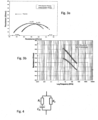
- Fig. 3a shows a Cole model plot wherein measured values of resistance are plotted versus reactance in a patient prior to and after an Oxandrin therapy, revealing the well-known semicircular relationship in both cases.
- the influence of the capacitor C m becomes minimum and the current flows freely through both the extracellular ECW and intracellular water ICW. It is the objective is to separate ECW from ICW for an independent analysis. Since it is not technically possible to measure at a low enough or high enough frequency such as to directly obtain R e and R i , the data are computationally extrapolated to the zero and infinite frequencies. At zero, only the contribution of R e from extracellular water ECW is measured.
- the intracellular water ICW is fully included in the current path and in the measurement along with the contribution of extracellular water ECW.
- the contribution from ICW measured is considerable at the measured low frequency (5 KHz) and where ICW is fully measured is far from the highest frequency measured (500 KHz).
- Fig. 3 shows a resulting model fit to a Cole model plot where data have been fit to determine frequency limits R 0 and R inf .
- R i 1 / R inf ⁇ 1 / R 0
- further measurement data are obtained from the human body by measuring the body height H and the total body weight W in a further step using a scale and a metering device, for example. These data may also be provided from a database etc. instead of from direct measurement, if these data have been obtained elsewhere.
- the equations are based on the well-known Xitron/Hanai equations (for ECW, see, e.g., Xitron Hydra ECF/ICF (Model 4200) Bioimpedance spectrum analyzer, Issue 1.016/97 (1997), Operating Manual Revision 1.01 Xitron Technologies Inc.: San Diego, USA ) and an equation for ICW derived in Matthie, J.R.: "Second generation mixture theory equation for estimating intracellular water using bioimpedance spectroscopy", J. Appl. Physiol. 99, 780-1 (2005 ). However, those equations have been additionally corrected in Moissl et al.
- volume fractions each of intracellular water ICW and extracellular water ECW are selected as two parameters ("ICW%", "ECW%”) defining a two-dimensional parameter space or plane.
- data regarding volumes fractions each of intracellular water ICW and extracellular water ECW were taken from a comprehensive database containing a large number of healthy subjects. This database is from the US National Health and Examination Survey (NHANES) and the size of the sample is 3,010 people.
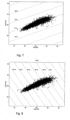
- the associated values of volume fractions of intracellular water ICW and extracellular water ECW may be plotted in the parameter space ("ICW%", "ECW%") for illustrative purposes as shown in Fig. 5 .
- the NHANES database provides BIS and DXA measurements on 3010 subjects, i.e., measurements of R e and R i obtained via BIS as well as accurate fat mass via DXA.
- body fat errors can be calculated with respect to the DXA data computed body fat. It has been observed that Moissl et al. (2006) volume equations may tend to under-predict body fat on low body fat subjects. In other words reported values for body fat using extracellular water (ECW) and intracellular water (ICW) are lower than the corresponding DXA results.
- ECW extracellular water
- ICW intracellular water
- a reference line may derived from these data, which line is taken to be representative of the associated values for each of a mass or volume fraction of intracellular water (ICW) and a mass or volume fraction of extracellular water (ECW) of a number of subjects considered healthy.
- “Healthy” herein means human bodies with normal hydration levels.
- the reference line is added to the diagram in Fig. 6 .
- the dots shown for the NHANES sample of 3.010 healthy subjects are again depicted in this diagram for illustrative purposes only.
- the reference line in this embodiment is linear, and coefficients of this linear function (e.g., ICW as a function of ECW or vice versa) derived in the fit may be stored in the memory.
- the stored results of the human body of intracellular water ICW P [in units of %] (as a proportion of the entire body mass) and extracellular water ECW P [in units of %] are read out from memory and provided as coordinates to locate a corresponding point in the parameter space or plane (ICW% ECW%).
- a distance is determined between the located point (indicated by a square in Fig. 6 ) representing the results for the concrete human body and the reference line representing the sample of healthy subjects.
- the distance is a length of a straight line connecting the located point and the reference line, wherein that straight line is selected which has the shortest length.
- a direction in which the distance is measured is perpendicular to the linear reference line.
- HYD body hydration index
- the hydration index (HYD) represents the mass or volume fraction with respect to the total body weight (W), e.g., in units of percent.
- W total body weight
- the hydration index may be calculated using above formula.
- the plotting of experimental data, reference lines and located points of the human body in the plane and graphic output on a device such as a screen or printer may herein serve for illustrative purposes only.
- the above equation simply reflects the steps taken to derive the distance between a human body's associated values of ICW P , ECW P and a normal or reference line reflecting a status of normal hydration.
- the derived function HYD (ICW P , ECW P ) indicates in Fig. 7 levels of same percentage of over hydration (dehydration yields negative values). Notably, positions in the parameter space occupied with same levels of the hydration index define lines parallel to the reference line.
- d ECW denotes the mean density of extracellular water (ECW) and associated materials and amounts to 1,106 kg/I
- d ICW denotes the mean density of intracellular water (ICW) and associated materials and amounts to 1,521 kg/I.
- ECW extracellular water
- ICW intracellular water
- Body fat is calculated by subtracting the detected conducting volumes (ICW and ECW and associated materials) converted to mass from the body weight (see below). Even if the body fat calculation method has historically been used in 2C models (Xitron), it is still valid for 3C modeling because it correctly reports body fat.
- NH_LT normally hydrated lean tissue
- BF / 0,75 corresponds to the ECW, ICW, and associated materials in normally hydrated adipose tissue (NH_AT).
- NH_AT normally hydrated adipose tissue
- MM muscle mass
- ECW p ECW b + ECW d
- ICW p ICW b + ICW d
- Baseline components of ICW b and ECW b are thereby obtained by applying low pass filtering to subsequent ICW and ECW measurements.
- the baseline components may also be referred to as "more static”.
- the residual dynamic ICW d and ECW d components represent changes in intracellular and extracellular compartments due to hydration changes and other factors including cell glycogen loading, response to training and others. These factors can be separately observed through the dynamic compartments ICW d and ECW d .
- a volume or mass fraction of normally hydrated lean tissue is calculated by subtracting NH_AT and HYD from total body weight W in the same manner as described above with respect to the first embodiment (i.e., a 3C model).
- a 5C model is defined by the following compartments: ICW d , ECW d , HYD, NH_AT and NH_LT. Therefore, the effects resulting from the residual dynamic ICW d and ECW d components are taken into account.
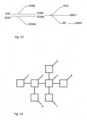
- the setup of a 5-compartment model according to such an embodiment is shown in Figs. 13 .
- FIG. 14 An embodiment of a device for determining a status of hydration and/or nutrition of tissues in a human body, which is configured to perform the steps of the above methods according to the above or further embodiments is schematically shown in Fig. 14 .
- the device of this embodiment comprises an electrode connection 1 with up to four current injection electrodes and/or up to four voltage measurement electrodes to be applied at limbs extreme points. Both sticky electrodes and contacts are supported.
- the device further includes a visualization and processing device 3, which may be embodied as, e.g., smartphone or other device accessing the measurements made and processes them.
- the device of this embodiment may further include a remote storage system 4, for example a cloud backup server where measurements may anonymously be stored and further analyzed.
- a user interface 5 may be provided as part of the device to effect visualization to present the measurement results in a suitable format to the user.
- Connectivity to further external devices e.g., printers, a scale for measuring weight ( W ) and a metering device for measuring height ( H ) of a human body
- further external devices e.g., printers, a scale for measuring weight ( W ) and a metering device for measuring height ( H ) of a human body
- manual input and output characteristics for those data are optionally also realized hereby, such as a display with keyboard (or touchscreen) for communicating with the apparatus and allowing to insert the human body's weight and height.
- the device of this embodiment also comprises a device storage 6, wherein the acquisition and processing program to carry out the method of the above embodiments etc. is stored.
- the measurements are also buffered in device storage 6.
- the device may further have a visualization device storage, wherein raw and processed measurements are stored.
- BIS measurement, volume calculation and baseline processing may be performed as an embodiment in connection with the device of Fig. 14 , wherein at least some of the processing may be realized as a smartphone-app.
- ICW P Intra Cellular Water
- ECW p Extra Cellular Water
- R e extracellular resistance
- R i intracellular resistance
- Fig. 12 This variant, or model, is explained in more detail with reference to Fig. 12 .
- “NHANES measurements” represents measured data (i.e., impedance data R e and R i measured via BIS as well as body weight and body height) of 3010 subjects.
- the top line in Fig. 12 i.e., STEPS 1 and 2 represents the classical BCS measurement processing based on the Moissl et al. (2006) volume model (see equations (7) and (8) above) and the corresponding 3C model.
- the mass or volume fraction of extracellular water (ECW 1 ) and intracellular water (ICW 1 ) are determined, respectively, and in STEP 2, the hydration (HYD 1 ), the body fat (BF 1 ), the normally hydrated adipose tissue (NH_AT 1 ), and the normally hydrated lean tissue mass (NH_LT 1 ) are calculated for all of the 3010 subjects in the manner explained with respect to the above embodiments.
- the body fat resulting from this BCS measurement is incorrect, especially for low and high body mass index (BMI) subjects.
- NH_LT 1 normally hydrated lean tissue mass
- HFD 1 normally hydrated lean tissue mass
- BF 1 body fat
- NH_AT 1 normally hydrated adipose tissue
- the above two functions (15) and (16) functions set up which describe extracellular water (ECW 2 ) and intracellular water (ICW 2 ) for the measured BIS data: ECW(R e , R i , h, w) and ICW(R e , R i , h, w), wherein the coefficients a 0 , ..., a 3 , b 0 , ..., b 6 in Table 2 are determined through regression or fit.
- a set of 3010 impedances R e , R i , and body weights w and body heights h and the set of corresponding 3010 corrected volumes ( ECW 2 and ICW 2 ) has been obtained through STEPS 3 and 4, and a new function can be built through regression or fit that defines a 0 , ..., a 3 , and b 0 , ...,b 6 .
- This function can be used from this point on for any newly measured subject with further BIS-measurements: R i , R e , w, and h.
- This function that has been “tailored” on 3010 subjects according to the above method, will calculate correct or at least more accurate values for extracellular water (ECW) and intracellular (ICW) for any other subjects.
- ECW extracellular water
- ICW intracellular
- the 3C model can be used to calculate correctly the compartments and get body fat close to what would be directly measured using DXA.
- devices 20 as shown in Figs. 1 or 14 may be implemented with computer hardware and/or software arranged to calculate equations (7) and (8) only, or to calculate equations (15) and (16) only, or with both equations (7) and (8) as well as (15) and (16), e.g., with a selection option for the user which calculation is to be performed in connection with an instant measurement.
- coefficients a 0 , ..., a 6 , b 0 , ..., b 6 in Table 2 are not restricted to be determined from NHANES DXA data, and more specifically from 3010 subjects. Data from other surveys using other measurement techniques to determine body fat and/or employing other total numbers of subjects may be employed as well as a basis for the regression or fit.
- each of the above coefficients a 0 , ..., a 6 , b 0 , ..., b 6 may deviate from the specific values in Table 2 by +/- 100%, preferably by +/-50%, and more preferably by +/- 20%, and most preferably by +/- 10%.
- the scope of the invention is limited by the specific values and ranges.
- equations (7) and (8) methods are encompassed by aspects of the invention wherein body fat is simply corrected by adding an overall percentage to what has been obtained from the measurement results and calculations, or adding a specific percentage only in cases of high and low body fat, where inaccurateness turned out be most prominent.
- ECW and ICW represent the total body volume measurement and the coefficients are then obtained by fitting the NHANES DXA data. Table 3 provides results for these coefficients. Table 3: Coefficients obtained (fit) and/or used for segmental calculation: k E ( arm ) 0.531 k I ( arm ) 0.134 k E ( trunk ) 0.0514 k I(trunk ) 0.0124 k E ( leg ) 0.450 k I ( leg ) 0.200
- count number n is defined for all timestamps from 1 to N
- i defines the integration on samples that are within the interval [t- ⁇ ,t]. The averaging assumes that a value is held until the next sample.
- the dynamic part of the functions is obtained by subtracting the calculated baseline function from the actually determined values of ICW and ECW of each measurement. Also individual segment volumes ECW(seg) and ICW(seg) may be processed according to baseline algorithm.
- the segment weight, the segment ICW and the segment ECW can be separated into baseline and dynamic components.
- the hydration index may be calculated according to this embodiment.
- the hydration index HYD (normalized to body weight) is calculated from baseline full body values for ICW and ECW according above noted linear equation, wherein the coefficients are given in Table 4.
- values for coefficient a 0 lie in arrange [-20.0;-3.0], more preferably [-15.0;-7.0], and even more preferably [-13.0;-12.0]
- values for coefficient a 1 lie in arrange [-0.5;-0.3], more preferably [-0.45;-0.4], and even more preferably [-0.435;-0.425]
- values for coefficient az lie in arrange [0.5;2.0], more preferably [0.8;1.5], and even more preferably [1.1;1.25].
- the hydration index may also be calculated with respect to the case where individual segments of the body are considered.
- the only difference with respect to the full body determination is that the values of ICW and ECW (in units of %) must be calculated with respect to segment weight and not body weight.
- the segment weights e.g., W arm , W leg , or W trunk , is obtained by regression of the DXA NHANES data described above and equations along with corresponding coefficients are listed in Table 5. Therein, it may be noted that the trunk weight includes also the weight of the head.
- BF body fat mass
- NH_AT normally hydrated adipose tissue mass
- NH_LT normally hydrated lean tissue mass
- MM muscle mass
- the segment volume can be also calculated from length (L) and circumferences (C1,C2) according to: Xitron Hydra ECF/ICF (Model 4200) Bioimpedance spectrum analyzer, Issue 1.016/97 (1997), Operating Manual Revision 1.02 Xitron Technologies Inc.: San Diego, USA . It may be noted that with a uniform conductor there is only one circumference needed, but if, for example, the leg is viewed as a cone, two circumferences (C1, C2) are needed. References to C1 and C2 and segmental equation is made on page 107 in the Operating Manual.
- Steps 1 to 5d may relate to preparatory steps of a device and method for determining the hydration, fitness and/or nutrition status of a human body, or of segments of the human body, while steps 6 to 12 may relate to the device and method itself.
Landscapes
- Health & Medical Sciences (AREA)
- Life Sciences & Earth Sciences (AREA)
- Medical Informatics (AREA)
- Molecular Biology (AREA)
- Veterinary Medicine (AREA)
- Biophysics (AREA)
- Pathology (AREA)
- Engineering & Computer Science (AREA)
- Biomedical Technology (AREA)
- Heart & Thoracic Surgery (AREA)
- Public Health (AREA)
- Physics & Mathematics (AREA)
- Surgery (AREA)
- Animal Behavior & Ethology (AREA)
- General Health & Medical Sciences (AREA)
- Nuclear Medicine, Radiotherapy & Molecular Imaging (AREA)
- Radiology & Medical Imaging (AREA)
- Measurement And Recording Of Electrical Phenomena And Electrical Characteristics Of The Living Body (AREA)
- Management, Administration, Business Operations System, And Electronic Commerce (AREA)
- Measuring And Recording Apparatus For Diagnosis (AREA)
Claims (11)
- Verfahren zur Bestimmung der Hydratation eines menschlichen Körpers oder eines Segments des menschlichen Körpers, umfassend die von einer Visualisierungs- und Prozessorvorrichtung (3) durchgeführten Schritte:Bestimmen von Werten jeweils eines Masse- oder Volumenanteils von intrazellulärem Wasser (ICWP) und eines Masse- oder Volumenanteils von extrazellulärem Wasser (ECWP) des menschlichen Körpers oder des Segments unter Verwendung einer Messeinheit (2), wobei die Messeinheit (2) eine bioelektrische Impedanzspektroskopiemessung in Bezug auf den menschlichen Körper durchführt;Festlegen eines zweidimensionalen Parameterraums mit einem Masse- oder Volumenanteil von intrazellulärem Wasser (ICWP) und einem Masse- oder Volumenanteil von extrazellulärem Wasser (ECWP) als voneinander getrennte Parameter;Bestimmen einer Referenzlinie innerhalb des Parameterraums, die zugehörige Werte jeweils eines Masse- oder Volumenanteils von intrazellulärem Wasser (ICWP) und eines Masse- oder Volumenanteils von extrazellulärem Wasser (ECWP) einer Anzahl von gesunden Probanden repräsentiert;Lokalisieren einer Position innerhalb des Parameterraums, die den zugehörigen Werten des Masse- oder Volumenanteils von intrazellulärem Wasser (ICWP) und des Masse-oder Volumenanteils von extrazellulärem Wasser (ECWP) des menschlichen Körpers oder des Segments entspricht;Bestimmen eines Abstands zwischen der Position und der Referenzlinie;Ableiten einer Masse oder eines Volumens oder eines Masse- oder Volumenanteils der Hydration (HYD) aus dem bestimmten Abstand für den menschlichen Körper oder das Segment;Bestimmen einer Körperfettmasse (BF) durch Subtrahieren des Masse- oder Volumenanteils von intrazellulärem Wasser (ICW) und zugehörigen Materialien und des Masse- oder Volumenanteils von extrazellulärem Wasser (ECW) und zugehörigen Materialien von einem Gesamtkörpergewicht (W) unter Verwendung einer Gleichung:
 Ableiten eines Masse- oder Volumenanteils von normal hydrierter Fettgewebemasse (NH_AT) aus der Körperfettmasse durch Dividieren der Körperfettmasse mit einem Faktor ϑ, der Wasser und zugehörige Materialien im Fettgewebe berücksichtigt, wobei ϑ zwischen 0,70 und 0,90 ausgewählt ist; undBestimmen eines Masse- oder Volumenanteils einer normal hydrierten fettfreien Gewebemasse (NH_LT) durch Subtrahieren des Masse- oder Volumenanteils einer normal hydrierten Fettgewebemasse (NH_AT) und des Hydrationsindex (HYD) von dem Gesamtkörpergewicht (W):
 Visualisieren der Ergebnisse der Messung und der Verarbeitung für den Benutzer unter Verwendung einer Benutzerschnittstelle (5).
 - Verfahren nach Anspruch 1, wobei:
ein extrazellulärer Widerstand (R0) und ein intrazellulärer Widerstand (RI) jeweils aus den gemessenen Ergebnissen der komplexen Impedanz bei den mehreren Frequenzen durch Berechnen eines Modells abgeleitet werden, wobei das Modell vorzugsweise ein Cole-Cole-Modell ist. - Verfahren nach Anspruch 2, ferner umfassend:Erhalten oder Messen eines Gesamtkörpergewichts (W) des menschlichen Körpers oder Berechnen des Segmentgewichts;Erhalten oder Messen einer Höhe (H) des menschlichen Körpers oder der Segmentlänge (L) und/oder der Umfänge (C1, C2);Bestimmen der Werte jeweils eines Masse- oder Volumenanteils von intrazellulärem Wasser (ICWP) und eines Masse- oder Volumenanteils von extrazellulärem Wasser (ECWP) des menschlichen Körpers als eine Funktion des Gesamtkörpergewichts (W), der Höhe (H) und/oder der Länge (L) und/oder des Umfangs (C1, C2), des extrazellulären Widerstands (R0) und des intrazellulären Widerstands (RI).
- Verfahren nach Anspruch 3, wobei:
der Masse- oder Volumenanteil von extrazellulärem Wasser (ECWP) des menschlichen Körpers oder des Segments durch Lösen einer Gleichung:
berechnet werden, wobei die Koeffizienten a0 , a1, a2 , a3, a4, a5 , a6 durch eine Anpassung an experimentelle Daten erhalten werden. - Verfahren nach Anspruch 3 oder 4, wobei:
der Masse- oder Volumenanteil von intrazellulärem Wasser (ICWP) des menschlichen Körpers oder des Segments durch Lösen einer Gleichung berechnet werden:
wobei die Koeffizienten b0 , b1 , b2 , b3, b4 , b5, b6 durch eine Anpassung an experimentelle Daten erhalten werden. - Verfahren nach einem der Ansprüche 1 bis 5, wobei:der Schritt des Bestimmens der Referenzlinie das Bereitstellen von zuvor bestimmten experimentellen Daten sowohl des der Masse- oder Volumenanteils von intrazellulärem Wasser (ICW) als auch des der Masse- oder Volumenanteils von extrazellulärem Wasser (ECW) einer Anzahl von gesunden Probanden beinhaltet, unddie Referenzlinie mittels linearer oder nichtlinearer Regression berechnet wird.
- Verfahren nach einem der Ansprüche 1 bis 6, wobei:der Schritt des Ableitens einer Masse oder eines Volumens oder eines Masse- oder Volumenanteils der Hydration aus dem bestimmten Abstand das Berechnen eines Hydrationsindex (HYD) beinhaltet, der als eine lineare Funktion des Masse- oder Volumenanteils von intrazellulärem Wasser (ICW) und des Masse- oder Volumenanteils von extrazellulärem Wasser (ECW) definiert ist,
 wobei die linearen Koeffizienten f, g und h aus einer Anpassung an experimentelle Daten bestimmt werden,wobei der Hydrationsindex (HYD) den Masse- oder Volumenanteil der Hydration darstellt, und
wobei der Hydrationsindex optional als Prozentsatz des gesamten extrazellulären Wassers (ECW) ausgedrückt wird. - Verfahren nach einem der Ansprüche 1 bis 7,
wobei ϑ zwischen 0,73 und 0,77 und vorzugsweise bei oder um 0,75 ausgewählt wird. - Vorrichtung zum Bestimmen der Hydration eines menschlichen Körpers, umfassend:eine Eingabe- (1) und/oder Messeinheit (2), die konfiguriert ist, um einen Schritt des Bereitstellens von Werten jeweils eines Masse oder Volumenanteils von intrazellulärem Wasser (ICW) und eines Masse- oder Volumenanteils von extrazellulärem Wasser (ECW) des menschlichen Körpers durchzuführen;eine Prozessoreinheit (3), die konfiguriert ist, um die folgenden Schritte durchzuführen:(a) Festlegen eines zweidimensionalen Parameterraums mit einem Masse- oder Volumenanteil von intrazellulärem Wasser (ICW) und einem Masse- oder Volumenanteil von extrazellulärem Wasser (ECW) als voneinander getrennte Parameter;(b) Bestimmen einer Referenzlinie innerhalb des Parameterraums, die zugehörige Werte jeweils eines Masse- oder Volumenanteils von intrazellulärem Wasser (ICW) und eines Masse- oder Volumenanteils von extrazellulärem Wasser (ECW) einer Anzahl von gesunden Probanden darstellt;(c) Lokalisieren einer Position innerhalb des Parameterraums, die den zugehörigen Werten des Masse- oder Volumenanteils von intrazellulärem Wasser (ICW) und des Masse- oder Volumenanteils von extrazellulärem Wasser (ECW) des menschlichen Körpers entspricht;(d) Bestimmen eines Abstands zwischen der Position und der Referenzlinie;(e) Ableiten und Ausgeben einer Masse oder eines Volumens oder eines Masse- oder Volumenanteils der Hydration aus dem bestimmten Abstand für den menschlichen Körper;(f) Bestimmen einer Körperfettmasse (BF) durch Subtrahieren des Masse- oder Volumenanteils von intrazellulärem Wasser (ICW) und zugehörigen Materialien und des Masse- oder Volumenanteils von extrazellulärem Wasser (ECW) und zugehörigen Materialien von einem Gesamtkörpergewicht (W) unter Verwendung einer Gleichung:
 (g) Ableiten eines Masse- oder Volumenanteils von normal hydrierter Fettgewebemasse (NH_AT) aus der Körperfettmasse durch Dividieren der Körperfettmasse durch einen Faktor ϑ, der Wasser und zugehörige Materialien in Fettgewebe berücksichtigt, wobei ϑ zwischen 0,70 und 0,90 ausgewählt wird; und(h) Bestimmen eines Masse- oder Volumenanteils einer normal hydrierten fettfreien Gewebemasse (NH_LT) durch Subtrahieren der Masse oder des Volumenanteils einer normal hydrierten Fettgewebemasse (NH_AT) und des Hydratationsindex (HYD) von dem Gesamtkörpergewicht (W):
 einen Vorrichtungsspeicher (6), der ein Verarbeitungsprogramm speichert, das die Prozessoreinheit (3) veranlasst, die Schritte (a) - (h) auszuführen.
 - Computerprogrammprodukt, umfassend Anweisungen, die, wenn das Programm von einem Computer ausgeführt wird, den Computer veranlassen, die Schritte des Verfahrens nach den Ansprüchen 1 bis 8 auszuführen.
- Computerlesbares Speichermedium, umfassend Anweisungen, die, wenn sie von einem Computer ausgeführt werden, den Computer veranlassen, die Schritte des Verfahrens nach den Ansprüchen 1 bis 8 auszuführen.
Applications Claiming Priority (2)
| Application Number | Priority Date | Filing Date | Title |
|---|---|---|---|
| US201762481378P | 2017-04-04 | 2017-04-04 | |
| PCT/IB2018/000319 WO2018185550A2 (en) | 2017-04-04 | 2018-04-04 | Method and device for determining the hydration, fitness and nutrition status of a human body |
Publications (4)
| Publication Number | Publication Date |
|---|---|
| EP3606440A2 EP3606440A2 (de) | 2020-02-12 |
| EP3606440A4 EP3606440A4 (de) | 2020-10-21 |
| EP3606440C0 EP3606440C0 (de) | 2024-08-07 |
| EP3606440B1 true EP3606440B1 (de) | 2024-08-07 |
Family
ID=63713374
Family Applications (1)
| Application Number | Title | Priority Date | Filing Date |
|---|---|---|---|
| EP18781774.7A Active EP3606440B1 (de) | 2017-04-04 | 2018-04-04 | Verfahren und vorrichtung zur bestimmung des hydratations-, fitness- und ernährungszustandes eines menschlichen körpers |
Country Status (3)
| Country | Link |
|---|---|
| US (1) | US11363963B2 (de) |
| EP (1) | EP3606440B1 (de) |
| WO (1) | WO2018185550A2 (de) |
Families Citing this family (4)
| Publication number | Priority date | Publication date | Assignee | Title |
|---|---|---|---|---|
| US11995036B2 (en) * | 2019-10-11 | 2024-05-28 | Ikigai Labs Inc. | Automated customized modeling of datasets with intuitive user interfaces |
| ES2940732A1 (es) * | 2021-11-08 | 2023-05-10 | Servicio Andaluz De Salud | Dispositivo, sistema y procedimiento para monitorización de un paciente con insuficiencia cardíaca |
| US12204567B2 (en) | 2022-03-17 | 2025-01-21 | Ikigai Labs, Inc. | System and method for joining datasets |
| CN119837499B (zh) * | 2025-03-19 | 2025-07-29 | 深圳市乐福衡器有限公司 | 一种智能体脂秤用测量数据校正方法及系统 |
Family Cites Families (8)
| Publication number | Priority date | Publication date | Assignee | Title |
|---|---|---|---|---|
| US4895163A (en) * | 1988-05-24 | 1990-01-23 | Bio Analogics, Inc. | System for body impedance data acquisition |
| ES2187422T3 (es) | 2000-11-06 | 2003-06-16 | Fresenius Medical Care De Gmbh | Metodo y dispositivo para determinar el peso en seco de un paciente con fracaso renal. |
| JP4068567B2 (ja) * | 2001-12-12 | 2008-03-26 | フレゼニウス メディカル ケア ドイッチェランド ゲゼルシャフト ミット ベシュレンクテル ハフツング | 患者の水和状態の判定 |
| US20040167423A1 (en) * | 2002-12-20 | 2004-08-26 | Luana Pillon | RXc graph and RXc Z-score graph methods |
| ATE519424T1 (de) * | 2004-06-29 | 2011-08-15 | Fresenius Medical Care De Gmbh | Verfahren und vorrichtung zur bestimmung der hydrierung und/oder des ernährungszustands eines patienten |
| US7558622B2 (en) * | 2006-05-24 | 2009-07-07 | Bao Tran | Mesh network stroke monitoring appliance |
| EP2295097A1 (de) * | 2009-09-09 | 2011-03-16 | Fresenius Medical Care Deutschland GmbH | Verfahren und Vorrichtung zur Beurteilung von Werten, die eine Masse oder eine Konzentration einer im Körper des Patienten vorhandenen Substanz darstellen |
| JP6541251B2 (ja) * | 2015-02-17 | 2019-07-10 | 株式会社タニタ | 身体情報処理装置、方法、及びプログラム |
-
2018
- 2018-04-04 EP EP18781774.7A patent/EP3606440B1/de active Active
- 2018-04-04 US US16/500,639 patent/US11363963B2/en active Active
- 2018-04-04 WO PCT/IB2018/000319 patent/WO2018185550A2/en not_active Ceased
Also Published As
| Publication number | Publication date |
|---|---|
| EP3606440C0 (de) | 2024-08-07 |
| EP3606440A2 (de) | 2020-02-12 |
| WO2018185550A3 (en) | 2018-11-15 |
| US20200113479A1 (en) | 2020-04-16 |
| US11363963B2 (en) | 2022-06-21 |
| WO2018185550A2 (en) | 2018-10-11 |
| EP3606440A4 (de) | 2020-10-21 |
Similar Documents
| Publication | Publication Date | Title |
|---|---|---|
| US7917202B2 (en) | Method and a device for determining the hydration and/or nutrition status of a patient | |
| US7133716B2 (en) | Determining the hydration status of a patient | |
| Van Loan et al. | Fluid changes during pregnancy: use of bioimpedance spectroscopy | |
| Kaysen et al. | Estimation of total-body and limb muscle mass in hemodialysis patients by using multifrequency bioimpedance spectroscopy | |
| EP1331880B1 (de) | Verfahren und gerät zur bestimmung des trockengewichts eines patienten mit nierenversagen. | |
| JP5491362B2 (ja) | 生体インピーダンス方法及び装置 | |
| EP1452133B1 (de) | Verfahren und Vorrichtung zur Bestimmung der Körperzusammensetzung | |
| EP3606440B1 (de) | Verfahren und vorrichtung zur bestimmung des hydratations-, fitness- und ernährungszustandes eines menschlichen körpers | |
| EP3322335B1 (de) | Flüssigkeitsstandbestimmung | |
| Wang | Impact of hydration and nutrition status on the Watson formula in peritoneal dialysis patients | |
| Bousbiat et al. | Comparison of body fat-free masses calculated from hand-to-foot and foot-to-foot resistances with DXA measurements | |
| Hsieh et al. | The validity and accuracy in foot-to-foot bioelectrical impedance analysis measuring models referenced by dual-energy X-ray absorptiometry in body composition in standing position | |
| JP7752107B2 (ja) | 部分的に筋体積を計測するための方法、デバイス及び装置 | |
| Jaffrin et al. | Accuracy of Plantar Electrodes Compared with Hand and Foot Electrodes in Fat‐free‐mass Measurement | |
| HORE et al. | Comparison between Bioelectric Impedance Analyzer Device and Anthropometry for the Evaluation of Body Composition among Young Adult Students of Paschim Medinipur, West Bengal | |
| HK1171935B (en) | A method and a device for determining the hydration and/or nutrition status of a patient |
Legal Events
| Date | Code | Title | Description |
|---|---|---|---|
| STAA | Information on the status of an ep patent application or granted ep patent |
Free format text: STATUS: THE INTERNATIONAL PUBLICATION HAS BEEN MADE |
|
| PUAI | Public reference made under article 153(3) epc to a published international application that has entered the european phase |
Free format text: ORIGINAL CODE: 0009012 |
|
| STAA | Information on the status of an ep patent application or granted ep patent |
Free format text: STATUS: REQUEST FOR EXAMINATION WAS MADE |
|
| 17P | Request for examination filed |
Effective date: 20191104 |
|
| AK | Designated contracting states |
Kind code of ref document: A2 Designated state(s): AL AT BE BG CH CY CZ DE DK EE ES FI FR GB GR HR HU IE IS IT LI LT LU LV MC MK MT NL NO PL PT RO RS SE SI SK SM TR |
|
| AX | Request for extension of the european patent |
Extension state: BA ME |
|
| DAV | Request for validation of the european patent (deleted) | ||
| DAX | Request for extension of the european patent (deleted) | ||
| A4 | Supplementary search report drawn up and despatched |
Effective date: 20200923 |
|
| RIC1 | Information provided on ipc code assigned before grant |
Ipc: A61B 10/00 20060101AFI20200917BHEP Ipc: A61B 5/053 20060101ALI20200917BHEP Ipc: A61B 5/00 20060101ALI20200917BHEP |
|
| RAP1 | Party data changed (applicant data changed or rights of an application transferred) |
Owner name: CELLA MEDICAL, INC. |
|
| RIN1 | Information on inventor provided before grant (corrected) |
Inventor name: MATTHIE, JAMES R. Inventor name: BARICEVIC, BORUT |
|
| STAA | Information on the status of an ep patent application or granted ep patent |
Free format text: STATUS: EXAMINATION IS IN PROGRESS |
|
| 17Q | First examination report despatched |
Effective date: 20230119 |
|
| REG | Reference to a national code |
Ref legal event code: R079 Ref country code: DE Ref legal event code: R079 Ref document number: 602018072809 Country of ref document: DE Free format text: PREVIOUS MAIN CLASS: A61B0010000000 Ipc: A61B0005053700 |
|
| GRAP | Despatch of communication of intention to grant a patent |
Free format text: ORIGINAL CODE: EPIDOSNIGR1 |
|
| STAA | Information on the status of an ep patent application or granted ep patent |
Free format text: STATUS: GRANT OF PATENT IS INTENDED |
|
| RIC1 | Information provided on ipc code assigned before grant |
Ipc: A61B 5/00 20060101ALI20240214BHEP Ipc: A61B 5/0537 20210101AFI20240214BHEP |
|
| INTG | Intention to grant announced |
Effective date: 20240304 |
|
| GRAS | Grant fee paid |
Free format text: ORIGINAL CODE: EPIDOSNIGR3 |
|
| GRAA | (expected) grant |
Free format text: ORIGINAL CODE: 0009210 |
|
| STAA | Information on the status of an ep patent application or granted ep patent |
Free format text: STATUS: THE PATENT HAS BEEN GRANTED |
|
| AK | Designated contracting states |
Kind code of ref document: B1 Designated state(s): AL AT BE BG CH CY CZ DE DK EE ES FI FR GB GR HR HU IE IS IT LI LT LU LV MC MK MT NL NO PL PT RO RS SE SI SK SM TR |
|
| REG | Reference to a national code |
Ref country code: GB Ref legal event code: FG4D |
|
| REG | Reference to a national code |
Ref country code: CH Ref legal event code: EP |
|
| REG | Reference to a national code |
Ref country code: DE Ref legal event code: R096 Ref document number: 602018072809 Country of ref document: DE |
|
| REG | Reference to a national code |
Ref country code: IE Ref legal event code: FG4D |
|
| U01 | Request for unitary effect filed |
Effective date: 20240807 |
|
| U07 | Unitary effect registered |
Designated state(s): AT BE BG DE DK EE FI FR IT LT LU LV MT NL PT SE SI Effective date: 20240823 |
|
| PG25 | Lapsed in a contracting state [announced via postgrant information from national office to epo] |
Ref country code: NO Free format text: LAPSE BECAUSE OF FAILURE TO SUBMIT A TRANSLATION OF THE DESCRIPTION OR TO PAY THE FEE WITHIN THE PRESCRIBED TIME-LIMIT Effective date: 20241107 |
|
| PG25 | Lapsed in a contracting state [announced via postgrant information from national office to epo] |
Ref country code: GR Free format text: LAPSE BECAUSE OF FAILURE TO SUBMIT A TRANSLATION OF THE DESCRIPTION OR TO PAY THE FEE WITHIN THE PRESCRIBED TIME-LIMIT Effective date: 20241108 Ref country code: PL Free format text: LAPSE BECAUSE OF FAILURE TO SUBMIT A TRANSLATION OF THE DESCRIPTION OR TO PAY THE FEE WITHIN THE PRESCRIBED TIME-LIMIT Effective date: 20240807 |
|
| PG25 | Lapsed in a contracting state [announced via postgrant information from national office to epo] |
Ref country code: IS Free format text: LAPSE BECAUSE OF FAILURE TO SUBMIT A TRANSLATION OF THE DESCRIPTION OR TO PAY THE FEE WITHIN THE PRESCRIBED TIME-LIMIT Effective date: 20241207 |
|
| PG25 | Lapsed in a contracting state [announced via postgrant information from national office to epo] |
Ref country code: HR Free format text: LAPSE BECAUSE OF FAILURE TO SUBMIT A TRANSLATION OF THE DESCRIPTION OR TO PAY THE FEE WITHIN THE PRESCRIBED TIME-LIMIT Effective date: 20240807 |
|
| PG25 | Lapsed in a contracting state [announced via postgrant information from national office to epo] |
Ref country code: ES Free format text: LAPSE BECAUSE OF FAILURE TO SUBMIT A TRANSLATION OF THE DESCRIPTION OR TO PAY THE FEE WITHIN THE PRESCRIBED TIME-LIMIT Effective date: 20240807 Ref country code: RS Free format text: LAPSE BECAUSE OF FAILURE TO SUBMIT A TRANSLATION OF THE DESCRIPTION OR TO PAY THE FEE WITHIN THE PRESCRIBED TIME-LIMIT Effective date: 20241107 |
|
| PG25 | Lapsed in a contracting state [announced via postgrant information from national office to epo] |
Ref country code: RS Free format text: LAPSE BECAUSE OF FAILURE TO SUBMIT A TRANSLATION OF THE DESCRIPTION OR TO PAY THE FEE WITHIN THE PRESCRIBED TIME-LIMIT Effective date: 20241107 Ref country code: PL Free format text: LAPSE BECAUSE OF FAILURE TO SUBMIT A TRANSLATION OF THE DESCRIPTION OR TO PAY THE FEE WITHIN THE PRESCRIBED TIME-LIMIT Effective date: 20240807 Ref country code: NO Free format text: LAPSE BECAUSE OF FAILURE TO SUBMIT A TRANSLATION OF THE DESCRIPTION OR TO PAY THE FEE WITHIN THE PRESCRIBED TIME-LIMIT Effective date: 20241107 Ref country code: IS Free format text: LAPSE BECAUSE OF FAILURE TO SUBMIT A TRANSLATION OF THE DESCRIPTION OR TO PAY THE FEE WITHIN THE PRESCRIBED TIME-LIMIT Effective date: 20241207 Ref country code: HR Free format text: LAPSE BECAUSE OF FAILURE TO SUBMIT A TRANSLATION OF THE DESCRIPTION OR TO PAY THE FEE WITHIN THE PRESCRIBED TIME-LIMIT Effective date: 20240807 Ref country code: GR Free format text: LAPSE BECAUSE OF FAILURE TO SUBMIT A TRANSLATION OF THE DESCRIPTION OR TO PAY THE FEE WITHIN THE PRESCRIBED TIME-LIMIT Effective date: 20241108 Ref country code: ES Free format text: LAPSE BECAUSE OF FAILURE TO SUBMIT A TRANSLATION OF THE DESCRIPTION OR TO PAY THE FEE WITHIN THE PRESCRIBED TIME-LIMIT Effective date: 20240807 |
|
| PG25 | Lapsed in a contracting state [announced via postgrant information from national office to epo] |
Ref country code: SM Free format text: LAPSE BECAUSE OF FAILURE TO SUBMIT A TRANSLATION OF THE DESCRIPTION OR TO PAY THE FEE WITHIN THE PRESCRIBED TIME-LIMIT Effective date: 20240807 |
|
| PG25 | Lapsed in a contracting state [announced via postgrant information from national office to epo] |
Ref country code: CZ Free format text: LAPSE BECAUSE OF FAILURE TO SUBMIT A TRANSLATION OF THE DESCRIPTION OR TO PAY THE FEE WITHIN THE PRESCRIBED TIME-LIMIT Effective date: 20240807 |
|
| PG25 | Lapsed in a contracting state [announced via postgrant information from national office to epo] |
Ref country code: SK Free format text: LAPSE BECAUSE OF FAILURE TO SUBMIT A TRANSLATION OF THE DESCRIPTION OR TO PAY THE FEE WITHIN THE PRESCRIBED TIME-LIMIT Effective date: 20240807 |
|
| U20 | Renewal fee for the european patent with unitary effect paid |
Year of fee payment: 8 Effective date: 20250429 |
|
| PLBE | No opposition filed within time limit |
Free format text: ORIGINAL CODE: 0009261 |
|
| STAA | Information on the status of an ep patent application or granted ep patent |
Free format text: STATUS: NO OPPOSITION FILED WITHIN TIME LIMIT |
|
| 26N | No opposition filed |
Effective date: 20250508 |
|
| REG | Reference to a national code |
Ref country code: CH Ref legal event code: H13 Free format text: ST27 STATUS EVENT CODE: U-0-0-H10-H13 (AS PROVIDED BY THE NATIONAL OFFICE) Effective date: 20251125 |
|
| PG25 | Lapsed in a contracting state [announced via postgrant information from national office to epo] |
Ref country code: MC Free format text: LAPSE BECAUSE OF FAILURE TO SUBMIT A TRANSLATION OF THE DESCRIPTION OR TO PAY THE FEE WITHIN THE PRESCRIBED TIME-LIMIT Effective date: 20240807 |