EP3605476B1 - Drahtloser empfänger und verfahren zur detektion eines angriffs auf ein schlüsselloses eingangssystem für ein fahrzeug - Google Patents
Drahtloser empfänger und verfahren zur detektion eines angriffs auf ein schlüsselloses eingangssystem für ein fahrzeug Download PDFInfo
- Publication number
- EP3605476B1 EP3605476B1 EP19187580.6A EP19187580A EP3605476B1 EP 3605476 B1 EP3605476 B1 EP 3605476B1 EP 19187580 A EP19187580 A EP 19187580A EP 3605476 B1 EP3605476 B1 EP 3605476B1
- Authority
- EP
- European Patent Office
- Prior art keywords
- output
- wireless transmission
- filter
- matched filter
- signal strength
- Prior art date
- Legal status (The legal status is an assumption and is not a legal conclusion. Google has not performed a legal analysis and makes no representation as to the accuracy of the status listed.)
- Active
Links
Images

Classifications
-
- G—PHYSICS
- G07—CHECKING-DEVICES
- G07C—TIME OR ATTENDANCE REGISTERS; REGISTERING OR INDICATING THE WORKING OF MACHINES; GENERATING RANDOM NUMBERS; VOTING OR LOTTERY APPARATUS; ARRANGEMENTS, SYSTEMS OR APPARATUS FOR CHECKING NOT PROVIDED FOR ELSEWHERE
- G07C9/00—Individual registration on entry or exit
- G07C9/00174—Electronically operated locks; Circuits therefor; Nonmechanical keys therefor, e.g. passive or active electrical keys or other data carriers without mechanical keys
- G07C9/00309—Electronically operated locks; Circuits therefor; Nonmechanical keys therefor, e.g. passive or active electrical keys or other data carriers without mechanical keys operated with bidirectional data transmission between data carrier and locks
-
- B—PERFORMING OPERATIONS; TRANSPORTING
- B60—VEHICLES IN GENERAL
- B60R—VEHICLES, VEHICLE FITTINGS, OR VEHICLE PARTS, NOT OTHERWISE PROVIDED FOR
- B60R25/00—Fittings or systems for preventing or indicating unauthorised use or theft of vehicles
- B60R25/20—Means to switch the anti-theft system on or off
- B60R25/24—Means to switch the anti-theft system on or off using electronic identifiers containing a code not memorised by the user
-
- H—ELECTRICITY
- H04—ELECTRIC COMMUNICATION TECHNIQUE
- H04L—TRANSMISSION OF DIGITAL INFORMATION, e.g. TELEGRAPHIC COMMUNICATION
- H04L63/00—Network architectures or network communication protocols for network security
- H04L63/14—Network architectures or network communication protocols for network security for detecting or protecting against malicious traffic
- H04L63/1408—Network architectures or network communication protocols for network security for detecting or protecting against malicious traffic by monitoring network traffic
- H04L63/1416—Event detection, e.g. attack signature detection
-
- H—ELECTRICITY
- H04—ELECTRIC COMMUNICATION TECHNIQUE
- H04L—TRANSMISSION OF DIGITAL INFORMATION, e.g. TELEGRAPHIC COMMUNICATION
- H04L63/00—Network architectures or network communication protocols for network security
- H04L63/14—Network architectures or network communication protocols for network security for detecting or protecting against malicious traffic
- H04L63/1441—Countermeasures against malicious traffic
- H04L63/1466—Active attacks involving interception, injection, modification, spoofing of data unit addresses, e.g. hijacking, packet injection or TCP sequence number attacks
-
- H—ELECTRICITY
- H04—ELECTRIC COMMUNICATION TECHNIQUE
- H04W—WIRELESS COMMUNICATION NETWORKS
- H04W52/00—Power management, e.g. Transmission Power Control [TPC] or power classes
- H04W52/04—Transmission power control [TPC]
- H04W52/18—TPC being performed according to specific parameters
- H04W52/24—TPC being performed according to specific parameters using SIR [Signal to Interference Ratio] or other wireless path parameters
- H04W52/245—TPC being performed according to specific parameters using SIR [Signal to Interference Ratio] or other wireless path parameters taking into account received signal strength
-
- G—PHYSICS
- G07—CHECKING-DEVICES
- G07C—TIME OR ATTENDANCE REGISTERS; REGISTERING OR INDICATING THE WORKING OF MACHINES; GENERATING RANDOM NUMBERS; VOTING OR LOTTERY APPARATUS; ARRANGEMENTS, SYSTEMS OR APPARATUS FOR CHECKING NOT PROVIDED FOR ELSEWHERE
- G07C9/00—Individual registration on entry or exit
- G07C9/00174—Electronically operated locks; Circuits therefor; Nonmechanical keys therefor, e.g. passive or active electrical keys or other data carriers without mechanical keys
- G07C9/00309—Electronically operated locks; Circuits therefor; Nonmechanical keys therefor, e.g. passive or active electrical keys or other data carriers without mechanical keys operated with bidirectional data transmission between data carrier and locks
- G07C2009/00555—Electronically operated locks; Circuits therefor; Nonmechanical keys therefor, e.g. passive or active electrical keys or other data carriers without mechanical keys operated with bidirectional data transmission between data carrier and locks comprising means to detect or avoid relay attacks
-
- G—PHYSICS
- G07—CHECKING-DEVICES
- G07C—TIME OR ATTENDANCE REGISTERS; REGISTERING OR INDICATING THE WORKING OF MACHINES; GENERATING RANDOM NUMBERS; VOTING OR LOTTERY APPARATUS; ARRANGEMENTS, SYSTEMS OR APPARATUS FOR CHECKING NOT PROVIDED FOR ELSEWHERE
- G07C2209/00—Indexing scheme relating to groups G07C9/00 - G07C9/38
- G07C2209/60—Indexing scheme relating to groups G07C9/00174 - G07C9/00944
- G07C2209/63—Comprising locating means for detecting the position of the data carrier, i.e. within the vehicle or within a certain distance from the vehicle
Definitions
- This disclosure relates generally to security, and more particularly, to a wireless receiver and method for detecting an attack on a keyless entry system for a vehicle.
- Various security sensitive systems such as contactless payment, contactless car access, contactless door access, etc. depend on wireless communications that may be subjected to attacks.
- Secure wireless transmissions such as radio frequency (RF) transmissions
- RF radio frequency
- a relay attack may be mounted by two attackers, one near the legitimate key fob and the other near the car.
- a successful relay attack the security system of the car is deceived about the actual distance between the legitimate key fob and the car by a relay channel set up between the legitimate key fob, the two attackers, and the car.
- WO 2016/059451 A1 discloses a method for detecting relay attacks for a passive entry system, in which distance measurements are derived from signal strengths and time of arrival of low frequency transmissions from a key fob and compared to determine a mismatch.
- Disclosed herein is a method for detecting an attack on a wireless system, the method comprising: detecting a wireless transmission; comparing a predetermined parameter of the wireless transmission to a reference parameter; and determining if the wireless transmission is from a transmitter that complies with a specification of the wireless transmission based on the comparison.
- the predetermined parameter of the wireless transmission may be a frequency bandwidth and the reference parameter a frequency bandwidth specification value of a predetermined wireless transmission specification.
- the predetermined parameter of the wireless transmission may be a transmit power value and the reference parameter a predetermined transmit power specification value of a predetermined wireless transmission protocol specification.
- the method may further comprise measuring a signal strength of the wireless transmission to determine the transmit power value.
- Detecting the wireless transmission may further comprise: bandpass filtering the wireless transmission with a bandpass filter having a first predetermined passband; bandpass filtering the wireless transmission with a reference bandpass filter having a second predetermined passband; and filtering the bandpass filtered wireless transmission using a matched filter to produce a matched filter output; wherein comparing the predetermined parameter to the reference parameter further comprises comparing a signal strength of the matched filter output to a reference signal strength.
- the second predetermined passband may be larger than the first predetermined passband.
- the method may further comprise authenticating the wireless system if the wireless transmission is determined to comply with the specification.
- the predetermined parameter of the wireless transmission may be a transmit power value, and if the transmit power value of the wireless transmission is greater than a reference transmit power value, then the wireless transmission does not comply with the specification of the wireless transmission.
- the specification of the wireless transmission is an ultra-wide band (UWB) specification for a keyless entry system for a vehicle.
- UWB ultra-wide band
- the method may comprise receiving a plurality of pulses from the wireless transmission and averaging a signal strength of the plurality of pulses to determine if the transmission is within a transmit power specification value.
- Also disclosed herein is a method for detecting an attack on a keyless entry system for a vehicle, the method comprising: receiving a wireless transmission by the keyless entry system; filtering the wireless transmission in a first filter to produce a filtered wireless transmission; filtering the wireless transmission in a second filter to produce a reference filtered wireless transmission; comparing a frequency band of the filtered wireless transmission to a frequency band of the reference filtered wireless transmission; and determining if the wireless transmission is from a key fob that complies with the specification of the wireless transmission based on the comparison.
- the method may further comprise measuring a signal strength of the wireless transmission to determine the transmit power value.
- Filtering the wireless transmission in a first filter may further comprise: filtering a wireless transmission signal in a bandpass filter to produce a bandpass filtered wireless transmission signal; and filtering the bandpass filtered wireless transmission signal in a matched filter to produce the filtered wireless transmission signal.
- Filtering the wireless transmission in a second filter may further comprise: filtering a wireless transmission signal in a reference bandpass filter to produce a reference bandpass filtered wireless transmission signal; and filtering the reference bandpass filtered wireless transmission signal in a reference matched filter to produce the reference filtered wireless transmission signal.
- the method may further comprise authenticating the key fob if the wireless transmission is determined to comply with the specification.
- a wireless receiver for a keyless entry system in a vehicle, the wireless receiver comprising: an amplifier having an input coupled to receive a wireless transmission from a key fob transceiver, and an output; a bandpass filter having an input coupled to the output of the amplifier, and an output; a matched filter having an input coupled to the output of the bandpass filter and an output; and a comparator having a first input coupled to the output of the matched filter, a second input coupled to receive a reference value, and an output for providing a result of a comparison of signal energies of the outputs of the matched filter and the reference matched filter.
- the wireless receiver may further comprise a signal strength monitor coupled to monitor a signal strength of the matched filter output.
- the wireless receiver may further comprise: a reference bandpass filter having an input coupled to the output of the amplifier, and an output; and a reference matched filter having an input coupled to the output of the bandpass filter, and output for providing the reference value.
- the comparator may determine if a bandwidth of the matched filter output matches a bandwidth of the reference value, and if the bandwidth of the matched filter output matches the bandwidth of the reference values, the wireless transmission complies with a wireless transmission protocol specification bandwidth.
- the wireless receiver may further comprise a first signal strength monitor coupled to receive the matched filter output and a second signal strength monitor coupled to receive the reference value, wherein a signal strength of the match filter output and a signal strength of the reference value are used to determine if the wireless transmission complies with the wireless transmission protocol.
- the wireless system is a keyless entry system for a vehicle.
- the method includes detecting a wireless transmission, for example, from a key fob to a receiver of the wireless system.
- a predetermined parameter of the wireless transmission is compared to a reference parameter. Based on the comparison, it is then determined if the wireless transmission is from a transmitter that complies with a specification of the wireless transmission.
- the predetermined parameter may be a frequency bandwidth of the wireless transmission.
- the predetermined parameter may be a transmit power of the wireless transmission.
- the reference parameter is a specification value of the frequency bandwidth or transmit power of a transmission protocol or standard of the wireless transmissionThe predetermined parameter may be another specification value of the transmission protocol that can be measured in a receiver of a wireless transmission.
- the described method and receiver provides protection against relay attacks, while allowing out-of-frequency band content to be minimized.
- a method for detecting an attack on a wireless system including: detecting a wireless transmission; comparing a predetermined parameter of the wireless transmission to a reference parameter; and determining if the wireless transmission is from a transmitter that complies with a specification of the wireless transmission based on the comparison.
- the predetermined parameter of the wireless transmission may be a frequency bandwidth and the reference parameter is a frequency bandwidth specification value of a predetermined wireless transmission specification.
- the predetermined parameter of the wireless transmission may be a transmit power value and the reference parameter may be a predetermined transmit power specification value of a predetermined wireless transmission protocol specification.
- the method may further include measuring a signal strength of the wireless transmission to determine the transmit power value.
- Detecting the wireless transmission may further include: bandpass filtering the wireless transmission with a bandpass filter having a first predetermined passband; bandpass filtering the wireless transmission with a reference bandpass filter having a second predetermined passband; and filtering the bandpass filtered wireless transmission using a matched filter to produce a matched filter output; wherein comparing the predetermined parameter to the reference parameter further comprises comparing a signal strength of the matched filter output to a reference signal strength.
- the second predetermined passband may be larger than the first predetermined passband.
- the method may further include authenticating the wireless system if the wireless transmission is determined to comply with the specification.
- the predetermined parameter of the wireless transmission may be a transmit power value, and if the transmit power value of the wireless transmission is greater than a reference transmit power value, then the wireless transmission does not comply with the specification of the wireless transmission.
- the specification of the wireless transmission may be an ultra-wide band (UWB) specification for a keyless entry system for a vehicle. Receiving a plurality of pulses from the wireless transmission and averaging a signal strength of the plurality of pulses may be performed to determine if the transmission is within a transmit power specification value.
- UWB ultra-wide band
- a method for detecting an attack on a keyless entry system for a vehicle including: receiving a wireless transmission by the keyless entry system; filtering the wireless transmission in a first filter to produce a filtered wireless transmission; filtering the wireless transmission in a second filter to produce a reference filtered wireless transmission; comparing a frequency band of the filtered wireless transmission to a frequency band of the reference filtered wireless transmission; and determining if the wireless transmission is from a key fob that complies with the specification of the wireless transmission based on the comparison.
- the method may further include measuring a signal strength of the wireless transmission to determine the transmit power value.
- Filtering the wireless transmission in a first filter may further include: filtering a wireless transmission signal in a bandpass filter to produce a bandpass filtered wireless transmission signal; and filtering the bandpass filtered wireless transmission signal in a matched filter to produce the filtered wireless transmission signal.
- Filtering the wireless transmission in a second filter may further include: filtering a wireless transmission signal in a reference bandpass filter to produce a reference bandpass filtered wireless transmission signal; and filtering the reference bandpass filtered wireless transmission signal in a reference matched filter to produce the reference filtered wireless transmission signal.
- the method may further include authenticating the key fob if the wireless transmission is determined to comply with the specification.
- a wireless receiver for a keyless entry system in a vehicle, the wireless receiver including: an amplifier having an input coupled to receive a wireless transmission from a key fob transceiver, and an output; a bandpass filter having an input coupled to the output of the amplifier, and an output; a matched filter having an input coupled to the output of the bandpass filter and an output; and a comparator having a first input coupled to the output of the matched filter, a second input coupled to receive a reference value, and an output for providing a result of a comparison of signal energies of the outputs of the matched filter and the reference matched filter.
- the wireless receiver may further include a signal strength monitor coupled to monitor a signal strength of the matched filter output.
- the wireless receiver may further include: a reference bandpass filter having an input coupled to the output of the amplifier, and an output; and a reference matched filter having an input coupled to the output of the bandpass filter, and output for providing the reference value.
- the comparator may determine if a bandwidth of the matched filter output matches a bandwidth of the reference value, and if the bandwidth of the matched filter output matches the bandwidth of the reference values, the wireless transmission complies with a wireless transmission protocol specification bandwidth.
- the wireless receiver may further include a first signal strength monitor coupled to receive the matched filter output and a second signal strength monitor coupled to receive the reference value, wherein a signal strength of the match filter output and a signal strength of the reference value are used to determine if the wireless transmission complies with the wireless transmission protocol.
- FIG. 1 illustrates a prior art wireless receiver 10.
- Wireless receiver 10 includes low noise amplifier (LNA) 14, bandpass filter 16, matched filter 18, and backend 20.
- Amplifier 14 has an input connected to antenna 12, and an output. Amplifier 14 receives a wireless transmission from antenna 12.
- Bandpass filter 16 has an input connected to the output of LNA 14, and an output for providing a bandpass filtered signal.
- Matched filter 18 has an input connected to the output of bandpass filter 16, and an output for providing a matched filtered output signal.
- Backend 20 is connected to receive the matched filtered output signal from matched filter 18.
- Backend 20 may include signal processor, data processor, and related systems. An example processor for use in backend 20 is illustrated in FIG. 6 and will be described later.
- Receiver 10 may be an ultra-wide band (UWB) receiver.
- UWB ultra-wide band
- a signal is received from antenna 12 and amplified in LNA 14.
- the relevant frequency band is filtered out by bandpass filter 16.
- a pulse shape of the signal used for distance bounding is known and hence may be passed through matched filter 18 to achieve a better signal-to-noise ratio (SNR).
- SNR signal-to-noise ratio
- the output of matched filter 18 is provided to backend 20 for further processing.
- FIG. 2 illustrates a graph of a transfer characteristic 22 of bandpass filter 16 of wireless receiver 10 of FIG. 1 .
- An allowed frequency band of bandpass filter 16 is illustrated in FIG. 2 and labeled "FREQUENCY BAND.”
- bandpass filter 16 should not attenuate signal frequencies inside the allowed frequency band, and completely block all other frequencies.
- the frequency blocking provided by bandpass filter 16 is important to reduce noise and other signals outside the allowed frequency band.
- An area labeled "A" in FIG.2 shows unintended attenuation for the allowed signal frequencies, while an area labeled "B” shows the unintended passing thru of frequencies outside of the allowed frequency band.
- the frequencies would be at least in the upper Megahertz range.
- Bandpass filter 16 is an analog filter, so that the edges of the filter transfer characteristic cannot be made so steep that areas A and B are negligibly small.
- area A can be reduced, but area B will become larger, which will cause more noise to be received and reduce the SNR, requiring more transmit power.
- increasing the transmit power may not be allowed if the maximum transmit power is being used.
- area B is reduced, area A will become larger, which will lead to lost signal content, and reduce the accuracy of distance bounding.
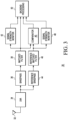
- FIG. 3 illustrates wireless receiver 30 in accordance with an embodiment.
- Wireless receiver 30 includes LNA 34, bandpass filter 36, matched filter 38, comparator 40, signal strength monitor 42, reference bandpass filter 44, reference matched filter 46, signal strength monitor 48, and backend processing block 50.
- Low-noise amplifier 34 has an input connected to antenna 32 for receiving a wireless transmission, and an output.
- Bandpass filter 36 has an input connected to the output of LNA 34, and an output.
- Matched filter 38 has an input connected to the output of bandpass filter 36, and an output.
- Reference bandpass filter 44 has an input connected to the output of LNA 34, and an output.
- Reference matched filter 46 has an input connected to the output of reference bandpass filter 44, and an output.
- Comparator 40 has a first input connected to the output of matched filter 38, a second input connected to the output of reference matched filter 46, and an output.
- Signal strength monitor 42 has an input connected to the output of matched filter 38, and an output.
- Signal strength monitor 48 has an input connected to the output of reference matched filter 46, and an output.
- Backend processing block 50 has a first input connected to the output of signal strength monitor 42, a second input connected to the output of matched filter 38, a third input connected to the output of comparator 40, and a fourth input connected to the output of signal strength monitor 48.
- Comparator 40 compares the signal energies at the outputs of matched filters 38 and 46. Because the frequencies outside of the allowed frequency band can also be in use by other radio frequency (RF) systems, it is required that measures be taken to prevent these other RF signals from disturbing the comparison of the signal energies. Therefore, the comparison only takes place during the time when a pulse is received by receiver 30. The time of the comparison is determined by when the pulse is processed by reference matched filter 46 because reference matched filter 46 has a higher bandwidth, and therefore outputs the pulse sooner than matched filter 38.
- RF radio frequency
- a result of the comparison by comparator 40 is that the energy at the output of matched filter 38 is substantially lower than the energy at the output of the reference matched filter 46, then a large amount of out-of-band energy has been received, indicating that the received signal comes from an illegitimate device, which is using a higher bandwidth in violation of the regulatory standard or protocol, to perform an attack.
- a difference of signal energies can be compared instead of an absolute value of signal energies.
- Transmit power is monitored using signal strength monitors 42 and 48 to detect violations of transmit power regulations, standards, or protocols. Monitoring transmit power addresses the case where an attacker uses higher transmit power than allowed, or uses a high-gain antenna to supersede the signal of the legitimate transmitter. In the case of the high-gain antenna, the parameter of a violated RF standard might not be transmit power, but of the field strength at a given distance. To make this determination, time-of-flight or triangulation of a plurality of receivers may be used, where each of the plurality of receivers measures a received signal level, calculates the transmitter's position, and thus its distance from the receivers. Alternately, a plurality of pulses from the wireless transmission may be received and a signal strength of the pulses may be averaged to determine if the transmission signal strength is within a transmit power specification value.
- the key fob may also be authenticated using a conventional authentication scheme to ensure that the key fob is legitimate.
- One way to authenticate is via challenge/response messages.
- the challenge/response communication may be any type of conventional challenge/response, such as a communication that uses a secret key and a cryptographic algorithm.
- the authentication process involves a common secret between the key fob and the vehicle. The vehicle will first transmit a challenge word to the key fob. Note that the challenge/response communication between the vehicle and the key fob requires the vehicle to also include a transmitter, which is not illustrated in FIG. 2 .
- the key fob calculates a response word based on the challenge word and on the common secret.
- the response word is transmitted to the vehicle.
- the vehicle knows from processing the response word if the key fob is in possession of the correct common secret. If the response word from the key fob is correct, the vehicle provides access. If the response word is incorrect, the vehicle does not provide access.
- another method for authentication may be used.
- Comparing the signal energies from the matched filter 38 and reference matched filter 46 provides the benefit of improving security by allowing a more informed compromise between the amount of out-of-band signal energy as discussed above regarding FIG. 2 . Furthermore, the described embodiment allows a better choice of bandpass bandwidth so that a distance bounding function is improved.
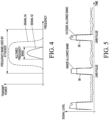
- FIG. 4 illustrates a signal characteristic comparison of a legitimate and illegitimate passband in the frequency domain.
- Signal 52 is from a legitimate transmitter and is shown within an allowed frequency band.
- Signal 54 is from an illegitimate transmitter and uses a much larger frequency band than legitimate signal 52. Also, signal 54 is transmitted with a much higher transmit power than signal 52, which can be detected using signal strength monitors 42 and 48 in FIG. 3 .
- FIG. 5 illustrates a signal characteristic comparison of a legitimate and illegitimate key fob pulse in the time domain. Two pulses are illustrated in FIG. 5 .
- Pulse 56 illustrates a UWB pulse that is within an allowed frequency band.
- Pulse 58 illustrates a UWB pulse that is outside of the allowed frequency band.
- the difference between a legitimate pulse and an illegitimate pulse may be difficult to detect and result in false alerts.
- a plurality of pulses from the wireless transmission may be received and a signal strength of the pulses may be averaged to determine if the transmission signal strength is within a transmit power specification value.
- the above described method to detect an illegitimate, or unauthorized key fob performs the detection using one or both of frequency bandwidth or signal strength.
- another predetermined parameter of a wireless transmission may be used.
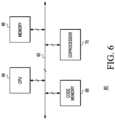
- FIG. 6 illustrates a simplified view of backend processing circuit 60 of the wireless receiver of FIG. 3 .
- Backend processing circuit 60 includes data and address bus 62.
- Each of central processing unit (CPU) 64, data memory 66, code memory 68, and coprocessor 70 are bi-directionally connected to bus 62.
- Backend processor 60 may be implemented on one or more integrated circuits.
- CPU 64 may be any hardware device capable of executing instructions stored in code memory 68.
- CPU 64 may be, for example, a microprocessor, field programmable gate array (FPGA), application-specific integrated circuit (ASIC), or similar device.
- FPGA field programmable gate array
- ASIC application-specific integrated circuit
- Data memory 66 may be any kind of memory, such as for example, L1, L2, or L3 cache or system memory.
- Data memory 66 may include volatile memory such as static random-access memory (SRAM) or dynamic RAM (DRAM), or may include non-volatile memory such as flash memory, read only memory (ROM), or other volatile or non-volatile memory.
- volatile memory such as static random-access memory (SRAM) or dynamic RAM (DRAM)
- non-volatile memory such as flash memory, read only memory (ROM), or other volatile or non-volatile memory.
- Code memory 68 may include one or more machine-readable storage media for storing instructions for execution by CPU 64. In other embodiments, memory 66 may also store data upon which CPU 64 may operate. Code memory 68 may store, for example, a machine learning model, or encryption, decryption, or verification applications. A software implementation of a rake receiver may be implemented in code memory 68. Code memory 68 may be implemented in a secure hardware element and be tamper-resistant.
- CPU 64 and coprocessor 70 may each be one or more of any kind of processor or processor core, such as for example, a microcontroller, microprocessor, digital signal processor, or the like, for executing instructions or commands.
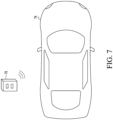
- FIG. 7 illustrates vehicle 74 and key fob transceiver 72.
- An automotive keyless entry system for vehicle 74 also includes key fob 72.
- Key fob 72 is a conventional key fob transceiver for communicating with the automobile keyless entry system for vehicle access.
- the vehicle 74 includes a keyless entry system that is based on a UWB protocol or standard for keyless entry systems.
- Vehicle 74 may be any kind of vehicle that can benefit from a keyless security system.
- Vehicle 74 may also be referred to as a car, automobile, truck, bus, or other type of vehicle that can benefit from the above described embodiments to detect if the key fob is legitimate or illegitimate.
- a method for detecting an attack on a keyless entry system for a vehicle includes receiving a wireless transmission by the keyless entry system.
- the wireless transmission is filtered in a first filter to produce a filtered wireless transmission.
- the wireless transmission is filtered in a second filter to produce a reference filtered wireless transmission.
- a frequency band of the filtered wireless transmission is compared to a frequency band of the reference filtered wireless transmission. Based on the comparison, it is determined if the wireless transmission is from a key fob that complies with the specification of the wireless transmission.
- a wireless receiver is provided for performing the method.
- Non-transitory machine-readable storage medium including any mechanism for storing information in a form readable by a machine, such as a personal computer, laptop computer, file server, smart phone, or other computing device.
- the non-transitory machine-readable storage medium may include volatile and non-volatile memories such as read only memory (ROM), random access memory (RAM), magnetic disk storage media, optical storage medium, NVM, and the like.
- ROM read only memory
- RAM random access memory
- magnetic disk storage media such as magnetic disks, optical storage medium, NVM, and the like.
- NVM non-transitory machine-readable storage medium excludes transitory signals.
Landscapes
- Engineering & Computer Science (AREA)
- Computer Security & Cryptography (AREA)
- Computer Networks & Wireless Communication (AREA)
- Signal Processing (AREA)
- Computer Hardware Design (AREA)
- Computing Systems (AREA)
- General Engineering & Computer Science (AREA)
- Physics & Mathematics (AREA)
- General Physics & Mathematics (AREA)
- Mechanical Engineering (AREA)
- Lock And Its Accessories (AREA)
Claims (6)
- Verfahren zum Detektieren eines Angriffs auf ein schlüsselloses Ultrabreitband- bzw. UWB-Zugangssystem für ein Fahrzeug durch einen Drahtlosempfänger in dem Fahrzeug, wobei das Verfahren Folgendes umfasst:Detektieren einer drahtlosen Übertragung;Bandpassfiltern der drahtlosen Übertragung mit einem Bandpassfilter (36) und einem Optimalfilter (38) mit einem ersten vorbestimmten Durchlassbereich, um eine erste Filterausgabe zu erzeugen;Bandpassfiltern der drahtlosen Übertragung mit einem Referenzbandpassfilter (44) und einem Referenzoptimalfilter (46) mit einem zweiten vorbestimmten Durchlassbereich, der größer als der erste vorbestimmte Durchlassbereich ist, um eine zweite Filterausgabe zu erzeugen;Vergleichen einer Signalenergie der ersten Filterausgabe mit einer Signalenergie der zweiten Filterausgabe; undBestimmen, dass die drahtlose Übertragung von einer nicht legitimen Vorrichtung stammt, wenn die Signalenergie der ersten Filterausgabe wesentlich geringer als die Signalenergie der zweiten Filterausgabe ist.
- Verfahren nach Anspruch 1, ferner umfassend Authentifizieren des Drahtlossystems, wenn die Signalstärke der zweiten Filterausgabe nicht höher als die Signalstärke der ersten Filterausgabe ist.
- Verfahren nach einem der vorhergehenden Ansprüche, wobei die drahtlose Übertragung mehrere Impulse umfasst und das Vergleichen einer Signalstärke eine Mittelwertbildung einer Signalstärke der mehreren Impulse umfasst.
- Drahtlosempfänger (30) für ein schlüsselloses Ultrabreitband- bzw. UWB-Zugangssystem in einem Fahrzeug, wobei der Drahtlosempfänger (30) Folgendes umfasst:einen Verstärker (34) mit einem zum Empfangen einer drahtlosen Übertragung von einem Key-Fob-Sendeempfänger gekoppelten Eingang und einem Ausgang;ein Bandpassfilter (36) mit einem mit dem Ausgang des Verstärkers (34) gekoppelten Eingang und einem Ausgang;ein Optimalfilter (38) mit einem mit dem Ausgang des Bandpassfilters (36) gekoppelten Eingang und einem Ausgang, wobei das Bandpassfilter und das Optimalfilter einen ersten vorbestimmten Durchlassbereich aufweisen;ein Referenzbandpassfilters (44) mit einem mit dem Ausgang des Verstärkers (34) gekoppelten Eingang und einem Ausgang; undein Referenzoptimalfilter (46) mit einem mit dem Ausgang des Referenzbandpassfilters (44) gekoppelten Eingang und einem Ausgang zum Bereitstellen eines Referenzwerts,wobei das Referenzbandpassfilter und das Referenzoptimalfilter einen zweiten vorbestimmten Durchlassbereich aufweisen, der größer als der erste vorbestimmte Durchlassbereich ist;einen Komparator (40) mit einem mit dem Ausgang des Optimalfilters (38) gekoppelten ersten Eingang, einem zum Empfangen des Referenzwerts gekoppelten zweiten Eingang und einem Ausgang zum Bereitstellen eines Ergebnisses eines Vergleichs von Signalenergien der Ausgaben des Optimalfilters (38) und des Referenzoptimalfilter (46); undeinen Backend-Prozessor (50), ausgelegt zum Bestimmen, dass die drahtlose Übertragung von einer nicht legitimen Vorrichtung stammt, wenn die Ausgabe von dem Komparator (40) angibt, dass die Signalenergie von dem Optimalfilter (38) wesentlich geringer als die Signalenergie von dem Referenzoptimalfilter (46) ist.
- Drahtlosempfänger (30) nach Anspruch 4, ferner umfassend eine Signalstärkeüberwachungseinrichtung (42), die zum Überwachen einer Signalstärke der Optimalfilterausgabe gekoppelt ist.
- Drahtlosempfänger nach Anspruch 4, ferner umfassend eine erste Signalstärkeüberwachungseinrichtung (42), die zum Empfangen der Optimalfilterausgabe gekoppelt ist, und eine zweite Signalstärkeüberwachungseinrichtung (48), die zum Empfangen des Referenzwerts gekoppelt ist, wobei eine Signalstärke der Optimalfilterausgabe und eine Signalstärke des Referenzwerts verwendet werden, um zu bestimmen, ob die drahtlose Übertragung einem Drahtlosübertragungsprotokoll entspricht.
Applications Claiming Priority (1)
| Application Number | Priority Date | Filing Date | Title |
|---|---|---|---|
| US16/051,558 US10629011B2 (en) | 2018-08-01 | 2018-08-01 | Wireless receiver and method for detecting an attack on a keyless entry system for a vehicle |
Publications (2)
| Publication Number | Publication Date |
|---|---|
| EP3605476A1 EP3605476A1 (de) | 2020-02-05 |
| EP3605476B1 true EP3605476B1 (de) | 2023-06-07 |
Family
ID=67438385
Family Applications (1)
| Application Number | Title | Priority Date | Filing Date |
|---|---|---|---|
| EP19187580.6A Active EP3605476B1 (de) | 2018-08-01 | 2019-07-22 | Drahtloser empfänger und verfahren zur detektion eines angriffs auf ein schlüsselloses eingangssystem für ein fahrzeug |
Country Status (2)
| Country | Link |
|---|---|
| US (1) | US10629011B2 (de) |
| EP (1) | EP3605476B1 (de) |
Families Citing this family (2)
| Publication number | Priority date | Publication date | Assignee | Title |
|---|---|---|---|---|
| JP6653986B1 (ja) * | 2019-12-06 | 2020-02-26 | マレリ株式会社 | リレーアタック判定装置 |
| FR3113738B1 (fr) * | 2020-09-01 | 2022-07-29 | Continental Automotive | Procédé d’activation d’une fonction d’un véhicule par ultra large bande avec un équipement portable d’utilisateur, système et dispositif d’activation d’une fonction associés |
Family Cites Families (5)
| Publication number | Priority date | Publication date | Assignee | Title |
|---|---|---|---|---|
| JP4676316B2 (ja) * | 2005-11-18 | 2011-04-27 | ルネサスエレクトロニクス株式会社 | 受信装置、通信装置、及びそれを用いた制御装置 |
| US8930045B2 (en) * | 2013-05-01 | 2015-01-06 | Delphi Technologies, Inc. | Relay attack prevention for passive entry passive start (PEPS) vehicle security systems |
| WO2016059451A1 (en) | 2014-10-15 | 2016-04-21 | Continental Automotive Gmbh | Method and system for detecting relay attack for pase system |
| US9775034B2 (en) * | 2015-02-06 | 2017-09-26 | Nxp B.V. | Communications with distance authentication |
| US10532719B2 (en) * | 2016-12-30 | 2020-01-14 | Robert Bosch Gmbh | Bluetooth low energy (BLE) passive vehicle access control system for defending the system against relay attacks and method thereof |
-
2018
- 2018-08-01 US US16/051,558 patent/US10629011B2/en active Active
-
2019
- 2019-07-22 EP EP19187580.6A patent/EP3605476B1/de active Active
Also Published As
| Publication number | Publication date |
|---|---|
| US20200043265A1 (en) | 2020-02-06 |
| EP3605476A1 (de) | 2020-02-05 |
| US10629011B2 (en) | 2020-04-21 |
Similar Documents
| Publication | Publication Date | Title |
|---|---|---|
| US8698605B2 (en) | Determining the validity of a connection between a reader and a transponder | |
| US10044512B2 (en) | Decoupling of measuring the response time of a transponder and its authentication | |
| US11611876B2 (en) | Authentication system and authentication method | |
| US10766453B2 (en) | Apparatus, key remote, and method for controlling operating conditions of a key module | |
| EP3599781B1 (de) | Verfahren zum schutz eines passiven schlüssellosen zugangssystems gegen einen relaisangriff | |
| US9558607B2 (en) | Relay attack prevention using RSSIPPLX | |
| US20140169193A1 (en) | Relay attack prevention | |
| US20160350987A1 (en) | Communications with interaction detection | |
| KR102499447B1 (ko) | 릴레이 어택을 파악하는 방법, 릴레이 어택 검출 장치, 및 컴퓨터 프로그램 | |
| EP3605476B1 (de) | Drahtloser empfänger und verfahren zur detektion eines angriffs auf ein schlüsselloses eingangssystem für ein fahrzeug | |
| KR102246430B1 (ko) | 릴레이 어택으로부터의 보호방법 | |
| US10389751B2 (en) | Wireless data security between vehicle components | |
| JP2018523390A (ja) | デバイス認証のためのシステム | |
| JP2021188924A (ja) | 制御装置およびプログラム | |
| JP3722216B2 (ja) | データ伝送中の転送の検知方法 | |
| KR102515940B1 (ko) | 지터 어택을 파악하는 방법, 지터 어택 검출 장치, 및 컴퓨터 프로그램 | |
| JP6835982B2 (ja) | 自動車両に設けられている機能のリモート起動を一時的に禁止する方法 | |
| JP5429195B2 (ja) | 電子キーシステム | |
| US11427160B2 (en) | Field superposition method and system | |
| WO2017131113A1 (ja) | 無線通信正否判定システム | |
| KR20240158023A (ko) | 차량을 위한 개선된 보안 기능 제공 방법과, 이를 지원하는 컴퓨팅 시스템 및 차량 | |
| HK1151910A (en) | Decoupling of measuring the response time of a transponder and its authentication |
Legal Events
| Date | Code | Title | Description |
|---|---|---|---|
| PUAI | Public reference made under article 153(3) epc to a published international application that has entered the european phase |
Free format text: ORIGINAL CODE: 0009012 |
|
| STAA | Information on the status of an ep patent application or granted ep patent |
Free format text: STATUS: THE APPLICATION HAS BEEN PUBLISHED |
|
| AK | Designated contracting states |
Kind code of ref document: A1 Designated state(s): AL AT BE BG CH CY CZ DE DK EE ES FI FR GB GR HR HU IE IS IT LI LT LU LV MC MK MT NL NO PL PT RO RS SE SI SK SM TR |
|
| AX | Request for extension of the european patent |
Extension state: BA ME |
|
| STAA | Information on the status of an ep patent application or granted ep patent |
Free format text: STATUS: REQUEST FOR EXAMINATION WAS MADE |
|
| 17P | Request for examination filed |
Effective date: 20200805 |
|
| RBV | Designated contracting states (corrected) |
Designated state(s): AL AT BE BG CH CY CZ DE DK EE ES FI FR GB GR HR HU IE IS IT LI LT LU LV MC MK MT NL NO PL PT RO RS SE SI SK SM TR |
|
| RIC1 | Information provided on ipc code assigned before grant |
Ipc: B60R 25/00 20130101ALN20221111BHEP Ipc: G07C 9/00 20200101AFI20221111BHEP |
|
| GRAP | Despatch of communication of intention to grant a patent |
Free format text: ORIGINAL CODE: EPIDOSNIGR1 |
|
| STAA | Information on the status of an ep patent application or granted ep patent |
Free format text: STATUS: GRANT OF PATENT IS INTENDED |
|
| INTG | Intention to grant announced |
Effective date: 20230118 |
|
| GRAS | Grant fee paid |
Free format text: ORIGINAL CODE: EPIDOSNIGR3 |
|
| GRAA | (expected) grant |
Free format text: ORIGINAL CODE: 0009210 |
|
| STAA | Information on the status of an ep patent application or granted ep patent |
Free format text: STATUS: THE PATENT HAS BEEN GRANTED |
|
| AK | Designated contracting states |
Kind code of ref document: B1 Designated state(s): AL AT BE BG CH CY CZ DE DK EE ES FI FR GB GR HR HU IE IS IT LI LT LU LV MC MK MT NL NO PL PT RO RS SE SI SK SM TR |
|
| REG | Reference to a national code |
Ref country code: GB Ref legal event code: FG4D |
|
| REG | Reference to a national code |
Ref country code: CH Ref legal event code: EP Ref country code: AT Ref legal event code: REF Ref document number: 1577312 Country of ref document: AT Kind code of ref document: T Effective date: 20230615 Ref country code: DE Ref legal event code: R096 Ref document number: 602019029823 Country of ref document: DE |
|
| REG | Reference to a national code |
Ref country code: LT Ref legal event code: MG9D |
|
| REG | Reference to a national code |
Ref country code: NL Ref legal event code: MP Effective date: 20230607 |
|
| P01 | Opt-out of the competence of the unified patent court (upc) registered |
Effective date: 20230907 |
|
| PG25 | Lapsed in a contracting state [announced via postgrant information from national office to epo] |
Ref country code: SE Free format text: LAPSE BECAUSE OF FAILURE TO SUBMIT A TRANSLATION OF THE DESCRIPTION OR TO PAY THE FEE WITHIN THE PRESCRIBED TIME-LIMIT Effective date: 20230607 Ref country code: NO Free format text: LAPSE BECAUSE OF FAILURE TO SUBMIT A TRANSLATION OF THE DESCRIPTION OR TO PAY THE FEE WITHIN THE PRESCRIBED TIME-LIMIT Effective date: 20230907 Ref country code: ES Free format text: LAPSE BECAUSE OF FAILURE TO SUBMIT A TRANSLATION OF THE DESCRIPTION OR TO PAY THE FEE WITHIN THE PRESCRIBED TIME-LIMIT Effective date: 20230607 |
|
| REG | Reference to a national code |
Ref country code: AT Ref legal event code: MK05 Ref document number: 1577312 Country of ref document: AT Kind code of ref document: T Effective date: 20230607 |
|
| PG25 | Lapsed in a contracting state [announced via postgrant information from national office to epo] |
Ref country code: RS Free format text: LAPSE BECAUSE OF FAILURE TO SUBMIT A TRANSLATION OF THE DESCRIPTION OR TO PAY THE FEE WITHIN THE PRESCRIBED TIME-LIMIT Effective date: 20230607 Ref country code: NL Free format text: LAPSE BECAUSE OF FAILURE TO SUBMIT A TRANSLATION OF THE DESCRIPTION OR TO PAY THE FEE WITHIN THE PRESCRIBED TIME-LIMIT Effective date: 20230607 Ref country code: LV Free format text: LAPSE BECAUSE OF FAILURE TO SUBMIT A TRANSLATION OF THE DESCRIPTION OR TO PAY THE FEE WITHIN THE PRESCRIBED TIME-LIMIT Effective date: 20230607 Ref country code: LT Free format text: LAPSE BECAUSE OF FAILURE TO SUBMIT A TRANSLATION OF THE DESCRIPTION OR TO PAY THE FEE WITHIN THE PRESCRIBED TIME-LIMIT Effective date: 20230607 Ref country code: HR Free format text: LAPSE BECAUSE OF FAILURE TO SUBMIT A TRANSLATION OF THE DESCRIPTION OR TO PAY THE FEE WITHIN THE PRESCRIBED TIME-LIMIT Effective date: 20230607 Ref country code: GR Free format text: LAPSE BECAUSE OF FAILURE TO SUBMIT A TRANSLATION OF THE DESCRIPTION OR TO PAY THE FEE WITHIN THE PRESCRIBED TIME-LIMIT Effective date: 20230908 |
|
| PGFP | Annual fee paid to national office [announced via postgrant information from national office to epo] |
Ref country code: FR Payment date: 20230720 Year of fee payment: 5 Ref country code: DE Payment date: 20230620 Year of fee payment: 5 |
|
| PG25 | Lapsed in a contracting state [announced via postgrant information from national office to epo] |
Ref country code: FI Free format text: LAPSE BECAUSE OF FAILURE TO SUBMIT A TRANSLATION OF THE DESCRIPTION OR TO PAY THE FEE WITHIN THE PRESCRIBED TIME-LIMIT Effective date: 20230607 |
|
| PG25 | Lapsed in a contracting state [announced via postgrant information from national office to epo] |
Ref country code: SK Free format text: LAPSE BECAUSE OF FAILURE TO SUBMIT A TRANSLATION OF THE DESCRIPTION OR TO PAY THE FEE WITHIN THE PRESCRIBED TIME-LIMIT Effective date: 20230607 |
|
| PG25 | Lapsed in a contracting state [announced via postgrant information from national office to epo] |
Ref country code: IS Free format text: LAPSE BECAUSE OF FAILURE TO SUBMIT A TRANSLATION OF THE DESCRIPTION OR TO PAY THE FEE WITHIN THE PRESCRIBED TIME-LIMIT Effective date: 20231007 |
|
| PG25 | Lapsed in a contracting state [announced via postgrant information from national office to epo] |
Ref country code: SM Free format text: LAPSE BECAUSE OF FAILURE TO SUBMIT A TRANSLATION OF THE DESCRIPTION OR TO PAY THE FEE WITHIN THE PRESCRIBED TIME-LIMIT Effective date: 20230607 Ref country code: SK Free format text: LAPSE BECAUSE OF FAILURE TO SUBMIT A TRANSLATION OF THE DESCRIPTION OR TO PAY THE FEE WITHIN THE PRESCRIBED TIME-LIMIT Effective date: 20230607 Ref country code: RO Free format text: LAPSE BECAUSE OF FAILURE TO SUBMIT A TRANSLATION OF THE DESCRIPTION OR TO PAY THE FEE WITHIN THE PRESCRIBED TIME-LIMIT Effective date: 20230607 Ref country code: PT Free format text: LAPSE BECAUSE OF FAILURE TO SUBMIT A TRANSLATION OF THE DESCRIPTION OR TO PAY THE FEE WITHIN THE PRESCRIBED TIME-LIMIT Effective date: 20231009 Ref country code: IS Free format text: LAPSE BECAUSE OF FAILURE TO SUBMIT A TRANSLATION OF THE DESCRIPTION OR TO PAY THE FEE WITHIN THE PRESCRIBED TIME-LIMIT Effective date: 20231007 Ref country code: EE Free format text: LAPSE BECAUSE OF FAILURE TO SUBMIT A TRANSLATION OF THE DESCRIPTION OR TO PAY THE FEE WITHIN THE PRESCRIBED TIME-LIMIT Effective date: 20230607 Ref country code: CZ Free format text: LAPSE BECAUSE OF FAILURE TO SUBMIT A TRANSLATION OF THE DESCRIPTION OR TO PAY THE FEE WITHIN THE PRESCRIBED TIME-LIMIT Effective date: 20230607 Ref country code: AT Free format text: LAPSE BECAUSE OF FAILURE TO SUBMIT A TRANSLATION OF THE DESCRIPTION OR TO PAY THE FEE WITHIN THE PRESCRIBED TIME-LIMIT Effective date: 20230607 |
|
| PG25 | Lapsed in a contracting state [announced via postgrant information from national office to epo] |
Ref country code: PL Free format text: LAPSE BECAUSE OF FAILURE TO SUBMIT A TRANSLATION OF THE DESCRIPTION OR TO PAY THE FEE WITHIN THE PRESCRIBED TIME-LIMIT Effective date: 20230607 |
|
| REG | Reference to a national code |
Ref country code: CH Ref legal event code: PL |
|
| REG | Reference to a national code |
Ref country code: DE Ref legal event code: R097 Ref document number: 602019029823 Country of ref document: DE |
|
| PG25 | Lapsed in a contracting state [announced via postgrant information from national office to epo] |
Ref country code: MC Free format text: LAPSE BECAUSE OF FAILURE TO SUBMIT A TRANSLATION OF THE DESCRIPTION OR TO PAY THE FEE WITHIN THE PRESCRIBED TIME-LIMIT Effective date: 20230607 |
|
| REG | Reference to a national code |
Ref country code: BE Ref legal event code: MM Effective date: 20230731 |
|
| PG25 | Lapsed in a contracting state [announced via postgrant information from national office to epo] |
Ref country code: LU Free format text: LAPSE BECAUSE OF NON-PAYMENT OF DUE FEES Effective date: 20230722 |
|
| PG25 | Lapsed in a contracting state [announced via postgrant information from national office to epo] |
Ref country code: MC Free format text: LAPSE BECAUSE OF FAILURE TO SUBMIT A TRANSLATION OF THE DESCRIPTION OR TO PAY THE FEE WITHIN THE PRESCRIBED TIME-LIMIT Effective date: 20230607 Ref country code: LU Free format text: LAPSE BECAUSE OF NON-PAYMENT OF DUE FEES Effective date: 20230722 |
|
| PLBE | No opposition filed within time limit |
Free format text: ORIGINAL CODE: 0009261 |
|
| STAA | Information on the status of an ep patent application or granted ep patent |
Free format text: STATUS: NO OPPOSITION FILED WITHIN TIME LIMIT |
|
| REG | Reference to a national code |
Ref country code: IE Ref legal event code: MM4A |
|
| PG25 | Lapsed in a contracting state [announced via postgrant information from national office to epo] |
Ref country code: DK Free format text: LAPSE BECAUSE OF FAILURE TO SUBMIT A TRANSLATION OF THE DESCRIPTION OR TO PAY THE FEE WITHIN THE PRESCRIBED TIME-LIMIT Effective date: 20230607 Ref country code: CH Free format text: LAPSE BECAUSE OF NON-PAYMENT OF DUE FEES Effective date: 20230731 |
|
| PG25 | Lapsed in a contracting state [announced via postgrant information from national office to epo] |
Ref country code: SI Free format text: LAPSE BECAUSE OF FAILURE TO SUBMIT A TRANSLATION OF THE DESCRIPTION OR TO PAY THE FEE WITHIN THE PRESCRIBED TIME-LIMIT Effective date: 20230607 |
|
| 26N | No opposition filed |
Effective date: 20240308 |
|
| GBPC | Gb: european patent ceased through non-payment of renewal fee |
Effective date: 20230907 |
|
| PG25 | Lapsed in a contracting state [announced via postgrant information from national office to epo] |
Ref country code: SI Free format text: LAPSE BECAUSE OF FAILURE TO SUBMIT A TRANSLATION OF THE DESCRIPTION OR TO PAY THE FEE WITHIN THE PRESCRIBED TIME-LIMIT Effective date: 20230607 Ref country code: IT Free format text: LAPSE BECAUSE OF FAILURE TO SUBMIT A TRANSLATION OF THE DESCRIPTION OR TO PAY THE FEE WITHIN THE PRESCRIBED TIME-LIMIT Effective date: 20230607 Ref country code: BE Free format text: LAPSE BECAUSE OF NON-PAYMENT OF DUE FEES Effective date: 20230731 |
|
| PG25 | Lapsed in a contracting state [announced via postgrant information from national office to epo] |
Ref country code: IE Free format text: LAPSE BECAUSE OF NON-PAYMENT OF DUE FEES Effective date: 20230722 |
|
| PG25 | Lapsed in a contracting state [announced via postgrant information from national office to epo] |
Ref country code: GB Free format text: LAPSE BECAUSE OF NON-PAYMENT OF DUE FEES Effective date: 20230907 |
|
| PG25 | Lapsed in a contracting state [announced via postgrant information from national office to epo] |
Ref country code: IE Free format text: LAPSE BECAUSE OF NON-PAYMENT OF DUE FEES Effective date: 20230722 Ref country code: GB Free format text: LAPSE BECAUSE OF NON-PAYMENT OF DUE FEES Effective date: 20230907 |
|
| PG25 | Lapsed in a contracting state [announced via postgrant information from national office to epo] |
Ref country code: BG Free format text: LAPSE BECAUSE OF FAILURE TO SUBMIT A TRANSLATION OF THE DESCRIPTION OR TO PAY THE FEE WITHIN THE PRESCRIBED TIME-LIMIT Effective date: 20230607 |
|
| PG25 | Lapsed in a contracting state [announced via postgrant information from national office to epo] |
Ref country code: BG Free format text: LAPSE BECAUSE OF FAILURE TO SUBMIT A TRANSLATION OF THE DESCRIPTION OR TO PAY THE FEE WITHIN THE PRESCRIBED TIME-LIMIT Effective date: 20230607 |
|
| REG | Reference to a national code |
Ref country code: DE Ref legal event code: R119 Ref document number: 602019029823 Country of ref document: DE |
|
| PG25 | Lapsed in a contracting state [announced via postgrant information from national office to epo] |
Ref country code: DE Free format text: LAPSE BECAUSE OF NON-PAYMENT OF DUE FEES Effective date: 20250201 |
|
| PG25 | Lapsed in a contracting state [announced via postgrant information from national office to epo] |
Ref country code: FR Free format text: LAPSE BECAUSE OF NON-PAYMENT OF DUE FEES Effective date: 20240731 |
|
| PG25 | Lapsed in a contracting state [announced via postgrant information from national office to epo] |
Ref country code: CY Free format text: LAPSE BECAUSE OF FAILURE TO SUBMIT A TRANSLATION OF THE DESCRIPTION OR TO PAY THE FEE WITHIN THE PRESCRIBED TIME-LIMIT; INVALID AB INITIO Effective date: 20190722 |
|
| PG25 | Lapsed in a contracting state [announced via postgrant information from national office to epo] |
Ref country code: HU Free format text: LAPSE BECAUSE OF FAILURE TO SUBMIT A TRANSLATION OF THE DESCRIPTION OR TO PAY THE FEE WITHIN THE PRESCRIBED TIME-LIMIT; INVALID AB INITIO Effective date: 20190722 |
|
| PG25 | Lapsed in a contracting state [announced via postgrant information from national office to epo] |
Ref country code: TR Free format text: LAPSE BECAUSE OF FAILURE TO SUBMIT A TRANSLATION OF THE DESCRIPTION OR TO PAY THE FEE WITHIN THE PRESCRIBED TIME-LIMIT Effective date: 20230607 |