EP3603206B1 - Bestimmung einer anfrage für systeminformationen - Google Patents
Bestimmung einer anfrage für systeminformationen Download PDFInfo
- Publication number
- EP3603206B1 EP3603206B1 EP18717759.7A EP18717759A EP3603206B1 EP 3603206 B1 EP3603206 B1 EP 3603206B1 EP 18717759 A EP18717759 A EP 18717759A EP 3603206 B1 EP3603206 B1 EP 3603206B1
- Authority
- EP
- European Patent Office
- Prior art keywords
- system information
- user equipment
- requested
- request
- response
- Prior art date
- Legal status (The legal status is an assumption and is not a legal conclusion. Google has not performed a legal analysis and makes no representation as to the accuracy of the status listed.)
- Active
Links
Images


Classifications
-
- H—ELECTRICITY
- H04—ELECTRIC COMMUNICATION TECHNIQUE
- H04W—WIRELESS COMMUNICATION NETWORKS
- H04W48/00—Access restriction; Network selection; Access point selection
- H04W48/08—Access restriction or access information delivery, e.g. discovery data delivery
- H04W48/14—Access restriction or access information delivery, e.g. discovery data delivery using user query or user detection
-
- H—ELECTRICITY
- H04—ELECTRIC COMMUNICATION TECHNIQUE
- H04W—WIRELESS COMMUNICATION NETWORKS
- H04W72/00—Local resource management
- H04W72/12—Wireless traffic scheduling
-
- H—ELECTRICITY
- H04—ELECTRIC COMMUNICATION TECHNIQUE
- H04W—WIRELESS COMMUNICATION NETWORKS
- H04W74/00—Wireless channel access
- H04W74/08—Non-scheduled access, e.g. ALOHA
- H04W74/0833—Random access procedures, e.g. with 4-step access
-
- H—ELECTRICITY
- H04—ELECTRIC COMMUNICATION TECHNIQUE
- H04W—WIRELESS COMMUNICATION NETWORKS
- H04W72/00—Local resource management
- H04W72/30—Resource management for broadcast services
Definitions
- the subject matter disclosed herein relates generally to wireless communications and more particularly relates to determining a request for system information.
- a first user equipment a method performed by a first user equipment, and a processor for wireless communication.
- SI system information
- PLMNs public land mobile networks
- RACH parameters resource allocation parameters
- the other non-minimum SI doesn't necessarily need to be periodically broadcast (e.g., it may be a network decision).
- the other SI may be provided on-demand to UEs (e.g., a UE may request it). Delivery of other SI may be done in a broadcast or unicast manner.
- the minimum SI may indicate whether a specific SIB is periodically broadcasted or provided on-demand.
- a UE may initiate an on-demand SI acquisition procedure (e.g., SI request).
- SI request For an SI used by the UE, the UE may determine whether it is available in the cell and whether it is broadcast or not before it sends a request for it.
- the scheduling information for other SI may be provided by the minimum SI (e.g., an SIB type, validity information, periodicity, SI-window information, etc.).
- multiple UEs may send a request for the same SI.
- the UEs may use power and resources to send the requests.
- a gNB that receives multiple requests for the same SI may use excessive resources to receive and/or respond to the requests.
- R2-164693 is a 3GPP draft titled "System Information Signalling Design in NR" submitted by Samsung and published by RAN WG2 in Gotheburg, Sweden on 21 August 2016 .
- R2-1701397 is a 3GPP draft titled "Considerations about on-demand SI acquiring procedure" submitted by Fujitsu and published by RAN WG2 in Athens, Greece on 12 February 2017 .
- R2-1700375 is a 3GPP draft titled "Handling of SI requests from unauthenticated UEs in NR" submitted by Blackberry UK Ltd and published by RAN WG2 in Spokane, USA on 17 January 2017 .
- R2-163371 is a 3GPP draft titled "System Information Signalling Design in NR” submitted by Samsung and published by RAN WG2 in Nanjing, China on 22 May 2016 .
- R2-1701362 is a 3GPP draft titled "NR SI Unicast” submitted by MediaTek Inc. also at the RAN WG2 meeting #97 in Athens, Greece on 13th February 2017 .
- R2-1700832 is a 3GPP draft titled "On demand SI” submitted by Ericsson also at the RAN WG2 meeting #97 in Athens, Greece on 13th February 2017 .
- Claim 1 defines a first user equipment
- claim 3 defines a method performed by a first user equipment
- claim 5 defines a processor for wireless communication.
- embodiments may be embodied as a system, apparatus, method, or program product. Accordingly, embodiments may take the form of an entirely hardware embodiment, an entirely software embodiment (including firmware, resident software, micro-code, etc.) or an embodiment combining software and hardware aspects that may all generally be referred to herein as a "circuit," "module” or “system.” Furthermore, embodiments may take the form of a program product embodied in one or more computer readable storage devices storing machine readable code, computer readable code, and/or program code, referred hereafter as code. The storage devices may be tangible, non-transitory, and/or non-transmission. The storage devices may not embody signals. In a certain embodiment, the storage devices only employ signals for accessing code.
- modules may be implemented as a hardware circuit comprising custom very-large-scale integration ("VLSI") circuits or gate arrays, off-the-shelf semiconductors such as logic chips, transistors, or other discrete components.
- VLSI very-large-scale integration
- a module may also be implemented in programmable hardware devices such as field programmable gate arrays, programmable array logic, programmable logic devices or the like.
- Modules may also be implemented in code and/or software for execution by various types of processors.
- An identified module of code may, for instance, include one or more physical or logical blocks of executable code which may, for instance, be organized as an object, procedure, or function. Nevertheless, the executables of an identified module need not be physically located together, but may include disparate instructions stored in different locations which, when joined logically together, include the module and achieve the stated purpose for the module.
- a module of code may be a single instruction, or many instructions, and may even be distributed over several different code segments, among different programs, and across several memory devices.
- operational data may be identified and illustrated herein within modules, and may be embodied in any suitable form and organized within any suitable type of data structure. The operational data may be collected as a single data set, or may be distributed over different locations including over different computer readable storage devices.
- the software portions are stored on one or more computer readable storage devices.
- the computer readable medium may be a computer readable storage medium.
- the computer readable storage medium may be a storage device storing the code.
- the storage device may be, for example, but not limited to, an electronic, magnetic, optical, electromagnetic, infrared, holographic, micromechanical, or semiconductor system, apparatus, or device, or any suitable combination of the foregoing.
- a storage device More specific examples (a non-exhaustive list) of the storage device would include the following: an electrical connection having one or more wires, a portable computer diskette, a hard disk, a random access memory (“RAM”), a read-only memory (“ROM”), an erasable programmable read-only memory (“EPROM” or Flash memory), a portable compact disc read-only memory (“CD-ROM”), an optical storage device, a magnetic storage device, or any suitable combination of the foregoing.
- a computer readable storage medium may be any tangible medium that can contain, or store a program for use by or in connection with an instruction execution system, apparatus, or device.
- Code for carrying out operations for embodiments may be any number of lines and may be written in any combination of one or more programming languages including an object oriented programming language such as Python, Ruby, Java, Smalltalk, C++, or the like, and conventional procedural programming languages, such as the "C" programming language, or the like, and/or machine languages such as assembly languages.
- the code may execute entirely on the user's computer, partly on the user's computer, as a stand-alone software package, partly on the user's computer and partly on a remote computer or entirely on the remote computer or server.
- the remote computer may be connected to the user's computer through any type of network, including a local area network (“LAN”) or a wide area network (“WAN”), or the connection may be made to an external computer (for example, through the Internet using an Internet Service Provider).
- LAN local area network
- WAN wide area network
- Internet Service Provider an Internet Service Provider
- the code may also be stored in a storage device that can direct a computer, other programmable data processing apparatus, or other devices to function in a particular manner, such that the instructions stored in the storage device produce an article of manufacture including instructions which implement the function/act specified in the schematic flowchart diagrams and/or schematic block diagrams block or blocks.
- the code may also be loaded onto a computer, other programmable data processing apparatus, or other devices to cause a series of operational steps to be performed on the computer, other programmable apparatus or other devices to produce a computer implemented process such that the code which execute on the computer or other programmable apparatus provide processes for implementing the functions/acts specified in the flowchart and/or block diagram block or blocks.
- each block in the schematic flowchart diagrams and/or schematic block diagrams may represent a module, segment, or portion of code, which includes one or more executable instructions of the code for implementing the specified logical function(s).
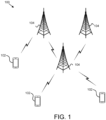
- Figure 1 depicts a wireless communication system 100 for determining a request for system information.
- the wireless communication system 100 includes remote units 102 and base units 104. Even though a specific number of remote units 102 and base units 104 are depicted in Figure 1 , one of skill in the art will recognize that any number of remote units 102 and base units 104 may be included in the wireless communication system 100.
- the remote units 102 may include computing devices, such as desktop computers, laptop computers, personal digital assistants ("PDAs"), tablet computers, smart phones, smart televisions (e.g., televisions connected to the Internet), set-top boxes, game consoles, security systems (including security cameras), vehicle on-board computers, network devices (e.g., routers, switches, modems), or the like.
- the remote units 102 include wearable devices, such as smart watches, fitness bands, optical head-mounted displays, or the like.
- the remote units 102 may be referred to as subscriber units, mobiles, mobile stations, users, terminals, mobile terminals, fixed terminals, subscriber stations, UE, user terminals, a device, or by other terminology used in the art.
- the remote units 102 may communicate directly with one or more of the base units 104 via UL communication signals.
- the base units 104 may be distributed over a geographic region.
- a base unit 104 may also be referred to as an access point, an access terminal, a base, a base station, a Node-B, an eNB, a gNB, a Home Node-B, a relay node, a device, or by any other terminology used in the art.
- the base units 104 are generally part of a radio access network that includes one or more controllers communicably coupled to one or more corresponding base units 104.
- the radio access network is generally communicably coupled to one or more core networks, which may be coupled to other networks, like the Internet and public switched telephone networks, among other networks. These and other elements of radio access and core networks are not illustrated but are well known generally by those having ordinary skill in the art.
- the wireless communication system 100 is compliant with the LTE protocols standardized in 3GPP, wherein the base unit 104 transmits using an OFDM modulation scheme on the DL and the remote units 102 transmit on the UL using a SC-FDMA scheme or an OFDM scheme. More generally, however, the wireless communication system 100 may implement some other open or proprietary communication protocol, for example, WiMAX, among other protocols.
- WiMAX wireless personal area network
- the base units 104 may serve a number of remote units 102 within a serving area, for example, a cell or a cell sector via a wireless communication link.
- the base units 104 transmit DL communication signals to serve the remote units 102 in the time, frequency, and/or spatial domain.
- a base unit 104 may receive information indicating a request for system information from the remote unit 102. In certain embodiments, the base unit 104 may transmit the system information to the remote unit 102.
- a remote unit 102 may determine whether system information used by the remote unit 102 is scheduled to be transmitted. The remote unit 102 may, in response to the system information not being scheduled to be transmitted, determine whether the system information is requested by a second remote unit. Accordingly, a remote unit 102 may be used for determining a request for system information.
- Figure 2 depicts an apparatus 200 that may be used for determining a request for system information.
- the apparatus 200 includes one embodiment of the remote unit 102.
- the remote unit 102 may include a processor 202, a memory 204, an input device 206, a display 208, a transmitter 210, and a receiver 212.
- the input device 206 and the display 208 are combined into a single device, such as a touchscreen.
- the remote unit 102 may not include any input device 206 and/or display 208.
- the remote unit 102 may include one or more of the processor 202, the memory 204, the transmitter 210, and the receiver 212, and may not include the input device 206 and/or the display 208.
- the processor 202 may include any known controller capable of executing computer-readable instructions and/or capable of performing logical operations.
- the processor 202 may be a microcontroller, a microprocessor, a central processing unit ("CPU"), a graphics processing unit (“GPU”), an auxiliary processing unit, a field programmable gate array (“FPGA”), or similar programmable controller.
- the processor 202 executes instructions stored in the memory 204 to perform the methods and routines described herein.
- the processor 202 determines whether system information used by the remote unit 102 is scheduled to be transmitted.
- the processor 202 in response to the system information not being scheduled to be transmitted, determines whether the system information is requested by a second apparatus.
- the processor 202 is communicatively coupled to the memory 204, the input device 206, the display 208, the transmitter 210, and the receiver 212.
- the memory 204 in one embodiment, is a computer readable storage medium.
- the memory 204 includes volatile computer storage media.
- the memory 204 may include a RAM, including dynamic RAM (“DRAM”), synchronous dynamic RAM (“SDRAM”), and/or static RAM (“SRAM”).
- the memory 204 includes non-volatile computer storage media.
- the memory 204 may include a hard disk drive, a flash memory, or any other suitable non-volatile computer storage device.
- the memory 204 includes both volatile and non-volatile computer storage media.
- the memory 204 stores data relating to system information.
- the memory 204 also stores program code and related data, such as an operating system or other controller algorithms operating on the remote unit 102.
- the input device 206 may include any known computer input device including a touch panel, a button, a keyboard, a stylus, a microphone, or the like.
- the input device 206 may be integrated with the display 208, for example, as a touchscreen or similar touch-sensitive display.
- the input device 206 includes a touchscreen such that text may be input using a virtual keyboard displayed on the touchscreen and/or by handwriting on the touchscreen.
- the input device 206 includes two or more different devices, such as a keyboard and a touch panel.
- the display 208 may include any known electronically controllable display or display device.
- the display 208 may be designed to output visual, audible, and/or haptic signals.
- the display 208 includes an electronic display capable of outputting visual data to a user.
- the display 208 may include, but is not limited to, an LCD display, an LED display, an OLED display, a projector, or similar display device capable of outputting images, text, or the like to a user.
- the display 208 may include a wearable display such as a smart watch, smart glasses, a heads-up display, or the like.
- the display 208 may be a component of a smart phone, a personal digital assistant, a television, a table computer, a notebook (laptop) computer, a personal computer, a vehicle dashboard, or the like.
- the display 208 includes one or more speakers for producing sound.
- the display 208 may produce an audible alert or notification (e.g., a beep or chime).
- the display 208 includes one or more haptic devices for producing vibrations, motion, or other haptic feedback.
- all or portions of the display 208 may be integrated with the input device 206.
- the input device 206 and display 208 may form a touchscreen or similar touch-sensitive display.
- the display 208 may be located near the input device 206.
- the transmitter 210 is used to provide UL communication signals to the base unit 104 and the receiver 212 is used to receive DL communication signals from the base unit 104.
- the transmitter 210 may be used to transmit information indicating a request for system information.
- the remote unit 102 may have any suitable number of transmitters 210 and receivers 212.
- the transmitter 210 and the receiver 212 may be any suitable type of transmitters and receivers.
- the transmitter 210 and the receiver 212 may be part of a transceiver.
- Figure 3 depicts one embodiment of an apparatus 300 that may be used for receiving and responding to requests for system information.
- the apparatus 300 includes one embodiment of the base unit 104.
- the base unit 104 may include a processor 302, a memory 304, an input device 306, a display 308, a transmitter 310, and a receiver 312.
- the processor 302, the memory 304, the input device 306, the display 308, the transmitter 310, and the receiver 312 may be substantially similar to the processor 202, the memory 204, the input device 206, the display 208, the transmitter 210, and the receiver 212 of the remote unit 102, respectively.
- the receiver 312 is used to receive information from the remote unit 102 indicating a request for system information.
- the transmitter 310 may be used to transmit system information to the remote unit 102.
- the base unit 104 may have any suitable number of transmitters 310 and receivers 312.
- the transmitter 310 and the receiver 312 may be any suitable type of transmitters and receivers.
- the transmitter 310 and the receiver 312 may be part of a transceiver.
- Figure 4 illustrates one embodiment of communications 400 for transmitting a request for system information. Specifically, communications 400 between a UE 402 and a gNB 404 are illustrated. The communications 400 may facilitate the UE 402 requesting on-demand SIBs using a RACH message 3 based approach.
- the gNB 404 may transmit a periodic broadcast 406 to the UE 402.
- the periodic broadcast 406 may include minimum SI used by the UE 402 for communication.
- the UE 402 may transmit a PRACH preamble 408 to the gNB 404.
- the gNB 404 may transmit an UL grant in a random access response 410.
- the UE 402 may transmit a system information ("SI") request 412 to the gNB 404 that indicates on-demand SIBs requested by the UE 402.
- SI system information
- the system information request 412 may be a random access message 3.
- the on-demand SIBs may not be broadcast (e.g., transmitted) unless requested.
- message 3 is a UL-SCH transmission (e.g., medium access control ("MAC") protocol data unit (“PDU”))
- MAC medium access control
- PDU protocol data unit
- the UE 402 includes a MAC control element ("CE") within the RACH message 3 to convey the SI request information.
- the MAC CE may contain a bitmap indicating the SI(s)/SIB(s) that the UE 402 wants to acquire.
- the bitmap may have an entry for all on-demand SI(s)/SIB(s) (e.g., all SIBs not broadcast in the cell).
- the UE 402 may indicate (e.g., by setting the corresponding field/bit to a predefined value) which of the SI(s)/SIB(s) it wants to acquire.
- the UE 402 requests system information not only for the current cell, (e.g., cell UE is camped on/connected with) but also for neighboring cells.
- the UE 402 includes information within the message 3 (e.g., SI request message) which indicates that the gNB 404 should provide to UE 402 all system information used in a predetermined area, covering one or multiple cells.
- the gNB 404 may include the requested SIB(s)/SI(s) in a RACH message 4 (e.g., RRC message).
- the SIB(s)/SI(s) requested by the UE 402 may be broadcast (instead of sending them in message 4).
- the RACH message 4 may include the scheduling information which indicates the timing information for the broadcast of the requested SIB(s)/SI(s).
- the UE 402 may not read minimum system information in order to acquire the timing information before receiving the broadcasted SIB(s)/SI(s).
- SIB(s)/SI(s) requested by the UE 402 may be partly provided by broadcast and partly within RACH message 4.
- the RACH message 4 may include information indicating which SI(s)/SIB(s) are provided by RACH message 4 and which SI(s)/SIB(s) are broadcast (e.g., the UE 402 monitors during the SI window associated with these SI(s)/SIB(s) for receiving the broadcast channel).
- the RACH message 4 may indicate scheduling information for SI(s)/SIB(s).
- the UE 402 may use the scheduling information provided by message 4.
- the UE 402 may use scheduling information provided in the minimum SI to receive the SI(s)/SIB(s).
- the gNB 404 may send multiple RACH message 4 (e.g., to be provided SI(s)/SIB(s) may not fit within only one downlink transmission).
- an indication is contained within the RACH message 4 (e.g., SI feedback response) indicating whether the UE 402 should continue monitoring for further downlink transmissions (e.g., further RACH message 4 transmissions, monitor the same RNTI) for reception of further SI(s)/SIB(s) or whether UE may stop monitoring for further downlink transmissions (e.g., further RACH message 4 transmissions).
- this indication is a boolean flag.
- the boolean flag may be set to mean that the gNB 404 may provide further SI(s)/SIB(s) directly in further downlink transmissions, and the boolean flag may be unset to mean that the gNB 404 may not provide further message 4 messages and thus the UE 402 may stop monitoring PDCCH for a corresponding RNTI.
- the RACH message 4 may include information indicating whether the UE 402, in response to receiving the RACH message, should initiate an RRC connection establishment procedure or an RRC connection resume procedure.
- the radio network temporary identifier (“RNTI") used for RACH message 4 transmission may indicate the on-demand SIB(s) which are either included in message 4 (e.g., RRC message) or being broadcast.
- RNTI radio network temporary identifier
- a certain number of RNTI(s) e.g., from the cell RNTI ("C-RNTI") space
- C-RNTI cell RNTI
- the RACH procedure may be used for the sole purpose of requesting on-demand SI.
- the UE 402 may establish an RRC connection and at the same request on-demand SI, or the UE 402 in an inactive state may transmit UL data and at the same time trigger an on-demand SI acquisition procedure.
- the UE 402 may send the SI-request MAC CE and the RRC connection request message in RACH message 3, or SI-request MAC CE and UL data and potentially some buffer status report ("BSR") MAC CE in RACH message 3.
- BSR buffer status report
- the gNB 404 may distinguish between the different cases (e.g., SI-request, SI-Request plus initial access, SI-request plus UL data) so that the gNB 404 may dimension the size of the UL grant accordingly. Accordingly, in some embodiments, PRACH preambles may be reserved for identification of the different cases.
- Figure 5 illustrates another embodiment of communications 500 for transmitting a request for system information. Specifically, communications 500 between a UE 502 and a gNB 504 are illustrated. The communications 500 may facilitate the UE 502 requesting on-demand SIBs using a RACH message 1 based approach.
- the gNB 504 may transmit a periodic broadcast 506 to the UE 502.
- the periodic broadcast 506 may include minimum SI used by the UE 502 for communication.
- the UE 502 may transmit a PRACH preamble 508 to the gNB 504.
- the PRACH preamble 508 indicates an SI request to the gNB 504 that indicates on-demand SIBs requested by the UE 502.
- the PRACH preamble 508 may be a message 1.
- the on-demand SIBs may not be broadcast (e.g., transmitted) unless requested.
- the PRACH preamble 508 is resource specific to an SIB or set of SIBs which the UE 502 wants to obtain. In some embodiments, the PRACH preamble 508 that is resource specific to each SIB or set of SIBs are reserved and indicated in periodically broadcasted minimum SI. In certain embodiments, the UE 502 may request system information not only for the current cell, (e.g., cell UE is camped on/connected with) but also for neighboring cells. In one embodiment, a PRACH preamble 508 indicates that the gNB 504 should provide to UE 502 all system information used in a predetermined area, covering one or multiple cells.
- the UE 502 may receive a request to perform the random access procedure for a different purpose than for on-demand SI acquisition (e.g., initial access) while also being triggered to perform the SI acquisition.
- the UE 502 may deprioritize the RACH procedure for SI request. For example, the UE 502 may first perform the initial access and then retrieve the system information by dedicated signaling (e.g., RRC signaling).
- dedicated signaling e.g., RRC signaling
- Figure 6 is a schematic flow chart diagram illustrating one embodiment of a method 600 for determining a request for system information.
- the method 600 is performed by an apparatus, such as the remote unit 102.
- the method 600 may be performed by a processor executing program code, for example, a microcontroller, a microprocessor, a CPU, a GPU, an auxiliary processing unit, a FPGA, or the like.
- UEs may monitor the same random access RNTI ("RA-RNTI") to receive a random access response (RAR or Msg2) to check if its (a particular UE's) sent preamble was received by the network and therefore in RAR it may confirm if the corresponding SI(s)/SIB(s) would be subsequently transmitted by the network on an on-demand basis.
- RA-RNTI random access RNTI
- RAR random access response
- an RA-RNTI (or a group of such pre-known RNTIs) may be known to the UEs because of one of the following: the RA-RNTI (or a group of such pre-known RNTIs) is specified; the RA-RNTI (or a group of such pre-known RNTIs) is configured as part of SI (e.g., minimum SI may be available by broadcast from the network); and/or the RA-RNTI (or a group of such pre-known RNTIs) is calculated from a known set of parameters like time and frequency resources of the PRACH resource(s) used by the UE(s) to transmit their preamble (e.g., message 1).
- SI e.g., minimum SI may be available by broadcast from the network
- one RA-RNTI may be sufficient to cater to all UEs requesting SI within a certain window; however, to cater to more than one overlapping window and/or for generalization, more than one RA-RNTI may be used
- UEs that sent a message 3 may monitor the same C-RNTI (or a group of such pre-known C-RNTIs) to receive a message 4 (e.g., Msg4) and further check if its (a particular UE's) Msg3 for requesting particular SI(s)/ SIB(s) is received by the network and the request is accepted by the network.
- a UE receives and analyzes Msg4 to check if the corresponding SI(s)/SIB(s) will be transmitted by the network on an on-demand basis.
- one C-RNTI may be known to the UEs because of one of the following: the C-RNTI (or a group of such pre-known RNTIs) is specified; the C-RNTI (or a group of such pre-known RNTIs) is configured as part of SI (e.g.
- the C-RNTI (or a group of such pre-known RNTIs) is calculated from a known set of parameters like time and frequency resources of the PRACH resource(s) used by the UE(s) to transmit their preamble (e.g., Msgl); and/or the C-RNTI (or a group of such pre-known RNTIs) is provided as part of RAR and the RAR is received using a RA-RNTI pre-known to the UE.
- only one C-RNTI may be sufficient to cater to all UEs requesting SI within a certain window; however, for generalization, more than one such C-RNTIs may be used.
- transmission of Msg1 in a Msg1 based method may be unnecessary to obtain particular SI(s)/SIB(s).
- transmission of Msg1 e.g., PRACH preamble
- reception of Msg2 e.g., reception of Msg2
- transmission of Msg3 in Msg3 based method may be unnecessary to obtain particular SI(s)/SIB(s).
- the method 600 may include determining 602 whether all SIBs to be used by a remote unit 102 are broadcast by a base unit 104. In response to all SIBs to be used by the remote unit 102 being broadcast, the method 600 acquires 604 SIBs using scheduling information that may be obtained from minimum SI, and the method 600 may end. In response to all SIBs to be used by the remote unit 102 not being broadcast, the method 600 determines 606 which SIBs are provided by the base unit 104 on an on-demand basis.
- the method 600 determines 608 whether a persistence check is required.
- the persistence check may be performed, in various embodiments, to avoid a situation in which there are too few remote units transmitting and too many remote units just listening to responses to on-demand requests made by other UEs.
- the persistence check may be required to be performed as indicated by a base unit 104.
- the method 600 may transmit 610 message 1 to request SI(s)/SIB(s) that are available on-demand. Transmitting 610 the message 1 as described herein may include choosing a preamble to transmit.
- a network may configure multiple different preambles (e.g., Preamble 1 that indicates SIBs A and B, Preamble 2 that indicates SIBs C and D, Preamble 3 that indicates SIBs E and F, Preamble 4 that indicates SIBs G and H, and so forth).
- a remote unit 102 may choose a preamble to transmit by determining that it needs SIBs A, B, and H and then selecting a preamble that corresponds to at least a portion of the needed SIBs (e.g., Preamble 1).
- the remote unit 102 may then check to see if SIBs A, B, and H are indicated to be provided. In response to none of A, B, and H being indicated to be provided, the remote unit 102 may again transmit Preamble 1 and check for an indication. In response to an indication that A and B are indicated as being provided, but not H, the remote unit 102 may proceed to acquire A and B and initiate Preamble 4 transmission in a similar manner as described above relating to Preamble 1. In response to only H being indicated as being provided, the remote unit 102 may proceed to acquire H and again transmit Preamble 1. In response to A, B, and H being indicated as being provided, the remote unit 102 may proceed to acquire A, B, and H.
- the method 600 performs the persistence check.
- the persistence check may be performed in one embodiment by comparing a UE generated decimal value between 0.0 and 1.0 (designated herein as 'r') against another decimal value (designated herein as 'p'). ⁇ p' may be specified or configured using a broadcast message (e.g., like minimum SI).
- the method 600 may determine 612 whether the persistence check passes. In one embodiment, the persistence check may pass if 'r' is smaller than or equal to 'p'. In another embodiment, the persistence check may pass if 'r' is greater than or equal to 'p'.
- the remote unit 102 may transmit 610 message 1 to request SI(s)/SIB(s) that are available on-demand.
- the base unit 104 may control how many remote units initiate a RACH procedure.
- special values of 'p' may be used, due to congestion, to indicate that the network is already transmitting the required SI using broadcast, or in a time frame known to the remote unit 102, or vice-versa.
- the method 600 receives 614 RAR on a known RA-RNTI.
- the method 600 checks the RAR to determine 616 whether desired SI(s)/SIB(s) is indicated.
- desired SI(s)/SIB(s) may mean the SIB(s)/SI(s) corresponding to transmitting 610 the message 1 (e.g., preamble) and/or preambles that may have been transmitted to receive other SIB(s)/SI(s).
- the method 600 In response to determining that the desired SI(s)/SIB(s) is not indicated, the method 600 returns to determining 608 whether a persistence check is required. In response to determining that the desired SI(s)/SIB(s) is indicated, the method 600 acquires 604 SIBs using scheduling information.
- Preamble 0 may indicate all SI A to H
- Preamble 1 may indicate SI A and B
- Preamble 2 may indicate SI C and D
- Preamble 3 may indicate SI E and F
- Preamble 4 may indicate SI G and H.
- some preamble transmissions from a remote unit 102 may not be necessary thereby saving the remote unit 102 power, reducing UL resources, reducing UL traffic, reducing UL collision, and so forth. This is facilitated because all remote units receive the RAR response (e.g., Msg2) using a particular (specified or configured) RA-RNTI and may check as part of RAR content (or alternatively DCI) if the particular remote unit's requested SI(s)/SIB(s) are listed therein.
- RAR response e.g., Msg2
- the base unit 104 may provide a list of SIs and SIBs (e.g., using a bitmap in which every bit or bitmap corresponds to a particular SI(s)/SIB(s), and this mapping is known to both the remote unit 102 and the base unit 104, setting a bit may mean that the corresponding system information will be provided, an unset bit means the corresponding system information will not be provided, or vice-versa) that it intends to provide on an on-demand basis (e.g., broadcast for certain duration known to the remote units from minimum SI).
- an on-demand basis e.g., broadcast for certain duration known to the remote units from minimum SI.
- a particular remote unit 102 does not need to actually transmit a corresponding preamble (e.g., Preamble 2) to request SIs (e.g., C and D) as long as it can verify that SIs C and D are listed in RAR.
- a corresponding preamble e.g., Preamble 2
- SIs e.g., C and D
- a base unit 104 includes just one MAC PDU containing just one MAC RAR including a bitmap of SIs and/or SIBs that it is going to provide on demand (based on all requests it received within a window). In such embodiments, only one RA-RNTI may be used.
- a remote unit 102 need not have transmitted the message 1 itself.
- the remote unit 102 may listen for Msg2/RAR which the base unit 104 may have sent in response to Msg1 sent by other remote units.
- a persistence check may be used so that remote units that are not transmitting Msg1 but just listening for Msg2 do not just listen endlessly. The persistence check helps to avoid unnecessarily listening when no response (RAR) would actually come, or only responses (RARs) not containing its required SI(s)/SIB(s) in the list are received.
- the amount of time that the remote unit 102 may perform just listening may be limited. In various embodiments, this limited time (e.g., duration, start time, end time, etc.) may be either remote unit implementation specific, specified, or configured (e.g., using a broadcast message like minimum SI).
- a message 3 based solution may be similar to the message 1 based solution of method 600, except that the C-RNTI used to scramble the cyclic redundancy code ("CRC") of PDCCH scheduling Msg4 may be known to all UEs (e.g., the C-RNTI(s) may be specified or configured using a broadcast message like minimum SI).
- CRC cyclic redundancy code
- remote units that are just listening receive only Msg4 on the C-RNTI and check the contents of Msg4 (or alternatively DCI) to determine if the particular remote unit's requested SI(s)/SIB(s) are listed therein.
- the base unit 104 may provide a list of SIs and SIBs (e.g., using a bitmap in which every bit or bitmap corresponds to a particular SI(s)/SIB(s), and this mapping is known to both the remote unit 102 and the base unit 104, setting a bit may mean that the corresponding system information will be provided, an unset bit means the corresponding system information will not be provided, or vice-versa) that it intends to provide on an on-demand basis (e.g., broadcast for a certain duration known to the remote units from minimum SI).
- an on-demand basis e.g., broadcast for a certain duration known to the remote units from minimum SI.
- a remote unit 102 it is not important that a remote unit 102 actually transmitted the Msg1 and Msg3 to request SIs as long as it can see that SIs that the remote unit 102 is interested in are listed in RAR.
- Certain embodiments of a message 3 based solution may include limiting a time that the remote unit 102 is just listening for Msg4 without transmitting and/or persistence checks as described herein.
- the remote unit 102 may determine an order for sending the different preambles.
- the remote unit may: send an SI-request for an SI in which the SI-window is the closest in time; prioritize transmission of a preamble which corresponds to an essential SIB (e.g., request corresponding SI first); prioritize transmission of a preamble which corresponds to SIB(s) which are required for a particular feature (e.g., like evolved multimedia broadcast multicast services ("eMBMS”) reception in idle mode) activation; or some combination thereof.
- Figure 7 is a schematic flow chart diagram illustrating another embodiment of a method 700 for determining a request for system information.
- the method 700 is performed by an apparatus, such as the remote unit 102.
- the method 700 may be performed by a processor executing program code, for example, a microcontroller, a microprocessor, a CPU, a GPU, an auxiliary processing unit, a FPGA, or the like.
- the method 700 may include determining 702, at a first remote unit (e.g., remote unit 102), whether system information used by the first remote unit is scheduled to be transmitted. The method 700 also includes, in response to the system information not being scheduled to be transmitted, determining 704 whether the system information is requested by a second remote unit (e.g., remote unit 102).
- a first remote unit e.g., remote unit 102
- determining 704 whether the system information is requested by a second remote unit e.g., remote unit 102
- the method 700 includes, in response to the system information being scheduled to be transmitted, receiving the system information based on scheduling information for the system information. In a further embodiment, determining whether the system information is requested by the second remote unit includes monitoring messages for an indication that the system information is requested by the second remote unit. In certain embodiments, determining whether the system information is requested by the second remote unit includes checking a common radio network temporary identifier for an indication that the system information is requested by the second remote unit. In various embodiments, the method 700 includes, in response to the system information being requested by the second remote unit, receiving the system information in response to the system information being transmitted to the second remote unit. In some embodiments, the method 700 includes, in response to the system information not being requested by the second remote unit, transmitting a request for the system information.
- transmitting a request for the system information includes determining whether the first remote unit is authorized to transmit the request prior to transmitting the request. In some embodiments, determining whether the first remote unit is authorized to transmit the request includes checking a parameter. In various embodiments, the method 700 includes, in response to the parameter passing a predetermined threshold, transmitting the request for system information, and, in response to the parameter not passing the predetermined threshold, not transmitting the request for system information.
- the method 700 includes receiving a response to the request for the system information.
- the response to the request for the system information is received as part of a random access response having a random access radio network temporary identifier.
- the response to the request for the system information includes an indication identifying the system information.
- transmitting the request for system information includes determining an order of requests in response to the request including multiple preambles.
- the order of requests includes transmitting a preamble of the multiple preambles first that corresponds to system information scheduled to be transmitted a closest in time, system information more important than other preambles of the multiple preambles, system information for a particular feature, or some combination thereof.
Landscapes
- Engineering & Computer Science (AREA)
- Computer Networks & Wireless Communication (AREA)
- Signal Processing (AREA)
- Computer Security & Cryptography (AREA)
- Mobile Radio Communication Systems (AREA)
- Hardware Redundancy (AREA)
Claims (6)
- Erste Benutzereinrichtung (200) für eine drahtlose Kommunikation, umfassend:mindestens einen Speicher (204); undmindestens einen Prozessor (202), der mit dem mindestens einen Speicher (204) gekoppelt ist und konfiguriert ist, die Benutzereinrichtung (200) zu veranlassen zum:
Bestimmen, ob Systeminformationen, die durch die erste Benutzereinrichtung verwendet werden, zum Übertragen geplant sind; gekennzeichnet durch den Prozessor, der ferner konfiguriert ist, die erste Benutzereinrichtung zu veranlassen, zum:als Reaktion darauf, dass die Systeminformationen zum Übertragen nicht geplant sind, Bestimmen, ob die Systeminformationen durch eine zweite Benutzereinrichtung angefordert werden, durch Prüfen einer temporären Kennung eines gemeinsamen Funknetzwerks auf einen Angabe, dass die Systeminformationen durch die zweite Benutzereinrichtung angefordert werden; undals Reaktion darauf, dass die Systeminformationen durch die zweite Benutzereinrichtung angefordert werden, Empfangen der Systeminformationen als Reaktion darauf, dass die Systeminformationen an die zweite Benutzereinrichtung übertragen werden. - Benutzereinrichtung (200) nach Anspruch 1, wobei, um zu bestimmen, ob die Systeminformationen durch die zweite Benutzereinrichtung angefordert werden, der mindestens eine Prozessor (202) ferner konfiguriert ist, um die erste Benutzereinrichtung (200) zu veranlassen, Nachrichten auf eine Angabe, dass die Systeminformationen durch die zweite Benutzereinrichtung angefordert werden, zu überwachen.
- Verfahren (700), das durch eine erste Benutzereinrichtung durchgeführt wird, das Verfahren (700) umfassend:
Bestimmen (702), ob Systeminformationen, die durch die erste Benutzereinrichtung verwendet werden, zum Übertragen geplant sind; gekennzeichnet durch:als Reaktion darauf, dass die Systeminformationen zum Übertragen nicht geplant sind, Bestimmen (704), ob die Systeminformationen durch eine zweite Benutzereinrichtung durch Prüfen einer temporären Kennung des gemeinsamen Funknetzwerks für eine Angabe, dass die Systeminformationen durch die zweite entfernte Einheit angefordert werden, angefordert werden; undals Reaktion darauf, dass die Systeminformationen durch die zweite Benutzereinrichtung angefordert werden, Empfangen der Systeminformationen als Reaktion darauf, dass die Systeminformationen an die zweite Benutzereinrichtung übertragen werden. - Verfahren (700) nach Anspruch 3, wobei das Bestimmen (704), ob die Systeminformationen durch die zweite Benutzereinrichtung angefordert werden, umfasst: Überwachen von Nachrichten auf eine Angabe, dass die Systeminformationen durch die zweite Benutzereinrichtung angefordert werden.
- Prozessor (202) für die drahtlose Kommunikation, umfassend: mindestens eine Steuerung, die mit mindestens einem Speicher gekoppelt und konfiguriert ist, um den Prozessor (202) zu veranlassen zum:
Bestimmen, ob die Systeminformationen, die durch eine erste Benutzereinrichtung verwendet werden, zum Übertragen geplant sind, gekennzeichnet durch den Prozessor, der ferner konfiguriert ist, zum:als Reaktion darauf, dass die Systeminformationen zum Übertragen nicht geplant sind, Bestimmen, ob die Systeminformationen durch eine zweite Benutzereinrichtung durch Prüfen einer temporären Kennung des gemeinsamen Funknetzwerks für eine Angabe, dass die Systeminformationen durch die zweite Benutzereinrichtung angefordert werden, angefordert werden; undals Reaktion auf die Systeminformationen, die durch die zweite Benutzereinrichtung angefordert werden, Empfangen der Systeminformationen als Reaktion auf die Systeminformationen , die an die zweite Benutzereinrichtung übertragen werden. - Prozessor (202) nach Anspruch 5, wobei, um zu bestimmen, ob die System informationen durch die zweite Benutzereinrichtung angefordert werden, die mindestens eine Steuerung ferner konfiguriert ist, um den Prozessor (202) zu veranlassen, Nachrichten auf eine Angabe zu überwachen, dass die Systeminformationen durch die zweite Benutzereinrichtung angefordert werden.
Applications Claiming Priority (2)
| Application Number | Priority Date | Filing Date | Title |
|---|---|---|---|
| US15/464,078 US10327264B2 (en) | 2017-03-20 | 2017-03-20 | Determining a request for system information |
| PCT/US2018/023378 WO2018175451A1 (en) | 2017-03-20 | 2018-03-20 | Determining a request for system information |
Publications (3)
| Publication Number | Publication Date |
|---|---|
| EP3603206A1 EP3603206A1 (de) | 2020-02-05 |
| EP3603206C0 EP3603206C0 (de) | 2024-10-30 |
| EP3603206B1 true EP3603206B1 (de) | 2024-10-30 |
Family
ID=61972205
Family Applications (1)
| Application Number | Title | Priority Date | Filing Date |
|---|---|---|---|
| EP18717759.7A Active EP3603206B1 (de) | 2017-03-20 | 2018-03-20 | Bestimmung einer anfrage für systeminformationen |
Country Status (4)
| Country | Link |
|---|---|
| US (1) | US10327264B2 (de) |
| EP (1) | EP3603206B1 (de) |
| CN (1) | CN110402601B (de) |
| WO (1) | WO2018175451A1 (de) |
Families Citing this family (14)
| Publication number | Priority date | Publication date | Assignee | Title |
|---|---|---|---|---|
| US10425926B2 (en) * | 2016-05-10 | 2019-09-24 | Lg Electronics Inc. | Method and apparatus for requesting additional system information |
| CN109845340B (zh) * | 2017-01-26 | 2022-01-11 | Lg 电子株式会社 | 请求系统信息的方法和装置 |
| US10701712B2 (en) * | 2017-03-24 | 2020-06-30 | Telefonaktiebolaget Lm Ericsson (Publ) | On-demand system information requests and transmissions |
| US12317273B2 (en) * | 2017-03-31 | 2025-05-27 | Qualcomm Incorporated | Reliable delivery of system information |
| CN107040977B (zh) * | 2017-05-05 | 2019-11-12 | 宇龙计算机通信科技(深圳)有限公司 | 一种系统信息传输方法及相关设备 |
| CN109089225A (zh) * | 2017-06-14 | 2018-12-25 | 维沃移动通信有限公司 | 一种系统信息传输方法、终端及网络设备 |
| EP3462797A1 (de) * | 2017-09-28 | 2019-04-03 | Panasonic Intellectual Property Corporation of America | Benutzergerät und basisstation mit beteiligung am priorisierten direktzugriff |
| CN110582089B (zh) * | 2018-06-07 | 2023-06-23 | 夏普株式会社 | 系统信息发送的方法以及用户设备 |
| US11706812B2 (en) * | 2018-07-04 | 2023-07-18 | Lg Electronics Inc. | Method for performing uplink transmission in wireless communication system, and device therefor |
| US11153912B2 (en) * | 2018-08-07 | 2021-10-19 | Samsung Electronics Co., Ltd. | System and method of selecting rach occasions for system information request |
| CN114902741B (zh) * | 2019-12-31 | 2025-05-06 | 华为技术有限公司 | 一种系统信息的传递方法和装置 |
| CN114080044A (zh) * | 2020-08-13 | 2022-02-22 | 维沃移动通信有限公司 | 传输系统消息的方法、终端设备和网络设备 |
| WO2023004584A1 (zh) * | 2021-07-27 | 2023-02-02 | Oppo广东移动通信有限公司 | 无线通信的方法、终端设备和网络设备 |
| CN115280848B (zh) * | 2022-06-21 | 2025-06-03 | 北京小米移动软件有限公司 | 一种系统信息配置方法/装置/设备及存储介质 |
Family Cites Families (9)
| Publication number | Priority date | Publication date | Assignee | Title |
|---|---|---|---|---|
| KR101384865B1 (ko) * | 2007-01-09 | 2014-04-16 | 엘지전자 주식회사 | 충돌 해결을 위한 랜덤 액세스 방법 |
| US8682318B2 (en) * | 2008-02-04 | 2014-03-25 | Lg Electronics Inc. | Method of performing random access after applying back-off |
| KR20100090632A (ko) * | 2009-02-06 | 2010-08-16 | 엘지전자 주식회사 | Ndi를 이용한 임의접속 수행 방법 및 이를 위한 단말 장치 |
| CN105493417B (zh) * | 2013-07-26 | 2018-11-09 | Lg 电子株式会社 | 发送用于mtc的信号的方法及其设备 |
| CN105519195B (zh) * | 2014-01-28 | 2019-08-20 | 华为技术有限公司 | 一种系统信息的调度方法及用户设备 |
| EP3117683B1 (de) * | 2014-03-11 | 2019-04-03 | LG Electronics Inc. | Verfahren zur zuweisung eines temporären identifikators zu einem endgerät in einem direktzugriffsverfahren in einem drahtloskommunikationssystem und vorrichtung dafür |
| US20150350959A1 (en) * | 2014-05-30 | 2015-12-03 | Qualcomm Incorporated | Reduced latency during random access procedure |
| CN106255159A (zh) * | 2015-06-08 | 2016-12-21 | 马维尔国际有限公司 | 通信方法和设备以及用户设备 |
| KR102677234B1 (ko) * | 2016-02-29 | 2024-06-21 | 삼성전자 주식회사 | 시스템 정보를 시그널링하는 장치 및 방법 |
-
2017
- 2017-03-20 US US15/464,078 patent/US10327264B2/en active Active
-
2018
- 2018-03-20 CN CN201880017561.9A patent/CN110402601B/zh active Active
- 2018-03-20 EP EP18717759.7A patent/EP3603206B1/de active Active
- 2018-03-20 WO PCT/US2018/023378 patent/WO2018175451A1/en not_active Ceased
Non-Patent Citations (4)
| Title |
|---|
| HUAWEI ET AL: "MSG3 based other SI acquisition", vol. RAN WG2, no. Sanya, China; 20180416 - 20180420, 14 April 2018 (2018-04-14), XP051428900, Retrieved from the Internet <URL:http://www.3gpp.org/ftp/Meetings%5F3GPP%5FSYNC/RAN2/Docs/> [retrieved on 20180414] * |
| LENOVO ET AL: "Details on Feedback to the SI requests", vol. RAN WG2, no. Hangzhou, China; 20170515 - 20170519, 14 May 2017 (2017-05-14), XP051275800, Retrieved from the Internet <URL:http://www.3gpp.org/ftp/Meetings_3GPP_SYNC/RAN2/Docs/> [retrieved on 20170514] * |
| SAMSUNG: "On Demand SI: Remaining Issues", vol. RAN WG2, no. Qingdao, China; 20170627 - 20170629, 16 June 2017 (2017-06-16), XP051306476, Retrieved from the Internet <URL:http://www.3gpp.org/ftp/tsg_ran/WG2_RL2/TSGR2_AHs/2017_06_NR/Docs/> [retrieved on 20170616] * |
| SPREADTRUM COMMUNICATIONS: "Consideration on Remaining Issues of On-Demand SI", vol. RAN WG2, no. Athens, Greece; 20180226 - 20180302, 15 February 2018 (2018-02-15), XP051399391, Retrieved from the Internet <URL:http://www.3gpp.org/ftp/tsg%5Fran/WG2%5FRL2/TSGR2%5F101/Docs/> [retrieved on 20180215] * |
Also Published As
| Publication number | Publication date |
|---|---|
| US10327264B2 (en) | 2019-06-18 |
| WO2018175451A1 (en) | 2018-09-27 |
| EP3603206C0 (de) | 2024-10-30 |
| US20180270865A1 (en) | 2018-09-20 |
| CN110402601A (zh) | 2019-11-01 |
| CN110402601B (zh) | 2022-08-16 |
| EP3603206A1 (de) | 2020-02-05 |
Similar Documents
| Publication | Publication Date | Title |
|---|---|---|
| US12069739B2 (en) | Feedback for a system information request | |
| EP3603206B1 (de) | Bestimmung einer anfrage für systeminformationen | |
| US11737162B2 (en) | Configuration information for an inactive state | |
| US10849158B2 (en) | Feedback for a system information request | |
| US10904772B2 (en) | Performing an action based on a number of transmissions reaching a threshold | |
| CN110291740B (zh) | 对系统信息请求的反馈方法和装置 | |
| EP3616465B1 (de) | Empfang von systeminformationen im inaktiven zustand | |
| BR112019019690B1 (pt) | Método em um equipamento de usuário, arranjado para operar em um sistema 3gpp, equipamento de usuário para um sistema 3gpp, e estação base arranjada para operar dentro de um sistema 3gpp |
Legal Events
| Date | Code | Title | Description |
|---|---|---|---|
| STAA | Information on the status of an ep patent application or granted ep patent |
Free format text: STATUS: UNKNOWN |
|
| STAA | Information on the status of an ep patent application or granted ep patent |
Free format text: STATUS: THE INTERNATIONAL PUBLICATION HAS BEEN MADE |
|
| PUAI | Public reference made under article 153(3) epc to a published international application that has entered the european phase |
Free format text: ORIGINAL CODE: 0009012 |
|
| STAA | Information on the status of an ep patent application or granted ep patent |
Free format text: STATUS: REQUEST FOR EXAMINATION WAS MADE |
|
| 17P | Request for examination filed |
Effective date: 20190902 |
|
| AK | Designated contracting states |
Kind code of ref document: A1 Designated state(s): AL AT BE BG CH CY CZ DE DK EE ES FI FR GB GR HR HU IE IS IT LI LT LU LV MC MK MT NL NO PL PT RO RS SE SI SK SM TR |
|
| AX | Request for extension of the european patent |
Extension state: BA ME |
|
| DAV | Request for validation of the european patent (deleted) | ||
| DAX | Request for extension of the european patent (deleted) | ||
| STAA | Information on the status of an ep patent application or granted ep patent |
Free format text: STATUS: EXAMINATION IS IN PROGRESS |
|
| 17Q | First examination report despatched |
Effective date: 20200805 |
|
| GRAP | Despatch of communication of intention to grant a patent |
Free format text: ORIGINAL CODE: EPIDOSNIGR1 |
|
| STAA | Information on the status of an ep patent application or granted ep patent |
Free format text: STATUS: GRANT OF PATENT IS INTENDED |
|
| RIC1 | Information provided on ipc code assigned before grant |
Ipc: H04W 74/0833 20240101ALN20240430BHEP Ipc: H04W 48/14 20090101AFI20240430BHEP |
|
| INTG | Intention to grant announced |
Effective date: 20240528 |
|
| GRAS | Grant fee paid |
Free format text: ORIGINAL CODE: EPIDOSNIGR3 |
|
| GRAA | (expected) grant |
Free format text: ORIGINAL CODE: 0009210 |
|
| STAA | Information on the status of an ep patent application or granted ep patent |
Free format text: STATUS: THE PATENT HAS BEEN GRANTED |
|
| AK | Designated contracting states |
Kind code of ref document: B1 Designated state(s): AL AT BE BG CH CY CZ DE DK EE ES FI FR GB GR HR HU IE IS IT LI LT LU LV MC MK MT NL NO PL PT RO RS SE SI SK SM TR |
|
| REG | Reference to a national code |
Ref country code: GB Ref legal event code: FG4D |
|
| REG | Reference to a national code |
Ref country code: CH Ref legal event code: EP |
|
| REG | Reference to a national code |
Ref country code: DE Ref legal event code: R096 Ref document number: 602018075950 Country of ref document: DE |
|
| REG | Reference to a national code |
Ref country code: IE Ref legal event code: FG4D |
|
| U01 | Request for unitary effect filed |
Effective date: 20241112 |
|
| U07 | Unitary effect registered |
Designated state(s): AT BE BG DE DK EE FI FR IT LT LU LV MT NL PT RO SE SI Effective date: 20241120 |
|
| PG25 | Lapsed in a contracting state [announced via postgrant information from national office to epo] |
Ref country code: HR Free format text: LAPSE BECAUSE OF FAILURE TO SUBMIT A TRANSLATION OF THE DESCRIPTION OR TO PAY THE FEE WITHIN THE PRESCRIBED TIME-LIMIT Effective date: 20241030 Ref country code: IS Free format text: LAPSE BECAUSE OF FAILURE TO SUBMIT A TRANSLATION OF THE DESCRIPTION OR TO PAY THE FEE WITHIN THE PRESCRIBED TIME-LIMIT Effective date: 20250228 |
|
| PG25 | Lapsed in a contracting state [announced via postgrant information from national office to epo] |
Ref country code: ES Free format text: LAPSE BECAUSE OF FAILURE TO SUBMIT A TRANSLATION OF THE DESCRIPTION OR TO PAY THE FEE WITHIN THE PRESCRIBED TIME-LIMIT Effective date: 20241030 |
|
| PG25 | Lapsed in a contracting state [announced via postgrant information from national office to epo] |
Ref country code: NO Free format text: LAPSE BECAUSE OF FAILURE TO SUBMIT A TRANSLATION OF THE DESCRIPTION OR TO PAY THE FEE WITHIN THE PRESCRIBED TIME-LIMIT Effective date: 20250130 |
|
| PG25 | Lapsed in a contracting state [announced via postgrant information from national office to epo] |
Ref country code: GR Free format text: LAPSE BECAUSE OF FAILURE TO SUBMIT A TRANSLATION OF THE DESCRIPTION OR TO PAY THE FEE WITHIN THE PRESCRIBED TIME-LIMIT Effective date: 20250131 |
|
| PG25 | Lapsed in a contracting state [announced via postgrant information from national office to epo] |
Ref country code: PL Free format text: LAPSE BECAUSE OF FAILURE TO SUBMIT A TRANSLATION OF THE DESCRIPTION OR TO PAY THE FEE WITHIN THE PRESCRIBED TIME-LIMIT Effective date: 20241030 |
|
| PGFP | Annual fee paid to national office [announced via postgrant information from national office to epo] |
Ref country code: GB Payment date: 20250325 Year of fee payment: 8 |
|
| PG25 | Lapsed in a contracting state [announced via postgrant information from national office to epo] |
Ref country code: RS Free format text: LAPSE BECAUSE OF FAILURE TO SUBMIT A TRANSLATION OF THE DESCRIPTION OR TO PAY THE FEE WITHIN THE PRESCRIBED TIME-LIMIT Effective date: 20250130 |
|
| U20 | Renewal fee for the european patent with unitary effect paid |
Year of fee payment: 8 Effective date: 20250325 |
|
| PG25 | Lapsed in a contracting state [announced via postgrant information from national office to epo] |
Ref country code: SM Free format text: LAPSE BECAUSE OF FAILURE TO SUBMIT A TRANSLATION OF THE DESCRIPTION OR TO PAY THE FEE WITHIN THE PRESCRIBED TIME-LIMIT Effective date: 20241030 |
|
| PG25 | Lapsed in a contracting state [announced via postgrant information from national office to epo] |
Ref country code: SK Free format text: LAPSE BECAUSE OF FAILURE TO SUBMIT A TRANSLATION OF THE DESCRIPTION OR TO PAY THE FEE WITHIN THE PRESCRIBED TIME-LIMIT Effective date: 20241030 |
|
| PG25 | Lapsed in a contracting state [announced via postgrant information from national office to epo] |
Ref country code: CZ Free format text: LAPSE BECAUSE OF FAILURE TO SUBMIT A TRANSLATION OF THE DESCRIPTION OR TO PAY THE FEE WITHIN THE PRESCRIBED TIME-LIMIT Effective date: 20241030 |
|
| PLBE | No opposition filed within time limit |
Free format text: ORIGINAL CODE: 0009261 |
|
| STAA | Information on the status of an ep patent application or granted ep patent |
Free format text: STATUS: NO OPPOSITION FILED WITHIN TIME LIMIT |
|
| 26N | No opposition filed |
Effective date: 20250731 |
|
| PG25 | Lapsed in a contracting state [announced via postgrant information from national office to epo] |
Ref country code: MC Free format text: LAPSE BECAUSE OF FAILURE TO SUBMIT A TRANSLATION OF THE DESCRIPTION OR TO PAY THE FEE WITHIN THE PRESCRIBED TIME-LIMIT Effective date: 20241030 |
|
| REG | Reference to a national code |
Ref country code: CH Ref legal event code: H13 Free format text: ST27 STATUS EVENT CODE: U-0-0-H10-H13 (AS PROVIDED BY THE NATIONAL OFFICE) Effective date: 20251023 |