EP3603181B1 - Bedingung für die weiterreichung - Google Patents
Bedingung für die weiterreichung Download PDFInfo
- Publication number
- EP3603181B1 EP3603181B1 EP17902379.1A EP17902379A EP3603181B1 EP 3603181 B1 EP3603181 B1 EP 3603181B1 EP 17902379 A EP17902379 A EP 17902379A EP 3603181 B1 EP3603181 B1 EP 3603181B1
- Authority
- EP
- European Patent Office
- Prior art keywords
- handover
- target cell
- handover command
- cell
- candidate cells
- Prior art date
- Legal status (The legal status is an assumption and is not a legal conclusion. Google has not performed a legal analysis and makes no representation as to the accuracy of the status listed.)
- Active
Links
Images




Classifications
-
- H—ELECTRICITY
- H04—ELECTRIC COMMUNICATION TECHNIQUE
- H04W—WIRELESS COMMUNICATION NETWORKS
- H04W36/00—Hand-off or reselection arrangements
- H04W36/0005—Control or signalling for completing the hand-off
- H04W36/0055—Transmission or use of information for re-establishing the radio link
- H04W36/0058—Transmission of hand-off measurement information, e.g. measurement reports
-
- H—ELECTRICITY
- H04—ELECTRIC COMMUNICATION TECHNIQUE
- H04W—WIRELESS COMMUNICATION NETWORKS
- H04W36/00—Hand-off or reselection arrangements
- H04W36/0005—Control or signalling for completing the hand-off
- H04W36/0083—Determination of parameters used for hand-off, e.g. generation or modification of neighbour cell lists
- H04W36/00837—Determination of triggering parameters for hand-off
-
- H—ELECTRICITY
- H04—ELECTRIC COMMUNICATION TECHNIQUE
- H04W—WIRELESS COMMUNICATION NETWORKS
- H04W36/00—Hand-off or reselection arrangements
- H04W36/0005—Control or signalling for completing the hand-off
- H04W36/0083—Determination of parameters used for hand-off, e.g. generation or modification of neighbour cell lists
- H04W36/0085—Hand-off measurements
-
- H—ELECTRICITY
- H04—ELECTRIC COMMUNICATION TECHNIQUE
- H04W—WIRELESS COMMUNICATION NETWORKS
- H04W36/00—Hand-off or reselection arrangements
- H04W36/08—Reselecting an access point
- H04W36/085—Reselecting an access point involving beams of access points
-
- H—ELECTRICITY
- H04—ELECTRIC COMMUNICATION TECHNIQUE
- H04W—WIRELESS COMMUNICATION NETWORKS
- H04W36/00—Hand-off or reselection arrangements
- H04W36/34—Reselection control
- H04W36/36—Reselection control by user or terminal equipment
- H04W36/362—Conditional handover
-
- H—ELECTRICITY
- H04—ELECTRIC COMMUNICATION TECHNIQUE
- H04W—WIRELESS COMMUNICATION NETWORKS
- H04W76/00—Connection management
- H04W76/20—Manipulation of established connections
- H04W76/27—Transitions between radio resource control [RRC] states
-
- H—ELECTRICITY
- H04—ELECTRIC COMMUNICATION TECHNIQUE
- H04W—WIRELESS COMMUNICATION NETWORKS
- H04W36/00—Hand-off or reselection arrangements
- H04W36/24—Reselection being triggered by specific parameters
- H04W36/30—Reselection being triggered by specific parameters by measured or perceived connection quality data
- H04W36/304—Reselection being triggered by specific parameters by measured or perceived connection quality data due to measured or perceived resources with higher communication quality
Definitions
- the subject matter disclosed herein relates generally to wireless communications and more particularly relates to a condition for handover.
- TDM Transmission Time Interval
- TX Transmit
- UCI Uplink Control Information
- UE User Entity/Equipment
- UL Uplink
- UMTS Universal Mobile Telecommunications System
- UpPTS Uplink Pilot Time Slot
- URLLC Ultra-reliability and Low-latency Communications
- WiMAX Worldwide Interoperability for Microwave Access
- HARQ-ACK may represent collectively the Positive Acknowledge (“ACK”) and the Negative Acknowledge (“NAK”). ACK means that a TB is correctly received while NAK means a TB is erroneously received.
- a high carrier frequency e.g., >6GHz
- conditional handovers may be used.
- a handover command transmitted to a UE may be configured by a serving cell and may involve multiple candidate cells with condition. If more than one candidate cell meets the condition, handover to a wrong cell may occur or a redundancy handover may occur.
- a radio link failure may occur shortly after a successful handover from a source cell to a target cell, or a handover failure may occur during a handover procedure.
- the UE may attempt to re-establish a radio link connection in a cell other than the source cell and the target cell (e.g., wrong cell).
- a UE selects a candidate second cell as a target cell for a system in which both a candidate first cell and the candidate second cell meet a condition, and a quality of the candidate first cell is better than the candidate second cell, after the UE is handed over to the candidate second cell, a handover from the candidate second cell to the candidate first cell may occur shortly (e.g., redundancy handover).
- the UE may apply this RRC configuration only when a condition is met. Before applying this RRC reconfiguration, the UE may suspend this RRC reconfiguration and evaluate whether the condition is met. As may be appreciated, more power and/or processing time may be used for such an evaluation than with another RRM measurement. This may occur because after the gNB configures the handover command and transmits the command to the UE, the handover condition may not be met for a long time. For example, after the UE moves to the cell edge, then the UE may move back to a center of the cell or may not move beyond the cell.
- WO2010/057127A1 discloses that the number of handover-related failures that occur in a communication system may be reduced by taking target access point conditions into account when declaring radio link failure and/or by delaying certain handover operations.
- WO2012/176010A2 discloses an apparatus for minimizing the recovery time of connecting to a network, the apparatus being configured to receive a message including a preparatory handover command indicating one or more candidate target cells for handover and data indicating that the candidate target cells are selectable for handover in response to a future detection of one or more handover conditions.
- WO2016/119876A1 concerns radio resource management in high speed train environments.
- the present invention provides a method performed by a user equipment according to claim 1 and a corresponding user equipment apparatus according to claim 7.
- Embodiments of the invention are defined in the dependent claims.
- embodiments may be embodied as a system, apparatus, method, or program product. Accordingly, embodiments may take the form of an entirely hardware embodiment, an entirely software embodiment (including firmware, resident software, micro-code, etc.) or an embodiment combining software and hardware aspects that may all generally be referred to herein as a "circuit," "module” or “system.” Furthermore, embodiments may take the form of a program product embodied in one or more computer readable storage devices storing machine readable code, computer readable code, and/or program code, referred hereafter as code. The storage devices may be tangible, non-transitory, and/or non-transmission. The storage devices may not embody signals. In a certain embodiment, the storage devices only employ signals for accessing code.
- modules may be implemented as a hardware circuit comprising custom very-large-scale integration ("VLSI") circuits or gate arrays, off-the-shelf semiconductors such as logic chips, transistors, or other discrete components.
- VLSI very-large-scale integration
- a module may also be implemented in programmable hardware devices such as field programmable gate arrays, programmable array logic, programmable logic devices or the like.
- Modules may also be implemented in code and/or software for execution by various types of processors.
- An identified module of code may, for instance, include one or more physical or logical blocks of executable code which may, for instance, be organized as an object, procedure, or function. Nevertheless, the executables of an identified module need not be physically located together, but may include disparate instructions stored in different locations which, when joined logically together, include the module and achieve the stated purpose for the module.
- a module of code may be a single instruction, or many instructions, and may even be distributed over several different code segments, among different programs, and across several memory devices.
- operational data may be identified and illustrated herein within modules, and may be embodied in any suitable form and organized within any suitable type of data structure. The operational data may be collected as a single data set, or may be distributed over different locations including over different computer readable storage devices.
- the software portions are stored on one or more computer readable storage devices.
- the computer readable medium may be a computer readable storage medium.
- the computer readable storage medium may be a storage device storing the code.
- the storage device may be, for example, but not limited to, an electronic, magnetic, optical, electromagnetic, infrared, holographic, micromechanical, or semiconductor system, apparatus, or device, or any suitable combination of the foregoing.
- a storage device More specific examples (a non-exhaustive list) of the storage device would include the following: an electrical connection having one or more wires, a portable computer diskette, a hard disk, a random access memory (“RAM”), a read-only memory (“ROM”), an erasable programmable read-only memory (“EPROM” or Flash memory), a portable compact disc read-only memory (“CD-ROM”), an optical storage device, a magnetic storage device, or any suitable combination of the foregoing.
- a computer readable storage medium may be any tangible medium that can contain, or store a program for use by or in connection with an instruction execution system, apparatus, or device.
- Code for carrying out operations for embodiments may be any number of lines and may be written in any combination of one or more programming languages including an object oriented programming language such as Python, Ruby, Java, Smalltalk, C++, or the like, and conventional procedural programming languages, such as the "C" programming language, or the like, and/or machine languages such as assembly languages.
- the code may execute entirely on the user's computer, partly on the user's computer, as a stand-alone software package, partly on the user's computer and partly on a remote computer or entirely on the remote computer or server.
- the remote computer may be connected to the user's computer through any type of network, including a local area network (“LAN”) or a wide area network (“WAN”), or the connection may be made to an external computer (for example, through the Internet using an Internet Service Provider).
- LAN local area network
- WAN wide area network
- Internet Service Provider an Internet Service Provider
- the code may also be stored in a storage device that can direct a computer, other programmable data processing apparatus, or other devices to function in a particular manner, such that the instructions stored in the storage device produce an article of manufacture including instructions which implement the function/act specified in the schematic flowchart diagrams and/or schematic block diagrams block or blocks.
- the code may also be loaded onto a computer, other programmable data processing apparatus, or other devices to cause a series of operational steps to be performed on the computer, other programmable apparatus or other devices to produce a computer implemented process such that the code which execute on the computer or other programmable apparatus provide processes for implementing the functions/acts specified in the flowchart and/or block diagram block or blocks.
- each block in the schematic flowchart diagrams and/or schematic block diagrams may represent a module, segment, or portion of code, which includes one or more executable instructions of the code for implementing the specified logical function(s).
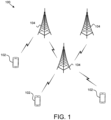
- Figure 1 depicts an embodiment of a wireless communication system 100 for conditional handovers.
- the wireless communication system 100 includes remote units 102 and base units 104. Even though a specific number of remote units 102 and base units 104 are depicted in Figure 1 , one of skill in the art will recognize that any number of remote units 102 and base units 104 may be included in the wireless communication system 100.
- the remote units 102 may include computing devices, such as desktop computers, laptop computers, personal digital assistants ("PDAs"), tablet computers, smart phones, smart televisions (e.g., televisions connected to the Internet), set-top boxes, game consoles, security systems (including security cameras), vehicle on-board computers, network devices (e.g., routers, switches, modems), or the like.
- the remote units 102 include wearable devices, such as smart watches, fitness bands, optical head-mounted displays, or the like.
- the remote units 102 may be referred to as subscriber units, mobiles, mobile stations, users, terminals, mobile terminals, fixed terminals, subscriber stations, UE, user terminals, a device, or by other terminology used in the art.
- the remote units 102 may communicate directly with one or more of the base units 104 via UL communication signals.
- the base units 104 may be distributed over a geographic region.
- a base unit 104 may also be referred to as an access point, an access terminal, a base, a base station, a Node-B, an eNB, a gNB, a Home Node-B, a relay node, a device, or by any other terminology used in the art.
- the base units 104 are generally part of a radio access network that includes one or more controllers communicably coupled to one or more corresponding base units 104.
- the radio access network is generally communicably coupled to one or more core networks, which may be coupled to other networks, like the Internet and public switched telephone networks, among other networks. These and other elements of radio access and core networks are not illustrated but are well known generally by those having ordinary skill in the art.
- the wireless communication system 100 is compliant with the LTE of the 3GPP protocol, wherein the base unit 104 transmits using an OFDM modulation scheme on the DL and the remote units 102 transmit on the UL using a SC-FDMA scheme or an OFDM scheme. More generally, however, the wireless communication system 100 may implement some other open or proprietary communication protocol, for example, WiMAX, among other protocols. The present disclosure is not intended to be limited to the implementation of any particular wireless communication system architecture or protocol.
- the base units 104 may serve a number of remote units 102 within a serving area, for example, a cell or a cell sector via a wireless communication link.
- the base units 104 transmit DL communication signals to serve the remote units 102 in the time, frequency, and/or spatial domain.
- a base unit 104 may transmit a handover command to a remote unit 102.
- a remote unit 102 may receive a handover command involving multiple candidate cells.
- the remote unit 102 may select a target cell of the multiple candidate cells in response to the target cell meeting a predetermined condition. Accordingly, a remote unit 102 may be used for conditional handovers.
- a remote unit 102 may receive a handover command involving multiple candidate cells.
- the remote unit 102 may select a target cell of the multiple candidate cells in response to the target cell meeting a predetermined condition relative to other cells of the plurality of candidate cells. Accordingly, a remote unit 102 may be used for conditional handovers.
- a remote unit 102 may receive RRCConnectionReconfiguration including a condition for handover.
- the remote unit 102 may suspend the RRCConnectionReconfiguration until the condition for handover is met.
- the remote unit 102 may overwrite the previously suspended RRCConnectionReconfiguration including the condition for handover in response to a predetermined criteria. Accordingly, a remote unit 102 may be used for conditional handovers.
- Figure 2 depicts one embodiment of an apparatus 200 that may be used for conditional handovers.
- the apparatus 200 includes one embodiment of the remote unit 102.
- the remote unit 102 may include a processor 202, a memory 204, an input device 206, a display 208, a transmitter 210, and a receiver 212.
- the input device 206 and the display 208 are combined into a single device, such as a touchscreen.
- the remote unit 102 may not include any input device 206 and/or display 208.
- the remote unit 102 may include one or more of the processor 202, the memory 204, the transmitter 210, and the receiver 212, and may not include the input device 206 and/or the display 208.
- the processor 202 may include any known controller capable of executing computer-readable instructions and/or capable of performing logical operations.
- the processor 202 may be a microcontroller, a microprocessor, a central processing unit (“CPU"), a graphics processing unit (“GPU”), an auxiliary processing unit, a field programmable gate array (“FPGA”), or similar programmable controller.
- the processor 202 executes instructions stored in the memory 204 to perform the methods and routines described herein.
- the processor 202 selects a target cell of multiple candidate cells in response to the target cell meeting a predetermined condition.
- the processor 202 selects a target cell of multiple candidate cells in response to the target cell meeting a predetermined condition relative to other cells of the multiple candidate cells. In some embodiments, the processor 202 suspends an RRCConnectionReconfiguration until a condition for handover is met and overwrites the previously suspended RRCConnectionReconfiguration including a condition for handover in response to a predetermined criteria.
- the processor 202 is communicatively coupled to the memory 204, the input device 206, the display 208, the transmitter 210, and the receiver 212.
- the memory 204 in one embodiment, is a computer readable storage medium.
- the memory 204 includes volatile computer storage media.
- the memory 204 may include a RAM, including dynamic RAM (“DRAM”), synchronous dynamic RAM (“SDRAM”), and/or static RAM (“SRAM”).
- the memory 204 includes non-volatile computer storage media.
- the memory 204 may include a hard disk drive, a flash memory, or any other suitable non-volatile computer storage device.
- the memory 204 includes both volatile and non-volatile computer storage media.
- the memory 204 stores data relating to handovers.
- the memory 204 also stores program code and related data, such as an operating system or other controller algorithms operating on the remote unit 102.
- the input device 206 may include any known computer input device including a touch panel, a button, a keyboard, a stylus, a microphone, or the like.
- the input device 206 may be integrated with the display 208, for example, as a touchscreen or similar touch-sensitive display.
- the input device 206 includes a touchscreen such that text may be input using a virtual keyboard displayed on the touchscreen and/or by handwriting on the touchscreen.
- the input device 206 includes two or more different devices, such as a keyboard and a touch panel.
- the display 208 may include any known electronically controllable display or display device.
- the display 208 may be designed to output visual, audible, and/or haptic signals.
- the display 208 includes an electronic display capable of outputting visual data to a user.
- the display 208 may include, but is not limited to, an LCD display, an LED display, an OLED display, a projector, or similar display device capable of outputting images, text, or the like to a user.
- the display 208 may include a wearable display such as a smart watch, smart glasses, a heads-up display, or the like.
- the display 208 may be a component of a smart phone, a personal digital assistant, a television, a table computer, a notebook (laptop) computer, a personal computer, a vehicle dashboard, or the like.
- the display 208 includes one or more speakers for producing sound.
- the display 208 may produce an audible alert or notification (e.g., a beep or chime).
- the display 208 includes one or more haptic devices for producing vibrations, motion, or other haptic feedback.
- all or portions of the display 208 may be integrated with the input device 206.
- the input device 206 and display 208 may form a touchscreen or similar touch-sensitive display.
- the display 208 may be located near the input device 206.
- the transmitter 210 is used to provide UL communication signals to the base unit 104 and the receiver 212 is used to receive DL communication signals from the base unit 104.
- the receiver 212 may be used to receive a handover command involving multiple candidate cells.
- the receiver 212 may be used to receive RRCConnectionReconfiguration including a condition for handover.
- the remote unit 102 may have any suitable number of transmitters 210 and receivers 212.
- the transmitter 210 and the receiver 212 may be any suitable type of transmitters and receivers.
- the transmitter 210 and the receiver 212 may be part of a transceiver.
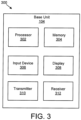
- Figure 3 depicts one embodiment of an apparatus 300 that may be used for conditional handovers.
- the apparatus 300 includes one embodiment of the base unit 104.
- the base unit 104 may include a processor 302, a memory 304, an input device 306, a display 308, a transmitter 310, and a receiver 312.
- the processor 302, the memory 304, the input device 306, the display 308, the transmitter 310, and the receiver 312 may be substantially similar to the processor 202, the memory 204, the input device 206, the display 208, the transmitter 210, and the receiver 212 of the remote unit 102, respectively.
- the transmitter 310 is used to transmit conditional handover commands to the remote unit 102.
- the base unit 104 may have any suitable number of transmitters 310 and receivers 312.
- the transmitter 310 and the receiver 312 may be any suitable type of transmitters and receivers.
- the transmitter 310 and the receiver 312 may be part of a transceiver.
- FIG. 4 illustrates one embodiment of communications 400 for handovers. Specifically, communications 400 between a UE 402, a source eNB 404, a target eNB 406, a mobility management entity ("MME") 408, and a serving gateway 410 are illustrated.
- MME mobility management entity
- a UE context 412 within the source eNB 404 may contain information regarding roaming and access restrictions which were provided either at connection establishment or at a last TA update.
- a first communication 414 from the source eNB 404 to the UE 402 includes the source eNB 404 configuring UE measurement procedures according to roaming and access restriction information and available multiple frequency band information. Measurements provided by the source eNB 404 may facilitate the function controlling the UE's connection mobility.
- a second communication 416 from the UE 402 to the source eNB 404 includes a measurement report triggered and sent to the source eNB 404.
- the source eNB 404 determines 418, based on the measurement report and radio resource management ("RRM") information, to hand off the UE 402.
- RRM radio resource management
- the source eNB 404 issues a handover request message to the target eNB 406 passing information to prepare the handover at the target side.
- Admission control 422 may be performed by the target eNB 406 dependent on received QoS information to increase the likelihood of a successful handover, if the resources can be granted by target eNB 406.
- the target eNB 406 configures the required resources according to the received QoS information and reserves a cell radio network temporary identifier ("C-RNTI") and optionally a RACH preamble.
- C-RNTI cell radio network temporary identifier
- the configuration to be used in the target cell may either be specified independently (e.g., an establishment) or as a delta compared to the configuration used in the source cell (e.g., a reconfiguration).
- the target eNB 406 prepares a handover with L1/L2 and sends a handover request acknowledge to the source eNB 404.
- the handover request acknowledge message includes a transparent container to be sent to the UE 402 as an RRC message to perform the handover.
- the container includes a new C-RNTI, target eNB 406 security algorithm identifiers for the selected security algorithms, and may include a dedicated RACH preamble, and possibly other parameters (e.g., access parameters, SIBs, etc.).
- the handover request acknowledge message may also include radio network layer/transmission network layer ("RNL/TNL") information for the forwarding tunnels, if necessary.
- RNL/TNL radio network layer/transmission network layer
- a fifth communication 426 from the source eNB 408 to the UE 402 in response to the target eNB 406 generating an RRC message to perform the handover (e.g., RRCConnectionReconfiguration message including the mobilityControlInformation ), the source eNB 404 transmits the RRC message to the UE 402.
- the source eNB 404 performs the necessary integrity protection and ciphering of the message.
- the UE 402 receives the RRCConnectionReconfiguration message with necessary parameters (e.g., new C-RNTI, target eNB 406 security algorithm identifiers, and optionally dedicated RACH preamble, target eNB 406 SIBs, etc.) and is commanded by the source eNB 404 to perform the handover.
- the UE 402 does not need to delay the handover execution for delivering the HARQ/ARQ responses to the source eNB 404.
- the source eNB 404 sends a SN status transfer message to the target eNB 406 to convey an uplink packet data convergence protocol ("PDCP") SN receiver status and a downlink PDCP SN transmitter status of enhanced radio access bearers ("E-RABs") for which PDCP status preservation applies.
- the uplink PDCP SN receiver status includes at least the PDCP SN of a first missing UL service data unit ("SDU”) and may include a bit map of the receive status of the out of sequence UL SDUs that the UE 402 needs to retransmit in the target cell, if there are any such SDUs.
- SDU first missing UL service data unit
- the downlink PDCP SN transmitter status indicates the next PDCP SN that the target eNB 406 may assign to new SDUs, not having a PDCP SN yet.
- the source eNB 404 may omit sending this message if none of the E-RABs of the UE 402 are to be treated with PDCP status preservation.
- a seventh communication 430 from the UE 402 to the target eNB 406 after receiving the RRCConnectionReconfiguration message including the mobilityControlInformation , the UE 402 performs synchronization to the target eNB 406 and accesses the target cell via RACH, following a contention-free procedure if a dedicated RACH preamble was indicated in the mobilityControlInformation , or following a contention-based procedure if no dedicated preamble was indicated.
- the UE 402 derives target eNB 406 specific keys and configures the selected security algorithms to be used in the target cell.
- thee target eNB 406 responds with UL allocation and timing advance.
- the UE 402 has successfully accessed the target cell and the UE 402 sends an RRCConnectionReconfigurationComplete message (e.g., including C-RNTI) to confirm the handover, along with an uplink buffer status report, whenever possible, to the target eNB 406 to indicate that the handover procedure is completed for the UE 402.
- the target eNB 406 verifies the C-RNTI sent in the RRCConnectionReconfigurationComplete message.
- the target eNB 406 may then begin sending data to the UE 402.
- the target eNB 406 sends a path switch request message to the MME 408 to inform the MME 408 that the UE 402 has changed cell.
- the MME 408 sends a modify bearer request message to the serving gateway 410.
- the serving gateway 410 switches 440 the downlink data path to the target side.
- the serving gateway 410 may send one or more end marker packets on the old path to the source eNB 404 and then may release any U-plane/TNL resources towards the source eNB 404.
- the serving gateway 410 sends a modify bearer response message to the MME 408.
- the MME 408 confirms the path switch request message with a path switch request acknowledge message.
- the target eNB 406 informs success of the handover to the source eNB 404 and triggers the release of resources by the source eNB 404.
- the target eNB 406 sends this message after the path switch request acknowledge message is received from the MME 408.
- the source eNB 402 may release 448 radio and C-plane related resources associated to the UE 402 context. Any ongoing data forwarding may continue.
- handover failure may occur due to the following three reasons: an RLF (e.g., too late handover) may occur after the UE 402 has stayed for a long period of time in a cell and the UE 402 may attempt to re-establish a radio link connection in a different cell; an RLF (e.g., too early handover) may occur shortly after a successful handover from a source cell to a target cell or a handover failure occurs during the handover procedure and the UE 402 may attempt to re-establish a radio link connection in a source cell; and an RLF (e.g., handover to a wrong cell) may occurs shortly after a successful handover from a source cell to a target cell or a handover failure may occur during a handover procedure and the UE 402 may attempt to re-establish the radio link connection in a cell other than a source cell and a target cell.
- an RLF e.g., too late handover
- an RLF e.
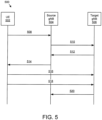
- Figure 5 illustrates one embodiment of communications 500 for conditional handovers. By using conditional handovers, too late handover, too early handover, and/or handover to a wrong cell may be avoided. Communications 500 between a UE 502, a gNB 504, and a target gNB 506 are illustrated.
- a first communication 508 transmitted from the UE 502 to the source gNB 504 may include the UE 502 reporting measurement results (e.g., reference signal received power ("RSRP"), reference signal received quality (“RSRQ”)) based on a trigger condition configured by the source gNB 504.
- a second communication 510 from the source gNB 504 to the target gNB 506 may include, in response to the source gNB 504 making a decision to perform conditional handover based on the measurement result from the UE 502, the source gNB 504 sending a handover request to the target gNB 506.
- the handover request may be sent to more than one candidate cell (e.g., target gNBs).
- a third communication 512 from the target gNB 506 to the source gNB 504 may include the source gNB 504 receiving a handover acknowledge from the target gNB 506 (e.g., one or more candidate cells).
- a fourth communication 514 from the source gNB 504 to the UE 502 may include the source gNB 504 sending a RRCconnectionreconfiguration message including mobilityControlInfo IE and a condition for handover configured by the source gNB 504 to the UE 502. Meanwhile, the source gNB 504 may forward data to the target gNB 506 (e.g., all candidate cells).
- a fifth communication 516 from the UE 502 to the target gNB 506 may include, in response to the condition being met and the UE 502 applying the RRCconnectionreconfiguration, accessing the target gNB 506.
- a sixth communication 518 from the UE 502 to the target gNB 506 may include the UE 502 informing the target gNB 506 that RRC reconfiguration is complete.
- a seventh communication 520 from the target gNB 506 to the source gNB 504 may include the target gNB 506 informing the source gNB 504 that handover is completed.
- the UE 502 may select a candidate cell (out of multiple available candidate cells) with a best channel quality (e.g., highest RSRP) as the target cell if more than one candidate cell meets the condition.
- a best channel quality e.g., highest RSRP
- the UE 502 may have a trigger condition for handover in which the trigger condition is relative to another cell such as a serving cell and/or one or more candidate cells.
- the trigger condition for handover may be that the target cell (or beam) becomes offset better than a serving cell (or beam) and/or the target cell (or beam) becomes better than other candidate cells (or beams.
- the trigger condition for handover may be that the target cell (or beam) becomes offset better than the serving cell (or beam) in a configured duration and/or the target cell (or beam) becomes better than other candidate cells (or beams) in the configured duration.
- the configured duration e.g., predetermined time period
- a new behavior for a remote unit 102 is defined for suspended RRCConnectionReconfiguration including mobilityControlInfo and a condition for handover.
- a base unit 104 informs a remote unit 102 to release a suspended RRCConnectionReconfiguration including conditional handover command by using RRC signaling.
- a timer may be included in RRCConnectionReconfiguration including conditional handover. Once the timer expires, the remote unit 102 may release the RRCConnectionReconfiguration including conditional handover.
- a remote unit 102 may suspend suspends RRCConnectionReconfiguration including conditional handover until a new RRCConnectionReconfiguration including conditional handover is configured.
- the remote unit 102 in response to RRCConnectionReconfiguration including conditional handover being received by a remote unit 102, the remote unit 102 overwrites the previous suspended RRCConnectionReconfiguration including conditional handover.
- Figure 6 is a schematic flow chart diagram illustrating one embodiment of a method 600 for conditional handovers.
- the method 600 is performed by an apparatus, such as the remote unit 102.
- the method 600 may be performed by a processor executing program code, for example, a microcontroller, a microprocessor, a CPU, a GPU, an auxiliary processing unit, a FPGA, or the like.
- the method 600 may include receiving 602 a handover command involving multiple candidate cells.
- the method 600 also includes selecting 604 a target cell of the multiple candidate cells in response to the target cell meeting a predetermined condition.
- selecting the target cell includes selecting the target cell with a best channel quality. In a further embodiment, selecting the target cell includes selecting the target cell with a highest reference signal received power. In certain embodiments, the predetermined condition is indicated in the handover command. In various embodiments, each candidate cell of the multiple candidate cells has a corresponding predetermined condition.
- the handover command is a conditional handover command.
- the handover command is part of RRCConnectionReconfiguration and includes mobilityControlInfo.
- the method 600 includes applying the RRCConnectionReconfiguration including the handover command in response to selecting the target cell.
- the method 600 includes overwriting a previously suspended handover command in response to receiving the handover command having the predetermined condition.
- Figure 7 is a schematic flow chart diagram illustrating a method 700 for conditional handovers according to the claimed embodiment.
- the method 700 is performed by an apparatus, such as the remote unit 102.
- the method 700 may be performed by a processor executing program code, for example, a microcontroller, a microprocessor, a CPU, a GPU, an auxiliary processing unit, a FPGA, or the like.
- the method 700 includes receiving 702 a handover command involving multiple candidate cells.
- the method 700 also includes selecting 704 a target cell of the multiple candidate cells in response to the target cell meeting a predetermined condition relative to other cells of the multiple candidate cells.
- the predetermined condition includes an offset that is better than a serving cell, an offset that is better than the other cells of the multiple candidate cells, or some combination thereof. In a further embodiment, the predetermined condition includes an offset that is better than a serving cell in a predetermined time period, an offset that is better than the other cells of the multiple candidate cells in the predetermined time period, or some combination thereof. In certain embodiments, the predetermined time period is configured by a base unit. In the claimed embodiment, the predetermined condition is indicated in the handover command.
- each candidate cell of the multiple candidate cells has a corresponding predetermined condition.
- the handover command is a conditional handover command.
- the handover command is part of RRCConnectionReconfiguration and includes mobilityControlInfo.
- the method 700 includes applying the RRCConnectionReconfiguration including the handover command in response to selecting the target cell.
- the method 700 includes overwriting a previously suspended handover command in response to receiving the handover command having the predetermined condition.
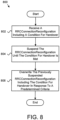
- Figure 8 is a schematic flow chart diagram illustrating a further embodiment of a method 800 for conditional handovers.
- the method 800 is performed by an apparatus, such as the remote unit 102.
- the method 800 may be performed by a processor executing program code, for example, a microcontroller, a microprocessor, a CPU, a GPU, an auxiliary processing unit, a FPGA, or the like.
- the method 800 may include receiving 802 RRCConnectionReconfiguration including a condition for handover.
- the method 800 also includes suspending 804 the RRCConnectionReconfiguration until the condition for handover is met.
- the method 800 includes overwriting 806 the previously suspended RRCConnectionReconfiguration including the condition for handover in response to a predetermined criteria.
- the predetermined criteria includes a timer that is part of the RRCConnectionReconfiguration, and in response to the timer elapsing the RRCConnectionReconfiguration is released.
- the timer is started in response to the receiver receiving the RRCConnectionReconfiguration.
- the timer is stopped in response to applying the RRCConnectionReconfiguration.
- the method 800 in response to the timer expiring, includes releasing the suspended RRCConnectionReconfiguration including the condition for handover.
- the predetermined criteria includes receiving a new RRCConnectionReconfiguration, and in response to receiving the new RRCConnectionReconfiguration, the new RRCConnectionReconfiguration overwrites the RRCConnectionReconfiguration including the condition for handover.
- the method 800 includes applying the RRCConnectionReconfiguration in response to the condition for handover being met.
Landscapes
- Engineering & Computer Science (AREA)
- Computer Networks & Wireless Communication (AREA)
- Signal Processing (AREA)
- Mobile Radio Communication Systems (AREA)
Claims (12)
- Verfahren, das durch eine Benutzerausrüstung (102) durchgeführt wird, das Verfahren umfassend:Empfangen (602) eines Übergabebefehls, der eine Vielzahl von Kandidatenzellen (506) einbezieht;Auswählen (604) einer Zielzelle aus der Vielzahl von Kandidatenzellen (506) als Reaktion darauf, dass die Zielzelle eine vorherbestimmte Bedingung relativ zu anderen Zellen der Vielzahl von Kandidatenzellen erfüllt;wobei die vorherbestimmte Bedingung in dem Übergabebefehl angegeben ist und die Bedingung umfasst, dass die Zielzelle einen besseren Offset als die bedienende Zelle aufweist und/oder dass die Zielzelle einen besseren Offset als andere Kandidatenzellen aufweist;gekennzeichnet durch:
Überschreiben eines zuvor ausgesetzten Übergabebefehls als Reaktion auf das Empfangen des Übergabebefehls mit der vorherbestimmten Bedingung. - Verfahren nach Anspruch 1, wobei die vorherbestimmte Bedingung, die in dem Übergabebefehl angegeben ist, die Bedingung umfasst, dass die Zielzelle einen besseren Offset als die bedienende Zelle innerhalb einer konfigurierten Dauer aufweist und/oder dass die Zielzelle einen besseren Offset als andere Kandidatenzellen innerhalb der konfigurierten Dauer aufweist.
- Verfahren nach Anspruch 2, wobei die konfigurierte Dauer durch eine Basiseinheit (504) konfiguriert wird.
- Verfahren nach Anspruch 1, wobei jede Kandidatenzelle der Vielzahl von Kandidatenzellen eine entsprechende vorherbestimmte Bedingung aufweist.
- Verfahren nach Anspruch 1, wobei die Übergabenachricht Teil einer RRCConnectionReconfiguration-Nachricht ist und mobilityControllnfo einschließt.
- Verfahren nach Anspruch 5, ferner umfassend das Anwenden der RRCConnectionReconfiguration-Nachricht auf die Zielzelle als Reaktion auf das Auswählen der Zielzelle.
- Benutzerausrüstung (102), umfassend:einen Empfänger (212), der konfiguriert ist, um einen Übergabebefehl zu empfangen, der eine Vielzahl von Kandidatenzellen einbezieht; undeinen Prozessor (202), konfiguriert zum:Auswählen einer Zielzelle aus der Vielzahl von Kandidatenzellen als Reaktion darauf, dass die Zielzelle eine vorherbestimmte Bedingung relativ zu anderen Zellen der Vielzahl von Kandidatenzellen erfüllt, wobei die vorherbestimmte Bedingung in dem Übergabebefehl angegeben ist und die Bedingung umfasst, dass die Zielzelle einen besseren Offset als die bedienende Zelle aufweist und/oder dass die Zielzelle einen besseren Offset als andere Kandidatenzellen aufweist;gekennzeichnet durch:
wobei der Prozessor (202) konfiguriert ist, um einen zuvor ausgesetzten Übergabebefehl als Reaktion auf das Empfangen des Übergabebefehls, der die vorherbestimmte Bedingung aufweist, zu überschreiben. - Benutzerausrüstung nach Anspruch 7, wobei die vorherbestimmte Bedingung, die in dem Übergabebefehl angegeben ist, die Bedingung umfasst, dass die Zielzelle einen besseren Offset als die bedienende Zelle innerhalb einer konfigurierten Dauer aufweist und/oder dass die Zielzelle einen besseren Offset als andere Kandidatenzellen innerhalb der konfigurierten Dauer aufweist.
- Benutzerausrüstung nach Anspruch 8, wobei die konfigurierte Dauer durch eine Basiseinheit konfiguriert wird.
- Benutzerausrüstung nach Anspruch 7, wobei jede Kandidatenzelle der Vielzahl von Kandidatenzellen eine entsprechende vorherbestimmte Bedingung aufweist.
- Benutzerausrüstung nach Anspruch 7, wobei der Übergabebefehl Teil der RRCConnectionReconfiguration ist und mobilityControllnfo einschließt.
- Benutzerausrüstung nach Anspruch 11, wobei der Prozessor (202) konfiguriert ist, um die RRCConnectionReconfiguration einschließlich des Übergabebefehls als Reaktion auf das Auswählen der Zielzelle anzuwenden.
Applications Claiming Priority (1)
| Application Number | Priority Date | Filing Date | Title |
|---|---|---|---|
| PCT/CN2017/077656 WO2018170777A1 (en) | 2017-03-22 | 2017-03-22 | A condition for handover |
Publications (4)
| Publication Number | Publication Date |
|---|---|
| EP3603181A1 EP3603181A1 (de) | 2020-02-05 |
| EP3603181A4 EP3603181A4 (de) | 2020-11-25 |
| EP3603181C0 EP3603181C0 (de) | 2024-10-30 |
| EP3603181B1 true EP3603181B1 (de) | 2024-10-30 |
Family
ID=63584858
Family Applications (1)
| Application Number | Title | Priority Date | Filing Date |
|---|---|---|---|
| EP17902379.1A Active EP3603181B1 (de) | 2017-03-22 | 2017-03-22 | Bedingung für die weiterreichung |
Country Status (4)
| Country | Link |
|---|---|
| US (1) | US20200336957A1 (de) |
| EP (1) | EP3603181B1 (de) |
| CN (2) | CN115643622A (de) |
| WO (1) | WO2018170777A1 (de) |
Families Citing this family (30)
| Publication number | Priority date | Publication date | Assignee | Title |
|---|---|---|---|---|
| US10939329B2 (en) | 2017-03-23 | 2021-03-02 | Motorola Mobility Llc | Discarding data corresponding to a conditional handover |
| CN109391355B (zh) | 2017-08-11 | 2020-10-23 | 华为技术有限公司 | 无线通信的方法、芯片和系统 |
| JP2021016011A (ja) * | 2017-10-10 | 2021-02-12 | 株式会社Nttドコモ | 基地局、及び通信制御装置 |
| EP3738348A4 (de) * | 2018-01-08 | 2021-08-11 | Lenovo (Beijing) Limited | Verfahren und vorrichtung für ue-handover |
| US11171765B2 (en) * | 2018-02-15 | 2021-11-09 | Qualcomm Incorporated | System and method for indicating preemption of transmissions |
| CN111132247B (zh) * | 2018-11-01 | 2024-05-28 | 夏普株式会社 | 切换控制方法以及通信装置 |
| CN113228738B (zh) * | 2019-01-11 | 2023-10-20 | Lg 电子株式会社 | 用于在无线通信系统中执行移动性的方法和装置 |
| CA3130485A1 (en) * | 2019-02-14 | 2020-08-20 | Telefonaktiebolaget Lm Ericsson (Publ) | Method, node and ue for initiating handover |
| CN111565426B (zh) | 2019-02-14 | 2024-01-16 | 华为技术有限公司 | 信息传输的方法及装置 |
| EP3925284B1 (de) * | 2019-02-14 | 2025-10-08 | ZTE Corporation | Mobilitätsverbesserung in einem verbundenen zustand |
| CN111436143B (zh) | 2019-03-28 | 2023-06-06 | 维沃移动通信有限公司 | 一种上行授权变更方法、信息发送方法及相关装置 |
| KR20200115328A (ko) * | 2019-03-28 | 2020-10-07 | 삼성전자주식회사 | 차세대 이동통신 시스템에서 핸드오버를 위한 방법 및 장치 |
| US12289786B2 (en) | 2019-03-28 | 2025-04-29 | Samsung Electronics Co., Ltd. | Method and device for handover in next generation mobile communication system |
| CN113748711A (zh) * | 2019-05-01 | 2021-12-03 | 株式会社Ntt都科摩 | 用户装置以及通信方法 |
| WO2020226374A1 (en) | 2019-05-03 | 2020-11-12 | Samsung Electronics Co., Ltd. | Method and apparatus for handling handover in wireless communication system |
| CN112789891B (zh) * | 2019-06-14 | 2023-03-21 | Oppo广东移动通信有限公司 | 无线通信方法、装置和终端设备 |
| WO2020252709A1 (zh) * | 2019-06-19 | 2020-12-24 | Oppo广东移动通信有限公司 | 无线通信的方法、网络设备和终端设备 |
| CN114097273B (zh) * | 2019-07-12 | 2024-12-13 | 诺基亚技术有限公司 | 用于多小区目标条件切换的方法和系统 |
| CN111083751B (zh) * | 2019-08-16 | 2024-06-25 | 中兴通讯股份有限公司 | 信息的传输方法及装置、存储介质和电子装置 |
| US11395190B2 (en) * | 2019-08-23 | 2022-07-19 | Qualcomm Incorporated | Full configuration handover techniques |
| CN118741621A (zh) | 2019-08-30 | 2024-10-01 | 华为技术有限公司 | 一种通信方法及装置 |
| US11558793B2 (en) * | 2019-09-10 | 2023-01-17 | Qualcomm Incorporated | Techniques for performing conditional handover in wireless communications |
| WO2021056504A1 (en) | 2019-09-29 | 2021-04-01 | Apple Inc. | Pre-forwarding data packets for conditional handover |
| ES2994454T3 (en) * | 2019-09-30 | 2025-01-24 | Guangdong Oppo Mobile Telecommunications Corp Ltd | Wireless communication method and apparatus, and network device |
| CN111034263B (zh) * | 2019-11-25 | 2022-06-24 | 北京小米移动软件有限公司 | 信息传输方法、装置及通信设备 |
| WO2021138905A1 (en) * | 2020-01-10 | 2021-07-15 | Lenovo (Beijing) Limited | Method of failure handling in conditional handover |
| CN117377003B (zh) * | 2020-09-24 | 2025-08-29 | Oppo广东移动通信有限公司 | 发送无线链路失败报告的方法、终端设备和网络设备 |
| CN112492274B (zh) * | 2020-11-26 | 2021-08-17 | 江南大学 | 一种基于普通网络摄像机的国密加密传输设备 |
| EP4287703A4 (de) * | 2021-01-27 | 2024-11-13 | Samsung Electronics Co., Ltd. | Elektronische vorrichtung zur durchführung einer übergabe und betriebsverfahren dafür |
| US20240357446A1 (en) * | 2021-06-29 | 2024-10-24 | Beijing Xiaomi Mobile Software Co., Ltd. | Cell handover method, cell handover apparatus, and storage medium |
Family Cites Families (11)
| Publication number | Priority date | Publication date | Assignee | Title |
|---|---|---|---|---|
| US9155014B2 (en) * | 2008-11-17 | 2015-10-06 | Qualcomm Incorporated | Conditional access terminal initiation of delayed handover |
| WO2012176010A2 (en) * | 2011-06-21 | 2012-12-27 | Nokia Corporation . | Methods, apparatuses and computer program products for providing an optimized handover preparation and execution operation |
| EP2740295B1 (de) * | 2011-09-12 | 2018-10-17 | Nokia Technologies Oy | Verfahren, vorrichtung, system und computerprogramm zum ermöglichen der mobilität eines mobilen endgerätes in einem semi-ruhestand |
| EP2870796B1 (de) * | 2012-07-04 | 2018-12-19 | Telefonaktiebolaget LM Ericsson (publ) | Funknetzwerkknoten, benutzergerät sowie verfahren damit |
| WO2014101071A1 (zh) * | 2012-12-27 | 2014-07-03 | 华为技术有限公司 | 切换方法及设备 |
| CN104349409B (zh) * | 2013-07-30 | 2019-11-05 | 中兴通讯股份有限公司 | 一种小区切换方法和基站 |
| EP2833669B1 (de) * | 2013-07-31 | 2022-06-22 | Panasonic Intellectual Property Corporation of America | Übergabeverfahren in einem mobilen Kommunikationssystem |
| CN103945467B (zh) * | 2014-04-21 | 2018-04-27 | 大唐移动通信设备有限公司 | 小区切换方法及系统、基站、终端 |
| PL3029996T3 (pl) * | 2014-12-01 | 2018-03-30 | Tata Consultancy Services Limited | Wybieranie komórki docelowej podczas przełączania połączenia |
| WO2016119876A1 (en) * | 2015-01-30 | 2016-08-04 | Telefonaktiebolaget Lm Ericsson (Publ) | Handover in high speed scenario |
| CN105228200B (zh) * | 2015-10-08 | 2019-04-16 | 西南交通大学 | 一种网络辅助ue控制的快速小区切换方法及装置 |
-
2017
- 2017-03-22 WO PCT/CN2017/077656 patent/WO2018170777A1/en not_active Ceased
- 2017-03-22 EP EP17902379.1A patent/EP3603181B1/de active Active
- 2017-03-22 CN CN202211202141.2A patent/CN115643622A/zh active Pending
- 2017-03-22 US US16/496,587 patent/US20200336957A1/en not_active Abandoned
- 2017-03-22 CN CN201780088636.8A patent/CN110546991B/zh active Active
Non-Patent Citations (1)
| Title |
|---|
| ERICSSON: "Inter-cell Handover in NR", vol. RAN WG2, no. Reno, Nevada, USA; 20161114 - 20161118, 5 November 2016 (2016-11-05), XP051193217, Retrieved from the Internet <URL:http://www.3gpp.org/ftp/tsg_ran/WG2_RL2/TSGR2_96/Docs/> [retrieved on 20161105] * |
Also Published As
| Publication number | Publication date |
|---|---|
| CN110546991B (zh) | 2022-10-25 |
| US20200336957A1 (en) | 2020-10-22 |
| CN110546991A (zh) | 2019-12-06 |
| WO2018170777A1 (en) | 2018-09-27 |
| EP3603181A1 (de) | 2020-02-05 |
| EP3603181C0 (de) | 2024-10-30 |
| CN115643622A (zh) | 2023-01-24 |
| EP3603181A4 (de) | 2020-11-25 |
Similar Documents
| Publication | Publication Date | Title |
|---|---|---|
| EP3603181B1 (de) | Bedingung für die weiterreichung | |
| US11595859B2 (en) | Discarding data corresponding to a conditional handover | |
| US11395194B2 (en) | Indicating status of forwarded data | |
| US11246072B2 (en) | Switching communication modes (direct and indirect UE access) | |
| US10499448B2 (en) | Configuration information for an inactive state | |
| US11265792B2 (en) | Aerial vehicle state transition | |
| EP3669597B1 (de) | Reaktion auf funkrufausfälle in einem funkzugangsnetzwerk | |
| US12445914B2 (en) | Selecting a base unit in response to a handover condition being triggered | |
| EP3616347B1 (de) | Anzeige des status von weiterleitungsdaten | |
| US20240349251A1 (en) | Methods and apparatus of determining type of ul transmission |
Legal Events
| Date | Code | Title | Description |
|---|---|---|---|
| STAA | Information on the status of an ep patent application or granted ep patent |
Free format text: STATUS: THE INTERNATIONAL PUBLICATION HAS BEEN MADE |
|
| PUAI | Public reference made under article 153(3) epc to a published international application that has entered the european phase |
Free format text: ORIGINAL CODE: 0009012 |
|
| STAA | Information on the status of an ep patent application or granted ep patent |
Free format text: STATUS: REQUEST FOR EXAMINATION WAS MADE |
|
| 17P | Request for examination filed |
Effective date: 20191022 |
|
| AK | Designated contracting states |
Kind code of ref document: A1 Designated state(s): AL AT BE BG CH CY CZ DE DK EE ES FI FR GB GR HR HU IE IS IT LI LT LU LV MC MK MT NL NO PL PT RO RS SE SI SK SM TR |
|
| AX | Request for extension of the european patent |
Extension state: BA ME |
|
| DAV | Request for validation of the european patent (deleted) | ||
| DAX | Request for extension of the european patent (deleted) | ||
| A4 | Supplementary search report drawn up and despatched |
Effective date: 20201026 |
|
| RIC1 | Information provided on ipc code assigned before grant |
Ipc: H04W 36/36 20090101ALI20201020BHEP Ipc: H04W 36/30 20090101ALN20201020BHEP Ipc: H04W 36/00 20090101AFI20201020BHEP |
|
| STAA | Information on the status of an ep patent application or granted ep patent |
Free format text: STATUS: EXAMINATION IS IN PROGRESS |
|
| 17Q | First examination report despatched |
Effective date: 20211005 |
|
| REG | Reference to a national code |
Ref country code: DE Free format text: PREVIOUS MAIN CLASS: H04W0036000000 Ref country code: DE Ref legal event code: R079 Ref document number: 602017085855 Country of ref document: DE Free format text: PREVIOUS MAIN CLASS: H04W0036000000 Ipc: H04W0036360000 |
|
| GRAP | Despatch of communication of intention to grant a patent |
Free format text: ORIGINAL CODE: EPIDOSNIGR1 |
|
| STAA | Information on the status of an ep patent application or granted ep patent |
Free format text: STATUS: GRANT OF PATENT IS INTENDED |
|
| RIC1 | Information provided on ipc code assigned before grant |
Ipc: H04W 36/08 20090101ALN20240531BHEP Ipc: H04W 36/00 20090101ALN20240531BHEP Ipc: H04W 36/36 20090101AFI20240531BHEP |
|
| RIC1 | Information provided on ipc code assigned before grant |
Ipc: H04W 36/08 20090101ALN20240617BHEP Ipc: H04W 36/00 20090101ALN20240617BHEP Ipc: H04W 36/36 20090101AFI20240617BHEP |
|
| INTG | Intention to grant announced |
Effective date: 20240705 |
|
| RIC1 | Information provided on ipc code assigned before grant |
Ipc: H04W 36/08 20090101ALN20240621BHEP Ipc: H04W 36/00 20090101ALN20240621BHEP Ipc: H04W 36/36 20090101AFI20240621BHEP |
|
| GRAS | Grant fee paid |
Free format text: ORIGINAL CODE: EPIDOSNIGR3 |
|
| GRAA | (expected) grant |
Free format text: ORIGINAL CODE: 0009210 |
|
| STAA | Information on the status of an ep patent application or granted ep patent |
Free format text: STATUS: THE PATENT HAS BEEN GRANTED |
|
| AK | Designated contracting states |
Kind code of ref document: B1 Designated state(s): AL AT BE BG CH CY CZ DE DK EE ES FI FR GB GR HR HU IE IS IT LI LT LU LV MC MK MT NL NO PL PT RO RS SE SI SK SM TR |
|
| REG | Reference to a national code |
Ref country code: GB Ref legal event code: FG4D |
|
| REG | Reference to a national code |
Ref country code: CH Ref legal event code: EP |
|
| REG | Reference to a national code |
Ref country code: DE Ref legal event code: R096 Ref document number: 602017085855 Country of ref document: DE |
|
| REG | Reference to a national code |
Ref country code: IE Ref legal event code: FG4D |
|
| U01 | Request for unitary effect filed |
Effective date: 20241115 |
|
| U07 | Unitary effect registered |
Designated state(s): AT BE BG DE DK EE FI FR IT LT LU LV MT NL PT RO SE SI Effective date: 20241125 |
|
| PG25 | Lapsed in a contracting state [announced via postgrant information from national office to epo] |
Ref country code: HR Free format text: LAPSE BECAUSE OF FAILURE TO SUBMIT A TRANSLATION OF THE DESCRIPTION OR TO PAY THE FEE WITHIN THE PRESCRIBED TIME-LIMIT Effective date: 20241030 Ref country code: IS Free format text: LAPSE BECAUSE OF FAILURE TO SUBMIT A TRANSLATION OF THE DESCRIPTION OR TO PAY THE FEE WITHIN THE PRESCRIBED TIME-LIMIT Effective date: 20250228 |
|
| PG25 | Lapsed in a contracting state [announced via postgrant information from national office to epo] |
Ref country code: ES Free format text: LAPSE BECAUSE OF FAILURE TO SUBMIT A TRANSLATION OF THE DESCRIPTION OR TO PAY THE FEE WITHIN THE PRESCRIBED TIME-LIMIT Effective date: 20241030 |
|
| PG25 | Lapsed in a contracting state [announced via postgrant information from national office to epo] |
Ref country code: NO Free format text: LAPSE BECAUSE OF FAILURE TO SUBMIT A TRANSLATION OF THE DESCRIPTION OR TO PAY THE FEE WITHIN THE PRESCRIBED TIME-LIMIT Effective date: 20250130 |
|
| PG25 | Lapsed in a contracting state [announced via postgrant information from national office to epo] |
Ref country code: GR Free format text: LAPSE BECAUSE OF FAILURE TO SUBMIT A TRANSLATION OF THE DESCRIPTION OR TO PAY THE FEE WITHIN THE PRESCRIBED TIME-LIMIT Effective date: 20250131 |
|
| PG25 | Lapsed in a contracting state [announced via postgrant information from national office to epo] |
Ref country code: PL Free format text: LAPSE BECAUSE OF FAILURE TO SUBMIT A TRANSLATION OF THE DESCRIPTION OR TO PAY THE FEE WITHIN THE PRESCRIBED TIME-LIMIT Effective date: 20241030 |
|
| PG25 | Lapsed in a contracting state [announced via postgrant information from national office to epo] |
Ref country code: RS Free format text: LAPSE BECAUSE OF FAILURE TO SUBMIT A TRANSLATION OF THE DESCRIPTION OR TO PAY THE FEE WITHIN THE PRESCRIBED TIME-LIMIT Effective date: 20250130 |
|
| U20 | Renewal fee for the european patent with unitary effect paid |
Year of fee payment: 9 Effective date: 20250325 |
|
| PG25 | Lapsed in a contracting state [announced via postgrant information from national office to epo] |
Ref country code: SM Free format text: LAPSE BECAUSE OF FAILURE TO SUBMIT A TRANSLATION OF THE DESCRIPTION OR TO PAY THE FEE WITHIN THE PRESCRIBED TIME-LIMIT Effective date: 20241030 |
|
| PGFP | Annual fee paid to national office [announced via postgrant information from national office to epo] |
Ref country code: GB Payment date: 20250418 Year of fee payment: 9 |
|
| PG25 | Lapsed in a contracting state [announced via postgrant information from national office to epo] |
Ref country code: SK Free format text: LAPSE BECAUSE OF FAILURE TO SUBMIT A TRANSLATION OF THE DESCRIPTION OR TO PAY THE FEE WITHIN THE PRESCRIBED TIME-LIMIT Effective date: 20241030 |
|
| PG25 | Lapsed in a contracting state [announced via postgrant information from national office to epo] |
Ref country code: CZ Free format text: LAPSE BECAUSE OF FAILURE TO SUBMIT A TRANSLATION OF THE DESCRIPTION OR TO PAY THE FEE WITHIN THE PRESCRIBED TIME-LIMIT Effective date: 20241030 |
|
| PLBE | No opposition filed within time limit |
Free format text: ORIGINAL CODE: 0009261 |
|
| STAA | Information on the status of an ep patent application or granted ep patent |
Free format text: STATUS: NO OPPOSITION FILED WITHIN TIME LIMIT |
|
| 26N | No opposition filed |
Effective date: 20250731 |
|
| PG25 | Lapsed in a contracting state [announced via postgrant information from national office to epo] |
Ref country code: MC Free format text: LAPSE BECAUSE OF FAILURE TO SUBMIT A TRANSLATION OF THE DESCRIPTION OR TO PAY THE FEE WITHIN THE PRESCRIBED TIME-LIMIT Effective date: 20241030 |
|
| REG | Reference to a national code |
Ref country code: CH Ref legal event code: H13 Free format text: ST27 STATUS EVENT CODE: U-0-0-H10-H13 (AS PROVIDED BY THE NATIONAL OFFICE) Effective date: 20251023 |