EP3600463B1 - Verfahren zur beschichtung eines biomedizinischen implantats mit einem biokompatiblen polymer und biomedizinisches implantat daraus - Google Patents
Verfahren zur beschichtung eines biomedizinischen implantats mit einem biokompatiblen polymer und biomedizinisches implantat daraus Download PDFInfo
- Publication number
- EP3600463B1 EP3600463B1 EP18772197.2A EP18772197A EP3600463B1 EP 3600463 B1 EP3600463 B1 EP 3600463B1 EP 18772197 A EP18772197 A EP 18772197A EP 3600463 B1 EP3600463 B1 EP 3600463B1
- Authority
- EP
- European Patent Office
- Prior art keywords
- implant
- coating
- biocompatible polymer
- silk fibroin
- pdms
- Prior art date
- Legal status (The legal status is an assumption and is not a legal conclusion. Google has not performed a legal analysis and makes no representation as to the accuracy of the status listed.)
- Active
Links
Images




Classifications
-
- A—HUMAN NECESSITIES
- A61—MEDICAL OR VETERINARY SCIENCE; HYGIENE
- A61L—METHODS OR APPARATUS FOR STERILISING MATERIALS OR OBJECTS IN GENERAL; DISINFECTION, STERILISATION OR DEODORISATION OF AIR; CHEMICAL ASPECTS OF BANDAGES, DRESSINGS, ABSORBENT PADS OR SURGICAL ARTICLES; MATERIALS FOR BANDAGES, DRESSINGS, ABSORBENT PADS OR SURGICAL ARTICLES
- A61L27/00—Materials for grafts or prostheses or for coating grafts or prostheses
- A61L27/02—Inorganic materials
- A61L27/04—Metals or alloys
- A61L27/06—Titanium or titanium alloys
-
- A—HUMAN NECESSITIES
- A61—MEDICAL OR VETERINARY SCIENCE; HYGIENE
- A61L—METHODS OR APPARATUS FOR STERILISING MATERIALS OR OBJECTS IN GENERAL; DISINFECTION, STERILISATION OR DEODORISATION OF AIR; CHEMICAL ASPECTS OF BANDAGES, DRESSINGS, ABSORBENT PADS OR SURGICAL ARTICLES; MATERIALS FOR BANDAGES, DRESSINGS, ABSORBENT PADS OR SURGICAL ARTICLES
- A61L27/00—Materials for grafts or prostheses or for coating grafts or prostheses
- A61L27/02—Inorganic materials
- A61L27/10—Ceramics or glasses
-
- A—HUMAN NECESSITIES
- A61—MEDICAL OR VETERINARY SCIENCE; HYGIENE
- A61L—METHODS OR APPARATUS FOR STERILISING MATERIALS OR OBJECTS IN GENERAL; DISINFECTION, STERILISATION OR DEODORISATION OF AIR; CHEMICAL ASPECTS OF BANDAGES, DRESSINGS, ABSORBENT PADS OR SURGICAL ARTICLES; MATERIALS FOR BANDAGES, DRESSINGS, ABSORBENT PADS OR SURGICAL ARTICLES
- A61L27/00—Materials for grafts or prostheses or for coating grafts or prostheses
- A61L27/14—Macromolecular materials
- A61L27/18—Macromolecular materials obtained otherwise than by reactions only involving carbon-to-carbon unsaturated bonds
-
- A—HUMAN NECESSITIES
- A61—MEDICAL OR VETERINARY SCIENCE; HYGIENE
- A61L—METHODS OR APPARATUS FOR STERILISING MATERIALS OR OBJECTS IN GENERAL; DISINFECTION, STERILISATION OR DEODORISATION OF AIR; CHEMICAL ASPECTS OF BANDAGES, DRESSINGS, ABSORBENT PADS OR SURGICAL ARTICLES; MATERIALS FOR BANDAGES, DRESSINGS, ABSORBENT PADS OR SURGICAL ARTICLES
- A61L27/00—Materials for grafts or prostheses or for coating grafts or prostheses
- A61L27/14—Macromolecular materials
- A61L27/22—Polypeptides or derivatives thereof, e.g. degradation products
- A61L27/227—Other specific proteins or polypeptides not covered by A61L27/222, A61L27/225 or A61L27/24
-
- A—HUMAN NECESSITIES
- A61—MEDICAL OR VETERINARY SCIENCE; HYGIENE
- A61L—METHODS OR APPARATUS FOR STERILISING MATERIALS OR OBJECTS IN GENERAL; DISINFECTION, STERILISATION OR DEODORISATION OF AIR; CHEMICAL ASPECTS OF BANDAGES, DRESSINGS, ABSORBENT PADS OR SURGICAL ARTICLES; MATERIALS FOR BANDAGES, DRESSINGS, ABSORBENT PADS OR SURGICAL ARTICLES
- A61L27/00—Materials for grafts or prostheses or for coating grafts or prostheses
- A61L27/28—Materials for coating prostheses
- A61L27/34—Macromolecular materials
-
- A—HUMAN NECESSITIES
- A61—MEDICAL OR VETERINARY SCIENCE; HYGIENE
- A61L—METHODS OR APPARATUS FOR STERILISING MATERIALS OR OBJECTS IN GENERAL; DISINFECTION, STERILISATION OR DEODORISATION OF AIR; CHEMICAL ASPECTS OF BANDAGES, DRESSINGS, ABSORBENT PADS OR SURGICAL ARTICLES; MATERIALS FOR BANDAGES, DRESSINGS, ABSORBENT PADS OR SURGICAL ARTICLES
- A61L27/00—Materials for grafts or prostheses or for coating grafts or prostheses
- A61L27/36—Materials for grafts or prostheses or for coating grafts or prostheses containing ingredients of undetermined constitution or reaction products thereof, e.g. transplant tissue, natural bone, extracellular matrix
- A61L27/3604—Materials for grafts or prostheses or for coating grafts or prostheses containing ingredients of undetermined constitution or reaction products thereof, e.g. transplant tissue, natural bone, extracellular matrix characterised by the human or animal origin of the biological material, e.g. hair, fascia, fish scales, silk, shellac, pericardium, pleura, renal tissue, amniotic membrane, parenchymal tissue, fetal tissue, muscle tissue, fat tissue, enamel
-
- A—HUMAN NECESSITIES
- A61—MEDICAL OR VETERINARY SCIENCE; HYGIENE
- A61L—METHODS OR APPARATUS FOR STERILISING MATERIALS OR OBJECTS IN GENERAL; DISINFECTION, STERILISATION OR DEODORISATION OF AIR; CHEMICAL ASPECTS OF BANDAGES, DRESSINGS, ABSORBENT PADS OR SURGICAL ARTICLES; MATERIALS FOR BANDAGES, DRESSINGS, ABSORBENT PADS OR SURGICAL ARTICLES
- A61L27/00—Materials for grafts or prostheses or for coating grafts or prostheses
- A61L27/36—Materials for grafts or prostheses or for coating grafts or prostheses containing ingredients of undetermined constitution or reaction products thereof, e.g. transplant tissue, natural bone, extracellular matrix
- A61L27/3641—Materials for grafts or prostheses or for coating grafts or prostheses containing ingredients of undetermined constitution or reaction products thereof, e.g. transplant tissue, natural bone, extracellular matrix characterised by the site of application in the body
-
- A—HUMAN NECESSITIES
- A61—MEDICAL OR VETERINARY SCIENCE; HYGIENE
- A61L—METHODS OR APPARATUS FOR STERILISING MATERIALS OR OBJECTS IN GENERAL; DISINFECTION, STERILISATION OR DEODORISATION OF AIR; CHEMICAL ASPECTS OF BANDAGES, DRESSINGS, ABSORBENT PADS OR SURGICAL ARTICLES; MATERIALS FOR BANDAGES, DRESSINGS, ABSORBENT PADS OR SURGICAL ARTICLES
- A61L27/00—Materials for grafts or prostheses or for coating grafts or prostheses
- A61L27/40—Composite materials, i.e. containing one material dispersed in a matrix of the same or different material
-
- A—HUMAN NECESSITIES
- A61—MEDICAL OR VETERINARY SCIENCE; HYGIENE
- A61L—METHODS OR APPARATUS FOR STERILISING MATERIALS OR OBJECTS IN GENERAL; DISINFECTION, STERILISATION OR DEODORISATION OF AIR; CHEMICAL ASPECTS OF BANDAGES, DRESSINGS, ABSORBENT PADS OR SURGICAL ARTICLES; MATERIALS FOR BANDAGES, DRESSINGS, ABSORBENT PADS OR SURGICAL ARTICLES
- A61L27/00—Materials for grafts or prostheses or for coating grafts or prostheses
- A61L27/50—Materials characterised by their function or physical properties, e.g. injectable or lubricating compositions, shape-memory materials, surface modified materials
- A61L27/505—Stabilizers
-
- A—HUMAN NECESSITIES
- A61—MEDICAL OR VETERINARY SCIENCE; HYGIENE
- A61L—METHODS OR APPARATUS FOR STERILISING MATERIALS OR OBJECTS IN GENERAL; DISINFECTION, STERILISATION OR DEODORISATION OF AIR; CHEMICAL ASPECTS OF BANDAGES, DRESSINGS, ABSORBENT PADS OR SURGICAL ARTICLES; MATERIALS FOR BANDAGES, DRESSINGS, ABSORBENT PADS OR SURGICAL ARTICLES
- A61L27/00—Materials for grafts or prostheses or for coating grafts or prostheses
- A61L27/50—Materials characterised by their function or physical properties, e.g. injectable or lubricating compositions, shape-memory materials, surface modified materials
- A61L27/54—Biologically active materials, e.g. therapeutic substances
-
- A—HUMAN NECESSITIES
- A61—MEDICAL OR VETERINARY SCIENCE; HYGIENE
- A61L—METHODS OR APPARATUS FOR STERILISING MATERIALS OR OBJECTS IN GENERAL; DISINFECTION, STERILISATION OR DEODORISATION OF AIR; CHEMICAL ASPECTS OF BANDAGES, DRESSINGS, ABSORBENT PADS OR SURGICAL ARTICLES; MATERIALS FOR BANDAGES, DRESSINGS, ABSORBENT PADS OR SURGICAL ARTICLES
- A61L29/00—Materials for catheters, medical tubing, cannulae, or endoscopes or for coating catheters
- A61L29/005—Ingredients of undetermined constitution or reaction products thereof
-
- A—HUMAN NECESSITIES
- A61—MEDICAL OR VETERINARY SCIENCE; HYGIENE
- A61L—METHODS OR APPARATUS FOR STERILISING MATERIALS OR OBJECTS IN GENERAL; DISINFECTION, STERILISATION OR DEODORISATION OF AIR; CHEMICAL ASPECTS OF BANDAGES, DRESSINGS, ABSORBENT PADS OR SURGICAL ARTICLES; MATERIALS FOR BANDAGES, DRESSINGS, ABSORBENT PADS OR SURGICAL ARTICLES
- A61L29/00—Materials for catheters, medical tubing, cannulae, or endoscopes or for coating catheters
- A61L29/02—Inorganic materials
-
- A—HUMAN NECESSITIES
- A61—MEDICAL OR VETERINARY SCIENCE; HYGIENE
- A61L—METHODS OR APPARATUS FOR STERILISING MATERIALS OR OBJECTS IN GENERAL; DISINFECTION, STERILISATION OR DEODORISATION OF AIR; CHEMICAL ASPECTS OF BANDAGES, DRESSINGS, ABSORBENT PADS OR SURGICAL ARTICLES; MATERIALS FOR BANDAGES, DRESSINGS, ABSORBENT PADS OR SURGICAL ARTICLES
- A61L29/00—Materials for catheters, medical tubing, cannulae, or endoscopes or for coating catheters
- A61L29/04—Macromolecular materials
- A61L29/044—Proteins; Polypeptides; Degradation products thereof
- A61L29/048—Other specific proteins or polypeptides not covered by A61L29/045 - A61L29/047
-
- A—HUMAN NECESSITIES
- A61—MEDICAL OR VETERINARY SCIENCE; HYGIENE
- A61L—METHODS OR APPARATUS FOR STERILISING MATERIALS OR OBJECTS IN GENERAL; DISINFECTION, STERILISATION OR DEODORISATION OF AIR; CHEMICAL ASPECTS OF BANDAGES, DRESSINGS, ABSORBENT PADS OR SURGICAL ARTICLES; MATERIALS FOR BANDAGES, DRESSINGS, ABSORBENT PADS OR SURGICAL ARTICLES
- A61L29/00—Materials for catheters, medical tubing, cannulae, or endoscopes or for coating catheters
- A61L29/04—Macromolecular materials
- A61L29/06—Macromolecular materials obtained otherwise than by reactions only involving carbon-to-carbon unsaturated bonds
-
- A—HUMAN NECESSITIES
- A61—MEDICAL OR VETERINARY SCIENCE; HYGIENE
- A61L—METHODS OR APPARATUS FOR STERILISING MATERIALS OR OBJECTS IN GENERAL; DISINFECTION, STERILISATION OR DEODORISATION OF AIR; CHEMICAL ASPECTS OF BANDAGES, DRESSINGS, ABSORBENT PADS OR SURGICAL ARTICLES; MATERIALS FOR BANDAGES, DRESSINGS, ABSORBENT PADS OR SURGICAL ARTICLES
- A61L29/00—Materials for catheters, medical tubing, cannulae, or endoscopes or for coating catheters
- A61L29/08—Materials for coatings
- A61L29/085—Macromolecular materials
-
- A—HUMAN NECESSITIES
- A61—MEDICAL OR VETERINARY SCIENCE; HYGIENE
- A61L—METHODS OR APPARATUS FOR STERILISING MATERIALS OR OBJECTS IN GENERAL; DISINFECTION, STERILISATION OR DEODORISATION OF AIR; CHEMICAL ASPECTS OF BANDAGES, DRESSINGS, ABSORBENT PADS OR SURGICAL ARTICLES; MATERIALS FOR BANDAGES, DRESSINGS, ABSORBENT PADS OR SURGICAL ARTICLES
- A61L29/00—Materials for catheters, medical tubing, cannulae, or endoscopes or for coating catheters
- A61L29/12—Composite materials, i.e. containing one material dispersed in a matrix of the same or different material
-
- A—HUMAN NECESSITIES
- A61—MEDICAL OR VETERINARY SCIENCE; HYGIENE
- A61L—METHODS OR APPARATUS FOR STERILISING MATERIALS OR OBJECTS IN GENERAL; DISINFECTION, STERILISATION OR DEODORISATION OF AIR; CHEMICAL ASPECTS OF BANDAGES, DRESSINGS, ABSORBENT PADS OR SURGICAL ARTICLES; MATERIALS FOR BANDAGES, DRESSINGS, ABSORBENT PADS OR SURGICAL ARTICLES
- A61L29/00—Materials for catheters, medical tubing, cannulae, or endoscopes or for coating catheters
- A61L29/14—Materials characterised by their function or physical properties, e.g. lubricating compositions
- A61L29/143—Stabilizers
-
- A—HUMAN NECESSITIES
- A61—MEDICAL OR VETERINARY SCIENCE; HYGIENE
- A61L—METHODS OR APPARATUS FOR STERILISING MATERIALS OR OBJECTS IN GENERAL; DISINFECTION, STERILISATION OR DEODORISATION OF AIR; CHEMICAL ASPECTS OF BANDAGES, DRESSINGS, ABSORBENT PADS OR SURGICAL ARTICLES; MATERIALS FOR BANDAGES, DRESSINGS, ABSORBENT PADS OR SURGICAL ARTICLES
- A61L29/00—Materials for catheters, medical tubing, cannulae, or endoscopes or for coating catheters
- A61L29/14—Materials characterised by their function or physical properties, e.g. lubricating compositions
- A61L29/16—Biologically active materials, e.g. therapeutic substances
-
- A—HUMAN NECESSITIES
- A61—MEDICAL OR VETERINARY SCIENCE; HYGIENE
- A61L—METHODS OR APPARATUS FOR STERILISING MATERIALS OR OBJECTS IN GENERAL; DISINFECTION, STERILISATION OR DEODORISATION OF AIR; CHEMICAL ASPECTS OF BANDAGES, DRESSINGS, ABSORBENT PADS OR SURGICAL ARTICLES; MATERIALS FOR BANDAGES, DRESSINGS, ABSORBENT PADS OR SURGICAL ARTICLES
- A61L31/00—Materials for other surgical articles, e.g. stents, stent-grafts, shunts, surgical drapes, guide wires, materials for adhesion prevention, occluding devices, surgical gloves, tissue fixation devices
- A61L31/005—Ingredients of undetermined constitution or reaction products thereof
-
- A—HUMAN NECESSITIES
- A61—MEDICAL OR VETERINARY SCIENCE; HYGIENE
- A61L—METHODS OR APPARATUS FOR STERILISING MATERIALS OR OBJECTS IN GENERAL; DISINFECTION, STERILISATION OR DEODORISATION OF AIR; CHEMICAL ASPECTS OF BANDAGES, DRESSINGS, ABSORBENT PADS OR SURGICAL ARTICLES; MATERIALS FOR BANDAGES, DRESSINGS, ABSORBENT PADS OR SURGICAL ARTICLES
- A61L31/00—Materials for other surgical articles, e.g. stents, stent-grafts, shunts, surgical drapes, guide wires, materials for adhesion prevention, occluding devices, surgical gloves, tissue fixation devices
- A61L31/02—Inorganic materials
- A61L31/022—Metals or alloys
-
- A—HUMAN NECESSITIES
- A61—MEDICAL OR VETERINARY SCIENCE; HYGIENE
- A61L—METHODS OR APPARATUS FOR STERILISING MATERIALS OR OBJECTS IN GENERAL; DISINFECTION, STERILISATION OR DEODORISATION OF AIR; CHEMICAL ASPECTS OF BANDAGES, DRESSINGS, ABSORBENT PADS OR SURGICAL ARTICLES; MATERIALS FOR BANDAGES, DRESSINGS, ABSORBENT PADS OR SURGICAL ARTICLES
- A61L31/00—Materials for other surgical articles, e.g. stents, stent-grafts, shunts, surgical drapes, guide wires, materials for adhesion prevention, occluding devices, surgical gloves, tissue fixation devices
- A61L31/02—Inorganic materials
- A61L31/026—Ceramic or ceramic-like structures, e.g. glasses
-
- A—HUMAN NECESSITIES
- A61—MEDICAL OR VETERINARY SCIENCE; HYGIENE
- A61L—METHODS OR APPARATUS FOR STERILISING MATERIALS OR OBJECTS IN GENERAL; DISINFECTION, STERILISATION OR DEODORISATION OF AIR; CHEMICAL ASPECTS OF BANDAGES, DRESSINGS, ABSORBENT PADS OR SURGICAL ARTICLES; MATERIALS FOR BANDAGES, DRESSINGS, ABSORBENT PADS OR SURGICAL ARTICLES
- A61L31/00—Materials for other surgical articles, e.g. stents, stent-grafts, shunts, surgical drapes, guide wires, materials for adhesion prevention, occluding devices, surgical gloves, tissue fixation devices
- A61L31/04—Macromolecular materials
- A61L31/043—Proteins; Polypeptides; Degradation products thereof
- A61L31/047—Other specific proteins or polypeptides not covered by A61L31/044 - A61L31/046
-
- A—HUMAN NECESSITIES
- A61—MEDICAL OR VETERINARY SCIENCE; HYGIENE
- A61L—METHODS OR APPARATUS FOR STERILISING MATERIALS OR OBJECTS IN GENERAL; DISINFECTION, STERILISATION OR DEODORISATION OF AIR; CHEMICAL ASPECTS OF BANDAGES, DRESSINGS, ABSORBENT PADS OR SURGICAL ARTICLES; MATERIALS FOR BANDAGES, DRESSINGS, ABSORBENT PADS OR SURGICAL ARTICLES
- A61L31/00—Materials for other surgical articles, e.g. stents, stent-grafts, shunts, surgical drapes, guide wires, materials for adhesion prevention, occluding devices, surgical gloves, tissue fixation devices
- A61L31/04—Macromolecular materials
- A61L31/06—Macromolecular materials obtained otherwise than by reactions only involving carbon-to-carbon unsaturated bonds
-
- A—HUMAN NECESSITIES
- A61—MEDICAL OR VETERINARY SCIENCE; HYGIENE
- A61L—METHODS OR APPARATUS FOR STERILISING MATERIALS OR OBJECTS IN GENERAL; DISINFECTION, STERILISATION OR DEODORISATION OF AIR; CHEMICAL ASPECTS OF BANDAGES, DRESSINGS, ABSORBENT PADS OR SURGICAL ARTICLES; MATERIALS FOR BANDAGES, DRESSINGS, ABSORBENT PADS OR SURGICAL ARTICLES
- A61L31/00—Materials for other surgical articles, e.g. stents, stent-grafts, shunts, surgical drapes, guide wires, materials for adhesion prevention, occluding devices, surgical gloves, tissue fixation devices
- A61L31/08—Materials for coatings
- A61L31/10—Macromolecular materials
-
- A—HUMAN NECESSITIES
- A61—MEDICAL OR VETERINARY SCIENCE; HYGIENE
- A61L—METHODS OR APPARATUS FOR STERILISING MATERIALS OR OBJECTS IN GENERAL; DISINFECTION, STERILISATION OR DEODORISATION OF AIR; CHEMICAL ASPECTS OF BANDAGES, DRESSINGS, ABSORBENT PADS OR SURGICAL ARTICLES; MATERIALS FOR BANDAGES, DRESSINGS, ABSORBENT PADS OR SURGICAL ARTICLES
- A61L31/00—Materials for other surgical articles, e.g. stents, stent-grafts, shunts, surgical drapes, guide wires, materials for adhesion prevention, occluding devices, surgical gloves, tissue fixation devices
- A61L31/12—Composite materials, i.e. containing one material dispersed in a matrix of the same or different material
-
- A—HUMAN NECESSITIES
- A61—MEDICAL OR VETERINARY SCIENCE; HYGIENE
- A61L—METHODS OR APPARATUS FOR STERILISING MATERIALS OR OBJECTS IN GENERAL; DISINFECTION, STERILISATION OR DEODORISATION OF AIR; CHEMICAL ASPECTS OF BANDAGES, DRESSINGS, ABSORBENT PADS OR SURGICAL ARTICLES; MATERIALS FOR BANDAGES, DRESSINGS, ABSORBENT PADS OR SURGICAL ARTICLES
- A61L31/00—Materials for other surgical articles, e.g. stents, stent-grafts, shunts, surgical drapes, guide wires, materials for adhesion prevention, occluding devices, surgical gloves, tissue fixation devices
- A61L31/14—Materials characterised by their function or physical properties, e.g. injectable or lubricating compositions, shape-memory materials, surface modified materials
- A61L31/143—Stabilizers
-
- A—HUMAN NECESSITIES
- A61—MEDICAL OR VETERINARY SCIENCE; HYGIENE
- A61L—METHODS OR APPARATUS FOR STERILISING MATERIALS OR OBJECTS IN GENERAL; DISINFECTION, STERILISATION OR DEODORISATION OF AIR; CHEMICAL ASPECTS OF BANDAGES, DRESSINGS, ABSORBENT PADS OR SURGICAL ARTICLES; MATERIALS FOR BANDAGES, DRESSINGS, ABSORBENT PADS OR SURGICAL ARTICLES
- A61L31/00—Materials for other surgical articles, e.g. stents, stent-grafts, shunts, surgical drapes, guide wires, materials for adhesion prevention, occluding devices, surgical gloves, tissue fixation devices
- A61L31/14—Materials characterised by their function or physical properties, e.g. injectable or lubricating compositions, shape-memory materials, surface modified materials
- A61L31/16—Biologically active materials, e.g. therapeutic substances
-
- D—TEXTILES; PAPER
- D01—NATURAL OR MAN-MADE THREADS OR FIBRES; SPINNING
- D01D—MECHANICAL METHODS OR APPARATUS IN THE MANUFACTURE OF ARTIFICIAL FILAMENTS, THREADS, FIBRES, BRISTLES OR RIBBONS
- D01D5/00—Formation of filaments, threads, or the like
- D01D5/0007—Electro-spinning
-
- D—TEXTILES; PAPER
- D01—NATURAL OR MAN-MADE THREADS OR FIBRES; SPINNING
- D01F—CHEMICAL FEATURES IN THE MANUFACTURE OF ARTIFICIAL FILAMENTS, THREADS, FIBRES, BRISTLES OR RIBBONS; APPARATUS SPECIALLY ADAPTED FOR THE MANUFACTURE OF CARBON FILAMENTS
- D01F4/00—Monocomponent artificial filaments or the like of proteins; Manufacture thereof
- D01F4/02—Monocomponent artificial filaments or the like of proteins; Manufacture thereof from fibroin
-
- A—HUMAN NECESSITIES
- A61—MEDICAL OR VETERINARY SCIENCE; HYGIENE
- A61L—METHODS OR APPARATUS FOR STERILISING MATERIALS OR OBJECTS IN GENERAL; DISINFECTION, STERILISATION OR DEODORISATION OF AIR; CHEMICAL ASPECTS OF BANDAGES, DRESSINGS, ABSORBENT PADS OR SURGICAL ARTICLES; MATERIALS FOR BANDAGES, DRESSINGS, ABSORBENT PADS OR SURGICAL ARTICLES
- A61L2420/00—Materials or methods for coatings medical devices
- A61L2420/02—Methods for coating medical devices
-
- A—HUMAN NECESSITIES
- A61—MEDICAL OR VETERINARY SCIENCE; HYGIENE
- A61L—METHODS OR APPARATUS FOR STERILISING MATERIALS OR OBJECTS IN GENERAL; DISINFECTION, STERILISATION OR DEODORISATION OF AIR; CHEMICAL ASPECTS OF BANDAGES, DRESSINGS, ABSORBENT PADS OR SURGICAL ARTICLES; MATERIALS FOR BANDAGES, DRESSINGS, ABSORBENT PADS OR SURGICAL ARTICLES
- A61L2430/00—Materials or treatment for tissue regeneration
- A61L2430/04—Materials or treatment for tissue regeneration for mammary reconstruction
-
- A—HUMAN NECESSITIES
- A61—MEDICAL OR VETERINARY SCIENCE; HYGIENE
- A61L—METHODS OR APPARATUS FOR STERILISING MATERIALS OR OBJECTS IN GENERAL; DISINFECTION, STERILISATION OR DEODORISATION OF AIR; CHEMICAL ASPECTS OF BANDAGES, DRESSINGS, ABSORBENT PADS OR SURGICAL ARTICLES; MATERIALS FOR BANDAGES, DRESSINGS, ABSORBENT PADS OR SURGICAL ARTICLES
- A61L2430/00—Materials or treatment for tissue regeneration
- A61L2430/16—Materials or treatment for tissue regeneration for reconstruction of eye parts, e.g. intraocular lens, cornea
-
- D—TEXTILES; PAPER
- D10—INDEXING SCHEME ASSOCIATED WITH SUBLASSES OF SECTION D, RELATING TO TEXTILES
- D10B—INDEXING SCHEME ASSOCIATED WITH SUBLASSES OF SECTION D, RELATING TO TEXTILES
- D10B2509/00—Medical; Hygiene
Definitions
- the present invention relates to a process for coating a biomedical implant. More particularly, the present invention relates to a process for coating an implant with a biocompatible polymer by using a sequential dip coating and electrospinning process.
- Medical devices and biomedical implants are today used in various applications and their performance is directly linked to the health of the patient. These devices can be in direct or indirect contact with the patient body and/or body fluids for time periods as short as few hours or as long as many years. Also, these devices can sometimes cause either minor or major discomfort to the patient.
- catheters are one of the most commonly used medical devices in hospitals for removal of bodily fluids. Indwelling catheters are catheters that reside in the urinary bladder and the time period of usage may very from few hours to few months depending on patient condition. The outer surface of the tubes of these catheters are frequently known to have problems due to bacterial biofilm formation leading to further complications such as urinary tract infection.
- implantation of stents can result in in-stent restenosis, late stent-thrombosis, and hypersensitivity reactions ( Strohbach & Busch et al., International Journal of Polymer Science, Volume 2015, Article ID 782653, 11 pages ).
- the stability of the coating during use is an important aspect for these applications.
- the PDMS implant undergoes tensile deformation during clinical procedures; one due to handling by the clinicians and also when it is injected with saline solution to increase its size. These mechanical forces can lead to cracking of the coating.
- the catheter tubes also undergo bending stresses. Under these circumstances, it is desired that the coating remains intact and does not fail due to cracking.
- the cracking of the coating may expose the underlying substrate; which may lead to a cascade of unfavourable biological events viz. capsular contracture or bacterial biofilm formation.
- self-reinforcement increases the toughness of the product (example: self-reinforced polypropylene). Coating polymeric implants with self-reinforced polymer fiber composites has not been explored till date. Self-reinforcement is advantageous since it would not hamper inherent properties of SF such bio-compatibility, thermo-mechanical stability, antibacterial activity, bioresorption, etc.
- WO2017093181 discloses a medical implant comprising a fiber reinforced silicone comprising (A) a silicone matrix and (B) fibers embedded in the silicone matrix, wherein the fibers comprise a comb polymer having a base polymer and side chains, wherein the base polymer is an organic polymer and the side chains comprise polysiloxanes, wherein the fiber enforced silicone is produced by dip coating and/or electro spinning.
- the process here involves placing an already electrospun mat onto a dip coated layer of silicone. It further applies another layer of silicone to completely wet the electrospun fibers.
- US20140010950 discloses devices and methods for the treatment of wounds in luminal vessels and organs, and other vascular abnormalities.
- the invention relates to a device and methods for the treatment of perforations, fistulas, ruptures, dehiscence, punctures, incisions, and aneurisms in luminal vessels and organs of a subject.
- the method of making a device for aneurism and perforation management comprising: dipping a rigid, stent like body in a biodegradable coating material to form a coated stent like body; and electrospinning fibers of a covering material onto said coated stent like body.
- the silk sponge coating enhanced tensile strength and elastic modulus circumferentially and longitudinally compared to the electrospun silk fibroin graft without the coating.
- US20130156844 disclosed a method for the controlled assembly of layered silk fibroin coatings using aqueous silk fibroin material.
- the methods described herein can be used to coat substrates of any material, shape, or size.
- the described methods enable control of the biomaterial surface chemistry, thickness, morphology and structure using layered thin film coatings, or bulk coatings.
- the methods can be performed in all water and do not require intensive chemical processing enabling controlled entrapment of labile molecules such as, drugs, cytokines, and even cells or viruses to generate functional coatings that can be used in a variety of applications.
- Biocompatible polymers such as silk fibroin, collagen, etc. have been used for coating applications. Coatings of these polymers on various metallic and polymeric implants have been prepared by a variety of techniques, including dip-coating, electrospinning, plasma spraying, sol-gel, RF sputtering, detonation gun coating, high velocity oxy-fuel coating, electrophoretic deposition, laser ablation, hydrothermal and biomimetic methods.
- dip-coating electrospinning
- plasma spraying sol-gel
- RF sputtering detonation gun coating
- high velocity oxy-fuel coating high velocity oxy-fuel coating
- electrophoretic deposition laser ablation
- hydrothermal and biomimetic methods have not been considered in these prior art reports.
- the present invention provides an effective process, which combines two conventional processing techniques: dip coating and electrospinning, to give a uniform, non-cracking coating on implant surfaces.
- the main objective of the present invention is to provide a process for obtaining an implant with a biocompatible polymer coating by using sequential dip coating followed by electrospinning process.
- the present invention provides a process for obtaining an implant with a biocompatible polymer coating, said process comprising:
- the implant is made up of a material selected from the group consisting of metal, polymer, ceramic, and composites thereof.
- the metal is titanium
- the polymer is polydimethylsiloxane (PDMS) or polyethylene.
- the ceramic is hydroxyapatite.
- the implant is selected from the group consisting of breast implant, ocular implant, cardiovascular stent, and catheter tube.
- the implant is in a form selected from the group consisting of tube, sheet, film, and 3D shape.
- the thickness of said biocompatible polymer coating is in the range of 100 nm to 5 ⁇ m.
- the fiber diameter of said biocompatible polymer coating after electrospinning in the range of 100 nm to 1000 nm.
- biocompatible polymer coating is modified with functional molecules, drugs, biomolecules, growth factors, proteins to enhance the effectiveness of the biocompatible polymer coating in biomedical applications.
- Another embodiment of the present invention provides the process for coating the surface of polydimethylsiloxane (PDMS) implant with silk fibroin layer, wherein said process comprises comprises the steps of:
- Still another embodiment of the present invention provides an implant with a biocompatible polymer coating prepared by the aforementioned process.
- the present invention provides a novel process to coat the surface of flexible polymeric implant with biocompatible polymer such that the coating does not crack when the implant is subjected to mechanical forces such as tension, torsion or bending while retaining the inherent properties of the coated polymer.
- the present invention provides a process for obtaining an implant with a biocompatible polymer coating, said process comprising:
- the electrospinning is directly done onto a dip coated wet substrate. As a result of which some fibers are embedded into the dip coated layer, while others on the surface are not embedded. The combination of this partial embedment and lower thickness of coating helps in preventing cracking.
- the present inventors also prepared a coated implant where the fibers are completely embedded in a coating of silk fibroin as suggested from prior art, it is observed that the coating does not meet the cracking resistance requirements and results are as shown in example 1.
- the biocompatible polymer is silk fibroin.
- the implant is made up of a material selected from the group consisting of metal, polymer, ceramic, and composites thereof.
- the metal is titanium
- the polymer is polydimethylsiloxane (PDMS) or polyethylene.
- the ceramic is hydroxyapatite.
- the implant is selected from the group consisting of breast implant, ocular implant, cardiovascular stent, and catheter tube.
- the implant is in a form selected from the group consisting of tube, sheet, film, and 3D shape.
- the thickness of said biocompatible polymer coating is in the range of 100 nm to 5 ⁇ m.
- the fiber diameter of said biocompatible polymer coating after electrospinning in the range of 100 nm to 1000 nm. The implant undergoes deformation when subjected to tensile strength, compression, torsion or bending forces during handling and/or use.
- biocompatible polymer coating is modified with functional molecules, drugs, biomolecules, growth factors, proteins to enhance the effectiveness of the biocompatible polymer coating in biomedical applications.
- Another embodiment of the present invention provides the process for coating the surface of polydimethylsiloxane (PDMS) implant with silk fibroin layer, wherein said process comprises comprises the steps of:
- the SEM analysis of the dip coating showed a thickness of ⁇ 400 nm.
- the coatings are found to be uniform and continuous. However, it is observed that the coating on these discs cracked after bending.
- the bending protocol followed is as per that given in the literature.
- Still another embodiment of the present invention provides an implant with a biocompatible polymer coating prepared by the aforementioned process.
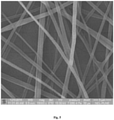
- Silk fibroin is electrospun onto the dip-coated samples in wet condition. This process ensured embedding of silk fibroin nano-fibers into the RSF matrix, which led to achieve a classical self-reinforced fiber composite system.
- regenerated silk fibroin forms a continuous coat onto PDMS discs after dip coating and drying.
- the coat shows no macro or micro cracks and/or any deformities when observed under the scanning electron microscope.
- the Fig. 8 shows that when the fibers are completely embedded in a coating of silk fibroin as suggested from prior art, the coating does not meet the cracking resistance requirements and it shows cracks.
- Bombyx mori silk cocoons were procured from Central Sericultural Research and Training Institute, Srirampura, Manandavadi Road, Mysore-570008, India. They were cut and degummed (sericin removal) by boiling in 0.5% w/v solution of sodium bicarbonate (NaHCO 3 ) (Thomas Baker). The silk fibroin obtained was dried for 48h under vacuum at 60 0 C, -720 mmHg. The dried silk fibroin was cut and dissolved in 9.3 M aq. solution of Lithium Bromide (Sigma) at 60°C for 4 h. This solution was dialysed against deionised water for 48h.
- the solution was centrifuged for 30 min at 10000 rpm, to remove any impurities or insoluble materials.
- the supernatant (RSF) was transfer into clean containers and was stored under 4°C until further required (Maximum storage period is 8 days).
- the concentration of RSF solution was between 3% to 8 % w/v. This solution was split into two parts. The concentration of one part was adjusted to 0.4%w/v by addition of deionised water. This was store under 4°C and later used as the dipping solution. The second part was quenched in liquid nitrogen and was lyophilised at -55°C for 8h. The aerogel thus obtained was stored under -18°C until further required.
- PDMS was obtained as a 2 part kit (Sylgard 184, Dow Corning).
- the resin and crosslinker were mixed in 10:1 ratio, by weight.
- the mixture was poured into polystyrene petriplates and kept in a vacuum oven, 40°C, -720 mmHg, for 24 h.
- the cured PDMS discs were peeled off and cut into 30mm X 10mm rectangles using a scalpel.
- the cut specimens were cleaned in isopropyl alcohol (Merck) under continuous sonication for 20 min.
- the specimens were then kept in a vacuum oven at 60°C, -720 mmHg for 24 h.
- the dried discs were subjected to oxygen plasma at RF power 50W, for 1 min.
- the plasma treated discs were stored under deionised water until further required.
- Plasma treated PDMS discs (Example 2) were taken out from the deionised water and then dipped into 0.4% w/v RSF solution (Example 1) for 10 min. The discs were then taken out and dried at 25 0 C under ambient conditions.
- Lyophilised RSF (Example 1) was dissolved into hexafluroisopropanol (HFIP) (Gujrat Flurachemical Pvt. Ltd.), under continuous stirring, to obtain a 3% w/v solution. This solution was poured into a 5ml disposable syringe (Dispovan), whose needle was blunted.
- HFIP hexafluroisopropanol
- Plasma treated PDMS (Example 2) discs were taken out from the deionised water and then dipped into 0.4% w/v RSF solution for 10 min. The discs were taken out and placed on an aluminium foil in the wet condition. This foil was attached to the plate collector of the electrospinning setup, ensuring good contact between the foil and the collector. Ground terminal of the electrospinning setup was attached to the collector. The syringe with SF-HFIP solution was placed on the syringe pump of the electrospinning setup and the live terminal was attached to its needle. Electrospinning was done onto the discs in the wet condition with the following parameters:
- the discs were carefully removed and place in a methanol (Merck) bath for 10 min. After this methanol treatment, the discs were kept in a vacuum oven, 60°C, -720 mmHg, for 24h, to remove the methanol.
- methanol Merck
- Samples from Example 3 and Example 4 were divided into two sets each. One set was kept as it was while the other set was subjected to bending deformation. This was done by holding the two ends of the specimen, along the 30 mm axis, between the thumb and the index finger; and bending the samples along the axis till the two ends met. This was repeated three times on each sample of the set.
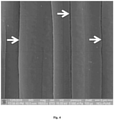
- the protocol followed is as described by Borkner et al. A 10 mm X 10mm square was observed under a scanning electron micrograph to study the coating surface. As seen in Fig. 6 , the fibers exhibit areas of stress whitening, indicating that the fibers take up the load applied during bending. However, the coating remains intact and the substrate surface is not exposed. The arrows indicate regions of deformation observed in the fibers supporting the fact that the fibers bear the load during bending.
- Example 1 Lyophilized RSF (Example 1) (30mg) and Cephalexin (30mg) (a standard antibiotic) was dissolved into 1ml of hexafluroisopropanol (HFIP) (Gujarat Fluorochemicals Pvt. Ltd.) with mild stirring for 10 minutes. 2ml of this solution was then used for electrospinning onto RSF dip coated PDMS discs (15mm diameter) using the same electrospinning conditions as described in Example 4. After 3h of electrospinning, the PDMS discs were carefully removed and annealed in water vapor at 95°C for 2h. One annealed PDMS disc was then dipped in 1ml DI water at 25°C for 15h and the release of cephalexin in DI water was measured. In UV spectroscopy, the signature peak of 262 nm for cephalexin was monitored and as shown in Fig. 7 , the coating enabled continuous release of this molecule over a period of 15h.
- HFIP hexaflurois
- Example 7 Sequential Dip Coating + Electrospinning + Dip onto PDMS as suggested from WO2017093181
- Example 4 The samples obtained in Example 4 were further dipped in a 0.4w/v% solution for 10 minutes and air-dried at room temperature. The coating thickness obtained using this method was found to be in the range of 5-10 microns. This sample was then subjected to the bending stability test as described in Example 5. As can be seen in Fig. 8 , the coating completely cracks at several locations and is not stable under bending loads. A thin coating (100-1000nm) with only partially embedded polymeric fibers in the dip coat will produce a stable coating resistant to mechanical forces such as bending.
- the present invention provides a novel, cost effective, efficient process to coat the surface of implant with biocompatible polymers such that the coating does not crack when subjected to mechanical forces such as bending, compression, tensile or torsion while retaining the inherent properties of the biocompatible polymer.
Landscapes
- Health & Medical Sciences (AREA)
- Life Sciences & Earth Sciences (AREA)
- Chemical & Material Sciences (AREA)
- Epidemiology (AREA)
- Animal Behavior & Ethology (AREA)
- General Health & Medical Sciences (AREA)
- Public Health (AREA)
- Veterinary Medicine (AREA)
- Engineering & Computer Science (AREA)
- Medicinal Chemistry (AREA)
- Transplantation (AREA)
- Oral & Maxillofacial Surgery (AREA)
- Dermatology (AREA)
- Vascular Medicine (AREA)
- Surgery (AREA)
- Heart & Thoracic Surgery (AREA)
- Biomedical Technology (AREA)
- Chemical Kinetics & Catalysis (AREA)
- Molecular Biology (AREA)
- Inorganic Chemistry (AREA)
- Composite Materials (AREA)
- Materials Engineering (AREA)
- Botany (AREA)
- Ceramic Engineering (AREA)
- Textile Engineering (AREA)
- Urology & Nephrology (AREA)
- Zoology (AREA)
- General Chemical & Material Sciences (AREA)
- Mechanical Engineering (AREA)
- Materials For Medical Uses (AREA)
- Prostheses (AREA)
Claims (12)
- Ein Verfahren zur Herstellung eines Implantats mit einer biokompatiblen Polymerbeschichtung, wobei das Verfahren umfasst:(a) Eintauchen des Implantats in eine Lösung eines biokompatiblen Polymers, um ein Implantat mit einer Tauchbeschichtung zu erhalten; und(b) sofortiges Elektrospinnen desselben Polymers auf das Implantat mit Tauchbeschichtung von Schritt (a), um ein Implantat mit einer biokompatiblen Polymerbeschichtung zu erhalten;wobei die Fasern des biokompatiblen Polymers teilweise in die Tauchbeschichtung eingebettet sind und die Beschichtung sogar nach Anwendung mechanischer Kräfte, die aus der Gruppe bestehend aus Biegung, Zugspannung, Kompression und Torsion ausgewählt werden, intakt/unabhängig von Brüchen/Rissen bleibt, wobei das biokompatible Polymer Seidenfibroin ist.
- Verfahren nach Anspruch 1, wobei das Implantat aus einem Material besteht, das aus der Gruppe ausgewählt ist, die aus Metall, Polymer, Keramik und deren Verbundwerkstoffen besteht.
- Verfahren nach Anspruch 2, wobei das Metall Titan ist.
- Verfahren nach Anspruch 2, wobei das Polymer ein Polydimethylsiloxan (PDMS) oder Polyethylen ist.
- Verfahren nach Anspruch 2, wobei die Keramik Hydroxyapatit ist.
- Verfahren nach Anspruch 2, wobei das Implantat ausgewählt ist aus der Gruppe, bestehend aus Brustimplantat, Augenimplantat, kardiovaskulärem Stent und Katheterröhrchen bzw. Katheterschlauch..
- Verfahren nach Anspruch 6, wobei das Implantat in einer Form vorliegt, die aus der Gruppe ausgewählt ist, die aus einem Rohr, einer Folie, einem Film und einer 3D-Form besteht.
- Verfahren nach Anspruch 1, wobei die Dicke der biokompatiblen Polymerbeschichtung im Bereich von 100 nm bis 5 µm liegt.
- Verfahren nach Anspruch 1, wobei der Faserdurchmesser der biokompatiblen Polymerbeschichtung nach dem Elektrospinnen im Bereich von 100 nm bis 1000 nm liegt.
- Verfahren nach Anspruch 1, wobei die biokompatible Polymerbeschichtung mit funktionellen Molekülen, Arzneimitteln, Biomolekülen, Wachstumsfaktoren und Proteinen modifiziert ist, um die Wirksamkeit der biokompatiblen Polymerbeschichtung für biomedizinische Anwendungen zu erhöhen.
- Verfahren nach Anspruch 1 zur Beschichtung der Oberfläche eines Polydimethylsiloxan (PDMS)-Implantats mit einer Seidenfibroinschicht, wobei das Verfahren die folgenden Schritte umfasst:a) Eintauchen des Polydimethylsiloxan (PDMS)-Implantats in eine Lösung von regeneriertem Seidenfibroin, um ein nasses PDMS-Implantat mit einer Beschichtung aus regeneriertem Seidenfibroin zu erhalten;b) sofortiges Platzieren des nassen PDMS-Implantats mit regenerierter Seidenfibroinbeschichtung aus Schritt (a) auf dem Kollektor des Elektrospinnsystems;c) Auflösen von lyophilisiertem Seidenfibroin (SF) in Hexafluroisopropanol (HFIP), um eine SF-HFIP-Lösung zu erhalten;d) Verwendung der SF-HFIP-Lösung aus Schritt (c) zum Elektrospinnen auf das nasse PDMS-Implantat mit regenerierter Seidenfibroinbeschichtung aus Schritt (b);e) zufällige Ablagerung von elektrogesponnenen Fasern mit Hilfe von Spritzentranslation und/oder Kollektortranslation und/oder Rotation, um ein Polydimethylsiloxan (PDMS)-Implantat mit Seidenfibroinschicht zu erhalten.
- Ein Implantat mit einer biokompatiblen Polymerbeschichtung, hergestellt nach dem Verfahren gemäß Anspruch 1.
Applications Claiming Priority (2)
| Application Number | Priority Date | Filing Date | Title |
|---|---|---|---|
| IN201711010187 | 2017-03-23 | ||
| PCT/IN2018/050163 WO2018173074A1 (en) | 2017-03-23 | 2018-03-23 | A process for coating a biomedical implant with a biocompatible polymer and a biomedical implant therefrom |
Publications (3)
| Publication Number | Publication Date |
|---|---|
| EP3600463A1 EP3600463A1 (de) | 2020-02-05 |
| EP3600463A4 EP3600463A4 (de) | 2020-12-09 |
| EP3600463B1 true EP3600463B1 (de) | 2022-03-02 |
Family
ID=63584372
Family Applications (1)
| Application Number | Title | Priority Date | Filing Date |
|---|---|---|---|
| EP18772197.2A Active EP3600463B1 (de) | 2017-03-23 | 2018-03-23 | Verfahren zur beschichtung eines biomedizinischen implantats mit einem biokompatiblen polymer und biomedizinisches implantat daraus |
Country Status (3)
| Country | Link |
|---|---|
| US (1) | US11439728B2 (de) |
| EP (1) | EP3600463B1 (de) |
| WO (1) | WO2018173074A1 (de) |
Families Citing this family (2)
| Publication number | Priority date | Publication date | Assignee | Title |
|---|---|---|---|---|
| DE102022128813A1 (de) | 2022-10-31 | 2024-05-02 | Universität Siegen, Körperschaft des öffentlichen Rechts | Antiadhäsive Polymer-Beschichtungen für Kurzzeitimplantate |
| CN119113230B (zh) * | 2024-09-14 | 2025-12-09 | 广州见微医疗科技有限公司 | 抗菌导管及其制备方法 |
Family Cites Families (15)
| Publication number | Priority date | Publication date | Assignee | Title |
|---|---|---|---|---|
| US3971316A (en) * | 1974-05-28 | 1976-07-27 | Xerox Corporation | Process for smoothing waterless lithographic masters |
| EP1551470A2 (de) * | 2002-09-13 | 2005-07-13 | The University of British Columbia | Calciumphosphat-beschichtete, implantierbare, medizinische geräte und methode zu deren herstellung |
| US7316710B1 (en) * | 2002-12-30 | 2008-01-08 | Advanced Cardiovascular Systems, Inc. | Flexible stent |
| AU2003300022A1 (en) * | 2002-12-30 | 2004-07-29 | Angiotech International Ag | Silk-containing stent graft |
| US20050148512A1 (en) * | 2003-11-10 | 2005-07-07 | Angiotech International Ag | Medical implants and fibrosis-inducing agents |
| ATE526378T1 (de) * | 2005-08-02 | 2011-10-15 | Tufts College | Verfahren zur stufenweisen ablagerung von seidenfibroinbeschichtungen |
| US8585753B2 (en) * | 2006-03-04 | 2013-11-19 | John James Scanlon | Fibrillated biodegradable prosthesis |
| PL2034088T3 (pl) * | 2007-09-10 | 2013-04-30 | Gore W L & Ass Gmbh | Tkanina i laminat tkaniny |
| CN101970026A (zh) * | 2007-10-19 | 2011-02-09 | Miv治疗有限公司 | 涂敷医疗器材的方法 |
| JP2012501806A (ja) * | 2008-09-12 | 2012-01-26 | ボストン サイエンティフィック サイムド,インコーポレイテッド | ステントの層単位製造 |
| US20110282437A1 (en) * | 2010-05-14 | 2011-11-17 | Boston Scientific Scimed, Inc. | Endoprosthesis |
| US10292808B2 (en) * | 2010-06-07 | 2019-05-21 | Q3 Medical Devices Limited | Device and method for management of aneurism, perforation and other vascular abnormalities |
| WO2012145652A1 (en) * | 2011-04-20 | 2012-10-26 | Trustees Of Tufts College | Dynamic silk coatings for implantable devices |
| JP6059111B2 (ja) * | 2012-10-31 | 2017-01-11 | 三ツ星ベルト株式会社 | 摩擦伝動ベルト |
| EP3173104A1 (de) | 2015-11-30 | 2017-05-31 | Friedrich-Alexander-Universität Erlangen-Nürnberg | Silikonbrustimplantat mit verstärkungsfasern |
-
2018
- 2018-03-23 EP EP18772197.2A patent/EP3600463B1/de active Active
- 2018-03-23 WO PCT/IN2018/050163 patent/WO2018173074A1/en not_active Ceased
- 2018-03-23 US US16/495,683 patent/US11439728B2/en active Active
Also Published As
| Publication number | Publication date |
|---|---|
| EP3600463A4 (de) | 2020-12-09 |
| US20200054787A1 (en) | 2020-02-20 |
| WO2018173074A1 (en) | 2018-09-27 |
| EP3600463A1 (de) | 2020-02-05 |
| US11439728B2 (en) | 2022-09-13 |
Similar Documents
| Publication | Publication Date | Title |
|---|---|---|
| Zhang et al. | Mimosa‐inspired stimuli‐responsive curling bioadhesive tape promotes peripheral nerve regeneration | |
| Fornasari et al. | Natural-based biomaterials for peripheral nerve injury repair | |
| Du et al. | Biomimetic neural scaffolds: a crucial step towards optimal peripheral nerve regeneration | |
| Lecomte et al. | A review on mechanical considerations for chronically-implanted neural probes | |
| Houshyar et al. | Peripheral nerve conduit: materials and structures | |
| Jiang et al. | Electrospun polycaprolactone/gelatin composites with enhanced cell–matrix interactions as blood vessel endothelial layer scaffolds | |
| Alessandrino et al. | SilkBridge™: a novel biomimetic and biocompatible silk-based nerve conduit | |
| Jing et al. | Repair of dural defects with electrospun bacterial cellulose membranes in a rabbit experimental model | |
| JP2016519222A (ja) | コア−シース繊維ならびにそれを作製するための方法およびそれを使用するための方法 | |
| US20140322512A1 (en) | Core-sheath fibers and methods of making and using same | |
| Feng et al. | Self-adhesion conductive sub-micron fiber cardiac patch from shape memory polymers to promote electrical signal transduction function | |
| US20160355951A1 (en) | Core-sheath fibers and methods of making and using same | |
| Valencia–Lazcano et al. | Enhancing surface properties of breast implants by using electrospun silk fibroin | |
| EP3634435A2 (de) | Elastomeres fasriges hybridgerüst zur in-vitro- und in-vivo-formung | |
| Bishal et al. | Enhanced bioactivity of collagen fiber functionalized with room temperature atomic layer deposited titania | |
| EP3600463B1 (de) | Verfahren zur beschichtung eines biomedizinischen implantats mit einem biokompatiblen polymer und biomedizinisches implantat daraus | |
| Patel et al. | HuBiogel incorporated fibro-porous hybrid nanomatrix graft for vascular tissue interfaces | |
| Lai et al. | Comparative evaluation of the biocompatible and physical–chemical properties of poly (lactide-co-glycolide) and polydopamine as coating materials for bacterial cellulose | |
| Huang et al. | Bioinspired poly (lactic acid)/silk fibroin-based dressings with wireless electrical stimulation and instant self-adhesion for promoting wound healing | |
| Sedaghati et al. | Nerve regeneration and bioengineering | |
| US11944725B2 (en) | Pro-healing, pro-regenerative nanofibrous coating for medical implants | |
| Wang et al. | Effect of surface structure on the antithrombogenicity performance of poly (-caprolactone)-cellulose acetate small-diameter tubular scaffolds | |
| Ghafouri et al. | Fabrication of functionally graded electrospun membranes based on silk fibroin for using as dental barrier membranes in guided bone regeneration | |
| Losi et al. | Development of a gelatin-based polyurethane vascular graft by spray, phase-inversion technology | |
| Liao et al. | Melt electrospun bilayered scaffolds for tissue integration of a suture‐less inflow cannula for rotary blood pumps |
Legal Events
| Date | Code | Title | Description |
|---|---|---|---|
| STAA | Information on the status of an ep patent application or granted ep patent |
Free format text: STATUS: THE INTERNATIONAL PUBLICATION HAS BEEN MADE |
|
| PUAI | Public reference made under article 153(3) epc to a published international application that has entered the european phase |
Free format text: ORIGINAL CODE: 0009012 |
|
| STAA | Information on the status of an ep patent application or granted ep patent |
Free format text: STATUS: REQUEST FOR EXAMINATION WAS MADE |
|
| 17P | Request for examination filed |
Effective date: 20190920 |
|
| AK | Designated contracting states |
Kind code of ref document: A1 Designated state(s): AL AT BE BG CH CY CZ DE DK EE ES FI FR GB GR HR HU IE IS IT LI LT LU LV MC MK MT NL NO PL PT RO RS SE SI SK SM TR |
|
| AX | Request for extension of the european patent |
Extension state: BA ME |
|
| DAV | Request for validation of the european patent (deleted) | ||
| DAX | Request for extension of the european patent (deleted) | ||
| A4 | Supplementary search report drawn up and despatched |
Effective date: 20201105 |
|
| RIC1 | Information provided on ipc code assigned before grant |
Ipc: A61L 29/08 20060101ALI20201030BHEP Ipc: A61L 27/18 20060101ALI20201030BHEP Ipc: A61L 29/04 20060101ALI20201030BHEP Ipc: A61L 27/00 20060101AFI20201030BHEP Ipc: A61L 31/16 20060101ALI20201030BHEP Ipc: A61L 29/06 20060101ALI20201030BHEP Ipc: A61L 27/22 20060101ALI20201030BHEP Ipc: A61L 27/36 20060101ALI20201030BHEP Ipc: A61L 27/54 20060101ALI20201030BHEP Ipc: A61F 2/00 20060101ALI20201030BHEP Ipc: A61L 31/10 20060101ALI20201030BHEP Ipc: A61L 31/06 20060101ALI20201030BHEP Ipc: A61L 29/16 20060101ALI20201030BHEP Ipc: A61L 31/04 20060101ALI20201030BHEP Ipc: A61L 27/34 20060101ALI20201030BHEP |
|
| GRAP | Despatch of communication of intention to grant a patent |
Free format text: ORIGINAL CODE: EPIDOSNIGR1 |
|
| STAA | Information on the status of an ep patent application or granted ep patent |
Free format text: STATUS: GRANT OF PATENT IS INTENDED |
|
| INTG | Intention to grant announced |
Effective date: 20211015 |
|
| GRAS | Grant fee paid |
Free format text: ORIGINAL CODE: EPIDOSNIGR3 |
|
| GRAA | (expected) grant |
Free format text: ORIGINAL CODE: 0009210 |
|
| STAA | Information on the status of an ep patent application or granted ep patent |
Free format text: STATUS: THE PATENT HAS BEEN GRANTED |
|
| AK | Designated contracting states |
Kind code of ref document: B1 Designated state(s): AL AT BE BG CH CY CZ DE DK EE ES FI FR GB GR HR HU IE IS IT LI LT LU LV MC MK MT NL NO PL PT RO RS SE SI SK SM TR |
|
| REG | Reference to a national code |
Ref country code: GB Ref legal event code: FG4D |
|
| REG | Reference to a national code |
Ref country code: CH Ref legal event code: EP Ref country code: AT Ref legal event code: REF Ref document number: 1471723 Country of ref document: AT Kind code of ref document: T Effective date: 20220315 |
|
| REG | Reference to a national code |
Ref country code: DE Ref legal event code: R096 Ref document number: 602018031686 Country of ref document: DE |
|
| REG | Reference to a national code |
Ref country code: IE Ref legal event code: FG4D |
|
| REG | Reference to a national code |
Ref country code: NL Ref legal event code: FP |
|
| REG | Reference to a national code |
Ref country code: LT Ref legal event code: MG9D |
|
| PG25 | Lapsed in a contracting state [announced via postgrant information from national office to epo] |
Ref country code: SE Free format text: LAPSE BECAUSE OF FAILURE TO SUBMIT A TRANSLATION OF THE DESCRIPTION OR TO PAY THE FEE WITHIN THE PRESCRIBED TIME-LIMIT Effective date: 20220302 Ref country code: RS Free format text: LAPSE BECAUSE OF FAILURE TO SUBMIT A TRANSLATION OF THE DESCRIPTION OR TO PAY THE FEE WITHIN THE PRESCRIBED TIME-LIMIT Effective date: 20220302 Ref country code: NO Free format text: LAPSE BECAUSE OF FAILURE TO SUBMIT A TRANSLATION OF THE DESCRIPTION OR TO PAY THE FEE WITHIN THE PRESCRIBED TIME-LIMIT Effective date: 20220602 Ref country code: LT Free format text: LAPSE BECAUSE OF FAILURE TO SUBMIT A TRANSLATION OF THE DESCRIPTION OR TO PAY THE FEE WITHIN THE PRESCRIBED TIME-LIMIT Effective date: 20220302 Ref country code: HR Free format text: LAPSE BECAUSE OF FAILURE TO SUBMIT A TRANSLATION OF THE DESCRIPTION OR TO PAY THE FEE WITHIN THE PRESCRIBED TIME-LIMIT Effective date: 20220302 Ref country code: ES Free format text: LAPSE BECAUSE OF FAILURE TO SUBMIT A TRANSLATION OF THE DESCRIPTION OR TO PAY THE FEE WITHIN THE PRESCRIBED TIME-LIMIT Effective date: 20220302 Ref country code: BG Free format text: LAPSE BECAUSE OF FAILURE TO SUBMIT A TRANSLATION OF THE DESCRIPTION OR TO PAY THE FEE WITHIN THE PRESCRIBED TIME-LIMIT Effective date: 20220602 |
|
| REG | Reference to a national code |
Ref country code: AT Ref legal event code: MK05 Ref document number: 1471723 Country of ref document: AT Kind code of ref document: T Effective date: 20220302 |
|
| PG25 | Lapsed in a contracting state [announced via postgrant information from national office to epo] |
Ref country code: PL Free format text: LAPSE BECAUSE OF FAILURE TO SUBMIT A TRANSLATION OF THE DESCRIPTION OR TO PAY THE FEE WITHIN THE PRESCRIBED TIME-LIMIT Effective date: 20220302 Ref country code: LV Free format text: LAPSE BECAUSE OF FAILURE TO SUBMIT A TRANSLATION OF THE DESCRIPTION OR TO PAY THE FEE WITHIN THE PRESCRIBED TIME-LIMIT Effective date: 20220302 Ref country code: GR Free format text: LAPSE BECAUSE OF FAILURE TO SUBMIT A TRANSLATION OF THE DESCRIPTION OR TO PAY THE FEE WITHIN THE PRESCRIBED TIME-LIMIT Effective date: 20220603 Ref country code: FI Free format text: LAPSE BECAUSE OF FAILURE TO SUBMIT A TRANSLATION OF THE DESCRIPTION OR TO PAY THE FEE WITHIN THE PRESCRIBED TIME-LIMIT Effective date: 20220302 |
|
| REG | Reference to a national code |
Ref country code: DE Ref legal event code: R119 Ref document number: 602018031686 Country of ref document: DE |
|
| PG25 | Lapsed in a contracting state [announced via postgrant information from national office to epo] |
Ref country code: SM Free format text: LAPSE BECAUSE OF FAILURE TO SUBMIT A TRANSLATION OF THE DESCRIPTION OR TO PAY THE FEE WITHIN THE PRESCRIBED TIME-LIMIT Effective date: 20220302 Ref country code: SK Free format text: LAPSE BECAUSE OF FAILURE TO SUBMIT A TRANSLATION OF THE DESCRIPTION OR TO PAY THE FEE WITHIN THE PRESCRIBED TIME-LIMIT Effective date: 20220302 Ref country code: RO Free format text: LAPSE BECAUSE OF FAILURE TO SUBMIT A TRANSLATION OF THE DESCRIPTION OR TO PAY THE FEE WITHIN THE PRESCRIBED TIME-LIMIT Effective date: 20220302 Ref country code: PT Free format text: LAPSE BECAUSE OF FAILURE TO SUBMIT A TRANSLATION OF THE DESCRIPTION OR TO PAY THE FEE WITHIN THE PRESCRIBED TIME-LIMIT Effective date: 20220704 Ref country code: EE Free format text: LAPSE BECAUSE OF FAILURE TO SUBMIT A TRANSLATION OF THE DESCRIPTION OR TO PAY THE FEE WITHIN THE PRESCRIBED TIME-LIMIT Effective date: 20220302 Ref country code: CZ Free format text: LAPSE BECAUSE OF FAILURE TO SUBMIT A TRANSLATION OF THE DESCRIPTION OR TO PAY THE FEE WITHIN THE PRESCRIBED TIME-LIMIT Effective date: 20220302 Ref country code: AT Free format text: LAPSE BECAUSE OF FAILURE TO SUBMIT A TRANSLATION OF THE DESCRIPTION OR TO PAY THE FEE WITHIN THE PRESCRIBED TIME-LIMIT Effective date: 20220302 |
|
| PG25 | Lapsed in a contracting state [announced via postgrant information from national office to epo] |
Ref country code: IS Free format text: LAPSE BECAUSE OF FAILURE TO SUBMIT A TRANSLATION OF THE DESCRIPTION OR TO PAY THE FEE WITHIN THE PRESCRIBED TIME-LIMIT Effective date: 20220702 Ref country code: AL Free format text: LAPSE BECAUSE OF FAILURE TO SUBMIT A TRANSLATION OF THE DESCRIPTION OR TO PAY THE FEE WITHIN THE PRESCRIBED TIME-LIMIT Effective date: 20220302 |
|
| REG | Reference to a national code |
Ref country code: BE Ref legal event code: MM Effective date: 20220331 |
|
| PLBE | No opposition filed within time limit |
Free format text: ORIGINAL CODE: 0009261 |
|
| STAA | Information on the status of an ep patent application or granted ep patent |
Free format text: STATUS: NO OPPOSITION FILED WITHIN TIME LIMIT |
|
| PG25 | Lapsed in a contracting state [announced via postgrant information from national office to epo] |
Ref country code: MC Free format text: LAPSE BECAUSE OF FAILURE TO SUBMIT A TRANSLATION OF THE DESCRIPTION OR TO PAY THE FEE WITHIN THE PRESCRIBED TIME-LIMIT Effective date: 20220302 Ref country code: LU Free format text: LAPSE BECAUSE OF NON-PAYMENT OF DUE FEES Effective date: 20220323 Ref country code: IE Free format text: LAPSE BECAUSE OF NON-PAYMENT OF DUE FEES Effective date: 20220323 Ref country code: DK Free format text: LAPSE BECAUSE OF FAILURE TO SUBMIT A TRANSLATION OF THE DESCRIPTION OR TO PAY THE FEE WITHIN THE PRESCRIBED TIME-LIMIT Effective date: 20220302 Ref country code: DE Free format text: LAPSE BECAUSE OF NON-PAYMENT OF DUE FEES Effective date: 20221001 |
|
| 26N | No opposition filed |
Effective date: 20221205 |
|
| PG25 | Lapsed in a contracting state [announced via postgrant information from national office to epo] |
Ref country code: SI Free format text: LAPSE BECAUSE OF FAILURE TO SUBMIT A TRANSLATION OF THE DESCRIPTION OR TO PAY THE FEE WITHIN THE PRESCRIBED TIME-LIMIT Effective date: 20220302 Ref country code: BE Free format text: LAPSE BECAUSE OF NON-PAYMENT OF DUE FEES Effective date: 20220331 |
|
| PGFP | Annual fee paid to national office [announced via postgrant information from national office to epo] |
Ref country code: NL Payment date: 20230330 Year of fee payment: 6 |
|
| P01 | Opt-out of the competence of the unified patent court (upc) registered |
Effective date: 20230529 |
|
| PG25 | Lapsed in a contracting state [announced via postgrant information from national office to epo] |
Ref country code: IT Free format text: LAPSE BECAUSE OF FAILURE TO SUBMIT A TRANSLATION OF THE DESCRIPTION OR TO PAY THE FEE WITHIN THE PRESCRIBED TIME-LIMIT Effective date: 20220302 |
|
| PG25 | Lapsed in a contracting state [announced via postgrant information from national office to epo] |
Ref country code: MK Free format text: LAPSE BECAUSE OF FAILURE TO SUBMIT A TRANSLATION OF THE DESCRIPTION OR TO PAY THE FEE WITHIN THE PRESCRIBED TIME-LIMIT Effective date: 20220302 Ref country code: CY Free format text: LAPSE BECAUSE OF FAILURE TO SUBMIT A TRANSLATION OF THE DESCRIPTION OR TO PAY THE FEE WITHIN THE PRESCRIBED TIME-LIMIT Effective date: 20220302 |
|
| PG25 | Lapsed in a contracting state [announced via postgrant information from national office to epo] |
Ref country code: HU Free format text: LAPSE BECAUSE OF FAILURE TO SUBMIT A TRANSLATION OF THE DESCRIPTION OR TO PAY THE FEE WITHIN THE PRESCRIBED TIME-LIMIT; INVALID AB INITIO Effective date: 20180323 |
|
| PG25 | Lapsed in a contracting state [announced via postgrant information from national office to epo] |
Ref country code: TR Free format text: LAPSE BECAUSE OF FAILURE TO SUBMIT A TRANSLATION OF THE DESCRIPTION OR TO PAY THE FEE WITHIN THE PRESCRIBED TIME-LIMIT Effective date: 20220302 |
|
| PG25 | Lapsed in a contracting state [announced via postgrant information from national office to epo] |
Ref country code: MT Free format text: LAPSE BECAUSE OF FAILURE TO SUBMIT A TRANSLATION OF THE DESCRIPTION OR TO PAY THE FEE WITHIN THE PRESCRIBED TIME-LIMIT Effective date: 20220302 |
|
| REG | Reference to a national code |
Ref country code: NL Ref legal event code: MM Effective date: 20240401 |
|
| PG25 | Lapsed in a contracting state [announced via postgrant information from national office to epo] |
Ref country code: NL Free format text: LAPSE BECAUSE OF NON-PAYMENT OF DUE FEES Effective date: 20240401 |
|
| PG25 | Lapsed in a contracting state [announced via postgrant information from national office to epo] |
Ref country code: NL Free format text: LAPSE BECAUSE OF NON-PAYMENT OF DUE FEES Effective date: 20240401 |
|
| PGFP | Annual fee paid to national office [announced via postgrant information from national office to epo] |
Ref country code: CH Payment date: 20250401 Year of fee payment: 8 |
|
| REG | Reference to a national code |
Ref country code: CH Ref legal event code: U11 Free format text: ST27 STATUS EVENT CODE: U-0-0-U10-U11 (AS PROVIDED BY THE NATIONAL OFFICE) Effective date: 20260401 |
|
| PGFP | Annual fee paid to national office [announced via postgrant information from national office to epo] |
Ref country code: GB Payment date: 20260313 Year of fee payment: 9 |
|
| PGFP | Annual fee paid to national office [announced via postgrant information from national office to epo] |
Ref country code: FR Payment date: 20260313 Year of fee payment: 9 |