EP3599964B1 - Cleanroom wiper and method for making same - Google Patents
Cleanroom wiper and method for making same Download PDFInfo
- Publication number
- EP3599964B1 EP3599964B1 EP18770364.0A EP18770364A EP3599964B1 EP 3599964 B1 EP3599964 B1 EP 3599964B1 EP 18770364 A EP18770364 A EP 18770364A EP 3599964 B1 EP3599964 B1 EP 3599964B1
- Authority
- EP
- European Patent Office
- Prior art keywords
- woven fabric
- wiper
- wipers
- saturated
- microfiber
- Prior art date
- Legal status (The legal status is an assumption and is not a legal conclusion. Google has not performed a legal analysis and makes no representation as to the accuracy of the status listed.)
- Active
Links
Images


Classifications
-
- B—PERFORMING OPERATIONS; TRANSPORTING
- B08—CLEANING
- B08B—CLEANING IN GENERAL; PREVENTION OF FOULING IN GENERAL
- B08B1/00—Cleaning by methods involving the use of tools
- B08B1/10—Cleaning by methods involving the use of tools characterised by the type of cleaning tool
- B08B1/14—Wipes; Absorbent members, e.g. swabs or sponges
- B08B1/143—Wipes
-
- B—PERFORMING OPERATIONS; TRANSPORTING
- B08—CLEANING
- B08B—CLEANING IN GENERAL; PREVENTION OF FOULING IN GENERAL
- B08B1/00—Cleaning by methods involving the use of tools
- B08B1/10—Cleaning by methods involving the use of tools characterised by the type of cleaning tool
- B08B1/14—Wipes; Absorbent members, e.g. swabs or sponges
- B08B1/145—Swabs
-
- B—PERFORMING OPERATIONS; TRANSPORTING
- B08—CLEANING
- B08B—CLEANING IN GENERAL; PREVENTION OF FOULING IN GENERAL
- B08B13/00—Accessories or details of general applicability for machines or apparatus for cleaning
-
- B—PERFORMING OPERATIONS; TRANSPORTING
- B08—CLEANING
- B08B—CLEANING IN GENERAL; PREVENTION OF FOULING IN GENERAL
- B08B3/00—Cleaning by methods involving the use or presence of liquid or steam
- B08B3/04—Cleaning involving contact with liquid
-
- D—TEXTILES; PAPER
- D02—YARNS; MECHANICAL FINISHING OF YARNS OR ROPES; WARPING OR BEAMING
- D02G—CRIMPING OR CURLING FIBRES, FILAMENTS, THREADS, OR YARNS; YARNS OR THREADS
- D02G3/00—Yarns or threads, e.g. fancy yarns; Processes or apparatus for the production thereof, not otherwise provided for
-
- D—TEXTILES; PAPER
- D03—WEAVING
- D03D—WOVEN FABRICS; METHODS OF WEAVING; LOOMS
- D03D1/00—Woven fabrics designed to make specified articles
- D03D1/0017—Woven household fabrics
- D03D1/0023—Mobs or wipes
-
- D—TEXTILES; PAPER
- D03—WEAVING
- D03D—WOVEN FABRICS; METHODS OF WEAVING; LOOMS
- D03D15/00—Woven fabrics characterised by the material, structure or properties of the fibres, filaments, yarns, threads or other warp or weft elements used
- D03D15/20—Woven fabrics characterised by the material, structure or properties of the fibres, filaments, yarns, threads or other warp or weft elements used characterised by the material of the fibres or filaments constituting the yarns or threads
- D03D15/292—Conjugate, i.e. bi- or multicomponent, fibres or filaments
-
- D—TEXTILES; PAPER
- D10—INDEXING SCHEME ASSOCIATED WITH SUBLASSES OF SECTION D, RELATING TO TEXTILES
- D10B—INDEXING SCHEME ASSOCIATED WITH SUBLASSES OF SECTION D, RELATING TO TEXTILES
- D10B2331/00—Fibres made from polymers obtained otherwise than by reactions only involving carbon-to-carbon unsaturated bonds, e.g. polycondensation products
- D10B2331/02—Fibres made from polymers obtained otherwise than by reactions only involving carbon-to-carbon unsaturated bonds, e.g. polycondensation products polyamides
-
- D—TEXTILES; PAPER
- D10—INDEXING SCHEME ASSOCIATED WITH SUBLASSES OF SECTION D, RELATING TO TEXTILES
- D10B—INDEXING SCHEME ASSOCIATED WITH SUBLASSES OF SECTION D, RELATING TO TEXTILES
- D10B2331/00—Fibres made from polymers obtained otherwise than by reactions only involving carbon-to-carbon unsaturated bonds, e.g. polycondensation products
- D10B2331/04—Fibres made from polymers obtained otherwise than by reactions only involving carbon-to-carbon unsaturated bonds, e.g. polycondensation products polyesters, e.g. polyethylene terephthalate [PET]
-
- Y—GENERAL TAGGING OF NEW TECHNOLOGICAL DEVELOPMENTS; GENERAL TAGGING OF CROSS-SECTIONAL TECHNOLOGIES SPANNING OVER SEVERAL SECTIONS OF THE IPC; TECHNICAL SUBJECTS COVERED BY FORMER USPC CROSS-REFERENCE ART COLLECTIONS [XRACs] AND DIGESTS
- Y10—TECHNICAL SUBJECTS COVERED BY FORMER USPC
- Y10T—TECHNICAL SUBJECTS COVERED BY FORMER US CLASSIFICATION
- Y10T442/00—Fabric [woven, knitted, or nonwoven textile or cloth, etc.]
- Y10T442/30—Woven fabric [i.e., woven strand or strip material]
Definitions
- the present invention is generally directed to a pre-saturated wiper for use in a cleanroom environment, or other similarly controlled environment, that enables effective removal of contaminants from equipment and work surfaces without the use of volatile organic compounds (VOCs) while exhibiting low releasable particle levels.
- the pre-saturated wiper is made from a woven fabric which incorporates a unique weave pattern with sealed edges that is saturated with only Ultrapure water (UPW).
- UPW Ultrapure water
- the pre-saturated wiper holds enough UPW to remove contaminants from a surface without leaving the surface wet. Critical surfaces are left clean and dry without VOC use and the health and safety risks that go with it.
- pre-saturated wipers using 100% isopropyl alcohol (IPA) as the wetting agent are typically used to clean the critical surfaces within cleanrooms, such as workstations, benchtops, and tooling surfaces like the interior of process chambers.
- IPA isopropyl alcohol
- Current users of wipers pre-saturated with IPA believe they offer a more convenient, cost-effective approach to contamination control.
- IPA pre-saturated wipers have reported better protocol adherence (likely due to convenience), lower overall wiper usage, lower volatile organic compound (VOC) levels, reduced fire hazards and more reproducible wetting levels on wipers as compared to the use of dry wipers with squirt bottles. Nevertheless, IPA pre-saturated wipers still carry the health and safety risks associated with VOCs such as flammability, fugitive VOC emissions, and personnel exposure to VOCs.
- VOC volatile organic compound
- wipers pre-saturated with IPA exhibit significant releasable particle levels, including levels that may be higher than those for corresponding dry wipers.
- the higher particle levels with IPA pre-saturated wipers have been linked to the long-term contact of the wetting agent with the wipers. These higher particle levels found during the testing of IPA pre-saturated wipers could potentially represent increased levels of particle exposure and risk to environmental surfaces and/or processes.
- the present invention is directed to a pre-saturated microfiber sealed edge wiper that is only pre-saturated with Ultrapure Water (UPW).
- Ultrapure water (UPW or high purity water) is water that has been purified to uncommonly stringent specifications. Ultrapure water is a commonly used term in the semiconductor industry to emphasize the fact that the water is treated to the highest levels of purity for all contaminant types, including: organic and inorganic compounds, dissolved and particulate matter, volatile and non-volatile, reactive and inert, hydrophilic and hydrophobic, and dissolved gases.
- the wiper of the present invention enables cleanroom technicians to achieve 100% VOC free wiping and completely eliminates flammable solvents including IPA form cleanroom wiping procedures.
- the wiper of the present invention is constructed from a microfiber fabric with a unique woven pattern that allows operators to dislodge, entrap, and remove contaminants while leaving surfaces clean and dry using only UPW.
- the weave and sealed edge of the wiper provide resistance to abrasion and tearing in order to reduce in-use particle and fiber generation.
- the UPW pre-saturated wiper of the present invention can be used in ISO Class 3 and higher cleanrooms.
- the UPW pre-saturated wiper is particularly useful in cleaning hivac process chambers and robotics in flat panel display and water fabs, cleaning volatile organic compound (VOC) sensitive process equipment in lithography, chemical vapor deposition, and metrology modules, and cleaning baked on resist ad developer from lithography tracks.
- VOC volatile organic compound
- the UPW pre-saturated wiper can also be used in the final wipe down of sensitive components such as equipment front end modules, electrostatic chucks, VAT valves, and gas dispersion plates.
- the UPW pre-saturated wiper is also particularly useful during the preventive maintenance of equipment and in wetcleans where the elimination of VOCs and flammable solvents are required.
- Horizontal surfaces, stainless steel carts, and work surfaces in the cleanroom are also ideal places to use the UPW pre-saturated wiper of the present invention.
- the cleanroom wiper of the present inventior which is defined by claim 1, includes a woven fabric having at least two distinct microfibers wherein the woven fabric is pre-saturated with only ultrapure water.
- one of the m ⁇ crofibers that make up the woven fabric comprises a nylon/polyester conjugate.
- the nylon/polyester conjugate is, in accordance with the invention, made of 25-30% nylon and 70-75% polyester.
- the nylon/polyester conjugate may comprise 72% polyester and 28% nylon which has proven to hold enough water to wet the surface to be cleaned so that contaminants can be removed without leaving the surface wet, which could inhibit tool recovery.
- the woven fabric may have sealed edges.
- the woven fabric includes a first microfiber and a second microfiber that are woven using a repeating pattern having six warp threads and eighteen weft threads.
- the first microfiber material comprises a nylon/polyester conjugate that is used for the eighteen weft threads in the repeating pattern.
- the second microfiber material is in accordance with the invention a polyester that is used for the six warp threads in the repeating pattern.
- the weave pattern allows for immediate and even saturation of the wipers with UPW.
- Multiple UPW pre-saturated wipers of the present invention may be stacked within packaging containing the wipers and the top and bottom wipers contained within the package contain the same amount of water and are therefore evenly wetted with UPW.
- the present invention is also directed to a method in accordance with claim 3 for making a UPW pre-saturated wiper that includes the steps of selecting microfibers with one microfiber comprising a nylon/polyester conjugate, weaving the microfibers using a special weave pattern to create a roll of woven fabric, processing the woven fabric for fast water wet out using high temperature, high pressure, and agents, clean processing the processed woven fabric with aseptic ultra pure water, forming wipers form the processed roll of fabric by cutting and sealing the fabric, and packaging and pre-saturating with ultra pure water.
- the method may also include the steps of post processing with gamma irradiation to assure sterility and lot testing to certify cleanliness.
- Another exemplary embodiment of the method for making a UPW pre-saturated wiper includes the steps of 1) weaving at least two distinct microfiber materials to create a woven fabric where one of the microfiber materials is a nylon/polymer conjugate. 2) processing the woven fabric with high temperature, high pressure, and at least one surfactant, 3) cleaning the woven fabric with aseptic pure water, 4) drying the woven fabric, 5) cutting the woven fabric and sealing the edges of the woven fabric to create individual wipers, and 6) packaging and pre-saturating the wipers with only ultra pure water.
- the weaving step may include weaving the nylon/polymer conjugate material with a second microfiber material using a repeating pattern having six warp threads and eighteen weft threads. The nylon/polymer conjugate material may be used for the eighteen weft threads in the repeating pattern and the second microfiber material may be used for the six warp threads in the repeating pattern.
- the woven fibers of the woven fabric may be relaxed before the step of processing the woven fabric.
- the step of cleaning the woven fabric may include washing the woven fabric with a detergent followed by repeating rinsing of the woven fabric with aseptic pure water.
- the cutting and sealing of the edges of the woven fabric may be done simultaneously to create individual wipers.
- the method for making the UPW pre-saturated wiper of the present invention may also include the step of sterilizing the packaged pre-saturated wipers.
- the present invention is directed to just such a wiper.
- the present invention includes a pre-saturated wiper that is saturated exclusively with Ultrapure water (UPW) and that is constructed in such a way that the UPW immediately and evenly wets into the wiper and is capable of cleaning critical surfaces without leaving water on the critical surface.
- the present invention also includes a method for making the UPW pre-saturated wiper of the present invention.
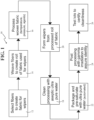
- FIG. 1 is a flow chart showing steps in an exemplary method 10 for making the UPW pre-saturated cleanroom wiper of the present invention.
- fibers are selected for creating a woven fabric that will be used to make the wipers.
- the fibers include a first microfiber that is a nylon/polyester conjugate and a second fiber that is a polyester.
- a photo of a first microfiber that can be used to make the woven fabric that is used to make one exemplary embodiment of the wiper of the present invention is shown in FIG. 2 .
- the first microfiber material is soft, shiny, and very bulky. It also provides for excellent moisture penetration and air ventilation.
- the nylon/polyester conjugate may be made of 25-30% nylon and 70-75% polyester.
- the nylon/polyester conjugate may comprise 72% polyester and 28% nylon.
- a photo of a second microfiber that can be used to make the woven fabric that is used to make the exemplary embodiment of the wiper of the present invention is shown in FIG. 3 .
- the second microfiber material is soft, high density, waterproof, permeable to moisture, and has a high tensile strength.
- the first and second microfibers are woven using a specific weaving pattern like that shown in FIG. 5 which assists in enabling the woven fabric to be Fast Water Wet Out, meaning that water can immediately and evenly wet into the woven fabric.
- the weaving pattern shown in FIG. 5 is one repeating unit that includes 6 warp threads and 18 weft threads. Each box shows the interlocking point of the weave. "X" means the warp yam/microfiber is above the weft yarn/microfiber on this interlocking point.
- the first microfiber material described above is used as the weft thread and the second microfiber material described above is used as the warp thread.
- the first and second microfibers are woven to create a roll of woven fabric that is used to make the wipers.
- the rolls of woven fabric may comprise 61-inch-wide (61-25.4 mm-wide) rolls of woven fabric.
- the woven fabric is processed in step 16 with high temperature and high pressure and one or more agents such as a surfactant that lowers the interfacial tension between UPW and the woven fabric thereby acting as a wetting agent.
- This processing further assists in enabling the woven fabric to be Fast Water Wet Out.
- a special arrangement on the loom used to weave the microfibers into the woven fabric is used to relax the woven fibers as shown in FIG. 6 .
- a resulting starfish type cross section of the Fast Water Wet Out processed woven fabric is shown in FIG. 4 .
- step 18 the processed roll of woven fabric is then clean processed with aseptic ultra pure water. More specifically, the roll of processed woven fabric is washed with detergent for 10 minutes and then rinsed for 36 minutes by performing nine rinses for 4 minutes each. Water is extracted from the roll by spinning it for 5 minutes at 300 rpm and then for 5 minutes at 600 rpm. The roll is then dried in the dryer at 85 degrees Celsius for 2 hours.
- Wipers are then formed from the roll of processed woven fabric in step 20.
- the roll of processed woven fabric is further processed into thinner rolls of fabric and finally to sheets. Smaller rolls and sheets of processed woven fabric are simultaneously cut and sealed with an ultrasonic tool that has a PVD coating on top of the stainless steel to minimize metal contamination transferring to the wiper from the tooling.
- the fabric is cut and sealed along the length to form sealed edges and then it is processed on another machine to be cut and sealed across the web to create an individual wiper.
- step 22 the individual sealed edge wipers are packaged and pre-saturated with UPW.
- the wipers are flat stacked on top of each other with 10 or 20 wipers per package. Rolling, ironing, and cutting of the roll of processed woven fabric to form wipers is done in a clean room. Packing and pre-saturation of the wipers is also done in a clean room.
- the packaged pre-saturated wipers are then sterilized using gamma radiation in step 24.
- Gamma irradiation is a standard sterilization procedure in which gamma irradiators are powered by Cobalt-60 to effectively kill microorganisms throughout the product and its packaging with very little temperature effect and no residues.
- lots of packaged, sterilized products are tested in step 26 to certify cleanliness.
- the UPW pre-saturated cleanroom wipers of the present invention work like IPA pre-saturated cleanroom wipers without the safety, environmental, and health issues that are associated with IPA.
- the UPW pre-saturated cleanroom wipers are clean, smooth and capable of effective cleaning without leaving water behind on the cleaned surface.
- the woven fabric that comprises the pre-saturated wipers is designed so that the cleaning surface dries very quickly, as it does with IPA pre-saturated wipers.
- Process benefits from using the UPW pre-saturated cleanroom wipers of the present invention include, but are not limited to, 1) protecting VOC sensitive fab modules such as lithography, metrology, and CVD from solvent fumes, 2) reducing the risk of fiber and particle excursions associated with fab wipers, 3) improved contamination pickup leading to faster preventative maintenance and improved equipment uptime, 4) even, consistent wetting of wipers which enables excellent first pass cleaning results and reduced cleaning time, and 5) a wiper optimized for use in the most advanced wafer fabs.
- UPW pre-saturated cleanroom wipers of the present invention enables reduced cost of ownership by reducing wiper usage resulting in a reduction of waste removal cost, greatly reducing VOC process exposure and fugitive emissions costs by eliminating IPA wipes, reducing the cost of Test Wafers by improving 1 st Pass quality, reducing costs associated with tool downtime by improving particle control, and reducing mean time to clean.
- Environmental health and safety benefits experienced with the use of the UPW pre-saturated cleanroom wipers of the present invention include, but are not limited to, 1) eliminating fire risk during cleanroom wipe downs by reducing flammable chemical storage and solvent squirt bottles, 2) eliminating fugitive VOC emissions and air permit implications associated with solvent wiping, and 3) eliminating personnel exposure to isopropyl alcohol during cleanroom wipe downs.
Landscapes
- Engineering & Computer Science (AREA)
- Textile Engineering (AREA)
- Mechanical Engineering (AREA)
- Cleaning Implements For Floors, Carpets, Furniture, Walls, And The Like (AREA)
- Cleaning In General (AREA)
- Chemical Or Physical Treatment Of Fibers (AREA)
- Woven Fabrics (AREA)
Description
- This application claims priority to provisional patent application having Serial No.
62/475,523, filed March 23, 2017 - The present invention is generally directed to a pre-saturated wiper for use in a cleanroom environment, or other similarly controlled environment, that enables effective removal of contaminants from equipment and work surfaces without the use of volatile organic compounds (VOCs) while exhibiting low releasable particle levels. The pre-saturated wiper is made from a woven fabric which incorporates a unique weave pattern with sealed edges that is saturated with only Ultrapure water (UPW). The pre-saturated wiper holds enough UPW to remove contaminants from a surface without leaving the surface wet. Critical surfaces are left clean and dry without VOC use and the health and safety risks that go with it.
- Currently, pre-saturated wipers using 100% isopropyl alcohol (IPA) as the wetting agent are typically used to clean the critical surfaces within cleanrooms, such as workstations, benchtops, and tooling surfaces like the interior of process chambers. Prior to the use of pre-saturated wipers, dry wipers were used in conjunction with squirt bottles containing IPA. Current users of wipers pre-saturated with IPA believe they offer a more convenient, cost-effective approach to contamination control.
- Companies using IPA pre-saturated wipers have reported better protocol adherence (likely due to convenience), lower overall wiper usage, lower volatile organic compound (VOC) levels, reduced fire hazards and more reproducible wetting levels on wipers as compared to the use of dry wipers with squirt bottles. Nevertheless, IPA pre-saturated wipers still carry the health and safety risks associated with VOCs such as flammability, fugitive VOC emissions, and personnel exposure to VOCs.
- In addition, another drawback to wipers pre-saturated with IPA is that they exhibit significant releasable particle levels, including levels that may be higher than those for corresponding dry wipers. The higher particle levels with IPA pre-saturated wipers have been linked to the long-term contact of the wetting agent with the wipers. These higher particle levels found during the testing of IPA pre-saturated wipers could potentially represent increased levels of particle exposure and risk to environmental surfaces and/or processes.
- Accordingly, there is a need for a pre-saturated cleanroom wiper that effectively cleans critical surfaces while providing increased process benefits, reduced costs, and enhanced environmental health and safety over current methods, namely those that use IPA pre-saturated wipers or dry wipers in conjunction with squirt bottles containing IPA.
- The document MIRASAT: THE VOC FREE CLEANROOM WIPER, 15 February 2017, page 2pp, XP009516843, Retrieved from the Internet: URL:https://www.foamtecintlwcc.com/documents/ datasheets/pdf/mirasat-wipers-datasheet-rev3.pdf discloses a cleanroom wiper comprising a woven fabric having at least two distinct microfiber materials wherein the woven fabric is pre-saturated with only ultrapure water.
- The present invention is directed to a pre-saturated microfiber sealed edge wiper that is only pre-saturated with Ultrapure Water (UPW). Ultrapure water (UPW or high purity water) is water that has been purified to uncommonly stringent specifications. Ultrapure water is a commonly used term in the semiconductor industry to emphasize the fact that the water is treated to the highest levels of purity for all contaminant types, including: organic and inorganic compounds, dissolved and particulate matter, volatile and non-volatile, reactive and inert, hydrophilic and hydrophobic, and dissolved gases. The wiper of the present invention enables cleanroom technicians to achieve 100% VOC free wiping and completely eliminates flammable solvents including IPA form cleanroom wiping procedures. The wiper of the present invention is constructed from a microfiber fabric with a unique woven pattern that allows operators to dislodge, entrap, and remove contaminants while leaving surfaces clean and dry using only UPW. The weave and sealed edge of the wiper provide resistance to abrasion and tearing in order to reduce in-use particle and fiber generation.
- The UPW pre-saturated wiper of the present invention can be used in ISO
Class 3 and higher cleanrooms. The UPW pre-saturated wiper is particularly useful in cleaning hivac process chambers and robotics in flat panel display and water fabs, cleaning volatile organic compound (VOC) sensitive process equipment in lithography, chemical vapor deposition, and metrology modules, and cleaning baked on resist ad developer from lithography tracks. The UPW pre-saturated wiper can also be used in the final wipe down of sensitive components such as equipment front end modules, electrostatic chucks, VAT valves, and gas dispersion plates. The UPW pre-saturated wiper is also particularly useful during the preventive maintenance of equipment and in wetcleans where the elimination of VOCs and flammable solvents are required. Horizontal surfaces, stainless steel carts, and work surfaces in the cleanroom are also ideal places to use the UPW pre-saturated wiper of the present invention. - The cleanroom wiper of the present inventior, which is defined by
claim 1, includes a woven fabric having at least two distinct microfibers wherein the woven fabric is pre-saturated with only ultrapure water. In accordance with the invention, one of the mícrofibers that make up the woven fabric comprises a nylon/polyester conjugate. Further, the nylon/polyester conjugate is, in accordance with the invention, made of 25-30% nylon and 70-75% polyester. In one particular exemplary embodiment, the nylon/polyester conjugate may comprise 72% polyester and 28% nylon which has proven to hold enough water to wet the surface to be cleaned so that contaminants can be removed without leaving the surface wet, which could inhibit tool recovery. - In another aspect of the invention, the woven fabric may have sealed edges. In accordance with the invention, the woven fabric includes a first microfiber and a second microfiber that are woven using a repeating pattern having six warp threads and eighteen weft threads. The first microfiber material comprises a nylon/polyester conjugate that is used for the eighteen weft threads in the repeating pattern. The second microfiber material is in accordance with the invention a polyester that is used for the six warp threads in the repeating pattern. The weave pattern allows for immediate and even saturation of the wipers with UPW. Multiple UPW pre-saturated wipers of the present invention may be stacked within packaging containing the wipers and the top and bottom wipers contained within the package contain the same amount of water and are therefore evenly wetted with UPW.
- The present invention is also directed to a method in accordance with
claim 3 for making a UPW pre-saturated wiper that includes the steps of selecting microfibers with one microfiber comprising a nylon/polyester conjugate, weaving the microfibers using a special weave pattern to create a roll of woven fabric, processing the woven fabric for fast water wet out using high temperature, high pressure, and agents, clean processing the processed woven fabric with aseptic ultra pure water, forming wipers form the processed roll of fabric by cutting and sealing the fabric, and packaging and pre-saturating with ultra pure water. The method may also include the steps of post processing with gamma irradiation to assure sterility and lot testing to certify cleanliness. - Another exemplary embodiment of the method for making a UPW pre-saturated wiper includes the steps of 1) weaving at least two distinct microfiber materials to create a woven fabric where one of the microfiber materials is a nylon/polymer conjugate. 2) processing the woven fabric with high temperature, high pressure, and at least one surfactant, 3) cleaning the woven fabric with aseptic pure water, 4) drying the woven fabric, 5) cutting the woven fabric and sealing the edges of the woven fabric to create individual wipers, and 6) packaging and pre-saturating the wipers with only ultra pure water. The weaving step may include weaving the nylon/polymer conjugate material with a second microfiber material using a repeating pattern having six warp threads and eighteen weft threads. The nylon/polymer conjugate material may be used for the eighteen weft threads in the repeating pattern and the second microfiber material may be used for the six warp threads in the repeating pattern.
- The woven fibers of the woven fabric may be relaxed before the step of processing the woven fabric. The step of cleaning the woven fabric may include washing the woven fabric with a detergent followed by repeating rinsing of the woven fabric with aseptic pure water. The cutting and sealing of the edges of the woven fabric may be done simultaneously to create individual wipers. The method for making the UPW pre-saturated wiper of the present invention may also include the step of sterilizing the packaged pre-saturated wipers.
-
-
FIG. 1 is a flow chart showing steps in an exemplary method for making the UPW pre-saturated cleanroom wiper of the present invention; -
FIG. 2 is a photo of a first microfiber that is used to make the woven fabric that is used to make one exemplary embodiment of the wiper of the present invention; -
FIG. 3 is a photo of a second microfiber that is used to make the woven fabric that is used to make the exemplary embodiment of the wiper of the present invention referred to inFIG. 2 ; -
FIG. 4 is a photo of a modified woven fabric having fast water wet out that was made using the microfibers shown inFIGS. 2 and 3 ; -
FIG. 5 is a drawing showing the weaving pattern that was used to make the modified woven fabric having fast water wet out shown inFIG. 4 ; and -
FIG. 6 is a magnified drawing of relaxed fibers that make up the modified woven fabric having fast water wet out shown inFIG. 4 . - Currently used cleanroom wipers pre-saturated with IPA are comprised of polyester. Polyester wipers need to fully wet a surface to be cleaned in order to get any kind of cleaning efficiency. One hundred percent polyester fabrics do not leave surfaces dry. Leaving a cleaned surface in a cleanroom wet with IPA is not a concern because all of the IPA will quickly evaporate. However, the downside to using IPA is that the IPA fumes are hazardous, flammable, and a source of pollution. In addition, 100% polyester easily sheds particles due to its lower resistance to abrasion.
- Despite the issues and drawbacks associated with IPA pre-saturated polyester wipers, semiconductor fabrication plants would never consider using water with wipers because many tools in the semiconductor manufacturing process must operate at 104 to 107 atmospheres and leaving water in the tool will extend pump down times by three to five times or by many hours. Plants will not allow these pump down times because the tools are valued at over $10,000 dollars/hr. However, if a wiper for use with water could be manufactured such that it would function like a wiper used with IPA, i.e. function so that it cleans but does not leave a cleaned surface wet, then semiconductor fabrication plants may readily elect to use them since they do not possess the safety and health risks associated with IPA.
- The present invention is directed to just such a wiper. The present invention includes a pre-saturated wiper that is saturated exclusively with Ultrapure water (UPW) and that is constructed in such a way that the UPW immediately and evenly wets into the wiper and is capable of cleaning critical surfaces without leaving water on the critical surface. The present invention also includes a method for making the UPW pre-saturated wiper of the present invention.
-
FIG. 1 is a flow chart showing steps in anexemplary method 10 for making the UPW pre-saturated cleanroom wiper of the present invention. First, instep 12, fibers are selected for creating a woven fabric that will be used to make the wipers. The fibers include a first microfiber that is a nylon/polyester conjugate and a second fiber that is a polyester. A photo of a first microfiber that can be used to make the woven fabric that is used to make one exemplary embodiment of the wiper of the present invention is shown inFIG. 2 . The first microfiber material is soft, shiny, and very bulky. It also provides for excellent moisture penetration and air ventilation. The nylon/polyester conjugate may be made of 25-30% nylon and 70-75% polyester. In one particular exemplary embodiment, the nylon/polyester conjugate may comprise 72% polyester and 28% nylon. A photo of a second microfiber that can be used to make the woven fabric that is used to make the exemplary embodiment of the wiper of the present invention is shown inFIG. 3 . The second microfiber material is soft, high density, waterproof, permeable to moisture, and has a high tensile strength. - In
step 14, the first and second microfibers are woven using a specific weaving pattern like that shown inFIG. 5 which assists in enabling the woven fabric to be Fast Water Wet Out, meaning that water can immediately and evenly wet into the woven fabric. The weaving pattern shown inFIG. 5 is one repeating unit that includes 6 warp threads and 18 weft threads. Each box shows the interlocking point of the weave. "X" means the warp yam/microfiber is above the weft yarn/microfiber on this interlocking point. The first microfiber material described above is used as the weft thread and the second microfiber material described above is used as the warp thread. The first and second microfibers are woven to create a roll of woven fabric that is used to make the wipers. In one exemplary method, the rolls of woven fabric may comprise 61-inch-wide (61-25.4 mm-wide) rolls of woven fabric. - The woven fabric is processed in
step 16 with high temperature and high pressure and one or more agents such as a surfactant that lowers the interfacial tension between UPW and the woven fabric thereby acting as a wetting agent. This processing further assists in enabling the woven fabric to be Fast Water Wet Out. After processing, a special arrangement on the loom used to weave the microfibers into the woven fabric is used to relax the woven fibers as shown inFIG. 6 . A resulting starfish type cross section of the Fast Water Wet Out processed woven fabric is shown inFIG. 4 . - In
step 18, the processed roll of woven fabric is then clean processed with aseptic ultra pure water. More specifically, the roll of processed woven fabric is washed with detergent for 10 minutes and then rinsed for 36 minutes by performing nine rinses for 4 minutes each. Water is extracted from the roll by spinning it for 5 minutes at 300 rpm and then for 5 minutes at 600 rpm. The roll is then dried in the dryer at 85 degrees Celsius for 2 hours. - Wipers are then formed from the roll of processed woven fabric in
step 20. The roll of processed woven fabric is further processed into thinner rolls of fabric and finally to sheets. Smaller rolls and sheets of processed woven fabric are simultaneously cut and sealed with an ultrasonic tool that has a PVD coating on top of the stainless steel to minimize metal contamination transferring to the wiper from the tooling. The fabric is cut and sealed along the length to form sealed edges and then it is processed on another machine to be cut and sealed across the web to create an individual wiper. - In
step 22, the individual sealed edge wipers are packaged and pre-saturated with UPW. The wipers are flat stacked on top of each other with 10 or 20 wipers per package. Rolling, ironing, and cutting of the roll of processed woven fabric to form wipers is done in a clean room. Packing and pre-saturation of the wipers is also done in a clean room. The packaged pre-saturated wipers are then sterilized using gamma radiation instep 24. Gamma irradiation is a standard sterilization procedure in which gamma irradiators are powered by Cobalt-60 to effectively kill microorganisms throughout the product and its packaging with very little temperature effect and no residues. Finally, lots of packaged, sterilized products are tested instep 26 to certify cleanliness. - The UPW pre-saturated cleanroom wipers of the present invention work like IPA pre-saturated cleanroom wipers without the safety, environmental, and health issues that are associated with IPA. The UPW pre-saturated cleanroom wipers are clean, smooth and capable of effective cleaning without leaving water behind on the cleaned surface. The woven fabric that comprises the pre-saturated wipers is designed so that the cleaning surface dries very quickly, as it does with IPA pre-saturated wipers.
- Process benefits from using the UPW pre-saturated cleanroom wipers of the present invention include, but are not limited to, 1) protecting VOC sensitive fab modules such as lithography, metrology, and CVD from solvent fumes, 2) reducing the risk of fiber and particle excursions associated with fab wipers, 3) improved contamination pickup leading to faster preventative maintenance and improved equipment uptime, 4) even, consistent wetting of wipers which enables excellent first pass cleaning results and reduced cleaning time, and 5) a wiper optimized for use in the most advanced wafer fabs. In addition, using the UPW pre-saturated cleanroom wipers of the present invention enables reduced cost of ownership by reducing wiper usage resulting in a reduction of waste removal cost, greatly reducing VOC process exposure and fugitive emissions costs by eliminating IPA wipes, reducing the cost of Test Wafers by improving 1st Pass quality, reducing costs associated with tool downtime by improving particle control, and reducing mean time to clean.
- Environmental health and safety benefits experienced with the use of the UPW pre-saturated cleanroom wipers of the present invention include, but are not limited to, 1) eliminating fire risk during cleanroom wipe downs by reducing flammable chemical storage and solvent squirt bottles, 2) eliminating fugitive VOC emissions and air permit implications associated with solvent wiping, and 3) eliminating personnel exposure to isopropyl alcohol during cleanroom wipe downs.
- Initial evaluations of performance and contamination characteristics of the UPW pre-saturated cleanroom wipers of the present invention show improvements over existing IPA pre-saturated wipers. Some initial data showing these characteristics for the UPW pre-saturated cleanroom wipers of the present invention are set forth in Table 1 below. The data in Table 1 represents typical analyses of the wipers after seven days of saturation (in dry state). The unit of measurement refers to the standard unit used in standard test method TEST-RP-CC004.3.
Table 1 Performance Characteristics Property Typical Value Basis Weight 160 g/m2 Absorbency Sorptive Capacity 330 mL/m2 Sorptive Rate 0.5 seconds Contamination Characteristics Property Typical Value LPC ≥ 0.5 um 700 particles/cm2 Fiber ≥ 100 um 250 fibers/m2 Non -Volatile Residue IPA extractant 0.15 g/m2 DI Water extractant 0.05 g/m2 Ions Chloride 0.10 ppm Sodium 0.20 ppm Potassium 0.20 ppm Organic with FTIR Silicone Not detected Amide Not detected DOP Not detected VOC 0 ppb - The drawings and description of exemplary embodiments of the invention herein shows various exemplary embodiments of the invention. These exemplary embodiments and modes are described in sufficient detail to enable those skilled in the art to practice the invention and are not intended to limit the scope, applicability, or configuration of the invention in any way. Rather, the following disclosure is intended to teach both the implementation of the exemplary embodiments and modes and any equivalent modes or embodiments that are known or obvious to those reasonably skilled in the art. Additionally, all included examples are non-limiting illustrations of the exemplary embodiments and modes, which similarly avail themselves to any equivalent modes or embodiments that are known or obvious to those reasonably skilled in the art.
- Other combinations and/or modifications of structures, arrangements, applications, proportions, elements, materials, or components used in the practice of the instant invention, in addition to those not specifically recited, can be varied or otherwise particularly adapted to specific environments, manufacturing specifications, design parameters, or other operating requirements without departing from the scope of the instant invention and are intended to be included in this disclosure.
- Unless specifically noted, it is the Applicant's intent that the words and phrases in the specification and the claims be given the commonly accepted generic meaning or an ordinary and accustomed meaning used by those of ordinary skill in the applicable arts. In the instance where these meanings differ, the words and phrases in the specification and the claims should be given the broadest possible, generic meaning. If any other special meaning is intended for any word or phrase, the specification will clearly state and define the special meaning.
Claims (8)
- A cleanroom wiper comprising a woven fabric having at least two distinct microfiber materialswherein the woven fabric comprises a first microfiber material and a second microfiber material that are woven using a repeating pattern having six warp threads and eighteen weft threads;wherein the first microfiber material comprises a nylon/polyester conjugate that is used for the eighteen weft threads in the repeating pattern and wherein the microfiber material comprising a nylon/polyester conjugate comprises 25-30% nylon and 70-75% polyester;wherein the second microfiber material comprises a polyester that is used for the six warp threads in the repeating pattern;wherein the woven fabric is pre-saturated with only ultrapure water which immediately and evenly wets into the wiper.
- The cleanroom wiper of claim 1 wherein the woven fabric comprises sealed edges.
- A method for the manufacture of a cleanroom wiper of claim 1 comprising the steps of:weaving said at least two distinct microfiber materials to create a woven fabric wherein one of the microfiber materials comprises a nylon/polymer conjugate;processing the woven fabric with high temperature, high pressure, and at least one surfactant;cleaning the woven fabric with aseptic ultra pure water;drying the woven fabric;cutting the woven fabric and sealing the edges of the woven fabric to create individual wipers; andpackaging and pre-saturating the wipers with the ultra pure water.
- The method of claim 3 wherein the woven fibers of the woven fabric are relaxed before the step of processing the woven fabric.
- The method of claim 4 wherein the step of cleaning the woven fabric comprises washing the woven fabric with a detergent followed by repeated rinsing of the woven fabric with aseptic pure water.
- The method of claim 5 wherein the step of cutting and sealing the edges of the woven fabric comprises simultaneous cutting and sealing.
- The method of claim 3 further comprising the step of sterilizing the packaged pre-saturated wipers.
- The cleanroom wiper of claim 1 wherein the wiper has a sorptive capacity of 330 mL/m2 and a sorptive rate of 0.5 seconds for a basis weight of 160 g/m2.
Applications Claiming Priority (2)
| Application Number | Priority Date | Filing Date | Title |
|---|---|---|---|
| US201762475523P | 2017-03-23 | 2017-03-23 | |
| PCT/US2018/024180 WO2018175987A1 (en) | 2017-03-23 | 2018-03-23 | Cleanroom wiper and method for making same |
Publications (3)
| Publication Number | Publication Date |
|---|---|
| EP3599964A1 EP3599964A1 (en) | 2020-02-05 |
| EP3599964A4 EP3599964A4 (en) | 2021-01-06 |
| EP3599964B1 true EP3599964B1 (en) | 2024-10-02 |
Family
ID=63581651
Family Applications (1)
| Application Number | Title | Priority Date | Filing Date |
|---|---|---|---|
| EP18770364.0A Active EP3599964B1 (en) | 2017-03-23 | 2018-03-23 | Cleanroom wiper and method for making same |
Country Status (13)
| Country | Link |
|---|---|
| US (4) | US10919077B2 (en) |
| EP (1) | EP3599964B1 (en) |
| JP (1) | JP7136798B2 (en) |
| KR (1) | KR102596894B1 (en) |
| CN (1) | CN110678112B (en) |
| CA (1) | CA3057628C (en) |
| DK (1) | DK3599964T3 (en) |
| ES (1) | ES2992886T3 (en) |
| IL (1) | IL269554B (en) |
| MX (1) | MX2019011276A (en) |
| MY (1) | MY201518A (en) |
| SG (1) | SG11201908822RA (en) |
| WO (1) | WO2018175987A1 (en) |
Citations (2)
| Publication number | Priority date | Publication date | Assignee | Title |
|---|---|---|---|---|
| US4923454A (en) * | 1988-01-20 | 1990-05-08 | The Procter & Gamble Company | Microfiber-containing absorbent structures and absorbent articles |
| US20070010148A1 (en) * | 2005-07-11 | 2007-01-11 | Shaffer Lori A | Cleanroom wiper |
Family Cites Families (21)
| Publication number | Priority date | Publication date | Assignee | Title |
|---|---|---|---|---|
| US4610750A (en) * | 1985-04-05 | 1986-09-09 | Branson Ultrasonics Corporation | Ultrasonic cut and seal apparatus |
| US4560427A (en) * | 1984-12-03 | 1985-12-24 | Branson Ultrasonics Corporation | Ultrasonic seal and cut method and apparatus |
| US4888229A (en) | 1988-04-08 | 1989-12-19 | The Texwipe Company | Wipers for cleanroom use |
| JP2870702B2 (en) * | 1990-04-27 | 1999-03-17 | ユニチカ株式会社 | Method for producing fabric made of ultrafine fibers |
| JPH0797742A (en) * | 1993-09-27 | 1995-04-11 | Kanebo Ltd | New microfiber cloth |
| JPH0871025A (en) * | 1994-09-09 | 1996-03-19 | Asahi Chem Ind Co Ltd | Wiper for clean room |
| IL132212A (en) * | 1998-10-23 | 2003-03-12 | Milliken & Co | Textile fabric with particle attracting finish |
| US20030072915A1 (en) * | 2001-10-12 | 2003-04-17 | Kelly Creighton C. | Low contaminant wiper |
| JP3895212B2 (en) * | 2002-04-12 | 2007-03-22 | エヌアイ帝人商事株式会社 | Standing blank fabric and mop for cleaning |
| JP2005110998A (en) | 2003-10-08 | 2005-04-28 | Asuta:Kk | Wiping fabric |
| CN101218388A (en) * | 2005-07-11 | 2008-07-09 | 金伯利-克拉克环球有限公司 | clean room wipes |
| US20070010153A1 (en) * | 2005-07-11 | 2007-01-11 | Shaffer Lori A | Cleanroom wiper |
| JP2008303523A (en) | 2007-04-18 | 2008-12-18 | Kb Seiren Ltd | Split type composite fiber, fiber structure using the same, and wiping cloth |
| JP2009279312A (en) | 2008-05-26 | 2009-12-03 | Teijin Fibers Ltd | Wiping cloth and its production method |
| KR100908217B1 (en) * | 2009-03-12 | 2009-07-20 | (주)웰크론 | Manufacturing Method of High Shrink Wiper for Clean Room |
| US8431497B2 (en) | 2009-08-25 | 2013-04-30 | Berkshire Corporation | Clean room wipes |
| US20120066850A1 (en) | 2010-08-20 | 2012-03-22 | Ferdinand Frederick Pisacane | Cleanroom cleaning apparatus |
| CN102517884B (en) | 2011-12-27 | 2013-11-27 | 厦门保视丽无尘科技有限公司 | Method for manufacturing completely split superfine fiber cleaning cloth |
| CN202809110U (en) * | 2012-09-04 | 2013-03-20 | 深圳市新纶科技股份有限公司 | Cleanroom wiper |
| CN103015081B (en) | 2012-12-26 | 2015-02-11 | 东莞市硕源电子材料有限公司 | Production method of ultra-clean wiping cloth |
| CN103409882A (en) | 2013-07-31 | 2013-11-27 | 徐州玉兔纺织有限公司 | Cloth used as ultrapure water filtering material |
-
2018
- 2018-03-23 JP JP2019552505A patent/JP7136798B2/en active Active
- 2018-03-23 DK DK18770364.0T patent/DK3599964T3/en active
- 2018-03-23 MY MYPI2019005531A patent/MY201518A/en unknown
- 2018-03-23 CA CA3057628A patent/CA3057628C/en active Active
- 2018-03-23 EP EP18770364.0A patent/EP3599964B1/en active Active
- 2018-03-23 WO PCT/US2018/024180 patent/WO2018175987A1/en not_active Ceased
- 2018-03-23 CN CN201880034081.3A patent/CN110678112B/en active Active
- 2018-03-23 US US15/934,611 patent/US10919077B2/en active Active
- 2018-03-23 KR KR1020197030742A patent/KR102596894B1/en active Active
- 2018-03-23 SG SG11201908822R patent/SG11201908822RA/en unknown
- 2018-03-23 MX MX2019011276A patent/MX2019011276A/en unknown
- 2018-03-23 ES ES18770364T patent/ES2992886T3/en active Active
-
2019
- 2019-09-23 IL IL269554A patent/IL269554B/en active IP Right Grant
-
2020
- 2020-12-21 US US17/128,880 patent/US11858012B2/en active Active
-
2023
- 2023-03-20 US US18/186,788 patent/US12103054B2/en active Active
-
2024
- 2024-09-26 US US18/897,486 patent/US20250018438A1/en active Pending
Patent Citations (2)
| Publication number | Priority date | Publication date | Assignee | Title |
|---|---|---|---|---|
| US4923454A (en) * | 1988-01-20 | 1990-05-08 | The Procter & Gamble Company | Microfiber-containing absorbent structures and absorbent articles |
| US20070010148A1 (en) * | 2005-07-11 | 2007-01-11 | Shaffer Lori A | Cleanroom wiper |
Non-Patent Citations (3)
| Title |
|---|
| ANONYMOUS: "Finishing (textiles)", WIKIPEDIA, 4 August 2016 (2016-08-04), XP055544256, Retrieved from the Internet <URL:https://en.wikipedia.org/w/index.php?title=Finishing_(textiles)&oldid=732994906> [retrieved on 20190118] * |
| ANONYMOUS: "MiraWipe Wipers", MIRAWIPE WIPERS, 11 August 2012 (2012-08-11), XP055635865, Retrieved from the Internet <URL:https://web.archive.org/web/20120811053620if_/http://www.foamtecintlwcc.com/documents/datasheets/pdf/mirawipe-wipers.pdf> [retrieved on 20191025] * |
| MIRASAT, 15 February 2017 (2017-02-15), pages 2pp, XP009516843, Retrieved from the Internet <URL:https://www.foamtecintlwcc.com/documents/datasheets/pdf/mirasat-wipers-datasheet-rev3.pdf> * |
Also Published As
| Publication number | Publication date |
|---|---|
| MY201518A (en) | 2024-02-27 |
| IL269554B (en) | 2021-05-31 |
| JP2020513986A (en) | 2020-05-21 |
| US11858012B2 (en) | 2024-01-02 |
| US10919077B2 (en) | 2021-02-16 |
| ES2992886T3 (en) | 2024-12-19 |
| KR102596894B1 (en) | 2023-10-31 |
| MX2019011276A (en) | 2020-01-13 |
| EP3599964A4 (en) | 2021-01-06 |
| WO2018175987A1 (en) | 2018-09-27 |
| US20210107039A1 (en) | 2021-04-15 |
| US20230294142A1 (en) | 2023-09-21 |
| CN110678112B (en) | 2022-08-09 |
| SG11201908822RA (en) | 2019-10-30 |
| US12103054B2 (en) | 2024-10-01 |
| US20180272385A1 (en) | 2018-09-27 |
| IL269554A (en) | 2019-11-28 |
| CA3057628C (en) | 2025-05-06 |
| JP7136798B2 (en) | 2022-09-13 |
| US20250018438A1 (en) | 2025-01-16 |
| KR20190142336A (en) | 2019-12-26 |
| EP3599964A1 (en) | 2020-02-05 |
| CN110678112A (en) | 2020-01-10 |
| CA3057628A1 (en) | 2018-09-27 |
| DK3599964T3 (en) | 2024-12-16 |
Similar Documents
| Publication | Publication Date | Title |
|---|---|---|
| US10106920B2 (en) | Production method of superclean wiper | |
| US6645930B1 (en) | Clean room wipes for neutralizing caustic chemicals | |
| KR20070044383A (en) | Acid-free cleaning methods for substrates, especially masks and mask blanks | |
| EP1084226B2 (en) | Sorbent material | |
| US12103054B2 (en) | Cleanroom wiper and method for making same | |
| WO2022009884A1 (en) | Substrate processing module, substrate processing apparatus, and substrate manufacturing method | |
| HK40021234A (en) | Cleanroom wiper and method for making same | |
| HK40021234B (en) | Cleanroom wiper and method for making same | |
| KR102657232B1 (en) | Compositions, uses and methods for removing wet strengthening resins and preventing contamination of papermaking equipment | |
| US20030049984A1 (en) | Electro-static dissipative clean room wiper | |
| JP2000315672A (en) | Semiconductor substrate cleaning method and cleaning apparatus | |
| JP2020513986A5 (en) | ||
| Cooper | Cleaning Aseptic Fill Areas | |
| KR102566723B1 (en) | Spin cleaning method of semiconductor lithography photo mask using ozone water | |
| KR100771417B1 (en) | Cleaner composition for clean room | |
| KR100599435B1 (en) | Device for Cleaning Substrate | |
| US10370170B1 (en) | Clean storage packaging article and method for making and using | |
| Takahashi et al. | Knack for reticle cleaning | |
| JPH11274123A (en) | Method of cleaning wafer | |
| TH61183A (en) | Clean room mop eliminates static electricity | |
| JP2002100598A (en) | Substrate processing apparatus, substrate processing method, and liquid crystal display device manufacturing method | |
| JPH09316229A (en) | High-cleanliness polyvinyl formal resin porous material | |
| IE83437B1 (en) | Process for producing an item for a sterile environment | |
| KR20070044967A (en) | Single wafer cleaning method |
Legal Events
| Date | Code | Title | Description |
|---|---|---|---|
| STAA | Information on the status of an ep patent application or granted ep patent |
Free format text: STATUS: THE INTERNATIONAL PUBLICATION HAS BEEN MADE |
|
| PUAI | Public reference made under article 153(3) epc to a published international application that has entered the european phase |
Free format text: ORIGINAL CODE: 0009012 |
|
| STAA | Information on the status of an ep patent application or granted ep patent |
Free format text: STATUS: REQUEST FOR EXAMINATION WAS MADE |
|
| 17P | Request for examination filed |
Effective date: 20191008 |
|
| AK | Designated contracting states |
Kind code of ref document: A1 Designated state(s): AL AT BE BG CH CY CZ DE DK EE ES FI FR GB GR HR HU IE IS IT LI LT LU LV MC MK MT NL NO PL PT RO RS SE SI SK SM TR |
|
| AX | Request for extension of the european patent |
Extension state: BA ME |
|
| DAV | Request for validation of the european patent (deleted) | ||
| DAX | Request for extension of the european patent (deleted) | ||
| A4 | Supplementary search report drawn up and despatched |
Effective date: 20201207 |
|
| RIC1 | Information provided on ipc code assigned before grant |
Ipc: C11D 1/12 20060101ALI20201201BHEP Ipc: B08B 1/00 20060101ALI20201201BHEP Ipc: C11D 17/04 20060101ALI20201201BHEP Ipc: A47L 13/17 20060101AFI20201201BHEP |
|
| STAA | Information on the status of an ep patent application or granted ep patent |
Free format text: STATUS: EXAMINATION IS IN PROGRESS |
|
| 17Q | First examination report despatched |
Effective date: 20230208 |
|
| REG | Reference to a national code |
Ref country code: DE Ref legal event code: R079 Free format text: PREVIOUS MAIN CLASS: A47L0013170000 Ipc: B08B0001000000 Ref document number: 602018074961 Country of ref document: DE |
|
| RIC1 | Information provided on ipc code assigned before grant |
Ipc: D03D 15/292 20210101ALI20231102BHEP Ipc: B08B 1/00 20060101AFI20231102BHEP |
|
| GRAP | Despatch of communication of intention to grant a patent |
Free format text: ORIGINAL CODE: EPIDOSNIGR1 |
|
| STAA | Information on the status of an ep patent application or granted ep patent |
Free format text: STATUS: GRANT OF PATENT IS INTENDED |
|
| INTG | Intention to grant announced |
Effective date: 20231213 |
|
| GRAJ | Information related to disapproval of communication of intention to grant by the applicant or resumption of examination proceedings by the epo deleted |
Free format text: ORIGINAL CODE: EPIDOSDIGR1 |
|
| STAA | Information on the status of an ep patent application or granted ep patent |
Free format text: STATUS: EXAMINATION IS IN PROGRESS |
|
| GRAP | Despatch of communication of intention to grant a patent |
Free format text: ORIGINAL CODE: EPIDOSNIGR1 |
|
| STAA | Information on the status of an ep patent application or granted ep patent |
Free format text: STATUS: GRANT OF PATENT IS INTENDED |
|
| INTC | Intention to grant announced (deleted) | ||
| INTG | Intention to grant announced |
Effective date: 20240508 |
|
| GRAS | Grant fee paid |
Free format text: ORIGINAL CODE: EPIDOSNIGR3 |
|
| GRAA | (expected) grant |
Free format text: ORIGINAL CODE: 0009210 |
|
| STAA | Information on the status of an ep patent application or granted ep patent |
Free format text: STATUS: THE PATENT HAS BEEN GRANTED |
|
| AK | Designated contracting states |
Kind code of ref document: B1 Designated state(s): AL AT BE BG CH CY CZ DE DK EE ES FI FR GB GR HR HU IE IS IT LI LT LU LV MC MK MT NL NO PL PT RO RS SE SI SK SM TR |
|
| REG | Reference to a national code |
Ref country code: GB Ref legal event code: FG4D |
|
| REG | Reference to a national code |
Ref country code: CH Ref legal event code: EP |
|
| REG | Reference to a national code |
Ref country code: IE Ref legal event code: FG4D |
|
| REG | Reference to a national code |
Ref country code: DE Ref legal event code: R096 Ref document number: 602018074961 Country of ref document: DE |
|
| REG | Reference to a national code |
Ref country code: NL Ref legal event code: FP |
|
| REG | Reference to a national code |
Ref country code: DK Ref legal event code: T3 Effective date: 20241209 |
|
| REG | Reference to a national code |
Ref country code: ES Ref legal event code: FG2A Ref document number: 2992886 Country of ref document: ES Kind code of ref document: T3 Effective date: 20241219 |
|
| REG | Reference to a national code |
Ref country code: LT Ref legal event code: MG9D |
|
| REG | Reference to a national code |
Ref country code: AT Ref legal event code: MK05 Ref document number: 1728099 Country of ref document: AT Kind code of ref document: T Effective date: 20241002 |
|
| PG25 | Lapsed in a contracting state [announced via postgrant information from national office to epo] |
Ref country code: PT Free format text: LAPSE BECAUSE OF FAILURE TO SUBMIT A TRANSLATION OF THE DESCRIPTION OR TO PAY THE FEE WITHIN THE PRESCRIBED TIME-LIMIT Effective date: 20250203 Ref country code: IS Free format text: LAPSE BECAUSE OF FAILURE TO SUBMIT A TRANSLATION OF THE DESCRIPTION OR TO PAY THE FEE WITHIN THE PRESCRIBED TIME-LIMIT Effective date: 20250202 Ref country code: HR Free format text: LAPSE BECAUSE OF FAILURE TO SUBMIT A TRANSLATION OF THE DESCRIPTION OR TO PAY THE FEE WITHIN THE PRESCRIBED TIME-LIMIT Effective date: 20241002 |
|
| PG25 | Lapsed in a contracting state [announced via postgrant information from national office to epo] |
Ref country code: FI Free format text: LAPSE BECAUSE OF FAILURE TO SUBMIT A TRANSLATION OF THE DESCRIPTION OR TO PAY THE FEE WITHIN THE PRESCRIBED TIME-LIMIT Effective date: 20241002 |
|
| PG25 | Lapsed in a contracting state [announced via postgrant information from national office to epo] |
Ref country code: BG Free format text: LAPSE BECAUSE OF FAILURE TO SUBMIT A TRANSLATION OF THE DESCRIPTION OR TO PAY THE FEE WITHIN THE PRESCRIBED TIME-LIMIT Effective date: 20241002 |
|
| PG25 | Lapsed in a contracting state [announced via postgrant information from national office to epo] |
Ref country code: NO Free format text: LAPSE BECAUSE OF FAILURE TO SUBMIT A TRANSLATION OF THE DESCRIPTION OR TO PAY THE FEE WITHIN THE PRESCRIBED TIME-LIMIT Effective date: 20250102 |
|
| PG25 | Lapsed in a contracting state [announced via postgrant information from national office to epo] |
Ref country code: AT Free format text: LAPSE BECAUSE OF FAILURE TO SUBMIT A TRANSLATION OF THE DESCRIPTION OR TO PAY THE FEE WITHIN THE PRESCRIBED TIME-LIMIT Effective date: 20241002 Ref country code: LV Free format text: LAPSE BECAUSE OF FAILURE TO SUBMIT A TRANSLATION OF THE DESCRIPTION OR TO PAY THE FEE WITHIN THE PRESCRIBED TIME-LIMIT Effective date: 20241002 Ref country code: GR Free format text: LAPSE BECAUSE OF FAILURE TO SUBMIT A TRANSLATION OF THE DESCRIPTION OR TO PAY THE FEE WITHIN THE PRESCRIBED TIME-LIMIT Effective date: 20250103 |
|
| PG25 | Lapsed in a contracting state [announced via postgrant information from national office to epo] |
Ref country code: PL Free format text: LAPSE BECAUSE OF FAILURE TO SUBMIT A TRANSLATION OF THE DESCRIPTION OR TO PAY THE FEE WITHIN THE PRESCRIBED TIME-LIMIT Effective date: 20241002 Ref country code: CZ Free format text: LAPSE BECAUSE OF FAILURE TO SUBMIT A TRANSLATION OF THE DESCRIPTION OR TO PAY THE FEE WITHIN THE PRESCRIBED TIME-LIMIT Effective date: 20241002 |
|
| PG25 | Lapsed in a contracting state [announced via postgrant information from national office to epo] |
Ref country code: RS Free format text: LAPSE BECAUSE OF FAILURE TO SUBMIT A TRANSLATION OF THE DESCRIPTION OR TO PAY THE FEE WITHIN THE PRESCRIBED TIME-LIMIT Effective date: 20250102 |
|
| PG25 | Lapsed in a contracting state [announced via postgrant information from national office to epo] |
Ref country code: SM Free format text: LAPSE BECAUSE OF FAILURE TO SUBMIT A TRANSLATION OF THE DESCRIPTION OR TO PAY THE FEE WITHIN THE PRESCRIBED TIME-LIMIT Effective date: 20241002 |
|
| REG | Reference to a national code |
Ref country code: DE Ref legal event code: R097 Ref document number: 602018074961 Country of ref document: DE |
|
| PGFP | Annual fee paid to national office [announced via postgrant information from national office to epo] |
Ref country code: DE Payment date: 20250331 Year of fee payment: 8 |
|
| PGFP | Annual fee paid to national office [announced via postgrant information from national office to epo] |
Ref country code: ES Payment date: 20250408 Year of fee payment: 8 |
|
| PGFP | Annual fee paid to national office [announced via postgrant information from national office to epo] |
Ref country code: IT Payment date: 20250328 Year of fee payment: 8 |
|
| PG25 | Lapsed in a contracting state [announced via postgrant information from national office to epo] |
Ref country code: EE Free format text: LAPSE BECAUSE OF FAILURE TO SUBMIT A TRANSLATION OF THE DESCRIPTION OR TO PAY THE FEE WITHIN THE PRESCRIBED TIME-LIMIT Effective date: 20241002 |
|
| PGFP | Annual fee paid to national office [announced via postgrant information from national office to epo] |
Ref country code: CH Payment date: 20250401 Year of fee payment: 8 |
|
| PG25 | Lapsed in a contracting state [announced via postgrant information from national office to epo] |
Ref country code: RO Free format text: LAPSE BECAUSE OF FAILURE TO SUBMIT A TRANSLATION OF THE DESCRIPTION OR TO PAY THE FEE WITHIN THE PRESCRIBED TIME-LIMIT Effective date: 20241002 |
|
| PG25 | Lapsed in a contracting state [announced via postgrant information from national office to epo] |
Ref country code: SK Free format text: LAPSE BECAUSE OF FAILURE TO SUBMIT A TRANSLATION OF THE DESCRIPTION OR TO PAY THE FEE WITHIN THE PRESCRIBED TIME-LIMIT Effective date: 20241002 |
|
| PLBE | No opposition filed within time limit |
Free format text: ORIGINAL CODE: 0009261 |
|
| STAA | Information on the status of an ep patent application or granted ep patent |
Free format text: STATUS: NO OPPOSITION FILED WITHIN TIME LIMIT |
|
| PG25 | Lapsed in a contracting state [announced via postgrant information from national office to epo] |
Ref country code: SE Free format text: LAPSE BECAUSE OF FAILURE TO SUBMIT A TRANSLATION OF THE DESCRIPTION OR TO PAY THE FEE WITHIN THE PRESCRIBED TIME-LIMIT Effective date: 20241002 |
|
| 26N | No opposition filed |
Effective date: 20250703 |
|
| PG25 | Lapsed in a contracting state [announced via postgrant information from national office to epo] |
Ref country code: MC Free format text: LAPSE BECAUSE OF FAILURE TO SUBMIT A TRANSLATION OF THE DESCRIPTION OR TO PAY THE FEE WITHIN THE PRESCRIBED TIME-LIMIT Effective date: 20241002 |
|
| PG25 | Lapsed in a contracting state [announced via postgrant information from national office to epo] |
Ref country code: LU Free format text: LAPSE BECAUSE OF NON-PAYMENT OF DUE FEES Effective date: 20250323 |
|
| REG | Reference to a national code |
Ref country code: CH Ref legal event code: U11 Free format text: ST27 STATUS EVENT CODE: U-0-0-U10-U11 (AS PROVIDED BY THE NATIONAL OFFICE) Effective date: 20260401 |
|
| PGFP | Annual fee paid to national office [announced via postgrant information from national office to epo] |
Ref country code: GB Payment date: 20260330 Year of fee payment: 9 |
|
| PGFP | Annual fee paid to national office [announced via postgrant information from national office to epo] |
Ref country code: DK Payment date: 20260327 Year of fee payment: 9 Ref country code: IE Payment date: 20260327 Year of fee payment: 9 |
|
| PGFP | Annual fee paid to national office [announced via postgrant information from national office to epo] |
Ref country code: BE Payment date: 20260330 Year of fee payment: 9 |
|
| PGFP | Annual fee paid to national office [announced via postgrant information from national office to epo] |
Ref country code: NL Payment date: 20260331 Year of fee payment: 9 |
|
| PGFP | Annual fee paid to national office [announced via postgrant information from national office to epo] |
Ref country code: FR Payment date: 20260327 Year of fee payment: 9 |