EP3596936B1 - System und verfahren zur virtualisierung von dynamischer bandbreitenzuweisung (dba) in einem mandantenfähigen passiven optischen netzwerk - Google Patents
System und verfahren zur virtualisierung von dynamischer bandbreitenzuweisung (dba) in einem mandantenfähigen passiven optischen netzwerk Download PDFInfo
- Publication number
- EP3596936B1 EP3596936B1 EP18716518.8A EP18716518A EP3596936B1 EP 3596936 B1 EP3596936 B1 EP 3596936B1 EP 18716518 A EP18716518 A EP 18716518A EP 3596936 B1 EP3596936 B1 EP 3596936B1
- Authority
- EP
- European Patent Office
- Prior art keywords
- bandwidth
- virtual
- vno
- optical network
- dynamic bandwidth
- Prior art date
- Legal status (The legal status is an assumption and is not a legal conclusion. Google has not performed a legal analysis and makes no representation as to the accuracy of the status listed.)
- Active
Links
Images

Classifications
-
- H—ELECTRICITY
- H04—ELECTRIC COMMUNICATION TECHNIQUE
- H04Q—SELECTING
- H04Q11/00—Selecting arrangements for multiplex systems
- H04Q11/0001—Selecting arrangements for multiplex systems using optical switching
- H04Q11/0062—Network aspects
- H04Q11/0067—Provisions for optical access or distribution networks, e.g. Gigabit Ethernet Passive Optical Network (GE-PON), ATM-based Passive Optical Network (A-PON), PON-Ring
-
- H—ELECTRICITY
- H04—ELECTRIC COMMUNICATION TECHNIQUE
- H04L—TRANSMISSION OF DIGITAL INFORMATION, e.g. TELEGRAPHIC COMMUNICATION
- H04L47/00—Traffic control in data switching networks
- H04L47/70—Admission control; Resource allocation
- H04L47/80—Actions related to the user profile or the type of traffic
- H04L47/808—User-type aware
-
- H—ELECTRICITY
- H04—ELECTRIC COMMUNICATION TECHNIQUE
- H04Q—SELECTING
- H04Q11/00—Selecting arrangements for multiplex systems
-
- H—ELECTRICITY
- H04—ELECTRIC COMMUNICATION TECHNIQUE
- H04Q—SELECTING
- H04Q11/00—Selecting arrangements for multiplex systems
- H04Q11/0001—Selecting arrangements for multiplex systems using optical switching
- H04Q11/0062—Network aspects
- H04Q2011/0084—Quality of service aspects
-
- H—ELECTRICITY
- H04—ELECTRIC COMMUNICATION TECHNIQUE
- H04Q—SELECTING
- H04Q11/00—Selecting arrangements for multiplex systems
- H04Q11/0001—Selecting arrangements for multiplex systems using optical switching
- H04Q11/0062—Network aspects
- H04Q2011/0086—Network resource allocation, dimensioning or optimisation
Definitions
- the invention relates a system and method for Dynamic Bandwidth Assignment (DBA) Virtualization in an Optical Network, for example a Passive Optical Network.
- DBA Dynamic Bandwidth Assignment
- Passive optical networks are considered as one of the prominent access network solutions due to the high capacity and coverage they can provide.
- the high Capital expenditure (CAPEX) required for PON deployment has been an obstacle to large-scale adoption, especially in rural areas with a lower number of users and bandwidth demand.
- multiple solutions have been proposed in the past to improve the business case of access fiber deployments, stemming from changes in the overall network architecture, M. Ruffini et al., DISCUS: End-to-end network design for ubiquitous high speed broadband services.
- ICTON 2013 to the development of cost effective transceivers for multi-wavelength PONs, N. Cheng, et al., Flexible TWDM PON system with pluggable optical transceiver modules.
- Optics Express 22(2), 2014 .
- a complementary approach to economic sustainability is to increase the revenue generated by the PON by increasing the number and types of services that can be supported, for example including mobile backhaul, P. Alvarez, et al., Evaluating dynamic bandwidth allocation of virtualized passive optical networks over mobile traffic traces.
- JOCN 8(3), 2016 and front haul, P. Chanclou et al., Optical fiber solution for mobile fronthaul to achieve cloud radio access network. Future Network Summit 2013 , in addition to the enterprise and residential applications.
- Keita Nishimoto et al entitled 'Virtualization of EPON OLT functions and collision suppression techniques for MultiPoint MAC Control' published at OFC 2016, Anaheim, CA, USA discloses moving a single DBA from hardware to software and addresses a specific issue of time synchronization only.
- a scenario in which all the aforementioned services can coexist and operate on the same PON infrastructure is pivotal in increasing the utilization of the infrastructure, thus generating new revenue streams.
- a set of suitable multi-tenancy oriented solutions is then required to enable coexistence of multiple service providers offering services with diverse requirements.
- Multi-tenancy of access network has been developed through techniques like Next Generation Access (NGA) bitstream and Virtual Unbundled Local Access (VULA).
- NGA Next Generation Access
- VULA Virtual Unbundled Local Access
- a further problem is wasted bandwidth in a PON network as bandwidth allocation can be over-engineered so that Quality of Service is maintained. This is expensive waste of bandwidth resources.
- DBA Dynamic Bandwidth Assignment
- a system for Dynamic Bandwidth Assignment (DBA) Virtualization in a Passive Optical Network comprising an Optical Line Termination (OLT) point and a plurality of Optical Network Units (ONU) and a plurality of Virtual Network Units (VNO), wherein each VNO is configured with a virtual Dynamic Bandwidth Assignment module to schedule a bandwidth assignment independently of the other VNOs and propose a detailed bandwidth scheduling allocation over the Passive Optical Network.
- DBA Dynamic Bandwidth Assignment
- the present invention relates to a virtual DBA (vDBA), a virtualization technique that allows each VNO to deploy its own virtual DBA algorithm of choice on top of a shared PON infrastructure, controlled by an Infrastructure Provider (IP).
- vDBA virtual DBA
- IP Infrastructure Provider
- a merging engine adapted to communicate buffer report or report frames from the OLT to each virtual Dynamic Bandwidth assignment module of each VNO. It will be appreciated that the terms scheduled bandwidth assignment and bandwidth maps are the same. The first term is more functional as it defines what the system does, while the second is the term typically used in PON systems.
- the merging engine is adapted to receive a virtual bandwidth map from each virtual Dynamic Bandwidth assignment module of each VNO.
- the merging engine is configured to merge the received virtual bandwidth maps received from the VNO into a single coherent physical bandwidth map allocation scheduled to the plurality of Optical Network Units (ONU).
- ONU Optical Network Units
- each vDBA produces one bandwidth map every frame.
- a VNO can have more vDBA, each producing one bandwidth map. In principle the VNO can produce more than one bandwidth map every frame. Considered together all vDBAs (and similarly all VNOs) will produce bandwidth maps, which are then merged by the merging engine into one bandwidth map (every frame).
- the virtual Dynamic Bandwidth Assignment is adapted to use an optimisation algorithm to determine how to merge the scheduling in a way that minimises the probability of not meeting a Service Level Agreement constraint.
- the PON is a multi-wavelength operated system.
- At least one VNO is adapted to assign bandwidth capacity independently by the number of wavelength used and generating a single Dynamic Bandwidth assignment and providing a single Bandwidth Map.
- the merging engine is adapted to dynamically assign a single Optical Network Unit to different wavelengths in order to optimise ability to meet a desired QoS requirements.
- an optimisation algorithm to provide optimal scheduling of virtual Dynamic Bandwidth Assignments across multiple wavelengths in a multi-wavelength system.
- the merging engine can provide optimal scheduling of vBMAPs across multiple wavelengths to optimise both objectives of ability to meet VNO's QoS requirements (for example as primary) and maximising system throughput across all wavelength channels (for example as secondary objective). It works well in this virtualised system because the VNOs do not see (or do not care) what wavelength channels are being used, so it gives the merging engine a further degree of freedom in selecting the best solutions.
- DBA Dynamic Bandwidth Assignment
- OLT Optical Line Termination
- ONU Optical Network Unit
- VNO Virtual Network Unit
- system provides a method for Frame Level Sharing for DBA Virtualization in Multi-Tenant PONs.
- the principle of virtualising the DBA e.g., the upstream capacity scheduling mechanism
- PONs in a way that allows creation of multiple instances of it, each assigned to a different virtual network operator.
- Each VNO has the ability to run its own scheduling algorithm independently of the other VNOs and propose a detailed scheduling allocation over a shared PON.
- the principle of the merging engine which has the task to facilitate communication between users and VNOs and of merging the individual virtual BMAPs from the VNOs into one coherent physical BMAP allocation to the users. Also the merging engine can use optimisation algorithms to determine how to merge the scheduling in a way that minimises the probability of not meeting the SLA constraints.
- the virtualisation according to the present invention can be applied to multi-wavelength systems.
- a PON has more than one channel to serve a number of users (multi-wavelength PONs already exist).
- the VNO operates independently of the knowledge of the physical allocation of his customers to the different wavelengths. Even if each wavelength offers physically 10Gb/s, a VNO is not bound to such physical constraint, and if the system has 8 wavelengths for a total capacity of 80 Gb/s, a VNO can be assigned say 16Gb/s (which could be also dynamically changed). This will be spread across a number of services, some with tight quality of service requirements and other with looser or no QoS.
- the VNO can assign capacity independently by the number of wavelength used, thus running one single DBA and providing a single BMap (while today if it owned the PON it would need to run a separate DBA on each wavelength).
- the infrastructure provider managing the merging engine, can dynamically assign users (and their services) to different wavelengths in order to optimise its ability to meet the strict QoS requirement of some of the service it provides to the VNO.
- DBA Dynamic Bandwidth Assignment
- DBA Dynamic Bandwidth Assignment
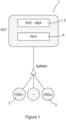
- FIG. 1 illustrates traditional PON indicated by the reference numeral 1
- a single DBA scheme 2 is implemented on OLT hardware in a physical layer 4.
- PHY-DBA The problem within the multi-tenancy architecture is that only the infrastructure provider controls the PHY-DBA function. Consequently, all of the VNOs will not be able to control the upstream DBA process of their own customers/services, and at best only work on an assured rate service, without the ability to schedule the burst allocation of their customers ONUs 3. This feature becomes important in order for the VNO to control additional parameters such as jitter, latency and availability.
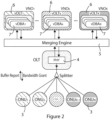
- Multi-Tenant architecture comprising of three layers is shown in Figure 2 .
- a physical layer 4 remains the same as in traditional PONs.
- the main difference is that it directs the DBRu (for example the ITU XGS-PON protocol) from the ONU T-CONTs to a merging engine 5, which directly forwards them to one or more virtual DBA (vDBA) engines 6 that are in charge of assigning capacity to them.
- DBRu for example the ITU XGS-PON protocol
- vDBA virtual DBA
- the PHY layer 4 can be controlled by the Infrastructure Provider.
- a Virtual DBA, vDBA, layer 7 is controlled by one or more VNO's 6, which has full control over the choice of the most appropriate virtual DBA algorithm to run on its virtual PON slice.
- the vDBA 7 calculates a virtual bandwidth map (vBMap) for its PON slice and delivers it to the merging engine 5.
- vDBA 6 operates a feedback loop with the merging engine 5 and on the level of precisions it intends to assign capacity, which is related to the type of application transported.
- the merging engine 5 comprises a merging engine layer which has two main tasks. First, it is responsible for communications with the vDBAs controlled by the VNOs. The merging engine layer passes upstream buffer reports (DBRus or report frames) to vDBA and it receives the corresponding virtual bandwidth grants (virtual bandwidth maps or virtual gate messages). Second, the merging layer analyzes the virtual bandwidth grants from all vDBAs, merging them into one physical bandwidth grant (bandwidth maps or gate frames). Within the context of a PON, the merging engine layer is responsible for merging virtual bandwidth maps generated from virtual DBAs, generating a physical BMap (PHY-BMap). This is the bandwidth map that can be sent over the PON physical interface.
- DBRus or report frames upstream buffer reports
- VNOs virtual bandwidth grants
- the merging layer analyzes the virtual bandwidth grants from all vDBAs, merging them into one physical bandwidth grant (bandwidth maps or gate frames).
- the merging engine layer is responsible for merging virtual bandwidth maps generated from
- DBRUs can also be generated by applications that interface directly with a vDBA.
- front haul for example DBRus for specific T-CONTs could be generated by an interface between the BBU scheduling process and the vDBA, rather than by the ONU.
- the merging engine 5 can be adapted to implement a scheme and architecture for overall capacity sharing, where the concept of wavelength channels is completely abstracted to the virtual operators, which can thus operate a virtual PON at any desired capacity, by using a subset of the capacity of one wavelength or merging capacity from multiple wavelengths together.
- the overall PON might operate over 8 wavelengths of 10 Gb/s capacity each, virtual operators could dynamically operate over an aggregate capacity of say 6 Gb/s, or 18 Gb/s or any other value within the overall capacity limit.
- the VNO can define a committed information rate (CIR), which will be always guaranteed by the PON (or guaranteed within a percentage of time) and a peak information rate (PIR) higher than the CIR, that is allowed if there is spare capacity. Traffic rates above the PIR are automatically rejected (or could be delayed if the admission control system operates a traffic shaper rather than a traffic policer). This allows the physical operator to decide how much traffic can be assigned to the operators as CIR (in principle the sum of CIRs assigned to multiple VNOS should not be larger than the overall system capacity, but some overbooking could be done according to the availability considered in the contract between VNOs and Infrastructure Provider (IP)).
- CIR committed information rate
- IP Infrastructure Provider
- the system and method allows virtual operators to identify the class of service of the applications transported. Since the invention allows multiplexing of operators and services (some with very tight performance requirements), it is important that the VNO defines the requirement class of each transported service.
- QoS-T-CONTs quality of service (QoS) requirements but those are only considered in terms of CIR and PIR (i.e., typically of today's systems).
- QoS-T-CONTs The T-CONTs associated to such services are referred to QoS-T-CONTs.
- a second class of traffic is where additional constraints other than CIR/PIR capacity need to be satisfied in order for the system to work properly. In this case additional parameters such as jitter, latency and availability are specified for what we call strict-QOS T-CONTs.
- a third class of traffic is only for best effort.
- Availability is defined as the percentage of time that the QoS (intended as an arbitrary but pre-established mix of capacity, jitter, latency and availability requirements) will be met on a specific T-CONT.
- a Frame Level Sharing (FLS) architecture 10 is provided, shown in Figure 3 , to facilitate the coexistence of multiple VNOs in the PON.
- the FLS architecture 10 falls under the category of medium access control layer sharing and includes a new layer, the merging engine, to be placed on top of a PON transmission convergence (TC) layer 12.
- TC PON transmission convergence
- a XGS-PON standard is used, although the work can be applied to other types of ITU-T PON standards.
- the bandwidth requests (DBRus) from the Optical Network Units (ONUs) 3 are relayed by the TC layer 12 to the vDBA instance of the corresponding VNO.
- Such virtual instance can physically run, for example, on a server in the central office, also owned by the PON infrastructure provider.
- each VNO 6 can calculate a virtual Bandwidth Map (vBWMap), achieving full control over the capacity scheduling to the ONUs it serves.
- the merging engine layer shown Figure 3 has two main tasks. First, it is responsible for handling the communications to each vDBA instance. It passes the upstream buffer reports (DBRus) to the vDBA and it receives the corresponding virtual bandwidth maps from each VNO. Second. It performs a full analysis on all the received vBWMaps, merging them into one physical bandwidth map 11. This analysis includes both grant sizing approach and grant scheduling algorithm within the next upstream frame. This operation is critical to solve the contention between conflicting vBWMap allocations, and within the context of XGS-PON.
- DBRus upstream buffer reports
- vDBA and merging engines can be implemented.
- QoS T-CONTs can be employed.
- vDBA 7 and Merging Engine (ME) 5 do not agree to any specific class definition and there is no admission control carried out by the ME on specific T-CONTs, reuses most of the current DBA mechanisms, for maximum backward compatibility.
- the merging engine simply passes the DBRu requests from the ONUs to the appropriate vDBA engines.
- Each vDBA engine operates a schedule of the upstream resources and creates a bandwidth map (BMap) as defined in the PON standards. All BMaps are then forwarded to the merging engine, which merges them together.
- BMap bandwidth map
- the vDBA might not be synchronised to the ME, meaning that while the ME generates a BMap for each frame, some of the vDBA might miss the current allocation if the virtual BMap they generate arrives to the ME after a given time and will instead be allocated for the next frame.
- a synchronous version can also be considered where instead all vDBAs are aware (being synchronised to the ME) of the timing they need to send their vBMap.
- the ME only checks whether traffic is consistent with CIR and PIR policies and then merges the vBMap from the multiple VNOs into one physical BMap. This simpler ME algorithm will merge the vBMap minimising the change in allocations.
- a more advanced ME algorithm can also minimize the allocation of non-adjacent ONU transmissions within the same frame. This is useful where the same ONU is served by more than one VNO, and can reduce the transmission overhead associated with multiple upstream burst from the same ONU. The additional capacity can then be exploited by the IP to increase the overall CIR and PIR budget.
- T-CONT allocation is assigned by concatenating the vBMaps of each VNO, after having compacted the allocation within each vBMap (i.e. remove any gap between T-CONT assignment, except for the mandatory guard interval between burst transmissions).
- vDBAs have no constraints to give vBMap every frame.
- Each vDBA can assign each service interval (SI) independently as long as the ME assigns to each VNOs its own share of every upstream frame.
- SI service interval
- a more sophisticated algorithm can be done to shift one of the vDBA if the ME notices that frequent and repetitive idle upstream frames are scheduled.
- Another embodiment can employ a coordinated vDBA allocation with jitter, latency and availability assurance: strict-QoS TCONT-s.
- strict-QoS TCONT-s strict-QoS TCONT-s.
- traffic is appropriately tagged to the specific class of service (e.g., to define jitter, latency and availability that can be supported).
- class of service e.g., to define jitter, latency and availability that can be supported.
- vDBA calculates a vBMap autonomously, associating the traffic slot allocation to specific T-CONTs.
- the ME When the ME tries to put together the multiple vBMaps from the different vDBAs into the PHY-BMap, it will first allocate the non-overlapping parts of the BMap, and where overlapping occurs give priority to the T-CONTs with stricter jitter/latency/availability requirements, shifting the lower priority T-CONTs.
- best effort T-CONTs can be moved anywhere along the PHY-BMap or allocated on different frames.
- QoS T-CONTs can also be moved over a number of frames.
- the ME can provide feedback to the vDBA proposing a different allocation. If the vDBA can accept it (i.e., it is still compliant to its QoS requirement) the ME will allocate the capacity.
- this mechanism can work best for services with static capacity requirement (such as front haul types of applications), as the admission control can be applied when the service starts and kept there for a number of frames before being updated.
- the admission control system will have to guarantee strict QoS up to a maximum capacity. If more capacity is request a new admission control with a higher capacity threshold will need to be agreed.
- the engine can propose to the vDBA to accept a different allocation. It could be argued that while doing so would allow the ME to guarantee the established value of jitter, it might move the problem towards the VNO which will see an increase the jitter of the service. Ultimately it is the end-to-end jitter that matters to the application.
- the jitter is a differential quantity, thus if the strict-QoS T-CONT is permanently shifted to a different place, it's jitter will settle to low values (as far as the additional latency caused can be tolerated).
- the vDBA does not specify exactly where the T-CONTs need to be allocated in the vBMap, but uses the vBMap to convey information about the T-CONTs class of service.
- the ME has in this case more freedom in choosing where in the PHY-BMap to place the T-CONTs allocations.
- jitter Since jitter is a differential value, it needs to be calculated over at least two consecutive T-CONTs allocations. In practice this is often calculated over a number of allocations and measured as a variance.
- the following algorithms describe a number of implementations for the ME for controlling jitter in the PHY-BMap allocation.
- This algorithm works through a moving window that covers a number of frames, to calculate the average latency and from that the jitter as the variance of the delay on each strict-QoS T-CONT transmission.
- the ME merges the vBMaps requests into one that minimises the calculated jitter for that frame. Since it is envisaged that the time might be too short for calculating optimal solutions, a heuristic should be considered for the implementation of the ME algorithm.
- a variance of this algorithm is also proposed that rather than just minimising the jitter across all strict-QoS T-CONTs in the frame also tries to provide fairness among different strict-QoS T-CONTs. It will thus also try to minimise the individual jitter of each strict-QoS T-CONT, bringing more fairness into the system. It is envisaged that a heuristic algorithm will be employed also in this case, whose complexity will probably be larger than the WJM algorithm.
- the merging engine defines starting point(s) for each strict-QoS T-CONT within each/multiple upstream frames according to the required Jitter constraints (max and average) for each service.
- each running vDBA is aware of its allocated share of the upstream capacity, Ci.
- Ci the cumulative grant size of the produced virtual bandwidth cannot under any circumstances exceed the corresponding VNO share of the upstream frame.
- This policy helps reducing the merging engine task complexity.
- the merging engine shall keep the size of the received bandwidth grants as they are. It will only perform simple a scheduling algorithm to ensure that the complete bandwidth map has no overlapped grants.
- the capacity sharing policy compromises between bandwidth utilization efficiency and VNOs isolation.
- the policy works as follows.
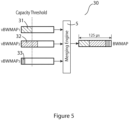
- Each vDBA acts as if it owns the whole PON capacity and produces the corresponding virtual bandwidth maps. Consequently, these vBWMaps 32, 32 and 33 can have cumulative grant size as large as the whole upstream frame.
- the merging engine layer 5 task is more sophisticated in order to process the virtual bandwidth maps from all VNOs and produce the final bandwidth map.
- grant sizing the merging engine acts as follows:
- the bandwidth grants reduction process cuts the non-guaranteed bandwidth grants starting from the most delay tolerant T-CONT and going higher if necessary, the merging engine layer starts reducing best effort traffic grants first. If it is still not enough, non-assured traffic bandwidth grants are also to be reduced.
- the analysis described is based on a single-wavelength system, the concept can be easily extended to multi-wavelength systems, where for example to total PON capacity across multiple wavelengths can be virtualized into slices with fine granularity of capacity (for example virtual slices do not need to operate as 10G PONs, but could be dynamically assigned for example as 4G PONs or 18G PONs, as required).
- the invention can also be easily adapted to applications requiring very low latency, like front haul.
- the BBU could embed the DBA and generate the bandwidth map without waiting for DBRu messages, thus enabling tight synchronization between BBU and OLT.
- a SDN system can be used to calculate the overall QoS requirement parameters, and calculate the relative values of capacity, jitter, latency and availability that should apply to the PON section.
- the embodiments in the invention described with reference to the drawings comprise a computer apparatus and/or processes performed in a computer apparatus.
- the invention also extends to computer programs, particularly computer programs stored on or in a carrier adapted to bring the invention into practice.
- the program may be in the form of source code, object code, or a code intermediate source and object code, such as in partially compiled form or in any other form suitable for use in the implementation of the method according to the invention.
- the carrier may comprise a storage medium such as ROM, e.g. CD ROM, or magnetic recording medium, e.g. a memory stick or hard disk.
- the carrier may be an electrical or optical signal which may be transmitted via an electrical or an optical cable or by radio or other means.
Landscapes
- Engineering & Computer Science (AREA)
- Computer Networks & Wireless Communication (AREA)
- Signal Processing (AREA)
- Small-Scale Networks (AREA)
Claims (9)
- System zur Virtualisierung von dynamischer Bandbreitenzuweisung (DBA), umfassend ein passives optisches Netzwerk mit einem optischen Leitungsabschlusspunkt (OLT) und einer Mehrzahl von optischen Netzwerkeinheiten (ONU) und einer Mehrzahl von virtuellen Netzwerkoperateuren (VNO), die das passive optische Netzwerk (PON) teilen, wobei jeder VNO (6) mit einem oder mehreren virtuellen dynamischen Bandbreitenzuweisungsmodulen (7) zum Einplanen einer Bandbreitenzuweisung unabhängig von anderen VNOs der Mehrzahl von VNOs konfiguriert ist; wobei das System Folgendes umfasst:ein Vereinigungsmodul (5) angepasst zum Kommunizieren eines Pufferberichts oder von Berichtsrahmen vom OLT-Punkt an jedes virtuelle dynamische Bandbreitenzuweisungsmodul (7) jedes VNOs (6), und angepasst zum Empfangen einer virtuellen Bandbreitenmap für jeden Rahmen von jedem virtuellen dynamischen Bandbreitenzuweisungsmodul (7) jedes VNOs (6), wobei das Vereinigungsmodul (5) zum Vereinigen der von jedem VNO (6) empfangenen virtuellen Bandbreitenmaps für einen Rahmen in eine einzelne zusammenhängende physische Bandbreitenmap-(11)-Zuweisung für den Rahmen konfiguriert ist, die an die Mehrzahl von optischen Netzwerkeinheiten (3) eingeplant ist, um eine Bandbreitenplanungszuweisung über das geteilte passive optische Netzwerk zu implementieren;wobei das passive optische Netzwerk ein mit mehreren Wellenlängen betriebenes System ist; undwobei mindestens ein VNO (6) angepasst ist, ohne Information über die physische Zuweisung von Wellenlängen durch das Vereinigungsmodul (5) zu arbeiten und dynamische Bandbreitenzuweisung zu erzeugen und Bandbreitenmaps bereitzustellen.
- System nach Anspruch 1, wobei das Vereinigungsmodul (5) zum Gebrauch eines Optimierungsalgorithmus angepasst ist, um zu bestimmen, wie die virtuellen Bandbreitenmaps in einer Weise zu vereinigen sind, die eine Wahrscheinlichkeit, eine Randbedingung aus einer Dienstqualitätsvereinbarung nicht zu erfüllen, minimiert.
- System nach einem der vorangehenden Ansprüche, wobei ein Optimierungsalgorithmus eine optimale Einplanung von virtuellen dynamischen Bandbreitenzuweisungen über mehrere Wellenlängen in einem Multi-Wellenlängen-System bereitstellt.
- System nach einem der vorangehenden Ansprüche, wobei das Vereinigungsmodul (5) angepasst ist, dynamisch eine einzelne optische Netzwerkeinheit zu verschiedenen Wellenlängen zuzuweisen, um die Fähigkeit zu optimieren, gewünschte Dienstqualitätsanforderungen zu erfüllen.
- Verfahren zur Virtualisierung von dynamischer Bandbreitenzuweisung (DBA) in einem passiven optischen Netzwerk, umfassend einen optischen Leitungsabschlusspunkt (OLT) und eine Mehrzahl von optischen Netzwerkeinheiten (ONU) und eine Mehrzahl von virtuellen Netzwerkoperateuren (VNO), die das passive optische Netzwerk teilen, wobei das Verfahren Folgendes umfasst:Konfigurieren jedes VNOs mit einem virtuellen dynamischen Bandbreitenzuweisungsmodul und Einplanen einer Bandbreitenzuweisung unabhängig von anderen VNOs der Mehrzahl von VNOs;Implementieren einer Bandbreitenplanungszuweisung über das geteilte passive optische Netzwerk durch Konfigurieren eines Vereinigungsmoduls zum Kommunizieren eines Pufferberichts oder von Berichtsrahmen vom OLT-Punkt an jedes virtuelle dynamische Bandbreitenzuweisungsmodul jedes VNOs, und zum Empfangen einer virtuellen Bandbreitenmap für jeden Rahmen von jedem virtuellen dynamischen Bandbreitenzuweisungsmodul jedes VNOs; undVereinigen der von jedem VNO empfangenen virtuellen Bandbreitenmaps für einen Rahmen in eine einzelne zusammenhängende physische Bandbreitenmapzuweisung für den Rahmen, die an die Mehrzahl von optischen Netzwerkeinheiten eingeplant ist, um die Bandbreitenplanungszuweisung zu implementieren; undmindestens einen VNO angepasst, ohne Information über die physische Zuweisung von Wellenlängen durch das Vereinigungsmodul zu arbeiten und dynamische Bandbreitenzuweisung zu erzeugen und Bandbreitenmaps bereitzustellen.
- Verfahren nach Anspruch 5, umfassend die Verwendung eines Optimierungsalgorithmus zum Bestimmen, wie die virtuellen Bandbreitenmaps im Vereinigungsmodul in einer Weise zu vereinigen sind, die eine Wahrscheinlichkeit, eine Randbedingung aus einer Dienstqualitätsvereinbarung nicht zu erfüllen, minimiert.
- Verfahren nach Anspruch 5, ferner umfassend die Verwendung eines Optimierungsalgorithmus, um eine optimale Einplanung von virtuellen dynamischen Bandbreitenzuweisungen über mehrere Wellenlängen in einem Multi-Wellenlängen-System bereitzustellen.
- Verfahren nach einem der Ansprüche 5 bis 7, ferner umfassend das Anpassen des Vereinigungsmoduls zum dynamischen Zuweisen einer einzelnen optischen Netzwerkeinheit zu verschiedenen Wellenlängen, um die Fähigkeit zu optimieren, gewünschte Dienstqualitätsanforderungen zu erfüllen.
- Computerprogramm oder Software umfassend Programminstruktionen zum Veranlassen des Systems nach einem der Ansprüche 1 bis 4, die Schritte des Verfahrens nach einem der Ansprüche 5 bis 8 auszuführen.
Applications Claiming Priority (2)
| Application Number | Priority Date | Filing Date | Title |
|---|---|---|---|
| GBGB1704185.6A GB201704185D0 (en) | 2017-03-16 | 2017-03-16 | System and method for dynamic bandwidth assignment (DBA) Virtualization in a multi-tenant passive optical network |
| PCT/EP2018/056767 WO2018167318A1 (en) | 2017-03-16 | 2018-03-16 | System and method for dynamic bandwidth assignment (dba) virtualization in a multi-tenant passive optical network |
Publications (3)
| Publication Number | Publication Date |
|---|---|
| EP3596936A1 EP3596936A1 (de) | 2020-01-22 |
| EP3596936B1 true EP3596936B1 (de) | 2023-09-20 |
| EP3596936C0 EP3596936C0 (de) | 2023-09-20 |
Family
ID=58688369
Family Applications (1)
| Application Number | Title | Priority Date | Filing Date |
|---|---|---|---|
| EP18716518.8A Active EP3596936B1 (de) | 2017-03-16 | 2018-03-16 | System und verfahren zur virtualisierung von dynamischer bandbreitenzuweisung (dba) in einem mandantenfähigen passiven optischen netzwerk |
Country Status (5)
| Country | Link |
|---|---|
| US (1) | US11115736B2 (de) |
| EP (1) | EP3596936B1 (de) |
| JP (1) | JP7309610B2 (de) |
| GB (1) | GB201704185D0 (de) |
| WO (1) | WO2018167318A1 (de) |
Families Citing this family (17)
| Publication number | Priority date | Publication date | Assignee | Title |
|---|---|---|---|---|
| JP7200737B2 (ja) * | 2019-02-21 | 2023-01-10 | 沖電気工業株式会社 | 局側装置、帯域割当プログラムおよび帯域割当方法 |
| CN110446122B (zh) * | 2019-05-31 | 2020-09-25 | 广东电网有限责任公司 | 一种光纤无线融合网络跨域协同资源分配方法 |
| CN114365459B (zh) * | 2019-09-18 | 2024-05-14 | 三菱电机株式会社 | 网络控制装置、通信资源分配方法以及通信系统 |
| GB2587235A (en) * | 2019-09-20 | 2021-03-24 | The Provost Fellows Scholars And The Other Members Of Board Of Trinity College Dublin | Apparatus and method for network scheduling |
| CN111193715B (zh) * | 2019-12-09 | 2021-06-29 | 北京邮电大学 | 无源光网络的业务调度方法、装置、电子设备及存储介质 |
| US12149287B2 (en) * | 2020-01-07 | 2024-11-19 | Nippon Telegraph And Telephone Corporation | Upbandwidth allocation device and uplink bandwidth allocation method |
| CN111464890B (zh) * | 2020-03-31 | 2021-09-07 | 烽火通信科技股份有限公司 | 一种网络切片的动态带宽分配方法及olt |
| CN113727389B (zh) * | 2020-05-25 | 2025-09-12 | 华为技术有限公司 | 确定传输业务流的带宽的方法、设备和系统 |
| JP7393699B2 (ja) * | 2020-07-27 | 2023-12-07 | 日本電信電話株式会社 | 光通信システム及び光通信方法 |
| JP7605306B2 (ja) * | 2021-06-08 | 2024-12-24 | 日本電信電話株式会社 | 通信スケジュール割当装置、通信スケジュール割当方法及びプログラム |
| CN113453099B (zh) * | 2021-09-01 | 2021-12-24 | 武汉长光科技有限公司 | 组播配置方法、系统、装置、电子设备及存储介质 |
| EP4161030A1 (de) * | 2021-09-30 | 2023-04-05 | Nokia Solutions and Networks Oy | Bandbreitenzuweisung |
| JP7374394B2 (ja) * | 2021-11-26 | 2023-11-06 | 三菱電機株式会社 | 光回線終端装置、光アクセスネットワークシステムおよび光通信方法 |
| CN117177104A (zh) * | 2022-05-27 | 2023-12-05 | 中国移动通信有限公司研究院 | 一种信息反馈方法、设备及存储介质 |
| CN116233659A (zh) * | 2023-03-10 | 2023-06-06 | 南京邮电大学 | 一种用交织器实现的灵活twdm-pon方法及系统 |
| CN116896698B (zh) * | 2023-09-11 | 2024-01-02 | 广州市成格信息技术有限公司 | 一种全光局域网中实现多业务承载的方法及系统 |
| CN119815214B (zh) * | 2024-06-17 | 2025-12-09 | 北京邮电大学 | 一种多用户多业务无源光网络动态带宽分配方法 |
Family Cites Families (7)
| Publication number | Priority date | Publication date | Assignee | Title |
|---|---|---|---|---|
| US7564852B2 (en) * | 2005-07-20 | 2009-07-21 | Cortina Systems, Inc. | Intelligent bandwidth allocation for ethernet passive optical networks |
| CN101656894B (zh) * | 2008-08-20 | 2012-11-21 | 华为技术有限公司 | 包分插复用设备及包分插复用设备的数据传输方法 |
| GB2489922A (en) * | 2011-04-06 | 2012-10-17 | Univ Bangor | Synchronising optical OFDM signal with pattern of DC offset levels superimposed upon OFDM symbols |
| US8917993B2 (en) * | 2011-06-17 | 2014-12-23 | Calix, Inc. | Scheduling delivery of upstream traffic based on downstream traffic in optical networks |
| US8976688B2 (en) * | 2011-06-17 | 2015-03-10 | Calix, Inc. | Grant scheduler for optical network devices |
| JP5822689B2 (ja) | 2011-11-29 | 2015-11-24 | 三菱電機株式会社 | Ponシステム、局側光終端装置および帯域制御方法 |
| JP5889809B2 (ja) | 2013-01-23 | 2016-03-22 | 日本電信電話株式会社 | 光加入者システム及び光加入者システムの動的波長帯域割当方法 |
-
2017
- 2017-03-16 GB GBGB1704185.6A patent/GB201704185D0/en not_active Ceased
-
2018
- 2018-03-16 JP JP2019550855A patent/JP7309610B2/ja active Active
- 2018-03-16 US US16/494,270 patent/US11115736B2/en active Active
- 2018-03-16 EP EP18716518.8A patent/EP3596936B1/de active Active
- 2018-03-16 WO PCT/EP2018/056767 patent/WO2018167318A1/en not_active Ceased
Non-Patent Citations (1)
| Title |
|---|
| SEDDIKI M SAID ET AL: "Automated controllers for bandwidth allocation in network virtualization", 2013 IEEE 32ND INTERNATIONAL PERFORMANCE COMPUTING AND COMMUNICATIONS CONFERENCE (IPCCC), IEEE, 6 December 2013 (2013-12-06), pages 1 - 7, XP032569965, DOI: 10.1109/PCCC.2013.6742795 * |
Also Published As
| Publication number | Publication date |
|---|---|
| EP3596936A1 (de) | 2020-01-22 |
| WO2018167318A1 (en) | 2018-09-20 |
| US11115736B2 (en) | 2021-09-07 |
| GB201704185D0 (en) | 2017-05-03 |
| JP2020510357A (ja) | 2020-04-02 |
| JP7309610B2 (ja) | 2023-07-18 |
| EP3596936C0 (de) | 2023-09-20 |
| US20210120321A1 (en) | 2021-04-22 |
Similar Documents
| Publication | Publication Date | Title |
|---|---|---|
| EP3596936B1 (de) | System und verfahren zur virtualisierung von dynamischer bandbreitenzuweisung (dba) in einem mandantenfähigen passiven optischen netzwerk | |
| KR101358795B1 (ko) | 상이한 동조 시간들을 가지는 가변 레이저들을 구비한 wdm pon 스케줄링 | |
| Bhattacharjee et al. | Network slicing for TSN-based transport networks | |
| Kanonakis et al. | Dynamic software-defined resource optimization in next-generation optical access enabled by OFDMA-based meta-MAC provisioning | |
| Khalili et al. | A proposal for an SDN-based SIEPON architecture | |
| Pesando et al. | Standardization of the 5th generation fixed network for enabling end-to-end network slicing and quality-assured services | |
| Mohammadani et al. | Load adaptive merging algorithm for multi-tenant PON environments | |
| Christodoulopoulos et al. | Deterministic passive optical networking | |
| Meng et al. | A joint transmission grant scheduling and wavelength assignment in multichannel SG-EPON | |
| Abed et al. | Proposed an efficient multilevel dynamic bandwidth allocation (M-DBA) scheme for FiWi networks | |
| Khalili et al. | Towards an integrated SDN-NFV architecture for EPON networks | |
| Elrasad et al. | Frame level sharing for DBA virtualization in multi-tenant PONs | |
| Guo et al. | Delay aware RSA algorithm based on scheduling of differentiated services with dynamic virtual topology construction | |
| Memon et al. | Dynamic bandwidth allocation in time division multiplexed passive optical networks: a dual-standard analysis of ITU-T and IEEE standard algorithms | |
| Radivojević et al. | Highly flexible and efficient model for QoS provisioning in WDM EPON | |
| Tong et al. | Priority-based mode transformation algorithm in a multisystem-based virtual passive optical network | |
| JP7605306B2 (ja) | 通信スケジュール割当装置、通信スケジュール割当方法及びプログラム | |
| Rafiq et al. | Bandwidth utilization and management algorithms (BUMAs) for NG-EPON | |
| Tyan et al. | On supporting temporal quality of service in WDMA-based star-coupled optical networks | |
| Ahmad et al. | Merging engine implementation for intra-frame sharing in multi-tenant virtual passive optical networks | |
| Zhu et al. | Integrated vone scheme over resource-virtualized elastic optical networks | |
| Hatano et al. | Standardization and technology trends in optical, wireless and virtualized access systems | |
| Malik et al. | Merging engine implementation with co-existence of independent dynamic bandwidth allocation algorithms in virtual passive optical networks | |
| Kiaei et al. | On the co-existence of 10G-EPONs and WDM-PONs: a scheduling and bandwidth allocation approach | |
| Ganguli et al. | Real-time capable, low-latency upstream scheduling in multi-tenant, SLA compliant TWDM PON |
Legal Events
| Date | Code | Title | Description |
|---|---|---|---|
| STAA | Information on the status of an ep patent application or granted ep patent |
Free format text: STATUS: UNKNOWN |
|
| STAA | Information on the status of an ep patent application or granted ep patent |
Free format text: STATUS: THE INTERNATIONAL PUBLICATION HAS BEEN MADE |
|
| PUAI | Public reference made under article 153(3) epc to a published international application that has entered the european phase |
Free format text: ORIGINAL CODE: 0009012 |
|
| STAA | Information on the status of an ep patent application or granted ep patent |
Free format text: STATUS: REQUEST FOR EXAMINATION WAS MADE |
|
| 17P | Request for examination filed |
Effective date: 20191015 |
|
| AK | Designated contracting states |
Kind code of ref document: A1 Designated state(s): AL AT BE BG CH CY CZ DE DK EE ES FI FR GB GR HR HU IE IS IT LI LT LU LV MC MK MT NL NO PL PT RO RS SE SI SK SM TR |
|
| AX | Request for extension of the european patent |
Extension state: BA ME |
|
| DAV | Request for validation of the european patent (deleted) | ||
| DAX | Request for extension of the european patent (deleted) | ||
| STAA | Information on the status of an ep patent application or granted ep patent |
Free format text: STATUS: EXAMINATION IS IN PROGRESS |
|
| 17Q | First examination report despatched |
Effective date: 20211203 |
|
| GRAP | Despatch of communication of intention to grant a patent |
Free format text: ORIGINAL CODE: EPIDOSNIGR1 |
|
| STAA | Information on the status of an ep patent application or granted ep patent |
Free format text: STATUS: GRANT OF PATENT IS INTENDED |
|
| INTG | Intention to grant announced |
Effective date: 20230425 |
|
| GRAS | Grant fee paid |
Free format text: ORIGINAL CODE: EPIDOSNIGR3 |
|
| GRAA | (expected) grant |
Free format text: ORIGINAL CODE: 0009210 |
|
| STAA | Information on the status of an ep patent application or granted ep patent |
Free format text: STATUS: THE PATENT HAS BEEN GRANTED |
|
| AK | Designated contracting states |
Kind code of ref document: B1 Designated state(s): AL AT BE BG CH CY CZ DE DK EE ES FI FR GB GR HR HU IE IS IT LI LT LU LV MC MK MT NL NO PL PT RO RS SE SI SK SM TR |
|
| REG | Reference to a national code |
Ref country code: GB Ref legal event code: FG4D |
|
| REG | Reference to a national code |
Ref country code: CH Ref legal event code: EP |
|
| REG | Reference to a national code |
Ref country code: DE Ref legal event code: R096 Ref document number: 602018057870 Country of ref document: DE |
|
| REG | Reference to a national code |
Ref country code: IE Ref legal event code: FG4D |
|
| U01 | Request for unitary effect filed |
Effective date: 20231017 |
|
| U07 | Unitary effect registered |
Designated state(s): AT BE BG DE DK EE FI FR IT LT LU LV MT NL PT SE SI Effective date: 20231025 |
|
| PG25 | Lapsed in a contracting state [announced via postgrant information from national office to epo] |
Ref country code: GR Free format text: LAPSE BECAUSE OF FAILURE TO SUBMIT A TRANSLATION OF THE DESCRIPTION OR TO PAY THE FEE WITHIN THE PRESCRIBED TIME-LIMIT Effective date: 20231221 |
|
| PG25 | Lapsed in a contracting state [announced via postgrant information from national office to epo] |
Ref country code: RS Free format text: LAPSE BECAUSE OF FAILURE TO SUBMIT A TRANSLATION OF THE DESCRIPTION OR TO PAY THE FEE WITHIN THE PRESCRIBED TIME-LIMIT Effective date: 20230920 Ref country code: NO Free format text: LAPSE BECAUSE OF FAILURE TO SUBMIT A TRANSLATION OF THE DESCRIPTION OR TO PAY THE FEE WITHIN THE PRESCRIBED TIME-LIMIT Effective date: 20231220 Ref country code: HR Free format text: LAPSE BECAUSE OF FAILURE TO SUBMIT A TRANSLATION OF THE DESCRIPTION OR TO PAY THE FEE WITHIN THE PRESCRIBED TIME-LIMIT Effective date: 20230920 Ref country code: GR Free format text: LAPSE BECAUSE OF FAILURE TO SUBMIT A TRANSLATION OF THE DESCRIPTION OR TO PAY THE FEE WITHIN THE PRESCRIBED TIME-LIMIT Effective date: 20231221 |
|
| PG25 | Lapsed in a contracting state [announced via postgrant information from national office to epo] |
Ref country code: IS Free format text: LAPSE BECAUSE OF FAILURE TO SUBMIT A TRANSLATION OF THE DESCRIPTION OR TO PAY THE FEE WITHIN THE PRESCRIBED TIME-LIMIT Effective date: 20240120 |
|
| PG25 | Lapsed in a contracting state [announced via postgrant information from national office to epo] |
Ref country code: ES Free format text: LAPSE BECAUSE OF FAILURE TO SUBMIT A TRANSLATION OF THE DESCRIPTION OR TO PAY THE FEE WITHIN THE PRESCRIBED TIME-LIMIT Effective date: 20230920 |
|
| PG25 | Lapsed in a contracting state [announced via postgrant information from national office to epo] |
Ref country code: SM Free format text: LAPSE BECAUSE OF FAILURE TO SUBMIT A TRANSLATION OF THE DESCRIPTION OR TO PAY THE FEE WITHIN THE PRESCRIBED TIME-LIMIT Effective date: 20230920 Ref country code: RO Free format text: LAPSE BECAUSE OF FAILURE TO SUBMIT A TRANSLATION OF THE DESCRIPTION OR TO PAY THE FEE WITHIN THE PRESCRIBED TIME-LIMIT Effective date: 20230920 Ref country code: IS Free format text: LAPSE BECAUSE OF FAILURE TO SUBMIT A TRANSLATION OF THE DESCRIPTION OR TO PAY THE FEE WITHIN THE PRESCRIBED TIME-LIMIT Effective date: 20240120 Ref country code: ES Free format text: LAPSE BECAUSE OF FAILURE TO SUBMIT A TRANSLATION OF THE DESCRIPTION OR TO PAY THE FEE WITHIN THE PRESCRIBED TIME-LIMIT Effective date: 20230920 Ref country code: CZ Free format text: LAPSE BECAUSE OF FAILURE TO SUBMIT A TRANSLATION OF THE DESCRIPTION OR TO PAY THE FEE WITHIN THE PRESCRIBED TIME-LIMIT Effective date: 20230920 Ref country code: SK Free format text: LAPSE BECAUSE OF FAILURE TO SUBMIT A TRANSLATION OF THE DESCRIPTION OR TO PAY THE FEE WITHIN THE PRESCRIBED TIME-LIMIT Effective date: 20230920 |
|
| U20 | Renewal fee for the european patent with unitary effect paid |
Year of fee payment: 7 Effective date: 20240329 |
|
| PG25 | Lapsed in a contracting state [announced via postgrant information from national office to epo] |
Ref country code: PL Free format text: LAPSE BECAUSE OF FAILURE TO SUBMIT A TRANSLATION OF THE DESCRIPTION OR TO PAY THE FEE WITHIN THE PRESCRIBED TIME-LIMIT Effective date: 20230920 |
|
| REG | Reference to a national code |
Ref country code: DE Ref legal event code: R097 Ref document number: 602018057870 Country of ref document: DE |
|
| PLBE | No opposition filed within time limit |
Free format text: ORIGINAL CODE: 0009261 |
|
| STAA | Information on the status of an ep patent application or granted ep patent |
Free format text: STATUS: NO OPPOSITION FILED WITHIN TIME LIMIT |
|
| 26N | No opposition filed |
Effective date: 20240621 |
|
| REG | Reference to a national code |
Ref country code: CH Ref legal event code: PL |
|
| PG25 | Lapsed in a contracting state [announced via postgrant information from national office to epo] |
Ref country code: MC Free format text: LAPSE BECAUSE OF FAILURE TO SUBMIT A TRANSLATION OF THE DESCRIPTION OR TO PAY THE FEE WITHIN THE PRESCRIBED TIME-LIMIT Effective date: 20230920 |
|
| PG25 | Lapsed in a contracting state [announced via postgrant information from national office to epo] |
Ref country code: MC Free format text: LAPSE BECAUSE OF FAILURE TO SUBMIT A TRANSLATION OF THE DESCRIPTION OR TO PAY THE FEE WITHIN THE PRESCRIBED TIME-LIMIT Effective date: 20230920 |
|
| PG25 | Lapsed in a contracting state [announced via postgrant information from national office to epo] |
Ref country code: IE Free format text: LAPSE BECAUSE OF NON-PAYMENT OF DUE FEES Effective date: 20240316 |
|
| PG25 | Lapsed in a contracting state [announced via postgrant information from national office to epo] |
Ref country code: IE Free format text: LAPSE BECAUSE OF NON-PAYMENT OF DUE FEES Effective date: 20240316 Ref country code: CH Free format text: LAPSE BECAUSE OF NON-PAYMENT OF DUE FEES Effective date: 20240331 |
|
| PGFP | Annual fee paid to national office [announced via postgrant information from national office to epo] |
Ref country code: GB Payment date: 20250326 Year of fee payment: 8 |
|
| U20 | Renewal fee for the european patent with unitary effect paid |
Year of fee payment: 8 Effective date: 20250331 |
|
| PG25 | Lapsed in a contracting state [announced via postgrant information from national office to epo] |
Ref country code: CY Free format text: LAPSE BECAUSE OF FAILURE TO SUBMIT A TRANSLATION OF THE DESCRIPTION OR TO PAY THE FEE WITHIN THE PRESCRIBED TIME-LIMIT; INVALID AB INITIO Effective date: 20180316 |
|
| PG25 | Lapsed in a contracting state [announced via postgrant information from national office to epo] |
Ref country code: HU Free format text: LAPSE BECAUSE OF FAILURE TO SUBMIT A TRANSLATION OF THE DESCRIPTION OR TO PAY THE FEE WITHIN THE PRESCRIBED TIME-LIMIT; INVALID AB INITIO Effective date: 20180316 |
|
| PG25 | Lapsed in a contracting state [announced via postgrant information from national office to epo] |
Ref country code: TR Free format text: LAPSE BECAUSE OF FAILURE TO SUBMIT A TRANSLATION OF THE DESCRIPTION OR TO PAY THE FEE WITHIN THE PRESCRIBED TIME-LIMIT Effective date: 20230920 |