EP3596581B1 - Schnittstelle zur taktilen stimulation unter verwendung von zeitumkehrung und zur bereitstellung von gesteigerten empfindungen - Google Patents
Schnittstelle zur taktilen stimulation unter verwendung von zeitumkehrung und zur bereitstellung von gesteigerten empfindungen Download PDFInfo
- Publication number
- EP3596581B1 EP3596581B1 EP18724957.8A EP18724957A EP3596581B1 EP 3596581 B1 EP3596581 B1 EP 3596581B1 EP 18724957 A EP18724957 A EP 18724957A EP 3596581 B1 EP3596581 B1 EP 3596581B1
- Authority
- EP
- European Patent Office
- Prior art keywords
- tactile
- given
- stimulation
- point
- actuator
- Prior art date
- Legal status (The legal status is an assumption and is not a legal conclusion. Google has not performed a legal analysis and makes no representation as to the accuracy of the status listed.)
- Active
Links
Images


Classifications
-
- G—PHYSICS
- G06—COMPUTING OR CALCULATING; COUNTING
- G06F—ELECTRIC DIGITAL DATA PROCESSING
- G06F3/00—Input arrangements for transferring data to be processed into a form capable of being handled by the computer; Output arrangements for transferring data from processing unit to output unit, e.g. interface arrangements
- G06F3/01—Input arrangements or combined input and output arrangements for interaction between user and computer
- G06F3/016—Input arrangements with force or tactile feedback as computer generated output to the user
-
- G—PHYSICS
- G06—COMPUTING OR CALCULATING; COUNTING
- G06F—ELECTRIC DIGITAL DATA PROCESSING
- G06F3/00—Input arrangements for transferring data to be processed into a form capable of being handled by the computer; Output arrangements for transferring data from processing unit to output unit, e.g. interface arrangements
- G06F3/01—Input arrangements or combined input and output arrangements for interaction between user and computer
- G06F3/03—Arrangements for converting the position or the displacement of a member into a coded form
- G06F3/041—Digitisers, e.g. for touch screens or touch pads, characterised by the transducing means
- G06F3/0414—Digitisers, e.g. for touch screens or touch pads, characterised by the transducing means using force sensing means to determine a position
- G06F3/04142—Digitisers, e.g. for touch screens or touch pads, characterised by the transducing means using force sensing means to determine a position the force sensing means being located peripherally, e.g. disposed at the corners or at the side of a touch sensing plate
-
- G—PHYSICS
- G06—COMPUTING OR CALCULATING; COUNTING
- G06F—ELECTRIC DIGITAL DATA PROCESSING
- G06F2203/00—Indexing scheme relating to G06F3/00 - G06F3/048
- G06F2203/01—Indexing scheme relating to G06F3/01
- G06F2203/014—Force feedback applied to GUI
-
- G—PHYSICS
- G06—COMPUTING OR CALCULATING; COUNTING
- G06F—ELECTRIC DIGITAL DATA PROCESSING
- G06F2203/00—Indexing scheme relating to G06F3/00 - G06F3/048
- G06F2203/048—Indexing scheme relating to G06F3/048
- G06F2203/04808—Several contacts: gestures triggering a specific function, e.g. scrolling, zooming, right-click, when the user establishes several contacts with the surface simultaneously; e.g. using several fingers or a combination of fingers and pen
-
- G—PHYSICS
- G06—COMPUTING OR CALCULATING; COUNTING
- G06F—ELECTRIC DIGITAL DATA PROCESSING
- G06F2203/00—Indexing scheme relating to G06F3/00 - G06F3/048
- G06F2203/048—Indexing scheme relating to G06F3/048
- G06F2203/04809—Textured surface identifying touch areas, e.g. overlay structure for a virtual keyboard
Definitions
- the present invention relates to a time-reversal tactile stimulation interface providing enriched sensations and to a method of controlling such an interface.
- a tactile stimulation interface is intended to restore tactile information, such as a texture, a relief, a roughness varying in time and/or space, an illusion of pressing on a flexible material, of pressing a key.
- Such interfaces are used for example in the field of human-machine interfaces. They can also be used in the fields of optics, acoustics, chemistry, and automated manufacturing...
- Some interfaces use an array of actuators, such as piezoelectric or electrostatic, arranged under the surface in the areas where the fingers are intended to come into contact. When one of the actuators is activated, the entire surface is vibrated, and the user touching the surface with several fingers feels the same stimulation on all fingers.
- actuators such as piezoelectric or electrostatic
- WO 2013/182611 A1 describes a time-reversal tactile stimulation interface, allowing the display of tactile stimuli of variable shapes and dimensions.
- US 2012/0326999 A1 describes a touch interface device that includes a touch surface configured to contact an object, first and second actuation assemblies operatively coupled to the touch surface, and a controller operatively coupled to the first and second actuation assemblies.
- the controller operates the first and second actuation assemblies such that the touch surface has variable contact with the object to apply a force to the object on the touch surface.
- US 2011/0199342 A1 describes an apparatus and method for providing non-contact raised, indented, or textured sensations to an object remote from a display device using ultrasonic waves. Methods involving raised, indented, or textured sensations on an object proximate to or in contact with a display device using airborne ultrasound or ultrasonic waves are also described.
- the interface comprises a glass plate and actuators arranged in contact with and on the periphery of the glass plate.
- the piezoelectric actuators propagate waves acoustics in the glass plate.
- the implementation of a time reversal process has the advantage of allowing a vibration to be generated in a localized manner on the surface of the plate and allows the different fingers to be stimulated separately; this tactile feedback is also called "multitouch localized tactile feedback”.
- This paper proposes to repeat the time-reversal focusing process to form a train of surface displacement pulses to provide intensified stimulation.
- a tactile stimulation touch interface according to claim 1 and by a method for controlling a tactile stimulation touch interface according to claim 9.
- This document also describes a tactile stimulation interface implementing a time reversal method, said interface comprising a surface intended to be explored tactilely by a user and at least one actuator intended to apply a force to the surface, means for controlling said actuator, said control means determining the force by the time reversal method.
- the control means send control signals to said actuator so that, to generate the same stimulation, the at least one actuator generates pulses by focusing acoustic waves at a point whose location on the surface varies over time. The different locations of the pulses are located in the area covered for example by the pulp of the finger in contact with the surface.
- control means control the actuator so as to at least spatially modulate the location of the focal point to generate the same haptic pattern, thereby rendering a wide range of tactile sensations.
- the inventors found that the perceived dimension of the focal point by the user was of the order of 1 mm to 2 mm, smaller than the actual size of the focal task which is of the order of 5 mm. They then determined that by moving the focal point over time to generate the same stimulation, the spatial dimension perceived by the user was greater, which made it possible to provide richer vibrotactile feedback than by repeated focusing at the same point of the surface.
- the stimulation is for example clicks of variable perceived shapes and amplitudes, a certain stiffness to reproduce the pressing of a button, a texture...
- This spatial modulation of the focal point is made possible by the good spatial resolution of the time reversal process.
- the displacement of the pulse point takes place under the contact area, for example under the fingertip that explores the surface.
- the distance between two focal points is between 100 ⁇ m and 1mm.
- a learning step makes it possible to establish a database of the impulse responses returned at a certain number of points on the surface, for example distributed in the form of a grid, and the impulse responses between the points of the database are determined by spatial interpolation.
- the focusing can be repeated over time and modulated in time and/or amplitude.
- the effort applied for example by the finger(s) and/or their position can be taken into account to spatially and advantageously temporally modulate the focusing.
- the surface is for example supported by a glass plate
- the actuators for example piezoelectric
- the actuators are in contact with the outer edge of the glass plate.
- the surface can then be transparent and can be that of a touch screen.
- the present invention then relates to a tactile stimulation interface comprising a surface intended to be explored tactilely by at least one organ of a user, at least one actuator intended to apply a force to said surface, and means for controlling said at least one actuator, said control means being intended to send to the actuator signals corresponding to the forces to be applied to said surface as a function of the tactile stimulation to be generated on the surface, said forces being determined by a time reversal method.
- the means control are such that, for at least one given tactile pattern, said at least one actuator is controlled so that it generates in at least one area of said surface, pulses by focusing at least one acoustic wave at a point whose location on the surface varies over time, so as to tactilely stimulate said organ according to the given tactile pattern.
- control means are capable of controlling said at least one actuator so that it generates pulses in several distinct zones by focusing acoustic waves at a point whose location on the surface varies over time, so as to tactilely stimulate several organs according to given tactile patterns.
- the tactile stimulation interface may advantageously comprise means for detecting the presence of said at least one organ intended to be tactilely stimulated, the detection means being for example of the capacitive type, and/or means for detecting the contact force between the at least one organ intended to be tactilely stimulated and the surface.
- the tactile stimulation interface can include several actuators.
- the surface is supported by a plate, the actuator(s) being located in contact with the plate at at least one edge thereof.
- the plate is transparent.
- the present invention also relates to a method for controlling a tactile stimulation interface according to the invention, so as to tactilely stimulate at least one organ according to a given tactile pattern in at least a first area of the surface, comprising a spatial modulation of at least one focal point of at least one acoustic wave generated by said at least one actuator.
- Steps a), b), c) and d) may be performed simultaneously for the first zone and for a second zone distinct from the first zone, and in step c) the signal sent to said actuator is the sum of the signal generated for the first zone and the signal generated for the second zone.
- the force exerted by the organ on the surface is measured and is taken into account in the generation of the signal.
- the pattern can have a variable amplitude and/or a variable pulse generation frequency.
- the returned impulse response is chosen from a database.
- the returned impulse response is determined by interpolation between at least two returned impulse responses chosen from a database.
- the presence of the organ intended to be tactilely stimulated is detected prior to step a).
- the touch surface is intended to be touched by the pulp of a finger D or of several fingers.
- the surface of the interface according to the invention is capable of applying stimulation to any part of the user's body sensitive to the sense of touch.
- the term "tactile pattern” or “tactile feedback” means a set of movements generated in a stimulation zone of the surface of the interface resulting from the activation of the actuators, felt by the part(s) of the body in contact with the surface, in order to reproduce a sensation such as a button being pressed, a texture, a click, etc.
- focus point refers to the point where the acoustic waves are focused and which is the site of a large amplitude displacement of the surface
- stimulation zone refers to the area where the tactile pattern is to be generated by successively generating several focus points to reproduce the same haptic pattern.
- the tactile interface I1 comprises a frame 2, an element 3 provided with a surface 4 held on the frame 2, and on which for example one or more fingers can come into contact, and actuators 6 fixed on the element 3 and capable of applying a mechanical stress to the surface 4, the stress being oriented transversely relative to the surface.
- the suspended part of the surface 4 forms a surface intended to be explored tactilely.
- Element 3 is, in the example shown, in the form of a plate.
- the frame forms a rigid support for the plate 3.
- a damping material 9 is interposed between the plate 3 and the frame.
- the damping material 9 is an adhesive foam, which in addition to attenuating vibrations in the plate 3, holds the plate 3 on the frame.
- the actuators 6 are fixed, for example by gluing on the face 11 of the plate 3 opposite the surface 4. In the example shown, the actuators are mounted along the edges of the plate. In another example, the actuators could be arranged at any point of the element 3. In addition, the actuators could be on the touch surface 4.
- the surface 4 is intended to be the seat of bending waves or transverse waves generated by the constraints applied by the actuators. According to the invention, the bending waves are focused so as to produce a tactile stimulation at the focal point.
- the element 3 carrying the surface 4 is for example a rigid substrate, transparent or not.
- the substrate can be flat or curved.
- the substrate can comprise one or more materials. In addition, it can have a thickness of between 0.1 mm and 5 mm.
- the element 3 carrying the surface 4 is for example a transparent plate made of glass, polycarbonate, PMMA, or a non-transparent plate made of metal, ceramic, plastic or other.
- a transparent substrate makes it possible, for example, to adapt the interface to a screen, for example to a touchscreen tablet screen.
- the actuators are piezoelectric actuators. They comprise a piezoelectric material and two electrodes on either side of the piezoelectric material allowing a potential difference to be applied to it. Applying a potential difference to the terminals of the piezoelectric actuator produces forces on the surface of the plate that are tangential to the plate. This force curves the surface of the plate. This results in a displacement in the direction perpendicular to the plane of the surface.
- the actuators may be electromagnetic.
- a force perpendicular to the plane of the surface is produced by the action of an electromagnetic field on a magnet.
- the magnet or coil is secured to the surface.
- the interface comprises thirty-two actuators, however this number is not limiting. For example, it is possible to provide 1, 10 or several dozen actuators, for example 40, distributed on the support along the edges of the plate.
- the interface also includes a control unit UC intended to generate signals to the actuators so that they apply forces to the surface, so as to generate bending waves at a given focal point.
- a control unit UC intended to generate signals to the actuators so that they apply forces to the surface, so as to generate bending waves at a given focal point.
- the forces applied by the actuators 6 on the surface 4 are calculated by a time reversal method, which allows the actuators to generate constructively interfering waves at one or more given points on the surface and at a desired time.
- the user feels, not the waves propagating in the plate but the pulse produced at the point(s) and at the desired time due to the constructive interference.
- the gain of the actuators is adjusted so that the amplitude everywhere else, outside the focal point, is such that the vibration is not perceived.
- the contrast which designates the ratio of the amplitude at the focal point by the mean square amplitude at any other point, is therefore a critical quantity that should be maximized to produce a clearly perceived stimulation at the focal point. without creating a stimulus at another point.
- the adhesive foam serves on the one hand to hold the plate on its support and on the other hand to attenuate its vibrations.
- This attenuation makes it possible to reduce the attenuation constant ⁇ and therefore to reduce the focusing repetition period T r without altering the repeated focusing contrast ⁇ , in accordance with the expression given below.
- This attenuation can also be adjusted by an appropriate choice of material for the plate or by adding a film to its surface.
- sensors detecting the presence of the user's fingers on the interface can also be implemented, which makes it possible to generate tactile stimulation only in the areas currently being explored by the fingers.
- the power consumption of the interface can then be reduced, which is particularly interesting in the case of tactile stimulation interfaces applied to portable devices.
- These may be, for example, optical or capacitive sensors.
- Finger position detection is for example achieved by capacitive means, the plate carrying the surface forming one of the plates of a variable capacitance capacitor and the fingertip forming the other plate. In addition it is possible to track the movement of the fingers.
- a device capable of measuring the value of the interaction force exerted locally or on the entire interface can also be added, in order to link the pulses produced by focusing to the forces exerted by the finger(s) in contact with the plate.
- the principle of time reversal of waves is based on the invariance of the equation of wave propagation by time reversal and on the principle of reciprocity.
- y q , t) be the out-of-plane displacement of the surface recorded over time t at a point with coordinates ( x a , y a ) after a pulse signal was emitted by an actuator at ( x q , y q ) .
- y q , t) the impulse response between points a and q.
- T the duration of the turning window
- ⁇ the time constant of attenuation of vibrations in the plate
- T c the characteristic time of the plate or modal density of the plate in seconds, or eigenmode per Hz
- B f max - f min the bandwidth, in hertz of the signals emitted by the actuators.
- a database of impulse responses returned at different points on the surface is then created; this database is used to generate the signals sent to the actuators.
- These can be all points on the surface or according to a very tight mesh, in order to offer a high resolution in the stimulation.
- a database of impulse responses is produced at a given number of points on the surface, for example distributed in the form of a grid or a contour of the surface and the impulse responses are determined between the points of the grid, for example by interpolation, which thus makes it possible to determine an impulse response at any point on the surface, and to reduce the time taken to produce the database and its size.
- the interpolation can be done using different methods, for example it can be a Fourier interpolation, the "Compressed Sensing" method, the methods of fundamental solutions, or a method based on a variational form of the propagation equation.
- the duration of the surface movements is variable, for example of the order of 10 ms to 100 ms, depending on the pattern to be reproduced and the desired contrast, and the efforts can be repeated at the desired frequency and amplitude.
- the contrast and amplitude obtained at the focal point depend on the dimension of the interface, the vibration damping and the number of actuators. The number of actuators can be chosen according to the interface.
- the actuator(s) are controlled to cause a displacement of the surface at a single point on the surface, this displacement being able to be repeated over time.
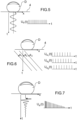
- the displacement of the surface takes place successively at different points on the surface located in the stimulation zone in contact with the fingertip. For example, on the figure 2 , we can see a finger on a surface and in transparency the different locations of the focal point PF i , the index i corresponding to the order of occurrence of the displacement of the location during the stimulation event.
- the fingertip is in contact with the surface having an area of 1 cm2 , this area corresponding to the stimulation zone, and the point of focus is moved successively in the stimulation zone by 1 cm 2 .
- the distance between the two successive locations of the focus point is of the order of 0.1 mm to 1 mm.
- the inventors have determined that the size of each focus point actually felt by the user is between 0.1 mm and 2 mm, which is substantially smaller than the size of the focus spot which is the area set in motion by the focusing of the constructive waves. This is for example confirmed by the document G. Von Bekesy, “Similarities between hearing and skin sensations,” Psychological review, vol. 66, no. 1, p. 1-22, Jan.
- the relative arrangement of the focal points may be variable.
- this arrangement may correspond to a circle, a spiral, a triangle, a square, a hexagon, a straight or curved line, etc. It should be noted that, according to the invention, the user does not distinguish this shape, but it is chosen to make the stimulation richer.
- This modulation of the location of the focal point makes it possible to significantly enrich the range of tactile sensations felt by the user.
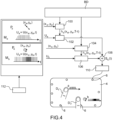
- FIG. 4 a schematic representation of the method of generating signals to actuators of a touch interface according to the invention can be seen.
- control unit simultaneously generates stimulation zones a and b for two fingers D1 and D2.
- first tactile pattern in zone a and a second tactile pattern in zone b.
- several focal points are associated in each stimulation zone.
- the interface may comprise patterns comprising several focal points.
- Each zone has a generation map Pa, Pb of the focal points.
- the focal points are designated PFai, and for zone b, the focal points are designated PFbi, i designating the generation order of the point.
- the focal points will be distributed on a straight line and for zone b, the focal points will be distributed on a spiral. Any other distribution is possible.
- the user is not able to feel the type of distribution of the points, he only feels a tactile stimulation.
- the distribution of the focal points can be variable in the same area over time.
- each focus point is determined by its coordinates in the (x, y) frame designated (xai, yai) and (xbi, ybi).
- Each pattern is defined by an amplitude of surface displacement at each focus point and by a frequency of repetition of the focus points, the frequency and amplitude being able to be constant or variable.
- the pattern in area a is defined by the function Ua(xai, yai, t) and the pattern in area b is defined by the function Ub(xbi, ybi, t).
- the pattern in area a has a constant frequency amplitude variation and the pattern in area b has a constant amplitude at a variable frequency.
- the patterns can be of any type and for example have a variable amplitude at variable frequency. Furthermore, the characteristics of the pattern can be modified depending on other parameters such as the force exerted by the finger on the surface as will be described below.
- the contact of the finger(s) with the surface can be detected, so as to generate stimulation only in the presence of fingers.
- the signal to be sent to each actuator is determined.
- Each impulse response is then convolved to the temporal pattern Ua (step 102).
- a signal corresponding to the sum of the signals calculated for each point is sent to an actuator.
- this set of operations is carried out simultaneously for each actuator of the surface.
- Each actuator emits a pulse response which is specific to it, depending in particular on its position in the surface and the type of actuator.
- a signal amplification step 110 takes place.
- the generation frequencies of the focus points PFai and PFbi vary over time and are different from each other.
- Each zone a and b then comprises a cloud of focal points, the focal points being excited successively.
- the excitation time of each focus point may vary from one focus point to another.
- the focus points are arranged in a line, but they could be arranged in a two-dimensional pattern, for example in a circle.
- the focus points are generated on a line with an evolving amplitude.
- the focus points could be arranged in a two-dimensional pattern, for example on a circle.
- temporal modulations are repetitions of the displacement at the same amplitude and constant frequency, which corresponds to an aggressive pattern.
- all the displacements PF i at least two occur at different locations.
- temporal modulations are repetitions of the displacement at increasing, then decreasing amplitude and at constant frequency, which corresponds to a progressive pattern.
- all the displacements PF i at least two occur at different locations.
- temporal modulations are repetitions of the displacement at decreasing amplitude and at the same frequency, which corresponds to an aggressive pattern at the beginning, which gradually softens.
- PFi displacements at least two occur at different locations.
- step 112 it is possible to modulate the characteristics of the movement according to the value of the force applied by the user's finger and the position of the finger (step 112). For example, if a focus is produced each time the exerted force crosses a threshold, the illusion of pressing on a surface having a certain stiffness is produced. It is this method which allows the restitution of a sensation of stiffness. A high pressing force allows focusing on a larger surface.
- the interface advantageously includes means for determining the force applied by the user to the surface.
- a force sensor integrated into the plate support can be used, which makes it possible to measure the total force applied to the surface.
- a matrix of piezoresistive sensors for example, could be used.
- the interface may further comprise one or more sensors.
- it may be a temperature sensor of the environment in which the interface is located.
- the temperature can modify the speed of propagation of the waves in the surface. This temperature information can therefore be used to correct the signals sent to the actuators to take into account this change in propagation speed.
- the invention can also be used, very advantageously, to guide the movements of the user. For example, a reduction in the amplitude of the discretized focus on a line makes it possible to guide a finger towards this direction. A low amplitude gives the impression of facilitating a finger movement towards the direction with decreasing amplitude, which prompts the user to move his or her finger in that direction.
Landscapes
- Engineering & Computer Science (AREA)
- General Engineering & Computer Science (AREA)
- Theoretical Computer Science (AREA)
- Human Computer Interaction (AREA)
- Physics & Mathematics (AREA)
- General Physics & Mathematics (AREA)
- User Interface Of Digital Computer (AREA)
Claims (15)
- Taktile Schnittstelle zur taktilen Stimulation, die eine Fläche (4), die dazu bestimmt ist, durch mindestens ein Organ eines Benutzers taktil erkundet zu werden, mindestens einen Aktor (6), der dazu bestimmt ist, eine Kraft an die Fläche (4) anzulegen, und Steuermittel für den mindestens einen Aktor umfasst, wobei die Steuermittel dazu bestimmt sind, Signale an den Aktor (6) zu senden, die den in Abhängigkeit von der taktilen Stimulation, die auf der Fläche erzeugt werden soll, an die Fläche anzulegenden Kräften entsprechen, wobei die Kräfte über ein Zeitumkehrverfahren bestimmt werden,
wobei die Schnittstelle zur taktilen Stimulation dadurch gekennzeichnet ist, dass die Steuermittel dazu konfiguriert sind, für mindestens eine taktile Stimulation in einem gegebenen Stimulationsbereich (a, b) der Fläche, wobei der Stimulationsbereich gemäß einem gegebenen taktilen Muster mit dem Organ des Benutzers in Kontakt steht, den mindestens einen Aktor (4) so zu steuern, dass er in dem mindestens einen gegebenen Stimulationsbereich (a, b) der Fläche, der mit dem Organ des Benutzers in Kontakt steht, Impulse durch Fokussierung mindestens einer Schallwelle an einem Punkt erzeugt, dessen Lage auf der Fläche in dem gegebenen Stimulationsbereich mit der Zeit variiert, um das Organ gemäß dem gegebenen taktilen Muster taktil zu stimulieren. - Taktile Schnittstelle zur taktilen Stimulation nach Anspruch 1, wobei der gegebene Stimulationsbereich einer Fläche entspricht, die im Wesentlichen gleich der des Organs des Benutzers ist.
- Taktile Schnittstelle zur taktilen Stimulation nach Anspruch 1 oder 2, wobei die Steuermittel dazu konfiguriert sind, den mindestens einen Aktor so zu steuern, dass er in mehreren verschiedenen gegebenen Stimulationsbereichen Impulse durch Fokussierung von Schallwellen an einem Punkt jedes gegebenen Stimulationsbereichs erzeugt, dessen Lage auf der Fläche in einem gegebenen Stimulationsbereich mit der Zeit variiert, um mehrere Organe gemäß gegebenen taktilen Mustern taktil zu stimulieren.
- Taktile Schnittstelle zur taktilen Stimulation nach Anspruch 1, 2 oder 3, die Mittel zum Detektieren der Anwesenheit des mindestens einen Organs, das dazu bestimmt ist, taktil stimuliert zu werden, umfasst, wobei die Detektionsmittel zum Beispiel kapazitiv sind.
- Taktile Schnittstelle zur taktilen Stimulation nach einem der Ansprüche 1 bis 4, die Mittel zum Detektieren der Kontaktkraft zwischen dem mindestens einen Organ, das dazu bestimmt ist, taktil stimuliert zu werden, und der Fläche umfasst.
- Taktile Schnittstelle zur taktilen Stimulation nach einem der Ansprüche 1 bis 5, die mehrere Aktoren (6) umfasst.
- Taktile Schnittstelle zur taktilen Stimulation nach einem der Ansprüche 1 bis 6, wobei die Fläche von einer Platte getragen wird, wobei sich der oder die Aktor(en) (6) an mindestens einer Kante derselben mit der Platte in Kontakt befinden.
- Taktile Schnittstelle zur taktilen Stimulation nach Anspruch 7, wobei die Platte transparent ist.
- Verfahren zur Steuerung einer taktilen Schnittstelle zur taktilen Stimulation nach einem der Ansprüche 1 bis 8, um mindestens ein Organ gemäß einem gegebenen taktilen Muster in mindestens einem ersten gegebenen Stimulationsbereich der Fläche taktil zu stimulieren, das eine räumliche Modulation mindestens eines Fokuspunkts mindestens einer von dem mindestens einen Aktor erzeugten Schallwelle umfasst.
- Verfahren zur Steuerung einer taktilen Schnittstelle zur taktilen Stimulation nach Anspruch 9, um mindestens ein Organ gemäß einem gegebenen taktilen Muster in mindestens einem ersten gegebenen Stimulationsbereich der Fläche taktil zu stimulieren, das die folgenden Schritte umfasst:a) Bestimmen einer Impulsantwort, die für einen ersten Punkt des gegebenen Stimulationsbereichs zurückgegeben wird,b) Falten der Impulsantwort, die für das gegebene taktile Muster zurückgegeben wird,c) Erzeugen eines Signals auf Basis des Ergebnisses der Faltung und Senden des Signals an den mindestens einen Aktor und Erzeugen von Impulsen an dem ersten Punkt,d) Wiederholen der Schritte a), b) und c) für n weitere Punkte des gegebenen Stimulationsbereichs, wobei n eine ganze Zahl größer oder gleich 1 ist, wobei mindestens ein Punkt der n Punkte von dem ersten Punkt verschieden ist.
- Steuerungsverfahren nach Anspruch 10, wobei die Schritte a), b), c) und d) gleichzeitig für den ersten gegebenen Stimulationsbereich und für einen zweiten gegebenen Stimulationsbereich, der vom ersten gegebenen Stimulationsbereich verschieden ist, ausgeführt werden, und bei Schritt c) das an den Aktor gesendete Signal und die Summe des für den ersten gegebenen Stimulationsbereich erzeugten Signals und des für den zweiten gegebenen Stimulationsbereich erzeugten Signals.
- Steuerungsverfahren nach einem der Ansprüche 9 bis 11, wobei die durch das Organ auf die Fläche ausgeübte Kraft gemessen und bei der Erzeugung des Signals berücksichtigt wird.
- Steuerungsverfahren nach einem der Ansprüche 9 bis 12, wobei das Muster eine variable Amplitude und/oder eine variable Erzeugungsfrequenz der Impulse aufweist.
- Steuerungsverfahren nach einem der Ansprüche 9 bis 13, wobei bei Schritt a) die zurückgegebene Impulsantwort aus einer Datenbank ausgewählt wird.
- Steuerungsverfahren nach einem der Ansprüche 9 bis 14, wobei bei Schritt a) die zurückgegebene Impulsantwort durch Interpolation zwischen mindestens zwei aus einer Datenbank ausgewählten zurückgegebenen Impulsantworten bestimmt wird.
Applications Claiming Priority (2)
| Application Number | Priority Date | Filing Date | Title |
|---|---|---|---|
| FR1753537A FR3065548B1 (fr) | 2017-04-24 | 2017-04-24 | Interface de stimulation tactile par retournement temporel offrant des sensations enrichies |
| PCT/FR2018/051011 WO2018197793A1 (fr) | 2017-04-24 | 2018-04-23 | Interface de stimulation tactile par retournement temporel offrant des sensations enrichies |
Publications (2)
| Publication Number | Publication Date |
|---|---|
| EP3596581A1 EP3596581A1 (de) | 2020-01-22 |
| EP3596581B1 true EP3596581B1 (de) | 2025-03-05 |
Family
ID=59253721
Family Applications (1)
| Application Number | Title | Priority Date | Filing Date |
|---|---|---|---|
| EP18724957.8A Active EP3596581B1 (de) | 2017-04-24 | 2018-04-23 | Schnittstelle zur taktilen stimulation unter verwendung von zeitumkehrung und zur bereitstellung von gesteigerten empfindungen |
Country Status (4)
| Country | Link |
|---|---|
| US (1) | US12026312B2 (de) |
| EP (1) | EP3596581B1 (de) |
| FR (1) | FR3065548B1 (de) |
| WO (1) | WO2018197793A1 (de) |
Citations (1)
| Publication number | Priority date | Publication date | Assignee | Title |
|---|---|---|---|---|
| US20110199342A1 (en) * | 2010-02-16 | 2011-08-18 | Harry Vartanian | Apparatus and method for providing elevated, indented or texturized sensations to an object near a display device or input detection using ultrasound |
Family Cites Families (10)
| Publication number | Priority date | Publication date | Assignee | Title |
|---|---|---|---|---|
| JP2008033739A (ja) * | 2006-07-31 | 2008-02-14 | Sony Corp | 力覚フィードバックおよび圧力測定に基づくタッチスクリーンインターラクション方法および装置 |
| KR101424259B1 (ko) * | 2007-08-22 | 2014-07-31 | 삼성전자주식회사 | 휴대단말에서 입력 피드백 제공 방법 및 장치 |
| AT507455A1 (de) * | 2008-10-30 | 2010-05-15 | Care Tec Gmbh | Verfahren zur eingabe von daten |
| JP5342005B2 (ja) * | 2009-09-17 | 2013-11-13 | 株式会社日立メディコ | 超音波探触子及び超音波撮像装置 |
| US8633916B2 (en) | 2009-12-10 | 2014-01-21 | Apple, Inc. | Touch pad with force sensors and actuator feedback |
| EP2638450A1 (de) * | 2010-11-09 | 2013-09-18 | Koninklijke Philips Electronics N.V. | Benutzerschnittstelle mit haptischem feedback |
| US9448713B2 (en) * | 2011-04-22 | 2016-09-20 | Immersion Corporation | Electro-vibrotactile display |
| WO2012177719A2 (en) * | 2011-06-21 | 2012-12-27 | Northwestern University | Touch interface device and method for applying lateral forces on a human appendage |
| FR2991791B1 (fr) * | 2012-06-06 | 2014-08-08 | Commissariat Energie Atomique | Interface de stimulation tactile par retournement temporel |
| WO2016132144A1 (en) | 2015-02-20 | 2016-08-25 | Ultrahaptics Ip Limited | Perceptions in a haptic system |
-
2017
- 2017-04-24 FR FR1753537A patent/FR3065548B1/fr active Active
-
2018
- 2018-04-23 US US16/607,307 patent/US12026312B2/en active Active
- 2018-04-23 EP EP18724957.8A patent/EP3596581B1/de active Active
- 2018-04-23 WO PCT/FR2018/051011 patent/WO2018197793A1/fr not_active Ceased
Patent Citations (1)
| Publication number | Priority date | Publication date | Assignee | Title |
|---|---|---|---|---|
| US20110199342A1 (en) * | 2010-02-16 | 2011-08-18 | Harry Vartanian | Apparatus and method for providing elevated, indented or texturized sensations to an object near a display device or input detection using ultrasound |
Non-Patent Citations (2)
| Title |
|---|
| INOUE SEKI ET AL: "Producing airborne ultrasonic 3D tactile image by time reversal field rendering", 2014 PROCEEDINGS OF THE SICE ANNUAL CONFERENCE (SICE), SICE, 9 September 2014 (2014-09-09), pages 1360 - 1365, XP032668829, DOI: 10.1109/SICE.2014.6935269 * |
| IWAMOTO T ET AL: "Two-dimensional Scanning Tactile Display using Ultrasound Radiation Pressure", HAPTIC INTERFACES FOR VIRTUAL ENVIRONMENT AND TELEOPERATOR SYSTEMS, 20 06 14TH SYMPOSIUM ON ALEXANDRIA, VA, USA 25-26 MARCH 2006, PISCATAWAY, NJ, USA,IEEE, 25 March 2006 (2006-03-25), pages 57 - 61, XP010913491, ISBN: 978-1-4244-0226-7, DOI: 10.1109/HAPTIC.2006.1627070 * |
Also Published As
| Publication number | Publication date |
|---|---|
| FR3065548A1 (fr) | 2018-10-26 |
| US20200379563A1 (en) | 2020-12-03 |
| WO2018197793A1 (fr) | 2018-11-01 |
| US12026312B2 (en) | 2024-07-02 |
| EP3596581A1 (de) | 2020-01-22 |
| FR3065548B1 (fr) | 2022-02-04 |
Similar Documents
| Publication | Publication Date | Title |
|---|---|---|
| EP2859428B1 (de) | Taktile stimulationsschnittstelle mit zeitumkehr | |
| EP2150882B1 (de) | Verfahren zur ortung einer berührung auf einer oberfläche und vorrichtung zur anwendung dieses verfahrens | |
| Hudin et al. | Localized tactile feedback on a transparent surface through time-reversal wave focusing | |
| EP3729241B1 (de) | Flächige vorrichtung mit verbesserter lokalisierter verformung | |
| EP4006698B1 (de) | Haptische schnittstelle | |
| EP3596582B1 (de) | Zeitumkehrschnittstelle zur erzeugung einer akustischen schmierung | |
| EP4232884B1 (de) | Dreidimensionale berührungsschnittstelle mit haptischer rückmeldung | |
| WO2012069722A2 (fr) | Système de détection et de localisation d'une perturbation d'un milieu, procédé et programme d'ordinateur correspondants | |
| EP3942392B1 (de) | Berührungsschnittstelle mit verbesserter lokalisierter vibrotaktiler rückkopplung | |
| Dhiab et al. | Confinement of vibrotactile stimuli in narrow plates: principle and effect of finger loading | |
| Hudin et al. | Localized tactile stimulation by time-reversal of flexural waves: Case study with a thin sheet of glass | |
| WO2021044085A2 (fr) | Procédé et dispositif pour la réalisation d'un effet de dse-bouton sur une interface haptique | |
| WO2019122762A1 (fr) | Dispositif surfacique offrant une deformation localisee amelioree | |
| EP3596581B1 (de) | Schnittstelle zur taktilen stimulation unter verwendung von zeitumkehrung und zur bereitstellung von gesteigerten empfindungen | |
| FR3115617A1 (fr) | Dispositif tactile à retour haptique avec textures spatialisées | |
| FR3106912A1 (fr) | Dispositif pour la création de sensations haptiques sur une surface à l’aide de vibrations elliptiques ultrasonores | |
| Dhiab | Confinement of vibrations for localized surface haptics | |
| FR3157606A1 (fr) | Interface tactile permettant un entraînement d’un organe externe par vibrations ultrasoniques | |
| Focusing | Localized Tactile Feedback on a Transparent Surface Through Time-Reversal Wave Focusing |
Legal Events
| Date | Code | Title | Description |
|---|---|---|---|
| STAA | Information on the status of an ep patent application or granted ep patent |
Free format text: STATUS: UNKNOWN |
|
| STAA | Information on the status of an ep patent application or granted ep patent |
Free format text: STATUS: THE INTERNATIONAL PUBLICATION HAS BEEN MADE |
|
| PUAI | Public reference made under article 153(3) epc to a published international application that has entered the european phase |
Free format text: ORIGINAL CODE: 0009012 |
|
| STAA | Information on the status of an ep patent application or granted ep patent |
Free format text: STATUS: REQUEST FOR EXAMINATION WAS MADE |
|
| 17P | Request for examination filed |
Effective date: 20191017 |
|
| AK | Designated contracting states |
Kind code of ref document: A1 Designated state(s): AL AT BE BG CH CY CZ DE DK EE ES FI FR GB GR HR HU IE IS IT LI LT LU LV MC MK MT NL NO PL PT RO RS SE SI SK SM TR |
|
| AX | Request for extension of the european patent |
Extension state: BA ME |
|
| DAV | Request for validation of the european patent (deleted) | ||
| DAX | Request for extension of the european patent (deleted) | ||
| STAA | Information on the status of an ep patent application or granted ep patent |
Free format text: STATUS: EXAMINATION IS IN PROGRESS |
|
| 17Q | First examination report despatched |
Effective date: 20210615 |
|
| RAP3 | Party data changed (applicant data changed or rights of an application transferred) |
Owner name: COMMISSARIAT A L'ENERGIE ATOMIQUE ET AUX ENERGIESALTERNATIVES |
|
| GRAP | Despatch of communication of intention to grant a patent |
Free format text: ORIGINAL CODE: EPIDOSNIGR1 |
|
| STAA | Information on the status of an ep patent application or granted ep patent |
Free format text: STATUS: GRANT OF PATENT IS INTENDED |
|
| INTG | Intention to grant announced |
Effective date: 20250102 |
|
| GRAS | Grant fee paid |
Free format text: ORIGINAL CODE: EPIDOSNIGR3 |
|
| GRAA | (expected) grant |
Free format text: ORIGINAL CODE: 0009210 |
|
| STAA | Information on the status of an ep patent application or granted ep patent |
Free format text: STATUS: THE PATENT HAS BEEN GRANTED |
|
| AK | Designated contracting states |
Kind code of ref document: B1 Designated state(s): AL AT BE BG CH CY CZ DE DK EE ES FI FR GB GR HR HU IE IS IT LI LT LU LV MC MK MT NL NO PL PT RO RS SE SI SK SM TR |
|
| REG | Reference to a national code |
Ref country code: GB Ref legal event code: FG4D Free format text: NOT ENGLISH |
|
| REG | Reference to a national code |
Ref country code: CH Ref legal event code: EP |
|
| REG | Reference to a national code |
Ref country code: IE Ref legal event code: FG4D Free format text: LANGUAGE OF EP DOCUMENT: FRENCH |
|
| REG | Reference to a national code |
Ref country code: DE Ref legal event code: R096 Ref document number: 602018079788 Country of ref document: DE |
|
| PG25 | Lapsed in a contracting state [announced via postgrant information from national office to epo] |
Ref country code: RS Free format text: LAPSE BECAUSE OF FAILURE TO SUBMIT A TRANSLATION OF THE DESCRIPTION OR TO PAY THE FEE WITHIN THE PRESCRIBED TIME-LIMIT Effective date: 20250605 |
|
| PG25 | Lapsed in a contracting state [announced via postgrant information from national office to epo] |
Ref country code: FI Free format text: LAPSE BECAUSE OF FAILURE TO SUBMIT A TRANSLATION OF THE DESCRIPTION OR TO PAY THE FEE WITHIN THE PRESCRIBED TIME-LIMIT Effective date: 20250305 |
|
| REG | Reference to a national code |
Ref country code: NL Ref legal event code: MP Effective date: 20250305 |
|
| PG25 | Lapsed in a contracting state [announced via postgrant information from national office to epo] |
Ref country code: ES Free format text: LAPSE BECAUSE OF FAILURE TO SUBMIT A TRANSLATION OF THE DESCRIPTION OR TO PAY THE FEE WITHIN THE PRESCRIBED TIME-LIMIT Effective date: 20250305 |
|
| REG | Reference to a national code |
Ref country code: LT Ref legal event code: MG9D |
|
| PG25 | Lapsed in a contracting state [announced via postgrant information from national office to epo] |
Ref country code: NO Free format text: LAPSE BECAUSE OF FAILURE TO SUBMIT A TRANSLATION OF THE DESCRIPTION OR TO PAY THE FEE WITHIN THE PRESCRIBED TIME-LIMIT Effective date: 20250605 |
|
| PG25 | Lapsed in a contracting state [announced via postgrant information from national office to epo] |
Ref country code: HR Free format text: LAPSE BECAUSE OF FAILURE TO SUBMIT A TRANSLATION OF THE DESCRIPTION OR TO PAY THE FEE WITHIN THE PRESCRIBED TIME-LIMIT Effective date: 20250305 |
|
| PG25 | Lapsed in a contracting state [announced via postgrant information from national office to epo] |
Ref country code: LV Free format text: LAPSE BECAUSE OF FAILURE TO SUBMIT A TRANSLATION OF THE DESCRIPTION OR TO PAY THE FEE WITHIN THE PRESCRIBED TIME-LIMIT Effective date: 20250305 |
|
| PGFP | Annual fee paid to national office [announced via postgrant information from national office to epo] |
Ref country code: FR Payment date: 20250429 Year of fee payment: 8 |
|
| PG25 | Lapsed in a contracting state [announced via postgrant information from national office to epo] |
Ref country code: GR Free format text: LAPSE BECAUSE OF FAILURE TO SUBMIT A TRANSLATION OF THE DESCRIPTION OR TO PAY THE FEE WITHIN THE PRESCRIBED TIME-LIMIT Effective date: 20250606 Ref country code: BG Free format text: LAPSE BECAUSE OF FAILURE TO SUBMIT A TRANSLATION OF THE DESCRIPTION OR TO PAY THE FEE WITHIN THE PRESCRIBED TIME-LIMIT Effective date: 20250305 |
|
| REG | Reference to a national code |
Ref country code: AT Ref legal event code: MK05 Ref document number: 1773497 Country of ref document: AT Kind code of ref document: T Effective date: 20250305 |
|
| PG25 | Lapsed in a contracting state [announced via postgrant information from national office to epo] |
Ref country code: NL Free format text: LAPSE BECAUSE OF FAILURE TO SUBMIT A TRANSLATION OF THE DESCRIPTION OR TO PAY THE FEE WITHIN THE PRESCRIBED TIME-LIMIT Effective date: 20250305 |
|
| PG25 | Lapsed in a contracting state [announced via postgrant information from national office to epo] |
Ref country code: SE Free format text: LAPSE BECAUSE OF FAILURE TO SUBMIT A TRANSLATION OF THE DESCRIPTION OR TO PAY THE FEE WITHIN THE PRESCRIBED TIME-LIMIT Effective date: 20250305 |
|
| PG25 | Lapsed in a contracting state [announced via postgrant information from national office to epo] |
Ref country code: SM Free format text: LAPSE BECAUSE OF FAILURE TO SUBMIT A TRANSLATION OF THE DESCRIPTION OR TO PAY THE FEE WITHIN THE PRESCRIBED TIME-LIMIT Effective date: 20250305 |
|
| PG25 | Lapsed in a contracting state [announced via postgrant information from national office to epo] |
Ref country code: PT Free format text: LAPSE BECAUSE OF FAILURE TO SUBMIT A TRANSLATION OF THE DESCRIPTION OR TO PAY THE FEE WITHIN THE PRESCRIBED TIME-LIMIT Effective date: 20250707 |
|
| PG25 | Lapsed in a contracting state [announced via postgrant information from national office to epo] |
Ref country code: PL Free format text: LAPSE BECAUSE OF FAILURE TO SUBMIT A TRANSLATION OF THE DESCRIPTION OR TO PAY THE FEE WITHIN THE PRESCRIBED TIME-LIMIT Effective date: 20250305 Ref country code: IT Free format text: LAPSE BECAUSE OF FAILURE TO SUBMIT A TRANSLATION OF THE DESCRIPTION OR TO PAY THE FEE WITHIN THE PRESCRIBED TIME-LIMIT Effective date: 20250305 |
|
| PG25 | Lapsed in a contracting state [announced via postgrant information from national office to epo] |
Ref country code: AT Free format text: LAPSE BECAUSE OF FAILURE TO SUBMIT A TRANSLATION OF THE DESCRIPTION OR TO PAY THE FEE WITHIN THE PRESCRIBED TIME-LIMIT Effective date: 20250305 |
|
| PG25 | Lapsed in a contracting state [announced via postgrant information from national office to epo] |
Ref country code: EE Free format text: LAPSE BECAUSE OF FAILURE TO SUBMIT A TRANSLATION OF THE DESCRIPTION OR TO PAY THE FEE WITHIN THE PRESCRIBED TIME-LIMIT Effective date: 20250305 Ref country code: CZ Free format text: LAPSE BECAUSE OF FAILURE TO SUBMIT A TRANSLATION OF THE DESCRIPTION OR TO PAY THE FEE WITHIN THE PRESCRIBED TIME-LIMIT Effective date: 20250305 |
|
| PG25 | Lapsed in a contracting state [announced via postgrant information from national office to epo] |
Ref country code: RO Free format text: LAPSE BECAUSE OF FAILURE TO SUBMIT A TRANSLATION OF THE DESCRIPTION OR TO PAY THE FEE WITHIN THE PRESCRIBED TIME-LIMIT Effective date: 20250305 |
|
| PG25 | Lapsed in a contracting state [announced via postgrant information from national office to epo] |
Ref country code: SK Free format text: LAPSE BECAUSE OF FAILURE TO SUBMIT A TRANSLATION OF THE DESCRIPTION OR TO PAY THE FEE WITHIN THE PRESCRIBED TIME-LIMIT Effective date: 20250305 |
|
| PG25 | Lapsed in a contracting state [announced via postgrant information from national office to epo] |
Ref country code: IS Free format text: LAPSE BECAUSE OF FAILURE TO SUBMIT A TRANSLATION OF THE DESCRIPTION OR TO PAY THE FEE WITHIN THE PRESCRIBED TIME-LIMIT Effective date: 20250705 |
|
| REG | Reference to a national code |
Ref country code: DE Ref legal event code: R119 Ref document number: 602018079788 Country of ref document: DE |
|
| REG | Reference to a national code |
Ref country code: CH Ref legal event code: H13 Free format text: ST27 STATUS EVENT CODE: U-0-0-H10-H13 (AS PROVIDED BY THE NATIONAL OFFICE) Effective date: 20251125 |
|
| PG25 | Lapsed in a contracting state [announced via postgrant information from national office to epo] |
Ref country code: LU Free format text: LAPSE BECAUSE OF NON-PAYMENT OF DUE FEES Effective date: 20250423 |
|
| PG25 | Lapsed in a contracting state [announced via postgrant information from national office to epo] |
Ref country code: MC Free format text: LAPSE BECAUSE OF FAILURE TO SUBMIT A TRANSLATION OF THE DESCRIPTION OR TO PAY THE FEE WITHIN THE PRESCRIBED TIME-LIMIT Effective date: 20250305 |
|
| REG | Reference to a national code |
Ref country code: BE Ref legal event code: MM Effective date: 20250430 |
|
| PG25 | Lapsed in a contracting state [announced via postgrant information from national office to epo] |
Ref country code: DE Free format text: LAPSE BECAUSE OF NON-PAYMENT OF DUE FEES Effective date: 20251104 |
|
| PLBE | No opposition filed within time limit |
Free format text: ORIGINAL CODE: 0009261 |
|
| STAA | Information on the status of an ep patent application or granted ep patent |
Free format text: STATUS: NO OPPOSITION FILED WITHIN TIME LIMIT |
|
| PG25 | Lapsed in a contracting state [announced via postgrant information from national office to epo] |
Ref country code: DK Free format text: LAPSE BECAUSE OF FAILURE TO SUBMIT A TRANSLATION OF THE DESCRIPTION OR TO PAY THE FEE WITHIN THE PRESCRIBED TIME-LIMIT Effective date: 20250305 |
|
| REG | Reference to a national code |
Ref country code: CH Ref legal event code: L10 Free format text: ST27 STATUS EVENT CODE: U-0-0-L10-L00 (AS PROVIDED BY THE NATIONAL OFFICE) Effective date: 20260114 |
|
| PG25 | Lapsed in a contracting state [announced via postgrant information from national office to epo] |
Ref country code: BE Free format text: LAPSE BECAUSE OF NON-PAYMENT OF DUE FEES Effective date: 20250430 |
|
| PG25 | Lapsed in a contracting state [announced via postgrant information from national office to epo] |
Ref country code: CH Free format text: LAPSE BECAUSE OF NON-PAYMENT OF DUE FEES Effective date: 20250430 |
|
| 26N | No opposition filed |
Effective date: 20251208 |
|
| GBPC | Gb: european patent ceased through non-payment of renewal fee |
Effective date: 20250605 |
|
| PG25 | Lapsed in a contracting state [announced via postgrant information from national office to epo] |
Ref country code: GB Free format text: LAPSE BECAUSE OF NON-PAYMENT OF DUE FEES Effective date: 20250605 |
|
| PG25 | Lapsed in a contracting state [announced via postgrant information from national office to epo] |
Ref country code: IE Free format text: LAPSE BECAUSE OF NON-PAYMENT OF DUE FEES Effective date: 20250423 |